EP2814108A1 - Photoelectric conversion element, method for manufacturing photoelectric conversion element, and dye-sensitized solar cell using photoelectric conversion element - Google Patents
Photoelectric conversion element, method for manufacturing photoelectric conversion element, and dye-sensitized solar cell using photoelectric conversion element Download PDFInfo
- Publication number
- EP2814108A1 EP2814108A1 EP13746872.4A EP13746872A EP2814108A1 EP 2814108 A1 EP2814108 A1 EP 2814108A1 EP 13746872 A EP13746872 A EP 13746872A EP 2814108 A1 EP2814108 A1 EP 2814108A1
- Authority
- EP
- European Patent Office
- Prior art keywords
- group
- formula
- dye
- integer
- photoelectric conversion
- Prior art date
- Legal status (The legal status is an assumption and is not a legal conclusion. Google has not performed a legal analysis and makes no representation as to the accuracy of the status listed.)
- Withdrawn
Links
- 238000006243 chemical reaction Methods 0.000 title claims abstract description 81
- 238000000034 method Methods 0.000 title claims abstract description 33
- 238000004519 manufacturing process Methods 0.000 title description 8
- 239000004065 semiconductor Substances 0.000 claims abstract description 65
- 239000010419 fine particle Substances 0.000 claims abstract description 45
- 230000001235 sensitizing effect Effects 0.000 claims abstract description 41
- 239000007788 liquid Substances 0.000 claims abstract description 23
- 239000002904 solvent Substances 0.000 claims abstract description 20
- 239000003446 ligand Substances 0.000 claims description 74
- 125000001424 substituent group Chemical group 0.000 claims description 60
- 125000003118 aryl group Chemical group 0.000 claims description 34
- 230000002378 acidificating effect Effects 0.000 claims description 33
- 125000004432 carbon atom Chemical group C* 0.000 claims description 29
- 125000000217 alkyl group Chemical group 0.000 claims description 28
- 239000003792 electrolyte Substances 0.000 claims description 24
- 125000004429 atom Chemical group 0.000 claims description 21
- 238000001035 drying Methods 0.000 claims description 19
- 229910052751 metal Inorganic materials 0.000 claims description 19
- 239000002184 metal Substances 0.000 claims description 19
- XLYOFNOQVPJJNP-UHFFFAOYSA-N water Substances O XLYOFNOQVPJJNP-UHFFFAOYSA-N 0.000 claims description 19
- 239000000758 substrate Substances 0.000 claims description 10
- 238000001179 sorption measurement Methods 0.000 claims description 9
- 150000004700 cobalt complex Chemical class 0.000 claims description 8
- 239000003960 organic solvent Substances 0.000 claims description 7
- 238000005259 measurement Methods 0.000 claims description 6
- 229910052697 platinum Inorganic materials 0.000 claims description 6
- QJGQUHMNIGDVPM-UHFFFAOYSA-N nitrogen group Chemical group [N] QJGQUHMNIGDVPM-UHFFFAOYSA-N 0.000 claims description 5
- 150000004696 coordination complex Chemical class 0.000 claims description 4
- 125000004122 cyclic group Chemical group 0.000 claims description 4
- 238000010438 heat treatment Methods 0.000 claims description 4
- 229910052707 ruthenium Inorganic materials 0.000 claims description 4
- 229910052721 tungsten Inorganic materials 0.000 claims description 4
- DNIAPMSPPWPWGF-GSVOUGTGSA-N (R)-(-)-Propylene glycol Chemical compound C[C@@H](O)CO DNIAPMSPPWPWGF-GSVOUGTGSA-N 0.000 claims description 3
- 150000008431 aliphatic amides Chemical class 0.000 claims description 3
- 229910052804 chromium Inorganic materials 0.000 claims description 3
- 229910052741 iridium Inorganic materials 0.000 claims description 3
- 229910052742 iron Inorganic materials 0.000 claims description 3
- 229910052748 manganese Inorganic materials 0.000 claims description 3
- 229910052750 molybdenum Inorganic materials 0.000 claims description 3
- 229910052759 nickel Inorganic materials 0.000 claims description 3
- 229910052763 palladium Inorganic materials 0.000 claims description 3
- 229910052702 rhenium Inorganic materials 0.000 claims description 3
- 229910052703 rhodium Inorganic materials 0.000 claims description 3
- 239000002265 redox agent Substances 0.000 claims description 2
- 239000000975 dye Substances 0.000 description 104
- -1 cation radicals Chemical class 0.000 description 55
- 239000010410 layer Substances 0.000 description 47
- GWEVSGVZZGPLCZ-UHFFFAOYSA-N Titan oxide Chemical compound O=[Ti]=O GWEVSGVZZGPLCZ-UHFFFAOYSA-N 0.000 description 46
- 150000002500 ions Chemical class 0.000 description 29
- 239000002245 particle Substances 0.000 description 29
- 125000000623 heterocyclic group Chemical group 0.000 description 22
- 150000001875 compounds Chemical class 0.000 description 18
- 125000003545 alkoxy group Chemical group 0.000 description 14
- 230000000694 effects Effects 0.000 description 14
- 125000003342 alkenyl group Chemical group 0.000 description 11
- 125000005843 halogen group Chemical group 0.000 description 11
- 239000003463 adsorbent Substances 0.000 description 10
- 150000001768 cations Chemical class 0.000 description 10
- 239000010408 film Substances 0.000 description 10
- 230000006872 improvement Effects 0.000 description 10
- 238000012360 testing method Methods 0.000 description 10
- UMGDCJDMYOKAJW-UHFFFAOYSA-N thiourea Chemical compound NC(N)=S UMGDCJDMYOKAJW-UHFFFAOYSA-N 0.000 description 10
- JUJWROOIHBZHMG-UHFFFAOYSA-N Pyridine Chemical group C1=CC=NC=C1 JUJWROOIHBZHMG-UHFFFAOYSA-N 0.000 description 9
- 125000003277 amino group Chemical group 0.000 description 9
- 125000004104 aryloxy group Chemical group 0.000 description 9
- 239000000463 material Substances 0.000 description 9
- 239000000203 mixture Substances 0.000 description 9
- BASFCYQUMIYNBI-UHFFFAOYSA-N platinum Substances [Pt] BASFCYQUMIYNBI-UHFFFAOYSA-N 0.000 description 9
- 125000004093 cyano group Chemical group *C#N 0.000 description 8
- 238000011156 evaluation Methods 0.000 description 8
- 239000011521 glass Substances 0.000 description 8
- ZCYVEMRRCGMTRW-UHFFFAOYSA-N 7553-56-2 Chemical compound [I] ZCYVEMRRCGMTRW-UHFFFAOYSA-N 0.000 description 7
- 125000004442 acylamino group Chemical group 0.000 description 7
- 125000004423 acyloxy group Chemical group 0.000 description 7
- 125000004453 alkoxycarbonyl group Chemical group 0.000 description 7
- 239000011630 iodine Substances 0.000 description 7
- 229910052740 iodine Inorganic materials 0.000 description 7
- ZMZDMBWJUHKJPS-UHFFFAOYSA-M thiocyanate group Chemical group [S-]C#N ZMZDMBWJUHKJPS-UHFFFAOYSA-M 0.000 description 7
- XOLBLPGZBRYERU-UHFFFAOYSA-N tin dioxide Chemical compound O=[Sn]=O XOLBLPGZBRYERU-UHFFFAOYSA-N 0.000 description 7
- 125000005110 aryl thio group Chemical group 0.000 description 6
- DKVNPHBNOWQYFE-UHFFFAOYSA-N carbamodithioic acid Chemical group NC(S)=S DKVNPHBNOWQYFE-UHFFFAOYSA-N 0.000 description 6
- 125000000753 cycloalkyl group Chemical group 0.000 description 6
- 125000005678 ethenylene group Chemical group [H]C([*:1])=C([H])[*:2] 0.000 description 6
- 125000004435 hydrogen atom Chemical group [H]* 0.000 description 6
- ZBKFYXZXZJPWNQ-UHFFFAOYSA-N isothiocyanate group Chemical group [N-]=C=S ZBKFYXZXZJPWNQ-UHFFFAOYSA-N 0.000 description 6
- 150000003839 salts Chemical class 0.000 description 6
- LFQSCWFLJHTTHZ-UHFFFAOYSA-N Ethanol Chemical compound CCO LFQSCWFLJHTTHZ-UHFFFAOYSA-N 0.000 description 5
- XSQUKJJJFZCRTK-UHFFFAOYSA-N Urea Natural products NC(N)=O XSQUKJJJFZCRTK-UHFFFAOYSA-N 0.000 description 5
- 125000004414 alkyl thio group Chemical group 0.000 description 5
- 125000000304 alkynyl group Chemical group 0.000 description 5
- XLJMAIOERFSOGZ-UHFFFAOYSA-M cyanate group Chemical group [O-]C#N XLJMAIOERFSOGZ-UHFFFAOYSA-M 0.000 description 5
- 230000006870 function Effects 0.000 description 5
- 125000005842 heteroatom Chemical group 0.000 description 5
- IQPQWNKOIGAROB-UHFFFAOYSA-N isocyanate group Chemical group [N-]=C=O IQPQWNKOIGAROB-UHFFFAOYSA-N 0.000 description 5
- 125000005647 linker group Chemical group 0.000 description 5
- 239000000434 metal complex dye Substances 0.000 description 5
- 238000006467 substitution reaction Methods 0.000 description 5
- RUDATBOHQWOJDD-UHFFFAOYSA-N (3beta,5beta,7alpha)-3,7-Dihydroxycholan-24-oic acid Natural products OC1CC2CC(O)CCC2(C)C2C1C1CCC(C(CCC(O)=O)C)C1(C)CC2 RUDATBOHQWOJDD-UHFFFAOYSA-N 0.000 description 4
- 0 C*CC(C=C*1)=CC1=C(*1)C=C(*)C=C1C1=C*C=C*1 Chemical compound C*CC(C=C*1)=CC1=C(*1)C=C(*)C=C1C1=C*C=C*1 0.000 description 4
- YLQBMQCUIZJEEH-UHFFFAOYSA-N Furan Chemical compound C=1C=COC=1 YLQBMQCUIZJEEH-UHFFFAOYSA-N 0.000 description 4
- KAESVJOAVNADME-UHFFFAOYSA-N Pyrrole Chemical compound C=1C=CNC=1 KAESVJOAVNADME-UHFFFAOYSA-N 0.000 description 4
- YTPLMLYBLZKORZ-UHFFFAOYSA-N Thiophene Chemical compound C=1C=CSC=1 YTPLMLYBLZKORZ-UHFFFAOYSA-N 0.000 description 4
- 238000000149 argon plasma sintering Methods 0.000 description 4
- 125000002915 carbonyl group Chemical group [*:2]C([*:1])=O 0.000 description 4
- 125000003178 carboxy group Chemical group [H]OC(*)=O 0.000 description 4
- KXGVEGMKQFWNSR-UHFFFAOYSA-N deoxycholic acid Natural products C1CC2CC(O)CCC2(C)C2C1C1CCC(C(CCC(O)=O)C)C1(C)C(O)C2 KXGVEGMKQFWNSR-UHFFFAOYSA-N 0.000 description 4
- IPCSVZSSVZVIGE-UHFFFAOYSA-N hexadecanoic acid Chemical compound CCCCCCCCCCCCCCCC(O)=O IPCSVZSSVZVIGE-UHFFFAOYSA-N 0.000 description 4
- HSZCZNFXUDYRKD-UHFFFAOYSA-M lithium iodide Chemical compound [Li+].[I-] HSZCZNFXUDYRKD-UHFFFAOYSA-M 0.000 description 4
- 125000001997 phenyl group Chemical group [H]C1=C([H])C([H])=C(*)C([H])=C1[H] 0.000 description 4
- 239000004033 plastic Substances 0.000 description 4
- 229920003023 plastic Polymers 0.000 description 4
- 239000002002 slurry Substances 0.000 description 4
- 150000003431 steroids Chemical group 0.000 description 4
- 239000011701 zinc Substances 0.000 description 4
- BGPJLYIFDLICMR-UHFFFAOYSA-N 1,4,2,3-dioxadithiolan-5-one Chemical group O=C1OSSO1 BGPJLYIFDLICMR-UHFFFAOYSA-N 0.000 description 3
- WWZKQHOCKIZLMA-UHFFFAOYSA-N Caprylic acid Natural products CCCCCCCC(O)=O WWZKQHOCKIZLMA-UHFFFAOYSA-N 0.000 description 3
- KFZMGEQAYNKOFK-UHFFFAOYSA-N Isopropanol Chemical compound CC(C)O KFZMGEQAYNKOFK-UHFFFAOYSA-N 0.000 description 3
- OKKJLVBELUTLKV-UHFFFAOYSA-N Methanol Chemical compound OC OKKJLVBELUTLKV-UHFFFAOYSA-N 0.000 description 3
- ZMXDDKWLCZADIW-UHFFFAOYSA-N N,N-Dimethylformamide Chemical compound CN(C)C=O ZMXDDKWLCZADIW-UHFFFAOYSA-N 0.000 description 3
- 206010070834 Sensitisation Diseases 0.000 description 3
- FZWLAAWBMGSTSO-UHFFFAOYSA-N Thiazole Chemical group C1=CSC=N1 FZWLAAWBMGSTSO-UHFFFAOYSA-N 0.000 description 3
- 125000002252 acyl group Chemical group 0.000 description 3
- 125000002947 alkylene group Chemical group 0.000 description 3
- 150000001450 anions Chemical class 0.000 description 3
- 230000015572 biosynthetic process Effects 0.000 description 3
- 125000003917 carbamoyl group Chemical group [H]N([H])C(*)=O 0.000 description 3
- 239000011203 carbon fibre reinforced carbon Substances 0.000 description 3
- RUDATBOHQWOJDD-BSWAIDMHSA-N chenodeoxycholic acid Chemical compound C([C@H]1C[C@H]2O)[C@H](O)CC[C@]1(C)[C@@H]1[C@@H]2[C@@H]2CC[C@H]([C@@H](CCC(O)=O)C)[C@@]2(C)CC1 RUDATBOHQWOJDD-BSWAIDMHSA-N 0.000 description 3
- 229960001091 chenodeoxycholic acid Drugs 0.000 description 3
- 238000010494 dissociation reaction Methods 0.000 description 3
- 230000005593 dissociations Effects 0.000 description 3
- 125000005677 ethinylene group Chemical group [*:2]C#C[*:1] 0.000 description 3
- 125000001072 heteroaryl group Chemical group 0.000 description 3
- 125000002887 hydroxy group Chemical group [H]O* 0.000 description 3
- RAXXELZNTBOGNW-UHFFFAOYSA-N imidazole Natural products C1=CNC=N1 RAXXELZNTBOGNW-UHFFFAOYSA-N 0.000 description 3
- 125000002883 imidazolyl group Chemical group 0.000 description 3
- 150000002496 iodine Chemical class 0.000 description 3
- 125000002496 methyl group Chemical group [H]C([H])([H])* 0.000 description 3
- 125000001624 naphthyl group Chemical group 0.000 description 3
- 229910052757 nitrogen Inorganic materials 0.000 description 3
- 125000004433 nitrogen atom Chemical group N* 0.000 description 3
- 125000004430 oxygen atom Chemical group O* 0.000 description 3
- 239000002243 precursor Substances 0.000 description 3
- 238000002360 preparation method Methods 0.000 description 3
- PBMFSQRYOILNGV-UHFFFAOYSA-N pyridazine Chemical group C1=CC=NN=C1 PBMFSQRYOILNGV-UHFFFAOYSA-N 0.000 description 3
- 230000008313 sensitization Effects 0.000 description 3
- 125000000565 sulfonamide group Chemical group 0.000 description 3
- 229910052717 sulfur Inorganic materials 0.000 description 3
- 125000004434 sulfur atom Chemical group 0.000 description 3
- 125000001425 triazolyl group Chemical group 0.000 description 3
- HIZCIEIDIFGZSS-UHFFFAOYSA-L trithiocarbonate Chemical group [S-]C([S-])=S HIZCIEIDIFGZSS-UHFFFAOYSA-L 0.000 description 3
- 125000000391 vinyl group Chemical group [H]C([*])=C([H])[H] 0.000 description 3
- BHQCQFFYRZLCQQ-UHFFFAOYSA-N (3alpha,5alpha,7alpha,12alpha)-3,7,12-trihydroxy-cholan-24-oic acid Natural products OC1CC2CC(O)CCC2(C)C2C1C1CCC(C(CCC(O)=O)C)C1(C)C(O)C2 BHQCQFFYRZLCQQ-UHFFFAOYSA-N 0.000 description 2
- 125000000339 4-pyridyl group Chemical group N1=C([H])C([H])=C([*])C([H])=C1[H] 0.000 description 2
- CPELXLSAUQHCOX-UHFFFAOYSA-M Bromide Chemical compound [Br-] CPELXLSAUQHCOX-UHFFFAOYSA-M 0.000 description 2
- FERIUCNNQQJTOY-UHFFFAOYSA-N Butyric acid Chemical compound CCCC(O)=O FERIUCNNQQJTOY-UHFFFAOYSA-N 0.000 description 2
- 239000004380 Cholic acid Substances 0.000 description 2
- QIGBRXMKCJKVMJ-UHFFFAOYSA-N Hydroquinone Chemical compound OC1=CC=C(O)C=C1 QIGBRXMKCJKVMJ-UHFFFAOYSA-N 0.000 description 2
- GRYLNZFGIOXLOG-UHFFFAOYSA-N Nitric acid Chemical compound O[N+]([O-])=O GRYLNZFGIOXLOG-UHFFFAOYSA-N 0.000 description 2
- 235000021314 Palmitic acid Nutrition 0.000 description 2
- KYQCOXFCLRTKLS-UHFFFAOYSA-N Pyrazine Chemical compound C1=CN=CC=N1 KYQCOXFCLRTKLS-UHFFFAOYSA-N 0.000 description 2
- DKGAVHZHDRPRBM-UHFFFAOYSA-N Tert-Butanol Chemical compound CC(C)(C)O DKGAVHZHDRPRBM-UHFFFAOYSA-N 0.000 description 2
- XLOMVQKBTHCTTD-UHFFFAOYSA-N Zinc monoxide Chemical compound [Zn]=O XLOMVQKBTHCTTD-UHFFFAOYSA-N 0.000 description 2
- 230000009471 action Effects 0.000 description 2
- 125000005035 acylthio group Chemical group 0.000 description 2
- 229910001413 alkali metal ion Inorganic materials 0.000 description 2
- 150000001412 amines Chemical class 0.000 description 2
- 125000004397 aminosulfonyl group Chemical group NS(=O)(=O)* 0.000 description 2
- 125000005605 benzo group Chemical group 0.000 description 2
- 125000001797 benzyl group Chemical group [H]C1=C([H])C([H])=C(C([H])=C1[H])C([H])([H])* 0.000 description 2
- 239000011230 binding agent Substances 0.000 description 2
- GNVMUORYQLCPJZ-UHFFFAOYSA-N carbamothioic s-acid Chemical group NC(S)=O GNVMUORYQLCPJZ-UHFFFAOYSA-N 0.000 description 2
- 150000001721 carbon Chemical group 0.000 description 2
- 229910052799 carbon Inorganic materials 0.000 description 2
- 125000005521 carbonamide group Chemical group 0.000 description 2
- 239000001913 cellulose Substances 0.000 description 2
- 229920002678 cellulose Polymers 0.000 description 2
- 150000004770 chalcogenides Chemical class 0.000 description 2
- BHQCQFFYRZLCQQ-OELDTZBJSA-N cholic acid Chemical compound C([C@H]1C[C@H]2O)[C@H](O)CC[C@]1(C)[C@@H]1[C@@H]2[C@@H]2CC[C@H]([C@@H](CCC(O)=O)C)[C@@]2(C)[C@@H](O)C1 BHQCQFFYRZLCQQ-OELDTZBJSA-N 0.000 description 2
- 229960002471 cholic acid Drugs 0.000 description 2
- 235000019416 cholic acid Nutrition 0.000 description 2
- 239000011248 coating agent Substances 0.000 description 2
- 238000000576 coating method Methods 0.000 description 2
- 230000000052 comparative effect Effects 0.000 description 2
- 125000000113 cyclohexyl group Chemical group [H]C1([H])C([H])([H])C([H])([H])C([H])(*)C([H])([H])C1([H])[H] 0.000 description 2
- 230000003247 decreasing effect Effects 0.000 description 2
- KXGVEGMKQFWNSR-LLQZFEROSA-N deoxycholic acid Chemical compound C([C@H]1CC2)[C@H](O)CC[C@]1(C)[C@@H]1[C@@H]2[C@@H]2CC[C@H]([C@@H](CCC(O)=O)C)[C@@]2(C)[C@@H](O)C1 KXGVEGMKQFWNSR-LLQZFEROSA-N 0.000 description 2
- 229960003964 deoxycholic acid Drugs 0.000 description 2
- 235000014113 dietary fatty acids Nutrition 0.000 description 2
- 238000009792 diffusion process Methods 0.000 description 2
- POULHZVOKOAJMA-UHFFFAOYSA-N dodecanoic acid Chemical compound CCCCCCCCCCCC(O)=O POULHZVOKOAJMA-UHFFFAOYSA-N 0.000 description 2
- 125000001495 ethyl group Chemical group [H]C([H])([H])C([H])([H])* 0.000 description 2
- 230000001747 exhibiting effect Effects 0.000 description 2
- 239000000194 fatty acid Substances 0.000 description 2
- 229930195729 fatty acid Natural products 0.000 description 2
- 150000004665 fatty acids Chemical class 0.000 description 2
- XMBWDFGMSWQBCA-UHFFFAOYSA-N hydrogen iodide Chemical compound I XMBWDFGMSWQBCA-UHFFFAOYSA-N 0.000 description 2
- 229910010272 inorganic material Inorganic materials 0.000 description 2
- 239000011147 inorganic material Substances 0.000 description 2
- XEEYBQQBJWHFJM-UHFFFAOYSA-N iron Substances [Fe] XEEYBQQBJWHFJM-UHFFFAOYSA-N 0.000 description 2
- 150000004698 iron complex Chemical class 0.000 description 2
- 229910044991 metal oxide Inorganic materials 0.000 description 2
- 150000004706 metal oxides Chemical class 0.000 description 2
- 150000002739 metals Chemical class 0.000 description 2
- 229910017604 nitric acid Inorganic materials 0.000 description 2
- 125000002971 oxazolyl group Chemical group 0.000 description 2
- 239000007800 oxidant agent Substances 0.000 description 2
- 230000001590 oxidative effect Effects 0.000 description 2
- 125000004437 phosphorous atom Chemical group 0.000 description 2
- 229910052698 phosphorus Inorganic materials 0.000 description 2
- 229920000642 polymer Polymers 0.000 description 2
- 230000008569 process Effects 0.000 description 2
- 125000003373 pyrazinyl group Chemical group 0.000 description 2
- 125000000714 pyrimidinyl group Chemical group 0.000 description 2
- 229910052705 radium Inorganic materials 0.000 description 2
- 230000009467 reduction Effects 0.000 description 2
- 238000007650 screen-printing Methods 0.000 description 2
- 239000007787 solid Substances 0.000 description 2
- 125000006850 spacer group Chemical group 0.000 description 2
- 239000012798 spherical particle Substances 0.000 description 2
- 238000003756 stirring Methods 0.000 description 2
- 125000000999 tert-butyl group Chemical group [H]C([H])([H])C(*)(C([H])([H])[H])C([H])([H])[H] 0.000 description 2
- 239000002562 thickening agent Substances 0.000 description 2
- 125000001544 thienyl group Chemical group 0.000 description 2
- 229930192474 thiophene Natural products 0.000 description 2
- 238000012546 transfer Methods 0.000 description 2
- 229910052724 xenon Inorganic materials 0.000 description 2
- FHNFHKCVQCLJFQ-UHFFFAOYSA-N xenon atom Chemical compound [Xe] FHNFHKCVQCLJFQ-UHFFFAOYSA-N 0.000 description 2
- 229910052725 zinc Inorganic materials 0.000 description 2
- DKPMWHFRUGMUKF-UHFFFAOYSA-N (3alpha,5alpha,6alpha,7alpha)-3,6,7-Trihydroxycholan-24-oic acid Natural products OC1C(O)C2CC(O)CCC2(C)C2C1C1CCC(C(CCC(O)=O)C)C1(C)CC2 DKPMWHFRUGMUKF-UHFFFAOYSA-N 0.000 description 1
- OYHQOLUKZRVURQ-NTGFUMLPSA-N (9Z,12Z)-9,10,12,13-tetratritiooctadeca-9,12-dienoic acid Chemical compound C(CCCCCCC\C(=C(/C\C(=C(/CCCCC)\[3H])\[3H])\[3H])\[3H])(=O)O OYHQOLUKZRVURQ-NTGFUMLPSA-N 0.000 description 1
- WRIDQFICGBMAFQ-UHFFFAOYSA-N (E)-8-Octadecenoic acid Natural products CCCCCCCCCC=CCCCCCCC(O)=O WRIDQFICGBMAFQ-UHFFFAOYSA-N 0.000 description 1
- JYEUMXHLPRZUAT-UHFFFAOYSA-N 1,2,3-triazine Chemical compound C1=CN=NN=C1 JYEUMXHLPRZUAT-UHFFFAOYSA-N 0.000 description 1
- CYSGHNMQYZDMIA-UHFFFAOYSA-N 1,3-Dimethyl-2-imidazolidinon Chemical compound CN1CCN(C)C1=O CYSGHNMQYZDMIA-UHFFFAOYSA-N 0.000 description 1
- JOYGXTIHTHBSOA-UHFFFAOYSA-N 1-(4-chlorophenyl)-3-thiophen-2-ylprop-2-en-1-one Chemical compound C1=CC(Cl)=CC=C1C(=O)C=CC1=CC=CS1 JOYGXTIHTHBSOA-UHFFFAOYSA-N 0.000 description 1
- GYSCBCSGKXNZRH-UHFFFAOYSA-N 1-benzothiophene-2-carboxamide Chemical compound C1=CC=C2SC(C(=O)N)=CC2=C1 GYSCBCSGKXNZRH-UHFFFAOYSA-N 0.000 description 1
- 125000006219 1-ethylpentyl group Chemical group [H]C([H])([H])C([H])([H])C([H])([H])C([H])([H])C([H])(*)C([H])([H])C([H])([H])[H] 0.000 description 1
- IOWQHNLDXBGENT-UHFFFAOYSA-N 1-hexyl-4-(1-hexylpyridin-1-ium-4-yl)pyridin-1-ium Chemical compound C1=C[N+](CCCCCC)=CC=C1C1=CC=[N+](CCCCCC)C=C1 IOWQHNLDXBGENT-UHFFFAOYSA-N 0.000 description 1
- 125000001637 1-naphthyl group Chemical group [H]C1=C([H])C([H])=C2C(*)=C([H])C([H])=C([H])C2=C1[H] 0.000 description 1
- 125000004174 2-benzimidazolyl group Chemical group [H]N1C(*)=NC2=C([H])C([H])=C([H])C([H])=C12 0.000 description 1
- 125000004182 2-chlorophenyl group Chemical group [H]C1=C([H])C(Cl)=C(*)C([H])=C1[H] 0.000 description 1
- 125000003903 2-propenyl group Chemical group [H]C([*])([H])C([H])=C([H])[H] 0.000 description 1
- 125000004105 2-pyridyl group Chemical group N1=C([*])C([H])=C([H])C([H])=C1[H] 0.000 description 1
- 125000000389 2-pyrrolyl group Chemical group [H]N1C([*])=C([H])C([H])=C1[H] 0.000 description 1
- 125000000175 2-thienyl group Chemical group S1C([*])=C([H])C([H])=C1[H] 0.000 description 1
- LQJBNNIYVWPHFW-UHFFFAOYSA-N 20:1omega9c fatty acid Natural products CCCCCCCCCCC=CCCCCCCCC(O)=O LQJBNNIYVWPHFW-UHFFFAOYSA-N 0.000 description 1
- WUPHOULIZUERAE-UHFFFAOYSA-N 3-(oxolan-2-yl)propanoic acid Chemical compound OC(=O)CCC1CCCO1 WUPHOULIZUERAE-UHFFFAOYSA-N 0.000 description 1
- ZVVXXGSRDOMYII-UHFFFAOYSA-N 3-cyanoprop-2-ynoic acid Chemical group OC(=O)C#CC#N ZVVXXGSRDOMYII-UHFFFAOYSA-N 0.000 description 1
- 125000004172 4-methoxyphenyl group Chemical group [H]C1=C([H])C(OC([H])([H])[H])=C([H])C([H])=C1* 0.000 description 1
- YSHMQTRICHYLGF-UHFFFAOYSA-N 4-tert-butylpyridine Chemical compound CC(C)(C)C1=CC=NC=C1 YSHMQTRICHYLGF-UHFFFAOYSA-N 0.000 description 1
- 125000002373 5 membered heterocyclic group Chemical group 0.000 description 1
- MARUHZGHZWCEQU-UHFFFAOYSA-N 5-phenyl-2h-tetrazole Chemical compound C1=CC=CC=C1C1=NNN=N1 MARUHZGHZWCEQU-UHFFFAOYSA-N 0.000 description 1
- RVDLHGSZWAELAU-UHFFFAOYSA-N 5-tert-butylthiophene-2-carbonyl chloride Chemical compound CC(C)(C)C1=CC=C(C(Cl)=O)S1 RVDLHGSZWAELAU-UHFFFAOYSA-N 0.000 description 1
- 125000004070 6 membered heterocyclic group Chemical group 0.000 description 1
- QSBYPNXLFMSGKH-UHFFFAOYSA-N 9-Heptadecensaeure Natural products CCCCCCCC=CCCCCCCCC(O)=O QSBYPNXLFMSGKH-UHFFFAOYSA-N 0.000 description 1
- QTBSBXVTEAMEQO-UHFFFAOYSA-M Acetate Chemical compound CC([O-])=O QTBSBXVTEAMEQO-UHFFFAOYSA-M 0.000 description 1
- QGZKDVFQNNGYKY-UHFFFAOYSA-O Ammonium Chemical compound [NH4+] QGZKDVFQNNGYKY-UHFFFAOYSA-O 0.000 description 1
- 241000922196 Antechinus leo Species 0.000 description 1
- IJGRMHOSHXDMSA-UHFFFAOYSA-N Atomic nitrogen Chemical compound N#N IJGRMHOSHXDMSA-UHFFFAOYSA-N 0.000 description 1
- KHBQMWCZKVMBLN-UHFFFAOYSA-N Benzenesulfonamide Chemical compound NS(=O)(=O)C1=CC=CC=C1 KHBQMWCZKVMBLN-UHFFFAOYSA-N 0.000 description 1
- LUAZZOXZPVVGSO-UHFFFAOYSA-N Benzyl viologen Chemical compound C=1C=C(C=2C=C[N+](CC=3C=CC=CC=3)=CC=2)C=C[N+]=1CC1=CC=CC=C1 LUAZZOXZPVVGSO-UHFFFAOYSA-N 0.000 description 1
- WKBOTKDWSSQWDR-UHFFFAOYSA-N Bromine atom Chemical compound [Br] WKBOTKDWSSQWDR-UHFFFAOYSA-N 0.000 description 1
- 229910052684 Cerium Inorganic materials 0.000 description 1
- VEXZGXHMUGYJMC-UHFFFAOYSA-M Chloride anion Chemical compound [Cl-] VEXZGXHMUGYJMC-UHFFFAOYSA-M 0.000 description 1
- ZAMOUSCENKQFHK-UHFFFAOYSA-N Chlorine atom Chemical compound [Cl] ZAMOUSCENKQFHK-UHFFFAOYSA-N 0.000 description 1
- GHVNFZFCNZKVNT-UHFFFAOYSA-N Decanoic acid Natural products CCCCCCCCCC(O)=O GHVNFZFCNZKVNT-UHFFFAOYSA-N 0.000 description 1
- KRHYYFGTRYWZRS-UHFFFAOYSA-M Fluoride anion Chemical compound [F-] KRHYYFGTRYWZRS-UHFFFAOYSA-M 0.000 description 1
- PXGOKWXKJXAPGV-UHFFFAOYSA-N Fluorine Chemical compound FF PXGOKWXKJXAPGV-UHFFFAOYSA-N 0.000 description 1
- 108010007979 Glycocholic Acid Proteins 0.000 description 1
- SMEROWZSTRWXGI-UHFFFAOYSA-N Lithocholsaeure Natural products C1CC2CC(O)CCC2(C)C2C1C1CCC(C(CCC(O)=O)C)C1(C)CC2 SMEROWZSTRWXGI-UHFFFAOYSA-N 0.000 description 1
- FXHOOIRPVKKKFG-UHFFFAOYSA-N N,N-Dimethylacetamide Chemical compound CN(C)C(C)=O FXHOOIRPVKKKFG-UHFFFAOYSA-N 0.000 description 1
- RFDAIACWWDREDC-UHFFFAOYSA-N Na salt-Glycocholic acid Natural products OC1CC2CC(O)CCC2(C)C2C1C1CCC(C(CCC(=O)NCC(O)=O)C)C1(C)C(O)C2 RFDAIACWWDREDC-UHFFFAOYSA-N 0.000 description 1
- ZQPPMHVWECSIRJ-UHFFFAOYSA-N Oleic acid Natural products CCCCCCCCC=CCCCCCCCC(O)=O ZQPPMHVWECSIRJ-UHFFFAOYSA-N 0.000 description 1
- 239000005642 Oleic acid Substances 0.000 description 1
- ZCQWOFVYLHDMMC-UHFFFAOYSA-N Oxazole Chemical compound C1=COC=N1 ZCQWOFVYLHDMMC-UHFFFAOYSA-N 0.000 description 1
- PCNDJXKNXGMECE-UHFFFAOYSA-N Phenazine Natural products C1=CC=CC2=NC3=CC=CC=C3N=C21 PCNDJXKNXGMECE-UHFFFAOYSA-N 0.000 description 1
- WTKZEGDFNFYCGP-UHFFFAOYSA-N Pyrazole Chemical compound C=1C=NNC=1 WTKZEGDFNFYCGP-UHFFFAOYSA-N 0.000 description 1
- CZPWVGJYEJSRLH-UHFFFAOYSA-N Pyrimidine Chemical compound C1=CN=CN=C1 CZPWVGJYEJSRLH-UHFFFAOYSA-N 0.000 description 1
- KJTLSVCANCCWHF-UHFFFAOYSA-N Ruthenium Chemical class [Ru] KJTLSVCANCCWHF-UHFFFAOYSA-N 0.000 description 1
- XUIMIQQOPSSXEZ-UHFFFAOYSA-N Silicon Chemical compound [Si] XUIMIQQOPSSXEZ-UHFFFAOYSA-N 0.000 description 1
- 235000021355 Stearic acid Nutrition 0.000 description 1
- QAOWNCQODCNURD-UHFFFAOYSA-L Sulfate Chemical compound [O-]S([O-])(=O)=O QAOWNCQODCNURD-UHFFFAOYSA-L 0.000 description 1
- 229920003182 Surlyn® Polymers 0.000 description 1
- ATJFFYVFTNAWJD-UHFFFAOYSA-N Tin Chemical compound [Sn] ATJFFYVFTNAWJD-UHFFFAOYSA-N 0.000 description 1
- RTAQQCXQSZGOHL-UHFFFAOYSA-N Titanium Chemical compound [Ti] RTAQQCXQSZGOHL-UHFFFAOYSA-N 0.000 description 1
- HCHKCACWOHOZIP-UHFFFAOYSA-N Zinc Chemical compound [Zn] HCHKCACWOHOZIP-UHFFFAOYSA-N 0.000 description 1
- QCWXUUIWCKQGHC-UHFFFAOYSA-N Zirconium Chemical compound [Zr] QCWXUUIWCKQGHC-UHFFFAOYSA-N 0.000 description 1
- KTSFMFGEAAANTF-UHFFFAOYSA-N [Cu].[Se].[Se].[In] Chemical compound [Cu].[Se].[Se].[In] KTSFMFGEAAANTF-UHFFFAOYSA-N 0.000 description 1
- 238000010521 absorption reaction Methods 0.000 description 1
- 125000000738 acetamido group Chemical group [H]C([H])([H])C(=O)N([H])[*] 0.000 description 1
- 125000003668 acetyloxy group Chemical group [H]C([H])([H])C(=O)O[*] 0.000 description 1
- 239000000853 adhesive Substances 0.000 description 1
- 230000001070 adhesive effect Effects 0.000 description 1
- 230000002776 aggregation Effects 0.000 description 1
- 238000004220 aggregation Methods 0.000 description 1
- 125000001931 aliphatic group Chemical group 0.000 description 1
- 125000004450 alkenylene group Chemical group 0.000 description 1
- 125000003282 alkyl amino group Chemical group 0.000 description 1
- 125000004419 alkynylene group Chemical group 0.000 description 1
- HSFWRNGVRCDJHI-UHFFFAOYSA-N alpha-acetylene Natural products C#C HSFWRNGVRCDJHI-UHFFFAOYSA-N 0.000 description 1
- OBETXYAYXDNJHR-UHFFFAOYSA-N alpha-ethylcaproic acid Natural products CCCCC(CC)C(O)=O OBETXYAYXDNJHR-UHFFFAOYSA-N 0.000 description 1
- DTOSIQBPPRVQHS-PDBXOOCHSA-N alpha-linolenic acid Chemical compound CC\C=C/C\C=C/C\C=C/CCCCCCCC(O)=O DTOSIQBPPRVQHS-PDBXOOCHSA-N 0.000 description 1
- 235000020661 alpha-linolenic acid Nutrition 0.000 description 1
- 150000001408 amides Chemical class 0.000 description 1
- 125000002490 anilino group Chemical group [H]N(*)C1=C([H])C([H])=C([H])C([H])=C1[H] 0.000 description 1
- 125000000129 anionic group Chemical group 0.000 description 1
- 238000000137 annealing Methods 0.000 description 1
- 230000003667 anti-reflective effect Effects 0.000 description 1
- 125000001769 aryl amino group Chemical group 0.000 description 1
- 125000000732 arylene group Chemical group 0.000 description 1
- 125000000043 benzamido group Chemical group [H]N([*])C(=O)C1=C([H])C([H])=C([H])C([H])=C1[H] 0.000 description 1
- 150000001555 benzenes Chemical class 0.000 description 1
- 125000001231 benzoyloxy group Chemical group C(C1=CC=CC=C1)(=O)O* 0.000 description 1
- GONOPSZTUGRENK-UHFFFAOYSA-N benzyl(trichloro)silane Chemical compound Cl[Si](Cl)(Cl)CC1=CC=CC=C1 GONOPSZTUGRENK-UHFFFAOYSA-N 0.000 description 1
- 125000000051 benzyloxy group Chemical group [H]C1=C([H])C([H])=C(C([H])=C1[H])C([H])([H])O* 0.000 description 1
- 125000005619 boric acid group Chemical group 0.000 description 1
- 229940006460 bromide ion Drugs 0.000 description 1
- GDTBXPJZTBHREO-UHFFFAOYSA-N bromine Substances BrBr GDTBXPJZTBHREO-UHFFFAOYSA-N 0.000 description 1
- 229910052794 bromium Inorganic materials 0.000 description 1
- GRADOOOISCPIDG-UHFFFAOYSA-N buta-1,3-diyne Chemical group [C]#CC#C GRADOOOISCPIDG-UHFFFAOYSA-N 0.000 description 1
- 125000004106 butoxy group Chemical group [*]OC([H])([H])C([H])([H])C(C([H])([H])[H])([H])[H] 0.000 description 1
- YTIVTFGABIZHHX-UHFFFAOYSA-N butynedioic acid Chemical group OC(=O)C#CC(O)=O YTIVTFGABIZHHX-UHFFFAOYSA-N 0.000 description 1
- 229910052980 cadmium sulfide Inorganic materials 0.000 description 1
- UHYPYGJEEGLRJD-UHFFFAOYSA-N cadmium(2+);selenium(2-) Chemical compound [Se-2].[Cd+2] UHYPYGJEEGLRJD-UHFFFAOYSA-N 0.000 description 1
- 238000001354 calcination Methods 0.000 description 1
- AOWKSNWVBZGMTJ-UHFFFAOYSA-N calcium titanate Chemical compound [Ca+2].[O-][Ti]([O-])=O AOWKSNWVBZGMTJ-UHFFFAOYSA-N 0.000 description 1
- 125000005708 carbonyloxy group Chemical group [*:2]OC([*:1])=O 0.000 description 1
- 125000002091 cationic group Chemical group 0.000 description 1
- 239000000919 ceramic Substances 0.000 description 1
- ZMIGMASIKSOYAM-UHFFFAOYSA-N cerium Chemical compound [Ce][Ce][Ce][Ce][Ce][Ce][Ce][Ce][Ce][Ce][Ce][Ce][Ce][Ce][Ce][Ce][Ce][Ce][Ce][Ce][Ce][Ce][Ce][Ce][Ce][Ce][Ce][Ce][Ce][Ce][Ce][Ce][Ce][Ce][Ce][Ce][Ce][Ce] ZMIGMASIKSOYAM-UHFFFAOYSA-N 0.000 description 1
- 238000012512 characterization method Methods 0.000 description 1
- 239000003638 chemical reducing agent Substances 0.000 description 1
- 239000000460 chlorine Substances 0.000 description 1
- 229910052801 chlorine Inorganic materials 0.000 description 1
- 238000010276 construction Methods 0.000 description 1
- 239000010949 copper Substances 0.000 description 1
- 239000013078 crystal Substances 0.000 description 1
- 125000001511 cyclopentyl group Chemical group [H]C1([H])C([H])([H])C([H])([H])C([H])(*)C1([H])[H] 0.000 description 1
- 125000001559 cyclopropyl group Chemical group [H]C1([H])C([H])([H])C1([H])* 0.000 description 1
- 230000006866 deterioration Effects 0.000 description 1
- 229910001873 dinitrogen Inorganic materials 0.000 description 1
- 239000006185 dispersion Substances 0.000 description 1
- HKNRNTYTYUWGLN-UHFFFAOYSA-N dithieno[3,2-a:2',3'-d]thiophene Chemical compound C1=CSC2=C1SC1=C2C=CS1 HKNRNTYTYUWGLN-UHFFFAOYSA-N 0.000 description 1
- 230000005518 electrochemistry Effects 0.000 description 1
- 238000005516 engineering process Methods 0.000 description 1
- 125000003754 ethoxycarbonyl group Chemical group C(=O)(OCC)* 0.000 description 1
- 125000002534 ethynyl group Chemical group [H]C#C* 0.000 description 1
- 238000001704 evaporation Methods 0.000 description 1
- 230000008020 evaporation Effects 0.000 description 1
- 230000005281 excited state Effects 0.000 description 1
- 238000002474 experimental method Methods 0.000 description 1
- 229910052731 fluorine Inorganic materials 0.000 description 1
- 239000011737 fluorine Substances 0.000 description 1
- 239000011245 gel electrolyte Substances 0.000 description 1
- RFDAIACWWDREDC-FRVQLJSFSA-N glycocholic acid Chemical compound C([C@H]1C[C@H]2O)[C@H](O)CC[C@]1(C)[C@@H]1[C@@H]2[C@@H]2CC[C@H]([C@@H](CCC(=O)NCC(O)=O)C)[C@@]2(C)[C@@H](O)C1 RFDAIACWWDREDC-FRVQLJSFSA-N 0.000 description 1
- 229940099347 glycocholic acid Drugs 0.000 description 1
- 229910052735 hafnium Inorganic materials 0.000 description 1
- VBJZVLUMGGDVMO-UHFFFAOYSA-N hafnium atom Chemical compound [Hf] VBJZVLUMGGDVMO-UHFFFAOYSA-N 0.000 description 1
- 229910052736 halogen Inorganic materials 0.000 description 1
- 150000002367 halogens Chemical class 0.000 description 1
- 125000003187 heptyl group Chemical group [H]C([*])([H])C([H])([H])C([H])([H])C([H])([H])C([H])([H])C([H])([H])C([H])([H])[H] 0.000 description 1
- 125000005549 heteroarylene group Chemical group 0.000 description 1
- 150000004693 imidazolium salts Chemical class 0.000 description 1
- 238000010348 incorporation Methods 0.000 description 1
- 229910052738 indium Inorganic materials 0.000 description 1
- APFVFJFRJDLVQX-UHFFFAOYSA-N indium atom Chemical compound [In] APFVFJFRJDLVQX-UHFFFAOYSA-N 0.000 description 1
- 238000009776 industrial production Methods 0.000 description 1
- XMBWDFGMSWQBCA-UHFFFAOYSA-M iodide Chemical compound [I-] XMBWDFGMSWQBCA-UHFFFAOYSA-M 0.000 description 1
- 229940006461 iodide ion Drugs 0.000 description 1
- 229920000831 ionic polymer Polymers 0.000 description 1
- 230000001678 irradiating effect Effects 0.000 description 1
- 125000000959 isobutyl group Chemical group [H]C([H])([H])C([H])(C([H])([H])[H])C([H])([H])* 0.000 description 1
- QXJSBBXBKPUZAA-UHFFFAOYSA-N isooleic acid Natural products CCCCCCCC=CCCCCCCCCC(O)=O QXJSBBXBKPUZAA-UHFFFAOYSA-N 0.000 description 1
- 125000001449 isopropyl group Chemical group [H]C([H])([H])C([H])(*)C([H])([H])[H] 0.000 description 1
- ZLTPDFXIESTBQG-UHFFFAOYSA-N isothiazole Chemical compound C=1C=NSC=1 ZLTPDFXIESTBQG-UHFFFAOYSA-N 0.000 description 1
- CTAPFRYPJLPFDF-UHFFFAOYSA-N isoxazole Chemical compound C=1C=NOC=1 CTAPFRYPJLPFDF-UHFFFAOYSA-N 0.000 description 1
- 229910052746 lanthanum Inorganic materials 0.000 description 1
- FZLIPJUXYLNCLC-UHFFFAOYSA-N lanthanum atom Chemical compound [La] FZLIPJUXYLNCLC-UHFFFAOYSA-N 0.000 description 1
- 230000031700 light absorption Effects 0.000 description 1
- 229960004488 linolenic acid Drugs 0.000 description 1
- KQQKGWQCNNTQJW-UHFFFAOYSA-N linolenic acid Natural products CC=CCCC=CCC=CCCCCCCCC(O)=O KQQKGWQCNNTQJW-UHFFFAOYSA-N 0.000 description 1
- 239000011244 liquid electrolyte Substances 0.000 description 1
- SMEROWZSTRWXGI-HVATVPOCSA-N lithocholic acid Chemical compound C([C@H]1CC2)[C@H](O)CC[C@]1(C)[C@@H]1[C@@H]2[C@@H]2CC[C@H]([C@@H](CCC(O)=O)C)[C@@]2(C)CC1 SMEROWZSTRWXGI-HVATVPOCSA-N 0.000 description 1
- 125000000040 m-tolyl group Chemical group [H]C1=C([H])C(*)=C([H])C(=C1[H])C([H])([H])[H] 0.000 description 1
- 239000011159 matrix material Substances 0.000 description 1
- HNQIVZYLYMDVSB-UHFFFAOYSA-N methanesulfonimidic acid Chemical compound CS(N)(=O)=O HNQIVZYLYMDVSB-UHFFFAOYSA-N 0.000 description 1
- 238000002156 mixing Methods 0.000 description 1
- WQEPLUUGTLDZJY-UHFFFAOYSA-N n-Pentadecanoic acid Natural products CCCCCCCCCCCCCCC(O)=O WQEPLUUGTLDZJY-UHFFFAOYSA-N 0.000 description 1
- 125000004108 n-butyl group Chemical group [H]C([H])([H])C([H])([H])C([H])([H])C([H])([H])* 0.000 description 1
- WNSXUAGCWVZDQC-UHFFFAOYSA-N n-ethylbenzenesulfonamide Chemical compound CCNS(=O)(=O)C1=CC=CC=C1 WNSXUAGCWVZDQC-UHFFFAOYSA-N 0.000 description 1
- FUZZWVXGSFPDMH-UHFFFAOYSA-N n-hexanoic acid Natural products CCCCCC(O)=O FUZZWVXGSFPDMH-UHFFFAOYSA-N 0.000 description 1
- 125000001280 n-hexyl group Chemical group C(CCCCC)* 0.000 description 1
- UHNHTTIUNATJKL-UHFFFAOYSA-N n-methylmethanesulfonamide Chemical compound CNS(C)(=O)=O UHNHTTIUNATJKL-UHFFFAOYSA-N 0.000 description 1
- 239000002073 nanorod Substances 0.000 description 1
- 239000002071 nanotube Substances 0.000 description 1
- 239000002070 nanowire Substances 0.000 description 1
- PCILLCXFKWDRMK-UHFFFAOYSA-N naphthalene-1,4-diol Chemical compound C1=CC=C2C(O)=CC=C(O)C2=C1 PCILLCXFKWDRMK-UHFFFAOYSA-N 0.000 description 1
- 229910052758 niobium Inorganic materials 0.000 description 1
- 239000010955 niobium Substances 0.000 description 1
- GUCVJGMIXFAOAE-UHFFFAOYSA-N niobium atom Chemical compound [Nb] GUCVJGMIXFAOAE-UHFFFAOYSA-N 0.000 description 1
- QGLKJKCYBOYXKC-UHFFFAOYSA-N nonaoxidotritungsten Chemical compound O=[W]1(=O)O[W](=O)(=O)O[W](=O)(=O)O1 QGLKJKCYBOYXKC-UHFFFAOYSA-N 0.000 description 1
- QIQXTHQIDYTFRH-UHFFFAOYSA-N octadecanoic acid Chemical compound CCCCCCCCCCCCCCCCCC(O)=O QIQXTHQIDYTFRH-UHFFFAOYSA-N 0.000 description 1
- OQCDKBAXFALNLD-UHFFFAOYSA-N octadecanoic acid Natural products CCCCCCCC(C)CCCCCCCCC(O)=O OQCDKBAXFALNLD-UHFFFAOYSA-N 0.000 description 1
- ZQPPMHVWECSIRJ-KTKRTIGZSA-N oleic acid Chemical compound CCCCCCCC\C=C/CCCCCCCC(O)=O ZQPPMHVWECSIRJ-KTKRTIGZSA-N 0.000 description 1
- 125000001117 oleyl group Chemical group [H]C([*])([H])C([H])([H])C([H])([H])C([H])([H])C([H])([H])C([H])([H])C([H])([H])C([H])([H])/C([H])=C([H])\C([H])([H])C([H])([H])C([H])([H])C([H])([H])C([H])([H])C([H])([H])C([H])([H])C([H])([H])[H] 0.000 description 1
- 239000011368 organic material Substances 0.000 description 1
- 229910052762 osmium Inorganic materials 0.000 description 1
- FIKAKWIAUPDISJ-UHFFFAOYSA-L paraquat dichloride Chemical compound [Cl-].[Cl-].C1=C[N+](C)=CC=C1C1=CC=[N+](C)C=C1 FIKAKWIAUPDISJ-UHFFFAOYSA-L 0.000 description 1
- 125000001147 pentyl group Chemical group C(CCCC)* 0.000 description 1
- VLTRZXGMWDSKGL-UHFFFAOYSA-M perchlorate Chemical compound [O-]Cl(=O)(=O)=O VLTRZXGMWDSKGL-UHFFFAOYSA-M 0.000 description 1
- 125000005499 phosphonyl group Chemical group 0.000 description 1
- OXNIZHLAWKMVMX-UHFFFAOYSA-M picrate anion Chemical compound [O-]C1=C([N+]([O-])=O)C=C([N+]([O-])=O)C=C1[N+]([O-])=O OXNIZHLAWKMVMX-UHFFFAOYSA-M 0.000 description 1
- 229920002717 polyvinylpyridine Polymers 0.000 description 1
- 239000000276 potassium ferrocyanide Substances 0.000 description 1
- 238000010248 power generation Methods 0.000 description 1
- 230000002265 prevention Effects 0.000 description 1
- 239000011164 primary particle Substances 0.000 description 1
- UORVCLMRJXCDCP-UHFFFAOYSA-N propynoic acid Chemical group OC(=O)C#C UORVCLMRJXCDCP-UHFFFAOYSA-N 0.000 description 1
- UMJSCPRVCHMLSP-UHFFFAOYSA-N pyridine Natural products COC1=CC=CN=C1 UMJSCPRVCHMLSP-UHFFFAOYSA-N 0.000 description 1
- JUJWROOIHBZHMG-UHFFFAOYSA-O pyridinium Chemical compound C1=CC=[NH+]C=C1 JUJWROOIHBZHMG-UHFFFAOYSA-O 0.000 description 1
- 125000000168 pyrrolyl group Chemical group 0.000 description 1
- 125000001453 quaternary ammonium group Chemical group 0.000 description 1
- 239000002994 raw material Substances 0.000 description 1
- 238000005215 recombination Methods 0.000 description 1
- 230000006798 recombination Effects 0.000 description 1
- 238000012827 research and development Methods 0.000 description 1
- 239000011347 resin Substances 0.000 description 1
- 229920005989 resin Polymers 0.000 description 1
- 238000012552 review Methods 0.000 description 1
- 150000004671 saturated fatty acids Chemical class 0.000 description 1
- 125000002914 sec-butyl group Chemical group [H]C([H])([H])C([H])([H])C([H])(*)C([H])([H])[H] 0.000 description 1
- 150000003346 selenoethers Chemical class 0.000 description 1
- MABNMNVCOAICNO-UHFFFAOYSA-N selenophene Chemical compound C=1C=C[se]C=1 MABNMNVCOAICNO-UHFFFAOYSA-N 0.000 description 1
- 229910052710 silicon Inorganic materials 0.000 description 1
- 239000010703 silicon Substances 0.000 description 1
- 239000002356 single layer Substances 0.000 description 1
- 239000007784 solid electrolyte Substances 0.000 description 1
- 239000008117 stearic acid Substances 0.000 description 1
- 238000003860 storage Methods 0.000 description 1
- 229910052712 strontium Inorganic materials 0.000 description 1
- CIOAGBVUUVVLOB-UHFFFAOYSA-N strontium atom Chemical compound [Sr] CIOAGBVUUVVLOB-UHFFFAOYSA-N 0.000 description 1
- VEALVRVVWBQVSL-UHFFFAOYSA-N strontium titanate Chemical compound [Sr+2].[O-][Ti]([O-])=O VEALVRVVWBQVSL-UHFFFAOYSA-N 0.000 description 1
- 239000000126 substance Substances 0.000 description 1
- 125000003107 substituted aryl group Chemical group 0.000 description 1
- 150000004763 sulfides Chemical class 0.000 description 1
- 125000000020 sulfo group Chemical group O=S(=O)([*])O[H] 0.000 description 1
- 230000001502 supplementing effect Effects 0.000 description 1
- 230000001629 suppression Effects 0.000 description 1
- 230000002195 synergetic effect Effects 0.000 description 1
- 238000003786 synthesis reaction Methods 0.000 description 1
- 229910052715 tantalum Inorganic materials 0.000 description 1
- GUVRBAGPIYLISA-UHFFFAOYSA-N tantalum atom Chemical compound [Ta] GUVRBAGPIYLISA-UHFFFAOYSA-N 0.000 description 1
- 125000005207 tetraalkylammonium group Chemical group 0.000 description 1
- DPKBAXPHAYBPRL-UHFFFAOYSA-M tetrabutylazanium;iodide Chemical compound [I-].CCCC[N+](CCCC)(CCCC)CCCC DPKBAXPHAYBPRL-UHFFFAOYSA-M 0.000 description 1
- XOGGUFAVLNCTRS-UHFFFAOYSA-N tetrapotassium;iron(2+);hexacyanide Chemical compound [K+].[K+].[K+].[K+].[Fe+2].N#[C-].N#[C-].N#[C-].N#[C-].N#[C-].N#[C-] XOGGUFAVLNCTRS-UHFFFAOYSA-N 0.000 description 1
- GKXDJYKZFZVASJ-UHFFFAOYSA-M tetrapropylazanium;iodide Chemical compound [I-].CCC[N+](CCC)(CCC)CCC GKXDJYKZFZVASJ-UHFFFAOYSA-M 0.000 description 1
- 150000003536 tetrazoles Chemical class 0.000 description 1
- VJYJJHQEVLEOFL-UHFFFAOYSA-N thieno[3,2-b]thiophene Chemical compound S1C=CC2=C1C=CS2 VJYJJHQEVLEOFL-UHFFFAOYSA-N 0.000 description 1
- 239000010409 thin film Substances 0.000 description 1
- 229910052718 tin Inorganic materials 0.000 description 1
- 239000011135 tin Substances 0.000 description 1
- 229910001887 tin oxide Inorganic materials 0.000 description 1
- 229910052719 titanium Inorganic materials 0.000 description 1
- 239000010936 titanium Substances 0.000 description 1
- OGIDPMRJRNCKJF-UHFFFAOYSA-N titanium oxide Inorganic materials [Ti]=O OGIDPMRJRNCKJF-UHFFFAOYSA-N 0.000 description 1
- 125000003944 tolyl group Chemical group 0.000 description 1
- 238000002834 transmittance Methods 0.000 description 1
- 150000003852 triazoles Chemical class 0.000 description 1
- WFKWXMTUELFFGS-UHFFFAOYSA-N tungsten Chemical compound [W] WFKWXMTUELFFGS-UHFFFAOYSA-N 0.000 description 1
- 239000010937 tungsten Substances 0.000 description 1
- 229910001930 tungsten oxide Inorganic materials 0.000 description 1
- 235000021122 unsaturated fatty acids Nutrition 0.000 description 1
- 150000004670 unsaturated fatty acids Chemical class 0.000 description 1
- RUDATBOHQWOJDD-UZVSRGJWSA-N ursodeoxycholic acid Chemical compound C([C@H]1C[C@@H]2O)[C@H](O)CC[C@]1(C)[C@@H]1[C@@H]2[C@@H]2CC[C@H]([C@@H](CCC(O)=O)C)[C@@]2(C)CC1 RUDATBOHQWOJDD-UZVSRGJWSA-N 0.000 description 1
- 229960001661 ursodiol Drugs 0.000 description 1
- 229910052720 vanadium Inorganic materials 0.000 description 1
- GPPXJZIENCGNKB-UHFFFAOYSA-N vanadium Chemical compound [V]#[V] GPPXJZIENCGNKB-UHFFFAOYSA-N 0.000 description 1
- 229920002554 vinyl polymer Polymers 0.000 description 1
- 229910052727 yttrium Inorganic materials 0.000 description 1
- VWQVUPCCIRVNHF-UHFFFAOYSA-N yttrium atom Chemical compound [Y] VWQVUPCCIRVNHF-UHFFFAOYSA-N 0.000 description 1
- 239000011787 zinc oxide Substances 0.000 description 1
- 229910052726 zirconium Inorganic materials 0.000 description 1
Images

Classifications
-
- C—CHEMISTRY; METALLURGY
- C09—DYES; PAINTS; POLISHES; NATURAL RESINS; ADHESIVES; COMPOSITIONS NOT OTHERWISE PROVIDED FOR; APPLICATIONS OF MATERIALS NOT OTHERWISE PROVIDED FOR
- C09B—ORGANIC DYES OR CLOSELY-RELATED COMPOUNDS FOR PRODUCING DYES, e.g. PIGMENTS; MORDANTS; LAKES
- C09B57/00—Other synthetic dyes of known constitution
- C09B57/10—Metal complexes of organic compounds not being dyes in uncomplexed form
-
- C—CHEMISTRY; METALLURGY
- C07—ORGANIC CHEMISTRY
- C07F—ACYCLIC, CARBOCYCLIC OR HETEROCYCLIC COMPOUNDS CONTAINING ELEMENTS OTHER THAN CARBON, HYDROGEN, HALOGEN, OXYGEN, NITROGEN, SULFUR, SELENIUM OR TELLURIUM
- C07F15/00—Compounds containing elements of Groups 8, 9, 10 or 18 of the Periodic Table
- C07F15/0006—Compounds containing elements of Groups 8, 9, 10 or 18 of the Periodic Table compounds of the platinum group
- C07F15/0046—Ruthenium compounds
- C07F15/0053—Ruthenium compounds without a metal-carbon linkage
-
- C—CHEMISTRY; METALLURGY
- C09—DYES; PAINTS; POLISHES; NATURAL RESINS; ADHESIVES; COMPOSITIONS NOT OTHERWISE PROVIDED FOR; APPLICATIONS OF MATERIALS NOT OTHERWISE PROVIDED FOR
- C09B—ORGANIC DYES OR CLOSELY-RELATED COMPOUNDS FOR PRODUCING DYES, e.g. PIGMENTS; MORDANTS; LAKES
- C09B23/00—Methine or polymethine dyes, e.g. cyanine dyes
- C09B23/10—The polymethine chain containing an even number of >CH- groups
- C09B23/105—The polymethine chain containing an even number of >CH- groups two >CH- groups
-
- C—CHEMISTRY; METALLURGY
- C09—DYES; PAINTS; POLISHES; NATURAL RESINS; ADHESIVES; COMPOSITIONS NOT OTHERWISE PROVIDED FOR; APPLICATIONS OF MATERIALS NOT OTHERWISE PROVIDED FOR
- C09B—ORGANIC DYES OR CLOSELY-RELATED COMPOUNDS FOR PRODUCING DYES, e.g. PIGMENTS; MORDANTS; LAKES
- C09B23/00—Methine or polymethine dyes, e.g. cyanine dyes
- C09B23/14—Styryl dyes
- C09B23/145—Styryl dyes the ethylene chain carrying an heterocyclic residue, e.g. heterocycle-CH=CH-C6H5
-
- H—ELECTRICITY
- H01—ELECTRIC ELEMENTS
- H01G—CAPACITORS; CAPACITORS, RECTIFIERS, DETECTORS, SWITCHING DEVICES, LIGHT-SENSITIVE OR TEMPERATURE-SENSITIVE DEVICES OF THE ELECTROLYTIC TYPE
- H01G9/00—Electrolytic capacitors, rectifiers, detectors, switching devices, light-sensitive or temperature-sensitive devices; Processes of their manufacture
- H01G9/20—Light-sensitive devices
- H01G9/2059—Light-sensitive devices comprising an organic dye as the active light absorbing material, e.g. adsorbed on an electrode or dissolved in solution
-
- H—ELECTRICITY
- H10—SEMICONDUCTOR DEVICES; ELECTRIC SOLID-STATE DEVICES NOT OTHERWISE PROVIDED FOR
- H10K—ORGANIC ELECTRIC SOLID-STATE DEVICES
- H10K85/00—Organic materials used in the body or electrodes of devices covered by this subclass
- H10K85/30—Coordination compounds
- H10K85/341—Transition metal complexes, e.g. Ru(II)polypyridine complexes
- H10K85/344—Transition metal complexes, e.g. Ru(II)polypyridine complexes comprising ruthenium
-
- H—ELECTRICITY
- H10—SEMICONDUCTOR DEVICES; ELECTRIC SOLID-STATE DEVICES NOT OTHERWISE PROVIDED FOR
- H10K—ORGANIC ELECTRIC SOLID-STATE DEVICES
- H10K85/00—Organic materials used in the body or electrodes of devices covered by this subclass
- H10K85/30—Coordination compounds
- H10K85/341—Transition metal complexes, e.g. Ru(II)polypyridine complexes
- H10K85/348—Transition metal complexes, e.g. Ru(II)polypyridine complexes comprising osmium
-
- H—ELECTRICITY
- H01—ELECTRIC ELEMENTS
- H01G—CAPACITORS; CAPACITORS, RECTIFIERS, DETECTORS, SWITCHING DEVICES, LIGHT-SENSITIVE OR TEMPERATURE-SENSITIVE DEVICES OF THE ELECTROLYTIC TYPE
- H01G9/00—Electrolytic capacitors, rectifiers, detectors, switching devices, light-sensitive or temperature-sensitive devices; Processes of their manufacture
- H01G9/20—Light-sensitive devices
- H01G9/2004—Light-sensitive devices characterised by the electrolyte, e.g. comprising an organic electrolyte
- H01G9/2018—Light-sensitive devices characterised by the electrolyte, e.g. comprising an organic electrolyte characterised by the ionic charge transport species, e.g. redox shuttles
-
- H—ELECTRICITY
- H10—SEMICONDUCTOR DEVICES; ELECTRIC SOLID-STATE DEVICES NOT OTHERWISE PROVIDED FOR
- H10K—ORGANIC ELECTRIC SOLID-STATE DEVICES
- H10K71/00—Manufacture or treatment specially adapted for the organic devices covered by this subclass
- H10K71/40—Thermal treatment, e.g. annealing in the presence of a solvent vapour
-
- H—ELECTRICITY
- H10—SEMICONDUCTOR DEVICES; ELECTRIC SOLID-STATE DEVICES NOT OTHERWISE PROVIDED FOR
- H10K—ORGANIC ELECTRIC SOLID-STATE DEVICES
- H10K85/00—Organic materials used in the body or electrodes of devices covered by this subclass
- H10K85/30—Coordination compounds
- H10K85/331—Metal complexes comprising an iron-series metal, e.g. Fe, Co, Ni
-
- H—ELECTRICITY
- H10—SEMICONDUCTOR DEVICES; ELECTRIC SOLID-STATE DEVICES NOT OTHERWISE PROVIDED FOR
- H10K—ORGANIC ELECTRIC SOLID-STATE DEVICES
- H10K85/00—Organic materials used in the body or electrodes of devices covered by this subclass
- H10K85/60—Organic compounds having low molecular weight
- H10K85/649—Aromatic compounds comprising a hetero atom
- H10K85/652—Cyanine dyes
-
- Y—GENERAL TAGGING OF NEW TECHNOLOGICAL DEVELOPMENTS; GENERAL TAGGING OF CROSS-SECTIONAL TECHNOLOGIES SPANNING OVER SEVERAL SECTIONS OF THE IPC; TECHNICAL SUBJECTS COVERED BY FORMER USPC CROSS-REFERENCE ART COLLECTIONS [XRACs] AND DIGESTS
- Y02—TECHNOLOGIES OR APPLICATIONS FOR MITIGATION OR ADAPTATION AGAINST CLIMATE CHANGE
- Y02E—REDUCTION OF GREENHOUSE GAS [GHG] EMISSIONS, RELATED TO ENERGY GENERATION, TRANSMISSION OR DISTRIBUTION
- Y02E10/00—Energy generation through renewable energy sources
- Y02E10/50—Photovoltaic [PV] energy
- Y02E10/542—Dye sensitized solar cells
-
- Y—GENERAL TAGGING OF NEW TECHNOLOGICAL DEVELOPMENTS; GENERAL TAGGING OF CROSS-SECTIONAL TECHNOLOGIES SPANNING OVER SEVERAL SECTIONS OF THE IPC; TECHNICAL SUBJECTS COVERED BY FORMER USPC CROSS-REFERENCE ART COLLECTIONS [XRACs] AND DIGESTS
- Y02—TECHNOLOGIES OR APPLICATIONS FOR MITIGATION OR ADAPTATION AGAINST CLIMATE CHANGE
- Y02E—REDUCTION OF GREENHOUSE GAS [GHG] EMISSIONS, RELATED TO ENERGY GENERATION, TRANSMISSION OR DISTRIBUTION
- Y02E10/00—Energy generation through renewable energy sources
- Y02E10/50—Photovoltaic [PV] energy
- Y02E10/549—Organic PV cells
-
- Y—GENERAL TAGGING OF NEW TECHNOLOGICAL DEVELOPMENTS; GENERAL TAGGING OF CROSS-SECTIONAL TECHNOLOGIES SPANNING OVER SEVERAL SECTIONS OF THE IPC; TECHNICAL SUBJECTS COVERED BY FORMER USPC CROSS-REFERENCE ART COLLECTIONS [XRACs] AND DIGESTS
- Y02—TECHNOLOGIES OR APPLICATIONS FOR MITIGATION OR ADAPTATION AGAINST CLIMATE CHANGE
- Y02P—CLIMATE CHANGE MITIGATION TECHNOLOGIES IN THE PRODUCTION OR PROCESSING OF GOODS
- Y02P70/00—Climate change mitigation technologies in the production process for final industrial or consumer products
- Y02P70/50—Manufacturing or production processes characterised by the final manufactured product
Definitions
- the present invention relates to a photoelectric conversion element and a producing method thereof, and a dye-sensitized solar cell using the same.
- solar cells that are used for power generation
- solar cells composed of various inorganic materials, such as silicon, cadmium telluride, or copper indium selenide
- these solar cells have problems, such as difficulty in manufacturing the cells at a low cost or securing a raw material sufficiently, and also a long energy payback time. These problems are required to be overcome.
- many proposals have been made for dye-sensitized solar cells produced by using organic materials, for the purpose of increasing an area of a light-condensing part and providing the cells at a low price.
- these kinds of solar cells generally had a lower conversion efficiency and a poor durability in many cases, as compared to the solar cells produced by using the inorganic materials.
- Patent Literatures 1 and 2 ruthenium metal complexes with modified ligands or the like, have been developed, as the sensitizing dyes to be used in photoelectric conversion elements. Furthermore, co-adsorbents having steroid skeletons or the like, have been proposed (see Patent Literatures 3 to 5).
- a dye-sensitized solar cell generates electric power, when electrons are injected from an excited state of a dye adsorbed on oxide semiconductor fine-particles into the oxide semiconductor fine-particles, and the thus-generated dye cation radicals oxidize a redox material in an electrolyte liquid. Therefore, it is conceivable that if cation radicals of a dye serve as cation trap, reduction to the redox material does not proceed smoothly, and when electrons on the oxide semiconductor fine-particles are injected into the cation radicals, this brings about lowering of battery performance.
- the present invention is contemplated for providing: a photoelectric conversion element, in which a balance between high photoelectric conversion efficiency and high durability (particularly, durability at a high temperature) is achieved at a high level, and in which fluctuation of the elements is suppressed; a method of producing the photoelectric conversion element; and a dye-sensitized solar cell using this photoelectric conversion element.
- the inventor of the present invention having studied keenly on a method of producing a photoelectric conversion element which inhibits formation of a cation trap, has succeeded in suppressing the formation of the trap, by investigating the conditions for preparing a dye-adsorbing liquid and the conditions for drying the solvent.
- the aromatic ring is used in a meaning including an aromatic ring and a hetero ring (an aliphatic hetero ring and an aromatic hetero ring), and it may be a single ring or a multi ring.
- the carbon-carbon double bond in the case where the E configuration and the Z configuration exist in the molecule, it may be either one of the two configurations.
- substituent(s) or the like represented by specific symbols are described herein, or a plurality of substituents or the like are defined all together or alternatively, each of the substituents or the like may be the same as or different from one another. This is also applied to the definition of the number of substituents or the like.
- substituents or the like When a plurality of substituents or the like are close to one another, they may be linked to one another or may be ring-fused, to form a ring.
- the present invention can provide: a photoelectric conversion element, in which a balance between high photoelectric conversion efficiency and high durability (particularly, durability at a high temperature) is achieved at a high level, and in which a fluctuation among the products has been suppressed; a method of producing the photoelectric conversion element; and a dye-sensitized solar cell using the photoelectric conversion element.
- the method of producing a photoelectric conversion element of the present invention is characterized in that when a dye-adsorbing liquid containing a sensitizing dye in a solvent is brought into contact with semiconductor fine-particles, to form a dye-adsorbed electrode having the sensitizing dye adsorbed to the semiconductor fine-particles, the treatment is carried out under any one of A to C:
- the dye-adsorbing liquid that can be used in this embodiment contains at least a sensitizing dye in a particular organic solvent.
- a sensitizing dye in a particular organic solvent.
- organic solvent there are no particular limitations on the kind of the organic solvent, but preferred examples include an alcohol (particularly, an aliphatic alcohol having 1 to 6 carbon atoms in total), an amide (particularly, an aliphatic amide having 2 to 6 carbon atoms in total), and combinations thereof, and particularly preferred examples include methanol, t-butanol, ethanol, 2-propanol, N,N-dimethylacetamide, N,N-dimethylformamide, dimethylimidazolidinone, and combinations thereof.
- the concentration of the sensitizing dye is not particularly limited, but it is preferable, as defined in the condition C, to contain the sensitizing dye in the dye-adsorbing liquid in an amount of 0.001 to 0.1% by mass, and more preferably 0.01 to 0.05% by mass.
- concentration of the sensitizing dye is adjusted to a value more than or equal to the lower limit, it is preferable because the time period of adsorption can be shortened, and a large number of adsorbed electrodes can be fabricated in the same vessel.
- the concentration is adjusted to a value less than or equal to the upper limit, it is preferable because lowering of the element performance caused by dye aggregation is suppressed, and fluctuation in the element performance can be reduced.
- the concentration of water is preferably kept less than 0.1% by mass, and more preferably kept less than 0.05% by mass (the condition C).
- this concentration is adjusted to a value less than or equal to the upper limit, the water content of the dye-adsorbed electrode is lowered, and lowering in the resultant element performance can be suppressed.
- the lower limit value is preferably 0.005% or more.
- a sensitizing dye can be adsorbed to the surface of semiconductor fine-particles, by immersing, in the dye-adsorbing liquid, an electrode precursor of semiconductor fine-particles that are fixed to a substrate and a transparent electrode, or by applying the dye-adsorbing liquid on the electrode precursor. Then, in the condition A, a heat treatment is carried out at a temperature of 50 to 200°C, and this temperature is preferably a temperature of 75 to 175°C, and more preferably a temperature of 80 to 150°C.
- drying is carried out at a pressure of 50,000 to 10 -3 Pa, and it is more preferable to perform drying at a pressure of 1,000 to 1 Pa, and it is particularly preferable to perform drying at a pressure of 100 to 10 Pa.
- the effects that are expected from both of the two conditions are similar, and the effects are to make the adsorbed state of the sensitizing dye on the surface of the semiconductor fine-particles into a characteristic state, and to obtain a state in which a cation trap of the dye is not likely to be generated. This is understood different in terms of action from annealing, which simply fixes an adsorbed state, and it is conceivable that speeding up of drying leads to a remarkable effect of lowering the proportion of the state in which dye molecules are aggregated.
- the solvent drying time period for the conditions A and B it is preferable to set the solvent drying time period for the conditions A and B to 5 to 30 minutes.
- this time period is adjusted to a value more than or equal to the lower limit, the solvent and the like can be sufficiently evaporated, and the dye adsorption state can be stabilized, which is preferable.
- the drying time period is adjusted to a value less than or equal to the upper limit, the time period required for the process can be shortened, and cost can be reduced, which is preferable.
- the conditions A and C in combination it is preferable: to apply the conditions A and C in combination; to apply the conditions B and C in combination; or to apply the conditions A, B, and C in combination. According to any of those, improvement of the adsorbed state of the sensitizing dye on the surface of the semiconductor fine-particle can be induced as a synergistic effect, and a highly excellent effect can be obtained.
- the dye-adsorbed electrode of this embodiment has no peak current value observed at 150 K or more, as determined by measurement of the thermally stimulated current, and the peak current value at 100 to 120 K is 0.3 pA/cm 2 or less according to the usual fabrication method.
- This dye that does not exhibit any particular peak in measurement of the thermally stimulated current means that a charge trap is not formed in the adsorbed electrode, and it is conceivable that this leads to the avoidance of occurrence of unprepared association.
- the sensitizing dye to which any of the conditions A to C is applied, is limited to a metal complex dye, and it is particularly preferable that the sensitizing dye be any one of formulas (I) and (II).
- the sensitizing dye be elected to use, the cation trap suppressing effect described above is exhibited particularly remarkably.
- the details of such a sensitizing dye will be described more specifically.
- M represents a metal atom.
- M is preferably a metal that is capable of tetracoordination or hexacoordination; more preferably Ru, Fe, Os, Cu, W, Cr, Mo, Ni, Pd, Pt, Co, Ir, Rh, Re, Mn, or Zn; particularly preferably Ru, Os, Zn, or Cu; and most preferably Ru.
- L 1 is represented by formula (L1).
- Za, Zb, and Zc each independently represent a group of non-metallic atoms for forming a 5- or 6-membered ring. At least one ring formed by Za, Zb, and Zc has an acidic group Ac.
- the acidic group means a substituent having a dissociable proton, and examples thereof include a carboxyl group, a phosphonyl group, a phosphoryl group, a sulfo group, a boric acid group, or a group having any one of these groups. Among these, a carboxyl group and a group having a carboxyl group are preferred. Further, the acidic group may be in a dissociation form due to release of a proton, or may be a salt thereof.
- the acidic group may be a group to which an acidic group binds through a linking group, and preferable examples thereof include a carboxy vinylene group, a dicarboxy vinylene group, a cyanocarboxy vinylene group, and a carboxy phenyl group. These acidic groups and a preferable range thereof herein described may be sometimes referred to as acidic group Ac.
- the linking group include an alkylene group having 1 to 4 carbon atoms, an alkenylene group having 2 to 4 carbon atoms, an alkynylene group having 2 to 4 carbon atoms, a carbonyl group, and a carbonyloxy group.
- the acidic group Ac can function as an adsorbing group that adsorbs to the semiconductor surface.
- the formed 5- or 6-membered ring may be substituted or unsubstituted, and may be a single ring or a condensed ring.
- Each of Za, Zb, and Zc is preferably composed of at least one of a carbon atom, hydrogen atom, a nitrogen atom, an oxygen atom, a sulfur atom, a phosphorus atom, and a halogen atom, and more preferably forms an aromatic ring.
- an imidazole ring, an oxazole ring, a thiazole ring, or a triazole ring is preferably formed.
- a pyridine ring, a pyrimidine ring, a pyridazine ring, or a pyrazine ring is preferably formed.
- an imidazole ring and a pyridine ring are more preferable.
- L 1 is preferably represented by formula (L1-1).
- a 1 , A 2 , and A 3 each independently represent an acidic group.
- Examples of A 1 , A 2 , and A 3 include those exemplified as the acidic group Ac.
- R 1 to R 3 each independently represent a substituent.
- R 1 to R 3 include the substituent T described below.
- R 1 to R 3 each are preferably an alkyl group, a heteroaryl group, an aryl group, a heteroaryl group linked through a vinyl group, or an aryl group linked through a vinyl group.
- b1, b3, and c1, c3 each independently represent an integer of 0 to 4, and b2 and c2 each independently represent an integer of 0 to 3. There is no case where all of c1 to c3 are 0.
- L 1 is more preferably represented by formula (L1-2).
- R 7 , R 8 , and R 9 each independently represent a hydrogen group, an alkyl group, a heteroaryl group, an aryl group, or an acidic group. At least one of R 7 , R 8 , and R 9 is an acidic group, and preferable examples of the acidic group include the acidic group Ac.
- n1 is 1 or 2, and preferably 1.
- L 2 is represented by formula (L2).
- V represents a substituent.
- V preferably represents a substituent having a positive ⁇ p value of Hammett's Rule.
- the ⁇ p value of V is preferably 0.05 or higher, and more preferably 0.10 or higher. There is no particular upper limit for the ⁇ p value, but the upper limit is practically 1 or less. When a substituent having such a ⁇ p value is employed, a shift of the wavelength to be longer than the wavelength of absorbed light can be realized, while durability and the conversion efficiency are maintained.
- the expression "Hammett substituent constant ⁇ p value" used herein will be described.
- the Hammett's Rule is an empirical rule proposed by L. P. Hammett in 1935 to discuss quantitatively the influence of substituents on the reaction or equilibrium of benzene derivatives, and its validity is approved widely nowadays.
- the substituent constant determined with the Hammett's Rule includes ⁇ p value and ⁇ m value, and these values can be found in many general literatures and books. For example, such values are described in detail, for example, in “ Lange's Handbook of Chemistry", 12th edition (1979), edited by J. A. Dean (McGraw-Hill ); “ Kagaku No Ryoiki” (“Region of Chemistry”), extra edition, No. 122, pp.
- At least one V be a substituent containing a heterocyclic group. According to this, ⁇ is increased, and the IPCE is enhanced. As a result, a noticeable enhancement in the conversion efficiency can be observed.
- hetero ring that constitutes the heterocyclic group
- Preferred examples of a hetero ring that constitutes the heterocyclic group include thiophene, furan, pyrrole, pyrazole, imidazole, triazole, tetrazole, oxazole, isoxazole, thiazole, isothiazole, pyridine, pyrimidine, pyridazine, pyrazine, benzo fused-ring derivatives thereof, and triazine.
- V be an alkyl group.
- the number of carbon atoms is preferably 1 to 18, more preferably 2 to 14, and particularly preferably 4 to 10.
- the alkyl group may have a substituent T described below.
- n represents an integer of 0 or more, preferably an integer of 1 to 5, further preferably an integer of 1 to 3.
- a and C each are preferably represented by any one of formulas (L2-1) to (L2-11).
- V has the same meaning as V in formula L2; n has the same meaning as n in formula L2; and these also have the same preferable ranges.
- the upper limit of each of them is the "number of substitutable positions" of each ring structure. Symbol * represents a bonding position.
- R represents a substituent, and m represents an integer of 0 or more.
- the upper limit of m is the "number of substitutable positions" in each formula, and in formula L2-1, the upper limit is 3.
- m is 2 or greater, a plurality of R's may be identical with or different from each other. Examples of R include the substituent T described below, and preferred examples include an alkyl group, an aryl group, and a heterocyclic group.
- R and V mean to include those substituted on the pyrrole ring.
- a and C each be represented by any one of formulas (L2-2) to (L2-6), and (L2-9).
- B represents a nitrogen-containing aromatic ring having a 5-membered or higher-membered ring, and preferably a 5-membered to 14-membered ring, which may be substituted.
- the thus-formed ring may be substituted or unsubstituted, and may be a single ring or a condensed ring.
- B is preferably composed of at least one of a carbon atom, a hydrogen atom, a nitrogen atom, an oxygen atom, a sulfur atom, a phosphorus atom, and a halogen atom, more preferably forms an aromatic ring.
- an imidazole ring, an oxazole ring, a thiazole ring, or a triazole ring is preferably formed.
- a pyridine ring, a pyrimidine ring, a pyridazine ring, or a pyrazine ring is preferably formed.
- B is preferably represented by formula (L2-21) or (L2-22).
- R x represents a substituent.
- R x include the substituent T described below.
- R y represents a hydrogen atom, an alkyl group, an aryl group, or a heterocyclic group.
- R y is preferably an aryl group or a heterocyclic group.
- R y is a heterocyclic group
- more preferred examples thereof include thiophene, furan, pyrrole, selenophene, and benzo fused-ring derivatives thereof; a heterocyclic group in which two or more rings are linked, with the aforementioned rings being included therein per se; thienothiophene, dithienothiophene, dithienocyclopentane, and dithienosilole.
- da represents an integer of 0 to 5.
- db represents an integer of 0 to 2.
- dc represents an integer of 0 to 4.
- L a is a linking group having the same meanings as L c and L d defined in L3 in formula (II) described below.
- a represents an integer of 0 or 1.
- n2 represents an integer of 0 or 1, preferably 1.
- X represents a monodentate ligand.
- X is preferably a monodentate ligand which coordinates through a coordinating group selected from the group consisting of an acyloxy group, an acylthio group, a thioacyloxy group, a thioacylthio group, an acylaminooxy group, a thiocarbamate group, a dithiocarbamate group, a thiocarbonate group, a dithiocarbonate group, a trithiocarbonate group, an acyl group, a thiocyanate group, an isothiocyanate group, a cyanate group, an isocyanate group, a cyano group, an alkylthio group, an arylthio group, an alkoxy group, and an aryloxy group; or a monodentate ligand selected from the group consisting of a halogen atom, a carbonyl, a dialkylketone, a carbonamide,
- the ligand X includes an alkyl group, an alkenyl group, an alkynyl group, an alkylene group, or the like, these groups each may be linear or branched, and may be substituted or unsubstituted. In the case where the ligand X includes an aryl group, a heterocyclic group, a cycloalkyl group, or the like, these groups each may be substituted or unsubstituted, and may be a single ring or a condensed ring.
- the ligand X may become an anion or a cation of each group described above, to coordinate the central metal.
- mX represents the number of ligands represented by X.
- mX represents an integer of 0 to 3, preferably 0 or 1, and more preferably 1.
- CI in formula (I) represents a counter ion in the case where the counter ion is necessary to neutralize the charge.
- the dye is cationic or anionic, or has a net ionic charge, depends on the metal, the ligands, and the substituents in the dye.
- the dye represented by formula (I) may have a negative charge arising from dissociation.
- an electric charge of the dye represented by formula (I) as a whole is electrically neutralized by the counter ion CI.
- examples of the counter ion CI include an inorganic or organic ammonium ion (for example, tetraalkyl ammonium ion, pyridinium ion, and the like), a phosphonium ion (for example, tetraalkyl phosphonium ion, alkultriphenyl phosphonium ion, and the like), an alkali metal ion, and a proton.
- an inorganic or organic ammonium ion for example, tetraalkyl ammonium ion, pyridinium ion, and the like
- a phosphonium ion for example, tetraalkyl phosphonium ion, alkultriphenyl phosphonium ion, and the like
- an alkali metal ion for example, a proton.
- the negative counter ion may be, for example, an inorganic negative ion or an organic negative ion.
- examples thereof include a halogen negative ion (for example, fluoride ion, chloride ion, bromide ion, iodide ion, and the like), a substituted arylsulfonate ion (for example, p-toluenesulfonate ion, p-chlorobenzenesulfonate ion, and the like), an aryldisulfonate ion (for example, 1,3-benzenedisulfonate ion, 1,5-naphthalenedisulfonate ion, 2,6-naphthalenedisulfonate ion, and the like), an alkylsulfate ion (for example, methylsulfate ion, and the like), a sulfate
- an ionic polymer or another dye with the opposite charge from the primary dye may be used.
- a metal complex ion for example, bisbenzene-1,2-dithiolatonickel (III), and the like
- III bisbenzene-1,2-dithiolatonickel
- M has the same meaning as M in formula (I).
- L 3 represents a bidentate ligand represented by formula (L3).
- n3 is an integer of 0 to 2, preferably 1 or 2, and more preferably 1.
- L 3' s may be the same as or different from each other; ⁇ 0065 ⁇
- Ac's each independently represent an acidic group.
- Preferable examples of Ac have the same meanings as defined in formula (I).
- Ac may substitute on an arbitrary atom on a pyridine ring or a substituent thereon.
- R a' s each independently represent a substituent.
- the substituent T can be mentioned.
- R a is preferably an alkyl group, an alkenyl group, a cycloalkyl group, an aryl group, a heterocyclic group, an alkoxy group, an aryloxy group, an alkoxycarbonyl group, an amino group, an acyl group, a sulfonamide group, an acyloxy group, a carbamoyl group, an acylamino group, a cyano group, or a halogen atom; more preferably an alkyl group, an alkenyl group, an aryl group, a heterocyclic group, an alkoxy group, an alkoxycarbonyl group, an amino group, an acylamino group, or a halogen atom; and particularly preferably an alkyl group, an alkenyl group, an alkoxy group, an alkoxycarbonyl group,
- R b represents an alkyl group or an aromatic group.
- the aromatic group is preferably an aromatic group having 6 to 30 carbon atoms, for example, phenyl, a substituted phenyl, naphthyl, or a substituted naphthyl.
- the heterocyclic group is preferably a heterocyclic group having 1 to 30 carbon atoms, for example, 2-thienyl, 2-pyrrolyl, 2-imidazolyl, 1-imidazolyl, 4-pyridyl, 3-indolyl, or a group obtained by combining two or more of these including the rings per se.
- a heterocyclic group having 1 to 3 electron donative groups is more preferable, and further preferably thienyl or a group formed by linking two or more thienyls.
- the electron donative group is preferably an alkyl group, an alkenyl group, an alkynyl group, a cycloalkyl group, an alkoxy group, an aryloxy group, an amino group, an acylamino group, or a hydroxyl group; more preferably an alkyl group, an alkoxy group, an amino group, or a hydroxyl group; and particularly preferably an alkyl group.
- e1 and e2 each independently are an integer of 0 to 5, preferably an integer of 0 to 3, more preferably an integer of 0 to 2.
- L c and L d each independently represent a conjugated chain, and examples thereof include a conjugated chain composed of at least one selected from the group consisting of an arylene group, a heteroarylene group, an ethenylene group, and an ethynylene group.
- the ethenylene group, the ethynylene group, and the like may be unsubstituted or may have a substituent.
- the substituent is preferably an alkyl group, and more preferably a methyl group.
- L c and L d each independently are a conjugated chain having 2 to 6 carbon atoms; more preferably thiophenediyl, ethenylene, butadienylene, ethynylene, butadiynylene, methylethenylene, or dimethylethenylene; especially preferably ethenylene or butadienylene; and most preferably ethenylene.
- L c and L d may be the same as or different from each other, but it is preferable that L c and L d are the same.
- each carbon-carbon double bond may have a E configuration or a Z configuration, or a mixture thereof.
- e3 is 0 or 1.
- f in formula (L3) shown on the right side of the paper is preferably 1 or 2
- f shown on the right side of the paper is preferably 0 or 1.
- g's each independently represent an integer of 0 to 3, preferably an integer of 0 to 2.
- f's each independently represent an integer of 0 to 3.
- m3 in formula (II) is preferably 2 or 3, and more preferably 2.
- f is 2 or more, a plurality of Ac's may be the same as or different from each other.
- f shown on the left side of the paper is preferably 0 or 1
- similarly f shown on the right side of the paper is preferably an integer of 0 to 2.
- the total of f's of the left and right sides of the paper is preferably an integer of 0 to 2.
- the ligand L 3 in formula (II) is preferably a ligand represented by formula (L3-1), (L3-2), or (L3-3).
- Ra substituted at the N-position may be a hydrogen atom.
- e4 represents an integer of 0 to 4.
- Ra and Ac each may be substituted at any position of the adjacent rings.
- L 4 represents a bidentate or tridentate ligand represented by formula (L4).
- Zd, Ze, and Zf represent a group of atoms for forming a 5- or 6-membered ring.
- h represents 0 or 1.
- At least one ring formed with Zd, Ze, and Zf has an acidic group Ac.
- n4 is an integer of 1 to 3, and preferably 1 or 2.
- a plurality of L 4 's may be the same as or different from each other.
- Zd, Ze, and Zf have the same meanings as Za, Zb, and Zc in formula (I), respectively.
- h represents 0 or 1. h is preferably 0, and L 4 is preferably a bidentate ligand.
- the ligand L 4 is preferably a ligand represented by any one of formulae (L4-1) to (L4-8), more preferably a ligand represented by formula (L4-1), (L4-2), (L4-4), or (L4-6), further preferably a ligand represented by formula (L4-1) or (L4-2), and particularly preferably a ligand represented by formula (L4-1).
- Ac's each independently represent an acidic group or a salt thereof.
- Ac is preferably the aforementioned acidic group Ac.
- R a has the same meaning as that of formula (I).
- R a which is substituted at N-position may be a hydrogen atom.
- i's each independently represent the number (an integer) ranging from 0 to the number of positions of carbons each of which may have a substituent. The number of possible substituents is shown in parenthesis at a side to the formula number.
- a plurality of R a 's may be linked or condensed each other, to form a ring.
- R a is not limited to the substitution on the aromatic ring. That is to say, for example, although formula L4-1 shows a configuration in which the pyridine ring on the paper left side is substituted with Ac or R a , the configuration may be such that the pyridine ring on the paper right side may be substituted with those.
- Y represents a monodentate or bidentate ligand.
- mY represents the number of ligands Y's.
- mY represents an integer of 0 to 2, and mY is preferably 1 or 2.
- mY is preferably 2; and when Y is a bidentate ligand, mY is preferably 1.
- a plurality of Y's may be the same as or different from each other; and the plurality of Y's may bond together.
- the ligand Y is preferably a ligand which coordinates via a group selected from the group consisting of an acyloxy group, a thioacylthio group, an acylaminooxy group, a dithiocarbamate group, a dithiocarbonate group, a trithiocarbonate group, a thiocyanate group, an isothiocyanate group, a cyanate group, an isocyanate group, a cyano group, an alkylthio group, an arylthio group, an alkoxy group, and an aryloxy group, or a ligand composed of a halogen atom, carbonyl, a 1,3-diketone, or a thiourea; more preferably a ligand which coordinates via a group selected from the group consisting of an acyloxy group, an acylaminooxy group, a dithiocarbamate group, a thiocyanate group, an isothiocyanate
- the ligand Y contains an alkyl group, an alkenyl group, an alkynyl group, an alkylene group, or the like, these each may be a straight chain or a branched chain, and may be substituted or unsubstituted. Further, in the case where the ligand Y contains an aryl group, a heterocyclic group, a cycloalkyl group, or the like, these each may be substituted or unsubstituted, and may be a single ring or a condensed ring.
- Y is preferably a ligand which coordinates via a group selected from the group consisting of an acyloxy group, an acylthio group, a thioacyloxy group, a thioacylthio group, an acylaminooxy group, a thiocarbamate group, a dithiocarbamate group, a thiocarbonate group, a dithiocarbonate group, a trithiocarbonate group, an acyl group, an alkylthio group, an arylthio group, an alkoxy group, and an aryloxy group, or a ligand composed of a 1,3-diketone, a carbonamide group, a thiocarbonamide group, or a thiourea.
- Y is a monodentate ligand
- Y is preferably a ligand which coordinates via a group selected from the group consisting of a thiocyanate group, an isothiocyanate group, a cyanate group, an isocyanate group, a cyano group, an alkylthio group, and an arylthio group, or a ligand composed of a halogen atom, carbonyl, a dialkylketone, or a thiourea.
- the ligand Y may become an anion or a cation of each group described above, to coordinate the central metal.
- CI in formula (II) represents a counter ion in the case where the counter ion is necessary to neutralize the charge.
- CI in formula (II) has the same meaning as CI in formula (I), and a preferred range thereof is also the same.
- the dye having a structure represented by formula (II) are shown below, but the present invention is not limited thereto.
- the ligand may release a proton with dissociation as needed.
- the dye represented by formula (II) can be synthesized, with reference to methods described in JP-A-2001-291534 , and methods that are cited in this Japanese patent application publication.
- the dye represented by formula (I) or (II) has a maximum absorption wavelength in a solution in a range of preferably from 300 to 1,000 nm, more preferably from 350 to 950 nm, and especially still more preferably from 370 to 900 nm.
- R/S in terms of mole % ratio is generally from 95/5 to 10/90, preferably from 95/5 to 50/50, more preferably from 95/5 to 60/40, still more preferably from 95/5 to 65/35, and most preferably from 95/5 to 70/30.
- an expression of the compound is utilized to mean to include not only the compound itself, but also a salt, complex, or ion thereof. Further, the expression of the compound is also utilized to mean to include derivatives thereof in which a given part is changed, to an extent necessary to exhibit the desired effects.
- a substituent with which substitution or non-substitution is not explicitly described in the present specification means that the substituent may have another arbitrary substituent thereon (the same is applied to a linking group and a ligand). The same is true on a compound with which substitution or non-substitution is not explicitly described.
- Preferable examples of the substituent include the following substituent T.
- a substituent represents a ligand, this means that the ligand may become an anion or a cation, to coordinate the central metal.
- the substituent T includes the followings:
- each of these may be a straight chain or a branched chain, and may be substituted or unsubstituted. Further, in the case of containing an aryl group, a heterocyclic group, or the like, each of these may be a single ring or a condensed ring, and may be substituted or unsubstituted.
- the photoelectric conversion element has: an electrically-conductive support (including a substrate and a transparent electrode); a photoconductor layer (including semiconductor fine-particles, and a sensitizing dye having an adsorbing group); an electrolyte layer; and a counter electrode, in which the photoelectric conversion element is equipped with a member to insulate the transparent electrode and the counter electrode, so as to keep the photoconductor layer and the electrolyte layer.
- an electrically-conductive support including a substrate and a transparent electrode
- a photoconductor layer including semiconductor fine-particles, and a sensitizing dye having an adsorbing group
- an electrolyte layer including a member to insulate the transparent electrode and the counter electrode, so as to keep the photoconductor layer and the electrolyte layer.
- the photoelectric conversion element 10 has an electrically-conductive support 1 composed of a substrate and a transparent electrode; a semiconductor layer (photoconductor layer) 2 provided thereon and sensitized by a dye 21; an electrolyte layer 3; and a counter electrode 4.
- a co-adsorbent (not shown in the figure) be adsorbed to the semiconductor layer.
- the electrically-conductive support 1 having a semiconductor layer provided thereon functions as a working electrode in the photoelectric conversion element 10.
- the photoelectric conversion element 10 is shown as a system 100, utilizing a dye-sensitized solar cell which enables the photoelectric conversion element 10 to use in a cell purpose which lets an operation means M to work with an external circuit 6.
- the light-receiving electrode 5 is composed of an electrically-conductive support 1, and a photoconductor layer 2 coated on the electrically-conductive support 1, with the layer 2 having semiconductor fine-particles 22 to which a dye 21 has been adsorbed.
- the light-receiving electrode 5 can contain an electrolyte.
- the boundary is not strictly defined, and as shown in the figure, the light-receiving electrode and electrolyte may be brought into contact at a surface with a convexo-concave surface.
- the photoconductor layer 2, which is the semiconductor layer, is designed according to the intended purpose, and may have a monolayer structure or a multilayered structure.
- the dye 21 in one layer of the photoconductor layer may be one kind or a mixture of a plurality of kinds.
- a light incident to the photoconductor layer 2 including a semiconductor layer excites the dye 21.
- the thus-excited dye has electrons with high energy, and these electrons are transported from the dye 21 to the conduction band of the semiconductor fine-particles 22, to further reach the electrically-conductive support 1 by diffusion.
- the dye 21 is in an oxidized form.
- the electrons on the electrode, while working with the external circuit 6, return to the photoconductor layer 2 in which the oxide form of the dye 21 exists, through the counter electrode 4, whereby this works as a solar cell.
- Examples of the redox pair contained in the electrolyte composition for use in the photoelectric conversion element of the present invention include: a combination of iodine and an iodide (for example, lithium iodide, tetrabutylammonium iodide, or tetrapropylammonium iodide); a combination of an alkylviologen (for example, methylviologen chloride, hexylviologen bromide, or benzylviologen tetrafluoroborate), and a reductant thereof; a combination of polyhydroxybenzenes (for example, hydroquinone or naphthohydroquinone), and an oxidant thereof; a combination of a divalent iron complex and a trivalent iron complex (for example, potassium ferricyanide, and potassium ferrocyanide); and a combination of a divalent cobalt complex and a trivalent cobalt complex.
- the cobalt complex is preferably represented by formula (A). Co(L 4 ) ma (X) mb •CI Formula (A)
- L 4 represents a bidentate or terdentate ligand.
- X represents a monodentate ligand.
- ma represents an integer of 0 to 3.
- mb represents an integer of 0 to 6.
- CI represents a counter ion in the case where the counter ion is necessary to neutralize the charge.
- L 4 and X have the same meanings as those in formula (I).
- the compound represented by formula (A) is preferably represented by any one of formulas (A-1) to (A-3).
- R'a to R'i each represent a substituent.
- na and nb each represent an integer of 0 to 4.
- nc and ne each represent an integer of 0 to 3.
- nd represents an integer of 0 to 2.
- nf and nj each represent an integer of 0 to 4.
- the substituents R'a to R'i are to substitute on the respective ring structure to which the atomic bonding is extended.
- examples of the substituent of R'a to R'i include an aliphatic group, an aromatic group, and a heterocyclic group.
- Specific examples of the substituent include an alkyl group, an alkoxy group, an alkylthio group, an aryl group, an aryloxy group, an arylthio group, and a heterocyclic group.
- Preferred examples include an alkyl group (e.g.
- aryl group e.g. phenyl, tolyl, and naphthyl
- an alkoxy group e.g. methoxy, ethoxy, isopropoxy, and butoxy
- cobalt complex represented by formula (A) include the following compounds.
- a cation of iodine salt is preferably a 5- or 6-membered nitrogen-containing aromatic cation.
- the compound represented by formula (A) is preferably used in combination with an iodine salt of pyridinium salts, imidazolium salts, triazolium salts, or the like, as described in Domestic re-publication of PCT international publication WO95/18456 , JP-A-8-259543 , and Denki Kagaku (Electrochemistry), Vol. 65, No. 11, page 923 (1997 ).
- iodine is preferably contained with a heterocyclic quaternary salt compound.
- the content of iodine is preferably 0.1 to 20% by mass, more preferably 0.5 to 5% by mass, to the total of the electrolyte composition.
- a co-adsorbent is preferably used together with the metal complex dye of the present invention or with the dye used in combination therewith if necessary.
- a co-adsorbent having a carboxyl group or a salt thereof is preferable, and examples of the co-adsorbent include a fatty acid, and a compound having a steroid skeleton.
- the fatty acid may be a saturated fatty acid or an unsaturated fatty acid.
- Examples thereof include a butanoic acid, a hexanoic acid, an octanoic acid, a decanoic acid, a hexadecanoic acid, a dodecanoic acid, a palmitic acid, a stearic acid, an oleic acid, a linoleic acid, and a linolenic acid.
- Examples of the compound having a steroid skeleton include a cholic acid, a glycocholic acid, a chenodeoxycholic acid, a hyocholic acid, a deoxycholic acid, a lithocholic acid, and a ursodeoxycholic acid.
- a cholic acid, a deoxycholic acid, and a chenodeoxycholic acid are preferable; and a chenodeoxycholic acid is further preferable.
- a preferred co-adsorbent is a compound represented by formula (B).
- R B1 represents a substituent having an acidic group.
- R B2 represents a substituent.
- nB represents an integer of 0 or more.
- the acidic group has the same meaning as the above-described Ac.
- nB is preferably an integer of 2 to 4.
- the substituent T described above can be mentioned.
- the co-adsorbent can exhibit, by adsorbing on the semiconductor fine-particles, an effect of suppressing the inefficient association of the dye.
- the amount to be used of the co-adsorbent is not particularly limited, but it is preferred that the amount thereof is preferably from 1 to 200 mole, more preferably from 10 to 150 mole, and particularly preferably from 20 to 50 mole, to mole of the sensitizing dye, from the viewpoints of effectively exhibiting the above action.
- the electrically-conductive support is a support having electroconductivity per se, such as a metal, or a support of glass or a polymeric material having an electrically-conductive layer on the surface.
- a support in addition to the glass and the plastic, use may be made of ceramic ( JP-A-2005-135902 ), or an electrically-conductive resin ( JP-A-2001-160425 ).
- the support may be provided with a light management function at the surface. For example, mention may be made of the anti-reflective film having a high refractive index film and a low refractive index oxide film alternately laminated, as described in JP-A-2003-123859 , and the light guide function, as described in JP-A-2002-260746 .
- the thickness of the electrically-conductive film layer is preferably 0.01 to 30 ⁇ m, more preferably 0.03 to 25 ⁇ m, and particularly preferably 0.05 to 20 ⁇ m.
- the electrically-conductive support is substantially transparent.
- substantially transparent means that the transmittance of light is 10% or more, preferably 50% or more, particularly preferably 80% or more.
- a support formed from glass or a plastic and coated with an electrically-conductive metal oxide is preferable.
- the amount of coating of the electrically-conductive metal oxide is preferably 0.1 to 100 g per square meter of the support made of glass or a plastic.
- it is preferable that light is incident from the support side.
- the semiconductor fine-particles are preferably fine-particles of chalcogenides of metals (for example, oxides, sulfides, and selenides), or fine-particles of perovskites.
- Preferred examples of the chalcogenides of metals include: oxides of titanium, tin, zinc, tungsten, zirconium, hafnium, strontium, indium, cerium, yttrium, lanthanum, vanadium, niobium, or tantalum; cadmium sulfide; and cadmium selenide.
- Preferred examples of the perovskites include strontium titanate, and calcium titanate. Among these, titanium oxide, zinc oxide, tin oxide, and tungsten oxide are particularly preferred.
- Examples of the crystal structure of titania include structures of anatase type, brookite type, and rutile type; and anatase type and brookite type structures are preferred, and the anatase type structure is particularly preferred.
- a titania nanotube/nanowire/nanorod may be mixed with titania fine-particles or may be used as a semiconductor electrode.
- a particle size of the semiconductor fine-particles is expressed in terms of an average particle size using a diameter when a projected area is converted into a circle, and is preferably 1 to 1,000 nm as primary particles, and preferably 10 to 100,000 nm as an average particle size of a dispersion thereof, particularly preferably 20 to 300 nm.
- the semiconductor fine-particles are utilized preferably in two or more kinds of fine-particles, particularly preferably in three or more kinds thereof, different in average particle sizes each other. When a plurality of kinds of the fine-particles are used, it is preferable to use both particles having an average particle size of 10 to 50 nm, and particles having an average particle size of 100 to 200 nm.
- spherical particles or rod-shaped particles are preferably used, and it is more preferable to mix these.
- the mixing ratio is preferably that the proportion of rod-shaped particles is 20 to 40, when the total amount of particles would be 100.
- spherical particles have an average particle size of 10 to 50 nm and rod-shaped particles have an average particle size of 100 to 200 nm.
- Examples of the method of applying the semiconductor fine-particles onto the electrically-conductive support include a wet method, a dry method, or other methods.
- the semiconductor fine-particles it is preferable to form a short-circuit preventing layer between the transparent electrically-conductive film and the semiconductor layer (oxide semiconductor layer), in order to prevent reverse current due to a direct contact between the electrolyte liquid and the electrode. It is preferable to employ a spacer or a separator, so as to prevent the contact between the light-receiving electrode and the counter electrode. It is preferable for the semiconductor fine-particles to have a large surface area, so that a large amount of dye can adsorb to the surface. For example, while the support has been coated with the semiconductor fine-particles, the surface area is preferably 10 times or more, and more preferably 100 times or more, to the projected surface area.
- the upper limit of this value is not particularly limited, but the upper limit is generally about 5,000 times.
- the thickness of the semiconductor fine-particle layer increases, the amount of dye that can be supported per unit area increases, and therefore, the light absorption efficiency is increased. However, since the diffusion distance of thus-generated electrons increases along, the loss due to charge recombination is also increased.
- a preferred thickness of the semiconductor fine-particle layer may vary with the usage of the resultant element, the thickness is typically 0.1 to 100 ⁇ m.
- the thickness of the semiconductor fine-particle layer is preferably 1 to 50 ⁇ m, and more preferably 3 to 30 ⁇ m.
- the semiconductor fine-particles may be calcined after being applied on the support, at a temperature of 100 to 800°C for 10 minutes to 10 hours, so as to bring about cohesion of the particles.
- the film-forming temperature is preferably 400 to 60°C.
- the amount of coating of the semiconductor fine-particles per square meter of the support is preferably 0.5 to 500 g, and more preferably 5 to 100 g.
- the overall amount to be used of the dye is preferably 0.01 to 100 millimoles, more preferably 0.1 to 50 millimoles, and particularly preferably 0.1 to 10 millimoles, per square meter of the support.
- the amount to be used of the dye of the present invention is preferably set to 5% by mole or more.
- the amount of the dye adsorbed to the semiconductor fine-particles is preferably 0.001 to 1 millimole, and more preferably 0.1 to 0.5 millimoles, to g of the semiconductor fine-particles.
- the sensitization effect for the semiconductor can be sufficiently obtained.
- the amount of the dye is set to such a range, the sensitization effect for the semiconductor can be sufficiently obtained.
- the amount of the dye is too small, the sensitization effect is insufficient, and if the amount of the dye is too large, the portion of the dye that is not attached to the semiconductor is suspended, to cause lowering in the sensitization effect.
- a counter ion of the specific metal complex dye is not particularly limited. Examples thereof include an alkali metal ion, and a quaternary ammonium ion.
- the surface of the semiconductor fine-particles may be treated with an amine.
- Preferred examples of the amines include 4-tert-butylpyridine, and polyvinylpyridine. These may be used directly when the compounds are liquids, or may be used in a state of being dissolved in an organic solvent.
- the charge-transfer layer is a layer having a function of supplementing electrons to an oxidant of the dye, and is provided between the light-receiving electrode and the counter electrode.
- Representative examples of the material forming the charge-transfer layer include a liquid prepared by dissolving a redox pair in an organic solvent, a so-called gel electrolyte obtained by impregnating a polymer matrix with a liquid prepared by dissolving a redox pair in an organic solvent, and a molten salt containing a redox pair.
- a solid charge-transport system such as a p-type semiconductor or a hole-transporting material, may also be used, instead of the liquid electrolytes and quasi-solid electrolytes described above.
- a solid charge-transport layer an organic hole-transporting material may be used.
- the redox pair serves as a carrier for electrons, and thus is required at a certain concentration.
- a preferred overall concentration is 0.01 moles/L or more, more preferably 0.1 moles/L or more, and particularly preferably 0.3 moles/L or more.
- the upper limit of the concentration is not particularly limited, but it is generally about 5 moles/L.
- the counter electrode is an electrode working as a positive electrode in the photoelectrochemical cell.
- the counter electrode generally has the same meaning as the electrically-conductive support described above, but in a construction which is likely to maintain a sufficient strength, a support is not necessarily required.
- a preferred structure of the counter electrode is a structure having a high charge-collecting effect.
- At least one of the electrically-conductive support and the counter electrode as mentioned above should be substantially transparent, in order for light to reach the photoconductor layer.
- the electrically-conductive support is preferably transparent, to allow sunlight to incident from the support side.
- the counter electrode has further preferably properties of reflecting light.
- a glass or a plastic on which a metal or an electrically-conductive oxide is deposited is preferable, and a glass on which platinum is deposited is particularly preferable.
- a lateral side of the cell is preferably sealed with a polymer, an adhesive, or the like, in order to prevent evaporation of the components.
- the characteristics of the thus-obtained photoelectrochemical cell of the present invention are: generally, 0.01 to 1.5 V in open-circuit voltage, 0.001 to 20 mA/cm 2 in short-circuit current density, 0.1 to 0.9 in shape factor, and 0.001 to 25% in conversion efficiency, in an operation of 100 mW/cm 2 at AM 1.5 G.
- the present invention can be applied to the photoelectric conversion elements and dye-sensitized solar cells, as described in Japanese Patent No. 4260494 , JP-A-2004-146425 , JP-A-2000-340269 , JP-A-2002-289274 , JP-A-2004-152613 , and JP-A-9-27352 .
- the present invention can be applied to the photoelectric conversion elements and dye-sensitized solar cells, as described in JP-A-2004-152613 , JP-A-2000-90989 , JP-A-2003-217688 , JP-A-2002-367686 , JP-A-2003-323818 , JP-A-2001-43907 , JP-A-2000-340269 , JP-A-2005-85500 , JP-A-2004-273272 , JP-A-2000-323190 , JP-A-2000- 228234 , JP-A-2001-266963 , JP-A-2001-185244 , JP-T-2001-525108 ("JP-T" means searched and published International patent publication), JP-A-2001-203377 , JP-A-2000-100483 , JP-A-2001-210390 , JP-A-2002-280587 , JP-A-2001-273937
- Pastes for forming a semiconductor layer or a light-scattering layer of a semiconductor electrode that constitutes a photoelectrode were prepared, to prepare dye-sensitized solar cells with the pastes.
- Paste A Spherical-shaped TiO 2 particles (anatase type, average particle size: 25 nm; hereinafter, referred to as spherical TiO 2 particles A) were introduced into a nitric acid solution, followed by stirring, to prepare a titania slurry. Then, a cellulose-based binder was added to the resultant titania slurry as a thickening agent, and the mixture was kneaded, to prepare a paste.
- spherical TiO 2 particles A Spherical-shaped TiO 2 particles (anatase type, average particle size: 25 nm; hereinafter, referred to as spherical TiO 2 particles A) were introduced into a nitric acid solution, followed by stirring, to prepare a titania slurry. Then, a cellulose-based binder was added to the resultant titania slurry as a thickening agent, and the mixture was kneaded, to prepare a paste.
- the paste A was mixed with rod-shaped TiO 2 particles (anatase type, diameter: 100 nm, aspect ratio: 5; hereinafter, referred to as rod-shaped TiO 2 particles C), to prepare a paste having a ratio of the mass of the rod-shaped TiO 2 particles C to the mass of the paste A of 30:70.
- rod-shaped TiO 2 particles C anatase type, diameter: 100 nm, aspect ratio: 5; hereinafter, referred to as rod-shaped TiO 2 particles C
- a photoelectrode having the same configuration as that of the photoelectrode 12, as shown in Fig. 5 of JP-A-2002-289274 was prepared. Further, using the photoelectrode, a dye-sensitized solar cell 1 of a scale of 10 mm ⁇ 10 mm having the same configuration as that of the dye-sensitized solar cell 20, as shown in Fig. 3 of JP-A-2002-289274 , except for the photoelectrode, was prepared. The specific configuration thereof was shown in Fig. 2 of the Drawings attached to the present application. In Fig.
- 41 stands for a transparent electrode
- 42 stands for a semiconductor electrode
- 43 stands for a transparent conductive film
- 44 stands for a substrate
- 45 stands for a semiconductor layer
- 46 stands for a light-scattering layer
- 40 stands for a photoelectrode
- 20 stands for a dye-sensitized solar cell
- CE stands for a counter electrode
- E stands for an electrolyte
- S stands for a spacer.
- the above paste 1 was applied by screen printing, followed by drying the paste. Then, the conductive film was calcined under the conditions of 450°C in the air. Furthermore, by repeating both the above screen printing and calcination using the paste 2, the semiconductor electrode having the same configuration as that of the semiconductor electrode 42, as shown in Fig.
- a dye was adsorbed on the semiconductor electrodes (precursors of dye-adsorbed electrodes) as follows. First, anhydrous ethanol which had been dehydrated with magnesium ethoxide was used as a solvent, and the metal complex dye (0.04 mass%) described in the table below was dissolved in this anhydrous ethanol. The amount of water was adjusted so as to obtain the water content described in the table. Thus, a dye-adsorbing liquid was prepared. Then, the semiconductor electrode was immersed in this solution, and the semiconductor electrode was dried for 15 minutes under nitrogen gas flow at the pressure and temperature described in the table. Thereby, the dye was adsorbed on the semiconductor electrode in an amount of about 1.5 ⁇ 10 -7 mol/cm 2 . Thus, a photoelectrode 40 was completed.
- a platinum electrode (thickness of Pt thin film: 100 nm) having the same shape and size as those of the photoelectrode described above was provided as a counter electrode, and an iodine-based redox solution containing iodine and lithium iodide was prepared as an electrolyte E.
- a spacer-S (trade name: "Surlyn") manufactured by DuPont, which had a shape matching the size of the semiconductor electrode, was provided.
- the photoelectrode 40 and the counter electrode CE were arranged to face each other, with the spacer-S interposed therebetween, and the electrolyte described above was filled in the inside. Thus, a dye-sensitized solar cell was completed.
- a cell characterization test was carried out, and the photoelectric conversion efficiencies ⁇ of the dye-sensitized solar cells were measured.
- the cell characteristics evaluation test was carried out using a solar simulator (manufactured by Wacom Electric, WXS-85-H type), by irradiating pseudo-sunlight of 1,000 W/cm 2 , from a xenon lamp through an AM1.5 filter.
- the current-voltage characteristics were measured using an I-V tester, and the photoelectric conversion efficiency ( ⁇ i /%), Jsc, Voc, and FF (fill factor) were determined.
- the thermally stimulated current of each of the above samples was measured by a thermally stimulated current analyzer (TS-FETT) available from Rigaku Denki. Each sample was cooled to 93K at a rate of 5 K/min, and maintained at this temperature for 20 minutes. Then, light with ⁇ max of 330 nm (using xenon lamp light passed through a band pass filter) was irradiated to the sample for 5 minutes, while applying a bias of 0.8V and maintaining at 93K. Then, temperature was raised up to 250K at a rate of 10 K/min, while applying a bias of 15 mV, and the current flowing at that time was measured. Table 1 Test No.
- Tests 305 to 309 are described in this text.
Landscapes
- Chemical & Material Sciences (AREA)
- Engineering & Computer Science (AREA)
- Organic Chemistry (AREA)
- Materials Engineering (AREA)
- Power Engineering (AREA)
- Crystallography & Structural Chemistry (AREA)
- Inorganic Chemistry (AREA)
- Microelectronics & Electronic Packaging (AREA)
- Hybrid Cells (AREA)
- Photovoltaic Devices (AREA)
Abstract
Description
- The present invention relates to a photoelectric conversion element and a producing method thereof, and a dye-sensitized solar cell using the same.
- As solar cells that are used for power generation, solar cells composed of various inorganic materials, such as silicon, cadmium telluride, or copper indium selenide, are main targets in research and development, and a part thereof is put in practical use. However, in order to widely expand use of these solar cells to applications, such as a household power supply, these solar cells have problems, such as difficulty in manufacturing the cells at a low cost or securing a raw material sufficiently, and also a long energy payback time. These problems are required to be overcome. On the other hand, many proposals have been made for dye-sensitized solar cells produced by using organic materials, for the purpose of increasing an area of a light-condensing part and providing the cells at a low price. However, these kinds of solar cells generally had a lower conversion efficiency and a poor durability in many cases, as compared to the solar cells produced by using the inorganic materials.
- In order to improve the performance of such dye-sensitized solar cells, ruthenium metal complexes with modified ligands or the like, have been developed, as the sensitizing dyes to be used in photoelectric conversion elements (Patent Literatures 1 and 2). Furthermore, co-adsorbents having steroid skeletons or the like, have been proposed (see
Patent Literatures 3 to 5). -
- Patent Literature 1: Japanese Patent No.
4576494 - Patent Literature 2:
JP-A-2001-291534 - Patent Literature 3:
JP-A-2010-135184 - Patent Literature 4:
JP-A-2009-132922 - Patent Literature 5:
JP-A-2008-311127 - Meanwhile, a dye-sensitized solar cell generates electric power, when electrons are injected from an excited state of a dye adsorbed on oxide semiconductor fine-particles into the oxide semiconductor fine-particles, and the thus-generated dye cation radicals oxidize a redox material in an electrolyte liquid. Therefore, it is conceivable that if cation radicals of a dye serve as cation trap, reduction to the redox material does not proceed smoothly, and when electrons on the oxide semiconductor fine-particles are injected into the cation radicals, this brings about lowering of battery performance.
- In view of the current status of the conventional art technologies as described above and the recognition of the problems by the inventor of the present invention, in order to provide an improvement from the viewpoints described above, the present invention is contemplated for providing: a photoelectric conversion element, in which a balance between high photoelectric conversion efficiency and high durability (particularly, durability at a high temperature) is achieved at a high level, and in which fluctuation of the elements is suppressed; a method of producing the photoelectric conversion element; and a dye-sensitized solar cell using this photoelectric conversion element.
- The inventor of the present invention, having studied keenly on a method of producing a photoelectric conversion element which inhibits formation of a cation trap, has succeeded in suppressing the formation of the trap, by investigating the conditions for preparing a dye-adsorbing liquid and the conditions for drying the solvent. As a result, I found that, in addition to improvement of the performance of the element, fluctuation of the element's performance can also be suppressed, by making the adsorbed state of the dye uniform. In regard to the suppression/prevention of the cation trap, I confirm that the dye-adsorbed electrode that has been subjected to the above-described improvement, substantially does not exhibit any peak in measurement of a thermally-stimulated current. That is, the tasks of the present invention can be achieved by the following means.
-
- [1] A method of producing a photoelectric conversion element,
the photoelectric conversion element having:- an electrically-conductive support having a substrate and a transparent electrode;
- a photoconductor layer having: a metal complex sensitizing dye having an adsorbing group; and semiconductor fine-particles;
- an electrolyte layer having an electrolyte; and
- a counter electrode,
- wherein, when a dye-adsorbing liquid containing the sensitizing dye in a solvent is brought into contact with the semiconductor fine-particles, to form a dye-adsorbed electrode having the sensitizing dye adsorbed on the semiconductor fine-particles, a treatment is carried out at least under any one of conditions A, B, and C:
- [A: In solvent drying after dye adsorption, a heat treatment is carried out at a temperature of 50 to 200°C.]
- [B: In solvent drying after dye adsorption, drying is carried out at a pressure of 50,000 to 10-3 Pa.]
- [C: The sensitizing dye is contained in the dye-adsorbing liquid in an amount of 0.001 to 0.1 % by mass, and the amount of water is kept below 0.1% by mass.].
- [2] The method of producing a photoelectric conversion element described in item [1], wherein the conditions A and C are applied to in combination, the conditions B and C are applied to in combination, or the conditions A, B, and C are applied to in combination.
- [3] The method of producing a photoelectric conversion element described in item [1] or [2], wherein the solvent drying time period for the conditions A and B is set to 5 to 30 minutes.
- [4] The method of producing a photoelectric conversion element described in any one of items [1] to [3], wherein the solvent of the dye-adsorbing liquid is an organic solvent selected from the group consisting of an aliphatic alcohol having 1 to 6 carbon atoms in total, an aliphatic amide having 2 to 6 carbon atoms in total, and a combination thereof.
- [5] The method of producing a photoelectric conversion element described in any one of items [1] to [4], wherein the sensitizing dye contains at least a dye represented by formula (I):
ML1 m1L2 m2XmX•CI (I)
wherein, in formula (I), M represents a metal atom; L1 represents a ligand represented by formula (L1); L2 represents a ligand represented by formula (L2); X represents a monodentate ligand; ml is 1 or 2; m2 is an integer of 0 or 1; mX is an integer of 0 to 3; and CI represents a counter ion, in the case where the counter ion is necessary to neutralize a charge in formula (I);

- [6] The method of producing a photoelectric conversion element described in any one of items [1] to [4], wherein the sensitizing dye contains at least a dye represented by formula (II):
ML3 m3L4 m4YmY•CI (II)
wherein, in formula (II), M represents a metal atom; L3 represents a bidentate ligand represented by formula (L3); L4 represents a bidentate or terdentate ligand represented by formula (L4); Y represents a monodentate or bidentate ligand; m3 represents an integer of 0 to 3; m4 represents an integer of 1 to 3; mY represents an integer of 0 to 2; and CI represents a counter ion, in the case where the counter ion is necessary to neutralize a charge in formula (II);

- [7] The method of producing a photoelectric conversion element described in item [5] or [6], wherein M in the sensitizing dye is Ru, Fe, Os, Cu, W, Cr, Mo, Ni, Pd, Pt, Co, Ir, Rh, Re, Mn, or Zn.
- [8] A photoelectric conversion element, having:
- an electrically-conductive support having a substrate and a transparent electrode;
- a photoconductor layer having: a metal complex sensitizing dye having an adsorbing group; and semiconductor fine-particles;
- a photoconductor having an electrolyte; and
- a counter electrode,
- wherein a dye-adsorbed electrode has no peak current value at 150K or more, in measurement of a thermally-stimulated current; and
- wherein the peak electric current value at 100 to 120K is 0.3 pA/cm2 or less.
- [9] The photoelectric conversion element described in item [8], wherein a redox agent constituting the electrolyte is a cobalt complex.
- [10] The photoelectric conversion element described in item [8] or [9], wherein the sensitizing dye contains at least a dye represented by formula (I):
ML1 m1L2 m2XmX•CI (I)
wherein, in formula (I), M represents a metal atom; L1 represents a ligand represented by formula (L1); L2 represents a ligand represented by formula (L2); X represents a monodentate ligand; ml is 1 or 2; m2 is an integer of 0 or 1; mX is an integer of 0 to 3; and CI represents a counter ion in the case where the counter ion is necessary to neutralize a charge in formula (I);

- [11] The photoelectric conversion element described in item [8] or [9], wherein the sensitizing dye contains at least a dye represented by formula (II):
ML3 m3L4 m4YmY•CI (II)
wherein, in formula (II), M represents a metal atom; L3 represents a bidentate ligand represented by formula (L3); L4 represents a bidentate or terdentate ligand represented by formula (L4); Y represents a monodentate or bidentate ligand; m3 represents an integer of 0 to 3; m4 represents an integer of 1 to 3; mY represents an integer of 0 to 2; and CI represents a counter ion in the case where the counter ion is necessary to neutralize a charge in formula (II);

- [12] A dye-sensitized solar cell, comprising the photoelectric conversion element described in any one of items [8] to [11].
- In the present specification, the aromatic ring is used in a meaning including an aromatic ring and a hetero ring (an aliphatic hetero ring and an aromatic hetero ring), and it may be a single ring or a multi ring. With respect to the carbon-carbon double bond, in the case where the E configuration and the Z configuration exist in the molecule, it may be either one of the two configurations. When a plurality of substituents, linking groups, ligands, or the like (hereinafter, referred to as "substituent(s) or the like") represented by specific symbols are described herein, or a plurality of substituents or the like are defined all together or alternatively, each of the substituents or the like may be the same as or different from one another. This is also applied to the definition of the number of substituents or the like. When a plurality of substituents or the like are close to one another, they may be linked to one another or may be ring-fused, to form a ring.
- The present invention can provide: a photoelectric conversion element, in which a balance between high photoelectric conversion efficiency and high durability (particularly, durability at a high temperature) is achieved at a high level, and in which a fluctuation among the products has been suppressed; a method of producing the photoelectric conversion element; and a dye-sensitized solar cell using the photoelectric conversion element.
- Other and further features and advantages of the invention will appear more fully from the following description, appropriately referring to the accompanying drawings.
-
- {
Fig. 1 }
Fig. 1 is a cross-sectional view schematically showing an exemplary embodiment of the photoelectric conversion element according to the present invention. - {
Fig. 2 }
Fig. 2 is a cross-sectional view schematically showing the dye-sensitized solar cell produced in Example 1. - The method of producing a photoelectric conversion element of the present invention is characterized in that when a dye-adsorbing liquid containing a sensitizing dye in a solvent is brought into contact with semiconductor fine-particles, to form a dye-adsorbed electrode having the sensitizing dye adsorbed to the semiconductor fine-particles, the treatment is carried out under any one of A to C:
- [A: In solvent drying after dye adsorption, a heat treatment is carried out at a temperature of 50 to 200°C.]
- [B: In solvent drying after dye adsorption, drying is carried out at a pressure of 50,000 to 10-3 Pa.]
- [C: The sensitizing dye is contained in the dye-adsorbing liquid in an amount of 0.001 to 0.1% by mass, and the amount of water is kept below 0.1% by mass.].
- The dye-adsorbing liquid that can be used in this embodiment contains at least a sensitizing dye in a particular organic solvent. There are no particular limitations on the kind of the organic solvent, but preferred examples include an alcohol (particularly, an aliphatic alcohol having 1 to 6 carbon atoms in total), an amide (particularly, an aliphatic amide having 2 to 6 carbon atoms in total), and combinations thereof, and particularly preferred examples include methanol, t-butanol, ethanol, 2-propanol, N,N-dimethylacetamide, N,N-dimethylformamide, dimethylimidazolidinone, and combinations thereof. The concentration of the sensitizing dye is not particularly limited, but it is preferable, as defined in the condition C, to contain the sensitizing dye in the dye-adsorbing liquid in an amount of 0.001 to 0.1% by mass, and more preferably 0.01 to 0.05% by mass. When the concentration of the sensitizing dye is adjusted to a value more than or equal to the lower limit, it is preferable because the time period of adsorption can be shortened, and a large number of adsorbed electrodes can be fabricated in the same vessel. On the other hand, when the concentration is adjusted to a value less than or equal to the upper limit, it is preferable because lowering of the element performance caused by dye aggregation is suppressed, and fluctuation in the element performance can be reduced.
- In regard to the dye-adsorbing liquid, it is preferable that incorporation of water be suppressed, and the concentration of water is preferably kept less than 0.1% by mass, and more preferably kept less than 0.05% by mass (the condition C). When this concentration is adjusted to a value less than or equal to the upper limit, the water content of the dye-adsorbed electrode is lowered, and lowering in the resultant element performance can be suppressed. On the other hand, it is practical that a very small amount of water is contained, and the lower limit value is preferably 0.005% or more. When water is contained at a concentration higher than or equal to this concentration, the cost pressure can be reduced while deterioration of the element performance is suppressed, thereby to make industrial production possible.
- In this embodiment, typically, a sensitizing dye can be adsorbed to the surface of semiconductor fine-particles, by immersing, in the dye-adsorbing liquid, an electrode precursor of semiconductor fine-particles that are fixed to a substrate and a transparent electrode, or by applying the dye-adsorbing liquid on the electrode precursor. Then, in the condition A, a heat treatment is carried out at a temperature of 50 to 200°C, and this temperature is preferably a temperature of 75 to 175°C, and more preferably a temperature of 80 to 150°C. On the other hand, in the condition B, drying is carried out at a pressure of 50,000 to 10-3 Pa, and it is more preferable to perform drying at a pressure of 1,000 to 1 Pa, and it is particularly preferable to perform drying at a pressure of 100 to 10 Pa. The effects that are expected from both of the two conditions are similar, and the effects are to make the adsorbed state of the sensitizing dye on the surface of the semiconductor fine-particles into a characteristic state, and to obtain a state in which a cation trap of the dye is not likely to be generated. This is understood different in terms of action from annealing, which simply fixes an adsorbed state, and it is conceivable that speeding up of drying leads to a remarkable effect of lowering the proportion of the state in which dye molecules are aggregated.
- In the present invention, it is preferable to set the solvent drying time period for the conditions A and B to 5 to 30 minutes. When this time period is adjusted to a value more than or equal to the lower limit, the solvent and the like can be sufficiently evaporated, and the dye adsorption state can be stabilized, which is preferable. On the other hand, when the drying time period is adjusted to a value less than or equal to the upper limit, the time period required for the process can be shortened, and cost can be reduced, which is preferable.
- In the present invention, it is preferable: to apply the conditions A and C in combination; to apply the conditions B and C in combination; or to apply the conditions A, B, and C in combination. According to any of those, improvement of the adsorbed state of the sensitizing dye on the surface of the semiconductor fine-particle can be induced as a synergistic effect, and a highly excellent effect can be obtained.
- The dye-adsorbed electrode of this embodiment has no peak current value observed at 150 K or more, as determined by measurement of the thermally stimulated current, and the peak current value at 100 to 120 K is 0.3 pA/cm2 or less according to the usual fabrication method. In the present invention, attention was paid to the relationship between this parameter in the dye-adsorbed electrode and the element performance, and the production conditions described above were finally derived. This dye that does not exhibit any particular peak in measurement of the thermally stimulated current, means that a charge trap is not formed in the adsorbed electrode, and it is conceivable that this leads to the avoidance of occurrence of unprepared association. In other words, a dye exhibiting the above peak tends to cause association in the photoelectric conversion element, and generation of a cation trap is also associated, thereby that reduction to a redox material is not smoothly carried out. As a result, it is conceivable that, when electrons on the oxide semiconductor fine-particles are injected to cation radicals, this brings about lowering of the cell performance. When the dye-adsorbed electrode obtained by the production method of the present invention, or a photoelectric conversion element equipped with this dye-adsorbed electrode is used, this problem is solved or improved, and thus satisfactory element performance is exhibited. In regard to the details of measurement of the thermally stimulated current (TSC), reference can be made to Japanese Journal of Applied Physics, Vol. 47, No. 1, 2008, p.505.
- In the present invention, the sensitizing dye, to which any of the conditions A to C is applied, is limited to a metal complex dye, and it is particularly preferable that the sensitizing dye be any one of formulas (I) and (II). When this sensitizing dye is elected to use, the cation trap suppressing effect described above is exhibited particularly remarkably. Hereinafter, the details of such a sensitizing dye will be described more specifically.
(Dye represented by formula (I))
ML1 m1L2 m2XmX•CI (I)
- M represents a metal atom. M is preferably a metal that is capable of tetracoordination or hexacoordination; more preferably Ru, Fe, Os, Cu, W, Cr, Mo, Ni, Pd, Pt, Co, Ir, Rh, Re, Mn, or Zn; particularly preferably Ru, Os, Zn, or Cu; and most preferably Ru.
- L1 is represented by formula (L1).

- In formula (L1), Za, Zb, and Zc each independently represent a group of non-metallic atoms for forming a 5- or 6-membered ring. At least one ring formed by Za, Zb, and Zc has an acidic group Ac.
- In the present invention, the acidic group means a substituent having a dissociable proton, and examples thereof include a carboxyl group, a phosphonyl group, a phosphoryl group, a sulfo group, a boric acid group, or a group having any one of these groups. Among these, a carboxyl group and a group having a carboxyl group are preferred. Further, the acidic group may be in a dissociation form due to release of a proton, or may be a salt thereof. The acidic group may be a group to which an acidic group binds through a linking group, and preferable examples thereof include a carboxy vinylene group, a dicarboxy vinylene group, a cyanocarboxy vinylene group, and a carboxy phenyl group. These acidic groups and a preferable range thereof herein described may be sometimes referred to as acidic group Ac. Examples of the linking group include an alkylene group having 1 to 4 carbon atoms, an alkenylene group having 2 to 4 carbon atoms, an alkynylene group having 2 to 4 carbon atoms, a carbonyl group, and a carbonyloxy group. The acidic group Ac can function as an adsorbing group that adsorbs to the semiconductor surface.
- With respect to Za, Zb, and Zc, the formed 5- or 6-membered ring may be substituted or unsubstituted, and may be a single ring or a condensed ring. Each of Za, Zb, and Zc is preferably composed of at least one of a carbon atom, hydrogen atom, a nitrogen atom, an oxygen atom, a sulfur atom, a phosphorus atom, and a halogen atom, and more preferably forms an aromatic ring. In the case of the 5-membered ring, an imidazole ring, an oxazole ring, a thiazole ring, or a triazole ring is preferably formed. In the case of the 6-membered ring, a pyridine ring, a pyrimidine ring, a pyridazine ring, or a pyrazine ring is preferably formed. Among these rings, an imidazole ring and a pyridine ring are more preferable.
- L1 is preferably represented by formula (L1-1).

- In formula (L1-1), A1, A2, and A3 each independently represent an acidic group. Examples of A1, A2, and A3 include those exemplified as the acidic group Ac.
- R1 to R3 each independently represent a substituent. Examples of R1 to R3 include the substituent T described below. R1 to R3 each are preferably an alkyl group, a heteroaryl group, an aryl group, a heteroaryl group linked through a vinyl group, or an aryl group linked through a vinyl group.
- b1, b3, and c1, c3 each independently represent an integer of 0 to 4, and b2 and c2 each independently represent an integer of 0 to 3. There is no case where all of c1 to c3 are 0.
- L1 is more preferably represented by formula (L1-2).

- In formula (L1-2), R7, R8, and R9 each independently represent a hydrogen group, an alkyl group, a heteroaryl group, an aryl group, or an acidic group. At least one of R7, R8, and R9 is an acidic group, and preferable examples of the acidic group include the acidic group Ac.
- m1 is 1 or 2, and preferably 1.
- L2 is represented by formula (L2).

- V represents a substituent. V preferably represents a substituent having a positive σp value of Hammett's Rule.
- The σp value of V is preferably 0.05 or higher, and more preferably 0.10 or higher. There is no particular upper limit for the σp value, but the upper limit is practically 1 or less. When a substituent having such a σp value is employed, a shift of the wavelength to be longer than the wavelength of absorbed light can be realized, while durability and the conversion efficiency are maintained.
- The expression "Hammett substituent constant σp value" used herein will be described. The Hammett's Rule is an empirical rule proposed by L. P. Hammett in 1935 to discuss quantitatively the influence of substituents on the reaction or equilibrium of benzene derivatives, and its validity is approved widely nowadays. The substituent constant determined with the Hammett's Rule includes σp value and σm value, and these values can be found in many general literatures and books. For example, such values are described in detail, for example, in "Lange's Handbook of Chemistry", 12th edition (1979), edited by J. A. Dean (McGraw-Hill); "Kagaku No Ryoiki" ("Region of Chemistry"), extra edition, No. 122, pp. 96-103 (1979) (Nankodo); "Chemical Reviews", Vol. 91, pp. 165-195 (1991); and by Corwin Hansch, A. LEO, and R. W. TAFT, "A Survey of Hammett Substituent Cosntants and Resonance and Field Parameters", Chem. Rev. 1991, 91, 165-195.
- When there are a plurality of substituents V's are present in one hetero ring, that is, when n is 2 or larger, an evaluation is conducted based on the sum of the σp values of the substituents V's. However, an evaluation should be carried out for each hetero ring, and for V's that are substituted on different hetero rings, the evaluation cannot be carried out based on the sum, but the evaluation should be based on the respective σp value.
- It is preferable that at least one V be a substituent containing a heterocyclic group. According to this, ε is increased, and the IPCE is enhanced. As a result, a noticeable enhancement in the conversion efficiency can be observed.
- Preferred examples of a hetero ring that constitutes the heterocyclic group include thiophene, furan, pyrrole, pyrazole, imidazole, triazole, tetrazole, oxazole, isoxazole, thiazole, isothiazole, pyridine, pyrimidine, pyridazine, pyrazine, benzo fused-ring derivatives thereof, and triazine.
- It is also preferable that V be an alkyl group. In the case of an alkyl group, the number of carbon atoms is preferably 1 to 18, more preferably 2 to 14, and particularly preferably 4 to 10. The alkyl group may have a substituent T described below.
- n represents an integer of 0 or more, preferably an integer of 1 to 5, further preferably an integer of 1 to 3.
- A and C each are preferably represented by any one of formulas (L2-1) to (L2-11).

- In the formulas, V has the same meaning as V in formula L2; n has the same meaning as n in formula L2; and these also have the same preferable ranges. However, the upper limit of each of them is the "number of substitutable positions" of each ring structure. Symbol * represents a bonding position. R represents a substituent, and m represents an integer of 0 or more. The upper limit of m is the "number of substitutable positions" in each formula, and in formula L2-1, the upper limit is 3. When m is 2 or greater, a plurality of R's may be identical with or different from each other. Examples of R include the substituent T described below, and preferred examples include an alkyl group, an aryl group, and a heterocyclic group. In formulas (L2-6), (L2-8), and (L2-10), R and V mean to include those substituted on the pyrrole ring.
- It is preferable that A and C each be represented by any one of formulas (L2-2) to (L2-6), and (L2-9).
- B represents a nitrogen-containing aromatic ring having a 5-membered or higher-membered ring, and preferably a 5-membered to 14-membered ring, which may be substituted. The thus-formed ring may be substituted or unsubstituted, and may be a single ring or a condensed ring. B is preferably composed of at least one of a carbon atom, a hydrogen atom, a nitrogen atom, an oxygen atom, a sulfur atom, a phosphorus atom, and a halogen atom, more preferably forms an aromatic ring. In the case of the 5-membered ring, an imidazole ring, an oxazole ring, a thiazole ring, or a triazole ring is preferably formed. In the case of the 6-membered ring, a pyridine ring, a pyrimidine ring, a pyridazine ring, or a pyrazine ring is preferably formed.
- B is preferably represented by formula (L2-21) or (L2-22).

- In formulas (L2-21) and (L2-22), Rx represents a substituent. Examples of Rx include the substituent T described below. Ry represents a hydrogen atom, an alkyl group, an aryl group, or a heterocyclic group. Ry is preferably an aryl group or a heterocyclic group.
- When Ry is a heterocyclic group, more preferred examples thereof include thiophene, furan, pyrrole, selenophene, and benzo fused-ring derivatives thereof; a heterocyclic group in which two or more rings are linked, with the aforementioned rings being included therein per se; thienothiophene, dithienothiophene, dithienocyclopentane, and dithienosilole.
- Symbol * means a bonding hand.
- da represents an integer of 0 to 5. db represents an integer of 0 to 2. dc represents an integer of 0 to 4.
- La is a linking group having the same meanings as Lc and Ld defined in L3 in formula (II) described below.
- a represents an integer of 0 or 1.
- m2 represents an integer of 0 or 1, preferably 1.
- X represents a monodentate ligand. X is preferably a monodentate ligand which coordinates through a coordinating group selected from the group consisting of an acyloxy group, an acylthio group, a thioacyloxy group, a thioacylthio group, an acylaminooxy group, a thiocarbamate group, a dithiocarbamate group, a thiocarbonate group, a dithiocarbonate group, a trithiocarbonate group, an acyl group, a thiocyanate group, an isothiocyanate group, a cyanate group, an isocyanate group, a cyano group, an alkylthio group, an arylthio group, an alkoxy group, and an aryloxy group; or a monodentate ligand selected from the group consisting of a halogen atom, a carbonyl, a dialkylketone, a carbonamide, a thiocarbonamide, or a thiourea.
- In the case where the ligand X includes an alkyl group, an alkenyl group, an alkynyl group, an alkylene group, or the like, these groups each may be linear or branched, and may be substituted or unsubstituted. In the case where the ligand X includes an aryl group, a heterocyclic group, a cycloalkyl group, or the like, these groups each may be substituted or unsubstituted, and may be a single ring or a condensed ring. The ligand X may become an anion or a cation of each group described above, to coordinate the central metal.
- mX represents the number of ligands represented by X. mX represents an integer of 0 to 3, preferably 0 or 1, and more preferably 1.
- CI in formula (I) represents a counter ion in the case where the counter ion is necessary to neutralize the charge. Generally, whether the dye is cationic or anionic, or has a net ionic charge, depends on the metal, the ligands, and the substituents in the dye.
- In the case where the substituent has a dissociative group or the like, the dye represented by formula (I) may have a negative charge arising from dissociation. In this case, an electric charge of the dye represented by formula (I) as a whole is electrically neutralized by the counter ion CI.
- When the counter ion CI is a positive counter ion, examples of the counter ion CI include an inorganic or organic ammonium ion (for example, tetraalkyl ammonium ion, pyridinium ion, and the like), a phosphonium ion (for example, tetraalkyl phosphonium ion, alkultriphenyl phosphonium ion, and the like), an alkali metal ion, and a proton.
- When the counter ion CI is a negative counter ion, the negative counter ion may be, for example, an inorganic negative ion or an organic negative ion. Examples thereof include a halogen negative ion (for example, fluoride ion, chloride ion, bromide ion, iodide ion, and the like), a substituted arylsulfonate ion (for example, p-toluenesulfonate ion, p-chlorobenzenesulfonate ion, and the like), an aryldisulfonate ion (for example, 1,3-benzenedisulfonate ion, 1,5-naphthalenedisulfonate ion, 2,6-naphthalenedisulfonate ion, and the like), an alkylsulfate ion (for example, methylsulfate ion, and the like), a sulfate ion, a thiocyanate ion, a perchlorate ion, a tetrafluoroborate ion, a hexafluorophosphae ion, a picrate ion, an acetate ion, and a trifluoromethanesulfonate ion. Alternatively, as a charge balance counter ion, an ionic polymer or another dye with the opposite charge from the primary dye may be used. Alternatively, a metal complex ion (for example, bisbenzene-1,2-dithiolatonickel (III), and the like) may be used.
- Specific examples of the dye having the structure represented by formula (I) are shown below, but the present invention is not limited thereto.


- Synthesis of the dye represented by formula (I) can be carried out in a usual manner. Reference can be made to Chem. Commun., 2009, 5844-5846;
US 2010/0258175 A1 , and the like. - (Dye represented by formula (II))
ML3 m3L4 m4YmY•CI (II)
- M has the same meaning as M in formula (I).
- L3 represents a bidentate ligand represented by formula (L3).

- m3 is an integer of 0 to 2, preferably 1 or 2, and more preferably 1. When m3 is an integer of 2 or more, L3's may be the same as or different from each other; {0065}
- Ac's each independently represent an acidic group. Preferable examples of Ac have the same meanings as defined in formula (I). Ac may substitute on an arbitrary atom on a pyridine ring or a substituent thereon.
- Ra's each independently represent a substituent. As the preferable substituent of Ra, the substituent T can be mentioned. Ra is preferably an alkyl group, an alkenyl group, a cycloalkyl group, an aryl group, a heterocyclic group, an alkoxy group, an aryloxy group, an alkoxycarbonyl group, an amino group, an acyl group, a sulfonamide group, an acyloxy group, a carbamoyl group, an acylamino group, a cyano group, or a halogen atom; more preferably an alkyl group, an alkenyl group, an aryl group, a heterocyclic group, an alkoxy group, an alkoxycarbonyl group, an amino group, an acylamino group, or a halogen atom; and particularly preferably an alkyl group, an alkenyl group, an alkoxy group, an alkoxycarbonyl group, an amino group, or an acylamino group.
- Rb represents an alkyl group or an aromatic group. The aromatic group is preferably an aromatic group having 6 to 30 carbon atoms, for example, phenyl, a substituted phenyl, naphthyl, or a substituted naphthyl. The heterocyclic group is preferably a heterocyclic group having 1 to 30 carbon atoms, for example, 2-thienyl, 2-pyrrolyl, 2-imidazolyl, 1-imidazolyl, 4-pyridyl, 3-indolyl, or a group obtained by combining two or more of these including the rings per se. A heterocyclic group having 1 to 3 electron donative groups is more preferable, and further preferably thienyl or a group formed by linking two or more thienyls. The electron donative group is preferably an alkyl group, an alkenyl group, an alkynyl group, a cycloalkyl group, an alkoxy group, an aryloxy group, an amino group, an acylamino group, or a hydroxyl group; more preferably an alkyl group, an alkoxy group, an amino group, or a hydroxyl group; and particularly preferably an alkyl group.
- e1 and e2 each independently are an integer of 0 to 5, preferably an integer of 0 to 3, more preferably an integer of 0 to 2.
- Lc and Ld each independently represent a conjugated chain, and examples thereof include a conjugated chain composed of at least one selected from the group consisting of an arylene group, a heteroarylene group, an ethenylene group, and an ethynylene group. The ethenylene group, the ethynylene group, and the like may be unsubstituted or may have a substituent. In the case where the ethenylene group has a substituent, the substituent is preferably an alkyl group, and more preferably a methyl group. Preferably Lc and Ld each independently are a conjugated chain having 2 to 6 carbon atoms; more preferably thiophenediyl, ethenylene, butadienylene, ethynylene, butadiynylene, methylethenylene, or dimethylethenylene; especially preferably ethenylene or butadienylene; and most preferably ethenylene. Lc and Ld may be the same as or different from each other, but it is preferable that Lc and Ld are the same. When the conjugated chain contains a carbon-carbon double bond, each carbon-carbon double bond may have a E configuration or a Z configuration, or a mixture thereof.
- e3 is 0 or 1. Especially, when e3 is 0, f in formula (L3) shown on the right side of the paper is preferably 1 or 2, and similarly when e3 is 1, f shown on the right side of the paper is preferably 0 or 1.
- g's each independently represent an integer of 0 to 3, preferably an integer of 0 to 2.
- f's each independently represent an integer of 0 to 3. When the total of f is 1 or more and the ligand L3 has at least one acidic group, m3 in formula (II) is preferably 2 or 3, and more preferably 2. When f is 2 or more, a plurality of Ac's may be the same as or different from each other. In formula (L3), f shown on the left side of the paper is preferably 0 or 1, and similarly f shown on the right side of the paper is preferably an integer of 0 to 2. The total of f's of the left and right sides of the paper is preferably an integer of 0 to 2.
- The ligand L3 in formula (II) is preferably a ligand represented by formula (L3-1), (L3-2), or (L3-3).


- In formulae (L3-1), (L3-2), and (L3-3), Ac, Ra, f, g, and e3 have the same meanings as those in formula (L3), respectively. Ra substituted at the N-position may be a hydrogen atom. e4 represents an integer of 0 to 4. Ra and Ac each may be substituted at any position of the adjacent rings.
- L4 represents a bidentate or tridentate ligand represented by formula (L4).

- In formula (L4), Zd, Ze, and Zf represent a group of atoms for forming a 5- or 6-membered ring. h represents 0 or 1. At least one ring formed with Zd, Ze, and Zf has an acidic group Ac.
- m4 is an integer of 1 to 3, and preferably 1 or 2. When m4 is 2 or more, a plurality of L4's may be the same as or different from each other.
- Zd, Ze, and Zf have the same meanings as Za, Zb, and Zc in formula (I), respectively.
- h represents 0 or 1. h is preferably 0, and L4 is preferably a bidentate ligand.
- The ligand L4 is preferably a ligand represented by any one of formulae (L4-1) to (L4-8), more preferably a ligand represented by formula (L4-1), (L4-2), (L4-4), or (L4-6), further preferably a ligand represented by formula (L4-1) or (L4-2), and particularly preferably a ligand represented by formula (L4-1).

- In formulae (L4-1) to (L4-8), Ac's each independently represent an acidic group or a salt thereof. Ac is preferably the aforementioned acidic group Ac.
- In formulae (L4-1) to (L4-8), Ra has the same meaning as that of formula (I). Ra which is substituted at N-position may be a hydrogen atom.
- i's each independently represent the number (an integer) ranging from 0 to the number of positions of carbons each of which may have a substituent. The number of possible substituents is shown in parenthesis at a side to the formula number. A plurality of Ra's may be linked or condensed each other, to form a ring.
- Although each of the substituents Ra in formulae L4-1 to L4-8 reaches up its atomic bonding for the predetermined aromatic ring, Ra is not limited to the substitution on the aromatic ring. That is to say, for example, although formula L4-1 shows a configuration in which the pyridine ring on the paper left side is substituted with Ac or Ra, the configuration may be such that the pyridine ring on the paper right side may be substituted with those.
- In formula (II), Y represents a monodentate or bidentate ligand. mY represents the number of ligands Y's. mY represents an integer of 0 to 2, and mY is preferably 1 or 2. When Y is a monodentate ligand, mY is preferably 2; and when Y is a bidentate ligand, mY is preferably 1. When mY is 2 or more, a plurality of Y's may be the same as or different from each other; and the plurality of Y's may bond together.
- The ligand Y is preferably a ligand which coordinates via a group selected from the group consisting of an acyloxy group, a thioacylthio group, an acylaminooxy group, a dithiocarbamate group, a dithiocarbonate group, a trithiocarbonate group, a thiocyanate group, an isothiocyanate group, a cyanate group, an isocyanate group, a cyano group, an alkylthio group, an arylthio group, an alkoxy group, and an aryloxy group, or a ligand composed of a halogen atom, carbonyl, a 1,3-diketone, or a thiourea; more preferably a ligand which coordinates via a group selected from the group consisting of an acyloxy group, an acylaminooxy group, a dithiocarbamate group, a thiocyanate group, an isothiocyanate group, a cyanate group, an isocyanate group, a cyano group, and an arylthio group, or a ligand composed of a halogen atom, a 1,3-diketone, or a thiourea; especially preferably a ligand which coordinates via a group selected from the group consisting of a dithiocarbamate group, a thiocyanate group, an isothiocyanate group, a cyanate group, and an isocyanate group, or a ligand composed of a halogen atom, or a 1,3-diketone; most preferably a ligand which coordinates via a group selected from the group consisting of a dithiocarbamate group, a thiocyanate group, and an isothiocyanate group, or a ligand composed of a 1,3-diketone. In the case where the ligand Y contains an alkyl group, an alkenyl group, an alkynyl group, an alkylene group, or the like, these each may be a straight chain or a branched chain, and may be substituted or unsubstituted. Further, in the case where the ligand Y contains an aryl group, a heterocyclic group, a cycloalkyl group, or the like, these each may be substituted or unsubstituted, and may be a single ring or a condensed ring.
- In the case where Y is a bidentate ligand, Y is preferably a ligand which coordinates via a group selected from the group consisting of an acyloxy group, an acylthio group, a thioacyloxy group, a thioacylthio group, an acylaminooxy group, a thiocarbamate group, a dithiocarbamate group, a thiocarbonate group, a dithiocarbonate group, a trithiocarbonate group, an acyl group, an alkylthio group, an arylthio group, an alkoxy group, and an aryloxy group, or a ligand composed of a 1,3-diketone, a carbonamide group, a thiocarbonamide group, or a thiourea. In the case where Y is a monodentate ligand, Y is preferably a ligand which coordinates via a group selected from the group consisting of a thiocyanate group, an isothiocyanate group, a cyanate group, an isocyanate group, a cyano group, an alkylthio group, and an arylthio group, or a ligand composed of a halogen atom, carbonyl, a dialkylketone, or a thiourea.
- The ligand Y may become an anion or a cation of each group described above, to coordinate the central metal.
- CI in formula (II) represents a counter ion in the case where the counter ion is necessary to neutralize the charge. CI in formula (II) has the same meaning as CI in formula (I), and a preferred range thereof is also the same.
- Specific examples of the dye having a structure represented by formula (II) are shown below, but the present invention is not limited thereto. In the case where a dye in the following specific examples contains a ligand having a proton-dissociable group, the ligand may release a proton with dissociation as needed.


- The dye represented by formula (II) can be synthesized, with reference to methods described in
JP-A-2001-291534 - The dye represented by formula (I) or (II) has a maximum absorption wavelength in a solution in a range of preferably from 300 to 1,000 nm, more preferably from 350 to 950 nm, and especially still more preferably from 370 to 900 nm.
- In the photoelectric conversion element and the photoelectrochemical cell of the present invention, high conversion efficiency can be secured, through use of light of a wide range of wavelengths, by means of at least the dye represented by formula (I) and the dye represented by formula (II).
- With respect to the blend ratio of the dye represented by formula (II) and the dye represented by formula (I), provided that the former is designated as R while the latter as S, R/S in terms of mole % ratio is generally from 95/5 to 10/90, preferably from 95/5 to 50/50, more preferably from 95/5 to 60/40, still more preferably from 95/5 to 65/35, and most preferably from 95/5 to 70/30.
- In the present specification, with respect to the term "compound" (including the complex and dye), an expression of the compound is utilized to mean to include not only the compound itself, but also a salt, complex, or ion thereof. Further, the expression of the compound is also utilized to mean to include derivatives thereof in which a given part is changed, to an extent necessary to exhibit the desired effects.
- A substituent with which substitution or non-substitution is not explicitly described in the present specification, means that the substituent may have another arbitrary substituent thereon (the same is applied to a linking group and a ligand). The same is true on a compound with which substitution or non-substitution is not explicitly described. Preferable examples of the substituent include the following substituent T. Furthermore, when a substituent represents a ligand, this means that the ligand may become an anion or a cation, to coordinate the central metal.
- The substituent T includes the followings:
- an alkyl group (preferably an alkyl group having 1 to 20 carbon atoms, e.g. methyl, ethyl, isopropyl, t-butyl, pentyl, heptyl, 1-ethylpentyl, benzyl, 2-ethoxyethyl, or 1-carboxymethyl), an alkenyl group (preferably an alkenyl group having 2 to 20 carbon atoms, e.g. vinyl, allyl, or oleyl), an alkynyl group (preferably an alkynyl group having 2 to 20 carbon atoms, e.g. ethynyl, butadiynyl, or phenylethynyl), a cycloalkyl group (preferably a cycloalkyl group having 3 to 20 carbon atoms, e.g. cyclopropyl, cyclopentyl, cyclohexyl, or 4-methylcyclohexyl), an aryl group (preferably an aryl group having 6 to 26 carbon atoms, e.g. phenyl, 1-naphthyl, 4-methoxyphenyl, 2-chlorophenyl, or 3-methylphenyl), a heterocyclic group (preferably a heterocyclic group having 2 to 20 carbon atoms, preferably a 5- or 6-membered heterocyclic group having 2 to 20 carbon atoms and having at least one oxygen atom, sulfur atom, or nitrogen atom, e.g. 2-pyridyl, 4-pyridyl, 2-imidazolyl, 2-benzimidazolyl, 2-thiazolyl, or 2-oxazolyl), an alkoxy group (preferably an alkoxy group having 1 to 20 carbon atoms, e.g. methoxy, ethoxy, isopropyloxy, or benzyloxy), an aryloxy group (preferably an aryloxy group having 6 to 26 carbon atoms, e.g. phenoxy,1-naphthyloxy, 3-methylphenoxy, or 4-methoxyphenoxy), an alkoxycarbonyl group (preferably an alkoxycarbonyl group having 2 to 20 carbon atoms, e.g. ethoxycarbonyl, or 2-ethylhexyloxycarbonyl), an amino group (preferably an amino group having 0 to 20 carbon atoms including an alkylamino group, and an arylamino group, e.g. amino, N,N-dimethylamino, N,N-diethylamino, N-ethylamino, or anilino), a sulfamoyl group (preferably a sulfonamide group having 0 to 20 carbon atoms, e.g. N,N-dimethylsulfamoyl, or N-phenylsulfamoyl), an acyloxy group (preferably an acyloxy group having 1 to 20 carbon atoms, e.g. acetyloxy, or benzoyloxy), a carbamoyl group (preferably a carbamoyl group having 1 to 20 carbon atoms, e.g. N,N-dimethylcarbamoyl, or N-phenylcarbamoyl), an acylamino group (preferably an acylamino group having 1 to 20 carbon atoms, e.g. acetylamino, or benzoylamino), a sulfonamide group (preferably a sulfamoyl group having 0 to 20 carbon atoms, e.g. methanesulfonamide, benzenesulfonamide, N-methyl methanesulfonamide, or N-ethylbenzenesulfonamide), a hydroxyl group, a cyano group, and a halogen atom (e.g. fluorine, chlorine, bromine, or iodine); more preferably an alkyl group, an alkenyl group, an aryl group, a heterocyclic group, an alkoxy group, an aryloxy group, an alkoxycarbonyl group, an amino group, an acyamino group, a cyano group, or a halogen atom; and particularly preferably an alkyl group, an alkenyl group, a heterocyclic group, an alkoxy group, an alkoxycarbonyl group, an amino group, an acylamino group, or a cyano group.
- When the compound, the substituent, or the like, contain an alkyl group or an alkenyl group, each of these may be a straight chain or a branched chain, and may be substituted or unsubstituted. Further, in the case of containing an aryl group, a heterocyclic group, or the like, each of these may be a single ring or a condensed ring, and may be substituted or unsubstituted.
- The photoelectric conversion element according to a preferred embodiment of the present invention has: an electrically-conductive support (including a substrate and a transparent electrode); a photoconductor layer (including semiconductor fine-particles, and a sensitizing dye having an adsorbing group); an electrolyte layer; and a counter electrode, in which the photoelectric conversion element is equipped with a member to insulate the transparent electrode and the counter electrode, so as to keep the photoconductor layer and the electrolyte layer. For example, as shown in
Fig. 1 , thephotoelectric conversion element 10 has an electrically-conductive support 1 composed of a substrate and a transparent electrode; a semiconductor layer (photoconductor layer) 2 provided thereon and sensitized by adye 21; anelectrolyte layer 3; and acounter electrode 4. In the present invention, it is preferable that, together with thedye 21, a co-adsorbent (not shown in the figure) be adsorbed to the semiconductor layer. The electrically-conductive support 1 having a semiconductor layer provided thereon functions as a working electrode in thephotoelectric conversion element 10. In this embodiment, thephotoelectric conversion element 10 is shown as asystem 100, utilizing a dye-sensitized solar cell which enables thephotoelectric conversion element 10 to use in a cell purpose which lets an operation means M to work with anexternal circuit 6. - In this embodiment, the light-receiving
electrode 5 is composed of an electrically-conductive support 1, and a photoconductor layer 2 coated on the electrically-conductive support 1, with the layer 2 having semiconductor fine-particles 22 to which adye 21 has been adsorbed. In this embodiment, as a matter of convenience for showing in the figure, it is illustrated such that the light-receivingelectrode 5 can contain an electrolyte. The boundary is not strictly defined, and as shown in the figure, the light-receiving electrode and electrolyte may be brought into contact at a surface with a convexo-concave surface. The photoconductor layer 2, which is the semiconductor layer, is designed according to the intended purpose, and may have a monolayer structure or a multilayered structure. Thedye 21 in one layer of the photoconductor layer may be one kind or a mixture of a plurality of kinds. A light incident to the photoconductor layer 2 including a semiconductor layer excites thedye 21. The thus-excited dye has electrons with high energy, and these electrons are transported from thedye 21 to the conduction band of the semiconductor fine-particles 22, to further reach the electrically-conductive support 1 by diffusion. At this time, thedye 21 is in an oxidized form. The electrons on the electrode, while working with theexternal circuit 6, return to the photoconductor layer 2 in which the oxide form of thedye 21 exists, through thecounter electrode 4, whereby this works as a solar cell. - In the present invention, with respect to materials that can be used in the photoelectric conversion element and the dye-sensitized solar cell and methods of preparing each member, usual ones in this field of art may be used. On the materials and methods, reference may be made, for example, to
U.S. Patent No. 4,927,721 ,U.S. Patent No. 4,684,537 ,U.S. Patent No. 5,084,365 ,U.S. Patent No. 5,350,644 ,U.S. Patent No. 5,463,057 ,U.S. Patent No. 5,525,440 ,JP-A-7-249790 JP-A-2004-220974 JP-A-2008-135197 - Examples of the redox pair contained in the electrolyte composition for use in the photoelectric conversion element of the present invention include: a combination of iodine and an iodide (for example, lithium iodide, tetrabutylammonium iodide, or tetrapropylammonium iodide); a combination of an alkylviologen (for example, methylviologen chloride, hexylviologen bromide, or benzylviologen tetrafluoroborate), and a reductant thereof; a combination of polyhydroxybenzenes (for example, hydroquinone or naphthohydroquinone), and an oxidant thereof; a combination of a divalent iron complex and a trivalent iron complex (for example, potassium ferricyanide, and potassium ferrocyanide); and a combination of a divalent cobalt complex and a trivalent cobalt complex. Among these, a combination of iodine and an iodide, and a combination of a divalent cobalt complex and a trivalent cobalt complex are preferred.
- The cobalt complex is preferably represented by formula (A).
Co(L4)ma(X)mb•CI Formula (A)
- In formula (A), L4 represents a bidentate or terdentate ligand. X represents a monodentate ligand. ma represents an integer of 0 to 3. mb represents an integer of 0 to 6. CI represents a counter ion in the case where the counter ion is necessary to neutralize the charge. L4 and X have the same meanings as those in formula (I).
- The compound represented by formula (A) is preferably represented by any one of formulas (A-1) to (A-3).

- R'a to R'i each represent a substituent. na and nb each represent an integer of 0 to 4. nc and ne each represent an integer of 0 to 3. nd represents an integer of 0 to 2. nf and nj each represent an integer of 0 to 4. The substituents R'a to R'i are to substitute on the respective ring structure to which the atomic bonding is extended.
- In formulas (A-1) to (A-3), examples of the substituent of R'a to R'i include an aliphatic group, an aromatic group, and a heterocyclic group. Specific examples of the substituent include an alkyl group, an alkoxy group, an alkylthio group, an aryl group, an aryloxy group, an arylthio group, and a heterocyclic group. Preferred examples include an alkyl group (e.g. methyl, ethyl, n-butyl, n-hexyl, isobutyl, sec-butyl, t-butyl, n-dodecyl, cyclohexyl, and benzyl), a substituted aryl group (e.g. phenyl, tolyl, and naphthyl), and an alkoxy group (e.g. methoxy, ethoxy, isopropoxy, and butoxy).
- Specific examples of the cobalt complex represented by formula (A) include the following compounds.
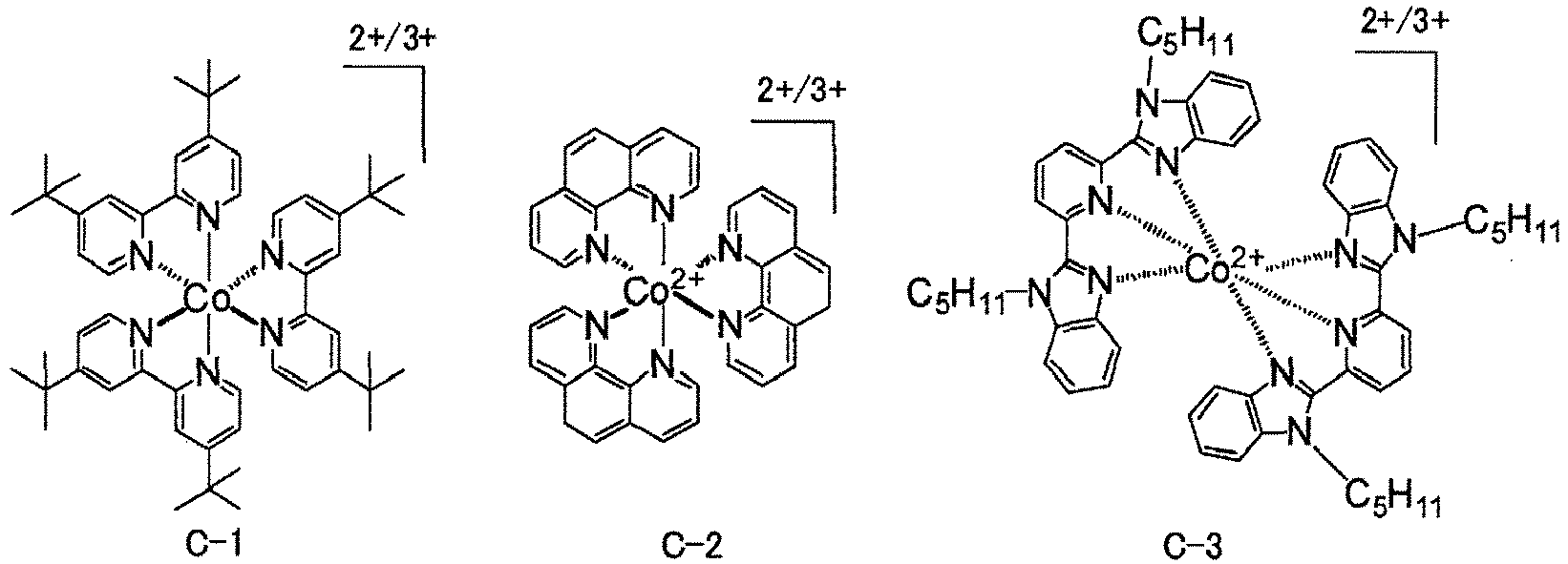
- A cation of iodine salt is preferably a 5- or 6-membered nitrogen-containing aromatic cation. Especially, in the case where the compound represented by formula (A) is not an iodine salt, the compound represented by formula (A) is preferably used in combination with an iodine salt of pyridinium salts, imidazolium salts, triazolium salts, or the like, as described in Domestic re-publication of
PCT international publication WO95/18456 JP-A-8-259543 - In the electrolyte composition that can be used in the photoelectric conversion element of the present invention, iodine is preferably contained with a heterocyclic quaternary salt compound. The content of iodine is preferably 0.1 to 20% by mass, more preferably 0.5 to 5% by mass, to the total of the electrolyte composition.
- In the photoelectric conversion element of the present invention, a co-adsorbent is preferably used together with the metal complex dye of the present invention or with the dye used in combination therewith if necessary. As such a co-adsorbent, a co-adsorbent having a carboxyl group or a salt thereof is preferable, and examples of the co-adsorbent include a fatty acid, and a compound having a steroid skeleton. The fatty acid may be a saturated fatty acid or an unsaturated fatty acid. Examples thereof include a butanoic acid, a hexanoic acid, an octanoic acid, a decanoic acid, a hexadecanoic acid, a dodecanoic acid, a palmitic acid, a stearic acid, an oleic acid, a linoleic acid, and a linolenic acid.
- Examples of the compound having a steroid skeleton include a cholic acid, a glycocholic acid, a chenodeoxycholic acid, a hyocholic acid, a deoxycholic acid, a lithocholic acid, and a ursodeoxycholic acid. Among these, a cholic acid, a deoxycholic acid, and a chenodeoxycholic acid are preferable; and a chenodeoxycholic acid is further preferable.
- A preferred co-adsorbent is a compound represented by formula (B).

- In formula (B), RB1 represents a substituent having an acidic group. RB2 represents a substituent. nB represents an integer of 0 or more. The acidic group has the same meaning as the above-described Ac. nB is preferably an integer of 2 to 4. As specific examples of the substituent, the substituent T described above can be mentioned. As specific compounds, mention can be made of the examples of the above-mentioned compound having a steroid skeleton.
- The co-adsorbent can exhibit, by adsorbing on the semiconductor fine-particles, an effect of suppressing the inefficient association of the dye. The amount to be used of the co-adsorbent is not particularly limited, but it is preferred that the amount thereof is preferably from 1 to 200 mole, more preferably from 10 to 150 mole, and particularly preferably from 20 to 50 mole, to mole of the sensitizing dye, from the viewpoints of effectively exhibiting the above action.
- The electrically-conductive support is a support having electroconductivity per se, such as a metal, or a support of glass or a polymeric material having an electrically-conductive layer on the surface. As the support, in addition to the glass and the plastic, use may be made of ceramic (
JP-A-2005-135902 JP-A-2001-160425 JP-A-2003-123859 JP-A-2002-260746 - The thickness of the electrically-conductive film layer is preferably 0.01 to 30 µm, more preferably 0.03 to 25 µm, and particularly preferably 0.05 to 20 µm.
- It is preferable that the electrically-conductive support is substantially transparent. The terms "substantially transparent" means that the transmittance of light is 10% or more, preferably 50% or more, particularly preferably 80% or more. As the transparent electrically-conductive support, a support formed from glass or a plastic and coated with an electrically-conductive metal oxide is preferable. In this case, the amount of coating of the electrically-conductive metal oxide is preferably 0.1 to 100 g per square meter of the support made of glass or a plastic. In the case of using a transparent electrically-conductive support, it is preferable that light is incident from the support side.
- The semiconductor fine-particles are preferably fine-particles of chalcogenides of metals (for example, oxides, sulfides, and selenides), or fine-particles of perovskites. Preferred examples of the chalcogenides of metals include: oxides of titanium, tin, zinc, tungsten, zirconium, hafnium, strontium, indium, cerium, yttrium, lanthanum, vanadium, niobium, or tantalum; cadmium sulfide; and cadmium selenide. Preferred examples of the perovskites include strontium titanate, and calcium titanate. Among these, titanium oxide, zinc oxide, tin oxide, and tungsten oxide are particularly preferred.
- Examples of the crystal structure of titania include structures of anatase type, brookite type, and rutile type; and anatase type and brookite type structures are preferred, and the anatase type structure is particularly preferred. A titania nanotube/nanowire/nanorod may be mixed with titania fine-particles or may be used as a semiconductor electrode.
- A particle size of the semiconductor fine-particles is expressed in terms of an average particle size using a diameter when a projected area is converted into a circle, and is preferably 1 to 1,000 nm as primary particles, and preferably 10 to 100,000 nm as an average particle size of a dispersion thereof, particularly preferably 20 to 300 nm. The semiconductor fine-particles are utilized preferably in two or more kinds of fine-particles, particularly preferably in three or more kinds thereof, different in average particle sizes each other. When a plurality of kinds of the fine-particles are used, it is preferable to use both particles having an average particle size of 10 to 50 nm, and particles having an average particle size of 100 to 200 nm. In regard to the particle shape, spherical particles or rod-shaped particles are preferably used, and it is more preferable to mix these. The mixing ratio is preferably that the proportion of rod-shaped particles is 20 to 40, when the total amount of particles would be 100. At this time, it is particularly preferable that spherical particles have an average particle size of 10 to 50 nm and rod-shaped particles have an average particle size of 100 to 200 nm.
- Examples of the method of applying the semiconductor fine-particles onto the electrically-conductive support include a wet method, a dry method, or other methods.
- It is preferable to form a short-circuit preventing layer between the transparent electrically-conductive film and the semiconductor layer (oxide semiconductor layer), in order to prevent reverse current due to a direct contact between the electrolyte liquid and the electrode. It is preferable to employ a spacer or a separator, so as to prevent the contact between the light-receiving electrode and the counter electrode. It is preferable for the semiconductor fine-particles to have a large surface area, so that a large amount of dye can adsorb to the surface. For example, while the support has been coated with the semiconductor fine-particles, the surface area is preferably 10 times or more, and more preferably 100 times or more, to the projected surface area. The upper limit of this value is not particularly limited, but the upper limit is generally about 5,000 times. In general, as the thickness of the semiconductor fine-particle layer increases, the amount of dye that can be supported per unit area increases, and therefore, the light absorption efficiency is increased. However, since the diffusion distance of thus-generated electrons increases along, the loss due to charge recombination is also increased. Although a preferred thickness of the semiconductor fine-particle layer (semiconductor layer) may vary with the usage of the resultant element, the thickness is typically 0.1 to 100 µm. In the case of using the photoelectric conversion element for a dye-sensitized solar cell, the thickness of the semiconductor fine-particle layer is preferably 1 to 50 µm, and more preferably 3 to 30 µm. The semiconductor fine-particles may be calcined after being applied on the support, at a temperature of 100 to 800°C for 10 minutes to 10 hours, so as to bring about cohesion of the particles. When a glass support is used, the film-forming temperature is preferably 400 to 60°C.
- The amount of coating of the semiconductor fine-particles per square meter of the support is preferably 0.5 to 500 g, and more preferably 5 to 100 g. The overall amount to be used of the dye is preferably 0.01 to 100 millimoles, more preferably 0.1 to 50 millimoles, and particularly preferably 0.1 to 10 millimoles, per square meter of the support. In this case, the amount to be used of the dye of the present invention is preferably set to 5% by mole or more. The amount of the dye adsorbed to the semiconductor fine-particles is preferably 0.001 to 1 millimole, and more preferably 0.1 to 0.5 millimoles, to g of the semiconductor fine-particles. When the amount of the dye is set to such a range, the sensitization effect for the semiconductor can be sufficiently obtained. On the other hand, if the amount of the dye is too small, the sensitization effect is insufficient, and if the amount of the dye is too large, the portion of the dye that is not attached to the semiconductor is suspended, to cause lowering in the sensitization effect.
- When the dye is a salt, a counter ion of the specific metal complex dye is not particularly limited. Examples thereof include an alkali metal ion, and a quaternary ammonium ion.
- After the dye has been adsorbed, the surface of the semiconductor fine-particles may be treated with an amine. Preferred examples of the amines include 4-tert-butylpyridine, and polyvinylpyridine. These may be used directly when the compounds are liquids, or may be used in a state of being dissolved in an organic solvent. The charge-transfer layer is a layer having a function of supplementing electrons to an oxidant of the dye, and is provided between the light-receiving electrode and the counter electrode. Representative examples of the material forming the charge-transfer layer include a liquid prepared by dissolving a redox pair in an organic solvent, a so-called gel electrolyte obtained by impregnating a polymer matrix with a liquid prepared by dissolving a redox pair in an organic solvent, and a molten salt containing a redox pair.
- A solid charge-transport system, such as a p-type semiconductor or a hole-transporting material, may also be used, instead of the liquid electrolytes and quasi-solid electrolytes described above. For the solid charge-transport layer, an organic hole-transporting material may be used.
- The redox pair serves as a carrier for electrons, and thus is required at a certain concentration. A preferred overall concentration is 0.01 moles/L or more, more preferably 0.1 moles/L or more, and particularly preferably 0.3 moles/L or more. In this case, the upper limit of the concentration is not particularly limited, but it is generally about 5 moles/L.
- The counter electrode is an electrode working as a positive electrode in the photoelectrochemical cell. The counter electrode generally has the same meaning as the electrically-conductive support described above, but in a construction which is likely to maintain a sufficient strength, a support is not necessarily required. A preferred structure of the counter electrode is a structure having a high charge-collecting effect. At least one of the electrically-conductive support and the counter electrode as mentioned above should be substantially transparent, in order for light to reach the photoconductor layer. In the photoelectrochemical cell of the present invention, the electrically-conductive support is preferably transparent, to allow sunlight to incident from the support side. In this case, the counter electrode has further preferably properties of reflecting light. As the counter electrode of the photoelectrochemical cell, a glass or a plastic on which a metal or an electrically-conductive oxide is deposited is preferable, and a glass on which platinum is deposited is particularly preferable. In the photoelectrochemical cell, a lateral side of the cell is preferably sealed with a polymer, an adhesive, or the like, in order to prevent evaporation of the components. The characteristics of the thus-obtained photoelectrochemical cell of the present invention are: generally, 0.01 to 1.5 V in open-circuit voltage, 0.001 to 20 mA/cm2 in short-circuit current density, 0.1 to 0.9 in shape factor, and 0.001 to 25% in conversion efficiency, in an operation of 100 mW/cm2 at AM 1.5 G.
- The present invention can be applied to the photoelectric conversion elements and dye-sensitized solar cells, as described in Japanese Patent No.
4260494 JP-A-2004-146425 JP-A-2000-340269 JP-A-2002-289274 JP-A-2004-152613 JP-A-9-27352 JP-A-2004-152613 JP-A-2000-90989 JP-A-2003-217688 JP-A-2002-367686 JP-A-2003-323818 JP-A-2001-43907 JP-A-2000-340269 JP-A-2005-85500 JP-A-2004-273272 JP-A-2000-323190 JP-A-2000- 228234 JP-A-2001-266963 JP-A-2001-185244 JP-T-2001-525108 JP-A-2001-203377 JP-A-2000-100483 JP-A-2001-210390 JP-A-2002-280587 JP-A-2001-273937 JP-A-2000-285977 JP-A-2001-320068 JP-A-2010-218770 - The present invention will be described in more detail based on examples given below, but the invention is not meant to be limited by these.
- Pastes for forming a semiconductor layer or a light-scattering layer of a semiconductor electrode that constitutes a photoelectrode were prepared, to prepare dye-sensitized solar cells with the pastes.
- (Paste A) Spherical-shaped TiO2 particles (anatase type, average particle size: 25 nm; hereinafter, referred to as spherical TiO2 particles A) were introduced into a nitric acid solution, followed by stirring, to prepare a titania slurry. Then, a cellulose-based binder was added to the resultant titania slurry as a thickening agent, and the mixture was kneaded, to prepare a paste.
- (Paste 1) Spherical TiO2 particles A and spherical-shaped TiO2 particles (anatase type, average particle size: 200 nm; hereinafter, referred to as spherical TiO2 particles B) were introduced into a nitric acid solution, followed by stirring, to prepare a titania slurry. Then, a cellulose-based binder was added to the resultant titania slurry as a thickening agent, and the mixture was kneaded, to prepare a paste (mass of the TiO2 particles A:mass of the TiO2 particles B = 30:70).
- (Paste 2) The paste A was mixed with rod-shaped TiO2 particles (anatase type, diameter: 100 nm, aspect ratio: 5; hereinafter, referred to as rod-shaped TiO2 particles C), to prepare a paste having a ratio of the mass of the rod-shaped TiO2 particles C to the mass of the paste A of 30:70.
- According to the procedures described below, a photoelectrode having the same configuration as that of the photoelectrode 12, as shown in Fig. 5 of
JP-A-2002-289274 solar cell 20, as shown in Fig. 3 ofJP-A-2002-289274 Fig. 2 of the Drawings attached to the present application. InFig. 2 of the present application, 41 stands for a transparent electrode, 42 stands for a semiconductor electrode, 43 stands for a transparent conductive film, 44 stands for a substrate, 45 stands for a semiconductor layer, 46 stands for a light-scattering layer, 40 stands for a photoelectrode, 20 stands for a dye-sensitized solar cell, CE stands for a counter electrode, E stands for an electrolyte, and S stands for a spacer. - A transparent electrode in which a fluorine-doped SnO2 conductive film (thickness: 500 nm) was formed on a glass substrate, was provided. On this SnO2 conductive film, the above paste 1 was applied by screen printing, followed by drying the paste. Then, the conductive film was calcined under the conditions of 450°C in the air. Furthermore, by repeating both the above screen printing and calcination using the paste 2, the semiconductor electrode having the same configuration as that of the
semiconductor electrode 42, as shown inFig. 2 (area of light-receiving face: 10 mm × 10 mm, layer thickness: 10 µm, layer thickness of the semiconductor layer: 6 µm, layer thickness of the light-scattering layer: 4 µm, and content of the rod-shaped TiO2 particles C contained in the light-scattering layer: 30% by mass) was formed on the SnO2 conductive film. Thus, a photoelectrode, which did not contain any sensitizing dye, was prepared. - Separately, a dye was adsorbed on the semiconductor electrodes (precursors of dye-adsorbed electrodes) as follows. First, anhydrous ethanol which had been dehydrated with magnesium ethoxide was used as a solvent, and the metal complex dye (0.04 mass%) described in the table below was dissolved in this anhydrous ethanol. The amount of water was adjusted so as to obtain the water content described in the table. Thus, a dye-adsorbing liquid was prepared. Then, the semiconductor electrode was immersed in this solution, and the semiconductor electrode was dried for 15 minutes under nitrogen gas flow at the pressure and temperature described in the table. Thereby, the dye was adsorbed on the semiconductor electrode in an amount of about 1.5 × 10⁻⁷ mol/cm2. Thus, a
photoelectrode 40 was completed. - Then, a platinum electrode (thickness of Pt thin film: 100 nm) having the same shape and size as those of the photoelectrode described above was provided as a counter electrode, and an iodine-based redox solution containing iodine and lithium iodide was prepared as an electrolyte E. Furthermore, a spacer-S (trade name: "Surlyn") manufactured by DuPont, which had a shape matching the size of the semiconductor electrode, was provided. The
photoelectrode 40 and the counter electrode CE were arranged to face each other, with the spacer-S interposed therebetween, and the electrolyte described above was filled in the inside. Thus, a dye-sensitized solar cell was completed. - A cell characterization test was carried out, and the photoelectric conversion efficiencies η of the dye-sensitized solar cells were measured. The cell characteristics evaluation test was carried out using a solar simulator (manufactured by Wacom Electric, WXS-85-H type), by irradiating pseudo-sunlight of 1,000 W/cm2, from a xenon lamp through an AM1.5 filter. The current-voltage characteristics were measured using an I-V tester, and the photoelectric conversion efficiency (ηi/%), Jsc, Voc, and FF (fill factor) were determined.
- The photoelectric conversion efficiency (ηf) after the lapse of time period in the dark at 65°C for 300 hours was measured. An evaluation was carried out by determining the drop rate (γd) (expression below) with respect to the initial conversion efficiency (ηi).

- Ten dye-sensitized solar cells were produced in the same manner, and the fluctuation ratio (SD) was determined as the ratio of the standard deviation of this photoelectric conversion efficiency (ηi) with respect to ηi.
- Production of a sample was carried out according to the aforementioned Japanese Journal of Applied Physics, Vol. 47, No. 1, 2008, p. 505, using a platinum electrode-attached substrate, except that the processes from preparation of the paste to adsorption of the dye were carried out according to those for the preparation of the paste of the present invention.
- The thermally stimulated current of each of the above samples was measured by a thermally stimulated current analyzer (TS-FETT) available from Rigaku Denki. Each sample was cooled to 93K at a rate of 5 K/min, and maintained at this temperature for 20 minutes. Then, light with λmax of 330 nm (using xenon lamp light passed through a band pass filter) was irradiated to the sample for 5 minutes, while applying a bias of 0.8V and maintaining at 93K. Then, temperature was raised up to 250K at a rate of 10 K/min, while applying a bias of 15 mV, and the current flowing at that time was measured.
Table 1 Test No. Dye Pressure (Pa) Temperature (°C) Water content (mass%) TSC (pA/cm2) Jsc (mA/cm2) Voc (V) FF ηi (%) SD γd (%) 101 1 5 × 10⁴ Room temperature 0.1 0.3 18.6 0.60 0.81 9.0 8 9 102 1 50 Room temperature 0.1 0.3 18.5 0.68 0.70 8.8 9 11 103 1 Atmospheric pressure 80 0.1 0.2 18.2 0.70 0.76 9.8 8 12 104 1 Atmospheric pressure 150 0.1 0.3 18.2 0.66 0.82 9.8 8 15 105 1 Atmospheric pressure Room temperature 0.05 0.3 17.8 0.63 0.74 8.3 13 14 106 1 50 80 0.1 0.1 18.8 0.73 0.75 10.3 6 10 107 1 50 Room temperature 0.05 0.2 18.8 0.69 0.71 9.2 9 11 108 1 50 80 0.05 0.1 18.5 0.79 0.72 10.5 7 10 C11 1 Atmospheric pressure Room temperature 0.1 0.5 18.7 0.63 0.58 6.8 14 12 Table 2 Test No. Dye Pressure (Pa) Temperature (°C) Water content (mass%) TSC (pA/cm2) Jsc (mA/cm2) Voc (V) FF ηi (%) SD γd (%) 108 1 50 80 0.05 0.2 18.5 0.79 0.72 10.5 7 10 C11 1 Atmospheric pressure Room temperature 0.1 0.5 18.7 0.63 0.58 6.8 14 15 201 2 50 80 0.05 0.1 16.2 0.68 0.77 8.4 5 12 C21 2 Atmospheric pressure Room temperature 0.1 0.4 16.3 0.43 0.45 3.2 20 14 202 3 50 80 0.05 0.3 16.5 0.63 0.41 4.2 7 9 C22 3 Atmospheric pressure Room temperature 0.1 0.4 16.1 0.48 0.50 3.8 17 17 203 4 50 80 0.05 0.3 15.3 0.50 0.51 3.9 5 11 C23 4 Atmospheric pressure Room temperature 0.1 0.8 14.9 0.56 0.51 4.3 13 18 <Notations for descriptions in the tables>
Pressure: Pressure at the time of solvent removal treatment
Temperature: Temperature at the time of solvent removal treatment
Water content: Percentage content of water in dye-adsorbing liquid
TCS: TCS current value - It can be seen that, as compared with the Comparative examples, all of the Examples have relatively superior detailed cell performances, such as Jsc, Voc, and FF, consequently obtain higher conversion efficiency, have smaller fluctuations in the efficiency, and have smaller drop rates of conversion efficiency of the cells after the lapse of time period in the dark at a high temperature. In particular, it can be seen that the differences are noticeable, by making a comparison between the results of the identical dye employed (Table 2). It is understood that one of the factors is the small TSC current value. From these results, it is understood that, as a result of the production method of the present application, the number of trap levels has decreased, and as a result, the TSC current is decreased, and along with this, an improvement in the cell performance, a lowering in the fluctuation, and an enhancement in the durability are achieved.

- In order to make a comparison with other dyes, dyes 1 to 4 were replaced with the dyes described below at the level of Test 108, to eliminate the fluctuation, and the test was carried out in the same manner as above. However, the effects of the present invention were not significantly exhibited.


- As was confirmed in the above Example 1, with respect to an improvement owing to the production process of the present invention, excellent effects can be exhibited in the dye represented by formula (I) or formula (II), which can give particularly high conversion efficiency. The reason is not clearly understood, but the dye has an influence on enhancement of the characteristics, including the TSC current, and exhibits a marked enhancement particularly on the fill factor (FF) and the increase rate of the conversion efficiency (ηi). Then, in order to verify this, the evaluations were carried out in the same manner as above, by employing other kinds of the dyes. In the results given below, Tests 301 to 304 are summaries of the same experiments results as in the above Tests 108, 201, 202, and 203.
Table 3 Test No. Dye ηi % Hi improvement % FF improvement % 301 1 10.5 1.5 1.2 302 2 8.4 2.6 1.7 303 3 4.2 1.1 0.8 304 4 3.2 0.9 1 305 (II-1) 10.3 1.8 1.4 306 (II-5) 9.4 1.3 1.4 307 (II-7) 10.7 2.1 1.2 308 Compound 48.3 2.4 1.4 309 Compound 7 9.4 2.6 1.7 • ηi: Photoelectric conversion efficiency when the treatment was carried out at a pressure 50 Pa, a temperature 80°C, and a water content 0.05 mass%
• ηi improvement ratio: Ratio (ηi1/ηi2) of the photoelectric conversion efficiency (ηi1) when the treatment was carried out at a pressure of 50 Pa, a temperature 80°C, and a water content 0.05 mass%, to the photoelectric conversion efficiency (ηi2) when the treatment was carried out at room temperature and atmospheric pressure, and a water content of 0.1 mass%
• FF improvement ratio: Ratio (FF1/FF2) of the fill factor (FF1) when the treatment as carried out at a pressure 50 Pa, a temperature 80°C, and a water content 0.05 mass%, to the fill factor (FF2) when the treatment was carried out at room temperature and atmospheric pressure, and a water content 0.1 mass% - The dye structures in Tests 305 to 309 are described in this text.
- Having described my invention as related to the present embodiments, it is my intention that the invention not be limited by any of the details of the description, unless otherwise specified, but rather be construed broadly within its spirit and scope as set out in the accompanying claims.
- This application claims priority on Patent Application No.
2012-025146 -
- 1
- Electrically-conductive support
- 2
- Photoconductor layer
- 21
- Metal complex dye
- 22
- Semiconductor fine-particle
- 3
- Electrolyte layer
- 4
- Counter electrode
- 5
- Light-receiving electrode
- 6
- Circuit
- 10
- Photoelectric conversion element
- 100
- System utilizing the dye-sensitized solar cell
Claims (12)
- A method of producing a photoelectric conversion element,
the photoelectric conversion element having:an electrically-conductive support having a substrate and a transparent electrode;a photoconductor layer having: a metal complex sensitizing dye having an adsorbing group; and semiconductor fine-particles;an electrolyte layer having an electrolyte; anda counter electrode,wherein, when a dye-adsorbing liquid containing the sensitizing dye in a solvent is brought into contact with the semiconductor fine-particles, to form a dye-adsorbed electrode having the sensitizing dye adsorbed on the semiconductor fine-particles, a treatment is carried out at least under any one of conditions A, B, and C:[A: In solvent drying after dye adsorption, a heat treatment is carried out at a temperature of 50 to 200°C.][B: In solvent drying after dye adsorption, drying is carried out at a pressure of 50,000 to 10-3 Pa.][C: The sensitizing dye is contained in the dye-adsorbing liquid in an amount of 0.001 to 0.1% by mass, and the amount of water is kept below 0.1% by mass.]. - The method of producing a photoelectric conversion element according to claim 1, wherein the conditions A and C are applied to in combination, the conditions B and C are applied to in combination, or the conditions A, B, and C are applied to in combination.
- The method of producing a photoelectric conversion element according to claim 1 or 2, wherein the solvent drying time period for the conditions A and B is set to 5 to 30 minutes.
- The method of producing a photoelectric conversion element according to any one of claims 1 to 3, wherein the solvent of the dye-adsorbing liquid is an organic solvent selected from the group consisting of an aliphatic alcohol having 1 to 6 carbon atoms in total, an aliphatic amide having 2 to 6 carbon atoms in total, and a combination thereof.
- The method of producing a photoelectric conversion element according to any one of claims 1 to 4, wherein the sensitizing dye contains at least a dye represented by formula (I):
ML1 m1L2 m2XmX•CI (I)
wherein, in formula (I), M represents a metal atom; L1 represents a ligand represented by formula (L1); L2 represents a ligand represented by formula (L2); X represents a monodentate ligand; m1 is 1 or 2; m2 is an integer of 0 or 1; mX is an integer of 0 to 3; and CI represents a counter ion in the case where the counter ion is necessary to neutralize a charge in formula (I);

- The method of producing a photoelectric conversion element according to any one of claims 1 to 4, wherein the sensitizing dye contains at least a dye represented by formula (II):
ML3 m3L4 m4YmY•CI (II)
wherein, in formula (II), M represents a metal atom; L3 represents a bidentate ligand represented by formula (L3); L4 represents a bidentate or terdentate ligand represented by formula (L4); Y represents a monodentate or bidentate ligand; m3 represents an integer of 0 to 3; m4 represents an integer of 1 to 3; mY represents an integer of 0 to 2; and CI represents a counter ion in the case where the counter ion is necessary to neutralize a charge in formula (II);

- The method of producing a photoelectric conversion element according to claim 5 or 6, wherein M in the sensitizing dye is Ru, Fe, Os, Cu, W, Cr, Mo, Ni, Pd, Pt, Co, Ir, Rh, Re, Mn, or Zn.
- A photoelectric conversion element, having:an electrically-conductive support having a substrate and a transparent electrode,a photoconductor layer having: a metal complex sensitizing dye having an adsorbing group; and semiconductor fine-particles,an electrolyte layer having an electrolyte, anda counter electrode,wherein a dye-adsorbed electrode has no peak current value at 150K or more, in measurement of a thermally-stimulated current; andwherein the peak electric current value at 100 to 120K is 0.3 pA/cm2 or less.
- The photoelectric conversion element according to claim 8, wherein a redox agent constituting the electrolyte is a cobalt complex.
- The photoelectric conversion element according to claim 8 or 9, wherein the sensitizing dye contains at least a dye represented by formula (I):
ML1 m1L2 m2XmX•CI (I)
wherein, in formula (I), M represents a metal atom; L1 represents a ligand represented by formula (L1); L2 represents a ligand represented by formula (L2); X represents a monodentate ligand; m1 is 1 or 2; m2 is an integer of 0 or 1; mX is an integer of 0 to 3; and CI represents a counter ion in the case where the counter ion is necessary to neutralize a charge in formula (I);

- The photoelectric conversion element according to claim 8 or 9, wherein the sensitizing dye contains at least a dye represented by formula (II):
ML3 m3L4 m4YmY•CI (II)
wherein, in formula (II), M represents a metal atom; L3 represents a bidentate ligand represented by formula (L3); L4 represents a bidentate or terdentate ligand represented by formula (L4); Y represents a monodentate or bidentate ligand; m3 represents an integer of 0 to 3; m4 represents an integer of 1 to 3; mY represents an integer of 0 to 2; and CI represents a counter ion in the case where the counter ion is necessary to neutralize a charge in formula (II);

- A dye-sensitized solar cell, comprising the photoelectric conversion element according to any one of claims 8 to 11.
Applications Claiming Priority (2)
| Application Number | Priority Date | Filing Date | Title |
|---|---|---|---|
| JP2012025146A JP2013161751A (en) | 2012-02-08 | 2012-02-08 | Photoelectric conversion element, method of manufacturing the same, and dye-sensitized solar cell using the same |
| PCT/JP2013/052584 WO2013118709A1 (en) | 2012-02-08 | 2013-02-05 | Photoelectric conversion element, method for manufacturing photoelectric conversion element, and dye-sensitized solar cell using photoelectric conversion element |
Publications (2)
| Publication Number | Publication Date |
|---|---|
| EP2814108A1 true EP2814108A1 (en) | 2014-12-17 |
| EP2814108A4 EP2814108A4 (en) | 2015-10-07 |
Family
ID=48947472
Family Applications (1)
| Application Number | Title | Priority Date | Filing Date |
|---|---|---|---|
| EP13746872.4A Withdrawn EP2814108A4 (en) | 2012-02-08 | 2013-02-05 | Photoelectric conversion element, method for manufacturing photoelectric conversion element, and dye-sensitized solar cell using photoelectric conversion element |
Country Status (5)
| Country | Link |
|---|---|
| EP (1) | EP2814108A4 (en) |
| JP (1) | JP2013161751A (en) |
| KR (1) | KR20140117534A (en) |
| TW (1) | TW201345022A (en) |
| WO (1) | WO2013118709A1 (en) |
Cited By (1)
| Publication number | Priority date | Publication date | Assignee | Title |
|---|---|---|---|---|
| EP2980816A4 (en) * | 2013-03-25 | 2016-06-01 | Fujifilm Corp | METAL COMPLEX DYE, PHOTOELECTRIC CONVERSION ELEMENT, SOLAR CELL WITH COLOR, AND DYE SOLUTION CONTAINING METAL COMPLEX DYE |
Families Citing this family (1)
| Publication number | Priority date | Publication date | Assignee | Title |
|---|---|---|---|---|
| JP6461331B2 (en) * | 2015-05-25 | 2019-01-30 | 富士フイルム株式会社 | Photoelectric conversion element and dye-sensitized solar cell |
Family Cites Families (54)
| Publication number | Priority date | Publication date | Assignee | Title |
|---|---|---|---|---|
| EP0179823B1 (en) | 1984-04-30 | 1989-07-12 | Stiftung, R. E. | Process for the sensitization of an oxidoreduction photocalatyst, and photocatalyst thus obtained |
| CH674596A5 (en) | 1988-02-12 | 1990-06-15 | Sulzer Ag | |
| ES2080313T3 (en) | 1990-04-17 | 1996-02-01 | Ecole Polytech | PHOTOVOLTAIC CELLS. |
| DE4207659A1 (en) | 1992-03-11 | 1993-09-16 | Abb Patent Gmbh | METHOD FOR PRODUCING A PHOTOELECTROCHEMICAL CELL AND A CLEARLY PRODUCED CELL |
| GB9217811D0 (en) | 1992-08-21 | 1992-10-07 | Graetzel Michael | Organic compounds |
| EP0737358B1 (en) | 1993-12-29 | 1999-02-03 | Ecole Polytechnique Federale De Lausanne | Photoelectrochemical cell and electrolyte therefor |
| JP3579078B2 (en) | 1994-03-11 | 2004-10-20 | 石原産業株式会社 | Semiconductors for photoelectric conversion materials |
| EP0718288B8 (en) | 1994-12-21 | 2005-10-26 | Hydro Quebec | Liquid hydrophobic salts, their preparation and their use in electrochemistry |
| JP3599859B2 (en) | 1994-12-29 | 2004-12-08 | 石原産業株式会社 | Porous substance-polymer solid electrolyte composite, method for producing the same, and photoelectric conversion element using the same |
| DE19711713A1 (en) | 1997-03-20 | 1998-10-01 | Hoechst Ag | Photovoltaic cell |
| JP4236715B2 (en) * | 1997-09-29 | 2009-03-11 | シャープ株式会社 | Manufacturing method of semiconductor for photoelectric conversion material |
| JP4024942B2 (en) | 1998-09-16 | 2007-12-19 | 株式会社東芝 | Dye-sensitized photochemical cell |
| JP2000100483A (en) | 1998-09-22 | 2000-04-07 | Sharp Corp | Photoelectric conversion element, method of manufacturing the same, and solar cell using the same |
| JP4360569B2 (en) | 1999-02-05 | 2009-11-11 | 富士フイルム株式会社 | Photoelectric conversion element and photoelectrochemical cell |
| JP2000340269A (en) | 1999-03-25 | 2000-12-08 | Showa Denko Kk | Pigment sensitization photoelectric transducer sensing element |
| JP2000285977A (en) | 1999-03-31 | 2000-10-13 | Fuji Photo Film Co Ltd | Photoelectric conversion element and photocell |
| JP4363553B2 (en) | 1999-05-14 | 2009-11-11 | 富士フイルム株式会社 | Electrolyte composition, photoelectric conversion element and photoelectrochemical cell |
| JP4077594B2 (en) | 1999-05-27 | 2008-04-16 | 触媒化成工業株式会社 | Photoelectric cell, coating liquid for forming metal oxide semiconductor film, and method for producing metal oxide semiconductor film for photoelectric cell |
| JP2001160425A (en) | 1999-12-02 | 2001-06-12 | Japan Gore Tex Inc | Optical semiconductor electrode and method of manufacturing the same |
| JP4414036B2 (en) | 1999-12-27 | 2010-02-10 | シャープ株式会社 | Method for producing dye-sensitized solar cell |
| JP4477729B2 (en) | 2000-01-19 | 2010-06-09 | シャープ株式会社 | Photoelectric conversion element and solar cell using the same |
| JP3982968B2 (en) | 2000-01-26 | 2007-09-26 | シャープ株式会社 | Dye-sensitized solar cell using polymer electrolyte and method for producing the same |
| JP4874454B2 (en) | 2000-01-31 | 2012-02-15 | 富士フイルム株式会社 | Photoelectric conversion element and photovoltaic cell |
| JP4443713B2 (en) | 2000-03-24 | 2010-03-31 | 富士フイルム株式会社 | Semiconductor fine particles, photoelectric conversion element and photovoltaic cell |
| JP4638973B2 (en) * | 2000-03-27 | 2011-02-23 | 富士フイルム株式会社 | Photoelectric conversion element and photovoltaic cell |
| JP2001320068A (en) | 2000-05-01 | 2001-11-16 | Fuji Photo Film Co Ltd | Transparent photoelectric converting element, photo cell using the same, optical sensor and window glass |
| JP4185285B2 (en) | 2002-01-18 | 2008-11-26 | シャープ株式会社 | Dye-sensitized photoelectric conversion element and solar cell using the same |
| JP4213355B2 (en) | 2001-02-28 | 2009-01-21 | 株式会社豊田中央研究所 | Dye-sensitized solar cell and dye-sensitized solar cell module |
| JP4617014B2 (en) | 2001-03-21 | 2011-01-19 | 富士フイルム株式会社 | Method for manufacturing photoelectric conversion element |
| JP4812956B2 (en) | 2001-03-27 | 2011-11-09 | 株式会社豊田中央研究所 | Photoelectrode and dye-sensitized solar cell provided with the same |
| JP5050301B2 (en) | 2001-06-12 | 2012-10-17 | アイシン精機株式会社 | Dye-sensitized solar cell and method for producing the same |
| JP2003123859A (en) | 2001-10-19 | 2003-04-25 | Bridgestone Corp | Organic dye sensitized metal oxide semiconductor electrode, and solar battery having the semiconductor electrode |
| JP4260494B2 (en) | 2002-02-26 | 2009-04-30 | 株式会社フジクラ | Manufacturing method of transparent electrode substrate, manufacturing method of photoelectric conversion element, and manufacturing method of dye-sensitized solar cell |
| JP4503226B2 (en) | 2002-10-22 | 2010-07-14 | 株式会社フジクラ | Electrode substrate, photoelectric conversion element, and dye-sensitized solar cell |
| JP2004152613A (en) | 2002-10-30 | 2004-05-27 | Toyota Central Res & Dev Lab Inc | Dye-sensitized solar cell |
| JP4423857B2 (en) | 2003-01-16 | 2010-03-03 | 東洋インキ製造株式会社 | Optical functional materials |
| JP4235728B2 (en) | 2003-03-07 | 2009-03-11 | 独立行政法人産業技術総合研究所 | Photoelectric conversion element using electrolyte solution containing benzimidazole compound and dye-sensitized solar cell using the same |
| JP4291609B2 (en) * | 2003-04-18 | 2009-07-08 | Tdk株式会社 | Dye-sensitized photoelectric conversion element |
| JP3671183B2 (en) | 2003-09-04 | 2005-07-13 | 司 吉田 | Method for producing dye-sensitized solar cell |
| JP2005135902A (en) | 2003-10-06 | 2005-05-26 | Ngk Spark Plug Co Ltd | Dye-sensitized solar cell |
| JP2005251591A (en) * | 2004-03-04 | 2005-09-15 | Toyo Seikan Kaisha Ltd | Manufacturing method of negative electrode in dye-sensitized solar cell |
| JP4972921B2 (en) * | 2005-01-14 | 2012-07-11 | セイコーエプソン株式会社 | Method for manufacturing photoelectric conversion element |
| JP4904698B2 (en) * | 2005-03-03 | 2012-03-28 | 東洋製罐株式会社 | Method for producing negative electrode in dye-sensitized solar cell |
| JP2006318771A (en) * | 2005-05-13 | 2006-11-24 | Japan Carlit Co Ltd:The | Catalyst electrode for dye-sensitized solar cell and dye-sensitized solar cell including the same |
| TWI389966B (en) * | 2005-05-19 | 2013-03-21 | Nippoh Chemicals | Electrolyte composition |
| US8106198B2 (en) | 2006-02-08 | 2012-01-31 | Shimane Prefectural Government | Photosensitizer dye |
| JP5135777B2 (en) | 2006-11-27 | 2013-02-06 | コニカミノルタビジネステクノロジーズ株式会社 | Dye-sensitized photoelectric conversion element and dye-sensitized solar cell |
| JP5285873B2 (en) | 2007-06-15 | 2013-09-11 | 国立大学法人岐阜大学 | Sensitizing dye used in dye-sensitized photoelectric conversion element, dye-sensitized photoelectric conversion element using the sensitizing dye, and solar cell using the dye-sensitized photoelectric conversion element |
| KR100918049B1 (en) | 2007-11-28 | 2009-09-18 | 삼성에스디아이 주식회사 | Dye-sensitized solar cell dyes and dye-sensitized solar cells comprising the same |
| JP5428312B2 (en) | 2008-12-04 | 2014-02-26 | 宇部興産株式会社 | Photoelectric conversion element and photochemical battery |
| JP5406570B2 (en) | 2009-03-13 | 2014-02-05 | アイシン精機株式会社 | Dye-sensitized solar cell and method for producing the same |
| TWI379836B (en) * | 2009-04-10 | 2012-12-21 | Nat Univ Tsing Hua | Panceromatic photosensitizers and dye-sensitized solar cell using the same |
| JP4980479B2 (en) * | 2010-06-02 | 2012-07-18 | 富士フイルム株式会社 | Metal complex dye, photoelectric conversion element, and dye-sensitized solar cell |
| JP2012003955A (en) * | 2010-06-17 | 2012-01-05 | Sony Corp | Method of manufacturing dye-sensitized solar cell |
-
2012
- 2012-02-08 JP JP2012025146A patent/JP2013161751A/en active Pending
-
2013
- 2013-02-05 KR KR1020147022572A patent/KR20140117534A/en not_active Ceased
- 2013-02-05 WO PCT/JP2013/052584 patent/WO2013118709A1/en not_active Ceased
- 2013-02-05 EP EP13746872.4A patent/EP2814108A4/en not_active Withdrawn
- 2013-02-07 TW TW102104952A patent/TW201345022A/en unknown
Cited By (1)
| Publication number | Priority date | Publication date | Assignee | Title |
|---|---|---|---|---|
| EP2980816A4 (en) * | 2013-03-25 | 2016-06-01 | Fujifilm Corp | METAL COMPLEX DYE, PHOTOELECTRIC CONVERSION ELEMENT, SOLAR CELL WITH COLOR, AND DYE SOLUTION CONTAINING METAL COMPLEX DYE |
Also Published As
| Publication number | Publication date |
|---|---|
| EP2814108A4 (en) | 2015-10-07 |
| KR20140117534A (en) | 2014-10-07 |
| JP2013161751A (en) | 2013-08-19 |
| WO2013118709A1 (en) | 2013-08-15 |
| TW201345022A (en) | 2013-11-01 |
Similar Documents
| Publication | Publication Date | Title |
|---|---|---|
| US9087642B2 (en) | Photoelectric conversion element, photoelectrochemical cell, and metal complex dye used therein | |
| KR101718198B1 (en) | Metal complex dye, photoelectric conversion element, dye-sensitized solar cell, dye adsorption liquid composition for dye-sensitized solar cell, semiconductor electrode for dye-sensitized solar cell, and method for producing dye-sensitized solar cell | |
| KR101670559B1 (en) | Photoelectric conversion element, photoelectrochemical cell, and dye used in photoelectric conversion element and photoelectrochemical cell | |
| EP2551951B1 (en) | Method for manufacturing photoelectric conversion element, photoelectric conversion element and photoelectrochemical cell | |
| JP2012216496A (en) | Photoelectric conversion element and dye-sensitization solar battery | |
| CN103828122B (en) | Photoelectric conversion element, photoelectrochemical cell, and metal complex dye used therein | |
| Kamaraj et al. | Performance of 4-Subsituted Pyridine Based Additive and Cobalt Redox in Poly (Ethylene Glycol)–Hydroxyethylcellulose Polymer Electrolytes with DTTCY Acid Sensitizer on Dye Sensitized Solar Cells | |
| CN103124774B (en) | Metal complex dye, photo-electric conversion element and photoelectrochemical cell | |
| JP5620315B2 (en) | Photoelectric conversion element and photoelectrochemical cell | |
| JP5809954B2 (en) | Photoelectric conversion element and dye-sensitized solar cell | |
| JP2006012848A (en) | Electrolyte composition and solar cell using the same | |
| JP2002176188A (en) | Photoelectric conversion element, photoelectrochemical cell and metal complex dye | |
| KR101505790B1 (en) | Photoelectric conversion element, photoelectrochemical cell, and dye for use therein | |
| JP2012051952A (en) | Pigment, photoelectric element and photoelectrochemical battery | |
| EP2814108A1 (en) | Photoelectric conversion element, method for manufacturing photoelectric conversion element, and dye-sensitized solar cell using photoelectric conversion element | |
| EP2511924A1 (en) | Transition metal complexes as redox couples for electrochemical and optoelectronic devices | |
| JP2013206716A (en) | Photoelectric conversion element and dye-sensitized solar cell | |
| JP5788817B2 (en) | Photoelectric conversion element and dye-sensitized solar cell | |
| JP5789506B2 (en) | Photoelectric conversion element and dye-sensitized solar cell | |
| JP6616907B2 (en) | Photoelectric conversion element, dye-sensitized solar cell, metal complex dye, dye solution, and oxide semiconductor electrode | |
| EP3272814B1 (en) | Ruthenium complex dye, dye solution, photoelectric conversion element, and dye-sensitized solar cell | |
| EP3273456A1 (en) | Photoelectric conversion element, dye-sensitized solar cell, ruthenium complex dye, and dye solution | |
| JP2013114944A (en) | Photoelectric conversion element and photoelectrochemical cell | |
| JP2013206874A (en) | Photoelectric conversion element, dye adsorption composition solution for dye-sensitized solar cell, semiconductor electrode for dye-sensitized solar cell, method of manufacturing dye-sensitized solar cell, and metal complex dye for photoelectric conversion element | |
| JP5636341B2 (en) | Photoelectric conversion element, photoelectrochemical cell, and dye used in them |
Legal Events
| Date | Code | Title | Description |
|---|---|---|---|
| PUAI | Public reference made under article 153(3) epc to a published international application that has entered the european phase |
Free format text: ORIGINAL CODE: 0009012 |
|
| 17P | Request for examination filed |
Effective date: 20140829 |
|
| AK | Designated contracting states |
Kind code of ref document: A1 Designated state(s): AL AT BE BG CH CY CZ DE DK EE ES FI FR GB GR HR HU IE IS IT LI LT LU LV MC MK MT NL NO PL PT RO RS SE SI SK SM TR |
|
| AX | Request for extension of the european patent |
Extension state: BA ME |
|
| DAX | Request for extension of the european patent (deleted) | ||
| RA4 | Supplementary search report drawn up and despatched (corrected) |
Effective date: 20150904 |
|
| RIC1 | Information provided on ipc code assigned before grant |
Ipc: C07F 15/00 20060101ALI20150831BHEP Ipc: C09B 57/10 20060101ALI20150831BHEP Ipc: H01L 31/04 20140101ALI20150831BHEP Ipc: H01M 14/00 20060101AFI20150831BHEP |
|
| STAA | Information on the status of an ep patent application or granted ep patent |
Free format text: STATUS: THE APPLICATION IS DEEMED TO BE WITHDRAWN |
|
| 18D | Application deemed to be withdrawn |
Effective date: 20160405 |