EP2811019A1 - Verfahren zur korrektur eines erkennungssignals in einer isotheren nucleinsäureamplifikationsreaktion - Google Patents
Verfahren zur korrektur eines erkennungssignals in einer isotheren nucleinsäureamplifikationsreaktion Download PDFInfo
- Publication number
- EP2811019A1 EP2811019A1 EP13743774.5A EP13743774A EP2811019A1 EP 2811019 A1 EP2811019 A1 EP 2811019A1 EP 13743774 A EP13743774 A EP 13743774A EP 2811019 A1 EP2811019 A1 EP 2811019A1
- Authority
- EP
- European Patent Office
- Prior art keywords
- nucleic acid
- acid probe
- detection
- correction
- single strand
- Prior art date
- Legal status (The legal status is an assumption and is not a legal conclusion. Google has not performed a legal analysis and makes no representation as to the accuracy of the status listed.)
- Withdrawn
Links
Images

Classifications
-
- C—CHEMISTRY; METALLURGY
- C12—BIOCHEMISTRY; BEER; SPIRITS; WINE; VINEGAR; MICROBIOLOGY; ENZYMOLOGY; MUTATION OR GENETIC ENGINEERING
- C12Q—MEASURING OR TESTING PROCESSES INVOLVING ENZYMES, NUCLEIC ACIDS OR MICROORGANISMS; COMPOSITIONS OR TEST PAPERS THEREFOR; PROCESSES OF PREPARING SUCH COMPOSITIONS; CONDITION-RESPONSIVE CONTROL IN MICROBIOLOGICAL OR ENZYMOLOGICAL PROCESSES
- C12Q1/00—Measuring or testing processes involving enzymes, nucleic acids or microorganisms; Compositions therefor; Processes of preparing such compositions
- C12Q1/68—Measuring or testing processes involving enzymes, nucleic acids or microorganisms; Compositions therefor; Processes of preparing such compositions involving nucleic acids
- C12Q1/6876—Nucleic acid products used in the analysis of nucleic acids, e.g. primers or probes
-
- C—CHEMISTRY; METALLURGY
- C12—BIOCHEMISTRY; BEER; SPIRITS; WINE; VINEGAR; MICROBIOLOGY; ENZYMOLOGY; MUTATION OR GENETIC ENGINEERING
- C12Q—MEASURING OR TESTING PROCESSES INVOLVING ENZYMES, NUCLEIC ACIDS OR MICROORGANISMS; COMPOSITIONS OR TEST PAPERS THEREFOR; PROCESSES OF PREPARING SUCH COMPOSITIONS; CONDITION-RESPONSIVE CONTROL IN MICROBIOLOGICAL OR ENZYMOLOGICAL PROCESSES
- C12Q1/00—Measuring or testing processes involving enzymes, nucleic acids or microorganisms; Compositions therefor; Processes of preparing such compositions
- C12Q1/68—Measuring or testing processes involving enzymes, nucleic acids or microorganisms; Compositions therefor; Processes of preparing such compositions involving nucleic acids
- C12Q1/6844—Nucleic acid amplification reactions
Definitions
- the present invention relates to a method for correcting a detection signal in an isothermal nucleic acid amplification reaction, and the like.
- an internal reference fluorescent substance such as ROX (6-carboxy-X-rhodamine) is used to stabilize a baseline of a fluorescence signal detected in a real-time nucleic acid amplification assay such as real-time PCR.
- ROX 6-carboxy-X-rhodamine
- Those disclosed in Patent Literature 1 are also known as the internal reference fluorescent substance.
- Patent Literature 1 WO97/046708
- a baseline is not stabilized in an isothermal nucleic acid amplification reaction, particularly an isothermal nucleic acid amplification reaction performed at low temperature. Therefore, it is difficult to stably correct a detection signal from a subject to be measured.
- the present inventors thought that a reason why the baseline of the fluorescence signal was not stabilized in the isothermal nucleic acid amplification reaction, particularly the isothermal nucleic acid amplification reaction performed at low temperature came from a fact that a nucleic acid probe for detection and an internal reference fluorescent substance often exhibited a different behavior.
- the present inventors have found that the baseline of the fluorescence signal in the isothermal nucleic acid amplification reaction can be stabilized by use of a nucleic acid probe for correction that can mimic a behavior of the nucleic acid probe for detection and therefore a detection signal from a subject to be measured can be corrected stably, and completed the present invention.
- the present invention is as follows.
- the present invention can stably correct a detection signal from a subject to be measured in an isothermal nucleic acid amplification reaction, particularly an isothermal nucleic acid amplification reaction performed at low temperature by use of a nucleic acid probe for correction. Therefore, the present invention is useful for qualitative and quantitative measurement of the subject to be measured by the isothermal nucleic acid amplification reaction. Specifically, the method of the present invention is excellent in accuracy in detection of the target nucleic acid in the isothermal nucleic acid amplification reaction. In addition, according to the kit of the present invention, the detection of the target nucleic acid in the isothermal nucleic acid amplification reaction can be carried out conveniently.
- the present invention provides a method for correcting a detection signal in an isothermal nucleic acid amplification reaction.
- any method that can amplify a target nucleic acid under an isothermal condition is used as the isothermal nucleic acid amplification reaction.
- a method mediated by transcription may include a method using a nicking enzyme (e.g., a restriction enzyme, ribonuclease H), a method utilizing a series of DNA synthesis through a loop structure, a method utilizing a rolling circle type of DNA replication reaction, a method using a helicase, and a method using a recombinase.
- a method mediated by the transcription may include TMA (Transcription Mediated Amplification) method and NASBA (Nucleic Acid Sequence-Based Amplification) method.
- Examples of the method using the nicking enzyme such as the restriction enzyme or the ribonuclease H may include SDA (Strand Displacement Amplification) method and ICAN (Isothermal and Chimeric Primer-initiated Amplification of Nucleic Acids) method.
- Examples of the method utilizing a series of DNA synthesis through the loop structure may include LAMP (Loop-mediated Isothermal Amplification) method and SMAP (Smart Amplification Process) method.
- Examples of the method utilizing the rolling circle type of DNA replication reaction may include RCA (Rolling Circle Amplification) method.
- Examples of the method using the helicase may include HAD (Helicase-Dependent Amplification) method.
- Example of the method using the recombinase may include RPA (Recombinase Polymerase Amplification) method and SIBA (Strand Invasion Based Amplification) method.
- the isothermal nucleic acid amplification reaction is mainly classified into an isothermal nucleic acid amplification reaction performed under a condition at medium or high temperature of 50°C or higher (e.g., 50°C or higher and lower than 70°C) and an isothermal nucleic acid amplification reaction performed under a condition at low temperature of lower than 50°C (e.g., 25°C or higher and lower than 50°C).
- a nucleic acid probe for detection and an internal reference fluorescent substance often exhibit different behavior, and thus it was difficult to stabilize baseline of a detection signal (see Reference Example 1 and DW in FIG. 2 ).
- the nucleic acid probe for correction can exhibit a behavior that is similar to that of a nucleic acid probe for detection even under a condition at low temperature, and thus it can be accomplished to stabilize baseline of a detection signal and stably correct the detection signal from a subject to be measured (see, e.g., Example 1 and FIG. 1 ).
- the method of the present invention can accomplish the stabilization of the baseline of the detection signal and the stable correction of the detection signal from the subject to be measured even when performed under the condition at low temperature of lower than 50°C, preferably lower than 45°C and more preferably lower than 42°C.
- the method mediated by the transcription, the method using the nicking enzyme such as the restriction enzyme or the ribonuclease H, the method utilizing the rolling circle type of DNA replication reaction, the method using the helicase, and the method using the recombinase can be carried out under such a low temperature condition. Therefore, the method of the present invention can be suitably carried out even under such a low temperature condition.
- the present invention comprises the following (1) and (2) :
- the nucleic acid probe for detection of a target nucleic acid is a nucleic acid probe that generates a detectable signal by specifically binding to the target nucleic acid.
- the nucleic acid probe for detection of a target nucleic acid comprises a single strand polynucleotide portion comprising a nucleotide sequence that is complementary to a nucleotide sequence of the target nucleic acid, and a detection signal generation portion.
- the nucleic acid probe for detection is designed so that its single strand polynucleotide portion complementarily binds to the target nucleic acid.
- the single strand polynucleotide portion in the nucleic acid probe for detection is composed of nucleotides having nucleobases selected from the group consisting of adenine (A), guanine (G), cytosine (C), uracil (U) and thymine (T) and modified nucleobases thereof (e.g., inosine, uridine, 3-nitropyrrole, 5-nitroindole, pyrimidine derivatives).
- the single strand polynucleotide portion in the nucleic acid probe for detection may be composed only of the nucleotides having nucleobases selected from the group consisting of adenine (A), guanine (G), cytosine (C), uracil (U) and thymine (T) that are commonly used as the nucleotides that constitute the nucleic acid probe.
- the single strand polynucleotide portion may be a DNA or RNA molecule or a hybrid molecule of DNA and RNA.
- the single strand polynucleotide portion in the nucleic acid probe for detection may be defined in terms of nucleotide sequence percent identity. Specifically, a nucleotide sequence of the single strand polynucleotide portion in the nucleic acid probe for detection exhibits a significant nucleotide sequence percent identity to a nucleotide sequence of a certain region in a complementary strand of the target nucleic acid to the extent that the single strand polynucleotide portion can be complementarily bound to the target nucleic acid.
- nucleotide sequence percent identity that is calculated between the nucleotide sequence of the single strand polynucleotide portion in the nucleic acid probe for detection and the nucleotide sequence of the above certain region is, for example 90% or more, preferably 92% or more, more preferably 94% or more, still more preferably 95% or more, 96% or more, 97% or more, 98% or more, or 99% or more, and particularly preferably 100%.
- the nucleotide sequence percent identity is calculated based on the length of the nucleotide sequence of the single strand polynucleotide portion in the nucleic acid probe for detection.
- the nucleotide sequence percent identity can be determined by a method well-known in the art, and for example, a program available on internet, in which two nucleotide sequences can be compared, may be utilized with default setting.
- the nucleotide sequence percent identity may be calculated by algorithm of Huang and Miller (Adv. Appl. Math. (1991) 12: 337-357 ). The calculation by the algorithm of Huang and Miller can be performed easily by utilizing William Pearson's lalign program published at http://www.ch.embnet.org/software/LALIGN_form.html with default setting (with the alignment method is made global).
- the length of the single strand polynucleotide portion in the nucleic acid probe for detection is not particularly limited as long as it can be complementarily bound to the target nucleic acid under a condition (e.g., temperature condition) employed in the method of the present invention, and can be appropriately determined depending on a type of the isothermal nucleic acid amplification reaction employed in the method of the present invention.
- the length of the single strand polynucleotide portion is 8 to 50 nucleotides in length, preferably 10 to 40 nucleotides in length, and more preferably 12 to 40 nucleotides in length.
- the length of the single strand polynucleotide portion may be determined from another perspective.
- the length of the single strand polynucleotide portion in the nucleic acid probe for detection is, for example, 20 to 50 nucleotides in length, preferably 20 to 40 nucleotides in length, and more preferably 30 to 40 nucleotides in length in terms of recognition of the single strand polynucleotide portion by the recombinase.
- the target nucleic acid can be detected specifically because the single strand polynucleotide portion in the nucleic acid probe for detection is recognized by the recombinase to be complementarily bound to the target nucleic acid.
- the detection signal generation portion in the nucleic acid probe for detection is composed of a substance capable of generating a detectable signal, and enables to detect the target nucleic acid complementarily bound to the single strand polynucleotide portion in the nucleic acid probe for detection.
- Examples of the detection signal generation portion may include fluorescent substances.
- the nucleic acid probe for detection may be a probe taking advantage of a fluorescence quenching phenomenon by a nucleobase.
- a nucleic acid probe for detection comprises the above single strand polynucleotide portion and the fluorescent substance having a nature that fluorescence is quenched by formation of a double strand nucleic acid structure.
- the fluorescent substance having the nature that the fluorescence is quenched by formation of the double strand nucleic acid structure may include fluorescent substances in which a fluorescence signal reduces when positioned adjacent to the guanine base.
- Examples of the fluorescent substance in which the fluorescence signal reduces when positioned adjacent to the guanine base may include Pacific blue (2-oxo-6,8-difluoro-7-hydroxy-2H-1-benzopyrane-3-carboxylic acid), BODIPY FL (N-[2-(iodoacetylamino)ethyl]-5,7-dimethyl-4,4-difluoro-3a-azonia-4-bora(IV)-4H-4a-aza-s-indacene-3-propaneamide), 5-CR6G (5-carboxyrhodamine), TAMRA (6-tetramethylrhodamine-5(6)-carboxamide)hexanoate, 6-JOE (6-carboxy-4',5'-dichloro-2',7'-dimethoxyfluorescein), Alexa 488 (trademark), Alexa 532 (trademark), BODIPY TMR, and BODIPY FL/C3.
- Pacific blue (2-o
- the nucleic acid probe for detection may also be a probe that does not emit fluorescence in an ordinary state.
- a nucleic acid probe for detection further comprises a quencher in addition to the above single strand polynucleotide portion and the fluorescent substance, and emits fluorescence when the fluorescent substance is separated from the quencher in distance.
- Examples of such a probe may include a hydrolysis probe and a stem-loop structured probe.
- the fluorescence is quenched while the probe is complementarily bound to the target nucleic acid to form a double strand structure
- the quenching effect is removed and the probe emits fluorescence.
- the stem-loop structured probe has a self-hairpin structure, and removes its quenching effect and emits fluorescence when the probe is stretched from the hairpin structure upon being complementarily bound to the target nucleic acid.
- Examples of the fluorescent substance to be used for such a nucleic acid probe for detection may include 6-FAM (6-carboxyfluorescein), TET (tetrachloro-6-carboxyfluorescein), HEX (hexachlorofluorescein), 6-JOE (6-carboxy-4',5'-dichloro-2',7'-dimethoxyfluorescein), ROX (carboxy-6-rhodamine), and TAMRA ((6-tetramethylrhodamine-5(6)-carboxamide)hexanoate).
- 6-FAM 6-carboxyfluorescein
- TET tetrachloro-6-carboxyfluorescein
- HEX hexachlorofluorescein
- 6-JOE 6-carboxy-4',5'-dichloro-2',7'-dimethoxyfluorescein
- ROX carbboxy-6-rhodamine
- TAMRA ((6-tetramethylrh
- Examples of the quencher to be used for such a nucleic acid probe for detection may include BHQ-1 ([4-(2-nitro-4-methyl-phenyl)-azo)-yl-((2-methoxy-5-methyl-phenyl)-azo)]-aniline), BHQ-2 (([(4-(1-nitro-phenyl)-azo)-yl-((2,5-dimethoxy-phenyl)-azo)]-aniline), Dabcyl (4-[[4-(dimethylamino)-phenyl]-azo]-benzoic acid), Eclipse (4-[[2-chloro-4-nitro-phenyl]-azo]-aniline), and TAMRA ((6-tetramethylrhodamine-5(6)-carboxamide)hexanoate).
- BHQ-1 [4-(2-nitro-4-methyl-phenyl)-azo)-yl-((2-methoxy-5-methyl-phenyl)-azo)]-aniline
- a single target nucleic acid or a plurality (e.g., 2, 3, or 4) of target nucleic acids may be employed.
- the same number of the nucleic acid probes for detection can be used.
- each of a plurality of target nucleic acids comprises a different type of the signal generation portion.
- Multiple analyses for a plurality of target nucleic acids are possible by use of a plurality of nucleic acid probes for detection.
- the nucleic acid probe for correction is a nucleic acid probe that does not have an ability to bind to the target nucleic acid and generates a detectable signal.
- the nucleic acid probe for correction comprises a single strand polynucleotide portion comprising a nucleotide sequence that is not complementary to a nucleotide sequence of a target nucleic acid, and a detection signal generation portion.
- the nucleic acid probe for correction is designed so as to comprise a detection signal generation portion different from that in the nucleic acid probe for detection, thereby discriminating a detection signal generated from the nucleic acid probe for correction from a detection signal generated from the nucleic acid probe for detection.
- the nucleic acid probe for correction is designed so that its single strand polynucleotide portion does not complementarily bind to the target nucleic acid.
- the single strand polynucleotide portion in the nucleic acid probe for correction is composed of nucleotides having nucleobases selected from the group consisting of adenine (A), guanine (G), cytosine (C), uracil (U) and thymine (T) and modified nucleobases thereof (e.g., inosine, uridine, 3-nitropyrrole, 5-nitroindole, pyrimidine derivatives).
- the single strand polynucleotide portion in the nucleic acid probe for correction is composed of the same type of nucleotides as the nucleotides that constitute the single strand polynucleotide portion in the nucleic acid probe for detection.
- the single strand polynucleotide portion in the nucleic acid probe for correction may be composed only of nucleotides having nucleobases selected from the group consisting of adenine (A), guanine (G), cytosine (C) and thymine (T) that are commonly used as the nucleotides that constitute nucleic acid probes.
- the single strand polynucleotide portion may be a DNA or RNA molecule or a hybrid molecule of DNA and RNA.
- the single strand polynucleotide portion in the nucleic acid probe for correction is DNA when the single strand polynucleotide portion in the nucleic acid probe for detection is DNA, or is RNA when the single strand polynucleotide portion in the nucleic acid probe for detection is RNA, or is the hybrid molecule when the single strand polynucleotide portion in the nucleic acid probe for detection is the hybrid molecule.
- the single strand polynucleotide portion in the nucleic acid probe for correction may be a homomer composed of the same type of nucleotides or a heteromer composed of plural types of nucleotides. It is preferably the heteromer because the nucleic acid probe for detection is typically composed of a plurality of nucleotides and the nucleic acid probe for correction should mimic the behavior of the nucleic acid probe for detection typically composed of a plurality of nucleotides.
- the single strand polynucleotide portion is the heteromer, the single strand polynucleotide portion has at least two types of the nucleotides and preferably 3 or 4 types of the nucleotides among the aforementioned nucleotides.
- the length of the single strand polynucleotide portion in the nucleic acid probe for correction is 8 to 50 nucleotides in length, preferably 10 to 40 nucleotides in length, and more preferably 12 to 40 nucleotides in length.
- the length of the single strand polynucleotide portion in the nucleic acid probe for correction is not particularly limited, and may be defined in relation to the length of the single strand polynucleotide portion in the nucleic acid probe for detection.
- the difference in length between the single strand polynucleotide portion in the nucleic acid probe for correction and the single strand polynucleotide portion in the nucleic acid probe for detection may be, for example, within the range of 9 nucleotide residues, more preferably within the range of 6 nucleotide residues, and still more preferably within the range of 3 nucleotide residues.
- the single strand polynucleotide portion in the nucleic acid probe for correction may have a similar GC content to that in the single strand polynucleotide portion in the nucleic acid probe for detection.
- the GC content (%) in the single strand polynucleotide portion in the nucleic acid probe for correction may be within the range of ⁇ 10%, ⁇ 7%, ⁇ 5% or ⁇ 3% relative to the GC content (%) in the single strand polynucleotide portion in the nucleic acid probe for detection.
- the single strand polynucleotide portion in the nucleic acid probe for correction may have a similar melting point (Tm value) to that of the single strand polynucleotide portion in the nucleic acid probe for detection.
- Tm value melting point
- the melting point (°C) of the single strand polynucleotide portion in the nucleic acid probe for correction may be within the range of ⁇ 10°C, ⁇ 7°C, ⁇ 5°C or ⁇ 3°C relative to the melting point (°C) in the single strand polynucleotide portion in the nucleic acid probe for detection.
- the melting point can be appropriately determined by a method well-known in the art, and for example, may be determined using commercially available software.
- the single strand polynucleotide portion in the nucleic acid probe for correction may be defined in terms of percent identity to a nucleotide sequence of any region in the complementary strand of the target nucleic acid. Specifically, the nucleotide sequence of the single strand polynucleotide portion in the nucleic acid probe for correction exhibits an insignificant nucleotide sequence percent identity to the nucleotide sequence of any region in the complementary strand of the target nucleic acid to the extent that it cannot complementarily bind to the target nucleic acid.
- nucleotide sequence percent identity calculated between the nucleotide sequence of the single strand polynucleotide portion in the nucleic acid probe for correction and the nucleotide sequence of any region mentioned above corresponds to nucleotide sequence percent identity of, for example, 60% or less, 55% or less, 50% or less, 45% or less, 40% or less, 35% or less, or 30% or less.
- nucleotide sequence percent identity is calculated based on the length of the nucleotide sequence of the single strand polynucleotide portion in the nucleic acid probe for correction.
- the nucleotide sequence percent identity can be determined by a method well-known in the art, and for example, may be determined as described above.
- the single strand polynucleotide portion in the nucleic acid probe for correction may be defined in terms of percent identity to the nucleotide sequence of the single strand polynucleotide portion in the nucleic acid probe for detection.
- the nucleotide sequence of the single strand polynucleotide portion in the nucleic acid probe for correction exhibits, for example, the nucleotide sequence identity of 60% or less, preferably exhibits the nucleotide sequence identity of 55% or less, more preferably exhibits the nucleotide sequence identity of 50% or less, still more preferably exhibits the nucleotide sequence identity of 45% or less, and particularly preferably exhibits the nucleotide sequence identity of 40% or less, 35% or less or 30% or less to the nucleotide sequence of the single strand polynucleotide portion in the nucleic acid probe for detection.
- the nucleotide sequence of the single strand polynucleotide portion in the nucleic acid probe for detection exhibits the nucleotide sequence identity of 100% to the nucleotide sequence of a specific region in the complementary strand of the target nucleic acid
- the nucleotide sequence of the single strand polynucleotide portion in the nucleic acid probe for correction exhibits the aforementioned nucleotide sequence identity to the nucleotide sequence of the single strand polynucleotide portion in the nucleic acid probe for detection.
- nucleotide sequence percent identity is calculated based on the length of the longer nucleotide sequence.
- the nucleotide sequence percent identity can be determined by a method well-known in the art, and for example, may be determined as described above.
- the nucleic acid probe for correction can also be used as a versatile probe for samples derived from any animals such as human.
- human genome is composed of approximately 3,000,000,000 nucleotides.
- a polynucleotide has 17 or more nucleotide residues in length, a single strand polynucleotide that is completely uncomplementary to any region on the human genome may be designed.
- the single strand polynucleotide portion in the nucleic acid probe for correction may be uncomplementary to any region on the human genome when having the nucleotide length as described in the previous paragraph.
- the versatile nucleic acid probe for correction which is uncomplementary to any region on the human genome and any region on optional human RNA (e.g., mRNA, microRNA) can be designed by checking a candidate nucleotide sequence in human gene information (e.g., genome, cDNA, RNA) database, taking a nucleotide sequence that exhibited a high identity to the candidate nucleotide sequence from the database, then again checking a candidate nucleotide sequence modified to exhibit a lower identity to the nucleotide sequence in the data base, and repeating these operations.
- human gene information e.g., genome, cDNA, RNA
- the data can also be checked in gene information database for viruses and microorganisms that cause infectious diseases.
- the nucleic acid probe for correction having the single strand polynucleotide portion designed by such a technique is useful as a versatile probe for human-derived samples, and is used suitably for diagnoses and therapeutic monitoring in human.
- the detection signal generation portion in the nucleic acid probe for correction is composed of a substance capable of generating a detectable signal, and enables to correct a detection signal from a subject to be measured in the isothermal nucleic acid amplification reaction.
- Example of the detection signal generation portion may include fluorescent substances.
- the nucleic acid probe for correction may be a probe taking advantage of a fluorescence quenching phenomenon by a nucleobase.
- a nucleic acid probe for correction comprises the above single strand polynucleotide portion and the fluorescent substance having a nature that fluorescence is quenched by formation of a double strand nucleic acid structure.
- the fluorescent substance having the nature that fluorescence is quenched by formation of the double strand nucleic acid structure may include fluorescent substances in which a fluorescence signal reduces when positioned adjacent to the guanine base.
- Examples of the fluorescent substance in which a fluorescence signal reduces when positioned adjacent to a guanine base may include, for example, those described above.
- the nucleic acid probe for correction is also the probe taking advantage of the fluorescence quenching phenomenon by the nucleobase because the nucleic acid probe for correction mimics the behavior of the nucleic acid probe for detection in the isothermal nucleic acid amplification reaction.
- the nucleic acid probe for correction may also be the probe that does not emit fluorescence in an ordinary state.
- Such a nucleic acid probe for correction further comprises a quencher in addition to the above single strand polynucleotide portion and the fluorescent substance, and emits fluorescence when the fluorescent substance is separated from the quencher in distance.
- Examples of such a probe may include the hydrolysis probe and the stem-loop structured probe as described above.
- Examples of the fluorescent substance and the quencher used for such a nucleic acid probe for correction may include those described above for the nucleic acid probe for detection.
- the nucleic acid probe for correction is also the probe that does not emit the fluorescence in the ordinary state because the nucleic acid probe for correction mimics the behavior of the nucleic acid probe for detection in the isothermal nucleic acid amplification reaction.
- the nucleic acid probe for correction is also the hydrolysis probe, and it is preferable that when the nucleic acid probe for detection is the stem-loop structured probe, the nucleic acid probe for correction is also the stem-loop structured probe.
- a single nucleic acid probe for correction or a plurality (e.g., 2, 3, or 4) of nucleic acid probes for correction may be employed.
- each of a plurality of nucleic acid probes for correction may comprise different detection signal generation portions. It is also preferable to comprise the same detection signal generation portion.
- detection signals from the nucleic acid probes for correction can be averaged to utilize for correction of a detection signal from a subject to be measured.
- both the detection signal generation portion in the nucleic acid probe for correction and the detection signal generation portion in the nucleic acid probe for detection is the fluorescent substance in which a fluorescence signal reduces when positioned adjacent to the guanine base.
- a nucleotide residue at a 3' end or a 5' end of the single strand polynucleotide portion in the nucleic acid probe for correction and the nucleic acid probe for detection is a cytosine-containing nucleotide, and is linked to the fluorescent substance in which a fluorescence signal reduces when the cytosine-containing nucleotide is positioned adjacent to the guanine base.
- the nucleic acid probe for detection When the nucleic acid probe for detection has the cytosine-containing nucleotide linked to the fluorescent substance in which a fluorescence signal reduces when the cytosine-containing nucleotide is positioned adjacent to the guanine base, at the 3' end or the 5' end of the single strand polynucleotide portion thereof, the nucleic acid probe for detection is complementarily bound to the target nucleic acid, thereby the fluorescent substance is positioned adjacent to the guanine base to quench a fluorescence signal from the fluorescent substance due to the effect of the guanine base.
- the nucleic acid probe for correction mimics the behavior of the nucleic acid probe for detection in the isothermal nucleic acid amplification reaction.
- a constitution of the nucleic acid probe for correction (end labeling pattern of the nucleic acid probe for correction with the fluorescent substance in which a fluorescence signal reduces when positioned adjacent to the guanine base) is the same as that of the nucleic acid probe for detection. Specifically, it is preferable to have any one of the following constitution of (I) or (II):
- the 3' end of the single strand polynucleotide portion is dephosphorylated in order to avoid an extension reaction by a polymerase.
- a nucleic acid sample itself such as DNA or RNA, or any sample containing the same is used as a nucleic acid sample.
- the nucleic acid sample is not particularly limited, and may be a sample containing or suspected of containing a nucleic acid component derived from an animal such as a mammal, a plant, an insect, a microorganism (e.g., bacterium, yeast), a virus (e.g., hepatitis virus such as HAV, HBV or HCV, or retrovirus such as HIV).
- the mammal may include primates (e.g., human, monkey, chimpanzee), rodents (e.g., mouse, rat, guinea pig), pets (e.g., dog.
- the nucleic acid sample may be a biological sample (e.g., blood, saliva, hair, mucosa, and tissue samples) derived from a mammal affected or suspected of being affected with a disease.
- the nucleic acid sample is used for the method of the present invention after extracting the nucleic acid as needed.
- the subject to be measured is RNA
- one obtained after a reverse transcription reaction of RNA can be used for the method of the present invention.
- the nucleic acid sample is subjected to the amplification reaction of the target nucleic acid under the isothermal condition in the presence of the nucleic acid probe for correction and the nucleic acid probe for detection of the target nucleic acid as described above.
- the amplification reaction of the target nucleic acid under the isothermal condition is appropriately performed according to a reaction condition of the isothermal nucleic acid amplification reaction to be employed.
- a reaction temperature is the same as the temperature aforementioned in the isothermal nucleic acid amplification reaction.
- the isothermal nucleic acid amplification reaction may be performed under the condition at high temperature of 50°C or higher (e.g., 50°C or higher and lower than 70°C) or under the condition at low temperature of lower than 50°C (e.g., 25°C or higher and lower than 50°C).
- the temperature may be lower than 50°C, preferably lower than 45°C, and more preferably lower than 42°C.
- a concentration of the nucleic acid probe for detection in a reaction solution used for the isothermal nucleic acid amplification reaction is, for example, 0.01 to 2 ⁇ M, preferably 0.02 to 1 ⁇ M, and more preferably 0.04 to 0.5 ⁇ M.
- a concentration of the nucleic acid probe for correction in the reaction solution is, for example, 0.01 to 2 ⁇ M, preferably 0.02 to 1 ⁇ M, and more preferably 0.04 to 0.5 ⁇ M.
- a ratio of the concentration of the nucleic acid probe for correction to the concentration of the nucleic acid probe for detection is, for example, within the range of 1/100 to 100, preferably within the range of 1/10 to 10, more preferably within the range of 1/5 to 5, still more preferably within the range of 1/2 to 2, and particularly preferably 1 (i.e., equal concentration).
- the correction of the detection signal due to the nucleic acid probe for detection can be performed with the detection signal due to the nucleic acid probe for correction according to a publicly known method concerning the correction of the detection signal.
- the detection signal due to the nucleic acid probe for detection can be corrected with dividing the detection signal due to the nucleic acid probe for detection by the detection signal due to the nucleic acid probe for correction.
- the present invention also provides a kit.
- the kit of the present invention comprises a nucleic acid probe for correction and a nucleic acid probe for detection of the target nucleic acid. Details of the nucleic acid probe for correction and the nucleic acid probe for detection of the target nucleic acid are as described above.
- the kit of the present invention is used, for example, for the aforementioned nucleic acid amplification reaction.
- the kit of the present invention may comprise a polymerase.
- the polymerase may include a DNA polymerase and an RNA polymerase.
- the kit of the present invention may further comprise one or more enzymes selected from the group consisting of a restriction enzyme, a ribonuclease H, a ligase, a helicase and a recombinase.
- the kit of the present invention may comprise a melting temperature adjuster (e.g., betaine) or a single strand DNA binding protein (SSB) in addition to the above enzyme.
- the kit of the present invention may further comprise dNTPs.
- the kit of the present invention may further comprise ATP when comprising the recombinase.
- the kit of the present invention may further comprise a reverse transcriptase (e.g., an enzyme having an RNase H activity or an enzyme having no RNase H activity).
- a reverse transcriptase e.g., an enzyme having an RNase H activity or an enzyme having no RNase H activity.
- the kit of the present invention may comprise either one of dNTPs or NTPs, preferably both of dNTPs and NTPs.
- the kit of the present invention may comprise primers for the target nucleic acid.
- One or more primers are included in the kit of the present invention, and the number of the primers can vary (e.g., 1, 2, 3 or 6) depending on the nucleic acid amplification reaction to be employed.
- the primer may include a DNA or RNA molecule, and a hybrid molecule of DNA and RNA.
- the kit of the present invention may also comprise the components as described in Table 1 depending on the nucleic acid amplification reaction to be employed.
- the kit of the present invention may also comprise a positive control [e.g., a normal or abnormal target nucleic acid (e.g., DNA, RNA)] and/or a negative control [e.g., an abnormal or normal target nucleic acid (e.g., DNA, RNA)].
- a positive control e.g., a normal or abnormal target nucleic acid (e.g., DNA, RNA)
- a negative control e.g., an abnormal or normal target nucleic acid (e.g., DNA, RNA)
- the kit of the present invention may further comprise another control such as a nucleic acid (e.g., DNA, RNA) for a housekeeping gene (e.g., GAPDH, ⁇ -actin, ⁇ 2-microglobulin, HPRT1) that can be used as a control for comparison in a qualitative and/or quantitative assay.
- a nucleic acid e.g., DNA, RNA
- a housekeeping gene e.g., GAPDH, ⁇ -actin, ⁇ 2-microglobulin, HPRT1
- the kit of the present invention may also comprise the primers for these controls.
- each component in an isolated form may be included in an individual container (e.g., a tube), or two or more components may be previously mixed in the same container.
- Table 1 Components in kit Essential enzyme Preferable component Number of primers Other component Method mediated by transcription TMA Reverse transcriptase having RNase H activity 2 I dNTPs NTPs RNA polymerase NASBA Reverse transcriptase 2 dNTPs RNA polymerase Ribonuclease H NTPs Method using a nicking enzyme SDA DNA polymerase 2 types dNTPs Restriction enzymes ICAN DNA polymerase 2 (hybrid molecule of DNA and RNA) dNTPs Ribonuclease H Method utilizing a series of DNA synthesis through loop structure LAMP DNA polymerase Melting temperature adjuster (e.g., betaine) 6 dNTPs Method utilizing rolling circle type of DNA replication reaction RCA DNA polymerase 1 dNTPs Ligase Padlock probe Method using a helicase HDA DNA polymerase Helicase SSB 2 dNTPs Method using a recombinase RPA DNA polymerase
- nucleic acid probe for detection consisting of the nucleotide sequence shown in Table 2
- a nucleic acid probe for correction consisting of a nucleotide sequence shown in Table 3 were used in the following experiments.
- nucleic acid probe for detection Details of the nucleic acid probe for correction are as shown in Tables 4 and 5, respectively.
- TwistAmp Basic kit supplied from TwistDx utilizing an RPA method as a principle was used for a nucleic acid amplification assay.
- This kit comprises a DNA polymerase, a recombinase, dNTPs, ATP and a single strand DNA binding protein (SSB) as components required for a nucleic acid amplification reaction. Therefore, these components were used in assays shown below.
- a forward primer: 5'-gctatcgctggatgtgtctgcggcgttttatca-3' (SEQ ID NO:9) and a reverse primer: 5'-ttgcgaaagcccaggatgatgggatgggaatac-3' (SEQ ID NO:10) were used as the sequences of two primers.
- a gene sequence corresponding to an S antigen site of HBV was used as the target nucleic acid.
- the nucleic acid probe for detection was labeled with BODIPY at its 3' end, and the nucleic acid probe for correction was labeled with TAMRA at its 3' end.
- Rehydration buffer containing 0.2 ⁇ M of the forward primer, 0.4 ⁇ M of the reverse primer, 0.05 ⁇ M of the nucleic acid probe for detection, and 0.05 ⁇ M of the nucleic acid probe for correction was prepared. Subsequently, 1,000 copies/0.05 ⁇ L of the target nucleic acid was added, and then 47.5 ⁇ L of the prepared solution was added to an RPA pellet and the mixture was dissolved. Likewise, a solution comprising distilled water (DW) in place of the target nucleic acid was prepared.
- DW distilled water
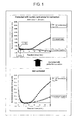
- the fluorescence intensity change rate on a baseline of the detection signal (“DW" in FIG. 1 ) was stabilized in the presence of the nucleic acid probe for correction (Reference-1 that is a nucleic acid probe).
- the fluorescence intensity change rate on the baseline (1 minute) exhibited a low value (1.15%) when corrected with the nucleic acid probe for correction ( FIG. 1 ).
- the fluorescence intensity change rate on the baseline was not stabilized in the early phase of the reaction process when not corrected. On the other hand, it was stabilized in a short period of time (2 minutes) when corrected with the nucleic acid probe for correction ( FIG. 1 ).
- the fluorescence intensity change rate on the baseline was confirmed to be stabilized in a late phase of the reaction process when corrected with the nucleic acid probe for correction ( FIG. 1 ).
- the stabilization of the fluorescence intensity change rate on the baseline of the detection signals contributes to stable correction of the detection signal from the subject to be measured in the isothermal nucleic acid amplification reaction ("10 3 copies/assay" in FIG. 1 ). Therefore, it was demonstrated that a nucleic acid probe for correction was beneficial for correction of detection signals from a subject to be measured in an isothermal nucleic acid amplification reaction.
- ROX non-nucleic acid molecule
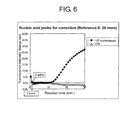
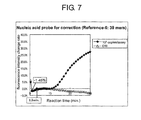
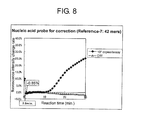
- Table 7 Change on baseline in late phase of reaction process Fluorescence change rate on baseline (20 min) Fluorescence change rate on baseline (30 min) ROX 4.70% 8.80% Reference-1 -1.10% -2.60% Reference-2 0.60% 5.30% Reference-3 -0.30% 1.50% Reference-4 -0.80% 0.50% Reference-5 -1.50% -2.10% Reference-6 -1.70% -3.50% Reference-7 -1.20% -1.90%
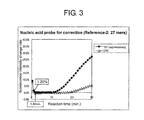
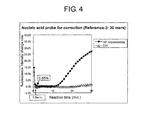
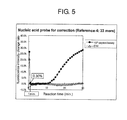
- nucleic acid probes for correction (References-1 to 8, nucleic acid probes) were more excellent than ROX (non-nucleic acid probe) in stabilization of the fluorescence intensity change rate on the baseline (i.e., correction of detection signals in an isothermal nucleic acid amplification reaction). It was also confirmed that the effect of the nucleic acid probe for correction was particularly excellent when the difference in length between the nucleic acid probe for correction and the nucleic acid probe for detection was within 3 nucleotide residues.
- the present invention is useful for measurement of a target nucleic acid by an isothermal nucleic acid amplification reaction.
Landscapes
- Chemical & Material Sciences (AREA)
- Life Sciences & Earth Sciences (AREA)
- Organic Chemistry (AREA)
- Proteomics, Peptides & Aminoacids (AREA)
- Zoology (AREA)
- Wood Science & Technology (AREA)
- Health & Medical Sciences (AREA)
- Engineering & Computer Science (AREA)
- Analytical Chemistry (AREA)
- Microbiology (AREA)
- Immunology (AREA)
- Molecular Biology (AREA)
- Biotechnology (AREA)
- Biophysics (AREA)
- Physics & Mathematics (AREA)
- Biochemistry (AREA)
- Bioinformatics & Cheminformatics (AREA)
- General Engineering & Computer Science (AREA)
- General Health & Medical Sciences (AREA)
- Genetics & Genomics (AREA)
- Chemical Kinetics & Catalysis (AREA)
- Measuring Or Testing Involving Enzymes Or Micro-Organisms (AREA)
Applications Claiming Priority (2)
| Application Number | Priority Date | Filing Date | Title |
|---|---|---|---|
| JP2012018277A JP2013153709A (ja) | 2012-01-31 | 2012-01-31 | 等温核酸増幅反応における検出シグナルの補正方法 |
| PCT/JP2013/051276 WO2013115029A1 (ja) | 2012-01-31 | 2013-01-23 | 等温核酸増幅反応における検出シグナルの補正方法 |
Publications (2)
| Publication Number | Publication Date |
|---|---|
| EP2811019A1 true EP2811019A1 (de) | 2014-12-10 |
| EP2811019A4 EP2811019A4 (de) | 2015-08-12 |
Family
ID=48905071
Family Applications (1)
| Application Number | Title | Priority Date | Filing Date |
|---|---|---|---|
| EP13743774.5A Withdrawn EP2811019A4 (de) | 2012-01-31 | 2013-01-23 | Verfahren zur korrektur eines erkennungssignals in einer isotheren nucleinsäureamplifikationsreaktion |
Country Status (4)
| Country | Link |
|---|---|
| US (1) | US20150010909A1 (de) |
| EP (1) | EP2811019A4 (de) |
| JP (1) | JP2013153709A (de) |
| WO (1) | WO2013115029A1 (de) |
Family Cites Families (9)
| Publication number | Priority date | Publication date | Assignee | Title |
|---|---|---|---|---|
| US5736333A (en) | 1996-06-04 | 1998-04-07 | The Perkin-Elmer Corporation | Passive internal references for the detection of nucleic acid amplification products |
| US6312929B1 (en) * | 2000-12-22 | 2001-11-06 | Cepheid | Compositions and methods enabling a totally internally controlled amplification reaction |
| CN1491285A (zh) * | 2000-12-26 | 2004-04-21 | �����﹤����ʽ���� | 致病微生物的检测方法 |
| DE602004026111D1 (de) * | 2003-12-19 | 2010-04-29 | Nat Inst Of Advanced Ind Scien | Verfahren zum testen von nukleinsäuren unter verwendung davon sowie dafür zu verwendende nukleinsäuresonde |
| JP5027126B2 (ja) * | 2005-07-25 | 2012-09-19 | アリーア サン ディエゴ, インコーポレイテッド | リコンビナーゼポリメラーゼ増幅を多重化するための方法 |
| US20100273173A1 (en) * | 2007-12-26 | 2010-10-28 | Arkray, Inc. | Method for amplifying target nucleic acid sequence and probe used for the same |
| EP2391733A1 (de) * | 2009-01-27 | 2011-12-07 | QIAGEN Gaithersburg, Inc. | Thermophile-helikase-abhängige amplifikationstechnik mit homogenem fluoreszenzendpunktnachweis |
| EP2248915B1 (de) * | 2009-05-05 | 2013-09-18 | Qiagen GmbH | Detektion mehrerer Nukleinsäuresequenzen in einer Reaktionskartusche |
| US9057097B2 (en) * | 2009-06-05 | 2015-06-16 | Alere San Diego Inc. | Recombinase polymerase amplification reagents and kits |
-
2012
- 2012-01-31 JP JP2012018277A patent/JP2013153709A/ja active Pending
-
2013
- 2013-01-23 US US14/375,291 patent/US20150010909A1/en not_active Abandoned
- 2013-01-23 WO PCT/JP2013/051276 patent/WO2013115029A1/ja not_active Ceased
- 2013-01-23 EP EP13743774.5A patent/EP2811019A4/de not_active Withdrawn
Also Published As
| Publication number | Publication date |
|---|---|
| WO2013115029A1 (ja) | 2013-08-08 |
| US20150010909A1 (en) | 2015-01-08 |
| JP2013153709A (ja) | 2013-08-15 |
| EP2811019A4 (de) | 2015-08-12 |
Similar Documents
| Publication | Publication Date | Title |
|---|---|---|
| Nagamine et al. | Accelerated reaction by loop-mediated isothermal amplification using loop primers | |
| KR102085119B1 (ko) | 핵산의 검출 | |
| EP2310527B1 (de) | Verbesserte lysis und reverse transkription zur mrna-quantifizierung | |
| JP7175326B2 (ja) | 標的核酸増幅方法及び標的核酸増幅用組成物 | |
| WO2016064894A2 (en) | Compositions and methods for detecting an rna virus | |
| US20170253921A1 (en) | Methods, kits & compositions for determining gene copy numbers | |
| US20100055685A1 (en) | Isothermal detection methods and uses thereof | |
| WO2023056451A1 (en) | Compositions and methods for assaying for and genotyping genetic variations | |
| US11180787B2 (en) | Strand-invasion based DNA amplification method | |
| WO2021183941A1 (en) | Looped primer and loop-de-loop method for detecting target nucleic acid | |
| MX2015000766A (es) | Sondas, cebadores cooperativos y aplicaciones de ellos. | |
| US20150064698A1 (en) | Method for detecting target nucleic acid using molecular beacon-type probe | |
| US20230167511A1 (en) | An ultrasensitive rapid and portable case13d-based diagnostic assay | |
| Kranaster et al. | One‐step RNA pathogen detection with reverse transcriptase activity of a mutated thermostable Thermus aquaticus DNA polymerase | |
| CN108291252B (zh) | 稳定特定rna的通用方法 | |
| WO2006098428A1 (ja) | プライマーダイマーからの非特異的増幅を減少させる方法 | |
| US20190032122A1 (en) | Indel detection by amplicon analysis | |
| EP2811019A1 (de) | Verfahren zur korrektur eines erkennungssignals in einer isotheren nucleinsäureamplifikationsreaktion | |
| EP4310195A1 (de) | Verfahren zur nukleinsäure-detektion unter verwendung der signalvermittelten amplifikation der rna-technologie und der rna-aptamere | |
| US20240376528A1 (en) | Looped Primer with Various Internal Modifications and Loop-De-Loop Method for Target Detection | |
| JP7160142B2 (ja) | 核酸増幅用試薬及び核酸増幅法 | |
| KR20100126676A (ko) | 등온 검출 방법 및 그의 용도 | |
| US7556943B2 (en) | Linear amplification of short nucleic acids | |
| JP6999645B2 (ja) | 核酸の増幅及び検出/定量の効率を改良するためのヘルパーオリゴヌクレオチド | |
| US20240425911A1 (en) | Protractor isothermal nucleic acid detection methods |
Legal Events
| Date | Code | Title | Description |
|---|---|---|---|
| PUAI | Public reference made under article 153(3) epc to a published international application that has entered the european phase |
Free format text: ORIGINAL CODE: 0009012 |
|
| 17P | Request for examination filed |
Effective date: 20140725 |
|
| AK | Designated contracting states |
Kind code of ref document: A1 Designated state(s): AL AT BE BG CH CY CZ DE DK EE ES FI FR GB GR HR HU IE IS IT LI LT LU LV MC MK MT NL NO PL PT RO RS SE SI SK SM TR |
|
| AX | Request for extension of the european patent |
Extension state: BA ME |
|
| DAX | Request for extension of the european patent (deleted) | ||
| RA4 | Supplementary search report drawn up and despatched (corrected) |
Effective date: 20150709 |
|
| RIC1 | Information provided on ipc code assigned before grant |
Ipc: C12N 15/09 20060101AFI20150703BHEP Ipc: C12Q 1/68 20060101ALI20150703BHEP |
|
| 17Q | First examination report despatched |
Effective date: 20160610 |
|
| STAA | Information on the status of an ep patent application or granted ep patent |
Free format text: STATUS: THE APPLICATION IS DEEMED TO BE WITHDRAWN |
|
| 18D | Application deemed to be withdrawn |
Effective date: 20161021 |