EP2810745A1 - Ensemble formant bras à articulations multiples - Google Patents
Ensemble formant bras à articulations multiples Download PDFInfo
- Publication number
- EP2810745A1 EP2810745A1 EP14155692.8A EP14155692A EP2810745A1 EP 2810745 A1 EP2810745 A1 EP 2810745A1 EP 14155692 A EP14155692 A EP 14155692A EP 2810745 A1 EP2810745 A1 EP 2810745A1
- Authority
- EP
- European Patent Office
- Prior art keywords
- link member
- pivot
- point
- assembly according
- attachment
- Prior art date
- Legal status (The legal status is an assumption and is not a legal conclusion. Google has not performed a legal analysis and makes no representation as to the accuracy of the status listed.)
- Withdrawn
Links
- 239000000463 material Substances 0.000 description 7
- OKTJSMMVPCPJKN-UHFFFAOYSA-N Carbon Chemical compound [C] OKTJSMMVPCPJKN-UHFFFAOYSA-N 0.000 description 6
- 229920002430 Fibre-reinforced plastic Polymers 0.000 description 6
- 229910052799 carbon Inorganic materials 0.000 description 6
- 239000013013 elastic material Substances 0.000 description 6
- 239000003365 glass fiber Substances 0.000 description 6
- 229910001000 nickel titanium Inorganic materials 0.000 description 6
- 230000000712 assembly Effects 0.000 description 3
- 238000000429 assembly Methods 0.000 description 3
- 239000000835 fiber Substances 0.000 description 3
- 239000011151 fibre-reinforced plastic Substances 0.000 description 3
- HLXZNVUGXRDIFK-UHFFFAOYSA-N nickel titanium Chemical compound [Ti].[Ti].[Ti].[Ti].[Ti].[Ti].[Ti].[Ti].[Ti].[Ti].[Ti].[Ni].[Ni].[Ni].[Ni].[Ni].[Ni].[Ni].[Ni].[Ni].[Ni].[Ni].[Ni].[Ni].[Ni] HLXZNVUGXRDIFK-UHFFFAOYSA-N 0.000 description 3
- 239000004033 plastic Substances 0.000 description 3
- 229920003023 plastic Polymers 0.000 description 3
- 238000004519 manufacturing process Methods 0.000 description 2
- 229910052751 metal Inorganic materials 0.000 description 2
- 239000002184 metal Substances 0.000 description 2
- 238000010146 3D printing Methods 0.000 description 1
- 241000406668 Loxodonta cyclotis Species 0.000 description 1
- 241000270295 Serpentes Species 0.000 description 1
- 238000005452 bending Methods 0.000 description 1
- 238000010276 construction Methods 0.000 description 1
- 238000011065 in-situ storage Methods 0.000 description 1
- 238000003754 machining Methods 0.000 description 1
- 238000000034 method Methods 0.000 description 1
- 238000012986 modification Methods 0.000 description 1
- 230000004048 modification Effects 0.000 description 1
- 238000005498 polishing Methods 0.000 description 1
- 239000012858 resilient material Substances 0.000 description 1
- 238000000926 separation method Methods 0.000 description 1
- 238000007666 vacuum forming Methods 0.000 description 1
Images



Classifications
-
- B—PERFORMING OPERATIONS; TRANSPORTING
- B25—HAND TOOLS; PORTABLE POWER-DRIVEN TOOLS; MANIPULATORS
- B25J—MANIPULATORS; CHAMBERS PROVIDED WITH MANIPULATION DEVICES
- B25J18/00—Arms
- B25J18/06—Arms flexible
-
- B—PERFORMING OPERATIONS; TRANSPORTING
- B25—HAND TOOLS; PORTABLE POWER-DRIVEN TOOLS; MANIPULATORS
- B25J—MANIPULATORS; CHAMBERS PROVIDED WITH MANIPULATION DEVICES
- B25J9/00—Programme-controlled manipulators
- B25J9/06—Programme-controlled manipulators characterised by multi-articulated arms
-
- B—PERFORMING OPERATIONS; TRANSPORTING
- B25—HAND TOOLS; PORTABLE POWER-DRIVEN TOOLS; MANIPULATORS
- B25J—MANIPULATORS; CHAMBERS PROVIDED WITH MANIPULATION DEVICES
- B25J9/00—Programme-controlled manipulators
- B25J9/10—Programme-controlled manipulators characterised by positioning means for manipulator elements
- B25J9/104—Programme-controlled manipulators characterised by positioning means for manipulator elements with cables, chains or ribbons
-
- Y—GENERAL TAGGING OF NEW TECHNOLOGICAL DEVELOPMENTS; GENERAL TAGGING OF CROSS-SECTIONAL TECHNOLOGIES SPANNING OVER SEVERAL SECTIONS OF THE IPC; TECHNICAL SUBJECTS COVERED BY FORMER USPC CROSS-REFERENCE ART COLLECTIONS [XRACs] AND DIGESTS
- Y10—TECHNICAL SUBJECTS COVERED BY FORMER USPC
- Y10T—TECHNICAL SUBJECTS COVERED BY FORMER US CLASSIFICATION
- Y10T74/00—Machine element or mechanism
- Y10T74/20—Control lever and linkage systems
- Y10T74/20207—Multiple controlling elements for single controlled element
- Y10T74/20305—Robotic arm
- Y10T74/20323—Robotic arm including flaccid drive element
Definitions
- the present invention relates to a multi jointed assembly, particularly though not exclusively to a multi-jointed assembly for a robot arm.
- Multi-jointed robot arms comprising a robotically controlled arm on which a manipulator or tool can be placed on a distal end are known.
- Such arms comprise a plurality of discrete pivotable link members, which pivot relative to each other to change the position of the distal end of the arm.
- a plurality of pivotable link members may be arranged in segments, such that each segment can be independently manipulated.
- typical prior multi-link robot arms for aerospace applications may have an end load capability of up to 1 kg, and a length up to 1 to 2 metres, but have a diameter greater than 40mm and a flexibility of only up to ⁇ 11° per joint.
- the robot arm where the robot arm is to be used for in situ repair of an internal component of a gas turbine engine, the robot arm must be capable of supporting a load of at least 200 g at its distal end, while having a small diameter ( ⁇ 30 mm), long length (>1200 mm) and great flexibility ( ⁇ 90° between adjacent segments).
- each segment must be controllable individually. This requires at least three control cables, and three actuators for each segment. Consequently, the diameter of the arm must be relatively large, particularly at the proximal end.
- the cables are tensioned against an attachment point on a distal joint of the respective segment by actuators provided in a head unit provided at the proximal end of the arm.
- actuators provided in a head unit provided at the proximal end of the arm.
- the present invention provides a multi-link robot arm which solves some or all of the above problems.
- a multi-jointed robot arm comprising at least first and second link members connected by a connection arrangement, and a first control cable, a first end of the first control cable engaging with a first engagement point of the first link member and a first attachment point of the second link member, and a second end of the first cable engaging with a second engagement point of the first link member spaced from the first engagement point, and a second attachment point of the second link member spaced from the first attachment point, the assembly further comprising a first actuator configured to selectively tension the first end of the first control cable such that the second link member pivots toward a first side, and to selectively tension the second end of the first control cable such that the second link member pivots toward a second side, wherein the connection arrangement is arranged to pivot at a first pivot point located substantially along a notional line extending between the first and second attachment points, and to pivot at a second pivot point extending between the first and second engagement points.
- the arrangement of the present invention solves the abovementioned kinematics problem by providing pivoting movement along lines extending between the attachment points and engagement points.
- the invention provides pivoting of the link members without resulting in one or more slack cables, and with a relatively simple and inexpensive arrangement.
- the arm may comprise a second control cable.
- a first end of the second control cable may engage with a third engagement point of the first link member and a third attachment point of the second link member, and a second end of the second cable may engage with a fourth engagement point of the first link member spaced from the third engagement point, and a fourth attachment point of the second link member spaced from the third attachment point.
- the first, second, third and fourth attachment points may together define an attachment plane which may extend substantially perpendicular to a longitudinal axis extending between the first and second link members.
- the assembly may further comprise a second actuator configured to selectively tension the first end of the second control cable such that the second link member pivots toward a third side, and to selectively tension the second end of the second control cable such that the second link member pivots toward a fourth side.
- the first pivot point may be co-planar with the attachment plane.
- the first, second, third and fourth engagement points may together define an engagement plane which may extend substantially perpendicular to a longitudinal axis extending between the first and second link members.
- the second pivot point may be co-planar with the engagement plane
- pivoting movement in two axes can be provided with only two actuators, and without a substantial amount of slack being introduced into any of the cables.
- the or each actuator may comprise a rotor, and the or each cable may be looped around a respective rotor, such rotation of the rotor in a first direction causes tensioning of the first end of the respective cable, and rotation of the rotor in a second direction causes tensioning of the second end of the respective cable.
- connection arrangement may comprise a rigid element located between a pair of pivotable portions, each pivotable portion providing pivotable movement at the respective first or second pivot point between a respective end of the rigid element and the respective one of the pair of link members.
- a rigid element located between a pair of pivotable portions between each pair of link members solves the problem of one of the cables becoming slack when adjacent link members are pivoted relative to each other, which would otherwise be the case if the rigid element were to pivot about a point away from the plane of the attachment points of the cables.
- the combination of a rigid element located between a pair of flexible elements also provides an arrangement which is relatively flexible, and has a large number of degrees of freedom for each segment.
- the rigid element may comprise a rigid rod, which may be hollow.
- the pivotable portions may comprise a flexible rod. A first part of each flexible rod may be located within the rigid rod, and a second part of the flexible rod may extend from each end of the rigid rod to provide the respective pivotable portions.
- the rigid portion may have a length approximately 6 to 8 times the length of the pivotable portions.
- the rigid rod may comprise a rigid plastic or metal.
- the flexible rod may comprise an elastic material, and may comprise one of a group selected from carbon fibre, carbon fibre reinforced plastic, glass fibre, glass fibre reinforced plastic and a super elastic material such as nickel titanium alloy (Nitinol).
- Each link member may comprise a recess which is recessed from the notional line between the attachment points of the respective ends of the cables.
- Each flexible rod may be attached to the respective link member within the recess.
- the depth of the recess relative to the notional line between the attachment points may be approximately half the length of the pivotable portions.
- the relative lengths and positions of the pivotable portions and connection points of the control cables ensures that the pivot point of the pivotable portions remains co-planar with the attachment points of the control cables.
- Each pivotable portion may comprise a first connector pivotally connected to a second connector by a first pivot such that the first and second connectors pivot about a first axis, and a third connector pivotally connected to the second connector by a second pivot such that the second and third connectors pivot about the second axis substantially perpendicular to the first axis.
- Each pivot may comprise a pair of pivot members, and may comprise an elastic material, and may comprise one of a group selected from carbon fibre, carbon fibre reinforced plastic, glass fibre, glass fibre reinforced plastic and a super elastic material such as nickel titanium alloy (Nitinol).
- the pivot may comprise a thin section of material.
- the pivotable portions are relatively robust, and the assembly is therefore resistant to twisting forces, enabling larger loads to be carried by the distal end of the robot arm.
- Such arrangement allows a large number of degrees of freedom for each segment, thereby providing a relatively flexible robot arm.
- each pivotable portion may comprise a single body connector having first, second and third body portions, the first body portion being connected to the second body portion by a thin walled section configured to provide pivotable movement in a first axis, the third body portion being connected to the second body portion by a thin walled section configured to provide pivotable movement in a second axis substantially perpendicular to the first axis.
- pivotable portions are relatively inexpensive to manufacture, and yet are still relatively robust and resistant to twisting forces.
- Each pivotable portion may comprise a spring element configured to permit movement along the longitudinal axis of the arm.
- the spring element permits a further degree of freedom in the direction of the longitudinal axis of the arm, thereby enabling further flexibility.
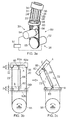
- Figures 1 to 3 show a first multi-jointed robot arm assembly 10.
- the assembly 10 comprises at least one arm segment 12.
- the assembly 10 may include further segments 12 joined to one or both of proximal 14 and distal 16 ends of the segment 12.
- Each segment 12 comprises a plurality of joint sections 18.
- Each joint section 18 comprises a pair of link members comprising a proximal link member 20 and a distal link member 21.
- the proximal link member 20 forms the distal link member 21 of an adjacent, proximal joint section 18.
- Each segment 12 further comprises at least one control cable (in this embodiment, first and second control cables 22, 24 are provided) and a connection arrangement 26 for pivotably connecting the link members 20, 21 of each joint section 18 together.
- Each control cable 22, 24 has first 32, 34 and second 36, 38 ends respectively, which are secured to the distal link member 21 of the distal joint 18 of the respective segment 12, as shown particularly in Figs. 3b and 3c at attachment points 32, 34, 36, 38.
- the attachment points define an attachment plane A which extends generally perpendicularly to a longitudinal axis X of the joint section 18.
- Each control cable 22, 24 slidably extends through the proximal link members 20 through openings provided at engagement points 41, 43, 45, 47.
- the engagement points 41, 43, 45, 47 are coplanar, and define an engagement plane B.
- the control cables 22, 24 extend through the proximal end 16 of the segment 12 toward a head unit 50.
- the head unit 50 comprises first and second actuators 28, 30 and a controller 51.
- Each actuator 28, 30 comprises a respective motor 52, 54 configured to rotate a respective rotor 55, 56 around which is looped a respective control cable 22, 24.
- connection arrangement comprises a rigid portion located between adjacent link members 20, 21 each end of the rigid portion being pivotally connected to the respective adjacent link member 20, 21 by a pivotable portion which is configured to provide pivotable movement between the respective ends of the rigid portion and the adjacent link member 20.
- the rigid portion comprises a rigid hollow rod 58 having a longitudinal axis extending along the longitudinal axis X, normal to the attachment planes A, B, and being parallel to and equidistant from each of the cables 22, 24.
- the rod 58 is made of a relatively rigid material such as any of a plastics material or metal, such that the rod 58 does not bend to a significant extent during normal use of the robot arm 10.
- the pivotable portion comprises an elastic rod 60 which passes through a through passage of the rigid rod 58.
- a distal end of the elastic rod 60 extends from the distal end of the rigid rod 58 into a recess 62a in the distal link member 21, which is recessed relative to the attachment plane A.
- An end of the elastic rod 60 contacts an inner surface 64 of the recess 62a.
- a proximal end of the elastic rod 60 extends from the proximal end of the rigid rod 58 into a recess 62b in the distal link member 21, which is recessed relative to the engagement plane B.
- the length of the rigid rod 58 parallel to the longitudinal axis X is less than the spacing between the inner surfaces 64a, 64b of the respective recesses 62a, 62b of adjacent link members 20, thereby leaving a gap 2a either end of the rigid rod 58.
- the distance between the attachment plane A and the inner surface 64a normal to the attachment plane A is shown in Fig. 3b as "a”.
- the same distance "a” is also provided between the other end of the rigid rod 58 and the engagement plane B.
- the length of each pivotable portion is therefore 2a.
- the joint section 18 can be pivoted from the first position to the second position by rotation of the rotor 54 in an anti-clockwise direction as shown in Fig. 3c by actuation of the motor 52.
- This rotation increases the tension in the end 32 (i.e. the left side as shown in Fig. 3c ) of the control cable 22, thereby sliding the first side of the first control cable 22 downwards through the engagement points and pulling on the attachment points, thereby reducing the length l 1 of the first end of the control cable 22.
- the tension on the second end 36 of the control cable 22 is reduced, thereby allowing the second side of the control cable 22 to increase in length I 2 .
- the pivotable portions are configured to pivot at points C, D which are co-planar with the attachment plane A, and engagement plane B, and are substantially equidistant from the respective attachment points 40 - 46. Consequently, as the joint section 18 pivots between the first and second positions, the overall length I 1 + I 2 of the cable 22 remains the same at all angles up to the maximum deflection that can be provided (typically approximately 9 to 15° for each joint, and up to 90° for each segment). Pivotable movement about a second axis perpendicular to the first axis can be provided by selectively tensioning first and second ends 34, 38 of the second cable 24 by rotation of the second rotor 56.
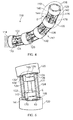
- Figs. 4 to 6 show a second assembly 110.
- the second assembly 110 is similar to the first assembly 10, comprising at least one arm segment 112, each arm segment having a plurality of joint sections 118, each joint section 118 comprising a pair of link members 120, 121.
- the apparatus 110 further comprises first and second control cables 122, 124, and each joint 118 comprises a connection arrangement 126 for pivotably connecting the link members 120 of each joint section 118 together.
- each control cable 122, 124 has first 132, 134 and second 136, 138 ends respectively, which are attached to and engage with the link members 120 in a similar manner to that of the first apparatus 10.
- the cables 122, 124 are controlled by a head unit similar to the head unit 50.
- connection arrangement 126 of the second assembly 110 comprises rigid and flexible portions in a similar arrangement to that of the first assembly 10.
- the rigid portion comprises a rigid rod 158 similar to the rod 58 of the first assembly, but need not be hollow.
- the pivotable portions differ from those of the first assembly 10.
- the pivotable portions each comprise a joint assembly 170 comprising first, second 174 and third 176 connectors, as shown in Fig. 6 .
- the first connector 172 is attached to the adjacent link member 120, 121 and is pivotally connected to the second connector 174 by a first pivot 178 such that the first and second connectors 172, 174 pivot about a first axis C 1 .
- the first axis C 1 is coplanar with a respective attachment plane A, B, and extends equidistant to the attachment points.
- the first pivot 178 comprises a pair of pivot members 179 located at either side of the first connector 172, each of which comprises an elastic material, such as carbon fibre, carbon fibre reinforced plastic, glass fibre or glass fibre reinforced plastic, or a super elastic material such as nickel titanium alloy (Nitinol).
- an elastic material such as carbon fibre, carbon fibre reinforced plastic, glass fibre or glass fibre reinforced plastic, or a super elastic material such as nickel titanium alloy (Nitinol).
- Nitinol nickel titanium alloy
- the third connector 176 is attached to the rigid rod 158, and is pivotally connected to the second connector 174 by a second pivot 180 such that the second and third connectors 174, 176 pivot about an axis C 2 substantially perpendicular to the axis C 1 , and coplanar with the adjacent attachment plane A and engagement plane B.
- the joint section 118 pivots between the first and second positions, the length l 2 + l 2 remains the same at all angles up to the maximum deflection that can be provided due to the position of the axes C 1 , C 2 relative to the planes A and B. Again, due to the provision of two pivots, the joint section 118 is able to pivot about two axes.
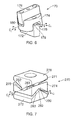
- Fig. 7 shows an alternative joint assembly 270 for use in the assembly 110.
- the joint assembly 270 is similar to the joint assembly 170, and comprises first, second and third connectors 272, 274, 276. However, the connectors 272, 274, 276 are integrally formed. The first and second connectors 272, 274, and the second and third connectors 274, 276 are joined to one another by first and second pivots 278, 280 respectively.
- Each pivot 278, 280 comprises a pair of pivot members which each comprise a thin section of material. A gap is provided either side of each pivot member such that the connectors 272, 274, 276 are able to pivot relative to one another.
- the connectors 272, 274, 276 are shaped such that the pivot axes C 1 , C 2 of the pivots 278, 280 is coplanar with the adjacent attachment plane A or engagement plane B. This is achieved by providing a triangular shaped protrusion 282 on the first and third connectors 272, 276 which projects into a correspondingly shaped recess 283 in either side of the second connector 274, the pivots 278, 280 being provided at the apex of the respective protrusions 282.
- the apexes are oriented perpendicular to one another, such that the axes C 1 , C 2 of each pivot 278, 280 crosses perpendicular to the other.
- Figs. 8 and 9 show parts of a third assembly 310.
- the assembly is similar to the assemblies 10, 110, 210, but has a different connection arrangement, and essentially combines features from the assemblies 10, 110.
- the connection arrangement comprises rigid and pivotable portions.
- the rigid portion comprises a hollow rigid rod 358.
- the rod 358 has a non-circular cross section, and in this embodiment has a square cross section, though other non-circular cross sections such as oval or polygonal cross sections could be employed.
- the pivotable portion comprises an elastic rod 360 made of a similar material to the rod 60 of the assembly 10.
- the elastic rod 360 passes through a through passage of the rigid rod 370, and is attached to a recess provided in proximal and distal links 320, 321 at either end, in a similar manner to the assembly 10.
- the pivotable portion also comprises a joint assembly 370 at proximal and distal ends, which is similar to the joint assembly 170, having first, second and third connectors 372, 374, 376, and first and second pivots 378, 380, which provide pivotable movement about axes which are coplanar with the attachment axes of the control cables.
- the combination of an elastic rod 360 and a joint assembly 370 provides
- the joint assembly 370 further differs from the joint assembly 170 of the second assembly 110 in that the rigid rod 358 is slidably attached to the first connector 372 by a non-circular aperture 384.
- the non-circular aperture 384 corresponds to the cross section of the rigid rod 358, such that in this embodiment, the aperture 384 has a square or rectangular cross section.
- An end part of the rigid rod 358 is received within the aperture 384 in each respective joint assembly.
- the rigid rod 358 is prevented from freely rotating within the aperture 384 by the edges of the aperture 384 and rod 358. Consequently, the link members 320, 321 are prevented from twisting about the longitudinal axis X.
- the sliding fit of the rod 358 within the aperture 384 permits movement of the rod 358 along the longitudinal axis X, while allows a further degree of freedom.
- Figs. 10 to 12 show a fourth assembly 410.
- Fig. 12 shows a single segment 412 comprising a plurality of joint section 418.
- Each joint section 418 comprises a pair of link members 420, 421.
- the link members 420, 421 are separated by a distance b + 2a such that they are located closer together compared to those of assemblies 10, 110, 210, 310, and are joined by a connection arrangement 426. Consequently, a larger number of joint sections 418 are required for a segment 412 having a given length.
- Pivoting movement of the link members 420, 421 is controlled by a pair of control cables 422, 424, attached to the link members 420, 421 in a similar manner to the previous arrangements.
- the link members 420, 421 and connection arrangement 426 of segment 412 are integrally formed.
- Fig. 13 shows two joint sections 418 in more detail.
- the link members 420, 421 of each joint section 418 are integrally formed, and are linked together by a connection arrangement 426.
- the connection arrangement 426 comprises rigid and pivotable portions, which are arranged to relatively pivot the link members 420, 421 of each joint section 418 at pivot axes which lie in the plane of the attachment plane and engagement plane of the control cables.
- the rigid and pivotable portions comprise an integrally formed rod 457 located between adjacent link members 420, 421.
- the rod 457 comprises a rigid portion 458 having a width less than that of the link members 420, 421, but greater than that of a pair of elastic portions 460 located either side of the rigid portion 458.
- the elastic portions 460 are connected to the adjacent link members 420, 421 within a recess 462, and have a length "2a" approximately twice the depth "a" of the recess 462 such that the link members are caused to pivot about axes which lie in the plane of the attachment plane and engagement plane of the control cables.
- the rigid portion 358 has a sufficient thickness such that it is substantially rigid, and a length "b" sufficient to bridge the gap between the elastic portions 460 and the link members 420, 421.
- Each rod 457 has a depth "c" which extends parallel to the planes A, B, and extends from one side of the link members to the other. Consequently, the elastic portions 460 are substantially rigid normal to the axis of the depth "c", and so each joint section 418 is able to pivot about one axis only, i.e. parallel to the depth "c".
- Alternate joint sections 418 have a depth "c" normal each other, but coplanar with the planes A, B, such that each joint section 418 pivots about an axis normal to the adjacent joint section 418. Consequently, pivoting movement of the segment 412 is provided in both directions.
- Such an arrangement provides many of the advantages of previous embodiments, and also has the further advantage that it can be produced using mass manufacturing techniques such as vacuum forming, electro-discharge machining (EDM) and 3D printing.
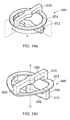
- Figs. 13 and 14 show a fifth assembly 510.
- the assembly 510 is similar to the assembly 110, but comprises a joint assembly 570 which allows some limited movement along the longitudinal axis X.
- the joint assembly 570 comprises an integral leaf spring assembly 586, shown in further detail in a first longitudinal position in Fig. 14a , and a second longitudinal position in Fig. 14b .
- the leaf spring assembly 586 comprises first, second and third connectors 572, 574, 576.
- the first connector 572 comprises an elongate web 586 which lies parallel with the plane A and is attached to the proximal link member 520, and a pair of upstanding finger members 588 extending longitudinally from opposite ends of the web 586.
- the finger members 588 are attached to a proximal side of the second connector 574, which is in the form of a generally toroidal spring member 574.
- the toroidal spring member 574 is in turn attached to finger members 590 of a third connector 578.
- the third connector 578 is similar to the first connector 574 having a web 592 and a pair of finger members 590, but with the finger members 590 extending in a proximal direction.
- the web 592 extends in a direction angle ⁇ to the web 586 relative to the longitudinal axis X.
- the joint arrangement 518 is formed of a resilient material such as a plastics material. This arrangement permits the joint arrangement 518 to pivot about axes normal to one another, coincident with the planes A and B of the attachment points of the control cables, and also to move between a first longitudinal position as shown in Fig. 14a to a second longitudinal position as shown in Fig. 14b when a longitudinal force is applied.
- the invention provides a multi-joint assembly which can be controlled in any direction about the longitudinal axis using only two actuators, yet is relatively strong and inexpensive to produce.
Landscapes
- Engineering & Computer Science (AREA)
- Robotics (AREA)
- Mechanical Engineering (AREA)
- Manipulator (AREA)
- Transmission Devices (AREA)
Applications Claiming Priority (1)
| Application Number | Priority Date | Filing Date | Title |
|---|---|---|---|
| GBGB1304572.9A GB201304572D0 (en) | 2013-03-14 | 2013-03-14 | Multi-jointed arm assembly |
Publications (1)
| Publication Number | Publication Date |
|---|---|
| EP2810745A1 true EP2810745A1 (fr) | 2014-12-10 |
Family
ID=48226291
Family Applications (1)
| Application Number | Title | Priority Date | Filing Date |
|---|---|---|---|
| EP14155692.8A Withdrawn EP2810745A1 (fr) | 2013-03-14 | 2014-02-19 | Ensemble formant bras à articulations multiples |
Country Status (3)
| Country | Link |
|---|---|
| US (1) | US20140260755A1 (fr) |
| EP (1) | EP2810745A1 (fr) |
| GB (1) | GB201304572D0 (fr) |
Cited By (12)
| Publication number | Priority date | Publication date | Assignee | Title |
|---|---|---|---|---|
| CN105171722A (zh) * | 2015-10-26 | 2015-12-23 | 冯亿坤 | 仿鳗鱼水下多自由度机器人 |
| JPWO2017006373A1 (ja) * | 2015-07-09 | 2018-04-19 | 川崎重工業株式会社 | ロボットアームの関節及び外科機器 |
| CN108472025A (zh) * | 2015-10-05 | 2018-08-31 | 弗莱克斯德克斯公司 | 具有平滑铰接的多簇接头的医疗装置 |
| US10213919B2 (en) | 2015-03-23 | 2019-02-26 | Rolls-Royce Plc | Flexible tools and apparatus for machining objects |
| CN110065058A (zh) * | 2019-05-20 | 2019-07-30 | 浙江大学 | 一种仿象鼻柔性机械臂 |
| US10525595B2 (en) | 2016-07-08 | 2020-01-07 | Rolls-Royce Plc | Methods, apparatus, computer programs, and non-transitory computer readable storage mediums for controlling at least one of a first robot and a second robot to collaborate within a system |
| CN113043270A (zh) * | 2021-02-23 | 2021-06-29 | 哈尔滨工业大学(深圳) | 基于工装条件下的绳驱柔性机械臂自动高精度复位方法 |
| US20220364621A1 (en) * | 2021-05-13 | 2022-11-17 | Moffitt, LLC | Methods and apparatus for a 3d-printed spring |
| US11896255B2 (en) | 2015-10-05 | 2024-02-13 | Flexdex, Inc. | End-effector jaw closure transmission systems for remote access tools |
| US12390293B2 (en) | 2016-02-25 | 2025-08-19 | Shorya Awtar | Parallel kinematic mechanisms with decoupled rotational motions |
| WO2025245596A1 (fr) * | 2024-05-27 | 2025-12-04 | Serviço Nacional De Aprendizagem Industrial | Système robotique déformable extensible |
| WO2025251123A1 (fr) * | 2024-06-06 | 2025-12-11 | Serviço Nacional De Aprendizagem Industrial | Système robotique modulaire de manipulation dans des systèmes et son procédé de fonctionnement |
Families Citing this family (38)
| Publication number | Priority date | Publication date | Assignee | Title |
|---|---|---|---|---|
| KR101917076B1 (ko) * | 2012-02-21 | 2018-11-09 | 삼성전자주식회사 | 링크 유닛 및 이를 가지는 암 모듈 |
| US9713873B2 (en) * | 2012-05-12 | 2017-07-25 | Massachusetts Institute Of Technology | Continuum style manipulator actuated with phase change media |
| DE102014010181B4 (de) * | 2014-07-09 | 2021-03-11 | Schölly Fiberoptic GmbH | Manipulations- und/oder Untersuchungs-Instrument |
| CN106625628A (zh) * | 2015-10-29 | 2017-05-10 | 广西大学 | 一种柔性抓取机械手 |
| US9796081B2 (en) * | 2015-11-25 | 2017-10-24 | Tata Consultancy Services Limited | Robotic snake |
| US10213883B2 (en) * | 2016-02-22 | 2019-02-26 | General Electric Company | System and method for in situ repair of gas turbine engine casing clearance |
| US20200038121A1 (en) * | 2016-05-23 | 2020-02-06 | Imperial Innovations Limited | Surgical instrument, robotic arm and control system for a robotic arm |
| GB2557269B (en) | 2016-12-02 | 2020-05-06 | Rolls Royce Plc | Hyper redundant robots |
| EP3576596A4 (fr) | 2016-12-02 | 2021-01-06 | Vanderbilt University | Endoscope orientable avec manipulateur de continuum |
| WO2019034863A1 (fr) * | 2017-08-15 | 2019-02-21 | University Of Dundee | Actionneur souple |
| WO2019055701A1 (fr) * | 2017-09-13 | 2019-03-21 | Vanderbilt University | Robots continuum à mouvement multi-échelle par modulation d'équilibre |
| WO2019089709A1 (fr) * | 2017-10-31 | 2019-05-09 | Worcester Polytechnic Institute | Élément de préhension robotique |
| US11865702B2 (en) | 2017-10-31 | 2024-01-09 | Worcester Polytechnic Institute | Robotic gripper member |
| JP7117760B2 (ja) * | 2018-05-22 | 2022-08-15 | 国立大学法人信州大学 | 6自由度関節 |
| US11458641B2 (en) * | 2018-05-23 | 2022-10-04 | General Electric Company | Robotic arm assembly construction |
| DE102018209609A1 (de) | 2018-06-14 | 2019-12-19 | MTU Aero Engines AG | Inspektionsverfahren und System |
| CN108942906B (zh) * | 2018-08-01 | 2020-08-28 | 清华大学深圳研究生院 | 柔性机械臂及系统总成 |
| US11707819B2 (en) | 2018-10-15 | 2023-07-25 | General Electric Company | Selectively flexible extension tool |
| US12194620B2 (en) | 2018-10-15 | 2025-01-14 | Oliver Crisipin Robotics Limited | Selectively flexible extension tool |
| CN111317571B (zh) * | 2018-12-13 | 2021-10-15 | 中国科学院沈阳自动化研究所 | 一种骨架嵌套可控连续形变机构 |
| GB201820398D0 (en) * | 2018-12-14 | 2019-01-30 | Rolls Royce Plc | Continuum robot |
| US11702955B2 (en) | 2019-01-14 | 2023-07-18 | General Electric Company | Component repair system and method |
| US12405187B2 (en) | 2019-10-04 | 2025-09-02 | General Electric Company | Insertion apparatus for use with rotary machines |
| US11865703B2 (en) * | 2019-12-05 | 2024-01-09 | Sanctuary Cognitive Systems Corporation | Flexible mechanical joint |
| US11752622B2 (en) | 2020-01-23 | 2023-09-12 | General Electric Company | Extension tool having a plurality of links |
| US11692650B2 (en) | 2020-01-23 | 2023-07-04 | General Electric Company | Selectively flexible extension tool |
| US11613003B2 (en) | 2020-01-24 | 2023-03-28 | General Electric Company | Line assembly for an extension tool having a plurality of links |
| US11371437B2 (en) | 2020-03-10 | 2022-06-28 | Oliver Crispin Robotics Limited | Insertion tool |
| US12091981B2 (en) | 2020-06-11 | 2024-09-17 | General Electric Company | Insertion tool and method |
| CN113352295A (zh) * | 2020-12-11 | 2021-09-07 | 浙江清华柔性电子技术研究院 | 柔性机械臂 |
| US12416800B2 (en) * | 2021-01-08 | 2025-09-16 | General Electric Company | Insertion tool |
| US12504616B2 (en) | 2021-01-08 | 2025-12-23 | General Electric Company | Insertion tool |
| US11654547B2 (en) | 2021-03-31 | 2023-05-23 | General Electric Company | Extension tool |
| CN113386117B (zh) * | 2021-06-07 | 2022-06-17 | 哈尔滨工业大学(深圳) | 一种实现正弦解耦的具有偏航自由度的绳驱柔性机械臂 |
| CN114367969B (zh) * | 2022-01-27 | 2023-10-10 | 山东大学 | 一种基于张拉原理的管道爬行机器人 |
| DE102022103043B3 (de) | 2022-02-09 | 2023-05-17 | Deutsches Zentrum für Luft- und Raumfahrt e.V. | System zur endoskopischen Positionierung und Verfahren zur Positionierung eines endoskopischen Systems |
| KR102615648B1 (ko) * | 2022-05-04 | 2023-12-19 | 네이버랩스 주식회사 | 로봇용 관절 장치 |
| KR102862539B1 (ko) * | 2025-02-21 | 2025-09-19 | 동양미래대학교 산학협력단 | 다관절 플렉시블 로봇암 |
Citations (4)
| Publication number | Priority date | Publication date | Assignee | Title |
|---|---|---|---|---|
| SU1184666A1 (ru) * | 1984-04-28 | 1985-10-15 | Институт Машиноведения Им.А.А.Благонравова | Исполнительное устройство промышленного робота |
| WO2002100608A1 (fr) * | 2001-06-13 | 2002-12-19 | Oliver Crispin Robotics Limited | Ensemble de liens pour bras robotique similaire a un serpent |
| US20050273085A1 (en) * | 2004-06-07 | 2005-12-08 | Novare Surgical Systems, Inc. | Articulating mechanism with flex-hinged links |
| US20050273084A1 (en) * | 2004-06-07 | 2005-12-08 | Novare Surgical Systems, Inc. | Link systems and articulation mechanisms for remote manipulation of surgical or diagnostic tools |
-
2013
- 2013-03-14 GB GBGB1304572.9A patent/GB201304572D0/en not_active Ceased
-
2014
- 2014-02-19 EP EP14155692.8A patent/EP2810745A1/fr not_active Withdrawn
- 2014-02-19 US US14/184,104 patent/US20140260755A1/en not_active Abandoned
Patent Citations (4)
| Publication number | Priority date | Publication date | Assignee | Title |
|---|---|---|---|---|
| SU1184666A1 (ru) * | 1984-04-28 | 1985-10-15 | Институт Машиноведения Им.А.А.Благонравова | Исполнительное устройство промышленного робота |
| WO2002100608A1 (fr) * | 2001-06-13 | 2002-12-19 | Oliver Crispin Robotics Limited | Ensemble de liens pour bras robotique similaire a un serpent |
| US20050273085A1 (en) * | 2004-06-07 | 2005-12-08 | Novare Surgical Systems, Inc. | Articulating mechanism with flex-hinged links |
| US20050273084A1 (en) * | 2004-06-07 | 2005-12-08 | Novare Surgical Systems, Inc. | Link systems and articulation mechanisms for remote manipulation of surgical or diagnostic tools |
Cited By (15)
| Publication number | Priority date | Publication date | Assignee | Title |
|---|---|---|---|---|
| US10213919B2 (en) | 2015-03-23 | 2019-02-26 | Rolls-Royce Plc | Flexible tools and apparatus for machining objects |
| JPWO2017006373A1 (ja) * | 2015-07-09 | 2018-04-19 | 川崎重工業株式会社 | ロボットアームの関節及び外科機器 |
| US11896255B2 (en) | 2015-10-05 | 2024-02-13 | Flexdex, Inc. | End-effector jaw closure transmission systems for remote access tools |
| CN108472025A (zh) * | 2015-10-05 | 2018-08-31 | 弗莱克斯德克斯公司 | 具有平滑铰接的多簇接头的医疗装置 |
| US12167903B2 (en) | 2015-10-05 | 2024-12-17 | Flexdex, Inc. | Methods of smoothly articulating medical devices having multi-cluster joints |
| CN105171722B (zh) * | 2015-10-26 | 2017-08-25 | 冯亿坤 | 仿鳗鱼水下多自由度机器人 |
| CN105171722A (zh) * | 2015-10-26 | 2015-12-23 | 冯亿坤 | 仿鳗鱼水下多自由度机器人 |
| US12390293B2 (en) | 2016-02-25 | 2025-08-19 | Shorya Awtar | Parallel kinematic mechanisms with decoupled rotational motions |
| US10525595B2 (en) | 2016-07-08 | 2020-01-07 | Rolls-Royce Plc | Methods, apparatus, computer programs, and non-transitory computer readable storage mediums for controlling at least one of a first robot and a second robot to collaborate within a system |
| CN110065058A (zh) * | 2019-05-20 | 2019-07-30 | 浙江大学 | 一种仿象鼻柔性机械臂 |
| CN113043270A (zh) * | 2021-02-23 | 2021-06-29 | 哈尔滨工业大学(深圳) | 基于工装条件下的绳驱柔性机械臂自动高精度复位方法 |
| US20220364621A1 (en) * | 2021-05-13 | 2022-11-17 | Moffitt, LLC | Methods and apparatus for a 3d-printed spring |
| US12228188B2 (en) * | 2021-05-13 | 2025-02-18 | Moffitt, LLC | Methods and apparatus for a 3D-printed spring |
| WO2025245596A1 (fr) * | 2024-05-27 | 2025-12-04 | Serviço Nacional De Aprendizagem Industrial | Système robotique déformable extensible |
| WO2025251123A1 (fr) * | 2024-06-06 | 2025-12-11 | Serviço Nacional De Aprendizagem Industrial | Système robotique modulaire de manipulation dans des systèmes et son procédé de fonctionnement |
Also Published As
| Publication number | Publication date |
|---|---|
| GB201304572D0 (en) | 2013-05-01 |
| US20140260755A1 (en) | 2014-09-18 |
Similar Documents
| Publication | Publication Date | Title |
|---|---|---|
| EP2810745A1 (fr) | Ensemble formant bras à articulations multiples | |
| US12042164B2 (en) | Joint assemblies with cross-axis flexural pivots | |
| US8578810B2 (en) | Jointed link structures exhibiting preferential bending, and related methods | |
| EP3282952B1 (fr) | Appareil de gestion de la tension pour transmission entraînée par câble | |
| EP2744427B1 (fr) | Instrument médical ayant des mécanismes de mâchoire flexible | |
| EP1976672B1 (fr) | Bras robotiques avec un moyen ressort helicoidal monte coaxialement | |
| KR101072818B1 (ko) | 분산구동 메커니즘을 갖는 매니퓰레이터 | |
| EP1743748B1 (fr) | Structure de guidage comprenant un élément de guidage flexible et plat pour un câble ombilical d'un robot industriel | |
| WO2016029047A1 (fr) | Mécanisme de mâchoire à joint de roulement | |
| JP2010240834A (ja) | 人間のような指を有するロボットハンド | |
| US20150343649A1 (en) | Tentacle mechanism | |
| US20160243697A1 (en) | Multi-articulated manipulator | |
| KR101862654B1 (ko) | 컴플라이언트 핑거유닛을 포함하는 로봇 핸드 어셈블리 | |
| US20210186637A1 (en) | Bending structure and flexible tube for medical manipulator | |
| US10687694B2 (en) | Wire-driven manipulator | |
| WO2016123139A2 (fr) | Mécanismes et procédés de joint de contact de roulement | |
| US20130046317A1 (en) | Medical instrument with flexible wrist mechanism | |
| EP4382257B1 (fr) | Articulation de robot de bras de continuum | |
| EP4183534B1 (fr) | Unité fonctionnelle d'articulation | |
| KR101776818B1 (ko) | 리스트유닛을 포함하는 로봇 핸드 어셈블리 | |
| US20200000318A1 (en) | Cable actuation mechanism for steerable endoscope | |
| JP7506409B2 (ja) | 変形機構およびグリッパ | |
| CN114619471B (zh) | 机械手 | |
| US11986934B2 (en) | Adjustable pliers | |
| JP7590442B2 (ja) | 線条体支持構造及びロボット |
Legal Events
| Date | Code | Title | Description |
|---|---|---|---|
| PUAI | Public reference made under article 153(3) epc to a published international application that has entered the european phase |
Free format text: ORIGINAL CODE: 0009012 |
|
| 17P | Request for examination filed |
Effective date: 20140219 |
|
| AK | Designated contracting states |
Kind code of ref document: A1 Designated state(s): AL AT BE BG CH CY CZ DE DK EE ES FI FR GB GR HR HU IE IS IT LI LT LU LV MC MK MT NL NO PL PT RO RS SE SI SK SM TR |
|
| AX | Request for extension of the european patent |
Extension state: BA ME |
|
| RAP1 | Party data changed (applicant data changed or rights of an application transferred) |
Owner name: ROLLS-ROYCE PLC |
|
| STAA | Information on the status of an ep patent application or granted ep patent |
Free format text: STATUS: THE APPLICATION IS DEEMED TO BE WITHDRAWN |
|
| 18D | Application deemed to be withdrawn |
Effective date: 20150611 |