EP2808645B1 - Kamerakalibrierungsvorrichtung, kamerakalibrierungsverfahren und kamerakalibrierungsprogramm - Google Patents
Kamerakalibrierungsvorrichtung, kamerakalibrierungsverfahren und kamerakalibrierungsprogramm Download PDFInfo
- Publication number
- EP2808645B1 EP2808645B1 EP12866684.9A EP12866684A EP2808645B1 EP 2808645 B1 EP2808645 B1 EP 2808645B1 EP 12866684 A EP12866684 A EP 12866684A EP 2808645 B1 EP2808645 B1 EP 2808645B1
- Authority
- EP
- European Patent Office
- Prior art keywords
- camera
- normal vector
- rotation matrix
- rotation
- estimation means
- Prior art date
- Legal status (The legal status is an assumption and is not a legal conclusion. Google has not performed a legal analysis and makes no representation as to the accuracy of the status listed.)
- Active
Links
Images







Classifications
-
- G—PHYSICS
- G06—COMPUTING OR CALCULATING; COUNTING
- G06T—IMAGE DATA PROCESSING OR GENERATION, IN GENERAL
- G06T7/00—Image analysis
- G06T7/80—Analysis of captured images to determine intrinsic or extrinsic camera parameters, i.e. camera calibration
-
- H—ELECTRICITY
- H04—ELECTRIC COMMUNICATION TECHNIQUE
- H04N—PICTORIAL COMMUNICATION, e.g. TELEVISION
- H04N17/00—Diagnosis, testing or measuring for television systems or their details
- H04N17/002—Diagnosis, testing or measuring for television systems or their details for television cameras
-
- G—PHYSICS
- G06—COMPUTING OR CALCULATING; COUNTING
- G06T—IMAGE DATA PROCESSING OR GENERATION, IN GENERAL
- G06T2207/00—Indexing scheme for image analysis or image enhancement
- G06T2207/10—Image acquisition modality
- G06T2207/10004—Still image; Photographic image
-
- G—PHYSICS
- G06—COMPUTING OR CALCULATING; COUNTING
- G06T—IMAGE DATA PROCESSING OR GENERATION, IN GENERAL
- G06T2207/00—Indexing scheme for image analysis or image enhancement
- G06T2207/30—Subject of image; Context of image processing
- G06T2207/30244—Camera pose
Definitions
- the XY plane in the world coordinate system is set to be parallel with the ground
- the Z axis direction of the world coordinate system is set to be perpendicular to the ground. Therefore, the projection virtual plane is defined as a plane parallel to the Z axis direction of the world coordinate system.
- the normal vector acquisition means 21 acquires normal vectors perpendicular to the ground from an image supplied from the image supply device 1. Further, the normal vector acquisition means 21 selects at least one normal vector from the acquired normal vectors. The normal vector acquisition means 21 acquires information on real-space heights of both of the end points (or two end points) of a selected normal vector (which will be denoted as height information below).
- the real-space height information is a value on the Z axis in the world coordinate system, for example.
- the normal vector acquisition means 21 can acquire two types of normal vectors including normal vectors with unknown height information and normal vectors with known height information.
- the normal vector acquisition means 21 may acquire a part designated by a user or the like as a normal vector for an artificial object such as desk, shelf or building shot in an image. In terms of a person or pedestrian standing in an image, the normal vector acquisition means 21 may acquire a straight line connecting the head position and the foot position of the person designated by the user or the like as a normal vector. Further, the normal vector acquisition means 21 may acquire normal vectors by an image processing such as a straight line detection method by Hough transform or a method for detecting the head or foot.
- the normal vector may be any line segment perpendicular to the ground.
- the normal vector acquisition method may employ any methods including the above methods.
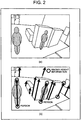
- Figs. 2(a) and 2(b) are the explanatory diagrams illustrating exemplary normal vectors. When an image illustrated in Fig. 2(a) is present, line segments illustrated in arrows in Fig. 2(b) are normal vectors. The normal vectors both ends of which are surrounded by circles, which are illustrated in Fig. 2(b) , indicate normal vectors with known height information.
- the normal vector acquisition means 21 acquires height information.
- the real-space height information indicting the end points of a normal vector can be acquired when the height information on an object, on which acquisition of a normal vector is based, is known. 3D information other than the height information is not required (that is, the coordinate on the ground is not required) for acquiring the height information on a normal vector.
- the normal vector acquisition means 21 can easily acquire the height information.
- the normal vector acquisition means 21 can automatically acquire many normal vectors with known height information from animations indicating a motion state in which a person whose height is known is moving.
- the rotation matrix estimation means 22 projects the normal vectors acquired by the normal vector acquisition means 21 on a projection virtual plane perpendicular to a reference horizontal plane (or the ground). Then, the rotation matrix estimation means 22 evaluates a nature that the projected normal vectors are perpendicular to the reference horizontal plane (or the ground), thereby estimating a rotation matrix.
- a vertical nature is to determine how much the normal vectors projected in the real space (projection virtual plane) are perpendicular. The vertical nature may be denoted as verticality below.
- the rotation matrix estimation means 22 projects the normal vectors acquired by the normal vector acquisition means 21 on the projection virtual plane stored in the projection virtual plane storage means 31 by use of the intrinsic parameters stored in the intrinsic parameter storage means 32 and the camera parameters indicating a posture of the camera. Then, the rotation matrix estimation means 22 evaluates verticality of the projected normal vectors on the ground and optimizes a rotation matrix R indicating a posture of the camera thereby to estimate the rotation matrix R.
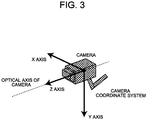
- Equation 2 Assuming a pinhole camera model, a relationship in Equation 2 is established between the camera coordinate system and the image coordinate system.
- s indicates a scalar quantity.
- A is a 3 ⁇ 3 camera intrinsic matrix which indicates an intrinsic parameter.
- the intrinsic parameter A is set by an intrinsic parameter stored in the intrinsic parameter storage means 32.
- the image coordinate and the world coordinate are interconvertible by use of Equation 1 and Equation 2.
- a positional restriction is imposed on the camera coordinate system and the world coordinate system when a camera parameter is estimated.
- the restriction is directed for setting the origin point of the world coordinate system immediately below a position of the camera.
- the rotation matrix estimation means 22 may make robust estimation such as RANSAC (Random sample consensus) thereby to enhance an estimation accuracy.
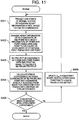
- the translation matrix estimation means 23 changes the height information at the 3D coordinate of one projected end point into the height information at the other end point paired with one end point by use of the fact that the two paired end points of the normal vector are different only in the real-space height information, thereby calculating a real-space 3D coordinate of the other end point (step S402).
- the translation matrix estimation means 23 re-projects the real-space 3D coordinate of the other end point paired with one end point on the image by use of Equation 1 and Equation 2, and calculates the re-projected end point as a re-projected point (step S403).
- a rotation matrix R estimated by the rotation matrix estimation means 22 is employed for the rotation matrix R in Equation 1.
- the translation matrix estimation means 23 calculates an error between the coordinate of the end point calculated as a re-projected point and the coordinate of the other end point paired with one end point directly acquired from the image as an evaluation index by use of Equation 6 (step S404).
- the error indicates how much both match with each other, and thus the translation matrix estimation means 23 may evaluate a coincidence therebetween by use of Equation 6.
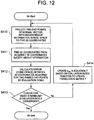
- the translation matrix estimation means 23 may estimate a translation matrix by performing the processings in step S410 to step S413 illustrated in Fig. 12 instead of the processings in step S401 to step S406 illustrated in Fig. 11 .
- Fig. 12 is a flowchart illustrating other exemplary processing of estimating a translation matrix by the translation matrix estimation means 23.
- the translation matrix estimation means 23 finds the 2D coordinates with the height information excluded from the 3D coordinates of the two found paired end points (step S411).
- the translation matrix estimation means 23 calculates an error between the 2D coordinates of the two paired end points as an evaluation index by use of Equation 8 (step S412).
- the error indicates a coincidence therebetween, and thus the translation matrix estimation means 23 may evaluate a coincidence therebetween by use of Equation 8.
- the normal vector acquisition means 21 acquires normal vectors perpendicular to a reference horizontal plane from an image of a camera to be calibrated.
- the rotation matrix estimation means 22 projects the acquired normal vectors on a projection virtual plane perpendicular to the reference horizontal plane (or ground). Then, the rotation matrix estimation means 22 evaluates that the projected normal vectors are perpendicular to the reference horizontal plane, thereby estimating a rotation matrix R.
- the camera parameters can be highly precisely and easily estimated without installing a piece of special calibration equipment or measuring 3D coordinates of reference points employed for calibration.
- the translation matrix estimation means 23 may estimate a translation matrix T based on an error indicating a deviation between a normal vector with known height information projected on a real-space 3D coordinate and the vertical direction in the real space by use of the intrinsic parameters and the rotation matrix R.
- the rotation matrix estimation means 22 estimates camera parameters by restricting a rotation matrix R which is as low a dimension as 2D of the roll rotation and the pitch rotation of a camera (or narrowing a search range). Further, the translation matrix estimation means 23 makes an estimation by restricting a translation matrix T by as low a dimensional parameter as 1D of only motion of a camera position on the Z axis in the world coordinate system (or narrowing a search range). Further, for the processing of estimating camera parameters, the processing of estimating a translation matrix is performed after the processing of estimating a rotation matrix. That is, the estimation processings are independently performed in two stages. Therefore, estimating the camera parameter is not easily caused to a local solution, and the estimation processings can be fast performed.
- the camera parameters are estimated by use of only normal vectors perpendicular to the ground acquired from an image and some normal vectors with known real-space height information. Further, when the image supply device 1 shoots a pedestrian who is walking in front of a camera to be calibrated and whose height is known, the normal vector acquisition means 21 can acquire a large number of normal vectors connecting the head and the foot and normal vectors with known height information in the shot image. Therefore, the camera parameters can be estimated by use of only the normal vectors and many normal vectors required for the estimation can be acquired so that the camera parameters can be easily estimated.
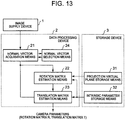
- Fig. 13 is a block diagram illustrating an exemplary structure of the camera calibration device according to a second exemplary embodiment of the present invention.
- the same constituents as those in the first exemplary embodiment are denoted with the same reference numerals as in Fig. 1 , and a description thereof will be omitted.
- the camera calibration device according to the second exemplary embodiment of the present invention is configured such that the camera calibration device according to the first exemplary embodiment illustrated in Fig. 1 is added with a normal vector selection means 24.
- the normal vector selection means 24 receives normal vectors perpendicular to the ground from the normal vector acquisition means 21. It is herein assumed that the normal vector acquisition means 21 notifies normal vectors including many errors to the normal vector selection means 24 since it automatically acquires the normal vectors, for example. The information to be notified by the normal vector acquisition means 21 is not limited to normal vectors. The normal vector acquisition means 21 may notify an image in which the normal vectors are to be specified to the normal vector selection means 24. The normal vector selection means 24 selects at least one correct normal vector from among the received normal vectors in response to a user's selection instruction.
- the normal vector selection means 24 receives normal vectors perpendicular to the ground from the normal vector acquisition means 21.
- the normal vector selection means 24 selects a normal vector effective for camera calibration based on some user-selected correct normal vectors. Then, the normal vector selection means 24 notifies the selected normal vectors to the normal vector acquisition means 21 (step S5).
- Fig. 15 is a flowchart illustrating an exemplary processing of selecting a normal vector by the normal vector selection means 24.
- the normal vector selection means 24 receives normal vectors perpendicular to the ground from the normal vector acquisition means 21.
- the normal vector selection means 24 selects at least one correct normal vector from among the normal vectors superimposed on the image in response to a user's selection instruction (step S501).
- the normal vector selection means 24 stores the normal vectors to be compared (step S504).
- the normal vector selection means 24 does not store the normal vectors to be compared.
- the normal vector selection means 24 compares the tilts of user-selected normal vectors from among all the normal vectors relative to all the normal vectors acquired by the normal vector acquisition means 21. Then, the normal vector selection means 24 selects a normal vector whose tilt relative to any selected normal vector from among all the normal vectors is within a threshold as a normal vector effective for camera calibration. Therefore, in addition to the advantages of the first exemplary embodiment, the camera parameters can be highly precisely and easily estimated even when many errors are included in the normal vectors acquired by the normal vector acquisition means 21.
- the normal vector selection means 24 selects a normal vector effective for camera calibration based on some selected correct normal vectors.
- the camera parameters can be estimated even when many errors are included in the normal vectors automatically acquired by the normal vector acquisition means 21.
- the computer readable storage medium 102 is realized by a magnetic disk, semiconductor memory or the like.
- the camera calibration program 101 stored in the computer readable storage medium 102 is read by the computer 100 on startup of the computer 100, and controls the operations of the computer 100 thereby to cause the computer 100 to function as the normal vector acquisition means 21, the rotation matrix estimation means 22 and the translation matrix estimation means 23 in the data processing device 2 according to the first exemplary embodiment described above.
- the camera calibration program 101 causes the computer 100 to perform the processings illustrated in Fig. 9 to Fig. 12 .
- Fig. 17 is a block diagram illustrating an outline of a camera calibration device according to the present invention.
- the camera calibration device according to the present invention includes a normal vector acquisition means 81 (the normal vector acquisition means 21, for example) for acquiring normal vectors perpendicular to a reference horizontal plane (ground, for example) from an image of a camera to be calibrated, and a rotation matrix estimation means 82 (the rotation matrix estimation means 22, for example) for projecting the acquired normal vectors on a projection virtual plane (plane parallel to the Z axis direction of the world coordinate system, for example) perpendicular to the reference horizontal plane, and evaluating that the projected normal vectors are perpendicular to the reference horizontal plane (determining a degree of verticality, for example), thereby estimating a rotation matrix (rotation matrix R, for example) employed for camera calibration.
- a normal vector acquisition means 81 the normal vector acquisition means 21, for example
- a reference horizontal plane ground, for example
- a rotation matrix estimation means 22 the rotation matrix estimation means 22
- the camera parameters can be highly precisely and easily estimated without installing a piece of special calibration equipment or measuring 3D coordinates of reference points employed for calibration.
- the camera calibration device may include a translation matrix estimation means (the translation matrix estimation means 23, for example) for estimating a translation matrix (translation matrix T, for example) employed for camera calibration.
- a translation matrix estimation means for estimating a translation matrix (translation matrix T, for example) employed for camera calibration.
- the present invention is suitably applied to a camera calibration device for highly precisely and easily estimating camera parameters without installing a piece of special calibration equipment or measuring 3D coordinates of reference points employed for calibration when estimating the camera parameters (rotation matrix and translation matrix) expressing a posture of a camera. Further, the present invention is suitably applied to a program for causing a computer to realize the camera calibration device.
- the present invention is applied also to a device or the like for projecting real-space 3D coordinates on a camera video or stored video. Further, the present invention is applied also to a device or the like for recovering a cubic structure of an object displayed in a camera video or stored video. Moreover, the present invention is applied also to an input interface for inputting real-space 3D coordinates from a camera video or stored video. Furthermore, the present invention is applied also to a device or the like for processing a target portion in a camera video or stored video with a real-space 3D coordinate as a trigger or a key.
- the present invention is applied to a device or the like for automatically correcting a posture of a camera in real-time, which can be subjected to posture deviation due to camera's weight, earthquake, environmental vibration or the like after the camera is installed.
Landscapes
- Engineering & Computer Science (AREA)
- Health & Medical Sciences (AREA)
- Biomedical Technology (AREA)
- General Health & Medical Sciences (AREA)
- Multimedia (AREA)
- Signal Processing (AREA)
- Computer Vision & Pattern Recognition (AREA)
- Physics & Mathematics (AREA)
- General Physics & Mathematics (AREA)
- Theoretical Computer Science (AREA)
- Studio Devices (AREA)
- Length Measuring Devices By Optical Means (AREA)
Claims (9)
- Kamerakalibrierungsvorrichtung mit:einer Normalenvektorerfassungseinrichtung (21), die Normalenvektoren senkrecht zu einer horizontalen Referenzebene von einem Bild einer zu kalibrierenden Kamera erfasst; undeiner Rotationsmatrixschätzeinrichtung (22), die die erfassten Normalenvektoren auf eine virtuelle Projektionsebene projiziert, die sich senkrecht zur horizontalen Referenzebene erstreckt, und bewertet, dass die projizierten Normalenvektoren sich senkrecht zur horizontalen Referenzebene erstrecken, um dadurch eine zum Kalibrieren der Kamera verwendete Rotationsmatrix zu schätzen,wobei die Rotationsmatrixschätzeinrichtung (22) dafür konfiguriert ist, eine Drehbewegung einer Kamera zum Aufnehmen eines Bildes durch 2D-Parameter nur für eine Roll-Rotation und eine Pitch-Rotation zu begrenzen, dafür konfiguriert ist, einen Bewertungsindex zu bewerten, der sich 0 nähert, wenn der projizierte Normalenvektor sich senkrecht zum Boden erstreckt, und dafür konfiguriert ist, eine Rotationsmatrix derart zu optimieren, dass der Bewertungsindex minimal ist, um dadurch die Rotationsmatrix zu schätzen.
- Kamerakalibrierungsvorrichtung nach Anspruch 1, mit:einer Translationsmatrixschätzeinrichtung (23), die eine zum Kalibrieren einer Kamera verwendete Translationsmatrix schätzt,wobei die Translationsmatrixschätzeinrichtung (23) dafür konfiguriert ist, anzunehmen, dass sich die Kamera auf der Z-Achse eines Weltkoordinatensystems befindet, und dafür konfiguriert ist, eine Position der Kamera durch einen 1D-Parameter zu begrenzen, der eine Position auf der Z-Achse des Weltkoordinatensystems angibt, um dadurch eine Translationsmatrix zu schätzen,wobei die Normalenvektorerfassungseinrichtung (21) Höheninformation über die Höhen der Endpunkte mindestens eines Normalenvektors unter den erfassten Normalenvektoren erfasst, unddie Translationsmatrixschätzeinrichtung (23) einen Endpunkt eines Normalenvektors, dessen Höheninformation im realen Raum erfasst wird, unter Verwendung einer Rotationsmatrix projiziert, die durch die Rotationsmatrixschätzeinrichtung (22) geschätzt wird, um eine 3D-Koordinate im realen Raum zu berechnen, eine 3D-Koordinate des anderen Endpunkts, der mit dem einen Endpunkt gepaart ist, unter Verwendung der berechneten 3D-Koordinate und der Höheninformation berechnet, die berechnete 3D-Koordinate des anderen Endpunkts unter Verwendung der Rotationsmatrix auf das Bild rückprojiziert, um dadurch eine Koordinate des anderen Endpunkts auf dem Bild zu berechnen, und die Translationsmatrix derart schätzt, dass ein Fehler zwischen der Koordinate des auf das Bild rückprojizierten anderen Endpunkts und der Koordinate des anderen Endpunkts, die direkt aus dem Bild erfasst wird, minimal ist.
- Kamerakalibrierungsvorrichtung nach Anspruch 1, mit:einer Translationsmatrixschätzeinrichtung (23), die eine zum Kalibrieren einer Kamera verwendete Translationsmatrix schätzt,wobei die Translationsmatrixschätzeinrichtung (23) dafür konfiguriert ist, anzunehmen, dass sich die Kamera auf der Z-Achse eines Weltkoordinatensystems befindet, und dafür konfiguriert ist, eine Position der Kamera durch einen 1D-Parameter zu begrenzen, der eine Position auf der Z-Achse des Weltkoordinatensystems anzeigt, um dadurch eine Translationsmatrix zu schätzen,wobei die Normalenvektorerfassungseinrichtung (21) Höheninformation über die Höhen der Endpunkte mindestens eines Normalenvektors unter den erfassten Normalvektoren erfasst, unddie Translationsmatrixschätzeinrichtung (23) beide Endpunkte eines Normalenvektors, dessen Höheninformation im realen Raum erfasst wird, unter Verwendung einer durch die Rotationsmatrixschätzeinrichtung (22) geschätzten Rotationsmatrix projiziert, um dadurch 3D-Koordinaten im realen Raum zu berechnen, 2D-Koordinaten, in denen die Höheninformation ausgenommen ist, aus den berechneten 3D-Koordinaten der beiden Endpunkte berechnet, und die Translationsmatrix derart schätzt, dass ein Fehler zwischen den berechneten 2D-Koordinaten der beiden Endpunkte minimal ist.
- Kamerakalibrierungsvorrichtung nach Anspruch 2 oder 3, mit:einer Bildzuführeinrichtung, die der Normalenvektorerfassungseinrichtung (21) eine Animation zuführt, die einen Bewegungszustand, bei dem sich ein sich bewegendes Medium, ausgedrückt durch einen Normalenvektor, in einen Aufnahmeraum bewegt, in dem ein zum Messen von Höheninformation verwendetes Messmedium angeordnet ist, und einen Durchgangszustand anzeigt, bei dem das sich bewegende Medium eine Position durchläuft, an der Höheninformation durch das Messmedium erfasst werden kann,wobei die Normalenvektorerfassungseinrichtung (21) das sich bewegende Medium verfolgt, um dadurch eine Vielzahl von Normalenvektoren mit bekannter Höheninformation von einer von der Bildzuführeinrichtung zugeführten Animation zu erfassen.
- Kamerakalibrierungsvorrichtung nach einem der Ansprüche 1 bis 4,wobei die Rotationsmatrixschätzeinrichtung (22) eine Neigung eines Normalenvektors, der auf eine virtuelle Projektionsebene projiziert wird, die als eine Ebene parallel zur Z-Achsenrichtung eines Weltkoordinatensystems definiert ist, relativ zur Z-Achse des Weltkoordinatensystems berechnet, um dadurch zu bewerten, dass der Normalenvektor sich senkrecht zu einer horizontalen Referenzebene erstreckt, und eine Rotationsmatrix derart schätzt, dass ein durch die Neigung angezeigter Fehler minimal ist.
- Kamerakalibrierungsvorrichtung nach einem der Ansprüche 1 bis 4,wobei die Rotationsmatrixschätzeinrichtung (22) einen Fehler in der X-Achsenrichtung zwischen beiden Endpunkten eines Normalenvektors berechnet, der auf eine virtuelle Projektionsebene projiziert wird, die als eine Ebene parallel zur XZ-Ebene eines Weltkoordinatensystems definiert ist, um dadurch zu bewerten, dass der Normalenvektor sich senkrecht zu einer horizontalen Referenzebene erstreckt, und eine Rotationsmatrix derart schätzt, dass der Fehler minimal ist.
- Kamerakalibrierungsvorrichtung nach einem der Ansprüche 1 bis 6, mit:einer Normalenvektorauswahleinrichtung, die Neigungen zwischen allen durch die Normalenvektorerfassungseinrichtung (21) erfassten Normalenvektoren und durch einen Benutzer unter allen Normalenvektoren ausgewählten korrekten Normalenvektoren vergleicht und einen Normalenvektor, dessen Neigung relativ zu irgendeinem der ausgewählten Normalenvektoren innerhalb eines Schwellenwertes liegt, als einen zum Kalibrieren der Kamera wirksamen Normalenvektor auswählt.
- Kamerakalibrierungsverfahren mit den Schritten:Erfassen von Normalenvektoren senkrecht zu einer horizontalen Referenzebene von einem Bild einer zu kalibrierenden Kamera;Projizieren der erfassten Normalenvektoren auf eine virtuelle Projektionsebene, die sich senkrecht zur horizontalen Referenzebene erstreckt; undBewerten, dass die projizierten Normalenvektoren sich senkrecht zur horizontalen Referenzebene erstrecken, um dadurch eine zum Kalibrieren der Kamera verwendete Rotationsmatrix zu schätzen;ferner mit den Schritten zum Begrenzen einer Drehbewegung einer Kamera zum Aufnehmen eines Bildes durch 2D-Parameter nur einer Roll-Rotation und einer Pitch-Rotation, Bewerten eines Bewertungsindex, der sich 0 nähert, wenn der projizierte Normalenvektor sich senkrecht zum Boden erstreckt, und Optimieren einer Rotationsmatrix derart, dass der Bewertungsindex minimal ist, um die Rotationsmatrix zu schätzen.
- Kamerakalibrierungsprogramm, das einen Computer veranlasst, auszuführen:eine Normalenvektorerfassungsverarbeitung zum Erfassen von Normalenvektoren, die sich senkrecht zu einer horizontalen Referenzebene erstrecken, von einem Bild einer zu kalibrierenden Kamera; undeine Rotationsmatrixschätzverarbeitung zum Projizieren der erfassten Normalenvektoren auf eine virtuelle Projektionsebene, die sich senkrecht zur horizontalen Referenzebene erstreckt, und Bewerten, dass die projizierten Normalenvektoren sich senkrecht zur horizontalen Referenzebene erstrecken, um dadurch eine zum Kalibrieren der Kamera verwendete Rotationsmatrix zu schätzen, undVeranlassen, dass ein Computer eine Drehbewegung einer Kamera zum Aufnehmen eines Bildes durch 2D-Parameter nur einer Roll-Rotation und einer Pitch-Rotation begrenzt, einen Bewertungsindex bewertet, der sich 0 nähert, wenn der projizierte Normalenvektor sich senkrecht zum Boden erstreckt, und eine Rotationsmatrix derart optimiert, dass der Bewertungsindex minimal ist, um dadurch die Rotationsmatrix zu schätzen.
Applications Claiming Priority (2)
| Application Number | Priority Date | Filing Date | Title |
|---|---|---|---|
| JP2012010640 | 2012-01-23 | ||
| PCT/JP2012/007655 WO2013111229A1 (ja) | 2012-01-23 | 2012-11-29 | カメラ校正装置、カメラ校正方法およびカメラ校正用プログラム |
Publications (3)
| Publication Number | Publication Date |
|---|---|
| EP2808645A1 EP2808645A1 (de) | 2014-12-03 |
| EP2808645A4 EP2808645A4 (de) | 2015-11-04 |
| EP2808645B1 true EP2808645B1 (de) | 2019-02-20 |
Family
ID=48873008
Family Applications (1)
| Application Number | Title | Priority Date | Filing Date |
|---|---|---|---|
| EP12866684.9A Active EP2808645B1 (de) | 2012-01-23 | 2012-11-29 | Kamerakalibrierungsvorrichtung, kamerakalibrierungsverfahren und kamerakalibrierungsprogramm |
Country Status (4)
| Country | Link |
|---|---|
| US (1) | US9875542B2 (de) |
| EP (1) | EP2808645B1 (de) |
| JP (1) | JP6011548B2 (de) |
| WO (1) | WO2013111229A1 (de) |
Families Citing this family (56)
| Publication number | Priority date | Publication date | Assignee | Title |
|---|---|---|---|---|
| US10623649B2 (en) * | 2014-07-31 | 2020-04-14 | Hewlett-Packard Development Company, L.P. | Camera alignment based on an image captured by the camera that contains a reference marker |
| CN104167001B (zh) * | 2014-08-27 | 2017-02-15 | 大连理工大学 | 基于正交补偿的大视场摄像机标定方法 |
| JP6619927B2 (ja) * | 2014-10-24 | 2019-12-11 | 株式会社日立製作所 | キャリブレーション装置 |
| JP6580407B2 (ja) * | 2015-07-30 | 2019-09-25 | 株式会社Screenホールディングス | 位置計測装置、データ補正装置、位置計測方法、およびデータ補正方法 |
| FR3042893B1 (fr) * | 2015-10-27 | 2017-11-03 | Morpho | Procede de detection de fraude par projection d'image pre-enregistree |
| CN105809702B (zh) * | 2016-03-29 | 2018-05-11 | 南京航空航天大学 | 一种基于Tsai算法的改进位姿估计方法 |
| EP3264761A1 (de) * | 2016-06-23 | 2018-01-03 | Thomson Licensing | Verfahren und vorrichtung zur erzeugung eines paares stereoskopischer bilder mit mindestens einer lichtfeldkamera |
| FR3053554B1 (fr) * | 2016-06-30 | 2018-08-03 | Continental Automotive France | Procede de calibration rapide d'une camera de vehicule automobile |
| US10372970B2 (en) * | 2016-09-15 | 2019-08-06 | Qualcomm Incorporated | Automatic scene calibration method for video analytics |
| KR101979246B1 (ko) * | 2017-01-26 | 2019-05-16 | (주)로보케어 | 센서 좌표계를 게임 존에 캘리브레이션하는 방법 및 장치 |
| US10175700B2 (en) * | 2017-03-22 | 2019-01-08 | The Boeing Company | Methods and apparatus to minimize command dynamics of a satellite |
| CN108805934B (zh) * | 2017-04-28 | 2021-12-28 | 华为技术有限公司 | 一种车载摄像机的外部参数标定方法及装置 |
| CN109099888A (zh) * | 2017-06-21 | 2018-12-28 | 中兴通讯股份有限公司 | 一种位姿测量方法、设备及存储介质 |
| CN108416810A (zh) * | 2018-02-05 | 2018-08-17 | 北京邦天信息技术有限公司 | 相机标定中相机坐标系到世界坐标系的转换方法和装置 |
| CN108917604B (zh) * | 2018-07-12 | 2020-07-17 | 上海航天设备制造总厂有限公司 | 一种法向测量装置及其标定方法 |
| CN110727966B (zh) * | 2018-07-16 | 2021-11-16 | Oppo广东移动通信有限公司 | 图像处理方法和装置、存储介质、电子设备 |
| CN110969664B (zh) * | 2018-09-30 | 2023-10-24 | 北京魔门塔科技有限公司 | 一种相机外部参数的动态标定方法 |
| KR102559203B1 (ko) * | 2018-10-01 | 2023-07-25 | 삼성전자주식회사 | 포즈 정보를 출력하는 방법 및 장치 |
| WO2020073261A1 (zh) * | 2018-10-10 | 2020-04-16 | 深圳配天智能技术研究院有限公司 | 相机标定的装置、系统、方法及具有存储功能的装置 |
| JP7211047B2 (ja) * | 2018-12-04 | 2023-01-24 | 株式会社アイシン | 路面検出装置および路面検出プログラム |
| JP7096176B2 (ja) * | 2019-02-01 | 2022-07-05 | 株式会社日立製作所 | 物体位置推定装置およびその方法 |
| CN111582293B (zh) * | 2019-02-19 | 2023-03-24 | 曜科智能科技(上海)有限公司 | 平面几何一致性检测方法、计算机设备、及存储介质 |
| US12067747B2 (en) | 2019-03-20 | 2024-08-20 | Nec Corporation | Camera parameter calculation apparatus, camera parameter calculation method, and non-transitory computer readable medium storing program |
| SG10201902705SA (en) * | 2019-03-26 | 2020-10-29 | Nec Asia Pacific Pte Ltd | Method and system for object detection coverage estimation |
| TWI720447B (zh) * | 2019-03-28 | 2021-03-01 | 財團法人工業技術研究院 | 影像定位方法及其系統 |
| JP7151879B2 (ja) * | 2019-04-08 | 2022-10-12 | 日本電気株式会社 | カメラ校正装置、カメラ校正方法、及びプログラム |
| JP7099627B2 (ja) * | 2019-04-24 | 2022-07-12 | 日本電気株式会社 | カメラパラメータ推定装置、カメラパラメータ推定方法、及びプログラム |
| US11023741B1 (en) * | 2019-10-25 | 2021-06-01 | 7-Eleven, Inc. | Draw wire encoder based homography |
| KR102593103B1 (ko) * | 2019-10-28 | 2023-10-24 | 주식회사 케이티 | 카메라를 정렬하는 장치, 방법 및 컴퓨터 프로그램 |
| CN113538477B (zh) * | 2020-04-14 | 2023-08-29 | 北京达佳互联信息技术有限公司 | 平面位姿的获取方法、装置、电子设备及存储介质 |
| CN113016007B (zh) * | 2020-08-12 | 2023-11-10 | 香港应用科技研究院有限公司 | 估计相机相对于地面的方位的装置和方法 |
| CN114119684B (zh) * | 2020-08-31 | 2023-02-28 | 中国移动通信集团浙江有限公司 | 基于四面体结构的标记点配准方法 |
| CN112148006B (zh) * | 2020-09-17 | 2025-01-21 | 常州锦瑟医疗信息科技有限公司 | 路径规划辅助调整设备及控制方法 |
| CN112465911A (zh) * | 2020-11-06 | 2021-03-09 | 北京迈格威科技有限公司 | 图像处理方法及装置 |
| CN114612567B (zh) * | 2020-12-08 | 2025-07-22 | 北京极智嘉科技股份有限公司 | 一种相机标定方法、装置、计算机设备和计算机存储介质 |
| CN112419416B (zh) * | 2020-12-10 | 2022-10-14 | 华中科技大学 | 一种基于少量控制点信息估计相机位置的方法和系统 |
| CN112785656B (zh) * | 2021-01-29 | 2023-11-10 | 北京罗克维尔斯科技有限公司 | 双立体相机的标定方法及装置、电子设备及存储介质 |
| JP7754918B2 (ja) * | 2021-03-04 | 2025-10-15 | パナソニック インテレクチュアル プロパティ コーポレーション オブ アメリカ | ニューラルネットワークのネットワークパラメータの学習方法、カメラパラメータの算出方法、及びプログラム |
| CN113160331B (zh) * | 2021-04-20 | 2023-02-24 | 中国科学院空天信息创新研究院 | 一种基于视觉系统成像的外参数标定方法 |
| JP7582460B2 (ja) * | 2021-05-17 | 2024-11-13 | 日本電気株式会社 | 撮影条件決定方法、撮影条件決定システム、撮影条件決定装置、及びプログラム |
| CN113465548B (zh) * | 2021-08-23 | 2022-06-07 | 广东维正科技有限公司 | 条纹投影三维测量系统的标定及精度评估方法 |
| US12549843B2 (en) * | 2021-08-23 | 2026-02-10 | Fujitsu Limited | Computer-readable recording medium storing identification program, identification method, and information processing apparatus |
| CN113888646B (zh) * | 2021-09-30 | 2025-05-30 | 苏州市科远软件技术开发有限公司 | 球机标定方法及电子设备 |
| FR3128806B1 (fr) * | 2021-11-04 | 2024-04-12 | Idemia Identity & Security France | Procédé de détermination de paramètres de calibration d’un dispositif de prise de vue et produit programme d’ordinateur associé |
| CN114445505B (zh) * | 2021-12-28 | 2025-06-17 | 中公高科养护科技股份有限公司 | 一种用于路面检测的相机标定系统及标定方法 |
| CN114742895A (zh) * | 2022-03-17 | 2022-07-12 | 深圳中智永浩机器人有限公司 | 摄像头外参自动标定方法、装置、计算机设备及存储介质 |
| CN117291958A (zh) * | 2022-06-16 | 2023-12-26 | 北京字跳网络技术有限公司 | 图像匹配方法、装置、设备及介质 |
| CN115311359B (zh) * | 2022-07-18 | 2023-06-16 | 北京城市网邻信息技术有限公司 | 相机位姿校正方法、装置、电子设备及存储介质 |
| CN115290021B (zh) * | 2022-08-16 | 2025-08-01 | 河南科技大学 | 一种基于一维测头的摆线轮安装误差识别和修正方法 |
| CN115470451B (zh) * | 2022-09-16 | 2026-01-20 | 厦门博视源机器视觉技术有限公司 | 一种测量仪载物台垂直度计算方法、终端设备及存储介质 |
| US12373972B2 (en) | 2022-11-23 | 2025-07-29 | Tyco Fire & Security Gmbh | Camera calibration and distance measurement using parallel lines |
| US12412307B2 (en) * | 2022-11-23 | 2025-09-09 | Tyco Fire & Security Gmbh | Camera calibration and distance measurement based on homography |
| US12094172B2 (en) | 2022-12-22 | 2024-09-17 | Industrial Technology Research Institute | Camera calibration method and camera calibration system |
| CN116000391B (zh) * | 2023-01-07 | 2024-06-07 | 中国航空制造技术研究院 | 一种电液束加工电极光影校准调节装置及方法 |
| DE102024100306B3 (de) | 2024-01-08 | 2025-03-20 | Bayerische Motoren Werke Aktiengesellschaft | Vorrichtung und Verfahren zum Kalibrieren einer im Innenraum eines Fahrzeugs angeordneten Innenraumkamera |
| CN119124219B (zh) * | 2024-11-11 | 2025-02-25 | 华东交通大学 | 惯性导航系统安装误差校正方法、系统、存储介质 |
Family Cites Families (13)
| Publication number | Priority date | Publication date | Assignee | Title |
|---|---|---|---|---|
| US5227985A (en) * | 1991-08-19 | 1993-07-13 | University Of Maryland | Computer vision system for position monitoring in three dimensions using non-coplanar light sources attached to a monitored object |
| US7106898B2 (en) * | 1999-12-06 | 2006-09-12 | California Institute Of Technology | 3D scanning using shadows |
| KR100468857B1 (ko) * | 2002-11-21 | 2005-01-29 | 삼성전자주식회사 | 2차원 형상에 대한 투사 불변형 표현자를 이용한핸드/아이 캘리브레이션 방법 |
| JP3891181B2 (ja) * | 2004-02-20 | 2007-03-14 | 住友電気工業株式会社 | カメラパラメータの自動算出方法及び装置 |
| JP4328692B2 (ja) * | 2004-08-11 | 2009-09-09 | 国立大学法人東京工業大学 | 物体検出装置 |
| JP4899424B2 (ja) * | 2005-11-04 | 2012-03-21 | トヨタ自動車株式会社 | 物体検出装置 |
| US8009930B2 (en) * | 2008-03-26 | 2011-08-30 | City University Of Hong Kong | Auto-calibration method for a projector-camera system |
| US8373763B2 (en) * | 2008-05-22 | 2013-02-12 | GM Global Technology Operations LLC | Self calibration of extrinsic camera parameters for a vehicle camera |
| EP2154650A1 (de) * | 2008-08-12 | 2010-02-17 | IEE INTERNATIONAL ELECTRONICS & ENGINEERING S.A. | 3D-Flugzeit-Kamerasystem und zugehöriges Positions-/Orientierungs-Kalibrationsverfahren |
| JP4690476B2 (ja) * | 2009-03-31 | 2011-06-01 | アイシン精機株式会社 | 車載カメラの校正装置 |
| US20110222757A1 (en) * | 2010-03-10 | 2011-09-15 | Gbo 3D Technology Pte. Ltd. | Systems and methods for 2D image and spatial data capture for 3D stereo imaging |
| JP5331047B2 (ja) * | 2010-04-01 | 2013-10-30 | 日本電信電話株式会社 | 撮像パラメータ決定方法、撮像パラメータ決定装置、撮像パラメータ決定プログラム |
| US9013550B2 (en) * | 2010-09-09 | 2015-04-21 | Qualcomm Incorporated | Online reference generation and tracking for multi-user augmented reality |
-
2012
- 2012-11-29 WO PCT/JP2012/007655 patent/WO2013111229A1/ja not_active Ceased
- 2012-11-29 US US14/373,726 patent/US9875542B2/en active Active
- 2012-11-29 EP EP12866684.9A patent/EP2808645B1/de active Active
- 2012-11-29 JP JP2013555009A patent/JP6011548B2/ja active Active
Non-Patent Citations (1)
| Title |
|---|
| None * |
Also Published As
| Publication number | Publication date |
|---|---|
| EP2808645A1 (de) | 2014-12-03 |
| WO2013111229A1 (ja) | 2013-08-01 |
| US9875542B2 (en) | 2018-01-23 |
| EP2808645A4 (de) | 2015-11-04 |
| US20150029345A1 (en) | 2015-01-29 |
| JPWO2013111229A1 (ja) | 2015-05-11 |
| JP6011548B2 (ja) | 2016-10-19 |
Similar Documents
| Publication | Publication Date | Title |
|---|---|---|
| EP2808645B1 (de) | Kamerakalibrierungsvorrichtung, kamerakalibrierungsverfahren und kamerakalibrierungsprogramm | |
| US8223146B2 (en) | Image processing apparatus and image processing method | |
| US10176554B2 (en) | Camera calibration using synthetic images | |
| US9208395B2 (en) | Position and orientation measurement apparatus, position and orientation measurement method, and storage medium | |
| US8823779B2 (en) | Information processing apparatus and control method thereof | |
| EP3309751B1 (de) | Bildverarbeitungsvorrichtung, -verfahren und -programm | |
| US10325336B2 (en) | Information processing apparatus, information processing method, and program | |
| US20200143603A1 (en) | Information processing apparatus, information processing method, and non-transitory computer-readable storage medium | |
| JP6338021B2 (ja) | 画像処理装置、画像処理方法および画像処理プログラム | |
| EP2579210A1 (de) | Vorrichtung zur positionskorrektur eines gesichtsmerkmalspunktes, verfahren zur positionskorrektur eines gesichtsmerkmalspunktes und programm zur positionskorrektur eines gesichtsmerkmalspunktes | |
| US12008782B2 (en) | Information processing apparatus, information processing method, and program | |
| US11328473B2 (en) | Information processing apparatus, information processing method, and non-transitory computer-readable storage medium | |
| JP6584208B2 (ja) | 情報処理装置、情報処理方法、プログラム | |
| JP2014216813A (ja) | カメラ姿勢推定装置及びそのプログラム | |
| JP2017053795A (ja) | 情報処理装置、位置姿勢計測方法、及び位置姿勢計測プログラム | |
| JP6662382B2 (ja) | 情報処理装置および方法、並びにプログラム | |
| US11669988B1 (en) | System and method for three-dimensional box segmentation and measurement | |
| Caruso et al. | Infrastructureless indoor navigation with an hybrid magneto-inertial and depth sensor system | |
| US9563816B2 (en) | Information processing apparatus, method for controlling information processing apparatus, and storage medium | |
| D'Alfonso et al. | On the use of IMUs in the PnP Problem | |
| JP2014529823A (ja) | グラフマッチングおよびサイクル検出による自動モデル初期化を用いた線トラッキング | |
| US9245343B1 (en) | Real-time image geo-registration processing | |
| JP6109213B2 (ja) | 情報処理装置および方法、プログラム | |
| Pai et al. | High-fidelity camera-based method for noncontact vibration testing of structures | |
| US11869217B2 (en) | Image processing apparatus, detection method, and non-transitory computer readable medium |
Legal Events
| Date | Code | Title | Description |
|---|---|---|---|
| PUAI | Public reference made under article 153(3) epc to a published international application that has entered the european phase |
Free format text: ORIGINAL CODE: 0009012 |
|
| 17P | Request for examination filed |
Effective date: 20140807 |
|
| AK | Designated contracting states |
Kind code of ref document: A1 Designated state(s): AL AT BE BG CH CY CZ DE DK EE ES FI FR GB GR HR HU IE IS IT LI LT LU LV MC MK MT NL NO PL PT RO RS SE SI SK SM TR |
|
| DAX | Request for extension of the european patent (deleted) | ||
| RA4 | Supplementary search report drawn up and despatched (corrected) |
Effective date: 20151007 |
|
| RIC1 | Information provided on ipc code assigned before grant |
Ipc: G06T 7/00 20060101ALI20151001BHEP Ipc: H04N 17/00 20060101ALI20151001BHEP Ipc: G01B 11/00 20060101AFI20151001BHEP |
|
| REG | Reference to a national code |
Ref country code: DE Ref legal event code: R079 Ref document number: 602012056963 Country of ref document: DE Free format text: PREVIOUS MAIN CLASS: G01B0011000000 Ipc: G06T0007800000 |
|
| GRAP | Despatch of communication of intention to grant a patent |
Free format text: ORIGINAL CODE: EPIDOSNIGR1 |
|
| STAA | Information on the status of an ep patent application or granted ep patent |
Free format text: STATUS: GRANT OF PATENT IS INTENDED |
|
| RIC1 | Information provided on ipc code assigned before grant |
Ipc: H04N 17/00 20060101ALI20180926BHEP Ipc: G06T 7/80 20170101AFI20180926BHEP |
|
| INTG | Intention to grant announced |
Effective date: 20181023 |
|
| GRAS | Grant fee paid |
Free format text: ORIGINAL CODE: EPIDOSNIGR3 |
|
| GRAA | (expected) grant |
Free format text: ORIGINAL CODE: 0009210 |
|
| STAA | Information on the status of an ep patent application or granted ep patent |
Free format text: STATUS: THE PATENT HAS BEEN GRANTED |
|
| RIC1 | Information provided on ipc code assigned before grant |
Ipc: G06T 7/80 20170101AFI20180926BHEP Ipc: H04N 17/00 20060101ALI20180926BHEP |
|
| AK | Designated contracting states |
Kind code of ref document: B1 Designated state(s): AL AT BE BG CH CY CZ DE DK EE ES FI FR GB GR HR HU IE IS IT LI LT LU LV MC MK MT NL NO PL PT RO RS SE SI SK SM TR |
|
| REG | Reference to a national code |
Ref country code: GB Ref legal event code: FG4D |
|
| REG | Reference to a national code |
Ref country code: CH Ref legal event code: EP |
|
| REG | Reference to a national code |
Ref country code: DE Ref legal event code: R096 Ref document number: 602012056963 Country of ref document: DE |
|
| REG | Reference to a national code |
Ref country code: AT Ref legal event code: REF Ref document number: 1099208 Country of ref document: AT Kind code of ref document: T Effective date: 20190315 |
|
| REG | Reference to a national code |
Ref country code: IE Ref legal event code: FG4D |
|
| REG | Reference to a national code |
Ref country code: NL Ref legal event code: FP |
|
| REG | Reference to a national code |
Ref country code: LT Ref legal event code: MG4D |
|
| PG25 | Lapsed in a contracting state [announced via postgrant information from national office to epo] |
Ref country code: LT Free format text: LAPSE BECAUSE OF FAILURE TO SUBMIT A TRANSLATION OF THE DESCRIPTION OR TO PAY THE FEE WITHIN THE PRESCRIBED TIME-LIMIT Effective date: 20190220 Ref country code: FI Free format text: LAPSE BECAUSE OF FAILURE TO SUBMIT A TRANSLATION OF THE DESCRIPTION OR TO PAY THE FEE WITHIN THE PRESCRIBED TIME-LIMIT Effective date: 20190220 Ref country code: PT Free format text: LAPSE BECAUSE OF FAILURE TO SUBMIT A TRANSLATION OF THE DESCRIPTION OR TO PAY THE FEE WITHIN THE PRESCRIBED TIME-LIMIT Effective date: 20190620 Ref country code: NO Free format text: LAPSE BECAUSE OF FAILURE TO SUBMIT A TRANSLATION OF THE DESCRIPTION OR TO PAY THE FEE WITHIN THE PRESCRIBED TIME-LIMIT Effective date: 20190520 Ref country code: SE Free format text: LAPSE BECAUSE OF FAILURE TO SUBMIT A TRANSLATION OF THE DESCRIPTION OR TO PAY THE FEE WITHIN THE PRESCRIBED TIME-LIMIT Effective date: 20190220 |
|
| PG25 | Lapsed in a contracting state [announced via postgrant information from national office to epo] |
Ref country code: GR Free format text: LAPSE BECAUSE OF FAILURE TO SUBMIT A TRANSLATION OF THE DESCRIPTION OR TO PAY THE FEE WITHIN THE PRESCRIBED TIME-LIMIT Effective date: 20190521 Ref country code: HR Free format text: LAPSE BECAUSE OF FAILURE TO SUBMIT A TRANSLATION OF THE DESCRIPTION OR TO PAY THE FEE WITHIN THE PRESCRIBED TIME-LIMIT Effective date: 20190220 Ref country code: BG Free format text: LAPSE BECAUSE OF FAILURE TO SUBMIT A TRANSLATION OF THE DESCRIPTION OR TO PAY THE FEE WITHIN THE PRESCRIBED TIME-LIMIT Effective date: 20190520 Ref country code: IS Free format text: LAPSE BECAUSE OF FAILURE TO SUBMIT A TRANSLATION OF THE DESCRIPTION OR TO PAY THE FEE WITHIN THE PRESCRIBED TIME-LIMIT Effective date: 20190620 Ref country code: LV Free format text: LAPSE BECAUSE OF FAILURE TO SUBMIT A TRANSLATION OF THE DESCRIPTION OR TO PAY THE FEE WITHIN THE PRESCRIBED TIME-LIMIT Effective date: 20190220 Ref country code: RS Free format text: LAPSE BECAUSE OF FAILURE TO SUBMIT A TRANSLATION OF THE DESCRIPTION OR TO PAY THE FEE WITHIN THE PRESCRIBED TIME-LIMIT Effective date: 20190220 |
|
| REG | Reference to a national code |
Ref country code: AT Ref legal event code: MK05 Ref document number: 1099208 Country of ref document: AT Kind code of ref document: T Effective date: 20190220 |
|
| PG25 | Lapsed in a contracting state [announced via postgrant information from national office to epo] |
Ref country code: AL Free format text: LAPSE BECAUSE OF FAILURE TO SUBMIT A TRANSLATION OF THE DESCRIPTION OR TO PAY THE FEE WITHIN THE PRESCRIBED TIME-LIMIT Effective date: 20190220 Ref country code: ES Free format text: LAPSE BECAUSE OF FAILURE TO SUBMIT A TRANSLATION OF THE DESCRIPTION OR TO PAY THE FEE WITHIN THE PRESCRIBED TIME-LIMIT Effective date: 20190220 Ref country code: CZ Free format text: LAPSE BECAUSE OF FAILURE TO SUBMIT A TRANSLATION OF THE DESCRIPTION OR TO PAY THE FEE WITHIN THE PRESCRIBED TIME-LIMIT Effective date: 20190220 Ref country code: DK Free format text: LAPSE BECAUSE OF FAILURE TO SUBMIT A TRANSLATION OF THE DESCRIPTION OR TO PAY THE FEE WITHIN THE PRESCRIBED TIME-LIMIT Effective date: 20190220 Ref country code: EE Free format text: LAPSE BECAUSE OF FAILURE TO SUBMIT A TRANSLATION OF THE DESCRIPTION OR TO PAY THE FEE WITHIN THE PRESCRIBED TIME-LIMIT Effective date: 20190220 Ref country code: IT Free format text: LAPSE BECAUSE OF FAILURE TO SUBMIT A TRANSLATION OF THE DESCRIPTION OR TO PAY THE FEE WITHIN THE PRESCRIBED TIME-LIMIT Effective date: 20190220 Ref country code: SK Free format text: LAPSE BECAUSE OF FAILURE TO SUBMIT A TRANSLATION OF THE DESCRIPTION OR TO PAY THE FEE WITHIN THE PRESCRIBED TIME-LIMIT Effective date: 20190220 Ref country code: RO Free format text: LAPSE BECAUSE OF FAILURE TO SUBMIT A TRANSLATION OF THE DESCRIPTION OR TO PAY THE FEE WITHIN THE PRESCRIBED TIME-LIMIT Effective date: 20190220 |
|
| REG | Reference to a national code |
Ref country code: DE Ref legal event code: R097 Ref document number: 602012056963 Country of ref document: DE |
|
| PG25 | Lapsed in a contracting state [announced via postgrant information from national office to epo] |
Ref country code: PL Free format text: LAPSE BECAUSE OF FAILURE TO SUBMIT A TRANSLATION OF THE DESCRIPTION OR TO PAY THE FEE WITHIN THE PRESCRIBED TIME-LIMIT Effective date: 20190220 Ref country code: SM Free format text: LAPSE BECAUSE OF FAILURE TO SUBMIT A TRANSLATION OF THE DESCRIPTION OR TO PAY THE FEE WITHIN THE PRESCRIBED TIME-LIMIT Effective date: 20190220 |
|
| PLBE | No opposition filed within time limit |
Free format text: ORIGINAL CODE: 0009261 |
|
| STAA | Information on the status of an ep patent application or granted ep patent |
Free format text: STATUS: NO OPPOSITION FILED WITHIN TIME LIMIT |
|
| PG25 | Lapsed in a contracting state [announced via postgrant information from national office to epo] |
Ref country code: AT Free format text: LAPSE BECAUSE OF FAILURE TO SUBMIT A TRANSLATION OF THE DESCRIPTION OR TO PAY THE FEE WITHIN THE PRESCRIBED TIME-LIMIT Effective date: 20190220 |
|
| 26N | No opposition filed |
Effective date: 20191121 |
|
| PG25 | Lapsed in a contracting state [announced via postgrant information from national office to epo] |
Ref country code: SI Free format text: LAPSE BECAUSE OF FAILURE TO SUBMIT A TRANSLATION OF THE DESCRIPTION OR TO PAY THE FEE WITHIN THE PRESCRIBED TIME-LIMIT Effective date: 20190220 |
|
| PG25 | Lapsed in a contracting state [announced via postgrant information from national office to epo] |
Ref country code: TR Free format text: LAPSE BECAUSE OF FAILURE TO SUBMIT A TRANSLATION OF THE DESCRIPTION OR TO PAY THE FEE WITHIN THE PRESCRIBED TIME-LIMIT Effective date: 20190220 |
|
| PG25 | Lapsed in a contracting state [announced via postgrant information from national office to epo] |
Ref country code: LU Free format text: LAPSE BECAUSE OF NON-PAYMENT OF DUE FEES Effective date: 20191129 Ref country code: MC Free format text: LAPSE BECAUSE OF FAILURE TO SUBMIT A TRANSLATION OF THE DESCRIPTION OR TO PAY THE FEE WITHIN THE PRESCRIBED TIME-LIMIT Effective date: 20190220 |
|
| REG | Reference to a national code |
Ref country code: BE Ref legal event code: MM Effective date: 20191130 |
|
| PG25 | Lapsed in a contracting state [announced via postgrant information from national office to epo] |
Ref country code: IE Free format text: LAPSE BECAUSE OF NON-PAYMENT OF DUE FEES Effective date: 20191129 |
|
| PG25 | Lapsed in a contracting state [announced via postgrant information from national office to epo] |
Ref country code: BE Free format text: LAPSE BECAUSE OF NON-PAYMENT OF DUE FEES Effective date: 20191130 |
|
| PG25 | Lapsed in a contracting state [announced via postgrant information from national office to epo] |
Ref country code: CY Free format text: LAPSE BECAUSE OF FAILURE TO SUBMIT A TRANSLATION OF THE DESCRIPTION OR TO PAY THE FEE WITHIN THE PRESCRIBED TIME-LIMIT Effective date: 20190220 |
|
| PG25 | Lapsed in a contracting state [announced via postgrant information from national office to epo] |
Ref country code: HU Free format text: LAPSE BECAUSE OF FAILURE TO SUBMIT A TRANSLATION OF THE DESCRIPTION OR TO PAY THE FEE WITHIN THE PRESCRIBED TIME-LIMIT; INVALID AB INITIO Effective date: 20121129 Ref country code: MT Free format text: LAPSE BECAUSE OF FAILURE TO SUBMIT A TRANSLATION OF THE DESCRIPTION OR TO PAY THE FEE WITHIN THE PRESCRIBED TIME-LIMIT Effective date: 20190220 |
|
| PG25 | Lapsed in a contracting state [announced via postgrant information from national office to epo] |
Ref country code: MK Free format text: LAPSE BECAUSE OF FAILURE TO SUBMIT A TRANSLATION OF THE DESCRIPTION OR TO PAY THE FEE WITHIN THE PRESCRIBED TIME-LIMIT Effective date: 20190220 |
|
| REG | Reference to a national code |
Ref country code: CH Ref legal event code: U11 Free format text: ST27 STATUS EVENT CODE: U-0-0-U10-U11 (AS PROVIDED BY THE NATIONAL OFFICE) Effective date: 20251201 |
|
| PGFP | Annual fee paid to national office [announced via postgrant information from national office to epo] |
Ref country code: NL Payment date: 20251119 Year of fee payment: 14 |
|
| PGFP | Annual fee paid to national office [announced via postgrant information from national office to epo] |
Ref country code: DE Payment date: 20251119 Year of fee payment: 14 |
|
| PGFP | Annual fee paid to national office [announced via postgrant information from national office to epo] |
Ref country code: GB Payment date: 20251121 Year of fee payment: 14 |
|
| PGFP | Annual fee paid to national office [announced via postgrant information from national office to epo] |
Ref country code: FR Payment date: 20251125 Year of fee payment: 14 |
|
| PGFP | Annual fee paid to national office [announced via postgrant information from national office to epo] |
Ref country code: CH Payment date: 20251201 Year of fee payment: 14 |