EP2807273B1 - Verfahren zum nachweis eines methicillinresistenten koagulasepositiven staphylococcus-aureus-stamms - Google Patents
Verfahren zum nachweis eines methicillinresistenten koagulasepositiven staphylococcus-aureus-stamms Download PDFInfo
- Publication number
- EP2807273B1 EP2807273B1 EP13701250.6A EP13701250A EP2807273B1 EP 2807273 B1 EP2807273 B1 EP 2807273B1 EP 13701250 A EP13701250 A EP 13701250A EP 2807273 B1 EP2807273 B1 EP 2807273B1
- Authority
- EP
- European Patent Office
- Prior art keywords
- sequence
- primer
- mrsa
- amplification
- seq
- Prior art date
- Legal status (The legal status is an assumption and is not a legal conclusion. Google has not performed a legal analysis and makes no representation as to the accuracy of the status listed.)
- Active
Links
- 238000000034 method Methods 0.000 title claims description 84
- 241000191967 Staphylococcus aureus Species 0.000 title claims description 60
- RJQXTJLFIWVMTO-TYNCELHUSA-N Methicillin Chemical compound COC1=CC=CC(OC)=C1C(=O)N[C@@H]1C(=O)N2[C@@H](C(O)=O)C(C)(C)S[C@@H]21 RJQXTJLFIWVMTO-TYNCELHUSA-N 0.000 title claims description 28
- 229960003085 meticillin Drugs 0.000 title claims description 28
- 108010065152 Coagulase Proteins 0.000 title claims description 19
- 238000003199 nucleic acid amplification method Methods 0.000 claims description 83
- 230000003321 amplification Effects 0.000 claims description 82
- 238000006243 chemical reaction Methods 0.000 claims description 54
- 239000000047 product Substances 0.000 claims description 44
- 238000001514 detection method Methods 0.000 claims description 37
- 230000002441 reversible effect Effects 0.000 claims description 24
- 108091034117 Oligonucleotide Proteins 0.000 claims description 23
- 239000002773 nucleotide Substances 0.000 claims description 19
- 125000003729 nucleotide group Chemical group 0.000 claims description 19
- 241000191940 Staphylococcus Species 0.000 claims description 14
- 108091028043 Nucleic acid sequence Proteins 0.000 claims description 13
- 101150008979 mecA gene Proteins 0.000 claims description 9
- 102000004190 Enzymes Human genes 0.000 claims description 6
- 108090000790 Enzymes Proteins 0.000 claims description 6
- 239000007795 chemical reaction product Substances 0.000 claims description 6
- 239000013611 chromosomal DNA Substances 0.000 claims description 6
- 230000002759 chromosomal effect Effects 0.000 claims description 6
- 238000009007 Diagnostic Kit Methods 0.000 claims description 2
- 239000013615 primer Substances 0.000 description 156
- 238000003752 polymerase chain reaction Methods 0.000 description 44
- 108020004414 DNA Proteins 0.000 description 38
- 239000000523 sample Substances 0.000 description 13
- 230000000295 complement effect Effects 0.000 description 12
- 238000002844 melting Methods 0.000 description 12
- 230000008018 melting Effects 0.000 description 12
- 238000009396 hybridization Methods 0.000 description 10
- 238000000137 annealing Methods 0.000 description 9
- 108020004707 nucleic acids Proteins 0.000 description 9
- 150000007523 nucleic acids Chemical class 0.000 description 9
- 102000039446 nucleic acids Human genes 0.000 description 9
- 238000003753 real-time PCR Methods 0.000 description 9
- 238000007397 LAMP assay Methods 0.000 description 7
- 238000013459 approach Methods 0.000 description 7
- 230000015572 biosynthetic process Effects 0.000 description 7
- 230000001965 increasing effect Effects 0.000 description 7
- 241000894006 Bacteria Species 0.000 description 6
- 230000001419 dependent effect Effects 0.000 description 6
- 239000000203 mixture Substances 0.000 description 6
- 108090000623 proteins and genes Proteins 0.000 description 6
- 230000002829 reductive effect Effects 0.000 description 6
- 108010014303 DNA-directed DNA polymerase Proteins 0.000 description 5
- 102000016928 DNA-directed DNA polymerase Human genes 0.000 description 5
- 230000008901 benefit Effects 0.000 description 5
- 230000010354 integration Effects 0.000 description 5
- 150000002500 ions Chemical class 0.000 description 5
- 239000013641 positive control Substances 0.000 description 5
- 238000003786 synthesis reaction Methods 0.000 description 5
- -1 Nucleosides Nucleotides Nucleic Acids Chemical class 0.000 description 4
- 229930182555 Penicillin Natural products 0.000 description 4
- JGSARLDLIJGVTE-MBNYWOFBSA-N Penicillin G Chemical compound N([C@H]1[C@H]2SC([C@@H](N2C1=O)C(O)=O)(C)C)C(=O)CC1=CC=CC=C1 JGSARLDLIJGVTE-MBNYWOFBSA-N 0.000 description 4
- 101710202686 Penicillin-sensitive transpeptidase Proteins 0.000 description 4
- JLCPHMBAVCMARE-UHFFFAOYSA-N [3-[[3-[[3-[[3-[[3-[[3-[[3-[[3-[[3-[[3-[[3-[[5-(2-amino-6-oxo-1H-purin-9-yl)-3-[[3-[[3-[[3-[[3-[[3-[[5-(2-amino-6-oxo-1H-purin-9-yl)-3-[[5-(2-amino-6-oxo-1H-purin-9-yl)-3-hydroxyoxolan-2-yl]methoxy-hydroxyphosphoryl]oxyoxolan-2-yl]methoxy-hydroxyphosphoryl]oxy-5-(5-methyl-2,4-dioxopyrimidin-1-yl)oxolan-2-yl]methoxy-hydroxyphosphoryl]oxy-5-(6-aminopurin-9-yl)oxolan-2-yl]methoxy-hydroxyphosphoryl]oxy-5-(6-aminopurin-9-yl)oxolan-2-yl]methoxy-hydroxyphosphoryl]oxy-5-(6-aminopurin-9-yl)oxolan-2-yl]methoxy-hydroxyphosphoryl]oxy-5-(6-aminopurin-9-yl)oxolan-2-yl]methoxy-hydroxyphosphoryl]oxyoxolan-2-yl]methoxy-hydroxyphosphoryl]oxy-5-(5-methyl-2,4-dioxopyrimidin-1-yl)oxolan-2-yl]methoxy-hydroxyphosphoryl]oxy-5-(4-amino-2-oxopyrimidin-1-yl)oxolan-2-yl]methoxy-hydroxyphosphoryl]oxy-5-(5-methyl-2,4-dioxopyrimidin-1-yl)oxolan-2-yl]methoxy-hydroxyphosphoryl]oxy-5-(5-methyl-2,4-dioxopyrimidin-1-yl)oxolan-2-yl]methoxy-hydroxyphosphoryl]oxy-5-(6-aminopurin-9-yl)oxolan-2-yl]methoxy-hydroxyphosphoryl]oxy-5-(6-aminopurin-9-yl)oxolan-2-yl]methoxy-hydroxyphosphoryl]oxy-5-(4-amino-2-oxopyrimidin-1-yl)oxolan-2-yl]methoxy-hydroxyphosphoryl]oxy-5-(4-amino-2-oxopyrimidin-1-yl)oxolan-2-yl]methoxy-hydroxyphosphoryl]oxy-5-(4-amino-2-oxopyrimidin-1-yl)oxolan-2-yl]methoxy-hydroxyphosphoryl]oxy-5-(6-aminopurin-9-yl)oxolan-2-yl]methoxy-hydroxyphosphoryl]oxy-5-(4-amino-2-oxopyrimidin-1-yl)oxolan-2-yl]methyl [5-(6-aminopurin-9-yl)-2-(hydroxymethyl)oxolan-3-yl] hydrogen phosphate Polymers Cc1cn(C2CC(OP(O)(=O)OCC3OC(CC3OP(O)(=O)OCC3OC(CC3O)n3cnc4c3nc(N)[nH]c4=O)n3cnc4c3nc(N)[nH]c4=O)C(COP(O)(=O)OC3CC(OC3COP(O)(=O)OC3CC(OC3COP(O)(=O)OC3CC(OC3COP(O)(=O)OC3CC(OC3COP(O)(=O)OC3CC(OC3COP(O)(=O)OC3CC(OC3COP(O)(=O)OC3CC(OC3COP(O)(=O)OC3CC(OC3COP(O)(=O)OC3CC(OC3COP(O)(=O)OC3CC(OC3COP(O)(=O)OC3CC(OC3COP(O)(=O)OC3CC(OC3COP(O)(=O)OC3CC(OC3COP(O)(=O)OC3CC(OC3COP(O)(=O)OC3CC(OC3COP(O)(=O)OC3CC(OC3COP(O)(=O)OC3CC(OC3CO)n3cnc4c(N)ncnc34)n3ccc(N)nc3=O)n3cnc4c(N)ncnc34)n3ccc(N)nc3=O)n3ccc(N)nc3=O)n3ccc(N)nc3=O)n3cnc4c(N)ncnc34)n3cnc4c(N)ncnc34)n3cc(C)c(=O)[nH]c3=O)n3cc(C)c(=O)[nH]c3=O)n3ccc(N)nc3=O)n3cc(C)c(=O)[nH]c3=O)n3cnc4c3nc(N)[nH]c4=O)n3cnc4c(N)ncnc34)n3cnc4c(N)ncnc34)n3cnc4c(N)ncnc34)n3cnc4c(N)ncnc34)O2)c(=O)[nH]c1=O JLCPHMBAVCMARE-UHFFFAOYSA-N 0.000 description 4
- 239000003242 anti bacterial agent Substances 0.000 description 4
- 229940088710 antibiotic agent Drugs 0.000 description 4
- 230000009286 beneficial effect Effects 0.000 description 4
- 238000004925 denaturation Methods 0.000 description 4
- 230000036425 denaturation Effects 0.000 description 4
- 230000004069 differentiation Effects 0.000 description 4
- 230000000694 effects Effects 0.000 description 4
- 229940049954 penicillin Drugs 0.000 description 4
- 150000003839 salts Chemical class 0.000 description 4
- 238000012360 testing method Methods 0.000 description 4
- 230000004544 DNA amplification Effects 0.000 description 3
- 238000012408 PCR amplification Methods 0.000 description 3
- 101710096749 Penicillin-binding protein 2A Proteins 0.000 description 3
- 239000008186 active pharmaceutical agent Substances 0.000 description 3
- 239000003782 beta lactam antibiotic agent Substances 0.000 description 3
- 230000001351 cycling effect Effects 0.000 description 3
- 238000006073 displacement reaction Methods 0.000 description 3
- 238000002474 experimental method Methods 0.000 description 3
- 239000012634 fragment Substances 0.000 description 3
- 230000006872 improvement Effects 0.000 description 3
- 238000007403 mPCR Methods 0.000 description 3
- 238000012986 modification Methods 0.000 description 3
- 230000004048 modification Effects 0.000 description 3
- 230000010076 replication Effects 0.000 description 3
- 210000003491 skin Anatomy 0.000 description 3
- 239000002132 β-lactam antibiotic Substances 0.000 description 3
- 229940124586 β-lactam antibiotics Drugs 0.000 description 3
- ULGZDMOVFRHVEP-RWJQBGPGSA-N Erythromycin Chemical compound O([C@@H]1[C@@H](C)C(=O)O[C@@H]([C@@]([C@H](O)[C@@H](C)C(=O)[C@H](C)C[C@@](C)(O)[C@H](O[C@H]2[C@@H]([C@H](C[C@@H](C)O2)N(C)C)O)[C@H]1C)(C)O)CC)[C@H]1C[C@@](C)(OC)[C@@H](O)[C@H](C)O1 ULGZDMOVFRHVEP-RWJQBGPGSA-N 0.000 description 2
- TWRXJAOTZQYOKJ-UHFFFAOYSA-L Magnesium chloride Chemical compound [Mg+2].[Cl-].[Cl-] TWRXJAOTZQYOKJ-UHFFFAOYSA-L 0.000 description 2
- 108060004795 Methyltransferase Proteins 0.000 description 2
- 108090000279 Peptidyltransferases Proteins 0.000 description 2
- 206010041925 Staphylococcal infections Diseases 0.000 description 2
- 108010006785 Taq Polymerase Proteins 0.000 description 2
- 239000004098 Tetracycline Substances 0.000 description 2
- 238000002835 absorbance Methods 0.000 description 2
- 230000001580 bacterial effect Effects 0.000 description 2
- 238000004364 calculation method Methods 0.000 description 2
- 210000002421 cell wall Anatomy 0.000 description 2
- 239000003795 chemical substances by application Substances 0.000 description 2
- 238000013461 design Methods 0.000 description 2
- 238000003745 diagnosis Methods 0.000 description 2
- 238000005516 engineering process Methods 0.000 description 2
- 230000001747 exhibiting effect Effects 0.000 description 2
- 230000001976 improved effect Effects 0.000 description 2
- 230000001939 inductive effect Effects 0.000 description 2
- 230000002401 inhibitory effect Effects 0.000 description 2
- 238000011901 isothermal amplification Methods 0.000 description 2
- 238000005259 measurement Methods 0.000 description 2
- 230000001404 mediated effect Effects 0.000 description 2
- 244000052769 pathogen Species 0.000 description 2
- 230000001717 pathogenic effect Effects 0.000 description 2
- 230000008569 process Effects 0.000 description 2
- 238000011002 quantification Methods 0.000 description 2
- 238000011897 real-time detection Methods 0.000 description 2
- 238000000926 separation method Methods 0.000 description 2
- UCSJYZPVAKXKNQ-HZYVHMACSA-N streptomycin Chemical compound CN[C@H]1[C@H](O)[C@@H](O)[C@H](CO)O[C@H]1O[C@@H]1[C@](C=O)(O)[C@H](C)O[C@H]1O[C@@H]1[C@@H](NC(N)=N)[C@H](O)[C@@H](NC(N)=N)[C@H](O)[C@H]1O UCSJYZPVAKXKNQ-HZYVHMACSA-N 0.000 description 2
- 230000002195 synergetic effect Effects 0.000 description 2
- 229960002180 tetracycline Drugs 0.000 description 2
- 229930101283 tetracycline Natural products 0.000 description 2
- 235000019364 tetracycline Nutrition 0.000 description 2
- 150000003522 tetracyclines Chemical class 0.000 description 2
- 108091032973 (ribonucleotides)n+m Proteins 0.000 description 1
- 108091093088 Amplicon Proteins 0.000 description 1
- 241000283690 Bos taurus Species 0.000 description 1
- 108091003079 Bovine Serum Albumin Proteins 0.000 description 1
- 108020004635 Complementary DNA Proteins 0.000 description 1
- 206010011409 Cross infection Diseases 0.000 description 1
- 239000003155 DNA primer Substances 0.000 description 1
- 230000006820 DNA synthesis Effects 0.000 description 1
- 108060002716 Exonuclease Proteins 0.000 description 1
- PWHULOQIROXLJO-UHFFFAOYSA-N Manganese Chemical compound [Mn] PWHULOQIROXLJO-UHFFFAOYSA-N 0.000 description 1
- 108700026244 Open Reading Frames Proteins 0.000 description 1
- 238000009004 PCR Kit Methods 0.000 description 1
- 108010002747 Pfu DNA polymerase Proteins 0.000 description 1
- 206010035664 Pneumonia Diseases 0.000 description 1
- 241000205156 Pyrococcus furiosus Species 0.000 description 1
- 206010040047 Sepsis Diseases 0.000 description 1
- 206010062255 Soft tissue infection Diseases 0.000 description 1
- 241000295644 Staphylococcaceae Species 0.000 description 1
- 241001147698 Staphylococcus cohnii Species 0.000 description 1
- 241000191963 Staphylococcus epidermidis Species 0.000 description 1
- 241000192087 Staphylococcus hominis Species 0.000 description 1
- 241000192086 Staphylococcus warneri Species 0.000 description 1
- 241000589500 Thermus aquaticus Species 0.000 description 1
- 239000011543 agarose gel Substances 0.000 description 1
- 238000004458 analytical method Methods 0.000 description 1
- 239000004599 antimicrobial Substances 0.000 description 1
- 210000004369 blood Anatomy 0.000 description 1
- 239000008280 blood Substances 0.000 description 1
- 210000001124 body fluid Anatomy 0.000 description 1
- 239000010839 body fluid Substances 0.000 description 1
- 229940098773 bovine serum albumin Drugs 0.000 description 1
- DEGAKNSWVGKMLS-UHFFFAOYSA-N calcein Chemical compound O1C(=O)C2=CC=CC=C2C21C1=CC(CN(CC(O)=O)CC(O)=O)=C(O)C=C1OC1=C2C=C(CN(CC(O)=O)CC(=O)O)C(O)=C1 DEGAKNSWVGKMLS-UHFFFAOYSA-N 0.000 description 1
- 150000001768 cations Chemical class 0.000 description 1
- 210000004027 cell Anatomy 0.000 description 1
- 230000008859 change Effects 0.000 description 1
- 239000003153 chemical reaction reagent Substances 0.000 description 1
- 210000000349 chromosome Anatomy 0.000 description 1
- 230000035602 clotting Effects 0.000 description 1
- 238000010668 complexation reaction Methods 0.000 description 1
- 238000012790 confirmation Methods 0.000 description 1
- 238000001816 cooling Methods 0.000 description 1
- 238000012937 correction Methods 0.000 description 1
- 235000013365 dairy product Nutrition 0.000 description 1
- 238000012217 deletion Methods 0.000 description 1
- 230000037430 deletion Effects 0.000 description 1
- 239000005547 deoxyribonucleotide Substances 0.000 description 1
- 238000011161 development Methods 0.000 description 1
- 230000018109 developmental process Effects 0.000 description 1
- 238000002405 diagnostic procedure Methods 0.000 description 1
- XZTWHWHGBBCSMX-UHFFFAOYSA-J dimagnesium;phosphonato phosphate Chemical compound [Mg+2].[Mg+2].[O-]P([O-])(=O)OP([O-])([O-])=O XZTWHWHGBBCSMX-UHFFFAOYSA-J 0.000 description 1
- XPPKVPWEQAFLFU-UHFFFAOYSA-J diphosphate(4-) Chemical compound [O-]P([O-])(=O)OP([O-])([O-])=O XPPKVPWEQAFLFU-UHFFFAOYSA-J 0.000 description 1
- 235000011180 diphosphates Nutrition 0.000 description 1
- 229940079593 drug Drugs 0.000 description 1
- 239000003814 drug Substances 0.000 description 1
- 230000002255 enzymatic effect Effects 0.000 description 1
- 210000002615 epidermis Anatomy 0.000 description 1
- 229960003276 erythromycin Drugs 0.000 description 1
- 230000007717 exclusion Effects 0.000 description 1
- 102000013165 exonuclease Human genes 0.000 description 1
- 230000002349 favourable effect Effects 0.000 description 1
- 238000009472 formulation Methods 0.000 description 1
- 238000010438 heat treatment Methods 0.000 description 1
- 244000052637 human pathogen Species 0.000 description 1
- 229910052739 hydrogen Inorganic materials 0.000 description 1
- 239000001257 hydrogen Substances 0.000 description 1
- 238000000338 in vitro Methods 0.000 description 1
- 238000011534 incubation Methods 0.000 description 1
- 208000015181 infectious disease Diseases 0.000 description 1
- 230000000977 initiatory effect Effects 0.000 description 1
- 230000003993 interaction Effects 0.000 description 1
- 231100000518 lethal Toxicity 0.000 description 1
- 230000001665 lethal effect Effects 0.000 description 1
- 230000007774 longterm Effects 0.000 description 1
- 239000011777 magnesium Substances 0.000 description 1
- 229910001629 magnesium chloride Inorganic materials 0.000 description 1
- 210000005075 mammary gland Anatomy 0.000 description 1
- 229910052748 manganese Inorganic materials 0.000 description 1
- 239000011572 manganese Substances 0.000 description 1
- 208000015688 methicillin-resistant staphylococcus aureus infectious disease Diseases 0.000 description 1
- 230000037311 normal skin Effects 0.000 description 1
- 229960002378 oftasceine Drugs 0.000 description 1
- 229940124276 oligodeoxyribonucleotide Drugs 0.000 description 1
- 210000003695 paranasal sinus Anatomy 0.000 description 1
- 150000002960 penicillins Chemical class 0.000 description 1
- 238000005375 photometry Methods 0.000 description 1
- 230000004260 plant-type cell wall biogenesis Effects 0.000 description 1
- 239000002987 primer (paints) Substances 0.000 description 1
- 238000012545 processing Methods 0.000 description 1
- 230000001915 proofreading effect Effects 0.000 description 1
- 230000009979 protective mechanism Effects 0.000 description 1
- 230000008261 resistance mechanism Effects 0.000 description 1
- 238000012552 review Methods 0.000 description 1
- 238000005096 rolling process Methods 0.000 description 1
- 210000003296 saliva Anatomy 0.000 description 1
- 238000012216 screening Methods 0.000 description 1
- 230000028327 secretion Effects 0.000 description 1
- 230000035945 sensitivity Effects 0.000 description 1
- 238000002864 sequence alignment Methods 0.000 description 1
- 238000012163 sequencing technique Methods 0.000 description 1
- 206010040872 skin infection Diseases 0.000 description 1
- 244000005714 skin microbiome Species 0.000 description 1
- 241000894007 species Species 0.000 description 1
- 238000001228 spectrum Methods 0.000 description 1
- 229960005322 streptomycin Drugs 0.000 description 1
- 238000011477 surgical intervention Methods 0.000 description 1
- 238000005382 thermal cycling Methods 0.000 description 1
- 210000001519 tissue Anatomy 0.000 description 1
- 208000037816 tissue injury Diseases 0.000 description 1
- 238000013518 transcription Methods 0.000 description 1
- 230000035897 transcription Effects 0.000 description 1
- 235000011178 triphosphate Nutrition 0.000 description 1
- 239000001226 triphosphate Substances 0.000 description 1
- XLYOFNOQVPJJNP-UHFFFAOYSA-N water Substances O XLYOFNOQVPJJNP-UHFFFAOYSA-N 0.000 description 1
- 150000003952 β-lactams Chemical class 0.000 description 1
Images



Classifications
-
- C—CHEMISTRY; METALLURGY
- C12—BIOCHEMISTRY; BEER; SPIRITS; WINE; VINEGAR; MICROBIOLOGY; ENZYMOLOGY; MUTATION OR GENETIC ENGINEERING
- C12Q—MEASURING OR TESTING PROCESSES INVOLVING ENZYMES, NUCLEIC ACIDS OR MICROORGANISMS; COMPOSITIONS OR TEST PAPERS THEREFOR; PROCESSES OF PREPARING SUCH COMPOSITIONS; CONDITION-RESPONSIVE CONTROL IN MICROBIOLOGICAL OR ENZYMOLOGICAL PROCESSES
- C12Q1/00—Measuring or testing processes involving enzymes, nucleic acids or microorganisms; Compositions therefor; Processes of preparing such compositions
- C12Q1/68—Measuring or testing processes involving enzymes, nucleic acids or microorganisms; Compositions therefor; Processes of preparing such compositions involving nucleic acids
- C12Q1/6876—Nucleic acid products used in the analysis of nucleic acids, e.g. primers or probes
- C12Q1/6888—Nucleic acid products used in the analysis of nucleic acids, e.g. primers or probes for detection or identification of organisms
- C12Q1/689—Nucleic acid products used in the analysis of nucleic acids, e.g. primers or probes for detection or identification of organisms for bacteria
-
- C—CHEMISTRY; METALLURGY
- C12—BIOCHEMISTRY; BEER; SPIRITS; WINE; VINEGAR; MICROBIOLOGY; ENZYMOLOGY; MUTATION OR GENETIC ENGINEERING
- C12Q—MEASURING OR TESTING PROCESSES INVOLVING ENZYMES, NUCLEIC ACIDS OR MICROORGANISMS; COMPOSITIONS OR TEST PAPERS THEREFOR; PROCESSES OF PREPARING SUCH COMPOSITIONS; CONDITION-RESPONSIVE CONTROL IN MICROBIOLOGICAL OR ENZYMOLOGICAL PROCESSES
- C12Q2600/00—Oligonucleotides characterized by their use
- C12Q2600/158—Expression markers
-
- C—CHEMISTRY; METALLURGY
- C12—BIOCHEMISTRY; BEER; SPIRITS; WINE; VINEGAR; MICROBIOLOGY; ENZYMOLOGY; MUTATION OR GENETIC ENGINEERING
- C12Q—MEASURING OR TESTING PROCESSES INVOLVING ENZYMES, NUCLEIC ACIDS OR MICROORGANISMS; COMPOSITIONS OR TEST PAPERS THEREFOR; PROCESSES OF PREPARING SUCH COMPOSITIONS; CONDITION-RESPONSIVE CONTROL IN MICROBIOLOGICAL OR ENZYMOLOGICAL PROCESSES
- C12Q2600/00—Oligonucleotides characterized by their use
- C12Q2600/16—Primer sets for multiplex assays
Definitions
- the invention relates to a method for detection of a methicillin resistant coagulase positive Staphylococcus aureus (MRSA) strain by means of a sequence specific amplification reaction.
- MRSA methicillin resistant coagulase positive Staphylococcus aureus
- Staphylococcus aureus has long been recognized as a human pathogen responsible for a wide range of afflictions. Since its first identification in the early 1960s methicillin-resistant Staphylococcus aureus (MRSA) has become one of the most significant pathogens worldwide and is capable of causing a wide range of hospital infections. Staphylococcus aureus infections can be lethal.
- Staphylococcus aureus is part of the normal skin flora in healthy persons and is mainly found in the anterior nasal sinus, in the throat, the openings of the mammary glands and on the skin. However, it can cause severe infections when the general condition of the patient is weakened, for example after tissue injury or surgical intervention. SA is described as the most frequent cause of sepsis, skin and soft-tissue infections and pneumonia worldwide.
- MRSA methicillin resistant Staphylococcus aureus
- SA Staphylococcus aureus
- CNS coagulase negative Staphylococcus
- SA strains obtain methicillin resistance through the genomic integration of a gene-fragment, the SSCmec cassette, which in addition to other essential information exhibits the mecA gene, which is responsible for the phenotypical characteristics of resistance.
- the SSCmec cassette is integrated at a highly conserved specific site of integration in the chromosomal DNA of SA. This conserved site is positioned close to the 3' end of an open reading frame (orf X) of the SA genome. It is of significant importance for the present invention that the integration side is highly conserved. However, at least ten various types of the SSCmec cassette with sequence variability have been described in the art.
- PCR polymerase chain reaction
- False positives may also occur when the junction region is successfully amplified but a deletion of the mecA gene in the integrated cassette has occurred.
- the main cause for false negative results is the failure of multiplex primer systems directed towards the various integration sites due to the sequence variation in these regions.
- the DNA sequence of the SSCmec cassette close to the junction point varies between different MRSA strains. New strains with sequence variation in this region are being discovered regularly, all of which require new primer design and additional forward primers in multiplex reactions, leading to increased failure rates due to multiplex complexity and more expensive amplification reactions.
- Multiplex design is complicated and labor-intensive, requiring careful sequence selection for compatible melting temperatures of the oligonucleotides applied, whereby multiplex reactions may ultimately need to be avoided for additional security and reliability of the analysis, so that individual reactions should be applied in place of multiplex reactions, thereby leading to increased reagent usage and unwanted associated cost.
- WO 2009/085221 discloses a method where various forward primers are to be applied within the SSCmec cassette depending on the strain to be interrogated. As can be seen in figures 2 to 4 of WO 2009/085221 , multiple forward primers are listed that must be either applied in multiplex or separate reactions, in order to provide sufficient screening of known MRSA strains.
- PCR detection systems for MRSA have been described in the art that exhibit a primer that hybridizes across the junction between the SSCmec cassette and the SA genome (for example the primer is a single DNA oligonucleotide that binds both cassette and genome sequences).
- the primer is a single DNA oligonucleotide that binds both cassette and genome sequences.
- the oligonucleotide primers described therein exhibit a significant disadvantage, namely, that the melting temperature (Tm) of the primers is approximately between 38 and 48° C, depending on the particular sequence and method used for calculation, resulting in an inability of this method to be effectively applied in practice.
- Tm melting temperature
- Low Tm of the primer causes significant problems in amplification due to the required low annealing temperature (Ta) applied during cycling.
- a very low Ta In order to enable annealing of a primer with low Tm (such as 48) to its template sequence, a very low Ta must be applied. Due to the low Ta non-specific products tend to amplify in great numbers caused by a high number of base pair mismatches. At low Ta the stringency regarding base pairing is significantly reduced, thereby allowing mismatch annealing and a large number of unspecific products. Mismatch tolerance at low Ta is found to have the one of the strongest influences on PCR specificity.
- WO 2011/019837 discloses detection methods for identifying polymorphic target sequence variants in a sample, including PCR reactions and primers for amplifying the SCCmec cassette.
- the technical problem underlying the present invention is to provide a method for detection of a methicillin resistant Staphylococcus aureus (SA) strain that overcomes the disadvantages of those methods known in the prior art.
- SA Staphylococcus aureus
- the invention relates to a method for detection of a methicillin resistant coagulase positive Staphylococcus aureus (MRSA) strain by means of a sequence specific amplification reaction, whereby the strain to be detected comprises a chromosomal Staphylococcus mec (SSCmec) cassette, wherein one or more first forward primer(s), preferably 3, 2 or most preferably 1 forward primer, is used in the amplification reaction, of which the 5' end hybridizes to the target DNA sequence within the SSCmec cassette and the 3' end hybridizes in the adjacent chromosomal DNA, characterized in that a first forward primer(s) comprises a sequence according to SEQ ID NO 1 (CATCATTTATGGTATGCTTCTCCAC), wherein the 3' end of SEQ ID NO 1 comprises no additional nucleotides.
- SSCmec chromosomal Staphylococcus mec
- a method for detection of a methicillin resistant coagulase positive Staphylococcus aureus (MRSA) strain by means of a sequence specific amplification reaction whereby the strain to be detected comprises a chromosomal Staphylococcus mec (SSCmec) cassette, which preferably carries a mecA gene, characterized in that one or more first forward primer(s), preferably 3, 2 or most preferably 1 forward primer, is used in the amplification reaction, of which the 5' end hybridizes to the target DNA sequence within the SSCmec cassette and the 3' end hybridizes in the adjacent chromosomal DNA, whereby the melting temperature (Tm) of the one or more first forward primer(s) is between 55° and 65° C, preferably between 56° and 64° C, more preferably between 57° and 63° C, or 58° and 62° C, or 59° and 61° C, and most preferably is 60° C.
- SSCmec chromosomal Staphy
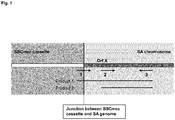
- the invention therefore relates primarily to an MRSA-identification method that employs a forward primer that hybridizes (or binds to) the template DNA region of the junction itself (and adjacent DNA sequences) across the boundary of mec (SSCmec) cassette and the SA genome (adjacent chromosomal DNA).
- the MRSA strain to be detected comprises a chromosomal Staphylococcus mec (SSCmec) cassette, which carries a mecA gene, or mecA-equivalent gene.
- SSCmec chromosomal Staphylococcus mec
- the method of the present invention is characterized in that the SA strain to be identified is selected from the group consisting of type I, II, III, V, IV a, IV b, IV c, VII, VIII, IX and/or X.
- the method of the present invention is capable of detecting MRSA of type I, II, III, V, IV a, IV b, IV c, VII, VIII, IX and/or X, especially types I, II, III, V, IV a, IV b and/or IV c.
- the present method enables detection of various MRSA strains in a reliable and efficient manner.
- MRSA diagnostics for amplification based approaches that are not overly sensitive to sequence variation present in different pathogenic MRSA strains discovered world wide.
- no noteworthy efforts had been disclosed in the art towards reducing the complexity of multiplex approaches by producing simplified methods to potentially identify multiple variants of MRSA simultaneously.
- multiple forward primers can be used in a multiplex manner, but preferably fewer forward primers are applied in the method than the number of MRSA variants that can potentially be tested.
- This feature of the invention enables simplifications in multiplex approaches, whereby until the present invention separate primer sequences have been developed and applied for each sequence variant to potentially be identified.
- the phrase "potentially be identified” or "tested” relates to the ability of the method to identify multiple MRSA variants, although not all variants must be detected. Each sample to be tested may only contain one particular MRSA strain, but the method of the invention enables the application of the same method without requiring modification to potentially identify various MRSA strains.
- the present invention is characterized in that the one or more first forward primer(s) according to claim 1 comprises a sequence according to SEQ ID NO 1, wherein the 3' end of SEQ ID NO 1 comprises no additional nucleotides, or preferably consists of a sequence according to SEQ ID NO 1.
- the particular preferred sequence of SEQ ID NO 1, in addition to closely related functionally analogous sequences as described herein, when present as an oligonucleotide is capable of binding to the relevant template region of a broad range of MRSA sequence variants.
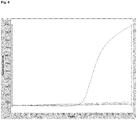
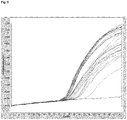
- amplification of the target DNA from various known and unknown MRSA strains with sequence variation in the template region has been achieved (also Figure 5 ).
- the sequence of SEQ ID NO 1 also exhibits improved stability during long term storage and exhibits a surprisingly high affinity for template sequences with varying sequence specificity.
- the invention relates to a method for detection of a methicillin resistant coagulase positive Staphylococcus aureus (MRSA) strain by means of a sequence specific amplification reaction, whereby the strain to be detected comprises a chromosomal Staphylococcus mec (SSCmec) cassette, characterized in that one or more first forward primer(s), preferably 3, 2 or most preferably 1 forward primer, is used in the amplification reaction, of which the 5' end hybridizes to the target DNA sequence within the SSCmec cassette and the 3' end hybridizes in the adjacent chromosomal DNA, whereby the forward primer comprises, preferably consists of, a sequence according to SEQ ID NO 1, wherein the 3' end of SEQ ID NO 1 comprises no additional nucleotides.
- MRSA methicillin resistant coagulase positive Staphylococcus aureus
- first forward primer(s) that comprise a functionally analogous sequence, comprising a nucleotide sequence with more than 80% sequence identity, preferably more than 90% sequence identity, to SEQ ID NO 1, for example, 80, 81, 82, 83, 84, 85, 86, 87, 88, 89, 90, 91, 92, 93, 94, 95, 96, 97, 98, 99%.
- Functionally analogous sequences are those that although exhibiting differences in DNA sequence, so that for example the same, fewer or more mismatches may occur between primer and template, exhibit a similar Tm and/or binding specificities for the various MRSA strains with sequence variation, so that the function of the primer in the context of the present invention is maintained.
- Functionally analogous sequences can be tested by one skilled in the art without inventive effort in light of the information provided within the application, for example by testing Tm or hybridization properties in the context of the PCR or other amplification method described.
- the method of the present invention is characterized in that a second forward primer is used in the amplification reaction, which hybridizes in the SA genome.
- This additional amplification enables the confirmation of Staphylococcus aureus (SA).
- SA Staphylococcus aureus
- Methods previously described in the prior art have provided no additional control for SA identification, whereby SCCmec cassettes or mecDNA integrated in other Staphylococcus species could also be identified.
- the second forward primer therefore provides a further identification of SA strains that provides concrete analytic and diagnostic outcomes.
- the second forward primer also enables identification of SA without an SSCmec resistance cassette via positive amplification of PCR product between second forward primer and reverse primer (Product 2), without showing amplification of the product from the primer that binds (overlaps) the junction region directly.
- the method of the present invention is characterized in that the second forward primer comprises a sequence according to SEQ ID NO 2.
- the method of the present invention is characterized in that a reverse primer is used, which hybridizes to the SA genome and represents a joint primer for the amplification reactions with both forward primers as described herein.
- the method of the present invention is characterized in that the reverse primer comprises a sequence according to SEQ ID NO 3.
- the method of the present invention is characterized in that two amplification reaction products are formed, namely
- the present invention therefore enables differentiation between:
- the invention therefore also relates to a method for differentiating between methicillin resistant, coagulase positive (MRSA) strains and methicillin resistant, coagulase negative Staphylococcus (CNS) strains.
- MRSA methicillin resistant, coagulase positive
- CNS coagulase negative Staphylococcus
- the invention thereby provides a surprising and unexpected combination of advantages until now not described in the prior art.
- the present invention also effectively solves two disadvantages of the prior art, namely a) the limitation of previous methods that could only detect one MRSA variant and b) the fact that CNS were also amplified as false positives.
- the present invention as described by both the independent claims and preferred embodiments, in particular with reference to SEQ ID NO 1, provides a method capable of detecting multiple MRSA variants and additionally provides no background or false positive amplification of CNS sequences. That the preferred sequence SEQ ID NO 1 enabled such a solution could neither have been expected nor derived from the prior art. This effect(s) arises particularly for SEQ ID NO 1, whereby Primers 1 and 5 from EP 1529847 show comparatively an absence or a significantly reduced extent of these advantages.
- the method of the present invention is characterized in that multiplex polymerase chain reaction (PCR) is carried out.
- PCR multiplex polymerase chain reaction
- the method of the present invention is characterized in that detection of the mecA or mecA-equivalent gene is carried out via a specific amplification reaction in addition to the amplification reactions described above.
- mecA identification is additionally carried out in a preferred embodiment, whereby "mecA” encompasses known and as yet unknown mecA and mecA-variant sequences that provide a mecA or mecA-analagous function.
- the mecA gene within the SCCmec cassette is known to allow a bacterium such as MRSA to be resistant to antibiotics such as methicillin, penicillin, erythromycin, tetracycline and other penicillin-like antibiotics.
- the mecA gene does not allow the ringlike structure of penicillin-like antibiotics to attack the enzymes that help form the cell wall of the bacterium (transpeptidases), and hence the bacteria is allowed to replicate as normal.
- the gene encodes aprotein PBP2A (Penicillin binding protein 2A).
- PBP2A has a low affinity for beta-lactam antibiotics such as methicillin and penicillin. This enables transpeptidase activity in the presence of beta-lactams, preventing them from inhibiting cell wall synthesis.
- the term mecA according to the present invention therefore also encompasses mecA-variants or analogues that perform mecA-equivalent function.
- mecC see Laurent F, Chardon H, et al, MRSA harboring mecA variant gene mecC, France. Emerg Infect Dis, 2012 Sep as a reference ).
- mecC A divergent mecA homolog (mecC or mecALGA251, in reference to LGA251 isolates from which it was characterized) has recently been described in a staphylococcal cassette chromosome mec named type XI.
- mecC has ⁇ 63% aa identity with PBP2a encoded by mecA and was described in S. aureus and/or coagulase-negative staphylococci.
- the mecA homolog mecC provides analogous function and has been detected in bacteria from dairy cattle in England and humans in England, Scotland, and Denmark. Therefore in a preferred embodiment the detection of mecC is also encompassed in the present invention.
- mecA encompasses mecC.
- the method of the present invention is characterized in that an internal amplification control is carried out via a specific amplification reaction in addition to the amplification reactions described above. In one embodiment the method of the present invention is characterized in that up to four amplification reaction products are formed. In one embodiment the method of the present invention is characterized in that the method comprises of individual detection of each of the amplification reaction products. In one embodiment the method of the present invention is characterized in that the method comprises real-time detection of quadruplex PCR in separated channels.
- a further aspect of the invention relates to a diagnostic kit for carrying out the amplification reaction(s) as described above comprising one or more oligonucleotide(s) with a sequence according to SEQ ID NO 1, wherein the 3' end of SEQ ID NO 1 comprises no additional nucleotides, and at least one enzyme.
- a further aspect of the invention relates to an isolated synthetic oligonucleotide comprising the sequence according to SEQ ID NO 1, wherein the 3' end of SEQ ID NO 1 comprises no additional nucleotides. Also disclosed are functionally analogous sequences, comprising a nucleotide sequence with more than 80% sequence identity, preferably more than 90% sequence identity, to SEQ ID NO 1.
- an isolated synthetic oligonucleotide comprising the sequence according to SEQ ID NO 2 or a functionally analogous sequence, comprising a nucleotide sequence with more than 80% sequence identity, preferably more than 90% sequence identity, to SEQ ID NO 2.
- an isolated synthetic oligonucleotide comprising the sequence according to SEQ ID NO 3 or a functionally analogous sequence, comprising a nucleotide sequence with more than 80% sequence identity, preferably more than 90% sequence identity, to SEQ ID NO 3.
- a further aspect of the invention relates to the use of one or more oligonucleotide(s) described above in a method described above.
- the invention further relates to functionally analogous sequences of the DNA sequences provided in Table 1, including primers and probes used herein.
- Functionally analogous sequences are those that although exhibiting differences in DNA sequence, exhibit similar properties so that the function of the DNA sequence in the context of the present invention is maintained.
- Functionally analogous sequences can be tested by one skilled in the art without inventive effort in light of the information provided within the application, for example by testing Tm or hybridization properties in the context of the PCR method described.
- the amplification reaction of the method for detecting MRSA of the present invention is characterised in a preferred embodiment in that 2 PCR products are formed.
- the first product which is amplified using the first forward primer (junction-primer) and the reverse primer, provides a stable and reliable detection of all junction sites (integration site of SSCmec cassette in SA genome). This represents a surprising and beneficial aspect of the invention.
- the present invention represents an effective solution to this problem, whereby the first primer, with a preferred Tm of 60° C, binds specifically and reliably regardless of the sequence variation of the SSCmec cassettes known to exist.
- This property (Tm) applies preferably to the sequence according to SEQ ID NO 1, which exhibits reliable binding properties regardless of sequence variation in the SSCmec cassette.
- the Tm of the one or more forward primers is itself is of great importance to the invention as claimed, in some cases independently of the specific sequence. Too low Tm of the primer involved may for example lead to non-specific products caused by a high number of base pair mismatches and difficulties in forming stable hybridisation under normal annealing conditions.
- the annealing temperature (T a ) chosen for the amplification depends on the length and composition of the primer(s). Generally, an annealing temperature about 2 to 7 °C, for example 5°C, below the lowest T m of the pair of primers is used. Such a strategy may be employed for the present method. Slightly higher Ta may also be applied in order to increase the stringency of the reaction, for example Ta of approximately the same Tm as the primers may be applied. Therefore, the Ta in the amplification reaction as described herein may be, in one embodiment, from 50 to 65°C, preferably from 55 to 65, more preferably approximately 60 °C. Other Ta values may be used depending on the primers applied.
- the second PCR product detects all SA strains.
- the combination of the two reactions provides a synergistic effect, in that only 3 primers are required to provide a stable detection system that only detects MRSA without detecting CNS, which is independent of the sequence variation possible in and around the junction region.
- the invention further relates to all sequences according to Table 1.
- Table 1 Preferred sequences of the present invention SEQ ID NO Description Sequence (5'-3') 1 First forward primer CATCATTTATGGTATGCTTCTCCAC 2 Second forward primer TGTACACTTGTTCAATTAACACAACC 3 Reverse primer CAACGCAGTAACTATGCACTATCA 4 SCC-mec-Probe - relates to the reverse complement sequence of the target sequence provided in Figure 9 FAM-TGTATAGAGCGTTTAAGATTATGC-IBFQ -ZEN 5 Staphylococcus aureus-Probe - relates to the reverse complement sequence of the target sequence provided in Figure 9 Rox-ACATTTCCACATCAAATGATGCG-BHQ2 mecA-system 6 forward primer CGGTCTAAAATTTTACCACGTTC 7 reverse primer GGATCATAGCGTCATTATTCCA 8 Probe 3 Cy5-ATGCAGAAAGACCAAAGCATACA-BHQ2 mecC-system 9 forward primer TGGAGACCAGACGTTATAGTACCT 10
- all 3 primers exhibit a Tm of approx. 60° C.
- the Tm of the primers according to SEQ ID NO 1, 2 and 3 are preferably between 55° and 65° C, preferably between 56° and 64° C, more preferably between 57° and 63° C, and most preferably is 60° C.
- these ranges also include the values 55.0, 55.1, 55.2, 55.3, 55.4, 55.5, 55.6, 55.7, 55.8, 55.9, 56.0, 56.1, 56.2, 56.3, 56.4, 56.5, 56.6, 56.7, 56.8, 56.9, 57.0, 57.1, 57.2, 57.3, 57.4, 57.5, 57.6, 57.7, 57.8, 57.9, 58.0, 58.1, 58.2, 58.3, 58.4, 58.5, 58.6, 58.7, 58.8, 58.9, 59.0, 59.1, 59.2, 59.3, 59.4, 59.5, 59.6, 59.7, 59.8, 59.9, 60.0, 60.1, 60.2, 60.3, 60.4, 60.5, 60.6, 60.7, 60.8, 60.9, 61.0, 61.1, 61.2, 61.3, 61.4, 61.5, 61.6, 61.7, 61.8, 61.9, 62.0
- the first forward primer preferably according to SEQ ID NO 1
- SEQ ID NO 1 The inventive properties of SEQ ID NO 1 are better illustrated in Table 2 via a comparison with the known and disadvantageous system of EP 1529847 .
- Table 2. Sequence alignment between SEQ ID NO 1 and the analogous primers (1 and 5) from EP 1529847. Description Sequence SEQ ID NO 1 CATCATTTATGGTATGCTTCTCCAC Identity Primer 5 from EP 1529847 TTATGATATGCTTCTCC Description Sequence SEQ ID NO 1 CATCATTTATGGTATGCTTCTCCAC Identity Primer 1 from EP 1529847 TTATGATAAGCTTCTCC
- the preferred first forward primer of the present invention differs from the primers known in EP 1529847 in various respects.
- the 5' extension has been developed in order to improve the hybridization capabilities of the primer in light of the varying sequence identity of the SSCmec cassettes known in the art. It was unexpected, that this particular sequence, especially the 5' extension compared to the primers known in EP 1529847 , would enable a single primer to be used in the identification of potentially all known MRSA strains.
- the corresponding advantage of reduced complexity in multiplex systems (fewer primers) or reduced PCR reactions leads to both technical and secondary beneficial effects, such as financial success due to increased reliability and reduced cost. Due to this sequence, and due to the Tm of the primer, the primer of SEQ ID NO 1 shows stable and reliable hybridization to various known SSCmec cassettes.
- the 3' extension also represents a significant improvement compared to the sequences disclosed in EP 1529847 .
- the inventor has provided an enormous improvement in the specificity of the primer. This specificity can for example also lead to the avoidance of false positive results, thereby avoiding amplification of unwanted CNS strains and providing reliable detection of MRSA strains. It would also have been impossible to assume from the prior art that this particular sequence modification would lead to such beneficial properties.
- SEQ ID NO 1 work together in a synergistic manner, providing enhanced hybridization in light of possible sequence variation in target sequence, enhanced specificity and an optimal Tm, in order to enable a novel and surprising improvement over the primers known in the art.
- Methicillin resistant, coagulase negative Staphylococcus (CNS) strains relate to Staphylococcus strains that do not possess or actively express the coagulase gene, which codes for an enzyme that causes blot clot formation.
- CNS coagulase negative Staphylococcus
- Examples of CNS are S. epidermis and S. warneri.
- Methicillin also known as Meticillin, is a narrow-spectrum beta-lactam antibiotic of the penicillin class. Like other beta-lactam antibiotics, methicillin acts by inhibiting the synthesis of bacterial cell walls.
- PCR refers primarily to PCR-based methods.
- PCR as such is known in the art and modifications of, or particular variations on, known PCR reactions or methods are included in the scope of the invention when used to carry out the method described herein.
- PCR relies on thermal cycling, consisting of cycles of repeated heating and cooling of the reaction for DNA melting (separation of the double strand) and enzymatic replication of the DNA.
- Primers relate to short DNA oligonucleotides that contain sequences complementary to the target region.
- a DNA polymerase is applied that facilitates selective and repeated amplification. As PCR progresses, the DNA generated is used as a template for replication, enabling a chain reaction in which the DNA template is exponentially amplified.
- PCR polymerase chain reaction
- isothermal nucleic acid amplification methods such as transcription mediated amplification, nucleic acid sequence-based amplification, signal mediated amplification of RNA technology, strand displacement amplification, rolling circle amplification, loop-mediated isothermal amplification of DNA, isothermal multiple displacement amplification, helicase-dependent amplification, single primer isothermal amplification, and circular helicase-dependent amplification (see Gill et al, Nucleosides Nucleotides Nucleic Acids. 2008 Mar;27(3):224-43 , for a review).
- Loop mediated isothermal amplification is one example of isothermal amplification that relates to a single tube technique for the amplification of DNA.
- LAMP enables nucleic acid amplification which uses a single temperature incubation thereby obviating the need for expensive thermal cyclers.
- Detection of amplification product can be by photometry for turbidity caused by increasing quantity of Magnesium pyrophosphate in solution or with addition of SYBR green, a color change can be seen without equipment.
- in-tube detection of DNA amplification is possible using manganese loaded calcein which starts fluorescing upon complexation of manganes by pyrophosphate during in vitro DNA synthesis.
- LAMP is a relatively new DNA amplification technique, which due to its simplicity, ruggedness, and low cost could provide major advantages.
- the target sequence is amplified at a constant temperature of 60 - 65 °C using either two or three sets of primers and a polymerase with high strand displacement activity in addition to a replication activity. LAMP can also be quantitative.
- DNA polymerase describes an enzyme frequently used in the polymerase chain reaction. Such enzymes include the Taq polymerase, a thermostable DNA polymerase named after the thermophilic bacterium Thermus aquaticus. Other thermostable polymerases are e.g. the Pfu DNA polymerase, which has been isolated from the hyperthermophilic bacterium Pyrococcus furiosus and has a 3'-5' exonuclease proofreading activity. Two DNA polymerases are mentioned exemplarily but do not represent limitations to the invention.
- primer refers to an oligonucleotide, whether occurring naturally as in a purified restriction digest or produced synthetically, which is capable of acting as a point of initiation of synthesis when placed under conditions in which synthesis of a primer extension product which is complementary to a nucleic acid strand is induced, i.e., in the presence of nucleotides and an inducing agent such as DNA polymerase and at a suitable temperature and pH.
- the primer is preferably single stranded for maximum efficiency in amplification, but may alternatively be double stranded. If double stranded, the primer is first treated to separate its strands before being used to prepare extension products.
- the primer is an oligodeoxyribonucleotide.
- the primer must be sufficiently long to prime the synthesis of extension products in the presence of the inducing agent.
- the exact lengths of the primers will depend on many factors, including temperature, source of primer and use of the method.
- the oligonucleotide primer typically contains 15-25 or more nucleotides, although it may contain fewer nucleotides. Preferred primers are provided in Table 1.
- RT-PCR real time PCR
- qRT-PCR quantitative RT-PCR
- the term "real-time PCR” is intended to mean any amplification technique which makes it possible to monitor the progress of an ongoing amplification reaction as it occurs (i.e. in real time). Data is therefore collected during the exponential phase of the PCR reaction, rather than at the end point as in conventional PCR. Measuring the kinetics of the reaction n the early phases of PCR provides distinct advantages over traditional PCR detection.
- real-time PCR reactions are characterized by the point in time during cycling when amplification of a target is first detected rather than the amount of target accumulated after a fixed number of cycles.
- the invention in another preferred embodiment relates to a method, wherein the amplification is a multiplex PCR with more than one pair of primers.
- the multiplex PCR is a variant of the standard PCR in which two or more loci are simultaneously amplified in the same reaction, by including more than one pair of primers in the reaction.
- the primers herein are selected to be “substantially" complementary to the different strands of each specific sequence to be amplified. This means that the primers must be sufficiently complementary to hybridize with their respective strands. Therefore, the primer sequences do not need to reflect the exact complementary sequence of the template.
- a non-complementary nucleotide fragment may be attached to the 5' end of the primer, with the remainder of the primer sequence being complementary to the strand.
- non-complementary bases or longer sequences can be interspersed into the primer, provided that the primer sequence has sufficient complementarity with the sequence of the strand to be amplified to hybridize therewith and thereby form a template for synthesis of the extension product of the other primer.
- Hybridization is the process of establishing a non-covalent, sequence-specific interaction between two or more complementary strands of nucleic acids into a single hybrid, which in the case of two strands is referred to as a duplex or DNA double strand in the case of DNA.
- Oligonucleotides, DNA, or RNA will bind to their complement under normal conditions, so two perfectly complementary strands will bind to each other readily. Due to the different molecular geometries of the nucleotides, a single inconsistency between the two strands will make binding between them less energetically favourable.
- the hybrids may be dissociated by thermal denaturation, also referred to as melting.
- the solution of hybrids is heated to break the hydrogen bonds between nucleic bases, after which the two strands separate.
- the processes of hybridization and melting may be repeated in succession indefinitely, which lays the ground for polymerase chain reaction.
- the melting temperature is generally defined as the temperature at which half of the DNA strands are in the double-helical state and half are in the random coil states.
- the melting temperature depends on both the length of the molecule, and the specific nucleotide sequence composition of that molecule.
- the melting temperature of an oligonucleotide primer can be calculated using various methods.
- Tm 4 ° C x number of G's and C's in the primer + 2 ° C x number of A's and T's in the primer
- Examples of empirical determination of Tm of a primer relate to determining the actual melting point, for example using a thermostatted cell in a UV spectrophotometer. If temperature is plotted vs. absorbance, an S-shaped curve with two plateaus will be observed. The absorbance reading halfway between the plateaus corresponds to Tm (obtained from Sigma Aldrich).
- Other useful references for Tm calculation are Wallace, R.B.; Shaffer, J.; Murphy, R.F.; Bonner, J.; Hirose, T.; Itakura, K. Nucleic Acids Res. 6, 3543 (1979 ) and Howley, P.M; Israel, M.F.; law, M-F.; Martin,M.A. J. Biol. Chem. 254, 4876 .
- Tm DH / DS + R * ln C / 4 + 16.6 log K + / 1 + 0.7 K + ⁇ 273.15
- DH is the enthalpy for helix formation.
- DS is the entropy for helix formation.
- C is the DNA concentration.
- [K+] is the salt concentration.
- DH and DS for the respective oligo are calculated using the values of nearest-neighbour thermodynamics from Breslauer, K.J. (1986 "Predicting DNA duplex stability from the base sequence” Proc Natl Acad Sci USA 83 3746-3750 ). Since the thermodynamic values calculated by the method of Breslauer are at 1 M Na+, it was necessary to add a term to correct for salt concentration, [K+].
- the salt concentration i.e., [K+] is represented as Total Na+ Equivalent and is updated according to the changes made in either Monovalent ion concentration or Free Mg2+ ion concentration.
- the default values of Monovalent ion concentration and Free Mg2+ ion concentration are 50.0 mM and 1.5 mM res., which gives a total salt concentration equal to 204.9 mM.
- the Tm of the oligos according to Primer 5 and Primer 1 from EP 1529847 are approximately 38 to 48 °C.
- Primer 5 from EP 1529847 has a Tm of 42.3 °C (according to Primer Premier 5) or 46 °C (according to the 4 + 2 method, for example from Promega).
- Primer 1 from EP 1529847 has a Tm of 38.3 °C (according to Primer Premier 5) or 44 °C (according to the 4 + 2 method, for example from Promega).
- EP 1529847 discloses that a higher amplimer quantity could be obtained by lowering the annealing temperature to 50°C. Even such a measure is unlikely to provide reliable and specific amplification.
- the Tm of SEQ ID NO 1 of the present invention is approximately 60 °C. These values can be confirmed by other methods, for example those of the "applied bio systems" website. Some variation in Tm does occur depending on the method used, but in general, the Tm of any given sequence can be reliably determined with different methods that provide similar outcomes.
- the present invention is intended to be applied in clinical diagnostic applications, in particular PCR kits for MRSA diagnosis, which provide a fast and reliable MRSA diagnosis without the need for extensive re-checking and further tests.
- the method of the present invention is intended to be carried out using samples obtained from subjects to be tested for the presence of MRSA.
- Samples to be tested can be obtained via various measures, for example from body fluids of subjects, such as blood or saliva.
- Tissue samples such as skin samples, or nasal secretions may also be obtained and subsequently tested for the presence of MRSA using the invention described herein.
- Bacterial cultures may also be used, if for example the MRSA has been isolated and cultured before testing.
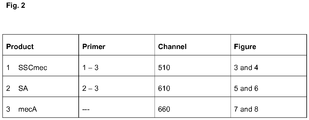
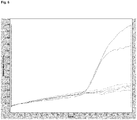
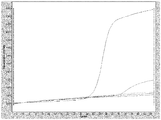
- the detection reaction is carried out in a quadruplex Real-Time PCR (RT-PCR) system, comprising detection of the two reaction products, in addition to a mecA control amplification and an internal control amplification.
- RT-PCR Real-Time PCR
- junction-specific reaction (first forward primer and reverse primer (Product 1)) is measured in the 510-channel, the internal control measured in the 580-channel, the SA-detection reaction (second forward primer and reverse primer (Product 2)) measured in the 610-channel and the mecA detection measured in the 660-channel.
- SA methicillin resistant coagulase positive Staphylococcus aureus
- the conducted experiment consists of 2 runs. In the first run all samples analyzed are MRSA. For all known species the SSC-mec type is mentioned in the table below. Otherwise the samples are named with unknown. In the second run only non-MRSA are analyzed and a PTC (positive template control - a synthetic MRSA) is used as comparison.
- channel 510 610 660 sample Cp SCC-mec Cp S. aureus Cp mecA NTC negative negative negative negative NTC negative negative negative S. aureus negative 30 negative S. cohnii negative negative negative S. hominis negative negative negative negative S. epidermidis negative negative 36 Positive Control 27 30 26
Landscapes
- Chemical & Material Sciences (AREA)
- Life Sciences & Earth Sciences (AREA)
- Analytical Chemistry (AREA)
- Proteomics, Peptides & Aminoacids (AREA)
- Organic Chemistry (AREA)
- Zoology (AREA)
- Wood Science & Technology (AREA)
- Health & Medical Sciences (AREA)
- Engineering & Computer Science (AREA)
- Microbiology (AREA)
- Immunology (AREA)
- Molecular Biology (AREA)
- Biotechnology (AREA)
- Biophysics (AREA)
- Physics & Mathematics (AREA)
- Biochemistry (AREA)
- Bioinformatics & Cheminformatics (AREA)
- General Engineering & Computer Science (AREA)
- General Health & Medical Sciences (AREA)
- Genetics & Genomics (AREA)
- Measuring Or Testing Involving Enzymes Or Micro-Organisms (AREA)
Claims (14)
- Verfahren zum Nachweis eines Methicillin-resistenten koagulasepositiven Staphylococcus-aureus-Stammes (MRSA) mittels einer sequenzspezifischen Amplifikationsreaktion, wobei der nachzuweisende Stamm eine chromosomale Staphylococcus-mec-Kassette (SSCmec) umfasst,
wobei
ein oder mehrere erste Vorwärtsprimer, vorzugsweise 3, 2 oder besonders bevorzugt 1 Vorwärtsprimer, in der Amplifikationsreaktion verwendet wird/werden, von denen das 5'-Ende mit der Ziel-DNA-Sequenz innerhalb der SSCmec-Kassette hybridisiert und das 3'-Ende in der benachbarten chromosomalen DNA hybridisiert,
dadurch gekennzeichnet, dass (ein) erste(r) Vorwärtsprimer eine Sequenz gemäß SEQ ID Nr. 1 (CATCATTTATGGTATGCTTCTCCAC) umfasst/umfassen, wobei das 3'-Ende von SEQ ID Nr. 1 keine zusätzlichen Nukleotide umfasst. - Verfahren gemäß Anspruch 1, dadurch gekennzeichnet, dass der zu identifizierende SA-Stamm aus der aus Typ I, II, III, V, IV a, IV b, IV c, VII, VIII, IX und/oder X bestehenden Gruppe ausgewählt wird.
- Verfahren gemäß Anspruch 1, dadurch gekennzeichnet, dass in der Amplifikationsreaktion ein zweiter Vorwärtsprimer verwendet wird, der in dem SA-Genom hybridisiert.
- Verfahren gemäß einem der vorhergehenden Ansprüche, dadurch gekennzeichnet, dass der zweite Vorwärtsprimer eine Sequenz gemäß SEQ ID Nr. 2 (TGTACACTTGTTCAATTAACACAACC) umfasst.
- Verfahren gemäß einem der vorhergehenden Ansprüche, dadurch gekennzeichnet, dass ein reverser Primer verwendet wird, der mit dem SA Genom hybridisiert und mit beiden Vorwärtsprimern gemäß den Ansprüchen 1 und/oder 3 einen reversen Primer für die Amplifikationsreaktionen darstellt.
- Verfahren gemäß einem der vorhergehenden Ansprüche, dadurch gekennzeichnet, dass der reverse Primer eine Sequenz gemäß SEQ ID Nr. 3 (CAACGCAGTAACTATGCACTATCA) umfasst.
- Verfahren nach einem der vorhergehenden Ansprüche, dadurch gekennzeichnet, dass zwei Amplifikationsreaktionsprodukte gebildet werden und zwar Folgende:a. ein Produkt, das sich aus der Amplifikation zwischen dem einen oder den mehreren ersten Vorwärtsprimern und dem reversen Primer ergibt, undb. ein Produkt, das sich aus der Amplifikation zwischen dem zweiten Vorwärtsprimer und dem reversen Primer ergibt.
- Verfahren nach einem der vorhergehenden Ansprüche, wobei, wenn mehr als ein Vorwärtsprimer eingesetzt wird, im Vergleich zu der Anzahl von möglicherweise identifizierbaren MRSA-Varianten weniger Vorwärtsprimer eingesetzt werden.
- Verfahren nach einem der vorhergehenden Ansprüche, dadurch gekennzeichnet, dass der nachzuweisende MRSA-Stamm eine chromosomale Staphylococcus-mec-Kassette (SSCmec) umfasst, die ein mecA-Gen trägt.
- Verfahren nach einem der vorhergehenden Ansprüche, das durch Folgendes gekennzeichnet ist:a) Nachweis des mecA-Gens wird zusätzlich zu den Amplifikationsreaktionen gemäß den Ansprüchen 1 und/oder 7 über eine spezifische Amplifikationsreaktion durchgeführt;b) interne Amplifikationssteuerung wird zusätzlich zu den Amplifikationsreaktionen gemäß den Ansprüchen 1, 7 und/oder 10 a) über eine spezifische Amplifikationsreaktion durchgeführt; und/oderc) bis zu vier Amplifikationsreaktionsprodukte werden vorzugsweise gemäß den der Ansprüche 7, 10 a) und 10 b) gebildet.
- Verfahren zur Unterscheidung zwischen Methicillin-resistenten koagulasepositiven MRSA-Stämmen und Methicillin-resistenten koagulasenegativen Staphylococcus-Stämmen (CNS), das das Verfahren gemäß einem der vorhergehenden Ansprüche umfasst.
- Diagnostikkit zum Durchführen der Amplifikationsreaktion(en) gemäß einem der vorhergehenden Ansprüche, das ein oder mehrere Oligonukleotide mit einer Sequenz gemäß SEQ ID Nr. 1 (CATCATTTATGGTATGCTTCTCCAC) umfasst, wobei das 3'-Ende von SEQ ID Nr. 1 keine zusätzlichen Nukleotide und mindestens ein Enzym umfasst.
- Isoliertes synthetisches Oligonukleotid, das eine Sequenz gemäß SEQ ID Nr. 1 (CAT C ATTT ATG GTATG CTT CT CC AC) umfasst, wobei das 3'-Ende von SEQ ID Nr. 1 keine zusätzlichen Nukleotide umfasst.
- Verwendung des Oligonukleotids gemäß dem vorhergehenden Anspruch in einem Verfahren gemäß einem der Ansprüche 1 bis 11.
Priority Applications (1)
| Application Number | Priority Date | Filing Date | Title |
|---|---|---|---|
| EP13701250.6A EP2807273B1 (de) | 2012-01-23 | 2013-01-23 | Verfahren zum nachweis eines methicillinresistenten koagulasepositiven staphylococcus-aureus-stamms |
Applications Claiming Priority (3)
| Application Number | Priority Date | Filing Date | Title |
|---|---|---|---|
| EP12152157.9A EP2617836A1 (de) | 2012-01-23 | 2012-01-23 | Verfahren zum Nachweis eines methicillinresistenten koagulasepositiven Staphylococcus-aureus-Stamms |
| PCT/EP2013/051242 WO2013110660A1 (en) | 2012-01-23 | 2013-01-23 | Method for detecting a methicillin resistant coagulase positive staphylococcus aureus strain |
| EP13701250.6A EP2807273B1 (de) | 2012-01-23 | 2013-01-23 | Verfahren zum nachweis eines methicillinresistenten koagulasepositiven staphylococcus-aureus-stamms |
Publications (2)
| Publication Number | Publication Date |
|---|---|
| EP2807273A1 EP2807273A1 (de) | 2014-12-03 |
| EP2807273B1 true EP2807273B1 (de) | 2019-02-27 |
Family
ID=47603730
Family Applications (2)
| Application Number | Title | Priority Date | Filing Date |
|---|---|---|---|
| EP12152157.9A Withdrawn EP2617836A1 (de) | 2012-01-23 | 2012-01-23 | Verfahren zum Nachweis eines methicillinresistenten koagulasepositiven Staphylococcus-aureus-Stamms |
| EP13701250.6A Active EP2807273B1 (de) | 2012-01-23 | 2013-01-23 | Verfahren zum nachweis eines methicillinresistenten koagulasepositiven staphylococcus-aureus-stamms |
Family Applications Before (1)
| Application Number | Title | Priority Date | Filing Date |
|---|---|---|---|
| EP12152157.9A Withdrawn EP2617836A1 (de) | 2012-01-23 | 2012-01-23 | Verfahren zum Nachweis eines methicillinresistenten koagulasepositiven Staphylococcus-aureus-Stamms |
Country Status (3)
| Country | Link |
|---|---|
| US (1) | US9574242B2 (de) |
| EP (2) | EP2617836A1 (de) |
| WO (1) | WO2013110660A1 (de) |
Families Citing this family (4)
| Publication number | Priority date | Publication date | Assignee | Title |
|---|---|---|---|---|
| US10407739B2 (en) * | 2013-09-23 | 2019-09-10 | Quest Diagnostics Investments Incorporated | Detection of methicillin-resistant Staphylococcus aureus in biological samples |
| CN109207615B (zh) * | 2018-10-12 | 2021-06-29 | 广东省生态环境技术研究所 | 一种免标记荧光检测金黄色葡萄球菌mecA基因的方法及检测试剂盒 |
| WO2020142852A1 (en) * | 2019-01-11 | 2020-07-16 | Uti Limited Partnership | Novel assay for mrsa detection directly from clinical samples |
| EP4289972A1 (de) | 2022-06-09 | 2023-12-13 | Congen Biotechnologie GmbH | Verfahren zum nachweis von methicillinresistentem staphylococcus aureus |
Citations (1)
| Publication number | Priority date | Publication date | Assignee | Title |
|---|---|---|---|---|
| WO2011019837A1 (en) * | 2009-08-11 | 2011-02-17 | Brandeis University | Single probe, multiple temperature, nucleic acid detection methods, kits, and compositions |
Family Cites Families (5)
| Publication number | Priority date | Publication date | Assignee | Title |
|---|---|---|---|---|
| JP3957338B2 (ja) | 1996-02-23 | 2007-08-15 | 株式会社カイノス | 診断薬 |
| CA2348042A1 (en) | 2001-06-04 | 2002-12-04 | Ann Huletsky | Sequences for detection and identification of methicillin-resistant staphylococcus aureus |
| DE60304481T8 (de) | 2003-11-07 | 2007-03-08 | Federal Rep. of Germany repr.by the Ministry of Health & Soc.Security, the latter repr. by the Pres. of the Robert Koch Inst. | Verfahren zur Identifizierung von Methicilin resistente Staphylococcus aureus (MRSA) |
| ES2425267T5 (es) | 2007-12-21 | 2022-07-13 | Biomerieux Sa | Detección de Staphylococcus aureus resistente a meticilina |
| BR112012011262A2 (pt) * | 2009-11-13 | 2019-09-24 | Beckman Coulter Inc | sistemas e métodos para detectar a presença de um estado biológico usando aglomeração |
-
2012
- 2012-01-23 EP EP12152157.9A patent/EP2617836A1/de not_active Withdrawn
-
2013
- 2013-01-23 WO PCT/EP2013/051242 patent/WO2013110660A1/en not_active Ceased
- 2013-01-23 US US14/373,902 patent/US9574242B2/en not_active Expired - Fee Related
- 2013-01-23 EP EP13701250.6A patent/EP2807273B1/de active Active
Patent Citations (1)
| Publication number | Priority date | Publication date | Assignee | Title |
|---|---|---|---|---|
| WO2011019837A1 (en) * | 2009-08-11 | 2011-02-17 | Brandeis University | Single probe, multiple temperature, nucleic acid detection methods, kits, and compositions |
Also Published As
| Publication number | Publication date |
|---|---|
| EP2617836A1 (de) | 2013-07-24 |
| WO2013110660A1 (en) | 2013-08-01 |
| EP2807273A1 (de) | 2014-12-03 |
| US9574242B2 (en) | 2017-02-21 |
| US20140370512A1 (en) | 2014-12-18 |
Similar Documents
| Publication | Publication Date | Title |
|---|---|---|
| CA2478020C (en) | Quantitative assay for the simultaneous detection and speciation of bacterial infections | |
| US5849497A (en) | Specific inhibition of the polymerase chain reaction using a non-extendable oligonucleotide blocker | |
| JP2026027349A (ja) | 結核菌(Mycobacterium Tuberculosis)のためのポリメラーゼ連鎖反応プライマーおよびプローブ | |
| US6258570B1 (en) | PCR assay for bacterial and viral meningitis | |
| EP2989212B1 (de) | Dna-amplifizierung auf stranginvasionsbasis | |
| US20140017692A1 (en) | Method and kit for detecting target nucleic acid | |
| EP1570079B1 (de) | Verfahren zum nachweis von pathogenen organismen | |
| EP2807273B1 (de) | Verfahren zum nachweis eines methicillinresistenten koagulasepositiven staphylococcus-aureus-stamms | |
| KR20180053743A (ko) | 짧은 호모폴리머릭 반복서열의 개선된 검출법 | |
| EP1160333A2 (de) | Oligonukleotide und Methoden zur Detektion des mecA Gens beim Methicillin-resistenten Staphylococcus aureus | |
| US20030113757A1 (en) | Rapid and specific detection of campylobacter | |
| JP2006508669A (ja) | ブドウ球菌属、腸球菌属、および連鎖球菌属から選択される病原性グラム陽性細菌の検出のための方法 | |
| WO2020069397A1 (en) | Methods for detection of microbial nucleic acids in body fluids | |
| CA2822953A1 (en) | Selective detection of haemophilus influenzae | |
| Miyachi et al. | Application of chimeric RNA–DNA oligonucleotides to the detection of pathogenic microorganisms using surface plasmon resonance | |
| EP4289972A1 (de) | Verfahren zum nachweis von methicillinresistentem staphylococcus aureus | |
| KR102369388B1 (ko) | 시료에서 M. tuberculosis, M. bovis 및 M. bovis BCG의 존재 또는 부존재를 결정하는 방법 | |
| US8304184B2 (en) | Genotyping using multiple variant-specific primer pools | |
| KR20070100531A (ko) | 쌍이온 화합물을 이용한 핵산 혼성화 특이성을 증가시키는방법 | |
| KR102260992B1 (ko) | 항생제 내성 균주 검출용 조성물 및 그 방법 | |
| KR102238514B1 (ko) | 항생제 내성 균주 검출용 조성물 및 그 방법 | |
| HK40072693B (en) | Polymerase chain reaction primers and probes for mycobacterium tuberculosis | |
| HK40072693A (en) | Polymerase chain reaction primers and probes for mycobacterium tuberculosis | |
| ES2349090T3 (es) | Ensayo multiplex de detección de organismos patogénicos. | |
| JPH03164199A (ja) | 結核菌の迅速同定方法及び同定用試薬キット |
Legal Events
| Date | Code | Title | Description |
|---|---|---|---|
| PUAI | Public reference made under article 153(3) epc to a published international application that has entered the european phase |
Free format text: ORIGINAL CODE: 0009012 |
|
| 17P | Request for examination filed |
Effective date: 20140716 |
|
| AK | Designated contracting states |
Kind code of ref document: A1 Designated state(s): AL AT BE BG CH CY CZ DE DK EE ES FI FR GB GR HR HU IE IS IT LI LT LU LV MC MK MT NL NO PL PT RO RS SE SI SK SM TR |
|
| DAX | Request for extension of the european patent (deleted) | ||
| 17Q | First examination report despatched |
Effective date: 20161017 |
|
| STAA | Information on the status of an ep patent application or granted ep patent |
Free format text: STATUS: EXAMINATION IS IN PROGRESS |
|
| RAP1 | Party data changed (applicant data changed or rights of an application transferred) |
Owner name: CONGEN BIOTECHNOLOGIE GMBH |
|
| RIN1 | Information on inventor provided before grant (corrected) |
Inventor name: MERGEMEIER, STEFFEN |
|
| REG | Reference to a national code |
Ref country code: DE Ref legal event code: R079 Ref document number: 602013051359 Country of ref document: DE Free format text: PREVIOUS MAIN CLASS: C12Q0001680000 Ipc: C12Q0001689000 |
|
| RIC1 | Information provided on ipc code assigned before grant |
Ipc: C12Q 1/689 20180101AFI20180718BHEP |
|
| GRAP | Despatch of communication of intention to grant a patent |
Free format text: ORIGINAL CODE: EPIDOSNIGR1 |
|
| STAA | Information on the status of an ep patent application or granted ep patent |
Free format text: STATUS: GRANT OF PATENT IS INTENDED |
|
| INTG | Intention to grant announced |
Effective date: 20180920 |
|
| GRAS | Grant fee paid |
Free format text: ORIGINAL CODE: EPIDOSNIGR3 |
|
| GRAA | (expected) grant |
Free format text: ORIGINAL CODE: 0009210 |
|
| STAA | Information on the status of an ep patent application or granted ep patent |
Free format text: STATUS: THE PATENT HAS BEEN GRANTED |
|
| AK | Designated contracting states |
Kind code of ref document: B1 Designated state(s): AL AT BE BG CH CY CZ DE DK EE ES FI FR GB GR HR HU IE IS IT LI LT LU LV MC MK MT NL NO PL PT RO RS SE SI SK SM TR |
|
| REG | Reference to a national code |
Ref country code: GB Ref legal event code: FG4D |
|
| REG | Reference to a national code |
Ref country code: CH Ref legal event code: EP |
|
| REG | Reference to a national code |
Ref country code: AT Ref legal event code: REF Ref document number: 1101405 Country of ref document: AT Kind code of ref document: T Effective date: 20190315 |
|
| REG | Reference to a national code |
Ref country code: IE Ref legal event code: FG4D |
|
| REG | Reference to a national code |
Ref country code: DE Ref legal event code: R096 Ref document number: 602013051359 Country of ref document: DE |
|
| REG | Reference to a national code |
Ref country code: NL Ref legal event code: MP Effective date: 20190227 |
|
| REG | Reference to a national code |
Ref country code: LT Ref legal event code: MG4D |
|
| PG25 | Lapsed in a contracting state [announced via postgrant information from national office to epo] |
Ref country code: FI Free format text: LAPSE BECAUSE OF FAILURE TO SUBMIT A TRANSLATION OF THE DESCRIPTION OR TO PAY THE FEE WITHIN THE PRESCRIBED TIME-LIMIT Effective date: 20190227 Ref country code: NO Free format text: LAPSE BECAUSE OF FAILURE TO SUBMIT A TRANSLATION OF THE DESCRIPTION OR TO PAY THE FEE WITHIN THE PRESCRIBED TIME-LIMIT Effective date: 20190527 Ref country code: LT Free format text: LAPSE BECAUSE OF FAILURE TO SUBMIT A TRANSLATION OF THE DESCRIPTION OR TO PAY THE FEE WITHIN THE PRESCRIBED TIME-LIMIT Effective date: 20190227 Ref country code: NL Free format text: LAPSE BECAUSE OF FAILURE TO SUBMIT A TRANSLATION OF THE DESCRIPTION OR TO PAY THE FEE WITHIN THE PRESCRIBED TIME-LIMIT Effective date: 20190227 Ref country code: SE Free format text: LAPSE BECAUSE OF FAILURE TO SUBMIT A TRANSLATION OF THE DESCRIPTION OR TO PAY THE FEE WITHIN THE PRESCRIBED TIME-LIMIT Effective date: 20190227 Ref country code: PT Free format text: LAPSE BECAUSE OF FAILURE TO SUBMIT A TRANSLATION OF THE DESCRIPTION OR TO PAY THE FEE WITHIN THE PRESCRIBED TIME-LIMIT Effective date: 20190627 |
|
| PG25 | Lapsed in a contracting state [announced via postgrant information from national office to epo] |
Ref country code: LV Free format text: LAPSE BECAUSE OF FAILURE TO SUBMIT A TRANSLATION OF THE DESCRIPTION OR TO PAY THE FEE WITHIN THE PRESCRIBED TIME-LIMIT Effective date: 20190227 Ref country code: RS Free format text: LAPSE BECAUSE OF FAILURE TO SUBMIT A TRANSLATION OF THE DESCRIPTION OR TO PAY THE FEE WITHIN THE PRESCRIBED TIME-LIMIT Effective date: 20190227 Ref country code: BG Free format text: LAPSE BECAUSE OF FAILURE TO SUBMIT A TRANSLATION OF THE DESCRIPTION OR TO PAY THE FEE WITHIN THE PRESCRIBED TIME-LIMIT Effective date: 20190527 Ref country code: GR Free format text: LAPSE BECAUSE OF FAILURE TO SUBMIT A TRANSLATION OF THE DESCRIPTION OR TO PAY THE FEE WITHIN THE PRESCRIBED TIME-LIMIT Effective date: 20190528 Ref country code: IS Free format text: LAPSE BECAUSE OF FAILURE TO SUBMIT A TRANSLATION OF THE DESCRIPTION OR TO PAY THE FEE WITHIN THE PRESCRIBED TIME-LIMIT Effective date: 20190627 Ref country code: HR Free format text: LAPSE BECAUSE OF FAILURE TO SUBMIT A TRANSLATION OF THE DESCRIPTION OR TO PAY THE FEE WITHIN THE PRESCRIBED TIME-LIMIT Effective date: 20190227 |
|
| REG | Reference to a national code |
Ref country code: AT Ref legal event code: MK05 Ref document number: 1101405 Country of ref document: AT Kind code of ref document: T Effective date: 20190227 |
|
| PG25 | Lapsed in a contracting state [announced via postgrant information from national office to epo] |
Ref country code: DK Free format text: LAPSE BECAUSE OF FAILURE TO SUBMIT A TRANSLATION OF THE DESCRIPTION OR TO PAY THE FEE WITHIN THE PRESCRIBED TIME-LIMIT Effective date: 20190227 Ref country code: EE Free format text: LAPSE BECAUSE OF FAILURE TO SUBMIT A TRANSLATION OF THE DESCRIPTION OR TO PAY THE FEE WITHIN THE PRESCRIBED TIME-LIMIT Effective date: 20190227 Ref country code: AL Free format text: LAPSE BECAUSE OF FAILURE TO SUBMIT A TRANSLATION OF THE DESCRIPTION OR TO PAY THE FEE WITHIN THE PRESCRIBED TIME-LIMIT Effective date: 20190227 Ref country code: SK Free format text: LAPSE BECAUSE OF FAILURE TO SUBMIT A TRANSLATION OF THE DESCRIPTION OR TO PAY THE FEE WITHIN THE PRESCRIBED TIME-LIMIT Effective date: 20190227 Ref country code: CZ Free format text: LAPSE BECAUSE OF FAILURE TO SUBMIT A TRANSLATION OF THE DESCRIPTION OR TO PAY THE FEE WITHIN THE PRESCRIBED TIME-LIMIT Effective date: 20190227 Ref country code: IT Free format text: LAPSE BECAUSE OF FAILURE TO SUBMIT A TRANSLATION OF THE DESCRIPTION OR TO PAY THE FEE WITHIN THE PRESCRIBED TIME-LIMIT Effective date: 20190227 Ref country code: ES Free format text: LAPSE BECAUSE OF FAILURE TO SUBMIT A TRANSLATION OF THE DESCRIPTION OR TO PAY THE FEE WITHIN THE PRESCRIBED TIME-LIMIT Effective date: 20190227 Ref country code: RO Free format text: LAPSE BECAUSE OF FAILURE TO SUBMIT A TRANSLATION OF THE DESCRIPTION OR TO PAY THE FEE WITHIN THE PRESCRIBED TIME-LIMIT Effective date: 20190227 |
|
| REG | Reference to a national code |
Ref country code: DE Ref legal event code: R097 Ref document number: 602013051359 Country of ref document: DE |
|
| PG25 | Lapsed in a contracting state [announced via postgrant information from national office to epo] |
Ref country code: SM Free format text: LAPSE BECAUSE OF FAILURE TO SUBMIT A TRANSLATION OF THE DESCRIPTION OR TO PAY THE FEE WITHIN THE PRESCRIBED TIME-LIMIT Effective date: 20190227 Ref country code: PL Free format text: LAPSE BECAUSE OF FAILURE TO SUBMIT A TRANSLATION OF THE DESCRIPTION OR TO PAY THE FEE WITHIN THE PRESCRIBED TIME-LIMIT Effective date: 20190227 |
|
| PG25 | Lapsed in a contracting state [announced via postgrant information from national office to epo] |
Ref country code: AT Free format text: LAPSE BECAUSE OF FAILURE TO SUBMIT A TRANSLATION OF THE DESCRIPTION OR TO PAY THE FEE WITHIN THE PRESCRIBED TIME-LIMIT Effective date: 20190227 |
|
| PLBE | No opposition filed within time limit |
Free format text: ORIGINAL CODE: 0009261 |
|
| STAA | Information on the status of an ep patent application or granted ep patent |
Free format text: STATUS: NO OPPOSITION FILED WITHIN TIME LIMIT |
|
| 26N | No opposition filed |
Effective date: 20191128 |
|
| PG25 | Lapsed in a contracting state [announced via postgrant information from national office to epo] |
Ref country code: SI Free format text: LAPSE BECAUSE OF FAILURE TO SUBMIT A TRANSLATION OF THE DESCRIPTION OR TO PAY THE FEE WITHIN THE PRESCRIBED TIME-LIMIT Effective date: 20190227 |
|
| PG25 | Lapsed in a contracting state [announced via postgrant information from national office to epo] |
Ref country code: TR Free format text: LAPSE BECAUSE OF FAILURE TO SUBMIT A TRANSLATION OF THE DESCRIPTION OR TO PAY THE FEE WITHIN THE PRESCRIBED TIME-LIMIT Effective date: 20190227 |
|
| PG25 | Lapsed in a contracting state [announced via postgrant information from national office to epo] |
Ref country code: MC Free format text: LAPSE BECAUSE OF FAILURE TO SUBMIT A TRANSLATION OF THE DESCRIPTION OR TO PAY THE FEE WITHIN THE PRESCRIBED TIME-LIMIT Effective date: 20190227 |
|
| REG | Reference to a national code |
Ref country code: CH Ref legal event code: PL |
|
| GBPC | Gb: european patent ceased through non-payment of renewal fee |
Effective date: 20200123 |
|
| REG | Reference to a national code |
Ref country code: BE Ref legal event code: MM Effective date: 20200131 |
|
| PG25 | Lapsed in a contracting state [announced via postgrant information from national office to epo] |
Ref country code: GB Free format text: LAPSE BECAUSE OF NON-PAYMENT OF DUE FEES Effective date: 20200123 Ref country code: FR Free format text: LAPSE BECAUSE OF NON-PAYMENT OF DUE FEES Effective date: 20200131 Ref country code: LU Free format text: LAPSE BECAUSE OF NON-PAYMENT OF DUE FEES Effective date: 20200123 |
|
| PG25 | Lapsed in a contracting state [announced via postgrant information from national office to epo] |
Ref country code: BE Free format text: LAPSE BECAUSE OF NON-PAYMENT OF DUE FEES Effective date: 20200131 Ref country code: CH Free format text: LAPSE BECAUSE OF NON-PAYMENT OF DUE FEES Effective date: 20200131 Ref country code: LI Free format text: LAPSE BECAUSE OF NON-PAYMENT OF DUE FEES Effective date: 20200131 |
|
| PG25 | Lapsed in a contracting state [announced via postgrant information from national office to epo] |
Ref country code: IE Free format text: LAPSE BECAUSE OF NON-PAYMENT OF DUE FEES Effective date: 20200123 |
|
| PG25 | Lapsed in a contracting state [announced via postgrant information from national office to epo] |
Ref country code: MT Free format text: LAPSE BECAUSE OF FAILURE TO SUBMIT A TRANSLATION OF THE DESCRIPTION OR TO PAY THE FEE WITHIN THE PRESCRIBED TIME-LIMIT Effective date: 20190227 Ref country code: CY Free format text: LAPSE BECAUSE OF FAILURE TO SUBMIT A TRANSLATION OF THE DESCRIPTION OR TO PAY THE FEE WITHIN THE PRESCRIBED TIME-LIMIT Effective date: 20190227 |
|
| PG25 | Lapsed in a contracting state [announced via postgrant information from national office to epo] |
Ref country code: MK Free format text: LAPSE BECAUSE OF FAILURE TO SUBMIT A TRANSLATION OF THE DESCRIPTION OR TO PAY THE FEE WITHIN THE PRESCRIBED TIME-LIMIT Effective date: 20190227 |
|
| PGFP | Annual fee paid to national office [announced via postgrant information from national office to epo] |
Ref country code: DE Payment date: 20230125 Year of fee payment: 11 |
|
| P01 | Opt-out of the competence of the unified patent court (upc) registered |
Effective date: 20230514 |
|
| REG | Reference to a national code |
Ref country code: DE Ref legal event code: R119 Ref document number: 602013051359 Country of ref document: DE |
|
| PG25 | Lapsed in a contracting state [announced via postgrant information from national office to epo] |
Ref country code: DE Free format text: LAPSE BECAUSE OF NON-PAYMENT OF DUE FEES Effective date: 20240801 |
|
| PG25 | Lapsed in a contracting state [announced via postgrant information from national office to epo] |
Ref country code: DE Free format text: LAPSE BECAUSE OF NON-PAYMENT OF DUE FEES Effective date: 20240801 |