EP2806562A1 - Programmierbares Frequenzteilermodul mit Arbeitszyklus bei fast fünfzig Prozent - Google Patents
Programmierbares Frequenzteilermodul mit Arbeitszyklus bei fast fünfzig Prozent Download PDFInfo
- Publication number
- EP2806562A1 EP2806562A1 EP13305661.4A EP13305661A EP2806562A1 EP 2806562 A1 EP2806562 A1 EP 2806562A1 EP 13305661 A EP13305661 A EP 13305661A EP 2806562 A1 EP2806562 A1 EP 2806562A1
- Authority
- EP
- European Patent Office
- Prior art keywords
- input
- clock
- value
- digital
- frequency divider
- Prior art date
- Legal status (The legal status is an assumption and is not a legal conclusion. Google has not performed a legal analysis and makes no representation as to the accuracy of the status listed.)
- Withdrawn
Links
- 230000003247 decreasing effect Effects 0.000 claims 1
- 238000010586 diagram Methods 0.000 description 8
- 230000000630 rising effect Effects 0.000 description 3
- 230000007423 decrease Effects 0.000 description 2
- 230000000694 effects Effects 0.000 description 2
- 230000001360 synchronised effect Effects 0.000 description 2
- 230000000295 complement effect Effects 0.000 description 1
- 239000013078 crystal Substances 0.000 description 1
- 238000001514 detection method Methods 0.000 description 1
- 238000004519 manufacturing process Methods 0.000 description 1
Images

Classifications
-
- H—ELECTRICITY
- H03—ELECTRONIC CIRCUITRY
- H03K—PULSE TECHNIQUE
- H03K23/00—Pulse counters comprising counting chains; Frequency dividers comprising counting chains
- H03K23/64—Pulse counters comprising counting chains; Frequency dividers comprising counting chains with a base or radix other than a power of two
- H03K23/66—Pulse counters comprising counting chains; Frequency dividers comprising counting chains with a base or radix other than a power of two with a variable counting base, e.g. by presetting or by adding or suppressing pulses
- H03K23/665—Pulse counters comprising counting chains; Frequency dividers comprising counting chains with a base or radix other than a power of two with a variable counting base, e.g. by presetting or by adding or suppressing pulses by presetting
-
- H—ELECTRICITY
- H03—ELECTRONIC CIRCUITRY
- H03K—PULSE TECHNIQUE
- H03K21/00—Details of pulse counters or frequency dividers
- H03K21/02—Input circuits
- H03K21/026—Input circuits comprising logic circuits
Definitions
- the invention relates to a programmable frequency divider module which is suitable for delivering a clock signal having a duty cycle close to fifty percent.
- Electronic circuits need clocks for synchronizing the operations of all their internal blocks. But different blocks within one and same electronic circuit may need different respective clock frequencies, so that several synthesized frequencies are required within the whole circuit. Therefore, it is appropriate to provide several frequency synthesizers of same type but being programmable, so that the required frequencies can be all synthesized from one initial clock signal using division ratio values which are different from one another, respectively within the frequency synthesizers.
- the duty cycle of the synthesized clock signal which is delivered by each frequency synthesizer should be about 50%, for example comprised between 35% and 65%.
- the quality of frequency synthesizers in term of duty cycle value is important for data converters, digital-to-analog ones or reverse, and for PLL devices.
- one object of the invention consists in providing a frequency synthesizer which is programmable, with duty cycle value of the signal synthesized which is constant and preferably comprised between 35% and 65%.
- Another object of the invention is that the clock signal which is delivered by the frequency synthesizer has low-noise
- Still another object of the invention is that the frequency synthesizer is low-cost and easy to implement within an electronic integrated circuit.
- a programmable frequency divider module which comprises:
- the invention frequency divider module further comprises, with N being an integer greater than unity:
- the invention frequency divider module is of programmable type.
- the derived clock signal exhibits low-noise, in particular thanks to using the D-flipflop for re-synchronizing this derived clock signal before it is delivered at the clock output.
- frequency divider module is that it is fully synchronized with reference to only the initial clock signal.
- the invention frequency divider module only implements components which are simple, easy to manufacture and low-cost.
- the duty cycle can be close to 50%, with sufficient time between successive falling and rising edges within the derived clock signal.
- the duty cycle can be comprised between 35% and 65%.
- the digital combination may comprise, further to the N-bit adder, at least one among a x-bit-right shifter, a y-bit-left shifter, a N-inverter and a digital comparator, x and y being non-zero integers less than N.
- the programmable re-load counter may be a programmable re-load down-counter, so that the count signal is then a down-count signal which decreases from the division ratio value and repeats back from this division ratio value after the one-value has been reached.
- a first adder input of the N-bit adder may be connected to the exit of the first intermediate N-bus, and the digital combination may comprise further to the N-bit adder:
- the N-bit adder adds the down-count signal to the offset value. Because the offset value is based itself on the value of the division ratio, the duty cycle can be close to 50% whatever the value of the division ratio.
- the N-bit adder may be provided with a carry output for delivering a carry which forms the digital signal.
- This carry equals a first value when the addition result of the down-count signal with the offset value is less than 2N, and otherwise equals a second value different from the first one.
- 2N is the comparison threshold involved earlier here-above.
- the programmable frequency divider module of the invention may further comprise a frequency two-divider unit connected at input to the clock output, and suitable for producing a final clock signal which is based on the derived clock signal and has a final frequency equal to half the synthesized frequency.
- the invention provides the final clock signal with final frequency equalling the initial one divided by two times the division ratio value.
- a second aspect of the invention proposes an electronic circuit which comprises:
- the programmable frequency divider module and the circuit block may be contained within one and same integrated circuit chip, and the clock module may be external to this chip.
- the invention suits specifically when the circuit block is selected from an analog-to-digital converter, a digital-to-analog converter and a phase-locked loop device.
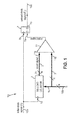
- the input 10a is to be fed from externally with an initial clock signal having initial frequency F i .
- the F i -frequency may be about 300 MHz (megahertz).
- the input 10b is to be fed with an integer value R for a division ratio, so that the output 10c delivers a derived clock signal with synthesized frequency F s equal to F i divided by R.
- N is greater than unity, for example equal to four, and R is greater than two and encoded over N bits.
- the F s -frequency may be comprised between 20 and 100 MHz included, depending on the actual R-value.
- the programmable re-load counter 1 may be either of up-counter type or down-counter type. Possibly, this counter-type itself may be programmed for a counter capable of operating alternatively according to both counter-types.
- the digital combination 11 outputs a digital signal, for example a binary signal, based on the time-varying count signal which is transmitted by the intermediate N-bus 2.
- the digital combination 11 may have several designs, in particular depending on the counter-type which is actually selected for the programmable re-load counter 1. These designs implement an N-bit adder, and may further implement operators as bit-right shifters, bit-left shifters, N-inverters and/or digital comparators.
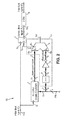
- Figure 2 corresponds to Figure 1 for a preferred design of the digital combination 11, with the programmable re-load counter 1 being a down-counter. Additionally but independently, Figure 2 also illustrates an optional invention refinement which provides a further reduction of the synthesized frequency F s .
- the counter 1 then transmits a digital down-count signal encoded over N-bits to the intermediate bus 2 which originates from the counter output 1c.
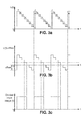
- the time-variations of the down-count signal are shown in Figure 3a .
- X-axis is time denoted t and Y-axis is the down-count signal denoted U(t).
- the down-count starts for example with value equal to R (7 in the example illustrated), and decreases gradually with unity decrement down to one-value. Once the one-value has been produced during one same reference cycle duration as for the other down-counted values, the down-count is repeated again from the R-value and so on.
- Count jumps from the one-value to the R-value thus form R-reloads of the down-count signal, indicated with vertical arrows.
- This down-count signal is clocked at the F i -frequency, due to the initial clock signal being fed into the counter input 1a.
- the down-count signal is then fed by the intermediate bus 2 into the adder input 6a.
- the effect of the shifter 4 ( Figure 2 ) is substantially equivalent to dividing the R-value by two: R>>1 equals R/2 for even R-values and (R-1)/2 for odd R-values. Then, the effect of the inverter 5 is calculating the number complementary to R>>1 with respect to 2 N -1: 2 N -1-(R>>1). This number is denoted offset value and fed into the input 6b of the adder 6.
- the adder 6 is a N-bit adder which adds the bit values of same rank as received at inputs 6a and 6b, and further adds a carry value originating from the bit rank just below.
- the addition result encoded over N bits as produced at the adder output 6d is actually not used in the present invention embodiment.
- the carry output 6c of the N-bit adder 6 produces the carry value which originates from the highest rank bit addition. It forms the digital signal which is outputted by the digital combination 11, and equals zero as long as the N-bit addition result is comprised between zero and 2 N -1 included, and equals unity when the N-bit addition result is 2 N or more, or less than zero due to 2 N -modulo equivalence.
- the adder 6 also has a digital comparator function.
- the time-diagram of Figure 3b corresponds to that of Figure 3a when a constant positive offset is subtracted from the down-count signal U(t).
- Time-diagrams 3a to 3c correspond to each other along vertical alignment.
- Figure 3c shows the signal which results from sign detection performed from the values exhibited in Figure 3b .
- the signal of Figure 3c denoted “divided clock image” is equivalent to reporting the highest rank carry value as resulting from the addition of the down-count signal U(t) with the opposite of the offset.
- R equals 7.
- the synthesized frequency F s of the divided clock image is the initial frequency F i divided by the R-value, as this appears from comparing Figures 3a and 3c .
- the offset is determined automatically as a function of the division ratio value R, as being equal to 2 N -1 - (R>>1). Then, the duty cycle theoretically equals 50% for the even values of the division ratio R, and equals (R+1)/(2R) for the odd R-values. When the R-value is large, the duty cycle for the odd R-values almost equals 50% too.
- the function of the D-flipflop 7 ( Figures 1 and 2 ) is synchronizing the derived clock signal with respect to the initial clock signal.
- the carry values successively produced by the adder 6 from output 6c are fed into the D-input 7a, and the initial clock signal is also fed into the synchronization input 7b.
- the Q-output 7c of the D-flipflop 7 thus delivers the derived clock signal synchronized with reference to the initial clock signal.
- FIG 4 is a diagram indicating the duty cycle values which are obtained by using a frequency divider module according to Figure 2 , where N-value is depending on the division ratio R.
- N-value is depending on the division ratio R.
- the duty cycle has been measured while varying a module temperature and also a module supply voltage.
- the duty cycle values labelled "a” are the minimal ones thus obtained, those labelled “b” are the maximum ones, and those labelled “c” are the average values calculated when thus varying the temperature and the supply voltage. Very small variations in the duty cycle appear for each R-value, as this appears from comparing the a- and b-values.
- such frequency two-divider unit may be obtained by using a D-flipflop with the initial clock signal fed into its synchronization input, the data input D being back-fed from the inversed data output of the D-flipflop, and the non-inversed data output of the D-flipflop thus producing the derived clock signal with half the frequency of the initial clock signal.
- the frequency two-divider 8 may be arranged downstream the output 7c of the D-flipflop 7. Such frequency two-divider 8 then transforms the derived clock signal with synthesized frequency F s as originating from the D-flipflop output 7c, into a final clock signal with frequency F f equal to half the F s -frequency.
- the two-divider 8 may be comprised itself of a further D-flipflop, as explained just above for the particular case of the division ratio value R equal to two.
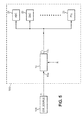
- Figure 5 illustrates an implementation of the programmable frequency divider module 10 within an electronic circuit.
- the additional reference numbers indicated therein have the following meanings:
- the clock module 101 may be of any type. In some implementations, it may be external to a circuit chip which contains the analog-to-digital converter 21, the digital-to-analog converter 22 and the phase-locked loop device 23 in integrated form. For example, the clock module 101 may be based on a crystal contained within a separate circuit component. Obviously, the above-listed circuit blocks 21 to 23 are listed for exemplifying purpose only, and may be replaced with other circuit blocks, whatever their number.
- the in-chip circuitry 100 may be provided as well with several programmable frequency divider modules, which are each fed with the initial clock signal by the clock module 101, but each programmed with a different value for its respective division ratio R.
- each programmable frequency divider module so-provided is capable of clocking separate sets of circuit blocks within the in-chip circuitry.
- an additional frequency two-divider similar to that referenced 8 above, may be arranged between some of the circuit blocks and the clock output 10c of the corresponding programmable frequency divider module 10.
Landscapes
- Manipulation Of Pulses (AREA)
- Stabilization Of Oscillater, Synchronisation, Frequency Synthesizers (AREA)
Priority Applications (1)
| Application Number | Priority Date | Filing Date | Title |
|---|---|---|---|
| EP13305661.4A EP2806562A1 (de) | 2013-05-22 | 2013-05-22 | Programmierbares Frequenzteilermodul mit Arbeitszyklus bei fast fünfzig Prozent |
Applications Claiming Priority (1)
| Application Number | Priority Date | Filing Date | Title |
|---|---|---|---|
| EP13305661.4A EP2806562A1 (de) | 2013-05-22 | 2013-05-22 | Programmierbares Frequenzteilermodul mit Arbeitszyklus bei fast fünfzig Prozent |
Publications (1)
| Publication Number | Publication Date |
|---|---|
| EP2806562A1 true EP2806562A1 (de) | 2014-11-26 |
Family
ID=48576920
Family Applications (1)
| Application Number | Title | Priority Date | Filing Date |
|---|---|---|---|
| EP13305661.4A Withdrawn EP2806562A1 (de) | 2013-05-22 | 2013-05-22 | Programmierbares Frequenzteilermodul mit Arbeitszyklus bei fast fünfzig Prozent |
Country Status (1)
| Country | Link |
|---|---|
| EP (1) | EP2806562A1 (de) |
Cited By (4)
| Publication number | Priority date | Publication date | Assignee | Title |
|---|---|---|---|---|
| US9762228B2 (en) | 2015-09-15 | 2017-09-12 | Qualcomm Incorporated | High-speed programmable clock divider |
| CN109167597A (zh) * | 2018-09-10 | 2019-01-08 | 佛山科学技术学院 | 一种分频电路、分频装置及电子设备 |
| CN110350913A (zh) * | 2019-06-25 | 2019-10-18 | 电子科技大学 | 一种基于锁相延迟的多adc同步装置 |
| CN117081582A (zh) * | 2023-05-12 | 2023-11-17 | 南京筠芯科技有限公司 | 一种实现占空比50%的分频方法及分频器 |
Citations (6)
| Publication number | Priority date | Publication date | Assignee | Title |
|---|---|---|---|---|
| US3196262A (en) * | 1961-12-14 | 1965-07-20 | Gen Electric | Binary comparator |
| US4975931A (en) * | 1988-12-19 | 1990-12-04 | Hughes Aircraft Company | High speed programmable divider |
| US5177771A (en) * | 1991-12-05 | 1993-01-05 | Glassburn Tim R | High resolution symmetrical divider circuit |
| US5220306A (en) * | 1990-08-30 | 1993-06-15 | Nippon Steel Corporation | Digital signal comparator for comparing n-bit binary signals |
| US5371772A (en) * | 1993-09-14 | 1994-12-06 | Intel Corporation | Programmable divider exhibiting a 50/50 duty cycle |
| US20060203954A1 (en) * | 2004-11-30 | 2006-09-14 | Ashish Panpalia | Programmable frequency divider |
-
2013
- 2013-05-22 EP EP13305661.4A patent/EP2806562A1/de not_active Withdrawn
Patent Citations (6)
| Publication number | Priority date | Publication date | Assignee | Title |
|---|---|---|---|---|
| US3196262A (en) * | 1961-12-14 | 1965-07-20 | Gen Electric | Binary comparator |
| US4975931A (en) * | 1988-12-19 | 1990-12-04 | Hughes Aircraft Company | High speed programmable divider |
| US5220306A (en) * | 1990-08-30 | 1993-06-15 | Nippon Steel Corporation | Digital signal comparator for comparing n-bit binary signals |
| US5177771A (en) * | 1991-12-05 | 1993-01-05 | Glassburn Tim R | High resolution symmetrical divider circuit |
| US5371772A (en) * | 1993-09-14 | 1994-12-06 | Intel Corporation | Programmable divider exhibiting a 50/50 duty cycle |
| US20060203954A1 (en) * | 2004-11-30 | 2006-09-14 | Ashish Panpalia | Programmable frequency divider |
Cited By (6)
| Publication number | Priority date | Publication date | Assignee | Title |
|---|---|---|---|---|
| US9762228B2 (en) | 2015-09-15 | 2017-09-12 | Qualcomm Incorporated | High-speed programmable clock divider |
| CN109167597A (zh) * | 2018-09-10 | 2019-01-08 | 佛山科学技术学院 | 一种分频电路、分频装置及电子设备 |
| CN109167597B (zh) * | 2018-09-10 | 2023-09-01 | 佛山科学技术学院 | 一种分频电路、分频装置及电子设备 |
| CN110350913A (zh) * | 2019-06-25 | 2019-10-18 | 电子科技大学 | 一种基于锁相延迟的多adc同步装置 |
| CN117081582A (zh) * | 2023-05-12 | 2023-11-17 | 南京筠芯科技有限公司 | 一种实现占空比50%的分频方法及分频器 |
| CN117081582B (zh) * | 2023-05-12 | 2024-04-23 | 南京筠芯科技有限公司 | 一种实现占空比50%的分频方法及分频器 |
Similar Documents
| Publication | Publication Date | Title |
|---|---|---|
| US9270280B1 (en) | Half-integer frequency dividers that support 50% duty cycle signal generation | |
| US8891725B2 (en) | Frequency divider with improved linearity for a fractional-N synthesizer using a multi-modulus prescaler | |
| US8471607B1 (en) | High-speed frequency divider architecture | |
| CN1256023A (zh) | 用数字字调整的频率合成电路 | |
| EP2806562A1 (de) | Programmierbares Frequenzteilermodul mit Arbeitszyklus bei fast fünfzig Prozent | |
| US9543960B1 (en) | Multi-stage frequency dividers having duty cycle correction circuits therein | |
| US8633739B2 (en) | Frequency divider circuit | |
| CN101127522A (zh) | 分频器 | |
| JP2009267651A (ja) | オーディオ参照クロックを生成可能な受信装置 | |
| US20180175840A1 (en) | Delay circuit, count value generation circuit, and physical quantity sensor | |
| WO2019183866A1 (zh) | 频率产生器以及频率产生方法 | |
| EP1776764B1 (de) | Frequenzteiler | |
| US8259774B2 (en) | Spread spectrum clock signal generator | |
| CN101217277A (zh) | 非整数除频器以及可产生非整数时脉信号的锁相回路 | |
| US8867696B2 (en) | Fractional frequency divider | |
| US9590637B1 (en) | High-speed programmable frequency divider with 50% output duty cycle | |
| US6956922B2 (en) | Generating non-integer clock division | |
| JPH04227330A (ja) | 対称な出力信号を得るための分数周波数分割器 | |
| KR100671749B1 (ko) | 클럭 분주기 | |
| CN118539921B (zh) | 一种连续整数分频器 | |
| KR101923012B1 (ko) | 고속 프로그래밍 가능 클록 분할기 | |
| US6791384B2 (en) | Delay adjustment circuit for delay locked loop | |
| US20120098592A1 (en) | Filter auto-calibration using multi-clock generator | |
| US20090243668A1 (en) | Frequency divider speed booster | |
| KR101083816B1 (ko) | 소수배 타입의 주파수 분주기 |
Legal Events
| Date | Code | Title | Description |
|---|---|---|---|
| PUAI | Public reference made under article 153(3) epc to a published international application that has entered the european phase |
Free format text: ORIGINAL CODE: 0009012 |
|
| 17P | Request for examination filed |
Effective date: 20130522 |
|
| AK | Designated contracting states |
Kind code of ref document: A1 Designated state(s): AL AT BE BG CH CY CZ DE DK EE ES FI FR GB GR HR HU IE IS IT LI LT LU LV MC MK MT NL NO PL PT RO RS SE SI SK SM TR |
|
| AX | Request for extension of the european patent |
Extension state: BA ME |
|
| STAA | Information on the status of an ep patent application or granted ep patent |
Free format text: STATUS: THE APPLICATION IS DEEMED TO BE WITHDRAWN |
|
| 18D | Application deemed to be withdrawn |
Effective date: 20150527 |