EP2802623B1 - Silikonprodukt, beleuchtungsvorrichtung mit dem silikonprodukt und verfahren zur herstellung eines silikonprodukts - Google Patents
Silikonprodukt, beleuchtungsvorrichtung mit dem silikonprodukt und verfahren zur herstellung eines silikonprodukts Download PDFInfo
- Publication number
- EP2802623B1 EP2802623B1 EP13759019.6A EP13759019A EP2802623B1 EP 2802623 B1 EP2802623 B1 EP 2802623B1 EP 13759019 A EP13759019 A EP 13759019A EP 2802623 B1 EP2802623 B1 EP 2802623B1
- Authority
- EP
- European Patent Office
- Prior art keywords
- particles
- silicone product
- luminescent material
- filler particles
- luminescent
- Prior art date
- Legal status (The legal status is an assumption and is not a legal conclusion. Google has not performed a legal analysis and makes no representation as to the accuracy of the status listed.)
- Active
Links
Images

Classifications
-
- B—PERFORMING OPERATIONS; TRANSPORTING
- B82—NANOTECHNOLOGY
- B82Y—SPECIFIC USES OR APPLICATIONS OF NANOSTRUCTURES; MEASUREMENT OR ANALYSIS OF NANOSTRUCTURES; MANUFACTURE OR TREATMENT OF NANOSTRUCTURES
- B82Y20/00—Nanooptics, e.g. quantum optics or photonic crystals
-
- C—CHEMISTRY; METALLURGY
- C09—DYES; PAINTS; POLISHES; NATURAL RESINS; ADHESIVES; COMPOSITIONS NOT OTHERWISE PROVIDED FOR; APPLICATIONS OF MATERIALS NOT OTHERWISE PROVIDED FOR
- C09K—MATERIALS FOR MISCELLANEOUS APPLICATIONS, NOT PROVIDED FOR ELSEWHERE
- C09K11/00—Luminescent, e.g. electroluminescent, chemiluminescent materials
- C09K11/02—Use of particular materials as binders, particle coatings or suspension media therefor
- C09K11/025—Use of particular materials as binders, particle coatings or suspension media therefor non-luminescent particle coatings or suspension media
-
- C—CHEMISTRY; METALLURGY
- C08—ORGANIC MACROMOLECULAR COMPOUNDS; THEIR PREPARATION OR CHEMICAL WORKING-UP; COMPOSITIONS BASED THEREON
- C08L—COMPOSITIONS OF MACROMOLECULAR COMPOUNDS
- C08L83/00—Compositions of macromolecular compounds obtained by reactions forming in the main chain of the macromolecule a linkage containing silicon with or without sulfur, nitrogen, oxygen or carbon only; Compositions of derivatives of such polymers
- C08L83/04—Polysiloxanes
-
- C—CHEMISTRY; METALLURGY
- C09—DYES; PAINTS; POLISHES; NATURAL RESINS; ADHESIVES; COMPOSITIONS NOT OTHERWISE PROVIDED FOR; APPLICATIONS OF MATERIALS NOT OTHERWISE PROVIDED FOR
- C09K—MATERIALS FOR MISCELLANEOUS APPLICATIONS, NOT PROVIDED FOR ELSEWHERE
- C09K11/00—Luminescent, e.g. electroluminescent, chemiluminescent materials
- C09K11/02—Use of particular materials as binders, particle coatings or suspension media therefor
-
- C—CHEMISTRY; METALLURGY
- C09—DYES; PAINTS; POLISHES; NATURAL RESINS; ADHESIVES; COMPOSITIONS NOT OTHERWISE PROVIDED FOR; APPLICATIONS OF MATERIALS NOT OTHERWISE PROVIDED FOR
- C09K—MATERIALS FOR MISCELLANEOUS APPLICATIONS, NOT PROVIDED FOR ELSEWHERE
- C09K11/00—Luminescent, e.g. electroluminescent, chemiluminescent materials
- C09K11/08—Luminescent, e.g. electroluminescent, chemiluminescent materials containing inorganic luminescent materials
-
- F—MECHANICAL ENGINEERING; LIGHTING; HEATING; WEAPONS; BLASTING
- F21—LIGHTING
- F21V—FUNCTIONAL FEATURES OR DETAILS OF LIGHTING DEVICES OR SYSTEMS THEREOF; STRUCTURAL COMBINATIONS OF LIGHTING DEVICES WITH OTHER ARTICLES, NOT OTHERWISE PROVIDED FOR
- F21V9/00—Elements for modifying spectral properties, polarisation or intensity of the light emitted, e.g. filters
- F21V9/30—Elements containing photoluminescent material distinct from or spaced from the light source
- F21V9/32—Elements containing photoluminescent material distinct from or spaced from the light source characterised by the arrangement of the photoluminescent material
-
- H—ELECTRICITY
- H10—SEMICONDUCTOR DEVICES; ELECTRIC SOLID-STATE DEVICES NOT OTHERWISE PROVIDED FOR
- H10H—INORGANIC LIGHT-EMITTING SEMICONDUCTOR DEVICES HAVING POTENTIAL BARRIERS
- H10H20/00—Individual inorganic light-emitting semiconductor devices having potential barriers, e.g. light-emitting diodes [LED]
- H10H20/80—Constructional details
- H10H20/85—Packages
- H10H20/851—Wavelength conversion means
- H10H20/8511—Wavelength conversion means characterised by their material, e.g. binder
-
- H—ELECTRICITY
- H10—SEMICONDUCTOR DEVICES; ELECTRIC SOLID-STATE DEVICES NOT OTHERWISE PROVIDED FOR
- H10H—INORGANIC LIGHT-EMITTING SEMICONDUCTOR DEVICES HAVING POTENTIAL BARRIERS
- H10H20/00—Individual inorganic light-emitting semiconductor devices having potential barriers, e.g. light-emitting diodes [LED]
- H10H20/80—Constructional details
- H10H20/85—Packages
- H10H20/851—Wavelength conversion means
- H10H20/8511—Wavelength conversion means characterised by their material, e.g. binder
- H10H20/8512—Wavelength conversion materials
-
- H—ELECTRICITY
- H10—SEMICONDUCTOR DEVICES; ELECTRIC SOLID-STATE DEVICES NOT OTHERWISE PROVIDED FOR
- H10H—INORGANIC LIGHT-EMITTING SEMICONDUCTOR DEVICES HAVING POTENTIAL BARRIERS
- H10H20/00—Individual inorganic light-emitting semiconductor devices having potential barriers, e.g. light-emitting diodes [LED]
- H10H20/80—Constructional details
- H10H20/85—Packages
- H10H20/852—Encapsulations
- H10H20/854—Encapsulations characterised by their material, e.g. epoxy or silicone resins
-
- B—PERFORMING OPERATIONS; TRANSPORTING
- B82—NANOTECHNOLOGY
- B82Y—SPECIFIC USES OR APPLICATIONS OF NANOSTRUCTURES; MEASUREMENT OR ANALYSIS OF NANOSTRUCTURES; MANUFACTURE OR TREATMENT OF NANOSTRUCTURES
- B82Y40/00—Manufacture or treatment of nanostructures
-
- C—CHEMISTRY; METALLURGY
- C08—ORGANIC MACROMOLECULAR COMPOUNDS; THEIR PREPARATION OR CHEMICAL WORKING-UP; COMPOSITIONS BASED THEREON
- C08J—WORKING-UP; GENERAL PROCESSES OF COMPOUNDING; AFTER-TREATMENT NOT COVERED BY SUBCLASSES C08B, C08C, C08F, C08G or C08H
- C08J2383/00—Characterised by the use of macromolecular compounds obtained by reactions forming in the main chain of the macromolecule a linkage containing silicon with or without sulfur, nitrogen, oxygen, or carbon only; Derivatives of such polymers
- C08J2383/04—Polysiloxanes
-
- C—CHEMISTRY; METALLURGY
- C08—ORGANIC MACROMOLECULAR COMPOUNDS; THEIR PREPARATION OR CHEMICAL WORKING-UP; COMPOSITIONS BASED THEREON
- C08J—WORKING-UP; GENERAL PROCESSES OF COMPOUNDING; AFTER-TREATMENT NOT COVERED BY SUBCLASSES C08B, C08C, C08F, C08G or C08H
- C08J3/00—Processes of treating or compounding macromolecular substances
- C08J3/20—Compounding polymers with additives, e.g. colouring
- C08J3/205—Compounding polymers with additives, e.g. colouring in the presence of a continuous liquid phase
- C08J3/2053—Compounding polymers with additives, e.g. colouring in the presence of a continuous liquid phase the additives only being premixed with a liquid phase
-
- C—CHEMISTRY; METALLURGY
- C08—ORGANIC MACROMOLECULAR COMPOUNDS; THEIR PREPARATION OR CHEMICAL WORKING-UP; COMPOSITIONS BASED THEREON
- C08K—Use of inorganic or non-macromolecular organic substances as compounding ingredients
- C08K2201/00—Specific properties of additives
- C08K2201/001—Conductive additives
-
- C—CHEMISTRY; METALLURGY
- C08—ORGANIC MACROMOLECULAR COMPOUNDS; THEIR PREPARATION OR CHEMICAL WORKING-UP; COMPOSITIONS BASED THEREON
- C08K—Use of inorganic or non-macromolecular organic substances as compounding ingredients
- C08K2201/00—Specific properties of additives
- C08K2201/002—Physical properties
- C08K2201/003—Additives being defined by their diameter
-
- C—CHEMISTRY; METALLURGY
- C08—ORGANIC MACROMOLECULAR COMPOUNDS; THEIR PREPARATION OR CHEMICAL WORKING-UP; COMPOSITIONS BASED THEREON
- C08K—Use of inorganic or non-macromolecular organic substances as compounding ingredients
- C08K9/00—Use of pretreated ingredients
- C08K9/12—Adsorbed ingredients, e.g. ingredients on carriers
-
- Y—GENERAL TAGGING OF NEW TECHNOLOGICAL DEVELOPMENTS; GENERAL TAGGING OF CROSS-SECTIONAL TECHNOLOGIES SPANNING OVER SEVERAL SECTIONS OF THE IPC; TECHNICAL SUBJECTS COVERED BY FORMER USPC CROSS-REFERENCE ART COLLECTIONS [XRACs] AND DIGESTS
- Y10—TECHNICAL SUBJECTS COVERED BY FORMER USPC
- Y10S—TECHNICAL SUBJECTS COVERED BY FORMER USPC CROSS-REFERENCE ART COLLECTIONS [XRACs] AND DIGESTS
- Y10S977/00—Nanotechnology
- Y10S977/70—Nanostructure
- Y10S977/773—Nanoparticle, i.e. structure having three dimensions of 100 nm or less
- Y10S977/774—Exhibiting three-dimensional carrier confinement, e.g. quantum dots
-
- Y—GENERAL TAGGING OF NEW TECHNOLOGICAL DEVELOPMENTS; GENERAL TAGGING OF CROSS-SECTIONAL TECHNOLOGIES SPANNING OVER SEVERAL SECTIONS OF THE IPC; TECHNICAL SUBJECTS COVERED BY FORMER USPC CROSS-REFERENCE ART COLLECTIONS [XRACs] AND DIGESTS
- Y10—TECHNICAL SUBJECTS COVERED BY FORMER USPC
- Y10S—TECHNICAL SUBJECTS COVERED BY FORMER USPC CROSS-REFERENCE ART COLLECTIONS [XRACs] AND DIGESTS
- Y10S977/00—Nanotechnology
- Y10S977/70—Nanostructure
- Y10S977/778—Nanostructure within specified host or matrix material, e.g. nanocomposite films
- Y10S977/783—Organic host/matrix, e.g. lipid
-
- Y—GENERAL TAGGING OF NEW TECHNOLOGICAL DEVELOPMENTS; GENERAL TAGGING OF CROSS-SECTIONAL TECHNOLOGIES SPANNING OVER SEVERAL SECTIONS OF THE IPC; TECHNICAL SUBJECTS COVERED BY FORMER USPC CROSS-REFERENCE ART COLLECTIONS [XRACs] AND DIGESTS
- Y10—TECHNICAL SUBJECTS COVERED BY FORMER USPC
- Y10S—TECHNICAL SUBJECTS COVERED BY FORMER USPC CROSS-REFERENCE ART COLLECTIONS [XRACs] AND DIGESTS
- Y10S977/00—Nanotechnology
- Y10S977/84—Manufacture, treatment, or detection of nanostructure
- Y10S977/90—Manufacture, treatment, or detection of nanostructure having step or means utilizing mechanical or thermal property, e.g. pressure, heat
-
- Y—GENERAL TAGGING OF NEW TECHNOLOGICAL DEVELOPMENTS; GENERAL TAGGING OF CROSS-SECTIONAL TECHNOLOGIES SPANNING OVER SEVERAL SECTIONS OF THE IPC; TECHNICAL SUBJECTS COVERED BY FORMER USPC CROSS-REFERENCE ART COLLECTIONS [XRACs] AND DIGESTS
- Y10—TECHNICAL SUBJECTS COVERED BY FORMER USPC
- Y10S—TECHNICAL SUBJECTS COVERED BY FORMER USPC CROSS-REFERENCE ART COLLECTIONS [XRACs] AND DIGESTS
- Y10S977/00—Nanotechnology
- Y10S977/902—Specified use of nanostructure
- Y10S977/932—Specified use of nanostructure for electronic or optoelectronic application
- Y10S977/949—Radiation emitter using nanostructure
- Y10S977/95—Electromagnetic energy
Definitions
- the invention relates to silicone products which comprise a luminescent material.
- the invention further relates to a lighting unit comprising the silicone product and a method of manufacturing a silicone product comprising immobilized luminescent materials
- silicone is used for optical elements, such as, for example, a lens or a light guide for guiding the light to a light exit window or improve the outcoupling of light from the LED.
- Silicones are sufficiently stable in LED application and are able to withstand the relatively high light dosages and high temperatures of LED applications.
- Such optical elements can easily be manufactured from a silicone resin.
- Luminescent quantum dots are a promising material for creating lighting assemblies which emit a specific color of light, such as, for example, a lighting assembly which emits white light.
- the luminescent quantum dots absorb a portion of light emitted by, for example, a LED and convert the light towards light of another color.
- Quantum dots provide a high efficiency and relatively long lifetime if the quantum dots are well spatially separated in the matrix material. Because of the advantageous characteristics of silicone, the quantum dots are preferably embedded in silicone.
- quantum dots and similar luminescent materials cannot be easily dispersed in silicone. It is known that quantum dots can easily be dispersed in liquids like toluene and some acrylic mixtures without forming clusters of quantum dots - in such liquids the quantum dots will be well spatially separated. Quantum dots are very small particles and during manufacturing they need to be added as a mixture of a solvent and quantum dots to a silicone resin. Quantum dots are not compatible with silicone resins and flocculation of the quantum dots occurs when they are mixed with a silicone resin. Other terms used for flocculation are aggregation, agglomeration and clustering.
- quantum dots form agglomerates in which their mutual separation is less than a few nanometers (e.g. smaller than 7 nanometers)
- the quantum efficiency of the quantum dots reduces and a faster degradation upon irradiation is observed.
- the quantum dots can still, to a limited extent, be mobile within the silicone resin and flocculation may slowly continue resulting in an even lower quantum efficiency. It is believed that the reduction of the quantum efficiency is the result of the occurrence of concentration quenching due to excitation and/or charge transfer between quantum dots. Further, undesired chemical reactions between neighboring quantum dots may also cause a degradation of the aggregates of quantum dots.
- a first aspect of the invention provides a silicone product.
- a second aspect of the invention provides a lighting unit.
- a third aspect of the invention provides a method of manufacturing a silicone product comprising immobilized luminescent material.
- a silicone product in accordance with the first aspect of the invention comprises polymeric material, luminescent material and filler particles.
- the polymeric material comprises a material of the group of polysiloxanes, the polymeric material being light transmitting.
- the luminescent material comprises particles which have at least in one dimension a size in the nanometer range.
- the luminescent material is configured to absorb light of a first spectral range and to convert a portion of the absorbed light into light of a second spectral range.
- the filler particles are of a light transmitting inert material.
- the filler particles are miscible with the luminescent material.
- the filler particles are provided in the polymeric material.
- the particles of luminescent material are distributed along a surface of the filler particles.
- polysiloxanes are polymeric materials with the general formula [R 2 SiO] m wherein R is an organic group, such as, for example, methyl, ethyl or phenyl.
- R is an organic group, such as, for example, methyl, ethyl or phenyl.
- the backbone of the molecules is an inorganic Silicon-Oxygen chain ...-Si-O-Si-O-Si-O-...
- the filler particles and the particles of the luminescent material are miscible, which means that the particles of the luminescent material and the filler particles both remain distributed in a solvent without being subject to extensive agglomeration, aggregation and/or flocculation. In practical embodiments it means that the filler particles and the particles of luminescent material can both be homogeneously mixed into at least one type of solvent.
- the colloidal stability of the luminescent particles is reduced causing them to flocculate. Due to the presence of the filler particles with excess surface area, the luminescent particles will flocculate onto the surface of the filler particles.
- Such a process in which one type of particles flocculates onto another type of particles is called heteroflocculation.
- Luminescent material and the filler particles do not have the tendency to stay away from each other in the solvent.
- the luminescent material and the filler particles would be non-miscible, a non-homogeneous mix would be obtained in the solvent and, optionally, the luminescent material and/or the filler particles would flocculate.
- colloidally stable relates to the possibility to obtain a homogeneous solution in which as well as the luminescent material and the filler particles are solved and/or dispersed homogeneously.
- the filler particles and the luminescent material are both colloidally stable in a group of liquids.
- colloidally stable means "the particles do not aggregate at a significant rate. An aggregate is, in general, a group of particles (which may be atoms or molecules) held together in any way.
- Aggregation is the process or the result of the formation of aggregates.
- coagulation When a colloidally system is colloidally unstable (i.e. the rate of aggregation is not negligible) the formation of aggregates is called coagulation or flocculation.
- coagulation implying the formation of compact aggregates, leading to the macroscopic separation of a coagulum; and flocculation, implying the formation of a loose or open network which may or may not separate macroscopically. In many contexts the loose structure formed in this way is called a floc.
- the rate of aggregation is in general determined by the frequency of collisions and the probability of cohesion during collision.
- the luminescent particles are distributed along the surface of the filler particles.
- the tendency of the particles of the luminescent material to agglomerate, aggregate and/or flocculate inside the polymeric material comprising a polysiloxane is reduced, or even fully stopped, because the particles of the luminescent material are located at the surface of filler particles.
- the luminescent particles are immobilized, because they are in contact with a filler particles, and they do not move anymore towards each other in the (cured) polymeric material, and, thus, they do not aggregate anymore. There is no tendency to form homoaggregates.
- the particles of the luminescent material do not touch other particles of the luminescent material, which means that they are well spatially separated from each other.
- a good spatial separation of the particles of luminescent material results in a relatively high quantum efficiency. Consequently, the silicone product exhibits, when being irradiated with light that is being absorbed and converted by the luminescent material, a relatively large color conversion efficiency.
- the particles of the luminescent material have in at least one dimension a size in the nanometer range.
- a size in the nanometer range means that the size in the at least one dimension is at least smaller than 100 nanometers, thus, smaller than 0.1 micrometer, and larger or equal to 0.5 nanometer.
- the size in one dimension is smaller than 50 nanometer.
- the size in one dimension is in the range from 2 to 20 nanometer.
- quantum confinement Most luminescent material with a size in the nanometer range in at least one dimension show quantum confinement, which means that the color of the light emitted by the material (as a consequence of absorbing light) strongly depend on their size. This applies to most quantum dots, however, specific quantum dots do not show quantum confinement. Also the quantum dots which do not show quantum confinement are subject to the same effects as the quantum dots discussed in the background of the art section (flocculation in silicone).
- the filler particles are not fully miscible with the (silicone) polymeric material such that the filler particles agglomerate, aggregate and/or flocculate up to some degree.
- the flocculation of the filler particles does not necessary negatively influence the efficiency of the particles of luminescent material.
- the particles of the luminescent material are distributed along the surface of the filler particles and, as such, when the filler particles touch each other, the particles of the luminescent material are still spatially separated from other particles of luminescent material by the filler particles.
- Distributed along the surface of the filler particles means that the particles of the luminescent material are in contact with the surface of the filler particles and that at different portions of the surface luminescent particles may be found. Being in contact with each other does not directly imply that the luminescent particles and filler particles are fused or have a sort of binding as the result of a chemical reaction.
- the particles are still individual particles and can be identified separately. The particles are adjacent in the meaning of 'they have common border or endpoint', or they adjoin in the meaning of 'to lie next to each other or being in contact', and, thus, the particles are neighboring.
- light transmitting means that light is transmitted through the material - in other words, if a light beam impinges on a surface of the material, at least some light is emitted at the same or other surfaces of the material. Thus, not all light is absorbed, for example, not more than 15% of the light is absorbed. In another embodiment, light transmitting means that not more than 10% of the light is absorbed. In yet a further embodiment, light transmitting means that not more than 10% of the light is absorbed. It is to be noted that transparent and translucent are terms falling within the scope of light transmitting.
- the filler particles are of a light transmitting material, but it is to be noted that the silicone product as a whole may absorb light, for example, the luminescent particles absorb light of a specific color and convert a portion of the absorbed light to light of another color.
- Inert materials are materials which do not react with at least the materials which are used in the context of this invention under the circumstances described in the context of this document. Thus, the inert materials are not chemically reactive. This does not exclude that, under specific circumstances, the inert materials may be involved in a chemical reaction, but then large amounts of energy from heat, pressure or radiation are needed and often catalysts are used to assist the reactions.
- the filler particles are larger than the particles of luminescent material. If the filler particles are larger they have a relatively large surface compared to the size of the particles of luminescent material and, thus, when the particles of luminescent material are distributed along the surface of the filler particles, they are spatially well separated. Thus, the chance that particles of luminescent material are too close to each other such that their quantum efficiency drops is smaller. Further, within the polymeric material particles may move (as long as the polymeric material is not cured to a solid state), and larger particles move much slower than smaller particles. Thus, the smaller luminescent particles which are in contact with the larger filler particles move much slower through the polymeric material, and, thus they are better immobilized and do not aggregate.
- the size of the filler particles may not become too large. Very large filler particles have a relatively small amount of surface area per gram of the material, and, thus, less space between particles of the luminescent material may be present between particles of the luminescent material which are in contact with the surface of a single filler particle.
- the size of the filler particles is below 5 micrometer, or, in another embodiment, below 1 micrometer, or, in a further embodiment, below 500 nanometers. In yet another optional embodiment below 250 nanometers, and in a further optional embodiment smaller than 100 nanometers.
- the filler particles are not smaller than the particles of luminescent material.
- the luminescent material comprises at least one of quantum dots, quantum rods and quantum tetrapods.
- the particles which show quantum confinement and have at least in one dimension a size in the nanometer range are quantum dots, quantum rods or quantum tetrapods.
- the materials of this optional embodiment are incompatible with silicone resins, thus, with polymeric material comprising polysiloxane.
- At least 60% of the particles of the luminescent material are separated far enough from other particles of the luminescent material to prevent a reduction of quantum efficiency of these particles.
- at least 75% of the particles of the luminescent material are separated far enough from each other.
- at least 90% of the particles of the luminescent material are separated far enough from each other. Separated far enough from each other means that these particles at least do not touch each other, and may mean in an optional embodiment that concentration quenching does not occur.
- concentration quenching does not occur.
- the quantum efficiency drops. The effect of this optional embodiment is that the quantum efficiency, and thus the color conversion efficiency, of the silicone product as a whole is relatively high.
- the particles of the luminescent material that are separated far enough from each other have at least a distance of 10 nanometers between the particles without another particles of the luminescent material in between them.
- the filler particles are silica particles or the filler particles comprise a material of one of the groups of alumina, titania, silica materials or a clay.
- Silica particles are often used in polymeric materials which comprise polysiloxane and can easily be mixed with such polymeric materials.
- silica particles have a refractive index which is close to the refractive index of polymeric materials which comprise polysiloxane and, thus, light is not much refracted at the interfaces between the silica particles and the polysiloxane material and not much light is reflected a these interfaces.
- the silicone product remains relatively transparent and does not much scatter light.
- scattering of light is required, and materials used for the filler particles have a refractive index that differs more from the refractive index of the polymeric material comprising polysiloxane.
- Transparent particles of clay have often a relatively flat shape which results in a relatively large outer surface along which the particles of luminescent materials can be distributed, and, thus, a good spatial separation of the particles of luminescent materials is obtained.
- the particles of the luminescent material comprise a first layer of organic material at their surface.
- the filler particles comprise a second layer of organic material at their surface.
- the first layer and/or the second layer are applied to, respectively, the particles of luminescent material and/or the filler particles to make them miscible in the solvents used in preparation processes.
- at least one of the first layer and the second layer of organic material is a monolayer of the organic material.
- a monolayer is the amount of organic material needed to form a densely packed, one molecule thick layer.
- the filler particles and the particles of luminescent material are better miscible with each other in a solvent and, thus, the particles of luminescent material can be processed to be better spatially separated along the surface of the filler particles - in other words, the particles of luminescent material do not tend to flocculate or agglomerate.
- not more than 20% of the surface of the filler particles is covered by particles of the luminescent material.
- the particles of luminescent material are probably well spatially separated. It may be tested whether the silicone product fulfills the condition of this optional embodiment by making Transmission Electron Microscopy (TEM) images of the silicone product, determining the size of the filler particles and calculating its corresponding surface area, determining the number of particles of luminescent material at the surface of the filler particles, determining the size of the particles of luminescent material, calculating the surface of the filler particles covered by the luminescent particles, and calculating the relative amount of the surface of the filler particles covered by the luminescent particles.
- TEM Transmission Electron Microscopy
- the relative amount of the surface of the filler particles covered by the particles of luminescent material is an average number and that the surface of individual filler particles may be covered by a higher percentage. In another optional embodiment not more than 10% of the surface of the filler particles is covered by particles of the luminescent material. In a further optional embodiment not more than 5% of the surface of the filler particles is covered by particles of the luminescent material.
- the relative amount of luminescent material is at least 0.05 weight percent of the silicone product and the relative amount of the luminescent material is not more than 10 weight percent of the silicone product.
- a relative amount of particles of the luminescent material is in general enough to provide the required light conversion by these luminescent particles (which, of course, also depends on the configuration of the light emitting device).
- the relative amount is below 10wt%, the particles of luminescent material can be advantageously distributed along the surface of the filler particles without being in contact with other particles of the luminescent material.
- the relative amount of the filler particles is not more than 40 weight percent of the silicone product, and the relative amount of the filler particles is at least twice the relative amount of luminescent material expressed as a weight percentage of the silicone product.
- the amount of filler particles should be below 40wt% in order to maintain advantageous properties of the polymeric material which comprises a polysiloxane.
- the largest size of the filler particles is smaller than 5 micrometer. In another optional embodiment, the largest size of the filler particles is smaller than 1 micrometer. In a further optional embodiment, the largest size of the filler particles is smaller than 500 nanometers. Largest size means in the context of this document: a cross-sectional size of the filler particle in a specific direction and in all other directions the cross-sectional size is smaller than the largest size. Thus, if the filler particles are substantially spherical, the diameter of the particles is less than 500 nanometers. If the filler particles have a rod-shape, the length of the rod is less than 500 nanometers. If the filler particles are flat shapes, any line that can be drawn in the flat plane is shorter than 500 nanometers.
- the polymeric material has a first refractive index and the filler particles have a second refractive index.
- the largest size of the filler particles is smaller than 100 nanometers if the absolute difference between the first refractive index and the second refractive index is larger than 0.3.
- the larger the difference in refractive indices between the two types of material the more reflection and refraction occurs at the interfaces between the two materials, which results in a diffusion of the light which transmits through the silicone product. In specific embodiments this is undesired and it is required that the silicone product is substantially transparent.
- the numbers provided in this optional embodiment result in a silicone product which diffuses / scatters light only up to a limited extent. It is further to be noticed that transparency does not necessary only dependent on the differences in refractive indices. It also depends on the particles size and the particle volume fraction. If the silicone product is, for example, applied in a thin layer of, for example, 1 micrometer, a layer can still be transparent when 20 nanometer TiO 2 are present in the layer. Further, the relative amount of filler particles also contributes to the amount of transparency.
- the silicone product is a resin and the silicone is a silicone resin.
- the silicone product is a resin it is, up to some extent, flexible / liquid and can be formed into different shapes. With specific treatments the resin may be cured such that a solid silicone product is obtained.
- a lighting unit which comprises a light source and a silicone product according to the first aspect of the invention.
- the silicone product is arranged to receive light from the light source.
- the lighting unit according to the second aspect of the invention provides the same benefits as the silicone product according to the first aspect of the invention and has similar embodiments with similar effects as the corresponding embodiments of the silicone product.
- a method of manufacturing a silicone product comprising immobilized luminescent material comprises the steps of: i) obtaining a mixture of filler particles of a light transmitting inert material and luminescent material comprising particles showing quantum confinement and having at least in one dimension a size in the nanometer range, wherein the particles of the luminescent material are situated at a surface of the filler particles; ii) mixing the mixture with a polymeric material comprising a material of the group of polysiloxanes.
- the method according to the third aspect of the invention provides the same benefits as the silicone product according to the first aspect of the invention and has similar embodiments with similar effects as the corresponding embodiments of the silicone product.
- the step of obtaining a mixture comprises the sub steps of: a) obtaining a first homogeneous mixture of the filler particles in a first solvent, b) obtaining a second homogeneous mixture of the luminescent material in a second solvent, c) mixing the first homogenous mixture with the second homogeneous mixture to obtain a third homogeneous mixture, and d) flocculating the luminescent material on the filler particles by changing the solvent composition of the third homogeneous mixture or by changing the solvent quality of the third homogeneous mixture.
- the method to obtain the mixture starts with obtaining the first homogeneous mixture and the second homogeneous mixture. These mixtures may be obtained directly from a manufacturer of such homogeneous mixtures, or may be prepared by, for example, diluting a stock solution in the same solvent as the solvent of the stock solution. Subsequently these homogeneous mixtures are mixed to obtain a third homogeneous mixture.
- the third homogeneous mixtures can only be obtained if the first solvent and the second solvent do not cause an aggregation or flocculation of the luminescent material and the filler particles.
- a third solvent or additive is added to the third homogeneous mixture which causes a change of the solvent composition of the third homogeneous mixture such that the luminescent material flocculates to the surface of the filler particles and the combination of the filler particles with luminescent material flocculates.
- the quality of the solvent composition of the third homogeneous mixture is changed by, for example, changing the temperature of the solvent composition, such that the luminescent material flocculates on the filler particles. Often the term heteroflocculation is used for this process.
- the solvents (the first solvent and/or the second solvent) are removed. This may be done, for example, by evaporating the solvents. Alternatively the solvents are removed after mixing the obtained mixture of filler particles and the luminescent material with the polymeric material.
- the method of obtaining the mixture of the filler particles and the luminescent material is an effective and an efficient way of obtaining the silicone product of the invention. It was seen that the particles of the luminescent material are well distributed along the surface of the filler particles and that most of the particles of the luminescent material are not located too close to each other.
- first solvent and the second solvent may be the same solvent.
- Fig. 1 schematically shows, in a cross-sectional view, an embodiment of the silicone product 100.
- the schematic presentation of Fig. 1 is an enlargement and with a dashed line a virtual border of the product 100 is drawn - however, in practical embodiments, the shown enlargement is only a fraction of a much larger quantity of the silicone product 100.
- the presented silicone product 100 may be a solid material, or may be a resin which comprises other molecules (not shown) for creating the semi-fluid state of the material (such materials are, for example, monomers, macromonomers, oligomers or reactive compounds).
- the silicone product 100 comprises polymer molecules 110 of the group of polysiloxanes. Often the term silicone is used instead of a material of the group of polysiloxanes.
- Polysiloxanes are a polymeric material with the general formula [R1R1SiO] m wherein R1 and R2 are an organic group, such as, for example, methyl, ethyl or phenyl. R1 may be equal to R2.
- the backbone of the molecules is an inorganic Silicon-Oxygen chain ...-Si-O-Si-O-Si-O-...
- the polymer molecules 110 are drawn as irregular lines which represent the Silicon-Oxygen chain.
- the material formed by the polymer molecules 110 is light transmitting, which means that light can be transmitted through the material - in other words, not much light is absorbed by the material, for example, not more than 15% of the light is absorbed. In another embodiment, light transmitting means not more than 10% of the light is absorbed. It is to be noted that the material may be clear (transparent) or may be diffuse light transmitting (translucent).
- the silicone product 100 further comprises filler particles 120.
- the filler particles are light transmitting. Thus, when only filler particles 120 would be provided in the material of polysiloxane molecules 110, the combination of them would still be light transmitting. It is to be noted that the filler particles may influence optical characteristics of the material. For example, if a difference between the refractive index of the filler particles and the refractive index of the material of polysiloxane molecules 110 is relatively large and if the size of the filler particles is comparable to the wavelength of (visible) light or larger, the filler particles partially reflect light which impinges on them and partially transmit and refract light - this results in a more diffuse / translucent silicone product 100.
- the filler particles 120 are of an inert material.
- inert materials are materials which do not react with at least the materials which are used in the context of this document under the circumstances described in the context of this document.
- the inert materials are not chemically reactive. This does not exclude that under specific circumstances the inert materials may be involved in a chemical reaction, but in such situations, large amounts of energy from heat, pressure or radiation are needed and often catalysts are used to assist reactions which the inert materials.
- the material of the filler particles 120 does not react with the polysiloxane molecules 110, with materials added to the polysiloxane molecule 110 to create a resin, etc.
- the filler particles 120 may have a layer of an organic material at their surface. In certain circumstances, this layer may be reactive with the polymer molecule 110 when the silicone product 110 is cured.
- silica is silica.
- Silica (SiO 2 ) is often used within a material which comprises a polysiloxane and in many optical applications the amount of silica used in a silicone may peak at 30 or even at 40 weight percent (wt%) of the total weight of the silicone resin.
- suitable materials from which transparent inert particles can be manufactured are materials from the groups of alumina, titania, silica or, for example, a clay. Specific types of transparent clays can be used and, in general, these particles have a relatively flat shape and thus a relatively large outer surface along which the luminescent particles 130 may be distributed. Flat shaped particles provide an advantageous spatially separation of the luminescent particles 130.
- the silicone product 100 further comprises luminescent material which comprises luminescent particles 130 of a material which shows quantum confinement and has at least in one dimension a size in the nanometer range.
- Quantum confinement means that the particles have optical properties that depend on the size of the particles.
- the luminescent particles 130 are configured to absorb a portion of light which impinges on them and to convert a portion of the absorbed light into light of another color.
- the luminescent particles 130 of the luminescent material have in at least one dimension a size which is in the nanometer range. This means, for example, that, if the particles 130 are substantially spherical, their diameter is in the nanometer range.
- a size of a cross-section of the rod is in one direction in the nanometer range.
- a size in the nanometer range means that their size is at least smaller than 100 nanometers, thus, smaller than 0.1 micrometer, and larger or equal to 0.5 nanometers.
- the size in one dimension is smaller than 50 nanometers.
- the size in one dimension is in the range from 2 to 20 nanometers.
- suitable luminescent particles 130 are quantum dots, quantum rods and quantum tetrapods.
- the luminescent particles 130 do not show quantum confinement.
- Mn-doped ZnSe quantum dots show a light emission of the Mn-ions and, thus, is the light emission of these quantum dots independent of the size of the quantum dots.
- Quantum dots are small crystals of semiconducting material generally have a width or diameter of only a few nanometers. When excited by incident light, a quantum dot emits light of a color determined by the size and material of the crystal. Light of a particular color can therefore be produced by adapting the size of the dots.
- Most known quantum dots with emission in the visible range are based on cadmium selenide (CdSe) with shell such as cadmium sulfide (CdS) and zinc sulfide (ZnS).
- Cadmium free quantum dots such as indium phosphode (InP), and copper indium sulfide (CuInS2) and/or silver indium sulfide (AgInS2) can also be used.
- Quantum dots show very narrow emission band (for example, with a width of 50 nanometer, or even 25 nanometer, expressed as a Full Width Half Maximum (FWHM) value) and, thus, they show saturated colors. Furthermore the color of the light can easily be tuned by adapting the size of the quantum dots.
- Any type of quantum dot known in the art may be used in the present invention.
- Other examples of materials of which quantum dots are made are: ZnSe, Silicon, CuInS, Carbon, ZnO, and Mn-doped materials.
- Other types of nanosized luminescent materials are silver clusters, or other magic-sized noble metal clusters.
- Quantum rods typically consist of a CdSe quantum dot core, surrounded by a rod-shaped CdS shell, which can have aspect ratios of 2 to 20. This could also be an InP quantum dot core, surrounded by a rod-shaped shell of similar dimensions.
- the rod comprises CdSe or InP rod-shaped nanocrystal, surrounded by a few mono layers of inorganic shell materials like CdS or ZnS.
- a tetrapod comprises a core of, for example, CdSe or InP, surrounded by a shell of material that preferably grows on certain facets of the nanocrystal such that a nanocrystal with a tetrapod-shape results.
- nanoplatelets are also included as luminescent nanomaterials. These materials are platelets of only a few (2-20) monolayers of eg CdSe or InP, and have much larger dimensions in the other two direction. Quantum confinement hence takes place in only one direction.
- the luminescent particles 130 and the filler particles 120 are well miscible with each other. This means that they do not show the tendency to go away from each other when they are, for example dissolved in a medium / liquid in which they are able to move freely.
- the luminescent particles are brought to flocculate. In this process they heteroflocculate onto the surface of the filler particles and they will stay there. Thus, when the luminescent particles 130 are brought in contact with filler particles 120, they remain in contact with the filler particles.
- the luminescent particles 130 When the luminescent particles 130 are in a non-compatible fluid or resin, they show the tendency to agglomerate, aggregate and/or flocculate, however, when they are on the surface of a filler material, they remain mainly at their position. Often the term "chemical affinity" is used to describe the well-miscibility of two materials. In practical embodiments, it means that the filler particles 120 and the luminescent particles 130 can both be homogeneously mixed into at least one type of solvent. In other practical embodiment, the particles 120, 130 are both compatible with more than one solvent.
- the luminescent particles 130 are distributed along the outer surfaces of the filler particles 120. This means that the luminescent particles 130 touch a filler particle 120. Both materials remain in contact with each other in the silicone product 100. Due to this the luminescent particles remain homogenously distributed in the silicone product.
- luminescent particles 130 which show quantum confinement and have one dimension in the nanometer range, are not well miscible with a material which comprises polysiloxane molecules 110. Especially this results in the fact that the luminescent particles 130 remain in the silicone product 100 in contact with the filler particles 120. When the luminescent particles 130 are in contact with filler particles 120 they do not have any more the tendency to flocculate or agglomerate and thus remain spatially separated.
- the filler particles may be porous and that the luminescent particles are not only present at the 'outer' surface of the filler particles, but also at the 'inner' surfaces of the filler particles.
- At least 60% of the luminescent particles 130 are separated far enough from other luminescent particles 130 to prevent a reduction of quantum efficiency of these particles. In an embodiment at least 75% of the luminescent particles 130 are separated far enough from other luminescent particles 130. In yet another embodiment, at least 90% of the luminescent particles 130 are separated far enough from other luminescent particles 130 Separated far enough from each other means that these particles at least do not touch each other and they are spaces apart at a distance which prevents concentration quenching. The effect of these embodiment is that the quantum efficiency, and thus the color conversion efficiency, of the silicone product 100 as a whole is relatively high.
- the luminescent particles 130 that are separated far enough from other luminescent particles 130 have at least a distance of 7 nanometers between the each other without another luminescent particles 130 in between them. However, in some situations, as shown in Fig. 1 at location 132, still some luminescent particles may be in contact with each other or within a distance of 7 nanometers from each other.
- the filler particles 120 are larger than the luminescent particles 130.
- the size of the filler particles 120 may be equal to the size of the luminescent particles 130. If the filler particles 120 are larger than the luminescent particles 130 the luminescent particles 130 will be better spatially separated by the filler particles.
- the relative amount of filler particles 120 within the silicone product is below 40wt%, and in another embodiment, below 30wt%.
- the relative amount of luminescent particles 130 mainly depends on the light conversion requirements. In an embodiment, their relative amount is between 0.1wt% and 10wt%. In another practical embodiment, their relative amount is between 0.5wt% and 5wt%.
- the relative amount of filler particles 120 is larger than the relative amount of luminescent particles 130 (when being expressed in a weight percentage). An even better spatially separation of the luminescent particles 130 is obtained in the silicone product 100 if the relative amount of filler particles 120 is 10wt% larger than the relative amount of luminescent particles 130.
- Fig. 1 the cross-sectional shapes of the filler particles 120 and the luminescent particles 130 is circular or elliptical.
- the drawn shapes are purely schematic and the filler particles 120 and the luminescent particles 130 may have completely different shapes.
- not more than 20%, or not more than 10% of the surface of the filler particles 230 is covered by particles 130 of the luminescent material.
- the filler particles are spherical and non-porous.
- the area covered by a single particle of the luminescent material is a projection of the surface area of the single particle of the luminescent material on the surface of the filler particle.
- the average diameter of a silica filler particles is, for example, 100nm
- the average surface area of such particles is 1 ⁇ 10 -14 m 2 .
- the average diameter of the of quantum dots particles is, for example, 7 nm
- the area of the surface of the silica filler particles is 4 ⁇ 10 -17 m 2 .
- the average amount of quantum dots on a single silica filler particle is 10
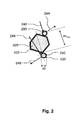
- Fig. 2 schematically shows an embodiment of a filler particle 220 with two particles 230 of a luminescent material being in contact with a surface of the filler particle 220.
- the silicone product 100 of Fig. 1 may comprise a multitude of such filler particles 220 and luminescent particles 230.
- the drawing of Fig. 2 presents a cross-sectional view of the filler particle 220 and the luminescent particles 230.
- the filler particle 220 has in a cross-sectional view a shape similar to a hexagon, and in other embodiments, the cross-sectional shape may be different.
- the surface of the filler particle 220 comprises a first layer 222 of an organic material.
- the first layer 222 may be a monolayer, which means that it is a layer which is only one molecule thick.
- the luminescent particles 230 are in contact with the filler particle 220, which means that the luminescent particles 230 are distributed along the surface of the filler particle 220.
- the surface of the luminescent particles 230 comprises a second organic layer 232.
- the second organic layer 232 is a monolayer.
- light 242 is schematically drawn by means of an arrow.
- Light 242 impinges on one of the luminescent particles 230 and is at least partially absorbed by the respective luminescent particles 230.
- the respective luminescent particle converts the absorbed light towards light 244 of another wavelength.
- the another luminescent particle 230 receives light 246 and the another luminescent particle 230 may be arranged to convert the absorbed light to yet another wavelength 248.
- different luminescent particles 230 may be used. They may be differently with respect to the color of light which is being emitted and this color strongly depends on the size of the particle 230. All luminescent particles 230 show quantum confinement and have a size in a specific dimension which is in the nanometer range.
- a size of the luminescent particle 230 is indicated by d2.
- a width of the luminescent particle 230 is in the nanometer range, which means that the width is in the range from 1 to 100 nanometers.
- the cross-sectional view of Fig. 2 may be a cross-section of a spherical luminescent particle, or the cross-section of, for example, a wire shaped particle. Other cross-sectional shapes are also possible.
- a maximum size of the filler particle 220 is indicated by d1 max . Maximum size means that no other line which intersects the filler particle 220 intersects the particle along a longer length than the maximum size.
- the size of the filler particles is below 5 micrometer, or, in another embodiment, below 1 micrometer, or, in a further embodiment, below 500 nanometers. In yet another optional embodiment below 250 nanometers, and in a further optional embodiment smaller than 100 nanometers.
- the filler particles have a smaller size, the total area of the filler particles surface is larger and, thus, the particles of luminescent material are distributed along a relatively larger surface which increases the probability that the particles of luminescent material are better spatially separated.
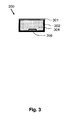
- Fig. 3 schematically shows a lighting unit 500 according to the second aspect of the invention.
- the lighting unit comprises a housing 302 which has a light exit window at which a light transmitting layer 301 is arranged.
- the light transmitting layer may be a diffuser.
- the light transmitting layer is a layer of micro-collimators.
- a solid state light emitter 306 Inside the housing is arranged a solid state light emitter 306 which is configured to emit light of a first spectrum towards the light exit window of the housing.
- the interior of the housing 302 is filled with the silicone product 304 according to the first aspect of the invention.
- the silicone product 304 is provided within the housing to provide a better outcoupling of light from the solid state light emitter 306 and to provide an advantageous light guiding of the outcoupled light towards the light exit window.
- the luminescent particles of the silicone product 304 receive the light of the first spectrum and absorb at least a portion of this light.
- the luminescent particles convert a portion of the absorbed light towards light of a second spectrum.
- the first spectrum and the second spectrum will be emitted into the ambient in a specific ratio which determines the color of the light emitted by the lighting unit 300.
- the lighting unit 300 is relatively efficient.
- the luminescent material in the silicone product 304 provide a high quantum efficiency, and the silicone product 304 assist in the outcoupling of light from the solid state light emitter 306, and, thus, not much light is trapped in the solid state light emitter 306.
- solid state light emitters are Light Emitting Diodes (LEDs), Organic Light Emitting diode(s) OLEDs, or, for example, laser diodes.
- LEDs Light Emitting Diodes
- OLEDs Organic Light Emitting diode(s) OLEDs
- laser diodes for example, laser diodes. It is to be noted that the invention is not limited to lighting units 300 of which the interior space is fully filled with the silicone product 304. In specific embodiments, the interior space is partially filled with silicone and partially filled with the silicone product according to the first aspect of the invention.
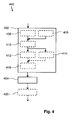
- Fig. 4 schematically presents an embodiment of a method 400 of manufacturing a silicone product comprising immobilized luminescent material.
- step 402 a mixture of filler particles of a light transmitting inert material and a luminescent material is obtained.
- the luminescent material comprises particles showing quantum confinement and have at least in one dimension a size in the nanometer range.
- the particles of the luminescent material are situated at a surface of the filler particles.
- the mixture obtained in step 402 is mixed with a polymeric material which comprises a material of the group of polysiloxanes.
- the luminescent material may also comprise material which has, in at least one dimension, a size in the nanometer range, but does not show quantum confinement.
- the particles of luminescent material are at the surface of the filler particles and are thus immobilized. This means that, when the mixture is mixed with the polymeric material, the particles of luminescent material do not flocculate or aggregate and remain at the surface of the filler particles and, thus, is the quantum efficiency of the luminescent material not negatively influenced when being applied in the polymeric material.
- the step 402 of obtaining the mixture of filler particles and the luminescent material may, optionally, be subdivided in the subsequent steps:
- the filler particles may be hydrophobized silica particles and the first solvent is often a suitable nonpolar or slightly polar solvent.
- suitable material for the first solvent are: toluene, xylene, butyl acetate or hexamethyldisiloxane, or longer alcohols like n-decanol. If the particles of the luminescent material are quantum dots, they are typically diluted from a stock solution into the second solvent to form a stable dispersion.
- the second solvent may be the same solvent as the first solvent or at least one solvent of a similar type.
- Changing 412 the solvent composition of the third homogeneous mixture may be performed by adding a third solvent to the third homogeneous mixture.
- Solvents which are more polar than the first solvent and second solvent are effective to establish the flocculation. Also some specific other nonpolar can cause the flocculation of the luminescent material on the filler particles.
- An example of a more polar solvent is propylene carbonate. The boiling point of propylene carbonate is relatively high (240 °C), which is advantageous when the solvents are removed from the mixture by thermal treatment; the first solvent and second solvent will be removed before the third solvent is removed, and, thus, the likelihood that the particles of luminescent material stay on the surface of the filler particles is increased.
- the third solvent may still be present in the obtained mixture.
- the polymeric material also comprises a fourth solvent and when the mixture of the polymeric material and the mixtures of luminescent particles at filler particles surfaces is cured, in an advantageous embodiment, the fourth solvent is removed before the third solvent is removed.
- the solvent quality of the third homogeneous mixtures may be changed 414 by changing the temperature of the third homogeneous mixture.
- suitable solvents heating or cooling result in the flocculation of quantum dots and thus in flocculating the luminescent material on the filler particles.
- the luminescent particles are colloidally stable in the subsequent solvents at room temperature, but flocculate at -18 °C: dipropylene glycol dimethylether, iso butyl acetate, methyl isobutyl keton and n-amyl acetate.
- the third homogeneous mixture is dried 416. Drying may, for example, be performed by heat treatment and/or by creating a vacuum.
- the step of mixing 404 the mixture of filler particles and the luminescent material with the polymeric material may be followed by a step of curing 420 the mixture obtained in step 404.
- the order of the steps of the method may be different or some steps may be executed in parallel.
- the steps 406 and 408 of obtaining the first homogeneous mixture and obtaining the second homogeneous mixture may be executed in parallel or in another order.
- a comparative test two samples were manufactured.
- a first sample was manufactured according to the state of the art methods of manufacturing a silicone product containing luminescent material, and a second sample was manufactured according to the invention.
- the first sample was manufactured as follows: 15 ⁇ l of a stock solution of quantum dots (10% w/v) was diluted in 1 ml toluene. The diluted solution was added to a 70% silicone (KJR9226) in toluene solution. Layers of the silicone product were prepared by drop-casting. Especially for creating a Transmission Electron Microscopy (TEM) image, a thin layer was prepared by quickly removing excess liquid on the TEM window using capillary forces. The layers were cured, 5 minutes at 50 °C, 5 minutes at 100 °C and 30 minutes 15 150 °C. It was observed in the TEM image that the quantum dots formed clusters, for example, with a diameter of around 100nm. Two dimensional and three dimensional clusters were found in the sample. A limited amount of quantum dots were found as single quantum dots.
- TEM Transmission Electron Microscopy
- any reference signs placed between parentheses shall not be construed as limiting the claim.
- Use of the verb "comprise” and its conjugations does not exclude the presence of elements or steps other than those stated in a claim.
- the article “a” or “an” preceding an element does not exclude the presence of a plurality of such elements.
- the invention may be implemented by means of hardware comprising several distinct elements. In the product claim enumerating several means, several of these means may be embodied by one and the same feature. The mere fact that certain measures are recited in mutually different dependent claims does not indicate that a combination of these measures cannot be used to advantage.
Landscapes
- Chemical & Material Sciences (AREA)
- Engineering & Computer Science (AREA)
- Organic Chemistry (AREA)
- Physics & Mathematics (AREA)
- Nanotechnology (AREA)
- Materials Engineering (AREA)
- Chemical Kinetics & Catalysis (AREA)
- Medicinal Chemistry (AREA)
- Polymers & Plastics (AREA)
- Health & Medical Sciences (AREA)
- Spectroscopy & Molecular Physics (AREA)
- Crystallography & Structural Chemistry (AREA)
- Life Sciences & Earth Sciences (AREA)
- Optics & Photonics (AREA)
- Biophysics (AREA)
- Inorganic Chemistry (AREA)
- General Engineering & Computer Science (AREA)
- Condensed Matter Physics & Semiconductors (AREA)
- General Physics & Mathematics (AREA)
- Manufacturing & Machinery (AREA)
- Luminescent Compositions (AREA)
- Compositions Of Macromolecular Compounds (AREA)
- Led Device Packages (AREA)
Claims (15)
- Silikonprodukt (100, 304), umfassend:- polymeres Material (110) mit einem Material der Gruppe von Polysiloxanen, wobei das polymere Material (110) lichtdurchlässig ist,- lumineszierendes Material (130, 230), das Partikel enthält, die zumindest in einer Dimension (d2) eine Größe in dem Nanometerbereich aufweisen, wobei das lumineszierende Material (130, 230) so vorgesehen ist, dass es Licht eines ersten Spektralbereichs absorbiert und einen Teil des absorbierten Lichts in Licht eines zweiten Spektralbereichs umwandelt,- Füllerpartikel (120, 220) aus einem lichtdurchlässigen inerten Material, das mit dem lumineszierenden Material (130, 230) mischbar ist, wobei die Füllerpartikel (120, 220) in dem polymeren Material vorgesehen sind,wobei die Partikel aus lumineszierendem Material (130, 230) entlang einer Oberfläche der Füllerpartikel (120, 220) verteilt sind.
- Silikonprodukt (100, 304) nach Anspruch 1,
wobei die Füllerpartikel (120, 220) größer als die Partikel aus lumineszierendem Material (130, 230) sind. - Silikonprodukt (100, 304) nach Anspruch 1,
wobei das lumineszierende Material (130, 230) mindestens einen der folgenden umfasst: Quantenpunkte, Quantenstäbe sowie Quantentetrapods. - Silikonprodukt (100, 304) nach Anspruch 1,
wobei mindestens 60% der Partikel aus dem lumineszierenden Material (130, 230) weit genug von anderen Partikeln aus dem lumineszierenden Material (130, 230) getrennt sind, um eine Reduzierung der Quanteneffizienz dieser Partikel zu verhindern. - Silikonprodukt (100, 304) nach Anspruch 1,
wobei die Füllerpartikel (120, 220) Siliciumdioxidpartikel sind oder die Füllerpartikel (120, 220) ein Material aus Aluminium, Titandioxid, Siliciumdioxid oder einem Ton enthalten. - Silikonprodukt (100, 304) nach Anspruch 1,
wobei die Partikel aus dem lumineszierenden Material (130, 230) eine erste Schicht (232) aus organischem Material an ihrer Oberfläche umfassen. - Silikonprodukt (100, 304) nach Anspruch 1,
wobei die Füllerpartikel (120, 230) eine zweite Schicht (222) aus organischem Material an ihrer Oberfläche umfassen. - Silikonprodukt (100, 304) nach zumindest einem der Ansprüche 6 und 7, wobei zumindest die erste Schicht (232) oder die zweite Schicht (222) aus organischem Material eine Monoschicht ist.
- Silikonprodukt (100, 304) nach Anspruch 1,
wobei nicht mehr als 10% der Oberfläche der Füllerpartikel (120, 220) von Partikeln aus dem lumineszierenden Material (130, 230) bedeckt ist. - Silikonprodukt (100, 304) nach Anspruch 1,
wobei die relative Menge des lumineszierenden Materiala (130, 230) mindestens 0,05 Gewichtsprozent des Silikonprodukts (100, 304) beträgt und die relative Menge des lumineszierenden Materials (130, 230) nicht mehr als 10 Gewichtsprozent des Silikonprodukts (100, 304) beträgt. - Silikonprodukt (100, 304) nach Anspruch 1,
wobei die relative Menge der Füllerpartikel (120, 220) nicht mehr als 40 Gewichtsprozent des Silikonprodukts (100, 304) beträgt und die relative Menge der Füllerpartikel (120, 220) mindestens zweimal die als ein Gewichtsprozent des Silikonprodukts (100, 304) ausgedrückte relative Menge des lumineszierenden Materials (130, 230) ausmacht. - Silikonprodukt (100, 304) nach Anspruch 1,
wobei das Silikonprodukt (100, 304) ein Harz ist und das polymere Material (110) ein Siliconharz ist. - Beleuchtungseinheit (300), umfassend:- eine Lichtquelle (306),- ein Silikonprodukt (100, 304) nach Anspruch 1, das so angeordnet ist, dass es Licht von der Lichtquelle (306) empfängt.
- Verfahren (400) zur Herstellung eines Silikonprodukts, das immobilisiertes lumineszierendes Material enthält, wobei das Verfahren die folgenden Schritte umfasst, wonach:- eine Mischung aus Füllerpartikeln aus einem lichtdurchlässigen inerten Material und einem lumineszierenden Material mit Partikeln vorgesehen wird (402), die Quantum-Confinement zeigen und zumindest in einer Dimension eine Größe in dem Nanometerbereich aufweisen, wobei sich die Partikel aus luminszierendem Material an einer Oberfläche der Füllerpartikel befinden,- die Mischung mit einem polymeren Material vermischt wird (404), das ein Material der Gruppe von Polysiloxanen enthält.
- Verfahren (400) zur Herstellung eines Silikonprodukts nach Anspruch 14, wobei der Schritt des Vorsehens einer Mischung die folgenden Schritte umfasst, wonach:- eine erste homogene Mischung der Füllerpartikel in einem ersten Lösungsmittel erhalten wird (406),- eine zweite homogene Mischung des lumineszierenden Materials in einem zweiten Lösungsmittel erhalten wird (408),- die erste homogene Mischung mit der zweiten homogenen Mischung vermischt wird (410), um eine dritte homogene Mischung zu erhalten, und- das lumineszierende Material auf den Füllerpartikeln durch Verändern einer Lösemittelzusammensetzung oder einer Lösemittelqualität der dritten homogenen Mischung ausgeflockt wird (412, 414).
Applications Claiming Priority (2)
| Application Number | Priority Date | Filing Date | Title |
|---|---|---|---|
| US201261670178P | 2012-07-11 | 2012-07-11 | |
| PCT/IB2013/055655 WO2014009890A2 (en) | 2012-07-11 | 2013-07-10 | Silicone product, a lighting unit comprising the silicone product and method of manufacturing a silicone product |
Publications (2)
| Publication Number | Publication Date |
|---|---|
| EP2802623A2 EP2802623A2 (de) | 2014-11-19 |
| EP2802623B1 true EP2802623B1 (de) | 2015-09-16 |
Family
ID=49117913
Family Applications (1)
| Application Number | Title | Priority Date | Filing Date |
|---|---|---|---|
| EP13759019.6A Active EP2802623B1 (de) | 2012-07-11 | 2013-07-10 | Silikonprodukt, beleuchtungsvorrichtung mit dem silikonprodukt und verfahren zur herstellung eines silikonprodukts |
Country Status (9)
| Country | Link |
|---|---|
| US (2) | US9382471B2 (de) |
| EP (1) | EP2802623B1 (de) |
| JP (1) | JP5759650B2 (de) |
| KR (1) | KR101519348B1 (de) |
| CN (1) | CN104487515B (de) |
| BR (1) | BR112014021766B1 (de) |
| RU (1) | RU2632840C2 (de) |
| TW (1) | TWI590492B (de) |
| WO (1) | WO2014009890A2 (de) |
Families Citing this family (7)
| Publication number | Priority date | Publication date | Assignee | Title |
|---|---|---|---|---|
| KR102427698B1 (ko) * | 2015-12-17 | 2022-07-29 | 삼성전자주식회사 | 양자점-폴리머 미분 복합체, 그의 제조 방법 및 이를 포함하는 성형품과 전자 소자 |
| KR102618409B1 (ko) | 2015-12-23 | 2023-12-27 | 삼성전자주식회사 | 양자점-폴리머 복합체 및 이를 포함하는 소자 |
| US10923634B2 (en) | 2016-06-30 | 2021-02-16 | Osram Opto Semiconductors Gmbh | Wavelength converter having a polysiloxane material, method of making, and solid state lighting device containing same |
| JP2018097351A (ja) * | 2016-12-15 | 2018-06-21 | パナソニックIpマネジメント株式会社 | 発光素子及び発光素子の製造方法 |
| TWI686459B (zh) | 2017-12-12 | 2020-03-01 | 奇美實業股份有限公司 | 發光材料及應用其之具有顯示功能的電子裝置 |
| US10991856B2 (en) * | 2017-12-21 | 2021-04-27 | Lumileds Llc | LED with structured layers and nanophosphors |
| TWI798343B (zh) * | 2018-03-12 | 2023-04-11 | 美商陶氏有機矽公司 | 可固化聚矽氧組成物及其經固化產物 |
Family Cites Families (9)
| Publication number | Priority date | Publication date | Assignee | Title |
|---|---|---|---|---|
| US7226966B2 (en) * | 2001-08-03 | 2007-06-05 | Nanogram Corporation | Structures incorporating polymer-inorganic particle blends |
| EP1757565A3 (de) * | 1999-09-13 | 2009-01-07 | Koninklijke Philips Electronics N.V. | Lichtabsorbierende Beschichtung und damit versehene elektrische Lampe |
| US7432327B2 (en) * | 2004-12-30 | 2008-10-07 | Sabic Innovative Plastics Ip B.V. | Transparent polymeric compositions comprising polysiloxane-polycarbonate copolymer, articles made therefrom and methods of making same |
| US20080023075A1 (en) * | 2006-07-26 | 2008-01-31 | Bravo Sergio M | Spill Containment Device |
| WO2008116079A1 (en) * | 2007-03-20 | 2008-09-25 | Evident Technologies, Inc. | Powdered quantum dots |
| CN101868865B (zh) * | 2007-11-20 | 2012-08-22 | 皇家飞利浦电子股份有限公司 | 具有波长转换的侧发射器件 |
| EP2428489B1 (de) | 2009-05-08 | 2017-07-05 | Konica Minolta Medical & Graphic, Inc. | Silica-nanopartikel mit darin verkapselten quantenpunkten, herstellungsverfahren dafür und biologisches markierungsmittel damit |
| GB0916699D0 (en) | 2009-09-23 | 2009-11-04 | Nanoco Technologies Ltd | Semiconductor nanoparticle-based materials |
| US20130112942A1 (en) * | 2011-11-09 | 2013-05-09 | Juanita Kurtin | Composite having semiconductor structures embedded in a matrix |
-
2013
- 2013-07-10 US US14/413,240 patent/US9382471B2/en active Active
- 2013-07-10 BR BR112014021766-1A patent/BR112014021766B1/pt active IP Right Grant
- 2013-07-10 KR KR1020147028191A patent/KR101519348B1/ko active Active
- 2013-07-10 JP JP2015503986A patent/JP5759650B2/ja active Active
- 2013-07-10 RU RU2014142241A patent/RU2632840C2/ru active
- 2013-07-10 WO PCT/IB2013/055655 patent/WO2014009890A2/en not_active Ceased
- 2013-07-10 CN CN201380036871.2A patent/CN104487515B/zh active Active
- 2013-07-10 EP EP13759019.6A patent/EP2802623B1/de active Active
- 2013-07-11 TW TW102124947A patent/TWI590492B/zh active
-
2016
- 2016-06-20 US US15/187,097 patent/US10190042B2/en active Active
Also Published As
| Publication number | Publication date |
|---|---|
| US20150152323A1 (en) | 2015-06-04 |
| US20160304777A1 (en) | 2016-10-20 |
| BR112014021766B1 (pt) | 2021-05-11 |
| CN104487515B (zh) | 2016-08-24 |
| US9382471B2 (en) | 2016-07-05 |
| TW201407821A (zh) | 2014-02-16 |
| TWI590492B (zh) | 2017-07-01 |
| US10190042B2 (en) | 2019-01-29 |
| KR20140126773A (ko) | 2014-10-31 |
| JP5759650B2 (ja) | 2015-08-05 |
| WO2014009890A3 (en) | 2014-03-06 |
| CN104487515A (zh) | 2015-04-01 |
| RU2014142241A (ru) | 2016-08-27 |
| JP2015514154A (ja) | 2015-05-18 |
| WO2014009890A2 (en) | 2014-01-16 |
| EP2802623A2 (de) | 2014-11-19 |
| RU2632840C2 (ru) | 2017-10-10 |
| KR101519348B1 (ko) | 2015-05-12 |
Similar Documents
| Publication | Publication Date | Title |
|---|---|---|
| US10190042B2 (en) | Silicone product, a lighting unit comprising the silicone product and method of manufacturing a silicone product | |
| TWI589020B (zh) | 量子點複合物及包含其之光電子裝置 | |
| US8941293B2 (en) | Solid state lighting devices comprising quantum dots | |
| KR102086712B1 (ko) | 다상의 수지를 이용한 양자점 막 | |
| KR102056786B1 (ko) | 양자점 조성물 | |
| EP3623442B1 (de) | Paarung aus nanokristallinem kern und nanokristalliner hülle mit nanokristallinem kern aus gruppe-i-iii-vi-material | |
| KR101869923B1 (ko) | 조명 장치, 조명 장치용 광학 요소, 및 방법 | |
| EP2973758B1 (de) | Paarung eines nanokristallinen kerns aus einem gruppe-i-iii-vi-material und einer nanokristallinen hülle aus einem gruppe i-iii-vi-material | |
| US20080173886A1 (en) | Solid state lighting devices comprising quantum dots | |
| TW201727961A (zh) | 量子點封裝技術 | |
| CN104487540A (zh) | 使用高度反射的试剂的量子产率的提高 | |
| KR20060044761A (ko) | 광원 모듈 및 차량용 전조등 | |
| CN106537608A (zh) | 具有改进的量子效率的二氧化硅涂敷的量子点 | |
| WO2020065300A1 (en) | Horticultural lighting apparatus | |
| KR20170071433A (ko) | 발광성 구조체 및 그것을 사용한 발광 장치 | |
| JP2017110061A (ja) | 蛍光体含有擬固体 | |
| JP2023168000A (ja) | 波長変換部材およびその製造方法 | |
| CN1315922A (zh) | 光学器件 |
Legal Events
| Date | Code | Title | Description |
|---|---|---|---|
| PUAI | Public reference made under article 153(3) epc to a published international application that has entered the european phase |
Free format text: ORIGINAL CODE: 0009012 |
|
| 17P | Request for examination filed |
Effective date: 20140814 |
|
| AK | Designated contracting states |
Kind code of ref document: A2 Designated state(s): AL AT BE BG CH CY CZ DE DK EE ES FI FR GB GR HR HU IE IS IT LI LT LU LV MC MK MT NL NO PL PT RO RS SE SI SK SM TR |
|
| GRAP | Despatch of communication of intention to grant a patent |
Free format text: ORIGINAL CODE: EPIDOSNIGR1 |
|
| INTG | Intention to grant announced |
Effective date: 20150202 |
|
| GRAS | Grant fee paid |
Free format text: ORIGINAL CODE: EPIDOSNIGR3 |
|
| DAX | Request for extension of the european patent (deleted) | ||
| GRAA | (expected) grant |
Free format text: ORIGINAL CODE: 0009210 |
|
| AK | Designated contracting states |
Kind code of ref document: B1 Designated state(s): AL AT BE BG CH CY CZ DE DK EE ES FI FR GB GR HR HU IE IS IT LI LT LU LV MC MK MT NL NO PL PT RO RS SE SI SK SM TR |
|
| REG | Reference to a national code |
Ref country code: GB Ref legal event code: FG4D |
|
| REG | Reference to a national code |
Ref country code: CH Ref legal event code: EP |
|
| REG | Reference to a national code |
Ref country code: IE Ref legal event code: FG4D |
|
| REG | Reference to a national code |
Ref country code: AT Ref legal event code: REF Ref document number: 749804 Country of ref document: AT Kind code of ref document: T Effective date: 20151015 |
|
| REG | Reference to a national code |
Ref country code: DE Ref legal event code: R096 Ref document number: 602013003149 Country of ref document: DE |
|
| REG | Reference to a national code |
Ref country code: NL Ref legal event code: MP Effective date: 20150916 |
|
| PG25 | Lapsed in a contracting state [announced via postgrant information from national office to epo] |
Ref country code: GR Free format text: LAPSE BECAUSE OF FAILURE TO SUBMIT A TRANSLATION OF THE DESCRIPTION OR TO PAY THE FEE WITHIN THE PRESCRIBED TIME-LIMIT Effective date: 20151217 Ref country code: FI Free format text: LAPSE BECAUSE OF FAILURE TO SUBMIT A TRANSLATION OF THE DESCRIPTION OR TO PAY THE FEE WITHIN THE PRESCRIBED TIME-LIMIT Effective date: 20150916 Ref country code: LV Free format text: LAPSE BECAUSE OF FAILURE TO SUBMIT A TRANSLATION OF THE DESCRIPTION OR TO PAY THE FEE WITHIN THE PRESCRIBED TIME-LIMIT Effective date: 20150916 Ref country code: NO Free format text: LAPSE BECAUSE OF FAILURE TO SUBMIT A TRANSLATION OF THE DESCRIPTION OR TO PAY THE FEE WITHIN THE PRESCRIBED TIME-LIMIT Effective date: 20151216 Ref country code: LT Free format text: LAPSE BECAUSE OF FAILURE TO SUBMIT A TRANSLATION OF THE DESCRIPTION OR TO PAY THE FEE WITHIN THE PRESCRIBED TIME-LIMIT Effective date: 20150916 |
|
| REG | Reference to a national code |
Ref country code: LT Ref legal event code: MG4D |
|
| REG | Reference to a national code |
Ref country code: AT Ref legal event code: MK05 Ref document number: 749804 Country of ref document: AT Kind code of ref document: T Effective date: 20150916 |
|
| PG25 | Lapsed in a contracting state [announced via postgrant information from national office to epo] |
Ref country code: SE Free format text: LAPSE BECAUSE OF FAILURE TO SUBMIT A TRANSLATION OF THE DESCRIPTION OR TO PAY THE FEE WITHIN THE PRESCRIBED TIME-LIMIT Effective date: 20150916 Ref country code: RS Free format text: LAPSE BECAUSE OF FAILURE TO SUBMIT A TRANSLATION OF THE DESCRIPTION OR TO PAY THE FEE WITHIN THE PRESCRIBED TIME-LIMIT Effective date: 20150916 Ref country code: HR Free format text: LAPSE BECAUSE OF FAILURE TO SUBMIT A TRANSLATION OF THE DESCRIPTION OR TO PAY THE FEE WITHIN THE PRESCRIBED TIME-LIMIT Effective date: 20150916 |
|
| PG25 | Lapsed in a contracting state [announced via postgrant information from national office to epo] |
Ref country code: NL Free format text: LAPSE BECAUSE OF FAILURE TO SUBMIT A TRANSLATION OF THE DESCRIPTION OR TO PAY THE FEE WITHIN THE PRESCRIBED TIME-LIMIT Effective date: 20150916 |
|
| PG25 | Lapsed in a contracting state [announced via postgrant information from national office to epo] |
Ref country code: ES Free format text: LAPSE BECAUSE OF FAILURE TO SUBMIT A TRANSLATION OF THE DESCRIPTION OR TO PAY THE FEE WITHIN THE PRESCRIBED TIME-LIMIT Effective date: 20150916 Ref country code: CZ Free format text: LAPSE BECAUSE OF FAILURE TO SUBMIT A TRANSLATION OF THE DESCRIPTION OR TO PAY THE FEE WITHIN THE PRESCRIBED TIME-LIMIT Effective date: 20150916 Ref country code: IS Free format text: LAPSE BECAUSE OF FAILURE TO SUBMIT A TRANSLATION OF THE DESCRIPTION OR TO PAY THE FEE WITHIN THE PRESCRIBED TIME-LIMIT Effective date: 20160116 Ref country code: EE Free format text: LAPSE BECAUSE OF FAILURE TO SUBMIT A TRANSLATION OF THE DESCRIPTION OR TO PAY THE FEE WITHIN THE PRESCRIBED TIME-LIMIT Effective date: 20150916 Ref country code: IT Free format text: LAPSE BECAUSE OF FAILURE TO SUBMIT A TRANSLATION OF THE DESCRIPTION OR TO PAY THE FEE WITHIN THE PRESCRIBED TIME-LIMIT Effective date: 20150916 Ref country code: SK Free format text: LAPSE BECAUSE OF FAILURE TO SUBMIT A TRANSLATION OF THE DESCRIPTION OR TO PAY THE FEE WITHIN THE PRESCRIBED TIME-LIMIT Effective date: 20150916 |
|
| PG25 | Lapsed in a contracting state [announced via postgrant information from national office to epo] |
Ref country code: PL Free format text: LAPSE BECAUSE OF FAILURE TO SUBMIT A TRANSLATION OF THE DESCRIPTION OR TO PAY THE FEE WITHIN THE PRESCRIBED TIME-LIMIT Effective date: 20150916 Ref country code: RO Free format text: LAPSE BECAUSE OF FAILURE TO SUBMIT A TRANSLATION OF THE DESCRIPTION OR TO PAY THE FEE WITHIN THE PRESCRIBED TIME-LIMIT Effective date: 20150916 Ref country code: AT Free format text: LAPSE BECAUSE OF FAILURE TO SUBMIT A TRANSLATION OF THE DESCRIPTION OR TO PAY THE FEE WITHIN THE PRESCRIBED TIME-LIMIT Effective date: 20150916 Ref country code: PT Free format text: LAPSE BECAUSE OF FAILURE TO SUBMIT A TRANSLATION OF THE DESCRIPTION OR TO PAY THE FEE WITHIN THE PRESCRIBED TIME-LIMIT Effective date: 20160118 |
|
| REG | Reference to a national code |
Ref country code: DE Ref legal event code: R097 Ref document number: 602013003149 Country of ref document: DE |
|
| PLBE | No opposition filed within time limit |
Free format text: ORIGINAL CODE: 0009261 |
|
| STAA | Information on the status of an ep patent application or granted ep patent |
Free format text: STATUS: NO OPPOSITION FILED WITHIN TIME LIMIT |
|
| REG | Reference to a national code |
Ref country code: FR Ref legal event code: PLFP Year of fee payment: 4 |
|
| 26N | No opposition filed |
Effective date: 20160617 |
|
| PG25 | Lapsed in a contracting state [announced via postgrant information from national office to epo] |
Ref country code: DK Free format text: LAPSE BECAUSE OF FAILURE TO SUBMIT A TRANSLATION OF THE DESCRIPTION OR TO PAY THE FEE WITHIN THE PRESCRIBED TIME-LIMIT Effective date: 20150916 |
|
| PG25 | Lapsed in a contracting state [announced via postgrant information from national office to epo] |
Ref country code: SI Free format text: LAPSE BECAUSE OF FAILURE TO SUBMIT A TRANSLATION OF THE DESCRIPTION OR TO PAY THE FEE WITHIN THE PRESCRIBED TIME-LIMIT Effective date: 20150916 |
|
| PG25 | Lapsed in a contracting state [announced via postgrant information from national office to epo] |
Ref country code: BE Free format text: LAPSE BECAUSE OF FAILURE TO SUBMIT A TRANSLATION OF THE DESCRIPTION OR TO PAY THE FEE WITHIN THE PRESCRIBED TIME-LIMIT Effective date: 20150916 |
|
| REG | Reference to a national code |
Ref country code: CH Ref legal event code: PL |
|
| PG25 | Lapsed in a contracting state [announced via postgrant information from national office to epo] |
Ref country code: MC Free format text: LAPSE BECAUSE OF FAILURE TO SUBMIT A TRANSLATION OF THE DESCRIPTION OR TO PAY THE FEE WITHIN THE PRESCRIBED TIME-LIMIT Effective date: 20150916 |
|
| PG25 | Lapsed in a contracting state [announced via postgrant information from national office to epo] |
Ref country code: LI Free format text: LAPSE BECAUSE OF NON-PAYMENT OF DUE FEES Effective date: 20160731 Ref country code: CH Free format text: LAPSE BECAUSE OF NON-PAYMENT OF DUE FEES Effective date: 20160731 |
|
| REG | Reference to a national code |
Ref country code: IE Ref legal event code: MM4A |
|
| REG | Reference to a national code |
Ref country code: FR Ref legal event code: PLFP Year of fee payment: 5 |
|
| PG25 | Lapsed in a contracting state [announced via postgrant information from national office to epo] |
Ref country code: IE Free format text: LAPSE BECAUSE OF NON-PAYMENT OF DUE FEES Effective date: 20160710 |
|
| PG25 | Lapsed in a contracting state [announced via postgrant information from national office to epo] |
Ref country code: LU Free format text: LAPSE BECAUSE OF NON-PAYMENT OF DUE FEES Effective date: 20160710 |
|
| REG | Reference to a national code |
Ref country code: FR Ref legal event code: CA Effective date: 20180126 Ref country code: FR Ref legal event code: TP Owner name: LUMILEDS HOLDING B.V., NL Effective date: 20180126 |
|
| PG25 | Lapsed in a contracting state [announced via postgrant information from national office to epo] |
Ref country code: HU Free format text: LAPSE BECAUSE OF FAILURE TO SUBMIT A TRANSLATION OF THE DESCRIPTION OR TO PAY THE FEE WITHIN THE PRESCRIBED TIME-LIMIT; INVALID AB INITIO Effective date: 20130710 Ref country code: SM Free format text: LAPSE BECAUSE OF FAILURE TO SUBMIT A TRANSLATION OF THE DESCRIPTION OR TO PAY THE FEE WITHIN THE PRESCRIBED TIME-LIMIT Effective date: 20150916 |
|
| PG25 | Lapsed in a contracting state [announced via postgrant information from national office to epo] |
Ref country code: MT Free format text: LAPSE BECAUSE OF NON-PAYMENT OF DUE FEES Effective date: 20160731 Ref country code: CY Free format text: LAPSE BECAUSE OF FAILURE TO SUBMIT A TRANSLATION OF THE DESCRIPTION OR TO PAY THE FEE WITHIN THE PRESCRIBED TIME-LIMIT Effective date: 20150916 Ref country code: MK Free format text: LAPSE BECAUSE OF FAILURE TO SUBMIT A TRANSLATION OF THE DESCRIPTION OR TO PAY THE FEE WITHIN THE PRESCRIBED TIME-LIMIT Effective date: 20150916 |
|
| REG | Reference to a national code |
Ref country code: FR Ref legal event code: PLFP Year of fee payment: 6 |
|
| PG25 | Lapsed in a contracting state [announced via postgrant information from national office to epo] |
Ref country code: BG Free format text: LAPSE BECAUSE OF FAILURE TO SUBMIT A TRANSLATION OF THE DESCRIPTION OR TO PAY THE FEE WITHIN THE PRESCRIBED TIME-LIMIT Effective date: 20150916 |
|
| REG | Reference to a national code |
Ref country code: GB Ref legal event code: 732E Free format text: REGISTERED BETWEEN 20180920 AND 20180926 |
|
| PG25 | Lapsed in a contracting state [announced via postgrant information from national office to epo] |
Ref country code: TR Free format text: LAPSE BECAUSE OF FAILURE TO SUBMIT A TRANSLATION OF THE DESCRIPTION OR TO PAY THE FEE WITHIN THE PRESCRIBED TIME-LIMIT Effective date: 20150916 Ref country code: AL Free format text: LAPSE BECAUSE OF FAILURE TO SUBMIT A TRANSLATION OF THE DESCRIPTION OR TO PAY THE FEE WITHIN THE PRESCRIBED TIME-LIMIT Effective date: 20150916 |
|
| REG | Reference to a national code |
Ref country code: DE Ref legal event code: R081 Ref document number: 602013003149 Country of ref document: DE Owner name: LUMILEDS HOLDING B.V., NL Free format text: FORMER OWNER: KONINKLIJKE PHILIPS N.V., EINDHOVEN, NL |
|
| P01 | Opt-out of the competence of the unified patent court (upc) registered |
Effective date: 20230530 |
|
| PGFP | Annual fee paid to national office [announced via postgrant information from national office to epo] |
Ref country code: DE Payment date: 20250728 Year of fee payment: 13 |
|
| PGFP | Annual fee paid to national office [announced via postgrant information from national office to epo] |
Ref country code: GB Payment date: 20250722 Year of fee payment: 13 |
|
| PGFP | Annual fee paid to national office [announced via postgrant information from national office to epo] |
Ref country code: FR Payment date: 20250725 Year of fee payment: 13 |