EP2793979B1 - Apparatus with a main control unit, a control unit and an electromechanical device - Google Patents
Apparatus with a main control unit, a control unit and an electromechanical device Download PDFInfo
- Publication number
- EP2793979B1 EP2793979B1 EP12808406.8A EP12808406A EP2793979B1 EP 2793979 B1 EP2793979 B1 EP 2793979B1 EP 12808406 A EP12808406 A EP 12808406A EP 2793979 B1 EP2793979 B1 EP 2793979B1
- Authority
- EP
- European Patent Office
- Prior art keywords
- control unit
- electromechanical device
- main control
- motion detector
- information
- Prior art date
- Legal status (The legal status is an assumption and is not a legal conclusion. Google has not performed a legal analysis and makes no representation as to the accuracy of the status listed.)
- Active
Links
Images


Classifications
-
- A—HUMAN NECESSITIES
- A61—MEDICAL OR VETERINARY SCIENCE; HYGIENE
- A61M—DEVICES FOR INTRODUCING MEDIA INTO, OR ONTO, THE BODY; DEVICES FOR TRANSDUCING BODY MEDIA OR FOR TAKING MEDIA FROM THE BODY; DEVICES FOR PRODUCING OR ENDING SLEEP OR STUPOR
- A61M5/00—Devices for bringing media into the body in a subcutaneous, intra-vascular or intramuscular way; Accessories therefor, e.g. filling or cleaning devices, arm rests
- A61M5/178—Syringes
- A61M5/19—Syringes having more than one chamber
-
- H—ELECTRICITY
- H02—GENERATION; CONVERSION OR DISTRIBUTION OF ELECTRIC POWER
- H02P—CONTROL OR REGULATION OF ELECTRIC MOTORS, ELECTRIC GENERATORS OR DYNAMO-ELECTRIC CONVERTERS; CONTROLLING TRANSFORMERS, REACTORS OR CHOKE COILS
- H02P8/00—Arrangements for controlling dynamo-electric motors rotating step by step
- H02P8/34—Monitoring operation
-
- A—HUMAN NECESSITIES
- A61—MEDICAL OR VETERINARY SCIENCE; HYGIENE
- A61M—DEVICES FOR INTRODUCING MEDIA INTO, OR ONTO, THE BODY; DEVICES FOR TRANSDUCING BODY MEDIA OR FOR TAKING MEDIA FROM THE BODY; DEVICES FOR PRODUCING OR ENDING SLEEP OR STUPOR
- A61M5/00—Devices for bringing media into the body in a subcutaneous, intra-vascular or intramuscular way; Accessories therefor, e.g. filling or cleaning devices, arm rests
- A61M5/14—Infusion devices, e.g. infusing by gravity; Blood infusion; Accessories therefor
- A61M5/142—Pressure infusion, e.g. using pumps
- A61M5/14212—Pumping with an aspiration and an expulsion action
-
- A—HUMAN NECESSITIES
- A61—MEDICAL OR VETERINARY SCIENCE; HYGIENE
- A61M—DEVICES FOR INTRODUCING MEDIA INTO, OR ONTO, THE BODY; DEVICES FOR TRANSDUCING BODY MEDIA OR FOR TAKING MEDIA FROM THE BODY; DEVICES FOR PRODUCING OR ENDING SLEEP OR STUPOR
- A61M5/00—Devices for bringing media into the body in a subcutaneous, intra-vascular or intramuscular way; Accessories therefor, e.g. filling or cleaning devices, arm rests
- A61M5/14—Infusion devices, e.g. infusing by gravity; Blood infusion; Accessories therefor
- A61M5/142—Pressure infusion, e.g. using pumps
- A61M5/145—Pressure infusion, e.g. using pumps using pressurised reservoirs, e.g. by means of pistons
- A61M5/1452—Pressure infusion, e.g. using pumps using pressurised reservoirs, e.g. by means of pistons pressurised by means of pistons
- A61M5/14546—Front-loading type injectors
-
- A—HUMAN NECESSITIES
- A61—MEDICAL OR VETERINARY SCIENCE; HYGIENE
- A61M—DEVICES FOR INTRODUCING MEDIA INTO, OR ONTO, THE BODY; DEVICES FOR TRANSDUCING BODY MEDIA OR FOR TAKING MEDIA FROM THE BODY; DEVICES FOR PRODUCING OR ENDING SLEEP OR STUPOR
- A61M5/00—Devices for bringing media into the body in a subcutaneous, intra-vascular or intramuscular way; Accessories therefor, e.g. filling or cleaning devices, arm rests
- A61M5/14—Infusion devices, e.g. infusing by gravity; Blood infusion; Accessories therefor
- A61M5/168—Means for controlling media flow to the body or for metering media to the body, e.g. drip meters, counters
- A61M5/16804—Active flow controllers
-
- A—HUMAN NECESSITIES
- A61—MEDICAL OR VETERINARY SCIENCE; HYGIENE
- A61M—DEVICES FOR INTRODUCING MEDIA INTO, OR ONTO, THE BODY; DEVICES FOR TRANSDUCING BODY MEDIA OR FOR TAKING MEDIA FROM THE BODY; DEVICES FOR PRODUCING OR ENDING SLEEP OR STUPOR
- A61M5/00—Devices for bringing media into the body in a subcutaneous, intra-vascular or intramuscular way; Accessories therefor, e.g. filling or cleaning devices, arm rests
- A61M5/14—Infusion devices, e.g. infusing by gravity; Blood infusion; Accessories therefor
- A61M5/168—Means for controlling media flow to the body or for metering media to the body, e.g. drip meters, counters
- A61M5/16804—Active flow controllers
- A61M5/16827—Active flow controllers controlling delivery of multiple fluids, e.g. sequencing, mixing or via separate flow-paths
-
- A—HUMAN NECESSITIES
- A61—MEDICAL OR VETERINARY SCIENCE; HYGIENE
- A61M—DEVICES FOR INTRODUCING MEDIA INTO, OR ONTO, THE BODY; DEVICES FOR TRANSDUCING BODY MEDIA OR FOR TAKING MEDIA FROM THE BODY; DEVICES FOR PRODUCING OR ENDING SLEEP OR STUPOR
- A61M5/00—Devices for bringing media into the body in a subcutaneous, intra-vascular or intramuscular way; Accessories therefor, e.g. filling or cleaning devices, arm rests
- A61M5/14—Infusion devices, e.g. infusing by gravity; Blood infusion; Accessories therefor
- A61M5/168—Means for controlling media flow to the body or for metering media to the body, e.g. drip meters, counters
- A61M5/172—Means for controlling media flow to the body or for metering media to the body, e.g. drip meters, counters electrical or electronic
-
- A—HUMAN NECESSITIES
- A61—MEDICAL OR VETERINARY SCIENCE; HYGIENE
- A61M—DEVICES FOR INTRODUCING MEDIA INTO, OR ONTO, THE BODY; DEVICES FOR TRANSDUCING BODY MEDIA OR FOR TAKING MEDIA FROM THE BODY; DEVICES FOR PRODUCING OR ENDING SLEEP OR STUPOR
- A61M5/00—Devices for bringing media into the body in a subcutaneous, intra-vascular or intramuscular way; Accessories therefor, e.g. filling or cleaning devices, arm rests
- A61M5/178—Syringes
- A61M5/24—Ampoule syringes, i.e. syringes with needle for use in combination with replaceable ampoules or cartridges, e.g. automatic
- A61M5/2448—Ampoule syringes, i.e. syringes with needle for use in combination with replaceable ampoules or cartridges, e.g. automatic comprising means for injection of two or more media, e.g. by mixing
-
- A—HUMAN NECESSITIES
- A61—MEDICAL OR VETERINARY SCIENCE; HYGIENE
- A61M—DEVICES FOR INTRODUCING MEDIA INTO, OR ONTO, THE BODY; DEVICES FOR TRANSDUCING BODY MEDIA OR FOR TAKING MEDIA FROM THE BODY; DEVICES FOR PRODUCING OR ENDING SLEEP OR STUPOR
- A61M5/00—Devices for bringing media into the body in a subcutaneous, intra-vascular or intramuscular way; Accessories therefor, e.g. filling or cleaning devices, arm rests
- A61M5/178—Syringes
- A61M5/30—Syringes for injection by jet action, without needle, e.g. for use with replaceable ampoules or carpules
-
- A—HUMAN NECESSITIES
- A61—MEDICAL OR VETERINARY SCIENCE; HYGIENE
- A61M—DEVICES FOR INTRODUCING MEDIA INTO, OR ONTO, THE BODY; DEVICES FOR TRANSDUCING BODY MEDIA OR FOR TAKING MEDIA FROM THE BODY; DEVICES FOR PRODUCING OR ENDING SLEEP OR STUPOR
- A61M2205/00—General characteristics of the apparatus
- A61M2205/10—General characteristics of the apparatus with powered movement mechanisms
- A61M2205/103—General characteristics of the apparatus with powered movement mechanisms rotating
-
- A—HUMAN NECESSITIES
- A61—MEDICAL OR VETERINARY SCIENCE; HYGIENE
- A61M—DEVICES FOR INTRODUCING MEDIA INTO, OR ONTO, THE BODY; DEVICES FOR TRANSDUCING BODY MEDIA OR FOR TAKING MEDIA FROM THE BODY; DEVICES FOR PRODUCING OR ENDING SLEEP OR STUPOR
- A61M2205/00—General characteristics of the apparatus
- A61M2205/17—General characteristics of the apparatus with redundant control systems
-
- A—HUMAN NECESSITIES
- A61—MEDICAL OR VETERINARY SCIENCE; HYGIENE
- A61M—DEVICES FOR INTRODUCING MEDIA INTO, OR ONTO, THE BODY; DEVICES FOR TRANSDUCING BODY MEDIA OR FOR TAKING MEDIA FROM THE BODY; DEVICES FOR PRODUCING OR ENDING SLEEP OR STUPOR
- A61M2205/00—General characteristics of the apparatus
- A61M2205/33—Controlling, regulating or measuring
- A61M2205/3306—Optical measuring means
-
- A—HUMAN NECESSITIES
- A61—MEDICAL OR VETERINARY SCIENCE; HYGIENE
- A61M—DEVICES FOR INTRODUCING MEDIA INTO, OR ONTO, THE BODY; DEVICES FOR TRANSDUCING BODY MEDIA OR FOR TAKING MEDIA FROM THE BODY; DEVICES FOR PRODUCING OR ENDING SLEEP OR STUPOR
- A61M2205/00—General characteristics of the apparatus
- A61M2205/33—Controlling, regulating or measuring
- A61M2205/3365—Rotational speed
Definitions
- the invention relates to an apparatus comprising an electromechanical device, a control unit, a main control unit and a motion detector, wherein said control unit is configured to control said electromechanical device.
- the invention also relates to a method for operating an apparatus with a main control unit, a control unit and an electromechanical device.
- stepper motors there is the problem of so called slipping and stalling. If the stepper motor slips a step, it does not perform a single step even though a control signal for the step was sent. In an extreme case, the stepper motor is stalling. Then the load is too high and the stepper motor does not only slip a step but does not move at all.
- US 2002/022807 A1 relates to an injection system with a motor 104 and a computer 100 for controlling the motor via a motor amplifier 106 (cf. Figs, 28, 38, paragraph [0091]).
- the speed and position of the motor is monitored by detectors 108 and 110, which signals are provided back to the interface of the computer and in our view thus back to the main control unit (cf. Fig. 38, paragraph [0092]).
- US 4,908,017 A relates to an electromechanical drive apparatus with a state machine 134, a motor driver 136 to drive a stepper motor 82 and sensors 78, 154, which signals are both fed back into the state machine (cf. Fig. 13, col. 4, lines 50- 55, col. 7, lines 45-59). It is also possible to provide a master state machine 202 and a slave state machine 204 (cf. Fig. 17A). The slave state machine is a redundant mechanism for safety (cf. col. 12, lines 21 - 24).
- WO 2007/062315 A2 discloses a further prior art delivery device.
- the device may be capable of delivering one or more drug agent.
- the device may be capable of delivering at least two drug agents from separate reservoirs.
- Such drug agents may comprise a first and a second medicament.
- the medical device includes a dose setting mechanism for delivering the drug agents automatically or manually by the user.
- the medical device can be an injector, for example a hand-held injector, especially a pen-type injector, that is an injector of the kind that provides for administration by injection of medicinal products from one or more multidose cartridges.
- the present invention relates to such injectors where a user may set the dose.
- the drug agents may be contained in two or more multiple dose reservoirs, containers or packages, each containing independent (single drug compound) or pre-mixed (co-formulated multiple drug compounds) drug agents.
- Certain disease states require treatment using one or more different medicaments.
- Some drug compounds need to be delivered in a specific relationship with each other in order to deliver the optimum therapeutic dose.
- the present patent application is of particular benefit where combination therapy is desirable, but not possible in a single formulation for reasons such as, but not limited to, stability, compromised therapeutic performance and toxicology.
- a diabetic with a long acting insulin (also may be referred to as the first or primary medicament) along with a glucagon-like peptide-1 such as GLP-1 or GLP-1 analog (also may be referred to as the second drug or secondary medicament).
- a long acting insulin also may be referred to as the first or primary medicament
- a glucagon-like peptide-1 such as GLP-1 or GLP-1 analog
- the proposed drug delivery device provides separate storage containers or cartridge retainers for two or more active drug agents. These active drug agents are then combined and/or delivered to the patient during a single delivery procedure. These active agents may be administered together in a combined dose or alternatively, these active agents may be combined in a sequential manner, one after the other.
- the drug delivery device also allows for the opportunity of varying the quantity of the medicaments.
- one fluid quantity can be varied by changing the properties of the injection device (e.g., setting a user variable dose or changing the device's "fixed" dose).
- the second medicament quantity can be changed by manufacturing a variety of secondary drug containing packages with each variant containing a different volume and/or concentration of the second active agent.
- the drug delivery device may have a single dispense interface.
- This interface may be configured for fluid communication with a primary reservoir and with a secondary reservoir of medicament containing at least one drug agent.
- the drug dispense interface can be a type of outlet that allows the two or more medicaments to exit the system and be delivered to the patient.
- the combination of compounds from separate reservoirs can be delivered to the body via a double-ended needle assembly.
- This provides a combination drug injection system that, from a user's perspective, achieves drug delivery in a manner that closely matches the currently available injection devices that use standard needle assemblies.
- One possible delivery procedure may involve the following steps:
- Both medicaments may be delivered via one injection needle or dose dispenser and in one injection step. This offers a convenient benefit to the user in terms of reduced user steps compared to administering two separate injections.
- the invention faces the technical problem of providing an apparatus with an electromechanical device with improved reliability.
- the technical problem is solved by an apparatus wherein the main control unit is configured to provide information to the control unit.
- the motion detector and the main control unit are configured such that information about the movement of the electromechanical device is provided by the motion detector at least to the main control unit.
- a main control unit to which information about the movement of the electromechanical device is provided, an improved reliability of the apparatus can be provided.
- the control unit can be seen as a dedicated control unit for the specific electromechanical device.
- the main control unit can send information such as relevant movement instructions to the control unit, which control unit in turn can instruct the electromechanical device.
- the main control unit gets feedback about the actual mechanical movement of the electromechanical device and the main control unit can initiate counter measures, for example, in case a mismatch between the information sent by the main control unit and received from the motion detector is detected.
- Such counter measures may be further instructions to the control unit, if the actual mechanical movement of the electromechanical device is less than instructed by the main control unit and/or the control unit.
- a counter measure may also be the immediate stop of the electromechanical device.
- Another possibility is to provide a warning to the user via optical, acoustical or other perceivable signals. Such a warning can also be provided together with the initiation of counter measures.
- a malfunctioning control unit is in this way still easily detectable by the main control unit.
- An electromechanical device can be any electrically driven motor, for example a brushless DC motor providing a continuous movement or a stepper motor providing a discrete movement.
- the control unit and the main control unit can in particular be realized with microprocessors.
- the control unit can in particular be a motor driver.
- a motor driver can in particular include an H-bridge to control a stepper motor, for example.
- the H-bridge can also be provided separately.
- a motion detector in the sense of the application is any device that is able to provide qualitative and / or quantitative information or feedback about the mechanical movement of the electromechanical device. This can be realized by any sort of encoder being able to transform information of mechanical movement into electrical signals, like rotary or linear encoders.
- the electromechanical device, the control unit and the motion detector are in particular a first electromechanical device, a first control unit and a first motion detector, since further such devices and/or units and/or detectors can be provided in embodiments of the apparatus according to the invention.
- the motion detector is configured to provide information to the control unit. Additionally to providing information about the movement of the electromechanical device to the main control unit, information of the motion detector is also provided to the control unit. This provides an additional feedback route to prevent the apparatus from malfunctioning.
- the control unit is for example able to perform a comparative operation between the information, for example in form of a control signal, sent to the electromechanical device and the information provided by the motion detector. This is advantageous, since a quick feedback can be provided to the control unit and counter measures correcting the electromechanical device or stopping the electromechanical device can be quickly provided to the electromechanical device without first being processed by the main control unit.
- the main control unit maintains the ability to overrule instructions by the control unit, for example by disconnecting the control unit and electromechanical device, by suppressing commands from the control unit to the electromechanical device, by disabling the power supply to the electromechanical device or by halting the control unit's issuing of signals to the electromechanical device.
- a further advantage of this embodiment is that in case of a software or hardware malfunction either in the sphere of the control unit or in the sphere of the main control unit a corrective action, a preventive action or an intervention of the other unit can be initiated.
- the main control unit is configured to control a switch to disconnect the control unit from the electromechanical device, the prevention of harmful or destructive consequences can be further improved.
- This switch is in particular arranged between the control unit and the electromechanical device in order to easily interrupt the connection there between.
- a switch can be any sort of electrical or mechanical element able to intervene in the connection between the control unit and the electromechanical device, such as transistors or circuit breakers. That means, that the connection can either be interrupted completely or instead a connection between the main control unit and the electromechanical device can be established overriding the control unit, for example.
- Such a switch provides a more secure technique to prevent further consequences than a software based technique, for example.
- the main control unit is configured to control a switch to disconnect at least an H-bridge used to control the electromechanical device from a power supply.
- the power supply can be a battery provided to power the apparatus. This provides an easy way of putting the electromechanical device out of action.
- the control unit can in this case remain connected to the electromechanical device.
- the H-bridge can be included in the control unit or it might be provided separately. If the H-bridge is included in the control unit, the control unit can also be disconnected from the power supply.
- the main control unit is configured to enable and/or disable the output of the voltage regulator providing power to the control unit.
- the enabling and/or disabling of the output of the voltage regulator can be realized by a switch, for example.
- the voltage regulator can be enabled and/or disabled.
- the voltage regulator may receive an electrical signal from the main control unit via a control line which enables the output of the voltage regulator, providing power to the control unit or disables the output of the voltage regulator, not providing power to the control unit. Additional voltage regulators may be provided in the system.
- An alternative embodiment may also combine the latter alternative with a previous alternative, such that the main control unit controls both a switch and a voltage regulator in order to stop operation of the electromechanical device.
- the electromechanical device comprises a stepper motor.
- the control signal for a stepper motor usually provides pulses for discrete steps of the motor, while the amplitude of the current of the control signal only influences the exerted torque or momentum of the stepper motor.
- a check of the position of the stepper motor and a correction of the position of the stepper motor is thus particularly easy and secure.
- a correlation between a control signal of the control unit and a motion detector signal by the motion detector is facilitated compared to continuously working motors, for example.
- the stepper motor can be a unipolar or bipolar stepper motor.
- the unipolar stepper motor provides a cheap way to achieve precise angular movements, while the bipolar stepper motor is more efficient and powerful.
- the stepper motor is in particular controlled by means of an H-bridge, which can be a part of the control unit.
- the apparatus provides an especially efficient and safe system.
- the more functions are taken over by the main control unit the more efficient a system can be designed.
- the control of the electromechanical device is not compromised by further operations of the main control unit but at the same time a supervision of the control of the electromechanical device is maintained by the main control unit.
- Such further elements can in particular be user interface elements like a display, a display controller, buttons and preferably a second control unit.
- the motion detector when the motion detector according to another embodiment of the apparatus according to the invention comprises an optical chopper, an emission source, for example a light source, and at least one detector, a space saving motion detector with low power consumption can be provided.
- the optical chopper arranged between the emission source and the detector, the emission source can be alternately covered and uncovered by the mechanical movement of the electromechanical device.
- This may be realized by one or more flags mounted on a pinion of the electromechanical device or a separate disc having flags such that the flags cover and uncover the detector or the emission source.
- the mechanical movement can also be detected at other positions within a drive train, for example. Depending on the number of flags the accuracy of the motion detector can be varied.
- the detector is in this sense an encoder, encoding the mechanical movement or a light signal into an electrical signal. It is in particular preferred to provide two photo detectors as the detector, thus increasing the accuracy with which the movement can be determined. Motion can be deduced by comparing the sates of the two signals of the two photo detectors.
- multiple, preferably two, detectors can be used while one emission source is used.
- a single flag of the chopper can produce four edges in the motion detector signal with one flag passing the detector. Since the there are two detectors and two edges of a flag, this results in four distinguishable signals, when a flag passes the two detectors. This way the resolution of the motion detector can be increased and thus the accuracy and speed of detecting movement of the electromechanical device is improved.
- the emission source is preferably a light source like an LED for example, while the detectors are light detectors.
- the apparatus further comprises at least a first reservoir containing a first fluid and a fluidic channel connected at least to the first reservoir.
- the electromechanical device is configured to exert a pressure at least on the first fluid in the first reservoir such that the fluid is guided through the fluidic channel. It may be problematic to predict and provide the right amount of torque or momentum for the electromechanical device to provide the pressure on the fluid, since the necessary torque depends on multiple factors like the viscosity of the fluid, the diameter of the channel or the ambient temperature, for example. This necessitates a reliable detection of errors and malfunctions.
- the main control unit is configured such that information is provided by the main control unit to the control unit and the motion detector and the main control unit are configured such that information about the movement of the electromechanical device is provided by the motion detector at least to the main control unit the reliability of error detections can be improved.
- the apparatus may further comprise a second reservoir containing a second fluid and a fluidic channel connected at least to the second reservoir.
- the electromechanical device is configured such that it can exert a pressure on the second fluid in the second reservoir such that the second fluid is guided through the fluidic channel.
- a second electromechanical device and/or a second control unit and/or a second motion detector is provided, as well. In this way two different fluids, in particular drugs or medicaments, can be delivered to the user, preferably independently from each other.
- the reservoirs are preferably provided in form of exchangeable cartridges.
- the electromechanical device comprises a drive train, wherein said electromechanical device drives said drive train to exert pressure on said first fluid.
- a drive train can include a gearing arrangement and/or a driving rod. This way a rotational movement of the electromechanical device can be transformed into a lateral movement.
- the preciseness can be further improved and the load on the motor can also be influenced to further improve the reliability and power consumption by making the electromechanical device work at an optimal working point, for example.
- the apparatus can be designed safer in that errors and malfunctions can even be prevented.
- the apparatus further comprises a second electromechanical device, a second motion detector and optionally a second control unit.
- the first or - if provided - the second control unit is configured to control the second electromechanical device
- the main control unit is configured to provide information to the first or - if provided - to the second control unit.
- the second motion detector and the main control unit are configured such that information about the movement of the second electromechanical device is provided by the second motion detector at least to the main control unit.
- an apparatus comprising only a first electromechanical device, a first motion detector and a first control unit are also applicable to an apparatus comprising further devices and/or detectors and/or units.
- a medical device for delivering at least one fluid, in particular a drug delivery device
- the main control unit can send total dosage information to the control unit, which in turn provides the electromechanical device with the corresponding control signal to deliver the dosage by a corresponding mechanical movement.
- an accurate dose delivery of a certain medicament is of great importance, since over- and under-dosages can be dangerous or even deadly in the worst case.
- a fluid in particular a medicament or a drug
- reliable error detection is essential, since they are moved around and especially prone to errors due to jolts, for example.
- the medical device is a portable drug delivery device such as a hand-held portable drug delivery device, for example a pen for injecting insulin or an infusion pump.
- the technical problem is furthermore solved by a method for operating an apparatus, in particular an apparatus or medical device according to the invention, comprising the steps of providing information from a main control unit to a control unit, controlling an electromechanical device by means of said control unit detecting movement of said electromechanical device and providing information about said movement of said electromechanical device to said main control unit.
- the control unit is provided with information, for example with a number of steps the electromechanical device, such as a stepper motor, has to move, or a total dosage which should be dispensed, and thus the control unit can control the electromechanical device independently from the main control unit.
- the main control unit is configured to receive information about the movement of the electromechanical device, in particular information from a motion detector or any other kind of sensor.
- the main control unit can thus observe and check the behaviour of the electromechanical device and / or the control unit.
- the main control unit can output a warning or intervene and prevent any behavior of the apparatus which might damage the apparatus or harm the user.
- Such an intervention may be a stop of the electromechanical device, blocking or interrupting a control signal from the control unit, or interrupting the power supply of the electromechanical device, for example.
- control unit and/or the electromechanical device and/or the motion detector can in particular be a first control unit and/or a first electromechanical device and/or a first motion detector, meaning that a second electromechanical device and/or a second motion detector and optionally a second control unit can be provided.
- the method further comprises the step of providing information about said movement of said electromechanical device to said control unit.
- information is provided to this control unit, in case there is a first and a second control unit, preferably information about the movement of the first electromechanical device is provided to the first control unit, while information about the movement of the second electromechanical device is provided to the second control unit.
- the control unit in this case is for example able to perform a comparative operation between the information, for example in form of a control signal, sent to the electromechanical device and the information provided by the motion detector.
- This is advantageous, since a quick feedback can be provided to the control unit and counter measures correcting the electromechanical device or stopping the electromechanical device can be quickly provided to the electromechanical device without first being processed by the main control unit.
- the main control unit maintains the ability to overrule instructions by the control unit, for example by disconnecting control unit and electromechanical device, or by suppressing commands from the control unit to the electromechanical device.
- a further advantage of this embodiment is that in case of a software or hardware malfunction either in the sphere of the control unit or in the sphere of the main control unit a corrective action, a preventive action or an intervention of the other unit can be initiated.
- the main control unit compares the information provided from the main control unit to the control unit with the information provided from the motion detector to the main control unit. By a comparison of the information, the main control unit can derive an appropriate action to prevent any damage or harm in case of a mismatch between the information provided to the control unit and the information about the movement of the electromechanical device and thus between the requested movement and the detected movement.
- This comparison can be performed while a movement is requested by the electromechanical device, for example. This may save power, since the comparison is not performed permanently. Nevertheless, the comparison can also be performed permanently, even when no movement is requested, to make sure that there is no accidental movement of the electromechanical device. To further reduce power consumption it is also possible to only compare the information when a movement of the electromechanical device is completed.
- the connection between the control unit and the electromechanical device is interrupted by said main control unit in dependence of said information from said motion detector.
- the interruption can be provided by means of a switch or any sort of electrical or mechanical element able to intervene in the connection between the control unit and the electromechanical device, such as transistors or circuit breakers, for example.
- This switch can in particular be arranged between the control unit and the electromechanical device in order to easily interrupt the connection there between. Interrupting means that the connection can either be interrupted completely or a connection between the main control unit and the electromechanical device can be established overriding the control unit, for example.
- connection between an H-bridge used to control the electromechanical device and a power supply is interrupted by said main control unit in dependence of said information from said motion detector.
- the generally more complex connection between the electromechanical device and the control unit can be maintained and the power supply of the H-Bridge, which may also be integrated into the control unit, is interrupted. This provides a particularly reliable way of improving the reliability of the device.
- the main control unit may also control at least a further element of said apparatus, in particular a second control unit.
- a more efficient method can be provided by letting the main control unit control multiple elements, such as displays, buttons, switches or further control units.
- the control of the electromechanical device is however not compromised by further operations of the main control unit, since the electromechanical devices are controlled by the control units. But at the same time a supervision of the control of the electromechanical device is maintained by the main control unit, still providing improved error detection.
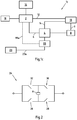
- Fig. 1a illustrates a schematic circuit diagram 1a of an exemplary embodiment of an apparatus according to the invention.
- a main control unit 2 is shown, which is connected to a control unit 4 over the connection 6.
- the main control unit 2 is in particular a microprocessor.
- the control unit 4 might be logic unit such as a microprocessor or a motor driver.
- the main control unit 2 provides the control unit 4 with information regarding the control of the electromechanical device 8, which might be a motor and in particular a stepper motor.
- Connection 6 may be a bidirectional communication between the main control unit 2 and the control unit 4.
- the elements shown in Fig. 1a can be powered by a battery (not shown), for example.
- This motion detector 10 can in particular be an optical detector comprising an optical chopper, an emission source and a detector to encode the light signal into an electrical signal, which can be processed by the main control unit 2 and/or the control unit 4.
- connection 12 and an optional connection 14 the motion detector 10 can provide information about the movement of the electromechanical device 8 to the main control unit 2 and (optionally) the control unit 4.
- the connection 14 to the control unit may be omitted, for example to reduce implementation costs.
- the main control unit 2 is further connected to user interfaces in form of a display unit 16 and an input element 18, for example one or more buttons or a touch screen. Over the input element 18 the user can provide the main control unit 2 with information how to control the control unit 4 such as a specific dosage of a medicament, for example. Via the display unit the user might check the input information, before confirming the input.
- the main control unit 2 can then provide information to the control unit 4 over the connection 6.
- the control unit 4 provides corresponding information to the electromechanical device, such as a control signal, in order to trigger a corresponding movement of the electromechanical device 8.
- the motion detector 10 then provides information to the main control unit 2 about the movement of the electromechanical device 8.
- the main control unit 2 may react accordingly. This means that the control unit can for example inform the user of the error over the display unit 16.
- the main control unit 4 may also send further information to the control unit 4 in order to counterbalance the mismatch. This works, for example, if the motor only performed a smaller movement than requested. In case the apparatus is used in a medical device, this may prevent an underdose, example.
- the main control unit 2 may also interrupt the connection between the control unit 4 and the electromechanical device 8 via the connection 20, illustrated by the dotted line.
- a switch 22 is located between the control unit 4 and the electromechanical device 8. This switch is illustrated in the open position. Of course, when the control unit 4 provides information to the electromechanical device, this switch 22 needs to be closed. Thus, in the normal case the switch 22 is closed. In case of an error or a malfunction, for example of the electromechanical device 8 or the control unit 4, the main control unit 2 can trigger the switch 22 to stop the mechanical device 8 from further receiving information from the control unit 4 and thus preventing the electromechanical device 8 from further movement. In case the apparatus is used in a medical device, this might prevent an overdose, for example.
- the switch can comprise a transistor for electronic switching, for example, but a mechanical switch is possible as well.
- the main control unit 2 could also override the control signals of the control unit 4 and provide information to the electromechanical device 8 itself.
- the optional connection 14 can also be used to receive information from the motion detector 10, so that an error can also be detected by the control unit 4. In this way, a faster error detection might be realized, though the main control unit 2 has still the possibility of overruling the control unit 4.
- Fig. 1b illustrates a schematic circuit diagram 1b of a further exemplary embodiment of an apparatus according to the invention.
- the illustrated schematic circuit diagram 1b is similar to the one illustrated in Fig. 1a . It differs from the schematic circuit diagram 1a in that the main control unit 2 operates the switch 22 in order to disconnect the H-bridge included in the control unit 4 from the power supply 23 to which the control unit 4 is connected over the connection 23a.
- the power supply 23 also provides power to the further elements, such as the main control unit 2, the display unit 16, the electromechanical device 8 and/or the motion detector 10, even though no connections are illustrated. It is also possible to disconnect only the connection of the power supply 23 to the H-bridge, without disconnection the control unit 4 completely.
- Fig. 1c illustrates a schematic circuit diagram 1c of a further exemplary embodiment of an apparatus according to the invention.
- the illustrated schematic circuit diagram 1c is similar to the one illustrated in Fig. 1b . It differs from the schematic circuit diagram 1b in that a voltage regulator 99 converts the voltage from the power supply 23 to a voltage suitable for use by the control unit 4.
- This voltage regulator 99 receives an electrical signal from the main control unit 2 via a control line 99a which enables the output of the voltage regulator 99, providing power to the control unit 4 or disables the output of the voltage regulator 99, not providing power to the control unit 4.
- There may be additional voltage regulators in the system which are not shown in the schematic for clarity.
- An alternative embodiment may combine the mechanisms shown in Fig 1b and Fig. 1c , such that the main control unit 2 controls both a switch 22 and a voltage regulator 99 in order to stop operation of the electromechanical device.
- Fig. 2 illustrates a schematic circuit diagram of an H-bridge 24.
- the H-bridge 24 might be used to control the electromechanical device 8, in particular a bipolar stepper motor or dc-motor.
- the H-bridge 24 comprises four switches 26, 28, 30, 32. By closing switches 26 and 30 the voltage will be applied across the electromechanical device opposite to the direction when switches 28 and 32 are closed. This way a bipolar stepper motor, which is efficient and powerful, can be used or a dc-motor can be driven forward and backward to counteract any detected errors, for example.
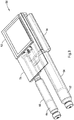
- Fig. 3 illustrates various internal components of a drug delivery device including one preferred arrangement of a drive train 50.
- Fig. 3 also illustrates a digital display 52, a printed circuit board assembly (PCBA) 54, along with a power source or battery 56.
- the PCBA 54 may be positioned between the digital display 52 and a drive train 50 with the battery or power source 56 positioned beneath this drive train 50.
- the battery or power source 52 is electronically connected to provide power to the digital display 52, the PCBA 54 and the drive train 50.
- both a first and second cartridges 58, 60 are shown in an expended state. That is, the first and second cartridges are illustrated in an empty state having a stopper 62, 64 at a most distal position.
- the first cartridge 58 (which ordinarily contains a first medicament) is illustrated as having its stopper 62 in the distal position.
- the stopper 64 of the second cartridge 60 is illustrated in a similar position.
- a power source 56 such as a replaceable battery or batteries.
- the power source 56 may comprise a rechargeable power source and may be recharged while the power source 56 remains in the device. Alternatively, the power source 56 may be removed from the drug delivery device and recharged externally, for example, by way of a remote battery charger.
- This power source may comprise a Lithium-Ion or Lithium-polymer power source.
- the battery 56 comprises a generally flat and rectangular shaped power source.
- Fig. 4 illustrates the arrangement of the electro-mechanical system illustrated in Figure 3 with both the digital display 52 and the PCBA 54 omitted.
- the drive train 50 operates to expel a dose from the first cartridge 58 containing the primary medicament and the second cartridge 60 containing the secondary medicament.
- the first and second cartridges 58, 60 are illustrated in an empty state having stoppers at a most distal position.
- the system comprises an independent electromechanical device 8 in form of motors 70, 86 for each cartridge 58, 60. That is, an independent mechanical driver 66 operates to expel a dose from the first cartridge 58 and an independent mechanical driver 68 operates to expel a dose from the second cartridge 60.
- an independent mechanical driver 66 operates to expel a dose from the first cartridge 58
- an independent mechanical driver 68 operates to expel a dose from the second cartridge 60.
- three independent mechanical drivers could be provided.
- the independent mechanical drivers can act under control of motor drivers of a control unit 4 (see Fig. 1a ).
- the first independent mechanical driver 66 operates to expel a dose from the first cartridge 58.
- This first driver 66 comprises a first electromechanical device 8 in form of a motor 70 that is operatively coupled to a first gearing arrangement 72.
- a connector 74 is provided as a means of electrically connecting to the motor driver.
- This first gearing arrangement 72 is mechanically linked to a proximal portion of the first telescoping piston rod 76.
- the first telescoping piston rod 76 is illustrated in a fully extended position having a distal end 78 acting on the stopper 62 of the first cartridge 58.
- this gearing arrangement 72 As this gearing arrangement 72 is driven by the output shaft of the first motor 70, this arrangement 72 rotates the proximal portion 80 of the first telescoping piston rod 76. As this proximal portion 80 of the piston rod 76 is rotated, the second or distal portion 82 of the piston rod 76 is driven in a distal direction.
- the proximal portion 80 of the telescope piston rod 76 comprises an external thread 84.
- This thread 84 engages the distal portion 82 which has in integrated nut comprising a short threaded section at a proximal end of the distal portion 82.
- This distal portion 82 is prevented from rotating via a key acting in a keyway.
- Such a keyway may pass through the middle of first telescope 76. Therefore, when the first gearbox arrangement 72 causes rotation of the proximal section 80, rotation of the proximal portion 80 acts upon the distal end 78 to thereby drive the distal portion of telescope piston rod to extend along the longitudinal axis.
- the distal end 78 of the second portion 82 of the piston rod 76 exerts a force on a stopper 62 contained within the first cartridge 58.
- the user selected dose of the first medicament is forced out of the cartridge 58 and into an attached dispense interface, for example, and then out an attached needle assembly which can allow the user to inject the medicament.
- a similar injection operation occurs with the second independent driver 68 when a controller first determines that a dose of a second medicament is called for and determines the amount of this dose. In certain circumstances, the controller may determine that a dose of the second medicament may not be called for and therefore this second dose would be "set" to a "0" dose.
- motors 70, 86 comprise motors suitable for electronic commutation. Most preferably, such motors may comprise either a stepper motor or a brushless DC motor.
- a user will first select a dose of the primary medicament by way of the human interface components on the display 52 (see Fig. 3 ).
- the motor drivers When the dose sizes of the first and second medicaments have been established, the motor drivers energize both the first and the second motors 70, 86 to begin the injection process described above.
- the piston rods 76, 88 are preferably movable between a first fully withdrawn position (not shown) and a second fully extended portion (as shown in Figures 6 and 7). With the piston rods 76, 88 in the withdrawn position, the user will be allowed to open up the respective cartridge retainer and remove an empty cartridge.
- both the first and second motors 70, 86 operate simultaneously so as to dispense the user selected dose of the first medicament and the subsequently calculated dose of the second medicament simultaneously. That is, both the first and the second independent mechanical drivers 66, 68 are capable of driving the respective piston rods 76, 88 either at the same or a different time.
- One or more of the steps of the injection may be performed automatically, for example controlled by a microcontroller, for example by the control unit 4 or the main control unit 2, such as the step of rewinding the first and/or second piston rod.
- the microcontroller in particular the main control unit 2 may be programmed so that the first and the second independent mechanical drivers 66, 68 may be operated to dispense either the first medicament or the second medicament prior to the other medicament. Thereafter, the second or the primary medicament may then be dispensed.
- the secondary medicament is dispensed before the primary medicament.
- both motors 70, 86 may be operated in a reverse direction. This feature may be required in order to allow the piston rods 76, 88 to be moved between a first and a second position.
- the first independent mechanical driver 66 illustrated in Figure 4 comprises a first motion detector 10a.
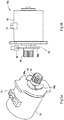
- Figure 5a illustrates a perspective view of the first motor 70 illustrated in Figure 4 .
- Figure 5b illustrates a preferred motion detector 10a comprising the first motor 70 illustrated in Figure 5a in conjunction with a detector in form of a digital encoder 90.
- a motion detector 10a may is beneficial as it is utilized to provide operational and positional feedback from the first independent driver 66 to the main control unit 2 or the control unit 4 of the drug delivery device.
- a preferred motion detector 10a is achieved through the use of a first motor pinion 92.
- This first pinion 92 operatively coupled to an output shaft 94 of the first motor 70.
- the first pinion 92 comprises a rotating gearing portion 96 that drives a first gear of the first gearing arrangement 72 (see, e.g., Figure 7).
- the first motor pinion 92 also comprises a plurality of flags 98 a-b.
- the first pinion 92 comprises a first flag 98a and a second flag 98b. These two flags 98a-b are positioned on the motor pinion 92 so that they pass through a first optical encoder 90 as the motor output shaft 94 and hence the connected first pinion 92 rotate when the motor is driven.
- the encoder 90 can send certain electrical pulses to a microcontroller, for example the main control unit 2 or the control unit 4.
- a microcontroller for example the main control unit 2 or the control unit 4.
- the optical encoder 90 sends two electrical pulses per motor output shaft revolution to the microcontroller.
- the microcontroller can therefore monitor motor output shaft rotation. This is advantageous to detect position errors or events that could occur during a dose administration step such as jamming of the drive train, incorrect mounting of a dispense interface or a needle assembly, or where there is a blocked needle.
- the first pinion 92 comprises a plastic injection molded pinion.
- a plastic injection molded part may be attached to the output motor shaft 94.
- the optical encoder 90 may be located and attached to a gearbox housing. Such a housing may contain both the first gearing arrangement 72 along with the optical encoder 90.
- the encoder 90 is preferably in electrical communication with the main control unit 2 potentially via a flexible portion of the PCB.
- the second independent mechanical driver 68 illustrated in Fig. 3 and 4 comprises a second motion detector 10b that operates in a similar and preferably in the same fashion as the first motion detector 10a of the first mechanical driver 66.
- drug or “medicament”, as used herein, means a pharmaceutical formulation containing at least one pharmaceutically active compound, wherein in one embodiment the pharmaceutically active compound has a molecular weight up to 1500 Da and/or is a peptide, a proteine, a polysaccharide, a vaccine, a DNA, a RNA, an enzyme, an antibody or a fragment thereof, a hormone or an oligonucleotide, or a mixture of the above-mentioned pharmaceutically active compound, wherein in a further embodiment the pharmaceutically active compound is useful for the treatment and/or prophylaxis of diabetes mellitus or complications associated with diabetes mellitus such as diabetic retinopathy, thromboembolism disorders such as deep vein or pulmonary thromboembolism, acute coronary syndrome (ACS), angina, myocardial infarction, cancer, macular degeneration, inflammation, hay fever, atherosclerosis and/or rheumatoid arthritis, wherein in a further
- Insulin analogues are for example Gly(A21), Arg(B31), Arg(B32) human insulin; Lys(B3), Glu(B29) human insulin; Lys(B28), Pro(B29) human insulin; Asp(B28) human insulin; human insulin, wherein proline in position B28 is replaced by Asp, Lys, Leu, Val or Ala and wherein in position B29 Lys may be replaced by Pro; Ala(B26) human insulin; Des(B28-B30) human insulin; Des(B27) human insulin and Des(B30) human insulin.
- Insulin derivates are for example B29-N-myristoyl-des(B30) human insulin; B29-N-palmitoyl-des(B30) human insulin; B29-N-myristoyl human insulin; B29-N-palmitoyl human insulin; B28-N-myristoyl LysB28ProB29 human insulin; B28-N-palmitoyl-LysB28ProB29 human insulin; B30-N-myristoyl-ThrB29LysB30 human insulin; B30-N-palmitoyl- ThrB29LysB30 human insulin; B29-N-(N-palmitoyl-Y-glutamyl)-des(B30) human insulin; B29-N-(N-lithocholyl-Y-glutamyl)-des(B30) human insulin; B29-N-( ⁇ -carboxyheptadecanoyl)-des(B30) human insulin and B29-N-( ⁇ -carbox
- Exendin-4 for example means Exendin-4(1-39), a peptide of the sequence H His-Gly-Glu-Gly-Thr-Phe-Thr-Ser-Asp-Leu-Ser-Lys-Gln-Met-Glu-Glu-Glu-Ala-Val-Arg-Leu-Phe-Ile-Glu-Trp-Leu-Lys-Asn-Gly-Gly-Pro-Ser-Ser-Gly-Ala-Pro-Pro-Pro-Ser-NH2.
- Exendin-4 derivatives are for example selected from the following list of compounds:
- Hormones are for example hypophysis hormones or hypothalamus hormones or regulatory active peptides and their antagonists as listed in Rote Liste, ed. 2008, Chapter 50 , such as Gonadotropine (Follitropin, Lutropin, Choriongonadotropin, Menotropin), Somatropine (Somatropin), Desmopressin, Terlipressin, Gonadorelin, Triptorelin, Leuprorelin, Buserelin, Nafarelin, Goserelin.
- Gonadotropine Follitropin, Lutropin, Choriongonadotropin, Menotropin
- Somatropine Somatropin
- Desmopressin Terlipressin
- Gonadorelin Triptorelin
- Leuprorelin Buserelin
- Nafarelin Goserelin.
- a polysaccharide is for example a glucosaminoglycane, a hyaluronic acid, a heparin, a low molecular weight heparin or an ultra low molecular weight heparin or a derivative thereof, or a sulphated, e.g. a poly-sulphated form of the above-mentioned polysaccharides, and/or a pharmaceutically acceptable salt thereof.
- An example of a pharmaceutically acceptable salt of a poly-sulphated low molecular weight heparin is enoxaparin sodium.
- Antibodies are globular plasma proteins (-150 kDa) that are also known as immunoglobulins which share a basic structure. As they have sugar chains added to amino acid residues, they are glycoproteins.
- the basic functional unit of each antibody is an immunoglobulin (Ig) monomer (containing only one Ig unit); secreted antibodies can also be dimeric with two Ig units as with IgA, tetrameric with four Ig units like teleost fish IgM, or pentameric with five Ig units, like mammalian IgM.
- Ig immunoglobulin
- the Ig monomer is a "Y"-shaped molecule that consists of four polypeptide chains; two identical heavy chains and two identical light chains connected by disulfide bonds between cysteine residues. Each heavy chain is about 440 amino acids long; each light chain is about 220 amino acids long. Heavy and light chains each contain intrachain disulfide bonds which stabilize their folding. Each chain is composed of structural domains called Ig domains. These domains contain about 70-110 amino acids and are classified into different categories (for example, variable or V, and constant or C) according to their size and function. They have a characteristic immunoglobulin fold in which two ⁇ sheets create a "sandwich" shape, held together by interactions between conserved cysteines and other charged amino acids.
- Ig heavy chain There are five types of mammalian Ig heavy chain denoted by ⁇ , ⁇ , ⁇ , y, and ⁇ .
- the type of heavy chain present defines the isotype of antibody; these chains are found in IgA, IgD, IgE, IgG, and IgM antibodies, respectively.
- Distinct heavy chains differ in size and composition; ⁇ and ⁇ contain approximately 450 amino acids and ⁇ approximately 500 amino acids, while ⁇ and ⁇ have approximately 550 amino acids.
- Each heavy chain has two regions, the constant region (CH) and the variable region (VH).
- the constant region is essentially identical in all antibodies of the same isotype, but differs in antibodies of different isotypes.
- Heavy chains ⁇ , ⁇ and ⁇ have a constant region composed of three tandem Ig domains, and a hinge region for added flexibility; heavy chains ⁇ and ⁇ have a constant region composed of four immunoglobulin domains.
- the variable region of the heavy chain differs in antibodies produced by different B cells, but is the same for all antibodies produced by a single B cell or B cell clone.
- the variable region of each heavy chain is approximately 110 amino acids long and is composed of a single Ig domain.
- a light chain has two successive domains: one constant domain (CL) and one variable domain (VL).
- CL constant domain
- VL variable domain
- the approximate length of a light chain is 211 to 217 amino acids.
- Each antibody contains two light chains that are always identical; only one type of light chain, ⁇ or ⁇ , is present per antibody in mammals.
- variable (V) regions are responsible for binding to the antigen, i.e. for its antigen specificity.
- VL variable light
- VH variable heavy chain
- CDRs Complementarity Determining Regions
- an "antibody fragment” contains at least one antigen binding fragment as defined above, and exhibits essentially the same function and specificity as the complete antibody of which the fragment is derived from.
- Limited proteolytic digestion with papain cleaves the Ig prototype into three fragments. Two identical amino terminal fragments, each containing one entire L chain and about half an H chain, are the antigen binding fragments (Fab).
- the Fc contains carbohydrates, complement-binding, and FcR-binding sites.
- F(ab')2 is divalent for antigen binding.
- the disulfide bond of F(ab')2 may be cleaved in order to obtain Fab'.
- the variable regions of the heavy and light chains can be fused together to form a single chain variable fragment (scFv).
- Pharmaceutically acceptable salts are for example acid addition salts and basic salts.
- Acid addition salts are e.g. HCI or HBr salts.
- Basic salts are e.g. salts having a cation selected from alkali or alkaline, e.g. Na+, or K+, or Ca2+, or an ammonium ion N+(R1)(R2)(R3)(R4), wherein R1 to R4 independently of each other mean: hydrogen, an optionally substituted C1 C6-alkyl group, an optionally substituted C2-C6-alkenyl group, an optionally substituted C6-C10-aryl group, or an optionally substituted C6-C10-heteroaryl group.
- solvates are for example hydrates.
Landscapes
- Health & Medical Sciences (AREA)
- Engineering & Computer Science (AREA)
- Hematology (AREA)
- Anesthesiology (AREA)
- Biomedical Technology (AREA)
- Heart & Thoracic Surgery (AREA)
- Vascular Medicine (AREA)
- Life Sciences & Earth Sciences (AREA)
- Animal Behavior & Ethology (AREA)
- General Health & Medical Sciences (AREA)
- Public Health (AREA)
- Veterinary Medicine (AREA)
- Power Engineering (AREA)
- Infusion, Injection, And Reservoir Apparatuses (AREA)
- Manipulator (AREA)
Priority Applications (1)
| Application Number | Priority Date | Filing Date | Title |
|---|---|---|---|
| EP12808406.8A EP2793979B1 (en) | 2011-12-22 | 2012-12-21 | Apparatus with a main control unit, a control unit and an electromechanical device |
Applications Claiming Priority (3)
| Application Number | Priority Date | Filing Date | Title |
|---|---|---|---|
| EP11195220 | 2011-12-22 | ||
| PCT/EP2012/076771 WO2013093059A1 (en) | 2011-12-22 | 2012-12-21 | Apparatus with a main control unit, a control unit and an electromechanical device and a method for operating such an apparatus |
| EP12808406.8A EP2793979B1 (en) | 2011-12-22 | 2012-12-21 | Apparatus with a main control unit, a control unit and an electromechanical device |
Publications (2)
| Publication Number | Publication Date |
|---|---|
| EP2793979A1 EP2793979A1 (en) | 2014-10-29 |
| EP2793979B1 true EP2793979B1 (en) | 2021-01-20 |
Family
ID=47458990
Family Applications (1)
| Application Number | Title | Priority Date | Filing Date |
|---|---|---|---|
| EP12808406.8A Active EP2793979B1 (en) | 2011-12-22 | 2012-12-21 | Apparatus with a main control unit, a control unit and an electromechanical device |
Country Status (6)
| Country | Link |
|---|---|
| US (1) | US9813003B2 (enExample) |
| EP (1) | EP2793979B1 (enExample) |
| JP (1) | JP6460795B2 (enExample) |
| CN (1) | CN104125842B (enExample) |
| DK (1) | DK2793979T3 (enExample) |
| WO (1) | WO2013093059A1 (enExample) |
Families Citing this family (17)
| Publication number | Priority date | Publication date | Assignee | Title |
|---|---|---|---|---|
| ES2659491T3 (es) | 2012-09-05 | 2018-03-15 | E3D Agricultural Cooperative Association Ltd. | Dispositivo de autoinyección electrónico |
| MX387880B (es) | 2013-10-24 | 2025-03-19 | Univ Boston | Sistema de infusion para prevenir el uso del canal equivocado para la administracion de multiples medicamentos. |
| US10971260B2 (en) | 2014-09-14 | 2021-04-06 | Becton, Dickinson And Company | System and method for capturing dose information |
| US10704944B2 (en) | 2014-09-14 | 2020-07-07 | Becton, Dickinson And Company | System and method for capturing dose information |
| JP6226914B2 (ja) * | 2015-06-12 | 2017-11-08 | ファナック株式会社 | 非常停止時にサーボモータを制御して停止させるサーボモータ停止制御装置 |
| WO2017060899A2 (en) | 2015-10-05 | 2017-04-13 | E3D Agricultural Cooperative Association Ltd. | Infusion pump device and method for use thereof |
| CN106100479A (zh) * | 2016-07-20 | 2016-11-09 | 深圳市禾望电气股份有限公司 | 变换器多轴控制系统和方法 |
| CN107115576B (zh) * | 2017-04-20 | 2020-06-16 | 深圳麦科田生物医疗技术有限公司 | 一种输液系统 |
| CN107115575B (zh) * | 2017-04-20 | 2020-11-17 | 深圳麦科田生物医疗技术有限公司 | 一种输液系统 |
| DK3714922T3 (da) * | 2017-07-07 | 2022-06-27 | Neuroderm Ltd | Anordning til subkutan indgivelse af flydende lægemiddel |
| RU2673983C1 (ru) * | 2018-06-29 | 2018-12-03 | Общество с ограниченной ответственностью "МЕДПЛАНТ" | Шприцевой дозатор лекарственных средств |
| CN115243746B (zh) | 2019-07-16 | 2025-01-03 | 贝塔仿生公司 | 移动装置及其部件 |
| USD1031975S1 (en) | 2020-03-10 | 2024-06-18 | Beta Bionics, Inc. | Medicament infusion pump device |
| US11278661B2 (en) | 2020-03-10 | 2022-03-22 | Beta Bionics, Inc. | Infusion system and components thereof |
| USD1099024S1 (en) | 2020-03-10 | 2025-10-21 | Beta Bionics, Inc. | Charging device for medicament infusion pump device |
| WO2021191326A1 (en) * | 2020-03-27 | 2021-09-30 | Sanofi | Drug delivery device with electronic system |
| EP4251236A4 (en) * | 2020-11-27 | 2024-10-30 | Medtrum Technologies Inc. | DRIVE STRUCTURE OF A DRUG INFUSION DEVICE |
Citations (4)
| Publication number | Priority date | Publication date | Assignee | Title |
|---|---|---|---|---|
| EP0518630A2 (en) * | 1991-06-12 | 1992-12-16 | Aeci Limited | Redundant control system |
| EP1688846A1 (en) * | 2003-11-05 | 2006-08-09 | Hitachi, Ltd. | Communication system, real time control apparatus, and information processing system |
| WO2007062315A2 (en) * | 2005-11-21 | 2007-05-31 | Acist Medical Systems, Inc. | Medical fluid injection system |
| KR20090027301A (ko) * | 2007-09-12 | 2009-03-17 | 주식회사 로보빌더 | 기능확장이 용이한 로봇용 액츄에이터 모듈 |
Family Cites Families (36)
| Publication number | Priority date | Publication date | Assignee | Title |
|---|---|---|---|---|
| US533575A (en) | 1895-02-05 | wilkens | ||
| US6241704B1 (en) * | 1901-11-22 | 2001-06-05 | Sims Deltec, Inc. | Drug pump systems and methods |
| US4908017A (en) * | 1985-05-14 | 1990-03-13 | Ivion Corporation | Failsafe apparatus and method for effecting syringe drive |
| US5130543A (en) * | 1988-01-19 | 1992-07-14 | Bradbeer Peter F | Direction sensitive energy detecting apparatus |
| US5226895A (en) | 1989-06-05 | 1993-07-13 | Eli Lilly And Company | Multiple dose injection pen |
| GB9007113D0 (en) | 1990-03-29 | 1990-05-30 | Sams Bernard | Dispensing device |
| EP0525525B1 (de) | 1991-07-24 | 1995-05-03 | Medico Development Investment Company | Injektor |
| DK175491D0 (da) | 1991-10-18 | 1991-10-18 | Novo Nordisk As | Apparat |
| US5279585A (en) | 1992-02-04 | 1994-01-18 | Becton, Dickinson And Company | Medication delivery pen having improved dose delivery features |
| US5320609A (en) | 1992-12-07 | 1994-06-14 | Habley Medical Technology Corporation | Automatic pharmaceutical dispensing syringe |
| US5383865A (en) | 1993-03-15 | 1995-01-24 | Eli Lilly And Company | Medication dispensing device |
| ZA941881B (en) | 1993-04-02 | 1995-09-18 | Lilly Co Eli | Manifold medication injection apparatus and method |
| US5582598A (en) | 1994-09-19 | 1996-12-10 | Becton Dickinson And Company | Medication delivery pen with variable increment dose scale |
| AU696439B2 (en) | 1995-03-07 | 1998-09-10 | Eli Lilly And Company | Recyclable medication dispensing device |
| US5674204A (en) | 1995-09-19 | 1997-10-07 | Becton Dickinson And Company | Medication delivery pen cap actuated dose delivery clutch |
| US5688251A (en) | 1995-09-19 | 1997-11-18 | Becton Dickinson And Company | Cartridge loading and priming mechanism for a pen injector |
| DE19730999C1 (de) | 1997-07-18 | 1998-12-10 | Disetronic Licensing Ag | Dosierknopfsicherung an einer Vorrichtung zur dosierten Verabreichung eines injizierbaren Produkts |
| US5921966A (en) | 1997-08-11 | 1999-07-13 | Becton Dickinson And Company | Medication delivery pen having an improved clutch assembly |
| JP3270761B2 (ja) | 1998-01-30 | 2002-04-02 | ノボ ノルディスク アクティーゼルスカブ | 注射器 |
| US5961495A (en) | 1998-02-20 | 1999-10-05 | Becton, Dickinson And Company | Medication delivery pen having a priming mechanism |
| US6221053B1 (en) | 1998-02-20 | 2001-04-24 | Becton, Dickinson And Company | Multi-featured medication delivery pen |
| US6248095B1 (en) | 1998-02-23 | 2001-06-19 | Becton, Dickinson And Company | Low-cost medication delivery pen |
| DE60026147T2 (de) | 1999-08-05 | 2006-11-23 | Becton, Dickinson And Co. | Stiftförmige medikamentenabgabevorrichtung |
| GB0007071D0 (en) | 2000-03-24 | 2000-05-17 | Sams Bernard | One-way clutch mechanisms and injector devices |
| US6663602B2 (en) | 2000-06-16 | 2003-12-16 | Novo Nordisk A/S | Injection device |
| AU2001277053A1 (en) * | 2000-07-20 | 2002-02-05 | Acist Medical Systems, Inc. | Syringe plunger locking mechanism |
| US6899699B2 (en) | 2001-01-05 | 2005-05-31 | Novo Nordisk A/S | Automatic injection device with reset feature |
| ATE355093T1 (de) | 2001-05-16 | 2006-03-15 | Lilly Co Eli | Arzneimitteleinspritzvorrichtung mit rückstellung erleichternder antriebsanordnung |
| GB0304823D0 (en) | 2003-03-03 | 2003-04-09 | Dca Internat Ltd | Improvements in and relating to a pen-type injector |
| DE10334736A1 (de) * | 2003-07-29 | 2005-02-17 | Rexroth Indramat Gmbh | Linearmotor mit Fortbewegungsregelung |
| US7599758B2 (en) * | 2003-09-19 | 2009-10-06 | Royal Appliance Mfg. Co. | Sensors and associated methods for controlling a vacuum cleaner |
| DE102004063647A1 (de) | 2004-12-31 | 2006-07-20 | Tecpharma Licensing Ag | Vorrichtung zur dosierten Verabreichung eines fluiden Produkts mit Kupplung |
| US8965707B2 (en) * | 2006-08-03 | 2015-02-24 | Smiths Medical Asd, Inc. | Interface for medical infusion pump |
| US8647309B2 (en) | 2008-05-02 | 2014-02-11 | Sanofi-Aventis Deutschland Gmbh | Medication delivery device |
| WO2011082272A2 (en) * | 2009-12-31 | 2011-07-07 | Deka Products Limited Partnership | Infusion pump assembley |
| TW201200190A (en) * | 2010-03-26 | 2012-01-01 | Sanofi Aventis Deutschland | Electro-mechanical drug delivery device |
-
2012
- 2012-12-21 DK DK12808406.8T patent/DK2793979T3/da active
- 2012-12-21 US US14/367,458 patent/US9813003B2/en active Active
- 2012-12-21 JP JP2014548089A patent/JP6460795B2/ja active Active
- 2012-12-21 CN CN201280070150.9A patent/CN104125842B/zh active Active
- 2012-12-21 EP EP12808406.8A patent/EP2793979B1/en active Active
- 2012-12-21 WO PCT/EP2012/076771 patent/WO2013093059A1/en not_active Ceased
Patent Citations (4)
| Publication number | Priority date | Publication date | Assignee | Title |
|---|---|---|---|---|
| EP0518630A2 (en) * | 1991-06-12 | 1992-12-16 | Aeci Limited | Redundant control system |
| EP1688846A1 (en) * | 2003-11-05 | 2006-08-09 | Hitachi, Ltd. | Communication system, real time control apparatus, and information processing system |
| WO2007062315A2 (en) * | 2005-11-21 | 2007-05-31 | Acist Medical Systems, Inc. | Medical fluid injection system |
| KR20090027301A (ko) * | 2007-09-12 | 2009-03-17 | 주식회사 로보빌더 | 기능확장이 용이한 로봇용 액츄에이터 모듈 |
Also Published As
| Publication number | Publication date |
|---|---|
| JP6460795B2 (ja) | 2019-01-30 |
| CN104125842A (zh) | 2014-10-29 |
| US9813003B2 (en) | 2017-11-07 |
| HK1198519A1 (en) | 2015-05-15 |
| DK2793979T3 (da) | 2021-04-12 |
| CN104125842B (zh) | 2017-06-20 |
| EP2793979A1 (en) | 2014-10-29 |
| JP2015500720A (ja) | 2015-01-08 |
| WO2013093059A1 (en) | 2013-06-27 |
| US20150303851A1 (en) | 2015-10-22 |
Similar Documents
| Publication | Publication Date | Title |
|---|---|---|
| US9813003B2 (en) | Apparatus with a main control unit, a control unit and an electromechanical device and a method for operating such an apparatus | |
| EP2785396B1 (en) | Medical device for delivering at least one fluid | |
| US20140303560A1 (en) | Piston Driving Motor Arrangement | |
| US20250114538A1 (en) | Medical device and method for limiting the use of the medical device | |
| US10549034B2 (en) | Actuation step failure handling | |
| EP2842225B1 (en) | Apparatus comprising electromechanical device and motion detector and method for operating apparatus | |
| EP2943237A1 (en) | Drive mechanism of a drug delivery device comprising an accessory drive | |
| EP3035982B1 (en) | Drive mechanism for a drug delivery device and a method for assembling a drug delivery device | |
| HK1198519B (en) | Apparatus with a main control unit, a control unit and an electromechanical device | |
| HK1201998B (en) | Apparatus comprising electromechanical device and motion detector and method for operating apparatus | |
| HK1197810B (en) | Medical device for delivering at least one fluid | |
| HK1197810A (en) | Medical device for delivering at least one fluid | |
| HK1196577A (en) | Medical device and method for limiting the use of the medical device | |
| HK1196577B (en) | Medical device and method for limiting the use of the medical device |
Legal Events
| Date | Code | Title | Description |
|---|---|---|---|
| PUAI | Public reference made under article 153(3) epc to a published international application that has entered the european phase |
Free format text: ORIGINAL CODE: 0009012 |
|
| 17P | Request for examination filed |
Effective date: 20140722 |
|
| AK | Designated contracting states |
Kind code of ref document: A1 Designated state(s): AL AT BE BG CH CY CZ DE DK EE ES FI FR GB GR HR HU IE IS IT LI LT LU LV MC MK MT NL NO PL PT RO RS SE SI SK SM TR |
|
| DAX | Request for extension of the european patent (deleted) | ||
| REG | Reference to a national code |
Ref country code: HK Ref legal event code: DE Ref document number: 1198519 Country of ref document: HK |
|
| 17Q | First examination report despatched |
Effective date: 20151214 |
|
| STAA | Information on the status of an ep patent application or granted ep patent |
Free format text: STATUS: EXAMINATION IS IN PROGRESS |
|
| GRAP | Despatch of communication of intention to grant a patent |
Free format text: ORIGINAL CODE: EPIDOSNIGR1 |
|
| STAA | Information on the status of an ep patent application or granted ep patent |
Free format text: STATUS: GRANT OF PATENT IS INTENDED |
|
| INTG | Intention to grant announced |
Effective date: 20200813 |
|
| GRAS | Grant fee paid |
Free format text: ORIGINAL CODE: EPIDOSNIGR3 |
|
| GRAA | (expected) grant |
Free format text: ORIGINAL CODE: 0009210 |
|
| STAA | Information on the status of an ep patent application or granted ep patent |
Free format text: STATUS: THE PATENT HAS BEEN GRANTED |
|
| AK | Designated contracting states |
Kind code of ref document: B1 Designated state(s): AL AT BE BG CH CY CZ DE DK EE ES FI FR GB GR HR HU IE IS IT LI LT LU LV MC MK MT NL NO PL PT RO RS SE SI SK SM TR |
|
| REG | Reference to a national code |
Ref country code: GB Ref legal event code: FG4D |
|
| REG | Reference to a national code |
Ref country code: CH Ref legal event code: EP |
|
| REG | Reference to a national code |
Ref country code: DE Ref legal event code: R096 Ref document number: 602012074236 Country of ref document: DE |
|
| REG | Reference to a national code |
Ref country code: AT Ref legal event code: REF Ref document number: 1355813 Country of ref document: AT Kind code of ref document: T Effective date: 20210215 |
|
| REG | Reference to a national code |
Ref country code: IE Ref legal event code: FG4D |
|
| REG | Reference to a national code |
Ref country code: DK Ref legal event code: T3 Effective date: 20210406 |
|
| REG | Reference to a national code |
Ref country code: NL Ref legal event code: MP Effective date: 20210120 |
|
| REG | Reference to a national code |
Ref country code: LT Ref legal event code: MG9D |
|
| REG | Reference to a national code |
Ref country code: AT Ref legal event code: MK05 Ref document number: 1355813 Country of ref document: AT Kind code of ref document: T Effective date: 20210120 |
|
| PG25 | Lapsed in a contracting state [announced via postgrant information from national office to epo] |
Ref country code: PT Free format text: LAPSE BECAUSE OF FAILURE TO SUBMIT A TRANSLATION OF THE DESCRIPTION OR TO PAY THE FEE WITHIN THE PRESCRIBED TIME-LIMIT Effective date: 20210520 Ref country code: LT Free format text: LAPSE BECAUSE OF FAILURE TO SUBMIT A TRANSLATION OF THE DESCRIPTION OR TO PAY THE FEE WITHIN THE PRESCRIBED TIME-LIMIT Effective date: 20210120 Ref country code: GR Free format text: LAPSE BECAUSE OF FAILURE TO SUBMIT A TRANSLATION OF THE DESCRIPTION OR TO PAY THE FEE WITHIN THE PRESCRIBED TIME-LIMIT Effective date: 20210421 Ref country code: FI Free format text: LAPSE BECAUSE OF FAILURE TO SUBMIT A TRANSLATION OF THE DESCRIPTION OR TO PAY THE FEE WITHIN THE PRESCRIBED TIME-LIMIT Effective date: 20210120 Ref country code: HR Free format text: LAPSE BECAUSE OF FAILURE TO SUBMIT A TRANSLATION OF THE DESCRIPTION OR TO PAY THE FEE WITHIN THE PRESCRIBED TIME-LIMIT Effective date: 20210120 Ref country code: BG Free format text: LAPSE BECAUSE OF FAILURE TO SUBMIT A TRANSLATION OF THE DESCRIPTION OR TO PAY THE FEE WITHIN THE PRESCRIBED TIME-LIMIT Effective date: 20210420 Ref country code: NL Free format text: LAPSE BECAUSE OF FAILURE TO SUBMIT A TRANSLATION OF THE DESCRIPTION OR TO PAY THE FEE WITHIN THE PRESCRIBED TIME-LIMIT Effective date: 20210120 Ref country code: NO Free format text: LAPSE BECAUSE OF FAILURE TO SUBMIT A TRANSLATION OF THE DESCRIPTION OR TO PAY THE FEE WITHIN THE PRESCRIBED TIME-LIMIT Effective date: 20210420 |
|
| PG25 | Lapsed in a contracting state [announced via postgrant information from national office to epo] |
Ref country code: SE Free format text: LAPSE BECAUSE OF FAILURE TO SUBMIT A TRANSLATION OF THE DESCRIPTION OR TO PAY THE FEE WITHIN THE PRESCRIBED TIME-LIMIT Effective date: 20210120 Ref country code: LV Free format text: LAPSE BECAUSE OF FAILURE TO SUBMIT A TRANSLATION OF THE DESCRIPTION OR TO PAY THE FEE WITHIN THE PRESCRIBED TIME-LIMIT Effective date: 20210120 Ref country code: RS Free format text: LAPSE BECAUSE OF FAILURE TO SUBMIT A TRANSLATION OF THE DESCRIPTION OR TO PAY THE FEE WITHIN THE PRESCRIBED TIME-LIMIT Effective date: 20210120 Ref country code: PL Free format text: LAPSE BECAUSE OF FAILURE TO SUBMIT A TRANSLATION OF THE DESCRIPTION OR TO PAY THE FEE WITHIN THE PRESCRIBED TIME-LIMIT Effective date: 20210120 Ref country code: AT Free format text: LAPSE BECAUSE OF FAILURE TO SUBMIT A TRANSLATION OF THE DESCRIPTION OR TO PAY THE FEE WITHIN THE PRESCRIBED TIME-LIMIT Effective date: 20210120 |
|
| PG25 | Lapsed in a contracting state [announced via postgrant information from national office to epo] |
Ref country code: IS Free format text: LAPSE BECAUSE OF FAILURE TO SUBMIT A TRANSLATION OF THE DESCRIPTION OR TO PAY THE FEE WITHIN THE PRESCRIBED TIME-LIMIT Effective date: 20210520 |
|
| REG | Reference to a national code |
Ref country code: DE Ref legal event code: R097 Ref document number: 602012074236 Country of ref document: DE |
|
| PG25 | Lapsed in a contracting state [announced via postgrant information from national office to epo] |
Ref country code: EE Free format text: LAPSE BECAUSE OF FAILURE TO SUBMIT A TRANSLATION OF THE DESCRIPTION OR TO PAY THE FEE WITHIN THE PRESCRIBED TIME-LIMIT Effective date: 20210120 Ref country code: CZ Free format text: LAPSE BECAUSE OF FAILURE TO SUBMIT A TRANSLATION OF THE DESCRIPTION OR TO PAY THE FEE WITHIN THE PRESCRIBED TIME-LIMIT Effective date: 20210120 Ref country code: SM Free format text: LAPSE BECAUSE OF FAILURE TO SUBMIT A TRANSLATION OF THE DESCRIPTION OR TO PAY THE FEE WITHIN THE PRESCRIBED TIME-LIMIT Effective date: 20210120 |
|
| PLBE | No opposition filed within time limit |
Free format text: ORIGINAL CODE: 0009261 |
|
| STAA | Information on the status of an ep patent application or granted ep patent |
Free format text: STATUS: NO OPPOSITION FILED WITHIN TIME LIMIT |
|
| PG25 | Lapsed in a contracting state [announced via postgrant information from national office to epo] |
Ref country code: RO Free format text: LAPSE BECAUSE OF FAILURE TO SUBMIT A TRANSLATION OF THE DESCRIPTION OR TO PAY THE FEE WITHIN THE PRESCRIBED TIME-LIMIT Effective date: 20210120 Ref country code: SK Free format text: LAPSE BECAUSE OF FAILURE TO SUBMIT A TRANSLATION OF THE DESCRIPTION OR TO PAY THE FEE WITHIN THE PRESCRIBED TIME-LIMIT Effective date: 20210120 Ref country code: ES Free format text: LAPSE BECAUSE OF FAILURE TO SUBMIT A TRANSLATION OF THE DESCRIPTION OR TO PAY THE FEE WITHIN THE PRESCRIBED TIME-LIMIT Effective date: 20210120 |
|
| 26N | No opposition filed |
Effective date: 20211021 |
|
| PG25 | Lapsed in a contracting state [announced via postgrant information from national office to epo] |
Ref country code: AL Free format text: LAPSE BECAUSE OF FAILURE TO SUBMIT A TRANSLATION OF THE DESCRIPTION OR TO PAY THE FEE WITHIN THE PRESCRIBED TIME-LIMIT Effective date: 20210120 |
|
| PG25 | Lapsed in a contracting state [announced via postgrant information from national office to epo] |
Ref country code: SI Free format text: LAPSE BECAUSE OF FAILURE TO SUBMIT A TRANSLATION OF THE DESCRIPTION OR TO PAY THE FEE WITHIN THE PRESCRIBED TIME-LIMIT Effective date: 20210120 |
|
| PG25 | Lapsed in a contracting state [announced via postgrant information from national office to epo] |
Ref country code: IT Free format text: LAPSE BECAUSE OF FAILURE TO SUBMIT A TRANSLATION OF THE DESCRIPTION OR TO PAY THE FEE WITHIN THE PRESCRIBED TIME-LIMIT Effective date: 20210120 |
|
| PG25 | Lapsed in a contracting state [announced via postgrant information from national office to epo] |
Ref country code: IS Free format text: LAPSE BECAUSE OF FAILURE TO SUBMIT A TRANSLATION OF THE DESCRIPTION OR TO PAY THE FEE WITHIN THE PRESCRIBED TIME-LIMIT Effective date: 20210520 |
|
| PG25 | Lapsed in a contracting state [announced via postgrant information from national office to epo] |
Ref country code: MC Free format text: LAPSE BECAUSE OF FAILURE TO SUBMIT A TRANSLATION OF THE DESCRIPTION OR TO PAY THE FEE WITHIN THE PRESCRIBED TIME-LIMIT Effective date: 20210120 |
|
| REG | Reference to a national code |
Ref country code: BE Ref legal event code: MM Effective date: 20211231 |
|
| PG25 | Lapsed in a contracting state [announced via postgrant information from national office to epo] |
Ref country code: LU Free format text: LAPSE BECAUSE OF NON-PAYMENT OF DUE FEES Effective date: 20211221 Ref country code: IE Free format text: LAPSE BECAUSE OF NON-PAYMENT OF DUE FEES Effective date: 20211221 |
|
| PG25 | Lapsed in a contracting state [announced via postgrant information from national office to epo] |
Ref country code: BE Free format text: LAPSE BECAUSE OF NON-PAYMENT OF DUE FEES Effective date: 20211231 |
|
| PG25 | Lapsed in a contracting state [announced via postgrant information from national office to epo] |
Ref country code: HU Free format text: LAPSE BECAUSE OF FAILURE TO SUBMIT A TRANSLATION OF THE DESCRIPTION OR TO PAY THE FEE WITHIN THE PRESCRIBED TIME-LIMIT; INVALID AB INITIO Effective date: 20121221 |
|
| PG25 | Lapsed in a contracting state [announced via postgrant information from national office to epo] |
Ref country code: CY Free format text: LAPSE BECAUSE OF FAILURE TO SUBMIT A TRANSLATION OF THE DESCRIPTION OR TO PAY THE FEE WITHIN THE PRESCRIBED TIME-LIMIT Effective date: 20210120 |
|
| PG25 | Lapsed in a contracting state [announced via postgrant information from national office to epo] |
Ref country code: MK Free format text: LAPSE BECAUSE OF FAILURE TO SUBMIT A TRANSLATION OF THE DESCRIPTION OR TO PAY THE FEE WITHIN THE PRESCRIBED TIME-LIMIT Effective date: 20210120 |
|
| PG25 | Lapsed in a contracting state [announced via postgrant information from national office to epo] |
Ref country code: MT Free format text: LAPSE BECAUSE OF FAILURE TO SUBMIT A TRANSLATION OF THE DESCRIPTION OR TO PAY THE FEE WITHIN THE PRESCRIBED TIME-LIMIT Effective date: 20210120 |
|
| REG | Reference to a national code |
Ref country code: CH Ref legal event code: U11 Free format text: ST27 STATUS EVENT CODE: U-0-0-U10-U11 (AS PROVIDED BY THE NATIONAL OFFICE) Effective date: 20260101 |
|
| PGFP | Annual fee paid to national office [announced via postgrant information from national office to epo] |
Ref country code: DE Payment date: 20250930 Year of fee payment: 14 |
|
| PGFP | Annual fee paid to national office [announced via postgrant information from national office to epo] |
Ref country code: GB Payment date: 20251001 Year of fee payment: 14 |
|
| PGFP | Annual fee paid to national office [announced via postgrant information from national office to epo] |
Ref country code: DK Payment date: 20251212 Year of fee payment: 14 |
|
| PGFP | Annual fee paid to national office [announced via postgrant information from national office to epo] |
Ref country code: FR Payment date: 20251008 Year of fee payment: 14 |
|
| PGFP | Annual fee paid to national office [announced via postgrant information from national office to epo] |
Ref country code: TR Payment date: 20251219 Year of fee payment: 14 |
|
| PGFP | Annual fee paid to national office [announced via postgrant information from national office to epo] |
Ref country code: CH Payment date: 20260101 Year of fee payment: 14 |