EP2784110B1 - Method and apparatus for colour removal from shredded pet-flakes - Google Patents
Method and apparatus for colour removal from shredded pet-flakes Download PDFInfo
- Publication number
- EP2784110B1 EP2784110B1 EP13171754.8A EP13171754A EP2784110B1 EP 2784110 B1 EP2784110 B1 EP 2784110B1 EP 13171754 A EP13171754 A EP 13171754A EP 2784110 B1 EP2784110 B1 EP 2784110B1
- Authority
- EP
- European Patent Office
- Prior art keywords
- pet
- flakes
- ethylene glycol
- vessel
- ext
- Prior art date
- Legal status (The legal status is an assumption and is not a legal conclusion. Google has not performed a legal analysis and makes no representation as to the accuracy of the status listed.)
- Active
Links
- 238000000034 method Methods 0.000 title claims description 29
- 238000002203 pretreatment Methods 0.000 claims description 60
- 238000000605 extraction Methods 0.000 claims description 51
- LYCAIKOWRPUZTN-UHFFFAOYSA-N Ethylene glycol Chemical compound OCCO LYCAIKOWRPUZTN-UHFFFAOYSA-N 0.000 claims description 47
- 239000003086 colorant Substances 0.000 claims description 21
- 230000008569 process Effects 0.000 claims description 7
- 238000010438 heat treatment Methods 0.000 claims description 6
- 238000007781 pre-processing Methods 0.000 claims description 6
- 230000009477 glass transition Effects 0.000 claims description 5
- 238000002844 melting Methods 0.000 claims description 4
- 230000008018 melting Effects 0.000 claims description 4
- 229920001223 polyethylene glycol Polymers 0.000 claims description 4
- 238000006116 polymerization reaction Methods 0.000 claims description 4
- ZIBGPFATKBEMQZ-UHFFFAOYSA-N triethylene glycol Chemical compound OCCOCCOCCO ZIBGPFATKBEMQZ-UHFFFAOYSA-N 0.000 claims description 4
- 150000001875 compounds Chemical class 0.000 claims description 3
- 230000034659 glycolysis Effects 0.000 claims description 3
- 238000006140 methanolysis reaction Methods 0.000 claims description 3
- UWHCKJMYHZGTIT-UHFFFAOYSA-N tetraethylene glycol Chemical compound OCCOCCOCCOCCO UWHCKJMYHZGTIT-UHFFFAOYSA-N 0.000 claims description 3
- 239000000284 extract Substances 0.000 claims description 2
- 230000007062 hydrolysis Effects 0.000 claims description 2
- 238000006460 hydrolysis reaction Methods 0.000 claims description 2
- 238000007127 saponification reaction Methods 0.000 claims description 2
- 239000003960 organic solvent Substances 0.000 claims 2
- VGGSQFUCUMXWEO-UHFFFAOYSA-N Ethene Chemical group C=C VGGSQFUCUMXWEO-UHFFFAOYSA-N 0.000 claims 1
- 239000002202 Polyethylene glycol Substances 0.000 claims 1
- 229920000139 polyethylene terephthalate Polymers 0.000 description 44
- 239000005020 polyethylene terephthalate Substances 0.000 description 44
- 239000007788 liquid Substances 0.000 description 35
- 238000009835 boiling Methods 0.000 description 7
- 239000012530 fluid Substances 0.000 description 7
- WOZVHXUHUFLZGK-UHFFFAOYSA-N dimethyl terephthalate Chemical compound COC(=O)C1=CC=C(C(=O)OC)C=C1 WOZVHXUHUFLZGK-UHFFFAOYSA-N 0.000 description 6
- 238000004064 recycling Methods 0.000 description 6
- GWEVSGVZZGPLCZ-UHFFFAOYSA-N Titan oxide Chemical compound O=[Ti]=O GWEVSGVZZGPLCZ-UHFFFAOYSA-N 0.000 description 5
- QPKOBORKPHRBPS-UHFFFAOYSA-N bis(2-hydroxyethyl) terephthalate Chemical compound OCCOC(=O)C1=CC=C(C(=O)OCCO)C=C1 QPKOBORKPHRBPS-UHFFFAOYSA-N 0.000 description 5
- 239000000178 monomer Substances 0.000 description 5
- 238000011144 upstream manufacturing Methods 0.000 description 5
- XLYOFNOQVPJJNP-UHFFFAOYSA-N water Substances O XLYOFNOQVPJJNP-UHFFFAOYSA-N 0.000 description 5
- OKKJLVBELUTLKV-UHFFFAOYSA-N Methanol Chemical compound OC OKKJLVBELUTLKV-UHFFFAOYSA-N 0.000 description 3
- KWYUFKZDYYNOTN-UHFFFAOYSA-M Potassium hydroxide Chemical compound [OH-].[K+] KWYUFKZDYYNOTN-UHFFFAOYSA-M 0.000 description 3
- 238000001914 filtration Methods 0.000 description 3
- 239000011159 matrix material Substances 0.000 description 3
- 239000000049 pigment Substances 0.000 description 3
- 229920000642 polymer Polymers 0.000 description 3
- 239000003054 catalyst Substances 0.000 description 2
- 239000000356 contaminant Substances 0.000 description 2
- 238000004042 decolorization Methods 0.000 description 2
- 238000000354 decomposition reaction Methods 0.000 description 2
- 238000009792 diffusion process Methods 0.000 description 2
- 239000000155 melt Substances 0.000 description 2
- 238000000465 moulding Methods 0.000 description 2
- 239000002245 particle Substances 0.000 description 2
- 239000012071 phase Substances 0.000 description 2
- -1 poly(ethylene terephthalate) Polymers 0.000 description 2
- 239000007787 solid Substances 0.000 description 2
- IJGRMHOSHXDMSA-UHFFFAOYSA-N Atomic nitrogen Chemical compound N#N IJGRMHOSHXDMSA-UHFFFAOYSA-N 0.000 description 1
- OFOBLEOULBTSOW-UHFFFAOYSA-N Malonic acid Chemical compound OC(=O)CC(O)=O OFOBLEOULBTSOW-UHFFFAOYSA-N 0.000 description 1
- 229910000831 Steel Inorganic materials 0.000 description 1
- 238000013019 agitation Methods 0.000 description 1
- AZDRQVAHHNSJOQ-UHFFFAOYSA-N alumane Chemical group [AlH3] AZDRQVAHHNSJOQ-UHFFFAOYSA-N 0.000 description 1
- 239000012080 ambient air Substances 0.000 description 1
- 229920006125 amorphous polymer Polymers 0.000 description 1
- QVGXLLKOCUKJST-UHFFFAOYSA-N atomic oxygen Chemical compound [O] QVGXLLKOCUKJST-UHFFFAOYSA-N 0.000 description 1
- 235000013405 beer Nutrition 0.000 description 1
- 235000013361 beverage Nutrition 0.000 description 1
- 239000013590 bulk material Substances 0.000 description 1
- 235000012174 carbonated soft drink Nutrition 0.000 description 1
- 238000006243 chemical reaction Methods 0.000 description 1
- 238000004140 cleaning Methods 0.000 description 1
- 238000009833 condensation Methods 0.000 description 1
- 230000005494 condensation Effects 0.000 description 1
- 238000011109 contamination Methods 0.000 description 1
- 230000000593 degrading effect Effects 0.000 description 1
- 230000001419 dependent effect Effects 0.000 description 1
- 238000010586 diagram Methods 0.000 description 1
- 125000001142 dicarboxylic acid group Chemical group 0.000 description 1
- 230000000694 effects Effects 0.000 description 1
- 238000005485 electric heating Methods 0.000 description 1
- 150000002148 esters Chemical class 0.000 description 1
- 239000000835 fiber Substances 0.000 description 1
- 239000007792 gaseous phase Substances 0.000 description 1
- 125000003827 glycol group Chemical group 0.000 description 1
- WGCNASOHLSPBMP-UHFFFAOYSA-N hydroxyacetaldehyde Natural products OCC=O WGCNASOHLSPBMP-UHFFFAOYSA-N 0.000 description 1
- 238000009413 insulation Methods 0.000 description 1
- 239000007791 liquid phase Substances 0.000 description 1
- 239000000463 material Substances 0.000 description 1
- 230000007246 mechanism Effects 0.000 description 1
- 229910052751 metal Inorganic materials 0.000 description 1
- 239000002184 metal Substances 0.000 description 1
- 238000003801 milling Methods 0.000 description 1
- 239000000203 mixture Substances 0.000 description 1
- 229910052760 oxygen Inorganic materials 0.000 description 1
- 239000001301 oxygen Substances 0.000 description 1
- 238000006068 polycondensation reaction Methods 0.000 description 1
- 229920000728 polyester Polymers 0.000 description 1
- 229940057847 polyethylene glycol 600 Drugs 0.000 description 1
- 235000011118 potassium hydroxide Nutrition 0.000 description 1
- 238000000746 purification Methods 0.000 description 1
- 239000011541 reaction mixture Substances 0.000 description 1
- 230000009467 reduction Effects 0.000 description 1
- 229920005989 resin Polymers 0.000 description 1
- 239000011347 resin Substances 0.000 description 1
- 238000000926 separation method Methods 0.000 description 1
- 239000002002 slurry Substances 0.000 description 1
- 239000010959 steel Substances 0.000 description 1
- 238000003756 stirring Methods 0.000 description 1
- 239000000126 substance Substances 0.000 description 1
- 230000008961 swelling Effects 0.000 description 1
- 229920001169 thermoplastic Polymers 0.000 description 1
- 239000004416 thermosoftening plastic Substances 0.000 description 1
- 239000004408 titanium dioxide Substances 0.000 description 1
- 238000005406 washing Methods 0.000 description 1
Images

Classifications
-
- C—CHEMISTRY; METALLURGY
- C08—ORGANIC MACROMOLECULAR COMPOUNDS; THEIR PREPARATION OR CHEMICAL WORKING-UP; COMPOSITIONS BASED THEREON
- C08J—WORKING-UP; GENERAL PROCESSES OF COMPOUNDING; AFTER-TREATMENT NOT COVERED BY SUBCLASSES C08B, C08C, C08F, C08G or C08H
- C08J11/00—Recovery or working-up of waste materials
- C08J11/04—Recovery or working-up of waste materials of polymers
- C08J11/06—Recovery or working-up of waste materials of polymers without chemical reactions
- C08J11/08—Recovery or working-up of waste materials of polymers without chemical reactions using selective solvents for polymer components
-
- C—CHEMISTRY; METALLURGY
- C08—ORGANIC MACROMOLECULAR COMPOUNDS; THEIR PREPARATION OR CHEMICAL WORKING-UP; COMPOSITIONS BASED THEREON
- C08J—WORKING-UP; GENERAL PROCESSES OF COMPOUNDING; AFTER-TREATMENT NOT COVERED BY SUBCLASSES C08B, C08C, C08F, C08G or C08H
- C08J11/00—Recovery or working-up of waste materials
- C08J11/04—Recovery or working-up of waste materials of polymers
- C08J11/10—Recovery or working-up of waste materials of polymers by chemically breaking down the molecular chains of polymers or breaking of crosslinks, e.g. devulcanisation
- C08J11/18—Recovery or working-up of waste materials of polymers by chemically breaking down the molecular chains of polymers or breaking of crosslinks, e.g. devulcanisation by treatment with organic material
- C08J11/22—Recovery or working-up of waste materials of polymers by chemically breaking down the molecular chains of polymers or breaking of crosslinks, e.g. devulcanisation by treatment with organic material by treatment with organic oxygen-containing compounds
- C08J11/24—Recovery or working-up of waste materials of polymers by chemically breaking down the molecular chains of polymers or breaking of crosslinks, e.g. devulcanisation by treatment with organic material by treatment with organic oxygen-containing compounds containing hydroxyl groups
-
- C—CHEMISTRY; METALLURGY
- C08—ORGANIC MACROMOLECULAR COMPOUNDS; THEIR PREPARATION OR CHEMICAL WORKING-UP; COMPOSITIONS BASED THEREON
- C08J—WORKING-UP; GENERAL PROCESSES OF COMPOUNDING; AFTER-TREATMENT NOT COVERED BY SUBCLASSES C08B, C08C, C08F, C08G or C08H
- C08J2367/00—Characterised by the use of polyesters obtained by reactions forming a carboxylic ester link in the main chain; Derivatives of such polymers
- C08J2367/02—Polyesters derived from dicarboxylic acids and dihydroxy compounds
-
- Y—GENERAL TAGGING OF NEW TECHNOLOGICAL DEVELOPMENTS; GENERAL TAGGING OF CROSS-SECTIONAL TECHNOLOGIES SPANNING OVER SEVERAL SECTIONS OF THE IPC; TECHNICAL SUBJECTS COVERED BY FORMER USPC CROSS-REFERENCE ART COLLECTIONS [XRACs] AND DIGESTS
- Y02—TECHNOLOGIES OR APPLICATIONS FOR MITIGATION OR ADAPTATION AGAINST CLIMATE CHANGE
- Y02W—CLIMATE CHANGE MITIGATION TECHNOLOGIES RELATED TO WASTEWATER TREATMENT OR WASTE MANAGEMENT
- Y02W30/00—Technologies for solid waste management
- Y02W30/50—Reuse, recycling or recovery technologies
- Y02W30/62—Plastics recycling; Rubber recycling
Definitions
- the invention relates to a method for removing colorants from PET-flakes which can be obtained by shredding commercially available used PET bottles.
- PET is the common abbreviation for "polyethylene terephthalate” or more precisely “poly(ethylene terephthalate)” (CAS: 25038-59-9).
- PET is a thermoplastic polyester and widely used for food containers and bottles, e.g. for water, carbonated soft drinks, beer. Pure PET is transparent for visible light with wavelengths between 380 nm and 780 nm and thus colourless. For aesthetic reasons and as well as to protect the liquids to be handled by PET bottles from degrading when subjected to light, the bottles are often coloured by organic colorants and/or pigments.
- EP 1153 070 B1 suggests to contact PET with a glycol, e.g. ethylene glycol (briefly "EG”) to thereby obtain oligomers and monomers of the PET, in particular bis- (2-hydroxyethyl) terephthalate (briefly "BHET", CAS: 959-26-2) in an agitated reactor vessel at a temperature of about 150°C to 300°C and an absolute pressure of 0.5 to 3.0 bars.
- the ratio of EG to dicarboxylic acid is greater than 1 to 5 total glycol units to total dicarboxylic acid units.
- Lower density contaminants form a distinct top layer in the reactor vessel and are separated from a lower layer containing a remainder of a glycolysis reaction mixture. Remaining immiscible contaminants are removed by filtration or straining.
- PET bottle recycling is addressed by the European Patent EP 1 437 377 B1 .
- First PET bottles are unpacked, steel and aluminium residues are removed and the bottles are shredded. Subsequently, non PET polymers are separated by winnowing and float-sink separation.
- the obtained PET-flakes are depolymerized by charging them into EG at 175-190°C at 0.1- 0.5 MPa to thereby obtain BHET which is later subjected to an ester interchange reaction for forming crude dimethyl terephthalate (briefly "DMT", CAS: 120-61-6) and EG. DMT and EG can be separated, purified and again used as monomers in the polymer industry.
- DMT crude dimethyl terephthalate
- EP 1 914 270 A1 , JP 2007 045874 and JP 2004 21 78 71 disclose to extract colorants from PET-fibers using ethylene glycol.
- JP 2000 327088 and JP 20011924292 relate to PET-bottle recycling.
- the bottles are shredded and color sorted.
- the bulk material is next refined by immersing it in a mixed liquor of potassium hydrate and methanol at room temperature, to thereby selectively remove decomposition products which are generated by decomposition of resins during the melt molding of the bottles. Subsequently the refined PET is used in a melt molding process to form a new PET-article.
- the invention is based on the observation, that the prior art methods for PET-recycling require transparent PET-flakes or PET-flakes of the same colour i.e. include a colour sorting step to obtain high quality recycling products.
- the problem to be solved by the invention is to provide a method and apparatuses for the recycling of PET-flakes without colour sorting.
- the method of the invention can be used for pre-processing PET-flakes in particular prior to depolymerisation.
- the PET-flakes can be obtained for example by shredding PET bottles.
- PET-flakes are preferably devoid of metal, paper and residues of beverages and other compounds previously stored in the bottles. This can be obtained by known prior art sorting and washing techniques, which are commercially available.
- the PET-flakes may be of any colour and may comprise a mixture of colours, e.g. brown PET-flakes as well as blue, green, red, or black PET-flakes.
- the colour removal process comprises at least two process steps. 1) PET-flakes are pre-treated in a hot organic liquid and 2) Organic colorants are extracted from the PET-flakes and the PET-flakes are simultaneously embrittled using hot ethylene glycol (EG; IUPAC name: ethane-1,2-diol, CAS: 107-21-1).
- EG ethylene glycol
- Extraction and simultaneous embrittlement is obtained by contacting the PET-flakes with hot EG in a contacting vessel (step 2). Only for brevity this is subsequently summarized by referring only to "extraction”. Extraction (and thus simultaneous embrittlement) is performed preferably at or slightly below the boiling temperature of EG (satp) at about ambient pressure.
- the extraction temperature T ext is preferably about 197,5°C (192°C ⁇ T ext ⁇ 205°C, preferably 195°C ⁇ T ext ⁇ 200°C, more preferably 196°C ⁇ T ext ⁇ 199°C, particularly preferred 197,0° ⁇ T ext ⁇ 197,6°C) at preferably ambient pressure p a (typically 850 hPa ⁇ p a ⁇ 1100 hPa).
- the EG extracts the organic colorants and embrittles the PET-flakes, however without significant depolymerisation. There is no need to add a catalyst to embrittle the PET, because in commercially produced PET, as used for the bottles from which the PET-flakes preferably originate, catalysts used for polycondensation of the PET are embedded in the polymer matrix.
- the extraction step and the optional pre-treatment step are performed at least approximately at ambient pressure (+-200hPa).
- used EG i.e. EG loaded with organic colorants is preferably continuously removed from the PET-flakes and/or at least from the extraction vessel, i.e. the contacting vessel, containing the PET-flakes.
- Fresh, i.e. colourless or at least less loaded EG is added to the PET-flakes, preferably continuously.
- Extraction of the PET-flakes is preferably completed once the PET-flakes are colourless.
- the mean colour distance ⁇ E of the PET-flakes when removing from the EG is preferably less or equal to 20, more preferably less or equal to 10.
- Total depolymerisation of the PET to BHET is avoided by the preferred temperature and pressure range and by limiting the contact time between PET and EG, respectively the residence time of PET under extraction conditions.
- the extraction process removes organic colorants from PET-flakes.
- pigments like titanium dioxide (TiO 2 , CAS: 13463-67-7) remain in the solid PET. These pigments migrate very slowly in the amorphous phase of solid-state PET and can be removed by an optional downstream depolymerisation process of PET to DMT or any other PET monomer.
- the mechanism of organic colourants removal is still not fully understood.
- the working hypothesis is that the organic colourants are extracted from a preferably pre-treated amorphous polymer matrix by molecular diffusion and film diffusion.
- PET-flakes embrittle in the course of the extraction process. This could be explained by a reduction of the degree of polymerisation of PET-flakes. However, PET-flakes are not fully depolymerized to PET monomers during the extraction step.
- the degree of polymerization (Pn) is solely reduced from initially typically 134 to a Pn of about 50 to 25.
- the extraction is preferably completed as soon as the PET-flakes are sufficiently decolourized as explained above.
- the time to obtain sufficient colorant extraction depends on the residence time, i.e. the time the PET-flakes are in contact with EG, the flow velocity of the liquid EG, the flakes' particle size, flakes' particle shape, and the temperature. Apart from sufficient colourant extraction, the process should preferably be completed before the flakes soften. Criteria for completing the extraction step can in addition or alternatively to the degree of decolourization as defined above be an intrinsic viscosity of IV ⁇ 0.20 dL/g and/or a molar mass Mn ⁇ 4000 g/mol and/or a degree of polymerization Pn ⁇ 20 ( ⁇ 5).
- Extracting the organic colourants is preferably obtained by conveying the PET-flakes in a conveying direction and simultaneously contacting the PET-flakes with liquid EG.
- extraction is obtained by establishing a counter-current flow of EG directed against the PET conveying direction.
- Such counter-current flow can be realized by conveying the PET-flakes in a conveyor, e.g. a screw-conveyor, in a PET conveying or flow direction.
- Extraction liquid i.e. liquid EG can be fed to the screw conveyor via an EG inlet downstream of the PET-flakes inlet.
- the EG is removed from the screw conveyor upstream of the EG inlet.
- the EG flows in the opposite direction of the PET-flakes' flow, to which upstream and downstream refers.
- the EG flows through the voids of the PET-flakes bulk. Therefore, the PET-flakes and the EG are in close contact and the PET-flakes are extracted by a counter-current flow of EG.
- the PET-flakes are heated by heat transfer from condensing EG vapour while being extracted.
- at least a part of the EG being used for extraction of colorants from the PET-flakes condenses from a gaseous phase into a liquid phase on the PET-flakes and/or in already liquid EG. Therefore, the optimum temperature for colorant extraction can be obtained easily, which turned out to be only slightly below the boiling temperature of EG (197.3°C at 1013 hPa).
- EG provided to the EG inlet or at least one of multiple EG inlets of the conveyor is at least partially in vapour phase and condenses in the conveyor. Additional heat can also be provided to the conveyor by heat transfer media at its shell or by electric heating devices via the shell or any other means.
- the pre-treatment liquid may at least comprise one of the following compounds: polyethylene glycol 600 ("PEG", HO(C 2 H 4 O) n , CAS: 25322-68-3) and/or ethylene glycol (C 2 H 6 O 2 , CAS: 107-21-1) and/or triethylene glycol ("TEG", C 6 H 14 O 4 , CAS: 112-27-6) and/or tetraethylene glycol (C 8 H 18 O 5 , CAS: 112-60-7).
- the PET-flakes are brought in close contact with the pre-treatment liquid.
- the PET-flakes can be immersed in a pre-treatment vessel containing the pre-treatment liquid.
- the pre-treatment temperature T pre should be above the glass transition temperature (T gl ) of the PET-flakes and below the melting temperature (T melt ) of the PET-flakes.
- the glass transition temperature together with the melting point of the bottle grade PET-flakes differs with the PET-flakes and depends on the PET specification (i.e. the kind and amount of PET co-monomers).
- a typical glass transition temperature of "bottle grade PET” is about 80°C ( ⁇ 5 K).
- the melting temperature of "bottle grade PET” is about 240°C to 255°C. More preferably, the pre-treatment temperature T pre is below the temperature where significant softening of the PET-flakes can be observed (T soft ), to thereby avoid that the PET-flakes get "sticky” and agglomerate while pre-treated.
- the pre-treatment temperature interval can be chosen as T gl ⁇ T pre ⁇ T melt , more preferred T gl ⁇ T pre ⁇ T soft .
- Typical values for T pre are between 120°C and 180°C. It has been observed that the PET-flakes shrink and the wall thickness increases while being pre-treated. It was shown experimentally that the PET relaxes above the glass transition temperature. However, almost no or at least no significant depolymerisation has been observed while pre-treating the PET-flakes. No or at least no significant colour extraction and no measureable embrittlement can be observed during the pre-treatment step (step 1). However, surprisingly the pre-treatment step enhances subsequent colour extraction in step 2.
- the mass ratio of PET-flakes to liquid for pre-treating PET-flakes in e.g. EG is preferably at least about 1:2 (possible 1:1 to 1:5).
- a pre-treatment vessel may be used to immerse the PET-flakes in the pre-treatment liquid, e.g. EG.
- the pre-treatment vessel may be heated to T pre with T g ⁇ T pre ⁇ T melt , and may have a thermal insulation layer.
- a blanket of gaseous nitrogen (N 2 ) may be used on top of the pre-treatment liquid/PET-flakes slurry to avoid contamination of the PET-flakes with moisture and/or oxygen. Agitation, e.g. by stirring is preferred.
- a condenser e.g.
- the pre-treatment liquid can be provided, preferably continuously to the pre-treatment vessel, e.g. via a tube.
- the tube's outlet is preferably below the fluid level in the pre-treatment vessel.
- the pre-treatment liquid can be removed, preferably continuously from the pre-treatment vessel for example by an overflow.
- a mesh may ensure that the PET-flakes remain in the pre-treatment vessel.
- the PET-flakes can be removed using a conveyor means, e.g. a screw conveyor with its lower end inside the pre-treatment vessel.
- the pre-treatment has two advantages: firstly, the PET is dried. PET is hygroscopic and PET-flakes being subjected to ambient air have typical moisture (water, H 2 O) content of up to 10,000 ppm by weight (typically 3000 ppm to 6000 ppm) and already small amounts of water may affect the boiling temperature of the extracting liquid and thus have an impact on extracting temperature Text. Secondly, the subsequent colourant extraction is enhanced. It is assumed that pre-treating the PET-flakes somehow affects the amorphous part of the solid PET matrix by a kind of "swelling" effect. However, a profound microscopic understanding is still missing. During the pre-treatment step only minor colour extraction is noticed.
- the pre-treatment time t pre depends on the pre-treatment liquid and the pre-treatment temperature T pre .
- T pre 130°C
- a higher pre-treatment temperature requires a lower residence time, but a non-linear relation between temperature and time is noticed.
- An apparatus for extracting organic colorants from PET-flakes comprises a conveyor as extracting vessel for conveying a flow of PET-flakes from a PET-flakes inlet in a conveying direction to a PET-flakes outlet.
- the conveyor can be for example a screw-conveyor with a screw housing and a conveyor screw for conveying PET-flakes via the screw housing from at least one PET-flakes inlet in a PET conveying direction to at least one PET-flakes out-let.
- the conveyor has at least one EG inlet, i.e. an extraction liquid inlet in the screw housing.
- the EG inlet is downstream of said PET-flakes inlet.
- At least one EG outlet, i.e. an extraction fluid outlet is upstream of the EG inlet for providing a counter-current flow.
- Upstream and "downstream” refer to the PET flow, i.e. the PET conveying direction.
- the apparatus may be used in particular for pre-processing PET-flakes prior to depolymerization of PET-flakes with an extraction fluid
- the counter-current EG flow in opposite direction to the PET-flakes flow can be obtained if the PET conveying direction is inclined against the horizontal or in other words sloped (including a vertical PET-flakes conveying direction).
- the extraction fluid pours or flows downwards in the conveyor through voids between the PET-flakes, whereas the PET-flakes are conveyed upwards.
- the screw axis may be sloped.
- the EG can of course be provided to the extraction vessel at its lower end and removed at the top, while the PET-flakes are conveyed in the opposite direction.
- the apparatus may further comprise at least one EG vapour source being connected to the screw housing for providing gaseous EG, i.e. EG vapour, to the screw housing.
- at least one EG vapour source being connected to the screw housing for providing gaseous EG, i.e. EG vapour, to the screw housing.
- the conveyor housing may comprise at least one condenser, for example being attached to its screw housing. This arrangement ensures that vapour from the extraction apparatus (which consists at least mainly of EG) is condensed, thus ensuring ambient (or slightly above ambient) pressure in the extraction apparatus.
- the extraction apparatus which consists at least mainly of EG
- the condensing chamber has at least one drain for removing condensed EG vapour, i.e. liquid EG.
- the drain may be connected to at least one extraction fluid-inlet of the screw housing and/or at least one vapour generator for providing a liquid to said at least one vapour generator.
- the apparatus further comprises at least a pre-treatment vessel for immersing PET-flakes in one of the above specified a pre-treatment liquids at a temperature T pre of T g ⁇ T pre ⁇ T soft .
- a pre-treatment vessel and/or pre-treatment liquid e.g. EG
- the pre-treatment vessel contains the pre-treatment liquid.
- the pre-treatment vessel comprises a PET strainer for removing PET from the pre-treatment vessel and feeding the PET-flakes inlet of the screw conveyor, handling of large amounts of PET-flakes is facilitated.
- pre-treatment vessel has been explained above with respect to EG as pre-treatment liquid.
- pre-treatment liquids may as well be used for pre-treatment of PET-flakes, e.g. in said pre-treatment vessel.
- the apparatus further comprises a rectification apparatus for rectifying liquid EG drained at the screw-conveyor's EG outlet to thereby obtain a colourless fraction and an a fraction comprising organic colorants and other high boiling residues.
- the colourless fraction may be reused for pre-treating and extracting PET-flakes.
- PET-flakes denotes the singular and the plural, i.e. a single PET-flake as well as a multitude of PET-flakes. In an industrial scale process, only the plural is relevant.
- extractions vessel and contacting vessel are used interchangeably throughout this application, as the colour extraction and PET-flakes embrittlement is obtained by contacting the PET-flakes with hot EG.
- the pre-treatment vessel for immersing the PET-flakes prior to the extraction step could thus as well be referred to as immersing vessel.
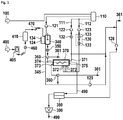
- PET-flakes are supplied by PET-flakes supply 400.
- the PET-flakes are typically provided in so called bigbags and thus unpacked as indicated by Symbol 405.
- the PET-flakes may pass an optional separator 460 for removing foreign material or PET-flakes with a size out of a given specification and stored in a PET-flakes reservoir 410.
- the PET-flakes reservoir 410 is a PET-flakes source for the pre-processing PET-flakes.
- Other bulk transport means can as well be used for providing the PET-flakes.
- Required is only a preferable continuous PET-flakes stream to the pre-treatment vessel 340.
- PET-flakes from a PET-flakes source are supplied to a pre-treatment vessel 340.
- the PET-flakes are immersed in EG.
- EG is preferably continuously provided from an EG-source, in this case an EG-reservoir 110.
- the EG is heated to a pre-treatment temperature T pre of typically 150°C (preferred: T g ⁇ T pre ⁇ T soft ).
- T pre typically 150°C
- EG is pumped from the pre-treatment vessel 340 by pump 124, fed to a heater 134 and fed back to the pre-treatment vessel 340.
- Other possibilities for obtaining the required temperature are as well suitable, for example an electrical pre-treatment vessel heating.
- EG is preferably continuously removed from the pre-treatment vessel, e.g. via line 345 and may be provided to an EG treatment device, e.g. a filtration and/or rectification unit. Purified EG may be used again, e.g. by providing it to the EG reservoir 110.
- an EG treatment device e.g. a filtration and/or rectification unit.
- Purified EG may be used again, e.g. by providing it to the EG reservoir 110.
- Pre-treated PET-flakes are drained from the pre-treatment vessel and transported via a separator 360 to an extraction vessel 370. Transporting may be obtained e.g. by use of a rotary feeder 350. Most EG may be removed from the PET-flakes flow using the separator 360 and then fed to a PET-flakes inlet 374 of a conveyor 370 used as extraction vessel. For example, a screw-conveyer as shown in Fig. 2 may be used as extraction vessel 370.
- the PET-flakes are conveyed by rotation of the screw from the PET-flakes inlet 374 to a PET-flakes outlet 375.
- EG is provided in a counter-current flow (with respect to the PET-flakes flow) to the conveyor.
- EG is provided from the reservoir 110 and may be split on two lines: In a first line 111 the EG is heated using a first heater 132 and fed as liquid EG to the downstream end of the conveyor.
- the temperature T l of the liquid EG provided to the extraction vessel should be adjusted to the extraction temperature T ext ,i.e. to:
- Organic colorants are extracted from the PET-flakes in the conveyor 370 by contacting the PET-flakes with a counter-current EG flow.
- the PET-flakes are preferably at least almost colourless when leaving the conveyor 370 via the PET-flakes outlet 375.
- the PET-flakes are not only at least almost colourless but as well brittle after passing the conveyor 370.
- EG leaving the conveyor via the PET-flakes outlet 375 can be separated using a strainer 380.
- PET-flakes from the outlet 375 can be further processed, e.g. by milling.
- the colourless brittle PET-flakes (line 490) can be subjected to depolymerisation, e.g. by methanolysis as indicated by arrow 499.
- Fig. 2 shows a simplified screw-conveyor 500 for pre-processing PET-flakes, in particular for extracting organic colorants from PET-flakes.
- the screw conveyor is a possible extraction vessel for extracting organic colorants from PET-flakes while simultaneously obtaining an embrittlement of the PET-flake, as referred to as step 2.
- the screw-conveyor as shown in Fig. 2 can be used as conveyor 370 in the scheme of Fig. 1 .
- the screw-conveyor 500 has a tubular screw housing 510, the latter housing a conveyor screw 520, briefly referred to as screw 520.
- the screw 520 is preferably motor driven.
- the longitudinal axis 515 of the screw 520 and accordingly as well of the screw housing 510 is sloped.
- the screw housing 510 has a PET-flakes inlet 374, being connected to a down pipe 511 for feeding PET-flakes to the PET-flakes inlet 374.
- the down pipe 511 is optional.
- the screw 520 conveys the PET-flakes to a PET-flakes outlet 375 at the upper end of the screw housing 510.
- a further optional down pipe 519 is attached to the PET-flakes outlet.
- the screw housing 510 has nozzles 530 as EG inlets 372 for injecting vaporous EG into the screw housing and thereby heating the PET-flakes to a temperature slightly below the boiling temperature of EG. The vaporous EG thus condenses inside the screw housing.
- the condensed, i.e. liquid, EG flows downwards through the voids in the PET-flakes bulk to an EG outlet 373.
- the EG is removed from the screw-conveyor.
- liquid EG may as well be injected into the screw housing 510 for example via EG inlet 371.
- the temperature in the conveyor can thus be adjusted by adjusting the amount of EG vapour provided to the extraction vessel.
- the screw conveyor may have an additional shell for heat transfer by a heat transfer medium and/or other heating means like an electrical heater.
Landscapes
- Chemical & Material Sciences (AREA)
- Life Sciences & Earth Sciences (AREA)
- Sustainable Development (AREA)
- Health & Medical Sciences (AREA)
- Chemical Kinetics & Catalysis (AREA)
- Medicinal Chemistry (AREA)
- Polymers & Plastics (AREA)
- Organic Chemistry (AREA)
- Separation, Recovery Or Treatment Of Waste Materials Containing Plastics (AREA)
- Polyesters Or Polycarbonates (AREA)
- Extraction Or Liquid Replacement (AREA)
Priority Applications (6)
| Application Number | Priority Date | Filing Date | Title |
|---|---|---|---|
| EP13171754.8A EP2784110B1 (en) | 2013-03-26 | 2013-06-12 | Method and apparatus for colour removal from shredded pet-flakes |
| JP2016504656A JP6214754B2 (ja) | 2013-03-26 | 2014-03-26 | Petフレーク(破砕pet)を脱色するための方法及び装置 |
| CN201480018097.7A CN105051097A (zh) | 2013-03-26 | 2014-03-26 | 从pet碎片(破碎的pet)脱色的方法和装置 |
| PCT/EP2014/056053 WO2014154745A1 (en) | 2013-03-26 | 2014-03-26 | Method and apparatus for colour removal from pet-flake (shredded pet) |
| KR1020157030844A KR101812198B1 (ko) | 2013-03-26 | 2014-03-26 | Pet-플레이크(세절된 pet)로부터 색을 제거하기 위한 방법 및 장치 |
| US14/862,584 US9890261B2 (en) | 2013-03-26 | 2015-09-23 | Method and apparatus for color removal from PET-flake (shredded PET) |
Applications Claiming Priority (2)
| Application Number | Priority Date | Filing Date | Title |
|---|---|---|---|
| EP13161194 | 2013-03-26 | ||
| EP13171754.8A EP2784110B1 (en) | 2013-03-26 | 2013-06-12 | Method and apparatus for colour removal from shredded pet-flakes |
Publications (2)
| Publication Number | Publication Date |
|---|---|
| EP2784110A1 EP2784110A1 (en) | 2014-10-01 |
| EP2784110B1 true EP2784110B1 (en) | 2017-03-29 |
Family
ID=47997151
Family Applications (1)
| Application Number | Title | Priority Date | Filing Date |
|---|---|---|---|
| EP13171754.8A Active EP2784110B1 (en) | 2013-03-26 | 2013-06-12 | Method and apparatus for colour removal from shredded pet-flakes |
Country Status (6)
| Country | Link |
|---|---|
| US (1) | US9890261B2 (enExample) |
| EP (1) | EP2784110B1 (enExample) |
| JP (1) | JP6214754B2 (enExample) |
| KR (1) | KR101812198B1 (enExample) |
| CN (1) | CN105051097A (enExample) |
| WO (1) | WO2014154745A1 (enExample) |
Cited By (5)
| Publication number | Priority date | Publication date | Assignee | Title |
|---|---|---|---|---|
| EP4342941B1 (en) * | 2022-09-20 | 2024-07-10 | revalyu Resources GmbH | Process for recycling polyethylene terephthalate using a gradient in impurity concentration |
| EP4342942B1 (en) * | 2022-09-20 | 2024-07-10 | revalyu Resources GmbH | Process for recycling polyethylene terephthalate determined by intrinsic viscosity of polyethylene terephthalate |
| EP4342945B1 (en) * | 2022-09-20 | 2024-07-17 | revalyu Resources GmbH | Process for recycling polyethylene terephthalate using different mono-ethylene glycol levels |
| EP4342944B1 (en) * | 2022-09-20 | 2024-08-14 | revalyu Resources GmbH | Process for recycling polyethylene terephthalate using gaseous and/or liquid mono-ethylene glycol |
| US12503566B2 (en) | 2022-09-20 | 2025-12-23 | Revalyu Resources Gmbh | Process for recycling polyethylene terephthalate using porous particulated filter material |
Families Citing this family (18)
| Publication number | Priority date | Publication date | Assignee | Title |
|---|---|---|---|---|
| KR102123492B1 (ko) | 2019-10-11 | 2020-06-16 | 주식회사 제팩 | 재활용 가능한 페트용기 및 그 제조방법 |
| IT201900025039A1 (it) | 2019-12-20 | 2021-06-20 | Garbo S R L | Processo per purificare il bis(2-idrossietil)tereftalato. |
| CN115443304A (zh) * | 2020-04-13 | 2022-12-06 | 伊士曼化工公司 | 化学回收着色塑料混合物 |
| NL2026273B1 (en) | 2020-08-14 | 2022-04-13 | Ioniqa Tech B V | Depolymerization method of a waste polymer material and system therefore |
| US11814492B2 (en) * | 2020-12-02 | 2023-11-14 | International Business Machines Corporation | Polyester recycling process with pre-reaction purification |
| JP2024506323A (ja) * | 2021-02-09 | 2024-02-13 | チア-ウェン・ウ | ポリアルキレンベンゼンジカルボキシラート材料の処理方法 |
| TWI870661B (zh) * | 2021-05-25 | 2025-01-21 | 國立臺灣大學 | 聚苯二甲酸烷二醇酯材的處理方法 |
| CH718700A1 (de) * | 2021-06-02 | 2022-12-15 | Alpla Werke Alwin Lehner Gmbh & Co Kg | Recycling-Verfahren. |
| CN113561365A (zh) * | 2021-08-13 | 2021-10-29 | 晋江市闽祥机械科技有限公司 | 一种滤芯表面pet残留物高温分解装置 |
| ES2987865T3 (es) | 2022-09-20 | 2024-11-18 | Revalyu Resources Gmbh | Proceso para reciclar tereftalato de polietileno utilizando coordenadas de color específicas para el procesamiento de oligómeros |
| EP4342946B1 (en) * | 2022-09-20 | 2024-07-17 | revalyu Resources GmbH | Process for recycling polyethylene terephthalate using a washing reactor |
| ES2987874T3 (es) | 2022-09-20 | 2024-11-18 | Revalyu Resources Gmbh | Proceso para reciclar tereftalato de polietileno utilizando una materia prima seleccionada |
| EP4342937B1 (en) * | 2022-09-20 | 2024-07-17 | revalyu Resources GmbH | Process for recycling polyethylene terephthalate using a separated feedstock |
| TW202511372A (zh) | 2023-06-19 | 2025-03-16 | 德商巴地斯顏料化工廠 | 包含脫色及化學處理之用於再循環有色聚合材料之方法 |
| WO2024260976A1 (en) | 2023-06-19 | 2024-12-26 | Basf Se | Process for recycling of a colored polymeric material and extrusion product obtained therefrom |
| WO2024260972A1 (en) | 2023-06-19 | 2024-12-26 | Basf Se | Method for discoloration and/or separation of a polymeric material |
| SE546629C2 (en) * | 2023-06-30 | 2025-01-02 | Rewin Textiles AB | Process and system for mixed fabric rejuvination |
| WO2025068466A1 (en) | 2023-09-29 | 2025-04-03 | Basf Se | Method for preparing a polyester fiber from polyester recycled from a polymer blend |
Family Cites Families (7)
| Publication number | Priority date | Publication date | Assignee | Title |
|---|---|---|---|---|
| US6410607B1 (en) | 1999-02-10 | 2002-06-25 | Eastman Chemical Company | Glycolysis process for recycling of post-consumer pet |
| JP2001192492A (ja) * | 1999-11-01 | 2001-07-17 | Akio Kobayashi | 精製熱可塑性ポリエステル樹脂の製造方法 |
| JP2002327088A (ja) * | 2001-05-07 | 2002-11-15 | Akio Kobayashi | 精製熱可塑性ポリエステル樹脂の製造法 |
| CN1273524C (zh) | 2001-10-16 | 2006-09-06 | 帝人株式会社 | Pet瓶的再循环方法 |
| JP2004217871A (ja) * | 2003-01-17 | 2004-08-05 | Teijin Fibers Ltd | 染着ポリエステル繊維からの有用成分回収方法 |
| AU2006277349B2 (en) * | 2005-08-05 | 2011-08-25 | Teijin Fibers Limited | Method for recovery of valuable ingredient from dyed polyester fiber |
| JP4537288B2 (ja) * | 2005-08-08 | 2010-09-01 | 帝人ファイバー株式会社 | 染着ポリエステル繊維からの有効成分回収方法 |
-
2013
- 2013-06-12 EP EP13171754.8A patent/EP2784110B1/en active Active
-
2014
- 2014-03-26 JP JP2016504656A patent/JP6214754B2/ja not_active Expired - Fee Related
- 2014-03-26 CN CN201480018097.7A patent/CN105051097A/zh active Pending
- 2014-03-26 KR KR1020157030844A patent/KR101812198B1/ko not_active Expired - Fee Related
- 2014-03-26 WO PCT/EP2014/056053 patent/WO2014154745A1/en not_active Ceased
-
2015
- 2015-09-23 US US14/862,584 patent/US9890261B2/en active Active
Non-Patent Citations (1)
| Title |
|---|
| None * |
Cited By (5)
| Publication number | Priority date | Publication date | Assignee | Title |
|---|---|---|---|---|
| EP4342941B1 (en) * | 2022-09-20 | 2024-07-10 | revalyu Resources GmbH | Process for recycling polyethylene terephthalate using a gradient in impurity concentration |
| EP4342942B1 (en) * | 2022-09-20 | 2024-07-10 | revalyu Resources GmbH | Process for recycling polyethylene terephthalate determined by intrinsic viscosity of polyethylene terephthalate |
| EP4342945B1 (en) * | 2022-09-20 | 2024-07-17 | revalyu Resources GmbH | Process for recycling polyethylene terephthalate using different mono-ethylene glycol levels |
| EP4342944B1 (en) * | 2022-09-20 | 2024-08-14 | revalyu Resources GmbH | Process for recycling polyethylene terephthalate using gaseous and/or liquid mono-ethylene glycol |
| US12503566B2 (en) | 2022-09-20 | 2025-12-23 | Revalyu Resources Gmbh | Process for recycling polyethylene terephthalate using porous particulated filter material |
Also Published As
| Publication number | Publication date |
|---|---|
| CN105051097A (zh) | 2015-11-11 |
| US9890261B2 (en) | 2018-02-13 |
| WO2014154745A1 (en) | 2014-10-02 |
| EP2784110A1 (en) | 2014-10-01 |
| JP6214754B2 (ja) | 2017-10-18 |
| JP2016514748A (ja) | 2016-05-23 |
| US20160009893A1 (en) | 2016-01-14 |
| KR101812198B1 (ko) | 2017-12-26 |
| KR20150139880A (ko) | 2015-12-14 |
Similar Documents
| Publication | Publication Date | Title |
|---|---|---|
| EP2784110B1 (en) | Method and apparatus for colour removal from shredded pet-flakes | |
| Georgiopoulou et al. | Recycling of post-consumer multilayer Tetra Pak® packaging with the Selective Dissolution-Precipitation process | |
| TWI389941B (zh) | Self-dyed polyester fiber for recycling useful ingredients | |
| EP2419395B1 (fr) | Recyclage chimique du pla par hydrolyse | |
| KR100866819B1 (ko) | Pet 보틀의 리사이클 방법 | |
| EP3481892B1 (fr) | Procédé de dépolymérisation d'un polyester comprenant du polyéthylène téréphtalate opaque | |
| US6518322B1 (en) | Conversion of contaminated polyethylene terephthalate to decontaminated polybutylene terephthalate | |
| US11028248B2 (en) | System and process for recycling contaminated polyolefins | |
| KR20140072051A (ko) | 폴리락타이드로부터 락타이드 또는 폴리글리콜라이드로부터 글리콜라이드를 회수하는 공정 및 장치 | |
| JPH06211971A (ja) | スクラップポリエステルからの成分回収方法 | |
| EP3950799A1 (en) | Solvent-based recycling with a roll-to-roll processing step | |
| EP0808339B1 (en) | Leaching contaminants from post-consumer polyester | |
| AU2019340817A1 (en) | Method, device and use for reprocessing substantially polyalkylene terephthalate | |
| EP3418328B1 (en) | Method and system for cleaning and upgrading post-consumer and/or post-industrial polyvinylbutyral | |
| TW401434B (en) | Process for recovering a solid microporous polyester polymer from a recycle stream and products made thereby | |
| RS65781B1 (sr) | Postupak i uređaj za reciklažu otpada koji sadrži polikondenzat | |
| JP4937521B2 (ja) | ポリエステルより高純度モノマーを回収する方法及び高純度モノマー、ポリエステル | |
| JP7660133B2 (ja) | ポリマーの解重合化のための装置および方法 | |
| JP5178211B2 (ja) | ペットボトル廃棄物より色相を改善したテレフタル酸ジメチルを回収する方法 | |
| WO2016111289A1 (ja) | テレフタル酸の製造方法および再生ポリエチレンテレフタレートの製造方法 | |
| KR101552868B1 (ko) | Pet 폐기물의 화학적 재활용 방법 | |
| US12435200B2 (en) | Method for decontaminating recycled plastic | |
| WO2016098764A1 (ja) | テレフタル酸の製造方法および再生ポリエチレンテレフタレートの製造方法 | |
| CA3029472C (fr) | Procede de depolymerisation d'un polyester comprenant du polyethylene terephtalate opaque | |
| CN120518475A (zh) | 一种基于超重力提馏回收dmt的方法及装置 |
Legal Events
| Date | Code | Title | Description |
|---|---|---|---|
| 17P | Request for examination filed |
Effective date: 20140331 |
|
| AK | Designated contracting states |
Kind code of ref document: A1 Designated state(s): AL AT BE BG CH CY CZ DE DK EE ES FI FR GB GR HR HU IE IS IT LI LT LU LV MC MK MT NL NO PL PT RO RS SE SI SK SM TR |
|
| AX | Request for extension of the european patent |
Extension state: BA ME |
|
| PUAI | Public reference made under article 153(3) epc to a published international application that has entered the european phase |
Free format text: ORIGINAL CODE: 0009012 |
|
| RBV | Designated contracting states (corrected) |
Designated state(s): AL AT BE BG CH CY CZ DE DK EE ES FI FR GB GR HR HU IE IS IT LI LT LU LV MC MK MT NL NO PL PT RO RS SE SI SK SM TR |
|
| GRAP | Despatch of communication of intention to grant a patent |
Free format text: ORIGINAL CODE: EPIDOSNIGR1 |
|
| INTG | Intention to grant announced |
Effective date: 20161011 |
|
| GRAS | Grant fee paid |
Free format text: ORIGINAL CODE: EPIDOSNIGR3 |
|
| GRAA | (expected) grant |
Free format text: ORIGINAL CODE: 0009210 |
|
| AK | Designated contracting states |
Kind code of ref document: B1 Designated state(s): AL AT BE BG CH CY CZ DE DK EE ES FI FR GB GR HR HU IE IS IT LI LT LU LV MC MK MT NL NO PL PT RO RS SE SI SK SM TR |
|
| REG | Reference to a national code |
Ref country code: GB Ref legal event code: FG4D |
|
| REG | Reference to a national code |
Ref country code: CH Ref legal event code: EP |
|
| REG | Reference to a national code |
Ref country code: AT Ref legal event code: REF Ref document number: 879718 Country of ref document: AT Kind code of ref document: T Effective date: 20170415 |
|
| REG | Reference to a national code |
Ref country code: IE Ref legal event code: FG4D |
|
| REG | Reference to a national code |
Ref country code: DE Ref legal event code: R096 Ref document number: 602013019085 Country of ref document: DE |
|
| REG | Reference to a national code |
Ref country code: FR Ref legal event code: PLFP Year of fee payment: 5 |
|
| REG | Reference to a national code |
Ref country code: NL Ref legal event code: FP |
|
| PG25 | Lapsed in a contracting state [announced via postgrant information from national office to epo] |
Ref country code: FI Free format text: LAPSE BECAUSE OF FAILURE TO SUBMIT A TRANSLATION OF THE DESCRIPTION OR TO PAY THE FEE WITHIN THE PRESCRIBED TIME-LIMIT Effective date: 20170329 Ref country code: NO Free format text: LAPSE BECAUSE OF FAILURE TO SUBMIT A TRANSLATION OF THE DESCRIPTION OR TO PAY THE FEE WITHIN THE PRESCRIBED TIME-LIMIT Effective date: 20170629 Ref country code: LT Free format text: LAPSE BECAUSE OF FAILURE TO SUBMIT A TRANSLATION OF THE DESCRIPTION OR TO PAY THE FEE WITHIN THE PRESCRIBED TIME-LIMIT Effective date: 20170329 Ref country code: GR Free format text: LAPSE BECAUSE OF FAILURE TO SUBMIT A TRANSLATION OF THE DESCRIPTION OR TO PAY THE FEE WITHIN THE PRESCRIBED TIME-LIMIT Effective date: 20170630 Ref country code: HR Free format text: LAPSE BECAUSE OF FAILURE TO SUBMIT A TRANSLATION OF THE DESCRIPTION OR TO PAY THE FEE WITHIN THE PRESCRIBED TIME-LIMIT Effective date: 20170329 |
|
| REG | Reference to a national code |
Ref country code: AT Ref legal event code: MK05 Ref document number: 879718 Country of ref document: AT Kind code of ref document: T Effective date: 20170329 |
|
| PG25 | Lapsed in a contracting state [announced via postgrant information from national office to epo] |
Ref country code: LV Free format text: LAPSE BECAUSE OF FAILURE TO SUBMIT A TRANSLATION OF THE DESCRIPTION OR TO PAY THE FEE WITHIN THE PRESCRIBED TIME-LIMIT Effective date: 20170329 Ref country code: BG Free format text: LAPSE BECAUSE OF FAILURE TO SUBMIT A TRANSLATION OF THE DESCRIPTION OR TO PAY THE FEE WITHIN THE PRESCRIBED TIME-LIMIT Effective date: 20170629 Ref country code: RS Free format text: LAPSE BECAUSE OF FAILURE TO SUBMIT A TRANSLATION OF THE DESCRIPTION OR TO PAY THE FEE WITHIN THE PRESCRIBED TIME-LIMIT Effective date: 20170329 Ref country code: SE Free format text: LAPSE BECAUSE OF FAILURE TO SUBMIT A TRANSLATION OF THE DESCRIPTION OR TO PAY THE FEE WITHIN THE PRESCRIBED TIME-LIMIT Effective date: 20170329 |
|
| PG25 | Lapsed in a contracting state [announced via postgrant information from national office to epo] |
Ref country code: ES Free format text: LAPSE BECAUSE OF FAILURE TO SUBMIT A TRANSLATION OF THE DESCRIPTION OR TO PAY THE FEE WITHIN THE PRESCRIBED TIME-LIMIT Effective date: 20170329 Ref country code: AT Free format text: LAPSE BECAUSE OF FAILURE TO SUBMIT A TRANSLATION OF THE DESCRIPTION OR TO PAY THE FEE WITHIN THE PRESCRIBED TIME-LIMIT Effective date: 20170329 Ref country code: SK Free format text: LAPSE BECAUSE OF FAILURE TO SUBMIT A TRANSLATION OF THE DESCRIPTION OR TO PAY THE FEE WITHIN THE PRESCRIBED TIME-LIMIT Effective date: 20170329 Ref country code: EE Free format text: LAPSE BECAUSE OF FAILURE TO SUBMIT A TRANSLATION OF THE DESCRIPTION OR TO PAY THE FEE WITHIN THE PRESCRIBED TIME-LIMIT Effective date: 20170329 Ref country code: CZ Free format text: LAPSE BECAUSE OF FAILURE TO SUBMIT A TRANSLATION OF THE DESCRIPTION OR TO PAY THE FEE WITHIN THE PRESCRIBED TIME-LIMIT Effective date: 20170329 Ref country code: RO Free format text: LAPSE BECAUSE OF FAILURE TO SUBMIT A TRANSLATION OF THE DESCRIPTION OR TO PAY THE FEE WITHIN THE PRESCRIBED TIME-LIMIT Effective date: 20170329 |
|
| PG25 | Lapsed in a contracting state [announced via postgrant information from national office to epo] |
Ref country code: IS Free format text: LAPSE BECAUSE OF FAILURE TO SUBMIT A TRANSLATION OF THE DESCRIPTION OR TO PAY THE FEE WITHIN THE PRESCRIBED TIME-LIMIT Effective date: 20170729 Ref country code: SM Free format text: LAPSE BECAUSE OF FAILURE TO SUBMIT A TRANSLATION OF THE DESCRIPTION OR TO PAY THE FEE WITHIN THE PRESCRIBED TIME-LIMIT Effective date: 20170329 Ref country code: PT Free format text: LAPSE BECAUSE OF FAILURE TO SUBMIT A TRANSLATION OF THE DESCRIPTION OR TO PAY THE FEE WITHIN THE PRESCRIBED TIME-LIMIT Effective date: 20170731 Ref country code: PL Free format text: LAPSE BECAUSE OF FAILURE TO SUBMIT A TRANSLATION OF THE DESCRIPTION OR TO PAY THE FEE WITHIN THE PRESCRIBED TIME-LIMIT Effective date: 20170329 |
|
| REG | Reference to a national code |
Ref country code: DE Ref legal event code: R097 Ref document number: 602013019085 Country of ref document: DE |
|
| PG25 | Lapsed in a contracting state [announced via postgrant information from national office to epo] |
Ref country code: MC Free format text: LAPSE BECAUSE OF FAILURE TO SUBMIT A TRANSLATION OF THE DESCRIPTION OR TO PAY THE FEE WITHIN THE PRESCRIBED TIME-LIMIT Effective date: 20170329 Ref country code: DK Free format text: LAPSE BECAUSE OF FAILURE TO SUBMIT A TRANSLATION OF THE DESCRIPTION OR TO PAY THE FEE WITHIN THE PRESCRIBED TIME-LIMIT Effective date: 20170329 |
|
| REG | Reference to a national code |
Ref country code: CH Ref legal event code: PL |
|
| PLBE | No opposition filed within time limit |
Free format text: ORIGINAL CODE: 0009261 |
|
| STAA | Information on the status of an ep patent application or granted ep patent |
Free format text: STATUS: NO OPPOSITION FILED WITHIN TIME LIMIT |
|
| GBPC | Gb: european patent ceased through non-payment of renewal fee |
Effective date: 20170629 |
|
| 26N | No opposition filed |
Effective date: 20180103 |
|
| PG25 | Lapsed in a contracting state [announced via postgrant information from national office to epo] |
Ref country code: CH Free format text: LAPSE BECAUSE OF NON-PAYMENT OF DUE FEES Effective date: 20170630 Ref country code: LU Free format text: LAPSE BECAUSE OF NON-PAYMENT OF DUE FEES Effective date: 20170612 Ref country code: GB Free format text: LAPSE BECAUSE OF NON-PAYMENT OF DUE FEES Effective date: 20170629 Ref country code: LI Free format text: LAPSE BECAUSE OF NON-PAYMENT OF DUE FEES Effective date: 20170630 |
|
| PG25 | Lapsed in a contracting state [announced via postgrant information from national office to epo] |
Ref country code: SI Free format text: LAPSE BECAUSE OF FAILURE TO SUBMIT A TRANSLATION OF THE DESCRIPTION OR TO PAY THE FEE WITHIN THE PRESCRIBED TIME-LIMIT Effective date: 20170329 |
|
| REG | Reference to a national code |
Ref country code: BE Ref legal event code: MM Effective date: 20170630 |
|
| REG | Reference to a national code |
Ref country code: FR Ref legal event code: PLFP Year of fee payment: 6 |
|
| PG25 | Lapsed in a contracting state [announced via postgrant information from national office to epo] |
Ref country code: BE Free format text: LAPSE BECAUSE OF NON-PAYMENT OF DUE FEES Effective date: 20170630 |
|
| PG25 | Lapsed in a contracting state [announced via postgrant information from national office to epo] |
Ref country code: MT Free format text: LAPSE BECAUSE OF NON-PAYMENT OF DUE FEES Effective date: 20170612 |
|
| PGFP | Annual fee paid to national office [announced via postgrant information from national office to epo] |
Ref country code: GB Payment date: 20180403 Year of fee payment: 7 |
|
| PG25 | Lapsed in a contracting state [announced via postgrant information from national office to epo] |
Ref country code: HU Free format text: LAPSE BECAUSE OF FAILURE TO SUBMIT A TRANSLATION OF THE DESCRIPTION OR TO PAY THE FEE WITHIN THE PRESCRIBED TIME-LIMIT; INVALID AB INITIO Effective date: 20130612 |
|
| PG25 | Lapsed in a contracting state [announced via postgrant information from national office to epo] |
Ref country code: CY Free format text: LAPSE BECAUSE OF FAILURE TO SUBMIT A TRANSLATION OF THE DESCRIPTION OR TO PAY THE FEE WITHIN THE PRESCRIBED TIME-LIMIT Effective date: 20170329 |
|
| PG25 | Lapsed in a contracting state [announced via postgrant information from national office to epo] |
Ref country code: MK Free format text: LAPSE BECAUSE OF FAILURE TO SUBMIT A TRANSLATION OF THE DESCRIPTION OR TO PAY THE FEE WITHIN THE PRESCRIBED TIME-LIMIT Effective date: 20170329 |
|
| PG25 | Lapsed in a contracting state [announced via postgrant information from national office to epo] |
Ref country code: IE Free format text: LAPSE BECAUSE OF NON-PAYMENT OF DUE FEES Effective date: 20190612 |
|
| PG25 | Lapsed in a contracting state [announced via postgrant information from national office to epo] |
Ref country code: AL Free format text: LAPSE BECAUSE OF FAILURE TO SUBMIT A TRANSLATION OF THE DESCRIPTION OR TO PAY THE FEE WITHIN THE PRESCRIBED TIME-LIMIT Effective date: 20170329 |
|
| PGFP | Annual fee paid to national office [announced via postgrant information from national office to epo] |
Ref country code: NL Payment date: 20200622 Year of fee payment: 8 |
|
| PGFP | Annual fee paid to national office [announced via postgrant information from national office to epo] |
Ref country code: IT Payment date: 20200630 Year of fee payment: 8 |
|
| PGFP | Annual fee paid to national office [announced via postgrant information from national office to epo] |
Ref country code: FR Payment date: 20210621 Year of fee payment: 9 |
|
| PGFP | Annual fee paid to national office [announced via postgrant information from national office to epo] |
Ref country code: TR Payment date: 20210607 Year of fee payment: 9 |
|
| REG | Reference to a national code |
Ref country code: NL Ref legal event code: MM Effective date: 20210701 |
|
| PG25 | Lapsed in a contracting state [announced via postgrant information from national office to epo] |
Ref country code: NL Free format text: LAPSE BECAUSE OF NON-PAYMENT OF DUE FEES Effective date: 20210701 |
|
| PG25 | Lapsed in a contracting state [announced via postgrant information from national office to epo] |
Ref country code: IT Free format text: LAPSE BECAUSE OF NON-PAYMENT OF DUE FEES Effective date: 20210612 |
|
| PGFP | Annual fee paid to national office [announced via postgrant information from national office to epo] |
Ref country code: DE Payment date: 20220621 Year of fee payment: 10 |
|
| PG25 | Lapsed in a contracting state [announced via postgrant information from national office to epo] |
Ref country code: FR Free format text: LAPSE BECAUSE OF NON-PAYMENT OF DUE FEES Effective date: 20220630 |
|
| REG | Reference to a national code |
Ref country code: DE Ref legal event code: R119 Ref document number: 602013019085 Country of ref document: DE |
|
| PG25 | Lapsed in a contracting state [announced via postgrant information from national office to epo] |
Ref country code: DE Free format text: LAPSE BECAUSE OF NON-PAYMENT OF DUE FEES Effective date: 20240103 |