EP2769740B1 - Abschirmstruktur für eine elektronenstrahlsterilisationsausrüstung - Google Patents
Abschirmstruktur für eine elektronenstrahlsterilisationsausrüstung Download PDFInfo
- Publication number
- EP2769740B1 EP2769740B1 EP12841622.9A EP12841622A EP2769740B1 EP 2769740 B1 EP2769740 B1 EP 2769740B1 EP 12841622 A EP12841622 A EP 12841622A EP 2769740 B1 EP2769740 B1 EP 2769740B1
- Authority
- EP
- European Patent Office
- Prior art keywords
- shield
- zone
- container
- trap
- chamber
- Prior art date
- Legal status (The legal status is an assumption and is not a legal conclusion. Google has not performed a legal analysis and makes no representation as to the accuracy of the status listed.)
- Not-in-force
Links
- 238000010894 electron beam technology Methods 0.000 title claims description 160
- 230000001954 sterilising effect Effects 0.000 title claims description 98
- 238000004659 sterilization and disinfection Methods 0.000 title claims description 97
- 238000011144 upstream manufacturing Methods 0.000 claims description 33
- 210000003739 neck Anatomy 0.000 description 17
- 230000005855 radiation Effects 0.000 description 13
- 238000012986 modification Methods 0.000 description 9
- 230000004048 modification Effects 0.000 description 9
- 230000000694 effects Effects 0.000 description 7
- 230000002238 attenuated effect Effects 0.000 description 6
- 239000000356 contaminant Substances 0.000 description 4
- 238000003780 insertion Methods 0.000 description 4
- 230000037431 insertion Effects 0.000 description 4
- 230000000903 blocking effect Effects 0.000 description 2
- 230000002411 adverse Effects 0.000 description 1
- 238000013459 approach Methods 0.000 description 1
- 230000001413 cellular effect Effects 0.000 description 1
- 239000003638 chemical reducing agent Substances 0.000 description 1
- 238000011109 contamination Methods 0.000 description 1
- 230000007423 decrease Effects 0.000 description 1
- 238000009792 diffusion process Methods 0.000 description 1
- 235000013305 food Nutrition 0.000 description 1
- 238000009434 installation Methods 0.000 description 1
- 239000007788 liquid Substances 0.000 description 1
- 244000005700 microbiome Species 0.000 description 1
- 230000000149 penetrating effect Effects 0.000 description 1
- 238000005096 rolling process Methods 0.000 description 1
- 239000000126 substance Substances 0.000 description 1
- 230000001360 synchronised effect Effects 0.000 description 1
Images




Classifications
-
- B—PERFORMING OPERATIONS; TRANSPORTING
- B65—CONVEYING; PACKING; STORING; HANDLING THIN OR FILAMENTARY MATERIAL
- B65B—MACHINES, APPARATUS OR DEVICES FOR, OR METHODS OF, PACKAGING ARTICLES OR MATERIALS; UNPACKING
- B65B55/00—Preserving, protecting or purifying packages or package contents in association with packaging
- B65B55/02—Sterilising, e.g. of complete packages
- B65B55/04—Sterilising wrappers or receptacles prior to, or during, packaging
- B65B55/08—Sterilising wrappers or receptacles prior to, or during, packaging by irradiation
-
- A—HUMAN NECESSITIES
- A61—MEDICAL OR VETERINARY SCIENCE; HYGIENE
- A61L—METHODS OR APPARATUS FOR STERILISING MATERIALS OR OBJECTS IN GENERAL; DISINFECTION, STERILISATION OR DEODORISATION OF AIR; CHEMICAL ASPECTS OF BANDAGES, DRESSINGS, ABSORBENT PADS OR SURGICAL ARTICLES; MATERIALS FOR BANDAGES, DRESSINGS, ABSORBENT PADS OR SURGICAL ARTICLES
- A61L2/00—Methods or apparatus for disinfecting or sterilising materials or objects other than foodstuffs or contact lenses; Accessories therefor
-
- B—PERFORMING OPERATIONS; TRANSPORTING
- B01—PHYSICAL OR CHEMICAL PROCESSES OR APPARATUS IN GENERAL
- B01J—CHEMICAL OR PHYSICAL PROCESSES, e.g. CATALYSIS OR COLLOID CHEMISTRY; THEIR RELEVANT APPARATUS
- B01J19/00—Chemical, physical or physico-chemical processes in general; Their relevant apparatus
- B01J19/08—Processes employing the direct application of electric or wave energy, or particle radiation; Apparatus therefor
- B01J19/081—Processes employing the direct application of electric or wave energy, or particle radiation; Apparatus therefor employing particle radiation or gamma-radiation
- B01J19/085—Electron beams only
-
- A—HUMAN NECESSITIES
- A61—MEDICAL OR VETERINARY SCIENCE; HYGIENE
- A61L—METHODS OR APPARATUS FOR STERILISING MATERIALS OR OBJECTS IN GENERAL; DISINFECTION, STERILISATION OR DEODORISATION OF AIR; CHEMICAL ASPECTS OF BANDAGES, DRESSINGS, ABSORBENT PADS OR SURGICAL ARTICLES; MATERIALS FOR BANDAGES, DRESSINGS, ABSORBENT PADS OR SURGICAL ARTICLES
- A61L2/00—Methods or apparatus for disinfecting or sterilising materials or objects other than foodstuffs or contact lenses; Accessories therefor
- A61L2/02—Methods or apparatus for disinfecting or sterilising materials or objects other than foodstuffs or contact lenses; Accessories therefor using physical phenomena
- A61L2/08—Radiation
- A61L2/087—Particle radiation, e.g. electron-beam, alpha or beta radiation
-
- B—PERFORMING OPERATIONS; TRANSPORTING
- B65—CONVEYING; PACKING; STORING; HANDLING THIN OR FILAMENTARY MATERIAL
- B65G—TRANSPORT OR STORAGE DEVICES, e.g. CONVEYORS FOR LOADING OR TIPPING, SHOP CONVEYOR SYSTEMS OR PNEUMATIC TUBE CONVEYORS
- B65G47/00—Article or material-handling devices associated with conveyors; Methods employing such devices
- B65G47/74—Feeding, transfer, or discharging devices of particular kinds or types
- B65G47/84—Star-shaped wheels or devices having endless travelling belts or chains, the wheels or devices being equipped with article-engaging elements
- B65G47/846—Star-shaped wheels or wheels equipped with article-engaging elements
- B65G47/847—Star-shaped wheels or wheels equipped with article-engaging elements the article-engaging elements being grippers
Definitions
- the present invention relates to a shield structure for electron beam sterilization equipment that sterilizes containers and instruments for foods, chemical solutions, and so on by electron radiation.
- an electron beam irradiation nozzle is inserted into the inlet of a container to sterilize the inner surface of the container, electron beams are emitted from the entire periphery of the electron beam irradiation nozzle.
- a revolving transport device that is a rotary device stored in a shield chamber is used to continuously sterilize the container at a high speed, the container is sterilized with the electron beam irradiation nozzle inserted into the inlet, the electron beam irradiation nozzle being revolved with the container.
- an electron beam generator cannot turn on or off electron radiation because a high voltage is supplied, leading to continuous radiation.
- electron beams (X-rays) leaking from the entrance or exit of the container formed on the shield chamber may be seriously shielded or attenuated.
- a shield structure for electron beam sterilization known from US 2011/012030 A1 comprises a plurality of shield chambers.
- Each shield chamber contains one of a plurality of circular paths connected in series, wherein containers are transported along with the circular paths.
- a sterilization zone has a container entrance where an entrance trap zone for attenuating electron beams is connected and a container exit where an exit trap zone for attenuating electron beams is connected. At least one of the entrance trap zone and the exit trap zone includes more than two of the plurality of circular paths connected in series. Two or more of the plurality of shield chambers containing the respective two or more of the plurality of circular paths.
- a sterilization zone internal circumferential shield composed of a metallic shield is mounted along an internal circumference of each of the circular paths in the sterilisation zone.
- a trap zone internal circumferential shield composed of a metallic shield is mounted on two or more of the plurality of the circular paths in the entrance trap zone and/or the exit trap zone along the internal circumference of the circular path.
- the problem to be solved is how to modify or adapt the known shield structure in order to attenuate the leakage of X-rays.
- the solution of the problem is a shield structure for electron beam sterilization which comprises:
- the invention discloses a shield structure where a circular path comprises a metallic shield mounted along an internal circumference of the circular path to form an internal circumferential shield. Furthermore the new structure where the internal circumference of a downstream circular path with a greater diameter than another upstream internal circumference path is closer to the electron beam emitting source allows a better shielding of the radiations caused by the electron beam emitting source.
- the second aspect of the present invention is the configuration according to the first aspect, wherein the internal circumferential shield (S5) of the first downstream circular path (L5) has an outer diameter (D5) 1.3 to 2.5 times larger than the outer diameter (D4) of the internal circumferential shield (S4) of the first upstream circular path (L4) in the exit trap zone (Z4).
- the third aspect of the present invention is the configuration according to the first aspect, wherein the internal circumferential shield (ST2) of the second downstream circular path (LT2) has an outer diameter (DT2) 1.3 to 2.5 times larger than the outer diameter (D1) of the internal circumferential shield (S1) of the second upstream circular path (L1) in the entrance trap zone.
- the fourth aspect of the present invention is the configuration according to the first aspect, wherein in the exit trap zone (Z4), a first shield chamber (R4) containing a most upstream circular path (L4) has a first attenuating chamber (R4b) opened to the container exit (P3-4) of the inner-surface sterilization zone, the first attenuating chamber (R4b) being formed by dividing the first shield chamber (R4) by a first trap wall (T4) protruding forward to the container exit (P3-4) from a shield wall of the first shield chamber opposed to the container exit (P3-4).
- the fifth aspect of the present invention is the configuration according to the first aspect, wherein in the outer-surface sterilization zone (Z2), a second shield chamber (R2) containing a most downstream circular path (L2) has a second attenuating chamber (R2b) opened to the container entrance (P2-3) of the inner-surface sterilization zone, the second attenuating chamber (R2b) being formed by dividing the second shield chamber (R2) by a second trap wall (T2) protruding forward to the container entrance (P2-3) from a shield wall of the second shield chamber opposed to the container entrance (P2-3).
- the internal circumferential shield is mounted along the internal circumference of the revolving channel in the sterilization zone.
- the number of reflections of electron beams is increased between the shield chambers and the internal circumferential shields, achieving effective attenuation.
- electron beams (X-rays) leaking from the container entrance and the container exit of the shield chamber in the sterilization zone can be effectively blocked by the internal circumferential shields disposed in a trap zone. This can effectively attenuate electron beams (X-rays) leaking upstream and downstream.
- the revolving channel In condition (I), a sufficient transport distance and time is necessary for the insertion of the electron beam irradiation nozzle and radiation.
- the revolving channel needs to be increased in length and diameter.
- the diameter of the revolving channel in the inner-surface sterilization zone is limited.
- the revolving channel cannot have a large diameter in the trap zone. This necessarily tends to increase an electron beam (X-ray) dose leaking from the container exit of the inner-surface sterilization zone to the shield chamber upstream of the trap zone.
- the outer diameter of the internal circumferential shield of the downstream revolving channel is set larger than that of the internal circumferential shield near the container exit. This can effectively block and reduce a dose of radiation leaking downstream from the upstream shield chamber.
- the internal circumferential shield of the revolving channel downstream of the entrance trap zone connected to the container entrance of the outer-surface sterilization zone has a larger outer diameter than the internal circumferential shield of the revolving channel upstream of the outer-surface sterilization zone. This can effectively block and reduce an electron beam (X-ray) dose leaking from the inner-surface sterilization zone and the outer-surface sterilization zone through the container entrance.
- X-ray electron beam
- the outer diameter of the internal circumferential shield of the downstream revolving channel is 1.3 to 2.5 times larger than that of the internal circumferential shield near the container exit.
- the internal circumferential shield of the revolving channel downstream of the entrance trap zone connected to the container entrance of the outer-surface sterilization zone has an outer diameter 1.3 to 2.5 times larger than the outer diameter of the internal circumferential shield of the revolving channel upstream of the outer-surface sterilization zone.
- This can obtain the enhanced effect of blocking and reducing an electron beam (X-ray) dose leaking from the inner-surface sterilization zone and the outer-surface sterilization zone through the container entrance without excessively increasing the size of a facility.
- X-ray electron beam
- the trap wall is provided in the shield chamber upstream of the exit trap zone to form the attenuating chamber.
- electron beams (X-rays) leaking from the container exit of the inner-surface sterilization zone can be guided into the attenuating chamber by the trap wall. This can effectively reflect and attenuate electron beams (X-rays) in the attenuating chamber.
- the trap wall in the outer-surface sterilization zone, is formed in the shield chamber facing the container entrance, forming the attenuating chamber.
- electron beams (X-rays) leaking from the container entrance of the inner-surface sterilization zone can be introduced into the attenuating chamber by the trap wall and can be effectively reflected and attenuated in the attenuating chamber.
- electron beam sterilization equipment includes an entrance trap zone Z1, an outer-surface sterilization zone Z2, an inner-surface sterilization zone Z3, and an exit trap zone Z4.
- the entrance trap zone Z1 includes a U-shaped feed channel LU.
- the outer-surface sterilization zone Z2, the inner-surface sterilization zone Z3, and the exit trap zone Z4 are configured such that first to sixth revolving channels L1 to L6 for transporting containers B by means of first to sixth revolving conveyors M1 to M6 are connected in series.
- a reject zone ZR is provided to transport insufficiently sterilized ones of the containers B along a reject revolving channel LR formed by a reject revolving conveyor MR and eject the transported containers B from a reject ejection port PR.
- the first and second revolving conveyors M1 and M2 forming the first and second circular paths L1 and L2 are connected in series and are respectively stored in first and second shield chambers R1 and R2 composed of metallic shields.
- the first shield chamber R1 contains a first electron beam irradiator E1 that sterilizes one outer half surface of the container B by electron beam irradiation when the container B held by the first revolving conveyor M1 via a neck n is transported along the first revolving channel L1.
- the second shield chamber R2 contains a second electron beam irradiator E2 that sterilizes the other outer half surface of the container B by electron beam irradiation when the container B held by the second revolving conveyor M2 via the neck n is transported along the second revolving channel L2.
- a third shield chamber R3 composed of a shield contains the third revolving conveyor M3 forming the third revolving channel L3.
- the third revolving conveyor M3 includes a plurality of container lifting/holding devices 26 spaced at regular intervals.
- the container lifting/holding devices 26 hold the containers B via the necks n and sequentially lift the transported containers B to insert electron beam irradiation nozzle En into the inlets of the containers B.
- third electron beam irradiators E3 that emit electron beams from the electron beam irradiation nozzles En hung is disposed on the container lifting/holding devices 26 respectively.
- the fourth to sixth revolving conveyors M4 to M6 forming the fourth to sixth circular paths L4 to L6 are connected in series in the exit trap zone Z4.
- the fourth to sixth revolving conveyors M4 to M6 are respectively stored in fourth to sixth shield chambers R4 to R6 composed of shields .
- the fourth to sixth shield chambers R4 to R6 attenuate electron beams leaking from a 3-4 connecting opening (container exit) P3-4 and X-rays [hereinafter, will be called electron beams (X-rays)] generated by reflecting or diffracting electron beams to the metallic shields.
- the containers B are held by the fourth to sixth revolving conveyors M4 to M6 via the necks n and are transported along the fourth to sixth circular paths L4 to L6.
- the sixth revolving channel L6 is connected to an intermediate revolving channel L8 formed by an intermediate revolving conveyor M8.
- the intermediate revolving channel L8 is connected to a feeder (not shown) so as to fill the sterilized containers B with a liquid.
- the reject zone ZR contains the reject revolving conveyor MR forming the reject revolving channel LR connected to the fifth revolving channel L5.
- the reject revolving conveyor MR is stored in a reject shield chamber RR surrounded by a shield.
- the electron beam sterilization equipment is installed in a clean room 22 set on a base frame 21 via a structural frame.
- the first and second revolving conveyors M1 and M2 of the outer-surface sterilization zone Z2, the fourth to sixth revolving conveyors M4 to M6 of the exit trap zone Z4, and the reject revolving conveyor MR of the reject zone ZR are operated in a synchronized manner with respect to the third revolving conveyor M3 of the inner-surface sterilization zone Z3.
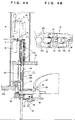
- the third revolving conveyor M3 is set up by a main shaft 23b that is raised on a bottom frame 21D of the base frame 21 so as to penetrate a base top plate 21U.
- a support table 24 is supported on an outer cylindrical shaft 23a rotatably supported on the main shaft 23b, and a swiveling table 25 is supported under the outer cylindrical shaft 23a.
- the tables are rotated at a predetermined speed along a transport direction by a revolving transport drive unit 49 shown in FIG. 5 .
- the support table 24 has a plurality of third electron beam generators E3 and electron beam irradiation nozzles En connected in a hanging position to the third electron beam generators E3.
- Reference character SM3 denotes a third outer shield that shields the third electron beam generators E3 on the outer periphery and top surface of the support table 24.
- the container lifting/holding devices 26 opposed to the electron beam irradiation nozzles En are disposed at equal intervals in the circumferential direction on the outer periphery of the swiveling table 25.
- the container lifting/holding devices 26 hold the necks n to move up or down the containers B.
- an actuator shaft 28 composed of a double cylinder penetrates the swiveling table 25.
- the actuator shaft 28 includes a hoisting/lowering outer shaft 28a that is disposed on the swiveling table 25 via a thrust bearing 27 so as to move up and down, and an opening/closing inner shaft 28b that is fit so as to rotate about an axis in the outer shaft 28a.
- a clamp 31 that can hold the container B via the neck n is provided on the upper end of the outer shaft 28a, and a lifting cam mechanism 37 that moves up and down the clamp 31 is provided on the lower end of the outer shaft 28a.
- the clamp 31 provided on the upper end of the outer shaft 28a is supported on a base plate 32 fixed on the outer shaft 28a so as to open and close a pair of clamp arms 35a and 35b via a pair of support pins 33.
- the clamp arm 35b is operated in synchronization with the clamp arm 35a via an interlock pin 34 fixed to the clamp arm 35a via a plate member, and the clamp arms 35a and 35b are urged in a holding direction by a coil spring 30 for closing and urging.
- an opening/closing output cam 36 pivoted by the inner shaft 28b so as to open and close the clamp arm 35a is provided between the proximal ends of the clamp arms 35a and 35b.
- the lifting cam mechanism 37 provided on the lower end of the outer shaft 28a has a lifting cam follower 38 that is supported via a lifting arm so as to lift the clamp 31 by rolling the cam surface of the lifting cam 40 mounted on the base frame 21.
- Reference numeral 41 denotes a lifting restraint spring that urges the lifting cam follower 38 to the cam surface of the lifting cam 40.
- An opening/closing output cam 36 is attached to the upper end of the inner shaft 28b and an opening/closing input cam mechanism 42 for opening and closing the clamp 31 is provided on the lower end of the inner shaft 28b.
- the opening/closing input cam mechanism 42 has an opening/closing input cam follower 44 that rolls the cam surface of an opening/closing input cam 43 via an opening/closing input arm 45 on the inner shaft 28b.
- Reference numeral 46 denotes an opening/closing input restraint spring that urges the opening/closing input cam follower 44 to the cam surface of the opening/closing input cam 43.
- the lifting cam 40 is disposed between a 2-3 joint J2-3 and a 3-4 joint J3-4 of the third revolving channel L3.
- the opening/closing input cam 43 is disposed from the upstream side of the 3-4 joint J3-4 to the downstream side of the 2-3 joint J2-3.
- the container B is transferred via the neck n to the clamp arms 35a and 35b opened by an action of the opening/closing input cam 43 at the 2-3 joint J2-3 during the rotations of the swiveling table 25, and then the container B is transported with the neck n held by the closed clamp arms 35a and 35b. After that, the container B is lifted via the clamp 31 by an action of the lifting cam 40 so as to fit the electron beam irradiation nozzle En to the inlet of the container B. Moreover, the inner surface of the container B is sterilized by electron beams emitted from the electron beam irradiation nozzle En.
- the container B is moved down via the clamp arms 35a and 35b by an action of the lifting cam 40 so as to separate the electron beam irradiation nozzle En from the inlet.
- the clamp arms 35a and 35b are opened by an action of the opening/closing input cam 43 so as to transfer the container B to the fourth revolving channel L4 with the neck n transferred to the fourth revolving conveyor M4.
- a third internal circumferential shield S3 is disposed between the swiveling table 25 and the support table 24.
- an interlock third ring gear 48 is attached to an outer wall 47 that is hung downward from the outer periphery of the swiveling table 25 and is rotatably supported on the base top plate 21U via a ring bearing.
- a conveyor drive gear 50 rotated by a revolving transport drive unit 49 via a speed reducer is engaged with the interlock third ring gear 48.
- the first and second revolving conveyors M1 and M2 are respectively installed in the first and second shield chambers R1 and R2 on the base top plate 21U.
- the first revolving conveyor M1 and the second revolving conveyor M2 include a first swiveling table 52 and a second swiveling table 72 fixed on the respective upper ends of a first rotating shaft 51 and a second rotating shaft 71 that rotatably penetrate the base top plate 21U via bearings.
- a second interlock gear 73 engaged with the interlock third ring gear 48 of the third revolving conveyor M3 is attached to the lower end of the second rotating shaft 71
- a first interlock gear 53 engaged with the second interlock gear 73 is attached to the lower end of the first rotating shaft 51.
- the first interlock gear 53 and the second interlock gear 73 are rotated while being interlocked with the outer cylindrical shaft 23a of the third revolving conveyor M3.
- first and second container holders 54 and 74 are substantially identical in structure except for the holding position of the neck n.
- first container holder 54 will be discussed below, and the explanation of the second container holder 74 denoted by the same reference numerals is omitted.
- fourth to sixth container holders 84 and 94 in the exit trap zone Z4 and a reject container holder 114 in the reject zone ZR are substantially identical in configuration except for the holding position of the neck n, and the detailed explanation thereof is omitted.
- the first container holder 54 includes a support cylinder 55 vertically penetrating the outer periphery of the first swiveling table 52, and a support plate 56 attached to the upper end of the support cylinder 55.
- a left and right pair of clamp arms 57a and 57b is supported on the support plate 56 so as to open and close via a pair of support pins 58.
- the clamp arms 57a and 57b can be opened and closed with respect to the support pin 58.
- an interlock pin 60 attached to the one clamp arm 57a via a plate member is fit into a receiving groove on the other clamp arm 57b.
- the other clamp arm 57b can be opened and closed in synchronization with opening and closing of the one clamp arm 57a via the interlock pin 60.
- the interlock pin 60 is urged in a closing direction by a closing urging spring 59 connected between ends the clamp arms 57a and 57b.
- An opening/closing shaft 61 is rotatably supported in the support cylinder 55, an opening/closing input cam follower 62 is attached to the lower end of the opening/closing shaft 61 via a cam lever, and an opening/closing restraint spring 63 connected to the cam lever brings the opening/closing input cam follower 62 into contact with opening/closing input cams 65 attached to the outer cylinder of the first rotating shaft 51 so as to coincide with a 0-1 joint J0-1 and a 1-2 joint J1-2 that transfer the containers B.
- the rotation of the opening/closing shaft 61 can open and close the clamp arm 57a through the opening/closing output cam 64.
- First and second internal circumferential shields S1 and S2 are mounted on the respective inner peripheries of the first and second circular paths L1 and L2 on the first and second swiveling tables 52 and 72 of the first container holder 54 and the second container holder 74.
- a first electron beam irradiator E1 disposed in the first shield chamber R1 and a second electron beam irradiator E2 disposed in a second shield chamber R2 will be described below.
- the first and second revolving conveyors M1 and M2 provided on the inner circumferences of the first and second circular paths L1 and L2 do not allow the installation of an electron beam irradiator.
- two electron beam irradiators are disposed on the respective outer peripheries of the two adjacent circular paths to emit electron beams to the two outer half surfaces of the container B.
- important challenges are: A) to minimize the entry of contaminants into the outer-surface sterilization zone Z2 from the container B transported into the first shield chamber R1; B) to minimize the diffusion of contaminants to one of outer half surfaces of the container B from the other outer half surface before sterilization after the one outer half surface is sterilized, and minimize the contamination of the one sterilized outer half surface; and C) to minimize the recontamination of the container B to the inner-surface sterilization zone Z3 after the sterilization of the other outer half surface.
- the first electron beam irradiator E1 for emitting electron beams to the container B is located near the inlet of the first revolving channel L1, and sterilization on the outer surface of the container B is started with a minimum transport distance and a shortest time, thereby preventing the entry of contaminants from the container B.
- the first electron beam irradiator E1 is mounted on the first revolving channel L1 near the upstream side of the 1-2 joint J1-2 of the first revolving channel L1 and the second revolving channel L2, and the second electron beam irradiator E2 is mounted near the downstream side of the 1-2 joint J1-2 of the second revolving channel L2. This minimizes a transport distance and a time period from the sterilization of one outer half surface to the sterilization of the other outer half surface.
- L2 is configured to maximize the irradiation of electron beams (X-rays) leaking into the container B.
- the electron beams are emitted from the second electron beam irradiator E2 in a carry-in channel L2c from a sterilization position on the other outer half surface to the 2-3 joint J2-3, and are emitted from the electron beam irradiation nozzle En of the outer-surface sterilization zone Z2 and leak through a 2-3 connecting opening (container entrance) P2-3.
- the first electron beam irradiator E1 is mounted so as to emit electron beams to the container B, near the 0-1 joint J0-1 of the U-shaped feed channel LU and the first revolving channel L1 of the entrance trap zone Z1 and on the outer periphery of the first revolving channel L1 near the upstream side of the 1-2 joint J1-2.
- the second electron beam irradiator E2 is mounted on the outer periphery of the second revolving channel L2 near the downstream side of the 1-2 joint J1-2 in the second shield chamber R2.
- the direction of electron beam irradiation is set so as to emit electron beams from the second electron beam irradiator E2 to the container B on the second revolving channel L2 opposed to the second electron beam irradiator E2 and the container B on the carry-in channel L2c on the downstream side. Since the carry-in channel L2c faces the P2-3 connecting opening of the third shield chamber R3, electron beams (X-rays) leaking from the third shield chamber R3 are also emitted to the container B.
- some of electron beams emitted from the second electron beam irradiator E2 may be emitted to the container B on a carry-in channel L2b through at least one electron beam deflector EA after sterilization.
- a second chamber trap wall T2 composed of a metallic shield is protruded downstream of the second electron beam irradiator E2 toward the second revolving conveyor M2 from a shield wall R2a opposed to the 2-3 connecting opening P2-3 of the third shield chamber R3.
- the second chamber trap wall T2 forms a second attenuating chamber R2b.
- the neck n is transferred from the clamp arm 57b of the first container holder 54 to the clamp arm 57a of the second container holder 74 at the 1-2 joint J1-2.
- the clamp arm 57b of the first container holder 54 holds the neck n at a different position from the clamp arm 57a of the second container holder 74.
- the first electron beam irradiator E1 emits electron beams to one outer half surface not held by the clamp arm 57b on the neck n
- the second electron beam irradiator E2 emits electron beams to the other outer half surface not held by the clamp arm 57a on the neck n.
- the overall outer surface of the neck n can be sterilized in the outer-surface sterilization zone Z2.
- the entrance trap zone Z1 has a plurality of conveyor units 11 that form the U-shaped feed channel LU composed of two connected quarter arcs LUi and LUo in plan view, and an entrance trap shield chamber 12 shaped like a letter U in plan view so as to surround the U-shaped feed channel LU.
- the entrance trap shield chamber 12 includes a plurality of first and second entrance trap walls T0a and T0b that are composed of metallic shields for shielding electron beams (X-rays) leaking from the outer surface and the inner-surface sterilization zones Z2 and Z3, and an entrance attenuating chamber R0a.
- first and second entrance trap walls T0a and T0b that are composed of metallic shields for shielding electron beams (X-rays) leaking from the outer surface and the inner-surface sterilization zones Z2 and Z3, and an entrance attenuating chamber R0a.
- the first entrance trap wall T0a at the joint of the entrance trap shield chamber 12 and the first shield chamber R1 is protruded perpendicularly to the shield side wall of the entrance trap shield chamber 12 (in a crosswise direction) on the opposite side of the U-shaped feed channel LU from the first revolving channel L1.
- the first entrance trap wall T0a can reduce the entry of electron beams (X-rays) from the 0-1 connecting opening (container entrance) P0-1 into the entrance trap shield chamber 12 after the electron beams are emitted from the first electron beam irradiator E1, the second electron beam irradiator E2, and the electron beam irradiation nozzle En of the third shield chambers R3.
- the first entrance attenuating chamber R0a on the downstream side is opposed to the first shield chamber R1 on the outer periphery of the quarter arc LUo on the downstream side.
- the first entrance attenuating chamber R0a is composed of a surrounding shield wall 12a that protrudes in a rectangular shape from the entrance trap shield chamber 12 in plan view.
- Reference numeral 11a denotes a not shielded conveyor shield wall provided on the opening of the first entrance attenuating chamber R0a so as to surround the conveyor unit 11.
- the first entrance attenuating chamber R0a reflects electron beams (X-rays) coming from the first shield chamber R1 through the 0-1 connecting opening P0-1, reducing a dose of radiation to the inlet of the entrance trap shield chamber 12.
- the second entrance trap wall T0b on the upstream side is protruded from the upstream end of the first entrance attenuating chamber R0a in the crosswise direction of the U-shaped feed channel LU. Electron beams (X-rays) coming into the first entrance attenuating chamber R0a are blocked by the second entrance trap wall T0b, reducing a dose of radiation from the entrance trap shield chamber 12 to the entrance.
- the entrance trap shield chamber 12 may further include a second entrance attenuating chamber R0b corresponding to the quarter arc LUi at the inlet, and a third entrance trap wall T0c.
- the second entrance attenuating chamber R0b and the third entrance trap wall T0c are formed by a surrounding shield wall 12b and are located on the outer periphery of the quarter arc LUi such that the second entrance attenuating chamber R0b and the third entrance trap wall T0c are rotated clockwise by 90° in plan view from the first entrance attenuating chamber R0a and the second entrance trap wall T0b. This can further considerably reduce a dose of radiation to the entrance of the entrance trap shield chamber 12.
- the three fourth to sixth circular paths L4 to L6 formed by the fourth to sixth revolving conveyors M4 to M6 are connected in series from the 3-4 joint J3-4 on the exit side of the third revolving channel L3, are connected to a 6-8 joint J6-8 acting as a container ejecting part, and the fourth to sixth revolving conveyors M4 to M6 are stored in the respective fourth to sixth shield chambers R4 to R6 composed of metallic shields.
- the fourth to sixth revolving conveyors M4 to M6 are mounted in the respective fourth to sixth shield chambers R4 to R6 on the base top plate 21U.
- the fourth to sixth revolving conveyors M4 to M6 have fourth to sixth rotating shafts 81, 91, and 101 that rotatably penetrate the base top plate 21U via bearings, and fourth to sixth swiveling tables 82, 92, and 102 that are fixed on the upper end of the fourth to sixth rotating shafts 81, 91, and 101. As shown in FIG.
- a fourth interlock gear 83 engaged with the interlock third ring gear 48 of the third revolving conveyor M3 is attached to the lower end of the fourth rotating shaft 81, and a fifth interlock gear 93 engaged with the fourth interlock gear 83 is attached to the lower end of the fifth rotating shaft 91.
- a sixth interlock gear 103 engaged with the fifth interlock gear 93 is attached to the lower end of the sixth rotating shaft 101.
- the fourth to sixth swiveling tables 82, 92, and 102 are rotated while being interlocked with the outer cylindrical shaft 23a of the third revolving conveyor M3.
- fourth to sixth swiveling tables 82, 92, and 102 have fourth to sixth container holders 84, 94, and 104 spaced at regular intervals.
- fourth to sixth internal circumferential shields S4 to S6 are provided on the respective inner circumferences of the fourth to sixth circular paths L4 to L6 on the fourth to sixth swiveling tables 82, 92, and 102.
- the fourth to sixth container holders 84, 94, and 104 are substantially identical to the first container holder 54 in structure except for the holding position of the neck n.
- the container holders are indicated by the same reference numerals and the explanation thereof is omitted.
- the 1-2 to 6-8 connecting openings P1-2 to P6-8 of the 1-2 to 6-8 joints J1-2 to J6-8 on the first to sixth circular paths L1 to L6 and a reject connecting opening P5-R of a reject joint J5-R on the reject revolving channel LR are substantially identical in structure.
- FIGS. 10 A and 10B only a 4-5 connecting opening P4-5 formed at the 4-5 joint J4-5 will be discussed below and the explanation of the other connecting openings are omitted.
- the 4-5 connecting opening P4-5 includes first and second openings 13 and 14 formed in odd shapes on the two respective shield side walls R4W and R5W.
- the first opening 13 includes a vertically long delivery part 13a that allows the passage of the container B transported on the fifth revolving channel L5 from the fourth revolving channel L4 through the 4-5 joint J4-5, and vertically the short holder insertion part 13b that allows the passage of the ends of the clamp arms 57a and 57b (35a, 35b) moved along the fifth revolving channel L5.
- the second opening 14 includes a delivery part 14a that allows the passage of the container B transported on the fifth revolving channel L5 from the fourth revolving channel L4 through the 4-5 joint J4-5, and a holder insertion part 14b that allows the passage of the ends of the clamp arms 57a and 57b (35a, 35b) moved along the fourth revolving channel L4.
- the first and second openings 13 and 14 in odd shapes are formed on the respective shield side walls R4W and R5W, thereby reducing a dose of electron beams (X-rays) leaking from the 4-5 connecting opening P4-5.
- the 4-5 connecting opening P4-5 is disposed at an angle with respect to the 3-4 connecting opening P3-4; meanwhile, the 4-5 connecting opening P4-5, a 5-6 connecting opening P5-6, and the 6-8 connecting opening P6-8 are substantially linearly disposed and the fourth to sixth revolving conveyors M4 to M6 are substantially linearly disposed.
- electron beams directly leaking from the 3-4 connecting opening P3-4 of the third shield chamber R3 are detected substantially over the fourth shield chamber R4 but do not reach the back side where the electron beams are blocked by the fourth internal circumferential shield S4 of the fourth revolving conveyor M4.
- Electron beams reaching the fifth shield chamber R5 through the 4-5 connecting opening P4-5 are blocked by a fifth internal circumferential shield S5 of the fifth revolving conveyor M5 and do not reach the 5-6 connecting opening P5-6.
- the fifth internal circumferential shield S5 quite effectively acts on electron beams reaching the fifth shield chamber R5.
- the outer diameter of the fifth revolving channel L5 is set larger than that of the fourth revolving channel L4, so that an outer diameter D5 of the fifth internal circumferential shield S5 of the fifth revolving conveyor M5 is larger than an outer diameter D4 of the fourth internal circumferential shield S4.
- the outer diameter D5 of the fifth internal circumferential shield S5 is preferably 1.3 to 2.5 times larger than the outer diameter D4 of the fourth internal circumferential shield S4. If the outer diameter D5 is at least 1.3 times larger than the outer diameter D4, a remarkable shielding effect can be obtained.
- the outer diameter D5 is 1 to 2.5 times larger than the outer diameter D4, a facility does not excessively increase in size.
- electron beams (X-rays) that leak from the 3-4 connecting opening P3-4 and collide with a metallic shield as shown in FIG. 11B , if X-rays generated by collision with the fourth internal circumferential shield S4 from the 3-4 connecting opening P3-4 leak into the fifth shield chamber R5 through the 4-5 connecting opening P4-5, the X-rays may leak into the sixth shield chamber R6 through the 5-6 connecting opening P5-6 as the outer diameter D5 of the fifth internal circumferential shield S5 decreases. Though, an X-ray dosage leaking from the 5-6 connecting opening P5-6 into the sixth shield chamber R6 can be substantially eliminated by increasing the outer diameter D5 of the internal circumferential shield S5.
- a fourth chamber trap wall T4 composed of a metallic shield is protruded toward the 3-4 connecting opening P3-4 from a shield wall R4a opposed to the 3-4 connecting opening P3-4 of the third shield chamber R3.
- the fourth chamber trap wall T4 forms a fourth attenuating chamber R4b.
- the fifth shield chamber R5 contains a fifth chamber trap wall T5 substantially vertically protruded from the shield side wall near the 5-6 connecting opening P5-6.
- the fifth chamber trap wall T5 is located on the opposite side of the 5-6 connecting opening P5-6 from the reject chamber RR.
- the fifth chamber trap wall T5 can reduce a dose of radiation from the 5-6 connecting opening P5-6 into the sixth shield chamber R6 by reflecting electron beams (X-rays) on the shield wall after the electron beams enter from the 4-5 connecting opening P4-5.
- the reject revolving conveyor MR is mounted in a clean room 22 and the reject revolving channel LR is formed.
- a reject rotating shaft 111 penetrates the base top plate 21U via a bearing, and a reject swiveling table 112 is attached to the upper end of the reject rotating shaft 111.
- reject container holders 114 identical in structure to the first container holder 54 are attached at regular intervals.
- the reject interlock gear 113 attached to the lower end of the reject rotating shaft 111 is engaged with the fifth interlock gear 93, allowing the reject swiveling table 112 to rotate while being interlocked with the outer cylindrical shaft 23a of the third revolving conveyor M3.
- FIG. 13C shows an exit chute 141 in a typical example.
- the container B is fed into a tilted chute body 144 through a ceiling tapered part 143 from a container entrance 142 formed so as to correspond to the reject ejection port PR, and then the container B is dropped into a tray from a container exit 145.
- the exit chute 141 X-rays at the reject ejection port PR with fewer reflections are likely to leak directly from the container exit 145.
- FIG. 13A shows a first modification of the exit chute 121 formed by a metallic shield wall.
- an attenuating chamber 122 having a high ceiling is formed with a step, and an entrance ceiling 123a of the chute body 123 is protruded into the attenuating chamber 122.
- a bent part 123b is formed at an intermediate part of the chute body 123, and the container exit 123c is bent downward.
- X-rays are reflected on the shield wall of the attenuating chamber 122 and then are reflected on the bent part 123b and the shield wall of the container exit 123c. This considerably reduces an X-ray dose leaking from the container exit 123c.
- FIG. 13B shows a second modification of the exit chute 131 formed by a metallic shield wall.
- An attenuating chamber 132, an entrance part 133a, a bent part 133b, and a container exit 133c are formed as in the first modification.
- the second modification is different from the first modification in that the ceiling part of the attenuating chamber 132 has a flat surface instead of a step.
- the exit chute 131 of the second modification can obtain the same effect as the first modification.
- the first and second electron beam irradiators E1 and E2 for sterilizing the outer half surfaces of the container B by electron beam radiation are located close to each other near the upstream side and the downstream side of the 1-2 joint J1-2 of the first and second circular paths L1 and L2 located in the outer-surface sterilization zone Z2.
- the other outer half surface can be sterilized in a short time after the sterilization of the one outer half surface. This can considerably reduce recontamination on one outer half surface by contaminants from the other outer half surface, thereby effectively sterilizing the overall outer surface.
- Some electron beams from the second electron beam irradiator E2 are emitted to the container B on the second revolving channel L2 after sterilization, thereby effectively preventing recontamination on the overall sterilized outer surface of the container B.
- the first to third internal circumferential shields S1 to S3 are mounted along the internal circumferences of the first to third circular paths L1 to L3 in the first to third revolving units M1 to M3.
- the number of reflections of electron beams is increased between the first to third shield chambers R1 to R3 and the first to third internal circumferential shields S1 to S3 of the outer-surface and inner-surface sterilization zones Z2 and Z3, achieving effective attenuation.
- the fourth to sixth internal circumferential shields S4 to S6 are mounted along the internal circumferences of the fourth to sixth circular paths L4 to L6 in the fourth to sixth revolving units M4 to M6.
- This can effectively block electron beams (X-rays) leaking from the third shield chamber R3 of the inner-surface sterilization zone Z3 through the 3-4 connecting opening P3-4, thereby effectively attenuating electron beams (X-rays) leaking downstream.
- the container B in order to insert the electron beam irradiation nozzle En into the inlet of the container B and emit electron beams, the container B needs to be transported with a sufficient distance and time.
- an extension of the third revolving channel L3 requires a larger diameter.
- the fourth revolving channel L4 of the exit trap zone Z4 disposed at the 3-4 connecting opening P3-4 increases in diameter, the transport distance of the third revolving channel L3 is limited.
- the fourth revolving channel L4 cannot have a large diameter in the exit trap zone Z4. This necessarily tends to increase an electron beam (X-ray) dose leaking from the 3-4 connecting opening P3-4 to the fourth shield chamber R4 upstream of the exit trap zone Z4.
- the outer diameter D5 of the fifth revolving channel L5 is set larger than the outer diameter D4 of the fourth internal circumferential shield S4.
- the outer diameter D5 of the fifth internal circumferential shield S5 is 1.3 to 2.5 times larger than the outer diameter D4 of the fourth internal circumferential shield S4. This can effectively reduce an electron beam (X-ray) dose leaking downstream from the fourth shield chamber R4 through the fifth shield chamber R5.
- the fourth chamber trap wall T4 is provided to form the fourth attenuating chamber R4b.
- electron beams (X-rays) leaking from the 3-4 connecting opening P3-4 of the inner-surface sterilization zone Z3 can be introduced into the fourth attenuating chamber R4b and thus can be effectively reflected and attenuated in the fourth attenuating chamber R4b.
- the fifth chamber trap wall T5 is provided on the shield side wall near the 5-6 connecting opening P5-6. This blocks electron beams (X-rays) coming from the 4-5 connecting opening P4-5, reducing a dose of radiation into the sixth shield chamber R6.
- the second attenuating chamber R2b is formed by the second chamber trap wall T2 protruding from the shield wall opposed to the 2-3 connecting opening P2-3.
- electron beams (X-rays) leaking from the 2-3 connecting opening P2-3 are introduced into the second attenuating chamber R2b by the second chamber trap wall T2, and thus the electron beams can be effectively reflected and attenuated.
- an entrance trap zone Z1 includes a plurality of circular paths LT1 and LT2.
- the first trap revolving channel LT1 and the second trap revolving channel LT2 are connected in series between a first revolving channel L1 and a carry-in revolving channel LS formed by a carry-in revolving conveyor M0.
- a first trap revolving conveyor MT1 forming the first trap revolving channel LT1 and a second trap revolving conveyor MT2 forming the second trap revolving channel LT2 are respectively stored in a first trap shield chamber RT1 and a second trap shield chamber RT2 that are formed by metallic shield walls.
- a carry-in part internal circumferential shield wall S0 and first and second trap internal circumferential shield walls ST1 and ST2, which are composed of metallic shield walls, are provided along the internal circumferences of the circular paths LS, LT1, and LT2.
- a trap entrance PT0-1, a trap intermediate PT1-2, and a trap exit connecting opening PT2-1 substantially identical in structure to those of the first embodiment are respectively formed at a trap entrance joint JT0-1 of the carry-in revolving channel LS and the first trap revolving channel LT1, a trap intermediate joint JT1-2 of the first trap revolving channel LT1 and the second trap revolving channel LT2, and a trap exit joint JT2-1 of the second trap revolving channel LT2 and the first revolving channel L1.
- the carry-in revolving unit M0 and the first and second trap revolving conveyors MT1 and MT2 are identical in configuration to those of the first embodiment.
- the carry-in revolving unit M0 and the first and second trap revolving conveyors MT1 and MT2 are indicated by the same reference numerals and the explanation thereof is omitted.
- the outer diameter of the second trap revolving channel LT2 is larger than that of the first revolving channel L1
- an outer diameter DT2 of the second trap internal circumferential shield ST2 is larger than an outer diameter D1 of the first internal circumferential shield S1.
- the second trap internal circumferential shield ST2 facing the trap exit connecting opening PT2-1 is so large as to effectively block electron beams (X-rays) leaking from the trap exit connecting opening PT2-1.
- the outer diameter DT2 of the second trap internal circumferential shield ST2 is 1.3 to 2.5 times larger than the outer diameter D1 of the first internal circumferential shield S1. If the outer diameter DT2 is at least 1.3 times larger than the outer diameter D1, a remarkable shielding effect can be obtained. If the outer diameter DT2 is 1 to 2.5 times larger than the outer diameter D1, a facility does not excessively increase in size.
- one shield wall of the trap entrance connecting opening PT0-1 of the first trap shield chamber RT1 is extended because the shield wall has an opening only for the insertion of a container holder.
- the first to sixth internal circumferential shields S1 to S6, the intermediate internal circumferential shield S8, the reject internal circumferential shield SR, the carry-in internal circumferential shield S0, and the first and second trap internal circumferential shields ST1 and ST2 are shaped like cylinders with closed top surfaces in the first to sixth revolving conveyors M1 to M6, the intermediate revolving conveyor M8, the reject revolving conveyor MR, the carry-in revolving conveyor M0, and the first and second trap revolving conveyors MT1 and MT2.
- grooves a formed in the axial direction may be circumferentially spaced at regular intervals on the outer periphery shaped cylindrically.
- reflecting plates b protruded along the axial direction may be circumferentially spaced at regular intervals on the outer periphery of the cylinder.
- shield plates c crossing one another at the axis may be radially assembled at a predetermined angle.
- the internal circumferential shields S11 to S13 can more effectively diffuse incident electron beams so as to accelerate attenuation.
Landscapes
- Health & Medical Sciences (AREA)
- General Health & Medical Sciences (AREA)
- Engineering & Computer Science (AREA)
- Toxicology (AREA)
- Chemical & Material Sciences (AREA)
- Mechanical Engineering (AREA)
- Public Health (AREA)
- Veterinary Medicine (AREA)
- Life Sciences & Earth Sciences (AREA)
- Epidemiology (AREA)
- Animal Behavior & Ethology (AREA)
- Physics & Mathematics (AREA)
- Plasma & Fusion (AREA)
- Organic Chemistry (AREA)
- Chemical Kinetics & Catalysis (AREA)
- Apparatus For Disinfection Or Sterilisation (AREA)
Claims (5)
- Abschirmstruktur für Elektronenstrahlsterilisation, wobei die Abschirmstruktur Folgendes umfasst:mehrere Abschirmkammern (R1-R3), die jeweils eine von mehreren in Reihe verbundenen Kreisbahnen (L1-L3) enthalten, wobei Behälter mit den Kreisbahnen transportiert werden; und eine Sterilisationszone (Z2, Z3), wobeiElektronenstrahlen zur Sterilisation einer Innenfläche des Behälters (B) emittiert werden,die Sterilisationszone (Z2, Z3) einen Behältereingang (P0-1), an den sich eine Eingangsfangzone (Z1) zum Abschwächen von Elektronenstrahlen anschließt, und einen Behälterausgang (P3-4), an den sich eine Ausgangsfangzone (Z4) zum Abschwächen von Elektronenstrahlen anschließt, aufweist,die Eingangsfangzone (Z1) und/oder die Ausgangsfangzone (Z4) mehr als zwei der mehreren in Reihe verbundenen Kreisbahnen beinhaltet, und wobei zwei oder mehr der mehreren Abschirmkammern die jeweils zwei oder mehr der mehreren Kreisbahnen enthalten,eine Sterilisationszoneninnenumlaufabschirmung (S1, S2, S3), bestehend aus einer metallischen Abschirmung, entlang einem Innenumlauf jeder der Kreisbahnen (L1-L3) in der Sterilisationszone (Z2, Z3) angebracht ist,eine Fangzoneninnenumlaufabschirmung (S4, S5) (ST1, ST2), bestehend aus einer metallischen Abschirmung, an zwei oder mehr der mehreren Kreisbahnen (L4) (LT2) in der Eingangsfangzone (Z1) und/oder der Ausgangsfangzone (Z4) (LT2) entlang dem Innenumlauf der Kreisbahn (L4, L5) (LT1, LT2) angebracht ist, unddadurch gekennzeichnet, dass:die Sterilisationszone (Z2, Z3) eine Außenflächensterilisationszone (Z2), in der eine Außenfläche eines Behälters (B) durch Emission von Elektronenstrahlen auf den Behälter (B) ausgehend von Elektronenstrahlemittern (E1, E2), die sich außerhalb der ersten und zweiten Kreisbahn (L1, L2) stromaufwärts in einer Behältertransportrichtung befinden, sterilisiert wird, und eine Innenflächensterilisationszone (Z3), in der eine Elektronenstrahlbestrahlungsdüse (En) in den Behälter (B), der entlang einer dritten Kreisbahn (L3) transportiert wird, stromabwärts in der Behältertransportrichtung eingesetzt wird, beinhaltet, unddie Abschirmstruktur mindestens eine der Bedingungen (I) und (II) erfüllt:(I) die Kreisbahnen in der Ausgangsfangzone, verbunden mit der Innenflächensterilisationszone, beinhalten eine erste stromaufwärts liegende Kreisbahn und eine erste stromabwärts liegende Kreisbahn, die mit der ersten stromaufwärts liegenden Kreisbahn verbunden ist, und die Innenumlaufabschirmung (S5) der ersten stromabwärts liegenden Kreisbahn (L5) weist einen größeren Außendurchmesser (D5) auf als ein Außendurchmesser (D4) der Innenumlaufabschirmung (S4) der ersten stromaufwärts liegenden Kreisbahn (L4),(II) die Kreisbahnen in der Eingangsfangzone, verbunden mit der Außenflächensterilisationszone, beinhalten eine zweite stromaufwärts liegende Kreisbahn und eine zweite stromabwärts liegende Kreisbahn, die mit der zweiten stromaufwärts liegenden Kreisbahn verbunden ist, die erste Kreisbahn in der Außenflächensterilisationszone ist mit der zweiten stromabwärts liegenden Kreisbahn verbunden und die Innenumlaufabschirmung (ST2) der zweiten stromabwärts liegenden Kreisbahn (LT2) weist einen größeren Außendurchmesser (DT2) auf als ein Außendurchmesser (D1) der Innenumlaufabschirmung (S1) der ersten Kreisbahn (L1).
- Abschirmstruktur für Elektronenstrahlsterilisation nach Anspruch 1, wobei die Innenumlaufabschirmung (S5) der ersten stromabwärts liegenden Kreisbahn (L5) einen Außendurchmesser (D5) aufweist, der 1,3- bis 2,5-mal größer als der Außendurchmesser (D4) der Innenumlaufabschirmung (S4) der ersten stromaufwärts liegenden Kreisbahn (L4) in der Ausgangsfangzone (Z4) ist.
- Abschirmstruktur für Elektronenstrahlsterilisation nach Anspruch 1, wobei die Innenumlaufabschirmung (ST2) der zweiten stromabwärts liegenden Kreisbahn (LT2) einen Außendurchmesser (DT2) aufweist, der 1,3- bis 2,5-mal größer als der Außendurchmesser (D1) der Innenumlaufabschirmung (S1) der zweiten stromaufwärts liegenden Kreisbahn (L1) in der Eingangsfangzone ist.
- Abschirmstruktur für Elektronenstrahlsterilisation nach Anspruch 1, wobei in der Ausgangsfangzone (Z4) eine erste Abschirmkammer (R4), die eine am meisten stromaufwärts liegende Kreisbahn enthält, eine erste Abschwächungskammer (R4b) aufweist, die zum Behälterausgang (P3-4) der Innenflächensterilisationszone geöffnet ist, wobei die erste Abschwächungskammer (R4b) durch Aufteilen der ersten Abschirmkammer (R4) mittels einer ersten Fangwand (T4), die sich zum Behälterausgang (P3-4) von einer Abschirmungswand der ersten Abschirmkammer gegenüber dem Behälterausgang (P3-4) nach vorne erstreckt, gebildet ist.
- Abschirmstruktur für Elektronenstrahlsterilisation nach Anspruch 1, wobei in der Außenflächensterilisationszone (Z2) eine zweite Abschirmkammer (R2), die eine am meisten stromabwärts liegende Kreisbahn (L2) enthält, eine zweite Abschwächungskammer (R2b) aufweist, die zum Behältereingang (P2-3) der Innenflächensterilisationszone geöffnet ist, wobei die zweite Abschwächungskammer (R2b) durch Aufteilen der zweiten Abschirmkammer (R2) mittels einer zweiten Fangwand (T2), die sich zum Behältereingang (P2-3) von einer Abschirmungswand der zweiten Abschirmkammer gegenüber dem Behältereingang (P2-3) nach vorne erstreckt, gebildet ist.
Applications Claiming Priority (2)
| Application Number | Priority Date | Filing Date | Title |
|---|---|---|---|
| JP2011227762A JP5791459B2 (ja) | 2011-10-17 | 2011-10-17 | 電子線殺菌設備の遮蔽構造 |
| PCT/JP2012/076576 WO2013058204A1 (ja) | 2011-10-17 | 2012-10-15 | 電子線殺菌設備の遮蔽構造 |
Publications (3)
| Publication Number | Publication Date |
|---|---|
| EP2769740A1 EP2769740A1 (de) | 2014-08-27 |
| EP2769740A4 EP2769740A4 (de) | 2015-05-20 |
| EP2769740B1 true EP2769740B1 (de) | 2016-08-17 |
Family
ID=48140851
Family Applications (1)
| Application Number | Title | Priority Date | Filing Date |
|---|---|---|---|
| EP12841622.9A Not-in-force EP2769740B1 (de) | 2011-10-17 | 2012-10-15 | Abschirmstruktur für eine elektronenstrahlsterilisationsausrüstung |
Country Status (5)
| Country | Link |
|---|---|
| US (1) | US8853654B2 (de) |
| EP (1) | EP2769740B1 (de) |
| JP (1) | JP5791459B2 (de) |
| CN (1) | CN103889463B (de) |
| WO (1) | WO2013058204A1 (de) |
Families Citing this family (13)
| Publication number | Priority date | Publication date | Assignee | Title |
|---|---|---|---|---|
| JP6033162B2 (ja) * | 2013-05-13 | 2016-11-30 | 日立造船株式会社 | 遮蔽体および電子線容器滅菌設備 |
| DE102013104998A1 (de) | 2013-05-15 | 2014-11-20 | Krones Ag | Vorrichtung und Verfahren zum Sterilisieren von Behältnissen mit Abschirmeinrichtung gegen Röntgenstrahlen |
| FR3006194B1 (fr) * | 2013-06-03 | 2015-05-22 | Serac Group | Installation de traitement d'articles par bombardement electronique |
| DE202013104114U1 (de) | 2013-09-10 | 2013-10-01 | Krones Ag | Vorrichtung zur Strahlenabschirmung beim Sterilisieren von Behältnissen |
| JP6157312B2 (ja) * | 2013-10-24 | 2017-07-05 | 日立造船株式会社 | 容器滅菌方法および容器滅菌設備 |
| US10252830B2 (en) * | 2014-10-14 | 2019-04-09 | Hitachi Zosen Corporation | Electron beam sterilization apparatus |
| CN106796823B (zh) * | 2014-10-14 | 2018-11-13 | 日立造船株式会社 | 电子射线杀菌设备 |
| DE102015118619A1 (de) | 2015-10-30 | 2017-05-04 | Krones Ag | Vorrichtung zum Behandeln von Behältern |
| JP6735134B2 (ja) * | 2016-04-18 | 2020-08-05 | 日立造船株式会社 | ノズル式電子線照射装置およびこれを具備する電子線滅菌設備 |
| CN107087906B (zh) * | 2017-04-20 | 2019-02-12 | 浙江工贸职业技术学院 | 一种带图书防尘杀菌功能的书架 |
| PL3527230T3 (pl) * | 2018-02-20 | 2024-08-05 | Bühler AG | Urządzenie i sposób pasteryzacji i/lub sterylizacji materiałów ziarnistych |
| DE102023113366A1 (de) * | 2023-05-23 | 2024-11-28 | Khs Gmbh | Vorrichtung und Verfahren zum Trennen von Bereichen einer Anlage zum Herstellen und/oder Behandeln von Behältern |
| IT202300018837A1 (it) * | 2023-09-13 | 2025-03-13 | Bettinelli F Lli S P A | Apparato per la movimentazione di prodotti |
Family Cites Families (24)
| Publication number | Priority date | Publication date | Assignee | Title |
|---|---|---|---|---|
| CN1012319B (zh) * | 1986-06-24 | 1991-04-10 | 北京师范大学 | 电子束辐照消毒中药成药的方法和设备 |
| JP2000214300A (ja) * | 1999-01-25 | 2000-08-04 | Mitsubishi Heavy Ind Ltd | 電子線殺菌装置 |
| JP2002080017A (ja) * | 2000-06-26 | 2002-03-19 | Hoshin Kagaku Sangyosho:Kk | 殺菌装置 |
| US7641851B2 (en) * | 2003-12-23 | 2010-01-05 | Baxter International Inc. | Method and apparatus for validation of sterilization process |
| US7700139B2 (en) * | 2004-12-30 | 2010-04-20 | Commonwealth Scientific And Industrial Research Organization | Method and means for improving bowel health |
| FR2884426B1 (fr) * | 2005-04-19 | 2009-11-06 | Linac Technologies Sas Soc Par | Installation pour la sterilisation d'objets par bombardement d'electrons. |
| BRPI0707814B1 (pt) | 2006-02-14 | 2018-05-02 | Hitachi Zosen Corporation | Emissor de feixe de elétrons e método para irradiar o interior de uma garrafa |
| JP4420237B2 (ja) * | 2006-04-05 | 2010-02-24 | アサヒ飲料株式会社 | プラスチック空容器の電子線殺菌装置および殺菌方法 |
| JP4730190B2 (ja) * | 2006-04-26 | 2011-07-20 | 澁谷工業株式会社 | 容器殺菌装置および容器殺菌方法 |
| JP4903608B2 (ja) * | 2007-03-22 | 2012-03-28 | 株式会社日本Aeパワーシステムズ | 開口容器用電子線照射装置 |
| EP1982920A1 (de) | 2007-04-19 | 2008-10-22 | Krones AG | Vorrichtung zum Sterilisieren von Behältnissen |
| JP5034683B2 (ja) * | 2007-05-31 | 2012-09-26 | 澁谷工業株式会社 | 電子線殺菌装置 |
| JP5141185B2 (ja) * | 2007-10-26 | 2013-02-13 | 澁谷工業株式会社 | 容器殺菌装置 |
| JP5125452B2 (ja) * | 2007-11-28 | 2013-01-23 | 澁谷工業株式会社 | グリッパ |
| DE102008007428B4 (de) * | 2008-02-01 | 2016-02-11 | Khs Gmbh | Verfahren sowie Vorrichtung zum Sterilisieren von Packmitteln |
| JP5137740B2 (ja) * | 2008-08-08 | 2013-02-06 | 日立造船株式会社 | 袋状容器内における酸素濃度の非破壊検査装置 |
| US20110012030A1 (en) * | 2009-04-30 | 2011-01-20 | Michael Lawrence Bufano | Ebeam sterilization apparatus |
| JP5336949B2 (ja) * | 2009-06-30 | 2013-11-06 | サントリーホールディングス株式会社 | 樹脂製容器の帯電除去方法、樹脂製容器の殺菌充填方法、樹脂製容器の充填キャッピング方法、樹脂製容器の帯電除去装置および樹脂製容器の殺菌充填システム |
| JP5560662B2 (ja) | 2009-10-29 | 2014-07-30 | 澁谷工業株式会社 | 電子線殺菌装置 |
| DE102010012569A1 (de) * | 2010-03-23 | 2011-09-29 | Krones Ag | Vorrichtung zum Sterilisieren von Behältnissen |
| JP5621567B2 (ja) * | 2010-12-10 | 2014-11-12 | 澁谷工業株式会社 | 電子線殺菌装置 |
| WO2012129694A1 (en) * | 2011-03-31 | 2012-10-04 | Ats Automation Tooling Systems Inc. | Hybrid sterilization |
| JP5686662B2 (ja) * | 2011-04-28 | 2015-03-18 | 日立造船株式会社 | 袋状容器内における酸素濃度の非破壊検査装置 |
| EP3456643A1 (de) * | 2012-04-13 | 2019-03-20 | Dr. Py Institute, LLC | Modulare füllvorrichtung und verfahren |
-
2011
- 2011-10-17 JP JP2011227762A patent/JP5791459B2/ja active Active
-
2012
- 2012-10-15 WO PCT/JP2012/076576 patent/WO2013058204A1/ja not_active Ceased
- 2012-10-15 EP EP12841622.9A patent/EP2769740B1/de not_active Not-in-force
- 2012-10-15 CN CN201280050900.6A patent/CN103889463B/zh not_active Expired - Fee Related
- 2012-10-15 US US14/351,177 patent/US8853654B2/en not_active Expired - Fee Related
Also Published As
| Publication number | Publication date |
|---|---|
| CN103889463A (zh) | 2014-06-25 |
| CN103889463B (zh) | 2016-01-27 |
| EP2769740A4 (de) | 2015-05-20 |
| WO2013058204A1 (ja) | 2013-04-25 |
| JP2013088225A (ja) | 2013-05-13 |
| US8853654B2 (en) | 2014-10-07 |
| JP5791459B2 (ja) | 2015-10-07 |
| US20140231673A1 (en) | 2014-08-21 |
| EP2769740A1 (de) | 2014-08-27 |
Similar Documents
| Publication | Publication Date | Title |
|---|---|---|
| EP2769740B1 (de) | Abschirmstruktur für eine elektronenstrahlsterilisationsausrüstung | |
| EP2769922B1 (de) | Elektronenstrahlsterilisationsgerät für behälter mit rotierender transportvorrichtung | |
| RU2309096C2 (ru) | Устройство и способ стерилизации | |
| CN103596596B (zh) | 电子束消毒装置和消毒方法 | |
| JP5079685B2 (ja) | 電子ボンバードメントによって物体を滅菌するための装置 | |
| JP2000214300A (ja) | 電子線殺菌装置 | |
| JP2007522833A (ja) | 電子照射により物品を殺菌消毒するための装置 | |
| CN106794912B (zh) | 电子射线杀菌设备 | |
| JP2014094782A (ja) | ビームフィンガのためのビーム保護を有する電子ビームによる容器の殺菌 | |
| JP6080918B2 (ja) | 電子線殺菌設備及び電子線殺菌方法 | |
| JP6091857B2 (ja) | 容器の殺菌のための装置、飲料充てん設備、飲料容器製造設備、ならびに内壁によって規定された容積部分を有する容器の殺菌方法 | |
| JP6932115B2 (ja) | X線に対する遮へい装置を備えた、容器の殺菌のための装置および方法 | |
| JP6359130B2 (ja) | 電子線殺菌設備 | |
| CN106796823A (zh) | 电子射线杀菌设备 | |
| US20250002266A1 (en) | Apparatus and method for treating and in particular sterilising containers | |
| JP2021095178A (ja) | 電子線殺菌装置および方法 | |
| JP2008237380A (ja) | 電子線殺菌装置 | |
| JP2021028228A (ja) | 電子線照射装置および電子線照射方法 | |
| HK1094437B (en) | Device and method for sterilization |
Legal Events
| Date | Code | Title | Description |
|---|---|---|---|
| PUAI | Public reference made under article 153(3) epc to a published international application that has entered the european phase |
Free format text: ORIGINAL CODE: 0009012 |
|
| 17P | Request for examination filed |
Effective date: 20140519 |
|
| AK | Designated contracting states |
Kind code of ref document: A1 Designated state(s): AL AT BE BG CH CY CZ DE DK EE ES FI FR GB GR HR HU IE IS IT LI LT LU LV MC MK MT NL NO PL PT RO RS SE SI SK SM TR |
|
| DAX | Request for extension of the european patent (deleted) | ||
| RA4 | Supplementary search report drawn up and despatched (corrected) |
Effective date: 20150416 |
|
| RIC1 | Information provided on ipc code assigned before grant |
Ipc: B65G 47/86 20060101ALN20150410BHEP Ipc: G21K 5/04 20060101ALI20150410BHEP Ipc: G21K 5/00 20060101ALI20150410BHEP Ipc: B65B 55/08 20060101ALI20150410BHEP Ipc: A61L 2/08 20060101AFI20150410BHEP Ipc: A61L 2/26 20060101ALI20150410BHEP |
|
| GRAP | Despatch of communication of intention to grant a patent |
Free format text: ORIGINAL CODE: EPIDOSNIGR1 |
|
| RIC1 | Information provided on ipc code assigned before grant |
Ipc: B65G 47/86 20060101ALN20160212BHEP Ipc: B65B 55/08 20060101ALI20160212BHEP Ipc: G21K 5/04 20060101ALI20160212BHEP Ipc: G21K 5/00 20060101ALI20160212BHEP Ipc: A61L 2/08 20060101AFI20160212BHEP Ipc: A61L 2/26 20060101ALI20160212BHEP |
|
| GRAJ | Information related to disapproval of communication of intention to grant by the applicant or resumption of examination proceedings by the epo deleted |
Free format text: ORIGINAL CODE: EPIDOSDIGR1 |
|
| GRAP | Despatch of communication of intention to grant a patent |
Free format text: ORIGINAL CODE: EPIDOSNIGR1 |
|
| INTG | Intention to grant announced |
Effective date: 20160321 |
|
| INTG | Intention to grant announced |
Effective date: 20160414 |
|
| GRAS | Grant fee paid |
Free format text: ORIGINAL CODE: EPIDOSNIGR3 |
|
| GRAA | (expected) grant |
Free format text: ORIGINAL CODE: 0009210 |
|
| AK | Designated contracting states |
Kind code of ref document: B1 Designated state(s): AL AT BE BG CH CY CZ DE DK EE ES FI FR GB GR HR HU IE IS IT LI LT LU LV MC MK MT NL NO PL PT RO RS SE SI SK SM TR |
|
| REG | Reference to a national code |
Ref country code: GB Ref legal event code: FG4D |
|
| REG | Reference to a national code |
Ref country code: CH Ref legal event code: EP |
|
| REG | Reference to a national code |
Ref country code: IE Ref legal event code: FG4D |
|
| REG | Reference to a national code |
Ref country code: AT Ref legal event code: REF Ref document number: 820423 Country of ref document: AT Kind code of ref document: T Effective date: 20160915 |
|
| REG | Reference to a national code |
Ref country code: DE Ref legal event code: R096 Ref document number: 602012022036 Country of ref document: DE |
|
| REG | Reference to a national code |
Ref country code: FR Ref legal event code: PLFP Year of fee payment: 5 |
|
| REG | Reference to a national code |
Ref country code: NL Ref legal event code: MP Effective date: 20160817 |
|
| REG | Reference to a national code |
Ref country code: LT Ref legal event code: MG4D |
|
| REG | Reference to a national code |
Ref country code: AT Ref legal event code: MK05 Ref document number: 820423 Country of ref document: AT Kind code of ref document: T Effective date: 20160817 |
|
| PG25 | Lapsed in a contracting state [announced via postgrant information from national office to epo] |
Ref country code: LT Free format text: LAPSE BECAUSE OF FAILURE TO SUBMIT A TRANSLATION OF THE DESCRIPTION OR TO PAY THE FEE WITHIN THE PRESCRIBED TIME-LIMIT Effective date: 20160817 Ref country code: FI Free format text: LAPSE BECAUSE OF FAILURE TO SUBMIT A TRANSLATION OF THE DESCRIPTION OR TO PAY THE FEE WITHIN THE PRESCRIBED TIME-LIMIT Effective date: 20160817 Ref country code: IT Free format text: LAPSE BECAUSE OF FAILURE TO SUBMIT A TRANSLATION OF THE DESCRIPTION OR TO PAY THE FEE WITHIN THE PRESCRIBED TIME-LIMIT Effective date: 20160817 Ref country code: NO Free format text: LAPSE BECAUSE OF FAILURE TO SUBMIT A TRANSLATION OF THE DESCRIPTION OR TO PAY THE FEE WITHIN THE PRESCRIBED TIME-LIMIT Effective date: 20161117 Ref country code: NL Free format text: LAPSE BECAUSE OF FAILURE TO SUBMIT A TRANSLATION OF THE DESCRIPTION OR TO PAY THE FEE WITHIN THE PRESCRIBED TIME-LIMIT Effective date: 20160817 Ref country code: RS Free format text: LAPSE BECAUSE OF FAILURE TO SUBMIT A TRANSLATION OF THE DESCRIPTION OR TO PAY THE FEE WITHIN THE PRESCRIBED TIME-LIMIT Effective date: 20160817 Ref country code: HR Free format text: LAPSE BECAUSE OF FAILURE TO SUBMIT A TRANSLATION OF THE DESCRIPTION OR TO PAY THE FEE WITHIN THE PRESCRIBED TIME-LIMIT Effective date: 20160817 |
|
| PG25 | Lapsed in a contracting state [announced via postgrant information from national office to epo] |
Ref country code: ES Free format text: LAPSE BECAUSE OF FAILURE TO SUBMIT A TRANSLATION OF THE DESCRIPTION OR TO PAY THE FEE WITHIN THE PRESCRIBED TIME-LIMIT Effective date: 20160817 Ref country code: PL Free format text: LAPSE BECAUSE OF FAILURE TO SUBMIT A TRANSLATION OF THE DESCRIPTION OR TO PAY THE FEE WITHIN THE PRESCRIBED TIME-LIMIT Effective date: 20160817 Ref country code: GR Free format text: LAPSE BECAUSE OF FAILURE TO SUBMIT A TRANSLATION OF THE DESCRIPTION OR TO PAY THE FEE WITHIN THE PRESCRIBED TIME-LIMIT Effective date: 20161118 Ref country code: PT Free format text: LAPSE BECAUSE OF FAILURE TO SUBMIT A TRANSLATION OF THE DESCRIPTION OR TO PAY THE FEE WITHIN THE PRESCRIBED TIME-LIMIT Effective date: 20161219 Ref country code: SE Free format text: LAPSE BECAUSE OF FAILURE TO SUBMIT A TRANSLATION OF THE DESCRIPTION OR TO PAY THE FEE WITHIN THE PRESCRIBED TIME-LIMIT Effective date: 20160817 Ref country code: AT Free format text: LAPSE BECAUSE OF FAILURE TO SUBMIT A TRANSLATION OF THE DESCRIPTION OR TO PAY THE FEE WITHIN THE PRESCRIBED TIME-LIMIT Effective date: 20160817 Ref country code: BE Free format text: LAPSE BECAUSE OF NON-PAYMENT OF DUE FEES Effective date: 20161031 Ref country code: LV Free format text: LAPSE BECAUSE OF FAILURE TO SUBMIT A TRANSLATION OF THE DESCRIPTION OR TO PAY THE FEE WITHIN THE PRESCRIBED TIME-LIMIT Effective date: 20160817 |
|
| PG25 | Lapsed in a contracting state [announced via postgrant information from national office to epo] |
Ref country code: EE Free format text: LAPSE BECAUSE OF FAILURE TO SUBMIT A TRANSLATION OF THE DESCRIPTION OR TO PAY THE FEE WITHIN THE PRESCRIBED TIME-LIMIT Effective date: 20160817 Ref country code: RO Free format text: LAPSE BECAUSE OF FAILURE TO SUBMIT A TRANSLATION OF THE DESCRIPTION OR TO PAY THE FEE WITHIN THE PRESCRIBED TIME-LIMIT Effective date: 20160817 |
|
| REG | Reference to a national code |
Ref country code: DE Ref legal event code: R097 Ref document number: 602012022036 Country of ref document: DE |
|
| PG25 | Lapsed in a contracting state [announced via postgrant information from national office to epo] |
Ref country code: BE Free format text: LAPSE BECAUSE OF FAILURE TO SUBMIT A TRANSLATION OF THE DESCRIPTION OR TO PAY THE FEE WITHIN THE PRESCRIBED TIME-LIMIT Effective date: 20160817 Ref country code: SM Free format text: LAPSE BECAUSE OF FAILURE TO SUBMIT A TRANSLATION OF THE DESCRIPTION OR TO PAY THE FEE WITHIN THE PRESCRIBED TIME-LIMIT Effective date: 20160817 Ref country code: CZ Free format text: LAPSE BECAUSE OF FAILURE TO SUBMIT A TRANSLATION OF THE DESCRIPTION OR TO PAY THE FEE WITHIN THE PRESCRIBED TIME-LIMIT Effective date: 20160817 Ref country code: BG Free format text: LAPSE BECAUSE OF FAILURE TO SUBMIT A TRANSLATION OF THE DESCRIPTION OR TO PAY THE FEE WITHIN THE PRESCRIBED TIME-LIMIT Effective date: 20161117 Ref country code: SK Free format text: LAPSE BECAUSE OF FAILURE TO SUBMIT A TRANSLATION OF THE DESCRIPTION OR TO PAY THE FEE WITHIN THE PRESCRIBED TIME-LIMIT Effective date: 20160817 Ref country code: DK Free format text: LAPSE BECAUSE OF FAILURE TO SUBMIT A TRANSLATION OF THE DESCRIPTION OR TO PAY THE FEE WITHIN THE PRESCRIBED TIME-LIMIT Effective date: 20160817 |
|
| REG | Reference to a national code |
Ref country code: CH Ref legal event code: PL |
|
| PLBE | No opposition filed within time limit |
Free format text: ORIGINAL CODE: 0009261 |
|
| STAA | Information on the status of an ep patent application or granted ep patent |
Free format text: STATUS: NO OPPOSITION FILED WITHIN TIME LIMIT |
|
| 26N | No opposition filed |
Effective date: 20170518 |
|
| GBPC | Gb: european patent ceased through non-payment of renewal fee |
Effective date: 20161117 |
|
| REG | Reference to a national code |
Ref country code: IE Ref legal event code: MM4A |
|
| PG25 | Lapsed in a contracting state [announced via postgrant information from national office to epo] |
Ref country code: LI Free format text: LAPSE BECAUSE OF NON-PAYMENT OF DUE FEES Effective date: 20161031 Ref country code: CH Free format text: LAPSE BECAUSE OF NON-PAYMENT OF DUE FEES Effective date: 20161031 |
|
| PG25 | Lapsed in a contracting state [announced via postgrant information from national office to epo] |
Ref country code: SI Free format text: LAPSE BECAUSE OF FAILURE TO SUBMIT A TRANSLATION OF THE DESCRIPTION OR TO PAY THE FEE WITHIN THE PRESCRIBED TIME-LIMIT Effective date: 20160817 Ref country code: LU Free format text: LAPSE BECAUSE OF NON-PAYMENT OF DUE FEES Effective date: 20161015 |
|
| REG | Reference to a national code |
Ref country code: FR Ref legal event code: PLFP Year of fee payment: 6 |
|
| PG25 | Lapsed in a contracting state [announced via postgrant information from national office to epo] |
Ref country code: IE Free format text: LAPSE BECAUSE OF NON-PAYMENT OF DUE FEES Effective date: 20161015 Ref country code: GB Free format text: LAPSE BECAUSE OF NON-PAYMENT OF DUE FEES Effective date: 20161117 |
|
| PG25 | Lapsed in a contracting state [announced via postgrant information from national office to epo] |
Ref country code: HU Free format text: LAPSE BECAUSE OF FAILURE TO SUBMIT A TRANSLATION OF THE DESCRIPTION OR TO PAY THE FEE WITHIN THE PRESCRIBED TIME-LIMIT; INVALID AB INITIO Effective date: 20121015 |
|
| PG25 | Lapsed in a contracting state [announced via postgrant information from national office to epo] |
Ref country code: IS Free format text: LAPSE BECAUSE OF FAILURE TO SUBMIT A TRANSLATION OF THE DESCRIPTION OR TO PAY THE FEE WITHIN THE PRESCRIBED TIME-LIMIT Effective date: 20160817 Ref country code: MT Free format text: LAPSE BECAUSE OF NON-PAYMENT OF DUE FEES Effective date: 20161031 Ref country code: MC Free format text: LAPSE BECAUSE OF FAILURE TO SUBMIT A TRANSLATION OF THE DESCRIPTION OR TO PAY THE FEE WITHIN THE PRESCRIBED TIME-LIMIT Effective date: 20160817 Ref country code: MK Free format text: LAPSE BECAUSE OF FAILURE TO SUBMIT A TRANSLATION OF THE DESCRIPTION OR TO PAY THE FEE WITHIN THE PRESCRIBED TIME-LIMIT Effective date: 20160817 Ref country code: CY Free format text: LAPSE BECAUSE OF FAILURE TO SUBMIT A TRANSLATION OF THE DESCRIPTION OR TO PAY THE FEE WITHIN THE PRESCRIBED TIME-LIMIT Effective date: 20160817 |
|
| REG | Reference to a national code |
Ref country code: FR Ref legal event code: PLFP Year of fee payment: 7 |
|
| PG25 | Lapsed in a contracting state [announced via postgrant information from national office to epo] |
Ref country code: AL Free format text: LAPSE BECAUSE OF FAILURE TO SUBMIT A TRANSLATION OF THE DESCRIPTION OR TO PAY THE FEE WITHIN THE PRESCRIBED TIME-LIMIT Effective date: 20160817 Ref country code: TR Free format text: LAPSE BECAUSE OF FAILURE TO SUBMIT A TRANSLATION OF THE DESCRIPTION OR TO PAY THE FEE WITHIN THE PRESCRIBED TIME-LIMIT Effective date: 20160817 |
|
| REG | Reference to a national code |
Ref country code: DE Ref legal event code: R082 Ref document number: 602012022036 Country of ref document: DE Representative=s name: PATENTANWAELTE CANZLER & BERGMEIER PARTNERSCHA, DE |
|
| PGFP | Annual fee paid to national office [announced via postgrant information from national office to epo] |
Ref country code: FR Payment date: 20210913 Year of fee payment: 10 |
|
| PGFP | Annual fee paid to national office [announced via postgrant information from national office to epo] |
Ref country code: DE Payment date: 20210908 Year of fee payment: 10 |
|
| REG | Reference to a national code |
Ref country code: DE Ref legal event code: R119 Ref document number: 602012022036 Country of ref document: DE |
|
| PG25 | Lapsed in a contracting state [announced via postgrant information from national office to epo] |
Ref country code: FR Free format text: LAPSE BECAUSE OF NON-PAYMENT OF DUE FEES Effective date: 20221031 Ref country code: DE Free format text: LAPSE BECAUSE OF NON-PAYMENT OF DUE FEES Effective date: 20230503 |