EP2762535A1 - Vorbehandlung mit verbesserter Lagerstabilität und Haftung - Google Patents
Vorbehandlung mit verbesserter Lagerstabilität und Haftung Download PDFInfo
- Publication number
- EP2762535A1 EP2762535A1 EP13153918.1A EP13153918A EP2762535A1 EP 2762535 A1 EP2762535 A1 EP 2762535A1 EP 13153918 A EP13153918 A EP 13153918A EP 2762535 A1 EP2762535 A1 EP 2762535A1
- Authority
- EP
- European Patent Office
- Prior art keywords
- composition
- component
- aminosilane
- mercaptosilane
- aqueous
- Prior art date
- Legal status (The legal status is an assumption and is not a legal conclusion. Google has not performed a legal analysis and makes no representation as to the accuracy of the status listed.)
- Withdrawn
Links
- 238000003860 storage Methods 0.000 title description 11
- 238000002203 pretreatment Methods 0.000 title 1
- 239000000203 mixture Substances 0.000 claims abstract description 158
- FZHAPNGMFPVSLP-UHFFFAOYSA-N silanamine Chemical compound [SiH3]N FZHAPNGMFPVSLP-UHFFFAOYSA-N 0.000 claims abstract description 66
- TXDNPSYEJHXKMK-UHFFFAOYSA-N sulfanylsilane Chemical compound S[SiH3] TXDNPSYEJHXKMK-UHFFFAOYSA-N 0.000 claims abstract description 59
- 239000003995 emulsifying agent Substances 0.000 claims abstract description 41
- 239000007795 chemical reaction product Substances 0.000 claims abstract description 38
- 150000004756 silanes Chemical class 0.000 claims abstract description 31
- 150000001414 amino alcohols Chemical class 0.000 claims abstract description 27
- QLNJFJADRCOGBJ-UHFFFAOYSA-N propionamide Chemical class CCC(N)=O QLNJFJADRCOGBJ-UHFFFAOYSA-N 0.000 claims abstract description 25
- 150000004040 pyrrolidinones Chemical class 0.000 claims abstract description 22
- 230000007062 hydrolysis Effects 0.000 claims abstract description 19
- 238000006460 hydrolysis reaction Methods 0.000 claims abstract description 19
- 125000002924 primary amino group Chemical group [H]N([H])* 0.000 claims abstract description 15
- 238000002156 mixing Methods 0.000 claims abstract description 13
- 238000006243 chemical reaction Methods 0.000 claims abstract description 11
- 239000007859 condensation product Substances 0.000 claims abstract description 11
- 150000001875 compounds Chemical class 0.000 claims abstract description 10
- 239000002243 precursor Substances 0.000 claims abstract description 8
- 239000006227 byproduct Substances 0.000 claims abstract description 7
- 229940080818 propionamide Drugs 0.000 claims abstract description 4
- AVXURJPOCDRRFD-UHFFFAOYSA-N Hydroxylamine Chemical compound ON AVXURJPOCDRRFD-UHFFFAOYSA-N 0.000 claims description 43
- 239000002318 adhesion promoter Substances 0.000 claims description 34
- XLYOFNOQVPJJNP-UHFFFAOYSA-N water Substances O XLYOFNOQVPJJNP-UHFFFAOYSA-N 0.000 claims description 29
- 230000001070 adhesive effect Effects 0.000 claims description 27
- 239000000853 adhesive Substances 0.000 claims description 25
- BLRPTPMANUNPDV-UHFFFAOYSA-N Silane Chemical compound [SiH4] BLRPTPMANUNPDV-UHFFFAOYSA-N 0.000 claims description 24
- 239000002253 acid Substances 0.000 claims description 24
- 229910000077 silane Inorganic materials 0.000 claims description 24
- 239000004094 surface-active agent Substances 0.000 claims description 24
- 239000000654 additive Substances 0.000 claims description 23
- 238000002360 preparation method Methods 0.000 claims description 19
- 230000000996 additive effect Effects 0.000 claims description 18
- 239000000758 substrate Substances 0.000 claims description 18
- 239000011521 glass Substances 0.000 claims description 16
- 238000000034 method Methods 0.000 claims description 14
- 125000000217 alkyl group Chemical group 0.000 claims description 13
- 125000004432 carbon atom Chemical group C* 0.000 claims description 12
- 125000001495 ethyl group Chemical group [H]C([H])([H])C([H])([H])* 0.000 claims description 12
- PZYDAVFRVJXFHS-UHFFFAOYSA-N n-cyclohexyl-2-pyrrolidone Chemical compound O=C1CCCN1C1CCCCC1 PZYDAVFRVJXFHS-UHFFFAOYSA-N 0.000 claims description 11
- GIAFURWZWWWBQT-UHFFFAOYSA-N 2-(2-aminoethoxy)ethanol Chemical compound NCCOCCO GIAFURWZWWWBQT-UHFFFAOYSA-N 0.000 claims description 9
- 229920002635 polyurethane Polymers 0.000 claims description 9
- 239000004814 polyurethane Substances 0.000 claims description 9
- 150000001412 amines Chemical class 0.000 claims description 8
- 125000002887 hydroxy group Chemical group [H]O* 0.000 claims description 8
- 230000008569 process Effects 0.000 claims description 8
- 239000002241 glass-ceramic Substances 0.000 claims description 7
- 150000007524 organic acids Chemical class 0.000 claims description 7
- SECXISVLQFMRJM-UHFFFAOYSA-N N-Methylpyrrolidone Chemical group CN1CCCC1=O SECXISVLQFMRJM-UHFFFAOYSA-N 0.000 claims description 6
- 125000000467 secondary amino group Chemical group [H]N([*:1])[*:2] 0.000 claims description 5
- 125000004178 (C1-C4) alkyl group Chemical group 0.000 claims description 4
- HZAXFHJVJLSVMW-UHFFFAOYSA-N 2-Aminoethan-1-ol Chemical compound NCCO HZAXFHJVJLSVMW-UHFFFAOYSA-N 0.000 claims description 4
- 125000002252 acyl group Chemical group 0.000 claims description 4
- 125000003396 thiol group Chemical group [H]S* 0.000 claims description 4
- ZFPGARUNNKGOBB-UHFFFAOYSA-N 1-Ethyl-2-pyrrolidinone Chemical compound CCN1CCCC1=O ZFPGARUNNKGOBB-UHFFFAOYSA-N 0.000 claims description 3
- IRTOOLQOINXNHY-UHFFFAOYSA-N 1-(2-aminoethylamino)ethanol Chemical compound CC(O)NCCN IRTOOLQOINXNHY-UHFFFAOYSA-N 0.000 claims description 2
- ZBCBWPMODOFKDW-UHFFFAOYSA-N diethanolamine Chemical compound OCCNCCO ZBCBWPMODOFKDW-UHFFFAOYSA-N 0.000 claims description 2
- 238000004519 manufacturing process Methods 0.000 claims description 2
- CRVGTESFCCXCTH-UHFFFAOYSA-N methyl diethanolamine Chemical compound OCCN(C)CCO CRVGTESFCCXCTH-UHFFFAOYSA-N 0.000 claims description 2
- 101000897906 Beet necrotic yellow vein virus (isolate Japan/S) Capsid readthrough protein Proteins 0.000 description 24
- 101000957637 Potato mop-top virus (isolate Potato/Sweden/Sw) 91 kDa readthrough protein Proteins 0.000 description 24
- 101000957638 Soil-borne wheat mosaic virus (strain United States/Nebraska/1981) 84 kDa readthrough protein Proteins 0.000 description 24
- -1 des Aminoalkohols Chemical class 0.000 description 21
- QTBSBXVTEAMEQO-UHFFFAOYSA-N Acetic acid Chemical compound CC(O)=O QTBSBXVTEAMEQO-UHFFFAOYSA-N 0.000 description 19
- 125000001424 substituent group Chemical group 0.000 description 11
- 239000000047 product Substances 0.000 description 10
- WQZGKKKJIJFFOK-GASJEMHNSA-N Glucose Natural products OC[C@H]1OC(O)[C@H](O)[C@@H](O)[C@@H]1O WQZGKKKJIJFFOK-GASJEMHNSA-N 0.000 description 9
- OKKJLVBELUTLKV-UHFFFAOYSA-N Methanol Chemical compound OC OKKJLVBELUTLKV-UHFFFAOYSA-N 0.000 description 9
- 239000008103 glucose Substances 0.000 description 9
- 125000002496 methyl group Chemical group [H]C([H])([H])* 0.000 description 9
- 125000003545 alkoxy group Chemical group 0.000 description 8
- 230000000052 comparative effect Effects 0.000 description 8
- TZZGHGKTHXIOMN-UHFFFAOYSA-N 3-trimethoxysilyl-n-(3-trimethoxysilylpropyl)propan-1-amine Chemical compound CO[Si](OC)(OC)CCCNCCC[Si](OC)(OC)OC TZZGHGKTHXIOMN-UHFFFAOYSA-N 0.000 description 7
- 239000004615 ingredient Substances 0.000 description 7
- UUEWCQRISZBELL-UHFFFAOYSA-N 3-trimethoxysilylpropane-1-thiol Chemical compound CO[Si](OC)(OC)CCCS UUEWCQRISZBELL-UHFFFAOYSA-N 0.000 description 6
- BQCADISMDOOEFD-UHFFFAOYSA-N Silver Chemical compound [Ag] BQCADISMDOOEFD-UHFFFAOYSA-N 0.000 description 6
- 150000007513 acids Chemical class 0.000 description 6
- 239000003795 chemical substances by application Substances 0.000 description 6
- 230000032050 esterification Effects 0.000 description 6
- 238000005886 esterification reaction Methods 0.000 description 6
- 125000000956 methoxy group Chemical group [H]C([H])([H])O* 0.000 description 6
- 229910052709 silver Inorganic materials 0.000 description 6
- 239000004332 silver Substances 0.000 description 6
- 125000002777 acetyl group Chemical group [H]C([H])([H])C(*)=O 0.000 description 5
- 150000001298 alcohols Chemical class 0.000 description 5
- 125000003277 amino group Chemical group 0.000 description 5
- 239000000470 constituent Substances 0.000 description 5
- 150000001282 organosilanes Chemical class 0.000 description 5
- 229920001296 polysiloxane Polymers 0.000 description 5
- 125000005372 silanol group Chemical group 0.000 description 5
- 238000003756 stirring Methods 0.000 description 5
- 238000005809 transesterification reaction Methods 0.000 description 5
- IJGRMHOSHXDMSA-UHFFFAOYSA-N Atomic nitrogen Chemical compound N#N IJGRMHOSHXDMSA-UHFFFAOYSA-N 0.000 description 4
- 150000001732 carboxylic acid derivatives Chemical class 0.000 description 4
- 238000006482 condensation reaction Methods 0.000 description 4
- 235000014113 dietary fatty acids Nutrition 0.000 description 4
- 239000000194 fatty acid Substances 0.000 description 4
- 229930195729 fatty acid Natural products 0.000 description 4
- 229910052757 nitrogen Inorganic materials 0.000 description 4
- HNJBEVLQSNELDL-UHFFFAOYSA-N pyrrolidin-2-one Chemical compound O=C1CCCN1 HNJBEVLQSNELDL-UHFFFAOYSA-N 0.000 description 4
- 239000002904 solvent Substances 0.000 description 4
- LFQSCWFLJHTTHZ-UHFFFAOYSA-N Ethanol Chemical compound CCO LFQSCWFLJHTTHZ-UHFFFAOYSA-N 0.000 description 3
- OFOBLEOULBTSOW-UHFFFAOYSA-N Malonic acid Chemical compound OC(=O)CC(O)=O OFOBLEOULBTSOW-UHFFFAOYSA-N 0.000 description 3
- XUIMIQQOPSSXEZ-UHFFFAOYSA-N Silicon Chemical group [Si] XUIMIQQOPSSXEZ-UHFFFAOYSA-N 0.000 description 3
- 125000004423 acyloxy group Chemical group 0.000 description 3
- 125000002947 alkylene group Chemical group 0.000 description 3
- 239000011324 bead Substances 0.000 description 3
- KRKNYBCHXYNGOX-UHFFFAOYSA-N citric acid Chemical compound OC(=O)CC(O)(C(O)=O)CC(O)=O KRKNYBCHXYNGOX-UHFFFAOYSA-N 0.000 description 3
- 239000006184 cosolvent Substances 0.000 description 3
- 150000004665 fatty acids Chemical class 0.000 description 3
- 230000006872 improvement Effects 0.000 description 3
- 125000001570 methylene group Chemical group [H]C([H])([*:1])[*:2] 0.000 description 3
- PHQOGHDTIVQXHL-UHFFFAOYSA-N n'-(3-trimethoxysilylpropyl)ethane-1,2-diamine Chemical compound CO[Si](OC)(OC)CCCNCCN PHQOGHDTIVQXHL-UHFFFAOYSA-N 0.000 description 3
- 239000002736 nonionic surfactant Substances 0.000 description 3
- 235000005985 organic acids Nutrition 0.000 description 3
- 229910052698 phosphorus Inorganic materials 0.000 description 3
- QQONPFPTGQHPMA-UHFFFAOYSA-N propylene Natural products CC=C QQONPFPTGQHPMA-UHFFFAOYSA-N 0.000 description 3
- 125000004805 propylene group Chemical group [H]C([H])([H])C([H])([*:1])C([H])([H])[*:2] 0.000 description 3
- 229910052710 silicon Inorganic materials 0.000 description 3
- 229910052717 sulfur Inorganic materials 0.000 description 3
- QAOWNCQODCNURD-UHFFFAOYSA-N sulfuric acid group Chemical class S(O)(O)(=O)=O QAOWNCQODCNURD-UHFFFAOYSA-N 0.000 description 3
- 150000003953 γ-lactams Chemical class 0.000 description 3
- SJECZPVISLOESU-UHFFFAOYSA-N 3-trimethoxysilylpropan-1-amine Chemical compound CO[Si](OC)(OC)CCCN SJECZPVISLOESU-UHFFFAOYSA-N 0.000 description 2
- LSNNMFCWUKXFEE-UHFFFAOYSA-M Bisulfite Chemical compound OS([O-])=O LSNNMFCWUKXFEE-UHFFFAOYSA-M 0.000 description 2
- 229920001730 Moisture cure polyurethane Polymers 0.000 description 2
- MUBZPKHOEPUJKR-UHFFFAOYSA-N Oxalic acid Chemical compound OC(=O)C(O)=O MUBZPKHOEPUJKR-UHFFFAOYSA-N 0.000 description 2
- 229910019142 PO4 Inorganic materials 0.000 description 2
- NBIIXXVUZAFLBC-UHFFFAOYSA-N Phosphoric acid Chemical compound OP(O)(O)=O NBIIXXVUZAFLBC-UHFFFAOYSA-N 0.000 description 2
- 229910008051 Si-OH Inorganic materials 0.000 description 2
- 229910006358 Si—OH Inorganic materials 0.000 description 2
- BOTDANWDWHJENH-UHFFFAOYSA-N Tetraethyl orthosilicate Chemical compound CCO[Si](OCC)(OCC)OCC BOTDANWDWHJENH-UHFFFAOYSA-N 0.000 description 2
- 239000000956 alloy Substances 0.000 description 2
- 229910045601 alloy Inorganic materials 0.000 description 2
- 239000003945 anionic surfactant Substances 0.000 description 2
- 125000004429 atom Chemical group 0.000 description 2
- 239000003054 catalyst Substances 0.000 description 2
- 239000003093 cationic surfactant Substances 0.000 description 2
- 238000009833 condensation Methods 0.000 description 2
- 230000005494 condensation Effects 0.000 description 2
- 238000010276 construction Methods 0.000 description 2
- 125000000113 cyclohexyl group Chemical group [H]C1([H])C([H])([H])C([H])([H])C([H])(*)C([H])([H])C1([H])[H] 0.000 description 2
- KPUWHANPEXNPJT-UHFFFAOYSA-N disiloxane Chemical class [SiH3]O[SiH3] KPUWHANPEXNPJT-UHFFFAOYSA-N 0.000 description 2
- 238000004821 distillation Methods 0.000 description 2
- VFNGKCDDZUSWLR-UHFFFAOYSA-N disulfuric acid Chemical compound OS(=O)(=O)OS(O)(=O)=O VFNGKCDDZUSWLR-UHFFFAOYSA-N 0.000 description 2
- RMGVZKRVHHSUIM-UHFFFAOYSA-N dithionic acid Chemical compound OS(=O)(=O)S(O)(=O)=O RMGVZKRVHHSUIM-UHFFFAOYSA-N 0.000 description 2
- 125000003438 dodecyl group Chemical group [H]C([H])([H])C([H])([H])C([H])([H])C([H])([H])C([H])([H])C([H])([H])C([H])([H])C([H])([H])C([H])([H])C([H])([H])C([H])([H])C([H])([H])* 0.000 description 2
- 150000002148 esters Chemical class 0.000 description 2
- 150000002170 ethers Chemical class 0.000 description 2
- 150000002191 fatty alcohols Chemical class 0.000 description 2
- 239000003112 inhibitor Substances 0.000 description 2
- 239000002563 ionic surfactant Substances 0.000 description 2
- 150000007522 mineralic acids Chemical class 0.000 description 2
- NHBRUUFBSBSTHM-UHFFFAOYSA-N n'-[2-(3-trimethoxysilylpropylamino)ethyl]ethane-1,2-diamine Chemical compound CO[Si](OC)(OC)CCCNCCNCCN NHBRUUFBSBSTHM-UHFFFAOYSA-N 0.000 description 2
- XTEGVFVZDVNBPF-UHFFFAOYSA-N naphthalene-1,5-disulfonic acid Chemical compound C1=CC=C2C(S(=O)(=O)O)=CC=CC2=C1S(O)(=O)=O XTEGVFVZDVNBPF-UHFFFAOYSA-N 0.000 description 2
- 125000004433 nitrogen atom Chemical group N* 0.000 description 2
- 125000005375 organosiloxane group Chemical group 0.000 description 2
- 235000021317 phosphate Nutrition 0.000 description 2
- 125000004437 phosphorous atom Chemical group 0.000 description 2
- 230000002035 prolonged effect Effects 0.000 description 2
- 230000009257 reactivity Effects 0.000 description 2
- 239000000126 substance Substances 0.000 description 2
- 125000004434 sulfur atom Chemical group 0.000 description 2
- VZCYOOQTPOCHFL-UHFFFAOYSA-N trans-butenedioic acid Natural products OC(=O)C=CC(O)=O VZCYOOQTPOCHFL-UHFFFAOYSA-N 0.000 description 2
- HFVMEOPYDLEHBR-UHFFFAOYSA-N (2-fluorophenyl)-phenylmethanol Chemical compound C=1C=CC=C(F)C=1C(O)C1=CC=CC=C1 HFVMEOPYDLEHBR-UHFFFAOYSA-N 0.000 description 1
- JNYAEWCLZODPBN-JGWLITMVSA-N (2r,3r,4s)-2-[(1r)-1,2-dihydroxyethyl]oxolane-3,4-diol Chemical class OC[C@@H](O)[C@H]1OC[C@H](O)[C@H]1O JNYAEWCLZODPBN-JGWLITMVSA-N 0.000 description 1
- KYVBNYUBXIEUFW-UHFFFAOYSA-N 1,1,3,3-tetramethylguanidine Chemical compound CN(C)C(=N)N(C)C KYVBNYUBXIEUFW-UHFFFAOYSA-N 0.000 description 1
- UNRGSSJGXFXPCY-UHFFFAOYSA-N 1-(dimethoxymethylsilyl)-N-methylmethanamine Chemical compound CNC[SiH2]C(OC)OC UNRGSSJGXFXPCY-UHFFFAOYSA-N 0.000 description 1
- NJPQAIBZIHNJDO-UHFFFAOYSA-N 1-dodecylpyrrolidin-2-one Chemical compound CCCCCCCCCCCCN1CCCC1=O NJPQAIBZIHNJDO-UHFFFAOYSA-N 0.000 description 1
- KIJDMKUPUUYDLN-UHFFFAOYSA-N 2,2-dimethyl-4-trimethoxysilylbutan-1-amine Chemical compound CO[Si](OC)(OC)CCC(C)(C)CN KIJDMKUPUUYDLN-UHFFFAOYSA-N 0.000 description 1
- OVSKIKFHRZPJSS-UHFFFAOYSA-N 2,4-D Chemical compound OC(=O)COC1=CC=C(Cl)C=C1Cl OVSKIKFHRZPJSS-UHFFFAOYSA-N 0.000 description 1
- FWTMTMVDOPTMQB-UHFFFAOYSA-N 2-methyl-3-trimethoxysilylpropan-1-amine Chemical compound CO[Si](OC)(OC)CC(C)CN FWTMTMVDOPTMQB-UHFFFAOYSA-N 0.000 description 1
- KPGQWRKCVVVDGP-UHFFFAOYSA-N 2-methyl-4-trimethoxysilylbutan-1-amine Chemical compound CO[Si](OC)(OC)CCC(C)CN KPGQWRKCVVVDGP-UHFFFAOYSA-N 0.000 description 1
- QHQNYHZHLAAHRW-UHFFFAOYSA-N 2-trimethoxysilylethanamine Chemical compound CO[Si](OC)(OC)CCN QHQNYHZHLAAHRW-UHFFFAOYSA-N 0.000 description 1
- SEZCJAFXYUABPC-UHFFFAOYSA-N 3-(dimethoxymethylsilyl)-n-ethylpropan-1-amine Chemical compound CCNCCC[SiH2]C(OC)OC SEZCJAFXYUABPC-UHFFFAOYSA-N 0.000 description 1
- ZYAASQNKCWTPKI-UHFFFAOYSA-N 3-[dimethoxy(methyl)silyl]propan-1-amine Chemical compound CO[Si](C)(OC)CCCN ZYAASQNKCWTPKI-UHFFFAOYSA-N 0.000 description 1
- LVYXPOCADCXMLP-UHFFFAOYSA-N 3-butoxy-n,n-dimethylpropanamide Chemical compound CCCCOCCC(=O)N(C)C LVYXPOCADCXMLP-UHFFFAOYSA-N 0.000 description 1
- LBVMWHCOFMFPEG-UHFFFAOYSA-N 3-methoxy-n,n-dimethylpropanamide Chemical compound COCCC(=O)N(C)C LBVMWHCOFMFPEG-UHFFFAOYSA-N 0.000 description 1
- DCQBZYNUSLHVJC-UHFFFAOYSA-N 3-triethoxysilylpropane-1-thiol Chemical compound CCO[Si](OCC)(OCC)CCCS DCQBZYNUSLHVJC-UHFFFAOYSA-N 0.000 description 1
- OSWFIVFLDKOXQC-UHFFFAOYSA-N 4-(3-methoxyphenyl)aniline Chemical compound COC1=CC=CC(C=2C=CC(N)=CC=2)=C1 OSWFIVFLDKOXQC-UHFFFAOYSA-N 0.000 description 1
- RSCUJJZVNRPPQH-UHFFFAOYSA-N 4-(dimethoxymethylsilyl)-2,2-dimethylbutan-1-amine Chemical compound COC(OC)[SiH2]CCC(C)(C)CN RSCUJJZVNRPPQH-UHFFFAOYSA-N 0.000 description 1
- NHIDUYBCYBGHAX-UHFFFAOYSA-N 4-(dimethoxymethylsilyl)butan-1-amine Chemical compound COC(OC)[SiH2]CCCCN NHIDUYBCYBGHAX-UHFFFAOYSA-N 0.000 description 1
- QISOBCMNUJQOJU-UHFFFAOYSA-N 4-bromo-1h-pyrazole-5-carboxylic acid Chemical compound OC(=O)C=1NN=CC=1Br QISOBCMNUJQOJU-UHFFFAOYSA-N 0.000 description 1
- RBVMDQYCJXEJCJ-UHFFFAOYSA-N 4-trimethoxysilylbutan-1-amine Chemical compound CO[Si](OC)(OC)CCCCN RBVMDQYCJXEJCJ-UHFFFAOYSA-N 0.000 description 1
- 229910000838 Al alloy Inorganic materials 0.000 description 1
- NLXLAEXVIDQMFP-UHFFFAOYSA-N Ammonia chloride Chemical class [NH4+].[Cl-] NLXLAEXVIDQMFP-UHFFFAOYSA-N 0.000 description 1
- DXNZYHPFQVXMHF-UHFFFAOYSA-N COC(OC)[SiH2]CCN Chemical compound COC(OC)[SiH2]CCN DXNZYHPFQVXMHF-UHFFFAOYSA-N 0.000 description 1
- XWSNOMORVOQOKF-UHFFFAOYSA-N COC(OC)[SiH2]CN Chemical compound COC(OC)[SiH2]CN XWSNOMORVOQOKF-UHFFFAOYSA-N 0.000 description 1
- KXDHJXZQYSOELW-UHFFFAOYSA-N Carbamic acid Chemical class NC(O)=O KXDHJXZQYSOELW-UHFFFAOYSA-N 0.000 description 1
- OKTJSMMVPCPJKN-UHFFFAOYSA-N Carbon Chemical compound [C] OKTJSMMVPCPJKN-UHFFFAOYSA-N 0.000 description 1
- VZCYOOQTPOCHFL-OWOJBTEDSA-N Fumaric acid Natural products OC(=O)\C=C\C(O)=O VZCYOOQTPOCHFL-OWOJBTEDSA-N 0.000 description 1
- WHUUTDBJXJRKMK-UHFFFAOYSA-N Glutamic acid Natural products OC(=O)C(N)CCC(O)=O WHUUTDBJXJRKMK-UHFFFAOYSA-N 0.000 description 1
- 101000801643 Homo sapiens Retinal-specific phospholipid-transporting ATPase ABCA4 Proteins 0.000 description 1
- CKLJMWTZIZZHCS-REOHCLBHSA-N L-aspartic acid Chemical compound OC(=O)[C@@H](N)CC(O)=O CKLJMWTZIZZHCS-REOHCLBHSA-N 0.000 description 1
- WHUUTDBJXJRKMK-VKHMYHEASA-N L-glutamic acid Chemical compound OC(=O)[C@@H](N)CCC(O)=O WHUUTDBJXJRKMK-VKHMYHEASA-N 0.000 description 1
- TXAUMPQRSDQWCL-UHFFFAOYSA-N N-(dimethoxymethylsilylmethyl)aniline Chemical compound COC(OC)[SiH2]CNC1=CC=CC=C1 TXAUMPQRSDQWCL-UHFFFAOYSA-N 0.000 description 1
- JXHFHNGJGVOHFQ-UHFFFAOYSA-N N-(dimethoxymethylsilylmethyl)butan-1-amine Chemical compound C(CCC)NC[SiH2]C(OC)OC JXHFHNGJGVOHFQ-UHFFFAOYSA-N 0.000 description 1
- JNQBMUUBQOIYFP-UHFFFAOYSA-N N-(dimethoxymethylsilylmethyl)ethanamine Chemical compound C(C)NC[SiH2]C(OC)OC JNQBMUUBQOIYFP-UHFFFAOYSA-N 0.000 description 1
- RIYYDMRHUBUUIL-UHFFFAOYSA-N N-(dimethoxymethylsilylmethyl)propan-1-amine Chemical compound C(CC)NC[SiH2]C(OC)OC RIYYDMRHUBUUIL-UHFFFAOYSA-N 0.000 description 1
- WPPOGHDFAVQKLN-UHFFFAOYSA-N N-Octyl-2-pyrrolidone Chemical group CCCCCCCCN1CCCC1=O WPPOGHDFAVQKLN-UHFFFAOYSA-N 0.000 description 1
- KKMQSUNDWYYFOR-UHFFFAOYSA-N N[SiH3].[SiH3]S Chemical compound N[SiH3].[SiH3]S KKMQSUNDWYYFOR-UHFFFAOYSA-N 0.000 description 1
- ABLZXFCXXLZCGV-UHFFFAOYSA-N Phosphorous acid Chemical compound OP(O)=O ABLZXFCXXLZCGV-UHFFFAOYSA-N 0.000 description 1
- OAICVXFJPJFONN-UHFFFAOYSA-N Phosphorus Chemical compound [P] OAICVXFJPJFONN-UHFFFAOYSA-N 0.000 description 1
- 229920002845 Poly(methacrylic acid) Polymers 0.000 description 1
- 102100033617 Retinal-specific phospholipid-transporting ATPase ABCA4 Human genes 0.000 description 1
- 229910018540 Si C Inorganic materials 0.000 description 1
- 229910018557 Si O Inorganic materials 0.000 description 1
- 229910002808 Si–O–Si Inorganic materials 0.000 description 1
- KDYFGRWQOYBRFD-UHFFFAOYSA-N Succinic acid Natural products OC(=O)CCC(O)=O KDYFGRWQOYBRFD-UHFFFAOYSA-N 0.000 description 1
- QAOWNCQODCNURD-UHFFFAOYSA-L Sulfate Chemical compound [O-]S([O-])(=O)=O QAOWNCQODCNURD-UHFFFAOYSA-L 0.000 description 1
- NINIDFKCEFEMDL-UHFFFAOYSA-N Sulfur Chemical compound [S] NINIDFKCEFEMDL-UHFFFAOYSA-N 0.000 description 1
- LSNNMFCWUKXFEE-UHFFFAOYSA-N Sulfurous acid Chemical class OS(O)=O LSNNMFCWUKXFEE-UHFFFAOYSA-N 0.000 description 1
- 241000120020 Tela Species 0.000 description 1
- DTQVDTLACAAQTR-UHFFFAOYSA-N Trifluoroacetic acid Chemical compound OC(=O)C(F)(F)F DTQVDTLACAAQTR-UHFFFAOYSA-N 0.000 description 1
- CBWLQRUXCZLHIA-UHFFFAOYSA-N [methoxy(dimethyl)silyl]methanamine Chemical compound CO[Si](C)(C)CN CBWLQRUXCZLHIA-UHFFFAOYSA-N 0.000 description 1
- 239000013466 adhesive and sealant Substances 0.000 description 1
- 238000004026 adhesive bonding Methods 0.000 description 1
- 150000004703 alkoxides Chemical group 0.000 description 1
- 125000005037 alkyl phenyl group Chemical group 0.000 description 1
- 229910052782 aluminium Inorganic materials 0.000 description 1
- XAGFODPZIPBFFR-UHFFFAOYSA-N aluminium Chemical compound [Al] XAGFODPZIPBFFR-UHFFFAOYSA-N 0.000 description 1
- 229910000147 aluminium phosphate Inorganic materials 0.000 description 1
- 150000001408 amides Chemical class 0.000 description 1
- 235000001014 amino acid Nutrition 0.000 description 1
- 150000003862 amino acid derivatives Chemical class 0.000 description 1
- 150000001413 amino acids Chemical class 0.000 description 1
- 235000019270 ammonium chloride Nutrition 0.000 description 1
- 239000002280 amphoteric surfactant Substances 0.000 description 1
- 125000000129 anionic group Chemical group 0.000 description 1
- 125000003118 aryl group Chemical group 0.000 description 1
- 235000003704 aspartic acid Nutrition 0.000 description 1
- SRSXLGNVWSONIS-UHFFFAOYSA-N benzenesulfonic acid Chemical compound OS(=O)(=O)C1=CC=CC=C1 SRSXLGNVWSONIS-UHFFFAOYSA-N 0.000 description 1
- 229940092714 benzenesulfonic acid Drugs 0.000 description 1
- OQFSQFPPLPISGP-UHFFFAOYSA-N beta-carboxyaspartic acid Natural products OC(=O)C(N)C(C(O)=O)C(O)=O OQFSQFPPLPISGP-UHFFFAOYSA-N 0.000 description 1
- 239000003139 biocide Substances 0.000 description 1
- 239000007767 bonding agent Substances 0.000 description 1
- 239000000872 buffer Substances 0.000 description 1
- 125000004106 butoxy group Chemical group [*]OC([H])([H])C([H])([H])C(C([H])([H])[H])([H])[H] 0.000 description 1
- 150000007942 carboxylates Chemical class 0.000 description 1
- 150000001735 carboxylic acids Chemical class 0.000 description 1
- 125000002091 cationic group Chemical group 0.000 description 1
- 239000001913 cellulose Substances 0.000 description 1
- 229920002678 cellulose Polymers 0.000 description 1
- 239000000919 ceramic Substances 0.000 description 1
- 230000003750 conditioning effect Effects 0.000 description 1
- 238000001816 cooling Methods 0.000 description 1
- 238000005260 corrosion Methods 0.000 description 1
- 230000007797 corrosion Effects 0.000 description 1
- 239000007822 coupling agent Substances 0.000 description 1
- 238000001723 curing Methods 0.000 description 1
- 125000004122 cyclic group Chemical group 0.000 description 1
- 125000000753 cycloalkyl group Chemical group 0.000 description 1
- 125000001511 cyclopentyl group Chemical group [H]C1([H])C([H])([H])C([H])([H])C([H])(*)C1([H])[H] 0.000 description 1
- 239000008367 deionised water Substances 0.000 description 1
- 229910021641 deionized water Inorganic materials 0.000 description 1
- 239000000539 dimer Substances 0.000 description 1
- OGQYPPBGSLZBEG-UHFFFAOYSA-N dimethyl(dioctadecyl)azanium Chemical class CCCCCCCCCCCCCCCCCC[N+](C)(C)CCCCCCCCCCCCCCCCCC OGQYPPBGSLZBEG-UHFFFAOYSA-N 0.000 description 1
- 238000010494 dissociation reaction Methods 0.000 description 1
- 230000005593 dissociations Effects 0.000 description 1
- 238000009826 distribution Methods 0.000 description 1
- 239000000975 dye Substances 0.000 description 1
- 239000003792 electrolyte Substances 0.000 description 1
- 230000001804 emulsifying effect Effects 0.000 description 1
- 238000005516 engineering process Methods 0.000 description 1
- 230000007613 environmental effect Effects 0.000 description 1
- RTZKZFJDLAIYFH-UHFFFAOYSA-N ether Substances CCOCC RTZKZFJDLAIYFH-UHFFFAOYSA-N 0.000 description 1
- 125000001301 ethoxy group Chemical group [H]C([H])([H])C([H])([H])O* 0.000 description 1
- 238000011156 evaluation Methods 0.000 description 1
- 239000004744 fabric Substances 0.000 description 1
- 239000000945 filler Substances 0.000 description 1
- 239000005329 float glass Substances 0.000 description 1
- 239000003205 fragrance Substances 0.000 description 1
- 239000001530 fumaric acid Substances 0.000 description 1
- 125000000524 functional group Chemical group 0.000 description 1
- 235000013922 glutamic acid Nutrition 0.000 description 1
- 239000004220 glutamic acid Substances 0.000 description 1
- 229930182470 glycoside Natural products 0.000 description 1
- 239000008240 homogeneous mixture Substances 0.000 description 1
- 230000003301 hydrolyzing effect Effects 0.000 description 1
- 239000012948 isocyanate Substances 0.000 description 1
- IQPQWNKOIGAROB-UHFFFAOYSA-N isocyanate group Chemical group [N-]=C=O IQPQWNKOIGAROB-UHFFFAOYSA-N 0.000 description 1
- 150000002513 isocyanates Chemical class 0.000 description 1
- 125000003253 isopropoxy group Chemical group [H]C([H])([H])C([H])(O*)C([H])([H])[H] 0.000 description 1
- 150000002576 ketones Chemical class 0.000 description 1
- 239000004922 lacquer Substances 0.000 description 1
- 230000002045 lasting effect Effects 0.000 description 1
- 239000007788 liquid Substances 0.000 description 1
- VZCYOOQTPOCHFL-UPHRSURJSA-N maleic acid Chemical compound OC(=O)\C=C/C(O)=O VZCYOOQTPOCHFL-UPHRSURJSA-N 0.000 description 1
- 239000011976 maleic acid Substances 0.000 description 1
- 229910052751 metal Inorganic materials 0.000 description 1
- 239000002184 metal Substances 0.000 description 1
- 229910001092 metal group alloy Inorganic materials 0.000 description 1
- 238000013008 moisture curing Methods 0.000 description 1
- SMIDUPHNWFRONB-UHFFFAOYSA-N n,2-dimethyl-3-trimethoxysilylpropan-1-amine Chemical compound CNCC(C)C[Si](OC)(OC)OC SMIDUPHNWFRONB-UHFFFAOYSA-N 0.000 description 1
- ZYWUVGFIXPNBDL-UHFFFAOYSA-N n,n-diisopropylaminoethanol Chemical compound CC(C)N(C(C)C)CCO ZYWUVGFIXPNBDL-UHFFFAOYSA-N 0.000 description 1
- KBJFYLLAMSZSOG-UHFFFAOYSA-N n-(3-trimethoxysilylpropyl)aniline Chemical compound CO[Si](OC)(OC)CCCNC1=CC=CC=C1 KBJFYLLAMSZSOG-UHFFFAOYSA-N 0.000 description 1
- XCOASYLMDUQBHW-UHFFFAOYSA-N n-(3-trimethoxysilylpropyl)butan-1-amine Chemical compound CCCCNCCC[Si](OC)(OC)OC XCOASYLMDUQBHW-UHFFFAOYSA-N 0.000 description 1
- KGNDVXPHQJMHLX-UHFFFAOYSA-N n-(3-trimethoxysilylpropyl)cyclohexanamine Chemical compound CO[Si](OC)(OC)CCCNC1CCCCC1 KGNDVXPHQJMHLX-UHFFFAOYSA-N 0.000 description 1
- OPNZRGZMQBXPTH-UHFFFAOYSA-N n-(4-trimethoxysilylbutyl)aniline Chemical compound CO[Si](OC)(OC)CCCCNC1=CC=CC=C1 OPNZRGZMQBXPTH-UHFFFAOYSA-N 0.000 description 1
- DWYWQJWQNQLGLB-UHFFFAOYSA-N n-(dimethoxymethylsilylmethyl)cyclohexanamine Chemical compound COC(OC)[SiH2]CNC1CCCCC1 DWYWQJWQNQLGLB-UHFFFAOYSA-N 0.000 description 1
- FRDNYWXDODPUJV-UHFFFAOYSA-N n-ethyl-2-methyl-3-trimethoxysilylpropan-1-amine Chemical compound CCNCC(C)C[Si](OC)(OC)OC FRDNYWXDODPUJV-UHFFFAOYSA-N 0.000 description 1
- FYZBRYMWONGDHC-UHFFFAOYSA-N n-ethyl-3-trimethoxysilylpropan-1-amine Chemical compound CCNCCC[Si](OC)(OC)OC FYZBRYMWONGDHC-UHFFFAOYSA-N 0.000 description 1
- DVYVMJLSUSGYMH-UHFFFAOYSA-N n-methyl-3-trimethoxysilylpropan-1-amine Chemical compound CNCCC[Si](OC)(OC)OC DVYVMJLSUSGYMH-UHFFFAOYSA-N 0.000 description 1
- PSZYNBSKGUBXEH-UHFFFAOYSA-N naphthalene-1-sulfonic acid Chemical compound C1=CC=C2C(S(=O)(=O)O)=CC=CC2=C1 PSZYNBSKGUBXEH-UHFFFAOYSA-N 0.000 description 1
- KVBGVZZKJNLNJU-UHFFFAOYSA-N naphthalene-2-sulfonic acid Chemical compound C1=CC=CC2=CC(S(=O)(=O)O)=CC=C21 KVBGVZZKJNLNJU-UHFFFAOYSA-N 0.000 description 1
- 239000012299 nitrogen atmosphere Substances 0.000 description 1
- 239000003921 oil Substances 0.000 description 1
- JRZJOMJEPLMPRA-UHFFFAOYSA-N olefin Natural products CCCCCCCC=C JRZJOMJEPLMPRA-UHFFFAOYSA-N 0.000 description 1
- 239000003960 organic solvent Substances 0.000 description 1
- 150000001283 organosilanols Chemical class 0.000 description 1
- 150000003961 organosilicon compounds Chemical class 0.000 description 1
- 150000004968 peroxymonosulfuric acids Chemical class 0.000 description 1
- NBIIXXVUZAFLBC-UHFFFAOYSA-K phosphate Chemical compound [O-]P([O-])([O-])=O NBIIXXVUZAFLBC-UHFFFAOYSA-K 0.000 description 1
- 239000010452 phosphate Substances 0.000 description 1
- 150000004714 phosphonium salts Chemical class 0.000 description 1
- XRBCRPZXSCBRTK-UHFFFAOYSA-N phosphonous acid Chemical compound OPO XRBCRPZXSCBRTK-UHFFFAOYSA-N 0.000 description 1
- 239000011574 phosphorus Substances 0.000 description 1
- 239000000049 pigment Substances 0.000 description 1
- 229920001515 polyalkylene glycol Polymers 0.000 description 1
- 239000010695 polyglycol Substances 0.000 description 1
- 229920000151 polyglycol Polymers 0.000 description 1
- 229920005862 polyol Polymers 0.000 description 1
- 150000003077 polyols Chemical class 0.000 description 1
- 229920000136 polysorbate Polymers 0.000 description 1
- 229940068965 polysorbates Drugs 0.000 description 1
- 239000001267 polyvinylpyrrolidone Substances 0.000 description 1
- 235000013855 polyvinylpyrrolidone Nutrition 0.000 description 1
- 229920000036 polyvinylpyrrolidone Polymers 0.000 description 1
- 239000013615 primer Substances 0.000 description 1
- 239000002987 primer (paints) Substances 0.000 description 1
- 125000001453 quaternary ammonium group Chemical group 0.000 description 1
- IUVKMZGDUIUOCP-BTNSXGMBSA-N quinbolone Chemical compound O([C@H]1CC[C@H]2[C@H]3[C@@H]([C@]4(C=CC(=O)C=C4CC3)C)CC[C@@]21C)C1=CCCC1 IUVKMZGDUIUOCP-BTNSXGMBSA-N 0.000 description 1
- 239000002994 raw material Substances 0.000 description 1
- 239000011541 reaction mixture Substances 0.000 description 1
- 230000009467 reduction Effects 0.000 description 1
- 238000005096 rolling process Methods 0.000 description 1
- 239000000565 sealant Substances 0.000 description 1
- 238000007789 sealing Methods 0.000 description 1
- 239000010703 silicon Substances 0.000 description 1
- 229910010271 silicon carbide Inorganic materials 0.000 description 1
- LIVNPJMFVYWSIS-UHFFFAOYSA-N silicon monoxide Inorganic materials [Si-]#[O+] LIVNPJMFVYWSIS-UHFFFAOYSA-N 0.000 description 1
- 125000005373 siloxane group Chemical group [SiH2](O*)* 0.000 description 1
- 239000000344 soap Substances 0.000 description 1
- 239000003381 stabilizer Substances 0.000 description 1
- 239000001384 succinic acid Substances 0.000 description 1
- 125000001273 sulfonato group Chemical group [O-]S(*)(=O)=O 0.000 description 1
- 125000000542 sulfonic acid group Chemical group 0.000 description 1
- 150000003460 sulfonic acids Chemical class 0.000 description 1
- 239000011593 sulfur Substances 0.000 description 1
- ISIJQEHRDSCQIU-UHFFFAOYSA-N tert-butyl 2,7-diazaspiro[4.5]decane-7-carboxylate Chemical compound C1N(C(=O)OC(C)(C)C)CCCC11CNCC1 ISIJQEHRDSCQIU-UHFFFAOYSA-N 0.000 description 1
- 150000005621 tetraalkylammonium salts Chemical class 0.000 description 1
- UQMOLLPKNHFRAC-UHFFFAOYSA-N tetrabutyl silicate Chemical compound CCCCO[Si](OCCCC)(OCCCC)OCCCC UQMOLLPKNHFRAC-UHFFFAOYSA-N 0.000 description 1
- LFQCEHFDDXELDD-UHFFFAOYSA-N tetramethyl orthosilicate Chemical compound CO[Si](OC)(OC)OC LFQCEHFDDXELDD-UHFFFAOYSA-N 0.000 description 1
- ZUEKXCXHTXJYAR-UHFFFAOYSA-N tetrapropan-2-yl silicate Chemical compound CC(C)O[Si](OC(C)C)(OC(C)C)OC(C)C ZUEKXCXHTXJYAR-UHFFFAOYSA-N 0.000 description 1
- ZQZCOBSUOFHDEE-UHFFFAOYSA-N tetrapropyl silicate Chemical compound CCCO[Si](OCCC)(OCCC)OCCC ZQZCOBSUOFHDEE-UHFFFAOYSA-N 0.000 description 1
- 239000013008 thixotropic agent Substances 0.000 description 1
- YZVRVDPMGYFCGL-UHFFFAOYSA-N triacetyloxysilyl acetate Chemical compound CC(=O)O[Si](OC(C)=O)(OC(C)=O)OC(C)=O YZVRVDPMGYFCGL-UHFFFAOYSA-N 0.000 description 1
- 125000005270 trialkylamine group Chemical group 0.000 description 1
- 239000013638 trimer Substances 0.000 description 1
- ARKBFSWVHXKMSD-UHFFFAOYSA-N trimethoxysilylmethanamine Chemical compound CO[Si](CN)(OC)OC ARKBFSWVHXKMSD-UHFFFAOYSA-N 0.000 description 1
- 239000000080 wetting agent Substances 0.000 description 1
Classifications
-
- C—CHEMISTRY; METALLURGY
- C09—DYES; PAINTS; POLISHES; NATURAL RESINS; ADHESIVES; COMPOSITIONS NOT OTHERWISE PROVIDED FOR; APPLICATIONS OF MATERIALS NOT OTHERWISE PROVIDED FOR
- C09D—COATING COMPOSITIONS, e.g. PAINTS, VARNISHES OR LACQUERS; FILLING PASTES; CHEMICAL PAINT OR INK REMOVERS; INKS; CORRECTING FLUIDS; WOODSTAINS; PASTES OR SOLIDS FOR COLOURING OR PRINTING; USE OF MATERIALS THEREFOR
- C09D5/00—Coating compositions, e.g. paints, varnishes or lacquers, characterised by their physical nature or the effects produced; Filling pastes
- C09D5/002—Priming paints
-
- C—CHEMISTRY; METALLURGY
- C03—GLASS; MINERAL OR SLAG WOOL
- C03C—CHEMICAL COMPOSITION OF GLASSES, GLAZES OR VITREOUS ENAMELS; SURFACE TREATMENT OF GLASS; SURFACE TREATMENT OF FIBRES OR FILAMENTS MADE FROM GLASS, MINERALS OR SLAGS; JOINING GLASS TO GLASS OR OTHER MATERIALS
- C03C17/00—Surface treatment of glass, not in the form of fibres or filaments, by coating
- C03C17/28—Surface treatment of glass, not in the form of fibres or filaments, by coating with organic material
- C03C17/30—Surface treatment of glass, not in the form of fibres or filaments, by coating with organic material with silicon-containing compounds
-
- C—CHEMISTRY; METALLURGY
- C08—ORGANIC MACROMOLECULAR COMPOUNDS; THEIR PREPARATION OR CHEMICAL WORKING-UP; COMPOSITIONS BASED THEREON
- C08G—MACROMOLECULAR COMPOUNDS OBTAINED OTHERWISE THAN BY REACTIONS ONLY INVOLVING UNSATURATED CARBON-TO-CARBON BONDS
- C08G77/00—Macromolecular compounds obtained by reactions forming a linkage containing silicon with or without sulfur, nitrogen, oxygen or carbon in the main chain of the macromolecule
- C08G77/04—Polysiloxanes
- C08G77/22—Polysiloxanes containing silicon bound to organic groups containing atoms other than carbon, hydrogen and oxygen
- C08G77/26—Polysiloxanes containing silicon bound to organic groups containing atoms other than carbon, hydrogen and oxygen nitrogen-containing groups
-
- C—CHEMISTRY; METALLURGY
- C08—ORGANIC MACROMOLECULAR COMPOUNDS; THEIR PREPARATION OR CHEMICAL WORKING-UP; COMPOSITIONS BASED THEREON
- C08G—MACROMOLECULAR COMPOUNDS OBTAINED OTHERWISE THAN BY REACTIONS ONLY INVOLVING UNSATURATED CARBON-TO-CARBON BONDS
- C08G77/00—Macromolecular compounds obtained by reactions forming a linkage containing silicon with or without sulfur, nitrogen, oxygen or carbon in the main chain of the macromolecule
- C08G77/04—Polysiloxanes
- C08G77/22—Polysiloxanes containing silicon bound to organic groups containing atoms other than carbon, hydrogen and oxygen
- C08G77/28—Polysiloxanes containing silicon bound to organic groups containing atoms other than carbon, hydrogen and oxygen sulfur-containing groups
-
- C—CHEMISTRY; METALLURGY
- C09—DYES; PAINTS; POLISHES; NATURAL RESINS; ADHESIVES; COMPOSITIONS NOT OTHERWISE PROVIDED FOR; APPLICATIONS OF MATERIALS NOT OTHERWISE PROVIDED FOR
- C09D—COATING COMPOSITIONS, e.g. PAINTS, VARNISHES OR LACQUERS; FILLING PASTES; CHEMICAL PAINT OR INK REMOVERS; INKS; CORRECTING FLUIDS; WOODSTAINS; PASTES OR SOLIDS FOR COLOURING OR PRINTING; USE OF MATERIALS THEREFOR
- C09D183/00—Coating compositions based on macromolecular compounds obtained by reactions forming in the main chain of the macromolecule a linkage containing silicon, with or without sulfur, nitrogen, oxygen, or carbon only; Coating compositions based on derivatives of such polymers
- C09D183/04—Polysiloxanes
- C09D183/08—Polysiloxanes containing silicon bound to organic groups containing atoms other than carbon, hydrogen, and oxygen
-
- C—CHEMISTRY; METALLURGY
- C09—DYES; PAINTS; POLISHES; NATURAL RESINS; ADHESIVES; COMPOSITIONS NOT OTHERWISE PROVIDED FOR; APPLICATIONS OF MATERIALS NOT OTHERWISE PROVIDED FOR
- C09D—COATING COMPOSITIONS, e.g. PAINTS, VARNISHES OR LACQUERS; FILLING PASTES; CHEMICAL PAINT OR INK REMOVERS; INKS; CORRECTING FLUIDS; WOODSTAINS; PASTES OR SOLIDS FOR COLOURING OR PRINTING; USE OF MATERIALS THEREFOR
- C09D7/00—Features of coating compositions, not provided for in group C09D5/00; Processes for incorporating ingredients in coating compositions
- C09D7/40—Additives
- C09D7/45—Anti-settling agents
Definitions
- the invention relates to a composition, in particular an aqueous one- or two-component composition which is suitable as a primer composition, a process for the preparation of the composition and the use thereof.
- Bonding is a widely used connection technology.
- some substrates can be problematic because they can build up with some adhesives no or insufficient adhesion.
- Adhesion promoter compositions have long been used to improve adhesion.
- a particularly important field of application of adhesion promoter compositions is vehicle construction, in particular in "direct glazing", i. the gluing of windows with vehicle bodies.
- compositions are based on organosilanes.
- adhesion promoter compositions are used as primers, ie as adhesion-promoting primer.
- Such compositions or primers often contain inert, volatile solvents to ensure rapid flash off.
- the content of organic solvent is disadvantageous in terms of environmental compatibility and occupational safety.
- Aqueous adhesion promoter compositions based on organosilanes are known. However, they have some disadvantages.
- a problem with aqueous silane-based adhesion promoter compositions is either their relatively low storage stability with sufficient reactivity or their insufficient reactivity with sufficient stability.
- the silanes used have hydrolyzable groups which, when mixed with water, hydrolyze to form silanol groups (Si-OH). Such silanol groups are often reactive and spontaneously condense with each other and form higher molecular weight condensation products.
- aqueous adhesive compositions so far as two-component systems (eg Sika ® -100 HydroPrep Sika Switzerland AG) are sold and prior to use on site, a mixing process for mixing the two components is required. It is important that the two components are mixed very homogeneously under very high turbulences. For this purpose, a specially developed device (“shaker") is required. After preparation, the ready-mixed product has a pot life of not more than 30 days.
- the object of the present invention is therefore to provide aqueous adhesion-promoting compositions based on silane, which have an improved storage stability, so that the aqueous compositions can also be marketed as one-component aqueous adhesion promoter systems. Furthermore, a simpler mixture without special mixing devices should be possible.
- the emulsifiers are specific cyclic or linear carboxylic acid amides or amino alcohol reaction products in which an aminoalcohol in the form of a reaction product of aminoalcohol and the silanes is used as an "integrated" emulsifier.
- aqueous compositions can be formulated with the compositions according to the invention.
- the resulting aqueous compositions or adhesion promoter compositions may have a shelf life of 12 months.
- an improved miscibility of the reactive components in water which significantly simplifies the mixing process and makes possible a problem-free production in a standard reactor.
- the invention thus enables easier handling, since the product can be offered as a 1-component system and no longer as a complicated 2-component system.
- the invention satisfies the need to be able to offer an aqueous 1-component system.
- the aqueous composition is generally suitable as a reactive, invisible adhesive pretreatment for substrates, in particular glass and glass ceramics, or for "direct glazing" in the automotive industry as a pretreatment for bonding, in particular with polyurethane adhesives, preferably 1 K polyurethane adhesives.
- silane and organosilane refer to compounds which on the one hand at least one, usually two or have three hydrolyzable groups, preferably via Si-O bonds, directly to the silicon atom bonded alkoxy groups or acyloxy groups, and on the other hand at least one, via a Si-C bond, directly bonded to the silicon atom organic radical.
- Such silanes with alkoxy or acyloxy groups are also known to the person skilled in the art as organoalkoxysilanes or organoacyloxysilanes.
- the silanes have the property of hydrolyzing on contact with moisture.
- organosilanols that is, organosilicon compounds containing one or more silanol groups (Si-OH groups) and, by subsequent condensation reactions, organosiloxanes, that is, organosiloxane compounds containing one or more siloxane groups (Si-O-Si groups).
- aminosilanes or “mercaptosilanes” organosilanes are referred to, the organic radical having an amino group or a mercapto group.
- primary aminosilanes aminosilanes are referred to which have a primary amino group, ie an NH 2 group which is bonded to an organic radical.
- secondary aminosilanes aminosilanes are referred to which have a secondary amino group, ie an NH group which is bonded to two organic radicals.
- a hydrolyzable group bonded to Si is a group which can be hydrolyzed by hydrolysis, optionally in the presence of a catalyst, to a silanol group.
- Hydrolysis products are silanes whose hydrolyzable groups are at least partially hydrolyzed, ie at least part of the hydrolyzable groups is replaced by an OH group.
- Condensation products include condensates of two or more such hydrolyzed silanes.
- one or more aminosilanes and one or more mercaptosilanes can be used.
- the aminosilanes and mercaptosilanes each have at least one hydrolyzable group bonded to Si. It may be any conventional hydrolyzable groups, with alkoxy groups and acyloxy groups being preferred, and C 1 -C 4 alkoxy groups being particularly preferred.
- hydrolysis of the hydrolyzable groups can occur over time. It then results in hydrolysis products in which at least a portion of the hydrolyzable groups are replaced by OH groups. As a consequence, condensation products can form over the formed silanol groups in the hydrolysis products.
- the groups (OR 2 ) and (OR 2 ) in the formulas (I) and (II) represent the hydrolyzable group.
- these groups (OR 2 ) and (OR 2 ) are at least partially represented by OH groups replaced.
- amino-functional organoalkoxysilanes ie aminosilanes of the formula (I) in which R 2 is an alkyl group having 1 to 4 C atoms
- aminosilanes which are selected from the group consisting of 3-aminopropyltrimethoxysilane, 3-aminopropyldimethoxymethylsilane, 3-amino-2-methylpropyltrimethoxysilane, 4-aminobutyltrimethoxysilane, 4-aminobutyldimethoxymethylsilane, 4 -Amino-3-methylbutyl-trimethoxysilane, 4-amino-3,3-dimethylbutyl-trimethoxysilane, 4-amino-3,3-dimethylbutyl-dimethoxymethylsilane, 2-aminoethyl-trimethoxysilane, 2-aminoethyl-dimethoxymethylsilane, aminomethyl-trimethoxysilane, aminomethyl -dimethoxymethylsilane, aminomethylmethoxydimethylsilane, N-methyl-3-aminopropyltrime
- the aminosilane of the formula (I) is an aminosilane of the formula (V) H 2 NR 5 Si (OR 2 ) (3-a) (R 3 ) a (V) wherein R 5 is a linear or branched alkylene group having 1 to 6 C atoms, in particular propylene, and the other substituents and indices are as defined in formula (I). Particularly preferred here is 3-aminopropyltrimethoxysilane.
- the aminosilane of the formula (I) has secondary amino groups, these being in particular Aminosilanes of the formula (VI) or (VII) or (VIII) is.
- R 5 is a linear or branched alkylene group having 1 to 6 C atoms, in particular propylene, and the other substituents and indices are as defined in formula (I).
- the mercaptosilane having at least one hydrolyzable group bonded to Si is preferably at least one above-described mercaptosilane of the formula (II).
- Particular preference is given to mercapto-functional organoalkoxysilanes, ie mercaptosilanes of the formula (II) in which R 2 'is an alkyl group having 1 to 4 C atoms.
- the mercaptosilane of the formula (II) preferably has the formula (IX).
- Particularly preferred mercaptosilanes are 3-mercaptopropyltrimethoxysilane and 3-mercaptopropyltriethoxysilane.
- the composition further comprises at least one emulsifier selected from pyrrolidones, propionamides and aminoalcohol reaction products.
- Pyrrolidones are cyclic carboxylic acid amides
- propionamides are linear carboxylic acid amides.
- Amino alcohols are used as an integrated emulsifier in Form of a reaction product with at least part of the aminosilane and / or mercaptosilane used in the composition. Preference is given to the use of pyrrolidones or amino alcohol reaction products.
- the emulsifiers cause better miscibility with water and slowed condensation reactions after addition of water.
- the pyrrolidones which can be used are in particular 2-pyrrolidones.
- 2-pyrrolidones are cyclic carboxylic acid amides.
- the pyrrolidone which can be used can be 2-pyrrolidone, also referred to as ⁇ -butyrolactam, or a derivative of 2-pyrrolidone which has a substituent on at least one of the three methylene ring groups and / or on the nitrogen atom.
- Suitable substituents on the nitrogen atom are alkyl, for example C 1-12 -alkyl, preferably C 1 -C 7 -alkyl, more preferably C 1 -C 4 -alkyl, in particular methyl or ethyl, or cycloalkyl, preferably cyclopentyl and cyclohexyl, in particular cyclohexyl.
- Suitable substituents on the methylene group are, for example, alkyl, preferably C 1 -C 4 -alkyl, in particular methyl or ethyl.
- N-substituted 2-pyrrolidones Preference is given to N-substituted 2-pyrrolidones. Optionally, they may have a substituent on at least one methylene ring group, but this is not preferred. Examples are NC 1 -C 12 -alkyl-2-pyrrolidone and polyvinylpyrrolidone. Examples of compounds with longer-chain alkyl groups are 1-octyl-2-pyrrolidone and 1-dodecylpyrrolidone.
- NC 1 -C 7 -alkyl-2-pyrrolidone or NC 1 -C 6 -alkyl-2-pyrrolidone in particular NC 1 -C 4 -alkyl-2-pyrrolidone
- N-cycloalkyl-2-pyrrolidone such as N-cyclohexyl-2-pyrrolidone.
- NMP N-methyl-2-pyrrolidone
- NEP N-ethyl-2-pyrrolidone
- CHP N-cyclohexyl-2-pyrrolidone
- Suitable propionamides are propionamide itself and derivatives of propionamide.
- suitable propionamides are propionamides of the formula R 6 -C (O) NR 7 2 wherein R 6 is a substituted or unsubstituted ethyl group and R 7 is independently H or a C 1-4 alkyl group, especially methyl or ethyl.
- R 6 is a substituted or unsubstituted ethyl group and R 7 is independently H or a C 1-4 alkyl group, especially methyl or ethyl.
- at least one group R 7 is a C 1-4 alkyl group and particularly preferably both groups R 7 are a C 1-4 alkyl group, with methyl and ethyl groups being preferred.
- the group R 6 may preferably have at least one substituent and preferably exactly one substituent on the ethyl group.
- the substituent is preferably located at the terminal end of the ethyl group, ie at the C3 atom of the propionamide.
- suitable substituents are C 1 -C 4 -alkoxy groups, such as methoxy, ethoxy, propoxy and butoxy.
- the aminoalcohol with which the aminoalcohol reaction product is formed is a compound having at least one amino group and at least one hydroxy group.
- the aminoalcohol may e.g. have one or two hydroxy groups, with one hydroxy group being preferred.
- the aminoalcohol may e.g. have one or two or more amino groups, wherein the amino groups are e.g. may be primary or secondary amino groups.
- amino alcohols suitable as emulsifying agent precursor for forming the aminoalcohol reaction product are ethanolamine, diethylene glycolamine, N- ( ⁇ -aminoethyl) aminoethanol, diethanolamine and N-methyldiethanolamine, with diethylene glycolamine being most preferred.
- Diethylene glycolamine is also referred to as 2- (2-aminoethoxy) ethanol.
- the aminoalcohol and at least a portion of the aminosilane and / or the mercaptosilane are contained in the form of a reaction product wherein at least a portion of the hydrolyzable groups contained in the at least one aminosilane and the at least one Mercaptosilane are replaced by the amino alcoholate group of the amino alcohol.
- the reaction product is obtained by transesterification or esterification of at least a portion of the hydrolyzable groups of the silanes in the composition with the amino alcohol bound to Si.
- the degree of conversion or esterification can be selected within a wide range. It is also possible for all of the hydrolyzable groups of the aminosilanes and / or mercaptosilanes contained in the composition to be replaced by the aminoalcoholate group. Preferably, the degree of transesterification or esterification is selected such that, based on the total amount of silanes contained in the composition, the molar ratio of the hydrolyzable groups bonded to Si and the aminoalcoholate groups attached to Si present in the silanes are among those Amino alkoxide groups bonded to Si are in the range from 1: 1 to 10: 1, preferably from 10: 5 to 10: 2.
- the reaction product contains two hydrolyzable groups and one aminoalcoholate group.
- the molar ratio of the hydrolyzable groups (2) bound to Si and the amino alcoholate groups (1) bonded to Si to the amino alcoholate groups (1) bound to Si would then be 3: 1.
- the amino alcoholate group is in principle also a hydrolyzable group, this is not considered here.
- this molar ratio refers to the composition before hydrolysis and / or condensation reactions have occurred. It is further understood that a composition containing the described reaction product may be a mixture of different compounds, for example unreacted aminosilanes or mercaptosilanes and aminosilanes and / or mercaptosilanes having one, two or three aminoalcoholate groups. The molar ratios given above are therefore to be understood as average values. After addition of water, additional hydrolysis and / or condensation products can then form.
- Amino silanes and / or mercaptosilanes which have amino alcoholate groups as a result of the transesterification or esterification are furthermore understood here as aminosilanes or mercaptosilanes.
- the process for the preparation of the mixtures or the reaction products is explained in more detail below.
- a further emulsifier selected from pyrrolidones and propionamides, preferably pyrrolidones, in particular N-cyclohexyl-2-pyrrolidone, is additionally added to the composition containing the amino alcohol reaction product.
- pyrrolidones and propionamides preferably pyrrolidones, in particular N-cyclohexyl-2-pyrrolidone
- the composition may further contain at least one tetraalkoxysilane of formula (IV) Si (OR 4 ) 4 (IV) where R 4 independently of one another is an alkyl group having 1 to 4 C atoms or an acyl group, in particular acetyl group.
- tetraalkoxysilanes are, for example, tetramethoxysilane, tetraethoxysilane, tetraisopropoxysilane, tetrapropoxysilane, tetrabutoxysilane and tetraacetoxysilane.
- Particularly preferred is tetraethoxysilane.
- the tetraalkoxysilanes can hydrolyze in the presence of water and optionally condense with other silanes.
- the composition is an aqueous composition or adhesion promoter composition, ie the composition further comprises water. It can be a one-component or two-component aqueous adhesion promoter composition, which is particularly preferably a one-component aqueous adhesion promoter composition.
- the silanes, emulsifiers or aminoalcohol reaction product and water described above are contained in the single component.
- the two-component aqueous adhesion promoter composition consists of a silane component A, which contains the above-described silanes, emulsifiers or the amino alcohol reaction product, and an aqueous component B, which contains water.
- the one-component aqueous adhesion promoter composition is characterized by excellent storage stability.
- the silanes When water is added to the composition containing the silanes, the silanes can be hydrolyzed and / or condensed over time, usually in a few minutes. In addition to the silanes contained therein, the composition can then also contain hydrolysis and / or condensation products of these silanes or, if the reaction has proceeded further, optionally only hydrolysis and / or condensation products of the silanes present as described above.
- the one- or two-component composition may include other optional ingredients in addition to water.
- additional ingredients are e.g. Surfactants, acids, primer additives, catalysts, cosolvents, biocides, anti-settling agents, stabilizers, inhibitors, pigments, dyes, corrosion inhibitors, odorants, UV indicators, thixotropic agents, fillers, defoamers, other organosilanes and titanates.
- Acids are preferred additional constituents of the one- or two-component aqueous composition.
- the acid can be organic or inorganic.
- Organic acids are on the one hand carboxylic acids, in particular a carboxylic acid, which is selected from the group consisting of formic, acetic, propionic, trifluoroacetic, oxalic, malonic, succinic, maleic, fumaric and citric acid and amino acids, in particular aspartic acid and glutamic acid.
- carboxylic acid acetic acid is preferable.
- organic acids are especially those containing a sulfur atom or a phosphorus atom.
- Such organic acids are in particular organic sulfonic acids.
- Organic sulfonic acid is understood as meaning compounds which have an organic radical having carbon atoms and at least one -SO 3 H functional group. Preferred are aromatic sulfonic acids.
- the aromatic sulfonic acid may be mononuclear or polynuclear, and one or more sulfonic acid groups may be present.
- these may be 1- or 2-naphthalenesulfonic acid, 1,5-naphthalenedisulfonic acid, benzenesulfonic acid or alkylbenzenesulfonic acids.
- Preferred aromatic sulfonic acids are those having the formula (X) R here stands for an alkyl radical having 1 to 18 atoms.
- R is a methyl or dodecyl group, in particular a dodecyl group.
- the acid may further be an inorganic acid.
- inorganic acids e.g. those having a sulfur atom or a phosphorus atom.
- Phosphorus-containing acids are in particular phosphoric acid, phosphorous acid, phosphonic acid, phosphonous acid.
- surfactants are preferred additional constituents of the one- or two-component aqueous adhesion promoter composition.
- surfactants It is possible to use natural or synthetic substances which in solutions reduce the surface tension of the water or other liquids.
- Surfactants also called wetting agents, anionic, cationic, nonionic or ampholytic surfactants or mixtures thereof can be used.
- anionic surfactants are surfactants having carboxylate, sulfate, phosphate or sulfonate groups, for example amino acid derivatives, fatty alcohol ether sulfates, fatty alcohol sulfates, soaps, alkylphenol ethoxylates, fatty alcohol ethoxylates, but also alkanesulfonates, olefin sulfonates or alkyl phosphates.
- Nonionic surfactants include e.g. Ethoxylates such as ethoxylated addition products of alcohols such as polyoxyalkylene polyols, amines, fatty acids, fatty acid amides, alkylphenols, ethanolamides, fatty amines, polysiloxanes or fatty acid esters, but also alkyl or alkylphenyl polyglycol ethers, such as.
- Ethoxylates such as ethoxylated addition products of alcohols such as polyoxyalkylene polyols, amines, fatty acids, fatty acid amides, alkylphenols, ethanolamides, fatty amines, polysiloxanes or fatty acid esters, but also alkyl or alkylphenyl polyglycol ethers, such as.
- Fettalkoholpolyglykolether or fatty acid amides, alkyl glycosides, sugar esters, sorbitan esters, polysorbates or trialkylamine, but also esters and amides of poly (meth) -acrylic acids with polyalkylene glycols or Aminopolyalkylenglykole, which may be closed on one side with alkyl groups.
- cationic surfactants are quaternary ammonium or phosphonium compounds, such as, for example, tetraalkylammonium salts, N-, N-dialkylimidazoline compounds, dimethyldistearylammonium compounds, or N-alkylpyridine compounds, in particular ammonium chlorides.
- Ampholytic or amphoteric surfactants include amphoteric electrolytes, so-called ampholytes, such as aminocarboxylic acids, and betaines.
- Such surfactants are widely available commercially. Particularly useful are alkoxylated alcohols, alkoxylated nonionic fluorosurfactants, especially Zonyl ® FSO-100, which from ABCR, Germany is commercially available, alkoxylated alcohols or alkoxylated alkylphenols, especially Antarox FM 33, which is commercially available commercially from Rhodia. Furthermore, alkoxylated fatty alcohols, such as Hydropalat ® 120 by Cognis, is preferred. Hydropalat ® is particularly preferably used 3037 by Cognis as a surfactant.
- Another preferred optional ingredient used is a water-soluble primer additive, preferably a water-soluble amine-containing primer additive.
- a water-soluble primer additive preferably a water-soluble amine-containing primer additive.
- Such adhesion promoter additives are often bases or aqueous silanes which may also contain basic groups such as amines.
- the pH of the composition may optionally be adjusted to compensate by additional acid, e.g. Acetic acid, to be adjusted.
- Water-soluble primer additives are commercially available.
- suitable water-soluble adhesion promoter additives are reactive organofunctional siloxane oligomers and amine bases.
- Examples are aminosiloxanes and tetramethylguanidine. The degree of condensation of the aminosiloxanes can be different. It may be dimers, trimers or oligomers of four or more monomeric silanes or mixtures thereof.
- Such Aminosiloxanes are also commercially available, such as Dynasylan ® HDYROSIL 2627, Dynasylan ® HDYROSIL 2776 or Dynasylan ® HDYROSIL 2929 from Degussa AG, Germany.
- Cosolvents are understood as meaning water-miscible solvents, such as alcohols or ethers or ketones. However, it is preferred that such solvents be used only in a small amount, ie, typically less than 10% by weight of the water. Most preferably, the composition is free of such cosolvents, except for traces of alcohols resulting from the hydrolysis of the alkoxy-silanes used in the aqueous composition. If a higher content of solvent is used, the VOC problem increases again, the avoidance of which constitutes a major reason for the use of aqueous compositions.
- the one- or two-component aqueous composition comprises at least one acid, preferably an organic acid, wherein the acid in the two-component composition is contained in the aqueous component B.
- the one- or two-component aqueous composition comprises at least one surfactant, wherein in the two-component composition the surfactant is contained in the silane component A and / or in the aqueous component B. It is preferred that at least one surfactant is contained in the aqueous component B.
- the silane component A may optionally also contain a surfactant.
- the one- or two-component aqueous composition comprises at least one water-soluble adhesion promoter additive, preferably an amine-containing water-soluble adhesion promoter additive, wherein the water-soluble adhesion promoter additive in the two-component composition in the aqueous component B.
- a particularly preferred embodiment is a one-component aqueous composition or adhesion promoter composition
- an acid preferably an organic acid, at least one surfactant and optionally a water-soluble adhesion promoter additive, preferably an amine-containing water-soluble adhesion promoter additive.
- the preferred one-component aqueous composition may be conveniently obtained by mixing the silane component A and the aqueous component B of the two-component aqueous composition as described above.
- the proportion of the emulsifier selected from pyrrolidones or propionamides is in the range from 0.1 to 10% by weight, preferably from 0, 5 to 2 wt .-%.
- the proportion by weight of the sum of aminosilanes, mercaptosilanes and water and, if present, tetraalkoxysilanes of the formula (IV) is preferably more than 80% by weight, in particular more than 90% by weight, based on the total weight of the or two-component composition.
- the proportion by weight of the sum of aminosilanes, mercaptosilanes and, if present, tetraalkoxysilanes of formula (IV) is e.g. more than 0.1 wt .-%, in particular from 0.1 to 10 wt .-%, preferably from 0.1 to 5 wt .-% and particularly preferably from 0.5 to 2 wt .-%, based on the Total weight of the one- or two-component composition.
- the weight ratio of the sum of aminosilanes to mercaptosilanes in the composition is preferably 1:10 to 10: 1, in particular 1: 1 to 10: 1, preferably 5: 2 to 15: 2.
- a composition is obtained by the mixture which is already suitable as silane component A.
- the mixture may be at room temperature, eg 23 ° C, done.
- at least one surfactant may be added to the mixture.
- other silanes or conventional ingredients may be added as described above.
- the resulting mixture is heated to react the aminoalcohol with the aminosilane and / or mercaptosilane by transesterification or esterification to form an aminoalcohol reaction product wherein at least a portion of the hydrolyzable groups substituted in the at least one aminosilane and the at least one mercaptosilane, is replaced by the aminoalcoholate group of the aminoalcohol, and by-product formed in the reaction is removed from the mixture.
- at least one aminoalcohol preferably diethyleneglycolamine
- the by-product is the protonated hydrolyzable group, preferably an alcohol.
- the removal of the by-product can be done in the usual way, e.g. by distilling off. The distillation can also be done in a vacuum as needed.
- the reaction is a transesterification, i.
- Alkoxy groups bonded to Si are exchanged with amino alcoholate groups.
- the alkoxy groups are particularly preferably methoxy groups, since the methanol formed can easily be distilled off.
- the reaction takes place, for example, at a temperature of more than 30 ° C., preferably more than 50 ° C., more preferably more than 70 ° C., for example about 90 ° C.
- the by-product formed, in particular alcohol are preferably removed by distillation. Once the total amount of byproduct formed, such as alcohol, has been removed, the reaction mixture is cooled to room temperature.
- the reaction is preferably carried out under nitrogen atmosphere or in vacuo.
- the composition obtained after cooling contains the reaction product and is already suitable as silane component A.
- at least one surfactant, further silanes or conventional ingredients may be added as described above. This is usually not preferred.
- a further emulsifier selected from pyrrolidones and propionamides, preferably pyrrolidones, in particular N-cyclohexyl-2-pyrrolidone, are added.
- the ratio of the amount of amino alcohol used to the total amount of aminosilanes and mercaptosilanes used can be varied according to the desired degree of conversion or esterification.
- the ratio of the total amount of aminosilane and mercaptosilane used to the amount of aminoalcohol used is preferably chosen such that the molar ratio of hydrolyzable groups bonded to Si present in the at least one aminosilane and the at least one mercaptosilane to the Hydroxyl groups present in the aminoalcohol range from 1: 1 to 10: 1, preferably from 10: 5 to 10: 2.
- about every third hydrolyzable group of the silanes, preferably an alkoxy group, particularly preferably a methoxy group, is transesterified by the aminoalcohol.
- the preferred one-part aqueous composition is preferably prepared as follows. First, water is introduced, to which preferably additional constituents, such as at least one surfactant and at least one acid and optionally a water-soluble adhesion promoter additive are added with stirring. The addition is conveniently carried out at room temperature, if appropriate, the stirring can also be carried out at elevated temperature.
- the additional ingredients are preferably added in succession, and prior to addition of the next ingredient is preferably stirred until the component has dissolved in water or distributed homogeneously.
- the order of addition of the possible additional constituents is arbitrary, but preference is given to using, if used, at least one surfactant, then at least one acid and finally at least one water-soluble adhesion promoter additive.
- the composition containing the emulsifier is selected from pyrrolidones and propionamides as a mixture or the composition comprising the aminoalcohol reaction product prepared as described above are added and stirred to obtain the one-component aqueous composition.
- the stirring is conveniently carried out at room temperature. It is expediently stirred for a certain time in order to obtain a homogeneous mixture.
- composition according to the invention comprising the emulsifier selected from pyrrolidones and propionamides as a mixture or the composition comprising the amino alcohol reaction product is also suitable as silane component A for a two-component aqueous adhesion promoter composition which comprises an aqueous component B as the second separate component.
- the aqueous component B preferably comprises at least one surfactant, at least one acid and optionally a water-soluble adhesion promoter additive.
- the aqueous component B can be prepared in the same manner as the aqueous component for the one-component aqueous composition.
- the one- or two-component aqueous composition according to the invention is particularly suitable as a primer or primer, preferably as a primer for adhesives and sealants.
- a primer for adhesives and sealants.
- the use of such a primer improves adhesion.
- any adhesive can be used.
- Advantageous adhesion improvements are particularly evident in polyurethane adhesives, especially those containing isocyanate polyurethane prepolymers.
- polyurethane adhesives are widely available commercially, such as Sikaflex ® Sika Switzerland AG.
- the aqueous composition according to the invention is particularly suitable for 1 K polyurethane adhesives.
- a process is suitable in which the aqueous adhesion promoter composition according to the invention is applied to at least one substrate as a pretreatment and flashed off. Subsequently, the substrates are bonded or sealed with an adhesive or sealant, preferably a 1 K polyurethane adhesive.
- the substrates can be of various types.
- at least one of the substrates to be pretreated with the aqueous adhesion promoter composition according to the invention is glass or glass ceramic or aluminum or an aluminum alloy.
- substrates of silver, in particular a silver print on glass or glass ceramic are also suitable.
- aqueous composition according to the invention is particularly suitable as a pretreatment for the bonding of panes, in particular in vehicle construction or for direct glazing. Therefore, in a preferred embodiment, a substrate is glass or glass-ceramic and the second substrate is a lacquer or a lacquered metal or a lacquered metal alloy.
- mercaptosilanes in the aqueous composition leads to a strong adhesion improvement of 1 K polyurethane adhesives on silver or on silver-based compositions or alloys. It has been found that the method described is particularly well suited for bonding disks with integrated antenna or other electronic components. Such antenna connection contacts or other electronic Components are typically silver or silver based compositions or alloys present on the disc.
- Such articles preferably represent a means of transport, in particular an automobile, bus, truck, rail vehicle, a ship or an aircraft.
- silane components 1 and 2 S1 and S2
- an aqueous component 1 and 2 W1 and W2
- the data in the table are in wt .-% based on the respective component.
- the silane component 1 and the aqueous component 1 and the silane component 2 and the aqueous component 2 were mixed as follows to obtain the one-component aqueous compositions 1 and 2 (M1 and M2).
- Table 1 shows the proportions of the individual constituents of the compositions M1 and M2 in% by weight, based on the total mixture.
- Cyclohexylpyrrolidone (CHP) was well mixed with the aminosilanes (Silquest A 1120 and Silquest A 1170) and the mercaptosilane (Silquest A 189). The entire mixing procedure was carried out at 23 ° C under nitrogen. A clear colorless mixture was obtained.
- the aminosilanes (Silquest A 1120 and Silquest A 1170) and the mercaptosilane (Silquest A 189) were added to a reactor. It was stirred and diethylene glycol amine was added slowly. Once all of the diethylene glycol amine was contained in the mixture, the reactor was heated to 90 ° C. Forming methanol was distilled off from the mixture. Once the methanol formed was completely removed (about 2 hours), the clear solution was cooled to room temperature. The entire procedure was done under nitrogen.
- silane component 3 is the aqueous component of this standard coupling agent and is similar to the aqueous components of Examples 1 and 2.
- aqueous compositions 1 to 3 according to Examples 1 and 2 and the Comparative Example formed were tested for their storage stability on various substrates as adhesion promoters in combination with various adhesives. For this, the aqueous compositions were used after preparation (fresh) and 3, 6 and 12 months after preparation.
- Sikaflex ® -250 were DM3 (DM3), Sikaflex-250 DB2 (DB2) and Sikaflex ® -265 DG3 (DG3) used in which they are one-component moisture-curing polyurethane adhesives, which polyurethane prepolymers with Isocyanate groups and are commercially available from Sika Switzerland AG.
- the substrates used were float glass, Ferro Frit 14251, Ferro Frit 3402 and Ferro Frit 14279.
- the mentioned glass substrates are sold by Rocholl AG. These are laboratory substrates that replace the commercially available glass ceramics for VSG and ESG glasses correspond.
- Ferro is the manufacturer of the glass ceramic paste, the numbers are the type designation of the ceramic used.
- aqueous compositions were applied by means of a soaked cellulose cloth (Tela®, Tela-Kimberly Switzerland GmbH) on the respective substrate and flashed for 10 minutes.
- a triangular bead of the adhesive was dried at 23 ° C and 50% rel. Humidity applied by means of expressing cartridge and nozzle.
- the adhesive was stored in a conditioning room (23 ° C., 50% relative humidity) (RT), and after a subsequent water storage (WL) in water at 23 ° C. for 7 days, and after a cataplasm storage (CP) of 7 days at 70 ° C, 100% rel. Humidity, tested.
- RT conditioning room
- WL water storage
- CP cataplasm storage
- the adhesion of the adhesive was tested by means of 'bead test'.
- the caterpillar is cut at the end just above the adhesive surface.
- the cut end of the caterpillar is held with a round tongs and pulled from the ground. This is done by carefully rolling up the bead on the pliers tip, as well as placing a cut perpendicular to the track pulling direction down to the bare ground.
- the caterpillar removal speed should be selected so that a cut must be made approx. Every 3 seconds.
- the test track must be at least 8 cm.
- the adhesive that remains after the removal of the caterpillar from the substrate (cohesive failure) is assessed. The evaluation of the adhesive properties is carried out by visually determining the cohesive portion of the adhesive surface.
- Tables 3 to 5 summarize the number of inadequate sticking results listed in Table 2 for the various ages and adhesives.
- Table 3 Sikaflex-250 DM-3 Product Age (months) Comparative example example 1
- Example 2 0.1 0 1 0 3 2 0 0 6 2 0 0 12 2 1 1
- Example 2 0.1 0 0 0 3 2 1 0 6 4 1 1 12 3 1 2
- Example 2 0.1 0 0 0 3 1 1 0 6 5 0 1 12 3 1 1 1
Landscapes
- Chemical & Material Sciences (AREA)
- Organic Chemistry (AREA)
- Engineering & Computer Science (AREA)
- Materials Engineering (AREA)
- Life Sciences & Earth Sciences (AREA)
- Chemical Kinetics & Catalysis (AREA)
- Wood Science & Technology (AREA)
- Polymers & Plastics (AREA)
- Health & Medical Sciences (AREA)
- Medicinal Chemistry (AREA)
- General Chemical & Material Sciences (AREA)
- Geochemistry & Mineralogy (AREA)
- Adhesives Or Adhesive Processes (AREA)
- Paints Or Removers (AREA)
- Compositions Of Macromolecular Compounds (AREA)
- Silicon Polymers (AREA)
- Treatments For Attaching Organic Compounds To Fibrous Goods (AREA)
Abstract
Die Erfindung betrifft eine Zusammensetzung, umfassend A) mindestens ein Aminosilan, das mindestens eine an Si gebundene hydrolysierbare Gruppe aufweist, B) mindestens ein Mercaptosilan, das mindestens eine an Si gebundene hydrolysierbare Gruppe aufweist, und C) mindestens einen Emulgator ausgewählt aus Pyrrolidonen, Propionamiden und Aminoalkohol-Reaktionsprodukten, wobei, wenn mindestens ein Aminoalkohol-Reaktionsprodukt als Emulgator eingesetzt wird, ein Aminoalkohol und zumindest ein Teil des Aminosilans und/oder Mercaptosilans in Form eines Aminoalkohol-Reaktionsprodukts enthalten sind, bei dem zumindest ein Teil der hydrolysierbaren Gruppen, die in dem mindestens einen Aminosilan und dem mindestens einen Mercaptosilan vorhanden sind, durch die Aminoalkoholat-Gruppe des Aminoalkohols ersetzt ist, D) und/oder Hydrolyse- und/oder Kondensationsprodukte der enthaltenen Silane.
Description
- Die Erfindung betrifft eine Zusammensetzung, insbesondere eine wässrige ein- oder zweikomponentige Zusammensetzung, die als Haftvermittlerzusammensetzung geeignet ist, ein Verfahren zur Herstellung der Zusammensetzung und deren Verwendung.
- Kleben ist eine breit eingesetzte Verbindungstechnologie. Einige Substrate können aber hierbei problematisch sein, da sie mit gewissen Klebstoffen keine oder ungenügende Haftung aufbauen können. Haftvermittlerzusammensetzungen werden seit langem verwendet, um die Haftung zu verbessern. Ein besonders wichtiges Einsatzgebiet von Haftvermittlerzusammensetzungen ist der Fahrzeugbau, insbesondere beim "Direct glazing", d.h. das Verkleben von Scheiben mit Fahrzeugkarosserien.
- Typischerweise basieren derartige Zusammensetzungen auf Organosilanen. Insbesondere werden derartige Haftvermittlerzusammensetzungen als Primer, d.h. als Haftverbesserungsvoranstrich, verwendet. Derartige Zusammensetzungen oder Primer enthalten häufig inerte leicht flüchtige Lösungsmittel, um ein schnelles Ablüften zu gewährleisten. Der Gehalt an organischem Lösungsmittel ist aber hinsichtlich der Umweltverträglichkeit und Arbeitssicherheit nachteilig.
- Wässrige Haftvermittlerzusammensetzungen auf Basis von Organosilanen sind bekannt. Sie weisen jedoch einige Nachteile auf. Ein Problem bei wässrigen Haftvermittlerzusammensetzungen auf Silanbasis ist entweder deren relativ geringe Lagerstabilität bei genügender Reaktivität oder deren ungenügende Reaktivität bei genügender Stabilität. Die eingesetzten Silane weisen hydrolysierbare Gruppen auf, die bei Mischung mit Wasser unter Bildung von Silanolgruppen (Si-OH) hydrolysieren. Solche Silanolgruppen sind häufig reaktiv und kondensieren spontan miteinander und Bildung höhermolekularer Kondensationsprodukte.
- Weiterhin ist der Einsatz von Aminosilanen und/oder Mercaptosilanen in solchen wässrigen Haftvermittlerzusammensetzungen bekannt. Das Emulgieren von Merkaptosilanen oder Aminosilan-Mercaptosilan-Gemischen in Wasser ist besonders schwierig, da die Mercaptosilane nicht wasserlöslich sind, bevor die Silane hydrolysiert werden. Um diese Silane in Wasser zu bringen, muss vor der Hydrolyse eine vollständige, homogene Verteilung sichergestellt werden. Zusätzlich muss das Wasser mit Säuren, z.B. Essigsäure, so justiert werden, dass die als Folgereaktion auftretende Kondensation möglichst verlangsamt wird. Es war bislang nicht möglich, die Mischbarkeit so zu verbessern bzw. die Hydrolyse so zu verlangsamen, dass ein "normaler", d.h. einige Minuten dauernder Mischprozess angewandt werden konnte. Daher müssen die Silane und das Wasser schnell homogen vermischt werden, was spezielle Mischvorrichtungen erfordert.
- Dies führt dazu, dass wässrige Haftvermittlerzusammensetzungen bisher als 2-Komponentensysteme (z.B. Sika HydroPrep®-100 von Sika Schweiz AG) vertrieben werden und vor dem Gebrauch vor Ort ein Mischprozess für die Mischung der beiden Komponenten erforderlich ist. Es ist wichtig, dass die beiden Komponenten unter sehr starken Turbulenzen sehr schnell homogen gemischt werden. Hierfür ist ein speziell dafür entwickeltes Gerät ("Shaker") erforderlich. Nach der Zubereitung hat das fertig gemischte Produkt eine Lagerstabilität ("Pot-Life") von nicht mehr als 30 Tagen.
- Die Aufgabe der vorliegenden Erfindung ist es daher, wässrige Haftvermittlerzusammensetzungen auf Silanbasis bereitzustellen, die eine verbesserte Lagerstabilität aufweisen, so dass die wässrigen Zusammensetzungen auch als einkomponentige wässrige Haftvermittlersysteme vertrieben werden können. Ferner sollte auch eine einfachere Mischung ohne spezielle Mischvorrichtungen möglich sein.
- Überraschenderweise wurde nun gefunden, dass durch Einsatz spezieller Emulgatoren eine deutliche Verbesserung der Lagerstabilität der wässrigen Zusammensetzungen erreicht werden kann. Bei den Emulgatoren handelt es sich um spezielle cyclische oder lineare Carbonsäureamide oder Aminoalkohol-Reaktionsprodukte, bei denen ein Aminoalkohol in Form eines Reaktionsprodukts von Aminoalkohol und den Silanen als "integrierter" Emulgator eingesetzt wird.
- Dementsprechend betrifft die Erfindung eine Zusammensetzung, umfassend
- A) mindestens ein Aminosilan, das mindestens eine an Si gebundene hydrolysierbare Gruppe aufweist,
- B) mindestens ein Mercaptosilan, das mindestens eine an Si gebundene hydrolysierbare Gruppe aufweist, und
- C) mindestens einen Emulgator ausgewählt aus Pyrrolidonen, Propionamiden und Aminoalkohol-Reaktionsprodukten,
wobei, wenn mindestens ein Aminoalkohol-Reaktionsprodukt als Emulgator eingesetzt wird, ein Aminoalkohol und zumindest ein Teil des Aminosilans und/oder Mercaptosilans in Form eines Aminoalkohol-Reaktionsprodukts enthalten sind, bei dem zumindest ein Teil der hydrolysierbaren Gruppen, die in dem mindestens einen Aminosilan und dem mindestens einen Mercaptosilan vorhanden sind, durch die Aminoalkoholat-Gruppe des Aminoalkohols ersetzt ist, - D) und/oder Hydrolyse- oder Kondensationsprodukte der enthaltenen Silane. Die Zusammensetzung wird besonders bevorzugt als ein- oder zweikompentige wässrige Zusammensetzung eingesetzt, z.B. als Haftvermittler, wobei die einkomponentige wässrige Zusammensetzung besonders bevorzugt ist.
- Es hat sich überraschenderweise gezeigt, dass sich mit den erfindungsgemäßen Zusammensetzungen äußerst lagerstabile wässrige Zusammensetzungen formulieren lassen. Die gebildeten wässrigen Zusammensetzungen bzw. Haftvermittlerzusammensetzungen können eine Haltbarkeit von 12 Monaten aufweisen. Zusätzlich zeigt sich erstaunlicherweise eine verbesserte Mischbarkeit der reaktiven Komponenten in Wasser, was den Mischprozess deutlich vereinfacht und eine problemlose Herstellung in einem Standardreaktor möglich macht. Die Erfindung ermöglicht somit eine einfachere Handhabung, da das Produkt als 1-Komponentensytem und nicht mehr als kompliziertes 2-Komponentensystem angeboten werden kann. Die Erfindung befriedigt das Bedürfnis, ein wässriges 1-Komponentensystem anbieten zu können.
- Außerdem werden das Verhalten der wässrigen Zusammensetzung bezüglich Hafteigenschaften und Hitzestabilität der ausgehärteten Verklebung verbessert. Die wässrige Zusammensetzung eignet sich ganz allgemein als reaktive, nicht sichtbare Haft-Vorbehandlung für Substrate, insbesondere Glas und Glaskeramiken, bzw. für das "Direct glazing" im Automobilbau als Vorbehandlung für die Verklebung, insbesondere mit Polyurethan-Klebstoffen, vorzugsweise 1 K Polyurethan-Klebstoffen.
- Im vorliegenden Dokument bezeichnen die Terme "Silan" bzw. "Organosilan" Verbindungen, welche einerseits mindestens eine, üblicherweise zwei oder drei, hydrolysierbare Gruppen aufweisen, vorzugsweise über Si-O-Bindungen, direkt an das Siliciumatom gebundene Alkoxygruppen oder Acyloxygruppen, und andererseits mindestens einen, über eine Si-C-Bindung, direkt an das Siliciumatom gebundenen organischen Rest aufweisen. Derartige Silane mit Alkoxy- oder Acyloxygruppen sind dem Fachmann auch als Organoalkoxysilane bzw. Organoacyloxysilane bekannt.
- Die Silane haben die Eigenschaft, bei Kontakt mit Feuchtigkeit zu hydrolysieren. Dabei bilden sich Organosilanole, das heisst siliciumorganische Verbindungen enthaltend eine oder mehrere Silanolgruppen (Si-OH-Gruppen) und, durch nachfolgende Kondensationsreaktionen, Organosiloxane, das heisst siliciumorganische Verbindungen enthaltend eine oder mehrere Siloxangruppen (Si-O-Si-Gruppen).
- Als "Aminosilane" bzw. "Mercaptosilane" werden Organosilane bezeichnet, deren organischer Rest eine Aminogruppe bzw. eine Mercaptogruppe aufweist. Als "primäre Aminosilane" werden Aminosilane bezeichnet, welche eine primäre Aminogruppe aufweisen, also eine NH2-Gruppe, die an einen organischen Rest gebunden ist. Als "sekundäre Aminosilane" werden Aminosilane bezeichnet, welche eine sekundäre Aminogruppe aufweisen, also eine NH-Gruppe, die an zwei organische Reste gebunden ist.
- Eine an Si gebundene hydrolysierbare Gruppe ist eine Gruppe, die durch Hydrolyse, gegebenenfalls unter Anwesenheit eines Katalysators zu einer Silanolgruppe hydrolysiert werden kann. Hydrolyseprodukte sind Silane, deren hydrolysierbaren Gruppen zumindest teilweise hydrolysiert sind, d.h. zumindest ein Teil der hydrolysierbaren Gruppen ist durch eine OH-Gruppe ersetzt. Kondensationsprodukte beinhalten Kondensate aus zwei oder mehr solcher hydrolysierten Silane. Diese Hydrolyse- und Kondensationsprodukte von Silanen sind dem Fachmann bekannt.
- Der Ausdruck "unabhängig voneinander" bedeutet hier immer auch unabhängig voneinander in demselben Molekül, wenn verschiedene Möglichkeiten bestehen.
- Für die Zusammensetzung können ein oder mehrere Aminosilane und ein oder mehrere Mercaptosilane eingesetzt werden. Die Aminosilane und Mercaptosilane weisen jeweils mindestens eine an Si gebundene hydrolysierbare Gruppe auf. Es kann sich um jede übliche hydrolysierbare Gruppen handeln, wobei Alkoxygruppen und Acyloxygruppen bevorzugt sind, und C1-C4-Alkoxygruppen besonders bevorzugt sind. Nach der Mischung mit Wasser kann mit der Zeit eine Hydrolyse der hydrolysierbaren Gruppen erfolgen. Es ergeben sich dann Hydrolyseprodukte, bei denen zumindest ein Teil der hydrolysierbaren Gruppen durch OH Gruppen ersetzt werden. Als Folgereaktion können sich Kondensationsprodukte über die gebildeten Silanolgruppen in den Hydrolyseprodukten bilden.
- Das Aminosilan, das mindestens eine an Si gebundene hydrolysierbare Gruppe aufweist, ist bevorzugt ein Aminosilan der nachstehenden Formel (I). Das Mercaptosilan, das mindestens eine an Si gebundene hydrolysierbare Gruppe aufweist, ist bevorzugt ein Mercaptosilan der nachstehenden Formel (II).
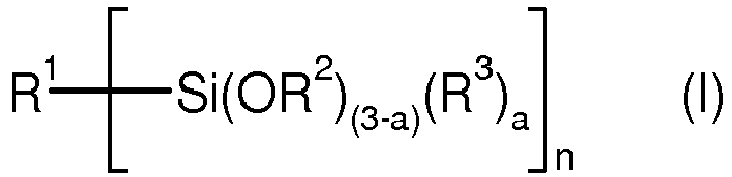

- R1 für einen n-wertigen organischen Rest mit mindestens einer primären und/oder sekundären Aminogruppe steht,
- R1' für einen m-wertigen organischen Rest mit mindestens einer Mercaptogruppe steht,
- R2 und R2' unabhängig voneinander für eine Alkylgruppe mit 1 bis 4 C-Atomen oder für eine Acylgruppe wie Acetyl stehen, wobei eine Alkylgruppe mit 1 bis 4 C-Atomen oder eine Acylgruppe wie Acetyl bevorzugt und Methyl und Ethyl besonders bevorzugt sind;
- R3 und R3' unabhängig voneinander für H oder für eine Alkylgruppe mit 1 bis 10 C-Atomen stehen;
- a und b unabhängig voneinander für einen Wert von 0, 1 oder 2 stehen, wobei a und b unabhängig voneinander bevorzugt 0 oder 1 und besonders bevorzugt 0 sind;
- und n und m unabhängig voneinander für die Werte 1, 2, 3 und 4 stehen,
- Die Gruppen (OR2) und (OR2) in den Formeln (I) bzw. (II) stellen die hydrolysierbare Gruppe dar. In Hydrolyseprodukten dieser Silane werden diese Gruppen (OR2) und (OR2) zumindest teilweise durch OH-Gruppen ersetzt.
- Bevorzugt sind aminofunktionelle Organoalkoxysilane, d.h. Aminosilane der Formel (I), bei denen R2 für eine Alkylgruppe mit 1 bis 4 C-Atome steht, wobei aminofunktionelle Organomethoxysilane (R2 = Methyl) und aminofunktionelle Organoethoxysilane (R2 = Ethyl) besonders bevorzugt sind. Als besonders vorteilhaft haben sich Aminosilane mit drei Alkoxygruppen (a = 0), insbesondere mit drei Methoxygruppen, erwiesen.
- Als Aminosilane sind insbesondere Aminosilane geeignet, welche ausgewählt sind aus der Gruppe bestehend aus 3-Aminopropyl-trimethoxysilan, 3-Aminopropyl-dimethoxymethylsilan, 3-Amino-2-methylpropyl-trimethoxysilan, 4-Aminobutyl-trimethoxysilan, 4-Aminobutyl-dimethoxymethylsilan, 4-Amino-3-methylbutyl-trimethoxysilan, 4-Amino-3,3-dimethylbutyl-trimethoxysilan, 4-Amino-3,3-dimethylbutyl-dimethoxymethylsilan, 2-Aminoethyl-trimethoxysilan, 2-Aminoethyl-dimethoxymethylsilan, Aminomethyl-trimethoxysilan, Aminomethyl-dimethoxymethylsilan, Aminomethylmethoxydimethylsilan, N-Methyl-3-aminopropyl-trimethoxysilan, N-Ethyl-3-aminopropyl-trimethoxysilan, N-Butyl-3-aminopropyl-trimethoxysilan, N-Cyclohexyl-3-aminopropyl-trimethoxysilan, N-Phenyl-3-aminopropyl-trimethoxysilan, N-Methyl-3-amino-2-methylpropyl-trimethoxysilan, N-Ethyl-3-amino-2-methylpropyl-trimethoxysilan, N-Ethyl-3-aminopropyl-dimethoxy-methylsilan, N-Phenyl-4-aminobutyl-trimethoxysilan, N-Phenyl-aminomethyl-dimethoxymethylsilan, N-Cyclohexyl-aminomethyl-dimethoxymethylsilan, N-Methyl-aminomethyl-dimethoxymethylsilan, N-Ethylaminomethyl-dimethoxymethylsilan, N-Propyl-aminomethyl-dimethoxymethylsilan, N-Butyl-aminomethyl-dimethoxymethylsilan; N-(2-Aminoethyl)-3-aminopropyl-trimethoxysilan, 3-[2-(2-Aminoethylamino)-ethylamino]-propyl-trimethoxysilan, Bis(trimethoxysilylpropyl)amin, sowie deren Analoga mit drei Ethoxy- oder drei Isopropoxygruppen anstelle der drei Methoxygruppen am Silicium.
- In einer Ausführungsform ist das Aminosilan der Formel (I) ein Aminosilan der Formel (V)
H2N-R5Si(OR2)(3-a)(R3)a (V)
wobei R5 für eine lineare oder verzweigte Alkylengruppe mit 1 bis 6 C-Atomen, insbesondere für Propylen, steht und die anderen Substituenten und Indices wie in Formel (I) definiert sind. Als besonders bevorzugt gilt hierbei 3-Aminopropyltrimethoxysilan. - In einer bevorzugten Ausführungsform weist das Aminosilan der Formel (I) sekundäre Aminogruppen auf, wobei es sich hierbei insbesondere um


- Es hat sich als besonders vorteilhaft herausgestellt, wenn zwei oder mehr Aminosilane der Formel (I) in der Zusammensetzung, vorhanden sind, von denen vorzugsweise mindestens eines ein Aminosilan der Formel (VI) ist. Eine besonders bevorzugte Kombination ist ein Aminosilan der Formel (VI) und ein ein Aminosilan der Formel (VIII) in der Zusammensetzung.
- Das Mercaptosilan, das mindestens eine an Si gebundene hydrolysierbare Gruppe aufweist, ist vorzugsweise mindestens ein vorstehend beschriebenes Mercaptosilan der Formel (II). Besonders bevorzugt sind mercaptofunktionelle Organoalkoxysilane, d.h. Mercaptosilane der Formel (II), bei denen R2' für eine Alkylgruppe mit 1 bis 4 C-Atome steht. Besonders bevorzugt sind mercaptofunktionelle Organomethoxysilane (R2' = Methyl) und mercaptofunktionelle Organoethoxysilane (R2' = Ethyl). Als besonders vorteilhaft haben sich Mercaptosilane mit drei Alkoxygruppen (b = 0), insbesondere drei Methoxygruppen, erwiesen.
- Bevorzugt weist das Mercaptosilan der Formel (II) die Formel (IX) auf.
HS-R5'-Si(OR2')(3-b)(R3')b (IX)
wobei R5' für eine lineare oder verzweigte Alkylengruppe mit 1 bis 6 C-Atomen, insbesondere für Propylen, steht, wobei die anderen Substituenten und Indices wie in Formel (II) definiert sind. - Besonders bevorzugte Mercaptosilane sind 3-Mercaptopropyl-trimethoxysilan und 3-Mercaptopropyltriethoxysilan.
- Die Zusammensetzung umfasst ferner mindestens einen Emulgator ausgewählt aus Pyrrolidonen, Propionamiden und Aminoalkohol-Reaktionsprodukten. Pyrrolidone sind cyclische Carbonsäureamide, Propionamide sind lineare Carbonsäureamide. Aminoalkohole werden als integrierter Emulgator in Form eines Reaktionsproduktes mit mindestens einem Teil des Aminosilans und/oder Mercaptosilans in der Zusammensetzung eingesetzt. Bevorzugt ist der Einsatz von Pyrrolidonen oder Aminoalkohol-Reaktionsprodukten. Die Emulgatoren bewirken eine bessere Mischbarkeit mit Wasser und verlangsamte Kondensationsreaktionen nach Zugabe von Wasser.
- Bei den einsetzbaren Pyrrolidonen handelt es sich insbesondere um 2-Pyrrolidone. 2-Pyrrolidone sind cyclische Carbonsäureamide. Das einsetzbare Pyrrolidon kann 2-Pyrrolidon, auch als γ-Butyrolactam bezeichnet, oder ein Derivat des 2-Pyrrolidons sein, das an mindestens einer der drei Methylenringgruppen und/oder am Stickstoffatom einen Substituenten aufweist. Geeignete Substituenten am Stickstoffatom sind Alkyl, z.B. C1-12-Alkyl, bevorzugt C1-C7-Alkyl, besonders bevorzugt C1-C4-Alkyl, insbesondere Methyl oder Ethyl, oder Cycloalkyl, bevorzugt Cyclopentyl und Cyclohexyl, insbesondere Cyclohexyl. Geeignete Substituenten an der Methylengruppe sind z.B. Alkyl, bevorzugt C1-C4-Alkyl, insbesondere Methyl oder Ethyl.
- Bevorzugt sind N-substituierte 2-Pyrrolidone. Gegebenenfalls können sie an mindestens einer Methylenringgruppe einen Substituenten aufweisen, was aber nicht bevorzugt ist. Beispiele sind N-C1-C12-Alkyl-2-pyrrolidon und Polyvinylpyrrolidon. Beispiele für Verbindungen mit längerkettigen Alkylgruppen sind 1-Octyl-2-pyrrolidon und 1-Dodecylpyrrolidon. Besonders bevorzugt sind N-C1-C7-Alkyl-2-pyrrolidon oder N-C1-C6-Alkyl-2-pyrrolidon, insbesondere N-C1-C4-Alkyl-2-pyrrolidon, und N-Cycloalkyl-2-pyrrolidon, wie N-Cyclohexyl-2-pyrrolidon. Am meisten bevorzugt sind N-Methyl-2-pyrrolidon (NMP), N-Ethyl-2-pyrrolidon (NEP) und insbesondere N-Cyclohexyl-2-pyrrolidon (CHP).
- Als Propionamide eignen sich Propionamid selbst und Derivate des Propionamids. Beispiele für geeignete Propionamide sind Propionamide der Formel
R6-C(O)NR7 2
worin R6 eine substituierte oder unsubstituierte Ethylgruppe ist und R7 unabhängig voneinander H oder eine C1-4-Alkylgruppe, insbesondere Methyl oder Ethyl, ist. Bevorzugt ist mindestens eine Gruppe R7 eine C1-4-Alkylgruppe und besonders bevorzugt sind beide Gruppen R7 eine C1-4-Alkylgruppe, wobei Methyl- und Ethylgruppe bevorzugt sind. - Die Gruppe R6 kann bevorzugt mindestens einen Substituenten und vorzugsweise genau einen Substituenten an der Ethylgruppe aufweisen. Der Substituent befindet sich bevorzugt am terminalen Ende der Ethylgruppe, d.h. am C3-Atom des Propionamids. Beispiele für geeignete Substituenten sind C1-C4-Alkoxygruppen, wie Methoxy, Ethoxy, Propoxy und Butoxy.
- Konkrete Beispiele sind 3-Methoxy-N,N-dimethylpropionamid und 3-Butoxy-N,N-dimethylpropionamid.
- Der Aminoalkohol, mit dem das Aminoalkohol-Reaktionsprodukt gebildet wird, ist eine Verbindung, die mindestens eine Aminogruppe und mindestens eine Hydroxygruppe aufweist. Der Aminoalkohol kann z.B. eine oder zwei Hydroxygruppen aufweisen, wobei eine Hydroxgruppe bevorzugt ist. Der Aminoalkohol kann z.B. eine oder zwei oder mehr Aminogruppen aufweisen, wobei es sich bei den Aminogruppen z.B. um primäre oder sekundäre Aminogruppen handeln kann.
- Beispiele für Aminoalkohole, die als Emulgatorvorstufe zur Bildung des Aminoalkohol-Reaktionsprodukts geeignet sind, sind Ethanolamin, Diethylenglykolamin, N-(β-Aminoethyl)aminoethanol, Diethanolamin und N-Methyldiethanolamin, wobei Diethylenglykolamin am meisten bevorzugt ist. Diethylenglykolamin wird auch als 2-(2-Aminoethoxy)ethanol bezeichnet.
- Wenn mindestens ein Aminoalkohol-Reaktionsprodukt als Emulgator eingesetzt wird, sind der Aminoalkohol und zumindest ein Teil des Aminosilans und/oder des Mercaptosilans in Form eines Reaktionsprodukts enthalten, bei dem zumindest ein Teil der hydrolysierbaren Gruppen, die in dem mindestens einen Aminosilan und dem mindestens einen Mercaptosilan vorhanden sind, durch die Aminoalkoholat-Gruppe des Aminoalkohols ersetzt ist.
- Das Reaktionsprodukt wird durch eine Umesterung oder Veresterung mindestens eines Teils der an Si gebundenen hydrolysierbaren Gruppen der in der Zusammensetzung enthaltenen Silane mit dem Aminoalkohol erhalten.
- Der Um- oder Veresterungsgrad kann in einem weiten Bereich gewählt werden. Es können auch alle der an Si gebundenen hydrolysierbaren Gruppen der in der Zusammensetzung enthaltenen Aminosilane und/oder Mercaptosilane durch die Aminoalkoholatgruppe ersetzt sein. Vorzugsweise wird der Um- oder Veresterungsgrad so gewählt, dass, bezogen auf die Gesamtmenge der in der Zusammensetzung enthaltenen Silane, das molare Verhältnis der an Si gebundenen hydrolysierbaren Gruppen und der an Si gebundenen Aminoalkoholat-Gruppen, die in den Silanen vorhanden sind, zu den an Si gebundenen Aminoalkoholat-Gruppen im Bereich von 1:1 bis 10:1, bevorzugt von 10:5 bis 10:2 liegt.
- Wenn z.B. bei einem Silan mit drei hydrolysierbaren Gruppen (z.B. Methoxy), eine hydrolysierbare Gruppe durch eine Aminoalkoholat-Gruppe ersetzt wird, enthält das Reaktionsprodukt zwei hydrolysierbare Gruppen und eine Aminoalkoholat-Gruppe. Das molare Verhältnis der an Si gebundenen hydrolysierbaren Gruppen (2) und der an Si gebundenen Aminoalkoholat-Gruppen (1), zu den an Si gebundenen Aminoalkoholat-Gruppen (1) wäre dann 3:1. Zwar ist die Aminoalkoholat-Gruppe prinzipiell auch eine hydrolysierbare Gruppe, dies wird aber hier nicht berücksichtigt.
- Es versteht sich, dass sich dieses molare Verhältnis auf die Zusammensetzung bezieht, bevor es zu Hydrolyse- und/oder Kondensationsreaktionen gekommen ist. Es versteht sich ferner, dass eine Zusammensetzung enthaltend das beschriebene Reaktionsprodukt ein Gemisch unterschiedlicher Verbindungen sein kann, z.B. nicht umgesetzte Aminosilane oder Mercaptosilane und Aminosilane und/oder Mercaptosilane, die ein, zwei oder drei Aminoalkoholatgruppen aufweisen. Die vorstehend angegebenen molaren Verhältnisse sind daher als Mittelwerte zu verstehen. Nach Zugabe von Wasser können sich dann zusätzlich Hydrolyse- und/oder Kondensationsprodukte bilden.
- Aminosilane und/oder Mercaptosilane, die durch die Umesterung oder Veresterung Aminoalkoholat-Gruppen aufweisen werden hier weiterhin als Aminosilane bzw. Mercaptosilane aufgefasst. Das Verfahren zur Herstellung der Mischungen bzw. der Reaktionsprodukte wird weiter unten näher erläutert.
- In einer bevorzugten Ausführungsform wird zu der das Aminoalkohol-Reaktionsprodukt enthaltenden Zusammensetzung zusätzlich ein weiterer Emulgator ausgewählt aus Pyrrolidonen und Propionamiden, bevorzugt Pyrrolidonen, insbesondere N-Cyclohexyl-2-pyrrolidon, zugesetzt. Auf diese Weise können Mischbarkeit der Zusammensetzung und Lagerstabilität der erhaltenen wässrigen Zusammensetzung weiter erhöht werden.
- Gegebenenfalls kann die Zusammensetzung ferner mindestens ein Tetraalkoxysilan der Formel (IV) enthalten
Si(OR4)4 (IV)
wobei R4 unabhängig voneinander eine Alkylgruppe mit 1 bis 4 C-Atomen oder für eine Acylgruppe, insbesondere Acetylgruppe, steht. Derartige Tetraalkoxysilane sind beispielsweise Tetramethoxysilan, Tetraethoxysilan, Tetraisopropoxysilan, Tetrapropoxysilan, Tetrabutoxysilan und Tetraacetoxysilan. Besonders bevorzugt ist Tetraethoxysilan. Wie bei den Aminosilanen und Mercaptosilanen können die Tetraalkoxysilane bei Anwesenheit von Wasser hydrolysieren und gegebenenfalls mit anderen Silanen kondensieren. - In einer bevorzugten Ausführungsform handelt es sich bei der Zusammensetzung um eine wässrige Zusammensetzung bzw. Haftvermittlerzusammensetzung, d.h. die Zusammensetzung umfasst ferner Wasser. Es kann sich um eine einkomponentige oder zweikomponentige wässrige Haftvermittlerzusammensetzung handeln, wobei es sich besonders bevorzugt um eine einkomponentige wässrige Haftvermittlerzusammensetzung handelt.
- Bei der bevorzugten einkomponentigen wässrigen Haftvermittlerzusammensetzung sind die vorstehend beschriebenen Silane, Emulgatoren bzw. das Aminoalkohol-Reaktionsprodukt und Wasser in der einzigen Komponente enthalten. Die zweikomponentige wässrige Haftvermittlerzusammensetzung besteht aus einer Silankomponente A, die die vorstehend beschriebenen Silane, Emulgatoren bzw. das Aminoalkohol-Reaktionsprodukt enthält, und einer wässrigen Komponente B, die Wasser enthält. Die einkomponentige wässrige Haftvermittlerzusammensetzung zeichnet sich durch ausgezeichnete Lagerstabilität aus.
- Wenn zu der die Silane enthaltenden Zusammensetzung Wasser zugegeben wird, können die Silane mit der Zeit, meist in wenigen Minuten, hydrolysiert und/oder kondensiert werden. Die Zusammensetzung kann dann neben den darin enthaltenen Silanen auch Hydrolyse- und/oder Kondensationprodukte dieser Silane oder bei fortgeschrittener Umsetzung gegebenenfalls nur noch Hydrolyse- und/oder Kondensationprodukte der enthaltenen Silane wie vorstehend beschrieben enthalten.
- Die ein- oder zweikomponentige Zusammensetzung kann neben Wasser weitere optionale Bestandteile umfassen. Derartige zusätzliche Bestandteile sind z.B. Tenside, Säuren, Haftvermittleradditive, Katalysatoren, Cosolventien, Biozide, Antiabsetzmittel, Stabilisatoren, Inhibitoren, Pigmente, Farbstoffe, Korrosionsschutzmittel, Geruchsstoffe, UV-Indikatoren, Thixotropiermittel, Füllstoffe, Entschäumer, weitere Organosilane und Titanate.
- Säuren sind bevorzugte zusätzliche Bestandteile der ein- oder zweikomponentigen wässrigen Zusammensetzung. Die Säure kann organisch oder anorganisch sein. Organische Säuren sind einerseits Carbonsäuren, insbesondere eine Carbonsäure, welche ausgewählt ist aus der Gruppe umfassend Ameisen-, Essig-, Propion-, Trifluoressig-, Oxal-, Malon-, Bernstein-, Malein-, Fumar- und Zitronensäure sowie Aminosäuren, insbesondere Asparginsäure und Glutaminsäure. Als Carbonsäure ist Essigsäure bevorzugt.
- Organische Säuren sind anderseits insbesondere solche die einen Schwefelatom oder ein Phosphoratom enthalten. Derartige organische Säuren sind insbesondere organische Sulfonsäuren. Unter organischer Sulfonsäure werden Verbindungen verstanden, welche einen Kohlenstoff-Atome aufweisenden organischen Rest sowie mindestens eine funktionelle Gruppe -SO3H aufweisen. Bevorzugt sind aromatische Sulfonsäuren.
- Die aromatische Sulfonsäure kann ein- oder mehrkernig sein und es können eine oder mehrere Sulfonsäure-Gruppen vorhanden sein. Beispielswiese können dies 1- oder 2-Napthalinsulfonsäure, 1,5-Napthalindisulfonsäure, Benzolsulfonsäure oder Alkylbenzolsulfonsäuren sein. Bevorzugte aromatische Sulfonsäuren sind diejenigen, welche die Formel (X) aufweisen

- Die Säure kann weiterhin eine anorganische Säure sein. Als anorganische Säuren eignen sich z.B. jene, die ein Schwefelatom oder ein Phosphoratom aufweisen. Als Phosphoratome aufweisende Säuren gelten insbesondere Phosphorsäure, Phosporige Säure, Phosponsäure, Phosphonige Säure. Als Schwefelatome aufweisende Säuren gelten insbesondere Schwefelsäuren, insbesondere Schwefelsäure, schweflige Säuren, Perschwefelsäure, Dischwefelsäure (=Pyroschwefelsäure), Dischwefelige Säure, Dithionsäure, Dithionige Säure, Thioschwefelsäure oder Thioschweflige Säure.
- Bevorzugt sind Säuren die einen pKa zwischen 4,0 und 5 aufweisen. Unter pKa versteht der Chemiker bekannterweise den negativen dekadischen Logarithmus der Säuredissoziationskonstante Ka: pKa = -log10ka.
- Ferner sind Tenside bevorzugte zusätzliche Bestandteile der ein- oder zweikomponentigen wässrigen Haftvermittlerzusammensetzung. Als Tenside können natürliche oder synthetische Stoffe verwendet werden, welche in Lösungen die Oberflächenspannung des Wassers oder anderer Flüssigkeiten herabsetzen. Als Tenside, auch Netzmittel genannt, können anionische, kationische, nichtionische oder ampholytische Tenside oder deren Mischungen verwendet werden.
- Beispiele für anionische Tenside sind Carboxylat-, Sulfat-, Phosphat- oder Sulfonat-Gruppen aufweisende Tenside, wie zum Beispiel Aminosäurederivate, Fettalkoholethersulfate, Fettalkoholsulfate, Seifen, Alkylphenolethoxylate, Fettalkoholethoxylate, aber auch Alkansulfonate, Olefinsulfonate oder Alkylphosphate.
- Zu den nichtionischen Tensiden, den sogenannten Niotensiden, gehören z.B. Ethoxylate, wie zum Beispiel ethoxylierte Additionsprodukte von Alkoholen, wie beispielsweise Polyoxyalkylenpolyole, Amine, Fettsäuren, Fettsäureamide, Alkylphenole, Ethanolamide, Fettamine, Polysiloxane oder Fettsäureester, aber auch Alkyl- oder Alkylphenyl-polyglykolether, wie z.B. Fettalkoholpolyglykolether, oder Fettsäureamide, Alkylglykoside, Zuckerester, Sorbitanester, Polysorbate oder Trialkylaminoxide, aber auch Ester und Amide aus Poly(meth)-acrylsäuren mit Polyalkylenglykolen oder Aminopolyalkylenglykole, die allenfalls einseitig mit Alkylgruppen abgeschlossen sein können.
- Beispiele für kationische Tenside sind quaternäre Ammonium- oder Phosphoniumverbindungen, wie zum Beispiel Tetraalkylammoniumsalze, N-,N-Dialkylimidazolinverbindungen, Dimethyldistearyl-ammoniumverbindungen, oder N-Alkylpyridinverbindungen, insbesondere Ammoniumchloride. Zu den amphoytischen oder amphoterischen Tensiden gehören amphotere Elektrolyte, sogeannte Ampholyte, wie zum Beispiel Aminocarbonsäuren, und Betaine.
- Derartige Tenside sind kommerziell breit erhältlich. Besonders geeignet sind alkoxylierte Alkohole, alkoxylierte nichtionische Fluorotenside, insbesondere Zonyl® FSO-100, welches von ABCR, Deutschland kommerziell erhältlich ist, alkoxylierte Alkohole oder alkoxylierte Alkylphenole, insbesondere Antarox FM 33, welches kommerziell bei Rhodia kommerziell erhältlich ist. Weiterhin sind alkoxylierte Fettalkohole, wie Hydropalat® 120 von Cognis, bevorzugt. Besonders bevorzugt wird Hydropalat® 3037 von Cognis als Tensid eingesetzt.
- Ein weiterer bevorzugt eingesetzter optionaler Bestandteil ist ein wasserlösliches Haftvermittleradditiv, vorzugsweise ein wasserlösliches Amin-haltiges Haftvermittleradditiv. Durch den Einsatz von wasserlöslichen Haftvermittleradditiven wird die Haftperformance generell verbessert. Solche Haftvermittleradditive sind häufig Basen oder wässrige Silane, die ebenfalls basische Gruppen wie Amine enthalten können. Der pH-Wert der Zusammensetzung kann gegebenenfalls zum Ausgleich durch zusätzlicher Säure, z.B. Essigsäure, justiert werden. Wasserlösliche Haftvermittleradditive sind im Handel erhältlich.
- Beispiele für geeignete wasserlösliche Haftvermittleradditive sind reaktive organofunktionelle Siloxan-Oligomere und Aminbasen. Beispiele sind Aminosiloxane und Tetramethylguanidin. Der Kondensationsgrad der Aminosiloxane kann unterschiedlich sein. Es kann sich um Dimere, Trimere oder Oligomere aus vier oder mehr monomeren Silanen oder Mischungen davon handeln. Derartige Aminosiloxane sind auch kommerziell erhältlich, z.B. als Dynasylan® HDYROSIL 2627, Dynasylan® HDYROSIL 2776 oder Dynasylan® HDYROSIL 2929 von Degussa AG, Deutschland.
- Als Cosolventien werden mit Wasser mischbare Lösungsmittel, wie Alkohole oder Ether oder Ketone, verstanden. Es ist jedoch bevorzugt, dass derartige Lösungsmittel lediglich in einer kleinen Menge, d.h. typischerweise weniger als 10 Gew.-% bezogen auf das Wasser, verwendet werden. Besonders bevorzugt ist die Zusammensetzung -abgesehen von Spuren von Alkoholen, welche sich aus der Hydrolyse der in der wässrigen Zusammensetzung eingesetzten Alkoxyilanen ergeben-frei von derartigen Cosolventien. Wird ein größerer Gehalt an Lösungsmittel eingesetzt, verstärkt sich die VOC-Problematik wiederum, deren Vermeidung ja mit ein Hauptgrund für den Einsatz von wässrigen Zusammensetzungen darstellt.
- In einer bevorzugten Ausführungsform umfasst die ein- oder zweikomponentige wässrige Zusammensetzung mindestens eine Säure, bevorzugt eine organische Säure, wobei die Säure bei der zweikomponentigen Zusammensetzung in der wässrigen Komponente B enthalten ist. In einer weiteren bevorzugten Ausführungsform umfasst die ein- oder zweikomponentige wässrige Zusammensetzung mindestens ein Tensid, wobei bei der zweikomponentigen Zusammensetzung das Tensid in der Silankomponente A und/oder in der wässrigen Komponente B enthalten ist. Es ist bevorzugt, dass in der wässrigen Komponente B mindestens ein Tensid enthalten ist. In der Silankomponente A kann gegebenenfalls auch ein Tensid enthalten sein. In einer weiteren bevorzugten Ausführungsform umfasst die ein- oder zweikomponentige wässrige Zusammensetzung mindestens ein wasserlösliches Haftvermittleradditiv, vorzugsweise ein Amin-haltiges wasserlösliches Haftvermittleradditiv, wobei das wasserlösliche Haftvermittleradditiv bei der zweikomponentigen Zusammensetzung in der wässrigen Komponente B enthalten ist.
- Eine besonders bevorzugte Ausführungsform ist eine einkomponentige wässrige Zusammensetzung bzw. Haftvermittlerzusammensetzung, die eine Säure, vorzugsweise eine organische Säure, mindestens ein Tensid und gegebenenfalls ein wasserlösliches Haftvermittleradditiv, vorzugsweise ein Amin-haltiges wasserlösliches Haftvermittleradditiv, umfasst.
- Die bevorzugte einkomponentige wässrige Zusammensetzung kann zweckmäßigerweise durch Vermischen der Silankomponente A und der wässrigen Komponenten B der zweikomponentigen wässrigen Zusammensetzung wie vorstehend beschrieben erhalten werden.
- Wenn der eingesetzte Emulgator aus Pyrrolidonen oder Propionamiden ausgewählt ist, liegt der Mengenanteil des Emulgators ausgewählt aus Pyrrolidonen oder Propionamiden, bezogen auf das Gesamtgewicht der ein- oder zweikomponentigen Zusammensetzung, im Bereich von 0,1 bis 10 Gew.-%, bevorzugt von 0,5 bis 2 Gew.-%.
- In der wässrigen Zusammensetzung beträgt der Gewichtsanteil der Summe von Aminosilanen, Mercaptosilanen und Wasser und, falls vorhanden, Tetraalkoxysilanen der Formel (IV) bevorzugt mehr als 80 Gew.-%, insbesondere mehr als 90 Gew.-%, bezogen auf das Gesamtgewicht der ein- oder zweikomponentigen Zusammensetzung.
- Der Gewichtsanteil der Summe von Aminosilanen, Mercaptosilanen und, falls vorhanden, Tetraalkoxysilanen der Formel (IV) beträgt z.B. mehr als 0,1 Gew.-%, insbesondere von 0,1 bis 10 Gew.-%, bevorzugt von 0,1 bis 5 Gew. -% und besonders bevorzugt von 0,5 bis 2 Gew.-%, bezogen auf das Gesamtgewicht der ein- oder zweikomponentigen Zusammensetzung.
- Das Gewichtsverhältnis der Summe von Aminosilanen zu Mercaptosilanen in der Zusammensetzung beträgt bevorzugt 1:10 bis 10:1, insbesondere 1:1 bis 10:1, bevorzugt 5:2 bis 15:2.
- Es versteht sich, dass die vorstehenden Gewichtsverhältnisse sich auf die Ausgangszusammensetzung beziehen, d.h. bevor es zu Hydrolyse- und/oder Kondensationsreaktionen kommt.
- Die erfindungsgemäße Zusammensetzung wird bevorzugt durch ein Verfahren hergestellt, das umfasst den Schritt des Mischens von
- a) mindestens einem Aminosilan, das mindestens eine an Si gebundene hydrolysierbare Gruppe aufweist,
- b) mindestens einem Mercaptosilan, das mindestens eine an Si gebundene hydrolysierbare Gruppe aufweist, und
- c) mindestens einer Verbindung ausgewählt aus Pyrrolidonen, Propionamiden und Aminoalkoholen als Emulgator oder Emulgatorvorstufe.
- Wenn der Emulgator aus Pyrrolidonen und Propionamiden ausgewählt wird, wird durch die Mischung eine Zusammensetzung erhalten, die bereits als Silankomponente A geeignet ist. Die Mischung kann bei Raumtemperatur, z.B. 23°C, erfolgen. Gegebenfalls und bevorzugt kann zusätzlich mindestens ein Tensid zur Mischung gegeben werden. Gegebenfalls können auch weitere Silane oder übliche Bestandteile wie vorstehend beschrieben zugesetzt werden.
- Wenn mindestens ein Aminoalkohol, bevorzugt Diethylenglycolamin, als Emulgatorvorstufe zugegeben wird, wird die erhaltene Mischung erwärmt, um den Aminoalkohol mit dem Aminosilan und/oder dem Mercaptosilan durch Umesterung oder Veresterung unter Bildung eines Aminoalkohol-Reaktionsprodukts umzusetzen, bei dem zumindest ein Teil der hydrolysierbaren Gruppen, die in dem mindestens einen Aminosilan und dem mindestens einen Mercaptosilan vorhanden sind, durch die Aminoalkoholat-Gruppe des Aminoalkohols ersetzt wird, und bei der Umsetzung gebildetes Nebenprodukt aus der Mischung entfernt wird.
- Bei dem Nebenprodukt handelt es sich um die protonierte hydrolysierbare Gruppe, bevorzugt um einen Alkohol. Die Entfernung des Nebenprodukts kann auf übliche Art erfolgen, z.B. durch Abdestillieren. Die Destillation kann nach Bedarf auch im Vakuum erfolgen.
- Vorzugsweise handelt es sich bei der Umsetzung um eine Umesterung, d.h. es werden an Si gebundene Alkoxygruppen durch Aminoalkoholatgruppen ausgetauscht. Besonders bevorzugt handelt es sich bei den Alkoxygruppen um Methoxygruppen, da das gebildete Methanol leicht abdestilliert werden kann.
- Die Umsetzung erfolgt z.B. bei einer Temperatur von mehr als 30°C, bevorzugt mehr als 50°C, bevorzugter mehr als 70°C, z.B. etwa 90°C. Das gebildete Nebenprodukt, insbesondere Alkohol, werden bevorzugt durch Abdestillieren entfernt. Sobald die gesamte gebildete Menge an Nebenprodukt wie Alkohol entfernt wurde, wird das Reaktionsgemisch auf Raumtemperatur abgekühlt. Die Umsetzung erfolgt bevorzugt unter Stickstoffatmosphäre oder im Vakuum. Die nach der Abkühlung erhaltene Zusammensetzung enthält das Reaktionsprodukt und ist bereits als Silankomponente A geeignet ist. Gegebenfalls kann mindestens ein Tensid, weitere Silane oder übliche Bestandteile wie vorstehend beschrieben zugesetzt werden. Das ist in der Regel aber nicht bevorzugt. Allerdings kann in einer bevorzugten Ausführungsform zu der das Reaktionsprodukt enthaltenden Zusammensetzung ein weiterer Emulgator ausgewählt aus Pyrrolidonen und Propionamiden, bevorzugt Pyrrolidonen, insbesondere N-Cyclohexyl-2-pyrrolidon, zugesetzt werden.
- Für die Umsetzung kann das Verhältnis an der Menge an eingesetztem Aminoalkohol zu der eingesetzten Gesamtmenge an Aminosilanen und Mercaptosilanen nach dem gewünschten Um- oder Veresterungsgrad variiert werden. Zur Herstellung des Reaktionsprodukts wird das Verhältnis der Gesamtmenge an eingesetztem Aminosilan und Mercaptosilan zur Menge an eingesetztem Aminoalkohol bevorzugt so gewählt, dass das molare Verhältnis von an Si gebundenen hydrolysierbaren Gruppen, die in dem mindestens einen Aminosilan und dem mindestens einen Mercaptosilan vorhanden sind, zu den Hydroxylgruppen, die im Aminoalkohol vorhanden sind, im Bereich von 1:1 bis 10:1, bevorzugt von 10:5 bis 10:2 liegt. In einer besonders bevorzugten Ausführungsform wir wird etwa jede dritte hydrolysierbare Gruppe der Silane, bevorzugt eine Alkoxygruppe, besonders bevorzugt eine Methoxygruppe durch den Aminoalkohol umgeestert.
- Die bevorzugte einkomponentige wässrige Zusammensetzung wird bevorzugt folgendermaßen hergestellt. Zunächst wird Wasser vorgelegt, zu dem vorzugsweise zusätzliche Bestandteile, wie mindestens ein Tensid und mindestens eine Säure und gegebenenfalls ein wasserlösliches Haftvermittleradditiv unter Rühren zugesetzt werden. Die Zugabe erfolgt zweckmäßigerweise bei Raumtemperatur, gegebenenfalls kann der Rührvorgang auch bei erhöhter Temperatur erfolgen.
- Die zusätzlichen Bestandteile werden vorzugweise nacheinander zugegeben und vor Zugabe des nächsten Bestandteils wird bevorzugt solange gerührt, bis sich der Bestandteil in Wasser aufgelöst bzw. homogen verteilt hat. Die Reihenfolge der Zugabe der möglichen zusätzlichen Bestandteile ist beliebig, bevorzugt wird aber, sofern eingesetzt, zunächst mindestens ein Tensid, dann mindestens eine Säure und schließlich mindestens ein wasserlösliches Haftvermittleradditiv zugegeben.
- Zu der so erhaltenen wässrigen Komponente, die vorzugsweise mindestens ein Tensid, mindestens eine Säure und gegebenenfalls ein wasserlösliches Haftvermittleradditiv enthält, wird die Zusammensetzung enthaltend den Emulgator ausgewählt aus Pyrrolidonen und Propionamiden als Gemisch oder die Zusammensetzung enthaltend das Aminoalkohol-Reaktionsprodukt, die wie vorstehend beschrieben hergestellt worden sind, zugegeben und gerührt, um die einkomponentige wässrige Zusammensetzung zu erhalten. Der Rührvorgang erfolgt zweckmäßigerweise bei Raumtemperatur. Es wird zweckmäßigerweise eine gewisse Zeit gerührt, um eine homogene Mischung zu erhalten.
- Die erfindungsgemäße Zusammensetzung enthaltend den Emulgator ausgewählt aus Pyrrolidonen und Propionamiden als Gemisch oder die Zusammensetzung enthaltend das Aminoalkohol-Reaktionsprodukt, ist als auch als Silankomponente A für eine zweikomponentige wässrige Haftvermittlerzusammensetzung geeignet, die als zweite gesonderte Komponente eine wässrige Komponente B umfasst. Die wässrige Komponente B enthält bevorzugt mindestens ein Tensid, mindestens eine Säure und gegebenenfalls ein wasserlösliches Haftvermittleradditiv. Die wässrige Komponente B kann hierfür auf die gleiche Weise hergestellt werden, wie die wässrige Komponente für die einkomponentige wässrige Zusammensetzung.
- Die erfindungsgemäße ein- oder zweikomponentige wässrige Zusammensetzung eignet sich insbesondere als Haftvermittler oder Primer, vorzugsweise als Primer für Kleb- und Dichtstoffe. Durch die Verwendung eines derartigen Primers wird die Haftung verbessert.
- Als Klebstoff kann grundsätzlich jeder Klebstoff verwendet werden. Vorteilhafte Haftverbesserungen zeigen sich insbesondere bei Polyurethan-Klebstoffen, insbesondere solche, die Isocyanatgruppen aufweisende Polyurethan-Präpolymere enthalten. Derartige Polyurethanklebstoffe sind kommerziell breit erhältlich, z.B. Sikaflex® von Sika Schweiz AG. Die erfindungsgemäße wässrige Zusammensetzung ist besonders geeignet für 1 K-Polyurethan-Klebstoffe.
- Zum Verkleben oder Abdichten von zwei oder mehr Substraten eignet sich somit ein Verfahren, bei dem die erfindungsgemäße wässrige Haftvermittlerzusammensetzung als Vorbehandlung auf mindestens ein Substrat aufgebracht und abgelüftet wird. Anschließend werden die Substrate mit einem Klebstoff oder Dichtstoff, vorzugsweise einem 1 K Polyurethan-Klebstoff, verklebt oder abgedichtet.
- Die Substrate können vielfältiger Art sein. Bevorzugt ist mindestens eines der Substrate, das mit der erfindungsgemäßen wässrigen Haftvermittlerzusammensetzung vorbehandelt werden soll, Glas oder Glaskeramik oder Aluminium oder eine Aluminiumlegierung. Geignet sind auch Substrate aus Silber, insbesondere ein Silberaufdruck auf Glas oder Glaskeramik.
- Besonders geeignet ist die erfindungsgemäße wässrige Zusammensetzung als Vorbehandlung zum Verkleben von Scheiben, insbesondere im Fahrzeugbau bzw. zum Direct Glazing. Daher ist in einer bevorzugten Ausführungsform ein Substrat Glas oder Glaskeramik und das zweite Substrat ein Lack oder ein lackiertes Metall oder eine lackierte Metalllegierung.
- Der Einsatz von Mercaptosilanen in der wässrigen Zusammensetzung führt zu einer starken Haftverbesserung von 1 K Polyurethanklebstoffen auf Silber oder auf Silber basierenden Zusammensetzungen oder Legierungen. Es hat sich gezeigt, dass das beschriebene Verfahren insbesondere gut geeignet ist zum Verkleben von Scheiben mit integrierter Antenne oder anderen elektronischen Bauteilen. Derartige Antennenanschlusskontakte oder andere elektronische Bauteile sind typischerweise aus Silber oder auf Silber basierenden Zusammensetzungen oder Legierungen, auf der Scheibe vorhanden.
- Auf diese Weise werden verklebte oder abgedichtete Artikel hergestellt. Derartige Artikel stellen vorzugsweise ein Transportmittel, insbesondere ein Automobil, Bus, Lastkraftwagen, Schienenfahrzeug, ein Schiff oder ein Luftfahrzeug dar.
- Die Erfindung wird durch nachstehende Beispiele weiter erläutert, die die Erfindung aber in keiner Weise einschränken sollen. Sofern nicht anders angegeben, beziehen sich alle Angaben auf das Gewicht.
Verwendete Rohstoffe: Silquest A1120 N-(2-Aminoethyl)-3-aminopropyl-trimethoxysilan Silquest® A1120, GE Silicones, Schweiz Silquest A1170 Bis(trimethoxysilylpropyl)amin Silquest® A1170, GE Silicones, Schweiz Silquest A189 3-Mercaptopropyl-trimethoxysilan Silquest® A189, GE Silicones, Schweiz Hydropalat 3037 Tensid, modifiziertes natürliches Öl, frei von Silicon, Hydropalat® 3037, Cognis, Deutschland Hydrosil 2776 Haftvermittleradditiv, reaktives organofunktionelles Siloxan-Oligomer, Dynasylan® Hydrosil 2776, Evonik Industries, Deutschland CHP N-Cyclohexyl-2-pyrrolidon - Auf Basis der in Tabelle 1 angegebenen Substanzen und Mengen wurden Silankomponenten 1 und 2 (S1 und S2) sowie eine wässrige Komponente 1 und 2 (W1 und W2) wie nachstehend angegeben hergestellt. Die Angaben in der Tabelle sind in Gew.-% bezogen auf die jeweilige Komponente. Anschließend wurden die Silankomponente 1 und die wässrige Komponente 1 und die Silankomponente 2 und die wässrige Komponente 2 wie nachstehend angegeben gemischt, um die einkomponentigen wässrigen Zusammensetzungen 1 und 2 (M1 und M2) zu erhalten. In der Tabelle 1 sind die Mengenanteile der einzelnen Bestandteile der Zusammensetzungen M1 und M2 in Gew.% bezogen auf die Gesamtmischung aufgeführt.
Tabelle 1 Beispiel 1 Beispiel 2 W1 M1 W2 M2 entionisiertes Wasser 94,7 92,33 93,97 91,62 Hydropalat 3037 0,3 0,29 4,01 3,91 Essigsäure 4 3,90 0,96 0,94 Hydrosil 2776 1 0,97 1,06 1,03 Summe 100 100 S1 S2 Silquest A 1120 20 0,50 20 0,50 Silquest A 1170 30 0,75 30 0,75 Silquest A 189 10 0,25 10 0,25 CHP 40 1,00 - - Diethylenglykolamin - - 40 1,00 Summe 100 100 100 100 - Cyclohexylpyrrolidon (CHP) wurde mit den Aminosilanen (Silquest A 1120 und Silquest A 1170) und dem Mercaptosilan (Silquest A 189) gut vermischt. Die gesamte Mischprozedur wurde bei 23°C unter Stickstoff durchgeführt. Es wurde eine klare farblose Mischung erhalten.
- Die gesamte Prozedur erfolgte bei 23°C unter langsamem Rühren. Wasser wird in einen Reaktor gegeben. Hydropalat 3037 wird zugegeben und es wird bis zur vollständigen Auflösung gerührt. Dann wird Essigsäure zugesetzt und 30 min gerührt. Hierzu wird Hydrosil 2776 gegeben und 15 min gerührt. Zu 97,5 Gewichtsteilen der so erhaltenen wässrigen Komponente 1 (W1) werden 2,5 Gewichtsteile der vorstehend hergestellten Silankomponente 1 (S1) gegeben und es wird 15 min gemischt, um die einkomponentige Zusammensetzung 1 (M1) zu erhalten.
- Die Aminosilane (Silquest A 1120 und Silquest A 1170) und das Mercaptosilan (Silquest A 189) wurden in einen Reaktor gegeben. Es wurde gerührt und Diethylenglykolamin wurde langsam zugegeben. Sobald die gesamte Menge Diethylenglykolamin in der Mischung enthalten war, wurde der Reaktor auf 90°C erwärmt. Sich bildendes Methanol wurde aus der Mischung abdestilliert. Sobald das gebildete Methanol vollständig entfernt worden war (etwa 2 h), wurde die klare Lösung auf Raumtemperatur abgekühlt. Die gesamte Prozedur erfolgte unter Stickstoff.
- Die gesamte Prozedur erfolgte bei 23°C unter langsamem Rühren. Wasser wird in einen Reaktor gegeben. Hydropalat 3037 wird zugegeben und es wird bis zur vollständigen Auflösung gerührt. Dann wird Essigsäure zugesetzt und 30 min gerührt. Hierzu wird Hydrosil 2776 gegeben und 15 min gerührt. Zu 97,5 Gewichtsteilen der so erhaltenen wässrigen Komponente 2 (W2) werden 2,5 Gewichtsteile der vorstehend hergestellten Silankomponente (S2) gegeben und es wird 15 min gemischt, um die einkomponentige wässrige Zusammensetzung 2 (M2) zu erhalten.
- Es wurde die Silankomponente des im Handel erhältlichen Standard-Haftvermittlers Sika HydroPrep®-100 von Sika Schweiz AG als Silankomponente 3 verwendet, die auf den in den Beispielen 1 und 2 eingesetzen Aminosilanen und Mercaptosilanen basiert, aber keinen Emulgator gemäß den Beispielen 1 oder 2 enthält. Die wässrige Komponente 3 ist die wässrige Komponente dieses Standard-Haftvermittlers und ähnelt den wässrigen Komponenten der Beispiele 1 und 2. Durch Mischung der Silankomponente 3 und der wässrigen Komponente 3 wird eine wässrige Zusammensetzung 3 erhalten.
- Die gebildeten wässrigen Zusammensetzungen 1 bis 3 gemäß den Beispielen 1 und 2 und dem Vergleichsbeispiel wurden hinsichtlich ihrer Lagerstabilität auf verschiedenen Substraten als Haftvermittler in Kombination mit verschiedenen Klebstoffen geprüft. Hierfür wurden die wässrigen Zusammensetzungen nach Herstellung (frisch) und 3, 6 und 12 Monate nach Herstellung verwendet.
- Als Klebstoffe wurden Sikaflex®-250 DM-3 (DM3), Sikaflex®-250 DB-2 (DB2) und Sikaflex®-265 DG-3 (DG3) verwendet, bei denen es sich um einkomponentige feuchtigkeitshärtende Polyurethanklebstoffe handelt, welche Polyurethanpräpolymere mit Isocyanatgruppen enthalten und bei Sika Schweiz AG kommerziell erhältlich sind.
- Als Substrate wurden Float-Glas, Ferro Frit 14251, Ferro Frit 3402 und Ferro Frit 14279 verwendet. Die erwähnten Glassubstrate werden durch Rocholl AG vertrieben. Es sind Laborsubstrate, die den marktüblichen Glaskeramiken für VSG und ESG Gläser entsprechen. Ferro ist der Hersteller der Glaskeramikpaste, die Nummern sind die Typenbezeichnung der verwendeten Keramik.
- Die wässrigen Zusammensetzungen wurden mittels eines damit getränktem Zellulosetuches (Tela®, Tela-Kimberly Switzerland GmbH) auf das jeweilige Substrat aufgetragen und 10 Minuten abgelüftet. Eine Dreiecksraupe von dem Klebstoff wurde bei 23°C und 50% rel. Luftfeuchtigkeit mittels Auspresskartusche und Düse aufgetragen.
- Der Klebstoff wurde nach einer Aushärtezeit von 7 Tagen Klimaraumlagerung (23°C, 50% rel. Luftfeuchtigkeit) (RT), sowie nach einer anschliessenden Wasserlagerung (WL) in Wasser bei 23°C während 7 Tagen, sowie nach einer anschliessend Kataplasma-Lagerung (CP) von 7 Tagen bei 70°C, 100 % rel. Luftfeuchtigkeit, getestet.
- Die Haftung des Klebstoffes wurde mittels 'Raupentest' getestet. Hierbei wird die Raupe am Ende knapp über der Klebefläche eingeschnitten. Das eingeschnittene Ende der Raupe wird mit einer Rundzange festgehalten und vom Untergrund gezogen. Dies geschieht durch vorsichtiges Aufrollen der Raupe auf die Zangenspitze, sowie Plazieren eines Schnittes senkrecht zur Raupenziehrichtung bis auf den blanken Untergrund. Die Raupenabziehgeschwindigkeit ist so zu wählen, dass ca. alle 3 Sekunden ein Schnitt gemacht werden muss. Die Teststrecke muss mindestens 8 cm entsprechen. Beurteilt wird der nach dem Abziehen der Raupe auf dem Untergrund zurückbleibende Klebstoff (Kohäsionsbruch). Die Bewertung der Hafteigenschaften erfolgt durch visuelle Bestimmung des kohäsiven Anteils der Haftfläche.
- Je höher der Anteil an kohäsivem Bruch ist, umso besser wird die Verklebung eingeschätzt. Testresultate mit Kohäsionsbrüchen von weniger als 70 % gelten typischerweise als ungenügend. Die Ergebnisse sind in Tabelle 2 zusammengefasst.
Tabelle 2 SikaFlex-250 DM-3 Vorbehandlung Substrat frisch 3 Monate (RT) 6 Monate (RT) 12 Monate (RT) RT WL CP RT WL CP RT WL CP RT WL CP Vergleichsbeispiel Glas 100 98 100 100 95 100 98 60 98 100 100 100 Ferro Frit 14251 100 100 90 100 100 30 85 85 80 100 100 20 Ferro Frit 3402 100 100 100 98 30 98 80 5 100 100 50 90 Ferro Frit 14279 100 95 100 100 100 100 100 100 100 100 85 100 ungenügende Haftresultate (per 12) 0 2 2 2 Vorbehandlung Substrat frisch 3 Monate (RT) 6 Monate (RT) 12 Monate (RT) RT WL CP RT WL CP RT WL CP RT WL CP Beispiel 1 Glas 100 100 100 100 100 98 100 95 100 100 75 100 Ferro Frit 14251 100 100 30 100 100 90 98 100 80 100 100 75 Ferro Frit 3402 100 100 100 100 100 100 100 100 100 100 100 100 Ferro Frit 14279 100 100 100 95 75 100 100 80 90 98 40 100 ungenügende Haftresultate (per 12) 1 0 0 1 Vorbehandlung Substrat frisch 3 Monate (RT) 6 Monate (RT) 12 Monate (RT) RT WL CP RT WL CP RT WL CP RT WL CP Beispiel 2 Glas 100 90 100 100 75 100 100 75 100 100 40 100 Ferro Frit 14251 100 100 100 100 100 100 100 100 100 100 100 100 Ferro Frit 3402 100 100 100 100 100 100 100 100 100 100 90 100 Ferro Frit 14279 100 100 100 100 100 100 95 75 100 100 100 100 ungenügende Haftresultate (per 12) 0 0 0 1 Vergleichsbeispiel Glas 100 100 100 100 60 100 98 20 100 100 50 100 Ferro Frit 14251 100 100 100 100 100 100 100 100 100 100 100 100 Ferro Frit 3402 100 98 95 98 20 90 10 5 100 100 0 20 Ferro Frit 14279 100 100 100 100 100 100 100 5 100 100 95 100 ungenügende Haftresultate (per 12) 0 2 4 3 Vorbehandlung Substrat frisch 3 Monate (RT) 6 Monate (RT) 12 Monate (RT) RT WL CP RT WL CP RT WL CP RT WL CP Beispiel 1 Glas 100 100 100 100 30 100 100 75 100 100 30 100 Ferro Frit 14251 100 100 100 100 100 100 100 100 100 100 100 100 Ferro Frit 3402 100 100 100 100 100 100 100 90 100 100 95 95 Ferro Frit 14279 100 100 100 100 95 100 100 98 40 100 75 100 ungenügende Haftresultate (per 12) 0 1 1 1 Vorbehandlung Substrat frisch 3 Monate (RT) 6 Monate (RT) 12 Monate (RT) RT WL CP RT WL CP RT WL CP RT WL CP Beispiel 2 Glas 100 100 100 100 75 100 100 75 100 100 30 100 Ferro Frit 14251 100 100 100 100 100 100 100 100 100 100 100 100 Ferro Frit 3402 100 100 100 98 75 98 100 90 100 98 30 80 Ferro Frit 14279 100 100 100 100 100 100 100 40 100 100 98 100 ungenügende Haftresultate (per 12) 0 0 1 2 Vorbehandlung Substrat frisch 3 Monate (RT) 6 Monate (RT) 12 Monate (3 RT) RT WL CP RT WL CP RT WL CP RT WL CP Vergleichsbeispiel Glas 100 100 100 100 85 100 60 60 100 100 60 100 Ferro Frit 14251 100 100 100 100 100 100 100 100 100 100 50 100 Ferro Frit 3402 100 100 100 95 30 100 60 5 100 100 30 100 Ferro Frit 14279 100 100 100 100 100 100 100 60 100 100 100 100 ungenügende Haftresultate (per 12) 0 1 5 3 Vorbehandlung Substrat frisch 3 Monate (RT) 6 Monate (RT) 12 Monate (3 RT) RT WL CP RT WL CP RT WL CP RT WL CP Beispiel 1 Glas 100 80 100 100 40 100 100 75 100 100 40 95 Ferro Frit 14251 100 100 100 100 100 100 100 100 100 100 100 100 Ferro Frit 3402 100 100 100 100 100 100 100 100 100 100 75 100 Ferro Frit 14279 100 100 100 100 100 100 100 100 100 100 100 100 ungenügende Haftresultate (per 12) 0 1 0 1 Vorbehandlung Substrat frisch 3 Monate (RT) 6 Monate (RT) 12 Monate (RT) RT WL CP RT WL CP RT WL CP RT WL CP Beispiel 2 Glas 100 95 100 100 80 100 95 30 100 100 75 100 Ferro Frit 14251 100 100 100 100 100 100 100 100 100 100 100 100 Ferro Frit 3402 100 75 100 100 75 100 100 98 100 90 10 100 Ferro Frit 14279 100 95 100 100 100 100 98 100 100 100 100 100 ungenügende Haftresultate (per 12) 0 0 1 1 - In den Tabellen 3 bis 5 sind die Anzahl unzureichender Haftresultate wie in Tabelle 2 aufgeführt für die verschiedenen Produktalter und Klebstoffe zusammengefasst.
Tabelle 3 Sikaflex-250 DM-3 Produktalter(Monate) Vergleichsbeispiel Beispiel 1 Beispiel 2 0,1 0 1 0 3 2 0 0 6 2 0 0 12 2 1 1 Tabelle 4 Sikaflex-250 DB-2 Produktalter(Monate) Vergleichsbeispiel Beispiel 1 Beispiel 2 0,1 0 0 0 3 2 1 0 6 4 1 1 12 3 1 2 Tabelle 5 Sikaflex-265 DG-3 Produktalter(Monate) Vergleichsbeispiel Beispiel 1 Beispiel 2 0,1 0 0 0 3 1 1 0 6 5 0 1 12 3 1 1 - Aus den Ergebnissen ist deutlich ersichtlich, dass die erfindungsgemäßen wässrigen Haftvermittlerzusammensetzungen auch nach längerer Lagerung gute Ergebnisse erzielen, während der als Vergleich eingesetzte Standard-Haftvermittler eine deutliche Verminderung der Performance bei längerer Lagerung zeigt.
Claims (15)
- Zusammensetzung, umfassendA) mindestens ein Aminosilan, das mindestens eine an Si gebundene hydrolysierbare Gruppe aufweist,B) mindestens ein Mercaptosilan, das mindestens eine an Si gebundene hydrolysierbare Gruppe aufweist, undC) mindestens einen Emulgator ausgewählt aus Pyrrolidonen, Propionamiden und Aminoalkohol-Reaktionsprodukten,
wobei, wenn mindestens ein Aminoalkohol-Reaktionsprodukt als Emulgator eingesetzt wird, ein Aminoalkohol und zumindest ein Teil des Aminosilans und/oder Mercaptosilans in Form eines Aminoalkohol-Reaktionsprodukts enthalten sind, bei dem zumindest ein Teil der hydrolysierbaren Gruppen, die in dem mindestens einen Aminosilan und dem mindestens einen Mercaptosilan vorhanden sind, durch die Aminoalkoholat-Gruppe des Aminoalkohols ersetzt ist,D) und/oder Hydrolyse- und/oder Kondensationsprodukte der enthaltenen Silane. - Zusammensetzung nach Anspruch 1, dadurch gekennzeichnet, dass der mindestens eine Emulgator ausgewählt ist aus
einem N-C1-7-Alkyl-2-pyrrolidon, einem N-Cycloalkyl-2-pyrrolidon, einem Propionamid der Formel R6-C(O)NR7 2, worin R6 eine substituierte oder unsubstituierte Ethylgruppe ist und R7 unabhängig voneinander H oder eine C1-4-Alkylgruppe ist, oder
einem Aminoalkohol-Reaktionsprodukt von einem Aminoalkohol ausgewählt aus Ethanolamin, Diethylenglykolamin, N-(β-Aminoethyl)-aminoethanol, Diethanolamin und N-Methyldiethanolamin. - Zusammensetzung nach Anspruch 1 oder Anspruch 2, dadurch gekennzeichnet, dass der mindestens eine Emulgator ausgewählt ist aus N-Methyl-2-pyrrolidon, N-Ethyl-2-pyrrolidon, N-Cyclohexyl-2-pyrrolidon und einem Aminoalkohol-Reaktionsprodukt von Diethylenglykolamin.
- Zusammensetzung nach einem der Ansprüche 1 bis 3, dadurch gekennzeichnet, dass das Aminoalkohol-Reaktionsprodukt enthalten ist, wobei, bezogen auf die Gesamtmenge der in der Zusammensetzung enthaltenen Aminosilane und Mercaptosilane, das molare Verhältnis der an Si gebundenen hydrolysierbaren Gruppen und Aminoalkoholat-Gruppen, die in dem mindestens einen Aminosilan und dem mindestens einen Mercaptosilan vorhanden sind, zu den an Si gebundenen Aminoalkoholat-Gruppen im Bereich von 1:1 bis 10:1, bevorzugt 10:5 bis 10:2 liegt.
- Zusammensetzung nach einem der Ansprüche 1 bis 4, dadurch gekennzeichnet, dass
das Aminosilan ein Aminosilan der Formel (I) ist,

R1 für einen n-wertigen organischen Rest mit mindestens einer primären und/oder sekundären Aminogruppe steht,
R1' für einen m-wertigen organischen Rest mit mindestens einer Mercaptogruppe steht,
R2 und R2' unabhängig voneinander für eine Alkylgruppe mit 1 bis 4 C-Atomen oder für eine Acylgruppe stehen;
R3 und R3' unabhängig voneinander für H oder für eine Alkylgruppe mit 1 bis 10 C-Atomen stehen;
a und b unabhängig voneinander für einen Wert von 0, 1 oder 2 stehen;
und n und m unabhängig voneinander für die Werte 1, 2, 3 und 4 stehen. - Zusammensetzung nach einem der Ansprüche 1 bis 5, dadurch gekennzeichnet, dass die Zusammensetzung eine einkomponentige wässrige Zusammensetzung ist, die Wasser umfasst, oder eine zweikomponentige wässrige Zusammensetzung aus einer Silankomponente A, die eine Zusammensetzung nach einem der Ansprüche 1 bis 5 ist, und einer wässrigen Komponente B, die Wasser enthält, ist, wobei die Zusammensetzung bevorzugt eine einkomponentige wässrige Zusammensetzung ist.
- Zusammensetzung nach Anspruch 6, dadurch gekennzeichnet, dass die Zusammensetzung mindestens eine Säure, bevorzugt eine organische Säure, umfasst, wobei die Säure bei der zweikomponentigen Zusammensetzung in der wässrigen Komponente B enthalten ist, und/oder die Zusammensetzung mindestens ein Tensid umfasst, wobei bei der zweikomponentigen Zusammensetzung das Tensid in der Silankomponente A und/oder in der wässrigen Komponente B enthalten ist, wobei bevorzugt in der wässrigen Komponente B mindestens ein Tensid enthalten ist.
- Zusammensetzung nach Anspruch 6 oder Anspruch 7, dadurch gekennzeichnet, dass die Zusammensetzung mindestens ein wasserlösliches Haftvermittleradditiv, vorzugsweise ein Amin-haltiges wasserlösliches Haftvermittleradditiv, umfasst, wobei das wasserlösliche Haftvermittleradditiv bei der zweikomponentigen Zusammensetzung in der wässrigen Komponente B enthalten ist.
- Zusammensetzung nach einem der Ansprüche 6 bis 8, dadurch gekennzeichnet, dass die einkomponentige wässrige Zusammensetzung eine Säure, vorzugsweise eine organische Säure, mindestens ein Tensid und gegebenenfalls ein wasserlösliches Haftvermittleradditiv, vorzugsweise ein Amin-haltiges wasserlösliches Haftvermittleradditiv, umfasst.
- Zusammensetzung nach einem der Ansprüche 1 bis 9, dadurch gekennzeichnet, dass der Emulgator aus Pyrrolidonen und/oder Propionamiden ausgewählt ist, wobei der Mengenanteil des Emulgators ausgewählt aus Pyrrolidonen und/oder Propionamiden, bezogen auf das Gesamtgewicht der ein- oder zweikomponentigen Zusammensetzung, im Bereich von 0,1 bis 10 Gew.-% liegt.
- Verfahren zur Herstellung einer Zusammensetzung, umfassend den Schritt des Mischens vona) mindestens einem Aminosilan, das mindestens eine an Si gebundene hydrolysierbare Gruppe aufweist,b) mindestens einem Mercaptosilan, das mindestens eine an Si gebundene hydrolysierbare Gruppe aufweist, undc) mindestens einer Verbindung ausgewählt aus Pyrrolidonen, Propionamiden und Aminoalkoholen als Emulgator oder Emulgatorvorstufe,wobei, wenn mindestens ein Aminoalkohol als Emulgatorvorstufe zugegeben wird, die erhaltene Mischung erwärmt wird, um den Aminoalkohol mit dem Aminosilan und dem Mercaptosilan unter Bildung eines Aminoalkohol-Reaktionsprodukts umzusetzen, bei dem zumindest ein Teil der hydrolysierbaren Gruppen, die in dem mindestens einen Aminosilan und dem mindestens einen Mercaptosilan vorhanden sind, durch die Aminoalkoholat-Gruppe des Aminoalkohols ersetzt wird, und bei der Umsetzung gebildetes Nebenprodukt aus der Mischung entfernt wird.
- Verfahren nach Anspruch 11, wobei zur Herstellung des Aminoalkohol-Reaktionsprodukts die Gesamtmenge an eingesetztem Aminosilan und Mercaptosilan zur Menge an eingesetztem Aminoalkohol so ist, dass das molare Verhältnis von an Si gebundenen hydrolysierbaren Gruppen, die in dem mindestens einen Aminosilan und dem mindestens einen Mercaptosilan vorhanden sind, zu den Hydroxylgruppen, die im Aminoalkohol vorhanden sind, im Bereich von 1:1 bis 10:1, bevorzugt von 10:5 bis 10:2, liegt.
- Verfahren nach Anspruch 11 oder Anspruch 12, ferner umfassend die Zugabe der erhaltenen Mischung zu einer wässrigen Komponente, die neben Wasser vorzugsweise mindestens ein Tensid, mindestens eine Säure und gegebenenfalls ein wasserlösliches Haftvermittleradditiv enthält, um eine einkomponentige wässrige Zusammensetzung zu erhalten.
- Verwendung einer wässrigen Zusammensetzung nach einem der Ansprüche 6 bis 10 als Haftvermittler oder Primer, wobei das zu behandelnde Substrat vorzugsweise ein Glas- oder Glaskeramiksubstrat ist, insbesondere als Vorbehandlung für die Verklebung mit einem Klebstoff, bevorzugt mit einem 1 K Polyurethan-Klebstoff.
- Verwendung nach Anspruch 14 für das Direct Glazing, insbesondere im Automobilbau.
Priority Applications (7)
| Application Number | Priority Date | Filing Date | Title |
|---|---|---|---|
| EP13153918.1A EP2762535A1 (de) | 2013-02-04 | 2013-02-04 | Vorbehandlung mit verbesserter Lagerstabilität und Haftung |
| US14/765,593 US10428223B2 (en) | 2013-02-04 | 2014-01-30 | Pretreatment having improved storage stability and adhesion |
| PCT/EP2014/051765 WO2014118259A1 (de) | 2013-02-04 | 2014-01-30 | Vorbehandlung mit verbesserter lagerstabilität und haftung |
| CN201480007305.3A CN105264023B (zh) | 2013-02-04 | 2014-01-30 | 具有改进的储存稳定性和附着力的预处理 |
| JP2015555697A JP6487853B2 (ja) | 2013-02-04 | 2014-01-30 | 貯蔵安定性及び接着性を改善させる前処理剤 |
| EP14702538.1A EP2951244B1 (de) | 2013-02-04 | 2014-01-30 | Vorbehandlung mit verbesserter lagerstabilität und haftung |
| JP2018239390A JP2019090028A (ja) | 2013-02-04 | 2018-12-21 | 貯蔵安定性及び接着性を改善させる前処理剤 |
Applications Claiming Priority (1)
| Application Number | Priority Date | Filing Date | Title |
|---|---|---|---|
| EP13153918.1A EP2762535A1 (de) | 2013-02-04 | 2013-02-04 | Vorbehandlung mit verbesserter Lagerstabilität und Haftung |
Publications (1)
| Publication Number | Publication Date |
|---|---|
| EP2762535A1 true EP2762535A1 (de) | 2014-08-06 |
Family
ID=47747393
Family Applications (2)
| Application Number | Title | Priority Date | Filing Date |
|---|---|---|---|
| EP13153918.1A Withdrawn EP2762535A1 (de) | 2013-02-04 | 2013-02-04 | Vorbehandlung mit verbesserter Lagerstabilität und Haftung |
| EP14702538.1A Active EP2951244B1 (de) | 2013-02-04 | 2014-01-30 | Vorbehandlung mit verbesserter lagerstabilität und haftung |
Family Applications After (1)
| Application Number | Title | Priority Date | Filing Date |
|---|---|---|---|
| EP14702538.1A Active EP2951244B1 (de) | 2013-02-04 | 2014-01-30 | Vorbehandlung mit verbesserter lagerstabilität und haftung |
Country Status (5)
| Country | Link |
|---|---|
| US (1) | US10428223B2 (de) |
| EP (2) | EP2762535A1 (de) |
| JP (2) | JP6487853B2 (de) |
| CN (1) | CN105264023B (de) |
| WO (1) | WO2014118259A1 (de) |
Cited By (1)
| Publication number | Priority date | Publication date | Assignee | Title |
|---|---|---|---|---|
| WO2018206623A1 (de) * | 2017-05-09 | 2018-11-15 | Sika Technology Ag | Wässrige vorbehandlung für verklebungen mit erhöhter hitzestabilität |
Families Citing this family (8)
| Publication number | Priority date | Publication date | Assignee | Title |
|---|---|---|---|---|
| EP2762535A1 (de) * | 2013-02-04 | 2014-08-06 | Sika Technology AG | Vorbehandlung mit verbesserter Lagerstabilität und Haftung |
| US10738181B2 (en) | 2016-02-25 | 2020-08-11 | Sumitomo Rubber Industries, Ltd. | Rubber composition and pneumatic tire |
| ES2743790T3 (es) * | 2016-08-24 | 2020-02-20 | Henkel Ag & Co Kgaa | Promoción de la adhesión plástica para adhesivos de poliuretano 2K |
| JP6839542B2 (ja) * | 2017-01-05 | 2021-03-10 | 株式会社カネカ | 硬化性組成物 |
| US10781333B2 (en) * | 2017-08-10 | 2020-09-22 | Axalta Coating Systems Ip Co., Llc | Coating adhesion promotors and methods of using the same |
| FR3102771B1 (fr) * | 2019-10-31 | 2021-10-08 | Commissariat Energie Atomique | Procédé de collage de deux surfaces hydrophiles |
| CN113097361B (zh) * | 2021-03-31 | 2022-08-02 | 厦门乾照光电股份有限公司 | 一种提高led结构稳定性的方法 |
| CN118632907A (zh) | 2022-01-24 | 2024-09-10 | Sika技术股份公司 | 制备用于玻璃和陶瓷基材的储存稳定的水性底漆的方法 |
Citations (1)
| Publication number | Priority date | Publication date | Assignee | Title |
|---|---|---|---|---|
| WO2008025846A2 (de) * | 2006-08-31 | 2008-03-06 | Sika Technology Ag | Wässrige haftmittlerzusammensetzung umfassend ein aminosilan und ein mercaptosilan |
Family Cites Families (12)
| Publication number | Priority date | Publication date | Assignee | Title |
|---|---|---|---|---|
| JPH11131045A (ja) * | 1997-10-28 | 1999-05-18 | Nippon Polyurethane Ind Co Ltd | ラミネート用接着剤 |
| WO2002024344A2 (de) * | 2000-09-25 | 2002-03-28 | Chemetall Gmbh | Verfahren zur vorbehandlung und beschichtung von metallischen oberflächen vor der umformung mit einem lackähnlichen überzug und verwendung der derart beschichteten substrate |
| US20030018599A1 (en) * | 2001-04-23 | 2003-01-23 | Weeks Michael C. | Embedding a wavelet transform within a neural network |
| WO2006070637A1 (ja) * | 2004-12-28 | 2006-07-06 | Kaneka Corporation | 硬化性組成物 |
| EP2099953B1 (de) | 2006-09-29 | 2019-04-03 | Momentive Performance Materials Inc. | Lagerstabile zusammensetzung von partial- und/oder vollkondensat von hydrolysierbarem organofunktionellem silan |
| CN101605857B (zh) * | 2006-11-20 | 2012-08-08 | Sika技术股份公司 | 含有硅烷反应产物的增粘剂 |
| JP2008214507A (ja) * | 2007-03-05 | 2008-09-18 | Fujifilm Corp | 親水性膜形成用組成物および親水性部材 |
| EP2110420B1 (de) * | 2008-04-11 | 2010-09-22 | Sika Technology AG | Verfahren zum Aufbringen einer Haftvermittler-Zusammensetzung auf ein Substrat |
| EP2128210B1 (de) * | 2008-05-28 | 2013-09-04 | Sika Technology AG | Epoxidharz enthaltende Haftvermittlerzusammensetzung |
| JP5407594B2 (ja) * | 2009-06-30 | 2014-02-05 | 株式会社リコー | 液体吐出装置用水性インクおよび該インクを含有するインクカートリッジ |
| KR20170069309A (ko) * | 2009-12-02 | 2017-06-20 | 닛산 가가쿠 고교 가부시키 가이샤 | 전극 보호막 형성제 |
| EP2762535A1 (de) * | 2013-02-04 | 2014-08-06 | Sika Technology AG | Vorbehandlung mit verbesserter Lagerstabilität und Haftung |
-
2013
- 2013-02-04 EP EP13153918.1A patent/EP2762535A1/de not_active Withdrawn
-
2014
- 2014-01-30 US US14/765,593 patent/US10428223B2/en active Active
- 2014-01-30 CN CN201480007305.3A patent/CN105264023B/zh active Active
- 2014-01-30 EP EP14702538.1A patent/EP2951244B1/de active Active
- 2014-01-30 WO PCT/EP2014/051765 patent/WO2014118259A1/de not_active Ceased
- 2014-01-30 JP JP2015555697A patent/JP6487853B2/ja active Active
-
2018
- 2018-12-21 JP JP2018239390A patent/JP2019090028A/ja active Pending
Patent Citations (1)
| Publication number | Priority date | Publication date | Assignee | Title |
|---|---|---|---|---|
| WO2008025846A2 (de) * | 2006-08-31 | 2008-03-06 | Sika Technology Ag | Wässrige haftmittlerzusammensetzung umfassend ein aminosilan und ein mercaptosilan |
Cited By (3)
| Publication number | Priority date | Publication date | Assignee | Title |
|---|---|---|---|---|
| WO2018206623A1 (de) * | 2017-05-09 | 2018-11-15 | Sika Technology Ag | Wässrige vorbehandlung für verklebungen mit erhöhter hitzestabilität |
| US11479676B2 (en) | 2017-05-09 | 2022-10-25 | Sika Technology Ag | Aqueous pretreatment for bonded joints with increased heat stability |
| EP4219641A1 (de) * | 2017-05-09 | 2023-08-02 | Sika Technology AG | Wässrige vorbehandlung für verklebungen mit erhöhter hitzestabilität |
Also Published As
| Publication number | Publication date |
|---|---|
| WO2014118259A1 (de) | 2014-08-07 |
| EP2951244A1 (de) | 2015-12-09 |
| US10428223B2 (en) | 2019-10-01 |
| EP2951244B1 (de) | 2016-12-07 |
| JP6487853B2 (ja) | 2019-03-20 |
| JP2019090028A (ja) | 2019-06-13 |
| US20150376417A1 (en) | 2015-12-31 |
| CN105264023B (zh) | 2017-11-24 |
| JP2016511304A (ja) | 2016-04-14 |
| CN105264023A (zh) | 2016-01-20 |
Similar Documents
| Publication | Publication Date | Title |
|---|---|---|
| EP2951244B1 (de) | Vorbehandlung mit verbesserter lagerstabilität und haftung | |
| EP2059561B1 (de) | Wässrige haftmittlerzusammensetzung umfassend ein aminosilan und ein mercaptosilan | |
| EP0832911B1 (de) | Glycidether-, Acryl- und/oder Methacryl-funktionelle Organopoly-siloxan-haltige Zusammensetzungen auf Wasser-Basis, Verfahren zu deren Herstellung sowie deren Verwendung | |
| EP2125982B1 (de) | Wässrige zwei- oder mehrkomponentige wässrige epoxidharz-primerzusammensetzung | |
| EP0716127B1 (de) | Organopolysiloxanhaltige Zusammensetzungen auf Wasserbasis, Verfahren zu deren Herstellung sowie deren Verwendung | |
| EP2922893B1 (de) | Feuchtigkeitshärtende zusammensetzungen, verfahren zu deren herstellung und deren verwendung | |
| EP2061841B1 (de) | Siliconzusammensetzung | |
| EP3133101A1 (de) | Wässrige haftvermittlerzusammensetzung auf basis von epoxidharz mit verbesserter haftvermittlung und lagerstabilität | |
| EP3816247A1 (de) | Härtermischung | |
| WO2008061556A2 (de) | Haftvermittler enthaltend ein silan-reaktionsprodukt | |
| EP3622029B1 (de) | Wässrige vorbehandlung für verklebungen mit erhöhter hitzestabilität | |
| EP1368428A2 (de) | Polyorganosiloxan-zusammensetzung | |
| DE102012206509A1 (de) | Umweltfreundliches Verfahren zur Herstellung von (Meth)acrylamido-funktionellen Silanen | |
| WO2007026015A1 (de) | Tensid-stabilisierte organoalkoxysilanzusammensetzung | |
| DE2906220A1 (de) | Selbstbindende siliconkautschukmassen | |
| CN118632907A (zh) | 制备用于玻璃和陶瓷基材的储存稳定的水性底漆的方法 | |
| DE102006012774A1 (de) | Azomethinverbindungen enthaltendes Additiv |
Legal Events
| Date | Code | Title | Description |
|---|---|---|---|
| PUAI | Public reference made under article 153(3) epc to a published international application that has entered the european phase |
Free format text: ORIGINAL CODE: 0009012 |
|
| 17P | Request for examination filed |
Effective date: 20130204 |
|
| AK | Designated contracting states |
Kind code of ref document: A1 Designated state(s): AL AT BE BG CH CY CZ DE DK EE ES FI FR GB GR HR HU IE IS IT LI LT LU LV MC MK MT NL NO PL PT RO RS SE SI SK SM TR |
|
| AX | Request for extension of the european patent |
Extension state: BA ME |
|
| STAA | Information on the status of an ep patent application or granted ep patent |
Free format text: STATUS: THE APPLICATION IS DEEMED TO BE WITHDRAWN |
|
| 18D | Application deemed to be withdrawn |
Effective date: 20150207 |