EP2760790B1 - Chemical looping removal of ventilation air methane - Google Patents
Chemical looping removal of ventilation air methane Download PDFInfo
- Publication number
- EP2760790B1 EP2760790B1 EP12836598.8A EP12836598A EP2760790B1 EP 2760790 B1 EP2760790 B1 EP 2760790B1 EP 12836598 A EP12836598 A EP 12836598A EP 2760790 B1 EP2760790 B1 EP 2760790B1
- Authority
- EP
- European Patent Office
- Prior art keywords
- particles
- methane
- section
- reactor
- ventilation air
- Prior art date
- Legal status (The legal status is an assumption and is not a legal conclusion. Google has not performed a legal analysis and makes no representation as to the accuracy of the status listed.)
- Not-in-force
Links
Images



Classifications
-
- B—PERFORMING OPERATIONS; TRANSPORTING
- B01—PHYSICAL OR CHEMICAL PROCESSES OR APPARATUS IN GENERAL
- B01D—SEPARATION
- B01D53/00—Separation of gases or vapours; Recovering vapours of volatile solvents from gases; Chemical or biological purification of waste gases, e.g. engine exhaust gases, smoke, fumes, flue gases, aerosols
- B01D53/34—Chemical or biological purification of waste gases
- B01D53/74—General processes for purification of waste gases; Apparatus or devices specially adapted therefor
- B01D53/86—Catalytic processes
- B01D53/8668—Removing organic compounds not provided for in B01D53/8603 - B01D53/8665
-
- B—PERFORMING OPERATIONS; TRANSPORTING
- B01—PHYSICAL OR CHEMICAL PROCESSES OR APPARATUS IN GENERAL
- B01D—SEPARATION
- B01D53/00—Separation of gases or vapours; Recovering vapours of volatile solvents from gases; Chemical or biological purification of waste gases, e.g. engine exhaust gases, smoke, fumes, flue gases, aerosols
- B01D53/34—Chemical or biological purification of waste gases
- B01D53/46—Removing components of defined structure
- B01D53/72—Organic compounds not provided for in groups B01D53/48 - B01D53/70, e.g. hydrocarbons
-
- C—CHEMISTRY; METALLURGY
- C01—INORGANIC CHEMISTRY
- C01B—NON-METALLIC ELEMENTS; COMPOUNDS THEREOF; METALLOIDS OR COMPOUNDS THEREOF NOT COVERED BY SUBCLASS C01C
- C01B3/00—Hydrogen; Gaseous mixtures containing hydrogen; Separation of hydrogen from mixtures containing it; Purification of hydrogen
- C01B3/02—Production of hydrogen or of gaseous mixtures containing a substantial proportion of hydrogen
- C01B3/06—Production of hydrogen or of gaseous mixtures containing a substantial proportion of hydrogen by reaction of inorganic compounds containing electro-positively bound hydrogen, e.g. water, acids, bases, ammonia, with inorganic reducing agents
- C01B3/10—Production of hydrogen or of gaseous mixtures containing a substantial proportion of hydrogen by reaction of inorganic compounds containing electro-positively bound hydrogen, e.g. water, acids, bases, ammonia, with inorganic reducing agents by reaction of water vapour with metals
-
- C—CHEMISTRY; METALLURGY
- C01—INORGANIC CHEMISTRY
- C01B—NON-METALLIC ELEMENTS; COMPOUNDS THEREOF; METALLOIDS OR COMPOUNDS THEREOF NOT COVERED BY SUBCLASS C01C
- C01B32/00—Carbon; Compounds thereof
- C01B32/50—Carbon dioxide
-
- B—PERFORMING OPERATIONS; TRANSPORTING
- B01—PHYSICAL OR CHEMICAL PROCESSES OR APPARATUS IN GENERAL
- B01D—SEPARATION
- B01D2251/00—Reactants
- B01D2251/20—Reductants
-
- B—PERFORMING OPERATIONS; TRANSPORTING
- B01—PHYSICAL OR CHEMICAL PROCESSES OR APPARATUS IN GENERAL
- B01D—SEPARATION
- B01D2255/00—Catalysts
- B01D2255/20—Metals or compounds thereof
- B01D2255/207—Transition metals
- B01D2255/20738—Iron
-
- B—PERFORMING OPERATIONS; TRANSPORTING
- B01—PHYSICAL OR CHEMICAL PROCESSES OR APPARATUS IN GENERAL
- B01D—SEPARATION
- B01D2255/00—Catalysts
- B01D2255/20—Metals or compounds thereof
- B01D2255/207—Transition metals
- B01D2255/20761—Copper
-
- B—PERFORMING OPERATIONS; TRANSPORTING
- B01—PHYSICAL OR CHEMICAL PROCESSES OR APPARATUS IN GENERAL
- B01D—SEPARATION
- B01D2257/00—Components to be removed
- B01D2257/70—Organic compounds not provided for in groups B01D2257/00 - B01D2257/602
- B01D2257/702—Hydrocarbons
- B01D2257/7022—Aliphatic hydrocarbons
- B01D2257/7025—Methane
-
- Y—GENERAL TAGGING OF NEW TECHNOLOGICAL DEVELOPMENTS; GENERAL TAGGING OF CROSS-SECTIONAL TECHNOLOGIES SPANNING OVER SEVERAL SECTIONS OF THE IPC; TECHNICAL SUBJECTS COVERED BY FORMER USPC CROSS-REFERENCE ART COLLECTIONS [XRACs] AND DIGESTS
- Y02—TECHNOLOGIES OR APPLICATIONS FOR MITIGATION OR ADAPTATION AGAINST CLIMATE CHANGE
- Y02C—CAPTURE, STORAGE, SEQUESTRATION OR DISPOSAL OF GREENHOUSE GASES [GHG]
- Y02C20/00—Capture or disposal of greenhouse gases
- Y02C20/20—Capture or disposal of greenhouse gases of methane
-
- Y—GENERAL TAGGING OF NEW TECHNOLOGICAL DEVELOPMENTS; GENERAL TAGGING OF CROSS-SECTIONAL TECHNOLOGIES SPANNING OVER SEVERAL SECTIONS OF THE IPC; TECHNICAL SUBJECTS COVERED BY FORMER USPC CROSS-REFERENCE ART COLLECTIONS [XRACs] AND DIGESTS
- Y02—TECHNOLOGIES OR APPLICATIONS FOR MITIGATION OR ADAPTATION AGAINST CLIMATE CHANGE
- Y02E—REDUCTION OF GREENHOUSE GAS [GHG] EMISSIONS, RELATED TO ENERGY GENERATION, TRANSMISSION OR DISTRIBUTION
- Y02E60/00—Enabling technologies; Technologies with a potential or indirect contribution to GHG emissions mitigation
- Y02E60/30—Hydrogen technology
- Y02E60/36—Hydrogen production from non-carbon containing sources, e.g. by water electrolysis
-
- Y—GENERAL TAGGING OF NEW TECHNOLOGICAL DEVELOPMENTS; GENERAL TAGGING OF CROSS-SECTIONAL TECHNOLOGIES SPANNING OVER SEVERAL SECTIONS OF THE IPC; TECHNICAL SUBJECTS COVERED BY FORMER USPC CROSS-REFERENCE ART COLLECTIONS [XRACs] AND DIGESTS
- Y02—TECHNOLOGIES OR APPLICATIONS FOR MITIGATION OR ADAPTATION AGAINST CLIMATE CHANGE
- Y02P—CLIMATE CHANGE MITIGATION TECHNOLOGIES IN THE PRODUCTION OR PROCESSING OF GOODS
- Y02P20/00—Technologies relating to chemical industry
- Y02P20/141—Feedstock
-
- Y—GENERAL TAGGING OF NEW TECHNOLOGICAL DEVELOPMENTS; GENERAL TAGGING OF CROSS-SECTIONAL TECHNOLOGIES SPANNING OVER SEVERAL SECTIONS OF THE IPC; TECHNICAL SUBJECTS COVERED BY FORMER USPC CROSS-REFERENCE ART COLLECTIONS [XRACs] AND DIGESTS
- Y02—TECHNOLOGIES OR APPLICATIONS FOR MITIGATION OR ADAPTATION AGAINST CLIMATE CHANGE
- Y02P—CLIMATE CHANGE MITIGATION TECHNOLOGIES IN THE PRODUCTION OR PROCESSING OF GOODS
- Y02P20/00—Technologies relating to chemical industry
- Y02P20/151—Reduction of greenhouse gas [GHG] emissions, e.g. CO2
- Y02P20/156—Methane [CH4]
Definitions
- This invention relates to the chemical looping removal of ventilation air methane and has been devised particularly, though not solely, for removing methane from ventilation air in coal mines.
- VAM ventilation air methane
- VAM destruction i.e. VAM destruction
- technologies based VAM destruction are technically feasible to mitigate VAM when the methane concentration in air exceeds their minimum requirement and economic performance is not an issue, such systems often need additional fuel for continuous operation. Current estimates suggest that the additional fuel intake may be at least 0.9% to maintain methane concentration at suitable levels for prolonged operations. Examples of VAM mitigation systems based on the destruction strategy are:
- the present invention therefore provides an alternative to these earlier forms of VAM destruction by using the concept of chemical looping for mitigation of VAM.
- the present invention provides a method of removing methane from ventilation air by cycling metal or metal oxide particles in a chemical looping process in one or more reactors where the metal particles are alternately reduced and oxidised, and passing ventilation air through one or more of said reactors to convert the air plus methane into reduced air plus water plus carbon dioxide, wherein there are upper and lower reactors connected by an array of parallel inclined plates forming lamellas, the upper reactor forming an oxidiser section and the lower reactor forming a reducer section, wherein the lamellas provide an internal circulation allowing lighter particles to travel to the upper oxidiser section, while keeping heavier particles in the lower reducer section.
- Also disclosed herein is a method of removing methane from ventilation air including the steps of;
- a gasifier may be embedded in either the combustor or the hydrogen generator.
- the metal oxide is in the form of particles of the iron metal oxide Wuestite, with the oxidised metal oxide being Hematite and the highly oxidised metal oxide being Magnetite.
- Also described herein is a method of removing methane from ventilation air including the steps of:
- a gasifier may be embedded in the hydrogen generator.
- the metal oxides are in the form of particles of iron metal oxide.
- the method of the invention uses upper and lower reactors connected by an array of parallel inclined plates forming lamellas, the upper reactor forming an oxidiser section and the lower reactor forming a reducer section, wherein the lamellas provide an internal circulation allowing lighter particles to travel to the upper oxidiser section, while keeping heavier particles in the lower reducer section.
- the lighter particles comprise Fe 3 O 4 and the heavier particles comprise Fe 2 O 3 .
- lighter particles comprise CuO and the heavier particles comprise Cu.
- a gasifier is embedded in the upper reactor.
- the present invention uses the principal of chemical looping to remove methane (CH 4 ) from ventilation air.
- CH 4 methane
- a given chemical reaction e.g. A + B ⁇ C + D
- a given chemical reaction e.g. A + B ⁇ C + D
- solid intermediates such as metals (Me), metal oxides (MeO) and carbon dioxide scavengers (e.g. CaO).
- Me metals
- MeO metal oxides
- CaO carbon dioxide scavengers
- These intermediates are reduced and regenerated in a cyclic fashion through the progress of the sub-reactions.
- the process is typically carried out by circulation of SI particles via a system of two interconnected reactors (typically fluidised beds) where sub-reactions are executed.
- Chemical looping schemes can be designed in such a manner that the energy and exergy losses of the overall process are minimised while allowing the separation of the undesired products (e.g. CO 2 ) generated from the reactions to be accomplished with ease, yielding an overall efficient and economical process. It is this inherent ability for separation of undesired products, such as CO 2 , which makes the chemical looping process an invaluable tool in low CO 2 emission technologies (e.g. clean coal technologies). Furthermore, the ability to incorporate a diverse range of intermediates (e.g. metal oxides, CO 2 scavengers, etc) provides the chemical looping concept with an unprecedented versatility, enabling it to be used in a wide range of applications.
- a diverse range of intermediates e.g. metal oxides, CO 2 scavengers, etc
- CLRVAM chemical looping removal of ventilation air methane
- the hydrogen based CLRVAM processes comprise three main steps, namely:
- the former leads to a flameless low/medium temperature oxidation process during the combustion of VAM / H 2 mixture while the latter results in a high temperature flaming combustion.
- the 3S-CLRVAM is more complex but has a much lower energy footprint than the 2S-CLRVAM version.
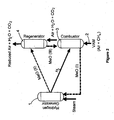
- the CLR-VAM process incorporates a three-step chemical loop to fully integrate the hydrogen production, combustion and regeneration steps ( Figure 2 ). Because of the need for high purity hydrogen, the CLR-VAM process can work best with metals with multiple oxidation states. Among these iron (Fe) is preferred primarily because:
- the main goal in Step 1 is to produce high purity hydrogen.
- the working principle of the chemical looping based process employed in this step is based on the cyclic reduction and oxidation of suitable metal oxides oxygen carrier particles, for example FeO (Wuestite) to Fe 3 O 4 (Magnetite). This is carried out by exchanging the carrier particles between the three interconnected reactors involved in the process (see Figure 2 ).
- Step 2 the mixture of H 2 transferred from the hydrogen generator 1 and the incoming VAM stream 2 are combusted together in a combustor 3 in the presence of metal oxides. This ensures non-flaming oxidation of the fuel mixture at moderate to low temperatures (e.g. 500-600°C). Also, hydrogen is used in Step 2 so that the overall fuel to oxygen ratio (i.e. [H 2 +CH 4 ]/O 2 ) is increased. This ensures the complete combustion of the fuel/air mixture in a robust manner; leading to generation of CO 2 and H 2 O. As shown in Figure 2 , Step 2 is carried out in the presence of fully regenerated metal oxide particles which are at their highest oxidation state (i.e.
- MeO (III) is reduced to the lowest oxidation state for the metal employed in the process (MeO (I)), for example Fe 2 O 3 (Hematite) reduces to FeO (Wuestite) in the case of iron.
- the reduced metal, MeO (I) is then fed back to the hydrogen generator 1.
- Step 2 provides a very effective means of dealing with variations and/or fluctuations in methane concentration. For instance, when methane concentration in VAM is low, addition of H 2 shifts the oxidation process towards full completion. Whilst, for situations where methane concentration in VAM increases to levels close to explosion limit, the flows of H 2 and MeO (III) can be stopped and steam is redirected to the combustor rather than the hydrogen generator. This not only brings the hydrogen production to an end but also significantly dilutes the concentration of the fuel/air mixture in the combustor, ultimately preventing any potential explosion.
- Step 3 the gaseous mixture exiting from the combustor and particles of MeO (II) (e.g. Fe 3 O 4 or Magnetite in the case of iron) from the hydrogen generator are fed into the third reactor (regenerator 4).
- MeO (II) e.g. Fe 3 O 4 or Magnetite in the case of iron
- the metal at its intermediate oxidation state is oxidised by incoming air/steam/CO 2 mixture from the combustor and reaches its highest oxidation state.
- Step 1 hydrogen is generated by chemical looping steam reforming although a metal oxide with reversible reduction/oxidation (redox) properties is preferred (e.g. Co, Mn, Cu).
- redox reversible reduction/oxidation
- the main goal in Step 1 is to produce high purity hydrogen.
- the working principle of the chemical looping based process employed in this step is based on the cyclic reduction and oxidation of suitable metal oxides oxygen carrier particles (e.g. Cu/CuO). This is typically carried out by exchanging the carrier particles between two interconnected fluidised bed reactors.
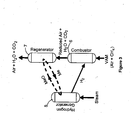
- Step 2 H 2 is transferred from the hydrogen generator 5 ( Figure 3 ) to the combustor 6 so that the overall fuel to air ratio (i.e. [H 2 +CH 4 ]/air) is increased and brought to levels close to the minimum flammability limit.
- This ensures the complete combustion of the fuel/air mixture in a robust manner; leading to generation of CO 2 and H 2 O and slight reduction in O 2 concentration of the ventilation air (i.e. reduced air).
- This step provides a very effective means of dealing with variations and/or fluctuations in methane concentration. For instance, when methane concentration in VAM is below the lower flammability limit, addition of H 2 shifts the oxidation process towards the generation of a stable flame.
- Step 3 the gaseous mixture exiting from the combustor and the MeO from the hydrogen generator are fed into the third reactor (regenerator 7).
- the reduced air is enriched by decoupling the oxygen from MeO simply by controlling the partial pressure of oxygen. This ensures that the mixture exiting the regenerator only contains normal air, steam and carbon dioxide.
- the steam in the outlet can be separated out by condensation and the resulting water can be reused as make-up water in the steam generation process (not shown in Figure 3 ).
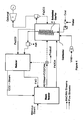
- Figure 4 and Figure 5 show two different three reactor versions with the embedded gasifier shown at 8, while Figure 6 shows a two reactor version with the embedded gasifier shown at 9.
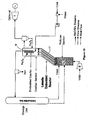
- Non-hydrogen based CLRVAM in a single reactor process as shown in Figure 7 .
- This process operates based on the simultaneous oxidation and reduction of Fe2O3/Fe3O4 in a single reactor 20.
- the reactor can be either fixed- or fluidised-bed although fluidised-bed type reactors provide a more robust operation.
- the process can be interfaced with an embedded gasifier 10 and other unit operations for heat/power generation, and there is no hydrogen involved.
- CLRVAM processes can also be provided using "Lamella Embedded Combined” (LEC) Reactors as shown in Figures 8 to 11 .
- LEC Lane Embedded Combined
- VAM is neutralised simply by redox (reduction/oxidation) reactions of metal oxides such as Fe 2 O 3 /Fe 3 O 4 (or CuO/Cu) and there is no hydrogen involved.
- Heavier particles which are typically at their full oxidation state (MeO) are forced to remain at the bottom of the reactor by the lamellas while lighter particles (typically at a lower oxidation state “Me") are transported through the lamella section up to the top of the reactor.
- the reaction taking place in the bottom section is predominately the reduction of MeO by methane content of the ventilation air while the reaction at the top section is regeneration (i.e. oxidation) of reduced metal (Me) to a higher oxidation state.
- Metal oxide systems of interest for VAM abatement include Fe2O3/Fe3O4 and CuO/Cu.
- the key technical features of VAMCO are:
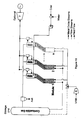
- the reactor is fitted with a series of inclined plates 11 (so-called lamellas) which divide the reactor into two sections, an oxidiser section 12 and a reducer section 13.
- the lamellas 11 provide an internal circulation allowing lighter particles to travel to the top oxidiser section 12 while preventing heavier particles from moving up, as such keeping them at the bottom reducer section 13.
- the lamellas allow reacting particles to be separated based on their density. As such, in the case of Fe 2 O 3 /Fe 3 O 4 , the heavier Fe 2 O 3 particles will predominately exist at the bottom section 13 while lighter Fe 3 O 4 particles exist at the top section 12. This effectively converts the bottom section into a "reducer" and the top section into an "oxidiser".
- FIG. 9 A further version of the CLRVAM process using lamella embedded reactors is shown in Figure 9 using Cu and CuO between a reducer 14 in the upper section and a regenerator 15 in the lower section, connected by the inclined plate lamellas 16.
- the LEC-based CLRVAM systems are extremely energy efficient and can be self sustaining from methane concentrations of about 0.1 vol% which is much lower than the corresponding figures for conventional VAM mitigation systems. This is partly due to the fact that heat is internally circulated from the oxidiser (where the reactions are always exothermic) to the reducer by hot metal oxide particles as shown in Figure 10 . It is also partly due to the fact that the LEC reactor 17 contains metal oxides which have much higher thermal mass than even brick.
- the LEC reactor can be interfaced with an embedded gasifier 18 to:
- LEC modules can be scaled up to meet any VAM flow rate or methane concentration either through:
- a LEC reactor is inherently very safe for a number of reasons:
Landscapes
- Chemical & Material Sciences (AREA)
- Engineering & Computer Science (AREA)
- Chemical Kinetics & Catalysis (AREA)
- Organic Chemistry (AREA)
- Environmental & Geological Engineering (AREA)
- Health & Medical Sciences (AREA)
- Biomedical Technology (AREA)
- Analytical Chemistry (AREA)
- General Chemical & Material Sciences (AREA)
- Oil, Petroleum & Natural Gas (AREA)
- Inorganic Chemistry (AREA)
- Combustion & Propulsion (AREA)
- General Health & Medical Sciences (AREA)
- Hydrogen, Water And Hydrids (AREA)
- Catalysts (AREA)
- Physical Or Chemical Processes And Apparatus (AREA)
Priority Applications (3)
| Application Number | Priority Date | Filing Date | Title |
|---|---|---|---|
| EP17202923.3A EP3345864B1 (en) | 2011-09-30 | 2012-09-28 | Chemical looping removal of ventilation air methane |
| PL17202923T PL3345864T3 (pl) | 2011-09-30 | 2012-09-28 | Usuwanie w pętli chemicznej metanu z powietrza wentylacyjnego |
| PL12836598T PL2760790T3 (pl) | 2011-09-30 | 2012-09-28 | Usuwanie w pętli chemicznej metanu z powietrza wentylacyjnego |
Applications Claiming Priority (2)
| Application Number | Priority Date | Filing Date | Title |
|---|---|---|---|
| AU2011904045A AU2011904045A0 (en) | 2011-09-30 | Chemical Looping Removal of Ventilation Air Methane | |
| PCT/AU2012/001173 WO2013044308A1 (en) | 2011-09-30 | 2012-09-28 | Chemical looping removal of ventilation air methane |
Related Child Applications (2)
| Application Number | Title | Priority Date | Filing Date |
|---|---|---|---|
| EP17202923.3A Division EP3345864B1 (en) | 2011-09-30 | 2012-09-28 | Chemical looping removal of ventilation air methane |
| EP17202923.3A Division-Into EP3345864B1 (en) | 2011-09-30 | 2012-09-28 | Chemical looping removal of ventilation air methane |
Publications (3)
| Publication Number | Publication Date |
|---|---|
| EP2760790A1 EP2760790A1 (en) | 2014-08-06 |
| EP2760790A4 EP2760790A4 (en) | 2015-06-24 |
| EP2760790B1 true EP2760790B1 (en) | 2018-01-10 |
Family
ID=47994025
Family Applications (2)
| Application Number | Title | Priority Date | Filing Date |
|---|---|---|---|
| EP12836598.8A Not-in-force EP2760790B1 (en) | 2011-09-30 | 2012-09-28 | Chemical looping removal of ventilation air methane |
| EP17202923.3A Not-in-force EP3345864B1 (en) | 2011-09-30 | 2012-09-28 | Chemical looping removal of ventilation air methane |
Family Applications After (1)
| Application Number | Title | Priority Date | Filing Date |
|---|---|---|---|
| EP17202923.3A Not-in-force EP3345864B1 (en) | 2011-09-30 | 2012-09-28 | Chemical looping removal of ventilation air methane |
Country Status (7)
| Country | Link |
|---|---|
| US (1) | US9314740B2 (OSRAM) |
| EP (2) | EP2760790B1 (OSRAM) |
| AU (1) | AU2012315483B2 (OSRAM) |
| IN (1) | IN2014KN00899A (OSRAM) |
| PL (2) | PL3345864T3 (OSRAM) |
| WO (1) | WO2013044308A1 (OSRAM) |
| ZA (1) | ZA201402182B (OSRAM) |
Families Citing this family (7)
| Publication number | Priority date | Publication date | Assignee | Title |
|---|---|---|---|---|
| SG11201504002SA (en) * | 2012-11-30 | 2015-06-29 | Saudi Arabian Oil Co | Staged chemical looping process with integrated oxygen generation |
| WO2015003219A1 (en) | 2013-07-11 | 2015-01-15 | Newcastle Innovation Limited | Mineral carbonate looping reactor for ventilation air methane mitigation |
| WO2017097733A1 (en) * | 2015-12-07 | 2017-06-15 | Dürr Systems Ag | A mixing and processing system of ventilation air methane and coal mine methane |
| CN109078600B (zh) * | 2018-07-13 | 2020-09-08 | 安徽省含山县锦华氧化锌厂 | 一种氧化锌生产加工机器人 |
| KR102644556B1 (ko) * | 2018-12-04 | 2024-03-07 | 현대자동차주식회사 | 부생가스를 이용한 수소 제조 시스템 및 제조 방법 |
| EP3699991B1 (en) * | 2019-02-25 | 2021-04-14 | ETH Zurich | Systems and reactors for storage of electrical energy |
| CN112201465B (zh) * | 2020-10-10 | 2022-05-06 | 河北建投能源科学技术研究院有限公司 | 一种脱硫废水处理改性生物磁流体的制备方法 |
Family Cites Families (9)
| Publication number | Priority date | Publication date | Assignee | Title |
|---|---|---|---|---|
| ITMI20040555A1 (it) * | 2004-03-23 | 2004-06-23 | Eni Spa | Procedimento per la produzione di idrogeno e la co-produzione di anidride carbonica |
| AU2007332089B2 (en) * | 2006-12-15 | 2012-05-17 | Eestech, Inc. | A combustion apparatus |
| JP4538077B2 (ja) * | 2008-06-13 | 2010-09-08 | 川崎重工業株式会社 | 希薄燃料吸入ガスタービン |
| WO2010085835A1 (en) | 2009-01-29 | 2010-08-05 | Commonwealth Scientific And Industrial Research Organisation | System and method for mitigating at least one component from a fluid stream |
| US20110081277A1 (en) * | 2009-10-05 | 2011-04-07 | Balon Jr Thomas Hamilton | Regenerative thermal oxidiser |
| US8753108B2 (en) * | 2012-03-30 | 2014-06-17 | Alstom Technology Ltd | Method and apparatus for treatment of unburnts |
| CN102618349B (zh) * | 2012-03-31 | 2014-07-02 | 昆明理工大学 | 一种甲烷化学链燃烧的氧载体及其制备方法 |
| US9481837B2 (en) * | 2013-03-15 | 2016-11-01 | The Babcock & Wilcox Company | Chemical looping processes for partial oxidation of carbonaceous fuels |
| CN103552983A (zh) * | 2013-10-25 | 2014-02-05 | 西南石油大学 | 一种CaO引导的甲烷蒸汽重整化学链燃烧制氢工艺 |
-
2012
- 2012-09-28 IN IN899KON2014 patent/IN2014KN00899A/en unknown
- 2012-09-28 PL PL17202923T patent/PL3345864T3/pl unknown
- 2012-09-28 EP EP12836598.8A patent/EP2760790B1/en not_active Not-in-force
- 2012-09-28 WO PCT/AU2012/001173 patent/WO2013044308A1/en not_active Ceased
- 2012-09-28 PL PL12836598T patent/PL2760790T3/pl unknown
- 2012-09-28 AU AU2012315483A patent/AU2012315483B2/en active Active
- 2012-09-28 US US14/348,500 patent/US9314740B2/en active Active
- 2012-09-28 EP EP17202923.3A patent/EP3345864B1/en not_active Not-in-force
-
2014
- 2014-03-25 ZA ZA2014/02182A patent/ZA201402182B/en unknown
Non-Patent Citations (1)
| Title |
|---|
| None * |
Also Published As
| Publication number | Publication date |
|---|---|
| ZA201402182B (en) | 2015-04-29 |
| US9314740B2 (en) | 2016-04-19 |
| AU2012315483A1 (en) | 2014-04-10 |
| EP3345864A1 (en) | 2018-07-11 |
| PL2760790T3 (pl) | 2018-04-30 |
| AU2012315483B2 (en) | 2016-06-02 |
| EP3345864B1 (en) | 2019-06-26 |
| US20140227157A1 (en) | 2014-08-14 |
| WO2013044308A1 (en) | 2013-04-04 |
| PL3345864T3 (pl) | 2020-02-28 |
| EP2760790A1 (en) | 2014-08-06 |
| EP2760790A4 (en) | 2015-06-24 |
| IN2014KN00899A (OSRAM) | 2015-10-09 |
Similar Documents
| Publication | Publication Date | Title |
|---|---|---|
| EP2760790B1 (en) | Chemical looping removal of ventilation air methane | |
| US8506915B2 (en) | Method for recovering CO2 by means of CaO and the exothermic reduction of a solid | |
| Fan et al. | Utilization of chemical looping strategy in coal gasification processes | |
| EP2808073B1 (en) | System for CO2 capture from a combustion flue gas using a CaO/CaCO3 chemical loop | |
| CN107849462B (zh) | 通过金属氧化物循环还原和氧化的合成气生产 | |
| EP1933087A2 (en) | Systems and methods using an unmixed fuel processor | |
| KR20220085705A (ko) | 공급원료 가스 반응기를 사용하여 하나 이상의 생성물을 제조하는 방법 | |
| CN101216175B (zh) | 载氧体载氧气化燃烧方法及其装置 | |
| EP3169879B1 (en) | Integrated calcium looping combined cycle for sour gas applications | |
| US7780749B2 (en) | Unmixed fuel processors and methods for using the same | |
| US20120100055A1 (en) | Chemical looping air separation unit and methods of use | |
| US8555652B1 (en) | Air-independent internal oxidation | |
| Duan et al. | Fluidized Bed Reactors for Carbon Capture: A Review of Advancing Combustion and Sorption Techniques for Decarbonization | |
| Liang et al. | Reaction of spinel CuFe2O4 oxygen carrier with converter off-gas during chemical looping combustion: An experimental characteristic and decomposition kinetic study | |
| AU2014289972B2 (en) | Mineral carbonate looping reactor for ventilation air methane mitigation | |
| EP3617590A1 (en) | Incineration apparatus and method | |
| Hassan et al. | Parametric and exergetic analysis of a power plant with CO2 and capture using chemical looping combustion | |
| Pröll et al. | Chemical looping combustion and reforming | |
| TWI554331B (zh) | 用以分離、純化二氧化碳之碳氫燃料反應器 | |
| Gallucci et al. | A review on recent patents on chemical and calcium looping processes | |
| Lee et al. | Simulation of the flue gas treatment processes of an industrial-waste incinerator using Aspen plus | |
| Amin et al. | Chemical looping combustion for gaseous fuels: principles, oxygen carriers, and reactor design | |
| TWI572562B (zh) | 具空間效益之用以分離、純化二氧化碳之碳氫燃料反應器 | |
| Li et al. | Coal Direct Chemical Looping (CDCL) process for hydrogen and power generation | |
| EP2867583A2 (en) | Process for obtaining thermal energy by the combustion of hydrogen in admixture with carbon oxides, nitrogen oxides and/or sulphur oxides and installation for the application of the process |
Legal Events
| Date | Code | Title | Description |
|---|---|---|---|
| PUAI | Public reference made under article 153(3) epc to a published international application that has entered the european phase |
Free format text: ORIGINAL CODE: 0009012 |
|
| 17P | Request for examination filed |
Effective date: 20140324 |
|
| AK | Designated contracting states |
Kind code of ref document: A1 Designated state(s): AL AT BE BG CH CY CZ DE DK EE ES FI FR GB GR HR HU IE IS IT LI LT LU LV MC MK MT NL NO PL PT RO RS SE SI SK SM TR |
|
| DAX | Request for extension of the european patent (deleted) | ||
| RA4 | Supplementary search report drawn up and despatched (corrected) |
Effective date: 20150526 |
|
| RIC1 | Information provided on ipc code assigned before grant |
Ipc: B01D 53/72 20060101ALI20150519BHEP Ipc: C01B 3/10 20060101ALI20150519BHEP Ipc: B01D 53/86 20060101ALI20150519BHEP Ipc: C01B 31/20 20060101AFI20150519BHEP |
|
| 17Q | First examination report despatched |
Effective date: 20160518 |
|
| REG | Reference to a national code |
Ref country code: DE Ref legal event code: R079 Ref document number: 602012041892 Country of ref document: DE Free format text: PREVIOUS MAIN CLASS: C01B0031200000 Ipc: C01B0003100000 |
|
| RIC1 | Information provided on ipc code assigned before grant |
Ipc: B01D 53/86 20060101ALI20170713BHEP Ipc: B01D 53/72 20060101ALI20170713BHEP Ipc: C01B 3/10 20060101AFI20170713BHEP |
|
| GRAP | Despatch of communication of intention to grant a patent |
Free format text: ORIGINAL CODE: EPIDOSNIGR1 |
|
| INTG | Intention to grant announced |
Effective date: 20170825 |
|
| GRAS | Grant fee paid |
Free format text: ORIGINAL CODE: EPIDOSNIGR3 |
|
| GRAA | (expected) grant |
Free format text: ORIGINAL CODE: 0009210 |
|
| AK | Designated contracting states |
Kind code of ref document: B1 Designated state(s): AL AT BE BG CH CY CZ DE DK EE ES FI FR GB GR HR HU IE IS IT LI LT LU LV MC MK MT NL NO PL PT RO RS SE SI SK SM TR |
|
| REG | Reference to a national code |
Ref country code: CH Ref legal event code: EP Ref country code: AT Ref legal event code: REF Ref document number: 962172 Country of ref document: AT Kind code of ref document: T Effective date: 20180115 |
|
| REG | Reference to a national code |
Ref country code: IE Ref legal event code: FG4D |
|
| RAP2 | Party data changed (patent owner data changed or rights of a patent transferred) |
Owner name: THE UNIVERSITY OF NEWCASTLE |
|
| REG | Reference to a national code |
Ref country code: DE Ref legal event code: R096 Ref document number: 602012041892 Country of ref document: DE |
|
| REG | Reference to a national code |
Ref country code: NL Ref legal event code: MP Effective date: 20180110 |
|
| REG | Reference to a national code |
Ref country code: AT Ref legal event code: MK05 Ref document number: 962172 Country of ref document: AT Kind code of ref document: T Effective date: 20180110 |
|
| PG25 | Lapsed in a contracting state [announced via postgrant information from national office to epo] |
Ref country code: NL Free format text: LAPSE BECAUSE OF FAILURE TO SUBMIT A TRANSLATION OF THE DESCRIPTION OR TO PAY THE FEE WITHIN THE PRESCRIBED TIME-LIMIT Effective date: 20180110 |
|
| PG25 | Lapsed in a contracting state [announced via postgrant information from national office to epo] |
Ref country code: ES Free format text: LAPSE BECAUSE OF FAILURE TO SUBMIT A TRANSLATION OF THE DESCRIPTION OR TO PAY THE FEE WITHIN THE PRESCRIBED TIME-LIMIT Effective date: 20180110 Ref country code: LT Free format text: LAPSE BECAUSE OF FAILURE TO SUBMIT A TRANSLATION OF THE DESCRIPTION OR TO PAY THE FEE WITHIN THE PRESCRIBED TIME-LIMIT Effective date: 20180110 Ref country code: CY Free format text: LAPSE BECAUSE OF FAILURE TO SUBMIT A TRANSLATION OF THE DESCRIPTION OR TO PAY THE FEE WITHIN THE PRESCRIBED TIME-LIMIT Effective date: 20180110 Ref country code: NO Free format text: LAPSE BECAUSE OF FAILURE TO SUBMIT A TRANSLATION OF THE DESCRIPTION OR TO PAY THE FEE WITHIN THE PRESCRIBED TIME-LIMIT Effective date: 20180410 Ref country code: HR Free format text: LAPSE BECAUSE OF FAILURE TO SUBMIT A TRANSLATION OF THE DESCRIPTION OR TO PAY THE FEE WITHIN THE PRESCRIBED TIME-LIMIT Effective date: 20180110 Ref country code: FI Free format text: LAPSE BECAUSE OF FAILURE TO SUBMIT A TRANSLATION OF THE DESCRIPTION OR TO PAY THE FEE WITHIN THE PRESCRIBED TIME-LIMIT Effective date: 20180110 |
|
| PG25 | Lapsed in a contracting state [announced via postgrant information from national office to epo] |
Ref country code: IS Free format text: LAPSE BECAUSE OF FAILURE TO SUBMIT A TRANSLATION OF THE DESCRIPTION OR TO PAY THE FEE WITHIN THE PRESCRIBED TIME-LIMIT Effective date: 20180510 Ref country code: RS Free format text: LAPSE BECAUSE OF FAILURE TO SUBMIT A TRANSLATION OF THE DESCRIPTION OR TO PAY THE FEE WITHIN THE PRESCRIBED TIME-LIMIT Effective date: 20180110 Ref country code: SE Free format text: LAPSE BECAUSE OF FAILURE TO SUBMIT A TRANSLATION OF THE DESCRIPTION OR TO PAY THE FEE WITHIN THE PRESCRIBED TIME-LIMIT Effective date: 20180110 Ref country code: LV Free format text: LAPSE BECAUSE OF FAILURE TO SUBMIT A TRANSLATION OF THE DESCRIPTION OR TO PAY THE FEE WITHIN THE PRESCRIBED TIME-LIMIT Effective date: 20180110 Ref country code: AT Free format text: LAPSE BECAUSE OF FAILURE TO SUBMIT A TRANSLATION OF THE DESCRIPTION OR TO PAY THE FEE WITHIN THE PRESCRIBED TIME-LIMIT Effective date: 20180110 Ref country code: GR Free format text: LAPSE BECAUSE OF FAILURE TO SUBMIT A TRANSLATION OF THE DESCRIPTION OR TO PAY THE FEE WITHIN THE PRESCRIBED TIME-LIMIT Effective date: 20180411 Ref country code: BG Free format text: LAPSE BECAUSE OF FAILURE TO SUBMIT A TRANSLATION OF THE DESCRIPTION OR TO PAY THE FEE WITHIN THE PRESCRIBED TIME-LIMIT Effective date: 20180410 |
|
| REG | Reference to a national code |
Ref country code: FR Ref legal event code: PLFP Year of fee payment: 7 |
|
| REG | Reference to a national code |
Ref country code: DE Ref legal event code: R097 Ref document number: 602012041892 Country of ref document: DE |
|
| PG25 | Lapsed in a contracting state [announced via postgrant information from national office to epo] |
Ref country code: RO Free format text: LAPSE BECAUSE OF FAILURE TO SUBMIT A TRANSLATION OF THE DESCRIPTION OR TO PAY THE FEE WITHIN THE PRESCRIBED TIME-LIMIT Effective date: 20180110 Ref country code: AL Free format text: LAPSE BECAUSE OF FAILURE TO SUBMIT A TRANSLATION OF THE DESCRIPTION OR TO PAY THE FEE WITHIN THE PRESCRIBED TIME-LIMIT Effective date: 20180110 Ref country code: IT Free format text: LAPSE BECAUSE OF FAILURE TO SUBMIT A TRANSLATION OF THE DESCRIPTION OR TO PAY THE FEE WITHIN THE PRESCRIBED TIME-LIMIT Effective date: 20180110 Ref country code: EE Free format text: LAPSE BECAUSE OF FAILURE TO SUBMIT A TRANSLATION OF THE DESCRIPTION OR TO PAY THE FEE WITHIN THE PRESCRIBED TIME-LIMIT Effective date: 20180110 |
|
| PLBE | No opposition filed within time limit |
Free format text: ORIGINAL CODE: 0009261 |
|
| STAA | Information on the status of an ep patent application or granted ep patent |
Free format text: STATUS: NO OPPOSITION FILED WITHIN TIME LIMIT |
|
| PG25 | Lapsed in a contracting state [announced via postgrant information from national office to epo] |
Ref country code: DK Free format text: LAPSE BECAUSE OF FAILURE TO SUBMIT A TRANSLATION OF THE DESCRIPTION OR TO PAY THE FEE WITHIN THE PRESCRIBED TIME-LIMIT Effective date: 20180110 Ref country code: SM Free format text: LAPSE BECAUSE OF FAILURE TO SUBMIT A TRANSLATION OF THE DESCRIPTION OR TO PAY THE FEE WITHIN THE PRESCRIBED TIME-LIMIT Effective date: 20180110 Ref country code: SK Free format text: LAPSE BECAUSE OF FAILURE TO SUBMIT A TRANSLATION OF THE DESCRIPTION OR TO PAY THE FEE WITHIN THE PRESCRIBED TIME-LIMIT Effective date: 20180110 Ref country code: CZ Free format text: LAPSE BECAUSE OF FAILURE TO SUBMIT A TRANSLATION OF THE DESCRIPTION OR TO PAY THE FEE WITHIN THE PRESCRIBED TIME-LIMIT Effective date: 20180110 |
|
| 26N | No opposition filed |
Effective date: 20181011 |
|
| PG25 | Lapsed in a contracting state [announced via postgrant information from national office to epo] |
Ref country code: SI Free format text: LAPSE BECAUSE OF FAILURE TO SUBMIT A TRANSLATION OF THE DESCRIPTION OR TO PAY THE FEE WITHIN THE PRESCRIBED TIME-LIMIT Effective date: 20180110 |
|
| PG25 | Lapsed in a contracting state [announced via postgrant information from national office to epo] |
Ref country code: MC Free format text: LAPSE BECAUSE OF FAILURE TO SUBMIT A TRANSLATION OF THE DESCRIPTION OR TO PAY THE FEE WITHIN THE PRESCRIBED TIME-LIMIT Effective date: 20180110 |
|
| REG | Reference to a national code |
Ref country code: CH Ref legal event code: PL |
|
| REG | Reference to a national code |
Ref country code: BE Ref legal event code: MM Effective date: 20180930 |
|
| REG | Reference to a national code |
Ref country code: IE Ref legal event code: MM4A |
|
| PG25 | Lapsed in a contracting state [announced via postgrant information from national office to epo] |
Ref country code: LU Free format text: LAPSE BECAUSE OF NON-PAYMENT OF DUE FEES Effective date: 20180928 |
|
| PG25 | Lapsed in a contracting state [announced via postgrant information from national office to epo] |
Ref country code: IE Free format text: LAPSE BECAUSE OF NON-PAYMENT OF DUE FEES Effective date: 20180928 |
|
| PG25 | Lapsed in a contracting state [announced via postgrant information from national office to epo] |
Ref country code: BE Free format text: LAPSE BECAUSE OF NON-PAYMENT OF DUE FEES Effective date: 20180930 Ref country code: LI Free format text: LAPSE BECAUSE OF NON-PAYMENT OF DUE FEES Effective date: 20180930 Ref country code: CH Free format text: LAPSE BECAUSE OF NON-PAYMENT OF DUE FEES Effective date: 20180930 |
|
| PGFP | Annual fee paid to national office [announced via postgrant information from national office to epo] |
Ref country code: FR Payment date: 20190927 Year of fee payment: 8 Ref country code: DE Payment date: 20190917 Year of fee payment: 8 |
|
| PGFP | Annual fee paid to national office [announced via postgrant information from national office to epo] |
Ref country code: PL Payment date: 20190916 Year of fee payment: 8 |
|
| PGFP | Annual fee paid to national office [announced via postgrant information from national office to epo] |
Ref country code: GB Payment date: 20190926 Year of fee payment: 8 |
|
| PG25 | Lapsed in a contracting state [announced via postgrant information from national office to epo] |
Ref country code: MT Free format text: LAPSE BECAUSE OF NON-PAYMENT OF DUE FEES Effective date: 20180928 |
|
| PG25 | Lapsed in a contracting state [announced via postgrant information from national office to epo] |
Ref country code: TR Free format text: LAPSE BECAUSE OF FAILURE TO SUBMIT A TRANSLATION OF THE DESCRIPTION OR TO PAY THE FEE WITHIN THE PRESCRIBED TIME-LIMIT Effective date: 20180110 |
|
| PG25 | Lapsed in a contracting state [announced via postgrant information from national office to epo] |
Ref country code: PT Free format text: LAPSE BECAUSE OF FAILURE TO SUBMIT A TRANSLATION OF THE DESCRIPTION OR TO PAY THE FEE WITHIN THE PRESCRIBED TIME-LIMIT Effective date: 20180110 Ref country code: HU Free format text: LAPSE BECAUSE OF FAILURE TO SUBMIT A TRANSLATION OF THE DESCRIPTION OR TO PAY THE FEE WITHIN THE PRESCRIBED TIME-LIMIT; INVALID AB INITIO Effective date: 20120928 |
|
| PG25 | Lapsed in a contracting state [announced via postgrant information from national office to epo] |
Ref country code: MK Free format text: LAPSE BECAUSE OF NON-PAYMENT OF DUE FEES Effective date: 20180110 |
|
| REG | Reference to a national code |
Ref country code: DE Ref legal event code: R119 Ref document number: 602012041892 Country of ref document: DE |
|
| GBPC | Gb: european patent ceased through non-payment of renewal fee |
Effective date: 20200928 |
|
| PG25 | Lapsed in a contracting state [announced via postgrant information from national office to epo] |
Ref country code: DE Free format text: LAPSE BECAUSE OF NON-PAYMENT OF DUE FEES Effective date: 20210401 Ref country code: FR Free format text: LAPSE BECAUSE OF NON-PAYMENT OF DUE FEES Effective date: 20200930 |
|
| PG25 | Lapsed in a contracting state [announced via postgrant information from national office to epo] |
Ref country code: GB Free format text: LAPSE BECAUSE OF NON-PAYMENT OF DUE FEES Effective date: 20200928 |
|
| PG25 | Lapsed in a contracting state [announced via postgrant information from national office to epo] |
Ref country code: PL Free format text: LAPSE BECAUSE OF NON-PAYMENT OF DUE FEES Effective date: 20200928 |
|
| P01 | Opt-out of the competence of the unified patent court (upc) registered |
Effective date: 20230515 |