EP2741355A2 - Energy storage device and energy storage unit - Google Patents
Energy storage device and energy storage unit Download PDFInfo
- Publication number
- EP2741355A2 EP2741355A2 EP20130195271 EP13195271A EP2741355A2 EP 2741355 A2 EP2741355 A2 EP 2741355A2 EP 20130195271 EP20130195271 EP 20130195271 EP 13195271 A EP13195271 A EP 13195271A EP 2741355 A2 EP2741355 A2 EP 2741355A2
- Authority
- EP
- European Patent Office
- Prior art keywords
- negative electrode
- active material
- electrode active
- particle size
- energy storage
- Prior art date
- Legal status (The legal status is an assumption and is not a legal conclusion. Google has not performed a legal analysis and makes no representation as to the accuracy of the status listed.)
- Granted
Links
Images




Classifications
-
- H—ELECTRICITY
- H01—ELECTRIC ELEMENTS
- H01M—PROCESSES OR MEANS, e.g. BATTERIES, FOR THE DIRECT CONVERSION OF CHEMICAL ENERGY INTO ELECTRICAL ENERGY
- H01M4/00—Electrodes
- H01M4/02—Electrodes composed of, or comprising, active material
- H01M4/36—Selection of substances as active materials, active masses, active liquids
- H01M4/58—Selection of substances as active materials, active masses, active liquids of inorganic compounds other than oxides or hydroxides, e.g. sulfides, selenides, tellurides, halogenides or LiCoFy; of polyanionic structures, e.g. phosphates, silicates or borates
- H01M4/583—Carbonaceous material, e.g. graphite-intercalation compounds or CFx
- H01M4/587—Carbonaceous material, e.g. graphite-intercalation compounds or CFx for inserting or intercalating light metals
-
- H—ELECTRICITY
- H01—ELECTRIC ELEMENTS
- H01M—PROCESSES OR MEANS, e.g. BATTERIES, FOR THE DIRECT CONVERSION OF CHEMICAL ENERGY INTO ELECTRICAL ENERGY
- H01M10/00—Secondary cells; Manufacture thereof
- H01M10/05—Accumulators with non-aqueous electrolyte
-
- C—CHEMISTRY; METALLURGY
- C01—INORGANIC CHEMISTRY
- C01B—NON-METALLIC ELEMENTS; COMPOUNDS THEREOF; METALLOIDS OR COMPOUNDS THEREOF NOT COVERED BY SUBCLASS C01C
- C01B32/00—Carbon; Compounds thereof
- C01B32/05—Preparation or purification of carbon not covered by groups C01B32/15, C01B32/20, C01B32/25, C01B32/30
-
- H—ELECTRICITY
- H01—ELECTRIC ELEMENTS
- H01M—PROCESSES OR MEANS, e.g. BATTERIES, FOR THE DIRECT CONVERSION OF CHEMICAL ENERGY INTO ELECTRICAL ENERGY
- H01M10/00—Secondary cells; Manufacture thereof
- H01M10/05—Accumulators with non-aqueous electrolyte
- H01M10/052—Li-accumulators
-
- H—ELECTRICITY
- H01—ELECTRIC ELEMENTS
- H01M—PROCESSES OR MEANS, e.g. BATTERIES, FOR THE DIRECT CONVERSION OF CHEMICAL ENERGY INTO ELECTRICAL ENERGY
- H01M10/00—Secondary cells; Manufacture thereof
- H01M10/05—Accumulators with non-aqueous electrolyte
- H01M10/052—Li-accumulators
- H01M10/0525—Rocking-chair batteries, i.e. batteries with lithium insertion or intercalation in both electrodes; Lithium-ion batteries
-
- H—ELECTRICITY
- H01—ELECTRIC ELEMENTS
- H01M—PROCESSES OR MEANS, e.g. BATTERIES, FOR THE DIRECT CONVERSION OF CHEMICAL ENERGY INTO ELECTRICAL ENERGY
- H01M4/00—Electrodes
- H01M4/02—Electrodes composed of, or comprising, active material
- H01M4/13—Electrodes for accumulators with non-aqueous electrolyte, e.g. for lithium-accumulators; Processes of manufacture thereof
-
- H—ELECTRICITY
- H01—ELECTRIC ELEMENTS
- H01M—PROCESSES OR MEANS, e.g. BATTERIES, FOR THE DIRECT CONVERSION OF CHEMICAL ENERGY INTO ELECTRICAL ENERGY
- H01M4/00—Electrodes
- H01M4/02—Electrodes composed of, or comprising, active material
- H01M4/36—Selection of substances as active materials, active masses, active liquids
- H01M4/58—Selection of substances as active materials, active masses, active liquids of inorganic compounds other than oxides or hydroxides, e.g. sulfides, selenides, tellurides, halogenides or LiCoFy; of polyanionic structures, e.g. phosphates, silicates or borates
- H01M4/583—Carbonaceous material, e.g. graphite-intercalation compounds or CFx
-
- H—ELECTRICITY
- H01—ELECTRIC ELEMENTS
- H01M—PROCESSES OR MEANS, e.g. BATTERIES, FOR THE DIRECT CONVERSION OF CHEMICAL ENERGY INTO ELECTRICAL ENERGY
- H01M50/00—Constructional details or processes of manufacture of the non-active parts of electrochemical cells other than fuel cells, e.g. hybrid cells
- H01M50/50—Current conducting connections for cells or batteries
- H01M50/531—Electrode connections inside a battery casing
- H01M50/536—Electrode connections inside a battery casing characterised by the method of fixing the leads to the electrodes, e.g. by welding
-
- H—ELECTRICITY
- H01—ELECTRIC ELEMENTS
- H01M—PROCESSES OR MEANS, e.g. BATTERIES, FOR THE DIRECT CONVERSION OF CHEMICAL ENERGY INTO ELECTRICAL ENERGY
- H01M50/00—Constructional details or processes of manufacture of the non-active parts of electrochemical cells other than fuel cells, e.g. hybrid cells
- H01M50/50—Current conducting connections for cells or batteries
- H01M50/531—Electrode connections inside a battery casing
- H01M50/538—Connection of several leads or tabs of wound or folded electrode stacks
-
- H—ELECTRICITY
- H01—ELECTRIC ELEMENTS
- H01M—PROCESSES OR MEANS, e.g. BATTERIES, FOR THE DIRECT CONVERSION OF CHEMICAL ENERGY INTO ELECTRICAL ENERGY
- H01M10/00—Secondary cells; Manufacture thereof
- H01M10/05—Accumulators with non-aqueous electrolyte
- H01M10/056—Accumulators with non-aqueous electrolyte characterised by the materials used as electrolytes, e.g. mixed inorganic/organic electrolytes
- H01M10/0564—Accumulators with non-aqueous electrolyte characterised by the materials used as electrolytes, e.g. mixed inorganic/organic electrolytes the electrolyte being constituted of organic materials only
- H01M10/0566—Liquid materials
- H01M10/0567—Liquid materials characterised by the additives
-
- H—ELECTRICITY
- H01—ELECTRIC ELEMENTS
- H01M—PROCESSES OR MEANS, e.g. BATTERIES, FOR THE DIRECT CONVERSION OF CHEMICAL ENERGY INTO ELECTRICAL ENERGY
- H01M4/00—Electrodes
- H01M4/02—Electrodes composed of, or comprising, active material
- H01M2004/021—Physical characteristics, e.g. porosity, surface area
-
- H—ELECTRICITY
- H01—ELECTRIC ELEMENTS
- H01M—PROCESSES OR MEANS, e.g. BATTERIES, FOR THE DIRECT CONVERSION OF CHEMICAL ENERGY INTO ELECTRICAL ENERGY
- H01M4/00—Electrodes
- H01M4/02—Electrodes composed of, or comprising, active material
- H01M4/13—Electrodes for accumulators with non-aqueous electrolyte, e.g. for lithium-accumulators; Processes of manufacture thereof
- H01M4/131—Electrodes based on mixed oxides or hydroxides, or on mixtures of oxides or hydroxides, e.g. LiCoOx
-
- H—ELECTRICITY
- H01—ELECTRIC ELEMENTS
- H01M—PROCESSES OR MEANS, e.g. BATTERIES, FOR THE DIRECT CONVERSION OF CHEMICAL ENERGY INTO ELECTRICAL ENERGY
- H01M4/00—Electrodes
- H01M4/02—Electrodes composed of, or comprising, active material
- H01M4/13—Electrodes for accumulators with non-aqueous electrolyte, e.g. for lithium-accumulators; Processes of manufacture thereof
- H01M4/133—Electrodes based on carbonaceous material, e.g. graphite-intercalation compounds or CFx
-
- Y—GENERAL TAGGING OF NEW TECHNOLOGICAL DEVELOPMENTS; GENERAL TAGGING OF CROSS-SECTIONAL TECHNOLOGIES SPANNING OVER SEVERAL SECTIONS OF THE IPC; TECHNICAL SUBJECTS COVERED BY FORMER USPC CROSS-REFERENCE ART COLLECTIONS [XRACs] AND DIGESTS
- Y02—TECHNOLOGIES OR APPLICATIONS FOR MITIGATION OR ADAPTATION AGAINST CLIMATE CHANGE
- Y02E—REDUCTION OF GREENHOUSE GAS [GHG] EMISSIONS, RELATED TO ENERGY GENERATION, TRANSMISSION OR DISTRIBUTION
- Y02E60/00—Enabling technologies; Technologies with a potential or indirect contribution to GHG emissions mitigation
- Y02E60/10—Energy storage using batteries
-
- Y—GENERAL TAGGING OF NEW TECHNOLOGICAL DEVELOPMENTS; GENERAL TAGGING OF CROSS-SECTIONAL TECHNOLOGIES SPANNING OVER SEVERAL SECTIONS OF THE IPC; TECHNICAL SUBJECTS COVERED BY FORMER USPC CROSS-REFERENCE ART COLLECTIONS [XRACs] AND DIGESTS
- Y02—TECHNOLOGIES OR APPLICATIONS FOR MITIGATION OR ADAPTATION AGAINST CLIMATE CHANGE
- Y02T—CLIMATE CHANGE MITIGATION TECHNOLOGIES RELATED TO TRANSPORTATION
- Y02T10/00—Road transport of goods or passengers
- Y02T10/60—Other road transportation technologies with climate change mitigation effect
- Y02T10/70—Energy storage systems for electromobility, e.g. batteries
Definitions
- the present invention relates to an energy storage device including a positive electrode, a negative electrode, a separator disposed between the positive electrode and the negative electrode, and a non-aqueous electrolyte, and an energy storage unit including a plurality of the energy storage devices.
- Patent Literature 1 W02005/098998 .
- the increased output in the energy storage device is attained by use of a non-graphitizable carbon having an average particle size D50 of 1 to 20 ⁇ m (preferably 4 to 15 ⁇ m) as a negative electrode active material to be formed into a negative electrode.
- An object of the present invention is to provide an energy storage device and energy storage unit that can attain an increased output and high durability.
- the energy storage device is an energy storage device including a positive electrode, a negative electrode, a separator disposed between the positive electrode and the negative electrode, and a non-aqueous electrolyte, wherein the negative electrode includes a negative electrode active material layer containing a non-graphitizable carbon as a negative electrode active material, and the negative electrode active material has a negative electrode active material weight per unit volume of the negative electrode active material layer of 0.92 g/cc or more and 1.13 g/cc or less and a particle size D90 of 4.3 ⁇ m or more and 11.5 ⁇ m or less, the particle size D90 being a particle size in particle size distribution in which a cumulative volume is 90%.
- the present inventors found that if the particle size of non-graphitizable carbon is reduced to about several micrometers in terms of the average particle size D50, the output can be effectively increased but durability will undesirably reduce. Namely, the conventional energy storage device has such a problem of reduced durability when a non-graphitizable carbon having such a small particle size is used as the negative electrode active material to increase the output.
- the present invention has been made to solve the problem above, and an object of the present invention is to provide an energy storage device and energy storage unit that can attain an increased output and high durability.
- the energy storage device is an energy storage device including a positive electrode, a negative electrode, a separator disposed between the positive electrode and the negative electrode, and a non-aqueous electrolyte, wherein the negative electrode includes a negative electrode active material layer containing a non-graphitizable carbon as a negative electrode active material, and the negative electrode active material has a negative electrode active material weight per unit volume of the negative electrode active material layer (density of the negative electrode active material) of 0.92 g/cc or more and 1.13 g/cc or less and a particle size D90 of 4.3 ⁇ m or more and 11.5 ⁇ m or less, the particle size D90 being a particle size in particle size distribution in which a cumulative volume is 90%.
- the negative electrode includes a negative electrode active material layer containing a non-graphitizable carbon as a negative electrode active material
- the negative electrode active material has a negative electrode active material weight per unit volume of the negative electrode active material layer (density of the negative electrode active material) of 0.92
- the present inventors found that an increased output and high durability can be attained when the non-graphitizable carbon is used as the negative electrode active material, the density of the negative electrode active material is controlled to be 0.92 g/cc or more and 1.13 g/cc or less, and the particle size D90 is controlled to be 4.3 ⁇ m or more and 11.5 ⁇ m or less. Namely, an excessively reduced density of the negative electrode active material will significantly reduce the capacity and output due to degradation, thereby reducing durability. An excessively increased density of the negative electrode active material will cause wrinkles in a negative electrode, leading to difficulties in production of an electrode assembly. When the negative electrode having wrinkles is used to produce the electrode assembly, durability will also reduce.
- the density of the negative electrode active material within a suitable range, high durability can be attained while an increased capacity and output are kept.
- an excessively reduced particle size of the negative electrode active material will significantly reduce the capacity and output due to degradation, thereby reducing durability.
- Numbers of coarse particles contained in the negative electrode active material will become pillars to cause insufficient contact between the negative electrode active materials of such a reduced particle size when the positive electrode, the negative electrode, and the separator are stacked and pressed to reduce the thickness of the layer. The insufficient contact will reduce the output.
- the particle size D90 of the negative electrode active material within a suitable range, high durability can be attained while an increased capacity and output are kept.
- the relation A1 -0.014 x B1 + C1 (where 4.3 ⁇ B1 ⁇ 8.5, and 1.04 ⁇ C1 ⁇ 1.20) may be satisfied wherein the negative electrode active material weight per unit volume of the negative electrode active material layer (density of the negative electrode active material) is A1 g/cc.
- the present inventors found that when the density of the negative electrode active material and the particle size D90 satisfy the relation, a more increased output and higher durability can be attained. Namely, higher durability can be attained while a more increased capacity and higher output are kept wherein the particle size D90 of the negative electrode active material is in the range of 4.3 ⁇ m or more and 8.5 ⁇ m or less and the particle size D90 is 4.3 ⁇ m and the density of the negative electrode active material is 0.98 g/cc or more and 1.13 g/cc or less, the particle size D90 is 6.5 ⁇ m and the density is 0.95 g/cc or more and 1.10 g/cc or less, and the particle size D90 is 8.5 ⁇ m and the density is 0.92 g/cc or more and 1.07 g/cc or less.
- the negative electrode active material may have a particle size D50 of 2.7 ⁇ m or more and 5.9 ⁇ m or less, the particle size D50 being a particle size in particle size distribution in which the cumulative volume is 50%.
- the particle size D90 of the negative electrode active material is 4.3 ⁇ m or more and 11.5 ⁇ m or less
- the particle size D50 is 2.7 ⁇ m or more and 5.9 ⁇ m or less. Then, at a particle size D50 in the range above, an increased output and high durability can be attained.
- the relation A2 -0.003 x B2 + C2 (where 2.7 ⁇ B2 ⁇ 4.6, and 1.05 ⁇ C2 ⁇ 1.21) may be satisfied wherein the negative electrode active material weight per unit volume of the negative electrode active material layer (density of the negative electrode active material) is A2 g/cc.
- the particle size D90 of the negative electrode active material is 4.3 ⁇ m or more and 8.5 ⁇ m or less
- the particle size D50 is 2.7 ⁇ m or more and 4.6 ⁇ m or less.
- the particle size D50 is in the range of 2.7 ⁇ m or more and 4.6 ⁇ m or less and the particle size D50 is 2.7 ⁇ m and the density of the negative electrode active material is 0.98 g/cc or more and 1.13 g/cc or less, the particle size D50 is 3.3 ⁇ m and the density is 0.95 g/cc or more and 1.10 g/cc or less, and the particle size D50 is 4.6 ⁇ m and the density is 0.92 g/cc or more and 1.07 g/cc or less.
- the energy storage device may further include a negative electrode terminal, and a negative electrode current collector that electrically connects the negative electrode terminal to the negative electrode, wherein the negative electrode includes a region having no negative electrode active material layer in which the negative electrode active material layer is not formed, and the negative electrode current collector is joined to the region having no negative electrode active material layer to electrically connect the negative electrode terminal to the negative electrode.
- the negative electrode current collector is joined to the region having no negative electrode active material layer to fix the negative electrode to the negative electrode current collector.
- the density of the negative electrode active material is high, wrinkles are produced between a region having the negative electrode active material layer and the region having no negative electrode active material layer.
- the energy storage device in contrast, by controlling the density of the negative electrode active material to fall within a suitable range, production of the wrinkles can be suppressed. As a result, the wrinkles to be produced in the negative electrode can be suppressed, avoiding difficulties to produce the electrode assembly due to wrinkles produced in the negative electrode.
- the non-aqueous electrolyte may contain an additive, and the additive is a coating forming material for forming a coating in a surface of the negative electrode.
- the non-aqueous electrolyte includes the coating forming material for the negative electrode. Therefore, a more increased output and higher durability can be attained.
- the present invention can be implemented by an energy storage unit including a plurality of the energy storage devices.
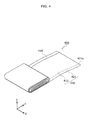
- Fig. 1 is a perspective view showing an appearance of an energy storage device 10 according to the embodiment of the present invention.
- the drawing perspectively illustrates the inside of a container.
- Fig. 2 is a perspective view showing the configuration of an electrode assembly 400 according to the embodiment of the present invention.
- the energy storage device 10 is a secondary battery that can charge and discharge electricity, and more specifically is a non-aqueous electrolyte secondary battery such as lithium ion secondary batteries. Particularly, the energy storage device 10 can be used for hybrid electric vehicles (HEV) that perform high-rate cycle charge and discharge of 8 CA or more (capacity: 5 Ah, current at cycles: approximately 40 A).
- HEV hybrid electric vehicles
- the energy storage device 10 will not be limited to the non-aqueous electrolyte secondary battery.
- the energy storage device 10 may be a secondary battery other than the non-aqueous electrolyte secondary battery or may be a capacitor.
- the energy storage device 10 includes a container 100, a positive electrode terminal 200, and a negative electrode terminal 300.
- the container 100 includes a cover plate 110 that is the top wall of the container.
- the container 100 accommodates an electrode assembly 400, a positive electrode current collector 120, and a negative electrode current collector 130.
- the container 100 of the energy storage device 10 contains a liquid such as an electrolyte solution (non-aqueous electrolyte) and is sealed, but the liquid is not illustrated in the drawing.
- the container 100 is composed of a metallic housing body having a prismatic shape with a bottom and a metallic cover plate 110 that closes the opening of the housing body.
- the electrode assembly 400 and other components are accommodated in the container 100, and the cover plate 110 is welded to the housing body, for example.
- the container can be sealed.
- the electrode assembly 400 includes a positive electrode, a negative electrode, and a separator, and can store electricity. Specifically, the electrode assembly 400 is formed by stacking the negative electrode and the positive electrode with the separator being interposed, and winding the stacked component into an oblong shape as illustrated in Fig. 2 . In the drawing, the shape of the electrode assembly 400 is illustrated as an oblong shape, but the shape may be a circular or oval shape. The form of the electrode assembly 400 is not limited to a winding type, and may be a form of stacked flat electrode plates (stacking type). The detailed configuration of the electrode assembly 400 will be described later.
- the positive electrode terminal 200 is an electrode terminal electrically connected to the positive electrode in the electrode assembly 400.
- the negative electrode terminal 300 is an electrode terminal electrically connected to the negative electrode in the electrode assembly 400.
- the positive electrode terminal 200 and the negative electrode terminal 300 are metallic electrode terminals for flowing the electricity stored in the electrode assembly 400 to an external space from the energy storage device 10 and flowing electricity into the internal space of the energy storage device 10 to store electricity in the electrode assembly 400.
- the positive electrode current collector 120 is disposed between the positive electrode in the electrode assembly 400 and a side wall of the container 100.
- the positive electrode current collector 120 is a conductive and rigid member electrically connected to the positive electrode terminal 200 and the positive electrode in the electrode assembly 400.
- the positive electrode current collector 120 as well as a positive electrode base material layer in the electrode assembly 400 described later is formed of aluminum.
- the negative electrode current collector 130 is disposed between the negative electrode in the electrode assembly 400 and a side wall of the container 100.
- the negative electrode current collector 130 is a conductive and rigid member electrically connected to the negative electrode terminal 300 and the negative electrode in the electrode assembly 400.
- the negative electrode current collector 130 as well as a negative electrode base material layer in the electrode assembly 400 described later is formed of copper.
- non-aqueous electrolytes electrolytes
- organic solvents for the non-aqueous electrolyte include non-aqueous solvents, that is, ethylene carbonate, propylene carbonate, butylene carbonate, trifluoropropylene carbonate, ⁇ -butyrolactone, ⁇ -valerolactone, sulfolane, 1,2-dimethoxyethane, 1,2-diethoxy ethane, tetrahydrofuran, 2-methyltetrahydrofuran, 2-methyl-1,3-dioxolane, dioxolane, fluoroethyl methyl ether, ethylene glycol diacetate, propylene glycol diacetate, ethylene glycol dipropionate, propylene glycol dipropionate, methyl acetate, ethyl acetate, propyl acetate, butyl acetate, methyl propionate, eth
- a porous polymer solid electrolyte membrane is used as a polymer solid electrolyte, and the polymer solid electrolyte may further contain an electrolyte solution.
- an electrolyte solution that forms the gel may be different from an electrolyte solution contained in pores and the like.
- use of the non-aqueous electrolyte alone is more preferred to use of the solid electrolyte or the polymer solid electrolyte.
- non-aqueous electrolyte salts include, but not particularly limited to, ionic compounds such as LiClO 4 , LiBF 4 , LiAsF 6 , LiPF 6 , LiCF 3 SO 3 , LiN(SO 2 CF 3 ) 2 , LiN(SO 2 C 2 F 5 ) 2 , LiN(SO 2 CF 3 )(SO 2 C 4 F 9 ), LiSCN, LiBr, LiI, Li 2 SO 4 , Li 2 B 10 Cl 10 , NaClO 4 , NaI, NaSCN, NaBr, KClO 4 , and KSCN and mixtures of two or more thereof.
- ionic compounds such as LiClO 4 , LiBF 4 , LiAsF 6 , LiPF 6 , LiCF 3 SO 3 , LiN(SO 2 CF 3 ) 2 , LiN(SO 2 C 2 F 5 ) 2 , LiN(SO 2 CF 3 )(SO 2 C 4 F 9 ), LiSCN,
- these organic solvents and non-aqueous electrolyte salts are used in combination as the non-aqueous electrolyte solution.
- these non-aqueous electrolytes use of a mixture of propylene carbonate, dimethyl carbonate, and methyl ethyl carbonate is preferred because lithium ions have maximum conductivity.
- the non-aqueous electrolyte includes an additive which is a coating forming material for forming a coating on the surface of the negative electrode.
- the additive include lithium difluorobisoxalatophosphate represented by Formula (1) below (LiPF 2 (Ox) 2 , LiFOP), lithium tetrafluorooxalatophosphate represented by Formula (2) below (LiPF 4 (Ox), LiFOP), lithium bisoxalatoborate represented by Formula (3) (LiBOB), lithium difluorooxalatoborate represented by Formula (4) below (LiFOB), vinylene carbonate (VC), and fluoroethylene carbonate (FEC).
- cyclic sultone compounds whose structures have a double bond such as propane sultone, propene sultone, glycol sulfate, and bis(vinylsulfonyl)methane, cyclic sulfuric acid ester compounds, linear sulfur compounds, and analogs thereof.
- propane sultone, propene sultone, glycol sulfate, and bis(vinylsulfonyl)methane cyclic sulfuric acid ester compounds, linear sulfur compounds, and analogs thereof.
- these compounds exemplified above may be used alone or in combination.
- Fig. 3 is a sectional view showing the configuration of the electrode assembly 400 according to the embodiment of the present invention. Specifically, Fig. 3 is an enlarged view showing a cross section of the electrode assembly 400 shown in Fig. 2 , the cross section being taken along the line P-P.
- Fig. 4 is a diagram showing the winding state of the electrode assembly 400 according to the embodiment of the present invention which is partially developed. In Fig. 4 , the separator is not shown for convenience for description.
- the electrode assembly 400 is formed by stacking a positive electrode 410, a negative electrode 420, and two separators 431 and 432. Specifically, the positive electrode 410, the negative electrode 420, and the separator 431 or 432 are stacked with the separator being disposed between the positive electrode 410 and the negative electrode 420.
- the positive electrode 410 includes a positive electrode base material layer 411 and a positive electrode active material layer 412.
- the negative electrode 420 includes a negative electrode base material layer 421 and a negative electrode active material layer 422.
- the positive electrode base material layer 411 is a long, band-like conductive current collecting foil made of aluminum or an aluminum alloy.
- the negative electrode base material layer 421 is a long, band-like conductive current collecting foil made of copper or a copper alloy.
- known materials such as nickel, iron, stainless steel, titanium, fired carbon, conductive polymers, conductive glass, and Al-Cd alloys can also be used properly.
- the positive electrode active material layer 412 is an active material layer formed on a surface of the positive electrode base material layer 411 (in Fig. 3 , both surfaces in the plus direction and minus direction in the Z-axis).
- the positive electrode active material layer 412 contains a positive electrode active material.
- the positive electrode active material can be selected from composite oxides represented by Li x MO y (wherein M represents at least one transition metal) (such as Li x CoO 2 , Li x NiO 2 , Li x Mn 2 O 4 , Li x MnO 3 , Li x Ni y Co (1-y )O 2 , Li x Ni y Mn z Co (1-y-z) O 2 , and Li x Ni y Mn (2-y) O 4 ); or polyanion compounds represented by Li w Me x (XO y ) z (wherein Me represents at least one transition metal, and X is P, Si, B, or V, for example) (such as LiFePO 4 , LiMnPO 4 , LiNiPO 4 , LiCoPO 4 , Li
- the element or polyanion in these compounds may be partially substituted by an element other than the element or anionic species, and the surface thereof may be coated with a metal oxide such as ZrO 2 , MgO, and Al 2 O 3 or carbon.
- a metal oxide such as ZrO 2 , MgO, and Al 2 O 3 or carbon.
- examples of the positive electrode active material include, but not limited to, conductive high-molecular compounds such as disulfide, polypyrrole, polyaniline, poly(para-styrene), polyacetylene, and polyacene materials; and pseudo-graphite structure carbonaceous materials. These compounds may be used alone or in combination.
- the negative electrode active material layer 422 is an active material layer formed on a surface of the negative electrode base material layer 421 (in Fig. 3 , both surfaces in the plus direction and minus direction in the Z-axis).
- a non-graphitizable carbon hard carbon is used as the negative electrode active material included in the negative electrode active material layer 422.
- the negative electrode active material included in the negative electrode active material layer 422 has a negative electrode active material weight per unit volume of the negative electrode active material layer 422 (density of the negative electrode active material) of 0.92 g/cc or more and 1.13 g/cc or less and a particle size D90 of 4.3 ⁇ m or more and 11.5 ⁇ m or less, the particle size D90 being a particle size in particle size distribution in which the cumulative volume is 90%.
- the particle size D50 is an average particle size (also referred to as a median diameter) when the volume cumulative distribution is plotted from the smallest particle size in the particle size distribution of the particle size, and the volume cumulative frequency is 50%. More specifically, the particle size D50 is a particle size when a powder is divided into two based on the particle size, and the powder having a large particle size is equivalent to that having a small particle size.
- the particle size D90 is a particle size having a volume cumulative frequency of 90% in the particle size distribution.
- the particle size D50 represents a particle size (D50) at a volume of 50% in terms of the volume of the particle measured by laser diffraction scattering.
- the particle size D90 represents a particle size (D90) at a volume of 90% in terms of the volume measured by laser diffraction scattering.
- the negative electrode 420 has a region having no negative electrode active material layer 421a in which the negative electrode active material layer 422 is not formed.
- the region having no negative electrode active material layer 421a is a portion of the negative electrode base material layer 421 in which no negative electrode active material layer 422 is not formed.
- the region having no negative electrode active material layer 421a is disposed at one end of the negative electrode base material layer 421 (the end in the plus direction of the X-axis).
- a plurality of regions having no negative electrode active material layer 421a is joined to the negative electrode current collector 130 to electrically connect the negative electrode terminal 300 to the negative electrode 420.
- the positive electrode 410 has a region having no positive electrode active material in which the positive electrode active material layer 412 is not formed, and the region having no positive electrode active material is disposed at the end in the minus direction of the X-axis. A plurality of regions having no positive electrode active material is joined to the positive electrode current collector 120 to electrically connect the positive electrode terminal 200 to the positive electrode 410.
- the separators 431 and 432 are microporous sheets made of a resin, and impregnated with a non-aqueous electrolyte containing an organic solvent and an electrolyte salt.
- a non-aqueous electrolyte containing an organic solvent and an electrolyte salt for the separators 431 and 432, woven fabrics, non-woven fabrics, and synthetic resin microporous membranes made of a polyolefin resin such as polyethylene are used. These are insoluble in the organic solvent.
- the separators 431 and 432 may be those formed of layers of microporous membranes having different materials, weight average molecular weights, or porosity rates, microporous membranes containing a proper amount of an additive such as a variety of a plasticizer, an antioxidant, and a flame retardant, or microporous membranes having at least one surface thereof coated with an inorganic oxide such as silica.
- an additive such as a variety of a plasticizer, an antioxidant, and a flame retardant
- microporous membranes having at least one surface thereof coated with an inorganic oxide such as silica Particularly, synthetic resin microporous membranes can be suitably used.
- polyolefin microporous membranes such as microporous membranes made of polyethylene and polypropylene, microporous membranes made of polyethylene and polypropylene formed into a composite with aramide or polyimide, and microporous membranes made of composites of thereof are suitably used for their thickness, membrane strength, and membrane resistance.
- the positive electrode 410 or negative electrode 420 contains a binder.
- a binder a known material such as an aqueous binder or a binder for an organic solvent can be properly used.
- Use of a fluorinated resin is suitable because high electrode density and durability are attained.
- the amount is 3 to 12% by weight, and more preferably 5 to 8% by weight based on the entire negative electrode paste.
- the positive electrode active material layer 412 includes the positive electrode active material and the binder
- the negative electrode active material layer 422 includes the negative electrode active material and the binder.
- the positive electrode active material or negative electrode active material is defined as a material left by excluding the binder from the positive electrode active material layer 412 or negative electrode active material layer 422.
- the positive electrode active material and the negative electrode active material include no binder.
- batteries were produced as energy storage devices in the following manner in Examples 1 to 23 and Comparative Examples 1 to 25 described later.
- Examples 1 to 23 all are concerned with the energy storage device 10 according to the embodiment.
- LiNi 1/3 Co 1/3 Mn 1/3 O 2 was used as the positive electrode active material
- acetylene black was used as a conductive aid
- PVDF polyvinylidene fluoride
- NMP N-methyl-2-pyrrolidone
- 4.5% by weight of the conductive aid, 4.5% by weight of the binder, and 91% by weight of the positive electrode active material were mixed, and kneaded to prepare a positive electrode paste.
- the prepared positive electrode paste was applied at a weight of 6.9 mg/cm 2 onto an aluminum foil having a thickness of 15 ⁇ m.
- the applied portion had a width of 83 mm, and the non-applied portion (region having no positive electrode active material) had a width of 11 mm.
- the workpiece was roll pressed to adjust the active material filling density in the positive electrode active material layer to be 2.48 g/cc.
- the workpiece was vacuum dried to remove moisture.
- non-graphitizable carbons having particle sizes shown in Tables 1 and 2 below were used.
- PVDF registered trademark
- NMP NMP as the solvent
- 7% by weight of the binder and 93% by weight of the negative electrode active material were mixed, and kneaded to prepare a negative electrode paste.
- the prepared negative electrode paste was applied at a weight of 3.3 mg/cm 2 onto a copper foil having a thickness of 8 ⁇ m.
- the applied portion had a width of 87 mm, and the non-applied portion (region having no negative electrode active material layer) had a width of 9 mm.
- the workpiece was roll pressed to adjust the active material filling density in the negative electrode active material layer to be the active material density shown in Tables 1 and 2.
- the workpiece was vacuum dried to remove moisture.
- the non-graphitizable carbon can be distinguished from the graphitizable carbon (soft carbon) by firing the negative electrode active material, for example.
- the density of the negative electrode active material is determined as follows.
- the negative electrode is extracted from the battery, and decomposed products of the electrolyte solution and unreleased lithium ions are removed from the negative electrode by washing with water, for example.
- the binder is removed by dissolving the binder in a solvent or heating the binder to a temperature at which the binder decomposes.
- the method is not limited to this, components other than the negative electrode active material are removed from the negative electrode active material layer as much as possible to separate the hard carbon (or negative electrode active material).
- the hard carbon (or negative electrode active material) is extracted, and the negative electrode active material weight per unit volume of the negative electrode active material layer is measured. Thereby, the density of the separated negative electrode active material can be measured.
- a polyethylene microporous membrane having an air permeability of approximately 100 sec/100 cc and having a thickness of 21 ⁇ m was used.
- the positive electrode, the negative electrode, and the separator were stacked, and wound.
- the region having no positive electrode active material in the positive electrode was welded to the positive electrode current collector and the region having no negative electrode active material layer in the negative electrode was welded to the negative electrode current collector, and placed in the container.
- the container was welded to the cover plate, and the non-aqueous electrolyte was injected into the container. Then, the container was sealed.
- the battery after the capacity check test was charged to 20% of the discharge capacity obtained by the capacity check test to adjust the State of Charge (SOC) of the battery to be 20%, and kept at -10°C for 4 hours. Subsequently, the battery was discharged at a constant voltage of 2.3 V for 1 second, and the low temperature output P was calculated from the current value at 1 second.
- SOC State of Charge
- the battery having an adjusted SOC of 50% was kept at 55°C for 4 hours, and charged at a constant current of 40 A until the SOC reached 80%. Subsequently, the battery was discharged at a constant current of 40 A until the SOC changed from 80% to 20%. Thus, a charge voltage V80 at an SOC of 80% and a discharge voltage V20 at an SOC of 20% were determined.
- a 55°C cycle test was performed at a constant current of 40 A.
- a cut-off voltage during charging was defined as V80, and a cut-off voltage during discharging was defined as V20.
- the cycle test was performed continuously without defining a time for pause. The cycle time was 3000 hours in total. After the cycle test for 3000 hours was completed, the battery was kept at 25°C for 4 hours. Then, the battery was subjected to the capacity check test and the low temperature output check test.
- Table 1 shows the thus-obtained initial capacity Q1, capacity after degradation Q2, and capacity reduction rate of the battery
- Table 2 shows the thus-obtained initial output P1, output after degradation P2, and output reduction rate of the battery.
- Examples 1 to 23 and Comparative Examples 1 to 25 are compared with respect to the initial capacity, capacity after degradation, and capacity reduction rate of the battery when the particle size D50 of the negative electrode active material (non-graphitizable carbon), the particle size D90, and the density of the negative electrode active material are varied.
- Examples 1 to 23 and Comparative Examples 1 to 25 are compared with respect to the initial output, output after degradation, and output reduction rate of the battery when the particle size D50 of the negative electrode active material (non-graphitizable carbon), the particle size D90, and the density of the negative electrode active material are varied.
- the negative electrode is extracted from the battery, and decomposed products of the electrolyte solution and unreleased lithium ions are removed from the negative electrode by washing with water.
- the binder is removed by dissolving the binder in a solvent or heating the binder to a temperature at which the binder decomposes.
- the method is not limited to this, components other than the negative electrode active material are removed from the negative electrode active material layer as much as possible to separate the hard carbon (or negative electrode active material). Then, the volume-based particle size at a cumulative volume (50% and 90%) of the obtained negative electrode active material is measured.
- the particle size D50 and the particle size D90 can be measured.
- Example 11 3.3 6.5 0.92 None 4.54 3.59 21
- Example 7 3.3 6.5 0.95 None 4.63 3.94 15
- Example 8 3.3 6.5 0.98 None 4.65 4.00 14
- Example 9 3.3 6.5 1.01 None 4.72 4.06 14
- Example 10 3.3 6.5 1.04 None 4.75 4.13 13
- Example 11 3.3 6.5 1.07 None 4.81 4.18 13
- Example 12 3.3 6.5 1.10 Wrinkles 4.87 4.14 15 Comp. Ex.
- Example 12 3.3 6.5 * Example 13 4.6 8.5 0.92 None 4.60 3.91 15 Example 14 4.6 8.5 0.95 None 4.62 3.97 14 Example 15 4.6 8.5 0.98 None 4.67 4.02 14 Example 16 4.6 8.5 1.01 None 4.73 4.12 13 Example 17 4.6 8.5 1.04 None 4.80 4.18 13 Example 18 4.6 8.5 1.07 Wrinkles 4.83 4.11 15 Comp. Ex. 13 4.6 8.5 * Comp. Ex. 14 4.6 8.5 * Example 19 5.9 11.5 0.92 None 4.59 3.67 20 Example 20 5.9 11.5 0.95 None 4.62 3.74 19 Example 21 5.9 11.5 0.98 None 4.67 3.83 18 Example 22 5.9 11.5 1.01 None 4.72 3.87 18 Example 23 5.9 11.5 1.04 Wrinkles 4.78 3.87 19 Comp. Ex.
- Fig. 5A is a graph showing the initial capacity and the capacity after degradation when the particle size D90 is varied.
- Fig. 5B is a graph showing the initial output and the particle size D90 when the output after degradation is varied.
- Fig. 6 is a graph showing the capacity reduction rate and the output reduction rate when the particle size D90 is varied.
- the initial outputs and the outputs after degradation in Comparative Examples 18 to 21 are lower than those in Examples 1 to 23. Namely, reduction in the output can be suppressed to attain higher output at a particle size D90 of 11.5 ⁇ m or less.
- the particle size D50 is 2.7 ⁇ m or more and 5.9 ⁇ m or less. Accordingly, at a particle size D50 of 2.7 ⁇ m or more and 5.9 ⁇ m or less, higher output and higher durability can be attained.
- the capacity reduction rates and the output reduction rates in Examples 19 to 23 are significantly higher than those in Examples 1 to 18. Namely, at a particle size D90 of 8.5 ⁇ m or less, reduction in the capacity and the output due to degradation can be suppressed to attain high durability.
- Fig. 7A is a graph showing the capacity after degradation when the density of the negative electrode active material is varied
- Fig. 7B is a graph showing the capacity reduction rate when the density of the negative electrode active material is varied
- Fig. 8A is a graph showing the output after degradation when the density of the negative electrode active material is varied
- Fig. 8B is a graph showing the output reduction rate when the density of the negative electrode active material is varied.
- the capacity after degradation and the output after degradation in Comparative Example 11 are significantly lower than those in Examples 7 to 12, and the capacity reduction rate and the output reduction rate in Comparative Example 11 are significantly higher than those in Examples 7 to 12. Namely, when the particle size D90 is 6.5 ⁇ m and the active material density is 0.95 g/cc or more, reduction in the capacity and the output due to degradation can be suppressed to attain higher durability.
- the particle size D90 is 8.5 ⁇ m and the active material density is 0.92 g/cc or more, reduction in the capacity and the output due to degradation can be suppressed to attain higher durability.
- the particle size D-90 is 8.5 ⁇ m and the active material density is more than 1.07 g/cc, wrinkles are produced in the negative electrode to avoid difficulties in production of the electrode assembly in Comparative Examples 13 and 14. Namely, when the particle size D90 is 8.5 ⁇ m and the active material density is 1.07 g/cc or less, wrinkles can be prevented from being produced in the negative electrode to cause difficulties in production of the electrode assembly, or reduction in durability can be prevented.
- Fig. 9A is a graph showing the relation between the particle size D90 and the active material density. Specifically, in the graph, the outer edges of the ranges of the particle size D90 and the active material density enabling higher output and higher durability are linearly approximated, and the range is diagonally shaded.
- A1 -0.014 x B1 + C1 (where 4.3 ⁇ B1 ⁇ 8.5, and 1.04 ⁇ C1 ⁇ 1.20) wherein the active material density (y-axis) is A1 g/cc and the particle size D90 (x-axis) is B1 ⁇ m.
- Fig. 9B is a graph showing the relation between the particle size D50 and the active material density. Specifically, as the graph shows, the ranges of the particle size D50 and the active material density correspond to the ranges of the particle size D90 and the active material density shown in Fig. 9A , and are diagonally shaded.
- the diagonally shaded portion is a region that satisfies the relation (Mathematical Relation 2)
- A2 -0.003 x B2 + C2 (where 2.7 ⁇ B2 ⁇ 4.6, and 1.05 ⁇ C2 ⁇ 1.21) wherein the active material density (y-axis) is A2 g/cc and the particle size D90 (x-axis) is B2 ⁇ m.
- the present inventors found that an increased output and high durability can be attained when the non-graphitizable carbon is used as the negative electrode active material, the density of the negative electrode active material is 0.92 g/cc or more and 1.13 g/cc or less, and the particle size D90 is 4.3 ⁇ m or more and 11.5 ⁇ m or less. Namely, an excessively reduced density of the negative electrode active material will reduce current collecting properties and the like to significantly reduce the capacity and the output due to degradation, thereby reducing durability. An excessively increased density of the negative electrode active material will cause wrinkles in the negative electrode 420, leading to difficulties in production of the electrode assembly 400.
- the present inventors also found that when the density of the negative electrode active material and the particle size D90 satisfy Mathematical Relation 1 above, a more increased output and higher durability can be attained. Namely, higher durability can be attained while a more increased capacity and higher output are kept wherein the particle size D90 of the negative electrode active material is in the range of 4.3 ⁇ m or more and 8.5 ⁇ m or less and the particle size D90 is 4.3 ⁇ m and the density of the negative electrode active material is 0.98 g/cc or more and 1.13 g/cc or less, the particle size D90 is 6.5 ⁇ m and the density is 0.95 g/cc or more and 1.10 g/cc or less, and the particle size D90 is 8.5 ⁇ m and the density is 0.92 g/cc or more and 1.07 g/cc or less.
- the particle size D90 of the negative electrode active material is 4.3 ⁇ m or more and 11.5 ⁇ m or less
- the particle size D50 is 2.7 ⁇ m or more and 5.9 ⁇ m or less. Then, at a particle size D50 in the range above, an increased output and high durability can be attained.
- the particle size D90 of the negative electrode active material is 4.3 ⁇ m or more 8.5 ⁇ m or less
- the particle size D50 is 2.7 ⁇ m or more and 4.6 ⁇ m or less.
- the particle size D50 is in the range of 2.7 ⁇ m or more and 4.6 ⁇ m or less and the particle size D50 is 2.7 ⁇ m and the density of the negative electrode active material is 0.98 g/cc or more and 1.13 g/cc or less, the particle size D50 is 3.3 ⁇ m and the density is 0.95 g/cc or more and 1.10 g/cc or less, and the particle size D50 is 4.6 ⁇ m and the density is 0.92 g/cc or more and 1.07 g/cc or less.
- the negative electrode current collector 130 is joined to the region having no negative electrode active material layer 421a to fix the negative electrode 420 to the negative electrode current collector 130.
- the density of the negative electrode active material is high, wrinkles are produced between the region having the negative electrode active material layer 422 and the region having no negative electrode active material layer 421a.
- the energy storage device 10 in contrast, by controlling the density of the negative electrode active material within a suitable range, the wrinkles to be produced in the negative electrode 420 can be suppressed, avoiding difficulties to produce the electrode assembly 400 due to wrinkles produced in the negative electrode 420.
- the non-aqueous electrolyte contains the coating forming material for the negative electrode 420, a more increased output and higher durability can be attained.
- a plurality of the energy storage devices 10 is combined to form an energy storage unit (module).
- Fig. 10 is a perspective view of an appearance of an energy storage unit 1 according to the embodiment of the present invention.
- the energy storage unit 1 includes a plurality of the energy storage devices 10 and at least one bus bar 150 that electrically connects two of the energy storage devices 10.
- the energy storage unit 1 includes a plurality of bus bars 150.
- Each of the bus bars 150 electrically connects the positive (or negative) electrode in one of the energy storage devices 10 to the negative (or positive) electrode in its adjacent energy storage device 10 in the energy storage devices 10. As a result, these energy storage devices 10 are connected in series.
- the energy storage unit 1 may include an exterior casing that accommodates the energy storage devices 10 and a control board for monitoring the charge and discharge states of the energy storage devices 10.
- the energy storage unit 1 according to the embodiment of the present invention can attain the same effects as those of the energy storage device 10 to attain an increased output and higher durability.
- the non-aqueous electrolyte contains the coating forming material as the additive, but the non-aqueous electrolyte may not contain the additive. Without the additive, an increased output and higher durability can also be attained.
- the negative electrode active material may include not only non-graphitizable carbon (hard carbon) but also soft carbon or graphite, for example.
- hard carbon non-graphitizable carbon
- soft carbon or graphite for example.
- the effects of the present invention are attained by the negative electrode active material including hard carbon as the main component.
- hard carbon for example, 95% or more of hard carbon is preferred.
Landscapes
- Chemical & Material Sciences (AREA)
- Chemical Kinetics & Catalysis (AREA)
- Electrochemistry (AREA)
- General Chemical & Material Sciences (AREA)
- Engineering & Computer Science (AREA)
- Materials Engineering (AREA)
- Inorganic Chemistry (AREA)
- Manufacturing & Machinery (AREA)
- Organic Chemistry (AREA)
- Secondary Cells (AREA)
- Battery Electrode And Active Subsutance (AREA)
- Electric Double-Layer Capacitors Or The Like (AREA)
Abstract
Description
- The present invention relates to an energy storage device including a positive electrode, a negative electrode, a separator disposed between the positive electrode and the negative electrode, and a non-aqueous electrolyte, and an energy storage unit including a plurality of the energy storage devices.
- To solve recent global environmental issues, the shift from gasoline vehicles to hybrid electric vehicles and electric vehicles has been promoted and the use of electric bicycles has been increased. A variety of energy storage devices such as lithium ion secondary batteries are widely used in these applications. For this reason, energy storage devices having a higher output have been demanded.
- To meet this demand, an energy storage device that attains a higher output by use of non-graphitizable carbon as a negative electrode active material has been proposed in the related art (see Patent Literature 1:
W02005/098998 ). The increased output in the energy storage device is attained by use of a non-graphitizable carbon having an average particle size D50 of 1 to 20 µm (preferably 4 to 15 µm) as a negative electrode active material to be formed into a negative electrode. - An object of the present invention is to provide an energy storage device and energy storage unit that can attain an increased output and high durability.
- To achieve the object above, the energy storage device according to one aspect of the present invention is an energy storage device including a positive electrode, a negative electrode, a separator disposed between the positive electrode and the negative electrode, and a non-aqueous electrolyte, wherein the negative electrode includes a negative electrode active material layer containing a non-graphitizable carbon as a negative electrode active material, and the negative electrode active material has a negative electrode active material weight per unit volume of the negative electrode active material layer of 0.92 g/cc or more and 1.13 g/cc or less and a particle size D90 of 4.3 µm or more and 11.5 µm or less, the particle size D90 being a particle size in particle size distribution in which a cumulative volume is 90%.
-
- [
Fig. 1] Fig. 1 is a perspective view showing an appearance of an energy storage device according to an embodiment of the present invention. - [
Fig. 2] Fig. 2 is a perspective view showing a configuration of an electrode assembly according to the embodiment of the present invention. - [
Fig. 3] Fig. 3 is a sectional view showing a configuration of the electrode assembly according to the embodiment of the present invention. - [
Fig. 4] Fig. 4 is a diagram showing a winding state of the electrode assembly according to the embodiment of the present invention which is partially developed. - [
Fig. 5A] Fig. 5A is a graph showing the initial capacity and the capacity after degradation when the particle size D90 is varied. - [
Fig. 5B] Fig. 5B is a graph showing the initial output and the output after degradation when the particle size D90 is varied. - [
Fig. 6] Fig. 6 is a graph showing the capacity reduction rate and the output reduction rate when the particle size D90 is varied. - [
Fig. 7A] Fig. 7A is a graph showing the capacity after degradation when the density of a negative electrode active material is varied. - [
Fig. 7B] Fig. 7B is a graph showing the capacity reduction rate when the density of a negative electrode active material is varied. - [
Fig. 8A] Fig. 8A is a graph showing the output after degradation when the density of a negative electrode active material is varied. - [
Fig. 8B] Fig. 8B is a graph showing the output reduction rate when the density of a negative electrode active material is varied. - [
Fig. 9A] Fig. 9A is a graph showing the relation between the particle size D90 and the active material density. - [
Fig. 9B] Fig. 9B is a graph showing the relation between the particle size D50 and the active material density. - [
Fig. 10] Fig. 10 is a perspective view showing an appearance of an energy storage unit according to the embodiment of the present invention. - The present inventors found that if the particle size of non-graphitizable carbon is reduced to about several micrometers in terms of the average particle size D50, the output can be effectively increased but durability will undesirably reduce. Namely, the conventional energy storage device has such a problem of reduced durability when a non-graphitizable carbon having such a small particle size is used as the negative electrode active material to increase the output.
- The present invention has been made to solve the problem above, and an object of the present invention is to provide an energy storage device and energy storage unit that can attain an increased output and high durability.
- To achieve the object above, the energy storage device according to one aspect of the present invention is an energy storage device including a positive electrode, a negative electrode, a separator disposed between the positive electrode and the negative electrode, and a non-aqueous electrolyte, wherein the negative electrode includes a negative electrode active material layer containing a non-graphitizable carbon as a negative electrode active material, and the negative electrode active material has a negative electrode active material weight per unit volume of the negative electrode active material layer (density of the negative electrode active material) of 0.92 g/cc or more and 1.13 g/cc or less and a particle size D90 of 4.3 µm or more and 11.5 µm or less, the particle size D90 being a particle size in particle size distribution in which a cumulative volume is 90%.
- According to this, as a result of intensive research, the present inventors found that an increased output and high durability can be attained when the non-graphitizable carbon is used as the negative electrode active material, the density of the negative electrode active material is controlled to be 0.92 g/cc or more and 1.13 g/cc or less, and the particle size D90 is controlled to be 4.3 µm or more and 11.5 µm or less. Namely, an excessively reduced density of the negative electrode active material will significantly reduce the capacity and output due to degradation, thereby reducing durability. An excessively increased density of the negative electrode active material will cause wrinkles in a negative electrode, leading to difficulties in production of an electrode assembly. When the negative electrode having wrinkles is used to produce the electrode assembly, durability will also reduce. Thus, by controlling the density of the negative electrode active material within a suitable range, high durability can be attained while an increased capacity and output are kept. Moreover, an excessively reduced particle size of the negative electrode active material will significantly reduce the capacity and output due to degradation, thereby reducing durability. Numbers of coarse particles contained in the negative electrode active material will become pillars to cause insufficient contact between the negative electrode active materials of such a reduced particle size when the positive electrode, the negative electrode, and the separator are stacked and pressed to reduce the thickness of the layer. The insufficient contact will reduce the output. Thus, by controlling the particle size D90 of the negative electrode active material within a suitable range, high durability can be attained while an increased capacity and output are kept.
- Moreover, the relation A1 = -0.014 x B1 + C1 (where 4.3 ≤ B1 ≤ 8.5, and 1.04 ≤ C1 ≤ 1.20) may be satisfied wherein the negative electrode active material weight per unit volume of the negative electrode active material layer (density of the negative electrode active material) is A1 g/cc.
- According to this, as a result of intensive research, the present inventors found that when the density of the negative electrode active material and the particle size D90 satisfy the relation, a more increased output and higher durability can be attained. Namely, higher durability can be attained while a more increased capacity and higher output are kept wherein the particle size D90 of the negative electrode active material is in the range of 4.3 µm or more and 8.5 µm or less and the particle size D90 is 4.3 µm and the density of the negative electrode active material is 0.98 g/cc or more and 1.13 g/cc or less, the particle size D90 is 6.5 µm and the density is 0.95 g/cc or more and 1.10 g/cc or less, and the particle size D90 is 8.5 µm and the density is 0.92 g/cc or more and 1.07 g/cc or less.
- Moreover, the negative electrode active material may have a particle size D50 of 2.7 µm or more and 5.9 µm or less, the particle size D50 being a particle size in particle size distribution in which the cumulative volume is 50%.
- According to this, when the particle size D90 of the negative electrode active material is 4.3 µm or more and 11.5 µm or less, the particle size D50 is 2.7 µm or more and 5.9 µm or less. Then, at a particle size D50 in the range above, an increased output and high durability can be attained.
- Moreover, the relation A2 = -0.003 x B2 + C2 (where 2.7 ≤ B2 ≤ 4.6, and 1.05 ≤ C2 ≤ 1.21) may be satisfied wherein the negative electrode active material weight per unit volume of the negative electrode active material layer (density of the negative electrode active material) is A2 g/cc.
- According to this, when the particle size D90 of the negative electrode active material is 4.3 µm or more and 8.5 µm or less, the particle size D50 is 2.7 µm or more and 4.6 µm or less. Then, when the density of the negative electrode active material and the particle size D50 satisfy the relation above, a more increased output and higher durability can be attained. Namely, higher durability can be attained while a more increased capacity and output are kept wherein the particle size D50 is in the range of 2.7 µm or more and 4.6 µm or less and the particle size D50 is 2.7 µm and the density of the negative electrode active material is 0.98 g/cc or more and 1.13 g/cc or less, the particle size D50 is 3.3 µm and the density is 0.95 g/cc or more and 1.10 g/cc or less, and the particle size D50 is 4.6 µm and the density is 0.92 g/cc or more and 1.07 g/cc or less.
- The energy storage device may further include a negative electrode terminal, and a negative electrode current collector that electrically connects the negative electrode terminal to the negative electrode, wherein the negative electrode includes a region having no negative electrode active material layer in which the negative electrode active material layer is not formed, and the negative electrode current collector is joined to the region having no negative electrode active material layer to electrically connect the negative electrode terminal to the negative electrode.
- According to this, the negative electrode current collector is joined to the region having no negative electrode active material layer to fix the negative electrode to the negative electrode current collector. When the density of the negative electrode active material is high, wrinkles are produced between a region having the negative electrode active material layer and the region having no negative electrode active material layer. According to the energy storage device, in contrast, by controlling the density of the negative electrode active material to fall within a suitable range, production of the wrinkles can be suppressed. As a result, the wrinkles to be produced in the negative electrode can be suppressed, avoiding difficulties to produce the electrode assembly due to wrinkles produced in the negative electrode.
- Moreover, the non-aqueous electrolyte may contain an additive, and the additive is a coating forming material for forming a coating in a surface of the negative electrode.
- According to this, the non-aqueous electrolyte includes the coating forming material for the negative electrode. Thereby, a more increased output and higher durability can be attained.
- Moreover, the present invention can be implemented by an energy storage unit including a plurality of the energy storage devices.
- Hereinafter, the energy storage device and energy storage unit according to the embodiment of the present invention will be described with reference to the drawings. The embodiment described below only exemplifies a preferred specific example of the present invention. Numeral values, shapes, materials, components, arrangements, positions, and connection forms of the components, and the like shown in the embodiments below are only examples, and will not limit to the present invention. Moreover, among the components of the embodiment below, the present invention the components not described in an independent Claim representing the most superordinate concept of the present invention will be described as arbitrary components that form a more preferred embodiment.
- First, the configuration of an
energy storage device 10 will be described. -
Fig. 1 is a perspective view showing an appearance of anenergy storage device 10 according to the embodiment of the present invention. The drawing perspectively illustrates the inside of a container.Fig. 2 is a perspective view showing the configuration of anelectrode assembly 400 according to the embodiment of the present invention. - The
energy storage device 10 is a secondary battery that can charge and discharge electricity, and more specifically is a non-aqueous electrolyte secondary battery such as lithium ion secondary batteries. Particularly, theenergy storage device 10 can be used for hybrid electric vehicles (HEV) that perform high-rate cycle charge and discharge of 8 CA or more (capacity: 5 Ah, current at cycles: approximately 40 A). Theenergy storage device 10 will not be limited to the non-aqueous electrolyte secondary battery. Theenergy storage device 10 may be a secondary battery other than the non-aqueous electrolyte secondary battery or may be a capacitor. - As shown in these drawings, the
energy storage device 10 includes acontainer 100, apositive electrode terminal 200, and anegative electrode terminal 300. Thecontainer 100 includes acover plate 110 that is the top wall of the container. Thecontainer 100 accommodates anelectrode assembly 400, a positive electrodecurrent collector 120, and a negative electrodecurrent collector 130. Thecontainer 100 of theenergy storage device 10 contains a liquid such as an electrolyte solution (non-aqueous electrolyte) and is sealed, but the liquid is not illustrated in the drawing. - The
container 100 is composed of a metallic housing body having a prismatic shape with a bottom and ametallic cover plate 110 that closes the opening of the housing body. Theelectrode assembly 400 and other components are accommodated in thecontainer 100, and thecover plate 110 is welded to the housing body, for example. Thus, the container can be sealed. - The
electrode assembly 400 includes a positive electrode, a negative electrode, and a separator, and can store electricity. Specifically, theelectrode assembly 400 is formed by stacking the negative electrode and the positive electrode with the separator being interposed, and winding the stacked component into an oblong shape as illustrated inFig. 2 . In the drawing, the shape of theelectrode assembly 400 is illustrated as an oblong shape, but the shape may be a circular or oval shape. The form of theelectrode assembly 400 is not limited to a winding type, and may be a form of stacked flat electrode plates (stacking type). The detailed configuration of theelectrode assembly 400 will be described later. - The
positive electrode terminal 200 is an electrode terminal electrically connected to the positive electrode in theelectrode assembly 400. Thenegative electrode terminal 300 is an electrode terminal electrically connected to the negative electrode in theelectrode assembly 400. Namely, thepositive electrode terminal 200 and thenegative electrode terminal 300 are metallic electrode terminals for flowing the electricity stored in theelectrode assembly 400 to an external space from theenergy storage device 10 and flowing electricity into the internal space of theenergy storage device 10 to store electricity in theelectrode assembly 400. - The positive electrode
current collector 120 is disposed between the positive electrode in theelectrode assembly 400 and a side wall of thecontainer 100. The positive electrodecurrent collector 120 is a conductive and rigid member electrically connected to thepositive electrode terminal 200 and the positive electrode in theelectrode assembly 400. The positive electrodecurrent collector 120 as well as a positive electrode base material layer in theelectrode assembly 400 described later is formed of aluminum. The negative electrodecurrent collector 130 is disposed between the negative electrode in theelectrode assembly 400 and a side wall of thecontainer 100. The negative electrodecurrent collector 130 is a conductive and rigid member electrically connected to thenegative electrode terminal 300 and the negative electrode in theelectrode assembly 400. The negative electrodecurrent collector 130 as well as a negative electrode base material layer in theelectrode assembly 400 described later is formed of copper. - A variety of non-aqueous electrolytes (electrolyte solutions) to be sealed within the
container 100 can be selected. Examples of organic solvents for the non-aqueous electrolyte include non-aqueous solvents, that is, ethylene carbonate, propylene carbonate, butylene carbonate, trifluoropropylene carbonate, γ-butyrolactone, γ-valerolactone, sulfolane, 1,2-dimethoxyethane, 1,2-diethoxy ethane, tetrahydrofuran, 2-methyltetrahydrofuran, 2-methyl-1,3-dioxolane, dioxolane, fluoroethyl methyl ether, ethylene glycol diacetate, propylene glycol diacetate, ethylene glycol dipropionate, propylene glycol dipropionate, methyl acetate, ethyl acetate, propyl acetate, butyl acetate, methyl propionate, ethyl propionate, propyl propionate, dimethyl carbonate, diethyl carbonate, ethyl methyl carbonate, methyl propyl carbonate, ethyl propyl carbonate, dipropyl carbonate, methyl isopropyl carbonate, ethyl isopropyl carbonate, diisopropyl carbonate, dibutyl carbonate, acetonitrile, fluoroacetonitrile, alkoxy- and halogen-substituted cyclic phosphazenes or linear phosphazenes such as ethoxypentafluorocyclotriphosphazene, diethoxytetrafluorocyclotriphosphazene, and phenoxypentafluorocyclotriphosphazene, phosphoric acid esters such as triethyl phosphate, trimethyl phosphate, and trioctyl phosphate, boric acid esters such as triethyl borate and tributyl borate, and N-methyloxazolidinone, and N-ethyloxazolidinone. When a solid electrolyte is used, a porous polymer solid electrolyte membrane is used as a polymer solid electrolyte, and the polymer solid electrolyte may further contain an electrolyte solution. When a gel polymer solid electrolyte is used, an electrolyte solution that forms the gel may be different from an electrolyte solution contained in pores and the like. When a high output is required as in the HEV application, use of the non-aqueous electrolyte alone is more preferred to use of the solid electrolyte or the polymer solid electrolyte. - Examples of non-aqueous electrolyte salts include, but not particularly limited to, ionic compounds such as LiClO4, LiBF4, LiAsF6, LiPF6, LiCF3SO3, LiN(SO2CF3)2, LiN(SO2C2F5)2, LiN(SO2CF3)(SO2C4F9), LiSCN, LiBr, LiI, Li2SO4, Li2B10Cl10, NaClO4, NaI, NaSCN, NaBr, KClO4, and KSCN and mixtures of two or more thereof.
- In the
energy storage device 10, these organic solvents and non-aqueous electrolyte salts are used in combination as the non-aqueous electrolyte solution. Among these non-aqueous electrolytes, use of a mixture of propylene carbonate, dimethyl carbonate, and methyl ethyl carbonate is preferred because lithium ions have maximum conductivity. - Desirably, the non-aqueous electrolyte includes an additive which is a coating forming material for forming a coating on the surface of the negative electrode. Examples of the additive include lithium difluorobisoxalatophosphate represented by Formula (1) below (LiPF2(Ox)2, LiFOP), lithium tetrafluorooxalatophosphate represented by Formula (2) below (LiPF4(Ox), LiFOP), lithium bisoxalatoborate represented by Formula (3) (LiBOB), lithium difluorooxalatoborate represented by Formula (4) below (LiFOB), vinylene carbonate (VC), and fluoroethylene carbonate (FEC). Additional examples thereof include cyclic sultone compounds whose structures have a double bond such as propane sultone, propene sultone, glycol sulfate, and bis(vinylsulfonyl)methane, cyclic sulfuric acid ester compounds, linear sulfur compounds, and analogs thereof. For the additives, these compounds exemplified above may be used alone or in combination.


- Next, a detailed configuration of the
electrode assembly 400 will be described. -
Fig. 3 is a sectional view showing the configuration of theelectrode assembly 400 according to the embodiment of the present invention. Specifically,Fig. 3 is an enlarged view showing a cross section of theelectrode assembly 400 shown inFig. 2 , the cross section being taken along the line P-P.Fig. 4 is a diagram showing the winding state of theelectrode assembly 400 according to the embodiment of the present invention which is partially developed. InFig. 4 , the separator is not shown for convenience for description. - As shown in these diagrams, the
electrode assembly 400 is formed by stacking apositive electrode 410, anegative electrode 420, and twoseparators positive electrode 410, thenegative electrode 420, and theseparator positive electrode 410 and thenegative electrode 420. - The
positive electrode 410 includes a positive electrodebase material layer 411 and a positive electrodeactive material layer 412. Thenegative electrode 420 includes a negative electrodebase material layer 421 and a negative electrodeactive material layer 422. - The positive electrode
base material layer 411 is a long, band-like conductive current collecting foil made of aluminum or an aluminum alloy. The negative electrodebase material layer 421 is a long, band-like conductive current collecting foil made of copper or a copper alloy. For the current collecting foil, known materials such as nickel, iron, stainless steel, titanium, fired carbon, conductive polymers, conductive glass, and Al-Cd alloys can also be used properly. - The positive electrode
active material layer 412 is an active material layer formed on a surface of the positive electrode base material layer 411 (inFig. 3 , both surfaces in the plus direction and minus direction in the Z-axis). The positive electrodeactive material layer 412 contains a positive electrode active material. - Here, a known material can be properly used as the positive electrode active material used for the positive electrode
active material layer 412 as long as the material is a positive electrode active material that can occlude and release lithium ions. For example, the positive electrode active material can be selected from composite oxides represented by LixMOy (wherein M represents at least one transition metal) (such as LixCoO2, LixNiO2, LixMn2O4, LixMnO3, LixNiyCo(1-y)O2, LixNiyMnzCo(1-y-z)O2, and LixNiyMn(2-y)O4); or polyanion compounds represented by LiwMex(XOy)z (wherein Me represents at least one transition metal, and X is P, Si, B, or V, for example) (such as LiFePO4, LiMnPO4, LiNiPO4, LiCoPO4, Li3V2(PO4)3, Li2MnSiO4, and Li2CoPO4F). The element or polyanion in these compounds may be partially substituted by an element other than the element or anionic species, and the surface thereof may be coated with a metal oxide such as ZrO2, MgO, and Al2O3 or carbon. Further, examples of the positive electrode active material include, but not limited to, conductive high-molecular compounds such as disulfide, polypyrrole, polyaniline, poly(para-styrene), polyacetylene, and polyacene materials; and pseudo-graphite structure carbonaceous materials. These compounds may be used alone or in combination. - The negative electrode
active material layer 422 is an active material layer formed on a surface of the negative electrode base material layer 421 (inFig. 3 , both surfaces in the plus direction and minus direction in the Z-axis). Here, a non-graphitizable carbon (hard carbon) is used as the negative electrode active material included in the negative electrodeactive material layer 422. - Specifically, the negative electrode active material included in the negative electrode active material layer 422 (non-graphitizable carbon) has a negative electrode active material weight per unit volume of the negative electrode active material layer 422 (density of the negative electrode active material) of 0.92 g/cc or more and 1.13 g/cc or less and a particle size D90 of 4.3 µm or more and 11.5 µm or less, the particle size D90 being a particle size in particle size distribution in which the cumulative volume is 90%. More specifically, the relation (hereinafter referred to Mathematical Relation 1) is preferably satisfied wherein A1 = -0.014 x B1 + C1 (where 4.3 ≤ B1 ≤ 8.5, and 1.04 ≤ C1 ≤ 1.20) wherein the negative electrode active material weight per unit volume of the negative electrode active material layer (density of the negative electrode active material) is A1 g/cc and the particle size D90 of the negative electrode active material is B1 µm.
- Alternatively, the negative electrode active material included in the negative electrode
active material layer 422 preferably has a particle size D50 of 2.7 µm or more and 5.9 µm or less, the particle size D50 being a particle size in particle size distribution in which the cumulative volume is 50%. More preferably, the relation (hereinafter referred to as Mathematical Relation 2) A2 = -0.003 x B2 + C2 is satisfied (where 2.7 ≤ B2 ≤ 4.6, and 1.05 ≤ C2 ≤ 1.21) wherein the negative electrode active material weight per unit volume of the negative electrode active material layer (density of the negative electrode active material) is A2 g/cc and the particle size D50 of the negative electrode active material is B2 µm. The details will be described later. - The particle size D50 is an average particle size (also referred to as a median diameter) when the volume cumulative distribution is plotted from the smallest particle size in the particle size distribution of the particle size, and the volume cumulative frequency is 50%. More specifically, the particle size D50 is a particle size when a powder is divided into two based on the particle size, and the powder having a large particle size is equivalent to that having a small particle size. The particle size D90 is a particle size having a volume cumulative frequency of 90% in the particle size distribution.
- In other words, the particle size D50 represents a particle size (D50) at a volume of 50% in terms of the volume of the particle measured by laser diffraction scattering. Similarly, the particle size D90 represents a particle size (D90) at a volume of 90% in terms of the volume measured by laser diffraction scattering.
- The
negative electrode 420 has a region having no negative electrodeactive material layer 421a in which the negative electrodeactive material layer 422 is not formed. The region having no negative electrodeactive material layer 421a is a portion of the negative electrodebase material layer 421 in which no negative electrodeactive material layer 422 is not formed. Specifically, the region having no negative electrodeactive material layer 421a is disposed at one end of the negative electrode base material layer 421 (the end in the plus direction of the X-axis). A plurality of regions having no negative electrodeactive material layer 421a is joined to the negative electrodecurrent collector 130 to electrically connect thenegative electrode terminal 300 to thenegative electrode 420. - Similarly, the
positive electrode 410 has a region having no positive electrode active material in which the positive electrodeactive material layer 412 is not formed, and the region having no positive electrode active material is disposed at the end in the minus direction of the X-axis. A plurality of regions having no positive electrode active material is joined to the positive electrodecurrent collector 120 to electrically connect thepositive electrode terminal 200 to thepositive electrode 410. - The
separators separators separators - The
positive electrode 410 ornegative electrode 420 contains a binder. For the binder, a known material such as an aqueous binder or a binder for an organic solvent can be properly used. Use of a fluorinated resin is suitable because high electrode density and durability are attained. The amount is 3 to 12% by weight, and more preferably 5 to 8% by weight based on the entire negative electrode paste. - Namely, the positive electrode
active material layer 412 includes the positive electrode active material and the binder, and the negative electrodeactive material layer 422 includes the negative electrode active material and the binder. In other words, the positive electrode active material or negative electrode active material is defined as a material left by excluding the binder from the positive electrodeactive material layer 412 or negative electrodeactive material layer 422. The positive electrode active material and the negative electrode active material include no binder. - Next, the thus-configured
energy storage device 10 enabling higher output and higher durability will be described in detail. - First, the method of producing the
energy storage device 10 will be described. Specifically, batteries were produced as energy storage devices in the following manner in Examples 1 to 23 and Comparative Examples 1 to 25 described later. Examples 1 to 23 all are concerned with theenergy storage device 10 according to the embodiment. - LiNi1/3Co1/3Mn1/3O2 was used as the positive electrode active material, acetylene black was used as a conductive aid, and polyvinylidene fluoride (PVDF (registered trademark)) was used as the binder. Using N-methyl-2-pyrrolidone (NMP) as the solvent, 4.5% by weight of the conductive aid, 4.5% by weight of the binder, and 91% by weight of the positive electrode active material were mixed, and kneaded to prepare a positive electrode paste. The prepared positive electrode paste was applied at a weight of 6.9 mg/cm2 onto an aluminum foil having a thickness of 15 µm. The applied portion had a width of 83 mm, and the non-applied portion (region having no positive electrode active material) had a width of 11 mm. After the applied positive electrode paste was dried, the workpiece was roll pressed to adjust the active material filling density in the positive electrode active material layer to be 2.48 g/cc. The workpiece was vacuum dried to remove moisture.
- As the negative electrode active material, non-graphitizable carbons having particle sizes shown in Tables 1 and 2 below were used. PVDF (registered trademark) was used as the binder. Using NMP as the solvent, 7% by weight of the binder and 93% by weight of the negative electrode active material were mixed, and kneaded to prepare a negative electrode paste. The prepared negative electrode paste was applied at a weight of 3.3 mg/cm2 onto a copper foil having a thickness of 8 µm. The applied portion had a width of 87 mm, and the non-applied portion (region having no negative electrode active material layer) had a width of 9 mm. After the applied negative electrode paste was dried, the workpiece was roll pressed to adjust the active material filling density in the negative electrode active material layer to be the active material density shown in Tables 1 and 2. The workpiece was vacuum dried to remove moisture.
- The non-graphitizable carbon (hard carbon) can be distinguished from the graphitizable carbon (soft carbon) by firing the negative electrode active material, for example.
- For example, the density of the negative electrode active material (active material density) is determined as follows. The negative electrode is extracted from the battery, and decomposed products of the electrolyte solution and unreleased lithium ions are removed from the negative electrode by washing with water, for example. Furthermore, the binder is removed by dissolving the binder in a solvent or heating the binder to a temperature at which the binder decomposes. Although the method is not limited to this, components other than the negative electrode active material are removed from the negative electrode active material layer as much as possible to separate the hard carbon (or negative electrode active material). Thus, only the hard carbon (or negative electrode active material) is extracted, and the negative electrode active material weight per unit volume of the negative electrode active material layer is measured. Thereby, the density of the separated negative electrode active material can be measured.
- For the separator, a polyethylene microporous membrane having an air permeability of approximately 100 sec/100 cc and having a thickness of 21 µm was used.
- 30% by volume of propylene carbonate, 40% by volume of dimethyl carbonate, and 30% by volume of ethyl methyl carbonate were mixed to prepare a solvent. In the mixed solvent, LiPF6 was dissolved such that the concentration of salt was 1.2 mol/L. Further, 0.3% by weight of vinylene carbonate was added to the solution to prepare a non-aqueous electrolyte.
- The positive electrode, the negative electrode, and the separator were stacked, and wound. The region having no positive electrode active material in the positive electrode was welded to the positive electrode current collector and the region having no negative electrode active material layer in the negative electrode was welded to the negative electrode current collector, and placed in the container. The container was welded to the cover plate, and the non-aqueous electrolyte was injected into the container. Then, the container was sealed.
- Next, numeric values below were determined, and evaluation tests for the battery were performed.
- The produced battery was charged for 3 hours in a 25°C thermostat at a constant charge current of 5 A and a constant voltage of 4.2 V. After the charging was paused for 10 minutes, the battery was discharged to 2.4 V at a constant discharge current of 5 A. Thereby, the discharge capacity Q of the battery was measured. (2-2) Low temperature output check test
- The battery after the capacity check test was charged to 20% of the discharge capacity obtained by the capacity check test to adjust the State of Charge (SOC) of the battery to be 20%, and kept at -10°C for 4 hours. Subsequently, the battery was discharged at a constant voltage of 2.3 V for 1 second, and the low temperature output P was calculated from the current value at 1 second.
- To determine test conditions for the charge and discharge cycle test, the battery having an adjusted SOC of 50% was kept at 55°C for 4 hours, and charged at a constant current of 40 A until the SOC reached 80%. Subsequently, the battery was discharged at a constant current of 40 A until the SOC changed from 80% to 20%. Thus, a charge voltage V80 at an SOC of 80% and a discharge voltage V20 at an SOC of 20% were determined.
- A 55°C cycle test was performed at a constant current of 40 A. A cut-off voltage during charging was defined as V80, and a cut-off voltage during discharging was defined as V20. The cycle test was performed continuously without defining a time for pause. The cycle time was 3000 hours in total. After the cycle test for 3000 hours was completed, the battery was kept at 25°C for 4 hours. Then, the battery was subjected to the capacity check test and the low temperature output check test. The capacity reduction rate after the cycle test was calculated from the expression capacity reduction rate = 100 - Q2
/Q1 x 100 wherein the capacity before the cycle test (initial capacity) was Q1 and the capacity after the cycle test (capacity after degradation) was Q2. Similarly, the output reduction rate was calculated from the expression output reduction rate = 100 - P2/P1 x 100 wherein the output before the cycle test (initial output) was P1 and the output after the cycle test (output after degradation) was P2. - Table 1 shows the thus-obtained initial capacity Q1, capacity after degradation Q2, and capacity reduction rate of the battery, and Table 2 shows the thus-obtained initial output P1, output after degradation P2, and output reduction rate of the battery. Namely, in Table 1, Examples 1 to 23 and Comparative Examples 1 to 25 are compared with respect to the initial capacity, capacity after degradation, and capacity reduction rate of the battery when the particle size D50 of the negative electrode active material (non-graphitizable carbon), the particle size D90, and the density of the negative electrode active material are varied. In Table 2, Examples 1 to 23 and Comparative Examples 1 to 25 are compared with respect to the initial output, output after degradation, and output reduction rate of the battery when the particle size D50 of the negative electrode active material (non-graphitizable carbon), the particle size D90, and the density of the negative electrode active material are varied.
- For example, the negative electrode is extracted from the battery, and decomposed products of the electrolyte solution and unreleased lithium ions are removed from the negative electrode by washing with water. Furthermore, the binder is removed by dissolving the binder in a solvent or heating the binder to a temperature at which the binder decomposes. Although the method is not limited to this, components other than the negative electrode active material are removed from the negative electrode active material layer as much as possible to separate the hard carbon (or negative electrode active material). Then, the volume-based particle size at a cumulative volume (50% and 90%) of the obtained negative electrode active material is measured. Thus, the particle size D50 and the particle size D90 can be measured.
- In "Wrinkles in negative electrode" of Tables 1 and 2, "Wrinkles" indicates cases where the negative electrode paste portion or the non-applied portion continuously disposed in the longitudinal direction (region having no negative electrode active material layer) in the negative electrode is significantly wrinkled by excessively pressing the negative electrode while "None" indicates cases where remarkable wrinkles are not found. Moreover, "Difficulties in production" in "Wrinkles in negative electrode" indicates cases where the electrode plate is more significantly wrinkled by more excessive press to cause difficulties in winding the electrode due to deviation in winding or when the electrode plate is difficult to press to a predetermined density.
[Table 1] Particle size D50 Particle size D90 Active material density Wrinkles in negative electrode Initial output Capacity after degradation Output reduction rate (µm) (µm) (g/cc) (Ah) (Ah) (%) Comp. Ex. 1 2.1 3.7 0.92 None 4.54 3.13 31 Comp. Ex. 2 2.1 3.7 0.95 None 4.59 3.30 28 Comp. Ex. 3 2.1 3.7 0.98 None 4.62 3.37 27 Comp. Ex. 4 2.1 3.7 1.01 None 4.71 3.49 26 Comp. Ex. 5 2.1 3.7 1.04 None 4.73 3.55 25 Comp. Ex. 6 2.1 3.7 1.07 None 4.79 3.59 25 Comp. Ex. 7 2.1 3.7 1.10 None 4.83 3.72 23 Comp. Ex. 8 2.1 3.7 1.13 Wrinkles 4.89 3.72 24 Comp. Ex. 9 2.7 4.3 0.92 None 4.55 3.46 24 Comp. Ex. 10 2.7 4.3 0.95 None 4.60 3.68 20 Example 1 2.7 4.3 0.98 None 4.65 4.00 14 Example 2 2.7 4.3 1.01 None 4.69 4.03 14 Example 3 2.7 4.3 1.04 None 4.73 4.07 14 Example 4 2.7 4.3 1.07 None 4.83 4.20 13 Example 5 2.7 4.3 1.10 None 4.85 4.22 13 Example 6 2.7 4.3 1.13 Wrinkles 4.90 4.17 15 Comp. Ex. 11 3.3 6.5 0.92 None 4.54 3.59 21 Example 7 3.3 6.5 0.95 None 4.63 3.94 15 Example 8 3.3 6.5 0.98 None 4.65 4.00 14 Example 9 3.3 6.5 1.01 None 4.72 4.06 14 Example 10 3.3 6.5 1.04 None 4.75 4.13 13 Example 11 3.3 6.5 1.07 None 4.81 4.18 13 Example 12 3.3 6.5 1.10 Wrinkles 4.87 4.14 15 Comp. Ex. 12 3.3 6.5 * Example 13 4.6 8.5 0.92 None 4.60 3.91 15 Example 14 4.6 8.5 0.95 None 4.62 3.97 14 Example 15 4.6 8.5 0.98 None 4.67 4.02 14 Example 16 4.6 8.5 1.01 None 4.73 4.12 13 Example 17 4.6 8.5 1.04 None 4.80 4.18 13 Example 18 4.6 8.5 1.07 Wrinkles 4.83 4.11 15 Comp. Ex. 13 4.6 8.5 * Comp. Ex. 14 4.6 8.5 * Example 19 5.9 11.5 0.92 None 4.59 3.67 20 Example 20 5.9 11.5 0.95 None 4.62 3.74 19 Example 21 5.9 11.5 0.98 None 4.67 3.83 18 Example 22 5.9 11.5 1.01 None 4.72 3.87 18 Example 23 5.9 11.5 1.04 Wrinkles 4.78 3.87 19 Comp. Ex. 15 5.9 11.5 * Comp. Ex. 16 5.9 11.5 * Comp. Ex. 17 5.9 11.5 * Comp. Ex. 18 9.6 22.1 0.92 None 4.59 3.76 18 Comp. Ex. 19 9.6 22.1 0.95 None 4.63 3.89 16 Comp. Ex. 20 9.6 22.1 0.98 None 4.68 3.88 17 Comp. Ex. 21 9.6 22.1 1.01 Wrinkles 4.74 3.89 18 Comp. Ex. 22 9.6 22.1 * Comp. Ex. 23 9.6 22.1 * Comp. Ex. 24 9.6 22.1 * Comp. Ex. 25 9.6 22.1 * *: Difficulties in production [Table 2] Particle size D50 Particle size D90 Active material density Wrinkles in negative electrode Initial output Capacity after degradation Output reduction rate (µm) (µm) (g/cc) (W) (W) (%) Comp. Ex. 1 2.1 3.7 0.92 None 433 147 66 Comp. Ex. 2 2.1 3.7 0.95 None 442 199 55 Comp. Ex. 3 2.1 3.7 0.98 None 441 203 54 Comp. Ex. 4 2.1 3.7 1.01 None 450 221 51 Comp. Ex. 5 2.1 3.7 1.04 None 452 221 51 Comp. Ex. 6 2.1 3.7 1.07 None 557 284 49 Comp. Ex. 7 2.1 3.7 1.10 None 464 246 47 Comp. Ex. 8 2.1 3.7 1.13 Wrinkles 467 243 48 Comp. Ex. 9 2.7 4.3 0.92 None 414 228 45 Comp. Ex. 10 2.7 4.3 0.95 None 418 288 31 Example 1 2.7 4.3 0.98 None 425 391 8 Example 2 2.7 4.3 1.01 None 429 403 6 Example 3 2.7 4.3 1.04 None 433 407 6 Example 4 2.7 4.3 1.07 None 442 420 5 Example 5 2.7 4.3 1.10 None 444 422 5 Example 6 2.7 4.3 1.13 Wrinkles 446 415 7 Comp. Ex. 11 3.3 6.5 0.92 None 370 285 23 Example 7 3.3 6.5 0.95 None 377 351 7 Example 8 3.3 6.5 0.98 None 381 366 4 Example 9 3.3 6.5 1.01 None 385 373 3 Example 10 3.3 6.5 1.04 None 388 380 2 Example 11 3.3 6.5 1.07 None 392 384 2 Example 12 3.3 6.5 1.10 Wrinkles 396 376 5 Comp. Ex. 12 3.3 6.5 * Example 13 4.6 8.5 0.92 None 332 305 8 Example 14 4.6 8.5 0.95 None 335 318 5 Example 15 4.6 8.5 0.98 None 339 322 5 Example 16 4.6 8.5 1.01 None 343 329 4 Example 17 4.6 8.5 1.04 None 348 334 4 Example 18 4.6 8.5 1.07 Wrinkles 348 324 7 Comp. Ex. 13 4.6 8.5 * Comp. Ex. 14 4.6 8.5 * Example 19 5.9 11.5 0.92 None 319 278 13 Example 20 5.9 11.5 0.95 None 322 283 12 Example 21 5.9 11.5 0.98 None 327 294 10 Example 22 5.9 11.5 1.01 None 328 295 10 Example 23 5.9 11.5 1.04 Wrinkles 332 292 12 Comp. Ex. 15 5.9 11.5 * Comp. Ex. 16 5.9 11.5 * Comp. Ex. 17 5.9 11.5 * Comp. Ex. 18 9.6 22.1 0.92 None 278 247 11 Comp. Ex. 19 9.6 22.1 0.95 None 280 252 10 Comp. Ex. 20 9.6 22.1 0.98 None 285 257 10 Comp. Ex. 21 9.6 22.1 1.01 Wrinkles 287 255 11 Comp. Ex. 22 9.6 22.1 * Comp. Ex. 23 9.6 22.1 * Comp. Ex. 24 9.6 22.1 * Comp. Ex. 25 9.6 22.1 * *: Difficulties in production -
Fig. 5A is a graph showing the initial capacity and the capacity after degradation when the particle size D90 is varied.Fig. 5B is a graph showing the initial output and the particle size D90 when the output after degradation is varied.Fig. 6 is a graph showing the capacity reduction rate and the output reduction rate when the particle size D90 is varied. - As shown in Table 2 above and
Fig. 5B , the initial outputs and the outputs after degradation in Comparative Examples 18 to 21 (particle size D90: 22.1 µm) are lower than those in Examples 1 to 23. Namely, reduction in the output can be suppressed to attain higher output at a particle size D90 of 11.5 µm or less. - As shown in Tables 1 and 2 above
Figs. 5A and 5B , the capacities after degradation and the outputs after degradation in Comparative Examples 1 to 8 (particle size D90: 3.7 µm) are significantly lower than those in Examples 1 to 23. As shown inFig. 6 , the capacity reduction rates and the output reduction rates in Comparative Examples 1 to 8 (particle size D90: 3.7 µm) are significantly higher. Namely, reduction in the capacity and output due to degradation can be suppressed to attain high durability at a particle size D90 of 4.3 µm or more. - As shown in Tables 1 and 2 above, at a particle size D90 of 4.3 µm or more and 11.5 µm or less, the particle size D50 is 2.7 µm or more and 5.9 µm or less. Accordingly, at a particle size D50 of 2.7 µm or more and 5.9 µm or less, higher output and higher durability can be attained.
- Furthermore, shown in
Fig. 6 , the capacity reduction rates and the output reduction rates in Examples 19 to 23 (particle size D90: 11.5 µm) are significantly higher than those in Examples 1 to 18. Namely, at a particle size D90 of 8.5 µm or less, reduction in the capacity and the output due to degradation can be suppressed to attain high durability. -
Fig. 7A is a graph showing the capacity after degradation when the density of the negative electrode active material is varied, andFig. 7B is a graph showing the capacity reduction rate when the density of the negative electrode active material is varied.Fig. 8A is a graph showing the output after degradation when the density of the negative electrode active material is varied, andFig. 8B is a graph showing the output reduction rate when the density of the negative electrode active material is varied. - As shown in Tables 1 and 2 above and
Figs. 7A to 8B , at a particle size D90 of 4.3 µm, the capacities after degradation and the outputs after degradation in Comparative Examples 9 and 10 (active material density: 0.92 g/cc and 0.95 g/cc, respectively) are significantly lower than those in Examples 1 to 6, while the capacity reduction rates and the output reduction rates in Comparative Examples 9 and 10 are significantly higher those in Examples 1 to 6. Namely, when the particle size D90 is 4.3 µm and the active material density is 0.98 g/cc or more, reduction in the capacity and the output due to degradation can be suppressed to attain higher durability. - As shown in Tables 1 and 2 above, when the particle size D90 is 4.3 µm and the active material density is 1.13 g/cc or less, wrinkles can be prevented from being produced in the negative electrode to avoid difficulties in production of the electrode assembly, or reduction in durability can be prevented.
- Similarly, at a particle size D90 of 6.5 µm, the capacity after degradation and the output after degradation in Comparative Example 11 (active material density: 0.92 g/cc) are significantly lower than those in Examples 7 to 12, and the capacity reduction rate and the output reduction rate in Comparative Example 11 are significantly higher than those in Examples 7 to 12. Namely, when the particle size D90 is 6.5 µm and the active material density is 0.95 g/cc or more, reduction in the capacity and the output due to degradation can be suppressed to attain higher durability.
- As shown in Tables 1 and 2, when the particle size D90 is 6.5 µm and the active material density is more than 1.10 g/cc, the negative electrode is wrinkled in Comparative Example 12 to cause difficulties in production of the electrode assembly. Namely, when the particle size D90 is 6.5 µm and the active material density is 1.10 g/cc or less, wrinkles can be prevented from being produced in the negative electrode to avoid difficulties in production of the electrode assembly, or reduction in durability can be prevented.
- Similarly, when the particle size D90 is 8.5 µm and the active material density is 0.92 g/cc or more, reduction in the capacity and the output due to degradation can be suppressed to attain higher durability. When the particle size D-90 is 8.5 µm and the active material density is more than 1.07 g/cc, wrinkles are produced in the negative electrode to avoid difficulties in production of the electrode assembly in Comparative Examples 13 and 14. Namely, when the particle size D90 is 8.5 µm and the active material density is 1.07 g/cc or less, wrinkles can be prevented from being produced in the negative electrode to cause difficulties in production of the electrode assembly, or reduction in durability can be prevented.
- The relation between the active material density and the particle size D90 described above is shown in
Fig. 9A. Fig. 9A is a graph showing the relation between the particle size D90 and the active material density. Specifically, in the graph, the outer edges of the ranges of the particle size D90 and the active material density enabling higher output and higher durability are linearly approximated, and the range is diagonally shaded. - As shown in
Fig. 9A , the diagonally shaded portion is a region that satisfies the relation (Mathematical Relation 1) A1 = -0.014 x B1 + C1 (where 4.3 ≤ B1 ≤ 8.5, and 1.04 ≤ C1 ≤ 1.20) wherein the active material density (y-axis) is A1 g/cc and the particle size D90 (x-axis) is B1 µm. -
Fig. 9B is a graph showing the relation between the particle size D50 and the active material density. Specifically, as the graph shows, the ranges of the particle size D50 and the active material density correspond to the ranges of the particle size D90 and the active material density shown inFig. 9A , and are diagonally shaded. - As shown in
Fig. 9B , the diagonally shaded portion is a region that satisfies the relation (Mathematical Relation 2) A2 =-0.003 x B2 + C2 (where 2.7 ≤ B2 ≤ 4.6, and 1.05 ≤ C2 ≤ 1.21) wherein the active material density (y-axis) is A2 g/cc and the particle size D90 (x-axis) is B2 µm. - As above, as a result of intensive research, the present inventors found that an increased output and high durability can be attained when the non-graphitizable carbon is used as the negative electrode active material, the density of the negative electrode active material is 0.92 g/cc or more and 1.13 g/cc or less, and the particle size D90 is 4.3 µm or more and 11.5 µm or less. Namely, an excessively reduced density of the negative electrode active material will reduce current collecting properties and the like to significantly reduce the capacity and the output due to degradation, thereby reducing durability. An excessively increased density of the negative electrode active material will cause wrinkles in the
negative electrode 420, leading to difficulties in production of theelectrode assembly 400. When thenegative electrode 420 having wrinkles is used to produce theelectrode assembly 400, durability will also reduce. Thus, by controlling the density of the negative electrode active material within a suitable range, high durability can be attained while an increased capacity and output are kept. Moreover, an excessively reduced particle size of the negative electrode active material will significantly reduce the capacity and output due to degradation, thereby reducing durability. Numbers of coarse particles contained in the negative electrode active material become pillars to cause insufficient contact between the negative electrode active materials of such a reduced particle size when thepositive electrode 410, thenegative electrode 420, and theseparators - As a result of intensive research, the present inventors also found that when the density of the negative electrode active material and the particle size D90 satisfy
Mathematical Relation 1 above, a more increased output and higher durability can be attained. Namely, higher durability can be attained while a more increased capacity and higher output are kept wherein the particle size D90 of the negative electrode active material is in the range of 4.3 µm or more and 8.5 µm or less and the particle size D90 is 4.3 µm and the density of the negative electrode active material is 0.98 g/cc or more and 1.13 g/cc or less, the particle size D90 is 6.5 µm and the density is 0.95 g/cc or more and 1.10 g/cc or less, and the particle size D90 is 8.5 µm and the density is 0.92 g/cc or more and 1.07 g/cc or less. - Moreover, when the particle size D90 of the negative electrode active material is 4.3 µm or more and 11.5 µm or less, the particle size D50 is 2.7 µm or more and 5.9 µm or less. Then, at a particle size D50 in the range above, an increased output and high durability can be attained.
- Moreover, when the particle size D90 of the negative electrode active material is 4.3 µm or more 8.5 µm or less, the particle size D50 is 2.7 µm or more and 4.6 µm or less. Then, when the density of the negative electrode active material and the particle size D50 satisfy
Mathematical Relation 2 above, a more increased output and higher durability can be attained. Namely, higher durability can be attained while a more increased capacity and higher output are kept wherein the particle size D50 is in the range of 2.7 µm or more and 4.6 µm or less and the particle size D50 is 2.7 µm and the density of the negative electrode active material is 0.98 g/cc or more and 1.13 g/cc or less, the particle size D50 is 3.3 µm and the density is 0.95 g/cc or more and 1.10 g/cc or less, and the particle size D50 is 4.6 µm and the density is 0.92 g/cc or more and 1.07 g/cc or less. - Moreover, the negative electrode
current collector 130 is joined to the region having no negative electrodeactive material layer 421a to fix thenegative electrode 420 to the negative electrodecurrent collector 130. When the density of the negative electrode active material is high, wrinkles are produced between the region having the negative electrodeactive material layer 422 and the region having no negative electrodeactive material layer 421a. According to theenergy storage device 10, in contrast, by controlling the density of the negative electrode active material within a suitable range, the wrinkles to be produced in thenegative electrode 420 can be suppressed, avoiding difficulties to produce theelectrode assembly 400 due to wrinkles produced in thenegative electrode 420. - Moreover, because the non-aqueous electrolyte contains the coating forming material for the
negative electrode 420, a more increased output and higher durability can be attained. - Moreover, a plurality of the
energy storage devices 10 is combined to form an energy storage unit (module). -
Fig. 10 is a perspective view of an appearance of anenergy storage unit 1 according to the embodiment of the present invention. - As shown in
Fig. 10 , theenergy storage unit 1 includes a plurality of theenergy storage devices 10 and at least onebus bar 150 that electrically connects two of theenergy storage devices 10. - Namely, the
energy storage unit 1 includes a plurality of bus bars 150. Each of the bus bars 150 electrically connects the positive (or negative) electrode in one of theenergy storage devices 10 to the negative (or positive) electrode in its adjacentenergy storage device 10 in theenergy storage devices 10. As a result, theseenergy storage devices 10 are connected in series. - The
energy storage unit 1 may include an exterior casing that accommodates theenergy storage devices 10 and a control board for monitoring the charge and discharge states of theenergy storage devices 10. - As above, the
energy storage unit 1 according to the embodiment of the present invention can attain the same effects as those of theenergy storage device 10 to attain an increased output and higher durability. - As above, the
energy storage device 10 andenergy storage unit 1 according to the embodiment of the present invention have been described, but the present invention will not be limited to the embodiment. Namely, the embodiment disclosed here is only an example with all respects, and should not be considered as limitative. It is intended that the scope of the present invention is specified by the scope of Claims not by the description above, and meaning equivalent to the scope of Claims and all modifications within the scope are included. - For example, in the embodiment, the non-aqueous electrolyte contains the coating forming material as the additive, but the non-aqueous electrolyte may not contain the additive. Without the additive, an increased output and higher durability can also be attained.
- Alternatively, the negative electrode active material may include not only non-graphitizable carbon (hard carbon) but also soft carbon or graphite, for example. The effects of the present invention are attained by the negative electrode active material including hard carbon as the main component. For example, 95% or more of hard carbon is preferred.
Claims (7)
- Energy storage device comprising:a positive electrode;a negative electrode;a separator disposed between the positive electrode and the negative electrode; anda non-aqueous electrolyte,wherein the negative electrode includes a negative electrode active material layer comprising a non-graphitizable carbon as a negative electrode active material, andthe negative electrode active material has a negative electrode active material weight per unit volume of the negative electrode active material layer of 0.92 g/cc or more and 1.13 g/cc or less and a particle size D90 of 4.3 µm or more and 11.5 µm or less, the particle size D90 being a particle size in particle size distribution in which a cumulative volume is 90%.
- The energy storage device according to Claim 1,
wherein a relation A1 = -0.014 x B1 + C1 (where 4.3 ≤ B1 ≤ 8.5, and 1.04 ≤ C1 ≤ 1.20) is satisfied wherein the negative electrode active material weight per unit volume of the negative electrode active material layer is A1 g/cc and the particle size D90 of the negative electrode active material is B1 µm. - The energy storage device according to Claim 1 or 2, wherein the negative electrode active material has a particle size D50 of 2.7 µm or more and 5.9 µm or less, the particle size D50 being a particle size in particle size distribution in which the cumulative volume is 50%.
- The energy storage device according to Claim 3, wherein a relation A2 = -0.003 x B2 + C2 (where 2.7 ≤ B2 ≤ 4.6, and 1.05 ≤ C2 ≤ 1.21) is satisfied wherein the negative electrode active material weight per unit volume of the negative electrode active material layer is A2 g/cc and the particle size D50 of the negative electrode active material is B2 µm.
- The energy storage device according to any one of Claims 1 to 4, further comprising:a negative electrode terminal; anda negative electrode current collector that electrically connects the negative electrode terminal to the negative electrode,wherein the negative electrode includes a region having no negative electrode active material layer in which the negative electrode active material layer is not formed, andthe negative electrode current collector is joined to the region having no negative electrode active material layer to electrically connect the negative electrode terminal to the negative electrode.
- The energy storage device according to any one of Claims 1 to 5, wherein the non-aqueous electrolyte contains an additive, and the additive is a coating forming material for forming a coating on a surface of the negative electrode.
- An energy storage unit comprising a plurality of the energy storage devices according to any one of Claims 1 to 6.
Applications Claiming Priority (2)
| Application Number | Priority Date | Filing Date | Title |
|---|---|---|---|
| JP2012265698 | 2012-12-04 | ||
| JP2013238248A JP6393976B2 (en) | 2012-12-04 | 2013-11-18 | Power storage element and power storage device |
Publications (3)
| Publication Number | Publication Date |
|---|---|
| EP2741355A2 true EP2741355A2 (en) | 2014-06-11 |
| EP2741355A3 EP2741355A3 (en) | 2015-04-08 |
| EP2741355B1 EP2741355B1 (en) | 2018-02-07 |
Family
ID=49674233
Family Applications (1)
| Application Number | Title | Priority Date | Filing Date |
|---|---|---|---|
| EP13195271.5A Active EP2741355B1 (en) | 2012-12-04 | 2013-12-02 | Energy storage device and energy storage unit |
Country Status (5)
| Country | Link |
|---|---|
| US (1) | US9761876B2 (en) |
| EP (1) | EP2741355B1 (en) |
| JP (1) | JP6393976B2 (en) |
| KR (1) | KR20140071904A (en) |
| CN (1) | CN103855398B (en) |
Cited By (4)
| Publication number | Priority date | Publication date | Assignee | Title |
|---|---|---|---|---|
| EP2854203A1 (en) * | 2013-09-30 | 2015-04-01 | GS Yuasa International Ltd. | Battery |
| EP2950368A1 (en) * | 2014-05-26 | 2015-12-02 | GS Yuasa International Ltd. | Energy storage device, energy storage apparatus, vehicle, and method for using energy storage device |
| US9761876B2 (en) | 2012-12-04 | 2017-09-12 | Gs Yuasa International Ltd. | Energy storage device and energy storage unit |
| EP3826092A4 (en) * | 2018-07-19 | 2022-04-27 | GS Yuasa International Ltd. | NON-AQUEOUS ELECTROLYTE ENERGY STORAGE ELEMENT AND ENERGY STORAGE DEVICE |
Families Citing this family (13)
| Publication number | Priority date | Publication date | Assignee | Title |
|---|---|---|---|---|
| US11283136B2 (en) | 2014-09-29 | 2022-03-22 | Gs Yuasa International Ltd. | Energy storage device and method of producing energy storage device |
| JP2016072233A (en) * | 2014-09-29 | 2016-05-09 | 株式会社Gsユアサ | Power storage device and method for manufacturing power storage device |
| JP6667122B2 (en) | 2015-02-25 | 2020-03-18 | 株式会社Gsユアサ | Storage element |
| JP6573150B2 (en) * | 2015-03-20 | 2019-09-11 | 株式会社Gsユアサ | Electricity storage element |
| WO2016160703A1 (en) | 2015-03-27 | 2016-10-06 | Harrup Mason K | All-inorganic solvents for electrolytes |
| JP6796272B2 (en) * | 2015-03-31 | 2020-12-09 | 株式会社Gsユアサ | Power storage element |
| JP6806302B2 (en) * | 2016-02-05 | 2021-01-06 | 国立大学法人大阪大学 | Positive electrode catalyst for fuel cells |
| US11114665B2 (en) * | 2016-08-29 | 2021-09-07 | Gs Yuasa International Ltd. | Energy storage device and method for producing same |
| US10707531B1 (en) | 2016-09-27 | 2020-07-07 | New Dominion Enterprises Inc. | All-inorganic solvents for electrolytes |
| CN108808085B (en) * | 2018-07-12 | 2020-09-04 | 合肥国轩高科动力能源有限公司 | An electrolyte for improving thermal runaway performance of lithium-ion batteries |
| US11245134B2 (en) | 2019-01-02 | 2022-02-08 | International Business Machines Corporation | Lithium energy storage device with composite anode |
| US12170353B2 (en) | 2019-01-02 | 2024-12-17 | International Business Machines Corporation | Method of making a lithium energy storage device |
| CN113363586A (en) * | 2021-06-28 | 2021-09-07 | 国联汽车动力电池研究院有限责任公司 | Lithium battery electrolyte and application thereof in lithium battery |
Citations (1)
| Publication number | Priority date | Publication date | Assignee | Title |
|---|---|---|---|---|
| WO2005098998A1 (en) | 2004-03-30 | 2005-10-20 | Kureha Corporation | Material for negative electrode of nonaqueous electrolyte secondary battery, process for producing the same, negative electrode and battery |
Family Cites Families (29)
| Publication number | Priority date | Publication date | Assignee | Title |
|---|---|---|---|---|
| WO1998034291A1 (en) * | 1997-02-04 | 1998-08-06 | Mitsubishi Chemical Corporation | Lithium ion secondary battery |
| JP4206565B2 (en) * | 1999-06-22 | 2009-01-14 | ソニー株式会社 | Non-aqueous electrolyte battery |
| JP2001110405A (en) | 1999-10-12 | 2001-04-20 | Sanyo Electric Co Ltd | Gel high-molecular solid electrolyte battery and method for manufacturing the same |
| JP4177574B2 (en) | 2001-11-02 | 2008-11-05 | 松下電器産業株式会社 | Lithium secondary battery |
| JP4120262B2 (en) * | 2002-02-26 | 2008-07-16 | ソニー株式会社 | Non-aqueous electrolyte battery |
| JP2004095306A (en) | 2002-08-30 | 2004-03-25 | Toshiba Corp | Non-aqueous electrolyte secondary battery |
| JP4082147B2 (en) * | 2002-09-19 | 2008-04-30 | 日産自動車株式会社 | Assembled battery |
| JP4731106B2 (en) * | 2002-09-30 | 2011-07-20 | 三洋電機株式会社 | Nonaqueous electrolyte secondary battery |
| JP2004193041A (en) * | 2002-12-13 | 2004-07-08 | Nissan Motor Co Ltd | Carbon electrode for polymer battery and polymer battery using the electrode |
| US7608364B2 (en) | 2003-01-10 | 2009-10-27 | Nec Corporation | Lithium ion secondary battery |
| JP4867147B2 (en) * | 2004-09-07 | 2012-02-01 | 日産自動車株式会社 | A negative electrode plate for a secondary battery, a secondary battery using the negative electrode plate, and a method for producing a negative electrode plate for a secondary battery. |
| JP2006079987A (en) * | 2004-09-10 | 2006-03-23 | Nissan Motor Co Ltd | Hybrid battery system |
| JP5094013B2 (en) | 2004-12-10 | 2012-12-12 | キヤノン株式会社 | ELECTRODE STRUCTURE FOR LITHIUM SECONDARY BATTERY AND SECONDARY BATTERY HAVING THE ELECTRODE STRUCTURE |
| US7615314B2 (en) | 2004-12-10 | 2009-11-10 | Canon Kabushiki Kaisha | Electrode structure for lithium secondary battery and secondary battery having such electrode structure |
| JP2006260904A (en) | 2005-03-16 | 2006-09-28 | Sony Corp | Winding type battery and manufacturing method thereof |
| JP2007134286A (en) * | 2005-11-14 | 2007-05-31 | Hitachi Plant Technologies Ltd | Negative electrode material for lithium secondary battery and lithium secondary battery |
| JP2007335143A (en) | 2006-06-13 | 2007-12-27 | Toyota Central Res & Dev Lab Inc | Lithium ion secondary battery |
| JP4857073B2 (en) * | 2006-10-20 | 2012-01-18 | 富士重工業株式会社 | Lithium ion capacitor |
| JP2009088221A (en) * | 2007-09-28 | 2009-04-23 | Nippon Chemicon Corp | Electrochemical capacitor |
| JP2009084099A (en) * | 2007-09-28 | 2009-04-23 | Sumitomo Bakelite Co Ltd | Method for producing carbon material, carbon material, and negative electrode material for lithium-ion secondary batteries using the same |
| JP5261127B2 (en) * | 2008-10-15 | 2013-08-14 | 日立粉末冶金株式会社 | Coating composition for forming a negative electrode film and an electrode film of a lithium ion capacitor |
| JP2010114206A (en) | 2008-11-05 | 2010-05-20 | Hitachi Powdered Metals Co Ltd | Negative electrode film for lithium-ion capacitor, and electrode film-forming coating material composition |
| JP5302646B2 (en) * | 2008-12-05 | 2013-10-02 | 富士重工業株式会社 | Pre-doping power storage device |
| JP5464076B2 (en) | 2010-06-28 | 2014-04-09 | 株式会社Gsユアサ | Nonaqueous electrolyte secondary battery, nonaqueous electrolyte, and nonaqueous electrolyte secondary battery manufacturing method |
| JP5556554B2 (en) * | 2010-10-04 | 2014-07-23 | 株式会社Gsユアサ | Nonaqueous electrolyte secondary battery |
| US9171675B2 (en) | 2010-12-20 | 2015-10-27 | Jsr Corporation | Electrical storage device, lithium ion capacitor and negative electrode for lithium ion capacitor |
| WO2012121407A1 (en) * | 2011-03-10 | 2012-09-13 | 株式会社クレハ | Carbonaceous material for non-aqueous electrolyte secondary battery negative electrode |
| US9508494B2 (en) * | 2012-08-30 | 2016-11-29 | Kureha Corporation | Carbonaceous material for negative electrodes of lithium ion capacitors and method for producing same |
| JP6393976B2 (en) | 2012-12-04 | 2018-09-26 | 株式会社Gsユアサ | Power storage element and power storage device |
-
2013
- 2013-11-18 JP JP2013238248A patent/JP6393976B2/en active Active
- 2013-11-25 KR KR1020130143936A patent/KR20140071904A/en not_active Ceased
- 2013-11-27 CN CN201310613022.0A patent/CN103855398B/en active Active
- 2013-12-02 EP EP13195271.5A patent/EP2741355B1/en active Active
- 2013-12-02 US US14/094,247 patent/US9761876B2/en active Active
Patent Citations (1)
| Publication number | Priority date | Publication date | Assignee | Title |
|---|---|---|---|---|
| WO2005098998A1 (en) | 2004-03-30 | 2005-10-20 | Kureha Corporation | Material for negative electrode of nonaqueous electrolyte secondary battery, process for producing the same, negative electrode and battery |
Cited By (6)
| Publication number | Priority date | Publication date | Assignee | Title |
|---|---|---|---|---|
| US9761876B2 (en) | 2012-12-04 | 2017-09-12 | Gs Yuasa International Ltd. | Energy storage device and energy storage unit |
| EP2854203A1 (en) * | 2013-09-30 | 2015-04-01 | GS Yuasa International Ltd. | Battery |
| CN104518198A (en) * | 2013-09-30 | 2015-04-15 | 株式会社杰士汤浅国际 | Battery |
| EP2950368A1 (en) * | 2014-05-26 | 2015-12-02 | GS Yuasa International Ltd. | Energy storage device, energy storage apparatus, vehicle, and method for using energy storage device |
| US9705119B2 (en) | 2014-05-26 | 2017-07-11 | Gs Yuasa International Ltd. | Energy storage device, energy storage apparatus, vehicle, and method for using energy storage device |
| EP3826092A4 (en) * | 2018-07-19 | 2022-04-27 | GS Yuasa International Ltd. | NON-AQUEOUS ELECTROLYTE ENERGY STORAGE ELEMENT AND ENERGY STORAGE DEVICE |
Also Published As
| Publication number | Publication date |
|---|---|
| KR20140071904A (en) | 2014-06-12 |
| US20140154557A1 (en) | 2014-06-05 |
| EP2741355B1 (en) | 2018-02-07 |
| CN103855398A (en) | 2014-06-11 |
| US9761876B2 (en) | 2017-09-12 |
| CN103855398B (en) | 2018-04-06 |
| JP2014132563A (en) | 2014-07-17 |
| JP6393976B2 (en) | 2018-09-26 |
| EP2741355A3 (en) | 2015-04-08 |
Similar Documents
| Publication | Publication Date | Title |
|---|---|---|
| EP2741355B1 (en) | Energy storage device and energy storage unit | |
| EP2854203B1 (en) | Battery | |
| JP6047881B2 (en) | Non-aqueous electrolyte secondary battery and method for producing non-aqueous electrolyte secondary battery | |
| KR101502832B1 (en) | Lithium Battery Having Higher Performance | |
| JP5708597B2 (en) | Non-aqueous electrolyte for lithium ion secondary battery and lithium ion secondary battery | |
| JP6275694B2 (en) | Nonaqueous electrolyte secondary battery | |
| US9991563B2 (en) | Energy storage device and energy storage apparatus | |
| KR101506451B1 (en) | Anode for Secondary Battery | |
| KR20130117719A (en) | Electrode assembly and lithium secondary battery comprising the same | |
| JP5953874B2 (en) | Power storage device and method for manufacturing power storage device | |
| JP5857839B2 (en) | Electric storage element, method for manufacturing electric storage element, and non-aqueous electrolyte | |
| JP5614431B2 (en) | Non-aqueous electrolyte for lithium ion secondary battery and lithium ion secondary battery | |
| JP5655828B2 (en) | Non-aqueous electrolyte for lithium ion secondary battery and lithium ion secondary battery | |
| KR20130117712A (en) | Lithium battery having higher performance | |
| KR101493255B1 (en) | The Method for Preparing Electrodes and the Electrodes Prepared by Using the Same | |
| JP5708598B2 (en) | Non-aqueous electrolyte for lithium ion secondary battery and lithium ion secondary battery | |
| KR20130116810A (en) | Cathode for secondary battery | |
| KR20130117709A (en) | Lithium battery having higher performance | |
| KR102183188B1 (en) | Non-aqueous electrolyte secondary battery | |
| JP6589386B2 (en) | Electricity storage element | |
| JP2013197051A (en) | Lithium ion power storage device |
Legal Events
| Date | Code | Title | Description |
|---|---|---|---|
| PUAI | Public reference made under article 153(3) epc to a published international application that has entered the european phase |
Free format text: ORIGINAL CODE: 0009012 |
|
| 17P | Request for examination filed |
Effective date: 20131202 |
|
| AK | Designated contracting states |
Kind code of ref document: A2 Designated state(s): AL AT BE BG CH CY CZ DE DK EE ES FI FR GB GR HR HU IE IS IT LI LT LU LV MC MK MT NL NO PL PT RO RS SE SI SK SM TR |
|
| AX | Request for extension of the european patent |
Extension state: BA ME |
|
| PUAL | Search report despatched |
Free format text: ORIGINAL CODE: 0009013 |
|
| AK | Designated contracting states |
Kind code of ref document: A3 Designated state(s): AL AT BE BG CH CY CZ DE DK EE ES FI FR GB GR HR HU IE IS IT LI LT LU LV MC MK MT NL NO PL PT RO RS SE SI SK SM TR |
|
| AX | Request for extension of the european patent |
Extension state: BA ME |
|
| RIC1 | Information provided on ipc code assigned before grant |
Ipc: H01M 4/133 20100101ALI20150303BHEP Ipc: H01M 10/0525 20100101ALI20150303BHEP Ipc: H01M 10/0567 20100101ALN20150303BHEP Ipc: H01M 4/131 20100101ALN20150303BHEP Ipc: H01M 4/02 20060101ALN20150303BHEP Ipc: H01M 4/587 20100101AFI20150303BHEP |
|
| R17P | Request for examination filed (corrected) |
Effective date: 20151008 |
|
| RBV | Designated contracting states (corrected) |
Designated state(s): AL AT BE BG CH CY CZ DE DK EE ES FI FR GB GR HR HU IE IS IT LI LT LU LV MC MK MT NL NO PL PT RO RS SE SI SK SM TR |
|
| 17Q | First examination report despatched |
Effective date: 20161117 |
|
| GRAP | Despatch of communication of intention to grant a patent |
Free format text: ORIGINAL CODE: EPIDOSNIGR1 |
|
| RIC1 | Information provided on ipc code assigned before grant |
Ipc: H01M 10/0525 20100101ALI20170606BHEP Ipc: H01M 2/26 20060101ALI20170606BHEP Ipc: H01M 4/13 20100101ALN20170606BHEP Ipc: H01M 4/587 20100101AFI20170606BHEP Ipc: H01M 4/02 20060101ALN20170606BHEP Ipc: H01M 4/133 20100101ALI20170606BHEP Ipc: H01M 10/0567 20100101ALN20170606BHEP |
|
| INTG | Intention to grant announced |
Effective date: 20170713 |
|
| GRAS | Grant fee paid |
Free format text: ORIGINAL CODE: EPIDOSNIGR3 |
|
| GRAA | (expected) grant |
Free format text: ORIGINAL CODE: 0009210 |
|
| AK | Designated contracting states |
Kind code of ref document: B1 Designated state(s): AL AT BE BG CH CY CZ DE DK EE ES FI FR GB GR HR HU IE IS IT LI LT LU LV MC MK MT NL NO PL PT RO RS SE SI SK SM TR |
|
| REG | Reference to a national code |
Ref country code: GB Ref legal event code: FG4D |
|
| REG | Reference to a national code |
Ref country code: AT Ref legal event code: REF Ref document number: 969119 Country of ref document: AT Kind code of ref document: T Effective date: 20180215 Ref country code: CH Ref legal event code: EP |
|
| REG | Reference to a national code |
Ref country code: IE Ref legal event code: FG4D |
|
| REG | Reference to a national code |
Ref country code: DE Ref legal event code: R096 Ref document number: 602013032913 Country of ref document: DE |
|
| REG | Reference to a national code |
Ref country code: NL Ref legal event code: MP Effective date: 20180207 |
|
| REG | Reference to a national code |
Ref country code: AT Ref legal event code: MK05 Ref document number: 969119 Country of ref document: AT Kind code of ref document: T Effective date: 20180207 |
|
| PG25 | Lapsed in a contracting state [announced via postgrant information from national office to epo] |
Ref country code: HR Free format text: LAPSE BECAUSE OF FAILURE TO SUBMIT A TRANSLATION OF THE DESCRIPTION OR TO PAY THE FEE WITHIN THE PRESCRIBED TIME-LIMIT Effective date: 20180207 Ref country code: CY Free format text: LAPSE BECAUSE OF FAILURE TO SUBMIT A TRANSLATION OF THE DESCRIPTION OR TO PAY THE FEE WITHIN THE PRESCRIBED TIME-LIMIT Effective date: 20180207 Ref country code: LT Free format text: LAPSE BECAUSE OF FAILURE TO SUBMIT A TRANSLATION OF THE DESCRIPTION OR TO PAY THE FEE WITHIN THE PRESCRIBED TIME-LIMIT Effective date: 20180207 Ref country code: ES Free format text: LAPSE BECAUSE OF FAILURE TO SUBMIT A TRANSLATION OF THE DESCRIPTION OR TO PAY THE FEE WITHIN THE PRESCRIBED TIME-LIMIT Effective date: 20180207 Ref country code: NL Free format text: LAPSE BECAUSE OF FAILURE TO SUBMIT A TRANSLATION OF THE DESCRIPTION OR TO PAY THE FEE WITHIN THE PRESCRIBED TIME-LIMIT Effective date: 20180207 Ref country code: FI Free format text: LAPSE BECAUSE OF FAILURE TO SUBMIT A TRANSLATION OF THE DESCRIPTION OR TO PAY THE FEE WITHIN THE PRESCRIBED TIME-LIMIT Effective date: 20180207 Ref country code: NO Free format text: LAPSE BECAUSE OF FAILURE TO SUBMIT A TRANSLATION OF THE DESCRIPTION OR TO PAY THE FEE WITHIN THE PRESCRIBED TIME-LIMIT Effective date: 20180507 |
|
| PG25 | Lapsed in a contracting state [announced via postgrant information from national office to epo] |
Ref country code: AT Free format text: LAPSE BECAUSE OF FAILURE TO SUBMIT A TRANSLATION OF THE DESCRIPTION OR TO PAY THE FEE WITHIN THE PRESCRIBED TIME-LIMIT Effective date: 20180207 Ref country code: SE Free format text: LAPSE BECAUSE OF FAILURE TO SUBMIT A TRANSLATION OF THE DESCRIPTION OR TO PAY THE FEE WITHIN THE PRESCRIBED TIME-LIMIT Effective date: 20180207 Ref country code: LV Free format text: LAPSE BECAUSE OF FAILURE TO SUBMIT A TRANSLATION OF THE DESCRIPTION OR TO PAY THE FEE WITHIN THE PRESCRIBED TIME-LIMIT Effective date: 20180207 Ref country code: RS Free format text: LAPSE BECAUSE OF FAILURE TO SUBMIT A TRANSLATION OF THE DESCRIPTION OR TO PAY THE FEE WITHIN THE PRESCRIBED TIME-LIMIT Effective date: 20180207 Ref country code: PL Free format text: LAPSE BECAUSE OF FAILURE TO SUBMIT A TRANSLATION OF THE DESCRIPTION OR TO PAY THE FEE WITHIN THE PRESCRIBED TIME-LIMIT Effective date: 20180207 Ref country code: IS Free format text: LAPSE BECAUSE OF FAILURE TO SUBMIT A TRANSLATION OF THE DESCRIPTION OR TO PAY THE FEE WITHIN THE PRESCRIBED TIME-LIMIT Effective date: 20180607 Ref country code: BG Free format text: LAPSE BECAUSE OF FAILURE TO SUBMIT A TRANSLATION OF THE DESCRIPTION OR TO PAY THE FEE WITHIN THE PRESCRIBED TIME-LIMIT Effective date: 20180507 Ref country code: GR Free format text: LAPSE BECAUSE OF FAILURE TO SUBMIT A TRANSLATION OF THE DESCRIPTION OR TO PAY THE FEE WITHIN THE PRESCRIBED TIME-LIMIT Effective date: 20180508 |
|
| PG25 | Lapsed in a contracting state [announced via postgrant information from national office to epo] |
Ref country code: AL Free format text: LAPSE BECAUSE OF FAILURE TO SUBMIT A TRANSLATION OF THE DESCRIPTION OR TO PAY THE FEE WITHIN THE PRESCRIBED TIME-LIMIT Effective date: 20180207 Ref country code: RO Free format text: LAPSE BECAUSE OF FAILURE TO SUBMIT A TRANSLATION OF THE DESCRIPTION OR TO PAY THE FEE WITHIN THE PRESCRIBED TIME-LIMIT Effective date: 20180207 Ref country code: IT Free format text: LAPSE BECAUSE OF FAILURE TO SUBMIT A TRANSLATION OF THE DESCRIPTION OR TO PAY THE FEE WITHIN THE PRESCRIBED TIME-LIMIT Effective date: 20180207 Ref country code: EE Free format text: LAPSE BECAUSE OF FAILURE TO SUBMIT A TRANSLATION OF THE DESCRIPTION OR TO PAY THE FEE WITHIN THE PRESCRIBED TIME-LIMIT Effective date: 20180207 |
|
| REG | Reference to a national code |
Ref country code: DE Ref legal event code: R097 Ref document number: 602013032913 Country of ref document: DE |
|
| PG25 | Lapsed in a contracting state [announced via postgrant information from national office to epo] |
Ref country code: SK Free format text: LAPSE BECAUSE OF FAILURE TO SUBMIT A TRANSLATION OF THE DESCRIPTION OR TO PAY THE FEE WITHIN THE PRESCRIBED TIME-LIMIT Effective date: 20180207 Ref country code: CZ Free format text: LAPSE BECAUSE OF FAILURE TO SUBMIT A TRANSLATION OF THE DESCRIPTION OR TO PAY THE FEE WITHIN THE PRESCRIBED TIME-LIMIT Effective date: 20180207 Ref country code: DK Free format text: LAPSE BECAUSE OF FAILURE TO SUBMIT A TRANSLATION OF THE DESCRIPTION OR TO PAY THE FEE WITHIN THE PRESCRIBED TIME-LIMIT Effective date: 20180207 Ref country code: SM Free format text: LAPSE BECAUSE OF FAILURE TO SUBMIT A TRANSLATION OF THE DESCRIPTION OR TO PAY THE FEE WITHIN THE PRESCRIBED TIME-LIMIT Effective date: 20180207 |
|
| PLBE | No opposition filed within time limit |
Free format text: ORIGINAL CODE: 0009261 |
|
| STAA | Information on the status of an ep patent application or granted ep patent |
Free format text: STATUS: NO OPPOSITION FILED WITHIN TIME LIMIT |
|
| 26N | No opposition filed |
Effective date: 20181108 |
|
| PG25 | Lapsed in a contracting state [announced via postgrant information from national office to epo] |
Ref country code: SI Free format text: LAPSE BECAUSE OF FAILURE TO SUBMIT A TRANSLATION OF THE DESCRIPTION OR TO PAY THE FEE WITHIN THE PRESCRIBED TIME-LIMIT Effective date: 20180207 |
|
| REG | Reference to a national code |
Ref country code: CH Ref legal event code: PL |
|
| GBPC | Gb: european patent ceased through non-payment of renewal fee |
Effective date: 20181202 |
|
| PG25 | Lapsed in a contracting state [announced via postgrant information from national office to epo] |
Ref country code: LU Free format text: LAPSE BECAUSE OF NON-PAYMENT OF DUE FEES Effective date: 20181202 Ref country code: MC Free format text: LAPSE BECAUSE OF FAILURE TO SUBMIT A TRANSLATION OF THE DESCRIPTION OR TO PAY THE FEE WITHIN THE PRESCRIBED TIME-LIMIT Effective date: 20180207 |
|
| REG | Reference to a national code |
Ref country code: IE Ref legal event code: MM4A |
|
| REG | Reference to a national code |
Ref country code: BE Ref legal event code: MM Effective date: 20181231 |
|
| PG25 | Lapsed in a contracting state [announced via postgrant information from national office to epo] |
Ref country code: IE Free format text: LAPSE BECAUSE OF NON-PAYMENT OF DUE FEES Effective date: 20181202 Ref country code: FR Free format text: LAPSE BECAUSE OF NON-PAYMENT OF DUE FEES Effective date: 20181231 |
|
| PG25 | Lapsed in a contracting state [announced via postgrant information from national office to epo] |
Ref country code: BE Free format text: LAPSE BECAUSE OF NON-PAYMENT OF DUE FEES Effective date: 20181231 |
|
| PG25 | Lapsed in a contracting state [announced via postgrant information from national office to epo] |
Ref country code: GB Free format text: LAPSE BECAUSE OF NON-PAYMENT OF DUE FEES Effective date: 20181202 Ref country code: CH Free format text: LAPSE BECAUSE OF NON-PAYMENT OF DUE FEES Effective date: 20181231 Ref country code: LI Free format text: LAPSE BECAUSE OF NON-PAYMENT OF DUE FEES Effective date: 20181231 |
|
| PG25 | Lapsed in a contracting state [announced via postgrant information from national office to epo] |
Ref country code: MT Free format text: LAPSE BECAUSE OF NON-PAYMENT OF DUE FEES Effective date: 20181202 |
|
| PG25 | Lapsed in a contracting state [announced via postgrant information from national office to epo] |
Ref country code: TR Free format text: LAPSE BECAUSE OF FAILURE TO SUBMIT A TRANSLATION OF THE DESCRIPTION OR TO PAY THE FEE WITHIN THE PRESCRIBED TIME-LIMIT Effective date: 20180207 |
|
| PG25 | Lapsed in a contracting state [announced via postgrant information from national office to epo] |
Ref country code: PT Free format text: LAPSE BECAUSE OF FAILURE TO SUBMIT A TRANSLATION OF THE DESCRIPTION OR TO PAY THE FEE WITHIN THE PRESCRIBED TIME-LIMIT Effective date: 20180207 |
|
| PG25 | Lapsed in a contracting state [announced via postgrant information from national office to epo] |
Ref country code: HU Free format text: LAPSE BECAUSE OF FAILURE TO SUBMIT A TRANSLATION OF THE DESCRIPTION OR TO PAY THE FEE WITHIN THE PRESCRIBED TIME-LIMIT; INVALID AB INITIO Effective date: 20131202 Ref country code: MK Free format text: LAPSE BECAUSE OF NON-PAYMENT OF DUE FEES Effective date: 20180207 |
|
| P01 | Opt-out of the competence of the unified patent court (upc) registered |
Effective date: 20230522 |
|
| PGFP | Annual fee paid to national office [announced via postgrant information from national office to epo] |
Ref country code: DE Payment date: 20251126 Year of fee payment: 13 |