EP2740099B1 - Methods and apparatus for transmitting and for receiving multimedia contents - Google Patents
Methods and apparatus for transmitting and for receiving multimedia contents Download PDFInfo
- Publication number
- EP2740099B1 EP2740099B1 EP12761674.6A EP12761674A EP2740099B1 EP 2740099 B1 EP2740099 B1 EP 2740099B1 EP 12761674 A EP12761674 A EP 12761674A EP 2740099 B1 EP2740099 B1 EP 2740099B1
- Authority
- EP
- European Patent Office
- Prior art keywords
- video
- watermark
- sequence
- video component
- component
- Prior art date
- Legal status (The legal status is an assumption and is not a legal conclusion. Google has not performed a legal analysis and makes no representation as to the accuracy of the status listed.)
- Active
Links
Images

Classifications
-
- H—ELECTRICITY
- H04—ELECTRIC COMMUNICATION TECHNIQUE
- H04N—PICTORIAL COMMUNICATION, e.g. TELEVISION
- H04N21/00—Selective content distribution, e.g. interactive television or video on demand [VOD]
- H04N21/40—Client devices specifically adapted for the reception of or interaction with content, e.g. set-top-box [STB]; Operations thereof
- H04N21/43—Processing of content or additional data, e.g. demultiplexing additional data from a digital video stream; Elementary client operations, e.g. monitoring of home network or synchronising decoder's clock; Client middleware
- H04N21/4302—Content synchronisation processes, e.g. decoder synchronisation
- H04N21/4307—Synchronising the rendering of multiple content streams or additional data on devices, e.g. synchronisation of audio on a mobile phone with the video output on the TV screen
- H04N21/43074—Synchronising the rendering of multiple content streams or additional data on devices, e.g. synchronisation of audio on a mobile phone with the video output on the TV screen of additional data with content streams on the same device, e.g. of EPG data or interactive icon with a TV programme
-
- H—ELECTRICITY
- H04—ELECTRIC COMMUNICATION TECHNIQUE
- H04N—PICTORIAL COMMUNICATION, e.g. TELEVISION
- H04N5/00—Details of television systems
- H04N5/04—Synchronising
- H04N5/06—Generation of synchronising signals
- H04N5/067—Arrangements or circuits at the transmitter end
- H04N5/0675—Arrangements or circuits at the transmitter end for mixing the synchronising signals with the picture signal or mutually
-
- G—PHYSICS
- G06—COMPUTING OR CALCULATING; COUNTING
- G06T—IMAGE DATA PROCESSING OR GENERATION, IN GENERAL
- G06T1/00—General purpose image data processing
- G06T1/0021—Image watermarking
-
- G—PHYSICS
- G06—COMPUTING OR CALCULATING; COUNTING
- G06T—IMAGE DATA PROCESSING OR GENERATION, IN GENERAL
- G06T1/00—General purpose image data processing
- G06T1/0021—Image watermarking
- G06T1/005—Robust watermarking, e.g. average attack or collusion attack resistant
- G06T1/0071—Robust watermarking, e.g. average attack or collusion attack resistant using multiple or alternating watermarks
-
- H—ELECTRICITY
- H04—ELECTRIC COMMUNICATION TECHNIQUE
- H04N—PICTORIAL COMMUNICATION, e.g. TELEVISION
- H04N21/00—Selective content distribution, e.g. interactive television or video on demand [VOD]
- H04N21/40—Client devices specifically adapted for the reception of or interaction with content, e.g. set-top-box [STB]; Operations thereof
- H04N21/43—Processing of content or additional data, e.g. demultiplexing additional data from a digital video stream; Elementary client operations, e.g. monitoring of home network or synchronising decoder's clock; Client middleware
- H04N21/44—Processing of video elementary streams, e.g. splicing a video clip retrieved from local storage with an incoming video stream or rendering scenes according to encoded video stream scene graphs
- H04N21/44008—Processing of video elementary streams, e.g. splicing a video clip retrieved from local storage with an incoming video stream or rendering scenes according to encoded video stream scene graphs involving operations for analysing video streams, e.g. detecting features or characteristics in the video stream
-
- H—ELECTRICITY
- H04—ELECTRIC COMMUNICATION TECHNIQUE
- H04N—PICTORIAL COMMUNICATION, e.g. TELEVISION
- H04N21/00—Selective content distribution, e.g. interactive television or video on demand [VOD]
- H04N21/40—Client devices specifically adapted for the reception of or interaction with content, e.g. set-top-box [STB]; Operations thereof
- H04N21/45—Management operations performed by the client for facilitating the reception of or the interaction with the content or administrating data related to the end-user or to the client device itself, e.g. learning user preferences for recommending movies, resolving scheduling conflicts
- H04N21/462—Content or additional data management e.g. creating a master electronic programme guide from data received from the Internet and a Head-end or controlling the complexity of a video stream by scaling the resolution or bit-rate based on the client capabilities
- H04N21/4622—Retrieving content or additional data from different sources, e.g. from a broadcast channel and the Internet
-
- H—ELECTRICITY
- H04—ELECTRIC COMMUNICATION TECHNIQUE
- H04N—PICTORIAL COMMUNICATION, e.g. TELEVISION
- H04N21/00—Selective content distribution, e.g. interactive television or video on demand [VOD]
- H04N21/60—Network structure or processes for video distribution between server and client or between remote clients; Control signalling between clients, server and network components; Transmission of management data between server and client, e.g. sending from server to client commands for recording incoming content stream; Communication details between server and client
- H04N21/61—Network physical structure; Signal processing
- H04N21/6106—Network physical structure; Signal processing specially adapted to the downstream path of the transmission network
- H04N21/6125—Network physical structure; Signal processing specially adapted to the downstream path of the transmission network involving transmission via Internet
-
- H—ELECTRICITY
- H04—ELECTRIC COMMUNICATION TECHNIQUE
- H04N—PICTORIAL COMMUNICATION, e.g. TELEVISION
- H04N21/00—Selective content distribution, e.g. interactive television or video on demand [VOD]
- H04N21/80—Generation or processing of content or additional data by content creator independently of the distribution process; Content per se
- H04N21/81—Monomedia components thereof
- H04N21/816—Monomedia components thereof involving special video data, e.g 3D video
-
- H—ELECTRICITY
- H04—ELECTRIC COMMUNICATION TECHNIQUE
- H04N—PICTORIAL COMMUNICATION, e.g. TELEVISION
- H04N21/00—Selective content distribution, e.g. interactive television or video on demand [VOD]
- H04N21/80—Generation or processing of content or additional data by content creator independently of the distribution process; Content per se
- H04N21/83—Generation or processing of protective or descriptive data associated with content; Content structuring
- H04N21/835—Generation of protective data, e.g. certificates
- H04N21/8358—Generation of protective data, e.g. certificates involving watermark
Definitions
- the present invention relates to methods and apparatuses for transmitting and receiving multimedia contents.
- a television signal included two components: an audio component and a video component.
- the teletext component was then added.
- a plurality of audio components each corresponding to a different language, have been included.
- Stereoscopic (or "3D) television programs are now beginning to gain ground; in simple words, in order to improve the three-dimensional effect perceived by the viewer, slightly different sequences of images are provided for the right eye and for the left eye.
- Multimedia contents are generally produced for transmission through electric and/or optic signals; if the multimedia content changes, e.g. because new components are added, the transmitted signal will change as well; therefore, receiving such modified signals will require changes to the receivers owned by the users, if such changes are feasible, or else the users will need to purchase new receivers.
- the DIOMEDES project financed by the European Union has proposed and studied the possibility of broadcasting a "3D content" through two "delivery channels", i.e. a first channel using DVB technology (for the "basic content” that can be viewed by everybody) and a second channel using IP technology (for the “additional content”).
- a first channel using DVB technology for the "basic content” that can be viewed by everybody
- IP technology for the “additional content”
- the article “ Flexible Transport of 3-D Video Over Networks” by GOKTUG GURLER C ET AL, PROCEEDINGS OF THE IEEE, vol. 99, no. 4, 1 April 2011 (2011-04-01 ) discloses this technique.
- the DIOMEDES project has proposed to use the video PID's [Packet Identifiers] of each view, the audio PID's of each track, and the PID of the PCR [Program Clock Reference], and to generate the PTS's [Presentation Time Stamps] and the DTS's [Decoding Time Stamps] by starting from the same clock; such information has not however been conceived for establishing a synchronization between different information streams, and therefore it does not ensure any accuracy at all; moreover, since the information streams follow different and unpredictable paths (especially as concerns the Internet-transported stream), it may happen that one or both of them undergo multiplexing and/or re-coding operations and thus lose track of the common time reference originally given by the fact that they were two "elementary streams" of the same "transport stream”.
- the DIOMEDES project has proposed to use the signalling mechanisms described in the ETSI TS 102 809 V1.1.1 standard; this means that the "basic content” or “primary stream” must necessarily be transported with DVB technology, because this standard and the signalling thereof specifically refer to that technology.
- Audio and video signatures for synchronization by Radhakrishnan et al., MULTIMEDIA AND EXPO, 2008 IEEE INTERNATIONAL CONFERENCE ON, IEEE, PISCATAWAY, NJ, USA, 23 June 2008 (2008-06-23), pages 1549-1552 describes a framework based on signatures extracted from audio and video streams for automatically measuring and maintaining synchronization between the two streams.
- the time alignment present at the signature generator between the two streams is recorded by combining audio and video signatures into a combined synchronization signature.
- the signatures are extracted again.
- the signatures extracted before and after processing from the audio and the video are compared independently to estimate the relative misalignment introduced due to the processing in each of the streams. Then, the estimated relative misalignment between the audio and video streams is used to preserve the same alignment between the streams that was present before processing.
- the idea at the basis of the present invention is to use "watermarking" at least for synchronization purposes, and preferably also for signalling purposes.
- Watermarking is a known technique commonly used in the electronics industry in order to protect multimedia contents from unauthorized copying and/or to ensure multimedia content authenticity.
- a mark e.g. a logo
- a content e.g. an image or a sequence of images, i.e. a video
- the mark has no real information content or, more precisely, it has value simply because it is present and recognizable when compared with a "reference mark”; for each content (image, video), a different mark can be used, but frequently the author or holder of a plurality of contents uses the same mark for all contents.
- Such a technique has been described in depth, for example, in the book “ Techniques and Applications of Digital Watermarking and Content Protection” by Michael Arnold, Martin Schmucker, Stephen D. Wolthusen, published by Artech House in July 2003 .
- the present invention uses the "watermark" to add or, more precisely, to superimpose, additional information to/on the multimedia content; moreover, a plurality of different marks are required for every single multimedia content.
- the goal is to transmit a multimedia content comprising at least two components over at least two corresponding transmission media.
- said media may be a television channel using DVB-T technology and an Internet connection using IP technology; alternatively, for example, the two media may be two television channels or two Internet connections.
- a first one of the two components is a traditional television signal (which in turn, therefore, comprises three sub-components: 2D video, audio and teletext) and a second one of the two components is a 2D video signal; the two 2D video components make up, as a whole, a 3D video.
- the first component is transmitted over the first medium, whereas the second component is transmitted over the second medium.
- the receiver Since two transmission media are used, the receiver will not, in general, receive both components at synchronized times, even if they were transmitted in a perfectly synchronized manner.
- the transmission system In order to allow the receiver to re-synchronize the two received components, the transmission system will have to:
- the receiver receives a first component of said at least two components from a first transmission medium and a second component of said at least two components from a second transmission medium; in addition, it does the following:
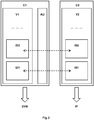
- the 3D video includes a first 2D video (referred to as V1 in Fig.2 ) with the sequence of images for the right eye (referred to as ID1, ID2, ... in Fig.2 ) and a second 2D video with the sequence of images for the left eye (referred to as IS1, IS2, ... in Fig.2 ).
- the two 2D videos (referred to as V1 and V2 in Fig.2 ) and the audio (referred to as AU in Fig.2 ) are synchronized with one another; in particular, as concerns the two 2D videos, one image of the first 2D video corresponds to one image of the second 2D video (and vice versa), so as to create a three-dimensional effect; in Fig.2 , a first arrow represents the correspondence of one image ID1 of the video V1 with an image IS1 of the video V2, and a second arrow represents the correspondence of one image ID2 of the video V1 with one image IS2 of the video V2.
- the first 2D video V1 and the audio AU which together constitute a first component C1 of a multimedia signal
- a traditional television signal in particular by using the DVB-T technology (as schematically shown in Fig.2 by the arrow designated as DVB)
- the second 2D video which constitutes a second component C2 of the multimedia signal
- the television signal will be broadcast through one or, more typically, a plurality of radio transmitters connected to antennas
- the second 2D video will be made available through the Internet thanks to, for example, a server connected to the Internet.
- the present invention is also applicable to cases which are more complex than the one just described, e.g. when the multimedia content is subdivided into three or more components and/or when three or more transmission media are used and/or when each component includes a plurality of sub-components (e.g. each component may include a video signal and an audio signal).
- the radio transmitters Upstream of the radio transmitters that broadcast the television signal containing the video V1 and the audio AU and of the server that makes available the video V2, it is necessary to provide a device which receives the multimedia content, subdivides it into the two components C1 and C2, and forwards the latter to the transmitters and to the server, respectively; the set consisting of said device, the transmitters and the server (plus any other possible components) can be considered to be a large apparatus or a system for transmitting multimedia contents.
- the television signal keeps the video and the audio synchronized, in particular the video V1 and the audio AU, and transports them simultaneously towards the user terminal.
- the first component C1 of the multimedia content in particular the images of the video V1
- the second component C2 of the multimedia content in particular the images of the video V2
- the components C1 and C2 are then transmitted over the chosen transmission media.
- the two "watermarking" sequences may even, for simplicity, be identical (or correspond to each other, in particular with an exact correspondence).
- the marks of the "watermarking" sequences must allow for a univocal association between images of the two videos; one such possibility of association is given by the information coded through the marks themselves.
- a simple and effective solution is to use numbers, e.g. having two digits, three digits, four digits or more digits; the number of digits may advantageously be chosen by taking into account the longest possible reception delay between the two components (if on average one image is transmitted every 20 ms, by using two digits it will be possible to compensate 2 seconds of delay at most between the two components).
- the image ID1 (see Fig.2 ) is marked with a mark corresponding to the number "44”
- the corresponding image IS1 may be marked with a mark corresponding to the number "44”
- the next image ID2 (se Fig.2 ) is marked with a mark corresponding to the number "17”
- the corresponding image IS2 (see Fig.2 ) may be marked with a mark corresponding to the number "17”; it can be understood that, since the marks are not necessarily used for re-sorting or verifying the correct and complete reception of the video, the order of the numbers is unimportant, but must be predetermined in a manner such that the same number is not associated with two temporally close images; it must be pointed out that, as far as the video transmitted over the Internet is concerned, it may happen that the order of reception of the images does not correspond to the order of transmission, so that the "watermarks" may also help re-sorting the images, especially for
- the corresponding image IS1 may be marked with a mark corresponding to the number "1044"
- the corresponding image IS2 may be marked with a mark corresponding to the number "2017”; in this case the numbers are different, but nonetheless they show correspondence, i.e. the first digit indicates the progressive number of the video ("1" for the video V1 and "2" for the video V2) and the remaining three digits are used for synchronization purposes.
- alphanumeric strings may be used as "watermarks". Said digits or alphanumeric strings may also be represented in binary form or in any other associated representation form considered to be valid according to the information theory, provided that it is also known on the reception side so as to ensure the recognition of the watermarking data embedded by the transmitter and extracted by the receiver in accordance with the watermarking technique currently used by the transmission system, with which they are both compatible.
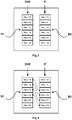
- Fig.3 schematically shows a situation of images received by such a receiver from a television antenna (arrow DVB) and from the Internet (arrow IP); it is assumed herein that the receiver has a first buffer B1 for a first component received from a first transmission medium and a second buffer B2 for a second component received from a second transmission medium; in the buffer B1 there are six right images, respectively marked with marks corresponding to the numbers “15”, “16", “17”, “18”, “19” and “20”; in the buffer B2 there are six left images, respectively marked with marks corresponding to the numbers “13", "14”, “15”, "16", “17” and “18”; Fig.3 also shows the fact that the right image marked with "15” has been received simultaneously with the left image marked with "13", the right image marked with "16” has been received simultaneously with the left image marked with "14”, the right image marked with "17 has been received simultaneously with the left image marked with "15”, the right image marked with "18” has been received simultaneously with the left image marked with "16
- the receiver according to the present invention detects the "watermarks" on both components, decodes such marks, thereby obtaining the above-mentioned numbers (or, more in general, information), and, on the basis of such numbers, it can re-synchronize the two components.
- Fig.4 shows some images of the two re-synchronized components; it is worth pointing out that the synchronization process does not necessarily require moving data within the memory of the receiver, but it may suffice to use pointers and store into said pointers information allowing the buffers to be properly read at the reproduction stage, exactly as indicated in Fig.4 .
- the apparatus for transmitting multimedia contents and the apparatus for receiving multimedia contents (according to the present invention) know how the multimedia content has been subdivided into components (e.g. a first component containing one audio and one video and a second component containing only one video), which transmission media are involved (e.g. the digital terrestrial television infrastructure and the Internet), and which parameters are involved, i.e. must be transmitted and received (e.g. radio frequency and Internet address).
- components e.g. a first component containing one audio and one video and a second component containing only one video
- transmission media e.g. the digital terrestrial television infrastructure and the Internet
- parameters i.e. must be transmitted and received (e.g. radio frequency and Internet address).
- such operating information (or a part thereof) is set beforehand in one or both of the apparatuses.
- this first option may be reasonable as well, in that these two elements have a more or less direct impact on the hardware.
- such operating information (or a part thereof) is set in one or both of the apparatuses by the respective users; this second option is typical of the transmission apparatus (or system), but it is uncomfortable for the reception apparatus, because it forces the user thereof, who is typically a common person, to deal with information that requires technical skill.
- a third option which may be used for the reception apparatus only (according to the present invention), such operating information (or a part thereof) is obtained by the apparatus directly from the signals being received; as can be easily understood, this third option is particularly advantageous.
- Such signalling may advantageously be provided through “watermarking”, i.e by marking one, some or all components of the multimedia content to be transmitted with marks adapted to code, and hence signal to the receiver, operating information that allows to identify, receive and treat the components of the multimedia content and therefore to reconstruct the multimedia content.
- watermarking i.e by marking one, some or all components of the multimedia content to be transmitted with marks adapted to code, and hence signal to the receiver, operating information that allows to identify, receive and treat the components of the multimedia content and therefore to reconstruct the multimedia content.
- the first component will signal operating information pertaining to the second component and/or the second component will signal operating information pertaining to the first component.
- the first component will signal operating information pertaining to the second component and/or the second component will signal operating information pertaining to the first component.
- the pieces of information to be signalled may be one, some or all of the following:
- the information TI may comprise, for example, the following values (which are typically appropriately coded into binary information):
- the information SO may comprise, for example, the following values (which are typically appropriately coded into binary information):
- the information PR (which is typically appropriately coded into binary information) may be useful when a multimedia content has been subdivided into three or more components transmitted over different transmission media and one wants to signal to the receiver where sub-components should preferably be retrieved.
- the right view is transmitted through a DVB-T stream and the left view is transmitted through both a DVB-S stream and an RTP stream
- the right view is transmitted through a DVB-T stream and the left view is transmitted through both an RTP stream from the address IP1 and an RTP stream from the address IP2, it may be useful to signal to the receiver that for receiving the left view it is preferable to use the RTP stream from the address IP1 because it corresponds to a more powerful server or because the server is closer to the user.
- the information PA may be useful for many other purposes; for example, if the information TI signals "audio in the main language” or "audio in a secondary language", the information PA may signal which language it is ("IT” for Italian, “FR” for French, “GB” for British English, and so on), or if reception of the other associated component is a pay service.
- Watermarking for signalling purposes is done repeatedly on one, both or all components, and typically in a periodical or quasi-periodical manner. It must be pointed out that the information carried by this marking remains constant or changes very seldom; therefore, the corresponding "watermarking" sequence may consist of the same mark which is repeated for a very long time, e.g. weeks, months or even years.
- the signalling "watermarking" frequency may advantageously be much lower than the synchronization "watermarking" frequency; for example, it is conceivable to adopt a frequency comprised between once per second and once per minute; such a choice is advantageous because the quality of the multimedia content will not be excessively and uselessly degraded and because the receiver will not have to carry out a complex and fast processing of the received components of the multimedia content.
- the present invention provides for applying a synchronization marking through a "watermarking" sequence and, possibly and advantageously, also a signalling marking through a "watermarking” sequence.
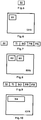
- Fig.5 and Fig.6 refer to the first case
- Fig.7 and Fig.8 refer to the second case
- Fig.9 and Fig.10 refer to the third case.
- the watermarks are graphic symbols superimposed on the images in a visible manner in order to facilitate the understanding of the examples of Fig.5 and Fig.7 and Fig.9 , but, preferably, the marks are invisible or almost invisible.
- the positions indicated in Fig.6 and Fig.8 and Fig.10 should not be considered to be restrictive for the present invention; when invisible or almost invisible marks are used, the marks are typically distributed over the whole image, and are not therefore associated with any particular position.
- the structure of the information to be coded through "watermarking” simply consists of a data field SI (e.g. a string of numeric, alphabetic or alphanumeric characters); such a structure can originate, for example, marks M1 superimposed on the images ID/IS of a video at the upper left angle thereof, as schematically shown in Fig.6 .
- SI e.g. a string of numeric, alphabetic or alphanumeric characters
- the structure of the information to be coded through "watermarking” consists of two elements; the first element includes just one data field SI (e.g. a string of numeric, alphabetic or alphanumeric characters) and the second element includes a set of data fields TI, SO, PR, PA (e.g. a string of numeric, alphabetic or alphanumeric characters); such a structure can originate, for example, marks M2 for the first element and marks M3 for the second element; both the marks M2 and the marks M3 are superimposed on the images ID/IS of a video at the upper left angle thereof and are arranged side by side, as schematically shown in Fig.8 .
- SI e.g. a string of numeric, alphabetic or alphanumeric characters
- TI e.g. a string of numeric, alphabetic or alphanumeric characters
- both marks M2 and M3 are superimposed only on a few video images, and only the marks M2 are superimposed on most video images.
- the marks M2 and M3 are made in the same manner, so that they can be detected and decoded in the receiver by means of the same hardware and/or software means.
- the structure of the information to be coded through "watermarking” consists of just one element including a set of data fields SI, TI, SO, PR, PA (e.g. a string of numeric, alphabetic or alphanumeric characters); such a structure can originate, for example, marks M4 superimposed on the images ID/IS of a video at the upper left angle thereof, as schematically shown in Fig.10 .
- the watermarks are graphic symbols which are superimposed on the images in a visible manner; preferably, however, the marks are invisible or almost invisible.
- watermarking techniques are not limited to this kind of physical and visual superimposition, and that the present invention has no limitations in this respect.
- Some types of digital signals may contain additional information/data, such as, for example, "metadata”; “watermarking” is very different, because the information/data are carried directly by the signal or, in other words, they are superimposed on the signal.
- the “watermarking” techniques differ from one another for a few characteristic parameters: robustness, visibility, capacity, insertion method.
- the marking may be fragile, semi-fragile or robust.
- the marking is fragile or semi-fragile because more information is transported with the same superimposition; besides, since the marking of the present invention does not aim at protecting the multimedia content from misuse, robustness is not necessary.
- the marking may be either visible or invisible.
- the marking it is preferable that the marking is invisible or almost invisible, so that it cannot be perceived by the user as an element disturbing the multimedia content.
- the marking may be "zero-bit long” or “1-bit watermark” or “n-bit watermark” or “multi-bit watermark”.
- the marking is of the "n-bit watermark” or “multi-bit watermark” type, in that the marks must code information which is at least sufficient to ensure the re-synchronization of the multimedia components.
- the marking may essentially be either “in the time domain” or “in the frequency domain”.
- the marking is in "the frequency domain", because this type of insertion promotes mark invisibility: in practice, the superimposition should be located where the image is more "blurred” (in space and/or time), so that it is less visible.
- Fig.1 shows, in a very schematic way, an example of embodiment of a receiving apparatus ARX according to the present invention.
- the apparatus ARX is adapted to receive signals over the air DVB and from the Internet IP; for the air, the DVB symbol has been used because the apparatus detects electric signals according to at least one of the DVB standards (in particular, DBV-T and/or DVB-S), which propagate in the air and are received by an antenna comprised in the apparatus ARX or connected to the apparatus ARX.
- the apparatus ARX comprises a tuner and demodulator A1 adapted to tune to electric signals according to the DVB standard, which signals are supposed to transport a first component C1 of a multimedia content MM; said electric signals are, in particular, normal television signals save for the fact, which is very important, that they have been suitably marked in accordance with the teachings of the present invention.
- the apparatus ARX further comprises an interface A2 adapted to receive electric signals from the Internet, which signals are supposed to transport a second component C2 of a multimedia content MM; in the drawing, the interface A2 is connected to the Internet IP through a bidirectional arrow because the Internet works in a manner such that it requires two-way data transmission even when, at application level, contents must be transferred in one direction only.
- the tuner and demodulator A1 and the interface A2 are connected to a block A3, whose task is to detect and decode the signalling marking and then control the tuner and demodulator A1 or the interface A2 accordingly.
- the tuner and demodulator A1 receives a television signal; the block A3 detects a signalling marking on the television signal, decodes it, and determines that the left view corresponding to the right view contained in this television signal can be obtained from a server at a given Internet address and according to certain parameters; the block A3 supplies this Internet address and these parameters to the interface A2; the interface A2 connects to this server and reception of the left view begins.
- the signals corresponding to the first component are sent by the tuner and demodulator A1 to a block A4; the signals corresponding to the second component are sent by the interface A2 to the block A4.
- the function of the block A4 is to detect the synchronization marks on these two signals and decode them; the block A4 then hands over these two signals, along with the extracted synchronization information, to a block A5.
- the function of the block A5 is to re-synchronize these two signals on the basis of the synchronization information extracted by the previous block; the block A5 then hands over these two re-synchronized signals to a block A6.
- the function of the block A6 is to combine these two re-synchronized signals, i.e. the two components of the multimedia content, to form the multimedia content MM, ready for being shown to the user.
Landscapes
- Engineering & Computer Science (AREA)
- Multimedia (AREA)
- Signal Processing (AREA)
- Databases & Information Systems (AREA)
- Physics & Mathematics (AREA)
- General Physics & Mathematics (AREA)
- Theoretical Computer Science (AREA)
- Computer Security & Cryptography (AREA)
- Television Systems (AREA)
- Two-Way Televisions, Distribution Of Moving Picture Or The Like (AREA)
- Editing Of Facsimile Originals (AREA)
- Testing, Inspecting, Measuring Of Stereoscopic Televisions And Televisions (AREA)
Applications Claiming Priority (2)
| Application Number | Priority Date | Filing Date | Title |
|---|---|---|---|
| IT000723A ITTO20110723A1 (it) | 2011-08-03 | 2011-08-03 | Metodi ed apparecchi per trasmettere e per ricevere contenuti multimediali |
| PCT/IB2012/053967 WO2013018058A1 (en) | 2011-08-03 | 2012-08-02 | Methods and apparatuses for transmitting and for receiving multimedia contents |
Publications (2)
| Publication Number | Publication Date |
|---|---|
| EP2740099A1 EP2740099A1 (en) | 2014-06-11 |
| EP2740099B1 true EP2740099B1 (en) | 2019-09-25 |
Family
ID=44860477
Family Applications (1)
| Application Number | Title | Priority Date | Filing Date |
|---|---|---|---|
| EP12761674.6A Active EP2740099B1 (en) | 2011-08-03 | 2012-08-02 | Methods and apparatus for transmitting and for receiving multimedia contents |
Country Status (9)
| Country | Link |
|---|---|
| US (1) | US8964119B2 (enExample) |
| EP (1) | EP2740099B1 (enExample) |
| JP (1) | JP6091015B2 (enExample) |
| KR (1) | KR101923110B1 (enExample) |
| CN (1) | CN103975363B (enExample) |
| IN (1) | IN2014CN01543A (enExample) |
| IT (1) | ITTO20110723A1 (enExample) |
| TW (1) | TWI497442B (enExample) |
| WO (1) | WO2013018058A1 (enExample) |
Families Citing this family (10)
| Publication number | Priority date | Publication date | Assignee | Title |
|---|---|---|---|---|
| US10409445B2 (en) | 2012-01-09 | 2019-09-10 | Activevideo Networks, Inc. | Rendering of an interactive lean-backward user interface on a television |
| US9800945B2 (en) | 2012-04-03 | 2017-10-24 | Activevideo Networks, Inc. | Class-based intelligent multiplexing over unmanaged networks |
| WO2014145921A1 (en) | 2013-03-15 | 2014-09-18 | Activevideo Networks, Inc. | A multiple-mode system and method for providing user selectable video content |
| WO2014197879A1 (en) | 2013-06-06 | 2014-12-11 | Activevideo Networks, Inc. | Overlay rendering of user interface onto source video |
| US9788029B2 (en) | 2014-04-25 | 2017-10-10 | Activevideo Networks, Inc. | Intelligent multiplexing using class-based, multi-dimensioned decision logic for managed networks |
| US10523985B2 (en) * | 2014-12-24 | 2019-12-31 | Activevideo Networks, Inc. | Managing deep and shallow buffers in a thin-client device of a digital media distribution network |
| US10419511B1 (en) * | 2016-10-04 | 2019-09-17 | Zoom Video Communications, Inc. | Unique watermark generation and detection during a conference |
| US10511885B2 (en) | 2016-12-25 | 2019-12-17 | Synamedia Limited | Reinforced interleaved watermarking |
| CN110087098B (zh) | 2018-01-26 | 2021-12-03 | 阿里巴巴(中国)有限公司 | 水印处理方法及装置 |
| CN116915519B (zh) * | 2023-09-14 | 2023-12-12 | 北京华云安信息技术有限公司 | 数据流溯源的方法、装置、设备以及存储介质 |
Citations (2)
| Publication number | Priority date | Publication date | Assignee | Title |
|---|---|---|---|---|
| WO2008041061A1 (en) * | 2006-10-05 | 2008-04-10 | Vestel Elektronik Sanayi Ve Ticaret A.S. | Watermark detection method for broadcasting |
| WO2010053246A2 (en) * | 2008-11-04 | 2010-05-14 | Electronics And Telecommunications Research Institute | Apparatus and method for synchronizing stereoscopic image, and apparatus and method for providing stereoscopic image based on the same |
Family Cites Families (15)
| Publication number | Priority date | Publication date | Assignee | Title |
|---|---|---|---|---|
| US6836295B1 (en) * | 1995-12-07 | 2004-12-28 | J. Carl Cooper | Audio to video timing measurement for MPEG type television systems |
| US6373960B1 (en) * | 1998-01-06 | 2002-04-16 | Pixel Tools Corporation | Embedding watermarks into compressed video data |
| US6480902B1 (en) * | 1999-05-25 | 2002-11-12 | Institute For Information Industry | Intermedia synchronization system for communicating multimedia data in a computer network |
| JP2003259314A (ja) * | 2002-02-26 | 2003-09-12 | Nippon Hoso Kyokai <Nhk> | 映像音声同期方法及びそのシステム |
| JP2005524183A (ja) * | 2002-05-01 | 2005-08-11 | コーニンクレッカ フィリップス エレクトロニクス エヌ ヴィ | 透かしを使用したマルチメディアメッセージング方法及びシステム |
| EP1518410A1 (en) * | 2002-06-24 | 2005-03-30 | Koninklijke Philips Electronics N.V. | Robust signature for signal authentication |
| JP4252324B2 (ja) * | 2003-01-28 | 2009-04-08 | 三菱電機株式会社 | 受信機、放送送出装置及び補助コンテンツサーバ |
| JP2004266497A (ja) * | 2003-02-28 | 2004-09-24 | Rikogaku Shinkokai | ステレオ映像放送受信用セットトップボックスおよびステレオ映像放送方法 |
| JP4144416B2 (ja) * | 2003-04-21 | 2008-09-03 | 沖電気工業株式会社 | 電子透かし埋め込み方法、電子透かし検出方法、電子透かし埋め込み装置、及び電子透かし検出装置 |
| KR100725387B1 (ko) * | 2004-08-24 | 2007-06-08 | 삼성전자주식회사 | 데이터 방송에서의 전송 코드 세트 시그널링 방법 및 장치 |
| CN1946176A (zh) * | 2006-10-11 | 2007-04-11 | 祝万昌 | Dvb数据实时高速接收和传送的装置和方法 |
| US8677437B2 (en) * | 2008-05-07 | 2014-03-18 | Evertz Microsystems Ltd. | Systems and methods for calculating the delay between media signals |
| US8300881B2 (en) * | 2009-09-16 | 2012-10-30 | Broadcom Corporation | Method and system for watermarking 3D content |
| JP5326972B2 (ja) * | 2009-09-29 | 2013-10-30 | 沖電気工業株式会社 | 遠隔コミュニケーションシステムおよび送信装置 |
| US8737679B2 (en) * | 2011-07-12 | 2014-05-27 | M/S. Amagi Media Labs Pvt. Ltd. | System and method for seamless content insertion on network content using audio-video fingerprinting and watermarking |
-
2011
- 2011-08-03 IT IT000723A patent/ITTO20110723A1/it unknown
-
2012
- 2012-08-02 JP JP2014523433A patent/JP6091015B2/ja not_active Expired - Fee Related
- 2012-08-02 US US14/236,400 patent/US8964119B2/en not_active Expired - Fee Related
- 2012-08-02 WO PCT/IB2012/053967 patent/WO2013018058A1/en not_active Ceased
- 2012-08-02 IN IN1543CHN2014 patent/IN2014CN01543A/en unknown
- 2012-08-02 EP EP12761674.6A patent/EP2740099B1/en active Active
- 2012-08-02 KR KR1020147005792A patent/KR101923110B1/ko not_active Expired - Fee Related
- 2012-08-02 CN CN201280038011.8A patent/CN103975363B/zh not_active Expired - Fee Related
- 2012-08-03 TW TW101128135A patent/TWI497442B/zh not_active IP Right Cessation
Patent Citations (2)
| Publication number | Priority date | Publication date | Assignee | Title |
|---|---|---|---|---|
| WO2008041061A1 (en) * | 2006-10-05 | 2008-04-10 | Vestel Elektronik Sanayi Ve Ticaret A.S. | Watermark detection method for broadcasting |
| WO2010053246A2 (en) * | 2008-11-04 | 2010-05-14 | Electronics And Telecommunications Research Institute | Apparatus and method for synchronizing stereoscopic image, and apparatus and method for providing stereoscopic image based on the same |
Non-Patent Citations (1)
| Title |
|---|
| GÖKTUG GURLER C ET AL: "Flexible Transport of 3-D Video Over Networks", PROCEEDINGS OF THE IEEE, IEEE. NEW YORK, US, vol. 99, no. 4, 1 April 2011 (2011-04-01), pages 694 - 707, XP011363631, ISSN: 0018-9219, DOI: 10.1109/JPROC.2010.2100010 * |
Also Published As
| Publication number | Publication date |
|---|---|
| IN2014CN01543A (enExample) | 2015-05-08 |
| EP2740099A1 (en) | 2014-06-11 |
| JP6091015B2 (ja) | 2017-03-08 |
| US8964119B2 (en) | 2015-02-24 |
| TWI497442B (zh) | 2015-08-21 |
| ITTO20110723A1 (it) | 2013-02-04 |
| JP2014524682A (ja) | 2014-09-22 |
| CN103975363B (zh) | 2017-07-04 |
| TW201320001A (zh) | 2013-05-16 |
| KR20140068923A (ko) | 2014-06-09 |
| CN103975363A (zh) | 2014-08-06 |
| US20140168515A1 (en) | 2014-06-19 |
| KR101923110B1 (ko) | 2018-11-28 |
| WO2013018058A1 (en) | 2013-02-07 |
Similar Documents
| Publication | Publication Date | Title |
|---|---|---|
| US8964119B2 (en) | Methods and apparatuses for transmitting and for receiving multimedia contents | |
| KR101664424B1 (ko) | 디지털 서비스 신호 처리 방법 및 장치 | |
| US9584844B2 (en) | Method and apparatus for matching of corresponding frames in multimedia streams | |
| US8422564B2 (en) | Method and apparatus for transmitting/receiving enhanced media data in digital multimedia broadcasting system | |
| JP6294503B2 (ja) | 放送信号送信装置、放送信号受信装置、放送信号送信方法、及び放送信号受信方法 | |
| GB2508451A (en) | Broadcast service transmitting method, broadcast service receiving method and broadcast service receiving apparatus | |
| JP2015531189A (ja) | デジタルサービス信号処理方法及び装置 | |
| EP2387250A1 (en) | Method and system for watermark insertion using video start codes | |
| CA2948117A1 (en) | A method of decoding a content bitstream | |
| JP7512344B2 (ja) | 受信装置、及び、データ処理方法 | |
| KR102137349B1 (ko) | 디코딩 장치, 수신기기, 송신기기, 송수신 시스템, 디코딩 방법, 및 디코딩 프로그램이 저장된 저장매체 | |
| KR101995197B1 (ko) | 디코딩 장치, 수신기기, 송신기기, 송수신 시스템, 디코딩 방법, 및 디코딩 프로그램이 저장된 저장매체 | |
| KR100910996B1 (ko) | 디지털 멀티미디어 방송 시스템에서의 3차원 비디오 서비스제공 방법 | |
| KR20060122784A (ko) | 디지털 멀티미디어방송에서 비디오 서비스와 동기화된데이터 서비스를 제공하는 방법 및 그 장치 | |
| EP1914993A2 (en) | Digital broadcasting receiver and scrambled channel determination method thereof | |
| US7577170B2 (en) | System for the dynamic multiplexing of digital streams | |
| JP5894759B2 (ja) | 受信装置および受信プログラム | |
| WO2009061150A2 (en) | Apparatus and method for storing broadcasting content in dmb system |
Legal Events
| Date | Code | Title | Description |
|---|---|---|---|
| PUAI | Public reference made under article 153(3) epc to a published international application that has entered the european phase |
Free format text: ORIGINAL CODE: 0009012 |
|
| 17P | Request for examination filed |
Effective date: 20140227 |
|
| AK | Designated contracting states |
Kind code of ref document: A1 Designated state(s): AL AT BE BG CH CY CZ DE DK EE ES FI FR GB GR HR HU IE IS IT LI LT LU LV MC MK MT NL NO PL PT RO RS SE SI SK SM TR |
|
| DAX | Request for extension of the european patent (deleted) | ||
| STAA | Information on the status of an ep patent application or granted ep patent |
Free format text: STATUS: EXAMINATION IS IN PROGRESS |
|
| 17Q | First examination report despatched |
Effective date: 20170522 |
|
| RAP1 | Party data changed (applicant data changed or rights of an application transferred) |
Owner name: S.I.SV.EL. SOCIETA ITALIANA PER LO SVILUPPO DELL'E |
|
| GRAP | Despatch of communication of intention to grant a patent |
Free format text: ORIGINAL CODE: EPIDOSNIGR1 |
|
| STAA | Information on the status of an ep patent application or granted ep patent |
Free format text: STATUS: GRANT OF PATENT IS INTENDED |
|
| INTG | Intention to grant announced |
Effective date: 20190515 |
|
| GRAS | Grant fee paid |
Free format text: ORIGINAL CODE: EPIDOSNIGR3 |
|
| GRAA | (expected) grant |
Free format text: ORIGINAL CODE: 0009210 |
|
| STAA | Information on the status of an ep patent application or granted ep patent |
Free format text: STATUS: THE PATENT HAS BEEN GRANTED |
|
| AK | Designated contracting states |
Kind code of ref document: B1 Designated state(s): AL AT BE BG CH CY CZ DE DK EE ES FI FR GB GR HR HU IE IS IT LI LT LU LV MC MK MT NL NO PL PT RO RS SE SI SK SM TR |
|
| REG | Reference to a national code |
Ref country code: GB Ref legal event code: FG4D |
|
| REG | Reference to a national code |
Ref country code: CH Ref legal event code: EP |
|
| REG | Reference to a national code |
Ref country code: AT Ref legal event code: REF Ref document number: 1184573 Country of ref document: AT Kind code of ref document: T Effective date: 20191015 |
|
| REG | Reference to a national code |
Ref country code: IE Ref legal event code: FG4D |
|
| REG | Reference to a national code |
Ref country code: DE Ref legal event code: R096 Ref document number: 602012064337 Country of ref document: DE |
|
| REG | Reference to a national code |
Ref country code: NL Ref legal event code: MP Effective date: 20190925 |
|
| PG25 | Lapsed in a contracting state [announced via postgrant information from national office to epo] |
Ref country code: BG Free format text: LAPSE BECAUSE OF FAILURE TO SUBMIT A TRANSLATION OF THE DESCRIPTION OR TO PAY THE FEE WITHIN THE PRESCRIBED TIME-LIMIT Effective date: 20191225 Ref country code: SE Free format text: LAPSE BECAUSE OF FAILURE TO SUBMIT A TRANSLATION OF THE DESCRIPTION OR TO PAY THE FEE WITHIN THE PRESCRIBED TIME-LIMIT Effective date: 20190925 Ref country code: HR Free format text: LAPSE BECAUSE OF FAILURE TO SUBMIT A TRANSLATION OF THE DESCRIPTION OR TO PAY THE FEE WITHIN THE PRESCRIBED TIME-LIMIT Effective date: 20190925 Ref country code: LT Free format text: LAPSE BECAUSE OF FAILURE TO SUBMIT A TRANSLATION OF THE DESCRIPTION OR TO PAY THE FEE WITHIN THE PRESCRIBED TIME-LIMIT Effective date: 20190925 Ref country code: FI Free format text: LAPSE BECAUSE OF FAILURE TO SUBMIT A TRANSLATION OF THE DESCRIPTION OR TO PAY THE FEE WITHIN THE PRESCRIBED TIME-LIMIT Effective date: 20190925 Ref country code: NO Free format text: LAPSE BECAUSE OF FAILURE TO SUBMIT A TRANSLATION OF THE DESCRIPTION OR TO PAY THE FEE WITHIN THE PRESCRIBED TIME-LIMIT Effective date: 20191225 |
|
| REG | Reference to a national code |
Ref country code: LT Ref legal event code: MG4D |
|
| PG25 | Lapsed in a contracting state [announced via postgrant information from national office to epo] |
Ref country code: GR Free format text: LAPSE BECAUSE OF FAILURE TO SUBMIT A TRANSLATION OF THE DESCRIPTION OR TO PAY THE FEE WITHIN THE PRESCRIBED TIME-LIMIT Effective date: 20191226 Ref country code: RS Free format text: LAPSE BECAUSE OF FAILURE TO SUBMIT A TRANSLATION OF THE DESCRIPTION OR TO PAY THE FEE WITHIN THE PRESCRIBED TIME-LIMIT Effective date: 20190925 Ref country code: LV Free format text: LAPSE BECAUSE OF FAILURE TO SUBMIT A TRANSLATION OF THE DESCRIPTION OR TO PAY THE FEE WITHIN THE PRESCRIBED TIME-LIMIT Effective date: 20190925 |
|
| REG | Reference to a national code |
Ref country code: AT Ref legal event code: MK05 Ref document number: 1184573 Country of ref document: AT Kind code of ref document: T Effective date: 20190925 |
|
| PG25 | Lapsed in a contracting state [announced via postgrant information from national office to epo] |
Ref country code: PT Free format text: LAPSE BECAUSE OF FAILURE TO SUBMIT A TRANSLATION OF THE DESCRIPTION OR TO PAY THE FEE WITHIN THE PRESCRIBED TIME-LIMIT Effective date: 20200127 Ref country code: AL Free format text: LAPSE BECAUSE OF FAILURE TO SUBMIT A TRANSLATION OF THE DESCRIPTION OR TO PAY THE FEE WITHIN THE PRESCRIBED TIME-LIMIT Effective date: 20190925 Ref country code: ES Free format text: LAPSE BECAUSE OF FAILURE TO SUBMIT A TRANSLATION OF THE DESCRIPTION OR TO PAY THE FEE WITHIN THE PRESCRIBED TIME-LIMIT Effective date: 20190925 Ref country code: IT Free format text: LAPSE BECAUSE OF FAILURE TO SUBMIT A TRANSLATION OF THE DESCRIPTION OR TO PAY THE FEE WITHIN THE PRESCRIBED TIME-LIMIT Effective date: 20190925 Ref country code: RO Free format text: LAPSE BECAUSE OF FAILURE TO SUBMIT A TRANSLATION OF THE DESCRIPTION OR TO PAY THE FEE WITHIN THE PRESCRIBED TIME-LIMIT Effective date: 20190925 Ref country code: AT Free format text: LAPSE BECAUSE OF FAILURE TO SUBMIT A TRANSLATION OF THE DESCRIPTION OR TO PAY THE FEE WITHIN THE PRESCRIBED TIME-LIMIT Effective date: 20190925 Ref country code: EE Free format text: LAPSE BECAUSE OF FAILURE TO SUBMIT A TRANSLATION OF THE DESCRIPTION OR TO PAY THE FEE WITHIN THE PRESCRIBED TIME-LIMIT Effective date: 20190925 Ref country code: PL Free format text: LAPSE BECAUSE OF FAILURE TO SUBMIT A TRANSLATION OF THE DESCRIPTION OR TO PAY THE FEE WITHIN THE PRESCRIBED TIME-LIMIT Effective date: 20190925 Ref country code: NL Free format text: LAPSE BECAUSE OF FAILURE TO SUBMIT A TRANSLATION OF THE DESCRIPTION OR TO PAY THE FEE WITHIN THE PRESCRIBED TIME-LIMIT Effective date: 20190925 |
|
| PG25 | Lapsed in a contracting state [announced via postgrant information from national office to epo] |
Ref country code: IS Free format text: LAPSE BECAUSE OF FAILURE TO SUBMIT A TRANSLATION OF THE DESCRIPTION OR TO PAY THE FEE WITHIN THE PRESCRIBED TIME-LIMIT Effective date: 20200224 Ref country code: SK Free format text: LAPSE BECAUSE OF FAILURE TO SUBMIT A TRANSLATION OF THE DESCRIPTION OR TO PAY THE FEE WITHIN THE PRESCRIBED TIME-LIMIT Effective date: 20190925 Ref country code: SM Free format text: LAPSE BECAUSE OF FAILURE TO SUBMIT A TRANSLATION OF THE DESCRIPTION OR TO PAY THE FEE WITHIN THE PRESCRIBED TIME-LIMIT Effective date: 20190925 Ref country code: CZ Free format text: LAPSE BECAUSE OF FAILURE TO SUBMIT A TRANSLATION OF THE DESCRIPTION OR TO PAY THE FEE WITHIN THE PRESCRIBED TIME-LIMIT Effective date: 20190925 |
|
| REG | Reference to a national code |
Ref country code: DE Ref legal event code: R097 Ref document number: 602012064337 Country of ref document: DE |
|
| PG2D | Information on lapse in contracting state deleted |
Ref country code: IS |
|
| PG25 | Lapsed in a contracting state [announced via postgrant information from national office to epo] |
Ref country code: DK Free format text: LAPSE BECAUSE OF FAILURE TO SUBMIT A TRANSLATION OF THE DESCRIPTION OR TO PAY THE FEE WITHIN THE PRESCRIBED TIME-LIMIT Effective date: 20190925 Ref country code: IS Free format text: LAPSE BECAUSE OF FAILURE TO SUBMIT A TRANSLATION OF THE DESCRIPTION OR TO PAY THE FEE WITHIN THE PRESCRIBED TIME-LIMIT Effective date: 20200126 |
|
| PLBE | No opposition filed within time limit |
Free format text: ORIGINAL CODE: 0009261 |
|
| STAA | Information on the status of an ep patent application or granted ep patent |
Free format text: STATUS: NO OPPOSITION FILED WITHIN TIME LIMIT |
|
| 26N | No opposition filed |
Effective date: 20200626 |
|
| PG25 | Lapsed in a contracting state [announced via postgrant information from national office to epo] |
Ref country code: SI Free format text: LAPSE BECAUSE OF FAILURE TO SUBMIT A TRANSLATION OF THE DESCRIPTION OR TO PAY THE FEE WITHIN THE PRESCRIBED TIME-LIMIT Effective date: 20190925 |
|
| PG25 | Lapsed in a contracting state [announced via postgrant information from national office to epo] |
Ref country code: MC Free format text: LAPSE BECAUSE OF FAILURE TO SUBMIT A TRANSLATION OF THE DESCRIPTION OR TO PAY THE FEE WITHIN THE PRESCRIBED TIME-LIMIT Effective date: 20190925 |
|
| REG | Reference to a national code |
Ref country code: CH Ref legal event code: PL |
|
| PG25 | Lapsed in a contracting state [announced via postgrant information from national office to epo] |
Ref country code: LU Free format text: LAPSE BECAUSE OF NON-PAYMENT OF DUE FEES Effective date: 20200802 Ref country code: LI Free format text: LAPSE BECAUSE OF NON-PAYMENT OF DUE FEES Effective date: 20200831 Ref country code: CH Free format text: LAPSE BECAUSE OF NON-PAYMENT OF DUE FEES Effective date: 20200831 |
|
| REG | Reference to a national code |
Ref country code: BE Ref legal event code: MM Effective date: 20200831 |
|
| PG25 | Lapsed in a contracting state [announced via postgrant information from national office to epo] |
Ref country code: IE Free format text: LAPSE BECAUSE OF NON-PAYMENT OF DUE FEES Effective date: 20200802 Ref country code: BE Free format text: LAPSE BECAUSE OF NON-PAYMENT OF DUE FEES Effective date: 20200831 |
|
| PGFP | Annual fee paid to national office [announced via postgrant information from national office to epo] |
Ref country code: GB Payment date: 20211023 Year of fee payment: 10 Ref country code: DE Payment date: 20211027 Year of fee payment: 10 |
|
| PGFP | Annual fee paid to national office [announced via postgrant information from national office to epo] |
Ref country code: FR Payment date: 20211023 Year of fee payment: 10 |
|
| PG25 | Lapsed in a contracting state [announced via postgrant information from national office to epo] |
Ref country code: TR Free format text: LAPSE BECAUSE OF FAILURE TO SUBMIT A TRANSLATION OF THE DESCRIPTION OR TO PAY THE FEE WITHIN THE PRESCRIBED TIME-LIMIT Effective date: 20190925 Ref country code: MT Free format text: LAPSE BECAUSE OF FAILURE TO SUBMIT A TRANSLATION OF THE DESCRIPTION OR TO PAY THE FEE WITHIN THE PRESCRIBED TIME-LIMIT Effective date: 20190925 Ref country code: CY Free format text: LAPSE BECAUSE OF FAILURE TO SUBMIT A TRANSLATION OF THE DESCRIPTION OR TO PAY THE FEE WITHIN THE PRESCRIBED TIME-LIMIT Effective date: 20190925 |
|
| PG25 | Lapsed in a contracting state [announced via postgrant information from national office to epo] |
Ref country code: MK Free format text: LAPSE BECAUSE OF FAILURE TO SUBMIT A TRANSLATION OF THE DESCRIPTION OR TO PAY THE FEE WITHIN THE PRESCRIBED TIME-LIMIT Effective date: 20190925 |
|
| REG | Reference to a national code |
Ref country code: DE Ref legal event code: R119 Ref document number: 602012064337 Country of ref document: DE |
|
| GBPC | Gb: european patent ceased through non-payment of renewal fee |
Effective date: 20220802 |
|
| PG25 | Lapsed in a contracting state [announced via postgrant information from national office to epo] |
Ref country code: FR Free format text: LAPSE BECAUSE OF NON-PAYMENT OF DUE FEES Effective date: 20220831 Ref country code: DE Free format text: LAPSE BECAUSE OF NON-PAYMENT OF DUE FEES Effective date: 20230301 |
|
| PG25 | Lapsed in a contracting state [announced via postgrant information from national office to epo] |
Ref country code: GB Free format text: LAPSE BECAUSE OF NON-PAYMENT OF DUE FEES Effective date: 20220802 |