EP2735441A2 - Battery packaging material having heat-dissipating characteristics - Google Patents
Battery packaging material having heat-dissipating characteristics Download PDFInfo
- Publication number
- EP2735441A2 EP2735441A2 EP12814766.7A EP12814766A EP2735441A2 EP 2735441 A2 EP2735441 A2 EP 2735441A2 EP 12814766 A EP12814766 A EP 12814766A EP 2735441 A2 EP2735441 A2 EP 2735441A2
- Authority
- EP
- European Patent Office
- Prior art keywords
- layer
- packaging material
- based resin
- heat dissipation
- pouch
- Prior art date
- Legal status (The legal status is an assumption and is not a legal conclusion. Google has not performed a legal analysis and makes no representation as to the accuracy of the status listed.)
- Withdrawn
Links
Images



Classifications
-
- B—PERFORMING OPERATIONS; TRANSPORTING
- B32—LAYERED PRODUCTS
- B32B—LAYERED PRODUCTS, i.e. PRODUCTS BUILT-UP OF STRATA OF FLAT OR NON-FLAT, e.g. CELLULAR OR HONEYCOMB, FORM
- B32B9/00—Layered products comprising a layer of a particular substance not covered by groups B32B11/00 - B32B29/00
- B32B9/04—Layered products comprising a layer of a particular substance not covered by groups B32B11/00 - B32B29/00 comprising such particular substance as the main or only constituent of a layer, which is next to another layer of the same or of a different material
- B32B9/045—Layered products comprising a layer of a particular substance not covered by groups B32B11/00 - B32B29/00 comprising such particular substance as the main or only constituent of a layer, which is next to another layer of the same or of a different material of synthetic resin
-
- B—PERFORMING OPERATIONS; TRANSPORTING
- B32—LAYERED PRODUCTS
- B32B—LAYERED PRODUCTS, i.e. PRODUCTS BUILT-UP OF STRATA OF FLAT OR NON-FLAT, e.g. CELLULAR OR HONEYCOMB, FORM
- B32B15/00—Layered products comprising a layer of metal
- B32B15/04—Layered products comprising a layer of metal comprising metal as the main or only constituent of a layer, which is next to another layer of the same or of a different material
- B32B15/08—Layered products comprising a layer of metal comprising metal as the main or only constituent of a layer, which is next to another layer of the same or of a different material of synthetic resin
- B32B15/088—Layered products comprising a layer of metal comprising metal as the main or only constituent of a layer, which is next to another layer of the same or of a different material of synthetic resin comprising polyamides
-
- B—PERFORMING OPERATIONS; TRANSPORTING
- B32—LAYERED PRODUCTS
- B32B—LAYERED PRODUCTS, i.e. PRODUCTS BUILT-UP OF STRATA OF FLAT OR NON-FLAT, e.g. CELLULAR OR HONEYCOMB, FORM
- B32B15/00—Layered products comprising a layer of metal
- B32B15/04—Layered products comprising a layer of metal comprising metal as the main or only constituent of a layer, which is next to another layer of the same or of a different material
- B32B15/08—Layered products comprising a layer of metal comprising metal as the main or only constituent of a layer, which is next to another layer of the same or of a different material of synthetic resin
- B32B15/09—Layered products comprising a layer of metal comprising metal as the main or only constituent of a layer, which is next to another layer of the same or of a different material of synthetic resin comprising polyesters
-
- B—PERFORMING OPERATIONS; TRANSPORTING
- B32—LAYERED PRODUCTS
- B32B—LAYERED PRODUCTS, i.e. PRODUCTS BUILT-UP OF STRATA OF FLAT OR NON-FLAT, e.g. CELLULAR OR HONEYCOMB, FORM
- B32B15/00—Layered products comprising a layer of metal
- B32B15/20—Layered products comprising a layer of metal comprising aluminium or copper
-
- B—PERFORMING OPERATIONS; TRANSPORTING
- B32—LAYERED PRODUCTS
- B32B—LAYERED PRODUCTS, i.e. PRODUCTS BUILT-UP OF STRATA OF FLAT OR NON-FLAT, e.g. CELLULAR OR HONEYCOMB, FORM
- B32B27/00—Layered products comprising a layer of synthetic resin
- B32B27/06—Layered products comprising a layer of synthetic resin as the main or only constituent of a layer, which is next to another layer of the same or of a different material
- B32B27/08—Layered products comprising a layer of synthetic resin as the main or only constituent of a layer, which is next to another layer of the same or of a different material of synthetic resin
-
- B—PERFORMING OPERATIONS; TRANSPORTING
- B32—LAYERED PRODUCTS
- B32B—LAYERED PRODUCTS, i.e. PRODUCTS BUILT-UP OF STRATA OF FLAT OR NON-FLAT, e.g. CELLULAR OR HONEYCOMB, FORM
- B32B27/00—Layered products comprising a layer of synthetic resin
- B32B27/18—Layered products comprising a layer of synthetic resin characterised by the use of special additives
- B32B27/20—Layered products comprising a layer of synthetic resin characterised by the use of special additives using fillers, pigments, thixotroping agents
-
- B—PERFORMING OPERATIONS; TRANSPORTING
- B32—LAYERED PRODUCTS
- B32B—LAYERED PRODUCTS, i.e. PRODUCTS BUILT-UP OF STRATA OF FLAT OR NON-FLAT, e.g. CELLULAR OR HONEYCOMB, FORM
- B32B27/00—Layered products comprising a layer of synthetic resin
- B32B27/32—Layered products comprising a layer of synthetic resin comprising polyolefins
-
- B—PERFORMING OPERATIONS; TRANSPORTING
- B32—LAYERED PRODUCTS
- B32B—LAYERED PRODUCTS, i.e. PRODUCTS BUILT-UP OF STRATA OF FLAT OR NON-FLAT, e.g. CELLULAR OR HONEYCOMB, FORM
- B32B27/00—Layered products comprising a layer of synthetic resin
- B32B27/36—Layered products comprising a layer of synthetic resin comprising polyesters
-
- B—PERFORMING OPERATIONS; TRANSPORTING
- B32—LAYERED PRODUCTS
- B32B—LAYERED PRODUCTS, i.e. PRODUCTS BUILT-UP OF STRATA OF FLAT OR NON-FLAT, e.g. CELLULAR OR HONEYCOMB, FORM
- B32B27/00—Layered products comprising a layer of synthetic resin
- B32B27/36—Layered products comprising a layer of synthetic resin comprising polyesters
- B32B27/365—Layered products comprising a layer of synthetic resin comprising polyesters comprising polycarbonates
-
- B—PERFORMING OPERATIONS; TRANSPORTING
- B32—LAYERED PRODUCTS
- B32B—LAYERED PRODUCTS, i.e. PRODUCTS BUILT-UP OF STRATA OF FLAT OR NON-FLAT, e.g. CELLULAR OR HONEYCOMB, FORM
- B32B7/00—Layered products characterised by the relation between layers; Layered products characterised by the relative orientation of features between layers, or by the relative values of a measurable parameter between layers, i.e. products comprising layers having different physical, chemical or physicochemical properties; Layered products characterised by the interconnection of layers
- B32B7/04—Interconnection of layers
- B32B7/12—Interconnection of layers using interposed adhesives or interposed materials with bonding properties
-
- H—ELECTRICITY
- H01—ELECTRIC ELEMENTS
- H01M—PROCESSES OR MEANS, e.g. BATTERIES, FOR THE DIRECT CONVERSION OF CHEMICAL ENERGY INTO ELECTRICAL ENERGY
- H01M10/00—Secondary cells; Manufacture thereof
- H01M10/60—Heating or cooling; Temperature control
- H01M10/61—Types of temperature control
- H01M10/613—Cooling or keeping cold
-
- H—ELECTRICITY
- H01—ELECTRIC ELEMENTS
- H01M—PROCESSES OR MEANS, e.g. BATTERIES, FOR THE DIRECT CONVERSION OF CHEMICAL ENERGY INTO ELECTRICAL ENERGY
- H01M10/00—Secondary cells; Manufacture thereof
- H01M10/60—Heating or cooling; Temperature control
- H01M10/65—Means for temperature control structurally associated with the cells
- H01M10/655—Solid structures for heat exchange or heat conduction
- H01M10/6551—Surfaces specially adapted for heat dissipation or radiation, e.g. fins or coatings
-
- H—ELECTRICITY
- H01—ELECTRIC ELEMENTS
- H01M—PROCESSES OR MEANS, e.g. BATTERIES, FOR THE DIRECT CONVERSION OF CHEMICAL ENERGY INTO ELECTRICAL ENERGY
- H01M50/00—Constructional details or processes of manufacture of the non-active parts of electrochemical cells other than fuel cells, e.g. hybrid cells
- H01M50/10—Primary casings; Jackets or wrappings
- H01M50/116—Primary casings; Jackets or wrappings characterised by the material
- H01M50/124—Primary casings; Jackets or wrappings characterised by the material having a layered structure
-
- H—ELECTRICITY
- H01—ELECTRIC ELEMENTS
- H01M—PROCESSES OR MEANS, e.g. BATTERIES, FOR THE DIRECT CONVERSION OF CHEMICAL ENERGY INTO ELECTRICAL ENERGY
- H01M50/00—Constructional details or processes of manufacture of the non-active parts of electrochemical cells other than fuel cells, e.g. hybrid cells
- H01M50/20—Mountings; Secondary casings or frames; Racks, modules or packs; Suspension devices; Shock absorbers; Transport or carrying devices; Holders
- H01M50/233—Mountings; Secondary casings or frames; Racks, modules or packs; Suspension devices; Shock absorbers; Transport or carrying devices; Holders characterised by physical properties of casings or racks, e.g. dimensions
- H01M50/24—Mountings; Secondary casings or frames; Racks, modules or packs; Suspension devices; Shock absorbers; Transport or carrying devices; Holders characterised by physical properties of casings or racks, e.g. dimensions adapted for protecting batteries from their environment, e.g. from corrosion
-
- H—ELECTRICITY
- H01—ELECTRIC ELEMENTS
- H01M—PROCESSES OR MEANS, e.g. BATTERIES, FOR THE DIRECT CONVERSION OF CHEMICAL ENERGY INTO ELECTRICAL ENERGY
- H01M50/00—Constructional details or processes of manufacture of the non-active parts of electrochemical cells other than fuel cells, e.g. hybrid cells
- H01M50/50—Current conducting connections for cells or batteries
- H01M50/572—Means for preventing undesired use or discharge
- H01M50/574—Devices or arrangements for the interruption of current
- H01M50/581—Devices or arrangements for the interruption of current in response to temperature
-
- B—PERFORMING OPERATIONS; TRANSPORTING
- B32—LAYERED PRODUCTS
- B32B—LAYERED PRODUCTS, i.e. PRODUCTS BUILT-UP OF STRATA OF FLAT OR NON-FLAT, e.g. CELLULAR OR HONEYCOMB, FORM
- B32B2264/00—Composition or properties of particles which form a particulate layer or are present as additives
- B32B2264/10—Inorganic particles
- B32B2264/107—Ceramic
- B32B2264/108—Carbon, e.g. graphite particles
-
- B—PERFORMING OPERATIONS; TRANSPORTING
- B32—LAYERED PRODUCTS
- B32B—LAYERED PRODUCTS, i.e. PRODUCTS BUILT-UP OF STRATA OF FLAT OR NON-FLAT, e.g. CELLULAR OR HONEYCOMB, FORM
- B32B2307/00—Properties of the layers or laminate
- B32B2307/30—Properties of the layers or laminate having particular thermal properties
- B32B2307/302—Conductive
-
- B—PERFORMING OPERATIONS; TRANSPORTING
- B32—LAYERED PRODUCTS
- B32B—LAYERED PRODUCTS, i.e. PRODUCTS BUILT-UP OF STRATA OF FLAT OR NON-FLAT, e.g. CELLULAR OR HONEYCOMB, FORM
- B32B2307/00—Properties of the layers or laminate
- B32B2307/30—Properties of the layers or laminate having particular thermal properties
- B32B2307/306—Resistant to heat
-
- B—PERFORMING OPERATIONS; TRANSPORTING
- B32—LAYERED PRODUCTS
- B32B—LAYERED PRODUCTS, i.e. PRODUCTS BUILT-UP OF STRATA OF FLAT OR NON-FLAT, e.g. CELLULAR OR HONEYCOMB, FORM
- B32B2307/00—Properties of the layers or laminate
- B32B2307/70—Other properties
- B32B2307/714—Inert, i.e. inert to chemical degradation, corrosion
-
- B—PERFORMING OPERATIONS; TRANSPORTING
- B32—LAYERED PRODUCTS
- B32B—LAYERED PRODUCTS, i.e. PRODUCTS BUILT-UP OF STRATA OF FLAT OR NON-FLAT, e.g. CELLULAR OR HONEYCOMB, FORM
- B32B2307/00—Properties of the layers or laminate
- B32B2307/70—Other properties
- B32B2307/75—Printability
-
- B—PERFORMING OPERATIONS; TRANSPORTING
- B32—LAYERED PRODUCTS
- B32B—LAYERED PRODUCTS, i.e. PRODUCTS BUILT-UP OF STRATA OF FLAT OR NON-FLAT, e.g. CELLULAR OR HONEYCOMB, FORM
- B32B2439/00—Containers; Receptacles
-
- B—PERFORMING OPERATIONS; TRANSPORTING
- B32—LAYERED PRODUCTS
- B32B—LAYERED PRODUCTS, i.e. PRODUCTS BUILT-UP OF STRATA OF FLAT OR NON-FLAT, e.g. CELLULAR OR HONEYCOMB, FORM
- B32B2457/00—Electrical equipment
- B32B2457/10—Batteries
-
- Y—GENERAL TAGGING OF NEW TECHNOLOGICAL DEVELOPMENTS; GENERAL TAGGING OF CROSS-SECTIONAL TECHNOLOGIES SPANNING OVER SEVERAL SECTIONS OF THE IPC; TECHNICAL SUBJECTS COVERED BY FORMER USPC CROSS-REFERENCE ART COLLECTIONS [XRACs] AND DIGESTS
- Y02—TECHNOLOGIES OR APPLICATIONS FOR MITIGATION OR ADAPTATION AGAINST CLIMATE CHANGE
- Y02E—REDUCTION OF GREENHOUSE GAS [GHG] EMISSIONS, RELATED TO ENERGY GENERATION, TRANSMISSION OR DISTRIBUTION
- Y02E60/00—Enabling technologies; Technologies with a potential or indirect contribution to GHG emissions mitigation
- Y02E60/10—Energy storage using batteries
Definitions
- the present invention relates to a packaging material for a battery having a heat dissipation property, and more particularly to a packaging material for a battery including a heat dissipation layer that is prepared by adding a carbon material to at least one constitutional layer of the packaging material, or a separate heat dissipation layer containing a carbon material and a binder resin.
- a lithium ion secondary battery uses a liquid electrolyte, it uses an aluminum can as a packaging material to prevent leakage of the electrolyte and decrease a risk of explosion.
- a lithium ion secondary battery inevitably has a heavy weight and a large volume due to the aluminum can that is used as the packaging material, and even if the aluminum can is used, a risk of explosion always exists because the liquid electrolyte in ion state is used, and thus safety is low. Accordingly, research and development for improving safety and further increasing energy density while decreasing volume are ongoing.
- the lithium polymer secondary battery may include a pouch-type exterior material, the battery may be reduced in weight, thereby reducing production cost and diversifying the shape of the battery, thus increasing product competiveness. Since the lithium polymer secondary battery uses a laminate pouch as a packaging material, it may become thinner.
- the polymer battery may be used in a notebook, portable terminal equipment (a mobile phone, a PDA, and the like), a video camera, an electric vehicle, a storage battery for storing energy, a robot, a satellite, and the like.
- the existing battery external packaging material consists of a base film formed of a polyester-based resin or a polyamide-based resin/a barrier layer formed of an aluminum alloy/an innermost layer formed of polyolefin-based resin.
- Korean Laid-Open Patent Publication No. 2008-0078160 aims to inform of risk as the color of the packaging material changes according to a change in external temperature and internal temperature of a battery, but it has a limitation in delaying or inhibiting the risk because the packaging material does not have a function for blocking or discharging heat when it is exposed to abnormal temperatures.
- Korean Laid-Open Patent Publication No. 2006-0034130 and Japanese Registered Patent No. 4541961 describe a packaging material consisting of a heat dissipation layer, a metal layer, and a polypropylene layer, but it has a limitation as a packaging material when long term reliability as a packaging material such as durability for over 3 years, weather resistance, mechanical strength, corrosion resistance, and the like should be secured, because a functional coating layer of aluminum, a barrier layer to oxygen and moisture, a film layer compensating mechanical strength, and the like are not included, and it may have a limitation in conducting a wide range of drawing operations due to inadequate functional additives that can influence the coefficient of friction of the internal/external surface of the packaging material. Under the circumstances that battery size becomes diversified and the application range becomes broadened, there is a need for a multifunctional packaging material that can reduce the above risk factors.
- the present invention provides a pouch-type packaging material for a battery, including a heat resistant resin outermost layer, a barrier layer containing aluminum or an aluminum alloy, and a thermoplastic resin innermost layer, wherein the packaging material for a battery includes a heat dissipation layer that is prepared by adding a carbon material to at least one constitutional layer of the packaging material, or a separate heat dissipation layer containing a carbon material and a binder resin.
- the present invention relates to packaging material for a battery including a deposited body consisting of an outermost layer, a barrier layer, and an innermost layer, wherein a carbon material is added to the constitutional layer, or a separate heat dissipation layer containing a carbon material and a binder resin is included to afford a slip property, flame resistance, printability, and the like as well as a heat dissipation property to the packaging material.
- the carbon material that is used in the present invention is at least one selected from the group consisting of graphite, CNT (carbon nanotubes), SWNT (single-walled carbon nanotubes), graphene, and ACF (activated carbon fiber).
- the heat dissipation layer is not added as a separate layer, and it may be prepared by adding a carbon material to at least one constitutional layer of the packaging material as an additive.
- the heat dissipation layer may be formed by coating, spraying, or roll pressing, and in case it is prepared by adding a carbon material to the existing layer, it may be added by compounding or mixing it together with the constitutional elements of the layer.
- the packaging material 10 for a battery has a structure including an outermost layer (22), an adhesive layer (23), a first chemically processed layer (24), a barrier layer (25), a second chemically processed layer (26), an electrolyte resistant layer (27), and an innermost layer (28) which are sequentially deposited, wherein a carbon material (a heat dissipation material) is added to the outermost layer (22), the adhesive layer (23), the first chemically processed layer (24), the barrier layer (25), the second chemically processed layer (26), the electrolyte resistant layer (27), and/or the innermost layer (28) to afford a heat dissipation property.
- a carbon material a heat dissipation material
- the carbon material may be included in the content of 1 to 40 wt%, and preferably 5 to 10 wt%, in each layer. If the content is less than 1 wt%, the heat transfer function may not be exhibited because a contact distance between carbon particles becomes far, and if the content is greater than 40 wt%, the intrinsic function of each layer may be lowered. Further, the contents that can minimize lowering of functions by a dispersion difference of carbon particles due to the properties of the carbon material, for example, MFR (melt flow rate), density, and the like, may be selected as a more preferable range.
- MFR melting flow rate
- the carbon material may be added to at least one constitutional layer of the packaging material to prepare a packaging material having the heat dissipation property.
- a packaging material having the heat dissipation property For example, it may be obtained by master batching the carbon material with a raw material used in each constitutional layer.
- the master batching is a method of preparing a raw material by highly concentrating additives and dispersing them in basic resin to solve the problems of using powder-type additives during extrusion, injection molding using a plastic resin such as PVC, PP, PE, PS, ABS, PC, and the like, namely, generation of poor dispersion due to lowering of kneadability.
- a film may be prepared by each preparation method (extrusion coating, cast film extrusion, blown film extrusion, and the like) using a prepared master batch raw material.
- a heat dissipating adhesive layer may be prepared by combining raw materials of the adhesive to be used (a main agent and a curing agent) with the carbon material and a solvent, sufficiently dispersing them through mixing, and then coating on a base and drying them.
- the chemically processed layers and the electrolyte resistant layer having the heat dissipation property may be prepared by the same method as the adhesive layer, through the processes of evenly dispersing the carbon material in the corresponding raw material, coating, and drying.
- the binder resin included in the heat dissipation layer may be at least one selected from the group consisting of a phenol-based resin, a melamine-based resin, a polyurethane-based resin, an epoxy-based resin, a vinyl-based resin, a polyimide-based resin, a polyester-based resin, and a polyolefin-based resin.
- the thickness of the additional heat dissipation layer may be 1 to 10 ⁇ m, and more preferably 1 to 5 ⁇ m.
- It is preferably 1 to 10 ⁇ m so as to be suitable for heat dissipation performance and the properties of the product, and if it is less than 1 ⁇ m, heat dissipation performance may be lowered, while if it is greater than 10 ⁇ m, the layer tends to be broken when bent.
- the additional heat dissipation layer may be formed on at least one position selected from the group consisting of the outermost layer of the packaging material for the battery, between the outermost layer and the barrier layer, and between the barrier layer and the innermost layer.
- the packaging material for a battery may include an outermost layer, an adhesive layer, a barrier layer, an adhesive layer, and an innermost layer, which are sequentially deposited, and the additional heat dissipation layer may be formed on at least one position selected from the group consisting of the outermost layer, between the outermost layer and the adhesive layer, between the adhesive layer and the barrier layer, between the barrier layer and the adhesive layer, and between the adhesive layer and the innermost layer.
- the packaging material for a battery may include an outermost layer, an adhesive layer, a first chemically processed layer, a barrier layer, a second chemically processed layer, an electrolyte resistant layer, and an innermost layer which are sequentially deposited, and the separate heat dissipation layer may be formed on at least one position selected from the group consisting of the outermost layer, between the outermost layer and the adhesive layer, between the adhesive layer and the first chemically processed layer, between the first chemically processed layer and the barrier layer, between the barrier layer and the second chemically processed layer, between the second chemically processed layer and the electrolyte resistant layer, and between the electrolyte resistant layer and the innermost layer.
- the chemically processed layer that contacts the barrier layer may be an aluminum oxide film layer formed by anodizing, an electroplated layer, an electroless plated layer, a chromate layer, a boehmite layer, or a phosphate-treated layer.
- the aluminum oxide film layer formed by anodizing may be a porous aluminum oxide film layer formed on at least one surface of the barrier layer by anodizing, and preferably, it may have a thickness of 0.2 ⁇ m to 10 ⁇ m, have pores with a diameter of 1 nm to 1000 nm, and have a specific surface area of 0.5 m 2 /g to 100 m 2 /g.
- the anodizing may be conducted by various methods known in the art, including a sulfuric acid method, an oxalic acid method, a chromic acid method, a phosphoric acid method, a boric acid method, and the like.
- the anodizing may be conducted at a current density of 0.5 A/dm 2 to 50 A/dm 2 using an electrolyte solution at about 10 °C to 30 °C including sulfuric acid, chromic acid, boric acid, oxalic acid, or a mixture thereof, and it may be conducted for about 5 seconds to 60 minutes.
- the thus treated oxide film layer is a porous oxide (Al 2 O 3 ) layer, and improves electrical insulation, acid resistance, metal adhesion, abrasion resistance, and the like, as well as the intrinsic performance of the barrier layer.
- the electrolyte resistant layer (27) is an adhesive resin that is easy to adhere between the barrier layer (25) and the innermost layer (28), and has chemical resistance to an electrolyte.
- the electrolyte resistant layer (27) has a thickness of 1 to 10 ⁇ m in terms of excellent adhesion, flexibility of the coating layer, and productivity, and the coating may be conducted by spraying, roll coating, and the like.
- a specific embodiment of the packaging material 10 for a battery according to the present invention has a structure including a heat dissipation layer (11), an outermost layer (12), an adhesive layer (13), a first chemically processed layer (14), a barrier layer (15), a second chemically processed layer (16), an electrolyte resistant layer (17), and an innermost layer (18), which are sequentially deposited, as shown in Fig. 1 .
- Another embodiment of the packaging material 10 for a battery according to the present invention has a structure including an outermost layer (12), a heat dissipation layer (11), an adhesive layer (13), a first chemically processed layer (14), a barrier layer (15), a second chemically processed layer (16), an electrolyte resistant layer (17) and an innermost layer (18), which are sequentially deposited, as shown in Fig. 2 .
- Yet another embodiment of the packaging material 10 for a battery according to the present invention has a structure including an outermost layer (12), an adhesive layer (13), a heat dissipation layer (11), a first chemically processed layer (14), a barrier layer (15), a second chemically processed layer (16), an electrolyte resistant layer (17) and an innermost layer (18), which are sequentially deposited, as shown in Fig. 3 .
- Yet another embodiment of the packaging material 10 for a battery according to the present invention has a structure including an outermost layer (12), an adhesive layer (13), a first chemically processed layer (14), a heat dissipation layer (11), a barrier layer (15), a second chemically processed layer (16), an electrolyte resistant layer (17) and an innermost layer (18), which are sequentially deposited, as shown in Fig. 4 .
- Yet another embodiment of the packaging material 10 for a battery according to the present invention has a structure including an outermost layer (12), an adhesive layer (13), a first chemically processed layer (14), a barrier layer (15), a heat dissipation layer (11), a second chemically processed layer (16), an electrolyte resistant layer (17) and an innermost layer (18), which are sequentially deposited, as shown in Fig. 5 .
- Yet another embodiment of the packaging material 10 for a battery according to the present invention has a structure including an outermost layer (12), an adhesive layer (13), a first chemically processed layer (14), a barrier layer (15), a second chemically processed layer (16), a heat dissipation layer (11), an electrolyte resistant layer (17) and an innermost layer (18), which are sequentially deposited, as shown in Fig. 6 .
- Yet another embodiment of the packaging material 10for a battery according to the present invention has a structure including an outermost layer (12), an adhesive layer (13), a first chemically processed layer (14), a barrier layer (15), a second chemically processed layer (16), an electrolyte resistant layer (17), a heat dissipation layer (11) and an innermost layer (18), which are sequentially deposited, as shown in Fig. 7
- the outermost layer (12), the barrier layer (15) and the innermost layer (18) may include all ingredients known in the field of packaging materials for a battery
- the outermost layer (12) may preferably consist of a stretched polyester-based resin or stretched polyamide-based resin considering weather resistance, chemical resistance, formability, and the like.
- polyester-based resin may include polyethylene terephthalate (PET), polybutylene terephthalate (PBT), polyethylene naphthalate (PEN), polybutylene naphthalate (PBN), a copolymerized polyester, a polycarbonate (PC), and the like, and a single layer or multiple layers may be formed of at least one material selected from the group consisting of nylon 6, nylon 6.6, a copolymer of nylon 6 and nylon 6.6, nylon 6.10, polymetaxylylene adipamide (MXD) 6, and the like, as the biaxially oriented polyamide resin film. Further, a polyolefin-based resin with improved weather resistance, heat resistance, and chemical resistance may be used to form the layer.
- PET polyethylene terephthalate
- PBT polybutylene terephthalate
- PEN polyethylene naphthalate
- PBN polybutylene naphthalate
- MXD polymetaxylylene adipamide
- the outermost layer (12) is adhered to the barrier layer (15) by dry lamination, extrusion lamination, and the like.
- the thermoplastic resin of the innermost layer may include at least one selected from the group consisting of a polyolefin-based resin, a polyethylene-based resin, a polypropylene-based resin, a polybutylene-based resin, a polyester-based resin, a polyamide-based resin, a polycarbonate-based resin, a fluorinated resin, a silicon-based resin, an acryl-based resin, and a mixture thereof.
- the barrier layer (15) is to prevent penetration of, particularly, vapor inside the lithium battery from the outside, and to afford resistance against pinholes, and it may be a layer of a metal or an inorganic compound, for example, a silicon oxide, alumina, and the like with a thickness of about 15 ⁇ m or more so as to stabilize processing quality (making it as a pouch, emboss forming), but as the barrier layer (15), an aluminum layer with a thickness of 15 ⁇ m to 200 ⁇ m is preferable.
- an iron-containing aluminum compound is known to have a good insulation property and less generation of pin holes due to bending, and facilitates formation of a side wall when an outer body of an embossing type is formed. Since the formability of aluminum is dependent upon elongation, it is preferable to use a material with improved elongation formed by a physical method, a method of controlling added ingredients besides aluminum, and the like. Thus, as the barrier layer (15), a material having elongation of 15 % or more when the thickness is about 20 ⁇ m or more is preferably used.
- the innermost layer (18) is selected from the group consisting of a polyolefin-based resin, a polyethylene-based resin, a polypropylene-based resin, a polybutylene-based resin, a polyester-based resin, a polyamide-based resin, a polycarbonate-based resin, a fluorinated resin, a silicon-based resin, an acryl-based resin, and a mixture thereof, and it may be formed of multiple layers consisting of each layer of the above ingredients.
- the layer may be formed by nano-extrusion, co-extrusion, tandem extrusion, lamination, and the like, and the thickness may preferably be 10 ⁇ m to 100 ⁇ m in terms of excellent heat sealing, electrical insulation, and barrier property.
- the innermost layer (18) may be formed as a composite layer using a film such as PET, a polyolefin, a nylon, and the like according to the function. Moreover, to improve adhesion of the barrier layer (15) and the innermost layer (18), ozone treatment, plasma treatment, gamma ray treatment, heat treatment, and the like may be conducted.
- an adhesive with excellent heat resistance may preferably be used, and specifically, a polyurethane adhesive, preferably a urethane base two-component adhesive, is used.
- a polyurethane adhesive preferably a urethane base two-component adhesive.
- separation of the outermost layer (12) and the barrier layer (15) may be generated, which is not preferable.
- the heat resistance of the adhesive should be such that layers may not be separated after about 5 minutes or more above about 150 °C.
- the layer may be formed by roll coating such as gravure coating, spraying, and the like, and the thickness is preferably 1 ⁇ m to 5 ⁇ m in terms of excellent adhesion and productivity.
- the slip agent may include a metallic soap, a fatty acid and derivatives thereof, a fatty acid amide, a higher alcohol, a fluorine-urethane polymer, silicon, a siloxane, a silane, a wax, a stearic acid monomer, and the like, but any material affording the slip property may be used without specific limitations.
- packaging material with excellent formability by using aluminum with a good stretching property in the heat dissipation layer, a stretching property problem due to thick thickness forming may be solved to prepare packaging material with excellent formability.
- the packaging material with excellent resistance to chemicals such as organic solvents, acids, alkalis, electrolytes, and the like may be prepared.
- the packaging material for a battery according to the present invention has excellent formability and chemical resistance.
- Packaging materials having a structure as shown in Fig. 1 including a heat dissipation layer respectively formed of a carbon material graphite, CNT (carbon nanotubes), SWNT (single-walled carbon nanotubes), graphene, and ACF (activated carbon fiber) were prepared.
- the thickness of the heat dissipation layer was about 5 ⁇ m, and the heat dissipation layer was formed on the outermost layer of the packaging material.
- the outermost layer of the packaging material was formed of PET (about 6 ⁇ m)/O-nylon (about 15 ⁇ m), and as the adhesive layer, a urethane-based two-component type of adhesive was used with a thickness of about 3 ⁇ m.
- the barrier layer an aluminum oxide-containing soft aluminum foil that was prepared by forming aluminum oxide (Al 2 O 3 ) film layers with a thickness of about 1 ⁇ m on both surfaces of aluminum by anodizing a degreased soft aluminum foil with a thickness of about 40 ⁇ m at a current density of 20 A/dm 2 for about 10 minutes using an electrolyte solution at about 20 °C containing sulfuric acid was used.
- As the electrolyte resistant layer polypropylene resin (about 5 ⁇ m) was used, and as the innermost layer, an ethylene-containing propylene resin (about 80 ⁇ m) was used.
- Each layer was deposited by roll coating and melt extrusion to prepare a packaging material for a battery.
- Example 2 The same process of Example 1 was conducted, except that the thickness of about 5 ⁇ m of the heat dissipation layer was changed as described in the following Table 2.
- the heat dissipation performance according to the thickness of the heat dissipation layer was measured by heating the specific area of each packaging material to about 90 °C and measuring the temperature values of the samples over about 1 hour using a thermo-graphic camera, and the results are shown in the following Table 2.
- each carbon material has heat dissipation performance, and particularly, as a result of increasing the thickness to 10 ⁇ m, heat dissipation performance is further increased.
- the heat dissipation property may be manifested so that an increase in the internal temperature of the battery may be primarily delayed and inhibited.
- Example 1 The same process of Example 1 was conducted, except for conducting chemical treatment by a boehmite process and a chromate process, instead of conducting anodizing on both sides of the barrier layer to form aluminum oxide film layers.
- Graphite was used as the carbon material, the thickness of the heat dissipation layer was about 5 ⁇ m, and the heat dissipation layer was formed on the outermost layer of the packaging material to prepare the packaging material having the structure as shown in Fig. 1 .
- the boehmite process was conducted using a mixed solution of 7 % aluminum sulfate solution and 25 % ammonia water at a weight ratio of 6:1, so as to maintain pH 4.
- the temperature of the solution was maintained at 180 °C, and an aluminum foil was impregnated for 2 hours.
- the chromate process was conducted by impregnating an aluminum foil using a trivalent chromate solution of pH 4 containing 10 % solid content at 50 °C for 10 minutes.
- the heat dissipation of the packaging material was confirmed by heating the specific area of the outermost layer to about 90 °C, and measuring the temperature values of the samples over about 1 hour using a thermo-graphic camera, and the results are shown in the following Table 3.
- a constitutional layer having a heat dissipation property was prepared by directly adding a carbon material to each constitutional layer of the packaging material.
- the packaging material for a battery consisting of an outermost layer/an adhesive layer/a first chemically processed layer/a barrier layer/a second chemically processed layer/an electrolyte resistant layer/an innermost layer was prepared, wherein each constitutional layer was prepared with the same material as Example 1 to the same thickness.
- the constitution of the heat dissipation layer was varied to prepare 3 kinds of packaging materials.
- Graphite was added to the constitutional layer containing the carbon material at a content of 5 wt% based on the main raw material of each layer.
- the heat dissipating outermost layer and the innermost layer could be obtained by master-batching carbon materials with the resins used in each constitutional layer.
- a film was prepared by each preparation method (extrusion coating, cast film extrusion, and blown film extrusion).
- the heat dissipating adhesive layer was prepared by combining a urethane-based two-component type of adhesive, a carbon material, and a solvent at a weight ratio of 10:1:0.3:15, mixing them with a mechanical stirrer for 30 minutes to sufficiently disperse them, coating the mixture on a base by gravure coating, and hot air drying at 60 °C for 1 minute.
- the chemically processed layer or aluminum oxide film layer and the electrolyte resistant layer were prepared by the same method as the adhesive layer, by evenly dispersing the carbon material in corresponding raw material with a mechanical stirrer for 30 minutes, coating it by impregnation, and hot air drying at 170 °C for 1 minute.
- the electrolyte resistant layer was prepared by stirring and mixing the raw material resin and carbon material with a mechanical stirrer for 30 minutes, coating the mixture on a base by gravure coating, and hot air drying at 170 °C for 1 minute.
- Heat dissipation was confirmed by heating the specific area of the outermost layer to about 90 °C and measuring temperature values of the samples over about 1 hour with a thermo-graphic camera, and the results are shown in the following Table 4.
- Table 4 Layer constitution Packaging material A Packaging material B Packaging material C Packaging material D Outermost layer O O x O Adhesive layer O O x x First chemically processed layer (or aluminum oxide film layer) O O x X barrier layer O X x x Second chemically processed layer (or aluminum oxide film layer) O X O x Electrolyte resistant layer O X O x innermost layer O X O x Heat dissipation property (0 hour elapse) 90 °C 90 °C 90 °C 90 °C Heat dissipation property (0.5 hours elapse) 85 °C 85 °C 90 °C 87 °C Heat dissipation property (1.0 hour elapse) 80 °C 80 °C 90 °C 85 °C
- a packaging material for a battery was prepared by the same method as the preparation of the packaging material D including the carbon material only in the outermost layer in Example 4, except that graphite was added at content of 0.5 wt%, 10 wt%, and 45 wt% to prepare the outermost layer and prepare a packaging material for a battery including the same, instead of using 5 wt% of graphite based on the raw material of the outermost layer in Example 4.
- packaging material 11 heat dissipation layer 12 and 22: outermost layer 13 and 23: adhesive layer 14 and 24: first chemically processed layer 15 and 25: barrier layer 16 and 26: second chemically processed layer 17 and 27: electrolyte resistant layer 18 and 28: innermost layer
Landscapes
- Chemical & Material Sciences (AREA)
- Chemical Kinetics & Catalysis (AREA)
- Electrochemistry (AREA)
- General Chemical & Material Sciences (AREA)
- Engineering & Computer Science (AREA)
- Manufacturing & Machinery (AREA)
- Ceramic Engineering (AREA)
- Sealing Battery Cases Or Jackets (AREA)
- Laminated Bodies (AREA)
- Wrappers (AREA)
- Secondary Cells (AREA)
Abstract
Description
- The present invention relates to a packaging material for a battery having a heat dissipation property, and more particularly to a packaging material for a battery including a heat dissipation layer that is prepared by adding a carbon material to at least one constitutional layer of the packaging material, or a separate heat dissipation layer containing a carbon material and a binder resin.
- Since a lithium ion secondary battery uses a liquid electrolyte, it uses an aluminum can as a packaging material to prevent leakage of the electrolyte and decrease a risk of explosion. Thus, a lithium ion secondary battery inevitably has a heavy weight and a large volume due to the aluminum can that is used as the packaging material, and even if the aluminum can is used, a risk of explosion always exists because the liquid electrolyte in ion state is used, and thus safety is low. Accordingly, research and development for improving safety and further increasing energy density while decreasing volume are ongoing.
- Recently, as a battery compensating the disadvantages of a lithium ion secondary battery, a lithium polymer secondary battery has been under development. Since the lithium polymer secondary battery may include a pouch-type exterior material, the battery may be reduced in weight, thereby reducing production cost and diversifying the shape of the battery, thus increasing product competiveness. Since the lithium polymer secondary battery uses a laminate pouch as a packaging material, it may become thinner. The polymer battery may be used in a notebook, portable terminal equipment (a mobile phone, a PDA, and the like), a video camera, an electric vehicle, a storage battery for storing energy, a robot, a satellite, and the like.
- Since the conventional battery packaging material has been applied only for small batteries, problems due to heat generated from the battery itself have been insignificant, but as the application field of batteries is expanded and the size of batteries becomes large, heat generated by batteries and exposure to external heat also increase, thus raising safety problems of batteries.
- The existing battery external packaging material consists of a base film formed of a polyester-based resin or a polyamide-based resin/a barrier layer formed of an aluminum alloy/an innermost layer formed of polyolefin-based resin.
- Korean Laid-Open Patent Publication No.
2008-0078160 - Korean Laid-Open Patent Publication No.
2006-0034130 4541961 - Accordingly, as the result of extensive studies, it was found that when the internal temperature of a battery rapidly increases according to an internal short circuit or overcharge due to an extraordinary reaction inside a polymer battery such as a lithium secondary battery or a portable storage battery, or it is exposed to a severe external environment such as heat, an increase in the internal temperature of the battery may be primarily delayed and inhibited by heat dissipation of a battery packaging material by a carbon material, and the invention was completed.
- Therefore, it is an object of the invention to provide a packaging material for a polymer battery that has an excellent heat dissipation property as well as excellent formability and chemical resistance, and that may secure stability and reliability of a battery.
- In order to achieve the above object, the present invention provides a pouch-type packaging material for a battery, including a heat resistant resin outermost layer, a barrier layer containing aluminum or an aluminum alloy, and a thermoplastic resin innermost layer, wherein the packaging material for a battery includes a heat dissipation layer that is prepared by adding a carbon material to at least one constitutional layer of the packaging material, or a separate heat dissipation layer containing a carbon material and a binder resin.
- Hereinafter, the present invention will be explained in detail.
- The present invention relates to packaging material for a battery including a deposited body consisting of an outermost layer, a barrier layer, and an innermost layer, wherein a carbon material is added to the constitutional layer, or a separate heat dissipation layer containing a carbon material and a binder resin is included to afford a slip property, flame resistance, printability, and the like as well as a heat dissipation property to the packaging material.
- The carbon material that is used in the present invention is at least one selected from the group consisting of graphite, CNT (carbon nanotubes), SWNT (single-walled carbon nanotubes), graphene, and ACF (activated carbon fiber).
- According to one embodiment, the heat dissipation layer is not added as a separate layer, and it may be prepared by adding a carbon material to at least one constitutional layer of the packaging material as an additive. In case the heat dissipation layer is added as a separate layer, it may be formed by coating, spraying, or roll pressing, and in case it is prepared by adding a carbon material to the existing layer, it may be added by compounding or mixing it together with the constitutional elements of the layer.
- Referring to
Fig. 8 , thepackaging material 10 for a battery according to the present invention has a structure including an outermost layer (22), an adhesive layer (23), a first chemically processed layer (24), a barrier layer (25), a second chemically processed layer (26), an electrolyte resistant layer (27), and an innermost layer (28) which are sequentially deposited, wherein a carbon material (a heat dissipation material) is added to the outermost layer (22), the adhesive layer (23), the first chemically processed layer (24), the barrier layer (25), the second chemically processed layer (26), the electrolyte resistant layer (27), and/or the innermost layer (28) to afford a heat dissipation property. - In this case, the carbon material may be included in the content of 1 to 40 wt%, and preferably 5 to 10 wt%, in each layer. If the content is less than 1 wt%, the heat transfer function may not be exhibited because a contact distance between carbon particles becomes far, and if the content is greater than 40 wt%, the intrinsic function of each layer may be lowered. Further, the contents that can minimize lowering of functions by a dispersion difference of carbon particles due to the properties of the carbon material, for example, MFR (melt flow rate), density, and the like, may be selected as a more preferable range.
- According to one embodiment, the carbon material may be added to at least one constitutional layer of the packaging material to prepare a packaging material having the heat dissipation property. For example, it may be obtained by master batching the carbon material with a raw material used in each constitutional layer. The master batching is a method of preparing a raw material by highly concentrating additives and dispersing them in basic resin to solve the problems of using powder-type additives during extrusion, injection molding using a plastic resin such as PVC, PP, PE, PS, ABS, PC, and the like, namely, generation of poor dispersion due to lowering of kneadability. A film may be prepared by each preparation method (extrusion coating, cast film extrusion, blown film extrusion, and the like) using a prepared master batch raw material.
- A heat dissipating adhesive layer may be prepared by combining raw materials of the adhesive to be used (a main agent and a curing agent) with the carbon material and a solvent, sufficiently dispersing them through mixing, and then coating on a base and drying them.
- The chemically processed layers and the electrolyte resistant layer having the heat dissipation property may be prepared by the same method as the adhesive layer, through the processes of evenly dispersing the carbon material in the corresponding raw material, coating, and drying.
- In case the heat dissipation layer is included as a separate layer in the packaging material, the binder resin included in the heat dissipation layer may be at least one selected from the group consisting of a phenol-based resin, a melamine-based resin, a polyurethane-based resin, an epoxy-based resin, a vinyl-based resin, a polyimide-based resin, a polyester-based resin, and a polyolefin-based resin. The thickness of the additional heat dissipation layer may be 1 to 10 µm, and more preferably 1 to 5 µm. It is preferably 1 to 10 µm so as to be suitable for heat dissipation performance and the properties of the product, and if it is less than 1 µm, heat dissipation performance may be lowered, while if it is greater than 10 µm, the layer tends to be broken when bent.
- The additional heat dissipation layer may be formed on at least one position selected from the group consisting of the outermost layer of the packaging material for the battery, between the outermost layer and the barrier layer, and between the barrier layer and the innermost layer.
- According to another embodiment, the packaging material for a battery may include an outermost layer, an adhesive layer, a barrier layer, an adhesive layer, and an innermost layer, which are sequentially deposited, and the additional heat dissipation layer may be formed on at least one position selected from the group consisting of the outermost layer, between the outermost layer and the adhesive layer, between the adhesive layer and the barrier layer, between the barrier layer and the adhesive layer, and between the adhesive layer and the innermost layer.
- Further, the packaging material for a battery may include an outermost layer, an adhesive layer, a first chemically processed layer, a barrier layer, a second chemically processed layer, an electrolyte resistant layer, and an innermost layer which are sequentially deposited, and the separate heat dissipation layer may be formed on at least one position selected from the group consisting of the outermost layer, between the outermost layer and the adhesive layer, between the adhesive layer and the first chemically processed layer, between the first chemically processed layer and the barrier layer, between the barrier layer and the second chemically processed layer, between the second chemically processed layer and the electrolyte resistant layer, and between the electrolyte resistant layer and the innermost layer.
- The chemically processed layer that contacts the barrier layer may be an aluminum oxide film layer formed by anodizing, an electroplated layer, an electroless plated layer, a chromate layer, a boehmite layer, or a phosphate-treated layer.
- The aluminum oxide film layer formed by anodizing may be a porous aluminum oxide film layer formed on at least one surface of the barrier layer by anodizing, and preferably, it may have a thickness of 0.2 µm to 10 µm, have pores with a diameter of 1 nm to 1000 nm, and have a specific surface area of 0.5 m2/g to 100 m2/g. The anodizing may be conducted by various methods known in the art, including a sulfuric acid method, an oxalic acid method, a chromic acid method, a phosphoric acid method, a boric acid method, and the like. For example, the anodizing may be conducted at a current density of 0.5 A/dm2 to 50 A/dm2 using an electrolyte solution at about 10 °C to 30 °C including sulfuric acid, chromic acid, boric acid, oxalic acid, or a mixture thereof, and it may be conducted for about 5 seconds to 60 minutes. The thus treated oxide film layer is a porous oxide (Al2O3) layer, and improves electrical insulation, acid resistance, metal adhesion, abrasion resistance, and the like, as well as the intrinsic performance of the barrier layer.
- The electrolyte resistant layer (27) is an adhesive resin that is easy to adhere between the barrier layer (25) and the innermost layer (28), and has chemical resistance to an electrolyte. Commonly, a polypropylene-based resin or a polyethylene-based resin, which are polyolefin-based resins, is used, and an acryl-based resin, a urethane-based resin, an epoxy-based, a phenol-based resin, and the like may be used. It is preferable that the electrolyte resistant layer (27) has a thickness of 1 to 10 µm in terms of excellent adhesion, flexibility of the coating layer, and productivity, and the coating may be conducted by spraying, roll coating, and the like.
- A specific embodiment of the
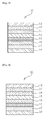
packaging material 10 for a battery according to the present invention has a structure including a heat dissipation layer (11), an outermost layer (12), an adhesive layer (13), a first chemically processed layer (14), a barrier layer (15), a second chemically processed layer (16), an electrolyte resistant layer (17), and an innermost layer (18), which are sequentially deposited, as shown inFig. 1 . - Another embodiment of the
packaging material 10 for a battery according to the present invention has a structure including an outermost layer (12), a heat dissipation layer (11), an adhesive layer (13), a first chemically processed layer (14), a barrier layer (15), a second chemically processed layer (16), an electrolyte resistant layer (17) and an innermost layer (18), which are sequentially deposited, as shown inFig. 2 . - Yet another embodiment of the
packaging material 10 for a battery according to the present invention has a structure including an outermost layer (12), an adhesive layer (13), a heat dissipation layer (11), a first chemically processed layer (14), a barrier layer (15), a second chemically processed layer (16), an electrolyte resistant layer (17) and an innermost layer (18), which are sequentially deposited, as shown inFig. 3 . - Yet another embodiment of the
packaging material 10 for a battery according to the present invention has a structure including an outermost layer (12), an adhesive layer (13), a first chemically processed layer (14), a heat dissipation layer (11), a barrier layer (15), a second chemically processed layer (16), an electrolyte resistant layer (17) and an innermost layer (18), which are sequentially deposited, as shown inFig. 4 . - Yet another embodiment of the
packaging material 10 for a battery according to the present invention has a structure including an outermost layer (12), an adhesive layer (13), a first chemically processed layer (14), a barrier layer (15), a heat dissipation layer (11), a second chemically processed layer (16), an electrolyte resistant layer (17) and an innermost layer (18), which are sequentially deposited, as shown inFig. 5 . - Yet another embodiment of the
packaging material 10 for a battery according to the present invention has a structure including an outermost layer (12), an adhesive layer (13), a first chemically processed layer (14), a barrier layer (15), a second chemically processed layer (16), a heat dissipation layer (11), an electrolyte resistant layer (17) and an innermost layer (18), which are sequentially deposited, as shown inFig. 6 . - Yet another embodiment of the packaging material 10for a battery according to the present invention has a structure including an outermost layer (12), an adhesive layer (13), a first chemically processed layer (14), a barrier layer (15), a second chemically processed layer (16), an electrolyte resistant layer (17), a heat dissipation layer (11) and an innermost layer (18), which are sequentially deposited, as shown in
Fig. 7 - In the present invention, although the outermost layer (12), the barrier layer (15) and the innermost layer (18) may include all ingredients known in the field of packaging materials for a battery, the outermost layer (12) may preferably consist of a stretched polyester-based resin or stretched polyamide-based resin considering weather resistance, chemical resistance, formability, and the like.
- Examples of the polyester-based resin may include polyethylene terephthalate (PET), polybutylene terephthalate (PBT), polyethylene naphthalate (PEN), polybutylene naphthalate (PBN), a copolymerized polyester, a polycarbonate (PC), and the like, and a single layer or multiple layers may be formed of at least one material selected from the group consisting of nylon 6, nylon 6.6, a copolymer of nylon 6 and nylon 6.6, nylon 6.10, polymetaxylylene adipamide (MXD) 6, and the like, as the biaxially oriented polyamide resin film. Further, a polyolefin-based resin with improved weather resistance, heat resistance, and chemical resistance may be used to form the layer.
- The outermost layer (12) is adhered to the barrier layer (15) by dry lamination, extrusion lamination, and the like.
- The thermoplastic resin of the innermost layer may include at least one selected from the group consisting of a polyolefin-based resin, a polyethylene-based resin, a polypropylene-based resin, a polybutylene-based resin, a polyester-based resin, a polyamide-based resin, a polycarbonate-based resin, a fluorinated resin, a silicon-based resin, an acryl-based resin, and a mixture thereof.
- The barrier layer (15) is to prevent penetration of, particularly, vapor inside the lithium battery from the outside, and to afford resistance against pinholes, and it may be a layer of a metal or an inorganic compound, for example, a silicon oxide, alumina, and the like with a thickness of about 15 µm or more so as to stabilize processing quality (making it as a pouch, emboss forming), but as the barrier layer (15), an aluminum layer with a thickness of 15 µm to 200 µm is preferable.
- As the barrier layer (15), an iron-containing aluminum compound is known to have a good insulation property and less generation of pin holes due to bending, and facilitates formation of a side wall when an outer body of an embossing type is formed. Since the formability of aluminum is dependent upon elongation, it is preferable to use a material with improved elongation formed by a physical method, a method of controlling added ingredients besides aluminum, and the like. Thus, as the barrier layer (15), a material having elongation of 15 % or more when the thickness is about 20 µm or more is preferably used.
- In the present invention, the innermost layer (18) is selected from the group consisting of a polyolefin-based resin, a polyethylene-based resin, a polypropylene-based resin, a polybutylene-based resin, a polyester-based resin, a polyamide-based resin, a polycarbonate-based resin, a fluorinated resin, a silicon-based resin, an acryl-based resin, and a mixture thereof, and it may be formed of multiple layers consisting of each layer of the above ingredients. The layer may be formed by nano-extrusion, co-extrusion, tandem extrusion, lamination, and the like, and the thickness may preferably be 10 µm to 100 µm in terms of excellent heat sealing, electrical insulation, and barrier property. The innermost layer (18) may be formed as a composite layer using a film such as PET, a polyolefin, a nylon, and the like according to the function. Moreover, to improve adhesion of the barrier layer (15) and the innermost layer (18), ozone treatment, plasma treatment, gamma ray treatment, heat treatment, and the like may be conducted.
- Meanwhile, as the adhesive layer (13), an adhesive with excellent heat resistance may preferably be used, and specifically, a polyurethane adhesive, preferably a urethane base two-component adhesive, is used. When a high temperature is generated from the internal/external environment of a battery, if an adhesive having low heat resistance is used, separation of the outermost layer (12) and the barrier layer (15) may be generated, which is not preferable. In general, the heat resistance of the adhesive should be such that layers may not be separated after about 5 minutes or more above about 150 °C. The layer may be formed by roll coating such as gravure coating, spraying, and the like, and the thickness is preferably 1 µm to 5 µm in terms of excellent adhesion and productivity.
- Meanwhile, according to the present invention, by adding a slip agent to the heat dissipation layer, frictional force between films and between a film and a molding machine may be reduced to secure a slip property as well as a heat dissipation property. The slip agent may include a metallic soap, a fatty acid and derivatives thereof, a fatty acid amide, a higher alcohol, a fluorine-urethane polymer, silicon, a siloxane, a silane, a wax, a stearic acid monomer, and the like, but any material affording the slip property may be used without specific limitations. Further, by using aluminum with a good stretching property in the heat dissipation layer, a stretching property problem due to thick thickness forming may be solved to prepare packaging material with excellent formability. In addition, by using a polyester-based resin in the outermost layer, the packaging material with excellent resistance to chemicals such as organic solvents, acids, alkalis, electrolytes, and the like may be prepared.
- As explained, according to the present invention, when the internal temperature of a battery rapidly increases or it is exposed to a severe external environment such as heat, an excellent heat dissipation property is manifested so that an increase in the internal temperature of a battery may be primarily delayed and inhibited, thus securing battery stability and reliability. Moreover, the packaging material for a battery according to the present invention has excellent formability and chemical resistance.
-
-
Fig. 1 is a schematic diagram showing one embodiment of the deposited structure of a packaging material for a battery having a heat dissipation layer according to the present invention. -
Fig. 2 is a schematic diagram showing another embodiment of the deposited structure of packaging material for a battery having a heat dissipation layer according to the present invention. -
Fig. 3 is a schematic diagram showing still another embodiment of the deposited structure of a packaging material for a battery having a heat dissipation layer according to the present invention. -
Fig. 4 is a schematic diagram showing still another embodiment of the deposited structure of a packaging material for a battery having heat dissipation function according to the present invention. -
Fig. 5 is a schematic diagram showing still another embodiment of the deposited structure of a packaging material for a battery having a heat dissipation layer according to the present invention. -
Fig. 6 is a schematic diagram showing still another embodiment of the deposited structure of a packaging material for a battery having a heat dissipation layer according to the present invention. -
Fig. 7 is a schematic diagram showing still another embodiment of the deposited structure of a packaging material for a battery having a heat dissipation layer according to the present invention. -
Fig. 8 is a schematic diagram showing one embodiment of the deposited structure of a packaging material for a battery containing a carbon material according to the present invention. - Hereinafter, the present invention will be explained in detail with reference to the following examples, but the scope of the invention is not limited thereto.
- Packaging materials having a structure as shown in
Fig. 1 including a heat dissipation layer respectively formed of a carbon material graphite, CNT (carbon nanotubes), SWNT (single-walled carbon nanotubes), graphene, and ACF (activated carbon fiber) were prepared. The thickness of the heat dissipation layer was about 5 µm, and the heat dissipation layer was formed on the outermost layer of the packaging material. - The outermost layer of the packaging material was formed of PET (about 6 µm)/O-nylon (about 15 µm), and as the adhesive layer, a urethane-based two-component type of adhesive was used with a thickness of about 3 µm. As the barrier layer, an aluminum oxide-containing soft aluminum foil that was prepared by forming aluminum oxide (Al2O3) film layers with a thickness of about 1 µm on both surfaces of aluminum by anodizing a degreased soft aluminum foil with a thickness of about 40 µm at a current density of 20 A/dm2 for about 10 minutes using an electrolyte solution at about 20 °C containing sulfuric acid was used. As the electrolyte resistant layer, polypropylene resin (about 5 µm) was used, and as the innermost layer, an ethylene-containing propylene resin (about 80 µm) was used.
- Each layer was deposited by roll coating and melt extrusion to prepare a packaging material for a battery.
- The specific area of each packaging material was heated to about 90 °C, temperature values of the samples were measured over about 1 hour using a thermo-graphic camera, and the results are shown in the following Table 1.
[Table 1] Passed time Graphite CNT SWNT Graphene ACF No heat dissipation layer 10 minutes 90 °C 90 °C 90 °C 90 °C 90 °C 90 °C 20 minutes 80 °C 80 °C 80 °C 80 °C 80 °C 90 °C 30 minutes 80 °C 80 °C 80 °C 80 °C 80 °C 90 °C 40 minutes 80 °C 80 °C 80 °C 80 °C 80 °C 90 °C 60 minutes 80 °C 80 °C 80 °C 80 °C 80 °C 90 °C *Graphite, CNT (carbon nanotubes), SWNT (single-walled carbon nanotubes), graphene, ACF (activated carbon fiber) - The same process of Example 1 was conducted, except that the thickness of about 5 µm of the heat dissipation layer was changed as described in the following Table 2.
- The heat dissipation performance according to the thickness of the heat dissipation layer was measured by heating the specific area of each packaging material to about 90 °C and measuring the temperature values of the samples over about 1 hour using a thermo-graphic camera, and the results are shown in the following Table 2.
[Table 2] Thickness of coating Graphite CNT SWNT Graphene ACF 11µm 88 °C 88 °C 88 °C 88 °C 88 °C 3 µm 85 °C 85 °C 85 °C 85 °C 85 °C 5 µm 80 °C 80 °C 80 °C 80 °C 80 ° C 10 µm 78 °C 78 °C 78 °C 78 °C 78 °C - As shown in Tables 1 and 2, it was confirmed that each carbon material has heat dissipation performance, and particularly, as a result of increasing the thickness to 10 µm, heat dissipation performance is further increased. According to the present invention, when the internal temperature of a battery rapidly increases or it is exposed to a severe external environment such as heat, the heat dissipation property may be manifested so that an increase in the internal temperature of the battery may be primarily delayed and inhibited.
- The same process of Example 1 was conducted, except for conducting chemical treatment by a boehmite process and a chromate process, instead of conducting anodizing on both sides of the barrier layer to form aluminum oxide film layers. Graphite was used as the carbon material, the thickness of the heat dissipation layer was about 5 µm, and the heat dissipation layer was formed on the outermost layer of the packaging material to prepare the packaging material having the structure as shown in
Fig. 1 . - Specifically, the boehmite process was conducted using a mixed solution of 7 % aluminum sulfate solution and 25 % ammonia water at a weight ratio of 6:1, so as to maintain pH 4. The temperature of the solution was maintained at 180 °C, and an aluminum foil was impregnated for 2 hours.
- The chromate process was conducted by impregnating an aluminum foil using a trivalent chromate solution of pH 4 containing 10 % solid content at 50 °C for 10 minutes.
- The heat dissipation of the packaging material was confirmed by heating the specific area of the outermost layer to about 90 °C, and measuring the temperature values of the samples over about 1 hour using a thermo-graphic camera, and the results are shown in the following Table 3.
- For each specimen (5×5 cm) of the prepared packaging material, adhesion was tested by a peel test of the innermost layer and the aluminum, and the results are shown in the following Table 3.
[Table 3] Chemical treatment method Adhesion (gf/15 mm) Nylon film/aluminum adhesion Heat dissipation property 0 hour 0.5 hours 1.0 hour elapse elapse elapse Non-treated 650 90 °C 80 °C 80 °C Anodizing of Example 1 800 90 °C 80 °C 80 °C Boehmite process 800 90 °C 80 °C 80 °C Chromate process 800 90 °C 80 °C 80 °C - In this example, a constitutional layer having a heat dissipation property was prepared by directly adding a carbon material to each constitutional layer of the packaging material. The packaging material for a battery consisting of an outermost layer/an adhesive layer/a first chemically processed layer/a barrier layer/a second chemically processed layer/an electrolyte resistant layer/an innermost layer was prepared, wherein each constitutional layer was prepared with the same material as Example 1 to the same thickness.
- As described in the following Table 3, the constitution of the heat dissipation layer was varied to prepare 3 kinds of packaging materials. Graphite was added to the constitutional layer containing the carbon material at a content of 5 wt% based on the main raw material of each layer.
- The heat dissipating outermost layer and the innermost layer could be obtained by master-batching carbon materials with the resins used in each constitutional layer. Using the prepared master batch raw material, a film was prepared by each preparation method (extrusion coating, cast film extrusion, and blown film extrusion).
- The heat dissipating adhesive layer was prepared by combining a urethane-based two-component type of adhesive, a carbon material, and a solvent at a weight ratio of 10:1:0.3:15, mixing them with a mechanical stirrer for 30 minutes to sufficiently disperse them, coating the mixture on a base by gravure coating, and hot air drying at 60 °C for 1 minute. The chemically processed layer or aluminum oxide film layer and the electrolyte resistant layer were prepared by the same method as the adhesive layer, by evenly dispersing the carbon material in corresponding raw material with a mechanical stirrer for 30 minutes, coating it by impregnation, and hot air drying at 170 °C for 1 minute. The electrolyte resistant layer was prepared by stirring and mixing the raw material resin and carbon material with a mechanical stirrer for 30 minutes, coating the mixture on a base by gravure coating, and hot air drying at 170 °C for 1 minute.
- Heat dissipation was confirmed by heating the specific area of the outermost layer to about 90 °C and measuring temperature values of the samples over about 1 hour with a thermo-graphic camera, and the results are shown in the following Table 4.
[Table 4] Layer constitution Packaging material A Packaging material B Packaging material C Packaging material D Outermost layer O O x O Adhesive layer O O x x First chemically processed layer (or aluminum oxide film layer) O O x X barrier layer O X x x Second chemically processed layer (or aluminum oxide film layer) O X O x Electrolyte resistant layer O X O x innermost layer O X O x Heat dissipation property (0 hour elapse) 90 °C 90 °C 90 °C 90 °C Heat dissipation property (0.5 hours elapse) 85 °C 85 °C 90 °C 87 °C Heat dissipation property (1.0 hour elapse) 80 °C 80 °C 90 °C 85 °C - A packaging material for a battery was prepared by the same method as the preparation of the packaging material D including the carbon material only in the outermost layer in Example 4, except that graphite was added at content of 0.5 wt%, 10 wt%, and 45 wt% to prepare the outermost layer and prepare a packaging material for a battery including the same, instead of using 5 wt% of graphite based on the raw material of the outermost layer in Example 4.
- Heat dissipation was confirmed by heating the specific area of the outermost layer to about 90 °C, and measuring the temperature values of the samples over about 1 hour using a thermo-graphic camera, and the results are shown in the following Table 5.
[Table 5] Graphite content 0.5 w/w% Graphite content 5 w/w% Graphite content 10w/w% Graphite content 45w/w% Heat dissipation property (0 hour elapse) 90 °C 90 °C 90 °C 90 °C Heat dissipation property (0.5 hours elapse) 88 °C 87 °C 85 °C 85 °C Heat dissipation property (1.0 hour elapse) 88 °C 85 °C 80 °C 80 °C -
10: packaging material 11: heat dissipation layer 12 and 22: outermost layer 13 and 23: adhesive layer 14 and 24: first chemically processed layer 15 and 25: barrier layer 16 and 26: second chemically processed layer 17 and 27: electrolyte resistant layer 18 and 28: innermost layer
Claims (15)
- A pouch-type packaging material for a battery, comprising a heat resistant resin outermost layer, a barrier layer containing aluminum or an aluminum alloy, and a thermoplastic resin innermost layer,
wherein the packaging material for a battery comprises a heat dissipation layer that is prepared by adding a carbon material to at least one constitutional layer selected from the group consisting of an outermost layer, a barrier layer, and an innermost layer, or a separate heat dissipation layer containing a carbon material and a binder resin. - The pouch-type packaging material for a battery according to claim 1, wherein the carbon material is at least one selected from the group consisting of graphite, CNT (carbon nanotubes), SWNT (single-walled carbon nanotubes), graphene, and ACF (activated carbon fiber).
- The pouch-type packaging material for a battery according to claim 1, wherein the carbon material is included in a content of 1 to 40 wt%, based on 100 wt% of a total composition of the heat dissipation layer prepared by adding the carbon material to the constitutional layer.
- The pouch-type packaging material for a battery according to claim 1, wherein the separate heat dissipation layer is formed by coating, spraying, or roll pressing.
- The pouch-type packaging material for a battery according to claim 1, wherein the binder resin of the separate heat dissipation layer is at least one selected from the group consisting of a phenol-based resin, a melamine-based resin, a polyurethane-based resin, an epoxy-based resin, a vinyl-based resin, a polyimide-based resin, a polyester-based resin, and a polyolefin-based resin.
- The pouch-type packaging material for a battery according to claim 1, wherein the thickness of the separate heat dissipation layer is 1 µm to 10 µm.
- The pouch-type packaging material for a battery according to claim 1, wherein the separate heat dissipation layer is formed on at least one position selected from the group consisting of on the outermost layer of the packaging material, between the outermost layer and the barrier layer, and between the barrier layer and the innermost layer.
- The pouch-type packaging material for a battery according to claim 1, wherein the packaging material for a battery comprises an outermost layer, an adhesive layer, a barrier layer, an adhesive layer, and an innermost layer, which are sequentially deposited,
and the separate heat dissipation layer is formed on at least one position selected from the group consisting of on the outermost layer, between the outermost layer and the adhesive layer, between the adhesive layer and the barrier layer, between the barrier layer and the adhesive layer, and between the adhesive layer and the innermost layer. - The pouch-type packaging material for a battery according to claim 1, wherein the packaging material for a battery comprises an outermost layer, an adhesive layer, a first chemically processed layer, a barrier layer, a second chemically processed layer, an electrolyte resistant layer, and an innermost layer,
and the separate heat dissipation layer is formed on at least one position selected from the group consisting of on the outermost layer, between the outermost layer and the adhesive layer, between the adhesive layer and the first chemically processed layer, between the first chemically processed layer and the barrier layer, between the barrier layer and the second chemically processed layer, between the second chemically processed layer and the electrolyte resistant layer, and between the electrolyte resistant layer and the innermost layer. - The pouch-type packaging material for a battery according to claim 9, wherein the chemically processed layer is an aluminum oxide film layer formed by anodizing, an electroplated layer, an electroless plated layer, a chromate layer, a boehmite layer, or a phosphate treated layer.
- The pouch-type packaging material for a battery according to claim 10, wherein the aluminum oxide film layer is formed by anodizing the surface of the barrier layer to a thickness of 0.2 µm to 10 µm, and has pores with a particle diameter of 1 nm to 1000 nm.
- The pouch-type packaging material for a battery according to claim 1, wherein the heat resistant resin of the outermost layer includes a stretched polyester-based resin, a stretched polyamide-based resin, or a mixed resin thereof.
- The pouch-type packaging material for a battery according to claim 1, wherein the thermoplastic resin of the innermost layer includes at least one selected from the group consisting of a polyolefin-based resin, a polyethylene-based resin, a polypropylene-based resin, a polybutylene-based resin, a polyester-based resin, a polyamide-based resin, a polycarbonate-based resin, a fluorinated resin, a silicon-based resin, a acryl-based resin, and a mixture thereof.
- The pouch-type packaging material for a battery according to claim 9, wherein the electrolyte resistant layer has a thickness of 1 µm to 10 µm, and includes a polyolefin-based resin.
- The pouch-type packaging material for a battery according to claim 1, wherein if the barrier layer has a thickness of 15 µm to 200 µm, it has elongation of 15 % or more.
Applications Claiming Priority (3)
| Application Number | Priority Date | Filing Date | Title |
|---|---|---|---|
| KR20110072494 | 2011-07-21 | ||
| PCT/KR2012/005825 WO2013012291A2 (en) | 2011-07-21 | 2012-07-20 | Battery packaging material having heat-dissipating characteristics |
| KR1020120079255A KR101308592B1 (en) | 2011-07-21 | 2012-07-20 | Packaging material for battery with thermal dissipation properties |
Publications (2)
| Publication Number | Publication Date |
|---|---|
| EP2735441A2 true EP2735441A2 (en) | 2014-05-28 |
| EP2735441A4 EP2735441A4 (en) | 2014-07-23 |
Family
ID=47840793
Family Applications (1)
| Application Number | Title | Priority Date | Filing Date |
|---|---|---|---|
| EP12814766.7A Withdrawn EP2735441A4 (en) | 2011-07-21 | 2012-07-20 | Battery packaging material having heat-dissipating characteristics |
Country Status (6)
| Country | Link |
|---|---|
| US (1) | US20140234689A1 (en) |
| EP (1) | EP2735441A4 (en) |
| JP (1) | JP2014527687A (en) |
| KR (1) | KR101308592B1 (en) |
| CN (1) | CN103687721A (en) |
| WO (1) | WO2013012291A2 (en) |
Cited By (5)
| Publication number | Priority date | Publication date | Assignee | Title |
|---|---|---|---|---|
| CN110235270A (en) * | 2017-09-19 | 2019-09-13 | 株式会社Lg化学 | Pouch-shaped battery case including heat dissipation layer |
| US10756311B2 (en) | 2015-05-06 | 2020-08-25 | Semiconductor Energy Laboratory Co., Ltd. | Secondary battery and electronic device |
| EP4199166A1 (en) * | 2021-12-16 | 2023-06-21 | APh ePower Co., Ltd. | Aluminum battery packaging film |
| WO2026057168A1 (en) * | 2024-09-13 | 2026-03-19 | Wacker Chemie Ag | Thermal management complex, and battery pack and energy storage system comprising the same |
| EP4593169A4 (en) * | 2023-10-04 | 2026-03-25 | Lg Energy Solution Ltd | BATTERY HOUSING, BATTERY CELL, AND METHOD FOR MANUFACTURING THE BATTERY CELL |
Families Citing this family (49)
| Publication number | Priority date | Publication date | Assignee | Title |
|---|---|---|---|---|
| JP2014182872A (en) * | 2013-03-18 | 2014-09-29 | Uacj Corp | Sheath material for batteries, and aluminum foil |
| KR101442070B1 (en) * | 2013-07-22 | 2014-09-18 | (주)월드튜브 | Radiant heat sheet comprising complex of graphene, graphite nanoplate, carbon nanotube and nanometal, and preparing method thereof |
| CN103587125A (en) * | 2013-11-07 | 2014-02-19 | 恩斯盟防静电材料(镇江)有限公司 | Method for manufacturing battery transfer tray |
| US20150180095A1 (en) * | 2013-12-19 | 2015-06-25 | GM Global Technology Operations LLC | Systems and Methods for Conducting Battery Heat Using Pouch Cells |
| JP6390127B2 (en) * | 2014-03-14 | 2018-09-19 | 凸版印刷株式会社 | Power storage device exterior materials |
| JP6446950B2 (en) * | 2014-09-25 | 2019-01-09 | 大日本印刷株式会社 | Battery packaging materials |
| JP6176220B2 (en) * | 2014-10-14 | 2017-08-09 | トヨタ自動車株式会社 | Inspection device |
| US11309604B2 (en) | 2015-04-13 | 2022-04-19 | Cps Technology Holdings Llc | Thermal epoxy and positioning of electrochemical cells |
| KR101779157B1 (en) | 2015-05-26 | 2017-09-18 | 주식회사 엘지화학 | Battery module comprising a layer of pigment for radiating heat |
| CN104953051A (en) * | 2015-07-09 | 2015-09-30 | 武汉美格科技有限公司 | Novel aluminum plastic packaging film |
| CN105101755B (en) * | 2015-08-31 | 2017-12-15 | 天奈(镇江)材料科技有限公司 | Conductive structure and heat abstractor |
| KR102477095B1 (en) | 2015-11-17 | 2022-12-13 | 삼성전자주식회사 | Electrocechemical cell |
| KR102528359B1 (en) * | 2015-11-26 | 2023-05-03 | 삼성에스디아이 주식회사 | Secondary battery |
| CN105462565B (en) * | 2015-12-14 | 2018-09-21 | 德阳烯碳科技有限公司 | A kind of preparation method of graphene and carbon fiber composite heat interfacial material |
| CN105505334B (en) * | 2015-12-25 | 2019-03-29 | 松亿实业(厦门)有限公司 | A kind of graphene radiator, preparation method and applications |
| CN106003918A (en) * | 2016-05-11 | 2016-10-12 | 明冠新材料股份有限公司 | Black aluminum plastic film and polymer lithium battery |
| CN106091793A (en) * | 2016-06-21 | 2016-11-09 | 太仓鸿鑫精密压铸有限公司 | Corrosion resistant alloy heat-sink sheet |
| JP7257568B2 (en) * | 2016-10-03 | 2023-04-13 | 株式会社レゾナック・パッケージング | Exterior materials for power storage devices |
| WO2018097330A1 (en) * | 2016-11-28 | 2018-05-31 | 大日本印刷株式会社 | Battery packaging material, production method thereof, and battery |
| JP7203483B2 (en) * | 2016-12-28 | 2023-01-13 | 昭和電工パッケージング株式会社 | Exterior material for power storage device, exterior case for power storage device, and power storage device |
| KR20190086006A (en) * | 2016-12-29 | 2019-07-19 | 베이징 퉁수 카본 어드밴스드 머테리얼스 테크놀로지 씨오., 엘티디. | Aluminum-plastic packaging films and lithium ion batteries using them |
| KR101778079B1 (en) | 2017-02-16 | 2017-09-13 | 유경윤 | Printed circuit board assembly |
| CN106887537B (en) * | 2017-03-09 | 2019-10-22 | 北京旭碳新材料科技有限公司 | A kind of aluminum-plastic film composite layer and its preparation method and lithium ion battery |
| US11446910B2 (en) | 2017-04-12 | 2022-09-20 | Dow Global Technologies Llc | Multilayer films containing a slip agent |
| TWI829636B (en) * | 2017-04-12 | 2024-01-21 | 美商陶氏全球科技有限責任公司 | Multilayer films containing a slip agent |
| CN108963117A (en) * | 2017-08-31 | 2018-12-07 | 江阴苏达汇诚复合材料股份有限公司 | A kind of lithium battery multilayer metal compound band aluminum plastic film and its production method |
| KR102328646B1 (en) * | 2017-10-25 | 2021-11-17 | 주식회사 엘지에너지솔루션 | Pouch case and secondary battery including the same |
| KR102012384B1 (en) | 2017-12-27 | 2019-08-20 | 에스케이씨 주식회사 | Packaging material for battery and battery cell comprising the same |
| CN109986850B (en) * | 2017-12-29 | 2021-11-02 | 宁德时代新能源科技股份有限公司 | Lithium-ion battery and aluminum plastic film |
| KR102255537B1 (en) * | 2018-01-12 | 2021-05-25 | 주식회사 엘지에너지솔루션 | The Pouch Film And The Method For Manufacturing Thereof |
| CN108859295B (en) * | 2018-06-04 | 2020-01-21 | 界首市天鸿新材料股份有限公司 | Electrolyte corrosion-resistant aluminum-plastic composite film for flexible packaging of lithium-ion batteries |
| CN109037503A (en) * | 2018-10-31 | 2018-12-18 | 福建巨电新能源股份有限公司 | A kind of polymer Li-ion battery carbon composite membrane |
| KR20200080017A (en) * | 2018-12-26 | 2020-07-06 | 삼성전자주식회사 | Battery case, and battery |
| CN111435713A (en) * | 2019-01-15 | 2020-07-21 | 华为技术有限公司 | Battery packaging material and battery |
| KR102387071B1 (en) | 2019-08-06 | 2022-04-18 | 주식회사 비티엘첨단소재 | Aluminium pouch film for the secondary battery and the manufacturing method thereof |
| KR102316721B1 (en) * | 2019-09-20 | 2021-10-26 | 주식회사 한국알미늄 | Pharmaceutical packaging sheets containing graphene |
| CN112537101A (en) * | 2019-09-20 | 2021-03-23 | 韩国铝业株式会社 | Graphene-containing sheet for packaging pharmaceutical agents |
| JP2021068705A (en) * | 2019-10-23 | 2021-04-30 | 韓国アルミニウム株式会社 | Rechargeable battery pouch film containing graphene |
| KR102819911B1 (en) * | 2019-11-22 | 2025-06-11 | 주식회사 엘지에너지솔루션 | Packaging for flexible secondary battery and flexible secondary battery including the same |
| KR102301518B1 (en) * | 2020-01-22 | 2021-09-15 | 율촌화학 주식회사 | Cell pouch with heat dissipation property comprising non-metal type barrier and the method for prodicng the same |
| JP7371581B2 (en) * | 2020-07-17 | 2023-10-31 | トヨタ自動車株式会社 | Non-aqueous electrolyte secondary battery |
| WO2022107933A1 (en) * | 2020-11-20 | 2022-05-27 | 안광선 | Pouch film for secondary battery comprising graphene |
| KR102383894B1 (en) * | 2021-02-01 | 2022-04-11 | 주식회사 비티엘첨단소재 | Aluminium pouch film for the secondary battery and the manufacturing method thereof |
| KR102383893B1 (en) * | 2021-02-01 | 2022-04-11 | 주식회사 비티엘첨단소재 | Aluminium pouch film for the secondary battery and the manufacturing method thereof |
| KR102383896B1 (en) * | 2021-02-01 | 2022-04-11 | 주식회사 비티엘첨단소재 | Aluminium pouch film for the secondary battery and the manufacturing method thereof |
| EP4187682A1 (en) * | 2021-11-25 | 2023-05-31 | Lilium eAircraft GmbH | Laminated film for packaging of pouch-type battery cells, pouch-type battery cell and battery |
| CN114335827B (en) * | 2021-12-20 | 2024-04-02 | 广东广麟材耀新能源材料有限公司 | Anti-cracking aluminum plastic film |
| KR102584179B1 (en) * | 2023-04-24 | 2023-10-05 | 한광현 | Laminate sheets applied to secondary battery pouches |
| WO2025058332A1 (en) * | 2023-09-11 | 2025-03-20 | 주식회사 릴엠 | Secondary battery cell pouch having excellent chemical resistance |
Family Cites Families (16)
| Publication number | Priority date | Publication date | Assignee | Title |
|---|---|---|---|---|
| EP1102336B1 (en) * | 1999-04-08 | 2007-09-12 | Dai Nippon Printing Co., Ltd. | Lithium battery packaging laminated multilayer structure |
| JP2001035455A (en) * | 1999-07-16 | 2001-02-09 | Dainippon Printing Co Ltd | Laminate and packaging material for polymer battery using the same |
| JP2001266811A (en) * | 2000-03-16 | 2001-09-28 | Dainippon Printing Co Ltd | Packaging material for polymer battery and method for producing the same |
| KR20030037771A (en) * | 2001-11-05 | 2003-05-16 | 삼성에스디아이 주식회사 | Li-ion polymer battery |
| KR100624950B1 (en) | 2004-10-18 | 2006-09-15 | 삼성에스디아이 주식회사 | Battery exterior material with heat dissipation layer and lithium polymer battery using same |
| KR101237693B1 (en) * | 2004-10-29 | 2013-02-26 | 다이니폰 인사츠 가부시키가이샤 | Multilayer body and secondary battery |
| JP4681345B2 (en) * | 2005-05-06 | 2011-05-11 | 住友軽金属工業株式会社 | Precoated aluminum alloy plate with excellent heat dissipation, scratch resistance and conductivity |
| KR200422459Y1 (en) * | 2006-05-10 | 2006-07-26 | 김재준 | Heat dissipation sheet |
| JP4978126B2 (en) * | 2006-09-20 | 2012-07-18 | 凸版印刷株式会社 | Lithium battery packaging |
| KR100887616B1 (en) | 2007-02-22 | 2009-03-11 | 율촌화학 주식회사 | Cell pouch and method of making the same |
| JP5089233B2 (en) * | 2007-04-26 | 2012-12-05 | 株式会社カネカ | Graphite composite film |
| JP5254332B2 (en) * | 2007-07-19 | 2013-08-07 | エルジー・ケム・リミテッド | Large capacity battery pack |
| JP5159435B2 (en) * | 2008-05-28 | 2013-03-06 | 古河電池株式会社 | Laminate film and heating material package |
| JP2010212070A (en) * | 2009-03-10 | 2010-09-24 | Unitika Ltd | Battery and method of manufacturing the same |
| JP5556128B2 (en) * | 2009-10-30 | 2014-07-23 | ソニー株式会社 | Non-aqueous electrolyte battery |
| JP5532902B2 (en) * | 2009-12-18 | 2014-06-25 | 凸版印刷株式会社 | Battery exterior packaging and secondary battery |
-
2012
- 2012-07-20 WO PCT/KR2012/005825 patent/WO2013012291A2/en not_active Ceased
- 2012-07-20 US US14/233,864 patent/US20140234689A1/en not_active Abandoned
- 2012-07-20 JP JP2014521565A patent/JP2014527687A/en active Pending
- 2012-07-20 EP EP12814766.7A patent/EP2735441A4/en not_active Withdrawn
- 2012-07-20 CN CN201280036008.2A patent/CN103687721A/en active Pending
- 2012-07-20 KR KR1020120079255A patent/KR101308592B1/en not_active Expired - Fee Related
Cited By (9)
| Publication number | Priority date | Publication date | Assignee | Title |
|---|---|---|---|---|
| US10756311B2 (en) | 2015-05-06 | 2020-08-25 | Semiconductor Energy Laboratory Co., Ltd. | Secondary battery and electronic device |
| US11916184B2 (en) | 2015-05-06 | 2024-02-27 | Semiconductor Energy Laboratory Co., Ltd. | Secondary battery and electronic device |
| US12368180B2 (en) | 2015-05-06 | 2025-07-22 | Semiconductor Energy Laboratory Co., Ltd. | Secondary battery and electronic device |
| CN110235270A (en) * | 2017-09-19 | 2019-09-13 | 株式会社Lg化学 | Pouch-shaped battery case including heat dissipation layer |
| CN110235270B (en) * | 2017-09-19 | 2022-08-26 | 株式会社Lg新能源 | Pouch-shaped battery case including heat dissipation layer |
| EP4199166A1 (en) * | 2021-12-16 | 2023-06-21 | APh ePower Co., Ltd. | Aluminum battery packaging film |
| US11804632B2 (en) | 2021-12-16 | 2023-10-31 | Aph Epower Co., Ltd. | Aluminum battery packaging film |
| EP4593169A4 (en) * | 2023-10-04 | 2026-03-25 | Lg Energy Solution Ltd | BATTERY HOUSING, BATTERY CELL, AND METHOD FOR MANUFACTURING THE BATTERY CELL |
| WO2026057168A1 (en) * | 2024-09-13 | 2026-03-19 | Wacker Chemie Ag | Thermal management complex, and battery pack and energy storage system comprising the same |
Also Published As
| Publication number | Publication date |
|---|---|
| WO2013012291A2 (en) | 2013-01-24 |
| CN103687721A (en) | 2014-03-26 |
| JP2014527687A (en) | 2014-10-16 |
| WO2013012291A3 (en) | 2013-04-11 |
| EP2735441A4 (en) | 2014-07-23 |
| KR20130011977A (en) | 2013-01-30 |
| US20140234689A1 (en) | 2014-08-21 |
| KR101308592B1 (en) | 2013-09-13 |
Similar Documents
| Publication | Publication Date | Title |
|---|---|---|
| EP2735441A2 (en) | Battery packaging material having heat-dissipating characteristics | |
| EP3188278B1 (en) | Packaging material for battery | |
| US10128471B2 (en) | Battery-packaging material | |
| CN114725589B (en) | Packaging material for battery, method for producing same, battery, and polyester film | |
| CN103317794B (en) | Molding packaging material and molded housing | |
| CN107078236B (en) | Packaging materials for batteries | |
| KR101366217B1 (en) | Packaging material for polymer cell and process for producing the same | |
| WO2020071254A1 (en) | Exterior material for electrical storage devices, method of manufacturing same, and electrical storage device | |
| JP2019165009A (en) | Wrapping material for cell, production method thereof, cell, and polyester film | |
| JP6679918B2 (en) | Battery packaging material | |
| JP7314970B2 (en) | BATTERY PACKAGING MATERIAL, MANUFACTURING METHOD THEREOF, AND BATTERY | |
| EP3998650A1 (en) | Adhesive film for metal terminals, metal terminal with adhesive film for metal terminals, electricity storage device using said adhesive film for metal terminals, and method for producing electricity storage device | |
| CN113348081B (en) | Outer packaging material for electrical storage device, manufacturing method of outer packaging material for electrical storage device, and electrical storage device | |
| EP4129653A1 (en) | Packaging material for power storage device, method of producing same, and power storage device | |
| CN107408645B (en) | Battery packaging material, method for producing the same, and battery | |
| EP3940848A1 (en) | Outer package material for all-solid-state batteries, method for producing same and all-solid-state battery | |
| JP2023139019A (en) | Battery, manufacturing method thereof, metal terminal with adhesive film for metal terminal, roll of adhesive film for metal terminal | |
| JP2016071952A (en) | Battery packaging materials | |
| KR101394721B1 (en) | Cell pouch treated plasma and method for manufacturing the same | |
| CN109564993B (en) | Packaging materials and batteries for batteries | |
| JP6319387B2 (en) | Battery packaging materials | |
| JP7528974B2 (en) | Battery Packaging Materials | |
| JP6627908B2 (en) | Battery packaging material | |
| JP7694544B2 (en) | Packaging materials for batteries | |
| CN117795744A (en) | Outer packaging material for electric storage device, manufacturing method thereof and electric storage device |
Legal Events
| Date | Code | Title | Description |
|---|---|---|---|
| PUAI | Public reference made under article 153(3) epc to a published international application that has entered the european phase |
Free format text: ORIGINAL CODE: 0009012 |
|
| 17P | Request for examination filed |
Effective date: 20140131 |
|
| AK | Designated contracting states |
Kind code of ref document: A2 Designated state(s): AL AT BE BG CH CY CZ DE DK EE ES FI FR GB GR HR HU IE IS IT LI LT LU LV MC MK MT NL NO PL PT RO RS SE SI SK SM TR |
|
| A4 | Supplementary search report drawn up and despatched |
Effective date: 20140623 |
|
| RIC1 | Information provided on ipc code assigned before grant |
Ipc: B32B 15/20 20060101ALI20140616BHEP Ipc: H01M 10/02 20060101ALI20140616BHEP Ipc: B32B 7/12 20060101ALI20140616BHEP Ipc: H01M 2/02 20060101ALI20140616BHEP Ipc: B32B 15/09 20060101ALI20140616BHEP Ipc: B65D 85/88 20060101ALI20140616BHEP Ipc: B32B 15/088 20060101AFI20140616BHEP |
|
| DAX | Request for extension of the european patent (deleted) | ||
| 17Q | First examination report despatched |
Effective date: 20150617 |
|
| STAA | Information on the status of an ep patent application or granted ep patent |
Free format text: STATUS: THE APPLICATION IS DEEMED TO BE WITHDRAWN |
|
| 18D | Application deemed to be withdrawn |
Effective date: 20151028 |