EP2731759B1 - Razor cartridge - Google Patents
Razor cartridge Download PDFInfo
- Publication number
- EP2731759B1 EP2731759B1 EP13745755.2A EP13745755A EP2731759B1 EP 2731759 B1 EP2731759 B1 EP 2731759B1 EP 13745755 A EP13745755 A EP 13745755A EP 2731759 B1 EP2731759 B1 EP 2731759B1
- Authority
- EP
- European Patent Office
- Prior art keywords
- blade
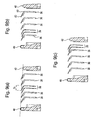
- leading
- trailing
- hair
- edge
- Prior art date
- Legal status (The legal status is an assumption and is not a legal conclusion. Google has not performed a legal analysis and makes no representation as to the accuracy of the status listed.)
- Active
Links
Images




Classifications
-
- B—PERFORMING OPERATIONS; TRANSPORTING
- B26—HAND CUTTING TOOLS; CUTTING; SEVERING
- B26B—HAND-HELD CUTTING TOOLS NOT OTHERWISE PROVIDED FOR
- B26B21/00—Razors of the open or knife type; Safety razors or other shaving implements of the planing type; Hair-trimming devices involving a razor-blade; Equipment therefor
- B26B21/40—Details or accessories
- B26B21/4012—Housing details, e.g. for cartridges
- B26B21/4031—Housing details, e.g. for cartridges characterised by special geometric shaving parameters, e.g. blade span or exposure
-
- B—PERFORMING OPERATIONS; TRANSPORTING
- B26—HAND CUTTING TOOLS; CUTTING; SEVERING
- B26B—HAND-HELD CUTTING TOOLS NOT OTHERWISE PROVIDED FOR
- B26B21/00—Razors of the open or knife type; Safety razors or other shaving implements of the planing type; Hair-trimming devices involving a razor-blade; Equipment therefor
- B26B21/54—Razor-blades
- B26B21/56—Razor-blades characterised by the shape
- B26B21/565—Bent razor blades; Razor blades with bent carriers
Definitions
- the present invention relates to wet shaving safety razors and more particularly to a safety razor blade unit having multiple blades.
- Wet shaving razors have evolved over the years to include a multiplicity of blades with the goal of increasing the closeness of a shave that is achieved while also providing a comfortable shaving experience.
- One of the main drivers of closeness in shaving is an effect called hysteresis.
- the hysteresis effect is the meta-stable extension of hair that occurs after a hair is cut during shaving.
- sharp cutting edges of the cartridge engage with individual hairs during a shaving stroke, exerting a force on the hairs and causing them to be lifted out of the follicle as the razor is moved across the surface of the skin. Once the hair has been cut and the force is removed, the hair retracts back into the skin.
- WO95/09071 describes a three blade safety razor having defined blade exposures to improve shaving efficiency and keep drag forces at an acceptable level. It is an object of the present invention to exploit the hysteresis effect further to result in a closer shave.
- a razor comprising a housing, a guard located at a front of the housing and a cap located at a rear of the housing, a skin contact plane tangential to the guard and the cap, a blade couplet disposed in the housing between the guard and the cap, the blade couplet being formed of a leading blade having a leading edge and a trailing blade having a trailing edge, the leading and trailing edges being directed towards the front of the housing, and the leading blade is positioned between the trailing blade and the guard, towards the front of the housing wherein i) there is a span of between 25 ⁇ m and 850 ⁇ m between the leading edge and the trailing edge, ii) the leading edge has an exposure of between 25 ⁇ m and 500 ⁇ m below the skin contact plane, iii) the trailing edge is positioned in line with or above the leading edge and has an exposure of between 150 ⁇ m above the skin contact plane to 300 ⁇ m below the skin contact plane, and iv) the
- the invention is applicable to razor cartridges in general that are used in a wet shaving system.
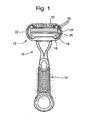
- FIG 1 shows a wet shaving razor 10 formed of a razor cartridge 12 attached to a handle 14.
- the razor cartridge is formed of a housing 16 having a front wall 18, a rear wall 20 and first and second opposing side walls 22, 24 disposed transverse to and between the front wall and rear wall.
- a blade couplet 26 (shown more clearly in Figure 2 ) formed of a leading blade 28 and a trailing blade 30 is mounted within the housing 16.
- Each of the leading blade 28 and trailing blade 30 has a cutting edge 32, 34 extending between the first and second opposing side walls 22, 24 and directed towards the front wall.
- One or more additional blades 36 are disposed in the housing 16, each additional blade having a cutting edge 38 ( Figure 2 ) extending between the first and second opposing side walls 22, 24 and directed towards the front wall.
- Hysteresis cutting is dependent on the proximity of blade edges to one another in a cartridge; the first blade makes contact with a hair and pulls it from the skin surface and the adjacent blade should be near enough the first blade that it engages with the hair before it has time to fully retract into the skin surface.
- the present inventors have discovered that to fully capitalize on the extension of a hair while it is being cut by a first blade, it would be desirable for the next/second blade to cut the hair before it has retracted at all. This is most easily achieved if two consecutive blades make contact with the same hair.
- a blade couplet 26 is provided where the preceding blade of the couplet, in this case the leading blade, is arranged to engage a hair, pulling it as the shaving stroke is progressed, and the trailing blade then cuts the hair - effectively resulting in double engagement of a hair by the blade couplet.
- leading and trailing blades relative to one another and relative to a skin contact plane is critical for either a) increasing the probability of achieving double-engagement of a hair, or b) minimizing retraction of a hair before it is cut by the trailing blade.
- Figure 3 shows the cartridge of Figure 2 showing only a first skin contact point 40 at a front of the housing, a second skin contact point 42 provided at a rear of the housing 16 and the blade couplet 26 disposed therebetween.
- the first skin contact point is a guard and the second skin contact point is a cap.
- the first and second skin contact points may take other forms or may be interchanged such that, for example, the guard is provided at the rear of the cartridge and the cap at the front of the cartridge.
- a skin contact plane P s is defined tangential to the first and second skin contact points, or in the case of the embodiment shown in Figure 3 , the skin contact plane P s is tangential to the guard and cap.
- the main body of the housing 16 of the cartridge is located below the skin contact plane P s .
- the blades are typically located below the skin contact plane, though in some cases, as described below, the tip of the blade may lie in or above the skin contact plane.
- Figure 3 shows the span ( ⁇ s) between blade edges. The span ( ⁇ s) is calculated by
- the span ( ⁇ s) between the leading edge 32 and trailing edge 34 is between about 25 ⁇ m, 100 ⁇ m, 200 ⁇ m or 300 ⁇ m and 400 ⁇ m, 550 ⁇ m, 700 ⁇ m, 850 ⁇ m.
- a hair there is greater scope for a hair to be extended as the span between blade edges in the couplet increases. However, if the span between adjacent edges is too great, the hair will be cut, released and/or pulled out by the leading blade 28 before the trailing blade 30 makes contact with the hair.
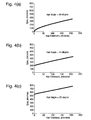
- Figure 4 shows the relationship between span and hair extension as the span is increased when other factors, e.g. exposure of the respective blades, are kept constant.
- Figure 4 shows the relationship when cutting a hair positioned at a) 90°, b) 45° and c) 20° to the skin. It can be seen from these drawings that in all circumstances, as the span is increased, the expected hair extension also increases. For hairs lying flatter to the skin (e.g. 20°), a greater increase in span is required to result in the same hair extension. The same extension is expected for hair growing at an angle regardless of which direction the hair faces, e.g. the hair could face toward or away from the blades and the expected hair extension will be the same. Body and/or female hair is typically finer than facial and/or male hair and is normally shaved less frequently. Furthermore, users tend to be more sensitive to pain caused by blades pulling hair when shaving facial hair versus body hair.
- the span is preferably between 250 ⁇ m and 850 ⁇ m.
- the span is preferably between 25 ⁇ m and 150 ⁇ m.
- Exposure of a blade edge (e) is calculated as the distance of a blade edge from the skin contact plane Ps in a direction substantially perpendicular to the skin contact plane Ps.
- Figure 3 shows that exposure can be calculated by:
- the exposure differential ⁇ e is the difference between the exposure of the leading blade and the exposure of the trailing blade.
- Blade edges can be located above the skin contact plane, otherwise known as having a "positive exposure”, in line with the skin contact plane or below the skin contact plane, known as “negative exposure”.
- the cutting efficiency of a blade is, in part, determined by its exposure. Cutting edges that are located in or above the skin contact plane tend to cut hair more efficiently than identical edges that are located below the skin contact plane. Since, in the present invention, it is preferred for the leading blade to engage hairs without cutting them, it is preferable for the leading blade edge to be positioned below the skin contact plane.
- leading blade edge when the leading blade engages with a hair, it will cause the hair to bend towards the skins surface. If the leading blade is positioned too close to the skins surface, the hair will lie flat on the skin as it is extended by the leading blade. This will decrease the likelihood that the trailing blade would then make a clean cut of the hair since it may penetrate the hair at an inefficient angle that may lead to a so-called "skive cut”.
- a skive-cut occurs when the blade edge cuts into one side of a hair and, rather than cutting straight across the hair, cuts diagonally through the shaft, leaving one side of the hair longer than another side - thus not achieving a clean cut. Accordingly, the leading blade edge has an exposure ( e L ) of 25 ⁇ m or more below the skin contact plane (P s ).
- the leading blade has a maximum exposure e L of 500 ⁇ m below the skin contact plane. In embodiments, the leading blade has an exposure of between 50 ⁇ m, 75 ⁇ m, 100 ⁇ m or 150 ⁇ m to 200 ⁇ m, 250 ⁇ m, 300 ⁇ m or 400 ⁇ m below the skin contact plane.
- the trailing blade of the couplet is required to actually cut hairs that are being pulled by the leading blade
- the trailing blade is designed to cut at least as efficiently, preferably more efficiently, than the leading blade. Hairs that are under tension require a lower cutting force to cut than hairs that are not under tension.
- the leading blade will still be in contact with a hair when the trailing blade penetrates the same hair.
- the trailing blade may still cut hair efficiently even the trailing blade has the same exposure as that of the leading blade.
- the trailing blade is positioned either in line with or above the leading blade. To maximize the benefit of the hysteresis effect, it is preferable for hairs to be cut as close to their roots as possible.
- the trailing edge is accordingly positioned to have an exposure e T of between 150 ⁇ m above to 300 ⁇ m below the skin contact plane. Placing a blade above the skin contact plane can sometimes increase the likelihood of irritation as the blade edge is more likely to make contact with skin. Accordingly, in a preferred embodiment, the trailing blade is located in the skin contact plane.
- FIG. 5 shows schematically how the angle of a hair being cut affects the pre-cut extension of a hair.
- Figures 5a ) to c) shows the interaction between a razor cartridge 100 incorporating a blade couplet 102 (with leading edge 104 and trailing edge 106) and a hair 108 protruding at an angle ⁇ relative to the skin surface 110 with a hair positioned substantially normal to the skin surface 110.
- the leading edge has a negative exposure relative to the skin contact plane.
- the trailing edge is positioned approximately in the skin contact plane such that the trailing edge is positioned above the leading edge.
- the exposure differential between the edges is shown as ⁇ e.
- the span between the leading and trailing edge is shown as ⁇ s and, in this schematic example, ⁇ s is greater than ⁇ e.
- Figure 5b shows the leading edge making contact with the hair 108 as the razor cartridge 100 is moved across the skin surface 110 - at which point the trailing edge is NOT in contact with the hair 108.
- the leading edge grips the hair 108 and extends it from the skin surface 110 until the trailing blade 106 makes contact with and cuts the hair 108.
- Figures 5d ) to f) show the same process with a hair positioned at a shallower angle relative to the skin surface. Specifically, Figures 5d) to 5f) show a hair positioned at approximately 60° to the skin surface.
- the extended part E of the hair that is cut is calculated as the distance between the leading edge and the trailing edge (shown as "y” in Figure 5b ) less the distance between the engagement point of the leading blade and a hair (shown as " l ' in Figure 5b ).
- E y - l
- l ⁇ ⁇ e / S ⁇ i ⁇ n ⁇
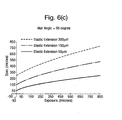
- FIG. 6 shows the different extensions for hairs positioned at a) 20°, b) 45° and c) 90° with variable spans and exposure differentials. As can be seen, for hairs angled at 20°, it is preferable for the exposure to be significantly less than the span to get any extension. At 45°, there will be some extension provided the exposure is less than the span (regardless of the magnitude by which it differs).
- the leading blade At 90°, there would be some extension even if the exposure is greater than the span, however, to achieve any meaningful extension, the leading blade would need to be positioned significantly below the skin contact plane and in such circumstances, would likely not make contact with any hairs. Accordingly, for y to be greater than l and for the leading blade to still make contact with hairs, the span between blades in the couplet must be equal to or greater than the exposure differential.
- Figures 5a) to 5f) show a differential in relative blade edge exposures that is achieved by physically positioning the trailing blade higher in the cartridge than the leading blade.
- a leading blade edge having negative exposure relative to the skin contact plane could be achieved by forcing skin away from the blade edge.
- Figure 7 shows a blade with a skin deflection strut/bump 50 located on the skin contact side of the blade that, when in use, pushes skin away from the blade edge - resulting in an effective negative exposure.
- the leading blade edge may sit in the skin contact plane (i.e. with an exposure of 0), without suffering the effect of the leading blade edge penetrating hairs too close to the skins surface.
- the leading blade is designed to be somewhat inefficient.
- the trailing blade is designed to be more efficient at cutting hairs, or other defined material, than the leading blade. As described above in the context of relative exposures of blades, the trailing blade will still cut hairs more efficiently than the leading blade where hairs are held in tension by the leading blade.
- the trailing blade could cut hairs more efficiently than the leading blade even if the respective cutting forces of the leading and trailing blades when measured in vitro are the same.
- the trailing blade has a lower cutting force than the leading blade. Since hair properties vary greatly with respect to their, for example, density, diameter etc, it is appreciated that while this is desirable, it is not possible to design a blade that will achieve this goal with all hairs. For example, in some cases, the leading blade may cut a hair all the way through and, in other cases, the leading blade may not penetrate all hairs with which it makes contact.
- the cutting force of the leading blade when measured on a single fiber cutting rig (described below) is between 60mN, 80mN, 100mN or 120mN and 140mN, 160mN, 180mN or 200mN.
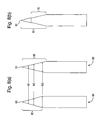
- FIG. 8a shows two different blade profiles that, if otherwise identical, would have different cutting forces.
- Blade 1 control blade
- Blade 2 exitperimental blade
- Tip radius ⁇ 25 nm ⁇ 20 nm w1 1 ⁇ m to 2 ⁇ m 2.25 ⁇ m to 3.25 ⁇ m w2 2 ⁇ m to 3.5 ⁇ m 4 ⁇ m to 5 ⁇ m w3 5 ⁇ m to 6 ⁇ m 8 ⁇ m to 9 ⁇ m
- Blade 1 Control CF
- Blade 2 Exp CF
- Mean Cutting Force mN
- 51.789848 109.48666
- Standard Deviation 10.026409 14.869536
- Blade 2 (the experimental blade) has a tip radius of similar size to the blade 1 (the control blade), but it is otherwise thicker than blade 1 at all measured points. As can be seen above, blade 2 has a higher cutting force than blade 1. Thus, it can be said that blade 2 has an initial penetration force that is roughly equivalent to blade 1, but that the increased thickness in the body of the blade causes blade 2 to have an overall higher cutting force than blade 1 - i.e. once the blade has penetrated a hair, it then has to work harder (vs the control blade) to pass through the hair.
- a first coating is applied to the tip 62 of the leading blade and a second coating (or no coating) is applied to the body 70 of the blade.
- the first coating has a lower coefficient of friction than the second coating and in the specific embodiment shown in Figure 8b ), the first coating is a telomer coating and the remainder of the blade is left free of telomer. In this case, the blade may easily penetrate a hair, but should not easily pass all the way through.
- the profile of both blades may be kept the same, but the leading blade may be formed without any telomer top coating. Having a telomer coating reduces the coefficient of friction at the blade to hair interface and accordingly reduces the cutting force. Thus, by removing the telomer outer coating, or by not applying it in the first place, the cutting force is increased.
- one or more additional blades 36 may be located in the cartridge.
- the blade couplet 26 is located adjacent the guard 40 and the additional blades 36 are located between the blade couplet 26 and the cap 42.
- the additional blades may be located between the guard and the blade couplet or, alternatively, one or more of the additional blades could be located between the guard and the blade couplet and the others between the blade couplet and the cap, as illustrated in any of the embodiments shown in Figures 9a) to 9c) . If the blade couplet is located adjacent the guard, the percentage of hairs with which the leading blade engages will increase since the hairs are typically longer than if they have been cut by a preceding blade.
- a span s G of 500 ⁇ m or 750 ⁇ m to 1000 ⁇ m, 1250 ⁇ m or 1500 ⁇ m between the guard and the leading blade.
- Increasing the span between the guard and the leading blade leads to an increase in the likelihood that the leading blade will contact skin, or at the least engage with hairs too close to their roots, as skin will likely bulge into the gap between the two skin contact points. This can, to some degree, be off-set by increasing the frictional properties of the guard, for example, by introducing or increasing the number of plastic fins on the guard provided to stretch skin.
- the additional blade(s) and the leading and trailing blades are positioned at an angle of between 15° to 45° relative to the skin contact plane P s . It will be appreciated that the angle of blades may be varied from one to another.
- the additional blade(s) 36 are shown to have progressively increasing exposures from the front to the rear of the cartridge. Specifically, the blade adjacent the blade couplet has negative exposure and the blade adjacent the cap has positive exposure. This form of progressive geometry is described in detail in EP 0,722,379 . Variation in blade exposure across a cartridge results in a varied load distribution across the blades of a cartridge. The load on respective blades reduces as the exposure is reduced.
- the leading and trailing blades may be secured to one another or directly to the housing.
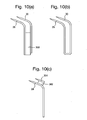
- Figure 10a shows an embodiment where the leading and trailing blades are secured to either side of a spacer 300.
- the leading and trailing blades are bent blades, where the blade itself is secured to the spacer.
- the blades may be secured to a blade support 202, and the support 202 may be secured to the spacer.
- the blade couplet may be formed from a single sheet of metal with a cutting edge at either end, or, as shown in Figure 10c ), one of the leading and/or trailing blade could have just an edge 304 secured to the other by a spacer 302.
- the additional blade(s) 36 may be secured to the housing in any known way, for example, the blades may be attached to blade supports, or they may be bent blades that are secured directly to the housing.
- the housing has a blade retaining member having a plurality of slots for receiving either the blade supports or, where bent blades are used, the blades.
- the angle of the respective blades relative to the skin contact plane can be determined by an angle in the blade support, where blade supports are used, or by a bend in a blade where bent blades are used.
- the angle of bend in the respective blade supports or bent blades may be kept the same, and the angle of the respective slots in the blade retaining member may be varied to result in blade edges of different angles.
- the blades are usually carried by the housing, which is generally a molded plastic frame, either independently of each other or in unison under forces imparted on the blades by the skin during shaving.
- the blades are mounted fixedly within slots in a blade retaining member.
- the blades may be floatably mounted within the housing, where the blades are supported by one or more spring loaded blade retaining member so they may respond to forces encountered during shaving.
- a lubricating strip may be provided on or in place of the cap. If, in use, the skin contact plane is defined by a lubricating strip, rather than the plastic housing, it will be appreciated that the relative exposures of the leading and trailing blade should be determined according to the guard to lubricating-strip tangent.
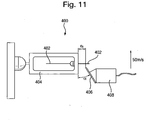
- a force cutting rig 400 is provided having a fiber mount 404 for holding a fiber 402 and a blade mount 408 for holding a blade 406.
- the blade mount is moved linearly towards the fiber until the blade cuts the fiber, as shown schematically in Figure 11 .
- sensors measure the cutting force exerted by the blade on the fiber. It will be appreciated that the force required to cut a fiber will depend on the fiber used. Furthermore, the angle at which the blade is presented to the fiber will also have an impact on the measured cutting force.
- the same fiber is cut twice, once by blade 1 and once by blade 2 - both blades being held in the same position when cutting the fiber.
- measurements are only taken when a blade engages with the fiber - if the blade touches the fiber but knocks it down, a negligible force will be measured by the sensor.
- the blades are positioned at an angle of 21.5° relative to the surface of the fiber mount (equivalent to having an angle ⁇ relative to the skin contact plane of 21.5°) and the fibers are positioned approximately normal (90°) to the surface of the fiber mount.
- the blade edge is positioned 100 ⁇ m from the fiber mount (so with an approximate exposure e f of 100 ⁇ m below the skin contact plane) and the blade mount is moved towards and across the fiber at a velocity of 50 mm/s. It will be appreciated that changing these parameters would affect the cutting force measured and result in a different result.
- the cutting force measured in the single fiber cutting method is influenced by the properties of the fiber being cut.
- the single fiber cutting method uses Asian female scalp hairs that are about 650mm long with a hair diameter in the range of between 70 ⁇ m to 90 ⁇ m and with a substantially round diameter, for example, having a ratio of less than 1.5 between the major and minor diameters.
- Each time the cutting force is measured approximately 0.5mm of the hair is cut.
- Each hair may be cut approximately 1200 timers, resulting in 1200 measurements of cutting force.
- each cut with an experimental blade is interleaved with a control blade, and the difference between the two calculated. This is done to mitigate the effects of variation in fiber diameter, mechanical properties, environmental conditions (e.g. temperature and humidity) and instrument variation.
Landscapes
- Life Sciences & Earth Sciences (AREA)
- Forests & Forestry (AREA)
- Engineering & Computer Science (AREA)
- Mechanical Engineering (AREA)
- Physics & Mathematics (AREA)
- Geometry (AREA)
- Dry Shavers And Clippers (AREA)
- Sheet Holders (AREA)
- Cosmetics (AREA)
Priority Applications (1)
| Application Number | Priority Date | Filing Date | Title |
|---|---|---|---|
| PL13745755T PL2731759T3 (pl) | 2012-07-24 | 2013-07-24 | Wkład maszynki do golenia |
Applications Claiming Priority (2)
| Application Number | Priority Date | Filing Date | Title |
|---|---|---|---|
| US201261675068P | 2012-07-24 | 2012-07-24 | |
| PCT/US2013/051789 WO2014018604A1 (en) | 2012-07-24 | 2013-07-24 | Razor cartridge |
Publications (2)
| Publication Number | Publication Date |
|---|---|
| EP2731759A1 EP2731759A1 (en) | 2014-05-21 |
| EP2731759B1 true EP2731759B1 (en) | 2015-12-23 |
Family
ID=48918472
Family Applications (1)
| Application Number | Title | Priority Date | Filing Date |
|---|---|---|---|
| EP13745755.2A Active EP2731759B1 (en) | 2012-07-24 | 2013-07-24 | Razor cartridge |
Country Status (14)
| Country | Link |
|---|---|
| US (1) | US20140026424A1 (enExample) |
| EP (1) | EP2731759B1 (enExample) |
| JP (1) | JP5694613B2 (enExample) |
| CN (1) | CN104507647A (enExample) |
| AU (1) | AU2013295827A1 (enExample) |
| BR (1) | BR112015001473A2 (enExample) |
| CA (1) | CA2879886A1 (enExample) |
| ES (1) | ES2565313T3 (enExample) |
| IN (1) | IN2015DN00546A (enExample) |
| MX (1) | MX2015001093A (enExample) |
| PL (1) | PL2731759T3 (enExample) |
| RU (1) | RU2015104139A (enExample) |
| SG (1) | SG11201500550TA (enExample) |
| WO (1) | WO2014018604A1 (enExample) |
Cited By (3)
| Publication number | Priority date | Publication date | Assignee | Title |
|---|---|---|---|---|
| US11059193B2 (en) | 2019-01-31 | 2021-07-13 | Bic Violex S.A. | Razor cartridge |
| US12226923B2 (en) | 2019-01-31 | 2025-02-18 | BIC Violex Single Member S.A. | Razor cartridge |
| US12491649B2 (en) | 2019-01-31 | 2025-12-09 | BIC Violex Single Member S.A. | Shaving head with increased inter blade span |
Families Citing this family (46)
| Publication number | Priority date | Publication date | Assignee | Title |
|---|---|---|---|---|
| EP2450162A1 (en) * | 2010-11-04 | 2012-05-09 | The Gillette Company | Razor cartridge |
| ES2429352T3 (es) * | 2011-06-21 | 2013-11-14 | The Gillette Company | Cartucho para máquinas de afeitar con elemento de contacto con la piel |
| US20150101195A1 (en) * | 2013-10-11 | 2015-04-16 | The Gillette Company | Shaving cartridges having lubrication members |
| US9751230B2 (en) * | 2014-05-19 | 2017-09-05 | The Gillette Company | Razor blades |
| USD748856S1 (en) * | 2014-06-13 | 2016-02-02 | The Gillette Company | Razor cartridge |
| KR101674460B1 (ko) * | 2014-08-25 | 2016-11-09 | 주식회사 도루코 | 면도기 카트리지 및 이를 이용한 면도기 |
| KR101538155B1 (ko) * | 2014-08-25 | 2015-07-22 | 주식회사 도루코 | 면도날 및 이를 적용한 면도기 카트리지 |
| US11224983B2 (en) | 2014-12-10 | 2022-01-18 | Bic-Volex Sa | Shaving blade assembly comprising a blade unit and a skin contact member and a razor comprising a razor handle and such a shaving blade assembly |
| JP6379068B2 (ja) * | 2015-04-01 | 2018-08-22 | フェザー安全剃刀株式会社 | 剃刀刃 |
| US11230025B2 (en) | 2015-11-13 | 2022-01-25 | The Gillette Company Llc | Razor blade |
| CN109414828B (zh) | 2016-03-18 | 2020-12-18 | 个人护理市场及调研公司 | 剃刀盒 |
| CN109195755B (zh) * | 2016-07-06 | 2021-10-12 | 比克-维尔莱克 | 剃须部件、剃须盒以及制造方法 |
| US11318632B2 (en) * | 2016-07-06 | 2022-05-03 | Bic-Violex Sa | Razor system |
| US11654588B2 (en) * | 2016-08-15 | 2023-05-23 | The Gillette Company Llc | Razor blades |
| US9993931B1 (en) | 2016-11-23 | 2018-06-12 | Personal Care Marketing And Research, Inc. | Razor docking and pivot |
| CN208246877U (zh) * | 2017-08-25 | 2018-12-18 | 宁波开利控股集团股份有限公司 | 一种矩阵式排列的漏须刀头 |
| EP3453498A1 (en) * | 2017-09-11 | 2019-03-13 | The Gillette Company LLC | Hair removal device for pubic hair |
| EP3453497A1 (en) * | 2017-09-11 | 2019-03-13 | The Gillette Company LLC | Hair removal device for pubic hair |
| EP3453499A1 (en) * | 2017-09-11 | 2019-03-13 | The Gillette Company LLC | Hair removal device for pubic hair |
| KR101925281B1 (ko) * | 2017-11-29 | 2018-12-06 | 주식회사 도루코 | 면도기 카트리지 및 면도기 카트리지 어셈블리 |
| KR102106304B1 (ko) | 2018-07-27 | 2020-05-04 | 주식회사 도루코 | 면도기 카트리지 |
| KR102063770B1 (ko) * | 2018-07-27 | 2020-01-08 | 주식회사 도루코 | 면도기 카트리지 |
| EP3744489B1 (en) * | 2019-05-31 | 2023-07-19 | BIC Violex Single Member S.A. | Razor cartridge |
| USD884969S1 (en) | 2019-02-27 | 2020-05-19 | Pcmr International Ltd | Combined razor cartridge guard and docking |
| USD884970S1 (en) | 2019-02-27 | 2020-05-19 | PCMR International Ltd. | Razor cartridge guard |
| USD884971S1 (en) | 2019-02-27 | 2020-05-19 | Pcmr International Ltd | Razor cartridge |
| USD926374S1 (en) | 2019-04-04 | 2021-07-27 | The Gillette Company Llc | Shaving razor cartridge cover |
| EP3946849B1 (en) | 2019-04-04 | 2025-04-23 | The Gillette Company LLC | Razor cartridge |
| CN118493457A (zh) * | 2019-06-21 | 2024-08-16 | 吉列有限责任公司 | 具有一个或多个皮肤支撑元件的剃刀刀片架 |
| EP3771533B1 (en) * | 2019-07-31 | 2022-09-21 | BIC Violex Single Member S.A. | Razor cartridge |
| WO2021022299A1 (en) | 2019-07-31 | 2021-02-04 | The Gillette Company Llc | Razors and razor cartridges with colored blades |
| EP3771531B1 (en) | 2019-07-31 | 2024-07-24 | BIC Violex Single Member S.A. | Razor cartridge |
| CN114080306B (zh) * | 2019-07-31 | 2024-03-29 | 吉列有限责任公司 | 剃刀和剃刀刀片架 |
| EP3771532B1 (en) * | 2019-07-31 | 2023-10-25 | BIC Violex Single Member S.A. | Razor cartridge |
| WO2022045732A1 (ko) * | 2020-08-27 | 2022-03-03 | 주식회사 도루코 | 면도기 카트리지 |
| USD1016392S1 (en) | 2020-09-24 | 2024-02-27 | The Gillette Company Llc | Shaving razor cartridge |
| US11000960B1 (en) * | 2020-11-16 | 2021-05-11 | Personal Care Marketing And Research, Inc. | Razor exposure |
| EP4049817B1 (en) * | 2021-02-25 | 2024-05-29 | BIC Violex Single Member S.A. | Cutting members with multiple cutting edges |
| KR102821256B1 (ko) * | 2021-11-30 | 2025-06-17 | 주식회사 도루코 | 면도기 카트리지 |
| CN114505894A (zh) * | 2022-02-21 | 2022-05-17 | 宁波佳利塑胶有限公司 | 一种舒适型剃须刀 |
| USD1041946S1 (en) | 2022-03-08 | 2024-09-17 | The Gillette Company Llc | Shaving razor cartridge dispenser |
| USD1073187S1 (en) | 2022-06-23 | 2025-04-29 | The Gillette Company Llc | Shaving razor cartridge |
| CN118632769A (zh) * | 2022-07-27 | 2024-09-10 | 温州美葆科技技术有限公司 | 剃须刀头 |
| WO2024106962A1 (ko) * | 2022-11-18 | 2024-05-23 | 주식회사 도루코 | 면도기 카트리지 |
| KR20250007858A (ko) * | 2023-07-06 | 2025-01-14 | 주식회사 도루코 | 면도기 카트리지 |
| KR20250055976A (ko) * | 2023-10-18 | 2025-04-25 | 주식회사 도루코 | 면도기 카트리지 및 이를 포함하는 면도기 조립체 |
Family Cites Families (34)
| Publication number | Priority date | Publication date | Assignee | Title |
|---|---|---|---|---|
| GB1136449A (en) * | 1966-12-08 | 1968-12-11 | Gillette Industries Ltd | Improvements relating to safety razors |
| US3786563A (en) * | 1971-08-31 | 1974-01-22 | Gillette Co | Shaving system |
| US4031620A (en) * | 1972-07-25 | 1977-06-28 | The Gillette Company | Shaving system |
| US3861040A (en) * | 1972-09-08 | 1975-01-21 | Gillette Co | Plural edge blade unit |
| US4146958A (en) * | 1976-10-15 | 1979-04-03 | Warner-Lambert Company | Safety razor |
| US4125939A (en) * | 1977-06-06 | 1978-11-21 | Abe Bros R | Razor blade arrangement |
| US4251914A (en) * | 1979-10-11 | 1981-02-24 | Grosjean Warren J | Shaving assembly |
| USRE30913E (en) * | 1980-01-17 | 1982-04-27 | Warner-Lambert Company | Safety razor with flexible blade cartridge |
| US4407067A (en) * | 1980-10-06 | 1983-10-04 | The Gillette Company | Shaving implement |
| US4516320A (en) * | 1983-04-28 | 1985-05-14 | Warner-Lambert Company | Dynamic razor |
| US4663843A (en) * | 1986-05-19 | 1987-05-12 | Savage Brian D | Razor with angled-edge blades |
| US4854042A (en) * | 1986-07-14 | 1989-08-08 | Byrne John J | Diagonal blade cartridge |
| CA2112888A1 (en) * | 1991-07-18 | 1993-02-04 | Vincent C. Motta | Razor head with variable shaving geometry |
| GB9320058D0 (en) * | 1993-09-29 | 1993-11-17 | Gillette Co | Savety razors |
| GB9703293D0 (en) * | 1997-02-18 | 1997-04-09 | Gillette Co | Safety razors |
| US5794343A (en) * | 1997-05-12 | 1998-08-18 | The Gillette Company | Razor blade assembly |
| US6276062B1 (en) * | 1998-04-01 | 2001-08-21 | American Safety Razor Corporation | Triple blade safety razor |
| US6519856B1 (en) * | 1998-06-22 | 2003-02-18 | Delphi Oracle Corp | Safety razor head with intrinsic fencing and lateral skin tensioning |
| JP2002523197A (ja) * | 1998-08-31 | 2002-07-30 | コーニンクレッカ フィリップス エレクトロニクス エヌ ヴィ | 引っ込み作用を有する湿式ひげ剃り器 |
| EP2017044A1 (en) * | 2001-04-27 | 2009-01-21 | Eveready Battery Company, Inc. | Wet razor with four blades, and cartridge therefor |
| GB2406537B (en) * | 2003-07-21 | 2006-09-06 | Gillette Co | Safety razors |
| US20060218794A1 (en) * | 2005-04-05 | 2006-10-05 | Eveready Battery Company, Inc. | Razor cartridge |
| US7681314B2 (en) * | 2005-06-10 | 2010-03-23 | Eveready Battery Company Inc. | Inter-blade guard and method for manufacturing same |
| US7448135B2 (en) * | 2006-03-29 | 2008-11-11 | The Gillette Company | Multi-blade razors |
| EP2207651A4 (en) * | 2007-10-12 | 2012-02-15 | American Safety Razor | RAZOR WITH PAIR OF MODULAR BLADES |
| JP5243057B2 (ja) * | 2008-02-14 | 2013-07-24 | 株式会社貝印刃物開発センター | 顔のほか足や腕の毛を剃るための安全かみそり |
| US9248579B2 (en) * | 2008-07-16 | 2016-02-02 | The Gillette Company | Razors and razor cartridges |
| US20100011588A1 (en) * | 2008-07-16 | 2010-01-21 | Xiandong Wang | Shaving Aid Geometry for Wet Shave System |
| WO2010037079A2 (en) * | 2008-09-29 | 2010-04-01 | The Gillette Company | Razors and razor cartridges with a decreased total interblade span |
| BR112012011213A2 (pt) * | 2009-11-18 | 2018-04-03 | Gillette Co | lâminas para aparelhos de barbear ou depilar |
| US20110162209A1 (en) * | 2010-01-06 | 2011-07-07 | Kevin James Wain | Blades for Shaving Razors |
| ES2429352T3 (es) * | 2011-06-21 | 2013-11-14 | The Gillette Company | Cartucho para máquinas de afeitar con elemento de contacto con la piel |
| EP2823942A1 (en) * | 2013-07-10 | 2015-01-14 | The Gillette Company | Razor cartridges |
| EP3113918B1 (en) * | 2013-10-02 | 2020-01-08 | Dorco Co., Ltd. | Razor cartridges |
-
2013
- 2013-07-08 US US13/936,302 patent/US20140026424A1/en not_active Abandoned
- 2013-07-24 AU AU2013295827A patent/AU2013295827A1/en not_active Abandoned
- 2013-07-24 JP JP2014528713A patent/JP5694613B2/ja not_active Expired - Fee Related
- 2013-07-24 PL PL13745755T patent/PL2731759T3/pl unknown
- 2013-07-24 RU RU2015104139A patent/RU2015104139A/ru not_active Application Discontinuation
- 2013-07-24 CN CN201380039386.0A patent/CN104507647A/zh active Pending
- 2013-07-24 MX MX2015001093A patent/MX2015001093A/es unknown
- 2013-07-24 IN IN546DEN2015 patent/IN2015DN00546A/en unknown
- 2013-07-24 EP EP13745755.2A patent/EP2731759B1/en active Active
- 2013-07-24 SG SG11201500550TA patent/SG11201500550TA/en unknown
- 2013-07-24 WO PCT/US2013/051789 patent/WO2014018604A1/en not_active Ceased
- 2013-07-24 ES ES13745755.2T patent/ES2565313T3/es active Active
- 2013-07-24 BR BR112015001473A patent/BR112015001473A2/pt not_active Application Discontinuation
- 2013-07-24 CA CA2879886A patent/CA2879886A1/en not_active Abandoned
Cited By (5)
| Publication number | Priority date | Publication date | Assignee | Title |
|---|---|---|---|---|
| US11059193B2 (en) | 2019-01-31 | 2021-07-13 | Bic Violex S.A. | Razor cartridge |
| US12049016B2 (en) | 2019-01-31 | 2024-07-30 | BIC Violex Single Member S.A. | Razor cartridge |
| US12202156B2 (en) | 2019-01-31 | 2025-01-21 | BIC Violex Single Member S.A. | Razor cartridge |
| US12226923B2 (en) | 2019-01-31 | 2025-02-18 | BIC Violex Single Member S.A. | Razor cartridge |
| US12491649B2 (en) | 2019-01-31 | 2025-12-09 | BIC Violex Single Member S.A. | Shaving head with increased inter blade span |
Also Published As
| Publication number | Publication date |
|---|---|
| EP2731759A1 (en) | 2014-05-21 |
| JP2014527453A (ja) | 2014-10-16 |
| CA2879886A1 (en) | 2014-01-30 |
| US20140026424A1 (en) | 2014-01-30 |
| IN2015DN00546A (enExample) | 2015-06-26 |
| JP5694613B2 (ja) | 2015-04-01 |
| CN104507647A (zh) | 2015-04-08 |
| MX2015001093A (es) | 2015-05-11 |
| BR112015001473A2 (pt) | 2017-07-04 |
| RU2015104139A (ru) | 2016-09-10 |
| SG11201500550TA (en) | 2015-02-27 |
| PL2731759T3 (pl) | 2016-07-29 |
| WO2014018604A1 (en) | 2014-01-30 |
| AU2013295827A1 (en) | 2015-02-19 |
| ES2565313T3 (es) | 2016-04-01 |
Similar Documents
| Publication | Publication Date | Title |
|---|---|---|
| US20140026424A1 (en) | Razor cartridge | |
| EP1899120B1 (en) | Inter-blade guard and method for manufacturing same | |
| US9446443B2 (en) | Cutting members for shaving razors | |
| KR102167722B1 (ko) | 면도기 블레이드, 면도기 헤드, 및 제조 방법 | |
| EP2823942A1 (en) | Razor cartridges | |
| EP2450162A1 (en) | Razor cartridge | |
| EP2435219B1 (en) | Shaving razor comb guard for a trimming blade | |
| EP2347869B1 (en) | Electric shaver | |
| US8225510B2 (en) | Razors and razor cartridges with a decreased total interblade span | |
| CN109070367B (zh) | 刀片、带有刀片的剃刀以及用于制备刀片的方法 | |
| EP1998939B1 (en) | Razors | |
| KR20080099337A (ko) | 면도기 | |
| US20100218381A1 (en) | Inter-Blade Guard and Method For Manufacturing Same | |
| US20220152853A1 (en) | Shaving head | |
| KR20170093933A (ko) | 날 유닛과 피부 접촉 부재를 포함하는 면도날 조립체 및 면도기 손잡이와 이러한 면도날 조립체를 포함하는 면도기 | |
| KR101945574B1 (ko) | 이발기용 절단 시스템 | |
| US20110023307A1 (en) | Inter-Blade Guard and Method for Manufacturing Same | |
| JP2001507261A (ja) | 安全かみそり | |
| US20220088813A1 (en) | Bent blade with improved rigidity | |
| JP6379068B2 (ja) | 剃刀刃 |
Legal Events
| Date | Code | Title | Description |
|---|---|---|---|
| PUAI | Public reference made under article 153(3) epc to a published international application that has entered the european phase |
Free format text: ORIGINAL CODE: 0009012 |
|
| 17P | Request for examination filed |
Effective date: 20140213 |
|
| AK | Designated contracting states |
Kind code of ref document: A1 Designated state(s): AL AT BE BG CH CY CZ DE DK EE ES FI FR GB GR HR HU IE IS IT LI LT LU LV MC MK MT NL NO PL PT RO RS SE SI SK SM TR |
|
| 17Q | First examination report despatched |
Effective date: 20140603 |
|
| GRAP | Despatch of communication of intention to grant a patent |
Free format text: ORIGINAL CODE: EPIDOSNIGR1 |
|
| DAX | Request for extension of the european patent (deleted) | ||
| INTG | Intention to grant announced |
Effective date: 20150202 |
|
| RIN1 | Information on inventor provided before grant (corrected) |
Inventor name: YU, WEILI Inventor name: OGLESBY, OLIVER, DAVID Inventor name: PASKINS, KEITH, EDWARD Inventor name: PATEL, ASHOK, BAKUL |
|
| GRAP | Despatch of communication of intention to grant a patent |
Free format text: ORIGINAL CODE: EPIDOSNIGR1 |
|
| INTG | Intention to grant announced |
Effective date: 20150624 |
|
| GRAS | Grant fee paid |
Free format text: ORIGINAL CODE: EPIDOSNIGR3 |
|
| GRAA | (expected) grant |
Free format text: ORIGINAL CODE: 0009210 |
|
| AK | Designated contracting states |
Kind code of ref document: B1 Designated state(s): AL AT BE BG CH CY CZ DE DK EE ES FI FR GB GR HR HU IE IS IT LI LT LU LV MC MK MT NL NO PL PT RO RS SE SI SK SM TR |
|
| REG | Reference to a national code |
Ref country code: GB Ref legal event code: FG4D |
|
| REG | Reference to a national code |
Ref country code: CH Ref legal event code: EP |
|
| REG | Reference to a national code |
Ref country code: IE Ref legal event code: FG4D |
|
| REG | Reference to a national code |
Ref country code: AT Ref legal event code: REF Ref document number: 766335 Country of ref document: AT Kind code of ref document: T Effective date: 20160115 |
|
| REG | Reference to a national code |
Ref country code: DE Ref legal event code: R096 Ref document number: 602013004267 Country of ref document: DE |
|
| REG | Reference to a national code |
Ref country code: ES Ref legal event code: FG2A Ref document number: 2565313 Country of ref document: ES Kind code of ref document: T3 Effective date: 20160401 |
|
| REG | Reference to a national code |
Ref country code: NL Ref legal event code: FP |
|
| REG | Reference to a national code |
Ref country code: LT Ref legal event code: MG4D |
|
| PG25 | Lapsed in a contracting state [announced via postgrant information from national office to epo] |
Ref country code: NO Free format text: LAPSE BECAUSE OF FAILURE TO SUBMIT A TRANSLATION OF THE DESCRIPTION OR TO PAY THE FEE WITHIN THE PRESCRIBED TIME-LIMIT Effective date: 20160323 Ref country code: LT Free format text: LAPSE BECAUSE OF FAILURE TO SUBMIT A TRANSLATION OF THE DESCRIPTION OR TO PAY THE FEE WITHIN THE PRESCRIBED TIME-LIMIT Effective date: 20151223 Ref country code: HR Free format text: LAPSE BECAUSE OF FAILURE TO SUBMIT A TRANSLATION OF THE DESCRIPTION OR TO PAY THE FEE WITHIN THE PRESCRIBED TIME-LIMIT Effective date: 20151223 |
|
| REG | Reference to a national code |
Ref country code: AT Ref legal event code: MK05 Ref document number: 766335 Country of ref document: AT Kind code of ref document: T Effective date: 20151223 |
|
| PG25 | Lapsed in a contracting state [announced via postgrant information from national office to epo] |
Ref country code: SE Free format text: LAPSE BECAUSE OF FAILURE TO SUBMIT A TRANSLATION OF THE DESCRIPTION OR TO PAY THE FEE WITHIN THE PRESCRIBED TIME-LIMIT Effective date: 20151223 Ref country code: FI Free format text: LAPSE BECAUSE OF FAILURE TO SUBMIT A TRANSLATION OF THE DESCRIPTION OR TO PAY THE FEE WITHIN THE PRESCRIBED TIME-LIMIT Effective date: 20151223 Ref country code: LV Free format text: LAPSE BECAUSE OF FAILURE TO SUBMIT A TRANSLATION OF THE DESCRIPTION OR TO PAY THE FEE WITHIN THE PRESCRIBED TIME-LIMIT Effective date: 20151223 Ref country code: RS Free format text: LAPSE BECAUSE OF FAILURE TO SUBMIT A TRANSLATION OF THE DESCRIPTION OR TO PAY THE FEE WITHIN THE PRESCRIBED TIME-LIMIT Effective date: 20151223 |
|
| REG | Reference to a national code |
Ref country code: FR Ref legal event code: PLFP Year of fee payment: 4 |
|
| REG | Reference to a national code |
Ref country code: GR Ref legal event code: EP Ref document number: 20160400504 Country of ref document: GR Effective date: 20160505 |
|
| PG25 | Lapsed in a contracting state [announced via postgrant information from national office to epo] |
Ref country code: IT Free format text: LAPSE BECAUSE OF FAILURE TO SUBMIT A TRANSLATION OF THE DESCRIPTION OR TO PAY THE FEE WITHIN THE PRESCRIBED TIME-LIMIT Effective date: 20151223 Ref country code: CZ Free format text: LAPSE BECAUSE OF FAILURE TO SUBMIT A TRANSLATION OF THE DESCRIPTION OR TO PAY THE FEE WITHIN THE PRESCRIBED TIME-LIMIT Effective date: 20151223 |
|
| PG25 | Lapsed in a contracting state [announced via postgrant information from national office to epo] |
Ref country code: PT Free format text: LAPSE BECAUSE OF FAILURE TO SUBMIT A TRANSLATION OF THE DESCRIPTION OR TO PAY THE FEE WITHIN THE PRESCRIBED TIME-LIMIT Effective date: 20160426 Ref country code: RO Free format text: LAPSE BECAUSE OF FAILURE TO SUBMIT A TRANSLATION OF THE DESCRIPTION OR TO PAY THE FEE WITHIN THE PRESCRIBED TIME-LIMIT Effective date: 20151223 Ref country code: SM Free format text: LAPSE BECAUSE OF FAILURE TO SUBMIT A TRANSLATION OF THE DESCRIPTION OR TO PAY THE FEE WITHIN THE PRESCRIBED TIME-LIMIT Effective date: 20151223 Ref country code: AT Free format text: LAPSE BECAUSE OF FAILURE TO SUBMIT A TRANSLATION OF THE DESCRIPTION OR TO PAY THE FEE WITHIN THE PRESCRIBED TIME-LIMIT Effective date: 20151223 Ref country code: EE Free format text: LAPSE BECAUSE OF FAILURE TO SUBMIT A TRANSLATION OF THE DESCRIPTION OR TO PAY THE FEE WITHIN THE PRESCRIBED TIME-LIMIT Effective date: 20151223 Ref country code: IS Free format text: LAPSE BECAUSE OF FAILURE TO SUBMIT A TRANSLATION OF THE DESCRIPTION OR TO PAY THE FEE WITHIN THE PRESCRIBED TIME-LIMIT Effective date: 20160423 Ref country code: SK Free format text: LAPSE BECAUSE OF FAILURE TO SUBMIT A TRANSLATION OF THE DESCRIPTION OR TO PAY THE FEE WITHIN THE PRESCRIBED TIME-LIMIT Effective date: 20151223 |
|
| REG | Reference to a national code |
Ref country code: DE Ref legal event code: R097 Ref document number: 602013004267 Country of ref document: DE |
|
| PLBE | No opposition filed within time limit |
Free format text: ORIGINAL CODE: 0009261 |
|
| STAA | Information on the status of an ep patent application or granted ep patent |
Free format text: STATUS: NO OPPOSITION FILED WITHIN TIME LIMIT |
|
| PG25 | Lapsed in a contracting state [announced via postgrant information from national office to epo] |
Ref country code: DK Free format text: LAPSE BECAUSE OF FAILURE TO SUBMIT A TRANSLATION OF THE DESCRIPTION OR TO PAY THE FEE WITHIN THE PRESCRIBED TIME-LIMIT Effective date: 20151223 |
|
| 26N | No opposition filed |
Effective date: 20160926 |
|
| PG25 | Lapsed in a contracting state [announced via postgrant information from national office to epo] |
Ref country code: BE Free format text: LAPSE BECAUSE OF FAILURE TO SUBMIT A TRANSLATION OF THE DESCRIPTION OR TO PAY THE FEE WITHIN THE PRESCRIBED TIME-LIMIT Effective date: 20151223 |
|
| PG25 | Lapsed in a contracting state [announced via postgrant information from national office to epo] |
Ref country code: SI Free format text: LAPSE BECAUSE OF FAILURE TO SUBMIT A TRANSLATION OF THE DESCRIPTION OR TO PAY THE FEE WITHIN THE PRESCRIBED TIME-LIMIT Effective date: 20151223 |
|
| REG | Reference to a national code |
Ref country code: CH Ref legal event code: PL |
|
| PG25 | Lapsed in a contracting state [announced via postgrant information from national office to epo] |
Ref country code: MC Free format text: LAPSE BECAUSE OF FAILURE TO SUBMIT A TRANSLATION OF THE DESCRIPTION OR TO PAY THE FEE WITHIN THE PRESCRIBED TIME-LIMIT Effective date: 20151223 |
|
| PG25 | Lapsed in a contracting state [announced via postgrant information from national office to epo] |
Ref country code: CH Free format text: LAPSE BECAUSE OF NON-PAYMENT OF DUE FEES Effective date: 20160731 Ref country code: LI Free format text: LAPSE BECAUSE OF NON-PAYMENT OF DUE FEES Effective date: 20160731 |
|
| REG | Reference to a national code |
Ref country code: IE Ref legal event code: MM4A |
|
| REG | Reference to a national code |
Ref country code: FR Ref legal event code: PLFP Year of fee payment: 5 |
|
| PG25 | Lapsed in a contracting state [announced via postgrant information from national office to epo] |
Ref country code: IE Free format text: LAPSE BECAUSE OF NON-PAYMENT OF DUE FEES Effective date: 20160724 |
|
| PG25 | Lapsed in a contracting state [announced via postgrant information from national office to epo] |
Ref country code: LU Free format text: LAPSE BECAUSE OF NON-PAYMENT OF DUE FEES Effective date: 20160724 |
|
| PG25 | Lapsed in a contracting state [announced via postgrant information from national office to epo] |
Ref country code: CY Free format text: LAPSE BECAUSE OF FAILURE TO SUBMIT A TRANSLATION OF THE DESCRIPTION OR TO PAY THE FEE WITHIN THE PRESCRIBED TIME-LIMIT Effective date: 20151223 Ref country code: HU Free format text: LAPSE BECAUSE OF FAILURE TO SUBMIT A TRANSLATION OF THE DESCRIPTION OR TO PAY THE FEE WITHIN THE PRESCRIBED TIME-LIMIT; INVALID AB INITIO Effective date: 20130724 |
|
| REG | Reference to a national code |
Ref country code: FR Ref legal event code: PLFP Year of fee payment: 6 |
|
| PG25 | Lapsed in a contracting state [announced via postgrant information from national office to epo] |
Ref country code: MK Free format text: LAPSE BECAUSE OF FAILURE TO SUBMIT A TRANSLATION OF THE DESCRIPTION OR TO PAY THE FEE WITHIN THE PRESCRIBED TIME-LIMIT Effective date: 20151223 Ref country code: MT Free format text: LAPSE BECAUSE OF NON-PAYMENT OF DUE FEES Effective date: 20160731 |
|
| PG25 | Lapsed in a contracting state [announced via postgrant information from national office to epo] |
Ref country code: BG Free format text: LAPSE BECAUSE OF FAILURE TO SUBMIT A TRANSLATION OF THE DESCRIPTION OR TO PAY THE FEE WITHIN THE PRESCRIBED TIME-LIMIT Effective date: 20151223 |
|
| PG25 | Lapsed in a contracting state [announced via postgrant information from national office to epo] |
Ref country code: AL Free format text: LAPSE BECAUSE OF FAILURE TO SUBMIT A TRANSLATION OF THE DESCRIPTION OR TO PAY THE FEE WITHIN THE PRESCRIBED TIME-LIMIT Effective date: 20151223 |
|
| PGFP | Annual fee paid to national office [announced via postgrant information from national office to epo] |
Ref country code: ES Payment date: 20180801 Year of fee payment: 6 Ref country code: NL Payment date: 20180712 Year of fee payment: 6 |
|
| PGFP | Annual fee paid to national office [announced via postgrant information from national office to epo] |
Ref country code: CH Payment date: 20180713 Year of fee payment: 6 |
|
| PG25 | Lapsed in a contracting state [announced via postgrant information from national office to epo] |
Ref country code: NL Free format text: LAPSE BECAUSE OF NON-PAYMENT OF DUE FEES Effective date: 20190801 |
|
| REG | Reference to a national code |
Ref country code: NL Ref legal event code: MM Effective date: 20190801 |
|
| PG25 | Lapsed in a contracting state [announced via postgrant information from national office to epo] |
Ref country code: PL Free format text: LAPSE BECAUSE OF NON-PAYMENT OF DUE FEES Effective date: 20190724 |
|
| REG | Reference to a national code |
Ref country code: ES Ref legal event code: FD2A Effective date: 20201130 |
|
| PG25 | Lapsed in a contracting state [announced via postgrant information from national office to epo] |
Ref country code: ES Free format text: LAPSE BECAUSE OF NON-PAYMENT OF DUE FEES Effective date: 20190725 |
|
| PG25 | Lapsed in a contracting state [announced via postgrant information from national office to epo] |
Ref country code: TR Free format text: LAPSE BECAUSE OF NON-PAYMENT OF DUE FEES Effective date: 20190724 |
|
| P01 | Opt-out of the competence of the unified patent court (upc) registered |
Effective date: 20230430 |
|
| PGFP | Annual fee paid to national office [announced via postgrant information from national office to epo] |
Ref country code: DE Payment date: 20250604 Year of fee payment: 13 |
|
| PGFP | Annual fee paid to national office [announced via postgrant information from national office to epo] |
Ref country code: GB Payment date: 20260608 Year of fee payment: 14 |
|
| PGFP | Annual fee paid to national office [announced via postgrant information from national office to epo] |
Ref country code: GR Payment date: 20260611 Year of fee payment: 14 |
|
| PGFP | Annual fee paid to national office [announced via postgrant information from national office to epo] |
Ref country code: FR Payment date: 20260608 Year of fee payment: 14 |