EP2728287A2 - Verfahren zur Gefriertrockung eines mit einem Lösungsmittel versehenen, feuchten Produktes - Google Patents
Verfahren zur Gefriertrockung eines mit einem Lösungsmittel versehenen, feuchten Produktes Download PDFInfo
- Publication number
- EP2728287A2 EP2728287A2 EP13004181.7A EP13004181A EP2728287A2 EP 2728287 A2 EP2728287 A2 EP 2728287A2 EP 13004181 A EP13004181 A EP 13004181A EP 2728287 A2 EP2728287 A2 EP 2728287A2
- Authority
- EP
- European Patent Office
- Prior art keywords
- product
- temperature
- pressure
- freezing
- drying
- Prior art date
- Legal status (The legal status is an assumption and is not a legal conclusion. Google has not performed a legal analysis and makes no representation as to the accuracy of the status listed.)
- Granted
Links
Images


Classifications
-
- F—MECHANICAL ENGINEERING; LIGHTING; HEATING; WEAPONS; BLASTING
- F26—DRYING
- F26B—DRYING SOLID MATERIALS OR OBJECTS BY REMOVING LIQUID THEREFROM
- F26B5/00—Drying solid materials or objects by processes not involving the application of heat
- F26B5/04—Drying solid materials or objects by processes not involving the application of heat by evaporation or sublimation of moisture under reduced pressure, e.g. in a vacuum
- F26B5/06—Drying solid materials or objects by processes not involving the application of heat by evaporation or sublimation of moisture under reduced pressure, e.g. in a vacuum the process involving freezing
-
- F—MECHANICAL ENGINEERING; LIGHTING; HEATING; WEAPONS; BLASTING
- F26—DRYING
- F26B—DRYING SOLID MATERIALS OR OBJECTS BY REMOVING LIQUID THEREFROM
- F26B21/00—Arrangements for supplying or controlling air or other gases for drying solid materials or objects
- F26B21/30—Controlling, e.g. regulating, parameters of gas supply
- F26B21/35—Temperature; Pressure
Definitions
- the present invention relates to a method according to the preamble of claim 1.
- the product For freeze-drying a product provided with a solvent, usually water, the product is filled into containers such as vials, injection bottles or product trays and introduced into a drying chamber of a freeze-drying plant (loading phase). There, the product is first cooled to the product-specific freezing temperature and kept at this freezing temperature (freezing phase) until the product has completely frozen through. Thereafter, the ice condenser of the freeze dryer is cooled and the drying chamber is evacuated to dry the product (drying phase).
- a solvent usually water
- the present invention is based on the finding that a uniform drying is favored when the frozen-out product has uniform crystal structures.
- the invention is based on the recognition that, due to the low pressure level, outgassing from the product during the freezing process affects the ice structures that form, with the result that the product forms different crystal structures that are very uneven.
- the object of the invention is to provide a freeze-drying method in which the escape of gases during the freezing phase is prevented, but at least reduced to a minimum, or in which the escape of gases is conditioned to a desired level.
- a method carried out according to this technical teaching has the advantage that the gases present in the product and, above all, in the solvent are already removed from the product by the upstream outgassing phase, so that uniform freezing becomes possible.
- Another advantage is that the uniform freezing results in a synchronous freezing of the product, even if the product is filled in different containers. As a result, an approximately equal product quality is achieved throughout the entire batch of a drying chamber.
- Yet another advantage is that the process according to the invention can be carried out with the existing freeze-drying plants and that the process according to the invention can be integrated in the existing freeze-drying process in a simple manner, so that a cost-effective implementation of the process according to the invention is possible.
- the temperature can be lowered during the Ausgasungsphase, but must remain above the glass transition temperature of the solvent during the Ausgasungsphase, for example, at 0 ° C water.
- the temperature reduction takes place only after the outgassing pressure is reached, so that a rapid outgassing is ensured.
- the freezing phase is initiated after completion of the outgassing phase, wherein the temperature and the pressure are lowered so that the glass transition temperature (at 0 ° C) and the freezing pressure (preferably the freezing point associated with the solvent, at water 6 mbar) can be achieved at the same time.
- the glass transition temperature at 0 ° C
- the freezing pressure preferably the freezing point associated with the solvent, at water 6 mbar
- the ice condenser of the freeze-drying plant is cooled before the pressure is reduced in the outgassing phase. This has the advantage that already in the outgassing phase, the gases emerging from the product can be discharged via the ice condenser, inter alia, in order to bind condensable fractions in the ice condenser and to prevent the gases from migrating back into the product.
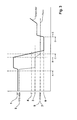
- Fig. 1 is a schematic representation of a first embodiment of a method according to the invention for the freeze-drying of a product shown.
- the product is filled in a variety of vials, which are placed on shelves in a drying chamber of a freeze-drying plant during the loading phase A at ambient temperature 1 and ambient pressure 2.
- the outgassing phase B begins by lowering the pressure within the drying chamber to the outgassing pressure 3 while the temperature remains unchanged at ambient temperature.
- the outgassing pressure 3 is dependent on the product, in particular the solvent in the product and is chosen so that the outgassing pressure 3 is slightly above the partial pressure of the solvent belonging to the freezing point.
- the ice condenser of the freeze-drying plant is cooled, preferably before the pressure reduction begins, in order to bind condensable gases emerging from the product. It also opens the main valve to connect to the drying chamber. Non-condensable gases are pumped out via the vacuum pump set.
- the freezing phase C begins by lowering the pressure and the temperature. This lowering is done such that the glass transition temperature 4 0 ° C for the Solvent water, and the freezing pressure 5, here the partial pressure of the solvent at the freezing point, can be achieved simultaneously to achieve a synchronous freezing.
- the freezing phase D begins, wherein the temperature of the product is further lowered to the desired Ausfrieremperatur 6, so that a hypothermia of the product occurs.
- the pressure may be further reduced to a desired freezing pressure 7 or maintained at the partial pressure of the solvent at the freezing point.
- the freezing pressure 7 corresponds to the partial pressure of the solvent at the point of freezing.
- the freezing temperature 6 and the freezing pressure 7 are maintained until the product is completely frozen before the drying phase E begins. This results in a uniform crystal formation in the product, because the gas in the product is reduced to a minimum or adjusted to a desired level. This uniformly crystallized product is then uniformly dried to leave a very uniform, dried product.
- a second embodiment of a freeze-drying process according to the invention is shown schematically, which differs from the in Fig. 1 , only differs in that already takes place during the Ausgasungsphase B, a lowering of the temperature of ambient temperature. Depending on the nature of the product, it may be that even at a reduced temperature sufficient outgassing occurs. In this case, a shortening of the product cycle is achieved by the premature lowering of the temperature. Depending on the amount of dissolved Gases in the starting point, the time and the gradient of the temperature reduction is set accordingly.
- a third embodiment of a freeze-drying method according to the invention is shown schematically, which differs from the in Fig. 1 only differs in that at the beginning of the Ausgasungsphase B, a temperature increase takes place.
- the temperature should be increased only so far taking into account the product to be frozen, that an impairment of the product is avoided.
- the gas pressure in the drying chamber is further reduced, thus facilitating the outgassing process.
- the temperature in the outgassing phase B always remains above the glass transition temperature 4 in order to achieve rapid outgassing. Also, the temperature reduction is initiated only after the Ausgasungstik is reached. This has the advantage that a rapid outgassing takes place without dragging the process process in the length.
Landscapes
- Engineering & Computer Science (AREA)
- Mechanical Engineering (AREA)
- General Engineering & Computer Science (AREA)
- Health & Medical Sciences (AREA)
- Life Sciences & Earth Sciences (AREA)
- Molecular Biology (AREA)
- Drying Of Solid Materials (AREA)
Abstract
Description
- Die vorliegende Erfindung betrifft ein Verfahren gemäß dem Oberbegriff des Anspruches 1.
- Zum Gefriertrocknen eines mit einem Lösungsmittel, in der Regel Wasser, versehenen Produktes wird das Produkt in Behältnisse wie Vials, Injektionsflaschen oder Produktschalen gefüllt und in eine Trocknungskammer einer Gefriertrocknungsanlage eingebracht (Beladungsphase). Dort wird das Produkt zunächst auf die produktspezifische Ausfriertemperatur abgekühlt und solange auf dieser Ausfriertemperatur gehalten (Ausfrierphase), bis das Produkt vollständig durchgefroren ist. Danach wird der Eiskondensator der Gefriertrocknungsanlage gekühlt und die Trocknungskammer evakuiert, um das Produkt zu trocknen (Trocknungsphase).
- Häufig werden pharmazeutische Produkte gefriergetrocknet. Dabei wird angestrebt, dass die gesamte Charge des Produktes am Ende des Trocknungsprozesses gleichmäßig trocken sein soll, um ein stets einheitliches und damit zuverlässiges Arzneimittel zu erhalten.
- Um dieses Ziel zu erreichen wurde in der
WO 2007/095033 A2 vorgeschlagen, das in der Trocknungskammer befindliche Produkt zu kühlen, bevor der Druck abgesenkt wird um die Gefriertrocknung einzuleiten, und um anschließend die Temperatur auf die endgültige Ausfriertemperatur zu senken und den Trocknungsvorgang durchzuführen. Auch wenn mit dem Gefriertrocknungsverfahren gemäßWO 2007/095033 A2 schon eine gewisse einheitliche Trocknung des Produktes erreicht wird, wird dennoch angestrebt, weiter verbesserte und vor allem gleichmäßig trockene Produkte zu schaffen, so dass ein hoher Grad an Produktzuverlässigkeit erreicht wird. Dies kann nur erreicht werden indem Feuchtigkeitsunterschiede innerhalb eines Behältnisses und zwischen den Behältnissen, sowie Feuchtigkeitsnester, vermieden werden. - Dabei liegt der vorliegenden Erfindung die Erkenntnis zugrunde, dass eine gleichförmige Trocknung begünstigt wird, wenn das ausgefrorene Produkt gleichförmige Kristallstrukturen aufweist.
- Des Weiteren liegt der Erfindung die Erkenntnis zugrunde, dass es beim Ausfriervorgang aufgrund des niedrigen Druckniveaus zu Ausgasungen aus dem Produkt kommt, welche die sich bildenden Eisstrukturen beeinflussen, mit der Folge, dass sich im Produkt unterschiedliche Kristallstrukturen bilden, die sehr uneinheitlich sind.
- Davon ausgehend liegt der Erfindung die Aufgabe zugrunde, ein Gefriertrocknungsverfahren zu schaffen, bei dem das Austreten von Gasen während der Ausfrierphase verhindert, zumindest jedoch auf ein Minimum reduziert wird, bzw. bei dem das Austreten von Gasen auf ein gewünschtes Maß konditioniert wird.
- Als technische Lösung dieser Aufgabe wird erfindungsgemäß ein Verfahren mit den Merkmalen des Anspruches 1 vorgeschlagen. Vorteilhafte Weiterbildungen dieses Verfahrens sind den Unteransprüchen zu entnehmen.
- Ein nach dieser technischen Lehre ausgeführtes Verfahren hat den Vorteil, dass durch die vorgeschaltete Ausgasungsphase die im Produkt und vor allem im Lösungsmittel befindlichen Gase bereits vor der Ausfrierphase dem Produkt entzogen werden, so dass ein gleichförmiges Ausfrieren möglich wird.
- Ein weiterer Vorteil besteht darin, dass das gleichförmige Ausfrieren zu einem synchronen einfrieren des Produktes führt, auch wenn dass Produkt in unterschiedlichen Behältnissen abgefüllt ist. Hierdurch wird eine annähernd gleiche Produktqualität in der gesamten gesamten Charge einer Trocknungskammer erreicht.
- Noch ein weiterer Vorteil besteht darin, dass das erfindungsgemäße Verfahren mit den vorhandenen Gefriertrocknungsanlagen ausgeführt werden kann und dass das erfindungsgemäße Verfahren in einfacher Weise in den vorhandenen Gefriertrocknungsprozess integriert werden kann, so dass eine kostengünstige Durchführung des erfindungsgemäßen Verfahrens möglich ist.
- In einer bevorzugten Ausführungsform wird vorgeschlagen, in der Ausgasungsphase den Druck auf einen Ausgasungsdruck auf knapp oberhalb des zum Einfrierpunkt gehörenden Partialdruckes des Lösungsmittels zu senken und auf diesem Niveau zu halten, während die Temperatur unverändert bleibt. Hierdurch wird es dem Gas im Lösungsmittel ermöglicht auszutreten, so dass die Gasmenge im Produkt deutlich reduziert wird, insbesondere auf das gewünschte Maß reduziert wird.
- In einer alternativen Ausführungsform wird vorgeschlagen, in der Ausgasungsphase den Druck auf einen Ausgasungsdruck auf knapp oberhalb des zum Einfrierpunkt gehörenden Partialdruckes des Lösungsmittels zu senken und auf diesem Niveau zu halten, während die Temperatur auf ein möglichst hohes Niveau angehoben wird. Dabei ist zu beachten, dass die hohe Temperatur die Qualität des Produktes nicht beeinträchtigt, denn mitunter werden temperaturempfindliche Arzneimittel gefriergetrocknet.
- In einer vorteilhaften Weiterbildung wird in der Ausgasungsphase der Druck bei einem hohen Druckgradienten auf den Ausgasungsdruck reduziert. Dies hat den Vorteil, dass der Ausgasungsdruck schnell erreicht wird, so dass die Ausgasung des Produktes schnell beginnen kann und dementsprechend eher beendet werden kann. Hierdurch wird der gesamte Gefriertrocknungsprozess beschleunigt.
- Je nach Beschaffung des Produktes und/oder nach der Menge des im Produkt gelösten Gases kann die Temperatur bereits während der Ausgasungsphase abgesenkt werden, muss aber während der Ausgasungsphase noch oberhalb der Einfriertemperatur des Lösungsmittels verbleiben, zum Beispiel bei Wasser 0°C.
- Vorteilhafterweise erfolgt die Temperaturabsenkung erst, nachdem der Ausgasungsdruck erreicht ist, damit eine zügige Ausgasung gewährleistet ist.
- In einer besonders bevorzugten Ausführungsform wird nach Beendigung der Ausgasungsphase die Einfrierphase eingeleitet, wobei die Temperatur und der Druck derart gesenkt werden, dass die Einfriertemperatur (bei Wasser 0°C) und der Einfrierdruck (vorzugsweise der zum Einfrierpunkt gehörende Partialdruck des Lösungsmittels, bei Wasser 6 mbar) zeitgleich erreicht werden. Dies hat den Vorteil, dass hierdurch ein synchrones Einfrieren des Produktes erreicht wird, was die Bildung gleichförmiger oder gar homogener Kristallstrukturen fördert.
- In einer anderen, bevorzugten Ausführungsform wird der Eiskondensator der Gefriertrocknungsanlage noch vor der Druckerniedrigung in der Ausgasungsphase gekühlt. Dies hat den Vorteil, dass bereits in der Ausgasungsphase die aus dem Produkt austretenden Gase über den Eiskondensator abgeleitet werden können, unter anderem um kondensierbare Anteile im Eiskondensator zu binden und um eine Rückwanderung der Gase in das Produkt zu vermeiden.
- Weitere Vorteile des erfindungsgemäßen Verfahrens ergeben sich aus der beigefügten Zeichnung und den nachstehend beschriebenen Ausführungsformen. Ebenso können die vorstehend genannten und die noch weiter ausgeführten Merkmale erfindungsgemäß jeweils einzeln oder in beliebigen Kombinationen miteinander verwendet werden. Die erwähnten Ausführungsformen sind nicht als abschließende Aufzählung zu verstehen, sondern haben vielmehr beispielhaften Charakter. Es zeigen:
- Fig. 1
- ein Ablaufschema einer ersten Ausführungsform eines erfindungs-gemäßen Verfahrens;
- Fig. 2
- ein Ablaufschema einer zweiten Ausführungsform eines erfindungsgemäßen Verfahrens.
- Fig. 3
- ein Ablaufschema einer dritten Ausführungsform eines erfindungsgemäßen Verfahrens.
- In
Fig. 1 ist in schematischer Darstellung eine erste Ausführungsform eines erfindungsgemäßen Verfahrens zur Gefriertrocknung eines Produktes dargestellt. Dabei ist das Produkt in eine Vielzahl von Vials gefüllt, welche während der Beladungsphase A bei Umgebungstemperatur 1 und Umgebungsdruck 2 auf Stellflächen in einer Trocknungskammer einer Gefriertrocknungsanlage abgestellt werden. Nachdem die Tür der Gefriertrocknungsanlage hermetisch geschlossen ist, beginnt die Ausgasungsphase B, indem der Druck innerhalb der Trocknungskammer auf den Ausgasungsdruck 3 gesenkt wird, während die Temperatur unverändert bei Umgebungstemperatur bleibt. Der Ausgasungsdruck 3 ist abhängig vom Produkt, insbesondere vom Lösungsmittel im Produkt und ist so gewählt, dass der Ausgasungsdruck 3 etwas oberhalb des zum Einfrierpunkt gehörenden Partialdruckes des Lösungsmittel liegt. - Bereits zu Beginn der Ausgasungsphase B wird der Eiskondensator der Gefriertrocknungsanlage gekühlt, vorzugsweise noch bevor die Druckerniedrigung einsetzt, um aus dem Produkt austretende, kondensierbare Gase zu binden. Dabei wird auch das Hauptventil geöffnet, um eine Verbindung zur Trockenkammer zu schaffen. Nicht kondensierbare Gase werden über den Vakuumpumpensatz abgepumpt.
- Bei diesem verhältnismäßig niedrigem Druck bei verhältnismäßig hoher Temperatur kann Gas aus dem Produkt in die Trocknungskammer austreten. Sobald die gewünschte Menge Gas ausgetreten ist, beziehungsweise sobald der gewünschte Ausgasungsgrad erreicht ist, beginnt die Einfrierphase C, indem der Druck und die Temperatur abgesenkt werden. Dieses Absenken geschieht derart, dass die Einfriertemperatur 4 0° C für das Lösungsmittel Wasser, und der Einfrierdruck 5, hier der Partialdruck des Lösungsmittels im Einfrierpunkt, gleichzeitig erreicht werden, um ein synchrones Einfrieren zu erreichen.
- Nachdem die Einfriertemperatur 4 erreicht ist, beginnt die Ausfrierphase D, wobei die Temperatur des Produktes weiter auf die gewünschte Ausfriertemperatur 6 gesenkt wird, so dass eine Unterkühlung des Produktes eintritt.
- Je nach Beschaffenheit des Produktes, kann der Druck weiter auf einen gewünschten Ausfrierdruck 7 gesenkt oder bei dem Partialdruck des Lösungsmittels am Gefrierpunkt gehalten werden. In der hier dargestellten Ausführungsform entspricht der Ausfrierdruck 7 den Partialdruck des Lösungsmittels am Einfrierpunkt.
- Die Ausfriertemperatur 6 und der Ausfrierdruck 7 werden solange gehalten, bis das Produkt vollständig ausgefroren ist, bevor die Trocknungsphase E beginnt. Dabei erfolgt eine gleichförmige Kristallbildung im Produkt, weil das Gas im Produkt auf ein Minimum reduziert oder auf ein gewünschtes Maß eingestellt wurde. Dieses gleichförmig kristallisierte Produkt wird anschließend gleichförmig getrocknet, so dass ein sehr einheitliches, getrocknetes Produkt verbleibt.
- In
Fig. 2 ist eine zweite Ausführungsform eines erfindungsgemäßen Gefriertrocknungsverfahrens schematisch dargestellt, die sich von der inFig 1 . dargestellten ersten Ausführungsform lediglich dadurch unterscheidet, dass bereits während der Ausgasungsphase B eine Absenkung der Temperatur von Umgebungstemperatur erfolgt. Je nach Produktbeschaffenheit kann es sein, dass auch bei abgesenkter Temperatur eine ausreichende Ausgasung erfolgt. In diesem Falle wird durch die vorzeitige Temperaturabsenkung eine Verkürzung des Produktzyklus erreicht. Je nach Menge der gelösten Gase im Ausgangspunkt wird der Zeitpunkt und der Gradient der Temperaturabsenkung entsprechend eingestellt. - In
Fig. 3 ist eine dritte Ausführungsform eines erfindungsgemäßen Gefriertrocknungsverfahrens schematisch dargestellt, die sich von der inFig 1 dargestellten ersten Ausführungsform lediglich dadurch unterscheidet, dass zu Beginn der Ausgasungsphase B eine Temperaturerhöhung erfolgt. Dabei sollte die Temperatur unter Berücksichtigung des zu gefrierenden Produktes nur so weit erhöht werden, dass eine Beeinträchtigung des Produktes vermieden wird. Durch diese Temperaturerhöhung bei gleichzeitiger Druckabsenkung in der Ausgasungsphase B wird der Gasdruck in der Trocknungskammer weiter reduziert und erleichtert so den Ausgasungsprozess. - In den hier dargestellten Ausführungsformen verbleibt die Temperatur in der Ausgasungsphase B stets oberhalb der Einfriertemperatur 4, um eine schnelle Ausgasung zu erreichen. Auch wird die Temperaturabsenkung erst eingeleitet, nachdem der Ausgasungsdruck erreicht ist. Dies hat den Vorteil, das eine zügige Ausgasung erfolgt ohne den Verfahrenprozess in die Länge zu ziehen.
Claims (9)
- Verfahren zur Gefriertrocknung eines mit einem Lösungsmittel versehenen, feuchten Produktes, insbesondere wenn das Produkt in einer Anzahl von Vials, Injektionsflachen oder Produktschalen gehalten ist, wobei das feuchte Produkt in einer Beladungsphase (A) im flüssigen Zustand, vorteilhafterweise bei Umgebungstemperatur (1) und/oder bei Umgebungsdruck (2), in eine Trocknungskammer einer Gefriertrocknungsanlage eingebracht wird, wobei das Produkt in einer Ausfrierphase (D) bei Ausfriertemperatur (6) und bei Ausfrierdruck (7) ausgefroren wird, und wobei das Produkt anschließend in einer Trocknungsphase (E) auf das gewünschte Maß getrocknet wird,
dadurch gekennzeichnet,
dass der Ausfrierphase (D) eine Ausgasungsphase (B) vorgeschaltet ist, in der dem feuchten Produkt Gase entzogen werden. - Verfahren nach Anspruch 1,
dadurch gekennzeichnet,
dass in der Ausgasungsphase (B) der Ausgasungsdruck (3) auf ein Niveau knapp oberhalb des zum Einfrierpunkt gehörenden Partialdruckes des Lösungsmittels gebracht wird, während die Temperatur auf Umgebungstemperatur gehalten wird. - Verfahren nach Anspruch 1,
dadurch gekennzeichnet,
dass in der Ausgasungsphase (B) der Ausgasungsdruck (3) auf ein Niveau knapp oberhalb des zum Einfrierpunkt gehörenden Partialdruckes des Lösungsmittels gebracht wird, während die Temperatur in Abhängigkeit vom Produkt auf ein möglichst hohes Temperaturniveau gebracht wird. - Verfahren nach einem der Ansprüche 2 oder 3,
dadurch gekennzeichnet,
dass der Druck bei einem hohen Druckgradienten auf den Ausgasungsdruck (3) gebracht wird. - Verfahren nach Anspruch 2 bis 4,
dadurch gekennzeichnet,
dass nach erreichen des Ausgasungsdruckes (3) die Temperatur langsam von Umgebungstemperatur (1) oder dem in Abhängigkeit vom Produkt möglichst hohen Temperatur-Niveau auf die Einfriertemperatur (4) des Lösungsmittels gesenkt wird. - Verfahren nach einem der Ansprüche 2 bis 5,
dadurch gekennzeichnet ist,
dass in der Ausgasungsphase (B) der Ausgasungsdruck (3) und die Temperatur solange oberhalb der Einfriertemperatur (4) des Lösungsmittels gehalten werden, bis der gewünschte Ausgasungsgrad erreicht ist. - Verfahren nach einem der voranstehenden Ansprüche,
dadurch gekennzeichnet,
dass nach Erreichen des gewünschten Ausgasungsgrades die Ausgasungsphase (B) beendet wird und durch Absenken des Druckes und/oder der Temperatur eine Einfrierphase (C) eingeleitet wird. - Verfahren nach Anspruch 7,
dadurch gekennzeichnet,
dass in der Einfrierphase (C) die Temperatur derart auf die Einfriertemperatur (4) abgesenkt wird und der Druck derart auf den Einfrierdruck (5) abgesenkt wird, dass die Einfriertemperatur (4) und der Einfrierdruck (5) zeitgleich erreicht werden. - Verfahren nach wenigstens einem der vorangehenden Ansprüche, dadurch gekennzeichnet,
dass ein Eiskondensator der Gefriertrocknungsanlage bereits während der Ausgasungsphase (B), vorzugsweise zu Beginn der Ausgasungsphase (B), gekühlt wird, um die aus dem Produkt austretenden, insbesondere kondensierbaren Gase über den Eiskondensator zu binden.
Applications Claiming Priority (1)
| Application Number | Priority Date | Filing Date | Title |
|---|---|---|---|
| DE102012021655.6A DE102012021655B4 (de) | 2012-11-03 | 2012-11-03 | Verfahren zur Gefriertrocknung eines mit einem Lösungsmittel versehenen, feuchten Produktes |
Publications (3)
| Publication Number | Publication Date |
|---|---|
| EP2728287A2 true EP2728287A2 (de) | 2014-05-07 |
| EP2728287A3 EP2728287A3 (de) | 2016-10-19 |
| EP2728287B1 EP2728287B1 (de) | 2021-03-10 |
Family
ID=49123617
Family Applications (1)
| Application Number | Title | Priority Date | Filing Date |
|---|---|---|---|
| EP13004181.7A Active EP2728287B1 (de) | 2012-11-03 | 2013-08-24 | Verfahren zur Gefriertrocknung eines mit einem Lösungsmittel versehenen, feuchten Produktes |
Country Status (3)
| Country | Link |
|---|---|
| EP (1) | EP2728287B1 (de) |
| DE (1) | DE102012021655B4 (de) |
| DK (1) | DK2728287T3 (de) |
Citations (1)
| Publication number | Priority date | Publication date | Assignee | Title |
|---|---|---|---|---|
| WO2007095033A2 (en) | 2006-02-10 | 2007-08-23 | Praxair Technology, Inc. | Lyophilization system and method |
Family Cites Families (6)
| Publication number | Priority date | Publication date | Assignee | Title |
|---|---|---|---|---|
| GB997246A (en) | 1963-01-31 | 1965-07-07 | Vickers Armstrongs Ltd | Improvements in or relating to methods of freeze-drying foodstuffs |
| US5275016A (en) | 1992-04-24 | 1994-01-04 | Abaxis, Inc. | Cryogenic apparatus |
| DK1401352T3 (da) | 2001-06-14 | 2012-06-25 | Kenton W Gregory | Fremgangsmåde til fremstilling af en chitosansårforbinding |
| US8269058B2 (en) * | 2002-06-14 | 2012-09-18 | Hemcon Medical Technologies, Inc. | Absorbable tissue dressing assemblies, systems, and methods formed from hydrophilic polymer sponge structures such as chitosan |
| EP2377554A1 (de) * | 2005-07-22 | 2011-10-19 | Amgen, Inc | Konzentrierte Proteinlyophilate, Verfahren und Verwendungen |
| ATE485043T1 (de) | 2005-12-05 | 2010-11-15 | Sandoz Ag | Verfahren zur herstellung von lyophilisiertem piperacillin-natrium in kombination mit tazobactam-natrium, mit verbesserter stabilität nach der rekonstitution |
-
2012
- 2012-11-03 DE DE102012021655.6A patent/DE102012021655B4/de active Active
-
2013
- 2013-08-24 DK DK13004181.7T patent/DK2728287T3/da active
- 2013-08-24 EP EP13004181.7A patent/EP2728287B1/de active Active
Patent Citations (1)
| Publication number | Priority date | Publication date | Assignee | Title |
|---|---|---|---|---|
| WO2007095033A2 (en) | 2006-02-10 | 2007-08-23 | Praxair Technology, Inc. | Lyophilization system and method |
Also Published As
| Publication number | Publication date |
|---|---|
| EP2728287B1 (de) | 2021-03-10 |
| DK2728287T3 (da) | 2021-05-03 |
| EP2728287A3 (de) | 2016-10-19 |
| DE102012021655B4 (de) | 2023-03-30 |
| DE102012021655A1 (de) | 2014-05-08 |
Similar Documents
| Publication | Publication Date | Title |
|---|---|---|
| DE2301807C3 (de) | Verfahren und Vorrichtung zum Kühlen von frischgebackenen mehlhaltigen Nahrungsmitteln | |
| DE3727640C2 (de) | ||
| EP2454128B1 (de) | Verfahren zur faltung eines gassackes für ein airbagmodul für ein kraftfahrzeug, ein airbagmodul und eine vorrichtung zur faltung eines gassackes für ein airbagmodul | |
| DE9001612U1 (de) | Vorrichtung zum Beschicken und Entladen einer Gefriertrocknungseinrichtung | |
| DE2621561A1 (de) | Verfahren zum trocknen von grossstueckigem holz bei unterdruck oder im vakuum, insbesondere zum trocknen von edelholz und/oder holz, welches sehr leicht spaltbar ist oder spruengig wird | |
| EP2867533B1 (de) | Verfahren und pumpenanordnung zum evakuieren einer kammer | |
| EP1137345B1 (de) | Verfahren zum vakuumbeschichten eines extrudierten materials | |
| DE102015104032A1 (de) | Verfahren zum Spritzgießen von Kunststoffen | |
| DE1745502A1 (de) | Vorrichtung zum Entfernen fluechtiger Bestandteile aus einem Polymeren | |
| DE102005019985B4 (de) | Verfahren zum kontrollierten Herausführen einer Anzahl von Vials aus einer Gefriertrocknungsanlage und Vorrichtung hierfür | |
| EP3462116B1 (de) | Verfahren zur gefriertrocknung | |
| EP2728287B1 (de) | Verfahren zur Gefriertrocknung eines mit einem Lösungsmittel versehenen, feuchten Produktes | |
| DE102021116843A1 (de) | Entleervorrichtung mit Fassfolge-Schlauchpumpe sowie Verfahren für ihren Betrieb | |
| DE3133032C2 (de) | ||
| EP3504496B1 (de) | Verfahren und vorrichtung zur gefriertrocknung | |
| DE2355177A1 (de) | Verfahren zum trocknen von holz | |
| WO2018137795A1 (de) | Zentrifuge, extraktionsverfahren zur behandlung eines gemischs und verwendung einer zentrifuge | |
| EP4381114A1 (de) | Verfahren zum beschichten von behältern aus kunststoff | |
| DE3826273C2 (de) | ||
| DE102011107964A1 (de) | Vorrichtung zur Herstellung von geschäumten Endlosblöcken | |
| EP1509736B1 (de) | Trocknungsverfahren | |
| DE102020110357B4 (de) | Verfahren zur Regelung eines hybriden Kühlsystems | |
| DE516681C (de) | Verfahren zur Foerderung von Loesungsmittel bei periodisch arbeitenden Absorptionskaeltemaschinen | |
| DE102018008719A1 (de) | Verfahren zum Beaufschlagen von Teilen in einem Autoklaven mit erhöhter Temperatur und/oder erhöhtem Druck und Autoklav | |
| DE1777223A1 (de) | Automatische Vorrichtung zum Pressen von Kugellagerinnenringen |
Legal Events
| Date | Code | Title | Description |
|---|---|---|---|
| PUAI | Public reference made under article 153(3) epc to a published international application that has entered the european phase |
Free format text: ORIGINAL CODE: 0009012 |
|
| 17P | Request for examination filed |
Effective date: 20130824 |
|
| AK | Designated contracting states |
Kind code of ref document: A2 Designated state(s): AL AT BE BG CH CY CZ DE DK EE ES FI FR GB GR HR HU IE IS IT LI LT LU LV MC MK MT NL NO PL PT RO RS SE SI SK SM TR |
|
| AX | Request for extension of the european patent |
Extension state: BA ME |
|
| TPAC | Observations filed by third parties |
Free format text: ORIGINAL CODE: EPIDOSNTIPA |
|
| PUAL | Search report despatched |
Free format text: ORIGINAL CODE: 0009013 |
|
| AK | Designated contracting states |
Kind code of ref document: A3 Designated state(s): AL AT BE BG CH CY CZ DE DK EE ES FI FR GB GR HR HU IE IS IT LI LT LU LV MC MK MT NL NO PL PT RO RS SE SI SK SM TR |
|
| AX | Request for extension of the european patent |
Extension state: BA ME |
|
| RIC1 | Information provided on ipc code assigned before grant |
Ipc: F26B 5/06 20060101AFI20160912BHEP Ipc: F26B 21/10 20060101ALI20160912BHEP |
|
| STAA | Information on the status of an ep patent application or granted ep patent |
Free format text: STATUS: REQUEST FOR EXAMINATION WAS MADE |
|
| 17P | Request for examination filed |
Effective date: 20170412 |
|
| RBV | Designated contracting states (corrected) |
Designated state(s): AL AT BE BG CH CY CZ DE DK EE ES FI FR GB GR HR HU IE IS IT LI LT LU LV MC MK MT NL NO PL PT RO RS SE SI SK SM TR |
|
| TPAC | Observations filed by third parties |
Free format text: ORIGINAL CODE: EPIDOSNTIPA |
|
| STAA | Information on the status of an ep patent application or granted ep patent |
Free format text: STATUS: EXAMINATION IS IN PROGRESS |
|
| 17Q | First examination report despatched |
Effective date: 20180301 |
|
| GRAP | Despatch of communication of intention to grant a patent |
Free format text: ORIGINAL CODE: EPIDOSNIGR1 |
|
| STAA | Information on the status of an ep patent application or granted ep patent |
Free format text: STATUS: GRANT OF PATENT IS INTENDED |
|
| INTG | Intention to grant announced |
Effective date: 20201013 |
|
| GRAS | Grant fee paid |
Free format text: ORIGINAL CODE: EPIDOSNIGR3 |
|
| GRAA | (expected) grant |
Free format text: ORIGINAL CODE: 0009210 |
|
| STAA | Information on the status of an ep patent application or granted ep patent |
Free format text: STATUS: THE PATENT HAS BEEN GRANTED |
|
| AK | Designated contracting states |
Kind code of ref document: B1 Designated state(s): AL AT BE BG CH CY CZ DE DK EE ES FI FR GB GR HR HU IE IS IT LI LT LU LV MC MK MT NL NO PL PT RO RS SE SI SK SM TR |
|
| REG | Reference to a national code |
Ref country code: GB Ref legal event code: FG4D Free format text: NOT ENGLISH |
|
| REG | Reference to a national code |
Ref country code: AT Ref legal event code: REF Ref document number: 1370267 Country of ref document: AT Kind code of ref document: T Effective date: 20210315 Ref country code: CH Ref legal event code: EP |
|
| REG | Reference to a national code |
Ref country code: DE Ref legal event code: R096 Ref document number: 502013015542 Country of ref document: DE |
|
| REG | Reference to a national code |
Ref country code: IE Ref legal event code: FG4D Free format text: LANGUAGE OF EP DOCUMENT: GERMAN |
|
| REG | Reference to a national code |
Ref country code: NL Ref legal event code: FP |
|
| REG | Reference to a national code |
Ref country code: DK Ref legal event code: T3 Effective date: 20210426 |
|
| REG | Reference to a national code |
Ref country code: LT Ref legal event code: MG9D |
|
| PG25 | Lapsed in a contracting state [announced via postgrant information from national office to epo] |
Ref country code: BG Free format text: LAPSE BECAUSE OF FAILURE TO SUBMIT A TRANSLATION OF THE DESCRIPTION OR TO PAY THE FEE WITHIN THE PRESCRIBED TIME-LIMIT Effective date: 20210610 Ref country code: NO Free format text: LAPSE BECAUSE OF FAILURE TO SUBMIT A TRANSLATION OF THE DESCRIPTION OR TO PAY THE FEE WITHIN THE PRESCRIBED TIME-LIMIT Effective date: 20210610 Ref country code: HR Free format text: LAPSE BECAUSE OF FAILURE TO SUBMIT A TRANSLATION OF THE DESCRIPTION OR TO PAY THE FEE WITHIN THE PRESCRIBED TIME-LIMIT Effective date: 20210310 Ref country code: FI Free format text: LAPSE BECAUSE OF FAILURE TO SUBMIT A TRANSLATION OF THE DESCRIPTION OR TO PAY THE FEE WITHIN THE PRESCRIBED TIME-LIMIT Effective date: 20210310 Ref country code: GR Free format text: LAPSE BECAUSE OF FAILURE TO SUBMIT A TRANSLATION OF THE DESCRIPTION OR TO PAY THE FEE WITHIN THE PRESCRIBED TIME-LIMIT Effective date: 20210611 Ref country code: LT Free format text: LAPSE BECAUSE OF FAILURE TO SUBMIT A TRANSLATION OF THE DESCRIPTION OR TO PAY THE FEE WITHIN THE PRESCRIBED TIME-LIMIT Effective date: 20210310 |
|
| PG25 | Lapsed in a contracting state [announced via postgrant information from national office to epo] |
Ref country code: SE Free format text: LAPSE BECAUSE OF FAILURE TO SUBMIT A TRANSLATION OF THE DESCRIPTION OR TO PAY THE FEE WITHIN THE PRESCRIBED TIME-LIMIT Effective date: 20210310 Ref country code: RS Free format text: LAPSE BECAUSE OF FAILURE TO SUBMIT A TRANSLATION OF THE DESCRIPTION OR TO PAY THE FEE WITHIN THE PRESCRIBED TIME-LIMIT Effective date: 20210310 Ref country code: LV Free format text: LAPSE BECAUSE OF FAILURE TO SUBMIT A TRANSLATION OF THE DESCRIPTION OR TO PAY THE FEE WITHIN THE PRESCRIBED TIME-LIMIT Effective date: 20210310 |
|
| PG25 | Lapsed in a contracting state [announced via postgrant information from national office to epo] |
Ref country code: SM Free format text: LAPSE BECAUSE OF FAILURE TO SUBMIT A TRANSLATION OF THE DESCRIPTION OR TO PAY THE FEE WITHIN THE PRESCRIBED TIME-LIMIT Effective date: 20210310 Ref country code: EE Free format text: LAPSE BECAUSE OF FAILURE TO SUBMIT A TRANSLATION OF THE DESCRIPTION OR TO PAY THE FEE WITHIN THE PRESCRIBED TIME-LIMIT Effective date: 20210310 Ref country code: CZ Free format text: LAPSE BECAUSE OF FAILURE TO SUBMIT A TRANSLATION OF THE DESCRIPTION OR TO PAY THE FEE WITHIN THE PRESCRIBED TIME-LIMIT Effective date: 20210310 |
|
| PG25 | Lapsed in a contracting state [announced via postgrant information from national office to epo] |
Ref country code: PL Free format text: LAPSE BECAUSE OF FAILURE TO SUBMIT A TRANSLATION OF THE DESCRIPTION OR TO PAY THE FEE WITHIN THE PRESCRIBED TIME-LIMIT Effective date: 20210310 Ref country code: PT Free format text: LAPSE BECAUSE OF FAILURE TO SUBMIT A TRANSLATION OF THE DESCRIPTION OR TO PAY THE FEE WITHIN THE PRESCRIBED TIME-LIMIT Effective date: 20210712 Ref country code: ES Free format text: LAPSE BECAUSE OF FAILURE TO SUBMIT A TRANSLATION OF THE DESCRIPTION OR TO PAY THE FEE WITHIN THE PRESCRIBED TIME-LIMIT Effective date: 20210310 Ref country code: SK Free format text: LAPSE BECAUSE OF FAILURE TO SUBMIT A TRANSLATION OF THE DESCRIPTION OR TO PAY THE FEE WITHIN THE PRESCRIBED TIME-LIMIT Effective date: 20210310 Ref country code: IS Free format text: LAPSE BECAUSE OF FAILURE TO SUBMIT A TRANSLATION OF THE DESCRIPTION OR TO PAY THE FEE WITHIN THE PRESCRIBED TIME-LIMIT Effective date: 20210710 Ref country code: RO Free format text: LAPSE BECAUSE OF FAILURE TO SUBMIT A TRANSLATION OF THE DESCRIPTION OR TO PAY THE FEE WITHIN THE PRESCRIBED TIME-LIMIT Effective date: 20210310 |
|
| REG | Reference to a national code |
Ref country code: DE Ref legal event code: R097 Ref document number: 502013015542 Country of ref document: DE |
|
| PLBE | No opposition filed within time limit |
Free format text: ORIGINAL CODE: 0009261 |
|
| STAA | Information on the status of an ep patent application or granted ep patent |
Free format text: STATUS: NO OPPOSITION FILED WITHIN TIME LIMIT |
|
| PG25 | Lapsed in a contracting state [announced via postgrant information from national office to epo] |
Ref country code: AL Free format text: LAPSE BECAUSE OF FAILURE TO SUBMIT A TRANSLATION OF THE DESCRIPTION OR TO PAY THE FEE WITHIN THE PRESCRIBED TIME-LIMIT Effective date: 20210310 |
|
| 26N | No opposition filed |
Effective date: 20211213 |
|
| PG25 | Lapsed in a contracting state [announced via postgrant information from national office to epo] |
Ref country code: SI Free format text: LAPSE BECAUSE OF FAILURE TO SUBMIT A TRANSLATION OF THE DESCRIPTION OR TO PAY THE FEE WITHIN THE PRESCRIBED TIME-LIMIT Effective date: 20210310 |
|
| PG25 | Lapsed in a contracting state [announced via postgrant information from national office to epo] |
Ref country code: MC Free format text: LAPSE BECAUSE OF FAILURE TO SUBMIT A TRANSLATION OF THE DESCRIPTION OR TO PAY THE FEE WITHIN THE PRESCRIBED TIME-LIMIT Effective date: 20210310 |
|
| GBPC | Gb: european patent ceased through non-payment of renewal fee |
Effective date: 20210824 |
|
| PG25 | Lapsed in a contracting state [announced via postgrant information from national office to epo] |
Ref country code: IS Free format text: LAPSE BECAUSE OF FAILURE TO SUBMIT A TRANSLATION OF THE DESCRIPTION OR TO PAY THE FEE WITHIN THE PRESCRIBED TIME-LIMIT Effective date: 20210710 Ref country code: LU Free format text: LAPSE BECAUSE OF NON-PAYMENT OF DUE FEES Effective date: 20210824 |
|
| PG25 | Lapsed in a contracting state [announced via postgrant information from national office to epo] |
Ref country code: IE Free format text: LAPSE BECAUSE OF NON-PAYMENT OF DUE FEES Effective date: 20210824 Ref country code: GB Free format text: LAPSE BECAUSE OF NON-PAYMENT OF DUE FEES Effective date: 20210824 |
|
| PG25 | Lapsed in a contracting state [announced via postgrant information from national office to epo] |
Ref country code: HU Free format text: LAPSE BECAUSE OF FAILURE TO SUBMIT A TRANSLATION OF THE DESCRIPTION OR TO PAY THE FEE WITHIN THE PRESCRIBED TIME-LIMIT; INVALID AB INITIO Effective date: 20130824 |
|
| PG25 | Lapsed in a contracting state [announced via postgrant information from national office to epo] |
Ref country code: CY Free format text: LAPSE BECAUSE OF FAILURE TO SUBMIT A TRANSLATION OF THE DESCRIPTION OR TO PAY THE FEE WITHIN THE PRESCRIBED TIME-LIMIT Effective date: 20210310 |
|
| PG25 | Lapsed in a contracting state [announced via postgrant information from national office to epo] |
Ref country code: MK Free format text: LAPSE BECAUSE OF FAILURE TO SUBMIT A TRANSLATION OF THE DESCRIPTION OR TO PAY THE FEE WITHIN THE PRESCRIBED TIME-LIMIT Effective date: 20210310 |
|
| PG25 | Lapsed in a contracting state [announced via postgrant information from national office to epo] |
Ref country code: MT Free format text: LAPSE BECAUSE OF FAILURE TO SUBMIT A TRANSLATION OF THE DESCRIPTION OR TO PAY THE FEE WITHIN THE PRESCRIBED TIME-LIMIT Effective date: 20210310 |
|
| PGFP | Annual fee paid to national office [announced via postgrant information from national office to epo] |
Ref country code: NL Payment date: 20250821 Year of fee payment: 13 |
|
| PGFP | Annual fee paid to national office [announced via postgrant information from national office to epo] |
Ref country code: DE Payment date: 20250606 Year of fee payment: 13 Ref country code: DK Payment date: 20250825 Year of fee payment: 13 |
|
| PGFP | Annual fee paid to national office [announced via postgrant information from national office to epo] |
Ref country code: IT Payment date: 20250825 Year of fee payment: 13 |
|
| PGFP | Annual fee paid to national office [announced via postgrant information from national office to epo] |
Ref country code: BE Payment date: 20250820 Year of fee payment: 13 |
|
| PGFP | Annual fee paid to national office [announced via postgrant information from national office to epo] |
Ref country code: AT Payment date: 20250821 Year of fee payment: 13 Ref country code: FR Payment date: 20250829 Year of fee payment: 13 |
|
| PGFP | Annual fee paid to national office [announced via postgrant information from national office to epo] |
Ref country code: CH Payment date: 20250901 Year of fee payment: 13 |
|
| PG25 | Lapsed in a contracting state [announced via postgrant information from national office to epo] |
Ref country code: TR Free format text: LAPSE BECAUSE OF FAILURE TO SUBMIT A TRANSLATION OF THE DESCRIPTION OR TO PAY THE FEE WITHIN THE PRESCRIBED TIME-LIMIT Effective date: 20210310 |