EP2725012A1 - 1-amino-2-vinyl cyclopropane carboxylic acid amide, salt of same, and method for producing same - Google Patents
1-amino-2-vinyl cyclopropane carboxylic acid amide, salt of same, and method for producing same Download PDFInfo
- Publication number
- EP2725012A1 EP2725012A1 EP12802722.4A EP12802722A EP2725012A1 EP 2725012 A1 EP2725012 A1 EP 2725012A1 EP 12802722 A EP12802722 A EP 12802722A EP 2725012 A1 EP2725012 A1 EP 2725012A1
- Authority
- EP
- European Patent Office
- Prior art keywords
- acid
- amino
- carboxylic acid
- salt
- vinylcyclopropane carboxylic
- Prior art date
- Legal status (The legal status is an assumption and is not a legal conclusion. Google has not performed a legal analysis and makes no representation as to the accuracy of the status listed.)
- Withdrawn
Links
- 150000003839 salts Chemical class 0.000 title claims abstract description 73
- LVIQDXOPKSTYMS-UHFFFAOYSA-N 1-amino-2-ethenylcyclopropane-1-carboxamide Chemical compound NC(=O)C1(N)CC1C=C LVIQDXOPKSTYMS-UHFFFAOYSA-N 0.000 title claims abstract description 66
- 238000004519 manufacturing process Methods 0.000 title claims abstract description 21
- GALLMPFNVWUCGD-UHFFFAOYSA-N 1-azaniumyl-2-ethenylcyclopropane-1-carboxylate Chemical compound OC(=O)C1(N)CC1C=C GALLMPFNVWUCGD-UHFFFAOYSA-N 0.000 claims abstract description 36
- 230000003301 hydrolyzing effect Effects 0.000 claims abstract description 16
- ARUOAADRSAMGHK-UHFFFAOYSA-N 1-amino-2-ethenylcyclopropane-1-carbonitrile Chemical compound N#CC1(N)CC1C=C ARUOAADRSAMGHK-UHFFFAOYSA-N 0.000 claims abstract description 11
- QTBSBXVTEAMEQO-UHFFFAOYSA-N Acetic acid Chemical group CC(O)=O QTBSBXVTEAMEQO-UHFFFAOYSA-N 0.000 claims description 48
- VEXZGXHMUGYJMC-UHFFFAOYSA-N Hydrochloric acid Chemical group Cl VEXZGXHMUGYJMC-UHFFFAOYSA-N 0.000 claims description 40
- 238000000034 method Methods 0.000 claims description 40
- QAOWNCQODCNURD-UHFFFAOYSA-N Sulfuric acid Chemical group OS(O)(=O)=O QAOWNCQODCNURD-UHFFFAOYSA-N 0.000 claims description 32
- 244000005700 microbiome Species 0.000 claims description 26
- 239000000203 mixture Substances 0.000 claims description 16
- GRYLNZFGIOXLOG-UHFFFAOYSA-N Nitric acid Chemical group O[N+]([O-])=O GRYLNZFGIOXLOG-UHFFFAOYSA-N 0.000 claims description 14
- 229910017604 nitric acid Inorganic materials 0.000 claims description 14
- OKTJSMMVPCPJKN-UHFFFAOYSA-N Carbon Chemical compound [C] OKTJSMMVPCPJKN-UHFFFAOYSA-N 0.000 claims description 11
- 229910052799 carbon Inorganic materials 0.000 claims description 11
- 230000003287 optical effect Effects 0.000 abstract description 16
- 239000003905 agrochemical Substances 0.000 abstract description 12
- 239000003814 drug Substances 0.000 abstract description 8
- 239000002994 raw material Substances 0.000 abstract description 7
- 208000005176 Hepatitis C Diseases 0.000 abstract description 6
- 229940124597 therapeutic agent Drugs 0.000 abstract description 6
- 239000000758 substrate Substances 0.000 abstract description 5
- 239000002253 acid Substances 0.000 description 35
- 238000006243 chemical reaction Methods 0.000 description 24
- AFVFQIVMOAPDHO-UHFFFAOYSA-N Methanesulfonic acid Chemical compound CS(O)(=O)=O AFVFQIVMOAPDHO-UHFFFAOYSA-N 0.000 description 20
- NBIIXXVUZAFLBC-UHFFFAOYSA-N Phosphoric acid Chemical compound OP(O)(O)=O NBIIXXVUZAFLBC-UHFFFAOYSA-N 0.000 description 20
- OFOBLEOULBTSOW-UHFFFAOYSA-N Propanedioic acid Natural products OC(=O)CC(O)=O OFOBLEOULBTSOW-UHFFFAOYSA-N 0.000 description 20
- 238000006460 hydrolysis reaction Methods 0.000 description 20
- BDAGIHXWWSANSR-UHFFFAOYSA-N methanoic acid Natural products OC=O BDAGIHXWWSANSR-UHFFFAOYSA-N 0.000 description 20
- JOXIMZWYDAKGHI-UHFFFAOYSA-N toluene-4-sulfonic acid Chemical compound CC1=CC=C(S(O)(=O)=O)C=C1 JOXIMZWYDAKGHI-UHFFFAOYSA-N 0.000 description 20
- 150000001875 compounds Chemical class 0.000 description 19
- 102000004190 Enzymes Human genes 0.000 description 18
- 108090000790 Enzymes Proteins 0.000 description 18
- KRKNYBCHXYNGOX-UHFFFAOYSA-N citric acid Chemical compound OC(=O)CC(O)(C(O)=O)CC(O)=O KRKNYBCHXYNGOX-UHFFFAOYSA-N 0.000 description 18
- 239000000243 solution Substances 0.000 description 17
- KRHYYFGTRYWZRS-UHFFFAOYSA-N Fluorane Chemical compound F KRHYYFGTRYWZRS-UHFFFAOYSA-N 0.000 description 16
- DTQVDTLACAAQTR-UHFFFAOYSA-N Trifluoroacetic acid Chemical compound OC(=O)C(F)(F)F DTQVDTLACAAQTR-UHFFFAOYSA-N 0.000 description 16
- HEMHJVSKTPXQMS-UHFFFAOYSA-M Sodium hydroxide Chemical compound [OH-].[Na+] HEMHJVSKTPXQMS-UHFFFAOYSA-M 0.000 description 15
- 230000007062 hydrolysis Effects 0.000 description 13
- FERIUCNNQQJTOY-UHFFFAOYSA-N Butyric acid Chemical compound CCCC(O)=O FERIUCNNQQJTOY-UHFFFAOYSA-N 0.000 description 12
- FEWJPZIEWOKRBE-JCYAYHJZSA-N Dextrotartaric acid Chemical compound OC(=O)[C@H](O)[C@@H](O)C(O)=O FEWJPZIEWOKRBE-JCYAYHJZSA-N 0.000 description 12
- VZCYOOQTPOCHFL-OWOJBTEDSA-N Fumaric acid Chemical compound OC(=O)\C=C\C(O)=O VZCYOOQTPOCHFL-OWOJBTEDSA-N 0.000 description 12
- 239000002585 base Substances 0.000 description 12
- WPYMKLBDIGXBTP-UHFFFAOYSA-N benzoic acid Chemical compound OC(=O)C1=CC=CC=C1 WPYMKLBDIGXBTP-UHFFFAOYSA-N 0.000 description 12
- 229960001270 d- tartaric acid Drugs 0.000 description 12
- KQNPFQTWMSNSAP-UHFFFAOYSA-N isobutyric acid Chemical compound CC(C)C(O)=O KQNPFQTWMSNSAP-UHFFFAOYSA-N 0.000 description 12
- 239000000047 product Substances 0.000 description 12
- VZCYOOQTPOCHFL-UHFFFAOYSA-N trans-butenedioic acid Natural products OC(=O)C=CC(O)=O VZCYOOQTPOCHFL-UHFFFAOYSA-N 0.000 description 12
- RTZKZFJDLAIYFH-UHFFFAOYSA-N Diethyl ether Chemical compound CCOCC RTZKZFJDLAIYFH-UHFFFAOYSA-N 0.000 description 11
- 239000000543 intermediate Substances 0.000 description 11
- OSWFIVFLDKOXQC-UHFFFAOYSA-N 4-(3-methoxyphenyl)aniline Chemical compound COC1=CC=CC(C=2C=CC(N)=CC=2)=C1 OSWFIVFLDKOXQC-UHFFFAOYSA-N 0.000 description 10
- WYURNTSHIVDZCO-UHFFFAOYSA-N Tetrahydrofuran Chemical compound C1CCOC1 WYURNTSHIVDZCO-UHFFFAOYSA-N 0.000 description 10
- 229910000147 aluminium phosphate Inorganic materials 0.000 description 10
- 150000001408 amides Chemical class 0.000 description 10
- 235000019253 formic acid Nutrition 0.000 description 10
- 229940098779 methanesulfonic acid Drugs 0.000 description 10
- WMFOQBRAJBCJND-UHFFFAOYSA-M Lithium hydroxide Chemical compound [Li+].[OH-] WMFOQBRAJBCJND-UHFFFAOYSA-M 0.000 description 9
- OKKJLVBELUTLKV-UHFFFAOYSA-N Methanol Chemical compound OC OKKJLVBELUTLKV-UHFFFAOYSA-N 0.000 description 9
- KWYUFKZDYYNOTN-UHFFFAOYSA-M Potassium hydroxide Chemical compound [OH-].[K+] KWYUFKZDYYNOTN-UHFFFAOYSA-M 0.000 description 9
- 239000011942 biocatalyst Substances 0.000 description 9
- XLYOFNOQVPJJNP-UHFFFAOYSA-N water Substances O XLYOFNOQVPJJNP-UHFFFAOYSA-N 0.000 description 9
- BMYNFMYTOJXKLE-UHFFFAOYSA-N 3-azaniumyl-2-hydroxypropanoate Chemical compound NCC(O)C(O)=O BMYNFMYTOJXKLE-UHFFFAOYSA-N 0.000 description 8
- FOCAUTSVDIKZOP-UHFFFAOYSA-N chloroacetic acid Chemical compound OC(=O)CCl FOCAUTSVDIKZOP-UHFFFAOYSA-N 0.000 description 8
- 229940106681 chloroacetic acid Drugs 0.000 description 8
- XMBWDFGMSWQBCA-UHFFFAOYSA-N hydrogen iodide Chemical compound I XMBWDFGMSWQBCA-UHFFFAOYSA-N 0.000 description 8
- 229940071870 hydroiodic acid Drugs 0.000 description 8
- YNJBWRMUSHSURL-UHFFFAOYSA-N trichloroacetic acid Chemical compound OC(=O)C(Cl)(Cl)Cl YNJBWRMUSHSURL-UHFFFAOYSA-N 0.000 description 8
- 150000007513 acids Chemical class 0.000 description 7
- CSCPPACGZOOCGX-UHFFFAOYSA-N Acetone Chemical compound CC(C)=O CSCPPACGZOOCGX-UHFFFAOYSA-N 0.000 description 6
- 239000005711 Benzoic acid Substances 0.000 description 6
- YMWUJEATGCHHMB-UHFFFAOYSA-N Dichloromethane Chemical compound ClCCl YMWUJEATGCHHMB-UHFFFAOYSA-N 0.000 description 6
- LFQSCWFLJHTTHZ-UHFFFAOYSA-N Ethanol Chemical compound CCO LFQSCWFLJHTTHZ-UHFFFAOYSA-N 0.000 description 6
- XEKOWRVHYACXOJ-UHFFFAOYSA-N Ethyl acetate Chemical compound CCOC(C)=O XEKOWRVHYACXOJ-UHFFFAOYSA-N 0.000 description 6
- YXFVVABEGXRONW-UHFFFAOYSA-N Toluene Chemical compound CC1=CC=CC=C1 YXFVVABEGXRONW-UHFFFAOYSA-N 0.000 description 6
- 235000010233 benzoic acid Nutrition 0.000 description 6
- 239000001530 fumaric acid Substances 0.000 description 6
- VZCYOOQTPOCHFL-UPHRSURJSA-N maleic acid Chemical compound OC(=O)\C=C/C(O)=O VZCYOOQTPOCHFL-UPHRSURJSA-N 0.000 description 6
- 239000011976 maleic acid Substances 0.000 description 6
- 238000003756 stirring Methods 0.000 description 6
- DYHSDKLCOJIUFX-UHFFFAOYSA-N tert-butoxycarbonyl anhydride Chemical compound CC(C)(C)OC(=O)OC(=O)OC(C)(C)C DYHSDKLCOJIUFX-UHFFFAOYSA-N 0.000 description 6
- LELOWRISYMNNSU-UHFFFAOYSA-N Hydrocyanic acid Natural products N#C LELOWRISYMNNSU-UHFFFAOYSA-N 0.000 description 5
- 239000003513 alkali Substances 0.000 description 5
- 150000001412 amines Chemical class 0.000 description 5
- 239000007864 aqueous solution Substances 0.000 description 5
- 238000004128 high performance liquid chromatography Methods 0.000 description 5
- 238000000926 separation method Methods 0.000 description 5
- YLQBMQCUIZJEEH-UHFFFAOYSA-N tetrahydrofuran Natural products C=1C=COC=1 YLQBMQCUIZJEEH-UHFFFAOYSA-N 0.000 description 5
- BGABKEVTHIJBIW-UHFFFAOYSA-N (7,7-dimethyl-3-oxo-4-bicyclo[2.2.1]heptanyl)methanesulfonyl chloride Chemical compound C1CC2(CS(Cl)(=O)=O)C(=O)CC1C2(C)C BGABKEVTHIJBIW-UHFFFAOYSA-N 0.000 description 4
- IWYDHOAUDWTVEP-SSDOTTSWSA-N (R)-mandelic acid Chemical compound OC(=O)[C@H](O)C1=CC=CC=C1 IWYDHOAUDWTVEP-SSDOTTSWSA-N 0.000 description 4
- RMXLHIUHKIVPAB-OWOJBTEDSA-N (e)-1,4-dibromobut-2-ene Chemical compound BrC\C=C\CBr RMXLHIUHKIVPAB-OWOJBTEDSA-N 0.000 description 4
- NWUYHJFMYQTDRP-UHFFFAOYSA-N 1,2-bis(ethenyl)benzene;1-ethenyl-2-ethylbenzene;styrene Chemical compound C=CC1=CC=CC=C1.CCC1=CC=CC=C1C=C.C=CC1=CC=CC=C1C=C NWUYHJFMYQTDRP-UHFFFAOYSA-N 0.000 description 4
- HEDRZPFGACZZDS-UHFFFAOYSA-N Chloroform Chemical compound ClC(Cl)Cl HEDRZPFGACZZDS-UHFFFAOYSA-N 0.000 description 4
- 238000006969 Curtius rearrangement reaction Methods 0.000 description 4
- KFZMGEQAYNKOFK-UHFFFAOYSA-N Isopropanol Chemical compound CC(C)O KFZMGEQAYNKOFK-UHFFFAOYSA-N 0.000 description 4
- LRHPLDYGYMQRHN-UHFFFAOYSA-N N-Butanol Chemical compound CCCCO LRHPLDYGYMQRHN-UHFFFAOYSA-N 0.000 description 4
- 125000003277 amino group Chemical group 0.000 description 4
- 239000001963 growth medium Substances 0.000 description 4
- 239000003456 ion exchange resin Substances 0.000 description 4
- 229920003303 ion-exchange polymer Polymers 0.000 description 4
- ZXEKIIBDNHEJCQ-UHFFFAOYSA-N isobutanol Chemical compound CC(C)CO ZXEKIIBDNHEJCQ-UHFFFAOYSA-N 0.000 description 4
- 239000012044 organic layer Substances 0.000 description 4
- FDPIMTJIUBPUKL-UHFFFAOYSA-N pentan-3-one Chemical compound CCC(=O)CC FDPIMTJIUBPUKL-UHFFFAOYSA-N 0.000 description 4
- BDERNNFJNOPAEC-UHFFFAOYSA-N propan-1-ol Chemical compound CCCO BDERNNFJNOPAEC-UHFFFAOYSA-N 0.000 description 4
- 230000002194 synthesizing effect Effects 0.000 description 4
- -1 vinylcyclopropane malonic acid diester Chemical class 0.000 description 4
- PAJPWUMXBYXFCZ-UHFFFAOYSA-N 1-aminocyclopropanecarboxylic acid Chemical class OC(=O)C1(N)CC1 PAJPWUMXBYXFCZ-UHFFFAOYSA-N 0.000 description 3
- ZWEHNKRNPOVVGH-UHFFFAOYSA-N 2-Butanone Chemical compound CCC(C)=O ZWEHNKRNPOVVGH-UHFFFAOYSA-N 0.000 description 3
- 239000004367 Lipase Substances 0.000 description 3
- 102000004882 Lipase Human genes 0.000 description 3
- 108090001060 Lipase Proteins 0.000 description 3
- 108091005804 Peptidases Proteins 0.000 description 3
- 239000004365 Protease Substances 0.000 description 3
- 102100037486 Reverse transcriptase/ribonuclease H Human genes 0.000 description 3
- FAPWRFPIFSIZLT-UHFFFAOYSA-M Sodium chloride Chemical class [Na+].[Cl-] FAPWRFPIFSIZLT-UHFFFAOYSA-M 0.000 description 3
- 238000005903 acid hydrolysis reaction Methods 0.000 description 3
- 150000001732 carboxylic acid derivatives Chemical class 0.000 description 3
- 239000003795 chemical substances by application Substances 0.000 description 3
- 230000000694 effects Effects 0.000 description 3
- 235000019421 lipase Nutrition 0.000 description 3
- 238000005259 measurement Methods 0.000 description 3
- 238000012986 modification Methods 0.000 description 3
- 230000004048 modification Effects 0.000 description 3
- 239000003960 organic solvent Substances 0.000 description 3
- 239000002243 precursor Substances 0.000 description 3
- AAWZDTNXLSGCEK-WYWMIBKRSA-N (-)-quinic acid Chemical compound O[C@@H]1C[C@](O)(C(O)=O)C[C@@H](O)[C@H]1O AAWZDTNXLSGCEK-WYWMIBKRSA-N 0.000 description 2
- BFNMOMYTTGHNGJ-SCSAIBSYSA-N (1s)-2,2-dimethylcyclopropane-1-carboxylic acid Chemical compound CC1(C)C[C@@H]1C(O)=O BFNMOMYTTGHNGJ-SCSAIBSYSA-N 0.000 description 2
- CMIBUZBMZCBCAT-HZPDHXFCSA-N (2r,3r)-2,3-bis[(4-methylbenzoyl)oxy]butanedioic acid Chemical compound C1=CC(C)=CC=C1C(=O)O[C@@H](C(O)=O)[C@H](C(O)=O)OC(=O)C1=CC=C(C)C=C1 CMIBUZBMZCBCAT-HZPDHXFCSA-N 0.000 description 2
- DNISEZBAYYIQFB-PHDIDXHHSA-N (2r,3r)-2,3-diacetyloxybutanedioic acid Chemical compound CC(=O)O[C@@H](C(O)=O)[C@H](C(O)=O)OC(C)=O DNISEZBAYYIQFB-PHDIDXHHSA-N 0.000 description 2
- YONLFQNRGZXBBF-ZIAGYGMSSA-N (2r,3r)-2,3-dibenzoyloxybutanedioic acid Chemical compound O([C@@H](C(=O)O)[C@@H](OC(=O)C=1C=CC=CC=1)C(O)=O)C(=O)C1=CC=CC=C1 YONLFQNRGZXBBF-ZIAGYGMSSA-N 0.000 description 2
- WTLNOANVTIKPEE-VKHMYHEASA-N (2s)-2-acetyloxypropanoic acid Chemical compound OC(=O)[C@H](C)OC(C)=O WTLNOANVTIKPEE-VKHMYHEASA-N 0.000 description 2
- MONMFXREYOKQTI-REOHCLBHSA-N (2s)-2-bromopropanoic acid Chemical compound C[C@H](Br)C(O)=O MONMFXREYOKQTI-REOHCLBHSA-N 0.000 description 2
- CBQBIPRPIHIKPW-YFKPBYRVSA-N (2s)-2-chloro-4-methylpentanoic acid Chemical compound CC(C)C[C@H](Cl)C(O)=O CBQBIPRPIHIKPW-YFKPBYRVSA-N 0.000 description 2
- QXODWULWEVPKFS-BYPYZUCNSA-N (2s)-2-methyl-4-oxopentanethioic s-acid Chemical compound SC(=O)[C@@H](C)CC(C)=O QXODWULWEVPKFS-BYPYZUCNSA-N 0.000 description 2
- AQYCMVICBNBXNA-BYPYZUCNSA-N (2s)-2-methylpentanedioic acid Chemical compound OC(=O)[C@@H](C)CCC(O)=O AQYCMVICBNBXNA-BYPYZUCNSA-N 0.000 description 2
- LVFFZQQWIZURIO-QMMMGPOBSA-N (2s)-2-phenylbutanedioic acid Chemical compound OC(=O)C[C@H](C(O)=O)C1=CC=CC=C1 LVFFZQQWIZURIO-QMMMGPOBSA-N 0.000 description 2
- KIUPCUCGVCGPPA-UHFFFAOYSA-N (5-methyl-2-propan-2-ylcyclohexyl) carbonochloridate Chemical compound CC(C)C1CCC(C)CC1OC(Cl)=O KIUPCUCGVCGPPA-UHFFFAOYSA-N 0.000 description 2
- MIOPJNTWMNEORI-XVKPBYJWSA-N (R)-camphorsulfonic acid Chemical compound C1C[C@]2(CS(O)(=O)=O)C(=O)C[C@H]1C2(C)C MIOPJNTWMNEORI-XVKPBYJWSA-N 0.000 description 2
- BJEPYKJPYRNKOW-UWTATZPHSA-N (R)-malic acid Chemical compound OC(=O)[C@H](O)CC(O)=O BJEPYKJPYRNKOW-UWTATZPHSA-N 0.000 description 2
- GAWAYYRQGQZKCR-REOHCLBHSA-N (S)-2-chloropropanoic acid Chemical compound C[C@H](Cl)C(O)=O GAWAYYRQGQZKCR-REOHCLBHSA-N 0.000 description 2
- WXUAQHNMJWJLTG-VKHMYHEASA-N (S)-methylsuccinic acid Chemical compound OC(=O)[C@@H](C)CC(O)=O WXUAQHNMJWJLTG-VKHMYHEASA-N 0.000 description 2
- RYHBNJHYFVUHQT-UHFFFAOYSA-N 1,4-Dioxane Chemical compound C1COCCO1 RYHBNJHYFVUHQT-UHFFFAOYSA-N 0.000 description 2
- GOFIUEUUROFVMA-UHFFFAOYSA-N 1-(1h-indol-5-yl)ethanone Chemical compound CC(=O)C1=CC=C2NC=CC2=C1 GOFIUEUUROFVMA-UHFFFAOYSA-N 0.000 description 2
- 238000005160 1H NMR spectroscopy Methods 0.000 description 2
- MYIPEPGIRJMNHF-UHFFFAOYSA-N 2,3,4-trimethyl-3-(2,3,4-trimethylpentan-3-yloxy)pentane Chemical compound CC(C)C(C)(C(C)C)OC(C)(C(C)C)C(C)C MYIPEPGIRJMNHF-UHFFFAOYSA-N 0.000 description 2
- KBMDBLCFKPRPOC-UHFFFAOYSA-N 2-bromo-3,3,3-trifluoro-2-(trifluoromethyl)propanenitrile Chemical compound FC(F)(F)C(Br)(C#N)C(F)(F)F KBMDBLCFKPRPOC-UHFFFAOYSA-N 0.000 description 2
- DDTJFSPKEIAZAM-UHFFFAOYSA-N 2-chloro-3-methylbutanoic acid Chemical compound CC(C)C(Cl)C(O)=O DDTJFSPKEIAZAM-UHFFFAOYSA-N 0.000 description 2
- XEEMVPPCXNTVNP-UHFFFAOYSA-N 3-chlorobutanoic acid Chemical compound CC(Cl)CC(O)=O XEEMVPPCXNTVNP-UHFFFAOYSA-N 0.000 description 2
- ODHCTXKNWHHXJC-GSVOUGTGSA-N 5-oxo-D-proline Chemical compound OC(=O)[C@H]1CCC(=O)N1 ODHCTXKNWHHXJC-GSVOUGTGSA-N 0.000 description 2
- IJGRMHOSHXDMSA-UHFFFAOYSA-N Atomic nitrogen Chemical compound N#N IJGRMHOSHXDMSA-UHFFFAOYSA-N 0.000 description 2
- AAWZDTNXLSGCEK-UHFFFAOYSA-N Cordycepinsaeure Natural products OC1CC(O)(C(O)=O)CC(O)C1O AAWZDTNXLSGCEK-UHFFFAOYSA-N 0.000 description 2
- RGSFGYAAUTVSQA-UHFFFAOYSA-N Cyclopentane Chemical compound C1CCCC1 RGSFGYAAUTVSQA-UHFFFAOYSA-N 0.000 description 2
- 229930182843 D-Lactic acid Natural products 0.000 description 2
- CKLJMWTZIZZHCS-UWTATZPHSA-N D-aspartic acid Chemical compound OC(=O)[C@H](N)CC(O)=O CKLJMWTZIZZHCS-UWTATZPHSA-N 0.000 description 2
- XFTRTWQBIOMVPK-RXMQYKEDSA-N D-citramalic acid Chemical compound OC(=O)[C@@](O)(C)CC(O)=O XFTRTWQBIOMVPK-RXMQYKEDSA-N 0.000 description 2
- WHUUTDBJXJRKMK-GSVOUGTGSA-N D-glutamic acid Chemical compound OC(=O)[C@H](N)CCC(O)=O WHUUTDBJXJRKMK-GSVOUGTGSA-N 0.000 description 2
- 229930182847 D-glutamic acid Natural products 0.000 description 2
- JVTAAEKCZFNVCJ-UWTATZPHSA-N D-lactic acid Chemical compound C[C@@H](O)C(O)=O JVTAAEKCZFNVCJ-UWTATZPHSA-N 0.000 description 2
- ROHFNLRQFUQHCH-RXMQYKEDSA-N D-leucine Chemical compound CC(C)C[C@@H](N)C(O)=O ROHFNLRQFUQHCH-RXMQYKEDSA-N 0.000 description 2
- 229930182819 D-leucine Natural products 0.000 description 2
- HYTRYEXINDDXJK-UHFFFAOYSA-N Ethyl isopropyl ketone Chemical compound CCC(=O)C(C)C HYTRYEXINDDXJK-UHFFFAOYSA-N 0.000 description 2
- DHMQDGOQFOQNFH-UHFFFAOYSA-N Glycine Natural products NCC(O)=O DHMQDGOQFOQNFH-UHFFFAOYSA-N 0.000 description 2
- 239000004471 Glycine Substances 0.000 description 2
- NTIZESTWPVYFNL-UHFFFAOYSA-N Methyl isobutyl ketone Chemical compound CC(C)CC(C)=O NTIZESTWPVYFNL-UHFFFAOYSA-N 0.000 description 2
- UIHCLUNTQKBZGK-UHFFFAOYSA-N Methyl isobutyl ketone Natural products CCC(C)C(C)=O UIHCLUNTQKBZGK-UHFFFAOYSA-N 0.000 description 2
- BZLVMXJERCGZMT-UHFFFAOYSA-N Methyl tert-butyl ether Chemical compound COC(C)(C)C BZLVMXJERCGZMT-UHFFFAOYSA-N 0.000 description 2
- XBDQKXXYIPTUBI-UHFFFAOYSA-M Propionate Chemical compound CCC([O-])=O XBDQKXXYIPTUBI-UHFFFAOYSA-M 0.000 description 2
- XBDQKXXYIPTUBI-UHFFFAOYSA-N Propionic acid Substances CCC(O)=O XBDQKXXYIPTUBI-UHFFFAOYSA-N 0.000 description 2
- 241000586779 Protaminobacter Species 0.000 description 2
- HEDRZPFGACZZDS-MICDWDOJSA-N Trichloro(2H)methane Chemical compound [2H]C(Cl)(Cl)Cl HEDRZPFGACZZDS-MICDWDOJSA-N 0.000 description 2
- 241000589494 Xanthobacter autotrophicus Species 0.000 description 2
- KXKVLQRXCPHEJC-UHFFFAOYSA-N acetic acid trimethyl ester Natural products COC(C)=O KXKVLQRXCPHEJC-UHFFFAOYSA-N 0.000 description 2
- 150000001298 alcohols Chemical class 0.000 description 2
- 230000008901 benefit Effects 0.000 description 2
- LSPHULWDVZXLIL-QUBYGPBYSA-N camphoric acid Chemical compound CC1(C)[C@H](C(O)=O)CC[C@]1(C)C(O)=O LSPHULWDVZXLIL-QUBYGPBYSA-N 0.000 description 2
- MIOPJNTWMNEORI-UHFFFAOYSA-N camphorsulfonic acid Chemical compound C1CC2(CS(O)(=O)=O)C(=O)CC1C2(C)C MIOPJNTWMNEORI-UHFFFAOYSA-N 0.000 description 2
- 238000005119 centrifugation Methods 0.000 description 2
- 238000007385 chemical modification Methods 0.000 description 2
- 239000013078 crystal Substances 0.000 description 2
- 229940022769 d- lactic acid Drugs 0.000 description 2
- 238000001212 derivatisation Methods 0.000 description 2
- 238000011161 development Methods 0.000 description 2
- 229940079593 drug Drugs 0.000 description 2
- 150000002148 esters Chemical class 0.000 description 2
- 150000002170 ethers Chemical class 0.000 description 2
- 238000001914 filtration Methods 0.000 description 2
- 150000008282 halocarbons Chemical class 0.000 description 2
- JMMWKPVZQRWMSS-UHFFFAOYSA-N isopropanol acetate Natural products CC(C)OC(C)=O JMMWKPVZQRWMSS-UHFFFAOYSA-N 0.000 description 2
- 229940011051 isopropyl acetate Drugs 0.000 description 2
- GWYFCOCPABKNJV-UHFFFAOYSA-N isovaleric acid Chemical compound CC(C)CC(O)=O GWYFCOCPABKNJV-UHFFFAOYSA-N 0.000 description 2
- 239000010410 layer Substances 0.000 description 2
- 239000007788 liquid Substances 0.000 description 2
- SKTCDJAMAYNROS-UHFFFAOYSA-N methoxycyclopentane Chemical compound COC1CCCC1 SKTCDJAMAYNROS-UHFFFAOYSA-N 0.000 description 2
- 229940043265 methyl isobutyl ketone Drugs 0.000 description 2
- 238000006386 neutralization reaction Methods 0.000 description 2
- 239000000825 pharmaceutical preparation Substances 0.000 description 2
- 229940127557 pharmaceutical product Drugs 0.000 description 2
- 230000008569 process Effects 0.000 description 2
- NGVDGCNFYWLIFO-UHFFFAOYSA-N pyridoxal 5'-phosphate Chemical compound CC1=NC=C(COP(O)(O)=O)C(C=O)=C1O NGVDGCNFYWLIFO-UHFFFAOYSA-N 0.000 description 2
- 230000035484 reaction time Effects 0.000 description 2
- 238000003786 synthesis reaction Methods 0.000 description 2
- NUMQCACRALPSHD-UHFFFAOYSA-N tert-Butyl ethyl ether Natural products CCOC(C)(C)C NUMQCACRALPSHD-UHFFFAOYSA-N 0.000 description 2
- KKSOKTQAWHCIMG-UHFFFAOYSA-N tert-butyl 4-bromo-2-methylbenzoate Chemical compound CC1=CC(Br)=CC=C1C(=O)OC(C)(C)C KKSOKTQAWHCIMG-UHFFFAOYSA-N 0.000 description 2
- RIOQSEWOXXDEQQ-UHFFFAOYSA-N triphenylphosphine Chemical compound C1=CC=CC=C1P(C=1C=CC=CC=1)C1=CC=CC=C1 RIOQSEWOXXDEQQ-UHFFFAOYSA-N 0.000 description 2
- ARUOAADRSAMGHK-WDSKDSINSA-N (1R,2R)-1-amino-2-ethenylcyclopropane-1-carbonitrile Chemical compound N#C[C@@]1(N)C[C@@H]1C=C ARUOAADRSAMGHK-WDSKDSINSA-N 0.000 description 1
- ARUOAADRSAMGHK-RITPCOANSA-N (1R,2S)-1-amino-2-ethenylcyclopropane-1-carbonitrile Chemical compound N#C[C@@]1(N)C[C@H]1C=C ARUOAADRSAMGHK-RITPCOANSA-N 0.000 description 1
- ARUOAADRSAMGHK-PHDIDXHHSA-N (1S,2S)-1-amino-2-ethenylcyclopropane-1-carbonitrile Chemical compound N#C[C@]1(N)C[C@H]1C=C ARUOAADRSAMGHK-PHDIDXHHSA-N 0.000 description 1
- UKSZBOKPHAQOMP-SVLSSHOZSA-N (1e,4e)-1,5-diphenylpenta-1,4-dien-3-one;palladium Chemical compound [Pd].C=1C=CC=CC=1\C=C\C(=O)\C=C\C1=CC=CC=C1.C=1C=CC=CC=1\C=C\C(=O)\C=C\C1=CC=CC=C1 UKSZBOKPHAQOMP-SVLSSHOZSA-N 0.000 description 1
- ARUOAADRSAMGHK-NTSWFWBYSA-N (1s,2r)-1-amino-2-ethenylcyclopropane-1-carbonitrile Chemical compound N#C[C@]1(N)C[C@@H]1C=C ARUOAADRSAMGHK-NTSWFWBYSA-N 0.000 description 1
- GALLMPFNVWUCGD-NJGYIYPDSA-N (1s,2r)-1-azaniumyl-2-ethenylcyclopropane-1-carboxylate Chemical compound OC(=O)[C@]1(N)C[C@@H]1C=C GALLMPFNVWUCGD-NJGYIYPDSA-N 0.000 description 1
- IWYDHOAUDWTVEP-ZETCQYMHSA-N (S)-mandelic acid Chemical compound OC(=O)[C@@H](O)C1=CC=CC=C1 IWYDHOAUDWTVEP-ZETCQYMHSA-N 0.000 description 1
- WZDUEHZHVVWRMA-UHFFFAOYSA-N 1,3-diaminourea;2-ethenylcyclopropan-1-amine Chemical compound NNC(=O)NN.NC1CC1C=C WZDUEHZHVVWRMA-UHFFFAOYSA-N 0.000 description 1
- LDZSRRMBFGBOAE-UHFFFAOYSA-N 1,4-dichlorobuta-1,3-diene Chemical compound ClC=CC=CCl LDZSRRMBFGBOAE-UHFFFAOYSA-N 0.000 description 1
- HGYAGFQHMMXJRJ-UHFFFAOYSA-N 1-amino-2-(oxiran-2-yl)cyclopropane-1-carboxamide Chemical compound NC(=O)C1(N)CC1C1OC1 HGYAGFQHMMXJRJ-UHFFFAOYSA-N 0.000 description 1
- WZDQHEALBKDGQP-UHFFFAOYSA-N 1-amino-2-ethenylcyclopropane-1-carbothioamide Chemical compound NC(=S)C1(N)CC1C=C WZDQHEALBKDGQP-UHFFFAOYSA-N 0.000 description 1
- MJUWCTHSQQMVGO-UHFFFAOYSA-N 1-amino-2-ethylcyclopropane-1-carboxamide Chemical compound CCC1CC1(N)C(N)=O MJUWCTHSQQMVGO-UHFFFAOYSA-N 0.000 description 1
- LOPZWLJIJMQQQI-UHFFFAOYSA-N 1-amino-2-formylcyclopropane-1-carboxamide Chemical compound NC(=O)C1(N)CC1C=O LOPZWLJIJMQQQI-UHFFFAOYSA-N 0.000 description 1
- VGHBWKACJXNKAF-UHFFFAOYSA-N 1-amino-n-cyclopropylsulfonyl-2-ethenylcyclopropane-1-carboxamide Chemical compound C1CC1S(=O)(=O)NC(=O)C1(N)CC1C=C VGHBWKACJXNKAF-UHFFFAOYSA-N 0.000 description 1
- VZWWEPVRXYJINZ-UHFFFAOYSA-N 1-carbamoyl-2-ethenylcyclopropane-1-carboxylic acid Chemical compound NC(=O)C1(C(O)=O)CC1C=C VZWWEPVRXYJINZ-UHFFFAOYSA-N 0.000 description 1
- PDOBSLHNWIVQJX-UHFFFAOYSA-N 1-ethenylcyclopropane-1-carboxylic acid Chemical compound OC(=O)C1(C=C)CC1 PDOBSLHNWIVQJX-UHFFFAOYSA-N 0.000 description 1
- 238000001644 13C nuclear magnetic resonance spectroscopy Methods 0.000 description 1
- VRLJFRODHVSTIK-UHFFFAOYSA-N 2-(benzhydrylideneamino)acetonitrile Chemical compound C=1C=CC=CC=1C(=NCC#N)C1=CC=CC=C1 VRLJFRODHVSTIK-UHFFFAOYSA-N 0.000 description 1
- SJRLGILOABNCSC-UHFFFAOYSA-N 2-ethenyl-1-(ethylamino)cyclopropane-1-carboxamide Chemical compound CCNC1(C(N)=O)CC1C=C SJRLGILOABNCSC-UHFFFAOYSA-N 0.000 description 1
- FJRKAPWWKVXRMO-UHFFFAOYSA-N 2-ethenyl-1-(methylamino)cyclopropane-1-carboxamide Chemical compound CNC1(C(N)=O)CC1C=C FJRKAPWWKVXRMO-UHFFFAOYSA-N 0.000 description 1
- WKRFOOPVDDFGAD-UHFFFAOYSA-N 2-ethenyl-1-(propan-2-ylamino)cyclopropane-1-carboxamide Chemical compound CC(C)NC1(C(N)=O)CC1C=C WKRFOOPVDDFGAD-UHFFFAOYSA-N 0.000 description 1
- VHJAFFRHTGNRDT-UHFFFAOYSA-N 2-ethenyl-1-(propylamino)cyclopropane-1-carboxamide Chemical compound CCCNC1(C(N)=O)CC1C=C VHJAFFRHTGNRDT-UHFFFAOYSA-N 0.000 description 1
- WEVYAHXRMPXWCK-UHFFFAOYSA-N Acetonitrile Chemical compound CC#N WEVYAHXRMPXWCK-UHFFFAOYSA-N 0.000 description 1
- NLXLAEXVIDQMFP-UHFFFAOYSA-N Ammonia chloride Chemical compound [NH4+].[Cl-] NLXLAEXVIDQMFP-UHFFFAOYSA-N 0.000 description 1
- 241000588881 Chromobacterium Species 0.000 description 1
- 241000941525 Chromobacterium sp. Species 0.000 description 1
- XDTMQSROBMDMFD-UHFFFAOYSA-N Cyclohexane Chemical compound C1CCCCC1 XDTMQSROBMDMFD-UHFFFAOYSA-N 0.000 description 1
- 241000711549 Hepacivirus C Species 0.000 description 1
- 238000007126 N-alkylation reaction Methods 0.000 description 1
- 241000589774 Pseudomonas sp. Species 0.000 description 1
- 241000607714 Serratia sp. Species 0.000 description 1
- VYPSYNLAJGMNEJ-UHFFFAOYSA-N Silicium dioxide Chemical compound O=[Si]=O VYPSYNLAJGMNEJ-UHFFFAOYSA-N 0.000 description 1
- KEAYESYHFKHZAL-UHFFFAOYSA-N Sodium Chemical compound [Na] KEAYESYHFKHZAL-UHFFFAOYSA-N 0.000 description 1
- 101710131583 Trypsin-10 Proteins 0.000 description 1
- 241001495153 Xanthobacter sp. Species 0.000 description 1
- 239000000654 additive Substances 0.000 description 1
- 230000000996 additive effect Effects 0.000 description 1
- BJEPYKJPYRNKOW-UHFFFAOYSA-N alpha-hydroxysuccinic acid Natural products OC(=O)C(O)CC(O)=O BJEPYKJPYRNKOW-UHFFFAOYSA-N 0.000 description 1
- 238000004458 analytical method Methods 0.000 description 1
- 230000000840 anti-viral effect Effects 0.000 description 1
- 239000002246 antineoplastic agent Substances 0.000 description 1
- 229940041181 antineoplastic drug Drugs 0.000 description 1
- 239000003443 antiviral agent Substances 0.000 description 1
- 230000003115 biocidal effect Effects 0.000 description 1
- 230000015572 biosynthetic process Effects 0.000 description 1
- 229940041514 candida albicans extract Drugs 0.000 description 1
- 238000009903 catalytic hydrogenation reaction Methods 0.000 description 1
- 238000003163 cell fusion method Methods 0.000 description 1
- 229910052927 chalcanthite Inorganic materials 0.000 description 1
- 239000003153 chemical reaction reagent Substances 0.000 description 1
- 239000007810 chemical reaction solvent Substances 0.000 description 1
- 238000007796 conventional method Methods 0.000 description 1
- 238000012258 culturing Methods 0.000 description 1
- 125000004093 cyano group Chemical group *C#N 0.000 description 1
- 230000001419 dependent effect Effects 0.000 description 1
- 239000003480 eluent Substances 0.000 description 1
- 238000006911 enzymatic reaction Methods 0.000 description 1
- 238000010931 ester hydrolysis Methods 0.000 description 1
- 229940093499 ethyl acetate Drugs 0.000 description 1
- 239000000706 filtrate Substances 0.000 description 1
- 125000000524 functional group Chemical group 0.000 description 1
- 238000010353 genetic engineering Methods 0.000 description 1
- 230000002140 halogenating effect Effects 0.000 description 1
- 238000010438 heat treatment Methods 0.000 description 1
- 108700012707 hepatitis C virus NS3 Proteins 0.000 description 1
- DMEGYFMYUHOHGS-UHFFFAOYSA-N heptamethylene Natural products C1CCCCCC1 DMEGYFMYUHOHGS-UHFFFAOYSA-N 0.000 description 1
- 238000009776 industrial production Methods 0.000 description 1
- 239000003112 inhibitor Substances 0.000 description 1
- PNDPGZBMCMUPRI-UHFFFAOYSA-N iodine Chemical compound II PNDPGZBMCMUPRI-UHFFFAOYSA-N 0.000 description 1
- 150000002576 ketones Chemical class 0.000 description 1
- 150000002611 lead compounds Chemical class 0.000 description 1
- 235000011090 malic acid Nutrition 0.000 description 1
- 239000011259 mixed solution Substances 0.000 description 1
- 229910000403 monosodium phosphate Inorganic materials 0.000 description 1
- 235000019799 monosodium phosphate Nutrition 0.000 description 1
- 230000035772 mutation Effects 0.000 description 1
- YKYONYBAUNKHLG-UHFFFAOYSA-N n-Propyl acetate Natural products CCCOC(C)=O YKYONYBAUNKHLG-UHFFFAOYSA-N 0.000 description 1
- 229910052757 nitrogen Inorganic materials 0.000 description 1
- 239000012299 nitrogen atmosphere Substances 0.000 description 1
- 235000015097 nutrients Nutrition 0.000 description 1
- 238000007254 oxidation reaction Methods 0.000 description 1
- 238000005949 ozonolysis reaction Methods 0.000 description 1
- 239000003208 petroleum Substances 0.000 description 1
- 239000012450 pharmaceutical intermediate Substances 0.000 description 1
- 230000001737 promoting effect Effects 0.000 description 1
- 229940090181 propyl acetate Drugs 0.000 description 1
- 125000001436 propyl group Chemical group [H]C([*])([H])C([H])([H])C([H])([H])[H] 0.000 description 1
- 235000007682 pyridoxal 5'-phosphate Nutrition 0.000 description 1
- 239000011589 pyridoxal 5'-phosphate Substances 0.000 description 1
- 229960001327 pyridoxal phosphate Drugs 0.000 description 1
- 230000006798 recombination Effects 0.000 description 1
- 238000011160 research Methods 0.000 description 1
- 238000010898 silica gel chromatography Methods 0.000 description 1
- 239000011780 sodium chloride Substances 0.000 description 1
- AJPJDKMHJJGVTQ-UHFFFAOYSA-M sodium dihydrogen phosphate Chemical compound [Na+].OP(O)([O-])=O AJPJDKMHJJGVTQ-UHFFFAOYSA-M 0.000 description 1
- 239000012312 sodium hydride Substances 0.000 description 1
- 229910000104 sodium hydride Inorganic materials 0.000 description 1
- 239000007858 starting material Substances 0.000 description 1
- 230000000707 stereoselective effect Effects 0.000 description 1
- 230000001954 sterilising effect Effects 0.000 description 1
- 238000004659 sterilization and disinfection Methods 0.000 description 1
- 125000001424 substituent group Chemical group 0.000 description 1
- 239000006228 supernatant Substances 0.000 description 1
- 125000005931 tert-butyloxycarbonyl group Chemical group [H]C([H])([H])C(OC(*)=O)(C([H])([H])[H])C([H])([H])[H] 0.000 description 1
- 238000005980 thioamidation reaction Methods 0.000 description 1
- 230000009466 transformation Effects 0.000 description 1
- NQPDZGIKBAWPEJ-UHFFFAOYSA-N valeric acid Chemical compound CCCCC(O)=O NQPDZGIKBAWPEJ-UHFFFAOYSA-N 0.000 description 1
- 125000000391 vinyl group Chemical group [H]C([*])=C([H])[H] 0.000 description 1
- 239000012138 yeast extract Substances 0.000 description 1
Classifications
-
- C—CHEMISTRY; METALLURGY
- C07—ORGANIC CHEMISTRY
- C07C—ACYCLIC OR CARBOCYCLIC COMPOUNDS
- C07C233/00—Carboxylic acid amides
- C07C233/57—Carboxylic acid amides having carbon atoms of carboxamide groups bound to carbon atoms of rings other than six-membered aromatic rings
- C07C233/58—Carboxylic acid amides having carbon atoms of carboxamide groups bound to carbon atoms of rings other than six-membered aromatic rings having the nitrogen atoms of the carboxamide groups bound to hydrogen atoms or to carbon atoms of unsubstituted hydrocarbon radicals
-
- C—CHEMISTRY; METALLURGY
- C07—ORGANIC CHEMISTRY
- C07C—ACYCLIC OR CARBOCYCLIC COMPOUNDS
- C07C255/00—Carboxylic acid nitriles
- C07C255/45—Carboxylic acid nitriles having cyano groups bound to carbon atoms of rings other than six-membered aromatic rings
- C07C255/46—Carboxylic acid nitriles having cyano groups bound to carbon atoms of rings other than six-membered aromatic rings to carbon atoms of non-condensed rings
-
- C—CHEMISTRY; METALLURGY
- C07—ORGANIC CHEMISTRY
- C07B—GENERAL METHODS OF ORGANIC CHEMISTRY; APPARATUS THEREFOR
- C07B53/00—Asymmetric syntheses
-
- C—CHEMISTRY; METALLURGY
- C07—ORGANIC CHEMISTRY
- C07C—ACYCLIC OR CARBOCYCLIC COMPOUNDS
- C07C229/00—Compounds containing amino and carboxyl groups bound to the same carbon skeleton
- C07C229/46—Compounds containing amino and carboxyl groups bound to the same carbon skeleton having amino or carboxyl groups bound to carbon atoms of rings other than six-membered aromatic rings of the same carbon skeleton
- C07C229/48—Compounds containing amino and carboxyl groups bound to the same carbon skeleton having amino or carboxyl groups bound to carbon atoms of rings other than six-membered aromatic rings of the same carbon skeleton with amino groups and carboxyl groups bound to carbon atoms of the same non-condensed ring
-
- C—CHEMISTRY; METALLURGY
- C07—ORGANIC CHEMISTRY
- C07C—ACYCLIC OR CARBOCYCLIC COMPOUNDS
- C07C231/00—Preparation of carboxylic acid amides
- C07C231/06—Preparation of carboxylic acid amides from nitriles by transformation of cyano groups into carboxamide groups
-
- C—CHEMISTRY; METALLURGY
- C07—ORGANIC CHEMISTRY
- C07C—ACYCLIC OR CARBOCYCLIC COMPOUNDS
- C07C237/00—Carboxylic acid amides, the carbon skeleton of the acid part being further substituted by amino groups
- C07C237/24—Carboxylic acid amides, the carbon skeleton of the acid part being further substituted by amino groups having the carbon atom of at least one of the carboxamide groups bound to a carbon atom of a ring other than a six-membered aromatic ring of the carbon skeleton
-
- C—CHEMISTRY; METALLURGY
- C07—ORGANIC CHEMISTRY
- C07C—ACYCLIC OR CARBOCYCLIC COMPOUNDS
- C07C51/00—Preparation of carboxylic acids or their salts, halides or anhydrides
- C07C51/06—Preparation of carboxylic acids or their salts, halides or anhydrides from carboxylic acid amides
-
- C—CHEMISTRY; METALLURGY
- C12—BIOCHEMISTRY; BEER; SPIRITS; WINE; VINEGAR; MICROBIOLOGY; ENZYMOLOGY; MUTATION OR GENETIC ENGINEERING
- C12P—FERMENTATION OR ENZYME-USING PROCESSES TO SYNTHESISE A DESIRED CHEMICAL COMPOUND OR COMPOSITION OR TO SEPARATE OPTICAL ISOMERS FROM A RACEMIC MIXTURE
- C12P13/00—Preparation of nitrogen-containing organic compounds
- C12P13/04—Alpha- or beta- amino acids
-
- C—CHEMISTRY; METALLURGY
- C07—ORGANIC CHEMISTRY
- C07C—ACYCLIC OR CARBOCYCLIC COMPOUNDS
- C07C2601/00—Systems containing only non-condensed rings
- C07C2601/02—Systems containing only non-condensed rings with a three-membered ring
Definitions
- the present invention relates to 1-amino-2-vinylcyclopropane carboxylic acid amide and a salt thereof, which are very useful as pharmaceutical and agrochemical intermediates.
- 1-Amino-2-vinylcyclopropane carboxylic acid is widely used as a raw material for pharmaceutical and agrochemical products.
- optically active 1-amino-2-vinylcyclopropane carboxylic acid is very important as a pharmaceutical product, especially as an intermediate for therapeutic agents for hepatitis C.
- 1-Amino-cyclopropane carboxylic acid derivative is known to function as an inhibitor of pyridoxal-phosphate dependent enzymes and attracts attention as a lead compound for antibiotic drugs, antiviral agents, antitumor drugs and the like, especially as a candidate compound for development of pharmaceutical products.
- the Hepatitis C virus NS3/4A protease can be inhibited by a compound which has 1-amino-2-vinylcyclopropane carboxylic acid having a vinyl group at position 2 of 1-amino-cyclopropane carboxylic acid as a part of the basic skeleton and that the compound has a high antiviral activity against Hepatitis C virus, the compound has been developed as a therapeutic agent for hepatitis C ( drugs of the Future, 2009, 34(7), 545 ). Since optically active 1-amino-2-vinylcyclopropane carboxylic acid which is a key intermediate thereof is an important compound as a pharmaceutical intermediate, an industrially convenient production method is demanded.
- optically active 1-amino-2-vinylcyclopropane carboxylic acid there are known (1) a production method using an asymmetric organic synthesis technique (Organic Research & Development, 2010, 14, 692), (2) a production method by the separation of a diastereomeric salt using an optical resolving agent, and (3) a production method using a biocatalyst.
- the production method using an optical resolving technique described in above (2) is currently most widely used since the method has such advantages that optically active 1-amino-2-vinylcyclopropane carboxylic acid is obtained with high stereoselectivity and that special purifying equipment for the separation of a small amount of enantiomer which is by-produced is not required.
- Examples for producing optically active 1-amino-2-vinylcyclopropane carboxylic acid using the biocatalysts reported so far include:
- the present inventors have succeeded in obtaining a 1-amino-2-vinylcyclopropane carboxylic acid amide having asymmetric carbons at positions 1 and 2 or a salt thereof as a novel precursor compound to 1-amino-2-vinylcyclopropane carboxylic acids.
- optically active 1-amino-2-vinylcyclopropane carboxylic acids which are widely used as a raw material for pharmaceutical and agrochemical products, may be produced more inexpensively with high purity and high yield.
- the present invention is based on these findings.
- an object of the present invention is to provide a substrate to be subjected to optical resolution, which enables the production of optically active 1-amino-2-vinylcyclopropane carboxylic acids, which are widely used as a raw material for pharmaceutical and agrochemical products and are especially important as an intermediate for therapeutic agents for hepatitis C, inexpensively with high purity and high yield.
- an object of the present invention is to provide a precursor compound to 1-amino-2-vinylcyclopropane carboxylic acids which satisfy such conditions that it may be subjected to optical resolution, has a molecular weight as low as possible from a view point of atom efficiency, and further may be easily subjected to derivatization required by a technique such as functional group transformation.
- the present invention relates to the following compounds and methods.
- the present invention may be rephrased as a compound or a method as described below.
- the present invention is capable of easily and efficiently producing optically active 1-amino-2-vinylcyclopropane carboxylic acid amide or a salt thereof, which may be converted in a simple process into optically active 1-amino-2-vinylcyclopropane carboxylic acid that is important as an intermediate for pharmaceutical and agrochemical products, especially, an intermediate for therapeutic agents for hepatitis C.
- the compound according to the present invention is a compound represented by formula (1) or a salt thereof, which is 1-amino-2-vinylcyclopropane carboxylic acid amide or a salt thereof useful as an intermediate for pharmaceutical and agrochemical products.
- formula (1) 1-amino-2-vinylcyclopropane carboxylic acid amide or a salt thereof useful as an intermediate for pharmaceutical and agrochemical products.
- both (1R, 2S)-isomer and (1S, 2R)-isomer of this compound are important as an intermediate for therapeutic agents for hepatitis C.
- examples of a precursor compound which may be used as a starting material are not particularly limited and include (E)-1-(diphenylmethylene)amino-2-ethenyl cyclopropane carbonitrile which may be synthesized by a method described in J. Org. Chem., 1999, 64 (13), 4712 , a compound obtained by treating the carbonitrile with an acid such as hydrochloric acid or a mixture of the two or more.
- Examples of such compounds include (1R, 2S)-1-amino-2-vinylcyclopropane carbonitrile, (1S, 2R)-1-amino-2-vinylcyclopropane carbonitrile, (1R, 2R)-1-amino-2-vinylcyclopropane carbonitrile and (1S, 2S)-1-amino-2-vinylcyclopropane carbonitrile, and a mixture of the two or more compounds may be used.
- examples of a method for synthesizing 1-amino-2-vinylcyclopropane carboxylic acid amide from a raw material are not particularly limited and when the starting raw material is 1-amino-2-vinylcyclopropane carbonitrile, 1-amino-2-vinylcyclopropane carboxylic acid amide may be obtained by hydrolyzing using an acid or hydrolyzing using a base.
- an acid used are not particularly limited and include hydrochloric acid, sulfuric acid, hydrofluoric acid, hydrobromic acid, hydroiodic acid, nitric acid, acetic acid, formic acid, phosphoric acid, trifluoroacetic acid, chloroacetic acid, trichloroacetic acid, p-toluene sulfonic acid, methanesulfonic acid, a strong-acid ion exchange resin and a weak-acid ion exchange resin.
- acid hydrolysis is performed using hydrochloric acid, sulfuric acid, acetic acid, formic acid, phosphoric acid, p-toluene sulfonic acid, methanesulfonic acid, a strong-acid ion exchange resin, and the like.
- a base used are not particularly limited and include a base such as lithium hydroxide, sodium hydroxide and potassium hydroxide.
- an acid is used to form the salt.
- the kinds of acids are not particularly limited and examples of usable acids include hydrochloric acid, sulfuric acid, hydrofluoric acid, hydrobromic acid, hydroiodic acid, nitric acid, acetic acid, formic acid, phosphoric acid, trifluoroacetic acid, chloroacetic acid, trichloroacetic acid, benzoic acid, citric acid, malonic acid, maleic acid, fumaric acid, butyric acid, isobutyric acid, p-toluene sulfonic acid, methanesulfonic acid, L- or D-tartaric acid, L- or D-lactic acid, L- or D-leucine acid, L- or D-malic acid, L- or D- mandelic acid, o-acetyl-L- or D-mandelic acid, L- or D-a
- achiral acids include hydrofluoric acid, hydrobromic acid, hydroiodic acid, formic acid, phosphoric acid, trifluoroacetic acid, chloroacetic acid, trichloroacetic acid, benzoic acid, citric acid, malonic acid, maleic acid, fumaric acid, butyric acid, isobutyric acid, p-toluene sulfonic acid, methanesulfonic acid, hydrochloric acid, sulfuric acid, nitric acid and acetic acid, which are easy to use from the viewpoints of easy availability and easy handleability.
- hydrochloric acid, sulfuric acid, nitric acid and acetic acid are easy to use because they are inexpensive.
- examples of the salt of 1-amino-2-vinylcyclopropane carboxylic acid amide according to the present invention include a salt with the acids exemplified above, preferred examples include a salt of hydrofluoric acid, hydrobromic acid, hydroiodic acid, formic acid, phosphoric acid, trifluoroacetic acid, chloroacetic acid, trichloroacetic acid, benzoic acid, citric acid, malonic acid, maleic acid, fumaric acid, butyric acid, isobutyric acid, p-toluene sulfonic acid, methanesulfonic acid, hydrochloric acid, sulfuric acid, nitric acid and acetic acid, and particularly preferred examples include a salt of hydrochloric acid, sulfuric acid, nitric acid and acetic acid.
- the hydrolysis reaction of 1-amino-2-vinylcyclopropane carbonitrile of the present invention may be carried out by stirring at -20 to 150°C and preferably at -5 to 50°C for 0.1 to 24 hour.
- desired conditions are such that the resulting 1-amino-2-vinylcyclopropane carboxylic acid amide is no further hydrolysed to form 1-amino-2-vinylcyclopropane carboxylic acid
- the hydrolysis reaction of 1-amino-2-vinylcyclopropane carbonitrile of the present invention may be carried out under the coexistence of water, an organic solvent (for example, alcohols such as methanol, ethanol, n-propanol, isopropanol, n-butanol and isobutanol; ethers such as tetrahydrofuran, diethyl ether, 1,4-dioxane, tert-butylmethyl ether, tert-butylethyl ether, diisopropyl ethyl ether and cyclopentyl methyl ether; esters such as methyl acetate, ethyl acetate, propyl acetate and isopropyl acetate; halogenated hydrocarbons such as dichloromethane, chloroform and 1,4-dichloroethane), an additive for promoting hydrolysis (for example, ketones such as acetone, methyle,
- 1-Amino-2-vinylcyclopropane carboxylic acid or a salt thereof may be obtained by hydrolyzing 1-amino-2-vinylcyclopropane carboxylic acid amide or a salt thereof of the present invention.
- Examples of a method for hydrolysis are not particularly limited and include a method of using a biocatalyst and a method of using an acid or a base.
- 1-amino-2-vinylcyclopropane carboxylic acid and a salt thereof are generated.
- an acid used are not particularly limited and include sulfuric acid, hydrochloric acid, hydrofluoric acid, hydrobromic acid, hydroiodic acid, nitric acid, acetic acid, formic acid, phosphoric acid, trifluoroacetic acid, chloroacetic acid, trichloroacetic acid, p-toluene sulfonic acid, methanesulfonic acid and a strong-acid ion exchange resin, which may be used in combination with two or more kinds.
- a base In the case of hydrolysis using a base, 1-amino-2-vinylcyclopropane carboxylic acid is generated.
- a base used are not particularly limited, and for example, alkali hydrolysis using a base such as lithium hydroxide, sodium hydroxide and potassium hydroxide may be performed.
- 1-amino-2-vinylcyclopropane carboxylic acid amide is hydrolyzed using an acid such as sulfuric acid, hydrochloric acid, acetic acid, formic acid, phosphoric acid, p-toluene sulfonic acid and methanesulfonic acid, or using a base such as lithium hydroxide, sodium hydroxide and potassium hydroxide, because 1-amino-2-vinylcyclopropane carboxylic acid is obtained easily and inexpensively.
- an acid is used for forming the salt.
- the kind of the acid are not particularly limited and include hydrochloric acid, sulfuric acid, hydrofluoric acid, hydrobromic acid, hydroiodic acid, nitric acid, acetic acid, formic acid, phosphoric acid, trifluoroacetic acid, chloroacetic acid, trichloroacetic acid, benzoic acid, citric acid, malonic acid, maleic acid, fumaric acid, butyric acid, isobutyric acid, p-toluene sulfonic acid, methanesulfonic acid, L- or D-tartaric acid, L- or D-lactic acid, L- or D-leucine acid, L- or D- malic acid, L- or D-mandelic acid, o-acetyl-L- or D-mandelic acid, L- or D-aspartic acid, (+)
- achiral acids include hydrofluoric acid, hydrobromic acid, hydroiodic acid, formic acid, phosphoric acid, trifluoroacetic acid, chloroacetic acid, trichloroacetic acid, benzoic acid, citric acid, malonic acid, maleic acid, fumaric acid, butyric acid, isobutyric acid, p-toluene sulfonic acid, methanesulfonic acid, hydrochloric acid, sulfuric acid, nitric acid and acetic acid, which are easy to use from the viewpoints of easy availability and easy handleability.
- hydrochloric acid, sulfuric acid, nitric acid and acetic acid are easy to use because they are inexpensive.
- examples of a salt of 1-amino-2-vinylcyclopropane carboxylic acid amide according to the present invention include a salt with the acids exemplified above, preferred examples of the acids include hydrofluoric acid, hydrobromic acid, hydroiodic acid, formic acid, phosphoric acid, trifluoroacetic acid, chloroacetic acid, trichloroacetic acid, benzoic acid, citric acid, malonic acid, maleic acid, fumaric acid, butyric acid, isobutyric acid, p-toluene sulfonic acid, methanesulfonic acid, hydrochloric acid, sulfuric acid, nitric acid and acetic acid, and particularly preferred examples include a salt of hydrochloric acid, sulfuric acid, nitric acid and acetic acid.
- the hydrolysis reaction of 1-amino-2-vinylcyclopropane carboxylic acid amide of the present invention may be carried out chemically by stirring at 0 to 180°C and preferably at 55 to 100°C for 0.1 to 72 hours.
- the reaction is carried out under the same reagent conditions as those in the case where 1-amino-2-vinylcyclopropane carbonitrile is chemically hydrolyzed, the reaction is carried out at a temperature higher than the temperature at which 1-amino-2-vinylcyclopropane carbonitrile is hydrolyzed, or may be carried out by elongating the reaction time.
- the hydrolysis reaction of 1-amino-2-vinylcyclopropane carboxylic acid amide of the present invention may be carried out under the coexistence of water, an organic solvent (for example, alcohols such as methanol, ethanol, n-propanol, isopropanol, n-butanol and isobutanol; ethers such as tetrahydrofuran, diethyl ether, 1,4-dioxane, tert-butylmethyl ether, tert-butylethyl ether, diisopropyl ethyl ether and cyclopentyl methyl ether; esters such as methyl acetate, ethyl acetate, propyl aqcetate and isopropyl acetate; halogenated hydrocarbons such as dichloromethane, chloroform and 1,4-dichloroethane) or the like.
- an organic solvent for example, alcohols such as methanol,
- 1-amino-2-vinylcyclopropane carboxylic acid amide and a salt thereof obtained by the present invention may be used as pharmaceutical and agrochemical raw materials obtained after derivatization.
- Examples of a compound derived from 1-amino-2-vinylcyclopropane carboxylic acid amide or a salt thereof include 1-amino-2-vinylcyclopropane carboxylic acid, 1-amino-2-ethylcyclopropane carboxylic acid amide, 1-amino-N-(cyclopropylsulfonyl)-2-vinylcyclopropane carboxylic acid amide, 1-methylamino-2-vinylcyclopropane carboxylic acid amide, 1-ethylamino-2-vinylcyclopropane carboxylic acid amide, 1-propylamino-2-vinylcyclopropane carboxylic acid amide, 1-isopropylamino-2-vinylcyclopropane carboxylic acid amide, 1-amino-2-vinylcyclopropane carbohydrazide, 1-amino-2-vinylcyclopropane carbothioamide, 1-amino-2-form
- 1-Amino-2-vinylcyclopropane carboxylic acid amide or a salt thereof may be optically resolved using a biocatalyst of a microorganism having stereoselectively hydrolyzing activity of an optically active carboxylic acid amide.
- biocatalyst examples include, but not limited to, a microorganism belonging to Xanthobacter sp., Serratia sp., Chromobacterium sp., Protaminobacter sp., Pseudomonas sp., Microbaterium sp., and the like or a processded product of the microorganism. More specific examples include Protaminobacter alboflavus ATCC8458, Xanthobacter autotrophicus DMS597 and Chromobacterium iodium IFO3558.
- a strain having the above ability may be used in the present invention.
- the cultivation of these microorganisms is generally carried out using a culture medium prepared by incorporating assimilable carbon sources, nitrogen sources, inorganic salts essential for each microorganism, nutrients or the like.
- the pH during cultivation is preferably in the range of 4 to 10 and the temperature is preferably 20 to 50°C.
- the cultivation is carried out aerobically for approximately one day to one week.
- microorganisms cultivated in this manner are used as a microorganism or a processed product of the microorganism, for example, a culture solution, a separated microorganism, a fractured microorganism or further a purified enzyme.
- a microorganism or an enzyme may be used after immobilization according to a conventional method.
- Optically active 1-amino-2-vinylcyclopropane carboxylic acid amide and a salt thereof of the present invention may also be converted into a derivative useful as pharmaceutical and agrochemical intermediates by chemical modification of the carboxylic acid amide site.
- the chemical modification include an N-alkylation reaction, an acid hydrazination reaction, an ozonolysis reaction, an imidization reaction, a thioamidation reaction, an oxidation reaction and a catalytic hydrogenation reaction, which may be carried out to obtain useful intermediates for pharmaceutical and agrochemical products.
- the optical purity of 1-amino-2-vinylcyclopropane carboxylic acid amide and 1-amino-2-vinylcyclopropane carboxylic acid was determined by HPLC analysis. Further, the following conditions were used in these analyses.
- a solution was prepared by dissolving 280 mg (0.5 mmol) of bis(dibenzylideneacetone)palladium (0) and 263 mg (1 mmol) of triphenylphosphine in 40 mL of tetrahydrofuran under a nitrogen atmosphere, followed by stirring at room temperature for 10 minutes. Into the solution was added 20 mL of a tetrahydrofuran solution of 1.25 g (10 mmol) of 1,4-dichlorobutadiene.
- a solution was prepared by dissolving 1.39 g (5.1 mmol) of (E)-1-(diphenylmethylene)amino-2-ethenylcyclopropane carbonitrile obtained in the same manner as in Reference Example 1 in 5 mL of toluene, followed by dropwise addition of 4.25 mL (51 mmol) of a 12 N hydrochloric acid aqueous solution at 0°C. The solution was stirred at the temperature (0°C) for 30 minutes, followed by removal of an organic layer by liquid separation.
- aqueous layer was stirred at 40°C for 2 hours, followed by the addition of 4.25 mL of water and concentration under reduce pressure to obtain a hydrochloride of a mixture of (1R, 2S)-isomer and (1S, 2R)-isomer of 1-amino-2-vinylcyclopropane carboxylic acid amide as ocher crystals (813 mg, yield: 98%).
- a solution was prepared by dissolving 1.85 g (6.8 mmol) of (E)-1-(diphenylmethylene)amino-2-ethenylcyclopropane carbonitrile obtained in the same manner as in Reference Example 1 in 7 mL of toluene, followed by dropwise addition of 5.65 mL (33.9 mmol) of a 6 N hydrochloric acid aqueous solution at 0°C. The solution was stirred at the temperature (0°C) for 30 minutes, followed by removal of an organic layer by liquid separation.
- the residue obtained by concentrating the resulting aqueous layer under reduced pressure was dissolved in a mixed solution of 13.7 mL (20.5 mmol) of a 1.5 N sodium hydroxide aqueous solution and 5.7 mL of acetone, followed by stirring at room temperature for one hour.
- the resulting solution was neutralized with a 10% aqueous solution of NH 4 Cl, followed by concentration under reduced pressure.
- the residue was suspended in 10 mL of methanol to separate insoluble matters by filtration.
- a culture medium having a composition described in the following Table 1 was prepared and 200 mL of the culture medium was placed in a 1 L Erlenmeyer flask. After sterilization, the flask was inoculated with Xanthobacter autotrophicus DSM597 (obtained from RIKEN BioResource Center) and shaking cultivation was carried out at 30°C for 72 hours.
- Culture Medium Composition pH: 7.0
- a solution was prepared by dissolving 1.0 g (7.93 mol) of a mixture (racemic mixture) of (1R, 2S)-isomer and (1S, 2R)-isomer of 1-amino-2 vinylcyclopropane carboxylic acid amide obtained in the same manner as in Example 2 in 100 mL of water. The solution was placed in 300 mL flask and the concentrated microorganism corresponding to 0.5.g of a dried microorganism was added, followed by stirring at 30°C for 5 hours to perform hydrolysis reaction.
- the above conversion may be calculated as follows using the area value of each isomer obtained by HPLC measurement.
- - Conversion Area value of 1 ⁇ R , 2 ⁇ S isomer of the above amide - Area value of 1 ⁇ S , 2 ⁇ R isomer of the above amide ⁇ 100 / Area value of 1 ⁇ R , 2 ⁇ S isomer of the above amide (Here, since the "area value of the (1R, 2S)-isomer of amide" in the above expression may be said to correspond to a value of the "(1S, 2R)-isomer of amide" before the hydrolysis reaction because the (1R, 2S)-isomer of amide and the (1S, 2R)-isomer of amide are considered to be present in the same amount in a racemic mixture, the conversion was calculated by the above expression.
- a solution was prepared by dissolving 50 mg (0.31 mmol) of a hydrochloride of a mixture of (1R, 2S)-isomer and (1S, 2R)-isomer of 1-amino-2-vinylcyclopropane carboxylic acid amide obtained in Example 1 in 0.62 mL (0.93 mmol) of a 1.5 N sodium hydroxide aqueous solution, followed by heating and stirring at 70°C.
- 1-Amino-2-vinylcyclopropane carboxylic acid was generated at a conversion of 83% of 1-amino-2-vinylcyclopropane carboxylic acid amide after the reaction time of 3 hours.
- 1-Amino-2-vinylcyclopropane carboxylic acid amide and a salt thereof obtained by the present invention are very useful as production intermediates for pharmaceutical and agrochemical products.
Landscapes
- Chemical & Material Sciences (AREA)
- Organic Chemistry (AREA)
- Engineering & Computer Science (AREA)
- Wood Science & Technology (AREA)
- Life Sciences & Earth Sciences (AREA)
- Zoology (AREA)
- Biotechnology (AREA)
- Microbiology (AREA)
- General Chemical & Material Sciences (AREA)
- Chemical Kinetics & Catalysis (AREA)
- Health & Medical Sciences (AREA)
- Biochemistry (AREA)
- Bioinformatics & Cheminformatics (AREA)
- General Engineering & Computer Science (AREA)
- General Health & Medical Sciences (AREA)
- Genetics & Genomics (AREA)
- Oil, Petroleum & Natural Gas (AREA)
- Organic Low-Molecular-Weight Compounds And Preparation Thereof (AREA)
- Preparation Of Compounds By Using Micro-Organisms (AREA)
Abstract
The present invention relates to 1-amino-2-vinylcyclopropane carboxylic acid amide or a salt thereof. By obtaining optically active 1-amino-2-vinylcyclopropane carboxylic acid amide or a salt thereof by hydrolyzing optically active 1-amino-2-vinylcyclopropane carbonitrile or a salt thereof according to the production method of the present invention, 1-amino-2-vinylcyclopropane carboxylic acid amide or a salt thereof, which is useful as a pharmaceutical/agrochemical intermediate, can be easily obtained. The present invention is capable of providing a substrate to be subjected to optical resolution, which enables the production of optically active 1-amino-2-vinylcyclopropane carboxylic acid, which is widely used as a raw material for pharmaceutical and agrochemical products and is especially important as an intermediate for therapeutic agents for hepatitis C, inexpensively with high purity and high yield.
Description
- This application is based on a preceding Japanese Patent Application No.
2011-137246 (filed on June 21, 2011 - The present invention relates to 1-amino-2-vinylcyclopropane carboxylic acid amide and a salt thereof, which are very useful as pharmaceutical and agrochemical intermediates.
- 1-Amino-2-vinylcyclopropane carboxylic acid is widely used as a raw material for pharmaceutical and agrochemical products. In particular, optically active 1-amino-2-vinylcyclopropane carboxylic acid is very important as a pharmaceutical product, especially as an intermediate for therapeutic agents for hepatitis C.
- 1-Amino-cyclopropane carboxylic acid derivative is known to function as an inhibitor of pyridoxal-phosphate dependent enzymes and attracts attention as a lead compound for antibiotic drugs, antiviral agents, antitumor drugs and the like, especially as a candidate compound for development of pharmaceutical products.
- Since it has recently been found that the Hepatitis C virus NS3/4A protease can be inhibited by a compound which has 1-amino-2-vinylcyclopropane carboxylic acid having a vinyl group at position 2 of 1-amino-cyclopropane carboxylic acid as a part of the basic skeleton and that the compound has a high antiviral activity against Hepatitis C virus, the compound has been developed as a therapeutic agent for hepatitis C (drugs of the Future, 2009, 34(7), 545). Since optically active 1-amino-2-vinylcyclopropane carboxylic acid which is a key intermediate thereof is an important compound as a pharmaceutical intermediate, an industrially convenient production method is demanded.
- As the methods for producing optically active 1-amino-2-vinylcyclopropane carboxylic acid, there are known (1) a production method using an asymmetric organic synthesis technique (Organic Research & Development, 2010, 14, 692), (2) a production method by the separation of a diastereomeric salt using an optical resolving agent, and (3) a production method using a biocatalyst. Among these, the production method using an optical resolving technique described in above (2) is currently most widely used since the method has such advantages that optically active 1-amino-2-vinylcyclopropane carboxylic acid is obtained with high stereoselectivity and that special purifying equipment for the separation of a small amount of enantiomer which is by-produced is not required.
- As the methods for producing optically active 1-amino-2-vinylcyclopropane carboxylic acid by the separation of a diastereomeric salt using an optical resolving agent, for example, the following methods are reported:
- a method of using Curtius rearrangement after performing optical resolution by reacting racemic vinyl-cyclopropane carboxylic acid with an optically active amine to form a diastereomeric salt (Synthetic Communications, 1994, 24, 2873), and
- a method of reacting a halogenating agent in the presence of a base after reacting racemic 2-vinyl-1-carbamoyl cyclopropane carboxylic acid with an optically active amine to form a diastereomeric salt (International Publication No.
WO 2010/041739 (corresponding publication,EP 2345633A )). - However, these methods are difficult to be industrially carried out due to the problems that the Curtius rearrangement reaction is not industrially suitable, that optically active amines are difficult to obtain because multiple steps are required for producing the amines and further that a stoichiometric amount of expensive optically active amines is required for an optical isomer having a target steric structure.
- On the other hand, in the production method using a biocatalyst described in the above (3), an optically active compound having high stereoselectivity and high optical purity can be frequently obtained. Further, this method has little effect on the environment because water can be used as a reaction solvent and a biocatalyst corresponding to an industrial scale can be stably and easily obtained by establishing a method for culturing microorganisms which produce an enzyme. For this reason, a production method using a biocatalyst frequently becomes an advantageous process compared with the other methods described above even from an economic viewpoint.
- Examples for producing optically active 1-amino-2-vinylcyclopropane carboxylic acid using the biocatalysts reported so far include:
- a method of using Curtius rearrangement by synthesizing a racemic vinylcyclopropane malonic acid diester by the reaction between a malonic acid diester and 1,4-dibromo-2-butene, followed by resolving by a lipase (International Publication No.
WO 2007/088571 ), and - a method in which an N-phenylmethylene glycine alkyl ester and trans-1,4-dibromo-2-butene are reacted to synthesize a racemic 1-amino-2-vinylcyclopropane carboxylic acid alkyl ester and the amino group is protected by di-tert-butyl dicarbonate, followed by resolving by an alkali protease (Japanese Patent Laid-Open Publication No.
2010-43124 WO 00/09543 - However, in the former method described in International Publication No.
WO 2007/088571 , that is, in the method of synthesizing a racemic vinylcyclopropane malonic acid diester by the reaction between a malonic acid diester and 1,4-dibromo-2-butene, followed by resolving by a lipase, since the stereoselectivity is low and the reaction activity is low in resolving by the enzyme, a large amount of enzyme has to be used. Further, this method is not preferable as an industrial production method because a porcine-derived enzyme is required and the Curtius rearrangement reaction is used. - In addition, in the latter method described in Japanese Patent Laid-Open Publication No.
2010-43124 WO 00/09543 - The present inventors have succeeded in obtaining a 1-amino-2-vinylcyclopropane carboxylic acid amide having asymmetric carbons at positions 1 and 2 or a salt thereof as a novel precursor compound to 1-amino-2-vinylcyclopropane carboxylic acids. By using this compound, optically active 1-amino-2-vinylcyclopropane carboxylic acids, which are widely used as a raw material for pharmaceutical and agrochemical products, may be produced more inexpensively with high purity and high yield. The present invention is based on these findings.
- Consequently, an object of the present invention is to provide a substrate to be subjected to optical resolution, which enables the production of optically active 1-amino-2-vinylcyclopropane carboxylic acids, which are widely used as a raw material for pharmaceutical and agrochemical products and are especially important as an intermediate for therapeutic agents for hepatitis C, inexpensively with high purity and high yield.
- More specifically, an object of the present invention is to provide a precursor compound to 1-amino-2-vinylcyclopropane carboxylic acids which satisfy such conditions that it may be subjected to optical resolution, has a molecular weight as low as possible from a view point of atom efficiency, and further may be easily subjected to derivatization required by a technique such as functional group transformation.
- That is, the present invention relates to the following compounds and methods.
- [1] 1-Amino-2-vinylcyclopropane carboxylic acid amide represented by the following formula (1) or a salt thereof:

- [2] 1-Amino-2-vinylcyclopropane carboxylic acid amide as described in above [1], which is represented by formula (1).
- [3] A salt of 1-amino-2-vinylcyclopropane carboxylic acid amide as described in above [1], which is represented by the following formula (2):

- [4] 1-Amino-2-vinylcyclopropane carboxylic acid amide as described in above [1] or [2], which is a (1R, 2S)-isomer or a (1S, 2R)-isomer.
- [5] A salt of 1-amino-2-vinylcyclopropane carboxylic acid amide as described in above [3], which is a (1R, 2S)-isomer or a (1S, 2R)-isomer.
- [6] A method for producing 1-amino-2-vinylcyclopropane carboxylic acid amide or a salt thereof, comprising hydrolyzing 1-amino-2-vinylcyclopropane carbonitrile represented by the following formula (3) or a salt thereof:

to obtain 1-amino-2-vinylcyclopropane carboxylic acid amide represented by formula (1) described in above [1] or a salt thereof. - [7] A method for producing 1-amino-2-vinylcyclopropane carboxylic acid or a salt thereof, comprising hydrolyzing 1-amino-2-vinylcyclopropane carboxylic acid amide represented by the following formula (1) or a salt thereof:

to obtain 1-amino-2-vinylcyclopropane carboxylic acid represented by the following formula (4) or a salt thereof:
- [8] The method described in above [7], which comprises allowing a microorganism or a processed product thereof having stereoselectively hydrolyzing activity to act on a racemic mixture of 1-amino-2-vinylcyclopropane carboxylic acid amide represented by formula (1) or a salt thereof to generate optically active 1-amino-2-vinylcyclopropane carboxylic acid represented by formula (4) or a salt thereof.
- [9] The method described in above [7] or [8], which comprises allowing a microorganism or a processed product thereof having stereoselectively hydrolyzing activity to act on a mixture containing a (1R, 2S)-isomer and a (1S, 2R)-isomer of 1-amino-2-vinylcyclopropane carboxylic acid amide represented by formula (1) or a salt thereof to generate optically active 1-amino-2-vinylcyclopropane carboxylic acid represented by formula (4).
- In addition, the present invention may be rephrased as a compound or a method as described below.
- [1'] 1-Amino-2-vinylcyclopropane carboxylic acid amide represented by formula (1).
- [2'] A salt of 1-amino-2-vinylcyclopropane carboxylic acid amide represented by formula (2).
- [3'] 1-Amino-2-vinylcyclopropane carboxylic acid amide described in above [1'], which is a (1R, 2S)-isomer or a (1S, 2R)-isomer.
- [4'] A salt of 1-amino-2-vinylcyclopropane carboxylic acid amide described in above [2'], which is a (1R, 2S)-isomer or a (1S, 2R)-isomer.
- [5'] A method for producing 1-amino-2-vinylcyclopropane carboxylic acid amide or a salt thereof, comprising hydrolyzing 1-amino-2-vinylcyclopropane carbonitrile represented by formula (3) or a salt thereof to obtain 1-amino-2-vinylcyclopropane carboxylic acid amide represented by formula (1) or a salt thereof.
- [6'] A method for producing 1-amino-2-vinylcyclopropane carboxylic acid or a salt thereof, comprising hydrolyzing 1-amino-2-vinylcyclopropane carboxylic acid amide represented by formula (1) or a salt thereof to obtain 1-amino-2-vinylcyclopropane carboxylic acid represented by formula (4) or a salt thereof.
- [7'] A method for producing optically active 1-amino-2-vinylcyclopropane carboxylic acid, which comprises allowing a microorganism or a processed product thereof having stereoselectively hydrolyzing activity to act on a mixture containing a (1R, 2S)-isomer and a (1S, 2R)-isomer of 1-amino-2-vinylcyclopropane carboxylic acid amide represented by formula (1) or a salt thereof to generate 1-amino-2-vinylcyclopropane carboxylic acid represented by formula (4).
- The present invention is capable of easily and efficiently producing optically active 1-amino-2-vinylcyclopropane carboxylic acid amide or a salt thereof, which may be converted in a simple process into optically active 1-amino-2-vinylcyclopropane carboxylic acid that is important as an intermediate for pharmaceutical and agrochemical products, especially, an intermediate for therapeutic agents for hepatitis C.
- The compound according to the present invention is a compound represented by formula (1) or a salt thereof, which is 1-amino-2-vinylcyclopropane carboxylic acid amide or a salt thereof useful as an intermediate for pharmaceutical and agrochemical products. In particular, both (1R, 2S)-isomer and (1S, 2R)-isomer of this compound are important as an intermediate for therapeutic agents for hepatitis C.
- In a method for producing 1-amino-2-vinyicyclopropane carboxylic acid amide of the present invention, examples of a precursor compound which may be used as a starting material are not particularly limited and include (E)-1-(diphenylmethylene)amino-2-ethenyl cyclopropane carbonitrile which may be synthesized by a method described in J. Org. Chem., 1999, 64 (13), 4712, a compound obtained by treating the carbonitrile with an acid such as hydrochloric acid or a mixture of the two or more. Examples of such compounds include (1R, 2S)-1-amino-2-vinylcyclopropane carbonitrile, (1S, 2R)-1-amino-2-vinylcyclopropane carbonitrile, (1R, 2R)-1-amino-2-vinylcyclopropane carbonitrile and (1S, 2S)-1-amino-2-vinylcyclopropane carbonitrile, and a mixture of the two or more compounds may be used.
- In a method for producing 1-amino-2-vinylcyclopropane carboxylic acid amide of the present invention, examples of a method for synthesizing 1-amino-2-vinylcyclopropane carboxylic acid amide from a raw material are not particularly limited and when the starting raw material is 1-amino-2-vinylcyclopropane carbonitrile, 1-amino-2-vinylcyclopropane carboxylic acid amide may be obtained by hydrolyzing using an acid or hydrolyzing using a base.
- In the case of hydrolysis using an acid, 1-amino-2-vinylcyclopropane carboxylic acid amide and a salt thereof are generated. Here, examples of an acid used are not particularly limited and include hydrochloric acid, sulfuric acid, hydrofluoric acid, hydrobromic acid, hydroiodic acid, nitric acid, acetic acid, formic acid, phosphoric acid, trifluoroacetic acid, chloroacetic acid, trichloroacetic acid, p-toluene sulfonic acid, methanesulfonic acid, a strong-acid ion exchange resin and a weak-acid ion exchange resin. Among others, it is preferable in terms of operability and economy that acid hydrolysis is performed using hydrochloric acid, sulfuric acid, acetic acid, formic acid, phosphoric acid, p-toluene sulfonic acid, methanesulfonic acid, a strong-acid ion exchange resin, and the like.
- In the case of hydrolysis using a base, 1-amino-2-vinylcyclopropane carboxylic acid amide is generated. Here, examples of a base used are not particularly limited and include a base such as lithium hydroxide, sodium hydroxide and potassium hydroxide.
- When 1-amino-2-vinylcyclopropane carboxylic acid amide is obtained as a salt, an acid is used to form the salt. In this case, the kinds of acids are not particularly limited and examples of usable acids include hydrochloric acid, sulfuric acid, hydrofluoric acid, hydrobromic acid, hydroiodic acid, nitric acid, acetic acid, formic acid, phosphoric acid, trifluoroacetic acid, chloroacetic acid, trichloroacetic acid, benzoic acid, citric acid, malonic acid, maleic acid, fumaric acid, butyric acid, isobutyric acid, p-toluene sulfonic acid, methanesulfonic acid, L- or D-tartaric acid, L- or D-lactic acid, L- or D-leucine acid, L- or D-malic acid, L- or D- mandelic acid, o-acetyl-L- or D-mandelic acid, L- or D-aspartic acid, (+)- or (-)-10-camphorsulfonic acid, (+)- or (-)-10-camphorsulfonyl chloride, (+)- or (-)-menthyl chloroformate, L- or D-glutamic acid, (+)- or (-)-camphoric acid, (+)- or (-)-cis-2-benzamidecyclohexanecarboxylic acid, diacetyl-L- or D-tartaric acid, dibenzoyl-L- or D-tartaric acid, di-p-toluoyl-L- or D-tartaric acid, L- or D-pyroglutamic acid, L-or D-quinic acid, (R)- or (S)-propionic acid, (R)- or (S)-2-acetoxypropionic acid, (R)- or (S)-3-acetylthioisobutyric acid, (+)- or (-)-cis-benzamidecyclohexanecarboxylic acid, (R)-or (S)-2-chloropropionic acid, (R)- or (S)-2-bromopropionic acid, 3-chlorobutyric acid, (R)- or (S)-2-chloro-3-methylbutyric acid, (R)- or (S)-2-chloro-4-methylvaleric acid, (R)- or (S)-phenylsuccinic acid, (R)- or (S)-methylsuccinic acid, (R)- or (S)-methylglutaric acid, (R)- or (S)-2,2-dimethylcyclopropanecarboxylic acid, L- or D-citramalic acid, di-p-anysoyl-L- or D-tartaric acid and di-p-benzoyl-L- or D-tartaric acid. Preferred examples of achiral acids include hydrofluoric acid, hydrobromic acid, hydroiodic acid, formic acid, phosphoric acid, trifluoroacetic acid, chloroacetic acid, trichloroacetic acid, benzoic acid, citric acid, malonic acid, maleic acid, fumaric acid, butyric acid, isobutyric acid, p-toluene sulfonic acid, methanesulfonic acid, hydrochloric acid, sulfuric acid, nitric acid and acetic acid, which are easy to use from the viewpoints of easy availability and easy handleability. Especially, hydrochloric acid, sulfuric acid, nitric acid and acetic acid are easy to use because they are inexpensive.
- Accordingly, examples of the salt of 1-amino-2-vinylcyclopropane carboxylic acid amide according to the present invention include a salt with the acids exemplified above, preferred examples include a salt of hydrofluoric acid, hydrobromic acid, hydroiodic acid, formic acid, phosphoric acid, trifluoroacetic acid, chloroacetic acid, trichloroacetic acid, benzoic acid, citric acid, malonic acid, maleic acid, fumaric acid, butyric acid, isobutyric acid, p-toluene sulfonic acid, methanesulfonic acid, hydrochloric acid, sulfuric acid, nitric acid and acetic acid, and particularly preferred examples include a salt of hydrochloric acid, sulfuric acid, nitric acid and acetic acid.
- When 1-amino-2-vinylcyclopropane carboxylic acid amide is obtained by hydrolysis, an acid for separately forming a salt is added after hydrolysis. An acid for forming a salt may be added after neutralization.
- In the acid hydrolysis or alkali hydrolysis of 1-amino-2-vinylcyclopropane carbonitrile of the present invention, 0.001 to 50 moles and preferably 0.01 to 10 moles of an acid or a base is used based on 1 mole of 1-amino-2-vinylcyclopropane carbonitrile.
- The hydrolysis reaction of 1-amino-2-vinylcyclopropane carbonitrile of the present invention may be carried out by stirring at -20 to 150°C and preferably at -5 to 50°C for 0.1 to 24 hour. In this case, desired conditions are such that the resulting 1-amino-2-vinylcyclopropane carboxylic acid amide is no further hydrolysed to form 1-amino-2-vinylcyclopropane carboxylic acid
- In addition, the hydrolysis reaction of 1-amino-2-vinylcyclopropane carbonitrile of the present invention may be carried out under the coexistence of water, an organic solvent (for example, alcohols such as methanol, ethanol, n-propanol, isopropanol, n-butanol and isobutanol; ethers such as tetrahydrofuran, diethyl ether, 1,4-dioxane, tert-butylmethyl ether, tert-butylethyl ether, diisopropyl ethyl ether and cyclopentyl methyl ether; esters such as methyl acetate, ethyl acetate, propyl acetate and isopropyl acetate; halogenated hydrocarbons such as dichloromethane, chloroform and 1,4-dichloroethane), an additive for promoting hydrolysis (for example, ketones such as acetone, methylethyl ketone, diethyl ketone, methylisobutyl ketone, diethyl ketone, isopropyl ethyl ketone, methylisobutyl ketone, cyclopentane and cyclohexane) or the like.
- 1-Amino-2-vinylcyclopropane carboxylic acid or a salt thereof may be obtained by hydrolyzing 1-amino-2-vinylcyclopropane carboxylic acid amide or a salt thereof of the present invention. Examples of a method for hydrolysis are not particularly limited and include a method of using a biocatalyst and a method of using an acid or a base.
- In the case of hydrolysis using an acid, 1-amino-2-vinylcyclopropane carboxylic acid and a salt thereof are generated. Examples of an acid used are not particularly limited and include sulfuric acid, hydrochloric acid, hydrofluoric acid, hydrobromic acid, hydroiodic acid, nitric acid, acetic acid, formic acid, phosphoric acid, trifluoroacetic acid, chloroacetic acid, trichloroacetic acid, p-toluene sulfonic acid, methanesulfonic acid and a strong-acid ion exchange resin, which may be used in combination with two or more kinds. In the case of hydrolysis using a base, 1-amino-2-vinylcyclopropane carboxylic acid is generated. Examples of a base used are not particularly limited, and for example, alkali hydrolysis using a base such as lithium hydroxide, sodium hydroxide and potassium hydroxide may be performed. Especially, it is preferable from the viewpoints of operability and economy that 1-amino-2-vinylcyclopropane carboxylic acid amide is hydrolyzed using an acid such as sulfuric acid, hydrochloric acid, acetic acid, formic acid, phosphoric acid, p-toluene sulfonic acid and methanesulfonic acid, or using a base such as lithium hydroxide, sodium hydroxide and potassium hydroxide, because 1-amino-2-vinylcyclopropane carboxylic acid is obtained easily and inexpensively.
- When 1-amino-2-vinylcyclopropane carboxylic acid is obtained as a salt, an acid is used for forming the salt. Examples of the kind of the acid are not particularly limited and include hydrochloric acid, sulfuric acid, hydrofluoric acid, hydrobromic acid, hydroiodic acid, nitric acid, acetic acid, formic acid, phosphoric acid, trifluoroacetic acid, chloroacetic acid, trichloroacetic acid, benzoic acid, citric acid, malonic acid, maleic acid, fumaric acid, butyric acid, isobutyric acid, p-toluene sulfonic acid, methanesulfonic acid, L- or D-tartaric acid, L- or D-lactic acid, L- or D-leucine acid, L- or D- malic acid, L- or D-mandelic acid, o-acetyl-L- or D-mandelic acid, L- or D-aspartic acid, (+)- or (-)-10-camphorsulfonic acid, (+)- or (-)-10-camphorsulfonyl chloride, (+)- or (-)-menthyl chloroformate, L- or D-glutamic acid, (+)- or (-)-camphoric acid, (+)- or (-)-cis-2-benzamidecyclohexanecarboxylic acid, diacetyl-L- or D-tartaric acid, dibenzoyl-L- or D-tartaric acid, di-p-toluoyl-L- or D-tartaric acid, L- or D-pyroglutamic acid, L-or D-quinic acid, (R)- or (S)-propionic acid, (R)- or (S)-2-acetoxypropionic acid, (R)- or (S)-3-acetylthioisobutyric acid, (+)- or (-)-cis-benzamidecyclohexanecarboxylic acid, (R)-or (S)-2-chloropropionic acid, (R)- or (S)-2-bromopropionic acid, 3-chlorobutyric acid, (R)- or (S)-2-chloro-3-methylbutyric acid, (R)- or (S)-2-chloro-4-methylvaleric acid, (R)- or (S)-phenylsuccinic acid, (R)- or (S)-methylsuccinic acid, (R)- or (S)-methylglutaric acid, (R)- or (S)-2,2-dimethylcyclopropanecarboxylic acid, L- or D-citramalic acid, di-p-anysoyl-L- or D-tartaric acid and di-p-benzoyl-L- or D-tartaric acid. Preferred examples of achiral acids include hydrofluoric acid, hydrobromic acid, hydroiodic acid, formic acid, phosphoric acid, trifluoroacetic acid, chloroacetic acid, trichloroacetic acid, benzoic acid, citric acid, malonic acid, maleic acid, fumaric acid, butyric acid, isobutyric acid, p-toluene sulfonic acid, methanesulfonic acid, hydrochloric acid, sulfuric acid, nitric acid and acetic acid, which are easy to use from the viewpoints of easy availability and easy handleability. Especially, hydrochloric acid, sulfuric acid, nitric acid and acetic acid are easy to use because they are inexpensive.
- Accordingly, examples of a salt of 1-amino-2-vinylcyclopropane carboxylic acid amide according to the present invention include a salt with the acids exemplified above, preferred examples of the acids include hydrofluoric acid, hydrobromic acid, hydroiodic acid, formic acid, phosphoric acid, trifluoroacetic acid, chloroacetic acid, trichloroacetic acid, benzoic acid, citric acid, malonic acid, maleic acid, fumaric acid, butyric acid, isobutyric acid, p-toluene sulfonic acid, methanesulfonic acid, hydrochloric acid, sulfuric acid, nitric acid and acetic acid, and particularly preferred examples include a salt of hydrochloric acid, sulfuric acid, nitric acid and acetic acid.
- When 1-amino-2-vinylcyclopropane carboxylic acid is obtained by hydrolysis, an acid for separately forming a salt is added after hydrolysis. An acid for forming a salt may be added after neutralization.
- In the acid hydrolysis or alkali hydrolysis of 1-amino-2-vinylcyclopropane carboxylic acid amide of the present invention, 0.001 to 50 moles and preferably 0.01 to 10 moles of an acid or a base is used based on 1 mole of 1-amino-2-vinylcyclopropane carboxylic acid amide.
- The hydrolysis reaction of 1-amino-2-vinylcyclopropane carboxylic acid amide of the present invention may be carried out chemically by stirring at 0 to 180°C and preferably at 55 to 100°C for 0.1 to 72 hours. In this case, when the reaction is carried out under the same reagent conditions as those in the case where 1-amino-2-vinylcyclopropane carbonitrile is chemically hydrolyzed, the reaction is carried out at a temperature higher than the temperature at which 1-amino-2-vinylcyclopropane carbonitrile is hydrolyzed, or may be carried out by elongating the reaction time.
- In addition, the hydrolysis reaction of 1-amino-2-vinylcyclopropane carboxylic acid amide of the present invention may be carried out under the coexistence of water, an organic solvent (for example, alcohols such as methanol, ethanol, n-propanol, isopropanol, n-butanol and isobutanol; ethers such as tetrahydrofuran, diethyl ether, 1,4-dioxane, tert-butylmethyl ether, tert-butylethyl ether, diisopropyl ethyl ether and cyclopentyl methyl ether; esters such as methyl acetate, ethyl acetate, propyl aqcetate and isopropyl acetate; halogenated hydrocarbons such as dichloromethane, chloroform and 1,4-dichloroethane) or the like.
- Further, 1-amino-2-vinylcyclopropane carboxylic acid amide and a salt thereof obtained by the present invention may be used as pharmaceutical and agrochemical raw materials obtained after derivatization.
- Examples of a compound derived from 1-amino-2-vinylcyclopropane carboxylic acid amide or a salt thereof include 1-amino-2-vinylcyclopropane carboxylic acid, 1-amino-2-ethylcyclopropane carboxylic acid amide, 1-amino-N-(cyclopropylsulfonyl)-2-vinylcyclopropane carboxylic acid amide, 1-methylamino-2-vinylcyclopropane carboxylic acid amide, 1-ethylamino-2-vinylcyclopropane carboxylic acid amide, 1-propylamino-2-vinylcyclopropane carboxylic acid amide, 1-isopropylamino-2-vinylcyclopropane carboxylic acid amide, 1-amino-2-vinylcyclopropane carbohydrazide, 1-amino-2-vinylcyclopropane carbothioamide, 1-amino-2-formylcyclopropane carboxylic acid amide and 1-amino-2-(oxiran-2-yl)cyclopropane carboxylic acid amide.
- 1-Amino-2-vinylcyclopropane carboxylic acid amide or a salt thereof may be optically resolved using a biocatalyst of a microorganism having stereoselectively hydrolyzing activity of an optically active carboxylic acid amide.
- Specific examples of the biocatalyst include, but not limited to, a microorganism belonging to Xanthobacter sp., Serratia sp., Chromobacterium sp., Protaminobacter sp., Pseudomonas sp., Microbaterium sp., and the like or a processded product of the microorganism. More specific examples include Protaminobacter alboflavus ATCC8458, Xanthobacter autotrophicus DMS597 and Chromobacterium iodium IFO3558. In addition, even in either case of a mutant strain derived from these microorganisms by artificial mutation means or a recombinant strain derived from these microorganisms by a genetic engineering technique such as a cell fusion method or a genetic recombination method, a strain having the above ability may be used in the present invention. The cultivation of these microorganisms is generally carried out using a culture medium prepared by incorporating assimilable carbon sources, nitrogen sources, inorganic salts essential for each microorganism, nutrients or the like. The pH during cultivation is preferably in the range of 4 to 10 and the temperature is preferably 20 to 50°C. The cultivation is carried out aerobically for approximately one day to one week. The microorganisms cultivated in this manner are used as a microorganism or a processed product of the microorganism, for example, a culture solution, a separated microorganism, a fractured microorganism or further a purified enzyme. In addition, a microorganism or an enzyme may be used after immobilization according to a conventional method.
- In a method of subjecting (E)-1-amino-2-vinylcyclopropane carboxylic acid amide or a salt thereof to stereoselective amide hydrolysis reaction by a biocatalyst, optical resolution is possible without performing a special modification, for example, special modification to an amino group, compared with the optical resolution by an ester hydrolysis enzyme such as lipase. Therefore, the method is preferred in that the synthesis step of a reaction substrate may be simplified, and the method is preferable in terms of atom efficiency because the method has an effect of reducing the weight of an unnecessary optical isomer. In addition, since the water solubility of the reaction substrate is maintained because no special modification is added to a substituent having high polarity and the amount used of an amphiphilic organic solvent, which is made to coexist with water in order to dissolve the reaction substrate, may be reduced, the method is useful in terms of safety and economy. Further, when 1-amino-2-vinylcyclopropane carboxylic acid amide is hydrolyzed, a mixture of a (1R, 2S)-isomer and a (1S, 2R) isomer may be used.
- Optically active 1-amino-2-vinylcyclopropane carboxylic acid amide and a salt thereof of the present invention may also be converted into a derivative useful as pharmaceutical and agrochemical intermediates by chemical modification of the carboxylic acid amide site. Examples of the chemical modification include an N-alkylation reaction, an acid hydrazination reaction, an ozonolysis reaction, an imidization reaction, a thioamidation reaction, an oxidation reaction and a catalytic hydrogenation reaction, which may be carried out to obtain useful intermediates for pharmaceutical and agrochemical products.
- Hereinafter, the present invention will be specifically explained with reference to Examples, but the present invention is not limited to these Examples.
- In the present Examples, the optical purity of 1-amino-2-vinylcyclopropane carboxylic acid amide and 1-amino-2-vinylcyclopropane carboxylic acid was determined by HPLC analysis. Further, the following conditions were used in these analyses.
-
- Column: SUMICHIRAL (Registered Trademark) OA-5000 (4.6 x 50 mm, 5 µm)
- Mobile Phase: 1 mM, CuSO4·5H2O
- Flow Rate: 1 mL/min.
- Detector: UV 210 nm
- A solution was prepared by dissolving 280 mg (0.5 mmol) of bis(dibenzylideneacetone)palladium (0) and 263 mg (1 mmol) of triphenylphosphine in 40 mL of tetrahydrofuran under a nitrogen atmosphere, followed by stirring at room temperature for 10 minutes. Into the solution was added 20 mL of a tetrahydrofuran solution of 1.25 g (10 mmol) of 1,4-dichlorobutadiene. After the color of the solution turned orange, 20 mL of a tetrahydrofuran solution of 2.52 g (12 mmol) of N-(diphenylmethylene)aminoacetonitrile and 1.07 g (20 mmol) of 45% sodium hydride (in oil) were added. The resulting reaction solution was stirred for 15 minutes, followed by filtering on celite and the resulting organic layer was washed with 30 mL of water and 30 mL of saturated saline. After the organic layer was concentrated under reduced pressure, the residue was refined by silica gel chromatography using 20% diethyl ether/petroleum ether as an eluent to obtain the refined (E)-1-(diphenylmethylene)amino-2-ethenylcyclopropane carbonitrile as a transparent yellow oil (2.32 g, yield: 71%).
1H NMR (CDCl3) 1.69 (dd, J=8.2, 5.6 Hz, 1H), 1.94 (dd, J=8.2, 5.6 Hz, 1H), 2.37 (ddd, J=8.2, 8.2, 7.1 Hz, 1H), 5.24-5.36 (m, 2H), 5.55 (ddd, J=15.3, 8.4, 7.1 Hz, 1H), 7.12-7.65 (m, 10H) - A solution was prepared by dissolving 1.39 g (5.1 mmol) of (E)-1-(diphenylmethylene)amino-2-ethenylcyclopropane carbonitrile obtained in the same manner as in Reference Example 1 in 5 mL of toluene, followed by dropwise addition of 4.25 mL (51 mmol) of a 12 N hydrochloric acid aqueous solution at 0°C. The solution was stirred at the temperature (0°C) for 30 minutes, followed by removal of an organic layer by liquid separation. The aqueous layer was stirred at 40°C for 2 hours, followed by the addition of 4.25 mL of water and concentration under reduce pressure to obtain a hydrochloride of a mixture of (1R, 2S)-isomer and (1S, 2R)-isomer of 1-amino-2-vinylcyclopropane carboxylic acid amide as ocher crystals (813 mg, yield: 98%).
1H NMR (D2O) δ 1.61 (dd, J=10.3, 8.0 Hz, 1H), 1.72 (t, J=8.0 Hz, 1H), 2.30 (dd, 17.2, 8.0 Hz, 1H), 5.21 (d, J=10.3 Hz, 1H), 5.29 (d, J=17.2 Hz, 1H), 5.63 (ddd, J=17.2, 10.3, 6.8 Hz, 1H) 13C NMR (D2O) δ 16.7, 28.8, 41.0, 121.2, 131.2, 170.9 - A solution was prepared by dissolving 1.85 g (6.8 mmol) of (E)-1-(diphenylmethylene)amino-2-ethenylcyclopropane carbonitrile obtained in the same manner as in Reference Example 1 in 7 mL of toluene, followed by dropwise addition of 5.65 mL (33.9 mmol) of a 6 N hydrochloric acid aqueous solution at 0°C. The solution was stirred at the temperature (0°C) for 30 minutes, followed by removal of an organic layer by liquid separation. The residue obtained by concentrating the resulting aqueous layer under reduced pressure was dissolved in a mixed solution of 13.7 mL (20.5 mmol) of a 1.5 N sodium hydroxide aqueous solution and 5.7 mL of acetone, followed by stirring at room temperature for one hour. The resulting solution was neutralized with a 10% aqueous solution of NH4Cl, followed by concentration under reduced pressure. The residue was suspended in 10 mL of methanol to separate insoluble matters by filtration. The filtrate was distilled off under reduced pressure to obtain a mixture of (1R, 2S)-isomer and (1S, 2R)-isomer of a 1-amino-2-vinylcyclopropane carboxylic acid amide as ocher crystals (0.70 g, yield: 82%).
- A culture medium having a composition described in the following Table 1 was prepared and 200 mL of the culture medium was placed in a 1 L Erlenmeyer flask. After sterilization, the flask was inoculated with Xanthobacter autotrophicus DSM597 (obtained from RIKEN BioResource Center) and shaking cultivation was carried out at 30°C for 72 hours.
[Table 1] Culture Medium Composition (pH: 7.0) Trypsin 10 g Yeast Extract 5 g NaCl 5 g Water 1 L - Subsequently, from the culture solution, a concentrated microorganism corresponding to 0.5 g of a dried microorganism was obtained by centrifugation.
- A solution was prepared by dissolving 1.0 g (7.93 mol) of a mixture (racemic mixture) of (1R, 2S)-isomer and (1S, 2R)-isomer of 1-amino-2 vinylcyclopropane carboxylic acid amide obtained in the same manner as in Example 2 in 100 mL of water. The solution was placed in 300 mL flask and the concentrated microorganism corresponding to 0.5.g of a dried microorganism was added, followed by stirring at 30°C for 5 hours to perform hydrolysis reaction. After the reaction, when the supernatant obtained by removing the microorganism from the reaction solution by centrifugation was analyzed by HPLC, the conversion of the reaction was 25% and the resulting (1S, 2R)-1-amino-2-vinyl-cyclopropane carboxylic acid has an optical purity of more than 99% e.e.
- In addition, the above conversion may be calculated as follows using the area value of each isomer obtained by HPLC measurement.

(Here, since the "area value of the (1R, 2S)-isomer of amide" in the above expression may be said to correspond to a value of the "(1S, 2R)-isomer of amide" before the hydrolysis reaction because the (1R, 2S)-isomer of amide and the (1S, 2R)-isomer of amide are considered to be present in the same amount in a racemic mixture, the conversion was calculated by the above expression.) - A solution was prepared by dissolving 50 mg (0.31 mmol) of a hydrochloride of a mixture of (1R, 2S)-isomer and (1S, 2R)-isomer of 1-amino-2-vinylcyclopropane carboxylic acid amide obtained in Example 1 in 0.62 mL (0.93 mmol) of a 1.5 N sodium hydroxide aqueous solution, followed by heating and stirring at 70°C. 1-Amino-2-vinylcyclopropane carboxylic acid was generated at a conversion of 83% of 1-amino-2-vinylcyclopropane carboxylic acid amide after the reaction time of 3 hours.
- In addition, the conversion in Example 4 may be calculated by the following expression using the area value of each component obtained by HPLC measurement under the following conditions.

[HPLC Analysis] - Column: Inertsil ODS-3 (4.0 x 250 mm, 5 µm)
- Mobile Phase: MeCN: 30 mM Sodium dihydrogen phosphate = 60: 40
- Flow Rate: 1 mL/min.
- Detector: UV 210 nm
- 1-Amino-2-vinylcyclopropane carboxylic acid amide and a salt thereof obtained by the present invention are very useful as production intermediates for pharmaceutical and agrochemical products.
Claims (9)
1-Amino-2-vinylcyclopropane carboxylic acid amide represented by the following formula (1) or a salt thereof:

(wherein, *1 and *2 represent asymmetric carbon).
1-Amino-2-vinylcyclopropane carboxylic acid amide according to claim 1, which is represented by formula (1).
A salt of 1-Amino-2-vinylcyclopropane carboxylic acid amide according to claim 1, which is represented by the following formula (2):

(wherein, *1 and *2 represent asymmetric carbon and X represents hydrochloric acid, sulfuric acid, nitric acid or acetic acid).
1-Amino-2-vinylcyclopropane carboxylic acid amide according to claim 1 or 2, which is a (1R, 2S)-isomer or a (1S, 2R)-isomer.
A salt of 1-Amino-2-vinylcyclopropane carboxylic acid amide according to claim 3, which is a (1R, 2S)-isomer or a (1S, 2R)-isomer.
A method for producing 1-amino-2-vinylcyclopropane carboxylic acid amide or a salt thereof, comprising hydrolyzing 1-amino-2-vinylcyclopropane carbonitrile represented by the following formula (3) or a salt thereof:
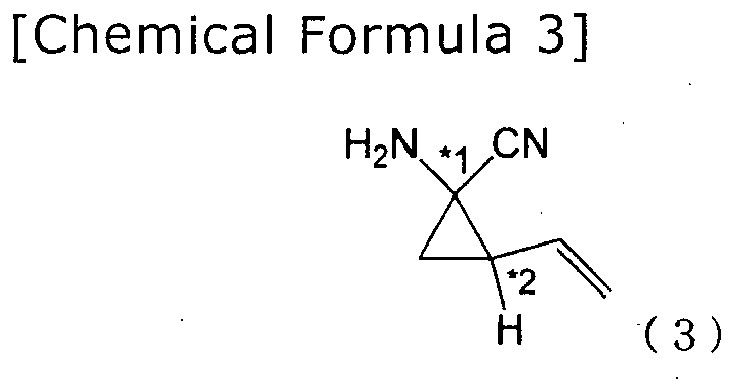
(wherein, *1 and *2 represent asymmetric carbon.) to obtain 1-amino-2-vinylcyclopropane carboxylic acid amide represented by formula (1) according to claim 1 or a salt thereof.
A method for producing 1-amino-2-vinylcyclopropane carboxylic acid or a salt thereof, comprising hydrolyzing 1-amino-2-vinylcyclopropane carboxylic acid amide represented by the following formula (1) or a salt thereof:

(wherein *1 and *2 represent asymmetric carbon.) to obtain 1-amino-2-vinylcyclopropane carboxylic acid represented by the following formula (4) or a salt thereof:

(wherein, *1 and *2 represent asymmetric carbon).
The method according to claim 7, which comprises allowing a microorganism or a processed product of the microorganism having stereoselectively hydrolyzing activity to act on a racemic mixture of 1-amino-2-vinylcyclopropane carboxylic acid amide represented by formula (1) or a salt thereof to generate optically active 1-amino-2-vinylcyclopropane carboxylic acid represented by formula (4) or a salt thereof.
The method according to claim 7 or 8, which comprises allowing a microorganism or a processed product of the microorganism having stereoselectively hydrolyzing activity to act on a mixture containing a (1R, 2S)-isomer and a (1S, 2R)-isomer of 1-amino-2-vinylcyclopropane carboxylic acid amide represented by formula (1) or of a salt thereof to generate optically active 1-amino-2-vinylcyclopropane carboxylic acid represented by formula (4).
Applications Claiming Priority (2)
| Application Number | Priority Date | Filing Date | Title |
|---|---|---|---|
| JP2011137246 | 2011-06-21 | ||
| PCT/JP2012/065452 WO2012176715A1 (en) | 2011-06-21 | 2012-06-18 | 1-amino-2-vinyl cyclopropane carboxylic acid amide, salt of same, and method for producing same |
Publications (1)
| Publication Number | Publication Date |
|---|---|
| EP2725012A1 true EP2725012A1 (en) | 2014-04-30 |
Family
ID=47422552
Family Applications (1)
| Application Number | Title | Priority Date | Filing Date |
|---|---|---|---|
| EP12802722.4A Withdrawn EP2725012A1 (en) | 2011-06-21 | 2012-06-18 | 1-amino-2-vinyl cyclopropane carboxylic acid amide, salt of same, and method for producing same |
Country Status (4)
| Country | Link |
|---|---|
| US (1) | US20140142337A1 (en) |
| EP (1) | EP2725012A1 (en) |
| JP (1) | JPWO2012176715A1 (en) |
| WO (1) | WO2012176715A1 (en) |
Cited By (1)
| Publication number | Priority date | Publication date | Assignee | Title |
|---|---|---|---|---|
| CN109863131A (en) * | 2016-10-12 | 2019-06-07 | 美国陶氏益农公司 | Preparation of (1R,3R)-2,2-dihalo-3-(substituted phenyl)cyclopropanecarboxylic acid and (1S,3S)-2,2-dihalo-3-(substituted phenyl) ring Propanecarboxylic acid method |
Families Citing this family (2)
| Publication number | Priority date | Publication date | Assignee | Title |
|---|---|---|---|---|
| WO2019189724A1 (en) * | 2018-03-30 | 2019-10-03 | 株式会社エーピーアイ コーポレーション | Novel hydrolase and method for producing (1s,2s)-1-alkoxycarbonyl-2-vinylcyclopropane carboxylic acid using same |
| CN116508749A (en) * | 2023-07-03 | 2023-08-01 | 四川科宏达集团有限责任公司 | Herbicide synergistic auxiliary agent and application thereof |
Family Cites Families (7)
| Publication number | Priority date | Publication date | Assignee | Title |
|---|---|---|---|---|
| US6323180B1 (en) | 1998-08-10 | 2001-11-27 | Boehringer Ingelheim (Canada) Ltd | Hepatitis C inhibitor tri-peptides |
| CA2549598A1 (en) * | 2003-12-15 | 2005-06-30 | Japan Tobacco Inc. | N-substituted-n-sulfonylaminocyclopropane compounds and pharmaceutical use thereof |
| ITMI20060179A1 (en) | 2006-02-02 | 2007-08-03 | Abiogen Pharma Spa | PROCEDURE FOR RESOLUTION OF RACEMIC MIXTURES AND DIASTEREOISOMERIC COMPLEX OF A SOLVING AGENT AND UNANTIOMER OF INTEREST |
| JP2009536158A (en) * | 2006-04-11 | 2009-10-08 | ノバルティス アクチエンゲゼルシャフト | HCV inhibitor |
| WO2008070358A2 (en) * | 2006-11-16 | 2008-06-12 | Phenomix Corporation | N-cyclopropyl-hydroxyproline-based tripeptidic hepatitis c serine protease inhibitors containing an isoindole, pyrrolopyridine, pyrrolopyrimidine or pyrrolopyrazine heterocycle in the side chain |
| US20110245529A1 (en) | 2008-10-10 | 2011-10-06 | Kaneka Corporation | Method for producing optically active vinylcyclopropanecarboxylic acid derivative and optically active vinylcyclopropaneamino acid derivative |
| US8927484B2 (en) * | 2009-12-03 | 2015-01-06 | Gilead Sciences, Inc. | Antiviral compounds |
-
2012
- 2012-06-18 EP EP12802722.4A patent/EP2725012A1/en not_active Withdrawn
- 2012-06-18 US US14/128,385 patent/US20140142337A1/en not_active Abandoned
- 2012-06-18 WO PCT/JP2012/065452 patent/WO2012176715A1/en not_active Ceased
- 2012-06-18 JP JP2013521566A patent/JPWO2012176715A1/en active Pending
Non-Patent Citations (1)
| Title |
|---|
| See references of WO2012176715A1 * |
Cited By (2)
| Publication number | Priority date | Publication date | Assignee | Title |
|---|---|---|---|---|
| CN109863131A (en) * | 2016-10-12 | 2019-06-07 | 美国陶氏益农公司 | Preparation of (1R,3R)-2,2-dihalo-3-(substituted phenyl)cyclopropanecarboxylic acid and (1S,3S)-2,2-dihalo-3-(substituted phenyl) ring Propanecarboxylic acid method |
| CN109863131B (en) * | 2016-10-12 | 2022-04-05 | 美国陶氏益农公司 | Method for preparing cyclopropanecarboxylic acid |
Also Published As
| Publication number | Publication date |
|---|---|
| US20140142337A1 (en) | 2014-05-22 |
| WO2012176715A1 (en) | 2012-12-27 |
| JPWO2012176715A1 (en) | 2015-02-23 |
Similar Documents
| Publication | Publication Date | Title |
|---|---|---|
| JP3789938B2 (en) | Racemic resolution of primary and secondary heteroatom-substituted amines by enzyme-catalyzed acylation | |
| KR20110025917A (en) | Stereoselective Enzymatic Hydrolysis Method of 5-methyl-3-nitromethyl-hexanoic Acid Ester | |
| US20140142337A1 (en) | 1-amino-2-vinylcyclopropane carboxylic acid amide and salt thereof, and method for producing same | |
| KR102791352B1 (en) | Enzymatic process for the preparation of (2s)-2-[(4r)-2-oxo-4-propyl-pyrrolidin-1-yl]butyric acid and its conversion into brivaracetam | |
| KR20000005286A (en) | Enzymatic process for stereoselective preparation of therapeutic amides | |
| WO2005073388A1 (en) | Processes for producing optically active 1-substituted 2-methylpyrrolidine and intermediate therefor | |
| CA2633358A1 (en) | Preparation of gamma-amino acids having affinity for the alpha-2-delta protein | |
| US7405070B2 (en) | Method for preparing (s)-indoline-2-carboxylic acid and (s)-indoline-2-carboxylic acid methyl ester using hydrolytic enzyme | |
| JP3819082B2 (en) | Optically active 3-N-substituted aminoisobutyric acids and salts thereof and process for producing them | |
| JP4843813B2 (en) | Method for preparing R- or S-form α-substituted heterocyclic carboxylic acid and enantiomer of α-substituted heterocyclic carboxylic acid ester of the opposite mirror image using enzyme | |
| JP4319847B2 (en) | Process for producing (1S, 2S) -2-fluorocyclopropanecarboxylic acid derivative | |
| WO2007078176A1 (en) | The method of making optically active 2-chloromandelic acid esters and 2-chloromandelic acids by enzymatic method | |
| JP2003534807A (en) | Optical resolution of racemic α-substituted heterocyclic carboxylic acids using enzymes | |
| WO1999004028A1 (en) | PROCESS FOR PREPARING OPTICALLY ACTIVE α-TRIFLUOROMETHYLLACTIC ACID AND ANTIPODE ESTERS THEREOF AND METHOD OF PURIFICATION THEREOF | |
| JP4476963B2 (en) | Optically active 3-N-substituted aminoisobutyric acids and salts thereof and process for producing them | |
| HK40077947B (en) | Enzymatic process for the preparation of (2s)-2-[(4r)-2-oxo-4-propyl-pyrrolidin-1-yl]butyric acid and its conversion into brivaracetam | |
| JP5092465B2 (en) | Stereoselective esterification of pipecolic acid | |
| EP1536017B1 (en) | Process for producing optically active octahydro-1H-indole-2-carboxylic acid | |
| JP4257975B2 (en) | Process for producing optically active aminoindanols and aminotetralinols | |
| KR100650546B1 (en) | Method for preparing optically active trans-1-alamino-2-indanol and esters thereof by enzymatic method | |
| JP2008222637A (en) | A method for producing optically active pipecolic acid or a derivative thereof. | |
| JP2007217402A (en) | Process for producing optically active biphenylalanine compound or salt thereof and ester thereof | |
| WO2006009338A1 (en) | Process for preparing chiral substituted carboxylic acid | |
| JP2000044521A (en) | Production of aminoacetic acid ester having tertiary hydrocarbon group at alfa-position | |
| JP2007202563A (en) | Method for producing and purifying optically active α-trifluoromethyl lactic acid and its enantiomer ester |
Legal Events
| Date | Code | Title | Description |
|---|---|---|---|
| PUAI | Public reference made under article 153(3) epc to a published international application that has entered the european phase |
Free format text: ORIGINAL CODE: 0009012 |
|
| 17P | Request for examination filed |
Effective date: 20140103 |
|
| AK | Designated contracting states |
Kind code of ref document: A1 Designated state(s): AL AT BE BG CH CY CZ DE DK EE ES FI FR GB GR HR HU IE IS IT LI LT LU LV MC MK MT NL NO PL PT RO RS SE SI SK SM TR |
|
| STAA | Information on the status of an ep patent application or granted ep patent |
Free format text: STATUS: THE APPLICATION HAS BEEN WITHDRAWN |
|
| 18W | Application withdrawn |
Effective date: 20140731 |