EP2716780A1 - Aluminum alloy and method of manufacturing extrusion using same - Google Patents
Aluminum alloy and method of manufacturing extrusion using same Download PDFInfo
- Publication number
- EP2716780A1 EP2716780A1 EP12793929.6A EP12793929A EP2716780A1 EP 2716780 A1 EP2716780 A1 EP 2716780A1 EP 12793929 A EP12793929 A EP 12793929A EP 2716780 A1 EP2716780 A1 EP 2716780A1
- Authority
- EP
- European Patent Office
- Prior art keywords
- aluminum alloy
- mass
- extruded shape
- content
- less
- Prior art date
- Legal status (The legal status is an assumption and is not a legal conclusion. Google has not performed a legal analysis and makes no representation as to the accuracy of the status listed.)
- Withdrawn
Links
Images




Classifications
-
- C—CHEMISTRY; METALLURGY
- C22—METALLURGY; FERROUS OR NON-FERROUS ALLOYS; TREATMENT OF ALLOYS OR NON-FERROUS METALS
- C22C—ALLOYS
- C22C21/00—Alloys based on aluminium
- C22C21/10—Alloys based on aluminium with zinc as the next major constituent
-
- B—PERFORMING OPERATIONS; TRANSPORTING
- B21—MECHANICAL METAL-WORKING WITHOUT ESSENTIALLY REMOVING MATERIAL; PUNCHING METAL
- B21C—MANUFACTURE OF METAL SHEETS, WIRE, RODS, TUBES, PROFILES OR LIKE SEMI-MANUFACTURED PRODUCTS OTHERWISE THAN BY ROLLING; AUXILIARY OPERATIONS USED IN CONNECTION WITH METAL-WORKING WITHOUT ESSENTIALLY REMOVING MATERIAL
- B21C23/00—Extruding metal; Impact extrusion
- B21C23/002—Extruding materials of special alloys so far as the composition of the alloy requires or permits special extruding methods of sequences
-
- B—PERFORMING OPERATIONS; TRANSPORTING
- B21—MECHANICAL METAL-WORKING WITHOUT ESSENTIALLY REMOVING MATERIAL; PUNCHING METAL
- B21C—MANUFACTURE OF METAL SHEETS, WIRE, RODS, TUBES, PROFILES OR LIKE SEMI-MANUFACTURED PRODUCTS OTHERWISE THAN BY ROLLING; AUXILIARY OPERATIONS USED IN CONNECTION WITH METAL-WORKING WITHOUT ESSENTIALLY REMOVING MATERIAL
- B21C23/00—Extruding metal; Impact extrusion
- B21C23/02—Making uncoated products
- B21C23/04—Making uncoated products by direct extrusion
- B21C23/08—Making wire, rods or tubes
- B21C23/085—Making tubes
-
- B—PERFORMING OPERATIONS; TRANSPORTING
- B21—MECHANICAL METAL-WORKING WITHOUT ESSENTIALLY REMOVING MATERIAL; PUNCHING METAL
- B21C—MANUFACTURE OF METAL SHEETS, WIRE, RODS, TUBES, PROFILES OR LIKE SEMI-MANUFACTURED PRODUCTS OTHERWISE THAN BY ROLLING; AUXILIARY OPERATIONS USED IN CONNECTION WITH METAL-WORKING WITHOUT ESSENTIALLY REMOVING MATERIAL
- B21C23/00—Extruding metal; Impact extrusion
- B21C23/02—Making uncoated products
- B21C23/04—Making uncoated products by direct extrusion
- B21C23/14—Making other products
- B21C23/142—Making profiles
-
- B—PERFORMING OPERATIONS; TRANSPORTING
- B60—VEHICLES IN GENERAL
- B60R—VEHICLES, VEHICLE FITTINGS, OR VEHICLE PARTS, NOT OTHERWISE PROVIDED FOR
- B60R19/00—Wheel guards; Radiator guards, e.g. grilles; Obstruction removers; Fittings damping bouncing force in collisions
- B60R19/02—Bumpers, i.e. impact receiving or absorbing members for protecting vehicles or fending off blows from other vehicles or objects
- B60R19/18—Bumpers, i.e. impact receiving or absorbing members for protecting vehicles or fending off blows from other vehicles or objects characterised by the cross-section; Means within the bumper to absorb impact
- B60R2019/1806—Structural beams therefor, e.g. shock-absorbing
- B60R2019/1813—Structural beams therefor, e.g. shock-absorbing made of metal
- B60R2019/182—Structural beams therefor, e.g. shock-absorbing made of metal of light metal, e.g. extruded
Definitions
- the invention relates to a high-strength aluminum alloy exhibiting excellent stress corrosion cracking resistance and ensuring high productivity, and a method for producing an extruded shape using the same.
- a high-strength aluminum material has been strongly desired for a vehicular structural member (e.g., side member) and a vehicular energy-absorbing member (e.g., bumper reinforcement and side door beam) in order to reduce fuel consumption through a reduction in weight.
- a vehicular structural member e.g., side member
- a vehicular energy-absorbing member e.g., bumper reinforcement and side door beam
- MgZn 2 precipitates having a potential lower than that of aluminum may be produced at the crystal grain boundaries, a deterioration in stress corrosion cracking resistance and a significant deterioration in extrudability may occur.
- the applicant of the present application proposed a high-strength aluminum alloy obtained by quenching an aluminum alloy that includes 1.5 to 2.0% of Mg, 7.0 to 9.0% of Zn, 0.2 to 0.4% of Cu, and the like after extrusion at a cooling rate of 1000°C/min or more (see Patent Document 1).
- Patent Document 1 exhibits high strength and excellent toughness. However, it is necessary to perform water quenching in order to achieve a cooling rate of 1000°C/min or more.
- Patent Document 2 discloses an aluminum alloy that is used to produce an automotive constituent member, and includes 0.9 to 1.3% of Mg, 8.0 to 10.0% of Zn, and 0.45 to 0.55% of Cu
- Patent Document 3 discloses a high-strength aluminum alloy that includes 1.0 to 1.5% ofMg, 5.0 to 7.0% of Zn, and 0.1 to 0.3% of Cu.
- the Mg content in these aluminum alloys is 1.3% or less or 1.5% or less, it is difficult to obtain a 0.2% proof stress of 470 MPa or more.
- Patent Document 2 since the Zn content is as high as 8% or more, a deterioration in stress corrosion cracking resistance may occur.
- Patent Document 4 discloses an aluminum alloy that includes 1.9 to 2.6% of Mg, 5.7 to 6.7% of Zn, and 2.0 to 2.6% of Cu. However, since the Cu content is 2.0% or more, it is expected that the extrudability significantly deteriorates. Therefore, the aluminum alloy disclosed in Patent Document 4 is not suitable for producing an extruded shape having a hollow cross-sectional shape (e.g., bumper reinforcement).
- An object of the invention is to provide a high-strength aluminum alloy exhibiting excellent stress corrosion cracking resistance and excellent extrudability, and a method for producing an extruded shape using the same.
- an aluminum alloy includes 1.6 to 2.6 mass% of Mg, 6.0 to 7.0 mass% of Zn, 0.5 mass% or less of Cu, and 0.01 to 0.05 mass% of Ti, with the balance being Al and unavoidable impurities.
- mass% may be hereinafter referred to as "%".
- the aluminum alloy that includes the above chemical components ensures that a high-strength extruded shape that exhibits a 0.2% proof stress of 470 MPa or more is obtained by performing air quenching without performing water quenching immediately after extrusion, or performing heating and water quenching after extrusion.
- the aluminum alloy may further include 0.15 to 0.6% of one element or two or more elements in total among Mn, Cr, and Zr in order to suppress formation of recrystallized grains on the surface of the extruded shape during extrusion.
- the stress corrosion cracking resistance is further improved by thus suppressing formation of recrystallized grains on the surface of the extruded shape.
- a method for producing an aluminum alloy extruded shape includes casting a billet using the aluminum alloy, homogenizing the billet at 500 to 560°C, and extruding the homogenized billet to obtain an extruded shape, the extruded shape being cooled by fan cooling at a cooling rate of 50 to 500°C/min immediately after the extrusion.
- the Mg content is less than 1.6%, it may be difficult to achieve a high strength necessary for achieving a reduction in weight of the resulting product. If the Mg content exceeds 2.6%, a deterioration in extrudability may occur.
- the Mg content is set to 1.6 to 2.6%.
- the Zn content is less than 6.0%, it may be difficult to achieve a high strength that is necessary for achieving a reduction in weight of the resulting product. If the Zn content exceeds 7.0%, a deterioration in stress corrosion cracking resistance may occur.
- the Zn content is set to 6.0 to 7.0%.
- Cu contributes to an increase in strength. However, if the Cu content exceeds 0.5%, a deterioration in extrudability may occur.
- the Cu content is set to 0.5% or less.
- the Cu content is preferably set to 0.1 to 0.5% from the viewpoint of obtaining the effect of addition of Cu.
- the Cu content is more preferably set to 0.15 to 0.4%.
- Mn, Cr, and Zr suppress formation of coarse recrystallized grains on the surface of the extruded shape, and suppress propagation of cracks, thereby contributing to an improvement in stress corrosion cracking resistance. If the total content of Mn, Cr, and Zr is less than 0.15%, the above effects may not be obtained. If the total content of Mn, Cr, and Zr exceeds 0.6%, the quench sensitivity may become high, and the desired strength may not be obtained.
- the content of that element is preferably set to 0.10 to 0.30%.
- Zr can sufficiently suppress formation of recrystallized grains when added alone, it is preferable to add Zr together with Mn and/or Cr in order to stabilize the fiber structure.
- Ti refines the crystal grains when casting a molten metal of the aluminum alloy into a billet. Ti is normally added within the range of 0.01 to 0.05%.
- Fe and Si are generally mixed as impurities during aluminum refinement and casting.
- a 7000 series high-strength aluminum alloy may show a deterioration in toughness when the amount of Fe and Si mixed therein is large.
- the Fe content is set to 0.3% or less, and preferably 0.2% or less.
- the Si content is preferably set to 0.1 % or less.
- the solute elements may not be sufficiently dissolved, and the desired strength may not be obtained.
- the billet is homogenized at a temperature of more than 560°C, the billet may be locally melted. Even if the billet is locally melted to only a small extent, and can be extruded, the amount of precipitates produced during homogenization is small, and recrystallization of the extruded shape may not be suppressed. As a result, a deterioration in stress corrosion cracking resistance may occur.
- the billet homogenization temperature is set to 500 to 560°C.
- the temperature of the extruded shape may be less than 500°C, and a supersaturated solid solution may not be formed by fan press quenching after extrusion. As a result, the desired strength may not be obtained.
- defects e.g., pickup or tearing may occur on the surface of the extruded shape.
- the billet preheating temperature it is preferable to set the billet preheating temperature to 400°C or more, and control the temperature of the extruded shape immediately after extrusion to 500 to 585°C.
- the cooling rate after extrusion is less than 50°C/min, the desired strength may not be obtained. It is difficult to achieve a cooling rate of 500°C/min or more by fan cooling due to an insufficient cooling capability. If a cooling rate of 500°C/min or more is achieved by water cooling (die edge T6) immediately after extrusion, the material may become brittle due to incorporation of hydrogen, and a deterioration in stress corrosion cracking resistance may occur.
- the aluminum alloy according to the aspect of the invention ensures that a high-strength extruded shape that exhibits a proof stress of 470 MPa or more is obtained by fan cooling without performing water quenching after extrusion as a result of optimizing the combination of the Mg content, the Zn content, and the Cu content, and exhibits excellent extrudability as a result of limiting the Cu content to 0.5% or less.
- a molten metal of each aluminum alloy shown in FIG. 1 (Examples 1 to 13) and a molten metal of each aluminum alloy shown in FIG. 2 (Comparative Examples 1 to 28) were prepared, and cast into a billet.
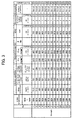
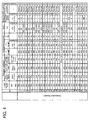
- FIGS. 3 and 4 show the billet homogenization temperature (HOMO temperature), the extrusion conditions, and the evaluation results.
- FIGS. 3 and 4 show the optimum ranges of the HOMO temperature and the extrusion conditions, and each data indicates the measured value.
- the billet temperature refers to the billet preheating temperature before extrusion
- the temperature of the extruded shape refers to the surface temperature of the extruded shape measured immediately after extrusion.
- the cooling rate after extrusion refers to the cooling rate until the temperature of the extruded shape reached 200°C or less when air was blown against the extruded shape using a fan immediately after extrusion.
- SCC refers to the stress corrosion cracking resistance.
- the stress corrosion cracking resistance was evaluated as described below.
- a structural material e.g., bumper reinforcement
- ⁇ B refers to tensile strength
- ⁇ 0.2 refers to proof stress
- ⁇ refers to elongation.
- the recrystallization ratio in the microstructure was determined by observing the cross section orthogonal to the extrusion direction using a microscope, and calculating the area ratio of the recrystallization area.
- the extrudability was determined to be normal when a surface defect having a depth of 0.5 mm or more was not observed when an extruded shape having the cross-sectional shape illustrated in FIGS. 5 to 7 was extruded, and the presence or absence of a surface defect (tearing or pickup) having a depth of 0.5 mm or more was evaluated.
- the aluminum alloy according to the embodiments of the invention exhibits excellent extrudability, and makes it possible to produce an extruded shape having the cross-sectional shape illustrated in FIGS. 5 to 7 .
- FIG. 5 illustrates an example of an extruded shape having a triple-hollow cross-sectional shape that is used for a bumper reinforcement and the like.
- the dimension a is more than 40 mm and 75 mm or less, and the dimension b is 120 mm or less, it is possible to produce an extruded shape wherein 3 ⁇ t 1 ⁇ 8, 1 ⁇ t 2 ⁇ 6, 1 ⁇ t 3 (t 31 , t 32 , ...) ⁇ 6.
- the extrudable dimensional range is similarly shown in FIGS. 6 and 7 .
- a high-strength extruded shape exhibiting excellent stress corrosion cracking resistance can be obtained using the aluminum alloy according to the embodiments of the invention.
- the extruded shape may be applied to a vehicular structural member and the like.
Landscapes
- Engineering & Computer Science (AREA)
- Mechanical Engineering (AREA)
- Chemical & Material Sciences (AREA)
- Materials Engineering (AREA)
- Metallurgy (AREA)
- Organic Chemistry (AREA)
- Extrusion Of Metal (AREA)
Abstract
Description
- The invention relates to a high-strength aluminum alloy exhibiting excellent stress corrosion cracking resistance and ensuring high productivity, and a method for producing an extruded shape using the same.
- A high-strength aluminum material has been strongly desired for a vehicular structural member (e.g., side member) and a vehicular energy-absorbing member (e.g., bumper reinforcement and side door beam) in order to reduce fuel consumption through a reduction in weight.
- However, when the content of Mg, Zn, Cu, and the like in a JIS 7000 series aluminum alloy is increased in order to improve the strength of the material, a decrease in toughness that has a trade-off relationship with the strength may occur. Moreover, since MgZn2 precipitates having a potential lower than that of aluminum may be produced at the crystal grain boundaries, a deterioration in stress corrosion cracking resistance and a significant deterioration in extrudability may occur.
- The applicant of the present application proposed a high-strength aluminum alloy obtained by quenching an aluminum alloy that includes 1.5 to 2.0% of Mg, 7.0 to 9.0% of Zn, 0.2 to 0.4% of Cu, and the like after extrusion at a cooling rate of 1000°C/min or more (see Patent Document 1).
- The aluminum material disclosed in
Patent Document 1 exhibits high strength and excellent toughness. However, it is necessary to perform water quenching in order to achieve a cooling rate of 1000°C/min or more. - Since the extruded shape may become brittle due to incorporation of hydrogen during water quenching, there has been room for a further improvement in stress corrosion cracking resistance.
- As an aluminum alloy that is characterized by the content of Mg, Zn, and Cu,
Patent Document 2 discloses an aluminum alloy that is used to produce an automotive constituent member, and includes 0.9 to 1.3% of Mg, 8.0 to 10.0% of Zn, and 0.45 to 0.55% of Cu, andPatent Document 3 discloses a high-strength aluminum alloy that includes 1.0 to 1.5% ofMg, 5.0 to 7.0% of Zn, and 0.1 to 0.3% of Cu. However, since the Mg content in these aluminum alloys is 1.3% or less or 1.5% or less, it is difficult to obtain a 0.2% proof stress of 470 MPa or more. - In
Patent Document 2, since the Zn content is as high as 8% or more, a deterioration in stress corrosion cracking resistance may occur. -
Patent Document 4 discloses an aluminum alloy that includes 1.9 to 2.6% of Mg, 5.7 to 6.7% of Zn, and 2.0 to 2.6% of Cu. However, since the Cu content is 2.0% or more, it is expected that the extrudability significantly deteriorates. Therefore, the aluminum alloy disclosed inPatent Document 4 is not suitable for producing an extruded shape having a hollow cross-sectional shape (e.g., bumper reinforcement). - Patent Document 1: Japanese Patent No.
3735407 - Patent Document 2: Japanese Patent No.
3834076 - Patent Document 3: Japanese Patent No.
2928445 - Patent Document 4: Japanese Patent No.
4498180 - An object of the invention is to provide a high-strength aluminum alloy exhibiting excellent stress corrosion cracking resistance and excellent extrudability, and a method for producing an extruded shape using the same.
- According to one aspect of the invention, an aluminum alloy includes 1.6 to 2.6 mass% of Mg, 6.0 to 7.0 mass% of Zn, 0.5 mass% or less of Cu, and 0.01 to 0.05 mass% of Ti, with the balance being Al and unavoidable impurities. Note that the unit "mass%" may be hereinafter referred to as "%".
- The aluminum alloy that includes the above chemical components ensures that a high-strength extruded shape that exhibits a 0.2% proof stress of 470 MPa or more is obtained by performing air quenching without performing water quenching immediately after extrusion, or performing heating and water quenching after extrusion.
- Since water quenching is unnecessary, incorporation of hydrogen that may cause stress corrosion cracking does not occur, and the stress corrosion cracking resistance is improved.
- The aluminum alloy may further include 0.15 to 0.6% of one element or two or more elements in total among Mn, Cr, and Zr in order to suppress formation of recrystallized grains on the surface of the extruded shape during extrusion.
- The stress corrosion cracking resistance is further improved by thus suppressing formation of recrystallized grains on the surface of the extruded shape.
- According to another aspect of the invention, a method for producing an aluminum alloy extruded shape includes casting a billet using the aluminum alloy, homogenizing the billet at 500 to 560°C, and extruding the homogenized billet to obtain an extruded shape, the extruded shape being cooled by fan cooling at a cooling rate of 50 to 500°C/min immediately after the extrusion. According to the above configuration, the stress corrosion cracking resistance can be improved while ensuring high strength since water quenching is unnecessary.
- The reasons for selection of the chemical components (mass%) and the production conditions are described below.
- If the Mg content is less than 1.6%, it may be difficult to achieve a high strength necessary for achieving a reduction in weight of the resulting product. If the Mg content exceeds 2.6%, a deterioration in extrudability may occur.
- Therefore, the Mg content is set to 1.6 to 2.6%.
- If the Zn content is less than 6.0%, it may be difficult to achieve a high strength that is necessary for achieving a reduction in weight of the resulting product. If the Zn content exceeds 7.0%, a deterioration in stress corrosion cracking resistance may occur.
- Therefore, the Zn content is set to 6.0 to 7.0%.
- Cu contributes to an increase in strength. However, if the Cu content exceeds 0.5%, a deterioration in extrudability may occur.
- Therefore, the Cu content is set to 0.5% or less. The Cu content is preferably set to 0.1 to 0.5% from the viewpoint of obtaining the effect of addition of Cu.
- The Cu content is more preferably set to 0.15 to 0.4%.
- Mn, Cr, and Zr suppress formation of coarse recrystallized grains on the surface of the extruded shape, and suppress propagation of cracks, thereby contributing to an improvement in stress corrosion cracking resistance. If the total content of Mn, Cr, and Zr is less than 0.15%, the above effects may not be obtained. If the total content of Mn, Cr, and Zr exceeds 0.6%, the quench sensitivity may become high, and the desired strength may not be obtained.
- When adding only one element among Mn, Cr, and Zr, the content of that element is preferably set to 0.10 to 0.30%.
- Although Zr can sufficiently suppress formation of recrystallized grains when added alone, it is preferable to add Zr together with Mn and/or Cr in order to stabilize the fiber structure.
- Ti refines the crystal grains when casting a molten metal of the aluminum alloy into a billet. Ti is normally added within the range of 0.01 to 0.05%.
- Fe and Si are generally mixed as impurities during aluminum refinement and casting.
- A 7000 series high-strength aluminum alloy may show a deterioration in toughness when the amount of Fe and Si mixed therein is large. The Fe content is set to 0.3% or less, and preferably 0.2% or less.
- The Si content is preferably set to 0.1 % or less.
- It is preferable to limit the total content of impurities excluding Fe and Si to 0.1 % or less.
- The billet homogenization conditions and the extrusion conditions are described below.
- If the billet is homogenized at a temperature of less than 500°C, the solute elements may not be sufficiently dissolved, and the desired strength may not be obtained. If the billet is homogenized at a temperature of more than 560°C, the billet may be locally melted. Even if the billet is locally melted to only a small extent, and can be extruded, the amount of precipitates produced during homogenization is small, and recrystallization of the extruded shape may not be suppressed. As a result, a deterioration in stress corrosion cracking resistance may occur.
- Therefore, the billet homogenization temperature is set to 500 to 560°C.
- If the billet is not heated at a temperature of 400°C or more during extrusion, the temperature of the extruded shape may be less than 500°C, and a supersaturated solid solution may not be formed by fan press quenching after extrusion. As a result, the desired strength may not be obtained.
- If the temperature of the extruded shape exceeds 585°C, defects (e.g., pickup or tearing) may occur on the surface of the extruded shape.
- Therefore, it is preferable to set the billet preheating temperature to 400°C or more, and control the temperature of the extruded shape immediately after extrusion to 500 to 585°C.
- If the cooling rate after extrusion is less than 50°C/min, the desired strength may not be obtained. It is difficult to achieve a cooling rate of 500°C/min or more by fan cooling due to an insufficient cooling capability. If a cooling rate of 500°C/min or more is achieved by water cooling (die edge T6) immediately after extrusion, the material may become brittle due to incorporation of hydrogen, and a deterioration in stress corrosion cracking resistance may occur.
- Therefore, it is preferable to control the cooling rate to 50 to 500°C/min by means of fan cooling without using water cooling.
- The aluminum alloy according to the aspect of the invention ensures that a high-strength extruded shape that exhibits a proof stress of 470 MPa or more is obtained by fan cooling without performing water quenching after extrusion as a result of optimizing the combination of the Mg content, the Zn content, and the Cu content, and exhibits excellent extrudability as a result of limiting the Cu content to 0.5% or less.
- Therefore, it is possible to produce an extruded shape having a solid cross section (see
FIG. 7 ) and an extruded shape having a hollow cross section (triple-hollow cross section) (seeFIGS. 5 and6 ). - Since high strength can be obtained without performing water quenching, it is possible to prevent a deterioration in stress corrosion cracking resistance due to incorporation of hydrogen.
-
-
FIG. 1 shows the chemical components of the aluminum alloys of the examples. -
FIG. 2 shows the chemical components of the aluminum alloys of the comparative examples. -
FIG. 3 shows the extrusion conditions and the evaluation results when using the aluminum alloys of the examples. -
FIG. 4 shows the extrusion conditions and the evaluation results when using the aluminum alloys of the comparative examples. -
FIG. 5 illustrates an example of the cross-sectional shape of an extruded shape. -
FIG. 6 illustrates an example of the cross-sectional shape of an extruded shape. -
FIG. 7 illustrates an example of the cross-sectional shape of an extruded shape. - A molten metal of each aluminum alloy shown in
FIG. 1 (Examples 1 to 13) and a molten metal of each aluminum alloy shown inFIG. 2 (Comparative Examples 1 to 28) were prepared, and cast into a billet. - Note that the content (mass%) of each component shown in
FIGS. 1 and2 indicates the analytical value after casting. - Each cast billet (diameter: 8 inches) was extruded.
-
FIGS. 3 and4 show the billet homogenization temperature (HOMO temperature), the extrusion conditions, and the evaluation results. -
FIGS. 3 and4 show the optimum ranges of the HOMO temperature and the extrusion conditions, and each data indicates the measured value. - In
FIGS. 3 and4 , the billet temperature refers to the billet preheating temperature before extrusion, and the temperature of the extruded shape refers to the surface temperature of the extruded shape measured immediately after extrusion. - The cooling rate after extrusion refers to the cooling rate until the temperature of the extruded shape reached 200°C or less when air was blown against the extruded shape using a fan immediately after extrusion.
- SCC refers to the stress corrosion cracking resistance. The stress corrosion cracking resistance was evaluated as described below.
- Specifically, an accelerated test was performed by immersing a sample (to which a stress equal to 80% of the proof stress was applied) in a 3.5% NaCl aqueous solution at 25°C for 10 minutes, and allowing the sample to dry at a temperature of 25°C (room temperature) and a humidity of 40% for 50 minutes (=1 cycle). When stress corrosion cracking was not observed after 720 cycles, it was determined that the sample had stress corrosion cracking resistance sufficient for a structural material (e.g., bumper reinforcement).
- In
FIGS. 3 and4 , σB refers to tensile strength, σ0.2 refers to proof stress, and δ refers to elongation. These mechanical properties were measured using a JIS Z 2241 No. 5 specimen that was cut from the extruded shape. - The recrystallization ratio in the microstructure was determined by observing the cross section orthogonal to the extrusion direction using a microscope, and calculating the area ratio of the recrystallization area.
- The extrudability was determined to be normal when a surface defect having a depth of 0.5 mm or more was not observed when an extruded shape having the cross-sectional shape illustrated in
FIGS. 5 to 7 was extruded, and the presence or absence of a surface defect (tearing or pickup) having a depth of 0.5 mm or more was evaluated. - In Examples 1 to 13, a proof stress of 470 MPa or more that is necessary for achieving a reduction in weight of a bumper reinforcement and the like was obtained, and excellent stress corrosion cracking resistance was achieved.
- In Comparative Examples 1 and 2 in which the HOMO temperature was more than 560°C, the billet was locally melted to only a small extent, and could be extruded. However, since the amount of precipitates produced during homogenization was small, and recrystallization of the extruded shape could not be suppressed, the stress corrosion cracking resistance deteriorated.
- In Comparative Examples 3, 5, 8, 10 to 15, and 20, since the Mg content was less than 1.6%, a proof stress of 470 MPa or more could not be obtained.
- In Comparative Examples 16 and 25, since the Zn content was more than 7.0%, the stress corrosion cracking resistance deteriorated.
- In Comparative Examples 4 and 6 in which the Mg content was less than 1.6%, and the Zn content was more than 7.0%, the desired strength was obtained, but the stress corrosion cracking resistance deteriorated.
- In Comparative Example 7, since the Zn content was less than 6.0%, the desired strength could not be obtained.
- In Comparative Example 9, since the cooling rate after extrusion was less than 50°C/min, the desired strength could not be obtained.
- In Comparative Examples 17 and 18 in which the HOMO temperature did not fall within the optimum range, the desired strength could not be obtained when the HOMO temperature was lower than the optimum range, and the billet was locally melted, and could not be extruded when the HOMO temperature was higher than the optimum range.
- In Comparative Example 19, since the Mg content was less than 1.6%, and the cooling rate after extrusion was less than 50°C/min, the desired strength could not be obtained.
- In Comparative Example 21, since the Mg content was less than 1.6%, the desired strength could not be obtained. Moreover, since the total content of Mn, Cr, and Zr was less than 0.15%, recrystallization of the extruded shape could not be suppressed, and the stress corrosion cracking resistance deteriorated.
- In Comparative Example 22, since the Mg content was less than 1.6%, the desired strength could not be obtained. Moreover, since water cooling was performed after extrusion, the cooling rate exceeded 500°C/min, and the material became brittle due to incorporation of hydrogen. As a result, the stress corrosion cracking resistance deteriorated.
- In Comparative Examples 23 and 24, since the temperature of the extruded shape was higher than 585°C, pickup or tear occurred on the surface of the extruded profile.
- In Comparative Example 26, since the Mg content was less than 1.6%, the desired strength could not be obtained. Moreover, since the Zn content was more than 7.0%, sufficient stress corrosion cracking resistance could not be obtained.
- In Comparative Examples 27 and 28, since the Mg content was less than 1.6%, the desired strength could not be obtained. Moreover, since the total content of Mn, Cr, and Zn was less than 0.15%, recrystallization of the extruded shape could not be suppressed, and the stress corrosion cracking resistance deteriorated.
- The aluminum alloy according to the embodiments of the invention exhibits excellent extrudability, and makes it possible to produce an extruded shape having the cross-sectional shape illustrated in
FIGS. 5 to 7 . -
FIG. 5 illustrates an example of an extruded shape having a triple-hollow cross-sectional shape that is used for a bumper reinforcement and the like. When the dimension a is more than 40 mm and 75 mm or less, and the dimension b is 120 mm or less, it is possible to produce an extruded shape wherein 3≤t1≤8, 1≤t2≤6, 1≤t3(t31, t32, ...)≤6. - The extrudable dimensional range is similarly shown in
FIGS. 6 and7 . - A high-strength extruded shape exhibiting excellent stress corrosion cracking resistance can be obtained using the aluminum alloy according to the embodiments of the invention. The extruded shape may be applied to a vehicular structural member and the like.
Claims (3)
- An aluminum alloy comprising 1.6 to 2.6 mass% of Mg, 6.0 to 7.0 mass% of Zn, 0.5 mass% or less of Cu, and 0.01 to 0.05 mass% of Ti, with the balance being Al and unavoidable impurities.
- An aluminum alloy comprising 1.6 to 2.6 mass% of Mg, 6.0 to 7.0 mass% of Zn, 0.1 to 0.5 mass% of Cu, 0.01 to 0.05 mass% of Ti, and 0.15 to 0.6 mass% of one element or two or more elements in total among Mn, Cr, and Zr, with the balance being Al and unavoidable impurities.
- A method for producing an aluminum alloy extruded shape comprising casting a billet using the aluminum alloy as defined in claim 1 or 2, homogenizing the billet at 500 to 560°C, and extruding the homogenized billet to obtain an extruded shape, the extruded shape being cooled at a cooling rate of 50 to 500°C/min immediately after the extrusion.
Applications Claiming Priority (2)
| Application Number | Priority Date | Filing Date | Title |
|---|---|---|---|
| JP2011124276 | 2011-06-02 | ||
| PCT/JP2012/060949 WO2012165086A1 (en) | 2011-06-02 | 2012-04-24 | Aluminum alloy and method of manufacturing extrusion using same |
Publications (2)
| Publication Number | Publication Date |
|---|---|
| EP2716780A1 true EP2716780A1 (en) | 2014-04-09 |
| EP2716780A4 EP2716780A4 (en) | 2014-11-05 |
Family
ID=47258950
Family Applications (1)
| Application Number | Title | Priority Date | Filing Date |
|---|---|---|---|
| EP12793929.6A Withdrawn EP2716780A4 (en) | 2011-06-02 | 2012-04-24 | Aluminum alloy and method of manufacturing extrusion using same |
Country Status (5)
| Country | Link |
|---|---|
| US (1) | US10087508B2 (en) |
| EP (1) | EP2716780A4 (en) |
| JP (1) | JP5834077B2 (en) |
| CN (1) | CN103608477A (en) |
| WO (1) | WO2012165086A1 (en) |
Cited By (2)
| Publication number | Priority date | Publication date | Assignee | Title |
|---|---|---|---|---|
| CN104120313A (en) * | 2014-08-06 | 2014-10-29 | 田丽 | High-strength aluminum alloy material |
| EP3135790A4 (en) * | 2014-05-29 | 2017-06-07 | Mitsubishi Heavy Industries, Ltd. | Method for manufacturing aluminum alloy member and aluminum alloy member using same |
Families Citing this family (12)
| Publication number | Priority date | Publication date | Assignee | Title |
|---|---|---|---|---|
| JP5767624B2 (en) * | 2012-02-16 | 2015-08-19 | 株式会社神戸製鋼所 | Aluminum alloy hollow extruded material for electromagnetic forming |
| JP6096488B2 (en) * | 2012-11-30 | 2017-03-15 | アイシン軽金属株式会社 | Billet for extrusion molding of 7000 series aluminum alloy and method for producing extruded profile |
| JP6195448B2 (en) * | 2013-01-30 | 2017-09-13 | 株式会社神戸製鋼所 | Method for producing 7000 series aluminum alloy member excellent in stress corrosion cracking resistance |
| JP6406971B2 (en) * | 2014-10-17 | 2018-10-17 | 三菱重工業株式会社 | Method for producing aluminum alloy member |
| CN106636808A (en) * | 2015-10-29 | 2017-05-10 | 比亚迪股份有限公司 | Aluminum alloy and preparation method thereof |
| JP7093611B2 (en) * | 2016-11-30 | 2022-06-30 | アイシン軽金属株式会社 | Aluminum alloy for extruded material and method for manufacturing extruded material and extruded material using it |
| CN107447141B (en) * | 2017-08-10 | 2019-01-11 | 广东和胜工业铝材股份有限公司 | A kind of electronic product casing high-strength aluminum alloy and preparation method thereof |
| JP7018332B2 (en) * | 2018-02-24 | 2022-02-10 | アイシン軽金属株式会社 | Manufacturing method of bent molded products using aluminum alloy |
| JP6672503B1 (en) * | 2019-03-28 | 2020-03-25 | 株式会社神戸製鋼所 | Automotive door beams made of extruded aluminum alloy |
| JP7172833B2 (en) * | 2019-04-24 | 2022-11-16 | 日本軽金属株式会社 | Aluminum alloy material and its manufacturing method |
| CN110218919B (en) * | 2019-07-12 | 2021-09-21 | 广亚铝业有限公司 | High-strength aluminum alloy material and preparation method thereof |
| JP2020164980A (en) * | 2020-01-22 | 2020-10-08 | 株式会社神戸製鋼所 | Automobile door beam made of extruded aluminum alloy material |
Family Cites Families (24)
| Publication number | Priority date | Publication date | Assignee | Title |
|---|---|---|---|---|
| BE785856A (en) | 1971-07-05 | 1973-01-05 | Alcan Res & Dev | IMPROVED ALUMINUM ALLOYS |
| JPH0273941A (en) | 1988-09-07 | 1990-03-13 | Kobe Steel Ltd | Aluminum alloy excellent in bendability |
| JPH0794701B2 (en) * | 1991-04-01 | 1995-10-11 | 住友軽金属工業株式会社 | Manufacturing method of aluminum alloy soft material for welded structure |
| JP2928445B2 (en) | 1993-08-31 | 1999-08-03 | 株式会社神戸製鋼所 | High-strength aluminum alloy extruded material and method for producing the same |
| JPH08144031A (en) * | 1994-11-28 | 1996-06-04 | Furukawa Electric Co Ltd:The | Method for producing hollow Al-Zn-Mg alloy material excellent in strength and formability |
| JP3834076B2 (en) | 1995-04-21 | 2006-10-18 | 昭和電工株式会社 | Extruded material manufacturing method |
| JPH09125184A (en) | 1995-11-07 | 1997-05-13 | Kobe Steel Ltd | Welding structural material made of aluminum alloy and its production |
| JP3735407B2 (en) | 1996-04-02 | 2006-01-18 | アイシン軽金属株式会社 | High strength aluminum alloy |
| JP3772962B2 (en) * | 1999-09-02 | 2006-05-10 | 株式会社神戸製鋼所 | Automotive bumper reinforcement |
| JP2001115227A (en) * | 1999-10-15 | 2001-04-24 | Furukawa Electric Co Ltd:The | High-strength aluminum alloy extruded material with excellent surface properties and motorcycle frame using the extruded material |
| JP4498180B2 (en) | 2005-03-18 | 2010-07-07 | 古河スカイ株式会社 | Al-Zn-Mg-Cu-based aluminum alloy containing Zr and method for producing the same |
| JP2006316295A (en) | 2005-05-10 | 2006-11-24 | Furukawa Sky Kk | Aluminum alloy extruded material for high temperature forming and high temperature formed product thereof |
| JP2007011990A (en) | 2005-07-04 | 2007-01-18 | Hitachi Ltd | Business portfolio simulation system |
| JP4977281B2 (en) * | 2005-09-27 | 2012-07-18 | アイシン軽金属株式会社 | High-strength aluminum alloy extruded material excellent in shock absorption and stress corrosion cracking resistance and method for producing the same |
| JP4753240B2 (en) * | 2005-10-04 | 2011-08-24 | 三菱アルミニウム株式会社 | High-strength aluminum alloy material and method for producing the alloy material |
| JP5345056B2 (en) | 2006-06-30 | 2013-11-20 | コンステリウム ロールド プロダクツ−レイヴンズウッド,エルエルシー | Heat-treatable high-strength aluminum alloy |
| CN101179216B (en) * | 2006-11-10 | 2012-06-27 | 乐金电子(天津)电器有限公司 | Rotary compressor |
| EP2141253B1 (en) | 2007-03-26 | 2015-09-16 | Aisin Keikinzoku Co., Ltd. | Process for producing a 7000 aluminum alloy extrudate |
| JP5344855B2 (en) * | 2008-06-05 | 2013-11-20 | 株式会社神戸製鋼所 | Aluminum alloy extruded material with excellent crushing properties |
| JP5279119B2 (en) | 2008-07-10 | 2013-09-04 | アイシン軽金属株式会社 | Partially modified aluminum alloy member and manufacturing method thereof |
| DE112009002557A5 (en) * | 2008-10-30 | 2011-10-13 | Aleris Aluminium Duffel Bvba | Structure automotive component from an aluminum alloy sheet product |
| JP5237128B2 (en) * | 2009-01-09 | 2013-07-17 | 株式会社神戸製鋼所 | Aluminum alloy bumper system manufacturing method and aluminum alloy bumper system |
| JP5409125B2 (en) | 2009-05-29 | 2014-02-05 | アイシン軽金属株式会社 | 7000 series aluminum alloy extruded material excellent in SCC resistance and method for producing the same |
| JP5725492B2 (en) | 2010-05-18 | 2015-05-27 | アイシン軽金属株式会社 | High strength 7000 series aluminum alloy extruded material |
-
2012
- 2012-04-24 EP EP12793929.6A patent/EP2716780A4/en not_active Withdrawn
- 2012-04-24 US US14/118,793 patent/US10087508B2/en active Active
- 2012-04-24 WO PCT/JP2012/060949 patent/WO2012165086A1/en not_active Ceased
- 2012-04-24 CN CN201280026367.XA patent/CN103608477A/en active Pending
- 2012-04-24 JP JP2013517929A patent/JP5834077B2/en active Active
Cited By (3)
| Publication number | Priority date | Publication date | Assignee | Title |
|---|---|---|---|---|
| EP3135790A4 (en) * | 2014-05-29 | 2017-06-07 | Mitsubishi Heavy Industries, Ltd. | Method for manufacturing aluminum alloy member and aluminum alloy member using same |
| US10655202B2 (en) | 2014-05-29 | 2020-05-19 | Mitsubishi Heavy Industries, Ltd. | Method for manufacturing aluminum alloy member and aluminum alloy member manufactured by the same |
| CN104120313A (en) * | 2014-08-06 | 2014-10-29 | 田丽 | High-strength aluminum alloy material |
Also Published As
| Publication number | Publication date |
|---|---|
| US20140102601A1 (en) | 2014-04-17 |
| JP5834077B2 (en) | 2015-12-16 |
| JPWO2012165086A1 (en) | 2015-02-23 |
| CN103608477A (en) | 2014-02-26 |
| WO2012165086A1 (en) | 2012-12-06 |
| US10087508B2 (en) | 2018-10-02 |
| EP2716780A4 (en) | 2014-11-05 |
Similar Documents
| Publication | Publication Date | Title |
|---|---|---|
| US10087508B2 (en) | Aluminum alloy and method of manufacturing extrusion using same | |
| US11136658B2 (en) | High strength aluminum alloy extruded material with excellent corrosion resistance and favorable quenching properties and manufacturing method therefor | |
| US8105449B2 (en) | High-strength aluminum alloy extruded product with excellent impact absorption and stress corrosion cracking resistance and method of manufacturing the same | |
| CA2908196C (en) | High strength, high formability, and low cost aluminum-lithium alloys | |
| US20120312427A1 (en) | High-strength aluminum alloy product and method of producing the same | |
| EP2811043B1 (en) | High-strength aluminum alloy extrudate with excellent corrosion resistance, ductility, and hardenability and process for producing same | |
| AU2017367371B2 (en) | Aluminum alloy for extruded material, extruded material using the same, and method for producing extruded material | |
| JP2010070847A (en) | Al-Mg-Si-BASED ALUMINUM ALLOY EXTRUDED PRODUCT EXHIBITING EXCELLENT FATIGUE STRENGTH AND IMPACT FRACTURE RESISTANCE | |
| KR102723102B1 (en) | 6XXX aluminum alloy for extrusion with excellent crash performance and high yield strength and its manufacturing method | |
| JP6329430B2 (en) | High yield strength Al-Zn aluminum alloy extruded material with excellent bendability | |
| JP2012097321A (en) | High-strength aluminum alloy forged product excellent in stress corrosion cracking resistance and forging method for the same | |
| JP6612029B2 (en) | High strength aluminum alloy extruded material with excellent impact resistance and method for producing the same | |
| JP6096488B2 (en) | Billet for extrusion molding of 7000 series aluminum alloy and method for producing extruded profile | |
| JP7439994B2 (en) | Aluminum alloy extrusion material and its manufacturing method | |
| WO2015077880A1 (en) | Aluminum alloy combining high strength and extrudability, and low quench sensitivity | |
| JP2016108653A (en) | Aluminum alloy for extruded shape and extruded shape using the same | |
| US11827967B2 (en) | Method for producing aluminum alloy extruded material | |
| JP5823010B2 (en) | High-strength aluminum alloy extruded material for automotive structural members with excellent stress corrosion cracking resistance | |
| JP2009221531A (en) | Al-Mg BASED ALUMINUM ALLOY EXTRUDED MATERIAL FOR COLD WORKING, AND METHOD FOR PRODUCING THE SAME | |
| CN119137306A (en) | Method for producing high-strength aluminum alloy extrusion material with excellent SCC resistance |
Legal Events
| Date | Code | Title | Description |
|---|---|---|---|
| PUAI | Public reference made under article 153(3) epc to a published international application that has entered the european phase |
Free format text: ORIGINAL CODE: 0009012 |
|
| 17P | Request for examination filed |
Effective date: 20131118 |
|
| AK | Designated contracting states |
Kind code of ref document: A1 Designated state(s): AL AT BE BG CH CY CZ DE DK EE ES FI FR GB GR HR HU IE IS IT LI LT LU LV MC MK MT NL NO PL PT RO RS SE SI SK SM TR |
|
| DAX | Request for extension of the european patent (deleted) | ||
| A4 | Supplementary search report drawn up and despatched |
Effective date: 20141009 |
|
| RIC1 | Information provided on ipc code assigned before grant |
Ipc: B21C 23/00 20060101ALI20141002BHEP Ipc: C22C 21/10 20060101AFI20141002BHEP Ipc: C22F 1/053 20060101ALI20141002BHEP Ipc: C22F 1/00 20060101ALI20141002BHEP |
|
| 17Q | First examination report despatched |
Effective date: 20151013 |
|
| STAA | Information on the status of an ep patent application or granted ep patent |
Free format text: STATUS: THE APPLICATION IS DEEMED TO BE WITHDRAWN |
|
| 18D | Application deemed to be withdrawn |
Effective date: 20160224 |