EP2713238B1 - Power management in a monitoring camera. - Google Patents
Power management in a monitoring camera. Download PDFInfo
- Publication number
- EP2713238B1 EP2713238B1 EP12186789.9A EP12186789A EP2713238B1 EP 2713238 B1 EP2713238 B1 EP 2713238B1 EP 12186789 A EP12186789 A EP 12186789A EP 2713238 B1 EP2713238 B1 EP 2713238B1
- Authority
- EP
- European Patent Office
- Prior art keywords
- power level
- level
- processing state
- monitoring camera
- energy
- Prior art date
- Legal status (The legal status is an assumption and is not a legal conclusion. Google has not performed a legal analysis and makes no representation as to the accuracy of the status listed.)
- Active
Links
Images
Classifications
-
- G—PHYSICS
- G06—COMPUTING OR CALCULATING; COUNTING
- G06F—ELECTRIC DIGITAL DATA PROCESSING
- G06F1/00—Details not covered by groups G06F3/00 - G06F13/00 and G06F21/00
- G06F1/26—Power supply means, e.g. regulation thereof
- G06F1/263—Arrangements for using multiple switchable power supplies, e.g. battery and AC
-
- H—ELECTRICITY
- H04—ELECTRIC COMMUNICATION TECHNIQUE
- H04N—PICTORIAL COMMUNICATION, e.g. TELEVISION
- H04N7/00—Television systems
- H04N7/18—Closed-circuit television [CCTV] systems, i.e. systems in which the video signal is not broadcast
-
- G—PHYSICS
- G06—COMPUTING OR CALCULATING; COUNTING
- G06F—ELECTRIC DIGITAL DATA PROCESSING
- G06F1/00—Details not covered by groups G06F3/00 - G06F13/00 and G06F21/00
- G06F1/26—Power supply means, e.g. regulation thereof
- G06F1/266—Arrangements to supply power to external peripherals either directly from the computer or under computer control, e.g. supply of power through the communication port, computer controlled power-strips
-
- G—PHYSICS
- G06—COMPUTING OR CALCULATING; COUNTING
- G06F—ELECTRIC DIGITAL DATA PROCESSING
- G06F1/00—Details not covered by groups G06F3/00 - G06F13/00 and G06F21/00
- G06F1/26—Power supply means, e.g. regulation thereof
- G06F1/32—Means for saving power
- G06F1/3203—Power management, i.e. event-based initiation of a power-saving mode
- G06F1/3234—Power saving characterised by the action undertaken
- G06F1/325—Power saving in peripheral device
-
- G—PHYSICS
- G06—COMPUTING OR CALCULATING; COUNTING
- G06F—ELECTRIC DIGITAL DATA PROCESSING
- G06F1/00—Details not covered by groups G06F3/00 - G06F13/00 and G06F21/00
- G06F1/26—Power supply means, e.g. regulation thereof
- G06F1/32—Means for saving power
- G06F1/3203—Power management, i.e. event-based initiation of a power-saving mode
- G06F1/3234—Power saving characterised by the action undertaken
- G06F1/3287—Power saving characterised by the action undertaken by switching off individual functional units in the computer system
-
- H—ELECTRICITY
- H04—ELECTRIC COMMUNICATION TECHNIQUE
- H04N—PICTORIAL COMMUNICATION, e.g. TELEVISION
- H04N23/00—Cameras or camera modules comprising electronic image sensors; Control thereof
- H04N23/60—Control of cameras or camera modules
- H04N23/61—Control of cameras or camera modules based on recognised objects
- H04N23/611—Control of cameras or camera modules based on recognised objects where the recognised objects include parts of the human body
-
- H—ELECTRICITY
- H04—ELECTRIC COMMUNICATION TECHNIQUE
- H04N—PICTORIAL COMMUNICATION, e.g. TELEVISION
- H04N23/00—Cameras or camera modules comprising electronic image sensors; Control thereof
- H04N23/60—Control of cameras or camera modules
- H04N23/65—Control of camera operation in relation to power supply
-
- Y—GENERAL TAGGING OF NEW TECHNOLOGICAL DEVELOPMENTS; GENERAL TAGGING OF CROSS-SECTIONAL TECHNOLOGIES SPANNING OVER SEVERAL SECTIONS OF THE IPC; TECHNICAL SUBJECTS COVERED BY FORMER USPC CROSS-REFERENCE ART COLLECTIONS [XRACs] AND DIGESTS
- Y02—TECHNOLOGIES OR APPLICATIONS FOR MITIGATION OR ADAPTATION AGAINST CLIMATE CHANGE
- Y02D—CLIMATE CHANGE MITIGATION TECHNOLOGIES IN INFORMATION AND COMMUNICATION TECHNOLOGIES [ICT], I.E. INFORMATION AND COMMUNICATION TECHNOLOGIES AIMING AT THE REDUCTION OF THEIR OWN ENERGY USE
- Y02D10/00—Energy efficient computing, e.g. low power processors, power management or thermal management
Definitions
- Embodiments herein relates generally to a monitoring camera and a method therein. In particular it relates to saving power in the monitoring camera.
- Monitoring cameras are installed in various places today. Monitoring cameras are installed both indoor and outdoor as well as on permanent and temporary installations. Depending on where a monitoring camera is installed and depending on the conditions under it is to be operated, there will be a very large variation with regard to the image processing capabilities that are required of the camera. For example, monitoring of a location in which during daytime images of a large number of passing objects are to be processed requires much image processing power. This contrasts to a situation where the same location is monitored during night time when no objects are passing in the field of view of the camera. Moreover, due to the fact that image detectors/sensors become more and more refined, and deliver ever increasing flows of image data, the requirements on the processing power of monitoring cameras will continue to increase. Such an increased need for processing power will typically be associated with increased electric power consumption in the camera.
- Power consumption is always an issue in all electronic products including monitoring cameras. There are several reasons for that, such as environmental reasons but there are also other reasons. One such reason could be when a large number of cameras are installed on a temporary basis, e.g. monitoring a sports event. In this case it could be costly to make a proper installation of electrical power from the power grid. One solution to this problem would be to use Power over Ethernet, PoE, which has a limited maximum power output. Another example of when the power consumption would be an issue could also be because the heat the image processing circuitry create cannot be taken care of and, as a consequence, the processing circuitry cannot be used the way it is needed to process the image.
- PoE there are several scenarios where the power supplied to the monitoring camera will be insufficient to handle all processing requirements in the monitoring camera.
- the monitoring camera has too low class to be able to deal with what is happening in the scene monitored by the monitoring camera. For example, having the monitoring camera at home a lot of the times nothing happens, and a low class of PoE is may be used.
- a low class of PoE is may be used.
- WO 94/03014 A1 describes a low power video security monitoring system. When motion is detected by a video camera the system establishes a connection with a video monitoring facility and transmits compressed video images to the facility.
- EP 2177970 A1 describes power management in an electronic device.
- the device comprises a flash unit and a camera.
- a battery level is measured before a decision is made whether or not to utilize the flash when taking a photograph.
- a method for controlling a monitoring camera is connected to an external power source.
- the external power source has an external maximum power level.
- Image data is being processed in a first processing state.
- the monitoring camera detects an event and determines a type of the detected event.
- An amount of energy in an energy accumulator is determined in the monitoring camera.
- a second processing state is determined.
- the second processing state requires a power level that is higher than the external maximum power level.
- Image data is then processed in the second processing state.
- such a method has an effect in that it enables a monitoring camera having a limited electric power supply to perform high performance image processing that requires an electric power level that exceeds the limited power supply level.
- An advantage is therefore that the processing capacity of the monitoring camera can be increased above the limit corresponding to an electric power limit that a power supply normally can provide.
- Energy is provided to the energy accumulator at a power level corresponding to the difference between the external maximum power level and a power level of the first processing state, and discontinuing the provision of energy to the energy accumulator as a consequence of the detection of the event.
- This enables re-charging of an energy accumulator during periods when the monitoring camera does not need all available power that can be provided by the external power source.
- An advantage of this is that the service intervals relating to battery replacement can be extended.
- the monitoring camera Since the monitoring camera is able to use power from both an external power source and from the power accumulator, the monitoring camera is able to do more processing and thereby increase the quality of the image data when needed.
- Embodiments include those that comprise obtaining a time interval that is required for the second processing state, and wherein determining the second processing state is further based on the time interval.
- the time interval can be based on the type of the detected event.
- the determination of the second processing state can in some embodiments comprise calculating the time interval for the second processing state by dividing the amount of energy in the energy accumulator by the difference between the power level required for the second processing state and the external maximum power level.
- some embodiments enable optimization of the amount image processing that can be performed as a consequence of the event detection.
- Some embodiments are such that the detection of an event comprises detection of motion in a scene that is being monitored, e.g. by identifying motion in the image data.
- Embodiments include those where the determination of the type an event comprises detecting a predetermined object type in the image data.
- Embodiments include those where the first processing state comprises processing image data according to any first frame rate, noise filtering level, tone mapping level, sharpening level, color correction level, artifact reduction level, and wherein the second processing state comprises processing image data according to any second frame rate, noise filtering level, tone mapping level, sharpening level, color correction level, artifact reduction level, being lower than the corresponding first rate and level.
- a monitoring camera corresponding to the method.
- a computer program product loadable into a memory of a computerized device and comprising software code portions adapted for performing the method as summarized above.
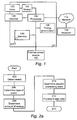
- FIG. 1 illustrates a block diagram according to embodiments of the invention.
- a monitoring camera 101 is adapted to monitor a scene, not illustrated in the figure.
- the monitoring camera 101 may be a permanent monitoring camera or installed on temporary basis as described in the background.
- the camera 101 can be any suitable digital camera capable of generating video sequences and communicating the video sequences, or other type of image data, such as image and video metadata, over a network 112 to any entity connected to the network, such as an image data receiver 109.
- the camera 101 comprises a lens system 103 for collecting incident light, an image sensor 104, for example in the form of a charge coupled device, CCD, a CMOS-sensor or similar sensor, for registering incident light, as well as circuitry as is known in the art.
- the circuitry typically includes image processing circuitry that comprises an image/video encoder (implemented in hardware, software, or any combination thereof) that form part of a processing unit 106 that manages, for example video analytics, memory 110, and network interface circuitry (not shown) for connection to the network 112.
- the image processing unit 106 comprising the image/video encoder is arranged to encode captured digital image data into any one of a plurality of known formats for continuous video sequences, for limited video sequences, for still images or for streamed images/video.
- the image data may be encoded into MPEG1, MPEG2, MPEG4, H.264, JPEG, M-JPEG, bitmapped, etc.
- the image data may be processed by using techniques such as noise filtering, tone mapping, sharpening, color correction and artifact reduction. As will be discussed below these processing techniques typically involve complex processing tasks and as such makes the load on the processor 106 higher than during performance of simple tasks, and thereby increase the power consumption of the monitoring camera 101.
- the controller 106 may also comprise analytics circuits and software to detect motion or objects in the image data.
- Software instructions 107stored in the memory 110 are configured to control the camera 101 and its interaction with any other entities connected via the network 112 and implement, when executed by the processor 106 and in combination with the hardware units, embodiments of the methods described herein.
- the monitoring camera 101 is supplied with electrical power from an external power source 102.
- the power may be supplied by means of power over Ethernet, PoE, universal serial bus, USB, or from any other appropriate power source known to the skilled person.
- the power supplied by the external power source 102 is limited by an upper bound. This upper bound will be called external maximum power level in this disclosure.
- the monitoring camera 101 comprises or may be connected to an energy accumulator 105.
- the energy accumulator 105 is adapted to store electrical energy which may be used by the monitoring camera 101 when needed.
- the energy accumulator 105 may be built in the monitoring camera 101 or may be connected to the monitoring camera 101.
- the energy accumulator may be either chargeable or non-chargeable. Examples of energy accumulators 105 may be a battery, a capacitor etc.
- the energy accumulator 105 may hold different amounts of electrical energy depending on how fully charged it is.
- the electrical power from the energy accumulator 105 may be added to the electrical power provided from the external power source 102 such that the total amount of electrical power supplied to the monitoring camera 101 is higher than the external maximum power level.
- the energy accumulator 105 may be charged with electrical power from the monitoring camera 101 when the power consumption of the camera 101 is less than the external maximum power level.
- the monitoring camera 101 may use power from the energy accumulator 105, and the amount of energy in the energy accumulator 105 will decrease. How this works in more detail will be described below.
- a detector 108 is included in or connected to the monitoring camera 101.
- the detector 108 may be any suitably configured detector for detecting changes in an environment in which the camera 101 is located.
- the detector 108 can be a motion detector of, e.g., an infra-red, IR, type or simply a sensor connected to a door close to or in the scene monitored by the monitoring camera 101. When the door opens the motion detector 108 transmits a signal to the monitoring camera 101 indicating that there will be or is motion in the scene.
- the motion detector 108 may also be a more or less remote sensing device and be placed outside the scene monitored by the monitoring camera 101.
- Other examples of a detector include a timer, an ambient light detector etc.
- the image data from the sensor 104 may be processed such that it is enhanced in the processor 106.
- the processor 106 may decide if the image data may be sent to the receiver 109 or not. This can be decided in a variety of ways. One way is to check for motion in the scene, and if there is no motion in the scene no image data is sent to the receiver 109.
- the receiver 109 may e.g. be a control station, a server or any other node for handling the image data from the monitoring camera 101. In the case with PoE the receiver 109 may be the same as the external power source 102.
- the image data may be stored on an image memory 110 and sent to the receiver 109 later.
- the image memory may be of any suitable type, such as a hard disk, optical storage or flash memory etc.
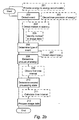
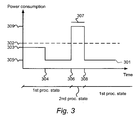
- Embodiments of a method in the monitoring camera 101 for improving the control and power management of the monitoring camera 101 will now be described with reference to the flowchart depicted in figures 2a , 2b and figure 3 illustrating a diagram showing the power consumption 301 of the monitoring camera 101, and with continued reference to figure 1
- the method comprises the following actions, which actions may be carried out in the described order as well as in other orders than described below. The actions may also be combined.
- the method describes a way of controlling the monitoring camera 101.
- the monitoring camera 101 is connected to the external power source 102 having an external maximum power level 302.
- the camera 101 can be monitoring a scene, whereby image data is processed in a first processing state. More information about the first processing state will be described below.
- the method can be embodied in a method as illustrated in figure 2a where the monitoring camera detects 202 an event and determines 206 a type of the detected event. An amount of energy in an energy accumulator is determined 208 in the monitoring camera. Based on the type of the event and based on the external maximum power level and based on the determined amount of energy in the energy accumulator, a second processing state is determined 210. The second processing state requires a power level that is higher than the external maximum power level. Image data is then processed 212 in the second processing state.
- FIG 2b A more detailed illustration of embodiments of the invention is illustrated in figure 2b , where initially, the monitoring camera 101 is monitoring the scene.
- the controller determines that nothing of interest happens in the scene at the moment, i.e. no events are occurring. Details regarding how this is determined are known to the skilled person.
- the monitoring camera 101 is now in the first processing state and the power consumption 301 is below the external maximum power level 302.
- the power consumption 301 of the monitoring camera is at a first power level 303.
- the first power level 303 is lower than or equal to the external maximum power level 302.
- the monitoring camera 101 is performing a certain amount of processing of image data. This could for example mean a specific frame rate or level of noise filtering or sharpening etc. at which the monitoring camera 101 is recording.
- the quality of the image data may be reduced in order to lower the power consumption 301 of the monitoring camera 101.
- a reason for this can e.g. be that it is determined that nothing of importance is occurring in the scene.
- the power consumption 301 of the monitoring camera 101 is then lowered to a second power level 305, while still being in the first processing state.
- the monitoring camera 101 may e.g. reduce the frame rate, adjust a noise filtering level, adjust a tone mapping level, adjust a sharpening level, adjust a color correction level or adjust an artifact reduction level.
- energy may be provided to the energy accumulator 105 at a power level corresponding to the difference between the external maximum power level 302 and the power level of the first processing state, as illustrated by an energy provision step 201.
- the power level of the first processing state may e.g. be the first power level 303 or the second power level 305.
- the energy accumulator 105 is charged slowly over time. The reason why the charging should be made slowly over time is to make sure that it does not require too much power during charging.
- an event is detected 202.
- the detected event may be several different kinds of event. Below a number of non-limiting examples will be provided.
- the event indicates that something has happened in the monitored scene that requires more processing power and thereby a higher power consumption 301 level in the monitoring camera 101 that is higher than the external maximum power level 302.
- the event is something of importance that happens in the scene.
- the monitoring camera 101 receives a signal that triggers the event without anything specific happening in the monitored scene.
- the event triggering signal may be induced by a user and the signal may be received via a cable or via a wireless interface.
- the event can be a timer that lapses, a timer that indicates that a specific time of day is reached, a detection that the ambient light is at a specific level, i.e. sunrise/sunset detection, etc.
- the event may be that motion is detected 204 in the scene.
- Motion may be detected in the scene by receiving a signal from a detector in the form of a motion detector 108 as described in relation to figure 1 .
- the event may be detected by the monitoring camera 101 by identifying 205 motion in the image data.
- Motion in the image data may be identified by any appropriate motion detection algorithm/process known in the art.
- a type of the detected event is determined 206.
- event types include the event that a door opens in the scene.
- Another event type may be that a car passes through the scene monitored by the monitoring camera 101.
- Further examples, as mentioned above, include timer generated events and ambient light changes. The monitoring camera 101 will react differently depending on which event type that is detected. This will be described below in relation to action 210.
- the monitoring camera 101 may detect 207 a predetermined object type in the image data.
- the object type may be a single object as well as a group of objects that may be identified in the scene.
- An example of an object type may be a face of a person, a vehicle number plate, a rising or setting sun etc.
- the amount of energy in the energy accumulator 105 in the monitoring camera 101 is determined 208. How this is performed is well known to the skilled person and include more or less complex detection means and algorithms.
- a time interval 307 is obtained 209 that is required for a second processing state.
- the determining of the second processing state may further be based on the time interval 307.
- the power consumption 301 of the monitoring camera 101 increases from a level, lower than the external maximum power level 302 to a third power level 309.
- the power consumption 301 of the monitoring camera 101 may be increased from the first power level 303 or from the second power level 305.
- the time interval 307 may be based on the type of the detected event. For example if the detected event is that a door is opened in the scene, it may be determined that the scene should be monitored long enough to identify the person walking through the door.
- the second processing state is determined 210.
- the power level of the second processing state is higher than the external maximum power level 302.
- the power level of the second processing state may e.g. be the third power level 309.
- image data may, e.g., be processed at a first frame rate or noise filtering level or tone mapping level or sharpening level or color correction level or artifact reduction level. Details regarding noise filtering, or tone mapping, sharpening, color correction, artifact reduction and other examples of types of processing are known in the art and therefore not described in detail here.
- the second processing state comprises processing image data at a second frame rate or noise filtering level or tone mapping level or sharpening level or color correction level or artifact reduction level.
- the second frame rate or noise filtering level or tone mapping level or sharpening level or color correction level or artifact reduction level is better than the first frame rate or noise filtering level or tone mapping level or sharpening level or color correction level or artifact reduction level. In this way the experience of the user watching the image data is increased.
- How the image data is processed in the second processing state may also depend on conditions in the scene. If the conditions are bad, e.g. if it is foggy or dark, more processing is required in the second processing state to increase the quality of the image data.
- the image quality in the first processing state may be enough for the monitoring camera 101 to detect the event in the scene. While in the second processing state, the image quality may high enough to identify objects in the scene.
- the time interval 307 for the second processing state may be calculated 211 by dividing the amount of energy in the energy accumulator 105 by the difference between the power level required for the second processing state 309 and the external maximum power level 302.
- the power level required for the second processing state 309 may e.g. be the third power level 309.
- Image data is processed 212 in the second processing state.
- the image data may then be saved on the image memory 110 or sent to the receiver 109.
- FIG. 2b a number of method steps 201, 203, 204, 205, 207, 209 and 211 are illustrated with dashed lines. This is to indicate that these steps are optional and that they can be combined in any number and in any appropriate manner and thereby define various embodiments of the method as defined by the steps 202, 206, 208, 210 and 212.
- An embodiment of a monitoring camera that corresponds to the method is the camera 101 in figure 1 .
- the monitoring camera 101 is configured to be connected to the external power source 102.
- the external power source 102 is limited to the external maximum power level 302.
- the monitoring camera 101 is configured to monitor the scene, whereby image data is being processed in the first processing state.
- the monitoring camera 101 comprises control circuitry 106 and memory circuitry 107.
- the control circuitry 106 and memory circuitry 107 is configured to detect the event and determine the type of the detected event.
- the control circuitry 106 and memory circuitry 107 is further configured to determine the amount of energy in the energy accumulator 105 in the monitoring camera 101. Based on the type of the event and based on the external maximum power level 302 and based on the determined amount of energy in the energy accumulator 105, a second processing state is determined.
- the power level of the second processing state 309 is higher than the external maximum power level 302. Image data is then processed in the second processing state.
- the embodiments herein for controlling the monitoring camera 101 may be implemented through one or more processors in the controller 106, in the monitoring camera 101, together with computer program code for performing the functions and actions of the embodiments herein.
- the program code mentioned above may also be provided as a computer program product, for instance in the form of a data carrier carrying computer program code for performing the embodiments herein when being loaded into the electronic device 101.
- a data carrier carrying computer program code for performing the embodiments herein when being loaded into the electronic device 101.
- One such carrier may be in the form of a CD ROM disc. It is however feasible with other data carriers such as a memory stick.
- the computer program code may furthermore be provided as pure program code on a server and downloaded to the monitoring camera 101.
- the monitoring camera 101 may comprise the memory circuitry 107 comprising one or more memory units.
- the memory circuitry 107 is arranged to be used to store data, received data streams, received information, configurations, schedules, and applications to perform the methods herein when being executed in the monitoring camera 101.
- controller 106 and the memory circuitry 107 described above may refer to a combination of analog and digital circuits, and/or one or more processors configured with software and/or firmware, e.g. stored in a memory, that when executed by the one or more processors.
- processors as well as the other digital hardware, may be included in a single application-specific integrated circuit (ASIC), or several processors and various digital hardware may be distributed among several separate components, whether individually packaged or assembled into a system-on-a-chip (SoC).
- ASIC application-specific integrated circuit
- SoC system-on-a-chip
Landscapes
- Engineering & Computer Science (AREA)
- Theoretical Computer Science (AREA)
- General Engineering & Computer Science (AREA)
- Multimedia (AREA)
- Signal Processing (AREA)
- Physics & Mathematics (AREA)
- General Physics & Mathematics (AREA)
- Computer Hardware Design (AREA)
- Power Engineering (AREA)
- Computing Systems (AREA)
- Studio Devices (AREA)
- Closed-Circuit Television Systems (AREA)
Priority Applications (6)
| Application Number | Priority Date | Filing Date | Title |
|---|---|---|---|
| EP12186789.9A EP2713238B1 (en) | 2012-10-01 | 2012-10-01 | Power management in a monitoring camera. |
| CN201310532690.0A CN103716583B (zh) | 2012-10-01 | 2013-09-25 | 监视摄像机中的方法及装置 |
| KR1020130115278A KR101467219B1 (ko) | 2012-10-01 | 2013-09-27 | 감시 카메라의 방법 및 장치 |
| TW102135318A TWI578779B (zh) | 2012-10-01 | 2013-09-30 | 用於省電之方法、實行此方法的監視攝影機、及相關的電腦程式產品 |
| JP2013206012A JP5667266B2 (ja) | 2012-10-01 | 2013-10-01 | 監視カメラにおける方法及び構成 |
| US14/043,595 US8964113B2 (en) | 2012-10-01 | 2013-10-01 | Method and arrangement in a monitoring camera |
Applications Claiming Priority (1)
| Application Number | Priority Date | Filing Date | Title |
|---|---|---|---|
| EP12186789.9A EP2713238B1 (en) | 2012-10-01 | 2012-10-01 | Power management in a monitoring camera. |
Publications (2)
| Publication Number | Publication Date |
|---|---|
| EP2713238A1 EP2713238A1 (en) | 2014-04-02 |
| EP2713238B1 true EP2713238B1 (en) | 2014-11-26 |
Family
ID=47148591
Family Applications (1)
| Application Number | Title | Priority Date | Filing Date |
|---|---|---|---|
| EP12186789.9A Active EP2713238B1 (en) | 2012-10-01 | 2012-10-01 | Power management in a monitoring camera. |
Country Status (5)
| Country | Link |
|---|---|
| EP (1) | EP2713238B1 (enExample) |
| JP (1) | JP5667266B2 (enExample) |
| KR (1) | KR101467219B1 (enExample) |
| CN (1) | CN103716583B (enExample) |
| TW (1) | TWI578779B (enExample) |
Families Citing this family (6)
| Publication number | Priority date | Publication date | Assignee | Title |
|---|---|---|---|---|
| JP2014209322A (ja) * | 2013-03-26 | 2014-11-06 | パナソニック株式会社 | 電子機器、電子機器の制御方法 |
| CN104079881B (zh) * | 2014-07-01 | 2017-09-12 | 中磊电子(苏州)有限公司 | 监控装置与其相关的监控方法 |
| KR20170087690A (ko) | 2016-01-21 | 2017-07-31 | 삼성전자주식회사 | 영상캡쳐장치 및 그 제어방법 |
| JP6766434B2 (ja) * | 2016-04-28 | 2020-10-14 | 富士通株式会社 | デバイス選択方法、デバイス選択プログラム及びデバイス選択装置 |
| CN110445966B (zh) * | 2019-08-09 | 2021-09-21 | 润博全景文旅科技有限公司 | 一种全景相机视频拍摄方法、装置、电子设备及存储介质 |
| KR20240137715A (ko) * | 2019-09-06 | 2024-09-20 | 구글 엘엘씨 | 이벤트 기반 레코딩 |
Family Cites Families (11)
| Publication number | Priority date | Publication date | Assignee | Title |
|---|---|---|---|---|
| WO1994003014A1 (en) * | 1992-07-24 | 1994-02-03 | Koz Mark C | Low power video security monitoring system |
| JPH08508616A (ja) * | 1992-07-24 | 1996-09-10 | コズ、マーク・シー | 小電力ビデオ保安監視装置 |
| JPH11337148A (ja) * | 1998-05-28 | 1999-12-10 | Hitachi Ltd | 空気調和機 |
| JP2002010243A (ja) * | 2000-06-16 | 2002-01-11 | Mitsubishi Heavy Ind Ltd | 動画像処理カメラ |
| DE602006004208D1 (de) * | 2006-08-10 | 2009-01-22 | Research In Motion Ltd | Verfahren und Vorrichtung zur Leistungssteuerung in einer elektronischen Vorrichtung |
| US7698580B2 (en) * | 2006-08-25 | 2010-04-13 | Cisco Technology, Inc. | Inline power policing |
| CN102804236A (zh) * | 2009-05-06 | 2012-11-28 | Ts澳大利亚有限公司 | 监控和记录装置 |
| TW201044810A (en) * | 2009-06-06 | 2010-12-16 | Moxa Inc | Method to control the overload of power |
| TW201114252A (en) * | 2009-10-02 | 2011-04-16 | Kye Systems Corp | Photographing driving system and the electronic device using the same |
| CN102074998B (zh) * | 2009-11-19 | 2013-03-20 | 国基电子(上海)有限公司 | 保护电路及以太网用电设备 |
| JP5287706B2 (ja) * | 2009-12-25 | 2013-09-11 | ソニー株式会社 | 撮像装置、撮像装置の制御方法及びプログラム |
-
2012
- 2012-10-01 EP EP12186789.9A patent/EP2713238B1/en active Active
-
2013
- 2013-09-25 CN CN201310532690.0A patent/CN103716583B/zh active Active
- 2013-09-27 KR KR1020130115278A patent/KR101467219B1/ko active Active
- 2013-09-30 TW TW102135318A patent/TWI578779B/zh active
- 2013-10-01 JP JP2013206012A patent/JP5667266B2/ja active Active
Also Published As
| Publication number | Publication date |
|---|---|
| KR101467219B1 (ko) | 2014-12-01 |
| TW201419851A (zh) | 2014-05-16 |
| CN103716583B (zh) | 2016-09-07 |
| EP2713238A1 (en) | 2014-04-02 |
| CN103716583A (zh) | 2014-04-09 |
| JP2014072899A (ja) | 2014-04-21 |
| TWI578779B (zh) | 2017-04-11 |
| JP5667266B2 (ja) | 2015-02-12 |
| KR20140043285A (ko) | 2014-04-09 |
Similar Documents
| Publication | Publication Date | Title |
|---|---|---|
| US8964113B2 (en) | Method and arrangement in a monitoring camera | |
| KR101467219B1 (ko) | 감시 카메라의 방법 및 장치 | |
| US10277805B2 (en) | Monitoring system and camera device | |
| US9313415B2 (en) | Method and system for adjusting exposure settings of video cameras | |
| US9367966B2 (en) | Smartphone augmented video-based on-street parking management system | |
| JP2014072899A5 (enExample) | ||
| US20140185875A1 (en) | Object area tracking apparatus, control method, and program of the same | |
| US10132913B2 (en) | Photographing apparatus, photographing method, template creation apparatus, template creation method, and program | |
| KR20140128885A (ko) | 전력 효율적인 이미지 감지 장치, 이미지 감지 장치의 작동 방법 및 눈/시선 추적 시스템 | |
| EP3110144A1 (en) | Monitoring system | |
| CN112084813A (zh) | 异常目标的检测方法、装置及存储介质 | |
| JP2014173775A (ja) | 空調制御装置、システム、及び方法 | |
| US12506941B2 (en) | Systems and methods for enhanced performance of camera devices | |
| JP2013140517A5 (enExample) | ||
| US20110090377A1 (en) | Video camera system | |
| CN111770309A (zh) | 一种视频上传方法、装置、电子设备及存储介质 | |
| US12609834B2 (en) | Imaging apparatus, method for controlling imaging apparatus, and storage medium | |
| CN112995763B (zh) | 智能监控系统的控制方法、5g电视、系统和存储介质 | |
| KR101059889B1 (ko) | 네트워크 영상 단말기 | |
| CN112504467A (zh) | 客流分析设备及其控制方法 | |
| KR101806552B1 (ko) | 도난 방지용 네트워크 카메라 | |
| US10715767B2 (en) | Information transmission device, information transmission method, and information transmission system | |
| KR20210129819A (ko) | 주차중 차량충격감지 시스템 및 방법 | |
| KR101656953B1 (ko) | 실외 환경 센싱 및 로깅 방법 및 시스템과 실외 환경 알림을 위한 어플리케이션 구동 방법 및 시스템 | |
| KR101082969B1 (ko) | 네트워크 영상 보안 시스템 |
Legal Events
| Date | Code | Title | Description |
|---|---|---|---|
| PUAI | Public reference made under article 153(3) epc to a published international application that has entered the european phase |
Free format text: ORIGINAL CODE: 0009012 |
|
| 17P | Request for examination filed |
Effective date: 20130503 |
|
| AK | Designated contracting states |
Kind code of ref document: A1 Designated state(s): AL AT BE BG CH CY CZ DE DK EE ES FI FR GB GR HR HU IE IS IT LI LT LU LV MC MK MT NL NO PL PT RO RS SE SI SK SM TR |
|
| AX | Request for extension of the european patent |
Extension state: BA ME |
|
| GRAP | Despatch of communication of intention to grant a patent |
Free format text: ORIGINAL CODE: EPIDOSNIGR1 |
|
| INTG | Intention to grant announced |
Effective date: 20140613 |
|
| GRAS | Grant fee paid |
Free format text: ORIGINAL CODE: EPIDOSNIGR3 |
|
| GRAA | (expected) grant |
Free format text: ORIGINAL CODE: 0009210 |
|
| AK | Designated contracting states |
Kind code of ref document: B1 Designated state(s): AL AT BE BG CH CY CZ DE DK EE ES FI FR GB GR HR HU IE IS IT LI LT LU LV MC MK MT NL NO PL PT RO RS SE SI SK SM TR |
|
| REG | Reference to a national code |
Ref country code: GB Ref legal event code: FG4D |
|
| REG | Reference to a national code |
Ref country code: CH Ref legal event code: EP |
|
| REG | Reference to a national code |
Ref country code: AT Ref legal event code: REF Ref document number: 698540 Country of ref document: AT Kind code of ref document: T Effective date: 20141215 |
|
| REG | Reference to a national code |
Ref country code: IE Ref legal event code: FG4D |
|
| REG | Reference to a national code |
Ref country code: DE Ref legal event code: R096 Ref document number: 602012003967 Country of ref document: DE Effective date: 20150108 |
|
| REG | Reference to a national code |
Ref country code: SE Ref legal event code: TRGR |
|
| REG | Reference to a national code |
Ref country code: NL Ref legal event code: VDEP Effective date: 20141126 |
|
| REG | Reference to a national code |
Ref country code: AT Ref legal event code: MK05 Ref document number: 698540 Country of ref document: AT Kind code of ref document: T Effective date: 20141126 |
|
| REG | Reference to a national code |
Ref country code: LT Ref legal event code: MG4D |
|
| PG25 | Lapsed in a contracting state [announced via postgrant information from national office to epo] |
Ref country code: NL Free format text: LAPSE BECAUSE OF FAILURE TO SUBMIT A TRANSLATION OF THE DESCRIPTION OR TO PAY THE FEE WITHIN THE PRESCRIBED TIME-LIMIT Effective date: 20141126 Ref country code: ES Free format text: LAPSE BECAUSE OF FAILURE TO SUBMIT A TRANSLATION OF THE DESCRIPTION OR TO PAY THE FEE WITHIN THE PRESCRIBED TIME-LIMIT Effective date: 20141126 Ref country code: NO Free format text: LAPSE BECAUSE OF FAILURE TO SUBMIT A TRANSLATION OF THE DESCRIPTION OR TO PAY THE FEE WITHIN THE PRESCRIBED TIME-LIMIT Effective date: 20150226 Ref country code: PT Free format text: LAPSE BECAUSE OF FAILURE TO SUBMIT A TRANSLATION OF THE DESCRIPTION OR TO PAY THE FEE WITHIN THE PRESCRIBED TIME-LIMIT Effective date: 20150326 Ref country code: IS Free format text: LAPSE BECAUSE OF FAILURE TO SUBMIT A TRANSLATION OF THE DESCRIPTION OR TO PAY THE FEE WITHIN THE PRESCRIBED TIME-LIMIT Effective date: 20150326 Ref country code: LT Free format text: LAPSE BECAUSE OF FAILURE TO SUBMIT A TRANSLATION OF THE DESCRIPTION OR TO PAY THE FEE WITHIN THE PRESCRIBED TIME-LIMIT Effective date: 20141126 Ref country code: FI Free format text: LAPSE BECAUSE OF FAILURE TO SUBMIT A TRANSLATION OF THE DESCRIPTION OR TO PAY THE FEE WITHIN THE PRESCRIBED TIME-LIMIT Effective date: 20141126 |
|
| PG25 | Lapsed in a contracting state [announced via postgrant information from national office to epo] |
Ref country code: LV Free format text: LAPSE BECAUSE OF FAILURE TO SUBMIT A TRANSLATION OF THE DESCRIPTION OR TO PAY THE FEE WITHIN THE PRESCRIBED TIME-LIMIT Effective date: 20141126 Ref country code: HR Free format text: LAPSE BECAUSE OF FAILURE TO SUBMIT A TRANSLATION OF THE DESCRIPTION OR TO PAY THE FEE WITHIN THE PRESCRIBED TIME-LIMIT Effective date: 20141126 Ref country code: RS Free format text: LAPSE BECAUSE OF FAILURE TO SUBMIT A TRANSLATION OF THE DESCRIPTION OR TO PAY THE FEE WITHIN THE PRESCRIBED TIME-LIMIT Effective date: 20141126 Ref country code: GR Free format text: LAPSE BECAUSE OF FAILURE TO SUBMIT A TRANSLATION OF THE DESCRIPTION OR TO PAY THE FEE WITHIN THE PRESCRIBED TIME-LIMIT Effective date: 20150227 Ref country code: AT Free format text: LAPSE BECAUSE OF FAILURE TO SUBMIT A TRANSLATION OF THE DESCRIPTION OR TO PAY THE FEE WITHIN THE PRESCRIBED TIME-LIMIT Effective date: 20141126 Ref country code: CY Free format text: LAPSE BECAUSE OF FAILURE TO SUBMIT A TRANSLATION OF THE DESCRIPTION OR TO PAY THE FEE WITHIN THE PRESCRIBED TIME-LIMIT Effective date: 20141126 |
|
| PG25 | Lapsed in a contracting state [announced via postgrant information from national office to epo] |
Ref country code: EE Free format text: LAPSE BECAUSE OF FAILURE TO SUBMIT A TRANSLATION OF THE DESCRIPTION OR TO PAY THE FEE WITHIN THE PRESCRIBED TIME-LIMIT Effective date: 20141126 Ref country code: SK Free format text: LAPSE BECAUSE OF FAILURE TO SUBMIT A TRANSLATION OF THE DESCRIPTION OR TO PAY THE FEE WITHIN THE PRESCRIBED TIME-LIMIT Effective date: 20141126 Ref country code: RO Free format text: LAPSE BECAUSE OF FAILURE TO SUBMIT A TRANSLATION OF THE DESCRIPTION OR TO PAY THE FEE WITHIN THE PRESCRIBED TIME-LIMIT Effective date: 20141126 Ref country code: DK Free format text: LAPSE BECAUSE OF FAILURE TO SUBMIT A TRANSLATION OF THE DESCRIPTION OR TO PAY THE FEE WITHIN THE PRESCRIBED TIME-LIMIT Effective date: 20141126 Ref country code: CZ Free format text: LAPSE BECAUSE OF FAILURE TO SUBMIT A TRANSLATION OF THE DESCRIPTION OR TO PAY THE FEE WITHIN THE PRESCRIBED TIME-LIMIT Effective date: 20141126 |
|
| REG | Reference to a national code |
Ref country code: DE Ref legal event code: R097 Ref document number: 602012003967 Country of ref document: DE |
|
| PG25 | Lapsed in a contracting state [announced via postgrant information from national office to epo] |
Ref country code: PL Free format text: LAPSE BECAUSE OF FAILURE TO SUBMIT A TRANSLATION OF THE DESCRIPTION OR TO PAY THE FEE WITHIN THE PRESCRIBED TIME-LIMIT Effective date: 20141126 |
|
| PLBE | No opposition filed within time limit |
Free format text: ORIGINAL CODE: 0009261 |
|
| STAA | Information on the status of an ep patent application or granted ep patent |
Free format text: STATUS: NO OPPOSITION FILED WITHIN TIME LIMIT |
|
| 26N | No opposition filed |
Effective date: 20150827 |
|
| PG25 | Lapsed in a contracting state [announced via postgrant information from national office to epo] |
Ref country code: IT Free format text: LAPSE BECAUSE OF FAILURE TO SUBMIT A TRANSLATION OF THE DESCRIPTION OR TO PAY THE FEE WITHIN THE PRESCRIBED TIME-LIMIT Effective date: 20141126 |
|
| PG25 | Lapsed in a contracting state [announced via postgrant information from national office to epo] |
Ref country code: SI Free format text: LAPSE BECAUSE OF FAILURE TO SUBMIT A TRANSLATION OF THE DESCRIPTION OR TO PAY THE FEE WITHIN THE PRESCRIBED TIME-LIMIT Effective date: 20141126 |
|
| PG25 | Lapsed in a contracting state [announced via postgrant information from national office to epo] |
Ref country code: LU Free format text: LAPSE BECAUSE OF FAILURE TO SUBMIT A TRANSLATION OF THE DESCRIPTION OR TO PAY THE FEE WITHIN THE PRESCRIBED TIME-LIMIT Effective date: 20151001 |
|
| REG | Reference to a national code |
Ref country code: CH Ref legal event code: PL |
|
| PG25 | Lapsed in a contracting state [announced via postgrant information from national office to epo] |
Ref country code: MC Free format text: LAPSE BECAUSE OF FAILURE TO SUBMIT A TRANSLATION OF THE DESCRIPTION OR TO PAY THE FEE WITHIN THE PRESCRIBED TIME-LIMIT Effective date: 20141126 |
|
| REG | Reference to a national code |
Ref country code: IE Ref legal event code: MM4A |
|
| PG25 | Lapsed in a contracting state [announced via postgrant information from national office to epo] |
Ref country code: LI Free format text: LAPSE BECAUSE OF NON-PAYMENT OF DUE FEES Effective date: 20151031 Ref country code: CH Free format text: LAPSE BECAUSE OF NON-PAYMENT OF DUE FEES Effective date: 20151031 |
|
| REG | Reference to a national code |
Ref country code: FR Ref legal event code: PLFP Year of fee payment: 5 |
|
| PG25 | Lapsed in a contracting state [announced via postgrant information from national office to epo] |
Ref country code: IE Free format text: LAPSE BECAUSE OF NON-PAYMENT OF DUE FEES Effective date: 20151001 |
|
| PG25 | Lapsed in a contracting state [announced via postgrant information from national office to epo] |
Ref country code: SM Free format text: LAPSE BECAUSE OF FAILURE TO SUBMIT A TRANSLATION OF THE DESCRIPTION OR TO PAY THE FEE WITHIN THE PRESCRIBED TIME-LIMIT Effective date: 20141126 Ref country code: BG Free format text: LAPSE BECAUSE OF FAILURE TO SUBMIT A TRANSLATION OF THE DESCRIPTION OR TO PAY THE FEE WITHIN THE PRESCRIBED TIME-LIMIT Effective date: 20141126 Ref country code: HU Free format text: LAPSE BECAUSE OF FAILURE TO SUBMIT A TRANSLATION OF THE DESCRIPTION OR TO PAY THE FEE WITHIN THE PRESCRIBED TIME-LIMIT; INVALID AB INITIO Effective date: 20121001 |
|
| PG25 | Lapsed in a contracting state [announced via postgrant information from national office to epo] |
Ref country code: MT Free format text: LAPSE BECAUSE OF FAILURE TO SUBMIT A TRANSLATION OF THE DESCRIPTION OR TO PAY THE FEE WITHIN THE PRESCRIBED TIME-LIMIT Effective date: 20141126 |
|
| REG | Reference to a national code |
Ref country code: FR Ref legal event code: PLFP Year of fee payment: 6 |
|
| PG25 | Lapsed in a contracting state [announced via postgrant information from national office to epo] |
Ref country code: BE Free format text: LAPSE BECAUSE OF FAILURE TO SUBMIT A TRANSLATION OF THE DESCRIPTION OR TO PAY THE FEE WITHIN THE PRESCRIBED TIME-LIMIT Effective date: 20141126 |
|
| PG25 | Lapsed in a contracting state [announced via postgrant information from national office to epo] |
Ref country code: MK Free format text: LAPSE BECAUSE OF FAILURE TO SUBMIT A TRANSLATION OF THE DESCRIPTION OR TO PAY THE FEE WITHIN THE PRESCRIBED TIME-LIMIT Effective date: 20141126 |
|
| REG | Reference to a national code |
Ref country code: FR Ref legal event code: PLFP Year of fee payment: 7 |
|
| PG25 | Lapsed in a contracting state [announced via postgrant information from national office to epo] |
Ref country code: AL Free format text: LAPSE BECAUSE OF FAILURE TO SUBMIT A TRANSLATION OF THE DESCRIPTION OR TO PAY THE FEE WITHIN THE PRESCRIBED TIME-LIMIT Effective date: 20141126 Ref country code: TR Free format text: LAPSE BECAUSE OF FAILURE TO SUBMIT A TRANSLATION OF THE DESCRIPTION OR TO PAY THE FEE WITHIN THE PRESCRIBED TIME-LIMIT Effective date: 20141126 |
|
| P01 | Opt-out of the competence of the unified patent court (upc) registered |
Effective date: 20230505 |
|
| PGFP | Annual fee paid to national office [announced via postgrant information from national office to epo] |
Ref country code: GB Payment date: 20250923 Year of fee payment: 14 |
|
| PGFP | Annual fee paid to national office [announced via postgrant information from national office to epo] |
Ref country code: FR Payment date: 20250924 Year of fee payment: 14 |
|
| PGFP | Annual fee paid to national office [announced via postgrant information from national office to epo] |
Ref country code: SE Payment date: 20250923 Year of fee payment: 14 |
|
| PGFP | Annual fee paid to national office [announced via postgrant information from national office to epo] |
Ref country code: DE Payment date: 20250923 Year of fee payment: 14 |