EP2705965A2 - Fahrerkabine eines landwirtschaftlichen Fahrzeugs - Google Patents
Fahrerkabine eines landwirtschaftlichen Fahrzeugs Download PDFInfo
- Publication number
- EP2705965A2 EP2705965A2 EP13173779.3A EP13173779A EP2705965A2 EP 2705965 A2 EP2705965 A2 EP 2705965A2 EP 13173779 A EP13173779 A EP 13173779A EP 2705965 A2 EP2705965 A2 EP 2705965A2
- Authority
- EP
- European Patent Office
- Prior art keywords
- roof
- driver
- cover
- hatch
- cab
- Prior art date
- Legal status (The legal status is an assumption and is not a legal conclusion. Google has not performed a legal analysis and makes no representation as to the accuracy of the status listed.)
- Granted
Links
Images


Classifications
-
- B—PERFORMING OPERATIONS; TRANSPORTING
- B60—VEHICLES IN GENERAL
- B60J—WINDOWS, WINDSCREENS, NON-FIXED ROOFS, DOORS, OR SIMILAR DEVICES FOR VEHICLES; REMOVABLE EXTERNAL PROTECTIVE COVERINGS SPECIALLY ADAPTED FOR VEHICLES
- B60J7/00—Non-fixed roofs; Roofs with movable panels, e.g. rotary sunroofs
- B60J7/08—Non-fixed roofs; Roofs with movable panels, e.g. rotary sunroofs of non-sliding type, i.e. movable or removable roofs or panels, e.g. let-down tops or roofs capable of being easily detached or of assuming a collapsed or inoperative position
- B60J7/16—Non-fixed roofs; Roofs with movable panels, e.g. rotary sunroofs of non-sliding type, i.e. movable or removable roofs or panels, e.g. let-down tops or roofs capable of being easily detached or of assuming a collapsed or inoperative position non-foldable and rigid, e.g. a one-piece hard-top or a single rigid roof panel
- B60J7/1628—Non-fixed roofs; Roofs with movable panels, e.g. rotary sunroofs of non-sliding type, i.e. movable or removable roofs or panels, e.g. let-down tops or roofs capable of being easily detached or of assuming a collapsed or inoperative position non-foldable and rigid, e.g. a one-piece hard-top or a single rigid roof panel for covering the passenger compartment
- B60J7/1635—Non-fixed roofs; Roofs with movable panels, e.g. rotary sunroofs of non-sliding type, i.e. movable or removable roofs or panels, e.g. let-down tops or roofs capable of being easily detached or of assuming a collapsed or inoperative position non-foldable and rigid, e.g. a one-piece hard-top or a single rigid roof panel for covering the passenger compartment of non-convertible vehicles
- B60J7/1642—Roof panels, e.g. sunroofs or hatches, movable relative to the main roof structure, e.g. by lifting or pivoting
Definitions
- the invention relates to a driver's cab of an agricultural vehicle according to the preamble of claim 1.
- Agricultural vehicles such as tractors are usually equipped with a driver's cab.
- these cabins are now formed mostly completed against the environment.
- drivers' cabs - for safety reasons - have a (cab) roof closing off the cab at the top.
- the roof In addition to the stiffening of the cabin structure and protection against uncomfortable external influences, the roof also has the function of protecting the driver in the event of an accident. In the event of a collision of the vehicle on the one hand should be prevented that the driver is thrown out of the cabin, on the other hand that hazardous objects penetrate into the cabin.
- cabs are optionally equipped with a so-called sunroof.
- a hatch opening
- the hatch can be opened at will to allow fresh air to flow in directly to allow warm or humid indoor air to flow out or to allow for upward visibility (for example, when working with a front loader attached).
- the hatch can be closed to prevent ingress of moisture or to make the interior of the driver's cab totally inaccessible (theft protection).
- a disadvantage of this design is that the hinges are largely exposed to the weather, whereby their Korrision is increased. Furthermore, during each opening or closing operation, a relatively high friction occurs in the area of mutual sealing surfaces of the window or panel with respect to the roof. This friction is due to a construction-related long relative movement of the window or the diaphragm parallel to the sealing surface at very small opening angles and leads to increased seal wear or can cause slippage of sealing elements from the installation. Finally, the in EP 1 288 044 B1 described construction only for front opening. However, high speeds when the sunroof is open at the front are not without danger and are therefore inadmissible in many countries.
- a driver's cab with the features of claim 1.
- the cover is mounted by means of a four-bar linkage mechanism relative to the car roof.
- the cover between a closing the hatch closing state and the hatch releasing opening state movable.
- the four-bar mechanism may be any four-link coupling mechanism.
- a structurally advantageous development provides that the four-bar mechanism comprises a first member and a second member, wherein the first and second members are each connected to their ends facing the roof at spaced pivot points with the roof, and with their ends facing away from the roof respectively are connected at spaced-apart pivot points with the cover.
- first and second members are aligned approximately parallel to the surface of the roof in the closed state of the hatch, so that the cover when opening the hatch from the closed state first approximately orthogonal lifts from the surface of the roof.
- a suitable for use on an agricultural vehicle trajectory of the cover is formed in particular, if further the first member and the second member have a different length, so that the cover is aligned in the closed state approximately parallel to the surface of the roof and in the open state against the Surface of the roof is inclined.
- a four-bar linkage mechanism could be integrated particularly favorably into the roof structure by connecting the cover element to the roof by means of at least one hinge arrangement which has a four-bar linkage mechanism.
- the four-bar mechanism thus arises in this case by using a hinge, in which a corresponding mechanism is integrated.
- several such hinges can be used in parallel to achieve, for example, a higher rigidity of the storage.
- an advantageous development of the invention provides that the at least one hinge arrangement is arranged below the cover so that it is protected at least in the closed state of the hatch by the cover from the weather.
- the hinge arrangement can be fastened to the roof in different positions, in particular reversibly.
- its opening angle could be changed in a simple manner, in particular by 180 °, or rotated by 90 ° or 270 ° to the side.
- the hinge assembly is preferably mounted from within the cab on the roof, in particular screwed to it.
- the cover usually has a significant weight. Furthermore, when driving - in addition to the weight - up or down directed acceleration forces acting on the cover. So that the cover is not damaged and a comfortable operation for the driver is possible, acting between the roof and movable cover support means is provided which is suitable for applying a weight of the cover counteracting supporting force.
- a support device also makes it easier for the driver to open the hatch.
- this comprises a spring arrangement, in particular a gas spring arrangement, for example in the sense of a gas-pressure-loaded cylinder-piston arrangement.
- the cover element can be any type of component which, in a broader sense, serves to protect the driver's cab and the driver therein.
- the cover is at least partially made of translucent material, in particular glass or made of translucent plastic.
- the invention also relates to an agricultural vehicle, in particular a tractor, which is equipped with a driver's cab of the type described here. It should be noted that other agricultural vehicles such as self-propelled forage harvester or combine harvester can be advantageously equipped with a driver's cab according to the invention.
- Fig. 1 shows an agricultural vehicle in the form of a tractor 1 in a side view from the left, based on a direction indicated by arrow forward travel direction.
- the tractor 1 has a closed cab 2.
- the driver's cab 2 is closed at the top by a roof 3.
- a hatch 6 is formed in a front central area, whose position in the lateral view of Fig. 1 indicated by arrow.
- the others Fig. 2 to 4 serve to explain the range of the hatch 6, where the invention is used.
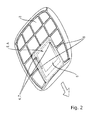
- Fig. 2 now shows the roof 3 of in Fig. 1 shown car 2 for explanatory purposes in dissolved from the car representation.
- the forward direction (in the installed state to the car 2 or the tractor 1) is - as in the following Fig. 3 and 4 indicated with a straight arrow.
- the roof 3 has an approximately square basic shape, but with slightly outwardly curved edges.
- To drain rainwater rain gutters can be incorporated into the roof 3.
- an approximately square hatch 6 is formed in the sense of an opening.
- the hatch 6 is closed by a completely extending cover member 5, located in Fig. 2 thus in a closed state a.
- An advantageously provided seal extends between the formed contact surfaces of the cover 5 and the roof 3, for example with a square course approximately below the outer edges of the cover. 5
- the cover 5 is made of transparent material such as glass, preferably tinted, and thus allows additional light into the cabin even in the closed state A of the hatch 6 shown.
- the cover 5 by means of a four-bar mechanism 4, which in detail with reference to the following Fig. 3 is still to be explained, mounted movably relative to the roof 3. It is already indicated that the four-bar mechanism 4 is realized by two hinges 7 located on opposite sides of the hatch 6.
- a support device 8 acting between the roof 3 and the movable cover element 5 is provided. This comprises a cylinder-piston arrangement designed gas spring assembly and is suitable for applying a counteracting the weight of the cover member supporting force.
- the support means 8 serves as a power assistance when lifting and holding the cover 5 from the shown closed state A in a as in Fig. 3 shown opening state b.
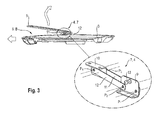
- Fig. 3 now shows the roof 3 according to Fig. 2 in the open state B of the hatch 6 in a side view from the left, and a detailed view of a built-in hinge 7.
- the cover 5 from a hatch 6 upwardly closing state A in a hatch 6 upwardly releasing opening state B moves Service.
- the cover 5 has a special trajectory put back, which is indicated by the curved arrow.
- the trajectory is characterized in that the cover 5 lifts off directly from the closed state A first in the orthogonal direction to the surface of the roof 3 of this. Only on further deflection of the cover 5 from the closed state A, this then also performs a rotational movement in order to get into the inclined state B shown.
- a four-bar mechanism 4 which is implemented in the illustrated embodiment by hinge assemblies 7, which are arranged on both sides of the hatch 6 and connect the cover 5 with the roof 3.
- the four-bar mechanism 4 comprises a first member 11 and a second member 12, which are designed as not directly interconnected struts.
- the first and second members 11, 12 are each connected with their ends facing the roof 3 at spaced pivot points P 1 , P 2 with the roof 3 by being rotatably mounted on a roof-fixed bearing element 9, which in turn is fastened to the roof 3 ,
- first and second members 11, 12 with their ends facing away from the roof 3 are each connected to the cover element 5 at spaced pivot points P 3 , P 4 by being rotatably mounted on a bearing element 10 which in turn the cover 5 is fastened.
- the hinge 7 shown therefore comprises essentially a bearing element 9, which is to be mounted on the roof 3 and thus immovable, a first and second member 11, 12 and a relative to the roof-fixed bearing element 9 by means of the first and second members 11, 12 movably mounted bearing element 10, which receives the cover 5.
- the roof-mounted bearing element 9 is arranged with the movable bearing element 10 in a plane which lies between the first member 11 and the second member 12.
- the first member 11 of the hinge 7 is formed slightly longer than the second member 12 (based on the distances of the respective pivot points P 1 to P 3 and P 2 to P 4 ).
- the members 11, 12 and the cover 5 are thus approximately parallel to the surface of the roof 3, to close the hatch 6 and to claim the smallest possible space.
- the cover element 5 first lifts upwards in an approximately orthogonal direction (relative to the surface of the roof 3). Due to the slightly different radii of movement of the first member 11 and the second member 12, an increasing inclination of the cover 5 is enforced with increasing degree of opening, so that the cover 5 in the front area more prominent from the roof 3 than in the rear area.
- a stop 13 can be integrated in the hinge 7, as in the detail view of FIG Fig. 3 to see.
- locking means (not shown) may be provided to lock the cover member 5 in a desired condition.
- Fig. 2 and 3 opens the sunroof shown on the front, ie the cover 5 raises front more from the roof 3 from the rear.
- the hinges 7 are attached to a different position and reversed by 180 ° to the roof 3.
- the sunroof therefore opens in the reverse direction, namely the rear.
- the assembly of the hinge 7 from within the cab 2 can perform by the screwing of the roof-fixed bearing element 9 of the hinge 7 are accessible from within the cabin 2.
- the opening direction of the sunroof can also be changed later in a simple manner. Climbing up to the cabin roof 2 - as in conventional attachment method of roof hinges necessary - is not required.
- the described invention is suitable for use on cabs of agricultural vehicles of all kinds. To achieve the advantages and effects mentioned, it may also be a partially open-plan (eg laterally open) driver's cab, which is provided with a roof.
Landscapes
- Engineering & Computer Science (AREA)
- Mechanical Engineering (AREA)
- Body Structure For Vehicles (AREA)
Abstract
Description
- Die Erfindung betrifft eine Fahrerkabine eines landwirtschaftlichen Fahrzeugs gemäß dem Oberbegriff des Anspruchs 1.
- Landwirtschaftliche Fahrzeuge wie beispielsweise Traktoren sind üblicherweise mit einer Fahrerkabine ausgestattet. Zum Schutz des sich darin aufhaltenden Fahrers vor nachteiligen Einflüssen wie schlechter Witterung, Motorlärm, Fahrtwind, Verschmutzung und/oder ganz allgemein zur Gewährleistung der Betriebssicherheit sind diese Kabinen heute zumeist gegenüber der Umgebung abgeschlossen ausgebildet. Insbesondere weisen Fahrerkabinen dazu - schon aus Sicherheitsgründen - ein die Kabine nach oben hin abschließendes (Kabinen-) Dach auf. Neben der Versteifung der Kabinenstruktur und dem Schutz vor unkomfortablen Außeneinflüssen hat das Dach auch die Funktion, den Fahrer bei Unfällen zu schützen. Im Kollisionsfall des Fahrzeugs soll einerseits verhindert werden, dass der Fahrer aus der Kabine herausgeschleudert wird, andererseits dass gefährdende Gegenstände in die Kabine eindringen.
- Damit der Fahrer beim Arbeitsbetrieb dennoch direkte Frischluft genießen kann - d.h. ohne Zuhilfenahme eines Lüftungssystems -, sind Fahrerkabinen optional mit einem sogenannten Sonnendach ausgestattet. In diesem Fall ist im Kabinendach eine Luke (Öffnung) ausgebildet, die mittels eines beweglich gegenüber dem Dach gelagerten Abdeckelements verschließbar ist. Nach Belieben kann die Luke geöffnet werden, um direkt Frischluft einströmen zu lassen, um warme oder feuchte Innenluft ausströmen zu lassen oder um Sicht nach oben zu ermöglichen (z.B. bei Arbeiten mit einem angebauten Frontlader). Insbesondere bei ungünstiger Witterung oder zum Betriebsende kann die Luke geschlossen werden, um Feuchtigkeitseintritt zu vermeiden oder um den Innenraum der Fahrerkabine insgesamt unzugänglich zu machen (Diebstahlschutz).
- In der
EP 1 288 044 B1 wird eine Dachlukenabdeckung für eine Fahrerkabine beschrieben, wobei sowohl ein Fensterelement als auch eine Blende um eine gemeinsame Achse schwenkbar mit dem Dach verbunden sind. Zur Verbindung mit dem Dach dienende Scharniere sind oberhalb des Dachs angeordnet, wodurch sich eine dachfeste Schwenkachse für Blende und Fensterelement ergibt. - Nachteilig an dieser Ausführung ist, dass die Scharniere weitestgehend der Witterung ausgesetzt sind, wodurch deren Korrision erhöht ist. Weiterhin entsteht bei jedem Öffnungs- bzw. Schließvorgang eine relativ hohe Reibung im Bereich gegenseitiger Dichtungsflächen von Fenster bzw. Blende gegenüber dem Dach. Diese Reibung ist bedingt durch eine konstruktionsbedingt lange Relativbewegung des Fensters bzw. der Blende parallel zur Dichtungsfläche bei sehr kleinen Öffnungswinkeln und führt zu einem erhöhten Dichtungsverschleiß oder kann ein Verrutschen von Dichtungselementen vom Einbauort verursachen. Schließlich eignet sich die in
EP 1 288 044 B1 beschriebene Bauweise nur zum frontseitigen Öffnen. Hohe Fahrgeschwindigkeiten bei frontseitig geöffnetem Sonnendach sind jedoch nicht gefahrlos und daher in vielen Ländern unzulässig. - Es ist daher Aufgabe der vorliegenden Erfindung, eine Fahrerkabine der eingangs genannten Art anzugeben, deren Sonnendach hinsichtlich Verschleißanfälligkeit und Verwendbarkeit verbessert ist.
- Die genannte Aufgabe wird gelöst durch eine Fahrerkabine mit den Merkmalen des Patentanspruchs 1. Bei einer solchen Fahrerkabine ist erfindungsgemäß das Abdeckelement mittels eines Viergelenkmechanismus gegenüber dem Kabinendach gelagert.
- Dabei wurde zunächst erkannt, dass die im Stand der Technik übliche einfache Schwenklagerung eines Abdeckelements die genannten Nachteile mit sich bringt. Erfindungsgemäß wurde weiterhin erkannt, dass sich durch eine andere Art der Lagerung des Abdeckelements gegenüber dem Dach Vorteile hinsichtlich Anbringbarkeit und Nutzbarkeit erzielen lassen, wenn nämlich statt eines einfachen Schwenkmechanismus ein Viergelenkmechanismus verwendet wird. In kinematischer Hinsicht weist das Abdeckelement dabei genau einen Freiheitsgrad auf und kann - eine geeignete Anordnung und Gestaltung der Gelenkglieder vorausgesetzt - auf einer solchen Bewegungsbahn geführt werden, dass das Abdeckelement beim Öffnen und Schließen der Luke stets in weitestgehend orthogonaler Richtung das Dach kontaktiert. Zwischen Dach und Abdeckelement vorhandene Dichtungselemente werden so geschont und verschleißen (und verrutschen) deutlich weniger. Aufzubringende Betätigungskräfte sind geringer, da weniger Reibung an Dichtungselementen zu überwinden ist. Da der Viergelenkmechanismus zweckmäßigerweise unterhalb des Abdeckelements angeordnet ist, tritt deutlich weniger witterungsbedingte Korrosion auf.
- Ganz unabhängig von der Gestaltung des Viergelenkmechanismus - und der sich ergebenden Bewegungsbahn - ist gemäß einer zweckmäßigen Ausgestaltung der Erfindung das Abdeckelement zwischen einem die Luke verschließenden Schließzustand und einem die Luke freigebenden Öffnungszustand bewegbar.
- Es kann sich bei dem Viergelenkmechanismus um einen beliebigen viergliedrigen Koppelmechanismus handeln. Eine konstruktiv vorteilhafte Weiterbildung sieht vor, dass der Viergelenkmechanismus ein erstes Glied und ein zweites Glied umfasst, wobei die ersten und zweiten Glieder jeweils mit deren dem Dach zugewandten Enden an voneinander beabstandeten Drehpunkten mit dem Dach verbunden sind, und mit deren dem Dach abgewandten Enden jeweils an voneinander beabstandeten Drehpunkten mit dem Abdeckelement verbunden sind.
- Eine vorteilhafte Anordnung für einen solchen Viergelenkmechanismus ergibt sich, indem die ersten und zweiten Glieder im Schließzustand der Luke annähernd parallel zur Fläche des Dachs ausgerichtet sind, so dass das Abdeckelement beim Öffnen der Luke aus dem Schließzustand zunächst etwa orthogonal von der Fläche des Dachs abhebt.
- Eine für den Einsatzzweck an einem landwirtschaftlichen Fahrzeug geeignete Bewegungsbahn des Abdeckelements entsteht insbesondere, wenn weiterhin das erste Glied und das zweite Glied eine unterschiedliche Länge aufweisen, so dass das Abdeckelement im verschlossenen Zustand etwa parallel zur Fläche des Dachs ausgerichtet ist und im geöffneten Zustand gegenüber der Fläche des Dachs geneigt ist.
- Konstruktiv ließe sich ein Viergelenkmechanismus besonders günstig in den Dachaufbau integrieren, indem das Abdeckelement mittels zumindest einer Scharnieranordnung, die einen Viergelenkmechanismus aufweist, mit dem Dach verbunden ist. Der Viergelenkmechanismus entsteht in diesem Fall also durch Verwendung eines Scharniers, in welches eine entsprechende Mechanik integriert ist. Selbstverständlich können mehrere derartiger Scharniere parallel zum Einsatz kommen, um beispielsweise eine höhere Steifigkeit der Lagerung zu erzielen.
- Eine vorteilhafte Weiterbildung der Erfindung sieht vor, dass die zumindest eine Scharnieranordnung derart unterhalb des Abdeckelements angeordnet ist, dass diese zumindest im Schließzustand der Luke durch das Abdeckelement vor Witterungseinflüssen geschützt ist.
- Zur erhöhten Verwendbarkeit und insgesamt flexibleren Nutzbarkeit kann vorgesehen sein, dass die Scharnieranordnung in unterschiedlichen Positionen, insbesondere umkehrbar an dem Dach befestigbar ist. Durch unterschiedliche Befestigungspositionen der Scharnieranordnung ließe sich so auf einfache Weise beispielsweise deren Öffnungswinkel ändern, insbesondere um 180° umkehren oder um 90° bzw. 270° zur Seite drehen. Um ein einfaches An- und Umbauen zu ermöglichen bzw. ganz allgemein eine einfache Zugänglichkeit zur Mechanik zu schaffen, ist die Scharnieranordnung vorzugsweise von innerhalb der Fahrerkabine am Dach montierbar, insbesondere daran verschraubbar.
- Das Abdeckelement weist in der Regel ein nicht unerhebliches Gewicht auf. Weiterhin können beim Fahrbetrieb - zusätzlich zur Gewichtskraft - nach oben oder unten gerichtete Beschleunigungskräfte auf das Abdeckelement wirken. Damit das Abdeckelement dabei nicht beschädigt wird und eine komfortable Bedienung für den Fahrer möglich ist, kann eine zwischen Dach und beweglichem Abdeckelement wirkende Stützeinrichtung vorgesehen ist, die zum Aufbringen einer der Gewichtskraft des Abdeckelements entgegenwirkenden Stützkraft geeignet ist. Eine solche Stützeinrichtung erleichtert dem Fahrer insbesondere auch das Öffnen der Luke. Vorzugsweise umfasst diese eine Federanordnung, insbesondere eine Gasfederanordnung, beispielsweise im Sinne einer gasdruckbelasteten Zylinder-Kolbenanordnung.
- Es kann sich bei dem Abdeckelement grundsätzlich um jedwede Art von Bauteil handeln, das im weiteren Sinne dem Schutz der Fahrerkabine und dem darin befindlichen Fahrer dient. Gemäß einer vorteilhaften Ausgestaltung ist das Abdeckelement zumindest teilweise aus lichtdurchlässigem Material, insbesondere aus Glas oder lichtdurchlässigem Kunststoff hergestellt. Damit wird auch bei geschlossener Luke ein zusätzlicher Lichteintritt in die Fahrerkabine erzielt.
- Die Erfindung betrifft auch ein landwirtschaftliches Fahrzeug, insbesondere einen Traktor, das (bzw. der) mit einer Fahrerkabine der hier beschriebenen Art ausgestattet ist. Es sei angemerkt, dass auch andere landwirtschaftliche Fahrzeuge wie beispielsweise selbstfahrende Feldhäcksler oder Mähdrescher auf vorteilhafte Weise mit einer erfindungsgemäßen Fahrerkabine ausgestattet sein können.
- Die Erfindung wird im Folgenden anhand von
Fig. 1 bis 4 näher erläutert. Aus den Fig. ergeben sich auch weitere vorteilhafte Wirkungen und Effekte. In den Fig. zeigen: - Fig. 1
- eine schematische Seitenansicht eines Traktors mit einer erfindungsgemäßen Fahrerkabine,
- Fig. 2
- das Dach der erfindungsgemäßen Fahrerkabine aus
Fig. 1 im geschlossenen Zustand der Luke in perspektivischer Ansicht von schräg oben, - Fig. 3
- das Dach gemäß
Fig. 2 im geöffneten Zustand der Luke in Seitenansicht von links, sowie eine Detaildarstellung eines darin eingebauten Scharniers, - Fig. 4
- das Dach ähnlich der
Fig. 3 im geöffneten Zustand der Luke in Seitenansicht von links, jedoch mit umgekehrter Scharnieranordnung. -
Fig. 1 zeigt ein landwirtschaftliches Fahrzeug in Form eines Traktors 1 in Seitenansicht von links, bezogen auf eine per Pfeil angedeutete Vorwärtsfahrtrichtung. Der Traktor 1 weist eine geschlossene Fahrerkabine 2 auf. Die Fahrerkabine 2 wird nach oben hin von einem Dach 3 abgeschlossen. In dem Dach 3 ist in einem vorderen mittigen Bereich eine Luke 6 ausgebildet, deren Position in der seitlichen Ansicht derFig. 1 per Pfeil angedeutet ist. Die weiterenFig. 2 bis 4 dienen der näheren Erläuterung des Bereichs der Luke 6, wo auch die Erfindung zum Einsatz kommt. -
Fig. 2 zeigt nun das Dach 3 der inFig. 1 gezeigten Kabine 2 zu Erläuterungszwecken in von der Kabine gelöster Darstellung. Die Vorwärtsrichtung (im Einbauzustand an die Kabine 2 bzw. den Traktor 1) ist - wie auch in den noch folgendenFig. 3 und4 mit einem geraden Pfeil angegeben. Das Dach 3 weist eine annähernd quadratische Grundform auf, jedoch mit leicht nach außen gewölbten Kanten. Zum Ablauf von Regenwasser können Regenablaufrinnen in das Dach 3 eingearbeitet sein. In einem vorderen mittigen Bereich des Dachs 3 ist eine etwa quadratische Luke 6 im Sinne einer Öffnung ausgebildet. Die Luke 6 wird durch ein sich vollständig darüber erstreckendes Abdeckelement 5 verschlossen, befindet sich inFig. 2 somit in einem Schließzustand a. Eine vorteilhaft vorgesehene Dichtung (nicht eingezeichnet) verläuft zwischen den gebildeten Kontaktflächen des Abdeckelements 5 und des Dachs 3, beispielsweise also mit quadratischem Verlauf etwa unterhalb der Außenkanten des Abdeckelements 5. - Das Abdeckelement 5 ist aus transparentem Material wie Glas, vorzugsweise getönt, hergestellt und ermöglicht so einen zusätzlichen Lichteinfall in die Kabine auch im gezeigten geschlossenen Zustand A der Luke 6. Erfindungsgemäß ist das Abdeckelement 5 mittels eines Viergelenkmechanismus 4, der im Detail anhand der nachfolgenden
Fig. 3 noch zu erläutern ist, gegenüber dem Dach 3 beweglich gelagert. Angedeutet ist bereits, dass der Viergelenkmechanismus 4 durch zwei an gegenüberliegenden Seiten der Luke 6 befindliche Scharniere 7 realisiert wird. Weiterhin ist zu sehen, dass eine zwischen Dach 3 und beweglichem Abdeckelement 5 wirkende Stützeinrichtung 8 vorgesehen ist. Diese umfasst eine in Zylinder-Kolbenanordnung gestaltete Gasfederanordnung und eignet sich zum Aufbringen einer der Gewichtskraft des Abdeckelements entgegenwirkenden Stützkraft. Mit anderen Worten, die Stützeinrichtung 8 dient als Kraftunterstützung beim Heben und Halten des Abdeckelements 5 aus dem gezeigten Schließzustand A in einen wie inFig. 3 gezeigten Öffnungszustand b. -
Fig. 3 zeigt nun das Dach 3 gemäßFig. 2 im geöffneten Zustand B der Luke 6 in Seitenansicht von links, sowie eine Detaildarstellung eines darin eingebauten Scharniers 7. Wie zu sehen, ist das Abdeckelement 5 aus einem die Luke 6 nach oben verschließenden Zustand A in einen die Luke 6 nach oben freigebenden Öffnungszustand B bewegt worden. Das Abdeckelement 5 hat dabei eine besondere Bewegungsbahn zurückgelegt, die durch den geschwungenen Pfeil angedeutet ist. Die Bewegungsbahn zeichnet sich dadurch aus, dass das Abdeckelement 5 unmittelbar aus dem Schließzustand A zunächst in orthogonaler Richtung zur Fläche des Dachs 3 von diesem abhebt. Erst bei weiterer Auslenkung des Abdeckelements 5 aus dem Schließzustand A führt dieses dann auch eine Drehbewegung durch, um in den gezeigten geneigten Zustand B zu gelangen. Zur Realisierung dieser Bewegungsbahn dient ein Viergelenkmechanismus 4, der im gezeigten Ausführungsbeispiel durch Scharnieranordnungen 7 umgesetzt ist, die beidseitig der Luke 6 angeordnet sind und das Abdeckelement 5 mit dem Dach 3 verbinden. - Wie die Detailansicht der
Fig. 3 zeigt, die ein einzelnes Scharnier 7 in perspektivischer Darstellung wiedergibt, umfasst der Viergelenkmechanismus 4 ein erstes Glied 11 und ein zweites Glied 12, die als nicht unmittelbar miteinander verbundene Streben ausgeführt sind. Die ersten und zweiten Glieder 11, 12 sind jeweils mit ihren dem Dach 3 zugewandten Enden an voneinander beabstandeten Drehpunkten P1, P2 mit dem Dach 3 verbunden, indem sie drehbar an einem dachfesten Lagerelement 9 gelagert sind, das wiederum am Dach 3 befestigbar ist. - Weiterhin sind die ersten und zweiten Glieder 11, 12 mit ihren dem Dach 3 (bzw. Lagerelement 9) abgewandten Enden jeweils an voneinander beabstandeten Drehpunkten P3, P4 mit dem Abdeckelement 5 verbunden, indem sie drehbar an einem Lagerelement 10 gelagert sind, an welchem wiederum das Abdeckelement 5 befestigbar ist.
- Das gezeigte Scharnier 7 umfasst demnach im Wesentlichen ein Lagerelement 9, das am Dach 3 zu montieren und somit unbeweglich ist, ein erstes und zweites Glied 11, 12 sowie ein gegenüber dem dachfesten Lagerelement 9 mittels der ersten und zweiten Glieder 11, 12 beweglich gelagertes Lagerelement 10, welches das Abdeckelement 5 aufnimmt. Das dachfeste Lagerelement 9 ist mit dem beweglichen Lagerelement 10 in einer Ebene angeordnet, die zwischen dem ersten Glied 11 und dem zweiten Glied 12 liegt. Durch die so realisierte Sandwich-Bauweise erreicht das Scharnier 7 eine weitestgehend ausgewogene Kraftverteilung, d.h. es werden einseitige Belastungen der Lagerelemente 9, 10 vermieden oder zumindest gemindert.
- Zur Erzielung der besonderen Bewegungsbahn des Abdeckelements 5 ist das erste Glied 11 des Scharniers 7 geringfügig länger ausgebildet als das zweite Glied 12 (bezogen auf die Abstände der jeweiligen Drehpunkte P1 zu P3 bzw. P2 zu P4). Im Schließzustand A der Luke 6 liegen die Glieder 11, 12 und auch das Abdeckelement 5 somit etwa parallel zur Fläche des Dachs 3, um die Luke 6 zu verschließen und einen möglichst geringen Raum zu beanspruchen. Bei einem Öffnen der Luke 6 hebt das Abdeckelement 5 zunächst in etwa orthogonaler Richtung (bezogen auf die Fläche des Dachs 3) nach oben ab. Aufgrund der geringfügig unterschiedlich großen Bewegungsradien des ersten Glieds 11 und des zweiten Glieds 12 wird mit zunehmendem Öffnungsgrad eine zunehmende Neigung des Abdeckelements 5 erzwungen, so dass das Abdeckelement 5 im vorderen Bereich stärker vom Dach 3 abhebt als im hinteren Bereich. Zur Begrenzung des Öffnungsgrads kann in das Scharnier 7 ein Anschlag 13 integriert sein, wie in der Detailansicht von
Fig. 3 zu sehen. Auch können Arretierungsmittel (nicht dargestellt) vorgesehen sein, um das Abdeckelement 5 in einem gewünschten Zustand festzustellen. - In den
Fig. 2 und3 öffnet das gezeigte Sonnendach frontseitig, d.h. das Abdeckelement 5 hebt frontseitig stärker vom Dach 3 ab als heckseitig. Eine alternative Ausführungsform, die inFig. 4 dargestellt ist, weist eine demgegenüber umgekehrte Anbringung der Scharniere 7 auf. Die Scharniere 7 sind dazu an einer anderen Position und um 180° umgekehrt am Dach 3 befestigt. Das Sonnendach öffnet demzufolge in umgekehrter Richtung, nämlich heckseitig. Auf vorteilhafte Weise lässt sich die Montage des Scharniers 7 von innerhalb der Fahrerkabine 2 durchführen, indem die Schraubstellen des dachfesten Lagerelements 9 des Scharniers 7 von innerhalb der Kabine 2 zugänglich sind. So lässt sich die Öffnungsrichtung des Sonnendachs auch nachträglich auf einfache Weise ändern. Ein Hinaufklettern auf das Kabinendach 2 - wie bei herkömmlicher Anbringungsweise von Dachscharnieren nötig - ist dabei nicht erforderlich. - Die beschriebene Erfindung eignet sich zum Einsatz an Fahrerkabinen landwirtschaftlicher Fahrzeuge aller Art. Zur Erzielung der genannten Vorteile und Wirkungen kann es sich auch um eine teilweise offen gestaltete (z.B. seitlich offene) Fahrerkabine handeln, die mit einem Dach versehen ist.
Bezugszeichenliste 1 Traktor P1 Drehpunkt 2 Fahrerkabine P2 Drehpunkt 3 Dach P3 Drehpunkt 4 Viergelenkmechanismus P4 Drehpunkt 5 Abdeckelement A Schließzustand 6 Luke B Öffnungszustand 7 Scharnier 8 Gasfeder 9 dachfestes Lagerelement 10 bewegliches Lagerelement 11 erstes Glied 12 zweites Glied 13 Anschlag
Claims (13)
- Fahrerkabine (2) eines landwirtschaftlichen Fahrzeugs (1), mit einem eine Luke (6) aufweisenden Dach (3), wobei die Luke (6) mittels eines beweglich gegenüber dem Dach (3) gelagerten Abdeckelements (5) verschließbar ist,
dadurch gekennzeichnet, dass das Abdeckelement (5) mittels eines Viergelenkmechanismus (4) gegenüber dem Dach (3) gelagert ist. - Fahrerkabine nach Anspruch 1, dadurch gekennzeichnet, dass das Abdeckelement (5) zwischen einem die Luke (6) verschließenden Schließzustand (A) und einem die Luke (6) freigebenden Öffnungszustand (B) bewegbar ist.
- Fahrerkabine nach Anspruch 1 oder 2, dadurch gekennzeichnet, dass der Viergelenkmechanismus (4) ein erstes Glied (11) und ein zweites Glied (12) umfasst, wobei die ersten und zweiten Glieder (11, 12) jeweils mit deren dem Dach (3) zugewandten Enden an voneinander beabstandeten Drehpunkten (P1, P2) mit dem Dach (3) verbunden sind, und mit deren dem Dach (3) abgewandten Enden jeweils an voneinander beabstandeten Drehpunkten (P3, P4) mit dem Abdeckelement (5) verbunden sind.
- Fahrerkabine nach Anspruch 3, dadurch gekennzeichnet, dass die ersten und zweiten Glieder (11, 12) im Schließzustand (A) der Luke (6) annähernd parallel zur Fläche des Dachs (3) ausgerichtet sind, so dass das Abdeckelement (5) beim Öffnen der Luke (6) aus dem Schließzustand (A) zunächst etwa orthogonal von der Fläche des Dachs (3) abhebt.
- Fahrerkabine nach Anspruch 3 oder 4, dadurch gekennzeichnet, dass das erste Glied (11) und das zweite Glied (12) eine unterschiedliche Länge aufweisen, so dass das Abdeckelement (5) im verschlossenen Zustand (A) etwa parallel zur Fläche des Dachs (3) ausgerichtet ist und im geöffneten Zustand (B) gegenüber der Fläche des Dachs (3) geneigt ist.
- Fahrerkabine nach einem der Ansprüche 1 bis 5, dadurch gekennzeichnet, dass das Abdeckelement (5) mittels zumindest einer Scharnieranordnung (7), die einen Viergelenkmechanismus (4) aufweist, mit dem Dach (3) verbunden ist.
- Fahrerkabine nach Anspruch 6, dadurch gekennzeichnet, dass die zumindest eine Scharnieranordnung (7) derart unterhalb des Abdeckelements (5) angeordnet ist, dass diese zumindest im Schließzustand (A) der Luke (6) durch das Abdeckelement (5) vor Witterungseinflüssen geschützt ist.
- Fahrerkabine nach Anspruch 6 oder 7, dadurch gekennzeichnet, dass die Scharnieranordnung (7) in unterschiedlichen Positionen, insbesondere umkehrbar an dem Dach (3) befestigbar ist.
- Fahrerkabine nach einem der Ansprüche 6 bis 8, dadurch gekennzeichnet, dass die Scharnieranordnung (7) von innerhalb der Fahrerkabine (2) am Dach (3) montierbar, insbesondere daran verschraubbar ist.
- Fahrerkabine nach einem der Ansprüche 1 bis 9, dadurch gekennzeichnet, dass eine zwischen Dach (3) und beweglichem Abdeckelement (5) wirkende Stützeinrichtung (8) vorgesehen ist, die zum Aufbringen einer der Gewichtskraft des Abdeckelements (5) entgegenwirkenden Stützkraft geeignet ist.
- Fahrerkabine nach Anspruch 10, dadurch gekennzeichnet, dass die Stützeinrichtung (8) eine Federanordnung, insbesondere eine Gasfederanordnung, umfasst.
- Fahrerkabine nach einem der Ansprüche 1 bis 11, dadurch gekennzeichnet, dass das Abdeckelement (5) zumindest teilweise aus lichtdurchlässigem Material hergestellt ist.
- Landwirtschaftliches Fahrzeug, insbesondere Traktor (1), mit einer Fahrerkabine (2) gemäß einem der Ansprüche 1 bis 12.
Applications Claiming Priority (1)
| Application Number | Priority Date | Filing Date | Title |
|---|---|---|---|
| DE102012108312.6A DE102012108312A1 (de) | 2012-09-07 | 2012-09-07 | Fahrerkabine eines landwirtschaftlichen Fahrzeugs |
Publications (3)
| Publication Number | Publication Date |
|---|---|
| EP2705965A2 true EP2705965A2 (de) | 2014-03-12 |
| EP2705965A3 EP2705965A3 (de) | 2017-11-29 |
| EP2705965B1 EP2705965B1 (de) | 2019-01-23 |
Family
ID=48745714
Family Applications (1)
| Application Number | Title | Priority Date | Filing Date |
|---|---|---|---|
| EP13173779.3A Not-in-force EP2705965B1 (de) | 2012-09-07 | 2013-06-26 | Fahrerkabine eines landwirtschaftlichen Fahrzeugs |
Country Status (2)
| Country | Link |
|---|---|
| EP (1) | EP2705965B1 (de) |
| DE (1) | DE102012108312A1 (de) |
Cited By (1)
| Publication number | Priority date | Publication date | Assignee | Title |
|---|---|---|---|---|
| EP2987669A1 (de) * | 2014-09-19 | 2016-02-24 | CLAAS Tractor S.A.S. | Fahrerkabine für ein landwirtschaftliches fahrzeug |
Citations (1)
| Publication number | Priority date | Publication date | Assignee | Title |
|---|---|---|---|---|
| EP1288044B1 (de) | 2001-08-29 | 2008-02-27 | Deere & Company | Dachlukenanordnung für Fahrzeuge |
Family Cites Families (1)
| Publication number | Priority date | Publication date | Assignee | Title |
|---|---|---|---|---|
| GB320242A (en) * | 1928-10-17 | 1929-10-10 | John Alexander Flewitt | Improvements relating to vehicle bodies |
-
2012
- 2012-09-07 DE DE102012108312.6A patent/DE102012108312A1/de not_active Withdrawn
-
2013
- 2013-06-26 EP EP13173779.3A patent/EP2705965B1/de not_active Not-in-force
Patent Citations (1)
| Publication number | Priority date | Publication date | Assignee | Title |
|---|---|---|---|---|
| EP1288044B1 (de) | 2001-08-29 | 2008-02-27 | Deere & Company | Dachlukenanordnung für Fahrzeuge |
Cited By (1)
| Publication number | Priority date | Publication date | Assignee | Title |
|---|---|---|---|---|
| EP2987669A1 (de) * | 2014-09-19 | 2016-02-24 | CLAAS Tractor S.A.S. | Fahrerkabine für ein landwirtschaftliches fahrzeug |
Also Published As
| Publication number | Publication date |
|---|---|
| EP2705965B1 (de) | 2019-01-23 |
| DE102012108312A1 (de) | 2014-05-15 |
| EP2705965A3 (de) | 2017-11-29 |
Similar Documents
| Publication | Publication Date | Title |
|---|---|---|
| EP1288044B1 (de) | Dachlukenanordnung für Fahrzeuge | |
| EP1300271B1 (de) | Dachaufbau eines Fahrzeugs | |
| EP0483533B1 (de) | Fahrzeugkabine, insbesondere für Industrieschlepper | |
| DE102020103696A1 (de) | Fahrzeugdach mit Trägereinrichtung und Dachmodul | |
| EP3056414B1 (de) | Regendach für bagger | |
| DE102011089027B4 (de) | Aktives Motorhauben-System für ein Fahrzeug | |
| DE102020130653A1 (de) | Mobile Arbeitsmaschine mit einem höhenverstellbaren Fahrerschutzdach | |
| EP1569812A1 (de) | Kraftfahrzeugtür | |
| DE102014116278B4 (de) | Montagestruktur einer Kotflügelseitenabdeckung | |
| AT511710B1 (de) | Vorrichtung zum anstellen einer motorhaube | |
| EP2705965B1 (de) | Fahrerkabine eines landwirtschaftlichen Fahrzeugs | |
| DE10258626B4 (de) | Kraftfahrzeug | |
| DE102006052189B4 (de) | Beschlagsatz | |
| DE2806491C2 (de) | Verriegelungsanordnung für den Verschluß einer Fahrzeugtür | |
| DE10254108B4 (de) | Abnehmbares Dach für ein Kraftfahrzeug | |
| EP2457758B1 (de) | Verdeck eines Cabriolet-Fahrzeugs mit einer Zentriereinrichtung zur Festlegung an einem Windschutzscheibenrahmen oder einer A-Säule | |
| DE102006014642A1 (de) | Blendenvorrichtung für eine Schiebedachanordnung eines Fahrzeugs | |
| WO2011154155A1 (de) | Lenkungsdurchführung für militärisches fahrzeug | |
| DE102019112097B4 (de) | Werkzeugloser Ein- und Ausbau einer Klappe | |
| DE2936049A1 (de) | Klappe fuer fahrzeuge | |
| DE102017208893A1 (de) | Fahrzeug mit einer LIDAR-Vorrichtung | |
| EP2228268A1 (de) | Scharniereinrichtung für eine Frontklappe eines Kraftfahrzeugs | |
| DE102010036673B4 (de) | Cabriolet-Fahrzeug | |
| DE9407552U1 (de) | Kabinenaufsatz für den Fahrerstand eines Arbeitsfahrzeuges | |
| DE102009059973A1 (de) | Kraftfahrzeug |
Legal Events
| Date | Code | Title | Description |
|---|---|---|---|
| PUAI | Public reference made under article 153(3) epc to a published international application that has entered the european phase |
Free format text: ORIGINAL CODE: 0009012 |
|
| AK | Designated contracting states |
Kind code of ref document: A2 Designated state(s): AL AT BE BG CH CY CZ DE DK EE ES FI FR GB GR HR HU IE IS IT LI LT LU LV MC MK MT NL NO PL PT RO RS SE SI SK SM TR |
|
| AX | Request for extension of the european patent |
Extension state: BA ME |
|
| PUAL | Search report despatched |
Free format text: ORIGINAL CODE: 0009013 |
|
| AK | Designated contracting states |
Kind code of ref document: A3 Designated state(s): AL AT BE BG CH CY CZ DE DK EE ES FI FR GB GR HR HU IE IS IT LI LT LU LV MC MK MT NL NO PL PT RO RS SE SI SK SM TR |
|
| AX | Request for extension of the european patent |
Extension state: BA ME |
|
| RIC1 | Information provided on ipc code assigned before grant |
Ipc: B60J 7/16 20060101AFI20171020BHEP |
|
| STAA | Information on the status of an ep patent application or granted ep patent |
Free format text: STATUS: REQUEST FOR EXAMINATION WAS MADE |
|
| 17P | Request for examination filed |
Effective date: 20180529 |
|
| RBV | Designated contracting states (corrected) |
Designated state(s): AL AT BE BG CH CY CZ DE DK EE ES FI FR GB GR HR HU IE IS IT LI LT LU LV MC MK MT NL NO PL PT RO RS SE SI SK SM TR |
|
| GRAP | Despatch of communication of intention to grant a patent |
Free format text: ORIGINAL CODE: EPIDOSNIGR1 |
|
| STAA | Information on the status of an ep patent application or granted ep patent |
Free format text: STATUS: GRANT OF PATENT IS INTENDED |
|
| INTG | Intention to grant announced |
Effective date: 20181026 |
|
| GRAS | Grant fee paid |
Free format text: ORIGINAL CODE: EPIDOSNIGR3 |
|
| GRAA | (expected) grant |
Free format text: ORIGINAL CODE: 0009210 |
|
| STAA | Information on the status of an ep patent application or granted ep patent |
Free format text: STATUS: THE PATENT HAS BEEN GRANTED |
|
| AK | Designated contracting states |
Kind code of ref document: B1 Designated state(s): AL AT BE BG CH CY CZ DE DK EE ES FI FR GB GR HR HU IE IS IT LI LT LU LV MC MK MT NL NO PL PT RO RS SE SI SK SM TR |
|
| REG | Reference to a national code |
Ref country code: GB Ref legal event code: FG4D Free format text: NOT ENGLISH |
|
| REG | Reference to a national code |
Ref country code: CH Ref legal event code: EP |
|
| REG | Reference to a national code |
Ref country code: AT Ref legal event code: REF Ref document number: 1091171 Country of ref document: AT Kind code of ref document: T Effective date: 20190215 |
|
| REG | Reference to a national code |
Ref country code: IE Ref legal event code: FG4D Free format text: LANGUAGE OF EP DOCUMENT: GERMAN |
|
| REG | Reference to a national code |
Ref country code: DE Ref legal event code: R096 Ref document number: 502013012094 Country of ref document: DE |
|
| REG | Reference to a national code |
Ref country code: NL Ref legal event code: MP Effective date: 20190123 |
|
| PG25 | Lapsed in a contracting state [announced via postgrant information from national office to epo] |
Ref country code: NL Free format text: LAPSE BECAUSE OF FAILURE TO SUBMIT A TRANSLATION OF THE DESCRIPTION OR TO PAY THE FEE WITHIN THE PRESCRIBED TIME-LIMIT Effective date: 20190123 |
|
| PG25 | Lapsed in a contracting state [announced via postgrant information from national office to epo] |
Ref country code: FI Free format text: LAPSE BECAUSE OF FAILURE TO SUBMIT A TRANSLATION OF THE DESCRIPTION OR TO PAY THE FEE WITHIN THE PRESCRIBED TIME-LIMIT Effective date: 20190123 Ref country code: PT Free format text: LAPSE BECAUSE OF FAILURE TO SUBMIT A TRANSLATION OF THE DESCRIPTION OR TO PAY THE FEE WITHIN THE PRESCRIBED TIME-LIMIT Effective date: 20190523 Ref country code: NO Free format text: LAPSE BECAUSE OF FAILURE TO SUBMIT A TRANSLATION OF THE DESCRIPTION OR TO PAY THE FEE WITHIN THE PRESCRIBED TIME-LIMIT Effective date: 20190423 Ref country code: SE Free format text: LAPSE BECAUSE OF FAILURE TO SUBMIT A TRANSLATION OF THE DESCRIPTION OR TO PAY THE FEE WITHIN THE PRESCRIBED TIME-LIMIT Effective date: 20190123 Ref country code: LT Free format text: LAPSE BECAUSE OF FAILURE TO SUBMIT A TRANSLATION OF THE DESCRIPTION OR TO PAY THE FEE WITHIN THE PRESCRIBED TIME-LIMIT Effective date: 20190123 Ref country code: PL Free format text: LAPSE BECAUSE OF FAILURE TO SUBMIT A TRANSLATION OF THE DESCRIPTION OR TO PAY THE FEE WITHIN THE PRESCRIBED TIME-LIMIT Effective date: 20190123 Ref country code: ES Free format text: LAPSE BECAUSE OF FAILURE TO SUBMIT A TRANSLATION OF THE DESCRIPTION OR TO PAY THE FEE WITHIN THE PRESCRIBED TIME-LIMIT Effective date: 20190123 |
|
| PG25 | Lapsed in a contracting state [announced via postgrant information from national office to epo] |
Ref country code: HR Free format text: LAPSE BECAUSE OF FAILURE TO SUBMIT A TRANSLATION OF THE DESCRIPTION OR TO PAY THE FEE WITHIN THE PRESCRIBED TIME-LIMIT Effective date: 20190123 Ref country code: GR Free format text: LAPSE BECAUSE OF FAILURE TO SUBMIT A TRANSLATION OF THE DESCRIPTION OR TO PAY THE FEE WITHIN THE PRESCRIBED TIME-LIMIT Effective date: 20190424 Ref country code: LV Free format text: LAPSE BECAUSE OF FAILURE TO SUBMIT A TRANSLATION OF THE DESCRIPTION OR TO PAY THE FEE WITHIN THE PRESCRIBED TIME-LIMIT Effective date: 20190123 Ref country code: BG Free format text: LAPSE BECAUSE OF FAILURE TO SUBMIT A TRANSLATION OF THE DESCRIPTION OR TO PAY THE FEE WITHIN THE PRESCRIBED TIME-LIMIT Effective date: 20190423 Ref country code: IS Free format text: LAPSE BECAUSE OF FAILURE TO SUBMIT A TRANSLATION OF THE DESCRIPTION OR TO PAY THE FEE WITHIN THE PRESCRIBED TIME-LIMIT Effective date: 20190523 Ref country code: RS Free format text: LAPSE BECAUSE OF FAILURE TO SUBMIT A TRANSLATION OF THE DESCRIPTION OR TO PAY THE FEE WITHIN THE PRESCRIBED TIME-LIMIT Effective date: 20190123 |
|
| REG | Reference to a national code |
Ref country code: DE Ref legal event code: R097 Ref document number: 502013012094 Country of ref document: DE |
|
| PG25 | Lapsed in a contracting state [announced via postgrant information from national office to epo] |
Ref country code: SK Free format text: LAPSE BECAUSE OF FAILURE TO SUBMIT A TRANSLATION OF THE DESCRIPTION OR TO PAY THE FEE WITHIN THE PRESCRIBED TIME-LIMIT Effective date: 20190123 Ref country code: DK Free format text: LAPSE BECAUSE OF FAILURE TO SUBMIT A TRANSLATION OF THE DESCRIPTION OR TO PAY THE FEE WITHIN THE PRESCRIBED TIME-LIMIT Effective date: 20190123 Ref country code: CZ Free format text: LAPSE BECAUSE OF FAILURE TO SUBMIT A TRANSLATION OF THE DESCRIPTION OR TO PAY THE FEE WITHIN THE PRESCRIBED TIME-LIMIT Effective date: 20190123 Ref country code: RO Free format text: LAPSE BECAUSE OF FAILURE TO SUBMIT A TRANSLATION OF THE DESCRIPTION OR TO PAY THE FEE WITHIN THE PRESCRIBED TIME-LIMIT Effective date: 20190123 Ref country code: EE Free format text: LAPSE BECAUSE OF FAILURE TO SUBMIT A TRANSLATION OF THE DESCRIPTION OR TO PAY THE FEE WITHIN THE PRESCRIBED TIME-LIMIT Effective date: 20190123 Ref country code: AL Free format text: LAPSE BECAUSE OF FAILURE TO SUBMIT A TRANSLATION OF THE DESCRIPTION OR TO PAY THE FEE WITHIN THE PRESCRIBED TIME-LIMIT Effective date: 20190123 |
|
| PG25 | Lapsed in a contracting state [announced via postgrant information from national office to epo] |
Ref country code: SM Free format text: LAPSE BECAUSE OF FAILURE TO SUBMIT A TRANSLATION OF THE DESCRIPTION OR TO PAY THE FEE WITHIN THE PRESCRIBED TIME-LIMIT Effective date: 20190123 |
|
| PLBE | No opposition filed within time limit |
Free format text: ORIGINAL CODE: 0009261 |
|
| STAA | Information on the status of an ep patent application or granted ep patent |
Free format text: STATUS: NO OPPOSITION FILED WITHIN TIME LIMIT |
|
| 26N | No opposition filed |
Effective date: 20191024 |
|
| PG25 | Lapsed in a contracting state [announced via postgrant information from national office to epo] |
Ref country code: MC Free format text: LAPSE BECAUSE OF FAILURE TO SUBMIT A TRANSLATION OF THE DESCRIPTION OR TO PAY THE FEE WITHIN THE PRESCRIBED TIME-LIMIT Effective date: 20190123 |
|
| REG | Reference to a national code |
Ref country code: CH Ref legal event code: PL |
|
| GBPC | Gb: european patent ceased through non-payment of renewal fee |
Effective date: 20190626 |
|
| PG25 | Lapsed in a contracting state [announced via postgrant information from national office to epo] |
Ref country code: SI Free format text: LAPSE BECAUSE OF FAILURE TO SUBMIT A TRANSLATION OF THE DESCRIPTION OR TO PAY THE FEE WITHIN THE PRESCRIBED TIME-LIMIT Effective date: 20190123 |
|
| PG25 | Lapsed in a contracting state [announced via postgrant information from national office to epo] |
Ref country code: TR Free format text: LAPSE BECAUSE OF FAILURE TO SUBMIT A TRANSLATION OF THE DESCRIPTION OR TO PAY THE FEE WITHIN THE PRESCRIBED TIME-LIMIT Effective date: 20190123 |
|
| PG25 | Lapsed in a contracting state [announced via postgrant information from national office to epo] |
Ref country code: IE Free format text: LAPSE BECAUSE OF NON-PAYMENT OF DUE FEES Effective date: 20190626 Ref country code: GB Free format text: LAPSE BECAUSE OF NON-PAYMENT OF DUE FEES Effective date: 20190626 |
|
| PG25 | Lapsed in a contracting state [announced via postgrant information from national office to epo] |
Ref country code: CH Free format text: LAPSE BECAUSE OF NON-PAYMENT OF DUE FEES Effective date: 20190630 Ref country code: LU Free format text: LAPSE BECAUSE OF NON-PAYMENT OF DUE FEES Effective date: 20190626 Ref country code: LI Free format text: LAPSE BECAUSE OF NON-PAYMENT OF DUE FEES Effective date: 20190630 |
|
| REG | Reference to a national code |
Ref country code: AT Ref legal event code: MM01 Ref document number: 1091171 Country of ref document: AT Kind code of ref document: T Effective date: 20190626 |
|
| PG25 | Lapsed in a contracting state [announced via postgrant information from national office to epo] |
Ref country code: AT Free format text: LAPSE BECAUSE OF NON-PAYMENT OF DUE FEES Effective date: 20190626 |
|
| PG25 | Lapsed in a contracting state [announced via postgrant information from national office to epo] |
Ref country code: CY Free format text: LAPSE BECAUSE OF FAILURE TO SUBMIT A TRANSLATION OF THE DESCRIPTION OR TO PAY THE FEE WITHIN THE PRESCRIBED TIME-LIMIT Effective date: 20190123 |
|
| PG25 | Lapsed in a contracting state [announced via postgrant information from national office to epo] |
Ref country code: MT Free format text: LAPSE BECAUSE OF FAILURE TO SUBMIT A TRANSLATION OF THE DESCRIPTION OR TO PAY THE FEE WITHIN THE PRESCRIBED TIME-LIMIT Effective date: 20190123 Ref country code: HU Free format text: LAPSE BECAUSE OF FAILURE TO SUBMIT A TRANSLATION OF THE DESCRIPTION OR TO PAY THE FEE WITHIN THE PRESCRIBED TIME-LIMIT; INVALID AB INITIO Effective date: 20130626 |
|
| PG25 | Lapsed in a contracting state [announced via postgrant information from national office to epo] |
Ref country code: MK Free format text: LAPSE BECAUSE OF FAILURE TO SUBMIT A TRANSLATION OF THE DESCRIPTION OR TO PAY THE FEE WITHIN THE PRESCRIBED TIME-LIMIT Effective date: 20190123 |
|
| P01 | Opt-out of the competence of the unified patent court (upc) registered |
Effective date: 20230515 |
|
| PGFP | Annual fee paid to national office [announced via postgrant information from national office to epo] |
Ref country code: DE Payment date: 20240619 Year of fee payment: 12 |
|
| PGFP | Annual fee paid to national office [announced via postgrant information from national office to epo] |
Ref country code: FR Payment date: 20240628 Year of fee payment: 12 |
|
| PGFP | Annual fee paid to national office [announced via postgrant information from national office to epo] |
Ref country code: BE Payment date: 20240619 Year of fee payment: 12 |
|
| PGFP | Annual fee paid to national office [announced via postgrant information from national office to epo] |
Ref country code: IT Payment date: 20240625 Year of fee payment: 12 |
|
| REG | Reference to a national code |
Ref country code: DE Ref legal event code: R119 Ref document number: 502013012094 Country of ref document: DE |
|
| REG | Reference to a national code |
Ref country code: BE Ref legal event code: MM Effective date: 20250630 |
|
| PG25 | Lapsed in a contracting state [announced via postgrant information from national office to epo] |
Ref country code: DE Free format text: LAPSE BECAUSE OF NON-PAYMENT OF DUE FEES Effective date: 20260101 |
|
| PG25 | Lapsed in a contracting state [announced via postgrant information from national office to epo] |
Ref country code: BE Free format text: LAPSE BECAUSE OF NON-PAYMENT OF DUE FEES Effective date: 20250630 Ref country code: IT Free format text: LAPSE BECAUSE OF NON-PAYMENT OF DUE FEES Effective date: 20250626 |
|
| PG25 | Lapsed in a contracting state [announced via postgrant information from national office to epo] |
Ref country code: FR Free format text: LAPSE BECAUSE OF NON-PAYMENT OF DUE FEES Effective date: 20250630 |