EP2702983B1 - Process for the preparation of a bispyridiniumalkane-containing semisolid preparation - Google Patents
Process for the preparation of a bispyridiniumalkane-containing semisolid preparation Download PDFInfo
- Publication number
- EP2702983B1 EP2702983B1 EP13179624.5A EP13179624A EP2702983B1 EP 2702983 B1 EP2702983 B1 EP 2702983B1 EP 13179624 A EP13179624 A EP 13179624A EP 2702983 B1 EP2702983 B1 EP 2702983B1
- Authority
- EP
- European Patent Office
- Prior art keywords
- weight
- phase
- preparation
- bispyridiniumalkane
- solution
- Prior art date
- Legal status (The legal status is an assumption and is not a legal conclusion. Google has not performed a legal analysis and makes no representation as to the accuracy of the status listed.)
- Not-in-force
Links
Images



Classifications
-
- A—HUMAN NECESSITIES
- A61—MEDICAL OR VETERINARY SCIENCE; HYGIENE
- A61K—PREPARATIONS FOR MEDICAL, DENTAL OR TOILETRY PURPOSES
- A61K9/00—Medicinal preparations characterised by special physical form
- A61K9/0012—Galenical forms characterised by the site of application
- A61K9/0043—Nose
-
- A—HUMAN NECESSITIES
- A61—MEDICAL OR VETERINARY SCIENCE; HYGIENE
- A61K—PREPARATIONS FOR MEDICAL, DENTAL OR TOILETRY PURPOSES
- A61K31/00—Medicinal preparations containing organic active ingredients
- A61K31/33—Heterocyclic compounds
- A61K31/395—Heterocyclic compounds having nitrogen as a ring hetero atom, e.g. guanethidine or rifamycins
- A61K31/435—Heterocyclic compounds having nitrogen as a ring hetero atom, e.g. guanethidine or rifamycins having six-membered rings with one nitrogen as the only ring hetero atom
- A61K31/44—Non condensed pyridines; Hydrogenated derivatives thereof
- A61K31/4425—Pyridinium derivatives, e.g. pralidoxime, pyridostigmine
-
- A—HUMAN NECESSITIES
- A61—MEDICAL OR VETERINARY SCIENCE; HYGIENE
- A61K—PREPARATIONS FOR MEDICAL, DENTAL OR TOILETRY PURPOSES
- A61K47/00—Medicinal preparations characterised by the non-active ingredients used, e.g. carriers or inert additives; Targeting or modifying agents chemically bound to the active ingredient
- A61K47/06—Organic compounds, e.g. natural or synthetic hydrocarbons, polyolefins, mineral oil, petrolatum or ozokerite
- A61K47/08—Organic compounds, e.g. natural or synthetic hydrocarbons, polyolefins, mineral oil, petrolatum or ozokerite containing oxygen, e.g. ethers, acetals, ketones, quinones, aldehydes, peroxides
- A61K47/10—Alcohols; Phenols; Salts thereof, e.g. glycerol; Polyethylene glycols [PEG]; Poloxamers; PEG/POE alkyl ethers
-
- A—HUMAN NECESSITIES
- A61—MEDICAL OR VETERINARY SCIENCE; HYGIENE
- A61K—PREPARATIONS FOR MEDICAL, DENTAL OR TOILETRY PURPOSES
- A61K47/00—Medicinal preparations characterised by the non-active ingredients used, e.g. carriers or inert additives; Targeting or modifying agents chemically bound to the active ingredient
- A61K47/06—Organic compounds, e.g. natural or synthetic hydrocarbons, polyolefins, mineral oil, petrolatum or ozokerite
- A61K47/08—Organic compounds, e.g. natural or synthetic hydrocarbons, polyolefins, mineral oil, petrolatum or ozokerite containing oxygen, e.g. ethers, acetals, ketones, quinones, aldehydes, peroxides
- A61K47/14—Esters of carboxylic acids, e.g. fatty acid monoglycerides, medium-chain triglycerides, parabens or PEG fatty acid esters
-
- A—HUMAN NECESSITIES
- A61—MEDICAL OR VETERINARY SCIENCE; HYGIENE
- A61K—PREPARATIONS FOR MEDICAL, DENTAL OR TOILETRY PURPOSES
- A61K9/00—Medicinal preparations characterised by special physical form
- A61K9/06—Ointments; Bases therefor; Other semi-solid forms, e.g. creams, sticks, gels
-
- A—HUMAN NECESSITIES
- A61—MEDICAL OR VETERINARY SCIENCE; HYGIENE
- A61P—SPECIFIC THERAPEUTIC ACTIVITY OF CHEMICAL COMPOUNDS OR MEDICINAL PREPARATIONS
- A61P31/00—Antiinfectives, i.e. antibiotics, antiseptics, chemotherapeutics
- A61P31/04—Antibacterial agents
Definitions
- the present invention relates to a process for the preparation of octenidine dihydrochloride-containing multiphase semisolid preparation in the form of an use preparation which is an ointment.
- octenidine dihydrochloride is pre-dissolved in glycerol, 1,2-propylene glycol or mixture thereof.
- the use preparation is applied in particular to the nasal mucous membrane to control multi-resistant pathogens and Gram-negative microorganisms.
- the invention relates to a kit which comprises the semisolid preparation (in particular the use preparation).
- MRSA multiresistant Staphylococcus aureus
- Staphylococcus aureus are bacteria which belong to the normal flora of the human skin and mucous membranes. Most frequently, it is the mucous membranes of the pharynx and of the vestibule of the nose which are colonized. Approximately 20% of the population in the Federal Republic of Germany are permanently colonized, and 60% intermittently colonized, with staphylococci. Approximately 0.3 to 5% of the population in Germany are MRSA carriers. The staphylococci are transmitted predominantly via direct contact, in the field of medicine mostly via the hands of patients and staff.
- the innocuous microbe on the skin may, via injuries, operations, other invasive medical procedures or disturbances of the immune system, penetrate into the human body and cause, inter alia, infections of wounds, soft parts or bones, endocarditis, pneumonia or life-threatening sepsis.
- Ointments are specific spreadable semisolid preparations which are intended to be employed by application to the skin or rubbing onto the skin. They consist of one or more ointment bases. As a rule, ointments are virtually anhydrous. They have advantages over other pharmaceutical forms in particular when applied to the mucous membrane area, such as, for example, the nose, since they do not dry out the nose, and adhere well to the set application, in particular when the ointment is what is known as an absorption base.
- An absorption base is a system which is capable of adsorbing water. As a rule, this is achieved by adding specific emulsifiers.
- Drug substances may be present in the base in dissolved form (solution ointments) or in suspended form (suspension ointments) ( Rudolf Voigt, Pharmazeutician Technologie [Pharmaceutical Technology], 11th edition, page 383 ).
- solution ointments dissolved form
- suspension ointments suspended form
- powders are unsuitable as pharmaceutical forms in the nasal mucosa area because they dry out the nose.
- Preparations which are used for removing MRSA from the nasopharyngeal zone are those based on mupirocin (pseudomonic acid A).
- EP 0 231 621 A describes a topical pharmaceutical containing pseudomonic acid and its salts or esters.
- WO 95/10999 A discloses a composition which comprises a therapeutic agent in a cream base, the cream base comprising 45 to 60% by weight of mineral oil, 5 to 15% by weight of fatty alcohols or fatty esters, 4 to 8% by weight of polyoxyethylene ether or ester surfactant and 20 to 35% by weight of water.
- WO 98/05313 A relates to a composition which contains mupirocin and chlorhexidin.
- WO 99/54048 A describes a process and a device for micronizing specially preferred crystalline calcium mupirocin dehydrate.
- PVP-iodine povidone-iodine
- the use of PVP-iodine may result in allergies.
- PVP-iodine may be absorbed. Absorption is a function of the area over which PVP-iodine is used, the amount applied and the use frequency.
- iodine concentrations which are critical for the hyperthyroid thyroid and, under certain circumstances, even for a euthyroid thyroid can be reached.
- the contraindications hyperthyroid thyroid diseases and hypersensitivity to iodine must be taken into consideration.
- WO 2006/029255 A2 describes antimicrobial compositions and processes for their preparation.
- the compositions may be applied to mucous membranes.
- the intended cationic antiseptic is, among others, octenidin.
- a process for the preparation of a formulation containing octenidin is, however, not described in WO 2006/029255 .
- DE 10 2010 044 785 A1 discloses preparations which are based on a microemulsion with an octenidin content as coemulsifier. The preparations are employed as deodorant formulations, with the octenidin improving the transparency of the microemulsions.
- DE 10 2010 044 787 A1 maintains that octenidin is not effective in microemulsions with a low active substance content, and that either the active substance content may be increased or that, according to the teaching of DE 10 2010 044 787 A1 , the product should be formulated as a macroemulsion.
- DE 10 2005 045 145 A1 furthermore discloses semisolid preparations (such as ointments) which contain octenidin dihydrochloride (a bispyridiniumalkane, hereinbelow abbreviated to octenidin), for example in the form of an ointment.
- octenidin dihydrochloride a bispyridiniumalkane, hereinbelow abbreviated to octenidin
- bispyridiniumalkanes would be suitable as active substances for controlling MRSA.
- the ointment base in DE 10 2005 045 145 A1 contains a mixture of wool wax alcohols.
- Eucerit® (Beiersdorf AG, Hamburg, Federal Republic of Germany) is a mixture of aliphatic alcohols (alkanols with chain lengths of from C 18 to C 20 , diols with chain lengths of from C 16 to C 26 ) and sterols, with a cholesterol content of at least 30%. Wool wax alcohols occasionally contain pesticide residues and may trigger allergies and are therefore undesired.
- the octenidin nasal ointment concentrate described therein comprises 2.0% by weight of octenidin, 60.0% by weight of wool wax alcohols, 5.0% by weight of cetylstearyl alcohol and 33.0% by weight of soft liquid paraffin.
- octenidin 60.0% by weight of wool wax alcohols, 5.0% by weight of cetylstearyl alcohol and 33.0% by weight of soft liquid paraffin.
- one (1) part by weight of the concentrate is formulated together with 9 parts by weight of Vaseline.
- Octenilin wound gel comprises 0.05% by weight of octenidin, 9.95% by weight of propylene glycol, 2.5% by weight of hydroxyethylcellulose and 87.5% by weight of fully-demineralized water.
- the bispyridiniumalkane used in the formulation of the present invention is octenidine dihydrochloride.
- an antiseptic preparation based on bispyridiniumalkane by means of which MRSA can be controlled effectively, in particular also in the nose. It is intended that the preparation be well tolerated, i.e. no hypersensitivity reactions on the nasal mucosa should occur (in other words, the preparation should not necessarily contain wool wax alcohols). It is intended that the preparation can be formulated as desired, in other words, including as a lipophile preparation, if desired. Furthermore, it should allow control of a wide range of Gram-negative microbes and multi-resistant pathogens (MRPs), in particular MRSA and ESBL producers. Furthermore, it is intended that the preparation be capable of absorbing water from the nasal secretion, which is important for physiological reasons.
- MRPs multi-resistant pathogens
- a particular challenge was furthermore to formulate the system with a low water content. This is important for the system to still be capable of absorbing nasal secretion while still adhering well to the nasal mucosa.
- Another object was therefore also to provide a possibility of incorporating a relatively hydrophilic active substance (bispyridiniumalkane) into an (optionally lipophilic) preparation in such a manner that the preparation has a sufficient antimicrobial activity.
- a relatively hydrophilic active substance bispyridiniumalkane
- lipophilic Typically, one would, for this purpose, incorporate the active substance into an ointment base in finely-suspended form.
- the object was achieved by predissolving the bispyridiniumalkane in a component of the preparation.
- the invention therefore relates to a process for preparing a multiphase semisolid preparation in the form an ointment which contains octenidine dihydrochloride, in which:
- solution with respect to step a) of the process according to the invention relates to the preparation of a homogeneous liquid mixture, i.e. the bispyridiniumalkane is dissolved completely in the solvent (or solvent mixture).
- bispyridiniumalkane comprises the bis[4-(substituted-amino)-1-pyridinium]alkanes of the general formulae (I) or (II) disclosed in DE 27 08 331 C2 in which
- Preferred amounts of the bispyridiniumalkane in the semisolid preparation according to the invention are from 0.01 to 1.0% by weight, preferably from 0.02 to 0.5% by weight, more preferably from 0.03 to 0.3% by weight, even more preferably from 0.04 to 0.1% by weight, such as, for example, 0.05% by weight.
- the temperature in step a) is from 50 to 100°C, in particular from 55 to 90°C, for example from 60 to 85°C, such as from 65 to 80°C.
- the solvent for the bispyridiniumalkane in step a) is selected from 1, 2-propylene glycol, glycerol and mixtures thereof. It is clear to a person skilled in the art that the solvent must be compatible with the further formulation components so that the desired semisolid preparation can be formulated.
- the concentration of the bispyridiniumalkane of the solution prepared in step a) amounts to 0.01 to 5% by weight, preferably 0.02 to 2% by weight, more preferably 0.05 to 1% by weight and in particular 0.1 to 0.5% by weight, based on the weight of the solution.
- step b) the further usual constituent or the optionally further usual constituents is/are brought to a temperature in the range of from 50 to 100°C (preferably from 60 to 90°C, in particular from 70 to 80°C) and the solution of the bispyridiniumalkane from step a) is then added to the constituent(s), with the solution preferably being added at the same temperature.
- the solution of step a) is preferably first brought to the temperature of the further constituent(s) and then added at this (same) temperature as the remaining constituent(s) .
- the semisolid preparation is in the form of a use preparation.
- the use preparation is prepared in accordance with the process according to the invention and it contains from 0.001 to 0.1% by weight of bispyridiniumalkane based on the total weight of the preparation.
- the invention in further embodiments is a use preparation (in the form of an ointment) which contains from 0.001 to 0.1% by weight of bispyridiniumalkane and whose preparation includes the dissolving of the bispyridiniumalkane in solvent.
- semisolid preparations according to the invention (ointments) comprise less than 10% by weight of water, based on their weight.
- a preferred preparation contains less than 5% by weight of water, more preferably less than 3% by weight of water, such as less than 2% by weight of water.
- An especially preferred preparation is essentially free from added water, i.e. it contains only the small amount of water which the use of remaining constituents of the semisolid preparation entails.
- Preferred preparations are free from wool wax alcohols. It is furthermore preferred that the preparation according to the invention comprises less than 20% by weight of solvent based on the total weight of the preparation.
- semisolid preparations according to the invention which are free from antibiotics.
- preferred semisolid preparations are those which contain none of the usual thickeners such as cellulose derivatives, xanthans, pectins, polyacrylates, gelatine or agar.
- the semisolid preparation (in particular use preparation, such as ointment) is present as a multi-phase embodiment.
- a multiphase (preferably two-phase) embodiment it also includes a lipid phase besides the phase in which the bispyridiniumalkane has been predissolved.
- Constituents of the lipid phase are preferably Vaseline, liquid paraffin, triglycerides and mixtures thereof.
- Further lipids of the lipid phase may be, for example, beeswax, hard fats, hard waxes, hard paraffin and pig fat.
- the weight ratio between the solution prepared in step a) and the further constituents added in step b) is, in this context, preferably from 1:99 to 20:80, preferably from 2:98 to 15:85, such as from 5:95 to 10:90.
- the solvent amounts preferably to from 1 to 15% by weight, but preferably 7 to 12% by weight, especially preferably approximately 10% by weight, based on the weight of the semisolid preparation.
- HLB hydrophilic-lipophilic balance
- emulsifier is incorporated together with the constituents added in step b), and no emulsifier is introduced into the phase prepared in step a).
- emulsifiers are selected from among (partial) esters of (poly)glycerol, for example glycerol (mono, di, tri) [adipate, alkanoate (C 8 , C 10 and C 18 ), isostearate], triglycerol diisostearate, polyglyceryl 2-dipolyhydroxystearate, glyceryl oleate, sorbitan laurate and cetyl stearyl acetate.
- the semisolid preparation in particular use preparation, such as ointment
- the semisolid preparation according to the invention may additionally comprise antioxidant.
- antioxidants are disclosed in DE 10 2008 011 691 A1 .
- Antioxidants which are preferably present and which act in accordance with the invention as stabilizers for bispyridiniumalkanes are acetylcystein, 3-tert-butyl-4-hydroxyanisole, 2,6-di-tert-butyl-p-cresol, tert-butylhydroquinone, caffeic acid, chlorogenic acid, cystein, cystein hydrochloride, decylmercaptomethylimidazole, diamylhydroquinone, di-tert-butylhydroquinone, dicetyl thiodipropionate, digalloyl trioleate, dilauryl thiodipropionate, dimyristyl thiodipropionate, dioleyl tocopheryl methylsilanol, diso
- the tocopherols are particularly effective antioxidants according to the invention. Furthermore, the tocopherols are particularly desirable antioxidants with regard to the uses of the preparations according to the invention, which are associated with stringent legal provisions and with toxicity tests, in the preparation of cosmetics and pharmaceuticals.
- Tocopherols are present in vegetable oils. Particularly rich in tocopherols are seed oils from soya, wheat, maize, rice, cotton, lucern and nuts, fruits and vegetables such as raspberries, legumes, fennel, paprika and celery.
- tocopherols The physiological action of tocopherols is based on their properties as free-radical scavengers.
- the tocopherols when they are used according to the invention as antioxidants and thus also pass in small amounts into the preparations which contain bispyridiniumalkane, can themselves act as physiologically active antioxidants even in the cell membrane and in lipoproteins.
- Alpha-tocopherol vitamin E, antisterility factor
- tocopherols used may be of synthetic origin, tocopherols of natural origin may be used. It is possible to use sterically uniform enantiomers or enantiomer mixtures of tocopherols; accordingly, for the derivatization to acetate, succinate, linoleate or nicotinate, it is possible to use tocopherols of natural and/or synthetic origin and sterically uniform enantiomers or mixtures of tocopherols (in particular alpha-tocopherol).
- Stabilizers employed in accordance with the invention are preferably selected from among ⁇ -tocopherol, 2,6-di-tert-butyl-4-methylphenol (BHT), tocopherol acetate, 2-tert-butyl-4-hydroxyanisole and/or 3-tert-butyl-4-hydroxyanisole (BHA), dodecyl gallate and ascorbic acid.
- Preferred stabilizers are vitamin E, vitamin E derivatives, BHA, BHT and alkyl gallate, or combinations of these substances, in particular ⁇ -tocopherol and BHT.
- the preparation according to the invention is prepared in such a way that the bispyridiniumalkane is dissolved in the solvent. Thereafter, the further constituents which may be present are added, for example the constituents of the lipid phase.
- the constituents of the lipid phase and any emulsifiers may be molten together, and the solution of the bispyridiniumalkane may be added to the melt.
- An especially preferred use of the preparations according to the invention preparations is the antiseptic treatment of the nose, especially preferably against MRPs (for example MRSA (methicillin-resistant Staphylococcus aureus ) and other multi-resistant microbes, such as ESBL).
- MRPs for example MRSA (methicillin-resistant Staphylococcus aureus )
- ESBL multi-resistant microbes
- a further aspect of the invention relates to the preparation for use for controlling Gram-negative microbes and MRPs, specifically MRSA and ESBL, in particular ESBL or MRSA. It
- kits for controlling Gram-negative microbes and MRPs in particular MRSA and ESBL.
- a kit according to the invention for the complete semitation of MRP carriers comprises, besides the semisolid preparation according to the invention (the use formulation in the form of an ointment) at least one of the following:
- a preferred rinse for the oropharyngeal cavity (1) is disclosed in DE 10 2006 051 891 A1 and DE 10 2008 011 691 A1 . It is preferred that this rinse comprises the following:
- Such a rinse (1) is present at a pH of from 5 to 8, such as, preferably, 5.5 to 7.0.
- the wash lotion (2) contains
- the constituents (a) to (e) and (h) are combined and dissolved to form a clear solution. Then, the thickener (f) is sprinkled in, and stirring is continued until a clear viscous solution has formed. Then, the organic acid (g) is added and, if appropriate, the pH is adjusted to from 4.8 to 5.0.
- Softisan 649 partial ester of diglycerol with fatty acids of medium chain length (isostearic acid, stearic acid, 1, 2-hydrostearic acid, adipic acid), ( CAS 130 905-60-1 ), Sasol Germany GmbH, Witten, Federal Republic of Germany.
- a CSA plate soybean casein digest agar
- CSA soybean casein digest agar
- test organism used was an MRSA strain from the DSMZ (Deutsche Sammlung von Mikroorganismen und Zellkulturen [German Collection of Microorganisms and Cell Cultures], Braunschweig, Federal Republic of Germany) ( Staphylococcus aureus ATCC 33592).
- the initial bacterial count of the bacterial suspensions was adjusted as follows: 2 ⁇ 10 5 CFU/ml.
- 0.05 ml of ointment of the formulations hereinbelow were distributed on the inoculated agar plates, using a finger and a sterile glove. The samples were distributed from the middle outwards over the entire plate until the plate was fully wetted (within approximately 10-15 seconds).
- Example A2 is a comparative example.
- Example A (placebo) does not fall in the scope of the claims.
- the evaluation is carried out via photographic documentation.
- predissolving the active substance octenidin dihydrochloride improves the activity of the ointment in comparison with the octenidin-containing suspension ointment.
- the evaluation was done via photographic documentation, followed by counting the CFU on each plate and calculating the RF factors based on the blank (plate B13) .
- the Turixin plate shows two microbes, but these are not MRSA, the Turixin plate contains zero (0) microbes. This results in an RF value of 2.83. This RF value is not obtained with the suspension ointments containing octenidin alone (plates B2-B5); the RF values are between 0.38-1.10. The solution ointments generally perform better than the suspension ointments.
- Formulation B6, which contains 4.95% propylene glycol, has an RF value of 2.53 and therefore approaches the activity of Turixin. Only two microbes grow on the plate. The activity of glycerol-containing formulations (B9 and B11) is good, too; only two and four microbes, respectively, grow. The RF values amount to 2.53 (B9) and 2.23 (B11).
Landscapes
- Health & Medical Sciences (AREA)
- Chemical & Material Sciences (AREA)
- Medicinal Chemistry (AREA)
- Pharmacology & Pharmacy (AREA)
- Life Sciences & Earth Sciences (AREA)
- Animal Behavior & Ethology (AREA)
- General Health & Medical Sciences (AREA)
- Public Health (AREA)
- Veterinary Medicine (AREA)
- Epidemiology (AREA)
- General Chemical & Material Sciences (AREA)
- Chemical Kinetics & Catalysis (AREA)
- Engineering & Computer Science (AREA)
- Oil, Petroleum & Natural Gas (AREA)
- Otolaryngology (AREA)
- Communicable Diseases (AREA)
- Oncology (AREA)
- Nuclear Medicine, Radiotherapy & Molecular Imaging (AREA)
- Organic Chemistry (AREA)
- Medicinal Preparation (AREA)
- Pharmaceuticals Containing Other Organic And Inorganic Compounds (AREA)
Description
- The present invention relates to a process for the preparation of octenidine dihydrochloride-containing multiphase semisolid preparation in the form of an use preparation which is an ointment. In the process, octenidine dihydrochloride is pre-dissolved in glycerol, 1,2-propylene glycol or mixture thereof. The use preparation is applied in particular to the nasal mucous membrane to control multi-resistant pathogens and Gram-negative microorganisms. Furthermore, the invention relates to a kit which comprises the semisolid preparation (in particular the use preparation).
The increase in the number of patients colonized by, or infected with, multiresistant Staphylococcus aureus (MRSA) strains is one of the big clinical and epidemiological problems worldwide. Staphylococcus aureus are bacteria which belong to the normal flora of the human skin and mucous membranes. Most frequently, it is the mucous membranes of the pharynx and of the vestibule of the nose which are colonized. Approximately 20% of the population in the Federal Republic of Germany are permanently colonized, and 60% intermittently colonized, with staphylococci. Approximately 0.3 to 5% of the population in Germany are MRSA carriers.
The staphylococci are transmitted predominantly via direct contact, in the field of medicine mostly via the hands of patients and staff. The innocuous microbe on the skin may, via injuries, operations, other invasive medical procedures or disturbances of the immune system, penetrate into the human body and cause, inter alia, infections of wounds, soft parts or bones, endocarditis, pneumonia or life-threatening sepsis. - Ointments (Latin: unguenta) are specific spreadable semisolid preparations which are intended to be employed by application to the skin or rubbing onto the skin. They consist of one or more ointment bases. As a rule, ointments are virtually anhydrous. They have advantages over other pharmaceutical forms in particular when applied to the mucous membrane area, such as, for example, the nose, since they do not dry out the nose, and adhere well to the set application, in particular when the ointment is what is known as an absorption base. An absorption base is a system which is capable of adsorbing water. As a rule, this is achieved by adding specific emulsifiers. Drug substances may be present in the base in dissolved form (solution ointments) or in suspended form (suspension ointments) (Rudolf Voigt, Pharmazeutische Technologie [Pharmaceutical Technology], 11th edition, page 383). In contrast, powders are unsuitable as pharmaceutical forms in the nasal mucosa area because they dry out the nose.
- Preparations which are used for removing MRSA from the nasopharyngeal zone are those based on mupirocin (pseudomonic acid A).
-
EP 0 231 621 A describes a topical pharmaceutical containing pseudomonic acid and its salts or esters.WO 95/10999 A WO 98/05313 A WO 99/54048 A - However, infections with Gram-negative bacteria, anaerobic bacteria and Enterococcus species cannot be treated with mupirocin. The use of antibiotics such as mupirocin involves the risk of the bacteria developing resistance. The prolonged use of Turixin may therefore mean that the therapy fails.
- The alternative approach in the case of mupirocin resistance is to control MRSA with preparations based on 1.25% povidone-iodine (PVP-iodine). However, the use of PVP-iodine may result in allergies. Moreover, PVP-iodine may be absorbed. Absorption is a function of the area over which PVP-iodine is used, the amount applied and the use frequency. Depending on the applied dose or the exposed area, iodine concentrations which are critical for the hyperthyroid thyroid and, under certain circumstances, even for a euthyroid thyroid can be reached. When using iodophores, therefore, the contraindications hyperthyroid thyroid diseases and hypersensitivity to iodine must be taken into consideration.
- It is known from N. Sloot, J. Siebert and U. Höffler (Zbl. Hyg. Umweltmed. 202 (1999), p. 513-523) that a full body wash with an aqueous solution which contains octenidin dihydrochloride (a bispyridiniumalkane, hereinbelow abbreviated to "octenidin") and phenoxyethanol may form part of an MRSA therapy, to be precise in combination with the use of mopirocin in the nose. The full body wash may have side effects, more precisely reddening of the skin (see also U. Rohr, C. Mueller, M. Wilhelm, G. Muhr and S. Gatermann (Journal of Hospital Infection (2003) 54, p. 305-309). There was therefore also a need for a preparation and a method for controlling MRP without these side effects.
-
WO 2006/029255 A2 describes antimicrobial compositions and processes for their preparation. The compositions may be applied to mucous membranes. The intended cationic antiseptic is, among others, octenidin. A process for the preparation of a formulation containing octenidin is, however, not described inWO 2006/029255 . -
DE 10 2010 044 785 A1 discloses preparations which are based on a microemulsion with an octenidin content as coemulsifier. The preparations are employed as deodorant formulations, with the octenidin improving the transparency of the microemulsions.DE 10 2010 044 787 A1 maintains that octenidin is not effective in microemulsions with a low active substance content, and that either the active substance content may be increased or that, according to the teaching ofDE 10 2010 044 787 A1 , the product should be formulated as a macroemulsion. -
DE 10 2005 045 145 A1 furthermore discloses semisolid preparations (such as ointments) which contain octenidin dihydrochloride (a bispyridiniumalkane, hereinbelow abbreviated to octenidin), for example in the form of an ointment. In principle, bispyridiniumalkanes would be suitable as active substances for controlling MRSA. However, the ointment base inDE 10 2005 045 145 A1 contains a mixture of wool wax alcohols. For example, Eucerit® (Beiersdorf AG, Hamburg, Federal Republic of Germany) is a mixture of aliphatic alcohols (alkanols with chain lengths of from C18 to C20, diols with chain lengths of from C16 to C26) and sterols, with a cholesterol content of at least 30%. Wool wax alcohols occasionally contain pesticide residues and may trigger allergies and are therefore undesired. - The successful and long-term sanitation of the body in the case of MRSA infection is only successful when an overall concept is employed for the antiseptic treatment (cf. N.-O. Hübner et al., Sanierung von MRSA-positiven Patienten [Sanitation of MRSA-positive Patients], in Arzneimittel-therapie 2009; 27:171 to 7). The octenidin nasal ointment concentrate described therein comprises 2.0% by weight of octenidin, 60.0% by weight of wool wax alcohols, 5.0% by weight of cetylstearyl alcohol and 33.0% by weight of soft liquid paraffin. To prepare the ointment, one (1) part by weight of the concentrate is formulated together with 9 parts by weight of Vaseline. Octenilin wound gel comprises 0.05% by weight of octenidin, 9.95% by weight of propylene glycol, 2.5% by weight of hydroxyethylcellulose and 87.5% by weight of fully-demineralized water.
- The bispyridiniumalkane used in the formulation of the present invention is octenidine dihydrochloride.
- Therefore it was an object of the present invention to provide an antiseptic preparation based on bispyridiniumalkane, by means of which MRSA can be controlled effectively, in particular also in the nose. It is intended that the preparation be well tolerated, i.e. no hypersensitivity reactions on the nasal mucosa should occur (in other words, the preparation should not necessarily contain wool wax alcohols). It is intended that the preparation can be formulated as desired, in other words, including as a lipophile preparation, if desired. Furthermore, it should allow control of a wide range of Gram-negative microbes and multi-resistant pathogens (MRPs), in particular MRSA and ESBL producers. Furthermore, it is intended that the preparation be capable of absorbing water from the nasal secretion, which is important for physiological reasons. A particular challenge was furthermore to formulate the system with a low water content. This is important for the system to still be capable of absorbing nasal secretion while still adhering well to the nasal mucosa.
Another object was therefore also to provide a possibility of incorporating a relatively hydrophilic active substance (bispyridiniumalkane) into an (optionally lipophilic) preparation in such a manner that the preparation has a sufficient antimicrobial activity. Typically, one would, for this purpose, incorporate the active substance into an ointment base in finely-suspended form. In an example of a formula with bispyridiniumalkane (octenidin), which had been micronized down to as little as 10 µm, however, preliminary experiments have shown that the antimicrobial activity of a preparation which contains bispyridiniumalkane which had been incorporated in micronized form is insufficient. - Surprisingly, the object was achieved by predissolving the bispyridiniumalkane in a component of the preparation.
- It has thus emerged that the abovementioned and further objects are achieved by an antiseptic semisolid preparation into which the bispyridiniumalkane, completely dissolved in solvent, has been incorporated. When applied to the nasal mucosa, this semisolid preparation has at least an equally good activity against MRPs as the known mupirocin-based preparation known and sold as Turixin®. It was surprising that the semisolid preparations according to the invention have a good activity because, as has been mentioned hereinabove, it is usually assumed that suspension ointments have a better activity than solution ointments. Thus, Bauer-Frömming-Führer describe in Lehrbuch der Pharmazeutischen Technologie [Text Book of Pharmaceutical Technology], 8th edition, 2006, p. 288, that active substances from a suspension ointment are usually absorbed better by the skin than those from a solution ointment, which the authors attribute to the presence of more favourable data for the distribution coefficient. Furthermore, it is claimed that a more constant penetration rate can be achieved from suspension ointments since undissolved active substance continues to dissolve in the base to the same extent as dissolved active substance penetrates into the skin.
- The invention therefore relates to a process for preparing a multiphase semisolid preparation in the form an ointment which contains octenidine dihydrochloride, in which:
- i)Octenidine dihydrochloride is dissolved in a solvent selected from among 1,2-propylene glycol, glycerol and mixtures thereof, so as to prepare a solution of 0.01% to 5% by weight of octenidine dihydrochloride, based on the weight of the solution (phase I),
- ii) an emulsifier with an HLB<8 is provided together with a lipid phase (phase II),
- iii) phases I and II are warmed separately at a temperature from 50°C to 100°C,
- iv) phase I is incorporated into phase II, such that the weight ratio between the phase I and the phase II amounts from 1:99 to 20:80 and
- v) if appropriate, the mixture is homogenized.
- In this context, the expression "solution" with respect to step a) of the process according to the invention relates to the preparation of a homogeneous liquid mixture, i.e. the bispyridiniumalkane is dissolved completely in the solvent (or solvent mixture).
- The expression bispyridiniumalkane comprises the bis[4-(substituted-amino)-1-pyridinium]alkanes of the general formulae (I) or (II) disclosed in
DE 27 08 331 C2 

- Y is an alkylene group having 4 to 18 carbon atoms,
- R represents an alkyl group having 6 to 18 carbon atoms or a cycloalkyl group having 5 to 7 carbon atoms or the phenyl radical which is substituted by a halogen atom, and
- A is an anion or several anions.
- However, in all embodiments of the invention the bispyridiniumalkane is octenidine dihydrochloride (R = n-octyl, Y = n-decenyl; A = 2 × Cl, hereinbelow "octenidin").
Preferred amounts of the bispyridiniumalkane in the semisolid preparation according to the invention are from 0.01 to 1.0% by weight, preferably from 0.02 to 0.5% by weight, more preferably from 0.03 to 0.3% by weight, even more preferably from 0.04 to 0.1% by weight, such as, for example, 0.05% by weight. - Preferably, the temperature in step a) is from 50 to 100°C, in particular from 55 to 90°C, for example from 60 to 85°C, such as from 65 to 80°C.
The solvent for the bispyridiniumalkane in step a) is selected from 1, 2-propylene glycol, glycerol and mixtures thereof. It is clear to a person skilled in the art that the solvent must be compatible with the further formulation components so that the desired semisolid preparation can be formulated.
The concentration of the bispyridiniumalkane of the solution prepared in step a) amounts to 0.01 to 5% by weight, preferably 0.02 to 2% by weight, more preferably 0.05 to 1% by weight and in particular 0.1 to 0.5% by weight, based on the weight of the solution. - The procedure is followed in the process according to the invention such that, in step b), the further usual constituent or the optionally further usual constituents is/are brought to a temperature in the range of from 50 to 100°C (preferably from 60 to 90°C, in particular from 70 to 80°C) and the solution of the bispyridiniumalkane from step a) is then added to the constituent(s), with the solution preferably being added at the same temperature. Here, the solution of step a) is preferably first brought to the temperature of the further constituent(s) and then added at this (same) temperature as the remaining constituent(s) .
- In the process according to the invention, a procedure is followed in which
- i) the solution of the bispyridiniumalkane is prepared (phase I),
- ii) at least part of at least one of the further customary constituents of a semisolid preparation is provided (phase II),
- iii) phases I and II are warmed separately,
- iv) phase I is incorporated into phase II, and
- v) if appropriate, the mixture is homogenized.
- a) 1.0 g of the test substance (in the case of emulsions 0.5 g) is applied to a sheet of glass (12 × 12 cm),
- b) a second sheet of glass is superimposed precisely on the first sheet of glass,
- c) after a brief settling time of the second sheet, the edges of the sheets are fixed so that displacing of the sheets as a result of the subsequent weighting is prevented, and
- d) the upper sheet is weighted for 10 seconds with a 350 g weight.
- The semisolid preparation is in the form of a use preparation. The use preparation is prepared in accordance with the process according to the invention and it contains from 0.001 to 0.1% by weight of bispyridiniumalkane based on the total weight of the preparation.
In other words, the invention in further embodiments is a use preparation (in the form of an ointment) which contains from 0.001 to 0.1% by weight of bispyridiniumalkane and whose preparation includes the dissolving of the bispyridiniumalkane in solvent. In this context, it is preferred that semisolid preparations according to the invention (ointments) comprise less than 10% by weight of water, based on their weight. A preferred preparation contains less than 5% by weight of water, more preferably less than 3% by weight of water, such as less than 2% by weight of water. An especially preferred preparation is essentially free from added water, i.e. it contains only the small amount of water which the use of remaining constituents of the semisolid preparation entails. Preferred preparations are free from wool wax alcohols.
It is furthermore preferred that the preparation according to the invention comprises less than 20% by weight of solvent based on the total weight of the preparation.
Especially preferred are semisolid preparations according to the invention which are free from antibiotics.
In addition, preferred semisolid preparations are those which contain none of the usual thickeners such as cellulose derivatives, xanthans, pectins, polyacrylates, gelatine or agar.
The semisolid preparation (in particular use preparation, such as ointment) is present as a multi-phase embodiment. As a multiphase (preferably two-phase) embodiment, it also includes a lipid phase besides the phase in which the bispyridiniumalkane has been predissolved. Constituents of the lipid phase are preferably Vaseline, liquid paraffin, triglycerides and mixtures thereof. Further lipids of the lipid phase may be, for example, beeswax, hard fats, hard waxes, hard paraffin and pig fat. - The weight ratio between the solution prepared in step a) and the further constituents added in step b) (preferably a lipid phase) is, in this context, preferably from 1:99 to 20:80, preferably from 2:98 to 15:85, such as from 5:95 to 10:90.
The solvent amounts preferably to from 1 to 15% by weight, but preferably 7 to 12% by weight, especially preferably approximately 10% by weight, based on the weight of the semisolid preparation.
Furthermore, it is possible to formulate an advantageous semisolid preparation according to the invention with the aid of emulsifiers, in particular emulsifiers with an HLB value (HLB = hydrophilic-lipophilic balance) of < 8. The emulsifier is incorporated together with the constituents added in step b), and no emulsifier is introduced into the phase prepared in step a).
Examples of emulsifiers are selected from among (partial) esters of (poly)glycerol, for example glycerol (mono, di, tri) [adipate, alkanoate (C8, C10 and C18), isostearate], triglycerol diisostearate, polyglyceryl 2-dipolyhydroxystearate, glyceryl oleate, sorbitan laurate and cetyl stearyl acetate. - In all embodiments of the invention, it is preferred that the semisolid preparation (in particular use preparation, such as ointment) does not comprise any C1-to C4-alkanols.
- The semisolid preparation according to the invention (in particular use preparation, such as ointment) may additionally comprise antioxidant. Examples of antioxidants are disclosed in
DE 10 2008 011 691 A1 . Antioxidants which are preferably present and which act in accordance with the invention as stabilizers for bispyridiniumalkanes are acetylcystein, 3-tert-butyl-4-hydroxyanisole, 2,6-di-tert-butyl-p-cresol, tert-butylhydroquinone, caffeic acid, chlorogenic acid, cystein, cystein hydrochloride, decylmercaptomethylimidazole, diamylhydroquinone, di-tert-butylhydroquinone, dicetyl thiodipropionate, digalloyl trioleate, dilauryl thiodipropionate, dimyristyl thiodipropionate, dioleyl tocopheryl methylsilanol, disodium rutinyl disulphate, distearyl thiodipropionate, ditridecyl thiodipropionate, dodecyl gallate, erythorbic acid, ethyl ferulate, ferulic acid, hydroquinone, p-hydroxyanisole, hydroxylamine hydrochloride, hydroxylamine sulphate, isooctyl thioglycolate, kojic acid, madecassicoside, methoxy-PEG-7-rutinyl succinate, nordihydroguaiaretic acid, octyl gallate, phenylthioglycolic acid, phloroglucinol, propyl gallate, rosmarinic acid, rutin, sodium erythorbate, sodium thioglycolate, sorbityl furfural, thiodiglycol, thiodiglycolamide, thiodiglycolic acid, thioglycolic acid, thiolactic acid, thiosalicylic acid, tocophereth-5, tocophereth-10, tocophereth-12, tocophereth-18, tocophereth-50, tocophersolan, tocopherol (for example vitamin E) and its derivatives (for example vitamin E derivatives such as vitamin E acetate, vitamin E linoleate, vitamin E nicotinate and vitamin E succinate), o-tolylbiguanide, tris(nonylphenyl) phosphite, dexpanthenol, alpha-hydroxycarboxylic acids (for example glycol acid, lactic acid, mandelic acid) and their salts, p-hydroxybenzoic esters (for example their methyl, ethyl, propyl or butyl esters), dimethyloldimethylhydantoin, N-acylamino acids and their salts (for example N-octanoylglycin, Lipacide C8G), ascorbic acid and hinoktiol. - The tocopherols are particularly effective antioxidants according to the invention. Furthermore, the tocopherols are particularly desirable antioxidants with regard to the uses of the preparations according to the invention, which are associated with stringent legal provisions and with toxicity tests, in the preparation of cosmetics and pharmaceuticals.
- Tocopherols are present in vegetable oils. Particularly rich in tocopherols are seed oils from soya, wheat, maize, rice, cotton, lucern and nuts, fruits and vegetables such as raspberries, legumes, fennel, paprika and celery.
- The physiological action of tocopherols is based on their properties as free-radical scavengers. Thus, the tocopherols, when they are used according to the invention as antioxidants and thus also pass in small amounts into the preparations which contain bispyridiniumalkane, can themselves act as physiologically active antioxidants even in the cell membrane and in lipoproteins. Alpha-tocopherol (vitamin E, antisterility factor) is the most physiologically effective and most widespread natural tocopherol.
- Although the tocopherols used may be of synthetic origin, tocopherols of natural origin may be used. It is possible to use sterically uniform enantiomers or enantiomer mixtures of tocopherols; accordingly, for the derivatization to acetate, succinate, linoleate or nicotinate, it is possible to use tocopherols of natural and/or synthetic origin and sterically uniform enantiomers or mixtures of tocopherols (in particular alpha-tocopherol).
- Stabilizers employed in accordance with the invention are preferably selected from among α-tocopherol, 2,6-di-tert-butyl-4-methylphenol (BHT), tocopherol acetate, 2-tert-butyl-4-hydroxyanisole and/or 3-tert-butyl-4-hydroxyanisole (BHA), dodecyl gallate and ascorbic acid. Preferred stabilizers are vitamin E, vitamin E derivatives, BHA, BHT and alkyl gallate, or combinations of these substances, in particular α-tocopherol and BHT.
- Typically, the preparation according to the invention is prepared in such a way that the bispyridiniumalkane is dissolved in the solvent. Thereafter, the further constituents which may be present are added, for example the constituents of the lipid phase.
For example, the constituents of the lipid phase and any emulsifiers may be molten together, and the solution of the bispyridiniumalkane may be added to the melt.
An especially preferred use of the preparations according to the invention preparations is the antiseptic treatment of the nose, especially preferably against MRPs (for example MRSA (methicillin-resistant Staphylococcus aureus) and other multi-resistant microbes, such as ESBL).
Accordingly, a further aspect of the invention relates to the preparation for use for controlling Gram-negative microbes and MRPs, specifically MRSA and ESBL, in particular ESBL or MRSA. It is preferred to apply the preparation to the nasal mucosa. - Finally, the invention relates to a kit for controlling Gram-negative microbes and MRPs, in particular MRSA and ESBL. A kit according to the invention for the complete semitation of MRP carriers comprises, besides the semisolid preparation according to the invention (the use formulation in the form of an ointment) at least one of the following:
- (1) a rinse for the oropharyngeal cavity,
- (2) a full-body wash lotion,
- (3) one or more towelettes for applying the use preparation, such as ointment and/or the components (1) and/or (2),
- (4) a surface disinfectant for disinfecting the surroundings of disinfected patients,
- (5) a hand disinfectant and
- (6) use instructions for the MRP sanitation.
- A preferred rinse for the oropharyngeal cavity (1) is disclosed in
DE 10 2006 051 891 A1 andDE 10 2008 011 691 A1 . It is preferred that this rinse comprises the following: - (a) octenidin in an amount of from 0.05 to 0.3% by weight, such as 0.1 to 0.2% by weight,
- (b) glycerol (85% strength) in an amount of from 0.3 to 1.0% by weight, such as, for example, 0.5% by weight,
- (c) sodium gluconate in an amount of from 0.2 to 0.6% by weight, such as, for example, 0.4% by weight,
- (d) sucralose in an amount of from 0.05% by weight to 0.2% by weight, such as 0.1% by weight,
- (e) nonionic surfactant (in particular macrogolglycerolhydroxystearate-40 EO) in an amount of from 1% by weight to 3% by weight, such as, for example, 1.75% by weight,
- (f) aroma in an amount of from 0.3% by weight to 1.0% by weight, such as, for example, 0.5% by weight,
- (g) BHT in an amount of from 0% by weight to 0.6% by weight, such as 0% by weight to 0.04% by weight,
- (h) citric acid in an amount of from 0.05% by weight to 0.2% by weight, such as, for example, 0.1% by weight,
- (i) buffer in an amount of from 0.1% by weight to 1.0% by weight, such as 0.2% by weight to 0.8% by weight, and
- (j) water to 100% by weight.
- Such a rinse (1) is present at a pH of from 5 to 8, such as, preferably, 5.5 to 7.0.
- In a further preferred embodiment, the wash lotion (2) contains
- (a) octenidin in an amount of from 0.05 to 1.0% by weight, preferably 0.1 to 0.5% by weight, such as, for example, 0.3% by weight,
- (b) glycerol (85% strength) in an amount of from 0.3 to 5.0% by weight, preferably 1.0 to 2.0% by weight, such as, for example, 1.3% by weight,
- (c) non-ionic surfactant (preferably PEG-7 glyceryl cocoate) in an amount of from 0.5 to 7.0% by weight, preferably 1.0 to 5.0% by weight, such as, for example, 2.5% by weight,
- (d) amine oxide (preferably coconut fatty acid amidopropyldimethylamine oxide 35% strength = Rewominox B 204) in an amount of from 5.0 to 60% by weight, preferably from 20 to 35% by weight, such as, for example, 28.6% by weight,
- (e) urea derivative (preferably allantoin) in an amount of from 0.05 to 0.5% by weight, preferably from 0.1 to 0.5% by weight, such as, for example, 0.2% by weight,
- (f) thickener (preferably hydroxyethylcellulose) in an amount of from 0.1 to 3.0% by weight, preferably from 0.5 to 2.0% by weight, such as, for example, 1.0% by weight,
- (g) organic acid (preferably lactic acid) in an amount of from 0.1 to 3.0% by weight, preferably 0.5 to 2.0% by weight, such as, for example, 0.9% by weight, and
- (h) water to 100% by weight.
- To prepare the wash lotion, the constituents (a) to (e) and (h) are combined and dissolved to form a clear solution. Then, the thickener (f) is sprinkled in, and stirring is continued until a clear viscous solution has formed. Then, the organic acid (g) is added and, if appropriate, the pH is adjusted to from 4.8 to 5.0.
- The advantages of the invention can be seen in particular from the examples which follow. Unless otherwise specified, percentages are by weight.
- Softisan 649 = partial ester of diglycerol with fatty acids of medium chain length (isostearic acid, stearic acid, 1, 2-hydrostearic acid, adipic acid), (CAS 130 905-60-1), Sasol Germany GmbH, Witten, Federal Republic of Germany.
- Modified experimental method for testing the microbial activity of the MRSA nasal ointment, analogously to: "RAPA: A novel in vitro method to evaluate antibactericidal skin cleansing products" (International Journal of ) .
- A CSA plate (CSA = soybean casein digest agar) was inoculated with 0.1 ml of bacterial suspension and plated until fully dry. Before further processing, the agar plates were left to stand for 30 minutes at room temperature. The test preparations are fully soaked up by the agar.
- The test organism used was an MRSA strain from the DSMZ (Deutsche Sammlung von Mikroorganismen und Zellkulturen [German Collection of Microorganisms and Cell Cultures], Braunschweig, Federal Republic of Germany) (Staphylococcus aureus ATCC 33592). The initial bacterial count of the bacterial suspensions was adjusted as follows: 2 × 10⁵ CFU/ml.
In each case 0.05 ml of ointment of the formulations hereinbelow were distributed on the inoculated agar plates, using a finger and a sterile glove. The samples were distributed from the middle outwards over the entire plate until the plate was fully wetted (within approximately 10-15 seconds). -
Formulation A1 A2 A (placebo) Octenidin, % 0.05 0.05 - Glycerol 100%, % 4.95 4.95 5.00 Softisan 649, % 2.00 2.00 2.00 Vaseline, % 93.00 93.00 93.00 Preparation Octenidin is dissolved in the glycerol, and the solution is then incorporated into Softisan and vaseline Triturate octenidin with the mixture of Softisan and vaseline, warm glycerol on its own and add - Example A2 is a comparative example. Example A (placebo) does not fall in the scope of the claims.
- The evaluation is carried out via photographic documentation.
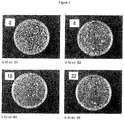
- The results are shown in
Figure 1 . - As can be seen from the photographic documentation, predissolving the active substance octenidin dihydrochloride improves the activity of the ointment in comparison with the octenidin-containing suspension ointment.
-

- The formulations B1-B5, B7, B8, B10, B12, and B13 are not in the scope of the claims. The amount applied was in each case 0.10 ml.
- The evaluation was done via photographic documentation, followed by counting the CFU on each plate and calculating the RF factors based on the blank (plate B13) .
- The results are shown in
Figures 2 to 4 . - The Turixin plate shows two microbes, but these are not MRSA, the Turixin plate contains zero (0) microbes. This results in an RF value of 2.83. This RF value is not obtained with the suspension ointments containing octenidin alone (plates B2-B5); the RF values are between 0.38-1.10. The solution ointments generally perform better than the suspension ointments. Formulation B6, which contains 4.95% propylene glycol, has an RF value of 2.53 and therefore approaches the activity of Turixin. Only two microbes grow on the plate. The activity of glycerol-containing formulations (B9 and B11) is good, too; only two and four microbes, respectively, grow. The RF values amount to 2.53 (B9) and 2.23 (B11).
- Thus, an approximately equally good activity is obtained with the solution ointments in comparison with Turixin. The activity of the suspension ointments is clearly worse.
Claims (4)
- Process for preparing a multiphase semisolid preparation in the form an ointment which contains octenidine dihydrochloride, in which:i) Octenidine dihydrochloride is dissolved in a solvent selected from among 1,2-propylene glycol, glycerol and mixtures thereof, so as to prepare a solution of 0.01% to 5% by weight of octenidine dihydrochloride, based on the weight of the solution (phase I),ii) an emulsifier with an HLB<8 is provided together with a lipid phase (phase II),iii) phases I and II are warmed separately at a temperature from 50°C to 100°C,iv) phase I is incorporated into phase II, such that the weight ratio between the phase I and the phase II amounts from 1:99 to 20:80 andv) if appropriate, the mixture is homogenized.
- Process according to Claim 1, characterized in that the concentration of octenidine dihydrochloride in the solution prepared in step i) amounts to 0.02 to 2% by weight, based on the weight of the solution.
- Process according to one of the preceding claims, characterized in that the weight ratio between phase I and phase II amounts to from 2:98 to 15:85.
- Process according to one of the preceding claims, characterized in that the lipid phase comprises Vaseline, liquid paraffin, triglycerides or mixtures thereof and one or more emulsifiers with an HLB value of < 8, selected from among glycerol (mono, di, tri) [adipate, alkanoate (C8, C10 and C18), isostearate], polyglyceryl esters, sorbitan laurate and cetylstearyl acetate and mixtures thereof.
Priority Applications (1)
| Application Number | Priority Date | Filing Date | Title |
|---|---|---|---|
| PL13179624T PL2702983T3 (en) | 2012-08-31 | 2013-08-07 | Process for the preparation of a bispyridiniumalkane-containing semisolid preparation |
Applications Claiming Priority (1)
| Application Number | Priority Date | Filing Date | Title |
|---|---|---|---|
| DE102012215511.2A DE102012215511A1 (en) | 2012-08-31 | 2012-08-31 | Process for the preparation of a semi-solid preparation containing bispyridiniumalkane |
Publications (2)
| Publication Number | Publication Date |
|---|---|
| EP2702983A1 EP2702983A1 (en) | 2014-03-05 |
| EP2702983B1 true EP2702983B1 (en) | 2018-10-10 |
Family
ID=48948295
Family Applications (1)
| Application Number | Title | Priority Date | Filing Date |
|---|---|---|---|
| EP13179624.5A Not-in-force EP2702983B1 (en) | 2012-08-31 | 2013-08-07 | Process for the preparation of a bispyridiniumalkane-containing semisolid preparation |
Country Status (4)
| Country | Link |
|---|---|
| EP (1) | EP2702983B1 (en) |
| DE (1) | DE102012215511A1 (en) |
| ES (1) | ES2702292T3 (en) |
| PL (1) | PL2702983T3 (en) |
Families Citing this family (4)
| Publication number | Priority date | Publication date | Assignee | Title |
|---|---|---|---|---|
| DE102014107412A1 (en) | 2014-05-26 | 2015-12-17 | Schülke & Mayr GmbH | Colored disinfecting preparation based on bispyridiniumalkane |
| EP3106172B1 (en) | 2015-06-15 | 2020-08-05 | B. Braun Melsungen AG | Antimicrobial agents and their use |
| DE102017119261A1 (en) * | 2017-08-23 | 2019-02-28 | Schülke & Mayr GmbH | Octenidine dihydrochloride-containing mouthwash |
| WO2021137102A1 (en) * | 2019-12-31 | 2021-07-08 | 3M Innovative Properties Company | Octenidine salt antimicrobial medical articles |
Family Cites Families (13)
| Publication number | Priority date | Publication date | Assignee | Title |
|---|---|---|---|---|
| GB1533952A (en) | 1976-02-25 | 1978-11-29 | Sterling Drug Inc | Anti-microbial bis-pyridinium compounds |
| GB8530796D0 (en) | 1985-12-13 | 1986-01-22 | Beecham Group Plc | Pharmaceutical composition |
| CN1102410C (en) | 1993-10-22 | 2003-03-05 | 史密丝克莱恩比彻姆公司 | Cream composition of mupirocin calcium salt |
| GB9616208D0 (en) | 1996-08-01 | 1996-09-11 | Smithkline Beecham Plc | Novel Compounds |
| DE19647692C2 (en) | 1996-11-05 | 2002-06-20 | Schuelke & Mayr Gmbh | Washing disinfectant for hygienic and surgical hand disinfection |
| GB9808470D0 (en) | 1998-04-22 | 1998-06-17 | Smithkline Beecham Plc | Novel process and apparatus |
| US9028852B2 (en) | 2004-09-07 | 2015-05-12 | 3M Innovative Properties Company | Cationic antiseptic compositions and methods of use |
| DE102005045145B4 (en) | 2005-09-15 | 2025-09-25 | Schülke & Mayr GmbH | Use of octenidine dihydrochloride in semi-solid preparations |
| DE102006051891A1 (en) | 2006-10-31 | 2008-05-08 | Schülke & Mayr GmbH | Antimicrobial composition containing Bispyridiniumalkan |
| DE102008011691A1 (en) | 2008-02-28 | 2009-09-10 | Schülke & Mayr GmbH | Stabilized antimicrobial composition containing bispyridiniumalkane |
| DE102009049506A1 (en) * | 2009-10-15 | 2011-04-21 | Schülke & Mayr GmbH | Octenidine dihydrochloride-containing wound dressing for use in the antiseptic of catheter entry sites |
| DE102010044785A1 (en) | 2010-09-09 | 2012-03-15 | Beiersdorf Ag | Octenidine dihydrochloride as a coemulsifier in microemulsions |
| DE102010044787A1 (en) | 2010-09-09 | 2012-03-15 | Beiersdorf Ag | Macroemulsions with improved deodorant activity |
-
2012
- 2012-08-31 DE DE102012215511.2A patent/DE102012215511A1/en not_active Ceased
-
2013
- 2013-08-07 ES ES13179624T patent/ES2702292T3/en active Active
- 2013-08-07 EP EP13179624.5A patent/EP2702983B1/en not_active Not-in-force
- 2013-08-07 PL PL13179624T patent/PL2702983T3/en unknown
Non-Patent Citations (1)
| Title |
|---|
| None * |
Also Published As
| Publication number | Publication date |
|---|---|
| PL2702983T3 (en) | 2019-05-31 |
| ES2702292T3 (en) | 2019-02-28 |
| DE102012215511A1 (en) | 2014-06-12 |
| EP2702983A1 (en) | 2014-03-05 |
Similar Documents
| Publication | Publication Date | Title |
|---|---|---|
| US5830488A (en) | Disinfectant composition | |
| EP3766489B1 (en) | Semisolid aqueous pharmaceutical composition containing tapentadol | |
| KR101658116B1 (en) | Preservative system for emulsion-based therapeutic topical formulations | |
| EP2702983A1 (en) | Process for the preparation of a bispyridiniumalkane-containing semisolid preparation | |
| WO2012011192A1 (en) | Tacrolimus-containing oil-in-water type creamy composition | |
| JP2022183154A (en) | Bisphosphocin gel formulations and uses thereof | |
| JP2014530840A (en) | Pharmaceutical composition comprising DGLA, 15-OHEPA and / or 15-HETRE and method of use thereof | |
| WO2009106467A2 (en) | Stabilized, antimicrobially effective composition with a content of bispyridinium alkane | |
| AU2014257984B2 (en) | Composition for use in reducing scab formation and promoting healing | |
| EP2496215A2 (en) | Antimicrobial and anti-acne formulations | |
| US4612193A (en) | Sty ointment and method of using the same | |
| JPH0764745B2 (en) | Cream for dermatology and ophthalmology for treating wounds and ulcers | |
| ME00390B (en) | Utilzation of powder preparations containig hydroxypyridones for treating leg ulcers and decubitus ulcers | |
| CA2711114A1 (en) | Topical compositions for the controlled delivery of proteins and peptides | |
| WO2026062287A1 (en) | An oil-in-water emulsion composition for use as a topical moisturizing, anti-itch, anti-infectious and anti-microbial composition | |
| JP5674786B2 (en) | Oil-in-water cream composition containing tacrolimus | |
| TW202228661A (en) | Topical composition | |
| WO2026015654A1 (en) | Octenidine formulations and methods for wound healing | |
| TWI474841B (en) | Preservative system for emulsion-based therapeutic topical formulations | |
| HK1176887A (en) | Tacrolimus-containing oil-in-water type creamy composition | |
| WO2010003431A1 (en) | Disinfecting composition | |
| JPH0478613B2 (en) | ||
| JPS638331A (en) | Infection remedy |
Legal Events
| Date | Code | Title | Description |
|---|---|---|---|
| AK | Designated contracting states |
Kind code of ref document: A1 Designated state(s): AL AT BE BG CH CY CZ DE DK EE ES FI FR GB GR HR HU IE IS IT LI LT LU LV MC MK MT NL NO PL PT RO RS SE SI SK SM TR |
|
| AX | Request for extension of the european patent |
Extension state: BA ME |
|
| PUAI | Public reference made under article 153(3) epc to a published international application that has entered the european phase |
Free format text: ORIGINAL CODE: 0009012 |
|
| 17P | Request for examination filed |
Effective date: 20140905 |
|
| RBV | Designated contracting states (corrected) |
Designated state(s): AL AT BE BG CH CY CZ DE DK EE ES FI FR GB GR HR HU IE IS IT LI LT LU LV MC MK MT NL NO PL PT RO RS SE SI SK SM TR |
|
| 17Q | First examination report despatched |
Effective date: 20151218 |
|
| GRAP | Despatch of communication of intention to grant a patent |
Free format text: ORIGINAL CODE: EPIDOSNIGR1 |
|
| STAA | Information on the status of an ep patent application or granted ep patent |
Free format text: STATUS: GRANT OF PATENT IS INTENDED |
|
| INTG | Intention to grant announced |
Effective date: 20180319 |
|
| GRAS | Grant fee paid |
Free format text: ORIGINAL CODE: EPIDOSNIGR3 |
|
| GRAA | (expected) grant |
Free format text: ORIGINAL CODE: 0009210 |
|
| STAA | Information on the status of an ep patent application or granted ep patent |
Free format text: STATUS: THE PATENT HAS BEEN GRANTED |
|
| AK | Designated contracting states |
Kind code of ref document: B1 Designated state(s): AL AT BE BG CH CY CZ DE DK EE ES FI FR GB GR HR HU IE IS IT LI LT LU LV MC MK MT NL NO PL PT RO RS SE SI SK SM TR |
|
| REG | Reference to a national code |
Ref country code: GB Ref legal event code: FG4D |
|
| REG | Reference to a national code |
Ref country code: CH Ref legal event code: EP Ref country code: AT Ref legal event code: REF Ref document number: 1050413 Country of ref document: AT Kind code of ref document: T Effective date: 20181015 |
|
| REG | Reference to a national code |
Ref country code: IE Ref legal event code: FG4D |
|
| REG | Reference to a national code |
Ref country code: DE Ref legal event code: R096 Ref document number: 602013044762 Country of ref document: DE |
|
| REG | Reference to a national code |
Ref country code: NL Ref legal event code: MP Effective date: 20181010 |
|
| REG | Reference to a national code |
Ref country code: LT Ref legal event code: MG4D |
|
| REG | Reference to a national code |
Ref country code: ES Ref legal event code: FG2A Ref document number: 2702292 Country of ref document: ES Kind code of ref document: T3 Effective date: 20190228 |
|
| REG | Reference to a national code |
Ref country code: AT Ref legal event code: MK05 Ref document number: 1050413 Country of ref document: AT Kind code of ref document: T Effective date: 20181010 |
|
| PG25 | Lapsed in a contracting state [announced via postgrant information from national office to epo] |
Ref country code: NL Free format text: LAPSE BECAUSE OF FAILURE TO SUBMIT A TRANSLATION OF THE DESCRIPTION OR TO PAY THE FEE WITHIN THE PRESCRIBED TIME-LIMIT Effective date: 20181010 |
|
| PG25 | Lapsed in a contracting state [announced via postgrant information from national office to epo] |
Ref country code: AT Free format text: LAPSE BECAUSE OF FAILURE TO SUBMIT A TRANSLATION OF THE DESCRIPTION OR TO PAY THE FEE WITHIN THE PRESCRIBED TIME-LIMIT Effective date: 20181010 Ref country code: IS Free format text: LAPSE BECAUSE OF FAILURE TO SUBMIT A TRANSLATION OF THE DESCRIPTION OR TO PAY THE FEE WITHIN THE PRESCRIBED TIME-LIMIT Effective date: 20190210 Ref country code: NO Free format text: LAPSE BECAUSE OF FAILURE TO SUBMIT A TRANSLATION OF THE DESCRIPTION OR TO PAY THE FEE WITHIN THE PRESCRIBED TIME-LIMIT Effective date: 20190110 Ref country code: LT Free format text: LAPSE BECAUSE OF FAILURE TO SUBMIT A TRANSLATION OF THE DESCRIPTION OR TO PAY THE FEE WITHIN THE PRESCRIBED TIME-LIMIT Effective date: 20181010 Ref country code: HR Free format text: LAPSE BECAUSE OF FAILURE TO SUBMIT A TRANSLATION OF THE DESCRIPTION OR TO PAY THE FEE WITHIN THE PRESCRIBED TIME-LIMIT Effective date: 20181010 Ref country code: BG Free format text: LAPSE BECAUSE OF FAILURE TO SUBMIT A TRANSLATION OF THE DESCRIPTION OR TO PAY THE FEE WITHIN THE PRESCRIBED TIME-LIMIT Effective date: 20190110 Ref country code: LV Free format text: LAPSE BECAUSE OF FAILURE TO SUBMIT A TRANSLATION OF THE DESCRIPTION OR TO PAY THE FEE WITHIN THE PRESCRIBED TIME-LIMIT Effective date: 20181010 Ref country code: FI Free format text: LAPSE BECAUSE OF FAILURE TO SUBMIT A TRANSLATION OF THE DESCRIPTION OR TO PAY THE FEE WITHIN THE PRESCRIBED TIME-LIMIT Effective date: 20181010 |
|
| PG25 | Lapsed in a contracting state [announced via postgrant information from national office to epo] |
Ref country code: RS Free format text: LAPSE BECAUSE OF FAILURE TO SUBMIT A TRANSLATION OF THE DESCRIPTION OR TO PAY THE FEE WITHIN THE PRESCRIBED TIME-LIMIT Effective date: 20181010 Ref country code: AL Free format text: LAPSE BECAUSE OF FAILURE TO SUBMIT A TRANSLATION OF THE DESCRIPTION OR TO PAY THE FEE WITHIN THE PRESCRIBED TIME-LIMIT Effective date: 20181010 Ref country code: SE Free format text: LAPSE BECAUSE OF FAILURE TO SUBMIT A TRANSLATION OF THE DESCRIPTION OR TO PAY THE FEE WITHIN THE PRESCRIBED TIME-LIMIT Effective date: 20181010 Ref country code: PT Free format text: LAPSE BECAUSE OF FAILURE TO SUBMIT A TRANSLATION OF THE DESCRIPTION OR TO PAY THE FEE WITHIN THE PRESCRIBED TIME-LIMIT Effective date: 20190210 Ref country code: GR Free format text: LAPSE BECAUSE OF FAILURE TO SUBMIT A TRANSLATION OF THE DESCRIPTION OR TO PAY THE FEE WITHIN THE PRESCRIBED TIME-LIMIT Effective date: 20190111 |
|
| REG | Reference to a national code |
Ref country code: DE Ref legal event code: R097 Ref document number: 602013044762 Country of ref document: DE |
|
| PG25 | Lapsed in a contracting state [announced via postgrant information from national office to epo] |
Ref country code: DK Free format text: LAPSE BECAUSE OF FAILURE TO SUBMIT A TRANSLATION OF THE DESCRIPTION OR TO PAY THE FEE WITHIN THE PRESCRIBED TIME-LIMIT Effective date: 20181010 Ref country code: CZ Free format text: LAPSE BECAUSE OF FAILURE TO SUBMIT A TRANSLATION OF THE DESCRIPTION OR TO PAY THE FEE WITHIN THE PRESCRIBED TIME-LIMIT Effective date: 20181010 |
|
| PLBE | No opposition filed within time limit |
Free format text: ORIGINAL CODE: 0009261 |
|
| STAA | Information on the status of an ep patent application or granted ep patent |
Free format text: STATUS: NO OPPOSITION FILED WITHIN TIME LIMIT |
|
| PG25 | Lapsed in a contracting state [announced via postgrant information from national office to epo] |
Ref country code: EE Free format text: LAPSE BECAUSE OF FAILURE TO SUBMIT A TRANSLATION OF THE DESCRIPTION OR TO PAY THE FEE WITHIN THE PRESCRIBED TIME-LIMIT Effective date: 20181010 Ref country code: SM Free format text: LAPSE BECAUSE OF FAILURE TO SUBMIT A TRANSLATION OF THE DESCRIPTION OR TO PAY THE FEE WITHIN THE PRESCRIBED TIME-LIMIT Effective date: 20181010 Ref country code: RO Free format text: LAPSE BECAUSE OF FAILURE TO SUBMIT A TRANSLATION OF THE DESCRIPTION OR TO PAY THE FEE WITHIN THE PRESCRIBED TIME-LIMIT Effective date: 20181010 Ref country code: SK Free format text: LAPSE BECAUSE OF FAILURE TO SUBMIT A TRANSLATION OF THE DESCRIPTION OR TO PAY THE FEE WITHIN THE PRESCRIBED TIME-LIMIT Effective date: 20181010 |
|
| REG | Reference to a national code |
Ref country code: ES Ref legal event code: PC2A Owner name: SCHUELKE & MAYR GMBH Effective date: 20190827 |
|
| 26N | No opposition filed |
Effective date: 20190711 |
|
| REG | Reference to a national code |
Ref country code: GB Ref legal event code: 732E Free format text: REGISTERED BETWEEN 20190919 AND 20190925 |
|
| PG25 | Lapsed in a contracting state [announced via postgrant information from national office to epo] |
Ref country code: SI Free format text: LAPSE BECAUSE OF FAILURE TO SUBMIT A TRANSLATION OF THE DESCRIPTION OR TO PAY THE FEE WITHIN THE PRESCRIBED TIME-LIMIT Effective date: 20181010 |
|
| PG25 | Lapsed in a contracting state [announced via postgrant information from national office to epo] |
Ref country code: TR Free format text: LAPSE BECAUSE OF FAILURE TO SUBMIT A TRANSLATION OF THE DESCRIPTION OR TO PAY THE FEE WITHIN THE PRESCRIBED TIME-LIMIT Effective date: 20181010 |
|
| PG25 | Lapsed in a contracting state [announced via postgrant information from national office to epo] |
Ref country code: LU Free format text: LAPSE BECAUSE OF NON-PAYMENT OF DUE FEES Effective date: 20190807 Ref country code: CH Free format text: LAPSE BECAUSE OF NON-PAYMENT OF DUE FEES Effective date: 20190831 Ref country code: LI Free format text: LAPSE BECAUSE OF NON-PAYMENT OF DUE FEES Effective date: 20190831 Ref country code: MC Free format text: LAPSE BECAUSE OF FAILURE TO SUBMIT A TRANSLATION OF THE DESCRIPTION OR TO PAY THE FEE WITHIN THE PRESCRIBED TIME-LIMIT Effective date: 20181010 |
|
| REG | Reference to a national code |
Ref country code: BE Ref legal event code: MM Effective date: 20190831 |
|
| PG25 | Lapsed in a contracting state [announced via postgrant information from national office to epo] |
Ref country code: IE Free format text: LAPSE BECAUSE OF NON-PAYMENT OF DUE FEES Effective date: 20190807 |
|
| PG25 | Lapsed in a contracting state [announced via postgrant information from national office to epo] |
Ref country code: BE Free format text: LAPSE BECAUSE OF NON-PAYMENT OF DUE FEES Effective date: 20190831 |
|
| PG25 | Lapsed in a contracting state [announced via postgrant information from national office to epo] |
Ref country code: CY Free format text: LAPSE BECAUSE OF FAILURE TO SUBMIT A TRANSLATION OF THE DESCRIPTION OR TO PAY THE FEE WITHIN THE PRESCRIBED TIME-LIMIT Effective date: 20181010 |
|
| PG25 | Lapsed in a contracting state [announced via postgrant information from national office to epo] |
Ref country code: MT Free format text: LAPSE BECAUSE OF FAILURE TO SUBMIT A TRANSLATION OF THE DESCRIPTION OR TO PAY THE FEE WITHIN THE PRESCRIBED TIME-LIMIT Effective date: 20181010 Ref country code: HU Free format text: LAPSE BECAUSE OF FAILURE TO SUBMIT A TRANSLATION OF THE DESCRIPTION OR TO PAY THE FEE WITHIN THE PRESCRIBED TIME-LIMIT; INVALID AB INITIO Effective date: 20130807 |
|
| PG25 | Lapsed in a contracting state [announced via postgrant information from national office to epo] |
Ref country code: MK Free format text: LAPSE BECAUSE OF FAILURE TO SUBMIT A TRANSLATION OF THE DESCRIPTION OR TO PAY THE FEE WITHIN THE PRESCRIBED TIME-LIMIT Effective date: 20181010 |
|
| PGFP | Annual fee paid to national office [announced via postgrant information from national office to epo] |
Ref country code: IT Payment date: 20220819 Year of fee payment: 10 Ref country code: GB Payment date: 20220822 Year of fee payment: 10 Ref country code: DE Payment date: 20220819 Year of fee payment: 10 |
|
| PGFP | Annual fee paid to national office [announced via postgrant information from national office to epo] |
Ref country code: PL Payment date: 20220801 Year of fee payment: 10 Ref country code: FR Payment date: 20220823 Year of fee payment: 10 |
|
| PGFP | Annual fee paid to national office [announced via postgrant information from national office to epo] |
Ref country code: ES Payment date: 20221024 Year of fee payment: 10 |
|
| REG | Reference to a national code |
Ref country code: DE Ref legal event code: R119 Ref document number: 602013044762 Country of ref document: DE |
|
| GBPC | Gb: european patent ceased through non-payment of renewal fee |
Effective date: 20230807 |
|
| PG25 | Lapsed in a contracting state [announced via postgrant information from national office to epo] |
Ref country code: GB Free format text: LAPSE BECAUSE OF NON-PAYMENT OF DUE FEES Effective date: 20230807 |
|
| PG25 | Lapsed in a contracting state [announced via postgrant information from national office to epo] |
Ref country code: IT Free format text: LAPSE BECAUSE OF NON-PAYMENT OF DUE FEES Effective date: 20230807 Ref country code: GB Free format text: LAPSE BECAUSE OF NON-PAYMENT OF DUE FEES Effective date: 20230807 Ref country code: FR Free format text: LAPSE BECAUSE OF NON-PAYMENT OF DUE FEES Effective date: 20230831 Ref country code: DE Free format text: LAPSE BECAUSE OF NON-PAYMENT OF DUE FEES Effective date: 20240301 |
|
| REG | Reference to a national code |
Ref country code: ES Ref legal event code: FD2A Effective date: 20240927 |
|
| PG25 | Lapsed in a contracting state [announced via postgrant information from national office to epo] |
Ref country code: ES Free format text: LAPSE BECAUSE OF NON-PAYMENT OF DUE FEES Effective date: 20230808 |
|
| PG25 | Lapsed in a contracting state [announced via postgrant information from national office to epo] |
Ref country code: PL Free format text: LAPSE BECAUSE OF NON-PAYMENT OF DUE FEES Effective date: 20230807 |
|
| PG25 | Lapsed in a contracting state [announced via postgrant information from national office to epo] |
Ref country code: PL Free format text: LAPSE BECAUSE OF NON-PAYMENT OF DUE FEES Effective date: 20230807 Ref country code: ES Free format text: LAPSE BECAUSE OF NON-PAYMENT OF DUE FEES Effective date: 20230808 |