EP2697447B1 - Method of protecting the end of a multi-tendon cable - Google Patents
Method of protecting the end of a multi-tendon cable Download PDFInfo
- Publication number
- EP2697447B1 EP2697447B1 EP11730736.3A EP11730736A EP2697447B1 EP 2697447 B1 EP2697447 B1 EP 2697447B1 EP 11730736 A EP11730736 A EP 11730736A EP 2697447 B1 EP2697447 B1 EP 2697447B1
- Authority
- EP
- European Patent Office
- Prior art keywords
- chamber
- protective material
- anchor block
- injected
- tendons
- Prior art date
- Legal status (The legal status is an assumption and is not a legal conclusion. Google has not performed a legal analysis and makes no representation as to the accuracy of the status listed.)
- Active
Links
Images



Classifications
-
- B—PERFORMING OPERATIONS; TRANSPORTING
- B29—WORKING OF PLASTICS; WORKING OF SUBSTANCES IN A PLASTIC STATE IN GENERAL
- B29C—SHAPING OR JOINING OF PLASTICS; SHAPING OF MATERIAL IN A PLASTIC STATE, NOT OTHERWISE PROVIDED FOR; AFTER-TREATMENT OF THE SHAPED PRODUCTS, e.g. REPAIRING
- B29C45/00—Injection moulding, i.e. forcing the required volume of moulding material through a nozzle into a closed mould; Apparatus therefor
- B29C45/14—Injection moulding, i.e. forcing the required volume of moulding material through a nozzle into a closed mould; Apparatus therefor incorporating preformed parts or layers, e.g. injection moulding around inserts or for coating articles
- B29C45/14336—Coating a portion of the article, e.g. the edge of the article
- B29C45/14426—Coating the end of wire-like or rod-like or cable-like or blade-like or belt-like articles
-
- E—FIXED CONSTRUCTIONS
- E04—BUILDING
- E04C—STRUCTURAL ELEMENTS; BUILDING MATERIALS
- E04C5/00—Reinforcing elements, e.g. for concrete; Auxiliary elements therefor
- E04C5/08—Members specially adapted to be used in prestressed constructions
- E04C5/12—Anchoring devices
-
- E—FIXED CONSTRUCTIONS
- E04—BUILDING
- E04C—STRUCTURAL ELEMENTS; BUILDING MATERIALS
- E04C5/00—Reinforcing elements, e.g. for concrete; Auxiliary elements therefor
- E04C5/08—Members specially adapted to be used in prestressed constructions
- E04C5/12—Anchoring devices
- E04C5/122—Anchoring devices the tensile members are anchored by wedge-action
Definitions
- the present invention relates to structural cables used in construction works. It applies, in particular, to the anchoring of stay cables or pre-stressing cables.
- Such structural cables are frequently made of a plurality of parallel tendons. Their ends are anchored using blocks in which channels are formed for receiving and blocking individually the tendons, for example by means of split conical jaws.
- the tendons of the cable are made of metal, for example in the form of strands.
- they are often contained in individual sheaths of plastic material which isolate them from the environment and thus protect them from corrosive agents.
- plastic sheath is removed in the anchoring region. It is then necessary to provide particular anti-corrosion protection measures in the anchoring region.
- the volume containing the exposed portions of the tendons is filled with a protective material injected under pressure into the anchoring region.
- the injection step must be carried out with caution so as to avoid any remaining voids in the volume to be filled, since such voids may be the starting point of the corrosion phenomenon for the metal of the tendons, in particular if water leaks in.
- Wax is an interesting example of protective material to be injected in the anchoring region, in view of its properties of adherence, corrosion protection and fatigue behavior.
- the wax is in a solid state at room temperature and becomes liquid when heated. It can thus form a reversible filling, which is useful for allowing inspection of the anchorage.
- injectable protective materials can be used, in particular thick materials, e.g. grease, or hardening materials, e.g. a resin or a polymer.
- the protective material is selected by taking into account the required functionalities for installing and or maintaining the anchorage.
- the volume to be filled with protective material includes a chamber located on the front side of the anchorage and closed by a cover.
- the end portions of the tendons of the cable, protruding from the anchorage, are located in that chamber.
- the rear side of the anchor block does not have a second chamber containing the tendons collectively.
- the ends of the individual sheaths of the tendons are located in the channels of the anchor block, or in extensions of those channels provided on the rear side of the anchor block.
- the injection is performed once the tendons have been installed and tensioned.
- the filling material is injected by an inlet located in a low portion of the anchorage until it flows out by a vent located in a high portion of the anchorage. This minimizes the risk of leaving voids in the volume to be filled.
- the different channels form competing flow paths.
- the head loss in those channels is not uniform because the contents of channels can be different from one channel to another.
- the block has one or more communication channels in addition to the channels containing tendons, the fluid material has a tendency to flow through the communication channels, so that the other channels may remain with voids, thus exposing the metallic tendons.
- the possible presence of debris in a channel when the injection starts also changes the head loss through that channel and causes a risk of incomplete filling. If there are no communication channels and/or if there is a chamber only on the front side of the anchorage, it is also quite difficult to ensure a complete filling of the channels containing the tendons.
- the invention solves this problem with a method according to claim 1.
- the first injection phase makes it possible to ensure that the channels are properly filled. In particular, they can be filled individually by injecting a controlled amount of protective material. Typically, each channel of the anchor block containing a tendon receives protective material in the first injection phase.
- the protective material injected into the channels of the anchor block in the first phase may be a wax or grease.
- the first injection phase comprises, for each channel:
- the bell-shaped cover may have a passage for that tendon. It is then possible to attach the bell-shaped cover to the tendon when the protective material is injected in order to withstand the injection pressure.
- the proposed method is also advantageous in that the protective material injected into the chamber in the second phase can be chosen different from the protective material injected into the channels of the anchor block in the first phase.
- the selection of the protective materials is made as a function of desired functionalities for each part of the anchorage in order to optimize the properties of the anchorage.
- the method is applicable to an anchorage in which the chamber has two parts on the front and rear sides of the anchor block, respectively, connected together by at least one communication channel extending through the anchor block.
- the communication channel is not filled with protective material in the first injection phase. In most cases, no tendon of the cable will be put in such a communication channel.
- the second injection phase may have a common step of injecting protective material into one of the parts of the chamber and, from said one of the parts of the chamber, into another part of the chamber through the at least one communication channel.
- This chamber contains end portions of the plurality of tendons of the cable, and receives protective material e.g. a wax or grease, in the second injection phase.
- first chamber containing tensioned portions of the tendons, formed on the rear side of the anchor block
- second chamber containing the end portions of the tendons, formed on a front side of the anchor block.
- protective material is injected into the first chamber and separately into the second chamber.
- the protective material e.g. a polymer or a resin
- injected into the first chamber can be chosen different from the protective material, e.g. a wax or grease, injected into the second chamber.
- the structural cable shown in figure 1 is made of a plurality of tendons 10 each consisting of a metallic strand 11 contained in an individual plastic sheath 12. Only two tendons 10 are shown in the figures for simplicity of the drawing. Typically, a higher number of tendons, e.g. a few tens of tendons, are used.
- the tendons 10 extend parallel to each other along the prescribed path of the structural cable, e.g. along the inclined path of a stay cable between the deck and a pylon of a bridge, or along the path specified for a pre-stressing cable.
- the structural cable is anchored at both ends.
- the anchoring devices transfer the tensile load of the cable to the structure.
- the plastic sheaths 12 are removed at the ends of the tendons 10, thus exposing the metal of the strands 11.
- the bare parts of the tendons 10 extend through and beyond an anchor block 15 of the anchoring device.
- the anchor block 15 has a number of channels 16 extending between its rear side 17 (towards the running part of the cable where the tendons will be under tension) and its front side 18. Each tendon 10 is received within one of the channels 16 with a blocking member 19.
- each channel 16 designed to receive a tendon 10 has a cylindrical part near the rear side 17 of the anchor block 15, with a diameter slightly larger than that of the strand 11, extended by a conical part which tapers outwardly towards the front side 18 of the anchor block 15.
- the blocking member is in the form of a conical jaw 19 placed in the conical part of the channel 16 to grip the metallic strand 11.
- the jaw 19 has a cylindrical axial bore for receiving the strand, and is made of a plurality of sectors (e.g. three sectors) held together by a ring 20 inserted in an annular groove located near the wide end of the jaw 19.
- the cable To install the cable, its tendons 10 are inserted into their respective channels 16 with the conical jaws 19, the tensile force is applied by holding the strands 11 in their parts projecting from the front face 18 of the anchor block 15, pulling them using an actuator such as a hydraulic jack, and pushing the jaws 19 into the channels 16. When the actuator is deactivated, the jaws 19 block the strands 11 in their channels 16. This tensioning operation can be performed strand by strand, group of strands by group of strands, or collectively for the whole cable.
- a first injection phase is carried out to make sure that these intervals are filled with a substance 100 which will protect the metal from corrosion.
- the substance with which the channels 16 are filled in the first injection phase is a wax or grease.
- it may also be a curing material such as a polymer or a resin.
- the first injection phase can be performed for each channel 16 by using a bell-shaped cover 25 over the inlet of the channel.
- the cover 25 is sealingly applied against the front side 18 of the anchor block 15 using a gasket 26, and its opposite end has an aperture providing a passage for the strand 11.
- a sealing ring 27 is placed around the strand 11 to seal the front end of the cover 25 which is secured in its position by a ring 28 clamped on the free end of the strand 11.
- the protective material 100 is injected in a fluid or soft phase through an inlet 29 provided in the cover 25. Since the volume of the intervals not occupied by the metallic strand and jaw is known with precision, a regulated amount of protective material can be injected into each channel 16 to ensure complete filling of the channel. An injection pump (not shown) is controlled to inject the set amount of protective material 100 inside the cover 25 to completely fill the channel 16.
- the attachment of the bell-shaped cover 25 to the strand 11 ensures that the cover 25 is kept in place at the inlet of the channel 16 while the protective material is injected under pressure to overcome the head loss within the channel 16. It will be noted that other mechanisms can be used to hold the cover in that step, for example attached to the anchor block 15.
- the filling material 100 injected into the channels 16 is allowed to cure (if it is a polymer or resin) or to solidify by cooling (if it is a wax) and the cover 25 is removed from the front side of the anchor block 15. If the filling 100 is a thick material such as grease, no hardening time is needed and the cover may be removed just after the injection. An amount of protective material 100 may or may not remain on the portion of the strand 11 which was contained in the cover 25.
- a second injection phase is carried out to fill the other closed volume(s) of the anchorage with protective material.
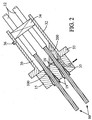
- the first chamber 30 on the rear side 17 of the anchor block is delimited radially by a tube 32 through with the tensioned parts of the tendons 10 extend.
- the ends of the plastic sheaths 12 of the tendons are located within the chamber 30.
- the chamber 30 is closed by a sealing device 34, for example a stuffing box arrangement as described in WO 01 /20098 A1 , which isolates the chamber 30 from the outside while leaving passages for the tendons 10.
- the front end of the tube 32 has a flange 33 which forms a bearing surface for the anchor block 15, the flange 33 being applied against the structure equipped with the cable.
- the anchorage may have various other arrangements within the scope of the present invention.
- the injection of the protective material 200 into the first chamber 30 is performed though an inlet which, in the illustrated example, is formed by an opening 35 provided in the anchor block 15, in a low part of the chamber 30.
- the opening 35 is bent to be accessible on a lateral side of the anchor block 15. It may also be straight and accessible on the front side 18 of the anchor block 15.
- a vent 36 is formed in an upper part of the tube 32 to evacuate the air contained in the chamber 30 during the injection step. Once the injection is complete, the vent 36 is closed by a plug 37 ( figure 3 ) and the protective material 200 is allowed to harden or solidify, if needed, prior to closing the inlet opening 35 with another plug 38.
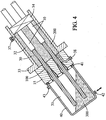
- the second chamber 31 on the front side 18 of the anchor block is delimited by a case 40 shown in figure 4 .
- the case 40 is mounted on the anchor block 15 by means of bolts or other fixing means (not shown).
- a sealing ring 41 is provided between the rear end of the case 40 and the front face 18 of the anchor block to prevent the protective material from leaking when injected.
- the case 40 is dimensioned to contain the bare ends of all the tendons 10 of the cable. Its lower part has an opening 42 for injecting the protective material 300 and its upper part has a vent 43 for evacuating the air when the protective material 300 is injected.
- the protective material 300 injected into the second chamber 31 fills all the remaining voids. When it flows out though the vent 43, the injection is stopped and a plug 45 is placed on the vent 43. The injected protective material 300 is allowed to harden or solidify, if needed, prior to closing the inlet opening 42 with another plug.
- the protective material injected to fill (i) the channels 16, (ii) the chamber 30 at the rear of the anchor block 15 and (iii) the chamber 31 at the front of the anchor block 15 can be selected independently for each volume to be filled, thus permitting an optimization of the anchorage by choosing each material for its properties as desired.
- the chamber 31 located at the front of the anchor block 15 may be opened, by removing the case 40, during the lifetime of the anchorage to enable checking of its proper operation. For this reason, it is typically desirable to use in that chamber 31 a protective material 300 which can be easily removed.
- a wax is an advantageous material for this purpose since it can be melted or at least softened by heating and pumped out. Grease can also be used.
- a flexible material 100 having lubricating properties such as grease or wax, is suitable in view of its good fatigue behavior which enhances the ultimate strength of the tendons.
- the chamber 30 at the rear of the anchor block 15 is potentially exposed to infiltrations of water flowing along the structure or the cable.
- a flexible, sticky and coherent material 200 is often a good choice to best prevent such infiltrations.
- a polymer or a resin is advantageously injected in that part of the anchorage.
- Figure 5 illustrates an alternative embodiment of an anchoring device, for which the second injection phase, i.e. after filling of the channels 16 where the tendons are blocked, is essentially performed in one step.
- the chamber thus filled is made of two parts 50, 51 connected together by one or more communication channels 52.
- the first part 50 is located on the rear side 17 of the anchor block 15 and is functionally similar to the first chamber 30 of the embodiment shown in figures 1-4 , being delimited by a cylindrical tube 32 and a stuffing box-type of sealing device 34.
- the second part 51 is located on the front side 18 of the anchor block 15 and is functionally similar to the second chamber 31 of the embodiment shown in figures 1-4 , being delimited by a case 40.
- the communication channels 52 do not contain tendons and extend through the anchor block 15 parallel to the channels 16 containing the tendons.
- the first injection phase is performed to fill the channels 16 with a protective substance 100 as described with reference to figure 1 .
- the case 40 is assembled on the anchor block 15 and the second injection phase is performed to inject a protective material 400 in the two-part chamber 50-51.
- FIG. 5 is, for example, that of the anchorage of the lower end of an inclined stay cable.
- the lower part of the anchorage is in the lower part of the case an inlet 42 is provided.
- two vents 36, 43 are provided, one (36) in the upper part of the rear part 50 of the chamber and the other (43) in the upper part of the front part 51 of the chamber.
- the level of the fluid material 400 rises.
- the vent 43 it overflows and a plug 45 is put on that vent 43 to continue the injection, thus permitting the protective material 400 to rise further through the communication channels 52 and into the rear part 50 of the chamber.
- the second injection phase is over and a plug is put on the vent 36.
- the protective material 400 is allowed to harden or solidify, if needed, prior to closing the inlet opening 42 with another plug.
- the protective material 400 injected into the chamber 50-51 in the second phase is preferably, though not necessarily, the same as the protective material 100 injected into the channels 16 in the first phase.
- a wax or grease may be injected into the channels 16 and then into the two-part chamber 50-51.
- specifications of a given work can make it preferable to use different filler materials.
- the chamber filled in the second injection phase is located only on the front side of the anchor block 15.
- the plastic sheaths 12 of the tendons 10 then have their end sections inside the channels 16 of the anchor block 15 or in individual extensions of those channels behind the anchor block 15.
- the first injection phase is performed to fill the channels 16 and/or their extensions with the protective material 100.
- the filling is made at least in the parts of the channels 16 and/or their extensions where the metal of the strand is free of plastic sheath.
- the separate injection of the protective material into the channels 16 and/or their extensions ensures a reliable filling irrespective of the variable head losses typically experienced by the injected substance in those channels.
- the second injection phase is carried out to introduce the protective material 300, which is preferably different from the previously injected protective material 100, into the chamber 31 located only on the front side 18 of the anchor block 15 and containing the end portions of the strands 11. This can be performed in the same manner as described with reference to figure 4 .
- the chamber 31 to be filled with protective material is located only on the front side of the anchor block 15
- wax or grease will often be a suitable choice for the protective material both in the channels 16 and in the chamber 31 because of its good fatigue properties (for the channels 16) and because it is relatively easy to remove (for the chamber 31).
- other choices may be suitable or preferable. For instance, water-tightness at the rear of the channels in such an anchorage design can be a concern. For this reason, an adhering filler material such as a polymer or a resin may be used in the channels 16, while a wax or grease is injected into the chamber 31.
- the above-described method of protecting the bare ends of the tendons of a structural cable using two or more injection phases in different parts of the anchoring device is applicable to the installation of a new cable. It is also applicable to the maintenance or repair of an existing cable.
- the protective filler material which was previously located in the different parts of the anchoring device may be removed (for example using a method as described in French patent application No. 11 52557 filed on March 28, 2011 ) prior to injecting one or more new protective material(s) in two or more phases as described above.
Landscapes
- Engineering & Computer Science (AREA)
- Architecture (AREA)
- Civil Engineering (AREA)
- Structural Engineering (AREA)
- Manufacturing & Machinery (AREA)
- Mechanical Engineering (AREA)
- Bridges Or Land Bridges (AREA)
- Piles And Underground Anchors (AREA)
- Ropes Or Cables (AREA)
- Processing Of Terminals (AREA)
Priority Applications (1)
| Application Number | Priority Date | Filing Date | Title |
|---|---|---|---|
| HUE11730736A HUE029019T2 (en) | 2011-04-15 | 2011-04-15 | A method of protecting the end of a multi-tension cable |
Applications Claiming Priority (1)
| Application Number | Priority Date | Filing Date | Title |
|---|---|---|---|
| PCT/IB2011/001046 WO2012140462A1 (en) | 2011-04-15 | 2011-04-15 | Method of protecting the end of a multi-tendon cable |
Publications (2)
| Publication Number | Publication Date |
|---|---|
| EP2697447A1 EP2697447A1 (en) | 2014-02-19 |
| EP2697447B1 true EP2697447B1 (en) | 2016-02-24 |
Family
ID=44628235
Family Applications (1)
| Application Number | Title | Priority Date | Filing Date |
|---|---|---|---|
| EP11730736.3A Active EP2697447B1 (en) | 2011-04-15 | 2011-04-15 | Method of protecting the end of a multi-tendon cable |
Country Status (11)
| Country | Link |
|---|---|
| US (1) | US9446541B2 (pl) |
| EP (1) | EP2697447B1 (pl) |
| KR (3) | KR102012838B1 (pl) |
| AU (1) | AU2011365314B2 (pl) |
| DK (1) | DK2697447T3 (pl) |
| ES (1) | ES2572636T3 (pl) |
| HU (1) | HUE029019T2 (pl) |
| MX (1) | MX339730B (pl) |
| PL (1) | PL2697447T3 (pl) |
| RU (1) | RU2566541C2 (pl) |
| WO (1) | WO2012140462A1 (pl) |
Families Citing this family (5)
| Publication number | Priority date | Publication date | Assignee | Title |
|---|---|---|---|---|
| DE102013215136A1 (de) * | 2013-08-01 | 2015-02-05 | Dywidag-Systems International Gmbh | Korrosionsgeschütztes Zugglied und plastisch verformbare Scheibe aus Korrosionsschutzmaterial für ein derartiges Zugglied |
| IT201800005437A1 (it) * | 2018-05-16 | 2019-11-16 | Dispositivo di fissaggio per funi tiranti | |
| CN109098086A (zh) * | 2018-10-22 | 2018-12-28 | 湖南路桥建设集团有限责任公司 | 一种斜拉索锚头钢绞线的防腐结构及方法 |
| JP6807482B1 (ja) * | 2020-08-18 | 2021-01-06 | 中日本ハイウェイ・エンジニアリング東京株式会社 | テンドンの頭部定着構造 |
| US12054947B1 (en) * | 2024-01-08 | 2024-08-06 | King Faisal University | Multi-layer wedge anchorage for FRP plates and FRP tendons |
Citations (9)
| Publication number | Priority date | Publication date | Assignee | Title |
|---|---|---|---|---|
| FR2492870A1 (fr) | 1980-10-27 | 1982-04-30 | Precontrainte Structures Ste F | Tete d'ancrage de cable pour ouvrage en beton precontraint |
| DE3339058A1 (de) | 1983-10-28 | 1985-05-15 | Dyckerhoff & Widmann AG, 8000 München | Freiliegendes spannbares zugglied aus einem oder mehreren zugelementen, wie stahlstaeben, -draehten oder -litzen |
| DE3224702C2 (de) | 1982-07-02 | 1986-01-16 | Dyckerhoff & Widmann AG, 8000 München | Vorrichtung zum Verankern und Koppeln eines Bündelspannglieds für Spannbeton |
| CH676617A5 (pl) | 1987-03-13 | 1991-02-15 | Dyckerhoff & Widmann Ag | |
| DE3801451C2 (de) | 1987-10-15 | 1994-09-29 | Dyckerhoff & Widmann Ag | Korrosionsgeschütztes freies Zugglied, vornehmlich Spannglied für Spannbeton ohne Verbund |
| DE3644551C2 (de) | 1986-12-24 | 1994-12-08 | Zueblin Ag | Verankerung für ein verbundloses Spannglied |
| EP0703326B1 (de) | 1994-09-22 | 1999-11-03 | DYCKERHOFF & WIDMANN AG | Korrosionsgeschütztes Zugglied, vornehmlich Spannglied für Spannbeton ohne Verbund |
| DE20311950U1 (de) | 2003-08-02 | 2004-12-09 | Dywidag-Systems International Gmbh | Korrosionsgeschütztes Zugglied, insbesondere Spannglied für Spannbeton |
| DE60102061T4 (de) | 2000-12-04 | 2009-10-22 | Freyssinet | Individuell geschützte Litze, deren Verwendung in der Bautechnik und Verfahren zu deren Herstellung |
Family Cites Families (17)
| Publication number | Priority date | Publication date | Assignee | Title |
|---|---|---|---|---|
| FR1152557A (fr) | 1954-09-21 | 1958-02-20 | Dispositif pour le relevage automatique de lames pour la formation de la foule dans des métiers à tisser à table et à domicile | |
| BE794024A (fr) * | 1972-01-21 | 1973-05-02 | Brandestini Antonio | Dispositif d'ancrage pour cables composes de brins |
| JPS59173712U (ja) * | 1983-05-09 | 1984-11-20 | 株式会社 春本鐵工所 | 橋梁ケ−ブルのアンカ−ソケツト |
| GB8407596D0 (en) * | 1984-03-23 | 1984-05-02 | Manuf Aceros Caucho Sa | Reinforcing tendon |
| FR2623551B1 (fr) * | 1987-11-25 | 1992-04-24 | Freyssinet Int Stup | Perfectionnements aux haubans et a leurs composants |
| DE4118897A1 (de) * | 1991-06-08 | 1992-12-10 | Hochtief Ag Hoch Tiefbauten | Bauwerkslagereinrichtung fuer ein spannglied und verfahren zum auswechseln eines solchen spanngliedes |
| US5173982A (en) | 1991-07-25 | 1992-12-29 | Greiner Inc, Southern | Corrosion protection system |
| DE29504739U1 (de) * | 1995-03-20 | 1995-05-18 | Dyckerhoff & Widmann AG, 81902 München | Korrosionsgeschütztes Zugglied, vornehmlich externes Spannglied für Spannbeton ohne Verbund |
| DE19733822A1 (de) | 1997-08-05 | 1999-02-11 | Dyckerhoff & Widmann Ag | Verfahren zum Einbauen und Spannen eines freigespannten Zugglieds und Vorrichtung zum Durchführen des Verfahrens |
| RU2131010C1 (ru) * | 1997-12-30 | 1999-05-27 | Государственный научно-исследовательский, проектно-конструкторский и изыскательский институт "Атомэнергопроект" | Предварительно напряженное железобетонное сооружение |
| FR2798410B1 (fr) | 1999-09-15 | 2001-11-23 | Freyssinet Int Stup | Dispositif d'ancrage pour fixer un cable de structure a un element de construction |
| EP1227200B1 (en) | 2001-01-29 | 2008-06-04 | VSL International AG | Device and method for Anchoring one end of a stay to a base |
| FR2822177B1 (fr) | 2001-03-15 | 2004-04-30 | Freyssinet Int Stup | Dispositif d'ancrage pour armatures de precontrainte, systeme de precontrainte incluant le dispositif, et armature appropriee |
| JP2003286759A (ja) * | 2002-03-28 | 2003-10-10 | Ps Mitsubishi Construction Co Ltd | Pc定着装置及び方法 |
| JP2004052539A (ja) * | 2002-05-30 | 2004-02-19 | Anderson Technology Kk | プレストレストコンクリート構造物の緊張端部構造及び緊張端部の施工方法 |
| JP4387380B2 (ja) * | 2006-06-15 | 2009-12-16 | 弘和産業株式会社 | アンカー補修方法とアンカー頭部及び頭部背面機構 |
| WO2012140463A1 (en) * | 2011-04-15 | 2012-10-18 | Soletanche Freyssinet | Anchoring device for a multi-tendon cable |
-
2011
- 2011-04-15 EP EP11730736.3A patent/EP2697447B1/en active Active
- 2011-04-15 HU HUE11730736A patent/HUE029019T2/en unknown
- 2011-04-15 DK DK11730736.3T patent/DK2697447T3/en active
- 2011-04-15 KR KR1020187018507A patent/KR102012838B1/ko active Active
- 2011-04-15 RU RU2013150822/03A patent/RU2566541C2/ru active
- 2011-04-15 WO PCT/IB2011/001046 patent/WO2012140462A1/en not_active Ceased
- 2011-04-15 US US14/009,767 patent/US9446541B2/en active Active
- 2011-04-15 AU AU2011365314A patent/AU2011365314B2/en active Active
- 2011-04-15 PL PL11730736.3T patent/PL2697447T3/pl unknown
- 2011-04-15 ES ES11730736.3T patent/ES2572636T3/es active Active
- 2011-04-15 KR KR1020137029333A patent/KR20140022402A/ko not_active Ceased
- 2011-04-15 MX MX2013011988A patent/MX339730B/es active IP Right Grant
- 2011-04-15 KR KR1020197023770A patent/KR20190097322A/ko not_active Ceased
Patent Citations (9)
| Publication number | Priority date | Publication date | Assignee | Title |
|---|---|---|---|---|
| FR2492870A1 (fr) | 1980-10-27 | 1982-04-30 | Precontrainte Structures Ste F | Tete d'ancrage de cable pour ouvrage en beton precontraint |
| DE3224702C2 (de) | 1982-07-02 | 1986-01-16 | Dyckerhoff & Widmann AG, 8000 München | Vorrichtung zum Verankern und Koppeln eines Bündelspannglieds für Spannbeton |
| DE3339058A1 (de) | 1983-10-28 | 1985-05-15 | Dyckerhoff & Widmann AG, 8000 München | Freiliegendes spannbares zugglied aus einem oder mehreren zugelementen, wie stahlstaeben, -draehten oder -litzen |
| DE3644551C2 (de) | 1986-12-24 | 1994-12-08 | Zueblin Ag | Verankerung für ein verbundloses Spannglied |
| CH676617A5 (pl) | 1987-03-13 | 1991-02-15 | Dyckerhoff & Widmann Ag | |
| DE3801451C2 (de) | 1987-10-15 | 1994-09-29 | Dyckerhoff & Widmann Ag | Korrosionsgeschütztes freies Zugglied, vornehmlich Spannglied für Spannbeton ohne Verbund |
| EP0703326B1 (de) | 1994-09-22 | 1999-11-03 | DYCKERHOFF & WIDMANN AG | Korrosionsgeschütztes Zugglied, vornehmlich Spannglied für Spannbeton ohne Verbund |
| DE60102061T4 (de) | 2000-12-04 | 2009-10-22 | Freyssinet | Individuell geschützte Litze, deren Verwendung in der Bautechnik und Verfahren zu deren Herstellung |
| DE20311950U1 (de) | 2003-08-02 | 2004-12-09 | Dywidag-Systems International Gmbh | Korrosionsgeschütztes Zugglied, insbesondere Spannglied für Spannbeton |
Non-Patent Citations (7)
| Title |
|---|
| "Rosario-Victoria-Brücke", STRUCTURAE, 2003, pages 1 - 3, XP055329438, Retrieved from the Internet <URL:https://structurae.de/bauwerke/rosario-victoria-bruecke> |
| "Strelasundquerung", WIKIPEDIA, pages 1 - 20, XP055329428 |
| "Ziegelgrabenbrücke", STRUCTURAE, 2007, pages 1 - 7, XP055329445 |
| CH. GLÄSER ET AL.: "?Die zweite Strelasundquerung - Erste deutsche An- wendung von Parallellitzenseilen", BAND, vol. 82, April 2007 (2007-04-01), pages 170 - 176, XP055329497 |
| D. JUNGWIRTH ET AL.: "Experience during the First Application of the New fib Stay Cable Recommendation 2005 on the Ziegelgraben Bridge to the Isle of Rügen/ Germany", ?PROCEEDINGS OF THE 2ND FIB CONGRESS, 5 June 2006 (2006-06-05), Neapel, Italien, pages 1 - 12, XP055329498 |
| EINTRAG ZUR ZIEGELGRABENBRÜCKE IN DER WEBSITE ''STRUC- TURAE, 2007, XP055329471, Retrieved from the Internet <URL:https://structurae.de/bauwerke/ziegelgraben-bruecke> |
| K. KLEINHANSS: "?Die 2. Strelasundquerung mit der Rügenbrücke - inter- aktive Entwicklung in der Bauphase", VDI-GESELLSCHAFT BAUTECHNIK, 2006, pages 224 - 240, XP055329452 |
Also Published As
| Publication number | Publication date |
|---|---|
| MX339730B (es) | 2016-06-06 |
| AU2011365314B2 (en) | 2017-04-27 |
| MX2013011988A (es) | 2013-11-20 |
| WO2012140462A1 (en) | 2012-10-18 |
| HUE029019T2 (en) | 2017-02-28 |
| AU2011365314A1 (en) | 2013-10-24 |
| KR20190097322A (ko) | 2019-08-20 |
| RU2566541C2 (ru) | 2015-10-27 |
| HK1189395A1 (zh) | 2014-06-06 |
| DK2697447T3 (en) | 2016-05-30 |
| EP2697447A1 (en) | 2014-02-19 |
| ES2572636T3 (es) | 2016-06-01 |
| KR20140022402A (ko) | 2014-02-24 |
| RU2013150822A (ru) | 2015-05-20 |
| KR20180077327A (ko) | 2018-07-06 |
| US20140021649A1 (en) | 2014-01-23 |
| US9446541B2 (en) | 2016-09-20 |
| PL2697447T3 (pl) | 2016-09-30 |
| KR102012838B1 (ko) | 2019-08-21 |
Similar Documents
| Publication | Publication Date | Title |
|---|---|---|
| EP2697446B1 (en) | Anchoring assembly | |
| EP2697447B1 (en) | Method of protecting the end of a multi-tendon cable | |
| EP2550400B1 (en) | Sealing arrangement | |
| US20200199831A1 (en) | Improved assembly comprising a structural cable and a saddle | |
| US20130007966A1 (en) | Strand guiding device | |
| KR102027925B1 (ko) | 피복 강연선을 이용한 교량 거더의 보강 공법 및 이에 사용되는 피복 강연선의 정착 장치. | |
| CN105089049B (zh) | 锚索外锚头钢绞线保护装置及其安装方法 | |
| HK1189395B (en) | Method of protecting the end of a multi-tendon cable | |
| HK1189254B (en) | Anchoring assembly | |
| KR20120110054A (ko) | 구조 케이블을 건축요소에 고정하기 위한 시스템 드레이닝 방법 | |
| KR102292311B1 (ko) | 이중튜브를 이용한 케이블 정착장치 시공방법 | |
| JP6049477B2 (ja) | ケーブルトレイ耐水圧処理方法及び耐水圧構造 | |
| KR102031412B1 (ko) | 물성 시험 장치 및 이를 이용한 물성 시험 방법 | |
| JP2005207218A (ja) | ケーブル保護および固定方法 | |
| JP2005207122A (ja) | ケーブル保護および固定方法 | |
| HK1231148A (en) | Improvement for a strand guiding device | |
| HK1231148A1 (en) | Bridge support frame and method for protecting strand from corroding in the same | |
| HK40004740A (en) | Cable anchorage with seal element | |
| HK1177775A (en) | Improvement for a strand guiding device | |
| HK1170276B (en) | Method of draining a system for anchoring a structural cable to a construction element | |
| HK1178226B (en) | Sealing arrangement |
Legal Events
| Date | Code | Title | Description |
|---|---|---|---|
| PUAI | Public reference made under article 153(3) epc to a published international application that has entered the european phase |
Free format text: ORIGINAL CODE: 0009012 |
|
| 17P | Request for examination filed |
Effective date: 20131114 |
|
| AK | Designated contracting states |
Kind code of ref document: A1 Designated state(s): AL AT BE BG CH CY CZ DE DK EE ES FI FR GB GR HR HU IE IS IT LI LT LU LV MC MK MT NL NO PL PT RO RS SE SI SK SM TR |
|
| REG | Reference to a national code |
Ref country code: HK Ref legal event code: DE Ref document number: 1189395 Country of ref document: HK |
|
| DAX | Request for extension of the european patent (deleted) | ||
| RIN1 | Information on inventor provided before grant (corrected) |
Inventor name: MELLIER, ERIK Inventor name: SYLVESTRE, AURELIEN Inventor name: JOYE, STEPHANE Inventor name: STUBLER, JEROME |
|
| RAP1 | Party data changed (applicant data changed or rights of an application transferred) |
Owner name: SOLETANCHE FREYSSINET |
|
| GRAP | Despatch of communication of intention to grant a patent |
Free format text: ORIGINAL CODE: EPIDOSNIGR1 |
|
| INTG | Intention to grant announced |
Effective date: 20150730 |
|
| GRAS | Grant fee paid |
Free format text: ORIGINAL CODE: EPIDOSNIGR3 |
|
| GRAA | (expected) grant |
Free format text: ORIGINAL CODE: 0009210 |
|
| AK | Designated contracting states |
Kind code of ref document: B1 Designated state(s): AL AT BE BG CH CY CZ DE DK EE ES FI FR GB GR HR HU IE IS IT LI LT LU LV MC MK MT NL NO PL PT RO RS SE SI SK SM TR |
|
| REG | Reference to a national code |
Ref country code: GB Ref legal event code: FG4D |
|
| REG | Reference to a national code |
Ref country code: CH Ref legal event code: EP |
|
| REG | Reference to a national code |
Ref country code: AT Ref legal event code: REF Ref document number: 776827 Country of ref document: AT Kind code of ref document: T Effective date: 20160315 |
|
| REG | Reference to a national code |
Ref country code: IE Ref legal event code: FG4D |
|
| REG | Reference to a national code |
Ref country code: DE Ref legal event code: R096 Ref document number: 602011023409 Country of ref document: DE |
|
| REG | Reference to a national code |
Ref country code: FR Ref legal event code: PLFP Year of fee payment: 6 |
|
| REG | Reference to a national code |
Ref country code: RO Ref legal event code: EPE |
|
| REG | Reference to a national code |
Ref country code: PT Ref legal event code: SC4A Free format text: AVAILABILITY OF NATIONAL TRANSLATION Effective date: 20160520 |
|
| REG | Reference to a national code |
Ref country code: DK Ref legal event code: T3 Effective date: 20160529 |
|
| REG | Reference to a national code |
Ref country code: ES Ref legal event code: FG2A Ref document number: 2572636 Country of ref document: ES Kind code of ref document: T3 Effective date: 20160601 Ref country code: NL Ref legal event code: FP |
|
| REG | Reference to a national code |
Ref country code: LT Ref legal event code: MG4D |
|
| REG | Reference to a national code |
Ref country code: AT Ref legal event code: MK05 Ref document number: 776827 Country of ref document: AT Kind code of ref document: T Effective date: 20160224 |
|
| PG25 | Lapsed in a contracting state [announced via postgrant information from national office to epo] |
Ref country code: HR Free format text: LAPSE BECAUSE OF FAILURE TO SUBMIT A TRANSLATION OF THE DESCRIPTION OR TO PAY THE FEE WITHIN THE PRESCRIBED TIME-LIMIT Effective date: 20160224 Ref country code: FI Free format text: LAPSE BECAUSE OF FAILURE TO SUBMIT A TRANSLATION OF THE DESCRIPTION OR TO PAY THE FEE WITHIN THE PRESCRIBED TIME-LIMIT Effective date: 20160224 Ref country code: NO Free format text: LAPSE BECAUSE OF FAILURE TO SUBMIT A TRANSLATION OF THE DESCRIPTION OR TO PAY THE FEE WITHIN THE PRESCRIBED TIME-LIMIT Effective date: 20160524 |
|
| PG25 | Lapsed in a contracting state [announced via postgrant information from national office to epo] |
Ref country code: LT Free format text: LAPSE BECAUSE OF FAILURE TO SUBMIT A TRANSLATION OF THE DESCRIPTION OR TO PAY THE FEE WITHIN THE PRESCRIBED TIME-LIMIT Effective date: 20160224 Ref country code: LV Free format text: LAPSE BECAUSE OF FAILURE TO SUBMIT A TRANSLATION OF THE DESCRIPTION OR TO PAY THE FEE WITHIN THE PRESCRIBED TIME-LIMIT Effective date: 20160224 Ref country code: SE Free format text: LAPSE BECAUSE OF FAILURE TO SUBMIT A TRANSLATION OF THE DESCRIPTION OR TO PAY THE FEE WITHIN THE PRESCRIBED TIME-LIMIT Effective date: 20160224 Ref country code: RS Free format text: LAPSE BECAUSE OF FAILURE TO SUBMIT A TRANSLATION OF THE DESCRIPTION OR TO PAY THE FEE WITHIN THE PRESCRIBED TIME-LIMIT Effective date: 20160224 Ref country code: AT Free format text: LAPSE BECAUSE OF FAILURE TO SUBMIT A TRANSLATION OF THE DESCRIPTION OR TO PAY THE FEE WITHIN THE PRESCRIBED TIME-LIMIT Effective date: 20160224 |
|
| REG | Reference to a national code |
Ref country code: GR Ref legal event code: EP Ref document number: 20160400999 Country of ref document: GR Effective date: 20160628 |
|
| REG | Reference to a national code |
Ref country code: HK Ref legal event code: GR Ref document number: 1189395 Country of ref document: HK |
|
| PG25 | Lapsed in a contracting state [announced via postgrant information from national office to epo] |
Ref country code: EE Free format text: LAPSE BECAUSE OF FAILURE TO SUBMIT A TRANSLATION OF THE DESCRIPTION OR TO PAY THE FEE WITHIN THE PRESCRIBED TIME-LIMIT Effective date: 20160224 |
|
| REG | Reference to a national code |
Ref country code: DE Ref legal event code: R026 Ref document number: 602011023409 Country of ref document: DE |
|
| PLBI | Opposition filed |
Free format text: ORIGINAL CODE: 0009260 |
|
| PG25 | Lapsed in a contracting state [announced via postgrant information from national office to epo] |
Ref country code: CZ Free format text: LAPSE BECAUSE OF FAILURE TO SUBMIT A TRANSLATION OF THE DESCRIPTION OR TO PAY THE FEE WITHIN THE PRESCRIBED TIME-LIMIT Effective date: 20160224 Ref country code: SM Free format text: LAPSE BECAUSE OF FAILURE TO SUBMIT A TRANSLATION OF THE DESCRIPTION OR TO PAY THE FEE WITHIN THE PRESCRIBED TIME-LIMIT Effective date: 20160224 Ref country code: SK Free format text: LAPSE BECAUSE OF FAILURE TO SUBMIT A TRANSLATION OF THE DESCRIPTION OR TO PAY THE FEE WITHIN THE PRESCRIBED TIME-LIMIT Effective date: 20160224 |
|
| 26 | Opposition filed |
Opponent name: DYWIDAG-SYSTEMS INTERNATIONAL GMBH Effective date: 20161123 |
|
| PG25 | Lapsed in a contracting state [announced via postgrant information from national office to epo] |
Ref country code: LU Free format text: LAPSE BECAUSE OF FAILURE TO SUBMIT A TRANSLATION OF THE DESCRIPTION OR TO PAY THE FEE WITHIN THE PRESCRIBED TIME-LIMIT Effective date: 20160415 |
|
| PLAF | Information modified related to communication of a notice of opposition and request to file observations + time limit |
Free format text: ORIGINAL CODE: EPIDOSCOBS2 |
|
| PLAX | Notice of opposition and request to file observation + time limit sent |
Free format text: ORIGINAL CODE: EPIDOSNOBS2 |
|
| REG | Reference to a national code |
Ref country code: IE Ref legal event code: MM4A |
|
| PG25 | Lapsed in a contracting state [announced via postgrant information from national office to epo] |
Ref country code: BG Free format text: LAPSE BECAUSE OF FAILURE TO SUBMIT A TRANSLATION OF THE DESCRIPTION OR TO PAY THE FEE WITHIN THE PRESCRIBED TIME-LIMIT Effective date: 20160524 Ref country code: SI Free format text: LAPSE BECAUSE OF FAILURE TO SUBMIT A TRANSLATION OF THE DESCRIPTION OR TO PAY THE FEE WITHIN THE PRESCRIBED TIME-LIMIT Effective date: 20160224 |
|
| REG | Reference to a national code |
Ref country code: HU Ref legal event code: AG4A Ref document number: E029019 Country of ref document: HU |
|
| REG | Reference to a national code |
Ref country code: FR Ref legal event code: PLFP Year of fee payment: 7 |
|
| PLBB | Reply of patent proprietor to notice(s) of opposition received |
Free format text: ORIGINAL CODE: EPIDOSNOBS3 |
|
| PG25 | Lapsed in a contracting state [announced via postgrant information from national office to epo] |
Ref country code: IE Free format text: LAPSE BECAUSE OF NON-PAYMENT OF DUE FEES Effective date: 20160415 |
|
| PLBP | Opposition withdrawn |
Free format text: ORIGINAL CODE: 0009264 |
|
| PLBD | Termination of opposition procedure: decision despatched |
Free format text: ORIGINAL CODE: EPIDOSNOPC1 |
|
| REG | Reference to a national code |
Ref country code: DE Ref legal event code: R100 Ref document number: 602011023409 Country of ref document: DE |
|
| PLBM | Termination of opposition procedure: date of legal effect published |
Free format text: ORIGINAL CODE: 0009276 |
|
| STAA | Information on the status of an ep patent application or granted ep patent |
Free format text: STATUS: OPPOSITION PROCEDURE CLOSED |
|
| REG | Reference to a national code |
Ref country code: FR Ref legal event code: PLFP Year of fee payment: 8 |
|
| 27C | Opposition proceedings terminated |
Effective date: 20171113 |
|
| REG | Reference to a national code |
Ref country code: BE Ref legal event code: FP Effective date: 20160520 |
|
| PG25 | Lapsed in a contracting state [announced via postgrant information from national office to epo] |
Ref country code: CY Free format text: LAPSE BECAUSE OF FAILURE TO SUBMIT A TRANSLATION OF THE DESCRIPTION OR TO PAY THE FEE WITHIN THE PRESCRIBED TIME-LIMIT Effective date: 20160224 |
|
| PG25 | Lapsed in a contracting state [announced via postgrant information from national office to epo] |
Ref country code: MK Free format text: LAPSE BECAUSE OF FAILURE TO SUBMIT A TRANSLATION OF THE DESCRIPTION OR TO PAY THE FEE WITHIN THE PRESCRIBED TIME-LIMIT Effective date: 20160224 Ref country code: MT Free format text: LAPSE BECAUSE OF NON-PAYMENT OF DUE FEES Effective date: 20160430 Ref country code: IS Free format text: LAPSE BECAUSE OF FAILURE TO SUBMIT A TRANSLATION OF THE DESCRIPTION OR TO PAY THE FEE WITHIN THE PRESCRIBED TIME-LIMIT Effective date: 20160224 Ref country code: MC Free format text: LAPSE BECAUSE OF FAILURE TO SUBMIT A TRANSLATION OF THE DESCRIPTION OR TO PAY THE FEE WITHIN THE PRESCRIBED TIME-LIMIT Effective date: 20160224 |
|
| PG25 | Lapsed in a contracting state [announced via postgrant information from national office to epo] |
Ref country code: AL Free format text: LAPSE BECAUSE OF FAILURE TO SUBMIT A TRANSLATION OF THE DESCRIPTION OR TO PAY THE FEE WITHIN THE PRESCRIBED TIME-LIMIT Effective date: 20160224 |
|
| P01 | Opt-out of the competence of the unified patent court (upc) registered |
Effective date: 20230526 |
|
| PGFP | Annual fee paid to national office [announced via postgrant information from national office to epo] |
Ref country code: PT Payment date: 20250324 Year of fee payment: 15 |
|
| PGFP | Annual fee paid to national office [announced via postgrant information from national office to epo] |
Ref country code: DK Payment date: 20250319 Year of fee payment: 15 Ref country code: NL Payment date: 20250319 Year of fee payment: 15 |
|
| PGFP | Annual fee paid to national office [announced via postgrant information from national office to epo] |
Ref country code: GR Payment date: 20250321 Year of fee payment: 15 Ref country code: BE Payment date: 20250319 Year of fee payment: 15 |
|
| PGFP | Annual fee paid to national office [announced via postgrant information from national office to epo] |
Ref country code: PL Payment date: 20250321 Year of fee payment: 15 Ref country code: FR Payment date: 20250319 Year of fee payment: 15 |
|
| PGFP | Annual fee paid to national office [announced via postgrant information from national office to epo] |
Ref country code: IT Payment date: 20250319 Year of fee payment: 15 Ref country code: GB Payment date: 20250319 Year of fee payment: 15 |
|
| PGFP | Annual fee paid to national office [announced via postgrant information from national office to epo] |
Ref country code: TR Payment date: 20250324 Year of fee payment: 15 |
|
| PGFP | Annual fee paid to national office [announced via postgrant information from national office to epo] |
Ref country code: DE Payment date: 20250319 Year of fee payment: 15 |
|
| PGFP | Annual fee paid to national office [announced via postgrant information from national office to epo] |
Ref country code: ES Payment date: 20250502 Year of fee payment: 15 |
|
| PGFP | Annual fee paid to national office [announced via postgrant information from national office to epo] |
Ref country code: HU Payment date: 20250423 Year of fee payment: 15 |
|
| PGFP | Annual fee paid to national office [announced via postgrant information from national office to epo] |
Ref country code: CH Payment date: 20250501 Year of fee payment: 15 |
|
| PGFP | Annual fee paid to national office [announced via postgrant information from national office to epo] |
Ref country code: RO Payment date: 20250410 Year of fee payment: 15 |