EP2679646A2 - Adhesive film, adhesive composition for the same and optical member including the same - Google Patents
Adhesive film, adhesive composition for the same and optical member including the same Download PDFInfo
- Publication number
- EP2679646A2 EP2679646A2 EP13173620.9A EP13173620A EP2679646A2 EP 2679646 A2 EP2679646 A2 EP 2679646A2 EP 13173620 A EP13173620 A EP 13173620A EP 2679646 A2 EP2679646 A2 EP 2679646A2
- Authority
- EP
- European Patent Office
- Prior art keywords
- meth
- group
- adhesive composition
- dielectric constant
- adhesive film
- Prior art date
- Legal status (The legal status is an assumption and is not a legal conclusion. Google has not performed a legal analysis and makes no representation as to the accuracy of the status listed.)
- Withdrawn
Links
- 239000002313 adhesive film Substances 0.000 title claims abstract description 71
- 239000000203 mixture Substances 0.000 title claims abstract description 55
- 239000000853 adhesive Substances 0.000 title claims abstract description 52
- 230000001070 adhesive effect Effects 0.000 title claims abstract description 52
- 230000003287 optical effect Effects 0.000 title claims abstract description 16
- 229920001577 copolymer Polymers 0.000 claims abstract description 46
- 125000003118 aryl group Chemical group 0.000 claims abstract description 23
- 125000005587 carbonate group Chemical group 0.000 claims abstract description 19
- 239000000178 monomer Substances 0.000 claims description 60
- 125000000391 vinyl group Chemical group [H]C([*])=C([H])[H] 0.000 claims description 32
- 229920002554 vinyl polymer Polymers 0.000 claims description 30
- -1 softeners Substances 0.000 claims description 27
- 125000002887 hydroxy group Chemical group [H]O* 0.000 claims description 15
- 239000003431 cross linking reagent Substances 0.000 claims description 14
- 125000000217 alkyl group Chemical group 0.000 claims description 12
- 239000003999 initiator Substances 0.000 claims description 12
- NIXOWILDQLNWCW-UHFFFAOYSA-N acrylic acid group Chemical group C(C=C)(=O)O NIXOWILDQLNWCW-UHFFFAOYSA-N 0.000 claims description 10
- 125000002723 alicyclic group Chemical group 0.000 claims description 7
- 125000004435 hydrogen atom Chemical group [H]* 0.000 claims description 7
- 229920005989 resin Polymers 0.000 claims description 7
- 239000011347 resin Substances 0.000 claims description 7
- 125000006273 (C1-C3) alkyl group Chemical group 0.000 claims description 6
- 239000003795 chemical substances by application Substances 0.000 claims description 6
- 239000001257 hydrogen Substances 0.000 claims description 6
- 229910052739 hydrogen Inorganic materials 0.000 claims description 6
- 125000005647 linker group Chemical group 0.000 claims description 6
- 125000000027 (C1-C10) alkoxy group Chemical group 0.000 claims description 5
- 125000000008 (C1-C10) alkyl group Chemical group 0.000 claims description 5
- 125000006736 (C6-C20) aryl group Chemical group 0.000 claims description 4
- 239000000049 pigment Substances 0.000 claims description 3
- 239000002904 solvent Substances 0.000 claims description 3
- 238000003860 storage Methods 0.000 claims description 3
- 125000006832 (C1-C10) alkylene group Chemical group 0.000 claims description 2
- 239000006087 Silane Coupling Agent Substances 0.000 claims description 2
- 239000006096 absorbing agent Substances 0.000 claims description 2
- 230000003712 anti-aging effect Effects 0.000 claims description 2
- 239000002518 antifoaming agent Substances 0.000 claims description 2
- 239000003963 antioxidant agent Substances 0.000 claims description 2
- 239000002216 antistatic agent Substances 0.000 claims description 2
- 239000002981 blocking agent Substances 0.000 claims description 2
- 239000002270 dispersing agent Substances 0.000 claims description 2
- 239000000975 dye Substances 0.000 claims description 2
- 239000006081 fluorescent whitening agent Substances 0.000 claims description 2
- 239000012760 heat stabilizer Substances 0.000 claims description 2
- 239000011256 inorganic filler Substances 0.000 claims description 2
- 229910003475 inorganic filler Inorganic materials 0.000 claims description 2
- 239000002608 ionic liquid Substances 0.000 claims description 2
- 239000004611 light stabiliser Substances 0.000 claims description 2
- 229910003002 lithium salt Inorganic materials 0.000 claims description 2
- 159000000002 lithium salts Chemical class 0.000 claims description 2
- 239000000314 lubricant Substances 0.000 claims description 2
- 239000004014 plasticizer Substances 0.000 claims description 2
- 238000002407 reforming Methods 0.000 claims description 2
- 239000003381 stabilizer Substances 0.000 claims description 2
- 230000007257 malfunction Effects 0.000 abstract description 6
- NIXOWILDQLNWCW-UHFFFAOYSA-M acrylate group Chemical group C(C=C)(=O)[O-] NIXOWILDQLNWCW-UHFFFAOYSA-M 0.000 description 75
- 239000010408 film Substances 0.000 description 31
- 229920005862 polyol Polymers 0.000 description 13
- 150000001875 compounds Chemical class 0.000 description 12
- 150000003077 polyols Chemical class 0.000 description 10
- 239000007787 solid Substances 0.000 description 9
- 230000000052 comparative effect Effects 0.000 description 7
- RBQRWNWVPQDTJJ-UHFFFAOYSA-N methacryloyloxyethyl isocyanate Chemical compound CC(=C)C(=O)OCCN=C=O RBQRWNWVPQDTJJ-UHFFFAOYSA-N 0.000 description 7
- 239000012788 optical film Substances 0.000 description 7
- BLRPTPMANUNPDV-UHFFFAOYSA-N Silane Chemical group [SiH4] BLRPTPMANUNPDV-UHFFFAOYSA-N 0.000 description 6
- YXFVVABEGXRONW-UHFFFAOYSA-N Toluene Chemical compound CC1=CC=CC=C1 YXFVVABEGXRONW-UHFFFAOYSA-N 0.000 description 6
- 150000001252 acrylic acid derivatives Chemical class 0.000 description 6
- 238000001723 curing Methods 0.000 description 6
- 238000003848 UV Light-Curing Methods 0.000 description 5
- 239000011521 glass Substances 0.000 description 5
- 239000012948 isocyanate Substances 0.000 description 5
- IMNIMPAHZVJRPE-UHFFFAOYSA-N triethylenediamine Chemical compound C1CN2CCN1CC2 IMNIMPAHZVJRPE-UHFFFAOYSA-N 0.000 description 5
- TXBCBTDQIULDIA-UHFFFAOYSA-N 2-[[3-hydroxy-2,2-bis(hydroxymethyl)propoxy]methyl]-2-(hydroxymethyl)propane-1,3-diol Chemical compound OCC(CO)(CO)COCC(CO)(CO)CO TXBCBTDQIULDIA-UHFFFAOYSA-N 0.000 description 4
- UKLDJPRMSDWDSL-UHFFFAOYSA-L [dibutyl(dodecanoyloxy)stannyl] dodecanoate Chemical compound CCCCCCCCCCCC(=O)O[Sn](CCCC)(CCCC)OC(=O)CCCCCCCCCCC UKLDJPRMSDWDSL-UHFFFAOYSA-L 0.000 description 4
- 239000003054 catalyst Substances 0.000 description 4
- 239000012975 dibutyltin dilaurate Substances 0.000 description 4
- 239000007788 liquid Substances 0.000 description 4
- 229940117969 neopentyl glycol Drugs 0.000 description 4
- 230000035945 sensitivity Effects 0.000 description 4
- IJGRMHOSHXDMSA-UHFFFAOYSA-N Atomic nitrogen Chemical compound N#N IJGRMHOSHXDMSA-UHFFFAOYSA-N 0.000 description 3
- ZJCCRDAZUWHFQH-UHFFFAOYSA-N Trimethylolpropane Chemical compound CCC(CO)(CO)CO ZJCCRDAZUWHFQH-UHFFFAOYSA-N 0.000 description 3
- 239000000654 additive Substances 0.000 description 3
- QVGXLLKOCUKJST-UHFFFAOYSA-N atomic oxygen Chemical compound [O] QVGXLLKOCUKJST-UHFFFAOYSA-N 0.000 description 3
- 125000002843 carboxylic acid group Chemical group 0.000 description 3
- MTHSVFCYNBDYFN-UHFFFAOYSA-N diethylene glycol Chemical compound OCCOCCO MTHSVFCYNBDYFN-UHFFFAOYSA-N 0.000 description 3
- 230000002708 enhancing effect Effects 0.000 description 3
- 229910052736 halogen Inorganic materials 0.000 description 3
- 150000002513 isocyanates Chemical class 0.000 description 3
- SLCVBVWXLSEKPL-UHFFFAOYSA-N neopentyl glycol Chemical compound OCC(C)(C)CO SLCVBVWXLSEKPL-UHFFFAOYSA-N 0.000 description 3
- 229910052760 oxygen Inorganic materials 0.000 description 3
- 239000001301 oxygen Substances 0.000 description 3
- WXZMFSXDPGVJKK-UHFFFAOYSA-N pentaerythritol Chemical compound OCC(CO)(CO)CO WXZMFSXDPGVJKK-UHFFFAOYSA-N 0.000 description 3
- 229920000139 polyethylene terephthalate Polymers 0.000 description 3
- 239000005020 polyethylene terephthalate Substances 0.000 description 3
- 238000006116 polymerization reaction Methods 0.000 description 3
- 230000000379 polymerizing effect Effects 0.000 description 3
- 239000000758 substrate Substances 0.000 description 3
- PSGCQDPCAWOCSH-UHFFFAOYSA-N (4,7,7-trimethyl-3-bicyclo[2.2.1]heptanyl) prop-2-enoate Chemical compound C1CC2(C)C(OC(=O)C=C)CC1C2(C)C PSGCQDPCAWOCSH-UHFFFAOYSA-N 0.000 description 2
- XLPJNCYCZORXHG-UHFFFAOYSA-N 1-morpholin-4-ylprop-2-en-1-one Chemical compound C=CC(=O)N1CCOCC1 XLPJNCYCZORXHG-UHFFFAOYSA-N 0.000 description 2
- KWVGIHKZDCUPEU-UHFFFAOYSA-N 2,2-dimethoxy-2-phenylacetophenone Chemical compound C=1C=CC=CC=1C(OC)(OC)C(=O)C1=CC=CC=C1 KWVGIHKZDCUPEU-UHFFFAOYSA-N 0.000 description 2
- GOXQRTZXKQZDDN-UHFFFAOYSA-N 2-Ethylhexyl acrylate Chemical compound CCCCC(CC)COC(=O)C=C GOXQRTZXKQZDDN-UHFFFAOYSA-N 0.000 description 2
- OMIGHNLMNHATMP-UHFFFAOYSA-N 2-hydroxyethyl prop-2-enoate Chemical compound OCCOC(=O)C=C OMIGHNLMNHATMP-UHFFFAOYSA-N 0.000 description 2
- 229920002799 BoPET Polymers 0.000 description 2
- JOYRKODLDBILNP-UHFFFAOYSA-N Ethyl urethane Chemical compound CCOC(N)=O JOYRKODLDBILNP-UHFFFAOYSA-N 0.000 description 2
- VZCYOOQTPOCHFL-OWOJBTEDSA-N Fumaric acid Chemical compound OC(=O)\C=C\C(O)=O VZCYOOQTPOCHFL-OWOJBTEDSA-N 0.000 description 2
- 239000002253 acid Substances 0.000 description 2
- ORILYTVJVMAKLC-UHFFFAOYSA-N adamantane Chemical compound C1C(C2)CC3CC1CC2C3 ORILYTVJVMAKLC-UHFFFAOYSA-N 0.000 description 2
- 239000004840 adhesive resin Substances 0.000 description 2
- 229920006223 adhesive resin Polymers 0.000 description 2
- 125000003545 alkoxy group Chemical group 0.000 description 2
- WERYXYBDKMZEQL-UHFFFAOYSA-N butane-1,4-diol Chemical compound OCCCCO WERYXYBDKMZEQL-UHFFFAOYSA-N 0.000 description 2
- 239000011203 carbon fibre reinforced carbon Chemical group 0.000 description 2
- 125000000113 cyclohexyl group Chemical group [H]C1([H])C([H])([H])C([H])([H])C([H])(*)C([H])([H])C1([H])[H] 0.000 description 2
- XBDQKXXYIPTUBI-UHFFFAOYSA-N dimethylselenoniopropionate Natural products CCC(O)=O XBDQKXXYIPTUBI-UHFFFAOYSA-N 0.000 description 2
- 230000000694 effects Effects 0.000 description 2
- 238000011156 evaluation Methods 0.000 description 2
- 239000005357 flat glass Substances 0.000 description 2
- 125000000524 functional group Chemical group 0.000 description 2
- 150000002367 halogens Chemical class 0.000 description 2
- XXMIOPMDWAUFGU-UHFFFAOYSA-N hexane-1,6-diol Chemical compound OCCCCCCO XXMIOPMDWAUFGU-UHFFFAOYSA-N 0.000 description 2
- IQPQWNKOIGAROB-UHFFFAOYSA-N isocyanate group Chemical group [N-]=C=O IQPQWNKOIGAROB-UHFFFAOYSA-N 0.000 description 2
- 239000000463 material Substances 0.000 description 2
- 238000000034 method Methods 0.000 description 2
- 229920000058 polyacrylate Polymers 0.000 description 2
- 239000004417 polycarbonate Substances 0.000 description 2
- 229920000728 polyester Polymers 0.000 description 2
- VZCYOOQTPOCHFL-UHFFFAOYSA-N trans-butenedioic acid Natural products OC(=O)C=CC(O)=O VZCYOOQTPOCHFL-UHFFFAOYSA-N 0.000 description 2
- 238000002834 transmittance Methods 0.000 description 2
- DTGKSKDOIYIVQL-WEDXCCLWSA-N (+)-borneol Chemical group C1C[C@@]2(C)[C@@H](O)C[C@@H]1C2(C)C DTGKSKDOIYIVQL-WEDXCCLWSA-N 0.000 description 1
- 125000003837 (C1-C20) alkyl group Chemical group 0.000 description 1
- 125000006833 (C1-C5) alkylene group Chemical group 0.000 description 1
- 125000006376 (C3-C10) cycloalkyl group Chemical group 0.000 description 1
- 125000006835 (C6-C20) arylene group Chemical group 0.000 description 1
- BUZYGTVTZYSBCU-UHFFFAOYSA-N 1-(4-chlorophenyl)ethanone Chemical compound CC(=O)C1=CC=C(Cl)C=C1 BUZYGTVTZYSBCU-UHFFFAOYSA-N 0.000 description 1
- IMDHDEPPVWETOI-UHFFFAOYSA-N 1-(4-tert-butylphenyl)-2,2,2-trichloroethanone Chemical compound CC(C)(C)C1=CC=C(C(=O)C(Cl)(Cl)Cl)C=C1 IMDHDEPPVWETOI-UHFFFAOYSA-N 0.000 description 1
- VMCRQYHCDSXNLW-UHFFFAOYSA-N 1-(4-tert-butylphenyl)-2,2-dichloroethanone Chemical compound CC(C)(C)C1=CC=C(C(=O)C(Cl)Cl)C=C1 VMCRQYHCDSXNLW-UHFFFAOYSA-N 0.000 description 1
- JAHNSTQSQJOJLO-UHFFFAOYSA-N 2-(3-fluorophenyl)-1h-imidazole Chemical compound FC1=CC=CC(C=2NC=CN=2)=C1 JAHNSTQSQJOJLO-UHFFFAOYSA-N 0.000 description 1
- AAXRSWGYLGOFQP-UHFFFAOYSA-N 2-butoxy-1-(2-butoxyphenyl)ethanone Chemical compound CCCCOCC(=O)C1=CC=CC=C1OCCCC AAXRSWGYLGOFQP-UHFFFAOYSA-N 0.000 description 1
- MRDMGGOYEBRLPD-UHFFFAOYSA-N 2-ethoxy-1-(2-ethoxyphenyl)ethanone Chemical compound CCOCC(=O)C1=CC=CC=C1OCC MRDMGGOYEBRLPD-UHFFFAOYSA-N 0.000 description 1
- XMLYCEVDHLAQEL-UHFFFAOYSA-N 2-hydroxy-2-methyl-1-phenylpropan-1-one Chemical compound CC(C)(O)C(=O)C1=CC=CC=C1 XMLYCEVDHLAQEL-UHFFFAOYSA-N 0.000 description 1
- 125000000954 2-hydroxyethyl group Chemical group [H]C([*])([H])C([H])([H])O[H] 0.000 description 1
- LWRBVKNFOYUCNP-UHFFFAOYSA-N 2-methyl-1-(4-methylsulfanylphenyl)-2-morpholin-4-ylpropan-1-one Chemical compound C1=CC(SC)=CC=C1C(=O)C(C)(C)N1CCOCC1 LWRBVKNFOYUCNP-UHFFFAOYSA-N 0.000 description 1
- SXIFAEWFOJETOA-UHFFFAOYSA-N 4-hydroxy-butyl Chemical group [CH2]CCCO SXIFAEWFOJETOA-UHFFFAOYSA-N 0.000 description 1
- FIHBHSQYSYVZQE-UHFFFAOYSA-N 6-prop-2-enoyloxyhexyl prop-2-enoate Chemical compound C=CC(=O)OCCCCCCOC(=O)C=C FIHBHSQYSYVZQE-UHFFFAOYSA-N 0.000 description 1
- KWOLFJPFCHCOCG-UHFFFAOYSA-N Acetophenone Natural products CC(=O)C1=CC=CC=C1 KWOLFJPFCHCOCG-UHFFFAOYSA-N 0.000 description 1
- 229920000178 Acrylic resin Polymers 0.000 description 1
- 239000004925 Acrylic resin Substances 0.000 description 1
- NOWKCMXCCJGMRR-UHFFFAOYSA-N Aziridine Chemical compound C1CN1 NOWKCMXCCJGMRR-UHFFFAOYSA-N 0.000 description 1
- WKBOTKDWSSQWDR-UHFFFAOYSA-N Bromine atom Chemical compound [Br] WKBOTKDWSSQWDR-UHFFFAOYSA-N 0.000 description 1
- BVKZGUZCCUSVTD-UHFFFAOYSA-L Carbonate Chemical compound [O-]C([O-])=O BVKZGUZCCUSVTD-UHFFFAOYSA-L 0.000 description 1
- ZAMOUSCENKQFHK-UHFFFAOYSA-N Chlorine atom Chemical compound [Cl] ZAMOUSCENKQFHK-UHFFFAOYSA-N 0.000 description 1
- SNRUBQQJIBEYMU-UHFFFAOYSA-N Dodecane Natural products CCCCCCCCCCCC SNRUBQQJIBEYMU-UHFFFAOYSA-N 0.000 description 1
- 239000004593 Epoxy Substances 0.000 description 1
- IAYPIBMASNFSPL-UHFFFAOYSA-N Ethylene oxide Chemical compound C1CO1 IAYPIBMASNFSPL-UHFFFAOYSA-N 0.000 description 1
- 239000004606 Fillers/Extenders Substances 0.000 description 1
- PXGOKWXKJXAPGV-UHFFFAOYSA-N Fluorine Chemical compound FF PXGOKWXKJXAPGV-UHFFFAOYSA-N 0.000 description 1
- 101000720524 Gordonia sp. (strain TY-5) Acetone monooxygenase (methyl acetate-forming) Proteins 0.000 description 1
- 229920000877 Melamine resin Polymers 0.000 description 1
- CERQOIWHTDAKMF-UHFFFAOYSA-N Methacrylic acid Chemical compound CC(=C)C(O)=O CERQOIWHTDAKMF-UHFFFAOYSA-N 0.000 description 1
- 239000005062 Polybutadiene Substances 0.000 description 1
- 239000002202 Polyethylene glycol Substances 0.000 description 1
- OFOBLEOULBTSOW-UHFFFAOYSA-N Propanedioic acid Natural products OC(=O)CC(O)=O OFOBLEOULBTSOW-UHFFFAOYSA-N 0.000 description 1
- BQCADISMDOOEFD-UHFFFAOYSA-N Silver Chemical compound [Ag] BQCADISMDOOEFD-UHFFFAOYSA-N 0.000 description 1
- NINIDFKCEFEMDL-UHFFFAOYSA-N Sulfur Chemical compound [S] NINIDFKCEFEMDL-UHFFFAOYSA-N 0.000 description 1
- 239000007983 Tris buffer Substances 0.000 description 1
- YIMQCDZDWXUDCA-UHFFFAOYSA-N [4-(hydroxymethyl)cyclohexyl]methanol Chemical compound OCC1CCC(CO)CC1 YIMQCDZDWXUDCA-UHFFFAOYSA-N 0.000 description 1
- 150000008062 acetophenones Chemical class 0.000 description 1
- WNLRTRBMVRJNCN-UHFFFAOYSA-L adipate(2-) Chemical compound [O-]C(=O)CCCCC([O-])=O WNLRTRBMVRJNCN-UHFFFAOYSA-L 0.000 description 1
- 230000032683 aging Effects 0.000 description 1
- 150000001298 alcohols Chemical class 0.000 description 1
- 125000002947 alkylene group Chemical group 0.000 description 1
- 230000004075 alteration Effects 0.000 description 1
- 125000003368 amide group Chemical group 0.000 description 1
- 150000001408 amides Chemical class 0.000 description 1
- 150000001412 amines Chemical class 0.000 description 1
- 125000000732 arylene group Chemical group 0.000 description 1
- 230000001588 bifunctional effect Effects 0.000 description 1
- 239000011230 binding agent Substances 0.000 description 1
- GDTBXPJZTBHREO-UHFFFAOYSA-N bromine Substances BrBr GDTBXPJZTBHREO-UHFFFAOYSA-N 0.000 description 1
- 229910052794 bromium Inorganic materials 0.000 description 1
- 238000012662 bulk polymerization Methods 0.000 description 1
- PVEOYINWKBTPIZ-UHFFFAOYSA-N but-3-enoic acid Chemical compound OC(=O)CC=C PVEOYINWKBTPIZ-UHFFFAOYSA-N 0.000 description 1
- QHIWVLPBUQWDMQ-UHFFFAOYSA-N butyl prop-2-enoate;methyl 2-methylprop-2-enoate;prop-2-enoic acid Chemical compound OC(=O)C=C.COC(=O)C(C)=C.CCCCOC(=O)C=C QHIWVLPBUQWDMQ-UHFFFAOYSA-N 0.000 description 1
- 150000001718 carbodiimides Chemical class 0.000 description 1
- 238000006243 chemical reaction Methods 0.000 description 1
- 239000007795 chemical reaction product Substances 0.000 description 1
- 229910052801 chlorine Inorganic materials 0.000 description 1
- 239000000460 chlorine Substances 0.000 description 1
- 239000011248 coating agent Substances 0.000 description 1
- 238000000576 coating method Methods 0.000 description 1
- 238000004040 coloring Methods 0.000 description 1
- 239000004020 conductor Substances 0.000 description 1
- 238000007796 conventional method Methods 0.000 description 1
- 230000007797 corrosion Effects 0.000 description 1
- 238000005260 corrosion Methods 0.000 description 1
- 238000004132 cross linking Methods 0.000 description 1
- VEIOBOXBGYWJIT-UHFFFAOYSA-N cyclohexane;methanol Chemical compound OC.OC.C1CCCCC1 VEIOBOXBGYWJIT-UHFFFAOYSA-N 0.000 description 1
- 125000001511 cyclopentyl group Chemical group [H]C1([H])C([H])([H])C([H])([H])C([H])(*)C1([H])[H] 0.000 description 1
- 125000002704 decyl group Chemical group [H]C([H])([H])C([H])([H])C([H])([H])C([H])([H])C([H])([H])C([H])([H])C([H])([H])C([H])([H])C([H])([H])C([H])([H])* 0.000 description 1
- 238000009792 diffusion process Methods 0.000 description 1
- 229940105990 diglycerin Drugs 0.000 description 1
- GPLRAVKSCUXZTP-UHFFFAOYSA-N diglycerol Chemical compound OCC(O)COCC(O)CO GPLRAVKSCUXZTP-UHFFFAOYSA-N 0.000 description 1
- 229910001873 dinitrogen Inorganic materials 0.000 description 1
- 150000002009 diols Chemical class 0.000 description 1
- 125000003438 dodecyl group Chemical group [H]C([H])([H])C([H])([H])C([H])([H])C([H])([H])C([H])([H])C([H])([H])C([H])([H])C([H])([H])C([H])([H])C([H])([H])C([H])([H])C([H])([H])* 0.000 description 1
- 238000010894 electron beam technology Methods 0.000 description 1
- 238000007720 emulsion polymerization reaction Methods 0.000 description 1
- 239000003822 epoxy resin Substances 0.000 description 1
- 125000001495 ethyl group Chemical group [H]C([H])([H])C([H])([H])* 0.000 description 1
- RMBPEFMHABBEKP-UHFFFAOYSA-N fluorene Chemical compound C1=CC=C2C3=C[CH]C=CC3=CC2=C1 RMBPEFMHABBEKP-UHFFFAOYSA-N 0.000 description 1
- 229910052731 fluorine Inorganic materials 0.000 description 1
- 239000011737 fluorine Substances 0.000 description 1
- 239000001530 fumaric acid Substances 0.000 description 1
- 230000009477 glass transition Effects 0.000 description 1
- LNEPOXFFQSENCJ-UHFFFAOYSA-N haloperidol Chemical compound C1CC(O)(C=2C=CC(Cl)=CC=2)CCN1CCCC(=O)C1=CC=C(F)C=C1 LNEPOXFFQSENCJ-UHFFFAOYSA-N 0.000 description 1
- 125000003187 heptyl group Chemical group [H]C([*])([H])C([H])([H])C([H])([H])C([H])([H])C([H])([H])C([H])([H])C([H])([H])[H] 0.000 description 1
- 125000004051 hexyl group Chemical group [H]C([H])([H])C([H])([H])C([H])([H])C([H])([H])C([H])([H])C([H])([H])* 0.000 description 1
- 150000003949 imides Chemical class 0.000 description 1
- PNDPGZBMCMUPRI-UHFFFAOYSA-N iodine Chemical compound II PNDPGZBMCMUPRI-UHFFFAOYSA-N 0.000 description 1
- 125000000959 isobutyl group Chemical group [H]C([H])([H])C([H])(C([H])([H])[H])C([H])([H])* 0.000 description 1
- ZFSLODLOARCGLH-UHFFFAOYSA-N isocyanuric acid Chemical compound OC1=NC(O)=NC(O)=N1 ZFSLODLOARCGLH-UHFFFAOYSA-N 0.000 description 1
- VZCYOOQTPOCHFL-UPHRSURJSA-N maleic acid Chemical compound OC(=O)\C=C/C(O)=O VZCYOOQTPOCHFL-UPHRSURJSA-N 0.000 description 1
- 239000011976 maleic acid Substances 0.000 description 1
- 239000011159 matrix material Substances 0.000 description 1
- 238000005259 measurement Methods 0.000 description 1
- JDSHMPZPIAZGSV-UHFFFAOYSA-N melamine Chemical compound NC1=NC(N)=NC(N)=N1 JDSHMPZPIAZGSV-UHFFFAOYSA-N 0.000 description 1
- 125000002496 methyl group Chemical group [H]C([H])([H])* 0.000 description 1
- LVHBHZANLOWSRM-UHFFFAOYSA-N methylenebutanedioic acid Natural products OC(=O)CC(=C)C(O)=O LVHBHZANLOWSRM-UHFFFAOYSA-N 0.000 description 1
- 238000012986 modification Methods 0.000 description 1
- 230000004048 modification Effects 0.000 description 1
- 125000002950 monocyclic group Chemical group 0.000 description 1
- 125000004108 n-butyl group Chemical group [H]C([H])([H])C([H])([H])C([H])([H])C([H])([H])* 0.000 description 1
- 229910052757 nitrogen Inorganic materials 0.000 description 1
- 125000001400 nonyl group Chemical group [H]C([*])([H])C([H])([H])C([H])([H])C([H])([H])C([H])([H])C([H])([H])C([H])([H])C([H])([H])C([H])([H])[H] 0.000 description 1
- NIHNNTQXNPWCJQ-UHFFFAOYSA-N o-biphenylenemethane Natural products C1=CC=C2CC3=CC=CC=C3C2=C1 NIHNNTQXNPWCJQ-UHFFFAOYSA-N 0.000 description 1
- OTLDLKLSNZMTTA-UHFFFAOYSA-N octahydro-1h-4,7-methanoindene-1,5-diyldimethanol Chemical compound C1C2C3C(CO)CCC3C1C(CO)C2 OTLDLKLSNZMTTA-UHFFFAOYSA-N 0.000 description 1
- 125000002347 octyl group Chemical group [H]C([*])([H])C([H])([H])C([H])([H])C([H])([H])C([H])([H])C([H])([H])C([H])([H])C([H])([H])[H] 0.000 description 1
- ZDHCZVWCTKTBRY-UHFFFAOYSA-N omega-Hydroxydodecanoic acid Natural products OCCCCCCCCCCCC(O)=O ZDHCZVWCTKTBRY-UHFFFAOYSA-N 0.000 description 1
- 125000001147 pentyl group Chemical group C(CCCC)* 0.000 description 1
- 229920001568 phenolic resin Polymers 0.000 description 1
- 239000005011 phenolic resin Substances 0.000 description 1
- 125000001997 phenyl group Chemical group [H]C1=C([H])C([H])=C(*)C([H])=C1[H] 0.000 description 1
- 230000000704 physical effect Effects 0.000 description 1
- 229920003023 plastic Polymers 0.000 description 1
- 239000004033 plastic Substances 0.000 description 1
- 229920002857 polybutadiene Polymers 0.000 description 1
- 229920000515 polycarbonate Polymers 0.000 description 1
- 229920000647 polyepoxide Polymers 0.000 description 1
- 229920001225 polyester resin Polymers 0.000 description 1
- 239000004645 polyester resin Substances 0.000 description 1
- 229920001223 polyethylene glycol Polymers 0.000 description 1
- 229920005672 polyolefin resin Polymers 0.000 description 1
- 235000019260 propionic acid Nutrition 0.000 description 1
- 125000001436 propyl group Chemical group [H]C([*])([H])C([H])([H])C([H])([H])[H] 0.000 description 1
- 230000001681 protective effect Effects 0.000 description 1
- 238000007348 radical reaction Methods 0.000 description 1
- 150000003254 radicals Chemical class 0.000 description 1
- 238000000926 separation method Methods 0.000 description 1
- 239000004332 silver Substances 0.000 description 1
- 229910052709 silver Inorganic materials 0.000 description 1
- 239000011593 sulfur Substances 0.000 description 1
- 229910052717 sulfur Inorganic materials 0.000 description 1
- 238000010557 suspension polymerization reaction Methods 0.000 description 1
- 125000000999 tert-butyl group Chemical group [H]C([H])([H])C(*)(C([H])([H])[H])C([H])([H])[H] 0.000 description 1
- 238000012360 testing method Methods 0.000 description 1
- QQQSFSZALRVCSZ-UHFFFAOYSA-N triethoxysilane Chemical compound CCO[SiH](OCC)OCC QQQSFSZALRVCSZ-UHFFFAOYSA-N 0.000 description 1
- QXJQHYBHAIHNGG-UHFFFAOYSA-N trimethylolethane Chemical compound OCC(C)(CO)CO QXJQHYBHAIHNGG-UHFFFAOYSA-N 0.000 description 1
- 238000009281 ultraviolet germicidal irradiation Methods 0.000 description 1
- 229920001567 vinyl ester resin Polymers 0.000 description 1
- PAPBSGBWRJIAAV-UHFFFAOYSA-N ε-Caprolactone Chemical compound O=C1CCCCCO1 PAPBSGBWRJIAAV-UHFFFAOYSA-N 0.000 description 1
Images

Classifications
-
- C—CHEMISTRY; METALLURGY
- C09—DYES; PAINTS; POLISHES; NATURAL RESINS; ADHESIVES; COMPOSITIONS NOT OTHERWISE PROVIDED FOR; APPLICATIONS OF MATERIALS NOT OTHERWISE PROVIDED FOR
- C09J—ADHESIVES; NON-MECHANICAL ASPECTS OF ADHESIVE PROCESSES IN GENERAL; ADHESIVE PROCESSES NOT PROVIDED FOR ELSEWHERE; USE OF MATERIALS AS ADHESIVES
- C09J7/00—Adhesives in the form of films or foils
- C09J7/20—Adhesives in the form of films or foils characterised by their carriers
- C09J7/29—Laminated material
-
- C—CHEMISTRY; METALLURGY
- C08—ORGANIC MACROMOLECULAR COMPOUNDS; THEIR PREPARATION OR CHEMICAL WORKING-UP; COMPOSITIONS BASED THEREON
- C08F—MACROMOLECULAR COMPOUNDS OBTAINED BY REACTIONS ONLY INVOLVING CARBON-TO-CARBON UNSATURATED BONDS
- C08F20/00—Homopolymers and copolymers of compounds having one or more unsaturated aliphatic radicals, each having only one carbon-to-carbon double bond, and only one being terminated by only one carboxyl radical or a salt, anhydride, ester, amide, imide or nitrile thereof
- C08F20/02—Monocarboxylic acids having less than ten carbon atoms, Derivatives thereof
- C08F20/10—Esters
-
- C—CHEMISTRY; METALLURGY
- C08—ORGANIC MACROMOLECULAR COMPOUNDS; THEIR PREPARATION OR CHEMICAL WORKING-UP; COMPOSITIONS BASED THEREON
- C08F—MACROMOLECULAR COMPOUNDS OBTAINED BY REACTIONS ONLY INVOLVING CARBON-TO-CARBON UNSATURATED BONDS
- C08F20/00—Homopolymers and copolymers of compounds having one or more unsaturated aliphatic radicals, each having only one carbon-to-carbon double bond, and only one being terminated by only one carboxyl radical or a salt, anhydride, ester, amide, imide or nitrile thereof
- C08F20/02—Monocarboxylic acids having less than ten carbon atoms, Derivatives thereof
- C08F20/10—Esters
- C08F20/20—Esters of polyhydric alcohols or polyhydric phenols, e.g. 2-hydroxyethyl (meth)acrylate or glycerol mono-(meth)acrylate
-
- C—CHEMISTRY; METALLURGY
- C08—ORGANIC MACROMOLECULAR COMPOUNDS; THEIR PREPARATION OR CHEMICAL WORKING-UP; COMPOSITIONS BASED THEREON
- C08F—MACROMOLECULAR COMPOUNDS OBTAINED BY REACTIONS ONLY INVOLVING CARBON-TO-CARBON UNSATURATED BONDS
- C08F20/00—Homopolymers and copolymers of compounds having one or more unsaturated aliphatic radicals, each having only one carbon-to-carbon double bond, and only one being terminated by only one carboxyl radical or a salt, anhydride, ester, amide, imide or nitrile thereof
- C08F20/02—Monocarboxylic acids having less than ten carbon atoms, Derivatives thereof
- C08F20/10—Esters
- C08F20/34—Esters containing nitrogen, e.g. N,N-dimethylaminoethyl (meth)acrylate
- C08F20/36—Esters containing nitrogen, e.g. N,N-dimethylaminoethyl (meth)acrylate containing oxygen in addition to the carboxy oxygen, e.g. 2-N-morpholinoethyl (meth)acrylate or 2-isocyanatoethyl (meth)acrylate
-
- C—CHEMISTRY; METALLURGY
- C08—ORGANIC MACROMOLECULAR COMPOUNDS; THEIR PREPARATION OR CHEMICAL WORKING-UP; COMPOSITIONS BASED THEREON
- C08F—MACROMOLECULAR COMPOUNDS OBTAINED BY REACTIONS ONLY INVOLVING CARBON-TO-CARBON UNSATURATED BONDS
- C08F22/00—Homopolymers and copolymers of compounds having one or more unsaturated aliphatic radicals each having only one carbon-to-carbon double bond, and at least one being terminated by a carboxyl radical and containing at least one other carboxyl radical in the molecule; Salts, anhydrides, esters, amides, imides or nitriles thereof
- C08F22/10—Esters
- C08F22/1006—Esters of polyhydric alcohols or polyhydric phenols, e.g. ethylene glycol dimethacrylate
-
- C—CHEMISTRY; METALLURGY
- C09—DYES; PAINTS; POLISHES; NATURAL RESINS; ADHESIVES; COMPOSITIONS NOT OTHERWISE PROVIDED FOR; APPLICATIONS OF MATERIALS NOT OTHERWISE PROVIDED FOR
- C09J—ADHESIVES; NON-MECHANICAL ASPECTS OF ADHESIVE PROCESSES IN GENERAL; ADHESIVE PROCESSES NOT PROVIDED FOR ELSEWHERE; USE OF MATERIALS AS ADHESIVES
- C09J133/00—Adhesives based on homopolymers or copolymers of compounds having one or more unsaturated aliphatic radicals, each having only one carbon-to-carbon double bond, and at least one being terminated by only one carboxyl radical, or of salts, anhydrides, esters, amides, imides, or nitriles thereof; Adhesives based on derivatives of such polymers
- C09J133/04—Homopolymers or copolymers of esters
- C09J133/14—Homopolymers or copolymers of esters of esters containing halogen, nitrogen, sulfur or oxygen atoms in addition to the carboxy oxygen
-
- C—CHEMISTRY; METALLURGY
- C09—DYES; PAINTS; POLISHES; NATURAL RESINS; ADHESIVES; COMPOSITIONS NOT OTHERWISE PROVIDED FOR; APPLICATIONS OF MATERIALS NOT OTHERWISE PROVIDED FOR
- C09J—ADHESIVES; NON-MECHANICAL ASPECTS OF ADHESIVE PROCESSES IN GENERAL; ADHESIVE PROCESSES NOT PROVIDED FOR ELSEWHERE; USE OF MATERIALS AS ADHESIVES
- C09J4/00—Adhesives based on organic non-macromolecular compounds having at least one polymerisable carbon-to-carbon unsaturated bond ; adhesives, based on monomers of macromolecular compounds of groups C09J183/00 - C09J183/16
-
- C—CHEMISTRY; METALLURGY
- C09—DYES; PAINTS; POLISHES; NATURAL RESINS; ADHESIVES; COMPOSITIONS NOT OTHERWISE PROVIDED FOR; APPLICATIONS OF MATERIALS NOT OTHERWISE PROVIDED FOR
- C09J—ADHESIVES; NON-MECHANICAL ASPECTS OF ADHESIVE PROCESSES IN GENERAL; ADHESIVE PROCESSES NOT PROVIDED FOR ELSEWHERE; USE OF MATERIALS AS ADHESIVES
- C09J7/00—Adhesives in the form of films or foils
- C09J7/20—Adhesives in the form of films or foils characterised by their carriers
- C09J7/22—Plastics; Metallised plastics
-
- C—CHEMISTRY; METALLURGY
- C09—DYES; PAINTS; POLISHES; NATURAL RESINS; ADHESIVES; COMPOSITIONS NOT OTHERWISE PROVIDED FOR; APPLICATIONS OF MATERIALS NOT OTHERWISE PROVIDED FOR
- C09J—ADHESIVES; NON-MECHANICAL ASPECTS OF ADHESIVE PROCESSES IN GENERAL; ADHESIVE PROCESSES NOT PROVIDED FOR ELSEWHERE; USE OF MATERIALS AS ADHESIVES
- C09J2203/00—Applications of adhesives in processes or use of adhesives in the form of films or foils
- C09J2203/318—Applications of adhesives in processes or use of adhesives in the form of films or foils for the production of liquid crystal displays
Definitions
- the present invention relates to an adhesive film, an adhesive composition for the same, and an optical member including the same. More particularly, the present invention relates to an adhesive film, which can be used to attach transparent members to each other, inhibit variation in capacitance, prevent malfunction due to touching, and improve outdoor readability in a capacitive touch panel, an adhesive composition for the same, and an optical member including the same.
- a capacitive touchpad is bonded to a window or film via a transparent adhesive.
- the capacitive touchpad detects variation in capacitance of the window or the film.
- dielectric constant of the unipolar detecting plate is varied. In accordance with such dielectric constant variation of the unipolar detecting plate, capacitance is varied to generate a switching signal.
- the capacitance is varied due to dielectric constant variation of the adhesive film, thereby causing switch signal malfunction. Specifically, such malfunction may be more severe when dielectric constant variation of the adhesive film is large. In addition, malfunctions can occur when the switch signal is greatly changed due to external noise in a display of the touch panel.
- Japanese Patent Publication No. 2012-041456A discloses an acrylic polymer compound, which is copolymerized from monomer components including (a) a (meth)acrylic ester monomer containing a C 1 -C 12 hydrocarbon group, (b) a (meth)acrylic ester monomer containing a hydroxyl group, (c) a monomer having an amide group and (d) a vinyl ester monomer, and is employed in an resin-based adhesive composition for a touch panel having an acid value of ⁇ 0.1 mg KOH/g and a dielectric constant of ⁇ 3 to ⁇ 6.
- the present invention provides an adhesive composition including a (meth)acrylate copolymer having carbonate groups and aromatic groups.
- the present invention provides an optical member including the adhesive film of the present invention.
- Fig. 1 is a sectional view of an optical member according to one embodiment of the present invention.
- an adhesive composition may include a (meth)acrylate copolymer having carbonate groups and aromatic groups.
- substituted in “substituted or unsubstituted” means that a hydrogen atom is substituted with a C 1 -C 10 alkyl group, a C 3 -C 10 cycloalkyl group, a C 6 -C 20 aryl group, a halogen, a hydroxylic group, or a C 1 -C 10 alkoxy group.
- the copolymer may serve as a binder for an adhesive film.
- the copolymer may be cured together with photocurable monomers, and form a matrix of an adhesive film when the adhesive film is prepared from the adhesive composition.
- the copolymer may have an index of refraction of ⁇ 1.50 to ⁇ 1.60.
- the copolymer can improve outdoor visibility of the adhesive film due to very high index of refraction, which is very similar to that of materials to which the adhesive film formed of the adhesive composition will be attached, for example, an ITO film of a touch panel.
- the copolymer may have a dielectric constant of ⁇ 3.0, preferably from ⁇ 2.0 to ⁇ 3.0, at a frequency of 10 3 Hz to 10 6 Hz.
- the copolymer may have a low dielectric constant by being prepared from a carbonate polyol having a low dielectric constant.
- an adhesive film prepared from an adhesive composition containing the copolymer has a lower dielectric constant than adhesive films in the art (for example, touch film).
- the adhesive film can be reduced in capacitance upon touch and can prevent signal delay, thereby enhancing sensitivity.
- the copolymer may have a weight average molecular weight from ⁇ 5,000 g/mol to ⁇ 100,000 g/mol. Within this range, the copolymer can function effectively as an adhesive resin.
- the copolymer may have a glass transition temperature (Tg) from ⁇ -80°C to ⁇ 0°C. Within this range, the copolymer can function as an effective adhesive resin.
- Tg glass transition temperature
- the copolymer may include aromatic group, carbonate group, and (meth)acrylate group.
- the copolymer may be represented by Formula 1: wherein R 1 is hydrogen, a substituted or unsubstituted C 1 -C 3 alkyl group, or a group represented by Formula 2 or 3: wherein * represents a linking group for -O- in Formula 1, X 1 , X 2 and X 3 are the same or different and each independently are a substituted or unsubstituted C 1 -C 10 alkyl group, a substituted or unsubstituted C 1 -C 10 alkoxy group, a substituted or unsubstituted C 6 -C 20 aryl group, and n is an integer from 1 to 10, wherein * represents a linking group for -O- in Formula 1, R 3 is hydrogen or a substituted or unsubstituted C 1 -C 3 alkyl group; A 1 and A 2 are the same or different, and each independently are a substituted or unsubstituted C 6 -C 20 aromatic hydrocarbon group; D is a single bond
- alkylene group may be linear or branched.
- '(CH 2 ) n ', '(CH 2 ) m ' or '(CH 2 ) p ' may be linear or branched.
- X 1 , X 2 , and X 3 are a substituted or unsubstituted C 1 -C 5 alkoxy group.
- a is an integer from 1 to 100, more preferably an integer from 1 to 50, still more preferably an integer from 1 to 10.
- a 1 and A 2 are a substituted or unsubstituted C 6 -C 20 arylene group, more preferably a substituted or unsubstituted C 6 -C 10 arylene group.
- D is a single bond, or a substituted or unsubstituted linear or branched C 1 -C 5 alkylene group.
- the copolymer may be a non-halogen copolymer.
- the copolymer does not include a halogen including fluorine, chlorine, iodine, or bromine.
- the copolymer is environmentally friendly and has an effect of preventing corrosion of electronic devices.
- the copolymer may be prepared by a typical method.
- the copolymer may be prepared by reacting a polyol containing an aromatic group and a carbonate group with a compound containing a (meth)acrylate group.
- the polyol containing an aromatic group and a carbonate group is not particularly limited so long as the polyol has a low dielectric constant of ⁇ 3.0 at 1,000 Hz, and an index of refraction of ⁇ 1.50 due to the presence of at least one aromatic group.
- the polyol may be a polycarbonate diol including units represented by Formula 5: wherein q is an integer from 1 to 250.
- the compound containing a (meth)acrylate group is not particularly limited so long as the compound includes a (meth)acrylate group and a functional group (for example, isocyanate group) capable of reacting with the polyol.
- the (meth)acrylate group-containing compound may be (meth)acryloyloxyalkyl isocyanate.
- the copolymer may be prepared by polymerizing a polyol containing an aromatic group and a carbonate group with a compound containing a (meth)acrylate group at 30°C to 60°C for ⁇ 30 seconds to ⁇ 24 hours.
- the polymerization may be performed by mass polymerization, emulsion polymerization, suspension polymerization, and the like.
- the polymerization may be performed in the absence of a catalyst or in the presence of a catalyst.
- the catalyst may be, for example, at least one selected from the group consisting of dibutyltin dilaurate (DBTDL), triethylene diamine (TEDA), and 1,4-diazabicyclo[2.2.2]octane, without being limited thereto.
- the catalyst may be used in an amount of ⁇ 0.05 parts by weight to ⁇ 2 parts by weight based on 100 parts by weight of the polyol.
- the copolymer may be prepared by polymerizing a polyol containing an aromatic group and a carbonate group, a compound containing a (meth)acrylate group, and a compound containing a silane group.
- the compound containing a silane group is not particularly limited so long as the compound contains a silane group (-SiX 1 X 2 X 3 , wherein X 1 , X 2 and X 3 are the same or different, and each independently are a substituted or unsubstituted C 1 -C 10 alkyl group, a substituted or unsubstituted C 1 -C 10 alkoxy group, or a substituted or unsubstituted C 6 -C 20 aryl group) and a functional group readily reactive with the polyol (for example, isocyanate group).
- the compound may be isocyanate alkyl trialkoxysilane.
- the alkyl group may be a C 1 -C 10 alkyl group and the alkoxy group is a C 1 -C 10 alkoxy group.
- the copolymer may comprise carbonate groups, aromatic groups and silan group.
- the copolymer may be present in an amount of ⁇ 1 wt% to ⁇ 65 wt%, preferably ⁇ 5 wt% to ⁇ 50 wt%, more preferably ⁇ 10 wt% to ⁇ 30 wt% in the adhesive composition in terms of solid content. Within this range, the copolymer can have enhanced sensitivity.
- the adhesive composition may include a photocurable monomer, an initiator and a crosslinking agent, in addition to the (meth)acrylate copolymer having carbonate group and an aromatic group.
- the photocurable monomer may include a non-aromatic photocurable monomer containing a vinyl group or a (meth)acrylate group without containing an aromatic group, a non-carbonate photocurable monomer containing a vinyl group or a (meth)acrylate group without containing carbonate group, or a combination thereof.
- the photocurable monomer may include vinyl monomers containing hydroxyl group, vinyl monomers containing alkyl group, vinyl monomers containing alicyclic group, (meth)acrylic monomers containing hetero-alicyclic group, vinyl monomers containing carboxylic acid group, vinyl monomers containing silane group, and the like.
- the photocurable monomer may include a vinyl monomer containing alkyl group, a vinyl monomer containing alicyclic group, a vinyl monomer containing hydroxyl group and a (meth)acrylic monomer containing hetero-alicyclic group.
- the photocurable monomer may be present in an amount of ⁇ 15 wt% to ⁇ 90 wt%, preferably ⁇ 40 wt% to ⁇ 90 wt%, in the adhesive composition in terms of solid content. Within this range of the photocurable monomer, the composition can function as adhesives.
- the vinyl monomer containing alkyl group may include (meth)acrylic esters having C 1 -C 20 linear or branched alkyl groups.
- the alkyl group-containing vinyl monomer may include at least one selected from the group consisting of methyl (meth)acrylate, ethyl (meth)acrylate, propyl (meth)acrylate, n-butyl (meth)acrylate, t-butyl (meth)acrylate, iso-butyl (meth)acrylate, pentyl (meth)acrylate, hexyl (meth)acrylate, heptyl (meth)acrylate, ethylhexyl (meth)acrylate, octyl (meth)acrylate, isooctyl (meth)acrylate, nonyl (meth)acrylate, decyl (meth)acrylate, and dodecyl (meth)acrylate, without being limited thereto.
- the vinyl monomer containing alkyl group may be present in an amount of ⁇ 1 wt% to ⁇ 75 wt%, preferably ⁇ 50 wt% to ⁇ 65 wt%, in the adhesive composition in terms of solid content.
- the vinyl monomer containing hydroxyl group is not particularly limited so long as the vinyl monomer contains a hydroxyl group and a carbon-carbon double bond.
- the vinyl monomer containing hydroxyl group may contain at least one hydroxyl group.
- the hydroxyl group may be present at a terminal or inside of the monomer.
- the vinyl monomer containing hydroxyl group may be a (meth)acrylic ester containing a hydroxyl group and a C 1 -C 20 alkyl group.
- Examples of the vinyl monomer containing hydroxyl group may include 2-hydroxyethyl (meth)acrylate, 4-hydroxybutyl (meth)acrylate, 2-hydroxypropyl (meth)acrylate, 2-hydroxybutyl (meth)acrylate, 6-hydroxyhexyl (meth)acrylate, 1,4-cyclohexane dimethanol mono(meth)acrylate, 1-chloro-2-hydroxypropyl (meth)acrylate, diethylene glycol mono(meth)acrylate, 1,6-hexanediol mono(meth)acrylate, pentaerythritol tri(meth)acrylate, dipentaerythritol penta(meth)acrylate, neopentylglycol mono(meth)acrylate, trimethylolpropane di(meth)acrylate, trimethylolethane di(meth)acrylate, 2-hydroxy-3-phenyloxypropyl (meth)acrylate, 4-hydroxycyclohexyl (me
- the vinyl monomer containing hydroxyl group may be present in an amount of > 1 wt% to ⁇ 10 wt%, preferably ⁇ 2 wt% to ⁇ 9 wt% in the adhesive composition in terms of solid content.
- Examples of the vinyl monomer containing alicyclic group may include (meth)acrylic esters containing a C 4 -C 20 monocyclic or polycyclic alicyclic ring, preferably (meth)acrylic esters containing a C 6 -C 20 monocyclic or polycyclic alicyclic ring.
- Examples of the vinyl monomer containing alicyclic group may include isobornyl (meth)acrylate, cyclohexyl (meth)acrylate, cyclopentyl (meth)acrylate, and the like.
- the vinyl monomer containing alicyclic group may be present in an amount of ⁇ 5 wt% to ⁇ 20 wt%, preferably ⁇ 6 wt% to ⁇ 18 wt% in the adhesive composition in terms of solid content. Within this range, the composition may have improved durability.
- Examples of the (meth)acrylic monomer containing hetero-alicyclic group may include (meth)acrylic monomer containing monocyclic C 4 -C 6 hetero-alicyclic group containing nitrogen, oxygen or sulfur.
- Examples of the monomer may include (meth)acryloyl morpholine, and the like.
- the (meth)acrylic monomer containing hetero-alicyclic group may be present in an amount of ⁇ 1 wt% to ⁇ 10 wt%, preferably ⁇ 1wt% to ⁇ 8 wt% in the adhesive composition in terms of solid content. Within this range, the adhesive composition may exhibit improved adhesion to glass substrates.
- Examples of the vinyl monomer containing carboxylic acid group may include at least one selected from the group consisting of ⁇ -carboxyethyl (meth)acrylate, (meth)acrylic acid, itaconic acid, maleic acid, fumaric acid, vinyl acetic acid, without being limited thereto.
- the vinyl monomer containing carboxylic acid group may be present in an amount of ⁇ 0 wt% to ⁇ 10 wt%, preferably ⁇ 1 wt% to ⁇ 10 wt% in the adhesive composition in terms of solid content. Within this range, the adhesive composition can improve adhesion of optical adhesives.
- the initiator may be a photoinitiator.
- the photoinitiator is activated by UV light or an electron beam, thus forming free radicals in a carbon-carbon double bond of an adhesive film, causing radical reaction.
- Examples of the initiator may include acetophenone compounds, benzylketal type compounds or mixtures thereof, without being limited thereto.
- examples of the acetophenone compound include 2,2-dimethoxy-2-phenylacetophenone, 2,2'-diethoxy acetophenone, 2,2'-dibutoxy acetophenone, 2-hydroxy-2-methyl propiophenone, p-t-butyl trichloro acetophenone, p-t-butyl dichloro acetophenone, 4-chloro acetophenone, 2,2'-dichloro-4-phenoxy acetophenone, 2-methyl-1-(4-(methylthio)phenyl)-2-morpholino propane-1-on, 2-benzyl-2-dimethyl amino-1-(4-morpholino phenyl)-butane-1-on, and mixtures thereof.
- the initiator may be present in an amount of ⁇ 0.1 wt% to ⁇ 10 wt%, preferably ⁇ 0.1 wt% to ⁇ 5 wt% in an adhesive composition in terms of solid content. Within this range, the composition can be completely cured when used as an adhesive film.
- crosslinking agent a multifunctional (meth)acrylate that is curable via electromagnetic irradiation may be used.
- crosslinking agent may include bifunctional (meth)acrylates, such as 1,4-butanediol di(meth)acrylate, 1,6-hexanediol di(meth)acrylate, neopentylglycol di(meth)acrylate, polyethyleneglycol di(meth)acrylate, neopentylglycol adipate di(meth)acrylate, dicyclopentanyl di(meth)acrylate, caprolactone modified dicyclopentenyl di(meth)acrylate, ethylene oxide modified di(meth)acrylate, di(meth)acryloxy ethyl isocyanurate, allylated cyclohexyl di(meth)acrylate, tricyclodecane dimethanol di(meth)acrylate, dimethylol dicyclopentane di(meth)acrylate, ethylene oxide modified hexahydrophthalic acid di(meth)acrylate, neopentylg
- crosslinking agent multifunctional (meth)acrylates of C2-C20 multivalent alcohols may be used.
- the crosslinking agent may be present in an amount of ⁇ 0.01 wt% to ⁇ 10 wt%, preferably ⁇ 0.01 wt% to ⁇ 5 wt% in the adhesive composition in terms of solid content. Within this range, the composition may have improved solvent resistance and degree of film crosslinking upon UV reaction, thereby providing improved durability.
- the crosslinking agent may be present in an amount of ⁇ 0.01 parts by weight to ⁇ 50 parts by weight, preferably ⁇ 0.01 parts by weight to ⁇ 5 parts by weight, based on 100 parts by weight of the copolymer.
- the adhesive composition may further include typical additives, for example, silane coupling agents, curing accelerators, an ionic liquid, lithium salt, inorganic fillers, softeners, antioxidants, anti-aging agents, stabilizers, tackifier resins, reforming resins such as polyol resins, phenolic resins, acrylic resins, polyester resins, polyolefin resins, epoxy resins, epoxylated polybutadiene resins, and the like, leveling agents, antifoaming agents, plasticizers, dyes, pigments such as coloring and extender pigments, treatment agents, UV blocking agents, fluorescent whitening agents, dispersants, heat stabilizers, light stabilizers, UV absorbers, antistatic agents, lubricants, and solvents, as needed.
- typical additives for example, silane coupling agents, curing accelerators, an ionic liquid, lithium salt, inorganic fillers, softeners, antioxidants, anti-aging agents, stabilizers, tackifier resins, reforming resins such as poly
- the additives may be present in an amount of ⁇ 0.01 parts by weight to ⁇ 5 parts by weight, preferably ⁇ 0.03 parts by weight to ⁇ 3 parts by weight, more preferably ⁇ 0.05 parts by weight to ⁇ 2 parts by weight, based on 100 parts by weight of the copolymer.
- the adhesive composition may be prepared as follows.
- the copolymer, photocurable monomer, and initiator are mixed and partially polymerized by UV irradiation to obtain a viscous liquid.
- the crosslinking agent, initiator and then additional additives are added to prepare an adhesive composition.
- Dielectric constant variation % A - B A ⁇ X 100 , wherein A is the dielectric constant of the adhesive film measured at a frequency of 10 3 Hz, and B is the dielectric constant of the adhesive film measured at a frequency of 10 6 Hz.
- the dielectric constant variation is preferably ⁇ 10% to ⁇ 30%, more preferably > 25% to ⁇ 30%.
- the adhesive film exhibits lower dielectric constant variation than existing adhesive films, particularly touch films. As a result, the adhesive film can be reduced in capacitance upon touch and can prevent signal delay, thereby enhancing sensitivity.
- a further aspect of the present invention provides an adhesive film having an average dielectric constant of ⁇ 3.0 at 10 3 Hz to 10 6 Hz and a resistance variation ( ⁇ R) of ⁇ 2%, as expressed by Equations 2 and 3, respectively.
- Average Dielectric constant E max + E min 2 , wherein E max is a maximum dielectric constant of the adhesive film measured at a frequency of 10 3 Hz to 10 6 Hz, and E min is a minimum dielectric constant of the adhesive film measured at a frequency of 10 3 Hz to 10 6 Hz.
- ⁇ R P 2 - P 1 P 1 X 100 , wherein P 1 is an initial resistance (unit: ⁇ ) measured on a sample with electrodes formed at both ends of the adhesive film, and P 2 is resistance (unit: ⁇ ) of the sample after storage at 60°C/90% RH for 240 hours.
- the adhesive film may have an average dielectric constant of ⁇ 2.0 to ⁇ 3.0 and a resistance variation of ⁇ 1.0% to ⁇ 2.0%.
- the adhesive film can be reduced in capacitance upon touch and can prevent signal delay, thereby enhancing sensitivity.
- the adhesive film has an index of refraction of ⁇ 1.48, preferably from ⁇ 1.48 to ⁇ 1.50.
- the adhesive film may have an index of refraction very similar to that of a transparent window glass (an index of refraction: 1.50), thus improving outdoor readability.
- the adhesive film may have an acid value of 0 mg KOH/g, which prevents variation in resistance upon attaching the adhesive film to a transparent conductive film.
- the adhesive film may be prepared from the adhesive composition.
- the adhesive film according to the invention may be formed by curing the adhesive composition.
- the adhesive composition is coated to a release film
- UV curing may be carried out at ⁇ 50 mW for 20 seconds to 240 seconds. Curing may be carried out in an anoxic environment.
- the adhesive composition may be coated to thickness from ⁇ 50 ⁇ m to ⁇ 2 mm, for example, from > 150 ⁇ m to ⁇ 1.5 mm.
- the thickness of the adhesive film is not particularly limited, the adhesive film may have a thickness of ⁇ 10 ⁇ m to ⁇ 1 mm, for example, ⁇ 50 ⁇ m to ⁇ 1.5 mm.
- a further aspect of the present invention provides an optical member.
- the optical member may include an optical film, and the adhesive film attached to at least one side of the optical film.
- the optical film may be a a polarizing plate, a color filter, a retardation film, an oval polarizing film, a reflective film, an anti-reflection film, a compensation film, a brightness enhancement film, an alignment film, a light diffusion film, an anti-glass scattering film, a surface protective film, a plastic LCD substrate, a glass substrate such as a window glass, a transparent conductive film such as an ITO film, and the like.
- the optical film can be easily manufactured by a person skilled in the art using a typical method known in the art.
- a touchpad is attached to a window or optical film using the adhesive film, thereby forming a touch panel.
- the adhesive film may be applied to a general polarizing film by a conventional method.
- the optical member may include a capacitive touch panel and a capacitive-type mobile phone.
- a (meth)acrylate copolymer containing carbonate groups and aromatic groups and a silane group represented by Formula 1B was prepared: wherein a is 4.
- Viscous liquids were obtained by mixing (A), (B), in amounts as listed in Table 1, and 0.04 parts by weight of (C) initiator in a glass container, followed by replacing dissolved oxygen with nitrogen gas, and polymerizing the mixture by irradiation using a low pressure lamp for a few minutes.
- 0.26 parts by weight of the (C) initiator and the (D) crosslinking agent in amounts as listed in Table 1 were added and thoroughly mixed to prepare an adhesive composition.
- the prepared adhesive composition was applied to a 50 ⁇ m thick polyester release film, followed by performing release treatment at a layer thickness of 100 ⁇ m In order to remove oxygen, which negatively affects polymerization, the release film was covered, and irradiated from two surfaces using a low-pressure lamp (Sylvania BL Lamp) for 3 minutes to obtain a transparent adhesive sheet.
- a low-pressure lamp Sylvania BL Lamp
- Example 2 Example 3
- Example 4 Comparative Example 1 (A) (A1) 15 - - - - (A2) - 15 15 15 - (B) (B1) 59 59 57 57.2 74 (B2) 11.2 11.2 11.2 13 11.2 (B3) 8.3 8.3 8.3 8.3 8.3 (B4) 6 6 8 6 6 (C) 0.3 0.3 0.3 0.3 0.3 (D) 0.2 0.2 0.2 0.2 0.2 0.2 0.2 Curing method UV curing Un curing UV curing UV curing UV curing Total amount 100 100 100 100 100 100 100 100 100 100 100 100 100 100 100 100 100 100 100 100 100 100 100 100 100 100 100 100 100 100 100 100 100 100 100 100 100 100 100 100 100 100 100 100 100 100 100 100 100 100 100 100 100 100 100 100 100 100 100 100 100 100 100 100 100 100 100 100 100 100 100 100 100 100 100 100 100 100 100 100 100 100 100 100 100 100 100 100 100 100 100 100 100 100 100 100 100 100 100 100 100 100 100 100 100 100 100 100 100 100 100 100 100 100 100 100 100
- the prepared adhesive sheets were evaluated as to the following physical properties. Results are shown in Table2.
- the 200 ⁇ m thick adhesive film was evaluated using a hazemeter (NHD-200W).
- the adhesive film was subjected to aging for 30 minutes prior to the measurement, and the sample had a size of 5 cm x 5 cm x 200 ⁇ m (width x length x thickness).
- the sample was set in the hazemeter with sample texture directed in the mechanical direction (MD), and the optical properties of the sample were measured 3 times.
- Index of refraction Index of refraction was measured according to ASTM D1218. An adhesive composition was coated onto a PET release film and cured at 3000 mJ/cm 2 to prepare a 175 ⁇ m thick adhesive film.
- the adhesive films according to the examples of the inventive exhibited low dielectric constant variation.
- the adhesive films according to the examples of the inventive had high indexes of refraction, the adhesive films did not suffer from touch malfunction and could have improved outdoor readability.
- the adhesive films according to Comparative Example 1 wherein the copolymer of the invention was not used had high dielectric constant variation and a low index of refraction, thereby failing to achieve the advantageous effects of the invention.
Landscapes
- Chemical & Material Sciences (AREA)
- Organic Chemistry (AREA)
- Health & Medical Sciences (AREA)
- Chemical Kinetics & Catalysis (AREA)
- Medicinal Chemistry (AREA)
- Polymers & Plastics (AREA)
- Adhesives Or Adhesive Processes (AREA)
- Adhesive Tapes (AREA)
- Addition Polymer Or Copolymer, Post-Treatments, Or Chemical Modifications (AREA)
Abstract
Description
- The present invention relates to an adhesive film, an adhesive composition for the same, and an optical member including the same. More particularly, the present invention relates to an adhesive film, which can be used to attach transparent members to each other, inhibit variation in capacitance, prevent malfunction due to touching, and improve outdoor readability in a capacitive touch panel, an adhesive composition for the same, and an optical member including the same.
- A capacitive touchpad is bonded to a window or film via a transparent adhesive. The capacitive touchpad detects variation in capacitance of the window or the film. As human hands or predetermined materials (conductors or liquids) are in proximity with or contact a unipolar detecting plate, dielectric constant of the unipolar detecting plate is varied. In accordance with such dielectric constant variation of the unipolar detecting plate, capacitance is varied to generate a switching signal.
- In capacitive touch panels employing typical adhesive films, the capacitance is varied due to dielectric constant variation of the adhesive film, thereby causing switch signal malfunction. Specifically, such malfunction may be more severe when dielectric constant variation of the adhesive film is large. In addition, malfunctions can occur when the switch signal is greatly changed due to external noise in a display of the touch panel.
- In this context, Japanese Patent Publication No.
2012-041456A - In one embodiment, the present invention provides an adhesive film having an index of refraction of ≥ 1.48 and a dielectric constant variation of ≤ 30% as expressed by Equation 1:

wherein A is the dielectric constant of the adhesive film measured at a frequency of 103 Hz, and B is the dielectric constant of the adhesive film measured at a frequency of 106 Hz. - In another embodiment, the present invention provides an adhesive film having an average dielectric constant of ≤ 3.0 at 103Hz to 106 Hz and a resistance variation (△R) of ≤ 2%, as expressed by Equations 2 and 3, respectively:

wherein Emax is a maximum dielectric constant of the adhesive film measured at a frequency of 103 Hz to 106 Hz, and Emin is a minimum dielectric constant of the adhesive film measured at a frequency of 103 Hz to 106 Hz,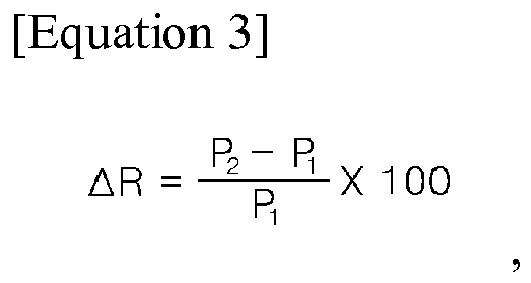
wherein P1 is an initial resistance (unit: Ω) measured on a sample with electrodes formed at both ends of the adhesive film, and P2 is resistance (unit: Ω) of the sample after storage at 60°C/90% RH for 240 hours. - In another embodiment, the present invention provides an adhesive composition including a (meth)acrylate copolymer having carbonate groups and aromatic groups.
- In another embodiment, the present invention provides an optical member including the adhesive film of the present invention.
-
Fig. 1 is a sectional view of an optical member according to one embodiment of the present invention. - In one aspect of the present invention, an adhesive composition may include a (meth)acrylate copolymer having carbonate groups and aromatic groups.
- As used herein, the term "substituted" in "substituted or unsubstituted" means that a hydrogen atom is substituted with a C1-C10 alkyl group, a C3-C10 cycloalkyl group, a C6-C20 aryl group, a halogen, a hydroxylic group, or a C1-C10 alkoxy group.
- The copolymer may serve as a binder for an adhesive film. The copolymer may be cured together with photocurable monomers, and form a matrix of an adhesive film when the adhesive film is prepared from the adhesive composition.
- Since the copolymer contains both an aromatic group and a carbonate group (-O-C(=O)-O-), the copolymer may have an index of refraction of ≥ 1.50 to ≤ 1.60. The copolymer can improve outdoor visibility of the adhesive film due to very high index of refraction, which is very similar to that of materials to which the adhesive film formed of the adhesive composition will be attached, for example, an ITO film of a touch panel.
- The copolymer may have a dielectric constant of ≤ 3.0, preferably from ≥ 2.0 to ≤ 3.0, at a frequency of 103 Hz to 106 Hz. The copolymer may have a low dielectric constant by being prepared from a carbonate polyol having a low dielectric constant. As a result, an adhesive film prepared from an adhesive composition containing the copolymer has a lower dielectric constant than adhesive films in the art (for example, touch film). As a result, the adhesive film can be reduced in capacitance upon touch and can prevent signal delay, thereby enhancing sensitivity.
- The copolymer may have a weight average molecular weight from ≥ 5,000 g/mol to ≤ 100,000 g/mol. Within this range, the copolymer can function effectively as an adhesive resin.
- The copolymer may have a glass transition temperature (Tg) from ≥ -80°C to ≤ 0°C. Within this range, the copolymer can function as an effective adhesive resin.
- The copolymer may include aromatic group, carbonate group, and (meth)acrylate group.
- In one embodiment, the copolymer may be represented by Formula 1:


A1 and A2 are the same or different, and each independently are a substituted or unsubstituted C6-C20 aromatic hydrocarbon group;
D is a single bond, or a substituted or unsubstituted C1-C10 alkylene group;
A3 is a single bond, -CO-(CH2)m- or -CONH-(CH2)p-, wherein m is an integer from 1 to 10 and p is an integer from 1 to 10;
R2 is a group represented by Formula 4:
a is an integer from 1 to 250. - In the above, the "alkylene group" may be linear or branched.
- In the above, '(CH2)n', '(CH2)m' or '(CH2)p' may be linear or branched.
- Preferably, X1, X2, and X3 are a substituted or unsubstituted C1-C5 alkoxy group.
- Preferably, a is an integer from 1 to 100, more preferably an integer from 1 to 50, still more preferably an integer from 1 to 10.
- Preferably, A1 and A2 are a substituted or unsubstituted C6-C20 arylene group, more preferably a substituted or unsubstituted C6-C10 arylene group.
- Preferably, D is a single bond, or a substituted or unsubstituted linear or branched C1-C5 alkylene group.
- The copolymer may be a non-halogen copolymer. The copolymer does not include a halogen including fluorine, chlorine, iodine, or bromine. As a result, the copolymer is environmentally friendly and has an effect of preventing corrosion of electronic devices.
- The copolymer may be prepared by a typical method. For example, the copolymer may be prepared by reacting a polyol containing an aromatic group and a carbonate group with a compound containing a (meth)acrylate group.
- The polyol containing an aromatic group and a carbonate group is not particularly limited so long as the polyol has a low dielectric constant of ≤ 3.0 at 1,000 Hz, and an index of refraction of ≤ 1.50 due to the presence of at least one aromatic group. For example, the polyol may be a polycarbonate diol including units represented by Formula 5:

- The compound containing a (meth)acrylate group is not particularly limited so long as the compound includes a (meth)acrylate group and a functional group (for example, isocyanate group) capable of reacting with the polyol. For example, the (meth)acrylate group-containing compound may be (meth)acryloyloxyalkyl isocyanate.
- The copolymer may be prepared by polymerizing a polyol containing an aromatic group and a carbonate group with a compound containing a (meth)acrylate group at 30°C to 60°C for ≥ 30 seconds to ≤ 24 hours. The polymerization may be performed by mass polymerization, emulsion polymerization, suspension polymerization, and the like.
- The polymerization may be performed in the absence of a catalyst or in the presence of a catalyst. The catalyst may be, for example, at least one selected from the group consisting of dibutyltin dilaurate (DBTDL), triethylene diamine (TEDA), and 1,4-diazabicyclo[2.2.2]octane, without being limited thereto. The catalyst may be used in an amount of ≥ 0.05 parts by weight to ≤ 2 parts by weight based on 100 parts by weight of the polyol.
- In addition, the copolymer may be prepared by polymerizing a polyol containing an aromatic group and a carbonate group, a compound containing a (meth)acrylate group, and a compound containing a silane group.
- The compound containing a silane group is not particularly limited so long as the compound contains a silane group (-SiX1X2X3, wherein X1, X2 and X3 are the same or different, and each independently are a substituted or unsubstituted C1-C10 alkyl group, a substituted or unsubstituted C1-C10 alkoxy group, or a substituted or unsubstituted C6-C20 aryl group) and a functional group readily reactive with the polyol (for example, isocyanate group). For example, the compound may be isocyanate alkyl trialkoxysilane. In isocyanate alkyl trialkoxysilane, the alkyl group may be a C1-C10 alkyl group and the alkoxy group is a C1-C10 alkoxy group. Thus the copolymer may comprise carbonate groups, aromatic groups and silan group.
- The copolymer may be present in an amount of ≥ 1 wt% to ≤ 65 wt%, preferably ≥ 5 wt% to ≤ 50 wt%, more preferably ≥ 10 wt% to ≤ 30 wt% in the adhesive composition in terms of solid content. Within this range, the copolymer can have enhanced sensitivity.
- The adhesive composition may include a photocurable monomer, an initiator and a crosslinking agent, in addition to the (meth)acrylate copolymer having carbonate group and an aromatic group.
- The photocurable monomer may include a non-aromatic photocurable monomer containing a vinyl group or a (meth)acrylate group without containing an aromatic group, a non-carbonate photocurable monomer containing a vinyl group or a (meth)acrylate group without containing carbonate group, or a combination thereof.
- Examples of the photocurable monomer may include vinyl monomers containing hydroxyl group, vinyl monomers containing alkyl group, vinyl monomers containing alicyclic group, (meth)acrylic monomers containing hetero-alicyclic group, vinyl monomers containing carboxylic acid group, vinyl monomers containing silane group, and the like. Preferably, the photocurable monomer may include a vinyl monomer containing alkyl group, a vinyl monomer containing alicyclic group, a vinyl monomer containing hydroxyl group and a (meth)acrylic monomer containing hetero-alicyclic group.
- The photocurable monomer may be present in an amount of ≥ 15 wt% to ≤ 90 wt%, preferably ≥ 40 wt% to ≤ 90 wt%, in the adhesive composition in terms of solid content. Within this range of the photocurable monomer, the composition can function as adhesives.
- Examples of the vinyl monomer containing alkyl group may include (meth)acrylic esters having C1-C20 linear or branched alkyl groups. For example, the alkyl group-containing vinyl monomer may include at least one selected from the group consisting of methyl (meth)acrylate, ethyl (meth)acrylate, propyl (meth)acrylate, n-butyl (meth)acrylate, t-butyl (meth)acrylate, iso-butyl (meth)acrylate, pentyl (meth)acrylate, hexyl (meth)acrylate, heptyl (meth)acrylate, ethylhexyl (meth)acrylate, octyl (meth)acrylate, isooctyl (meth)acrylate, nonyl (meth)acrylate, decyl (meth)acrylate, and dodecyl (meth)acrylate, without being limited thereto. The vinyl monomer containing alkyl group may be used alone or in combination of two or more thereof.
- The vinyl monomer containing alkyl group may be present in an amount of ≥ 1 wt% to ≤ 75 wt%, preferably ≥ 50 wt% to ≤ 65 wt%, in the adhesive composition in terms of solid content.
- The vinyl monomer containing hydroxyl group is not particularly limited so long as the vinyl monomer contains a hydroxyl group and a carbon-carbon double bond. The vinyl monomer containing hydroxyl group may contain at least one hydroxyl group. The hydroxyl group may be present at a terminal or inside of the monomer. The vinyl monomer containing hydroxyl group may be a (meth)acrylic ester containing a hydroxyl group and a C1-C20 alkyl group. Examples of the vinyl monomer containing hydroxyl group may include 2-hydroxyethyl (meth)acrylate, 4-hydroxybutyl (meth)acrylate, 2-hydroxypropyl (meth)acrylate, 2-hydroxybutyl (meth)acrylate, 6-hydroxyhexyl (meth)acrylate, 1,4-cyclohexane dimethanol mono(meth)acrylate, 1-chloro-2-hydroxypropyl (meth)acrylate, diethylene glycol mono(meth)acrylate, 1,6-hexanediol mono(meth)acrylate, pentaerythritol tri(meth)acrylate, dipentaerythritol penta(meth)acrylate, neopentylglycol mono(meth)acrylate, trimethylolpropane di(meth)acrylate, trimethylolethane di(meth)acrylate, 2-hydroxy-3-phenyloxypropyl (meth)acrylate, 4-hydroxycyclohexyl (meth)acrylate, 2-hydroxy-3-phenyloxy (meth)acrylate, 4-hydroxycyclopentyl (meth)acrylate, and cyclohexane dimethanol mono(meth)acrylate, without being limited thereto. The vinyl monomer containing hydroxyl group may be used alone or in combination of two or more thereof.
- The vinyl monomer containing hydroxyl group may be present in an amount of > 1 wt% to ≤ 10 wt%, preferably ≥ 2 wt% to ≤ 9 wt% in the adhesive composition in terms of solid content.
- Examples of the vinyl monomer containing alicyclic group may include (meth)acrylic esters containing a C4-C20 monocyclic or polycyclic alicyclic ring, preferably (meth)acrylic esters containing a C6-C20 monocyclic or polycyclic alicyclic ring. Examples of the vinyl monomer containing alicyclic group may include isobornyl (meth)acrylate, cyclohexyl (meth)acrylate, cyclopentyl (meth)acrylate, and the like. The vinyl monomer containing alicyclic group may be present in an amount of ≥ 5 wt% to ≤ 20 wt%, preferably ≥ 6 wt% to ≤ 18 wt% in the adhesive composition in terms of solid content. Within this range, the composition may have improved durability.
- Examples of the (meth)acrylic monomer containing hetero-alicyclic group may include (meth)acrylic monomer containing monocyclic C4-C6 hetero-alicyclic group containing nitrogen, oxygen or sulfur. Examples of the monomer may include (meth)acryloyl morpholine, and the like. The (meth)acrylic monomer containing hetero-alicyclic group may be present in an amount of ≥ 1 wt% to ≤ 10 wt%, preferably ≥ 1wt% to ≤ 8 wt% in the adhesive composition in terms of solid content. Within this range, the adhesive composition may exhibit improved adhesion to glass substrates.
- Examples of the vinyl monomer containing carboxylic acid group may include at least one selected from the group consisting of β-carboxyethyl (meth)acrylate, (meth)acrylic acid, itaconic acid, maleic acid, fumaric acid, vinyl acetic acid, without being limited thereto. The vinyl monomer containing carboxylic acid group may be present in an amount of ≥ 0 wt% to ≤ 10 wt%, preferably ≥ 1 wt% to ≤ 10 wt% in the adhesive composition in terms of solid content. Within this range, the adhesive composition can improve adhesion of optical adhesives.
- The initiator may be a photoinitiator. The photoinitiator is activated by UV light or an electron beam, thus forming free radicals in a carbon-carbon double bond of an adhesive film, causing radical reaction.
- Examples of the initiator may include acetophenone compounds, benzylketal type compounds or mixtures thereof, without being limited thereto. Preferably, examples of the acetophenone compound include 2,2-dimethoxy-2-phenylacetophenone, 2,2'-diethoxy acetophenone, 2,2'-dibutoxy acetophenone, 2-hydroxy-2-methyl propiophenone, p-t-butyl trichloro acetophenone, p-t-butyl dichloro acetophenone, 4-chloro acetophenone, 2,2'-dichloro-4-phenoxy acetophenone, 2-methyl-1-(4-(methylthio)phenyl)-2-morpholino propane-1-on, 2-benzyl-2-dimethyl amino-1-(4-morpholino phenyl)-butane-1-on, and mixtures thereof.
- The initiator may be present in an amount of ≥ 0.1 wt% to ≤ 10 wt%, preferably ≥ 0.1 wt% to ≤ 5 wt% in an adhesive composition in terms of solid content. Within this range, the composition can be completely cured when used as an adhesive film.
- As the crosslinking agent, a multifunctional (meth)acrylate that is curable via electromagnetic irradiation may be used.
- Examples of the crosslinking agent may include bifunctional (meth)acrylates, such as 1,4-butanediol di(meth)acrylate, 1,6-hexanediol di(meth)acrylate, neopentylglycol di(meth)acrylate, polyethyleneglycol di(meth)acrylate, neopentylglycol adipate di(meth)acrylate, dicyclopentanyl di(meth)acrylate, caprolactone modified dicyclopentenyl di(meth)acrylate, ethylene oxide modified di(meth)acrylate, di(meth)acryloxy ethyl isocyanurate, allylated cyclohexyl di(meth)acrylate, tricyclodecane dimethanol di(meth)acrylate, dimethylol dicyclopentane di(meth)acrylate, ethylene oxide modified hexahydrophthalic acid di(meth)acrylate, neopentylglycol modified trimethylpropane di(meth)acrylate, adamantane di(meth)acrylate or 9,9-bis[4-(2-(meth)acryloyloxyethoxy)phenyl]fluorene, and the like; trifunctional (meth)acrylates, such as trimethylolpropane tri(meth)acrylate, dipentaerythritol tri(meth)acrylate, propionic acid modified dipentaerythritol tri(meth)acrylate, pentaerythritol tri(meth)acrylate, propylene oxide modified trimethylolpropane tri(meth)acrylate, trifunctional urethane (meth)acrylate, tris(meth)acryloxyethyl isocyanurate, and the like; tetrafunctional (meth)acrylates, such as diglycerin tetra(meth)acrylate, pentaerythritol tetra(meth)acrylate, and the like; pentafunctional (meth)acrylates, such as dipentaerythritol penta(meth)acrylate, and the like; and hexafunctional (meth)acrylates, such as dipentaerythritol hexa(meth)acrylate, caprolactone modified dipentaerythritol hexa(meth)acrylate, and urethane hexa(meth)acrylate (e.g., reaction products of an isocyanate monomer and trimethylolpropane tri(meth)acrylate), without being limited thereto. The crosslinking agent may be used alone or in combination of two or more thereof.
- As the crosslinking agent, multifunctional (meth)acrylates of C2-C20 multivalent alcohols may be used.
- In addition, typical isocyanate, epoxy, aziridine, melamine, amine, imide, carbodiimide and amide crosslinking agents, or mixtures thereof may also be used.
- The crosslinking agent may be present in an amount of ≥ 0.01 wt% to ≤ 10 wt%, preferably ≥ 0.01 wt% to ≤ 5 wt% in the adhesive composition in terms of solid content. Within this range, the composition may have improved solvent resistance and degree of film crosslinking upon UV reaction, thereby providing improved durability.
- The crosslinking agent may be present in an amount of ≥ 0.01 parts by weight to ≤ 50 parts by weight, preferably ≥ 0.01 parts by weight to ≤ 5 parts by weight, based on 100 parts by weight of the copolymer.
- The adhesive composition may further include typical additives, for example, silane coupling agents, curing accelerators, an ionic liquid, lithium salt, inorganic fillers, softeners, antioxidants, anti-aging agents, stabilizers, tackifier resins, reforming resins such as polyol resins, phenolic resins, acrylic resins, polyester resins, polyolefin resins, epoxy resins, epoxylated polybutadiene resins, and the like, leveling agents, antifoaming agents, plasticizers, dyes, pigments such as coloring and extender pigments, treatment agents, UV blocking agents, fluorescent whitening agents, dispersants, heat stabilizers, light stabilizers, UV absorbers, antistatic agents, lubricants, and solvents, as needed. The additives may be present in an amount of ≥ 0.01 parts by weight to ≤ 5 parts by weight, preferably ≥ 0.03 parts by weight to ≤ 3 parts by weight, more preferably ≥ 0.05 parts by weight to ≤ 2 parts by weight, based on 100 parts by weight of the copolymer.
- The adhesive composition may be prepared as follows. The copolymer, photocurable monomer, and initiator are mixed and partially polymerized by UV irradiation to obtain a viscous liquid. To this liquid, the crosslinking agent, initiator and then additional additives are added to prepare an adhesive composition.
- Another aspect of the present invention provides an adhesive film having a dielectric constant variation of ≤ 30%, as expressed by Equation 1:

wherein A is the dielectric constant of the adhesive film measured at a frequency of 103 Hz, and B is the dielectric constant of the adhesive film measured at a frequency of 106 Hz. - The dielectric constant variation is preferably ≥ 10% to ≤ 30%, more preferably > 25% to ≤ 30%. The adhesive film exhibits lower dielectric constant variation than existing adhesive films, particularly touch films. As a result, the adhesive film can be reduced in capacitance upon touch and can prevent signal delay, thereby enhancing sensitivity.
- A further aspect of the present invention provides an adhesive film having an average dielectric constant of ≤ 3.0 at 103Hz to 106 Hz and a resistance variation (△R) of ≤ 2%, as expressed by Equations 2 and 3, respectively.

wherein Emax is a maximum dielectric constant of the adhesive film measured at a frequency of 103 Hz to 106 Hz, and Emin is a minimum dielectric constant of the adhesive film measured at a frequency of 103 Hz to 106 Hz.
wherein P1 is an initial resistance (unit: Ω) measured on a sample with electrodes formed at both ends of the adhesive film, and P2 is resistance (unit: Ω) of the sample after storage at 60°C/90% RH for 240 hours. - In some embodiments, the adhesive film may have an average dielectric constant of ≥ 2.0 to ≤ 3.0 and a resistance variation of ≥ 1.0% to ≤ 2.0%.
- When the average dielectric constant of the adhesive film is ≤ 3.0 and the resistance variation thereof is ≤ 2.0%, the adhesive film can be reduced in capacitance upon touch and can prevent signal delay, thereby enhancing sensitivity.
- The adhesive film has an index of refraction of ≥ 1.48, preferably from ≥ 1.48 to ≤ 1.50. The adhesive film may have an index of refraction very similar to that of a transparent window glass (an index of refraction: 1.50), thus improving outdoor readability.
- The adhesive film may have an acid value of 0 mg KOH/g, which prevents variation in resistance upon attaching the adhesive film to a transparent conductive film.
- The adhesive film may be prepared from the adhesive composition.
- The adhesive film according to the invention may be formed by curing the adhesive composition. For example, the adhesive composition is coated to a release film
- (for example, polyester comprising polyethylene terephthalate film) and UV-cured. In one embodiment, UV curing may be carried out at ≤ 50 mW for 20 seconds to 240 seconds. Curing may be carried out in an anoxic environment.
- Although there is no particular restriction as to coating thickness, the adhesive composition may be coated to thickness from ≥ 50 µm to ≤ 2 mm, for example, from > 150 µm to ≤ 1.5 mm.
- Although the thickness of the adhesive film (thickness except release film thickness) is not particularly limited, the adhesive film may have a thickness of ≥ 10 µm to ≤ 1 mm, for example, ≥ 50 µm to ≤ 1.5 mm.
- A further aspect of the present invention provides an optical member.
- The optical member may include an optical film, and the adhesive film attached to at least one side of the optical film. The optical film may be a a polarizing plate, a color filter, a retardation film, an oval polarizing film, a reflective film, an anti-reflection film, a compensation film, a brightness enhancement film, an alignment film, a light diffusion film, an anti-glass scattering film, a surface protective film, a plastic LCD substrate, a glass substrate such as a window glass, a transparent conductive film such as an ITO film, and the like. The optical film can be easily manufactured by a person skilled in the art using a typical method known in the art.
- For example, a touchpad is attached to a window or optical film using the adhesive film, thereby forming a touch panel. Alternatively, the adhesive film may be applied to a general polarizing film by a conventional method. In one embodiment, the optical member may include a capacitive touch panel and a capacitive-type mobile phone.
-
Fig. 1 is a sectional view of an optical member according to one embodiment. Referring toFig. 1 , the optical member may include an optical film (200); and an adhesive film (110) formed on the optical film (200). - Next, the present invention will be explained in more detail with reference to some examples and comparative examples. These examples are provided for illustration only and are not to be in any way construed as limiting the present invention.
- To a four-neck 2L flask, 90 g of a carbonate polyol containing an aromatic group was added and heated to 60°C. Then, 0.5 g of dibutyltin dilaurate diluted in toluene in a ratio of 10% was added to the flask. The resultant was cooled to 50°C and then 6 g of 2-methacryloylchloride and 6 g of 2-methacryloyloxyethyl isocyanate (MOI) were added thereto. The resultant was maintained at 50°C for seven hours. After identifying through IR that NCO groups of MOI were not observed, the resultant was cooled to 40°C. A (meth)acrylate polymer containing carbonate groups and aromatic groups represented by Formula 1A was prepared:

- To a four-neck 2L flask, 90 g of a carbonate polyol containing an aromatic group was added and heated to 60°C. Then, 0.5 g of dibutyltin dilaurate diluted in toluene in a ratio of 10% was added to the flask. 11 g of 3-isocyanatepropyl triethoxysilane was added and the temperature was maintained at 60°C for 3 hours. After identifying through IR that NCO groups of MOI were not observed, the resultant was cooled to 50°C, and then 6 g of 2-methacryloyloxyethyl isocyanate (MOI) was added. The resultant was maintained at 50°C for 7 hours. After identifying through IR that NCO groups of MOI were not observed, the resultant was cooled to 40°C. A (meth)acrylate copolymer containing carbonate groups and aromatic groups and a silane group represented by Formula 1B was prepared:

- Details of components used in Examples and Comparative Examples are as follows:
- (A) (Meth)acrylate copolymer containing carbonate groups and aromatic groups: (A1) Copolymer prepared in Preparative Example 1, (A2) Copolymer prepared in Preparative Example 2
- (B) Photocurable monomer: (B1) ethylhexylacrylate (EHA), (B2) isobornyl acrylate (IBOA), (B3) 2-hydroxyethyl acrylate (HEA), (B4) acryloyl morpholine (ACMO)
- (C) Initiator: Irgacure M651 (2,2-dimethoxy-2-phenylacetophenone) (Ciba Japan K.A.)
- (D) Crosslinking agent: 1,6-hexanediol diacrylate (HDDA)
- Viscous liquids were obtained by mixing (A), (B), in amounts as listed in Table 1, and 0.04 parts by weight of (C) initiator in a glass container, followed by replacing dissolved oxygen with nitrogen gas, and polymerizing the mixture by irradiation using a low pressure lamp for a few minutes. To the obtained composition, 0.26 parts by weight of the (C) initiator and the (D) crosslinking agent in amounts as listed in Table 1 were added and thoroughly mixed to prepare an adhesive composition.
- The prepared adhesive composition was applied to a 50 µm thick polyester release film, followed by performing release treatment at a layer thickness of 100 µm In order to remove oxygen, which negatively affects polymerization, the release film was covered, and irradiated from two surfaces using a low-pressure lamp (Sylvania BL Lamp) for 3 minutes to obtain a transparent adhesive sheet.
TABLE 1 Example 1 Example 2 Example 3 Example 4 Comparative Example 1 (A) (A1) 15 - - - - (A2) - 15 15 15 - (B) (B1) 59 59 57 57.2 74 (B2) 11.2 11.2 11.2 13 11.2 (B3) 8.3 8.3 8.3 8.3 8.3 (B4) 6 6 8 6 6 (C) 0.3 0.3 0.3 0.3 0.3 (D) 0.2 0.2 0.2 0.2 0.2 Curing method UV curing Un curing UV curing UV curing UV curing Total amount 100 100 100 100 100 - The prepared adhesive sheets were evaluated as to the following physical properties. Results are shown in Table2.
- (1) Resistance variation: Each of the adhesive sheets prepared in the examples and the comparative examples were attached to ITO and PET and electrodes were formed on opposite sides thereof using a silver paste, thereby preparing a sample. Initial resistance (P1, unit: Ω) of the sample was measured. The sample was left at 60°C/90%RH for 240 hours, followed by evaluation of resistance (P2, unit: Ω). Here, resistance was measured using portable test instrument for measuring resistance, voltage, and current (Checkman, Tae Kwang Electronics Co.). To calculate resistance variation (ΔR), the obtained resistances under the above-mentioned conditions were substituted into Equation 3.
- (2) Durability: A PC film/ITO film/glass and a PET film were bonded and left at 60°C/90%RH for 500 hours, followed by observation with the naked eye to identify whether separation, peeling, or bubbles occurred on an adherend. Evaluation was performed as follows.
O: Good (no bubbles and no peeling)
X: Poor (large amount of bubbles or severe peeling) - (3) Optical properties: An adhesive composition was coated on a release PET film, followed by curing at 3000 mJ/cm2 to prepare a 200 µm thick adhesive film. After removing the release film, transmittance and yellow index of the 200 µm thick adhesive film were measured using a Lambda 950 (manufactured by Perkin Elmer) in the range of wavelength 400∼800 nm.
- After removing the release film, the 200 µm thick adhesive film was evaluated using a hazemeter (NHD-200W). The adhesive film was subjected to aging for 30 minutes prior to the measurement, and the sample had a size of 5 cm x 5 cm x 200 µm (width x length x thickness). After opening the cover of the hazemeter, the sample was set in the hazemeter with sample texture directed in the mechanical direction (MD), and the optical properties of the sample were measured 3 times.
(4) Dielectric constant, dielectric constant variation and average dielectric constant: Dielectric constant of an adhesive film (width x length x thickness = 4 cm x 6 cm x 100 µm) was measured at 103 Hz to 106 Hz using an E5515E 8960 (Agilent). Dielectric constant variation and average dielectric constant were measured in accordance with Equations 1 and 2.
(5) Index of refraction: Index of refraction was measured according to ASTM D1218. An adhesive composition was coated onto a PET release film and cured at 3000 mJ/cm2 to prepare a 175 µm thick adhesive film. After removing the release film, an index of refraction of the 200 µm adhesive film was measured using an ABBE5 refractometer (Bellingham/Stanley Ltd.).TABLE 2 Example 1 Example 2 Example 3 Example 4 Comparative Example 1 Resistance Variation (%) 1.5 1.5 1.6 1.6 1.5 Durability ○ ○ ○ ○ × Optical properties Transmittance (%) 93.1 93.2 93.4 93.4 89.1 YI 0.18 0.19 0.17 0.18 0.19 Haze (%) 0.3 0.3 0.4 0.3 0.4 Dielectric constant At 103 Hz 3.50 3.42 3.32 3.43 5.20 At 106 Hz 2.48 2.46 2.42 2.43 3.52 Dielectric constant variation (%) 29.10 28.07 27.10 29.15 32.30 Average Dielectric constant 2.99 2.94 2.87 2.93 4.36 Index of refraction 1.49 1.49 1.49 1.50 1.47 - As shown in Table 2, the adhesive films according to the examples of the inventive exhibited low dielectric constant variation. However, since the adhesive films according to the examples of the inventive had high indexes of refraction, the adhesive films did not suffer from touch malfunction and could have improved outdoor readability. On the other hand, the adhesive films according to Comparative Example 1 wherein the copolymer of the invention was not used had high dielectric constant variation and a low index of refraction, thereby failing to achieve the advantageous effects of the invention.
- Although some embodiments have been described herein, it will be apparent to those skilled in the art that these embodiments are given by way of illustration only, and that various modifications, changes, alterations, and equivalent embodiments can be made without departing from the spirit and scope of the invention. The scope of the invention should be limited only by the accompanying claims and equivalents thereof.
Claims (13)
- An adhesive composition comprising: a (meth)acrylate copolymer having carbonate groups and an aromatic groups.
- The adhesive composition according to claim 1, wherein the (meth)acrylate copolymer has a dielectric constant of ≤ 3.0 at a frequency of 103 Hz to 106 Hz and an index of refraction of ≥ 1.50 to ≤ 1.60.
- The adhesive composition according to claim 1 or 2, wherein the (meth)acrylate copolymer has a weight average molecular weight of ≥ 5,000 g/mol to ≤ 100,000g/mol.
- The adhesive composition according to claims 1 to 3, wherein the (meth)acrylate copolymer is represented by Formula 1:


A1 and A2 are the same or different, and each independently are a substituted or unsubstituted C6-C20 aromatic hydrocarbon group;
D is a single bond, or a substituted or unsubstituted C1-C10 alkylene group;
A3 is a single bond, -CO-(CH2)m- or -CONH-(CH2)p-, wherein m is an integer from 1 to 10 and p is an integer from 1 to 10;
R2 is a group represented by Formula 4:
a is an integer from 1 to 250. - The adhesive composition according to claims 1 to 4, comprising: the (meth)acrylate copolymer, a photocurable monomer, an initiator and a crosslinking agent.
- The adhesive composition according to claims 1 to 5, comprising: ≥ 1 wt% to ≤ 65 wt% of the (meth)acrylate copolymer, ≥ 15 wt% to ≤ 90 wt% of the photocurable monomer, ≥ 0.1 wt% to ≤ 10 wt% of the initiator, and ≥ 0.01 wt% to ≤ 10 wt% of the crosslinking agent.
- The adhesive composition according to claims 1 to 6, wherein the photocurable monomer includes a vinyl monomer containing alkyl group, a vinyl monomer containing alicyclic group, a vinyl monomer containing hydroxyl group and a (meth)acrylic monomer containing hetero-alicyclic group.
- The adhesive composition according to claims 1 to 7, wherein the vinyl monomer containing alkyl group is present in an amount of ≥ 1 wt% to ≤ 75 wt%, the vinyl monomer containing hydroxyl group is present in an amount of ≥ 1 wt% to ≤ 10 wt%, the vinyl monomer containing alicyclic group is present in an amount of ≥ 5 wt% to ≤ 20 wt%, and the (meth)acrylic monomer containing hetero-alicyclic group is present in an amount of ≥ 1 wt% to ≤ 10 wt%, in the adhesive composition.
- The adhesive composition according to claims 1 to 8, further comprising: a silane coupling agent.
- The adhesive composition according to claims 1 to 9, further comprising: curing accelerators, an ionic liquid, lithium salt, inorganic fillers, softeners, antioxidants, anti-aging agents, stabilizers, tackifier resins, reforming resins, leveling agents, antifoaming agents, plasticizers, dyes, pigments, treatment agents, UV blocking agents, fluorescent whitening agents, dispersants, heat stabilizers, light stabilizers, UV absorbers, anti-static agents, lubricants, or solvents.
- An adhesive film having an index of refraction of ≥ 1.48 and a dielectric constant variation of ≤ 30%, as expressed by Equation 1:

wherein A is the dielectric constant of the adhesive film measured at a frequency of 103 Hz, and B is the dielectric constant of the adhesive film measured at a frequency of 106 Hz; and/or
the adhesive film having an average dielectric constant of ≤ 3.0 at a frequency of 103 Hz to 106 Hz and a resistance variation (△R) of ≤ 2%, as expressed by Equations 2 and 3,
respectively:
wherein Emax is a maximum dielectric constant of the adhesive film measured at a frequency of 103 Hz to 106 Hz, and Emin is a minimum dielectric constant of the adhesive film measured at a frequency of 103 Hz to 106 Hz,
wherein P1 is an initial resistance (unit: Ω) measured on a sample with electrodes formed at both ends of the adhesive film, and P2 is resistance (unit: Ω) of the sample after storage at 60°C/90%RH for 240 hours. - The adhesive film according to claim 11, comprising an adhesive composition according to claims 1 to 10.
- An optical member comprising the adhesive film according to claims 11 or 12.
Applications Claiming Priority (1)
| Application Number | Priority Date | Filing Date | Title |
|---|---|---|---|
| KR1020120068527A KR101562088B1 (en) | 2012-06-26 | 2012-06-26 | Adhesive film, adhesive film composition for the same and optical member comprising the same |
Publications (2)
| Publication Number | Publication Date |
|---|---|
| EP2679646A2 true EP2679646A2 (en) | 2014-01-01 |
| EP2679646A3 EP2679646A3 (en) | 2014-01-08 |
Family
ID=48672477
Family Applications (1)
| Application Number | Title | Priority Date | Filing Date |
|---|---|---|---|
| EP13173620.9A Withdrawn EP2679646A3 (en) | 2012-06-26 | 2013-06-25 | Adhesive film, adhesive composition for the same and optical member including the same |
Country Status (5)
| Country | Link |
|---|---|
| US (1) | US9382457B2 (en) |
| EP (1) | EP2679646A3 (en) |
| KR (1) | KR101562088B1 (en) |
| CN (1) | CN103509475B (en) |
| TW (1) | TWI563059B (en) |
Cited By (1)
| Publication number | Priority date | Publication date | Assignee | Title |
|---|---|---|---|---|
| EP2982724A4 (en) * | 2013-04-05 | 2016-03-09 | Lg Hausys Ltd | Adhesive composition for touch panel, adhesive film and touch panel |
Families Citing this family (10)
| Publication number | Priority date | Publication date | Assignee | Title |
|---|---|---|---|---|
| KR101623771B1 (en) | 2014-10-16 | 2016-05-25 | 도레이첨단소재 주식회사 | Adhesive composition for touch screen panel having low permeability and adhesive film using the same |
| KR101780547B1 (en) * | 2015-07-31 | 2017-09-22 | 삼성에스디아이 주식회사 | Adhesive film for polarizing plate, polarizing plate comprising the same and optical display apparatus comprising the same |
| JP6872869B2 (en) * | 2016-08-10 | 2021-05-19 | 日東電工株式会社 | Adhesive sheet |
| US10800944B2 (en) * | 2016-08-10 | 2020-10-13 | Nitto Denko Corporation | Pressure-sensitive adhesive sheet |
| KR102826561B1 (en) * | 2018-12-14 | 2025-06-30 | 미쯔비시 케미컬 주식회사 | Adhesive resin composition, adhesive resin cured product, adhesive sheet and image display device laminate |
| KR102612238B1 (en) * | 2019-12-24 | 2023-12-08 | 삼성에스디아이 주식회사 | Polarizing plate and optical display apparatus comprising the same |
| KR102920778B1 (en) | 2020-03-20 | 2026-02-03 | 삼성디스플레이 주식회사 | Display device |
| US20220041903A1 (en) * | 2020-08-04 | 2022-02-10 | Samsung Sdi Co., Ltd. | Adhesive film, optical member including the same, and optical display including the same |
| KR102946902B1 (en) | 2020-12-29 | 2026-04-01 | 삼성디스플레이 주식회사 | Adhesive composition and display apparatus including the same |
| US20240213598A1 (en) * | 2022-12-19 | 2024-06-27 | Samsung Sdi Co., Ltd. | Sealing tape for rechargeable lithium battery and rechargeable lithium battery including the same |
Citations (1)
| Publication number | Priority date | Publication date | Assignee | Title |
|---|---|---|---|---|
| JP2012041456A (en) | 2010-08-19 | 2012-03-01 | Daido Kasei Kogyo Kk | Acrylic polymeric compound for use in self-adhesive composition for touch panel |
Family Cites Families (8)
| Publication number | Priority date | Publication date | Assignee | Title |
|---|---|---|---|---|
| US3716571A (en) | 1969-07-02 | 1973-02-13 | Inst Khim Fiz An Sssr | Oligocarbonate acrylates and a process for producing the same |
| DE3340930A1 (en) * | 1983-11-11 | 1985-05-23 | Bayer Ag, 5090 Leverkusen | ELECTRICALLY CONDUCTIVE POLYCARBONATE COMPOSITIONS, THEIR PRODUCTION AND USE |
| JP2001163937A (en) * | 1999-12-07 | 2001-06-19 | Nippon Kayaku Co Ltd | Resin composition for lens and lens sheet |
| JP2002180040A (en) * | 2000-12-08 | 2002-06-26 | Fuji Photo Film Co Ltd | Light emitting element |
| US7439278B2 (en) * | 2004-05-04 | 2008-10-21 | Essilor International Compagnie Generale D'optique | Curable adhesive composition and its use in the optical field |
| JP5119685B2 (en) * | 2007-02-28 | 2013-01-16 | 東洋インキScホールディングス株式会社 | Urethane resin and method for producing the same, and urethane resin-containing pressure-sensitive adhesive |
| WO2009084386A1 (en) * | 2007-12-27 | 2009-07-09 | Bridgestone Corporation | Adhesive resin composition |
| JP5644249B2 (en) | 2010-08-12 | 2014-12-24 | 日立金属株式会社 | Thermoplastic resin composition, adhesive film, and wiring film using the same |
-
2012
- 2012-06-26 KR KR1020120068527A patent/KR101562088B1/en active Active
-
2013
- 2013-06-25 TW TW102122539A patent/TWI563059B/en active
- 2013-06-25 EP EP13173620.9A patent/EP2679646A3/en not_active Withdrawn
- 2013-06-26 US US13/927,201 patent/US9382457B2/en active Active
- 2013-06-26 CN CN201310258538.8A patent/CN103509475B/en active Active
Patent Citations (1)
| Publication number | Priority date | Publication date | Assignee | Title |
|---|---|---|---|---|
| JP2012041456A (en) | 2010-08-19 | 2012-03-01 | Daido Kasei Kogyo Kk | Acrylic polymeric compound for use in self-adhesive composition for touch panel |
Cited By (2)
| Publication number | Priority date | Publication date | Assignee | Title |
|---|---|---|---|---|
| EP2982724A4 (en) * | 2013-04-05 | 2016-03-09 | Lg Hausys Ltd | Adhesive composition for touch panel, adhesive film and touch panel |
| US10144854B2 (en) | 2013-04-05 | 2018-12-04 | Lg Chem, Ltd. | Adhesive composition for touch panel, adhesive film and touch panel |
Also Published As
| Publication number | Publication date |
|---|---|
| CN103509475A (en) | 2014-01-15 |
| KR101562088B1 (en) | 2015-10-20 |
| US20130345333A1 (en) | 2013-12-26 |
| KR20140001345A (en) | 2014-01-07 |
| TW201410833A (en) | 2014-03-16 |
| EP2679646A3 (en) | 2014-01-08 |
| TWI563059B (en) | 2016-12-21 |
| US9382457B2 (en) | 2016-07-05 |
| CN103509475B (en) | 2017-04-26 |
Similar Documents
| Publication | Publication Date | Title |
|---|---|---|
| US9382457B2 (en) | Adhesive film, adhesive composition for the same, and optical member including the same | |
| US8945705B2 (en) | Adhesive composition, adhesive film including the same, method of preparing adhesive film, and display member using the same | |
| KR101871551B1 (en) | Adhesive film, optical member comprising the same and optical display apparatus comprising the same | |
| US10025432B2 (en) | Capacitive touch panel | |
| KR101566060B1 (en) | Adhesive film, adhesive composition for the same and display member comprising the same | |
| US20240141206A1 (en) | Adhesive film and display member comprising the same | |
| KR101645066B1 (en) | Adhesive film and optical display comprising the same | |
| US10030180B2 (en) | Adhesive film, adhesive composition for the same, and display member including the same | |
| US9469528B2 (en) | Adhesive composition, adhesive film including the same, method of preparing adhesive film, and display member using the same | |
| US10377926B2 (en) | Adhesive film, adhesive composition for the same, and display member including the same | |
| KR101628437B1 (en) | Adhesive film, adhesive composition for the same and display member comprising the same | |
| US10815400B2 (en) | Adhesive film and optical display including the same | |
| KR101385042B1 (en) | Adhesive Composition, Adhesive Film Comprising the Same, Method for Preparing the Adhesive Film and Display Member Using the Same | |
| KR20180015718A (en) | The acrylic-based flexible assembly layer | |
| US20130158221A1 (en) | Optical pressure-sensitive adhesive sheet | |
| KR102826561B1 (en) | Adhesive resin composition, adhesive resin cured product, adhesive sheet and image display device laminate | |
| KR20170048440A (en) | Optically clear adhesive and optical laminate | |
| KR20150072400A (en) | Adhesive sheet for image display device, method for manufacturing image display device, and image display device | |
| KR20160130092A (en) | Adhesive film and flexibile display apparatus comprising the same | |
| KR101385040B1 (en) | Adhesive Composition, Adhesive Film Comprising the Same, Method for Preparing the Adhesive Film and Display Member Using the Same | |
| WO2016148208A1 (en) | Adhesive sheet for image display device, adhesive layered body for image display device, and image display device | |
| KR20200073813A (en) | Adhesive film, optical member comprising the same and optical display apparatus comprising the same | |
| KR101385039B1 (en) | Adhesive Composition, Adhesive Film Comprising the Same, Method for Preparing the Adhesive Film and Display Member Using the Same | |
| KR20090003843A (en) | Transparent pressure-sensitive adhesive composition, transparent pressure-sensitive adhesive sheet, optical filter for PD, and method of manufacturing pressure-sensitive adhesive sheet |
Legal Events
| Date | Code | Title | Description |
|---|---|---|---|
| PUAL | Search report despatched |
Free format text: ORIGINAL CODE: 0009013 |
|
| PUAI | Public reference made under article 153(3) epc to a published international application that has entered the european phase |
Free format text: ORIGINAL CODE: 0009012 |
|
| AK | Designated contracting states |
Kind code of ref document: A2 Designated state(s): AL AT BE BG CH CY CZ DE DK EE ES FI FR GB GR HR HU IE IS IT LI LT LU LV MC MK MT NL NO PL PT RO RS SE SI SK SM TR |
|
| AX | Request for extension of the european patent |
Extension state: BA ME |
|
| AK | Designated contracting states |
Kind code of ref document: A3 Designated state(s): AL AT BE BG CH CY CZ DE DK EE ES FI FR GB GR HR HU IE IS IT LI LT LU LV MC MK MT NL NO PL PT RO RS SE SI SK SM TR |
|
| AX | Request for extension of the european patent |
Extension state: BA ME |
|
| RIC1 | Information provided on ipc code assigned before grant |
Ipc: C08F 20/20 20060101ALN20131203BHEP Ipc: C09J 4/00 20060101AFI20131203BHEP Ipc: C08F 20/10 20060101ALN20131203BHEP Ipc: C08F 20/36 20060101ALN20131203BHEP Ipc: C08F 22/10 20060101ALN20131203BHEP |
|
| 17P | Request for examination filed |
Effective date: 20140326 |
|
| RBV | Designated contracting states (corrected) |
Designated state(s): AL AT BE BG CH CY CZ DE DK EE ES FI FR GB GR HR HU IE IS IT LI LT LU LV MC MK MT NL NO PL PT RO RS SE SI SK SM TR |
|
| RIC1 | Information provided on ipc code assigned before grant |
Ipc: C08F 20/20 20060101ALN20190513BHEP Ipc: C09J 4/00 20060101AFI20190513BHEP Ipc: C08F 20/36 20060101ALN20190513BHEP Ipc: C09J 133/14 20060101ALI20190513BHEP Ipc: C08F 22/10 20060101ALN20190513BHEP Ipc: C08F 20/10 20060101ALN20190513BHEP |
|
| GRAP | Despatch of communication of intention to grant a patent |
Free format text: ORIGINAL CODE: EPIDOSNIGR1 |
|
| STAA | Information on the status of an ep patent application or granted ep patent |
Free format text: STATUS: GRANT OF PATENT IS INTENDED |
|
| RIC1 | Information provided on ipc code assigned before grant |
Ipc: C08F 22/10 20060101ALN20190606BHEP Ipc: C08F 20/36 20060101ALN20190606BHEP Ipc: C08F 20/20 20060101ALN20190606BHEP Ipc: C08F 20/10 20060101ALN20190606BHEP Ipc: C09J 133/14 20060101ALI20190606BHEP Ipc: C09J 4/00 20060101AFI20190606BHEP |
|
| RIC1 | Information provided on ipc code assigned before grant |
Ipc: C09J 4/00 20060101AFI20190613BHEP Ipc: C08F 22/10 20060101ALN20190613BHEP Ipc: C09J 133/14 20060101ALI20190613BHEP Ipc: C08F 20/36 20060101ALN20190613BHEP Ipc: C08F 20/20 20060101ALN20190613BHEP Ipc: C08F 20/10 20060101ALN20190613BHEP |
|
| INTG | Intention to grant announced |
Effective date: 20190709 |
|
| STAA | Information on the status of an ep patent application or granted ep patent |
Free format text: STATUS: THE APPLICATION IS DEEMED TO BE WITHDRAWN |
|
| 18D | Application deemed to be withdrawn |
Effective date: 20191120 |