EP2676974A1 - Ionische Haftgruppen enthaltende Kammcopolymere - Google Patents
Ionische Haftgruppen enthaltende Kammcopolymere Download PDFInfo
- Publication number
- EP2676974A1 EP2676974A1 EP12004659.4A EP12004659A EP2676974A1 EP 2676974 A1 EP2676974 A1 EP 2676974A1 EP 12004659 A EP12004659 A EP 12004659A EP 2676974 A1 EP2676974 A1 EP 2676974A1
- Authority
- EP
- European Patent Office
- Prior art keywords
- structural unit
- substituted
- group
- dicarboxylic acid
- acid derivative
- Prior art date
- Legal status (The legal status is an assumption and is not a legal conclusion. Google has not performed a legal analysis and makes no representation as to the accuracy of the status listed.)
- Withdrawn
Links
- 229920001577 copolymer Polymers 0.000 title claims abstract description 80
- 239000000853 adhesive Substances 0.000 title description 6
- 230000001070 adhesive effect Effects 0.000 title description 6
- 229920000642 polymer Polymers 0.000 claims abstract description 113
- 239000007787 solid Substances 0.000 claims abstract description 42
- 150000001990 dicarboxylic acid derivatives Chemical class 0.000 claims abstract description 31
- 239000000178 monomer Substances 0.000 claims abstract description 22
- 239000002270 dispersing agent Substances 0.000 claims abstract description 20
- 239000006185 dispersion Substances 0.000 claims abstract description 19
- 239000002245 particle Substances 0.000 claims abstract description 18
- 239000000080 wetting agent Substances 0.000 claims abstract description 17
- 125000003118 aryl group Chemical group 0.000 claims abstract description 12
- 125000000217 alkyl group Chemical group 0.000 claims abstract description 8
- 239000001023 inorganic pigment Substances 0.000 claims abstract description 7
- 239000012860 organic pigment Substances 0.000 claims abstract description 7
- OKTJSMMVPCPJKN-UHFFFAOYSA-N Carbon Chemical compound [C] OKTJSMMVPCPJKN-UHFFFAOYSA-N 0.000 claims abstract description 6
- 125000001931 aliphatic group Chemical group 0.000 claims abstract description 5
- 150000001450 anions Chemical class 0.000 claims abstract description 4
- 125000003710 aryl alkyl group Chemical group 0.000 claims abstract description 4
- 125000000753 cycloalkyl group Chemical group 0.000 claims abstract description 4
- 229920006395 saturated elastomer Polymers 0.000 claims abstract description 4
- QGZKDVFQNNGYKY-UHFFFAOYSA-O ammonium group Chemical group [NH4+] QGZKDVFQNNGYKY-UHFFFAOYSA-O 0.000 claims abstract description 3
- 239000002041 carbon nanotube Substances 0.000 claims abstract description 3
- 229910021393 carbon nanotube Inorganic materials 0.000 claims abstract description 3
- 125000004122 cyclic group Chemical group 0.000 claims abstract description 3
- 229910021389 graphene Inorganic materials 0.000 claims abstract description 3
- 239000011256 inorganic filler Substances 0.000 claims abstract description 3
- 229910003475 inorganic filler Inorganic materials 0.000 claims abstract description 3
- -1 allyl ethers Chemical class 0.000 claims description 54
- 238000006243 chemical reaction Methods 0.000 claims description 37
- XLYOFNOQVPJJNP-UHFFFAOYSA-N water Substances O XLYOFNOQVPJJNP-UHFFFAOYSA-N 0.000 claims description 34
- 238000002360 preparation method Methods 0.000 claims description 20
- PPBRXRYQALVLMV-UHFFFAOYSA-N Styrene Chemical compound C=CC1=CC=CC=C1 PPBRXRYQALVLMV-UHFFFAOYSA-N 0.000 claims description 18
- 150000001252 acrylic acid derivatives Chemical class 0.000 claims description 18
- 229920000570 polyether Polymers 0.000 claims description 18
- 229920000728 polyester Polymers 0.000 claims description 16
- 125000004432 carbon atom Chemical group C* 0.000 claims description 15
- 239000004721 Polyphenylene oxide Substances 0.000 claims description 13
- 238000009736 wetting Methods 0.000 claims description 13
- IAYPIBMASNFSPL-UHFFFAOYSA-N Ethylene oxide Chemical class C1CO1 IAYPIBMASNFSPL-UHFFFAOYSA-N 0.000 claims description 12
- 150000001412 amines Chemical group 0.000 claims description 12
- 238000006116 polymerization reaction Methods 0.000 claims description 12
- 229920001296 polysiloxane Polymers 0.000 claims description 12
- 125000001424 substituent group Chemical group 0.000 claims description 11
- 150000001298 alcohols Chemical class 0.000 claims description 10
- 125000004433 nitrogen atom Chemical group N* 0.000 claims description 8
- 229910052757 nitrogen Inorganic materials 0.000 claims description 6
- 229910019142 PO4 Inorganic materials 0.000 claims description 5
- 125000000623 heterocyclic group Chemical group 0.000 claims description 5
- 239000001257 hydrogen Substances 0.000 claims description 5
- 229910052739 hydrogen Inorganic materials 0.000 claims description 5
- 239000010452 phosphate Substances 0.000 claims description 5
- 239000002243 precursor Substances 0.000 claims description 5
- 125000006686 (C1-C24) alkyl group Chemical group 0.000 claims description 4
- 125000000391 vinyl group Chemical class [H]C([*])=C([H])[H] 0.000 claims description 4
- 229920002554 vinyl polymer Chemical class 0.000 claims description 4
- NBIIXXVUZAFLBC-UHFFFAOYSA-N Phosphoric acid Chemical compound OP(O)(O)=O NBIIXXVUZAFLBC-UHFFFAOYSA-N 0.000 claims description 3
- QYKIQEUNHZKYBP-UHFFFAOYSA-N Vinyl ether Chemical class C=COC=C QYKIQEUNHZKYBP-UHFFFAOYSA-N 0.000 claims description 3
- 229910052799 carbon Inorganic materials 0.000 claims description 3
- NBIIXXVUZAFLBC-UHFFFAOYSA-K phosphate Chemical compound [O-]P([O-])([O-])=O NBIIXXVUZAFLBC-UHFFFAOYSA-K 0.000 claims description 3
- 150000003440 styrenes Chemical class 0.000 claims description 3
- NLHHRLWOUZZQLW-UHFFFAOYSA-N Acrylonitrile Chemical class C=CC#N NLHHRLWOUZZQLW-UHFFFAOYSA-N 0.000 claims description 2
- GYCMBHHDWRMZGG-UHFFFAOYSA-N Methylacrylonitrile Chemical class CC(=C)C#N GYCMBHHDWRMZGG-UHFFFAOYSA-N 0.000 claims description 2
- ABLZXFCXXLZCGV-UHFFFAOYSA-N Phosphorous acid Chemical compound OP(O)=O ABLZXFCXXLZCGV-UHFFFAOYSA-N 0.000 claims description 2
- QAOWNCQODCNURD-UHFFFAOYSA-L Sulfate Chemical compound [O-]S([O-])(=O)=O QAOWNCQODCNURD-UHFFFAOYSA-L 0.000 claims description 2
- 150000003926 acrylamides Chemical class 0.000 claims description 2
- 125000003342 alkenyl group Chemical group 0.000 claims description 2
- 150000008052 alkyl sulfonates Chemical class 0.000 claims description 2
- 150000007942 carboxylates Chemical class 0.000 claims description 2
- 150000001732 carboxylic acid derivatives Chemical class 0.000 claims description 2
- 150000002170 ethers Chemical class 0.000 claims description 2
- 150000004820 halides Chemical class 0.000 claims description 2
- 238000010438 heat treatment Methods 0.000 claims description 2
- 150000002763 monocarboxylic acids Chemical class 0.000 claims description 2
- 125000004430 oxygen atom Chemical group O* 0.000 claims description 2
- 125000000542 sulfonic acid group Chemical group 0.000 claims description 2
- 150000004670 unsaturated fatty acids Chemical class 0.000 claims description 2
- 235000021122 unsaturated fatty acids Nutrition 0.000 claims description 2
- 229920001567 vinyl ester resin Polymers 0.000 claims description 2
- 239000004711 α-olefin Chemical class 0.000 claims description 2
- 125000004435 hydrogen atom Chemical class [H]* 0.000 claims 2
- 239000008199 coating composition Substances 0.000 claims 1
- 239000004922 lacquer Substances 0.000 claims 1
- 239000000203 mixture Substances 0.000 abstract description 14
- 125000003277 amino group Chemical group 0.000 abstract description 4
- 238000009472 formulation Methods 0.000 abstract description 4
- 125000002947 alkylene group Chemical group 0.000 abstract description 3
- 125000000732 arylene group Chemical group 0.000 abstract 1
- 125000000962 organic group Chemical group 0.000 abstract 1
- 125000001453 quaternary ammonium group Chemical group 0.000 abstract 1
- CCTFMNIEFHGTDU-UHFFFAOYSA-N 3-methoxypropyl acetate Chemical compound COCCCOC(C)=O CCTFMNIEFHGTDU-UHFFFAOYSA-N 0.000 description 42
- 239000000049 pigment Substances 0.000 description 41
- NIXOWILDQLNWCW-UHFFFAOYSA-M Acrylate Chemical compound [O-]C(=O)C=C NIXOWILDQLNWCW-UHFFFAOYSA-M 0.000 description 37
- POAOYUHQDCAZBD-UHFFFAOYSA-N 2-butoxyethanol Chemical compound CCCCOCCO POAOYUHQDCAZBD-UHFFFAOYSA-N 0.000 description 33
- 150000008064 anhydrides Chemical class 0.000 description 24
- 239000000243 solution Substances 0.000 description 24
- WOLATMHLPFJRGC-UHFFFAOYSA-N furan-2,5-dione;styrene Chemical compound O=C1OC(=O)C=C1.C=CC1=CC=CC=C1 WOLATMHLPFJRGC-UHFFFAOYSA-N 0.000 description 21
- SWVGZFQJXVPIKM-UHFFFAOYSA-N n,n-bis(methylamino)propan-1-amine Chemical compound CCCN(NC)NC SWVGZFQJXVPIKM-UHFFFAOYSA-N 0.000 description 21
- 229920003002 synthetic resin Polymers 0.000 description 19
- 239000000057 synthetic resin Substances 0.000 description 19
- KCXMKQUNVWSEMD-UHFFFAOYSA-N benzyl chloride Chemical compound ClCC1=CC=CC=C1 KCXMKQUNVWSEMD-UHFFFAOYSA-N 0.000 description 18
- 229940073608 benzyl chloride Drugs 0.000 description 18
- SNCZNSNPXMPCGN-UHFFFAOYSA-N butanediamide Chemical class NC(=O)CCC(N)=O SNCZNSNPXMPCGN-UHFFFAOYSA-N 0.000 description 17
- 238000000034 method Methods 0.000 description 17
- 239000003973 paint Substances 0.000 description 17
- WPYMKLBDIGXBTP-UHFFFAOYSA-N benzoic acid Chemical compound OC(=O)C1=CC=CC=C1 WPYMKLBDIGXBTP-UHFFFAOYSA-N 0.000 description 16
- 239000007795 chemical reaction product Substances 0.000 description 15
- 239000002253 acid Substances 0.000 description 13
- 238000004519 manufacturing process Methods 0.000 description 12
- 239000012141 concentrate Substances 0.000 description 11
- GOOHAUXETOMSMM-UHFFFAOYSA-N Propylene oxide Chemical compound CC1CO1 GOOHAUXETOMSMM-UHFFFAOYSA-N 0.000 description 10
- 239000000976 ink Substances 0.000 description 10
- 238000005259 measurement Methods 0.000 description 10
- QTBSBXVTEAMEQO-UHFFFAOYSA-N Acetic acid Chemical compound CC(O)=O QTBSBXVTEAMEQO-UHFFFAOYSA-N 0.000 description 9
- 241000894007 species Species 0.000 description 9
- 239000005711 Benzoic acid Substances 0.000 description 8
- 235000010233 benzoic acid Nutrition 0.000 description 8
- 238000000576 coating method Methods 0.000 description 8
- 238000005956 quaternization reaction Methods 0.000 description 8
- 229920005989 resin Polymers 0.000 description 8
- 239000011347 resin Substances 0.000 description 8
- VYPSYNLAJGMNEJ-UHFFFAOYSA-N Silicium dioxide Chemical compound O=[Si]=O VYPSYNLAJGMNEJ-UHFFFAOYSA-N 0.000 description 7
- 239000011230 binding agent Substances 0.000 description 7
- 239000000047 product Substances 0.000 description 7
- 150000003254 radicals Chemical class 0.000 description 7
- 238000003756 stirring Methods 0.000 description 7
- XNWFRZJHXBZDAG-UHFFFAOYSA-N 2-METHOXYETHANOL Chemical compound COCCO XNWFRZJHXBZDAG-UHFFFAOYSA-N 0.000 description 6
- WFDIJRYMOXRFFG-UHFFFAOYSA-N Acetic anhydride Chemical compound CC(=O)OC(C)=O WFDIJRYMOXRFFG-UHFFFAOYSA-N 0.000 description 6
- 125000002887 hydroxy group Chemical group [H]O* 0.000 description 6
- 239000000126 substance Substances 0.000 description 6
- 125000001302 tertiary amino group Chemical group 0.000 description 6
- CRSBERNSMYQZNG-UHFFFAOYSA-N 1-dodecene Chemical compound CCCCCCCCCCC=C CRSBERNSMYQZNG-UHFFFAOYSA-N 0.000 description 5
- OZJPLYNZGCXSJM-UHFFFAOYSA-N 5-valerolactone Chemical compound O=C1CCCCO1 OZJPLYNZGCXSJM-UHFFFAOYSA-N 0.000 description 5
- UQSXHKLRYXJYBZ-UHFFFAOYSA-N Iron oxide Chemical compound [Fe]=O UQSXHKLRYXJYBZ-UHFFFAOYSA-N 0.000 description 5
- WYURNTSHIVDZCO-UHFFFAOYSA-N Tetrahydrofuran Chemical compound C1CCOC1 WYURNTSHIVDZCO-UHFFFAOYSA-N 0.000 description 5
- 229910052782 aluminium Inorganic materials 0.000 description 5
- XAGFODPZIPBFFR-UHFFFAOYSA-N aluminium Chemical compound [Al] XAGFODPZIPBFFR-UHFFFAOYSA-N 0.000 description 5
- 229920001400 block copolymer Polymers 0.000 description 5
- 239000011248 coating agent Substances 0.000 description 5
- 239000007788 liquid Substances 0.000 description 5
- 239000005267 main chain polymer Substances 0.000 description 5
- 125000002924 primary amino group Chemical group [H]N([H])* 0.000 description 5
- 238000007639 printing Methods 0.000 description 5
- 150000003242 quaternary ammonium salts Chemical group 0.000 description 5
- 239000002904 solvent Substances 0.000 description 5
- PAPBSGBWRJIAAV-UHFFFAOYSA-N ε-Caprolactone Chemical compound O=C1CCCCCO1 PAPBSGBWRJIAAV-UHFFFAOYSA-N 0.000 description 5
- AVTLBBWTUPQRAY-UHFFFAOYSA-N 2-(2-cyanobutan-2-yldiazenyl)-2-methylbutanenitrile Chemical compound CCC(C)(C#N)N=NC(C)(CC)C#N AVTLBBWTUPQRAY-UHFFFAOYSA-N 0.000 description 4
- PUAQLLVFLMYYJJ-UHFFFAOYSA-N 2-aminopropiophenone Chemical compound CC(N)C(=O)C1=CC=CC=C1 PUAQLLVFLMYYJJ-UHFFFAOYSA-N 0.000 description 4
- KDHWOCLBMVSZPG-UHFFFAOYSA-N 3-imidazol-1-ylpropan-1-amine Chemical compound NCCCN1C=CN=C1 KDHWOCLBMVSZPG-UHFFFAOYSA-N 0.000 description 4
- LFQSCWFLJHTTHZ-UHFFFAOYSA-N Ethanol Chemical compound CCO LFQSCWFLJHTTHZ-UHFFFAOYSA-N 0.000 description 4
- XEEYBQQBJWHFJM-UHFFFAOYSA-N Iron Chemical compound [Fe] XEEYBQQBJWHFJM-UHFFFAOYSA-N 0.000 description 4
- UEEJHVSXFDXPFK-UHFFFAOYSA-N N-dimethylaminoethanol Chemical compound CN(C)CCO UEEJHVSXFDXPFK-UHFFFAOYSA-N 0.000 description 4
- 239000004698 Polyethylene Substances 0.000 description 4
- JUJWROOIHBZHMG-UHFFFAOYSA-N Pyridine Chemical compound C1=CC=NC=C1 JUJWROOIHBZHMG-UHFFFAOYSA-N 0.000 description 4
- AWMVMTVKBNGEAK-UHFFFAOYSA-N Styrene oxide Chemical compound C1OC1C1=CC=CC=C1 AWMVMTVKBNGEAK-UHFFFAOYSA-N 0.000 description 4
- KDYFGRWQOYBRFD-UHFFFAOYSA-N Succinic acid Natural products OC(=O)CCC(O)=O KDYFGRWQOYBRFD-UHFFFAOYSA-N 0.000 description 4
- GWEVSGVZZGPLCZ-UHFFFAOYSA-N Titan oxide Chemical compound O=[Ti]=O GWEVSGVZZGPLCZ-UHFFFAOYSA-N 0.000 description 4
- HCHKCACWOHOZIP-UHFFFAOYSA-N Zinc Chemical compound [Zn] HCHKCACWOHOZIP-UHFFFAOYSA-N 0.000 description 4
- 229920000180 alkyd Polymers 0.000 description 4
- TZCXTZWJZNENPQ-UHFFFAOYSA-L barium sulfate Chemical compound [Ba+2].[O-]S([O-])(=O)=O TZCXTZWJZNENPQ-UHFFFAOYSA-L 0.000 description 4
- 239000003795 chemical substances by application Substances 0.000 description 4
- 230000000052 comparative effect Effects 0.000 description 4
- 150000001875 compounds Chemical class 0.000 description 4
- 150000002148 esters Chemical class 0.000 description 4
- 239000000945 filler Substances 0.000 description 4
- 238000005227 gel permeation chromatography Methods 0.000 description 4
- 150000002596 lactones Chemical class 0.000 description 4
- 239000011572 manganese Substances 0.000 description 4
- 239000012299 nitrogen atmosphere Substances 0.000 description 4
- TXQWFIVRZNOPCK-UHFFFAOYSA-N pyridin-4-ylmethanamine Chemical compound NCC1=CC=NC=C1 TXQWFIVRZNOPCK-UHFFFAOYSA-N 0.000 description 4
- 238000010992 reflux Methods 0.000 description 4
- 239000000758 substrate Substances 0.000 description 4
- JOXIMZWYDAKGHI-UHFFFAOYSA-N toluene-4-sulfonic acid Chemical compound CC1=CC=C(S(O)(=O)=O)C=C1 JOXIMZWYDAKGHI-UHFFFAOYSA-N 0.000 description 4
- 229910052725 zinc Inorganic materials 0.000 description 4
- 239000011701 zinc Substances 0.000 description 4
- OAYXUHPQHDHDDZ-UHFFFAOYSA-N 2-(2-butoxyethoxy)ethanol Chemical compound CCCCOCCOCCO OAYXUHPQHDHDDZ-UHFFFAOYSA-N 0.000 description 3
- ZWEHNKRNPOVVGH-UHFFFAOYSA-N 2-Butanone Chemical compound CCC(C)=O ZWEHNKRNPOVVGH-UHFFFAOYSA-N 0.000 description 3
- IMSODMZESSGVBE-UHFFFAOYSA-N 2-Oxazoline Chemical compound C1CN=CO1 IMSODMZESSGVBE-UHFFFAOYSA-N 0.000 description 3
- NYEZZYQZRQDLEH-UHFFFAOYSA-N 2-ethyl-4,5-dihydro-1,3-oxazole Chemical compound CCC1=NCCO1 NYEZZYQZRQDLEH-UHFFFAOYSA-N 0.000 description 3
- YEJRWHAVMIAJKC-UHFFFAOYSA-N 4-Butyrolactone Chemical compound O=C1CCCO1 YEJRWHAVMIAJKC-UHFFFAOYSA-N 0.000 description 3
- QTBSBXVTEAMEQO-UHFFFAOYSA-M Acetate Chemical compound CC([O-])=O QTBSBXVTEAMEQO-UHFFFAOYSA-M 0.000 description 3
- CTQNGGLPUBDAKN-UHFFFAOYSA-N O-Xylene Chemical compound CC1=CC=CC=C1C CTQNGGLPUBDAKN-UHFFFAOYSA-N 0.000 description 3
- RTAQQCXQSZGOHL-UHFFFAOYSA-N Titanium Chemical compound [Ti] RTAQQCXQSZGOHL-UHFFFAOYSA-N 0.000 description 3
- 238000007792 addition Methods 0.000 description 3
- 239000000654 additive Substances 0.000 description 3
- 239000002168 alkylating agent Substances 0.000 description 3
- 229940100198 alkylating agent Drugs 0.000 description 3
- 230000009435 amidation Effects 0.000 description 3
- 238000007112 amidation reaction Methods 0.000 description 3
- 239000011324 bead Substances 0.000 description 3
- 230000015572 biosynthetic process Effects 0.000 description 3
- 239000006229 carbon black Substances 0.000 description 3
- 229910017052 cobalt Inorganic materials 0.000 description 3
- 239000010941 cobalt Substances 0.000 description 3
- 239000002537 cosmetic Substances 0.000 description 3
- 229960002887 deanol Drugs 0.000 description 3
- 150000004985 diamines Chemical class 0.000 description 3
- 229940069096 dodecene Drugs 0.000 description 3
- 238000005886 esterification reaction Methods 0.000 description 3
- 150000002431 hydrogen Chemical class 0.000 description 3
- 235000013980 iron oxide Nutrition 0.000 description 3
- LVHBHZANLOWSRM-UHFFFAOYSA-N itaconic acid Chemical class OC(=O)CC(=C)C(O)=O LVHBHZANLOWSRM-UHFFFAOYSA-N 0.000 description 3
- 150000002688 maleic acid derivatives Chemical class 0.000 description 3
- FPYJFEHAWHCUMM-UHFFFAOYSA-N maleic anhydride Chemical compound O=C1OC(=O)C=C1 FPYJFEHAWHCUMM-UHFFFAOYSA-N 0.000 description 3
- 238000006386 neutralization reaction Methods 0.000 description 3
- 239000006072 paste Substances 0.000 description 3
- 229920000098 polyolefin Polymers 0.000 description 3
- 229920002635 polyurethane Polymers 0.000 description 3
- 239000004814 polyurethane Substances 0.000 description 3
- 150000003141 primary amines Chemical class 0.000 description 3
- LLHKCFNBLRBOGN-UHFFFAOYSA-N propylene glycol methyl ether acetate Chemical compound COCC(C)OC(C)=O LLHKCFNBLRBOGN-UHFFFAOYSA-N 0.000 description 3
- 239000000376 reactant Substances 0.000 description 3
- 239000001384 succinic acid Substances 0.000 description 3
- KZNICNPSHKQLFF-UHFFFAOYSA-N succinimide Chemical compound O=C1CCC(=O)N1 KZNICNPSHKQLFF-UHFFFAOYSA-N 0.000 description 3
- 238000003786 synthesis reaction Methods 0.000 description 3
- 239000008096 xylene Substances 0.000 description 3
- KFUSXMDYOPXKKT-VIFPVBQESA-N (2s)-2-[(2-methylphenoxy)methyl]oxirane Chemical compound CC1=CC=CC=C1OC[C@H]1OC1 KFUSXMDYOPXKKT-VIFPVBQESA-N 0.000 description 2
- ZGEGCLOFRBLKSE-UHFFFAOYSA-N 1-Heptene Chemical compound CCCCCC=C ZGEGCLOFRBLKSE-UHFFFAOYSA-N 0.000 description 2
- AFFLGGQVNFXPEV-UHFFFAOYSA-N 1-decene Chemical compound CCCCCCCCC=C AFFLGGQVNFXPEV-UHFFFAOYSA-N 0.000 description 2
- LIKMAJRDDDTEIG-UHFFFAOYSA-N 1-hexene Chemical compound CCCCC=C LIKMAJRDDDTEIG-UHFFFAOYSA-N 0.000 description 2
- JRZJOMJEPLMPRA-UHFFFAOYSA-N 1-nonene Chemical compound CCCCCCCC=C JRZJOMJEPLMPRA-UHFFFAOYSA-N 0.000 description 2
- KWKAKUADMBZCLK-UHFFFAOYSA-N 1-octene Chemical compound CCCCCCC=C KWKAKUADMBZCLK-UHFFFAOYSA-N 0.000 description 2
- DCTOHCCUXLBQMS-UHFFFAOYSA-N 1-undecene Chemical compound CCCCCCCCCC=C DCTOHCCUXLBQMS-UHFFFAOYSA-N 0.000 description 2
- KKFDCBRMNNSAAW-UHFFFAOYSA-N 2-(morpholin-4-yl)ethanol Chemical compound OCCN1CCOCC1 KKFDCBRMNNSAAW-UHFFFAOYSA-N 0.000 description 2
- WOXFMYVTSLAQMO-UHFFFAOYSA-N 2-Pyridinemethanamine Chemical compound NCC1=CC=CC=N1 WOXFMYVTSLAQMO-UHFFFAOYSA-N 0.000 description 2
- CUFXMPWHOWYNSO-UHFFFAOYSA-N 2-[(4-methylphenoxy)methyl]oxirane Chemical compound C1=CC(C)=CC=C1OCC1OC1 CUFXMPWHOWYNSO-UHFFFAOYSA-N 0.000 description 2
- BFSVOASYOCHEOV-UHFFFAOYSA-N 2-diethylaminoethanol Chemical compound CCN(CC)CCO BFSVOASYOCHEOV-UHFFFAOYSA-N 0.000 description 2
- OWWOMMRAJBVMAC-UHFFFAOYSA-N 2-dodecyl-4,5-dihydro-1,3-oxazole Chemical compound CCCCCCCCCCCCC1=NCCO1 OWWOMMRAJBVMAC-UHFFFAOYSA-N 0.000 description 2
- 150000000376 2-oxazolines Chemical class 0.000 description 2
- 125000003903 2-propenyl group Chemical group [H]C([*])([H])C([H])=C([H])[H] 0.000 description 2
- BCHZICNRHXRCHY-UHFFFAOYSA-N 2h-oxazine Chemical group N1OC=CC=C1 BCHZICNRHXRCHY-UHFFFAOYSA-N 0.000 description 2
- YGIPYNIOFGSGCD-UHFFFAOYSA-N 4-(3-methyl-4,5-dihydro-1,3-oxazol-3-ium-2-yl)phenol;trifluoromethanesulfonate Chemical compound [O-]S(=O)(=O)C(F)(F)F.O1CC[N+](C)=C1C1=CC=C(O)C=C1 YGIPYNIOFGSGCD-UHFFFAOYSA-N 0.000 description 2
- CSCPPACGZOOCGX-UHFFFAOYSA-N Acetone Chemical compound CC(C)=O CSCPPACGZOOCGX-UHFFFAOYSA-N 0.000 description 2
- VTYYLEPIZMXCLO-UHFFFAOYSA-L Calcium carbonate Chemical compound [Ca+2].[O-]C([O-])=O VTYYLEPIZMXCLO-UHFFFAOYSA-L 0.000 description 2
- UFHFLCQGNIYNRP-UHFFFAOYSA-N Hydrogen Chemical compound [H][H] UFHFLCQGNIYNRP-UHFFFAOYSA-N 0.000 description 2
- PXHVJJICTQNCMI-UHFFFAOYSA-N Nickel Chemical compound [Ni] PXHVJJICTQNCMI-UHFFFAOYSA-N 0.000 description 2
- FQYUMYWMJTYZTK-UHFFFAOYSA-N Phenyl glycidyl ether Chemical compound C1OC1COC1=CC=CC=C1 FQYUMYWMJTYZTK-UHFFFAOYSA-N 0.000 description 2
- 239000004793 Polystyrene Substances 0.000 description 2
- XTXRWKRVRITETP-UHFFFAOYSA-N Vinyl acetate Chemical compound CC(=O)OC=C XTXRWKRVRITETP-UHFFFAOYSA-N 0.000 description 2
- XLOMVQKBTHCTTD-UHFFFAOYSA-N Zinc monoxide Chemical compound [Zn]=O XLOMVQKBTHCTTD-UHFFFAOYSA-N 0.000 description 2
- QCWXUUIWCKQGHC-UHFFFAOYSA-N Zirconium Chemical compound [Zr] QCWXUUIWCKQGHC-UHFFFAOYSA-N 0.000 description 2
- 230000021736 acetylation Effects 0.000 description 2
- 238000006640 acetylation reaction Methods 0.000 description 2
- 150000008065 acid anhydrides Chemical group 0.000 description 2
- DZBUGLKDJFMEHC-UHFFFAOYSA-N acridine Chemical compound C1=CC=CC2=CC3=CC=CC=C3N=C21 DZBUGLKDJFMEHC-UHFFFAOYSA-N 0.000 description 2
- 230000000996 additive effect Effects 0.000 description 2
- 229940024548 aluminum oxide Drugs 0.000 description 2
- 150000003863 ammonium salts Chemical group 0.000 description 2
- IRERQBUNZFJFGC-UHFFFAOYSA-L azure blue Chemical compound [Na+].[Na+].[Na+].[Na+].[Na+].[Na+].[Na+].[Na+].[Al+3].[Al+3].[Al+3].[Al+3].[Al+3].[Al+3].[S-]S[S-].[O-][Si]([O-])([O-])[O-].[O-][Si]([O-])([O-])[O-].[O-][Si]([O-])([O-])[O-].[O-][Si]([O-])([O-])[O-].[O-][Si]([O-])([O-])[O-].[O-][Si]([O-])([O-])[O-] IRERQBUNZFJFGC-UHFFFAOYSA-L 0.000 description 2
- VEZXCJBBBCKRPI-UHFFFAOYSA-N beta-propiolactone Chemical compound O=C1CCO1 VEZXCJBBBCKRPI-UHFFFAOYSA-N 0.000 description 2
- 229910052797 bismuth Inorganic materials 0.000 description 2
- JCXGWMGPZLAOME-UHFFFAOYSA-N bismuth atom Chemical compound [Bi] JCXGWMGPZLAOME-UHFFFAOYSA-N 0.000 description 2
- OSGAYBCDTDRGGQ-UHFFFAOYSA-L calcium sulfate Chemical compound [Ca+2].[O-]S([O-])(=O)=O OSGAYBCDTDRGGQ-UHFFFAOYSA-L 0.000 description 2
- 238000005266 casting Methods 0.000 description 2
- 239000000919 ceramic Substances 0.000 description 2
- MVPPADPHJFYWMZ-UHFFFAOYSA-N chlorobenzene Chemical compound ClC1=CC=CC=C1 MVPPADPHJFYWMZ-UHFFFAOYSA-N 0.000 description 2
- GUTLYIVDDKVIGB-UHFFFAOYSA-N cobalt atom Chemical compound [Co] GUTLYIVDDKVIGB-UHFFFAOYSA-N 0.000 description 2
- 238000001816 cooling Methods 0.000 description 2
- 239000006071 cream Substances 0.000 description 2
- JHIVVAPYMSGYDF-UHFFFAOYSA-N cyclohexanone Chemical compound O=C1CCCCC1 JHIVVAPYMSGYDF-UHFFFAOYSA-N 0.000 description 2
- 150000005690 diesters Chemical class 0.000 description 2
- 235000014113 dietary fatty acids Nutrition 0.000 description 2
- 150000002009 diols Chemical class 0.000 description 2
- 238000001035 drying Methods 0.000 description 2
- 239000003995 emulsifying agent Substances 0.000 description 2
- 239000000839 emulsion Substances 0.000 description 2
- XBRDBODLCHKXHI-UHFFFAOYSA-N epolamine Chemical compound OCCN1CCCC1 XBRDBODLCHKXHI-UHFFFAOYSA-N 0.000 description 2
- 239000003822 epoxy resin Substances 0.000 description 2
- 125000001495 ethyl group Chemical group [H]C([H])([H])C([H])([H])* 0.000 description 2
- 239000000194 fatty acid Substances 0.000 description 2
- 229930195729 fatty acid Natural products 0.000 description 2
- 150000004665 fatty acids Chemical class 0.000 description 2
- 239000000499 gel Substances 0.000 description 2
- 239000011521 glass Substances 0.000 description 2
- LNEPOXFFQSENCJ-UHFFFAOYSA-N haloperidol Chemical compound C1CC(O)(C=2C=CC(Cl)=CC=2)CCN1CCCC(=O)C1=CC=C(F)C=C1 LNEPOXFFQSENCJ-UHFFFAOYSA-N 0.000 description 2
- 238000004128 high performance liquid chromatography Methods 0.000 description 2
- XLYOFNOQVPJJNP-UHFFFAOYSA-M hydroxide Chemical compound [OH-] XLYOFNOQVPJJNP-UHFFFAOYSA-M 0.000 description 2
- 150000004679 hydroxides Chemical class 0.000 description 2
- 239000003999 initiator Substances 0.000 description 2
- 229910003480 inorganic solid Inorganic materials 0.000 description 2
- 230000003993 interaction Effects 0.000 description 2
- 229910052742 iron Inorganic materials 0.000 description 2
- 229910052751 metal Inorganic materials 0.000 description 2
- 239000002184 metal Substances 0.000 description 2
- VUQUOGPMUUJORT-UHFFFAOYSA-N methyl 4-methylbenzenesulfonate Chemical compound COS(=O)(=O)C1=CC=C(C)C=C1 VUQUOGPMUUJORT-UHFFFAOYSA-N 0.000 description 2
- OIRDBPQYVWXNSJ-UHFFFAOYSA-N methyl trifluoromethansulfonate Chemical compound COS(=O)(=O)C(F)(F)F OIRDBPQYVWXNSJ-UHFFFAOYSA-N 0.000 description 2
- YPLIFKZBNCNJJN-UHFFFAOYSA-N n,n-bis(ethylamino)ethanamine Chemical compound CCNN(CC)NCC YPLIFKZBNCNJJN-UHFFFAOYSA-N 0.000 description 2
- NYIODHFKZFKMSU-UHFFFAOYSA-N n,n-bis(methylamino)ethanamine Chemical compound CCN(NC)NC NYIODHFKZFKMSU-UHFFFAOYSA-N 0.000 description 2
- FTQWRYSLUYAIRQ-UHFFFAOYSA-N n-[(octadecanoylamino)methyl]octadecanamide Chemical group CCCCCCCCCCCCCCCCCC(=O)NCNC(=O)CCCCCCCCCCCCCCCCC FTQWRYSLUYAIRQ-UHFFFAOYSA-N 0.000 description 2
- 239000003960 organic solvent Substances 0.000 description 2
- 150000002924 oxiranes Chemical class 0.000 description 2
- VLTRZXGMWDSKGL-UHFFFAOYSA-N perchloric acid Chemical compound OCl(=O)(=O)=O VLTRZXGMWDSKGL-UHFFFAOYSA-N 0.000 description 2
- 239000004014 plasticizer Substances 0.000 description 2
- 229920000233 poly(alkylene oxides) Polymers 0.000 description 2
- 229920000647 polyepoxide Polymers 0.000 description 2
- 229920000573 polyethylene Polymers 0.000 description 2
- 229920001223 polyethylene glycol Polymers 0.000 description 2
- 229920002557 polyglycidol polymer Polymers 0.000 description 2
- 229920001451 polypropylene glycol Polymers 0.000 description 2
- 229920002223 polystyrene Polymers 0.000 description 2
- 239000004800 polyvinyl chloride Substances 0.000 description 2
- 229920000915 polyvinyl chloride Polymers 0.000 description 2
- BWHMMNNQKKPAPP-UHFFFAOYSA-L potassium carbonate Chemical compound [K+].[K+].[O-]C([O-])=O BWHMMNNQKKPAPP-UHFFFAOYSA-L 0.000 description 2
- 239000000843 powder Substances 0.000 description 2
- 238000012545 processing Methods 0.000 description 2
- UMJSCPRVCHMLSP-UHFFFAOYSA-N pyridine Natural products COC1=CC=CN=C1 UMJSCPRVCHMLSP-UHFFFAOYSA-N 0.000 description 2
- MCJGNVYPOGVAJF-UHFFFAOYSA-N quinolin-8-ol Chemical compound C1=CN=C2C(O)=CC=CC2=C1 MCJGNVYPOGVAJF-UHFFFAOYSA-N 0.000 description 2
- 238000010526 radical polymerization reaction Methods 0.000 description 2
- 238000007151 ring opening polymerisation reaction Methods 0.000 description 2
- 239000000377 silicon dioxide Substances 0.000 description 2
- 235000012239 silicon dioxide Nutrition 0.000 description 2
- 230000006641 stabilisation Effects 0.000 description 2
- 238000011105 stabilization Methods 0.000 description 2
- 239000007858 starting material Substances 0.000 description 2
- 125000000999 tert-butyl group Chemical group [H]C([H])([H])C(*)(C([H])([H])[H])C([H])([H])[H] 0.000 description 2
- 150000003512 tertiary amines Chemical group 0.000 description 2
- VZGDMQKNWNREIO-UHFFFAOYSA-N tetrachloromethane Chemical compound ClC(Cl)(Cl)Cl VZGDMQKNWNREIO-UHFFFAOYSA-N 0.000 description 2
- 229910052719 titanium Inorganic materials 0.000 description 2
- 239000010936 titanium Substances 0.000 description 2
- 239000004408 titanium dioxide Substances 0.000 description 2
- ARCGXLSVLAOJQL-UHFFFAOYSA-N trimellitic acid Chemical compound OC(=O)C1=CC=C(C(O)=O)C(C(O)=O)=C1 ARCGXLSVLAOJQL-UHFFFAOYSA-N 0.000 description 2
- 229910052726 zirconium Inorganic materials 0.000 description 2
- DTGKSKDOIYIVQL-WEDXCCLWSA-N (+)-borneol Chemical group C1C[C@@]2(C)[C@@H](O)C[C@@H]1C2(C)C DTGKSKDOIYIVQL-WEDXCCLWSA-N 0.000 description 1
- ZOKCNEIWFQCSCM-UHFFFAOYSA-N (2-methyl-4-phenylpent-4-en-2-yl)benzene Chemical compound C=1C=CC=CC=1C(C)(C)CC(=C)C1=CC=CC=C1 ZOKCNEIWFQCSCM-UHFFFAOYSA-N 0.000 description 1
- TWGTXKYDTLKYLK-UHFFFAOYSA-N (3-hydroxy-3-phenoxypropyl) 2-methylprop-2-enoate Chemical compound CC(=C)C(=O)OCCC(O)OC1=CC=CC=C1 TWGTXKYDTLKYLK-UHFFFAOYSA-N 0.000 description 1
- UXDCSXDWLVYCQF-UHFFFAOYSA-N (3-methyloxiran-2-yl)methyl 2-methylprop-2-enoate Chemical compound CC1OC1COC(=O)C(C)=C UXDCSXDWLVYCQF-UHFFFAOYSA-N 0.000 description 1
- NACSMDAZDYUKMU-UHFFFAOYSA-N (4-nitrophenyl) 2-methylprop-2-enoate Chemical compound CC(=C)C(=O)OC1=CC=C([N+]([O-])=O)C=C1 NACSMDAZDYUKMU-UHFFFAOYSA-N 0.000 description 1
- YSOIPYJQRBVUOM-UHFFFAOYSA-N (6-hydroxy-2,5-dimethylhexyl) 2-methylprop-2-enoate Chemical compound OCC(C)CCC(C)COC(=O)C(C)=C YSOIPYJQRBVUOM-UHFFFAOYSA-N 0.000 description 1
- RYHBNJHYFVUHQT-UHFFFAOYSA-N 1,4-Dioxane Chemical compound C1COCCO1 RYHBNJHYFVUHQT-UHFFFAOYSA-N 0.000 description 1
- SMNOVRZDAZZQTI-UHFFFAOYSA-N 1-[dibutyl(dodecanoyl)stannyl]dodecan-1-one Chemical compound CCCCCCCCCCCC(=O)[Sn](CCCC)(CCCC)C(=O)CCCCCCCCCCC SMNOVRZDAZZQTI-UHFFFAOYSA-N 0.000 description 1
- KHUFHLFHOQVFGB-UHFFFAOYSA-N 1-aminoanthracene-9,10-dione Chemical compound O=C1C2=CC=CC=C2C(=O)C2=C1C=CC=C2N KHUFHLFHOQVFGB-UHFFFAOYSA-N 0.000 description 1
- JWYVGKFDLWWQJX-UHFFFAOYSA-N 1-ethenylazepan-2-one Chemical compound C=CN1CCCCCC1=O JWYVGKFDLWWQJX-UHFFFAOYSA-N 0.000 description 1
- BBBUAWSVILPJLL-UHFFFAOYSA-N 2-(2-ethylhexoxymethyl)oxirane Chemical compound CCCCC(CC)COCC1CO1 BBBUAWSVILPJLL-UHFFFAOYSA-N 0.000 description 1
- YSUQLAYJZDEMOT-UHFFFAOYSA-N 2-(butoxymethyl)oxirane Chemical compound CCCCOCC1CO1 YSUQLAYJZDEMOT-UHFFFAOYSA-N 0.000 description 1
- YCUKMYFJDGKQFC-UHFFFAOYSA-N 2-(octan-3-yloxymethyl)oxirane Chemical compound CCCCCC(CC)OCC1CO1 YCUKMYFJDGKQFC-UHFFFAOYSA-N 0.000 description 1
- PTBAHIRKWPUZAM-UHFFFAOYSA-N 2-(oxiran-2-yl)ethyl 2-methylprop-2-enoate Chemical compound CC(=C)C(=O)OCCC1CO1 PTBAHIRKWPUZAM-UHFFFAOYSA-N 0.000 description 1
- NWLUZGJDEZBBRH-UHFFFAOYSA-N 2-(propan-2-yloxymethyl)oxirane Chemical compound CC(C)OCC1CO1 NWLUZGJDEZBBRH-UHFFFAOYSA-N 0.000 description 1
- XHZPRMZZQOIPDS-UHFFFAOYSA-N 2-Methyl-2-[(1-oxo-2-propenyl)amino]-1-propanesulfonic acid Chemical compound OS(=O)(=O)CC(C)(C)NC(=O)C=C XHZPRMZZQOIPDS-UHFFFAOYSA-N 0.000 description 1
- NQBXSWAWVZHKBZ-UHFFFAOYSA-N 2-butoxyethyl acetate Chemical compound CCCCOCCOC(C)=O NQBXSWAWVZHKBZ-UHFFFAOYSA-N 0.000 description 1
- VMSBGXAJJLPWKV-UHFFFAOYSA-N 2-ethenylbenzenesulfonic acid Chemical compound OS(=O)(=O)C1=CC=CC=C1C=C VMSBGXAJJLPWKV-UHFFFAOYSA-N 0.000 description 1
- 125000000954 2-hydroxyethyl group Chemical group [H]C([*])([H])C([H])([H])O[H] 0.000 description 1
- VHSHLMUCYSAUQU-UHFFFAOYSA-N 2-hydroxypropyl methacrylate Chemical compound CC(O)COC(=O)C(C)=C VHSHLMUCYSAUQU-UHFFFAOYSA-N 0.000 description 1
- AGBXYHCHUYARJY-UHFFFAOYSA-N 2-phenylethenesulfonic acid Chemical compound OS(=O)(=O)C=CC1=CC=CC=C1 AGBXYHCHUYARJY-UHFFFAOYSA-N 0.000 description 1
- UDXXYUDJOHIIDZ-UHFFFAOYSA-N 2-phosphonooxyethyl prop-2-enoate Chemical compound OP(O)(=O)OCCOC(=O)C=C UDXXYUDJOHIIDZ-UHFFFAOYSA-N 0.000 description 1
- AGIJRRREJXSQJR-UHFFFAOYSA-N 2h-thiazine Chemical compound N1SC=CC=C1 AGIJRRREJXSQJR-UHFFFAOYSA-N 0.000 description 1
- JTFIUWWKGBGREU-UHFFFAOYSA-N 3,4-dihydroxybutyl 2-methylprop-2-enoate Chemical compound CC(=C)C(=O)OCCC(O)CO JTFIUWWKGBGREU-UHFFFAOYSA-N 0.000 description 1
- GNSFRPWPOGYVLO-UHFFFAOYSA-N 3-hydroxypropyl 2-methylprop-2-enoate Chemical compound CC(=C)C(=O)OCCCO GNSFRPWPOGYVLO-UHFFFAOYSA-N 0.000 description 1
- SKKXTPQPJYBUEF-UHFFFAOYSA-N 3-phosphonooxypropyl prop-2-enoate Chemical compound OP(O)(=O)OCCCOC(=O)C=C SKKXTPQPJYBUEF-UHFFFAOYSA-N 0.000 description 1
- JLBJTVDPSNHSKJ-UHFFFAOYSA-N 4-Methylstyrene Chemical compound CC1=CC=C(C=C)C=C1 JLBJTVDPSNHSKJ-UHFFFAOYSA-N 0.000 description 1
- SXIFAEWFOJETOA-UHFFFAOYSA-N 4-hydroxy-butyl Chemical group [CH2]CCCO SXIFAEWFOJETOA-UHFFFAOYSA-N 0.000 description 1
- OTLNPYWUJOZPPA-UHFFFAOYSA-N 4-nitrobenzoic acid Chemical compound OC(=O)C1=CC=C([N+]([O-])=O)C=C1 OTLNPYWUJOZPPA-UHFFFAOYSA-N 0.000 description 1
- ZVVXONRZVSRAKL-UHFFFAOYSA-N 4-phosphonooxybutyl prop-2-enoate Chemical compound OP(O)(=O)OCCCCOC(=O)C=C ZVVXONRZVSRAKL-UHFFFAOYSA-N 0.000 description 1
- 239000005725 8-Hydroxyquinoline Substances 0.000 description 1
- GJCOSYZMQJWQCA-UHFFFAOYSA-N 9H-xanthene Chemical compound C1=CC=C2CC3=CC=CC=C3OC2=C1 GJCOSYZMQJWQCA-UHFFFAOYSA-N 0.000 description 1
- 239000005995 Aluminium silicate Substances 0.000 description 1
- 229910001369 Brass Inorganic materials 0.000 description 1
- WSNMPAVSZJSIMT-UHFFFAOYSA-N COc1c(C)c2COC(=O)c2c(O)c1CC(O)C1(C)CCC(=O)O1 Chemical compound COc1c(C)c2COC(=O)c2c(O)c1CC(O)C1(C)CCC(=O)O1 WSNMPAVSZJSIMT-UHFFFAOYSA-N 0.000 description 1
- 229910021532 Calcite Inorganic materials 0.000 description 1
- VYZAMTAEIAYCRO-UHFFFAOYSA-N Chromium Chemical compound [Cr] VYZAMTAEIAYCRO-UHFFFAOYSA-N 0.000 description 1
- 229910020366 ClO 4 Inorganic materials 0.000 description 1
- RYGMFSIKBFXOCR-UHFFFAOYSA-N Copper Chemical compound [Cu] RYGMFSIKBFXOCR-UHFFFAOYSA-N 0.000 description 1
- XDTMQSROBMDMFD-UHFFFAOYSA-N Cyclohexane Chemical compound C1CCCCC1 XDTMQSROBMDMFD-UHFFFAOYSA-N 0.000 description 1
- LCGLNKUTAGEVQW-UHFFFAOYSA-N Dimethyl ether Chemical compound COC LCGLNKUTAGEVQW-UHFFFAOYSA-N 0.000 description 1
- SNRUBQQJIBEYMU-UHFFFAOYSA-N Dodecane Natural products CCCCCCCCCCCC SNRUBQQJIBEYMU-UHFFFAOYSA-N 0.000 description 1
- 240000003517 Elaeocarpus dentatus Species 0.000 description 1
- 239000004593 Epoxy Substances 0.000 description 1
- AVXURJPOCDRRFD-UHFFFAOYSA-N Hydroxylamine Chemical class ON AVXURJPOCDRRFD-UHFFFAOYSA-N 0.000 description 1
- 239000005909 Kieselgur Substances 0.000 description 1
- FYYHWMGAXLPEAU-UHFFFAOYSA-N Magnesium Chemical compound [Mg] FYYHWMGAXLPEAU-UHFFFAOYSA-N 0.000 description 1
- 229920000877 Melamine resin Polymers 0.000 description 1
- CERQOIWHTDAKMF-UHFFFAOYSA-N Methacrylic acid Chemical compound CC(=C)C(O)=O CERQOIWHTDAKMF-UHFFFAOYSA-N 0.000 description 1
- VVQNEPGJFQJSBK-UHFFFAOYSA-N Methyl methacrylate Chemical compound COC(=O)C(C)=C VVQNEPGJFQJSBK-UHFFFAOYSA-N 0.000 description 1
- ZOKXTWBITQBERF-UHFFFAOYSA-N Molybdenum Chemical compound [Mo] ZOKXTWBITQBERF-UHFFFAOYSA-N 0.000 description 1
- WHNWPMSKXPGLAX-UHFFFAOYSA-N N-Vinyl-2-pyrrolidone Chemical compound C=CN1CCCC1=O WHNWPMSKXPGLAX-UHFFFAOYSA-N 0.000 description 1
- 239000000020 Nitrocellulose Substances 0.000 description 1
- BPQQTUXANYXVAA-UHFFFAOYSA-N Orthosilicate Chemical compound [O-][Si]([O-])([O-])[O-] BPQQTUXANYXVAA-UHFFFAOYSA-N 0.000 description 1
- 229920001944 Plastisol Polymers 0.000 description 1
- 239000004952 Polyamide Substances 0.000 description 1
- 239000002202 Polyethylene glycol Substances 0.000 description 1
- 239000004743 Polypropylene Substances 0.000 description 1
- DNIAPMSPPWPWGF-UHFFFAOYSA-N Propylene glycol Chemical class CC(O)CO DNIAPMSPPWPWGF-UHFFFAOYSA-N 0.000 description 1
- NRCMAYZCPIVABH-UHFFFAOYSA-N Quinacridone Chemical compound N1C2=CC=CC=C2C(=O)C2=C1C=C1C(=O)C3=CC=CC=C3NC1=C2 NRCMAYZCPIVABH-UHFFFAOYSA-N 0.000 description 1
- XUIMIQQOPSSXEZ-UHFFFAOYSA-N Silicon Chemical compound [Si] XUIMIQQOPSSXEZ-UHFFFAOYSA-N 0.000 description 1
- WGLPBDUCMAPZCE-UHFFFAOYSA-N Trioxochromium Chemical compound O=[Cr](=O)=O WGLPBDUCMAPZCE-UHFFFAOYSA-N 0.000 description 1
- BZHJMEDXRYGGRV-UHFFFAOYSA-N Vinyl chloride Chemical compound ClC=C BZHJMEDXRYGGRV-UHFFFAOYSA-N 0.000 description 1
- 229920004482 WACKER® Polymers 0.000 description 1
- 239000005083 Zinc sulfide Substances 0.000 description 1
- FJWGYAHXMCUOOM-QHOUIDNNSA-N [(2s,3r,4s,5r,6r)-2-[(2r,3r,4s,5r,6s)-4,5-dinitrooxy-2-(nitrooxymethyl)-6-[(2r,3r,4s,5r,6s)-4,5,6-trinitrooxy-2-(nitrooxymethyl)oxan-3-yl]oxyoxan-3-yl]oxy-3,5-dinitrooxy-6-(nitrooxymethyl)oxan-4-yl] nitrate Chemical compound O([C@@H]1O[C@@H]([C@H]([C@H](O[N+]([O-])=O)[C@H]1O[N+]([O-])=O)O[C@H]1[C@@H]([C@@H](O[N+]([O-])=O)[C@H](O[N+]([O-])=O)[C@@H](CO[N+]([O-])=O)O1)O[N+]([O-])=O)CO[N+](=O)[O-])[C@@H]1[C@@H](CO[N+]([O-])=O)O[C@@H](O[N+]([O-])=O)[C@H](O[N+]([O-])=O)[C@H]1O[N+]([O-])=O FJWGYAHXMCUOOM-QHOUIDNNSA-N 0.000 description 1
- HZEWFHLRYVTOIW-UHFFFAOYSA-N [Ti].[Ni] Chemical compound [Ti].[Ni] HZEWFHLRYVTOIW-UHFFFAOYSA-N 0.000 description 1
- UKLDJPRMSDWDSL-UHFFFAOYSA-L [dibutyl(dodecanoyloxy)stannyl] dodecanoate Chemical compound CCCCCCCCCCCC(=O)O[Sn](CCCC)(CCCC)OC(=O)CCCCCCCCCCC UKLDJPRMSDWDSL-UHFFFAOYSA-L 0.000 description 1
- 125000004018 acid anhydride group Chemical group 0.000 description 1
- 230000002378 acidificating effect Effects 0.000 description 1
- 150000007513 acids Chemical class 0.000 description 1
- 239000002671 adjuvant Substances 0.000 description 1
- 230000001476 alcoholic effect Effects 0.000 description 1
- 238000005904 alkaline hydrolysis reaction Methods 0.000 description 1
- 150000001350 alkyl halides Chemical class 0.000 description 1
- XYLMUPLGERFSHI-UHFFFAOYSA-N alpha-Methylstyrene Chemical compound CC(=C)C1=CC=CC=C1 XYLMUPLGERFSHI-UHFFFAOYSA-N 0.000 description 1
- WNROFYMDJYEPJX-UHFFFAOYSA-K aluminium hydroxide Chemical compound [OH-].[OH-].[OH-].[Al+3] WNROFYMDJYEPJX-UHFFFAOYSA-K 0.000 description 1
- 229910000147 aluminium phosphate Inorganic materials 0.000 description 1
- 235000012211 aluminium silicate Nutrition 0.000 description 1
- ZXKINMCYCKHYFR-UHFFFAOYSA-N aminooxidanide Chemical compound [O-]N ZXKINMCYCKHYFR-UHFFFAOYSA-N 0.000 description 1
- PYKYMHQGRFAEBM-UHFFFAOYSA-N anthraquinone Natural products CCC(=O)c1c(O)c2C(=O)C3C(C=CC=C3O)C(=O)c2cc1CC(=O)OC PYKYMHQGRFAEBM-UHFFFAOYSA-N 0.000 description 1
- 150000004056 anthraquinones Chemical class 0.000 description 1
- 229910052787 antimony Inorganic materials 0.000 description 1
- WATWJIUSRGPENY-UHFFFAOYSA-N antimony atom Chemical compound [Sb] WATWJIUSRGPENY-UHFFFAOYSA-N 0.000 description 1
- 229910000410 antimony oxide Inorganic materials 0.000 description 1
- 238000010533 azeotropic distillation Methods 0.000 description 1
- OCVSBJXTWPHUPQ-UHFFFAOYSA-N benzyl 2-methylprop-2-enoate;2-methylprop-2-enoic acid Chemical compound CC(=C)C(O)=O.CC(=C)C(=O)OCC1=CC=CC=C1 OCVSBJXTWPHUPQ-UHFFFAOYSA-N 0.000 description 1
- 125000001797 benzyl group Chemical group [H]C1=C([H])C([H])=C(C([H])=C1[H])C([H])([H])* 0.000 description 1
- 239000010951 brass Substances 0.000 description 1
- 229930188620 butyrolactone Natural products 0.000 description 1
- 229910052793 cadmium Inorganic materials 0.000 description 1
- BDOSMKKIYDKNTQ-UHFFFAOYSA-N cadmium atom Chemical compound [Cd] BDOSMKKIYDKNTQ-UHFFFAOYSA-N 0.000 description 1
- 229910000019 calcium carbonate Inorganic materials 0.000 description 1
- BVKZGUZCCUSVTD-UHFFFAOYSA-N carbonic acid Chemical class OC(O)=O BVKZGUZCCUSVTD-UHFFFAOYSA-N 0.000 description 1
- 150000001735 carboxylic acids Chemical class 0.000 description 1
- 239000004359 castor oil Substances 0.000 description 1
- 239000003054 catalyst Substances 0.000 description 1
- 125000002091 cationic group Chemical group 0.000 description 1
- 239000001913 cellulose Substances 0.000 description 1
- 229920002678 cellulose Polymers 0.000 description 1
- 229910052804 chromium Inorganic materials 0.000 description 1
- 239000011651 chromium Substances 0.000 description 1
- 229910000423 chromium oxide Inorganic materials 0.000 description 1
- UMUXBDSQTCDPJZ-UHFFFAOYSA-N chromium titanium Chemical compound [Ti].[Cr] UMUXBDSQTCDPJZ-UHFFFAOYSA-N 0.000 description 1
- UOUJSJZBMCDAEU-UHFFFAOYSA-N chromium(3+);oxygen(2-) Chemical class [O-2].[O-2].[O-2].[Cr+3].[Cr+3] UOUJSJZBMCDAEU-UHFFFAOYSA-N 0.000 description 1
- 239000002772 conduction electron Substances 0.000 description 1
- 150000004696 coordination complex Chemical class 0.000 description 1
- 229910052802 copper Inorganic materials 0.000 description 1
- 239000010949 copper Substances 0.000 description 1
- 238000005260 corrosion Methods 0.000 description 1
- 125000000113 cyclohexyl group Chemical group [H]C1([H])C([H])([H])C([H])([H])C([H])(*)C([H])([H])C1([H])[H] 0.000 description 1
- 238000007257 deesterification reaction Methods 0.000 description 1
- 239000013530 defoamer Substances 0.000 description 1
- LSXWFXONGKSEMY-UHFFFAOYSA-N di-tert-butyl peroxide Chemical compound CC(C)(C)OOC(C)(C)C LSXWFXONGKSEMY-UHFFFAOYSA-N 0.000 description 1
- CRHLEZORXKQUEI-UHFFFAOYSA-N dialuminum;cobalt(2+);oxygen(2-) Chemical compound [O-2].[O-2].[O-2].[O-2].[O-2].[Al+3].[Al+3].[Co+2].[Co+2] CRHLEZORXKQUEI-UHFFFAOYSA-N 0.000 description 1
- 239000012975 dibutyltin dilaurate Substances 0.000 description 1
- 150000001991 dicarboxylic acids Chemical class 0.000 description 1
- GYZLOYUZLJXAJU-UHFFFAOYSA-N diglycidyl ether Chemical class C1OC1COCC1CO1 GYZLOYUZLJXAJU-UHFFFAOYSA-N 0.000 description 1
- 239000004205 dimethyl polysiloxane Substances 0.000 description 1
- VAYGXNSJCAHWJZ-UHFFFAOYSA-N dimethyl sulfate Chemical compound COS(=O)(=O)OC VAYGXNSJCAHWJZ-UHFFFAOYSA-N 0.000 description 1
- PPSZHCXTGRHULJ-UHFFFAOYSA-N dioxazine Chemical compound O1ON=CC=C1 PPSZHCXTGRHULJ-UHFFFAOYSA-N 0.000 description 1
- CZZYITDELCSZES-UHFFFAOYSA-N diphenylmethane Chemical compound C=1C=CC=CC=1CC1=CC=CC=C1 CZZYITDELCSZES-UHFFFAOYSA-N 0.000 description 1
- 238000009826 distribution Methods 0.000 description 1
- 125000003438 dodecyl group Chemical group [H]C([H])([H])C([H])([H])C([H])([H])C([H])([H])C([H])([H])C([H])([H])C([H])([H])C([H])([H])C([H])([H])C([H])([H])C([H])([H])C([H])([H])* 0.000 description 1
- 239000010459 dolomite Substances 0.000 description 1
- 229910000514 dolomite Inorganic materials 0.000 description 1
- 239000000975 dye Substances 0.000 description 1
- 230000000694 effects Effects 0.000 description 1
- 229920001971 elastomer Polymers 0.000 description 1
- 238000004070 electrodeposition Methods 0.000 description 1
- 239000003480 eluent Substances 0.000 description 1
- 238000010828 elution Methods 0.000 description 1
- 238000005516 engineering process Methods 0.000 description 1
- 125000004185 ester group Chemical group 0.000 description 1
- 230000032050 esterification Effects 0.000 description 1
- BNKAXGCRDYRABM-UHFFFAOYSA-N ethenyl dihydrogen phosphate Chemical compound OP(O)(=O)OC=C BNKAXGCRDYRABM-UHFFFAOYSA-N 0.000 description 1
- 125000005745 ethoxymethyl group Chemical group [H]C([H])([H])C([H])([H])OC([H])([H])* 0.000 description 1
- 239000010433 feldspar Substances 0.000 description 1
- 239000012765 fibrous filler Substances 0.000 description 1
- 239000003063 flame retardant Substances 0.000 description 1
- 238000005189 flocculation Methods 0.000 description 1
- 230000016615 flocculation Effects 0.000 description 1
- 230000009969 flowable effect Effects 0.000 description 1
- 125000000524 functional group Chemical group 0.000 description 1
- 239000006221 furniture coating Substances 0.000 description 1
- 125000003055 glycidyl group Chemical group C(C1CO1)* 0.000 description 1
- 239000010439 graphite Substances 0.000 description 1
- 229910002804 graphite Inorganic materials 0.000 description 1
- 238000000227 grinding Methods 0.000 description 1
- 239000000118 hair dye Substances 0.000 description 1
- 230000007062 hydrolysis Effects 0.000 description 1
- 238000006460 hydrolysis reaction Methods 0.000 description 1
- CPSYWNLKRDURMG-UHFFFAOYSA-L hydron;manganese(2+);phosphate Chemical compound [Mn+2].OP([O-])([O-])=O CPSYWNLKRDURMG-UHFFFAOYSA-L 0.000 description 1
- 125000002768 hydroxyalkyl group Chemical group 0.000 description 1
- QWPPOHNGKGFGJK-UHFFFAOYSA-N hypochlorous acid Chemical compound ClO QWPPOHNGKGFGJK-UHFFFAOYSA-N 0.000 description 1
- 238000006358 imidation reaction Methods 0.000 description 1
- 238000010348 incorporation Methods 0.000 description 1
- 239000006115 industrial coating Substances 0.000 description 1
- 239000012442 inert solvent Substances 0.000 description 1
- 230000000977 initiatory effect Effects 0.000 description 1
- INQOMBQAUSQDDS-UHFFFAOYSA-N iodomethane Chemical compound IC INQOMBQAUSQDDS-UHFFFAOYSA-N 0.000 description 1
- 238000005342 ion exchange Methods 0.000 description 1
- VBMVTYDPPZVILR-UHFFFAOYSA-N iron(2+);oxygen(2-) Chemical class [O-2].[Fe+2] VBMVTYDPPZVILR-UHFFFAOYSA-N 0.000 description 1
- 125000000959 isobutyl group Chemical group [H]C([H])([H])C([H])(C([H])([H])[H])C([H])([H])* 0.000 description 1
- GWVMLCQWXVFZCN-UHFFFAOYSA-N isoindoline Chemical compound C1=CC=C2CNCC2=C1 GWVMLCQWXVFZCN-UHFFFAOYSA-N 0.000 description 1
- NLYAJNPCOHFWQQ-UHFFFAOYSA-N kaolin Chemical compound O.O.O=[Al]O[Si](=O)O[Si](=O)O[Al]=O NLYAJNPCOHFWQQ-UHFFFAOYSA-N 0.000 description 1
- 239000010985 leather Substances 0.000 description 1
- QDLAGTHXVHQKRE-UHFFFAOYSA-N lichenxanthone Natural products COC1=CC(O)=C2C(=O)C3=C(C)C=C(OC)C=C3OC2=C1 QDLAGTHXVHQKRE-UHFFFAOYSA-N 0.000 description 1
- 125000005647 linker group Chemical group 0.000 description 1
- 239000004973 liquid crystal related substance Substances 0.000 description 1
- 238000010552 living cationic polymerization reaction Methods 0.000 description 1
- 239000006210 lotion Substances 0.000 description 1
- 229920001427 mPEG Polymers 0.000 description 1
- 229920002521 macromolecule Polymers 0.000 description 1
- 229910052749 magnesium Inorganic materials 0.000 description 1
- 239000011777 magnesium Substances 0.000 description 1
- VTHJTEIRLNZDEV-UHFFFAOYSA-L magnesium dihydroxide Chemical compound [OH-].[OH-].[Mg+2] VTHJTEIRLNZDEV-UHFFFAOYSA-L 0.000 description 1
- 239000000347 magnesium hydroxide Substances 0.000 description 1
- 229910001862 magnesium hydroxide Inorganic materials 0.000 description 1
- WPBNNNQJVZRUHP-UHFFFAOYSA-L manganese(2+);methyl n-[[2-(methoxycarbonylcarbamothioylamino)phenyl]carbamothioyl]carbamate;n-[2-(sulfidocarbothioylamino)ethyl]carbamodithioate Chemical compound [Mn+2].[S-]C(=S)NCCNC([S-])=S.COC(=O)NC(=S)NC1=CC=CC=C1NC(=S)NC(=O)OC WPBNNNQJVZRUHP-UHFFFAOYSA-L 0.000 description 1
- 239000000463 material Substances 0.000 description 1
- 239000006224 matting agent Substances 0.000 description 1
- JDSHMPZPIAZGSV-UHFFFAOYSA-N melamine Chemical compound NC1=NC(N)=NC(N)=N1 JDSHMPZPIAZGSV-UHFFFAOYSA-N 0.000 description 1
- 150000002734 metacrylic acid derivatives Chemical class 0.000 description 1
- 229940117841 methacrylic acid copolymer Drugs 0.000 description 1
- 229920003145 methacrylic acid copolymer Polymers 0.000 description 1
- 125000001434 methanylylidene group Chemical group [H]C#[*] 0.000 description 1
- 125000002496 methyl group Chemical group [H]C([H])([H])* 0.000 description 1
- 239000010445 mica Substances 0.000 description 1
- 229910052618 mica group Inorganic materials 0.000 description 1
- 229910003455 mixed metal oxide Inorganic materials 0.000 description 1
- MEFBJEMVZONFCJ-UHFFFAOYSA-N molybdate Chemical compound [O-][Mo]([O-])(=O)=O MEFBJEMVZONFCJ-UHFFFAOYSA-N 0.000 description 1
- 229910052750 molybdenum Inorganic materials 0.000 description 1
- 239000011733 molybdenum Substances 0.000 description 1
- 238000000465 moulding Methods 0.000 description 1
- QOHMWDJIBGVPIF-UHFFFAOYSA-N n',n'-diethylpropane-1,3-diamine Chemical compound CCN(CC)CCCN QOHMWDJIBGVPIF-UHFFFAOYSA-N 0.000 description 1
- ASXPYJWTKDPZIE-UHFFFAOYSA-N n,n-bis(ethylamino)propan-1-amine Chemical compound CCCN(NCC)NCC ASXPYJWTKDPZIE-UHFFFAOYSA-N 0.000 description 1
- 229940088644 n,n-dimethylacrylamide Drugs 0.000 description 1
- YLGYACDQVQQZSW-UHFFFAOYSA-N n,n-dimethylprop-2-enamide Chemical compound CN(C)C(=O)C=C YLGYACDQVQQZSW-UHFFFAOYSA-N 0.000 description 1
- TVMXDCGIABBOFY-UHFFFAOYSA-N n-Octanol Natural products CCCCCCCC TVMXDCGIABBOFY-UHFFFAOYSA-N 0.000 description 1
- 125000004108 n-butyl group Chemical group [H]C([H])([H])C([H])([H])C([H])([H])C([H])([H])* 0.000 description 1
- XFHJDMUEHUHAJW-UHFFFAOYSA-N n-tert-butylprop-2-enamide Chemical compound CC(C)(C)NC(=O)C=C XFHJDMUEHUHAJW-UHFFFAOYSA-N 0.000 description 1
- 229910052759 nickel Inorganic materials 0.000 description 1
- 229910001000 nickel titanium Inorganic materials 0.000 description 1
- 229920001220 nitrocellulos Polymers 0.000 description 1
- ODUCDPQEXGNKDN-UHFFFAOYSA-N nitroxyl Chemical group O=N ODUCDPQEXGNKDN-UHFFFAOYSA-N 0.000 description 1
- 230000000269 nucleophilic effect Effects 0.000 description 1
- 239000007764 o/w emulsion Substances 0.000 description 1
- XSXHWVKGUXMUQE-UHFFFAOYSA-N osmium dioxide Inorganic materials O=[Os]=O XSXHWVKGUXMUQE-UHFFFAOYSA-N 0.000 description 1
- 125000000466 oxiranyl group Chemical group 0.000 description 1
- TWNQGVIAIRXVLR-UHFFFAOYSA-N oxo(oxoalumanyloxy)alumane Chemical compound O=[Al]O[Al]=O TWNQGVIAIRXVLR-UHFFFAOYSA-N 0.000 description 1
- VTRUBDSFZJNXHI-UHFFFAOYSA-N oxoantimony Chemical compound [Sb]=O VTRUBDSFZJNXHI-UHFFFAOYSA-N 0.000 description 1
- 229910052760 oxygen Inorganic materials 0.000 description 1
- 229960003540 oxyquinoline Drugs 0.000 description 1
- 125000005010 perfluoroalkyl group Chemical group 0.000 description 1
- 239000010451 perlite Substances 0.000 description 1
- 235000019362 perlite Nutrition 0.000 description 1
- 150000002978 peroxides Chemical class 0.000 description 1
- 125000002080 perylenyl group Chemical group C1(=CC=C2C=CC=C3C4=CC=CC5=CC=CC(C1=C23)=C45)* 0.000 description 1
- CSHWQDPOILHKBI-UHFFFAOYSA-N peryrene Natural products C1=CC(C2=CC=CC=3C2=C2C=CC=3)=C3C2=CC=CC3=C1 CSHWQDPOILHKBI-UHFFFAOYSA-N 0.000 description 1
- 150000002989 phenols Chemical class 0.000 description 1
- 125000001997 phenyl group Chemical group [H]C1=C([H])C([H])=C(*)C([H])=C1[H] 0.000 description 1
- IEQIEDJGQAUEQZ-UHFFFAOYSA-N phthalocyanine Chemical compound N1C(N=C2C3=CC=CC=C3C(N=C3C4=CC=CC=C4C(=N4)N3)=N2)=C(C=CC=C2)C2=C1N=C1C2=CC=CC=C2C4=N1 IEQIEDJGQAUEQZ-UHFFFAOYSA-N 0.000 description 1
- 230000000485 pigmenting effect Effects 0.000 description 1
- 229920003023 plastic Polymers 0.000 description 1
- 239000004033 plastic Substances 0.000 description 1
- 239000004999 plastisol Substances 0.000 description 1
- 229920000765 poly(2-oxazolines) Polymers 0.000 description 1
- 229920000435 poly(dimethylsiloxane) Polymers 0.000 description 1
- 229920000058 polyacrylate Polymers 0.000 description 1
- 229920002647 polyamide Polymers 0.000 description 1
- 238000006068 polycondensation reaction Methods 0.000 description 1
- 229920001225 polyester resin Polymers 0.000 description 1
- 239000004645 polyester resin Substances 0.000 description 1
- 239000002986 polymer concrete Substances 0.000 description 1
- 229920001155 polypropylene Polymers 0.000 description 1
- 229920005749 polyurethane resin Polymers 0.000 description 1
- 229910000027 potassium carbonate Inorganic materials 0.000 description 1
- 238000001556 precipitation Methods 0.000 description 1
- 125000000075 primary alcohol group Chemical group 0.000 description 1
- 229960000380 propiolactone Drugs 0.000 description 1
- 235000013772 propylene glycol Nutrition 0.000 description 1
- LLBIOIRWAYBCKK-UHFFFAOYSA-N pyranthrene-8,16-dione Chemical compound C12=CC=CC=C2C(=O)C2=CC=C3C=C4C5=CC=CC=C5C(=O)C5=C4C4=C3C2=C1C=C4C=C5 LLBIOIRWAYBCKK-UHFFFAOYSA-N 0.000 description 1
- FYNROBRQIVCIQF-UHFFFAOYSA-N pyrrolo[3,2-b]pyrrole-5,6-dione Chemical class C1=CN=C2C(=O)C(=O)N=C21 FYNROBRQIVCIQF-UHFFFAOYSA-N 0.000 description 1
- 239000010453 quartz Substances 0.000 description 1
- 239000002994 raw material Substances 0.000 description 1
- 239000011541 reaction mixture Substances 0.000 description 1
- 230000035484 reaction time Effects 0.000 description 1
- 239000005060 rubber Substances 0.000 description 1
- 150000003333 secondary alcohols Chemical class 0.000 description 1
- 239000000741 silica gel Substances 0.000 description 1
- 229910002027 silica gel Inorganic materials 0.000 description 1
- 239000010703 silicon Substances 0.000 description 1
- 229910052710 silicon Inorganic materials 0.000 description 1
- 229920002545 silicone oil Polymers 0.000 description 1
- 239000010454 slate Substances 0.000 description 1
- 238000003980 solgel method Methods 0.000 description 1
- 238000004528 spin coating Methods 0.000 description 1
- 239000007921 spray Substances 0.000 description 1
- 230000000087 stabilizing effect Effects 0.000 description 1
- 229940071182 stannate Drugs 0.000 description 1
- 125000004079 stearyl group Chemical group [H]C([*])([H])C([H])([H])C([H])([H])C([H])([H])C([H])([H])C([H])([H])C([H])([H])C([H])([H])C([H])([H])C([H])([H])C([H])([H])C([H])([H])C([H])([H])C([H])([H])C([H])([H])C([H])([H])C([H])([H])C([H])([H])[H] 0.000 description 1
- 238000003860 storage Methods 0.000 description 1
- 150000003900 succinic acid esters Chemical class 0.000 description 1
- 229960002317 succinimide Drugs 0.000 description 1
- YPMOSINXXHVZIL-UHFFFAOYSA-N sulfanylideneantimony Chemical compound [Sb]=S YPMOSINXXHVZIL-UHFFFAOYSA-N 0.000 description 1
- 230000000475 sunscreen effect Effects 0.000 description 1
- 239000000516 sunscreening agent Substances 0.000 description 1
- 239000000725 suspension Substances 0.000 description 1
- 239000000454 talc Substances 0.000 description 1
- 229910052623 talc Inorganic materials 0.000 description 1
- 238000010345 tape casting Methods 0.000 description 1
- 238000012360 testing method Methods 0.000 description 1
- YLQBMQCUIZJEEH-UHFFFAOYSA-N tetrahydrofuran Natural products C=1C=COC=1 YLQBMQCUIZJEEH-UHFFFAOYSA-N 0.000 description 1
- 239000004753 textile Substances 0.000 description 1
- 229920001169 thermoplastic Polymers 0.000 description 1
- 229920001187 thermosetting polymer Polymers 0.000 description 1
- 239000004416 thermosoftening plastic Substances 0.000 description 1
- 150000003573 thiols Chemical class 0.000 description 1
- 238000004448 titration Methods 0.000 description 1
- 238000012546 transfer Methods 0.000 description 1
- 125000002889 tridecyl group Chemical group [H]C([*])([H])C([H])([H])C([H])([H])C([H])([H])C([H])([H])C([H])([H])C([H])([H])C([H])([H])C([H])([H])C([H])([H])C([H])([H])C([H])([H])C([H])([H])[H] 0.000 description 1
- 229920006305 unsaturated polyester Polymers 0.000 description 1
- LSGOVYNHVSXFFJ-UHFFFAOYSA-N vanadate(3-) Chemical compound [O-][V]([O-])([O-])=O LSGOVYNHVSXFFJ-UHFFFAOYSA-N 0.000 description 1
- 229910052720 vanadium Inorganic materials 0.000 description 1
- GPPXJZIENCGNKB-UHFFFAOYSA-N vanadium Chemical compound [V]#[V] GPPXJZIENCGNKB-UHFFFAOYSA-N 0.000 description 1
- 239000002966 varnish Substances 0.000 description 1
- 239000003981 vehicle Substances 0.000 description 1
- ZTWTYVWXUKTLCP-UHFFFAOYSA-N vinylphosphonic acid Chemical compound OP(O)(=O)C=C ZTWTYVWXUKTLCP-UHFFFAOYSA-N 0.000 description 1
- 239000003643 water by type Substances 0.000 description 1
- 239000002023 wood Substances 0.000 description 1
- 239000011787 zinc oxide Substances 0.000 description 1
- LRXTYHSAJDENHV-UHFFFAOYSA-H zinc phosphate Chemical compound [Zn+2].[Zn+2].[Zn+2].[O-]P([O-])([O-])=O.[O-]P([O-])([O-])=O LRXTYHSAJDENHV-UHFFFAOYSA-H 0.000 description 1
- 229910000165 zinc phosphate Inorganic materials 0.000 description 1
- NWONKYPBYAMBJT-UHFFFAOYSA-L zinc sulfate Chemical compound [Zn+2].[O-]S([O-])(=O)=O NWONKYPBYAMBJT-UHFFFAOYSA-L 0.000 description 1
- 229910052984 zinc sulfide Inorganic materials 0.000 description 1
- NDKWCCLKSWNDBG-UHFFFAOYSA-N zinc;dioxido(dioxo)chromium Chemical compound [Zn+2].[O-][Cr]([O-])(=O)=O NDKWCCLKSWNDBG-UHFFFAOYSA-N 0.000 description 1
- DRDVZXDWVBGGMH-UHFFFAOYSA-N zinc;sulfide Chemical compound [S-2].[Zn+2] DRDVZXDWVBGGMH-UHFFFAOYSA-N 0.000 description 1
Classifications
-
- C—CHEMISTRY; METALLURGY
- C08—ORGANIC MACROMOLECULAR COMPOUNDS; THEIR PREPARATION OR CHEMICAL WORKING-UP; COMPOSITIONS BASED THEREON
- C08F—MACROMOLECULAR COMPOUNDS OBTAINED BY REACTIONS ONLY INVOLVING CARBON-TO-CARBON UNSATURATED BONDS
- C08F267/00—Macromolecular compounds obtained by polymerising monomers on to polymers of unsaturated polycarboxylic acids or derivatives thereof as defined in group C08F22/00
- C08F267/04—Macromolecular compounds obtained by polymerising monomers on to polymers of unsaturated polycarboxylic acids or derivatives thereof as defined in group C08F22/00 on to polymers of anhydrides
-
- C—CHEMISTRY; METALLURGY
- C08—ORGANIC MACROMOLECULAR COMPOUNDS; THEIR PREPARATION OR CHEMICAL WORKING-UP; COMPOSITIONS BASED THEREON
- C08F—MACROMOLECULAR COMPOUNDS OBTAINED BY REACTIONS ONLY INVOLVING CARBON-TO-CARBON UNSATURATED BONDS
- C08F18/00—Homopolymers and copolymers of compounds having one or more unsaturated aliphatic radicals, each having only one carbon-to-carbon double bond, and at least one being terminated by an acyloxy radical of a saturated carboxylic acid, of carbonic acid or of a haloformic acid
- C08F18/14—Esters of polycarboxylic acids
- C08F18/16—Esters of polycarboxylic acids with alcohols containing three or more carbon atoms
-
- C—CHEMISTRY; METALLURGY
- C08—ORGANIC MACROMOLECULAR COMPOUNDS; THEIR PREPARATION OR CHEMICAL WORKING-UP; COMPOSITIONS BASED THEREON
- C08F—MACROMOLECULAR COMPOUNDS OBTAINED BY REACTIONS ONLY INVOLVING CARBON-TO-CARBON UNSATURATED BONDS
- C08F220/00—Copolymers of compounds having one or more unsaturated aliphatic radicals, each having only one carbon-to-carbon double bond, and only one being terminated by only one carboxyl radical or a salt, anhydride ester, amide, imide or nitrile thereof
- C08F220/02—Monocarboxylic acids having less than ten carbon atoms; Derivatives thereof
- C08F220/04—Acids; Metal salts or ammonium salts thereof
- C08F220/06—Acrylic acid; Methacrylic acid; Metal salts or ammonium salts thereof
-
- C—CHEMISTRY; METALLURGY
- C08—ORGANIC MACROMOLECULAR COMPOUNDS; THEIR PREPARATION OR CHEMICAL WORKING-UP; COMPOSITIONS BASED THEREON
- C08F—MACROMOLECULAR COMPOUNDS OBTAINED BY REACTIONS ONLY INVOLVING CARBON-TO-CARBON UNSATURATED BONDS
- C08F220/00—Copolymers of compounds having one or more unsaturated aliphatic radicals, each having only one carbon-to-carbon double bond, and only one being terminated by only one carboxyl radical or a salt, anhydride ester, amide, imide or nitrile thereof
- C08F220/02—Monocarboxylic acids having less than ten carbon atoms; Derivatives thereof
- C08F220/10—Esters
- C08F220/34—Esters containing nitrogen, e.g. N,N-dimethylaminoethyl (meth)acrylate
-
- C—CHEMISTRY; METALLURGY
- C08—ORGANIC MACROMOLECULAR COMPOUNDS; THEIR PREPARATION OR CHEMICAL WORKING-UP; COMPOSITIONS BASED THEREON
- C08F—MACROMOLECULAR COMPOUNDS OBTAINED BY REACTIONS ONLY INVOLVING CARBON-TO-CARBON UNSATURATED BONDS
- C08F267/00—Macromolecular compounds obtained by polymerising monomers on to polymers of unsaturated polycarboxylic acids or derivatives thereof as defined in group C08F22/00
- C08F267/02—Macromolecular compounds obtained by polymerising monomers on to polymers of unsaturated polycarboxylic acids or derivatives thereof as defined in group C08F22/00 on to polymers of acids or salts
-
- C—CHEMISTRY; METALLURGY
- C08—ORGANIC MACROMOLECULAR COMPOUNDS; THEIR PREPARATION OR CHEMICAL WORKING-UP; COMPOSITIONS BASED THEREON
- C08F—MACROMOLECULAR COMPOUNDS OBTAINED BY REACTIONS ONLY INVOLVING CARBON-TO-CARBON UNSATURATED BONDS
- C08F283/00—Macromolecular compounds obtained by polymerising monomers on to polymers provided for in subclass C08G
- C08F283/06—Macromolecular compounds obtained by polymerising monomers on to polymers provided for in subclass C08G on to polyethers, polyoxymethylenes or polyacetals
-
- C—CHEMISTRY; METALLURGY
- C08—ORGANIC MACROMOLECULAR COMPOUNDS; THEIR PREPARATION OR CHEMICAL WORKING-UP; COMPOSITIONS BASED THEREON
- C08F—MACROMOLECULAR COMPOUNDS OBTAINED BY REACTIONS ONLY INVOLVING CARBON-TO-CARBON UNSATURATED BONDS
- C08F293/00—Macromolecular compounds obtained by polymerisation on to a macromolecule having groups capable of inducing the formation of new polymer chains bound exclusively at one or both ends of the starting macromolecule
-
- C—CHEMISTRY; METALLURGY
- C08—ORGANIC MACROMOLECULAR COMPOUNDS; THEIR PREPARATION OR CHEMICAL WORKING-UP; COMPOSITIONS BASED THEREON
- C08F—MACROMOLECULAR COMPOUNDS OBTAINED BY REACTIONS ONLY INVOLVING CARBON-TO-CARBON UNSATURATED BONDS
- C08F8/00—Chemical modification by after-treatment
- C08F8/14—Esterification
-
- C—CHEMISTRY; METALLURGY
- C08—ORGANIC MACROMOLECULAR COMPOUNDS; THEIR PREPARATION OR CHEMICAL WORKING-UP; COMPOSITIONS BASED THEREON
- C08F—MACROMOLECULAR COMPOUNDS OBTAINED BY REACTIONS ONLY INVOLVING CARBON-TO-CARBON UNSATURATED BONDS
- C08F8/00—Chemical modification by after-treatment
- C08F8/44—Preparation of metal salts or ammonium salts
-
- C—CHEMISTRY; METALLURGY
- C08—ORGANIC MACROMOLECULAR COMPOUNDS; THEIR PREPARATION OR CHEMICAL WORKING-UP; COMPOSITIONS BASED THEREON
- C08L—COMPOSITIONS OF MACROMOLECULAR COMPOUNDS
- C08L51/00—Compositions of graft polymers in which the grafted component is obtained by reactions only involving carbon-to-carbon unsaturated bonds; Compositions of derivatives of such polymers
- C08L51/003—Compositions of graft polymers in which the grafted component is obtained by reactions only involving carbon-to-carbon unsaturated bonds; Compositions of derivatives of such polymers grafted on to macromolecular compounds obtained by reactions only involving unsaturated carbon-to-carbon bonds
-
- C—CHEMISTRY; METALLURGY
- C09—DYES; PAINTS; POLISHES; NATURAL RESINS; ADHESIVES; COMPOSITIONS NOT OTHERWISE PROVIDED FOR; APPLICATIONS OF MATERIALS NOT OTHERWISE PROVIDED FOR
- C09D—COATING COMPOSITIONS, e.g. PAINTS, VARNISHES OR LACQUERS; FILLING PASTES; CHEMICAL PAINT OR INK REMOVERS; INKS; CORRECTING FLUIDS; WOODSTAINS; PASTES OR SOLIDS FOR COLOURING OR PRINTING; USE OF MATERIALS THEREFOR
- C09D151/00—Coating compositions based on graft polymers in which the grafted component is obtained by reactions only involving carbon-to-carbon unsaturated bonds; Coating compositions based on derivatives of such polymers
- C09D151/003—Coating compositions based on graft polymers in which the grafted component is obtained by reactions only involving carbon-to-carbon unsaturated bonds; Coating compositions based on derivatives of such polymers grafted on to macromolecular compounds obtained by reactions only involving unsaturated carbon-to-carbon bonds
-
- C—CHEMISTRY; METALLURGY
- C08—ORGANIC MACROMOLECULAR COMPOUNDS; THEIR PREPARATION OR CHEMICAL WORKING-UP; COMPOSITIONS BASED THEREON
- C08F—MACROMOLECULAR COMPOUNDS OBTAINED BY REACTIONS ONLY INVOLVING CARBON-TO-CARBON UNSATURATED BONDS
- C08F18/00—Homopolymers and copolymers of compounds having one or more unsaturated aliphatic radicals, each having only one carbon-to-carbon double bond, and at least one being terminated by an acyloxy radical of a saturated carboxylic acid, of carbonic acid or of a haloformic acid
- C08F18/14—Esters of polycarboxylic acids
-
- C—CHEMISTRY; METALLURGY
- C08—ORGANIC MACROMOLECULAR COMPOUNDS; THEIR PREPARATION OR CHEMICAL WORKING-UP; COMPOSITIONS BASED THEREON
- C08F—MACROMOLECULAR COMPOUNDS OBTAINED BY REACTIONS ONLY INVOLVING CARBON-TO-CARBON UNSATURATED BONDS
- C08F20/00—Homopolymers and copolymers of compounds having one or more unsaturated aliphatic radicals, each having only one carbon-to-carbon double bond, and only one being terminated by only one carboxyl radical or a salt, anhydride, ester, amide, imide or nitrile thereof
- C08F20/02—Monocarboxylic acids having less than ten carbon atoms, Derivatives thereof
- C08F20/10—Esters
- C08F20/26—Esters containing oxygen in addition to the carboxy oxygen
-
- C—CHEMISTRY; METALLURGY
- C08—ORGANIC MACROMOLECULAR COMPOUNDS; THEIR PREPARATION OR CHEMICAL WORKING-UP; COMPOSITIONS BASED THEREON
- C08F—MACROMOLECULAR COMPOUNDS OBTAINED BY REACTIONS ONLY INVOLVING CARBON-TO-CARBON UNSATURATED BONDS
- C08F20/00—Homopolymers and copolymers of compounds having one or more unsaturated aliphatic radicals, each having only one carbon-to-carbon double bond, and only one being terminated by only one carboxyl radical or a salt, anhydride, ester, amide, imide or nitrile thereof
- C08F20/02—Monocarboxylic acids having less than ten carbon atoms, Derivatives thereof
- C08F20/10—Esters
- C08F20/34—Esters containing nitrogen, e.g. N,N-dimethylaminoethyl (meth)acrylate
-
- C—CHEMISTRY; METALLURGY
- C08—ORGANIC MACROMOLECULAR COMPOUNDS; THEIR PREPARATION OR CHEMICAL WORKING-UP; COMPOSITIONS BASED THEREON
- C08F—MACROMOLECULAR COMPOUNDS OBTAINED BY REACTIONS ONLY INVOLVING CARBON-TO-CARBON UNSATURATED BONDS
- C08F20/00—Homopolymers and copolymers of compounds having one or more unsaturated aliphatic radicals, each having only one carbon-to-carbon double bond, and only one being terminated by only one carboxyl radical or a salt, anhydride, ester, amide, imide or nitrile thereof
- C08F20/02—Monocarboxylic acids having less than ten carbon atoms, Derivatives thereof
- C08F20/10—Esters
- C08F20/34—Esters containing nitrogen, e.g. N,N-dimethylaminoethyl (meth)acrylate
- C08F20/36—Esters containing nitrogen, e.g. N,N-dimethylaminoethyl (meth)acrylate containing oxygen in addition to the carboxy oxygen, e.g. 2-N-morpholinoethyl (meth)acrylate or 2-isocyanatoethyl (meth)acrylate
-
- C—CHEMISTRY; METALLURGY
- C08—ORGANIC MACROMOLECULAR COMPOUNDS; THEIR PREPARATION OR CHEMICAL WORKING-UP; COMPOSITIONS BASED THEREON
- C08F—MACROMOLECULAR COMPOUNDS OBTAINED BY REACTIONS ONLY INVOLVING CARBON-TO-CARBON UNSATURATED BONDS
- C08F20/00—Homopolymers and copolymers of compounds having one or more unsaturated aliphatic radicals, each having only one carbon-to-carbon double bond, and only one being terminated by only one carboxyl radical or a salt, anhydride, ester, amide, imide or nitrile thereof
- C08F20/02—Monocarboxylic acids having less than ten carbon atoms, Derivatives thereof
- C08F20/52—Amides or imides
- C08F20/54—Amides, e.g. N,N-dimethylacrylamide or N-isopropylacrylamide
- C08F20/58—Amides, e.g. N,N-dimethylacrylamide or N-isopropylacrylamide containing oxygen in addition to the carbonamido oxygen, e.g. N-methylolacrylamide, N-acryloylmorpholine
-
- C—CHEMISTRY; METALLURGY
- C08—ORGANIC MACROMOLECULAR COMPOUNDS; THEIR PREPARATION OR CHEMICAL WORKING-UP; COMPOSITIONS BASED THEREON
- C08F—MACROMOLECULAR COMPOUNDS OBTAINED BY REACTIONS ONLY INVOLVING CARBON-TO-CARBON UNSATURATED BONDS
- C08F20/00—Homopolymers and copolymers of compounds having one or more unsaturated aliphatic radicals, each having only one carbon-to-carbon double bond, and only one being terminated by only one carboxyl radical or a salt, anhydride, ester, amide, imide or nitrile thereof
- C08F20/02—Monocarboxylic acids having less than ten carbon atoms, Derivatives thereof
- C08F20/52—Amides or imides
- C08F20/54—Amides, e.g. N,N-dimethylacrylamide or N-isopropylacrylamide
- C08F20/60—Amides, e.g. N,N-dimethylacrylamide or N-isopropylacrylamide containing nitrogen in addition to the carbonamido nitrogen
-
- C—CHEMISTRY; METALLURGY
- C08—ORGANIC MACROMOLECULAR COMPOUNDS; THEIR PREPARATION OR CHEMICAL WORKING-UP; COMPOSITIONS BASED THEREON
- C08F—MACROMOLECULAR COMPOUNDS OBTAINED BY REACTIONS ONLY INVOLVING CARBON-TO-CARBON UNSATURATED BONDS
- C08F212/00—Copolymers of compounds having one or more unsaturated aliphatic radicals, each having only one carbon-to-carbon double bond, and at least one being terminated by an aromatic carbocyclic ring
- C08F212/02—Monomers containing only one unsaturated aliphatic radical
- C08F212/04—Monomers containing only one unsaturated aliphatic radical containing one ring
- C08F212/06—Hydrocarbons
- C08F212/08—Styrene
-
- C—CHEMISTRY; METALLURGY
- C08—ORGANIC MACROMOLECULAR COMPOUNDS; THEIR PREPARATION OR CHEMICAL WORKING-UP; COMPOSITIONS BASED THEREON
- C08F—MACROMOLECULAR COMPOUNDS OBTAINED BY REACTIONS ONLY INVOLVING CARBON-TO-CARBON UNSATURATED BONDS
- C08F218/00—Copolymers of compounds having one or more unsaturated aliphatic radicals, each having only one carbon-to-carbon double bond, and at least one being terminated by an acyloxy radical of a saturated carboxylic acid, of carbonic acid or of a haloformic acid
- C08F218/14—Esters of polycarboxylic acids
-
- C—CHEMISTRY; METALLURGY
- C08—ORGANIC MACROMOLECULAR COMPOUNDS; THEIR PREPARATION OR CHEMICAL WORKING-UP; COMPOSITIONS BASED THEREON
- C08F—MACROMOLECULAR COMPOUNDS OBTAINED BY REACTIONS ONLY INVOLVING CARBON-TO-CARBON UNSATURATED BONDS
- C08F218/00—Copolymers of compounds having one or more unsaturated aliphatic radicals, each having only one carbon-to-carbon double bond, and at least one being terminated by an acyloxy radical of a saturated carboxylic acid, of carbonic acid or of a haloformic acid
- C08F218/14—Esters of polycarboxylic acids
- C08F218/16—Esters of polycarboxylic acids with alcohols containing three or more carbon atoms
-
- C—CHEMISTRY; METALLURGY
- C08—ORGANIC MACROMOLECULAR COMPOUNDS; THEIR PREPARATION OR CHEMICAL WORKING-UP; COMPOSITIONS BASED THEREON
- C08F—MACROMOLECULAR COMPOUNDS OBTAINED BY REACTIONS ONLY INVOLVING CARBON-TO-CARBON UNSATURATED BONDS
- C08F220/00—Copolymers of compounds having one or more unsaturated aliphatic radicals, each having only one carbon-to-carbon double bond, and only one being terminated by only one carboxyl radical or a salt, anhydride ester, amide, imide or nitrile thereof
- C08F220/02—Monocarboxylic acids having less than ten carbon atoms; Derivatives thereof
- C08F220/10—Esters
- C08F220/26—Esters containing oxygen in addition to the carboxy oxygen
- C08F220/28—Esters containing oxygen in addition to the carboxy oxygen containing no aromatic rings in the alcohol moiety
- C08F220/283—Esters containing oxygen in addition to the carboxy oxygen containing no aromatic rings in the alcohol moiety and containing one or more carboxylic moiety in the chain, e.g. acetoacetoxyethyl(meth)acrylate
-
- C—CHEMISTRY; METALLURGY
- C08—ORGANIC MACROMOLECULAR COMPOUNDS; THEIR PREPARATION OR CHEMICAL WORKING-UP; COMPOSITIONS BASED THEREON
- C08F—MACROMOLECULAR COMPOUNDS OBTAINED BY REACTIONS ONLY INVOLVING CARBON-TO-CARBON UNSATURATED BONDS
- C08F220/00—Copolymers of compounds having one or more unsaturated aliphatic radicals, each having only one carbon-to-carbon double bond, and only one being terminated by only one carboxyl radical or a salt, anhydride ester, amide, imide or nitrile thereof
- C08F220/02—Monocarboxylic acids having less than ten carbon atoms; Derivatives thereof
- C08F220/10—Esters
- C08F220/26—Esters containing oxygen in addition to the carboxy oxygen
- C08F220/28—Esters containing oxygen in addition to the carboxy oxygen containing no aromatic rings in the alcohol moiety
- C08F220/285—Esters containing oxygen in addition to the carboxy oxygen containing no aromatic rings in the alcohol moiety and containing a polyether chain in the alcohol moiety
-
- C—CHEMISTRY; METALLURGY
- C08—ORGANIC MACROMOLECULAR COMPOUNDS; THEIR PREPARATION OR CHEMICAL WORKING-UP; COMPOSITIONS BASED THEREON
- C08F—MACROMOLECULAR COMPOUNDS OBTAINED BY REACTIONS ONLY INVOLVING CARBON-TO-CARBON UNSATURATED BONDS
- C08F220/00—Copolymers of compounds having one or more unsaturated aliphatic radicals, each having only one carbon-to-carbon double bond, and only one being terminated by only one carboxyl radical or a salt, anhydride ester, amide, imide or nitrile thereof
- C08F220/02—Monocarboxylic acids having less than ten carbon atoms; Derivatives thereof
- C08F220/10—Esters
- C08F220/26—Esters containing oxygen in addition to the carboxy oxygen
- C08F220/28—Esters containing oxygen in addition to the carboxy oxygen containing no aromatic rings in the alcohol moiety
- C08F220/285—Esters containing oxygen in addition to the carboxy oxygen containing no aromatic rings in the alcohol moiety and containing a polyether chain in the alcohol moiety
- C08F220/286—Esters containing oxygen in addition to the carboxy oxygen containing no aromatic rings in the alcohol moiety and containing a polyether chain in the alcohol moiety and containing polyethylene oxide in the alcohol moiety, e.g. methoxy polyethylene glycol (meth)acrylate
-
- C—CHEMISTRY; METALLURGY
- C08—ORGANIC MACROMOLECULAR COMPOUNDS; THEIR PREPARATION OR CHEMICAL WORKING-UP; COMPOSITIONS BASED THEREON
- C08F—MACROMOLECULAR COMPOUNDS OBTAINED BY REACTIONS ONLY INVOLVING CARBON-TO-CARBON UNSATURATED BONDS
- C08F220/00—Copolymers of compounds having one or more unsaturated aliphatic radicals, each having only one carbon-to-carbon double bond, and only one being terminated by only one carboxyl radical or a salt, anhydride ester, amide, imide or nitrile thereof
- C08F220/02—Monocarboxylic acids having less than ten carbon atoms; Derivatives thereof
- C08F220/10—Esters
- C08F220/26—Esters containing oxygen in addition to the carboxy oxygen
- C08F220/28—Esters containing oxygen in addition to the carboxy oxygen containing no aromatic rings in the alcohol moiety
- C08F220/285—Esters containing oxygen in addition to the carboxy oxygen containing no aromatic rings in the alcohol moiety and containing a polyether chain in the alcohol moiety
- C08F220/287—Esters containing oxygen in addition to the carboxy oxygen containing no aromatic rings in the alcohol moiety and containing a polyether chain in the alcohol moiety and containing polypropylene oxide in the alcohol moiety
-
- C—CHEMISTRY; METALLURGY
- C08—ORGANIC MACROMOLECULAR COMPOUNDS; THEIR PREPARATION OR CHEMICAL WORKING-UP; COMPOSITIONS BASED THEREON
- C08F—MACROMOLECULAR COMPOUNDS OBTAINED BY REACTIONS ONLY INVOLVING CARBON-TO-CARBON UNSATURATED BONDS
- C08F220/00—Copolymers of compounds having one or more unsaturated aliphatic radicals, each having only one carbon-to-carbon double bond, and only one being terminated by only one carboxyl radical or a salt, anhydride ester, amide, imide or nitrile thereof
- C08F220/02—Monocarboxylic acids having less than ten carbon atoms; Derivatives thereof
- C08F220/10—Esters
- C08F220/26—Esters containing oxygen in addition to the carboxy oxygen
- C08F220/28—Esters containing oxygen in addition to the carboxy oxygen containing no aromatic rings in the alcohol moiety
- C08F220/285—Esters containing oxygen in addition to the carboxy oxygen containing no aromatic rings in the alcohol moiety and containing a polyether chain in the alcohol moiety
- C08F220/288—Esters containing oxygen in addition to the carboxy oxygen containing no aromatic rings in the alcohol moiety and containing a polyether chain in the alcohol moiety and containing polypropylene-co-ethylene oxide in the alcohol moiety
-
- C—CHEMISTRY; METALLURGY
- C08—ORGANIC MACROMOLECULAR COMPOUNDS; THEIR PREPARATION OR CHEMICAL WORKING-UP; COMPOSITIONS BASED THEREON
- C08F—MACROMOLECULAR COMPOUNDS OBTAINED BY REACTIONS ONLY INVOLVING CARBON-TO-CARBON UNSATURATED BONDS
- C08F220/00—Copolymers of compounds having one or more unsaturated aliphatic radicals, each having only one carbon-to-carbon double bond, and only one being terminated by only one carboxyl radical or a salt, anhydride ester, amide, imide or nitrile thereof
- C08F220/02—Monocarboxylic acids having less than ten carbon atoms; Derivatives thereof
- C08F220/10—Esters
- C08F220/26—Esters containing oxygen in addition to the carboxy oxygen
- C08F220/30—Esters containing oxygen in addition to the carboxy oxygen containing aromatic rings in the alcohol moiety
- C08F220/305—Esters containing oxygen in addition to the carboxy oxygen containing aromatic rings in the alcohol moiety and containing a polyether chain in the alcohol moiety
-
- C—CHEMISTRY; METALLURGY
- C08—ORGANIC MACROMOLECULAR COMPOUNDS; THEIR PREPARATION OR CHEMICAL WORKING-UP; COMPOSITIONS BASED THEREON
- C08F—MACROMOLECULAR COMPOUNDS OBTAINED BY REACTIONS ONLY INVOLVING CARBON-TO-CARBON UNSATURATED BONDS
- C08F220/00—Copolymers of compounds having one or more unsaturated aliphatic radicals, each having only one carbon-to-carbon double bond, and only one being terminated by only one carboxyl radical or a salt, anhydride ester, amide, imide or nitrile thereof
- C08F220/02—Monocarboxylic acids having less than ten carbon atoms; Derivatives thereof
- C08F220/10—Esters
- C08F220/26—Esters containing oxygen in addition to the carboxy oxygen
- C08F220/30—Esters containing oxygen in addition to the carboxy oxygen containing aromatic rings in the alcohol moiety
- C08F220/305—Esters containing oxygen in addition to the carboxy oxygen containing aromatic rings in the alcohol moiety and containing a polyether chain in the alcohol moiety
- C08F220/306—Esters containing oxygen in addition to the carboxy oxygen containing aromatic rings in the alcohol moiety and containing a polyether chain in the alcohol moiety and polyethylene oxide chain in the alcohol moiety
-
- C—CHEMISTRY; METALLURGY
- C08—ORGANIC MACROMOLECULAR COMPOUNDS; THEIR PREPARATION OR CHEMICAL WORKING-UP; COMPOSITIONS BASED THEREON
- C08F—MACROMOLECULAR COMPOUNDS OBTAINED BY REACTIONS ONLY INVOLVING CARBON-TO-CARBON UNSATURATED BONDS
- C08F220/00—Copolymers of compounds having one or more unsaturated aliphatic radicals, each having only one carbon-to-carbon double bond, and only one being terminated by only one carboxyl radical or a salt, anhydride ester, amide, imide or nitrile thereof
- C08F220/02—Monocarboxylic acids having less than ten carbon atoms; Derivatives thereof
- C08F220/10—Esters
- C08F220/26—Esters containing oxygen in addition to the carboxy oxygen
- C08F220/30—Esters containing oxygen in addition to the carboxy oxygen containing aromatic rings in the alcohol moiety
- C08F220/305—Esters containing oxygen in addition to the carboxy oxygen containing aromatic rings in the alcohol moiety and containing a polyether chain in the alcohol moiety
- C08F220/307—Esters containing oxygen in addition to the carboxy oxygen containing aromatic rings in the alcohol moiety and containing a polyether chain in the alcohol moiety and polypropylene oxide chain in the alcohol moiety
-
- C—CHEMISTRY; METALLURGY
- C08—ORGANIC MACROMOLECULAR COMPOUNDS; THEIR PREPARATION OR CHEMICAL WORKING-UP; COMPOSITIONS BASED THEREON
- C08F—MACROMOLECULAR COMPOUNDS OBTAINED BY REACTIONS ONLY INVOLVING CARBON-TO-CARBON UNSATURATED BONDS
- C08F220/00—Copolymers of compounds having one or more unsaturated aliphatic radicals, each having only one carbon-to-carbon double bond, and only one being terminated by only one carboxyl radical or a salt, anhydride ester, amide, imide or nitrile thereof
- C08F220/02—Monocarboxylic acids having less than ten carbon atoms; Derivatives thereof
- C08F220/10—Esters
- C08F220/26—Esters containing oxygen in addition to the carboxy oxygen
- C08F220/30—Esters containing oxygen in addition to the carboxy oxygen containing aromatic rings in the alcohol moiety
- C08F220/305—Esters containing oxygen in addition to the carboxy oxygen containing aromatic rings in the alcohol moiety and containing a polyether chain in the alcohol moiety
- C08F220/308—Esters containing oxygen in addition to the carboxy oxygen containing aromatic rings in the alcohol moiety and containing a polyether chain in the alcohol moiety and polyethylene-co-propylene oxide chain in the alcohol moiety
-
- C—CHEMISTRY; METALLURGY
- C08—ORGANIC MACROMOLECULAR COMPOUNDS; THEIR PREPARATION OR CHEMICAL WORKING-UP; COMPOSITIONS BASED THEREON
- C08F—MACROMOLECULAR COMPOUNDS OBTAINED BY REACTIONS ONLY INVOLVING CARBON-TO-CARBON UNSATURATED BONDS
- C08F220/00—Copolymers of compounds having one or more unsaturated aliphatic radicals, each having only one carbon-to-carbon double bond, and only one being terminated by only one carboxyl radical or a salt, anhydride ester, amide, imide or nitrile thereof
- C08F220/02—Monocarboxylic acids having less than ten carbon atoms; Derivatives thereof
- C08F220/10—Esters
- C08F220/34—Esters containing nitrogen, e.g. N,N-dimethylaminoethyl (meth)acrylate
- C08F220/343—Esters containing nitrogen, e.g. N,N-dimethylaminoethyl (meth)acrylate in the form of urethane links
- C08F220/346—Esters containing nitrogen, e.g. N,N-dimethylaminoethyl (meth)acrylate in the form of urethane links and further oxygen
-
- C—CHEMISTRY; METALLURGY
- C08—ORGANIC MACROMOLECULAR COMPOUNDS; THEIR PREPARATION OR CHEMICAL WORKING-UP; COMPOSITIONS BASED THEREON
- C08F—MACROMOLECULAR COMPOUNDS OBTAINED BY REACTIONS ONLY INVOLVING CARBON-TO-CARBON UNSATURATED BONDS
- C08F220/00—Copolymers of compounds having one or more unsaturated aliphatic radicals, each having only one carbon-to-carbon double bond, and only one being terminated by only one carboxyl radical or a salt, anhydride ester, amide, imide or nitrile thereof
- C08F220/02—Monocarboxylic acids having less than ten carbon atoms; Derivatives thereof
- C08F220/52—Amides or imides
- C08F220/54—Amides, e.g. N,N-dimethylacrylamide or N-isopropylacrylamide
- C08F220/60—Amides, e.g. N,N-dimethylacrylamide or N-isopropylacrylamide containing nitrogen in addition to the carbonamido nitrogen
- C08F220/603—Amides, e.g. N,N-dimethylacrylamide or N-isopropylacrylamide containing nitrogen in addition to the carbonamido nitrogen and containing oxygen in addition to the carbonamido oxygen and nitrogen
-
- C—CHEMISTRY; METALLURGY
- C08—ORGANIC MACROMOLECULAR COMPOUNDS; THEIR PREPARATION OR CHEMICAL WORKING-UP; COMPOSITIONS BASED THEREON
- C08F—MACROMOLECULAR COMPOUNDS OBTAINED BY REACTIONS ONLY INVOLVING CARBON-TO-CARBON UNSATURATED BONDS
- C08F220/00—Copolymers of compounds having one or more unsaturated aliphatic radicals, each having only one carbon-to-carbon double bond, and only one being terminated by only one carboxyl radical or a salt, anhydride ester, amide, imide or nitrile thereof
- C08F220/02—Monocarboxylic acids having less than ten carbon atoms; Derivatives thereof
- C08F220/52—Amides or imides
- C08F220/54—Amides, e.g. N,N-dimethylacrylamide or N-isopropylacrylamide
- C08F220/60—Amides, e.g. N,N-dimethylacrylamide or N-isopropylacrylamide containing nitrogen in addition to the carbonamido nitrogen
- C08F220/606—Amides, e.g. N,N-dimethylacrylamide or N-isopropylacrylamide containing nitrogen in addition to the carbonamido nitrogen and containing other heteroatoms
-
- C—CHEMISTRY; METALLURGY
- C08—ORGANIC MACROMOLECULAR COMPOUNDS; THEIR PREPARATION OR CHEMICAL WORKING-UP; COMPOSITIONS BASED THEREON
- C08F—MACROMOLECULAR COMPOUNDS OBTAINED BY REACTIONS ONLY INVOLVING CARBON-TO-CARBON UNSATURATED BONDS
- C08F222/00—Copolymers of compounds having one or more unsaturated aliphatic radicals, each having only one carbon-to-carbon double bond, and at least one being terminated by a carboxyl radical and containing at least one other carboxyl radical in the molecule; Salts, anhydrides, esters, amides, imides, or nitriles thereof
- C08F222/04—Anhydrides, e.g. cyclic anhydrides
- C08F222/06—Maleic anhydride
-
- C—CHEMISTRY; METALLURGY
- C08—ORGANIC MACROMOLECULAR COMPOUNDS; THEIR PREPARATION OR CHEMICAL WORKING-UP; COMPOSITIONS BASED THEREON
- C08F—MACROMOLECULAR COMPOUNDS OBTAINED BY REACTIONS ONLY INVOLVING CARBON-TO-CARBON UNSATURATED BONDS
- C08F222/00—Copolymers of compounds having one or more unsaturated aliphatic radicals, each having only one carbon-to-carbon double bond, and at least one being terminated by a carboxyl radical and containing at least one other carboxyl radical in the molecule; Salts, anhydrides, esters, amides, imides, or nitriles thereof
- C08F222/04—Anhydrides, e.g. cyclic anhydrides
- C08F222/06—Maleic anhydride
- C08F222/08—Maleic anhydride with vinyl aromatic monomers
-
- C—CHEMISTRY; METALLURGY
- C08—ORGANIC MACROMOLECULAR COMPOUNDS; THEIR PREPARATION OR CHEMICAL WORKING-UP; COMPOSITIONS BASED THEREON
- C08F—MACROMOLECULAR COMPOUNDS OBTAINED BY REACTIONS ONLY INVOLVING CARBON-TO-CARBON UNSATURATED BONDS
- C08F222/00—Copolymers of compounds having one or more unsaturated aliphatic radicals, each having only one carbon-to-carbon double bond, and at least one being terminated by a carboxyl radical and containing at least one other carboxyl radical in the molecule; Salts, anhydrides, esters, amides, imides, or nitriles thereof
- C08F222/10—Esters
- C08F222/12—Esters of phenols or saturated alcohols
- C08F222/20—Esters containing oxygen in addition to the carboxy oxygen
- C08F222/205—Esters containing oxygen in addition to the carboxy oxygen the ester chains containing seven or more carbon atoms
-
- C—CHEMISTRY; METALLURGY
- C08—ORGANIC MACROMOLECULAR COMPOUNDS; THEIR PREPARATION OR CHEMICAL WORKING-UP; COMPOSITIONS BASED THEREON
- C08F—MACROMOLECULAR COMPOUNDS OBTAINED BY REACTIONS ONLY INVOLVING CARBON-TO-CARBON UNSATURATED BONDS
- C08F222/00—Copolymers of compounds having one or more unsaturated aliphatic radicals, each having only one carbon-to-carbon double bond, and at least one being terminated by a carboxyl radical and containing at least one other carboxyl radical in the molecule; Salts, anhydrides, esters, amides, imides, or nitriles thereof
- C08F222/10—Esters
- C08F222/12—Esters of phenols or saturated alcohols
- C08F222/22—Esters containing nitrogen
- C08F222/225—Esters containing nitrogen the ester chains containing seven or more carbon atoms
-
- C—CHEMISTRY; METALLURGY
- C08—ORGANIC MACROMOLECULAR COMPOUNDS; THEIR PREPARATION OR CHEMICAL WORKING-UP; COMPOSITIONS BASED THEREON
- C08L—COMPOSITIONS OF MACROMOLECULAR COMPOUNDS
- C08L87/00—Compositions of unspecified macromolecular compounds, obtained otherwise than by polymerisation reactions only involving unsaturated carbon-to-carbon bonds
- C08L87/005—Block or graft polymers not provided for in groups C08L1/00 - C08L85/04
Definitions
- the present invention relates to a copolymer, the preparation of the copolymer, a dispersion, a particle preparation and the use of the copolymer.
- Comb copolymers with different side chain types are frequently used as wetting and dispersing agents for particle-containing dispersions.
- such comb polymers contain a relatively small proportion by weight of adhesive surface side chains interacting with particle surfaces, since these should have a relatively low molecular weight compared to the other side chains in order to ensure the stability of the dispersion.
- too small an adhesion group fraction often counteracts the stabilization of the particle dispersions.
- a typical Kammcopolymertyp with correspondingly different side chains which can be used as wetting and dispersing agent based on copolymers having structural units of monoethylenically unsaturated dicarboxylic acids or their anhydrides.
- Common representatives of this type are comb copolymers based on so-called styrene / maleic anhydride resins (SMA resins).
- WO 2008/080580 relates to wetting agents and dispersants based on SMA resins reacted with polyether monoamines and dialkylaminoalkylamines, it being possible for the resulting adhesive groups, which are in the form of tertiary amino groups, to be at least partially quaternized.
- SMA resins reacted with polyether monoamines and dialkylaminoalkylamines
- the resulting adhesive groups which are in the form of tertiary amino groups
- Z1, Z2, Z3 and Z4 are each the same or different and each independently represented by hydrogen, a linear C 1 -C 4 alkyl radical and / or polymer backbone linkage sites, provided that there are exactly two polymer backbone linkage sites per general formula. It is stated that the species of the dicarboxylic acid derivative structural unit (B) are bivalent structural units each being either based on maleic acid derivatives or based on itaconic acid derivatives.
- the copolymer according to the invention is a high-quality wetting and dispersing agent, in particular for solid particles, such as pigments and fillers (liquid-solid interface).
- the particularly good universal applicability as wetting agent and dispersant of the copolymer according to the invention is very substantially due to the double-substituted dicarboxylic acid derivative structural units (B) of type BI (comprising (I-1), (I-2), (I-3) contained in the copolymer according to the invention , (I-4), (I-5), (I-6)).
- B double-substituted dicarboxylic acid derivative structural units (B) of type BI (comprising (I-1), (I-2), (I-3) contained in the copolymer according to the invention , (I-4), (I-5), (I-6)).
- This is probably u. a. in connection with the fact that these bi-substituted species of type B-1 cause a higher proportion of side chains or adhesive groups in the copolymer compared to the respectively singly substituted species of types B-II and B-III.
- the proportion of adhesive groups (provided by the substituents E 1 , E 2 , Q 1 and Q 2 ) has a significant influence on the binder compatibility and the interaction with relevant solid surfaces.
- quaternary ammonium salt structures often show different properties than tertiary amine structures, which generally improves the universality of the wetting and dispersing agent.
- Quaternary ammonium salt structures for example, usually show a better interaction with organic pigments, which carry neutralized acid functions on the surface. Frequently, a mixture of ammonium salt structures and tertiary amine structures are advantageous, even if there is only a relatively small proportion of ammonium salt structures.
- the basic structural unit (A) By the basic structural unit (A), the long side chains (in particular of the structural unit (B)) "at a distance" (depending on the grafting / grafting conversion) and also depending on the selection of the basic structural unit (A) generating monomer (a), the polarity or Affinity of the copolymer of the invention specifically influenced.
- the particular desired property can be provided as wetting and dispersing agent.
- the copolymer according to the invention in addition to the structural units (A) and (B) still further bivalent structural units.
- the copolymer according to the invention preferably contains 12-500, preferably 20-200, structural units selected from the basic structural unit (A) and the dicarboxylic acid derivative structural unit (B).
- the molar fraction of the structural units selected from the group consisting of (I-2), (I-3), (I-4), (1-5), (I-6), (II-2), (II- 3), (III-2) and (III-3), based on the total of the structural units attributable to the dicarboxylic acid derivative structural unit (B), is 10-90, preferably 20-80%, and with respect to the dicarboxylic acid derivative structural unit (B), the molar fraction of the substituents belonging to the group consisting of Q 1 and Q 2 , based on the total of the substituents belonging to the group consisting of E 1 , E 2 , Q 1 and Q 2 , 20 95, preferably 25-90%.
- an olefinic double bond monomer selected from one or more of the monomers of the group consisting of alkyl (meth) acrylates and alkenyl (meth) acrylates of straight-chain, branched or cycloaliphatic mono-alcohols with 1 to 22 carbon atoms or of straight-chain or branched aromatic or mixed aromatic-aliphatic monoalcohols having 1 to 22 carbon atoms, mono (meth) acrylates of oligomeric or polymeric ethers, (meth) acrylates of halogenated alcohols; oxirane-containing (meth) acrylates, styrene, substituted styrenes, ⁇ -olefins, vinyl ethers, allyl ethers; Methacrylonitrile, acrylonitrile, vinyl-containing cycloaliphatic heterocycles having at least one N atom as ring member, vinyl esters of monocarboxy
- the above-mentioned species of the basic types of the monomer (a) mentioned above can be used, for example: Methyl (meth) acrylate, ethyl (meth) acrylate, n-butyl (meth) acrylate, i-butyl (meth) acrylate, t-butyl (meth) acrylate, lauryl (meth) acrylate, 2-ethylhexyl (meth) acrylate, Stearyl (meth) acrylate, tridecyl (meth) acrylate, cyclohexyl (meth) acrylate, isobornyl (meth) acrylate, allyl (meth) acrylate, t-butyl (meth) acrylate; Aryl (meth) acrylates, substituted or unsubstituted benzyl (meth) acrylate, substituted or unsubstituted, and phenyl (meth) acrylate such
- Preferred monomers (a) are styrene and styrene derivatives, vinyl ethers, allyl ethers and vinyl heterocycles, with styrene being particularly preferred.
- At least 60 mol%, preferably at least 90 mol%, particularly preferably 100 mol%, of the structural units belonging to the basic structural unit (I) are produced by reacting styrene.
- the invention also relates to the preparation of the copolymer described above, which is characterized in that first a copolymer precursor is prepared by polymerization, by subsequent grafting the substituents of the type (I), (II) and / or (III) of the Dicarbonklarederivat Modelliser (B ) be formed.
- the subsequent grafting is carried out by the use of water-liberating measures, preferably by heating to a temperature of 120 to 200 ° C, carried out until the molar fraction of the structural units selected from the group consisting of (I-1), (I-2), (I-3), (I-4), (I-5) and (I-6), based on the total of the structural units attributable to the dicarboxylic acid derivative structural unit (B), at least 5% , preferably at least 10%, particularly preferably at least 25%.
- the preparation of the copolymer of the invention is thus carried out in practice by reaction of the monomer structural units (A) and (B *) containing copolymer precursors (hereinafter called main chain polymers) with primary monoamines and / or monoalcohols, each containing at least one tertiary amino group. These tertiary amino groups are partially or fully converted to the quaternary ammonium salt. Conversion of "(B) -type" structural units to "(B) -types" is by esterification, amidation, imidation, and quaternization reactions.
- the number average molecular weight (determination method gel permeation chromatography) of the main chain polymers is often between 1200 g / mol and 12000 g / mol.
- the backbone polymers may have a random, alternating, gradient or blocky structure.
- the linear or branched maleic anhydride-based main chain polymers (precursors) which can be used to prepare the copolymers according to the invention can preferably be prepared by free-radical-initiated polymerization, for example using azo or peroxide initiators.
- chain regulators chain transfer agents
- chain transfer agents such as thiols, secondary alcohols or alkyl halides such as carbon tetrachloride may be added during the polymerization.
- Further possible manufacturing processes relate to controlled free-radical polymerization processes.
- the copolymers obtained are not necessarily defined as the end group via the polymerization regulator.
- the end group can be split off, for example, completely or partially after the polymerization.
- Other preparation methods for preparing the backbone polymers may be controlled radical polymerization processes. Depending on which controlled polymerization technique is used, different copolymers are obtained even when using identical ethylenically unsaturated monomers and even at the same molar ratios of the monomers, since the different polymerization techniques can lead to different microstructures or to different sequences of the structural units.
- different microstructured blocks are obtained in the preparation of block copolymers by different techniques using identical monomer mixtures.
- the copolymers can also differ significantly in terms of their molecular weight and molecular weight distribution. The same applies to gradient-like copolymers.
- backbone polymers may be used in admixture with AB block copolymers having a block of the backbone polymer.
- the second block of styrene, aryl and alkyl-substituted acrylates and methacrylates is constructed.
- R 1 and R 2 are each independently polyether radical, polyester residue, polyetherpolyester radical, poly-2-alkyl-2-oxazoline radical, poly-2-alkyl-2-oxazine radical and / or polysiloxane radical.
- R 11 and R 12 together with the N atom connecting R 11 and R 12 together form an aromatic, substituted or unsubstituted heterocycle having a total of two N atoms.
- M - before and carboxylate as phosphate, as Phosphatmonoester as phosphate diester as alkyl sulfonate, as sulfate and / or a halide.
- the bonding groups are prepared by reaction of the structural unit (B *) of the main chain polymer with primary amines and / or alcohols (HX 1 -E 1 , HX 2 -E 1 , HX 1 -E 2 or / and HX 2 -E 2 ) and subsequent quaternization or partial quaternization.
- N, N-disubstituted diamines of the general structure R 11 R 12 NY-NH 2 Preference is given to N, N-disubstituted diamines of the general structure R 11 R 12 NY-NH 2 .
- alkylating agent is alkyl and aralkyl halide sulfates such as benzyl chloride, methyl iodide or dimethyl sulfate. Combinations of oxiranes and acids are also suitable as alkylating agents.
- oxiranes in this context are ethylene oxide, propylene oxide, butylene oxide, styrene oxide and glycidyl ethers, such as ethylhexyl glycidyl ether, phenyl glycidyl ether and cresyl glycidyl ether.
- the preparation of the copolymer according to the invention is typically carried out in such a way that in the first step the main chain polymer, which is optionally dissolved in a solvent, is reacted (at temperatures of preferably 120 ° C. to 200 ° C. with primary amines bearing tertiary amino groups and / or or alcohols) that anhydride structures to succinic diamides,
- reaction water is formed in each case.
- the proportion of succinic acid diamide, succinic acid diester or succinic acid ester amide can be increased.
- succinimide structures are additionally formed at higher temperatures (in particular above 120 ° C.).
- the proportion of succinic diamides, succinic diesters or succinic esters of the amount of sterically shielding acting polymeric monoamines and alcohols is pending. The more polymeric monoamines and alcohols are used, the lower the proportion of succinic acid diamide, succinic acid or succinic ester amide formed.
- the molar fraction of polymeric hydroxyl- and amino-functional side-chain molecules based on the total number of amines and alcohols which form (B *) the structural unit (B) is at most 50 mol%.
- the added solvent can be distilled off again to remove, for example, the water obtained by the amidation and esterification reaction by azeotropic distillation.
- the proportion of succinic diamides, succinic diesters and succinic acid ester amides can be determined by determining the acid number, if appropriate the pyridine number and the amine number or the OH number.
- the structural types I-III are in an equilibrium state at the reaction temperature.
- the reactant types HX-R, HX-Q and / or HX-E by adding the reactant types HX-R, HX-Q and / or HX-E, the structure type II and III can be converted into the structural type I.
- the invention also relates to a dispersion which comprises a dispersing medium and dispersed particulate solid, preferably in the form of an inorganic filler, and / or in the form of an inorganic or organic pigment and / or in the form of carbon nanotubes and / or in the form of graphenes , is present, based on the total weight of the dispersion 0.1-10 wt .-%, preferably 0.3 to 4.5 wt .-%, of the copolymer according to the invention is used as wetting and dispersing agent.
- the invention further relates to a particle preparation containing 30.0 to 99.9% by weight particulate solid and 0.1-70.0% by weight of the copolymer according to the invention.
- the invention relates to the use of the copolymer according to the invention as a wetting and dispersing agent.
- copolymer of the invention (comb copolymers) is used in particular in known fields of use of dispersants, for. As in the manufacture or processing of paints, printing inks, paper coating, leather and textile dyes, pastes, pigment concentrates, ceramics or cosmetic preparations, especially if these products solids, such as pigments and / or fillers , contain.
- copolymer of the invention can be used.
- corresponding copolymers can be used for the production of casting compounds, PVC plastisols, gel coats, polymer concrete, printed circuit boards, industrial coatings, wood and furniture coatings, vehicle paints, marine paints, anti-corrosion paints, can and coil coatings, painter and building paints.
- Examples of conventional binders are resins based on polyurethane, cellulose nitrate, cellulose acetobutyrate, alkyd, melamine, polyester, chlorinated rubber, epoxy and acrylate.
- Examples of water-based coatings are cathodic or anodic electrodeposition coatings, for example for automobile bodies. Further examples are plasters, silicate paints, emulsion paints, water-based paints based on water-dilutable alkyds, alkyd emulsions, hybrid systems, 2-component systems, polyurethane and acrylate dispersions.
- the comb copolymers are also particularly suitable as dispersants for the preparation of solid concentrates, such as pigment concentrates.
- solid concentrates such as pigment concentrates.
- a carrier medium such as organic solvents, plasticizers and / or water
- these concentrates may contain binders and / or other adjuvants.
- the comb copolymers it is particularly possible to produce stable binder-free pigment concentrates.
- the comb cake copolymers which may still contain organic solvents, plasticizers and / or water, are added to the press cake and the resulting mixture is dispersed.
- the solid concentrates prepared in various ways can then be divided into different substrates such. For example, alkyd resins, polyester resins, acrylate resins, polyurethane resins or epoxy resins may be incorporated.
- pigments can also be dispersed directly in the comb copolymers without solvent, and are then particularly suitable for pigmenting thermoplastic and thermoset plastic formulations.
- the comb copolymers can also be advantageously used in the production of inks for "non-impact” printing processes such as “thermal inkjet” and the “Bubblejet process".
- These inks may be, for example, aqueous ink formulations, solvent-based ink formulations, solvent-free or low-pH inks for UV applications, as well as waxy inks.
- the comb copolymers can also be advantageously used in the manufacture of color filters for liquid crystal displays, monitors, color resolvers, sensors, plasma screens, displays based on the SED (Surface Conduction Electron Emitter Display) and for MLCC (Multi Layer Ceramic Compounds).
- the liquid color filter varnish which is also called color resist
- MLCC technology is used in the manufacture of microchips and printed circuit boards.
- the comb copolymers may also be used for the preparation of cosmetic preparations such as make-up, powders, lipsticks, hair dyes, creams, nail polishes and sunscreen preparations. These may be in the usual forms, such as W / O or O / W emulsions, solutions, gels, creams, Lotions or sprays.
- the comb copolymers can be used advantageously in dispersions used for the preparation of these preparations. These may contain the carrier media customary for these purposes in cosmetics, such as water, castor oils or silicone oils and solids, for example organic and inorganic pigments, such as titanium dioxide or iron oxide.
- Such a dispersant can also be used for producing a pigmented coating on a substrate, wherein the pigmented paint is applied to the substrate and wherein the pigmented paint applied to the substrate is baked or cured or crosslinked.
- the comb copolymers can be used alone or together with conventional binders. When used in polyolefins, it may, for. B. be advantageous to use corresponding low molecular weight polyolefins as support materials together with the copolymer of the invention.
- comb copolymers are also in the production of dispersible powder particle and / or fibrous particulate solids, especially dispersible pigments or plastic fillers, which particles are coated with the comb copolymer.
- Such coatings of organic as well as inorganic solids are carried out in a known manner.
- the solvent or emulsifier can either be removed or remain in the mixture to form pastes.
- These pastes are common commercial products and may additionally contain binder portions as well as other auxiliaries and additives.
- the coating of the pigment surface can take place during or after the synthesis of the pigments, for. B. by addition of the copolymers to the pigment suspension or during or after the pigment finish.
- the pretreated in this way pigments are characterized by easier incorporation and improved viscosity, flocculation and gloss behavior and higher color strength over untreated pigments from.
- pigments are mono-, di-, tri- and polyazo-pigments, oxazine, dioxazine, thiazine pigments, diketo-pyrrolo-pyrroles, phthalocyanines, ultramarine and other metal complex pigments, indigoid pigments, diphenylmethane, triarylmethane, xanthene, acridine, quinacridone, methine pigments, anthraquinone, pyranthrone, perylene and other polycyclic carbonyl pigments.
- organic pigments can be found in the monograph: W. Herbst, K.
- inorganic pigments are pigments based on carbon black, graphite, zinc, titanium dioxide, zinc oxide, zinc sulfide, zinc phosphate, barium sulfate, lithophones, iron oxide, ultramarine, manganese phosphate, cobalt aluminate, cobalt stannate, cobalt zincate, antimony oxide, antimony sulfide, chromium oxide, zinc chromate, mixed metal oxides Base of nickel, bismuth, vanadium, molybdenum, cadmium, titanium, zinc, manganese, cobalt, iron, chromium, antimony, magnesium, aluminum (for example nickel titanium yellow, bismuth vanadate molybdate yellow or chromium titanium yellow).
- Inorganic pigments may also be magnetic pigments based on pure iron, iron oxides and chromium oxides or mixed oxides, metallic effect pigments of aluminum, zinc, copper or brass as well as pearlescent pigments, fluorescent and phosphorescent luminescent pigments.
- nanoscale organic or inorganic solids with particle sizes below 100 nm such as certain carbon black types or particles which consist of a metal or semimetal oxide or hydroxide, as well as particles which consist of mixed metal and / or semimetal oxides or consist of hydroxides.
- the oxides and / or oxide hydroxides of aluminum, silicon, zinc, titanium, etc. may be used to produce such extremely fine particulate solids.
- the production process of these oxidic or hydroxidic or oxidic hydroxide particles can be carried out by a wide variety of processes, such as, for example, ion exchange processes, plasma processes, sol-gel processes, precipitation, comminution (for example by grinding) or flame hydrolysis.
- These nanoscale solids may also be so-called hybrid particles, which consist of an inorganic core and an organic shell - or vice versa.
- pulverulent or fibrous fillers are, for example, those which are composed of pulverulent or fibrous particles of aluminum oxide, aluminum hydroxide, silicon dioxide, diatomaceous earth, silica, quartz, silica gel, talc, Kaolin, mica, perlite, feldspar, slate, calcium sulfate, barium sulfate, calcium carbonate, calcite, dolomite, glass, polyvinyl difluoride (PVDF) or carbon.
- pigments or fillers can be found, for example, in US Pat EP-A-0 270 126 , Also flame retardants such.
- aluminum or magnesium hydroxide and matting agents such.
- As silicas can also be well dispersed and stabilized.
- copolymer of the invention can also be used as emulsifier and phase mediator (compatibilizer liquid / liquid).
- Alcoholic hydroxy groups are reacted by acetylation with an excess of acetic anhydride. Subsequently, the excess acetic anhydride is split by addition of water to acetic acid and choirtiriert back with ethanolic KOH.
- the OH number indicates the amount of KOH in mg, which is equivalent to the amount of acetic acid bound in the acetylation of 1 g of substance.
- the amine number (AZ) is understood to mean the amount of KOH in mg which corresponds to the amine content of 1 g of substance.
- the amine number is determined according to DIN 16945 by a neutralization reaction with 0.1 N perchloric acid in acetic acid as the tanning agent: R - NH 2 + HClO 4 ⁇ R - NH 3 + + ClO 4 -
- inert solvents such as cyclohexane, dioxane, chlorobenzene, acetone, methyl ethyl ketone can improve the titration of very weak bases.
- the acid number (SZ) is understood to mean the amount of KOH in mg required to neutralize 1 g of substance under the specified conditions.
- the acid number is determined according to DIN EN ISO 2114 by a neutralization reaction with 0.1 N KOH in ethanol as the tanning agent:
- the total acid number is determined according to DIN EN ISO 2114 by a neutralization reaction with 0.1 N KOH in ethanol as the tanning agent:
- Polymer 1 0 mol% succinic acid diamide structure (comparative example to polymer 3-6)
- Polymer 2 100 mol% succinic acid diamide structure, amine (comparative example to polymer 3-6)
- Polymer 3 100 mol% succinic acid diamide structure, 90% quat
- Polymer 4 100 mol% succinic acid diamide structure, 45% quat
- Polymer 5 100 mol% succinic acid diamide structure, 23% quat
- Polymer 6 100 mol% succinic acid diamide structure, 11% quat
- Polymer 7 0 mol% succinic acid diamide structure (comparative example to polymer 8-11)
- Polymer 8 5 mol% succinic acid diamide structure
- Polymer 11 100 mol% succinic acid diamide structure
- Polymer 12 100 mole% succinic diamide structure
- Polymer 13 block copolymer with pMMA-b-pSMA
- Polymer 14 Copolymer of MSA and dodecene
- stage b 200 mmol of anhydride groups
- stage b 200 mmol of anhydride groups
- the temperature is then raised to 170 ° C. and reacted for a further 4 hours, after which additional vacuum is applied after 2 hours.
- the xylene and water of reaction is distilled off.
- Polymer 15 Copolymer of MSA and allyl polyether, molar 1.8: 1
- stage a 100 g of stage a (67 mmol of anhydride groups) are slowly mixed with 90 mmol of N, N-dimethylaminopropylamine at 130 ° C. and reacted for 2 hours. The temperature is then raised to 170 ° C. and reacted for a further 4 hours, after which additional vacuum is applied after 2 hours.
- the methoxypropyl acetate and water of reaction is distilled off.
- the reaction product is dissolved 50% in butyl glycol.
- reaction product is dissolved 50% in butyl glycol.
- reaction product is dissolved 50% in butyl glycol.
- Polymer 19 Quaternization with o-cresyl glycidyl ether
- reaction product is dissolved 50% in butyl glycol.
- Polymer 20 Quaternization with styrene oxide
- reaction product is dissolved 50% in butyl glycol.
- reaction product is dissolved 50% in butyl glycol.
- Polymer 22 Jeffamine M 2070 / MPEG 750
- reaction product is dissolved 50% in butyl glycol.
- Polymer 24 Jeffamine M 2070 / polyester
- reaction product is dissolved 50% in butyl glycol.
- Polymer 25 Jeffamine M 2005 / polysiloxane
- FPD binder 7.14 PMA 30.86 N + D means 4.50 Cromophtal Red A3B 7.5 50,00
- the viscosity measurements were carried out with the Stresstech instrument from Reologica Instruments AB.
- the cylinder measuring system CC 25 was used here.
- the compensation time before the start of the measurement was 5 s.
- 12 measurement points were recorded at a shear rate of 100 1 / s with a total measurement time of 48 s at a measurement temperature of 25 ° C.
- the stated viscosity value is the average of the last 10 measuring points.
- the viscosity measurements were carried out with the Stresstech instrument from Reologica Instruments AB.
- the cylinder measuring system CC 25 was used here.
- the compensation time before the start of the measurement was 5 s.
- 12 measurement points were recorded at a shear rate of 100 1 / s with a total measurement time of 48 s at a measurement temperature of 25 ° C.
- the stated viscosity value is the average of the last 10 measuring points.
- N + D means Viscosity immediately Transparency Immediately Viscosity 14d / 40 ° C Transparency 14d / 40 ° C Polymer 1 8.5 mPas 5 11.1 mPas 5 Polymer 3 8.5 mPas 2 10.3 mPas 2
- N + D means Viscosity immediately Transparency Immediately Viscosity 14d / 40 ° C Transparency 14d / 40 ° C Polymer 1 10.1 mPas 2 19.8 mPas 2 Polymer 3 7.9 mPas 1-2 7.9 mPas 1-2
- Dispersing with Dispermat CV Ratio of millbase to glass beads (1 mm diameter): 1: 1 (parts by weight), 30 min, 40 ° C, 10000 rpm.
- N + D means Viscosity PC immediately Color strength immediately Shine immediately 20 ° Viscosity PC 5 d / 40 ° C Color intensity 5 d / 40 ° C Polymer 7 1 1 54 4 2 Polymer 8 1 1 59 3 1-2 Polymer 9 1 1 60 2 1 Polymer 10 1 1 61 2 1 Polymer 11 1 1 65 2 1 Polymer 12 1 1 62 2 1
- N + D means Viscosity PC immediately Color strength immediately Shine 20 ° Viscosity PC 5 d / 40 ° C Color intensity 5 d / 40 ° C Polymer 7 3.2 2 60 5 3 Polymer 8 2 2 61 3 2 Polymer 9 2 2 62 3 2 Polymer 10 2 2 63 3 2 Polymer 11 2 2 64 3 2 Polymer 12 2 2 63 3 2
- N + D means Viscosity PC immediately Color strength immediately Shine 20 ° Viscosity PC 5 d / 40 ° C Color intensity 5 d / 40 ° C Polymer 7 2 2 7 3 3 Polymer 8 1 1 7 2 2 Polymer 9 1 1 8th 2 1 Polymer 10 1 1 9 2 1 Polymer 11 1 1 8th 2 1 Polymer 12 1 1 8th 2 1
Landscapes
- Chemical & Material Sciences (AREA)
- Chemical Kinetics & Catalysis (AREA)
- Organic Chemistry (AREA)
- Health & Medical Sciences (AREA)
- Medicinal Chemistry (AREA)
- Polymers & Plastics (AREA)
- General Chemical & Material Sciences (AREA)
- Life Sciences & Earth Sciences (AREA)
- Engineering & Computer Science (AREA)
- Materials Engineering (AREA)
- Wood Science & Technology (AREA)
- Addition Polymer Or Copolymer, Post-Treatments, Or Chemical Modifications (AREA)
- Paints Or Removers (AREA)
- Inks, Pencil-Leads, Or Crayons (AREA)
- Polyesters Or Polycarbonates (AREA)
Abstract
Die Erfindung betrifft ein als Netz- und Dispergiermittel einsetzbares Copolymer enthaltend
i) 40-73 Mol-% einer Basisstruktureinheit (A) sowie
ii) 27-60 Mol-% einer substituierten Dicarbonsäurederivatstruktureinheit (B),
wobei die Struktureinheit (B) Spezies mit Bisamidstruktur sowie Spezies mit quarternisierten Aminogruppen enthält.
Description
- Die vorliegende Erfindung betrifft ein Copolymer, die Herstellung des Copolymers, eine Dispersion, eine Partikelzubereitung sowie die Verwendung des Copolymers.
- Kammcopolymere mit unterschiedlichen Seitenkettentypen werden häufig als Netz- und Dispergiermittel für Partikel enthaltende Dispersionen eingesetzt. In der Regel enthalten derartige Kammpolymere einen verhältnismäßig geringen Gewichtsanteil an mit Partikeloberflächen wechselwirkenden Haftgruppenseitenketten, da diese gegenüber den anderen Seitenketten zwecks Gewährleistung der Stabilität der Dispersion ein verhältnismäßig niedriges Molekulargewicht aufweisen sollten. Andererseits wirkt oft auch ein zu kleiner Haftgruppenanteil der Stabilisierung der Partikeldispersionen entgegen.
- Ein typischer Kammcopolymertyp mit entsprechend unterschiedlichen Seitenketten, der als Netz- und Dispergiermittel einsetzbar ist, basiert auf Copolymeren mit Struktureinheiten von monoethylenisch ungesättigten Dicarbonsäuren oder deren Anhydriden. Häufige Vertreter dieses Typs sind Kammcopolymere auf Basis von sog. Styrol/Maleinsäureanhydrid-Harzen (SMA-Harzen).
-
US 7 078 464 beschreibt Netz- und Dispergiermittel vom SMA-Harztyp, die durch Pfropfung von SMA-Harzen mit Polyetheraminen und Dialkylaminoalkylaminen herstellbar sind. Durch nachträgliche Versalzung der freien Aminogruppen mit ungesättigten Carbonsäuren entstehen Bernsteinsäureimidsubstrukturen. -
WO 2008/080580 betrifft Netz- und Dispergiermittel auf der Basis von mit Polyethermonoaminen und Dialkylaminoalkylaminen umgesetzten SMA-Harzen, wobei die entstehenden Haftgruppen, welche in Form von tertiären Aminogruppen vorliegen, zumindest teilweise quarternisiert werden können. In derWO 2008/122606 werden ähnliche SMA-Harztypen mit einem niedrigen relativen Anteil an Maleinsäureanhydridstrukureinheiten beschrieben. - Die vorstehend genannten Kammcopolymere werden zwar in der Praxis erfolgreich als Netz- und Dispergiermittel eingesetzt, wobei jedoch deren stabilisierende Wirkung in Partikel enthaltenden Dispersionen noch weiter verbessert werden soll.
- Aufgabe der vorliegenden Erfindung ist somit die Bereitstellung eines qualitativ hochwertigen Netz- und Dispergiermittels mit besonders guten Eigenschaften bezüglich der Stabilisierung von Partikel enthaltenden Dispersionen.
- Die Lösung dieser Aufgabe ist ein Copolymer enthaltend
- i) 40-73 Mol-% einer Basisstruktureinheit (A) sowie
- ii) 27-60 Mol-% einer substituierten Dicarbonsäurederivatstruktureinheit (B),
- Das erfindungsgemäße Copolymer kann je nach dessen Umgebung vollständig oder teilweise versalzt vorliegen.
- Mit der Aussage " Z1, Z2, Z3 und Z4 jeweils gleich oder verschieden sowie jeweils unabhängig voneinander repräsentiert durch Wasserstoff, einen linearen C1-C4-Alkylrest und/ oder Polymerhauptketteverknüpfungsstellen, mit der Maßgabe, dass pro allgemeiner Formel genau zwei Polymerhauptketteverknüpfungsstellen vorliegen" wird zum Ausdruck gebracht, dass die Spezies der Dicarbonsäurederivatstruktureinheit (B) bivalente Struktureinheiten sind, die jeweils entweder auf Basis von Maleinsäurederivaten oder auf Basis von Itakonsäurederivaten vorliegen.
- Im Falle eines einpolymerisierten Maleinsäurederivats sind entweder Z1 oder Z2 und entweder Z3 oder Z4 als Konnektivitäten (Verknüpfungen in der Kette) vorhanden. Dies entspricht einer bevorzugten Ausführungsform der Erfindung und ist in der Regel bei allen Spezies der Dicarbonsäurederivatstruktureinheit (B) verwirklicht.
- Im Falle eines einpolymerisierten Itakonsäurederivats sind hingegen entweder Z1 und Z2 oder alternativ Z3 und Z4 als Konnektivitäten vorhanden. Grundsätzlich besteht auch die Möglichkeit, dass das erfindungsgemäße Copolymer sowohl entsprechende Maleinsäurederivate als auch entsprechende ltakonsäurederivate aufweist.
- Das erfindungsgemäße Copolymer ist eine qualitativ hochwertiges Netz- und Dispergiermittel, insbesondere für feste Partikel, wie Pigmente und Füllstoffe (Grenzfläche flüssig-fest).
- Die besonders gute universelle Einsetzbarkeit als Netz- und Dispergiermittel des erfindungsgemäßen Copolymers wird ganz wesentlich durch die im erfindungsgemäßen Copolymer enthaltenen zweifach substituierten Dicarbonsäurederivatstruktureinheiten (B) vom Typ B-I (umfassend (I-1), (I-2), (I-3), (I-4), (I-5), (I-6)) bestimmt. Dies steht wahrscheinlich u. a. damit im Zusammenhang, dass diese zweifach substituierten Spezies vom Typen B-1 gegenüber den jeweils nur einfach substituierten Spezies vom Typen B-II und B-III, eine höheren Anteil an Seitenketten bzw. Haftgruppen im Copolymer bewirken.
- Der Anteil an Haftgruppen (bereitgestellt durch die Substituenten E1, E2, Q1 sowie Q2) hat maßgeblichen Einfluss auf die Bindemittelverträglichkeit sowie die Wechselwirkung mit relevanten Feststoffoberflächen.
- Als Haftgruppen zeigen quartäre Ammoniumsalzstrukturen gegenüber tertiären Aminstrukturen häufig andere Eigenschaften, wodurch in der Regel die Universalität des Netz und Dispergiermittels verbessert wird.
- Quartäre Ammoniumsalzstrukturen zeigen z.B. meist eine bessere Wechselwirkung mit organischen Pigmenten, welche an der Oberfläche neutralisierte Säurefunktionen tragen. Häufig erweist sich auch eine Mischung aus Ammoniumsalzstrukturen und tertiären Aminstrukturen als vorteilhaft, und zwar auch dann, wenn nur ein verhältnismäßig geringer Anteil an Ammoniumsalzstrukturen vorliegt.
- Durch die Basisstruktureinheit (A) werden die langen Seitenketten (insbesondere der Struktureinheit (B)) "auf Abstand gehalten" (je nach Pfropfungsdichte/Pfropfungsumsatz) sowie außerdem je nach Auswahl des die Basisstruktureinheit (A) erzeugenden Monomers (a), die Polarität bzw. Affinität des erfindungsgemäßen Copolymers gezielt beeinflusst.
- Grundsätzlich kann durch geeignete Auswahl der bivalenten Struktureinheiten (A) und (B) die jeweils gewünschte Eigenschaft als Netz- und Dispergiermittel bereitgestellt werden. Wenn auch nicht bevorzugt, so ist es jedoch auch nicht ausgeschlossen, dass das erfindungsgemäße Copolymer neben den Struktureinheiten (A) und (B) noch weitere bivalente Struktureinheiten aufweist.
- In einer bevorzugten Ausführungsform der Erfindung enthält das erfindungsgemäße Copolymer
- i) 48 - 70, bevorzugt 50 - 67 Mol-% der Basisstruktureinheit (A) sowie
- ii) 30 - 52, bevorzugt 33 - 50 Mol-% der substituierten Dicarbonsäurederivatstruktureinheit (B).
- Entsprechende Anteile der Struktureinheiten (A) und (B) im erfindungsgemäßen Copolymer gewährleisten, dass praktisch eine optimale Dichte an Haftgruppen (E1, E2, Q1 sowie Q2) realisiert werden kann.
- Bevorzugt enthält das erfindungsgemäße Copolymer 12 - 500, bevorzugt 20 - 200 Struktureinheiten, welche aus der Basisstruktureinheit (A) und der Dicarbonsäurederivatstruktureinheit (B) ausgewählt sind.
- Typischerweise ist im erfindungsgemäßen Copolymer verwirklicht, dass
der molare Anteil der Struktureinheiten, welche der Gruppe bestehend aus (I-1), (I-2), (I-3), (I-4), (I-5) sowie (I-6) zugehören bezogen auf die Gesamtheit der Struktureinheiten, die der Dicarbonsäurederivatstruktureinheit (B) zuzurechnen sind, 10 - 80, bevorzugt 25 - 75 % beträgt,
der molare Anteil der Struktureinheiten, welche der Gruppe bestehend aus (I-2), (I-3), (I-4), (1-5), (I-6), (II-2), (II-3), (III-2) sowie (III-3) zugehören bezogen auf die Gesamtheit der Struktureinheiten, die der Dicarbonsäurederivatstruktureinheit (B) zuzurechnen sind, 10 - 90, bevorzugt 20 - 80 % beträgt und
bezüglich der Dicarbonsäurederivatstruktureinheit (B) der molare Anteil der Substituenten, welche der Gruppe bestehend aus Q1 sowie Q2 angehören bezogen auf die Gesamtheit der Substituenten, die der Gruppe bestehend aus E1, E2, Q1 sowie Q2 angehören, 20 - 95, bevorzugt 25 - 90 % beträgt. - Meist ist das die Basisstruktureinheit (A) erzeugende, eine olefinische Doppelbindung enthaltende Monomer (a) ausgewählt aus einem oder mehreren der Monomere der Gruppe bestehend aus Alkyl(meth)acrylaten sowie Alkenyl(meth)acrylaten von geradkettigen, verzweigten oder cycloaliphatischen Mono-Alkoholen mit 1 bis 22 Kohlenstoffatomen oder von geradkettigen oder verzweigten aromatischen oder gemischt aromatisch-aliphatischen Monoalkoholen mit 1 bis 22 Kohlenstoffatomen, Mono(meth)acrylaten von oligomeren oder polymeren Ethern, (Meth)acrylate von halogenierten Alkoholen; oxiranhaltige (Meth)acrylate, Styrol, substituierte Styrole, α-Olefine, Vinylether, Allylether; Methacrylnitril, Acrylnitril, Vinylgruppen aufweisende cycloaliphatische Heterocyclen mit wenigstens einem N-Atom als Ringglied, Vinylester von Monocarbonsäuren mit 1 bis 20 Kohlenstoffatomen, N-Alkyl- und N,N-Dialkylsubstituierte Acrylamide mit geradkettigen, verzweigten oder cycloaliphatischen Alkylgruppen mit 1 bis 22 Kohlenstoffatomen, ethylenisch ungesättigte Monomere mit mindestens einer carbonsauren, phosphonsauren, phosphorsauren und/oder sulfonsauren Gruppe und ungesättigten Fettsäuren.
- Vorstehend im einzelnen noch nicht genannte Spezies der genannten Grundtypen des Monomers (a) können zum Beispiel eingesetzt werden:
Methyl(meth)acrylat, Ethyl(meth)acrylat, n-Butyl(meth)acrylat, i-Butyl(meth)acrylat, t-Butyl(meth)acrylat, Lauryl(meth)acrylat, 2-Ethylhexyl(meth)acrylat, Stearyl(meth)acrylat, Tridecyl(meth)acrylat, Cyclohexyl(meth)acrylat, Isobornyl(meth)acrylat, Allyl(meth)acrylat, t-Butyl(meth)acrylat; Aryl(meth)acrylate, substituiertes oder nicht substituiertes Benzyl(meth)acrylat, substituiertes oder nicht substituiertes und Phenyl(meth)acrylat, wie 4-Nitrophenylmethacrylat; Hydroxyalkyl(meth)acrylate von geradkettigen, verzweigten oder cycloaliphatischen Diolen mit 2 bis 36 Kohlenstoffatomen, wie 3-Hydroxypropylmethacrylat, 3,4-Dihydroxybutylmonomethacrylat, 2-Hydroxy-ethyl(meth)acrylat, 4-Hydroxybutyl(meth)acrylat, 2-Hydroxypropylmethacrylat, 2,5-Dimethyl-1,6-hexandiolmonomethacrylat, Hydroxyphenoxypropylmethacrylat, Mono(meth)acrylate von Polyethylenglykolen, Polypropylenglycolen oder gemischten Polyethylen/propylenglycolen, Poly(ethylenglycol)methylether(meth)acrylat, Poly(propylenglycol)methylether(meth)-acrylat mit 5 bis 80 Kohlenstoffatomen, Methoxyethoxyethyl(meth)acrylat, 1 -Butoxypropyl(meth)acrylat, Cyclohexyloxymethyl(meth)acrylat, Methoxymethoxy-ethyl(meth)acrylat, Benzyloxymethyl(meth)acrylat, Furfuryl(meth)acrylat, 2- Butoxy-ethyl(meth)acrylat, 2-Ethoxyethyl(meth)acrylat, Allyloxymethyl(meth)acrylat, 1-Ethoxybutyl(meth)acrylat, 1 - Ethoxyethyl(meth)acrylat, Ethoxymethyl(meth)acrylat, Caprolacton- und/oder Valerolacton-modifizierte Hydroxyalkyl(meth)acrylate mit einem Molekulargewicht von 220 bis 1200, wobei die Hydroxy(meth)acrylate bevorzugt von geradkettigen, verzweigten oder cycloaliphatischen Diolen mit 2 bis 8 Kohlenstoffatomen abgeleitet sind; Perfluoralkyl(meth)acrylate mit 6 bis 20 Kohlenstoffatomen; oxiranhaltige (Meth)acrylate, vorzugsweise 2,3-Epoxybutylmethacrylat, 3,4-Epoxybutylmethacrylat, Glycidyl(meth)acrylat; α-Methylstyrol, 4-Methylstyrol; 1-Hexen, 1-Hepten, 1-Octen, 1-Nonen, 1-Decen, 1-Undecen, 1-Dodecen; 1-[2-(Methacrylyloxy)-ethyl]-2-imidazolidin, N-Vinylpyrrolidon, N-Vinylcaprolactam, Vinylacetat; N-(t-Butyl)acrylamid, N,N-Dimethylacrylamid, (Meth)acrylsäure, Carboxyethyl(meth)acrylat, Citraconsäure, Crotonsäure, Zimtsäure, Vinylsulfonsäure, 2-Methyl-2-[(1-oxo-2-propenyl)amino]-1-propansulfonsäure, Styrolsulfonsäure, Vinylbenzolsulfonsäure, Vinylphosphonsäure sowie deren Ester, Vinylphosphorsäure sowie deren Ester, 2-(Meth)acryloyloxyethylphosphat, 3-(Meth)acryloyloxypropylphosphat, 4-(Meth)acryloyloxybutylphosphat, 4-(2-Methacryloyloxyethyl)trimellithsäure und die in derEP-A-1674067 genannten, saure Gruppen sowie eine polymerisierbare Doppelbindung aufweisenden Monomere. - Nach erfolgter Polymerisation können die betreffenden Struktureinheiten, die sich von diesen ethylenisch ungesättigten Monomeren ableiten, noch weiter modifiziert werden.
- So lassen sich zum Beispiel Oxiranstrukturen mit nucleophilen Verbindungen, wie 4-Nitrobenzoesäure, umsetzen. Hydroxygruppen können mit Lactonen, wie zum Beispiel ε-Caprolacton, zu Polyestern umgesetzt werden und aus Estergruppen können durch säure- oder basenkatalysierte Esterspaltung Polymer-Struktureinheiten mit OH-Gruppen freigesetzt werden.
- Bevorzugte Monomere (a) sind Styrol und Styrolderivate, Vinylether, Allylether und Vinylheterocyclen, wobei Styrol besonders bevorzugt ist.
- In der Regel werden mindestens 60 Mol-%, bevorzugt mindestens 90 Mol-%, besonders bevorzugt 100 Mol-% der der Basisstruktureinheit (I) zugehörigen Struktureinheiten durch Umsetzung von Styrol erzeugt.
- Die Erfindung betrifft auch die Herstellung des vorstehend beschriebenen Copolymers, welche sich dadurch auszeichnet, dass zunächst ein Copolymervorprodukt durch Polymerisation hergestellt wird, wobei durch anschließende Pfropfung die Substituenten vom Typ (I), (II) und/ oder (III) der Dicarbonsäurederivatstruktureinheit (B) ausgebildet werden.
- In einer besonders bevorzugten Ausführungsform wird die anschließende Pfropfung durch den Einsatz von Reaktionswasser befreienden Maßnahmen, bevorzugt durch Erwärmung auf eine Temperatur von 120 bis 200 °C, solange durchgeführt bis der molare Anteil der Struktureinheiten, welche der Gruppe bestehend aus (I-1), (I-2), (I-3), (I-4), (I-5) sowie (I-6) zugehören, bezogen auf die Gesamtheit der Struktureinheiten, die der Dicarbonsäurederivatstruktureinheit (B) zuzurechnen sind, mindestens 5 %, bevorzugt mindestens 10 %, besonders bevorzugt mindestens 25 %, beträgt.
- Anschließend erfolgt dann typischerweise die Quarternisierung bzw. die Teilquarternisierung der relevanten tertiären Aminogruppen.
- Die Herstellung des erfindungsgemäßen Copolymers erfolgt somit praktisch durch Umsetzung von die Monomerstruktureinheiten (A) und (B*) enthaltenden Copolymervorprodukten (nachstehend Hauptkettenpolymere genannt) mit primären Monoaminen und/ oder Monoalkoholen, die jeweils mindestens eine tertiäre Aminogruppe enthalten. Diese tertiären Aminogruppen werden teilweise oder vollständig zum quartären Ammoniumsalz umgewandelt. Die Umwandlung der Struktureinheiten des "(B*)-Typs" in den "(B)-Typen" erfolgt durch Veresterungs-, Amidierungs-, Imidierungs- und Quaternisierungsreaktionen.
- Das zahlengemittelte Molekulargewicht (Bestimmungsmethode Gelpermeationschromatographie) der Hauptkettenpolymere liegt häufig zwischen 1200 g/mol und 12000 g/mol.
- Die Hauptkettenpolymere können einen statistischen, alternierenden, gradientenartigen oder blockartigen Aufbau besitzen.
- Vorzugsweise sind die zur Herstellung der erfindungsgemäßgen Copolymere einsetzbaren linearen oder verzweigten Maleinsäureanhydrid basierten Hauptkettenpolymere (Vorprodukte) herstellbar durch radikalisch initiierte Polymerisation, zum Beispiel mit Azo- oder Peroxidinitiatoren. Um das gewünschte Molekulargewicht einzustellen, können Kettenregler (Kettenüberträger) wie zum Beispiel Thiole, sekundäre Alkohole oder Alkylhalogenide wie Tetrachlorkohlenstoff während der Polymerisation zugegeben werden. Weitere mögliche Herstellverfahren betreffen kontrollierte radikalische Polymerisationsverfahren. Je nachdem, welche kontrollierte Polymerisationstechnik ggf. eingesetzt wird, werden selbst bei Einsatz identischer ethylenisch ungesättigter Monomere und selbst bei denselben molaren Verhältnissen der Monomere unterschiedliche Copolymere erhalten, da unterschiedlichen Polymerisationstechniken zu unterschiedlichen Mikrostrukturen bzw. zu unterschiedlichen Abfolgen der Struktureinheiten führen können.
- Dabei sind die erhaltenen Copolymere (Vorprodukte des erfindungsgemäßen Copolymers) nicht zwangsläufig über den Polymerisationsregler als Endgruppe definiert. Die Endgruppe kann beispielsweise nach der Polymerisation ganz oder teilweise abgespalten werden. So ist es zum Beispiel möglich, die Nitroxylendgruppe der Copolymeren, welche mittels NMP hergestellt wurden, thermisch abzuspalten. Weitere Herstellverfahren für die zur Herstellung der Hauptkettenpolymere können kontrollierte radikalische Polymerisationsverfahren sein. Je nachdem, welche kontrollierte Polymerisationstechnik eingesetzt wird, werden selbst bei Einsatz identischer ethylenisch ungesättigter Monomere und selbst bei denselben molaren Verhältnissen der Monomere unterschiedliche Copolymere erhalten, da die unterschiedlichen Polymerisationstechniken zu unterschiedlichen Mikrostrukturen beziehungsweise zu unterschiedlichen Abfolgen der Struktureinheiten führen können. So werden beispielsweise bei der Herstellung von Blockcopolymeren nach unterschiedlichen Techniken bei Einsatz identischer Monomerenmischungen unterschiedlich mikrostrukturierte Blöcke erhalten. Darüber hinaus können sich die Copolymeren auch noch hinsichtlich ihres Molekulargewichts und ihrer Molekulargewichtsverteilung deutlich unterscheiden. Gleiches gilt auch für gradientenartige Copolymere.
- Weiterhin können diese Hauptkettenpolymere in Mischung mit AB-Blockcopolymeren, die einen Block aus dem Hauptkettenpolymer besitzen, eingesetzt werden. Hierbei ist der zweite Block aus Styrol, Aryl- und Alkylsubstituierten Acrylaten und Methacrylaten aufgebaut.
- In der Regel liegen R1 und R2 jeweils unabhängig voneinander als Polyetherrest, als Polyesterrest, als Polyetherpolyesterrest, als Poly-2-alkyl-2-oxazolinrest, als Poly-2-alkyl-2-oxazinrest und/oder als Polysiloxanrest vor.
- Typischerweise bilden R11 und R12 zusammen mit dem R11 und R12 verbindenden N-Atom gemeinsam einen aromatischen, substituierten oder nicht substituierten Heterozyklus aus, der insgesamt zwei N-Atome aufweist.
- Meist liegt M- als Carboxylat, als Phosphat, als Phosphatmonoester, als Phosphatdiester, als Alkylsulfonat, als Sulfat und/ oder als Halogenid vor.
- Die Haftgruppen werden durch Umsetzung der Struktureinheit (B*) des Hauptkettenpolymers mit primären Aminen und/ oder Alkoholen (HX1-E1, HX2-E1, HX1-E2 oder/und HX2-E2) und anschließender Quarternisierung bzw. Teilquarternisierung erzeugt.
- Konkret kann die Struktureinheit (B*) mit folgenden Spezies umgesetzt werden:
- N,N-disubstituierte Diamine der allgemeinen Struktur R11R12N-Y-NH2 Beispiele hierfür sind N,N-Dimethylaminoethylamin, N,N-Dimethylaminopropylamin, N,N-Diethylaminoethylamin und N,N-Diethylaminopropylamin.
- N,N-disubstituierte Aminoalkohole der allgemeinen Struktur R11R12N-R3-OH. Beispiele sind Dimethylaminoethanol und Diethylaminoethanol.
- basische Heterocylen, die eine primäre Amin- oder Alkoholfunktion tragen Entsprechende Beispiele sind 2-Aminomethylpyridin, 4-Aminomethylpyridin, N-Aminopropyl-imidazol, 8-Hydroxychinolin, 4-(2-Hydroxyethyl)morpholin, 1-(2-Hydroxyethyl)-pyrrolidin
- Bevorzugt sind N,N-disubstituierte Diamine der allgemeinen Struktur R11R12N-Y-NH2.
- Um die Q1 und/ oder Q2 enthaltenden quaternären Ammoniumsalzstrukturen herzustellen, kann die tertiäre Aminofunktion der oben beschriebenen Verbindungen mit Alkylierungsmittel umgesetzt werden. Geeignete Alkylierungsmittel sind Alkyl- und Aralkylhalogenide -sulfate, wie Benzylchlorid, Methyliodid oder Dimethylsulfat. Es sind auch Kombinationen von Oxiranen und Säuren als Alkylierungsmittel geeignet. Beispiele für Oxirane sind in diesem Zusammenhang Ethylenoxid, Propylenoxid, Butylenoxid, Styroloxid und Glycidether, wie Ethylhexylglycidether, Phenylglycidether und Kresylglycidether.
- Als Reaktionskomponente für die besagte Struktureinheit (B*) eignen sich auch Oligomere und Polymere, die eine monofunktionelle Amino- und/ oder Hydroxylfunktion tragen (HX1-R1, HX2-R1, HX1-R2 oder/und HX2-R2).
- Beispiele hierfür sind:
- Polyalkylenoxidmonoamine, die C1 - C4-alkoholgestartete Polyether sind, die aus Ethylenoxid- und/oder Propylenoxid aufgebaut sind und eine primäre Aminogruppe tragen: Das Gewichtsverhältnis von Ethylenoxid- zu Propylenoxid-Einheiten liegt häufig zwischen 5:95 und 100:1, bevorzugt zwischen 30:70 und 70:30. Das zahlengemittelte Molekulargewicht der Polyalkylenoxidmonoamine liegt typischerweise zwischen 500 g/mol und 3000 g/mol.
- Monohydroxyterminierte Polyether: Diese können zum Beispiel durch Alkoxylierung von monofunktionellen Alkoholen, wie Alkanolen, Cycloalkanolen, Phenolen mit Alkylenoxiden wie Ethylenoxid, Propylenoxid, Butylenoxid, Styroloxid, aliphatischen oder aromatischen Glycidethern wie Isopropylglycidether, Butylglycidether, Allyglycideter, 2-Ethylhexylglycidether, Kresylglycidether und Phenylglycidether hergestellt werden. Es können auch Mischungen dieser Rohstoffe eingesetzt werden. Im Falle von gemischten Polyethern können diese statistisch, in Gradientenform oder in Blöcken angeordnet sein. Diese Polyether haben häufig ein zahlenmittleres Molekulargewicht (Mn) im Bereich von etwa 100 bis 25000, besonders häufig von 150 bis 15000 und besonders typisch von 200 bis 10000 g/mol. Bevorzugt sind Polyether auf Basis von Ethylenoxid, Propylenoxid und deren Mischungen.
- Monohydroxyterminierte Polyester und Polyether-Polyesterblockcopolymere:
Diese werden erhalten durch Polykondensation einer oder mehrerer, gegebenenfalls alkylsubstituierter, Hydroxycarbonsäuren und/oder Ringöffnungspolymerisation der korrespondierenden Lactone, wie Propiolacton, Valerolacton, Butyrolacton, Caprolacton und/ oder substituierten Lactonen mittels einer Monohydroxy-Startkomponente (wie inUS-A-4 647 647 beschrieben). Bevorzugt besitzen diese ein zahlenmittleres Molekulargewicht von 150 bis 5000 g/mol. Die Lactonpolymerisation wird nach bekannten Verfahren, initiert durch beispielsweise Titanate, p-Toluolsulfonsäure oder Dibutylzinndilaurat, bei Temperaturen von etwa 70° C bis 180°C durchgeführt. Besonders bevorzugt sind Polyester auf ε-Caprolacton-Basis, gegebenenfalls in Kombination mit δ-Valerolacton. - Monohydroxy- oder monoaminoterminierte Poly-2-alkyl-2-oxazoline oder Poly-2-alkyl-2-oxazine: Poly-2-alkyl-2-oxazoline oder Poly-2-alkyl-2-oxazine werden durch kationische, ringöffnende Polymerisation von 2-Alkyl-2-oxazolinen oder 2-alkyl-2-oxazinen mit Initiatoren, wie para-Toluolsulfonsäure, Methyltosylat oder Methyltriflat, erhalten. Die durch den lebenden kationischen Polymerisationsmechanismus resultierenden Oxazolinium- oder Oxaziniumendgruppen können durch alkalische Hydrolyse über Aminoesterendgruppen in die stabileren Hydroxyamide überführt werden. Ein alternativer Weg zur Herstellung von monohydroxyfunktionellen Poly-2-alkyl-2-oxazolinen oder Poly-2-alkyl-2-oxazinen ist die Polymerisation mit 2-(4-hydroxyphenyl)-N-methyl-2-oxazolinium trifluormethansulfonat als initiierender Spezies. Die Synthese von aminoterminierten Polyoxazolinen ist beispielsweise in
US 6, 444, 776 beschrieben. Durch Wahl des Alkylsubstituenten lässt sich die Verträglichkeit steuern. So ist beispielsweise Poly-2-ethyl-2-oxazolin durch seine Wasserlöslichkeit für hochpolare Systeme geeignet, während beispielsweise Poly-2-lauryl-2-oxazolin in unpolaren Systemen verträglich ist. Werden Blockcopolymere aus 2-Ethyl-2-oxazolin und 2-Lauryl-2-oxazolin gebildet, so zeichnen sich die Polymere durch eine besonders breite Verträglichkeit aus. Solche Poly-2-alkyl-2-oxazoline oder Poly-2-alkyl-2-oxazine besitzen meist ein zahlenmittleres Molekulargewicht Mn von 300 bis 20000 g/mol, bevorzugt von 500 bis 10000 g/mol. Einsetzbar sind unter anderem verschiedenartige 2-Oxazoline, welche eventuell zusätzliche funktionelle Gruppen aufweisen können. Derartige Spezies sind beispielsweise entsprechende fettsäurebasierte 2-Oxazoline. - Monohydroxy- oder monoaminoterminierte Polysiloxane: Die Polysiloxane lassen sich mit der nachstehenden allgemeinen Formel beschreiben:

T = C1-C14-Alkylen,
RK = unverzweigter Polyetherrest aus Alkylenoxid-Einheiten mit 1-6 Kohlenstoffatomen, und/oder aliphatischer und/oder cycloaliphatischer und/oder aromatischer Polyesterrest mit einem Molekulargewicht zwischen 200 und 4000 g/mol,
R14 und R17 jeweils unabhängig repräsentiert durch
C1-C14-Alkyl, -Aryl oder -Aralkyl, -O(C1-C14-Alkyl, -Aryl oder -Aralkyl), -OCO(C1-C14-Alkyl, -Aryl oder -Aralkyl), -O-CO-O(C1-C14-Alkyl, -Aryl oder -Aralkyl), -OSO2(C1-C14-Alkyl, -Aryl oder -Aralkyl), -H, -Cl, -F, -OH, -R, -RK, R15 = C1-C14-Alkyl, -Aryl oder -Aralkyl,
R16 = polyhydroxyfunktioneller verzweigter Polyglycidol-Polyetherrest, der aus einer verzweigten Polyglycidolgruppe besteht oder diese enthält,
i = 0 - 20, bevorzugt 1 - 15, besonders bevorzugt 1 - 8,
j = 2 - 300, bevorzugt 10 - 200, besonders bevorzugt 15 - 100 und k = 0 - 20, bevorzugt 1 - 15, besonders bevorzugt 1 - 8,
wobei bei C = 0 gilt, dass R14 = R16 und/oder R17 = R16. Wenn die Einheit -
[SiR15(Z-R16)]-O- vorhanden ist, d. h. C mindestens 1 ist, so ist es möglich, dass R14 und R17 verschieden von R16 sind. - Die Herstellung des erfindungsgemäßen Copolymers erfolgt typischerweise auf eine Weise, dass im ersten Schritt das Hauptkettenpolymer, welches ggf. in einem Lösemittel angelöst ist, so umgesetzt wird (bei Temperaturen von vorzugsweise 120°C bis 200°C mit tertiären Aminogruppen tragenden primären Aminen und/ oder Alkoholen), dass Anhydridstrukturen zu Bernsteinsäurediamiden,
- Bernsteinsäurediestern oder Bernsteinsäureesteramiden umgesetzt werden.
- Bei der Amidierungs- und Veresterungsreaktion zum Bernsteinsäurediamid, Bernsteinsäurediester oder Bernsteinsäureesteramid entsteht jeweils Reaktionswasser. Durch Entfernung des Reaktionswassers kann der Anteil an Bernsteinsäurediamid, Bernsteinsäurediester oder Bernsteinsäureesteramid erhöht werden. Als weitere Strukturen entstehen bei höheren Temperaturen (insbesondere bei über 120°C) zusätzlich Bernsteinsäureimidstrukturen. Weiterhin ist der Anteil an Bernsteinsäurediamide, Bernsteinsäurediester oder Bernsteinsäureesteramide von der eingesetzten Menge an sterisch abschirmend wirkenden polymeren Monoaminen und -alkoholen anhängig. Je mehr polymere Monoamine und -alkohole eingesetzt werden, desto geringer wird der Anteil an gebildeten Bernsteinsäurediamid-, Bernsteinsäurediester- oder Bernsteinsäureesteramidstrukturen. Meist beträgt der molare Anteil an polymeren hydroxy- und aminofunktionellen Seitenkettenmolekülen bezogen auf die Gesamtzahl an Aminen und Alkoholen, die mit (B*) die Struktureinheit (B) bilden, maximal 50 Mol-%.
- Ein typisches erfindungsgemäßes Vorgehensprinzip soll nachstehend erläutert werden:
- 1 mol Säureanhydridstruktur IV-1 reagiert mit 1 mol der Reaktandentypen HX-R, HX-Q und/oder HX-E schon bei Raumtemperatur zu Struktur II. Durch Erhöhung der Temperatur auf über 120 °C (insbesondere über 150°C) bildet sich die Struktur III aus II. Wird über erste Mol hinaus ein Überschuß an Reaktanden HX-R, HX-Q und/oder HX-E zu der Säureanhydridstruktur IV-1 oder den Strukturen II und III gegeben, so bildet sich bei Temperaturen über 100°C (bevorzugt über 120°C) die Strukturen I-1 bis I-6 aus. Durch Zugabe von geeigneten Katalysatoren kann die Reaktion beschleunigt werden und/oder die Reaktionstemperatur niedriger gewählt werden. Die Entfernung des Reaktionswasser, das bei der Bildung der Strukturen I und III entsteht, z.B. durch Anlegen von Vakuum, erhöht den Anteil an gebildeten Strukturen I und III oder verkürzt die Reaktionszeiten. Durch Abdestillieren von flüchtigen HX-R, HX-Q und/oder HX-E kann die Struktur I (langsam) in den Strukturtypen III überführt werden, da beide Strukturen im chemischen Gleichgewicht stehen. Weiterhin ist der Anteil an Struktur I von der eingesetzten Menge an sterisch abschirmend wirkenden polymeren Monoaminen und -alkoholen R-XH anhängig. Je mehr R-XH eingesetzt werden, desto geringer wird der Anteil an gebildeten Bernsteinsäurediamid-, Bernsteinsäurediester- oder Bernsteinsäureesteramidstrukturen I, da sich aus sterischen Gründen das Strukturelement I-1 langsamer bildet als die Strukturen I-4 und I-5. Meist beträgt der molare Anteil an polymeren hydroxy- und aminofunktionellen Seitenkettenmolekülen bezogen auf die Gesamtzahl an Aminen und Alkoholen, die mit (B*) die Struktureinheit (B) bilden, maximal 50 Mol-%.
- Bei der Umsetzung kann das zugegebene Lösemittel wieder abdestilliert werden, um zum Beispiel das durch die Amidierungs- und Veresterungsreaktion anfallende Wasser durch azeotrope Destillation zu entfernen. Durch Bestimmung der Säurezahl, ggf. der Pyridinsäurezahl und der Aminzahl respektive der OH-Zahl kann der Anteil an Bernsteinsäurediamiden, Bernsteinsäurediestern und Bernsteinsäureesteramiden bestimmt werden.
- Die Strukturtypen I - III stehen bei Reaktionstemperatur in einem Gleichgewichtszustand. So kann durch Zugabe der Reaktandentypen HX-R, HX-Q und/oder HX-E der Strukturtyp II und III in den Strukturtypen I überführt werden. Es ist aber auch möglich, durch Abdestillieren von flüchtigen HX-R, HX-Q und/oder HX-E den Strukturtypen I (langsam) in den Strukturtypen III zu überführen.
- Die Erfindung betrifft auch eine Dispersion, welche ein Dispergiermedium sowie dispergierten partikulären Feststoff enthält, der bevorzugt in Form eines anorganischen Füllstoffs, und/oder in Form eines anorganischen oder organischen Pigments und/oder in Form von Kohlenstoff-Nanoröhren und/oder in Form von Graphenen, vorliegt, wobei bezogen auf das Gesamtgewicht der Dispersion 0,1-10 Gew.-%, bevorzugt 0,3 bis 4,5 Gew.-%, des erfindungsgemäßen Copolymers als Netz- und Dispergiermittel eingesetzt wird.
- Bevorzugt liegt die erfindungsgemäße Dispersion als Tinte oder Beschichtungsmittel, insbesondere als Lack, vor.
- Die Erfindung betrifft weiterhin auch eine Partikelzubereitung enthaltend 30,0 bis 99,9 Gew.% partikulären Feststoff sowie 0,1 - 70,0 Gew.% des erfindungsgemäßen Copolymers.
- Schließlich betrifft die Erfindung die Verwendung des erfindungsgemäßen Copolymers als Netz- und Dispergiermittel.
- Das erfindungsgemäße Copolymer (Kammcopolymere) wird insbesondere in bekannten Einsatzgebieten von Dispergiermitteln verwendet, z. B. bei der Herstellung oder Verarbeitung von Lacken, von Druckfarben, von Papierstrich, von Leder- und Textilfarben, von Pasten, von Pigmentkonzentraten, von Keramiken oder von kosmetischen Zubereitungen und zwar insbesondere dann, wenn diese Produkte Feststoffe, wie Pigmente und/oder Füllstoffe, enthalten.
- Auch bei der Herstellung oder Verarbeitung von Gieß- und/oder Formmassen auf Basis von synthetischen, halbsynthetischen oder natürlichen makromolekularen Stoffen, wie Polyvinylchlorid, gesättigten oder ungesättigten Polyestern, Polyurethanen, Polystyrol, Polyacrylat, Polyamid, Epoxidharzen, Polyolefinen, wie Polyethylen oder Polypropylen, kann das erfindungsgemäße Copolymer eingesetzt werden. Beispielsweise lassen sich entsprechende Copolymere verwenden zur Herstellung von Gießmassen, PVC-Plastisolen, Gelcoats, Polymerbeton, Leiterplatten, Industrielacken, Holz- und Möbellacken, Fahrzeuglacken, Schiffsfarben, Korrosionsschutzfarben, Can- und Coil-Coatings, Maler- und Bautenlacken. Beispiele für übliche Bindemittel sind Harze auf Basis von Polyurethan, Cellulosenitrat, Celluloseacetobutyrat, Alkyd, Melamin, Polyester, Chlorkautschuk, Epoxid und Acrylat. Beispiele für Beschichtungen auf Wasserbasis sind kathodische oder anodische Elektrotauchlackierungen zum Beispiel für Automobilkarossen. Weitere Beispiele sind Putze, Silikatfarben, Dispersionsfarben, Wasserlacke auf Basis von wasserverdünnbaren Alkyden, Alkydemulsionen, Hybridsystemen, 2-Komponenten-Systemen, Polyurethan- und Acrylat-Dispersionen.
- Die Kammcopolymere (erfindungsgemäßes Copolymer) eignen sich insbesondere auch als Dispergiermittel zur Herstellung von Feststoffkonzentraten, wie Pigmentkonzentraten. Dazu werden beispielsweise die Kammcopolymere in einem Trägermedium, wie organischen Lösemitteln, Weichmachern und/oder Wasser vorgelegt, und die zu dispergierenden Feststoffe werden unter Rühren zugegeben. Zusätzlich können diese Konzentrate Bindemittel und/oder andere Hilfsstoffe enthalten. Mit den Kammcopolymeren ist es aber insbesondere möglich, stabile bindemittelfreie Pigmentkonzentrate herzustellen. Ebenso ist es möglich, mit den Polymeren fließfähige Feststoffkonzentrate aus Pigmentpresskuchen herzustellen. Hierbei werden dem Presskuchen, der noch organische Lösemittel, Weichmacher und/oder Wasser enthalten kann, die Kammcopolymere zugemischt und die so erhaltene Mischung dispergiert. Die auf verschiedenen Wegen hergestellten Feststoffkonzentrate können dann in unterschiedliche Substrate wie z. B. Alkydharze, Polyesterharze, Acrylatharze, Polyurethanharze oder Epoxidharze eingearbeitet werden. Pigmente können aber auch lösemittelfrei direkt in den Kammcopolymeren dispergiert werden und eignen sich dann besonders zur Pigmentierung von thermoplastischen und duroplastischen Kunststoffformulierungen.
- Die Kammcopolymere können vorteilhaft auch bei der Herstellung von Tinten für "non impact"-Druckverfahren wie "thermal inkjet" und dem "Bubblejet-Verfahren" verwendet werden. Diese Tinten können beispielsweise wässrige Tintenformulierungen, lösemittelbasierte Tintenformulierungen, lösemittelfreie oder - arme Tinten für UV-Applikationen als auch wachsartige Tinten sein.
- Die Kammcopolymere können vorteilhaft auch bei der Herstellung von Farbfiltern für Flüssigkristallanzeigen, -bildschirme, Farbauflösungsgeräte, Sensoren, Plasmabildschirme, Anzeigen auf Basis der SED (Surface conduction Electron emitter Display) und für MLCC (Multi Layer Ceramic Compounds) verwendet werden. Hierbei kann der flüssige Farbfilterlack, der auch Color Resist genannt wird, durch verschiedenste Applikationsverfahren wie Spin Coating, Aufrakeln, Kombination beider oder über "non impact"-Druckverfahren wie zum Beispiel Inkjet-Verfahren aufgetragen werden. Die MLCC-Technologie wird bei der Herstellung von Mikrochips und Leiterplatten verwendet.
- Die Kammcopolymere können auch zur Herstellung kosmetischer Zubereitungen wie zum Beispiel Make-up, Puder, Lippenstifte, Haarfärbemittel, Cremes, Nagellacke und Sonnenschutzpräparate verwendet werden. Diese können in den üblichen Formen, wie beispielsweise als W/O- oder O/W-Emulsionen, Lösungen, Gele, Cremes, Lotionen oder Sprays, vorliegen. Die Kammcopolymere können vorteilhaft in zur Herstellung dieser Zubereitungen verwendeten Dispersionen eingesetzt werden. Diese können die für diese Zwecke in der Kosmetik üblichen Trägermedien, wie Wasser, Ricinusöle oder Silikonöle und Feststoffe, z.B. organische und anorganische Pigmente, wie Titandioxid oder Eisenoxid, enthalten.
- Ein derartiges Dispergiermittel kann schließlich auch zur Herstellung eines pigmentierten Überzuges auf einem Substrat verwendet werden, wobei der Pigmentlack auf das Substrat aufgebracht wird und wobei der auf das Substrat aufgebrachte Pigmentlack eingebrannt oder ausgehärtet bzw. vernetzt wird.
- Die Kammcopolymere können alleine oder zusammen mit üblichen Bindemitteln eingesetzt werden. Beim Einsatz in Polyolefinen kann es z. B. vorteilhaft sein, entsprechende niedermolekulare Polyolefine als Trägermaterialien zusammen mit dem erfindungsgemäßen Copolymer einzusetzen.
- Eine mögliche Verwendung der Kammcopolymere besteht auch in der Herstellung dispergierbarer pulverpartikel- und/oder faserpartikelförmiger Feststoffe, insbesondere von dispergierbaren Pigmenten oder Kunststofffüllstoffen, wobei die Partikel mit dem Kammcopolymer beschichtet sind. Derartige Beschichtungen von organischen wie auch anorganischen Feststoffen werden in bekannter Weise ausgeführt. Hierbei kann das Lösungs- oder Emulsionsmittel entweder entfernt werden oder im Gemisch unter Bildung von Pasten verbleiben. Diese Pasten sind übliche Handelsprodukte und können zusätzlich Bindemittelanteile sowie weitere Hilfs- und Zusatzstoffe enthalten. Speziell bei Pigmenten kann die Beschichtung der Pigmentoberfläche während oder nach der Synthese der Pigmente erfolgen, z. B. durch Zusatz der Copolymere zur Pigmentsuspension oder während oder nach dem Pigmentfinish. Die auf diese Weise vorbehandelten Pigmente zeichnen sich durch leichtere Einarbeitbarkeit sowie durch verbessertes Viskositäts-, Flockulations- und Glanzverhalten und durch höhere Farbstärke gegenüber nicht behandelten Pigmenten aus.
- Beispiele für Pigmente sind Mono-, Di-, Tri- und Polyazopigmente, Oxazin-, Dioxazin-, Thiazin-Pigmente, Diketo-pyrrolo-pyrrole, Phthalocyanine, Ultramarin und andere Metallkomplex-Pigmente, indigoide Pigmente, Diphenylmethan-, Triarylmethan-, Xanthen-, Acridin-, Chinacridon-, Methin-Pigmente, Anthrachinon, Pyranthron-, Perylen- und andere polycyclische Carbonyl-Pigmente. Weitere Beispiele für organische Pigmente finden sich in der Monographie: W. Herbst, K. Hunger "Industrial Organic Pigments", 1997 (Verlag: Wiley-VCH, ISBN: 3-527-28836-8). Beispiele für anorganische Pigmente sind Pigmente auf Basis von Ruß, Graphit, Zink, Titandioxid, Zinkoxid, Zinksulfid, Zinkphosphat, Bariumsulfat, Lithophone, Eisenoxid, Ultramarin, Manganphosphat, Cobaltaluminat, Cobaltstannat, Cobaltzinkat, Antimonoxid, Antimonsulfid, Chromoxid, Zinkchromat, gemischten Metalloxiden auf Basis von Nickel, Bismut, Vanadium, Molybdän, Cadmium, Titan, Zink, Mangan, Cobalt, Eisen, Chrom, Antimon, Magnesium, Aluminium (beispielsweise Nickeltitangelb, Bismut-vanadat-molybdatgelb oder Chromtitangelb), Weitere Beispiele sind in der Monographie: G. Buxbaum "Industrial Inorganic Pigments", 1998 (Verlag: Wiley-VCH, ISBN: 3-527-28878-3) genannt. Anorganische Pigmente können auch magnetische Pigmente auf Basis von Reineisen, Eisenoxiden und Chromoxiden oder Mischoxyden, Metalleffektpigmente aus Aluminium, Zink, Kupfer oder Messing sowie Perlglanzpigmente, fluoreszierende und phosphoreszierende Leuchtpigmente sein. Weitere Beispiele sind nanoskalige organische oder anorganische Feststoffe mit Teilchengrößen unterhalb von 100 nm, wie bestimmte Rußtypen oder Partikel, die aus einem Metall-, oder Halbmetalloxid bzw. -hydroxid bestehen, sowie Partikel, die aus gemischten Metall- und/oder Halbmetalloxiden bzw. -hydroxiden bestehen. Beispielsweise lassen sich die Oxide und/oder Oxidhydroxide des Aluminiums, Siliziums, Zinks, Titans, usw. zur Herstellung solcher extrem feinteiligen Feststoffe heranziehen. Der Herstellprozess dieser oxidischen bzw. hydroxidischen bzw. oxidhydroxidischen Teilchen kann über die unterschiedlichsten Verfahren wie beispielsweise lonenaustauschprozesse, Plasmaprozesse, Sol-Gel-Verfahren, Ausfällung, Zerkleinerung (z. B. durch Vermahlung) oder Flammhydrolyse usw. erfolgen. Bei diesen nanoskaligen Feststoffen kann es sich auch um sog. Hybrid-Partikel handeln, die aus einem anorganischen Kern und einer organischen Hülle - oder umgekehrt - bestehen.
- Beispiele für pulver- oder faserförmige Füllstoffe sind zum Beispiel solche, die aufgebaut sind aus pulver- oder faserförmigen Teilchen von Aluminiumoxid, Aluminiumhydroxid, Siliziumdioxid, Kieselgur, Kieselerde, Quarz, Kieselgel, Talkum, Kaolin, Glimmer, Perlite, Feldspat, Schiefermehl, Calciumsulfat, Bariumsulfat, Calciumcarbonat, Calcit, Dolomit, Glas, Polyvinylendifluorid (PVDF) oder Kohlenstoff. Weitere Beispiele für Pigmente oder Füllstoffe finden sich beispielsweise in der
EP-A-0 270 126 . Auch Flammschutzmittel wie z. B. Aluminium- oder Magnesiumhydroxid und Mattierungsmittel wie z. B. Kieselsäuren lassen sich ebenfalls gut dispergieren und stabilisieren. - Im Übrigen kann das erfindungsgemäße Copolymer auch als Emulgator und Phasenvermittler (Verträglichkeitsvermittler flüssig/flüssig) eingesetzt werden.
- Nachstehend soll die Erfindung anhand von Ausführungsbeispielen näher erläutert werden.
-
- Kunstharz SMA 2000
- SMA-Copolymer mit einem Styrolanteil von 66 mol-%, Pyridinsäurezahl = 335; Hersteller Cray Valley
- Jeffamine M 2070
- Polyethermonoamin mit endständiger primärer Aminogruppe, molares Verhältnis von Ethylenoxid- zu Propylenoxid-Wiederholungseinheiten ca. 31/10, Aminzahl = 27; Hersteller Huntsman
- Jeffamine M 2005
- Polyethermonoamin mit endständiger primärer Aminogruppe, molares Verhältnis von Ethylenoxid- zu Propylenoxid-Wiederholungseinheiten ca. 6/29, Aminzahl = 25; Hersteller Huntsman
- MPEG 750
- Polyethylenglycolmonomethylether, Molgewicht ca. 750, OHZ = 75; Hersteller BASF
- Polyester PE
- Caprolactonpolyester aus
WO 2009/103381 , Zwischenprodukt A1, OHZ = 51 - Polysiloxan S
- α-Butyldimethylsiloxy-ω-(3-(2-hydroxyethoxy)propyl))-polydimethylsiloxan, Mn = 4670 g/mol, OHZ = 12; von Sigma-Aldrich
- Grilonit RV1814
- Alkylglycidylether, Hersteller EMS Chemie
- Uniox Mus 15
- α-Methyl-ω-(2-propenyloxy)poly(oxy-1,2-ethanediyl), Hersteller NOF
- Die Gelpermeationschromatographie wurde bei 40°C mit einer Hochdruckflüssigkeitschromatographie-Pumpe (Bischoff HPLC 2200) und einem Brechungsindexdetektor (Waters 419) durchgeführt. Als Elutionsmittel wurde Tetrahydrofuran mit einer Elutionsgeschwindigkeit von 1 mL/min verwendet. Die Kalibrierung wurde mittels Polystyrol-Standards durchgeführt. Das zahlenmittlere Molekulargewicht Mn, das gewichtsmittlere Molekulargewicht Mw und der Polymolekularitätsindex PMI = Mw/Mn wurden mit dem Programm NTeqGPC berechnet.
- Ca. 2 g Probe werden in eine vorher getrocknete Aluminiumschale eingewogen und 30 Minuten bei 150°C im Trockenschrank getrocknet, im Exsikkator abgekühlt, und dann zurückgewogen. Der Rückstand entspricht dem Festkörperanteil.
- Alkoholische Hydroxygruppen werden durch Acetylierung mit einem Überschuss Essigsäureanhydrid umgesetzt. Anschließend wird das überschüssige Essigsäureanhydrid durch Wasserzugabe zur Essigsäure aufgespalten und mit ethanolischer KOH zurücktiriert. Die OH-Zahl gibt die Menge KOH in mg an, die der bei der Acetylierung von 1 g Substanz gebundenen Menge Essigsäure äquivalent ist.
- Unter der Aminzahl (AZ) wird die Menge KOH in mg verstanden, die dem Aminanteil von 1g Substanz entspricht. Die Aminzahl wird nach DIN 16945 durch eine Neutralisationsreaktion mit 0,1 n Perchlorsäure in Essigsäure als Titationsmittel bestimmt:
R - NH2 + HClO4 → R - NH3 + + ClO4 -
- Die Zugaben inerter Lösemittel, wie Cyclohexan, Dioxan, Chlorbenzol, Aceton, Methylethylketon können die Titration sehr schwacher Basen verbessern.
- Unter der Säurezahl (SZ) wird die Menge KOH in mg verstanden, die zur Neutralisation von 1 g Substanz unter den festgelegten Bedingungen erforderlich ist. Die Säurezahl wird nach DIN EN ISO 2114 durch eine Neutralisationsreaktion mit 0,1 n KOH in Ethanol als Titationsmittel bestimmt:

- Unter der Gesamtsäurezahl (GSZ) wird die Menge KOH in mg verstanden, die zur Neutralisation von 1 g Substanz unter den festgelegten Bedingungen erforderlich ist. Hierbei werden sowohl die Säure- als auch die Säureanhydridgruppen erfasst.
- Die Gesamtsäurezahl wird nach DIN EN ISO 2114 durch eine Neutralisationsreaktion mit 0,1 n KOH in Ethanol als Titationsmittel bestimmt:


- 47,5 g Kunstharz SMA 2000 (GSZ=335/141,5 mmol Anhydridgruppen) werden in 50 g Methoxypropylacetat angelöst und langsam mit 47,2 mmol Jeffamin M 2070 (AZ=27,0) bei 110°C vermischt. Nach 30min werden 94,3 mmol N,N-Dimethylaminopropylamin (AZ=1105) zudosiert und bei 130°C 2h zur Reaktion gebracht. Im Anschluß wird die Temperatur auf 170°C erhöht und weitere 4 h zur Reaktion gebracht, wobei nach 2h zusätzlich Vakuum angelegt wird. Hierbei wird das Methoxypropylacetat und Reaktionswasser abdestilliert.
- Das Reaktionsprodukt wird 50%ig in Butylglycol angelöst.
AZ(theo.) = 17 AZ(gemessen) = 17 SZ(gemessen) = 4 - 100 g der Polymerlösung wird bei 120°C mit 3,5 g Benzylchlorid 4 h zur Reaktion gebracht und mit Butylglycol auf einen Festkörper von 50% eingestellt.
- 47,5 g Kunstharz SMA 2000 (GSZ=335/141,5 mmol Anhydridgruppen) werden in 50 g Methoxypropylacetat angelöst und langsam mit 47,2 mmol Jeffamin M 2070 (AZ=27,0) bei 110°C vermischt. Nach 30min werden 235,9 mmol N,N-Dimethylaminopropylamin (AZ=1105) zudosiert und bei 130°C 2h zur Reaktion gebracht. Im Anschluß wird die Temperatur auf 170°C erhöht und weitere 4 h zur Reaktion gebracht, wobei nach 2h zusätzlich Vakuum angelegt wird. Hierbei wird das Methoxypropylacetat und Reaktionswasser abdestilliert.
- Das Reaktionsprodukt wird 50%ig in Butylglycol angelöst.
AZ(theo.) = 40 AZ(gemessen) = 40 SZ(gemessen) = 1 - 100 g der Polymerlösung Polymer 2 wird bei 120°C mit 8 g Benzylchlorid 4 h zur Reaktion gebracht und mit Butylglycol auf einen Festkörper von 50% eingestellt.
- 100 g der Polymerlösung Polymer 2 wird bei 120°C mit 4 g Benzylchlorid 4 h zur Reaktion gebracht und mit Butylglycol auf einen Festkörper von 50% eingestellt.
- 100 g der Polymerlösung Polymer 2 wird bei 120°C mit 2 g Benzylchlorid 4 h zur Reaktion gebracht und mit Butylglycol auf einen Festkörper von 50% eingestellt.
- 100 g der Polymerlösung Polymer 2 wird bei 120°C mit 1 g Benzylchlorid 4 h zur Reaktion gebracht und mit Butylglycol auf einen Festkörper von 50% eingestellt.
- 47,5 g Kunstharz SMA 2000 (GSZ=335/141,5 mmol Anhydridgruppen) werden in 50 g Methoxypropylacetat angelöst und langsam mit 70,8 mmol Jeffamin M 2070 (AZ=27,0) bei 110°C vermischt. Nach 30min werden 70,8 mmol N,N-Dimethylaminopropylamin (AZ=1105) zudosiert und bei 130°C 2h zur Reaktion gebracht. Im Anschluß wird die Temperatur auf 170°C erhöht und weitere 4 h zur Reaktion gebracht, wobei nach 2h zusätzlich Vakuum angelegt wird. Hierbei wird das Methoxypropylacetat und Reaktionswasser abdestilliert.
AZ(theo.) = 20 AZ(gemessen) = 20 SZ(gemessen) = 7 - 80 g des Polymers wird bei 120°C mit 25,1 mmol Benzoesäure und 25,1 mmol Grilonit RV1814 (EG=283 g/mol) 4 h zur Reaktion gebracht.
- 47,5 g Kunstharz SMA 2000 (GSZ=335/141,5 mmol Anhydridgruppen) werden in 50 g Methoxypropylacetat angelöst und langsam mit 70,8 mmol Jeffamin M 2070 (AZ=27,0) bei 110°C vermischt. Nach 30min werden 77,8 mmol N,N-Dimethylaminopropylamin (AZ=1105) zudosiert und bei 130°C 2h zur Reaktion gebracht. Im Anschluß wird die Temperatur auf 170°C erhöht und weitere 4 h zur Reaktion gebracht, wobei nach 2h zusätzlich Vakuum angelegt wird. Hierbei wird das Methoxypropylacetat und Reaktionswasser abdestilliert.
AZ(theo.) = 22 AZ(gemessen) = 22 SZ(gemessen) = 7 - 80 g des Polymers wird bei 120°C mit 27,7 mmol Benzoesäure und 27,7 mmol Grilonit RV1814 (EG=283 g/mol) 4 h zur Reaktion gebracht.
- 47,5 g Kunstharz SMA 2000 (GSZ=335/141,5 mmol Anhydridgruppen) werden in 50 g Methoxypropylacetat angelöst und langsam mit 70,8 mmol Jeffamin M 2070 (AZ=27,0) bei 110°C vermischt. Nach 30min werden 84,9 mmol N,N-Dimethylaminopropylamin (AZ=1105) zudosiert und bei 130°C 2h zur Reaktion gebracht. Im Anschluß wird die Temperatur auf 170°C erhöht und weitere 4 h zur Reaktion gebracht, wobei nach 2h zusätzlich Vakuum angelegt wird. Hierbei wird das Methoxypropylacetat und Reaktionswasser abdestilliert.
AZ(theo.) = 24 AZ(gemessen) = 24 SZ(gemessen) = 19,7 - 80 g des Polymers wird bei 120°C mit 30,1 mmol Benzoesäure und 30,1 mmol Grilonit RV1814 (EG = 283 g/mol) 4 h zur Reaktion gebracht.
- 47,5 g Kunstharz SMA 2000 (GSZ=3351141,5 mmol Anhydridgruppen) werden in 50 g Methoxypropylacetat angelöst und langsam mit 70,8 mmol Jeffamin M 2070 (AZ=27,0) bei 110°C vermischt. Nach 30min werden 92,0 mmol N,N-Dimethylaminopropylamin (AZ=1105) zudosiert und bei 130°C 2h zur Reaktion gebracht. Im Anschluß wird die Temperatur auf 170°C erhöht und weitere 4 h zur Reaktion gebracht, wobei nach 2h zusätzlich Vakuum angelegt wird. Hierbei wird das Methoxypropylacetat und Reaktionswasser abdestilliert.
AZ(theo.) = 26 AZ(gemessen) = 26 SZ(gemessen) = 6 - 80 g des Polymers wird bei 120°C mit 32,6 mmol Benzoesäure und 32,6 mmol Grilonit RV1814 (EG = 283 g/mol) 4 h zur Reaktion gebracht.
- 47,5 g Kunstharz SMA 2000 (GSZ=335/141,5 mmol Anhydridgruppen) werden in 50 g Methoxypropylacetat angelöst und langsam mit 70,8 mmol Jeffamin M 2070 (AZ=27,0) bei 110°C vermischt. Nach 30min werden 92,0 mmol N,N-Dimethylaminopropylamin (AZ=1105) zudosiert und bei 130°C 2h zur Reaktion gebracht. Im Anschluß wird die Temperatur auf 170°C erhöht und weitere 4 h zur Reaktion gebracht, wobei nach 2h zusätzlich Vakuum angelegt wird. Hierbei wird das Methoxypropylacetat und Reaktionswasser abdestilliert.
AZ(theo.) = 55 AZ(gemessen) = 57 SZ(gemessen) = 1 - 80 g des Polymers wird bei 120°C mit 70,6 mmol Benzoesäure und 70,6 mmol Grilonit RV1814 (EG = 283 g/mol) 4 h zur Reaktion gebracht.
- 47,5 g Kunstharz SMA 2000 (GSZ=335/141,5 mmol Anhydridgruppen) werden in 50 g Methoxypropylacetat angelöst und langsam mit 46,7 mmol Jeffamin M 2070 (AZ=27,0) bei 110°C vermischt. Nach 30min werden 236 mmol N,N-Dimethylaminopropylamin (AZ=1105) zudosiert und bei 130°C 2h zur Reaktion gebracht. Im Anschluß wird die Temperatur auf 170°C erhöht und weitere 4 h zur Reaktion gebracht, wobei nach 2h zusätzlich Vakuum angelegt wird. Hierbei wird das Methoxypropylacetat und Reaktionswasser abdestilliert.
AZ(theo.) = 79 AZ(gemessen) = 79 SZ(gemessen) = 1 - 80 g des Polymers wird bei 120°C mit 101,4 mmol Benzoesäure und 101,4 mmol Grilonit RV1814 (EG = 283 g/mol) 4 h zur Reaktion gebracht.
- In einem Rundkolben mit Rückflusskühler, Temperaturfühler und KPG-Rührer werden unter Stickstoffatmosphäre 59,1 g 2,4-Diphenyl-4-methyl-1-penten und 132,3 g 1-Methoxy-2-propylacetat vorgelegt und unter Rühren auf 130°C erhitzt. Anschließend wird innerhalb von 90 Minuten 250,3 g Methylmethacrylat mit 3,3 g 2,2'-Azodi(2-methylbutyronitril) zudosiert. Es wird 3 h weitergerührt (Produkt: Mn=630, Mw=2900).
- In einem Rundkolben mit Rückflusskühler, Temperaturfühler und KPG-Rührer werden unter Stickstoffatmosphäre 100,00 g vom Produkt aus Stufe a) vorgelegt und unter Rühren auf 130°C erhitzt. Anschließend werden innerhalb von 60 Minuten parallel 1.) 27,6 g MSA mit 1,5 g 2,2'-Azodi(2-methylbutyronitril) in 55,5 g 1-Methoxy-2-propylacetat sowie 2.) 29,4 g Styrol zudosiert. Es wird 5 h weitergerührt (Festkörper: 60% Produkt: Mn=1900, Mw=5400).
- 50 g Stufe b (64 mmol Anhydridgruppen) werden langsam mit 40 mmol Jeffamin M 2070 (AZ=27,0) bei 110°C vermischt. Nach 30min werden 88 mmol N,N-Dimethylaminopropylamin (AZ=1105) zudosiert und bei 130°C 2h zur Reaktion gebracht. Im Anschluß wird die Temperatur auf 170°C erhöht und weitere 4 h zur Reaktion gebracht, wobei nach 2h zusätzlich Vakuum angelegt wird. Hierbei wird das Methoxypropylacetat und Reaktionswasser abdestilliert.
- Das Reaktionsprodukt wird 50%ig in Butylglycol angelöst.
AZ(theo.) = 20 AZ(gemessen) = 21 SZ(gemessen) = 2 - 100 g der Polymerlösung wird bei 120°C mit 2 g Benzylchlorid 4 h zur Reaktion gebracht und mit Butylglycol auf einen Festkörper von 50% eingestellt.
- In einem Rundkolben mit Rückflusskühler, Temperaturfühler und KPG-Rührer werden unter Stickstoffatmosphäre 84,2 g 1 -Dodecen und 25,5 g Xylol eingefüllt und unter Rühren auf 140°C erhitzt. Anschließend werden portionsweise 7 Mal alle 30 Minuten 7,00 g MSA sowie je 1 g Di-tert-butylperoxid parallel zugegeben. Man rührt noch 3 h bei 140°C. Da das entstandene Produkt fest wird, werden 82, 00 g Xylol nachträglich hinzugegeben. Man erhält eine klare, gelbe, mittelviskose Flüssigkeit (57%-ige Lösung; Mn=2500, Mw=7100).
- 100 g Stufe b (200 mmol Anhydridgruppen) werden langsam mit 200 mmol Jeffamin M 2070 (AZ=27,0) bei 110°C vermischt. Nach 30min werden 100 mmol N, N-Dimethylaminopropylamin (AZ=1105) zudosiert und bei 130°C 2h zur Reaktion gebracht. Im Anschluß wird die Temperatur auf 170°C erhöht und weitere 4 h zur Reaktion gebracht, wobei nach 2h zusätzlich Vakuum angelegt wird. Hierbei wird das Xylol und Reaktionswasser abdestilliert.
- Das Reaktionsprodukt wird 50%ig in Butylglycol angelöst.
AZ(theo.) = 6 AZ(gemessen) = 8 SZ(gemessen) = 3 - 100 g der Polymerlösung wird bei 120°C mit 1 g Benzylchlorid 4 h zur Reaktion gebracht und mit Butylglycol auf einen Festkörper von 50% eingestellt.
- In einem Rundkolben mit Rückflusskühler, Temperaturfühler und KPG-Rührer werden unter Stickstoffatmosphäre 130 g Uniox Mus 15 und 60,00 g 1-Methoxy-2-propylacetat vorgelegt und unter Rühren auf 130°C erhitzt. Anschließend werden 20,7 g Maleinsäureanhydrid mit 1,84 g 2,2'-Azodi(2-methylbutyronitril) in 94 g 1-Methoxypropylacetat innerhalb von 90 Minuten zudosiert. Man rührt noch insgesamt 2 h bei 130°C, in denen 3 Mal mit jeweils 0,50 g 2,2'-Azodi(2-methylbutyronitril) nachinitiiert wird. Man erhält eine klare, gelbe, niederviskose Flüssigkeit (50%-ige Lösung; Mn=4200, Mw=11300).
- 100 g Stufe a (67 mmol Anhydridgruppen) werden langsam mit 90 mmol N,N-Dimethylaminopropylamin bei 130°C vermischt und 2h zur Reaktion gebracht. Im Anschluß wird die Temperatur auf 170°C erhöht und weitere 4 h zur Reaktion gebracht, wobei nach 2h zusätzlich Vakuum angelegt wird. Hierbei wird das Methoxypropylacetat und Reaktionswasser abdestilliert.
- Das Reaktionsprodukt wird 50%ig in Butylglycol angelöst.
AZ(theo.) = 43 AZ(gemessen) = 45 SZ(gemessen) = 2 - 47,5 g Kunstharz SMA 2000 (GSZ=335/141,5 mmol Anhydridgruppen) werden in 50 g Methoxypropylacetat angelöst und langsam mit 47,2 mmol Jeffamin M 2070 (AZ=27,0) bei 110°C vermischt. Nach 30min werden 235,9 mmol N,N-Dimethylaminoethanol zudosiert und bei 130°C 2h zur Reaktion gebracht. Im Anschluß wird die Temperatur auf 170°C erhöht und weitere 4 h zur Reaktion gebracht, wobei nach 2h zusätzlich Vakuum angelegt wird. Hierbei wird das Methoxypropylacetat und Reaktionswasser abdestilliert.
- Das Reaktionsprodukt wird 50%ig in Butylglycol angelöst.
AZ(theo.) = 41 AZ(gemessen) = 41 OHZ(gemessen) = 3 SZ(gemessen) = 3 - 47,5 g Kunstharz SMA 2000 (GSZ=335/141,5 mmol Anhydridgruppen) werden in 50 g Methoxypropylacetat angelöst und langsam mit 47,2 mmol Jeffamin M 2070 (AZ=27,0) bei 110°C vermischt. Nach 30min werden 235,9 mmol N-(3-Aminopropyl)imidazol zudosiert und bei 130°C 2h zur Reaktion gebracht. Im Anschluß wird die Temperatur auf 170°C erhöht und weitere 4 h zur Reaktion gebracht, wobei nach 2h zusätzlich Vakuum angelegt wird. Hierbei wird das Methoxypropylacetat und Reaktionswasser abdestilliert.
- Das Reaktionsprodukt wird 50%ig in Butylglycol angelöst.
AZ(theo.) = 38 AZ(gemessen) = 39 SZ(gemessen) = 1 - 47,5 g Kunstharz SMA 2000 (GSZ=335/141,5 mmol Anhydridgruppen) werden in 50 g Methoxypropylacetat angelöst und langsam mit 47,2 mmol Jeffamin M 2070 (AZ=27,0) bei 110°C vermischt. Nach 30min werden 235,9 mmol 4-Aminomethylpyridin zudosiert und bei 130°C 2h zur Reaktion gebracht. Im Anschluß wird die Temperatur auf 170°C erhöht und weitere 4 h zur Reaktion gebracht, wobei nach 2h zusätzlich Vakuum angelegt wird. Hierbei wird das Methoxypropylacetat und Reaktionswasser abdestilliert.
- Das Reaktionsprodukt wird 50%ig in Butylglycol angelöst.
AZ(theo.) = 40 AZ(gemessen) = 41 SZ(gemessen) = 2 - 47,5 g Kunstharz SMA 2000 (GSZ=335/141,5 mmol Anhydridgruppen) werden in 50 g Methoxypropylacetat angelöst und langsam mit 47,2 mmol Jeffamin M 2070 (AZ=27,0) bei 110°C vermischt. Nach 30min werden 235,9 mmol N,N-Dimethylaminopropylamin (AZ=1105) zudosiert und bei 130°C 2h zur Reaktion gebracht. Im Anschluß wird die Temperatur auf 170°C erhöht und weitere 4 h zur Reaktion gebracht, wobei nach 2h zusätzlich Vakuum angelegt wird. Hierbei wird das Methoxypropylacetat und Reaktionswasser abdestilliert.
- Das Reaktionsprodukt wird 50%ig in Butylglycol angelöst.
AZ(theo.) = 40 AZ(gemessen) = 40 SZ(gemessen) = 1 - 47,5 g Kunstharz SMA 2000 (GSZ=335/141,5 mmol Anhydridgruppen) werden in 50 g Methoxypropylacetat angelöst und langsam mit 47,2 mmol Jeffamin M 2070 (AZ=27,0) bei 110°C vermischt. Nach 30min werden 235,9 mmol N,N-Dimethylaminopropylamin (AZ=1105) zudosiert und bei 130°C 2h zur Reaktion gebracht. Im Anschluß wird die Temperatur auf 170°C erhöht und weitere 4 h zur Reaktion gebracht, wobei nach 2h zusätzlich Vakuum angelegt wird. Hierbei wird das Methoxypropylacetat und Reaktionswasser abdestilliert.
- Das Reaktionsprodukt wird 50%ig in Butylglycol angelöst.
AZ(theo.) = 40 AZ(gemessen) = 40 SZ(gemessen) = 1 - 47,5 g Kunstharz SMA 2000 (GSZ=335/141,5 mmol Anhydridgruppen) werden in 50 g Methoxypropylacetat angelöst und langsam mit 47,2 mmol Jeffamin M 2005 (AZ = 25) bei 110°C vermischt. Nach 30min werden 235,9 mmol N,N-Dimethylaminopropylamin (AZ = 1105) zudosiert und bei 130°C 2h zur Reaktion gebracht. Im Anschluß wird die Temperatur auf 170°C erhöht und weitere 4 h zur Reaktion gebracht, wobei nach 2h zusätzlich Vakuum angelegt wird. Hierbei wird das Methoxypropylacetat und Reaktionswasser abdestilliert.
- Das Reaktionsprodukt wird 50%ig in Butylglycol angelöst.
AZ(theo.) = 37 AZ(gemessen) = 37 SZ(gemessen) = 1 - 47,5 g Kunstharz SMA 2000 (GSZ=335/141,5 mmol Anhydridgruppen) werden in 50 g Methoxypropylacetat angelöst und langsam mit 27,2 mmol Jeffamin M 2070 (AZ = 27,0) und 20 mmol MPEG 750 bei 110°C vermischt. Nach 30min werden 235,9 mmol N,N-Dimethylaminopropylamin (AZ = 1105) zudosiert und bei 130°C 2h zur Reaktion gebracht. Im Anschluß wird die Temperatur auf 170°C erhöht und weitere 4 h zur Reaktion gebracht, wobei nach 2h zusätzlich Vakuum angelegt wird. Hierbei wird das Methoxypropylacetat und Reaktionswasser abdestilliert.
- Das Reaktionsprodukt wird 50%ig in Butylglycol angelöst.
AZ(theo.) = 46 AZ(gemessen) = 46 OHZ(gemessen) = 1 SZ(gemessen) = 1 - 47,5 g Kunstharz SMA 2000 (GSZ=335/141,5 mmol Anhydridgruppen) werden in 50 g Methoxypropylacetat angelöst, 0,5 g Kaliumcarbonat hinzugefügt und über 3 h mit 47,2 mmol MPEG 750 bei 130°C zur Reaktion gebracht. Die OH-Zahl beträgt nach der Reaktion 2 mg KOH/g. Anschließend werden 235,9 mmol N,N-Dimethylaminopropylamin (AZ = 1105) zudosiert und bei 130°C 2h zur Reaktion gebracht. Im Anschluß wird die Temperatur auf 170°C erhöht und weitere 4 h zur Reaktion gebracht, wobei nach 2h zusätzlich Vakuum angelegt wird. Hierbei wird das Methoxypropylacetat und Reaktionswasser abdestilliert.
- Das Reaktionsprodukt wird 50%ig in Butylglycol angelöst.
AZ(theo.) = 62 AZ(gemessen) = 61 OHZ(gemessen) = 1 SZ(gemessen) = 2 - 47,5 g Kunstharz SMA 2000 (GSZ=335/141,5 mmol Anhydridgruppen) werden in 50 g Methoxypropylacetat angelöst und langsam mit 27,2 mmol Jeffamin M 2070 (AZ = 27,0) und 20 mmol Polyester PE bei 110°C vermischt. Nach 30min werden 235,9 mmol N,N-Dimethylaminopropylamin (AZ = 1105) zudosiert und bei 130°C 2h zur Reaktion gebracht. Im Anschluß wird die Temperatur auf 170°C erhöht und weitere 4 h zur Reaktion gebracht, wobei nach 2h zusätzlich Vakuum angelegt wird. Hierbei wird das Methoxypropylacetat und Reaktionswasser abdestilliert.
- Das Reaktionsprodukt wird 50%ig in Butylglycol angelöst.
AZ(theo.) = 44 AZ(gemessen) = 45 OHZ(gemessen) = 2 SZ(gemessen) = 2 - 47,5 g Kunstharz SMA 2000 (GSZ=335/141,5 mmol Anhydridgruppen) werden in 50 g Methoxypropylacetat angelöst und langsam mit 42,2 mmol Jeffamin M 2005 und 5 mmol Polysiloxan S bei 110°C vermischt. Nach 30min werden 235,9 mmol N,N-Dimethylaminopropylamin (AZ = 1105) zudosiert und bei 130°C 2h zur Reaktion gebracht. Im Anschluß wird die Temperatur auf 170°C erhöht und weitere 4 h zur Reaktion gebracht, wobei nach 2h zusätzlich Vakuum angelegt wird. Hierbei wird das Methoxypropylacetat und Reaktionswasser abdestilliert.
- Das Reaktionsprodukt wird 50%ig in Butylglycol angelöst.
AZ(theo.) = 35 AZ(gemessen) = 36 OHZ(gemessen) = 1 SZ(gemessen) = 2 - 47,5 g Kunstharz SMA 2000 (GSZ=335/141,5 mmol Anhydridgruppen) werden in 50 g Methoxypropylacetat und 100 g Butyldiglycolacetat angelöst und auf 50°C erwärmt. Anschließend werden langsam 283 mmol N,N-Dimethylaminopropylamin (AZ = 1105) zudosiert und die Reaktionsmischung bei 130°C 2h zur Reaktion gebracht. Im Anschluß wird die Temperatur auf 170°C erhöht und weitere 4 h zur Reaktion gebracht, wobei nach 2h zusätzlich Vakuum angelegt wird. Hierbei wird das Methoxypropylacetat und Reaktionswasser abdestilliert.
- Die Polymerlösung wird mit Butyldiglycolacetat auf einen Festkörper von 50% eingestellt.
AZ(theo.) = 132 AZ(gemessen) = 131 SZ(gemessen) = 1 - Verwendung der erfindungsgemäßen Polymere als Netz- und Dispergiermittel zur Herstellung von Pigmentkonzentraten und deren Einsatz in Lacksystemen
-
- FPD-Bindemittel
- Benzylmethacrylat-Methacrylsäure-Copolymer, 35%ig in Methoxypropylacetat, Säurezahl 53, von Byk-Chemie
- Vinnol E 15/45
- Copolymer aus Vinylchlorid und Vinylacetat von Wacker Chemie
- Ebecryl 81
- aminmodifiziertes Polyesteracrylat von Cytec
- Ebecryl 450
- fettsäuremodifiziertes Polyesterhexaacrylat vonCytec
- Irgacure 2022
- Photoinitiator von BASF
- lrgacure 2100
- Photoinitiator von BASF
- BYK 085
- Silikonhaltiger Polymer-Entschäumer von BYK-Chemie
- BYK 377
- Silikonhaltiges Oberflächenadditiv von BYK-Chemie
- BYK UV 3510
- Silikonhaltiges Oberflächenadditiv von BYK-Chemie
- Spezial Schwarz 250
- Rußpigment von Evonik
- Cromophtal Red A3B
- Aminoanthrachinon-Pigment von BASF
- Novoperm yellow PM3R
- Isoindolin-Pigment von Clariant
- Irgalith Rubine L4BH
- Azopigment von BASF
- Sun fast Blue 249-5412
- Phthalocyaninpigment von Sun Chemicals
- PMA
- Methoxypropylacetat
-
FPD-Bindemittel 7,14 PMA 30,86 N+D-Mittel 4,50 Cromophtal Red A3B 7,5 50,00 - Dispergierung mit Lau Paint Shaker DAS H [/A]200-K: Verhältnis Mahlgut zu Zirkoniumperlen (0,4 - 0,6 mm Durchmesser): 1 : 2 (Gewichtsteile), 300 min, Kühlstufe 3, normale Geschwindigkeit.
- Die Viskositätsmessungen wurden mit dem Gerät Stresstech von Reologica Instruments AB durchgeführt. Hierbei fand das Zylindermesssystem CC 25 Verwendung. Die Ausgleichszeit vor Messbeginn betrug 5 s. Es wurden 12 Messpunkte bei einer Scherrate von 100 1/s mit einer Gesamtmessdauer von 48 s bei einer Messtemperatur von 25°C aufgenommen. Der angegebene Viskositätswert ist der Mittelwert der letzten 10 Messpunkte.
- Die Transparenz wurde visuell beurteilt: 1 - 5, 1 = sehr gut, 5 = sehr schlecht
-
N+D-Mittel Viskosität sofort Transparenz sofort Viskosität 14d/40°C Transparenz 14d/40°C Polymer 1 16,9 mPas 2 17,5 mPas 2 Polymer 2 25,5 mPas 4 59,1 mPas 4 Polymer 3 13,6 mPas 1 13,8 mPas 1 Polymer 4 14,3 mPas 1 14,8 mPas 1 Polymer 5 15,4 mPas 1 16,3 mPas 1 Polymer 6 19,8 mPas 2 28,6 mPas 2 - Die Ergebnisse zeigen, dass mit dem erfindungsgemäße Polymere 3 eine niedrigviskosere und lagerstabilere Pigmentdispersion als mit dem Vergleich Polymer 1 erhalten wird. Weiterhin wird ein transparenter Lackfilm erhalten. Bei der Variation des Quarternisierungsgrades zeigten die quarternisierten Netz- und Dispergiermittel (Polymer 3-6) bessere Ergebnisse als das unquarternisierte Vergleichsprodukt Polymer 2.
-
Spezial Schwarz 250 Novoperm yellow PM3R Butylglycolacetat 34,25 36,25 Cyclohexanon 3,00 3,00 Vinnol E 15/45 0,75 0,75 N+D-Mittel 6,0 5,0 Pigment 6,0 5,0 50,00 50,00 - Dispergierung mit Lau Paint Shaker DAS H [/A]200-K: Verhältnis Mahlgut zu Zirkoniumperlen (0,4 - 0,6 mm Durchmesser): 1 : 2 (Gewichtsteile), 960 min, Kühlstufe 3, normale Geschwindigkeit.
- Die Viskositätsmessungen wurden mit dem Gerät Stresstech von Reologica Instruments AB durchgeführt. Hierbei fand das Zylindermesssystem CC 25 Verwendung. Die Ausgleichszeit vor Messbeginn betrug 5 s. Es wurden 12 Messpunkte bei einer Scherrate von 100 1/s mit einer Gesamtmessdauer von 48 s bei einer Messtemperatur von 25°C aufgenommen. Der angegebene Viskositätswert ist der Mittelwert der letzten 10 Messpunkte.
- Die Transparenz wurde visuell beurteilt: 1 - 5, 1 = sehr gut, 5 = sehr schlecht
-
N+D-Mittel Viskosität sofort Transparenz Sofort Viskosität 14 d / 40°C Transparenz 14d/40°C Polymer 1 8,5 mPas 5 11,1 mPas 5 Polymer 3 8,5 mPas 2 10,3 mPas 2 -
N+D-Mittel Viskosität sofort Transparenz Sofort Viskosität 14d/40°C Transparenz 14 d / 40°C Polymer 1 10,1 mPas 2 19,8 mPas 2 Polymer 3 7,9 mPas 1-2 7,9 mPas 1-2 - Die Ergebnisse zeigen, dass mit dem erfindungsgemäße Polymere 3 eine niedrigviskosere und lagerstabilere Pigmentdispersion als mit dem Vergleich Polymer 1 erhalten wird. Weiterhin wird ein transparenter Lackfilm erhalten.
-
Irgalith L4BH Sun fast Blue 249-5412 Spezialschwarz 250 Ebecryl 81 66,6 66,6 45,78 Ebecryl 450 10,3 10,3 18,7 N+D-Mittel 3,0 3,0 4,25 Byk-085 0,1 0,1 1 Pigment 20,0 20,0 30,0 - Dispergierung mit Dispermat CV: Verhältnis Mahlgut zu Glasperlen (1 mm Durchmesser): 1 : 1 (Gewichtsteile), 30 min, 40°C, 10000 U/min.
-
Ebecryl 81 89,80 89,80 79,9 Byk-377 0,20 0,20 Byk UV 3510 0,1 Irgacure 2022 10,0 10,0 Irgacure 2100 20,0 -
Pigment-konzentrat 6,0 6,0 5,0 Lack 4,0 4,0 5,0 - Nach vollständiger Trocknung wurde der Glanz wird mit einem Glanzmessgerät Typ "Micro Tri Gloss" (Hersteller: BYK Gardner, Geretsried) unter einem Winkeln von 20° gemessen.
- Die Viskosität und Farbstärke wurde visuell beurteilt: 1 - 5, 1 = sehr gut, 5 = sehr schlecht
-
N+D-Mittel Viskosität PC sofort Farbstärke sofort Glanz sofort 20° Viskosität PC 5 d / 40°C Farbstärke 5 d / 40°C Polymer 7 1 1 54 4 2 Polymer 8 1 1 59 3 1-2 Polymer 9 1 1 60 2 1 Polymer 10 1 1 61 2 1 Polymer 11 1 1 65 2 1 Polymer 12 1 1 62 2 1 -
N+D-Mittel Viskosität PC sofort Farbstärke sofort Glanz 20° Viskosität PC 5 d / 40°C Farbstärke 5 d / 40°C Polymer 7 3/2 2 60 5 3 Polymer 8 2 2 61 3 2 Polymer 9 2 2 62 3 2 Polymer 10 2 2 63 3 2 Polymer 11 2 2 64 3 2 Polymer 12 2 2 63 3 2 -
N+D-Mittel Viskosität PC sofort Farbstärke sofort Glanz 20° Viskosität PC 5 d / 40°C Farbstärke 5 d / 40°C Polymer 7 2 2 7 3 3 Polymer 8 1 1 7 2 2 Polymer 9 1 1 8 2 1 Polymer 10 1 1 9 2 1 Polymer 11 1 1 8 2 1 Polymer 12 1 1 8 2 1 - Die Ergebnisse zeigen, dass mit den erfindungsgemäßen Copolymeren 8 - 12, die Bisamidstrukturen enthalten, pigmentierte Lacke mit besseren Eigenschaften hinsichtlich der Viskosität, Lagerstabilität, des Glanzes und der Farbstärke, erhalten werden als mit Polymer 7, das keine Bisamidstrukturen enthält.
die substituierte Dicarbonsäurederivatstruktureinheit (B) vorliegt gemäß einer oder mehrerer der allgemeinen Formeln aus der Gruppe bestehend aus (I-1), (I-2), (I-3), (I-4), (I-5), (1-6), (II-1), (II-2), (II-3), (III-1), (III-2), (III-3), (IV-1) sowie (IV-2)


Z1, Z2, Z3 und Z4 jeweils gleich oder verschieden sowie jeweils unabhängig voneinander repräsentiert durch Wasserstoff, einen linearen C1-C4-Alkylrest und/ oder Polymerhauptketteverknüpfungsstellen, mit der Maßgabe, dass pro allgemeiner Formel genau zwei Polymerhauptketteverknüpfungsstellen vorliegen,
X1 und X2 jeweils gleich oder verschieden sowie jeweils unabhängig voneinander repräsentiert durch NH und/oder O,
R1 und R2 jeweils gleich oder verschieden sowie jeweils unabhängig voneinander repräsentiert durch einen verzweigten oder unverzweigten, gesättigten oder ungesättigten, mindestens vier Kohlenstoffatome sowie mindestens drei Sauerstoffatome enthaltenden organischen Rest, der keine Aminfunktionen und keine Ammoniumfunktionen aufweist,
E1 und E2 jeweils gleich oder verschieden sowie jeweils unabhängig voneinander repräsentiert durch einen N,N-disubstituierten Aminrest der allgemeinen Formel (V-E)

R11, R12 jeweils gleich oder verschieden sowie jeweils unabhängig voneinander repräsentiert durch eine substituierte oder nicht substituierte verzweigte oder unverzweigte C1-C24 -Alkylgruppe, durch eine substituierte oder nicht substituierte C4-C10 - Zykloalkylgruppe, durch eine substituierte oder nicht substituierte C6-C18 -Arylgruppe und/oder eine substituierte oder nicht substituierte verzweigte oder unverzweigte C7-C18 -Arylalkylgruppe, wobei R11 und R12 zusammen mit dem R11 und R12 verbindenden N-Atom gemeinsam eine aromatische oder aliphatische, substituierte oder nicht substituierte, zyklische C3-C10 - Gruppe ausbilden können,
Y gleich oder verschieden sowie repräsentiert durch eine substituierte oder nicht substituierte verzweigte oder unverzweigte C1-C24 - Alkylengruppe und/ oder eine substituierte oder nicht substituierte C6-C18-Arylengruppe
Q1 und Q2 jeweils gleich oder verschieden sowie jeweils unabhängig voneinander repräsentiert durch einen quartären Ammoniumrest der allgemeinen Formel (V-Q)

R11, R12 der gleichen Entsprechung wie in der allgemeinen Formel (V-E),
Y der gleichen Entsprechung wie in der allgemeinen Formel (V-E),
R13 gleich oder verschieden sowie repräsentiert durch Wasserstoff, durch eine substituierte oder nicht substituierte verzweigte oder unverzweigte C1-C24 -Alkylgruppe, durch eine substituierte oder nicht substituierte C4-C10 - Zykloalkylgruppe, durch eine substituierte oder nicht substituierte C6-C18 -Arylgruppe und/ oder eine substituierte oder nicht substituierte verzweigte oder unverzweigte C7-C18 - Arylalkylgruppe,
M- gleich oder verschieden sowie repräsentiert durch ein Anion,
wobei der molare Anteil der Struktureinheiten, welche der Gruppe bestehend aus (I-1), (I-2), (I-3), (I-4), (I-5) sowie (I-6) zugehören bezogen auf die Gesamtheit der Struktureinheiten, die der Dicarbonsäurederivatstruktureinheit (B) zuzurechnen sind, 5 - 100 % beträgt,
der molare Anteil der Struktureinheiten, welche der Gruppe bestehend aus (I-2), (I-3), (I-4), (I-5), (I-6), (II-2), (II-3), (III-2) sowie (III-3) zugehören bezogen
auf die Gesamtheit der Struktureinheiten, die der Dicarbonsäurederivatstruktureinheit (B) zuzurechnen sind, 5 - 100 % beträgt und
bezüglich der Dicarbonsäurederivatstruktureinheit (B) der molare Anteil der Substituenten, welche der Gruppe bestehend aus Q1 sowie Q2 angehören bezogen auf die Gesamtheit der Substituenten, die der Gruppe bestehend aus E1 E2, Q1 sowie Q2 angehören, 10 - 100 % beträgt.
Claims (15)
- Copolymer enthaltendi) 40-73 Mol-% einer Basisstruktureinheit (A) sowieii) 27-60 Mol-% einer substituierten Dicarbonsäurederivatstruktureinheit (B),wobei die Basisstruktureinheit (A) durch Umsetzung eines eine olefinische Doppelbindung enthaltenden Monomers (a) erzeugt wird sowie keine unter die Dicarbonsäurederivatstruktureinheit (B) fallende Spezies umfasst,
die substituierte Dicarbonsäurederivatstruktureinheit (B) vorliegt gemäß einer oder mehrerer der allgemeinen Formeln aus der Gruppe bestehend aus (I-1), (I-2), (I-3), (I-4), (I-5), (I-6), (II-1), (II-2), (II-3), (III-1), (III-2), (III-3), (IV-1) sowie (IV-2)
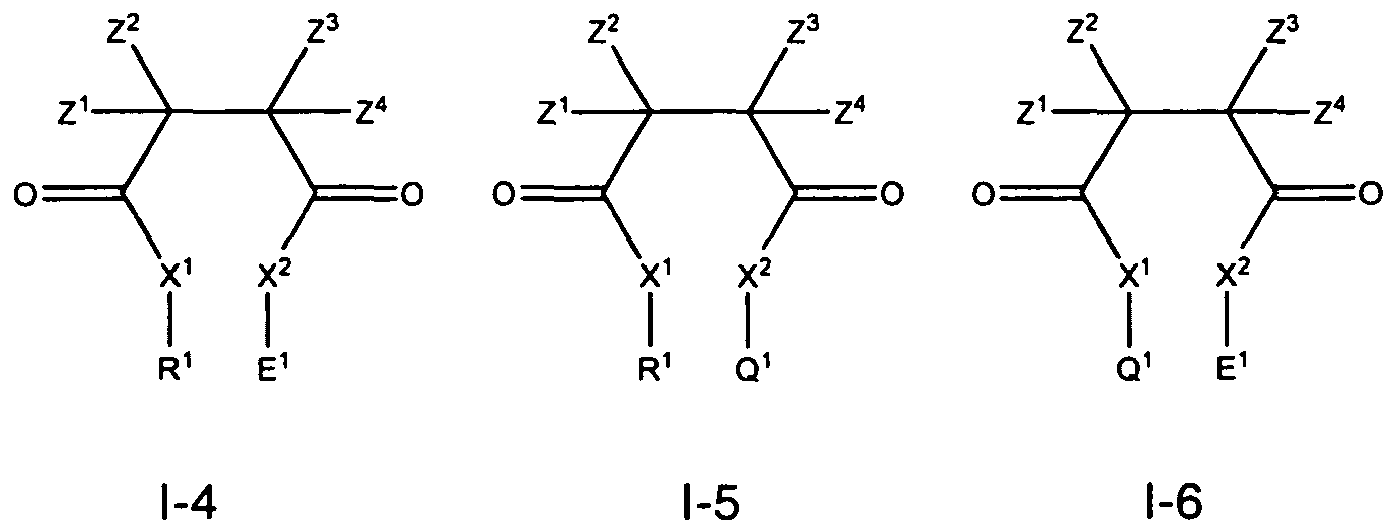


Z1, Z2, Z3 und Z4 jeweils gleich oder verschieden sowie jeweils unabhängig voneinander repräsentiert durch Wasserstoff, einen linearen C1-C4-Alkylrest und/ oder Polymerhauptketteverknüpfungsstellen, mit der Maßgabe, dass pro allgemeiner Formel genau zwei Polymerhauptketteverknüpfungsstellen vorliegen,
X1 und X2 jeweils gleich oder verschieden sowie jeweils unabhängig voneinander repräsentiert durch NH und/oder O,
R1 und R2 jeweils gleich oder verschieden sowie jeweils unabhängig voneinander repräsentiert durch einen verzweigten oder unverzweigten, gesättigten oder ungesättigten, mindestens vier Kohlenstoffatome sowie mindestens drei Sauerstoffatome enthaltenden organischen Rest, der keine Aminfunktionen und keine Ammoniumfunktionen aufweist,
E1 und E2 jeweils gleich oder verschieden sowie jeweils unabhängig voneinander repräsentiert durch einen N,N-disubstituierten Aminrest der allgemeinen Formel (V-E)
R11, R12 jeweils gleich oder verschieden sowie jeweils unabhängig voneinander repräsentiert durch eine substituierte oder nicht substituierte verzweigte oder unverzweigte C1-C24 -Alkylgruppe, durch eine substituierte oder nicht substituierte C4-C10 - Zykloalkylgruppe, durch eine substituierte oder nicht substituierte C6-C18 -Arylgruppe und/oder eine substituierte oder nicht substituierte verzweigte oder unverzweigte C7-C18 -Arylalkylgruppe, wobei R11 und R12 zusammen mit dem R11 und R12 verbindenden N-Atom gemeinsam eine aromatische oder aliphatische, substituierte oder nicht substituierte, zyklische C3-C10 - Gruppe ausbilden können,
Y gleich oder verschieden sowie repräsentiert durch eine substituierte oder nicht substituierte verzweigte oder unverzweigte C1-C24 - Alkylengruppe und/ oder eine substituierte oder nicht substituierte C6-C18-Arylengruppe
Q1 und Q2 jeweils gleich oder verschieden sowie jeweils unabhängig voneinander repräsentiert durch einen quartären Ammoniumrest der allgemeinen Formel (V-Q)
R11, R12 der gleichen Entsprechung wie in der allgemeinen Formel (V-E),
Y der gleichen Entsprechung wie in der allgemeinen Formel (V-E),
R13 gleich oder verschieden sowie repräsentiert durch Wasserstoff, durch eine substituierte oder nicht substituierte verzweigte oder unverzweigte C1-C24 -Alkylgruppe, durch eine substituierte oder nicht substituierte C4-C10 - Zykloalkylgruppe, durch eine substituierte oder nicht substituierte C6-C18 -Arylgruppe und/ oder eine substituierte oder nicht substituierte verzweigte oder unverzweigte C7-C18 - Arylalkylgruppe,
M- gleich oder verschieden sowie repräsentiert durch ein Anion,
wobei der molare Anteil der Struktureinheiten, welche der Gruppe bestehend aus (I-1), (I-2), (I-3), (I-4), (I-5) sowie (I-6) zugehören bezogen auf die Gesamtheit der Struktureinheiten, die der Dicarbonsäurederivatstruktureinheit (B) zuzurechnen sind, 5 - 100 % beträgt,
der molare Anteil der Struktureinheiten, welche der Gruppe bestehend aus (I-2), (I-3), (I-4), (I-5), (I-6), (II-2), (II-3), (III-2) sowie (III-3) zugehören bezogen auf die Gesamtheit der Struktureinheiten, die der Dicarbonsäurederivatstruktureinheit (B) zuzurechnen sind, 5 - 100 % beträgt und
bezüglich der Dicarbonsäurederivatstruktureinheit (B) der molare Anteil der Substituenten, welche der Gruppe bestehend aus Q1 sowie Q2 angehören bezogen auf die Gesamtheit der Substituenten, die der Gruppe bestehend aus E1 E2, Q1 sowie Q2 angehören, 10 - 100 % beträgt. - Copolymer nach Anspruch 1 enthaltend,i) 48 - 70, bevorzugt 50 - 67 Mol-% der Basisstruktureinheit (A) sowieii) 30 - 52, bevorzugt 33 - 50 Mol-% der substituierten Dicarbonsäurederivatstruktureinheit (B).
- Copolymer nach Anspruch 1 oder 2, dadurch gekennzeichnet, dass das die Basisstruktureinheit (A) erzeugende, eine olefinische Doppelbindung enthaltende Monomer (a) ausgewählt ist aus einem oder mehreren der Monomere der Gruppe bestehend aus Alkyl(meth)acrylaten sowie Alkenyl(meth)acrylaten von geradkettigen, verzweigten oder cycloaliphatischen Mono-Alkoholen mit 1 bis 22 Kohlenstoffatomen oder von geradkettigen oder verzweigten aromatischen oder gemischt aromatisch-aliphatischen Monoalkoholen mit 1 bis 22 Kohlenstoffatomen, Mono(meth)acrylaten von oligomeren oder polymeren Ethern, (Meth)acrylate von halogenierten Alkoholen; oxiranhaltige (Meth)acrylate, Styrol, substituierte Styrole, α-Olefine, Vinylether, Allylether; Methacrylnitril, Acrylnitril; Vinylgruppen aufweisende cycloaliphatische Heterocyclen mit wenigstens einem N-Atom als Ringglied, Vinylester von Monocarbonsäuren mit 1 bis 20 Kohlenstoffatomen, N-Alkyl- und N,N-Dialkylsubstituierte Acrylamide mit geradkettigen, verzweigten oder cycloaliphatischen Alkylgruppen mit 1 bis 22 Kohlenstoffatomen, ethylenisch ungesättigte Monomere mit mindestens einer carbonsauren, phosphonsauren, phosphorsauren und/oder sulfonsauren Gruppe und ungesättigten Fettsäuren.
- Copolymer nach einem der Ansprüche 1 bis 3, dadurch gekennzeichnet, dass mindestens 60 Mol-%, bevorzugt mindestens 90 Mol-%, besonders bevorzugt 100 Mol-% der der Basisstruktureinheit (A) zugehörigen Struktureinheiten durch Umsetzung von Styrol erzeugt werden.
- Copolymer nach einem der Ansprüche 1 bis 4, dadurch gekennzeichnet, dass R1 und R2 jeweils unabhängig voneinander vorliegen als Polyetherrest, als Polyesterrest, als Polyetherpolyesterrest, als Poly-2-alkyl-2-oxazolinrest, als Poly-2-alkyl-2-oxazinrest und/oder als Polysiloxanrest.
- Copolymer nach einem der Ansprüche 1 bis 5, dadurch gekennzeichnet, dass R11 und R12 zusammen mit dem R11 und R12 verbindenden N-Atom gemeinsam einen aromatischen, substituierten oder nicht substituierten Heterozyklus ausbilden, der insgesamt zwei N-Atome aufweist.
- Copolymer nach einem der Ansprüche 1 bis 6, dadurch gekennzeichnet, dass M- vorliegt als Carboxylat, als Phosphat, als Phosphatmonoester, als Phosphatdiester, als Alkylsulfonat, als Sulfat und/ oder als Halogenid.
- Copolymer nach einem der Ansprüche 1 bis 7, dadurch gekennzeichnet, dass
der molare Anteil der Struktureinheiten, welche der Gruppe bestehend aus (I-1), (I-2), (I-3), (I-4), (I-5) sowie (I-6) zugehören bezogen auf die Gesamtheit der Struktureinheiten, die der Dicarbonsäurederivatstruktureinheit (B) zuzurechnen sind, 10 - 80, bevorzugt 25 - 75 % beträgt,
der molare Anteil der Struktureinheiten, welche der Gruppe bestehend aus (I-2), (I-3), (I-4), (I-5), (I-6), (II-2), (II-3), (III-2) sowie (III-3) zugehören bezogen auf die Gesamtheit der Struktureinheiten, die der Dicarbonsäurederivatstruktureinheit (B) zuzurechnen sind, 10 - 90, bevorzugt 20 - 80 % beträgt und
bezüglich der Dicarbonsäurederivatstruktureinheit (B) der molare Anteil der Substituenten, welche der Gruppe bestehend aus Q1 sowie Q2 angehören bezogen auf die Gesamtheit der Substituenten, die der Gruppe bestehend aus E1, E2, Q1 sowie Q2 angehören, 20 - 95, bevorzugt 25 - 90 % beträgt. - Copolymer nach einem der Ansprüche 1 bis 8 enthaltend 12 - 500, bevorzugt 20 - 200 Struktureinheiten, welche aus der Basisstruktureinheit (A) und der Dicarbonsäurederivatstruktureinheit (B) ausgewählt sind.
- Herstellung eines Copolymers gemäß eines der Ansprüche 1 bis 9, dadurch gekennzeichnet, dass zunächst ein Copolymervorprodukt durch Polymerisation hergestellt wird, wobei durch anschließende Pfropfung die Substituenten vom Typ (I), (II) und/ oder (III) der Dicarbonsäurederivatstruktureinheit (B) ausgebildet werden.
- Herstellung nach Anspruch 10, dadurch gekennzeichnet, dass die anschließende Pfropfung durch den Einsatz von Reaktionswasser befreienden Maßnahmen, bevorzugt durch Erwärmung auf eine Temperatur von 120 bis 200 °C, solange durchgeführt wird, bis der molare Anteil der Struktureinheiten, welche der Gruppe bestehend aus (I-1), (I-2), (I-3), (I-4), (I-5) sowie (I-6) zugehören bezogen auf die Gesamtheit der Struktureinheiten, die der Dicarbonsäurederivatstruktureinheit (B) zuzurechnen sind, mindestens 5 %, bevorzugt mindestens 10 %, besonders bevorzugt mindestens 25 %, beträgt.
- Dispersion, welche ein Dispergiermedium sowie dispergierten partikulären Feststoff enthält, der bevorzugt in Form eines anorganischen Füllstoffs, und/oder in Form eines anorganischen oder organischen Pigments und/oder in Form von Kohlenstoff-Nanoröhren und/oder in Form von Graphenen, vorliegt, wobei bezogen auf das Gesamtgewicht der Dispersion 0,1-10 Gew.-%, bevorzugt 0,3 bis 4,5 Gew.-%, eines Copolymers gemäß einem der Ansprüche 1 bis 9 als Netz- und Dispergiermittel eingesetzt wird.
- Dispersion nach Anspruch 12, die als Tinte oder Beschichtungsmittel, insbesondere als Lack, vorliegt.
- Partikelzubereitung enthaltend 30,0 bis 99,9 Gew.% partikulären Feststoff sowie 0,1 - 70,0 Gew.% eines Copolymers gemäß einem der Ansprüche 1 bis 9.
- Verwendung eines Copolymers gemäß einem der Ansprüche 1 bis 9 als Netz- und Dispergiermittel.
Priority Applications (6)
| Application Number | Priority Date | Filing Date | Title |
|---|---|---|---|
| EP12004659.4A EP2676974A1 (de) | 2012-06-21 | 2012-06-21 | Ionische Haftgruppen enthaltende Kammcopolymere |
| PCT/EP2013/001626 WO2013189568A1 (de) | 2012-06-21 | 2013-06-04 | Ionische haftgruppen enthaltende kammcopolymere |
| EP13726690.4A EP2864373B1 (de) | 2012-06-21 | 2013-06-04 | Ionische haftgruppen enthaltende kammcopolymere |
| US14/407,657 US9957343B2 (en) | 2012-06-21 | 2013-06-04 | Ionic bonding group-containing comb polymers |
| CN201380031999.XA CN104395358B (zh) | 2012-06-21 | 2013-06-04 | 含有离子型键合基团的梳状共聚物 |
| JP2015517627A JP5968530B2 (ja) | 2012-06-21 | 2013-06-04 | イオン性結合基を有する櫛形コポリマー |
Applications Claiming Priority (1)
| Application Number | Priority Date | Filing Date | Title |
|---|---|---|---|
| EP12004659.4A EP2676974A1 (de) | 2012-06-21 | 2012-06-21 | Ionische Haftgruppen enthaltende Kammcopolymere |
Publications (1)
| Publication Number | Publication Date |
|---|---|
| EP2676974A1 true EP2676974A1 (de) | 2013-12-25 |
Family
ID=48576350
Family Applications (2)
| Application Number | Title | Priority Date | Filing Date |
|---|---|---|---|
| EP12004659.4A Withdrawn EP2676974A1 (de) | 2012-06-21 | 2012-06-21 | Ionische Haftgruppen enthaltende Kammcopolymere |
| EP13726690.4A Active EP2864373B1 (de) | 2012-06-21 | 2013-06-04 | Ionische haftgruppen enthaltende kammcopolymere |
Family Applications After (1)
| Application Number | Title | Priority Date | Filing Date |
|---|---|---|---|
| EP13726690.4A Active EP2864373B1 (de) | 2012-06-21 | 2013-06-04 | Ionische haftgruppen enthaltende kammcopolymere |
Country Status (5)
| Country | Link |
|---|---|
| US (1) | US9957343B2 (de) |
| EP (2) | EP2676974A1 (de) |
| JP (1) | JP5968530B2 (de) |
| CN (1) | CN104395358B (de) |
| WO (1) | WO2013189568A1 (de) |
Cited By (1)
| Publication number | Priority date | Publication date | Assignee | Title |
|---|---|---|---|---|
| WO2024141447A1 (en) * | 2022-12-29 | 2024-07-04 | Bostik Sa | Additives for caustic removal of adhesive from substrates, hot melt adhesives comprising such additives, and methods for recycling laminates bonded by such adhesives |
Families Citing this family (16)
| Publication number | Priority date | Publication date | Assignee | Title |
|---|---|---|---|---|
| JP6959254B2 (ja) | 2016-03-30 | 2021-11-02 | エッカルト ゲゼルシャフト ミット ベシュレンクテル ハフツングEckart GmbH | 粉体コーティングのための、有機バインダーを用いてコーティングされた効果顔料、ならびに前記コーティングされた効果顔料を製造するための方法およびそれらの使用 |
| US10626314B1 (en) | 2016-07-11 | 2020-04-21 | Byk-Chemie, Gmbh | Additive for drilling fluids |
| FR3054225B1 (fr) * | 2016-07-21 | 2019-12-27 | Total Marketing Services | Copolymere utilisable comme additif detergent pour carburant |
| CN108666523B (zh) * | 2017-03-30 | 2021-01-15 | 宁德时代新能源科技股份有限公司 | 阳极浆料用悬浮剂、阳极片以及储能装置 |
| EP3626753B1 (de) * | 2017-05-17 | 2022-02-09 | China Petroleum & Chemical Corporation | Esterpolymer, herstellungsverfahren dafür und verwendung davon |
| TWI800575B (zh) * | 2017-12-20 | 2023-05-01 | 美商盧伯利索先進材料有限公司 | 苯乙烯馬來醯胺嵌段共聚物顏料分散劑及其形成方法 |
| US11787955B2 (en) | 2019-02-22 | 2023-10-17 | Byk-Chemie Gmbh | Aqueous dispersant composition |
| CN109943106A (zh) * | 2019-02-25 | 2019-06-28 | 北京碧海舟腐蚀防护工业股份有限公司 | 水性无机防腐涂料、防腐涂层及其应用 |
| JP7245922B2 (ja) * | 2019-02-26 | 2023-03-24 | ベーイプシロンカー ヘミー ゲゼルシャフト ミット ベシュレンクター ハフトゥング | 櫛型コポリマーを含む組成物 |
| US12460160B2 (en) * | 2019-11-19 | 2025-11-04 | Lubrizol Advanced Materials, Inc. | Redeposition inhibiting styrene maleic anhydride copolymers and detergent compositions containing same |
| EP3950787A1 (de) * | 2020-08-04 | 2022-02-09 | CliQ SwissTech (Netherlands) B.V. | Quaternisierte kammpolymere |
| CN112011263A (zh) * | 2020-08-27 | 2020-12-01 | 漳州鑫展旺化工有限公司 | 一种环保型免磨高固中涂漆及其制备方法和使用方法 |
| EP4320181A1 (de) * | 2021-04-07 | 2024-02-14 | BYK-Chemie GmbH | Kammpolymer mit salzgruppen |
| CN115975126B (zh) * | 2022-12-26 | 2025-01-24 | 上海宇昂水性新材料科技股份有限公司 | 一种梳型聚合物及其制备方法与应用 |
| CN116262806A (zh) * | 2022-12-30 | 2023-06-16 | 杭州吉华高分子材料股份有限公司 | 一种用于液体分散染料的复合超分散剂及其制备方法 |
| WO2026027343A1 (de) | 2024-08-02 | 2026-02-05 | Evonik Operations Gmbh | Polymere basierend auf oligoaminoestermonomeren |
Citations (11)
| Publication number | Priority date | Publication date | Assignee | Title |
|---|---|---|---|---|
| US4647647A (en) | 1984-01-27 | 1987-03-03 | Byk-Chemie Gmbh | Addition compounds suitable as dispersing agents, processes for their preparation, their use and solids coated therewith |
| EP0270126A2 (de) | 1986-12-05 | 1988-06-08 | Byk-Chemie GmbH | Als Dispergiermittel und als Dispersionsstabilisatoren geeignete Additionsverbindungen, Verfahren zu ihrer Herstellung, ihre Verwendung und damit beschichtete Feststoffe |
| EP1026178A1 (de) * | 1999-02-05 | 2000-08-09 | Goldschmidt AG | Aminoxidgruppen enthaltende Maleinsäureanhydrid-Copolymere und ihre Verwendung als Dispergiermittel für Pigmente oder Füllstoffe |
| US6444776B1 (en) | 1998-12-21 | 2002-09-03 | Novartis Ag | Organic polymers |
| EP1640389A1 (de) * | 2004-09-14 | 2006-03-29 | Byk-Chemie GmbH | Copolymerisate, deren Herstellung und Verwendung als Netz- und Dispergiermittel |
| EP1674067A1 (de) | 2004-12-22 | 2006-06-28 | Ivoclar Vivadent AG | Hydrolysestabiles selbstätzendes Einkomponentendentaladhäsiv |
| US7078464B2 (en) | 2002-06-26 | 2006-07-18 | Sartomer Technology, Inc. | Acid salts of amine-functionalized SMA imide resins |
| DE102006062441A1 (de) * | 2006-12-27 | 2008-07-03 | Byk-Chemie Gmbh | Modifizierte Kammcopolymere |
| WO2008122606A2 (en) | 2007-04-04 | 2008-10-16 | Lubrizol Limited | Dispersant composition |
| DE102008021511A1 (de) * | 2008-04-30 | 2009-11-05 | Clariant International Limited | Pigmentdispergatoren und leicht dispergierbare feste Pigmentzubereitungen |
| DE102008041790A1 (de) * | 2008-09-03 | 2010-03-04 | Evonik Goldschmidt Gmbh | Verwendung von Aminoxidgruppen enthaltenden Maleinsäureanhydrid-Copolymeren zur Herstellung von Reinigungszusammensetzungen sowie entsprechende Reinigungszusammensetzungen |
Family Cites Families (4)
| Publication number | Priority date | Publication date | Assignee | Title |
|---|---|---|---|---|
| US3095390A (en) * | 1953-10-30 | 1963-06-25 | Ciba Ltd | Copolymerisation products of amides of copolymerisable carboxylic acids containing quaternary ammonium groups bound to amide nitrogen |
| NL131603C (de) * | 1957-03-22 | |||
| DE102006062439A1 (de) * | 2006-12-27 | 2008-07-03 | Byk-Chemie Gmbh | Kamm(block)copolymere |
| EP2723779B1 (de) * | 2011-06-22 | 2015-01-14 | BYK-Chemie GmbH | Oberflächenaktive kammcopolymere |
-
2012
- 2012-06-21 EP EP12004659.4A patent/EP2676974A1/de not_active Withdrawn
-
2013
- 2013-06-04 US US14/407,657 patent/US9957343B2/en active Active
- 2013-06-04 EP EP13726690.4A patent/EP2864373B1/de active Active
- 2013-06-04 CN CN201380031999.XA patent/CN104395358B/zh active Active
- 2013-06-04 WO PCT/EP2013/001626 patent/WO2013189568A1/de not_active Ceased
- 2013-06-04 JP JP2015517627A patent/JP5968530B2/ja not_active Expired - Fee Related
Patent Citations (12)
| Publication number | Priority date | Publication date | Assignee | Title |
|---|---|---|---|---|
| US4647647A (en) | 1984-01-27 | 1987-03-03 | Byk-Chemie Gmbh | Addition compounds suitable as dispersing agents, processes for their preparation, their use and solids coated therewith |
| EP0270126A2 (de) | 1986-12-05 | 1988-06-08 | Byk-Chemie GmbH | Als Dispergiermittel und als Dispersionsstabilisatoren geeignete Additionsverbindungen, Verfahren zu ihrer Herstellung, ihre Verwendung und damit beschichtete Feststoffe |
| US6444776B1 (en) | 1998-12-21 | 2002-09-03 | Novartis Ag | Organic polymers |
| EP1026178A1 (de) * | 1999-02-05 | 2000-08-09 | Goldschmidt AG | Aminoxidgruppen enthaltende Maleinsäureanhydrid-Copolymere und ihre Verwendung als Dispergiermittel für Pigmente oder Füllstoffe |
| US7078464B2 (en) | 2002-06-26 | 2006-07-18 | Sartomer Technology, Inc. | Acid salts of amine-functionalized SMA imide resins |
| EP1640389A1 (de) * | 2004-09-14 | 2006-03-29 | Byk-Chemie GmbH | Copolymerisate, deren Herstellung und Verwendung als Netz- und Dispergiermittel |
| EP1674067A1 (de) | 2004-12-22 | 2006-06-28 | Ivoclar Vivadent AG | Hydrolysestabiles selbstätzendes Einkomponentendentaladhäsiv |
| DE102006062441A1 (de) * | 2006-12-27 | 2008-07-03 | Byk-Chemie Gmbh | Modifizierte Kammcopolymere |
| WO2008080580A2 (de) | 2006-12-27 | 2008-07-10 | Byk-Chemie Gmbh | Modifizierte styrol/maleinsäureanhydrid-basierte kammcopolymere |
| WO2008122606A2 (en) | 2007-04-04 | 2008-10-16 | Lubrizol Limited | Dispersant composition |
| DE102008021511A1 (de) * | 2008-04-30 | 2009-11-05 | Clariant International Limited | Pigmentdispergatoren und leicht dispergierbare feste Pigmentzubereitungen |
| DE102008041790A1 (de) * | 2008-09-03 | 2010-03-04 | Evonik Goldschmidt Gmbh | Verwendung von Aminoxidgruppen enthaltenden Maleinsäureanhydrid-Copolymeren zur Herstellung von Reinigungszusammensetzungen sowie entsprechende Reinigungszusammensetzungen |
Non-Patent Citations (2)
| Title |
|---|
| G. BUXBAUM: "Industrial Inorganic Pigments", 1998, VERLAG: WILEY-VCH |
| W. HERBST; K. HUNGER: "Industrial Organlc Pigments", 1997, VERLAG: WILEY-VCH |
Cited By (1)
| Publication number | Priority date | Publication date | Assignee | Title |
|---|---|---|---|---|
| WO2024141447A1 (en) * | 2022-12-29 | 2024-07-04 | Bostik Sa | Additives for caustic removal of adhesive from substrates, hot melt adhesives comprising such additives, and methods for recycling laminates bonded by such adhesives |
Also Published As
| Publication number | Publication date |
|---|---|
| WO2013189568A1 (de) | 2013-12-27 |
| US9957343B2 (en) | 2018-05-01 |
| CN104395358B (zh) | 2016-12-07 |
| EP2864373A1 (de) | 2015-04-29 |
| CN104395358A (zh) | 2015-03-04 |
| JP2015526539A (ja) | 2015-09-10 |
| JP5968530B2 (ja) | 2016-08-10 |
| EP2864373B1 (de) | 2015-12-09 |
| US20150152211A1 (en) | 2015-06-04 |
Similar Documents
| Publication | Publication Date | Title |
|---|---|---|
| EP2864373B1 (de) | Ionische haftgruppen enthaltende kammcopolymere | |
| EP2106412B1 (de) | Polymermischung umfassend ein kammcopolymeres | |
| EP2125910B1 (de) | Modifizierte styrol / maleinsäureanhydrid basierte kammcopolymere | |
| EP2091984B1 (de) | Netz- und dispergiermittel basierend auf mischungen von strukturierten copolymeren | |
| EP2125909B1 (de) | Kamm(block)copolymere | |
| EP2240543B1 (de) | Netz- und dispergiermittel | |
| EP2367865B1 (de) | Zusammensetzungen umfassend glycidylether-copolymere | |
| EP1685895B1 (de) | Polyether/Polyester enthaltende Dispergierharze | |
| EP2780390B1 (de) | Aminaddukte herstellbar durch michael-addition | |
| EP3122447B1 (de) | Dispergierharze | |
| US11879032B2 (en) | Reaction products containing urethane groups and urea groups | |
| EP2432819B1 (de) | Aus oxetan-basierten makromonomeren erhältliche polymere, verfahren zu deren herstellung und deren verwendung als additive in beschichtungsmitteln und kunststoffen | |
| EP2432820B1 (de) | Terminal ungesättigte, oxetan-basierte makromonomere und verfahren zu deren herstellung | |
| WO2026077748A1 (de) | Dispergiermittel auf basis von amidierten polyaminen und/oder polyiminen mit carbonsäureesterfunktionellen polyethern |
Legal Events
| Date | Code | Title | Description |
|---|---|---|---|
| PUAI | Public reference made under article 153(3) epc to a published international application that has entered the european phase |
Free format text: ORIGINAL CODE: 0009012 |
|
| AK | Designated contracting states |
Kind code of ref document: A1 Designated state(s): AL AT BE BG CH CY CZ DE DK EE ES FI FR GB GR HR HU IE IS IT LI LT LU LV MC MK MT NL NO PL PT RO RS SE SI SK SM TR |
|
| AX | Request for extension of the european patent |
Extension state: BA ME |
|
| STAA | Information on the status of an ep patent application or granted ep patent |
Free format text: STATUS: THE APPLICATION HAS BEEN WITHDRAWN |
|
| 18W | Application withdrawn |
Effective date: 20140206 |