EP2673320B1 - Polymer composition comprising polyamide and ionomer - Google Patents
Polymer composition comprising polyamide and ionomer Download PDFInfo
- Publication number
- EP2673320B1 EP2673320B1 EP12704490.7A EP12704490A EP2673320B1 EP 2673320 B1 EP2673320 B1 EP 2673320B1 EP 12704490 A EP12704490 A EP 12704490A EP 2673320 B1 EP2673320 B1 EP 2673320B1
- Authority
- EP
- European Patent Office
- Prior art keywords
- ionomer
- blend
- composition
- polyamide
- weight
- Prior art date
- Legal status (The legal status is an assumption and is not a legal conclusion. Google has not performed a legal analysis and makes no representation as to the accuracy of the status listed.)
- Active
Links
- 239000000203 mixture Substances 0.000 title claims description 99
- 229920000554 ionomer Polymers 0.000 title claims description 78
- 239000004952 Polyamide Substances 0.000 title claims description 26
- 229920002647 polyamide Polymers 0.000 title claims description 25
- 229920000642 polymer Polymers 0.000 title description 4
- 125000000217 alkyl group Chemical group 0.000 claims description 16
- -1 alkyl methacrylate Chemical compound 0.000 claims description 15
- 239000002245 particle Substances 0.000 claims description 15
- 229910052725 zinc Inorganic materials 0.000 claims description 14
- 239000011701 zinc Substances 0.000 claims description 14
- VGGSQFUCUMXWEO-UHFFFAOYSA-N Ethene Chemical compound C=C VGGSQFUCUMXWEO-UHFFFAOYSA-N 0.000 claims description 12
- 239000005977 Ethylene Substances 0.000 claims description 12
- HCHKCACWOHOZIP-UHFFFAOYSA-N Zinc Chemical compound [Zn] HCHKCACWOHOZIP-UHFFFAOYSA-N 0.000 claims description 11
- 150000001732 carboxylic acid derivatives Chemical class 0.000 claims description 11
- FPYJFEHAWHCUMM-UHFFFAOYSA-N maleic anhydride Chemical compound O=C1OC(=O)C=C1 FPYJFEHAWHCUMM-UHFFFAOYSA-N 0.000 claims description 10
- 238000000034 method Methods 0.000 claims description 10
- VZCYOOQTPOCHFL-UHFFFAOYSA-N trans-butenedioic acid Natural products OC(=O)C=CC(O)=O VZCYOOQTPOCHFL-UHFFFAOYSA-N 0.000 claims description 9
- 239000004953 Aliphatic polyamide Substances 0.000 claims description 8
- 229920003231 aliphatic polyamide Polymers 0.000 claims description 8
- 229920001577 copolymer Polymers 0.000 claims description 8
- 239000002667 nucleating agent Substances 0.000 claims description 7
- NIXOWILDQLNWCW-UHFFFAOYSA-M Acrylate Chemical compound [O-]C(=O)C=C NIXOWILDQLNWCW-UHFFFAOYSA-M 0.000 claims description 6
- VZCYOOQTPOCHFL-OWOJBTEDSA-N Fumaric acid Chemical compound OC(=O)\C=C\C(O)=O VZCYOOQTPOCHFL-OWOJBTEDSA-N 0.000 claims description 6
- FYYHWMGAXLPEAU-UHFFFAOYSA-N Magnesium Chemical compound [Mg] FYYHWMGAXLPEAU-UHFFFAOYSA-N 0.000 claims description 6
- 229920002292 Nylon 6 Polymers 0.000 claims description 6
- OFOBLEOULBTSOW-UHFFFAOYSA-N Propanedioic acid Natural products OC(=O)CC(O)=O OFOBLEOULBTSOW-UHFFFAOYSA-N 0.000 claims description 6
- 229910052783 alkali metal Inorganic materials 0.000 claims description 6
- 229910052784 alkaline earth metal Inorganic materials 0.000 claims description 6
- 229910052749 magnesium Inorganic materials 0.000 claims description 6
- 239000011777 magnesium Substances 0.000 claims description 6
- 239000011976 maleic acid Substances 0.000 claims description 6
- VZCYOOQTPOCHFL-UPHRSURJSA-N maleic acid group Chemical group C(\C=C/C(=O)O)(=O)O VZCYOOQTPOCHFL-UPHRSURJSA-N 0.000 claims description 6
- 229910052723 transition metal Inorganic materials 0.000 claims description 6
- 125000004432 carbon atom Chemical group C* 0.000 claims description 5
- 239000006185 dispersion Substances 0.000 claims description 5
- JAHNSTQSQJOJLO-UHFFFAOYSA-N 2-(3-fluorophenyl)-1h-imidazole Chemical compound FC1=CC=CC(C=2NC=CN=2)=C1 JAHNSTQSQJOJLO-UHFFFAOYSA-N 0.000 claims description 4
- OYPRJOBELJOOCE-UHFFFAOYSA-N Calcium Chemical compound [Ca] OYPRJOBELJOOCE-UHFFFAOYSA-N 0.000 claims description 4
- DGAQECJNVWCQMB-PUAWFVPOSA-M Ilexoside XXIX Chemical compound C[C@@H]1CC[C@@]2(CC[C@@]3(C(=CC[C@H]4[C@]3(CC[C@@H]5[C@@]4(CC[C@@H](C5(C)C)OS(=O)(=O)[O-])C)C)[C@@H]2[C@]1(C)O)C)C(=O)O[C@H]6[C@@H]([C@H]([C@@H]([C@H](O6)CO)O)O)O.[Na+] DGAQECJNVWCQMB-PUAWFVPOSA-M 0.000 claims description 4
- WHXSMMKQMYFTQS-UHFFFAOYSA-N Lithium Chemical compound [Li] WHXSMMKQMYFTQS-UHFFFAOYSA-N 0.000 claims description 4
- 125000005250 alkyl acrylate group Chemical group 0.000 claims description 4
- 229910052791 calcium Inorganic materials 0.000 claims description 4
- 239000011575 calcium Substances 0.000 claims description 4
- 229910052744 lithium Inorganic materials 0.000 claims description 4
- LVHBHZANLOWSRM-UHFFFAOYSA-N methylenebutanedioic acid Natural products OC(=O)CC(=C)C(O)=O LVHBHZANLOWSRM-UHFFFAOYSA-N 0.000 claims description 4
- 229910052708 sodium Inorganic materials 0.000 claims description 4
- 239000011734 sodium Substances 0.000 claims description 4
- 229920000571 Nylon 11 Polymers 0.000 claims description 3
- 229920002302 Nylon 6,6 Polymers 0.000 claims description 3
- 150000001768 cations Chemical class 0.000 claims description 3
- 150000002148 esters Chemical class 0.000 claims description 3
- 239000001530 fumaric acid Substances 0.000 claims description 3
- 229910052751 metal Inorganic materials 0.000 claims description 2
- 239000002184 metal Substances 0.000 claims description 2
- 150000001991 dicarboxylic acids Chemical class 0.000 claims 1
- CERQOIWHTDAKMF-UHFFFAOYSA-N Methacrylic acid Chemical compound CC(=C)C(O)=O CERQOIWHTDAKMF-UHFFFAOYSA-N 0.000 description 9
- 239000004433 Thermoplastic polyurethane Substances 0.000 description 8
- 229920002803 thermoplastic polyurethane Polymers 0.000 description 8
- CQEYYJKEWSMYFG-UHFFFAOYSA-N butyl acrylate Chemical compound CCCCOC(=O)C=C CQEYYJKEWSMYFG-UHFFFAOYSA-N 0.000 description 7
- 239000000463 material Substances 0.000 description 7
- 229920005657 Surlyn® 9320 Polymers 0.000 description 5
- 150000001340 alkali metals Chemical class 0.000 description 5
- 150000001990 dicarboxylic acid derivatives Chemical class 0.000 description 5
- 239000002253 acid Substances 0.000 description 4
- 239000008188 pellet Substances 0.000 description 4
- 150000003624 transition metals Chemical class 0.000 description 4
- XLYMOEINVGRTEX-ARJAWSKDSA-N Ethyl hydrogen fumarate Chemical compound CCOC(=O)\C=C/C(O)=O XLYMOEINVGRTEX-ARJAWSKDSA-N 0.000 description 3
- 229920006097 Ultramide® Polymers 0.000 description 3
- 210000003484 anatomy Anatomy 0.000 description 3
- XLYMOEINVGRTEX-UHFFFAOYSA-N fumaric acid monoethyl ester Natural products CCOC(=O)C=CC(O)=O XLYMOEINVGRTEX-UHFFFAOYSA-N 0.000 description 3
- 239000007787 solid Substances 0.000 description 3
- 239000000126 substance Substances 0.000 description 3
- SMZOUWXMTYCWNB-UHFFFAOYSA-N 2-(2-methoxy-5-methylphenyl)ethanamine Chemical compound COC1=CC=C(C)C=C1CCN SMZOUWXMTYCWNB-UHFFFAOYSA-N 0.000 description 2
- NIXOWILDQLNWCW-UHFFFAOYSA-N 2-Propenoic acid Natural products OC(=O)C=C NIXOWILDQLNWCW-UHFFFAOYSA-N 0.000 description 2
- BAPJBEWLBFYGME-UHFFFAOYSA-N Methyl acrylate Chemical compound COC(=O)C=C BAPJBEWLBFYGME-UHFFFAOYSA-N 0.000 description 2
- 150000001252 acrylic acid derivatives Chemical class 0.000 description 2
- WNLRTRBMVRJNCN-UHFFFAOYSA-N adipic acid Chemical compound OC(=O)CCCCC(O)=O WNLRTRBMVRJNCN-UHFFFAOYSA-N 0.000 description 2
- 125000000484 butyl group Chemical group [H]C([*])([H])C([H])([H])C([H])([H])C([H])([H])[H] 0.000 description 2
- 239000003795 chemical substances by application Substances 0.000 description 2
- 230000000052 comparative effect Effects 0.000 description 2
- 150000001875 compounds Chemical class 0.000 description 2
- 238000001816 cooling Methods 0.000 description 2
- 230000000694 effects Effects 0.000 description 2
- 239000006260 foam Substances 0.000 description 2
- 238000010438 heat treatment Methods 0.000 description 2
- NAQMVNRVTILPCV-UHFFFAOYSA-N hexane-1,6-diamine Chemical compound NCCCCCCN NAQMVNRVTILPCV-UHFFFAOYSA-N 0.000 description 2
- 238000004519 manufacturing process Methods 0.000 description 2
- CXMXRPHRNRROMY-UHFFFAOYSA-N sebacic acid Chemical compound OC(=O)CCCCCCCCC(O)=O CXMXRPHRNRROMY-UHFFFAOYSA-N 0.000 description 2
- 239000003381 stabilizer Substances 0.000 description 2
- 230000035882 stress Effects 0.000 description 2
- 229920001897 terpolymer Polymers 0.000 description 2
- HFVMEOPYDLEHBR-UHFFFAOYSA-N (2-fluorophenyl)-phenylmethanol Chemical compound C=1C=CC=C(F)C=1C(O)C1=CC=CC=C1 HFVMEOPYDLEHBR-UHFFFAOYSA-N 0.000 description 1
- 125000004178 (C1-C4) alkyl group Chemical group 0.000 description 1
- JIGUQPWFLRLWPJ-UHFFFAOYSA-N Ethyl acrylate Chemical compound CCOC(=O)C=C JIGUQPWFLRLWPJ-UHFFFAOYSA-N 0.000 description 1
- 239000006057 Non-nutritive feed additive Substances 0.000 description 1
- 229920000393 Nylon 6/6T Polymers 0.000 description 1
- ZLMJMSJWJFRBEC-UHFFFAOYSA-N Potassium Chemical compound [K] ZLMJMSJWJFRBEC-UHFFFAOYSA-N 0.000 description 1
- KDYFGRWQOYBRFD-UHFFFAOYSA-N Succinic acid Natural products OC(=O)CCC(O)=O KDYFGRWQOYBRFD-UHFFFAOYSA-N 0.000 description 1
- ATJFFYVFTNAWJD-UHFFFAOYSA-N Tin Chemical compound [Sn] ATJFFYVFTNAWJD-UHFFFAOYSA-N 0.000 description 1
- 239000006096 absorbing agent Substances 0.000 description 1
- 150000007513 acids Chemical class 0.000 description 1
- 239000000654 additive Substances 0.000 description 1
- 150000001342 alkaline earth metals Chemical class 0.000 description 1
- 229910052782 aluminium Inorganic materials 0.000 description 1
- XAGFODPZIPBFFR-UHFFFAOYSA-N aluminium Chemical compound [Al] XAGFODPZIPBFFR-UHFFFAOYSA-N 0.000 description 1
- 150000001413 amino acids Chemical class 0.000 description 1
- 239000003963 antioxidant agent Substances 0.000 description 1
- 239000002216 antistatic agent Substances 0.000 description 1
- 229910052788 barium Inorganic materials 0.000 description 1
- DSAJWYNOEDNPEQ-UHFFFAOYSA-N barium atom Chemical compound [Ba] DSAJWYNOEDNPEQ-UHFFFAOYSA-N 0.000 description 1
- 150000001735 carboxylic acids Chemical class 0.000 description 1
- 235000019506 cigar Nutrition 0.000 description 1
- 238000009833 condensation Methods 0.000 description 1
- 230000005494 condensation Effects 0.000 description 1
- 230000001143 conditioned effect Effects 0.000 description 1
- 230000007812 deficiency Effects 0.000 description 1
- 150000004985 diamines Chemical class 0.000 description 1
- 125000001142 dicarboxylic acid group Chemical group 0.000 description 1
- 238000009826 distribution Methods 0.000 description 1
- 239000000975 dye Substances 0.000 description 1
- 125000001495 ethyl group Chemical group [H]C([H])([H])C([H])([H])* 0.000 description 1
- 230000001747 exhibiting effect Effects 0.000 description 1
- 239000000945 filler Substances 0.000 description 1
- 239000010419 fine particle Substances 0.000 description 1
- 239000003063 flame retardant Substances 0.000 description 1
- 239000003365 glass fiber Substances 0.000 description 1
- 230000008642 heat stress Effects 0.000 description 1
- 230000003301 hydrolyzing effect Effects 0.000 description 1
- 238000010102 injection blow moulding Methods 0.000 description 1
- 238000001746 injection moulding Methods 0.000 description 1
- 150000007529 inorganic bases Chemical class 0.000 description 1
- 239000011872 intimate mixture Substances 0.000 description 1
- 125000000959 isobutyl group Chemical group [H]C([H])([H])C([H])(C([H])([H])[H])C([H])([H])* 0.000 description 1
- 150000003951 lactams Chemical class 0.000 description 1
- 239000000314 lubricant Substances 0.000 description 1
- 125000002496 methyl group Chemical group [H]C([H])([H])* 0.000 description 1
- 125000004108 n-butyl group Chemical group [H]C([H])([H])C([H])([H])C([H])([H])C([H])([H])* 0.000 description 1
- 238000006386 neutralization reaction Methods 0.000 description 1
- PNJWIWWMYCMZRO-UHFFFAOYSA-N pent‐4‐en‐2‐one Natural products CC(=O)CC=C PNJWIWWMYCMZRO-UHFFFAOYSA-N 0.000 description 1
- 239000000049 pigment Substances 0.000 description 1
- 239000004014 plasticizer Substances 0.000 description 1
- 229910052700 potassium Inorganic materials 0.000 description 1
- 239000011591 potassium Substances 0.000 description 1
- 125000001436 propyl group Chemical group [H]C([*])([H])C([H])([H])C([H])([H])[H] 0.000 description 1
- 239000012744 reinforcing agent Substances 0.000 description 1
- 238000001175 rotational moulding Methods 0.000 description 1
- 125000002914 sec-butyl group Chemical group [H]C([H])([H])C([H])([H])C([H])(*)C([H])([H])[H] 0.000 description 1
- 238000003860 storage Methods 0.000 description 1
- 125000000999 tert-butyl group Chemical group [H]C([H])([H])C(*)(C([H])([H])[H])C([H])([H])[H] 0.000 description 1
- 238000003856 thermoforming Methods 0.000 description 1
- 229920006345 thermoplastic polyamide Polymers 0.000 description 1
- 229910052718 tin Inorganic materials 0.000 description 1
Images
Classifications
-
- C—CHEMISTRY; METALLURGY
- C08—ORGANIC MACROMOLECULAR COMPOUNDS; THEIR PREPARATION OR CHEMICAL WORKING-UP; COMPOSITIONS BASED THEREON
- C08L—COMPOSITIONS OF MACROMOLECULAR COMPOUNDS
- C08L77/00—Compositions of polyamides obtained by reactions forming a carboxylic amide link in the main chain; Compositions of derivatives of such polymers
- C08L77/06—Polyamides derived from polyamines and polycarboxylic acids
-
- C—CHEMISTRY; METALLURGY
- C08—ORGANIC MACROMOLECULAR COMPOUNDS; THEIR PREPARATION OR CHEMICAL WORKING-UP; COMPOSITIONS BASED THEREON
- C08L—COMPOSITIONS OF MACROMOLECULAR COMPOUNDS
- C08L23/00—Compositions of homopolymers or copolymers of unsaturated aliphatic hydrocarbons having only one carbon-to-carbon double bond; Compositions of derivatives of such polymers
- C08L23/02—Compositions of homopolymers or copolymers of unsaturated aliphatic hydrocarbons having only one carbon-to-carbon double bond; Compositions of derivatives of such polymers not modified by chemical after-treatment
- C08L23/04—Homopolymers or copolymers of ethene
- C08L23/08—Copolymers of ethene
- C08L23/0846—Copolymers of ethene with unsaturated hydrocarbons containing atoms other than carbon or hydrogen
- C08L23/0869—Copolymers of ethene with unsaturated hydrocarbons containing atoms other than carbon or hydrogen with unsaturated acids, e.g. [meth]acrylic acid; with unsaturated esters, e.g. [meth]acrylic acid esters
- C08L23/0876—Salts thereof, i.e. ionomers
-
- C—CHEMISTRY; METALLURGY
- C08—ORGANIC MACROMOLECULAR COMPOUNDS; THEIR PREPARATION OR CHEMICAL WORKING-UP; COMPOSITIONS BASED THEREON
- C08L—COMPOSITIONS OF MACROMOLECULAR COMPOUNDS
- C08L77/00—Compositions of polyamides obtained by reactions forming a carboxylic amide link in the main chain; Compositions of derivatives of such polymers
- C08L77/02—Polyamides derived from omega-amino carboxylic acids or from lactams thereof
-
- C—CHEMISTRY; METALLURGY
- C08—ORGANIC MACROMOLECULAR COMPOUNDS; THEIR PREPARATION OR CHEMICAL WORKING-UP; COMPOSITIONS BASED THEREON
- C08L—COMPOSITIONS OF MACROMOLECULAR COMPOUNDS
- C08L2205/00—Polymer mixtures characterised by other features
- C08L2205/02—Polymer mixtures characterised by other features containing two or more polymers of the same C08L -group
-
- C—CHEMISTRY; METALLURGY
- C08—ORGANIC MACROMOLECULAR COMPOUNDS; THEIR PREPARATION OR CHEMICAL WORKING-UP; COMPOSITIONS BASED THEREON
- C08L—COMPOSITIONS OF MACROMOLECULAR COMPOUNDS
- C08L2205/00—Polymer mixtures characterised by other features
- C08L2205/03—Polymer mixtures characterised by other features containing three or more polymers in a blend
-
- C—CHEMISTRY; METALLURGY
- C08—ORGANIC MACROMOLECULAR COMPOUNDS; THEIR PREPARATION OR CHEMICAL WORKING-UP; COMPOSITIONS BASED THEREON
- C08L—COMPOSITIONS OF MACROMOLECULAR COMPOUNDS
- C08L2205/00—Polymer mixtures characterised by other features
- C08L2205/22—Mixtures comprising a continuous polymer matrix in which are dispersed crosslinked particles of another polymer
Definitions
- the present invention relates to polymeric compositions comprising at least one ionomer and at least one blend of polyamide and a different ionomer.
- flex modulus of the material employed in the outer shell of the boot when manufacturing winter sport footwear, such as for example skiing boots or skating boots, a key property is the flex modulus of the material employed in the outer shell of the boot. Boots that are too stiff or rigid are not well received among athletes, because they are uncomfortable and unresponsive. Expressed alternatively, the flex modulus of the boot material needs to be reasonably low over a wide range of temperatures of from -20°C to 20° C.
- the currently used materials in boots are "softer" polymers such as for example ionomers or thermoplastic polyurethanes (TPUs), which have a comparatively low flex modulus and yield flexible and responsive skiing boots.
- TPUs thermoplastic polyurethanes
- boots made of ionomer have excellent flex properties at temperatures of form about -20°C to about 20°C, they have a propensity to deform under creep stress.
- temperature can easily climb to 50 or 70°C, a temperature at which the currently used ionomers starts deforming or warping. This is of course undesirable, because after cooling down, the boot will not fit in the intended way onto the foot of the wearer. Repeated heating and cooling further exacerbate this problem.
- thermoplastic polyurethanes While not suffering from deformation under creep stress, boots made from thermoplastic polyurethanes have other drawbacks. For instance, the flex properties of TPUs can change dramatically over the ranges encountered in winter that is of from about -20°C to about 20°C. While the flex properties of TPUs are satisfactory in the upper parts of the range, TPUs rigidify significantly (by up to 400%) in the lower parts of the range, i.e., the colder it becomes, the less flexible and comfortable boots made of TPU become.
- Polymers such as TPUs or polyamides require very high temperatures of up to 200°C to reach a point where they are soft enough, which makes it impossible to adjust the boot, because the user is required to shoe the boot during the adjustment process.
- ionomers may be suitable for boot shells that can be adjusted at temperatures around 50°C, but they suffer from the above-mentioned deformation problems of creep deformation.
- compositions comprising or produced from at least one ionomer (A) and at least one blend, wherein the blend comprises at least one polyamide and at least one ionomer (B), the blend is a dispersion of the ionomer (B) in a continuous phase of the polyamide and the blend is a dispersed phase dispersed in a continuous phase of the ionomer (A), the polyamide is an aliphatic polyamide and the ionomer (B) of the blend is a copolymer of (a) ethylene, (b) from 5 weight percent to 15 weight percent of an ⁇ , ⁇ -unsaturated C 3 -C 8 carboxylic acid based on the weight of the ionomer (B) of the blend, (c) from 3 weight percent to 25 weight percent of at least one comonomer that is an ethylenically unsaturated dicarboxylic acid or derivative thereof, the comonomer preferably being selected from the
- composition as described above is obtainable by first mixing the at least one aliphatic polyamide and the at least ionomer (B) into a blend, and subsequently mixing said blend into the at least one ionomer (A).
- the invention also provides an article comprising a composition as described above, wherein the article is a skiing boot, snowboard boot, ice skating boot, in-line skate boot, skating boot, or mountaineering boot.
- the polymeric composition can be an intimate mixture of at least one ionomer (A) and a blend comprising at least one aliphatic polyamide and at least one ionomer (B) selected from a special family of ionomers and can provide new materials that are highly suitable for applications where high mechanical rigidity is needed at relatively low temperatures, in conjunction with good formability at temperatures below 100°C.
- the new materials can overcome some of the major deficiencies of both polyamides and ionomers, while continuing to retain most of the desirable attributes.
- the composition can comprise at least one ionomer (A) in amounts of from 10 weight % to 60 weight %, preferably of from 20 weight % to 40 weight % or from 20 weight percent to 30 weight percent, based on the total weight of the composition.
- the ionomer (A) may be chosen among E/X/Y copolymers where E is ethylene, X is a C 3 to C 8 ⁇ , ⁇ ethylenically unsaturated carboxylic acid, and Y is a comonomer selected from alkyl acrylate, alkyl methacrylate, or both.
- the C 3 to C 8 ⁇ , ⁇ ethylenically unsaturated carboxylic acid X can be present of from 2 weight percent to 30 weight percent, preferably 5 weight percent to 15 weight percent, based on the weight of the ionomer (A).
- Suitable C 3 to C 8 ⁇ , ⁇ ethylenically unsaturated carboxylic acids X can be chosen among methacrylic acid, acrylic acid, or both and methacrylic acid being preferred.
- the comonomer Y can be present of from 0.1 weight percent to 40 weight percent, preferably 10 weight percent to 30 weight percent, based on the weight of the ionomer (A) and the alkyl groups may have of from 1 to 8 carbon atoms.
- Suitable alkyl groups can be chosen for example among methyl, ethyl, propyl, butyl such as n-butyl, sec-butyl, isobutyl and tert-butyl, with butyl being preferred.
- the carboxylic acid functionalities present in the ionomer (A) are at least partially neutralized by one or more alkali metal, transition metal, or alkaline earth metal cations such as for example from sodium, zinc, lithium, magnesium, and calcium; and more preferably zinc or magnesium, with zinc being the most preferred.
- the blend comprises at least one aliphatic polyamide and at least one ionomer (B).
- the blend can be present in the composition of from 40 weight percent to 90 weight percent, preferably of from 60 weight percent to 80 weight percent, more preferably of from 70 weight percent to 80 weight percent, based on the total weight of the composition.
- the aliphatic polyamide of the blend may be present of from 20 weight percent to 65 weight percent, preferably of 30 weight percent from to 65 weight percent, more preferably of 55 weight percent from to 65 weight percent, based on the total weight of the blend.
- the aliphatic polyamide of the blend may be chosen, for example, among the group of polyamides obtainable from lactams or amino acids (e.g. polyepsiloncaprolactam (PA6) or PA11), or from condensation of diamines such as hexamethylene diamine with dibasic acids such as succinic, adipic, or sebacic acid. Copolymers and terpolymers of these polyamides are also included.
- the aliphatic polyamide may be chosen among polyepsiloncaprolactam (PA6); polyhexamethylene adipamide (PA6, 6); PA11; PA12; PA12,12 and copolymers and terpolymers such as PA6/6,6; PA 6,10; PA6,12; PA6,6/12; PA6/6,6/6,10 and PA6/6T. More preferably, the polyamide is polyepsiloncaprolactam (PA6), PA6,10 or polyh exam ethylene adipamide (PA6,6); polyepsiloncaprolactam (PA6) being the most preferred.
- PA6 polyepsiloncaprolactam
- PA6 polyhexamethylene adipamide
- the ionomer (B) of the blend may be present in the blend from 35 to 80 weight %, preferably of 35 from to 70%, more preferably of 35 from to 45%, based on the total weight of the blend.
- the ionomer (B) may be chosen, for example, among ionomers containing higher amounts of dicarboxylic acid moieties that are derived from ethylenically unsaturated dicarboxylic acid comonomers, such as for example maleic anhydride and ethyl hydrogen maleate, which moieties are at least partially neutralized by one or more alkali metal, transition metal, or alkaline earth metal cations.
- the ionomer (B) is a copolymer (or ter-polymer) of ethylene, C 3 to C 8 ⁇ , ⁇ -ethylenically unsaturated carboxylic acid, and at least one comonomer that is an ethylenically unsaturated dicarboxylic acid.
- the ethylenically unsaturated dicarboxylic acid is present in an amount of from 3 weight percent to 25 weight percent, preferably of from 4 weight percent to 10 weight percent, based on the total weight of the ionomer (B).
- Suitable ethylenically unsaturated dicarboxylic acid comonomers may be, for example, maleic anhydride (MAH), C 1 to C 4 alkyl half ester of maleic acid such as ethyl hydrogen maleate (also known as maleic acid monoethylester- MAME), itaconic acid (ITA) and fumaric acid.
- MAH maleic anhydride
- C 1 to C 4 alkyl half ester of maleic acid such as ethyl hydrogen maleate (also known as maleic acid monoethylester- MAME), itaconic acid (ITA) and fumaric acid.
- ITA itaconic acid
- the at least one ionomer (B) can contain additional comonomers, such as for example alkyl (meth)acrylate, wherein the alkyl groups have from 1 to 8 carbon atoms.
- Alkyl (meth)acrylate can include alkyl acrylate, alkyl methacrylate, or both.
- the alkyl (meth)acrylate comonomer may be present in an amount of from 0 to 30 weight percent, preferably of from 0 to 15 weight percent, based on the weight of the ionomer (B).
- Suitable alkyl (meth)acrylates may be chosen among alkyl (meth)acrylates having alkyl groups that have from 1 to 8 carbon atoms, such as methyl acrylate, ethyl acrylate and n-butyl acrylate (nBA), with n-butyl acrylate (nBA) being preferred.
- ionomers (B) examples include copolymers of ethylene, methacrylic acid and ethyl hydrogen maleate (E/MAA/MAME) and copolymers of ethylene, acrylic acid and maleic anhydride (E/AA/MAH).
- the carboxylic acid functionalities present in ionomer (B) are neutralized at least partially, or from 10 to 99.5 percent, typically 10 to 70 percent, by one or more alkali metal, transition metal, or alkaline earth metal cations such as from example lithium, sodium, potassium, magnesium, calcium, barium, lead, tin, zinc, aluminum; or combinations of such cations.
- the carboxylic acid functionalities present in the at least one ionomer (B) can be neutralized of from 35 to 70 percent by at least one metal cation selected from sodium, zinc, lithium, magnesium, and calcium; and more preferably zinc or magnesium, with zinc being the most preferred.
- the neutralization may be effected by first making the ionomer and treating it with inorganic base(s), with alkali metal, alkaline earth metal or transition metal cation(s), as known in the art.
- the polymeric compositions of the invention can additionally comprise 0.0001 to 50 % (based on the total weight of the composition) optional materials, such as conventional additives used in polymeric materials including: plasticizers, stabilizers, antioxidants, ultraviolet ray absorbers, hydrolytic stabilizers, anti-static agents, dyes or pigments, fillers, fire-retardants, lubricants, reinforcing agents such as glass fiber and flakes, processing aids, antiblock agents, release agents, nucleating agents and/or mixtures thereof.
- optional materials such as conventional additives used in polymeric materials including: plasticizers, stabilizers, antioxidants, ultraviolet ray absorbers, hydrolytic stabilizers, anti-static agents, dyes or pigments, fillers, fire-retardants, lubricants, reinforcing agents such as glass fiber and flakes, processing aids, antiblock agents, release agents, nucleating agents and/or mixtures thereof.
- the nucleating agent can be present from 0.1 to 1 weight percent, based on the total weight of the composition.
- composition comprising at least one ionomer (A) and at least one blend comprising at least one polyamide and at least one ionomer (B) can be obtained by the a one-step or a two-step mixing process, with the two-step mixing process being preferred:
- Suitable mixing devices can be chosen among twin screw extruders with a mixing screw, Brabender-type mixers, internal mixers, Farrell continuous mixers or Buss Ko kneaders.
- the mixing device is a twin screw extruder with a mixing screw operating at a temperature of from 260°C to 300°C.
- the ionomer (B) can be dispersed in the polyamide (which forms the continuous phase) as extremely fine particles which have a very narrow particle size distribution.
- the blend is passed through the die of the extruder and then cut to yield solid particles of polyamide/ionomer blend such as for example pellets.
- the blend of ionomer (B) and polyamide prepared in the first step is subsequently combined with the at least one ionomer (A) in a suitable mixing device.
- the mixing device can be the same as disclosed above such as a twin-screw extruder operating at a temperature of from 260°C to 300°C.
- the molten blend of ionomer (B) and polyamide, and the molten ionomer (A) can be injected simultaneously into a mold in their molten form to achieve a mixing of the two components.
- the mixing device is a twin-screw extruder.
- the compound may be processed into various forms for storage such as for example pellets.
- the first step of the two-step mixing process has the effect of producing a dispersion of ionomer (B) in a continuous phase of polyamide (the blend).
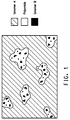
- the second step, in which the blend is combined with the ionomer (A) has the effect of producing a composition where the blend itself is dispersed in a continuous phase of the ionomer (A), yielding a "dispersion-in-dispersion" / ⁇ [dispersion of polyamide in ionomer (B)] dispersed in ionomer (A) ⁇ .
- Figure 1 shows a non-limiting, exemplary drawing depicting the morphology of the composition according to the invention..
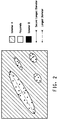
- the size of the blend particles can be characterized by defining the longest diameter of a blend particle dispersed in the at least one ionomer (A) and an orthogonal second longest diameter of a blend particle.
- the ratio between the longest diameter and the second longest diameter can be of from 1 (a spherical shaped particle) to 10, more preferably of from 1 to 6 (an ellipsoid, "zeppelin” or "cigar” shaped particle).
- Figure 2 shows a non-limiting, exemplary drawing depicting the longest and second longest diameter of a particle.
- the longest diameter of the blend particles can be of from 200 nm to 600 nm, and the second longest diameter of the blend can be of from 40 nm to 120 nm.
- the compound according to the invention can be used to manufacture various articles such as for example automotive parts or sport articles such as for example the outer shell of skiing boots, snowboard boots, skating boots, ice skating boots, in-line skate boots, or mountaineering boots.
- the sport articles can be articles that can be fitted to the anatomy of the user by thermoforming.
- the adjustment of the heated outer shell may be obtained by for example by a) placing the outer shell in an oven, b) heating the outer shell to the softening point, c) removing the outer shell from the oven, d) reinserting the liner of the boot back into the outer shell, e) shoeing the boot, f) wrapping the still soft boot in a hollow bag that fits the outline of the boot connected to a pump g) applying vacuum or overpressure to press the bag against the boot and at the same time press the softened shell of the boot against the foot of the user and h) maintaining the vacuum or overpressure until the softened shell has cooled and solidified.
- the sport articles and/or the outer shells as described above may be manufactured by injection molding the composition of the present invention into a mold or by simultaneously injecting the ionomer (A) and blend into a mold.
- the composition of the present invention may be molded into sport articles by rotomolding or injection blow molding the pre-blended composition.
- a composition was prepared by mixing simultaneously the 4.4 kg of nylon 6, obtainable from BASF under the trademark ULTRAMID B3, 2.5 kg of ionomer (B) comprising ethylene, 11 weight percent of methacrylic acid and 6 weight percent maleic anhydride monoethylester having 40% of the available acid moieties neutralized with zinc cations, 3 kg of a zinc ionomer based on ethylene, methacrylic acid and n-butylacrylate , obtainable from E.I.
- Du Pont de Nemours & Co (Delaware, US; DuPont) under the trademark SURLYN 9320 and 0.1 kg of a nucleating agent obtainable from Brueggemann Chemical under the trademark BRUGGOLEN P22 in a Werner Pfleiderer 30 mm twin screw extruder operating at a temperature of 285°C and having a L/D ratio of 29.
- a first blend was prepared by mixing 5.9 kg of nylon 6, obtainable from BASF under the trademark ULTRAMID B3, 4 kg of ionomer (B) comprising ethylene, 11 weight percent of methacrylic acid and 6 weight percent maleic anhydride monoethylester having 40% of the available acid moieties neutralized with zinc cations, 0.1 kg of a nucleating agent obtainable from Brueggemann Chemical under the trademark BRUGGOLEN P22 in a Werner Pfleiderer 30 mm twin screw extruder operating at a temperature of 285°C and having a L/D ratio of 29.
- a first blend was prepared by mixing 4.95 kg of nylon 6, obtainable from BASF under the trademark ULTRAMID B3, 4.95 kg of ionomer (B) comprising ethylene, 11 weight percent of methacrylic acid and 6 weight percent maleic anhydride monoethylester having 40% of the available acid moieties neutralized with zinc cations, 0.1 kg of a nucleating agent obtainable from Brueggemann Chemical under the trademark BRUGGOLEN P22 in a Werner Pfleiderer 30 mm twin screw extruder operating at a temperature of 285°C and having a L/D ratio of 29.
- compositions were then molded into flex bars and conditioned for 24 hours at 50% relative humidity and 25°C and tested for flex modulus according to ASTM D790 at 25°C. Results are shown in Table 1 (the % was based on weight), which shows the flex modulus in kilopound per square inch (Ksi) as measured according to ASTM D790.
Landscapes
- Chemical & Material Sciences (AREA)
- Health & Medical Sciences (AREA)
- Chemical Kinetics & Catalysis (AREA)
- Medicinal Chemistry (AREA)
- Polymers & Plastics (AREA)
- Organic Chemistry (AREA)
- Compositions Of Macromolecular Compounds (AREA)
- Processes Of Treating Macromolecular Substances (AREA)
Applications Claiming Priority (2)
| Application Number | Priority Date | Filing Date | Title |
|---|---|---|---|
| US201161440559P | 2011-02-08 | 2011-02-08 | |
| PCT/US2012/024274 WO2012109318A1 (en) | 2011-02-08 | 2012-02-08 | Polymer composition comprising polyamide and ionomer |
Publications (2)
| Publication Number | Publication Date |
|---|---|
| EP2673320A1 EP2673320A1 (en) | 2013-12-18 |
| EP2673320B1 true EP2673320B1 (en) | 2016-04-20 |
Family
ID=45615080
Family Applications (1)
| Application Number | Title | Priority Date | Filing Date |
|---|---|---|---|
| EP12704490.7A Active EP2673320B1 (en) | 2011-02-08 | 2012-02-08 | Polymer composition comprising polyamide and ionomer |
Country Status (5)
| Country | Link |
|---|---|
| US (1) | US8586663B2 (enExample) |
| EP (1) | EP2673320B1 (enExample) |
| JP (1) | JP5976683B2 (enExample) |
| CN (1) | CN103370375B (enExample) |
| WO (1) | WO2012109318A1 (enExample) |
Families Citing this family (16)
| Publication number | Priority date | Publication date | Assignee | Title |
|---|---|---|---|---|
| AT510545B1 (de) * | 2011-01-07 | 2012-05-15 | Fischer Sports Gmbh | Schuh, insbesondere alpin- oder langlaufschuh, mit einem schalenförmigen element |
| EP2797454A1 (en) * | 2011-12-30 | 2014-11-05 | Ticona LLC | Molded polymer articles for use in low temperatures having a low rigidity factor |
| US8906479B2 (en) | 2011-12-30 | 2014-12-09 | E I Du Pont De Nemours And Company | Compositions of polyamide and ionomer |
| US20130172470A1 (en) * | 2011-12-30 | 2013-07-04 | E I Du Pont De Nemours And Company | Optionally reinforced polyamide composition containing ionomer |
| US20130171394A1 (en) | 2011-12-30 | 2013-07-04 | E. I. Du Pont De Nemours And Company | Polyamide Composition Containing Ionomer |
| CN104884255B (zh) * | 2012-10-25 | 2017-11-17 | 纳幕尔杜邦公司 | 可印刷的保护层 |
| US20160347929A1 (en) | 2014-02-24 | 2016-12-01 | E.I. Du Pont De Nemours And Company | Plasticized polyamide compositions |
| WO2015168068A1 (en) | 2014-04-29 | 2015-11-05 | E. I. Du Pont De Nemours And Company | Photovoltaic cells with improved multilayer backsheet |
| WO2015168075A1 (en) | 2014-04-29 | 2015-11-05 | E. I. Du Pont De Nemours And Company | Photovoltaic cells with improved backsheet |
| WO2015168073A1 (en) | 2014-04-29 | 2015-11-05 | E. I. Du Pont De Nemours And Company | Solar cell modules with improved backsheet |
| EP3120722B1 (en) * | 2015-07-24 | 2020-05-20 | Performance Materials NA, Inc. | Thermoformable polyamide ionomer material for heel counter and toe puff |
| EP3497393A4 (en) | 2016-08-08 | 2020-03-18 | Ticona LLC | Thermally conductive polymer composition for a heat sink |
| EP3529307A1 (en) | 2016-10-21 | 2019-08-28 | E. I. du Pont de Nemours and Company | Filament compositions for fused filament fabrication and methods of use thereof |
| US11919979B2 (en) * | 2018-07-31 | 2024-03-05 | Dow Global Technologies, Llc | Ionomers of ethylene acid copolymers with enhanced creep resistance |
| US12338335B2 (en) | 2018-09-28 | 2025-06-24 | Dow Global Technologies Llc | Polyamide foam preparation |
| BR112022005010A2 (pt) * | 2019-09-30 | 2022-06-21 | Dow Global Technologies Llc | Filme elástico de múltiplas camadas |
Family Cites Families (23)
| Publication number | Priority date | Publication date | Assignee | Title |
|---|---|---|---|---|
| US3264269A (en) | 1962-08-03 | 1966-08-02 | Du Pont | Process for cross-linking polymers containing carboxyl groups which comprises imbibing a shaped article of the polymer in a dhsocyanate |
| US3317631A (en) | 1963-09-09 | 1967-05-02 | Du Pont | Thermosetting resins of aliphatic olefin, unsaturated acid copolymers and melamine-formaldehyde resins |
| US4174358A (en) | 1975-05-23 | 1979-11-13 | E. I. Du Pont De Nemours And Company | Tough thermoplastic nylon compositions |
| US4248990A (en) | 1979-04-05 | 1981-02-03 | E. I. Du Pont De Nemours & Company | Nonrandom copolymers of ethylene and unsaturated acid |
| EP0342244B1 (en) | 1987-11-20 | 1994-12-14 | Du Pont-Mitsui Polychemicals Co., Ltd. | Ionomer composition |
| JP2867406B2 (ja) | 1989-02-09 | 1999-03-08 | 住友化学工業株式会社 | 多相構造体およびその製造方法 |
| GB9321701D0 (en) | 1993-10-21 | 1993-12-15 | Amtico Co | Floor coverings |
| JPH07316368A (ja) | 1994-05-26 | 1995-12-05 | Du Pont Mitsui Polychem Co Ltd | アイオノマー組成物 |
| US6800690B2 (en) | 1995-01-24 | 2004-10-05 | Acushnet Company | Golf balls incorporating polyamide polymers |
| DE19502371A1 (de) | 1995-01-26 | 1996-08-01 | Leuna Werke Gmbh | Polymerbitumina auf Basis von EVA-Copolymeren |
| JPH09111118A (ja) | 1995-10-16 | 1997-04-28 | Unitika Ltd | 耐ピンホール性に優れたポリアミドフィルム |
| US5674579A (en) | 1995-11-20 | 1997-10-07 | Elf Atochem S.A. | Flexible translucent polyamide composition |
| US5902869A (en) | 1996-03-22 | 1999-05-11 | E. I. Du Pont De Nemours And Company | Thermally stable ethylene/acid copolymers |
| US5866658A (en) | 1996-08-26 | 1999-02-02 | E. I. Du Pont De Nemours And Company | High performance ionomer blends |
| US5886103A (en) | 1996-12-10 | 1999-03-23 | Lisco, Inc. | Nylon compositions for golf ball constructions and method of making same |
| WO1998038227A1 (en) | 1997-02-28 | 1998-09-03 | E.I. Du Pont De Nemours And Company | New ionomers based on copolymers of ethylene with both mono- and dicarboxylic acids and polyamide blends containing these ionomers |
| WO2001053415A1 (en) | 2000-01-21 | 2001-07-26 | E.I. Du Pont De Nemours And Company | Impact modified polyamide composition |
| US20020004555A1 (en) | 2000-01-21 | 2002-01-10 | Silvia Di-Benedetto | Impact modified polyamide composition |
| US6756443B2 (en) * | 2002-01-25 | 2004-06-29 | E. I. Du Pont De Nemours And Company | Ionomer/polyamide blends with improved flow and impact properties |
| KR101094515B1 (ko) * | 2003-06-05 | 2011-12-19 | 이 아이 듀폰 디 네모아 앤드 캄파니 | 에틸렌 산 공중합체 및 폴리아미드를 포함하는 내마모성조성물 |
| JP4770324B2 (ja) | 2004-08-17 | 2011-09-14 | 三菱瓦斯化学株式会社 | ポリアミド系延伸フィルム |
| AU2005304620A1 (en) * | 2004-11-08 | 2006-05-18 | E.I. Dupont De Nemours And Company | Toughened polyamide for food packaging and health care applications |
| US20110020573A1 (en) | 2009-07-22 | 2011-01-27 | E.I. Du Pont De Nemours And Company | Polyamide composition containing ionomer |
-
2012
- 2012-02-07 US US13/367,423 patent/US8586663B2/en active Active
- 2012-02-08 CN CN201280007935.1A patent/CN103370375B/zh active Active
- 2012-02-08 JP JP2013553513A patent/JP5976683B2/ja active Active
- 2012-02-08 EP EP12704490.7A patent/EP2673320B1/en active Active
- 2012-02-08 WO PCT/US2012/024274 patent/WO2012109318A1/en not_active Ceased
Also Published As
| Publication number | Publication date |
|---|---|
| WO2012109318A1 (en) | 2012-08-16 |
| US20120202940A1 (en) | 2012-08-09 |
| JP5976683B2 (ja) | 2016-08-24 |
| US8586663B2 (en) | 2013-11-19 |
| CN103370375B (zh) | 2016-07-06 |
| JP2014505157A (ja) | 2014-02-27 |
| EP2673320A1 (en) | 2013-12-18 |
| CN103370375A (zh) | 2013-10-23 |
Similar Documents
| Publication | Publication Date | Title |
|---|---|---|
| EP2673320B1 (en) | Polymer composition comprising polyamide and ionomer | |
| EP1689815B1 (en) | Articles of manufacture comprising stiff and resilient ethylene copolymer compositions | |
| CN109111720B (zh) | 一种超轻高回弹etpu复合减震鞋中底材料及其成型方法 | |
| AU731479B2 (en) | Nylon compositions for golf ball constructions and method of making same | |
| US6930150B2 (en) | Method for making polymer mixtures and compositions thereof | |
| AU669126B2 (en) | Improved golf ball covers containing high acid ionomers | |
| CN113881130B (zh) | 一种高耐磨的鞋用eva发泡材料及其制备方法 | |
| WO2003039683A1 (en) | Multi-layer golf ball | |
| AU2002338427A1 (en) | Golf ball having dual core and thin polyurethane cover formed by rim | |
| WO2002085467A1 (en) | Golf ball having dual core and thin polyurethane cover formed by rim | |
| WO2001052943A1 (en) | Improved multi-layer golf ball | |
| US6613843B2 (en) | Golf ball materials and golf ball | |
| US20020013413A1 (en) | Blending and neutralization method for preparing polyamide-ionomer materials for golf ball covers or mantles | |
| US20060043632A1 (en) | Process for manufacturing thermoplastic components for golf balls | |
| US20180220735A1 (en) | Boot with an element in shell form | |
| CN112029187B (zh) | 一种中底材料及其制备方法 | |
| US11142641B2 (en) | Transparent impact-resistant composition | |
| WO2002047769A1 (en) | Polyamide-ionomer graft copolymer and blends thereof for use in golf ball covers or mantles | |
| CN109233178B (zh) | 超轻减震耐磨发泡鞋材及其制造方法 | |
| CN114921048B (zh) | 一种抗寒中底材料及其制备方法、鞋 | |
| CN119798763A (zh) | 一种中底发泡材料及其制备方法 | |
| CN116583398A (zh) | 用于生产发泡制品的包含聚酰胺嵌段和聚醚嵌段的共聚物 | |
| WO2000057963A1 (en) | Improved multi-layer golf ball | |
| CN120329646A (zh) | 一种超轻高回弹缓震透明eva复合化学发泡材料及其制备方法以及应用 | |
| JPS60212406A (ja) | アイオノマー樹脂の製法 |
Legal Events
| Date | Code | Title | Description |
|---|---|---|---|
| PUAI | Public reference made under article 153(3) epc to a published international application that has entered the european phase |
Free format text: ORIGINAL CODE: 0009012 |
|
| 17P | Request for examination filed |
Effective date: 20130722 |
|
| AK | Designated contracting states |
Kind code of ref document: A1 Designated state(s): AL AT BE BG CH CY CZ DE DK EE ES FI FR GB GR HR HU IE IS IT LI LT LU LV MC MK MT NL NO PL PT RO RS SE SI SK SM TR |
|
| DAX | Request for extension of the european patent (deleted) | ||
| GRAP | Despatch of communication of intention to grant a patent |
Free format text: ORIGINAL CODE: EPIDOSNIGR1 |
|
| INTG | Intention to grant announced |
Effective date: 20150729 |
|
| GRAP | Despatch of communication of intention to grant a patent |
Free format text: ORIGINAL CODE: EPIDOSNIGR1 |
|
| INTG | Intention to grant announced |
Effective date: 20151104 |
|
| GRAS | Grant fee paid |
Free format text: ORIGINAL CODE: EPIDOSNIGR3 |
|
| GRAA | (expected) grant |
Free format text: ORIGINAL CODE: 0009210 |
|
| AK | Designated contracting states |
Kind code of ref document: B1 Designated state(s): AL AT BE BG CH CY CZ DE DK EE ES FI FR GB GR HR HU IE IS IT LI LT LU LV MC MK MT NL NO PL PT RO RS SE SI SK SM TR |
|
| REG | Reference to a national code |
Ref country code: GB Ref legal event code: FG4D |
|
| REG | Reference to a national code |
Ref country code: CH Ref legal event code: EP |
|
| REG | Reference to a national code |
Ref country code: AT Ref legal event code: REF Ref document number: 792428 Country of ref document: AT Kind code of ref document: T Effective date: 20160515 |
|
| REG | Reference to a national code |
Ref country code: IE Ref legal event code: FG4D |
|
| REG | Reference to a national code |
Ref country code: DE Ref legal event code: R096 Ref document number: 602012017290 Country of ref document: DE |
|
| REG | Reference to a national code |
Ref country code: LT Ref legal event code: MG4D |
|
| REG | Reference to a national code |
Ref country code: AT Ref legal event code: MK05 Ref document number: 792428 Country of ref document: AT Kind code of ref document: T Effective date: 20160420 |
|
| REG | Reference to a national code |
Ref country code: NL Ref legal event code: MP Effective date: 20160420 |
|
| PG25 | Lapsed in a contracting state [announced via postgrant information from national office to epo] |
Ref country code: LT Free format text: LAPSE BECAUSE OF FAILURE TO SUBMIT A TRANSLATION OF THE DESCRIPTION OR TO PAY THE FEE WITHIN THE PRESCRIBED TIME-LIMIT Effective date: 20160420 Ref country code: FI Free format text: LAPSE BECAUSE OF FAILURE TO SUBMIT A TRANSLATION OF THE DESCRIPTION OR TO PAY THE FEE WITHIN THE PRESCRIBED TIME-LIMIT Effective date: 20160420 Ref country code: PL Free format text: LAPSE BECAUSE OF FAILURE TO SUBMIT A TRANSLATION OF THE DESCRIPTION OR TO PAY THE FEE WITHIN THE PRESCRIBED TIME-LIMIT Effective date: 20160420 Ref country code: NO Free format text: LAPSE BECAUSE OF FAILURE TO SUBMIT A TRANSLATION OF THE DESCRIPTION OR TO PAY THE FEE WITHIN THE PRESCRIBED TIME-LIMIT Effective date: 20160720 Ref country code: NL Free format text: LAPSE BECAUSE OF FAILURE TO SUBMIT A TRANSLATION OF THE DESCRIPTION OR TO PAY THE FEE WITHIN THE PRESCRIBED TIME-LIMIT Effective date: 20160420 |
|
| PG25 | Lapsed in a contracting state [announced via postgrant information from national office to epo] |
Ref country code: RS Free format text: LAPSE BECAUSE OF FAILURE TO SUBMIT A TRANSLATION OF THE DESCRIPTION OR TO PAY THE FEE WITHIN THE PRESCRIBED TIME-LIMIT Effective date: 20160420 Ref country code: LV Free format text: LAPSE BECAUSE OF FAILURE TO SUBMIT A TRANSLATION OF THE DESCRIPTION OR TO PAY THE FEE WITHIN THE PRESCRIBED TIME-LIMIT Effective date: 20160420 Ref country code: HR Free format text: LAPSE BECAUSE OF FAILURE TO SUBMIT A TRANSLATION OF THE DESCRIPTION OR TO PAY THE FEE WITHIN THE PRESCRIBED TIME-LIMIT Effective date: 20160420 Ref country code: PT Free format text: LAPSE BECAUSE OF FAILURE TO SUBMIT A TRANSLATION OF THE DESCRIPTION OR TO PAY THE FEE WITHIN THE PRESCRIBED TIME-LIMIT Effective date: 20160822 Ref country code: SE Free format text: LAPSE BECAUSE OF FAILURE TO SUBMIT A TRANSLATION OF THE DESCRIPTION OR TO PAY THE FEE WITHIN THE PRESCRIBED TIME-LIMIT Effective date: 20160420 Ref country code: ES Free format text: LAPSE BECAUSE OF FAILURE TO SUBMIT A TRANSLATION OF THE DESCRIPTION OR TO PAY THE FEE WITHIN THE PRESCRIBED TIME-LIMIT Effective date: 20160420 Ref country code: AT Free format text: LAPSE BECAUSE OF FAILURE TO SUBMIT A TRANSLATION OF THE DESCRIPTION OR TO PAY THE FEE WITHIN THE PRESCRIBED TIME-LIMIT Effective date: 20160420 Ref country code: GR Free format text: LAPSE BECAUSE OF FAILURE TO SUBMIT A TRANSLATION OF THE DESCRIPTION OR TO PAY THE FEE WITHIN THE PRESCRIBED TIME-LIMIT Effective date: 20160721 |
|
| PG25 | Lapsed in a contracting state [announced via postgrant information from national office to epo] |
Ref country code: IT Free format text: LAPSE BECAUSE OF FAILURE TO SUBMIT A TRANSLATION OF THE DESCRIPTION OR TO PAY THE FEE WITHIN THE PRESCRIBED TIME-LIMIT Effective date: 20160420 Ref country code: BE Free format text: LAPSE BECAUSE OF FAILURE TO SUBMIT A TRANSLATION OF THE DESCRIPTION OR TO PAY THE FEE WITHIN THE PRESCRIBED TIME-LIMIT Effective date: 20160420 |
|
| REG | Reference to a national code |
Ref country code: FR Ref legal event code: PLFP Year of fee payment: 6 |
|
| REG | Reference to a national code |
Ref country code: DE Ref legal event code: R097 Ref document number: 602012017290 Country of ref document: DE |
|
| PG25 | Lapsed in a contracting state [announced via postgrant information from national office to epo] |
Ref country code: RO Free format text: LAPSE BECAUSE OF FAILURE TO SUBMIT A TRANSLATION OF THE DESCRIPTION OR TO PAY THE FEE WITHIN THE PRESCRIBED TIME-LIMIT Effective date: 20160420 Ref country code: DK Free format text: LAPSE BECAUSE OF FAILURE TO SUBMIT A TRANSLATION OF THE DESCRIPTION OR TO PAY THE FEE WITHIN THE PRESCRIBED TIME-LIMIT Effective date: 20160420 Ref country code: CZ Free format text: LAPSE BECAUSE OF FAILURE TO SUBMIT A TRANSLATION OF THE DESCRIPTION OR TO PAY THE FEE WITHIN THE PRESCRIBED TIME-LIMIT Effective date: 20160420 Ref country code: SK Free format text: LAPSE BECAUSE OF FAILURE TO SUBMIT A TRANSLATION OF THE DESCRIPTION OR TO PAY THE FEE WITHIN THE PRESCRIBED TIME-LIMIT Effective date: 20160420 Ref country code: EE Free format text: LAPSE BECAUSE OF FAILURE TO SUBMIT A TRANSLATION OF THE DESCRIPTION OR TO PAY THE FEE WITHIN THE PRESCRIBED TIME-LIMIT Effective date: 20160420 |
|
| PLBE | No opposition filed within time limit |
Free format text: ORIGINAL CODE: 0009261 |
|
| STAA | Information on the status of an ep patent application or granted ep patent |
Free format text: STATUS: NO OPPOSITION FILED WITHIN TIME LIMIT |
|
| PG25 | Lapsed in a contracting state [announced via postgrant information from national office to epo] |
Ref country code: SM Free format text: LAPSE BECAUSE OF FAILURE TO SUBMIT A TRANSLATION OF THE DESCRIPTION OR TO PAY THE FEE WITHIN THE PRESCRIBED TIME-LIMIT Effective date: 20160420 |
|
| 26N | No opposition filed |
Effective date: 20170123 |
|
| PG25 | Lapsed in a contracting state [announced via postgrant information from national office to epo] |
Ref country code: SI Free format text: LAPSE BECAUSE OF FAILURE TO SUBMIT A TRANSLATION OF THE DESCRIPTION OR TO PAY THE FEE WITHIN THE PRESCRIBED TIME-LIMIT Effective date: 20160420 |
|
| PG25 | Lapsed in a contracting state [announced via postgrant information from national office to epo] |
Ref country code: MC Free format text: LAPSE BECAUSE OF FAILURE TO SUBMIT A TRANSLATION OF THE DESCRIPTION OR TO PAY THE FEE WITHIN THE PRESCRIBED TIME-LIMIT Effective date: 20160420 |
|
| REG | Reference to a national code |
Ref country code: CH Ref legal event code: PL |
|
| GBPC | Gb: european patent ceased through non-payment of renewal fee |
Effective date: 20170208 |
|
| PG25 | Lapsed in a contracting state [announced via postgrant information from national office to epo] |
Ref country code: CH Free format text: LAPSE BECAUSE OF NON-PAYMENT OF DUE FEES Effective date: 20170228 Ref country code: LI Free format text: LAPSE BECAUSE OF NON-PAYMENT OF DUE FEES Effective date: 20170228 |
|
| REG | Reference to a national code |
Ref country code: IE Ref legal event code: MM4A |
|
| PG25 | Lapsed in a contracting state [announced via postgrant information from national office to epo] |
Ref country code: LU Free format text: LAPSE BECAUSE OF NON-PAYMENT OF DUE FEES Effective date: 20170208 |
|
| REG | Reference to a national code |
Ref country code: FR Ref legal event code: PLFP Year of fee payment: 7 |
|
| PG25 | Lapsed in a contracting state [announced via postgrant information from national office to epo] |
Ref country code: GB Free format text: LAPSE BECAUSE OF NON-PAYMENT OF DUE FEES Effective date: 20170208 Ref country code: IE Free format text: LAPSE BECAUSE OF NON-PAYMENT OF DUE FEES Effective date: 20170208 |
|
| PG25 | Lapsed in a contracting state [announced via postgrant information from national office to epo] |
Ref country code: MT Free format text: LAPSE BECAUSE OF NON-PAYMENT OF DUE FEES Effective date: 20170208 |
|
| PG25 | Lapsed in a contracting state [announced via postgrant information from national office to epo] |
Ref country code: AL Free format text: LAPSE BECAUSE OF FAILURE TO SUBMIT A TRANSLATION OF THE DESCRIPTION OR TO PAY THE FEE WITHIN THE PRESCRIBED TIME-LIMIT Effective date: 20160420 |
|
| PG25 | Lapsed in a contracting state [announced via postgrant information from national office to epo] |
Ref country code: HU Free format text: LAPSE BECAUSE OF FAILURE TO SUBMIT A TRANSLATION OF THE DESCRIPTION OR TO PAY THE FEE WITHIN THE PRESCRIBED TIME-LIMIT; INVALID AB INITIO Effective date: 20120208 |
|
| PG25 | Lapsed in a contracting state [announced via postgrant information from national office to epo] |
Ref country code: BG Free format text: LAPSE BECAUSE OF FAILURE TO SUBMIT A TRANSLATION OF THE DESCRIPTION OR TO PAY THE FEE WITHIN THE PRESCRIBED TIME-LIMIT Effective date: 20160420 |
|
| PG25 | Lapsed in a contracting state [announced via postgrant information from national office to epo] |
Ref country code: CY Free format text: LAPSE BECAUSE OF NON-PAYMENT OF DUE FEES Effective date: 20160420 |
|
| PG25 | Lapsed in a contracting state [announced via postgrant information from national office to epo] |
Ref country code: MK Free format text: LAPSE BECAUSE OF FAILURE TO SUBMIT A TRANSLATION OF THE DESCRIPTION OR TO PAY THE FEE WITHIN THE PRESCRIBED TIME-LIMIT Effective date: 20160420 |
|
| PG25 | Lapsed in a contracting state [announced via postgrant information from national office to epo] |
Ref country code: TR Free format text: LAPSE BECAUSE OF FAILURE TO SUBMIT A TRANSLATION OF THE DESCRIPTION OR TO PAY THE FEE WITHIN THE PRESCRIBED TIME-LIMIT Effective date: 20160420 |
|
| PG25 | Lapsed in a contracting state [announced via postgrant information from national office to epo] |
Ref country code: IS Free format text: LAPSE BECAUSE OF FAILURE TO SUBMIT A TRANSLATION OF THE DESCRIPTION OR TO PAY THE FEE WITHIN THE PRESCRIBED TIME-LIMIT Effective date: 20160820 |
|
| P01 | Opt-out of the competence of the unified patent court (upc) registered |
Effective date: 20230526 |
|
| REG | Reference to a national code |
Ref country code: DE Ref legal event code: R082 Ref document number: 602012017290 Country of ref document: DE Representative=s name: MURGITROYD GERMANY PATENTANWALTSGESELLSCHAFT M, DE Ref country code: DE Ref legal event code: R081 Ref document number: 602012017290 Country of ref document: DE Owner name: DOW GLOBAL TECHNOLOGIES LLC, MIDLAND, US Free format text: FORMER OWNER: E.I. DU PONT DE NEMOURS AND CO., WILMINGTON, DEL., US |
|
| PGFP | Annual fee paid to national office [announced via postgrant information from national office to epo] |
Ref country code: FR Payment date: 20241209 Year of fee payment: 14 |
|
| PGFP | Annual fee paid to national office [announced via postgrant information from national office to epo] |
Ref country code: DE Payment date: 20241217 Year of fee payment: 14 |