EP2654472B1 - Splash resistant facemask - Google Patents
Splash resistant facemask Download PDFInfo
- Publication number
- EP2654472B1 EP2654472B1 EP11819011.5A EP11819011A EP2654472B1 EP 2654472 B1 EP2654472 B1 EP 2654472B1 EP 11819011 A EP11819011 A EP 11819011A EP 2654472 B1 EP2654472 B1 EP 2654472B1
- Authority
- EP
- European Patent Office
- Prior art keywords
- layer
- splash
- osy
- spunbond
- gsm
- Prior art date
- Legal status (The legal status is an assumption and is not a legal conclusion. Google has not performed a legal analysis and makes no representation as to the accuracy of the status listed.)
- Active
Links
Images

Classifications
-
- A—HUMAN NECESSITIES
- A41—WEARING APPAREL
- A41D—OUTERWEAR; PROTECTIVE GARMENTS; ACCESSORIES
- A41D13/00—Professional, industrial or sporting protective garments, e.g. surgeons' gowns or garments protecting against blows or punches
- A41D13/05—Professional, industrial or sporting protective garments, e.g. surgeons' gowns or garments protecting against blows or punches protecting only a particular body part
- A41D13/11—Protective face masks, e.g. for surgical use, or for use in foul atmospheres
-
- A—HUMAN NECESSITIES
- A62—LIFE-SAVING; FIRE-FIGHTING
- A62B—DEVICES, APPARATUS OR METHODS FOR LIFE-SAVING
- A62B23/00—Filters for breathing-protection purposes
- A62B23/02—Filters for breathing-protection purposes for respirators
- A62B23/025—Filters for breathing-protection purposes for respirators the filter having substantially the shape of a mask
Definitions
- the present disclosure generally relates to face masks.
- the disclosure relates to an assembly of material layers that provides splash resistance used in constructing the body portion of face masks (used to cover the mouth, nasal openings, and most of the cheeks).
- the challenge in providing splash resistance to face masks is to maintain an acceptable level of breathability while prohibiting splashes as well as minute airborne (virus) particles from passing through the mask and being inhaled by the wearer. Since masks cover the mouth and nasal openings, the heat and moisture from expired air creates micro-climates between the exterior of the mask and the covered skin; such micro-climates are often perceived as uncomfortable for the person wearing the mask.
- One measure of air flow through a material layer or layers follows the procedure steps described in ASTM D737-04. This gives quantifiable air permeability values for the layer or layers at a water pressure differential of 125 Pascals. The procedure steps of ASTM D737 used in determining air permeability values are described in US patent 4,748,065 .
- US 2005/0133036 describes a face mask having a baffle layer for improved fluid resistance.
- Ways to impart splash resistance involve merely adding more layers to the mask, increasing the thickness of existing layers in the mask, or reducing the size or number of open pores of one or more of these layers. All of these approaches tend to compromise the flow of air, heat, and moisture of expired air through the mask.
- Another way to impart splash resistance is to alter the surface energy attributes of the material layers which can be done with chemical treatments.
- repellent finishes used on fabrics including fiber reactive hydrocarbon hydrophobes, silicone water repellents and fluorochemical repellents. Fluorochemical repellents are unique in that they confer both water and low surface tension fluids repellent to fabrics. This property is important because blood and alcohol, common liquids in an operating room, are low surface tension liquids.
- fluorochemicals to repel low surface tension liquids is related to their low surface energy.
- the fluorochemical finishes are organic fluorine-containing compounds in which a majority of the hydrogen atoms are replaced by fluorine. When these compounds are applied to fabric followed by drying and curing, the fluorochemical tails orient themselves away from the fibers to produce a very low surface energy barrier.
- fluorocarbon treatments may increase the repellency of facemasks, there is concern regarding the safety of such treated materials. Many uses of fluorocarbons were phased out in the United States in the 1970s and 1980 due to concerns of safety and environmental degradation.
- the desired facemask should be sufficiently breathable yet resist penetration by splashes of blood.
- a facemask for surgical use comprises a first spunbond splash layer (28) adjacent a second splash layer (26) on a side away from a wearer's face, the second splash layer (26) made from a spunbond fabric or apertured film, a meltblown filtration layer (24) and an inner layer (22) suitable for contact with the wearer's face.
- Said first spunbond splash layer (28) has a basis weight of between 23.7 and 30.5 gsm (0.7 osy and 0.9 osy) and a drape stiffness above 3.5 according to ASTM standard test D-1388 using 0.0254 m by 0.2032 m (1" by 8") pieces and said second splash layer (26) has a basis weight of at least 27 gsm (0.8 osy) and an air permeability value of greater than about 4575 m 3 s/m 2 (250 CFM/Ft2) according to ASTM D737- 04, said meltblown filtration layer (24) having an air permeability value greater than 732 m 3 s/m 2 (40 CFM/ Ft2) according to ASTM D737- 04 and a basis weight between 13.6 gsm and 30.5 gsm (0.4 and 0.9 osy), said inner layer (22) comprising at least one polyester cellulose wetlaid material and at least one of a spunbond layer or a meltblown layer or combinations thereof, the inner layer (2
- Fluid splash resistance for face masks is measured according to ASTM method F1862-05.
- a certain level of splash resistance designated “Level 3” is achieved when a mask or a construction of assembled layers of materials (that will form the mask body) can keep 2.0 grams of a synthetic blood fluid from penetrating the inside layer when the fluid is squirted at a pressure of 160 mmHg 21,33kPa to strike the outermost layer.
- a “Level 3 pass” rating for splash resistance is given for the mask- or construction-type when at least 29 out of 32 specimens of a sampling show no penetration of fluid through their inside layer at the Level 3 conditions.
- a "level 2" mask has resistance to fluid penetration measured in the same manner but at a pressure of 120 mmHg 15,99kPa.
- a sample is placed in the sample holder 2. Liquid is directed toward the sample horizontally (at a 90 ° angle to the sample) from a pressurized fluid reservoir 4 via a valve 6 that is controlled by a valve switch 8.
- the sample holder 2 has a targeting plate and collection cups 10 to channel and collect excess fluid.
- the fluid is delivered from the valve 6, through a cannula 12 and impinges on the sample.
- a valve timing controller 14 may also be used to control the valve opening and duration of the test.
- the splash resistant face mask according to examples herein has, in general terms, a first splash resistant layer 28, a second splash layer 26 between the first splash layer and the filter layer 24, and an inner comfort layer 22 for contact with the skin of a wearer.
- the filtration layer 24 is most commonly a layer made by the meltblowing process as described below.
- the meltblown filter layer 24 is lightweight, generally between 0.4 and 0.9 osy (13.6 and 30.5 gsm) and usually made from a polyolefin like polypropylene due to cost considerations, though other polymers would function as well.
- the splash layers 28, 26 may be a number of different materials including spunbond fabrics and apertured films. These materials should have very high air permeability rates (e.g. greater than 200 cfm/ft 2 ) 3660 (m3s/m2). These layers must also not be too flexible but have sufficient stiffness to maintain their shape and integrity when impinged upon by a liquid stream (e.g. a splash).
- the innermost layer should be comfortable when in contact with the skin and also possessing a high breathability rating.
- Suitable materials include polyester cellulose wetlaid materials and other nonwoven materials like spunbond and meltblown layers and combinations thereof, again having air permeability rated of greater than 200 cfm/ft 2 3660 (m3s/m2), generally greater than 300 cfm/ft 2 5490 (m3s/m2).
- the splash resistant face mask is a construction involving the following:
- Table 3 illustrate the importance of material selection in a 4-layer mask design for passing level 3 splash resistance.
- the outer layer the first splash layer
- the first splash layer was a low basis weight material (e.g. 0.5 osy orange striped Poly-Cell)
- the selection of the second splash layer becomes more important.
- AP 76
- This 4-layer design was tested in layered sheet form, not in finished mask form.
- the SB&MB splash layer is believed to be too flexible (not sufficiently stiff) to manage the liquid impact; it allows too much liquid through to the second splash layer and subsequent layers.
- the flexibility of this SB&MB splash layer was measured with the drape stiffness test, also called the cantilever bending test.
- the fabrics of the splash layers for use in examples of the facemask desirably have a drape stiffness of at least 3.5, more desirably more than 4.0 and still more desirably more than 4.5.
- the Sample 15 splash 1 outer layer is from Avgol America Inc., 178 Avgol Drive, Mocksville, NC, 27028. It was labeled YD-018-26 and described as a polyethylene sheath/polypropylene core bicomponent spunbond SMS fabric. The meltblown portion is polypropylene. It should be noted that polyolefins are normally hydrophobic without a repellent treatment. This fabric was believed to be insufficiently stiff for use in the splash layers of the face mask disclosed herein, i.e., it had a drape stiffness below 3.5 and so failed the test (see Table 6).
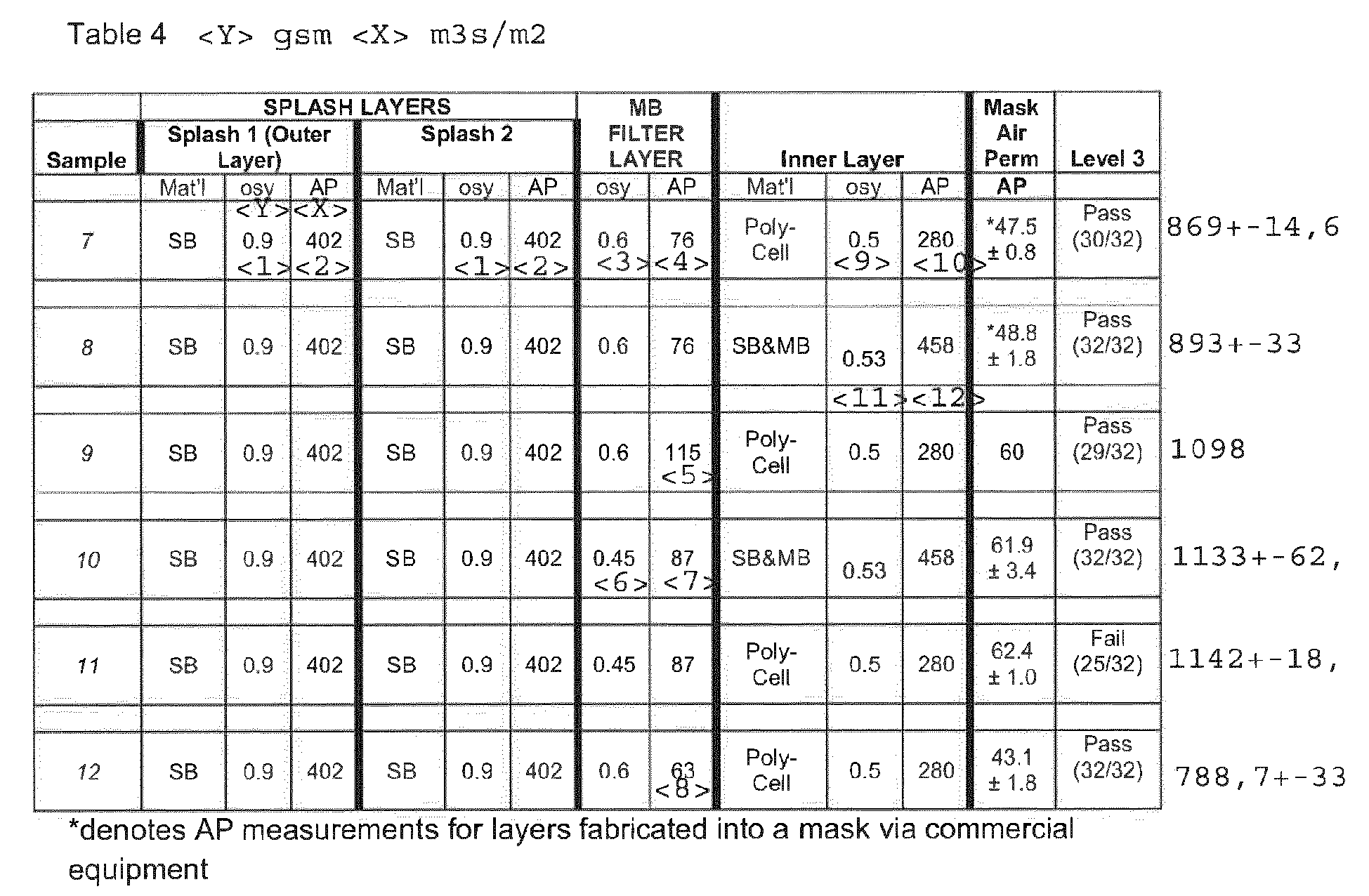
- Table 4 show 4-layer designs that passed level 3 using the same splash layers, two different inner layer materials, and four different MB filter layers.
- Sample 12 passed the level 3 splash test using two 0.9 osy SB splash layers, a 0.6 osy meltblown filter layer and a 0.5 osy polyester cellulose inner layer.
- Sample 11 was nearly identical to sample 12 with a lower basis weight meltblown filter layer, and failed the splash test, indicating that for this combination of layers a heavier meltblown filter layer was necessary.
- Sample 10 was nearly identical to sample 11 with an inner layer made from the Avgol YD-018-26 used in the splash layer of sample 15 (described above) and passed the splash test.
- Table 7 contains data from still more air permeability testing for a level 3 splash resistant mask.
- the materials are two layers of 0.9 (30,5 gms) spunbond splash layers, a 0.6 osy (20,3 gsm) meltblown filter layer and a 0.5 osy (17 gsm) poly-cell wetlaid inner facing.
- the overall mask air permeability is given also. All results are in cfm/ft 2 . (m3s/m2)
- PGI refers to Polymer Group Inc. of Charlotte, NC.
- PGI is a leading global engineered materials company, focused primarily on the production of nonwovens for the hygiene, wipes, medical, and industrial markets.
- PGI's internet site is at http)://www.polymergroupinc.com/en/ .
- Ahlstrom is a global developer and manufacturer of high performance specialty papers and fiber composites for industrial applications.
- Ahlstrom's internet site is at http://www.ahlstrom.com/en/aboutAhlstrom/Pages/default.aspx .
- the masks of the present invention have also been observed to retain or absorb more of the splash in Level 3 splash resistance testing compared to other masks that are similar yet with different constructions.
- a repellent treated e.g. fluorochemical
- the sterile surgical site can be compromised with fluid that is ricocheted from a mask.
- repellent treatment refers to a chemical treatment that improves repellency to low surface tension fluids.
- PP fabrics are treated with fluorochemicals to improve repellency to isopropyl alcohol (IPA).
- the isopropyl alcohol repellency of PP fabrics is only 20% IPA/ water.
- the fluorochemical treatment is designed to improve the repellency of PP to at least 70% IPA/ water.
- a repellent treatment as the term is used herein would be any treatment that provides the fabric (PP, wetlaid, etc.) with repellency to at least 30% IPA/ water.
- spunbonded fibers refers to small diameter fibers which are formed by extruding molten thermoplastic material as filaments from a plurality of fine, usually circular capillaries of a spinneret with the diameter of the extruded filaments then being rapidly reduced as by, for example, in US Patent 4,340,563 to Appel et al. , and US Patent 3,692,618 to Dorschner et al. , US Patent 3,802,817 to Matsuki et al. , US Patents 3,338,992 and 3,341,394 to Kinney , US Patent 3,502,763 to Hartman , and US Patent 3,542,615 to Dobo et al.
- Spunbond fibers are generally not tacky when they are deposited onto a collecting surface.
- Spunbond fibers are generally continuous and have average diameters (from a sample of at least 10) larger than 7 microns, more particularly, between about 10 and 20 microns.
- the fibers may also have shapes such as those described in US Patents 5,277,976 to Hogle et al. , US Patent 5,466,410 to Hills and 5,069,970 and 5,057,368 to Largman et al. , which describe fibers with unconventional shapes.
- bicomponent fibers refers to fibers which have been formed from at least two polymers extruded from separate extruders but spun together to form one fiber. Bicomponent fibers are also sometimes referred to as multicomponent or conjugate fibers.
- the polymers are usually different from each other though bicomponent fibers may be made from a single type of polymer.
- the polymers are arranged in substantially constantly positioned distinct zones across the cross-section of the bicomponent fibers and extend continuously along the length of the bicomponent fibers.
- bicomponent fiber may be, for example, a sheath/core arrangement wherein one polymer is surrounded by another or may be a side by side arrangement, a pie arrangement or an "islands-in-the-sea" arrangement.
- Bicomponent fibers are taught in US Patent 5,108,820 to Kaneko et al. , US Patent 4,795,668 to Krueger et al. , US Patent 5,540,992 to Marcher et al. and US Patent 5,336,552 to Strack et al.
- Bicomponent fibers are also taught in US Patent 5,382,400 to Pike et al.
- the fibers may also have shapes such as those described in US Patents 5,277,976 to Hogle et al. , US Patent 5,466,410 to Hills and 5,069,970 and 5,057,368 to Largman et al. , which describe fibers with unconventional shapes.
- meltblown fibers means fibers formed by extruding a molten thermoplastic material through a plurality of fine, usually circular, die capillaries as molten threads or filaments into converging high velocity, usually hot, gas (e.g. air) streams which attenuate the filaments of molten thermoplastic material to reduce their diameter, which may be to microfiber diameter. Thereafter, the meltblown fibers are carried by the high velocity gas stream and are deposited on a collecting surface to form a web of randomly dispersed meltblown fibers.
- gas e.g. air
- multilayer nonwoven laminate means a laminate wherein some of the layers are spunbond and some meltblown such as a spunbond/meltblown/spunbond (SMS) laminate and others as disclosed in U.S. Patent 4,041,203 to Brock et al. , U.S. Patent 5,169,706 to Collier, et al , US Patent 5,145,727 to Potts et al. , US Patent 5,178,931 to Perkins et al. and U.S. Patent 5,188,885 to Timmons et al.
- SMS spunbond/meltblown/spunbond
- Such a laminate may be made by sequentially depositing onto a moving forming belt first a spunbond fabric layer, then a meltblown fabric layer and last another spunbond layer and then bonding the laminate in a manner described below.
- the fabric layers may be made individually, collected in rolls, and combined in a separate bonding step.
- Such fabrics usually have a basis weight of from about 0.1 to 12 osy (6 to 400 gsm), or more particularly from about 0.75 to about 3 osy (101.7 gsm).
- Multilayer laminates may also have various numbers of meltblown layers or multiple spunbond layers in many different configurations and may include other materials like films (F) or coform materials, e.g. SMMS, SM, SFS, etc.
- the basis weight of nonwoven fabrics is usually expressed in ounces of material per square yard (osy) or grams per square meter (gsm) and the fiber diameters useful are usually expressed in microns. (Note that to convert from osy to gsm, multiply osy by 33.91).
- the drape stiffness test also sometimes called the cantilever bending test, determines the bending length of a fabric using the principle of cantilever bending of the fabric under its own weight.
- the bending length is a measure of the interaction between fabric weight and fabric stiffness.
- One version of this test uses a 1 inch (2.54 cm) by 8 inch (20.3 cm) fabric strip, sliding the strip at 4.75 inches per minute (12 cm/min) in a direction parallel to its long dimension so that its leading edge projects from the edge of a horizontal surface.
- the length of the overhang is measured when the tip of the specimen is depressed under its own weight to the point where the line joining the tip of the fabric to the edge of the platform makes a 41.5 degree angle with the horizontal.
- the drape stiffness is calculated as 0.5 x bending length. When more than one specimen of a sample is measured, the drape stiffness value is reported as an average of the individual specimens of the sample. This procedure follows ASTM standard test D-1388 except for the fabric length which is different (longer).
- the test equipment used is a Cantilever Bending tester model 79-10 available from Testing Machines Inc., 400 Bayview Ave., Amityville, NY 11701.
- the sample should be conditioned to ASTM conditions of 65 ⁇ 2 percent relative humidity and 72 ⁇ 2 °F (22 ⁇ 1 °C), or TAPPI conditions of 50 ⁇ 2 percent relative humidity and 72 ⁇ 1.8 °F (22 +- 0,9°C) prior to testing.
Landscapes
- Health & Medical Sciences (AREA)
- General Health & Medical Sciences (AREA)
- Physical Education & Sports Medicine (AREA)
- Engineering & Computer Science (AREA)
- Textile Engineering (AREA)
- Respiratory Apparatuses And Protective Means (AREA)
Description
- The present disclosure generally relates to face masks. In particular the disclosure relates to an assembly of material layers that provides splash resistance used in constructing the body portion of face masks (used to cover the mouth, nasal openings, and most of the cheeks).
- Medical professionals involved in caring for sick and injured patients can be exposed to bodily fluids that may carry disease and transmit it to the medical professional through contact with the skin and mucous membranes. Those diseases of most concern include hepatitis and AIDS but also include avian flu, SARS, west Nile disease and others. While medical professionals must of course exercise care in dealing with infected individuals, protective attire like gowns, gloves and facemasks are used to minimize contact with the vectors of infection. It is particularly important that the mucus membranes of the mouth be protected from inadvertent splashes of blood and other bodily fluids.
- The challenge in providing splash resistance to face masks is to maintain an acceptable level of breathability while prohibiting splashes as well as minute airborne (virus) particles from passing through the mask and being inhaled by the wearer. Since masks cover the mouth and nasal openings, the heat and moisture from expired air creates micro-climates between the exterior of the mask and the covered skin; such micro-climates are often perceived as uncomfortable for the person wearing the mask. One measure of air flow through a material layer or layers follows the procedure steps described in ASTM D737-04. This gives quantifiable air permeability values for the layer or layers at a water pressure differential of 125 Pascals. The procedure steps of ASTM D737 used in determining air permeability values are described in
US patent 4,748,065 . - For instance,
US 2005/0133036 describes a face mask having a baffle layer for improved fluid resistance. - Ways to impart splash resistance involve merely adding more layers to the mask, increasing the thickness of existing layers in the mask, or reducing the size or number of open pores of one or more of these layers. All of these approaches tend to compromise the flow of air, heat, and moisture of expired air through the mask. Another way to impart splash resistance is to alter the surface energy attributes of the material layers which can be done with chemical treatments. There are a variety of repellent finishes used on fabrics including fiber reactive hydrocarbon hydrophobes, silicone water repellents and fluorochemical repellents. Fluorochemical repellents are unique in that they confer both water and low surface tension fluids repellent to fabrics. This property is important because blood and alcohol, common liquids in an operating room, are low surface tension liquids. The ability of fluorochemicals to repel low surface tension liquids is related to their low surface energy. The fluorochemical finishes are organic fluorine-containing compounds in which a majority of the hydrogen atoms are replaced by fluorine. When these compounds are applied to fabric followed by drying and curing, the fluorochemical tails orient themselves away from the fibers to produce a very low surface energy barrier.
- While fluorocarbon treatments may increase the repellency of facemasks, there is concern regarding the safety of such treated materials. Many uses of fluorocarbons were phased out in the United States in the 1970s and 1980 due to concerns of safety and environmental degradation.
- The challenge of providing a fluorocarbon free mask that will provide sufficient splash resistance to be used in a surgical setting remains. This is an area of great importance to those in the medical profession and represents an important area of research for those concerned about the safety of not only medical professionals but of their patients as well.
- There thus remains a need for a facemask that can protect a medical worker from exposure to the blood and bodily fluids of a patient and which does not contain a repellent treatment. The desired facemask should be sufficiently breathable yet resist penetration by splashes of blood.
- According to the invention, a facemask for surgical use is provided. The facemask comprises a first spunbond splash layer (28) adjacent a second splash layer (26) on a side away from a wearer's face, the second splash layer (26) made from a spunbond fabric or apertured film, a meltblown filtration layer (24) and an inner layer (22) suitable for contact with the wearer's face.
Said first spunbond splash layer (28) has a basis weight of between 23.7 and 30.5 gsm (0.7 osy and 0.9 osy) and a drape stiffness above 3.5 according to ASTM standard test D-1388 using 0.0254 m by 0.2032 m (1" by 8") pieces and said second splash layer (26) has a basis weight of at least 27 gsm (0.8 osy) and an air permeability value of greater than about 4575 m3s/m2 (250 CFM/Ft2) according to ASTM D737- 04,, said meltblown filtration layer (24) having an air permeability value greater than 732 m3s/m2 (40 CFM/ Ft2) according to ASTM D737- 04 and a basis weight between 13.6 gsm and 30.5 gsm (0.4 and 0.9 osy), said inner layer (22) comprising at least one polyester cellulose wetlaid material and at least one of a spunbond layer or a meltblown layer or combinations thereof, the inner layer (22) comprising an air permeability of greater than 3652 m3s/m2 (200 CFM/Ft2), and wherein said facemask has an air permeability value of at least 549 m3s/m2 (30 CFM/ Ft2) according to ASTM D737- 04 and passes a test of splash resistance conducted at a pressure of 21.33 kPa (160 mmHg) according to ASTM F-1862-05 level 3 test, and wherein none of the layers have a repellent treatment that improves repellency to low surface tension fluids. -
-
Figure 1 is a drawing of the layout of the test equipment used in the ASTM F1862-05; the Standard Method for Resistance of Medical Facemasks to Penetration by Synthetic Blood (Horizontal Projection of Fixed Volume at a Known Velocity). -
Figure 2 is a depiction of the layers of the disclosed face mask showing two outer splash layers, a filter layer and a layer suitable for comfortable contact with the skin. - Fluid splash resistance for face masks is measured according to ASTM method F1862-05. A certain level of splash resistance, designated "Level 3", is achieved when a mask or a construction of assembled layers of materials (that will form the mask body) can keep 2.0 grams of a synthetic blood fluid from penetrating the inside layer when the fluid is squirted at a pressure of 160 mmHg 21,33kPa to strike the outermost layer. A "Level 3 pass" rating for splash resistance is given for the mask- or construction-type when at least 29 out of 32 specimens of a sampling show no penetration of fluid through their inside layer at the Level 3 conditions. Likewise a "
level 2" mask has resistance to fluid penetration measured in the same manner but at a pressure of 120 mmHg 15,99kPa. - In addition to fluid resistance, in order for the mask generally to be designated
level 2 or level 3, certain other criteria must also be satisfied. These include resistance to flammability, pressure differential (delta P), particle filtration efficiency, and bacterial filtration efficiency. This disclosure is concerned with masks that satisfy the level designation for at least the splash resistance. - One can also determine directional changes in splash resistance by tracking the number (and therefore percentage) of specimens of a sampling that show no such fluid penetration. This provides information about splash resistance when one has fewer than 32 specimens in a sampling. Such tracking was recorded for sample sets of the subsequent Tables (Tables 2 - 5) and reported in the right-most column of these Tables as the number of specimens that passed the level 3 splash criteria with respect to the total specimens tested - these numbers are those inside the parentheses, e.g. for Table 2A: (20/32), meaning 20 specimens passed out of the 32 specimens tested). The equipment used for this method is shown in
Figure 1 . - As described in ASTM F1862-05 and depicted in
Figure 1 , a sample is placed in thesample holder 2. Liquid is directed toward the sample horizontally (at a 90 ° angle to the sample) from a pressurizedfluid reservoir 4 via a valve 6 that is controlled by avalve switch 8. Thesample holder 2 has a targeting plate andcollection cups 10 to channel and collect excess fluid. The fluid is delivered from the valve 6, through acannula 12 and impinges on the sample. Avalve timing controller 14 may also be used to control the valve opening and duration of the test. - To overcome the shortcomings of previous mask constructions, material components and face mask design have been leveraged to provide masks with: (1) high levels of fluid splash resistance, (2) the ability to absorb more of the fluid splash, (3) low fluid interaction with the filter layer, and (4) acceptable comfort as measured by air permeability via ASTM D737 - 04 procedures.
- The splash resistant face mask according to examples herein (see also
Figure 2 ) has, in general terms, a first splashresistant layer 28, asecond splash layer 26 between the first splash layer and thefilter layer 24, and aninner comfort layer 22 for contact with the skin of a wearer. - The
filtration layer 24 is most commonly a layer made by the meltblowing process as described below. Themeltblown filter layer 24 is lightweight, generally between 0.4 and 0.9 osy (13.6 and 30.5 gsm) and usually made from a polyolefin like polypropylene due to cost considerations, though other polymers would function as well. - The
splash layers - The innermost layer should be comfortable when in contact with the skin and also possessing a high breathability rating. Suitable materials include polyester cellulose wetlaid materials and other nonwoven materials like spunbond and meltblown layers and combinations thereof, again having air permeability rated of greater than 200 cfm/ft2 3660 (m3s/m2), generally greater than 300 cfm/ft2 5490 (m3s/m2).
- According to an example useful to understand the invention, the splash resistant face mask is a construction involving the following:
- at least 4 separate layers that collectively pass ASTM method F1862-05
- none of the material components of the mask design contains a repellent treatment.
- at least 2 adjacent splash layers, a first splash layer and a second splash layer, and these layers are positioned in the assembly so that the second splash layer is adjacent the filter layer.
- both adjacent splash layers are recognized as needing a certain stiffness, e.g. drape stiffness, to contribute to the level 3 splash resistance. This level is met for the 0.7 and 0.9 osy (27.1 and 30.5 gsm) spunbond (SB), the 0.5 osy (17gsm) Poly-Cell (polyester cellulose) wetlaid, but not for the 0.53 osy (17 gsm) SB & meltblown (MB) (test results below).
- the second splash layer desirably has at least a 0.8 osy (27,1 gsm) basis weight and an air permeability value of greater than about 250 CFM/Ft2 (4575 m3s/m2)
- a filter layer with an air permeability value greater than 40 CFM/Ft2 732 m3s/m2 desirably greater than 45 823,5 m3s/m2 and still more desirably greater than 50 915 m3s/m2. The filter is desirably a meltblown fabric layer having a basis weight between 0.4 (13,6 gsm) and 0.9 osy (30,5 gsm), more desirably about 0.6 osy (20,3 gsm).
- an inner layer that provides for skin comfort, having a basis weight between 0.3 10,2 gsm and 0.9 osy 30,5 gsm, desirably about 0.5 osy (17 gsm).
- an overall face mask air permeability of at least 30 CFM/Ft2 (549 m3s/m2) desirably greater than 35 (641 m3s/m2) and still more desirably greater than 40 (732 m3s/m2).
- One assembly of the separate layers that conform to an example or the mask is shown in
Figure 2 . - Details of representative layers used for examples of the masks and comparative masks and their respective air permeability values are listed in Table 1. Note that spunbond and meltblown fabrics are polypropylene unless otherwise noted.
Table 1 Materials for layers: Identifying Description Basis wt., osy Air Permeability (AP) Avg Std Dev Reps VISPOR E® Film Microfunnel Film, MED-40 HEX, 10/1/07, FG# F110176 0.86 285 32 16 SB Spunbond by PGI; Orange) 0.9 402 26 15 SB Spunbond by PGI; Orange (Higher Pigment Level) 0.9 453 15 5 SB Spunbond by PGI; Orange (Higher Pigment Level) 1.4 262 14 5 SB Spunbond by Kimberly-Clark; Orange 0.9 403 17 15 SB Spunbond by PGI; white 0.7 514 23 10 Poly-Cell wetlaid nonwoven by AHLSTROM; 55% polyester staple & 45% rayon staple, White 0.5 280 7 12 Poly-Cell wetlaid nonwoven by AHLSTROM; 55% polyester staple & 45% rayon staple, Orange 0.5 270 4 11 SB&MB Proprietary structure of polyolefin meltspun fibers consisting of polypropylene and more flexible polyethylene 0.53 458 18 4 MB Meltblown by Kimberly-Clark 0.6 63 2 4 MB Meltblown by Kimberly-Clark 0.6 115 4 12 MB Meltblown by Kimberly-Clark 0.6 76 2 11 MB Meltblown by Kimberly-Clark 0.45 87 4 7 Kraton MB Elastomeric Meltblown from Kraton's MD6717 polymer 1.4 280 20 3 - The importance of having multiple layers in front of (i.e. on the side away from the wearer) the meltblown filtration layer to achieve level 3 splash resistance can be seen by comparing the fluid splash resistance data shown in Table 2 A and B. These mask designs were tested in the form of layered sheets of various materials and not in finished face mask form. It can be seen that placement of a Vispore® film material (apertured film described in
US patent 4,920,960 ) in front of the meltblown layer to give two layers in front of the meltblown allows the mask prototype to achieve level 3 fluid resistance (31 of 32 samples pass). Placing the splash layers on either side of the meltblown filter layer (Table 2A) did not yield a sufficiently splash resistant result. Apertured films (e.g. Vispore® film) have a particular characteristic structure that has been associated with the free passage of gases through the layer in either direction, while restricting passage of liquids in at least one direction.


- The examples in Table 3 illustrate the importance of material selection in a 4-layer mask design for passing level 3 splash resistance. When the outer layer, the first splash layer, was a low basis weight material (e.g. 0.5 osy orange striped Poly-Cell) the selection of the second splash layer becomes more important. Note that the first three constructions use a relatively high air perm MB (AP = 76) filter layer. This 4-layer design was tested in layered sheet form, not in finished mask form. Also note that for sample 15, the SB&MB splash layer is believed to be too flexible (not sufficiently stiff) to manage the liquid impact; it allows too much liquid through to the second splash layer and subsequent layers. The flexibility of this SB&MB splash layer was measured with the drape stiffness test, also called the cantilever bending test. This procedure follows ASTM standard test D-1388 except for the fabric length which is different (1 inch by 8 inches or 2.5 cm by 20.3 cm). By comparison, the Poly-cell Splash 1 (Outer Layer) in Sample 6 was also measured. Drape stiffness test results are shown in Table 6. The fabrics of the splash layers for use in examples of the facemask desirably have a drape stiffness of at least 3.5, more desirably more than 4.0 and still more desirably more than 4.5.


- The Sample 15 splash 1 outer layer is from Avgol America Inc., 178 Avgol Drive, Mocksville, NC, 27028. It was labeled YD-018-26 and described as a polyethylene sheath/polypropylene core bicomponent spunbond SMS fabric. The meltblown portion is polypropylene. It should be noted that polyolefins are normally hydrophobic without a repellent treatment. This fabric was believed to be insufficiently stiff for use in the splash layers of the face mask disclosed herein, i.e., it had a drape stiffness below 3.5 and so failed the test (see Table 6).
- The examples of Table 4 show 4-layer designs that passed level 3 using the same splash layers, two different inner layer materials, and four different MB filter layers.
Sample 12 passed the level 3 splash test using two 0.9 osy SB splash layers, a 0.6 osy meltblown filter layer and a 0.5 osy polyester cellulose inner layer. Sample 11 was nearly identical to sample 12 with a lower basis weight meltblown filter layer, and failed the splash test, indicating that for this combination of layers a heavier meltblown filter layer was necessary.Sample 10 was nearly identical to sample 11 with an inner layer made from the Avgol YD-018-26 used in the splash layer of sample 15 (described above) and passed the splash test. This result shows that while thissample 10 was quite similar to sample 11, the naturally hydrophobic SB&MB inner layer ofsample 10 allowed thissample 10 to pass the splash test while the poly-cell inner layer of sample 11 did not. In addition, the low drape stiffness of the Avgol SB&MB material was not as critical to splash performance when it was the inner layer when compared to when it was the outer layer in sample 15. - Note that the first two samples in Table 4 were tested in finished mask form. The last four samples were tested in layered sheet form. Note that a very high air permeability 0.6 osy (20.3 gsm) meltblown of 115 cfm/ ft2 (2105 m3s/m2) was included for this study set. (2105 m3s/m2)

- The examples in Table 5 show two 5-layer constructions (4 layers plus an additional splash layer) that did not pass level 3. Of note is comparing results for
Sample 14 to the Table 4 Samples that have 2 identical SB splash layers of 0.9 osy. Surprisingly, even theheavier sample 14, with three splash layers with a combined basis weight of 2.0 osy (68 gsm) failed the splash test while the two layer splash layer with a basis weight of 1.8 osy (61 gsm), sample 9, passed the test.Table 5 SPLASH LAYERS MB FILTER LAYER Inner Layer Mask Air Perm Level 3 Sample Splash 1 (Outer Layer) Splash 2Splash 3 Mat'I Osy gsm AP m3s/m2 Mat'I Osy AP Mat'I Osy AP Osy AP Mat'I Osy AP AP 13 SB 0.7
23,7514
9406SB 0.7 514 SB 0.7 514 0.6
20,3115
2105Poly-Cell 0.5
17280
512459 ± 2
1080±36,6Fail (25/32) 14 SB 0.9
30,5402
7357SB 0.55
18,6SB 0.55 0.6 115 Poly-Cell 0.5 280 60
1098Fail (24/32) Table 6 Drape Stiffness Data (ASTM D-1388 with 1" by 8" pieces) Sample 6 splash 1 Sample 15 splash 1 Sample 12 splash 14.25 3.15 4.15 4.70 3.00 3.60 4.75 3.15 3.95 4.65 2.70 3.85 4.55 3.40 4.05 Average: 4.58 3.08 3.920 Standard deviation: 0.20 0.26 0.211 - Table 7 contains data from still more air permeability testing for a level 3 splash resistant mask. In this case the materials are two layers of 0.9 (30,5 gms) spunbond splash layers, a 0.6 osy (20,3 gsm) meltblown filter layer and a 0.5 osy (17 gsm) poly-cell wetlaid inner facing. The overall mask air permeability is given also. All results are in cfm/ft2. (m3s/m2)

- In the tables, PGI refers to Polymer Group Inc. of Charlotte, NC. PGI is a leading global engineered materials company, focused primarily on the production of nonwovens for the hygiene, wipes, medical, and industrial markets. PGI's internet site is at http)://www.polymergroupinc.com/en/. Ahlstrom is a global developer and manufacturer of high performance specialty papers and fiber composites for industrial applications. Ahlstrom's internet site is at http://www.ahlstrom.com/en/aboutAhlstrom/Pages/default.aspx.
- The masks of the present invention have also been observed to retain or absorb more of the splash in Level 3 splash resistance testing compared to other masks that are similar yet with different constructions. For example, masks with a repellent treated (e.g. fluorochemical) outer layer were found to ricochet (or bounce off) the splashed fluid instead of absorbing and/or trapping it within the mask. The sterile surgical site can be compromised with fluid that is ricocheted from a mask. "Repellent treatment" refers to a chemical treatment that improves repellency to low surface tension fluids. For example, PP fabrics are treated with fluorochemicals to improve repellency to isopropyl alcohol (IPA). Without the fluorochemical treatment, the isopropyl alcohol repellency of PP fabrics is only 20% IPA/ water. The fluorochemical treatment is designed to improve the repellency of PP to at least 70% IPA/ water. A repellent treatment as the term is used herein would be any treatment that provides the fabric (PP, wetlaid, etc.) with repellency to at least 30% IPA/ water.
- As used herein the term "spunbonded fibers" refers to small diameter fibers which are formed by extruding molten thermoplastic material as filaments from a plurality of fine, usually circular capillaries of a spinneret with the diameter of the extruded filaments then being rapidly reduced as by, for example, in
US Patent 4,340,563 to Appel et al. , andUS Patent 3,692,618 to Dorschner et al. ,US Patent 3,802,817 to Matsuki et al. ,US Patents 3,338,992 and3,341,394 to Kinney ,US Patent 3,502,763 to Hartman , andUS Patent 3,542,615 to Dobo et al. Spunbond fibers are generally not tacky when they are deposited onto a collecting surface. Spunbond fibers are generally continuous and have average diameters (from a sample of at least 10) larger than 7 microns, more particularly, between about 10 and 20 microns. The fibers may also have shapes such as those described inUS Patents 5,277,976 to Hogle et al. ,US Patent 5,466,410 to Hills and5,069,970 and5,057,368 to Largman et al. , which describe fibers with unconventional shapes. - As used herein the term "bicomponent fibers" refers to fibers which have been formed from at least two polymers extruded from separate extruders but spun together to form one fiber. Bicomponent fibers are also sometimes referred to as multicomponent or conjugate fibers. The polymers are usually different from each other though bicomponent fibers may be made from a single type of polymer. The polymers are arranged in substantially constantly positioned distinct zones across the cross-section of the bicomponent fibers and extend continuously along the length of the bicomponent fibers. The configuration of such a bicomponent fiber may be, for example, a sheath/core arrangement wherein one polymer is surrounded by another or may be a side by side arrangement, a pie arrangement or an "islands-in-the-sea" arrangement. Bicomponent fibers are taught in
US Patent 5,108,820 to Kaneko et al. ,US Patent 4,795,668 to Krueger et al. ,US Patent 5,540,992 to Marcher et al. andUS Patent 5,336,552 to Strack et al. Bicomponent fibers are also taught inUS Patent 5,382,400 to Pike et al. and may be used to produce crimp in the fibers by using the differential rates of expansion and contraction of the two (or more) polymers. For two component fibers, the polymers may be present in ratios of 75/25, 50/50, 25/75 or any other desired ratios. The fibers may also have shapes such as those described inUS Patents 5,277,976 to Hogle et al. ,US Patent 5,466,410 to Hills and5,069,970 and5,057,368 to Largman et al. , which describe fibers with unconventional shapes. - As used herein the term "meltblown fibers" means fibers formed by extruding a molten thermoplastic material through a plurality of fine, usually circular, die capillaries as molten threads or filaments into converging high velocity, usually hot, gas (e.g. air) streams which attenuate the filaments of molten thermoplastic material to reduce their diameter, which may be to microfiber diameter. Thereafter, the meltblown fibers are carried by the high velocity gas stream and are deposited on a collecting surface to form a web of randomly dispersed meltblown fibers. Such a process is disclosed, for example, in
US Patent 3,849,241 to Butin et al. Meltblown fibers are microfibers which may be continuous or discontinuous, are generally smaller than 10 microns in average diameter, and are generally tacky when deposited onto a collecting surface. - As used herein "multilayer nonwoven laminate" means a laminate wherein some of the layers are spunbond and some meltblown such as a spunbond/meltblown/spunbond (SMS) laminate and others as disclosed in
U.S. Patent 4,041,203 to Brock et al. ,U.S. Patent 5,169,706 to Collier, et al ,US Patent 5,145,727 to Potts et al. ,US Patent 5,178,931 to Perkins et al. andU.S. Patent 5,188,885 to Timmons et al. Such a laminate may be made by sequentially depositing onto a moving forming belt first a spunbond fabric layer, then a meltblown fabric layer and last another spunbond layer and then bonding the laminate in a manner described below. Alternatively, the fabric layers may be made individually, collected in rolls, and combined in a separate bonding step. Such fabrics usually have a basis weight of from about 0.1 to 12 osy (6 to 400 gsm), or more particularly from about 0.75 to about 3 osy (101.7 gsm). Multilayer laminates may also have various numbers of meltblown layers or multiple spunbond layers in many different configurations and may include other materials like films (F) or coform materials, e.g. SMMS, SM, SFS, etc. - The basis weight of nonwoven fabrics is usually expressed in ounces of material per square yard (osy) or grams per square meter (gsm) and the fiber diameters useful are usually expressed in microns. (Note that to convert from osy to gsm, multiply osy by 33.91).
- The drape stiffness test, also sometimes called the cantilever bending test, determines the bending length of a fabric using the principle of cantilever bending of the fabric under its own weight. The bending length is a measure of the interaction between fabric weight and fabric stiffness. One version of this test uses a 1 inch (2.54 cm) by 8 inch (20.3 cm) fabric strip, sliding the strip at 4.75 inches per minute (12 cm/min) in a direction parallel to its long dimension so that its leading edge projects from the edge of a horizontal surface. The length of the overhang is measured when the tip of the specimen is depressed under its own weight to the point where the line joining the tip of the fabric to the edge of the platform makes a 41.5 degree angle with the horizontal. The longer the overhang the slower the specimen was to bend, indicating a stiffer fabric. The drape stiffness is calculated as 0.5 x bending length. When more than one specimen of a sample is measured, the drape stiffness value is reported as an average of the individual specimens of the sample. This procedure follows ASTM standard test D-1388 except for the fabric length which is different (longer). The test equipment used is a Cantilever Bending tester model 79-10 available from Testing Machines Inc., 400 Bayview Ave., Amityville, NY 11701. As in most testing, the sample should be conditioned to ASTM conditions of 65 ± 2 percent relative humidity and 72 ± 2 °F (22 ± 1 °C), or TAPPI conditions of 50± 2 percent relative humidity and 72 ± 1.8 °F (22 +- 0,9°C) prior to testing.
- As will be appreciated by those skilled in the art, changes and variations to the invention are considered to be within the ability of those skilled in the art. Such changes and variations are intended by the inventors to be within the scope of the invention. It is also to be understood that the scope of the present invention is not to be interpreted as limited to the specific embodiments disclosed herein, but only in accordance with the appended claims when read in light of the foregoing disclosure.
Claims (3)
- A facemask for surgical use, comprising:a first spunbond splash layer (28) adjacent a second splash layer (26) on a side away from a wearer's face, the second splash layer (26) made from a spunbond fabric or apertured film,a meltblown filtration layer (24) and an inner layer (22) suitable for contact with the wearer's face, characterized in thatsaid first spunbond splash layer (28) has a basis weight of between 23.7 and 30.5 gsm (0.7 osy and 0.9 osy) and a drape stiffness above 3.5 according to ASTM standard test D-1388 using 0.0254 m by 0.2032 m (1" by 8") pieces and said second splash layer (26) has a basis weight of at least 27 gsm (0.8 osy) and an air permeability value of greater than about 4575 m3s/m2 (250 CFM/Ft2) according to ASTM D737- 04, said meltblown filtration layer (24) having an air permeability value greater than 732 m3s/m2 (40 CFM/ Ft2) according to ASTM D737- 04 and a basis weight between 13.6 gsm and 30.5 gsm (0.4 and 0.9 osy), said inner layer (22) comprising at least one polyester cellulose wetlaid material and at least one of a spunbond layer or a meltblown layer or combinations thereof, the inner layer (22) comprising an air permeability of greater than 3652 m3s/m2 (200 CFM/Ft2), and wherein said facemask has an air permeability value of at least 549 m3s/m2 (30 CFM/ Ft2) according to ASTM D737- 04 and passes a test of splash resistance conducted at a pressure of 21.33 kPa (160 mmHg) according to ASTM F-1862-05 level 3 test, and wherein none of the layers have a repellent treatment that improves repellency to low surface tension fluids.
- The facemask of claim 1, wherein said spunbond splash layer (28) has a drape stiffness above 4.0 according to ASTM standard test D-1388 using 0.0254 m by 0.2032 m (1" by 8") pieces.
- The facemask of claim 1, wherein said spunbond splash layer (28) has a drape stiffness above 4.5 according to ASTM standard test D-1388 using 0.0254 by 0.2032 m (1" by 8") pieces.
Applications Claiming Priority (3)
| Application Number | Priority Date | Filing Date | Title |
|---|---|---|---|
| US201061425875P | 2010-12-22 | 2010-12-22 | |
| US13/100,353 US20120160247A1 (en) | 2010-12-22 | 2011-05-04 | Splash Resistant Facemask |
| PCT/IB2011/055140 WO2012085709A1 (en) | 2010-12-22 | 2011-11-16 | Splash resistant facemask |
Publications (2)
| Publication Number | Publication Date |
|---|---|
| EP2654472A1 EP2654472A1 (en) | 2013-10-30 |
| EP2654472B1 true EP2654472B1 (en) | 2016-08-03 |
Family
ID=45688189
Family Applications (1)
| Application Number | Title | Priority Date | Filing Date |
|---|---|---|---|
| EP11819011.5A Active EP2654472B1 (en) | 2010-12-22 | 2011-11-16 | Splash resistant facemask |
Country Status (7)
| Country | Link |
|---|---|
| US (2) | US20120160247A1 (en) |
| EP (1) | EP2654472B1 (en) |
| JP (1) | JP2014503288A (en) |
| AU (1) | AU2011346721B2 (en) |
| CA (1) | CA2818675C (en) |
| MX (1) | MX2013005990A (en) |
| WO (1) | WO2012085709A1 (en) |
Families Citing this family (8)
| Publication number | Priority date | Publication date | Assignee | Title |
|---|---|---|---|---|
| US10065481B2 (en) * | 2009-08-14 | 2018-09-04 | Freudenberg Filtration Technologies, L.P. | Non-woven air exhauster and filter |
| CN104305591B (en) * | 2014-09-23 | 2016-07-20 | 西安交通大学医学院第一附属医院 | A kind of have the haze mask filtered with adsorption dual function based on nanostructured |
| BR112018071706A2 (en) * | 2016-04-21 | 2019-02-19 | O&M Halyard International Unlimited Company | sneeze resistant multilayer structure and article |
| CN109843102B (en) * | 2016-10-17 | 2023-05-05 | 株式会社Nbc纱网技术 | Face mask |
| CN107006920A (en) * | 2017-03-27 | 2017-08-04 | 深圳市九明药业有限公司 | A kind of multi-layer structure design filtration efficiency absorption mouth mask and preparation method thereof |
| KR102174440B1 (en) * | 2018-05-09 | 2020-11-04 | 주식회사 엘지생활건강 | Mask pack sheet comprising silk produced by silkworm variety goldensilk and mask pack using the same |
| KR102085479B1 (en) * | 2019-06-03 | 2020-03-05 | 이원석 | A Neck Warmer Having a Distinguishing Area |
| CN111109713A (en) * | 2020-03-03 | 2020-05-08 | 杭州余宏卫生用品有限公司 | Anti-Blood SMS Non Woven Face Mask |
Family Cites Families (16)
| Publication number | Priority date | Publication date | Assignee | Title |
|---|---|---|---|---|
| US4969457A (en) * | 1987-10-02 | 1990-11-13 | Tecnol, Inc. | Body fluids barrier mask |
| US4920960A (en) * | 1987-10-02 | 1990-05-01 | Tecnol, Inc. | Body fluids barrier mask |
| GB9307117D0 (en) * | 1993-04-06 | 1993-05-26 | Hercules Inc | Card bonded comfort barrier fabrics |
| US6055982A (en) * | 1993-12-15 | 2000-05-02 | Kimberly-Clark Worldwide, Inc. | Disposable face mask with enhanced fluid barrier |
| CA2132555A1 (en) * | 1993-12-15 | 1995-06-16 | Kevin K. Brunson | Disposable aerosol mask with face shield |
| US5467765A (en) * | 1994-10-06 | 1995-11-21 | Maturaporn; Thawatchai | Disposable face mask with multiple liquid resistant layers |
| US6103647A (en) * | 1996-03-14 | 2000-08-15 | Kimberly-Clark Worldwide, Inc. | Nonwoven fabric laminate with good conformability |
| US8091550B2 (en) * | 2003-12-22 | 2012-01-10 | Kimberly-Clark Worldwide, Inc. | Face mask having baffle layer for improved fluid resistance |
| US20060289009A1 (en) * | 2005-06-24 | 2006-12-28 | Joe Palomo | Coordinated medical face mask system |
| US7845351B2 (en) * | 2005-08-31 | 2010-12-07 | Kimberly-Clark Worldwide Inc. | Germicidal face mask |
| JP2007282720A (en) * | 2006-04-13 | 2007-11-01 | Nitto Denko Corp | Moisturizing mask cloth and sanitary mask using the same |
| US8129298B2 (en) * | 2006-05-31 | 2012-03-06 | Mitsui Chemicals, Inc. | Nonwoven laminates and process for producing the same |
| US7642208B2 (en) * | 2006-12-14 | 2010-01-05 | Kimberly-Clark Worldwide, Inc. | Abrasion resistant material for use in various media |
| US20080271739A1 (en) * | 2007-05-03 | 2008-11-06 | 3M Innovative Properties Company | Maintenance-free respirator that has concave portions on opposing sides of mask top section |
| WO2009035526A2 (en) * | 2007-09-07 | 2009-03-19 | Cohen Binyomin A | Apparatus for producing oxygen and/or hydrogen in an environment devoid of breathable oxygen |
| US20090151733A1 (en) * | 2007-12-13 | 2009-06-18 | Welchel Debra N | Respirator with stretch-panels |
-
2011
- 2011-05-04 US US13/100,353 patent/US20120160247A1/en not_active Abandoned
- 2011-11-16 JP JP2013545536A patent/JP2014503288A/en active Pending
- 2011-11-16 MX MX2013005990A patent/MX2013005990A/en unknown
- 2011-11-16 WO PCT/IB2011/055140 patent/WO2012085709A1/en not_active Ceased
- 2011-11-16 EP EP11819011.5A patent/EP2654472B1/en active Active
- 2011-11-16 CA CA2818675A patent/CA2818675C/en active Active
- 2011-11-16 AU AU2011346721A patent/AU2011346721B2/en active Active
-
2018
- 2018-10-31 US US16/175,931 patent/US20190059471A1/en not_active Abandoned
Also Published As
| Publication number | Publication date |
|---|---|
| CA2818675A1 (en) | 2012-06-28 |
| AU2011346721B2 (en) | 2015-08-27 |
| US20190059471A1 (en) | 2019-02-28 |
| US20120160247A1 (en) | 2012-06-28 |
| EP2654472A1 (en) | 2013-10-30 |
| CA2818675C (en) | 2019-01-15 |
| WO2012085709A1 (en) | 2012-06-28 |
| MX2013005990A (en) | 2013-07-15 |
| AU2011346721A1 (en) | 2013-06-13 |
| JP2014503288A (en) | 2014-02-13 |
Similar Documents
| Publication | Publication Date | Title |
|---|---|---|
| US20190059471A1 (en) | Splash Resistant Facemask | |
| US8622059B2 (en) | Face mask with absorbent element | |
| JP4823314B2 (en) | Bactericidal face mask | |
| TWI457156B (en) | Masks | |
| KR102385800B1 (en) | Face mask with enhanced comfort through cooling of the microclimate through the use of phase change materials | |
| US20060137691A1 (en) | Face mask with anti-fog folding | |
| US6948499B2 (en) | Easy gripping face mask | |
| JP4099394B2 (en) | Stretchable face mask | |
| US20060130841A1 (en) | Face mask with horizontal and vertical folds | |
| JP2007515248A (en) | Facial mask with baffle layer for improved fluid resistance | |
| EP3182850A1 (en) | Respirator including polymeric netting and method of forming same | |
| EP3713436B1 (en) | Face mask with moisture absorbing layer | |
| PL196013B1 (en) | Respirator that includes an integral filter element, an exhalation valve, and impactor element | |
| EP3237088A1 (en) | Protective masks with coating comprising different electrospun fibers interweaved with each other, formulations forming the same, and method of producing thereof | |
| WO2010079626A1 (en) | Mask | |
| TWI804867B (en) | Face mask with filter medium from multicomponent | |
| WO1998053896A1 (en) | Face mask | |
| US20230040653A1 (en) | Ultra-light nanotechnology breathable gowns and method of making same | |
| JP4095863B2 (en) | Blood impermeable mask | |
| JP2023059426A (en) | medical mask | |
| US20250387651A1 (en) | Personal protective equipment mask with exchangable filter | |
| WO2021192490A1 (en) | Mask | |
| EP3741240B1 (en) | Face mask with filter medium made from polypropylene filaments and use of a face mask | |
| HK40056518A (en) | Face mask with filter medium made from multicomponent filaments | |
| TR2021010915A2 (en) | MULTI-LAYERED SURGICAL FACE MASKS |
Legal Events
| Date | Code | Title | Description |
|---|---|---|---|
| PUAI | Public reference made under article 153(3) epc to a published international application that has entered the european phase |
Free format text: ORIGINAL CODE: 0009012 |
|
| 17P | Request for examination filed |
Effective date: 20130611 |
|
| AK | Designated contracting states |
Kind code of ref document: A1 Designated state(s): AL AT BE BG CH CY CZ DE DK EE ES FI FR GB GR HR HU IE IS IT LI LT LU LV MC MK MT NL NO PL PT RO RS SE SI SK SM TR |
|
| DAX | Request for extension of the european patent (deleted) | ||
| 17Q | First examination report despatched |
Effective date: 20140508 |
|
| RAP1 | Party data changed (applicant data changed or rights of an application transferred) |
Owner name: AVENT, INC. |
|
| GRAP | Despatch of communication of intention to grant a patent |
Free format text: ORIGINAL CODE: EPIDOSNIGR1 |
|
| INTG | Intention to grant announced |
Effective date: 20160219 |
|
| GRAS | Grant fee paid |
Free format text: ORIGINAL CODE: EPIDOSNIGR3 |
|
| GRAA | (expected) grant |
Free format text: ORIGINAL CODE: 0009210 |
|
| AK | Designated contracting states |
Kind code of ref document: B1 Designated state(s): AL AT BE BG CH CY CZ DE DK EE ES FI FR GB GR HR HU IE IS IT LI LT LU LV MC MK MT NL NO PL PT RO RS SE SI SK SM TR |
|
| REG | Reference to a national code |
Ref country code: GB Ref legal event code: FG4D |
|
| REG | Reference to a national code |
Ref country code: CH Ref legal event code: EP Ref country code: AT Ref legal event code: REF Ref document number: 816757 Country of ref document: AT Kind code of ref document: T Effective date: 20160815 |
|
| REG | Reference to a national code |
Ref country code: IE Ref legal event code: FG4D |
|
| REG | Reference to a national code |
Ref country code: DE Ref legal event code: R096 Ref document number: 602011028860 Country of ref document: DE |
|
| REG | Reference to a national code |
Ref country code: FR Ref legal event code: PLFP Year of fee payment: 6 |
|
| REG | Reference to a national code |
Ref country code: NL Ref legal event code: FP |
|
| REG | Reference to a national code |
Ref country code: LT Ref legal event code: MG4D |
|
| REG | Reference to a national code |
Ref country code: AT Ref legal event code: MK05 Ref document number: 816757 Country of ref document: AT Kind code of ref document: T Effective date: 20160803 |
|
| PG25 | Lapsed in a contracting state [announced via postgrant information from national office to epo] |
Ref country code: NO Free format text: LAPSE BECAUSE OF FAILURE TO SUBMIT A TRANSLATION OF THE DESCRIPTION OR TO PAY THE FEE WITHIN THE PRESCRIBED TIME-LIMIT Effective date: 20161103 Ref country code: HR Free format text: LAPSE BECAUSE OF FAILURE TO SUBMIT A TRANSLATION OF THE DESCRIPTION OR TO PAY THE FEE WITHIN THE PRESCRIBED TIME-LIMIT Effective date: 20160803 Ref country code: IS Free format text: LAPSE BECAUSE OF FAILURE TO SUBMIT A TRANSLATION OF THE DESCRIPTION OR TO PAY THE FEE WITHIN THE PRESCRIBED TIME-LIMIT Effective date: 20161203 Ref country code: RS Free format text: LAPSE BECAUSE OF FAILURE TO SUBMIT A TRANSLATION OF THE DESCRIPTION OR TO PAY THE FEE WITHIN THE PRESCRIBED TIME-LIMIT Effective date: 20160803 Ref country code: LT Free format text: LAPSE BECAUSE OF FAILURE TO SUBMIT A TRANSLATION OF THE DESCRIPTION OR TO PAY THE FEE WITHIN THE PRESCRIBED TIME-LIMIT Effective date: 20160803 Ref country code: FI Free format text: LAPSE BECAUSE OF FAILURE TO SUBMIT A TRANSLATION OF THE DESCRIPTION OR TO PAY THE FEE WITHIN THE PRESCRIBED TIME-LIMIT Effective date: 20160803 |
|
| PG25 | Lapsed in a contracting state [announced via postgrant information from national office to epo] |
Ref country code: GR Free format text: LAPSE BECAUSE OF FAILURE TO SUBMIT A TRANSLATION OF THE DESCRIPTION OR TO PAY THE FEE WITHIN THE PRESCRIBED TIME-LIMIT Effective date: 20161104 Ref country code: ES Free format text: LAPSE BECAUSE OF FAILURE TO SUBMIT A TRANSLATION OF THE DESCRIPTION OR TO PAY THE FEE WITHIN THE PRESCRIBED TIME-LIMIT Effective date: 20160803 Ref country code: LV Free format text: LAPSE BECAUSE OF FAILURE TO SUBMIT A TRANSLATION OF THE DESCRIPTION OR TO PAY THE FEE WITHIN THE PRESCRIBED TIME-LIMIT Effective date: 20160803 Ref country code: BE Free format text: LAPSE BECAUSE OF NON-PAYMENT OF DUE FEES Effective date: 20161130 Ref country code: PL Free format text: LAPSE BECAUSE OF FAILURE TO SUBMIT A TRANSLATION OF THE DESCRIPTION OR TO PAY THE FEE WITHIN THE PRESCRIBED TIME-LIMIT Effective date: 20160803 Ref country code: SE Free format text: LAPSE BECAUSE OF FAILURE TO SUBMIT A TRANSLATION OF THE DESCRIPTION OR TO PAY THE FEE WITHIN THE PRESCRIBED TIME-LIMIT Effective date: 20160803 Ref country code: PT Free format text: LAPSE BECAUSE OF FAILURE TO SUBMIT A TRANSLATION OF THE DESCRIPTION OR TO PAY THE FEE WITHIN THE PRESCRIBED TIME-LIMIT Effective date: 20161205 Ref country code: AT Free format text: LAPSE BECAUSE OF FAILURE TO SUBMIT A TRANSLATION OF THE DESCRIPTION OR TO PAY THE FEE WITHIN THE PRESCRIBED TIME-LIMIT Effective date: 20160803 |
|
| PG25 | Lapsed in a contracting state [announced via postgrant information from national office to epo] |
Ref country code: EE Free format text: LAPSE BECAUSE OF FAILURE TO SUBMIT A TRANSLATION OF THE DESCRIPTION OR TO PAY THE FEE WITHIN THE PRESCRIBED TIME-LIMIT Effective date: 20160803 Ref country code: RO Free format text: LAPSE BECAUSE OF FAILURE TO SUBMIT A TRANSLATION OF THE DESCRIPTION OR TO PAY THE FEE WITHIN THE PRESCRIBED TIME-LIMIT Effective date: 20160803 |
|
| REG | Reference to a national code |
Ref country code: DE Ref legal event code: R097 Ref document number: 602011028860 Country of ref document: DE |
|
| PG25 | Lapsed in a contracting state [announced via postgrant information from national office to epo] |
Ref country code: CZ Free format text: LAPSE BECAUSE OF FAILURE TO SUBMIT A TRANSLATION OF THE DESCRIPTION OR TO PAY THE FEE WITHIN THE PRESCRIBED TIME-LIMIT Effective date: 20160803 Ref country code: BG Free format text: LAPSE BECAUSE OF FAILURE TO SUBMIT A TRANSLATION OF THE DESCRIPTION OR TO PAY THE FEE WITHIN THE PRESCRIBED TIME-LIMIT Effective date: 20161103 Ref country code: SM Free format text: LAPSE BECAUSE OF FAILURE TO SUBMIT A TRANSLATION OF THE DESCRIPTION OR TO PAY THE FEE WITHIN THE PRESCRIBED TIME-LIMIT Effective date: 20160803 Ref country code: DK Free format text: LAPSE BECAUSE OF FAILURE TO SUBMIT A TRANSLATION OF THE DESCRIPTION OR TO PAY THE FEE WITHIN THE PRESCRIBED TIME-LIMIT Effective date: 20160803 Ref country code: SK Free format text: LAPSE BECAUSE OF FAILURE TO SUBMIT A TRANSLATION OF THE DESCRIPTION OR TO PAY THE FEE WITHIN THE PRESCRIBED TIME-LIMIT Effective date: 20160803 Ref country code: BE Free format text: LAPSE BECAUSE OF FAILURE TO SUBMIT A TRANSLATION OF THE DESCRIPTION OR TO PAY THE FEE WITHIN THE PRESCRIBED TIME-LIMIT Effective date: 20160803 |
|
| PLBE | No opposition filed within time limit |
Free format text: ORIGINAL CODE: 0009261 |
|
| STAA | Information on the status of an ep patent application or granted ep patent |
Free format text: STATUS: NO OPPOSITION FILED WITHIN TIME LIMIT |
|
| REG | Reference to a national code |
Ref country code: CH Ref legal event code: PL |
|
| 26N | No opposition filed |
Effective date: 20170504 |
|
| PG25 | Lapsed in a contracting state [announced via postgrant information from national office to epo] |
Ref country code: CH Free format text: LAPSE BECAUSE OF NON-PAYMENT OF DUE FEES Effective date: 20161130 Ref country code: LI Free format text: LAPSE BECAUSE OF NON-PAYMENT OF DUE FEES Effective date: 20161130 |
|
| REG | Reference to a national code |
Ref country code: IE Ref legal event code: MM4A |
|
| PG25 | Lapsed in a contracting state [announced via postgrant information from national office to epo] |
Ref country code: SI Free format text: LAPSE BECAUSE OF FAILURE TO SUBMIT A TRANSLATION OF THE DESCRIPTION OR TO PAY THE FEE WITHIN THE PRESCRIBED TIME-LIMIT Effective date: 20160803 |
|
| PG25 | Lapsed in a contracting state [announced via postgrant information from national office to epo] |
Ref country code: LU Free format text: LAPSE BECAUSE OF NON-PAYMENT OF DUE FEES Effective date: 20161130 |
|
| REG | Reference to a national code |
Ref country code: FR Ref legal event code: PLFP Year of fee payment: 7 |
|
| PG25 | Lapsed in a contracting state [announced via postgrant information from national office to epo] |
Ref country code: IE Free format text: LAPSE BECAUSE OF NON-PAYMENT OF DUE FEES Effective date: 20161116 |
|
| PG25 | Lapsed in a contracting state [announced via postgrant information from national office to epo] |
Ref country code: CY Free format text: LAPSE BECAUSE OF FAILURE TO SUBMIT A TRANSLATION OF THE DESCRIPTION OR TO PAY THE FEE WITHIN THE PRESCRIBED TIME-LIMIT Effective date: 20160803 Ref country code: HU Free format text: LAPSE BECAUSE OF FAILURE TO SUBMIT A TRANSLATION OF THE DESCRIPTION OR TO PAY THE FEE WITHIN THE PRESCRIBED TIME-LIMIT; INVALID AB INITIO Effective date: 20111116 |
|
| REG | Reference to a national code |
Ref country code: DE Ref legal event code: R081 Ref document number: 602011028860 Country of ref document: DE Owner name: O&M HALYARD, INC., MECHANICSVILLE, US Free format text: FORMER OWNER: AVENT, INC., ALPHARETTA, GA., US Ref country code: DE Ref legal event code: R082 Ref document number: 602011028860 Country of ref document: DE Representative=s name: ZIMMERMANN & PARTNER PATENTANWAELTE MBB, DE Ref country code: DE Ref legal event code: R081 Ref document number: 602011028860 Country of ref document: DE Owner name: O&M HALYARD INTERNATIONAL UNLIMITED COMPANY, IE Free format text: FORMER OWNER: AVENT, INC., ALPHARETTA, GA., US |
|
| PG25 | Lapsed in a contracting state [announced via postgrant information from national office to epo] |
Ref country code: MK Free format text: LAPSE BECAUSE OF FAILURE TO SUBMIT A TRANSLATION OF THE DESCRIPTION OR TO PAY THE FEE WITHIN THE PRESCRIBED TIME-LIMIT Effective date: 20160803 Ref country code: MC Free format text: LAPSE BECAUSE OF FAILURE TO SUBMIT A TRANSLATION OF THE DESCRIPTION OR TO PAY THE FEE WITHIN THE PRESCRIBED TIME-LIMIT Effective date: 20160803 |
|
| PG25 | Lapsed in a contracting state [announced via postgrant information from national office to epo] |
Ref country code: MT Free format text: LAPSE BECAUSE OF NON-PAYMENT OF DUE FEES Effective date: 20161116 |
|
| REG | Reference to a national code |
Ref country code: GB Ref legal event code: 732E Free format text: REGISTERED BETWEEN 20180906 AND 20180912 |
|
| REG | Reference to a national code |
Ref country code: FR Ref legal event code: PLFP Year of fee payment: 8 |
|
| PG25 | Lapsed in a contracting state [announced via postgrant information from national office to epo] |
Ref country code: AL Free format text: LAPSE BECAUSE OF FAILURE TO SUBMIT A TRANSLATION OF THE DESCRIPTION OR TO PAY THE FEE WITHIN THE PRESCRIBED TIME-LIMIT Effective date: 20160803 Ref country code: TR Free format text: LAPSE BECAUSE OF FAILURE TO SUBMIT A TRANSLATION OF THE DESCRIPTION OR TO PAY THE FEE WITHIN THE PRESCRIBED TIME-LIMIT Effective date: 20160803 |
|
| REG | Reference to a national code |
Ref country code: DE Ref legal event code: R082 Ref document number: 602011028860 Country of ref document: DE Representative=s name: ZIMMERMANN & PARTNER PATENTANWAELTE MBB, DE Ref country code: DE Ref legal event code: R081 Ref document number: 602011028860 Country of ref document: DE Owner name: O&M HALYARD, INC., MECHANICSVILLE, US Free format text: FORMER OWNER: O&M HALYARD INTERNATIONAL UNLIMITED COMPANY, DUBLIN, IE |
|
| PGFP | Annual fee paid to national office [announced via postgrant information from national office to epo] |
Ref country code: IT Payment date: 20221011 Year of fee payment: 12 |
|
| PG25 | Lapsed in a contracting state [announced via postgrant information from national office to epo] |
Ref country code: IT Free format text: LAPSE BECAUSE OF NON-PAYMENT OF DUE FEES Effective date: 20231116 |
|
| PG25 | Lapsed in a contracting state [announced via postgrant information from national office to epo] |
Ref country code: IT Free format text: LAPSE BECAUSE OF NON-PAYMENT OF DUE FEES Effective date: 20231116 |
|
| PGFP | Annual fee paid to national office [announced via postgrant information from national office to epo] |
Ref country code: NL Payment date: 20251015 Year of fee payment: 15 |
|
| PGFP | Annual fee paid to national office [announced via postgrant information from national office to epo] |
Ref country code: DE Payment date: 20251013 Year of fee payment: 15 |
|
| PGFP | Annual fee paid to national office [announced via postgrant information from national office to epo] |
Ref country code: GB Payment date: 20251009 Year of fee payment: 15 |
|
| REG | Reference to a national code |
Ref country code: GB Ref legal event code: 732E Free format text: REGISTERED BETWEEN 20251218 AND 20251224 |
|
| PGFP | Annual fee paid to national office [announced via postgrant information from national office to epo] |
Ref country code: FR Payment date: 20251013 Year of fee payment: 15 |
|
| REG | Reference to a national code |
Ref country code: DE Ref legal event code: R081 Ref document number: 602011028860 Country of ref document: DE Owner name: O&M HALYARD, INC., GLEN ALLEN, US Free format text: FORMER OWNER: O&M HALYARD, INC., MECHANICSVILLE, VA, US |