EP2653739A1 - Schiebemechanismus und reibungsverminderungsverfahren dafür - Google Patents
Schiebemechanismus und reibungsverminderungsverfahren dafür Download PDFInfo
- Publication number
- EP2653739A1 EP2653739A1 EP11849358.4A EP11849358A EP2653739A1 EP 2653739 A1 EP2653739 A1 EP 2653739A1 EP 11849358 A EP11849358 A EP 11849358A EP 2653739 A1 EP2653739 A1 EP 2653739A1
- Authority
- EP
- European Patent Office
- Prior art keywords
- molybdenum
- sliding
- added
- friction
- lubricant
- Prior art date
- Legal status (The legal status is an assumption and is not a legal conclusion. Google has not performed a legal analysis and makes no representation as to the accuracy of the status listed.)
- Ceased
Links
Images

Classifications
-
- F—MECHANICAL ENGINEERING; LIGHTING; HEATING; WEAPONS; BLASTING
- F16—ENGINEERING ELEMENTS AND UNITS; GENERAL MEASURES FOR PRODUCING AND MAINTAINING EFFECTIVE FUNCTIONING OF MACHINES OR INSTALLATIONS; THERMAL INSULATION IN GENERAL
- F16C—SHAFTS; FLEXIBLE SHAFTS; ELEMENTS OR CRANKSHAFT MECHANISMS; ROTARY BODIES OTHER THAN GEARING ELEMENTS; BEARINGS
- F16C29/00—Bearings for parts moving only linearly
- F16C29/02—Sliding-contact bearings
-
- C—CHEMISTRY; METALLURGY
- C10—PETROLEUM, GAS OR COKE INDUSTRIES; TECHNICAL GASES CONTAINING CARBON MONOXIDE; FUELS; LUBRICANTS; PEAT
- C10M—LUBRICATING COMPOSITIONS; USE OF CHEMICAL SUBSTANCES EITHER ALONE OR AS LUBRICATING INGREDIENTS IN A LUBRICATING COMPOSITION
- C10M135/00—Lubricating compositions characterised by the additive being an organic non-macromolecular compound containing sulfur, selenium or tellurium
- C10M135/12—Thio-acids; Thiocyanates; Derivatives thereof
- C10M135/14—Thio-acids; Thiocyanates; Derivatives thereof having a carbon-to-sulfur double bond
- C10M135/18—Thio-acids; Thiocyanates; Derivatives thereof having a carbon-to-sulfur double bond thiocarbamic type, e.g. containing the groups
-
- C—CHEMISTRY; METALLURGY
- C10—PETROLEUM, GAS OR COKE INDUSTRIES; TECHNICAL GASES CONTAINING CARBON MONOXIDE; FUELS; LUBRICANTS; PEAT
- C10M—LUBRICATING COMPOSITIONS; USE OF CHEMICAL SUBSTANCES EITHER ALONE OR AS LUBRICATING INGREDIENTS IN A LUBRICATING COMPOSITION
- C10M169/00—Lubricating compositions characterised by containing as components a mixture of at least two types of ingredient selected from base-materials, thickeners or additives, covered by the preceding groups, each of these compounds being essential
- C10M169/04—Mixtures of base-materials and additives
-
- F—MECHANICAL ENGINEERING; LIGHTING; HEATING; WEAPONS; BLASTING
- F16—ENGINEERING ELEMENTS AND UNITS; GENERAL MEASURES FOR PRODUCING AND MAINTAINING EFFECTIVE FUNCTIONING OF MACHINES OR INSTALLATIONS; THERMAL INSULATION IN GENERAL
- F16C—SHAFTS; FLEXIBLE SHAFTS; ELEMENTS OR CRANKSHAFT MECHANISMS; ROTARY BODIES OTHER THAN GEARING ELEMENTS; BEARINGS
- F16C33/00—Parts of bearings; Special methods for making bearings or parts thereof
- F16C33/02—Parts of sliding-contact bearings
- F16C33/04—Brasses; Bushes; Linings
- F16C33/06—Sliding surface mainly made of metal
- F16C33/10—Construction relative to lubrication
- F16C33/1095—Construction relative to lubrication with solids as lubricant, e.g. dry coatings, powder
-
- F—MECHANICAL ENGINEERING; LIGHTING; HEATING; WEAPONS; BLASTING
- F16—ENGINEERING ELEMENTS AND UNITS; GENERAL MEASURES FOR PRODUCING AND MAINTAINING EFFECTIVE FUNCTIONING OF MACHINES OR INSTALLATIONS; THERMAL INSULATION IN GENERAL
- F16C—SHAFTS; FLEXIBLE SHAFTS; ELEMENTS OR CRANKSHAFT MECHANISMS; ROTARY BODIES OTHER THAN GEARING ELEMENTS; BEARINGS
- F16C33/00—Parts of bearings; Special methods for making bearings or parts thereof
- F16C33/02—Parts of sliding-contact bearings
- F16C33/04—Brasses; Bushes; Linings
- F16C33/06—Sliding surface mainly made of metal
- F16C33/12—Structural composition; Use of special materials or surface treatments, e.g. for rust-proofing
- F16C33/122—Multilayer structures of sleeves, washers or liners
- F16C33/124—Details of overlays
-
- C—CHEMISTRY; METALLURGY
- C10—PETROLEUM, GAS OR COKE INDUSTRIES; TECHNICAL GASES CONTAINING CARBON MONOXIDE; FUELS; LUBRICANTS; PEAT
- C10M—LUBRICATING COMPOSITIONS; USE OF CHEMICAL SUBSTANCES EITHER ALONE OR AS LUBRICATING INGREDIENTS IN A LUBRICATING COMPOSITION
- C10M2203/00—Organic non-macromolecular hydrocarbon compounds and hydrocarbon fractions as ingredients in lubricant compositions
- C10M2203/10—Petroleum or coal fractions, e.g. tars, solvents, bitumen
- C10M2203/1006—Petroleum or coal fractions, e.g. tars, solvents, bitumen used as base material
-
- C—CHEMISTRY; METALLURGY
- C10—PETROLEUM, GAS OR COKE INDUSTRIES; TECHNICAL GASES CONTAINING CARBON MONOXIDE; FUELS; LUBRICANTS; PEAT
- C10M—LUBRICATING COMPOSITIONS; USE OF CHEMICAL SUBSTANCES EITHER ALONE OR AS LUBRICATING INGREDIENTS IN A LUBRICATING COMPOSITION
- C10M2219/00—Organic non-macromolecular compounds containing sulfur, selenium or tellurium as ingredients in lubricant compositions
- C10M2219/06—Thio-acids; Thiocyanates; Derivatives thereof
- C10M2219/062—Thio-acids; Thiocyanates; Derivatives thereof having carbon-to-sulfur double bonds
- C10M2219/066—Thiocarbamic type compounds
- C10M2219/068—Thiocarbamate metal salts
-
- C—CHEMISTRY; METALLURGY
- C10—PETROLEUM, GAS OR COKE INDUSTRIES; TECHNICAL GASES CONTAINING CARBON MONOXIDE; FUELS; LUBRICANTS; PEAT
- C10M—LUBRICATING COMPOSITIONS; USE OF CHEMICAL SUBSTANCES EITHER ALONE OR AS LUBRICATING INGREDIENTS IN A LUBRICATING COMPOSITION
- C10M2227/00—Organic non-macromolecular compounds containing atoms of elements not provided for in groups C10M2203/00, C10M2207/00, C10M2211/00, C10M2215/00, C10M2219/00 or C10M2223/00 as ingredients in lubricant compositions
- C10M2227/06—Organic compounds derived from inorganic acids or metal salts
- C10M2227/066—Organic compounds derived from inorganic acids or metal salts derived from Mo or W
-
- C—CHEMISTRY; METALLURGY
- C10—PETROLEUM, GAS OR COKE INDUSTRIES; TECHNICAL GASES CONTAINING CARBON MONOXIDE; FUELS; LUBRICANTS; PEAT
- C10N—INDEXING SCHEME ASSOCIATED WITH SUBCLASS C10M RELATING TO LUBRICATING COMPOSITIONS
- C10N2030/00—Specified physical or chemical properties which is improved by the additive characterising the lubricating composition, e.g. multifunctional additives
- C10N2030/06—Oiliness; Film-strength; Anti-wear; Resistance to extreme pressure
-
- C—CHEMISTRY; METALLURGY
- C10—PETROLEUM, GAS OR COKE INDUSTRIES; TECHNICAL GASES CONTAINING CARBON MONOXIDE; FUELS; LUBRICANTS; PEAT
- C10N—INDEXING SCHEME ASSOCIATED WITH SUBCLASS C10M RELATING TO LUBRICATING COMPOSITIONS
- C10N2040/00—Specified use or application for which the lubricating composition is intended
- C10N2040/02—Bearings
-
- C—CHEMISTRY; METALLURGY
- C10—PETROLEUM, GAS OR COKE INDUSTRIES; TECHNICAL GASES CONTAINING CARBON MONOXIDE; FUELS; LUBRICANTS; PEAT
- C10N—INDEXING SCHEME ASSOCIATED WITH SUBCLASS C10M RELATING TO LUBRICATING COMPOSITIONS
- C10N2040/00—Specified use or application for which the lubricating composition is intended
- C10N2040/25—Internal-combustion engines
- C10N2040/252—Diesel engines
-
- C—CHEMISTRY; METALLURGY
- C10—PETROLEUM, GAS OR COKE INDUSTRIES; TECHNICAL GASES CONTAINING CARBON MONOXIDE; FUELS; LUBRICANTS; PEAT
- C10N—INDEXING SCHEME ASSOCIATED WITH SUBCLASS C10M RELATING TO LUBRICATING COMPOSITIONS
- C10N2080/00—Special pretreatment of the material to be lubricated, e.g. phosphatising or chromatising of a metal
Definitions
- the present invention relates to a sliding mechanism comprising one sliding member (for example, a shaft) and the other sliding member (for example, bearings), and both members are lubricated by a lubricant, and friction-reducing technique in such a sliding mechanism.
- one sliding member for example, a shaft
- the other sliding member for example, bearings
- an organic molybdenum lubricating oil additive such as molybdenum dithiocarbamate (MoDTC) which is a friction reduction agent exhibits low friction properties when it is added to a lubricant.
- MoDTC molybdenum dithiocarbamate
- a lubricant for example, engine oil
- various additives are contained.
- an extreme pressure agent represented by zinc dialkyldithiophosphate (ZnDTP) or a detergent-dispersant forms a lubricating film at the sliding surfaces as in the lubricant. Therefore, the lubricating oil to which an organic molybdenum lubricating oil additive has been added cannot sufficiently form a lubricating film at the sliding surfaces. That is, various kinds of additives other than the additives for the lubricating oil compete for forming the lubricating film, so that even when the organic molybdenum lubricating oil additive is added, there are cases where the effects cannot be obtained or the effects cannot sufficiently be exhibited.
- diesel engine oil contains a detergent-dispersant with a large amount, the phenomenon markedly generates that the effects cannot be obtained or the effects cannot sufficiently be exhibited, although the organic molybdenum lubricating oil additive is added,
- Patent Literature 1 a technique in which zinc dialkyl dithio compound and a lubricant are mixed has been proposed.
- an object of such a prior art is to reduce the friction coefficient in the range of a low to medium temperature, and it does not intend to solve the above-mentioned problems.
- Patent Literature 1 Japanese Patent Application Nonexamined Publication Gazette No. H10-219267 ( JPA H10-219267 )
- the present invention has been proposed in view of the problems of the prior art as mentioned above, and an object is to provide a sliding member in which a lubricating film is formed at the sliding surfaces whereby friction-reducing property can be exhibited.
- MoDTC molybdenum dithiocarbamate
- CrN chromium nitride
- Pa Hertzian stress
- a method for reducing a friction of a sliding mechanism of the present invention comprises:
- friction performances are markedly lowered although it has a sliding surface coated by a chromium nitride (CrN) which increases a friction coefficient in a general diesel engine oil.
- CrN chromium nitride
- by setting the lubricating conditions in the range as mentioned above it has been confirmed that good lubricating performances can be shown in the region of a boundary friction at which a lubricating film is formed between the sliding members. That is, according to the present invention, although it is diesel engine oil containing a large amount of a detergent-dispersant, when molybdenum dithiocarbamate (MoDTC) is added thereto, the effect can be sufficiently exhibited.
- MoDTC molybdenum dithiocarbamate
- one of the sliding members is a shaft, and the peripheral surface (the sliding surface) of said shaft was coated by chromium nitride (CrN) according to the arc ion plating (AIP) technique.
- CrN chromium nitride
- AIP arc ion plating
- the arithmetic mean roughness of the shaft surface was made 50 nm.
- a bearing at least inner race
- SAJ2 high-carbon chromium bearing steel
- DH-2 diesel engine oil of Japanese Automotive Standards Organization "DH-2", to which molybdenum dithiocarbamate (MoDTC) with molybdenum in the amount of 700ppm had been added
- Such bearing was used under the sliding conditions (mixed lubricating region) of the Sommerfeld number of 2,12365 ⁇ 10 -19 .
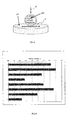
- Experimental Example 1 was carried out by using a ball-on-disk type high-frequency reciprocating rig (HFRR) as shown in Fig. 1 .
- HFRR high-frequency reciprocating rig
- a ball 20 made of high-carbon chromium bearing steel (SUJ2) was placed on a plate shaped substrate 10 (arithmetical mean roughness: 50 nm), and the substrate 10 and the ball 20 were lubricated by diesel engine oil.
- SUJ2 high-carbon chromium bearing steel
- the arrow P is a load loaded to the ball 20, and the arrow F is a direction of acting the friction force.
- the load P it was set to 1000 g or 400 g so that the lubricating conditions in Experimental Example 2 mentioned below are aligned as equal intervals as possible.
- the substrates 10 were categorized in two cases, in one of which cases the substrate is constituted by high-carbon chromium bearing steel (SUJ2), and in other one of which cases titanium nitride aluminum was coated on the ball 20 side (sliding surface side) of high-carbon chromium bearing steel (SUJ2).
- a diesel engine oil ⁇ diesel engine oil (hereinafter referred to the reference "CD") with the American Petroleum Institute standard of "CD”
- diesel engine oil hereinafter referred to the reference "VDS-4 (DH-2)
- VDS-4 diesel engine oil
- both are general diesel engine oils ⁇ were used.
- MoDTC molybdenum dithiocarbamate
- MoDTC molybdenum dithiocarbamate
- Friction controller 1 SUJ2 SUJ2 - CD - 2 SUJ2 SUJ2 CrN CD - 3 SUJ2 SUJ2 - CD MoDTC 4 SUJ2 SUJ2 CrN CD MoDTC 5 SUJ2 SUJ2 - VDS-4 (DH-2) - 6 SUJ2 SUJ2 CrN VDS-4 (DH-2) - 7 SUJ2 SUJ2 - VDS-4 (DH-2) MoDTC 8 SUJ2 SUJ2 CrN VDS-4 (DH-2) MoDTC
- Fig. 2 The test results of Experimental Example 1 using the ball-on-disk type high-frequency reciprocating rig (HFRR) as shown in Fig. 1 are shown in Fig. 2 .
- the horizontal axis of Fig. 2 shows a friction coefficient ⁇ and the vertical axis shows the sample No. In Fig. 2 , when Samples No. 1 and No.2, and Sample No. 5 and Sample No. 6 are compared to each other, it can be understood that, in either of two kinds of diesel engines, if no molybdenum dithiocarbamate (MoDTC) is added, the samples (No. 2 and No.
- MoDTC molybdenum dithiocarbamate
- Fig. 3 shows wear amounts generated at the substrate 10 side, after Experimental Example 1 was carried out, by comparison.
- a width (mm) of wear scar generated at the substrate 10 side, and at the horizontal axis, Sample No. is shown.
- the width (mm) of wear scar generated at the substrate 10 side is proportional to the wear amount.
- a substrate constituted by a high-carbon chromium bearing steel (SUJ2) to which no chromium nitride has been coated and a substrate (CrN) to which chromium nitride has been coated were prepared.
- the lubricating conditions were determined in the range of a mixed lubrication region using the Sommerfeld number as a standard.
- the results of Experimental Example 2 are shown in Fig. 4 .
- the vertical axis shows a friction coefficient ⁇
- the horizontal axis shows the Sommerfeld number S.
- the friction coefficient ⁇ could not be measured by the experiment device as shown in Fig. 1 . That is, according to the experiment by the inventor, the lubricating conditions in which low friction performances have been confirmed in combination of the lubricant to which molybdenum dithiocarbamate had been added and the chromium nitride coating were only the region in which the Sommerfeld number S was larger than "2,12365 ⁇ 10 -20 " (the right side region than the numeral A in Fig. 4 ).
- the Sommerfeld number S was smaller than "2,12365 ⁇ 10 -20 , it is impossible to measure due to specifications of the experiment device. It can be estimated that if the Sommerfeld number S is smaller than "2.12365 ⁇ 10 -20 , the properties are belonged in the category of dry friction causing solid contact and that low friction by generating a lubricating film is not able to keep fully, although the Sommerfeld number S of "2.12365 ⁇ 10 -20" is not a threshold level.
- the lubricating conditions in which low friction performances have been confirmed in combination of the lubricant to which molybdenum dithiocarbamate had been added and the chromium nitride coating were in the region in which the Sommerfeld number S was smaller than "5.94509 ⁇ 10 -19 " (the left side region than the numeral E in Fig. 4 ).
- the Sommerfeld number S is larger than "5.94509 ⁇ 10 -19 ", it would be belonging to the category of the so-called "fluid friction", so that it can be estimated that the low friction performances in combination of the lubricant to which molybdenum dithiocarbamate had been added and the chromium nitride coating could not be performed.
- the fluid friction a sufficient amount of the lubricant exists between the sliding surfaces but no lubricant film is formed.
- Example 4 that the lubricant does not belong to the category of the boundary friction in which the lubricating film forms between the sliding members, otherwise the arithmetic mean average roughness of the substrate 10 is 2 nm or more.
- the ball 20 which is an opposite member of the substrate 10 the sliding surface of which has been coated by chromium nitride is made of a high-carbon chromium bearing steel (SUJ2).
- a ferrous material in which the carbon amount is 0.15 to 0.55% by weight, hardening and tempering treatments has been carried out and carbonizing treatment has been carried out the same results as in those shown in the drawing, Experimental Example 1 and Experimental Example 2 can be obtained. Accordingly, the ferrous material in which the carbon amount is 0.15 to 0.55% by weight, hardening, tempering and carbonizing treatments have been carried out may be used in place of the high-carbon chromium bearing steel (SUJ2).
- the bearing is exemplified but it is as a matter of course that the present invention can be applied to the other sliding members.
Landscapes
- Chemical & Material Sciences (AREA)
- Engineering & Computer Science (AREA)
- General Engineering & Computer Science (AREA)
- Mechanical Engineering (AREA)
- Chemical Kinetics & Catalysis (AREA)
- General Chemical & Material Sciences (AREA)
- Oil, Petroleum & Natural Gas (AREA)
- Organic Chemistry (AREA)
- Lubricants (AREA)
- Sliding-Contact Bearings (AREA)
Applications Claiming Priority (2)
| Application Number | Priority Date | Filing Date | Title |
|---|---|---|---|
| JP2010276929A JP5674118B2 (ja) | 2010-12-13 | 2010-12-13 | 摺動機構及びその摩擦低減方法 |
| PCT/JP2011/074270 WO2012081309A1 (ja) | 2010-12-13 | 2011-10-21 | 摺動機構及びその摩擦低減方法 |
Publications (2)
| Publication Number | Publication Date |
|---|---|
| EP2653739A1 true EP2653739A1 (de) | 2013-10-23 |
| EP2653739A4 EP2653739A4 (de) | 2014-12-24 |
Family
ID=46244424
Family Applications (1)
| Application Number | Title | Priority Date | Filing Date |
|---|---|---|---|
| EP11849358.4A Ceased EP2653739A4 (de) | 2010-12-13 | 2011-10-21 | Schiebemechanismus und reibungsverminderungsverfahren dafür |
Country Status (4)
| Country | Link |
|---|---|
| US (1) | US8883696B2 (de) |
| EP (1) | EP2653739A4 (de) |
| JP (1) | JP5674118B2 (de) |
| WO (1) | WO2012081309A1 (de) |
Families Citing this family (1)
| Publication number | Priority date | Publication date | Assignee | Title |
|---|---|---|---|---|
| JP2019066002A (ja) * | 2017-10-03 | 2019-04-25 | 株式会社豊田中央研究所 | 摺動システム |
Family Cites Families (7)
| Publication number | Priority date | Publication date | Assignee | Title |
|---|---|---|---|---|
| US5736491A (en) | 1997-01-30 | 1998-04-07 | Texaco Inc. | Method of improving the fuel economy characteristics of a lubricant by friction reduction and compositions useful therein |
| JP4007440B2 (ja) * | 2000-04-28 | 2007-11-14 | 三宅 正二郎 | 硬質炭素皮膜摺動部材 |
| WO2005014760A1 (ja) * | 2003-08-06 | 2005-02-17 | Nippon Oil Corporation | Dlc接触面を有するシステム、該システムの潤滑方法及び該システム用潤滑油 |
| JP4614427B2 (ja) * | 2003-08-06 | 2011-01-19 | 日産自動車株式会社 | 低摩擦摺動機構、手動変速機及び終減速機 |
| JP4784248B2 (ja) * | 2005-10-05 | 2011-10-05 | トヨタ自動車株式会社 | 摺動構造及び摺動方法 |
| JP2007205564A (ja) * | 2006-01-06 | 2007-08-16 | Toyota Motor Corp | 摺動部材及びクラッチ |
| JP4333794B2 (ja) * | 2007-11-06 | 2009-09-16 | トヨタ自動車株式会社 | 摺動構造 |
-
2010
- 2010-12-13 JP JP2010276929A patent/JP5674118B2/ja active Active
-
2011
- 2011-10-21 EP EP11849358.4A patent/EP2653739A4/de not_active Ceased
- 2011-10-21 WO PCT/JP2011/074270 patent/WO2012081309A1/ja not_active Ceased
- 2011-10-21 US US13/993,132 patent/US8883696B2/en active Active
Also Published As
| Publication number | Publication date |
|---|---|
| US20130266245A1 (en) | 2013-10-10 |
| JP5674118B2 (ja) | 2015-02-25 |
| WO2012081309A1 (ja) | 2012-06-21 |
| EP2653739A4 (de) | 2014-12-24 |
| US8883696B2 (en) | 2014-11-11 |
| JP2012127370A (ja) | 2012-07-05 |
Similar Documents
| Publication | Publication Date | Title |
|---|---|---|
| EP2762552B1 (de) | Gleitelement und gleitmaterialzusammensetzung | |
| EP2757277B1 (de) | Gleitelement und gleitmaterialzusammensetzung | |
| Martins et al. | Austempered ductile iron (ADI) gears: Power loss, pitting and micropitting | |
| US20110243484A1 (en) | Sliding Bearing With Improved Wear Resistance and Method of Manufacturing Same | |
| Ahlroos et al. | Twin disc micropitting tests | |
| US20050180671A1 (en) | Bearing having anodic nanoparticle lubricant | |
| Farias et al. | Friction behavior of lubricated zinc phosphate coatings | |
| Ohue et al. | Sliding–rolling contact fatigue and wear of maraging steel roller with ion-nitriding and fine particle shot-peening | |
| US9790447B2 (en) | Sliding system | |
| US8883696B2 (en) | Sliding mechanism and friction reduction method for the same | |
| Ananth et al. | Tribological behaviour of grey cast iron–EN31 steel contact under sliding conditions | |
| Gokce et al. | Effect of substrate surface roughness on the wear of molybdenum disulphate coated rolling contact bearings | |
| EP1980608A1 (de) | Phosphatbeschichtungen für verbesserte Verschleißeigenschaften | |
| Das et al. | Boundary lubricated tribology of an aluminium-silicon alloy sliding against steel | |
| EP2653740B1 (de) | Schiebemechanismus und reibungsverminderungsverfahren dafür | |
| US5282689A (en) | Rolling bearing | |
| EP3633015B1 (de) | Schmierfettzusammensetzung und damit beschichtetes gleitelement | |
| JP5854554B2 (ja) | 摺動機構 | |
| JP3939200B2 (ja) | グリース封入耐熱性転がり軸受 | |
| Nehme | Effect of extreme contact load under two different rotational speeds on reduced phosphorus plain ZDDP oil in the presence of 1 per cent FeF3 catalyst | |
| GB2259711A (en) | Rolling bearing lubricant | |
| US20260036170A1 (en) | Method for reducing friction in a rolling bearing, in particular in a vehicle wheel hub bearing, and associated rolling bearing | |
| Lohner et al. | Friction reduction in gearboxes by plastic deformation (PD) additives | |
| Daszykowski et al. | Tribological Properties of aC: H: W Coated Friction Pairs Under Mixed Friction Conditions Using Sae 5w30 Oils | |
| Takii | Trends of rolling bearing performance and recent results |
Legal Events
| Date | Code | Title | Description |
|---|---|---|---|
| PUAI | Public reference made under article 153(3) epc to a published international application that has entered the european phase |
Free format text: ORIGINAL CODE: 0009012 |
|
| 17P | Request for examination filed |
Effective date: 20130627 |
|
| AK | Designated contracting states |
Kind code of ref document: A1 Designated state(s): AL AT BE BG CH CY CZ DE DK EE ES FI FR GB GR HR HU IE IS IT LI LT LU LV MC MK MT NL NO PL PT RO RS SE SI SK SM TR |
|
| DAX | Request for extension of the european patent (deleted) | ||
| A4 | Supplementary search report drawn up and despatched |
Effective date: 20141120 |
|
| RIC1 | Information provided on ipc code assigned before grant |
Ipc: C10N 80/00 20060101ALI20141114BHEP Ipc: C10N 40/02 20060101ALI20141114BHEP Ipc: F16C 33/12 20060101ALI20141114BHEP Ipc: C10M 135/18 20060101ALI20141114BHEP Ipc: C10N 30/06 20060101ALI20141114BHEP Ipc: C10N 40/25 20060101ALI20141114BHEP Ipc: F16C 33/10 20060101AFI20141114BHEP Ipc: C10N 10/12 20060101ALI20141114BHEP Ipc: C10M 169/04 20060101ALI20141114BHEP |
|
| 17Q | First examination report despatched |
Effective date: 20160630 |
|
| STAA | Information on the status of an ep patent application or granted ep patent |
Free format text: STATUS: EXAMINATION IS IN PROGRESS |
|
| REG | Reference to a national code |
Ref country code: DE Ref legal event code: R003 |
|
| STAA | Information on the status of an ep patent application or granted ep patent |
Free format text: STATUS: THE APPLICATION HAS BEEN REFUSED |
|
| 18R | Application refused |
Effective date: 20190715 |