EP2647744A1 - Purified cellulose fibers, fiber-rubber complex, and tire - Google Patents
Purified cellulose fibers, fiber-rubber complex, and tire Download PDFInfo
- Publication number
- EP2647744A1 EP2647744A1 EP11845200.2A EP11845200A EP2647744A1 EP 2647744 A1 EP2647744 A1 EP 2647744A1 EP 11845200 A EP11845200 A EP 11845200A EP 2647744 A1 EP2647744 A1 EP 2647744A1
- Authority
- EP
- European Patent Office
- Prior art keywords
- group
- purified cellulose
- ion
- fiber
- carbon atoms
- Prior art date
- Legal status (The legal status is an assumption and is not a legal conclusion. Google has not performed a legal analysis and makes no representation as to the accuracy of the status listed.)
- Granted
Links
- 229920003043 Cellulose fiber Polymers 0.000 title claims abstract description 64
- 229920001971 elastomer Polymers 0.000 title claims abstract description 54
- 239000005060 rubber Substances 0.000 title claims abstract description 54
- 229920002678 cellulose Polymers 0.000 claims abstract description 77
- 239000001913 cellulose Substances 0.000 claims abstract description 77
- 239000002608 ionic liquid Substances 0.000 claims abstract description 67
- 239000002994 raw material Substances 0.000 claims abstract description 48
- 239000007788 liquid Substances 0.000 claims abstract description 29
- 239000002131 composite material Substances 0.000 claims abstract description 26
- 238000001891 gel spinning Methods 0.000 claims abstract description 7
- 238000002166 wet spinning Methods 0.000 claims abstract description 6
- 125000004432 carbon atom Chemical group C* 0.000 claims description 52
- -1 phosphonium ion Chemical class 0.000 claims description 52
- 125000000217 alkyl group Chemical group 0.000 claims description 45
- 150000001450 anions Chemical class 0.000 claims description 21
- 150000001768 cations Chemical class 0.000 claims description 15
- 125000004435 hydrogen atom Chemical group [H]* 0.000 claims description 15
- 150000001875 compounds Chemical class 0.000 claims description 11
- 229910052698 phosphorus Inorganic materials 0.000 claims description 11
- RAXXELZNTBOGNW-UHFFFAOYSA-O Imidazolium Chemical compound C1=C[NH+]=CN1 RAXXELZNTBOGNW-UHFFFAOYSA-O 0.000 claims description 10
- OAICVXFJPJFONN-UHFFFAOYSA-N Phosphorus Chemical compound [P] OAICVXFJPJFONN-UHFFFAOYSA-N 0.000 claims description 10
- 125000003342 alkenyl group Chemical group 0.000 claims description 10
- 239000011574 phosphorus Substances 0.000 claims description 10
- 125000002887 hydroxy group Chemical group [H]O* 0.000 claims description 8
- 239000000463 material Substances 0.000 claims description 6
- NBIIXXVUZAFLBC-UHFFFAOYSA-K phosphate Chemical compound [O-]P([O-])([O-])=O NBIIXXVUZAFLBC-UHFFFAOYSA-K 0.000 claims description 6
- 229940085991 phosphate ion Drugs 0.000 claims description 6
- UEZVMMHDMIWARA-UHFFFAOYSA-M phosphonate Chemical compound [O-]P(=O)=O UEZVMMHDMIWARA-UHFFFAOYSA-M 0.000 claims description 6
- 125000002496 methyl group Chemical group [H]C([H])([H])* 0.000 claims description 5
- QGZKDVFQNNGYKY-UHFFFAOYSA-O Ammonium Chemical compound [NH4+] QGZKDVFQNNGYKY-UHFFFAOYSA-O 0.000 claims description 4
- JUJWROOIHBZHMG-UHFFFAOYSA-O pyridinium Chemical compound C1=CC=[NH+]C=C1 JUJWROOIHBZHMG-UHFFFAOYSA-O 0.000 claims description 4
- 238000000034 method Methods 0.000 description 21
- 239000000835 fiber Substances 0.000 description 19
- QGJOPFRUJISHPQ-UHFFFAOYSA-N Carbon disulfide Chemical compound S=C=S QGJOPFRUJISHPQ-UHFFFAOYSA-N 0.000 description 18
- 238000004519 manufacturing process Methods 0.000 description 18
- 239000002904 solvent Substances 0.000 description 18
- 238000009987 spinning Methods 0.000 description 18
- 230000000052 comparative effect Effects 0.000 description 15
- JEGUKCSWCFPDGT-UHFFFAOYSA-N h2o hydrate Chemical compound O.O JEGUKCSWCFPDGT-UHFFFAOYSA-N 0.000 description 14
- 239000003960 organic solvent Substances 0.000 description 14
- LFTLOKWAGJYHHR-UHFFFAOYSA-N N-methylmorpholine N-oxide Chemical compound CN1(=O)CCOCC1 LFTLOKWAGJYHHR-UHFFFAOYSA-N 0.000 description 12
- 229920000297 Rayon Polymers 0.000 description 10
- 229920001577 copolymer Polymers 0.000 description 9
- 230000007613 environmental effect Effects 0.000 description 9
- 239000002964 rayon Substances 0.000 description 9
- 238000001035 drying Methods 0.000 description 7
- 150000002500 ions Chemical class 0.000 description 7
- 238000010438 heat treatment Methods 0.000 description 6
- 238000003756 stirring Methods 0.000 description 6
- 238000011282 treatment Methods 0.000 description 6
- 241000196324 Embryophyta Species 0.000 description 5
- 230000001112 coagulating effect Effects 0.000 description 5
- 125000006165 cyclic alkyl group Chemical group 0.000 description 5
- 125000004122 cyclic group Chemical group 0.000 description 5
- 238000002156 mixing Methods 0.000 description 5
- 239000000203 mixture Substances 0.000 description 5
- 238000012360 testing method Methods 0.000 description 5
- 238000004073 vulcanization Methods 0.000 description 5
- 230000000694 effects Effects 0.000 description 4
- 229910052736 halogen Inorganic materials 0.000 description 4
- 125000002950 monocyclic group Chemical group 0.000 description 4
- 125000003367 polycyclic group Chemical group 0.000 description 4
- XLYOFNOQVPJJNP-UHFFFAOYSA-N water Substances O XLYOFNOQVPJJNP-UHFFFAOYSA-N 0.000 description 4
- BSKSXTBYXTZWFI-UHFFFAOYSA-M 1-butyl-3-methylimidazol-3-ium;acetate Chemical compound CC([O-])=O.CCCC[N+]=1C=CN(C)C=1 BSKSXTBYXTZWFI-UHFFFAOYSA-M 0.000 description 3
- XIYUIMLQTKODPS-UHFFFAOYSA-M 1-ethyl-3-methylimidazol-3-ium;acetate Chemical compound CC([O-])=O.CC[N+]=1C=CN(C)C=1 XIYUIMLQTKODPS-UHFFFAOYSA-M 0.000 description 3
- SSCZXVJFONHEMK-UHFFFAOYSA-L 1-ethyl-3-methylimidazol-3-ium;methyl-dioxido-oxo-$l^{5}-phosphane Chemical compound CP([O-])([O-])=O.CC[N+]=1C=CN(C)C=1.CC[N+]=1C=CN(C)C=1 SSCZXVJFONHEMK-UHFFFAOYSA-L 0.000 description 3
- QVRCRKLLQYOIKY-UHFFFAOYSA-M 1-methyl-3-prop-2-enylimidazol-1-ium;chloride Chemical compound [Cl-].C[N+]=1C=CN(CC=C)C=1 QVRCRKLLQYOIKY-UHFFFAOYSA-M 0.000 description 3
- WEVYAHXRMPXWCK-UHFFFAOYSA-N Acetonitrile Chemical compound CC#N WEVYAHXRMPXWCK-UHFFFAOYSA-N 0.000 description 3
- LFQSCWFLJHTTHZ-UHFFFAOYSA-N Ethanol Chemical compound CCO LFQSCWFLJHTTHZ-UHFFFAOYSA-N 0.000 description 3
- VHOQXEIFYTTXJU-UHFFFAOYSA-N Isobutylene-isoprene copolymer Chemical compound CC(C)=C.CC(=C)C=C VHOQXEIFYTTXJU-UHFFFAOYSA-N 0.000 description 3
- 241001465754 Metazoa Species 0.000 description 3
- ZMXDDKWLCZADIW-UHFFFAOYSA-N N,N-Dimethylformamide Chemical compound CN(C)C=O ZMXDDKWLCZADIW-UHFFFAOYSA-N 0.000 description 3
- RLMMKMUTGWEHDL-UHFFFAOYSA-M [O-][PH2]=O.CCn1cc[n+](C)c1 Chemical compound [O-][PH2]=O.CCn1cc[n+](C)c1 RLMMKMUTGWEHDL-UHFFFAOYSA-M 0.000 description 3
- 230000002411 adverse Effects 0.000 description 3
- 125000002029 aromatic hydrocarbon group Chemical group 0.000 description 3
- JFDZBHWFFUWGJE-UHFFFAOYSA-N benzonitrile Chemical compound N#CC1=CC=CC=C1 JFDZBHWFFUWGJE-UHFFFAOYSA-N 0.000 description 3
- 239000011248 coating agent Substances 0.000 description 3
- 238000000576 coating method Methods 0.000 description 3
- HQWOEDCLDNFWEV-UHFFFAOYSA-M diethyl phosphate;1-ethyl-3-methylimidazol-3-ium Chemical compound CC[N+]=1C=CN(C)C=1.CCOP([O-])(=O)OCC HQWOEDCLDNFWEV-UHFFFAOYSA-M 0.000 description 3
- 150000002430 hydrocarbons Chemical group 0.000 description 3
- 238000000465 moulding Methods 0.000 description 3
- 231100000614 poison Toxicity 0.000 description 3
- 239000002798 polar solvent Substances 0.000 description 3
- 230000008569 process Effects 0.000 description 3
- 239000004627 regenerated cellulose Substances 0.000 description 3
- 229920003051 synthetic elastomer Polymers 0.000 description 3
- 239000005061 synthetic rubber Substances 0.000 description 3
- 229920006027 ternary co-polymer Polymers 0.000 description 3
- 239000003440 toxic substance Substances 0.000 description 3
- DTGKSKDOIYIVQL-WEDXCCLWSA-N (+)-borneol Chemical group C1C[C@@]2(C)[C@@H](O)C[C@@H]1C2(C)C DTGKSKDOIYIVQL-WEDXCCLWSA-N 0.000 description 2
- 125000004493 2-methylbut-1-yl group Chemical group CC(C*)CC 0.000 description 2
- 125000005916 2-methylpentyl group Chemical group 0.000 description 2
- 125000005917 3-methylpentyl group Chemical group 0.000 description 2
- QTBSBXVTEAMEQO-UHFFFAOYSA-M Acetate Chemical compound CC([O-])=O QTBSBXVTEAMEQO-UHFFFAOYSA-M 0.000 description 2
- KAKZBPTYRLMSJV-UHFFFAOYSA-N Butadiene Chemical compound C=CC=C KAKZBPTYRLMSJV-UHFFFAOYSA-N 0.000 description 2
- VTYYLEPIZMXCLO-UHFFFAOYSA-L Calcium carbonate Chemical compound [Ca+2].[O-]C([O-])=O VTYYLEPIZMXCLO-UHFFFAOYSA-L 0.000 description 2
- VEXZGXHMUGYJMC-UHFFFAOYSA-M Chloride anion Chemical compound [Cl-] VEXZGXHMUGYJMC-UHFFFAOYSA-M 0.000 description 2
- IAZDPXIOMUYVGZ-UHFFFAOYSA-N Dimethylsulphoxide Chemical compound CS(C)=O IAZDPXIOMUYVGZ-UHFFFAOYSA-N 0.000 description 2
- BDAGIHXWWSANSR-UHFFFAOYSA-M Formate Chemical compound [O-]C=O BDAGIHXWWSANSR-UHFFFAOYSA-M 0.000 description 2
- 244000043261 Hevea brasiliensis Species 0.000 description 2
- RRHGJUQNOFWUDK-UHFFFAOYSA-N Isoprene Chemical compound CC(=C)C=C RRHGJUQNOFWUDK-UHFFFAOYSA-N 0.000 description 2
- XBDQKXXYIPTUBI-UHFFFAOYSA-M Propionate Chemical compound CCC([O-])=O XBDQKXXYIPTUBI-UHFFFAOYSA-M 0.000 description 2
- JUJWROOIHBZHMG-UHFFFAOYSA-N Pyridine Chemical compound C1=CC=NC=C1 JUJWROOIHBZHMG-UHFFFAOYSA-N 0.000 description 2
- VYPSYNLAJGMNEJ-UHFFFAOYSA-N Silicium dioxide Chemical compound O=[Si]=O VYPSYNLAJGMNEJ-UHFFFAOYSA-N 0.000 description 2
- PPBRXRYQALVLMV-UHFFFAOYSA-N Styrene Chemical compound C=CC1=CC=CC=C1 PPBRXRYQALVLMV-UHFFFAOYSA-N 0.000 description 2
- WYURNTSHIVDZCO-UHFFFAOYSA-N Tetrahydrofuran Chemical compound C1CCOC1 WYURNTSHIVDZCO-UHFFFAOYSA-N 0.000 description 2
- XLOMVQKBTHCTTD-UHFFFAOYSA-N Zinc monoxide Chemical compound [Zn]=O XLOMVQKBTHCTTD-UHFFFAOYSA-N 0.000 description 2
- 125000005073 adamantyl group Chemical group C12(CC3CC(CC(C1)C3)C2)* 0.000 description 2
- 239000000853 adhesive Substances 0.000 description 2
- 230000001070 adhesive effect Effects 0.000 description 2
- 125000001931 aliphatic group Chemical group 0.000 description 2
- 150000001336 alkenes Chemical class 0.000 description 2
- 150000001408 amides Chemical class 0.000 description 2
- 239000003963 antioxidant agent Substances 0.000 description 2
- 150000004982 aromatic amines Chemical class 0.000 description 2
- 125000003118 aryl group Chemical group 0.000 description 2
- 125000000484 butyl group Chemical group [H]C([*])([H])C([H])([H])C([H])([H])C([H])([H])[H] 0.000 description 2
- OSGAYBCDTDRGGQ-UHFFFAOYSA-L calcium sulfate Chemical compound [Ca+2].[O-]S([O-])(=O)=O OSGAYBCDTDRGGQ-UHFFFAOYSA-L 0.000 description 2
- QGJOPFRUJISHPQ-NJFSPNSNSA-N carbon disulfide-14c Chemical compound S=[14C]=S QGJOPFRUJISHPQ-NJFSPNSNSA-N 0.000 description 2
- 230000008859 change Effects 0.000 description 2
- 150000004292 cyclic ethers Chemical class 0.000 description 2
- 125000001995 cyclobutyl group Chemical group [H]C1([H])C([H])([H])C([H])(*)C1([H])[H] 0.000 description 2
- 125000000582 cycloheptyl group Chemical group [H]C1([H])C([H])([H])C([H])([H])C([H])([H])C([H])(*)C([H])([H])C1([H])[H] 0.000 description 2
- 125000000113 cyclohexyl group Chemical group [H]C1([H])C([H])([H])C([H])([H])C([H])(*)C([H])([H])C1([H])[H] 0.000 description 2
- 125000000640 cyclooctyl group Chemical group [H]C1([H])C([H])([H])C([H])([H])C([H])([H])C([H])(*)C([H])([H])C([H])([H])C1([H])[H] 0.000 description 2
- 125000001511 cyclopentyl group Chemical group [H]C1([H])C([H])([H])C([H])([H])C([H])(*)C1([H])[H] 0.000 description 2
- 125000001559 cyclopropyl group Chemical group [H]C1([H])C([H])([H])C1([H])* 0.000 description 2
- 125000002704 decyl group Chemical group [H]C([H])([H])C([H])([H])C([H])([H])C([H])([H])C([H])([H])C([H])([H])C([H])([H])C([H])([H])C([H])([H])C([H])([H])* 0.000 description 2
- 238000007598 dipping method Methods 0.000 description 2
- 239000004210 ether based solvent Substances 0.000 description 2
- 125000001495 ethyl group Chemical group [H]C([H])([H])C([H])([H])* 0.000 description 2
- 238000011156 evaluation Methods 0.000 description 2
- 125000003187 heptyl group Chemical group [H]C([*])([H])C([H])([H])C([H])([H])C([H])([H])C([H])([H])C([H])([H])C([H])([H])[H] 0.000 description 2
- 125000004051 hexyl group Chemical group [H]C([H])([H])C([H])([H])C([H])([H])C([H])([H])C([H])([H])C([H])([H])* 0.000 description 2
- 229910052739 hydrogen Inorganic materials 0.000 description 2
- 239000001257 hydrogen Substances 0.000 description 2
- 125000000959 isobutyl group Chemical group [H]C([H])([H])C([H])(C([H])([H])[H])C([H])([H])* 0.000 description 2
- 125000004491 isohexyl group Chemical group C(CCC(C)C)* 0.000 description 2
- 125000001972 isopentyl group Chemical group [H]C([H])([H])C([H])(C([H])([H])[H])C([H])([H])C([H])([H])* 0.000 description 2
- 125000001449 isopropyl group Chemical group [H]C([H])([H])C([H])(*)C([H])([H])[H] 0.000 description 2
- 229920000126 latex Polymers 0.000 description 2
- 239000004816 latex Substances 0.000 description 2
- 229920003052 natural elastomer Polymers 0.000 description 2
- 229920001194 natural rubber Polymers 0.000 description 2
- 125000001971 neopentyl group Chemical group [H]C([*])([H])C(C([H])([H])[H])(C([H])([H])[H])C([H])([H])[H] 0.000 description 2
- 150000002825 nitriles Chemical class 0.000 description 2
- 125000001400 nonyl group Chemical group [H]C([*])([H])C([H])([H])C([H])([H])C([H])([H])C([H])([H])C([H])([H])C([H])([H])C([H])([H])C([H])([H])[H] 0.000 description 2
- 125000002868 norbornyl group Chemical group C12(CCC(CC1)C2)* 0.000 description 2
- 125000002347 octyl group Chemical group [H]C([*])([H])C([H])([H])C([H])([H])C([H])([H])C([H])([H])C([H])([H])C([H])([H])C([H])([H])[H] 0.000 description 2
- 239000012188 paraffin wax Substances 0.000 description 2
- 125000001147 pentyl group Chemical group C(CCCC)* 0.000 description 2
- 239000000047 product Substances 0.000 description 2
- 125000001436 propyl group Chemical group [H]C([*])([H])C([H])([H])C([H])([H])[H] 0.000 description 2
- 238000010298 pulverizing process Methods 0.000 description 2
- CZPWVGJYEJSRLH-UHFFFAOYSA-P pyrimidine-1,3-diium Chemical compound C1=C[NH+]=C[NH+]=C1 CZPWVGJYEJSRLH-UHFFFAOYSA-P 0.000 description 2
- 238000004064 recycling Methods 0.000 description 2
- 230000003014 reinforcing effect Effects 0.000 description 2
- 238000007151 ring opening polymerisation reaction Methods 0.000 description 2
- 125000002914 sec-butyl group Chemical group [H]C([H])([H])C([H])([H])C([H])(*)C([H])([H])[H] 0.000 description 2
- 125000003548 sec-pentyl group Chemical group [H]C([H])([H])C([H])([H])C([H])([H])C([H])(*)C([H])([H])[H] 0.000 description 2
- 239000000243 solution Substances 0.000 description 2
- 229920003048 styrene butadiene rubber Polymers 0.000 description 2
- 150000003462 sulfoxides Chemical class 0.000 description 2
- 125000000999 tert-butyl group Chemical group [H]C([H])([H])C(*)(C([H])([H])[H])C([H])([H])[H] 0.000 description 2
- 125000001973 tert-pentyl group Chemical group [H]C([H])([H])C([H])([H])C(*)(C([H])([H])[H])C([H])([H])[H] 0.000 description 2
- VZCYOOQTPOCHFL-UHFFFAOYSA-N trans-butenedioic acid Natural products OC(=O)C=CC(O)=O VZCYOOQTPOCHFL-UHFFFAOYSA-N 0.000 description 2
- 239000003981 vehicle Substances 0.000 description 2
- 239000002023 wood Substances 0.000 description 2
- BGJSXRVXTHVRSN-UHFFFAOYSA-N 1,3,5-trioxane Chemical compound C1OCOCO1 BGJSXRVXTHVRSN-UHFFFAOYSA-N 0.000 description 1
- VDFVNEFVBPFDSB-UHFFFAOYSA-N 1,3-dioxane Chemical compound C1COCOC1 VDFVNEFVBPFDSB-UHFFFAOYSA-N 0.000 description 1
- WNXJIVFYUVYPPR-UHFFFAOYSA-N 1,3-dioxolane Chemical compound C1COCO1 WNXJIVFYUVYPPR-UHFFFAOYSA-N 0.000 description 1
- OWRCNXZUPFZXOS-UHFFFAOYSA-N 1,3-diphenylguanidine Chemical compound C=1C=CC=CC=1NC(=N)NC1=CC=CC=C1 OWRCNXZUPFZXOS-UHFFFAOYSA-N 0.000 description 1
- RYHBNJHYFVUHQT-UHFFFAOYSA-N 1,4-Dioxane Chemical compound C1COCCO1 RYHBNJHYFVUHQT-UHFFFAOYSA-N 0.000 description 1
- 125000001637 1-naphthyl group Chemical group [H]C1=C([H])C([H])=C2C(*)=C([H])C([H])=C([H])C2=C1[H] 0.000 description 1
- SMZOUWXMTYCWNB-UHFFFAOYSA-N 2-(2-methoxy-5-methylphenyl)ethanamine Chemical compound COC1=CC=C(C)C=C1CCN SMZOUWXMTYCWNB-UHFFFAOYSA-N 0.000 description 1
- NIXOWILDQLNWCW-UHFFFAOYSA-N 2-Propenoic acid Natural products OC(=O)C=C NIXOWILDQLNWCW-UHFFFAOYSA-N 0.000 description 1
- 125000001622 2-naphthyl group Chemical group [H]C1=C([H])C([H])=C2C([H])=C(*)C([H])=C([H])C2=C1[H] 0.000 description 1
- 125000000094 2-phenylethyl group Chemical group [H]C1=C([H])C([H])=C(C([H])=C1[H])C([H])([H])C([H])([H])* 0.000 description 1
- 125000003903 2-propenyl group Chemical group [H]C([*])([H])C([H])=C([H])[H] 0.000 description 1
- KGIGUEBEKRSTEW-UHFFFAOYSA-N 2-vinylpyridine Chemical compound C=CC1=CC=CC=N1 KGIGUEBEKRSTEW-UHFFFAOYSA-N 0.000 description 1
- POVPOADUCDQYMB-UHFFFAOYSA-N 3-butyl-1h-imidazol-3-ium;chloride Chemical compound [Cl-].CCCCN1C=C[NH+]=C1 POVPOADUCDQYMB-UHFFFAOYSA-N 0.000 description 1
- 241000589220 Acetobacter Species 0.000 description 1
- 241000590020 Achromobacter Species 0.000 description 1
- NLHHRLWOUZZQLW-UHFFFAOYSA-N Acrylonitrile Chemical compound C=CC#N NLHHRLWOUZZQLW-UHFFFAOYSA-N 0.000 description 1
- 241000589158 Agrobacterium Species 0.000 description 1
- 241000589151 Azotobacter Species 0.000 description 1
- CPELXLSAUQHCOX-UHFFFAOYSA-M Bromide Chemical compound [Br-] CPELXLSAUQHCOX-UHFFFAOYSA-M 0.000 description 1
- FERIUCNNQQJTOY-UHFFFAOYSA-N Butyric acid Natural products CCCC(O)=O FERIUCNNQQJTOY-UHFFFAOYSA-N 0.000 description 1
- 229920000742 Cotton Polymers 0.000 description 1
- 229920000875 Dissolving pulp Polymers 0.000 description 1
- VQTUBCCKSQIDNK-UHFFFAOYSA-N Isobutene Chemical group CC(C)=C VQTUBCCKSQIDNK-UHFFFAOYSA-N 0.000 description 1
- CERQOIWHTDAKMF-UHFFFAOYSA-N Methacrylic acid Chemical compound CC(=C)C(O)=O CERQOIWHTDAKMF-UHFFFAOYSA-N 0.000 description 1
- FXHOOIRPVKKKFG-UHFFFAOYSA-N N,N-Dimethylacetamide Chemical compound CN(C)C(C)=O FXHOOIRPVKKKFG-UHFFFAOYSA-N 0.000 description 1
- SECXISVLQFMRJM-UHFFFAOYSA-N N-Methylpyrrolidone Chemical compound CN1CCCC1=O SECXISVLQFMRJM-UHFFFAOYSA-N 0.000 description 1
- WHNWPMSKXPGLAX-UHFFFAOYSA-N N-Vinyl-2-pyrrolidone Chemical compound C=CN1CCCC1=O WHNWPMSKXPGLAX-UHFFFAOYSA-N 0.000 description 1
- UFWIBTONFRDIAS-UHFFFAOYSA-N Naphthalene Chemical compound C1=CC=CC2=CC=CC=C21 UFWIBTONFRDIAS-UHFFFAOYSA-N 0.000 description 1
- 239000004677 Nylon Substances 0.000 description 1
- MUBZPKHOEPUJKR-UHFFFAOYSA-L Oxalate Chemical compound [O-]C(=O)C([O-])=O MUBZPKHOEPUJKR-UHFFFAOYSA-L 0.000 description 1
- 235000019482 Palm oil Nutrition 0.000 description 1
- 235000019483 Peanut oil Nutrition 0.000 description 1
- 239000005062 Polybutadiene Substances 0.000 description 1
- 241000589516 Pseudomonas Species 0.000 description 1
- RWRDLPDLKQPQOW-UHFFFAOYSA-O Pyrrolidinium ion Chemical compound C1CC[NH2+]C1 RWRDLPDLKQPQOW-UHFFFAOYSA-O 0.000 description 1
- LCTONWCANYUPML-UHFFFAOYSA-M Pyruvate Chemical compound CC(=O)C([O-])=O LCTONWCANYUPML-UHFFFAOYSA-M 0.000 description 1
- 235000019484 Rapeseed oil Nutrition 0.000 description 1
- 241000589180 Rhizobium Species 0.000 description 1
- 241000192023 Sarcina Species 0.000 description 1
- 235000021355 Stearic acid Nutrition 0.000 description 1
- 239000002174 Styrene-butadiene Substances 0.000 description 1
- NINIDFKCEFEMDL-UHFFFAOYSA-N Sulfur Chemical compound [S] NINIDFKCEFEMDL-UHFFFAOYSA-N 0.000 description 1
- UCKMPCXJQFINFW-UHFFFAOYSA-N Sulphide Chemical compound [S-2] UCKMPCXJQFINFW-UHFFFAOYSA-N 0.000 description 1
- DHXVGJBLRPWPCS-UHFFFAOYSA-N Tetrahydropyran Chemical compound C1CCOCC1 DHXVGJBLRPWPCS-UHFFFAOYSA-N 0.000 description 1
- ZMZDMBWJUHKJPS-UHFFFAOYSA-M Thiocyanate anion Chemical compound [S-]C#N ZMZDMBWJUHKJPS-UHFFFAOYSA-M 0.000 description 1
- 241000251555 Tunicata Species 0.000 description 1
- 239000002253 acid Substances 0.000 description 1
- 239000003513 alkali Substances 0.000 description 1
- 125000005250 alkyl acrylate group Chemical group 0.000 description 1
- 238000013459 approach Methods 0.000 description 1
- 239000007864 aqueous solution Substances 0.000 description 1
- 125000003710 aryl alkyl group Chemical group 0.000 description 1
- 125000001797 benzyl group Chemical group [H]C1=C([H])C([H])=C(C([H])=C1[H])C([H])([H])* 0.000 description 1
- 125000006267 biphenyl group Chemical group 0.000 description 1
- 229940006460 bromide ion Drugs 0.000 description 1
- 229910000019 calcium carbonate Inorganic materials 0.000 description 1
- 238000003490 calendering Methods 0.000 description 1
- 239000006229 carbon black Substances 0.000 description 1
- 239000011203 carbon fibre reinforced carbon Substances 0.000 description 1
- 150000007942 carboxylates Chemical class 0.000 description 1
- 239000004359 castor oil Substances 0.000 description 1
- 235000019438 castor oil Nutrition 0.000 description 1
- 238000007385 chemical modification Methods 0.000 description 1
- 239000003795 chemical substances by application Substances 0.000 description 1
- YACLQRRMGMJLJV-UHFFFAOYSA-N chloroprene Chemical compound ClC(=C)C=C YACLQRRMGMJLJV-UHFFFAOYSA-N 0.000 description 1
- 239000004927 clay Substances 0.000 description 1
- 229910052570 clay Inorganic materials 0.000 description 1
- 239000003240 coconut oil Substances 0.000 description 1
- 235000019864 coconut oil Nutrition 0.000 description 1
- 235000012343 cottonseed oil Nutrition 0.000 description 1
- 239000002385 cottonseed oil Substances 0.000 description 1
- 239000003431 cross linking reagent Substances 0.000 description 1
- XLJMAIOERFSOGZ-UHFFFAOYSA-M cyanate Chemical compound [O-]C#N XLJMAIOERFSOGZ-UHFFFAOYSA-M 0.000 description 1
- 150000001925 cycloalkenes Chemical class 0.000 description 1
- 230000007547 defect Effects 0.000 description 1
- 150000001993 dienes Chemical class 0.000 description 1
- LXCYSACZTOKNNS-UHFFFAOYSA-N diethoxy(oxo)phosphanium Chemical compound CCO[P+](=O)OCC LXCYSACZTOKNNS-UHFFFAOYSA-N 0.000 description 1
- YLFBFPXKTIQSSY-UHFFFAOYSA-N dimethoxy(oxo)phosphanium Chemical compound CO[P+](=O)OC YLFBFPXKTIQSSY-UHFFFAOYSA-N 0.000 description 1
- 238000004821 distillation Methods 0.000 description 1
- 125000003438 dodecyl group Chemical group [H]C([H])([H])C([H])([H])C([H])([H])C([H])([H])C([H])([H])C([H])([H])C([H])([H])C([H])([H])C([H])([H])C([H])([H])C([H])([H])C([H])([H])* 0.000 description 1
- 230000002708 enhancing effect Effects 0.000 description 1
- 238000004880 explosion Methods 0.000 description 1
- 239000002657 fibrous material Substances 0.000 description 1
- 239000000945 filler Substances 0.000 description 1
- 239000002803 fossil fuel Substances 0.000 description 1
- ZEMPKEQAKRGZGQ-XOQCFJPHSA-N glycerol triricinoleate Natural products CCCCCC[C@@H](O)CC=CCCCCCCCC(=O)OC[C@@H](COC(=O)CCCCCCCC=CC[C@@H](O)CCCCCC)OC(=O)CCCCCCCC=CC[C@H](O)CCCCCC ZEMPKEQAKRGZGQ-XOQCFJPHSA-N 0.000 description 1
- 230000005484 gravity Effects 0.000 description 1
- 150000004820 halides Chemical class 0.000 description 1
- 229920001519 homopolymer Polymers 0.000 description 1
- XMBWDFGMSWQBCA-UHFFFAOYSA-M iodide Chemical compound [I-] XMBWDFGMSWQBCA-UHFFFAOYSA-M 0.000 description 1
- 229940006461 iodide ion Drugs 0.000 description 1
- 239000000944 linseed oil Substances 0.000 description 1
- 235000021388 linseed oil Nutrition 0.000 description 1
- 229940057995 liquid paraffin Drugs 0.000 description 1
- 238000002844 melting Methods 0.000 description 1
- 230000008018 melting Effects 0.000 description 1
- 239000010445 mica Substances 0.000 description 1
- 229910052618 mica group Inorganic materials 0.000 description 1
- 239000002480 mineral oil Substances 0.000 description 1
- 239000011259 mixed solution Substances 0.000 description 1
- 125000001421 myristyl group Chemical group [H]C([*])([H])C([H])([H])C([H])([H])C([H])([H])C([H])([H])C([H])([H])C([H])([H])C([H])([H])C([H])([H])C([H])([H])C([H])([H])C([H])([H])C([H])([H])C([H])([H])[H] 0.000 description 1
- 125000004998 naphthylethyl group Chemical group C1(=CC=CC2=CC=CC=C12)CC* 0.000 description 1
- 125000004923 naphthylmethyl group Chemical group C1(=CC=CC2=CC=CC=C12)C* 0.000 description 1
- JFNLZVQOOSMTJK-KNVOCYPGSA-N norbornene Chemical compound C1[C@@H]2CC[C@H]1C=C2 JFNLZVQOOSMTJK-KNVOCYPGSA-N 0.000 description 1
- 229920001778 nylon Polymers 0.000 description 1
- QIQXTHQIDYTFRH-UHFFFAOYSA-N octadecanoic acid Chemical compound CCCCCCCCCCCCCCCCCC(O)=O QIQXTHQIDYTFRH-UHFFFAOYSA-N 0.000 description 1
- OQCDKBAXFALNLD-UHFFFAOYSA-N octadecanoic acid Natural products CCCCCCCC(C)CCCCCCCCC(O)=O OQCDKBAXFALNLD-UHFFFAOYSA-N 0.000 description 1
- 239000003921 oil Substances 0.000 description 1
- 235000019198 oils Nutrition 0.000 description 1
- 150000002898 organic sulfur compounds Chemical class 0.000 description 1
- 125000000466 oxiranyl group Chemical group 0.000 description 1
- 239000002540 palm oil Substances 0.000 description 1
- 125000000913 palmityl group Chemical group [H]C([*])([H])C([H])([H])C([H])([H])C([H])([H])C([H])([H])C([H])([H])C([H])([H])C([H])([H])C([H])([H])C([H])([H])C([H])([H])C([H])([H])C([H])([H])C([H])([H])C([H])([H])C([H])([H])[H] 0.000 description 1
- 239000000312 peanut oil Substances 0.000 description 1
- 125000002958 pentadecyl group Chemical group [H]C([*])([H])C([H])([H])C([H])([H])C([H])([H])C([H])([H])C([H])([H])C([H])([H])C([H])([H])C([H])([H])C([H])([H])C([H])([H])C([H])([H])C([H])([H])C([H])([H])C([H])([H])[H] 0.000 description 1
- 239000012466 permeate Substances 0.000 description 1
- 125000001997 phenyl group Chemical group [H]C1=C([H])C([H])=C(*)C([H])=C1[H] 0.000 description 1
- 125000004437 phosphorous atom Chemical group 0.000 description 1
- 229920001084 poly(chloroprene) Polymers 0.000 description 1
- 229920002755 poly(epichlorohydrin) Polymers 0.000 description 1
- 229920002857 polybutadiene Polymers 0.000 description 1
- 229920000728 polyester Polymers 0.000 description 1
- 229920001195 polyisoprene Polymers 0.000 description 1
- 229920000642 polymer Polymers 0.000 description 1
- 229920003246 polypentenamer Polymers 0.000 description 1
- 229920001451 polypropylene glycol Polymers 0.000 description 1
- 239000000843 powder Substances 0.000 description 1
- 238000003825 pressing Methods 0.000 description 1
- 239000010734 process oil Substances 0.000 description 1
- 238000012545 processing Methods 0.000 description 1
- FVSKHRXBFJPNKK-UHFFFAOYSA-N propionitrile Chemical compound CCC#N FVSKHRXBFJPNKK-UHFFFAOYSA-N 0.000 description 1
- UMJSCPRVCHMLSP-UHFFFAOYSA-N pyridine Natural products COC1=CC=CN=C1 UMJSCPRVCHMLSP-UHFFFAOYSA-N 0.000 description 1
- 230000009467 reduction Effects 0.000 description 1
- 230000001172 regenerating effect Effects 0.000 description 1
- 238000007142 ring opening reaction Methods 0.000 description 1
- 229920006395 saturated elastomer Polymers 0.000 description 1
- 229930195734 saturated hydrocarbon Natural products 0.000 description 1
- CRDYSYOERSZTHZ-UHFFFAOYSA-M selenocyanate Chemical compound [Se-]C#N CRDYSYOERSZTHZ-UHFFFAOYSA-M 0.000 description 1
- 239000000377 silicon dioxide Substances 0.000 description 1
- 238000007614 solvation Methods 0.000 description 1
- 239000003549 soybean oil Substances 0.000 description 1
- 235000012424 soybean oil Nutrition 0.000 description 1
- 241000894007 species Species 0.000 description 1
- 239000008117 stearic acid Substances 0.000 description 1
- 239000000126 substance Substances 0.000 description 1
- 229910052717 sulfur Inorganic materials 0.000 description 1
- 239000011593 sulfur Substances 0.000 description 1
- 238000010059 sulfur vulcanization Methods 0.000 description 1
- 239000004094 surface-active agent Substances 0.000 description 1
- 229920002994 synthetic fiber Polymers 0.000 description 1
- 239000012209 synthetic fiber Substances 0.000 description 1
- 238000009864 tensile test Methods 0.000 description 1
- 238000010998 test method Methods 0.000 description 1
- YLQBMQCUIZJEEH-UHFFFAOYSA-N tetrahydrofuran Natural products C=1C=COC=1 YLQBMQCUIZJEEH-UHFFFAOYSA-N 0.000 description 1
- LBMZLLXZMSMJPJ-UHFFFAOYSA-N thiepane 1-oxide Chemical compound O=S1CCCCCC1 LBMZLLXZMSMJPJ-UHFFFAOYSA-N 0.000 description 1
- 125000003944 tolyl group Chemical group 0.000 description 1
- 125000002889 tridecyl group Chemical group [H]C([*])([H])C([H])([H])C([H])([H])C([H])([H])C([H])([H])C([H])([H])C([H])([H])C([H])([H])C([H])([H])C([H])([H])C([H])([H])C([H])([H])C([H])([H])[H] 0.000 description 1
- 238000001665 trituration Methods 0.000 description 1
- 125000002948 undecyl group Chemical group [H]C([*])([H])C([H])([H])C([H])([H])C([H])([H])C([H])([H])C([H])([H])C([H])([H])C([H])([H])C([H])([H])C([H])([H])C([H])([H])[H] 0.000 description 1
- 230000008016 vaporization Effects 0.000 description 1
- 235000015112 vegetable and seed oil Nutrition 0.000 description 1
- 239000008158 vegetable oil Substances 0.000 description 1
- 125000000391 vinyl group Chemical group [H]C([*])=C([H])[H] 0.000 description 1
- 229920002554 vinyl polymer Polymers 0.000 description 1
- 238000005406 washing Methods 0.000 description 1
- 239000011787 zinc oxide Substances 0.000 description 1
- 239000004711 α-olefin Substances 0.000 description 1
Classifications
-
- C—CHEMISTRY; METALLURGY
- C08—ORGANIC MACROMOLECULAR COMPOUNDS; THEIR PREPARATION OR CHEMICAL WORKING-UP; COMPOSITIONS BASED THEREON
- C08B—POLYSACCHARIDES; DERIVATIVES THEREOF
- C08B37/00—Preparation of polysaccharides not provided for in groups C08B1/00 - C08B35/00; Derivatives thereof
-
- B—PERFORMING OPERATIONS; TRANSPORTING
- B60—VEHICLES IN GENERAL
- B60C—VEHICLE TYRES; TYRE INFLATION; TYRE CHANGING; CONNECTING VALVES TO INFLATABLE ELASTIC BODIES IN GENERAL; DEVICES OR ARRANGEMENTS RELATED TO TYRES
- B60C9/00—Reinforcements or ply arrangement of pneumatic tyres
- B60C9/0042—Reinforcements made of synthetic materials
-
- C—CHEMISTRY; METALLURGY
- C08—ORGANIC MACROMOLECULAR COMPOUNDS; THEIR PREPARATION OR CHEMICAL WORKING-UP; COMPOSITIONS BASED THEREON
- C08B—POLYSACCHARIDES; DERIVATIVES THEREOF
- C08B1/00—Preparatory treatment of cellulose for making derivatives thereof, e.g. pre-treatment, pre-soaking, activation
- C08B1/003—Preparation of cellulose solutions, i.e. dopes, with different possible solvents, e.g. ionic liquids
-
- C—CHEMISTRY; METALLURGY
- C08—ORGANIC MACROMOLECULAR COMPOUNDS; THEIR PREPARATION OR CHEMICAL WORKING-UP; COMPOSITIONS BASED THEREON
- C08B—POLYSACCHARIDES; DERIVATIVES THEREOF
- C08B16/00—Regeneration of cellulose
-
- C—CHEMISTRY; METALLURGY
- C08—ORGANIC MACROMOLECULAR COMPOUNDS; THEIR PREPARATION OR CHEMICAL WORKING-UP; COMPOSITIONS BASED THEREON
- C08J—WORKING-UP; GENERAL PROCESSES OF COMPOUNDING; AFTER-TREATMENT NOT COVERED BY SUBCLASSES C08B, C08C, C08F, C08G or C08H
- C08J5/00—Manufacture of articles or shaped materials containing macromolecular substances
- C08J5/04—Reinforcing macromolecular compounds with loose or coherent fibrous material
- C08J5/045—Reinforcing macromolecular compounds with loose or coherent fibrous material with vegetable or animal fibrous material
-
- C—CHEMISTRY; METALLURGY
- C08—ORGANIC MACROMOLECULAR COMPOUNDS; THEIR PREPARATION OR CHEMICAL WORKING-UP; COMPOSITIONS BASED THEREON
- C08J—WORKING-UP; GENERAL PROCESSES OF COMPOUNDING; AFTER-TREATMENT NOT COVERED BY SUBCLASSES C08B, C08C, C08F, C08G or C08H
- C08J5/00—Manufacture of articles or shaped materials containing macromolecular substances
- C08J5/04—Reinforcing macromolecular compounds with loose or coherent fibrous material
- C08J5/06—Reinforcing macromolecular compounds with loose or coherent fibrous material using pretreated fibrous materials
-
- C—CHEMISTRY; METALLURGY
- C08—ORGANIC MACROMOLECULAR COMPOUNDS; THEIR PREPARATION OR CHEMICAL WORKING-UP; COMPOSITIONS BASED THEREON
- C08L—COMPOSITIONS OF MACROMOLECULAR COMPOUNDS
- C08L1/00—Compositions of cellulose, modified cellulose or cellulose derivatives
-
- C—CHEMISTRY; METALLURGY
- C08—ORGANIC MACROMOLECULAR COMPOUNDS; THEIR PREPARATION OR CHEMICAL WORKING-UP; COMPOSITIONS BASED THEREON
- C08L—COMPOSITIONS OF MACROMOLECULAR COMPOUNDS
- C08L1/00—Compositions of cellulose, modified cellulose or cellulose derivatives
- C08L1/02—Cellulose; Modified cellulose
- C08L1/06—Cellulose hydrate
-
- C—CHEMISTRY; METALLURGY
- C08—ORGANIC MACROMOLECULAR COMPOUNDS; THEIR PREPARATION OR CHEMICAL WORKING-UP; COMPOSITIONS BASED THEREON
- C08L—COMPOSITIONS OF MACROMOLECULAR COMPOUNDS
- C08L21/00—Compositions of unspecified rubbers
-
- D—TEXTILES; PAPER
- D01—NATURAL OR MAN-MADE THREADS OR FIBRES; SPINNING
- D01F—CHEMICAL FEATURES IN THE MANUFACTURE OF ARTIFICIAL FILAMENTS, THREADS, FIBRES, BRISTLES OR RIBBONS; APPARATUS SPECIALLY ADAPTED FOR THE MANUFACTURE OF CARBON FILAMENTS
- D01F2/00—Monocomponent artificial filaments or the like of cellulose or cellulose derivatives; Manufacture thereof
- D01F2/02—Monocomponent artificial filaments or the like of cellulose or cellulose derivatives; Manufacture thereof from solutions of cellulose in acids, bases or salts
-
- C—CHEMISTRY; METALLURGY
- C08—ORGANIC MACROMOLECULAR COMPOUNDS; THEIR PREPARATION OR CHEMICAL WORKING-UP; COMPOSITIONS BASED THEREON
- C08J—WORKING-UP; GENERAL PROCESSES OF COMPOUNDING; AFTER-TREATMENT NOT COVERED BY SUBCLASSES C08B, C08C, C08F, C08G or C08H
- C08J2321/00—Characterised by the use of unspecified rubbers
-
- C—CHEMISTRY; METALLURGY
- C08—ORGANIC MACROMOLECULAR COMPOUNDS; THEIR PREPARATION OR CHEMICAL WORKING-UP; COMPOSITIONS BASED THEREON
- C08K—Use of inorganic or non-macromolecular organic substances as compounding ingredients
- C08K7/00—Use of ingredients characterised by shape
- C08K7/02—Fibres or whiskers
Definitions
- the present invention relates to a purified cellulose fiber, a fiber-rubber composite, and a tire.
- Priority is claimed on Japanese Patent Application No. 2010-267898, filed on November 30, 2010 , the content of which is incorporated herein by reference.
- a cellulose fiber has advantages of good dimensional stability, high adhesiveness, and low temperature dependence of its elastic modulus, and thus is generally used for tires as a rayon fiber.
- rayon discharges carbon disulfide in a manufacturing process and thus has a problem that the environmental burden is very high. Therefore, rayon does not satisfy the social requirement for manufacturing products with raw materials having a low environmental burden.
- cellulose fibers other than rayon are not generally used for reinforcing tires is that it is difficult to melt and dissolve cellulose in an industrial method and it is difficult to find a method of obtaining high strength and elongation at break during fiberization of cellulose.
- NMMO N-methylmorpholine N-oxide
- the purified cellulose fiber manufactured using NMMO as the solvent does not have sufficient strength nor sufficient elongation at break, and is thus difficult to be applied to the use for tires.
- there is a trade-off between strength and elongation at break That is, when sufficient strength is imparted to a fiber spinned using NMMO, elongation at break is reduced. Conversely, when sufficient elongation at break is imparted, strength is reduced.
- the purified cellulose fiber manufactured using NMMO as the solvent described in Patent Literature 1 did not have sufficient elongation at break.
- NMMO has explosiveness, there are problems of low safety and a risk of explosion during production.
- Strength is a property determined by a combination of a plurality of complex factors such as internal defects as well as molecular orientations but is not necessarily a property determined in connection with the initial elastic modulus.
- the purified cellulose fiber is required to sufficiently have both initial elastic modulus and elongation at break, and when any one of the initial elastic modulus and elongation at break is significantly lower than that of the properties of rayon used in current tires, this may affect tire performance.
- Patent Literatures 2 to 4 efficiently dissolving cellulose in various types of ionic liquids has been reported (Patent Literatures 2 to 4). Dissolving of cellulose in ionic solutions is caused by solvation, and toxic substances such as carbon disulfide are not discharged in the manufacturing process of a purified cellulose fiber. Manufacture of the purified cellulose fiber is easily achieved by causing dissolved cellulose to pass through a polar solvent such as water or alcohol, or an aqueous solution of a polar solvent such as water or alcohol and an ionic liquid. Spinning of cellulose fibers using the ionic liquid has been reported in Patent Literatures 5 and 6. Ionic liquids do not have explosiveness and have high safety during production.
- the present invention has been made taking the foregoing circumstances into consideration, and an object thereof is to provide a purified cellulose fiber which is manufactured by using raw materials with low environmental burdens, which suppresses discharge of carbon disulfide, and is excellent in initial elastic modulus and elongation at break, a fiber-rubber composite using the same, and a tire having excellent tire characteristics using the same.
- the present invention provides a purified cellulose fiber having the following characteristics, a fiber-rubber composite using the same, and a tire using the same.
- the purified cellulose fiber can be produced without generating toxic substances such as carbon disulfide, and thus environmental burdens can be reduced.
- the fiber-rubber composite of the present invention uses the purified cellulose fiber that is excellent in initial elastic modulus and elongation at break, the utility value thereof is high.
- the tire of the present invention uses the fiber-rubber composite of the present invention, and thus has good tire performance.
- a purified cellulose fiber used in a fiber-rubber composite of the present invention will be described.
- the properties of the purified cellulose fiber used in the present invention has an initial elastic modulus of 2.30 cN/dtex or higher in a region having an elongation of 0.5% to 0.7%.
- a preferable manufacturing method of the purified cellulose fiber used in the present invention will be described.
- the purified cellulose fiber be obtained by wet spinning or dry-wet spinning a cellulose-dissolved liquid made by dissolving a cellulose raw material in an ionic liquid.
- the wet spinning or dry-wet spinning method is not particularly limited, and the purified cellulose fiber may be spinned by well-known spinning methods.
- the cellulose-dissolved liquid may be produced by blending an ionic liquid and an organic solvent.
- the cellulose raw material is not particularly limited as long as it contains cellulose, and may be a cellulose raw material derived from plants, a cellulose raw material derived from animals, a cellulose raw material derived from microbes, or a regenerated cellulose raw material.
- the cellulose raw material derived from plants include cellulose raw materials derived from unprocessed natural plants such as wood, cotton, linen, or other herbaceous species, and processed cellulose raw materials derived from plants which are subjected to a processing treatment in advance, such as pulp, wood powder, and paper products.
- the cellulose raw material derived from animals include cellulose raw materials derived from sea squirts.
- Examples of the cellulose raw material derived from microbes include cellulose raw materials produced by microbes that belong to the genera Aerobacter, Acetobacter, Achromobacter, Agrobacterium, Alacaligenes, Azotobacter, Pseudomonas, Rhizobium, and Sarcina.
- Examples of the regenerated cellulose raw material include cellulose raw materials made by regenerating the cellulose raw materials derived from plants, animals, or microbes as described above using well-known methods such as the viscose method.
- pulp that is appropriately dissolved in an ionic liquid is preferable.
- a pretreatment may be performed on the cellulose raw material for the purpose of enhancing solubility in the ionic liquid.
- a drying treatment specifically, a physical pulverizing treatment such as pulverization or trituration, a chemical modifying treatment using an acid or an alkali, and the like may be performed. All of these may be performed by ordinary methods.
- the ionic liquid is a liquid at 100°C or less, and is referred to as a solvent which is formed from only ions and in which cation portions, anion portions, or both thereof are formed from organic ions.
- the cation portion of the ionic liquid is not particularly limited, and may use a cation portion generally used in ionic liquids.
- Preferable examples of the cation portion of the ionic liquid of the present invention include a nitrogen-containing aromatic ion, an ammonium ion, and a phosphonium ion.
- the nitrogen-containing aromatic cation examples thereof include a pyridinium ion, a pyridazinium ion, a pyrimidinium ion, a pyrazinium ion, an imidazolium ion, a pyrazonium ion, an oxazolium ion, a 1,2,3-triazolium ion, a 1,2,4-triazolium ion, a thiazolium ion, a piperidinium ion, and a pyrrolidinium ion.
- the imidazolium ion and the pyrimidinium ion are preferable, and the imidazolium ion expressed by the following General Formula (C3) is more preferable.
- R 6 and R 7 each independently are an alkyl group having 1 to 10 carbon atoms or an alkenyl group having 2 to 10 carbon atoms
- R 8 to R 10 each independently are a hydrogen atom or an alkyl group having 1 to 10 carbon atoms.
- R 6 and R 7 each independently are an alkyl group having 1 to 10 carbon atoms or an alkenyl group having 2 to 10 carbon atoms.
- the alkyl group having 1 to 10 carbon atoms may have any of linear, branched, and cyclic types, the linear or branched type is preferable, and the linear type is more preferable.
- Specific examples of the linear alkyl group include a methyl group, an ethyl group, a propyl group, a butyl group, a pentyl group, a hexyl group, a heptyl group, an octyl group, a nonyl group, and a decyl group.
- branched alkyl group examples include a 1-methylethyl group, a 1,1-dimethylethyl group, a 1-methylpropyl group, a 2-methylpropyl group, a 1,1-dimethylpropyl group, a 2,2-dimethylpropyl group, a 1-methylbutyl group, a 2-methylbutyl group, a 3-methylbutyl group, a 1-methylpentyl group, a 2-methylpentyl group, a 3-methylpentyl group, and a 4-methylpentyl group.
- the cyclic alkyl group may be a monocyclic group or a polycyclic group.
- R 6 and R 7 the number of carbon atoms of the alkyl group is preferably 1 to 8, and more preferably 1 to 4.
- alkenyl group having 2 to 10 carbon atoms those obtained by substituting a single bond between carbon atoms in an alkyl group having 2 to 10 carbon atoms with a double bond may be exemplified, and preferable examples thereof include a vinyl group and an allyl group.
- the position of the double bond is not particularly limited.
- the number of carbon atoms of the alkenyl group is preferably 2 to 8, and more preferably 2 to 4.
- R 6 and R 7 may be the same or may be different from each other.
- R 8 to R 10 each independently are a hydrogen atom, or an alkyl group having 1 to 10 carbon atoms.
- the alkyl group having 1 to 10 carbon atoms may have any of linear, branched, and cyclic types, the linear or branched type is preferable, and the linear type is more preferable.
- Examples of the linear, branched, and cyclic alkyl groups include the same group as the alkyl groups of R 5 and R 6 .
- the number of carbon atoms of the alkyl group is preferably 1 to 6, and more preferably 1 to 3.
- a hydrogen atom other than the alkyl group is even more preferable.
- R 7 to R 9 may be the same or may be different from each other.
- R 1 represents an alkyl group having 1 to 4 carbon atoms or an alkenyl group having 2 to 4 carbon atoms
- R 2 represents a hydrogen atom or a methyl group
- R 3 represents an alkyl group having 1 to 8 carbon atoms or an alkenyl group having 2 to 8 carbon atoms.
- the phosphonium ion is not particularly limited as long as it has "P + ", and preferable and specific examples thereof include those expressed by the general formula "R 4 P + (a plurality of Rs each independently are a hydrogen atom or a hydrocarbon group having 1 to 30 carbon atoms.)".
- the hydrocarbon group having 1 to 30 carbon atoms may be an aliphatic hydrocarbon group or an aromatic hydrocarbon group.
- a saturated hydrocarbon group (alkyl group) is preferable, and the alkyl group may have any of linear, branched, and cyclic types.
- the linear alkyl group preferably has 1 to 20 carbon atoms, and more preferably has 1 to 16 carbon atoms.
- linear alkyl group examples include a methyl group, an ethyl group, a propyl group, a butyl group, a pentyl group, a hexyl group, a heptyl group, an octyl group, a nonyl group, a decyl group, a undecyl group, a dodecyl group, a tridecyl group, a tetradecyl group, a pentadecyl group, and hexadecyl group.
- the branched alkyl group has 3 to 30 carbon atoms, preferably has 3 to 20 carbon atoms, and more preferably has 3 to 16 carbon atoms.
- branched alkyl group examples include a 1-methylethyl group, a 1,1-dimethylethyl group, a 1-methylpropyl group, a 2-methylpropyl group, a 1,1-dimethylpropyl group, a 2,2-dimethylpropyl group, a 1-methylbutyl group, a 2-methylbutyl group, a 3-methylbutyl group, a 1-methylpentyl group, a 2-methylpentyl group, a 3-methylpentyl group, and a 4-methylpentyl group.
- the cyclic alkyl group has 3 to 30 carbon atoms, preferably has 3 to 20 carbon atoms, more preferably has 3 to 16 carbon atoms, and may be a monocyclic group or a polycyclic group.
- Specific examples of the cyclic alkyl group include a monocyclic group such as a cyclopropyl group, a cyclobutyl group, a cyclopentyl group, a cyclohexyl group, a cycloheptyl group, and a cyclooctyl group, and a polycyclic group such as a norbornyl group, an adamantyl group, and an isobornyl group.
- the aromatic hydrocarbon group preferably has 6 to 30 carbon atoms.
- Specific examples of the aromatic hydrocarbon group include an aryl group such as a phenyl group, a 1-naphthyl group, a 2-naphthyl group, a biphenyl group, and a tolyl group, and an arylalkyl group such as a benzyl group, a phenethyl group, a naphthylmethyl group, and a naphthylethyl group.
- a plurality of Rs in the general formula "R 4 P + " may be the same or different from each other.
- a cation portion expressed by the following formula (C4) is preferable.
- R 11 to R 14 each independently are an alkyl group having 1 to 16 carbon atoms.
- R 11 to R 14 each independently are an alkyl group having 1 to 16 carbon atoms.
- the alkyl group having 1 to 16 carbon atoms may have any of linear, branched, and cyclic types, the linear or branched type is preferable, and the linear type is more preferable. Examples of the linear, branched, and cyclic alkyl groups include those described above.
- R 11 to R 14 may be the same or may be different from each other. Particularly, in terms of easy availability, it is preferable that three or more of R 11 to R 14 be the same.
- a linear or branched alkyl group having 1 to 14 carbon atoms is preferable, a linear or branched alkyl group having 1 to 10 carbon atoms is more preferable, a linear or branched alkyl group having 1 to 8 carbon atoms is even more preferable, and a linear or branched alkyl group having 1 to 4 carbon atoms is particularly preferable.
- a preferable and specific example of the cation portion expressed by the formula (C4) is expressed by the following formula (C5).
- the cation portion is more preferably one or more types selected from the group consisting of an imidazolium ion, a pyridinium ion, an ammonium ion, and a phosphonium ion.
- examples of the anion portion include a halogen ion, a carboxylate ion, a phosphate ion, a phosphonate ion, and a phosphinate ion.
- examples of the halogen ion include a chloride ion, a bromide ion, and an iodide ion, and the chloride ion is preferable.
- Examples of the carboxylate ion include a formate ion, an acetate ion, a propionate ion, a butyrate ion, a hexanoate ion, a maleate ion, a fumarate ion, an oxalate ion, a lactate ion, and a pyruvate ion.
- the carboxylate ion the formate ion, the acetate ion, and the propionate ion are preferable.
- the anion portion have a compound including a phosphorus atom, and any of a phosphate ion, a phosphonate ion, and a phosphinate ion expressed by the following general formula (C2) is more preferable.
- X 1 and X 2 are independent, X 1 is a hydrogen atom, a hydroxyl group, or OR 4 , R 4 represents an alkyl group having 1 to 4 carbon atoms, X 2 is a hydrogen atom or OR 5 , and R 5 represents an alkyl group having 1 to 4 carbon atoms.
- Examples of the phosphonate ion include ions expressed by the following general formula (A1).
- R 15 and R 16 each independently are a hydrogen atom or an alkyl group.
- R 15 and R 16 each independently are a hydrogen atom or an alkyl group, and the alkyl group may have any of linear, branched, and cyclic types. Particularly, the linear or branched alkyl group is preferable.
- the number of carbon atoms of the alkyl group in R 15 and R 16 is preferably 1 to 10, more preferably 1 to 6, and even more preferably 1 to 4. In addition, for the industrial reason, an alkyl group having 1 or 2 carbon atoms is particularly preferable.
- R 15 and R 16 may be the same or different from each other.
- phosphonate ions a dimethyl phosphonate ion and a diethyl phosphonate ion are preferable.
- Examples of the phosphinate ion include ions expressed by the following general formula (A2). In the formula, R 15 is as described above.
- R 15 is the same as R 15 in the formula (A1).
- phosphinate ions a methyl phosphinate ion is preferable.
- the phosphate ion is expressed by the following general formula (A3).
- pseudohalogen ions include pseudohalogen ions.
- the pseudohalogen ion has similar properties to those of halogen ions. Examples of the pseudohalogen ion include a cyanate ion, an oxocyanate ion, a thiocyanate ion, and a selenocyanate ion.
- the anion portion be formed from a compound including phosphorus described above.
- a phosphate ion, a phosphonate ion, and a phosphinate ion are particularly preferable.
- An ionic liquid that contains the compound including phosphorus as the anion portion has low viscosity and melting point compared to a case where the anion portion is a halogen ion. Therefore, a purified cellulose fiber using the ionic liquid is superior in terms of being easily spinned.
- the ionic liquid that contains the compound including phosphorus as the anion portion is less likely to reduce the molecular weight of a fiber and has high heat resistance (that is, is less likely to be pyrolyzed at a high temperature) compared to a case where the anion portion is a carboxylate ion. Therefore, when the purified cellulose fiber using the ionic liquid is spinned, the spinning temperature can be set to be high.
- the productivity of the purified cellulose fiber at a higher spinning temperature can be ensured.
- the anion portion is carboxylate
- productivity in spinning purified cellulose is reduced.
- the anion portion is the compound containing phosphorus
- productivity in spinning purified cellulose can be maintained.
- the yield of the reuse is high. Therefore, increases in the amount of the ionic liquid needed to continuously produce the purified cellulose fiber, and materials and energy needed to produce the ionic liquid can be prevented.
- the ionic liquid in the present invention is formed from the cation portion and the anion portion described above.
- the combination of the cation portion and the anion portion is not particularly limited, and may be appropriately selected to appropriately dissolve a cellulose raw material.
- As the ionic liquid in the present invention 1-butyl-3-methylimidazolium acetate (C4AmimAc), 1-ethyl-3-methylimidazolium acetate (C2AmimAc), 1-allyl-3-methylimidazolium chloride (AminCl), and 1-ethyl-3-methylimidazolium diethylphosphate (C2mimDEP) are preferable.
- ionic liquid in the present invention 1-ethyl-3-methylimidazolium methylphosphonate (C2mimMEP) and 1-ethyl-3-methylimidazolium phosphinate (C2mimHPO) are more preferable.
- C2mimMEP 1-ethyl-3-methylimidazolium methylphosphonate
- C2mimHPO 1-ethyl-3-methylimidazolium phosphinate
- the viscosity of the ionic liquid be low.
- an ionic liquid having a high viscosity it becomes difficult to dissolve the cellulose raw material in the ionic liquid.
- dissolving the cellulose raw material is difficult, a large amount of the undissolved and remained cellulose raw material is generated, and thus clogging of a filter occurs during spinning. As a result, productivity is reduced.
- the undissolved and remained cellulose raw material is incorporated in the fiber, they become the fracture nucleus of the fiber. As a result, the quality of the fiber is degraded.
- the cellulose raw material when the cellulose raw material is dissolved in the ionic liquid, the cellulose raw material appropriately permeates into the ionic liquid. Therefore, cellulose can be easily dissolved in the ionic liquid.
- a liquid in which the cellulose raw material is dissolved includes the ionic liquid.
- the liquid may contain or may not contain liquid components other than the ionic liquid.
- Specific examples of the liquid components other than the ionic liquid include an organic solvent.
- the organic solvent is not particularly limited as long as it is not the ionic liquid, and may be appropriately selected considering the compatibility with the ionic liquid, viscosity, and the like. Particularly, it is preferable that the organic solvent be one or more types selected from the group consisting of an amide-based solvent, a sulfoxide-based solvent, a nitrile-based solvent, a cyclic ether-based solvent, and an aromatic amine-based solvent.
- Examples of the amide-based solvent include N,N-dimethylformamide, N,N-dimethylacetamide, 1-methyl-2-pyrrolidone, and 1-vinyl-2-pyrrolidone.
- Examples of the sulfoxide-based solvent include dimethylsulfoxide and hexamethylene sulfoxide.
- Examples of the nitrile-based solvent include acetonitrile, propionitrile, and benzonitrile.
- Examples of the cyclic ether-based solvent include 1,3-dioxolan, tetrahydrofuran, tetrahydropyran, 1,3-dioxane, 1,4-dioxane, and 1,3,5-trioxane.
- Examples of the aromatic amine-based solvent include pyridine.
- the mixing mass ratio between the ionic liquid and the organic solvent is preferably 6:1 1 to 0.1:1, more preferably 5:1 to 0.2:1, and even more preferably 4:1 to 0.5:1.
- a solvent that causes the cellulose raw material to easily swell can be obtained.
- the use amount of the organic solvent is not particularly limited, and is preferably 1 to 30 parts by mass with respect to 1 part by mass of the cellulose raw material, preferably 1 to 25 parts by mass, and more preferably 3 to 20 parts by mass.
- a cellulose-dissolved liquid having an appropriate viscosity can be obtained.
- a method of dissolving the cellulose raw material in the liquid that contains the ionic liquid is not particularly limited, and for example, a cellulose-dissolved liquid can be obtained by causing the liquid that contains the ionic liquid to come into contact with the cellulose raw material, and heating or stirring the resultant as necessary.
- the method of causing the liquid that contains the ionic liquid to come into contact with the cellulose raw material is not particularly limited, and for example, the cellulose raw material may be added to the liquid that contains the ionic liquid or the liquid that contains the ionic liquid may be added to the cellulose raw material.
- the heating temperature is preferably 30°C to 200°C, more preferably 70°C to 180°C, and even more preferably 80°C to 150°C.
- the stirring method is not particularly limited, and the liquid that contains the ionic liquid and the cellulose raw material may be mechanically stirred using a stirrer, a stirring blade, a stirring rod, or the like, or the liquid that contains the ionic liquid and the cellulose raw material may be sealed in an airtight container and stirred by shaking the container.
- the stirring time is not particularly limited, and it is preferable that stirring be performed until the cellulose raw material is appropriately dissolved. Otherwise, the liquid that contains the ionic liquid and the cellulose raw material may be dissolved by an extruder having a single shaft or a plurality of shafts, a kneader, or the like.
- the organic solvent and the ionic liquid may be mixed with each other in advance, the organic solvent may be added to be dissolved after the ionic liquid and the cellulose raw material are mixed with each other, or the ionic liquid may be added to be dissolved after the organic solvent and the cellulose raw material are mixed with each other.
- a mixed liquid be prepared by mixing the organic solvent and the ionic liquid with each other in advance.
- the organic solvent and the ionic liquid be heated and stirred at 70°C to 180°C for 5 to 30 minutes and mixed until the liquid that contains the ionic liquid is uniformized, so as to be uniformly mixed with each other.
- a purified cellulose fiber By using the cellulose-dissolved liquid obtained by the above method, a purified cellulose fiber can be spinned by the well-known spinning methods such as the dry-wet spinning or wet spinning mentioned above.
- the purified cellulose fiber obtained by the above method has an initial elastic modulus of 2.30 cN/dtex or higher in a region having an elongation of 0.5% to 0.7%.
- the relationship between the strength TB (cN/dtex) and the elongation at break EB (%) at 25°C satisfies the following formulas (1) and (2), and a strength holding ratio (HT/TB) assuming that the strength is HT (cN/dtex) at 150°C is 70 to 100 (%).
- the strength (TB) is more preferably 5.1 cN/dtex or higher, and even more preferably 5.4 cN/dtex or higher.
- the breaking strength (EB) is preferably in a range of 10% to 30%, more preferably in a range of 10% to 25%, and even more preferably 10% to 20%.
- the initial elastic modulus is preferably in a range of 2.30 cN/dtex to 8.0 cN/dtex, more preferably in a range of 2.30 cN/dtex to 6.0 cN/dtex, and even more preferably in a range of 2.30 cN/dtex to 5.0 cN/dtex. In a case where the initial elastic modulus is below the above ranges, steering stability and cut resistance are degraded.
- the fiber-rubber composite of the present invention which uses the purified cellulose fiber that is excellent in initial elastic modulus and elongation at break for a carcass ply, a belt ply, or a belt protecting layer, a tire having high performance can be obtained.
- the fiber-rubber composite of the present invention be used for a carcass ply. Accordingly, a tire having excellent steering stability can be obtained.
- the fiber-rubber composite may be used for at least one of the carcass ply, the belt ply, and the belt protecting layer.
- the fiber-rubber composite may also be used for all the carcass ply, the belt ply, and the belt protecting layer.
- a cord produced from the cellulose fiber employs a single twisted structure having a single twisted filament bundle, or a double twisted structure made by finally twisting a plurality of lines of primarily twisted filament bundles.
- the fineness per single cord is preferably 1400 to 6000 dtex, and more preferably 1400 to 4000 dtex.
- the number of carcasses needs to be increased in order to maintain tire strength, resulting in increase in tire weight.
- the thickness of the carcass layer is unnecessarily increased, resulting in an increase in tire weight.
- the twisting coefficient of the cord is preferably 0.30 to 0.80, and more preferably 0.50 to 0.70.
- the cord is dipped into a general adhesive such as RFL (resolein-formalin-latex) to be subjected to a dipping treatment, and is subjected to heat treatments including a drying process and a baking process.
- RFL resolein-formalin-latex
- the dipped cord produced by the above method is topped with a coating rubber, thereby producing a fiber-rubber composite.
- a natural rubber (NR) and a synthetic rubber having a carbon-carbon double bond may be singly or in a combination of two or more thereof.
- the synthetic rubber include: a polyisoprene rubber (IR), a polybutadiene rubber (BR), a polychloroprene rubber, and the like which are homopolymers of a conjugated diene compound such as isoprene, butadiene, and chloroprene; a styrene-butadiene copolymer rubber (SBR), a vinylpyridine-butadiene-styrene copolymer rubber, an acrylonitrile-butadiene copolymer rubber, an acrylic acid-butadiene copolymer rubber, a methacrylic acid-butadiene copolymer rubber, a methyl acrylate-butadiene copolymer rubber, a methyl methacrylate-
- the above synthetic rubbers may be blended with a saturated elastic body such as a polyalkenamer (for example, polypentenamer) obtained by ring-opening polymerization of a cycloolefin, a rubber (for example, a polyepichlorohydrin rubber which can be subjected to sulfur vulcanization) obtained by ring-opening polymerization of an oxirane ring, or a polypropylene oxide rubber.
- a saturated elastic body such as a polyalkenamer (for example, polypentenamer) obtained by ring-opening polymerization of a cycloolefin, a rubber (for example, a polyepichlorohydrin rubber which can be subjected to sulfur vulcanization) obtained by ring-opening polymerization of an oxirane ring, or a polypropylene oxide rubber.
- sulfur, organic sulfur compounds, and other cross-linking agents may be blended at a ratio of preferably 0.01 to 10 parts by mass, and more preferably 1 to 5 parts by mass with respect to 100 parts by mass of the rubber component.
- a vulcanization accelerator may be blended at a ratio of preferably 0.01 to 10 parts by mass, and more preferably 0.5 to 5 parts by mass with respect to 100 parts by mass of the rubber component.
- the type of the vulcanization accelerator is not limited, but by using dibenzothiazyl sulfide (DM), diphenylguanidine (D), and the like, the vulcanizing time can be shortened.
- the rubber composition used in the present invention may be blended with, for example, oils such as mineral oils including paraffin-based, naphthene-based, and aromatic process oils, a co-oligomer of ethylene- ⁇ -olefin, paraffin wax, and liquid paraffin, and vegetable oils including castor oil, cottonseed oil, linseed oil, rapeseed oil, soybean oil, palm oil, coconut oil, and peanut oil.
- oils such as mineral oils including paraffin-based, naphthene-based, and aromatic process oils, a co-oligomer of ethylene- ⁇ -olefin, paraffin wax, and liquid paraffin, and vegetable oils including castor oil, cottonseed oil, linseed oil, rapeseed oil, soybean oil, palm oil, coconut oil, and peanut oil.
- blending agents used in typical rubber industries such as fillers including carbon black, silica, calcium carbonate, calcium sulfate, clay, and mica; vulcanization accelerator assistants including zinc oxide and stearic acid
- the tire of the present invention can be manufactured by performing typical molding and vulcanization processes using the fiber-rubber composite of the present invention.
- C4AmimAc 1-butyl-3
- a fiber that was false-twisted four times per 10 cm was subjected to a tensile test using a tensile tester under the conditions of 25°C and 55%RH.
- the elongation at break is an elongation at the time of breaking, and the initial elastic modulus was obtained from the gradient of a tangential line of a stress-strain curve at an elongation of 0.5 to 0.7%.
- the unit of initial elastic modulus is [cN/dtex ⁇ %]
- the unit of initial elastic modulus in the present invention was defined as the notation [cN/dtex].
- the cord was dipped in the RFL (resolcin-formalin-latex) adhesive to be subjected to a dipping treatment, and was subjected to heat treatments including a drying process and a baking process.
- the drying process was performed under the conditions of 150°C ⁇ 150 seconds and a tension of 1 ⁇ 10 -3 N/dtex.
- the baking process was performed after the drying process under the conditions of the same temperature, same time, and same tension as those of the drying process. As a result, a dipped cord was produced.
- the tire in each of the Examples and the Comparative Examples was mounted in a car, a real car feeling test was performed at a speed of 60 to 200 km/h.
- the items including (i) straight-running stability, (ii) turning stability, (iii) feeling of rigidity, (iv) handling, and the like were graded 1 to 10 points, and the points of each of the items were averaged to measure the steering stability.
- the evaluation was performed by two expert drivers, the grades of the two drivers were averaged to index a control tire of the Comparative Example 1 as 100. A larger index indicates good steering stability.
- the tire was rim-assembled at a pneumatic pressure of 2.0 kgf/cm 2 , and was fixed to a tester under the unloaded condition.
- a plunger pin having a hemispherical surface (diameter: 19 mm) at the tip end was pressed to reach the maximum width position of a tire side portion under the condition of 50 ⁇ 2.5 mm/min.
- a plunger energy (PE) was calculated by the following formula (4) from a plunger movement amount Y(cm) until a plunger comes into contact with the tire and is broken, and a plunger pressing force F (kg) at break of the tire, and the control tire of the Comparative Example 1 was indexed as 100.
- PE 1 / 2 ⁇ Y ⁇ F kg ⁇ cm
- the tire was mounted to a vehicle, and was caused to ride on a vertically steep curbstone having a height of 120 mm and a radius of curvature at the corner of 20 mm under the condition of a speed of 15 km/h in a direction in which the approach angle is 15 degrees.
- the same test was performed on the same test tire while reducing the internal pressure from 3 kg/cm 2 by 0.1 kg/cm 2 , and an internal pressure p (kg/cm 2 ) at which the side portion has a cur burst was obtained. At the internal pressure p or less, the side portion is likely to be bent, and cut bursts occur in all the cases.
- Example 1 Example 2
- Example 3 Example 4
- Example 5 Example 6
- Example 7 Example 8
- Initial elastic modulus 2.74 2.45 2.83 2.31 3.74 4.57 4.
- C4mimAc 1-butyl-3-methylimidazolium acetate
- C2mimAc 1-ethyl-3-methylimidazolium acetate
- AmimCl 1-allyl-3-methylimidazolium chloride
- C2mimDEP 1-ethyl-3-methylimidazolium diethylphosphate
- C2mimMEP 1-ethyl-3-methylimidazolium methylphosphonate
- C2mimHPO 1-ethyl-3-methylimidazolium phosphinate
- NMMP N-methylmorpholine N-oxide
- Example 9 Example 10
- Example 11 Example 12
- Example 13 Example 14
- Example 16 Solvent C2mim DEP C2mimDEP C2mimDEP C2mimDEP C2mimHPO C2mimDEP C2mimDEP Cellulose concentration [wt%] 12.4 12.8 13.4 13.2 16.5 16.8 14.2 15.8 Air-gap [mm] 52 49 69 65 60 59 73 67 Coagulating bath Water Water Water Water Water Water Water Water Water Spinning Temperature [°C] 140 140 140 140 140 130 140 140 130 Strength [cN/dtex] 6.8 5.4 3.9 8.2 6.1 4.7 7.8 7.9 Elongation at break [%] 10.2 13.4 10.2 9.4 12.7 7.4 10.0 7.2 TB/EB -0.52 22.7 20.8 13.0 26.3 22.9 13.3 25.8 22.1 TB ⁇ EB 69.4 72.4 39.8 77.1 77.5 34.8 78.0 56.9
- Initial elastic modulus 2.96 2.35 2.87 3.17 2.34
- Example 18 Example 19
- Example 20 Example 21
- Example 22 Solvent C2mimDEP C2mimDEP C2mimMEP C2mimDEP C2mimMEP C2mimDEP C2mimDEP Cellulose concentration [wt%] 15.8 13.6 16.7 13.0 14.4 15.0 13.7 Air-gap [mm] 67 68 58 55 59 61 46 Coagulating bath Water Water Water Water Water Water Water Water Spinning Temperature [°C] 140 140 140 140 140 130 140 140 Strength [cN/dtex] 5.4 5.2 4.2 5.1 5.4 5.5 7.4 Elongation at break [%] 11.9 15.1 17.4 10.0 11.7 10.5 10.6 TB/EB -0.52 19.6 21.3 18.5 16.9 19.4 18.7 25.3 TB ⁇ EB 64.3 78.5 73.1 51.0 63.2 57.8 78.4
- the purified cellulose fiber can be produced without generating toxic substances such as carbon disulfide. Therefore, environmental burdens can be reduced.
- the purified cellulose fiber that is excellent in initial elastic modulus and elongation at break is used in the fiber-rubber composite of the present invention. Therefore, the utility value thereof is high.
- the fiber-rubber composite of the present invention is used in the tire of the present invention. Therefore, good tire performance is provided.
Landscapes
- Chemical & Material Sciences (AREA)
- Chemical Kinetics & Catalysis (AREA)
- Health & Medical Sciences (AREA)
- Engineering & Computer Science (AREA)
- Medicinal Chemistry (AREA)
- Polymers & Plastics (AREA)
- Organic Chemistry (AREA)
- Materials Engineering (AREA)
- Life Sciences & Earth Sciences (AREA)
- Biochemistry (AREA)
- Manufacturing & Machinery (AREA)
- Mechanical Engineering (AREA)
- Textile Engineering (AREA)
- General Chemical & Material Sciences (AREA)
- General Health & Medical Sciences (AREA)
- Molecular Biology (AREA)
- Tires In General (AREA)
- Artificial Filaments (AREA)
- Polysaccharides And Polysaccharide Derivatives (AREA)
- Compositions Of Macromolecular Compounds (AREA)
Abstract
Description
- The present invention relates to a purified cellulose fiber, a fiber-rubber composite, and a tire.
Priority is claimed on Japanese Patent Application No.2010-267898, filed on November 30, 2010 - A cellulose fiber has advantages of good dimensional stability, high adhesiveness, and low temperature dependence of its elastic modulus, and thus is generally used for tires as a rayon fiber.
However, rayon discharges carbon disulfide in a manufacturing process and thus has a problem that the environmental burden is very high. Therefore, rayon does not satisfy the social requirement for manufacturing products with raw materials having a low environmental burden. - The above-mentioned characteristics of good dimensional stability, high adhesiveness, and low temperature dependence of the elastic modulus (a change in the elastic modulus with respect to a temperature change) significantly depend on the use of cellulose as the fiber material and its properties. Synthetic fibers such as polyester and nylon are used as a tire reinforcing cord; however, it is difficult to obtain the same degree of dimensional stability, adhesiveness, and elastic modulus as the cellulose fibers.
Therefore, in a current status, some tires use rayon even though the environmental burden is heavy. - In recent years, environmental conservation for the earth is required. Particularly, it is desirable to use cellulose that does not depend on fossil fuels as a raw material. The need for using carbon disulfide which has a high environmental burden during manufacture of rayon, which is the above-mentioned problem, is to melt or dissolve cellulose during fiberization (spinning).
In order to melt or dissolve cellulose, there is a need to break hydrogen bonds within molecules and between molecules in hydroxyl groups, which are present at three points per repeating unit of cellulose. In the manufacture of rayon, cellulose can be dissolved by chemically modifying the hydroxyl groups using carbon disulfide and breaking the hydrogen bonds. The hydroxyl groups are chemically modified and spinned, and thereafter, a cellulose fiber with the regenerated hydroxyl groups is generally called regenerated cellulose. Currently, the reason that cellulose fibers other than rayon are not generally used for reinforcing tires is that it is difficult to melt and dissolve cellulose in an industrial method and it is difficult to find a method of obtaining high strength and elongation at break during fiberization of cellulose. - Contrary to this, a method of manufacturing a purified cellulose fiber using N-methylmorpholine N-oxide (NMMO) as a solvent has been reported. In this method, it is possible to dissolve cellulose without chemical modification of cellulose itself and discharge of carbon disulfide. In addition, the purified cellulose fiber obtained by dry-wet spinning a cellulose-dissolved liquid manufactured in this method is superior in terms of a low environmental burden and no residue of chemically modified hydroxyl groups (Patent Literature 1).
-
- [Patent Literature 1] Japanese Unexamined Patent Application, First Publication No.
2006-188806 - [Patent Literature 2] United States Patent No.
1943176 - [Patent Literature 3] Japanese Unexamined Patent Application, First Publication No.
S60-144322 - [Patent Literature 4] Japanese Patent No.
4242768 - [Patent Literature 5] United States Patent Application, Publication No.
2008/0269477 - [Patent Literature 6] Chinese Patent No.
101328626 - However, the purified cellulose fiber manufactured using NMMO as the solvent does not have sufficient strength nor sufficient elongation at break, and is thus difficult to be applied to the use for tires.
In general, there is a trade-off between strength and elongation at break. That is, when sufficient strength is imparted to a fiber spinned using NMMO, elongation at break is reduced. Conversely, when sufficient elongation at break is imparted, strength is reduced. For example, the purified cellulose fiber manufactured using NMMO as the solvent described in Patent Literature 1 did not have sufficient elongation at break. Moreover, since NMMO has explosiveness, there are problems of low safety and a risk of explosion during production.
Strength is a property determined by a combination of a plurality of complex factors such as internal defects as well as molecular orientations but is not necessarily a property determined in connection with the initial elastic modulus. - However, in recent years, performance required by car tires becomes stricter in cooperation with vehicle performance. Therefore, steering stability is one of the most important performances. Tires in which the above-mentioned rayon fibers are used in manufacturing exhibit excellent steering stability.
- When the initial elastic modulus of a fiber is insufficient, it has an adverse effect on steering stability and cut resistance. In addition, when elongation at break is low, tires are easily cut by an external input. Therefore, the purified cellulose fiber is required to sufficiently have both initial elastic modulus and elongation at break, and when any one of the initial elastic modulus and elongation at break is significantly lower than that of the properties of rayon used in current tires, this may affect tire performance.
- On the other hand, efficiently dissolving cellulose in various types of ionic liquids has been reported (Patent Literatures 2 to 4). Dissolving of cellulose in ionic solutions is caused by solvation, and toxic substances such as carbon disulfide are not discharged in the manufacturing process of a purified cellulose fiber. Manufacture of the purified cellulose fiber is easily achieved by causing dissolved cellulose to pass through a polar solvent such as water or alcohol, or an aqueous solution of a polar solvent such as water or alcohol and an ionic liquid. Spinning of cellulose fibers using the ionic liquid has been reported in Patent Literatures 5 and 6.
Ionic liquids do not have explosiveness and have high safety during production. In addition, spinning of cellulose using the ionic liquids can be performed without the addition of antioxidants or surfactants unlike the case of using NMMO. As a result, materials and energy can be saved.
For the above-described reason, a method of manufacturing a purified cellulose fiber in which both sufficient initial elastic modulus and sufficient elongation at break are obtained using ionic liquids is preferable. - The present invention has been made taking the foregoing circumstances into consideration, and an object thereof is to provide a purified cellulose fiber which is manufactured by using raw materials with low environmental burdens, which suppresses discharge of carbon disulfide, and is excellent in initial elastic modulus and elongation at break, a fiber-rubber composite using the same, and a tire having excellent tire characteristics using the same.
- The present invention provides a purified cellulose fiber having the following characteristics, a fiber-rubber composite using the same, and a tire using the same.
- (1) A purified cellulose fiber which has an initial elastic modulus of 2.30 cN/dtex or higher in a region having an elongation of 0.5% to 0.7%, in which the purified cellulose fiber is made by wet spinning or dry-wet spinning a cellulose-dissolved liquid made by dissolving a cellulose raw material in an ionic liquid.
- (2) The purified cellulose fiber, in which an elongation at break (EB) of the purified cellulose is 10.0% or more.
- (3) The purified cellulose fiber, in which the ionic liquid includes a cation portion and an anion portion, and the cation portion is one selected from the group consisting of an imidazolium ion, a pyridinium ion, an ammonium ion, and a phosphonium ion.
- (4) The purified cellulose fiber, in which the cation portion is an imidazolium ion expressed by the following general formula (C1):

- (5) The purified cellulose fiber, in which the anion portion is formed from a compound including phosphorus.
In this case, the ionic liquid which is a compound including phosphorus in the anion portion is less likely to reduce the molecular weight of the fiber and has high heat resistance (that is, is less likely to be pyrolyzed). Since heat resistance is high, the spinning temperature can be set to be high, and thus the yield during recycling is high. In general, in a case where the purified cellulose fiber is produced industrially, an ionic liquid that flows out during fiberization with a dissolving liquid through a mixed solution of a polar solvent such as water or alcohol and the ionic liquid is recycled. During distillation or the like, heat is applied, and thus having thermal stability becomes important. In a case where the ionic liquid is reused by vaporizing liquid components other than the ionic liquid, heat is applied, and thus heat resistance has an effect on the yield of recycling. - (6) The purified cellulose fiber, in which the compound including phosphorus of the anion portion is any of a phosphate ion, a phosphonate ion, and a phosphinate ion expressed by the following general formula (C2).
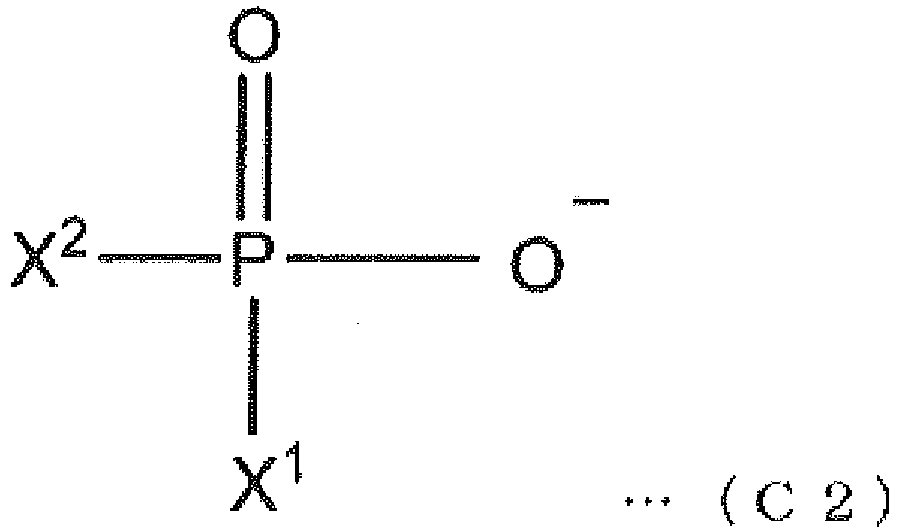
- (7) The purified cellulose fiber, in which a strength (TB) and the elongation at break (EB) of the purified cellulose satisfy a relationship of the following general formula (1):

- (8) The purified cellulose fiber, in which the strength (TB) of the purified cellulose is equal to or higher than 5.1 cN/dtex.
- (9) The purified cellulose fiber, in which the strength (TB) of the purified cellulose is equal to or higher than 5.4 cN/dtex.
- (10) The purified cellulose fiber, in which the strength (TB) and the elongation at break (EB) of the purified cellulose satisfy a relationship of the following general formula (2):

- (11) A fiber-rubber composite which is formed as a composite material with a rubber material by using the purified cellulose.
- (12) A tire which uses the fiber-rubber composite.
- (13) The tire, in which the fiber-rubber composite is used as a carcass ply.
- According to the present invention, the purified cellulose fiber can be produced without generating toxic substances such as carbon disulfide, and thus environmental burdens can be reduced.
In addition, since the fiber-rubber composite of the present invention uses the purified cellulose fiber that is excellent in initial elastic modulus and elongation at break, the utility value thereof is high.
Moreover, since the tire of the present invention uses the fiber-rubber composite of the present invention, and thus has good tire performance. - First, a purified cellulose fiber used in a fiber-rubber composite of the present invention will be described.
The properties of the purified cellulose fiber used in the present invention has an initial elastic modulus of 2.30 cN/dtex or higher in a region having an elongation of 0.5% to 0.7%.
Hereinafter, a preferable manufacturing method of the purified cellulose fiber used in the present invention will be described. - In the present invention, it is preferable that the purified cellulose fiber be obtained by wet spinning or dry-wet spinning a cellulose-dissolved liquid made by dissolving a cellulose raw material in an ionic liquid.
The wet spinning or dry-wet spinning method is not particularly limited, and the purified cellulose fiber may be spinned by well-known spinning methods.
The cellulose-dissolved liquid may be produced by blending an ionic liquid and an organic solvent. - In the present invention, the cellulose raw material is not particularly limited as long as it contains cellulose, and may be a cellulose raw material derived from plants, a cellulose raw material derived from animals, a cellulose raw material derived from microbes, or a regenerated cellulose raw material.
Examples of the cellulose raw material derived from plants include cellulose raw materials derived from unprocessed natural plants such as wood, cotton, linen, or other herbaceous species, and processed cellulose raw materials derived from plants which are subjected to a processing treatment in advance, such as pulp, wood powder, and paper products.
Examples of the cellulose raw material derived from animals include cellulose raw materials derived from sea squirts.
Examples of the cellulose raw material derived from microbes include cellulose raw materials produced by microbes that belong to the genera Aerobacter, Acetobacter, Achromobacter, Agrobacterium, Alacaligenes, Azotobacter, Pseudomonas, Rhizobium, and Sarcina.
Examples of the regenerated cellulose raw material include cellulose raw materials made by regenerating the cellulose raw materials derived from plants, animals, or microbes as described above using well-known methods such as the viscose method.
Particularly, as the cellulose raw material in the present invention, pulp that is appropriately dissolved in an ionic liquid is preferable. - In the present invention, before dissolving the cellulose raw material in a liquid including the ionic liquid, a pretreatment may be performed on the cellulose raw material for the purpose of enhancing solubility in the ionic liquid. As the pretreatment, specifically, a drying treatment, a physical pulverizing treatment such as pulverization or trituration, a chemical modifying treatment using an acid or an alkali, and the like may be performed. All of these may be performed by ordinary methods.
- In the present invention, the ionic liquid is a liquid at 100°C or less, and is referred to as a solvent which is formed from only ions and in which cation portions, anion portions, or both thereof are formed from organic ions.
- The cation portion of the ionic liquid is not particularly limited, and may use a cation portion generally used in ionic liquids.
Preferable examples of the cation portion of the ionic liquid of the present invention include a nitrogen-containing aromatic ion, an ammonium ion, and a phosphonium ion. - As the nitrogen-containing aromatic cation, specific examples thereof include a pyridinium ion, a pyridazinium ion, a pyrimidinium ion, a pyrazinium ion, an imidazolium ion, a pyrazonium ion, an oxazolium ion, a 1,2,3-triazolium ion, a 1,2,4-triazolium ion, a thiazolium ion, a piperidinium ion, and a pyrrolidinium ion.
Particularly, as the nitrogen-containing aromatic cation, the imidazolium ion and the pyrimidinium ion are preferable, and the imidazolium ion expressed by the following General Formula (C3) is more preferable. -

- In the formula (C3), R6 and R7 each independently are an alkyl group having 1 to 10 carbon atoms or an alkenyl group having 2 to 10 carbon atoms.
The alkyl group having 1 to 10 carbon atoms may have any of linear, branched, and cyclic types, the linear or branched type is preferable, and the linear type is more preferable.
Specific examples of the linear alkyl group include a methyl group, an ethyl group, a propyl group, a butyl group, a pentyl group, a hexyl group, a heptyl group, an octyl group, a nonyl group, and a decyl group.
Specific examples of the branched alkyl group include a 1-methylethyl group, a 1,1-dimethylethyl group, a 1-methylpropyl group, a 2-methylpropyl group, a 1,1-dimethylpropyl group, a 2,2-dimethylpropyl group, a 1-methylbutyl group, a 2-methylbutyl group, a 3-methylbutyl group, a 1-methylpentyl group, a 2-methylpentyl group, a 3-methylpentyl group, and a 4-methylpentyl group.
The cyclic alkyl group may be a monocyclic group or a polycyclic group. Specific examples thereof include a monocyclic group such as a cyclopropyl group, a cyclobutyl group, a cyclopentyl group, a cyclohexyl group, a cycloheptyl group, and a cyclooctyl group, and a polycyclic group such as a norbornyl group, an adamantyl group, and an isobornyl group.
In R6 and R7, the number of carbon atoms of the alkyl group is preferably 1 to 8, and more preferably 1 to 4.
As the alkenyl group having 2 to 10 carbon atoms, those obtained by substituting a single bond between carbon atoms in an alkyl group having 2 to 10 carbon atoms with a double bond may be exemplified, and preferable examples thereof include a vinyl group and an allyl group. In addition, the position of the double bond is not particularly limited.
In R6 and R7, the number of carbon atoms of the alkenyl group is preferably 2 to 8, and more preferably 2 to 4.
In addition, R6 and R7 may be the same or may be different from each other. - In the formula (C3), R8 to R10 each independently are a hydrogen atom, or an alkyl group having 1 to 10 carbon atoms.
The alkyl group having 1 to 10 carbon atoms may have any of linear, branched, and cyclic types, the linear or branched type is preferable, and the linear type is more preferable. Examples of the linear, branched, and cyclic alkyl groups include the same group as the alkyl groups of R5 and R6.
In R7 to R9, the number of carbon atoms of the alkyl group is preferably 1 to 6, and more preferably 1 to 3. However, a hydrogen atom other than the alkyl group is even more preferable.
In addition, R7 to R9 may be the same or may be different from each other. - Preferable and specific examples of the imidazolium ion expressed by the formula (C3) are expressed by the following formula (C1).
-

- In addition, preferable and specific examples of the imidazolium ion expressed by the formula (C1) are expressed by the following formulas (C1-1) to (C1-3).
-


- The phosphonium ion is not particularly limited as long as it has "P+", and preferable and specific examples thereof include those expressed by the general formula "R4P+ (a plurality of Rs each independently are a hydrogen atom or a hydrocarbon group having 1 to 30 carbon atoms.)".
The hydrocarbon group having 1 to 30 carbon atoms may be an aliphatic hydrocarbon group or an aromatic hydrocarbon group.
As the aliphatic hydrocarbon group, a saturated hydrocarbon group (alkyl group) is preferable, and the alkyl group may have any of linear, branched, and cyclic types.
The linear alkyl group preferably has 1 to 20 carbon atoms, and more preferably has 1 to 16 carbon atoms. Specific examples of the linear alkyl group include a methyl group, an ethyl group, a propyl group, a butyl group, a pentyl group, a hexyl group, a heptyl group, an octyl group, a nonyl group, a decyl group, a undecyl group, a dodecyl group, a tridecyl group, a tetradecyl group, a pentadecyl group, and hexadecyl group.
The branched alkyl group has 3 to 30 carbon atoms, preferably has 3 to 20 carbon atoms, and more preferably has 3 to 16 carbon atoms. Specific examples of the branched alkyl group include a 1-methylethyl group, a 1,1-dimethylethyl group, a 1-methylpropyl group, a 2-methylpropyl group, a 1,1-dimethylpropyl group, a 2,2-dimethylpropyl group, a 1-methylbutyl group, a 2-methylbutyl group, a 3-methylbutyl group, a 1-methylpentyl group, a 2-methylpentyl group, a 3-methylpentyl group, and a 4-methylpentyl group.
The cyclic alkyl group has 3 to 30 carbon atoms, preferably has 3 to 20 carbon atoms, more preferably has 3 to 16 carbon atoms, and may be a monocyclic group or a polycyclic group. Specific examples of the cyclic alkyl group include a monocyclic group such as a cyclopropyl group, a cyclobutyl group, a cyclopentyl group, a cyclohexyl group, a cycloheptyl group, and a cyclooctyl group, and a polycyclic group such as a norbornyl group, an adamantyl group, and an isobornyl group.
The aromatic hydrocarbon group preferably has 6 to 30 carbon atoms. Specific examples of the aromatic hydrocarbon group include an aryl group such as a phenyl group, a 1-naphthyl group, a 2-naphthyl group, a biphenyl group, and a tolyl group, and an arylalkyl group such as a benzyl group, a phenethyl group, a naphthylmethyl group, and a naphthylethyl group.
A plurality of Rs in the general formula "R4P+" may be the same or different from each other. - Particularly, as the phosphonium cation ion, a cation portion expressed by the following formula (C4) is preferable.
-

- In the formula (C4), R11 to R14 each independently are an alkyl group having 1 to 16 carbon atoms. The alkyl group having 1 to 16 carbon atoms may have any of linear, branched, and cyclic types, the linear or branched type is preferable, and the linear type is more preferable. Examples of the linear, branched, and cyclic alkyl groups include those described above.
In addition, R11 to R14 may be the same or may be different from each other. Particularly, in terms of easy availability, it is preferable that three or more of R11 to R14 be the same. - In the present invention, as the alkyl group of the R11 to R14, a linear or branched alkyl group having 1 to 14 carbon atoms is preferable, a linear or branched alkyl group having 1 to 10 carbon atoms is more preferable, a linear or branched alkyl group having 1 to 8 carbon atoms is even more preferable, and a linear or branched alkyl group having 1 to 4 carbon atoms is particularly preferable.
A preferable and specific example of the cation portion expressed by the formula (C4) is expressed by the following formula (C5). -

- In the present invention, the cation portion is more preferably one or more types selected from the group consisting of an imidazolium ion, a pyridinium ion, an ammonium ion, and a phosphonium ion.
- In the present invention, examples of the anion portion include a halogen ion, a carboxylate ion, a phosphate ion, a phosphonate ion, and a phosphinate ion.
Examples of the halogen ion include a chloride ion, a bromide ion, and an iodide ion, and the chloride ion is preferable.
Examples of the carboxylate ion include a formate ion, an acetate ion, a propionate ion, a butyrate ion, a hexanoate ion, a maleate ion, a fumarate ion, an oxalate ion, a lactate ion, and a pyruvate ion. As the carboxylate ion, the formate ion, the acetate ion, and the propionate ion are preferable.
Particularly, it is preferable that the anion portion have a compound including a phosphorus atom, and any of a phosphate ion, a phosphonate ion, and a phosphinate ion expressed by the following general formula (C2) is more preferable. -

Examples of the phosphonate ion include ions expressed by the following general formula (A1). -

- In the formula (A1), R15 and R16 each independently are a hydrogen atom or an alkyl group, and the alkyl group may have any of linear, branched, and cyclic types. Particularly, the linear or branched alkyl group is preferable. The number of carbon atoms of the alkyl group in R15 and R16 is preferably 1 to 10, more preferably 1 to 6, and even more preferably 1 to 4. In addition, for the industrial reason, an alkyl group having 1 or 2 carbon atoms is particularly preferable. R15 and R16 may be the same or different from each other.
- Among the phosphonate ions, a dimethyl phosphonate ion and a diethyl phosphonate ion are preferable.
- Examples of the phosphinate ion include ions expressed by the following general formula (A2).

- In the formula (A2), R15 is the same as R15 in the formula (A1).
- Among the phosphinate ions, a methyl phosphinate ion is preferable.
- The phosphate ion is expressed by the following general formula (A3).
-

- In addition, other anion portions include pseudohalogen ions. The pseudohalogen ion has similar properties to those of halogen ions. Examples of the pseudohalogen ion include a cyanate ion, an oxocyanate ion, a thiocyanate ion, and a selenocyanate ion.
- In the present invention, it is preferable that the anion portion be formed from a compound including phosphorus described above. In addition, as the compound including phosphorus as the anion portion, a phosphate ion, a phosphonate ion, and a phosphinate ion are particularly preferable.
- An ionic liquid that contains the compound including phosphorus as the anion portion has low viscosity and melting point compared to a case where the anion portion is a halogen ion. Therefore, a purified cellulose fiber using the ionic liquid is superior in terms of being easily spinned.
In addition, the ionic liquid that contains the compound including phosphorus as the anion portion is less likely to reduce the molecular weight of a fiber and has high heat resistance (that is, is less likely to be pyrolyzed at a high temperature) compared to a case where the anion portion is a carboxylate ion. Therefore, when the purified cellulose fiber using the ionic liquid is spinned, the spinning temperature can be set to be high. As a result, the productivity of the purified cellulose fiber at a higher spinning temperature can be ensured. For example, in the case where the anion portion is carboxylate, under the condition in which the spinning temperature is equal to or higher than 130°C, productivity in spinning purified cellulose is reduced. However, in the case where the anion portion is the compound containing phosphorus, even under the high heat condition in which the spinning temperature is 150°C, productivity in spinning purified cellulose can be maintained.
Moreover, in a case where the ionic liquid is reused, the yield of the reuse is high. Therefore, increases in the amount of the ionic liquid needed to continuously produce the purified cellulose fiber, and materials and energy needed to produce the ionic liquid can be prevented. - The ionic liquid in the present invention is formed from the cation portion and the anion portion described above. The combination of the cation portion and the anion portion is not particularly limited, and may be appropriately selected to appropriately dissolve a cellulose raw material.
As the ionic liquid in the present invention, 1-butyl-3-methylimidazolium acetate (C4AmimAc), 1-ethyl-3-methylimidazolium acetate (C2AmimAc), 1-allyl-3-methylimidazolium chloride (AminCl), and 1-ethyl-3-methylimidazolium diethylphosphate (C2mimDEP) are preferable. In addition, as the ionic liquid in the present invention, 1-ethyl-3-methylimidazolium methylphosphonate (C2mimMEP) and 1-ethyl-3-methylimidazolium phosphinate (C2mimHPO) are more preferable.
In the case where the above-mentioned ionic liquid is used, compared to a case where, for example, 1-butyl-3-imidazolium chloride is used as the ionic liquid, reduction in the molecular weight of the fiber can be prevented. - It is preferable that the viscosity of the ionic liquid be low. In a case where an ionic liquid having a high viscosity is used, it becomes difficult to dissolve the cellulose raw material in the ionic liquid. In a case where dissolving the cellulose raw material is difficult, a large amount of the undissolved and remained cellulose raw material is generated, and thus clogging of a filter occurs during spinning. As a result, productivity is reduced. In addition, when the undissolved and remained cellulose raw material is incorporated in the fiber, they become the fracture nucleus of the fiber. As a result, the quality of the fiber is degraded. On the other hand, in the case where the ionic liquid having a low viscosity is used, when the cellulose raw material is dissolved in the ionic liquid, the cellulose raw material appropriately permeates into the ionic liquid. Therefore, cellulose can be easily dissolved in the ionic liquid.
- In the present invention, a liquid in which the cellulose raw material is dissolved includes the ionic liquid.
The liquid may contain or may not contain liquid components other than the ionic liquid. Specific examples of the liquid components other than the ionic liquid include an organic solvent. - The organic solvent is not particularly limited as long as it is not the ionic liquid, and may be appropriately selected considering the compatibility with the ionic liquid, viscosity, and the like.
Particularly, it is preferable that the organic solvent be one or more types selected from the group consisting of an amide-based solvent, a sulfoxide-based solvent, a nitrile-based solvent, a cyclic ether-based solvent, and an aromatic amine-based solvent. - Examples of the amide-based solvent include N,N-dimethylformamide, N,N-dimethylacetamide, 1-methyl-2-pyrrolidone, and 1-vinyl-2-pyrrolidone. Examples of the sulfoxide-based solvent include dimethylsulfoxide and hexamethylene sulfoxide.
Examples of the nitrile-based solvent include acetonitrile, propionitrile, and benzonitrile.
Examples of the cyclic ether-based solvent include 1,3-dioxolan, tetrahydrofuran, tetrahydropyran, 1,3-dioxane, 1,4-dioxane, and 1,3,5-trioxane.
Examples of the aromatic amine-based solvent include pyridine. - In the case where the above-described organic solvent is used, the mixing mass ratio between the ionic liquid and the organic solvent is preferably 6:1 1 to 0.1:1, more preferably 5:1 to 0.2:1, and even more preferably 4:1 to 0.5:1. At the mixing mass ratio in the above-described ranges, a solvent that causes the cellulose raw material to easily swell can be obtained.
In addition, the use amount of the organic solvent is not particularly limited, and is preferably 1 to 30 parts by mass with respect to 1 part by mass of the cellulose raw material, preferably 1 to 25 parts by mass, and more preferably 3 to 20 parts by mass. At the use amount in the above range, a cellulose-dissolved liquid having an appropriate viscosity can be obtained.
By using the organic solvent in combination with the ionic liquid, the solubility of the cellulose raw material is further enhanced. - In the present invention, a method of dissolving the cellulose raw material in the liquid that contains the ionic liquid is not particularly limited, and for example, a cellulose-dissolved liquid can be obtained by causing the liquid that contains the ionic liquid to come into contact with the cellulose raw material, and heating or stirring the resultant as necessary.
The method of causing the liquid that contains the ionic liquid to come into contact with the cellulose raw material is not particularly limited, and for example, the cellulose raw material may be added to the liquid that contains the ionic liquid or the liquid that contains the ionic liquid may be added to the cellulose raw material.
In a case where heating is performed during dissolving, the heating temperature is preferably 30°C to 200°C, more preferably 70°C to 180°C, and even more preferably 80°C to 150°C. By performing heating, the solubility of the cellulose raw material is further enhanced.
The stirring method is not particularly limited, and the liquid that contains the ionic liquid and the cellulose raw material may be mechanically stirred using a stirrer, a stirring blade, a stirring rod, or the like, or the liquid that contains the ionic liquid and the cellulose raw material may be sealed in an airtight container and stirred by shaking the container. The stirring time is not particularly limited, and it is preferable that stirring be performed until the cellulose raw material is appropriately dissolved. Otherwise, the liquid that contains the ionic liquid and the cellulose raw material may be dissolved by an extruder having a single shaft or a plurality of shafts, a kneader, or the like. - In addition, in the case where the liquid that contains the ionic liquid of the present invention contains the organic solvent as well as the ionic liquid, the organic solvent and the ionic liquid may be mixed with each other in advance, the organic solvent may be added to be dissolved after the ionic liquid and the cellulose raw material are mixed with each other, or the ionic liquid may be added to be dissolved after the organic solvent and the cellulose raw material are mixed with each other.
Particularly, it is preferable that a mixed liquid be prepared by mixing the organic solvent and the ionic liquid with each other in advance. Here, it is preferable that the organic solvent and the ionic liquid be heated and stirred at 70°C to 180°C for 5 to 30 minutes and mixed until the liquid that contains the ionic liquid is uniformized, so as to be uniformly mixed with each other. - By using the cellulose-dissolved liquid obtained by the above method, a purified cellulose fiber can be spinned by the well-known spinning methods such as the dry-wet spinning or wet spinning mentioned above.
- The purified cellulose fiber obtained by the above method has an initial elastic modulus of 2.30 cN/dtex or higher in a region having an elongation of 0.5% to 0.7%.
Regarding the purified cellulose fiber obtained by the above method, the relationship between the strength TB (cN/dtex) and the elongation at break EB (%) at 25°C satisfies the following formulas (1) and (2), and a strength holding ratio (HT/TB) assuming that the strength is HT (cN/dtex) at 150°C is 70 to 100 (%). -


- The strength (TB) is more preferably 5.1 cN/dtex or higher, and even more preferably 5.4 cN/dtex or higher.
The breaking strength (EB) is preferably in a range of 10% to 30%, more preferably in a range of 10% to 25%, and even more preferably 10% to 20%.
The initial elastic modulus is preferably in a range of 2.30 cN/dtex to 8.0 cN/dtex, more preferably in a range of 2.30 cN/dtex to 6.0 cN/dtex, and even more preferably in a range of 2.30 cN/dtex to 5.0 cN/dtex. In a case where the initial elastic modulus is below the above ranges, steering stability and cut resistance are degraded. In a case where the initial elastic modulus is above the above ranges, molding a tire using the purified cellulose is difficult, which has an adverse effect on the vibration characteristics of the tire. In addition, there is an adverse effect that results in bad ride quality for a person who rides in the car. - By using the fiber-rubber composite of the present invention which uses the purified cellulose fiber that is excellent in initial elastic modulus and elongation at break for a carcass ply, a belt ply, or a belt protecting layer, a tire having high performance can be obtained. Particularly, it is preferable that the fiber-rubber composite of the present invention be used for a carcass ply. Accordingly, a tire having excellent steering stability can be obtained.
In addition, the fiber-rubber composite may be used for at least one of the carcass ply, the belt ply, and the belt protecting layer. However, the fiber-rubber composite may also be used for all the carcass ply, the belt ply, and the belt protecting layer. - A cord produced from the cellulose fiber employs a single twisted structure having a single twisted filament bundle, or a double twisted structure made by finally twisting a plurality of lines of primarily twisted filament bundles. The fineness per single cord is preferably 1400 to 6000 dtex, and more preferably 1400 to 4000 dtex. When a cord having a fineness of less than 1400 dtex is used, the number of carcasses needs to be increased in order to maintain tire strength, resulting in increase in tire weight. In a case where a cord having a fineness of higher than 6000 dtex is used, the thickness of the carcass layer is unnecessarily increased, resulting in an increase in tire weight.
- The twisting coefficient of the cord is preferably 0.30 to 0.80, and more preferably 0.50 to 0.70.
The twisting coefficient tanθ is obtained by following formula (3).
D: total decitex value
P: cord specific gravity
T: the number of twists (twists/cm) - The cord is dipped into a general adhesive such as RFL (resolein-formalin-latex) to be subjected to a dipping treatment, and is subjected to heat treatments including a drying process and a baking process. The dipped cord produced by the above method is topped with a coating rubber, thereby producing a fiber-rubber composite.
- As a rubber composition used in the fiber-rubber composite of the present invention, for example, a natural rubber (NR) and a synthetic rubber having a carbon-carbon double bond may be singly or in a combination of two or more thereof.
Examples of the synthetic rubber include: a polyisoprene rubber (IR), a polybutadiene rubber (BR), a polychloroprene rubber, and the like which are homopolymers of a conjugated diene compound such as isoprene, butadiene, and chloroprene; a styrene-butadiene copolymer rubber (SBR), a vinylpyridine-butadiene-styrene copolymer rubber, an acrylonitrile-butadiene copolymer rubber, an acrylic acid-butadiene copolymer rubber, a methacrylic acid-butadiene copolymer rubber, a methyl acrylate-butadiene copolymer rubber, a methyl methacrylate-butadiene copolymer rubber, and the like which are copolymers of the conjugated diene compound and a vinyl compound such as styrene, acrylonitrile, vinylpyridine, acrylic acid, methacrylic acid, alkyl acrylates, and alkyl methacrylates; copolymers (for example, an isobutylene-isoprene copolymer rubber (IIR)) of olefins such as ethylene, propylene, and isobutylene and a diene compound; copolymers (EPDM) (for example, an ethylene-propylene-cyclopentadiene ternary copolymer, an ethylene-propylene-5-ethylidene-2-norbornene ternary copolymer, and an ethylene-propylene-1,4-hexadiene ternary copolymer) of olefins and unconjugated dienes; and halides of the above various rubbers, for example, a chlorinated isobutylene-isoprene copolymer rubber (Cl-IIR), a brominated isobutylene-isoprene copolymer rubber (Br-IIR), and a ring-opening polymer of norbornene.
The above synthetic rubbers may be blended with a saturated elastic body such as a polyalkenamer (for example, polypentenamer) obtained by ring-opening polymerization of a cycloolefin, a rubber (for example, a polyepichlorohydrin rubber which can be subjected to sulfur vulcanization) obtained by ring-opening polymerization of an oxirane ring, or a polypropylene oxide rubber. - In the rubber composition used in the present invention, sulfur, organic sulfur compounds, and other cross-linking agents may be blended at a ratio of preferably 0.01 to 10 parts by mass, and more preferably 1 to 5 parts by mass with respect to 100 parts by mass of the rubber component. In addition, in the rubber composition, a vulcanization accelerator may be blended at a ratio of preferably 0.01 to 10 parts by mass, and more preferably 0.5 to 5 parts by mass with respect to 100 parts by mass of the rubber component. In this case, the type of the vulcanization accelerator is not limited, but by using dibenzothiazyl sulfide (DM), diphenylguanidine (D), and the like, the vulcanizing time can be shortened.
In addition, the rubber composition used in the present invention may be blended with, for example, oils such as mineral oils including paraffin-based, naphthene-based, and aromatic process oils, a co-oligomer of ethylene-α-olefin, paraffin wax, and liquid paraffin, and vegetable oils including castor oil, cottonseed oil, linseed oil, rapeseed oil, soybean oil, palm oil, coconut oil, and peanut oil.
Moreover, blending agents used in typical rubber industries such as fillers including carbon black, silica, calcium carbonate, calcium sulfate, clay, and mica; vulcanization accelerator assistants including zinc oxide and stearic acid; and antioxidants may be added to the rubber composition used in the present invention according to routine methods depending on the purposes and applications. - The tire of the present invention can be manufactured by performing typical molding and vulcanization processes using the fiber-rubber composite of the present invention.
- Next, the present invention will be described in more detail by showing Examples, but the present invention is not limited to the following Examples.
- A cellulose-dissolved liquid in which pulp is dissolved in 1-butyl-3-methylimidazolium acetate (C4AmimAc), 1-ethyl-3-methylimidazolium acetate (C2AmimAc), 1-allyl-3-methylimidazolium chloride (AminCl), 1-ethyl-3-methylimidazolium diethylphosphate (C2mimDEP), 1-ethyl-3-methylimidazolium methylphosphonate (C2mimMEP), 1-ethyl-3-methylimidazolium phosphinate (C2mimHPO), or N-methylmorpholine N-oxide (NMMO) was heated to a spinning temperature. Thereafter, the heated solution was extruded in a coagulating bath by an extruder and was subjected to washing and drying processes, thereby obtaining multifilaments of Examples 1 to 23 and Comparative Examples 1 to 6 shown in Tables 1 to 4.
- The properties of the multifilament (fiber) in each of the Examples and the Comparative Examples were measured by the following test methods, and the results are shown in Tables 1 to 4. In addition, in the item regarding "Productivity" of Tables 1 to 4, symbol O indicates that the amount of fiber for producing a tire can be produced, and symbol X indicates that it is difficult to produce the amount of fiber for producing a tire.
- 100 m of the fiber was taken, dried at 130°C for 30 minutes, and was left in a dry desiccator to cool until the temperature becomes the room temperature. Thereafter, the weight thereof was measured. Since 1 g per 10,000 m becomes 1 dtex, the fineness was calculated from the weight of 100 m of the fiber.
- A fiber that was false-twisted four times per 10 cm was subjected to a tensile test using a tensile tester under the conditions of 25°C and 55%RH. The elongation at break is an elongation at the time of breaking, and the initial elastic modulus was obtained from the gradient of a tangential line of a stress-strain curve at an elongation of 0.5 to 0.7%.
In addition, although the unit of initial elastic modulus is [cN/dtex·%], the unit of initial elastic modulus in the present invention was defined as the notation [cN/dtex]. - After the obtained multifilament is primarily twisted, two pieces of the multifilament were combined and finally twisted, thereby producing a cord.
- The cord was dipped in the RFL (resolcin-formalin-latex) adhesive to be subjected to a dipping treatment, and was subjected to heat treatments including a drying process and a baking process. The drying process was performed under the conditions of 150°C×150 seconds and a tension of 1×10⁻³ N/dtex. The baking process was performed after the drying process under the conditions of the same temperature, same time, and same tension as those of the drying process. As a result, a dipped cord was produced.
- By calendering the dipped cord with a coating rubber, a carcass ply material was produced.
- Using the dipped cord topped with the coating rubber, typical molding and vulcanization processes were performed, thereby producing a tire 225/45R17.
- The tire in each of the Examples and the Comparative Examples was mounted in a car, a real car feeling test was performed at a speed of 60 to 200 km/h. The items including (i) straight-running stability, (ii) turning stability, (iii) feeling of rigidity, (iv) handling, and the like were graded 1 to 10 points, and the points of each of the items were averaged to measure the steering stability.
In addition, the evaluation was performed by two expert drivers, the grades of the two drivers were averaged to index a control tire of the Comparative Example 1 as 100. A larger index indicates good steering stability. - The tire was rim-assembled at a pneumatic pressure of 2.0 kgf/cm2, and was fixed to a tester under the unloaded condition. In addition, a plunger pin having a hemispherical surface (diameter: 19 mm) at the tip end was pressed to reach the maximum width position of a tire side portion under the condition of 50±2.5 mm/min. At this time, a plunger energy (PE) was calculated by the following formula (4) from a plunger movement amount Y(cm) until a plunger comes into contact with the tire and is broken, and a plunger pressing force F (kg) at break of the tire, and the control tire of the Comparative Example 1 was indexed as 100.

- The tire was mounted to a vehicle, and was caused to ride on a vertically steep curbstone having a height of 120 mm and a radius of curvature at the corner of 20 mm under the condition of a speed of 15 km/h in a direction in which the approach angle is 15 degrees. The same test was performed on the same test tire while reducing the internal pressure from 3 kg/cm2 by 0.1 kg/cm2, and an internal pressure p (kg/cm2) at which the side portion has a cur burst was obtained. At the internal pressure p or less, the side portion is likely to be bent, and cut bursts occur in all the cases. Therefore, it was determined that the side cut resistance was good as the internal pressure p was reduced, whereas cut bursts had easily occurred and the side cut resistance was poor as the internal pressure p was increased. When it is assumed that the internal pressure of the tire of the Comparative Examples 1 was p0 and the internal pressure of the test tire with respect to the internal pressure p0 was p1, the side cut resistance index (As) can be expressed as the formula As=p0÷p1×100. The above test was performed on each of the three same tires, and on the basis of the average internal pressure p of the three values, the side cut resistance index (As) was obtained.
- As can be seen from Tables 1 to 4, in the Examples 1 to 23, the balance between the initial elastic modulus and the elongation at break of the purified cellulose fiber used was good, and consequently, good tire performance was obtained.
On the other hand, in the Comparative Example 1, the elongation at break of the purified cellulose fiber used was low, and the energy until the cord was cut was low, so that good tire performance could not be obtained. In the Comparative Example 2, the initial elastic modulus of the purified cellulose fiber used was low, and good tire performance was not obtained. In the Comparative Examples 3 to 6, stability (productivity) to such a degree that the amount of fiber at which a fiber-rubber composite can be produced was produced could not be obtained, and the fiber-rubber composite and a tire using this could not be produced. -
[Table 1] Example 1 Example 2 Example 3 Example 4 Example 5 Example 6 Example 7 Example 8 Solvent C4mimAc C2mimAc AmimCl C2mimDEP C2mimDEP C2mimDEP C2mimDEP C2mimDEP Cellulose concentration [wt%] 10 15 12.5 13.8 8 14.3 15.7 15.0 Air-gap [mm] 60 67 63 55 70 54 84 89 Coagulating bath Water Water Water Water Water Water Water Water Spinning Temperature [°C] 110 110 120 130 140 130 140 140 Strength [cN/dtex] 5.3 5.1 5.5 4.6 4.9 5.1 5.7 5.5 Elongation at break [%] 10.5 12.9 10.1 13.4 7.9 6.2 5.1 14.3 TB/EB-0.52 18.0 19.3 18.3 17.7 14.4 13.2 13.3 21.9 TB×EB 55.7 65.8 55.6 61.6 38.7 31.6 29.1 78.7 Initial elastic modulus 2.74 2.45 2.83 2.31 3.74 4.57 4.98 2.32 Fineness [dtex] 1842 1856 1847 1798 1837 1866 1812 1843 Structure 1840 dtex/2 1840 dtex/2 1840 dtex/2 1840 dtex/2 1840 dtex/2 1840 dtex/2 1840dex/2 1840 dtex/2 Number of primary twists [twists/10 cm] 47 47 47 47 47 47 47 47 Number of final twists [twists/10 cm] 47 47 47 47 47 47 47 47 Steering stability [index 107 105 110 102 116 125 124 101 Plunger energy [index] 190 230 190 190 140 110 100 170 Side cut resistance index] 180 190 170 160 130 105 100 190 Productivity ○ ○ ○ ○ ○ ○ ○ ○ * Regarding productivity, O indicates that the amount of fiber at which a tire can be produced can be produced, and X indicates that it is difficult to produce the amount of fiber at which a tire can be produced.
* Abbreviations of solvents are shown as follows:
C4mimAc: 1-butyl-3-methylimidazolium acetate
C2mimAc: 1-ethyl-3-methylimidazolium acetate
AmimCl: 1-allyl-3-methylimidazolium chloride
C2mimDEP: 1-ethyl-3-methylimidazolium diethylphosphate
C2mimMEP: 1-ethyl-3-methylimidazolium methylphosphonate
C2mimHPO: 1-ethyl-3-methylimidazolium phosphinate
NMMP: N-methylmorpholine N-oxide -
[Table 2] Example 9 Example 10 Example 11 Example 12 Example 13 Example 14 Example 15 Example 16 Solvent C2mim DEP C2mimDEP C2mimDEP C2mimDEP C2mimDEP C2mimHPO C2mimDEP C2mimDEP Cellulose concentration [wt%] 12.4 12.8 13.4 13.2 16.5 16.8 14.2 15.8 Air-gap [mm] 52 49 69 65 60 59 73 67 Coagulating bath Water Water Water Water Water Water Water Water Spinning Temperature [°C] 140 140 140 140 130 140 140 130 Strength [cN/dtex] 6.8 5.4 3.9 8.2 6.1 4.7 7.8 7.9 Elongation at break [%] 10.2 13.4 10.2 9.4 12.7 7.4 10.0 7.2 TB/EB-0.52 22.7 20.8 13.0 26.3 22.9 13.3 25.8 22.1 TB×EB 69.4 72.4 39.8 77.1 77.5 34.8 78.0 56.9 Initial elastic modulus 2.96 2.35 2.87 3.17 2.34 3.97 3.03 4.08 Fineness [dtex] 1807 1831 1851 1874 1803 1844 1842 1889 Structure 1840 dtex/2 1840 dtex/2 1840 dtex/2 1840 dtex/2 1840 dtex/2 1840 dtex/2 1840 dtex/2 1840 dtex/2 Number of primary twists [twists/10 cm] 47 47 47 47 47 47 47 47 Number or final twists [twists/10 cm] 47 47 47 47 47 47 47 47 Steering stability [index] 106 102 106 107 103 117 108 119 Plunger energy [index] 190 190 120 190 170 120 180 190 Side cut resistance [index] 180 190 160 150 190 130 140 110 Productivity ○ ○ ○ ○ ○ ○ ○ ○ -
[Table 3] Example 17 Example 18 Example 19 Example 20 Example 21 Example 22 Example 23 Solvent C2mimDEP C2mimDEP C2mimMEP C2mimMEP C2mimDEP C2mimMEP C2mimDEP Cellulose concentration [wt%] 15.8 13.6 16.7 13.0 14.4 15.0 13.7 Air-gap [mm] 67 68 58 55 59 61 46 Coagulating bath Water Water Water Water Water Water Water Spinning Temperature [°C] 140 140 140 140 130 140 140 Strength [cN/dtex] 5.4 5.2 4.2 5.1 5.4 5.5 7.4 Elongation at break [%] 11.9 15.1 17.4 10.0 11.7 10.5 10.6 TB/EB-0.52 19.6 21.3 18.5 16.9 19.4 18.7 25.3 TB×EB 64.3 78.5 73.1 51.0 63.2 57.8 78.4 Initial elastic modulus 2.53 2.31 2.30 2.94 2.47 2.83 2.78 Fineness [dtex] 1865 1891 1808 1812 1890 1792 1872 Structure 1840 dtexl2 1840 dtex/2 1840 dtex/2 1840 dtex/2 1840 dtex/2 1840 dtex/2 1840 dtex/2 Number of primary twists [twists/10 cm] 47 47 47 47 47 47 47 Number of final twists [twists/10 cm] 47 47 47 47 47 47 47 Steering stability [index] 104 102 102 109 104 109 108 Plunger energy [index] 170 190 190 170 180 180 190 Side cut resistance [index] 190 160 170 170 180 170 180 Productivity ○ ○ ○ ○ ○ ○ ○ -
[Table 4] Comparative Example 1 Comparative Example 2 Comparative Example 3 Comparative Example 4 Comparative Example 5 Comparative Example 6 Solvent NMMO NMMO C2mimAc C2mimDEP C2mimMEP C2mimDEP Cellulose concentration [wt%] 10 13.5 16.2 18.4 17.7 17.7 Air-gap [mm] 73 26 71 78 64 64 Coagulating bath Water Water Water Water Water Water Spinning Temperature [°C] 100 90 150 90 160 170 Strength [cN/dtex] 5.0 3.3 9.2 6.6 6.6 6 Elongation at break [%] 5.8 13.2 8.8 3.4 12.4 13.5 TB/EB-0.52 12.5 12.6 28.5 12.5 24.4 23.2 TB×EB 29.0 43.6 81.0 22.4 81.8 81.0 Initial elastic modulus 2.25 1.35 2.29 2.28 2.26 2.15 Fineness [dtex] 1863 1861 1728 1842 1842 1867 Structure 1840 dtex/2 1840 dtex/2 1840 dtex/2 1840 dtex/2 1840 dtex/2 1840 dtex/2 Number of primary twists [twists/10 cm] 47 47 47 47 47 47 Number of final twists [twists/10 cm] 47 47 47 47 47 47 Steering stability [index] 100 89 - 100 - - Plunger energy [index] 100 100 - 70 - - Side cut resistance [index] 100 100 - 60 - - Productivity ○ ○ X X X X - According to the present invention, the purified cellulose fiber can be produced without generating toxic substances such as carbon disulfide. Therefore, environmental burdens can be reduced. In addition, the purified cellulose fiber that is excellent in initial elastic modulus and elongation at break is used in the fiber-rubber composite of the present invention. Therefore, the utility value thereof is high. Moreover, the fiber-rubber composite of the present invention is used in the tire of the present invention. Therefore, good tire performance is provided.
Claims (13)
- A purified cellulose fiber which has an initial elastic modulus of 2.30 cN/dtex or higher in a region having an elongation of 0.5% to 0.7%,
wherein the purified cellulose fiber is made by wet spinning or dry-wet spinning a cellulose-dissolved liquid made by dissolving a cellulose raw material in an ionic liquid. - The purified cellulose fiber according to claim 1,
wherein an elongation at break (EB) of the purified cellulose is 10.0% or more. - The purified cellulose fiber according to claim 1 or 2,
wherein the ionic liquid includes a cation portion and an anion portion, and
the cation portion is one selected from the group consisting of an imidazolium ion, a pyridinium ion, an ammonium ion, and a phosphonium ion. - The purified cellulose fiber according to any one of claims 1 to 3,
wherein the cation portion is an imidazolium ion expressed by the following general formula (C1):
- The purified cellulose fiber according to any one of claims 1 to 4,
wherein the anion portion is formed from a compound including phosphorus. - The purified cellulose fiber according toany one of claims 1 to 5,
wherein the compound including phosphorus of the anion portion is any of a phosphate ion, a phosphonate ion, and a phosphinate ion expressed by the following general formula (C2):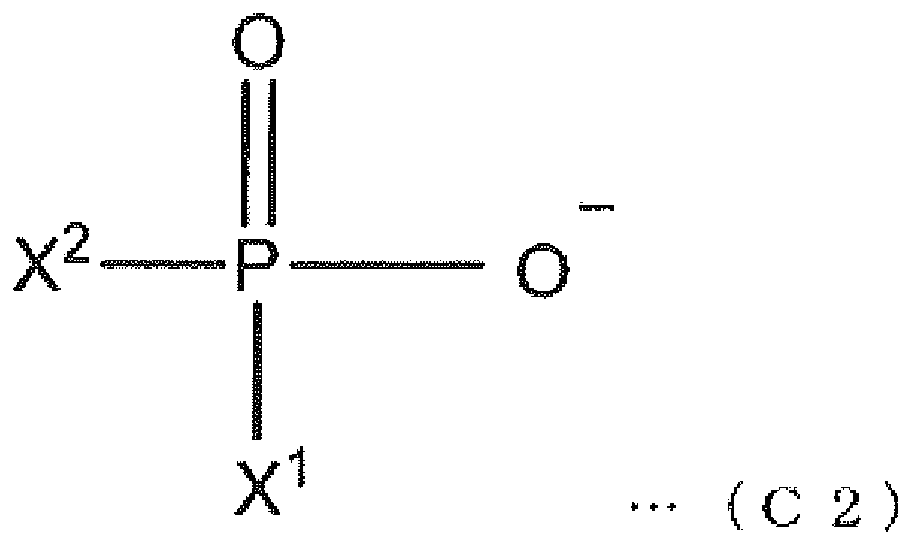
- The purified cellulose fiber according to any one of claims 1 to 6,
wherein a strength (TB) and the elongation at break (EB) of the purified cellulose satisfy a relationship of the following general formula (1):
- The purified cellulose fiber according to any one of claims 1 to 7,
wherein the strength (TB) of the purified cellulose is equal to or higher than 5.1 cN/dtex. - The purified cellulose fiber according to any one of claims 1 to 8,
wherein the strength (TB) of the purified cellulose is equal to or higher than 5.4 cN/dtex. - The purified cellulose fiber according to any one of claims 1 to 8,
wherein the strength (TB) and the elongation at break (EB) of the purified cellulose satisfy a relationship of the following general formula (2):
- A fiber-rubber composite which is formed as a composite material with a rubber material by using the purified cellulose according to any one of claims 1 to 10.
- A tire which uses the fiber-rubber composite according to claim 11.
- The tire according to claim 12,
wherein the fiber-rubber composite is used as a carcass ply.
Applications Claiming Priority (2)
| Application Number | Priority Date | Filing Date | Title |
|---|---|---|---|
| JP2010267898 | 2010-11-30 | ||
| PCT/JP2011/077697 WO2012074019A1 (en) | 2010-11-30 | 2011-11-30 | Purified cellulose fibers, fiber-rubber complex, and tire |
Publications (3)
| Publication Number | Publication Date |
|---|---|
| EP2647744A1 true EP2647744A1 (en) | 2013-10-09 |
| EP2647744A4 EP2647744A4 (en) | 2014-05-21 |
| EP2647744B1 EP2647744B1 (en) | 2018-01-03 |
Family
ID=46171945
Family Applications (1)
| Application Number | Title | Priority Date | Filing Date |
|---|---|---|---|
| EP11845200.2A Not-in-force EP2647744B1 (en) | 2010-11-30 | 2011-11-30 | Purified cellulose fibers, fiber-rubber complex, and tire |
Country Status (5)
| Country | Link |
|---|---|
| US (1) | US20130248077A1 (en) |
| EP (1) | EP2647744B1 (en) |
| JP (1) | JP5851418B2 (en) |
| CN (1) | CN103328701B (en) |
| WO (1) | WO2012074019A1 (en) |
Cited By (1)
| Publication number | Priority date | Publication date | Assignee | Title |
|---|---|---|---|---|
| EP3138698A4 (en) * | 2014-06-06 | 2017-06-14 | Bridgestone Corporation | Tire |
Families Citing this family (10)
| Publication number | Priority date | Publication date | Assignee | Title |
|---|---|---|---|---|
| JP5957214B2 (en) * | 2010-11-30 | 2016-07-27 | 株式会社ブリヂストン | Cord manufacturing method, fiber-rubber composite manufacturing method, and tire manufacturing method |
| JP5948144B2 (en) * | 2012-05-21 | 2016-07-06 | 株式会社ブリヂストン | Method for producing purified polysaccharide fiber, method for producing rubber-fiber composite, method for producing reinforcing cord, method for producing rubber-cord composite, and method for producing tire |
| JP5948141B2 (en) * | 2012-05-21 | 2016-07-06 | 株式会社ブリヂストン | Process for producing purified polysaccharide fiber, cord, rubber-cord composite, tire and run-flat tire |
| JP5948143B2 (en) * | 2012-05-21 | 2016-07-06 | 株式会社ブリヂストン | Hybrid cord manufacturing method, rubber-cord composite manufacturing method, and tire manufacturing method |
| US9670596B2 (en) | 2012-05-21 | 2017-06-06 | Bridgestone Corporation | Production method for purified polysaccharide fibers, purified polysaccharide fibers, fiber-rubber complex, and tire |
| JP5948142B2 (en) * | 2012-05-21 | 2016-07-06 | 株式会社ブリヂストン | Cord manufacturing method, rubber-cord composite manufacturing method, and tire manufacturing method |
| JP5948145B2 (en) * | 2012-05-21 | 2016-07-06 | 株式会社ブリヂストン | Method for producing purified polysaccharide fiber, method for producing rubber-fiber composite, method for producing rubber-cord composite, and method for producing tire |
| CN104508194A (en) * | 2012-05-21 | 2015-04-08 | 株式会社普利司通 | Cord, rubber-cord composite structure, and tire |
| JP2014227619A (en) * | 2013-05-21 | 2014-12-08 | 株式会社ブリヂストン | Method of producing refined polysaccharide fiber, refined polysaccharide fiber and tire |
| WO2025263495A1 (en) * | 2024-06-21 | 2025-12-26 | オーミケンシ株式会社 | Regenerated cellulose fiber, article containing same, and method for producing regenerated cellulose fiber |
Family Cites Families (17)
| Publication number | Priority date | Publication date | Assignee | Title |
|---|---|---|---|---|
| US1943176A (en) | 1930-09-27 | 1934-01-09 | Chem Ind Basel | Cellulose solution |
| JPS60144322A (en) | 1984-01-06 | 1985-07-30 | Matsushita Electric Works Ltd | Epoxy resin molding material |
| JP4523702B2 (en) * | 1999-06-21 | 2010-08-11 | 株式会社ブリヂストン | Pneumatic radial tire |
| JP2002002217A (en) * | 2000-06-15 | 2002-01-08 | Bridgestone Corp | Pneumatic tire |
| US6824599B2 (en) * | 2001-10-03 | 2004-11-30 | The University Of Alabama | Dissolution and processing of cellulose using ionic liquids |
| CA2438445C (en) * | 2002-12-26 | 2006-11-28 | Hyosung Corporation | Lyocell multi-filament for tire cord and method of producing the same |
| DE102004031025B3 (en) * | 2004-06-26 | 2005-12-29 | Thüringisches Institut für Textil- und Kunststoff-Forschung e.V. | Method and device for the production of shaped articles from cellulose |
| KR100575388B1 (en) | 2004-12-30 | 2006-05-03 | 주식회사 효성 | Highly homogeneous cellulose solution and fibers made therefrom |
| KR101370200B1 (en) * | 2005-12-23 | 2014-03-05 | 바스프 에스이 | Solvent system based on molten ionic liquids, its production and use for producing regenerated carbohydrates |
| JP2010132558A (en) * | 2007-03-16 | 2010-06-17 | Nisshinbo Holdings Inc | Treating agent for polysaccharides |
| CN101328626A (en) | 2007-06-21 | 2008-12-24 | 中国科学院化学研究所 | A method for continuously preparing regenerated cellulose fibers |
| CA2702761A1 (en) * | 2007-11-01 | 2009-05-07 | Bausch & Lomb Incorporated | Non-aqueous water-miscible materials as vehicles for drug delivery |
| EP2062922A1 (en) * | 2007-11-14 | 2009-05-27 | Basf Se | Method for manufacturing regenerated biopolymers and regenerated products created therewith |
| JP5190277B2 (en) * | 2008-01-31 | 2013-04-24 | 株式会社Kri | Method for producing fine fibers of cellulose and chitin |
| WO2009118262A1 (en) * | 2008-03-27 | 2009-10-01 | Cordenka Gmbh | Cellulosic mouldings |
| KR20100062907A (en) * | 2008-12-01 | 2010-06-10 | 스미토모 고무 고교 가부시키가이샤 | Rubber composition for sidewall reinforcement layer or sidewall, and tire |
| CN101492837B (en) * | 2009-03-03 | 2012-05-30 | 江苏盛丰登泰生物技术有限公司 | A kind of preparation method of bacterial cellulose fiber with high degree of polymerization |
-
2011
- 2011-11-30 EP EP11845200.2A patent/EP2647744B1/en not_active Not-in-force
- 2011-11-30 CN CN201180066047.2A patent/CN103328701B/en not_active Expired - Fee Related
- 2011-11-30 WO PCT/JP2011/077697 patent/WO2012074019A1/en not_active Ceased
- 2011-11-30 JP JP2012546919A patent/JP5851418B2/en not_active Expired - Fee Related
- 2011-11-30 US US13/989,961 patent/US20130248077A1/en not_active Abandoned
Cited By (1)
| Publication number | Priority date | Publication date | Assignee | Title |
|---|---|---|---|---|
| EP3138698A4 (en) * | 2014-06-06 | 2017-06-14 | Bridgestone Corporation | Tire |
Also Published As
| Publication number | Publication date |
|---|---|
| EP2647744B1 (en) | 2018-01-03 |
| EP2647744A4 (en) | 2014-05-21 |
| CN103328701B (en) | 2016-05-04 |
| US20130248077A1 (en) | 2013-09-26 |
| WO2012074019A1 (en) | 2012-06-07 |
| CN103328701A (en) | 2013-09-25 |
| JPWO2012074019A1 (en) | 2014-05-19 |
| JP5851418B2 (en) | 2016-02-03 |
Similar Documents
| Publication | Publication Date | Title |
|---|---|---|
| EP2647744B1 (en) | Purified cellulose fibers, fiber-rubber complex, and tire | |
| JP5957214B2 (en) | Cord manufacturing method, fiber-rubber composite manufacturing method, and tire manufacturing method | |
| EP2853623A1 (en) | Cord, rubber-cord composite structure, and tire | |
| KR101703404B1 (en) | Production method for purified polysaccharide fibers, purified polysaccharide fibers, fiber-rubber complex, and tire | |
| DE112008002617B4 (en) | A sidewall rubber composition and use thereof, and an abrasion strip rubber composition and use thereof | |
| EP3000919B1 (en) | Process for producing purified polysaccharide fiber, purified polysaccharide fiber and tire | |
| JP2013241702A (en) | Method for producing polysaccharide fiber, polysaccharide fiber, cord, fiber-rubber composite, and tire | |
| JP2013241703A (en) | Purified cellulose fiber, fiber-rubber composite, and tire | |
| JP5948143B2 (en) | Hybrid cord manufacturing method, rubber-cord composite manufacturing method, and tire manufacturing method | |
| JP5948144B2 (en) | Method for producing purified polysaccharide fiber, method for producing rubber-fiber composite, method for producing reinforcing cord, method for producing rubber-cord composite, and method for producing tire | |
| JP5948147B2 (en) | Process for producing purified polysaccharide fiber, purified polysaccharide fiber, fiber-rubber composite, and tire | |
| JP5948141B2 (en) | Process for producing purified polysaccharide fiber, cord, rubber-cord composite, tire and run-flat tire | |
| JP6002440B2 (en) | Method for producing polysaccharide solid, polysaccharide solid, cord, fiber-rubber composite, film-rubber composite, and tire | |
| JP5948142B2 (en) | Cord manufacturing method, rubber-cord composite manufacturing method, and tire manufacturing method | |
| JP5993614B2 (en) | Purified polysaccharide fiber, fiber-rubber composite and tire manufacturing method | |
| JP5948145B2 (en) | Method for producing purified polysaccharide fiber, method for producing rubber-fiber composite, method for producing rubber-cord composite, and method for producing tire | |
| JP5948146B2 (en) | Process for producing purified polysaccharide fiber, purified polysaccharide fiber, fiber-rubber composite, and tire | |
| Susanto | Tensile and oil resistance properties of chloroprene added in epoxidized natural rubber, nitrile butadiene rubber, and poly vinyl chloride blends | |
| JP2013241704A (en) | Apparatus for producing polysaccharide solid, method for producing polysaccharide solid, polysaccharide solid, cord, fiber-rubber composite, and tire | |
| John | Rubber Compounding and Processing | |
| JP2008303335A (en) | Rubber composition and method for producing the same | |
| KR20180085859A (en) | Eco-friendly addititives containing lyocell dipped cord improved fatigue properties |
Legal Events
| Date | Code | Title | Description |
|---|---|---|---|
| PUAI | Public reference made under article 153(3) epc to a published international application that has entered the european phase |
Free format text: ORIGINAL CODE: 0009012 |
|
| 17P | Request for examination filed |
Effective date: 20130603 |
|
| AK | Designated contracting states |
Kind code of ref document: A1 Designated state(s): AL AT BE BG CH CY CZ DE DK EE ES FI FR GB GR HR HU IE IS IT LI LT LU LV MC MK MT NL NO PL PT RO RS SE SI SK SM TR |
|
| DAX | Request for extension of the european patent (deleted) | ||
| REG | Reference to a national code |
Ref country code: DE Ref legal event code: R079 Ref document number: 602011044822 Country of ref document: DE Free format text: PREVIOUS MAIN CLASS: D01F0002000000 Ipc: D01F0002020000 |
|
| A4 | Supplementary search report drawn up and despatched |
Effective date: 20140422 |
|
| RIC1 | Information provided on ipc code assigned before grant |
Ipc: B60C 9/00 20060101ALI20140414BHEP Ipc: C08B 16/00 20060101ALI20140414BHEP Ipc: D01F 2/02 20060101AFI20140414BHEP |
|
| 17Q | First examination report despatched |
Effective date: 20160519 |
|
| GRAP | Despatch of communication of intention to grant a patent |
Free format text: ORIGINAL CODE: EPIDOSNIGR1 |
|
| INTG | Intention to grant announced |
Effective date: 20170627 |
|
| GRAS | Grant fee paid |
Free format text: ORIGINAL CODE: EPIDOSNIGR3 |
|
| GRAA | (expected) grant |
Free format text: ORIGINAL CODE: 0009210 |
|
| AK | Designated contracting states |
Kind code of ref document: B1 Designated state(s): AL AT BE BG CH CY CZ DE DK EE ES FI FR GB GR HR HU IE IS IT LI LT LU LV MC MK MT NL NO PL PT RO RS SE SI SK SM TR |
|
| REG | Reference to a national code |
Ref country code: GB Ref legal event code: FG4D |
|
| REG | Reference to a national code |
Ref country code: CH Ref legal event code: EP Ref country code: AT Ref legal event code: REF Ref document number: 960356 Country of ref document: AT Kind code of ref document: T Effective date: 20180115 |
|
| REG | Reference to a national code |
Ref country code: IE Ref legal event code: FG4D |
|
| REG | Reference to a national code |
Ref country code: DE Ref legal event code: R096 Ref document number: 602011044822 Country of ref document: DE |
|
| REG | Reference to a national code |
Ref country code: NL Ref legal event code: MP Effective date: 20180103 |
|
| REG | Reference to a national code |
Ref country code: LT Ref legal event code: MG4D |
|
| REG | Reference to a national code |
Ref country code: AT Ref legal event code: MK05 Ref document number: 960356 Country of ref document: AT Kind code of ref document: T Effective date: 20180103 |
|
| PG25 | Lapsed in a contracting state [announced via postgrant information from national office to epo] |
Ref country code: NL Free format text: LAPSE BECAUSE OF FAILURE TO SUBMIT A TRANSLATION OF THE DESCRIPTION OR TO PAY THE FEE WITHIN THE PRESCRIBED TIME-LIMIT Effective date: 20180103 |
|
| PG25 | Lapsed in a contracting state [announced via postgrant information from national office to epo] |
Ref country code: HR Free format text: LAPSE BECAUSE OF FAILURE TO SUBMIT A TRANSLATION OF THE DESCRIPTION OR TO PAY THE FEE WITHIN THE PRESCRIBED TIME-LIMIT Effective date: 20180103 Ref country code: CY Free format text: LAPSE BECAUSE OF FAILURE TO SUBMIT A TRANSLATION OF THE DESCRIPTION OR TO PAY THE FEE WITHIN THE PRESCRIBED TIME-LIMIT Effective date: 20180103 Ref country code: ES Free format text: LAPSE BECAUSE OF FAILURE TO SUBMIT A TRANSLATION OF THE DESCRIPTION OR TO PAY THE FEE WITHIN THE PRESCRIBED TIME-LIMIT Effective date: 20180103 Ref country code: LT Free format text: LAPSE BECAUSE OF FAILURE TO SUBMIT A TRANSLATION OF THE DESCRIPTION OR TO PAY THE FEE WITHIN THE PRESCRIBED TIME-LIMIT Effective date: 20180103 Ref country code: NO Free format text: LAPSE BECAUSE OF FAILURE TO SUBMIT A TRANSLATION OF THE DESCRIPTION OR TO PAY THE FEE WITHIN THE PRESCRIBED TIME-LIMIT Effective date: 20180403 Ref country code: FI Free format text: LAPSE BECAUSE OF FAILURE TO SUBMIT A TRANSLATION OF THE DESCRIPTION OR TO PAY THE FEE WITHIN THE PRESCRIBED TIME-LIMIT Effective date: 20180103 |
|
| PG25 | Lapsed in a contracting state [announced via postgrant information from national office to epo] |
Ref country code: AT Free format text: LAPSE BECAUSE OF FAILURE TO SUBMIT A TRANSLATION OF THE DESCRIPTION OR TO PAY THE FEE WITHIN THE PRESCRIBED TIME-LIMIT Effective date: 20180103 Ref country code: LV Free format text: LAPSE BECAUSE OF FAILURE TO SUBMIT A TRANSLATION OF THE DESCRIPTION OR TO PAY THE FEE WITHIN THE PRESCRIBED TIME-LIMIT Effective date: 20180103 Ref country code: SE Free format text: LAPSE BECAUSE OF FAILURE TO SUBMIT A TRANSLATION OF THE DESCRIPTION OR TO PAY THE FEE WITHIN THE PRESCRIBED TIME-LIMIT Effective date: 20180103 Ref country code: PL Free format text: LAPSE BECAUSE OF FAILURE TO SUBMIT A TRANSLATION OF THE DESCRIPTION OR TO PAY THE FEE WITHIN THE PRESCRIBED TIME-LIMIT Effective date: 20180103 Ref country code: IS Free format text: LAPSE BECAUSE OF FAILURE TO SUBMIT A TRANSLATION OF THE DESCRIPTION OR TO PAY THE FEE WITHIN THE PRESCRIBED TIME-LIMIT Effective date: 20180503 Ref country code: GR Free format text: LAPSE BECAUSE OF FAILURE TO SUBMIT A TRANSLATION OF THE DESCRIPTION OR TO PAY THE FEE WITHIN THE PRESCRIBED TIME-LIMIT Effective date: 20180404 Ref country code: BG Free format text: LAPSE BECAUSE OF FAILURE TO SUBMIT A TRANSLATION OF THE DESCRIPTION OR TO PAY THE FEE WITHIN THE PRESCRIBED TIME-LIMIT Effective date: 20180403 Ref country code: RS Free format text: LAPSE BECAUSE OF FAILURE TO SUBMIT A TRANSLATION OF THE DESCRIPTION OR TO PAY THE FEE WITHIN THE PRESCRIBED TIME-LIMIT Effective date: 20180103 |
|
| REG | Reference to a national code |
Ref country code: DE Ref legal event code: R097 Ref document number: 602011044822 Country of ref document: DE |
|
| PG25 | Lapsed in a contracting state [announced via postgrant information from national office to epo] |
Ref country code: AL Free format text: LAPSE BECAUSE OF FAILURE TO SUBMIT A TRANSLATION OF THE DESCRIPTION OR TO PAY THE FEE WITHIN THE PRESCRIBED TIME-LIMIT Effective date: 20180103 Ref country code: RO Free format text: LAPSE BECAUSE OF FAILURE TO SUBMIT A TRANSLATION OF THE DESCRIPTION OR TO PAY THE FEE WITHIN THE PRESCRIBED TIME-LIMIT Effective date: 20180103 Ref country code: EE Free format text: LAPSE BECAUSE OF FAILURE TO SUBMIT A TRANSLATION OF THE DESCRIPTION OR TO PAY THE FEE WITHIN THE PRESCRIBED TIME-LIMIT Effective date: 20180103 |
|
| PLBE | No opposition filed within time limit |
Free format text: ORIGINAL CODE: 0009261 |
|
| STAA | Information on the status of an ep patent application or granted ep patent |
Free format text: STATUS: NO OPPOSITION FILED WITHIN TIME LIMIT |
|
| PG25 | Lapsed in a contracting state [announced via postgrant information from national office to epo] |
Ref country code: SK Free format text: LAPSE BECAUSE OF FAILURE TO SUBMIT A TRANSLATION OF THE DESCRIPTION OR TO PAY THE FEE WITHIN THE PRESCRIBED TIME-LIMIT Effective date: 20180103 Ref country code: CZ Free format text: LAPSE BECAUSE OF FAILURE TO SUBMIT A TRANSLATION OF THE DESCRIPTION OR TO PAY THE FEE WITHIN THE PRESCRIBED TIME-LIMIT Effective date: 20180103 Ref country code: SM Free format text: LAPSE BECAUSE OF FAILURE TO SUBMIT A TRANSLATION OF THE DESCRIPTION OR TO PAY THE FEE WITHIN THE PRESCRIBED TIME-LIMIT Effective date: 20180103 Ref country code: DK Free format text: LAPSE BECAUSE OF FAILURE TO SUBMIT A TRANSLATION OF THE DESCRIPTION OR TO PAY THE FEE WITHIN THE PRESCRIBED TIME-LIMIT Effective date: 20180103 |
|
| 26N | No opposition filed |
Effective date: 20181005 |
|
| PG25 | Lapsed in a contracting state [announced via postgrant information from national office to epo] |
Ref country code: SI Free format text: LAPSE BECAUSE OF FAILURE TO SUBMIT A TRANSLATION OF THE DESCRIPTION OR TO PAY THE FEE WITHIN THE PRESCRIBED TIME-LIMIT Effective date: 20180103 |
|
| REG | Reference to a national code |
Ref country code: CH Ref legal event code: PL |
|
| GBPC | Gb: european patent ceased through non-payment of renewal fee |
Effective date: 20181130 |
|
| PG25 | Lapsed in a contracting state [announced via postgrant information from national office to epo] |
Ref country code: LU Free format text: LAPSE BECAUSE OF NON-PAYMENT OF DUE FEES Effective date: 20181130 Ref country code: MC Free format text: LAPSE BECAUSE OF FAILURE TO SUBMIT A TRANSLATION OF THE DESCRIPTION OR TO PAY THE FEE WITHIN THE PRESCRIBED TIME-LIMIT Effective date: 20180103 |
|
| REG | Reference to a national code |
Ref country code: BE Ref legal event code: MM Effective date: 20181130 |
|
| REG | Reference to a national code |
Ref country code: IE Ref legal event code: MM4A |
|
| PG25 | Lapsed in a contracting state [announced via postgrant information from national office to epo] |
Ref country code: CH Free format text: LAPSE BECAUSE OF NON-PAYMENT OF DUE FEES Effective date: 20181130 Ref country code: LI Free format text: LAPSE BECAUSE OF NON-PAYMENT OF DUE FEES Effective date: 20181130 |
|
| PG25 | Lapsed in a contracting state [announced via postgrant information from national office to epo] |
Ref country code: IE Free format text: LAPSE BECAUSE OF NON-PAYMENT OF DUE FEES Effective date: 20181130 |
|
| PG25 | Lapsed in a contracting state [announced via postgrant information from national office to epo] |
Ref country code: BE Free format text: LAPSE BECAUSE OF NON-PAYMENT OF DUE FEES Effective date: 20181130 |
|
| PG25 | Lapsed in a contracting state [announced via postgrant information from national office to epo] |
Ref country code: GB Free format text: LAPSE BECAUSE OF NON-PAYMENT OF DUE FEES Effective date: 20181130 |
|
| PG25 | Lapsed in a contracting state [announced via postgrant information from national office to epo] |
Ref country code: MT Free format text: LAPSE BECAUSE OF NON-PAYMENT OF DUE FEES Effective date: 20181130 |
|
| PGFP | Annual fee paid to national office [announced via postgrant information from national office to epo] |
Ref country code: IT Payment date: 20191128 Year of fee payment: 9 |
|
| PG25 | Lapsed in a contracting state [announced via postgrant information from national office to epo] |
Ref country code: TR Free format text: LAPSE BECAUSE OF FAILURE TO SUBMIT A TRANSLATION OF THE DESCRIPTION OR TO PAY THE FEE WITHIN THE PRESCRIBED TIME-LIMIT Effective date: 20180103 |
|
| PG25 | Lapsed in a contracting state [announced via postgrant information from national office to epo] |
Ref country code: PT Free format text: LAPSE BECAUSE OF FAILURE TO SUBMIT A TRANSLATION OF THE DESCRIPTION OR TO PAY THE FEE WITHIN THE PRESCRIBED TIME-LIMIT Effective date: 20180103 |
|
| PG25 | Lapsed in a contracting state [announced via postgrant information from national office to epo] |
Ref country code: HU Free format text: LAPSE BECAUSE OF FAILURE TO SUBMIT A TRANSLATION OF THE DESCRIPTION OR TO PAY THE FEE WITHIN THE PRESCRIBED TIME-LIMIT; INVALID AB INITIO Effective date: 20111130 Ref country code: MK Free format text: LAPSE BECAUSE OF NON-PAYMENT OF DUE FEES Effective date: 20180103 |
|
| PGFP | Annual fee paid to national office [announced via postgrant information from national office to epo] |
Ref country code: FR Payment date: 20201120 Year of fee payment: 10 Ref country code: DE Payment date: 20201119 Year of fee payment: 10 |
|
| PG25 | Lapsed in a contracting state [announced via postgrant information from national office to epo] |
Ref country code: IT Free format text: LAPSE BECAUSE OF NON-PAYMENT OF DUE FEES Effective date: 20201130 |
|
| REG | Reference to a national code |
Ref country code: DE Ref legal event code: R119 Ref document number: 602011044822 Country of ref document: DE |
|
| PG25 | Lapsed in a contracting state [announced via postgrant information from national office to epo] |
Ref country code: DE Free format text: LAPSE BECAUSE OF NON-PAYMENT OF DUE FEES Effective date: 20220601 |
|
| PG25 | Lapsed in a contracting state [announced via postgrant information from national office to epo] |
Ref country code: FR Free format text: LAPSE BECAUSE OF NON-PAYMENT OF DUE FEES Effective date: 20211130 |