EP2644874A2 - Einleiteinrichtung für Gase, insbesondere eine Abgasrückführeinrichtung - Google Patents
Einleiteinrichtung für Gase, insbesondere eine Abgasrückführeinrichtung Download PDFInfo
- Publication number
- EP2644874A2 EP2644874A2 EP13159883.1A EP13159883A EP2644874A2 EP 2644874 A2 EP2644874 A2 EP 2644874A2 EP 13159883 A EP13159883 A EP 13159883A EP 2644874 A2 EP2644874 A2 EP 2644874A2
- Authority
- EP
- European Patent Office
- Prior art keywords
- fresh air
- exhaust gas
- duct section
- internal combustion
- combustion engine
- Prior art date
- Legal status (The legal status is an assumption and is not a legal conclusion. Google has not performed a legal analysis and makes no representation as to the accuracy of the status listed.)
- Granted
Links
- 239000007789 gas Substances 0.000 title claims abstract description 105
- 238000002485 combustion reaction Methods 0.000 claims abstract description 31
- 239000002245 particle Substances 0.000 claims abstract description 24
- 230000003134 recirculating effect Effects 0.000 claims abstract 5
- 238000011144 upstream manufacturing Methods 0.000 claims description 7
- 238000007599 discharging Methods 0.000 claims 1
- 230000002093 peripheral effect Effects 0.000 abstract 1
- 239000000463 material Substances 0.000 description 17
- 238000000926 separation method Methods 0.000 description 8
- 239000007788 liquid Substances 0.000 description 7
- 239000007787 solid Substances 0.000 description 7
- 230000000694 effects Effects 0.000 description 4
- 239000003054 catalyst Substances 0.000 description 3
- 239000000446 fuel Substances 0.000 description 3
- 239000012535 impurity Substances 0.000 description 3
- 238000004026 adhesive bonding Methods 0.000 description 2
- 239000000919 ceramic Substances 0.000 description 2
- 238000006243 chemical reaction Methods 0.000 description 2
- 238000001816 cooling Methods 0.000 description 2
- 230000008878 coupling Effects 0.000 description 2
- 238000010168 coupling process Methods 0.000 description 2
- 238000005859 coupling reaction Methods 0.000 description 2
- 230000001419 dependent effect Effects 0.000 description 2
- 239000004744 fabric Substances 0.000 description 2
- 238000001746 injection moulding Methods 0.000 description 2
- 238000003466 welding Methods 0.000 description 2
- 239000000853 adhesive Substances 0.000 description 1
- 230000001070 adhesive effect Effects 0.000 description 1
- 230000015572 biosynthetic process Effects 0.000 description 1
- 230000015556 catabolic process Effects 0.000 description 1
- 238000010276 construction Methods 0.000 description 1
- 238000013016 damping Methods 0.000 description 1
- 230000008021 deposition Effects 0.000 description 1
- 238000010586 diagram Methods 0.000 description 1
- 238000009826 distribution Methods 0.000 description 1
- 238000005516 engineering process Methods 0.000 description 1
- 230000005484 gravity Effects 0.000 description 1
- 238000002955 isolation Methods 0.000 description 1
- 238000004519 manufacturing process Methods 0.000 description 1
- 239000002184 metal Substances 0.000 description 1
- 238000000034 method Methods 0.000 description 1
- 230000003647 oxidation Effects 0.000 description 1
- 238000007254 oxidation reaction Methods 0.000 description 1
- 239000012716 precipitator Substances 0.000 description 1
- 230000035939 shock Effects 0.000 description 1
- 239000004071 soot Substances 0.000 description 1
- 238000003860 storage Methods 0.000 description 1
- 230000007704 transition Effects 0.000 description 1
- 238000009423 ventilation Methods 0.000 description 1
- 239000002912 waste gas Substances 0.000 description 1
- XLYOFNOQVPJJNP-UHFFFAOYSA-N water Chemical compound O XLYOFNOQVPJJNP-UHFFFAOYSA-N 0.000 description 1
Images



Classifications
-
- F—MECHANICAL ENGINEERING; LIGHTING; HEATING; WEAPONS; BLASTING
- F02—COMBUSTION ENGINES; HOT-GAS OR COMBUSTION-PRODUCT ENGINE PLANTS
- F02M—SUPPLYING COMBUSTION ENGINES IN GENERAL WITH COMBUSTIBLE MIXTURES OR CONSTITUENTS THEREOF
- F02M26/00—Engine-pertinent apparatus for adding exhaust gases to combustion-air, main fuel or fuel-air mixture, e.g. by exhaust gas recirculation [EGR] systems
- F02M26/13—Arrangement or layout of EGR passages, e.g. in relation to specific engine parts or for incorporation of accessories
- F02M26/35—Arrangement or layout of EGR passages, e.g. in relation to specific engine parts or for incorporation of accessories with means for cleaning or treating the recirculated gases, e.g. catalysts, condensate traps, particle filters or heaters
-
- F—MECHANICAL ENGINEERING; LIGHTING; HEATING; WEAPONS; BLASTING
- F02—COMBUSTION ENGINES; HOT-GAS OR COMBUSTION-PRODUCT ENGINE PLANTS
- F02M—SUPPLYING COMBUSTION ENGINES IN GENERAL WITH COMBUSTIBLE MIXTURES OR CONSTITUENTS THEREOF
- F02M26/00—Engine-pertinent apparatus for adding exhaust gases to combustion-air, main fuel or fuel-air mixture, e.g. by exhaust gas recirculation [EGR] systems
- F02M26/02—EGR systems specially adapted for supercharged engines
- F02M26/04—EGR systems specially adapted for supercharged engines with a single turbocharger
- F02M26/06—Low pressure loops, i.e. wherein recirculated exhaust gas is taken out from the exhaust downstream of the turbocharger turbine and reintroduced into the intake system upstream of the compressor
-
- F—MECHANICAL ENGINEERING; LIGHTING; HEATING; WEAPONS; BLASTING
- F02—COMBUSTION ENGINES; HOT-GAS OR COMBUSTION-PRODUCT ENGINE PLANTS
- F02M—SUPPLYING COMBUSTION ENGINES IN GENERAL WITH COMBUSTIBLE MIXTURES OR CONSTITUENTS THEREOF
- F02M26/00—Engine-pertinent apparatus for adding exhaust gases to combustion-air, main fuel or fuel-air mixture, e.g. by exhaust gas recirculation [EGR] systems
- F02M26/13—Arrangement or layout of EGR passages, e.g. in relation to specific engine parts or for incorporation of accessories
- F02M26/14—Arrangement or layout of EGR passages, e.g. in relation to specific engine parts or for incorporation of accessories in relation to the exhaust system
- F02M26/15—Arrangement or layout of EGR passages, e.g. in relation to specific engine parts or for incorporation of accessories in relation to the exhaust system in relation to engine exhaust purifying apparatus
-
- F—MECHANICAL ENGINEERING; LIGHTING; HEATING; WEAPONS; BLASTING
- F02—COMBUSTION ENGINES; HOT-GAS OR COMBUSTION-PRODUCT ENGINE PLANTS
- F02M—SUPPLYING COMBUSTION ENGINES IN GENERAL WITH COMBUSTIBLE MIXTURES OR CONSTITUENTS THEREOF
- F02M26/00—Engine-pertinent apparatus for adding exhaust gases to combustion-air, main fuel or fuel-air mixture, e.g. by exhaust gas recirculation [EGR] systems
- F02M26/13—Arrangement or layout of EGR passages, e.g. in relation to specific engine parts or for incorporation of accessories
- F02M26/17—Arrangement or layout of EGR passages, e.g. in relation to specific engine parts or for incorporation of accessories in relation to the intake system
- F02M26/19—Means for improving the mixing of air and recirculated exhaust gases, e.g. venturis or multiple openings to the intake system
-
- F—MECHANICAL ENGINEERING; LIGHTING; HEATING; WEAPONS; BLASTING
- F02—COMBUSTION ENGINES; HOT-GAS OR COMBUSTION-PRODUCT ENGINE PLANTS
- F02M—SUPPLYING COMBUSTION ENGINES IN GENERAL WITH COMBUSTIBLE MIXTURES OR CONSTITUENTS THEREOF
- F02M26/00—Engine-pertinent apparatus for adding exhaust gases to combustion-air, main fuel or fuel-air mixture, e.g. by exhaust gas recirculation [EGR] systems
- F02M26/13—Arrangement or layout of EGR passages, e.g. in relation to specific engine parts or for incorporation of accessories
- F02M26/22—Arrangement or layout of EGR passages, e.g. in relation to specific engine parts or for incorporation of accessories with coolers in the recirculation passage
- F02M26/23—Layout, e.g. schematics
-
- F—MECHANICAL ENGINEERING; LIGHTING; HEATING; WEAPONS; BLASTING
- F02—COMBUSTION ENGINES; HOT-GAS OR COMBUSTION-PRODUCT ENGINE PLANTS
- F02M—SUPPLYING COMBUSTION ENGINES IN GENERAL WITH COMBUSTIBLE MIXTURES OR CONSTITUENTS THEREOF
- F02M35/00—Combustion-air cleaners, air intakes, intake silencers, or induction systems specially adapted for, or arranged on, internal-combustion engines
- F02M35/12—Intake silencers ; Sound modulation, transmission or amplification
- F02M35/1288—Intake silencers ; Sound modulation, transmission or amplification combined with or integrated into other devices ; Plurality of air intake silencers
Definitions
- the present invention relates to an inlet device for gases, in particular an exhaust gas recirculation device having the features of the preamble of claim 1.
- the invention also relates to an exhaust gas recirculation device equipped with such an introduction device and to an internal combustion engine equipped with such an exhaust gas recirculation device.
- Such an introduction device is preferably used in an exhaust gas recirculation device, which recirculates exhaust gas of an internal combustion engine from an exhaust system of the internal combustion engine to a fresh air system of the internal combustion engine.
- the introduction of the recirculated exhaust gas into the fresh air system takes place via such an introduction device.
- Such an introducing device which comprises a fresh air duct section for guiding fresh air and a return duct section for guiding recirculated exhaust gas.
- the return duct section wraps around the fresh air duct section in the circumferential direction over exactly 360 °.
- the return duct section covers a plurality of radial inlet openings of the fresh air duct section distributed in the circumferential direction. Through these inlet openings of the return duct section and the fresh air duct section are fluidly connected to each other.
- a cylindrical sleeve is inserted into a cylindrical housing, such that the annular return channel section forms radially between the housing and the sleeve.
- the sleeve contains the inlet openings and surrounds the fresh air duct section.
- a return line of the exhaust gas recirculation device is connected upstream of a turbine of an exhaust gas turbocharger to an exhaust line of the exhaust system and downstream of a compressor of the exhaust gas turbocharger to a fresh air line of the fresh air system.
- the return line is connected downstream of the turbine to the exhaust gas line on the inlet side and to the fresh air line on the outlet side upstream of the compressor.
- the LP EGR is generally preferred, since in this case the full exhaust gas flow of the turbine is available.
- a larger pressure gradient between the exhaust pipe and fresh air line is generally low-pressure side realized as high-pressure side.
- the recirculated exhaust gas In order to increase the mass flow of the recirculated exhaust gas and to reduce the NOX emissions of the internal combustion engine, it is expedient to cool the recirculated exhaust gas. Since water vapor is usually contained in the exhaust gas, condensate formation can occur due to the cooling of the recirculated exhaust gas. In the case of a LP EGR, there is basically the risk that droplets of condensate strike a compressor wheel of the compressor, which leads to a high mechanical load on the compressor wheel. This can also cause damage to the compressor. A risk of damage to the compressor also results from solids that can be carried in the exhaust. For example, soot particles can be carried in the exhaust gas.
- the diversion of the recirculated exhaust gas is therefore downstream of a particulate filter. If ceramic particle filters are used, there is in these the danger that ceramic particles, for example, due to shocks, replace and be carried in the exhaust.
- the present invention is concerned with the problem of providing an improved embodiment for an inlet device or for an exhaust gas recirculation device or for an internal combustion engine or a fuel cell, which is characterized in particular by the fact that the risk of damage to subsequent components, in particular a compressor wheel, is reduced.
- the invention is based on the general idea of integrating a separating device into the inlet device, with the aid of which liquid or solid impurities or particles entrained in the gas, in particular in the exhaust gas, can be eliminated from the gas or exhaust gas.
- the separating device is designed so that it can be flowed through by the gas, while it is impermeable to the particles to be separated, ie for liquid droplets to be separated or for solid bodies to be separated.
- the gas or waste gas can be any process gas which arises during a chemical reaction and contains solid and / or liquid particles. In particular, it is an exhaust gas generated in a combustion process.
- the gas may also be a blow-by gas of a crankcase ventilation or a cathode gas of a fuel cell.
- the invention proposes for this purpose a separator structure, which is arranged in or at the respective inlet opening, through which a gas channel section, in particular a return channel section, with a main channel section, in particular, a fresh air duct section is fluidly connected.
- a gas channel section in particular a return channel section
- main channel section in particular, a fresh air duct section
- the gas channel section is also referred to as the return channel section, which is not intended to be a restriction to a single gas type to be introduced into the main channel section or fresh air channel section.
- exhaust gas recirculation in the fresh air duct are therefore only examples of all mentioned, to be introduced into another channel section gases.
- the return passage section is a separate component with respect to the fresh air passage section, so that the return passage section is attached to the fresh air passage section.
- different materials can be used for the return duct section and the fresh air duct section.
- the separation device or the separator structure is expediently designed so that it is impermeable to particles of critical size. Particles whose size is below the critical size, however, can pass largely unhindered depending on the nature of the separator structure through the separator or through the separator structure. These particles are then so small in mass that they pose no serious risk of damage to subsequent components, in particular the compressor wheel.
- the separator structure of the respective inlet opening is assigned so that recirculated exhaust gas passes only through the separator structure into the fresh air duct section.
- a flow through the separator structure is thus absolutely necessary in order to reach the fresh air duct to get. This ensures that at no point is a bypass of the separator structure possible for the particles entrained in the exhaust gas.
- the return duct section wraps around the fresh air duct section according to an advantageous embodiment by at least 360 °.
- the introduction of the recirculated exhaust gas over the entire circumference of the fresh air passage portion is distributed, so that in principle a comparatively large flow-through cross-section can be realized.
- a pressure loss which arises when flowing through the separator structure, be largely or completely compensated.
- the return duct section has an inlet region which merges tangentially into a looping region, in which the return duct section wraps around the fresh air duct section in the circumferential direction.
- the introduction device can be designed so that such, already deposited in advance larger particles along the wall of the return duct section are transported to a collecting area, which can be formed for this purpose in a housing of the inlet device. Additionally or alternatively, the introduction device may be arranged in the assembled state that the previously deposited coarser particles now fall due to gravity in at least one collecting area in the absence of exhaust gas flow, which can be designed for this purpose in a housing of the inlet device.
- the return duct section in the looping region has one or more connecting channels, in which the separated impurities are evenly distributed or removed.
- These connection channels preferably have a smaller cross section than the return channel section.
- the return duct section can wrap around the fresh air duct section in a helical manner. This means that the wrapping takes place not only in the circumferential direction but also in the axial direction to achieve a pitch for the helical shape. This makes it possible, on the one hand, to enlarge the region in which the fluidic coupling takes place between the return duct section and the fresh air duct section in the axial direction. On the other hand, it is thereby possible to arrange the fresh air duct section so that it wraps around the fresh air duct section over more than 360 °, which likewise leads to an enlargement of the looping area. Therefore, the return duct section can particularly advantageously wrap around the fresh air duct section over at least 720 °.
- the enlargement of the wrap-around region leads to the fact that the flow-through cross-section of the respective inlet opening and the flow-through cross section of the separator structure can be increased in order to reduce the pressure drop at the separator structure.
- the enlargement of the flow-through cross section of the inlet opening causes the flow velocity in the exhaust gas to be reduced at the transition to the fresh air. This is of significant importance for the separation effect of the separator structure.
- the danger of a breakdown of particles by the Separator structure reduced.
- the particles can not penetrate deeply into the material of the deposition structure, whereby the clogging of the separator structure and a concomitant increase in the throughflow resistance can be slowed down.
- the wrap-around region encloses a region greater than 180 °, wherein the stretched length of the wrap-around region is longer than the circumference of the fresh-air channel.
- the introduction of the exhaust gas takes place over a large area of the fresh air channel.
- the wrap area is preferably arranged meander-shaped around the fresh air duct. The deflections in the return duct section result in greater centrifugal forces, with improved separation of the particles being achieved in these areas. In a complete enclosure of the fresh air duct, the deflection regions of the return duct section can overlap.
- wrap-around region it is also possible to combine a meander-shaped section with a spirally formed subsequent section in order to optimize the introduction point geometrically and / or functionally.
- the return duct section is open radially inwardly in a region covering the respective inlet opening.
- the return duct section is formed as a half-shell, which is arranged sealingly on the fresh air duct.
- the half-shell only represents the outer contour of the return duct section. Radially inward, the return duct section is delimited by the fresh air duct section.
- the return duct section can also be formed from a plurality of sealingly connected half-shells. This is particularly advantageous for a cost-effective production of the return duct section.
- the return duct section may be formed in a housing which is mounted on the fresh air duct section.
- the housing may be glued or welded to the fresh air duct section.
- the housing may be segmented in the circumferential direction such that it has at least two housing parts which are fastened to each other.
- the attachment of the housing parts together preferably by means of an adhesive bond or a welded connection.
- a two-part housing can be produced particularly easily and inexpensively. In addition, this simplifies the assembly at the fresh air duct section.
- Preferred is an embodiment in which exactly two housing parts are provided, which in particular represent housing halves and thus each extend over 180 ° in the circumferential direction. In principle, however, more than two housing parts may be provided.
- the inlet opening may extend annularly in the circumferential direction. This creates an axial gap between two adjacent regions of the fresh air duct section.
- the separator structure may now be annular and inserted into this annular inlet opening to thereby fill the inlet opening.
- the separator structure can be dimensioned such that it is flush with the axially adjacent regions of the fresh air duct section radially inward and / or radially outward.
- the separator structure may have an annular carrier body which has a plurality of radial openings, in each of which a separator element or a separator material is arranged.
- a separator material which is suitable for realizing the desired flowability and separation effect, usually has a comparatively low stability and can be deformed, for example, by the back pressure of the incoming recirculated exhaust gas.
- the carrier body may be fixedly connected to the axially adjacent areas of the fresh air duct section.
- the carrier body can be glued or welded to the regions of the fresh air duct section.
- the carrier body is produced integrally with the regions of the fresh air duct section, for example by injection molding.
- the separator structure is designed as a screen structure.
- a screen structure can be designed, for example, as a fabric or as a grid.
- a sieve structure stands out through a mesh size, which can be selected specifically so that particles above the desired critical particle size can not pass through the screen structure.
- the screen structure can be designed in one or more layers.
- a screen material for producing the screen structure may be metallic or made of plastic. If the separator structure comprises a carrier body with separator elements, then the separator elements are preferably sieve elements made of said sieve material.
- the screen material has an electrical contact, by means of which the screen material is electrically heated.
- the screen material is electrically heated.
- An exhaust gas recirculation device comprises a return line, which is connected on the input side to an exhaust pipe of an exhaust system and on the output side to a fresh air line of a fresh air system.
- a return line which is connected on the input side to an exhaust pipe of an exhaust system and on the output side to a fresh air line of a fresh air system.
- the coupling between the return line and the fresh air line via an inlet device of the type described above takes place.
- the return line is connected to the return duct section of the inlet, while the fresh air duct section of the inlet device is integrated into the fresh air line.
- a return cooler in which in the return line upstream of the inlet a return cooler is arranged, with the aid of which the recirculated exhaust gas can be cooled. Since the incoming at the inlet exhaust gas is cooled, the introduction device can be made in principle of plastic. In particular, the separator structure can be made of plastic.
- the return duct section has an additional connection for the introduction of a further gas into the fresh air section.
- This nozzle is connected to an emission source for the additional gas.
- the spigot is connected to a crankcase breather or a tank breather.
- An internal combustion engine comprises an exhaust system, a fresh air system and an exhaust gas recirculation device of the type described above.
- the exhaust-gas recirculation device preferably being arranged on the low-pressure side. Accordingly, the return line of the exhaust gas recirculation device is connected downstream of a turbine of the exhaust gas turbocharger on the exhaust pipe, while the inlet device is connected upstream of a compressor of the exhaust gas turbocharger to the fresh air line.
- a fuel cell according to the invention comprises a fresh air system, an exhaust system and a gas introduction device of the type described above.
- the apertures in the region of the inlet point are designed such that they together with the inlet device form a resonator which is suitable for damping the frequencies present in the fresh air line.
- the breakthroughs in their geometric shape and / or their cross-sectional area may be the same or different.
- several frequencies at the inlet point be steamed.
- a targeted attenuation of particularly disturbing frequencies can be achieved via the arrangement or distribution of the breakthroughs.
- multiple apertures contact multiple channels to achieve improved noise attenuation.
- the openings are preferably circular, slit-shaped or rectangular.
- Fig. 1 is a fresh air system 3 is connected to an engine block 1 of an internal combustion engine 2 to be able to supply fresh air to combustion chambers 5 of the internal combustion engine 2 via a fresh air line 4. Furthermore, an exhaust system 6 is provided, with which exhaust gas generated in the combustion chambers 5 can be discharged via an exhaust pipe 7.
- the internal combustion engine 2 is charged and is accordingly equipped with an exhaust gas turbocharger 8, which has a turbine 9 with a turbine wheel 10 and a compressor 11 with a compressor wheel 12.
- the turbine 9 is arranged in the exhaust pipe 7.
- the compressor 11 is arranged in the fresh air line 4. In the usual way while the turbine 10 is rotatably connected via a common shaft 49 with the compressor 12.
- the internal combustion engine 2 is also equipped with an exhaust gas recirculation device 13, with the aid of which exhaust gas can be recirculated from the exhaust system 6 to the fresh air system 3.
- a return line 14 is connected at the inlet side at 15 to the exhaust gas line 7 and connected via an inlet device 16 to the fresh air line 4.
- the exhaust gas recirculation device 13 is arranged on the low pressure side. Accordingly, the inlet-side connection point 15 is located downstream of the turbine 9, while the inlet device 16 is arranged upstream of the compressor 11.
- the fresh air system 3 contains by way of example an air filter 17 and / or an air mass meter 18 and / or a charge air cooler 19 and / or a throttle device 20.
- the exhaust system Be equipped with an oxidation catalyst 21 and / or with a particulate filter 22 and / or with a NOX storage catalyst 23 and / or with an exhaust valve 24 and / or with a H 2 S catalyst 25 and / or with a muffler 26.
- the exhaust gas recirculation device 13 may be equipped with an exhaust gas recirculation valve 27 for setting an exhaust gas recirculation rate and / or with an exhaust gas recirculation cooler 28 for cooling the recirculated exhaust gas.
- FIG. 1 For symbolizing an operating state of the internal combustion engine 2, a flow of the fresh air is indicated by arrows 29, a flow of the exhaust gas by arrows 30 and a flow of the recirculated exhaust gas by arrows 31.
- the introducing device 16 includes a fresh air passage portion 32 for guiding fresh air and a return passage portion 33 for guiding recirculated exhaust gas.
- the return passage section 33 comprises a wrap-around section 34 and a feed section 35.
- the wrap-around section 34 wraps around the fresh-air passage section 32 in the circumferential direction of the fresh-air passage section 32 over at least 360 °.
- the return duct section 33 wraps around the fresh air duct section 32 multiple times and helically and thus over at least 720 °.
- the feed section 35 is rectilinear and tangentially aligned with respect to the fresh air passage section 32.
- the fresh air duct section 32 is here also rectilinear and equipped with at least one radial inlet opening 36 in an axial section assigned to the wrapping region 34.
- at least one radial inlet opening 36 is provided, which extends annularly closed in the circumferential direction.
- the inlet opening 36 divides the fresh air passage portion 32 so that the fresh air passage portion 32 has two axial portions 37 and 38, which are axially spaced from each other by the annular inlet opening 36.
- the return channel section 33 is designed to cover the respective inlet opening 36. Further, the return passage portion 33 and the fresh air passage portion 32 are fluidly connected to each other through the respective intake port 36.
- the introduction device 16 presented here is distinguished by a separator structure 39, which is designed such that it is suitable for separating solid and / or liquid particles entrained in the exhaust gas.
- the separator structure 39 is arranged in or at the inlet opening 36.
- the arrangement of the separator structure 39 at or in the inlet opening 36 or the assignment of the separator structure 39 to the respective inlet opening 36 takes place in such a way that the recirculated exhaust gas only passes through the separator structure 39 into the fresh air channel section 32.
- the separator structure 39 can develop their separation effect and accordingly retain solid or liquid particles.
- the return duct section 33 is expediently designed such that it is open radially inwardly in a region covering the inlet opening 36.
- a U-shaped cross-sectional profile 40 which has the same cross-sectional area in all areas for the flow-through cross section in the return duct section 33.
- other cross-sectional profiles 40 can be realized.
- the cross-sectional profile 40 be designed differently in different areas.
- the introduction device 16 is assembled from several individual parts.
- the return duct section 33 is produced with the aid of a housing 41, which is attached to the fresh air duct section 32.
- the housing 41 is correspondingly gas-tightly connected to the fresh air duct section 32, for example by gluing or welding.
- the housing 41 is segmented in the circumferential direction in the preferred embodiment shown here in such a way that it has exactly two housing parts, namely a first housing part 42 and a second housing part 43.
- the two housing parts 42, 43 extend in each case over 180 ° in the circumferential direction of the fresh air duct section 32 and thereby define two housing halves 42, 43.
- the housing halves 42, 43 formed as half shells, which form the outer contour of the inlet device 16.
- the first housing part 42 can be seen.
- the second housing part 43 can be seen.
- the two housing parts 42, 43 are secured together, for example by welding or gluing. Due to the multi-part construction of the housing 41, for example, the individual housing parts 42, 43 can be designed particularly cost-effectively as injection-molded parts.
- the fresh air passage portion 32 is assembled from a plurality of parts.
- the two areas 37, 38 are provided, each of which defines a tubular body.
- the separator structure 39 is inserted, which is also annular for this purpose is configured and the two areas 37, 38, which axially adjacent to the separator structure 39, connects to each other.
- the separator structure 39 is dimensioned so that it is flush radially inwardly with the adjoining areas 37, 38, so that the separator structure 39 fresh air side has no interference contour.
- the separator structure 39 is also dimensioned such that it terminates radially outwardly flush with the regions 37, 38 adjoining it axially, so that no disturbing contour also arises on the outside, which facilitates the mounting of the housing 41.
- the separator structure 39 has an annular carrier body 44 which has a plurality of radial openings 45. In these openings 45, a separator 46 and a separator 46 are arranged in each case.
- the carrier body 44 is formed by at least two, here three ring elements 47, which extend in the circumferential direction, and a plurality of axially oriented web members 48 over which the ring members 47 are axially supported against each other.
- the ring elements 47 and the web elements 48 define the openings 45 and form a corset for the separator material 46 or a holder for the respective separator element 46.
- an annularly arranged separator material can be injection-molded with the plastic of the carrier body 44 in order to form the ring elements 47 and the web elements 48, thereby simultaneously segmenting the separator material into the individual separator elements 46.
- the carrier body 44 is fixedly connected to the axially adjacent regions 37, 38 of the fresh air duct section 32, which can be advantageously realized again by means of welded joints or glued joints.
- the separator structure 39 is a screen structure.
- the individual separator elements 46 are then sieve elements.
- a separator material then conveniently a screen material is used, which can be designed in one or more layers.
- the screen material suitably has a fabric or a grid and may be made of metal or of plastic.
Landscapes
- Engineering & Computer Science (AREA)
- Chemical & Material Sciences (AREA)
- Combustion & Propulsion (AREA)
- Mechanical Engineering (AREA)
- General Engineering & Computer Science (AREA)
- Chemical Kinetics & Catalysis (AREA)
- Exhaust-Gas Circulating Devices (AREA)
Abstract
Description
- Die vorliegende Erfindung betrifft eine Einleiteinrichtung für Gase, insbesondere eine Abgasrückführeinrichtung mit den Merkmalen des Oberbegriffs des Anspruchs 1. Die Erfindung betrifft außerdem eine mit einer derartigen Einleiteinrichtung ausgestattete Abgasrückführeinrichtung, sowie eine mit einer solchen Abgasrückführeinrichtung ausgestattete Brennkraftmaschine.
- Eine derartige Einleiteinrichtung kommt vorzugsweise bei einer Abgasrückführeinrichtung zum Einsatz, die Abgas einer Brennkraftmaschine von einer Abgasanlage der Brennkraftmaschine zu einer Frischluftanlage der Brennkraftmaschine zurückführt. Die Einleitung des rückgeführten Abgases in die Frischluftanlage erfolgt dabei über eine derartige Einleiteinrichtung.
- Aus der
US 2003/0226552 A1 ist eine solche Einleiteinrichtung bekannt, die einen Frischluftkanalabschnitt zum Führen von Frischluft und einen Rückführkanalabschnitt zum Führen von rückgeführtem Abgas umfasst. Der Rückführkanalabschnitt umschlingt dabei den Frischluftkanalabschnitt in der Umfangsrichtung über genau 360°. Dabei deckt der Rückführkanalabschnitt mehrere, in der Umfangsrichtung verteilt angeordnete radiale Einlassöffnungen des Frischluftkanalabschnitts ab. Durch diese Einlassöffnungen sind der Rückführkanalabschnitt und der Frischluftkanalabschnitt fluidisch miteinander verbunden. - Bei der bekannten Einleiteinrichtung ist in ein zylindrisches Gehäuse eine zylindrische Hülse eingesetzt, derart, dass sich radial zwischen dem Gehäuse und der Hülse der kreisringförmige Rückführkanalabschnitt ausbildet. Die Hülse enthält dabei die Einlassöffnungen und umschließt den Frischluftkanalabschnitt. Weitere Einleiteinrichtungen, bei denen das rückgeführte Abgas im Wesentlichen radial in die Frischluft eingeleitet wird, sind aus der
DE 10 2009 056 544 A1 , aus derWO 2008/129076 A1 und aus derWO 2009/071174 A1 bekannt. - Bei der Rückführung von Abgas bei einer aufgeladenen Brennkraftmaschine wird zwischen einer Hochdruck-Abgasrückführung, kurz HD-AGR, und einer Niederdruck-Abgasrückführung, kurz ND-AGR, unterschieden. Bei der HD-AGR ist eine Rückführleitung der Abgasrückführeinrichtung einlassseitig stromauf einer Turbine eines Abgasturboladers an eine Abgasleitung der Abgasanlage und auslassseitig stromab eines Verdichters des Abgasturboladers an eine Frischluftleitung der Frischluftanlage angeschlossen. Bei einer ND-AGR ist die Rückführleitung einlassseitig stromab der Turbine an die Abgasleitung und auslassseitig stromauf des Verdichters an die Frischluftleitung angeschlossen. Die ND-AGR wird in der Regel bevorzugt, da in diesem Fall der volle Abgasstrom der Turbine zur Verfügung steht. Außerdem ist in der Regel niederdruckseitig ein größeres Druckgefälle zwischen Abgasleitung und Frischluftleitung realisierbar als hochdruckseitig.
- Um den Massenstrom des rückgeführten Abgases zu vergrößern und um die NOX-Emissionen der Brennkraftmaschine zu reduzieren, ist es zweckmäßig, das rückgeführte Abgas zu kühlen. Da im Abgas in der Regel Wasserdampf enthalten ist, kann es durch die Kühlung des rückgeführten Abgases zu einer Kondensatbildung kommen. Bei einer ND-AGR besteht nun grundsätzlich die Gefahr, dass Kondensattröpfchen auf ein Verdichterrad des Verdichters treffen, was zu einer hohen mechanischen Belastung des Verdichterrads führt. Dabei kann es auch zu Beschädigungen des Verdichterrads kommen. Eine Beschädigungsgefahr für das Verdichterrad ergibt sich auch aufgrund von Festkörpern, die im Abgas mitgeführt werden können. Beispielsweise können im Abgas Rußpartikel mitgeführt werden. Zweckmäßig erfolgt die Abzweigung des rückgeführten Abgases daher stromab eines Partikelfilters. Sofern keramische Partikelfilter zum Einsatz kommen, besteht bei diesen die Gefahr, dass sich keramische Partikel, zum Beispiel aufgrund von Erschütterungen, ablösen und im Abgas mitgeführt werden.
- Die vorliegende Erfindung beschäftigt sich mit dem Problem, für eine Einleiteinrichtung bzw. für eine Abgasrückführeinrichtung bzw. für eine Brennkraftmaschine oder eine Brennstoffzelle eine verbesserte Ausführungsform anzugeben, die sich insbesondere dadurch charakterisiert, dass die Gefahr einer Beschädigung nachfolgender Komponenten, insbesondere eines Verdichterrads reduziert ist.
- Dieses Problem wird erfindungsgemäß durch den Gegenstand des unabhängigen Anspruchs gelöst. Vorteilhafte Ausführungsformen sind Gegenstand der abhängigen Ansprüche.
- Die Erfindung beruht auf dem allgemeinen Gedanken, in die Einleiteinrichtung eine Abscheideeinrichtung zu integrieren, mit deren Hilfe im Gas, insbesondere im Abgas, mitgeführte flüssige oder feste Verunreinigungen bzw. Partikel aus dem Gas bzw. Abgas ausgeschieden werden können. Mit anderen Worten, die Abscheideeinrichtung ist so ausgestaltet, dass sie für das Gas durchströmbar ist, während sie für die abzuscheidenden Partikel, also für abzuscheidende flüssige Tröpfchen bzw. für abzuscheidende feste Körper, undurchlässig ist. Das Gas bzw. Abgas kann ein beliebiges bei einer chemischen Reaktion entstehendes Prozessgas sein, welches feste und/oder flüssige Partikel enthält. Insbesondere ist es ein, bei einem Verbrennungsvorgang erzeugtes Abgas. Alternativ kann das Gas auch ein Blow-By-Gas einer Kurbelgehäuseentlüftung oder ein Kathodengas einer Brennstoffzelle sein.
- Im Einzelnen schlägt die Erfindung hierfür eine Abscheiderstruktur vor, die in oder an der jeweiligen Einlassöffnung angeordnet ist, durch welche ein Gaskanalabschnitt, insbesondere ein Rückführkanalabschnitt, mit einem Hauptkanalabschnitt, insbesondere ein Frischluftkanalabschnitt, fluidisch verbunden ist. Hierdurch ergibt sich eine besonders kompakte Bauform. Im Nachfolgenden ist der Gaskanalabschnitt auch als Rückführkanalabschnitt bezeichnet, wobei dies keine Beschränkung auf eine einzige in den Hauptkanalabschnitt bzw. Frischluftkanalabschnitt einzuleitende Gasart darstellen soll. Die nachfolgenden Ausführungen zur Abgasrückführung in den Frischluftkanal stehen daher nur beispielhaft für alle genannten, in einen anderen Kanalabschnitt einzuleitenden Gase.
- Der Rückführkanalabschnitt ist bezüglich des Frischluftkanalabschnitts ein separates Bauteil, so dass der Rückführkanalabschnitt an den Frischluftkanalabschnitt angebaut ist. Hierdurch lassen sich insbesondere unterschiedliche Materialien für den Rückführkanalabschnitt und den Frischluftkanalabschnitt verwenden.
- Durch die Integration einer Abscheideeinrichtung bzw. einer Abscheiderstruktur in die Einleiteinrichtung lässt sich effektiv verhindern, dass feste oder flüssige Partikel, die eine vorbestimmte, kritische Größe übersteigen, in die Frischluft gelangen. Die Abscheideeinrichtung bzw. die Abscheiderstruktur ist zweckmäßig so konzipiert, dass sie für Partikel ab der kritischen Größe undurchlässig ist. Partikel, deren Größe unterhalb der kritischen Größe liegt, können dagegen je nach Art der Abscheiderstruktur durch die Abscheideeinrichtung bzw. durch die Abscheiderstruktur weitgehend ungehindert hindurchtreten. Diese Partikel sind dann hinsichtlich ihrer Masse so klein, dass sie keine ernsthafte Beschädigungsgefahr für nachfolgende Bauteile, insbesondere das Verdichterrad, darstellen.
- Zweckmäßig ist die Abscheiderstruktur der jeweiligen Einlassöffnung so zugeordnet, dass rückgeführtes Abgas nur durch die Abscheiderstruktur hindurch in den Frischluftkanalabschnitt gelangt. Für das rückgeführte Abgas ist somit zwingend eine Durchströmung der Abscheiderstruktur erforderlich, um zum Frischluftkanal zu gelangen. Hierdurch ist sichergestellt, dass an keiner Stelle eine Umgehung der Abscheiderstruktur für die im Abgas mitgeführten Partikel möglich ist.
- Bei der hier vorgestellten Einleiteinrichtung umschlingt der Rückführkanalabschnitt den Frischluftkanalabschnitt entsprechend einer vorteilhaften Ausführungsform um wenigstens 360°. Somit wird die Einleitung des rückgeführten Abgases über den gesamten Umfang des Frischluftkanalabschnitts verteilt, so dass grundsätzlich ein vergleichsweise großer durchströmbarer Querschnitt realisierbar ist. Hierdurch kann ein Druckverlust, der beim Durchströmen der Abscheiderstruktur entsteht, weitgehend oder vollständig kompensiert werden.
- Besonders vorteilhaft ist dabei eine Ausführungsform, bei welcher der Rückführkanalabschnitt einen Zulaufbereich aufweist, der tangential in einen Umschlingungsbereich übergeht, in dem der Rückführkanalabschnitt den Frischluftkanalabschnitt in der Umfangsrichtung umschlingt. Hierdurch ergibt sich eine signifikant verbesserte Abscheidewirkung, insbesondere für größere Partikel. Denn durch die tangentiale Zuströmung des rückgeführten Abgases werden Zentrifugalkräfte erzeugt bzw. verstärkt, welche die mitgeführten Partikel radial nach außen gegen eine Wand des Rückführkanalabschnitts antreiben, während das Abgas radial nach innen strömen muss, um durch die jeweilige Einlassöffnung sowie durch die Abscheiderstruktur in die Frischluft zu gelangen. Durch diese Zentrifugalkräfte kann bereits eine Vorabscheidung für größere Verunreinigungen realisiert werden, die nach dem Prinzip eines Trägheitsabscheiders arbeitet.
- Ferner lässt sich die Einleiteinrichtung so konzipieren, dass solche, bereits vorab abgeschiedene größere Partikel entlang der Wand des Rückführkanalabschnitts bis zu einem Sammelbereich transportiert werden, der zu diesem Zweck in einem Gehäuse der Einleiteinrichtung ausgebildet werden kann. Zusätzlich oder alternativ kann die Einleiteinrichtung im montierten Zustand so angeordnet sein, dass die vorab abgeschiedenen gröberen Partikel nunmehr bei fehlender Abgasströmung schwerkraftbedingt in wenigstens einen Sammelbereich fallen, der hierfür in einem Gehäuse der Einleiteinrichtung ausgebildet sein kann.
- Bei einer weiteren Ausgestaltung der Erfindung verfügt der Rückführkanalabschnitt im Umschlingungsbereich über einen oder mehrere Verbindungskanäle, in welchen die abgeschiedenen Verunreinigungen gleichmäßig verteilt oder abgeführt werden. Diese Verbindungskanäle verfügen vorzugsweise über einen geringeren Querschnitt als der Rückführkanalabschnitt.
- Entsprechend einer weiteren vorteilhaften Ausführungsform kann der Rückführkanalabschnitt den Frischluftkanalabschnitt schraubenförmig umschlingen. Das bedeutet, dass die Umschlingung nicht nur in der Umfangsrichtung, sondern außerdem in der Axialrichtung erfolgt, um eine Steigung für die Schraubenform zu erzielen. Hierdurch ist es zum einen möglich, den Bereich, in dem die fluidische Kopplung zwischen dem Rückführkanalabschnitt und dem Frischluftkanalabschnitt erfolgt, in der Axialrichtung zu vergrößern. Zum anderen ist es dadurch möglich, den Frischluftkanalabschnitt so anzuordnen, dass er den Frischluftkanalabschnitt über mehr als 360° umschlingt, was ebenfalls zu einer Vergrößerung des Umschlingungsbereichs führt. Besonders vorteilhaft kann daher der Rückführkanalabschnitt den Frischluftkanalabschnitt über wenigstens 720° umschlingen. Die Vergrößerung des Umschlingungsbereichs führt dazu, dass der durchströmbare Querschnitt der jeweiligen Einlassöffnung sowie der durchströmbare Querschnitt der Abscheiderstruktur vergrößert werden kann, um so den Druckabfall an der Abscheiderstruktur zu reduzieren. Gleichzeitig führt die Vergrößerung des durchströmbaren Querschnitts der Einlassöffnung dazu, dass sich die Strömungsgeschwindigkeit im Abgas am Übergang zur Frischluft reduziert. Dies ist von signifikanter Bedeutung für die Abscheidewirkung der Abscheiderstruktur. Zum einen wird dadurch die Gefahr eines Durchschlags von Partikeln durch die Abscheiderstruktur reduziert. Zum anderen können die Partikel aufgrund ihrer reduzierten Geschwindigkeit nicht tief in das Material der Abscheidestruktur eindringen, wodurch ein Zusetzen der Abscheiderstruktur und eine damit einhergehende Zunahme des Durchströmungswiderstands verlangsamt werden kann.
- Bei einer alternativen Ausgestaltung umschließt der Umschlingungsbereich einen Bereich größer 180°, wobei die gestreckte Länge des Umschlingungsbereiches länger als der Umfang des Frischluftkanals ist. Somit erfolgt die Einleitung des Abgases über einen großen Bereich des Frischluftkanals Hierbei ist der Umschlingungsbereich vorzugsweise mäanderförmig um den Frischluftkanal herum angeordnet. Durch die Umlenkungen in dem Rückführkanalabschnitt entstehen größere Zentrifugalkräfte, wobei in diesen Bereichen eine verbesserte Abscheidung der Partikel erreicht wird. Bei einer vollständigen Umschließung des Frischluftkanals können sich die Umlenkungsbereiche des Rückführkanalabschnitts überdecken.
- Bei einer weiteren Ausgestaltung des Umschlingungsbereiches ist auch eine Kombination eines mäanderförmig ausgeführten Abschnitts mit einem spiralförmig ausgebildeten nachfolgenden Abschnitt möglich, um die Einleitstelle geometrisch und/oderfunktional zu optimieren.
- Gemäß einer anderen vorteilhaften Ausführungsform ist der Rückführkanalabschnitt in einem die jeweilige Einlassöffnung abdeckenden Bereich radial innen offen. Hierdurch erhält der Rückführkanalabschnitt eine besonders einfache Geometrie, wodurch er sich vergleichsweise preiswert herstellen lässt. Vorzugsweise ist der Rückführkanalabschnitt als Halbschale ausgebildet, die dichtend auf dem Frischluftkanal angeordnet wird. Hierbei stellt die Halbschale lediglich die Außenkontur des Rückführkanalabschnitts dar. Radial innenliegend wird der Rückführkanalabschnitt durch den Frischluftkanalabschnitt begrenzt. Der Rückführkanalabschnitt kann auch aus mehreren dichtend miteinander verbundenen Halbschalen gebildet werden. Dies ist insbesondere für eine kostengünstige Herstellung des Rückführkanalabschnitts vorteilhaft.
- Gemäß einer weiteren vorteilhaften Ausführungsform kann der Rückführkanalabschnitt in einem Gehäuse ausgebildet sein, das an dem Frischluftkanalabschnitt angebaut ist. Beispielsweise kann das Gehäuse an den Frischluftkanalabschnitt angeklebt oder angeschweißt werden. Somit lässt sich die Einleiteinrichtung aus mehreren Teilen preiswert zusammenbauen.
- Vorzugsweise kann das Gehäuse in der Umfangsrichtung segmentiert sein, derart, dass es zumindest zwei Gehäuseteile besitzt, die aneinander befestigt sind. Auch hier erfolgt die Befestigung der Gehäuseteile aneinander bevorzugt mittels einer Klebverbindung oder einer Schweißverbindung. Insbesondere ein zweiteiliges Gehäuse lässt sich besonders einfach und preiswert herstellen. Außerdem vereinfacht sich dadurch die Montage am Frischluftkanalabschnitt. Bevorzugt ist dabei eine Ausführungsform, bei welcher genau zwei Gehäuseteile vorgesehen sind, die insbesondere Gehäusehälften repräsentieren und sich somit jeweils über 180° in der Umfangsrichtung erstrecken. Grundsätzlich können jedoch auch mehr als zwei Gehäuseteile vorgesehen sein.
- Bei einer anderen vorteilhaften Ausführungsform kann sich die Einlassöffnung in der Umfangsrichtung ringförmig erstrecken. Hierdurch entsteht eine axiale Lücke zwischen zwei benachbarten Bereichen des Frischluftkanalabschnitts. Die Abscheiderstruktur kann nun ringförmig ausgestaltet sein und in diese ringförmige Einlassöffnung eingesetzt sein, um dadurch die Einlassöffnung auszufüllen. Besonders vorteilhaft kann die Abscheiderstruktur dabei so bemessen sein, dass sie radial innen und/oder radial außen bündig an die axial daran angrenzenden Bereiche des Frischluftkanalabschnitts anschließt. Somit wird z.B. die Ausbildung einer Störkontur im Inneren des Frischluftkanalabschnitts durch die Anordnung der Abscheiderstruktur vermieden.
- Gemäß einer anderen vorteilhaften Weiterbildung kann die Abscheiderstruktur einen ringförmigen Trägerkörper aufweisen, der mehrere radiale Durchbrüche besitzt, in denen jeweils ein Abscheiderelement bzw. ein Abscheidermaterial angeordnet ist. Ein Abscheidermaterial, das sich zur Realisierung der gewünschten Durchströmbarkeit und Abscheidewirkung eignet, besitzt in der Regel eine vergleichsweise geringe Stabilität und kann beispielsweise durch den Staudruck des ankommenden rückgeführten Abgases deformiert werden. Durch die Verwendung eines Trägerkörpers, der zweckmäßig aus einem vergleichsweise stabilen Werkstoff hergestellt werden kann, läßt sich das Abscheidermaterial bzw. lassen sich mehrere Abscheiderelemente aus dem Abscheidermaterial vergleichsweise einfach positionieren und festhalten, wobei der Trägerkörper für die gesamte Abscheiderstruktur die gewünschte Form gewährleistet.
- Gemäß einer weiteren vorteilhaften Weiterbildung kann der Trägerkörper mit den daran axial angrenzenden Bereichen des Frischluftkanalabschnitts fest verbunden sein. Beispielsweise kann der Trägerkörper mit den Bereichen des Frischluftkanalabschnitts verklebt oder verschweißt sein. Alternativ ist auch eine Ausführungsform denkbar, bei welcher der Trägerkörper integral mit den Bereichen des Frischluftkanalabschnitts, zum Beispiel durch Spritzformen, hergestellt ist. Hierzu ist es beispielsweise möglich, den rohrförmigen Frischluftkanalabschnitt in einer Form mittels Spritzgusstechnik herzustellen, in welche zuvor die Abscheiderelemente bzw. das Abscheidermaterial entsprechend angeordnet sind.
- Besonders vorteilhaft ist eine Ausführungsform, bei welcher die Abscheiderstruktur als Siebstruktur ausgestaltet ist. Eine derartige Siebstruktur kann beispielsweise als Gewebe oder als Gitter konzipiert sein. Eine Siebstruktur zeichnet sich durch eine Maschenweite aus, die gezielt so gewählt werden kann, dass Partikel oberhalb der gewünschten kritischen Partikelgröße nicht durch die Siebstruktur hindurchtreten können. Die Siebstruktur kann einlagig oder mehrlagig ausgestaltet sein. Ein Siebmaterial zum Herstellen der Siebstruktur kann metallisch sein oder aus Kunststoff hergestellt sein. Sofern die Abscheiderstruktur einen Trägerkörper mit Abscheiderelementen umfasst, handelt es sich bei den Abscheiderelementen dann bevorzugt um Siebelemente aus besagtem Siebmaterial.
- Gemäß einer Weiterbildung der Erfindung verfügt das Siebmaterial über eine elektrische Kontaktierung, mittels welcher das Siebmaterial elektrisch beheizbar ist. Somit können abgeschiedene Flüssigkeitströpfchen verdunstet und somit in gasförmigem Zustand entsorgt werden.
- Eine erfindungsgemäße Abgasrückführeinrichtung umfasst eine Rückführleitung, die eingangsseitig an eine Abgasleitung einer Abgasanlage und ausgangsseitig an eine Frischluftleitung einer Frischluftanlage angeschlossen ist. Dabei erfolgt die Kopplung zwischen der Rückführleitung und der Frischluftleitung über eine Einleiteinrichtung der vorstehend beschriebenen Art. In der Folge ist die Rückführleitung an den Rückführkanalabschnitt der Einleiteinrichtung angeschlossen, während der Frischluftkanalabschnitt der Einleiteinrichtung in die Frischluftleitung eingebunden ist.
- Besonders vorteilhaft ist hier eine Ausführungsform, bei welcher in der Rückführleitung stromauf der Einleiteinrichtung ein Rückführkühler angeordnet ist, mit dessen Hilfe das rückgeführte Abgas gekühlt werden kann. Da das bei der Einleiteinrichtung ankommende Abgas gekühlt ist, kann die Einleiteinrichtung grundsätzlich aus Kunststoff hergestellt werden. Insbesondere kann auch die Abscheiderstruktur aus Kunststoff hergestellt werden.
- Bei alternativen Ausgestaltungen der Erfindung verfügt der Rückführkanalabschnitt über einen zusätzlichen Stutzen für die Einleitung eines weiteren Gases in den Frischluftabschnitt. Dieser Stutzen ist mit einer Emissionsquelle für das weitere Gas verbunden. Insbesondere ist der Stutzen mit einer Kurbelgehäuseentlüftung oder einerTankentlüftung verbunden. Somit werden diese Gase gemeinsam mit dem in dem Frischluftkanalabschnitt geführten Gas einer Weiterverwendung, insbesondere der Verbrennung oder einer weiteren chemischen Reaktion zugeführt.
- Eine erfindungsgemäße Brennkraftmaschine umfasst eine Abgasanlage, eine Frischluftanlage und eine Abgasrückführeinrichtung der vorstehend beschriebenen Art.
- Bevorzugt wird dabei eine mittels eines Abgasturboladers aufgeladene Brennkraftmaschine, wobei die Abgasrückführeinrichtung bevorzugt niederdruckseitig angeordnet ist. Dementsprechend ist die Rückführleitung der Abgasrückführeinrichtung einlassseitig stromab einer Turbine des Abgasturboladers an die Abgasleitung angeschlossen, während die Einleiteinrichtung stromauf eines Verdichters des Abgasturboladers an die Frischluftleitung angeschlossen ist.
- Eine erfindungsgemäße Brennstoffzelle umfasst eine Frischluftanlage, eine Abgasanlage und eine Gaseinleitungseinrichtung der vorstehend beschriebenen Art.
- Gemäß einer vorteilhaften Ausgestaltung der Erfindung sind die Durchbrüche im Bereich der Einlassstelle derart gestaltet, dass diese gemeinsam mit der Einleiteinrichtung einen Resonator bilden, welcher zur Dämpfung der in der Frischluftleitung vorhandenen Frequenzen geeignet ist. Hierbei können die Durchbrüche in ihrer geometrischen Form und/oder ihrer Querschnittsfläche gleich oder unterschiedlich ausgeführt sein. Somit können auch mehrere Frequenzen an der einlassstelle gedämpft werden. Weiterhin kann über die Anordnung bzw. Verteilung der Durchbrüche eine gezielte Dämpfung besonders störender Frequenzen erreicht werden. Bei geeigneten Ausführungen kontaktiert mindestens ein Durchbruch in axialer Richtung aufeinanderfolgende Kanäle des Rückführkanalabschnitts. Vorzugsweise kontaktieren mehrere Durchbrüche mehrere Kanäle, um eine verbesserte Geräuschdämpfung zu erzielen. Die Durchbrüche sind vorzugsweise kreisförmig, schlitzförmig oder rechteckförmig ausgeführt.
- Weitere wichtige Merkmale und Vorteile der Erfindung ergeben sich aus den Unteransprüchen, aus den Zeichnungen und aus der zugehörigen Figurenbeschreibung anhand der Zeichnungen.
- Es versteht sich, dass die vorstehend genannten und die nachstehend noch zu erläuternden Merkmale nicht nur in der jeweils angegebenen Kombination, sondern auch in anderen Kombinationen oder in Alleinstellung verwendbar sind, ohne den Rahmen der vorliegenden Erfindung zu verlassen.
- Bevorzugte Ausführungsbeispiele der Erfindung sind in den Zeichnungen dargestellt und werden in der nachfolgenden Beschreibung näher erläutert, wobei sich gleiche Bezugszeichen auf gleiche oder ähnliche oder funktional gleiche Bauteile beziehen.
- Es zeigen, jeweils schematisch,
- Fig. 1
- eine stark vereinfachte, schaltplanartige Prinzipdarstellung einer Brennkraftmaschine mit einer Abgasrückführeinrichtung,
- Fig. 2
- eine isometrische Ansicht der Brennkraftmaschine im Bereich einer Einleiteinrichtung der Abgasrückführeinrichtung,
- Fig. 3
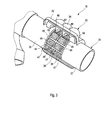
- eine teilweise geschnittene Detailansicht der Einleiteinrichtung,
- Fig. 4
- eine Ansicht wie in
Fig. 3 , jedoch bei einer anderen Blickrichtung. - Entsprechend
Fig. 1 ist an einen Motorblock 1 einer Brennkraftmaschine 2 eine Frischluftanlage 3 angeschlossen, um über eine Frischluftleitung 4 Frischluft zu Brennräumen 5 der Brennkraftmaschine 2 zuführen zu können. Ferner ist eine Abgasanlage 6 vorgesehen, mit der in den Brennräumen 5 erzeugtes Abgas über eine Abgasleitung 7 abgeführt werden kann. Die Brennkraftmaschine 2 ist aufgeladen und ist dementsprechend mit einem Abgasturbolader 8 ausgestattet, der eine Turbine 9 mit einem Turbinenrad 10 sowie einen Verdichter 11 mit einem Verdichterrad 12 aufweist. Die Turbine 9 ist in der Abgasleitung 7 angeordnet. Der Verdichter 11 ist in der Frischluftleitung 4 angeordnet. In üblicher Weise ist dabei das Turbinenrad 10 über eine gemeinsame Welle 49 drehfest mit dem Verdichterrad 12 verbunden. - Die Brennkraftmaschine 2 ist außerdem mit einer Abgasrückführungseinrichtung 13 ausgestattet, mit deren Hilfe Abgas von der Abgasanlage 6 zur Frischluftanlage 3 rückgeführt werden kann. Hierzu ist eine Rückführleitung 14 einlassseitig bei 15 an die Abgasleitung 7 angeschlossen und über eine Einleiteinrichtung 16 an die Frischluftleitung 4 angeschlossen. Die Abgasrückführeinrichtung 13 ist niederdruckseitig angeordnet. Dementsprechend befindet sich die einlassseitige Anschlussstelle 15 stromab der Turbine 9, während die Einleiteinrichtung 16 stromauf des Verdichters 11 angeordnet ist.
- Im hier gezeigten Beispiel enthält die Frischluftanlage 3 beispielhaft ein Luftfilter 17 und/oder einen Luftmassenmesser 18 und/oder einen Ladeluftkühler 19 und/oder eine Drosseleinrichtung 20. Zusätzlich oder alternativ kann die Abgasanlage 6 mit einem Oxidationskatalysator 21 und/oder mit einem Partikelfilter 22 und/oder mit einem NOX-Speicherkatalysator 23 und/oder mit einer Abgasklappe 24 und/oder mit einem H2S-Katalysator 25 und/oder mit einem Schalldämpfer 26 ausgestattet sein. Zusätzlich oder alternativ kann die Abgasrückführeinrichtung 13 mit einem Abgasrückführventil 27 zum Einstellen einer Abgasrückführrate und/oder mit einem Abgasrückführkühler 28 zum Kühlen des rückgeführten Abgases ausgestattet sein.
- In
Figur 1 ist zur Symbolisierung eines Betriebszustands der Brennkraftmaschine 2 eine Strömung der Frischluft durch Pfeile 29, eine Strömung des Abgases durch Pfeile 30 und eine Strömung des rückgeführten Abgases durch Pfeile 31 angedeutet. - Entsprechend den
Figuren 2 bis 4 umfasst die Einleiteinrichtung 16 einen Frischluftkanalabschnitt 32 zum Führen von Frischluft und einen Rückführkanalabschnitt 33 zum Führen von rückgeführtem Abgas. Der Rückführkanalabschnitt 33 umfasst einen Umschlingungsbereich 34 und einen Zuführbereich 35. Im Umschlingungsbereich 34 umschlingt der Rückführkanalabschnitt 33 den Frischluftkanalabschnitt 32 in der Umfangsrichtung des Frischluftkanalabschnitts 32 über wenigstens 360°. Bei den hier gezeigten Beispielen umschlingt der Rückführkanalabschnitt 33 den Frischluftkanalabschnitt 32 mehrfach und schraubenförmig und somit über wenigstens 720°. Im Unterschied dazu ist der Zuführabschnitt 35 geradlinig und bezüglich des Frischluftkanalabschnitts 32 tangential ausgerichtet. - Der Frischluftkanalabschnitt 32 ist hier ebenfalls geradlinig ausgestaltet und in einem dem Umschlingungsbereich 34 zugeordneten Axialabschnitt mit zumindest einer radialen Einlassöffnung 36 ausgestattet. Im gezeigten, bevorzugten Beispiel ist nur eine einzige Einlassöffnung 36 vorgesehen, die sich in der Umfangsrichtung geschlossen ringförmig erstreckt. Hierdurch unterteilt die Einlassöffnung 36 den Frischluftkanalabschnitt 32, so dass der Frischluftkanalabschnitt 32 zwei axiale Bereiche 37 und 38 aufweist, die durch die ringförmige Einlassöffnung 36 voneinander axial beabstandet sind.
- Unabhängig davon, wie die Einlassöffnung 36 nun geometrisch gestaltet ist und unabhängig von der Anzahl der Einlassöffnungen 36 ist der Rückführkanalabschnitt 33 so gestaltet, dass er die jeweilige Einlassöffnung 36 abdeckt. Ferner sind der Rückführkanalabschnitt 33 und der Frischluftkanalabschnitt 32 durch die jeweilige Einlassöffnung 36 hindurch fluidisch miteinander verbunden.
- Die hier vorgestellte Einleiteinrichtung 16 zeichnet sich durch eine Abscheiderstruktur 39 aus, die so ausgestaltet ist, dass sie sich zum Abscheiden von in dem Abgas mitgeführten festen und/oder flüssigen Partikeln eignet. Hierzu ist die Abscheiderstruktur 39 in bzw. an der Einlassöffnung 36 angeordnet. Die Anordnung der Abscheiderstruktur 39 an oder in der Einlassöffnung 36 bzw. die Zuordnung der Abscheiderstruktur 39 zur jeweiligen Einlassöffnung 36 erfolgt dabei so, dass das rückgeführte Abgas nur durch die Abscheiderstruktur 39 hindurch in den Frischluftkanalabschnitt 32 gelangt. Mit anderen Worten, damit das rückgeführte Abgas vom Rückführkanalabschnitt 33 in die Frischluft des Frischluftkanalabschnitts 32 gelangen kann, muss es zwangsläufig die Abscheiderstruktur 39 durchströmen. Hierbei kann die Abscheiderstruktur 39 ihre Abscheidewirkung entfalten und dementsprechend feste oder flüssige Partikel zurückhalten.
- Der Rückführkanalabschnitt 33 ist zweckmäßig so konzipiert, dass er in einem die Einlassöffnung 36 abdeckenden Bereich radial innen offen ist. Hierdurch ergibt sich für den durchströmbaren Querschnitt im Rückführkanalabschnitt 33 im gezeigten Beispiel ein U-förmiges Querschnittsprofil 40, welches in allen Bereichen die gleiche Querschnittsfläche aufweist. Bei anderen Ausgestaltungen sind auch andere Querschnittsprofile 40 realisierbar. Weiterhin kann das Querschnittsprofil 40 in unterschiedlichen Bereichen unterschiedlich ausgeführt sein. Bei weiteren Ausgestaltungen ist es auch möglich, dass die Größe und/oder Form der Querschnittsfläche in unterschiedlichen Bereichen variiert. Hierbei ist insbesondere eine sich verjüngende Querschnittsfläche vorteilhaft, um die Strömungsverhältnisse zu beeinflussen.
- Im gezeigten Beispiel ist die Einleiteinrichtung 16 aus mehreren Einzelteilen zusammengebaut. Zum einen ist dabei der Rückführkanalabschnitt 33 mit Hilfe eines Gehäuses 41 hergestellt, das an den Frischluftkanalabschnitt 32 angebaut ist. Dabei ist das Gehäuse 41 entsprechend gasdicht fest mit dem Frischluftkanalabschnitt 32 verbunden, beispielsweise durch Kleben oder Schweißen. Das Gehäuse 41 ist bei der hier gezeigten, bevorzugten Ausführungsform in der Umfangsrichtung derart segmentiert, dass es genau zwei Gehäuseteile, nämlich ein erstes Gehäuseteil 42 und ein zweites Gehäuseteil 43 aufweist. Die beiden Gehäuseteile 42, 43 erstrecken sich dabei jeweils über 180° in der Umfangsrichtung des Frischluftkanalabschnitts 32 und definieren dadurch zwei Gehäusehälften 42, 43. Hierbei sind die Gehäusehälften 42, 43 als Halbschalen ausgebildet, welche die Außenkontur der Einleiteinrichtung 16 bilden. In
Figur 3 ist nur das erste Gehäuseteil 42 erkennbar. InFigur 4 ist nur das zweite Gehäuseteil 43 erkennbar. InFigur 2 sind die beiden Gehäuseteile 42, 43 aneinander befestigt, beispielsweise durch Verschweißen oder Kleben. Durch die mehrteilige Bauweise des Gehäuses 41 lassen sich beispielsweise die einzelnen Gehäuseteile 42, 43 besonders preiswert als Spritzgussteile konzipieren. - Im Beispiel ist außerdem der Frischluftkanalabschnitt 32 aus mehreren Teilen zusammengebaut. Zum einen sind die beiden Bereiche 37, 38 vorgesehen, die jeweils für sich einen Rohrkörper definieren. In den axialen Abstand zwischen den beiden Abschnitten 37, 38, der die ringförmige Einlassöffnung 36 definiert, ist die Abscheiderstruktur 39 eingesetzt, die zu diesem Zweck ebenfalls ringförmig ausgestaltet ist und die die beiden Bereiche 37, 38, die axial an die Abscheiderstruktur 39 angrenzen, miteinander verbindet. Zweckmäßig ist die Abscheiderstruktur 39 dabei so dimensioniert, dass sie radial innen bündig mit den daran angrenzenden Bereichen 37, 38 abschließt, so dass die Abscheiderstruktur 39 frischluftseitig keine Störkontur besitzt. Zweckmäßig ist die Abscheiderstruktur 39 auch so dimensioniert, dass sie radial außen bündig mit den axial daran angrenzenden Bereichen 37, 38 abschließt, so dass auch an der Außenseite keine Störkontur entsteht, was das Montieren des Gehäuses 41 erleichtert.
- Im hier gezeigten Beispiel besitzt die Abscheiderstruktur 39 einen ringförmigen Trägerkörper 44, der mehrere radiale Durchbrüche 45 besitzt. In diesen Durchbrüchen 45 ist jeweils ein Abscheidermaterial 46 bzw. ein Abscheiderelement 46 angeordnet. Im Beispiel ist der Trägerkörper 44 durch wenigstens zwei, hier drei Ringelemente 47, die sich in der Umfangsrichtung erstrecken, und mehrere axial orientierte Stegelemente 48 gebildet, über die die Ringelemente 47 axial aneinander abgestützt sind. Die Ringelemente 47 und die Stegelemente 48 begrenzen die Durchbrüche 45 und bilden ein Korsett für das Abscheidermaterial 46 bzw. eine Halterung für das jeweilige Abscheiderelement 46.
- Zum Herstellen der Abscheiderstruktur 39 kann beispielsweise ein ringförmig angeordnetes Abscheidermaterial mit dem Kunststoff des Trägerkörpers 44 angespritzt werden, um die Ringelemente 47 und die Stegelemente 48 auszuformen, wodurch gleichzeitig eine Segmentierung des Abscheidermaterials in die einzelnen Abscheiderelemente 46 erfolgt.
- Zweckmäßig ist der Trägerkörper 44 mit den daran axial angrenzenden Bereichen 37, 38 des Frischluftkanalabschnitts 32 fest verbunden, was zweckmäßig wieder mittels Schweißverbindungen oder Klebverbindungen realisiert werden kann.
- Besonders zweckmäßig handelt es sich bei der Abscheiderstruktur 39 um eine Siebstruktur. Die einzelnen Abscheiderelemente 46 sind dann Siebelemente. Als Abscheidermaterial kommt zweckmäßig dann ein Siebmaterial zum Einsatz, das einlagig oder mehrlagig konzipiert sein kann. Das Siebmaterial besitzt zweckmäßig ein Gewebe oder ein Gitter und kann aus Metall oder aus Kunststoff hergestellt sein.
Claims (14)
- Einleiteinrichtung für Gase, insbesondere für eine Abgasrückführeinrichtung (13),- mit einem Frischluftkanalabschnitt (32) zum Führen von Frischluft,- mit einem Rückführkanalabschnitt (33) zum Führen von Gasen, insbesondere von rückgeführtem Abgas,- wobei der Rückführkanalabschnitt (33) den Frischluftkanalabschnitt (32) in der Umfangsrichtung umschlingt und dabei wenigstens eine radiale Einlassöffnung (36) des Frischluftkanalabschnitts (32) abdeckt,- wobei der Rückführkanalabschnitt (33) durch die jeweilige Einlassöffnung (36) fluidisch mit dem Frischluftkanalabschnitt (32) verbunden ist,
dadurch gekennzeichnet,
dass in oder an der jeweiligen Einlassöffnung (36) eine Abscheiderstruktur (39) zum Abscheiden von im Gas, insbesondere im Abgas, mitgeführten Partikeln angeordnet ist. - Einleiteinrichtung nach Anspruch 1,
dadurch gekennzeichnet,
dass der Rückführkanalabschnitt (33) den Frischluftkanalabschnitt (32) schraubenförmig umschlingt. - Einleiteinrichtung nach Anspruch 2,
dadurch gekennzeichnet,
dass der Rückführkanalabschnitt (33) den Frischluftkanalabschnitt (32) über wenigstens 360° umschlingt. - Einleiteinrichtung nach einem der Ansprüche 1 bis 3,
dadurch gekennzeichnet,
dass der Rückführkanalabschnitt (33) in einem die jeweilige Einlassöffnung (36) abdeckenden Bereich radial innen offen ist. - Einleiteinrichtung nach einem der Ansprüche 1 bis 4,
dadurch gekennzeichnet,
dass der Rückführkanalabschnitt (33) in einem Gehäuse (41) ausgebildet ist, das an den Frischluftkanalabschnitt (32) angebaut ist. - Einleiteinrichtung nach Anspruch 5,
dadurch gekennzeichnet,
dass das Gehäuse (41) in der Umfangsrichtung segmentiert ist und wenigstens zwei Gehäuseteile (42, 43) aufweist, die aneinander befestigt sind. - Einleiteinrichtung nach einem der Ansprüche 1 bis 6,
dadurch gekennzeichnet,
dass sich die Einlassöffnung (36) in der Umfangsrichtung ringförmig erstreckt, wobei die Abscheiderstruktur (39) ringförmig ausgestaltet ist und in die Einlassöffnung (36) eingesetzt ist. - Einleiteinrichtung nach Anspruch 7,
dadurch gekennzeichnet,
dass die Abscheiderstruktur (39) einen ringförmigen Trägerkörper (44) aufweist, der mehrere radiale Durchbrüche (45) besitzt, in denen jeweils ein Abscheiderelement (46) angeordnet ist. - Einleiteinrichtung nach Anspruch 8,
dadurch gekennzeichnet,
dass der Trägerkörper (44) mit den daran axial angrenzenden Bereichen (37, 38) des Frischluftkanalabschnitts (32) fest verbunden ist. - Einleiteinrichtung nach einem der Ansprüche 1 bis 9,
dadurch gekennzeichnet,
dass die Abscheiderstruktur (39) als Siebstruktur ausgestaltet ist. - Abgasrückführeinrichtung zum Rückführen von Abgas einer Brennkraftmaschine (2) von einer Abgasanlage (6) und/oder Blow-By-Gasen der Brennkraftmaschine (2) und/oder einer Tankentlüftung zu einer Frischluftanlage (3) der Brennkraftmaschine (2),- wobei eine Rückführleitung (14) der Abgasrückführeinrichtung (13) über eine Einleiteinrichtung (16) nach einem der Ansprüche 1 bis 10 an eine Frischluftleitung (4) der Frischluftanlage (3) angeschlossen ist,- wobei die Rückführleitung (14) an den Rückführkanalabschnitt (33) der Einleiteinrichtung (16) angeschlossen ist,- wobei der Frischluftkanalabschnitt (32) der Einleiteinrichtung (16) in die Frischluftleitung (4) eingebunden ist.
- Abgasrückführeinrichtung nach Anspruch 11,
dadurch gekennzeichnet,
dass in der Rückführleitung (14) stromauf der Einleiteinrichtung (16) ein Rückführkühler (28) angeordnet ist. - Brennkraftmaschine, insbesondere eines Fahrzeugs,- mit einer Abgasanlage (6) zum Abführen von Abgas von der Brennkraftmaschine (2),- mit einer Frischluftanlage (3) zum Zuführen von Frischluft zur Brennkraftmaschine (2),- mit einer Abgasrückführeinrichtung (13) nach Anspruch 11 oder 12.
- Brennkraftmaschine nach Anspruch 13,
dadurch gekennzeichnet,- dass in der Abgasanlage (6) eine Turbine (9) eines Abgasturboladers (8) angeordnet ist,- dass in der Frischluftanlage (3) ein Verdichter (11) des Abgasturboladers (8) angeordnet ist,- dass die Rückführleitung (14) stromab der Turbine (9) an die Abgasleitung (7) angeschlossen ist,- dass die Einleiteinrichtung (16) stromauf des Verdichters (11) an der Frischluftleitung (4) angeordnet ist.
Applications Claiming Priority (1)
| Application Number | Priority Date | Filing Date | Title |
|---|---|---|---|
| DE102012205027A DE102012205027A1 (de) | 2012-03-28 | 2012-03-28 | Einleiteinrichtung für Gase, insbesondere eine Abgasrückführeinrichtung |
Publications (3)
| Publication Number | Publication Date |
|---|---|
| EP2644874A2 true EP2644874A2 (de) | 2013-10-02 |
| EP2644874A3 EP2644874A3 (de) | 2013-10-23 |
| EP2644874B1 EP2644874B1 (de) | 2015-10-21 |
Family
ID=47997051
Family Applications (1)
| Application Number | Title | Priority Date | Filing Date |
|---|---|---|---|
| EP13159883.1A Not-in-force EP2644874B1 (de) | 2012-03-28 | 2013-03-19 | Einleiteinrichtung für Gase, insbesondere eine Abgasrückführeinrichtung |
Country Status (2)
| Country | Link |
|---|---|
| EP (1) | EP2644874B1 (de) |
| DE (1) | DE102012205027A1 (de) |
Cited By (2)
| Publication number | Priority date | Publication date | Assignee | Title |
|---|---|---|---|---|
| EP3533990A1 (de) * | 2018-02-28 | 2019-09-04 | Mann + Hummel Gmbh | Vertikal montierbarer kondensatabscheider |
| FR3086702A1 (fr) * | 2018-09-27 | 2020-04-03 | Renault S.A.S. | Systeme de recirculation des gaz d'echappement a l'admission d'un moteur, comprenant une structure poreuse |
Families Citing this family (6)
| Publication number | Priority date | Publication date | Assignee | Title |
|---|---|---|---|---|
| DE102014217334A1 (de) * | 2014-08-29 | 2016-03-03 | Mahle International Gmbh | Nebenschlussresonator für eine Frischluftanlage einer Brennkraftmaschine |
| DE102015200196A1 (de) | 2015-01-09 | 2016-07-14 | Elringklinger Ag | Mischvorrichtung, Verbrennungsmotor und Verfahren zur Herstellung einer Mischvorrichtung |
| DE102016118722B4 (de) | 2016-10-04 | 2022-09-01 | Engineering Center Steyr Gmbh & Co. Kg | Verbrennungskraftmaschine für ein Kraftfahrzeug |
| DE102018221964A1 (de) * | 2018-12-17 | 2020-06-18 | Mahle International Gmbh | Schalldämpfer und Frischluftleitung |
| DE102020006783A1 (de) | 2020-11-05 | 2022-05-05 | Daimler Ag | Einleitvorrichtung für eine Verbrennungskraftmaschine |
| AT524259A1 (de) * | 2021-06-17 | 2022-04-15 | Avl List Gmbh | Einlasssammler für eine brennkraftmaschine |
Citations (4)
| Publication number | Priority date | Publication date | Assignee | Title |
|---|---|---|---|---|
| US20030226552A1 (en) | 2002-03-15 | 2003-12-11 | Filterwerk Mann & Hummel Gmbh | Exhaust gas recycle (EGR) assembly |
| WO2008129076A1 (de) | 2007-04-24 | 2008-10-30 | Mann+Hummel Gmbh | Verbrennungsluft- und abgasanordnung eines verbrennungsmotors |
| WO2009071174A1 (de) | 2007-12-04 | 2009-06-11 | Daimler Ag | Abgasturbolader für eine brennkraftmaschine und verfahren zum schalten einer luftführungsvorrichtung eines abgasturboladers |
| DE102009056544A1 (de) | 2008-12-04 | 2010-06-24 | Mann + Hummel Gmbh | Verbrennungsmotor mit einem Turbolader und einer Rückführung für die Abgase |
Family Cites Families (6)
| Publication number | Priority date | Publication date | Assignee | Title |
|---|---|---|---|---|
| WO2005090773A2 (de) * | 2004-03-18 | 2005-09-29 | Fev Motorentechnik Gmbh | Abgasrückführung |
| US7721542B2 (en) * | 2006-06-13 | 2010-05-25 | Honeywell International, Inc. | Exhaust gas recirculation mixer |
| CN101512122B (zh) * | 2006-09-13 | 2012-09-05 | 博格华纳公司 | 排出空气冷却器在涡轮增压器中的整合 |
| US7624722B2 (en) * | 2007-12-31 | 2009-12-01 | Cummins, Inc | Apparatus and system for efficiently recirculating an exhaust gas in a combustion engine |
| KR20110070890A (ko) * | 2008-10-16 | 2011-06-24 | 보르그워너 인코퍼레이티드 | 공통 하우징에 혼합기와 미립자 분리기가 통합된 모듈 및 그 모듈을 가진 엔진 브리딩 시스템 |
| FR2954412B1 (fr) * | 2009-12-22 | 2015-12-25 | Valeo Sys Controle Moteur Sas | Moteur a combustion interne integrant un dispositif de recirculation des gaz d'echappement |
-
2012
- 2012-03-28 DE DE102012205027A patent/DE102012205027A1/de not_active Withdrawn
-
2013
- 2013-03-19 EP EP13159883.1A patent/EP2644874B1/de not_active Not-in-force
Patent Citations (4)
| Publication number | Priority date | Publication date | Assignee | Title |
|---|---|---|---|---|
| US20030226552A1 (en) | 2002-03-15 | 2003-12-11 | Filterwerk Mann & Hummel Gmbh | Exhaust gas recycle (EGR) assembly |
| WO2008129076A1 (de) | 2007-04-24 | 2008-10-30 | Mann+Hummel Gmbh | Verbrennungsluft- und abgasanordnung eines verbrennungsmotors |
| WO2009071174A1 (de) | 2007-12-04 | 2009-06-11 | Daimler Ag | Abgasturbolader für eine brennkraftmaschine und verfahren zum schalten einer luftführungsvorrichtung eines abgasturboladers |
| DE102009056544A1 (de) | 2008-12-04 | 2010-06-24 | Mann + Hummel Gmbh | Verbrennungsmotor mit einem Turbolader und einer Rückführung für die Abgase |
Cited By (2)
| Publication number | Priority date | Publication date | Assignee | Title |
|---|---|---|---|---|
| EP3533990A1 (de) * | 2018-02-28 | 2019-09-04 | Mann + Hummel Gmbh | Vertikal montierbarer kondensatabscheider |
| FR3086702A1 (fr) * | 2018-09-27 | 2020-04-03 | Renault S.A.S. | Systeme de recirculation des gaz d'echappement a l'admission d'un moteur, comprenant une structure poreuse |
Also Published As
| Publication number | Publication date |
|---|---|
| EP2644874A3 (de) | 2013-10-23 |
| EP2644874B1 (de) | 2015-10-21 |
| DE102012205027A1 (de) | 2013-10-02 |
Similar Documents
| Publication | Publication Date | Title |
|---|---|---|
| EP2644874B1 (de) | Einleiteinrichtung für Gase, insbesondere eine Abgasrückführeinrichtung | |
| EP2025896B1 (de) | Radialverdichter für einen Turbolader | |
| EP2532408B2 (de) | Luftfilter mit vorabscheider | |
| EP1653048B1 (de) | Abgasturbolader | |
| EP3092385B1 (de) | Trimmsteller für mindestens einen verdichter und brennkraftmaschine | |
| EP2440759A1 (de) | Abgasbehandlungsvorrichtung für den motornahen einsatz | |
| EP2157309B1 (de) | Brennkraftmaschine | |
| DE102010036799A1 (de) | Abgasrückführungsvorrichtung für einen Verbrennungsmotor | |
| WO2008101978A1 (de) | Frischgasmodul für eine frischgasanlage | |
| DE102018211300A1 (de) | Kondensatabscheider | |
| DE102009043085A1 (de) | Brennkraftmaschine mit einem Abgasturbolader und einem Abgasrückführsystem | |
| EP2549093B1 (de) | Brennkraftmaschine | |
| DE102009014179B4 (de) | Abgassystem | |
| DE102013111313A1 (de) | Leitungsteil für eine Abgasanlage mit Abgasrückführung | |
| DE102007025437A1 (de) | Verfahren für eine Brennkraftmaschine mit einem Abgasturbolader | |
| DE102014018035A1 (de) | Luftleitung für einen Ansaugtrakt einer Verbrennungskraftmaschine | |
| EP1715162B1 (de) | Abgasabführungssystem für eine Brennkraftmaschine sowie Absperrklappe für ein Abgasabführungssystem | |
| DE102013110127B4 (de) | Leitungsteil für eine Abgasanlage mit Abgasrückführung | |
| EP2602468B1 (de) | Brennkraftmaschine mit Abgasrückführungseinrichtung | |
| DE102012206974A1 (de) | Abgasrückführungsanlage | |
| DE102019202380B4 (de) | Brennkraftmaschine mit einem Abgaskrümmer und einem Abgasturbolader | |
| DE102011009634A1 (de) | Abgasturbolader | |
| DE202007007146U1 (de) | Entkoppelelement | |
| DE102015113073A1 (de) | Leitungsteil mit Filterelement | |
| DE102010008273B4 (de) | Partikelfilteranordnung |
Legal Events
| Date | Code | Title | Description |
|---|---|---|---|
| PUAL | Search report despatched |
Free format text: ORIGINAL CODE: 0009013 |
|
| PUAI | Public reference made under article 153(3) epc to a published international application that has entered the european phase |
Free format text: ORIGINAL CODE: 0009012 |
|
| AK | Designated contracting states |
Kind code of ref document: A2 Designated state(s): AL AT BE BG CH CY CZ DE DK EE ES FI FR GB GR HR HU IE IS IT LI LT LU LV MC MK MT NL NO PL PT RO RS SE SI SK SM TR |
|
| AX | Request for extension of the european patent |
Extension state: BA ME |
|
| AK | Designated contracting states |
Kind code of ref document: A3 Designated state(s): AL AT BE BG CH CY CZ DE DK EE ES FI FR GB GR HR HU IE IS IT LI LT LU LV MC MK MT NL NO PL PT RO RS SE SI SK SM TR |
|
| AX | Request for extension of the european patent |
Extension state: BA ME |
|
| RIC1 | Information provided on ipc code assigned before grant |
Ipc: F02M 25/07 20060101AFI20130913BHEP |
|
| 17P | Request for examination filed |
Effective date: 20140411 |
|
| RBV | Designated contracting states (corrected) |
Designated state(s): AL AT BE BG CH CY CZ DE DK EE ES FI FR GB GR HR HU IE IS IT LI LT LU LV MC MK MT NL NO PL PT RO RS SE SI SK SM TR |
|
| 17Q | First examination report despatched |
Effective date: 20141118 |
|
| GRAP | Despatch of communication of intention to grant a patent |
Free format text: ORIGINAL CODE: EPIDOSNIGR1 |
|
| INTG | Intention to grant announced |
Effective date: 20150716 |
|
| GRAS | Grant fee paid |
Free format text: ORIGINAL CODE: EPIDOSNIGR3 |
|
| GRAA | (expected) grant |
Free format text: ORIGINAL CODE: 0009210 |
|
| AK | Designated contracting states |
Kind code of ref document: B1 Designated state(s): AL AT BE BG CH CY CZ DE DK EE ES FI FR GB GR HR HU IE IS IT LI LT LU LV MC MK MT NL NO PL PT RO RS SE SI SK SM TR |
|
| REG | Reference to a national code |
Ref country code: GB Ref legal event code: FG4D Free format text: NOT ENGLISH Ref country code: NL Ref legal event code: MP Effective date: 20151021 |
|
| REG | Reference to a national code |
Ref country code: CH Ref legal event code: EP |
|
| REG | Reference to a national code |
Ref country code: AT Ref legal event code: REF Ref document number: 756774 Country of ref document: AT Kind code of ref document: T Effective date: 20151115 |
|
| REG | Reference to a national code |
Ref country code: IE Ref legal event code: FG4D Free format text: LANGUAGE OF EP DOCUMENT: GERMAN |
|
| REG | Reference to a national code |
Ref country code: DE Ref legal event code: R096 Ref document number: 502013001367 Country of ref document: DE |
|
| REG | Reference to a national code |
Ref country code: LT Ref legal event code: MG4D |
|
| PG25 | Lapsed in a contracting state [announced via postgrant information from national office to epo] |
Ref country code: ES Free format text: LAPSE BECAUSE OF FAILURE TO SUBMIT A TRANSLATION OF THE DESCRIPTION OR TO PAY THE FEE WITHIN THE PRESCRIBED TIME-LIMIT Effective date: 20151021 Ref country code: IT Free format text: LAPSE BECAUSE OF FAILURE TO SUBMIT A TRANSLATION OF THE DESCRIPTION OR TO PAY THE FEE WITHIN THE PRESCRIBED TIME-LIMIT Effective date: 20151021 Ref country code: NL Free format text: LAPSE BECAUSE OF FAILURE TO SUBMIT A TRANSLATION OF THE DESCRIPTION OR TO PAY THE FEE WITHIN THE PRESCRIBED TIME-LIMIT Effective date: 20151021 Ref country code: NO Free format text: LAPSE BECAUSE OF FAILURE TO SUBMIT A TRANSLATION OF THE DESCRIPTION OR TO PAY THE FEE WITHIN THE PRESCRIBED TIME-LIMIT Effective date: 20160121 Ref country code: LT Free format text: LAPSE BECAUSE OF FAILURE TO SUBMIT A TRANSLATION OF THE DESCRIPTION OR TO PAY THE FEE WITHIN THE PRESCRIBED TIME-LIMIT Effective date: 20151021 Ref country code: IS Free format text: LAPSE BECAUSE OF FAILURE TO SUBMIT A TRANSLATION OF THE DESCRIPTION OR TO PAY THE FEE WITHIN THE PRESCRIBED TIME-LIMIT Effective date: 20160221 Ref country code: HR Free format text: LAPSE BECAUSE OF FAILURE TO SUBMIT A TRANSLATION OF THE DESCRIPTION OR TO PAY THE FEE WITHIN THE PRESCRIBED TIME-LIMIT Effective date: 20151021 |
|
| PG25 | Lapsed in a contracting state [announced via postgrant information from national office to epo] |
Ref country code: GR Free format text: LAPSE BECAUSE OF FAILURE TO SUBMIT A TRANSLATION OF THE DESCRIPTION OR TO PAY THE FEE WITHIN THE PRESCRIBED TIME-LIMIT Effective date: 20160122 Ref country code: FI Free format text: LAPSE BECAUSE OF FAILURE TO SUBMIT A TRANSLATION OF THE DESCRIPTION OR TO PAY THE FEE WITHIN THE PRESCRIBED TIME-LIMIT Effective date: 20151021 Ref country code: RS Free format text: LAPSE BECAUSE OF FAILURE TO SUBMIT A TRANSLATION OF THE DESCRIPTION OR TO PAY THE FEE WITHIN THE PRESCRIBED TIME-LIMIT Effective date: 20151021 Ref country code: PL Free format text: LAPSE BECAUSE OF FAILURE TO SUBMIT A TRANSLATION OF THE DESCRIPTION OR TO PAY THE FEE WITHIN THE PRESCRIBED TIME-LIMIT Effective date: 20151021 Ref country code: PT Free format text: LAPSE BECAUSE OF FAILURE TO SUBMIT A TRANSLATION OF THE DESCRIPTION OR TO PAY THE FEE WITHIN THE PRESCRIBED TIME-LIMIT Effective date: 20160222 Ref country code: LV Free format text: LAPSE BECAUSE OF FAILURE TO SUBMIT A TRANSLATION OF THE DESCRIPTION OR TO PAY THE FEE WITHIN THE PRESCRIBED TIME-LIMIT Effective date: 20151021 Ref country code: SE Free format text: LAPSE BECAUSE OF FAILURE TO SUBMIT A TRANSLATION OF THE DESCRIPTION OR TO PAY THE FEE WITHIN THE PRESCRIBED TIME-LIMIT Effective date: 20151021 |
|
| REG | Reference to a national code |
Ref country code: DE Ref legal event code: R097 Ref document number: 502013001367 Country of ref document: DE |
|
| PG25 | Lapsed in a contracting state [announced via postgrant information from national office to epo] |
Ref country code: CZ Free format text: LAPSE BECAUSE OF FAILURE TO SUBMIT A TRANSLATION OF THE DESCRIPTION OR TO PAY THE FEE WITHIN THE PRESCRIBED TIME-LIMIT Effective date: 20151021 |
|
| PLBE | No opposition filed within time limit |
Free format text: ORIGINAL CODE: 0009261 |
|
| STAA | Information on the status of an ep patent application or granted ep patent |
Free format text: STATUS: NO OPPOSITION FILED WITHIN TIME LIMIT |
|
| PG25 | Lapsed in a contracting state [announced via postgrant information from national office to epo] |
Ref country code: EE Free format text: LAPSE BECAUSE OF FAILURE TO SUBMIT A TRANSLATION OF THE DESCRIPTION OR TO PAY THE FEE WITHIN THE PRESCRIBED TIME-LIMIT Effective date: 20151021 Ref country code: SK Free format text: LAPSE BECAUSE OF FAILURE TO SUBMIT A TRANSLATION OF THE DESCRIPTION OR TO PAY THE FEE WITHIN THE PRESCRIBED TIME-LIMIT Effective date: 20151021 Ref country code: DK Free format text: LAPSE BECAUSE OF FAILURE TO SUBMIT A TRANSLATION OF THE DESCRIPTION OR TO PAY THE FEE WITHIN THE PRESCRIBED TIME-LIMIT Effective date: 20151021 Ref country code: SM Free format text: LAPSE BECAUSE OF FAILURE TO SUBMIT A TRANSLATION OF THE DESCRIPTION OR TO PAY THE FEE WITHIN THE PRESCRIBED TIME-LIMIT Effective date: 20151021 Ref country code: RO Free format text: LAPSE BECAUSE OF FAILURE TO SUBMIT A TRANSLATION OF THE DESCRIPTION OR TO PAY THE FEE WITHIN THE PRESCRIBED TIME-LIMIT Effective date: 20151021 Ref country code: BE Free format text: LAPSE BECAUSE OF NON-PAYMENT OF DUE FEES Effective date: 20160331 |
|
| 26N | No opposition filed |
Effective date: 20160722 |
|
| PG25 | Lapsed in a contracting state [announced via postgrant information from national office to epo] |
Ref country code: LU Free format text: LAPSE BECAUSE OF FAILURE TO SUBMIT A TRANSLATION OF THE DESCRIPTION OR TO PAY THE FEE WITHIN THE PRESCRIBED TIME-LIMIT Effective date: 20160319 Ref country code: MC Free format text: LAPSE BECAUSE OF FAILURE TO SUBMIT A TRANSLATION OF THE DESCRIPTION OR TO PAY THE FEE WITHIN THE PRESCRIBED TIME-LIMIT Effective date: 20151021 |
|
| REG | Reference to a national code |
Ref country code: CH Ref legal event code: PL |
|
| PG25 | Lapsed in a contracting state [announced via postgrant information from national office to epo] |
Ref country code: SI Free format text: LAPSE BECAUSE OF FAILURE TO SUBMIT A TRANSLATION OF THE DESCRIPTION OR TO PAY THE FEE WITHIN THE PRESCRIBED TIME-LIMIT Effective date: 20151021 |
|
| REG | Reference to a national code |
Ref country code: IE Ref legal event code: MM4A |
|
| REG | Reference to a national code |
Ref country code: FR Ref legal event code: ST Effective date: 20161130 |
|
| PG25 | Lapsed in a contracting state [announced via postgrant information from national office to epo] |
Ref country code: IE Free format text: LAPSE BECAUSE OF NON-PAYMENT OF DUE FEES Effective date: 20160319 Ref country code: CH Free format text: LAPSE BECAUSE OF NON-PAYMENT OF DUE FEES Effective date: 20160331 Ref country code: LI Free format text: LAPSE BECAUSE OF NON-PAYMENT OF DUE FEES Effective date: 20160331 Ref country code: FR Free format text: LAPSE BECAUSE OF NON-PAYMENT OF DUE FEES Effective date: 20160331 |
|
| PG25 | Lapsed in a contracting state [announced via postgrant information from national office to epo] |
Ref country code: MT Free format text: LAPSE BECAUSE OF FAILURE TO SUBMIT A TRANSLATION OF THE DESCRIPTION OR TO PAY THE FEE WITHIN THE PRESCRIBED TIME-LIMIT Effective date: 20151021 |
|
| GBPC | Gb: european patent ceased through non-payment of renewal fee |
Effective date: 20170319 |
|
| PG25 | Lapsed in a contracting state [announced via postgrant information from national office to epo] |
Ref country code: GB Free format text: LAPSE BECAUSE OF NON-PAYMENT OF DUE FEES Effective date: 20170319 |
|
| PG25 | Lapsed in a contracting state [announced via postgrant information from national office to epo] |
Ref country code: CY Free format text: LAPSE BECAUSE OF FAILURE TO SUBMIT A TRANSLATION OF THE DESCRIPTION OR TO PAY THE FEE WITHIN THE PRESCRIBED TIME-LIMIT Effective date: 20151021 Ref country code: HU Free format text: LAPSE BECAUSE OF FAILURE TO SUBMIT A TRANSLATION OF THE DESCRIPTION OR TO PAY THE FEE WITHIN THE PRESCRIBED TIME-LIMIT; INVALID AB INITIO Effective date: 20130319 |
|
| PG25 | Lapsed in a contracting state [announced via postgrant information from national office to epo] |
Ref country code: TR Free format text: LAPSE BECAUSE OF FAILURE TO SUBMIT A TRANSLATION OF THE DESCRIPTION OR TO PAY THE FEE WITHIN THE PRESCRIBED TIME-LIMIT Effective date: 20151021 Ref country code: MK Free format text: LAPSE BECAUSE OF FAILURE TO SUBMIT A TRANSLATION OF THE DESCRIPTION OR TO PAY THE FEE WITHIN THE PRESCRIBED TIME-LIMIT Effective date: 20151021 |
|
| PG25 | Lapsed in a contracting state [announced via postgrant information from national office to epo] |
Ref country code: BG Free format text: LAPSE BECAUSE OF FAILURE TO SUBMIT A TRANSLATION OF THE DESCRIPTION OR TO PAY THE FEE WITHIN THE PRESCRIBED TIME-LIMIT Effective date: 20151021 |
|
| PGFP | Annual fee paid to national office [announced via postgrant information from national office to epo] |
Ref country code: DE Payment date: 20180530 Year of fee payment: 6 |
|
| PG25 | Lapsed in a contracting state [announced via postgrant information from national office to epo] |
Ref country code: AL Free format text: LAPSE BECAUSE OF FAILURE TO SUBMIT A TRANSLATION OF THE DESCRIPTION OR TO PAY THE FEE WITHIN THE PRESCRIBED TIME-LIMIT Effective date: 20151021 |
|
| REG | Reference to a national code |
Ref country code: AT Ref legal event code: MM01 Ref document number: 756774 Country of ref document: AT Kind code of ref document: T Effective date: 20180319 |
|
| REG | Reference to a national code |
Ref country code: DE Ref legal event code: R119 Ref document number: 502013001367 Country of ref document: DE |
|
| PG25 | Lapsed in a contracting state [announced via postgrant information from national office to epo] |
Ref country code: AT Free format text: LAPSE BECAUSE OF NON-PAYMENT OF DUE FEES Effective date: 20180319 |
|
| PG25 | Lapsed in a contracting state [announced via postgrant information from national office to epo] |
Ref country code: DE Free format text: LAPSE BECAUSE OF NON-PAYMENT OF DUE FEES Effective date: 20191001 |