EP2640776B1 - Polyamidzusammensetzungen mit verbesserten thermooxidativen, antibakteriellen, licht- oder energieaktiven eigenschaften sowie verfahren zu deren herstellung - Google Patents
Polyamidzusammensetzungen mit verbesserten thermooxidativen, antibakteriellen, licht- oder energieaktiven eigenschaften sowie verfahren zu deren herstellung Download PDFInfo
- Publication number
- EP2640776B1 EP2640776B1 EP11785654.2A EP11785654A EP2640776B1 EP 2640776 B1 EP2640776 B1 EP 2640776B1 EP 11785654 A EP11785654 A EP 11785654A EP 2640776 B1 EP2640776 B1 EP 2640776B1
- Authority
- EP
- European Patent Office
- Prior art keywords
- copper
- acid
- organoligand
- complex
- metal salt
- Prior art date
- Legal status (The legal status is an assumption and is not a legal conclusion. Google has not performed a legal analysis and makes no representation as to the accuracy of the status listed.)
- Active
Links
- 0 *C1OC(*)=NC1 Chemical compound *C1OC(*)=NC1 0.000 description 1
Images


Classifications
-
- C—CHEMISTRY; METALLURGY
- C01—INORGANIC CHEMISTRY
- C01G—COMPOUNDS CONTAINING METALS NOT COVERED BY SUBCLASSES C01D OR C01F
- C01G23/00—Compounds of titanium
- C01G23/002—Compounds containing titanium, with or without oxygen or hydrogen, and containing two or more other elements
-
- C—CHEMISTRY; METALLURGY
- C08—ORGANIC MACROMOLECULAR COMPOUNDS; THEIR PREPARATION OR CHEMICAL WORKING-UP; COMPOSITIONS BASED THEREON
- C08K—Use of inorganic or non-macromolecular organic substances as compounding ingredients
- C08K5/00—Use of organic ingredients
- C08K5/0091—Complexes with metal-heteroatom-bonds
-
- C—CHEMISTRY; METALLURGY
- C01—INORGANIC CHEMISTRY
- C01G—COMPOUNDS CONTAINING METALS NOT COVERED BY SUBCLASSES C01D OR C01F
- C01G3/00—Compounds of copper
-
- C—CHEMISTRY; METALLURGY
- C01—INORGANIC CHEMISTRY
- C01G—COMPOUNDS CONTAINING METALS NOT COVERED BY SUBCLASSES C01D OR C01F
- C01G39/00—Compounds of molybdenum
- C01G39/006—Compounds containing molybdenum, with or without oxygen or hydrogen, and containing two or more other elements
-
- C—CHEMISTRY; METALLURGY
- C01—INORGANIC CHEMISTRY
- C01G—COMPOUNDS CONTAINING METALS NOT COVERED BY SUBCLASSES C01D OR C01F
- C01G5/00—Compounds of silver
-
- C—CHEMISTRY; METALLURGY
- C01—INORGANIC CHEMISTRY
- C01G—COMPOUNDS CONTAINING METALS NOT COVERED BY SUBCLASSES C01D OR C01F
- C01G9/00—Compounds of zinc
-
- C—CHEMISTRY; METALLURGY
- C08—ORGANIC MACROMOLECULAR COMPOUNDS; THEIR PREPARATION OR CHEMICAL WORKING-UP; COMPOSITIONS BASED THEREON
- C08K—Use of inorganic or non-macromolecular organic substances as compounding ingredients
- C08K3/00—Use of inorganic substances as compounding ingredients
- C08K3/10—Metal compounds
-
- C—CHEMISTRY; METALLURGY
- C08—ORGANIC MACROMOLECULAR COMPOUNDS; THEIR PREPARATION OR CHEMICAL WORKING-UP; COMPOSITIONS BASED THEREON
- C08K—Use of inorganic or non-macromolecular organic substances as compounding ingredients
- C08K3/00—Use of inorganic substances as compounding ingredients
- C08K3/16—Halogen-containing compounds
-
- C—CHEMISTRY; METALLURGY
- C08—ORGANIC MACROMOLECULAR COMPOUNDS; THEIR PREPARATION OR CHEMICAL WORKING-UP; COMPOSITIONS BASED THEREON
- C08K—Use of inorganic or non-macromolecular organic substances as compounding ingredients
- C08K5/00—Use of organic ingredients
- C08K5/16—Nitrogen-containing compounds
- C08K5/34—Heterocyclic compounds having nitrogen in the ring
- C08K5/35—Heterocyclic compounds having nitrogen in the ring having also oxygen in the ring
- C08K5/353—Five-membered rings
-
- C—CHEMISTRY; METALLURGY
- C01—INORGANIC CHEMISTRY
- C01P—INDEXING SCHEME RELATING TO STRUCTURAL AND PHYSICAL ASPECTS OF SOLID INORGANIC COMPOUNDS
- C01P2006/00—Physical properties of inorganic compounds
- C01P2006/80—Compositional purity
Definitions
- the invention relates to a process for the preparation of stabilized and / or functionalized, melt-deformable polyamide molding compositions in which stabilization and / or special functionalization is achieved by using special metal salt-organoligand complex compounds.
- Stabilization relates to the improvement of the thermo-oxidative properties against exposure to heat, the functionalization can include antibacterial, light-absorbing or energy-active properties.
- the stabilization and / or functionalization is achieved by the presence of metal salt-organoligand complex compounds as a polymer additive.
- the metal salt-organoligand complex compounds consist of a combination of a metal salt with a heterocyclic organic compound, which acts as a ligand to the metal ion and leads to a stoichiometrically structured, thermally stable complex compound.
- the new stabilizers or functional additives are also low in halogen.
- polyamides In the field of engineering thermoplastics, polyamides belong to an important group of polymer materials. As an important construction material, polyamides are used in addition to the textile application in automotive engineering and in electrical engineering, where there is an increasing demand for stability against the effects of heat.
- the present invention relates to stabilized and / or functionalized polyamide compositions with increased heat stability and / or functional properties.
- the polyamide composition contains at least one stabilizing and / or functionalizing metal salt-organoligand complex compound as a polymer additive.
- the organo ligand is a 2-oxazoline derivative.
- the metal salt is a copper (I) or copper (II) acetate or a zinc (II), tin (II), cobalt-molybdenum, titanium, silver (I), halide, nitrate, phosphate or acetate. Polymers are broken down by the action of heat, light and oxygen using thermo-oxidative processes.
- Copper complexes are also in the US 4,486,326 described.
- antioxidants are mostly made up of sterically hindered phenols, secondary aromatic amines or phosphorus derivatives or thioethers.
- stabilizers for polyamides from the class of special copper compounds so-called copper stabilizers.
- Copper stabilizers for stabilizing polyamides have been known for some time and are currently being intensively developed [ DE19847627 ; DE4305166 ].
- the use of stabilizer systems of this type aims to achieve long-term stabilization of polyamides at elevated temperatures of up to 180 ° C.
- Copper stabilizers are used for example in the production of polyamide fibers for tire cord and for injection molded parts in technical applications in the automotive sector and in the electrical industry as circuit board carriers.
- Copper stabilizers usually consist of a mixture of two components, based on copper compounds and halogen salts. One component consists of copper halides or other copper salts such as copper acetate, copper stearate and copper sulfate.
- halogen compounds in large excess, must be added as a further component.
- Alkali iodides and bromides are mostly used, and the amount added must be up to a 15-fold molar excess of halogen, based on copper.
- Up to 200 ppm copper are used in the stabilizer composition to stabilize polyamide, which requires an adequate entry of up to 3000 ppm of the respective halogen into the polymer.
- polyamides can be sufficiently heat-stabilized so that these polymers can be exposed to temperatures of 150 to 180 ° C for a short time without a dramatic loss of their mechanical properties.
- these copper stabilizers have significant disadvantages in use.
- polyolefins such as polyethylene, polypropylene and ethylene-propylene copolymers were recommended, which in turn, however, as Disadvantage of having limited compatibility with polyamides.
- copper compounds and reactive substances based on bis (2-oxazolines) in a binary system in order to increase the known stabilizing effect of copper in high concentrations of up to 1000 ppm and by chain extension of the polyamides by the reactive substances connect [ JP60248730 ].
- the copper salt-organo ligand complexes according to the invention composed of a combination of alkylcarboxylic acid (2-oxazolines) and a copper salt, have a stoichiometrically defined structure, are air-resistant and storage-stable and form a new class of low-halogen copper stabilizers. It was also surprising that polyamide compositions according to claim 1 can be stabilized so that they have improved properties and have higher long-term use temperatures without chain extensions occurring. In addition, it was surprising that in addition to copper salts, other metal salts can also be stably complexed by compounds with 2-oxazoline rings as ligands.
- polyamide molding compositions can obtain additional functional properties such as antibacterial activity, light- or energy-absorbing properties.
- the object described above is now achieved in that at least one polyamide and at least one metal salt-organoligand complex according to claim 1 are present in the stabilized polyamide composition.
- the invention represents a method for producing a functionalized polyamide composition with increased heat stability and functional properties according to claim 7.
- the at least one polyamide can be any polyamide.
- Polyamides are polymers that contain recurring carboxylic acid amide groups. They are obtained from polycondensing reactions of diamines with dicarboxylic acids or their carboxylic acid-functional derivatives or from aminocarboxylic acids or their derivatives such as lactams.
- polyamides of different chemical structures are accessible.
- stabilized or functionalized polyamide molding compositions from the important standard polyamides polyamide 6 (from ⁇ -caprolactam), polyamide 6.6 (from hexamethylene diamine and adipic acid) can thus be used.
- polyamide 11, polyamide 12, polyamide 6.10, partially aromatic polyamides can be used.
- copolyamides, block copolyamides and polyamide blends can also be used according to the invention.
- the metal salt-organoligand complex compounds according to the invention are always a combination of a metal salt built up with an organo ligand.
- the metal salt can be any metal salt consisting of a metal cation and an inorganic or organic anion.
- suitable metal salts are the copper (I) salts CuJ, CuBr, CuCl, the copper (II) salts CuCl 2 , copper acetate, copper sulfate.
- Further examples of suitable metal salts are silver nitrate, cobalt (II) chloride, molybdenum phosphoric acid hydrate, tin (II) chloride, zinc (II) chloride, zinc (II) iodide, manganese (II) acetate.
- the active substance contained as the organoligand in the metal salt-organoligand complexes are 2-oxazoline derivatives of organic carboxylic acids.
- 2-oxazolines are heterocyclic 5-ring compounds, each containing an oxygen atom, a nitrogen atom and a double bond in the ring.
- Chiral complexes of palladium (II) and copper (II) salts and ligands with oxazoline groups have already been described in Chemistry Letters 35 [2006] 172-173 , They are intended as catalysts in asymmetric Diels-Alder reactions.
- the complexes used in the present invention are not chiral, ie they have no centers of chirality, or they are racemates. They have no catalytic activity and are not used as catalysts.
- 2-oxazolines are formed in the dehydration of N - (2-hydroxyalkyl) amides by internal molecular cyclization.
- 2-oxazolines can also be obtained from ⁇ -haloalkylamides by reaction with strong bases such as, for example, alcoholic alkalis.
- strong bases such as, for example, alcoholic alkalis.
- they can by a condensation reaction of 1,2-amino alcohols
- Carboxylic acid esters, carboxamides or nitriles can be obtained.
- 2-oxazolines are used as derivatives of organic carboxylic acids.
- the organic carboxylic acid can be any carboxylic acid which is aliphatic, aromatic or aliphatic-aromatic in nature and is monofunctional, difunctional or polyfunctional in number of carboxylic acid groups present.
- Examples of suitable carboxylic acids from which 2-oxazoline derivatives can be obtained according to the invention as ligand systems for complexing metal cations contained in the metal salts are the monofunctional carboxylic acids palmitic acid [57-10-3], stearic acid [57-11-4], behenic acid [112- 85-6], 10-undecenoic acid [112-38-9], linolenic acid [463-40-1], oleic acid [112-80-1], erucic acid [112-86-7], and the difunctional substances oxalic acid [144 -62-7], adipic acid [124-04-9], isophthalic acid [121-91-5], terephthalic acid [100-21-0], 2-bromoterephthalic acid [586-35-6] and trifunctional trimesic acid [554- 95-0].
- the metal salt-organoligand complex compounds according to the invention now arise from the fact that at least one of the metal salts listed above is completely dissolved in a suitable solvent or solvent mixture and to this homogeneous metal salt solution at least one of the abovementioned suitable carboxylic acid 2-oxazolines as organoligand, likewise in a suitable solvent dissolved, is added.
- the solvents or solvent mixtures used for the metal salt and the 2-oxazoline combined with it must be completely miscible with one another.
- Preferred solvents are aliphatic primary alcohols such as methanol, ethanol, n-propanol, isopropanol and butanol, and halogenated hydrocarbons such as dichloromethane, chloroform or carbon tetrachloride. Methanol, ethanol or n-propanol are preferably used.
- concentrations of the components in the solutions to be mixed are preferably 0.1 to 1 mol / l 0.2 to 0.4 mol / l.
- the components forming the metal salt-organoligand complex must be present in the solvent mixture in a special equimolar ratio of the organoligand to the metal salt cation.
- the specific equimolar ratio of the components depends on the chemical structure of the 2-oxazolines and not on the type of metal salt used. According to the invention, the equimolar ratios of organo ligand to metal salt cation in the solution mixtures of 2: 1, 1: 1 or 1: 2 mol / mol must be maintained for the preparation of the complex compounds so that stable complex compounds can be formed.
- the mixture of the at least one 2-oxazoline solution and the at least one metal salt solution becomes intensive in homogeneous solution at a temperature between 20 and 60 ° C., preferably between 22 and 28 ° C. for a period of 1 to 6 hours, preferably 2 to 3 hours mixed.
- the 2-oxazoline compounds Due to the spatial arrangement of the heterocyclic atoms in the 2-oxazoline ring and the effectiveness of the nitrogen atom as an electron donor, the 2-oxazoline compounds can act as chelating agents for metal ions and form stable metal salt complexes.
- the metal salt 2-oxazoline complexes recede a certain dwell time as solids from the solutions. They can then be isolated in the usual way by filtration, cleaning by washing and drying.
- copper salts are used as metal salts for complex formation with 2-oxazoline compounds, effective stabilizers for polyamides are obtained in a simple manner, in particular for improving the heat stability and for a significant increase in the long-term use temperature.
- the copper salt-2-oxazoline complexes can be added to the polyamides in a simple manner, advantageously before they are processed by melt extrusion processes, since they are air-resistant and stable in storage. They can be processed directly with the polyamide matrix. It is also possible to produce a masterbatch, which can later be blended with other polyamides.
- the complex compounds are distributed evenly and homogeneously in the polymer melt. Surprisingly, no agglomerations of metal salt clusters are found.
- the metal complexes are in bulk in particle sizes smaller than the nanometer range.
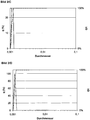
- the pictures 2 AC show the analysis of the particle measurements of different polyamide compositions as graphic representations. It can be seen that there are no particles or agglomerates in the polyamide compositions.
- the copper components are homogeneously distributed in their molecular form by the organocomplex formulations.
- Figures 3 / A to 3 / D show the results of the REM-EDX analyzes for the detection of the distributions of the element copper on the sample surfaces of various polyamide compositions. It can be clearly seen that the copper components are evenly distributed in the polyamide matrix and there are no major agglomerations at the same time.
- This homogeneous Copper distribution is particularly caused by the organocomplexes.
- the addition of copper salt complex stabilizers does not affect the polyamide processing process in any way.
- the polyamide molding compounds stabilized with the copper complexes can, as usual, be shaped into molded parts by injection molding, deep-drawing, blow molding or into monofilaments or filaments by filament spinning processes.
- the amount of copper which is introduced into the polyamide molding compositions in the form of the copper salt-2-oxazoline complex compounds for effective stabilization can be freely selected as long as the mechanical properties of the molding compositions are not adversely affected.
- the copper content is usually between 10 and 1000 ppm, based on the overall formulation. 30 to 130 ppm copper are preferably used.
- the stabilized polyamide compositions according to claim 1 can be stated as low in halogen.
- the halogen content in the polymide molding compositions thus corresponds only to that which may be introduced as the anion of the metal salt for the formation of the metal salt-organoligand complex. If metal-halogen salts are used for complex formation, the halogen content is usually below 200 ppm. If halogen-free salts such as nitrates, acetates or phosphates are used, completely halogen-free stabilized polyamide molding compounds result.
- copper salts are not used for complex formation with 2-oxazolines, but metal salts in which other metal cations are present, stoichiometric complexes are also formed. In turn, they can also be mixed into various polyamides as additives and processed in this mixture with them. Polyamide compositions formulated in this way have additional functional properties. Additional functional properties can be of an antibacterial nature or can also contribute to the absorption of light or energy. If, for example, a metal salt-organoligand complex compound is used in which silver cations are present, antibacterially functionalized polyamide molding compositions can be specified.
- the silver content in the overall formulation is usually between 200 ppm and 3000 ppm, preferably 600 to 1500 ppm are used.
- polyamide molding compositions against Staphylococcus aureus and Klebsiella pneumoniae containing Sibersalz organoligand complexes can be used to give significantly highly effective formulations with regard to antibacterial properties.
- the metals molybdenum, zinc, tin, titanium, cobalt and manganese can also be used in metal salt-organoligand complexes. If at least one of these metal salt-organoligand complex compound is added to polyamides, modified polyamide formulations obtain additional light- or energy-absorbing properties. For example, the transmission of UV or light radiation when passing through foils in which these complexes are contained can be influenced.
- metal salt containing molybdenum is used as the metal salt component in an organo ligand
- radiation absorption will Irradiation of a polyamide film in the wavelength range between 300 and 350 nm generated.
- These polyamide molding compositions usually contain 1000 to 4000 ppm of molybdenum, and the amount used is preferably between 2000 and 3000 ppm of Mo.
- the radiation absorption range can be changed in a targeted manner. If a silver-containing complex is incorporated into polyamides, the wavelength of the absorbed radiation increases to 410 nm.
- the polyamide compositions according to the invention can be provided and processed with other conventional additives, fillers, processing aids, color pigments or lubricants without restrictions, without the stabilization effect or functionalization effect being impaired.
- the advantages described make the polyamide compositions particularly suitable for the production of moldings and components, plates and foils.
- Preferred areas of application can be plates and supports for electronic components in the electronics sector and electrical components such as housings or plugs as well as molded parts for covering important components in the vehicle sector.
- the production of stabilized or functionalized fibers or filaments is equally possible.
- the applications here are particularly in the field of heat-stabilized technical textiles or antibacterial textile fibers for clothing or medical applications.
- the polyamide compositions are usually prepared by mixing at least one polyamide with at least one metal salt-organoligand complex as stated in claim 1.
- the components can be mixed in conventional mixing devices.
- polyamide is pre-mixed in chip form, platelet form or as granulate with a powdered organocomplex, the mixture is melted together in a suitable apparatus and homogenized in the melt.
- this is preferred process that a premix of a metal salt-organoligand-metal complex is produced in the form of a masterbatch or preconcentrate and this is mixed into the pure polyamide, if necessary by means of a side stream metering on an extrusion machine.
- the proportion of the metal salt-organoligand complex in a masterbatch depends on the compatibility with the matrix material, the intended degree of stabilization or functionalization and the desired final concentration in the compound. It is possible to produce preconcentrates up to a concentration of 10% by weight of metal salt-organoligand complex.
- the invention is illustrated by the following explanations and examples.
- a 2-oxazoline derivative of a mono-, di- or tri-carboxylic acid is first prepared, since the 2-oxazoline ring is required as a ligand system for complexing the selected metal cation.
- the 2-oxazoline derivatives of the mono-, di- or tricarboxylic acids are then mixed by mixing with solutions of the selected metal salts.
- the chemical route for the production of the metal salt-organoligand-metal complexes is shown in Figure 1 using the example of aromatic dicarboxylic acids and an aliphatic monocarboxylic acid:
- the 2-oxazoline derivatives are prepared from aromatic di- or tricarboxylic acids in a two-stage process.
- the corresponding carboxylic acid chlorides are used for the 2-oxazoline synthesis or the dicarboxylic acid dichlorides or tricarboxylic acid trichlorides are prepared in a simple manner by halogenation of the carboxylic acids, which are then reacted with chloroethylammonium chloride in a first synthesis stage.
- the procedure is such that hydrochloric acid is eliminated by the action of methanolic potassium hydroxide, whereupon the heterocyclic five-membered ring of the 2-oxazoline is formed.
- the oxalic acid derivative is based on the diethyl ester, which is further reacted with chloroethylammonium chloride analogously to Route A.
- a single-stage 2-oxazoline synthesis is carried out as shown in Route B.
- Simple esters of monocarboxylic acids such as methyl or ethyl esters are used as starting materials and these are reacted with ethanolamine and the reaction is carried out in a reaction mixture by using a catalyst and increasing the temperature until the final formation of 2-oxazoline.
- the alcohol split off during the aminolysis of the carboxylic acid esters is suitable for monitoring the reaction and is removed as an overhead product from the reaction mixture during the reaction. Excess ethanolamine is also removed further by increasing the temperature, so that the carboxylic acid ethanolamide remaining in the reaction mixture is converted into the 2-oxazoline derivative.
- Titanium (IV) butoxide is advantageously used as the catalyst for the 2-oxazoline formation.
- the oxazoline derivatives obtained according to route A or route B are used as organo ligands for complexing metal salt cations in certain molar ratios.
- Cu (II) salts can be complexed in a molar ratio of 1: 1, as shown in Route C.
- Route D shows the course of a complexation of Cu (II) salt with aliphatic monocarboxylic acid 2-oxazolines, where a Molar ratio of the organo ligand to the metal ion of 2: 1 is used.
- Aromatic metal salt-organoligand complexes are obtained as described above in mixtures of the components bis- (2-oxazoline) and metal salt in a molar ratio of 1: 1.
- the molar ratio to the metal salt must be maintained at 2: 1.
- Oxalic acid bis (2-oxazoline) is used in a ratio of 1: 2.
- the isophthalic acid bis-chloroethylamide was prepared by dissolving 101.5 g (0.5 mol) of isophthalic acid dichloride in 600 ml of an inert solvent and this solution was added dropwise with cooling (water / ice) and stirring to a mixture of 1200 ml of water , 116 g (1 mol) of 2-chloroethylammonium hydrochloride and 112 g (2 mol) of KOH. The mixture was stirred at 0 to 5 ° C. for 1 hour and at room temperature for a further hour, a compact precipitate being formed. This was suctioned off, subsequently washed with ethanol, water, ethanol and dried at 80 ° C. in vacuo. Yield: 127 g (90%) F: 136-141 ° C (DSC)
- the organoligand 1,3-phenylene-bis- (2-oxazoline) (1,3-PBO) was prepared by dissolving 34 g (0.6 mol) KOH in portions in a reflux apparatus in 400 ml of dried methanol, then 86 7 g (0.3 mol) of bis-chloroethylamide enters and then the reaction mixture is slowly warmed to reflux temperature. It was cooked for 3 hours after cooling the resulting one Aspirated KCl and the product from the filtrate after storage in the refrigerator recovered by suction. The washing was carried out with methanol, and drying was carried out in vacuo at 80 ° C. It could be recrystallized from a mixture of benzene / cyclohexane 7: 3. Yield: 32 g (52%) F: 142-146 ° C (DSC) Purity: 96% (titration with perchloric acid)
- the copper (II) salt-organoligand complex compound 1,3-phenylene-bis- (2-oxazoline) -Cu (II) chloride complex (Cu (II) -13) was obtained when 50 ml in a stirrer a mixture of equal parts by volume of ethanol and water and 1.7 g (0.01 mol) of Cu (II) chloride dihydrate were dissolved and after complete dissolution of the copper salt 50 ml of a previously prepared solution from the same solvent mixture and 2 , 16 g (0.01 mol) of 1,3-PBO was slowly added dropwise. When the solution was mixed intensively, the color changed from blue to green. After a while the complex turned out to be a green precipitate.
- the copper (I) salt-organoligand complex compound 1,3-phenylene-bis- (2-oxazoline) -Cu (I) chloride complex was obtained if 1.0 g (0.01 mol) was obtained according to the previous procedure. Copper (I) chloride dissolved in ethanol was used as the metal salt for complex formation. Elemental analysis: C H N Cu theor .: 45.7 3.8 8.9 20.1 Found .: 43.9 3.4 7.5 21.2
- the silver salt-organo ligand complex was prepared by using the organo ligand 1,3-phenylene-bis (2-oxazoline) (1,3-PBO) from Example 1 to complex the silver salt silver nitrate. 50 ml of a mixture of equal parts by volume of ethanol and water are prepared and 1.7 g (0.01 mol) of AgNO 3 are dissolved therein. 50 ml of a solution from the same solvent mixture with 2.16 g (0.01 mol) of 1,3-PBO were slowly allowed to flow into this mixture. When the solutions were mixed, a white-gray precipitate formed, which was filtered off, washed and dried in vacuo. A: 1.8 g Elemental analysis: C H N Ag theor .: 37.33 3.13 10.88 27.9 Found .: 37.37 3.50 11.0 28.0 Ligand ratio: 1: 1: 1
- a molybdenum-containing complex compound with the organo ligand (1,3-PBO, Example 1) can be specified if molybdato-phosphoric acid hydrate is used as the metal compound becomes.
- the molybdenum-organoligand complex was prepared by adding the organoligand 1,3-phenylene-bis- (2-oxazoline) from Example 1 to a solution of the molybdenum compound. 80 ml of ethanol / water (50/50 v / v) with 18.2 g (0.01 mol) of molybdate-phosphoric acid hydrate dissolved therein are initially introduced and the dissolved organoligand 1,3-PBO from Example 1 is added dropwise. The product precipitated as a white precipitate with stirring within 2 hours. A: 18 g Elemental analysis: C H N Mo theor .: 7.06 0.74 1.37 56 Found .: 9.1 1.8 1.7 76 Ligand ratio: 1: 1
- the tin salt-organoligand complex was prepared using the organoligand 1,3-phenylene-bis- (2-oxazoline) (1,3-PBO) from Example 1 to complex tin (II) chloride.
- 2.2 g (0.01 mol) of SnCl 2 dihydrate are dissolved in 50 ml of anhydrous ethanol, and 50 ml of a solution of the organoligand 1,3-PBO (2.16 g, 0.01 mol) are slowly added to this mixture , A white precipitate formed within an hour, which was filtered off, washed and dried in vacuo.
- a titanium-containing complex compound with the organo ligand (1,3-PBO, Example 1) was also obtained if titanium bromide was used as the metal salt.
- the titanium-organoligand complex was prepared by adding the organoligand 1,3-phenylene-bis- (2-oxazoline) from Example 1 dissolved in anhydrous ethanol to a solution of titanium tetrabromide. 60 ml of ethanol with 3.7 g (0.01 mol) of TiBr 4 dissolved therein were added and the dissolved organoligand 1,3-PBO was added dropwise. The The complex precipitated as a white precipitate with stirring within 2 hours.
- a zinc-containing complex compound with the organo ligand (1,3-PBO, Example 1) was also obtained if zinc iodide was used as the metal salt.
- the zinc-organoligand complex was prepared by adding the organoligand 1,3-phenylene-bis- (2-oxazoline) from Example 1, dissolved in anhydrous ethanol, to a solution of zinc iodine. 50 ml of water / ethanol mixture with 3.2 g (0.01 mol) of ZnJ 2 dissolved therein are introduced and the dissolved organoligand 1,3-PBO is added dropwise. The complex precipitated as a white precipitate with stirring within 2 hours.
- Ligand ratio 1: 1
- the terephthalic acid bis-chloroethylamide was prepared by dissolving 101.5 g (0.5 mol) of terephthalic acid dichloride in 600 ml of an inert solvent and this solution was added dropwise with cooling (ice water) and stirring to a mixture of 1200 ml of water, 116 g (1 mol) of 2-chloroethylammonium hydrochloride and 112 g (2 mol) of KOH are added. The mixture was stirred at 0 to 5 ° C. for 1 hour and at room temperature for a further hour, during which a precipitate formed. This was suctioned off, subsequently washed with ethanol, water, ethanol and dried at 80 ° C. in vacuo. Yield: 132 g (94%) F: 208-211 ° C (DSC)
- the organo ligand 1,4-phenylene-bis- (2-oxazoline) (1,4-PBO) was prepared by dissolving 34 g (0.6 mol) KOH in portions in a reflux apparatus with 400 ml of dried methanol, then 86 7 g (0.3 mol) of bis-chloroethylamide enters and then the reaction mixture is slowly warmed to reflux temperature. The mixture was stirred under heat for 3 hours, and after cooling, the KCl was suctioned off and the product was recovered from the filtrate after being kept in the refrigerator by suction. The washing was carried out with methanol, and drying was carried out in vacuo at 80 ° C. It could be recrystallized from ethanol. Yield: 33 g (54%) F: 238-241 ° C (DSC) Purity: 96% (titration with perchloric acid)
- the copper (II) salt-organoligand complex 1,4-phenylene-bis- (2-oxazoline) -Cu (II) chloride complex (Cu (II) -14) was obtained when 50 ml in a stirrer a mixture of equal parts by volume of ethanol and water and 1.7 g (0.01 mol) of Cu (II) chloride dihydrate are dissolved and after complete dissolution of the copper salt 50 ml of a previously prepared solution from the same solvent mixture and 2 , 16 g (0.01 mol) of 1,4-PBO are slowly added dropwise. A blue-colored suspension formed with vigorous stirring. The mixture was stirred for a further 3 hours at room temperature.
- the copper (I) salt-organoligand complex 1,4-phenylene-bis- (2-oxazoline) -Cu (I) chloride complex was obtained when 1.0 g (0.01 mol) was obtained by the previous procedure. Copper (I) chloride was used as the metal salt for complex formation. Elemental analysis: C H N Cu theor .: 45.7 3.8 8.9 20.1 Found .: 42.0 3.7 6.5 20.2
- a molybdenum-containing complex compound can be prepared with the organo ligand (1,4-PBO, Example 8) if molybdate phosphoric acid hydrate is used as the metal compound.
- the molybdenum-organoligand complex was obtained by adding the organoligand 1,4-phenylene-bis- (2-oxazoline) to a solution of the molybdenum compound. 80 ml of ethanol / water (50/50 v / v) with 18.2 g (0.01 mol) of molybdate phosphoric acid hydrate dissolved therein were initially introduced and the dissolved organoligand 1,4-PBO from Example 8 was added dropwise. The product precipitated as a white precipitate with stirring within 2 hours.
- the silver salt-organoligand complex is made by making the organoligand 1,4-phenylene-bis- (2-oxazoline) (1,4-PBO)
- Example 8 is used to complex the silver salt silver nitrate. 50 ml of a mixture of equal parts by volume of ethanol and water are prepared and 1.7 g (0.01 mol) of AgNO 3 are dissolved therein. 50 ml of a solution from the same solvent mixture with 2.16 g (0.01 mol) of 1,4-PBO were slowly allowed to flow into this mixture. A white-gray precipitate formed within an hour, which was filtered off, washed and dried in vacuo. A: 1.9 g Elemental analysis: C H N Ag theor .: 37.33 3.13 10.88 27.9 Found .: 37.3 3.4 11.0 27.8
- the oxalic acid-bis-chloroethylamide is prepared by adding a solution of 146 g (1 mol) of diethyl oxalate and 400 ml of ethanol with stirring and cooling (ice water) to a mixture of 600 ml of water, 232 g (2 mol) of 2- Chlorethylammonium chloride and 56 g (1 mol) KOH is slowly added dropwise. The mixing of the solutions was carried out so slowly that the temperature of the reaction mixture did not rise above 40 ° C. A precipitate of the reaction product formed, with stirring being continued for 1 hour. The reaction mixture was kept in the refrigerator overnight, then the precipitate was filtered off with suction, washed with ethanol and dried at 80 ° C. in vacuo. Yield: 162 g (88%) F: 203-205 ° C (DSC)
- the organoligand 2,2'-bis-oxazoline (2,2-BOX) was prepared by dissolving 34 g (0.6 mol) KOH in portions in a reflux apparatus in 400 ml of dried methanol, then 63.9 g (0.05 3 mol) bis-chloroethylamide added and slowly warmed to reflux temperature. It was heated for 3 hours, after cooling, the resulting KCl was suctioned off and the product obtained from the filtrate by concentrating by evaporating the filtrate until a precipitate has formed. It was filtered off, washed with a little methanol and dried in vacuo at 80 ° C. Yield: 14 g (33%) F: 212-214 ° C (DSC)
- the copper (II) salt-organoligand complex compound 2,2'-bis-oxazoline-Cu (II) complex, (Cu (II) -22) is obtained when 50 ml of a mixture of equal parts by volume of ethanol in a stirring apparatus and water are introduced and 3.4 g (0.02 mol) of Cu (II) chloride dihydrate are dissolved therein and, after the copper salt has completely dissolved, 50 ml of a previously prepared solution from the same solvent mixture and 1.4 g (0.05 01 mol) 2,2-BOX slowly added dropwise.
- the reaction mixture initially remained a clear solution in which turbidity occurred after about 2 hours due to the formation of a fine precipitate.
- the copper (I) salt-organoligand complex compound Cu (I) -22 is obtained if 2.0 g (0.02 mol) of copper (I) chloride are used as the metal salt for complex formation according to the previous procedure.
- the silver salt-organoligand complex is prepared by using the organoligand 2,2'-bisoxazoline (2,2-BOX) from Example 12 silver nitrate is used to complex the silver salt.
- 50 ml of a mixture of equal parts by volume of ethanol and water were prepared, and 3.4 g (0.02 mol) of AgNO 3 were dissolved therein.
- 50 ml of a solution from the same solvent mixture with 1.4 g (0.01 mol) of 2,2-BOX were slowly added to this mixture.
- a white precipitate formed within an hour, which was filtered off, washed and dried in vacuo.
- Stearic acid was esterified with methanol by mixing 100 g of stearic acid with 800 ml of methanol and 65 ml of conc. Hydrochloric acid were mixed and refluxed for 3 hours. After cooling, the ester solidified or settled as an oily layer. It was separated from the methanol, placed in a 500 ml flask and separated from the main amount of the methanol, in which the solvent and water were distilled off under vacuum to a flow temperature of 40 ° C. The Liebig cooler was replaced with a drip catcher, the apparatus was equipped with a cooler heated to 55 ° C and the ester fractionated. Yield: 98% F: 39 ° C Saponification number: 186.9 mg KOH / g
- the organoligand stearic acid bis (2-oxazoline) (ST) is produced from the methyl ester by aminolysis with ethanolamine.
- a mixture of 120 g of methyl stearate, 61 g of ethanolamine and 1.4 g of titanium (IV) butoxide was slowly heated to 140-175 ° C. under an N 2 atmosphere, and methanol was distilled off in the process. Thereafter, excess ethanolamine was first removed under reduced pressure at about 400 mbar, further down to 20 mbar, until the temperature in the cooler dropped.
- the oxazoline was then fractionated using a drip catcher and a cooler heated to 70 ° C.
- the purity of the oxazoline was determined conductometrically using perchloric acid. Yield: 80% F: 69.8 ° C Purity: > 92%
- the copper (II) salt-organoligand complex compound stearic acid-2-oxazoline-Cu (II) chloride complex (Cu (II) -ST) is obtained in a stirrer when 50 ml of a mixture of equal parts by volume of ethanol and water are introduced , 1.7 g (0.01 mol) of Cu (II) chloride dissolved therein, and after complete dissolution of the copper salt 100 ml of an ethanolic solution of 6.2 g (0.02 mol) of stearic acid-2-oxazoline were slowly added dropwise become. A blue-colored suspension formed during the addition of the ligand solution.
- the copper (I) salt-organoligand complex compound Cu (I) -ST is obtained if 1.0 g (0.01 mol) of copper (I) chloride are used as the metal salt for complex formation according to the previous procedure.
- the silver nitrate-organoligand complex compound Ag-ST is obtained if, according to the previous procedure, 1.7 g (0.01 mol) of AgNO 3 are used as the metal salt for complex formation.
- Behenic acid was esterified with methanol by mixing 100 g of behenic acid with 800 ml of methanol and 65 ml of conc. HCl mixed and refluxed for 3 hours under N 2 .
- the still hot reaction mixture was transferred to a temperature-controlled crystallization vessel and slowly cooled with stirring. As the cooling progresses, the crude ester is obtained in granular form. It is filtered off, added to 150 ml of water and this mixture is neutralized with a 5% K 2 CO 3 solution. The solid product is suctioned off again and dissolved in 200 ml of acetone. When cooling again overnight, the ester crystallized out as a fine precipitate. It was suctioned off and dried at room temperature in a vacuum. Yield: 98%
- F 53 ° C saponification value: 154.7 mg KOH / g
- the organo ligand behenic acid bis (2-oxazoline) (BE) was prepared from the methyl ester by aminolysis with ethanolamine. The procedure was such that 142 g of methyl beenate, 61 g of ethanolamine and 1.4 g of titanium (IV) butoxide were mixed and slowly heated to 140-175 ° C. under an N 2 atmosphere, methanol being distilled off. Excess ethanolamine was then removed under reduced pressure, first at approximately 400 mbar, then further to 20 mbar, until the temperature in the cooler dropped. The behenic acid crude oxazoline remaining as the bottom was fractionated in vacuo under 1 mbar. Yield: 90% F: 62 ° C Purity: 92% (perchloric acid titration)
- the copper (II) salt-organoligand complex compound behenic acid-2-oxazoline-Cu (II) chloride complex (Cu (II) -BE) is obtained in a stirrer when 50 ml of a mixture of equal parts by volume of ethanol and water are introduced , in it 1.7 g (0.01 mol) of Cu (II) chloride, and after complete dissolution of the copper salt, 100 ml of an ethanolic solution of 7.3 g (0.02 mol) of behenic acid-2-oxazoline are slowly added dropwise. A light green suspension was formed during the addition of the ligand solution. The mixture was stirred at room temperature for a further 1 day, a blue-colored precipitate being formed.
- the copper (I) salt-organoligand complex compound Cu (I) -BE is obtained if, according to the previous procedure, 1.0 g (0.01 mol) of copper (I) chloride as the metal salt for complex formation with (BE) from Example 18 are used.
- Behenic acid-2-oxazoline-silver nitrate complex (Ag-BE)
- the silver nitrate-organoligand complex compound Ag-BE is obtained if, according to the previous procedure, 1.7 g (0.01 mol) of AgNO 3 are combined as the metal salt for complex formation with the organoligand (BE) from Example 18.
- the polyamide compositions according to the invention were generally prepared by mixing at least one polyamide with at least one metal salt-organoligand complex compound. As already described above, it is possible to premix the components directly and then homogenize them together by melting, or first to prepare a preconcentrate in which the proportion of metal salt-organoligand complex can be up to 10% by mass and this then with pure polyamide to be processed in mixtures to the desired concentration.
- the person skilled in the art is familiar with the customary processing machines for the production of moldings, films or fibers.
- twin-screw extruder is particularly suitable for the production of the polyamide compositions in order to achieve a homogeneous mixture of the components.
- the speed of the extruder screws should be between 75 and 150 rpm, preferably 100 rpm.
- the metal salt-organoligand complex compound can be metered directly into the polyamide mass flow either in the desired final concentration or in the concentration of the preconcentrate, preferably by means of a speed-controlled metering screw.
- the mass is discharged as a polymer strand and leads through a water bath, from which it is fed directly into a granulating machine.
- the granules obtained are dried in a conventional dryer under vacuum.
- test pieces 1A and 5A (ISO 527-2) for tensile tests (DIN EN ISO 527) and bending tests were made from the polyamide compositions according to the invention using an injection molding machine (DIN EN ISO 178) as well as filaments for investigations of the antibacterial activity (JIS L 1902) by means of a filament melt spinning plant and foils for measurements of the radiation absorption by means of a foil extrusion device.
- the standard test rods manufactured by injection molding as described above were continuously treated in convection drying ovens at a temperature of 150 ° C. Samples were taken at 500 hour intervals and examined for their material properties. The mechanical properties of tensile strength and elongation at break were tested in accordance with DIN EN ISO 527-2 and DIN EN ISO 178. The ratio of the strength parameters after heat exposure and the values of the untreated initial state was used as a benchmark for evaluating the thermal stability of the copper salt-organoligand complex compounds defined in polyamides and referred to as residual strength, residual elongation or residual modulus. Furthermore, the half-life is specified from the temporal course of the strength parameters over the heat storage period, which is defined as the period until the values decrease to less than 50% of the respective initial value.
- metal salt-organoligand complex compounds according to the invention is the formulation of polyamide compositions with antibacterial material properties. These material properties are obtained by adding metal salt-organoligand complex compounds to the polyamides in which silver salts were used for the complexation.
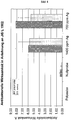
- Textile filaments were spun from polyamide 6 and the addition of various amounts of the silver nitrate-organoligand complex Ag-13 (example 3) using conventional melt spinning technology. These fibers were then examined in parallel with comparison fibers made of pure polyamide 6 and a polyester comparison fiber with regard to antibacterial activity. The tests were carried out based on JIS L 1902 against the gram-positive bacterium Staphylococcus aureus and the gram-negative germ Klebsiella pneumoniae. The test values obtained are shown in Table 6 and Figure 4: Table 6 sample Metal-Org. - Complx. Addition (mass%) Silver (ppm) Effectiveness A K. pneum. S. aureus Zero sample PA6 - - 0 0.38 0.14 Comparison PET - - 0 0.00 0.00 Invention A / 25 Ag-13 0.25 700 8.18 5.53 Invention A / 50 Ag-13 0.50 1400 5.93 5.73
- Figure 4 shows the antibacterial effectiveness of polyamide fibers modified according to the invention in comparison to a blank sample or to a polyester fiber.
- An expansion of the functionalization of polyamides by adding metal salt-organoligand complex compounds according to the invention relates to radiation absorption, which can advantageously be used in polyamide films if, in addition to copper (II), other metals such as Cu (I) or molybdenum are selected for complexation with organoligands.
Landscapes
- Chemical & Material Sciences (AREA)
- Organic Chemistry (AREA)
- Inorganic Chemistry (AREA)
- Health & Medical Sciences (AREA)
- Chemical Kinetics & Catalysis (AREA)
- Medicinal Chemistry (AREA)
- Polymers & Plastics (AREA)
- Life Sciences & Earth Sciences (AREA)
- Environmental & Geological Engineering (AREA)
- General Life Sciences & Earth Sciences (AREA)
- Geology (AREA)
- Compositions Of Macromolecular Compounds (AREA)
Description
- Die Erfindung betrifft ein Verfahren zur Herstellung von stabilisierten und/oder funktionalisierten, aus der Schmelze verformbaren Polyamidformmassen, bei denen durch Einsatz spezieller Metallsalz-Organoligand-Komplexverbindungen eine Stabilisierung und/oder spezielle Funktionalisierung erreicht wird. Die Stabilisierung betrifft die Verbesserung der thermooxidativen Eigenschaften gegen Wärmeeinwirkung, die Funktionalisierung kann antibakterielle, lichtabsorbierende oder energieaktive Eigenschaften umfassen. Die Stabilisierung und/oder Funktionalisierung wird durch Anwesenheit von Metallsalz-Organoligand-Komplexverbindungen als Polymeradditiv erreicht. Die Metallsalz-Organoligand-Komplexverbindungen bestehen aus einer Kombination eines Metallsalzes mit einer heterozyklischen organischen Verbindung, die als Ligand gegenüber dem Metallion auftritt und zu einer stöchiometrisch aufgebauten, thermisch stabilen Komplexverbindung führt. Die neuen Stabilisatoren oder funktionellen Additive sind gleichzeitig halogenarm.
- Polyamide zählen im Bereich der technischen Thermoplaste zu einer bedeutenden Gruppe polymerer Werkstoffe. Als wichtiger Konstruktionswerkstoff werden Polyamide neben dem textilen Anwendungsbereich im Automobilbau und in der Elektrotechnik eingesetzt, wo zunehmend die Forderung nach Stabilität gegen Wärmeeinwirkung gestellt wird.
- Die vorliegende Erfindung betrifft stabilisierte und/oder funktionalisierte Polyamidzusammensetzungen mit erhöhter Wärmestabilität und/oder funktionellen Eigenschaften. Die Polyamidzusammensetzung enthält zur Stabilisierung und/oder Funktionalisierung mindestens eine stabilisierende und/oder funktionalisierende Metallsalz-Organoligand-Komplexverbindung als Polymeradditiv. Der Organoligand ist ein 2-Oxazolinderivat. Das Metallsalz ist ein Kupfer(I)- oder Kupfer(II)-acetat oder ein Zink(II)-, Zinn(II)-, Cobalt-Molybdän-, Titan-, Silber(I)-, halogenid, nitrat, phosphat oder acetat.
Polymere werden durch Einwirkung von Wärme, Licht und Sauerstoff durch thermooxidative Prozesse abgebaut. Diese Polymerdegradationsvorgänge beruhen auf chemischen Reaktionen, bei denen Polymerketten nach unterschiedlichen Mechanismen gespalten werden. Die Folge sind nachteilige Änderungen der makroskopischen und physikalischen Eigenschaften der Polymere, die letztlich zu erheblichen Schädigungen bis hin zur Unbrauchbarkeit der Werkstoffe führen. Um diesen Degradationsprozessen entgegenzuwirken ist der Einsatz hochwirksamer Stabilisatoren unabdingbar. Durch Zusatz spezifisch wirksamer Additivsysteme zu den Polymeren können diese Prozesse über lange Zeiträume, d.h. über den gesamten Gebrauchszyklus von polymeren Fertigteilen, verzögert werden.
In derEP 0 610 155 A und in derUS 3 639 335 sind Polyamidzusammensetzungen offenbart, die gegen die Einwirkung von Sonnenlicht und Hitze stabilisiert sind. Als Stabilisator enthalten sie das Reaktionsprodukt aus mindestens einem Kupfersalz und mindestens einem organischen metallkomplexierenden Mittel. Kupfer-Komplexe sind auch in derUS 4 486 326 beschrieben.
Für die Stabilisierung von Polyamiden werden aus einer breiten Produktpalette verschiedenste chemische Substanzen zugesetzt, die Oxidationsprozesse der Polymeren minimieren oder zeitlich hinausschieben. Diese sogenannten Antioxidantien sind meistens aus sterisch gehinderten Phenolen, sekundären aromatischen Aminen oder Phosphorderivaten oder Thioethern aufgebaut. Neben diesen Substanzen gibt es für Polyamide besonders wirkungsvolle Stabilisatoren aus der Stoffklasse spezieller Kupferverbindungen, sogenannter Kupferstabilisatoren. - Kupferstabilisatoren sind zur Stabilisierung von Polyamiden seit einiger Zeit bekannt und werden gegenwärtig intensiv weiterentwickelt [
DE19847627 ;DE4305166 ]. Der Einsatz derartiger Stabilisatorsysteme zielt darauf ab, eine Langzeitstabilisierung von Polyamiden bei erhöhten Temperaturen von bis zu 180 C zu erreichen. Kupferstabilisatoren werden beispielsweise bei der Polyamidfaserproduktion für Reifencord sowie für Spritzgussteile in technischen Anwendungen im Automotivebereich und in der Elektroindustrie als Leiterplattenträger eingesetzt. Kupferstabilisatoren bestehen in der Regel aus einem Gemisch von zwei Komponenten, basierend auf Kupferverbindungen und Halogensalzen. Eine Komponente besteht aus Kupferhalogeniden oder anderen Kupfersalzen wie Kupferacetat, Kupferstearat und Kupfersulfat. Damit diese Verbindungen als Antioxidantien wirksam sind, müssen als weitere Komponente Halogenverbindungen, und zwar in großem Überschuss, zugegeben werden. Verwendet werden meist Alkalijodide und -bromide, wobei die zugesetzte Menge einen bis zu 15-fachen molaren Überschuss an Halogen bezogen auf Kupfer betragen muss. Zur Stabilisierung von Polyamid werden bis zu 200 ppm Kupfer in der Stabilisatorzusammensetzung eingesetzt, was einem adäquaten Eintrag von bis zu 3000 ppm des jeweiligen Halogens in das Polymere erfordert. Mit derartigen Stabilisatorsystemen können Polyamide ausreichend wärmestabilisiert werden, sodass diese Polymere kurzzeitig Temperaturen von 150 bis 180 °C ausgesetzt werden können ohne dramatischen Verlust ihrer mechanischen Eigenschaften.
Jedoch weisen diese Kupferstabilisatoren im Gebrauch entscheidende Nachteile auf. Da Polyamide im konditionierten Zustand bis zu 3 Masse-% Wasser aufnehmen, migrieren wasserlösliche Bestandteile aus der Polymermatrix an die Oberfläche, was zu Belagsbildungen führt. Werden Kupferstabilisatoren in der beschriebenen Zusammensetzung mit dem notwendigerweise hohen Überschuss an Halogensalzen verwendet, bilden diese infolge Extraktionsprozessen einen hygroskopischen, meist sauren Belag auf der Polyamidoberfläche, was sich nachteilig bei Anwendungen für elektrische Bauteile auswirkt. Die Kriechstrombeständigkeit wird bis zum Versagen beeinträchtigt. Darüber hinaus kann es an Kontaktstellen mit Metallen zu Korrosion kommen. Auflagen der Automobil- und Elektronikindustrie lassen sich dadurch nur schwer einhalten.
Ein weiterer Nachteil dieser Stabilisatorsysteme besteht in der Reagglomerationsneigung dieser Verbindungen im Verarbeitungsprozess. Um diese Vorgänge zu reduzieren ist es erforderlich, einerseits auf eine Feinstverteilung der Stabilisatoren bei Zumischung zu den Polymeren zu achten, andererseits versucht man durch Herstellung von Masterbatches Probleme der Dosierbarkeit zu überwinden. Werden Kupfersalz/Halogensalz-Stabilisatoren als wässerige Lösung während der Polymerisation zugegeben, kommt es zudem zu Ablagerungen an Kesseln oder beim Faserherstellungsprozess an Spinndüsen mit der Folge von Filamentbrüchen. - Zur Vermeidung dieser Nachteile wurden verschiedene Lösungen untersucht. Häufig wurde versucht, zusätzlich neben den Kupferstabilisatoren weitere organische oder anorganische Verbindungen einzusetzen, die synergistisch auf den Stabilisierungsprozess wirken sollen. Beschrieben sind bspw. der Einsatz von Kupferphosphinverbindungen sowie Zusätze von Mercaptobenzimidazol- oder organischen Halogenverbindungen. Eine andere Lösung wurde in [
DE19847626 ] beschrieben, wo anstelle eines Halogensalzes eine hochhalogenierte organische Phosphatverbindung eingesetzt werden kann. Durch diese Maßnahmen konnten jedoch die bekannten Nachteile nicht vollständig beseitigt werden, was zumindest auf die Kriechstromfestigkeit der Polyamide zutrifft.
Weiterhin wird auf die Notwendigkeit des Einsatzes von Synergisten neben Kupferstabilisatoren hingewiesen [DE69415493 ]. Hier wurden Polyolefine wie Polyethylen, Polypropylen und Ethylen-Propylen-Copolymere empfohlen, die jedoch wiederum als Nachteil eine begrenzte Kompatibilität zu Polyamiden aufweisen. Vorgeschlagen wurde auch, Kupferverbindungen und reaktive Substanzen auf Basis von Bis-(2-Oxazolinen) in einem binären System einzusetzen, um die bekannte stabilisierende Wirkung von Kupfer in hohen Konzentrationen von bis zu 1000 ppm und durch eine Kettenverlängerung der Polyamide durch die Reaktivsubstanzen miteinander zu verbinden [JP60248730
Ausgehend von den oben beschriebenen Problemen und Nachteilen des Standes der Technik war es Aufgabe der vorliegenden Erfindung, eine stabilisierte Polyamidzusammensetzung zu formulieren, welche halogenarm ist, die mechanischen Eigenschaften der Polyamide nicht negativ beeinflusst und gleichzeitig die Dauergebrauchstemperatur anhebt und somit die bisher bekannten Nachteile überwindet.
Diese Aufgabe wird durch stabilisierte Polyamidzusammensetzungen nach Anspruch 1 gelöst. - Überraschenderweise wurde gefunden, dass Kupfersalze, die üblicherweise in Kombination mit einem hohen Überschuss von Alkalihalogeniden als Stabilisatorsystem eingesetzt werden, auch ohne zusätzliches Halogenid ebenso mit Carbonsäure-(2-Oxazolin)-Derivaten halogenarme stabile Kupfersalz-Organoligand-Komplexe bilden. Bekannt ist, dass Stickstoffhaltige organische Substanzen als mehrzahnige Liganden zur Komplexierung zahlreicher Katalysatormetalle für chemische Reaktionen eingesetzt werden können [Ch. Wei et al., J. Am. Chem. Soc. 124(2002)5638-5639]. Vor allem war überraschend, dass die erfindungsgemäßen Kupfersalz-Organoligand-Komplexe aus einer Kombination von Alkylcarbonsäure-(2-oxazolinen) und einem Kupfersalz stöchiometrisch definiert aufgebaut, luftbeständig und lagerstabil sind und eine neue Klasse von halogenarmen Kupferstabilisatoren bilden. Weiter war überraschend, dass Polyamidzusammensetzungen nach Anspruch 1 so stabilisiert werden können, dass sie verbesserte Eigenschaften aufweisen und höhere Dauergebrauchstemperaturen besitzen ohne dass Kettenverlängerungen auftreten.
Darüber hinaus war überraschend, dass neben Kupfersalzen auch andere Metallsalze durch Verbindungen mit 2-Oxazolinringen als Liganden stabil komplexiert werden können. So kann man weitere verschiedene Additive angeben, mit denen Polyamidformmassen zusätzliche funktionelle Eigenschaften wie antibakterielle Wirksamkeit, Licht- oder Energie-absorbierende Eigenschaften erhalten können.
Die oben beschriebene Aufgabe wird nun dadurch gelöst, dass mindestens ein Polyamid und mindestens ein Metallsalz-Organoligand-Komplex nach Anspruch 1 in der stabilisierten Polyamidzusammensetzung vorliegen. Gleichzeitig stellt die Erfindung ein Verfahren zur Herstellung einer funktionalisierten Polyamidzusammensetzung mit erhöhter Wärmestabilität und funktionelle Eigenschaften nach Anspruch 7 dar. Das mindestens eine Polyamid kann irgendein Polyamid sein. Polyamide sind Polymere, in denen wiederkehrende Carbonsäure- Amidgruppen enthalten sind. Sie werden aus polykondensierenden Umsetzungen von Diaminen mit Dicarbonsäuren bzw. ihren Carbonsäurefunktionellen Derivaten oder aus Aminocarbonsäuren bzw. ihren Derivaten wie z.B. Lactamen erhalten. Durch Auswahl, Variation oder Kombination der zur Polykondensation herangezogenen Monomeren sind Polyamide verschiedener chemischer Struktur zugänglich. Entsprechend der Erfindung können somit stabilisierte oder funktionalisierte Polyamidformmassen aus den wichtigen Standardpolyamiden Polyamid 6 (aus ε-Caprolactam), Polyamid 6.6 (aus Hexamethylendiamin und Adipinsäure) Anwendung finden. Weiterhin können Polyamid 11, Polyamid 12, Polyamid 6.10 teilaromatische Polyamide eingesetzt werden. Erfindungsgemäß können neben diesen Polymeren auch Co-Polyamide, Block-Co-Polyamide und Polyamid-Blends verwendet werden.
Die erfindungsgemäßen Metallsalz-Organoligand-Komplexverbindungen sind stets durch eine Kombination aus einem Metallsalz mit einem Organoliganden aufgebaut. Das Metallsalz kann ein beliebiges Metallsalz sein, das aus einem Metallkation und einem anorganischen oder organischen Anion besteht. Beispiele geeigneter Metallsalze sind die Kupfer(I)-Salze CuJ, CuBr, CuCl, die Kupfer(II)-Salze CuCl2, Kupferacetat, Kupfersulfat. Weitere Beispiele geeigneter Metallsalze sind Silbernitrat, Kobalt(II)-chlorid, Molybdän-Phosphorsäure-hydrat, Zinn(II)-chlorid, Zink(II)-chlorid, Zink(II)-jodid, Mangan(II)-acetat. Die als Organoligand in den Metallsalz-Organoligand-Komplexen enthaltene wirksame Substanz sind 2-Oxazolinderivate organischer Carbonsäuren. 2-Oxazoline (auch bezeichnet als 4,5-Dihydrooxazole) sind heterozyklische 5-Ringverbindungen, die jeweils ein Sauerstoffatom, ein Stickstoffatom und eine Doppelbindung im Ring enthalten. Die erfindungsgemäß als Organoliganden verwendeten 2-Oxazoline enthalten die Heteroatome Sauerstoff in 1-Stellung, den Stickstoff in 3-Stellung, die Doppelbindung im heterozyklischen Ring befindet sich zwischen dem Kohlenstoffatom 2 und dem Stickstoffatom:
- Bild: chemische Struktur 2-Oxazoline (4,5-Dihydrooxazole)
- Besonders bevorzugte Komplexe werden erhalten aus:
- Silbernitrat und 2,2'-(meta-Phenylen)-bis-(4,5-dihydro-oxazol) im molaren Verhältnis 1 : 1. Diesem Komplex wurde die folgende Formel zugeordnet:

- Silbernitrat und 2-Heneicosyl-4,5-dihydro-oxazol im molaren Verhältnis 1 : 2, mit der Strukturformel

- Kupfer(I)chlorid und 2,2'-(para-Phenylen)-bis-4,5-dihydro-oxazol im molaren Verhältnis 1 : 1. Chloro-[2,2'-para-phenylen-bis-(4,5-dihydro-oxazol)]-cuprat
- Kupfer(II)chlorid und 2,2'-(para-Phenylen)-bis-4,5-dihydro-oxazol im molaren Verhältnis 1 : 1.
- Dichloro-[2,2'-para-phenylen-bis-(4,5-dihydro-oxazol)]
- Chirale Komplexe aus Palladium(II)- und Kupfer(II)-Salzen und Liganden mit Oxazolin-Gruppen wurden bereits beschrieben in Chemistry Letters 35 [2006] 172 - 173. Sie sind vorgesehen als Katalysatoren in asymmetrischen Diels-Alder-Reaktionen. Die in der vorliegenden Erfindung eingesetzten Komplexe sind dagegen nicht chiral, d.h. sie weisen keine Chiralitätszentren auf, oder es handelt sich um Racemate. Sie haben keine katalytische Wirkung und werden nicht als Katalysatoren eingesetzt.
- 2-Oxazoline entstehen beispielsweise bei der Dehydratisierung von N-(2-Hydroxyalkyl)-amiden durch innermolekulare Zyklisierung. Man kann 2-Oxazoline aber auch aus β-Halogen-alkylamiden durch Umsetzung mit starken Basen wie z.B. alkoholischen Alkalien gewinnen. Weiterhin können sie durch eine Kondensationsreaktion von 1,2-Aminoalkoholen mit Carbonsäureestern, Carbonsäureamiden oder Nitrilen erhalten werden. Erfindungsgemäß werden 2-Oxazoline als Derivate organischer Carbonsäuren verwendet.
Die organische Carbonsäure kann irgendeine Carbonsäure sein, die aliphatischer, aromatischer oder aliphatisch-aromatischer Natur ist und monofunktionell, difunktionell oder polyfunktionell hinsichtlich der Zahl vorhandener Carbonsäuregruppen aufgebaut ist. Beispiele geeigneter Carbonsäuren, aus denen 2-Oxazolinderivate erfindungsgemäß als Ligandensysteme zur Komplexierung von in den Metallsalzen enthaltenen Metallkationen gewonnen werden können, sind die monofunktionellen Carbonsäuren Palmitinsäure [57-10-3], Stearinsäure [57-11-4], Behensäure [112-85-6], 10-Undecensäure [112-38-9], Linolensäure [463-40-1], Ölsäure [112-80-1], Erucasäure [112-86-7], weiterhin die difunktionellen Substanzen Oxalsäure [144-62-7], Adipinsäure [124-04-9], Isophthalsäure [121-91-5], Terephthalsäure [100-21-0], 2-Bromterephthalsäure [586-35-6] sowie die trifunktionelle Trimesinsäure [554-95-0].
Die erfindungsgemäßen Metallsalz-Organoligand-Komplexverbindungen entstehen nun dadurch, dass mindestens eines der oben aufgeführten Metallsalze in einem geeigneten Lösungsmittel oder Lösungsmittelgemisch vollständig aufgelöst wird und zu dieser homogenen Metallsalzlösung mindestens eines der vorgenannten geeigneten Carbonsäure-2-Oxazoline als Organoligand, ebenfalls in einem geeigneten Lösungsmittel gelöst, zugegeben wird. Die verwendeten Lösungsmittel oder Lösungsmittelgemische für das Metallsalz und das mit ihm kombinierte 2-Oxazolin müssen vollständig miteinander mischbar sein. Bevorzugte Lösungsmittel sind aliphatische primäre Alkohole wie z.B. Methanol, Ethanol, n-Propanol, Isopropanol und Butanol sowie halogenierte Kohlenwasserstoffe wie Dichlormethan, Chloroform oder Tetrachlorkohlenstoff. Vorzugsweise werden Methanol, Ethanol oder n-Propanol verwendet. Die Konzentrationen der Komponenten in den zu vermischenden Lösungen betragen 0,1 bis 1 mol/l, vorzugsweise 0,2 bis 0,4 mol/l. Die den Metallsalz-Organoligand-Komplexbildenden Komponenten müssen in einem speziellen äquimolaren Verhältnis des Organoliganden zu dem Metallsalzkation in dem Lösungsmittelgemisch vorliegen. Das spezielle äquimolare Verhältnis der Komponenten ist von der chemischen Struktur der 2-Oxazoline und nicht von der Art des verwendeten Metallsalzes abhängig. Erfindungsgemäß müssen für die Herstellung der Komplexverbindungen die äquimolaren Verhältnisse von Organoligand zu Metallsalzkation in den Lösungsgemischen von 2:1, 1:1 oder 1:2 mol/mol eingehalten werden, damit stabile Komplexverbindungen gebildet werden können. Günstigerweise können für verschiedene Organokomplexe folgende molare Verhältnisse gewählt werden:Tabelle 1: Bevorzugte Kombinationen von 2-Oxazolinligand und Metallsalz und molare Zusammensetzungen in den Organoligand-Metallsalz-Komplexen Organoligand (OL) als 2-Oxazolinderivat Molverhält -nis OL/M (mol/mol) Metallsalz (M) Palmitinsäure-2-oxazolin 2:1 Kupfer(I)-chlorid Stearinsäure-2-oxazolin 2:1 -bromid 10-Undecensäure-2-oxazolin 2:1 -jodid Behensäure-2-oxazolin 2:1 oder Erucasäure-2-oxazolin 2:1 Kupfer(II)-chlorid Linolensäure-2-oxazolin 2:1 -sulfat Ölsäure-2-oxazolin 2:1 oder ÖEAO 2:1 AgNO3 Oxalsäure-2,2'-bis(2-oxazolin) 1:2 oder Isophthalsäure-1,3-bis(2-oxazolin) SnCl2 1:1 oder Terephthalsäure-1,4-bis(2-oxazolin) ZnCl2, ZnJ2 1:1 oder Adipinsäure-1,6-bis(2-oxazolin) Mn(II)-acetat 1:1 oder Trimesinsäure-tris- (2-oxazolin) 1:1 H3P (Mo3O10)4 oder Kobalt (II)-chlorid - Die Mischung aus der mindestens einen 2-Oxazolinlösung und der mindestens einen Metallsalzlösung wird in homogener Lösung bei einer Temperatur zwischen 20 und 60 C, vorzugsweise zwischen 22 und 28 °C für einen Zeitraum von 1 bis 6 Stunden, vorzugsweise 2 bis 3 Stunden, intensiv vermischt. Auf Grund der räumlichen Anordnung der heterozyklischen Atome im 2-Oxazolinring und der Wirksamkeit des Stickstoffatoms als Elektronendonator können die 2-Oxazolinverbindungen als Chelatbildner für Metallionen auftreten und stabile Metallsalz-Komplexe bilden. Erfindungsgemäß fallen die Metallsalz-2-Oxazolinkomplexe nach einer gewissen Verweilzeit als Feststoffe aus den Lösungen an. Sie können dann auf übliche Weise durch Filtration, Reinigung durch Wäsche und Trocknung isoliert werden.
Verwendet man als Metallsalze zur Komplexbildung mit 2-Oxazolinverbindungen Kupfersalze, werden auf einfache Weise wirksame Stabilisatoren für Polyamide, insbesondere für die Verbesserung der Wärmestabilität und für eine deutliche Anhebung der Dauergebrauchstemperatur, erhalten. Die Kupfersalz-2-Oxazolin-Komplexe können in einfacher Weise den Polyamiden vorteilhafterweise vor ihrer Verarbeitung durch Schmelzeextrusionsprozesse zugegeben werden, da sie luftbeständig und lagerstabil sind. Sie können so mit der Polyamidmatrix direkt verarbeitet werden. Ebenso möglich ist die Herstellung eines Masterbatches, welches später mit anderen Polyamiden verschnitten werden kann. Während der Verarbeitung der Polyamidformmassen verteilen sich die Komplexverbindungen gleichmäßig und homogen in der Polymerschmelze. Überraschenderweise werden keine Agglomerationen von Metallsalzclustern gefunden. Die Metallkomplexe liegen nach der Polyamidverarbeitung in der Masse in Partikelgößen kleiner als der Nanometerbereich vor.
Die Bilder 2 A-C zeigen die Analyse der Partikelmessungen verschiedener Polyamidzusammensetzungen als grafische Darstellungen. Es ist zu erkennen, dass in den Polyamidzusammensetzungen keine Teilchen oder Agglomerate vorliegen. Somit sind in den erfindungsgemäßen Polyamidzusammensetzungen die Kupferanteile durch die Organokomplex-Formulierungen in ihrer molekularen Form homogen verteilt. In den Bildern 3/A bis 3/D sind die Ergebnisse der REM-EDX-Analysen zum Nachweis der Verteilungen des Elementes Kupfer auf den Probenoberflächen verschiedener Polyamidzusammensetzungen gezeigt. Es ist deutlich zu erkennen, dass die Kupferanteile gleichmäßig in der Polyamidmatrix verteilt sind und gleichzeitig keine größeren Agglomerationen vorliegen. Diese homogene Kupferverteilung wird insbesondere durch die Organokomplexe hervorgerufen.
Der Polyamidverarbeitungsprozess wird durch den Zusatz der Kupfersalz-Komplexstabilisatoren in keiner Weise beeinträchtigt. Die mit den Kupferkomplexen stabilisierten Polyamidformmassen können wie üblich zu Formteilen durch Spritzgießen, Tiefziehen, Blasformen oder zu Monofilen oder Filamenten durch Filamentspinnprozesse verformt werden.
Die Menge an Kupfer, welche in Form der Kupfersalz-2-Oxazolin-Komplexverbindungen zur wirksamen Stabilisierung in die Polyamidformmassen eingebracht wird, ist in weiten Grenzen frei wählbar, solange die mechanischen Eigenschaften der Formmassen nicht negativ beeinflusst werden. Üblicherweise liegt der Kupferanteil zwischen 10 und 1000 ppm bezogen auf die Gesamtformulierung. Bevorzugt werden 30 bis 130 ppm Kupfer eingesetzt. Da erfindungsgemäß kein zusätzliches Halogen in Form von Alkalihalogeniden zur Stabilisierung des Kupfers in der Polymermatrix zugegeben werden muss, können die stabilisierten Polyamidzusammensetzungen nach Anspruch 1 als halogenarm angegeben werden. Der Halogenanteil in den Polymidformmassen entspricht somit nur dem, welcher eventuell als Anion des Metallsalzes für die Bildung des Metallsalz-Organoligand-Komplexes eingebracht wird. Werden Metall-Halogen-Salze zur Komplexbildung verwendet, liegt der Halogenanteil üblicherweise unterhalb von 200 ppm. Werden halogenfreie Salze wie z.B. Nitrate, Acetate oder Phosphate eingesetzt, resultieren vollständig halogenfreie stabilisierte Polyamidformmassen. Daraus ergibt sich je nach Auswahl der Metallsalz-Organoligand-Komplexstabilisatoren ein Verhältnis von Kupfer zu Halogen von 1:0 (Halogenfreie Metallsalze) bis 1:1,1 (Kupfer(II)-Halogenide), bevorzugt ist der Bereich von 1:0,6 (Kupfer(I)-Halogenide) bis 1:1,1.
Die erfindungsgemäßen Polyamidzusammensetzungen sind weiterhin hervorragend geeignet im Hinblick auf die Einstellung weiterer zusätzlicher Materialeigenschaften. Diese variable Modifizierungsmöglichkeit von Polyamidformmassen ergibt sich insbesondere dadurch, dass auch weitere Metallsalze stabile Metallsalz-Organoligand-Komplexverbindungen bilden.
Setzt man zur Komplexbildung mit 2-Oxazolinen keine Kupfersalze, sondern Metallsalze ein, in denen andere Metallkationen vorhanden sind, werden ebenfalls stöchiometrische Komplexe gebildet. Sie können wiederum verschiedenen Polyamiden ebenso als Additive zugemischt und in dieser Mischung mit ihnen verarbeitet werden. Derartig formulierte Polyamidzusammensetzungen weisen zusätzliche funktionelle Eigenschaften auf. Zusätzliche funktionelle Eigenschaften können antibakteriell wirksamer Natur sein oder aber auch Beiträge zur Licht- oder Energieabsorption liefern. Wird z.B. eine Metallsalz-Organoligand-Komplexverbindung verwendet, in denen Silberkationen vorhanden sind, können antibakteriell funktionalisierte Polyamidformmassen angegeben werden. Üblicherweise beträgt der Silberanteil in der Gesamtformulierung zwischen 200 ppm und 3000 ppm, bevorzugt werden 600 bis 1500 ppm eingesetzt. Beispielsweise können mit Sibersalz-Organoligand-Komplexen enthaltenden Polyamidformmassen gegen Staphylococcus aureus und Klebsiella pneumoniae im Hinblick auf antibakterielle Eigenschaften signifikant hochwirksame Formulierungen angegeben werden.
Weiterhin können neben Kupfer zur Wärmestabilisierung und Silber zur antibakteriellen Ausrüstung von Polyamiden außerdem die Metalle Molybdän, Zink, Zinn, Titan, Kobalt und Mangan in Metallsalz-Organoligand-Komplexen Verwendung finden. Setzt man mindestens eine dieser Metallsalz-Organoligand-Komplexverbindung Polyamiden zu, erhalten modifizierte Polyamidformulierungen zusätzliche licht- oder Energie-absorbierende Eigenschaften. Beispielsweise kann die Transmission von UV- oder Lichtstrahlung bei Durchtritt durch Folien, in denen diese Komplexe enthalten sind, beeinflusst werden. Wird z.B. Molybdän-haltiges Metallsalz als Metallsalzkomponente in einem Organoliganden eingesetzt, wird eine Strahlungsabsorption bei Bestrahlung einer Polyamidfolie im Wellenlängenbereich zwischen 300 und 350 nm generiert. Üblicherweise sind in diesen Polyamidformmassen 1000 bis 4000 ppm Molybdän enthalten, vorzugsweise liegt die Einsatzmenge zwischen 2000 und 3000 ppm Mo. Durch die Verwendung weiterer Metallkomplexverbindungen in Polyamiden kann der Strahlungsabsorptionsbereich gezielt verändert werden. Wird ein Silberhaltiger Komplex in Polyamiden eingearbeitet, erhöht sich die Wellenlänge der absorbierten Strahlung auf 410 nm.
Die erfindungsgemäßen Polyamidzusammensetzungen können ohne Einschränkungen mit weiteren üblichen Additiven, Füllstoffen, Verarbeitungshilfsmitteln, Farbpigmenten oder Gleitmitteln versehen und verarbeitet werden, ohne dass der Stabilisierungseffekt oder Funktionalisierungseffekt beeinträchtigt wird. Durch die beschriebenen Vorteile eignen sich die Polyamidzusammensetzungen besonders zur Herstellung von Form- und Bauteilen, Platten und Folien. Bevorzugte Einsatzgebiete können im Elektronikbereich Platten und Träger für elektronische Bauteile und im Fahrzeugbereich Elektrobauteile wie Gehäuse oder Stecker sowie Formteile zur Abdeckung wichtiger Bauteile sein. Die Herstellung stabilisierter oder funktionalisierter Fasern oder Filamenten ist ebenso hervorragend möglich. Die Anwendungen liegen hier besonders im Bereich hitzestabilisierter technischer Textilien oder antibakteriell ausgerüsteter textiler Fasern für Bekleidung oder medizinische Anwendungen.
Die Herstellung der Polyamidzusammensetzungen erfolgt üblicherweise durch Mischen mindestens eines Polyamids mit mindestens einem Metallsalz-Organoligand-Komplex wie im Anspruch 1 angeführt. Die Vermischung der Komponenten kann in gebräuchlichen Mischeinrichtungen erfolgen. Dabei wird Polyamid in Chipsform, Plättchenform oder als Granulat mit einem pulverförmigen Organokomplex vorgemischt, die Mischung in einem geeigneten Apparat gemeinsam aufgeschmolzen und in der Schmelze homogenisiert. Bevorzugt wird allerdings so verfahren, dass eine Vorabmischung eines Metallsalz-Organoligand-Metallkomplexes in Form eines Masterbatches oder Vorkonzentrates hergestellt und dieses dem reinen Polyamid zugemischt wird, gegebenenfalls mittels einer Seitenstromdosierung an einer Extrusionsmaschine. Der Anteil des Metallsalz-Organoligand-Komplexes in einem Masterbatch richtet sich nach der Verträglichkeit mit dem Matrixmaterial, dem beabsichtigten Stabilisierungs- oder Funktionalisierungsgrad und der gewünschten Endkonzentration im Compound. Es ist möglich, Vorkonzentrate bis zu einer Konzentration von 10 Gewichts-% an Metallsalz-Organoligand-Komplex herzustellen.
Die Erfindung wird an nachfolgenden Ausführungen und Beispielen erläutert. - Für die Ausbildung eines stabilen Metallsalz-Organoligand-Metallkomplexes wird zunächst ein 2-Oxazolin-Derivat einer Mono-, Di- oder Tri-Carbonsäure hergestellt, da der 2-Oxazolinring als Ligandensystem zur Komplexierung des ausgewählten Metallkationes benötigt wird. Die 2-Oxazolin-derivate der Mono- Di- oder Tricarbonsäuren werden dann durch Mischen mit Lösungen der ausgewählten Metallsalze gemischt. Der chemische Weg zur Herstellung der Metallsalz-Organoligand-Metallkomplexe ist in Bild 1 am Beispiel von aromatischen Dicarbonsäuren und einer aliphatischen Monocarbonsäure dargestellt:
Nach dem in der Route A gezeigten Syntheseweg werden die 2-Oxazolinderivate aus aromatischen Di- oder Tricarbonsäuren in einem zweistufigen Verfahren hergestellt. Man setzt für die 2-Oxazolinsynthese die entsprechenden Carbonsäurechloride ein oder stellt die Dicarbonsäuredichloride bzw. Tricarbonsäuretrichloride auf einfache Weise durch Halogenierung der Carbonsäuren her, welche dann in einer ersten Synthesestufe mit Chlorethylammoniumchlorid umgesetzt werden. Man erhält so Dicarbonsäure-bis-(chlorethylamide) bzw. Tricarbonsäure-tris-(chlorethylamide), welche in einer zweiten Reaktionsstufe durch Ringschlussreaktion in die entsprechenden 2-Oxazolinderivate überführt werden. Man verfährt dabei so, dass durch Einwirkung von methanolischem Kaliumhydroxid Salzsäure eliminiert wird, worauf der heterozyklische Fünfring des 2-Oxazolins gebildet wird. Bei dem Oxalsäurederivat geht man vom Diethylester aus, der mit Chlorethylammoniumchlorid analog Route A weiter umgesetzt wird. - Im Falle der aliphatischen Monocarbonsäuren wird wie in Route B gezeigt eine einstufige 2-Oxazolinsynthese vollzogen. Man setzt hier einfache Ester der Monocarbonsäuren wie Methyl- oder Ethylester als Ausgangsstoffe ein und setzt diese mit Ethanolamin um und führt die Reaktion durch Einsatz eines Katalysators und Temperaturerhöhung bis zur abschließenden 2-Oxazolinbildung in einem Reaktionsansatz weiter. Der während der Aminolyse der Carbonsäureester abgespaltene Alkohol eignet sich zur Reaktionsverfolgung und wird während der Umsetzung aus dem Reaktionsgemisch als Kopfprodukt entfernt. Ebenso wird weiter durch Temperatursteigerung überschüssiges Ethanolamin entfernt, sodass das im Reaktionsgemisch verbleibende Carbonsäureethanolamid in das 2-Oxazolinderivat übergeht. Als Katalysator für die 2-Oxazolinbildung wird vorteilhafterweise Titan-(IV)-butylat verwendet.
Die nach Route A oder Route B erhaltenen Oxazolinderivate werden als Organoliganden zur Komplexierung von Metallsalzkationen in bestimmten molaren Verhältnissen verwendet. - Mit aromatischen Dicarbonsäure-2-oxazolinen können wie in Route C gezeigt Cu(II)-Salze im Molverhältnis 1:1 komplexiert werden.
Route D zeigt den Verlauf einer Komplexierung von Cu(II)-Salz mit aliphatischen Monocarbonsäure-2-oxazolinen, wobei ein Molverhältnis des Organoliganden zu dem Metallion von 2:1 verwendet wird. - Die Komplexbildung der 2-Oxazoline mit Metallsalzen erfolgt in einem weiteren separaten Schritt in homogener Lösung. Aromatische Metallsalz-Organoligand-Komplexe werden wie oben beschrieben in Mischungen der Komponenten Bis-(2-Oxazolin) und Metallsalz im molaren Verhältnis von 1:1 erhalten. Bei aliphatischen Monocarbonsäure-2-oxazolinen und ungesättigten n-Fettalkylsäure-(2-oxazolinen) muss das molare Verhältnis zum Metallsalz 2:1 eingehalten werden. Mit Oxalsäure-bis(2-oxazolin) wird im Verhältnis 1:2 gearbeitet.
- Das Isophthalsäure-bis-chlorethylamid wurde hergestellt, indem man 101,5 g (0,5 mol) Isophthalsäuredichlorid in 600 ml eines inerten Lösungsmittels löste und diese Lösung tropfenweise unter Kühlung (Wasser/Eis) und Rühren zu einem vorgelegten Gemisch aus 1200 ml Wasser, 116 g (1 mol) 2-Chlorethylammonium-hydrochlorid und 112 g (2 mol) KOH gab. Es wurde 1 Std. bei 0 bis 5 °C und eine weitere Stunde bei Raumtemperatur gerührt, wobei sich ein kompakter Niederschlag bildete. Dieser wurde abgesaugt, in der Folge mit Ethanol, Wasser, Ethanol gewaschen und bei 80 °C im Vakuum getrocknet.
Ausbeute: 127 g (90 %) F: 136-141 °C (DSC) - Der Organoligand 1,3-Phenylen-bis-(2-oxazolin) (1,3-PBO) wurde hergestellt, indem man in einer Rückflussapparatur in 400 ml getrocknetem Methanol 34 g (0,6 mol) KOH portionsweise löst, danach 86,7 g (0,3 mol) Bis-Chlorethylamid einträgt und dann das Reaktionsgemisch langsam auf Rückflusstemperatur erwärmt. Es wurde 3 Std. gekocht, nach dem Abkühlen vom entstandenen KCl abgesaugt und das Produkt aus dem Filtrat nach Aufbewahrung im Kühlschrank durch erneutes Absaugen gewonnen. Die Wäsche erfolgte mit Methanol, getrocknet wurde im Vakuum bei 80°C. Es konnte aus einem Gemisch Benzol/Cyclohexan 7:3 umkristallisiert werden.
Ausbeute: 32 g (52 %) F: 142-146 °C (DSC) Reinheit: 96 % (Titration mit Perchlorsäure) - Die Kupfer(II)-salz-Organoligand-Komplexverbindung 1,3-Phenylen-bis-(2-oxazolin)-Cu(II)-chlorid-Komplex (Cu(II)-13) erhielt man, wenn in einer Rührapparatur 50 ml einer Mischung aus gleichen Volumenanteilen Ethanol und Wasser vorgelegt und dazu 1,7 g (0,01 mol) Cu-(II)-chlorid-dihydrat gelöst wurden und nach vollständiger Auflösung des Kupfersalzes 50 ml einer zuvor hergestellten Lösung aus dem gleichen Lösungsmittelgemisch und 2,16 g (0,01 mol) 1,3-PBO langsam zutropfte. Bei intensiver Mischung der Lösung erfolgte ein Farbumschlag von blau nach grün. Der Komplex fiel nach einiger Zeit als grüner Niederschlag aus. Es wurde noch 3 Std. bei Raumtemperatur nachgerührt. Der Feststoff wurde abgesaugt, mit Ethanol/Wasser gewaschen und anschließend im Vakuum getrocknet.
A: 1,9 gElementaranalyse: C H N Cu theor.: 41,10 3,45 7,99 18,1 gef.: 40,29 3,65 7,57 19,8 Ligandenverhältnis: 1:1 - Die Kupfer(I)-salz-Organoligand-Komplexverbindung 1,3-Phenylen-bis-(2-oxazolin)-Cu(I)-chlorid-Komplex erhielt man, wenn nach vorheriger Verfahrensweise 1,0 g (0,01 mol) Kupfer(I)-chlorid gelöst in Ethanol als Metallsalz zur Komplexbildung eingesetzt wurde.
Elementaranalyse: C H N Cu theor.: 45,7 3,8 8,9 20,1 gef.: 43,9 3,4 7,5 21,2 - Der Silbersalz-Organoligand-Komplex wurde hergestellt, indem der Organoligand 1,3-Phenylen-bis-(2-oxazolin) (1,3-PBO) aus Beispiel 1 zur Komplexierung des Silbersalzes Silbernitrat verwendet wird. Man stellt 50 ml einer Mischung aus gleichen Volumenanteilen Ethanol und Wasser her und löst darin 1,7 g (0,01 mol) AgNO3. Zu dieser Mischung ließ man 50 ml einer Lösung aus dem gleichen Lösungsmittelgemisch mit 2,16 g (0,01 mol) 1,3-PBO langsam zufließen. Beim Vermischen der Lösungen bildete sich ein weiß-grauer Niederschlag, der abfiltriert, gewaschen und im Vakuum getrocknet wurde.
A: 1,8 gElementaranalyse: C H N Ag theor.: 37,33 3,13 10,88 27,9 gef.: 37,37 3,50 11,0 28,0 Ligandenverhältnis: 1:1 - Weiterhin kann man eine Molybdän-haltige Komplexverbindung mit dem Organoligand (1,3-PBO, Beispiel 1) angeben, wenn als Metallverbindung Molybdato-phosphorsäure-hydrat verwendet wird. Der Molybdän-Organoligand-Komplex wurde hergestellt, indem der Organoligand 1,3-Phenylen-bis-(2-oxazolin) aus Beispiel 1 zu einer Lösung der Molybdänverbindung gegeben wurde. Man legt 80 ml Ethanol/Wasser (50/50 v/v) mit 18,2 g (0,01 mol) darin aufgelöstem Molybdato-phosphorsäurehydrat vor und gibt tropfenweise den gelösten Organoligand 1,3-PBO aus Beispiel 1 hinzu. Das Produkt fiel unter Rühren innerhalb von 2 Stunden als weißer Niederschlag aus.
A: 18 gElementaranalyse: C H N Mo theor.: 7,06 0,74 1,37 56 gef.: 9,1 1,8 1,7 76 Ligandenverhältnis: 1:1 - Der Zinnsalz-Organoligand-Komplex wurde hergestellt, indem der Organoligand 1,3-Phenylen-bis-(2-oxazolin) (1,3-PBO) aus Beispiel 1 zur Komplexierung von Zinn(II)-chlorid verwendet wurde. Man löst in 50 ml wasserfreiem Ethanol 2,2 g (0,01 mol) SnCl2-Dihydrat und gibt zu dieser Mischung langsam 50 ml einer Lösung des Organoliganden 1,3-PBO (2,16 g, 0,01 mol) hinzu. Innerhalb einer Stunde bildete sich ein weißer Niederschlag, der abfiltriert, gewaschen und im Vakuum getrocknet wurde.
A: 1,7 g - Ebenso erhielt man eine Titan-haltige Komplexverbindung mit dem Organoligand (1,3-PBO, Beispiel 1), wenn als Metallsalz Titanbromid verwendet wird. Der Titan-Organoligand-Komplex wurde hergestellt, indem der in wasserfreiem Ethanol gelöste Organoligand 1,3-Phenylen-bis-(2-oxazolin) aus Beispiel 1 zu einer Lösung von Titantetrabromid gegeben wird. Man legte 60 ml Ethanol mit 3,7 g (0,01 mol) darin aufgelöstem TiBr4 vor und gab tropfenweise den gelösten Organoligand 1,3-PBO hinzu. Der Komplex fiel unter Rühren innerhalb von 2 Stunden als weißer Niederschlag aus.
A: 1,7 g - Ebenso erhielt man eine Zink-haltige Komplexverbindung mit dem Organoligand (1,3-PBO, Beispiel 1), wenn als Metallsalz Zinkjodid verwendet wurde. Der Zink-Organoligand-Komplex wurde hergestellt, indem der in wasserfreiem Ethanol gelöste Organoligand 1,3-Phenylen-bis-(2-oxazolin) aus Beispiel 1 zu einer Lösung von Zinkjodod gegeben wird. Man legt 50 ml Wasser/Ethanol-Gemisch mit 3,2 g (0,01 mol) darin aufgelöstem ZnJ2 vor und gibt tropfenweise den gelösten Organoligand 1,3-PBO hinzu. Der Komplex fiel unter Rühren innerhalb von 2 Stunden als weißer Niederschlag aus.
A: 3,5 gElementaranalyse: C H N Zn theor.: 26,9 2,3 5,22 12 gef.: 27,3 3,5 5,22 15,7 Ligandenverhältnis: 1:1 - Das Terephthalsäure-bis-chlorethylamid wurde hergestellt, indem man 101,5 g (0,5 mol) Terephthalsäuredichlorid in 600 ml eines inerten Lösungsmittels löst und diese Lösung tropfenweise unter Kühlung (Eiswasser) und Rühren zu einem vorgelegten Gemisch aus 1200 ml Wasser, 116 g (1 mol) 2-Chlorethylammonium-hydrochlorid und 112 g (2 mol) KOH zugibt. Es wurde 1 Std. bei 0 bis 5 °C und eine weitere Stunden bei Raumtemperatur gerührt, wobei sich ein Niederschlag bildete. Dieser wurde abgesaugt, in der Folge mit Ethanol, Wasser, Ethanol gewaschen und bei 80 °C im Vakuum getrocknet.
Ausbeute: 132 g (94 %) F: 208-211 °C (DSC) - Der Organoligand 1,4-Phenylen-bis-(2-oxazolin) (1,4-PBO) wurde hergestellt, indem man in einer Rückflussapparatur zu 400 ml getrocknetem Methanol 34 g (0,6 mol) KOH portionsweise löst, danach 86,7 g (0,3 mol) Bis-Chlorethylamid einträgt und dann das Reaktionsgemisch langsam auf Rückflusstemperatur erwärmt. Es wurde 3 Std. in der Wärme gerührt, nach dem Abkühlen vom entstandenen KCl abgesaugt und das Produkt aus dem Filtrat nach Aufbewahrung im Kühlschrank durch erneutes Absaugen gewonnen. Die Wäsche erfolgte mit Methanol, getrocknet wurde im Vakuum bei 80°C. Es konnte aus Ethanol umkristallisiert werden.
Ausbeute: 33 g (54 %) F: 238-241 °C (DSC) Reinheit: 96 % (Titration mit Perchlorsäure) - Die Kupfer(II)-salz-Organoligand-Komplexverbindung 1,4-Phenylen-bis-(2-oxazolin)-Cu(II)-chlorid-Komplex (Cu(II)-14) erhielt man, wenn in einer Rührapparatur 50 ml einer Mischung aus gleichen Volumenanteilen Ethanol und Wasser vorgelegt und dazu 1,7 g (0,01 mol) Cu-(II)-chlorid-dihydrat gelöst werden und nach vollständiger Auflösung des Kupfersalzes 50 ml einer zuvor hergestellten Lösung aus dem gleichen Lösungsmittelgemisch und 2,16 g (0,01 mol) 1,4-PBO langsam zutropft. Unter intensivem Rühren bildete sich eine blaugefärbte Suspension. Es wurde noch 3 Stunden bei Raumtemperatur nachgerührt. Der Feststoff wurde abgesaugt, mit Ethanol/Wasser gewaschen und anschließend im Vakuum getrocknet.
A: 3,3 g (94%)Elementaranalyse: C H N Cu theor.: 41,10 3,45 7,99 18,1 gef.: 42,42 3, 69 7,45 17,3 Ligandenverhältnis: 1:1 - Die Kupfer(I)-salz-Organoligand-Komplexverbindung 1,4-Phenylen-bis-(2-oxazolin)-Cu(I)-chlorid-Komplex erhielt man, wenn nach vorheriger Verfahrensweise 1,0 g (0,01 mol) Kupfer(I)chlorid als Metallsalz zur Komplexbildung eingesetzt wurden.
Elementaranalyse: C H N Cu theor.: 45,7 3,8 8,9 20,1 gef.: 42,0 3,7 6,5 20,2 - Man kann eine Molybdän-haltige Komplexverbindung mit dem Organoligand (1,4-PBO, Beispiel 8) herstellen, wenn als Metallverbindung Molybdato-phosphorsäure-hydrat verwendet wird. Der Molybdän-Organoligand-Komplex wurde gewonnen, indem der Organoligand 1,4-Phenylen-bis-(2-oxazolin) zu einer Lösung der Molybdänverbindung gegeben wurde. Man legte 80 ml Ethanol/Wasser (50/50 v/v) mit 18,2 g (0,01 mol) darin aufgelöstem Molybdato-phosphorsäurehydrat vor und gab tropfenweise den gelösten Organoligand 1,4-PBO aus Beispiel 8 hinzu. Das Produkt fiel unter Rühren innerhalb von 2 Stunden als weißer Niederschlag aus.
A: 26 gElementaranalyse: C H N Mo theor.: 7,06 0,74 1,37 gef.: 7,00 3,20 1,26 Ligandenverhältnis: 1:1 - Der Silbersalz-Organoligand-Komplex wird hergestellt, indem der Organoligand 1,4-Phenylen-bis-(2-oxazolin) (1,4-PBO) aus Beispiel 8 zur Komplexierung des Silbersalzes Silbernitrat verwendet wird. Man stellt 50 ml einer Mischung aus gleichen Volumenanteilen Ethanol und Wasser her und löst darin 1,7 g (0,01 mol) AgNO3. Zu dieser Mischung ließ man 50 ml einer Lösung eine aus dem gleichen Lösungsmittelgemisch mit 2,16 g (0,01 mol) 1,4-PBO langsam zufließen. Innerhalb einer Stunde bildete sich ein weiß-grauer Niederschlag, der abfiltriert, gewaschen und im Vakuum getrocknet wurde.
A: 1,9 gElementaranalyse: C H N Ag theor.: 37,33 3,13 10,88 27,9 gef.: 37,3 3,4 11,0 27,8 - Das Oxalsäure-bis-chlorethylamid stellt man her, indem eine Lösung aus 146 g (1 mol) Oxalsäurediethylester und 400 ml Ethanol wird unter Rühren und Kühlung (Eiswasser) in eine vorgelegte Mischung aus 600 ml Wasser, 232 g (2 mol) 2-Chlorethylammoniumchlorid und 56 g (1 mol) KOH langsam zugetropft wird. Das Mischen der Lösungen wurde so langsam vorgenommen, dass die Temperatur der Reaktionsmischung nicht über 40 °C anstieg. Es bildete sich ein Niederschlag des Umsetzungsproduktes, wobei noch 1 Std. nachgerührt wurde. Das Reaktionsgemisch wurde über Nacht im Kühlschrank aufbewahrt, danach der Niederschlag abgesaugt, mit Ethanol gewaschen und bei 80 °C im Vakuum getrocknet.
Ausbeute: 162 g (88 %) F: 203-205 °C (DSC) - Der Organoligand 2,2'-Bis-oxazolin (2,2-BOX) wurde hergestellt, indem man in einer Rückflussapparatur in 400 ml getrocknetem Methanol 34 g (0,6 mol) KOH portionsweise löst, danach 63,9 g (0,3 mol) Bis-Chlorethylamid zusetzt und langsam auf Rückflusstemperatur erwärmt. Es wurde 3 Std. erwärmt, nach dem Abkühlen vom entstandenen KCl abgesaugt und das Produkt aus dem Filtrat durch Aufkonzentrieren gewonnen, indem das Filtrat bis zum Ausfallen eines Niederschlages eingedampft wurde. Es wurde abgesaugt, mit wenig Methanol gewaschen und im Vakuum bei 80°C getrocknet.
Ausbeute: 14 g (33 %) F: 212-214 °C (DSC) - Die Kupfer(II)-salz-Organoligand-Komplexverbindung 2,2'-Bis-Oxazolin-Cu(II)-Komplex, (Cu(II)-22) erhält man, wenn in einer Rührapparatur 50 ml einer Mischung aus gleichen Volumenanteilen Ethanol und Wasser vorgelegt und darin 3,4 g (0,02 mol) Cu-(II)-chlorid-dihydrat gelöst werden und nach vollständiger Auflösung des Kupfersalzes 50 ml einer zuvor hergestellten Lösung aus dem gleichen Lösungsmittelgemisch und 1,4 g (0,01 mol) 2,2-BOX langsam zutropft. Das Reaktionsgemisch blieb zunächst eine klare Lösung, in der nach ca. 2 Std. eine Trübung durch Bildung eines feinen Niederschlages auftrat. Es wurde noch 2 Std. bei Raumtemperatur nachgerührt, danach der Feststoff abgesaugt, mit Ethanol/Wasser gewaschen und im Vakuum getrocknet.
A: 1,5 g (55%)Elementaranalysee: C H N Cu theor.: 17,62 1,97 6,85 31,1 gef.: 18,39 2, 98 4,11 27,2 Ligandenverhältnis: 1:2 - Die Kupfer(I)-salz-Organoligand-Komplexverbindung Cu(I)-22 erhält man, wenn nach vorheriger Verfahrensweise 2,0 g (0,02 mol) Kupfer(I)-chlorid als Metallsalz zur Komplexbildung eingesetzt werden.
- Der Silbersalz-Organoligand-Komplex wird hergestellt, indem der Organoligand 2,2'-Bisoxazolin (2,2-BOX) aus Beispiel 12 zur Komplexierung des Silbersalzes Silbernitrat verwendet wird. Man stellte 50 ml einer Mischung aus gleichen Volumenanteilen Ethanol und Wasser her und löste darin 3,4 g (0,02 mol) AgNO3. Zu dieser Mischung ließ man 50 ml einer Lösung eine aus dem gleichen Lösungsmittelgemisch mit 1,4 g (0,01 mol) 2,2-BOX langsam zufließen. Innerhalb einer Stunde bildete sich ein weißer Niederschlag, der abfiltriert, gewaschen und im Vakuum getrocknet wurde.
A: 1,6 g - Stearinsäure wurde mit Methanol verestert, indem 100 g Stearinsäure mit 800 ml Methanol und 65 ml konz. Salzsäure gemischt und 3 Std. am Rückfluss gekocht wurden. Nach dem Abkühlen erstarrte der Ester oder setzte sich als ölige Schicht ab. Er wurde vom Methanol getrennt, in einen 500-ml-Kolben gegeben und von der Hauptmenge des Methanols getrennt, in dem unter Vakuum das Lösungsmittel und Wasser bis zu einer Vorlauftemperatur von 40 °C abdestilliert wurden. Der Liebigkühler wurde gegen einen Tropfenfänger ausgetauscht, die Apparatur mit einem auf 55 °C temperierten Kühler versehen und der Ester fraktioniert.
Ausbeute: 98 % F: 39 °C Verseifungszahl: 186,9 mg KOH/g - Der Organoligand Stearinsäure-bis-(2-oxazolin) (ST) wird aus dem Methylester durch Aminolyse mit Ethanolamin hergestellt. Man erhitzte eine Mischung aus 120 g Stearinsäuremethylester, 61 g Ethanolamin und 1,4 g Titan-(IV)-butylat unter N2-Atmosphäre langsam auf 140-175 °C und destillierte dabei Methanol ab. Danach wurde unter reduziertem Druck zunächst bei ca. 400 mbar, weiter bis auf 20 mbar überschüssiges Ethanolamin entfernt, bis die Temperatur im Kühler sank. Anschließend wurde über einen Tropfenfänger und einem auf 70 °C temperierten Kühler das Oxazolin fraktioniert. Die Reinheitsbestimmung des Oxazolins erfolgte konduktometrisch mit Perchlorsäure.
Ausbeute: 80 % F: 69,8 °C Reinheit: > 92 % - Die Kupfer(II)-salz-Organoligand-Komplexverbindung Stearinsäure-2-oxazolin-Cu(II)chlorid-Komplex (Cu(II)-ST) erhält man in einer Rührapparatur, wenn 50 ml einer Mischung aus gleichen Volumenanteilen Ethanol und Wasser vorgelegt, darin 1,7 g (0,01 mol) Cu-(II)-Chlorid aufgelöst, und nach vollständiger Auflösung des Kupfersalzes 100 ml einer ethanolischen Lösung von 6,2 g (0,02 mol) Stearinsäure-2-oxazolin langsam zugetropft werden. Während der Zugabe der Ligandenlösung entstand eine blaugefärbte Suspension. Das Reaktionsgemisch wurde weitere 3 Std. bei Raumtemperatur und unter Stickstoff gerührt, danach der Niederschlag abgesaugt, gewaschen und im Vakuum getrocknet.
A: 5,6 g (75%) F: 92-95 °C Elementaranalyse: C H N Cu theor.: 63,76 10,43 3,72 8,43 gef.: 60,67 10,30 3,52 11,3 Ligandenverhältnis: 2:1 - Die Kupfer(I)-salz-Organoligand-Komplexverbindung Cu(I)-ST erhält man, wenn nach vorheriger Verfahrensweise 1,0 g (0,01 mol) Kupfer(I)-chlorid als Metallsalz zur Komplexbildung eingesetzt werden.
- Die Silbernitrat-Organoligand-Komplexverbindung Ag-ST erhält man, wenn nach vorheriger Verfahrensweise 1,7 g (0,01 mol) AgNO3 als Metallsalz zur Komplexbildung eingesetzt werden.
- Behensäure wurde mit Methanol verestert, indem 100g Behensäure mit 800 ml Methanol und 65 ml konz. HCl gemischt und 3 Stunden am Rückfluss unter N2 erhitzt wurden. Die noch heiße Reaktionsmischung wurde in ein temperierbares Kristallisationsgefäß umgefüllt und unter Rühren langsam abgekühlt. Während des fortschreitenden Kühlens fällt der Rohester in granulierter Form an. Er wird abfiltriert, in 150 ml Wasser gegeben und diese Mischung mit 5%-iger K2CO3-Lösung neutralisiert. Das feste Produkt wird erneut abgesaugt und in 200 ml Aceton gelöst. Bei erneutem Abkühlen über Nacht kristallisierte der Ester als feiner Niederschlag aus. Es wurde abgesaugt und bei Raumtemperatur °C im Vakuum getrocknet.
Ausbeute: 98% F: 53°C Verseifungszahl: 154,7 mg KOH/g - Der Organoligand Behensäure-bis-(2-oxazolin) (BE) wurde aus dem Methylester durch Aminolyse mit Ethanolamin hergestellt. Man ging man so vor, dass 142 g Behensäuremethylester, 61 g Ethanolamin und 1,4 g Titan-(IV)-butylat gemischt und unter N2-Atmosphäre langsam auf 140-175 °C erhitzt wurden, wobei Methanol abdestilliert. Danach wurde unter reduziertem Druck zunächst bei ca. 400 mbar, dann weiter bis 20 mbar, überschüssiges Ethanolamin entfernt, bis die Temperatur im Kühler sank. Das als Sumpf zurückbleibende Behensäure-Rohoxazolin wurde im Vakuum unter 1 mbar fraktioniert.
Ausbeute: 90 % F: 62 °C Reinheit: 92 % (Perchlorsäuretitration) - Die Kupfer(II)-salz-Organoligand-Komplexverbindung Behensäure-2-oxazolin-Cu(II)chlorid-Komplex (Cu(II)-BE) erhält man in einer Rührapparatur, wenn 50 ml einer Mischung aus gleichen Volumenanteilen Ethanol und Wasser vorgelegt, darin 1,7 g (0,01 mol) Cu-(II)-Chlorid aufgelöst, und nach vollständiger Auflösung des Kupfersalzes 100 ml einer ethanolischen Lösung von 7,3 g (0,02 mol) Behensäure-2-oxazolin langsam zugetropft werden. Während der Zugabe der Ligandenlösung entstand eine hellgrüne Suspension. Es wurde noch 1 Tag bei Raumtemperatur nachgerührt, wobei ein blaugefärbter Niederschlag entstand. Der Feststoff wurde abgesaugt, mit Ethanol/Wasser gewaschen und anschließend im Vakuum getrocknet.
Ausbeute: 6,2 g (72 %) Fp 82-84°C Elementaranalyse: C H N Cu theor.: 66,52 11,05 3,23 7,3 gef.: 68,11 11,56 3,17 5,2 - Die Kupfer(I)-salz-Organoligand-Komplexverbindung Cu(I)-BE erhält man, wenn nach vorheriger Verfahrensweise 1,0 g (0,01 mol) Kupfer(I)-chlorid als Metallsalz zur Komplexbildung mit (BE) aus Beispiel 18 eingesetzt werden.
- Die Silbernitrat-Organoligand-Komplexverbindung Ag-BE erhält man, wenn nach vorheriger Verfahrensweise 1,7 g (0,01 mol) AgNO3 als Metallsalz zur Komplexbildung mit dem Organoligand (BE) aus Beispiel 18 kombiniert werden.
- Eine Übersicht der hergestellten Metallsalz-Organoligand-Komplexverbindungen und ihre bevorzugte Anwendung als Stabilisatoren oder funktionelle Additive enthält Tabelle 2
Tabelle 2 Metallsalz-Organoligand-Komplexverbindungen und bevorzugte Anwendung in Polyamiden Beispiel Bezeichnung Organoligand Metallsalz Anwendung1) 1 Cu(II)-13 1,3-PBO CuCl2*H2O S 2 Cu(I)-13 1,3-PBO CuCl S 3 Ag-13 1,3-PBO AgNO3 A 4 Mo-13 1,3-PBO H3P(Mo3O10)4 L 5 Sn-13 1,3-PBO SnCl2 L 6 Ti-13 1,3-PBO TiBr4 L 7 Zn-13 1,3-PBO ZnJ2 L, A 8 Cu(II)-14 1,4-PBO CuCl2*H2O S 9 Cu(I)-14 1,4-PBO CuCl S 10 Mo-14 1,4-PBO H3P (Mo3O10) L 11 Ag-14 1,4-PBO AgNO3 A 12 Cu(II)-22 2,2-BOX CuCl2*H2O S 13 Cu(I)-22 2,2-PBO CuCl S 14 Ag-22 2,2-BOX AgNO3 A 15 Cu(II)-ST ST (Stearins.-ox) CuCl2*H2O S 16 Cu(I)-ST ST (Stearins.-ox) CuCl S 17 Ag-ST ST (Stearins.-ox) AgNO3 A 18 Cu(II)-BE BE (Behens.-ox.) CuCl2*H2O S 19 Cu(I)-BE BE (Behens.-ox.) CuCl S 20 Ag-BE BE (Behens.-ox.) AgNO3 A S: Stabilisator, Wärmestabilisierung
A: antibakterielle Wirksamkeit
L: Strahlungsabsorption - Die Herstellung der erfindungsgemäßen Polyamidzusammensetzungen erfolgte im allgemeinen durch Mischen mindestens eines Polyamids mit mindestens einer Metallsalz-Organoligand-Komplexverbindung. Wie bereits oben beschrieben ist es dabei möglich, die Komponenten direkt vorzumischen und dann gemeinsam durch Aufschmelzen zu homogenisieren oder zunächst ein Vorkonzentrat herzustellen, in dem der Anteil an Metallsalz-Organoligand-Komplex bis zu 10 Masse-% betragen kann und dieses dann mit reinem Polyamid in Abmischungen bis zur gewünschten Konzentration zu verarbeiten. Dem Fachmann sind die üblichen Verarbeitungsmaschinen für die Herstellung von Formteilen, Folien oder Fasern geläufig.
- Besonders geeignet für die Herstellung der Polyamidzusammensetzungen ist die Verwendung eines Zweischneckenxtruders, um eine homogene Mischung der Komponenten zu erreichen. Die Drehzahl der Extruderschnecken soll zwischen 75 und 150 U/min, bevorzugt bei 100 U/min liegen. Die Metallsalz-Organoligand-Komplexverbindung kann direkt entweder in der gewünschten Endkonzentration oder in der Konzentration des Vorkonzentrates in den Polyamidmassestrom dosiert werden, vorzugsweise mittels einer Drehzahl-gesteuerten Dosierschnecke. Eine Produktschonende und homogene Einarbeitung der Komplexverbindungen wird dann erzielt, wenn folgende Temperaturprofile an der Verarbeitungsmaschine, z.B. einem Extruder, eingehalten werden:
Polymer: PA 6 PA 66 Drehzahl Extruderschnecken (min-1): 100 100 Drehzahl Dosierschnecke min-1: 15 (2,0 kg/h) Temperatur Heizzonen 1-4 (°C): 250 270 270 290 260 280 250 270 Schmelzetemperatur (°C): 260 280 Temperatur Granulierdüse (°C): 250 270. - Der Masseaustrag erfolgt als Polymerstrang und führt durch ein Wasserbad, aus dem direkt in eine Granuliermaschine gefördert wird. Das erhaltene Granulat wird in einer üblichen Trocknerapparatur unter Vakuum getrocknet.
- Die oben beschriebene Verfahrensweise zur Herstellung der Polyamidzusammensetzungen führt zu einer homogenen und feinsten Verteilung der Metallkomplexe in der Polyamidmatrix. In Untersuchungen durch Partikelmessungen an Polymerlösungen (Lösungsmittel Ethanol/Lithiumchlorid) von mit Kupfer(II)-salz-Organoligand-Komplexverbindungen versehenen Polyamidzusammensetzungen waren keinerlei Agglomerationen der Metallverbindungen im nanoskaligen Bereich nachzuweisen:
Typ Metalls-Org. - Komplx. Zusatz (Masse-%) Kupfer (II) (ppm) Halogen (ppm) Nullprobe 2/A - - 0 0 Erfindung 2/B Cu(II)-22 0,1 310 350 Erfindung 2/C Cu(II)-13 0,05 90 100 Erfindung 2/D Cu(II)-ST 0,1 84 94 - Weitere spezielle Untersuchungen zur Verteilung der Kupferanteile in ausgewählten erfindungsgemäßen Polyamidzusammensetzungen wurden mit speziellen Messungen durch Rasterelektronenmikroskopie (REM) in Verbindung mit energiedispersiver Röntgenspektroskopie (EDX) durchgeführt. An Bruchflächen von spritzgegossenen Normprüfstäben wurde die elementare Zusammensetzung der Proben analysiert, sodass die Verteilung der Elemente Kupfer oder Halogen angegeben werden kann:
Probe Metalls-Org. - Komplx. Zusatz (Masse-%) Kupfer (II) (ppm) Halogen (ppm) Nullprobe 3/A - - 0 0 Referenz 3/B KJ/CuJ2 0,15/0,045 90 1500 Erfindung 3/C Cu(II)-14 0,075 136 152 Erfindung 3/D Cu(II)-ST 0,075 63 71 - Aus den erfindungsgemäßen Polyamidzusammensetzungen wurden mittels einer Spritzgießmaschine Norm-Prüfstäbe 1A bzw. 5A (ISO 527-2) für Zugversuch (DIN EN ISO 527) und Biegeversuch (DIN EN ISO 178) sowie mittels einer Filamentschmelzspinnanlage Filamente für Untersuchungen der antibakteriellen Aktivität (JIS L 1902) und mittels eines Folieextrusionsgerätes Folien für Messungen der Strahlungsabsorption hergestellt.
- Die wie oben beschrieben durch Spritzgießen hergestellten Norm-Prüfstäbe wurden in Umluft-Trockenschränken bei einer Temperatur von 150 °C durchgängig behandelt. In Zeitintervallen von jeweils 500 Stunden wurden Proben entnommen und hinsichtlich ihrer Materialeigenschaften untersucht. Geprüft wurden die mechanischen Eigenschaften Zugfestigkeit und Bruchdehnung nach DIN EN ISO 527-2 bzw. DIN EN ISO 178. Das Verhältnis aus den Festigkeitsparametern nach Wärmeexposition und den Werten des unbehandelten Ausgangszustandes wurde als Maßstab zur Bewertung der Wärmestabilität der Kupfersalz-Organoligand-Komplex-verbindungen in Polyamiden definiert und als Restfestigkeit, Restdehnung bzw. Restmodul bezeichnet. Weiterhin wird aus dem zeitlichen Verlauf der Festigkeitsparameter über die Wärmelagerdauer die Halbwertszeit angegeben, die als Zeitraum bis zur Abnahme der Werte auf unter 50% des jeweiligen Ausgangswertes festgelegt ist.
- Wärmelagerungsversuch bei 150 °C/Umluft, halogenarme Wärmestabilisierung mit Kupfersalz-Organoligand-Komplexstabilisatoren mit Kupfergehalten von 17 bis 312 ppm, Halogengehalten von 19 bis 348 ppm, Vergleichsvarianten mit anderen Kupferstabilisatoren bzw. Stabilisatoren, Werte enthält Tabelle 3
Tabelle 3 Nr. Variante Stabilisator Cu (ppm) Halogen (ppm) Ausgangswerte Restfestigkeiten (%) Halbwertszeit (h) Festigk. (MPa) Dehnung (%) Modul (MPa) 500 (h) 1000 (h) 1500 (h) 1 Nullprobe - 0 0 75,8 6,0 1693 40 24 28 400 2 Referenz 1.1 0,02% MD 10241 0 0 78,4 6,8 1522 19 16 21 400 3 Referenz 1.2 0,05% MD 10241 0 0 79,9 6,7 1573 25 23 15 400 4 Referenz 1.3 0,1 % MD 10241 0 0 81,0 6,8 1558 19 23 24 400 5 Referenz 2.1 0,02% B 11712) 0 0 78,8 6,7 1580 31 30 22 450 6 Referenz 2.2 0,05% B 11712) 0 0 78,8 6,5 1592 27 32 25 450 7 Referenz 2.3 0,10% B 11712) 0 0 79,9 6,9 1538 26 22 19 450 8 Erfindung Cu(II)-22 62 70 78,2 6,1 1698 32 30 31 500 9 Erfindung Cu(II)-22 156 174 78,0 6,3 1673 55 34 61 550 10 Erfindung Cu(II)-22 312 348 78,7 6,7 1629 61 30 64 600 11 Erfindung Cu(II)-13 36 41 80,1 6,9 1655 87 35 25 700 12 Erfindung Cu(II)-13 90 100 80,9 6,8 1605 98 37 37 850 13 Erfindung Cu(II)-13 180 200 80,3 6,8 1564 89 36 29 800 14 Erfindung Cu(II)-14 36 41 81,0 6,8 1558 86 14 32 800 15 Erfindung Cu(II)-14 90 100 81,3 6,7 1566 96 41 34 900 16 Erfindung Cu(II)-14 180 200 79,0 6,7 1527 88 41 25 900 17 Erfindung Cu(II)-ST 17 19 78,5 6,5 1543 34 48 20 950 18 Erfindung Cu(II)-ST 42 47 80,6 6,5 1470 96 48 29 1000 19 Erfindung Cu(II)-ST 84 94 81,2 6,5 1575 99 50 34 1000 Wärmelagerung PA 6, Prüfkörper 5A
1) IRGANOX MD 1024 (Ciba), Metal Deactivator and Antioxidant, primary Phenolic Antioxidans and Hydrazide
2) IRGANOX B1171 (Ciba), Antioxidant Blend for Processing and Long-Term Thermal Stabilization; Blend of Phenolic antioxidans and phosphite - Diese Ergebnisse zeigen deutlich, dass erfindungsgemäß stabilisierte Polyamidzusammensetzungen eine deutlich verbesserte thermische und oxidative Stabilität aufweisen und gleichzeitig halogenarm sind. Insbesondere sind hitzestabilisierte Polyamidzusammensetzungen erhältlich, wenn die Metallsalz-Organokomplexe Cu(II)-13 wie in Nr. 12/Tabelle 3, Cu(II)-14 wie in Nr. 15 und 16/Tabelle 3 sowie Cu-ST wie in Nr. 17, 18 und 19/Tabelle 3 zur Stabilisierung eingesetzt werden.
- Wärmelagerungsversuch bei 150 °C/Umluft, halogenarme Wärmestabilisierung mit Kupfersalz-Organoligand-Komplexstabilisatoren mit Kupfergehalten von 17 bis 312 ppm, halogengehalten von 19 bis 348 ppm, Vergleichsvarianten mit anderen Kupferstabilisatoren bzw. Stabilisatoren, Werte enthält Tabelle 4
Tabelle 4 Nr. Variante Stabilisator Cu (ppm) Halogen (ppm) Ausgangswerte Restfestigkeiten (%) Halbwertszeit (h) Festigk. (MPa) Dehnung (%) Modul (MPa) 500 (h) 1000 (h) 1500 (h) 1 Nullprobe - 0 0 87,1 6,7 1541 25 22 12 150 2 Referenz 1.1 0,02% MD 10241 0 0 87,3 7,0 1626 23 20 21 200 3 Referenz 1.2 0,05% MD 10241 0 0 86,3 6,9 1614 27 22 21 200 4 Referenz 1.3 0,1 % MD 10241 0 0 79,5 6,0 1602 29 22 23 250 5 Referenz 2.1 0,02% B 11712) 0 0 85,9 6,8 1623 25 20 18 150 6 Referenz 2.2 0,05% B 11712) 0 0 86,6 7,2 1495 27 23 21 150 7 Referenz 2.3 0,10% B 11712) 0 0 82,9 6,5 1714 34 23 20 150 8 Erfindung Cu(II)-22 62 70 89,1 6, 8 1580 30 20 31 500 9 Erfindung Cu(II)-22 156 174 88,7 6, 8 1554 33 23 30 500 10 Erfindung Cu(II)-22 312 348 87,6 6,8 1499 45 33 38 600 11 Erfindung Cu(II)-13 36 41 86,1 6, 8 1508 30 25 18 400 12 Erfindung Cu(II)-13 90 100 84,4 6,8 1428 36 29 23 500 13 Erfindung Cu(II)-13 180 200 84,0 6,5 1423 65 43 22 1000 14 Erfindung Cu(II)-14 36 41 86,2 6,8 1413 21 21 17 400 15 Erfindung Cu(II)-14 90 100 87,0 6,7 1478 39 28 27 500 16 Erfindung Cu(II)-14 180 200 86,8 6,7 1585 59 42 25 900 17 Erfindung Cu(II)-ST 17 19 87,6 6,7 1632 27 27 16 400 18 Erfindung Cu(II)-ST 42 47 87,3 7,2 1452 42 24 20 500 19 Erfindung Cu(II)-ST 84 94 87,3 6,8 1632 51 25 28 900 Wärmelagerung PA 66, Prüfkörper 5A
1) IRGANOX MD 1024 (Ciba), Metal Deactivator and Antioxidant, primary Phenolic Antioxidans and Hydrazide
2) IRGANOX B1171 (Ciba), Antioxidant Blend for Processing and Long-Term Thermal Stabilization; Blend of Phenolic antioxidans and phosphite - Diese Ergebnisse zeigen anschaulich, dass erfindungsgemäß auch stabilisierte Polyamid-66-Zusammensetzungen mit deutlich verbesserter Wirksamkeit gegen thermische und oxidative Einflüsse erhalten werden können und gleichzeitig halogenarm sind. Besonders wirksam in PA 66 sind die Metallsalz-Organokomplexe Cu(II)-13 wie in Nr. 13/Tabelle 4, weiterhin Cu(II)-14 wie in Nr. 16/Tabelle 4 und Cu-ST wie in Nr. 19/Tabelle 4.
- Für eine Optimierung des Einsatzes von Kupfersalz-Organoligand-Metallkomplexverbindungen zur Stabilisierung von Polyamidzusammensetzungen wurden in zusätzlichen Versuchsreihen weitere Kupferkomplexe in Mischung mit PA 6 eingesetzt und verschiedene Kupferanteile eingestellt. Verarbeitet wurden diese Zusammensetzungen zu Normprüfkörpern 1A, welche für eine Temperzeit von bis zu 3000 Stunden im Umluftofen behandelt wurden. In Zeitabständen von 500 Stunden wurden Probekörper für die Prüfung der Materialeigenschaften entnommen.
- Wärmelagerungsversuch bei 150 °C/Umluft, halogenarme Wärmestabilisierung mit Kupfersalz-Organoligand-Komplexstabilisatoren mit Kupfergehalten von 55 bis 136 ppm, Halogengehalten 62 bis 152 ppm, Vergleichsvariante mit anderen Kupferstabilisatoren und Halogengehalt von 1500 ppm, Werte enthält Tabelle 5

- Diese Ergebnisse zeigen, dass erfindungsgemäß mit Kupfersalz-Organoligand-Komplexen stabilisierte Polyamid-6-Zusammensetzungen erhalten werden, die eine deutlich verbesserte thermische und oxidative Stabilität aufweisen und gleichzeitig halogenarm sind. Dies trifft insbesondere für stabilisierte Polyamidzusammensetzungen zu, in denen die Stabilisatoren Cu(II)-13, Cu(II)-14 und Cu(II)-ST enthalten waren (Nr. 3, 4 und 5/Tabelle 5). Der Halogenanteil in diesen erfindungsgemäßen Polyamidzusammensetzungen beträgt nur den zehnten Teil des Halogeneinsatzes der Referenzstabilisierung (Nr. 2/Tabelle 5).
- Eine weitere erfindungsgemäße Anwendung der Metallsalz-Organoligand-Komplexverbindungen ist die Formulierung von Polyamidzusammensetzungen mit antibakteriellen Materialeigenschaften. Diese Werkstoffeigenschaften werden dadurch erhalten, dass Metallsalz-Organoligand-Komplexverbindungen den Polyamiden zugesetzt werden, in denen Silbersalze zur Komplexierung verwendet wurden.
- Aus Polyamid 6 und Zusatz verschiedener Mengen des Silbernitrat-Organoligand-Komplexes Ag-13 (Beispiel 3) wurden mittels üblicher Schmelzspinntechnologie textile Filamente ersponnen. Diese Fasern wurden dann parallel zu Vergleichsfasern aus reinem Polyamid 6 und einer Polyestervergleichfaser hinsichtlich antibakterieller Wirksamkeit untersucht. Die Testungen erfolgten in Anlehnung an JIS L 1902 gegen das grampositive Bakterium Staphylococcus aureus und den gramnegativen Keim Klebsiella pneumoniae. Die erhaltenen Prüfwerte zeigen Tabelle 6 und Bild 4:
Tabelle 6 Probe Metalls-Org. - Komplx. Zusatz (Masse-%) Silber (ppm) Wirksamkeit A K. pneum. S. aureus Nullprobe PA6 - - 0 0,38 0,14 Vergleich PET - - 0 0,00 0,00 Erfindung A/25 Ag-13 0,25 700 8,18 5,53 Erfindung A/50 Ag-13 0,50 1400 5,93 5,73 - Im Bild 4 ist antibakterielle Wirksamkeit von erfindungsgemäß modifizierten Polyamidfasern im Vergleich zu einer Nullprobe bzw. zu einer Polyesterfaser dargestellt.
- Die Ergebnisse zeigen deutlich, dass durch Zusatz des Silber-Organokomplexes Ag-13 im Vergleich zu den Silber-freien Vergleichsfasern aus Polyamid oder Polyester eine starke antibakterielle Wirksamkeit erreicht wurde.
- Eine Erweiterung der Funktionalisierung von Polyamiden durch Zusatz von erfindungsgemäßen Metallsalz-Organoligand-Komplexverbindungen betrifft die Strahlungsabsorption, die vorteilhafterweise in Polyamidfolien genutzt werden kann, wenn neben Kupfer(II) weitere Metalle wie Cu(I) oder Molybdän zur Komplexierung mit Organoliganden gewählt werden.
- Aus Polyamid 6 und Zusatz verschiedener Mengen der Metallsalz-Organoligand-Komplexe Cu(I)-13 (Beispiel 2), Ag-13 (Beispiel 3) oder Mo-13 (Beispiel 4) wurden mittels üblicher Verarbeitungstechnik Folien hergestellt. Diese Folien wurden dann gemeinsam mit einer Vergleichsfolie aus reinem Polyamid 6 hinsichtlich der Strahlungsabsorption untersucht. Durchstrahlt wurde mit einer Strahlung gemäß der Australischneuseeländischen Norm AS/NZ 4399:1996, die für die Ermittlung des UV-Schutzgrades von Flächengebilden zur Anwendung kommt. Die bei den Messungen verwendete Strahlungsart entspricht der des Sonnenspektrums Mittags, 17, januar, Melbourne/Australien. Die erhaltenen Messwerte zeigt Tabelle 7:
Tabelle 7 Probe Metalls-Org. - Komplx. Foliedicke (µm) Zusatz %) (Ma-%) Metall (ppm) Absorption bei (nm) Transmis sion1) (%) Nullprobe PA6 - 80 - 0 keine 90 Erfindung Cu/1 Cu(I)-13 80 - 182 (CuI) 250-300 40-80 Erfindung A13 Ag-13 80 0,1 280 (Ag) 415 40 Erfindung Mo13 Mo-13 80 0,1 630 (Mo) 300-350 75 1) bei Absorptionsminimum - Die Ergebnisse zeigen, dass in Polyamidformmassen, die vorteilhafterweise zu Folien verarbeitet werden können, gezielt mit Strahlungsabsorbierenden Eigenschaften durch Zusatz erfindungsgemäßer Metallsalz-Organoligand-Komplexverbindungen versehen werden können. Die Folien sind gleichzeitig völlig transparent.
Claims (7)
- Polyamidzusammensetzung mit erhöhter Wärmestabilität und/oder funktionellen Eigenschaften, dadurch gekennzeichnet, dass sie zur Stabilisierung und/oder Funktionalisierung mindestens eine stabilisierende und/oder funktionalisierende Metallsalz-Organoligand-Komplexverbindung als Polymeradditiv enthält, wobei der Organoligand ein 2-Oxazolinderivat ist und das Metallsalz ein Kupfer(I)- oder Kupfer(II)-acetat oder ein Zink(II)-, Zinn(II)-, Cobalt- Molybdän-, Titan-, Silber(I)-, halogenid, nitrat, phosphat oder acetat ist.
- Polyamidzusammensetzung nach Anspruch 1, dadurch gekennzeichnet, dass das 2-Oxazolinderivat aus einer aliphatischen oder aromatischen Carbonsäure oder Dicarbonsäure erhältlich ist.
- Polyamidzusammensetzung nach Anspruch 2, dadurch gekennzeichnet, dass die aliphatische oder aromatische Carbonsäure oder Dicarbonsäure Stearinsäure, Behensäure, Adipinsäure, Palmitinsäure, Oxalsäure, Isophthalsäure, Terephthalsäure, 2-Bromterephthal-säure ist.
- Polyamidzusammensetzung nach Anspruch 1, dadurch gekennzeichnet, dass sie antibakteriell funktionalisiert ist oder licht- oder energieabsorbierende Eigenschaften aufweist.
- Polyamidzusammensetzung nach Anspruch 1, dadurch gekennzeichnet, dass die Metallsalz-Organoligand-Komplexverbindung eine stöchiometrische Zusammensetzung mit einem molaren Verhältnis von Organoligand zu Metallsalz-Kation von 2:1, 1:1 oder 1:2 mol/mol aufweist.
- Polyamidzusammensetzung nach Anspruch 1 oder 4, dadurch gekennzeichnet, dass die Metallsalz-Organoligand-Komplexverbindunga) ein Komplex aus Silbernitrat und 2,2'-(Phenylen-1,3-diyl)-bis-(4,5-dihydro-oxazol) im molaren Verhältnis 1 : 1, entsprechend der Formel
 b) ein Komplex aus Silbernitrat und 2-heneicosyl-4,5-dihydro-oxazol im molaren Verhältnis 1 : 2
 c) ein Komplex aus Kupfer(I)chlorid und 2,2'-para-Phenylen-bis-(4,5-dihydro-oxazol) Chloro-[2,2'-para-phenylen-bis-(4,5-dihydro-oxazol)]-cuprat oderd) ein Komplex aus Kupfer(II)chlorid und 2,2'-para-Phenylen-bis-(4,5-dihydro-oxazol) Dichloro-[2,2'-para-phenylen-bis-(4,5-dihydro-oxazol)]-cuprat ist.
 - Verfahren zur Herstellung einer Polyamidzusammensetzung mit erhöhter Wärmestabilität und funktionellen Eigenschaften nach Anspruch 1, dadurch gekennzeichnet, dass mindestens ein Polyamid und eine Metallsalz-Organoligand-Komplexverbindung nach Anspruch 1 vermischt werden.
Applications Claiming Priority (2)
| Application Number | Priority Date | Filing Date | Title |
|---|---|---|---|
| DE102010051310A DE102010051310A1 (de) | 2010-11-16 | 2010-11-16 | Verfahren zur Herstellung von Polyamidzusammensetzungen mit verbesserten thermooxidativen, antibakteriellen, licht- oder energieaktiven Eigenschaften |
| PCT/EP2011/070279 WO2012066051A2 (de) | 2010-11-16 | 2011-11-16 | Polyamidzusammensetzungen mit verbesserten thermooxidativen, antibakteriellen, licht- oder energieaktiven eigenschaften sowie verfahren zu deren herstellung |
Publications (2)
| Publication Number | Publication Date |
|---|---|
| EP2640776A2 EP2640776A2 (de) | 2013-09-25 |
| EP2640776B1 true EP2640776B1 (de) | 2020-01-08 |
Family
ID=45002943
Family Applications (1)
| Application Number | Title | Priority Date | Filing Date |
|---|---|---|---|
| EP11785654.2A Active EP2640776B1 (de) | 2010-11-16 | 2011-11-16 | Polyamidzusammensetzungen mit verbesserten thermooxidativen, antibakteriellen, licht- oder energieaktiven eigenschaften sowie verfahren zu deren herstellung |
Country Status (3)
| Country | Link |
|---|---|
| EP (1) | EP2640776B1 (de) |
| DE (1) | DE102010051310A1 (de) |
| WO (1) | WO2012066051A2 (de) |
Cited By (1)
| Publication number | Priority date | Publication date | Assignee | Title |
|---|---|---|---|---|
| CN109312107A (zh) * | 2016-06-06 | 2019-02-05 | 纺织和塑料研究协会图林根研究院 | 具有生物活性性能的聚酯和聚烯烃模制料以及由其制备的模制体 |
Families Citing this family (3)
| Publication number | Priority date | Publication date | Assignee | Title |
|---|---|---|---|---|
| WO2017211807A1 (de) * | 2016-06-06 | 2017-12-14 | Thüringisches Institut für Textil- und Kunststoff-Forschung e.V. | Thermoplastische formmassen mit identifizierbaren kennzeichen für den marken- und produktschutz |
| DE102018107149A1 (de) | 2018-03-26 | 2019-09-26 | Kautex Textron Gmbh & Co. Kg | Antimikrobielle Bevorratung von Wasser oder wässrigen Lösungen insbesondere in Kraftfahrzeugen |
| CN116332866A (zh) * | 2023-03-02 | 2023-06-27 | 浙江大学 | 一种2,2’-双(2-噁唑啉)的制备方法 |
Family Cites Families (9)
| Publication number | Priority date | Publication date | Assignee | Title |
|---|---|---|---|---|
| US3639335A (en) * | 1970-06-12 | 1972-02-01 | Toray Industries | Thermally-stable polyamide compositions |
| US4486326A (en) * | 1983-09-06 | 1984-12-04 | Exxon Research & Engineering Co. | Copper complexes of oxazolines and lactone oxazolines as lubricating oil additives |
| JPS60248730A (ja) | 1984-05-23 | 1985-12-09 | Unitika Ltd | 高分子量ポリアミドの製造法 |
| EP0610155A1 (de) * | 1993-02-04 | 1994-08-10 | Ciba-Geigy Ag | Stabilisierte Polyamidzusammensetzungen |
| DE4305166A1 (de) | 1993-02-19 | 1994-08-25 | Bayer Ag | Thermostabile kupferhaltige Polyamidformmassen |
| US5447980A (en) | 1993-09-16 | 1995-09-05 | Amoco Corporation | Stabilized polyamide fiber |
| DE19847627A1 (de) | 1998-10-15 | 2000-04-20 | Brueggemann L Kg | Mit Kupferkomplexen und organischen Halogenverbindungen stabilisierte Polyamidzusammensetzung |
| DE19847626B4 (de) | 1998-10-15 | 2004-08-19 | L. Brüggemann KG | Mit Kupfersalz und aliphatischem halogeniertem Phosphat stabilisierte Polyamidzusammensetzung |
| JP2004161963A (ja) * | 2002-11-15 | 2004-06-10 | Takasago Internatl Corp | 高分子担持光学活性ビナフチル型オキサゾリン化合物 |
-
2010
- 2010-11-16 DE DE102010051310A patent/DE102010051310A1/de not_active Ceased
-
2011
- 2011-11-16 WO PCT/EP2011/070279 patent/WO2012066051A2/de not_active Ceased
- 2011-11-16 EP EP11785654.2A patent/EP2640776B1/de active Active
Non-Patent Citations (1)
| Title |
|---|
| None * |
Cited By (2)
| Publication number | Priority date | Publication date | Assignee | Title |
|---|---|---|---|---|
| CN109312107A (zh) * | 2016-06-06 | 2019-02-05 | 纺织和塑料研究协会图林根研究院 | 具有生物活性性能的聚酯和聚烯烃模制料以及由其制备的模制体 |
| CN109312107B (zh) * | 2016-06-06 | 2020-10-30 | 纺织和塑料研究协会图林根研究院 | 具有生物活性性能的聚酯和聚烯烃模制料以及由其制备的模制体 |
Also Published As
| Publication number | Publication date |
|---|---|
| WO2012066051A3 (de) | 2012-09-27 |
| DE102010051310A1 (de) | 2012-05-16 |
| WO2012066051A2 (de) | 2012-05-24 |
| EP2640776A2 (de) | 2013-09-25 |
Similar Documents
| Publication | Publication Date | Title |
|---|---|---|
| EP3505596B1 (de) | Halogenfreie feste flammschutzmittelmischung und ihre verwendung | |
| EP3464445B1 (de) | Polyester- und polyolefinformmassen mit bioaktiven eigenschaften und daraus hergestellte formkörper | |
| DE4002988C2 (de) | ||
| DE60217087T2 (de) | Metallsalze von hexahydrophthalsäure als keimbildende additive für kristalline thermoplaste | |
| EP1121388B1 (de) | Mit kupferkomplexen und organischen halogenverbindungen stabilisierte polyamidzusammensetzung | |
| EP1316585B1 (de) | Thermostabiler, antimonfreier Polyester, Verfahren zu seiner Herstellung und seine Verwendung | |
| EP0612794B1 (de) | Thermostabile kupferhaltige Polyamidformmassen | |
| EP2140958A2 (de) | Verfahren zur Hestellung von Metallnanopartikeldispersionen und Produkte daraus | |
| DE2420681A1 (de) | Polyamid-zusammensetzung mit verbessertem kristallisationsverhalten, verfahren zur herstellung derselben und damit erzeugte formkoerper | |
| DE102015112592A1 (de) | Flammfestes Polyamid als Reaktionsprodukt eines Lactams, ein Verfahren zu dessen Herstellung sowie dessen Verwendung | |
| WO2012066051A2 (de) | Polyamidzusammensetzungen mit verbesserten thermooxidativen, antibakteriellen, licht- oder energieaktiven eigenschaften sowie verfahren zu deren herstellung | |
| DE19925221B4 (de) | Schwarz gefärbte verstärkte Polyamidharz-Zusammensetzung | |
| CN118271726A (zh) | 一种无机抗菌防霉色母粒及其制备方法 | |
| DE2924024A1 (de) | Fluessige zusammensetzung zur lichtund waermestabilisierung von polyamiden, verfahren zu deren herstellung und deren verwendung zum stabilisieren von polyamiden | |
| EP0621304A1 (de) | Flammgeschützte thermoplastische Formmassen auf der Basis von Polyamiden | |
| EP0229382B1 (de) | Verfahren zur Herstellung stabilisierter Polyamide | |
| DE112014002978B4 (de) | Schwer entflammbare thermoplastische Harzmischung mit geringer Korrosionswirkung | |
| DE3208486C2 (de) | Flammfeste Polyamid-Formmasse und Verfahren zu ihrer Herstellung | |
| DE102018220616B3 (de) | Verfahren zur Herstellung von Polyamid 6 | |
| EP2128198A1 (de) | Verfahren zur Herstellung von Polyamiden unter Verwendung von Carbonsäuren und Amiden | |
| DE19860798B4 (de) | Zusammensetzung, enthaltend mindestens ein halogenhaltiges Polymer und einen Stabilisator sowie Verwendung einer röntgenamorphen Mischung | |
| DE602004001657T2 (de) | Flammgeschützte Polyamidharzzusammensetzung | |
| DE102015000124A1 (de) | Verfahren zur Stabilisierung von Polyamiden | |
| EP1912892B1 (de) | Feste salzzubereitung, deren herstellung und verwendung | |
| EP2382258B1 (de) | Licht- und wärmestabilisierte polyamide und verfahren zu ihrer herstellung |
Legal Events
| Date | Code | Title | Description |
|---|---|---|---|
| PUAI | Public reference made under article 153(3) epc to a published international application that has entered the european phase |
Free format text: ORIGINAL CODE: 0009012 |
|
| 17P | Request for examination filed |
Effective date: 20130617 |
|
| AK | Designated contracting states |
Kind code of ref document: A2 Designated state(s): AL AT BE BG CH CY CZ DE DK EE ES FI FR GB GR HR HU IE IS IT LI LT LU LV MC MK MT NL NO PL PT RO RS SE SI SK SM TR |
|
| DAX | Request for extension of the european patent (deleted) | ||
| STAA | Information on the status of an ep patent application or granted ep patent |
Free format text: STATUS: EXAMINATION IS IN PROGRESS |
|
| 17Q | First examination report despatched |
Effective date: 20180103 |
|
| GRAP | Despatch of communication of intention to grant a patent |
Free format text: ORIGINAL CODE: EPIDOSNIGR1 |
|
| STAA | Information on the status of an ep patent application or granted ep patent |
Free format text: STATUS: GRANT OF PATENT IS INTENDED |
|
| INTG | Intention to grant announced |
Effective date: 20190618 |
|
| GRAJ | Information related to disapproval of communication of intention to grant by the applicant or resumption of examination proceedings by the epo deleted |
Free format text: ORIGINAL CODE: EPIDOSDIGR1 |
|
| STAA | Information on the status of an ep patent application or granted ep patent |
Free format text: STATUS: EXAMINATION IS IN PROGRESS |
|
| GRAP | Despatch of communication of intention to grant a patent |
Free format text: ORIGINAL CODE: EPIDOSNIGR1 |
|
| STAA | Information on the status of an ep patent application or granted ep patent |
Free format text: STATUS: GRANT OF PATENT IS INTENDED |
|
| INTC | Intention to grant announced (deleted) | ||
| INTG | Intention to grant announced |
Effective date: 20190823 |
|
| GRAS | Grant fee paid |
Free format text: ORIGINAL CODE: EPIDOSNIGR3 |
|
| GRAA | (expected) grant |
Free format text: ORIGINAL CODE: 0009210 |
|
| STAA | Information on the status of an ep patent application or granted ep patent |
Free format text: STATUS: THE PATENT HAS BEEN GRANTED |
|
| AK | Designated contracting states |
Kind code of ref document: B1 Designated state(s): AL AT BE BG CH CY CZ DE DK EE ES FI FR GB GR HR HU IE IS IT LI LT LU LV MC MK MT NL NO PL PT RO RS SE SI SK SM TR |
|
| REG | Reference to a national code |
Ref country code: GB Ref legal event code: FG4D Free format text: NOT ENGLISH |
|
| REG | Reference to a national code |
Ref country code: CH Ref legal event code: EP |
|
| REG | Reference to a national code |
Ref country code: DE Ref legal event code: R096 Ref document number: 502011016388 Country of ref document: DE |
|
| REG | Reference to a national code |
Ref country code: IE Ref legal event code: FG4D Free format text: LANGUAGE OF EP DOCUMENT: GERMAN |
|
| REG | Reference to a national code |
Ref country code: AT Ref legal event code: REF Ref document number: 1222644 Country of ref document: AT Kind code of ref document: T Effective date: 20200215 |
|
| REG | Reference to a national code |
Ref country code: NL Ref legal event code: MP Effective date: 20200108 |
|
| REG | Reference to a national code |
Ref country code: LT Ref legal event code: MG4D |
|
| PG25 | Lapsed in a contracting state [announced via postgrant information from national office to epo] |
Ref country code: LT Free format text: LAPSE BECAUSE OF FAILURE TO SUBMIT A TRANSLATION OF THE DESCRIPTION OR TO PAY THE FEE WITHIN THE PRESCRIBED TIME-LIMIT Effective date: 20200108 Ref country code: NL Free format text: LAPSE BECAUSE OF FAILURE TO SUBMIT A TRANSLATION OF THE DESCRIPTION OR TO PAY THE FEE WITHIN THE PRESCRIBED TIME-LIMIT Effective date: 20200108 Ref country code: RS Free format text: LAPSE BECAUSE OF FAILURE TO SUBMIT A TRANSLATION OF THE DESCRIPTION OR TO PAY THE FEE WITHIN THE PRESCRIBED TIME-LIMIT Effective date: 20200108 Ref country code: PT Free format text: LAPSE BECAUSE OF FAILURE TO SUBMIT A TRANSLATION OF THE DESCRIPTION OR TO PAY THE FEE WITHIN THE PRESCRIBED TIME-LIMIT Effective date: 20200531 Ref country code: NO Free format text: LAPSE BECAUSE OF FAILURE TO SUBMIT A TRANSLATION OF THE DESCRIPTION OR TO PAY THE FEE WITHIN THE PRESCRIBED TIME-LIMIT Effective date: 20200408 Ref country code: FI Free format text: LAPSE BECAUSE OF FAILURE TO SUBMIT A TRANSLATION OF THE DESCRIPTION OR TO PAY THE FEE WITHIN THE PRESCRIBED TIME-LIMIT Effective date: 20200108 |
|
| PG25 | Lapsed in a contracting state [announced via postgrant information from national office to epo] |
Ref country code: BG Free format text: LAPSE BECAUSE OF FAILURE TO SUBMIT A TRANSLATION OF THE DESCRIPTION OR TO PAY THE FEE WITHIN THE PRESCRIBED TIME-LIMIT Effective date: 20200408 Ref country code: GR Free format text: LAPSE BECAUSE OF FAILURE TO SUBMIT A TRANSLATION OF THE DESCRIPTION OR TO PAY THE FEE WITHIN THE PRESCRIBED TIME-LIMIT Effective date: 20200409 Ref country code: LV Free format text: LAPSE BECAUSE OF FAILURE TO SUBMIT A TRANSLATION OF THE DESCRIPTION OR TO PAY THE FEE WITHIN THE PRESCRIBED TIME-LIMIT Effective date: 20200108 Ref country code: HR Free format text: LAPSE BECAUSE OF FAILURE TO SUBMIT A TRANSLATION OF THE DESCRIPTION OR TO PAY THE FEE WITHIN THE PRESCRIBED TIME-LIMIT Effective date: 20200108 Ref country code: IS Free format text: LAPSE BECAUSE OF FAILURE TO SUBMIT A TRANSLATION OF THE DESCRIPTION OR TO PAY THE FEE WITHIN THE PRESCRIBED TIME-LIMIT Effective date: 20200508 Ref country code: SE Free format text: LAPSE BECAUSE OF FAILURE TO SUBMIT A TRANSLATION OF THE DESCRIPTION OR TO PAY THE FEE WITHIN THE PRESCRIBED TIME-LIMIT Effective date: 20200108 |
|
| REG | Reference to a national code |
Ref country code: DE Ref legal event code: R097 Ref document number: 502011016388 Country of ref document: DE |
|
| PG25 | Lapsed in a contracting state [announced via postgrant information from national office to epo] |
Ref country code: ES Free format text: LAPSE BECAUSE OF FAILURE TO SUBMIT A TRANSLATION OF THE DESCRIPTION OR TO PAY THE FEE WITHIN THE PRESCRIBED TIME-LIMIT Effective date: 20200108 Ref country code: DK Free format text: LAPSE BECAUSE OF FAILURE TO SUBMIT A TRANSLATION OF THE DESCRIPTION OR TO PAY THE FEE WITHIN THE PRESCRIBED TIME-LIMIT Effective date: 20200108 Ref country code: EE Free format text: LAPSE BECAUSE OF FAILURE TO SUBMIT A TRANSLATION OF THE DESCRIPTION OR TO PAY THE FEE WITHIN THE PRESCRIBED TIME-LIMIT Effective date: 20200108 Ref country code: SM Free format text: LAPSE BECAUSE OF FAILURE TO SUBMIT A TRANSLATION OF THE DESCRIPTION OR TO PAY THE FEE WITHIN THE PRESCRIBED TIME-LIMIT Effective date: 20200108 Ref country code: SK Free format text: LAPSE BECAUSE OF FAILURE TO SUBMIT A TRANSLATION OF THE DESCRIPTION OR TO PAY THE FEE WITHIN THE PRESCRIBED TIME-LIMIT Effective date: 20200108 Ref country code: RO Free format text: LAPSE BECAUSE OF FAILURE TO SUBMIT A TRANSLATION OF THE DESCRIPTION OR TO PAY THE FEE WITHIN THE PRESCRIBED TIME-LIMIT Effective date: 20200108 Ref country code: CZ Free format text: LAPSE BECAUSE OF FAILURE TO SUBMIT A TRANSLATION OF THE DESCRIPTION OR TO PAY THE FEE WITHIN THE PRESCRIBED TIME-LIMIT Effective date: 20200108 |
|
| PLBE | No opposition filed within time limit |
Free format text: ORIGINAL CODE: 0009261 |
|
| STAA | Information on the status of an ep patent application or granted ep patent |
Free format text: STATUS: NO OPPOSITION FILED WITHIN TIME LIMIT |
|
| 26N | No opposition filed |
Effective date: 20201009 |
|
| PG25 | Lapsed in a contracting state [announced via postgrant information from national office to epo] |
Ref country code: IT Free format text: LAPSE BECAUSE OF FAILURE TO SUBMIT A TRANSLATION OF THE DESCRIPTION OR TO PAY THE FEE WITHIN THE PRESCRIBED TIME-LIMIT Effective date: 20200108 |
|
| PG25 | Lapsed in a contracting state [announced via postgrant information from national office to epo] |
Ref country code: PL Free format text: LAPSE BECAUSE OF FAILURE TO SUBMIT A TRANSLATION OF THE DESCRIPTION OR TO PAY THE FEE WITHIN THE PRESCRIBED TIME-LIMIT Effective date: 20200108 Ref country code: SI Free format text: LAPSE BECAUSE OF FAILURE TO SUBMIT A TRANSLATION OF THE DESCRIPTION OR TO PAY THE FEE WITHIN THE PRESCRIBED TIME-LIMIT Effective date: 20200108 |
|
| PG25 | Lapsed in a contracting state [announced via postgrant information from national office to epo] |
Ref country code: MC Free format text: LAPSE BECAUSE OF FAILURE TO SUBMIT A TRANSLATION OF THE DESCRIPTION OR TO PAY THE FEE WITHIN THE PRESCRIBED TIME-LIMIT Effective date: 20200108 |
|
| REG | Reference to a national code |
Ref country code: CH Ref legal event code: PL |
|
| GBPC | Gb: european patent ceased through non-payment of renewal fee |
Effective date: 20201116 |
|
| PG25 | Lapsed in a contracting state [announced via postgrant information from national office to epo] |
Ref country code: LU Free format text: LAPSE BECAUSE OF NON-PAYMENT OF DUE FEES Effective date: 20201116 |
|
| REG | Reference to a national code |
Ref country code: BE Ref legal event code: MM Effective date: 20201130 |
|
| PG25 | Lapsed in a contracting state [announced via postgrant information from national office to epo] |
Ref country code: LI Free format text: LAPSE BECAUSE OF NON-PAYMENT OF DUE FEES Effective date: 20201130 Ref country code: CH Free format text: LAPSE BECAUSE OF NON-PAYMENT OF DUE FEES Effective date: 20201130 |
|
| PG25 | Lapsed in a contracting state [announced via postgrant information from national office to epo] |
Ref country code: IE Free format text: LAPSE BECAUSE OF NON-PAYMENT OF DUE FEES Effective date: 20201116 Ref country code: FR Free format text: LAPSE BECAUSE OF NON-PAYMENT OF DUE FEES Effective date: 20201130 |
|
| PG25 | Lapsed in a contracting state [announced via postgrant information from national office to epo] |
Ref country code: GB Free format text: LAPSE BECAUSE OF NON-PAYMENT OF DUE FEES Effective date: 20201116 |
|
| REG | Reference to a national code |
Ref country code: AT Ref legal event code: MM01 Ref document number: 1222644 Country of ref document: AT Kind code of ref document: T Effective date: 20201116 |
|
| PG25 | Lapsed in a contracting state [announced via postgrant information from national office to epo] |
Ref country code: AT Free format text: LAPSE BECAUSE OF NON-PAYMENT OF DUE FEES Effective date: 20201116 |
|
| PG25 | Lapsed in a contracting state [announced via postgrant information from national office to epo] |
Ref country code: TR Free format text: LAPSE BECAUSE OF FAILURE TO SUBMIT A TRANSLATION OF THE DESCRIPTION OR TO PAY THE FEE WITHIN THE PRESCRIBED TIME-LIMIT Effective date: 20200108 Ref country code: MT Free format text: LAPSE BECAUSE OF FAILURE TO SUBMIT A TRANSLATION OF THE DESCRIPTION OR TO PAY THE FEE WITHIN THE PRESCRIBED TIME-LIMIT Effective date: 20200108 Ref country code: CY Free format text: LAPSE BECAUSE OF FAILURE TO SUBMIT A TRANSLATION OF THE DESCRIPTION OR TO PAY THE FEE WITHIN THE PRESCRIBED TIME-LIMIT Effective date: 20200108 |
|
| PG25 | Lapsed in a contracting state [announced via postgrant information from national office to epo] |
Ref country code: MK Free format text: LAPSE BECAUSE OF FAILURE TO SUBMIT A TRANSLATION OF THE DESCRIPTION OR TO PAY THE FEE WITHIN THE PRESCRIBED TIME-LIMIT Effective date: 20200108 Ref country code: AL Free format text: LAPSE BECAUSE OF FAILURE TO SUBMIT A TRANSLATION OF THE DESCRIPTION OR TO PAY THE FEE WITHIN THE PRESCRIBED TIME-LIMIT Effective date: 20200108 |
|
| PG25 | Lapsed in a contracting state [announced via postgrant information from national office to epo] |
Ref country code: BE Free format text: LAPSE BECAUSE OF NON-PAYMENT OF DUE FEES Effective date: 20201130 |
|
| PGFP | Annual fee paid to national office [announced via postgrant information from national office to epo] |
Ref country code: DE Payment date: 20251119 Year of fee payment: 15 |