EP2637626B1 - Chest following algorithm for automated cpr device - Google Patents
Chest following algorithm for automated cpr device Download PDFInfo
- Publication number
- EP2637626B1 EP2637626B1 EP11785127.9A EP11785127A EP2637626B1 EP 2637626 B1 EP2637626 B1 EP 2637626B1 EP 11785127 A EP11785127 A EP 11785127A EP 2637626 B1 EP2637626 B1 EP 2637626B1
- Authority
- EP
- European Patent Office
- Prior art keywords
- compression
- chest
- controlling
- control
- control element
- Prior art date
- Legal status (The legal status is an assumption and is not a legal conclusion. Google has not performed a legal analysis and makes no representation as to the accuracy of the status listed.)
- Not-in-force
Links
- 230000006835 compression Effects 0.000 claims description 140
- 238000007906 compression Methods 0.000 claims description 140
- 238000009423 ventilation Methods 0.000 claims description 20
- 230000033001 locomotion Effects 0.000 claims description 10
- 230000007704 transition Effects 0.000 claims description 2
- 210000000038 chest Anatomy 0.000 description 92
- 238000002680 cardiopulmonary resuscitation Methods 0.000 description 45
- 238000000034 method Methods 0.000 description 25
- 230000000694 effects Effects 0.000 description 7
- 238000004891 communication Methods 0.000 description 6
- 238000000465 moulding Methods 0.000 description 6
- 206010049418 Sudden Cardiac Death Diseases 0.000 description 5
- 208000014221 sudden cardiac arrest Diseases 0.000 description 5
- 230000008569 process Effects 0.000 description 4
- 238000004590 computer program Methods 0.000 description 3
- 230000006870 function Effects 0.000 description 3
- 208000014674 injury Diseases 0.000 description 3
- 230000003287 optical effect Effects 0.000 description 3
- 210000001562 sternum Anatomy 0.000 description 3
- 230000008733 trauma Effects 0.000 description 3
- 230000008901 benefit Effects 0.000 description 2
- 230000007423 decrease Effects 0.000 description 2
- 230000003292 diminished effect Effects 0.000 description 2
- 238000004519 manufacturing process Methods 0.000 description 2
- 230000007246 mechanism Effects 0.000 description 2
- 238000012806 monitoring device Methods 0.000 description 2
- 238000012545 processing Methods 0.000 description 2
- 239000004065 semiconductor Substances 0.000 description 2
- 230000003068 static effect Effects 0.000 description 2
- 230000004083 survival effect Effects 0.000 description 2
- 230000001154 acute effect Effects 0.000 description 1
- 230000005540 biological transmission Effects 0.000 description 1
- 230000005779 cell damage Effects 0.000 description 1
- 230000030833 cell death Effects 0.000 description 1
- 208000037887 cell injury Diseases 0.000 description 1
- 125000004122 cyclic group Chemical group 0.000 description 1
- 230000006378 damage Effects 0.000 description 1
- 230000034994 death Effects 0.000 description 1
- 230000006837 decompression Effects 0.000 description 1
- 230000001419 dependent effect Effects 0.000 description 1
- 208000028867 ischemia Diseases 0.000 description 1
- 230000001681 protective effect Effects 0.000 description 1
- 230000004044 response Effects 0.000 description 1
- 230000033764 rhythmic process Effects 0.000 description 1
- 230000001020 rhythmical effect Effects 0.000 description 1
- 230000000630 rising effect Effects 0.000 description 1
- 238000004088 simulation Methods 0.000 description 1
- 231100000444 skin lesion Toxicity 0.000 description 1
- 206010040882 skin lesion Diseases 0.000 description 1
- 238000012360 testing method Methods 0.000 description 1
- 238000004804 winding Methods 0.000 description 1
Images

Classifications
-
- A—HUMAN NECESSITIES
- A61—MEDICAL OR VETERINARY SCIENCE; HYGIENE
- A61H—PHYSICAL THERAPY APPARATUS, e.g. DEVICES FOR LOCATING OR STIMULATING REFLEX POINTS IN THE BODY; ARTIFICIAL RESPIRATION; MASSAGE; BATHING DEVICES FOR SPECIAL THERAPEUTIC OR HYGIENIC PURPOSES OR SPECIFIC PARTS OF THE BODY
- A61H31/00—Artificial respiration by a force applied to the chest; Heart stimulation, e.g. heart massage
-
- A—HUMAN NECESSITIES
- A61—MEDICAL OR VETERINARY SCIENCE; HYGIENE
- A61H—PHYSICAL THERAPY APPARATUS, e.g. DEVICES FOR LOCATING OR STIMULATING REFLEX POINTS IN THE BODY; ARTIFICIAL RESPIRATION; MASSAGE; BATHING DEVICES FOR SPECIAL THERAPEUTIC OR HYGIENIC PURPOSES OR SPECIFIC PARTS OF THE BODY
- A61H31/00—Artificial respiration by a force applied to the chest; Heart stimulation, e.g. heart massage
- A61H31/004—Heart stimulation
-
- A—HUMAN NECESSITIES
- A61—MEDICAL OR VETERINARY SCIENCE; HYGIENE
- A61H—PHYSICAL THERAPY APPARATUS, e.g. DEVICES FOR LOCATING OR STIMULATING REFLEX POINTS IN THE BODY; ARTIFICIAL RESPIRATION; MASSAGE; BATHING DEVICES FOR SPECIAL THERAPEUTIC OR HYGIENIC PURPOSES OR SPECIFIC PARTS OF THE BODY
- A61H31/00—Artificial respiration by a force applied to the chest; Heart stimulation, e.g. heart massage
- A61H31/004—Heart stimulation
- A61H31/006—Power driven
-
- A—HUMAN NECESSITIES
- A61—MEDICAL OR VETERINARY SCIENCE; HYGIENE
- A61H—PHYSICAL THERAPY APPARATUS, e.g. DEVICES FOR LOCATING OR STIMULATING REFLEX POINTS IN THE BODY; ARTIFICIAL RESPIRATION; MASSAGE; BATHING DEVICES FOR SPECIAL THERAPEUTIC OR HYGIENIC PURPOSES OR SPECIFIC PARTS OF THE BODY
- A61H2201/00—Characteristics of apparatus not provided for in the preceding codes
- A61H2201/01—Constructive details
- A61H2201/0173—Means for preventing injuries
-
- A—HUMAN NECESSITIES
- A61—MEDICAL OR VETERINARY SCIENCE; HYGIENE
- A61H—PHYSICAL THERAPY APPARATUS, e.g. DEVICES FOR LOCATING OR STIMULATING REFLEX POINTS IN THE BODY; ARTIFICIAL RESPIRATION; MASSAGE; BATHING DEVICES FOR SPECIAL THERAPEUTIC OR HYGIENIC PURPOSES OR SPECIFIC PARTS OF THE BODY
- A61H2201/00—Characteristics of apparatus not provided for in the preceding codes
- A61H2201/01—Constructive details
- A61H2201/0173—Means for preventing injuries
- A61H2201/018—By limiting the applied torque or force
-
- A—HUMAN NECESSITIES
- A61—MEDICAL OR VETERINARY SCIENCE; HYGIENE
- A61H—PHYSICAL THERAPY APPARATUS, e.g. DEVICES FOR LOCATING OR STIMULATING REFLEX POINTS IN THE BODY; ARTIFICIAL RESPIRATION; MASSAGE; BATHING DEVICES FOR SPECIAL THERAPEUTIC OR HYGIENIC PURPOSES OR SPECIFIC PARTS OF THE BODY
- A61H2201/00—Characteristics of apparatus not provided for in the preceding codes
- A61H2201/50—Control means thereof
- A61H2201/5007—Control means thereof computer controlled
-
- A—HUMAN NECESSITIES
- A61—MEDICAL OR VETERINARY SCIENCE; HYGIENE
- A61H—PHYSICAL THERAPY APPARATUS, e.g. DEVICES FOR LOCATING OR STIMULATING REFLEX POINTS IN THE BODY; ARTIFICIAL RESPIRATION; MASSAGE; BATHING DEVICES FOR SPECIAL THERAPEUTIC OR HYGIENIC PURPOSES OR SPECIFIC PARTS OF THE BODY
- A61H2201/00—Characteristics of apparatus not provided for in the preceding codes
- A61H2201/50—Control means thereof
- A61H2201/5007—Control means thereof computer controlled
- A61H2201/501—Control means thereof computer controlled connected to external computer devices or networks
-
- A—HUMAN NECESSITIES
- A61—MEDICAL OR VETERINARY SCIENCE; HYGIENE
- A61H—PHYSICAL THERAPY APPARATUS, e.g. DEVICES FOR LOCATING OR STIMULATING REFLEX POINTS IN THE BODY; ARTIFICIAL RESPIRATION; MASSAGE; BATHING DEVICES FOR SPECIAL THERAPEUTIC OR HYGIENIC PURPOSES OR SPECIFIC PARTS OF THE BODY
- A61H2201/00—Characteristics of apparatus not provided for in the preceding codes
- A61H2201/50—Control means thereof
- A61H2201/5007—Control means thereof computer controlled
- A61H2201/501—Control means thereof computer controlled connected to external computer devices or networks
- A61H2201/5012—Control means thereof computer controlled connected to external computer devices or networks using the internet
-
- A—HUMAN NECESSITIES
- A61—MEDICAL OR VETERINARY SCIENCE; HYGIENE
- A61H—PHYSICAL THERAPY APPARATUS, e.g. DEVICES FOR LOCATING OR STIMULATING REFLEX POINTS IN THE BODY; ARTIFICIAL RESPIRATION; MASSAGE; BATHING DEVICES FOR SPECIAL THERAPEUTIC OR HYGIENIC PURPOSES OR SPECIFIC PARTS OF THE BODY
- A61H2201/00—Characteristics of apparatus not provided for in the preceding codes
- A61H2201/50—Control means thereof
- A61H2201/5051—Control means thereof hydraulically controlled
-
- A—HUMAN NECESSITIES
- A61—MEDICAL OR VETERINARY SCIENCE; HYGIENE
- A61H—PHYSICAL THERAPY APPARATUS, e.g. DEVICES FOR LOCATING OR STIMULATING REFLEX POINTS IN THE BODY; ARTIFICIAL RESPIRATION; MASSAGE; BATHING DEVICES FOR SPECIAL THERAPEUTIC OR HYGIENIC PURPOSES OR SPECIFIC PARTS OF THE BODY
- A61H2201/00—Characteristics of apparatus not provided for in the preceding codes
- A61H2201/50—Control means thereof
- A61H2201/5056—Control means thereof pneumatically controlled
-
- A—HUMAN NECESSITIES
- A61—MEDICAL OR VETERINARY SCIENCE; HYGIENE
- A61H—PHYSICAL THERAPY APPARATUS, e.g. DEVICES FOR LOCATING OR STIMULATING REFLEX POINTS IN THE BODY; ARTIFICIAL RESPIRATION; MASSAGE; BATHING DEVICES FOR SPECIAL THERAPEUTIC OR HYGIENIC PURPOSES OR SPECIFIC PARTS OF THE BODY
- A61H2201/00—Characteristics of apparatus not provided for in the preceding codes
- A61H2201/50—Control means thereof
- A61H2201/5058—Sensors or detectors
- A61H2201/5061—Force sensors
-
- A—HUMAN NECESSITIES
- A61—MEDICAL OR VETERINARY SCIENCE; HYGIENE
- A61H—PHYSICAL THERAPY APPARATUS, e.g. DEVICES FOR LOCATING OR STIMULATING REFLEX POINTS IN THE BODY; ARTIFICIAL RESPIRATION; MASSAGE; BATHING DEVICES FOR SPECIAL THERAPEUTIC OR HYGIENIC PURPOSES OR SPECIFIC PARTS OF THE BODY
- A61H2201/00—Characteristics of apparatus not provided for in the preceding codes
- A61H2201/50—Control means thereof
- A61H2201/5058—Sensors or detectors
- A61H2201/5064—Position sensors
-
- A—HUMAN NECESSITIES
- A61—MEDICAL OR VETERINARY SCIENCE; HYGIENE
- A61H—PHYSICAL THERAPY APPARATUS, e.g. DEVICES FOR LOCATING OR STIMULATING REFLEX POINTS IN THE BODY; ARTIFICIAL RESPIRATION; MASSAGE; BATHING DEVICES FOR SPECIAL THERAPEUTIC OR HYGIENIC PURPOSES OR SPECIFIC PARTS OF THE BODY
- A61H2205/00—Devices for specific parts of the body
- A61H2205/08—Trunk
-
- A—HUMAN NECESSITIES
- A61—MEDICAL OR VETERINARY SCIENCE; HYGIENE
- A61H—PHYSICAL THERAPY APPARATUS, e.g. DEVICES FOR LOCATING OR STIMULATING REFLEX POINTS IN THE BODY; ARTIFICIAL RESPIRATION; MASSAGE; BATHING DEVICES FOR SPECIAL THERAPEUTIC OR HYGIENIC PURPOSES OR SPECIFIC PARTS OF THE BODY
- A61H2205/00—Devices for specific parts of the body
- A61H2205/08—Trunk
- A61H2205/084—Chest
Definitions
- the field of the present invention relates to a device for automated cardiopulmonary resuscitation (CPR), as well as to a computer program product comprising a non-transitory computer-usable medium having control logic stored therein for causing a transceiver to execute a method for automated CPR.
- CPR cardiopulmonary resuscitation
- SCA Sudden Cardiac Arrest
- Cardio Pulmonary Resuscitation (CPR) procedure can be performed whenever a patient suffers a sudden cardiac arrest.
- the procedure consists in performing regular and rhythmic chest compressions to the sternum of the patient, at a rate of 100 compressions per minute.
- a successful CPR requires that high force be applied to the chest and it may be very difficult to perform consistent high-quality manual chest compressions. Since CPR is key for survival, mechanical automated devices (A-CPR) have been developed to replace less reliable, frequently interrupted, difficult to control, and sometimes lengthy in duration manual CPR.
- a first type of CPR apparatus uses techniques such as pneumatics to drive a compression pad on to the chest of the patient.
- Another type of automated CPR is electrically powered and uses a large band around the patient's chest which contracts in rhythm in order to deliver chest compressions.
- the compression frequency is fixed and is controlled and high quality chest compressions can be achieved.
- the automated systems often induce trauma, such as rib-braking, skin lesions and all sorts of trauma.
- Important issues in the CPR devices include long set-up times, low stability during operation of the device, as well as suggestions and clinical evidence that insufficient force is being applied for optimal performance.
- Optimal chest compressions can only be given when the compression pad/actuator is in contact with the chest at the start of a compression.
- the thorax diameter of a victim can decrease due to rib-breakage or molding due to continuous large compression forces.
- the compression actuator always retracts to a fixed position, a gap may arise between the actuator and the thorax.
- Another object of the present disclosure is to provide an improved automated CPR device and method for performing automated CPR that allows for optimal ventilations in the course of resuscitation.
- the present disclosure for automated CPR comprises: controlling a position of a compression element during movement of the compression element from a first starting position of a first compression cycle to a first compression position corresponding to a first compression depth and back to a rest position of the compression element, and after the rest position has been reached, controlling a force exerted on the compression element until a second compression cycle starts.
- the controlling of the force exerted on the compression element comprises imposing a counterforce.
- the compression element is driven by a motor and wherein the controlling of the force exerted on the compression element comprises limiting a power of the motor.
- the power may be limited by applying a limited current on the motor.
- One aspect of the disclosure further comprises calculating a second compression depth for the second compression cycle, wherein a final position of the first compression cycle is a second starting position of the compression element for the second compression cycle.
- the automated CPR may comprise limiting a difference between the first compression depth and the second compression depth to a maximum depth deviation.
- the maximum depth deviation may be comprised in a range of 1 to 3 centimeters.
- controlling of the position and/or the controlling of the force are enabled at fixed enabling times.
- the controlling of the position and/or the controlling of the force may also be disabled at fixed disabling times.
- a transition period may be provided between the controlling of the position of the compression element and the controlling of the force exerted on the compression element.
- controlling of the force is performed for a time window comprised between about 0.2 second and about 0.6 second.
- the method for automated CPR comprises analyzing a position of the compression element during the controlling of the force exerted on the compression element.
- the present disclosure also teaches a computer program product comprising a non-transitory computer-usable medium having control logic stored therein for causing a transceiver to execute a method for automated CPR according to the present disclosure.
- a device for automated CPR comprises a computer program product comprising a non-transitory computer-usable medium having control logic stored therein for causing a transceiver to execute a method for automated CPR according to the present disclosure.
- the disclosure also teaches a device for automated CPR.
- the device for automated CPR comprises a CPR element comprising a compression element adapted to apply a compression force to a patient's chest, and a control element adapted to control a position of the compression element during movement of the compression element from a first starting position of a first compression cycle to a first compression position corresponding to a first compression depth and back to a rest position of the compression element, and to control a force exerted on the compression element, after the rest position has been reached and until a second compression cycle starts.
- a force control is interposed between position control during compressions. This allows the compression element to stay in contact with the chest at all time during the compression cycles, whilst allowing full movement of the chest during ventilation if ventilation is performed.
- Fig. 1 shows a device 1 for automated CPR according to one aspect of the disclosure.
- the device 1 is adapted to compress and decompress a subject's chest in a cyclical fashion.
- the device 1 comprises a CPR element 10 adapted to perform the compression/decompression on the subject's chest, and a control element 20 adapted to control the CPR element 10 for a cyclic delivery of compressions.
- a compression cycle comprises a compression phase where the chest is compressed, a hold time where the compression depth stays at the maximum depth, a retraction phase during which the chest recovers, and a wait time where the thorax stays at the natural zero level.
- the CPR element 10 of the device 1 of Fig. 1 comprises a movable unit or arm 11 arranged to move back and forth along a front structure, a back support 12 for positioning behind the patient's back, a chest pad 13 coupled to the arm 11 and adapted to transmit the compression force to the patients' chest, and driving means 14 arranged for, when in operation, driving the movable unit 11 back and forth such that the chest pad 13 cyclically compresses the patient's chest.
- the driving means 14 is selected from the group consisting of an electromagnetic, a pneumatic, or a hydraulic motor, which provides either a rotational force, or a linear force, and converts it into a translational or linear motion of the chest pad 13 in the direction of the chest.
- the driving means 14 are in the form of an electrical motor.
- the compression depth may be determined by using Hall sensors from the motor 14, wherein each count stands for a certain amount of depth.
- the CPR element 10 of Fig. 1 may include a pneumatically driven compressor unit which reciprocally drives the chest pad 13 to mechanically compress/decompress the subject's chest.
- the subject is rested in a supine position during CPR administration.
- the compressor unit is mechanically supported vertically above the subject's chest so that the contact pad is in mechanical contact with the subject's chest about the sternum.
- the device 1 for automated CPR may also comprise an output element 15 for outputting information or signal representative of the CPR being performed.
- Output element 15 may include a device that outputs information to an operator, such as a display, a speaker, etc.
- the device 1 may include other components such as a memory 31, a bus 32 and a communication interface 33, as well as other components (not shown) that aid in receiving, transmitting, and/or processing data. Moreover, it will be appreciated that other configurations are possible.
- the memory 31 may include a random access memory (RAM) or another type of dynamic storage device that stores information and instructions for execution by the control element 10, a read only memory (ROM) or another type of static storage device that stores static information and instructions for the control element 10, and/or some other type of magnetic or optical recording medium and its corresponding drive for storing information and/or instructions.
- RAM random access memory
- ROM read only memory
- the bus 32 may permit communication among the components of the device 1.
- Communication interface 33 may include any transceiver-like mechanism that enables the device 1 to communicate with other devices and/or systems.
- the communication interface 33 may include mechanisms for communicating with other monitoring devices, such as an ECG monitoring device.
- the device 1 is adapted to perform controlling associated with the delivery of compressions on the patient.
- the device 1 may perform these and other functions in response to the control element 20 executing software instructions contained in a computer-readable medium, such as a memory.
- a computer-readable medium may be defined as one or more memory devices and/or carrier waves.
- the software instructions may be read into memory 31 from another computer-readable medium or from another device via the communication interface 33.
- the software instructions contained in memory 31 may cause control element 20 of the device 1 to perform processes that will be described later in reference with figures 2 to 4 .
- hardwired circuitry may be used in place of or in combination with software instructions to implement processes consistent with the principles of the invention.
- systems and methods consistent with the principles of the invention are not limited to any specific combination of hardware circuitry and software.
- the control element 20 is adapted to control the CPR element 10.
- the control element 20 may include any type of processor or microprocessor that interprets and executes instructions.
- the control element 20 may be implemented as or include an application specific integrated circuit (ASIC), field programmable gate array (FPGA), or the like.
- ASIC application specific integrated circuit
- FPGA field programmable gate array
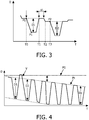
- Fig. 2 shows a flowchart of a method for automated CPR in one aspect of the disclosure. The method for automated CPR is described with reference to Fig. 3 and Fig. 4.
- Fig. 3 shows a position of the compression element with time for two compression cycles
- Fig. 4 shows a position of the compression element with time for different compression cycles in one aspect of the disclosure.
- a device 1 for automated CPR comprising a compression element in the form of a chest pad 13 coupled to a movable arm 11 cyclically compressing/decompressing the patient's chest, and with an electrical motor 14 driving the movable arm 11.
- a compression element in the form of a chest pad 13 coupled to a movable arm 11 cyclically compressing/decompressing the patient's chest, and with an electrical motor 14 driving the movable arm 11.
- a first step S1 at the start of the compression T0, the chest pad 13 is preferably in contact with the patient's chest, at a first initial position P0.
- the control element 20 activates a position control for controlling the position of the compression element, i.e. the chest pad 13 coupled to the movable arm 11.
- the position control is aimed at ensuring that a compression pulse for driving the movable arm 11 to a first position P1 corresponding to a first compression depth D1 is followed optimally.
- the chest pad's initial position P0 also referred to as the initial zero position, is stored.
- a second step S2 the control element 20 sends the compression pulse to the driving means 14 adapted for driving the movable arm 11 and the chest pad 13 to compress or decompress the patient's chest.
- the chest pad 13 travels to the first position P1 corresponding to said first compression depth D1, for compressing the chest, and back to a rest position (preferably the first initial position P0) during retraction of the chest after compression.
- the compression depth may depend on the specific patient and his body or thorax properties. Typically, the compression depth is of the order of 4 to 6 cm.
- the driving means 14 is in the form of an electrical motor.
- the distance covered by the movable arm 11 or chest pad 13 during compression may be determined by using Hall sensors from the electrical motor 14, wherein each count stands for a certain amount of depth.
- the movable arm or chest pad 13 may be hold for a certain time during which the compression depth stays at the maximum depth, whereafter travelling back, thereby allowing the retraction of the chest.
- this is not limiting, and other sensing and controlling solutions may be contemplated for sensing and controlling the distance covered by the movable arm 11 and the chest pad 13.
- the control element 20 disables the position control (instant T1 on Fig. 3 ), and activates a force control at step S4 (instant T2 on Fig. 3 ).
- the force control is adapted for controlling a force exerted on the chest pad 13, until the next compression cycle starts.
- the force control is adapted to add a counterforce to the chest, to ensure that the chest pad 13 stays in contact or re-contacts with the chest whilst allowing the chest to move due to ventilation if a ventilation is performed.
- the re-contact takes place when the chest pad 13 has been retracted to its original position, where the chest itself did not recoil fully due to molding effects. It should be understood that the force control is enabled after each compression cycle, irrespective of whether a ventilation is to be performed or not. Indeed, in a typical CPR procedure, the patient is ventilated every 30 compression cycles.
- the counterforce may be set by applying a limited current to the motor 14 which in turn applies a limited force to the compression pad 13. This can be done by limiting the current of the motor 14, thereby limiting the strength or power of the motor.
- the counterforce may be set by sending a fixed current through the motor windings of the motor 14. Alternately, the counterforce may be set by adapting a fixed current to the output of a force sensor. These examples are not limiting the present disclosure.
- the counterforce should be relatively small, with amplitude of the counterforce in an order of 1 Newton to 50 Newton, preferably approximately 20 Newton.
- the counterforce is aimed to ensure that the chest pad 13 does not block movement of the chest rising up during ventilation, whilst allowing the chest pad to stays in contact during movement of the chest due to ventilation.
- the position and the force control are enabled at fixed time during the CPR.
- the counterforce is applied for a time window typically comprised between 0.2 second and 0.6 second.
- the force control is applied for a fixed time.
- the recoil's position of the chest after this fixed time, and possibly after a ventilation, is the new starting position P2 of the chest pad 13, for the next compression cycle.
- step S5 the force control is disabled and the position control is enabled for the next compression cycle.
- the control element 20 determines the next compression depth D2, taking account of the new starting position P2 of the chest pad 13.
- a compression pulse for driving the movable arm 11 to the second compression depth D2 is computed, and the next compression cycle begins (instant T3 on Fig. 3 )
- Fig. 4 shows the first initial position P0 for the first compression cycle, and a current zero position Pc along different compression cycles. Seven cycles are shown on Fig. 4 .
- Each compression starts at the final location of each previous compression, or, in other words, the position of the chest pad 13 at the start of a new compression is the new current zero position Pc.
- the compression depth is calculated from the new current zero position Pc.
- the molding effect of the chest is taken into effect. Indeed, the recoil point of the chest can drift a few centimeters over the course of a resuscitation.
- Computing the compression depth from the current zero position of the chest pad 13 ensures that the effective compression depth is not diminished by the amount of depth that the chest has molded.
- the effective compression depth stays in the required range for effective CPR.
- the present zero position Pc corresponds to the recoil point of the chest, trauma, which appears when the chest pad starts at a height that is some cm's above the thorax and contacts the thorax with a relative high velocity, is avoided.
- a ventilation V is performed after the first compression cycle of Fig. 4 .
- the chest pad 13 is allowed to closely follow the chest's movement during the ventilation. This is achieved through the force control which does not block movement of the chest, whereas prior art systems simply block the chest pad at a fixed position after compression has taken place.
- the depth deviation is limited so that harm to the patient is minimized. Indeed, when the current zero position Pc changes too much with respect to the initial zero position P0, the distance between the sternum and spine of the patient gets smaller and smaller. In this case the effective compression depth (D1, D2,..., Dc) will be diminished by the amount of extra depth deviation, so that contact with the chest is never lost.
- the depth deviation is limited in the range of 1 to 3 cm.
- the man skilled in the art will also recognize that the present disclosure allows the analysis of the chest pad's position when the force control is enabled, for a compression cycle.
- the analysis of the chest pad's position may comprise the analysis of an absolute position of the chest pad 13.
- the analysis of the chest pad's position may also comprise the analysis of a relative position of the chest pad 13, with respect to the previous compression cycle.
- the analysis of the chest pad's position when the force control is enabled may provide information about ventilation and molding effects.
- this effect cannot be due to chest molding, which is a slow process, but has to be caused by ventilation.
- a force control is interposed between position control during compressions.
- the force control and position control are enabled and disabled at fixed times during compression cycles. This allows the pad to stay in contact with the chest at all time during the compression cycles, whilst allowing full movement of the chest during ventilation if ventilation is performed.
- Such software can enable, for example, the function, fabrication, modeling, simulation, description and/or testing of the apparatus and methods described herein. For example, this can be accomplished through the use of general program languages (e.g., C, C++), hardware description languages (HDL) including Verilog HDL, VHDL, and so on, or other available programs.
- Such software can be disposed in any known non-transitory computer useable medium such as semiconductor, magnetic disc, or optical disc (e.g., CD-ROM, DVD-ROM, etc.).
- the software can also be disposed as a computer data signal embodied in a non-transitory computer useable (e.g. readable) transmission medium (e.g., carrier wave or any other medium including digital, optical, analogue-based medium).
- Embodiments of the present invention may include methods of providing the apparatus described herein by providing software describing the apparatus and subsequently transmitting the software as a computer data signal over a communication network including the internet and intranets.
- the apparatus and method describe herein may be included in a semiconductor intellectual property core, such as a micro processor core (e.g., embodied in HDL) and transformed to hardware in the production of integrated circuits. Additionally, the apparatus and methods described herein may be embodied as a combination of hardware and software. Thus, the present invention should not be limited by any of the above-described exemplary embodiments, but should be defined only in accordance with the following claims.
Landscapes
- Health & Medical Sciences (AREA)
- Cardiology (AREA)
- Heart & Thoracic Surgery (AREA)
- Rehabilitation Therapy (AREA)
- Pulmonology (AREA)
- Epidemiology (AREA)
- Pain & Pain Management (AREA)
- Physical Education & Sports Medicine (AREA)
- Emergency Medicine (AREA)
- Life Sciences & Earth Sciences (AREA)
- Animal Behavior & Ethology (AREA)
- General Health & Medical Sciences (AREA)
- Public Health (AREA)
- Veterinary Medicine (AREA)
- Percussion Or Vibration Massage (AREA)
- Output Control And Ontrol Of Special Type Engine (AREA)
Priority Applications (1)
| Application Number | Priority Date | Filing Date | Title |
|---|---|---|---|
| EP11785127.9A EP2637626B1 (en) | 2010-11-11 | 2011-11-02 | Chest following algorithm for automated cpr device |
Applications Claiming Priority (3)
| Application Number | Priority Date | Filing Date | Title |
|---|---|---|---|
| EP10190850 | 2010-11-11 | ||
| PCT/IB2011/054861 WO2012063163A1 (en) | 2010-11-11 | 2011-11-02 | Chest following algorithm for automated cpr device |
| EP11785127.9A EP2637626B1 (en) | 2010-11-11 | 2011-11-02 | Chest following algorithm for automated cpr device |
Publications (2)
| Publication Number | Publication Date |
|---|---|
| EP2637626A1 EP2637626A1 (en) | 2013-09-18 |
| EP2637626B1 true EP2637626B1 (en) | 2019-10-30 |
Family
ID=44999835
Family Applications (1)
| Application Number | Title | Priority Date | Filing Date |
|---|---|---|---|
| EP11785127.9A Not-in-force EP2637626B1 (en) | 2010-11-11 | 2011-11-02 | Chest following algorithm for automated cpr device |
Country Status (7)
| Country | Link |
|---|---|
| US (1) | US9566210B2 (enExample) |
| EP (1) | EP2637626B1 (enExample) |
| JP (1) | JP6336754B2 (enExample) |
| CN (1) | CN103200920B (enExample) |
| BR (1) | BR112013011544A2 (enExample) |
| RU (1) | RU2597944C2 (enExample) |
| WO (1) | WO2012063163A1 (enExample) |
Families Citing this family (26)
| Publication number | Priority date | Publication date | Assignee | Title |
|---|---|---|---|---|
| US11478190B2 (en) | 2008-10-29 | 2022-10-25 | Flashback Technologies, Inc. | Noninvasive hydration monitoring |
| US12201405B2 (en) | 2008-10-29 | 2025-01-21 | Flashback Technologies, Inc. | Assessing effectiveness of CPR |
| US11857293B2 (en) | 2008-10-29 | 2024-01-02 | Flashback Technologies, Inc. | Rapid detection of bleeding before, during, and after fluid resuscitation |
| US8512260B2 (en) | 2008-10-29 | 2013-08-20 | The Regents Of The University Of Colorado, A Body Corporate | Statistical, noninvasive measurement of intracranial pressure |
| US11395594B2 (en) | 2008-10-29 | 2022-07-26 | Flashback Technologies, Inc. | Noninvasive monitoring for fluid resuscitation |
| US9757041B2 (en) | 2008-10-29 | 2017-09-12 | Flashback Technologies, Inc. | Hemodynamic reserve monitor and hemodialysis control |
| US11382571B2 (en) | 2008-10-29 | 2022-07-12 | Flashback Technologies, Inc. | Noninvasive predictive and/or estimative blood pressure monitoring |
| US11395634B2 (en) | 2008-10-29 | 2022-07-26 | Flashback Technologies, Inc. | Estimating physiological states based on changes in CRI |
| US11406269B2 (en) | 2008-10-29 | 2022-08-09 | Flashback Technologies, Inc. | Rapid detection of bleeding following injury |
| US9713568B2 (en) | 2012-12-21 | 2017-07-25 | Physio-Control, Inc. | Mechanical CPR device with automatic suction cup attachment |
| US10143619B2 (en) | 2013-05-10 | 2018-12-04 | Physio-Control, Inc. | CPR chest compression machine performing prolonged chest compression |
| US10292899B2 (en) | 2014-05-09 | 2019-05-21 | Physio-Control, Inc. | CPR chest compression machine adjusting motion-time profile in view of detected force |
| EP3231409B1 (en) * | 2014-06-06 | 2021-10-20 | Physio-Control, Inc. | Mechanical cpr device |
| EP3207479A4 (en) * | 2014-10-16 | 2018-05-02 | Flashback Technologies, Inc. | Rapid detection of bleeding before, during, and after fluid resuscitation |
| EP4548899A3 (en) | 2014-11-17 | 2025-07-23 | Physio-Control, Inc. | Cpr chest compression machine adjusting motion-time profile in view of detected force |
| JP7047226B2 (ja) | 2015-09-21 | 2022-04-05 | ゾール メディカル コーポレイション | 胸部コンプライアンスに従う胸部圧迫 |
| KR101956776B1 (ko) * | 2016-01-29 | 2019-03-11 | 서울대학교산학협력단 | 자동 심폐소생 장치 및 제어 방법 |
| RU2018142937A (ru) | 2016-05-06 | 2020-06-08 | Конинклейке Филипс Н.В. | Вспомогательное устройство для слр и способ определения глубины сжатия грудной клетки пациента |
| EP3493782B1 (en) * | 2016-08-03 | 2021-10-27 | Jolife AB | Mechanical cpr with selective zero-position & compression depth adjustment |
| EP3598457B1 (en) | 2016-09-30 | 2026-04-15 | ZOLL Medical Corporation | Active compression decompression cardiopulmonary resuscitation with chest compression feedback |
| US11523966B2 (en) * | 2016-12-30 | 2022-12-13 | Physio-Control, Inc. | CPR chest compression system |
| US10835450B2 (en) | 2016-12-30 | 2020-11-17 | Stryker Corporation | CPR chest compression system periodically reminding attendant to check patient |
| US11179293B2 (en) | 2017-07-28 | 2021-11-23 | Stryker Corporation | Patient support system with chest compression system and harness assembly with sensor system |
| US20190374430A1 (en) * | 2018-06-08 | 2019-12-12 | Defibtech, Llc | Autonomous Mechanical CPR Device |
| US11918386B2 (en) | 2018-12-26 | 2024-03-05 | Flashback Technologies, Inc. | Device-based maneuver and activity state-based physiologic status monitoring |
| CN118415870B (zh) * | 2024-07-04 | 2024-09-13 | 浙江大学医学院附属第二医院 | 一种cpr按压深度调节方法、装置及cpr按压设备 |
Family Cites Families (18)
| Publication number | Priority date | Publication date | Assignee | Title |
|---|---|---|---|---|
| US5399148A (en) * | 1990-07-06 | 1995-03-21 | Baswat Holdings Pty. Ltd. | External cardiac massage device |
| US5327887A (en) * | 1993-01-25 | 1994-07-12 | Ludwik Nowakowski | Cardiopulmonary resuscitation device |
| US5769800A (en) * | 1995-03-15 | 1998-06-23 | The Johns Hopkins University Inc. | Vest design for a cardiopulmonary resuscitation system |
| US6066106A (en) | 1998-05-29 | 2000-05-23 | Emergency Medical Systems, Inc. | Modular CPR assist device |
| AU1611200A (en) * | 1998-11-09 | 2000-05-29 | Johns Hopkins University, The | Automated chest compression apparatus |
| US6171267B1 (en) | 1999-01-07 | 2001-01-09 | Michigan Instruments, Inc. | High impulse cardiopulmonary resuscitator |
| US6616620B2 (en) * | 2001-05-25 | 2003-09-09 | Revivant Corporation | CPR assist device with pressure bladder feedback |
| US7226427B2 (en) | 2003-05-12 | 2007-06-05 | Jolife Ab | Systems and procedures for treating cardiac arrest |
| US8007451B2 (en) | 2006-05-11 | 2011-08-30 | Laerdal Medical As | Servo motor for CPR with decompression stroke faster than the compression stroke |
| RU2336859C2 (ru) * | 2006-10-18 | 2008-10-27 | Общество с ограниченной ответственностью Фирма "Тритон-ЭлектроникС" | Способ искусственной вентиляции легких и устройство для его осуществления |
| EP2107901A4 (en) | 2007-01-18 | 2012-11-28 | Jolife Ab | OPERATING CONTROL OF ALTERNATIVE CARDIO-PULMONARY RESUSCITATION DEVICE |
| US20090062701A1 (en) * | 2007-06-29 | 2009-03-05 | Advanced Circulatory Systems, Inc. | Lower extremity compression devices, systems and methods to enhance circulation |
| CN101835447B (zh) | 2007-09-21 | 2013-07-17 | 皇家飞利浦电子股份有限公司 | Cpr监控和报告系统 |
| RU2492849C2 (ru) * | 2007-12-19 | 2013-09-20 | Конинклейке Филипс Электроникс Н.В. | Система и способ для автоматической кардиопульмональной реанимации (cpr) |
| US8690804B2 (en) * | 2008-05-07 | 2014-04-08 | Physio-Control, Inc. | CPR apparatus and method |
| US20110166490A1 (en) * | 2008-06-26 | 2011-07-07 | Koninklijke Philips Electronics N.V. | Smart Servo for a Mechanical CPR System |
| WO2010009531A1 (en) | 2008-07-23 | 2010-01-28 | Atreo Medical, Inc. | Cpr assist device for measuring compression parameters during cardiopulmonary resuscitation |
| US20100198118A1 (en) * | 2009-02-05 | 2010-08-05 | Michael Itai Itnati | Augmenting force-delivery in belt-type ECM devices |
-
2011
- 2011-11-02 WO PCT/IB2011/054861 patent/WO2012063163A1/en not_active Ceased
- 2011-11-02 JP JP2013538303A patent/JP6336754B2/ja not_active Expired - Fee Related
- 2011-11-02 CN CN201180054086.0A patent/CN103200920B/zh not_active Expired - Fee Related
- 2011-11-02 US US13/881,377 patent/US9566210B2/en active Active
- 2011-11-02 EP EP11785127.9A patent/EP2637626B1/en not_active Not-in-force
- 2011-11-02 BR BR112013011544-0A patent/BR112013011544A2/pt not_active Application Discontinuation
- 2011-11-02 RU RU2013126594/14A patent/RU2597944C2/ru not_active IP Right Cessation
Non-Patent Citations (1)
| Title |
|---|
| None * |
Also Published As
| Publication number | Publication date |
|---|---|
| US20130218056A1 (en) | 2013-08-22 |
| JP6336754B2 (ja) | 2018-06-06 |
| EP2637626A1 (en) | 2013-09-18 |
| CN103200920A (zh) | 2013-07-10 |
| CN103200920B (zh) | 2016-03-23 |
| RU2597944C2 (ru) | 2016-09-20 |
| WO2012063163A1 (en) | 2012-05-18 |
| US9566210B2 (en) | 2017-02-14 |
| RU2013126594A (ru) | 2014-12-20 |
| JP2013545541A (ja) | 2013-12-26 |
| BR112013011544A2 (pt) | 2020-08-04 |
Similar Documents
| Publication | Publication Date | Title |
|---|---|---|
| EP2637626B1 (en) | Chest following algorithm for automated cpr device | |
| EP3062757B1 (en) | Cpr chest compression monitor for infants | |
| US20240307265A1 (en) | Compression Depth Monitor With Variable Release Velocity Feedback | |
| JP5509364B2 (ja) | 心肺蘇生中の胸部圧迫深度を決定するシステム | |
| US11794027B2 (en) | Active compression decompression resuscitation integrated treatment system | |
| CN101917952B (zh) | 用于自动cpr的系统 | |
| US10272013B2 (en) | CPR feedback system progressively diminishing target compression depth to prevent over-compression | |
| US12127999B2 (en) | Mechanical CPR with selective zero-position and compression depth adjustment | |
| CN113632175B (zh) | 主动按压减压期间确定按压深度并提供反馈的系统和方法 | |
| EP3988073A1 (en) | System and method for distinguishing manual from automated cpr | |
| WO2013016640A2 (en) | Method and apparatus for monitoring manual chest compression efficiency during cpr | |
| CN104523420A (zh) | 一种在线诊疗装置及方法 | |
| CN113057874A (zh) | 胸外按压参数的测量方法、装置、除颤电极组件及自动体外除颤器 | |
| US20180168923A1 (en) | Detection of myocardial contractions indicative of perfusion | |
| CN104352345A (zh) | 一种移动式心肺复苏设备及其控制方法 | |
| US20230381061A1 (en) | Cpr feedback system progressively diminishing target compression depth to prevent over-compression | |
| CN203736512U (zh) | 一种叩击按摩机器人 | |
| KR20160074259A (ko) | 심폐소생술 훈련 품질 모니터링 장치 | |
| CN201806912U (zh) | 便携式胸外心脏按压装置 | |
| CN202136555U (zh) | 负压式心脏复苏器 | |
| CN201668684U (zh) | 胸外心脏按压机 | |
| CN119074475A (zh) | 外骨骼机器人控制方法、装置、外骨骼机器人及存储介质 | |
| Xu et al. | Research on CPR parameters impact on hemodynamic effects based on mathematics model |
Legal Events
| Date | Code | Title | Description |
|---|---|---|---|
| PUAI | Public reference made under article 153(3) epc to a published international application that has entered the european phase |
Free format text: ORIGINAL CODE: 0009012 |
|
| 17P | Request for examination filed |
Effective date: 20130611 |
|
| AK | Designated contracting states |
Kind code of ref document: A1 Designated state(s): AL AT BE BG CH CY CZ DE DK EE ES FI FR GB GR HR HU IE IS IT LI LT LU LV MC MK MT NL NO PL PT RO RS SE SI SK SM TR |
|
| RAP1 | Party data changed (applicant data changed or rights of an application transferred) |
Owner name: KONINKLIJKE PHILIPS N.V. |
|
| DAX | Request for extension of the european patent (deleted) | ||
| STAA | Information on the status of an ep patent application or granted ep patent |
Free format text: STATUS: EXAMINATION IS IN PROGRESS |
|
| 17Q | First examination report despatched |
Effective date: 20161025 |
|
| GRAP | Despatch of communication of intention to grant a patent |
Free format text: ORIGINAL CODE: EPIDOSNIGR1 |
|
| STAA | Information on the status of an ep patent application or granted ep patent |
Free format text: STATUS: GRANT OF PATENT IS INTENDED |
|
| INTG | Intention to grant announced |
Effective date: 20190522 |
|
| GRAS | Grant fee paid |
Free format text: ORIGINAL CODE: EPIDOSNIGR3 |
|
| GRAA | (expected) grant |
Free format text: ORIGINAL CODE: 0009210 |
|
| STAA | Information on the status of an ep patent application or granted ep patent |
Free format text: STATUS: THE PATENT HAS BEEN GRANTED |
|
| AK | Designated contracting states |
Kind code of ref document: B1 Designated state(s): AL AT BE BG CH CY CZ DE DK EE ES FI FR GB GR HR HU IE IS IT LI LT LU LV MC MK MT NL NO PL PT RO RS SE SI SK SM TR |
|
| REG | Reference to a national code |
Ref country code: GB Ref legal event code: FG4D |
|
| REG | Reference to a national code |
Ref country code: CH Ref legal event code: EP |
|
| REG | Reference to a national code |
Ref country code: AT Ref legal event code: REF Ref document number: 1195384 Country of ref document: AT Kind code of ref document: T Effective date: 20191115 |
|
| REG | Reference to a national code |
Ref country code: DE Ref legal event code: R096 Ref document number: 602011063077 Country of ref document: DE |
|
| REG | Reference to a national code |
Ref country code: IE Ref legal event code: FG4D |
|
| REG | Reference to a national code |
Ref country code: LT Ref legal event code: MG4D |
|
| RAP2 | Party data changed (patent owner data changed or rights of a patent transferred) |
Owner name: KONINKLIJKE PHILIPS N.V. |
|
| PG25 | Lapsed in a contracting state [announced via postgrant information from national office to epo] |
Ref country code: PT Free format text: LAPSE BECAUSE OF FAILURE TO SUBMIT A TRANSLATION OF THE DESCRIPTION OR TO PAY THE FEE WITHIN THE PRESCRIBED TIME-LIMIT Effective date: 20200302 Ref country code: SE Free format text: LAPSE BECAUSE OF FAILURE TO SUBMIT A TRANSLATION OF THE DESCRIPTION OR TO PAY THE FEE WITHIN THE PRESCRIBED TIME-LIMIT Effective date: 20191030 Ref country code: LV Free format text: LAPSE BECAUSE OF FAILURE TO SUBMIT A TRANSLATION OF THE DESCRIPTION OR TO PAY THE FEE WITHIN THE PRESCRIBED TIME-LIMIT Effective date: 20191030 Ref country code: FI Free format text: LAPSE BECAUSE OF FAILURE TO SUBMIT A TRANSLATION OF THE DESCRIPTION OR TO PAY THE FEE WITHIN THE PRESCRIBED TIME-LIMIT Effective date: 20191030 Ref country code: BG Free format text: LAPSE BECAUSE OF FAILURE TO SUBMIT A TRANSLATION OF THE DESCRIPTION OR TO PAY THE FEE WITHIN THE PRESCRIBED TIME-LIMIT Effective date: 20200130 Ref country code: NO Free format text: LAPSE BECAUSE OF FAILURE TO SUBMIT A TRANSLATION OF THE DESCRIPTION OR TO PAY THE FEE WITHIN THE PRESCRIBED TIME-LIMIT Effective date: 20200130 Ref country code: GR Free format text: LAPSE BECAUSE OF FAILURE TO SUBMIT A TRANSLATION OF THE DESCRIPTION OR TO PAY THE FEE WITHIN THE PRESCRIBED TIME-LIMIT Effective date: 20200131 Ref country code: PL Free format text: LAPSE BECAUSE OF FAILURE TO SUBMIT A TRANSLATION OF THE DESCRIPTION OR TO PAY THE FEE WITHIN THE PRESCRIBED TIME-LIMIT Effective date: 20191030 Ref country code: NL Free format text: LAPSE BECAUSE OF FAILURE TO SUBMIT A TRANSLATION OF THE DESCRIPTION OR TO PAY THE FEE WITHIN THE PRESCRIBED TIME-LIMIT Effective date: 20191030 Ref country code: LT Free format text: LAPSE BECAUSE OF FAILURE TO SUBMIT A TRANSLATION OF THE DESCRIPTION OR TO PAY THE FEE WITHIN THE PRESCRIBED TIME-LIMIT Effective date: 20191030 Ref country code: ES Free format text: LAPSE BECAUSE OF FAILURE TO SUBMIT A TRANSLATION OF THE DESCRIPTION OR TO PAY THE FEE WITHIN THE PRESCRIBED TIME-LIMIT Effective date: 20191030 |
|
| REG | Reference to a national code |
Ref country code: NL Ref legal event code: MP Effective date: 20191030 |
|
| PG25 | Lapsed in a contracting state [announced via postgrant information from national office to epo] |
Ref country code: HR Free format text: LAPSE BECAUSE OF FAILURE TO SUBMIT A TRANSLATION OF THE DESCRIPTION OR TO PAY THE FEE WITHIN THE PRESCRIBED TIME-LIMIT Effective date: 20191030 Ref country code: RS Free format text: LAPSE BECAUSE OF FAILURE TO SUBMIT A TRANSLATION OF THE DESCRIPTION OR TO PAY THE FEE WITHIN THE PRESCRIBED TIME-LIMIT Effective date: 20191030 Ref country code: IS Free format text: LAPSE BECAUSE OF FAILURE TO SUBMIT A TRANSLATION OF THE DESCRIPTION OR TO PAY THE FEE WITHIN THE PRESCRIBED TIME-LIMIT Effective date: 20200229 |
|
| PG25 | Lapsed in a contracting state [announced via postgrant information from national office to epo] |
Ref country code: AL Free format text: LAPSE BECAUSE OF FAILURE TO SUBMIT A TRANSLATION OF THE DESCRIPTION OR TO PAY THE FEE WITHIN THE PRESCRIBED TIME-LIMIT Effective date: 20191030 |
|
| REG | Reference to a national code |
Ref country code: CH Ref legal event code: PL |
|
| PG25 | Lapsed in a contracting state [announced via postgrant information from national office to epo] |
Ref country code: LI Free format text: LAPSE BECAUSE OF NON-PAYMENT OF DUE FEES Effective date: 20191130 Ref country code: CH Free format text: LAPSE BECAUSE OF NON-PAYMENT OF DUE FEES Effective date: 20191130 Ref country code: CZ Free format text: LAPSE BECAUSE OF FAILURE TO SUBMIT A TRANSLATION OF THE DESCRIPTION OR TO PAY THE FEE WITHIN THE PRESCRIBED TIME-LIMIT Effective date: 20191030 Ref country code: LU Free format text: LAPSE BECAUSE OF NON-PAYMENT OF DUE FEES Effective date: 20191102 Ref country code: EE Free format text: LAPSE BECAUSE OF FAILURE TO SUBMIT A TRANSLATION OF THE DESCRIPTION OR TO PAY THE FEE WITHIN THE PRESCRIBED TIME-LIMIT Effective date: 20191030 Ref country code: RO Free format text: LAPSE BECAUSE OF FAILURE TO SUBMIT A TRANSLATION OF THE DESCRIPTION OR TO PAY THE FEE WITHIN THE PRESCRIBED TIME-LIMIT Effective date: 20191030 Ref country code: MC Free format text: LAPSE BECAUSE OF FAILURE TO SUBMIT A TRANSLATION OF THE DESCRIPTION OR TO PAY THE FEE WITHIN THE PRESCRIBED TIME-LIMIT Effective date: 20191030 Ref country code: DK Free format text: LAPSE BECAUSE OF FAILURE TO SUBMIT A TRANSLATION OF THE DESCRIPTION OR TO PAY THE FEE WITHIN THE PRESCRIBED TIME-LIMIT Effective date: 20191030 |
|
| REG | Reference to a national code |
Ref country code: DE Ref legal event code: R097 Ref document number: 602011063077 Country of ref document: DE |
|
| REG | Reference to a national code |
Ref country code: AT Ref legal event code: MK05 Ref document number: 1195384 Country of ref document: AT Kind code of ref document: T Effective date: 20191030 |
|
| REG | Reference to a national code |
Ref country code: BE Ref legal event code: MM Effective date: 20191130 |
|
| PG25 | Lapsed in a contracting state [announced via postgrant information from national office to epo] |
Ref country code: SM Free format text: LAPSE BECAUSE OF FAILURE TO SUBMIT A TRANSLATION OF THE DESCRIPTION OR TO PAY THE FEE WITHIN THE PRESCRIBED TIME-LIMIT Effective date: 20191030 Ref country code: IT Free format text: LAPSE BECAUSE OF FAILURE TO SUBMIT A TRANSLATION OF THE DESCRIPTION OR TO PAY THE FEE WITHIN THE PRESCRIBED TIME-LIMIT Effective date: 20191030 Ref country code: SK Free format text: LAPSE BECAUSE OF FAILURE TO SUBMIT A TRANSLATION OF THE DESCRIPTION OR TO PAY THE FEE WITHIN THE PRESCRIBED TIME-LIMIT Effective date: 20191030 |
|
| PLBE | No opposition filed within time limit |
Free format text: ORIGINAL CODE: 0009261 |
|
| STAA | Information on the status of an ep patent application or granted ep patent |
Free format text: STATUS: NO OPPOSITION FILED WITHIN TIME LIMIT |
|
| GBPC | Gb: european patent ceased through non-payment of renewal fee |
Effective date: 20200130 |
|
| 26N | No opposition filed |
Effective date: 20200731 |
|
| PG25 | Lapsed in a contracting state [announced via postgrant information from national office to epo] |
Ref country code: FR Free format text: LAPSE BECAUSE OF NON-PAYMENT OF DUE FEES Effective date: 20191230 Ref country code: IE Free format text: LAPSE BECAUSE OF NON-PAYMENT OF DUE FEES Effective date: 20191102 Ref country code: GB Free format text: LAPSE BECAUSE OF NON-PAYMENT OF DUE FEES Effective date: 20200130 |
|
| PG25 | Lapsed in a contracting state [announced via postgrant information from national office to epo] |
Ref country code: SI Free format text: LAPSE BECAUSE OF FAILURE TO SUBMIT A TRANSLATION OF THE DESCRIPTION OR TO PAY THE FEE WITHIN THE PRESCRIBED TIME-LIMIT Effective date: 20191030 Ref country code: BE Free format text: LAPSE BECAUSE OF NON-PAYMENT OF DUE FEES Effective date: 20191130 Ref country code: AT Free format text: LAPSE BECAUSE OF FAILURE TO SUBMIT A TRANSLATION OF THE DESCRIPTION OR TO PAY THE FEE WITHIN THE PRESCRIBED TIME-LIMIT Effective date: 20191030 |
|
| PG25 | Lapsed in a contracting state [announced via postgrant information from national office to epo] |
Ref country code: CY Free format text: LAPSE BECAUSE OF FAILURE TO SUBMIT A TRANSLATION OF THE DESCRIPTION OR TO PAY THE FEE WITHIN THE PRESCRIBED TIME-LIMIT Effective date: 20191030 |
|
| PG25 | Lapsed in a contracting state [announced via postgrant information from national office to epo] |
Ref country code: MT Free format text: LAPSE BECAUSE OF FAILURE TO SUBMIT A TRANSLATION OF THE DESCRIPTION OR TO PAY THE FEE WITHIN THE PRESCRIBED TIME-LIMIT Effective date: 20191030 Ref country code: HU Free format text: LAPSE BECAUSE OF FAILURE TO SUBMIT A TRANSLATION OF THE DESCRIPTION OR TO PAY THE FEE WITHIN THE PRESCRIBED TIME-LIMIT; INVALID AB INITIO Effective date: 20111102 |
|
| PGFP | Annual fee paid to national office [announced via postgrant information from national office to epo] |
Ref country code: DE Payment date: 20211129 Year of fee payment: 11 |
|
| PG25 | Lapsed in a contracting state [announced via postgrant information from national office to epo] |
Ref country code: TR Free format text: LAPSE BECAUSE OF FAILURE TO SUBMIT A TRANSLATION OF THE DESCRIPTION OR TO PAY THE FEE WITHIN THE PRESCRIBED TIME-LIMIT Effective date: 20191030 |
|
| PG25 | Lapsed in a contracting state [announced via postgrant information from national office to epo] |
Ref country code: MK Free format text: LAPSE BECAUSE OF FAILURE TO SUBMIT A TRANSLATION OF THE DESCRIPTION OR TO PAY THE FEE WITHIN THE PRESCRIBED TIME-LIMIT Effective date: 20191030 |
|
| REG | Reference to a national code |
Ref country code: DE Ref legal event code: R119 Ref document number: 602011063077 Country of ref document: DE |
|
| PG25 | Lapsed in a contracting state [announced via postgrant information from national office to epo] |
Ref country code: DE Free format text: LAPSE BECAUSE OF NON-PAYMENT OF DUE FEES Effective date: 20230601 |