EP2631253A2 - Preparation of polymer, resulting polymer, resist composition, and patterning process - Google Patents
Preparation of polymer, resulting polymer, resist composition, and patterning process Download PDFInfo
- Publication number
- EP2631253A2 EP2631253A2 EP13156373.6A EP13156373A EP2631253A2 EP 2631253 A2 EP2631253 A2 EP 2631253A2 EP 13156373 A EP13156373 A EP 13156373A EP 2631253 A2 EP2631253 A2 EP 2631253A2
- Authority
- EP
- European Patent Office
- Prior art keywords
- polymer
- group
- sulfonic acid
- methyl
- acid
- Prior art date
- Legal status (The legal status is an assumption and is not a legal conclusion. Google has not performed a legal analysis and makes no representation as to the accuracy of the status listed.)
- Withdrawn
Links
- 229920000642 polymer Polymers 0.000 title claims abstract description 134
- 239000000203 mixture Substances 0.000 title claims abstract description 60
- 238000000034 method Methods 0.000 title claims description 64
- 230000008569 process Effects 0.000 title claims description 24
- 238000000059 patterning Methods 0.000 title description 4
- 238000002360 preparation method Methods 0.000 title description 3
- -1 triarylsulfonium cation Chemical class 0.000 claims abstract description 238
- 239000002253 acid Substances 0.000 claims abstract description 73
- XLYOFNOQVPJJNP-UHFFFAOYSA-N water Substances O XLYOFNOQVPJJNP-UHFFFAOYSA-N 0.000 claims abstract description 45
- 150000001768 cations Chemical class 0.000 claims abstract description 27
- 125000005409 triarylsulfonium group Chemical group 0.000 claims abstract description 24
- QGZKDVFQNNGYKY-UHFFFAOYSA-O Ammonium Chemical compound [NH4+] QGZKDVFQNNGYKY-UHFFFAOYSA-O 0.000 claims abstract description 21
- 229910052751 metal Inorganic materials 0.000 claims abstract description 19
- 239000002184 metal Substances 0.000 claims abstract description 19
- 238000002425 crystallisation Methods 0.000 claims abstract description 7
- 230000008025 crystallization Effects 0.000 claims abstract description 7
- 238000005406 washing Methods 0.000 claims abstract description 7
- 239000004094 surface-active agent Substances 0.000 claims description 28
- 125000004435 hydrogen atom Chemical group [H]* 0.000 claims description 26
- 150000001450 anions Chemical group 0.000 claims description 25
- 125000002496 methyl group Chemical group [H]C([H])([H])* 0.000 claims description 24
- 239000003960 organic solvent Substances 0.000 claims description 24
- 230000005855 radiation Effects 0.000 claims description 23
- RTZKZFJDLAIYFH-UHFFFAOYSA-N ether Chemical group CCOCC RTZKZFJDLAIYFH-UHFFFAOYSA-N 0.000 claims description 19
- 239000001257 hydrogen Substances 0.000 claims description 19
- 229910052739 hydrogen Inorganic materials 0.000 claims description 19
- 229910052731 fluorine Inorganic materials 0.000 claims description 18
- 125000005842 heteroatom Chemical group 0.000 claims description 18
- 239000002904 solvent Substances 0.000 claims description 18
- 125000002023 trifluoromethyl group Chemical group FC(F)(F)* 0.000 claims description 17
- 239000011737 fluorine Chemical group 0.000 claims description 16
- PXGOKWXKJXAPGV-UHFFFAOYSA-N Fluorine Chemical group FF PXGOKWXKJXAPGV-UHFFFAOYSA-N 0.000 claims description 14
- 125000004122 cyclic group Chemical group 0.000 claims description 14
- 238000000671 immersion lithography Methods 0.000 claims description 13
- 125000002887 hydroxy group Chemical group [H]O* 0.000 claims description 11
- 230000001681 protective effect Effects 0.000 claims description 11
- 238000006243 chemical reaction Methods 0.000 claims description 10
- 125000004430 oxygen atom Chemical group O* 0.000 claims description 8
- 239000000758 substrate Substances 0.000 claims description 8
- 125000006736 (C6-C20) aryl group Chemical group 0.000 claims description 7
- 125000002915 carbonyl group Chemical group [*:2]C([*:1])=O 0.000 claims description 7
- 239000007788 liquid Substances 0.000 claims description 7
- 125000004957 naphthylene group Chemical group 0.000 claims description 7
- 125000000843 phenylene group Chemical group C1(=C(C=CC=C1)*)* 0.000 claims description 7
- BVKZGUZCCUSVTD-UHFFFAOYSA-L Carbonate Chemical compound [O-]C([O-])=O BVKZGUZCCUSVTD-UHFFFAOYSA-L 0.000 claims description 5
- 150000001244 carboxylic acid anhydrides Chemical class 0.000 claims description 5
- 150000008053 sultones Chemical group 0.000 claims description 5
- 125000006832 (C1-C10) alkylene group Chemical group 0.000 claims description 4
- 238000005341 cation exchange Methods 0.000 claims description 4
- 239000011248 coating agent Substances 0.000 claims description 4
- 238000000576 coating method Methods 0.000 claims description 4
- TUJKJAMUKRIRHC-UHFFFAOYSA-N hydroxyl Chemical group [OH] TUJKJAMUKRIRHC-UHFFFAOYSA-N 0.000 claims description 3
- 125000000686 lactone group Chemical group 0.000 claims 2
- 238000009792 diffusion process Methods 0.000 abstract description 14
- LSNNMFCWUKXFEE-UHFFFAOYSA-M Bisulfite Chemical compound OS([O-])=O LSNNMFCWUKXFEE-UHFFFAOYSA-M 0.000 abstract description 7
- RWSOTUBLDIXVET-UHFFFAOYSA-O sulfonium group Chemical group [SH3+] RWSOTUBLDIXVET-UHFFFAOYSA-O 0.000 abstract description 2
- 230000015572 biosynthetic process Effects 0.000 description 37
- 239000000178 monomer Substances 0.000 description 36
- 238000003786 synthesis reaction Methods 0.000 description 36
- 125000004432 carbon atom Chemical group C* 0.000 description 31
- 101000692259 Homo sapiens Phosphoprotein associated with glycosphingolipid-enriched microdomains 1 Proteins 0.000 description 28
- ZWEHNKRNPOVVGH-UHFFFAOYSA-N 2-Butanone Chemical compound CCC(C)=O ZWEHNKRNPOVVGH-UHFFFAOYSA-N 0.000 description 24
- VLKZOEOYAKHREP-UHFFFAOYSA-N n-Hexane Chemical compound CCCCCC VLKZOEOYAKHREP-UHFFFAOYSA-N 0.000 description 24
- 239000011347 resin Substances 0.000 description 22
- 229920005989 resin Polymers 0.000 description 22
- 150000001875 compounds Chemical class 0.000 description 19
- 230000007547 defect Effects 0.000 description 18
- IJGRMHOSHXDMSA-UHFFFAOYSA-N Atomic nitrogen Chemical compound N#N IJGRMHOSHXDMSA-UHFFFAOYSA-N 0.000 description 16
- RWSOTUBLDIXVET-UHFFFAOYSA-N Dihydrogen sulfide Chemical class S RWSOTUBLDIXVET-UHFFFAOYSA-N 0.000 description 16
- 239000002585 base Substances 0.000 description 16
- 238000001459 lithography Methods 0.000 description 15
- 229920001577 copolymer Polymers 0.000 description 14
- 150000003839 salts Chemical class 0.000 description 14
- 239000000243 solution Substances 0.000 description 14
- 125000001495 ethyl group Chemical group [H]C([H])([H])C([H])([H])* 0.000 description 13
- YMWUJEATGCHHMB-UHFFFAOYSA-N Dichloromethane Chemical compound ClCCl YMWUJEATGCHHMB-UHFFFAOYSA-N 0.000 description 12
- 229910052757 nitrogen Inorganic materials 0.000 description 12
- 125000000217 alkyl group Chemical group 0.000 description 11
- 238000011161 development Methods 0.000 description 11
- 238000010894 electron beam technology Methods 0.000 description 11
- 238000006116 polymerization reaction Methods 0.000 description 11
- 125000000999 tert-butyl group Chemical group [H]C([H])([H])C(*)(C([H])([H])[H])C([H])([H])[H] 0.000 description 11
- 125000001449 isopropyl group Chemical group [H]C([H])([H])C([H])(*)C([H])([H])[H] 0.000 description 10
- WGTYBPLFGIVFAS-UHFFFAOYSA-M tetramethylammonium hydroxide Chemical compound [OH-].C[N+](C)(C)C WGTYBPLFGIVFAS-UHFFFAOYSA-M 0.000 description 10
- 238000005160 1H NMR spectroscopy Methods 0.000 description 9
- 125000000113 cyclohexyl group Chemical group [H]C1([H])C([H])([H])C([H])([H])C([H])(*)C([H])([H])C1([H])[H] 0.000 description 9
- 239000000463 material Substances 0.000 description 9
- 125000001436 propyl group Chemical group [H]C([*])([H])C([H])([H])C([H])([H])[H] 0.000 description 9
- 125000001511 cyclopentyl group Chemical group [H]C1([H])C([H])([H])C([H])([H])C([H])(*)C1([H])[H] 0.000 description 8
- 150000002430 hydrocarbons Chemical group 0.000 description 8
- 150000002596 lactones Chemical group 0.000 description 8
- 125000002914 sec-butyl group Chemical group [H]C([H])([H])C([H])([H])C([H])(*)C([H])([H])[H] 0.000 description 8
- 229910052717 sulfur Inorganic materials 0.000 description 8
- YEJRWHAVMIAJKC-UHFFFAOYSA-N 4-Butyrolactone Chemical compound O=C1CCCO1 YEJRWHAVMIAJKC-UHFFFAOYSA-N 0.000 description 7
- 0 C*IC(C)(C(C)(CC(C)C)C(OCCC(C(F)(F)F)(C(F)(F)F)O)=O)[Tl]C Chemical compound C*IC(C)(C(C)(CC(C)C)C(OCCC(C(F)(F)F)(C(F)(F)F)O)=O)[Tl]C 0.000 description 7
- ZAFNJMIOTHYJRJ-UHFFFAOYSA-N Diisopropyl ether Chemical compound CC(C)OC(C)C ZAFNJMIOTHYJRJ-UHFFFAOYSA-N 0.000 description 7
- 125000003342 alkenyl group Chemical group 0.000 description 7
- 125000003710 aryl alkyl group Chemical group 0.000 description 7
- QVGXLLKOCUKJST-UHFFFAOYSA-N atomic oxygen Chemical compound [O] QVGXLLKOCUKJST-UHFFFAOYSA-N 0.000 description 7
- 125000004108 n-butyl group Chemical group [H]C([H])([H])C([H])([H])C([H])([H])C([H])([H])* 0.000 description 7
- 125000001624 naphthyl group Chemical group 0.000 description 7
- 125000005188 oxoalkyl group Chemical group 0.000 description 7
- 229910052760 oxygen Inorganic materials 0.000 description 7
- 239000001301 oxygen Substances 0.000 description 7
- LLHKCFNBLRBOGN-UHFFFAOYSA-N propylene glycol methyl ether acetate Chemical compound COCC(C)OC(C)=O LLHKCFNBLRBOGN-UHFFFAOYSA-N 0.000 description 7
- PEDCQBHIVMGVHV-UHFFFAOYSA-N Glycerine Chemical compound OCC(O)CO PEDCQBHIVMGVHV-UHFFFAOYSA-N 0.000 description 6
- 150000001412 amines Chemical class 0.000 description 6
- 125000003118 aryl group Chemical group 0.000 description 6
- 229910052799 carbon Inorganic materials 0.000 description 6
- JHIVVAPYMSGYDF-UHFFFAOYSA-N cyclohexanone Chemical compound O=C1CCCCC1 JHIVVAPYMSGYDF-UHFFFAOYSA-N 0.000 description 6
- 125000001153 fluoro group Chemical group F* 0.000 description 6
- 150000003949 imides Chemical class 0.000 description 6
- 239000012044 organic layer Substances 0.000 description 6
- WLOQLWBIJZDHET-UHFFFAOYSA-N triphenylsulfonium Chemical compound C1=CC=CC=C1[S+](C=1C=CC=CC=1)C1=CC=CC=C1 WLOQLWBIJZDHET-UHFFFAOYSA-N 0.000 description 6
- HEDRZPFGACZZDS-UHFFFAOYSA-N Chloroform Chemical compound ClC(Cl)Cl HEDRZPFGACZZDS-UHFFFAOYSA-N 0.000 description 5
- 239000007983 Tris buffer Substances 0.000 description 5
- 239000007864 aqueous solution Substances 0.000 description 5
- 239000000470 constituent Substances 0.000 description 5
- 125000006165 cyclic alkyl group Chemical group 0.000 description 5
- 238000005516 engineering process Methods 0.000 description 5
- QJGQUHMNIGDVPM-UHFFFAOYSA-N nitrogen group Chemical group [N] QJGQUHMNIGDVPM-UHFFFAOYSA-N 0.000 description 5
- 125000002868 norbornyl group Chemical group C12(CCC(CC1)C2)* 0.000 description 5
- 125000001997 phenyl group Chemical group [H]C1=C([H])C([H])=C(*)C([H])=C1[H] 0.000 description 5
- 230000035945 sensitivity Effects 0.000 description 5
- 125000001424 substituent group Chemical group 0.000 description 5
- 238000006467 substitution reaction Methods 0.000 description 5
- ZMANZCXQSJIPKH-UHFFFAOYSA-O triethylammonium ion Chemical compound CC[NH+](CC)CC ZMANZCXQSJIPKH-UHFFFAOYSA-O 0.000 description 5
- ARXJGSRGQADJSQ-UHFFFAOYSA-N 1-methoxypropan-2-ol Chemical compound COCC(C)O ARXJGSRGQADJSQ-UHFFFAOYSA-N 0.000 description 4
- IAZDPXIOMUYVGZ-WFGJKAKNSA-N Dimethyl sulfoxide Chemical compound [2H]C([2H])([2H])S(=O)C([2H])([2H])[2H] IAZDPXIOMUYVGZ-WFGJKAKNSA-N 0.000 description 4
- NTIZESTWPVYFNL-UHFFFAOYSA-N Methyl isobutyl ketone Chemical compound CC(C)CC(C)=O NTIZESTWPVYFNL-UHFFFAOYSA-N 0.000 description 4
- UIHCLUNTQKBZGK-UHFFFAOYSA-N Methyl isobutyl ketone Natural products CCC(C)C(C)=O UIHCLUNTQKBZGK-UHFFFAOYSA-N 0.000 description 4
- OJGMBLNIHDZDGS-UHFFFAOYSA-N N-Ethylaniline Chemical compound CCNC1=CC=CC=C1 OJGMBLNIHDZDGS-UHFFFAOYSA-N 0.000 description 4
- NINIDFKCEFEMDL-UHFFFAOYSA-N Sulfur Chemical compound [S] NINIDFKCEFEMDL-UHFFFAOYSA-N 0.000 description 4
- WYURNTSHIVDZCO-UHFFFAOYSA-N Tetrahydrofuran Chemical compound C1CCOC1 WYURNTSHIVDZCO-UHFFFAOYSA-N 0.000 description 4
- 150000007513 acids Chemical class 0.000 description 4
- 125000005073 adamantyl group Chemical group C12(CC3CC(CC(C1)C3)C2)* 0.000 description 4
- 125000004390 alkyl sulfonyl group Chemical group 0.000 description 4
- 125000005355 arylox oalkyl group Chemical group 0.000 description 4
- 150000001721 carbon Chemical group 0.000 description 4
- 230000015556 catabolic process Effects 0.000 description 4
- 230000000052 comparative effect Effects 0.000 description 4
- 238000006731 degradation reaction Methods 0.000 description 4
- 238000010586 diagram Methods 0.000 description 4
- 150000002148 esters Chemical class 0.000 description 4
- LZCLXQDLBQLTDK-UHFFFAOYSA-N ethyl 2-hydroxypropanoate Chemical compound CCOC(=O)C(C)O LZCLXQDLBQLTDK-UHFFFAOYSA-N 0.000 description 4
- 125000005843 halogen group Chemical group 0.000 description 4
- 125000004464 hydroxyphenyl group Chemical group 0.000 description 4
- 238000004519 manufacturing process Methods 0.000 description 4
- 230000036961 partial effect Effects 0.000 description 4
- YFSUTJLHUFNCNZ-UHFFFAOYSA-N perfluorooctane-1-sulfonic acid Chemical compound OS(=O)(=O)C(F)(F)C(F)(F)C(F)(F)C(F)(F)C(F)(F)C(F)(F)C(F)(F)C(F)(F)F YFSUTJLHUFNCNZ-UHFFFAOYSA-N 0.000 description 4
- 238000007152 ring opening metathesis polymerisation reaction Methods 0.000 description 4
- 159000000000 sodium salts Chemical class 0.000 description 4
- 150000003460 sulfonic acids Chemical class 0.000 description 4
- 239000011593 sulfur Substances 0.000 description 4
- 125000004434 sulfur atom Chemical group 0.000 description 4
- 125000004665 trialkylsilyl group Chemical group 0.000 description 4
- 239000012953 triphenylsulfonium Substances 0.000 description 4
- DGVVWUTYPXICAM-UHFFFAOYSA-N β‐Mercaptoethanol Chemical compound OCCS DGVVWUTYPXICAM-UHFFFAOYSA-N 0.000 description 4
- MFNBODQBPMDPPQ-UHFFFAOYSA-N (4-tert-butylphenyl)-diphenylsulfanium Chemical compound C1=CC(C(C)(C)C)=CC=C1[S+](C=1C=CC=CC=1)C1=CC=CC=C1 MFNBODQBPMDPPQ-UHFFFAOYSA-N 0.000 description 3
- 125000000923 (C1-C30) alkyl group Chemical group 0.000 description 3
- WFOPOIDEXSSEFF-UHFFFAOYSA-N 1,1,3,3,3-pentafluoro-2-(2-methylprop-2-enoyloxy)propane-1-sulfonate;triethylazanium Chemical compound CC[NH+](CC)CC.CC(=C)C(=O)OC(C(F)(F)F)C(F)(F)S([O-])(=O)=O WFOPOIDEXSSEFF-UHFFFAOYSA-N 0.000 description 3
- MIIRVZWIZQJCCC-UHFFFAOYSA-N 1,1,3,3,3-pentafluoro-2-hydroxypropane-1-sulfonate;triethylazanium Chemical compound CC[NH+](CC)CC.FC(F)(F)C(O)C(F)(F)S([O-])(=O)=O MIIRVZWIZQJCCC-UHFFFAOYSA-N 0.000 description 3
- JOLQKTGDSGKSKJ-UHFFFAOYSA-N 1-ethoxypropan-2-ol Chemical compound CCOCC(C)O JOLQKTGDSGKSKJ-UHFFFAOYSA-N 0.000 description 3
- OZAIFHULBGXAKX-UHFFFAOYSA-N 2-(2-cyanopropan-2-yldiazenyl)-2-methylpropanenitrile Chemical compound N#CC(C)(C)N=NC(C)(C)C#N OZAIFHULBGXAKX-UHFFFAOYSA-N 0.000 description 3
- 125000003903 2-propenyl group Chemical group [H]C([*])([H])C([H])=C([H])[H] 0.000 description 3
- UHOVQNZJYSORNB-UHFFFAOYSA-N Benzene Chemical compound C1=CC=CC=C1 UHOVQNZJYSORNB-UHFFFAOYSA-N 0.000 description 3
- LFQSCWFLJHTTHZ-UHFFFAOYSA-N Ethanol Chemical compound CCO LFQSCWFLJHTTHZ-UHFFFAOYSA-N 0.000 description 3
- XEKOWRVHYACXOJ-UHFFFAOYSA-N Ethyl acetate Chemical compound CCOC(C)=O XEKOWRVHYACXOJ-UHFFFAOYSA-N 0.000 description 3
- LYCAIKOWRPUZTN-UHFFFAOYSA-N Ethylene glycol Chemical compound OCCO LYCAIKOWRPUZTN-UHFFFAOYSA-N 0.000 description 3
- UFHFLCQGNIYNRP-UHFFFAOYSA-N Hydrogen Chemical compound [H][H] UFHFLCQGNIYNRP-UHFFFAOYSA-N 0.000 description 3
- OKKJLVBELUTLKV-UHFFFAOYSA-N Methanol Chemical compound OC OKKJLVBELUTLKV-UHFFFAOYSA-N 0.000 description 3
- JLTDJTHDQAWBAV-UHFFFAOYSA-N N,N-dimethylaniline Chemical compound CN(C)C1=CC=CC=C1 JLTDJTHDQAWBAV-UHFFFAOYSA-N 0.000 description 3
- YXFVVABEGXRONW-UHFFFAOYSA-N Toluene Chemical compound CC1=CC=CC=C1 YXFVVABEGXRONW-UHFFFAOYSA-N 0.000 description 3
- ZMANZCXQSJIPKH-UHFFFAOYSA-N Triethylamine Chemical compound CCN(CC)CC ZMANZCXQSJIPKH-UHFFFAOYSA-N 0.000 description 3
- QVLLTVALUYGYIX-UHFFFAOYSA-N [4-[(2-methylpropan-2-yl)oxy]phenyl]-diphenylsulfanium Chemical compound C1=CC(OC(C)(C)C)=CC=C1[S+](C=1C=CC=CC=1)C1=CC=CC=C1 QVLLTVALUYGYIX-UHFFFAOYSA-N 0.000 description 3
- 125000001539 acetonyl group Chemical group [H]C([H])([H])C(=O)C([H])([H])* 0.000 description 3
- 150000001298 alcohols Chemical class 0.000 description 3
- 125000003545 alkoxy group Chemical group 0.000 description 3
- 125000003282 alkyl amino group Chemical group 0.000 description 3
- 125000002947 alkylene group Chemical group 0.000 description 3
- 238000004458 analytical method Methods 0.000 description 3
- 125000001797 benzyl group Chemical group [H]C1=C([H])C([H])=C(C([H])=C1[H])C([H])([H])* 0.000 description 3
- 125000000484 butyl group Chemical group [H]C([*])([H])C([H])([H])C([H])([H])C([H])([H])[H] 0.000 description 3
- 125000003178 carboxy group Chemical group [H]OC(*)=O 0.000 description 3
- 125000004210 cyclohexylmethyl group Chemical group [H]C([H])(*)C1([H])C([H])([H])C([H])([H])C([H])([H])C([H])([H])C1([H])[H] 0.000 description 3
- 238000004090 dissolution Methods 0.000 description 3
- 230000006870 function Effects 0.000 description 3
- 238000005227 gel permeation chromatography Methods 0.000 description 3
- CATSNJVOTSVZJV-UHFFFAOYSA-N heptan-2-one Chemical compound CCCCCC(C)=O CATSNJVOTSVZJV-UHFFFAOYSA-N 0.000 description 3
- 125000004051 hexyl group Chemical group [H]C([H])([H])C([H])([H])C([H])([H])C([H])([H])C([H])([H])C([H])([H])* 0.000 description 3
- 230000002209 hydrophobic effect Effects 0.000 description 3
- RAXXELZNTBOGNW-UHFFFAOYSA-N imidazole Natural products C1=CNC=N1 RAXXELZNTBOGNW-UHFFFAOYSA-N 0.000 description 3
- 150000008040 ionic compounds Chemical class 0.000 description 3
- 239000010410 layer Substances 0.000 description 3
- ZQMHJBXHRFJKOT-UHFFFAOYSA-N methyl 2-[(1-methoxy-2-methyl-1-oxopropan-2-yl)diazenyl]-2-methylpropanoate Chemical compound COC(=O)C(C)(C)N=NC(C)(C)C(=O)OC ZQMHJBXHRFJKOT-UHFFFAOYSA-N 0.000 description 3
- 125000001280 n-hexyl group Chemical group C(CCCCC)* 0.000 description 3
- 125000000740 n-pentyl group Chemical group [H]C([H])([H])C([H])([H])C([H])([H])C([H])([H])C([H])([H])* 0.000 description 3
- 125000004433 nitrogen atom Chemical group N* 0.000 description 3
- 125000006574 non-aromatic ring group Chemical group 0.000 description 3
- 150000007524 organic acids Chemical class 0.000 description 3
- 125000000962 organic group Chemical group 0.000 description 3
- 125000004043 oxo group Chemical group O=* 0.000 description 3
- 239000002245 particle Substances 0.000 description 3
- PAYRUJLWNCNPSJ-UHFFFAOYSA-O phenylazanium Chemical compound [NH3+]C1=CC=CC=C1 PAYRUJLWNCNPSJ-UHFFFAOYSA-O 0.000 description 3
- 125000002924 primary amino group Chemical group [H]N([H])* 0.000 description 3
- 238000012545 processing Methods 0.000 description 3
- 150000003254 radicals Chemical class 0.000 description 3
- 150000003459 sulfonic acid esters Chemical class 0.000 description 3
- QEMXHQIAXOOASZ-UHFFFAOYSA-N tetramethylammonium Chemical compound C[N+](C)(C)C QEMXHQIAXOOASZ-UHFFFAOYSA-N 0.000 description 3
- GETQZCLCWQTVFV-UHFFFAOYSA-N trimethylamine Chemical compound CN(C)C GETQZCLCWQTVFV-UHFFFAOYSA-N 0.000 description 3
- GPXHHBYETPIZOU-UHFFFAOYSA-N (1-propan-2-ylcyclopentyl) 2-methylprop-2-enoate Chemical compound CC(=C)C(=O)OC1(C(C)C)CCCC1 GPXHHBYETPIZOU-UHFFFAOYSA-N 0.000 description 2
- QSUJHKWXLIQKEY-UHFFFAOYSA-N (2-oxooxolan-3-yl) 2-methylprop-2-enoate Chemical compound CC(=C)C(=O)OC1CCOC1=O QSUJHKWXLIQKEY-UHFFFAOYSA-N 0.000 description 2
- 125000000008 (C1-C10) alkyl group Chemical group 0.000 description 2
- 125000004209 (C1-C8) alkyl group Chemical group 0.000 description 2
- BYEAHWXPCBROCE-UHFFFAOYSA-N 1,1,1,3,3,3-hexafluoropropan-2-ol Chemical compound FC(F)(F)C(O)C(F)(F)F BYEAHWXPCBROCE-UHFFFAOYSA-N 0.000 description 2
- VLLPVDKADBYKLM-UHFFFAOYSA-M 1,1,2,2,3,3,4,4,4-nonafluorobutane-1-sulfonate;triphenylsulfanium Chemical compound [O-]S(=O)(=O)C(F)(F)C(F)(F)C(F)(F)C(F)(F)F.C1=CC=CC=C1[S+](C=1C=CC=CC=1)C1=CC=CC=C1 VLLPVDKADBYKLM-UHFFFAOYSA-M 0.000 description 2
- 125000004343 1-phenylethyl group Chemical group [H]C1=C([H])C([H])=C(C([H])=C1[H])C([H])(*)C([H])([H])[H] 0.000 description 2
- OPEAEGRGOYEXQV-UHFFFAOYSA-N 10-phenylphenoxathiin-10-ium Chemical compound C12=CC=CC=C2OC2=CC=CC=C2[S+]1C1=CC=CC=C1 OPEAEGRGOYEXQV-UHFFFAOYSA-N 0.000 description 2
- HYZJCKYKOHLVJF-UHFFFAOYSA-N 1H-benzimidazole Chemical compound C1=CC=C2NC=NC2=C1 HYZJCKYKOHLVJF-UHFFFAOYSA-N 0.000 description 2
- WKBALTUBRZPIPZ-UHFFFAOYSA-N 2,6-di(propan-2-yl)aniline Chemical compound CC(C)C1=CC=CC(C(C)C)=C1N WKBALTUBRZPIPZ-UHFFFAOYSA-N 0.000 description 2
- VZSRBBMJRBPUNF-UHFFFAOYSA-N 2-(2,3-dihydro-1H-inden-2-ylamino)-N-[3-oxo-3-(2,4,6,7-tetrahydrotriazolo[4,5-c]pyridin-5-yl)propyl]pyrimidine-5-carboxamide Chemical compound C1C(CC2=CC=CC=C12)NC1=NC=C(C=N1)C(=O)NCCC(N1CC2=C(CC1)NN=N2)=O VZSRBBMJRBPUNF-UHFFFAOYSA-N 0.000 description 2
- QQZOPKMRPOGIEB-UHFFFAOYSA-N 2-Oxohexane Chemical compound CCCCC(C)=O QQZOPKMRPOGIEB-UHFFFAOYSA-N 0.000 description 2
- ZPVFWPFBNIEHGJ-UHFFFAOYSA-N 2-octanone Chemical compound CCCCCCC(C)=O ZPVFWPFBNIEHGJ-UHFFFAOYSA-N 0.000 description 2
- IKDIJXDZEYHZSD-UHFFFAOYSA-N 2-phenylethyl formate Chemical compound O=COCCC1=CC=CC=C1 IKDIJXDZEYHZSD-UHFFFAOYSA-N 0.000 description 2
- 125000000094 2-phenylethyl group Chemical group [H]C1=C([H])C([H])=C(C([H])=C1[H])C([H])([H])C([H])([H])* 0.000 description 2
- JJYPMNFTHPTTDI-UHFFFAOYSA-N 3-methylaniline Chemical compound CC1=CC=CC(N)=C1 JJYPMNFTHPTTDI-UHFFFAOYSA-N 0.000 description 2
- HCFAJYNVAYBARA-UHFFFAOYSA-N 4-heptanone Chemical compound CCCC(=O)CCC HCFAJYNVAYBARA-UHFFFAOYSA-N 0.000 description 2
- 125000004203 4-hydroxyphenyl group Chemical group [H]OC1=C([H])C([H])=C(*)C([H])=C1[H] 0.000 description 2
- 125000004172 4-methoxyphenyl group Chemical group [H]C1=C([H])C(OC([H])([H])[H])=C([H])C([H])=C1* 0.000 description 2
- IEHGSIUPPIZJGG-UHFFFAOYSA-N 5-phenyldibenzothiophen-5-ium Chemical compound C1=CC=CC=C1[S+]1C2=CC=CC=C2C2=CC=CC=C21 IEHGSIUPPIZJGG-UHFFFAOYSA-N 0.000 description 2
- HBAQYPYDRFILMT-UHFFFAOYSA-N 8-[3-(1-cyclopropylpyrazol-4-yl)-1H-pyrazolo[4,3-d]pyrimidin-5-yl]-3-methyl-3,8-diazabicyclo[3.2.1]octan-2-one Chemical class C1(CC1)N1N=CC(=C1)C1=NNC2=C1N=C(N=C2)N1C2C(N(CC1CC2)C)=O HBAQYPYDRFILMT-UHFFFAOYSA-N 0.000 description 2
- CSCPPACGZOOCGX-UHFFFAOYSA-N Acetone Chemical compound CC(C)=O CSCPPACGZOOCGX-UHFFFAOYSA-N 0.000 description 2
- KWOLFJPFCHCOCG-UHFFFAOYSA-N Acetophenone Chemical compound CC(=O)C1=CC=CC=C1 KWOLFJPFCHCOCG-UHFFFAOYSA-N 0.000 description 2
- PAYRUJLWNCNPSJ-UHFFFAOYSA-N Aniline Chemical compound NC1=CC=CC=C1 PAYRUJLWNCNPSJ-UHFFFAOYSA-N 0.000 description 2
- UYWQUFXKFGHYNT-UHFFFAOYSA-N Benzylformate Chemical compound O=COCC1=CC=CC=C1 UYWQUFXKFGHYNT-UHFFFAOYSA-N 0.000 description 2
- DKPFZGUDAPQIHT-UHFFFAOYSA-N Butyl acetate Natural products CCCCOC(C)=O DKPFZGUDAPQIHT-UHFFFAOYSA-N 0.000 description 2
- VZCYOOQTPOCHFL-OWOJBTEDSA-N Fumaric acid Chemical compound OC(=O)\C=C\C(O)=O VZCYOOQTPOCHFL-OWOJBTEDSA-N 0.000 description 2
- DGAQECJNVWCQMB-PUAWFVPOSA-M Ilexoside XXIX Chemical compound C[C@@H]1CC[C@@]2(CC[C@@]3(C(=CC[C@H]4[C@]3(CC[C@@H]5[C@@]4(CC[C@@H](C5(C)C)OS(=O)(=O)[O-])C)C)[C@@H]2[C@]1(C)O)C)C(=O)O[C@H]6[C@@H]([C@H]([C@@H]([C@H](O6)CO)O)O)O.[Na+] DGAQECJNVWCQMB-PUAWFVPOSA-M 0.000 description 2
- AFVFQIVMOAPDHO-UHFFFAOYSA-N Methanesulfonic acid Chemical compound CS(O)(=O)=O AFVFQIVMOAPDHO-UHFFFAOYSA-N 0.000 description 2
- CRZQGDNQQAALAY-UHFFFAOYSA-N Methyl benzeneacetate Chemical compound COC(=O)CC1=CC=CC=C1 CRZQGDNQQAALAY-UHFFFAOYSA-N 0.000 description 2
- YNAVUWVOSKDBBP-UHFFFAOYSA-N Morpholine Chemical compound C1COCCN1 YNAVUWVOSKDBBP-UHFFFAOYSA-N 0.000 description 2
- AFCARXCZXQIEQB-UHFFFAOYSA-N N-[3-oxo-3-(2,4,6,7-tetrahydrotriazolo[4,5-c]pyridin-5-yl)propyl]-2-[[3-(trifluoromethoxy)phenyl]methylamino]pyrimidine-5-carboxamide Chemical compound O=C(CCNC(=O)C=1C=NC(=NC=1)NCC1=CC(=CC=C1)OC(F)(F)F)N1CC2=C(CC1)NN=N2 AFCARXCZXQIEQB-UHFFFAOYSA-N 0.000 description 2
- AFBPFSWMIHJQDM-UHFFFAOYSA-N N-methylaniline Chemical compound CNC1=CC=CC=C1 AFBPFSWMIHJQDM-UHFFFAOYSA-N 0.000 description 2
- NQRYJNQNLNOLGT-UHFFFAOYSA-N Piperidine Chemical compound C1CCNCC1 NQRYJNQNLNOLGT-UHFFFAOYSA-N 0.000 description 2
- 239000004793 Polystyrene Substances 0.000 description 2
- NPYPAHLBTDXSSS-UHFFFAOYSA-N Potassium ion Chemical compound [K+] NPYPAHLBTDXSSS-UHFFFAOYSA-N 0.000 description 2
- JUJWROOIHBZHMG-UHFFFAOYSA-N Pyridine Chemical compound C1=CC=NC=C1 JUJWROOIHBZHMG-UHFFFAOYSA-N 0.000 description 2
- SMWDFEZZVXVKRB-UHFFFAOYSA-N Quinoline Chemical compound N1=CC=CC2=CC=CC=C21 SMWDFEZZVXVKRB-UHFFFAOYSA-N 0.000 description 2
- VYPSYNLAJGMNEJ-UHFFFAOYSA-N Silicium dioxide Chemical compound O=[Si]=O VYPSYNLAJGMNEJ-UHFFFAOYSA-N 0.000 description 2
- 108060007963 Surf-1 Proteins 0.000 description 2
- 102000046669 Surf-1 Human genes 0.000 description 2
- 125000002777 acetyl group Chemical group [H]C([H])([H])C(*)=O 0.000 description 2
- DZBUGLKDJFMEHC-UHFFFAOYSA-N acridine Chemical compound C1=CC=CC2=CC3=CC=CC=C3N=C21 DZBUGLKDJFMEHC-UHFFFAOYSA-N 0.000 description 2
- 230000009471 action Effects 0.000 description 2
- 125000002252 acyl group Chemical group 0.000 description 2
- 125000004453 alkoxycarbonyl group Chemical group 0.000 description 2
- 125000005036 alkoxyphenyl group Chemical group 0.000 description 2
- 125000005037 alkyl phenyl group Chemical group 0.000 description 2
- 125000004414 alkyl thio group Chemical group 0.000 description 2
- 150000003863 ammonium salts Chemical class 0.000 description 2
- 150000001448 anilines Chemical class 0.000 description 2
- 125000005428 anthryl group Chemical group [H]C1=C([H])C([H])=C2C([H])=C3C(*)=C([H])C([H])=C([H])C3=C([H])C2=C1[H] 0.000 description 2
- 239000006117 anti-reflective coating Substances 0.000 description 2
- 125000004429 atom Chemical group 0.000 description 2
- 150000001556 benzimidazoles Chemical class 0.000 description 2
- QUKGYYKBILRGFE-UHFFFAOYSA-N benzyl acetate Chemical compound CC(=O)OCC1=CC=CC=C1 QUKGYYKBILRGFE-UHFFFAOYSA-N 0.000 description 2
- 125000004369 butenyl group Chemical group C(=CCC)* 0.000 description 2
- NMJJFJNHVMGPGM-UHFFFAOYSA-N butyl formate Chemical compound CCCCOC=O NMJJFJNHVMGPGM-UHFFFAOYSA-N 0.000 description 2
- 150000001732 carboxylic acid derivatives Chemical class 0.000 description 2
- 150000001735 carboxylic acids Chemical class 0.000 description 2
- 239000012141 concentrate Substances 0.000 description 2
- 125000000753 cycloalkyl group Chemical group 0.000 description 2
- 125000000596 cyclohexenyl group Chemical group C1(=CCCCC1)* 0.000 description 2
- 125000004186 cyclopropylmethyl group Chemical group [H]C([H])(*)C1([H])C([H])([H])C1([H])[H] 0.000 description 2
- 230000000694 effects Effects 0.000 description 2
- 238000005530 etching Methods 0.000 description 2
- MTZQAGJQAFMTAQ-UHFFFAOYSA-N ethyl benzoate Chemical compound CCOC(=O)C1=CC=CC=C1 MTZQAGJQAFMTAQ-UHFFFAOYSA-N 0.000 description 2
- 229940116333 ethyl lactate Drugs 0.000 description 2
- 238000001900 extreme ultraviolet lithography Methods 0.000 description 2
- FATAVLOOLIRUNA-UHFFFAOYSA-N formylmethyl Chemical group [CH2]C=O FATAVLOOLIRUNA-UHFFFAOYSA-N 0.000 description 2
- 230000005251 gamma ray Effects 0.000 description 2
- 125000001188 haloalkyl group Chemical group 0.000 description 2
- NGAZZOYFWWSOGK-UHFFFAOYSA-N heptan-3-one Chemical compound CCCCC(=O)CC NGAZZOYFWWSOGK-UHFFFAOYSA-N 0.000 description 2
- 125000003187 heptyl group Chemical group [H]C([*])([H])C([H])([H])C([H])([H])C([H])([H])C([H])([H])C([H])([H])C([H])([H])[H] 0.000 description 2
- FUZZWVXGSFPDMH-UHFFFAOYSA-M hexanoate Chemical compound CCCCCC([O-])=O FUZZWVXGSFPDMH-UHFFFAOYSA-M 0.000 description 2
- 125000006038 hexenyl group Chemical group 0.000 description 2
- 238000004128 high performance liquid chromatography Methods 0.000 description 2
- XMBWDFGMSWQBCA-UHFFFAOYSA-N hydrogen iodide Chemical class I XMBWDFGMSWQBCA-UHFFFAOYSA-N 0.000 description 2
- 230000007062 hydrolysis Effects 0.000 description 2
- 238000006460 hydrolysis reaction Methods 0.000 description 2
- 239000003999 initiator Substances 0.000 description 2
- 229910017053 inorganic salt Inorganic materials 0.000 description 2
- MLFHJEHSLIIPHL-UHFFFAOYSA-N isoamyl acetate Chemical compound CC(C)CCOC(C)=O MLFHJEHSLIIPHL-UHFFFAOYSA-N 0.000 description 2
- 239000005453 ketone based solvent Substances 0.000 description 2
- 230000000670 limiting effect Effects 0.000 description 2
- 229910001416 lithium ion Inorganic materials 0.000 description 2
- 125000000040 m-tolyl group Chemical group [H]C1=C([H])C(*)=C([H])C(=C1[H])C([H])([H])[H] 0.000 description 2
- BCDRHEQJJURKAJ-UHFFFAOYSA-N methoxycarbonyl difluoromethanesulfonate Chemical compound COC(=O)OS(=O)(=O)C(F)F BCDRHEQJJURKAJ-UHFFFAOYSA-N 0.000 description 2
- MCVVUJPXSBQTRZ-ONEGZZNKSA-N methyl (e)-but-2-enoate Chemical compound COC(=O)\C=C\C MCVVUJPXSBQTRZ-ONEGZZNKSA-N 0.000 description 2
- XROBHZIKIJXPPO-UHFFFAOYSA-N methyl 2-(2-methylprop-2-enoyloxy)-5-oxo-4-oxatricyclo[4.2.1.03,7]nonane-9-carboxylate Chemical compound O1C(=O)C2C(C(=O)OC)C3C(OC(=O)C(C)=C)C1C2C3 XROBHZIKIJXPPO-UHFFFAOYSA-N 0.000 description 2
- RPUSRLKKXPQSGP-UHFFFAOYSA-N methyl 3-phenylpropanoate Chemical compound COC(=O)CCC1=CC=CC=C1 RPUSRLKKXPQSGP-UHFFFAOYSA-N 0.000 description 2
- QPJVMBTYPHYUOC-UHFFFAOYSA-N methyl benzoate Chemical compound COC(=O)C1=CC=CC=C1 QPJVMBTYPHYUOC-UHFFFAOYSA-N 0.000 description 2
- 238000002156 mixing Methods 0.000 description 2
- JDEJGVSZUIJWBM-UHFFFAOYSA-N n,n,2-trimethylaniline Chemical compound CN(C)C1=CC=CC=C1C JDEJGVSZUIJWBM-UHFFFAOYSA-N 0.000 description 2
- HNBDRPTVWVGKBR-UHFFFAOYSA-N n-pentanoic acid methyl ester Natural products CCCCC(=O)OC HNBDRPTVWVGKBR-UHFFFAOYSA-N 0.000 description 2
- CDZOGLJOFWFVOZ-UHFFFAOYSA-N n-propylaniline Chemical compound CCCNC1=CC=CC=C1 CDZOGLJOFWFVOZ-UHFFFAOYSA-N 0.000 description 2
- 239000012454 non-polar solvent Substances 0.000 description 2
- VKCYHJWLYTUGCC-UHFFFAOYSA-N nonan-2-one Chemical compound CCCCCCCC(C)=O VKCYHJWLYTUGCC-UHFFFAOYSA-N 0.000 description 2
- UMRZSTCPUPJPOJ-KNVOCYPGSA-N norbornane Chemical group C1C[C@H]2CC[C@@H]1C2 UMRZSTCPUPJPOJ-KNVOCYPGSA-N 0.000 description 2
- RNVCVTLRINQCPJ-UHFFFAOYSA-N o-toluidine Chemical compound CC1=CC=CC=C1N RNVCVTLRINQCPJ-UHFFFAOYSA-N 0.000 description 2
- 125000003261 o-tolyl group Chemical group [H]C1=C([H])C(*)=C(C([H])=C1[H])C([H])([H])[H] 0.000 description 2
- 150000002921 oxetanes Chemical group 0.000 description 2
- RZXMPPFPUUCRFN-UHFFFAOYSA-N p-toluidine Chemical compound CC1=CC=C(N)C=C1 RZXMPPFPUUCRFN-UHFFFAOYSA-N 0.000 description 2
- 125000001037 p-tolyl group Chemical group [H]C1=C([H])C(=C([H])C([H])=C1*)C([H])([H])[H] 0.000 description 2
- 125000001147 pentyl group Chemical group C(CCCC)* 0.000 description 2
- 125000005561 phenanthryl group Chemical group 0.000 description 2
- MDHYEMXUFSJLGV-UHFFFAOYSA-N phenethyl acetate Chemical compound CC(=O)OCCC1=CC=CC=C1 MDHYEMXUFSJLGV-UHFFFAOYSA-N 0.000 description 2
- 238000000206 photolithography Methods 0.000 description 2
- 229920002223 polystyrene Polymers 0.000 description 2
- 229910001414 potassium ion Inorganic materials 0.000 description 2
- 239000000843 powder Substances 0.000 description 2
- 230000001376 precipitating effect Effects 0.000 description 2
- 125000004368 propenyl group Chemical group C(=CC)* 0.000 description 2
- KRIOVPPHQSLHCZ-UHFFFAOYSA-N propiophenone Chemical compound CCC(=O)C1=CC=CC=C1 KRIOVPPHQSLHCZ-UHFFFAOYSA-N 0.000 description 2
- 238000000746 purification Methods 0.000 description 2
- 125000001725 pyrenyl group Chemical group 0.000 description 2
- 230000009257 reactivity Effects 0.000 description 2
- 238000001953 recrystallisation Methods 0.000 description 2
- 230000002829 reductive effect Effects 0.000 description 2
- 230000004044 response Effects 0.000 description 2
- 238000002791 soaking Methods 0.000 description 2
- 239000011734 sodium Substances 0.000 description 2
- 229910001415 sodium ion Inorganic materials 0.000 description 2
- 239000007787 solid Substances 0.000 description 2
- 238000003797 solvolysis reaction Methods 0.000 description 2
- 238000004528 spin coating Methods 0.000 description 2
- 125000000547 substituted alkyl group Chemical group 0.000 description 2
- LZOZLBFZGFLFBV-UHFFFAOYSA-N sulfene Chemical compound C=S(=O)=O LZOZLBFZGFLFBV-UHFFFAOYSA-N 0.000 description 2
- 125000000020 sulfo group Chemical group O=S(=O)([*])O[H] 0.000 description 2
- 150000003871 sulfonates Chemical class 0.000 description 2
- 150000003464 sulfur compounds Chemical class 0.000 description 2
- 230000005469 synchrotron radiation Effects 0.000 description 2
- 125000005931 tert-butyloxycarbonyl group Chemical group [H]C([H])([H])C(OC(*)=O)(C([H])([H])[H])C([H])([H])[H] 0.000 description 2
- 150000003512 tertiary amines Chemical class 0.000 description 2
- 238000012360 testing method Methods 0.000 description 2
- YLQBMQCUIZJEEH-UHFFFAOYSA-N tetrahydrofuran Natural products C=1C=COC=1 YLQBMQCUIZJEEH-UHFFFAOYSA-N 0.000 description 2
- 125000001544 thienyl group Chemical group 0.000 description 2
- JOXIMZWYDAKGHI-UHFFFAOYSA-N toluene-4-sulfonic acid Chemical compound CC1=CC=C(S(O)(=O)=O)C=C1 JOXIMZWYDAKGHI-UHFFFAOYSA-N 0.000 description 2
- 125000003944 tolyl group Chemical group 0.000 description 2
- VZCYOOQTPOCHFL-UHFFFAOYSA-N trans-butenedioic acid Natural products OC(=O)C=CC(O)=O VZCYOOQTPOCHFL-UHFFFAOYSA-N 0.000 description 2
- UFFBMTHBGFGIHF-UHFFFAOYSA-O (2,6-dimethylphenyl)azanium Chemical compound CC1=CC=CC(C)=C1[NH3+] UFFBMTHBGFGIHF-UHFFFAOYSA-O 0.000 description 1
- NBKZGRPRTQELKX-UHFFFAOYSA-N (2-methylpropan-2-yl)oxymethanone Chemical compound CC(C)(C)O[C]=O NBKZGRPRTQELKX-UHFFFAOYSA-N 0.000 description 1
- QQQNRNPTINWWFD-UHFFFAOYSA-N (4-hexoxy-3,5-dimethylphenyl)-diphenylsulfanium Chemical compound C1=C(C)C(OCCCCCC)=C(C)C=C1[S+](C=1C=CC=CC=1)C1=CC=CC=C1 QQQNRNPTINWWFD-UHFFFAOYSA-N 0.000 description 1
- SVWPKTGVXWNEIV-UHFFFAOYSA-O (4-hydroxy-3,5-dimethylphenyl)-diphenylsulfanium Chemical compound CC1=C(O)C(C)=CC([S+](C=2C=CC=CC=2)C=2C=CC=CC=2)=C1 SVWPKTGVXWNEIV-UHFFFAOYSA-O 0.000 description 1
- RCBARGVNZTUGHE-UHFFFAOYSA-O (4-hydroxyphenyl)-diphenylsulfanium Chemical compound C1=CC(O)=CC=C1[S+](C=1C=CC=CC=1)C1=CC=CC=C1 RCBARGVNZTUGHE-UHFFFAOYSA-O 0.000 description 1
- 125000003161 (C1-C6) alkylene group Chemical group 0.000 description 1
- ULPMRIXXHGUZFA-UHFFFAOYSA-N (R)-4-Methyl-3-hexanone Natural products CCC(C)C(=O)CC ULPMRIXXHGUZFA-UHFFFAOYSA-N 0.000 description 1
- CRSBERNSMYQZNG-UHFFFAOYSA-N 1 -dodecene Natural products CCCCCCCCCCC=C CRSBERNSMYQZNG-UHFFFAOYSA-N 0.000 description 1
- ZXMGHDIOOHOAAE-UHFFFAOYSA-N 1,1,1-trifluoro-n-(trifluoromethylsulfonyl)methanesulfonamide Chemical compound FC(F)(F)S(=O)(=O)NS(=O)(=O)C(F)(F)F ZXMGHDIOOHOAAE-UHFFFAOYSA-N 0.000 description 1
- DOYSIZKQWJYULQ-UHFFFAOYSA-N 1,1,2,2,2-pentafluoro-n-(1,1,2,2,2-pentafluoroethylsulfonyl)ethanesulfonamide Chemical compound FC(F)(F)C(F)(F)S(=O)(=O)NS(=O)(=O)C(F)(F)C(F)(F)F DOYSIZKQWJYULQ-UHFFFAOYSA-N 0.000 description 1
- GKNWQHIXXANPTN-UHFFFAOYSA-M 1,1,2,2,2-pentafluoroethanesulfonate Chemical compound [O-]S(=O)(=O)C(F)(F)C(F)(F)F GKNWQHIXXANPTN-UHFFFAOYSA-M 0.000 description 1
- XBWQFDNGNOOMDZ-UHFFFAOYSA-N 1,1,2,2,3,3,3-heptafluoropropane-1-sulfonic acid Chemical compound OS(=O)(=O)C(F)(F)C(F)(F)C(F)(F)F XBWQFDNGNOOMDZ-UHFFFAOYSA-N 0.000 description 1
- JGTNAGYHADQMCM-UHFFFAOYSA-M 1,1,2,2,3,3,4,4,4-nonafluorobutane-1-sulfonate Chemical compound [O-]S(=O)(=O)C(F)(F)C(F)(F)C(F)(F)C(F)(F)F JGTNAGYHADQMCM-UHFFFAOYSA-M 0.000 description 1
- FMWOQCFGKLGVLR-UHFFFAOYSA-N 1,1,2,2-tetrafluoro-4-hydroxybutane-1-sulfonic acid Chemical compound OCCC(F)(F)C(F)(F)S(O)(=O)=O FMWOQCFGKLGVLR-UHFFFAOYSA-N 0.000 description 1
- BMAZNSJRHJFTBF-UHFFFAOYSA-M 1,1,3,3,3-pentafluoro-2-(2-methylprop-2-enoyloxy)propane-1-sulfonate;triphenylsulfanium Chemical compound CC(=C)C(=O)OC(C(F)(F)F)C(F)(F)S([O-])(=O)=O.C1=CC=CC=C1[S+](C=1C=CC=CC=1)C1=CC=CC=C1 BMAZNSJRHJFTBF-UHFFFAOYSA-M 0.000 description 1
- TYASJMIZETTWMA-UHFFFAOYSA-N 1,1,3,3,3-pentafluoroprop-1-en-2-yl benzoate Chemical compound FC(F)=C(C(F)(F)F)OC(=O)C1=CC=CC=C1 TYASJMIZETTWMA-UHFFFAOYSA-N 0.000 description 1
- SCYULBFZEHDVBN-UHFFFAOYSA-N 1,1-Dichloroethane Chemical compound CC(Cl)Cl SCYULBFZEHDVBN-UHFFFAOYSA-N 0.000 description 1
- ZVIQVQCAOSPBFT-UHFFFAOYSA-N 1,1-difluoro-2-(4-methylphenyl)sulfonyloxyethanesulfonic acid Chemical compound CC1=CC=C(S(=O)(=O)OCC(F)(F)S(O)(=O)=O)C=C1 ZVIQVQCAOSPBFT-UHFFFAOYSA-N 0.000 description 1
- FJJHRCLHBNAGQE-UHFFFAOYSA-N 1,1-difluoro-2-oxo-2-[(4-oxo-1-adamantyl)oxy]ethanesulfonic acid Chemical compound C1C(C2)CC3CC1(OC(=O)C(F)(F)S(=O)(=O)O)CC2C3=O FJJHRCLHBNAGQE-UHFFFAOYSA-N 0.000 description 1
- TXPYLTJRCKUULC-UHFFFAOYSA-N 1,1-difluoro-2-oxo-2-[(5-oxo-4-oxatricyclo[4.2.1.03,7]nonan-2-yl)oxy]ethanesulfonic acid Chemical compound O1C(=O)C2CC3C(OC(=O)C(F)(F)S(=O)(=O)O)C1C2C3 TXPYLTJRCKUULC-UHFFFAOYSA-N 0.000 description 1
- ICKAEAFPESRWOT-UHFFFAOYSA-N 1,2,2,3,3,4,5,5,6,6-decafluoro-4-(1,1,2,2,2-pentafluoroethyl)cyclohexane-1-sulfonic acid Chemical compound OS(=O)(=O)C1(F)C(F)(F)C(F)(F)C(F)(C(F)(F)C(F)(F)F)C(F)(F)C1(F)F ICKAEAFPESRWOT-UHFFFAOYSA-N 0.000 description 1
- OGTNCQPGBOYGSI-UHFFFAOYSA-N 1,2-difluoro-1-hydroxyethanesulfonic acid Chemical compound FCC(F)(O)S(O)(=O)=O OGTNCQPGBOYGSI-UHFFFAOYSA-N 0.000 description 1
- LEEANUDEDHYDTG-UHFFFAOYSA-N 1,2-dimethoxypropane Chemical compound COCC(C)OC LEEANUDEDHYDTG-UHFFFAOYSA-N 0.000 description 1
- JLIDRDJNLAWIKT-UHFFFAOYSA-N 1,2-dimethyl-3h-benzo[e]indole Chemical compound C1=CC=CC2=C(C(=C(C)N3)C)C3=CC=C21 JLIDRDJNLAWIKT-UHFFFAOYSA-N 0.000 description 1
- RYHBNJHYFVUHQT-UHFFFAOYSA-N 1,4-Dioxane Chemical compound C1COCCO1 RYHBNJHYFVUHQT-UHFFFAOYSA-N 0.000 description 1
- ZSXYJNYYDJTZPB-UHFFFAOYSA-N 1-(1,1-difluoro-2h-naphthalen-2-yl)ethanesulfonic acid Chemical compound C1=CC=C2C(F)(F)C(C(C)S(O)(=O)=O)C=CC2=C1 ZSXYJNYYDJTZPB-UHFFFAOYSA-N 0.000 description 1
- JEIHSRORUWXJGF-UHFFFAOYSA-N 1-[(2-methylpropan-2-yl)oxy]propan-2-yl acetate Chemical compound CC(=O)OC(C)COC(C)(C)C JEIHSRORUWXJGF-UHFFFAOYSA-N 0.000 description 1
- NQGLXIZYPIWJLB-UHFFFAOYSA-N 1-[2-(methoxymethoxy)ethyl]-2-phenylbenzimidazole Chemical compound N=1C2=CC=CC=C2N(CCOCOC)C=1C1=CC=CC=C1 NQGLXIZYPIWJLB-UHFFFAOYSA-N 0.000 description 1
- PBRZXKNXAJTWTG-UHFFFAOYSA-N 1-[2-(methoxymethoxy)ethyl]benzimidazole Chemical compound C1=CC=C2N(CCOCOC)C=NC2=C1 PBRZXKNXAJTWTG-UHFFFAOYSA-N 0.000 description 1
- RYSVHOAPGPOIAW-UHFFFAOYSA-N 1-[2-[2-(2-methoxyethoxy)ethoxy]ethyl]benzimidazole Chemical compound C1=CC=C2N(CCOCCOCCOC)C=NC2=C1 RYSVHOAPGPOIAW-UHFFFAOYSA-N 0.000 description 1
- LIPRQQHINVWJCH-UHFFFAOYSA-N 1-ethoxypropan-2-yl acetate Chemical compound CCOCC(C)OC(C)=O LIPRQQHINVWJCH-UHFFFAOYSA-N 0.000 description 1
- 125000001637 1-naphthyl group Chemical group [H]C1=C([H])C([H])=C2C(*)=C([H])C([H])=C([H])C2=C1[H] 0.000 description 1
- XGMDYIYCKWMWLY-UHFFFAOYSA-N 2,2,2-trifluoroethanesulfonic acid Chemical compound OS(=O)(=O)CC(F)(F)F XGMDYIYCKWMWLY-UHFFFAOYSA-N 0.000 description 1
- OKWPDQZYZATSCC-UHFFFAOYSA-N 2,2-difluoro-1-hydroxypropane-1-sulfonic acid Chemical compound FC(C(S(=O)(=O)O)O)(C)F OKWPDQZYZATSCC-UHFFFAOYSA-N 0.000 description 1
- YQTCQNIPQMJNTI-UHFFFAOYSA-N 2,2-dimethylpropan-1-one Chemical group CC(C)(C)[C]=O YQTCQNIPQMJNTI-UHFFFAOYSA-N 0.000 description 1
- IKMBXKGUMLSBOT-UHFFFAOYSA-M 2,3,4,5,6-pentafluorobenzenesulfonate Chemical compound [O-]S(=O)(=O)C1=C(F)C(F)=C(F)C(F)=C1F IKMBXKGUMLSBOT-UHFFFAOYSA-M 0.000 description 1
- LXQOQPGNCGEELI-UHFFFAOYSA-N 2,4-dinitroaniline Chemical compound NC1=CC=C([N+]([O-])=O)C=C1[N+]([O-])=O LXQOQPGNCGEELI-UHFFFAOYSA-N 0.000 description 1
- QFUSCYRJMXLNRB-UHFFFAOYSA-N 2,6-dinitroaniline Chemical compound NC1=C([N+]([O-])=O)C=CC=C1[N+]([O-])=O QFUSCYRJMXLNRB-UHFFFAOYSA-N 0.000 description 1
- UJJGKNBSVYMIKC-UHFFFAOYSA-N 2-(2,2-dimethylpropanoyloxy)-1,1,3,3,3-pentafluoropropane-1-sulfonate;triethylazanium Chemical compound CC[NH+](CC)CC.CC(C)(C)C(=O)OC(C(F)(F)F)C(F)(F)S([O-])(=O)=O UJJGKNBSVYMIKC-UHFFFAOYSA-N 0.000 description 1
- SMZOUWXMTYCWNB-UHFFFAOYSA-N 2-(2-methoxy-5-methylphenyl)ethanamine Chemical compound COC1=CC=C(C)C=C1CCN SMZOUWXMTYCWNB-UHFFFAOYSA-N 0.000 description 1
- XGLVDUUYFKXKPL-UHFFFAOYSA-N 2-(2-methoxyethoxy)-n,n-bis[2-(2-methoxyethoxy)ethyl]ethanamine Chemical compound COCCOCCN(CCOCCOC)CCOCCOC XGLVDUUYFKXKPL-UHFFFAOYSA-N 0.000 description 1
- AHFWIRXJWWWORD-UHFFFAOYSA-N 2-(3-bicyclo[2.2.1]heptanyl)-1,1,2,2-tetrafluoroethanesulfonic acid Chemical compound C1CC2C(C(F)(F)C(F)(F)S(=O)(=O)O)CC1C2 AHFWIRXJWWWORD-UHFFFAOYSA-N 0.000 description 1
- JAHNSTQSQJOJLO-UHFFFAOYSA-N 2-(3-fluorophenyl)-1h-imidazole Chemical compound FC1=CC=CC(C=2NC=CN=2)=C1 JAHNSTQSQJOJLO-UHFFFAOYSA-N 0.000 description 1
- ZSDQQJHSRVEGTJ-UHFFFAOYSA-N 2-(6-amino-1h-indol-3-yl)acetonitrile Chemical compound NC1=CC=C2C(CC#N)=CNC2=C1 ZSDQQJHSRVEGTJ-UHFFFAOYSA-N 0.000 description 1
- HXQLQPYQYYECNB-UHFFFAOYSA-M 2-(adamantane-1-carbonyloxy)-1,1,3,3,3-pentafluoropropane-1-sulfonate;triphenylsulfanium Chemical compound C1=CC=CC=C1[S+](C=1C=CC=CC=1)C1=CC=CC=C1.C1C(C2)CC3CC2CC1(C(=O)OC(C(F)(F)S(=O)(=O)[O-])C(F)(F)F)C3 HXQLQPYQYYECNB-UHFFFAOYSA-M 0.000 description 1
- VYCGXYLUILCCID-UHFFFAOYSA-N 2-(benzimidazol-1-yloxy)ethyl acetate Chemical compound C1=CC=C2N(OCCOC(=O)C)C=NC2=C1 VYCGXYLUILCCID-UHFFFAOYSA-N 0.000 description 1
- NRTKFSQKHCMEMO-UHFFFAOYSA-N 2-(methoxymethoxy)-n,n-bis[2-(methoxymethoxy)ethyl]ethanamine Chemical compound COCOCCN(CCOCOC)CCOCOC NRTKFSQKHCMEMO-UHFFFAOYSA-N 0.000 description 1
- PTTPXKJBFFKCEK-UHFFFAOYSA-N 2-Methyl-4-heptanone Chemical compound CC(C)CC(=O)CC(C)C PTTPXKJBFFKCEK-UHFFFAOYSA-N 0.000 description 1
- AVMSWPWPYJVYKY-UHFFFAOYSA-N 2-Methylpropyl formate Chemical compound CC(C)COC=O AVMSWPWPYJVYKY-UHFFFAOYSA-N 0.000 description 1
- NIXOWILDQLNWCW-UHFFFAOYSA-N 2-Propenoic acid Natural products OC(=O)C=C NIXOWILDQLNWCW-UHFFFAOYSA-N 0.000 description 1
- WYGWHHGCAGTUCH-UHFFFAOYSA-N 2-[(2-cyano-4-methylpentan-2-yl)diazenyl]-2,4-dimethylpentanenitrile Chemical compound CC(C)CC(C)(C#N)N=NC(C)(C#N)CC(C)C WYGWHHGCAGTUCH-UHFFFAOYSA-N 0.000 description 1
- DJYQGDNOPVHONN-UHFFFAOYSA-N 2-[bis(2-acetyloxyethyl)amino]ethyl acetate Chemical compound CC(=O)OCCN(CCOC(C)=O)CCOC(C)=O DJYQGDNOPVHONN-UHFFFAOYSA-N 0.000 description 1
- YLNHOJPBLKPYLM-UHFFFAOYSA-N 2-[bis(2-butanoyloxyethyl)amino]ethyl butanoate Chemical compound CCCC(=O)OCCN(CCOC(=O)CCC)CCOC(=O)CCC YLNHOJPBLKPYLM-UHFFFAOYSA-N 0.000 description 1
- CRHQYAQOBIZEES-UHFFFAOYSA-N 2-[bis(2-pentanoyloxyethyl)amino]ethyl pentanoate Chemical compound CCCCC(=O)OCCN(CCOC(=O)CCCC)CCOC(=O)CCCC CRHQYAQOBIZEES-UHFFFAOYSA-N 0.000 description 1
- AGEKLPYMRIWMQH-UHFFFAOYSA-N 2-[bis(2-propanoyloxyethyl)amino]ethyl propanoate Chemical compound CCC(=O)OCCN(CCOC(=O)CC)CCOC(=O)CC AGEKLPYMRIWMQH-UHFFFAOYSA-N 0.000 description 1
- FSSOCJUFTLMVSB-UHFFFAOYSA-N 2-[bis[2-(2,2-dimethylpropanoyloxy)ethyl]amino]ethyl 2,2-dimethylpropanoate Chemical compound CC(C)(C)C(=O)OCCN(CCOC(=O)C(C)(C)C)CCOC(=O)C(C)(C)C FSSOCJUFTLMVSB-UHFFFAOYSA-N 0.000 description 1
- NGUGISSCCFAZPW-UHFFFAOYSA-N 2-[bis[2-(2-methylpropanoyloxy)ethyl]amino]ethyl 2-methylpropanoate Chemical compound CC(C)C(=O)OCCN(CCOC(=O)C(C)C)CCOC(=O)C(C)C NGUGISSCCFAZPW-UHFFFAOYSA-N 0.000 description 1
- OJPDDQSCZGTACX-UHFFFAOYSA-N 2-[n-(2-hydroxyethyl)anilino]ethanol Chemical compound OCCN(CCO)C1=CC=CC=C1 OJPDDQSCZGTACX-UHFFFAOYSA-N 0.000 description 1
- YPFJVAAXNOANAU-UHFFFAOYSA-N 2-benzoyloxy-1,1,3,3,3-pentafluoropropane-1-sulfonic acid Chemical compound OS(=O)(=O)C(F)(F)C(C(F)(F)F)OC(=O)C1=CC=CC=C1 YPFJVAAXNOANAU-UHFFFAOYSA-N 0.000 description 1
- NSZRJEVWQXEPTL-UHFFFAOYSA-N 2-butan-2-yloxy-1,1-difluoro-2-oxoethanesulfonic acid Chemical compound CCC(C)OC(=O)C(F)(F)S(O)(=O)=O NSZRJEVWQXEPTL-UHFFFAOYSA-N 0.000 description 1
- QGLVWTFUWVTDEQ-UHFFFAOYSA-N 2-chloro-3-methoxyphenol Chemical compound COC1=CC=CC(O)=C1Cl QGLVWTFUWVTDEQ-UHFFFAOYSA-N 0.000 description 1
- 125000004204 2-methoxyphenyl group Chemical group [H]C1=C([H])C(*)=C(OC([H])([H])[H])C([H])=C1[H] 0.000 description 1
- WBPAQKQBUKYCJS-UHFFFAOYSA-N 2-methylpropyl 2-hydroxypropanoate Chemical compound CC(C)COC(=O)C(C)O WBPAQKQBUKYCJS-UHFFFAOYSA-N 0.000 description 1
- VVPHHMWTBGGPKB-UHFFFAOYSA-N 2-morpholin-4-ylethyl 2-(2-methoxyethoxy)acetate Chemical compound COCCOCC(=O)OCCN1CCOCC1 VVPHHMWTBGGPKB-UHFFFAOYSA-N 0.000 description 1
- ZMWQWPMCAKGOMK-UHFFFAOYSA-N 2-morpholin-4-ylethyl 2-methoxyacetate Chemical compound COCC(=O)OCCN1CCOCC1 ZMWQWPMCAKGOMK-UHFFFAOYSA-N 0.000 description 1
- YYAQCAPKLWYEOU-UHFFFAOYSA-N 2-morpholin-4-ylethyl adamantane-1-carboxylate Chemical compound C1C(C2)CC(C3)CC2CC13C(=O)OCCN1CCOCC1 YYAQCAPKLWYEOU-UHFFFAOYSA-N 0.000 description 1
- SXEHNUFAMUORRF-UHFFFAOYSA-N 2-morpholin-4-ylethyl cyclohexanecarboxylate Chemical compound C1CCCCC1C(=O)OCCN1CCOCC1 SXEHNUFAMUORRF-UHFFFAOYSA-N 0.000 description 1
- LMECSJDYYXMVPG-UHFFFAOYSA-N 2-morpholin-4-ylethyl decanoate Chemical compound CCCCCCCCCC(=O)OCCN1CCOCC1 LMECSJDYYXMVPG-UHFFFAOYSA-N 0.000 description 1
- AFODJWLTZZIPDU-UHFFFAOYSA-N 2-morpholin-4-ylethyl dodecanoate Chemical compound CCCCCCCCCCCC(=O)OCCN1CCOCC1 AFODJWLTZZIPDU-UHFFFAOYSA-N 0.000 description 1
- CKLOUNIALOMLNL-UHFFFAOYSA-N 2-morpholin-4-ylethyl hexadecanoate Chemical compound CCCCCCCCCCCCCCCC(=O)OCCN1CCOCC1 CKLOUNIALOMLNL-UHFFFAOYSA-N 0.000 description 1
- RYNRTQQPJVWDLU-UHFFFAOYSA-N 2-morpholin-4-ylethyl hexanoate Chemical compound CCCCCC(=O)OCCN1CCOCC1 RYNRTQQPJVWDLU-UHFFFAOYSA-N 0.000 description 1
- HLKLWDOLNHEHME-UHFFFAOYSA-N 2-morpholin-4-ylethyl octadecanoate Chemical compound CCCCCCCCCCCCCCCCCC(=O)OCCN1CCOCC1 HLKLWDOLNHEHME-UHFFFAOYSA-N 0.000 description 1
- ZKTLPKQFIRBDNY-UHFFFAOYSA-N 2-morpholin-4-ylethyl octanoate Chemical compound CCCCCCCC(=O)OCCN1CCOCC1 ZKTLPKQFIRBDNY-UHFFFAOYSA-N 0.000 description 1
- LCZMXQMHZRWQTD-UHFFFAOYSA-N 2-morpholin-4-ylethyl tetradecanoate Chemical compound CCCCCCCCCCCCCC(=O)OCCN1CCOCC1 LCZMXQMHZRWQTD-UHFFFAOYSA-N 0.000 description 1
- 125000001622 2-naphthyl group Chemical group [H]C1=C([H])C([H])=C2C([H])=C(*)C([H])=C([H])C2=C1[H] 0.000 description 1
- DPJCXCZTLWNFOH-UHFFFAOYSA-N 2-nitroaniline Chemical compound NC1=CC=CC=C1[N+]([O-])=O DPJCXCZTLWNFOH-UHFFFAOYSA-N 0.000 description 1
- DWYHDSLIWMUSOO-UHFFFAOYSA-N 2-phenyl-1h-benzimidazole Chemical compound C1=CC=CC=C1C1=NC2=CC=CC=C2N1 DWYHDSLIWMUSOO-UHFFFAOYSA-N 0.000 description 1
- NECRQCBKTGZNMH-UHFFFAOYSA-N 3,5-dimethylhex-1-yn-3-ol Chemical compound CC(C)CC(C)(O)C#C NECRQCBKTGZNMH-UHFFFAOYSA-N 0.000 description 1
- MPBZUKLDHPOCLS-UHFFFAOYSA-N 3,5-dinitroaniline Chemical compound NC1=CC([N+]([O-])=O)=CC([N+]([O-])=O)=C1 MPBZUKLDHPOCLS-UHFFFAOYSA-N 0.000 description 1
- PFCHFHIRKBAQGU-UHFFFAOYSA-N 3-hexanone Chemical compound CCCC(=O)CC PFCHFHIRKBAQGU-UHFFFAOYSA-N 0.000 description 1
- JSGVZVOGOQILFM-UHFFFAOYSA-N 3-methoxy-1-butanol Chemical compound COC(C)CCO JSGVZVOGOQILFM-UHFFFAOYSA-N 0.000 description 1
- MFKRHJVUCZRDTF-UHFFFAOYSA-N 3-methoxy-3-methylbutan-1-ol Chemical compound COC(C)(C)CCO MFKRHJVUCZRDTF-UHFFFAOYSA-N 0.000 description 1
- 125000004207 3-methoxyphenyl group Chemical group [H]C1=C([H])C(*)=C([H])C(OC([H])([H])[H])=C1[H] 0.000 description 1
- KNLXBOKBOCQJTG-UHFFFAOYSA-N 3-methyl-3-(2,2,2-trifluoroethoxymethyl)oxetane Chemical compound FC(F)(F)COCC1(C)COC1 KNLXBOKBOCQJTG-UHFFFAOYSA-N 0.000 description 1
- CRORGGSWAKIXSA-UHFFFAOYSA-N 3-methylbutyl 2-hydroxypropanoate Chemical compound CC(C)CCOC(=O)C(C)O CRORGGSWAKIXSA-UHFFFAOYSA-N 0.000 description 1
- OFNISBHGPNMTMS-UHFFFAOYSA-N 3-methylideneoxolane-2,5-dione Chemical compound C=C1CC(=O)OC1=O OFNISBHGPNMTMS-UHFFFAOYSA-N 0.000 description 1
- XJCVRTZCHMZPBD-UHFFFAOYSA-N 3-nitroaniline Chemical compound NC1=CC=CC([N+]([O-])=O)=C1 XJCVRTZCHMZPBD-UHFFFAOYSA-N 0.000 description 1
- LLNPIUABYPBVFJ-UHFFFAOYSA-N 4-[2-(2-methoxyethoxymethoxy)ethyl]morpholine Chemical compound COCCOCOCCN1CCOCC1 LLNPIUABYPBVFJ-UHFFFAOYSA-N 0.000 description 1
- AVBAXZVEXXBKKQ-UHFFFAOYSA-N 4-[2-[2-(2-butoxyethoxy)ethoxy]ethyl]morpholine Chemical compound CCCCOCCOCCOCCN1CCOCC1 AVBAXZVEXXBKKQ-UHFFFAOYSA-N 0.000 description 1
- XIWCBHLZFGDJNF-UHFFFAOYSA-N 4-[2-[2-(2-methoxyethoxy)ethoxy]ethyl]morpholine Chemical compound COCCOCCOCCN1CCOCC1 XIWCBHLZFGDJNF-UHFFFAOYSA-N 0.000 description 1
- 125000004860 4-ethylphenyl group Chemical group [H]C1=C([H])C(=C([H])C([H])=C1*)C([H])([H])C([H])([H])[H] 0.000 description 1
- VGVHNLRUAMRIEW-UHFFFAOYSA-N 4-methylcyclohexan-1-one Chemical compound CC1CCC(=O)CC1 VGVHNLRUAMRIEW-UHFFFAOYSA-N 0.000 description 1
- TYMLOMAKGOJONV-UHFFFAOYSA-N 4-nitroaniline Chemical compound NC1=CC=C([N+]([O-])=O)C=C1 TYMLOMAKGOJONV-UHFFFAOYSA-N 0.000 description 1
- LPEKGGXMPWTOCB-UHFFFAOYSA-N 8beta-(2,3-epoxy-2-methylbutyryloxy)-14-acetoxytithifolin Natural products COC(=O)C(C)O LPEKGGXMPWTOCB-UHFFFAOYSA-N 0.000 description 1
- OZAIFHULBGXAKX-VAWYXSNFSA-N AIBN Substances N#CC(C)(C)\N=N\C(C)(C)C#N OZAIFHULBGXAKX-VAWYXSNFSA-N 0.000 description 1
- VHUUQVKOLVNVRT-UHFFFAOYSA-N Ammonium hydroxide Chemical compound [NH4+].[OH-] VHUUQVKOLVNVRT-UHFFFAOYSA-N 0.000 description 1
- 239000004342 Benzoyl peroxide Substances 0.000 description 1
- OMPJBNCRMGITSC-UHFFFAOYSA-N Benzoylperoxide Chemical compound C=1C=CC=CC=1C(=O)OOC(=O)C1=CC=CC=C1 OMPJBNCRMGITSC-UHFFFAOYSA-N 0.000 description 1
- MRABAEUHTLLEML-UHFFFAOYSA-N Butyl lactate Chemical compound CCCCOC(=O)C(C)O MRABAEUHTLLEML-UHFFFAOYSA-N 0.000 description 1
- FERIUCNNQQJTOY-UHFFFAOYSA-M Butyrate Chemical compound CCCC([O-])=O FERIUCNNQQJTOY-UHFFFAOYSA-M 0.000 description 1
- SUFXQLDAYPGRHW-YDFGWWAZSA-N C/C(/N)=C\C=C(/C=C)\I Chemical compound C/C(/N)=C\C=C(/C=C)\I SUFXQLDAYPGRHW-YDFGWWAZSA-N 0.000 description 1
- OVNNUDYLRFMSPY-UHFFFAOYSA-N C12C(C3)CC=C3C1C1CCC2(C(F)(F)C(F)(F)S(=O)(=O)O)C1 Chemical compound C12C(C3)CC=C3C1C1CCC2(C(F)(F)C(F)(F)S(=O)(=O)O)C1 OVNNUDYLRFMSPY-UHFFFAOYSA-N 0.000 description 1
- OKTJSMMVPCPJKN-UHFFFAOYSA-N Carbon Chemical group [C] OKTJSMMVPCPJKN-UHFFFAOYSA-N 0.000 description 1
- QPUYECUOLPXSFR-UHFFFAOYSA-N Cc1cccc2ccccc12 Chemical compound Cc1cccc2ccccc12 QPUYECUOLPXSFR-UHFFFAOYSA-N 0.000 description 1
- SNRUBQQJIBEYMU-UHFFFAOYSA-N Dodecane Natural products CCCCCCCCCCCC SNRUBQQJIBEYMU-UHFFFAOYSA-N 0.000 description 1
- ZFDIRQKJPRINOQ-HWKANZROSA-N Ethyl crotonate Chemical compound CCOC(=O)\C=C\C ZFDIRQKJPRINOQ-HWKANZROSA-N 0.000 description 1
- XXRCUYVCPSWGCC-UHFFFAOYSA-N Ethyl pyruvate Chemical compound CCOC(=O)C(C)=O XXRCUYVCPSWGCC-UHFFFAOYSA-N 0.000 description 1
- VEXZGXHMUGYJMC-UHFFFAOYSA-N Hydrochloric acid Chemical compound Cl VEXZGXHMUGYJMC-UHFFFAOYSA-N 0.000 description 1
- YIVJZNGAASQVEM-UHFFFAOYSA-N Lauroyl peroxide Chemical compound CCCCCCCCCCCC(=O)OOC(=O)CCCCCCCCCCC YIVJZNGAASQVEM-UHFFFAOYSA-N 0.000 description 1
- WHXSMMKQMYFTQS-UHFFFAOYSA-N Lithium Chemical compound [Li] WHXSMMKQMYFTQS-UHFFFAOYSA-N 0.000 description 1
- HBBGRARXTFLTSG-UHFFFAOYSA-N Lithium ion Chemical compound [Li+] HBBGRARXTFLTSG-UHFFFAOYSA-N 0.000 description 1
- CERQOIWHTDAKMF-UHFFFAOYSA-M Methacrylate Chemical compound CC(=C)C([O-])=O CERQOIWHTDAKMF-UHFFFAOYSA-M 0.000 description 1
- VVQNEPGJFQJSBK-UHFFFAOYSA-N Methyl methacrylate Chemical compound COC(=O)C(C)=C VVQNEPGJFQJSBK-UHFFFAOYSA-N 0.000 description 1
- XYVQFUJDGOBPQI-UHFFFAOYSA-N Methyl-2-hydoxyisobutyric acid Chemical compound COC(=O)C(C)(C)O XYVQFUJDGOBPQI-UHFFFAOYSA-N 0.000 description 1
- 238000005481 NMR spectroscopy Methods 0.000 description 1
- BXAVKNRWVKUTLY-UHFFFAOYSA-N Oc(cc1)ccc1S Chemical compound Oc(cc1)ccc1S BXAVKNRWVKUTLY-UHFFFAOYSA-N 0.000 description 1
- DIQMPQMYFZXDAX-UHFFFAOYSA-N Pentyl formate Chemical compound CCCCCOC=O DIQMPQMYFZXDAX-UHFFFAOYSA-N 0.000 description 1
- OFOBLEOULBTSOW-UHFFFAOYSA-N Propanedioic acid Natural products OC(=O)CC(O)=O OFOBLEOULBTSOW-UHFFFAOYSA-N 0.000 description 1
- 229910004541 SiN Inorganic materials 0.000 description 1
- XUIMIQQOPSSXEZ-UHFFFAOYSA-N Silicon Chemical compound [Si] XUIMIQQOPSSXEZ-UHFFFAOYSA-N 0.000 description 1
- DWAQJAXMDSEUJJ-UHFFFAOYSA-M Sodium bisulfite Chemical compound [Na+].OS([O-])=O DWAQJAXMDSEUJJ-UHFFFAOYSA-M 0.000 description 1
- FKNQFGJONOIPTF-UHFFFAOYSA-N Sodium cation Chemical compound [Na+] FKNQFGJONOIPTF-UHFFFAOYSA-N 0.000 description 1
- 229920006362 Teflon® Polymers 0.000 description 1
- ATJFFYVFTNAWJD-UHFFFAOYSA-N Tin Chemical compound [Sn] ATJFFYVFTNAWJD-UHFFFAOYSA-N 0.000 description 1
- ZJCCRDAZUWHFQH-UHFFFAOYSA-N Trimethylolpropane Chemical compound CCC(CO)(CO)CO ZJCCRDAZUWHFQH-UHFFFAOYSA-N 0.000 description 1
- 229910008812 WSi Inorganic materials 0.000 description 1
- NLAMRLZPVVKXTK-SNAWJCMRSA-N [(e)-but-1-enyl] acetate Chemical compound CC\C=C\OC(C)=O NLAMRLZPVVKXTK-SNAWJCMRSA-N 0.000 description 1
- QDXMEMNNXCKAQY-UHFFFAOYSA-N [3,4-bis[(2-methylpropan-2-yl)oxy]phenyl]-diphenylsulfanium Chemical compound C1=C(OC(C)(C)C)C(OC(C)(C)C)=CC=C1[S+](C=1C=CC=CC=1)C1=CC=CC=C1 QDXMEMNNXCKAQY-UHFFFAOYSA-N 0.000 description 1
- OMLJUIAUVMCBHU-UHFFFAOYSA-N [3-[(2-methylpropan-2-yl)oxy]phenyl]-diphenylsulfanium Chemical compound CC(C)(C)OC1=CC=CC([S+](C=2C=CC=CC=2)C=2C=CC=CC=2)=C1 OMLJUIAUVMCBHU-UHFFFAOYSA-N 0.000 description 1
- BKUNBDQVOHMIAE-UHFFFAOYSA-N [4,4,4-trifluoro-3-hydroxy-2-methyl-3-(trifluoromethyl)butan-2-yl] 2-methylprop-2-enoate Chemical compound CC(=C)C(=O)OC(C)(C)C(O)(C(F)(F)F)C(F)(F)F BKUNBDQVOHMIAE-UHFFFAOYSA-N 0.000 description 1
- FLVJCWKJUGNAFO-UHFFFAOYSA-N [4-[2-[(2-methylpropan-2-yl)oxy]-2-oxoethoxy]phenyl]-diphenylsulfanium Chemical compound C1=CC(OCC(=O)OC(C)(C)C)=CC=C1[S+](C=1C=CC=CC=1)C1=CC=CC=C1 FLVJCWKJUGNAFO-UHFFFAOYSA-N 0.000 description 1
- PMYQUTMCFSBEMT-UHFFFAOYSA-N [[1-(9h-fluoren-2-yl)-2,2,3,3,4,4,5,5-octafluoropentylidene]amino] 1,1,2,2,3,3,4,4,4-nonafluorobutane-1-sulfonate Chemical compound C1=CC=C2C3=CC=C(C(=NOS(=O)(=O)C(F)(F)C(F)(F)C(F)(F)C(F)(F)F)C(F)(F)C(F)(F)C(F)(F)C(F)F)C=C3CC2=C1 PMYQUTMCFSBEMT-UHFFFAOYSA-N 0.000 description 1
- ZREXKPRBFHYNAS-UHFFFAOYSA-N [[1-(9h-fluoren-2-yl)-2,2,3,3,4,4-hexafluorobutylidene]amino] 1,1,2,2,3,3,4,4,4-nonafluorobutane-1-sulfonate Chemical compound C1=CC=C2C3=CC=C(C(=NOS(=O)(=O)C(F)(F)C(F)(F)C(F)(F)C(F)(F)F)C(F)(F)C(F)(F)C(F)F)C=C3CC2=C1 ZREXKPRBFHYNAS-UHFFFAOYSA-N 0.000 description 1
- IPBVNPXQWQGGJP-UHFFFAOYSA-N acetic acid phenyl ester Natural products CC(=O)OC1=CC=CC=C1 IPBVNPXQWQGGJP-UHFFFAOYSA-N 0.000 description 1
- 150000008065 acid anhydrides Chemical class 0.000 description 1
- 125000005396 acrylic acid ester group Chemical group 0.000 description 1
- 125000003670 adamantan-2-yl group Chemical group [H]C1([H])C(C2([H])[H])([H])C([H])([H])C3([H])C([*])([H])C1([H])C([H])([H])C2([H])C3([H])[H] 0.000 description 1
- ADBIXYANGWRBQE-UHFFFAOYSA-N adamantane methoxycarbonyl difluoromethanesulfonate Chemical compound FC(S(=O)(=O)OC(=O)OC)F.C12CC3CC(CC(C1)C3)C2 ADBIXYANGWRBQE-UHFFFAOYSA-N 0.000 description 1
- 125000003158 alcohol group Chemical group 0.000 description 1
- 230000001476 alcoholic effect Effects 0.000 description 1
- 150000007933 aliphatic carboxylic acids Chemical class 0.000 description 1
- 125000001931 aliphatic group Chemical group 0.000 description 1
- 239000003513 alkali Substances 0.000 description 1
- 229920005603 alternating copolymer Polymers 0.000 description 1
- 150000001408 amides Chemical class 0.000 description 1
- 239000000908 ammonium hydroxide Substances 0.000 description 1
- 229940072049 amyl acetate Drugs 0.000 description 1
- PGMYKACGEOXYJE-UHFFFAOYSA-N anhydrous amyl acetate Natural products CCCCCOC(C)=O PGMYKACGEOXYJE-UHFFFAOYSA-N 0.000 description 1
- 125000001204 arachidyl group Chemical group [H]C([*])([H])C([H])([H])C([H])([H])C([H])([H])C([H])([H])C([H])([H])C([H])([H])C([H])([H])C([H])([H])C([H])([H])C([H])([H])C([H])([H])C([H])([H])C([H])([H])C([H])([H])C([H])([H])C([H])([H])C([H])([H])C([H])([H])C([H])([H])[H] 0.000 description 1
- 150000004982 aromatic amines Chemical class 0.000 description 1
- 239000003849 aromatic solvent Substances 0.000 description 1
- DULCUDSUACXJJC-UHFFFAOYSA-N benzeneacetic acid ethyl ester Natural products CCOC(=O)CC1=CC=CC=C1 DULCUDSUACXJJC-UHFFFAOYSA-N 0.000 description 1
- WPYMKLBDIGXBTP-UHFFFAOYSA-N benzoic acid Chemical compound OC(=O)C1=CC=CC=C1 WPYMKLBDIGXBTP-UHFFFAOYSA-N 0.000 description 1
- 235000019400 benzoyl peroxide Nutrition 0.000 description 1
- 229940007550 benzyl acetate Drugs 0.000 description 1
- VBQDSLGFSUGBBE-UHFFFAOYSA-N benzyl(triethyl)azanium Chemical compound CC[N+](CC)(CC)CC1=CC=CC=C1 VBQDSLGFSUGBBE-UHFFFAOYSA-N 0.000 description 1
- YOUGRGFIHBUKRS-UHFFFAOYSA-N benzyl(trimethyl)azanium Chemical compound C[N+](C)(C)CC1=CC=CC=C1 YOUGRGFIHBUKRS-UHFFFAOYSA-N 0.000 description 1
- BCCDCNCWUHICFM-UHFFFAOYSA-N benzyl(tripropyl)azanium Chemical compound CCC[N+](CCC)(CCC)CC1=CC=CC=C1 BCCDCNCWUHICFM-UHFFFAOYSA-N 0.000 description 1
- FFZVILRAPIUNAA-UHFFFAOYSA-N benzyl-dimethyl-phenylazanium Chemical compound C=1C=CC=CC=1[N+](C)(C)CC1=CC=CC=C1 FFZVILRAPIUNAA-UHFFFAOYSA-N 0.000 description 1
- KONHJEPYMLZPCM-UHFFFAOYSA-O bis(4-hydroxyphenyl)-phenylsulfanium Chemical compound C1=CC(O)=CC=C1[S+](C=1C=CC(O)=CC=1)C1=CC=CC=C1 KONHJEPYMLZPCM-UHFFFAOYSA-O 0.000 description 1
- MHAPZEWOIUNYBU-UHFFFAOYSA-M bis(4-tert-butylphenyl)iodanium;1,1-difluoro-2-naphthalen-1-ylethanesulfonate Chemical compound C1=CC=C2C(CC(F)(F)S(=O)(=O)[O-])=CC=CC2=C1.C1=CC(C(C)(C)C)=CC=C1[I+]C1=CC=C(C(C)(C)C)C=C1 MHAPZEWOIUNYBU-UHFFFAOYSA-M 0.000 description 1
- ZLJHCPCYKYJGGL-UHFFFAOYSA-N bis(trifluoromethylsulfonyl)azanide triphenylsulfanium Chemical compound FC(F)(F)S(=O)(=O)[N-]S(=O)(=O)C(F)(F)F.c1ccc(cc1)[S+](c1ccccc1)c1ccccc1 ZLJHCPCYKYJGGL-UHFFFAOYSA-N 0.000 description 1
- UQWLFOMXECTXNQ-UHFFFAOYSA-N bis(trifluoromethylsulfonyl)methylsulfonyl-trifluoromethane Chemical group FC(F)(F)S(=O)(=O)[C-](S(=O)(=O)C(F)(F)F)S(=O)(=O)C(F)(F)F UQWLFOMXECTXNQ-UHFFFAOYSA-N 0.000 description 1
- LBYUWLDBALFUSJ-UHFFFAOYSA-N bis(trifluoromethylsulfonyl)methylsulfonyl-trifluoromethane;triphenylsulfanium Chemical compound C1=CC=CC=C1[S+](C=1C=CC=CC=1)C1=CC=CC=C1.FC(F)(F)S(=O)(=O)[C-](S(=O)(=O)C(F)(F)F)S(=O)(=O)C(F)(F)F LBYUWLDBALFUSJ-UHFFFAOYSA-N 0.000 description 1
- OZVDNRKZPHUHHH-UHFFFAOYSA-N bis[3,4-bis[(2-methylpropan-2-yl)oxy]phenyl]-phenylsulfanium Chemical compound C1=C(OC(C)(C)C)C(OC(C)(C)C)=CC=C1[S+](C=1C=C(OC(C)(C)C)C(OC(C)(C)C)=CC=1)C1=CC=CC=C1 OZVDNRKZPHUHHH-UHFFFAOYSA-N 0.000 description 1
- AQHLARFCQRKNIZ-UHFFFAOYSA-N bis[3-[(2-methylpropan-2-yl)oxy]phenyl]-phenylsulfanium Chemical compound CC(C)(C)OC1=CC=CC([S+](C=2C=CC=CC=2)C=2C=C(OC(C)(C)C)C=CC=2)=C1 AQHLARFCQRKNIZ-UHFFFAOYSA-N 0.000 description 1
- LNNMPUCAOZRXCW-UHFFFAOYSA-N bis[4-(dimethylamino)phenyl]-[4-[(2-methylpropan-2-yl)oxy]phenyl]sulfanium Chemical compound C1=CC(N(C)C)=CC=C1[S+](C=1C=CC(=CC=1)N(C)C)C1=CC=C(OC(C)(C)C)C=C1 LNNMPUCAOZRXCW-UHFFFAOYSA-N 0.000 description 1
- GGIPUHXGGFQZCM-UHFFFAOYSA-N bis[4-[(2-methylpropan-2-yl)oxy]phenyl]-phenylsulfanium Chemical compound C1=CC(OC(C)(C)C)=CC=C1[S+](C=1C=CC(OC(C)(C)C)=CC=1)C1=CC=CC=C1 GGIPUHXGGFQZCM-UHFFFAOYSA-N 0.000 description 1
- 239000005380 borophosphosilicate glass Substances 0.000 description 1
- YFNONBGXNFCTMM-UHFFFAOYSA-N butoxybenzene Chemical group CCCCOC1=CC=CC=C1 YFNONBGXNFCTMM-UHFFFAOYSA-N 0.000 description 1
- 239000001191 butyl (2R)-2-hydroxypropanoate Substances 0.000 description 1
- 229940043232 butyl acetate Drugs 0.000 description 1
- 150000004657 carbamic acid derivatives Chemical class 0.000 description 1
- 238000006555 catalytic reaction Methods 0.000 description 1
- 150000001767 cationic compounds Chemical class 0.000 description 1
- 229910001914 chlorine tetroxide Inorganic materials 0.000 description 1
- 125000001309 chloro group Chemical group Cl* 0.000 description 1
- 229910052681 coesite Inorganic materials 0.000 description 1
- 230000001010 compromised effect Effects 0.000 description 1
- 238000007796 conventional method Methods 0.000 description 1
- 238000001816 cooling Methods 0.000 description 1
- 229910052906 cristobalite Inorganic materials 0.000 description 1
- 239000013078 crystal Substances 0.000 description 1
- 125000000582 cycloheptyl group Chemical group [H]C1([H])C([H])([H])C([H])([H])C([H])([H])C([H])(*)C([H])([H])C1([H])[H] 0.000 description 1
- ZWAJLVLEBYIOTI-UHFFFAOYSA-N cyclohexene oxide Chemical compound C1CCCC2OC21 ZWAJLVLEBYIOTI-UHFFFAOYSA-N 0.000 description 1
- 125000004851 cyclopentylmethyl group Chemical group C1(CCCC1)C* 0.000 description 1
- 125000001559 cyclopropyl group Chemical group [H]C1([H])C([H])([H])C1([H])* 0.000 description 1
- 230000009849 deactivation Effects 0.000 description 1
- 238000000354 decomposition reaction Methods 0.000 description 1
- 238000001514 detection method Methods 0.000 description 1
- CSYSRRCOBYEGPI-UHFFFAOYSA-N diazo(sulfonyl)methane Chemical compound [N-]=[N+]=C=S(=O)=O CSYSRRCOBYEGPI-UHFFFAOYSA-N 0.000 description 1
- IYYZUPMFVPLQIF-ALWQSETLSA-N dibenzothiophene Chemical group C1=CC=CC=2[34S]C3=C(C=21)C=CC=C3 IYYZUPMFVPLQIF-ALWQSETLSA-N 0.000 description 1
- 125000004212 difluorophenyl group Chemical group 0.000 description 1
- SBZXBUIDTXKZTM-UHFFFAOYSA-N diglyme Chemical compound COCCOCCOC SBZXBUIDTXKZTM-UHFFFAOYSA-N 0.000 description 1
- ZWWQRMFIZFPUAA-UHFFFAOYSA-N dimethyl 2-methylidenebutanedioate Chemical compound COC(=O)CC(=C)C(=O)OC ZWWQRMFIZFPUAA-UHFFFAOYSA-N 0.000 description 1
- LDCRTTXIJACKKU-ARJAWSKDSA-N dimethyl maleate Chemical compound COC(=O)\C=C/C(=O)OC LDCRTTXIJACKKU-ARJAWSKDSA-N 0.000 description 1
- JLTDJTHDQAWBAV-UHFFFAOYSA-O dimethyl(phenyl)azanium Chemical compound C[NH+](C)C1=CC=CC=C1 JLTDJTHDQAWBAV-UHFFFAOYSA-O 0.000 description 1
- MIXORYPLPZKOKS-UHFFFAOYSA-N diphenyl-(2-prop-2-enoyloxyphenyl)sulfanium Chemical class C=CC(=O)OC1=CC=CC=C1[S+](C=1C=CC=CC=1)C1=CC=CC=C1 MIXORYPLPZKOKS-UHFFFAOYSA-N 0.000 description 1
- OWZDULOODZHVCQ-UHFFFAOYSA-N diphenyl-(4-phenylsulfanylphenyl)sulfanium Chemical compound C=1C=C([S+](C=2C=CC=CC=2)C=2C=CC=CC=2)C=CC=1SC1=CC=CC=C1 OWZDULOODZHVCQ-UHFFFAOYSA-N 0.000 description 1
- 125000005982 diphenylmethyl group Chemical group [H]C1=C([H])C([H])=C(C([H])=C1[H])C([H])(*)C1=C([H])C([H])=C([H])C([H])=C1[H] 0.000 description 1
- 229940069096 dodecene Drugs 0.000 description 1
- ODQWQRRAPPTVAG-GZTJUZNOSA-N doxepin Chemical compound C1OC2=CC=CC=C2C(=C/CCN(C)C)/C2=CC=CC=C21 ODQWQRRAPPTVAG-GZTJUZNOSA-N 0.000 description 1
- 238000003379 elimination reaction Methods 0.000 description 1
- 239000003759 ester based solvent Substances 0.000 description 1
- 239000004210 ether based solvent Substances 0.000 description 1
- 150000002170 ethers Chemical class 0.000 description 1
- 125000005745 ethoxymethyl group Chemical group [H]C([H])([H])C([H])([H])OC([H])([H])* 0.000 description 1
- GFUIDHWFLMPAGY-UHFFFAOYSA-N ethyl 2-hydroxy-2-methylpropanoate Chemical compound CCOC(=O)C(C)(C)O GFUIDHWFLMPAGY-UHFFFAOYSA-N 0.000 description 1
- BHXIWUJLHYHGSJ-UHFFFAOYSA-N ethyl 3-ethoxypropanoate Chemical compound CCOCCC(=O)OCC BHXIWUJLHYHGSJ-UHFFFAOYSA-N 0.000 description 1
- 229940117360 ethyl pyruvate Drugs 0.000 description 1
- 238000011156 evaluation Methods 0.000 description 1
- 230000001747 exhibiting effect Effects 0.000 description 1
- 238000001914 filtration Methods 0.000 description 1
- 125000003709 fluoroalkyl group Chemical group 0.000 description 1
- 125000001207 fluorophenyl group Chemical group 0.000 description 1
- NTZQXTIIJGXIMQ-UHFFFAOYSA-N fluorosulfonyl hypofluorite Chemical compound FOS(F)(=O)=O NTZQXTIIJGXIMQ-UHFFFAOYSA-N 0.000 description 1
- 238000009472 formulation Methods 0.000 description 1
- 239000001530 fumaric acid Substances 0.000 description 1
- 125000000524 functional group Chemical group 0.000 description 1
- 238000007429 general method Methods 0.000 description 1
- MNWFXJYAOYHMED-UHFFFAOYSA-M heptanoate Chemical compound CCCCCCC([O-])=O MNWFXJYAOYHMED-UHFFFAOYSA-M 0.000 description 1
- 229920001519 homopolymer Polymers 0.000 description 1
- 238000005286 illumination Methods 0.000 description 1
- 239000003112 inhibitor Substances 0.000 description 1
- 229910001411 inorganic cation Inorganic materials 0.000 description 1
- 238000007689 inspection Methods 0.000 description 1
- 230000010354 integration Effects 0.000 description 1
- 150000002500 ions Chemical class 0.000 description 1
- GJRQTCIYDGXPES-UHFFFAOYSA-N iso-butyl acetate Natural products CC(C)COC(C)=O GJRQTCIYDGXPES-UHFFFAOYSA-N 0.000 description 1
- 229940117955 isoamyl acetate Drugs 0.000 description 1
- XKYICAQFSCFURC-UHFFFAOYSA-N isoamyl formate Chemical compound CC(C)CCOC=O XKYICAQFSCFURC-UHFFFAOYSA-N 0.000 description 1
- 125000000959 isobutyl group Chemical group [H]C([H])([H])C([H])(C([H])([H])[H])C([H])([H])* 0.000 description 1
- FGKJLKRYENPLQH-UHFFFAOYSA-M isocaproate Chemical compound CC(C)CCC([O-])=O FGKJLKRYENPLQH-UHFFFAOYSA-M 0.000 description 1
- OQAGVSWESNCJJT-UHFFFAOYSA-N isovaleric acid methyl ester Natural products COC(=O)CC(C)C OQAGVSWESNCJJT-UHFFFAOYSA-N 0.000 description 1
- 150000002576 ketones Chemical class 0.000 description 1
- 238000002386 leaching Methods 0.000 description 1
- VZCYOOQTPOCHFL-UPHRSURJSA-N maleic acid Chemical compound OC(=O)\C=C/C(O)=O VZCYOOQTPOCHFL-UPHRSURJSA-N 0.000 description 1
- 239000011976 maleic acid Substances 0.000 description 1
- 125000002960 margaryl group Chemical group [H]C([*])([H])C([H])([H])C([H])([H])C([H])([H])C([H])([H])C([H])([H])C([H])([H])C([H])([H])C([H])([H])C([H])([H])C([H])([H])C([H])([H])C([H])([H])C([H])([H])C([H])([H])C([H])([H])C([H])([H])[H] 0.000 description 1
- DCUFMVPCXCSVNP-UHFFFAOYSA-N methacrylic anhydride Chemical compound CC(=C)C(=O)OC(=O)C(C)=C DCUFMVPCXCSVNP-UHFFFAOYSA-N 0.000 description 1
- 229940098779 methanesulfonic acid Drugs 0.000 description 1
- LGRLWUINFJPLSH-UHFFFAOYSA-N methanide Chemical compound [CH3-] LGRLWUINFJPLSH-UHFFFAOYSA-N 0.000 description 1
- 125000005525 methide group Chemical group 0.000 description 1
- 125000004184 methoxymethyl group Chemical group [H]C([H])([H])OC([H])([H])* 0.000 description 1
- BDJSOPWXYLFTNW-UHFFFAOYSA-N methyl 3-methoxypropanoate Chemical compound COCCC(=O)OC BDJSOPWXYLFTNW-UHFFFAOYSA-N 0.000 description 1
- 229940095102 methyl benzoate Drugs 0.000 description 1
- 229940057867 methyl lactate Drugs 0.000 description 1
- MBAHGFJTIVZLFB-UHFFFAOYSA-N methyl pent-2-enoate Chemical compound CCC=CC(=O)OC MBAHGFJTIVZLFB-UHFFFAOYSA-N 0.000 description 1
- JZMJDSHXVKJFKW-UHFFFAOYSA-N methyl sulfate Chemical compound COS(O)(=O)=O JZMJDSHXVKJFKW-UHFFFAOYSA-N 0.000 description 1
- 125000001570 methylene group Chemical group [H]C([H])([*:1])[*:2] 0.000 description 1
- LVHBHZANLOWSRM-UHFFFAOYSA-N methylenebutanedioic acid Natural products OC(=O)CC(=C)C(O)=O LVHBHZANLOWSRM-UHFFFAOYSA-N 0.000 description 1
- 125000004092 methylthiomethyl group Chemical group [H]C([H])([H])SC([H])([H])* 0.000 description 1
- 238000004377 microelectronic Methods 0.000 description 1
- 150000007522 mineralic acids Chemical class 0.000 description 1
- 238000012986 modification Methods 0.000 description 1
- 230000004048 modification Effects 0.000 description 1
- 125000002950 monocyclic group Chemical group 0.000 description 1
- YKYONYBAUNKHLG-UHFFFAOYSA-N n-Propyl acetate Natural products CCCOC(C)=O YKYONYBAUNKHLG-UHFFFAOYSA-N 0.000 description 1
- 125000004123 n-propyl group Chemical group [H]C([H])([H])C([H])([H])C([H])([H])* 0.000 description 1
- UIWMMUSDNIMEBK-UHFFFAOYSA-N naphthalen-2-yl(diphenyl)sulfanium Chemical compound C1=CC=CC=C1[S+](C=1C=C2C=CC=CC2=CC=1)C1=CC=CC=C1 UIWMMUSDNIMEBK-UHFFFAOYSA-N 0.000 description 1
- 125000001971 neopentyl group Chemical group [H]C([*])([H])C(C([H])([H])[H])(C([H])([H])[H])C([H])([H])[H] 0.000 description 1
- 125000001400 nonyl group Chemical group [H]C([*])([H])C([H])([H])C([H])([H])C([H])([H])C([H])([H])C([H])([H])C([H])([H])C([H])([H])C([H])([H])[H] 0.000 description 1
- JFNLZVQOOSMTJK-KNVOCYPGSA-N norbornene Chemical compound C1[C@@H]2CC[C@H]1C=C2 JFNLZVQOOSMTJK-KNVOCYPGSA-N 0.000 description 1
- 125000003518 norbornenyl group Chemical class C12(C=CC(CC1)C2)* 0.000 description 1
- 125000002347 octyl group Chemical group [H]C([*])([H])C([H])([H])C([H])([H])C([H])([H])C([H])([H])C([H])([H])C([H])([H])C([H])([H])[H] 0.000 description 1
- 230000003287 optical effect Effects 0.000 description 1
- 235000005985 organic acids Nutrition 0.000 description 1
- 230000035515 penetration Effects 0.000 description 1
- 125000002958 pentadecyl group Chemical group [H]C([*])([H])C([H])([H])C([H])([H])C([H])([H])C([H])([H])C([H])([H])C([H])([H])C([H])([H])C([H])([H])C([H])([H])C([H])([H])C([H])([H])C([H])([H])C([H])([H])C([H])([H])[H] 0.000 description 1
- WXZMFSXDPGVJKK-UHFFFAOYSA-N pentaerythritol Chemical compound OCC(CO)(CO)CO WXZMFSXDPGVJKK-UHFFFAOYSA-N 0.000 description 1
- 125000006340 pentafluoro ethyl group Chemical group FC(F)(F)C(F)(F)* 0.000 description 1
- GXOHBWLPQHTYPF-UHFFFAOYSA-N pentyl 2-hydroxypropanoate Chemical compound CCCCCOC(=O)C(C)O GXOHBWLPQHTYPF-UHFFFAOYSA-N 0.000 description 1
- VLTRZXGMWDSKGL-UHFFFAOYSA-M perchlorate Chemical compound [O-]Cl(=O)(=O)=O VLTRZXGMWDSKGL-UHFFFAOYSA-M 0.000 description 1
- 125000005010 perfluoroalkyl group Chemical group 0.000 description 1
- JGTNAGYHADQMCM-UHFFFAOYSA-N perfluorobutanesulfonic acid Chemical compound OS(=O)(=O)C(F)(F)C(F)(F)C(F)(F)C(F)(F)F JGTNAGYHADQMCM-UHFFFAOYSA-N 0.000 description 1
- QZHDEAJFRJCDMF-UHFFFAOYSA-N perfluorohexanesulfonic acid Chemical compound OS(=O)(=O)C(F)(F)C(F)(F)C(F)(F)C(F)(F)C(F)(F)C(F)(F)F QZHDEAJFRJCDMF-UHFFFAOYSA-N 0.000 description 1
- 230000010363 phase shift Effects 0.000 description 1
- GJSGGHOYGKMUPT-UHFFFAOYSA-N phenoxathiine Chemical group C1=CC=C2OC3=CC=CC=C3SC2=C1 GJSGGHOYGKMUPT-UHFFFAOYSA-N 0.000 description 1
- WLJVXDMOQOGPHL-UHFFFAOYSA-M phenylacetate Chemical compound [O-]C(=O)CC1=CC=CC=C1 WLJVXDMOQOGPHL-UHFFFAOYSA-M 0.000 description 1
- 229940049953 phenylacetate Drugs 0.000 description 1
- 229920002120 photoresistant polymer Polymers 0.000 description 1
- 229920000636 poly(norbornene) polymer Polymers 0.000 description 1
- 229920000172 poly(styrenesulfonic acid) Polymers 0.000 description 1
- 239000003505 polymerization initiator Substances 0.000 description 1
- 229940005642 polystyrene sulfonic acid Drugs 0.000 description 1
- 239000011148 porous material Substances 0.000 description 1
- 239000002243 precursor Substances 0.000 description 1
- 108010001861 pregnancy-associated glycoprotein 1 Proteins 0.000 description 1
- 108010001843 pregnancy-associated glycoprotein 2 Proteins 0.000 description 1
- 150000003139 primary aliphatic amines Chemical class 0.000 description 1
- 150000003141 primary amines Chemical class 0.000 description 1
- ILVGAIQLOCKNQA-UHFFFAOYSA-N propyl 2-hydroxypropanoate Chemical compound CCCOC(=O)C(C)O ILVGAIQLOCKNQA-UHFFFAOYSA-N 0.000 description 1
- 229940090181 propyl acetate Drugs 0.000 description 1
- UMJSCPRVCHMLSP-UHFFFAOYSA-N pyridine Natural products COC1=CC=CN=C1 UMJSCPRVCHMLSP-UHFFFAOYSA-N 0.000 description 1
- 238000010791 quenching Methods 0.000 description 1
- 239000000376 reactant Substances 0.000 description 1
- 230000035484 reaction time Effects 0.000 description 1
- 230000009467 reduction Effects 0.000 description 1
- 230000002940 repellent Effects 0.000 description 1
- 239000005871 repellent Substances 0.000 description 1
- 238000011160 research Methods 0.000 description 1
- 150000005619 secondary aliphatic amines Chemical class 0.000 description 1
- 150000003335 secondary amines Chemical class 0.000 description 1
- 229910052710 silicon Inorganic materials 0.000 description 1
- 239000010703 silicon Substances 0.000 description 1
- 239000000377 silicon dioxide Substances 0.000 description 1
- 229910052814 silicon oxide Inorganic materials 0.000 description 1
- 229910052708 sodium Inorganic materials 0.000 description 1
- 229940079827 sodium hydrogen sulfite Drugs 0.000 description 1
- 235000010267 sodium hydrogen sulphite Nutrition 0.000 description 1
- 238000004611 spectroscopical analysis Methods 0.000 description 1
- 239000007921 spray Substances 0.000 description 1
- 238000003892 spreading Methods 0.000 description 1
- 238000003756 stirring Methods 0.000 description 1
- 229910052682 stishovite Inorganic materials 0.000 description 1
- 238000003860 storage Methods 0.000 description 1
- 239000000126 substance Substances 0.000 description 1
- 125000003107 substituted aryl group Chemical group 0.000 description 1
- BDHFUVZGWQCTTF-UHFFFAOYSA-M sulfonate Chemical compound [O-]S(=O)=O BDHFUVZGWQCTTF-UHFFFAOYSA-M 0.000 description 1
- 125000000472 sulfonyl group Chemical group *S(*)(=O)=O 0.000 description 1
- 230000002194 synthesizing effect Effects 0.000 description 1
- WMOVHXAZOJBABW-UHFFFAOYSA-N tert-butyl acetate Chemical compound CC(=O)OC(C)(C)C WMOVHXAZOJBABW-UHFFFAOYSA-N 0.000 description 1
- JAELLLITIZHOGQ-UHFFFAOYSA-N tert-butyl propanoate Chemical compound CCC(=O)OC(C)(C)C JAELLLITIZHOGQ-UHFFFAOYSA-N 0.000 description 1
- 150000003510 tertiary aliphatic amines Chemical class 0.000 description 1
- DZLFLBLQUQXARW-UHFFFAOYSA-N tetrabutylammonium Chemical compound CCCC[N+](CCCC)(CCCC)CCCC DZLFLBLQUQXARW-UHFFFAOYSA-N 0.000 description 1
- 125000004192 tetrahydrofuran-2-yl group Chemical group [H]C1([H])OC([H])(*)C([H])([H])C1([H])[H] 0.000 description 1
- 125000003718 tetrahydrofuranyl group Chemical group 0.000 description 1
- 125000004187 tetrahydropyran-2-yl group Chemical group [H]C1([H])OC([H])(*)C([H])([H])C([H])([H])C1([H])[H] 0.000 description 1
- 125000000383 tetramethylene group Chemical group [H]C([H])([*:1])C([H])([H])C([H])([H])C([H])([H])[*:2] 0.000 description 1
- 229910052718 tin Inorganic materials 0.000 description 1
- ZFDIRQKJPRINOQ-UHFFFAOYSA-N transbutenic acid ethyl ester Natural products CCOC(=O)C=CC ZFDIRQKJPRINOQ-UHFFFAOYSA-N 0.000 description 1
- 125000005270 trialkylamine group Chemical group 0.000 description 1
- IMFACGCPASFAPR-UHFFFAOYSA-O tributylazanium Chemical compound CCCC[NH+](CCCC)CCCC IMFACGCPASFAPR-UHFFFAOYSA-O 0.000 description 1
- 125000002889 tridecyl group Chemical group [H]C([*])([H])C([H])([H])C([H])([H])C([H])([H])C([H])([H])C([H])([H])C([H])([H])C([H])([H])C([H])([H])C([H])([H])C([H])([H])C([H])([H])C([H])([H])[H] 0.000 description 1
- 229910052905 tridymite Inorganic materials 0.000 description 1
- ITMCEJHCFYSIIV-UHFFFAOYSA-M triflate Chemical compound [O-]S(=O)(=O)C(F)(F)F ITMCEJHCFYSIIV-UHFFFAOYSA-M 0.000 description 1
- QXJQHYBHAIHNGG-UHFFFAOYSA-N trimethylolethane Chemical compound OCC(C)(CO)CO QXJQHYBHAIHNGG-UHFFFAOYSA-N 0.000 description 1
- 125000000026 trimethylsilyl group Chemical group [H]C([H])([H])[Si]([*])(C([H])([H])[H])C([H])([H])[H] 0.000 description 1
- XTAZYLNFDRKIHJ-UHFFFAOYSA-O trioctylazanium Chemical compound CCCCCCCC[NH+](CCCCCCCC)CCCCCCCC XTAZYLNFDRKIHJ-UHFFFAOYSA-O 0.000 description 1
- ZFEAYIKULRXTAR-UHFFFAOYSA-M triphenylsulfanium;chloride Chemical compound [Cl-].C1=CC=CC=C1[S+](C=1C=CC=CC=1)C1=CC=CC=C1 ZFEAYIKULRXTAR-UHFFFAOYSA-M 0.000 description 1
- XUWXFPUSCUUNPR-UHFFFAOYSA-O tris(4-hydroxyphenyl)sulfanium Chemical compound C1=CC(O)=CC=C1[S+](C=1C=CC(O)=CC=1)C1=CC=C(O)C=C1 XUWXFPUSCUUNPR-UHFFFAOYSA-O 0.000 description 1
- ZMOJTPABCOWEOS-UHFFFAOYSA-N tris(4-tert-butylphenyl)sulfanium Chemical compound C1=CC(C(C)(C)C)=CC=C1[S+](C=1C=CC(=CC=1)C(C)(C)C)C1=CC=C(C(C)(C)C)C=C1 ZMOJTPABCOWEOS-UHFFFAOYSA-N 0.000 description 1
- DMJFWVWYOPMJIK-UHFFFAOYSA-N tris[3,4-bis[(2-methylpropan-2-yl)oxy]phenyl]sulfanium Chemical compound C1=C(OC(C)(C)C)C(OC(C)(C)C)=CC=C1[S+](C=1C=C(OC(C)(C)C)C(OC(C)(C)C)=CC=1)C1=CC=C(OC(C)(C)C)C(OC(C)(C)C)=C1 DMJFWVWYOPMJIK-UHFFFAOYSA-N 0.000 description 1
- HENPLGIMUIZOJQ-UHFFFAOYSA-N tris[3-[(2-methylpropan-2-yl)oxy]phenyl]sulfanium Chemical compound CC(C)(C)OC1=CC=CC([S+](C=2C=C(OC(C)(C)C)C=CC=2)C=2C=C(OC(C)(C)C)C=CC=2)=C1 HENPLGIMUIZOJQ-UHFFFAOYSA-N 0.000 description 1
- YNIMTIPTLNZOMC-UHFFFAOYSA-N tris[4-(dimethylamino)phenyl]sulfanium Chemical compound C1=CC(N(C)C)=CC=C1[S+](C=1C=CC(=CC=1)N(C)C)C1=CC=C(N(C)C)C=C1 YNIMTIPTLNZOMC-UHFFFAOYSA-N 0.000 description 1
- PNXQORBBJALXKA-UHFFFAOYSA-N tris[4-[(2-methylpropan-2-yl)oxy]phenyl]sulfanium Chemical compound C1=CC(OC(C)(C)C)=CC=C1[S+](C=1C=CC(OC(C)(C)C)=CC=1)C1=CC=C(OC(C)(C)C)C=C1 PNXQORBBJALXKA-UHFFFAOYSA-N 0.000 description 1
- JXPBRQHHMIKAPW-UHFFFAOYSA-N tris[4-[2-[(2-methylpropan-2-yl)oxy]-2-oxoethoxy]phenyl]sulfanium Chemical compound C1=CC(OCC(=O)OC(C)(C)C)=CC=C1[S+](C=1C=CC(OCC(=O)OC(C)(C)C)=CC=1)C1=CC=C(OCC(=O)OC(C)(C)C)C=C1 JXPBRQHHMIKAPW-UHFFFAOYSA-N 0.000 description 1
- 125000002948 undecyl group Chemical group [H]C([*])([H])C([H])([H])C([H])([H])C([H])([H])C([H])([H])C([H])([H])C([H])([H])C([H])([H])C([H])([H])C([H])([H])C([H])([H])[H] 0.000 description 1
- NQPDZGIKBAWPEJ-UHFFFAOYSA-N valeric acid Chemical compound CCCCC(O)=O NQPDZGIKBAWPEJ-UHFFFAOYSA-N 0.000 description 1
- 125000000391 vinyl group Chemical group [H]C([*])=C([H])[H] 0.000 description 1
- 229920002554 vinyl polymer Polymers 0.000 description 1
- 125000005023 xylyl group Chemical group 0.000 description 1
Images


Classifications
-
- C—CHEMISTRY; METALLURGY
- C08—ORGANIC MACROMOLECULAR COMPOUNDS; THEIR PREPARATION OR CHEMICAL WORKING-UP; COMPOSITIONS BASED THEREON
- C08F—MACROMOLECULAR COMPOUNDS OBTAINED BY REACTIONS ONLY INVOLVING CARBON-TO-CARBON UNSATURATED BONDS
- C08F14/00—Homopolymers and copolymers of compounds having one or more unsaturated aliphatic radicals, each having only one carbon-to-carbon double bond, and at least one being terminated by a halogen
- C08F14/18—Monomers containing fluorine
- C08F14/185—Monomers containing fluorine not covered by the groups C08F14/20 - C08F14/28
-
- C—CHEMISTRY; METALLURGY
- C08—ORGANIC MACROMOLECULAR COMPOUNDS; THEIR PREPARATION OR CHEMICAL WORKING-UP; COMPOSITIONS BASED THEREON
- C08F—MACROMOLECULAR COMPOUNDS OBTAINED BY REACTIONS ONLY INVOLVING CARBON-TO-CARBON UNSATURATED BONDS
- C08F8/00—Chemical modification by after-treatment
-
- C—CHEMISTRY; METALLURGY
- C08—ORGANIC MACROMOLECULAR COMPOUNDS; THEIR PREPARATION OR CHEMICAL WORKING-UP; COMPOSITIONS BASED THEREON
- C08F—MACROMOLECULAR COMPOUNDS OBTAINED BY REACTIONS ONLY INVOLVING CARBON-TO-CARBON UNSATURATED BONDS
- C08F220/00—Copolymers of compounds having one or more unsaturated aliphatic radicals, each having only one carbon-to-carbon double bond, and only one being terminated by only one carboxyl radical or a salt, anhydride ester, amide, imide or nitrile thereof
- C08F220/02—Monocarboxylic acids having less than ten carbon atoms; Derivatives thereof
- C08F220/10—Esters
- C08F220/12—Esters of monohydric alcohols or phenols
- C08F220/16—Esters of monohydric alcohols or phenols of phenols or of alcohols containing two or more carbon atoms
- C08F220/18—Esters of monohydric alcohols or phenols of phenols or of alcohols containing two or more carbon atoms with acrylic or methacrylic acids
- C08F220/1808—C8-(meth)acrylate, e.g. isooctyl (meth)acrylate or 2-ethylhexyl (meth)acrylate
-
- C—CHEMISTRY; METALLURGY
- C08—ORGANIC MACROMOLECULAR COMPOUNDS; THEIR PREPARATION OR CHEMICAL WORKING-UP; COMPOSITIONS BASED THEREON
- C08F—MACROMOLECULAR COMPOUNDS OBTAINED BY REACTIONS ONLY INVOLVING CARBON-TO-CARBON UNSATURATED BONDS
- C08F220/00—Copolymers of compounds having one or more unsaturated aliphatic radicals, each having only one carbon-to-carbon double bond, and only one being terminated by only one carboxyl radical or a salt, anhydride ester, amide, imide or nitrile thereof
- C08F220/02—Monocarboxylic acids having less than ten carbon atoms; Derivatives thereof
- C08F220/10—Esters
- C08F220/12—Esters of monohydric alcohols or phenols
- C08F220/16—Esters of monohydric alcohols or phenols of phenols or of alcohols containing two or more carbon atoms
- C08F220/18—Esters of monohydric alcohols or phenols of phenols or of alcohols containing two or more carbon atoms with acrylic or methacrylic acids
- C08F220/1812—C12-(meth)acrylate, e.g. lauryl (meth)acrylate
-
- C—CHEMISTRY; METALLURGY
- C08—ORGANIC MACROMOLECULAR COMPOUNDS; THEIR PREPARATION OR CHEMICAL WORKING-UP; COMPOSITIONS BASED THEREON
- C08F—MACROMOLECULAR COMPOUNDS OBTAINED BY REACTIONS ONLY INVOLVING CARBON-TO-CARBON UNSATURATED BONDS
- C08F220/00—Copolymers of compounds having one or more unsaturated aliphatic radicals, each having only one carbon-to-carbon double bond, and only one being terminated by only one carboxyl radical or a salt, anhydride ester, amide, imide or nitrile thereof
- C08F220/02—Monocarboxylic acids having less than ten carbon atoms; Derivatives thereof
- C08F220/10—Esters
- C08F220/12—Esters of monohydric alcohols or phenols
- C08F220/16—Esters of monohydric alcohols or phenols of phenols or of alcohols containing two or more carbon atoms
- C08F220/18—Esters of monohydric alcohols or phenols of phenols or of alcohols containing two or more carbon atoms with acrylic or methacrylic acids
- C08F220/1818—C13or longer chain (meth)acrylate, e.g. stearyl (meth)acrylate
-
- C—CHEMISTRY; METALLURGY
- C08—ORGANIC MACROMOLECULAR COMPOUNDS; THEIR PREPARATION OR CHEMICAL WORKING-UP; COMPOSITIONS BASED THEREON
- C08F—MACROMOLECULAR COMPOUNDS OBTAINED BY REACTIONS ONLY INVOLVING CARBON-TO-CARBON UNSATURATED BONDS
- C08F220/00—Copolymers of compounds having one or more unsaturated aliphatic radicals, each having only one carbon-to-carbon double bond, and only one being terminated by only one carboxyl radical or a salt, anhydride ester, amide, imide or nitrile thereof
- C08F220/02—Monocarboxylic acids having less than ten carbon atoms; Derivatives thereof
- C08F220/10—Esters
- C08F220/20—Esters of polyhydric alcohols or phenols, e.g. 2-hydroxyethyl (meth)acrylate or glycerol mono-(meth)acrylate
-
- C—CHEMISTRY; METALLURGY
- C08—ORGANIC MACROMOLECULAR COMPOUNDS; THEIR PREPARATION OR CHEMICAL WORKING-UP; COMPOSITIONS BASED THEREON
- C08F—MACROMOLECULAR COMPOUNDS OBTAINED BY REACTIONS ONLY INVOLVING CARBON-TO-CARBON UNSATURATED BONDS
- C08F220/00—Copolymers of compounds having one or more unsaturated aliphatic radicals, each having only one carbon-to-carbon double bond, and only one being terminated by only one carboxyl radical or a salt, anhydride ester, amide, imide or nitrile thereof
- C08F220/02—Monocarboxylic acids having less than ten carbon atoms; Derivatives thereof
- C08F220/10—Esters
- C08F220/26—Esters containing oxygen in addition to the carboxy oxygen
- C08F220/28—Esters containing oxygen in addition to the carboxy oxygen containing no aromatic rings in the alcohol moiety
- C08F220/283—Esters containing oxygen in addition to the carboxy oxygen containing no aromatic rings in the alcohol moiety and containing one or more carboxylic moiety in the chain, e.g. acetoacetoxyethyl(meth)acrylate
-
- C—CHEMISTRY; METALLURGY
- C08—ORGANIC MACROMOLECULAR COMPOUNDS; THEIR PREPARATION OR CHEMICAL WORKING-UP; COMPOSITIONS BASED THEREON
- C08F—MACROMOLECULAR COMPOUNDS OBTAINED BY REACTIONS ONLY INVOLVING CARBON-TO-CARBON UNSATURATED BONDS
- C08F220/00—Copolymers of compounds having one or more unsaturated aliphatic radicals, each having only one carbon-to-carbon double bond, and only one being terminated by only one carboxyl radical or a salt, anhydride ester, amide, imide or nitrile thereof
- C08F220/02—Monocarboxylic acids having less than ten carbon atoms; Derivatives thereof
- C08F220/10—Esters
- C08F220/38—Esters containing sulfur
- C08F220/382—Esters containing sulfur and containing oxygen, e.g. 2-sulfoethyl (meth)acrylate
-
- C—CHEMISTRY; METALLURGY
- C08—ORGANIC MACROMOLECULAR COMPOUNDS; THEIR PREPARATION OR CHEMICAL WORKING-UP; COMPOSITIONS BASED THEREON
- C08G—MACROMOLECULAR COMPOUNDS OBTAINED OTHERWISE THAN BY REACTIONS ONLY INVOLVING UNSATURATED CARBON-TO-CARBON BONDS
- C08G75/00—Macromolecular compounds obtained by reactions forming a linkage containing sulfur with or without nitrogen, oxygen, or carbon in the main chain of the macromolecule
- C08G75/24—Polysulfonates
-
- C—CHEMISTRY; METALLURGY
- C08—ORGANIC MACROMOLECULAR COMPOUNDS; THEIR PREPARATION OR CHEMICAL WORKING-UP; COMPOSITIONS BASED THEREON
- C08L—COMPOSITIONS OF MACROMOLECULAR COMPOUNDS
- C08L81/00—Compositions of macromolecular compounds obtained by reactions forming in the main chain of the macromolecule a linkage containing sulfur with or without nitrogen, oxygen or carbon only; Compositions of polysulfones; Compositions of derivatives of such polymers
- C08L81/08—Polysulfonates
-
- G—PHYSICS
- G03—PHOTOGRAPHY; CINEMATOGRAPHY; ANALOGOUS TECHNIQUES USING WAVES OTHER THAN OPTICAL WAVES; ELECTROGRAPHY; HOLOGRAPHY
- G03F—PHOTOMECHANICAL PRODUCTION OF TEXTURED OR PATTERNED SURFACES, e.g. FOR PRINTING, FOR PROCESSING OF SEMICONDUCTOR DEVICES; MATERIALS THEREFOR; ORIGINALS THEREFOR; APPARATUS SPECIALLY ADAPTED THEREFOR
- G03F7/00—Photomechanical, e.g. photolithographic, production of textured or patterned surfaces, e.g. printing surfaces; Materials therefor, e.g. comprising photoresists; Apparatus specially adapted therefor
- G03F7/004—Photosensitive materials
-
- G—PHYSICS
- G03—PHOTOGRAPHY; CINEMATOGRAPHY; ANALOGOUS TECHNIQUES USING WAVES OTHER THAN OPTICAL WAVES; ELECTROGRAPHY; HOLOGRAPHY
- G03F—PHOTOMECHANICAL PRODUCTION OF TEXTURED OR PATTERNED SURFACES, e.g. FOR PRINTING, FOR PROCESSING OF SEMICONDUCTOR DEVICES; MATERIALS THEREFOR; ORIGINALS THEREFOR; APPARATUS SPECIALLY ADAPTED THEREFOR
- G03F7/00—Photomechanical, e.g. photolithographic, production of textured or patterned surfaces, e.g. printing surfaces; Materials therefor, e.g. comprising photoresists; Apparatus specially adapted therefor
- G03F7/004—Photosensitive materials
- G03F7/0045—Photosensitive materials with organic non-macromolecular light-sensitive compounds not otherwise provided for, e.g. dissolution inhibitors
-
- G—PHYSICS
- G03—PHOTOGRAPHY; CINEMATOGRAPHY; ANALOGOUS TECHNIQUES USING WAVES OTHER THAN OPTICAL WAVES; ELECTROGRAPHY; HOLOGRAPHY
- G03F—PHOTOMECHANICAL PRODUCTION OF TEXTURED OR PATTERNED SURFACES, e.g. FOR PRINTING, FOR PROCESSING OF SEMICONDUCTOR DEVICES; MATERIALS THEREFOR; ORIGINALS THEREFOR; APPARATUS SPECIALLY ADAPTED THEREFOR
- G03F7/00—Photomechanical, e.g. photolithographic, production of textured or patterned surfaces, e.g. printing surfaces; Materials therefor, e.g. comprising photoresists; Apparatus specially adapted therefor
- G03F7/004—Photosensitive materials
- G03F7/0046—Photosensitive materials with perfluoro compounds, e.g. for dry lithography
-
- G—PHYSICS
- G03—PHOTOGRAPHY; CINEMATOGRAPHY; ANALOGOUS TECHNIQUES USING WAVES OTHER THAN OPTICAL WAVES; ELECTROGRAPHY; HOLOGRAPHY
- G03F—PHOTOMECHANICAL PRODUCTION OF TEXTURED OR PATTERNED SURFACES, e.g. FOR PRINTING, FOR PROCESSING OF SEMICONDUCTOR DEVICES; MATERIALS THEREFOR; ORIGINALS THEREFOR; APPARATUS SPECIALLY ADAPTED THEREFOR
- G03F7/00—Photomechanical, e.g. photolithographic, production of textured or patterned surfaces, e.g. printing surfaces; Materials therefor, e.g. comprising photoresists; Apparatus specially adapted therefor
- G03F7/004—Photosensitive materials
- G03F7/039—Macromolecular compounds which are photodegradable, e.g. positive electron resists
- G03F7/0392—Macromolecular compounds which are photodegradable, e.g. positive electron resists the macromolecular compound being present in a chemically amplified positive photoresist composition
-
- G—PHYSICS
- G03—PHOTOGRAPHY; CINEMATOGRAPHY; ANALOGOUS TECHNIQUES USING WAVES OTHER THAN OPTICAL WAVES; ELECTROGRAPHY; HOLOGRAPHY
- G03F—PHOTOMECHANICAL PRODUCTION OF TEXTURED OR PATTERNED SURFACES, e.g. FOR PRINTING, FOR PROCESSING OF SEMICONDUCTOR DEVICES; MATERIALS THEREFOR; ORIGINALS THEREFOR; APPARATUS SPECIALLY ADAPTED THEREFOR
- G03F7/00—Photomechanical, e.g. photolithographic, production of textured or patterned surfaces, e.g. printing surfaces; Materials therefor, e.g. comprising photoresists; Apparatus specially adapted therefor
- G03F7/004—Photosensitive materials
- G03F7/039—Macromolecular compounds which are photodegradable, e.g. positive electron resists
- G03F7/0392—Macromolecular compounds which are photodegradable, e.g. positive electron resists the macromolecular compound being present in a chemically amplified positive photoresist composition
- G03F7/0397—Macromolecular compounds which are photodegradable, e.g. positive electron resists the macromolecular compound being present in a chemically amplified positive photoresist composition the macromolecular compound having an alicyclic moiety in a side chain
-
- G—PHYSICS
- G03—PHOTOGRAPHY; CINEMATOGRAPHY; ANALOGOUS TECHNIQUES USING WAVES OTHER THAN OPTICAL WAVES; ELECTROGRAPHY; HOLOGRAPHY
- G03F—PHOTOMECHANICAL PRODUCTION OF TEXTURED OR PATTERNED SURFACES, e.g. FOR PRINTING, FOR PROCESSING OF SEMICONDUCTOR DEVICES; MATERIALS THEREFOR; ORIGINALS THEREFOR; APPARATUS SPECIALLY ADAPTED THEREFOR
- G03F7/00—Photomechanical, e.g. photolithographic, production of textured or patterned surfaces, e.g. printing surfaces; Materials therefor, e.g. comprising photoresists; Apparatus specially adapted therefor
- G03F7/20—Exposure; Apparatus therefor
-
- G—PHYSICS
- G03—PHOTOGRAPHY; CINEMATOGRAPHY; ANALOGOUS TECHNIQUES USING WAVES OTHER THAN OPTICAL WAVES; ELECTROGRAPHY; HOLOGRAPHY
- G03F—PHOTOMECHANICAL PRODUCTION OF TEXTURED OR PATTERNED SURFACES, e.g. FOR PRINTING, FOR PROCESSING OF SEMICONDUCTOR DEVICES; MATERIALS THEREFOR; ORIGINALS THEREFOR; APPARATUS SPECIALLY ADAPTED THEREFOR
- G03F7/00—Photomechanical, e.g. photolithographic, production of textured or patterned surfaces, e.g. printing surfaces; Materials therefor, e.g. comprising photoresists; Apparatus specially adapted therefor
- G03F7/20—Exposure; Apparatus therefor
- G03F7/2041—Exposure; Apparatus therefor in the presence of a fluid, e.g. immersion; using fluid cooling means
-
- C—CHEMISTRY; METALLURGY
- C08—ORGANIC MACROMOLECULAR COMPOUNDS; THEIR PREPARATION OR CHEMICAL WORKING-UP; COMPOSITIONS BASED THEREON
- C08F—MACROMOLECULAR COMPOUNDS OBTAINED BY REACTIONS ONLY INVOLVING CARBON-TO-CARBON UNSATURATED BONDS
- C08F2800/00—Copolymer characterised by the proportions of the comonomers expressed
- C08F2800/10—Copolymer characterised by the proportions of the comonomers expressed as molar percentages
-
- C—CHEMISTRY; METALLURGY
- C08—ORGANIC MACROMOLECULAR COMPOUNDS; THEIR PREPARATION OR CHEMICAL WORKING-UP; COMPOSITIONS BASED THEREON
- C08F—MACROMOLECULAR COMPOUNDS OBTAINED BY REACTIONS ONLY INVOLVING CARBON-TO-CARBON UNSATURATED BONDS
- C08F2810/00—Chemical modification of a polymer
- C08F2810/50—Chemical modification of a polymer wherein the polymer is a copolymer and the modification is taking place only on one or more of the monomers present in minority
Definitions
- This invention relates to (1) a novel method of preparing a polymer having a triarylsulfonium salt, (2) a polymer obtained from the method and capable of generating sulfonic acid in response to high-energy radiation or heat, (3) a resist composition comprising the polymer, and (4) a pattern forming process using the resist composition.
- the candidates for the next generation 32-nm node include ultra-high NA lens immersion lithography using a liquid having a higher refractive index than water in combination with a high refractive index lens and a high refractive index resist film, extreme ultraviolet (EUV) lithography of 13.5 nm wavelength, and double patterning version of the ArF lithography, on which active research efforts have been made.
- EUV extreme ultraviolet
- resist materials sensitive to high-energy radiation of short wavelength typically electron beam (EB) find use in the mask image writing application.
- a high sensitivity resist material capable of achieving a high resolution at a small dose of exposure is needed to prevent the degradation of precise and expensive optical system materials.
- the most common is to select each component which is highly transparent at the wavelength of 193 nm.
- polymers of acrylic acid and derivatives thereof, norbornene-maleic anhydride alternating copolymers, polynorbornene, ring-opening metathesis polymerization (ROMP) polymers, and hydrogenated ROMP polymers have been proposed as the base resin. This choice is effective to some extent in that the transparency of a resin alone is increased.
- PAGs capable of generating perfluoroalkanesulfonic acids having a high acid strength are generally used in ArF chemically amplified resist compositions. These PAGs capable of generating perfluoroalkanesulfonic acids were already developed for use in the KrF resist compositions.
- Patent Documents 1 and 2 describe PAGs capable of generating perfluorohexanesulfonic acid, perfluorooctanesulfonic acid, perfluoro-4-ethylcyclohexanesulfonic acid, and perfluorobutanesulfonic acid.
- PFOS perfluorooctanesulfonic acid and homologues thereof
- Patent Document 3 refers to the synthesis of ⁇ , ⁇ -difluoroalkanesulfonic acid salts from ⁇ , ⁇ -difluoroalkene and a sulfur compound and discloses a resist composition comprising a PAG which generates such sulfonic acid upon exposure, specifically di(4-tert-butylphenyl)iodonium 1,1-difluoro-2-(1-naphthyl)ethanesulfonate.
- Patent Document 4 refers to the development of ⁇ , ⁇ , ⁇ , ⁇ -tetrafluoroalkanesulfonic acid salts from ⁇ , ⁇ , ⁇ , ⁇ -tetrafluoro- ⁇ -iodoalkane and sulfur compound and discloses a resist composition comprising a PAG capable of generating such a sulfonic acid.
- the resist material is required to increase a dissolution contrast or restrain acid diffusion, as compared with the prior art materials.
- Patent Document 5 describes a polymer using an acryloyloxyphenyldiphenylsulfonium salt as a monomer.
- Patent Document 6 proposes to incorporate the monomer into a polyhydroxystyrene resin for improving the LWR of this base resin.
- the sulfonium salt is bound at its cation side to the polymer, the sulfonic acid generated therefrom upon exposure to high-energy radiation is equivalent to the sulfonic acids generated by conventional PAGs.
- Patent Document 7 discloses sulfonium salts having an anion side incorporated into the polymer backbone such as polystyrenesulfonic acid.
- the acids generated therefrom are arenesulfonic and alkylsulfonic acid derivatives which have too low an acid strength to sever acid labile groups, especially acid labile groups in ArF chemically amplified resist compositions.
- Patent Document 8 discloses polymers having three partially fluorinated sulfonic acid anions in combination with a specific lactone compound.
- Patent Document 9 describes exemplary three anions. Since they are esters of carboxylic acids which are strong acids, they are expected to be readily hydrolyzable and low stable. Copolymers derived therefrom have an insufficient solubility in resist solvents.
- Patent Document 10 discloses a sulfonium salt having a partially fluorinated alkane sulfonic acid anion as a polymerizable unit, which has insufficient resist performance in terms of resolution and LWR.
- the task of reducing defects has not been fully met.
- EUV Extreme ultraviolet
- EB electron beam
- LWR pattern roughness
- Patent Document 1 JP 4421707 ( USP 7704668 )
- Patent Document 2 JP-A H11-282168 ( USP 6,048,672 )
- Patent Document 3 JP 4211971 ( WO 02/42845 )
- Patent Document 4 JP 4110319 ( USP 6908722 , EP 1270553 )
- Patent Document 5 JP-A H04-230645
- Patent Document 6 JP 4244755
- Patent Document 7 JP 3613491 ( USP 5945250 )
- Patent Document 8 WO 06/121096
- Patent Document 9 JP-A 2007-197718
- Patent Document 10 JP-A 2008-133448
- Non-Patent Document 1 Journal of Photopolymer Science and Technology, Vol. 17, No. 4, p587 (2004 )
- An object of the invention is to provide a method of preparing a triarylsulfonium salt-containing polymer having an anion moiety bound to the polymer backbone; a polymer obtained from the method; a resist composition comprising the polymer as base resin, which exhibits high resolution, improved LWR and minimal defects when processed by photolithography using high-energy radiation such as ArF excimer laser, EUV or EB; and a pattern forming process using the resist composition.
- the inventors have found that a specific method is effective for preparing a triarylsulfonium salt-containing polymer having an anion moiety bound to the polymer backbone, and that a resist composition comprising the resulting polymer as a base resin exhibits improved resist properties including pattern profile and roughness (LWR), and leaves minimal defects.
- the resist composition is very effective for precise micropatterning.
- the invention provides (1) a method of preparing a triarylsulfonium salt-containing polymer, (2) a polymer obtained from the method and capable of generating sulfonic acid in response to high-energy radiation or heat, (3) a resist composition comprising the polymer, and (4) a pattern forming process using the resist composition.
- the invention provides a method of preparing a sulfonic acid anion-containing polymer having a triarylsulfonium cation, comprising the steps of:
- the anion moiety of sulfonic acid anion-containing unit in the sulfonic acid anion-containing polymer having an ammonium or metal cation not bound thereto is of the structure having the general formula (1): wherein R 1 is hydrogen, fluorine, methyl or trifluoromethyl, and L is a divalent C 1 -C 20 organic group which may contain a heteroatom.
- a triarylsulfonium salt having the general formula (7) acts on a polymer having the general formula (5) to induce cation exchange reaction.
- R 1 is hydrogen, fluorine, methyl or trifluoromethyl
- L is a divalent C 1 -C 20 organic group which may contain a heteroatom
- M + is an ammonium or metal cation.
- Ar is a substituted or unsubstituted C 6 -C 20 aryl group which may contain a heteroatom, a plurality of Ar groups may bond together directly or via an oxygen atom, methylene, sulfonyl or carbonyl moiety, and X- is an anion.
- R 1' is hydrogen, fluorine, methyl or trifluoromethyl
- Z' is a straight, branched or cyclic C 1 -C 10 alkylene group which may contain
- the sulfonic acid anion-containing polymer having an ammonium or metal cation not bound thereto further comprises recurring units having the general formula (3): wherein R 1" is hydrogen, fluorine, methyl or trifluoromethyl, and YL is a polar group having one or more structures selected from the group consisting of hydroxyl, cyano, carbonyl, ether bond, ester bond, sulfonic acid ester bond, carbonate, lactone ring, sultone ring, and carboxylic anhydride.
- the step (3) of reacting the polymer from step (2) with a triarylsulfonium salt is performed in a two-layer system using water and an organic solvent separable from water.
- the invention provides a polymer prepared by the method defined above.
- the invention provides a resist composition comprising a polymer prepared by the method defined above.
- the resist composition may further comprise one or more of a photoacid generator, quencher, solvent, and surfactant.
- the invention provides a pattern forming process comprising the steps of coating the resist composition defined above onto a substrate, baking to form a resist film, exposing the resist film to high-energy radiation, and developing it in a developer.
- the high-energy radiation has a wavelength in the range of 180 to 250 nm.
- the step of exposing to high-energy radiation includes immersion lithography of exposing the resist film to radiation via a liquid.
- the pattern forming process may further comprise the step of forming a protective film on the resist film, so that the protective film intervenes between the resist film and the liquid during the immersion lithography.
- the high-energy radiation is EUV or EB.
- the resist composition is not only effective in the ArF dry lithography and ArF immersion lithography, but is also applicable to other lithography processes using high-energy radiation such as KrF excimer laser, EUV, and EB.
- the resist composition comprising the polymer obtained from the inventive method is effective for controlling acid diffusion since the sulfonium salt is incorporated in and bound to the polymer backbone.
- pattern profile and LWR are improved, and the number of defects is minimized.
- the resist composition is very effective for precise micropatterning.
- high-energy radiation is intended to encompass UV, deep UV, EUV, EB, x-ray, excimer laser, gamma-ray and synchrotron radiation.
- triarylsulfonium salt refers to a salt having the general formula (4).
- S + (Ar) 3 (4)
- Ar is a substituted or unsubstituted C 6 -C 20 aryl group which may contain a heteroatom, a plurality of Ar groups may bond together directly or via an oxygen atom, methylene, sulfonyl or carbonyl moiety.
- Ar is a substituted or unsubstituted C 6 -C 20 aryl group which may contain a heteroatom, or a plurality of Ar groups may bond directly or via an oxygen atom, methylene, sulfone or carbonyl moiety.
- Typical of the heteroatom contained are oxygen, nitrogen, sulfur and halogen atoms, with the oxygen and fluorine atoms being preferred.
- Suitable substituent radicals include straight, branched or cyclic C 1 -C 6 alkyl radicals, straight, branched or cyclic C 1 -C 6 alkoxy radicals, alkoxyalkyl radicals, alkoxyalkoxy radicals, hydroxyl radicals, fluoro, chloro, N,N-dialkylamino radicals in which the alkyl moiety has 1 to 4 carbon atoms, mono- or polycyclic lactone radicals of 4 to 10 carbon atoms, straight, branched or cyclic C 1 -C 14 alkyloxycarbonylmethoxy radicals, methylthio radicals, phenylthio radicals, and C 1 -C 11 acyloxy radicals.
- substituent radicals include methyl, ethyl, propyl, 1-methylethyl, butyl, 1,1-dimethylethyl, hexyl, cyclohexyl, methoxy, ethoxy, propoxy, butoxy, 1,1-dimethylethoxy, hexyloxy, cyclohexyloxy, 2-methoxyethoxy, 2-(2-methoxyethoxy)ethoxy, 2,2,2-trifluoroethoxy, N,N-dimethylamino, 1,1-dimethylethoxycarbonylmethoxy, 1-methyladamantan-1-yloxycarbonylmethoxy, acetyl, pivaloyloxy, and adamantan-1-ylcarbonyloxy.
- Suitable groups of Ar include, but are not limited to, phenyl, naphthyl (with any substitution position to the sulfur atom of sulfonium cation), anthryl, phenanthryl, pyrenyl, tolyl, xylyl, trimethylphenyl (with any substitution position to the sulfur atom of sulfonium cation), ethylphenyl, biphenylyl, methoxyphenyl, fluorophenyl, difluorophenyl, tert-butylphenyl, ethoxyphenyl, butoxyphenyl, tert-butoxyphenyl, methylthiophenyl, trifluoromethylphenyl, acetoxyphenyl, hydroxyphenyl, N,N-dimethylaminophenyl, methylnaphthyl, hydroxynaphthyl, dihydroxynaphthyl, methoxynaphthyl,
- sulfonium cation examples include, but are not limited to, triphenylsulfonium, 4-hydroxyphenyldiphenylsulfonium, bis(4-hydroxyphenyl)phenylsulfonium, tris(4-hydroxyphenyl)sulfonium, 4-tert-butoxyphenyldiphenylsulfonium, bis(4-tert-butoxyphenyl)phenylsulfonium, tris(4-tert-butoxyphenyl)sulfonium, 3-tert-butoxyphenyldiphenylsulfonium, bis(3-tert-butoxyphenyl)phenylsulfonium, tris(3-tert-butoxyphenyl)sulfonium, 4-tert-butylphenyldiphenylsulfonium, tris(4-tert-butylphenyl)sulfonium, 3,4-di-tert-butoxypheny
- triphenylsulfonium 4-tert-butylphenyldiphenylsulfonium, 4-tert-butoxyphenyldiphenylsulfonium, 10-phenylphenoxathiinium, and S-phenyldibenzothiophenium are more preferred.
- triphenylsulfonium, 4-tert-butylphenyldiphenylsulfonium, and 4-tert-butoxyphenyldiphenylsulfonium are most preferred.
- JP-A 2007-145797 JP-A 2009-007327 , and JP-A 2009-091350 , for example.
- the polymer is characterized by a triarylsulfonium salt whose anion moiety is bound to the polymer backbone.
- the preferred anion moiety has the structure of ⁇ , ⁇ '-difluorosulfonate having the general formula (1).
- R 1 is hydrogen, fluorine, methyl or trifluoromethyl
- L is a divalent C 1 -C 20 organic group which may contain a heteroatom.
- Examples of the divalent organic group represented by L include straight alkanediyl groups such as methylene, ethylene, propane-1,3-diyl, butane-1,4-diyl, pentane-1,5-diyl, hexane-1,6-diyl, heptane-1,7-diyl, octane-1,8-diyl, nonane-1,9-diyl, decane-1,10-diyl, undecane-1,11-diyl, dodecane-1,12-diyl, tridecane-1,13-diyl, tetradecane-1,14-diyl, pentadecane-1,15-diyl, hexadecane-1,16-diyl, and heptadecane-1,17-diyl; branched alkanediyl groups obtained by adding a side chain such as methyl
- L may also be a combination of two or more of the foregoing groups. Also included are substituted forms of the foregoing groups in which one or more hydrogen atoms are substituted by a heteroatom or atoms such as oxygen, sulfur, nitrogen, and halogen atom to eventually form a hydroxyl, cyano, carbonyl, ether bond, ester bond, sulfonic acid ester link, carbonate, lactone ring, sultone ring, carboxylic anhydride or haloalkyl group.
- a heteroatom or atoms such as oxygen, sulfur, nitrogen, and halogen atom to eventually form a hydroxyl, cyano, carbonyl, ether bond, ester bond, sulfonic acid ester link, carbonate, lactone ring, sultone ring, carboxylic anhydride or haloalkyl group.
- the polymer is defined as comprising recurring units of an ionic compound consisting of an anion moiety bound to the polymer backbone and a cation moiety in the form of triarylsulfonium, it is specifically a combination of the anion structure having formula (1) with the cation structure having formula (4), for example, a combination of an exemplary anion structure with an exemplary cation structure as illustrated above.
- the polymer may further comprise recurring units having an acid labile group.
- the recurring unit having an acid labile group typically has the general formula (2).
- R 1' is hydrogen, fluorine, methyl or trifluoromethyl.
- XA is an acid labile group.
- a polymer comprising recurring units of formula (2) is decomposed to generate carboxylic acid, turning to be an alkali soluble polymer.
- the acid labile group represented by XA may be selected from a variety of such groups. Examples of the acid labile group include groups of the following general formulae (L1) to (L4), tertiary alkyl groups of 4 to 20 carbon atoms, preferably 4 to 15 carbon atoms, trialkylsilyl groups in which each alkyl moiety has 1 to 6 carbon atoms, and oxoalkyl groups of 4 to 20 carbon atoms.
- R L01 and R L02 each are hydrogen or a straight, branched or cyclic alkyl group of 1 to 18 carbon atoms, preferably 1 to 10 carbon atoms.
- exemplary alkyl groups include methyl, ethyl, propyl, isopropyl, n-butyl, sec-butyl, tert-butyl, cyclopentyl, cyclohexyl, 2-ethylhexyl, n-octyl, norbornyl, tricyclodecanyl, tetracyclododecanyl, and adamantyl.
- R L03 is a monovalent hydrocarbon group of 1 to 18 carbon atoms, preferably 1, to 10 carbon atoms, which may contain a hetero atom such as oxygen, examples of which include unsubstituted straight, branched or cyclic alkyl groups and substituted forms of such alkyl groups in which some hydrogen atoms are replaced by hydroxyl, alkoxy, oxo, amino, alkylamino or the like, or in which an oxygen atom is interposed between carbon atoms.
- Exemplary straight, branched or cyclic alkyl groups include methyl, ethyl, propyl, isopropyl, n-butyl, sec-butyl, tert-butyl, cyclopentyl, cyclohexyl, 2-ethylhexyl, n-octyl, norbornyl, tricyclodecanyl, tetracyclododecanyl, and adamantyl.
- Illustrative examples of the substituted alkyl groups are shown below.
- R L01 and R L02 , R L01 and R L03 , or R L02 and R L03 may bond together to form a ring with the carbon and oxygen atoms to which they are attached.
- Each of R L01 , R L02 and R L03 is a straight or branched alkylene group of 1 to 18 carbon atoms, preferably 1 to 10 carbon atoms when they form a ring.
- R L04 is a tertiary alkyl group of 4 to 20 carbon atoms, preferably 4 to 15 carbon atoms, a trialkylsilyl group in which each alkyl moiety has 1 to 6 carbon atoms, an oxoalkyl group of 4 to 20 carbon atoms, or a group of formula (L1).
- tertiary alkyl groups are tert-butyl, tert-amyl, 1,1-diethylpropyl, 2-cyclopentylpropan-2-yl, 2-cyclohexylpropan-2-yl, 2-(bicyclo[2.2.1]heptan-2-yl)propan-2-yl, 2-(adamantan-1-yl)propan-2-yl, 1-ethylcyclopentyl, 1-butylcyclopentyl, 1-ethylcyclohexyl, 1-butylcyclohexyl, 1-ethyl-2-cyclopentenyl, 1-ethyl-2--cyclohexenyl, 2-methyl-2-adamantyl, and 2-ethyl-2-adamantyl.
- Exemplary trialkylsilyl groups are trimethylsilyl, triethylsilyl, and dimethyl-tert-butylsilyl.
- Exemplary oxoalkyl groups are 3-oxocyclohexyl, 4-methyl-2-oxooxan-4-yl, and 5-methyl-2-oxooxolan-5-yl.
- Letter y is an integer of 0 to 6.
- R L05 is a substituted or unsubstituted, straight, branched or cyclic C 1 -C 8 alkyl group or a substituted or unsubstituted C 6 -C 20 aryl group.
- Examples of the optionally substituted alkyl group include straight, branched or cyclic alkyl groups such as methyl, ethyl, propyl, isopropyl, n-butyl, sec-butyl, tert-butyl, tert-amyl, n-pentyl, n-hexyl, cyclopentyl, and cyclohexyl, and substituted forms of such groups in which some hydrogen atoms are substituted by hydroxyl, alkoxy, carboxyl, alkoxycarbonyl, oxo, amino, alkylamino, cyano, mercapto, alkylthio, sulfo or other groups.
- straight, branched or cyclic alkyl groups such as methyl, ethyl, propyl, isopropyl, n-butyl, sec-butyl, tert-butyl, tert-amyl, n-pentyl,
- aryl groups examples include phenyl, methylphenyl, naphthyl, anthryl, phenanthryl, and pyrenyl.
- Letter m' is equal to 0 or 1
- n' is equal to 0, 1, 2 or 3
- 2m'+n' is equal to 2 or 3.
- R L06 is a substituted or unsubstituted, straight, branched or cyclic C 1 -C 8 alkyl group or a substituted or unsubstituted C 6 -C 20 aryl group. Examples of these groups are the same as exemplified for R L05 , R L07 to R L16 independently represent hydrogen or monovalent C 1 -C 15 hydrocarbon groups.
- hydrocarbon groups are straight, branched or cyclic alkyl groups such as methyl, ethyl, propyl, isopropyl, n-butyl, sec-butyl, tert-butyl, tert-amyl, n-pentyl, n-hexyl, n-octyl, n-nonyl, n-decyl, cyclopentyl, cyclohexyl, cyclopentylmethyl, cyclopentylethyl, cyclopentylbutyl, cyclohexylmethyl, cyclohexylethyl and cyclohexylbutyl, and substituted forms of these groups in which some hydrogen atoms are replaced by hydroxyl, alkoxy, carboxyl, alkoxycarbonyl, oxo, amino, alkylamino, cyano, mercapto, alkylthio, sulfo or other
- R L07 to R L16 taken together, form a ring with the carbon atom to which they are attached (for example, a pair of R L07 and R L08 , R L07 and R L09 , R L07 and R L10 , R L08 and R L10 , R L09 and R L10 , R L11 and R L12 , or R L13 and R L14 form a ring).
- Each of R L07 to R L16 represents a divalent C 1 -C 15 hydrocarbon group when they form a ring, examples of which are the ones exemplified above for the monovalent hydrocarbon groups, with one hydrogen atom being eliminated.
- R L07 to R L16 which are attached to vicinal carbon atoms may bond together directly to form a double bond (for example, a pair of R L07 and R L09 , R L09 and R L15 , R L13 and R L15 , or R L14 and R L15 ).
- the cyclic ones are, for example, tetrahydrofuran-2-yl, 2-methyltetrahydrofuran-2-yl, tetrahydropyran-2-yl, and 2-methyltetrahydropyran-2-yl.
- Examples of the acid labile groups of formula (L2) include tert-butoxycarbonyl, tert-butoxycarbonylmethyl, tert-amyloxycarbonyl, tert-amyloxycarbonylmethyl, 1,1-diethylpropyloxycarbonyl, 1,1-diethylpropyloxycarbonylmethyl, 1-ethylcyclopentyloxycarbonyl, 1-ethylcyclopentyloxycarbonylmethyl, 1-ethyl-2-cyclopentenyloxycarbonyl, 1-ethyl-2-cyclopentenyloxycarbonylmethyl, 1-ethoxyethoxycarbonylmethyl, 2-tetrahydropyranyloxycarbonylmethyl, and 2-tetrahydrofuranyloxycarbonylmethyl groups.
- Examples of the acid labile groups of formula (L3) include 1-methylcyclopentyl, 1-ethylcyclopentyl, 1-n-propylcyclopentyl, 1-isopropylcyclopentyl, 1-n-butylcyclopentyl, 1-sec-butylcyclopentyl, 1-cyclohexylcyclopentyl, 1-(4-methoxy-n-butyl)cyclopentyl, 1-methylcyclohexyl, 1-ethylcyclohexyl, 3-methyl-1-cyclopenten-3-yl, 3-ethyl-1-cyclopenten-3-yl, 3-methyl-1-cyclohexen-3-yl, and 3-ethyl-1-cyclohexen-3-yl groups.
- R L41 is each independently a monovalent hydrocarbon group, typically a straight, branched or cyclic C 1 -C 10 alkyl group, such as methyl, ethyl, propyl, isopropyl, n-butyl, sec-butyl, tert-butyl, tert-amyl, n-pentyl, n-hexyl, cyclopentyl and cyclohexyl.
- the general formula (L4-3) represents one or a mixture of two selected from groups having the following general formulas (L4-3-1) and (L4-3-2).
- the general formula (L4-4) represents one or a mixture of two or more selected from groups having the following general formulas (L4-4-1) to (L4-4-4).
- Each of formulas (L4-1) to (L4-4), (L4-3-1) and (L4-3-2), and (L4-4-1) to (L4-4-4) collectively represents an enantiomer thereof and a mixture of enantiomers.
- Examples of the tertiary C 4 -C 20 alkyl groups, trialkylsilyl groups in which each alkyl moiety has 1 to 6 carbon atoms, and C 4 -C 20 oxoalkyl groups are as exemplified for R L04 .
- the polymer may further comprise additional units, typically recurring units having the general formula (3).
- R 1" is hydrogen, fluorine, methyl or trifluoromethyl.
- YL is a polar group having one or more structures selected from the group consisting of hydroxyl, cyano, carbonyl, ether bond, ester bond, sulfonic acid ester link, carbonate, lactone ring, sultone ring, and carboxylic anhydride.
- the recurring units having formula (3) are copolymerized with the anion-containing recurring units having formula (1) and the recurring units having formula (2), although they may be further copolymerized with other recurring units.
- the polymer may further comprise recurring units derived from carbon-to-carbon double bond-bearing monomers other than the above-described ones, for example, substituted acrylic acid esters such as methyl methacrylate, methyl crotonate, dimethyl maleate and dimethyl itaconate, unsaturated carboxylic acids such as maleic acid, fumaric acid, and itaconic acid, cyclic olefins such as norbornene, norbornene derivatives, and tetracyclo [6.2.1.1 3,6 .0 2.7 ] dodecene derivatives, unsaturated acid anhydrides such as itaconic anhydride, and other monomers.
- hydrogenated products of ROMP polymers as described in JP-A 2003-066612 may be used.
- the polymer generally has a weight average molecular weight (Mw) of 1,000 to 500,000, and preferably 3,000 to 100,000, as measured by gel permeation chromatography (GPC) using polystyrene standards. Outside the range, there may result an extreme drop of etch resistance, and a drop of resolution due to difficulty to gain a dissolution rate difference before and after exposure.
- Mw weight average molecular weight
- the general method of synthesizing a resist polymer is, for example, by dissolving one or more unsaturated bond-bearing monomers in an organic solvent, adding a radical initiator, and effecting heat polymerization.
- JP-A 2005-264103 JP-A 2010-077404 describes the synthesis of a polymer comprising copolymerized units having a triphenylsulfonium salt-containing compound whose anion is bound to the polymer backbone, which method is similar to the above-mentioned one.
- JP-A 2008-133448 describes synthesis examples of sulfonic acid anion-containing polymers where the polymerization reaction is followed by crystallization from hexane. Since the corresponding sulfonium salt monomer does not dissolve in hexane, the residual monomer cannot be removed in these synthesis examples.
- the residual sulfonium salt monomer has not been incorporated in the polymer chain as a matter of course, it is presumed that acid diffusion is not suppressed, and as a result, resist performance may be degraded, for example, LWR be enlarged. Also, the residual monomer can cause defects. Accordingly, it is recommended to remove the residual monomer as much as possible from the sulfonium anion-containing polymer.
- the method of the invention is designed to avoid the above-discussed problem.
- a sulfonic acid anion-containing polymer having an ammonium or metal cation not bound thereto is first synthesized. Then purification such as by water washing is carried out to remove the residual monomer originating from the ionic compound. Thereafter, the polymer is subjected to cation exchange reaction with a triarylsulfonium salt to form a triarylsulfonium salt-containing polymer comprising sulfonic acid anion-containing recurring units having formula (1).
- the inventive method is successful in producing the desired polymer while significantly reducing the amount of the residual monomer originating from sulfonium salt as compared with the prior art method. Then a resist composition comprising the desired polymer is improved in resist properties such as pattern profile and LWR and effective for reducing the number of defects.
- the precursor to the inventive polymer is a sulfonic acid anion-containing polymer having an ammonium or metal cation not bound to the polymer.
- the sulfonic acid anion-containing polymer comprises recurring units having the general formula (5).
- R 1 is hydrogen, fluorine, methyl or trifluoromethyl
- L is a divalent C 1 -C 20 organic group which may contain a heteroatom
- M* is an ammonium or metal cation.
- L is a divalent organic group, examples of which are the same as previously illustrated in conjunction with formula (1).
- M + is an ammonium or metal cation. Suitable metal cations include lithium ion, sodium ion and potassium ion. The ammonium ion is of the structure having the general formula (6).
- R 2 is each independently hydrogen, a substituted or unsubstituted, straight, branched or cyclic C 1 -C 10 alkyl, alkenyl or oxoalkyl group or a substituted or unsubstituted C 6 -C 18 aryl, aralkyl or aryloxoalkyl group, or at least two of R 2 may bond together to form a ring with the nitrogen atom in the formula.
- suitable alkyl groups include methyl, ethyl, propyl, isopropyl, n-butyl, sec-butyl, tert-butyl, pentyl, hexyl, heptyl, octyl, cyclopentyl, cyclohexyl, cycloheptyl, cyclopropylmethyl, 4-methylcyclohexyl, cyclohexylmethyl, norbornyl, and adamantyl.
- Suitable alkenyl groups include allyl, propenyl, butenyl, hexenyl, and cyclohexenyl.
- Suitable oxoalkyl groups include 2-oxocyclopentyl, 2-oxocyclohexyl, 2-oxopropyl, 2-oxoethyl, 2-cyclopentyl-2-oxoethyl, 2-cyclohexyl-2-oxoethyl, and 2-(4-methylcyclohexyl)-2-oxoethyl.
- Suitable aryl groups include phenyl, 1-naphthyl, 2-naphthyl and thienyl, as well as hydroxyphenyl and alkoxyphenyl groups such as 4-hydroxyphenyl, p-methoxyphenyl, m-methoxyphenyl, o-methoxyphenyl, p-ethoxyphenyl, p-tert-butoxyphenyl, and m-tert-butoxyphenyl, alkylphenyl groups such as 2-methylphenyl, 3-methylphenyl, 4-methylphenyl, ethylphenyl, 4-tert-butylphenyl, 4-butylphenyl, and 2,4-dimethylphenyl, alkylnaphthyl groups such as 1-(4-methyl)naphthyl and 2-(6-methyl)naphthyl, and alkoxynaphthyl groups such as 1-(4-methoxy)
- Suitable aralkyl groups include benzyl, 1-phenylethyl, and 2-phenylethyl.
- Suitable aryloxoalkyl groups include 2-aryl-2-oxoethyl groups such as 2-phenyl-2-oxoethyl, 2-(1-naphthyl)-2-oxoethyl, and 2-(2-naphthyl)-2-oxoethyl.
- one or more hydrogen atoms may be substituted by a heteroatom or atoms such as oxygen, sulfur, nitrogen or halogen atom, to eventually form a hydroxyl, cyano, carbonyl, ether bond, ester bond, sulfonic acid ester link, carbonate, lactone ring, sultone ring, carboxylic anhydride, or haloalkyl group.
- a heteroatom or atoms such as oxygen, sulfur, nitrogen or halogen atom
- At least two of R 2 groups bond together to form a ring with the nitrogen atom in the formula.
- exemplary ring structures include piperidine, morpholine, pyridine, quinoline, acridine, imidazole and benzimidazole in which the nitrogen atom may be protonized or alkylated.
- ammonium ion having formula (6) examples include ammonium, trimethylammonium, tetramethylammonium, triethylammonium, tributylammonium, tetrabutylammonium, trioctylammonium, anilinium, 2,6-dimethylanilinium, N,N-dimethylanilinium, bezyltrimethylammonium, benzyltriethylammonium, benzyltripropylammonium, N-benzyl-N,N-dimethylanilinium, and N-(p-methoxy)benzyl-N,N-dimethylanilinium.
- trimethylammonium, tetramethylammonium, triethylammonium, anilinium, and bezyltrimethylammonium are preferred.
- the monomeric compound having formula (5) may be synthesized, for example, by the method of JP-A 2007-304490 .
- an aliphatic or aromatic carboxylic acid ester of 1,1,3,3,3-pentafluoropropen-2-yl, typically 1,1,3,3,3-pentafluoropropen-2-yl benzoate which was developed by Nakai et al. (see Tetrahedron Lett., vol. 29, 4119, 1988 ) using 1,1,1,3,3,3-hexafluoro-2-propanol as the starting reactant, is reacted with sodium hydrogen sulfite in water, forming a corresponding sulfonic acid inorganic salt such as sodium sulfonate.
- the acyl group of this sulfonic acid inorganic salt is subjected to hydrolysis or solvolysis, after which it is reacted with a carboxylic acid halide having a polymerizable substituent group in a conventional manner, yielding the monomeric compound having formula (5).
- the monomeric compound having formula (5) wherein M + is an ammonium cation may be obtained by reacting ammonium halide, ammonium hydroxide or the like with the salt either before or after decomposition of the acyl group, and thereafter introducing a polymerizable substituent group in a similar way.
- Exchange reaction from metal cation to ammonium cation is a well-known procedure.
- the reaction may be driven by mixing the corresponding metal cation-containing compound and ammonium halide in a two-layer system of organic solvent and water.
- the monomeric compound having formula (5) may also be obtained by converting the sodium salt of 2-butyl difluorosulfoacetate described in JP-A 2011-158896 , the sodium salt of 1,1,2,2-tetrafluoro-4-hydroxy-butane-1-sulfonic acid described in WO 2008/56795 , the sodium salt of difluorohydroxypropanesulfonic acid described in JP-A 2011-256390 , or the sodium salt of difluorohydroxyethanesulfonic acid described in JP-A 2009-221454 into a metal or ammonium salt of difluorosulfonic acid having a polymerizable substituent group.
- the recurring units having formula (5) may be used as a homopolymer or copolymerized with other recurring units.
- the recurring units having formula (5) are copolymerized with acid labile group-containing units having formula (2) and more desirably with units having formulae (2) and (3).
- the polymer comprising recurring units having formula (5) may be synthesized by the aforementioned method, specifically by dissolving one or more unsaturated bond-containing monomers in an organic solvent, adding a radical initiator thereto, and effecting heat polymerization.
- organic solvent which can be used for polymerization include aromatic solvents such as toluene and benzene, ether solvents such as tetrahydrofuran, diethyl ether and dioxane, ketone solvents such as acetone and methyl ethyl ketone, alcohols such as methanol and propylene glycol monomethyl ether, ester solvents such as ethyl acetate and propylene glycol monomethyl ether acetate (PGMEA), and halogenated solvents such as chloroform and dichloroethane.
- aromatic solvents such as toluene and benzene
- ether solvents such as tetrahydrofuran, diethyl ether and dio
- polymerization initiator examples include 2,2'-azobisisobutyronitrile (AIBN), 2,2'-azobis(2,4-dimethylvaleronitrile), dimethyl 2,2'-azobis(2-methylpropionate), benzoyl peroxide, and lauroyl peroxide.
- AIBN 2,2'-azobisisobutyronitrile
- 2,2'-azobis(2,4-dimethylvaleronitrile) dimethyl 2,2'-azobis(2-methylpropionate)
- benzoyl peroxide and lauroyl peroxide.
- the system is heated at 50 to 80°C for polymerization to take place.
- the reaction time is 2 to 100 hours, preferably 5 to 20 hours.
- acid labile group-containing units such a unit that has been incorporated in a monomer may be kept as such, or protection or partial protection after polymerization may be adopted.
- sulfonic acid anion-containing polymer having a triarylsulfonium cation Described below is the synthesis of a sulfonic acid anion-containing polymer having a triarylsulfonium cation as used in the resist composition.
- the sulfonic acid anion-containing polymer having a triarylsulfonium cation is synthesized by letting a triarylsulfonium salt having the general formula (7) act on a polymer having the above formula (5) to induce cation exchange reaction.
- Ar is a substituted or unsubstituted C 6 -C 20 aryl group which may contain a heteroatom, a plurality of Ar groups may bond together directly or via an oxygen atom, methylene, sulfonyl or carbonyl moiety, and X- is an anion.
- Ar is as illustrated previously, and X - is an anion which may be any of conjugated bases of either inorganic acids or organic acids, for example, conjugated bases of methylsulfuric acid, methanesulfonic acid and p-toluenesulfonic acid, I - . Br - , Cl - , BF 4 - , ClO 4 - , or the like.
- a polymer comprising recurring units having formula (5) is synthesized by the aforementioned method.
- the polymer thus synthesized should preferably be purified by separatory operation such as water washing or crystallization.
- the polymer and a triarylsulfonium salt having formula (7) are mixed in a system of water and an organic solvent separable from water whereupon the organic layer is taken out.
- the organic layer is washed with water, if necessary.
- the desired polymer may be recovered from the organic layer by conventional means such as concentration or crystallization.
- Any organic solvent may be used herein as long as it can be separated from water and the polymer is dissolvable therein.
- the preferred organic solvents include ketone solvents such as methyl ethyl ketone and methyl isobutyl ketone, and halogenated solvents such as dichloromethane and chloroform.
- M + is an inorganic cation such as lithium, sodium or potassium ion or an ammonium ion of 1 to 10 carbon atoms undergoes exchange reaction with a triarylsulfonium salt, there are formed the desired polymer and M + X - which is readily extractable into the water layer. More desirably, M + is trimethylammonium, tetramethylammonium, triethylammonium, anilinium, or benzyltrimethylammonium.
- the polymers having these species of cation are characterized by ease of polymerization and allow subsequent exchange reaction with a triarylsulfonium salt to take place rapidly.
- the desired polymer may be obtained by dissolving a polymer comprising recurring units having formula (5) and a triarylsulfonium salt having formula (7) in an organic solvent, and pouring it into water or another organic solvent for crystallization.
- the good solvent is an alcohol and the poor solvent is water.
- the polymer comprises recurring units derived from monomers
- the molar fractions of respective units preferably fall in the following range (mol%), but are not limited thereto.
- the polymer is not limited to one type and a mixture of two or more polymers may be added.
- the use of plural polymers allows for easy adjustment of resist properties.
- a further embodiment of the invention is a resist composition
- a resist composition comprising (A) the sulfonic acid anion-containing polymer having a triarylsulfonium cation defined above as essential component.
- the resist composition may further comprise (B) a photoacid generator capable of generating an acid upon exposure, (C) a quencher, and (D) an organic solvent.
- the resist composition may further comprise (E) a surfactant which is insoluble or substantially insoluble in water and soluble in alkaline developer, and/or a surfactant which is insoluble or substantially insoluble in water and alkaline developer (hydrophobic resin), and (F) an organic acid derivative and/or fluorinated alcohol.
- the PAG used herein may be any compound capable of generating an acid upon exposure to high-energy radiation including UV, DUV, EB, EUV, x-ray, excimer laser, ⁇ -ray, and synchrotron radiation.
- Suitable PAGs include sulfonium salts, iodonium salts, sulfonyldiazomethane, N-sulfonyloxydicarboxyimide, O-arylsulfonyloxime, and O-alkylsulfonyloxime generators.
- the acid generators may be used alone or in admixture of two or more.
- Sulfonium salts are salts of sulfonium cations with sulfonates, bis(substituted alkylsulfonyl)imides and tris(substituted alkylsulfonyl)methides.
- Suitable sulfonium cations include those cations having the general formula (8).
- R 3 , R 4 and R 5 are each independently a substituted or unsubstituted, straight, branched or cyclic C 1 -C 10 alkyl, alkenyl or oxoalkyl group or a substituted or unsubstituted C 6 -C 16 aryl, aralkyl or aryloxoalkyl group, or any two of R 3 , R 4 and R 5 may bond together to form a ring with the sulfur atom in the formula.
- suitable alkyl groups include methyl, ethyl, n-propyl, isopropyl, n-butyl, tert-butyl, cyclopropyl, cyclopentyl, cyclohexyl, cyclopropylmethyl, 4-methylcyclohexyl, cyclohexylmethyl, norbornyl, and adamantyl.
- Suitable alkenyl groups include vinyl, allyl, propenyl, butenyl, hexenyl, and cyclohexenyl.
- Suitable oxoalkyl groups include 2-oxocyclopentyl, 2-oxocyclohexyl, 2-oxopropyl, 2-oxoethyl, 2-cyclopentyl-2-oxoethyl, 2-cyclohexyl-2-oxoethyl, and 2-(4-methylcyclohexyl)-2-oxoethyl.
- Suitable aryl groups include phenyl, naphthyl and thienyl, as well as hydroxyphenyl and alkoxyphenyl groups such as 4-hydroxyphenyl, 4-methoxyphenyl, 3-methoxyphenyl, 2-methoxyphenyl, 4-ethoxyphenyl, 4-tert-butoxyphenyl, and 3-tert-butoxyphenyl, alkylphenyl groups such as 2-methylphenyl, 3-methylphenyl, 4-methylphenyl, 4-ethylphenyl, 4-tert-butylphenyl, 4-n-butylphenyl, and 2,4-dimethylphenyl, alkylnaphthyl groups such as methylnaphthyl and ethylnaphthyl, alkoxynaphthyl groups such as methoxynaphthyl and ethoxynaphthyl, dialkylnaphthyl groups such as
- Suitable aralkyl groups include benzyl, 1-phenylethyl, and 2-phenylethyl.
- Suitable aryloxoalkyl groups are 2-aryl-2-oxoethyl groups including 2-phenyl-2-oxoethyl, 2-(1-naphthyl)-2-oxoethyl, and 2-(2-naphthyl)-2-oxoethyl.
- one or more hydrogen atoms may be substituted by fluorine or hydroxyl.
- any two of R 3 , R 4 and R 5 bond together to form a ring with the sulfur atom in the formula.
- Exemplary ring structures are given below.
- R 6 is as defined and illustrated for R 3 , R 4 and R 5 .
- exemplary sulfonates include trifluoromethanesulfonate, pentafluoroethanesulfonate, heptafluoropropanesulfonate, nonafluorobutanesulfonate, tridecafluorohexanesulfonate, 2,2,2-trifluoroethanesulfonate, pentafluorobenzenesulfonate, 1,1-difluoro-2-naphthylethanesulfonate, 1,1,2,2-tetrafluoro-2-(norbornan-2-yl)ethanesulfonate, 1,1,2,2-tetrafluoro-2-(tetracyclo[6.2.1.1 3,6 .0 2,7 ]dodec-3-en-8-yl)ethanesulfonate, 2-benzoyloxy-1,1,3,3,3-pentafluoropropanesulfonate, 2-benzoyloxy-1,1,
- Exemplary bis(substituted alkylsulfonyl)imides include bis(trifluoromethylsulfonyl)imide, bis(pentafluoroethylsulfonyl)imide, bis(heptafluoropropylsulfonyl)imide, and perfluoro(1,3-propylenebissulfonyl)imide.
- a typical tris(substituted alkylsulfonyl)methide is tris(trifluoromethylsulfonyl)methide.
- Preferred examples of the PAG include triphenylsulfonium nonafluorobutanesulfonate, triphenylsulfonium bis(trifluoromethylsulfonyl)imide, triphenylsulfonium perfluoro(1,3-propylenebissulfonyl)imide, triphenylsulfonium tris(trifluoromethanesulfonyl)methide, N-nonafluorobutanesulfonyloxy-1,8-naphthalenedicarboxyimide, 2-(2,2,3,3,4,4-hexafluoro-1-(nonafluorobutylsulfonyloxy-imino)butyl)fluorene, and 2-(2,2,3,3,4,4,5,5-octafluoro-1-(nonafluorobutylsulfonyloxy-imino)pentyl)fluorene.
- PAG includes compounds having the general formula (P1).
- R 8 is a C 1 -C 30 alkyl, alkenyl or aralkyl group which may contain a heteroatom
- R 7 is hydrogen or trifluoromethyl
- R 3 , R 4 and R 5 are as defined above.
- R 8 is a C 1 -C 30 alkyl, alkenyl or aralkyl group which may contain a heteroatom. Suitable heteroatoms contained in R 8 include oxygen, nitrogen, sulfur and halogen atoms, with oxygen being preferred.
- the C 1 -C 30 alkyl, alkenyl or aralkyl group of R 8 may be straight, branched or cyclic while it is preferred for achieving a high resolution sufficient to form a fine size pattern that these groups have 6 to 30 carbon atoms. It is undesirable that R 8 be aryl because the resulting resist pattern may have less smooth sidewalls.
- R 8 examples include, but are not limited to, methyl, ethyl, propyl, isopropyl, butyl, isobutyl, s-butyl, tert-butyl, pentyl, neopentyl, cyclopentyl, hexyl, cyclohexyl, 3-cyclohexenyl, heptyl, 2-ethylhexyl, nonyl, undecyl, tridecyl, pentadecyl, heptadecyl, 1-adamantyl, 2-adamantyl, 1-adamantylmethyl, norbornyl, norbornylmethyl, tricyclodecanyl, tetracyclododecanyl, tetracyclododecanylmethyl, dicyclohexylmethyl, eicosyl, allyl, benzyl, diphenylmethyl, tetrahydrofuryl
- An appropriate amount of the PAG having formula (P1) added is 0 to 40 parts by weight, and if added, 0.1 to 40 parts, and more preferably 0.1 to 20 parts by weight per 100 parts by weight of the base resin. Too high a proportion of the PAG may give rise to problems such as degraded resolution and foreign particles during development and resist film stripping.
- the PAG having formula (P1) may be used alone or in admixture of two or more or in admixture with another PAG. When the other PAG is added, its amount is arbitrary as long as the objects of the invention are not compromised.
- the amount of the other PAG is 0 to 20 parts, preferably 0.1 to 10 parts by weight per 100 parts by weight of the base resin.
- the resist composition comprises as base resin (A) a sulfonic acid anion-containing polymer having a triarylsulfonium cation, which also functions as PAG. Therefore, it is unnecessary to add PAG (B) although it is acceptable to use one or more PAGs (B) in combination with base resin (A).
- an acid diffusion controlling function may be provided when two or more PAGs are used in admixture provided that one PAG is an onium salt capable of generating a weak acid.
- one PAG is an onium salt capable of generating a weak acid.
- an onium salt capable of generating a strong acid e.g., fluorinated sulfonic acid
- an onium salt capable of generating a weak acid e.g., non-fluorinated sulfonic acid or carboxylic acid
- a salt exchange occurs whereby the weak acid is released and an onium salt having a strong acid anion is formed.
- the strong acid is exchanged into the weak acid having a low catalysis, incurring apparent deactivation of the acid for enabling to control acid diffusion.
- the PAG capable of generating a strong acid is an onium salt
- an exchange from the strong acid generated upon exposure to high-energy radiation to a weak acid as above can take place, but it never happens that the weak acid generated upon exposure to high-energy radiation collides with the unreacted onium salt capable of generating a strong acid to induce a salt exchange. This is because of a likelihood of an onium cation forming an ion pair with a stronger acid anion.
- the quencher (C) may be a compound capable of suppressing the rate of diffusion when the acid generated by the PAG diffuses within the resist film.
- the inclusion of quencher facilitates adjustment of resist sensitivity and holds down the rate of acid diffusion within the resist film, resulting in better resolution. In addition, it suppresses changes in sensitivity following exposure and reduces substrate and environment dependence, as well as improving the exposure latitude and the pattern profile.
- the inclusion of quencher is also effective for improving adhesion to the substrate.
- quenchers include primary, secondary, and tertiary aliphatic amines, mixed amines, aromatic amines, heterocyclic amines, nitrogen-containing compounds with carboxyl group, nitrogen-containing compounds with sulfonyl group, nitrogen-containing compounds with hydroxyl group, nitrogen-containing compounds with hydroxyphenyl group, alcoholic nitrogen-containing compounds, amide derivatives, imide derivatives, carbamate derivatives, and ammonium salts.
- Preferred tertiary amines include 2-morpholinoethyl esters of straight, branched or cyclic C 2 -C 20 aliphatic carboxylic acids and trialkylamines having a straight, branched or cyclic C 2 -C 10 alkyl moiety. Also included are substituted forms of these amines in which some carbon-bonded hydrogen atoms are replaced by hydroxyl groups. These amines may have an ether or ester linkage. Examples include 2-morpholinoethyl 2-methoxyacetate, 2-morpholinoethyl 2-(2-methoxyethoxy)acetate,
- benzimidazoles include benzimidazole, 2-phenylbenzimidazole, 1-(2-acetoxyethoxy)benzimidazole, 1-[2-(methoxymethoxy)ethyl]benzimidazole, 1-[2-(methoxymethoxy)ethyl]-2-phenylbenzimidazole, and 1-(2-(2-(2-methoxyethoxy)ethoxy)ethyl)benzimidazole.
- anilines include aniline, N-methylaniline, N-ethylaniline, N-propylaniline, N,N-dimethylaniline, N,N-bis(hydroxyethyl)aniline, 2-methylaniline, 3-methylaniline, 4-methylaniline, ethylaniline, propylaniline, dimethylaniline, 2,6-diisopropylaniline, trimethylaniline, 2-nitroaniline, 3-nitroaniline, 4-nitroaniline, 2,4-dinitroaniline, 2,6-dinitroaniline, 3,5-dinitroaniline, and N,N-dimethyltoluidine.
- the quenchers may be used alone or in admixture of two or more.
- the quencher is preferably used in an amount of 0.001 to 8 parts, more preferably 0.01 to 4 parts by weight per 100 parts by weight of the base resin. Less than 0.001 part of the quencher may achieve no addition effect whereas more than 8 parts may lead to too low a sensitivity.
- the organic solvent (D) used herein may be any organic solvent in which the polymer (or base resin), acid generator, quencher, and other components are soluble.
- the organic solvent include ketones such as cyclohexanone and methyl amyl ketone; alcohols such as 3-methoxybutanol, 3-methyl-3-methoxybutanol, 1-methoxy-2-propanol, and 1-ethoxy-2-propanol; ethers such as propylene glycol monomethyl ether, propylene glycol monoethyl ether, propylene glycol dimethyl ether, and diethylene glycol dimethyl ether; esters such as propylene glycol monomethyl ether acetate (PGMEA), propylene glycol monoethyl ether acetate, ethyl lactate, ethyl pyruvate, butyl acetate, methyl 3-methoxypropionate, ethyl 3-ethoxypropionate
- PMEA propylene
- An appropriate amount of the organic solvent used is 200 to 5,000 parts, more preferably 400 to 3,000 parts by weight per 100 parts by weight of the base resin.
- Component (E) is a surfactant which is insoluble or substantially insoluble in water and soluble in alkaline developer, and/or a surfactant which is insoluble or substantially insoluble in water and alkaline developer (hydrophobic resin).
- the surfactant (E) may be added to the resist composition.
- surfactant which is insoluble or substantially insoluble in water and alkaline developer are described in these patent documents, preferred examples are FC-4430, Surflon S-381, Surfynol E1004, KH-20 and KH-30, which may be used alone or in admixture.
- Partially fluorinated oxetane ring-opened polymers having the structural formula (surf-1) are also useful. It is provided herein that R, Rf, A, B, C, m, and n are applied to only formula (surf-1), independent of their descriptions other than for the surfactant.
- R is a di- to tetra-valent C 2 -C 5 aliphatic group.
- Exemplary divalent groups include ethylene, 1,4-butylene, 1,2-propylene, 2,2-dimethyl-1,3-propylene and 1,5-pentylene.
- Exemplary tri-and tetra-valent groups are shown below. Herein the broken line denotes a valence bond.
- These formulae are partial structures derived from glycerol, trimethylol ethane, trimethylol propane, and pentaerythritol, respectively. Of these, 1,4-butylene and 2,2-dimethyl-1,3-propylene are preferably used.
- Rf is trifluoromethyl or pentafluoroethyl, and preferably trifluoromethyl.
- the letter m is an integer of 0 to 3
- n is an integer of 1 to 4
- the sum of m and n, which represents the valence of R, is an integer of 2 to 4.
- A is equal to 1
- B is an integer of 2 to 25
- C is an integer of 0 to 10.
- B is an integer of 4 to 20, and C is 0 or 1.
- the above structural formula does not prescribe the arrangement of respective constituent units while they may be arranged either in blocks or randomly.
- surfactants in the form of partially fluorinated oxetane ring-opened polymers reference should be made to USP 5,650,483 , for example.
- the surfactant which is insoluble or substantially insoluble in water and soluble in alkaline developer is useful when ArF immersion lithography is applied to the resist composition in the absence of a resist protective film.
- the surfactant has a propensity to segregate on the resist surface after spin coating for achieving a function of minimizing water penetration or leaching.
- the surfactant is also effective for preventing water-soluble components from being leached out of the resist film for minimizing any damage to the exposure tool.
- the surfactant becomes solubilized during alkaline development following exposure and PEB, and thus forms few or no foreign particles which become defects.
- the preferred surfactant is a polymeric surfactant which is insoluble or substantially insoluble in water, but soluble in alkaline developer, also referred to as "hydrophobic resin" in this sense, and especially which is water repellent and enhances water slippage.
- Suitable polymeric surfactants are shown below.
- R 114 is each independently hydrogen, fluorine, methyl or trifluoromethyl.
- R 115 is each independently hydrogen or a straight, branched or cyclic C 1 -C 20 alkyl or fluoroalkyl group, or two R 115 in a common monomer may bond together to form a ring with the carbon atom to which they are attached, and in this event, they together represent a straight, branched or cyclic C 2 -C 20 alkylene or fluoroalkylene group.
- R 116 is fluorine or hydrogen, or R 116 may bond with R 117 to form a non-aromatic ring of 3 to 10 carbon atoms in total with the carbon atom to which they are attached.
- R 117 is a straight, branched or cyclic C 1 -C 6 alkylene group in which at least one hydrogen atom may be substituted by a fluorine atom.
- R 118 is a straight or branched C 1 -C 10 alkyl group in which at least one hydrogen atom is substituted by a fluorine atom.
- R 117 and R 118 may bond together to form a non-aromatic ring with the carbon atoms to which they are attached. In this event, R 117 , R 118 and the carbon atoms to which they are attached together represent a trivalent organic group of 2 to 12 carbon atoms in total.
- R 119 is a single bond or a C 1 -C 4 alkylene.
- R 120 is each independently a single bond, -O-, or -CR 114 R 114 -.
- R 121 is a straight or branched C 1 -C 4 alkylene group, or may bond with R 115 within a common monomer to form a C 3 -C 6 non-aromatic ring with the carbon atom to which they are attached.
- R 122 is 1,2-ethylene, 1,3-propylene, or 1,4-butylene.
- Rf is a linear perfluoroalkyl group of 3 to 6 carbon atoms, typically 3H-perfluoropropyl, 4H-perfluorobutyl, 5H-perfluoropentyl, or 6H-perfluorohexyl.
- R 123 is a straight, branched or cyclic C 1 -C 10 alkylene group. The subscripts are in the range: 0 ⁇ (a'-1) ⁇ 1, 0 ⁇ (a'-2) ⁇ 1, 0 ⁇ (a'-3) ⁇ 1, 0 ⁇ (a'-1) + (a'-2) + (a'-3) ⁇ 1, 0 ⁇ b' ⁇ 1, 0 ⁇ c' ⁇ 1, and 0 ⁇ (a'-1)+(a'-2)+(a'-3)+b'+c' ⁇ 1.
- the polymeric surfactant preferably has a Mw of 1,000 to 50,000, more preferably 2,000 to 20,000 as measured by GPC versus polystyrene standards. A surfactant with a Mw outside the range may be less effective for surface modification and cause development defects.
- the polymeric surfactant is preferably formulated in an amount of 0.001 to 20 parts, and more preferably 0.01 to 10 parts by weight per 100 parts by weight of the base resin. Reference should also be made to JP-A 2010-215608 .
- a compound which is decomposed with an acid to generate another acid that is, acid amplifier compound may be added.
- acid amplifier compound for these compounds, reference should be made to JP-A 2009-269953 and 2010-215608 .
- an appropriate amount of the acid amplifier compound is up to 2 parts, and especially up to 1 part by weight per 100 parts by weight of the base resin. Excessive amounts of the acid amplifier compound make diffusion control difficult, leading to degradation of resolution and pattern profile.
- an organic acid derivative or a compound having a Mw of up to 3,000 which changes its solubility in alkaline developer under the action of an acid also referred to as dissolution inhibitor, may be added.
- an organic acid derivative or a compound having a Mw of up to 3,000 which changes its solubility in alkaline developer under the action of an acid also referred to as dissolution inhibitor.
- dissolution inhibitor an organic acid derivative or a compound having a Mw of up to 3,000 which changes its solubility in alkaline developer under the action of an acid, also referred to as dissolution inhibitor.
- a further embodiment of the invention is a pattern forming process using the resist composition defined above.
- a pattern may be formed from the resist composition using any well-known lithography process.
- the preferred process includes at least the steps of forming a resist film on a substrate, exposing it to high-energy radiation, and developing it in a developer.
- the resist composition is applied onto a substrate for integrated circuit fabrication (e.g., Si, SiO 2 , SiN, SiON, TiN, WSi, BPSG, SOG or organic antireflective coating) by a suitable coating technique such as spin coating.
- a suitable coating technique such as spin coating.
- the coating is prebaked on a hot plate at a temperature of 60 to 150°C for 1 to 10 minutes, preferably 80 to 140°C for 1 to 5 minutes, to form a resist film of 0.05 to 2.0 ⁇ m thick.
- the resist film is then exposed by the ArF immersion lithography.
- a mask having the desired pattern is placed over the resist film, a liquid, typically water, is interposed between the mask and the resist film, and the resist film is exposed to ArF excimer laser radiation in a dose of 1 to 200 mJ/cm 2 , and preferably 10 to 100 mJ/cm 2 .
- a protective film which is insoluble in water may be formed on the resist film, if desired.
- the resist film is baked (PEB) on a hot plate at 60 to 150°C for 1 to 5 minutes, and preferably at 80 to 140°C for 1 to 3 minutes.
- PEB tetramethylammonium hydroxide
- development may be carried out by a conventional method such as dip, puddle, or spray development for 0.1 to 3 minutes, and preferably 0.5 to 2 minutes.
- the water-insoluble protective film which is used in the immersion lithography is to prevent any components from being leached out of the resist film and to improve water slippage at the film surface and is generally divided into two types.
- the first type is an organic solvent-strippable protective film which must be stripped, prior to alkaline development, with an organic solvent in which the resist film is not dissolvable.
- the second type is an alkali-soluble protective film which is soluble in an alkaline developer so that it can be removed simultaneously with the removal of solubilized regions of the resist film.
- the protective film of the second type is preferably of a material comprising a polymer having a 1,1,1,3,3,3-hexafluoro-2-propanol residue (which is insoluble in water and soluble in an alkaline developer) as a base in an alcohol solvent of at least 4 carbon atoms, an ether solvent of 8 to 12 carbon atoms or a mixture thereof.
- the aforementioned surfactant which is insoluble in water and soluble in an alkaline developer may be dissolved in an alcohol solvent of at least 4 carbon atoms, an ether solvent of 8 to 12 carbon atoms or a mixture thereof to form a material from which the protective film of the second type is formed.
- any desired step may be added to the pattern forming process.
- a step of rinsing with pure water may be introduced to extract the acid generator or the like from the film surface or wash away particles.
- a step of rinsing may be introduced to remove any water remaining on the film after exposure.
- the technique enabling the ArF lithography to survive to the 32-nm node is a double patterning process.
- the double patterning process includes a trench process of processing an underlay to a 1:3 trench pattern by a first step of exposure and etching, shifting the position, and forming a 1:3 trench pattern by a second step of exposure for forming a 1:1 pattern; and a line process of processing a first underlay to a 1:3 isolated left pattern by a first step of exposure and etching, shifting the position, processing a second underlay formed below the first underlay by a second step of exposure through the 1:3 isolated left pattern, for forming a half-pitch 1:1 pattern.
- an alkaline aqueous solution typically an aqueous solution of 0.1 to 5 wt%, more typically 2 to 3 wt% of tetramethylammonium hydroxide (TMAH) is often used as the developer.
- TMAH tetramethylammonium hydroxide
- the negative tone development technique wherein the unexposed region is developed and dissolved in an organic solvent is also applicable.
- the organic solvent used as the developer is preferably selected from 2-octanone, 2-nonanone, 2-heptanone, 3-heptanone, 4-heptanone, 2-hexanone, 3-hexanone, diisobutyl ketone, methylcyclohexanone, acetophenone, methylacetophenone, propyl acetate, butyl acetate, isobutyl acetate, amyl acetate, isoamyl acetate, butenyl acetate, phenyl acetate, propyl formate, butyl formate, isobutyl formate, amyl formate, isoamyl formate, methyl valerate, methyl pentenoate, methyl crotonate, ethyl crotonate, methyl lactate, ethyl lactate, propyl lactate, butyl lactate, isobutyl lactate, amyl lactate, isobutyl lactate
- Mw and Mn are weight and number average molecular weights, respectively, and Mw/Mn is a polydispersity index.
- triethylammonium 1,1,3,3,3-pentafluoro-2-(pivaloyloxy)-propane-1-sulfonate was synthesized.
- the pivaloyl group was subjected to hydrolysis (or solvolysis), obtaining triethylammonium 1,1,3,3,3-pentafluoro-2-hydroxypropane-1-sulfonate as white crystals.
- the copolymer was washed 2 times with a mixture of 120 g of methyl ethyl ketone and 480 g of hexane, and vacuum dried at 50°C for 20 hours, obtaining 88 g of the copolymer in white powder form.
- the copolymer was analyzed by 1 H-NMR spectroscopy, finding a copolymer compositional ratio of 5/55/10/30 mol% in the described order of monomers.
- FIG. 1 is the diagram of nuclear magnetic resonance spectroscopy ( 1 H-NMR/DMSO-d 6 ) of the target. In 1 H-NMR analysis, a trace amount of solvent (diisopropyl ether) was observed.
- a series of resins as shown in Table 1 were prepared by the same procedure as in Synthesis Example 2-1 except that the type and ratio of monomers were changed.
- the units in Table 1 have the structure shown in Tables 2 to 4.
- the ratio of units is a molar ratio.
- Polymer P-1 obtained in Synthesis Example 2-1, 10 g was dissolved in 100 g of methylene chloride, followed by five cycles of water washing and separating operation using 30 g of water. The reaction solution was concentrated, combined with methyl isobutyl ketone, and concentrated again. Diisopropyl ether was added to the concentrate for recrystallization. The solid was collected, washed with diisopropyl ether, and vacuum dried at 50°C, completing purification of Polymer P-1. The thus purified Polymer P-1 was mixed with 90 g of methylene chloride, 45 g of water and an amount (corresponding to 4 mmol) of triphenylsulfonium chloride, and stirred for 30 minutes at room temperature.
- FIG. 2 is the diagram of spectroscopy ( 1 H-NMR/DMSO-d 6 ) of the copolymer.
- 1 H-NMR analysis a trace amount of solvent (diisopropyl ether) was observed.
- a comparison of FIG. 2 with FIG. 1 reveals that in FIG. 2 , the peak (9H, 1.2 ppm) assigned to methyl and the peak (6H, 3.1 ppm) assigned to methylene on the triethylammonium cation were extinguished, and instead, peaks indicative of triphenylsulfonium salt (e.g., peaks at 7.7 ppm to 7.9 ppm assigned to aromatic) were detected.
- triphenylsulfonium salt e.g., peaks at 7.7 ppm to 7.9 ppm assigned to aromatic
- a series of resins as shown in Table 1 were prepared by the same procedure as in Synthesis Example 2-11 except that the type and ratio of monomers were changed.
- Polymer P-23 had the same composition as Polymer P-11, but its residual monomer content was 2.1% as measured by HPLC, and more than in Polymer P-11.
- Resist compositions in solution form were prepared by mixing and dissolving a polymer (obtained in Synthesis Examples), photoacid generator, amine quencher, and alkali-soluble surfactant (F-1) in a solvent according to the formulation shown in Table 5 and filtering through a Teflon@ filter having a pore size of 0.2 ⁇ m. In all runs, the solvent contained 0.01 wt% of surfactant (F-2).
- the PAG, solvent, amine quencher, alkali-soluble surfactant (F-1) and surfactant (F-2) used herein are identified below.
- An antireflective coating solution (ARC-29A by Nissan Chemical Industries Co., Ltd.) was coated onto a silicon substrate and baked at 200°C for 60 seconds to form an ARC film of 100 nm thick.
- the resist solution was spin coated onto the ARC film and baked on a hot plate at 100°C for 60 seconds to form a resist film of 90 nm thick.
- the resist film was exposed according to the ArF immersion lithography on an ArF excimer laser scanner NSR-S610C (Nikon Corp., NA 1.30, dipole illumination, 6% halftone phase shift mask).
- the resist film was baked (PEB) at an arbitrary temperature for 60 seconds and developed in a 2.38 wt% aqueous solution of tetramethylammonium hydroxide for 60 seconds.
- the resist was evaluated by observing a 40-nm 1:1 line-and-space pattern under an electron microscope.
- the optimum dose (Eop) was a dose (mJ/cm 2 ) which provided a line width of 40 nm.
- the profile of a L/S pattern at the optimum dose was compared and evaluated according to the following criterion. Passed: Pattern of rectangular profile with perpendicular sidewall Rejected: Pattern of tapered profile with sharply graded sidewall, or top-rounded profile due to top loss
- LWR line width roughness
- Defects in the pattern as developed were inspected by a flaw detector KLA2800 (KLA-Tencor).
- a defect density (count/cm 2 ) was computed by dividing the total number of detected defects by a detection area.
- the pattern formed was an iterated 40-nm 1:1 line-and-space pattern.
- the defect inspection conditions included light source UV, inspected pixel size 0.28 ⁇ m, and cell-to-cell mode. In this test, the sample was rated good for a defect density of less than 0.05 defect/cm 2 and poor for a density of equal to or more than 0.05 defect/cm 2 .
- the resist compositions comprising polymers prepared by the method of the invention display good pattern profile and low LWR, as compared with the resist compositions comprising Polymers P-23 to 27 prepared by the prior art method or sulfonium salt-free Polymers P-28 to 30. Also a lower defect density was demonstrated.
Landscapes
- Chemical & Material Sciences (AREA)
- Physics & Mathematics (AREA)
- Medicinal Chemistry (AREA)
- Health & Medical Sciences (AREA)
- Chemical Kinetics & Catalysis (AREA)
- Polymers & Plastics (AREA)
- Organic Chemistry (AREA)
- General Physics & Mathematics (AREA)
- Spectroscopy & Molecular Physics (AREA)
- General Chemical & Material Sciences (AREA)
- Materials For Photolithography (AREA)
- Addition Polymer Or Copolymer, Post-Treatments, Or Chemical Modifications (AREA)
- Exposure And Positioning Against Photoresist Photosensitive Materials (AREA)
Abstract
Description
- This invention relates to (1) a novel method of preparing a polymer having a triarylsulfonium salt, (2) a polymer obtained from the method and capable of generating sulfonic acid in response to high-energy radiation or heat, (3) a resist composition comprising the polymer, and (4) a pattern forming process using the resist composition.
- To meet the demand for higher integration density and operating speed of LSIs, the effort to reduce the pattern rule is in rapid progress. The wide-spreading flash memory market and the demand for increased storage capacities drive forward the miniaturization technology. As the advanced miniaturization technology, manufacturing of microelectronic devices at the 65-nm node by the ArF lithography has been implemented in a mass scale. Manufacturing of 45-nm node devices by the next generation ArF immersion lithography is approaching to the verge of high-volume application. The candidates for the next generation 32-nm node include ultra-high NA lens immersion lithography using a liquid having a higher refractive index than water in combination with a high refractive index lens and a high refractive index resist film, extreme ultraviolet (EUV) lithography of 13.5 nm wavelength, and double patterning version of the ArF lithography, on which active research efforts have been made. Also, resist materials sensitive to high-energy radiation of short wavelength, typically electron beam (EB) find use in the mask image writing application.
- The ArF lithography started partial use from the fabrication of 130-nm node devices and became the main lithography since 90-nm node devices. Although lithography using F2 laser (157 nm) was initially thought promising as the next lithography for 45-nm node devices, its development was retarded by several problems. A highlight was suddenly placed on the ArF immersion lithography that introduces a liquid having a higher refractive index than air (e.g., water, ethylene glycol, glycerol) between the projection lens and the wafer, allowing the projection lens to be designed to a numerical aperture (NA) of 1.0 or higher and achieving a higher resolution. See Non-Patent
Document 1. - In the photolithography using an ArF excimer laser (wavelength 193 nm), a high sensitivity resist material capable of achieving a high resolution at a small dose of exposure is needed to prevent the degradation of precise and expensive optical system materials. Among several measures for providing high sensitivity resist material, the most common is to select each component which is highly transparent at the wavelength of 193 nm. For example, polymers of acrylic acid and derivatives thereof, norbornene-maleic anhydride alternating copolymers, polynorbornene, ring-opening metathesis polymerization (ROMP) polymers, and hydrogenated ROMP polymers have been proposed as the base resin. This choice is effective to some extent in that the transparency of a resin alone is increased.
- Studies have also been made on photoacid generators. PAGs capable of generating perfluoroalkanesulfonic acids having a high acid strength are generally used in ArF chemically amplified resist compositions. These PAGs capable of generating perfluoroalkanesulfonic acids were already developed for use in the KrF resist compositions. For instance,
Patent Documents - Among these, perfluorooctanesulfonic acid and homologues thereof (collectively referred to as PFOS) are considered problematic with respect to their non-degradability and biological concentration in the environment. Manufacturers made efforts to develop partially fluorinated alkane sulfonic acids having a reduced degree of fluorine substitution as the replacement to PFOS. For instance, Patent Document 3 refers to the synthesis of α,α-difluoroalkanesulfonic acid salts from α,α-difluoroalkene and a sulfur compound and discloses a resist composition comprising a PAG which generates such sulfonic acid upon exposure, specifically di(4-tert-butylphenyl)
iodonium 1,1-difluoro-2-(1-naphthyl)ethanesulfonate. Patent Document 4 refers to the development of α,α,β,β-tetrafluoroalkanesulfonic acid salts from α,α,β,β-tetrafluoro-α-iodoalkane and sulfur compound and discloses a resist composition comprising a PAG capable of generating such a sulfonic acid. - However, as the circuit line width is reduced by the recent rapid advance of technology, the degradation of contrast by acid diffusion becomes more serious for the resist material even when partially fluorinated alkanesulfonic acid generators as mentioned above are used. The reason is that the pattern feature size is approaching the diffusion length of acid, and this causes degradations of mask fidelity, line width roughness (LWR) and pattern rectangularity. Accordingly, to gain more benefits from a reduction of exposure light wavelength and an increase of lens NA, the resist material is required to increase a dissolution contrast or restrain acid diffusion, as compared with the prior art materials.
- Under the circumstances, it was proposed to incorporate a PAG into a polymer for suppressing acid diffusion. For instance, Patent Document 5 describes a polymer using an acryloyloxyphenyldiphenylsulfonium salt as a monomer.
Patent Document 6 proposes to incorporate the monomer into a polyhydroxystyrene resin for improving the LWR of this base resin. However, since the sulfonium salt is bound at its cation side to the polymer, the sulfonic acid generated therefrom upon exposure to high-energy radiation is equivalent to the sulfonic acids generated by conventional PAGs. These proposals are thus insufficient to suppress acid diffusion and unsatisfactory to overcome the outstanding problem. Also, Patent Document 7 discloses sulfonium salts having an anion side incorporated into the polymer backbone such as polystyrenesulfonic acid. The acids generated therefrom are arenesulfonic and alkylsulfonic acid derivatives which have too low an acid strength to sever acid labile groups, especially acid labile groups in ArF chemically amplified resist compositions. Patent Document 8 discloses polymers having three partially fluorinated sulfonic acid anions in combination with a specific lactone compound. Patent Document 9 describes exemplary three anions. Since they are esters of carboxylic acids which are strong acids, they are expected to be readily hydrolyzable and low stable. Copolymers derived therefrom have an insufficient solubility in resist solvents. Furthermore, Patent Document 10 discloses a sulfonium salt having a partially fluorinated alkane sulfonic acid anion as a polymerizable unit, which has insufficient resist performance in terms of resolution and LWR. In the lithography of the advanced generation toward further miniaturization as typified by the ArF immersion lithography, the task of reducing defects has not been fully met. - Extreme ultraviolet (EUV) lithography is regarded promising as the exposure technology following the ArF lithography while electron beam (EB) lithography is adopted for mask image writing. For these lithography processes, it would be desirable to have a resist composition exhibiting improved resist profile, pattern roughness (LWR) and minimized defects while suppressing the impact of acid diffusion so that the resist may comply with the current requirement of further pattern miniaturization.
-
Patent Document 1: JP 4421707 USP 7704668 )Patent Document 2: JP-A H11-282168 USP 6,048,672 )Patent Document 3: JP 4211971 WO 02/42845 Patent Document 4: JP 4110319 USP 6908722 ,EP 1270553 )Patent Document 5: JP-A H04-230645 Patent Document 6: JP 4244755 Patent Document 7: JP 3613491 USP 5945250 )Patent Document 8: WO 06/121096 Patent Document 9: JP-A 2007-197718 Patent Document 10: JP-A 2008-133448 Non-Patent Document 1: Journal of Photopolymer Science and Technology, Vol. 17, No. 4, p587 (2004) - An object of the invention is to provide a method of preparing a triarylsulfonium salt-containing polymer having an anion moiety bound to the polymer backbone; a polymer obtained from the method; a resist composition comprising the polymer as base resin, which exhibits high resolution, improved LWR and minimal defects when processed by photolithography using high-energy radiation such as ArF excimer laser, EUV or EB; and a pattern forming process using the resist composition.
- The inventors have found that a specific method is effective for preparing a triarylsulfonium salt-containing polymer having an anion moiety bound to the polymer backbone, and that a resist composition comprising the resulting polymer as a base resin exhibits improved resist properties including pattern profile and roughness (LWR), and leaves minimal defects. The resist composition is very effective for precise micropatterning.
- The invention provides (1) a method of preparing a triarylsulfonium salt-containing polymer, (2) a polymer obtained from the method and capable of generating sulfonic acid in response to high-energy radiation or heat, (3) a resist composition comprising the polymer, and (4) a pattern forming process using the resist composition.
- In one aspect, the invention provides a method of preparing a sulfonic acid anion-containing polymer having a triarylsulfonium cation, comprising the steps of:
- (1) preparing a sulfonic acid anion-containing polymer having an ammonium or metal cation not bound thereto,
- (2) subjecting the polymer to water washing or crystallization, and
- (3) then reacting the polymer with a triarylsulfonium salt.
- In one preferred embodiment, the anion moiety of sulfonic acid anion-containing unit in the sulfonic acid anion-containing polymer having an ammonium or metal cation not bound thereto is of the structure having the general formula (1):

- Also preferably, in step (3), a triarylsulfonium salt having the general formula (7) acts on a polymer having the general formula (5) to induce cation exchange reaction.

S+ (Ar)3X- (7)
Herein Ar is a substituted or unsubstituted C6-C20 aryl group which may contain a heteroatom, a plurality of Ar groups may bond together directly or via an oxygen atom, methylene, sulfonyl or carbonyl moiety, and X- is an anion. - In a preferred embodiment, the sulfonic acid anion-containing polymer having an ammonium or metal cation not bound thereto further comprises recurring units having the general formula (2):

- In a more preferred embodiment, the sulfonic acid anion-containing polymer having an ammonium or metal cation not bound thereto further comprises recurring units having the general formula (3):

- Preferably, the step (3) of reacting the polymer from step (2) with a triarylsulfonium salt is performed in a two-layer system using water and an organic solvent separable from water.
- In another aspect, the invention provides a polymer prepared by the method defined above.
- In a further aspect, the invention provides a resist composition comprising a polymer prepared by the method defined above. The resist composition may further comprise one or more of a photoacid generator, quencher, solvent, and surfactant.
- In a still further aspect, the invention provides a pattern forming process comprising the steps of coating the resist composition defined above onto a substrate, baking to form a resist film, exposing the resist film to high-energy radiation, and developing it in a developer.
- In a preferred embodiment, the high-energy radiation has a wavelength in the range of 180 to 250 nm.
- In another preferred embodiment, the step of exposing to high-energy radiation includes immersion lithography of exposing the resist film to radiation via a liquid. The pattern forming process may further comprise the step of forming a protective film on the resist film, so that the protective film intervenes between the resist film and the liquid during the immersion lithography.
- In another preferred embodiment, the high-energy radiation is EUV or EB.
- The resist composition is not only effective in the ArF dry lithography and ArF immersion lithography, but is also applicable to other lithography processes using high-energy radiation such as KrF excimer laser, EUV, and EB.
- Since the method employs very mild conditions for polymer synthesis, a sulfonic acid anion-containing polymer having a triarylsulfonium cation can be readily prepared. The resist composition comprising the polymer obtained from the inventive method is effective for controlling acid diffusion since the sulfonium salt is incorporated in and bound to the polymer backbone. When the resist composition is processed by the lithography, pattern profile and LWR are improved, and the number of defects is minimized. The resist composition is very effective for precise micropatterning.
-
-
FIG. 1 is a diagram of 1H-NMR spectroscopy of Polymer P-1 in Synthesis Example 2-1. -
FIG. 2 is a diagram of 1H-NMR spectroscopy of Polymer P-11 in Synthesis Example 2-11. - The singular forms "a," "an" and "the" include plural referents unless the context clearly dictates otherwise. "Optional" or "optionally" means that the subsequently described event or circumstances may or may not occur, and that description includes instances where the event or circumstance occurs and instances where it does not. The notation (Cn-Cm) means a group containing from n to m carbon atoms per group.
- The abbreviations have the following meaning.
- EB: electron beam
- UV: ultraviolet
- EUV: extreme ultraviolet
- PAG: photoacid generator
- PEB: post-exposure bake
- LWR: line width roughness
- The term "high-energy radiation" is intended to encompass UV, deep UV, EUV, EB, x-ray, excimer laser, gamma-ray and synchrotron radiation.
- One embodiment of the invention is a method of preparing a triarylsulfonium salt-containing polymer having an anion moiety bound thereto. The term "triarylsulfonium salt" refers to a salt having the general formula (4).
S+(Ar)3 (4)
Herein Ar is a substituted or unsubstituted C6-C20 aryl group which may contain a heteroatom, a plurality of Ar groups may bond together directly or via an oxygen atom, methylene, sulfonyl or carbonyl moiety. - In formula (4), Ar is a substituted or unsubstituted C6-C20 aryl group which may contain a heteroatom, or a plurality of Ar groups may bond directly or via an oxygen atom, methylene, sulfone or carbonyl moiety. Typical of the heteroatom contained are oxygen, nitrogen, sulfur and halogen atoms, with the oxygen and fluorine atoms being preferred. Suitable substituent radicals include straight, branched or cyclic C1-C6 alkyl radicals, straight, branched or cyclic C1-C6 alkoxy radicals, alkoxyalkyl radicals, alkoxyalkoxy radicals, hydroxyl radicals, fluoro, chloro, N,N-dialkylamino radicals in which the alkyl moiety has 1 to 4 carbon atoms, mono- or polycyclic lactone radicals of 4 to 10 carbon atoms, straight, branched or cyclic C1-C14 alkyloxycarbonylmethoxy radicals, methylthio radicals, phenylthio radicals, and C1-C11 acyloxy radicals. Although the number of substituent radicals is arbitrary, mono or di-substitution is preferred, if any, with mono-substitution being most preferred. Exemplary substituent radicals include methyl, ethyl, propyl, 1-methylethyl, butyl, 1,1-dimethylethyl, hexyl, cyclohexyl, methoxy, ethoxy, propoxy, butoxy, 1,1-dimethylethoxy, hexyloxy, cyclohexyloxy, 2-methoxyethoxy, 2-(2-methoxyethoxy)ethoxy, 2,2,2-trifluoroethoxy, N,N-dimethylamino, 1,1-dimethylethoxycarbonylmethoxy, 1-methyladamantan-1-yloxycarbonylmethoxy, acetyl, pivaloyloxy, and adamantan-1-ylcarbonyloxy.
- Suitable groups of Ar include, but are not limited to, phenyl, naphthyl (with any substitution position to the sulfur atom of sulfonium cation), anthryl, phenanthryl, pyrenyl, tolyl, xylyl, trimethylphenyl (with any substitution position to the sulfur atom of sulfonium cation), ethylphenyl, biphenylyl, methoxyphenyl, fluorophenyl, difluorophenyl, tert-butylphenyl, ethoxyphenyl, butoxyphenyl, tert-butoxyphenyl, methylthiophenyl, trifluoromethylphenyl, acetoxyphenyl, hydroxyphenyl, N,N-dimethylaminophenyl, methylnaphthyl, hydroxynaphthyl, dihydroxynaphthyl, methoxynaphthyl, butoxynaphthyl, 2,2,2-trifluoroethoxynaphthyl, and (2-methoxyethoxy)naphthyl.
- When a plurality of Ar groups bond directly or via an oxygen atom, methylene, sulfone or carbonyl moiety, dibenzothiophene skeleton, phenoxathiin skeleton, and other partial structures as shown below are exemplary.

- Examples of the sulfonium cation include, but are not limited to, triphenylsulfonium, 4-hydroxyphenyldiphenylsulfonium, bis(4-hydroxyphenyl)phenylsulfonium, tris(4-hydroxyphenyl)sulfonium, 4-tert-butoxyphenyldiphenylsulfonium, bis(4-tert-butoxyphenyl)phenylsulfonium, tris(4-tert-butoxyphenyl)sulfonium, 3-tert-butoxyphenyldiphenylsulfonium, bis(3-tert-butoxyphenyl)phenylsulfonium, tris(3-tert-butoxyphenyl)sulfonium, 4-tert-butylphenyldiphenylsulfonium, tris(4-tert-butylphenyl)sulfonium, 3,4-di-tert-butoxyphenyldiphenylsulfonium, bis(3,4-di-tert-butoxyphenyl)phenylsulfonium, tris(3,4-di-tert-butoxyphenyl)sulfonium, diphenyl(4-thiophenoxyphenyl)sulfonium, 10-phenylphenoxathiinium, S-phenyldibenzothiophenium, 4-tert-butoxycarbonylmethyloxyphenyldiphenylsulfonium, tris(4-tert-butoxycarbonylmethyloxyphenyl)sulfonium, (4-tert-butoxyphenyl)bis(4-dimethylaminophenyl)sulfonium, tris(4-dimethylaminophenyl)sulfonium, 2-naphthyldiphenylsulfonium, (4-hydroxy-3,5-dimethylphenyl)diphenylsulfonium, and (4-n-hexyloxy-3,5-dimethylphenyl)diphenylsulfonium. Of these, triphenylsulfonium, 4-tert-butylphenyldiphenylsulfonium, 4-tert-butoxyphenyldiphenylsulfonium, 10-phenylphenoxathiinium, and S-phenyldibenzothiophenium are more preferred. Inter alia, triphenylsulfonium, 4-tert-butylphenyldiphenylsulfonium, and 4-tert-butoxyphenyldiphenylsulfonium are most preferred.
- With respect to the synthesis of the sulfonium cation, reference may be made to
JP-A 2007-145797 JP-A 2009-007327 JP-A 2009-091350 - The polymer is characterized by a triarylsulfonium salt whose anion moiety is bound to the polymer backbone. The preferred anion moiety has the structure of α,α'-difluorosulfonate having the general formula (1).

- Examples of the divalent organic group represented by L include straight alkanediyl groups such as methylene, ethylene, propane-1,3-diyl, butane-1,4-diyl, pentane-1,5-diyl, hexane-1,6-diyl, heptane-1,7-diyl, octane-1,8-diyl, nonane-1,9-diyl, decane-1,10-diyl, undecane-1,11-diyl, dodecane-1,12-diyl, tridecane-1,13-diyl, tetradecane-1,14-diyl, pentadecane-1,15-diyl, hexadecane-1,16-diyl, and heptadecane-1,17-diyl; branched alkanediyl groups obtained by adding a side chain such as methyl, ethyl, propyl, isopropyl, butyl, sec-butyl or tert-butyl to the foregoing straight alkanediyl groups; divalent saturated cyclic hydrocarbon groups such as cyclopentanediyl, cyclohexanediyl, norbornanediyl, and adamantanediyl; and divalent unsaturated cyclic hydrocarbon groups such as phenylene and naphthylene. L may also be a combination of two or more of the foregoing groups. Also included are substituted forms of the foregoing groups in which one or more hydrogen atoms are substituted by a heteroatom or atoms such as oxygen, sulfur, nitrogen, and halogen atom to eventually form a hydroxyl, cyano, carbonyl, ether bond, ester bond, sulfonic acid ester link, carbonate, lactone ring, sultone ring, carboxylic anhydride or haloalkyl group.
- Illustrative examples of the anion having formula (1) are given below. The structure of the anion moiety of the polymer is not limited thereto.


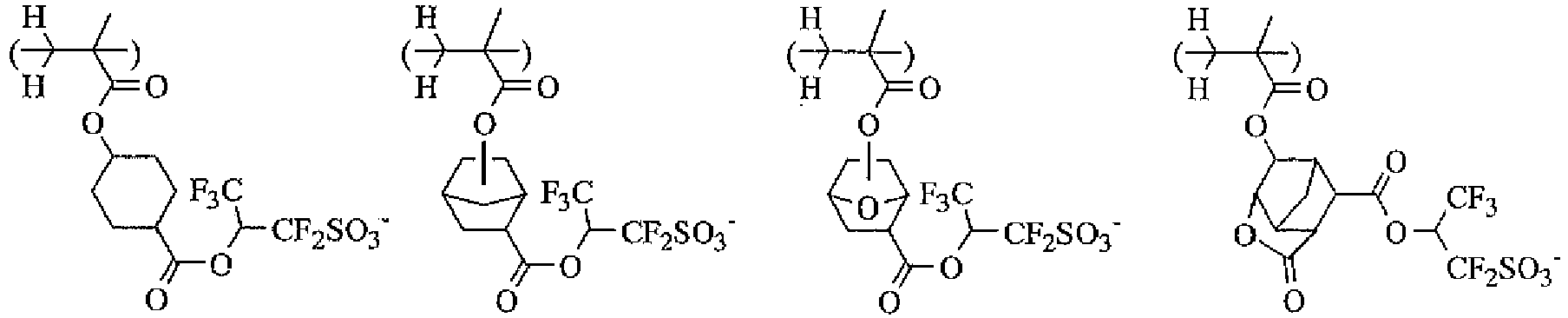


- While the polymer is defined as comprising recurring units of an ionic compound consisting of an anion moiety bound to the polymer backbone and a cation moiety in the form of triarylsulfonium, it is specifically a combination of the anion structure having formula (1) with the cation structure having formula (4), for example, a combination of an exemplary anion structure with an exemplary cation structure as illustrated above.
- In addition to the recurring units of an ionic compound consisting of an anion moiety bound to the polymer backbone and a cation moiety in the form of triarylsulfonium, the polymer may further comprise recurring units having an acid labile group. The recurring unit having an acid labile group typically has the general formula (2).

- Examples of the unit having formula (2) wherein Z is a variant are shown below.


- Under the action of acid, a polymer comprising recurring units of formula (2) is decomposed to generate carboxylic acid, turning to be an alkali soluble polymer. The acid labile group represented by XA may be selected from a variety of such groups. Examples of the acid labile group include groups of the following general formulae (L1) to (L4), tertiary alkyl groups of 4 to 20 carbon atoms, preferably 4 to 15 carbon atoms, trialkylsilyl groups in which each alkyl moiety has 1 to 6 carbon atoms, and oxoalkyl groups of 4 to 20 carbon atoms.

- In these formulae, the broken line denotes a valence bond.
- In formula (L1), RL01 and RL02 each are hydrogen or a straight, branched or cyclic alkyl group of 1 to 18 carbon atoms, preferably 1 to 10 carbon atoms. Exemplary alkyl groups include methyl, ethyl, propyl, isopropyl, n-butyl, sec-butyl, tert-butyl, cyclopentyl, cyclohexyl, 2-ethylhexyl, n-octyl, norbornyl, tricyclodecanyl, tetracyclododecanyl, and adamantyl. RL03 is a monovalent hydrocarbon group of 1 to 18 carbon atoms, preferably 1, to 10 carbon atoms, which may contain a hetero atom such as oxygen, examples of which include unsubstituted straight, branched or cyclic alkyl groups and substituted forms of such alkyl groups in which some hydrogen atoms are replaced by hydroxyl, alkoxy, oxo, amino, alkylamino or the like, or in which an oxygen atom is interposed between carbon atoms. Exemplary straight, branched or cyclic alkyl groups include methyl, ethyl, propyl, isopropyl, n-butyl, sec-butyl, tert-butyl, cyclopentyl, cyclohexyl, 2-ethylhexyl, n-octyl, norbornyl, tricyclodecanyl, tetracyclododecanyl, and adamantyl. Illustrative examples of the substituted alkyl groups are shown below.


- A pair of RL01 and RL02, RL01 and RL03, or RL02 and RL03 may bond together to form a ring with the carbon and oxygen atoms to which they are attached. Each of RL01, RL02 and RL03 is a straight or branched alkylene group of 1 to 18 carbon atoms, preferably 1 to 10 carbon atoms when they form a ring.
- In formula (L2), RL04 is a tertiary alkyl group of 4 to 20 carbon atoms, preferably 4 to 15 carbon atoms, a trialkylsilyl group in which each alkyl moiety has 1 to 6 carbon atoms, an oxoalkyl group of 4 to 20 carbon atoms, or a group of formula (L1). Exemplary tertiary alkyl groups are tert-butyl, tert-amyl, 1,1-diethylpropyl, 2-cyclopentylpropan-2-yl, 2-cyclohexylpropan-2-yl, 2-(bicyclo[2.2.1]heptan-2-yl)propan-2-yl, 2-(adamantan-1-yl)propan-2-yl, 1-ethylcyclopentyl, 1-butylcyclopentyl, 1-ethylcyclohexyl, 1-butylcyclohexyl, 1-ethyl-2-cyclopentenyl, 1-ethyl-2--cyclohexenyl, 2-methyl-2-adamantyl, and 2-ethyl-2-adamantyl. Exemplary trialkylsilyl groups are trimethylsilyl, triethylsilyl, and dimethyl-tert-butylsilyl. Exemplary oxoalkyl groups are 3-oxocyclohexyl, 4-methyl-2-oxooxan-4-yl, and 5-methyl-2-oxooxolan-5-yl. Letter y is an integer of 0 to 6.
- In formula (L3), RL05 is a substituted or unsubstituted, straight, branched or cyclic C1-C8 alkyl group or a substituted or unsubstituted C6-C20 aryl group. Examples of the optionally substituted alkyl group include straight, branched or cyclic alkyl groups such as methyl, ethyl, propyl, isopropyl, n-butyl, sec-butyl, tert-butyl, tert-amyl, n-pentyl, n-hexyl, cyclopentyl, and cyclohexyl, and substituted forms of such groups in which some hydrogen atoms are substituted by hydroxyl, alkoxy, carboxyl, alkoxycarbonyl, oxo, amino, alkylamino, cyano, mercapto, alkylthio, sulfo or other groups. Examples of the optionally substituted aryl groups include phenyl, methylphenyl, naphthyl, anthryl, phenanthryl, and pyrenyl. Letter m' is equal to 0 or 1, n' is equal to 0, 1, 2 or 3, and 2m'+n' is equal to 2 or 3.
- In formula (L4), RL06 is a substituted or unsubstituted, straight, branched or cyclic C1-C8 alkyl group or a substituted or unsubstituted C6-C20 aryl group. Examples of these groups are the same as exemplified for RL05, RL07 to RL16 independently represent hydrogen or monovalent C1-C15 hydrocarbon groups. Exemplary hydrocarbon groups are straight, branched or cyclic alkyl groups such as methyl, ethyl, propyl, isopropyl, n-butyl, sec-butyl, tert-butyl, tert-amyl, n-pentyl, n-hexyl, n-octyl, n-nonyl, n-decyl, cyclopentyl, cyclohexyl, cyclopentylmethyl, cyclopentylethyl, cyclopentylbutyl, cyclohexylmethyl, cyclohexylethyl and cyclohexylbutyl, and substituted forms of these groups in which some hydrogen atoms are replaced by hydroxyl, alkoxy, carboxyl, alkoxycarbonyl, oxo, amino, alkylamino, cyano, mercapto, alkylthio, sulfo or other groups. Alternatively, RL07 to RL16, taken together, form a ring with the carbon atom to which they are attached (for example, a pair of RL07 and RL08, RL07 and RL09, RL07 and RL10, RL08 and RL10, RL09 and RL10, RL11 and RL12, or RL13 and RL14 form a ring). Each of RL07 to RL16 represents a divalent C1-C15 hydrocarbon group when they form a ring, examples of which are the ones exemplified above for the monovalent hydrocarbon groups, with one hydrogen atom being eliminated. Two of RL07 to RL16 which are attached to vicinal carbon atoms may bond together directly to form a double bond (for example, a pair of RL07 and RL09, RL09 and RL15, RL13 and RL15, or RL14 and RL15).
- Of the acid labile groups of formula (L1), the straight and branched ones are exemplified by the following groups.



- Of the acid labile groups of formula (L1), the cyclic ones are, for example, tetrahydrofuran-2-yl, 2-methyltetrahydrofuran-2-yl, tetrahydropyran-2-yl, and 2-methyltetrahydropyran-2-yl.
- Examples of the acid labile groups of formula (L2) include tert-butoxycarbonyl, tert-butoxycarbonylmethyl, tert-amyloxycarbonyl, tert-amyloxycarbonylmethyl, 1,1-diethylpropyloxycarbonyl, 1,1-diethylpropyloxycarbonylmethyl, 1-ethylcyclopentyloxycarbonyl, 1-ethylcyclopentyloxycarbonylmethyl, 1-ethyl-2-cyclopentenyloxycarbonyl, 1-ethyl-2-cyclopentenyloxycarbonylmethyl, 1-ethoxyethoxycarbonylmethyl, 2-tetrahydropyranyloxycarbonylmethyl, and 2-tetrahydrofuranyloxycarbonylmethyl groups.
- Examples of the acid labile groups of formula (L3) include 1-methylcyclopentyl, 1-ethylcyclopentyl, 1-n-propylcyclopentyl, 1-isopropylcyclopentyl, 1-n-butylcyclopentyl, 1-sec-butylcyclopentyl, 1-cyclohexylcyclopentyl, 1-(4-methoxy-n-butyl)cyclopentyl, 1-methylcyclohexyl, 1-ethylcyclohexyl, 3-methyl-1-cyclopenten-3-yl, 3-ethyl-1-cyclopenten-3-yl, 3-methyl-1-cyclohexen-3-yl, and 3-ethyl-1-cyclohexen-3-yl groups.
- Of the acid labile groups having formula (L4), groups having the following formulas (L4-1) to (L4-4) are preferred.

- In formulas (L4-1) to (L4-4), the broken line denotes a bonding site and direction. RL41 is each independently a monovalent hydrocarbon group, typically a straight, branched or cyclic C1-C10 alkyl group, such as methyl, ethyl, propyl, isopropyl, n-butyl, sec-butyl, tert-butyl, tert-amyl, n-pentyl, n-hexyl, cyclopentyl and cyclohexyl.
- For formulas (L4-1) to (L4-4), there can exist enantiomers and diastereomers. Each of formulae (L4-1) to (L4-4) collectively represents all such stereoisomers. Such stereoisomers may be used alone or in admixture.
- For example, the general formula (L4-3) represents one or a mixture of two selected from groups having the following general formulas (L4-3-1) and (L4-3-2).

- Similarly, the general formula (L4-4) represents one or a mixture of two or more selected from groups having the following general formulas (L4-4-1) to (L4-4-4).

- Each of formulas (L4-1) to (L4-4), (L4-3-1) and (L4-3-2), and (L4-4-1) to (L4-4-4) collectively represents an enantiomer thereof and a mixture of enantiomers.
- It is noted that in the above formulas (L4-1) to (L4-4), (L4-3-1) and (L4-3-2), and (L4-4-1) to (L4-4-4), the bond direction is on the exo side relative to the bicyclo[2.2.1]heptane ring, which ensures high reactivity for acid catalyzed elimination reaction (see
JP-A 2000-336121 
- Illustrative examples of the acid labile group of formula (L4) are given below.


- Examples of the tertiary C4-C20 alkyl groups, trialkylsilyl groups in which each alkyl moiety has 1 to 6 carbon atoms, and C4-C20 oxoalkyl groups are as exemplified for RL04.
- Illustrative examples of the recurring units of formula (2) are given below, but not limited thereto.





- While the foregoing examples correspond to those units wherein Z is a single bond, Z which is other than a single bond may be combined with similar acid labile groups. Examples of units wherein Z is other than a single bond are substantially the same as illustrated above.
- Besides the acid labile group-containing units having formula (2), the polymer may further comprise additional units, typically recurring units having the general formula (3).

- Illustrative, non-limiting examples of the recurring units having formula (3) are shown below.

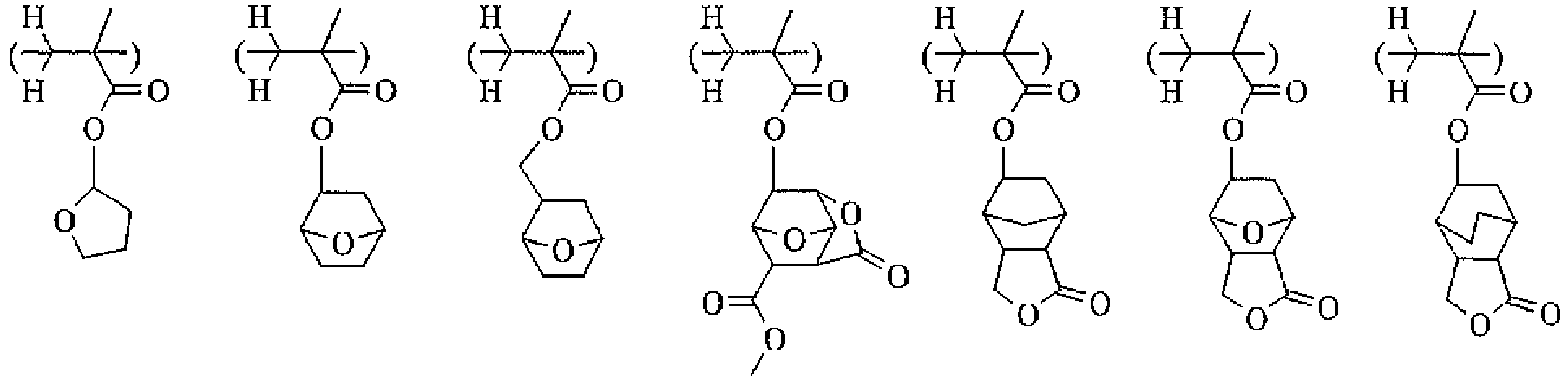





- Of the recurring units having formula (3), if used, those units having a lactone ring as the polar group are most preferred.
- On use, the recurring units having formula (3) are copolymerized with the anion-containing recurring units having formula (1) and the recurring units having formula (2), although they may be further copolymerized with other recurring units.
- In addition to the foregoing units, the polymer may further comprise recurring units derived from carbon-to-carbon double bond-bearing monomers other than the above-described ones, for example, substituted acrylic acid esters such as methyl methacrylate, methyl crotonate, dimethyl maleate and dimethyl itaconate, unsaturated carboxylic acids such as maleic acid, fumaric acid, and itaconic acid, cyclic olefins such as norbornene, norbornene derivatives, and tetracyclo [6.2.1.13,6.02.7] dodecene derivatives, unsaturated acid anhydrides such as itaconic anhydride, and other monomers. Also, hydrogenated products of ROMP polymers as described in
JP-A 2003-066612 - The polymer generally has a weight average molecular weight (Mw) of 1,000 to 500,000, and preferably 3,000 to 100,000, as measured by gel permeation chromatography (GPC) using polystyrene standards. Outside the range, there may result an extreme drop of etch resistance, and a drop of resolution due to difficulty to gain a dissolution rate difference before and after exposure.
- The general method of synthesizing a resist polymer is, for example, by dissolving one or more unsaturated bond-bearing monomers in an organic solvent, adding a radical initiator, and effecting heat polymerization. Reference may be made to many documents including
JP-A 2005-264103 JP-A 2010-077404 - However, in the process of preparing a polymer comprising recurring units having the PAG function like the above-mentioned sulfonium salt, it is often difficult to remove the residual monomer, especially the residual monomer from which sulfonium salt-containing unit is derived. In general, after a polymer for resist use is polymerized, a non-polar solvent, typically hexane, or water is often used as poor solvent for such removal, but the residual monomer corresponding to the sulfonium salt-containing unit cannot be removed, in most cases, using these species of solvent. If a highly lipophilic substituent group is introduced into the sulfonium salt, there is not only a possibility that the monomer dissolves in hexane or non-polar solvents, but also a possibility that the desired polymer also dissolves therein. For example,
JP-A 2008-133448 - Since the residual sulfonium salt monomer has not been incorporated in the polymer chain as a matter of course, it is presumed that acid diffusion is not suppressed, and as a result, resist performance may be degraded, for example, LWR be enlarged. Also, the residual monomer can cause defects. Accordingly, it is recommended to remove the residual monomer as much as possible from the sulfonium anion-containing polymer.
- The method of the invention is designed to avoid the above-discussed problem. According to the invention, a sulfonic acid anion-containing polymer having an ammonium or metal cation not bound thereto is first synthesized. Then purification such as by water washing is carried out to remove the residual monomer originating from the ionic compound. Thereafter, the polymer is subjected to cation exchange reaction with a triarylsulfonium salt to form a triarylsulfonium salt-containing polymer comprising sulfonic acid anion-containing recurring units having formula (1). The inventive method is successful in producing the desired polymer while significantly reducing the amount of the residual monomer originating from sulfonium salt as compared with the prior art method. Then a resist composition comprising the desired polymer is improved in resist properties such as pattern profile and LWR and effective for reducing the number of defects.
- The precursor to the inventive polymer is a sulfonic acid anion-containing polymer having an ammonium or metal cation not bound to the polymer. Typically the sulfonic acid anion-containing polymer comprises recurring units having the general formula (5).

- In formula (5), L is a divalent organic group, examples of which are the same as previously illustrated in conjunction with formula (1). M+ is an ammonium or metal cation. Suitable metal cations include lithium ion, sodium ion and potassium ion. The ammonium ion is of the structure having the general formula (6).
(R2)4N+ (6)
Herein R2 is each independently hydrogen, a substituted or unsubstituted, straight, branched or cyclic C1-C10 alkyl, alkenyl or oxoalkyl group or a substituted or unsubstituted C6-C18 aryl, aralkyl or aryloxoalkyl group, or at least two of R2 may bond together to form a ring with the nitrogen atom in the formula. - Of the groups of R2 in formula (6), suitable alkyl groups include methyl, ethyl, propyl, isopropyl, n-butyl, sec-butyl, tert-butyl, pentyl, hexyl, heptyl, octyl, cyclopentyl, cyclohexyl, cycloheptyl, cyclopropylmethyl, 4-methylcyclohexyl, cyclohexylmethyl, norbornyl, and adamantyl. Suitable alkenyl groups include allyl, propenyl, butenyl, hexenyl, and cyclohexenyl. Suitable oxoalkyl groups include 2-oxocyclopentyl, 2-oxocyclohexyl, 2-oxopropyl, 2-oxoethyl, 2-cyclopentyl-2-oxoethyl, 2-cyclohexyl-2-oxoethyl, and 2-(4-methylcyclohexyl)-2-oxoethyl. Suitable aryl groups include phenyl, 1-naphthyl, 2-naphthyl and thienyl, as well as hydroxyphenyl and alkoxyphenyl groups such as 4-hydroxyphenyl, p-methoxyphenyl, m-methoxyphenyl, o-methoxyphenyl, p-ethoxyphenyl, p-tert-butoxyphenyl, and m-tert-butoxyphenyl, alkylphenyl groups such as 2-methylphenyl, 3-methylphenyl, 4-methylphenyl, ethylphenyl, 4-tert-butylphenyl, 4-butylphenyl, and 2,4-dimethylphenyl, alkylnaphthyl groups such as 1-(4-methyl)naphthyl and 2-(6-methyl)naphthyl, and alkoxynaphthyl groups such as 1-(4-methoxy)naphthyl and 2-(6-methoxy)naphthyl. Suitable aralkyl groups include benzyl, 1-phenylethyl, and 2-phenylethyl. Suitable aryloxoalkyl groups include 2-aryl-2-oxoethyl groups such as 2-phenyl-2-oxoethyl, 2-(1-naphthyl)-2-oxoethyl, and 2-(2-naphthyl)-2-oxoethyl. In these hydrocarbon groups, one or more hydrogen atoms may be substituted by a heteroatom or atoms such as oxygen, sulfur, nitrogen or halogen atom, to eventually form a hydroxyl, cyano, carbonyl, ether bond, ester bond, sulfonic acid ester link, carbonate, lactone ring, sultone ring, carboxylic anhydride, or haloalkyl group.
- Alternatively, at least two of R2 groups bond together to form a ring with the nitrogen atom in the formula. Exemplary ring structures include piperidine, morpholine, pyridine, quinoline, acridine, imidazole and benzimidazole in which the nitrogen atom may be protonized or alkylated.
- Illustrative examples of the ammonium ion having formula (6) include ammonium, trimethylammonium, tetramethylammonium, triethylammonium, tributylammonium, tetrabutylammonium, trioctylammonium, anilinium, 2,6-dimethylanilinium, N,N-dimethylanilinium, bezyltrimethylammonium, benzyltriethylammonium, benzyltripropylammonium, N-benzyl-N,N-dimethylanilinium, and N-(p-methoxy)benzyl-N,N-dimethylanilinium. Inter alia, trimethylammonium, tetramethylammonium, triethylammonium, anilinium, and bezyltrimethylammonium are preferred.
- The monomeric compound having formula (5) may be synthesized, for example, by the method of
JP-A 2007-304490 - Likewise, the monomeric compound having formula (5) may also be obtained by converting the sodium salt of 2-butyl difluorosulfoacetate described in
JP-A 2011-158896 WO 2008/56795 JP-A 2011-256390 JP-A 2009-221454 - Next, the synthesis of a polymer comprising recurring units having formula (5) is described. The recurring units having formula (5) may be used as a homopolymer or copolymerized with other recurring units. Desirably, the recurring units having formula (5) are copolymerized with acid labile group-containing units having formula (2) and more desirably with units having formulae (2) and (3).
- The polymer comprising recurring units having formula (5) may be synthesized by the aforementioned method, specifically by dissolving one or more unsaturated bond-containing monomers in an organic solvent, adding a radical initiator thereto, and effecting heat polymerization. Examples of the organic solvent which can be used for polymerization include aromatic solvents such as toluene and benzene, ether solvents such as tetrahydrofuran, diethyl ether and dioxane, ketone solvents such as acetone and methyl ethyl ketone, alcohols such as methanol and propylene glycol monomethyl ether, ester solvents such as ethyl acetate and propylene glycol monomethyl ether acetate (PGMEA), and halogenated solvents such as chloroform and dichloroethane. Examples of the polymerization initiator used herein include 2,2'-azobisisobutyronitrile (AIBN), 2,2'-azobis(2,4-dimethylvaleronitrile),
dimethyl 2,2'-azobis(2-methylpropionate), benzoyl peroxide, and lauroyl peroxide. Preferably the system is heated at 50 to 80°C for polymerization to take place. The reaction time is 2 to 100 hours, preferably 5 to 20 hours. When acid labile group-containing units are to be incorporated, such a unit that has been incorporated in a monomer may be kept as such, or protection or partial protection after polymerization may be adopted. - Described below is the synthesis of a sulfonic acid anion-containing polymer having a triarylsulfonium cation as used in the resist composition. The sulfonic acid anion-containing polymer having a triarylsulfonium cation is synthesized by letting a triarylsulfonium salt having the general formula (7) act on a polymer having the above formula (5) to induce cation exchange reaction.
S+(Ar)3X- (7)
Herein Ar is a substituted or unsubstituted C6-C20 aryl group which may contain a heteroatom, a plurality of Ar groups may bond together directly or via an oxygen atom, methylene, sulfonyl or carbonyl moiety, and X- is an anion. - In formula (7), Ar is as illustrated previously, and X- is an anion which may be any of conjugated bases of either inorganic acids or organic acids, for example, conjugated bases of methylsulfuric acid, methanesulfonic acid and p-toluenesulfonic acid, I-. Br-, Cl-, BF4 -, ClO4 -, or the like.
- With respect to the synthesis of the triarylsulfonium salt having formula (7), reference may be made to
JP-A 2007-145797 2008-106045 2009-007327 2009-258695 - First, a polymer comprising recurring units having formula (5) is synthesized by the aforementioned method. The polymer thus synthesized should preferably be purified by separatory operation such as water washing or crystallization. The polymer and a triarylsulfonium salt having formula (7) are mixed in a system of water and an organic solvent separable from water whereupon the organic layer is taken out. The organic layer is washed with water, if necessary. The desired polymer may be recovered from the organic layer by conventional means such as concentration or crystallization. Any organic solvent may be used herein as long as it can be separated from water and the polymer is dissolvable therein. The preferred organic solvents include ketone solvents such as methyl ethyl ketone and methyl isobutyl ketone, and halogenated solvents such as dichloromethane and chloroform.
- When the compound having formula (5) wherein M+ is an inorganic cation such as lithium, sodium or potassium ion or an ammonium ion of 1 to 10 carbon atoms undergoes exchange reaction with a triarylsulfonium salt, there are formed the desired polymer and M+X- which is readily extractable into the water layer. More desirably, M+ is trimethylammonium, tetramethylammonium, triethylammonium, anilinium, or benzyltrimethylammonium. The polymers having these species of cation are characterized by ease of polymerization and allow subsequent exchange reaction with a triarylsulfonium salt to take place rapidly.
- Alternatively, the desired polymer may be obtained by dissolving a polymer comprising recurring units having formula (5) and a triarylsulfonium salt having formula (7) in an organic solvent, and pouring it into water or another organic solvent for crystallization. Preferably the good solvent is an alcohol and the poor solvent is water.
- While the polymer comprises recurring units derived from monomers, the molar fractions of respective units preferably fall in the following range (mol%), but are not limited thereto.
- (I) 0.2 to 20 mol%, more preferably 0.5 to 15 mol% of constituent units of sulfonic acid anion-containing compound having triarylsulfonium cation,
- (II) 1 to 50 mol%, more preferably 5 to 40 mol%, and even more preferably 10 to 30 mol% of constituent units of at least one type having formula (2),
- (III) 30 to 98.8 mol%, more preferably 45 to 94.5 mol%, and even more preferably 69.5 to 89.5 mol% of constituent units of at least one type having formula (3), and optionally,
- (IV) 0 to 80 mol%, more preferably 0 to 70 mol%, and even more preferably 0 to 50 mol% of constituent units of at least one type derived from another monomer(s).
- The polymer is not limited to one type and a mixture of two or more polymers may be added. The use of plural polymers allows for easy adjustment of resist properties.
- A further embodiment of the invention is a resist composition comprising (A) the sulfonic acid anion-containing polymer having a triarylsulfonium cation defined above as essential component. The resist composition may further comprise (B) a photoacid generator capable of generating an acid upon exposure, (C) a quencher, and (D) an organic solvent. Optionally, the resist composition may further comprise (E) a surfactant which is insoluble or substantially insoluble in water and soluble in alkaline developer, and/or a surfactant which is insoluble or substantially insoluble in water and alkaline developer (hydrophobic resin), and (F) an organic acid derivative and/or fluorinated alcohol.
- The PAG used herein may be any compound capable of generating an acid upon exposure to high-energy radiation including UV, DUV, EB, EUV, x-ray, excimer laser, γ-ray, and synchrotron radiation. Suitable PAGs include sulfonium salts, iodonium salts, sulfonyldiazomethane, N-sulfonyloxydicarboxyimide, O-arylsulfonyloxime, and O-alkylsulfonyloxime generators. The acid generators may be used alone or in admixture of two or more.
- Sulfonium salts are salts of sulfonium cations with sulfonates, bis(substituted alkylsulfonyl)imides and tris(substituted alkylsulfonyl)methides. Suitable sulfonium cations include those cations having the general formula (8).
S+(R3R4R5) (8)
Herein R3, R4 and R5 are each independently a substituted or unsubstituted, straight, branched or cyclic C1-C10 alkyl, alkenyl or oxoalkyl group or a substituted or unsubstituted C6-C16 aryl, aralkyl or aryloxoalkyl group, or any two of R3,
R4 and R5 may bond together to form a ring with the sulfur atom in the formula. - Of the groups represented by R3 to R5, suitable alkyl groups include methyl, ethyl, n-propyl, isopropyl, n-butyl, tert-butyl, cyclopropyl, cyclopentyl, cyclohexyl, cyclopropylmethyl, 4-methylcyclohexyl, cyclohexylmethyl, norbornyl, and adamantyl. Suitable alkenyl groups include vinyl, allyl, propenyl, butenyl, hexenyl, and cyclohexenyl. Suitable oxoalkyl groups include 2-oxocyclopentyl, 2-oxocyclohexyl, 2-oxopropyl, 2-oxoethyl, 2-cyclopentyl-2-oxoethyl, 2-cyclohexyl-2-oxoethyl, and 2-(4-methylcyclohexyl)-2-oxoethyl. Suitable aryl groups include phenyl, naphthyl and thienyl, as well as hydroxyphenyl and alkoxyphenyl groups such as 4-hydroxyphenyl, 4-methoxyphenyl, 3-methoxyphenyl, 2-methoxyphenyl, 4-ethoxyphenyl, 4-tert-butoxyphenyl, and 3-tert-butoxyphenyl, alkylphenyl groups such as 2-methylphenyl, 3-methylphenyl, 4-methylphenyl, 4-ethylphenyl, 4-tert-butylphenyl, 4-n-butylphenyl, and 2,4-dimethylphenyl, alkylnaphthyl groups such as methylnaphthyl and ethylnaphthyl, alkoxynaphthyl groups such as methoxynaphthyl and ethoxynaphthyl, dialkylnaphthyl groups such as dimethylnaphthyl and diethylnaphthyl, and dialkoxynaphthyl groups such as dimethoxynaphthyl and diethoxynaphthyl. Suitable aralkyl groups include benzyl, 1-phenylethyl, and 2-phenylethyl. Suitable aryloxoalkyl groups are 2-aryl-2-oxoethyl groups including 2-phenyl-2-oxoethyl, 2-(1-naphthyl)-2-oxoethyl, and 2-(2-naphthyl)-2-oxoethyl. In these hydrocarbon groups, one or more hydrogen atoms may be substituted by fluorine or hydroxyl.
- Alternatively, any two of R3, R4 and R5 bond together to form a ring with the sulfur atom in the formula. Exemplary ring structures are given below.

- As the anion of the sulfonium salt, exemplary sulfonates include trifluoromethanesulfonate, pentafluoroethanesulfonate, heptafluoropropanesulfonate, nonafluorobutanesulfonate, tridecafluorohexanesulfonate, 2,2,2-trifluoroethanesulfonate, pentafluorobenzenesulfonate, 1,1-difluoro-2-naphthylethanesulfonate, 1,1,2,2-tetrafluoro-2-(norbornan-2-yl)ethanesulfonate, 1,1,2,2-tetrafluoro-2-(tetracyclo[6.2.1.13,6.02,7]dodec-3-en-8-yl)ethanesulfonate, 2-benzoyloxy-1,1,3,3,3-pentafluoropropanesulfonate, 1,1-difluoro-2-tosyloxyethanesulfonate, adamantanemethoxycarbonyldifluoromethanesulfonate, 1-(3-hydroxymethyladamantane)methoxycarbonyldifluoromethanesulfonate, methoxycarbonyldifluoromethanesulfonate, 1-(hexahydro-2-oxo-3,5-methano-2H-cyclopenta[b]furan-6-yl-oxycarbonyl)difluoromethanesulfonate, and 4-oxo-1-adamantyloxycarbonyldifluoromethanesulfonate. Exemplary bis(substituted alkylsulfonyl)imides include bis(trifluoromethylsulfonyl)imide, bis(pentafluoroethylsulfonyl)imide, bis(heptafluoropropylsulfonyl)imide, and perfluoro(1,3-propylenebissulfonyl)imide. A typical tris(substituted alkylsulfonyl)methide is tris(trifluoromethylsulfonyl)methide. Sulfonium salts based on combination of the foregoing examples are included.
- Examples of the iodonium salt, N-sulfonyloxydicarboxyimide, O-arylsulfonyloxime, and O-alkylsulfonyloxime (or oximesulfonate) acid generators are described in
JP-A 2009-269953 - Preferred examples of the PAG include triphenylsulfonium nonafluorobutanesulfonate, triphenylsulfonium bis(trifluoromethylsulfonyl)imide, triphenylsulfonium perfluoro(1,3-propylenebissulfonyl)imide, triphenylsulfonium tris(trifluoromethanesulfonyl)methide, N-nonafluorobutanesulfonyloxy-1,8-naphthalenedicarboxyimide, 2-(2,2,3,3,4,4-hexafluoro-1-(nonafluorobutylsulfonyloxy-imino)butyl)fluorene, and 2-(2,2,3,3,4,4,5,5-octafluoro-1-(nonafluorobutylsulfonyloxy-imino)pentyl)fluorene.
- The preferred structure of PAG includes compounds having the general formula (P1).

- In formula (P1), R8 is a C1-C30 alkyl, alkenyl or aralkyl group which may contain a heteroatom. Suitable heteroatoms contained in R8 include oxygen, nitrogen, sulfur and halogen atoms, with oxygen being preferred. The C1-C30 alkyl, alkenyl or aralkyl group of R8 may be straight, branched or cyclic while it is preferred for achieving a high resolution sufficient to form a fine size pattern that these groups have 6 to 30 carbon atoms. It is undesirable that R8 be aryl because the resulting resist pattern may have less smooth sidewalls. Exemplary groups of R8 include, but are not limited to, methyl, ethyl, propyl, isopropyl, butyl, isobutyl, s-butyl, tert-butyl, pentyl, neopentyl, cyclopentyl, hexyl, cyclohexyl, 3-cyclohexenyl, heptyl, 2-ethylhexyl, nonyl, undecyl, tridecyl, pentadecyl, heptadecyl, 1-adamantyl, 2-adamantyl, 1-adamantylmethyl, norbornyl, norbornylmethyl, tricyclodecanyl, tetracyclododecanyl, tetracyclododecanylmethyl, dicyclohexylmethyl, eicosyl, allyl, benzyl, diphenylmethyl, tetrahydrofuryl, methoxymethyl, ethoxymethyl, methylthiomethyl, acetamidomethyl, trifluoromethyl, (2-methoxyethoxy)methyl, acetoxymethyl, 2-carboxy-1-cyclohexyl, 2-oxopropyl, 4-oxo-1-adamantyl, and 3-oxocyclohexyl.
- With respect to the synthesis of the sulfonium salt having formula (P1), reference may be made to
JP-A 2007-145797 2008-106045 2009-007327 2009-258695 - Illustrative examples of the preferred PAG are given below.








- An appropriate amount of the PAG having formula (P1) added is 0 to 40 parts by weight, and if added, 0.1 to 40 parts, and more preferably 0.1 to 20 parts by weight per 100 parts by weight of the base resin. Too high a proportion of the PAG may give rise to problems such as degraded resolution and foreign particles during development and resist film stripping. The PAG having formula (P1) may be used alone or in admixture of two or more or in admixture with another PAG. When the other PAG is added, its amount is arbitrary as long as the objects of the invention are not compromised. Typically the amount of the other PAG is 0 to 20 parts, preferably 0.1 to 10 parts by weight per 100 parts by weight of the base resin.
- Notably, the resist composition comprises as base resin (A) a sulfonic acid anion-containing polymer having a triarylsulfonium cation, which also functions as PAG. Therefore, it is unnecessary to add PAG (B) although it is acceptable to use one or more PAGs (B) in combination with base resin (A).
- It is noted that an acid diffusion controlling function may be provided when two or more PAGs are used in admixture provided that one PAG is an onium salt capable of generating a weak acid. Specifically, in a system using a mixture of an onium salt capable of generating a strong acid (e.g., fluorinated sulfonic acid) and an onium salt capable of generating a weak acid (e.g., non-fluorinated sulfonic acid or carboxylic acid), if the strong acid generated from the PAG upon exposure to high-energy radiation collides with the unreacted onium salt having a weak acid anion, then a salt exchange occurs whereby the weak acid is released and an onium salt having a strong acid anion is formed. In this course, the strong acid is exchanged into the weak acid having a low catalysis, incurring apparent deactivation of the acid for enabling to control acid diffusion.
- If the PAG capable of generating a strong acid is an onium salt, an exchange from the strong acid generated upon exposure to high-energy radiation to a weak acid as above can take place, but it never happens that the weak acid generated upon exposure to high-energy radiation collides with the unreacted onium salt capable of generating a strong acid to induce a salt exchange. This is because of a likelihood of an onium cation forming an ion pair with a stronger acid anion.
- The quencher (C) may be a compound capable of suppressing the rate of diffusion when the acid generated by the PAG diffuses within the resist film. The inclusion of quencher facilitates adjustment of resist sensitivity and holds down the rate of acid diffusion within the resist film, resulting in better resolution. In addition, it suppresses changes in sensitivity following exposure and reduces substrate and environment dependence, as well as improving the exposure latitude and the pattern profile. The inclusion of quencher is also effective for improving adhesion to the substrate.
- Examples of suitable quenchers include primary, secondary, and tertiary aliphatic amines, mixed amines, aromatic amines, heterocyclic amines, nitrogen-containing compounds with carboxyl group, nitrogen-containing compounds with sulfonyl group, nitrogen-containing compounds with hydroxyl group, nitrogen-containing compounds with hydroxyphenyl group, alcoholic nitrogen-containing compounds, amide derivatives, imide derivatives, carbamate derivatives, and ammonium salts. Of these, preferred are tertiary amines, amine oxides, benzimidazoles, and anilines having a polar functional group such as ether, carbonyl, ester or alcohol.
- Preferred tertiary amines include 2-morpholinoethyl esters of straight, branched or cyclic C2-C20 aliphatic carboxylic acids and trialkylamines having a straight, branched or cyclic C2-C10 alkyl moiety. Also included are substituted forms of these amines in which some carbon-bonded hydrogen atoms are replaced by hydroxyl groups. These amines may have an ether or ester linkage. Examples include 2-morpholinoethyl 2-methoxyacetate, 2-morpholinoethyl 2-(2-methoxyethoxy)acetate,
- 2-morpholinoethyl 2-[2-(2-methoxyethoxy)ethoxylacetate, 2-morpholinoethyl hexanoate, 2-morpholinoethyl octanoate, 2-morpholinoethyl decanoate, 2-morpholinoethyl laurate, 2-morpholinoethyl myristate, 2-morpholinoethyl palmitate, 2-morpholinoethyl stearate, 2-morpholinoethyl cyclohexanecarboxylate, 2-morpholinoethyl adamantanecarboxylate, 4-[2-[(2-methoxyethoxy)methoxy]ethyl]morpholine, 4-[2-[2-(2-methoxyethoxy)ethoxy]ethyl]morpholine, 4-[2-[2-(2-butoxyethoxy)ethoxy]ethyl]morpholine, tris(2-methoxymethoxyethyl)amine, tris{2-(2-methoxyethoxy)ethyl}amine, tris{2-(2-methoxyethoxymethoxy)ethyl}amine, tris{2-(1-methoxyethoxy)ethyl}amine, tris{2-(1-ethoxyethoxy)ethyl}amine, tris(2-acetoxyethyl)amine, tris(2-propionyloxyethyl)amine, tris(2-butyryloxyethyl)amine, tris(2-isobutyryloxyethyl)amine, tris(2-valeryloxyethyl)amine, and tris(2-pivaloyloxyethyl)amine.
- Preferred examples of the benzimidazoles include benzimidazole, 2-phenylbenzimidazole, 1-(2-acetoxyethoxy)benzimidazole, 1-[2-(methoxymethoxy)ethyl]benzimidazole, 1-[2-(methoxymethoxy)ethyl]-2-phenylbenzimidazole, and 1-(2-(2-(2-methoxyethoxy)ethoxy)ethyl)benzimidazole.
- Preferred examples of the anilines include aniline, N-methylaniline, N-ethylaniline, N-propylaniline, N,N-dimethylaniline, N,N-bis(hydroxyethyl)aniline, 2-methylaniline, 3-methylaniline, 4-methylaniline, ethylaniline, propylaniline, dimethylaniline, 2,6-diisopropylaniline, trimethylaniline, 2-nitroaniline, 3-nitroaniline, 4-nitroaniline, 2,4-dinitroaniline, 2,6-dinitroaniline, 3,5-dinitroaniline, and N,N-dimethyltoluidine.
- Also included are primary and secondary amines which have been protected with tert-butoxycarbonyl (tBOC). Those compounds described in
JP-A 2007-298569 JP-A 2010-020204 - The quenchers may be used alone or in admixture of two or more. The quencher is preferably used in an amount of 0.001 to 8 parts, more preferably 0.01 to 4 parts by weight per 100 parts by weight of the base resin. Less than 0.001 part of the quencher may achieve no addition effect whereas more than 8 parts may lead to too low a sensitivity.
- The organic solvent (D) used herein may be any organic solvent in which the polymer (or base resin), acid generator, quencher, and other components are soluble. Illustrative, non-limiting, examples of the organic solvent include ketones such as cyclohexanone and methyl amyl ketone; alcohols such as 3-methoxybutanol, 3-methyl-3-methoxybutanol, 1-methoxy-2-propanol, and 1-ethoxy-2-propanol; ethers such as propylene glycol monomethyl ether, propylene glycol monoethyl ether, propylene glycol dimethyl ether, and diethylene glycol dimethyl ether; esters such as propylene glycol monomethyl ether acetate (PGMEA), propylene glycol monoethyl ether acetate, ethyl lactate, ethyl pyruvate, butyl acetate, methyl 3-methoxypropionate, ethyl 3-ethoxypropionate, tert-butyl acetate, tert-butyl propionate, and propylene glycol mono-tert-butyl ether acetate; and lactones such as γ-butyrolactone, which may be used alone or in combinations of two or more. Of the above organic solvents, it is recommended to use 1-ethoxy-2-propanol, PGMEA, cyclohexanone, γ-butyrolactone, and mixtures thereof because the acid generator is most soluble therein.
- An appropriate amount of the organic solvent used is 200 to 5,000 parts, more preferably 400 to 3,000 parts by weight per 100 parts by weight of the base resin.
- Component (E) is a surfactant which is insoluble or substantially insoluble in water and soluble in alkaline developer, and/or a surfactant which is insoluble or substantially insoluble in water and alkaline developer (hydrophobic resin). The surfactant (E) may be added to the resist composition. Reference should be made to those compounds defined as component (S) in
JP-A 2010-215608 JP-A 2011-016746 - While many examples of the surfactant which is insoluble or substantially insoluble in water and alkaline developer are described in these patent documents, preferred examples are FC-4430, Surflon S-381, Surfynol E1004, KH-20 and KH-30, which may be used alone or in admixture. Partially fluorinated oxetane ring-opened polymers having the structural formula (surf-1) are also useful.


- Rf is trifluoromethyl or pentafluoroethyl, and preferably trifluoromethyl. The letter m is an integer of 0 to 3, n is an integer of 1 to 4, and the sum of m and n, which represents the valence of R, is an integer of 2 to 4. A is equal to 1, B is an integer of 2 to 25, and C is an integer of 0 to 10. Preferably, B is an integer of 4 to 20, and C is 0 or 1. Note that the above structural formula does not prescribe the arrangement of respective constituent units while they may be arranged either in blocks or randomly. For the preparation of surfactants in the form of partially fluorinated oxetane ring-opened polymers, reference should be made to
USP 5,650,483 , for example. - The surfactant which is insoluble or substantially insoluble in water and soluble in alkaline developer is useful when ArF immersion lithography is applied to the resist composition in the absence of a resist protective film. In this embodiment, the surfactant has a propensity to segregate on the resist surface after spin coating for achieving a function of minimizing water penetration or leaching. The surfactant is also effective for preventing water-soluble components from being leached out of the resist film for minimizing any damage to the exposure tool. The surfactant becomes solubilized during alkaline development following exposure and PEB, and thus forms few or no foreign particles which become defects. The preferred surfactant is a polymeric surfactant which is insoluble or substantially insoluble in water, but soluble in alkaline developer, also referred to as "hydrophobic resin" in this sense, and especially which is water repellent and enhances water slippage. Suitable polymeric surfactants are shown below.

- Examples of these units are shown below.




- For the surfactant which is insoluble or substantially insoluble in water and soluble in alkaline developer, reference may be made to
JP-A 2008-122932 2010-134012 2010-107695 2009-276363 2009-192784 2009-191151 2009-98638 2010-250105 2011-42789 - The polymeric surfactant preferably has a Mw of 1,000 to 50,000, more preferably 2,000 to 20,000 as measured by GPC versus polystyrene standards. A surfactant with a Mw outside the range may be less effective for surface modification and cause development defects. The polymeric surfactant is preferably formulated in an amount of 0.001 to 20 parts, and more preferably 0.01 to 10 parts by weight per 100 parts by weight of the base resin. Reference should also be made to
JP-A 2010-215608 - To the resist composition, a compound which is decomposed with an acid to generate another acid, that is, acid amplifier compound may be added. For these compounds, reference should be made to
JP-A 2009-269953 2010-215608 - Optionally, an organic acid derivative or a compound having a Mw of up to 3,000 which changes its solubility in alkaline developer under the action of an acid, also referred to as dissolution inhibitor, may be added. Reference may be made to
JP-A 2009-269953 2010-215608 - A further embodiment of the invention is a pattern forming process using the resist composition defined above. A pattern may be formed from the resist composition using any well-known lithography process. The preferred process includes at least the steps of forming a resist film on a substrate, exposing it to high-energy radiation, and developing it in a developer.
- The resist composition is applied onto a substrate for integrated circuit fabrication (e.g., Si, SiO2, SiN, SiON, TiN, WSi, BPSG, SOG or organic antireflective coating) by a suitable coating technique such as spin coating. The coating is prebaked on a hot plate at a temperature of 60 to 150°C for 1 to 10 minutes, preferably 80 to 140°C for 1 to 5 minutes, to form a resist film of 0.05 to 2.0 µm thick. The resist film is then exposed by the ArF immersion lithography. A mask having the desired pattern is placed over the resist film, a liquid, typically water, is interposed between the mask and the resist film, and the resist film is exposed to ArF excimer laser radiation in a dose of 1 to 200 mJ/cm2, and preferably 10 to 100 mJ/cm2. Prior to exposure, a protective film which is insoluble in water may be formed on the resist film, if desired.
- After exposure, the resist film is baked (PEB) on a hot plate at 60 to 150°C for 1 to 5 minutes, and preferably at 80 to 140°C for 1 to 3 minutes. This is followed by development in a developer which is an alkaline aqueous solution, typically an aqueous solution of 0.1 to 5 wt%, more typically 2 to 3 wt% of tetramethylammonium hydroxide (TMAH). Development may be carried out by a conventional method such as dip, puddle, or spray development for 0.1 to 3 minutes, and preferably 0.5 to 2 minutes. These steps result in the formation of the desired pattern on the substrate.
- The water-insoluble protective film which is used in the immersion lithography is to prevent any components from being leached out of the resist film and to improve water slippage at the film surface and is generally divided into two types. The first type is an organic solvent-strippable protective film which must be stripped, prior to alkaline development, with an organic solvent in which the resist film is not dissolvable. The second type is an alkali-soluble protective film which is soluble in an alkaline developer so that it can be removed simultaneously with the removal of solubilized regions of the resist film. The protective film of the second type is preferably of a material comprising a polymer having a 1,1,1,3,3,3-hexafluoro-2-propanol residue (which is insoluble in water and soluble in an alkaline developer) as a base in an alcohol solvent of at least 4 carbon atoms, an ether solvent of 8 to 12 carbon atoms or a mixture thereof. Alternatively, the aforementioned surfactant which is insoluble in water and soluble in an alkaline developer may be dissolved in an alcohol solvent of at least 4 carbon atoms, an ether solvent of 8 to 12 carbon atoms or a mixture thereof to form a material from which the protective film of the second type is formed.
- Any desired step may be added to the pattern forming process. For example, after a photoresist film is formed, a step of rinsing with pure water (post-soaking) may be introduced to extract the acid generator or the like from the film surface or wash away particles. After exposure, a step of rinsing (post-soaking) may be introduced to remove any water remaining on the film after exposure.
- The technique enabling the ArF lithography to survive to the 32-nm node is a double patterning process. The double patterning process includes a trench process of processing an underlay to a 1:3 trench pattern by a first step of exposure and etching, shifting the position, and forming a 1:3 trench pattern by a second step of exposure for forming a 1:1 pattern; and a line process of processing a first underlay to a 1:3 isolated left pattern by a first step of exposure and etching, shifting the position, processing a second underlay formed below the first underlay by a second step of exposure through the 1:3 isolated left pattern, for forming a half-pitch 1:1 pattern.
- In the pattern forming process, an alkaline aqueous solution, typically an aqueous solution of 0.1 to 5 wt%, more typically 2 to 3 wt% of tetramethylammonium hydroxide (TMAH) is often used as the developer. The negative tone development technique wherein the unexposed region is developed and dissolved in an organic solvent is also applicable.
- In the organic solvent development, the organic solvent used as the developer is preferably selected from 2-octanone, 2-nonanone, 2-heptanone, 3-heptanone, 4-heptanone, 2-hexanone, 3-hexanone, diisobutyl ketone, methylcyclohexanone, acetophenone, methylacetophenone, propyl acetate, butyl acetate, isobutyl acetate, amyl acetate, isoamyl acetate, butenyl acetate, phenyl acetate, propyl formate, butyl formate, isobutyl formate, amyl formate, isoamyl formate, methyl valerate, methyl pentenoate, methyl crotonate, ethyl crotonate, methyl lactate, ethyl lactate, propyl lactate, butyl lactate, isobutyl lactate, amyl lactate, isoamyl lactate, methyl 2-hydroxyisobutyrate, ethyl 2-hydroxyisobutyrate, methyl benzoate, ethyl benzoate, benzyl acetate, methyl phenylacetate, benzyl formate, phenylethyl formate, methyl 3-phenylpropionate, benzyl propionate, ethyl phenylacetate, and 2-phenylethyl acetate. These organic solvents may be used alone or in admixture of two or more.
- Examples of the invention are given below by way of illustration and not by way of limitation. Mw and Mn are weight and number average molecular weights, respectively, and Mw/Mn is a polydispersity index.
-

- In accordance with the method of
JP-A 2007-304490 triethylammonium JP-A 2007-145804 triethylammonium -

- In 400 g of methylene chloride were dissolved 79 g (0.16 mol) of
triethylammonium triethylammonium - In a flask purged with nitrogen, 9 g of
triethylammonium dimethyl 2,2'-azobis(2-methylpropionate), and 0.7 g of 2-mercaptoethanol were dissolved in 192 g of methyl ethyl ketone to form a monomer solution. Another flask purged with nitrogen was charged with 58 g of methyl ethyl ketone, which was stirred and heated at 80°C. Thereafter, the monomer solution was added dropwise over 4 hours. After the completion of dropwise addition, the polymerization solution was stirred for a further 2 hours while maintaining at 80°C. After the polymerization solution was cooled to room temperature, it was added dropwise to 1,000 g of hexane. A precipitating copolymer was filtered. The copolymer was washed 2 times with a mixture of 120 g of methyl ethyl ketone and 480 g of hexane, and vacuum dried at 50°C for 20 hours, obtaining 88 g of the copolymer in white powder form. The copolymer was analyzed by 1H-NMR spectroscopy, finding a copolymer compositional ratio of 5/55/10/30 mol% in the described order of monomers. -

-
FIG. 1 is the diagram of nuclear magnetic resonance spectroscopy (1H-NMR/DMSO-d6) of the target. In 1H-NMR analysis, a trace amount of solvent (diisopropyl ether) was observed. - A series of resins as shown in Table 1 were prepared by the same procedure as in Synthesis Example 2-1 except that the type and ratio of monomers were changed. The units in Table 1 have the structure shown in Tables 2 to 4. In Table 1, the ratio of units is a molar ratio.
- Polymer P-1 obtained in Synthesis Example 2-1, 10 g, was dissolved in 100 g of methylene chloride, followed by five cycles of water washing and separating operation using 30 g of water. The reaction solution was concentrated, combined with methyl isobutyl ketone, and concentrated again. Diisopropyl ether was added to the concentrate for recrystallization. The solid was collected, washed with diisopropyl ether, and vacuum dried at 50°C, completing purification of Polymer P-1. The thus purified Polymer P-1 was mixed with 90 g of methylene chloride, 45 g of water and an amount (corresponding to 4 mmol) of triphenylsulfonium chloride, and stirred for 30 minutes at room temperature. The organic layer was separated, washed 5 times with water, concentrated, combined with methyl isobutyl ketone, and concentrated again. Diisopropyl ether was added to the concentrate for recrystallization. The solid was collected, washed with diisopropyl ether, and vacuum dried at 50°C, obtaining 8.5 g of the target, Polymer P-11. On 1H-NMR analysis, it had a copolymer compositional ratio of 5/55/10/30 mol% in the described order of monomers.
-

-
FIG. 2 is the diagram of spectroscopy (1H-NMR/DMSO-d6) of the copolymer. In 1H-NMR analysis, a trace amount of solvent (diisopropyl ether) was observed. A comparison ofFIG. 2 withFIG. 1 reveals that inFIG. 2 , the peak (9H, 1.2 ppm) assigned to methyl and the peak (6H, 3.1 ppm) assigned to methylene on the triethylammonium cation were extinguished, and instead, peaks indicative of triphenylsulfonium salt (e.g., peaks at 7.7 ppm to 7.9 ppm assigned to aromatic) were detected. These results demonstrate that the cation moiety of the polymer was converted from triethylammonium to triarylsulfonium. The residual monomer was detected by HPLC, finding a content of 0.3%. - A series of resins as shown in Table 1 were prepared by the same procedure as in Synthesis Example 2-11 except that the type and ratio of monomers were changed.
- The procedure used herein was similar to Synthesis Example 2-1. In a flask purged with nitrogen, 14 g of
triphenylsulfonium dimethyl 2,2'-azobis(2-methyl-propionate), and 0.7 g of 2-mercaptoethanol were dissolved in 191 g of methyl ethyl ketone to form a monomer solution. Another flask purged with nitrogen was charged with 58 g of methyl ethyl ketone, which was stirred and heated at 80°C. Thereafter, the monomer solution was added dropwise over 4 hours. After the completion of dropwise addition, the polymerization solution was stirred for a further 2 hours while maintaining at 80°C. After the polymerization solution was cooled to room temperature, it was added dropwise to 1,000 g of hexane. A precipitating copolymer was filtered. The copolymer was washed 2 times with a mixture of 120 g of methyl ethyl ketone and 480 g of hexane, and vacuum dried at 50°C for 20 hours, obtaining 90 g of the copolymer in white powder form. The copolymer was analyzed by 1H-NMR spectroscopy, finding a copolymer compositional ratio of 5/55/10/30 mol% in the described order of monomers. -

- Polymer P-23 had the same composition as Polymer P-11, but its residual monomer content was 2.1% as measured by HPLC, and more than in Polymer P-11.
- A series of resins as shown in Table 1 were prepared by the same procedure as in Synthesis Example 2-23 except that the type and ratio of monomers were changed.
Table 1 Resin Unit 1 (ratio) Unit 2 (ratio) Unit 3 (ratio) Unit 4 (ratio) Unit 5 (ratio) P-1 A-1 (0.05) B-1 (0.55) C-1 (0.10) C-4 (0.30) - P-2 A-1 (0.08) B-1 (0.55) C-1 (0.07) C-4 (0.30) - P-3 A-1 (0.04) B-1 (0.55) C-1 (0.11) C-4 (0.30) - P-4 A-1 (0.10) B-3 (0.30) C-3 (0.30) C-7 (0.30) - P-5 A-l (0.10) B-3 (0.30) C-2 (0.40) C-7 (0.20) - P-6 A-1 (0.10) B-3 (0.30) C-3 (0.30) C-6 (0.30) - P-7 A-1 (0.10) B-3 (0.30) C-2 (0.30) C-6 (0.30) - P-8 A-1 (0.10) B-2 (0.10) B-4 (0.20) C-3 (0.30) C-7 (0.30) P-9 A-1 (0.10) B-5 (0.30) C-4 (0.30) C-7 (0.30) - P-10 A-1 (0.10) B-3 (0.25) C-2 (0.15) C-5 (0.25) C-7 (0.25) P-11 A-2 (0.05) B-1 (0.55) C-1 (0.10) C-4 (0.30) - P-12 A-2 (0.08) B-1 (0.55) C-1 (0.07) C-4 (0.30) - P-13 A-2 (0.04) B-1 (0.55) C-l (0.11) C-4 (0.30) - P-14 A-3 (0.08) B-1 (0.50) C-1 (0.22) C-4 (0.20) - P-15 A-4 (0.08) B-1 (0.50) C-1 (0.22) C-4 (0.20) - P-16 A-2 (0.10) B-3 (0.30) C-3 (0.30) C-7 (0.30) - P-17 A-2 (0.10) B-3 (0.30) C-2 (0.40) C-7 (0.20) - P-18 A-2 (0.10) B-3 (0.30) C-3 (0.30) C-6 (0.30) - P-19 A-2 (0.10) B-3 (0.30) C-2 (0.30) C-6 (0.30) - P-20 A-2 (0.10) B-2 (0.10) B-4 (0.20) C-3 (0.30) C-7 (0.30) P-21 A-2 (0.10) B-5 (0.30) C-4 (0.30) C-7 (0.30) - P-22 A-2 (0.10) B-3 (0.25) C-2 (0.15) C-5 (0.25) C-7 (0.25) P-23 A-2 (0.05) B-1 (0.55) C-1 (0.10) C-4 (0.30) - P-24 A-2 (0.08) B-1 (0.55) C-1 (0.07) C-4 (0.30) - P-25 A-5 (0.08) B-1 (0.55) C-1 (0.07) C-4 (0.30) - P-26 A-2 (0.10) B-3 (0.30) C-3 (0.30) C-6 (0.30) - P-27 A-2 (0.10) B-5 (0.30) C-4 (0.30) C-7 (0.30) - P-28 B-1 (0.50) C-1 (0.20) C-4 (0.30) - - P-29 B-3 (0.40) C-3 (0.30) C-7 (0.30) - - P-30 B-5 (0.40) C-4 (0.30) C-7 (0.30) - - 


- Resist compositions in solution form were prepared by mixing and dissolving a polymer (obtained in Synthesis Examples), photoacid generator, amine quencher, and alkali-soluble surfactant (F-1) in a solvent according to the formulation shown in Table 5 and filtering through a Teflon@ filter having a pore size of 0.2 µm. In all runs, the solvent contained 0.01 wt% of surfactant (F-2).

- The PAG, solvent, amine quencher, alkali-soluble surfactant (F-1) and surfactant (F-2) used herein are identified below.
-
- PAG-1: triphenylsulfonium nonafluoro-1-butanesulfonate
- PAG-2: triphenylsulfonium 2-(adamantane-1-carbonyloxy)-1,1,3,3,3-pentafluoropropane-1-sulfonate (see
JP-A 2007-145797 -
- PGMEA: propylene glycol monomethyl ether acetate
- GBL: γ-butyrolactone
- CyHO: cyclohexanone
-
- Q-1: 2,6-diisopropylaniline
-
- F-1: poly(3,3,3-trifluoro-2-hydroxy-1,1-dimethyl-2-trifluoromethylpropyl methacrylate/1,1,1-trifluoro-2-hydroxy-6-methyl-2-trifluoromethylhept-4-yl methacrylate) (described in
JP-A 2008-122932 
- F-2: 3-methyl-3-(2,2,2-trifluoroethoxymethyl)oxetane/tetrahydrofuran/2,2-dimethyl-1,3-propane diol copolymer (Omnova Solutions, Inc.)

- An antireflective coating solution (ARC-29A by Nissan Chemical Industries Co., Ltd.) was coated onto a silicon substrate and baked at 200°C for 60 seconds to form an ARC film of 100 nm thick. The resist solution was spin coated onto the ARC film and baked on a hot plate at 100°C for 60 seconds to form a resist film of 90 nm thick. The resist film was exposed according to the ArF immersion lithography on an ArF excimer laser scanner NSR-S610C (Nikon Corp., NA 1.30, dipole illumination, 6% halftone phase shift mask). The resist film was baked (PEB) at an arbitrary temperature for 60 seconds and developed in a 2.38 wt% aqueous solution of tetramethylammonium hydroxide for 60 seconds.
- The resist was evaluated by observing a 40-nm 1:1 line-and-space pattern under an electron microscope. The optimum dose (Eop) was a dose (mJ/cm2) which provided a line width of 40 nm. The profile of a L/S pattern at the optimum dose was compared and evaluated according to the following criterion.
Passed: Pattern of rectangular profile with perpendicular sidewall Rejected: Pattern of tapered profile with sharply graded sidewall, or top-rounded profile due to top loss - The width of lines of a 40-nm 1:1 line-and-space pattern was measured under SEM to determine a line width variation, which was reported as line width roughness (LWR). A smaller value of LWR indicates a better line pattern with a less fluctuation.
- Defects in the pattern as developed were inspected by a flaw detector KLA2800 (KLA-Tencor). A defect density (count/cm2) was computed by dividing the total number of detected defects by a detection area. The pattern formed was an iterated 40-nm 1:1 line-and-space pattern. The defect inspection conditions included light source UV, inspected pixel size 0.28 µm, and cell-to-cell mode. In this test, the sample was rated good for a defect density of less than 0.05 defect/cm2 and poor for a density of equal to or more than 0.05 defect/cm2.
- The test results of inventive and comparative resist compositions in Table 5 are shown in Table 6.
Table 6 Resist Eop (mJ/cm2) Profile LWR (nm) Defect density (count/cm2) Example 2-1 R-1 31 Passed 4.4 0.02 2-2 R-2 30 Passed 4.6 0.03 2-3 R-3 33 Passed 4.7 0.02 2-4 R-4 34 Passed 4.5 0.04 2-5 R-5 36 Passed 4.8 0.03 2-6 R-6 32 Passed 4.6 0.02 2-7 R-7 30 Passed 4.5 0.03 2-8 R-8 31 Passed 4.4 0.03 2-9 R-9 31 Passed 4.5 0.03 2-10 R-10 30 Passed 4.7 0.04 2-11 R-11 32 Passed 4.8 0.04 2-12 R-12 32 Passed 4.5 0.03 Comparative Example 2-1 R-13 32 Rejected 5.1 0.11 2-2 R-14 31 Rejected 5.0 0.14 2-3 R-15 31 Rejected 5.6 0.20 2-4 R-16 35 Rejected 5.4 0.09 2-5 R-17 36 Rejected 5.5 0.16 2-6 R-18 35 Rejected 5.6 0.08 2-7 R-19 38 Rejected 5.7 0.07 2-8 R-20 40 Rejected 5.8 0.10 - As seen from the data in Table 6, the resist compositions comprising polymers prepared by the method of the invention display good pattern profile and low LWR, as compared with the resist compositions comprising Polymers P-23 to 27 prepared by the prior art method or sulfonium salt-free Polymers P-28 to 30. Also a lower defect density was demonstrated.
- While the invention has been illustrated and described in typical embodiments, it is not intended to be limited to the details shown. Any modified embodiments having substantially the same features and achieving substantially the same results as the technical idea disclosed herein are within the spirit and scope of the invention.
Claims (17)
- A method of preparing a sulfonic acid anion-containing polymer having a triarylsulfonium cation, comprising the steps of:(1) preparing a sulfonic acid anion-containing polymer having an ammonium or metal cation not bound thereto,(2) subjecting the polymer to water washing or crystallization, and(3) then reacting the polymer with a triarylsulfonium salt.
- The method of claim 1 wherein the anion moiety of sulfonic acid anion-containing unit in the sulfonic acid anion-containing polymer having an ammonium or metal cation not bound thereto is of the structure having the general formula (1):

- The method of claim 1 or 2 wherein in step (3), a triarylsulfonium salt having the general formula (7) acts on a polymer having the general formula (5) to induce cation exchange reaction,
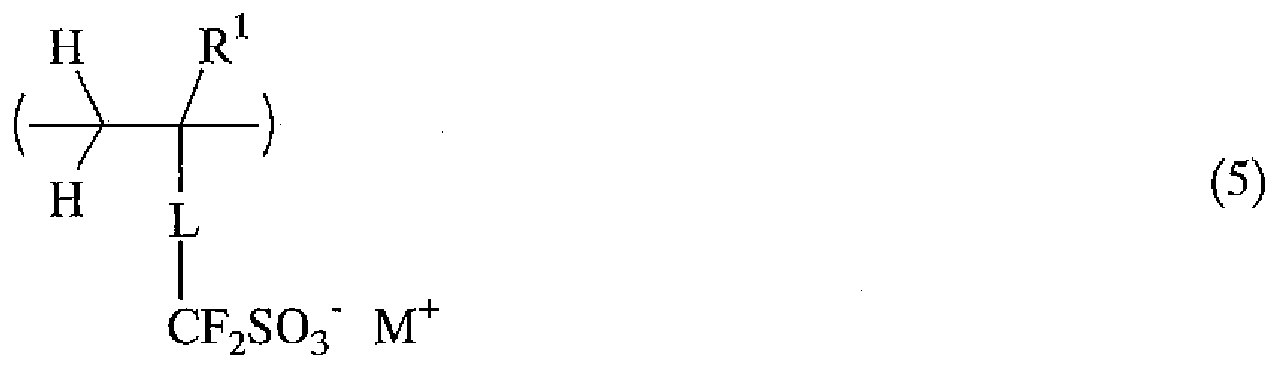
S+(Ar)3X- (7)
wherein Ar is a substituted or unsubstituted C6-C20 aryl group which may contain a heteroatom, a plurality of Ar groups may bond together directly or via an oxygen atom, methylene, sulfonyl or carbonyl moiety, and X- is an anion. - The method of any one of claims 1 to 3, wherein the sulfonic acid anion-containing polymer having an ammonium or metal cation not bound thereto further comprises recurring units having the general formula (2):

- The method of claim 4, wherein the sulfonic acid anion-containing polymer having an ammonium or metal cation not bound thereto further comprises recurring units having the general formula (3):

- The method of any one of claims 1 to 5 wherein the step (3) of reacting the polymer from step (2) with a triarylsulfonium salt is performed in a two-layer system using water and an organic solvent separable from water.
- A polymer prepared by the method of any one of claims 1 to 6.
- A resist composition comprising a polymer prepared by the method of any one of claims 1 to 6.
- The resist composition of claim 8, further comprising a photoacid generator.
- The resist composition of claim 8 or 9, further comprising a quencher.
- The resist composition of any one of claims 8 to 10, further comprising a solvent.
- The resist composition of any one of claims 8 to 11, further comprising a surfactant.
- A pattern forming process comprising the steps of coating the resist composition of any one of claims 8 to 12 onto a substrate, baking to form a resist film, exposing the resist film to high-energy radiation, and developing it in a developer.
- The pattern forming process of claim 13 wherein the high-energy radiation has a wavelength in the range of 180 to 250 nm.
- The pattern forming process of claim 13 or 14 wherein the step of exposing to high-energy radiation includes immersion lithography of exposing the resist film to radiation via a liquid.
- The pattern forming process of claim 15, further comprising the step of forming a protective film on the resist film, so that the protective film intervenes between the resist film and the liquid during the immersion lithography.
- The pattern forming process of claim 13 wherein the high-energy radiation is EUV or EB.
Applications Claiming Priority (1)
| Application Number | Priority Date | Filing Date | Title |
|---|---|---|---|
| JP2012039638A JP2013173855A (en) | 2012-02-27 | 2012-02-27 | Method for producing polymer compound, polymer compound produced by the production method, resist material containing the same and method for forming pattern |
Publications (2)
| Publication Number | Publication Date |
|---|---|
| EP2631253A2 true EP2631253A2 (en) | 2013-08-28 |
| EP2631253A3 EP2631253A3 (en) | 2013-12-18 |
Family
ID=47826912
Family Applications (1)
| Application Number | Title | Priority Date | Filing Date |
|---|---|---|---|
| EP13156373.6A Withdrawn EP2631253A3 (en) | 2012-02-27 | 2013-02-22 | Preparation of polymer, resulting polymer, resist composition, and patterning process |
Country Status (5)
| Country | Link |
|---|---|
| US (1) | US8957160B2 (en) |
| EP (1) | EP2631253A3 (en) |
| JP (1) | JP2013173855A (en) |
| KR (1) | KR20130098217A (en) |
| TW (1) | TWI467326B (en) |
Families Citing this family (10)
| Publication number | Priority date | Publication date | Assignee | Title |
|---|---|---|---|---|
| KR20130076598A (en) * | 2011-12-28 | 2013-07-08 | 금호석유화학 주식회사 | Hydrophilic photoacid generator and resist composition comprising same |
| JP2013203895A (en) * | 2012-03-28 | 2013-10-07 | Tokyo Ohka Kogyo Co Ltd | Method for producing polymer compound, resist composition, and resist pattern forming method |
| JP6037689B2 (en) * | 2012-07-10 | 2016-12-07 | 東京応化工業株式会社 | Method for producing ammonium salt compound and method for producing acid generator |
| JP6225100B2 (en) * | 2013-12-20 | 2017-11-01 | 信越化学工業株式会社 | Method for producing polymer compound for conductive polymer |
| JP6335138B2 (en) * | 2014-08-28 | 2018-05-30 | 信越化学工業株式会社 | Conductive polymer composite and substrate |
| JP2016108508A (en) | 2014-12-10 | 2016-06-20 | 信越化学工業株式会社 | Polymer, resist material, and pattern formation method |
| JP2016141796A (en) * | 2015-02-05 | 2016-08-08 | 信越化学工業株式会社 | Polymer, resist material, and patterning process |
| US10191373B2 (en) | 2015-02-05 | 2019-01-29 | Shin-Etsu Chemical Co., Ltd. | Method for producing polymer |
| JP7351261B2 (en) * | 2019-07-04 | 2023-09-27 | 信越化学工業株式会社 | Positive resist material and pattern forming method |
| JP7695103B2 (en) * | 2021-05-06 | 2025-06-18 | 富士フイルム株式会社 | Method for producing resin, method for producing actinic ray-sensitive or radiation-sensitive resin composition, method for forming pattern, and resin |
Citations (42)
| Publication number | Priority date | Publication date | Assignee | Title |
|---|---|---|---|---|
| JPH04230645A (en) | 1990-08-27 | 1992-08-19 | Ciba Geigy Ag | Olefinically unsaturated onium salt |
| US5650483A (en) | 1992-07-10 | 1997-07-22 | Aerojet-General Corporation | Preparation of mono-substituted fluorinated oxetane prepolymers |
| US5945250A (en) | 1996-06-04 | 1999-08-31 | Fuji Photo Film Co., Ltd. | Positive photosensitive composition |
| JPH11282168A (en) | 1998-02-20 | 1999-10-15 | Shipley Co Ltd Liability Co | Photosensitive corrosion resistant composition and method, and industrial products containing the composition |
| JP2000336121A (en) | 1998-11-02 | 2000-12-05 | Shin Etsu Chem Co Ltd | Novel ester compound, polymer compound, resist material, and pattern forming method |
| WO2002042845A2 (en) | 2000-11-03 | 2002-05-30 | Shipley Company, L.L.C. | Photoacid generators and photoresists comprising same |
| EP1270553A2 (en) | 2001-06-29 | 2003-01-02 | JSR Corporation | Acid generator, sulfonic acid, sulfonic acid derivatives and radiation-sensitive resin composition |
| JP2003066612A (en) | 2001-06-15 | 2003-03-05 | Shin Etsu Chem Co Ltd | Resist material and pattern forming method |
| JP2005264103A (en) | 2004-03-22 | 2005-09-29 | Shin Etsu Chem Co Ltd | Polymer compound, resist material, and pattern forming method |
| WO2006121096A1 (en) | 2005-05-11 | 2006-11-16 | Jsr Corporation | Novel compound, polymer and radiation-sensitive resin composition |
| JP2007145797A (en) | 2005-04-06 | 2007-06-14 | Shin Etsu Chem Co Ltd | Novel sulfonate and derivative thereof, photoacid generator, resist material and pattern forming method using the same |
| JP2007145804A (en) | 2005-10-31 | 2007-06-14 | Shin Etsu Chem Co Ltd | Novel sulfonate and derivative thereof, photoacid generator, resist material and pattern forming method using the same |
| JP2007197718A (en) | 2005-12-27 | 2007-08-09 | Sumitomo Chemical Co Ltd | Acid amplification resin for chemically amplified positive resist composition |
| JP2007298569A (en) | 2006-04-27 | 2007-11-15 | Jsr Corp | Radiation sensitive resin composition for immersion exposure |
| JP2007304490A (en) | 2006-05-15 | 2007-11-22 | Shin Etsu Chem Co Ltd | Thermal acid generator, resist underlayer film material containing the same, and pattern formation method using this resist underlayer film material |
| JP2008106045A (en) | 2006-09-28 | 2008-05-08 | Shin Etsu Chem Co Ltd | Novel photoacid generator, resist material and pattern forming method using the same |
| WO2008056795A1 (en) | 2006-11-10 | 2008-05-15 | Jsr Corporation | Polymerizable sulfonic acid onium salt and resin |
| JP2008122932A (en) | 2006-10-17 | 2008-05-29 | Shin Etsu Chem Co Ltd | Resist material and pattern forming method using the same |
| JP2008133448A (en) | 2006-10-27 | 2008-06-12 | Shin Etsu Chem Co Ltd | Sulfonium salt and polymer compound having polymerizable anion, resist material and pattern forming method |
| JP4110319B2 (en) | 2001-06-29 | 2008-07-02 | Jsr株式会社 | Radiation sensitive acid generator and radiation sensitive resin composition |
| JP2009007327A (en) | 2007-02-15 | 2009-01-15 | Central Glass Co Ltd | Compound for photoacid generator, resist composition using the same, and pattern formation method |
| JP4244755B2 (en) | 2003-09-09 | 2009-03-25 | Jsr株式会社 | Radiation sensitive resin composition |
| JP2009091350A (en) | 2007-09-18 | 2009-04-30 | Central Glass Co Ltd | Process for producing 2-bromo-2,2-difluoroethanol and 2- (alkylcarbonyloxy) -1,1-difluoroethanesulfonates |
| JP2009098638A (en) | 2007-09-26 | 2009-05-07 | Shin Etsu Chem Co Ltd | Resist material and pattern forming method using the same |
| JP2009192784A (en) | 2008-02-14 | 2009-08-27 | Shin Etsu Chem Co Ltd | Resist material, resist protective film material, and pattern forming method |
| JP2009191151A (en) | 2008-02-14 | 2009-08-27 | Shin Etsu Chem Co Ltd | Polymer compound, resist material, and pattern forming method |
| JP2009221454A (en) | 2008-03-13 | 2009-10-01 | Korea Kumho Petrochem Co Ltd | Acid generating agent for chemically amplified resist composition |
| JP2009258695A (en) | 2008-03-25 | 2009-11-05 | Shin Etsu Chem Co Ltd | New photoacid generator, resist material, and patterning process |
| JP2009269953A (en) | 2008-05-01 | 2009-11-19 | Shin Etsu Chem Co Ltd | New photoacid generator, resist material using the same, and pattern forming method |
| JP2009276363A (en) | 2008-05-12 | 2009-11-26 | Shin Etsu Chem Co Ltd | Resist material and pattern-forming method |
| JP2010020204A (en) | 2008-07-14 | 2010-01-28 | Jsr Corp | Radiation-sensitive resin composition |
| JP4421707B2 (en) | 1998-08-04 | 2010-02-24 | ローム・アンド・ハース・エレクトロニック・マテリアルズ,エル.エル.シー. | Photoresist composition, method thereof and industrial product containing them |
| JP2010077404A (en) | 2008-08-28 | 2010-04-08 | Shin-Etsu Chemical Co Ltd | Sulfonium salt having polymerizable anion and high molecular compound, resist material, and method for forming pattern |
| JP2010107695A (en) | 2008-10-30 | 2010-05-13 | Shin-Etsu Chemical Co Ltd | Resist material and pattern forming method |
| JP2010134012A (en) | 2008-12-02 | 2010-06-17 | Shin-Etsu Chemical Co Ltd | Resist material and pattern forming process |
| JP2010215608A (en) | 2009-02-19 | 2010-09-30 | Shin-Etsu Chemical Co Ltd | New sulfonate and derivative thereof, photo acid-generating agent and resist material using the same and method for forming pattern |
| JP2010250105A (en) | 2009-04-16 | 2010-11-04 | Shin-Etsu Chemical Co Ltd | Resist material and pattern forming method |
| JP2011016746A (en) | 2009-07-08 | 2011-01-27 | Shin-Etsu Chemical Co Ltd | Sulfonium salt, resist material and method for forming pattern |
| JP2011042789A (en) | 2010-08-17 | 2011-03-03 | Shin-Etsu Chemical Co Ltd | Fluorine-containing monomer, polymer compound, resist material and pattern forming method |
| WO2011093520A1 (en) * | 2010-01-29 | 2011-08-04 | Fujifilm Corporation | Actinic ray-sensitive or radiation-sensitive resin composition, resist film using the composition and pattern forming method |
| JP2011158896A (en) | 2010-01-05 | 2011-08-18 | Sumitomo Chemical Co Ltd | Resist composition |
| JP2011256390A (en) | 2010-06-10 | 2011-12-22 | Korea Kumho Petrochemical Co Ltd | Compound, polymer including the compound, and chemically amplified resist composition including the polymer |
Family Cites Families (17)
| Publication number | Priority date | Publication date | Assignee | Title |
|---|---|---|---|---|
| US6312867B1 (en) | 1998-11-02 | 2001-11-06 | Shin-Etsu Chemical Co., Ltd. | Ester compounds, polymers, resist compositions and patterning process |
| KR100636068B1 (en) | 2001-06-15 | 2006-10-19 | 신에쓰 가가꾸 고교 가부시끼가이샤 | Resist Composition and Patterning Process |
| TWI332122B (en) | 2005-04-06 | 2010-10-21 | Shinetsu Chemical Co | Novel sulfonate salts and derivatives, photoacid generators, resist compositions and patterning process |
| EP1780199B1 (en) | 2005-10-31 | 2012-02-01 | Shin-Etsu Chemical Co., Ltd. | Novel fluorohydroxyalkyl sulfonate salts and derivatives, photoacid generators, resist compositions, and patterning process |
| US7932334B2 (en) | 2005-12-27 | 2011-04-26 | Sumitomo Chemical Company, Limited | Resin suitable for an acid generator |
| US7527912B2 (en) | 2006-09-28 | 2009-05-05 | Shin-Etsu Chemical Co., Ltd. | Photoacid generators, resist compositions, and patterning process |
| US7771914B2 (en) | 2006-10-17 | 2010-08-10 | Shin-Etsu Chemical Co., Ltd. | Resist composition and patterning process |
| US7569326B2 (en) | 2006-10-27 | 2009-08-04 | Shin-Etsu Chemical Co., Ltd. | Sulfonium salt having polymerizable anion, polymer, resist composition, and patterning process |
| JP4998746B2 (en) | 2008-04-24 | 2012-08-15 | 信越化学工業株式会社 | Polymer compound containing sulfonium salt, resist material, and pattern forming method |
| TWI400226B (en) * | 2008-10-17 | 2013-07-01 | Shinetsu Chemical Co | Polymerizable anion-containing sulfonium salt and polymer, resist composition, and patterning process |
| KR101438844B1 (en) | 2008-10-30 | 2014-09-05 | 신에쓰 가가꾸 고교 가부시끼가이샤 | Fluorine-containing monomers having a cyclic acetal structure, polymer compounds, resist protective film materials, resist materials, and pattern forming methods |
| WO2010119910A1 (en) * | 2009-04-15 | 2010-10-21 | Jsr株式会社 | Radiation-sensitive resin composition, polymer used therein, and compound used therein |
| JP5445320B2 (en) * | 2009-05-29 | 2014-03-19 | 信越化学工業株式会社 | Chemically amplified resist material and pattern forming method |
| JP5851688B2 (en) | 2009-12-31 | 2016-02-03 | ローム アンド ハース エレクトロニック マテリアルズ エルエルシーRohm and Haas Electronic Materials LLC | Photosensitive composition |
| JP5740168B2 (en) * | 2010-07-01 | 2015-06-24 | 富士フイルム株式会社 | Actinic ray-sensitive or radiation-sensitive resin composition, resist film using the same, and pattern forming method |
| JP5715890B2 (en) * | 2011-06-10 | 2015-05-13 | 東京応化工業株式会社 | Method for producing polymer compound |
| JP5668710B2 (en) | 2012-02-27 | 2015-02-12 | 信越化学工業株式会社 | POLYMER COMPOUND, RESIST MATERIAL CONTAINING SAME, PATTERN FORMING METHOD, AND METHOD FOR PRODUCING THE POLYMER COMPOUND |
-
2012
- 2012-02-27 JP JP2012039638A patent/JP2013173855A/en active Pending
-
2013
- 2013-02-15 US US13/768,861 patent/US8957160B2/en active Active
- 2013-02-22 EP EP13156373.6A patent/EP2631253A3/en not_active Withdrawn
- 2013-02-25 TW TW102106593A patent/TWI467326B/en active
- 2013-02-26 KR KR1020130020355A patent/KR20130098217A/en not_active Ceased
Patent Citations (47)
| Publication number | Priority date | Publication date | Assignee | Title |
|---|---|---|---|---|
| JPH04230645A (en) | 1990-08-27 | 1992-08-19 | Ciba Geigy Ag | Olefinically unsaturated onium salt |
| US5650483A (en) | 1992-07-10 | 1997-07-22 | Aerojet-General Corporation | Preparation of mono-substituted fluorinated oxetane prepolymers |
| JP3613491B2 (en) | 1996-06-04 | 2005-01-26 | 富士写真フイルム株式会社 | Photosensitive composition |
| US5945250A (en) | 1996-06-04 | 1999-08-31 | Fuji Photo Film Co., Ltd. | Positive photosensitive composition |
| JPH11282168A (en) | 1998-02-20 | 1999-10-15 | Shipley Co Ltd Liability Co | Photosensitive corrosion resistant composition and method, and industrial products containing the composition |
| US6048672A (en) | 1998-02-20 | 2000-04-11 | Shipley Company, L.L.C. | Photoresist compositions and methods and articles of manufacture comprising same |
| US7704668B1 (en) | 1998-08-04 | 2010-04-27 | Rohm And Haas Electronic Materials Llc | Photoresist compositions and methods and articles of manufacture comprising same |
| JP4421707B2 (en) | 1998-08-04 | 2010-02-24 | ローム・アンド・ハース・エレクトロニック・マテリアルズ,エル.エル.シー. | Photoresist composition, method thereof and industrial product containing them |
| JP2000336121A (en) | 1998-11-02 | 2000-12-05 | Shin Etsu Chem Co Ltd | Novel ester compound, polymer compound, resist material, and pattern forming method |
| WO2002042845A2 (en) | 2000-11-03 | 2002-05-30 | Shipley Company, L.L.C. | Photoacid generators and photoresists comprising same |
| JP4211971B2 (en) | 2000-11-03 | 2009-01-21 | ローム・アンド・ハース・エレクトロニック・マテリアルズ,エル.エル.シー. | Photosensitive acid generator and photoresist containing them |
| JP2003066612A (en) | 2001-06-15 | 2003-03-05 | Shin Etsu Chem Co Ltd | Resist material and pattern forming method |
| EP1270553A2 (en) | 2001-06-29 | 2003-01-02 | JSR Corporation | Acid generator, sulfonic acid, sulfonic acid derivatives and radiation-sensitive resin composition |
| US6908722B2 (en) | 2001-06-29 | 2005-06-21 | Jsr Corporation | Acid generator, sulfonic acid, sulfonic acid derivatives and radiation-sensitive resin composition |
| JP4110319B2 (en) | 2001-06-29 | 2008-07-02 | Jsr株式会社 | Radiation sensitive acid generator and radiation sensitive resin composition |
| JP4244755B2 (en) | 2003-09-09 | 2009-03-25 | Jsr株式会社 | Radiation sensitive resin composition |
| JP2005264103A (en) | 2004-03-22 | 2005-09-29 | Shin Etsu Chem Co Ltd | Polymer compound, resist material, and pattern forming method |
| JP2007145797A (en) | 2005-04-06 | 2007-06-14 | Shin Etsu Chem Co Ltd | Novel sulfonate and derivative thereof, photoacid generator, resist material and pattern forming method using the same |
| WO2006121096A1 (en) | 2005-05-11 | 2006-11-16 | Jsr Corporation | Novel compound, polymer and radiation-sensitive resin composition |
| JP2007145804A (en) | 2005-10-31 | 2007-06-14 | Shin Etsu Chem Co Ltd | Novel sulfonate and derivative thereof, photoacid generator, resist material and pattern forming method using the same |
| JP2007197718A (en) | 2005-12-27 | 2007-08-09 | Sumitomo Chemical Co Ltd | Acid amplification resin for chemically amplified positive resist composition |
| JP2007298569A (en) | 2006-04-27 | 2007-11-15 | Jsr Corp | Radiation sensitive resin composition for immersion exposure |
| JP2007304490A (en) | 2006-05-15 | 2007-11-22 | Shin Etsu Chem Co Ltd | Thermal acid generator, resist underlayer film material containing the same, and pattern formation method using this resist underlayer film material |
| JP2008106045A (en) | 2006-09-28 | 2008-05-08 | Shin Etsu Chem Co Ltd | Novel photoacid generator, resist material and pattern forming method using the same |
| JP2008122932A (en) | 2006-10-17 | 2008-05-29 | Shin Etsu Chem Co Ltd | Resist material and pattern forming method using the same |
| JP2008133448A (en) | 2006-10-27 | 2008-06-12 | Shin Etsu Chem Co Ltd | Sulfonium salt and polymer compound having polymerizable anion, resist material and pattern forming method |
| WO2008056795A1 (en) | 2006-11-10 | 2008-05-15 | Jsr Corporation | Polymerizable sulfonic acid onium salt and resin |
| JP2009007327A (en) | 2007-02-15 | 2009-01-15 | Central Glass Co Ltd | Compound for photoacid generator, resist composition using the same, and pattern formation method |
| JP2009091350A (en) | 2007-09-18 | 2009-04-30 | Central Glass Co Ltd | Process for producing 2-bromo-2,2-difluoroethanol and 2- (alkylcarbonyloxy) -1,1-difluoroethanesulfonates |
| JP2009098638A (en) | 2007-09-26 | 2009-05-07 | Shin Etsu Chem Co Ltd | Resist material and pattern forming method using the same |
| JP2009192784A (en) | 2008-02-14 | 2009-08-27 | Shin Etsu Chem Co Ltd | Resist material, resist protective film material, and pattern forming method |
| JP2009191151A (en) | 2008-02-14 | 2009-08-27 | Shin Etsu Chem Co Ltd | Polymer compound, resist material, and pattern forming method |
| JP2009221454A (en) | 2008-03-13 | 2009-10-01 | Korea Kumho Petrochem Co Ltd | Acid generating agent for chemically amplified resist composition |
| JP2009258695A (en) | 2008-03-25 | 2009-11-05 | Shin Etsu Chem Co Ltd | New photoacid generator, resist material, and patterning process |
| JP2009269953A (en) | 2008-05-01 | 2009-11-19 | Shin Etsu Chem Co Ltd | New photoacid generator, resist material using the same, and pattern forming method |
| JP2009276363A (en) | 2008-05-12 | 2009-11-26 | Shin Etsu Chem Co Ltd | Resist material and pattern-forming method |
| JP2010020204A (en) | 2008-07-14 | 2010-01-28 | Jsr Corp | Radiation-sensitive resin composition |
| JP2010077404A (en) | 2008-08-28 | 2010-04-08 | Shin-Etsu Chemical Co Ltd | Sulfonium salt having polymerizable anion and high molecular compound, resist material, and method for forming pattern |
| JP2010107695A (en) | 2008-10-30 | 2010-05-13 | Shin-Etsu Chemical Co Ltd | Resist material and pattern forming method |
| JP2010134012A (en) | 2008-12-02 | 2010-06-17 | Shin-Etsu Chemical Co Ltd | Resist material and pattern forming process |
| JP2010215608A (en) | 2009-02-19 | 2010-09-30 | Shin-Etsu Chemical Co Ltd | New sulfonate and derivative thereof, photo acid-generating agent and resist material using the same and method for forming pattern |
| JP2010250105A (en) | 2009-04-16 | 2010-11-04 | Shin-Etsu Chemical Co Ltd | Resist material and pattern forming method |
| JP2011016746A (en) | 2009-07-08 | 2011-01-27 | Shin-Etsu Chemical Co Ltd | Sulfonium salt, resist material and method for forming pattern |
| JP2011158896A (en) | 2010-01-05 | 2011-08-18 | Sumitomo Chemical Co Ltd | Resist composition |
| WO2011093520A1 (en) * | 2010-01-29 | 2011-08-04 | Fujifilm Corporation | Actinic ray-sensitive or radiation-sensitive resin composition, resist film using the composition and pattern forming method |
| JP2011256390A (en) | 2010-06-10 | 2011-12-22 | Korea Kumho Petrochemical Co Ltd | Compound, polymer including the compound, and chemically amplified resist composition including the polymer |
| JP2011042789A (en) | 2010-08-17 | 2011-03-03 | Shin-Etsu Chemical Co Ltd | Fluorine-containing monomer, polymer compound, resist material and pattern forming method |
Non-Patent Citations (2)
| Title |
|---|
| JOURNAL OF PHOTOPOLYMER SCIENCE AND TECHNOLOGY, vol. 17, no. 4, 2004, pages 587 |
| TETRAHEDRON LETT., vol. 29, 1988, pages 4119 |
Also Published As
| Publication number | Publication date |
|---|---|
| KR20130098217A (en) | 2013-09-04 |
| TWI467326B (en) | 2015-01-01 |
| US20130224660A1 (en) | 2013-08-29 |
| TW201344347A (en) | 2013-11-01 |
| JP2013173855A (en) | 2013-09-05 |
| EP2631253A3 (en) | 2013-12-18 |
| US8957160B2 (en) | 2015-02-17 |
Similar Documents
| Publication | Publication Date | Title |
|---|---|---|
| US10234757B2 (en) | Polymer, making method, resist composition, and patterning process | |
| US9091918B2 (en) | Sulfonium salt, polymer, resist composition, and patterning process | |
| US9366958B2 (en) | Photoacid generator, chemically amplified resist composition, and patterning process | |
| US8957160B2 (en) | Preparation of polymer, resulting polymer, resist composition, and patterning process | |
| US9162967B2 (en) | Sulfonium salt, polymer, resist composition, and patterning process | |
| JP6237428B2 (en) | Pattern formation method | |
| KR102381822B1 (en) | Sulfonium compound, chemically amplified resist composition, and patterning process | |
| US8980527B2 (en) | Pattern forming process and resist compostion | |
| JP5815575B2 (en) | Pattern formation method | |
| US9104110B2 (en) | Polymer, resist composition and patterning process | |
| US9146464B2 (en) | Sulfonium salt, polymer, polymer making method, resist composition, and patterning process | |
| KR102271594B1 (en) | Photoacid generator, chemically amplified resist composition, and patterning process | |
| KR20220044423A (en) | Sulfonium salt, chemically amplified resist composition, and patterning process | |
| JP5815576B2 (en) | Pattern formation method |
Legal Events
| Date | Code | Title | Description |
|---|---|---|---|
| PUAI | Public reference made under article 153(3) epc to a published international application that has entered the european phase |
Free format text: ORIGINAL CODE: 0009012 |
|
| AK | Designated contracting states |
Kind code of ref document: A2 Designated state(s): AL AT BE BG CH CY CZ DE DK EE ES FI FR GB GR HR HU IE IS IT LI LT LU LV MC MK MT NL NO PL PT RO RS SE SI SK SM TR |
|
| AX | Request for extension of the european patent |
Extension state: BA ME |
|
| PUAL | Search report despatched |
Free format text: ORIGINAL CODE: 0009013 |
|
| AK | Designated contracting states |
Kind code of ref document: A3 Designated state(s): AL AT BE BG CH CY CZ DE DK EE ES FI FR GB GR HR HU IE IS IT LI LT LU LV MC MK MT NL NO PL PT RO RS SE SI SK SM TR |
|
| AX | Request for extension of the european patent |
Extension state: BA ME |
|
| RIC1 | Information provided on ipc code assigned before grant |
Ipc: C07C 303/22 20060101ALN20131111BHEP Ipc: C08F 220/20 20060101ALN20131111BHEP Ipc: C08F 220/28 20060101ALN20131111BHEP Ipc: C08F 220/18 20060101ALN20131111BHEP Ipc: C08F 6/00 20060101ALI20131111BHEP Ipc: C07C 309/12 20060101ALN20131111BHEP Ipc: C07C 309/22 20060101ALN20131111BHEP Ipc: H01L 21/027 20060101ALI20131111BHEP Ipc: C07C 67/08 20060101ALN20131111BHEP Ipc: G03F 7/039 20060101ALI20131111BHEP Ipc: G03F 7/004 20060101ALI20131111BHEP Ipc: C08F 246/00 20060101ALI20131111BHEP Ipc: C08F 220/38 20060101ALN20131111BHEP Ipc: C08F 8/00 20060101AFI20131111BHEP Ipc: G03F 7/20 20060101ALI20131111BHEP Ipc: C07C 309/08 20060101ALN20131111BHEP |
|
| 17P | Request for examination filed |
Effective date: 20140331 |
|
| RBV | Designated contracting states (corrected) |
Designated state(s): AL AT BE BG CH CY CZ DE DK EE ES FI FR GB GR HR HU IE IS IT LI LT LU LV MC MK MT NL NO PL PT RO RS SE SI SK SM TR |
|
| 17Q | First examination report despatched |
Effective date: 20161118 |
|
| STAA | Information on the status of an ep patent application or granted ep patent |
Free format text: STATUS: THE APPLICATION HAS BEEN WITHDRAWN |
|
| 18W | Application withdrawn |
Effective date: 20161228 |