EP2628779B1 - Liquid-crystalline medium - Google Patents
Liquid-crystalline medium Download PDFInfo
- Publication number
- EP2628779B1 EP2628779B1 EP13000511.9A EP13000511A EP2628779B1 EP 2628779 B1 EP2628779 B1 EP 2628779B1 EP 13000511 A EP13000511 A EP 13000511A EP 2628779 B1 EP2628779 B1 EP 2628779B1
- Authority
- EP
- European Patent Office
- Prior art keywords
- compounds
- denotes
- liquid
- alkyl
- formula
- Prior art date
- Legal status (The legal status is an assumption and is not a legal conclusion. Google has not performed a legal analysis and makes no representation as to the accuracy of the status listed.)
- Active
Links
- 0 *C(CC1)COC1c(cc1)cc(F)c1-c1cc(F)c(*c2cc(F)c(*)c(F)c2)cc1 Chemical compound *C(CC1)COC1c(cc1)cc(F)c1-c1cc(F)c(*c2cc(F)c(*)c(F)c2)cc1 0.000 description 65
- MISHTVMUAYPBCW-UHFFFAOYSA-N C=CC(OCCCc1ccc(C=C(c(cc2)ccc2OC(C=C)=O)C(O2)=O)c2c1)=O Chemical compound C=CC(OCCCc1ccc(C=C(c(cc2)ccc2OC(C=C)=O)C(O2)=O)c2c1)=O MISHTVMUAYPBCW-UHFFFAOYSA-N 0.000 description 3
- CYBOLFHAZZXVDM-UHFFFAOYSA-N CC(C(OCCCc(cc1)ccc1-c(cc1)ccc1OC(C(C)=C)=O)=O)=C Chemical compound CC(C(OCCCc(cc1)ccc1-c(cc1)ccc1OC(C(C)=C)=O)=O)=C CYBOLFHAZZXVDM-UHFFFAOYSA-N 0.000 description 2
- VDVUCLWJZJHFAV-UHFFFAOYSA-N CC(C)(C1)NC(C)(C)CC1O Chemical compound CC(C)(C1)NC(C)(C)CC1O VDVUCLWJZJHFAV-UHFFFAOYSA-N 0.000 description 2
- XITRBUPOXXBIJN-UHFFFAOYSA-N CC(C)(C1)NC(C)(C)CC1OC(CCCCCCCCC(OC1CC(C)(C)NC(C)(C)C1)=O)=O Chemical compound CC(C)(C1)NC(C)(C)CC1OC(CCCCCCCCC(OC1CC(C)(C)NC(C)(C)C1)=O)=O XITRBUPOXXBIJN-UHFFFAOYSA-N 0.000 description 2
- VKXUVIHPMOGTKX-UHFFFAOYSA-N C=CC(OCCCCC(OC(COS(C1OC(CCCCOC(C=C)=O)=O)OC(CCCCOC(C=C)=O)=O)C1OC(CCCCOC(C=C)=O)=O)=O)=O Chemical compound C=CC(OCCCCC(OC(COS(C1OC(CCCCOC(C=C)=O)=O)OC(CCCCOC(C=C)=O)=O)C1OC(CCCCOC(C=C)=O)=O)=O)=O VKXUVIHPMOGTKX-UHFFFAOYSA-N 0.000 description 1
- WJZJQMLAGLHEGT-FCHUYYIVSA-N C=CC(OCCCCC(O[C@@H](C/C(/OC1)=[O]\C(CCCCOC(C=C)=O)=O)[C@@H]1OC(CCCCOC(C=C)=O)=O)=O)=O Chemical compound C=CC(OCCCCC(O[C@@H](C/C(/OC1)=[O]\C(CCCCOC(C=C)=O)=O)[C@@H]1OC(CCCCOC(C=C)=O)=O)=O)=O WJZJQMLAGLHEGT-FCHUYYIVSA-N 0.000 description 1
- JTBMRKKDLFZDLY-UHFFFAOYSA-N C=CC(OCCCCc(cc1cc2)ccc1c(cc1)c2cc1OC(C=C)=O)=O Chemical compound C=CC(OCCCCc(cc1cc2)ccc1c(cc1)c2cc1OC(C=C)=O)=O JTBMRKKDLFZDLY-UHFFFAOYSA-N 0.000 description 1
- WQGFMRMZAAEJJQ-UHFFFAOYSA-N C=CC(OCCCc(cc1)ccc1-c(cc1)cc(F)c1-c(cc1)ccc1OC(C=C)=O)=O Chemical compound C=CC(OCCCc(cc1)ccc1-c(cc1)cc(F)c1-c(cc1)ccc1OC(C=C)=O)=O WQGFMRMZAAEJJQ-UHFFFAOYSA-N 0.000 description 1
- DXEMZQBFKPPVFX-UHFFFAOYSA-N C=CC(Oc(c(F)c1)ccc1-c(ccc(OC(C=C)=O)c1F)c1F)=O Chemical compound C=CC(Oc(c(F)c1)ccc1-c(ccc(OC(C=C)=O)c1F)c1F)=O DXEMZQBFKPPVFX-UHFFFAOYSA-N 0.000 description 1
- DTWNAZOAKFVCTO-UHFFFAOYSA-N C=CC(Oc(cc1)cc(cc2)c1cc2OC(C=C)=O)=O Chemical compound C=CC(Oc(cc1)cc(cc2)c1cc2OC(C=C)=O)=O DTWNAZOAKFVCTO-UHFFFAOYSA-N 0.000 description 1
- QQOXBVMVPRRXMQ-UHFFFAOYSA-N C=CC(Oc(cc1)ccc1C(C(Oc1c2)=O)=Cc1ccc2OC(C=C)=O)=O Chemical compound C=CC(Oc(cc1)ccc1C(C(Oc1c2)=O)=Cc1ccc2OC(C=C)=O)=O QQOXBVMVPRRXMQ-UHFFFAOYSA-N 0.000 description 1
- MIQDLBSZVTUOMG-UHFFFAOYSA-N C=CC(Oc1ccc(-c(cc2)cc(F)c2OC(C=C)=O)c(F)c1)=O Chemical compound C=CC(Oc1ccc(-c(cc2)cc(F)c2OC(C=C)=O)c(F)c1)=O MIQDLBSZVTUOMG-UHFFFAOYSA-N 0.000 description 1
- VDKJTBJDGUKTDR-UHFFFAOYSA-N CC(C(OCC(Cc(cc1)ccc1-c(cc1)ccc1OC(C(C)=C)=O)COC(C(C)=C)=O)=O)=C Chemical compound CC(C(OCC(Cc(cc1)ccc1-c(cc1)ccc1OC(C(C)=C)=O)COC(C(C)=C)=O)=O)=C VDKJTBJDGUKTDR-UHFFFAOYSA-N 0.000 description 1
- PEFZCSOBXJKLSY-UHFFFAOYSA-N CC(C(OCCC(Oc(cc1)ccc1-c1cc(OC(C(C)=C)=O)cc(-c(cc2)ccc2OC(CCOC(C(C)=C)=O)=O)c1)=O)=O)=C Chemical compound CC(C(OCCC(Oc(cc1)ccc1-c1cc(OC(C(C)=C)=O)cc(-c(cc2)ccc2OC(CCOC(C(C)=C)=O)=O)c1)=O)=O)=C PEFZCSOBXJKLSY-UHFFFAOYSA-N 0.000 description 1
- UXQBWDVDVZVFJB-ORHRHGBZSA-N CC(C(OCCCCC(O[C@H](COC([C@@H]1OC(CCCCOC(C(C)=C)=O)=O)OC(CCCCOC(C(C)=C)=O)=O)[C@@H]1OC(CCCCOC(C(C)=C)=O)=O)=O)=O)=C Chemical compound CC(C(OCCCCC(O[C@H](COC([C@@H]1OC(CCCCOC(C(C)=C)=O)=O)OC(CCCCOC(C(C)=C)=O)=O)[C@@H]1OC(CCCCOC(C(C)=C)=O)=O)=O)=O)=C UXQBWDVDVZVFJB-ORHRHGBZSA-N 0.000 description 1
- NJJLVZKAVFKYSB-UHFFFAOYSA-N CC(C(OCCCCc1cc(OC(C(c(cc2)ccc2OC(C(C)=C)=O)=C2)=O)c2c(CCCCOC(C(C)=C)=O)c1)=O)=C Chemical compound CC(C(OCCCCc1cc(OC(C(c(cc2)ccc2OC(C(C)=C)=O)=C2)=O)c2c(CCCCOC(C(C)=C)=O)c1)=O)=C NJJLVZKAVFKYSB-UHFFFAOYSA-N 0.000 description 1
- OEXWVWRHLGBXCZ-UHFFFAOYSA-N CC(C(OCCCOc(cc1)ccc1-c1cc(OC(C(C)=C)=O)cc(-c(cc2)ccc2OCCCOC(C(C)=C)=O)c1)=O)=C Chemical compound CC(C(OCCCOc(cc1)ccc1-c1cc(OC(C(C)=C)=O)cc(-c(cc2)ccc2OCCCOC(C(C)=C)=O)c1)=O)=C OEXWVWRHLGBXCZ-UHFFFAOYSA-N 0.000 description 1
- WUWPZVWYFRCJFT-UHFFFAOYSA-N CC(C(OCCCc(cc1)cc(O2)c1C=C(c(cc1)ccc1OC)C2=O)=O)=C Chemical compound CC(C(OCCCc(cc1)cc(O2)c1C=C(c(cc1)ccc1OC)C2=O)=O)=C WUWPZVWYFRCJFT-UHFFFAOYSA-N 0.000 description 1
- XSMTYHCWXRADEL-UHFFFAOYSA-N CC(C(OCCCc1ccc(C=C(c(cc2)ccc2OC(C(C)=C)=O)C(O2)=O)c2c1)=O)=C Chemical compound CC(C(OCCCc1ccc(C=C(c(cc2)ccc2OC(C(C)=C)=O)C(O2)=O)c2c1)=O)=C XSMTYHCWXRADEL-UHFFFAOYSA-N 0.000 description 1
- NFWSLZFGJZIYNN-UHFFFAOYSA-N CC(C(OCCOc(c(OCCOC(C(C)=C)=O)c1)ccc1-c(cc1)cc(F)c1OC(C(C)=C)=O)=O)=C Chemical compound CC(C(OCCOc(c(OCCOC(C(C)=C)=O)c1)ccc1-c(cc1)cc(F)c1OC(C(C)=C)=O)=O)=C NFWSLZFGJZIYNN-UHFFFAOYSA-N 0.000 description 1
- QVEVRMAXBFNUOD-UHFFFAOYSA-N CC(C(OCCOc(c(OCCOC(C(C)=C)=O)c1)ccc1-c(cc1)ccc1OC(C(C)=C)=O)=O)=C Chemical compound CC(C(OCCOc(c(OCCOC(C(C)=C)=O)c1)ccc1-c(cc1)ccc1OC(C(C)=C)=O)=O)=C QVEVRMAXBFNUOD-UHFFFAOYSA-N 0.000 description 1
- QBZKZKHDBGXEOR-UHFFFAOYSA-N CC(C(OCc(cc1)ccc1-c(cc1)ccc1OC(C(C)=C)=O)=O)=C Chemical compound CC(C(OCc(cc1)ccc1-c(cc1)ccc1OC(C(C)=C)=O)=O)=C QBZKZKHDBGXEOR-UHFFFAOYSA-N 0.000 description 1
- NDVFEQOZDHYVLY-UHFFFAOYSA-N CC(C(Oc(c(N)c1)ccc1-c(cc1N)ccc1OC(C(C)=C)=O)=O)=C Chemical compound CC(C(Oc(c(N)c1)ccc1-c(cc1N)ccc1OC(C(C)=C)=O)=O)=C NDVFEQOZDHYVLY-UHFFFAOYSA-N 0.000 description 1
- MQBFTCBDGBDHEB-UHFFFAOYSA-N CC(C(Oc(cc1)cc(F)c1-c(ccc(OC(C(C)=C)=O)c1F)c1F)=O)=C Chemical compound CC(C(Oc(cc1)cc(F)c1-c(ccc(OC(C(C)=C)=O)c1F)c1F)=O)=C MQBFTCBDGBDHEB-UHFFFAOYSA-N 0.000 description 1
- FKRRGIZBYWZEHY-UHFFFAOYSA-N CC(C(Oc(cc1)cc(cc2)c1cc2OC(C(C)=C)=O)=O)=C Chemical compound CC(C(Oc(cc1)cc(cc2)c1cc2OC(C(C)=C)=O)=O)=C FKRRGIZBYWZEHY-UHFFFAOYSA-N 0.000 description 1
- IBPRDTXXRUGUMH-UHFFFAOYSA-N CC(C(Oc(cc1)ccc1C(C(Oc1c2)=O)=Cc1ccc2OC(C(C)=C)=O)=O)=C Chemical compound CC(C(Oc(cc1)ccc1C(C(Oc1c2)=O)=Cc1ccc2OC(C(C)=C)=O)=O)=C IBPRDTXXRUGUMH-UHFFFAOYSA-N 0.000 description 1
- SMWVFBJTHKAMEK-UHFFFAOYSA-N CC(C(Oc(cc1)ccc1C(Oc(cc1)c2cc1OC(C(C)=C)=O)=CC2=O)=O)=C Chemical compound CC(C(Oc(cc1)ccc1C(Oc(cc1)c2cc1OC(C(C)=C)=O)=CC2=O)=O)=C SMWVFBJTHKAMEK-UHFFFAOYSA-N 0.000 description 1
- RXOUBDUTSAEHPT-UHFFFAOYSA-N CC(C(Oc(ccc(-c(cc1)cc(F)c1OC(C(C)=C)=O)c1)c1F)=O)=C Chemical compound CC(C(Oc(ccc(-c(cc1)cc(F)c1OC(C(C)=C)=O)c1)c1F)=O)=C RXOUBDUTSAEHPT-UHFFFAOYSA-N 0.000 description 1
- WVXBPTBBWMARNQ-UHFFFAOYSA-N CC(C(Oc1ccc(-c(cc2)cc(F)c2OC(C(C)=C)=O)c(F)c1)=O)=C Chemical compound CC(C(Oc1ccc(-c(cc2)cc(F)c2OC(C(C)=C)=O)c(F)c1)=O)=C WVXBPTBBWMARNQ-UHFFFAOYSA-N 0.000 description 1
- IYTRPRLQBGXUCP-UHFFFAOYSA-N CC(C(Oc1ccc(C=C(c(cc2)ccc2OC)C(O2)=O)c2c1)=O)=C Chemical compound CC(C(Oc1ccc(C=C(c(cc2)ccc2OC)C(O2)=O)c2c1)=O)=C IYTRPRLQBGXUCP-UHFFFAOYSA-N 0.000 description 1
- RSOILICUEWXSLA-UHFFFAOYSA-N CC(C)(C1)N(C)C(C)(C)CC1OC(CCCCCCCCC(OC1CC(C)(C)N(C)C(C)(C)C1)=O)=O Chemical compound CC(C)(C1)N(C)C(C)(C)CC1OC(CCCCCCCCC(OC1CC(C)(C)N(C)C(C)(C)C1)=O)=O RSOILICUEWXSLA-UHFFFAOYSA-N 0.000 description 1
- RWWGPCWSFFOXJN-UHFFFAOYSA-N CC(C)(C1)NC(C)(C)CC1OC Chemical compound CC(C)(C1)NC(C)(C)CC1OC RWWGPCWSFFOXJN-UHFFFAOYSA-N 0.000 description 1
- CSGAUKGQUCHWDP-UHFFFAOYSA-N CC(C)(CC(CC1(C)C)O)N1O Chemical compound CC(C)(CC(CC1(C)C)O)N1O CSGAUKGQUCHWDP-UHFFFAOYSA-N 0.000 description 1
- KRNWYBIEWUXCOB-UHFFFAOYSA-N CC(C)(CC(CC1(C)C)OC)N1O Chemical compound CC(C)(CC(CC1(C)C)OC)N1O KRNWYBIEWUXCOB-UHFFFAOYSA-N 0.000 description 1
- XHNCSMCMYJNZMC-UHFFFAOYSA-N CCCC(CC1)CCC1C(OCCCCOC(C=C)=O)=O Chemical compound CCCC(CC1)CCC1C(OCCCCOC(C=C)=O)=O XHNCSMCMYJNZMC-UHFFFAOYSA-N 0.000 description 1
- FPLMCQOYXVSLRU-UHFFFAOYSA-N CCCCC(C(C(OC1CC(C)(C)N(C)C(C)(C)C1)=O)C(OC1CC(C)(C)N(C)C(C)(C)C1)=O)c(cc1C(C)(C)C)cc(C(C)(C)C)c1O Chemical compound CCCCC(C(C(OC1CC(C)(C)N(C)C(C)(C)C1)=O)C(OC1CC(C)(C)N(C)C(C)(C)C1)=O)c(cc1C(C)(C)C)cc(C(C)(C)C)c1O FPLMCQOYXVSLRU-UHFFFAOYSA-N 0.000 description 1
- SLPZYQYEIZAMPU-UHFFFAOYSA-N COc(cc1)ccc1C(Oc(cc1)c2cc1OC(C=C)=O)=CC2=O Chemical compound COc(cc1)ccc1C(Oc(cc1)c2cc1OC(C=C)=O)=CC2=O SLPZYQYEIZAMPU-UHFFFAOYSA-N 0.000 description 1
- RCGMSPQINMINIZ-UHFFFAOYSA-N COc(cc1)ccc1C1=Cc2ccc(CCCOC(C=C)=O)cc2OC1=O Chemical compound COc(cc1)ccc1C1=Cc2ccc(CCCOC(C=C)=O)cc2OC1=O RCGMSPQINMINIZ-UHFFFAOYSA-N 0.000 description 1
Classifications
-
- C—CHEMISTRY; METALLURGY
- C09—DYES; PAINTS; POLISHES; NATURAL RESINS; ADHESIVES; COMPOSITIONS NOT OTHERWISE PROVIDED FOR; APPLICATIONS OF MATERIALS NOT OTHERWISE PROVIDED FOR
- C09K—MATERIALS FOR MISCELLANEOUS APPLICATIONS, NOT PROVIDED FOR ELSEWHERE
- C09K19/00—Liquid crystal materials
- C09K19/04—Liquid crystal materials characterised by the chemical structure of the liquid crystal components, e.g. by a specific unit
- C09K19/06—Non-steroidal liquid crystal compounds
- C09K19/062—Non-steroidal liquid crystal compounds containing one non-condensed benzene ring
-
- C—CHEMISTRY; METALLURGY
- C09—DYES; PAINTS; POLISHES; NATURAL RESINS; ADHESIVES; COMPOSITIONS NOT OTHERWISE PROVIDED FOR; APPLICATIONS OF MATERIALS NOT OTHERWISE PROVIDED FOR
- C09K—MATERIALS FOR MISCELLANEOUS APPLICATIONS, NOT PROVIDED FOR ELSEWHERE
- C09K19/00—Liquid crystal materials
- C09K19/04—Liquid crystal materials characterised by the chemical structure of the liquid crystal components, e.g. by a specific unit
- C09K19/06—Non-steroidal liquid crystal compounds
- C09K19/08—Non-steroidal liquid crystal compounds containing at least two non-condensed rings
- C09K19/10—Non-steroidal liquid crystal compounds containing at least two non-condensed rings containing at least two benzene rings
- C09K19/12—Non-steroidal liquid crystal compounds containing at least two non-condensed rings containing at least two benzene rings at least two benzene rings directly linked, e.g. biphenyls
-
- C—CHEMISTRY; METALLURGY
- C09—DYES; PAINTS; POLISHES; NATURAL RESINS; ADHESIVES; COMPOSITIONS NOT OTHERWISE PROVIDED FOR; APPLICATIONS OF MATERIALS NOT OTHERWISE PROVIDED FOR
- C09K—MATERIALS FOR MISCELLANEOUS APPLICATIONS, NOT PROVIDED FOR ELSEWHERE
- C09K19/00—Liquid crystal materials
- C09K19/04—Liquid crystal materials characterised by the chemical structure of the liquid crystal components, e.g. by a specific unit
- C09K19/06—Non-steroidal liquid crystal compounds
- C09K19/08—Non-steroidal liquid crystal compounds containing at least two non-condensed rings
- C09K19/10—Non-steroidal liquid crystal compounds containing at least two non-condensed rings containing at least two benzene rings
- C09K19/20—Non-steroidal liquid crystal compounds containing at least two non-condensed rings containing at least two benzene rings linked by a chain containing carbon and oxygen atoms as chain links, e.g. esters or ethers
-
- C—CHEMISTRY; METALLURGY
- C09—DYES; PAINTS; POLISHES; NATURAL RESINS; ADHESIVES; COMPOSITIONS NOT OTHERWISE PROVIDED FOR; APPLICATIONS OF MATERIALS NOT OTHERWISE PROVIDED FOR
- C09K—MATERIALS FOR MISCELLANEOUS APPLICATIONS, NOT PROVIDED FOR ELSEWHERE
- C09K19/00—Liquid crystal materials
- C09K19/04—Liquid crystal materials characterised by the chemical structure of the liquid crystal components, e.g. by a specific unit
- C09K19/06—Non-steroidal liquid crystal compounds
- C09K19/08—Non-steroidal liquid crystal compounds containing at least two non-condensed rings
- C09K19/10—Non-steroidal liquid crystal compounds containing at least two non-condensed rings containing at least two benzene rings
- C09K19/20—Non-steroidal liquid crystal compounds containing at least two non-condensed rings containing at least two benzene rings linked by a chain containing carbon and oxygen atoms as chain links, e.g. esters or ethers
- C09K19/2007—Non-steroidal liquid crystal compounds containing at least two non-condensed rings containing at least two benzene rings linked by a chain containing carbon and oxygen atoms as chain links, e.g. esters or ethers the chain containing -COO- or -OCO- groups
-
- C—CHEMISTRY; METALLURGY
- C09—DYES; PAINTS; POLISHES; NATURAL RESINS; ADHESIVES; COMPOSITIONS NOT OTHERWISE PROVIDED FOR; APPLICATIONS OF MATERIALS NOT OTHERWISE PROVIDED FOR
- C09K—MATERIALS FOR MISCELLANEOUS APPLICATIONS, NOT PROVIDED FOR ELSEWHERE
- C09K19/00—Liquid crystal materials
- C09K19/04—Liquid crystal materials characterised by the chemical structure of the liquid crystal components, e.g. by a specific unit
- C09K19/06—Non-steroidal liquid crystal compounds
- C09K19/08—Non-steroidal liquid crystal compounds containing at least two non-condensed rings
- C09K19/30—Non-steroidal liquid crystal compounds containing at least two non-condensed rings containing saturated or unsaturated non-aromatic rings, e.g. cyclohexane rings
- C09K19/3001—Cyclohexane rings
-
- C—CHEMISTRY; METALLURGY
- C09—DYES; PAINTS; POLISHES; NATURAL RESINS; ADHESIVES; COMPOSITIONS NOT OTHERWISE PROVIDED FOR; APPLICATIONS OF MATERIALS NOT OTHERWISE PROVIDED FOR
- C09K—MATERIALS FOR MISCELLANEOUS APPLICATIONS, NOT PROVIDED FOR ELSEWHERE
- C09K19/00—Liquid crystal materials
- C09K19/04—Liquid crystal materials characterised by the chemical structure of the liquid crystal components, e.g. by a specific unit
- C09K19/06—Non-steroidal liquid crystal compounds
- C09K19/08—Non-steroidal liquid crystal compounds containing at least two non-condensed rings
- C09K19/30—Non-steroidal liquid crystal compounds containing at least two non-condensed rings containing saturated or unsaturated non-aromatic rings, e.g. cyclohexane rings
- C09K19/3001—Cyclohexane rings
- C09K19/3003—Compounds containing at least two rings in which the different rings are directly linked (covalent bond)
-
- C—CHEMISTRY; METALLURGY
- C09—DYES; PAINTS; POLISHES; NATURAL RESINS; ADHESIVES; COMPOSITIONS NOT OTHERWISE PROVIDED FOR; APPLICATIONS OF MATERIALS NOT OTHERWISE PROVIDED FOR
- C09K—MATERIALS FOR MISCELLANEOUS APPLICATIONS, NOT PROVIDED FOR ELSEWHERE
- C09K19/00—Liquid crystal materials
- C09K19/04—Liquid crystal materials characterised by the chemical structure of the liquid crystal components, e.g. by a specific unit
- C09K19/06—Non-steroidal liquid crystal compounds
- C09K19/08—Non-steroidal liquid crystal compounds containing at least two non-condensed rings
- C09K19/30—Non-steroidal liquid crystal compounds containing at least two non-condensed rings containing saturated or unsaturated non-aromatic rings, e.g. cyclohexane rings
- C09K19/3001—Cyclohexane rings
- C09K19/3066—Cyclohexane rings in which the rings are linked by a chain containing carbon and oxygen atoms, e.g. esters or ethers
-
- C—CHEMISTRY; METALLURGY
- C09—DYES; PAINTS; POLISHES; NATURAL RESINS; ADHESIVES; COMPOSITIONS NOT OTHERWISE PROVIDED FOR; APPLICATIONS OF MATERIALS NOT OTHERWISE PROVIDED FOR
- C09K—MATERIALS FOR MISCELLANEOUS APPLICATIONS, NOT PROVIDED FOR ELSEWHERE
- C09K19/00—Liquid crystal materials
- C09K19/04—Liquid crystal materials characterised by the chemical structure of the liquid crystal components, e.g. by a specific unit
- C09K19/06—Non-steroidal liquid crystal compounds
- C09K19/08—Non-steroidal liquid crystal compounds containing at least two non-condensed rings
- C09K19/30—Non-steroidal liquid crystal compounds containing at least two non-condensed rings containing saturated or unsaturated non-aromatic rings, e.g. cyclohexane rings
- C09K19/3098—Unsaturated non-aromatic rings, e.g. cyclohexene rings
-
- C—CHEMISTRY; METALLURGY
- C09—DYES; PAINTS; POLISHES; NATURAL RESINS; ADHESIVES; COMPOSITIONS NOT OTHERWISE PROVIDED FOR; APPLICATIONS OF MATERIALS NOT OTHERWISE PROVIDED FOR
- C09K—MATERIALS FOR MISCELLANEOUS APPLICATIONS, NOT PROVIDED FOR ELSEWHERE
- C09K19/00—Liquid crystal materials
- C09K19/04—Liquid crystal materials characterised by the chemical structure of the liquid crystal components, e.g. by a specific unit
- C09K19/06—Non-steroidal liquid crystal compounds
- C09K19/34—Non-steroidal liquid crystal compounds containing at least one heterocyclic ring
- C09K19/3402—Non-steroidal liquid crystal compounds containing at least one heterocyclic ring having oxygen as hetero atom
-
- C—CHEMISTRY; METALLURGY
- C09—DYES; PAINTS; POLISHES; NATURAL RESINS; ADHESIVES; COMPOSITIONS NOT OTHERWISE PROVIDED FOR; APPLICATIONS OF MATERIALS NOT OTHERWISE PROVIDED FOR
- C09K—MATERIALS FOR MISCELLANEOUS APPLICATIONS, NOT PROVIDED FOR ELSEWHERE
- C09K19/00—Liquid crystal materials
- C09K19/04—Liquid crystal materials characterised by the chemical structure of the liquid crystal components, e.g. by a specific unit
- C09K19/42—Mixtures of liquid crystal compounds covered by two or more of the preceding groups C09K19/06 - C09K19/40
-
- C—CHEMISTRY; METALLURGY
- C09—DYES; PAINTS; POLISHES; NATURAL RESINS; ADHESIVES; COMPOSITIONS NOT OTHERWISE PROVIDED FOR; APPLICATIONS OF MATERIALS NOT OTHERWISE PROVIDED FOR
- C09K—MATERIALS FOR MISCELLANEOUS APPLICATIONS, NOT PROVIDED FOR ELSEWHERE
- C09K19/00—Liquid crystal materials
- C09K19/04—Liquid crystal materials characterised by the chemical structure of the liquid crystal components, e.g. by a specific unit
- C09K19/42—Mixtures of liquid crystal compounds covered by two or more of the preceding groups C09K19/06 - C09K19/40
- C09K19/44—Mixtures of liquid crystal compounds covered by two or more of the preceding groups C09K19/06 - C09K19/40 containing compounds with benzene rings directly linked
-
- G—PHYSICS
- G02—OPTICS
- G02F—OPTICAL DEVICES OR ARRANGEMENTS FOR THE CONTROL OF LIGHT BY MODIFICATION OF THE OPTICAL PROPERTIES OF THE MEDIA OF THE ELEMENTS INVOLVED THEREIN; NON-LINEAR OPTICS; FREQUENCY-CHANGING OF LIGHT; OPTICAL LOGIC ELEMENTS; OPTICAL ANALOGUE/DIGITAL CONVERTERS
- G02F1/00—Devices or arrangements for the control of the intensity, colour, phase, polarisation or direction of light arriving from an independent light source, e.g. switching, gating or modulating; Non-linear optics
- G02F1/01—Devices or arrangements for the control of the intensity, colour, phase, polarisation or direction of light arriving from an independent light source, e.g. switching, gating or modulating; Non-linear optics for the control of the intensity, phase, polarisation or colour
- G02F1/13—Devices or arrangements for the control of the intensity, colour, phase, polarisation or direction of light arriving from an independent light source, e.g. switching, gating or modulating; Non-linear optics for the control of the intensity, phase, polarisation or colour based on liquid crystals, e.g. single liquid crystal display cells
- G02F1/133—Constructional arrangements; Operation of liquid crystal cells; Circuit arrangements
- G02F1/1333—Constructional arrangements; Manufacturing methods
-
- C—CHEMISTRY; METALLURGY
- C09—DYES; PAINTS; POLISHES; NATURAL RESINS; ADHESIVES; COMPOSITIONS NOT OTHERWISE PROVIDED FOR; APPLICATIONS OF MATERIALS NOT OTHERWISE PROVIDED FOR
- C09K—MATERIALS FOR MISCELLANEOUS APPLICATIONS, NOT PROVIDED FOR ELSEWHERE
- C09K19/00—Liquid crystal materials
- C09K19/04—Liquid crystal materials characterised by the chemical structure of the liquid crystal components, e.g. by a specific unit
- C09K2019/0444—Liquid crystal materials characterised by the chemical structure of the liquid crystal components, e.g. by a specific unit characterized by a linking chain between rings or ring systems, a bridging chain between extensive mesogenic moieties or an end chain group
- C09K2019/0466—Liquid crystal materials characterised by the chemical structure of the liquid crystal components, e.g. by a specific unit characterized by a linking chain between rings or ring systems, a bridging chain between extensive mesogenic moieties or an end chain group the linking chain being a -CF2O- chain
-
- C—CHEMISTRY; METALLURGY
- C09—DYES; PAINTS; POLISHES; NATURAL RESINS; ADHESIVES; COMPOSITIONS NOT OTHERWISE PROVIDED FOR; APPLICATIONS OF MATERIALS NOT OTHERWISE PROVIDED FOR
- C09K—MATERIALS FOR MISCELLANEOUS APPLICATIONS, NOT PROVIDED FOR ELSEWHERE
- C09K19/00—Liquid crystal materials
- C09K19/04—Liquid crystal materials characterised by the chemical structure of the liquid crystal components, e.g. by a specific unit
- C09K19/06—Non-steroidal liquid crystal compounds
- C09K19/08—Non-steroidal liquid crystal compounds containing at least two non-condensed rings
- C09K19/10—Non-steroidal liquid crystal compounds containing at least two non-condensed rings containing at least two benzene rings
- C09K19/12—Non-steroidal liquid crystal compounds containing at least two non-condensed rings containing at least two benzene rings at least two benzene rings directly linked, e.g. biphenyls
- C09K2019/121—Compounds containing phenylene-1,4-diyl (-Ph-)
- C09K2019/123—Ph-Ph-Ph
-
- C—CHEMISTRY; METALLURGY
- C09—DYES; PAINTS; POLISHES; NATURAL RESINS; ADHESIVES; COMPOSITIONS NOT OTHERWISE PROVIDED FOR; APPLICATIONS OF MATERIALS NOT OTHERWISE PROVIDED FOR
- C09K—MATERIALS FOR MISCELLANEOUS APPLICATIONS, NOT PROVIDED FOR ELSEWHERE
- C09K19/00—Liquid crystal materials
- C09K19/04—Liquid crystal materials characterised by the chemical structure of the liquid crystal components, e.g. by a specific unit
- C09K19/06—Non-steroidal liquid crystal compounds
- C09K19/08—Non-steroidal liquid crystal compounds containing at least two non-condensed rings
- C09K19/30—Non-steroidal liquid crystal compounds containing at least two non-condensed rings containing saturated or unsaturated non-aromatic rings, e.g. cyclohexane rings
- C09K19/3001—Cyclohexane rings
- C09K19/3003—Compounds containing at least two rings in which the different rings are directly linked (covalent bond)
- C09K2019/3004—Cy-Cy
-
- C—CHEMISTRY; METALLURGY
- C09—DYES; PAINTS; POLISHES; NATURAL RESINS; ADHESIVES; COMPOSITIONS NOT OTHERWISE PROVIDED FOR; APPLICATIONS OF MATERIALS NOT OTHERWISE PROVIDED FOR
- C09K—MATERIALS FOR MISCELLANEOUS APPLICATIONS, NOT PROVIDED FOR ELSEWHERE
- C09K19/00—Liquid crystal materials
- C09K19/04—Liquid crystal materials characterised by the chemical structure of the liquid crystal components, e.g. by a specific unit
- C09K19/06—Non-steroidal liquid crystal compounds
- C09K19/08—Non-steroidal liquid crystal compounds containing at least two non-condensed rings
- C09K19/30—Non-steroidal liquid crystal compounds containing at least two non-condensed rings containing saturated or unsaturated non-aromatic rings, e.g. cyclohexane rings
- C09K19/3001—Cyclohexane rings
- C09K19/3003—Compounds containing at least two rings in which the different rings are directly linked (covalent bond)
- C09K2019/3009—Cy-Ph
-
- C—CHEMISTRY; METALLURGY
- C09—DYES; PAINTS; POLISHES; NATURAL RESINS; ADHESIVES; COMPOSITIONS NOT OTHERWISE PROVIDED FOR; APPLICATIONS OF MATERIALS NOT OTHERWISE PROVIDED FOR
- C09K—MATERIALS FOR MISCELLANEOUS APPLICATIONS, NOT PROVIDED FOR ELSEWHERE
- C09K19/00—Liquid crystal materials
- C09K19/04—Liquid crystal materials characterised by the chemical structure of the liquid crystal components, e.g. by a specific unit
- C09K19/06—Non-steroidal liquid crystal compounds
- C09K19/08—Non-steroidal liquid crystal compounds containing at least two non-condensed rings
- C09K19/30—Non-steroidal liquid crystal compounds containing at least two non-condensed rings containing saturated or unsaturated non-aromatic rings, e.g. cyclohexane rings
- C09K19/3001—Cyclohexane rings
- C09K19/3003—Compounds containing at least two rings in which the different rings are directly linked (covalent bond)
- C09K2019/301—Cy-Cy-Ph
-
- C—CHEMISTRY; METALLURGY
- C09—DYES; PAINTS; POLISHES; NATURAL RESINS; ADHESIVES; COMPOSITIONS NOT OTHERWISE PROVIDED FOR; APPLICATIONS OF MATERIALS NOT OTHERWISE PROVIDED FOR
- C09K—MATERIALS FOR MISCELLANEOUS APPLICATIONS, NOT PROVIDED FOR ELSEWHERE
- C09K19/00—Liquid crystal materials
- C09K19/04—Liquid crystal materials characterised by the chemical structure of the liquid crystal components, e.g. by a specific unit
- C09K19/06—Non-steroidal liquid crystal compounds
- C09K19/08—Non-steroidal liquid crystal compounds containing at least two non-condensed rings
- C09K19/30—Non-steroidal liquid crystal compounds containing at least two non-condensed rings containing saturated or unsaturated non-aromatic rings, e.g. cyclohexane rings
- C09K19/3001—Cyclohexane rings
- C09K19/3003—Compounds containing at least two rings in which the different rings are directly linked (covalent bond)
- C09K2019/3016—Cy-Ph-Ph
-
- C—CHEMISTRY; METALLURGY
- C09—DYES; PAINTS; POLISHES; NATURAL RESINS; ADHESIVES; COMPOSITIONS NOT OTHERWISE PROVIDED FOR; APPLICATIONS OF MATERIALS NOT OTHERWISE PROVIDED FOR
- C09K—MATERIALS FOR MISCELLANEOUS APPLICATIONS, NOT PROVIDED FOR ELSEWHERE
- C09K19/00—Liquid crystal materials
- C09K19/04—Liquid crystal materials characterised by the chemical structure of the liquid crystal components, e.g. by a specific unit
- C09K19/06—Non-steroidal liquid crystal compounds
- C09K19/08—Non-steroidal liquid crystal compounds containing at least two non-condensed rings
- C09K19/30—Non-steroidal liquid crystal compounds containing at least two non-condensed rings containing saturated or unsaturated non-aromatic rings, e.g. cyclohexane rings
- C09K19/3001—Cyclohexane rings
- C09K19/3003—Compounds containing at least two rings in which the different rings are directly linked (covalent bond)
- C09K2019/3027—Compounds comprising 1,4-cyclohexylene and 2,3-difluoro-1,4-phenylene
-
- C—CHEMISTRY; METALLURGY
- C09—DYES; PAINTS; POLISHES; NATURAL RESINS; ADHESIVES; COMPOSITIONS NOT OTHERWISE PROVIDED FOR; APPLICATIONS OF MATERIALS NOT OTHERWISE PROVIDED FOR
- C09K—MATERIALS FOR MISCELLANEOUS APPLICATIONS, NOT PROVIDED FOR ELSEWHERE
- C09K19/00—Liquid crystal materials
- C09K19/04—Liquid crystal materials characterised by the chemical structure of the liquid crystal components, e.g. by a specific unit
- C09K19/06—Non-steroidal liquid crystal compounds
- C09K19/34—Non-steroidal liquid crystal compounds containing at least one heterocyclic ring
- C09K19/3402—Non-steroidal liquid crystal compounds containing at least one heterocyclic ring having oxygen as hetero atom
- C09K2019/3422—Non-steroidal liquid crystal compounds containing at least one heterocyclic ring having oxygen as hetero atom the heterocyclic ring being a six-membered ring
-
- C—CHEMISTRY; METALLURGY
- C09—DYES; PAINTS; POLISHES; NATURAL RESINS; ADHESIVES; COMPOSITIONS NOT OTHERWISE PROVIDED FOR; APPLICATIONS OF MATERIALS NOT OTHERWISE PROVIDED FOR
- C09K—MATERIALS FOR MISCELLANEOUS APPLICATIONS, NOT PROVIDED FOR ELSEWHERE
- C09K19/00—Liquid crystal materials
- C09K19/52—Liquid crystal materials characterised by components which are not liquid crystals, e.g. additives with special physical aspect: solvents, solid particles
- C09K19/54—Additives having no specific mesophase characterised by their chemical composition
- C09K19/542—Macromolecular compounds
- C09K2019/548—Macromolecular compounds stabilizing the alignment; Polymer stabilized alignment
Definitions
- the present invention relates to a liquid-crystalline medium (LC medium), to the use thereof for electro-optical purposes, and to LC displays containing this medium.
- LC medium liquid-crystalline medium
- Liquid crystals are used principally as dielectrics in display devices, since the optical properties of such substances can be modified by an applied voltage.
- Electro-optical devices based on liquid crystals are extremely well known to the person skilled in the art and can be based on various effects. Examples of such devices are cells having dynamic scattering, DAP (deformation of aligned phases) cells, guest/host cells, TN cells having a twisted nematic structure, STN (supertwisted nematic) cells, SBE (superbirefringence effect) cells and OMI (optical mode interference) cells.
- DAP deformation of aligned phases
- guest/host cells guest/host cells
- TN cells having a twisted nematic structure
- STN (supertwisted nematic) cells SBE (superbirefringence effect) cells
- OMI optical mode interference
- the commonest display devices are based on the Schadt-Helfrich effect and have a twisted nematic structure.
- the liquid-crystal materials must have good chemical and thermal stability and good stability to electric fields and electromagnetic radiation. Furthermore, the liquid-crystal materials should have low viscosity and produce short addressing times, low threshold voltages and high contrast in the cells.
- a suitable mesophase for example a nematic or cholesteric mesophase for the above-mentioned cells, at the usual operating temperatures, i.e. in the broadest possible range above and below room temperature.
- liquid crystals are generally used as mixtures of a plurality of components, it is important that the components are readily miscible with one another.
- Further properties, such as the electrical conductivity, the dielectric anisotropy and the optical anisotropy have to satisfy various requirements depending on the cell type and area of application. For example, materials for cells having a twisted nematic structure should have positive dielectric anisotropy and low electrical conductivity.
- Matrix liquid-crystal displays of this type are known. Examples of non-linear elements which can be used to individually switch the individual pixels are active elements (i.e. transistors).
- active matrix is then used, where a distinction can be made between two types:
- the electro-optical effect used is usually the TN effect.
- TFTs comprising compound semiconductors, such as, for example, CdSe, or TFTs based on polycrystalline or amorphous silicon. Intensive work is being carried out worldwide on the latter technology.
- the TFT matrix is applied to the inside of one glass plate of the display, while the other glass plate carries the transparent counterelectrode on its inside. Compared with the size of the pixel electrode, the TFT is very small and has virtually no adverse effect on the image.
- This technology can also be extended to fully colour-capable displays, in which a mosaic of red, green and blue filters is arranged in such a way that a filter element is opposite each switchable pixel.
- the TFT displays usually operate as TN cells with crossed polarisers in transmission and are backlit.
- MLC displays of this type are particularly suitable for TV applications (for example pocket televisions) or for high-information displays for computer applications (laptops) and in automobile or aircraft construction.
- TV applications for example pocket televisions
- high-information displays for computer applications (laptops) and in automobile or aircraft construction.
- difficulties also arise in MLC displays due to insufficiently high specific resistance of the liquid-crystal mixtures [ TOGASHI, S., SEKIGUCHI, K., TANABE, H., YAMAMOTO, E., SORIMACHI, K., TAJIMA, E., WATA-NABE, H., SHIMIZU, H., Proc. Eurodisplay 84, Sept. 1984: A 210-288 Matrix LCD Controlled by Double Stage Diode Rings, pp.
- the specific resistance exhibits the smallest possible increase with increasing temperature and after heating and/or UV exposure.
- the low-temperature properties of the mixtures from the prior art are also particularly disadvantageous. It is demanded that no crystallisation and/or smectic phases occur, even at low temperatures, and the temperature dependence of the viscosity is as low as possible.
- the MLC displays from the prior art thus do not satisfy today's requirements.
- liquid-crystal displays which use backlighting, i.e. are operated transmissively and if desired transflectively
- reflective liquid-crystal displays are also particularly interesting. These reflective liquid-crystal displays use the ambient light for information display. They thus consume significantly less energy than backlit liquid-crystal displays having a corresponding size and resolution. Since the TN effect is characterised by very good contrast, reflective displays of this type can even be read well in bright ambient conditions. This is already known of simple reflective TN displays, as used, for example, in watches and pocket calculators. However, the principle can also be applied to high-quality, higher-resolution active matrix-addressed displays, such as, for example, TFT displays.
- liquid crystals of low birefringence ⁇ n
- d ⁇ ⁇ n low optical retardation
- This low optical retardation results in usually acceptable low viewing-angle dependence of the contrast (cf. DE 30 22 818 ).
- the use of liquid crystals of low birefringence is even more important than in transmissive displays since the effective layer thickness through which the light passes is approximately twice as large in reflective displays as in transmissive displays having the same layer thickness.
- Electro-optical lens systems by means of which a 2-dimensional representation of a display can be switched to a 3-dimensional autostereoscopic representation, can be achieved using mixtures having high optical anisotropy ( ⁇ n).
- LC displays for TV and video applications (for example LCD-TVs, monitors, PDAs, notebooks, games consoles), a significant reduction in the response times is desired.
- the LC media should have high clearing points, preferably ⁇ 70°C.
- the invention has the object of providing media, in particular for MLC, FFS, IPS, TN, positive VA or STN displays of this type, which do not exhibit the disadvantages indicated above or only do so to a lesser extent and preferably have fast response times and low rotational viscosities at the same time as a high clearing point, as well as high dielectric anisotropy and a low threshold voltage and a high transmittance.
- fringe-field switching (FFS) mode is especially interesting for the small and medium size displays for the use in tablet and smart phone displays.
- FFS mode is widely adapted for smart and medium size displays.
- LC mixtures of the prior art are characterized in that they consist of compounds with positive dielectric anisotropy and optionally of neutral compounds.
- the LC mixtures having positive dielectric anisotropy (+ ⁇ ) can be improved if the LC media additionally contain one or more compounds selected from the compounds of the formula IIA, IIB and IIC having negative values for the dielectric anisotropy (- ⁇ ).
- the mixtures according to the invention have a very high light efficiency, show very high transmittance, low values for the rotational viscosity ⁇ 1 and thus are suitable for all kind of applications in the TN, IPS, FFS and VA modes, especially in the FFS mode.
- the compounds of the formulae IA in combination with at least one compound selected from the group of compounds of the formula IIA, IIB and IIC result in LC mixtures having the desired properties indicated above.
- the invention relates to a liquid-crystalline medium accordina to Claim 1 having a positive dielectric anisotropy, characterised in that it contains one or more compounds of the formula IA and at least one compound selected from the group of compounds of the formula IIA, IIB and IIC, in which
- mixtures containing the compounds of the formulae IA and at least one compound of the formula IIA, IIB or IIC have high dielectric anisotropy ⁇ and at the same time have an advantageous rotational viscosity ⁇ 1 /clearing point ratio. They are therefore particularly suitable for achieving liquid-crystal mixtures having low ⁇ 1 , high transmittance and a relatively high clearing point.
- the compounds of the formulae IA, IIA, IIB and IIC exhibit good solubility in LC media.
- LC media according to the invention comprising compounds of the formulae IA and at least one compound of the formula IIA, IIB and/or IIC have a low rotational viscosity, fast response times, a high clearing point, very high positive dielectric anisotropy, relatively high birefringence and a broad nematic phase range and a high transmittance. They are therefore particularly suitable for mobile telephones, TV and video applications, most preferably for smart phones and tablet PC.
- the compounds of the formulae IA, IIA, IIB and IIC have a broad range of applications. Depending on the choice of substituents, they can serve as base materials of which liquid-crystalline media are predominantly composed; however, liquid-crystalline base materials from other classes of compound can also be added to the compounds of the formulae IA and IIA, IIB, IIC in order, for example, to modify the dielectric and/or optical anisotropy of a dielectric of this type and/or to optimise its transmittance, threshold voltage and/or its viscosity.
- the compounds of the formulae IA, IIA, IIB and IIC are colourless and form liquid-crystalline mesophases in a temperature range which is favourably located for electro-optical use. They are stable chemically, thermally and to light.
- the compounds of the formulae IA, IIA, IIB and IIC are prepared by methods known per se, as described in the literature (for example in the standard works, such as Houben-Weyl, Methoden der organischen Chemie [Methods of Organic Chemistry], Georg-Thieme-Verlag, Stuttgart), to be precise under reaction conditions which are known and suitable for the said reactions. Use can also be made here of variants known per se, which are not mentioned here in greater detail.
- the compounds of the formulae IA, IIA, IIB and IIC are known, for example, from WO 2004/048501 A , EP 0 786 445 , EP 0 364 538 , US 5,273,680 .
- R A , R 2A , R 2B and R 2C in the formulae above and below denote an alkyl radical and/or an alkoxy radical, this may be straight-chain or branched. It is preferably straight-chain, has 2, 3, 4, 5, 6 or 7 C atoms and accordingly preferably denotes ethyl, propyl, butyl, pentyl, hexyl, heptyl, ethoxy, propoxy, butoxy, pentoxy, hexyloxy or heptyloxy, furthermore methyl, octyl, nonyl, decyl, undecyl, dodecyl, tridecyl, tetradecyl, pentadecyl, methoxy, octyloxy, nonyloxy, decyloxy, undecyloxy, dodecyloxy, tridecyloxy or tetradecyloxy.
- R A and R B each preferably de
- R A , R 2A , R 2B and R 2C denote an alkyl or alkenyl radical which is at least monosubstituted by halogen, this radical is preferably straight-chain, and halogen is preferably F or Cl. In the case of polysubstitution, halogen is preferably F.
- the resultant radicals also include perfluorinated radicals. In the case of monosubstitution, the fluorine or chlorine substituent may be in any desired position, but is preferably in the ⁇ -position.
- X A is preferably F, Cl or a mono- or polyfluorinated alkyl or alkoxy radical having 1, 2 or 3 C atoms or a mono- or polyfluorinated alkenyl radical having 2 or 3 C atoms.
- X A denotes F or OCF 3 , preferably F.
- Preferred compounds of the formula IA are those in which Y 1 denotes F, those in which Y 2 denotes F, those in which Y 3 denotes H, those in which Y 4 denotes H and Y 5 denotes F, and those in which Y 6 and Y 7 each denote H.
- Preferred compounds of the formula IA are selected from the following sub-formulae: in which R A , X A and Y 1-6 have the above indicated meanings and Y 7 and Y 8 each, independently denote H or F.
- R A and X A have the meanings indicated in Claim 1.
- R A preferably denotes straight-chain alkyl having 1 to 6 C atoms, in particular ethyl, propyl and pentyl, furthermore butyl and alkenyl having 2 to 6 C atoms.
- Z 2 may have identical or different meanings.
- Z 2 and Z 2 may have identical or different meanings.
- R 2A , R 2B and R 2C each preferably denote alkyl having 1-6 C atoms, in particular CH 3 , C 2 H 5 , n-C 3 H 7 , n-C 4 H 9 , n-C 5 H 11 .
- Z 2 and Z 2' in the formulae IIA and IIB preferably each, independently of one another, denote a single bond, furthermore a -C 2 H 4 - bridge.
- (O)C v H 2v+1 preferably denotes OC v H 2v+1 , furthermore C v H 2v+1 .
- (O)C v H 2v+1 preferably denotes C v H 2v+1
- L 3 and L 4 preferably each denote F.
- Particularly preferred mixtures according to the invention contain one or more compounds of the formulae IIA-2, IIA-8, IIA-14, IIA-26, IIA-29, IIA-35, IIA-45, IIA-57, IIB-2, IIB-11, IIB-16 and IIC-1.
- the proportion of compounds of the formulae IIA, IIB and/or IIC in the mixture as a whole is preferably 3-40 %, preferably 5-30 % by weight, most preferably 3-20 %, by weight.
- Particularly preferred media according to the invention contain at least one compound of the formula IIC-1, in which alkyl and alkyl* have the meanings indicated above, preferably in amounts of ⁇ 3 % by weight, in particular ⁇ 5 % by weight and particularly preferably 5-15 % by weight.
- Preferred mixtures contain one or more compounds of the formula IIA-64:
- Preferred mixtures contain at least one compound of the formula IIA-64a to IIA-64n.
- Preferred mixtures contain at least one or more tolan compound(s) of the formula IIB-T1 and IIB-T2,
- the mixtures according to the invention additionally can contain at least one compound of the formula To-1 in which R 1 has the meaning for R 2A and R 2 has the meaning of (O)C v H 2v+1 .
- R 1 preferably denotes straight-chain alkyl having 1-6 C atoms.
- R 2 preferably denotes alkoxy having 1-5 C atoms, in particular OC 2 H 5 , OC 3 H 7 , OC 4 H 9 , OC 5 H 11 , furthermore OCH 3 .
- the compounds of the formulae IIB-T1 and IIB-T2 are preferably employed in concentrations of 3 - 25 % by weight, in particular 5 - 15 % by weight based on the total mixture.
- alkyl or "alkyl*" in this application encompasses straight-chain and branched alkyl groups having 1-6 carbon atoms, in particular the straight-chain groups methyl, ethyl, propyl, butyl, pentyl and hexyl. Groups having 2-5 carbon atoms are generally preferred.
- alkenyl or “alkenyl*” encompasses straight-chain and branched alkenyl groups having 2-6 carbon atoms, in particular the straight-chain groups.
- Preferred alkenyl groups are C 2 -C 7 -1E-alkenyl, C 4 -C 6 -3E-alkenyl, in particular C 2 -C 6 -1E-alkenyl.
- alkenyl groups are vinyl, 1 E-propenyl, 1 E-butenyl, 1 E-pentenyl, 1 E-hexenyl, 3-butenyl, 3E-pentenyl, 3E-hexenyl, 4-pentenyl, 4Z-hexenyl, 4E-hexenyl and 5-hexenyl.
- fluoroalkyl preferably encompasses straight-chain groups having a terminal fluorine, i.e. fluoromethyl, 2-fluoroethyl, 3-fluoropropyl, 4-fluorobutyl, 5-fluoropentyl, 6-fluorohexyl and 7-fluoroheptyl.
- fluorine i.e. fluoromethyl, 2-fluoroethyl, 3-fluoropropyl, 4-fluorobutyl, 5-fluoropentyl, 6-fluorohexyl and 7-fluoroheptyl.
- other positions of the fluorine are not excluded.
- R 0 and X 0 Through a suitable choice of the meanings of R 0 and X 0 , the addressing times, the threshold voltage, the steepness of the transmission characteristic lines, etc., can be modified in the desired manner.
- 1E-alkenyl radicals, 3E-alkenyl radicals, 2E-alkenyloxy radicals and the like generally result in shorter addressing times, improved nematic tendencies and a higher ratio between the elastic constants k 33 (bend) and k 11 (splay) compared with alkyl and alkoxy radicals.
- 4-Alkenyl radicals, 3-alkenyl radicals and the like generally give lower threshold voltages and lower values of k 33 /k 11 compared with alkyl and alkoxy radicals.
- the mixtures according to the invention are distinguished, in particular, by high ⁇ values and thus have significantly faster response times than the mixtures from the prior art.
- the optimum mixing ratio of the compounds of the above-mentioned formulae depends substantially on the desired properties, on the choice of the components of the above-mentioned formulae and on the choice of any further components that may be present.
- the total amount of compounds of the above-mentioned formulae in the mixtures according to the invention is not crucial.
- the mixtures can therefore comprise one or more further components for the purposes of optimisation of various properties.
- the observed effect on the desired improvement in the properties of the mixture is generally greater, the higher the total concentration of compounds of the above-mentioned formulae.
- a favourable synergistic action with the compounds of the formulae IA and IIA-IIC results in particularly advantageous properties.
- mixtures comprising compounds of the formulae IA and at least one compound of the formula IIA, IIBC and IIC in combination with at least one compound of the formula IIIa and/or IVa are distinguished
- the invention also relates to electro-optical displays, such as, for example, STN or MLC displays, having two plane-parallel outer plates, which, together with a frame, form a cell, integrated non-linear elements for switching individual pixels on the outer plates, and a nematic liquid-crystal mixture having positive dielectric anisotropy and high specific resistance located in the cell, which contain media of this type, and to the use of these media for electro-optical purposes.
- electro-optical displays such as, for example, STN or MLC displays, having two plane-parallel outer plates, which, together with a frame, form a cell, integrated non-linear elements for switching individual pixels on the outer plates, and a nematic liquid-crystal mixture having positive dielectric anisotropy and high specific resistance located in the cell, which contain media of this type, and to the use of these media for electro-optical purposes.
- liquid-crystal mixtures according to the invention enable a significant broadening of the available parameter latitude.
- achievable combinations of clearing point, viscosity at low temperature, thermal and UV stability and high optical anisotropy are far superior to previous materials from the prior art.
- the mixtures according to the invention are particularly suitable for TV, monitor, mobile applications, smart phones, tablet PC and PDA. Furthermore, the mixtures according to the invention can be used in TN- - TFT, FFS, VA-IPS, OCB and IPS displays.
- the dielectric anisotropy ⁇ of the liquid-crystal mixtures according to the invention at 20 °C is preferably ⁇ +3, particularly preferably ⁇ +8, especially preferably ⁇ 12.
- the birefringence ⁇ n of the liquid-crystal mixtures according to the invention at 20°C is preferably ⁇ 0.09, particularly preferably ⁇ 0.10.
- the liquid-crystalline medium according to the invention preferably has a nematic phase from ⁇ -20 °C to ⁇ 70 °C, particularly preferably from ⁇ -30 °C to ⁇ 80 °C, very particularly preferably from ⁇ -40 °C to ⁇ 90 °C.
- LC mixtures with this nematic phase range at the same time allow rotational viscosities ⁇ 1 of ⁇ 110 mPa ⁇ s, particularly preferably ⁇ 100 mPa ⁇ s, and thus excellent MLC displays having fast response times can be achieved.
- the rotational viscosities are determined at 20 °C.
- the expression "have a nematic phase” here means on the one hand that no smectic phase and no crystallisation are observed at low temperatures at the corresponding temperature and on the other hand that clearing still does not occur on heating from the nematic phase.
- the investigation at low temperatures is carried out in a flow viscometer at the corresponding temperature and checked by storage in test cells having a layer thickness corresponding to the electro-optical use for at least 100 hours. If the storage stability at a temperature of -20 °C in a corresponding test cell is 1000 h or more, the medium is referred to as stable at this temperature. At temperatures of -30 °C and -40 °C, the corresponding times are 500 h and 250 h respectively. At high temperatures, the clearing point is measured by conventional methods in capillaries.
- the liquid-crystal media according to the invention have relatively low values for the threshold voltage (V 0 ). They are preferably in the range from 1.7 V to 3.0 V, particularly preferably ⁇ 2.5 V and very particularly preferably ⁇ 2.3 V.
- liquid-crystal media according to the invention have high values for the voltage holding ratio in liquid-crystal cells.
- liquid-crystal media having a low addressing voltage or threshold voltage exhibit a lower voltage holding ratio than those having a higher addressing voltage or threshold voltage and vice versa.
- dielectrically positive mixture or compounds denotes mixtures or compounds having a ⁇ > 1.5
- dielectrically neutral compounds denotes those having -1.5 ⁇ ⁇ ⁇ 1.5
- dielectrically negative compounds denotes those having ⁇ ⁇ -1.5.
- the dielectric anisotropy of the compounds is determined here by dissolving 10 % of the compounds in a liquid-crystalline host and determining the capacitance of the resultant mixture in at least one test cell in each case having a layer thickness of 20 ⁇ m with homeotropic and with homogeneous surface alignment at 1 kHz.
- the measurement voltage is typically 0.5 V to 1.0 V, but is always lower than the capacitive threshold of the respective liquid-crystal mixture investigated.
- the MLC displays according to the invention preferably operate at the first Gooch and Tarry transmission minimum [ C.H. Gooch and H.A. Tarry, Electron. Lett. 10, 2-4, 1974 ; C.H. Gooch and H.A. Tarry, Appl. Phys., Vol.
- the light stability and UV stability of the mixtures according to the invention are considerably better, i.e. they exhibit a significantly smaller decrease in the HR on exposure to light or UV.
- the construction of the MLC display according to the invention from polarisers, electrode base plates and surface-treated electrodes corresponds to the usual design for displays of this type.
- the term usual design is broadly drawn here and also encompasses all derivatives and modifications of the MLC display, in particular including matrix display elements based on poly-Si TFTs or MIM.
- liquid-crystal mixtures which can be used in accordance with the invention are prepared in a manner conventional per se, for example by mixing one or more compounds of the formulae IA with the compound(s) of the formula IIA, IIB and/or IIC with one or more mesogenic compounds, preferably at least one compound of the formulae III to XXX and optionally with suitable additives.
- the desired amount of the components used in lesser amount is dissolved in the components making up the principal constituent, advantageously at elevated temperature. It is also possible to mix solutions of the components in an organic solvent, for example in acetone, chloroform or methanol, and to remove the solvent again, for example by distillation, after thorough mixing.
- the dielectrics may also comprise further additives known to the person skilled in the art and described in the literature, such as, for example, UV stabilisers, such as Tinuvin ® , e.g. Tinuvin ® 770, from Ciba Chemicals, antioxidants, e.g. TEMPOL, microparticles, free-radical scavengers, nanoparticles, etc.
- UV stabilisers such as Tinuvin ® , e.g. Tinuvin ® 770, from Ciba Chemicals
- antioxidants e.g. TEMPOL
- microparticles e.g. TEMPOL
- free-radical scavengers e.g. TEMPOL
- nanoparticles e.g. TEMPOL
- 0-15 % of pleochroic dyes or chiral dopants can be added.
- Suitable stabilisers and dopants are mentioned below in Tables C and D.
- Polymerisable compounds so-called reactive mesogens (RMs), for example as disclosed in U.S. 6,861,107 , may furthermore be added to the mixtures according to the invention in concentrations of preferably 0.12-5 % by weight, particularly preferably 0.2-2 % by weight, based on the mixture.
- These mixtures may optionally also comprise an initiator, as described, for example, in U.S. 6,781,665 .
- the initiator for example Irganox-1076 from Ciba, is preferably added to the mixture comprising polymerisable compounds in amounts of 0-1 %.
- PS polymer-stabilised
- the polymerisable compounds are selected from the compounds of the formula M R Ma -A M1 -(Z M1 -A M2 ) m1 -R Mb M in which the individual radicals have the following meanings:
- Particularly preferred compounds of the formula M are those in which
- Suitable and preferred RMs for use in liquid-crystalline media and PS mode displays according to the invention are selected, for example, from the following formulae: in which the individual radicals have the following meanings:
- Suitable polymerisable compounds are listed, for example, in Table E.
- the liquid-crystalline media in accordance with the present application preferably comprise in total 0.01 to 10 %, preferably 0.2 to 4.0 %, particularly preferably 0.2 to 2.0 %, of polymerisable compounds.
- the present invention thus also relates to the use of the mixtures according to the invention in electro-optical displays and to the use of the mixtures according to the invention in shutter glasses, in particular for 3D applications, and in TN, PS-TN, STN, TN-TFT, OCB, IPS, PS-IPS, FFS, PS-FFS and PS-VA-IPS displays.
- the mixtures according to the invention preferably contain one or more of the compounds from Table A indicated below.
- liquid-crystalline mixtures which, besides the compounds of the formulae IA and IB, comprise at least one, two, three, four or more compounds from Table B.
- Table E Polymerisable compounds, which can be added, for example, to the mixtures according to the invention in amounts of 0.01 - 1 % by weight, are mentioned below. It may also be necessary to add an initiator for the polymerisation, preferably in amounts of 0 - 1 %.
Landscapes
- Chemical & Material Sciences (AREA)
- Crystallography & Structural Chemistry (AREA)
- Engineering & Computer Science (AREA)
- Materials Engineering (AREA)
- Organic Chemistry (AREA)
- Physics & Mathematics (AREA)
- Nonlinear Science (AREA)
- Mathematical Physics (AREA)
- General Physics & Mathematics (AREA)
- Optics & Photonics (AREA)
- Liquid Crystal Substances (AREA)
- Liquid Crystal (AREA)
- Steroid Compounds (AREA)
Description
- The present invention relates to a liquid-crystalline medium (LC medium), to the use thereof for electro-optical purposes, and to LC displays containing this medium.
- Liquid crystals are used principally as dielectrics in display devices, since the optical properties of such substances can be modified by an applied voltage. Electro-optical devices based on liquid crystals are extremely well known to the person skilled in the art and can be based on various effects. Examples of such devices are cells having dynamic scattering, DAP (deformation of aligned phases) cells, guest/host cells, TN cells having a twisted nematic structure, STN (supertwisted nematic) cells, SBE (superbirefringence effect) cells and OMI (optical mode interference) cells. The commonest display devices are based on the Schadt-Helfrich effect and have a twisted nematic structure.
- The liquid-crystal materials must have good chemical and thermal stability and good stability to electric fields and electromagnetic radiation. Furthermore, the liquid-crystal materials should have low viscosity and produce short addressing times, low threshold voltages and high contrast in the cells.
- They should furthermore have a suitable mesophase, for example a nematic or cholesteric mesophase for the above-mentioned cells, at the usual operating temperatures, i.e. in the broadest possible range above and below room temperature. Since liquid crystals are generally used as mixtures of a plurality of components, it is important that the components are readily miscible with one another. Further properties, such as the electrical conductivity, the dielectric anisotropy and the optical anisotropy, have to satisfy various requirements depending on the cell type and area of application. For example, materials for cells having a twisted nematic structure should have positive dielectric anisotropy and low electrical conductivity.
- For example, for matrix liquid-crystal displays with integrated non-linear elements for switching individual pixels (MLC displays), media having large positive dielectric anisotropy, broad nematic phases, relatively low birefringence, very high specific resistance, good UV and temperature stability and low vapour pressure are desired.
- Matrix liquid-crystal displays of this type are known. Examples of non-linear elements which can be used to individually switch the individual pixels are active elements (i.e. transistors). The term "active matrix" is then used, where a distinction can be made between two types:
- 1. MOS (metal oxide semiconductor) or other diodes on silicon wafers as substrate.
- 2. Thin-film transistors (TFTs) on a glass plate as substrate.
- The use of single-crystal silicon as substrate material restricts the display size, since even modular assembly of various part-displays results in problems at the joints.
- In the case of the more promising type 2, which is preferred, the electro-optical effect used is usually the TN effect. A distinction is made between two technologies: TFTs comprising compound semiconductors, such as, for example, CdSe, or TFTs based on polycrystalline or amorphous silicon. Intensive work is being carried out worldwide on the latter technology.
- The TFT matrix is applied to the inside of one glass plate of the display, while the other glass plate carries the transparent counterelectrode on its inside. Compared with the size of the pixel electrode, the TFT is very small and has virtually no adverse effect on the image. This technology can also be extended to fully colour-capable displays, in which a mosaic of red, green and blue filters is arranged in such a way that a filter element is opposite each switchable pixel.
- The TFT displays usually operate as TN cells with crossed polarisers in transmission and are backlit.
- The term MLC displays here encompasses any matrix display with integrated non-linear elements, i.e., besides the active matrix, also displays with passive elements, such as varistors or diodes (MIM = metal-insulator-metal).
- MLC displays of this type are particularly suitable for TV applications (for example pocket televisions) or for high-information displays for computer applications (laptops) and in automobile or aircraft construction. Besides problems regarding the angle dependence of the contrast and the response times, difficulties also arise in MLC displays due to insufficiently high specific resistance of the liquid-crystal mixtures [TOGASHI, S., SEKIGUCHI, K., TANABE, H., YAMAMOTO, E., SORIMACHI, K., TAJIMA, E., WATA-NABE, H., SHIMIZU, H., Proc. Eurodisplay 84, Sept. 1984: A 210-288 Matrix LCD Controlled by Double Stage Diode Rings, pp. 141 ff, Paris; STROMER, M., Proc. Eurodisplay 84, Sept. 1984: Design of Thin Film Transistors for Matrix Addressing of Television Liquid Crystal Displays, pp. 145 ff, Paris]. With decreasing resistance, the contrast of an MLC display deteriorates, and the problem of after-image elimination may occur. Since the specific resistance of the liquid-crystal mixture generally drops over the life of an MLC display owing to interaction with the interior surfaces of the display, a high (initial) resistance is very important in order to obtain acceptable lifetimes. In particular in the case of low-volt mixtures, it was hitherto impossible to achieve very high specific resistance values. It is furthermore important that the specific resistance exhibits the smallest possible increase with increasing temperature and after heating and/or UV exposure. The low-temperature properties of the mixtures from the prior art are also particularly disadvantageous. It is demanded that no crystallisation and/or smectic phases occur, even at low temperatures, and the temperature dependence of the viscosity is as low as possible. The MLC displays from the prior art thus do not satisfy today's requirements.
- Besides liquid-crystal displays which use backlighting, i.e. are operated transmissively and if desired transflectively, reflective liquid-crystal displays are also particularly interesting. These reflective liquid-crystal displays use the ambient light for information display. They thus consume significantly less energy than backlit liquid-crystal displays having a corresponding size and resolution. Since the TN effect is characterised by very good contrast, reflective displays of this type can even be read well in bright ambient conditions. This is already known of simple reflective TN displays, as used, for example, in watches and pocket calculators. However, the principle can also be applied to high-quality, higher-resolution active matrix-addressed displays, such as, for example, TFT displays. Here, as already in the transmissive TFT-TN displays which are generally conventional, the use of liquid crystals of low birefringence (Δn) is necessary in order to achieve low optical retardation (d · Δn). This low optical retardation results in usually acceptable low viewing-angle dependence of the contrast (cf.
DE 30 22 818 ). In reflective displays, the use of liquid crystals of low birefringence is even more important than in transmissive displays since the effective layer thickness through which the light passes is approximately twice as large in reflective displays as in transmissive displays having the same layer thickness. - In order to achieve 3D effects by means of shutter glasses, fast-switching mixtures having low rotational viscosities and correspondingly high optical anisotropy (Δn), in particular, are employed. Electro-optical lens systems, by means of which a 2-dimensional representation of a display can be switched to a 3-dimensional autostereoscopic representation, can be achieved using mixtures having high optical anisotropy (Δn).
- Thus, there continues to be a great demand for MLC displays having very high specific resistance at the same time as a large working-temperature range, short response times, even at low temperatures, and a low threshold voltage which do not exhibit these disadvantages or only do so to a lesser extent.
- In the case of TN (Schadt-Helfrich) cells, media are desired which facilitate the following advantages in the cells:
- extended nematic phase range (in particular down to low temperatures)
- switchability at extremely low temperatures (outdoor use, automobiles, avionics)
- increased resistance to UV radiation (longer life)
- low threshold voltage
- high transmittance.
- The media available from the prior art, i.e.
US 2011/140039 A1 ,WO 2010/012363 ,WO 2011/098214 A1 ,US 2011/095229 A1 andUS 2010/301270 A1 , do not enable these advantages to be achieved while simultaneously retaining the other parameters. - In the case of supertwisted (STN) cells, media are desired which facilitate greater multiplexability and/or lower threshold voltages and/or broader nematic phase ranges (in particular at low temperatures). To this end, a further widening of the available parameter latitude (clearing point, smectic-nematic transition or melting point, viscosity, dielectric parameters, elastic parameters) is urgently desired.
- In particular in the case of LC displays for TV and video applications (for example LCD-TVs, monitors, PDAs, notebooks, games consoles), a significant reduction in the response times is desired. This requires LC mixtures having low rotational viscosities and high dielectric anisotropies. At the same time, the LC media should have high clearing points, preferably ≥ 70°C.
- The invention has the object of providing media, in particular for MLC, FFS, IPS, TN, positive VA or STN displays of this type, which do not exhibit the disadvantages indicated above or only do so to a lesser extent and preferably have fast response times and low rotational viscosities at the same time as a high clearing point, as well as high dielectric anisotropy and a low threshold voltage and a high transmittance.
- Nowadays, fringe-field switching (FFS) mode is especially interesting for the small and medium size displays for the use in tablet and smart phone displays. The reason why the FFS mode is widely adapted for smart and medium size displays is the wide viewing angle, the high transmittance the low operating characteristics compared to the well-known modes of the prior art. LC mixtures of the prior art are characterized in that they consist of compounds with positive dielectric anisotropy and optionally of neutral compounds.
- It has now been found that the LC mixtures having positive dielectric anisotropy (+Δε) can be improved if the LC media additionally contain one or more compounds selected from the compounds of the formula IIA, IIB and IIC having negative values for the dielectric anisotropy (-Δε). The mixtures according to the invention have a very high light efficiency, show very high transmittance, low values for the rotational viscosity γ1 and thus are suitable for all kind of applications in the TN, IPS, FFS and VA modes, especially in the FFS mode.
- The compounds of the formulae IA in combination with at least one compound selected from the group of compounds of the formula IIA, IIB and IIC result in LC mixtures having the desired properties indicated above.
- The invention relates to a liquid-crystalline medium accordina to Claim 1 having a positive dielectric anisotropy, characterised in that it contains one or more compounds of the formula IA

at least one compound selected from the group of compounds of the formula IIA, IIB and IIC,


- RA, R2A, R2B and R2C
- each, independently of one another, denote H, an alkyl or alkenyl radical having up to 15 C atoms which is unsubstituted, monosubstituted by CN or CF3 or at least monosubstituted by halogen, where, in addition, one or more CH2 groups in these radicals may be replaced by -O-, -S-,


- XA
- denotes F, Cl, CN, SF5, SCN, NCS, a halogenated alkyl radical, a halogenated alkenyl radical, a halogenated alkoxy radical or a halogenated alkenyloxy radical, each having up to 6 C atoms,
- Y1-6
- each, independently of one another, denote H or F,
- L1 and L2
- each, independently of one another, denote F, Cl, CF3 or CHF2,
- L3-6
- each, independently of one another, denote H, F, Cl, CF3 or CHF2, but at least two of L3-6 denote F, Cl, CF3 or CHF2
- Z2 and Z2'
- each, independently of one another, denote a single bond, -CH2CH2-, -CH=CH-, -C≡C-, -CF2O-, -OCF2-, -CH2O-, -OCH2-, -COO-, -OCO-, -C2F4-, -CF=CF-, -CH=CHCH2O-,
- p
- denotes 1 or 2, and, in the case where Z2 = single bond, p may also denote 0,
- o and q
- each, independently of one another, denote 0 or 1,
- (O)CvH2v+1
- denotes OCvH2v+1 or CvH2v+1, and
- v
- denotes 1 to 6.
- Surprisingly, it has been found that mixtures containing the compounds of the formulae IA and at least one compound of the formula IIA, IIB or IIC have high dielectric anisotropy Δε and at the same time have an advantageous rotational viscosity γ1/clearing point ratio. They are therefore particularly suitable for achieving liquid-crystal mixtures having low γ1, high transmittance and a relatively high clearing point. In addition, the compounds of the formulae IA, IIA, IIB and IIC exhibit good solubility in LC media. LC media according to the invention comprising compounds of the formulae IA and at least one compound of the formula IIA, IIB and/or IIC have a low rotational viscosity, fast response times, a high clearing point, very high positive dielectric anisotropy, relatively high birefringence and a broad nematic phase range and a high transmittance. They are therefore particularly suitable for mobile telephones, TV and video applications, most preferably for smart phones and tablet PC.
- The compounds of the formulae IA, IIA, IIB and IIC have a broad range of applications. Depending on the choice of substituents, they can serve as base materials of which liquid-crystalline media are predominantly composed; however, liquid-crystalline base materials from other classes of compound can also be added to the compounds of the formulae IA and IIA, IIB, IIC in order, for example, to modify the dielectric and/or optical anisotropy of a dielectric of this type and/or to optimise its transmittance, threshold voltage and/or its viscosity.
- In the pure state, the compounds of the formulae IA, IIA, IIB and IIC are colourless and form liquid-crystalline mesophases in a temperature range which is favourably located for electro-optical use. They are stable chemically, thermally and to light.
- The compounds of the formulae IA, IIA, IIB and IIC are prepared by methods known per se, as described in the literature (for example in the standard works, such as Houben-Weyl, Methoden der organischen Chemie [Methods of Organic Chemistry], Georg-Thieme-Verlag, Stuttgart), to be precise under reaction conditions which are known and suitable for the said reactions. Use can also be made here of variants known per se, which are not mentioned here in greater detail.
- The compounds of the formulae IA, IIA, IIB and IIC are known, for example, from
WO 2004/048501 A ,EP 0 786 445 ,EP 0 364 538 ,US 5,273,680 . - If RA, R2A, R2B and R2C in the formulae above and below denote an alkyl radical and/or an alkoxy radical, this may be straight-chain or branched. It is preferably straight-chain, has 2, 3, 4, 5, 6 or 7 C atoms and accordingly preferably denotes ethyl, propyl, butyl, pentyl, hexyl, heptyl, ethoxy, propoxy, butoxy, pentoxy, hexyloxy or heptyloxy, furthermore methyl, octyl, nonyl, decyl, undecyl, dodecyl, tridecyl, tetradecyl, pentadecyl, methoxy, octyloxy, nonyloxy, decyloxy, undecyloxy, dodecyloxy, tridecyloxy or tetradecyloxy. RA and RB each preferably denote straight-chain alkyl having 2-6 C atoms.
- Oxaalkyl preferably denotes straight-chain 2-oxapropyl (= methoxymethyl), 2- (= ethoxymethyl) or 3-oxabutyl (= 2-methoxyethyl), 2-, 3- or 4-oxapentyl, 2-, 3-, 4- or 5-oxahexyl, 2-, 3-, 4-, 5- or 6-oxaheptyl, 2-, 3-, 4-, 5-, 6- or 7-oxaoctyl, 2-, 3-, 4-, 5-, 6-, 7- or 8-oxanonyl, 2-, 3-, 4-, 5-, 6-, 7-, 8- or 9-oxax-decyl.
- If RA, R2A, R2B and R2C denote an alkyl radical in which one CH2 group has been replaced by -CH=CH-, this may be straight-chain or branched. It is preferably straight-chain and has 2 to 10 C atoms. Accordingly, it denotes, in particular, vinyl, prop-1- or -2-enyl, but-1-, -2- or -3-enyl, pent-1-, -2-, -3- or -4-enyl, hex-1-, -2-, -3-, -4- or -5-enyl, hept-1-, -2-, -3-, -4-, -5- or -6-enyl, oct-1-, -2-, -3-, -4-, -5-, -6- or -7-enyl, non-1-, -2-, -3-, -4-, -5-, -6-, -7- or -8-enyl, dec-1-, -2-, -3-, -4-, -5-, -6-, -7-, -8- or -9-enyl.
- If RA, R2A, R2B and R2C denote an alkyl or alkenyl radical which is at least monosubstituted by halogen, this radical is preferably straight-chain, and halogen is preferably F or Cl. In the case of polysubstitution, halogen is preferably F. The resultant radicals also include perfluorinated radicals. In the case of monosubstitution, the fluorine or chlorine substituent may be in any desired position, but is preferably in the ω-position.
- In the formulae above and below, XA is preferably F, Cl or a mono- or polyfluorinated alkyl or alkoxy radical having 1, 2 or 3 C atoms or a mono- or polyfluorinated alkenyl radical having 2 or 3 C atoms. XA is particularly preferably F, Cl, CF3, CHF2, OCF3, OCHF2, OCFHCF3, OCFHCHF2, OCFHCHF2, OCF2CH3, OCF2CHF2, OCF2CHF2, OCF2CF2CHF2, OCF2CF2CHF2, OCFHCF2CF3, OCFHCF2CHF2, OCF2CF2CF3, OCF2CF2CClF2, OCClFCF2CF3, OCH=CF2 or CH=CF2, very particularly preferably F or OCF3, furthermore CF3, OCF=CF2, OCHF2 or OCH=CF2.
- Particular preference is given to compounds of the formulae IA in which XA denotes F or OCF3, preferably F. Preferred compounds of the formula IA are those in which Y1 denotes F, those in which Y2 denotes F, those in which Y3 denotes H, those in which Y4 denotes H and Y5 denotes F, and those in which Y6 and Y7 each denote H.
- Preferred compounds of the formula IA are selected from the following sub-formulae:


- Particularly preferred compounds of the formula IA are selected from the following formulae:


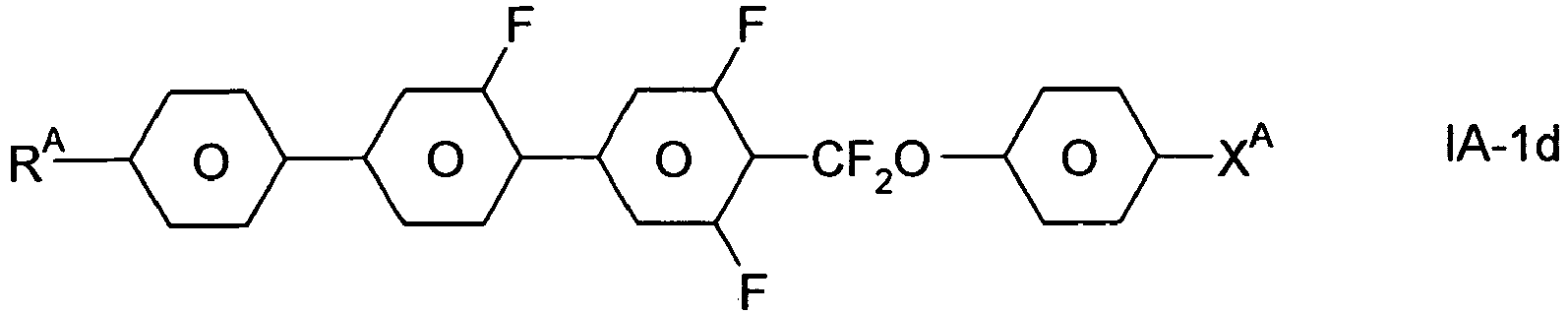


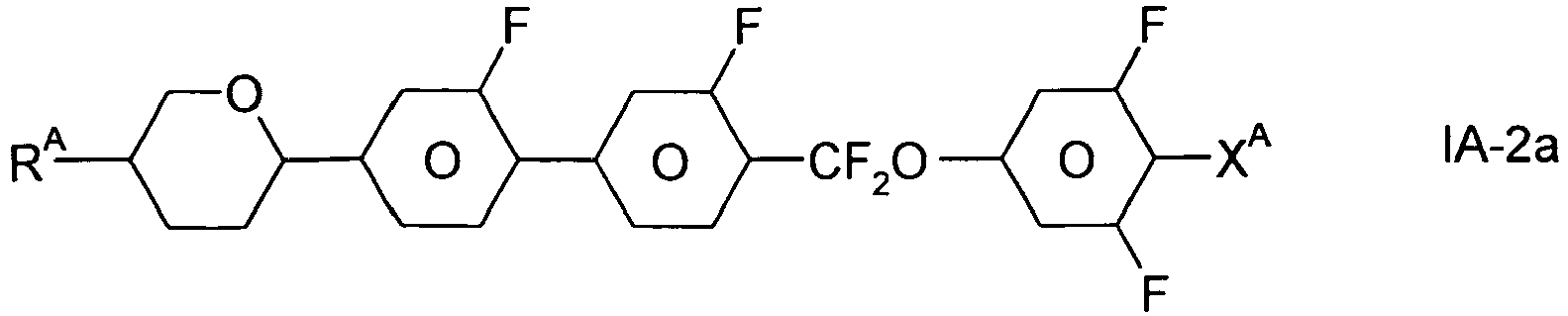





RA and XA have the meanings indicated in Claim 1. RA preferably denotes straight-chain alkyl having 1 to 6 C atoms, in particular ethyl, propyl and pentyl, furthermore butyl and alkenyl having 2 to 6 C atoms. XA preferably denotes F, OCF3, OCHFCF3, OCF2CHFCF3, OCH=CF2, most preferably F or OCF3. - Very particular preference is given to the compound of the sub-formula IA-1 b, IA-2i, IA-3b and IA-5e.
- In the compounds of the formulae IIA and IIB, Z2 may have identical or different meanings. In the compounds of the formula IIB, Z2 and Z2 may have identical or different meanings.
- In the compounds of the formulae IIA, IIB and IIC, R2A, R2B and R2C each preferably denote alkyl having 1-6 C atoms, in particular CH3, C2H5, n-C3H7, n-C4H9, n-C5H11.
- In the compounds of the formulae IIA and IIB, L1, L2, L3 and L4 preferably denote L1 = L2 = F and L3 = L4 = F, furthermore L1 = F and L2 = Cl, L1 = Cl and L2 = F, L3 = F and L4 = Cl, L3 = Cl and L4 = F. Z2 and Z2' in the formulae IIA and IIB preferably each, independently of one another, denote a single bond, furthermore a -C2H4- bridge.
- If in the formula IIB Z2 = -C2H4-, -CH2O-, -COO- or -CH=CH-, Z2' is preferably a single bond or, if Z2' = -C2H4-, -CH2O-, -COO- or -CH=CH-, Z2 is preferably a single bond. In the compounds of the formulae IIA and IIB, (O)CvH2v+1 preferably denotes OCvH2v+1, furthermore CvH2v+1. In the compounds of the formula IIC, (O)CvH2v+1 preferably denotes CvH2v+1 In the compounds of the formula IIC, L3 and L4 preferably each denote F.
- Preferred compounds of the formulae IIA, IIB and IIC are indicated below:




















- Particularly preferred mixtures according to the invention contain one or more compounds of the formulae IIA-2, IIA-8, IIA-14, IIA-26, IIA-29, IIA-35, IIA-45, IIA-57, IIB-2, IIB-11, IIB-16 and IIC-1.
- The proportion of compounds of the formulae IIA, IIB and/or IIC in the mixture as a whole is preferably 3-40 %, preferably 5-30 % by weight, most preferably 3-20 %, by weight.
- Particularly preferred media according to the invention contain at least one compound of the formula IIC-1,

- Preferred mixtures contain one or more compounds of the formula IIA-64:


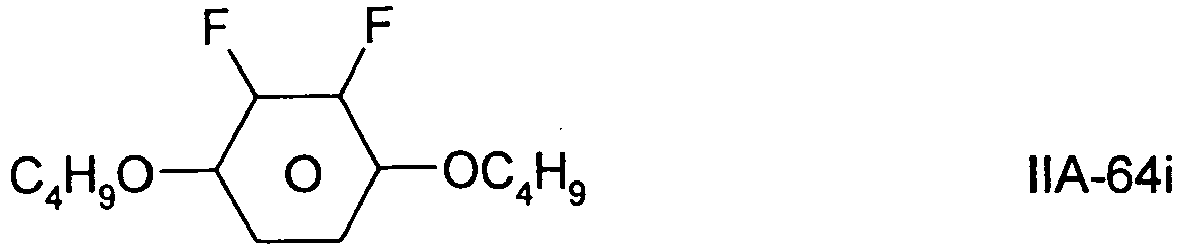


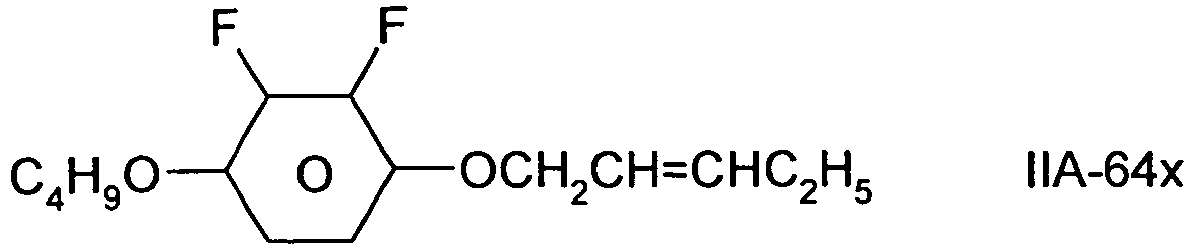


- Preferred mixtures contain at least one compound of the formula IIA-64a to IIA-64n.
- Preferred mixtures contain at least one or more tolan compound(s) of the formula IIB-T1 and IIB-T2,


- The mixtures according to the invention additionally can contain at least one compound of the formula To-1

- The compounds of the formulae IIB-T1 and IIB-T2 are preferably employed in concentrations of 3 - 25 % by weight, in particular 5 - 15 % by weight based on the total mixture.
- Further preferred embodiments of the mixture according to the invention are indicated below:
- The medium additionally contains one or more compounds of the formulae III and/or IV,


- R0
- denotes a halogenated or unsubstituted alkyl or alkoxy radical having 1 to 15 C atoms, where, in addition, one or more CH2 groups in these radicals may each be replaced, independently of one another, by -C≡C-, -CF2O-, -O-,

- X0
- denotes F, Cl, CN, SF5, SCN, NCS, a halogenated alkyl radical, a halogenated alkenyl radical, a halogenated alkoxy radical or a halogenated alkenyloxy radical having up to 6 C atoms,
- Y1-6
- each, independently of one another, denote H or F,


- The compounds of the formula III are preferably selected from the following formulae:


R0 preferably denotes alkyl having 1 to 6 C atoms. X0 preferably denotes F. Particular preference is given to compounds of the formulae IIIa and IIIb, in particular compounds of the formulae IIIa and IIIb in which X denotes F. - The compounds of the formula IV are preferably selected from the following formulae:

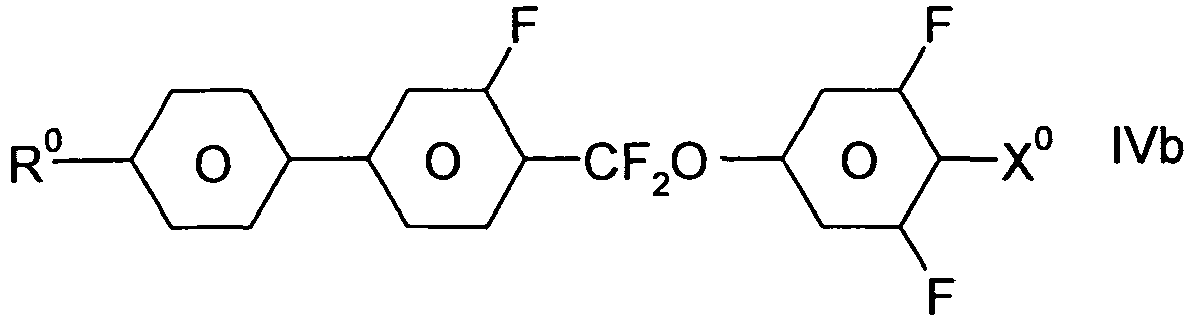


R0 preferably denotes alkyl having 1 to 6 C atoms. X0 preferably denotes F, OCF3 or CF3. Particular preference is given to compounds of the formulae IVa and IVe, in particular compounds of the formula IVa; - The medium additionally contains one or more compounds selected from the following formulae:


- R0
- denotes a halogenated or unsubstituted alkyl or alkoxy radical having 1 to 15 C atoms, where, in addition, one or more CH2 groups in these radicals may each be replaced, independently of one another, by -C≡C-, -CF2O-, -O-,

- X0
- denotes F, Cl, CN, SF5, SCN, NCS, a halogenated alkyl radical, a halogenated alkenyl radical, a halogenated alkoxy radical or a halogenated alkenyloxy radical having up to 6 C atoms.
- Y1-4
- each, independently of one another, denote H or F,
- Z0
- denotes -C2H4-, -(CH2)4-, -CH=CH-, -CF=CF-, -C2F4-, -CH2CF2-, -CF2CH2-, -CH2O-, -OCH2-, -COO- or -OCF2, and in formula VI and VII additionally a single bond and in formula VI and IX additionally -CF2O-,
- r
- denotes 0 or 1, and
- s
- denotes 0 or 1;
- The compounds of the formula V are preferably selected from the following formulae:


R0 preferably denotes alkyl having 1 to 6 C atoms. X0 preferably denotes F, CF3 or OCF3, furthermore OCF=CF2, OCH=CF2 or Cl; - The compounds of the formula VI are preferably selected from the following formulae:


R0 preferably denotes alkyl having 1 to 6 C atoms. X0 preferably denotes F, CF3 or OCF3, furthermore OCHF2, CF3, OCF=CF2 and OCH=CF2; - The compounds of the formula VII are preferably selected from the following formulae:


R0 preferably denotes alkyl having 1 to 6 C atoms, X° preferably denotes F, furthermore OCF3, CF3, CF=CF2, OCF=CF2, OCHF2 and OCH=CF2; - The compounds of the formula VIII are preferably selected from the following formulae:


R0 preferably denotes alkyl having 1 to 6 C atoms. X0 preferably denotes F, furthermore OCF3, OCHF2 and OCH=CF2. - The medium additionally contains one or more compounds selected from the following formulae:


- L
- denotes H or F,
- "alkyl"
- denotes C1-6-alkyl,
- R'
- denotes C1-6-alkyl, C1-6-alkoxy or C2-6-alkenyl, and "alkenyl" and "alkenyl*" each, independently of one another, denote C2-6-alkenyl.
- The compounds of the formulae X-XIII are preferably selected from the following formulae:




Particular preference is given to the compounds of the formulae Xa, Xb, Xc, XIa, XIb, Xlla and Xllla. In the formulae X and XI, "alkyl" preferably, independently of one another, denotes n-C3H7, n-C4H9 or n-CSH11, in particular n-C3H7. - The medium additionally contains one or more compounds selected from the following formulae:


- The medium contains one or more compounds of the formula XIV in which at least one of the radicals R1 and R2 denotes alkenyl having 2 to 6 C atoms. Preferred compounds of the formula XIV are compounds of the following formulae:


- The medium contains one or more compounds of the following formula


- The compounds of the formula XVI is preferably selected from the following formulae:
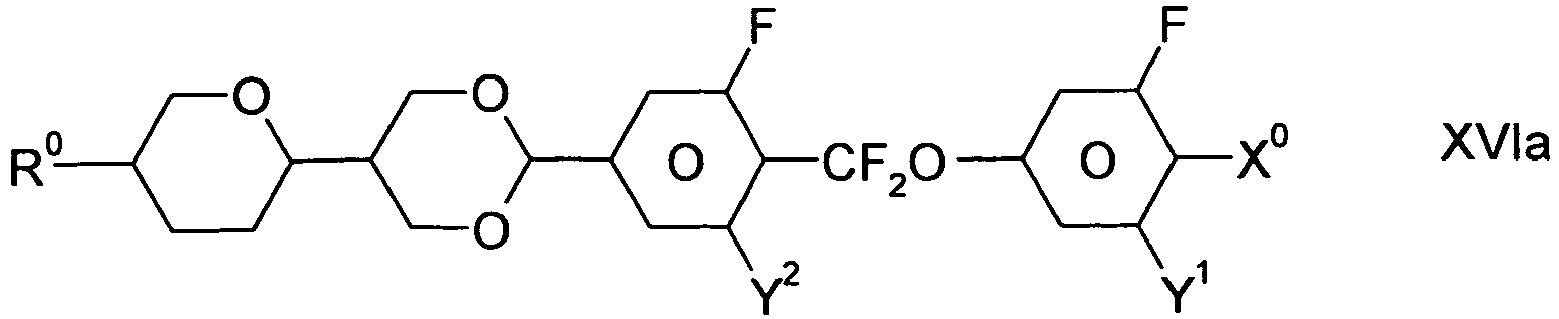


R0 preferably denotes alkyl having 1 to 6 C atoms. X0 preferably denotes F, furthermore OCF3. Particularly preferred compounds of the formulae XVI are those in which Y1 denotes F and Y2 denotes H or F, preferably F. The mixture according to the invention particularly preferably contains at least one compound of the formula XVIf. - The medium contains one or more compounds of the formula XVII,

Particularly preferred compounds of the formula XVII are those of the sub-formulae



- alkyl and alkyl*
- each, independently of one another, denote a straight-chain alkyl radical having 1-6 C atoms, in particular ethyl, propyl and pentyl,
- alkenyl and alkenyl*
- each, independently of one another, denote a straight-chain alkenyl radical having 2-6 C atoms, in particular CH2=CHC2H4, CH3CH=CHC2H4, CH2=CH and CH3CH=CH.


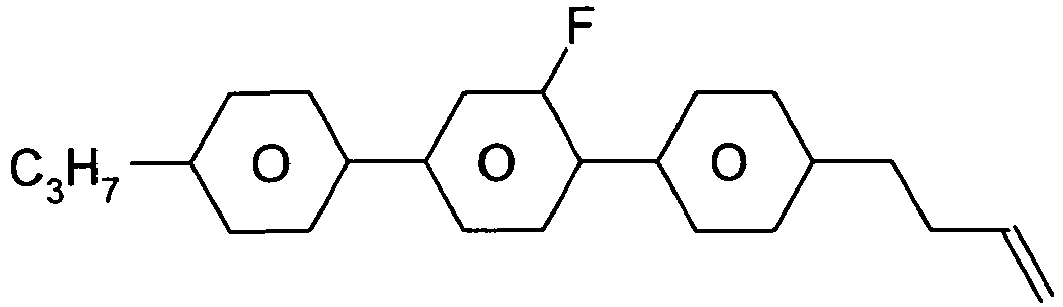


- The medium contains one or more compounds of the following formulae:


- The medium additionally contains one or more compounds selected from the following formulae:


The mixture according to the invention particularly preferably contains one or more compounds of the formula XXIV-a,
- The medium additionally contains one or more compounds of the formula XXV,


R0 preferably denotes alkyl having 1 to 6 C atoms. X0 preferably denotes F; - The compounds of the formula XXV are preferably selected from the following formulae:





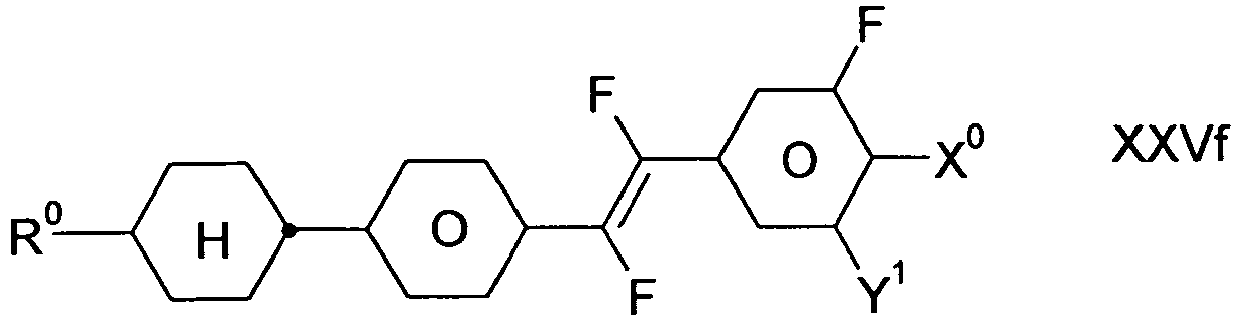


- R0 is straight-chain alkyl or alkenyl having 2 to 6 C atoms;
- The medium contains one or more compounds of the following formulae:


- The medium contains one or more compounds of the following formulae:


- The medium contains one or more compounds of the following pyrimidine or pyridine compounds of the formulae



- Further particular preferred embodiments are indicated below:
- The medium contains two or more compounds of the formula IA, in particular of the formula IA-1b;
- The medium contains 2-50 % by weight, preferably 3-40 % by weight, particularly preferably 5-15 % by weight, of compounds of the formula IA;
- The medium contains 3-40 % by weight, particularly preferably 5-15 % by weight, of at least one compound of the formula IV;
- The medium contains 5-30 % by weight, particularly preferably 5-25 % by weight, of compounds of the formulae VII;
- The medium contains 20-70 % by weight, particularly preferably 25-65 % by weight, of compounds of the formulae X-XIV;
- The medium contains 3-40 % by weight, particularly preferably 5-30 % by weight, of compounds of the formula XVII;
- The medium contains 1-20 % by weight, particularly preferably 2-15 % by weight, of compounds of the formula XVIII;
- The medium contains at least two compounds of the formulae



- The medium contains at least two compounds of the formulae


- The medium contains at least two compounds of the formula IA and at least two compounds of the formula IIB;
- The medium contains at least one compound of the formula IA and at least one compound of the formula IIB and at least one compound of the formula IIC;
- The medium contains at least two compounds of the formula IA and at least two compounds of the formula IIB and at least one compound of the formula IVa;
- The medium contains ≥ 20 % by weight, preferably ≥ 25 %, especially preferred ≥ 30 %, by weight, of one or more compounds of the formula IA and one or more compounds of the formula IIB;
- The medium contains ≥ 20 % by weight, preferably ≥ 25 %, especially preferred ≥ 30 %, by weight, of one or more compounds of the formula IA and one or more compounds of the formula IIB;
- The medium contains ≥ 20 % by weight, preferably ≥ 24 % by weight, preferably 25-60 % by weight, of compounds of the formula Xb, in particular the compound of the formula Xb-1,

- The medium contains at least one compound of the formula XIb-1 and at least one compound of the formula Xc-1,

- The medium contains at least one compound of the formula CDUQU-n-F;
- The medium contains at least one compound of the formula PUQU-n-F;
- The medium contains at least one compound of the formula APUQU-n-F and at least on compound of the formula PGUQU-n-F and at least one compound of the formula DPGU-n-F;
- The medium contains at least one compound of the formula PPGU-n-F.
- The medium contains at least one compound of the formula PGP-n-m, preferably two or three compounds.
- The medium contains at least one compound of PGP-n-2V having the following formula

- The medium contains at least one compound of the formula PYP-n-m, preferably in amounts of 1-20 wt.% based on the total mixture.
- The medium contains at least one compound of the formula IIA, IIB and IIC;
- The medium contains at least one compound of the formula PY-n-Om, preferably in amounts of 1-20 wt.% based on the total mixture;
- The medium contains at least one compound of the formula CY-n-Om; preferably in amounts of 1-20 wt.% based on the total mixture;
- The medium contains at least one compound of the formula Y-nO-Om, preferably in amounts of 1-20 wt.% based on the total mixture;
- The medium contains at least one compound of the formula PYP-n-m, preferably in amounts of 1-20 wt.% based on the total mixture;
- It has been found that ≥ 20 % by weight, preferably ≥ 25 % by weight, of compounds of the formulae IA mixed with conventional liquid-crystal materials, but in particular with one or more compounds of the formulae III to XXIX, results in a significant increase in the light stability and in low birefringence values, with broad nematic phases with low smectic-nematic transition temperatures being observed at the same time, improving the shelf life. At the same time, the mixtures exhibit relatively low threshold voltages, very good values for the VHR on exposure to UV, and very high clearing points.
- The term "alkyl" or "alkyl*" in this application encompasses straight-chain and branched alkyl groups having 1-6 carbon atoms, in particular the straight-chain groups methyl, ethyl, propyl, butyl, pentyl and hexyl. Groups having 2-5 carbon atoms are generally preferred.
- The term "alkenyl" or "alkenyl*" encompasses straight-chain and branched alkenyl groups having 2-6 carbon atoms, in particular the straight-chain groups. Preferred alkenyl groups are C2-C7-1E-alkenyl, C4-C6-3E-alkenyl, in particular C2-C6-1E-alkenyl. Examples of particularly preferred alkenyl groups are vinyl, 1 E-propenyl, 1 E-butenyl, 1 E-pentenyl, 1 E-hexenyl, 3-butenyl, 3E-pentenyl, 3E-hexenyl, 4-pentenyl, 4Z-hexenyl, 4E-hexenyl and 5-hexenyl. Groups having up to 5 carbon atoms are generally preferred, in particular CH2=CH, CH3CH=CH.
- The term "fluoroalkyl" preferably encompasses straight-chain groups having a terminal fluorine, i.e. fluoromethyl, 2-fluoroethyl, 3-fluoropropyl, 4-fluorobutyl, 5-fluoropentyl, 6-fluorohexyl and 7-fluoroheptyl. However, other positions of the fluorine are not excluded.
- The term "oxaalkyl" or "alkoxy" preferably encompasses straight-chain radicals of the formula CnH2n+1-O-(CH2)m, in which n and m each, independently of one another, denote 1 to 6. m may also denote 0. Preferably, n = 1 and m = 1-6 or m = 0 and n = 1-3.
- Through a suitable choice of the meanings of R0 and X0, the addressing times, the threshold voltage, the steepness of the transmission characteristic lines, etc., can be modified in the desired manner. For example, 1E-alkenyl radicals, 3E-alkenyl radicals, 2E-alkenyloxy radicals and the like generally result in shorter addressing times, improved nematic tendencies and a higher ratio between the elastic constants k33 (bend) and k11 (splay) compared with alkyl and alkoxy radicals. 4-Alkenyl radicals, 3-alkenyl radicals and the like generally give lower threshold voltages and lower values of k33/k11 compared with alkyl and alkoxy radicals. The mixtures according to the invention are distinguished, in particular, by high Δε values and thus have significantly faster response times than the mixtures from the prior art.
- The optimum mixing ratio of the compounds of the above-mentioned formulae depends substantially on the desired properties, on the choice of the components of the above-mentioned formulae and on the choice of any further components that may be present.
- Suitable mixing ratios within the range indicated above can easily be determined from case to case.
- The total amount of compounds of the above-mentioned formulae in the mixtures according to the invention is not crucial. The mixtures can therefore comprise one or more further components for the purposes of optimisation of various properties. However, the observed effect on the desired improvement in the properties of the mixture is generally greater, the higher the total concentration of compounds of the above-mentioned formulae.
- In a particularly preferred embodiment, the media according to the invention comprise compounds of the formulae III to IX (preferably III, IV, V, VI and, VII, in particular IIIa and IVa) in which X0 denotes F, OCF3, OCHF2, CF3, OCF2CHFCF3, OCHFCF3, CF2H, OCH=CF2, OCF=CF2 or OCF2CF2H. A favourable synergistic action with the compounds of the formulae IA and IIA-IIC results in particularly advantageous properties. In particular, mixtures comprising compounds of the formulae IA and at least one compound of the formula IIA, IIBC and IIC in combination with at least one compound of the formula IIIa and/or IVa are distinguished by their low threshold voltage.
- The individual compounds of the above-mentioned formulae and the sub-formulae thereof which can be used in the media according to the invention are either known or can be prepared analogously to the known compounds.
- The invention also relates to electro-optical displays, such as, for example, STN or MLC displays, having two plane-parallel outer plates, which, together with a frame, form a cell, integrated non-linear elements for switching individual pixels on the outer plates, and a nematic liquid-crystal mixture having positive dielectric anisotropy and high specific resistance located in the cell, which contain media of this type, and to the use of these media for electro-optical purposes.
- The liquid-crystal mixtures according to the invention enable a significant broadening of the available parameter latitude. The achievable combinations of clearing point, viscosity at low temperature, thermal and UV stability and high optical anisotropy are far superior to previous materials from the prior art.
- The mixtures according to the invention are particularly suitable for TV, monitor, mobile applications, smart phones, tablet PC and PDA. Furthermore, the mixtures according to the invention can be used in TN-- TFT, FFS, VA-IPS, OCB and IPS displays.
- The dielectric anisotropy Δε of the liquid-crystal mixtures according to the invention at 20 °C is preferably ≥ +3, particularly preferably ≥ +8, especially preferably ≥ 12.
- The birefringence Δn of the liquid-crystal mixtures according to the invention at 20°C is preferably ≥ 0.09, particularly preferably ≥ 0.10.
- The liquid-crystalline medium according to the invention preferably has a nematic phase from ≤ -20 °C to ≥ 70 °C, particularly preferably from ≤ -30 °C to ≥ 80 °C, very particularly preferably from ≤ -40 °C to ≥ 90 °C.
- LC mixtures with this nematic phase range at the same time allow rotational viscosities γ1 of ≤ 110 mPa·s, particularly preferably ≤ 100 mPa·s, and thus excellent MLC displays having fast response times can be achieved. The rotational viscosities are determined at 20 °C.
- The expression "have a nematic phase" here means on the one hand that no smectic phase and no crystallisation are observed at low temperatures at the corresponding temperature and on the other hand that clearing still does not occur on heating from the nematic phase. The investigation at low temperatures is carried out in a flow viscometer at the corresponding temperature and checked by storage in test cells having a layer thickness corresponding to the electro-optical use for at least 100 hours. If the storage stability at a temperature of -20 °C in a corresponding test cell is 1000 h or more, the medium is referred to as stable at this temperature. At temperatures of -30 °C and -40 °C, the corresponding times are 500 h and 250 h respectively. At high temperatures, the clearing point is measured by conventional methods in capillaries.
- The liquid-crystal media according to the invention have relatively low values for the threshold voltage (V0). They are preferably in the range from 1.7 V to 3.0 V, particularly preferably ≤ 2.5 V and very particularly preferably ≤ 2.3 V.
- In addition, the liquid-crystal media according to the invention have high values for the voltage holding ratio in liquid-crystal cells.
- In general, liquid-crystal media having a low addressing voltage or threshold voltage exhibit a lower voltage holding ratio than those having a higher addressing voltage or threshold voltage and vice versa.
- For the present invention, the term "dielectrically positive mixture or compounds" denotes mixtures or compounds having a Δε > 1.5, the term "dielectrically neutral compounds" denotes those having -1.5 ≤ Δε ≤ 1.5 and the term "dielectrically negative compounds" denotes those having Δε < -1.5. The dielectric anisotropy of the compounds is determined here by dissolving 10 % of the compounds in a liquid-crystalline host and determining the capacitance of the resultant mixture in at least one test cell in each case having a layer thickness of 20 µm with homeotropic and with homogeneous surface alignment at 1 kHz. The measurement voltage is typically 0.5 V to 1.0 V, but is always lower than the capacitive threshold of the respective liquid-crystal mixture investigated.
- All temperature values indicated for the present invention are in °C.
- It goes without saying that, through a suitable choice of the components of the mixtures according to the invention, it is also possible for higher clearing points (for example above 100 °C) to be achieved at higher threshold voltages or lower clearing points to be achieved at lower threshold voltages with retention of the other advantageous properties. At viscosities correspondingly increased only slightly, it is likewise possible to obtain mixtures having a higher Δε and thus low thresholds. The MLC displays according to the invention preferably operate at the first Gooch and Tarry transmission minimum [C.H. Gooch and H.A. Tarry, Electron. Lett. 10, 2-4, 1974; C.H. Gooch and H.A. Tarry, Appl. Phys., Vol. 8, 1575-1584, 1975], where, besides particularly favourable electro-optical properties, such as, for example, high steepness of the characteristic line and low angle dependence of the contrast (German patent
30 22 818 ), lower dielectric anisotropy is sufficient at the same threshold voltage as in an analogous display at the second minimum. This enables significantly higher specific resistance values to be achieved using the mixtures according to the invention at the first minimum than in the case of mixtures comprising cyano compounds. Through a suitable choice of the individual components and their proportions by weight, the person skilled in the art is able to set the birefringence necessary for a pre-specified layer thickness of the MLC display using simple routine methods. - Measurements of the voltage holding ratio (HR) [S. Matsumoto et al., Liquid Crystals 5, 1320 (1989); K. Niwa et al., Proc. SID Conference, San Francisco, June 1984, p. 304 (1984); G. Weber et al., Liquid Crystals 5, 1381 (1989)] have shown that mixtures according to the invention comprising compounds of the formulae IA and IB exhibit a significantly smaller decrease in the HR on UV exposure than analogous mixtures comprising cyanophenylcyclohexanes of the formula


- The light stability and UV stability of the mixtures according to the invention are considerably better, i.e. they exhibit a significantly smaller decrease in the HR on exposure to light or UV.
- The construction of the MLC display according to the invention from polarisers, electrode base plates and surface-treated electrodes corresponds to the usual design for displays of this type. The term usual design is broadly drawn here and also encompasses all derivatives and modifications of the MLC display, in particular including matrix display elements based on poly-Si TFTs or MIM.
- A significant difference between the displays according to the invention and the hitherto conventional displays based on the twisted nematic cell consists, however, in the choice of the liquid-crystal parameters of the liquid-crystal layer.
- The liquid-crystal mixtures which can be used in accordance with the invention are prepared in a manner conventional per se, for example by mixing one or more compounds of the formulae IA with the compound(s) of the formula IIA, IIB and/or IIC with one or more mesogenic compounds, preferably at least one compound of the formulae III to XXX and optionally with suitable additives. In general, the desired amount of the components used in lesser amount is dissolved in the components making up the principal constituent, advantageously at elevated temperature. It is also possible to mix solutions of the components in an organic solvent, for example in acetone, chloroform or methanol, and to remove the solvent again, for example by distillation, after thorough mixing.
- The dielectrics may also comprise further additives known to the person skilled in the art and described in the literature, such as, for example, UV stabilisers, such as Tinuvin®, e.g. Tinuvin® 770, from Ciba Chemicals, antioxidants, e.g. TEMPOL, microparticles, free-radical scavengers, nanoparticles, etc. For example, 0-15 % of pleochroic dyes or chiral dopants can be added. Suitable stabilisers and dopants are mentioned below in Tables C and D.
- Polymerisable compounds, so-called reactive mesogens (RMs), for example as disclosed in
U.S. 6,861,107 , may furthermore be added to the mixtures according to the invention in concentrations of preferably 0.12-5 % by weight, particularly preferably 0.2-2 % by weight, based on the mixture. These mixtures may optionally also comprise an initiator, as described, for example, inU.S. 6,781,665 . The initiator, for example Irganox-1076 from Ciba, is preferably added to the mixture comprising polymerisable compounds in amounts of 0-1 %. Mixtures of this type can be used for so-called polymer-stabilised (PS) modes, in which polymerisation of the reactive mesogens is intended to take place in the liquid-crystalline mixture, for example for PS-IPS, PS-FFS, PS-TN, PS-VA-IPS. The prerequisite for this is that the liquid-crystal mixture does not itself comprise any polymerisable components. - In a preferred embodiment of the invention, the polymerisable compounds are selected from the compounds of the formula M
RMa-AM1-(ZM1-AM2)m1-RMb M
in which the individual radicals have the following meanings: - RMa and RMb
- each, independently of one another, denote P, P-Sp-, H, halogen, SF5, NO2, an alkyl, alkenyl or alkynyl group, where at least one of the radicals RMa and RMb preferably denotes or contains a group P or P-Sp-,
- P
- denotes a polymerisable group,
- Sp
- denotes a spacer group or a single bond,
- AM1 and AM2
- each, independently of one another, denote an aromatic, heteroaromatic, alicyclic or heterocyclic group, preferably having 4 to 25 ring atoms, preferably C atoms, which may also encompass or contain fused rings, and which may optionally be mono- or polysubstituted by L,
- L
- denotes P, P-Sp-, OH, CH2OH, F, Cl, Br, I, -CN, -NO2, -NCO, -NCS, -OCN, -SCN, -C(=O)N(Rx)2, -C(=O)Y1, -C(=O)Rx, -N(Rx)2, optionally substituted silyl, optionally substituted aryl having 6 to 20 C atoms, or straight-chain or branched alkyl, alkoxy, alkylcarbonyl, alkoxycarbonyl, alkylcarbonyloxy or alkoxycarbonyloxy having 1 to 25 C atoms, in which, in addition, one or more H atoms may be replaced by F, Cl, P or P-Sp-, preferably P, P-Sp-, H, OH, CH2OH, halogen, SFs, NO2, an alkyl, alkenyl or alkynyl group,
- Y1
- denotes halogen,
- ZM1
- denotes -O-, -S-, -CO-, -CO-O-, -OCO-, -O-CO-O-, -OCH2-, -CH2O-, -SCH2-, -CH2S-, -CF2O-, -OCF2-, -CF2S-, -SCF2-, -(CH2)n1-, -CF2CH2-, -CH2CF2-, -(CF2)n1-, -CH=CH-, -CF=CF-, -C≡C-, -CH=CH-, -COO-, -OCO-CH=CH-, CR0R00 or a single bond,
- R0 and R00
- each, independently of one another, denote H or alkyl having 1 to 12 C atoms,
- Rx
- denotes P, P-Sp-, H, halogen, straight-chain, branched or cyclic alkyl having 1 to 25 C atoms, in which, in addition, one or more non-adjacent CH2 groups may be replaced by -O-, -S-, -CO-, -CO-O-, -O-CO-, -O-CO-O- in such a way that O and/or S atoms are not linked directly to one another, and in which, in addition, one or more H atoms may be replaced by F, Cl, P or P-Sp-, an optionally substituted aryl or aryloxy group having 6 to 40 C atoms, or an optionally substituted heteroaryl or heteroaryloxy group having 2 to 40 C atoms,
- m1
- denotes 0, 1, 2, 3 or 4, and
- n1
- denotes 1, 2, 3 or 4,
- Particularly preferred compounds of the formula M are those in which
- RMa and RMb
- each, independently of one another, denote P, P-Sp-, H, F, Cl, Br, I, -CN, -NO2, -NCO, -NCS, -OCN, -SCN, SF5 or straight-chain or branched alkyl having 1 to 25 C atoms, in which, in addition, one or more non-adjacent CH2 groups may each be replaced, independently of one another, by -C(R0)=C(R00)-, -C≡C-, -N(R00)-, -O-, -S-, -CO-, -CO-O-, -O-CO-, -O-CO-O- in such a way that O and/or S atoms are not linked directly to one another, and in which, in addition, one or more H atoms may be replaced by F, Cl, Br, I, CN, P or P-Sp-, where at least one of the radicals RMa and RMb preferably denotes or contains a group P or P-Sp-,
- AM1 and AM2
- each, independently of one another, denote 1,4-phenylene, naphthalene-1,4-diyl, naphthalene-2,6-diyl, phenanthrene-2,7-diyl, anthracene-2,7-diyl, fluorene-2,7-diyl, coumarine, flavone, where, in addition, one or more CH groups in these groups may be replaced by N, cyclohexane-1,4-diyl, in which, in addition, one or more non-adjacent CH2 groups may be replaced by O and/or S, 1,4-cyclohexenylene, bicyclo[1.1.1]pentane-1,3-diyl, bicyclo[2.2.2]octane-1,4-diyl, spiro[3.3]heptane-2,6-diyl, piperidine-1,4-diyl, decahydronaphthalene-2,6-diyl, 1,2,3,4-tetrahydronaphthalene-2,6-diyl, indane-2,5-diyl or octahydro-4,7-methanoindane-2,5-diyl, where all these groups may be unsubstituted or mono- or polysubstituted by L,
- L
- denotes P, P-Sp-, OH, CH2OH, F, Cl, Br, I, -CN, -NO2, -NCO, -NCS, -OCN, -SCN, -C(=O)N(Rx)2, -C(=O)Y1, -C(=O)Rx, -N(Rx)2, optionally substituted silyl, optionally substituted aryl having 6 to 20 C atoms, or straight-chain or branched alkyl, alkoxy, alkylcarbonyl, alkoxycarbonyl, alkylcarbonyloxy or alkoxycarbonyloxy having 1 to 25 C atoms, in which, in addition, one or more H atoms may be replaced by F, Cl, P or P-Sp-,
- P
- denotes a polymerisable group,
- Y1
- denotes halogen,
- Rx
- denotes P, P-Sp-, H, halogen, straight-chain, branched or cyclic alkyl having 1 to 25 C atoms, in which, in addition, one or more non-adjacent CH2 groups may be replaced by -O-, -S-, -CO-, -CO-O-, -O-CO-, -O-CO-O- in such a way that O and/or S atoms are not linked directly to one another, and in which, in addition, one or more H atoms may be replaced by F, Cl, P or P-Sp-, an optionally substituted aryl or aryloxy group having 6 to 40 C atoms, or an optionally substituted heteroaryl or heteroaryloxy group having 2 to 40 C atoms.
- Very particular preference is given to compounds of the formula M in which one of RMa and RMb or both denote(s) P or P-Sp-.
- Suitable and preferred RMs for use in liquid-crystalline media and PS mode displays according to the invention are selected, for example, from the following formulae:





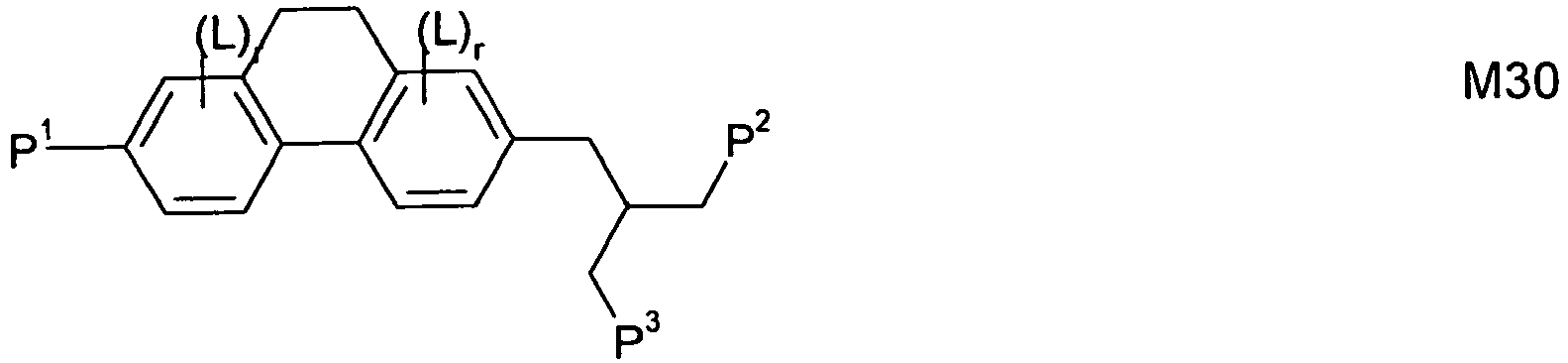





- P1 and P2
- each, independently of one another, denote a polymerisable group, preferably having one of the meanings indicated above and below for P, particularly preferably an acrylate, methacrylate, fluoroacrylate, oxetane, vinyloxy or epoxy group,
- Sp1 and Sp2
- each, independently of one another, denote a single bond or a spacer group, preferably having one of the meanings indicated above and below for Sp, and particularly preferably -(CH2)p1-, -(CH2)p1-O-, -(CH2)p1-CO-O- or -(CH2)p1-O-CO-O-, in which p1 is an integer from 1 to 12, and where the linking of the last-mentioned groups to the adjacent ring takes place via the O atom, where one of the radicals P1-Sp1- and P2-Sp2- may also denote Raa,
- Raa
- denotes H, F, Cl, CN or straight-chain or branched alkyl having 1 to 25 C atoms, in which, in addition, one or more non-adjacent CH2 groups may each be replaced, independently of one another, by -C(R0)=C(R00)-, -C≡C-, -N(R0)-, -O-, -S-, -CO-, -CO-O-, -O-CO-, -O-CO-O- in such a way that O and/or S atoms are not linked directly to one another, and in which, in addition, one or more H atoms may be replaced by F, Cl, CN or P1-Sp1-, particularly preferably straight-chain or branched, optionally mono- or polyfluorinated alkyl, alkoxy, alkenyl, alkynyl, alkylcarbonyl, alkoxycarbonyl or alkylcarbonyloxy having 1 to 12 C atoms (where the alkenyl and alkynyl radicals have at least two C atoms and the branched radicals have at least three C atoms),
- R0, R00
- each, independently of one another and on each occurrence identically or differently, denote H or alkyl having 1 to 12 C atoms,
- Ry and Rz
- each, independently of one another, denote H, F, CH3 or CF3,
- Z1
- denotes -O-, -CO-, -C(RyRz)- or -CF2CF2-,
- Z2 and Z3
- each, independently of one another, denote -CO-O-, -O-CO-, -CH2O-, -OCH2-, -CF2O-, -OCF2- or -(CH2)n-, where n is 2, 3 or 4,
- L
- on each occurrence, identically or differently, denotes F, Cl, CN, or straight-chain or branched, optionally mono- or polyfluorinated alkyl, alkoxy, alkenyl, alkynyl, alkylcarbonyl, alkoxycarbonyl or alkylcarbonyloxy having 1 to 12 C atoms, preferably F,
- L' and L"
- each, independently of one another, denote H, F or Cl,
- r
- denotes 0, 1, 2, 3 or 4,
- s
- denotes 0, 1, 2 or 3,
- t
- denotes 0, 1 or 2, and
- x
- denotes 0 or 1.
- Suitable polymerisable compounds are listed, for example, in Table E.
- The liquid-crystalline media in accordance with the present application preferably comprise in total 0.01 to 10 %, preferably 0.2 to 4.0 %, particularly preferably 0.2 to 2.0 %, of polymerisable compounds.
- Particular preference is given to the polymerisable compounds of the formula M.
- The present invention thus also relates to the use of the mixtures according to the invention in electro-optical displays and to the use of the mixtures according to the invention in shutter glasses, in particular for 3D applications, and in TN, PS-TN, STN, TN-TFT, OCB, IPS, PS-IPS, FFS, PS-FFS and PS-VA-IPS displays.
- The following examples are intended to explain the invention without limiting it. Above and below, per cent data denote per cent by weight; all temperatures are indicated in degrees Celsius.
- Throughout the patent application, 1,4-cyclohexylene rings and 1,4-phenylene rings are depicted as follows:


- Besides the compounds of the formula IA and at least one compound selected from the compounds of the formula IIA, IIB and IIC, the mixtures according to the invention preferably contain one or more of the compounds from Table A indicated below.
- In the present application and in the examples below, the structures of the liquid-crystal compounds are indicated by means of acronyms, the transformation into chemical formulae taking place in accordance with Table A. All radicals CnH2n+1 and CmH2m+1 are straight-chain alkyl radicals having n and m C atoms respectively; n, m and k are integers and preferably denote 0, 1, 2, 3, 4, 5, 6, 7, 8, 9, 10, 11 or 12. The coding in Table B is self-evident. In Table A, only the acronym for the parent structure is indicated. In individual cases, the acronym for the parent structure is followed, separated by a dash, by a code for the substituents R1*, R2*, L1* and L2*:
Code for R1*, R2*, L1*, L3* R1* R2* L1* L2* nm CnH2n+1 CmH2m+1 H H nOm CnH2n+1 OCmH2m+1 H H nO.m OCnH2n+1 CmH2m+1 H H n CnH2n+1 CN H H nN.F CnH2n+1 CN F H nN.F.F CnH2n+1 CN F F nF CnH2n+1 F H H nCl CnH2n+1 Cl H H nOF OCnH2n+1 F H H nF.F CnH2n+1 F F H nF.F.F CnH2n+1 F F F nOCF3 CnH2n+1 OCF3 H H nOCF3.F CnH2n+1 OCF3 F H n-Vm CnH2n+1 -CH=CH-CmH2m+1 H H nV-Vm CnH2n+1-CH=CH- -CH=CH-CmH2m+1 H H - The following abbreviations are used: (n, m, m', z: each, independently of one another, 1, 2, 3, 4, 5 or 6; (O)CmH2m+1 denotes OCmH2m+1 or CmH2m+1)
- Preferred mixture components are shown in Tables A and B.


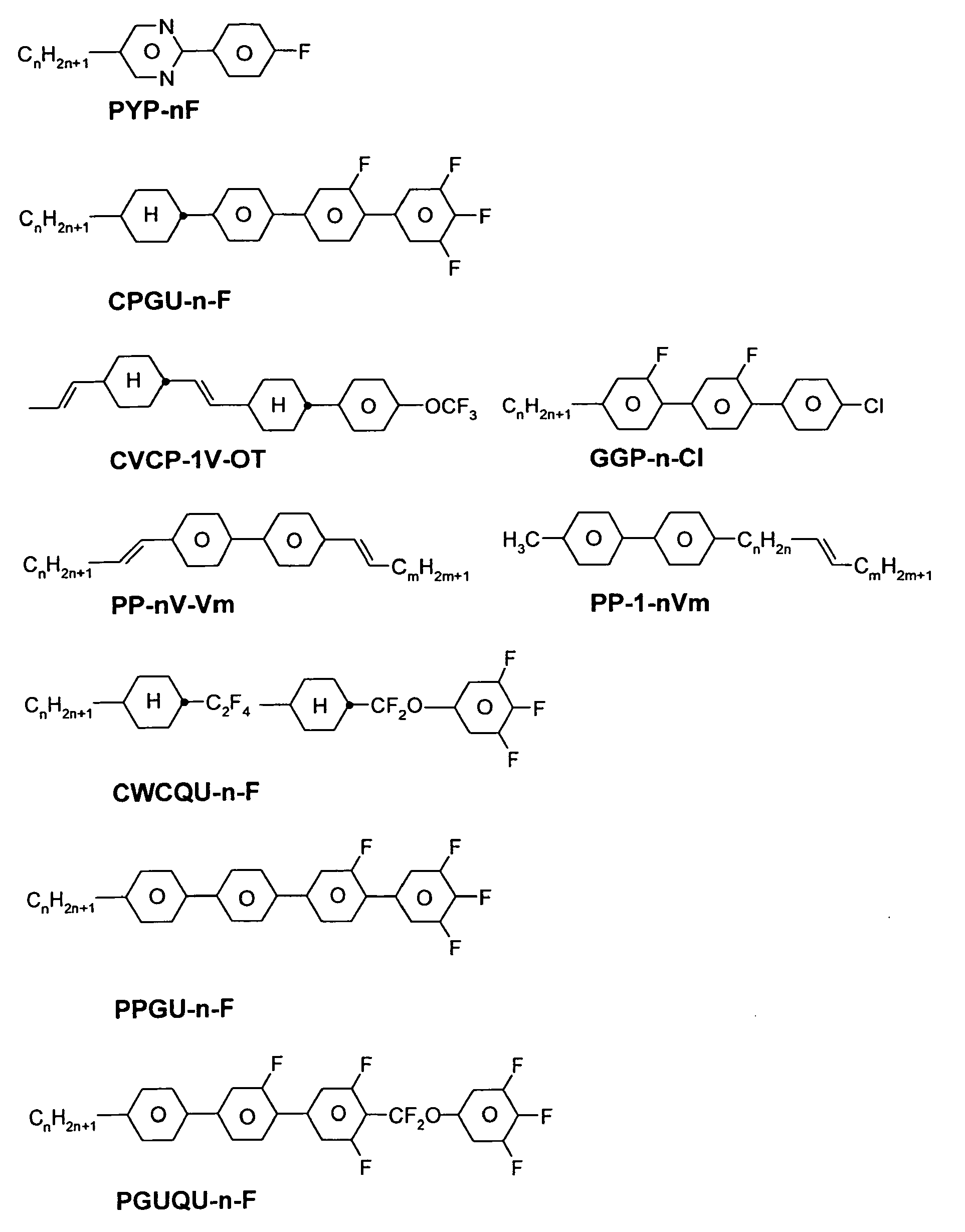


- Particular preference is given to liquid-crystalline mixtures which, besides the compounds of the formulae IA and IB, comprise at least one, two, three, four or more compounds from Table B.


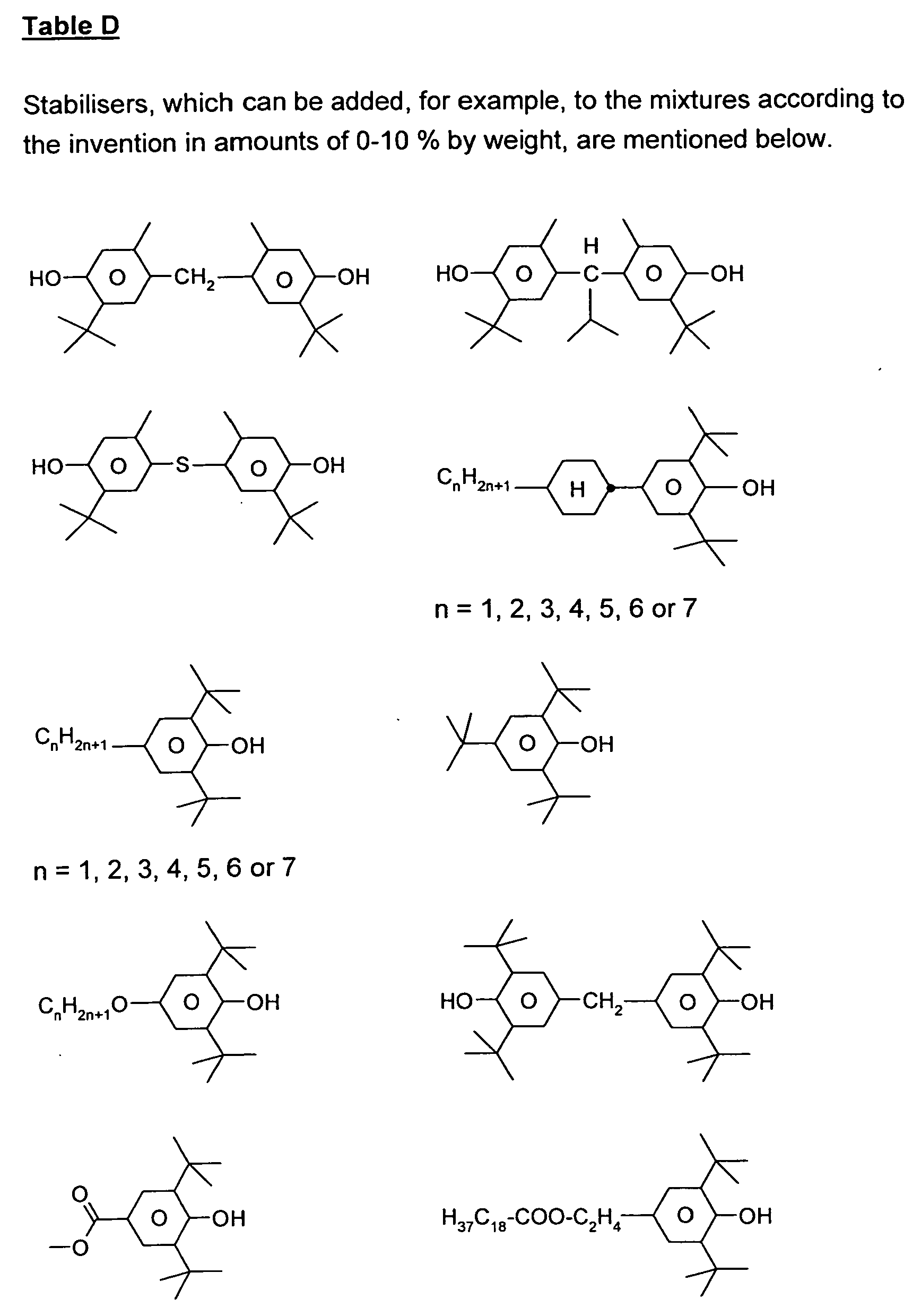


Table E Polymerisable compounds, which can be added, for example, to the mixtures according to the invention in amounts of 0.01 - 1 % by weight, are mentioned below. It may also be necessary to add an initiator for the polymerisation, preferably in amounts of 0 - 1 %. 
RM-1 
RM-2 
RM-3 
RM-4 
RM-5 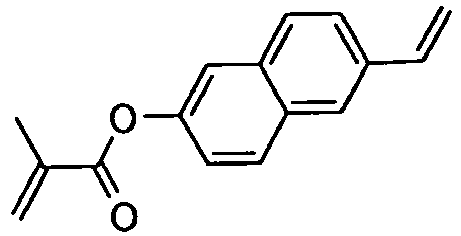
RM-6 
RM-7 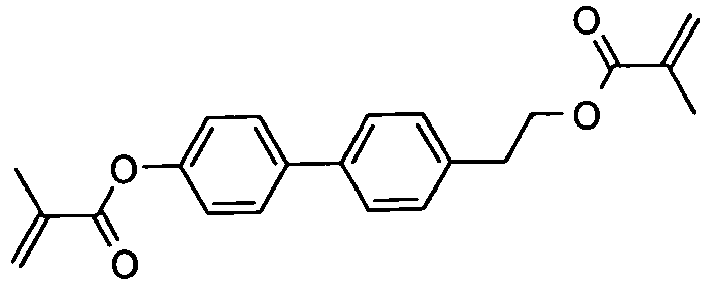
RM-8 
RM-9 
RM-10 
RM-11 
RM-12 
RM-13 
RM-14 
RM-15 
RM-16 
RM-17 
RM-18 
RM-19 
RM-20 
RM-21 
RM-22 
RM-23 
RM-24 
RM-25 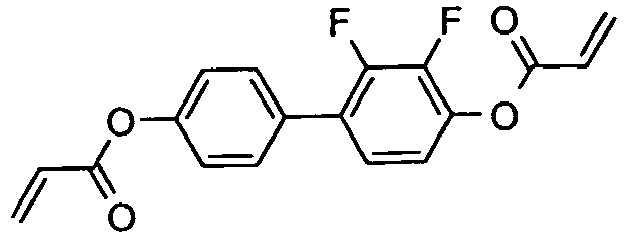
RM-26 
RM-27 
RM-28 
RM-29 
RM-30 
RM-31 
RM-32 
RM-33 
RM-34 
RM-35 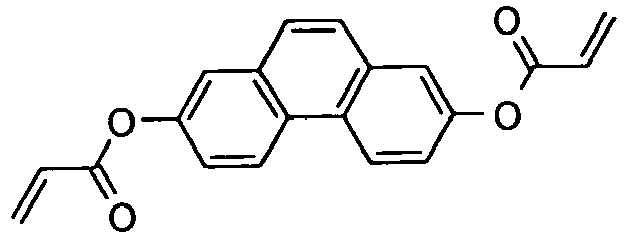
RM-36 
RM-37 
RM-38 
RM-39 
RM-40 
RM-41 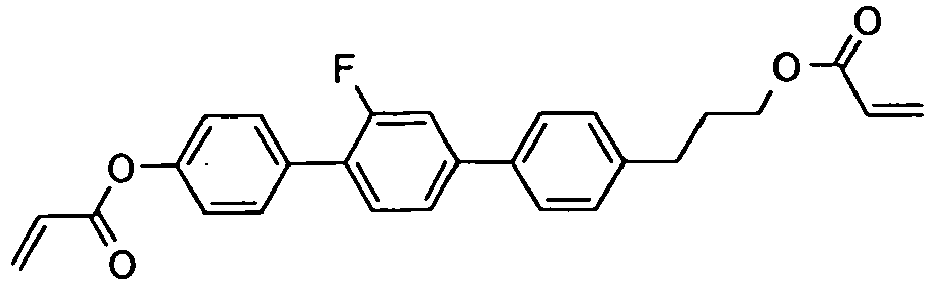
RM-42 
RM-43 
RM-44 
RM-45 
RM-46 
RM-47 
RM-48 
RM-49 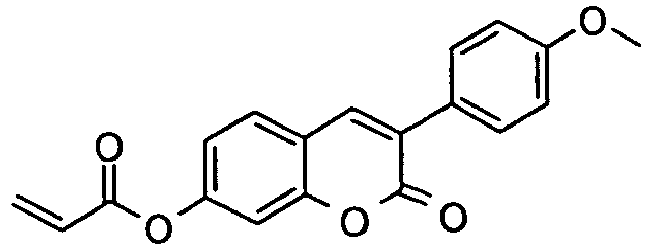
RM-50 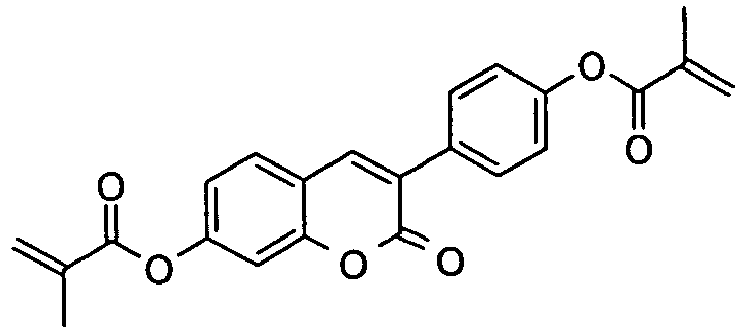
RM-51 
RM-52 
RM-53 
RM-54 
RM-55 
RM-56 
RM-57 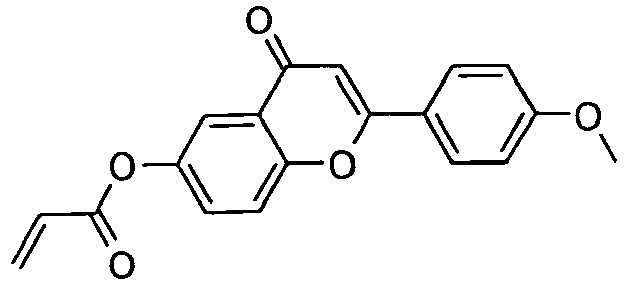
RM-58 
RM-59 
RM-60 
RM-61 
RM-62 
RM-63 
RM-64 
RM-65 
RM-66 
RM-67 
RM-68 
RM-69 
RM-70 
RM-71 
RM-72 
RM-73 
RM-74 
RM-75 
RM-76 
RM-77 
RM-78 
RM-79 
RM-80 
RM-81 
RM-82 
RM-83 
RM-84 
RM-85 
RM-86 - The following mixture examples are intended to explain the invention without limiting it.
- Above and below, percentage data denote per cent by weight. All temperatures are indicated in degrees Celsius. m.p. denotes melting point, cl.p. = clearing point. Furthermore, C = crystalline state, N = nematic phase, S = smectic phase and I = isotropic phase. The data between these symbols represent the transition temperatures. Furthermore,
- Δn denotes the optical anisotropy at 589 nm and 20°C,
- γ1 denotes the rotational viscosity (mPa·s) at 20°C,
- Δε denotes the dielectric anisotropy at 20°C and 1 kHz (Δε = ε∥ - ε⊥, where ε∥ denotes the dielectric constant parallel to the longitudinal axes of the molecules and ε⊥ denotes the dielectric constant perpendicular thereto),
- V10 denotes the voltage (V) for 10 % transmission (viewing angle perpendicular to the plate surface), (threshold voltage), determined in a TN cell (90 degree twist) at the 1 st minimum (i.e. at a d · Δn value of 0.5 µm) at 20 °C,
- V0 denotes the capacitively determined Freedericks threshold voltage in an antiparallel-rubbed cell at 20 °C.
- All physical properties are determined in accordance with "Merck Liquid Crystals, Physical Properties of Liquid Crystals", status Nov. 1997, Merck KGaA, Germany, and apply for a temperature of 20 °C, unless explicitly indicated otherwise.
-
Mixture M1 CC-3-V 16.87% Clearing Point [°C]: 82.0 CC-3-V1 4.26% Δn [589 nm, 20°C]: 0.108 CCQU-2-F 6.39% Δε [1 kHz, 20°C]: 9.3 CCQU-3-F 9.23% ε⊥ [1 kHz, 20 °C]: 8.37 CCP-2F.F.F 4.26% K1 [20 °C]: 12.5 PUQU-3-F 11.36 % K3 [20 °C] 13.4 CCP-V-1 9.94% γ1 [20 °C, m·Pas]: 112 APUQU-3-F 8.52% LTS Bulk -25 °C > 1000 h PGUQU-3-F 5.68% LTS Bulk -30 °C > 1000 h CY-3-O2 6.96% CY-5-O2 1.015% CLY-3-O2 2.03% CCY-3-O2 2.90% CCY-3-O3 1.305% CCY-4-O2 1.16% CPY-2-O2 2.90% CPY-3-O2 2.32 % PYP-2-3 1.74% PYP-2-4 1.16 % Mixture M2 CY-3-O2 8.50 % Clearing Point [°C]: 80.0 CCY-3-O2 6.00 % Δn [589 nm, 20°C]: 0.109 CPY-2-O2 6.00 % Δε [1 kHz, 20°C]: 9.5 PYP-2-3 3.00 % ε⊥ [1 kHz, 20 °C]: 8.97 CC-3-V 30.50 % K1 [20 °C]: 12.5 CLY-3-O2 5.00% K3 [20 °C]: 13.5 CCQU-3-F 11.50 % γ1 [20 °C, mPa·s]: 105 APUQU-2-F 8.50 % APUQU-3-F 8.00% PGUQU-3-F 7.50% PUQU-3-F 5.50 % Mixture M3 CCY-3-O2 5.00% Clearing Point [°C]: 78.5 CPY-2-O2 8.00% Δn [589 nm, 20°C]: 0.109 CC-3-V 31.00% Δε [1 kHz, 20°C]: 9.7 CLY-3-O2 8.00% ε⊥ [1 kHz, 20 °C]: 9.58 CCQU-3-F 7.50% K1 [20 °C]: 12.6 APUQU-2-F 11.50% K3 [20 °C]: 13.2 APUQU-3-F 12.00% γ1 [20 °C, mPa·s]: 105 DPGU-4-F 3.00% PUQU-3-F 5.50% PY-3-O2 5.50% Y-40-O4 3.00% Mixture M4 CY-3-O2 5.50 % Clearing Point [°C]: 78.5 CCY-3-O2 4.50 % Δn [589 nm, 20°C]: 0.109 CPY-2-O2 5.50 % Δε [1 kHz, 20°C]: 9.3 PYP-2-3 3.00 % ε⊥ [1 kHz, 20 °C]: 8.95 CC-3-V 30.50 % K1 [20 °C]: 12.4 CLY-3-O2 7.00 % K3 [20 °C]: 13.4 CCQU-3-F 8.00 % γ1 [20 °C, mPa·s]: 103 APUQU-2-F 12.00 % APUQU-3-F 12.00 % PUQU-3-F 5.50 % BCH-3F.F.F 3.50 % PY-3-O2 3.00 % Mixture M5 CCY-3-O2 5.00 % Clearing Point [°C]: 78.0 CPY-2-O2 8.00 % Δn [589 nm, 20°C]: 0.109 CC-3-V 31.00 % Δε [1 kHz, 20°C]: 9.9 CLY-3-O2 8.00 % ε⊥ [1 kHz, 20 °C]: 9.55 CCQU-3-F 8.00 % K1 [20 °C]: 12.5 APUQU-2-F 11.50 % K3 [20 °C]: 13.3 APUQU-3-F 12.00 % γ1 [20 °C, mPa·s]: 104 PGUQU-3-F 3.00 % PUQU-3-F 5.50 % PY-3-O2 5.50 % Y-4O-O4 2.50 % Mixture M6 CC-3-V 33.00 % Clearing Point [°C]: 77.5 CCQU-3-F 8.50% Δn [589 nm, 20°C]: 0.109 APUQU-2-F 10.00% Δε [1 kHz, 20°C]: 9.5 APUQU-3-F 10.00 % ε⊥[1 kHz, 20 °C]: 8.25 PUQU-3-F 5.50% K1 [20 °C]: 12.1 PYP-2-3 4.00 % K3 [20 °C]: 12.8 CLY-3-O2 8.00 % γ1 [20 °C, mPa·s]: 90 CPY-2-O2 7.50 % BCH-3F.F.F 12.00 % Y-4O-O4 1.50% Mixture M7 CCY-3-O2 5.00 % Clearing Point [°C]: 79.5 CPY-2-O2 8.00 % Δn [589 nm, 20°C]: 0.109 CC-3-V 31.00 % Δε [1 kHz, 20°C]: 9.4 CLY-3-O2 8.00 % ε⊥ [1 kHz, 20 °C]: 9.36 CCQU-3-F 7.50 % K1 [20 °C]: 12.6 APUQU-2-F 11.50 % K3 [20 °C]: 13.4 APUQU-3-F 12.00 % γ1 [20 °C, mPa·s]: 104 CPGU-3-OT 3.00 % PUQU-3-F 6.00 % PY-3-O2 5.00 % Y-4O-O4 3.00 % Mixture M8 CCY-3-O2 5.00 % Clearing Point [°C]: 77.0 CPY-2-O2 8.00 % Δn [589 nm, 20°C]: 0.109 CC-3-V 27.00 % Δε [1 kHz, 20°C]: 9.4 PCH-301 5.00 % ε⊥ [1 kHz, 20 °C]: 9.49 CLY-3-O2 8.00 % K1 [20 °C]: 12.1 CCQU-3-F 8.00 % K3 [20 °C]: 12.9 APUQU-2-F 11.50 % γ1 [20 °C, mPa·s]: 107 APUQU-3-F 11.50 % DPGU-4-F 3.00 % PUQU-3-F 5.50 % PY-3-O2 4.50 % Y-40-O4 3.00 % Mixture M9 CY-3-O2 6.50 % Clearing Point [°C]: 77.0 CLY-3-O2 6.00 % Δn [589 nm, 20°C]: 0.111 CCY-3-O2 8.00 % Δε [1 kHz, 20°C]: 9.5 CPY-2-O2 7.00 % ε⊥ [1 kHz, 20 °C]: 9.88 CPY-3-O2 5.50 % K1 [20 °C]: 12.1 CC-3-V 27.00 % K3 [20 °C]: 13.2 PUQU-3-F 15.00 % γ1 [20 °C, mPa·s]: 114 APUQU-2-F 10.00 % APUQU-3-F 10.00 % CCQU-3-F 4.00 % Y-4O-O4 1.00 % Reference Mixture M10 CC-3-V 35.00 % Clearing Point [°C]: 80 CC-3-V1 11.00 % Δn [589 nm, 20°C]: 0.1058 CCP-V-1 4.50 % Δε [1 kHz, 20°C]: 5.4 PGP-2-2V 10.00 % ε⊥ [1 kHz, 20 °C]: 3.8 CCP-3OCF3 8.00 % K1 [20 °C]: 13.2 APUQU-2-F 7.00 % K3 [20 °C]: 14.4 APUQU-3-F 8.00 % γ1 [20 °C, mPa·s]: 69 -RGUQU-3-F 3.00 % V0 [V]: 1.65 CPGU-3-OT 3.00 % CY-3-O2 10.00 % Preference Mixture M11 CC-3-V 33.50 % Clearing Point [°C]: 79.5 CCP-V-1 12.50 % Δn [589 nm, 20°C]: 0.1077 PGP-2-2V 6.50 % Δε [1 kHz, 20°C]: 5.5 CCP-3-1 7.00 % ε⊥ [1 kHz, 20 °C]: 4.3 CCP-3-3 6.00 % K1 [20 °C]: 12.8 CCP-3OCF3 2.00 % K3 [20 °C] 13.7 APUQU-3-F 8.00 % γ1 [20 °C, mPa·s]: 69 PGUQU-3-F 3.00 % V0 [V] 1.61 PGUQU-4-F 7.00 % CPGU-3-OT 5.00 % Y-4O-O4 10.00 % Reference Mixture M12 CC-3-V 29.50 % Clearing Point [°C]: 80 CC-3-V1 6.00 % Δn [589 nm, 20°C]: 0.1056 CCP-V-1 12.00 % Δε [1 kHz, 20°C]: 6.1 CCP-3-1 5.00 % ε⊥ [1 kHz, 20 °C]: 4.3 CCP-30CF3 8.00 % K1 [20 °C]: 13.7 CCP-50CF3 2.00 % K3 [20 °C]: 14.8 APUQU-2-F 8.00 % γ1 [20 °C, mPa·s]: 74 APUQU-3-F 8.00 % V0 [V] 1.57 PGUQU-3-F 3.00 % PGUQU-4-F 3.50 % PY-3-O2 15.00 % Reference Mixture M13 APUQU-2-F 6.00 % Clearing Point [°C]: 80.2 APUQU-3-F 6.00 % Δn [589 nm, 25°C]: 0.1043 BCH-32 4.50 % Δε [1 kHz, 25°C]: 8.4 CC-3-V 31.00 % ε⊥ [1 kHz, 25 °C]: 4.0 CC-3-V1 3.50 % K1 [25 °C]: 11.6 CCP-3-1 3.50 % K3 [25 °C]: 13.1 CCP-V-1 18.00 % γ1 [25 °C, mPa·s]: 60 CDUQU-3-F 4.00 % V0 [V] 1.24 PGP-2-2V 2.00 % PGUQU-3-F 5.50 % PGUQU-4-F 5.00 % PPGU-3-F 0.50 % PUQU-3-F 4.50 % Y-4O-O4 6.00 % Reference Mixture M14 CC-3-V 33.00 % Clearing Point [°C]: 84.8 CCP-3-1 6.00 % Δn [589 nm, 20°C]: 0.1182 CCP-30CF3 4.00 % Δε [1 kHz, 20°C]: 8.5 CCP-V-1 13.50 % ε⊥ [1 kHz, 20 °C]: 3.9 CDUQU-3-F 1.00 % K1 [20 °C]: 12.8 CPGP-5-2 2.00 % K3 [20°C]: 14.8 CPGU-3-OT 4.50 % γ1 [20 °C, mPa·s]: 82 DPGU-4-F 5.00 % V0 [V] 1.29 PGU-2-F 3.00 % PGUQU-3-F 7.00 % PPGU-3-F 1.00 % PUQU-3-F 12.00 % PY-3-O2 8.00 % Reference Mixture M15 PUQU-3-F 12.00 % Clearing Point [°C]: 86.3 APUQU-3-F 6.00 % Δn [589 nm, 25°C]: 0.1194 PGUQU-3-F 5.00 % Δε [1 kHz, 25°C]: 6.9 PGUQU-4-F 5.00 % ε⊥ [1 kHz, 25 °C]: 3.8 CC-3-V 28.00 % K1 [25 °C]: 13.3 CC-3-V1 5.00 % K3 [25 °C]: 14.2 CCP-V-1 12.00 % γ1 [25 °C, mPa·s]: 70 CCP-V2-1 12.00 % V0 [V] 1.45 PYP-2-3 10.00 % CPY-3-O2 2.00 % PY-3-O2 3.00 % Reference Mixture M16 APUQU-3-F 6.00 % Clearing Point [°C]: 115.1 CBC-33 4.00 % Δn [589 nm, 25°C]: 0.1211 CBC-53F 3.25 % Δε [1 kHz, 25°C]: 1.8 CC-3-V 27.25 % ε⊥ [1 kHz, 25 °C]: 3.2 CC-3-V1 7.00 % CCGU-3-F 6.00 % CCP-3-1 4.00 % CCP-V-1 12.00 % CPGP-5-2 3.75 % PGP-2-3 5.00 % PGP-2-4 4.75 % PUQU-3-F 11.75 % CCY-3-O2 5.25 % Preference Mixture M17 APUQU-2-F 6.00 % Clearing Point [°C]: 80.4 APUQU-3-F 5.50 % Δn [589 nm, 25°C]: 0.1038 CC-3-V 32.00 % Δε [1 kHz, 25°C]: 11.4 CCP-3-1 7.00 % ε⊥ [1 kHz, 25 °C]: 4.1 CCP-30CF3 7.00 % K1 [25°C]: 11.4 CCP-V-1 6.00 % K3 [25 °C]: 11.7 CDUQU-3-F 8.00 % γ1 [25 °C, mPa·s]: 71 CPGU-3-OT 5.00 % V0 [V] 1.06 DPGU-4-F 4.00 % PGU-2-F 2.50 % PGUQU-3-F 4.00 % PPGU-3-F 0.50 % PUQU-3-F 6.50 % Y-4O-O4 6.00 %
Claims (23)
- Liquid-crystalline medium having a positive anisotropy, characterised in that it contains one or more compounds of the formula IA,

at least one compound selected from the group of compounds of the formula IIA, IIB and IIC,

 RA, R2A, R2B and R2C each, independently of one another, denote H, an alkyl or alkenyl radical having up to 15 C atoms which is unsubstituted, monosubstituted by CN or CF3 or at least monosubstituted by halogen, where, in addition, one or more CH2 groups in these radicals may be replaced by -O-, -S-,




 XA denotes F, Cl, CN, SF5, SCN, NCS, a halogenated alkyl radical, a halogenated alkenyl radical, a halogenated alkoxy radical or a halogenated alkenyloxy radical, each having up to 6 C atoms, andY1-6 each, independently of one another, denote H or F.L1 and L2 each, independently of one another, denote F, Cl, CF3 or CHF2,L3-6 each, independently of one another, denote H, F, Cl, CF3 or CHF2, but at least two of L3-6 denote F, Cl, CF3 or CHF2Z2 and Z2' each, independently of one another, denote a single bond, -CH2CH2-, -CH=CH-, -C≡C-, -CF2O-, -OCF2-, -CH2O-, -OCH2-, -COO-, -OCO-, -C2F4-, -CF=CF-, -CH=CHCH2O-,p denotes 1 or 2, and, in the case where Z2 = single bond, p may also denote 0,o and q each, independently of one another, denote 0 or 1,(O)CvH2v+1 denotes OCvH2v+1 or CvH2v+1, andv denotes 1 to 6,and that
the liquid-crystalline medium contains at least two compounds of the formula IA and at least two compounds of the formula IIA
and that further either
the liquid-crystalline medium contains in total ≥ 20 % by weight of compounds of the formula IA and compounds of the formula IIB, based on the mixture
or
the liquid-crystalline medium contains in total ≥ 20 % by weight of compounds of the formula IA and compounds of the formula IIC, based on the mixture. - Liquid-crystalline medium according to Claim 1, characterised in that it contains one or more compounds selected from the compounds of the formulae IA-1 to IA-5,


- Liquid-crystalline medium according to Claim 1 or 2, characterised in that it contains one or more compounds selected from the compounds of the formulae IA-1a to IA-4d,


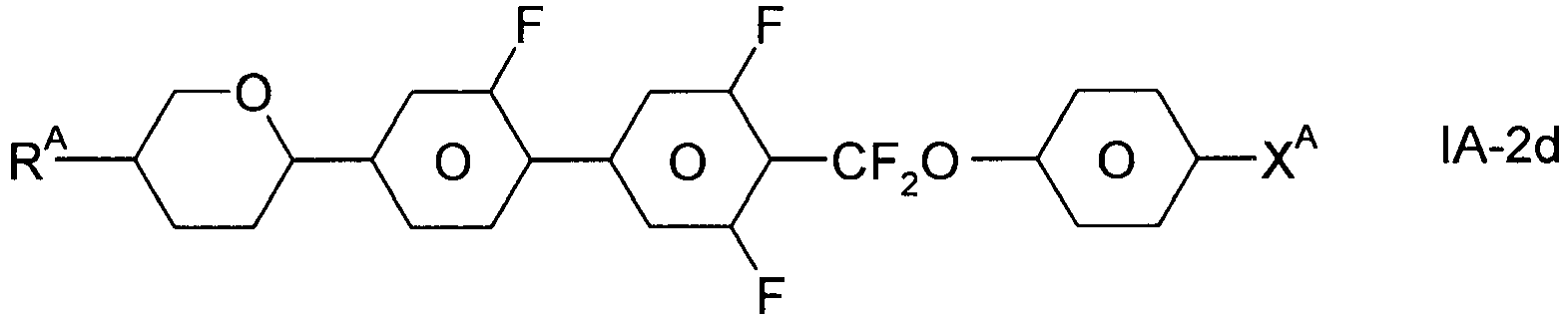


- Liquid-crystalline medium according to one or more of Claims 1 to 3, characterised in that XA in formula IA denotes F, OCF3, OCHF2, CF3, OCHF2, OCHFCF3, OCF2CHFCF3, CF=CF2, CH=CF2, OCF=CF2 or OCH=CF2.
- Liquid-crystalline medium according to one or more of Claims 1 to 4, characterised in that it contains one or more compounds of the formula IIA-1 to IIC-6,














- Liquid-crystalline medium according to one or more of Claims 1 to 5, characterised in that it additionally contains one or more compounds selected from the formulae III and/or IV,

 R0 denotes a halogenated or unsubstituted alkyl or alkoxy radical having 1 to 15 C atoms, where, in addition, one or more CH2 groups in these radicals may each be replaced, independently of one another, by -C≡C-, -CF2O-, -CH=CH-,
 X0 denotes F, Cl, CN, SF5, SCN, NCS, a halogenated alkyl radical, a halogenated alkenyl radical, a halogenated alkoxy radical or a halogenated alkenyloxy radical, each having up to 6 C atoms, andY1-6 each, independently of one another, denote H or F,

- Liquid-crystalline medium according to one or more of Claims 1 to 6, characterised in that it additionally contains one or more compounds selected from the formulae V to IX,


 R0 denotes a halogenated or unsubstituted alkyl or alkoxy radical having 1 to 15 C atoms, where, in addition, one or more CH2 groups in these radicals may each be replaced, independently of one another, by -C≡C-, -CF2O- -O-,
 X0 denotes F, Cl, CN, SF5, SCN, NCS, a halogenated alkyl radical, a halogenated alkenyl radical, a halogenated alkoxy radical or a halogenated alkenyloxy radical having up to 6 C atoms,Y1-4 each, independently of one another, denote H or F,Z0 denotes -C2H4-, -(CH2)4-, -CH=CH-, -CF=CF-, -C2F4-, -CH2CF2-, -CF2CH2-, -CH2O-, -OCH2-, -COO- or -OCF2-, in formula VI and VII also a single bond and in formula VI and IX also -CF2O-,r denotes 0 or 1, ands denotes 0 or 1.
 - Liquid-crystalline medium according to one or more of Claims 1 to 7, characterised in that it additionally contains one or more compounds selected from the formulae X to XIII,


 L denotes H or F,"alkyl" denotes C1-6-alkyl,R' denotes C1-6-alkyl, C1-6-alkoxy or C2-6-alkenyl, and"alkenyl" and "alkenyl*" each, independently of one another, denote C2-6-alkenyl.
 - Liquid-crystalline medium according to one or more of Claims 1 to 8, characterised in that it additionally contains one or more compounds selected from the formulae Xa, Xb, Xc, Xd, Xe, XIa, XIb, XIIa and XIIIa:


(O)alkyl* denotes alkyl* or O-alkyl* (=alkoxy). - Liquid-crystalline medium according to one or more of Claims 1 to 9, characterised in that it additionally contains one or more compounds of the formula XIV,

- Liquid-crystalline medium according to one or more of Claims 1 to 10, characterised in that it additionally contains one or more compounds of the formula XVII,

- Liquid-crystalline medium according to one or more of Claims 1 to 11, characterised in that it contains one or more compounds selected from the group of the compounds of the formulae XXVIII to XXXI,


- Liquid-crystalline medium according to one or more of Claims 1 to 12, characterised in that it contains one or more compounds selected from the group of the compounds of the formulae XIX, XX, XXI, XXII, XXIII and XXIV,


- Liquid-crystalline medium according to one or more of Claims 1 to 13, characterised in that it contains ≥ 20 % by weight of the compound of the formula Xb,

- Liquid-crystalline medium according to one or more of Claims 1 to 14, characterised in that it has a dielectric anisotropy (Δε) of > 1.5 at 20 °C and 1 kHz.
- Liquid-crystalline medium according to one or more of Claims 1 to 15, characterised in that it additionally contains one or more additive(s) selected from the group of the UV stabilisers, dopants and antioxidants.
- Liquid-crystalline medium according to one or more of Claims 1 to 16, characterised in that the additive(s) is selected from


- Liquid-crystalline medium according to one or more of Claims 1 to 17, characterised in that it additionally contains one or more polymerisable compounds.
- Liquid-crystalline medium according to one or more of Claims 1 to 18, characterised in that the polymerisable compound is selected from RM-1 to RM-86:











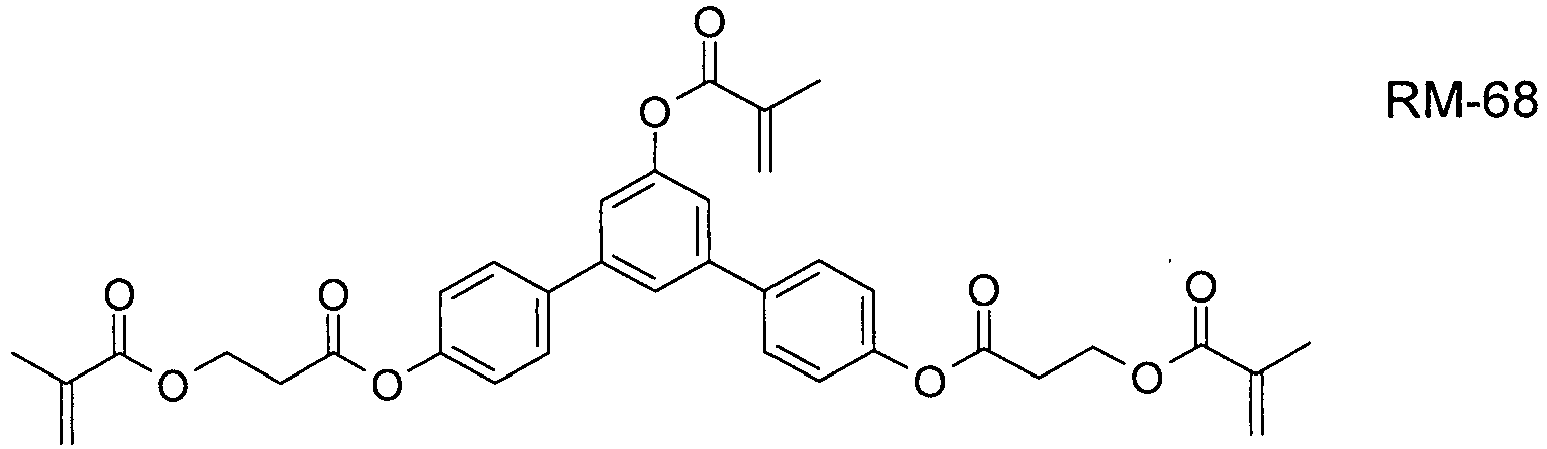

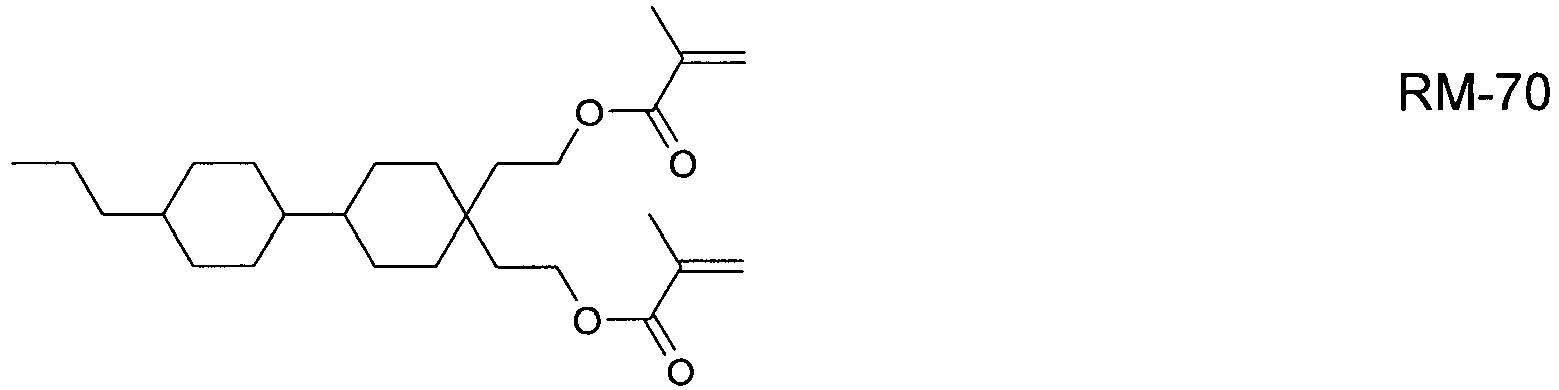


- Process for the preparation of a liquid-crystalline medium according to one or more of Claims 1 to 19, characterised in that one or more compounds of the formula IA and one or more compounds selected from the group of compounds of the formula IIA, IIB and IIC as defined in Claim 1, are mixed with one or more mesogenic compounds and optionally also with one or more additives and/or at least one polymerisable compound.
- Use of a liquid-crystalline medium according to one or more of Claims 1 to 19 for electro-optical purposes.
- Use of the liquid-crystalline medium according to Claim 21 in shutter glasses, for 3D applications, in TN, PS-TN, STN, TN-TFT, OCB, IPS, PS-IPS, FFS, PS-FFS and PS-VA-IPS displays.
- Electro-optical liquid-crystal display containing a liquid-crystalline medium according to one or more of Claims 1 to 19.
Priority Applications (1)
| Application Number | Priority Date | Filing Date | Title |
|---|---|---|---|
| EP13000511.9A EP2628779B1 (en) | 2012-02-15 | 2013-02-01 | Liquid-crystalline medium |
Applications Claiming Priority (2)
| Application Number | Priority Date | Filing Date | Title |
|---|---|---|---|
| EP12001001 | 2012-02-15 | ||
| EP13000511.9A EP2628779B1 (en) | 2012-02-15 | 2013-02-01 | Liquid-crystalline medium |
Publications (3)
| Publication Number | Publication Date |
|---|---|
| EP2628779A2 EP2628779A2 (en) | 2013-08-21 |
| EP2628779A3 EP2628779A3 (en) | 2014-04-23 |
| EP2628779B1 true EP2628779B1 (en) | 2017-05-17 |
Family
ID=47631251
Family Applications (1)
| Application Number | Title | Priority Date | Filing Date |
|---|---|---|---|
| EP13000511.9A Active EP2628779B1 (en) | 2012-02-15 | 2013-02-01 | Liquid-crystalline medium |
Country Status (7)
| Country | Link |
|---|---|
| US (1) | US20130207038A1 (en) |
| EP (1) | EP2628779B1 (en) |
| JP (3) | JP6787646B2 (en) |
| KR (1) | KR102146716B1 (en) |
| CN (2) | CN106085460B (en) |
| GB (2) | GB201301786D0 (en) |
| TW (2) | TWI637047B (en) |
Cited By (2)
| Publication number | Priority date | Publication date | Assignee | Title |
|---|---|---|---|---|
| US11739267B2 (en) | 2019-06-28 | 2023-08-29 | Merck Patent Gmbh | LC medium |
| US11891557B2 (en) | 2017-09-14 | 2024-02-06 | Merck Patent Gmbh | Isothiocyanato tolane derivatives |
Families Citing this family (131)
| Publication number | Priority date | Publication date | Assignee | Title |
|---|---|---|---|---|
| DE102012024126A1 (en) | 2011-12-20 | 2013-06-20 | Merck Patent Gmbh | Liquid crystalline medium |
| TWI638035B (en) * | 2012-09-24 | 2018-10-11 | 捷恩智股份有限公司 | Liquid crystal display element, and liquid crystal composition and use thereof |
| DE102012020939B4 (en) * | 2012-10-25 | 2014-12-11 | Merck Patent Gmbh | Liquid-crystalline medium and its use in an electro-optical liquid crystal display |
| US9441160B2 (en) | 2012-12-27 | 2016-09-13 | Dic Corporation | Fluorobiphenyl-containing composition |
| JP5719445B2 (en) * | 2013-03-01 | 2015-05-20 | Dic株式会社 | Liquid crystal composition and liquid crystal display device using the same |
| EP2899250B1 (en) | 2013-03-06 | 2017-10-25 | DIC Corporation | Liquid crystal composition and liquid crystal display element using same |
| JP5878556B2 (en) * | 2013-03-25 | 2016-03-08 | Dic株式会社 | Liquid crystal composition and liquid crystal display device using the same |
| CN105051157A (en) * | 2013-03-25 | 2015-11-11 | Dic株式会社 | Liquid crystal composition and liquid crystal display element using same |
| JP2014215347A (en) * | 2013-04-23 | 2014-11-17 | Jnc株式会社 | Liquid crystal panel |
| CN104293357B (en) * | 2013-07-16 | 2016-06-29 | 江苏和成显示科技股份有限公司 | There is liquid-crystal composition and the display device thereof of high permeability |
| KR102252761B1 (en) * | 2013-08-02 | 2021-05-18 | 메르크 파텐트 게엠베하 | Liquid-crystalline medium |
| CN104419428B (en) * | 2013-08-26 | 2016-08-10 | 江苏和成显示科技股份有限公司 | Polymerizable liquid crystal composition and liquid crystal display device thereof |
| US20160194560A1 (en) * | 2013-09-12 | 2016-07-07 | Dic Corporation | Composition and liquid crystal display element using same |
| WO2015037519A1 (en) * | 2013-09-12 | 2015-03-19 | Dic株式会社 | Composition and liquid crystal display element using same |
| JP2015074701A (en) * | 2013-10-08 | 2015-04-20 | Dic株式会社 | Composition and liquid crystal display device using the same |
| WO2015056644A1 (en) * | 2013-10-15 | 2015-04-23 | Dic株式会社 | Liquid crystal display element |
| US10294424B2 (en) | 2013-11-18 | 2019-05-21 | Jnc Corporation | Liquid crystal composition and liquid crystal display device |
| JPWO2015098233A1 (en) * | 2013-12-26 | 2017-03-23 | Jnc株式会社 | Liquid crystal composition and liquid crystal display element |
| CN103740377B (en) * | 2013-12-27 | 2015-05-20 | 北京八亿时空液晶科技股份有限公司 | Liquid crystal composition and application thereof |
| CN103756686B (en) * | 2013-12-30 | 2015-11-25 | 北京八亿时空液晶科技股份有限公司 | A kind of High-contrast liquid crystal composition and application thereof |
| CN104845641A (en) * | 2014-01-26 | 2015-08-19 | 江苏和成显示科技股份有限公司 | Liquid crystal composition and display component using same |
| EP2921545B1 (en) * | 2014-03-21 | 2019-08-21 | Merck Patent GmbH | Polymerisable compounds and the use thereof in liquid-crystal displays |
| DE102015004479A1 (en) * | 2014-04-22 | 2015-10-22 | Merck Patent Gmbh | Liquid crystalline medium |
| CN104232105A (en) * | 2014-08-18 | 2014-12-24 | 京东方科技集团股份有限公司 | Liquid crystal mixture, liquid crystal display panel and liquid crystal display device |
| EP2993216B1 (en) * | 2014-09-02 | 2017-07-26 | Merck Patent GmbH | Compounds and liquid crystalline medium |
| CN106715648A (en) * | 2014-10-09 | 2017-05-24 | Dic株式会社 | Composition and liquid crystal display element using same |
| JP5979465B1 (en) * | 2014-10-09 | 2016-08-24 | Dic株式会社 | Composition and liquid crystal display device using the same |
| CN104371745B (en) * | 2014-10-24 | 2017-03-29 | 石家庄诚志永华显示材料有限公司 | A kind of liquid-crystal composition |
| KR20160052898A (en) | 2014-10-29 | 2016-05-13 | 삼성디스플레이 주식회사 | Liquid crystal compositon and liquid crystal display device including the same |
| CN107109225A (en) * | 2014-10-31 | 2017-08-29 | 默克专利股份有限公司 | Liquid crystal media and the high frequency assembly comprising it |
| CN107001939A (en) * | 2014-12-16 | 2017-08-01 | 捷恩智株式会社 | Liquid-crystal composition and liquid crystal display cells |
| CN104498055B (en) * | 2014-12-31 | 2017-01-11 | 石家庄诚志永华显示材料有限公司 | Liquid crystal composition |
| CN104498054B (en) * | 2014-12-31 | 2017-02-22 | 石家庄诚志永华显示材料有限公司 | Liquid crystal medium and liquid crystal display including same |
| CN104560057B (en) * | 2014-12-31 | 2016-09-07 | 石家庄诚志永华显示材料有限公司 | Liquid-crystal composition |
| EP3067405B1 (en) * | 2015-03-10 | 2019-03-27 | Merck Patent GmbH | Liquid crystalline medium |
| WO2016152340A1 (en) * | 2015-03-24 | 2016-09-29 | Jnc株式会社 | Liquid crystal composition and liquid crystal display element |
| US20180057744A1 (en) * | 2015-03-24 | 2018-03-01 | Jnc Corporation | Liquid crystal composition and liquid crystal display device |
| EP3085753B1 (en) | 2015-04-13 | 2019-04-24 | Merck Patent GmbH | Fluorinated dibenzofurane derivatives and dibenzothiophene derivatives |
| EP3081620B1 (en) | 2015-04-13 | 2020-04-01 | Merck Patent GmbH | Liquid-crystalline medium and liquid-crystal display comprising the same |
| CN106147791B (en) * | 2015-04-23 | 2017-10-24 | 江苏和成显示科技股份有限公司 | Liquid-crystal composition and liquid crystal display cells with good light and thermally stable |
| KR102312261B1 (en) | 2015-04-30 | 2021-10-13 | 삼성디스플레이 주식회사 | Liquid crystal composition and liquid crystal display including the same |
| WO2016177445A1 (en) * | 2015-05-04 | 2016-11-10 | Merck Patent Gmbh | Liquid-crystal medium |
| DE102016005083A1 (en) * | 2015-05-13 | 2016-11-17 | Merck Patent Gmbh | Liquid crystalline medium |
| EP3095834B9 (en) * | 2015-05-21 | 2019-09-04 | Merck Patent GmbH | Liquid-crystalline medium and liquid-crystal display comprising the same |
| EP3112440B1 (en) * | 2015-07-02 | 2019-07-24 | Merck Patent GmbH | Liquid-crystal medium |
| DE102016007042A1 (en) * | 2015-07-03 | 2017-01-05 | Merck Patent Gmbh | Liquid-crystalline medium and liquid-crystal display |
| KR102350511B1 (en) | 2015-07-10 | 2022-01-12 | 삼성디스플레이 주식회사 | Liquid crystal composition and liquid crystal display including the same |
| US11884862B2 (en) * | 2015-08-05 | 2024-01-30 | Merck Patent Gmbh | Liquid-crystalline medium |
| CN105131975B (en) * | 2015-09-02 | 2017-11-10 | 石家庄诚志永华显示材料有限公司 | A kind of positive and negative mixed liquid crystal composition |
| CN106554783B (en) * | 2015-09-25 | 2019-05-21 | 北京八亿时空液晶科技股份有限公司 | A kind of liquid-crystal composition and its application with high transmittance |
| CN105199745A (en) * | 2015-09-30 | 2015-12-30 | 石家庄诚志永华显示材料有限公司 | Positive-negative-mixed liquid crystal composition |
| CN105199746A (en) * | 2015-09-30 | 2015-12-30 | 石家庄诚志永华显示材料有限公司 | Liquid crystal composition with high UV (ultraviolet) stability |
| CN105295955A (en) * | 2015-09-30 | 2016-02-03 | 石家庄诚志永华显示材料有限公司 | Positive and negative mixed liquid crystal composition |
| CN105602577B (en) * | 2016-01-28 | 2017-07-07 | 石家庄诚志永华显示材料有限公司 | Positive dielectric anisotropy liquid crystal composition and its liquid crystal display cells or liquid crystal display |
| CN105670649B (en) * | 2016-02-29 | 2017-12-08 | 北京市金讯阳光电子材料科技有限公司 | A kind of liquid-crystal composition and its application with high transmittance |
| WO2017154680A1 (en) * | 2016-03-10 | 2017-09-14 | シャープ株式会社 | Liquid crystal display device |
| CN107189791B (en) * | 2016-03-15 | 2020-10-27 | 北京八亿时空液晶科技股份有限公司 | Positive and negative mixed liquid crystal composition and application thereof |
| CN107189792B (en) * | 2016-03-15 | 2019-07-19 | 北京八亿时空液晶科技股份有限公司 | A kind of positive and negative mixed liquid crystal composition and its application |
| EP3228681B1 (en) * | 2016-04-07 | 2018-11-14 | Merck Patent GmbH | Liquid-crystalline medium and liquid-crystal display comprising the same |
| US11186773B2 (en) | 2016-04-13 | 2021-11-30 | Nitto Denko Corporation | Liquid crystal compositions, mixtures, elements, and dimmable devices |
| CN107418595B (en) * | 2016-05-23 | 2019-09-20 | 北京八亿时空液晶科技股份有限公司 | A kind of negative dielectric anisotropy liquid crystal composition containing terphenyl structure and its application |
| CN107586546B (en) * | 2016-07-08 | 2021-06-04 | 江苏和成显示科技有限公司 | Liquid crystal composition and display device |
| CN107619669A (en) * | 2016-07-15 | 2018-01-23 | 北京八亿时空液晶科技股份有限公司 | A kind of liquid-crystal composition and its application with fast-response |
| WO2018031410A2 (en) | 2016-08-04 | 2018-02-15 | Nitto Denko Corporation | Heterocyclic liquid crystal composition, reverse-mode polymer dispersed liquid crystal element, and associated selectively dimmable device |
| EP3299438B1 (en) * | 2016-09-23 | 2020-01-15 | Merck Patent GmbH | Liquid-crystalline medium and liquid-crystal display comprising the same |
| WO2018073151A1 (en) | 2016-10-17 | 2018-04-26 | Merck Patent Gmbh | Liquid-crystalline medium, liquid crystal compound and liquid-crystal display comprising the same |
| EP3533855A4 (en) * | 2016-10-27 | 2020-06-03 | JNC Corporation | Liquid crystal composition for light control use, and liquid crystal light-controlling element |
| KR102512438B1 (en) | 2016-11-18 | 2023-03-21 | 메르크 파텐트 게엠베하 | Liquid crystal medium and liquid crystal display including the same |
| CN108219802B (en) * | 2016-12-14 | 2021-11-02 | 江苏和成显示科技有限公司 | Liquid crystal composition and application thereof |
| EP3345985A1 (en) * | 2017-01-09 | 2018-07-11 | Merck Patent GmbH | Liquid-crystalline medium |
| EP3375842A1 (en) | 2017-03-16 | 2018-09-19 | Merck Patent GmbH | Liquid-crystalline medium |
| EP3421570B1 (en) * | 2017-06-30 | 2020-11-11 | Merck Patent GmbH | Liquid-crystalline medium and liquid-crystal display comprising the same |
| CN107384439A (en) | 2017-07-27 | 2017-11-24 | 默克专利股份有限公司 | Liquid crystal media and the liquid crystal display for including it |
| WO2019026621A1 (en) * | 2017-08-02 | 2019-02-07 | Jnc株式会社 | Liquid crystal composite and liquid crystal light control element |
| US11001757B2 (en) | 2017-08-04 | 2021-05-11 | Nitto Denko Corporation | Heterocyclic liquid crystal composition, reverse-mode polymer dispersed liquid crystal element, and selectively dimmable device |
| WO2019048444A1 (en) | 2017-09-08 | 2019-03-14 | Merck Patent Gmbh | Liquid-crystalline medium and liquid-crystal display comprising the same |
| WO2019052973A1 (en) | 2017-09-14 | 2019-03-21 | Merck Patent Gmbh | Dibenzofuran and dibenzothiophene derivatives |
| KR102677218B1 (en) | 2017-09-26 | 2024-06-21 | 메르크 파텐트 게엠베하 | Liquid-crystalline medium and liquid-crystal display comprising the same |
| CN109575940B (en) * | 2017-09-28 | 2022-10-21 | 江苏和成显示科技有限公司 | Liquid crystal composition and liquid crystal display device thereof |
| CN107603641B (en) * | 2017-09-30 | 2023-03-31 | 石家庄诚志永华显示材料有限公司 | High vertical dielectric liquid crystal composition and liquid crystal display device |
| CN111315847A (en) | 2017-10-18 | 2020-06-19 | 默克专利股份有限公司 | Liquid crystal medium and liquid crystal display comprising same |
| CN109913237A (en) * | 2017-12-12 | 2019-06-21 | 北京八亿时空液晶科技股份有限公司 | A kind of high transmittance liquid crystal composition and its application |
| CN109913236B (en) * | 2017-12-12 | 2021-01-26 | 北京八亿时空液晶科技股份有限公司 | High-transmittance liquid crystal composition containing dioxygen heterocyclic compound and application thereof |
| CN109913239B (en) * | 2017-12-12 | 2021-01-26 | 北京八亿时空液晶科技股份有限公司 | Positive and negative mixed liquid crystal composition and application thereof |
| JP7172069B2 (en) * | 2018-03-13 | 2022-11-16 | Jnc株式会社 | Liquid crystal composition and liquid crystal display element |
| CN113563899B (en) * | 2018-06-05 | 2023-03-24 | 晶美晟光电材料(南京)有限公司 | Positive polarity liquid crystal composition with high penetration rate and application thereof |
| US11447703B2 (en) | 2018-06-29 | 2022-09-20 | Merck Patent Gmbh | Thiophene compound, liquid-crystalline medium and liquid-crystal display comprising the same |
| EP4279565B1 (en) | 2018-07-12 | 2025-08-27 | Merck Patent GmbH | Thiophene compound, liquid-crystalline medium and liquid-crystal display comprising the same |
| CN111117657B (en) * | 2018-10-30 | 2022-02-11 | 江苏和成显示科技有限公司 | Liquid crystal composition and liquid crystal display device thereof |
| CN111117661B (en) * | 2018-10-30 | 2022-02-11 | 江苏和成显示科技有限公司 | Liquid crystal composition and liquid crystal display device thereof |
| CN111117645B (en) * | 2018-10-30 | 2022-01-18 | 江苏和成显示科技有限公司 | Liquid crystal composition with high transmittance and liquid crystal display device thereof |
| CN111117663B (en) | 2018-10-30 | 2022-02-11 | 江苏和成显示科技有限公司 | Liquid crystal composition and liquid crystal display device thereof |
| CN111117649B (en) * | 2018-10-30 | 2022-02-22 | 江苏和成显示科技有限公司 | Liquid crystal composition and display device thereof |
| CN111117652B (en) * | 2018-10-30 | 2023-03-31 | 江苏和成显示科技有限公司 | Liquid crystal composition and display device thereof |
| CN111117646B (en) * | 2018-10-30 | 2023-01-10 | 江苏和成显示科技有限公司 | Liquid crystal composition and display device thereof |
| CN111117653A (en) * | 2018-10-30 | 2020-05-08 | 江苏和成显示科技有限公司 | Liquid crystal composition and liquid crystal display device thereof |
| CN111117662B (en) * | 2018-10-30 | 2022-01-18 | 江苏和成显示科技有限公司 | Liquid crystal composition and liquid crystal display device thereof |
| CN111117650B (en) * | 2018-10-30 | 2022-01-18 | 江苏和成显示科技有限公司 | Liquid crystal composition and display device thereof |
| CN111117656A (en) * | 2018-10-30 | 2020-05-08 | 江苏和成显示科技有限公司 | Liquid crystal composition and liquid crystal display device thereof |
| CN111117651B (en) * | 2018-10-30 | 2022-02-22 | 江苏和成显示科技有限公司 | Liquid crystal composition and display device thereof |
| CN111117664B (en) * | 2018-10-30 | 2022-01-18 | 江苏和成显示科技有限公司 | Liquid crystal composition and liquid crystal display device thereof |
| EP3877484B1 (en) | 2018-11-07 | 2023-09-13 | Merck Patent GmbH | Liquid-crystalline medium and liquid-crystal display comprising the same |
| EP3898891A1 (en) | 2018-12-19 | 2021-10-27 | Merck Patent GmbH | Liquid-crystalline medium and liquid-crystal display comprising the same and compounds |
| CN112048314B (en) * | 2019-06-06 | 2023-11-14 | 江苏和成显示科技有限公司 | Liquid crystal composition and display device thereof |
| CN112048320B (en) * | 2019-06-06 | 2023-07-18 | 江苏和成显示科技有限公司 | Liquid crystal composition and display device thereof |
| WO2021004868A1 (en) | 2019-07-05 | 2021-01-14 | Merck Patent Gmbh | Liquid-crystalline medium and liquid-crystal display comprising the same and compounds |
| CN110396412B (en) * | 2019-08-06 | 2022-02-08 | 晶美晟光电材料(南京)有限公司 | Liquid crystal composition and application thereof |
| CN112391173B (en) * | 2019-08-14 | 2023-07-18 | 江苏和成显示科技有限公司 | Liquid crystal composition having positive dielectric anisotropy and liquid crystal display device thereof |
| CN112391171B (en) * | 2019-08-14 | 2023-07-18 | 江苏和成显示科技有限公司 | Liquid crystal composition having positive dielectric anisotropy and liquid crystal display device thereof |
| KR102911561B1 (en) | 2019-12-19 | 2026-01-13 | 메르크 파텐트 게엠베하 | Liquid-crystalline medium and liquid-crystal display comprising the same and compound |
| EP4015599A1 (en) | 2019-12-20 | 2022-06-22 | Merck Patent GmbH | Liquid-crystalline medium and liquid-crystal display comprising the same |
| US11359142B2 (en) | 2019-12-20 | 2022-06-14 | Merck Patent Gmbh | Liquid-crystalline medium and liquid-crystal display comprising the same |
| CN112920811B (en) * | 2019-12-30 | 2023-04-07 | 石家庄诚志永华显示材料有限公司 | Liquid crystal composition, liquid crystal display element and liquid crystal display |
| DE102021000109A1 (en) * | 2020-02-05 | 2021-08-05 | MERCK Patent Gesellschaft mit beschränkter Haftung | LIQUID CRYSTALLINE COMPOUNDS |
| EP4189035A1 (en) | 2020-07-31 | 2023-06-07 | Merck Patent GmbH | Liquid-crystalline medium and liquid-crystal display comprising the same and compounds |
| US12624291B2 (en) | 2020-12-22 | 2026-05-12 | Merck Patent Gmbh | Liquid-crystalline medium and liquid-crystal display comprising the same and compounds |
| CN115197716A (en) | 2021-04-13 | 2022-10-18 | 默克专利股份有限公司 | liquid crystal medium |
| CN115678568B (en) * | 2021-07-22 | 2025-04-25 | 江苏和成显示科技有限公司 | Liquid crystal composition and liquid crystal display device containing the same |
| KR20230017123A (en) * | 2021-07-27 | 2023-02-03 | 제이엔씨 주식회사 | Liquid crystal composition and liquid crystal display device |
| CN114196423A (en) * | 2021-12-27 | 2022-03-18 | 苏州汉朗光电有限公司 | Liquid crystal composition containing positive and negative liquid crystal compounds and application thereof |
| EP4499777A1 (en) | 2022-03-25 | 2025-02-05 | Merck Patent GmbH | Liquid crystalline medium |
| US20260028530A1 (en) * | 2022-07-20 | 2026-01-29 | Merck Patent Gmbh | Liquid crystalline medium |
| CN115537210A (en) * | 2022-09-30 | 2022-12-30 | 重庆汉朗精工科技有限公司 | A kind of positive and negative mixed liquid crystal composition and its application |
| CN117304944A (en) * | 2023-02-20 | 2023-12-29 | 重庆汉朗精工科技有限公司 | Positive and negative mixed liquid crystal composition and application thereof |
| CN116286026B (en) * | 2023-02-20 | 2026-01-02 | 重庆汉朗精工科技有限公司 | A liquid crystal composition with high birefringence and high reliability |
| CN116904209B (en) * | 2023-06-09 | 2025-02-18 | 重庆汉朗精工科技有限公司 | Polymerizable liquid crystal composition and display device thereof |
| CN116904206B (en) * | 2023-06-09 | 2025-02-18 | 重庆汉朗精工科技有限公司 | Negative liquid crystal composition and display device thereof |
| CN116904208B (en) * | 2023-06-09 | 2025-02-18 | 重庆汉朗精工科技有限公司 | Liquid crystal composition and display device thereof |
| CN116904205A (en) * | 2023-06-09 | 2023-10-20 | 重庆汉朗精工科技有限公司 | Negative dielectric liquid crystal composition and display device thereof |
| CN116970407B (en) * | 2023-06-09 | 2025-02-18 | 重庆汉朗精工科技有限公司 | Dielectric negative liquid crystal composition and display device thereof |
| CN116904207B (en) * | 2023-06-09 | 2025-02-18 | 重庆汉朗精工科技有限公司 | Liquid crystal composition and display device thereof |
Family Cites Families (34)
| Publication number | Priority date | Publication date | Assignee | Title |
|---|---|---|---|---|
| DE3022818C2 (en) | 1980-06-19 | 1986-11-27 | Merck Patent Gmbh, 6100 Darmstadt | Liquid crystal display element |
| US5273680A (en) | 1988-03-10 | 1993-12-28 | Merck Patent Gesellschaft Mit Beschrankter Haftung | Fluorinated oligophenyls and their use in liquid crystal materials |
| DE3807872A1 (en) | 1988-03-10 | 1989-09-21 | Merck Patent Gmbh | DIFLUORBENZENE DERIVATIVES |
| US5387369A (en) * | 1988-10-20 | 1995-02-07 | Merck Patent Gesellschaft Mit Beschrankter Haftung | Supertwist liquid crystal display |
| TW343232B (en) | 1994-10-13 | 1998-10-21 | Chisso Corp | Difluorooxymethane derivative and liquid crystal composition |
| DE69713339T2 (en) * | 1996-04-02 | 2002-12-05 | Chisso Corp., Osaka | LIQUID CRYSTAL COMPOUNDS, PREPARATIONS CONTAINING LIQUID CRYSTALS, AND LIQUID CRYSTAL DISPLAYS MADE FROM THESE COMPOUNDS |
| EP0959061A4 (en) * | 1996-11-25 | 2000-08-23 | Chisso Corp | 3,3'-DIFLUOROBIPHENYL DERIVATIVES, LIQUID CRYSTAL COMPOSITIONS, AND LIQUID CRYSTAL DISPLAY ELEMENTS |
| JP4333032B2 (en) * | 1997-10-24 | 2009-09-16 | チッソ株式会社 | 2,3-difluorophenyl derivative having negative dielectric anisotropy, liquid crystal composition, and liquid crystal display device |
| JP2002156619A (en) * | 2000-11-21 | 2002-05-31 | Chisso Corp | Liquid crystal display device |
| JP4244556B2 (en) * | 2001-03-30 | 2009-03-25 | チッソ株式会社 | Liquid crystalline compound having bis (trifluoromethyl) phenyl ring, liquid crystal composition and liquid crystal display device |
| CN1204445C (en) | 2002-02-04 | 2005-06-01 | 富士通显示技术株式会社 | Liquid crystal display device and manufacturing method thereof |
| EP1378557B1 (en) | 2002-07-06 | 2007-02-21 | MERCK PATENT GmbH | Liquid crystalline medium |
| JP4161663B2 (en) * | 2002-09-27 | 2008-10-08 | チッソ株式会社 | Liquid crystalline compounds, liquid crystal compositions and liquid crystal display devices having difluoromethyl and trifluoromethyl groups on the benzene ring |
| ATE374232T1 (en) | 2002-11-27 | 2007-10-15 | Merck Patent Gmbh | LIQUID CRYSTALLINE COMPOUNDS |
| JP4225064B2 (en) * | 2003-01-14 | 2009-02-18 | チッソ株式会社 | Compound having bis (trifluoromethyl) vinyl group, liquid crystal composition, and liquid crystal display device |
| DE102004008638A1 (en) * | 2003-03-05 | 2004-09-16 | Merck Patent Gmbh | Liquid crystal medium for electrooptical, e.g. matrix or (super)twisted nematic, display, contains 4-(trans-4-cyclohexyl)-cyclohexyl-difluoromethyl and 4-(4'-ring substituted biphenylyl)-difluoromethyl phenyl ether compounds |
| DE102004006669A1 (en) * | 2003-03-06 | 2004-09-16 | Merck Patent Gmbh | Liquid crystal medium, useful in liquid crystal displays, is based on a mixture of polar compounds having a positive dielectric anisotropy and contains at least one difluorinated aryl compound and at least one fluorinated aryl compound |
| KR101208150B1 (en) * | 2003-12-04 | 2012-12-04 | 메르크 파텐트 게엠베하 | Liquid crystal medium |
| JP5145711B2 (en) * | 2004-04-01 | 2013-02-20 | Jnc株式会社 | Benzene derivative, liquid crystal composition, and liquid crystal display device |
| WO2007118623A1 (en) * | 2006-04-13 | 2007-10-25 | Merck Patent Gmbh | Liquid-crystalline medium |
| DE102007007143A1 (en) * | 2006-10-04 | 2008-04-10 | Merck Patent Gmbh | Liquid crystalline medium |
| KR20080077468A (en) * | 2007-02-20 | 2008-08-25 | 삼성전자주식회사 | Liquid crystal composition and liquid crystal display comprising the same |
| EP2144975B1 (en) * | 2007-05-16 | 2010-10-27 | Merck Patent GmbH | Liquid- crystalline medium |
| US8940375B2 (en) * | 2007-07-30 | 2015-01-27 | Merck Patent Gmbh | Liquid-crystal display |
| US8114310B2 (en) * | 2007-10-22 | 2012-02-14 | Merck Patent Gmbh | Liquid-crystal display |
| DE102008024866A1 (en) * | 2007-12-21 | 2009-06-25 | Merck Patent Gmbh | Liquid crystalline medium |
| EP2692826B1 (en) * | 2008-06-27 | 2016-04-13 | Merck Patent GmbH | Liquid-crystalline medium |
| JP5847580B2 (en) * | 2008-07-28 | 2016-01-27 | メルク パテント ゲゼルシャフト ミット ベシュレンクテル ハフツングMerck Patent Gesellschaft mit beschraenkter Haftung | Liquid crystal display |
| WO2010017868A1 (en) * | 2008-08-11 | 2010-02-18 | Merck Patent Gmbh | Liquid-crystalline medium |
| DE102009034301A1 (en) * | 2009-07-21 | 2011-01-27 | Merck Patent Gmbh | Liquid-crystalline medium and high-frequency components containing the same |
| DE102011009691A1 (en) * | 2010-02-09 | 2011-08-11 | Merck Patent GmbH, 64293 | Liquid crystalline medium |
| DE102011009337A1 (en) * | 2010-02-15 | 2011-08-18 | Merck Patent GmbH, 64293 | Liquid crystalline medium |
| JP5712510B2 (en) * | 2010-06-18 | 2015-05-07 | Jnc株式会社 | Compound having 5-membered ring, liquid crystal composition, and liquid crystal display device |
| CN103261371B (en) * | 2010-12-17 | 2015-11-25 | 默克专利股份有限公司 | Liquid crystal media |
-
2013
- 2013-02-01 GB GBGB1301786.8A patent/GB201301786D0/en not_active Ceased
- 2013-02-01 EP EP13000511.9A patent/EP2628779B1/en active Active
- 2013-02-07 GB GB1302184.5A patent/GB2499513B/en not_active Expired - Fee Related
- 2013-02-08 TW TW106101552A patent/TWI637047B/en active
- 2013-02-08 CN CN201610447504.7A patent/CN106085460B/en active Active
- 2013-02-08 CN CN201310158999.8A patent/CN103320142B/en active Active
- 2013-02-08 TW TW102105205A patent/TWI628268B/en active
- 2013-02-11 US US13/763,741 patent/US20130207038A1/en not_active Abandoned
- 2013-02-14 JP JP2013026370A patent/JP6787646B2/en active Active
- 2013-02-14 KR KR1020130015914A patent/KR102146716B1/en active Active
-
2018
- 2018-11-05 JP JP2018208104A patent/JP7085966B2/en active Active
-
2020
- 2020-03-02 JP JP2020034656A patent/JP2020105524A/en active Pending
Cited By (2)
| Publication number | Priority date | Publication date | Assignee | Title |
|---|---|---|---|---|
| US11891557B2 (en) | 2017-09-14 | 2024-02-06 | Merck Patent Gmbh | Isothiocyanato tolane derivatives |
| US11739267B2 (en) | 2019-06-28 | 2023-08-29 | Merck Patent Gmbh | LC medium |
Also Published As
| Publication number | Publication date |
|---|---|
| TW201718831A (en) | 2017-06-01 |
| EP2628779A3 (en) | 2014-04-23 |
| GB201302184D0 (en) | 2013-03-27 |
| TWI637047B (en) | 2018-10-01 |
| JP2013166936A (en) | 2013-08-29 |
| GB2499513B (en) | 2015-02-11 |
| JP6787646B2 (en) | 2020-11-18 |
| CN106085460B (en) | 2019-11-12 |
| KR20130094251A (en) | 2013-08-23 |
| TW201335343A (en) | 2013-09-01 |
| KR102146716B1 (en) | 2020-08-21 |
| US20130207038A1 (en) | 2013-08-15 |
| CN103320142A (en) | 2013-09-25 |
| JP2020105524A (en) | 2020-07-09 |
| CN106085460A (en) | 2016-11-09 |
| GB2499513A (en) | 2013-08-21 |
| TWI628268B (en) | 2018-07-01 |
| CN103320142B (en) | 2017-06-13 |
| JP7085966B2 (en) | 2022-06-17 |
| EP2628779A2 (en) | 2013-08-21 |
| JP2019052313A (en) | 2019-04-04 |
| GB201301786D0 (en) | 2013-03-20 |
Similar Documents
| Publication | Publication Date | Title |
|---|---|---|
| US11279879B2 (en) | Liquid-crystalline medium | |
| KR102146716B1 (en) | Liquid-crystalline medium | |
| US8486298B2 (en) | Liquid-crystalline medium | |
| US8795552B2 (en) | Liquid-crystalline medium | |
| US8834744B2 (en) | Liquid-crystalline medium | |
| US7595101B2 (en) | Liquid-crystalline medium | |
| CN101235294B (en) | Liquid crystalline medium | |
| EP2288672B1 (en) | Liquid-crystalline medium | |
| EP3130651B1 (en) | Liquid-crystalline medium | |
| TWI686463B (en) | Liquid-crystalline medium | |
| US7678432B2 (en) | Liquid-crystalline medium | |
| KR102169769B1 (en) | Liquid crystal medium | |
| US20170037315A1 (en) | Liquid-crystalline medium | |
| EP4022009B1 (en) | Lc medium | |
| US10519375B2 (en) | Liquid-crystal medium | |
| US20180223187A1 (en) | Liquid crystal medium | |
| US9376622B2 (en) | Liquid-crystalline medium |
Legal Events
| Date | Code | Title | Description |
|---|---|---|---|
| PUAI | Public reference made under article 153(3) epc to a published international application that has entered the european phase |
Free format text: ORIGINAL CODE: 0009012 |
|
| 17P | Request for examination filed |
Effective date: 20130201 |
|
| AK | Designated contracting states |
Kind code of ref document: A2 Designated state(s): AL AT BE BG CH CY CZ DE DK EE ES FI FR GB GR HR HU IE IS IT LI LT LU LV MC MK MT NL NO PL PT RO RS SE SI SK SM TR |
|
| AX | Request for extension of the european patent |
Extension state: BA ME |
|
| PUAL | Search report despatched |
Free format text: ORIGINAL CODE: 0009013 |
|
| AK | Designated contracting states |
Kind code of ref document: A3 Designated state(s): AL AT BE BG CH CY CZ DE DK EE ES FI FR GB GR HR HU IE IS IT LI LT LU LV MC MK MT NL NO PL PT RO RS SE SI SK SM TR |
|
| AX | Request for extension of the european patent |
Extension state: BA ME |
|
| RIC1 | Information provided on ipc code assigned before grant |
Ipc: C09K 19/54 20060101ALI20140314BHEP Ipc: C09K 19/06 20060101ALI20140314BHEP Ipc: C09K 19/44 20060101ALI20140314BHEP Ipc: C09K 19/34 20060101ALI20140314BHEP Ipc: C09K 19/30 20060101ALI20140314BHEP Ipc: C09K 19/12 20060101ALI20140314BHEP Ipc: C09K 19/04 20060101ALI20140314BHEP Ipc: C09K 19/20 20060101AFI20140314BHEP |
|
| 17Q | First examination report despatched |
Effective date: 20150908 |
|
| GRAP | Despatch of communication of intention to grant a patent |
Free format text: ORIGINAL CODE: EPIDOSNIGR1 |
|
| INTG | Intention to grant announced |
Effective date: 20160721 |
|
| GRAJ | Information related to disapproval of communication of intention to grant by the applicant or resumption of examination proceedings by the epo deleted |
Free format text: ORIGINAL CODE: EPIDOSDIGR1 |
|
| GRAS | Grant fee paid |
Free format text: ORIGINAL CODE: EPIDOSNIGR3 |
|
| GRAP | Despatch of communication of intention to grant a patent |
Free format text: ORIGINAL CODE: EPIDOSNIGR1 |
|
| INTC | Intention to grant announced (deleted) | ||
| INTG | Intention to grant announced |
Effective date: 20170104 |
|
| GRAA | (expected) grant |
Free format text: ORIGINAL CODE: 0009210 |
|
| AK | Designated contracting states |
Kind code of ref document: B1 Designated state(s): AL AT BE BG CH CY CZ DE DK EE ES FI FR GR HR HU IE IS IT LI LT LU LV MC MK MT NL NO PL PT RO RS SE SI SK SM TR |
|
| RBV | Designated contracting states (corrected) |
Designated state(s): AL AT BE BG CH CY CZ DE DK EE ES FI FR GR HR HU IE IS IT LI LT LU LV MC MK MT NL NO PL PT RO RS SE SI SK SM TR |
|
| REG | Reference to a national code |
Ref country code: CH Ref legal event code: EP |
|
| REG | Reference to a national code |
Ref country code: IE Ref legal event code: FG4D |
|
| REG | Reference to a national code |
Ref country code: AT Ref legal event code: REF Ref document number: 894470 Country of ref document: AT Kind code of ref document: T Effective date: 20170615 |
|
| REG | Reference to a national code |
Ref country code: DE Ref legal event code: R096 Ref document number: 602013021143 Country of ref document: DE |
|
| REG | Reference to a national code |
Ref country code: NL Ref legal event code: MP Effective date: 20170517 |
|
| REG | Reference to a national code |
Ref country code: LT Ref legal event code: MG4D |
|
| REG | Reference to a national code |
Ref country code: AT Ref legal event code: MK05 Ref document number: 894470 Country of ref document: AT Kind code of ref document: T Effective date: 20170517 |
|
| PG25 | Lapsed in a contracting state [announced via postgrant information from national office to epo] |
Ref country code: FI Free format text: LAPSE BECAUSE OF FAILURE TO SUBMIT A TRANSLATION OF THE DESCRIPTION OR TO PAY THE FEE WITHIN THE PRESCRIBED TIME-LIMIT Effective date: 20170517 Ref country code: AT Free format text: LAPSE BECAUSE OF FAILURE TO SUBMIT A TRANSLATION OF THE DESCRIPTION OR TO PAY THE FEE WITHIN THE PRESCRIBED TIME-LIMIT Effective date: 20170517 Ref country code: NO Free format text: LAPSE BECAUSE OF FAILURE TO SUBMIT A TRANSLATION OF THE DESCRIPTION OR TO PAY THE FEE WITHIN THE PRESCRIBED TIME-LIMIT Effective date: 20170817 Ref country code: HR Free format text: LAPSE BECAUSE OF FAILURE TO SUBMIT A TRANSLATION OF THE DESCRIPTION OR TO PAY THE FEE WITHIN THE PRESCRIBED TIME-LIMIT Effective date: 20170517 Ref country code: ES Free format text: LAPSE BECAUSE OF FAILURE TO SUBMIT A TRANSLATION OF THE DESCRIPTION OR TO PAY THE FEE WITHIN THE PRESCRIBED TIME-LIMIT Effective date: 20170517 Ref country code: LT Free format text: LAPSE BECAUSE OF FAILURE TO SUBMIT A TRANSLATION OF THE DESCRIPTION OR TO PAY THE FEE WITHIN THE PRESCRIBED TIME-LIMIT Effective date: 20170517 Ref country code: GR Free format text: LAPSE BECAUSE OF FAILURE TO SUBMIT A TRANSLATION OF THE DESCRIPTION OR TO PAY THE FEE WITHIN THE PRESCRIBED TIME-LIMIT Effective date: 20170818 |
|
| PG25 | Lapsed in a contracting state [announced via postgrant information from national office to epo] |
Ref country code: SE Free format text: LAPSE BECAUSE OF FAILURE TO SUBMIT A TRANSLATION OF THE DESCRIPTION OR TO PAY THE FEE WITHIN THE PRESCRIBED TIME-LIMIT Effective date: 20170517 Ref country code: LV Free format text: LAPSE BECAUSE OF FAILURE TO SUBMIT A TRANSLATION OF THE DESCRIPTION OR TO PAY THE FEE WITHIN THE PRESCRIBED TIME-LIMIT Effective date: 20170517 Ref country code: BG Free format text: LAPSE BECAUSE OF FAILURE TO SUBMIT A TRANSLATION OF THE DESCRIPTION OR TO PAY THE FEE WITHIN THE PRESCRIBED TIME-LIMIT Effective date: 20170817 Ref country code: IS Free format text: LAPSE BECAUSE OF FAILURE TO SUBMIT A TRANSLATION OF THE DESCRIPTION OR TO PAY THE FEE WITHIN THE PRESCRIBED TIME-LIMIT Effective date: 20170917 Ref country code: NL Free format text: LAPSE BECAUSE OF FAILURE TO SUBMIT A TRANSLATION OF THE DESCRIPTION OR TO PAY THE FEE WITHIN THE PRESCRIBED TIME-LIMIT Effective date: 20170517 Ref country code: PL Free format text: LAPSE BECAUSE OF FAILURE TO SUBMIT A TRANSLATION OF THE DESCRIPTION OR TO PAY THE FEE WITHIN THE PRESCRIBED TIME-LIMIT Effective date: 20170517 Ref country code: RS Free format text: LAPSE BECAUSE OF FAILURE TO SUBMIT A TRANSLATION OF THE DESCRIPTION OR TO PAY THE FEE WITHIN THE PRESCRIBED TIME-LIMIT Effective date: 20170517 |
|
| PG25 | Lapsed in a contracting state [announced via postgrant information from national office to epo] |
Ref country code: CZ Free format text: LAPSE BECAUSE OF FAILURE TO SUBMIT A TRANSLATION OF THE DESCRIPTION OR TO PAY THE FEE WITHIN THE PRESCRIBED TIME-LIMIT Effective date: 20170517 Ref country code: RO Free format text: LAPSE BECAUSE OF FAILURE TO SUBMIT A TRANSLATION OF THE DESCRIPTION OR TO PAY THE FEE WITHIN THE PRESCRIBED TIME-LIMIT Effective date: 20170517 Ref country code: SK Free format text: LAPSE BECAUSE OF FAILURE TO SUBMIT A TRANSLATION OF THE DESCRIPTION OR TO PAY THE FEE WITHIN THE PRESCRIBED TIME-LIMIT Effective date: 20170517 Ref country code: DK Free format text: LAPSE BECAUSE OF FAILURE TO SUBMIT A TRANSLATION OF THE DESCRIPTION OR TO PAY THE FEE WITHIN THE PRESCRIBED TIME-LIMIT Effective date: 20170517 Ref country code: EE Free format text: LAPSE BECAUSE OF FAILURE TO SUBMIT A TRANSLATION OF THE DESCRIPTION OR TO PAY THE FEE WITHIN THE PRESCRIBED TIME-LIMIT Effective date: 20170517 |
|
| REG | Reference to a national code |
Ref country code: DE Ref legal event code: R097 Ref document number: 602013021143 Country of ref document: DE |
|
| PG25 | Lapsed in a contracting state [announced via postgrant information from national office to epo] |
Ref country code: SM Free format text: LAPSE BECAUSE OF FAILURE TO SUBMIT A TRANSLATION OF THE DESCRIPTION OR TO PAY THE FEE WITHIN THE PRESCRIBED TIME-LIMIT Effective date: 20170517 Ref country code: IT Free format text: LAPSE BECAUSE OF FAILURE TO SUBMIT A TRANSLATION OF THE DESCRIPTION OR TO PAY THE FEE WITHIN THE PRESCRIBED TIME-LIMIT Effective date: 20170517 |
|
| PLBE | No opposition filed within time limit |
Free format text: ORIGINAL CODE: 0009261 |
|
| STAA | Information on the status of an ep patent application or granted ep patent |
Free format text: STATUS: NO OPPOSITION FILED WITHIN TIME LIMIT |
|
| 26N | No opposition filed |
Effective date: 20180220 |
|
| PG25 | Lapsed in a contracting state [announced via postgrant information from national office to epo] |
Ref country code: SI Free format text: LAPSE BECAUSE OF FAILURE TO SUBMIT A TRANSLATION OF THE DESCRIPTION OR TO PAY THE FEE WITHIN THE PRESCRIBED TIME-LIMIT Effective date: 20170517 |
|
| REG | Reference to a national code |
Ref country code: CH Ref legal event code: PL |
|
| PG25 | Lapsed in a contracting state [announced via postgrant information from national office to epo] |
Ref country code: MC Free format text: LAPSE BECAUSE OF FAILURE TO SUBMIT A TRANSLATION OF THE DESCRIPTION OR TO PAY THE FEE WITHIN THE PRESCRIBED TIME-LIMIT Effective date: 20170517 |
|
| REG | Reference to a national code |
Ref country code: IE Ref legal event code: MM4A |
|
| REG | Reference to a national code |
Ref country code: BE Ref legal event code: MM Effective date: 20180228 |
|
| PG25 | Lapsed in a contracting state [announced via postgrant information from national office to epo] |
Ref country code: CH Free format text: LAPSE BECAUSE OF NON-PAYMENT OF DUE FEES Effective date: 20180228 Ref country code: LI Free format text: LAPSE BECAUSE OF NON-PAYMENT OF DUE FEES Effective date: 20180228 Ref country code: LU Free format text: LAPSE BECAUSE OF NON-PAYMENT OF DUE FEES Effective date: 20180201 |
|
| REG | Reference to a national code |
Ref country code: FR Ref legal event code: ST Effective date: 20181031 |
|
| PG25 | Lapsed in a contracting state [announced via postgrant information from national office to epo] |
Ref country code: IE Free format text: LAPSE BECAUSE OF NON-PAYMENT OF DUE FEES Effective date: 20180201 |
|
| PG25 | Lapsed in a contracting state [announced via postgrant information from national office to epo] |
Ref country code: BE Free format text: LAPSE BECAUSE OF NON-PAYMENT OF DUE FEES Effective date: 20180228 Ref country code: FR Free format text: LAPSE BECAUSE OF NON-PAYMENT OF DUE FEES Effective date: 20180228 |
|
| PG25 | Lapsed in a contracting state [announced via postgrant information from national office to epo] |
Ref country code: MT Free format text: LAPSE BECAUSE OF NON-PAYMENT OF DUE FEES Effective date: 20180201 |
|
| PG25 | Lapsed in a contracting state [announced via postgrant information from national office to epo] |
Ref country code: TR Free format text: LAPSE BECAUSE OF FAILURE TO SUBMIT A TRANSLATION OF THE DESCRIPTION OR TO PAY THE FEE WITHIN THE PRESCRIBED TIME-LIMIT Effective date: 20170517 |
|
| PG25 | Lapsed in a contracting state [announced via postgrant information from national office to epo] |
Ref country code: PT Free format text: LAPSE BECAUSE OF FAILURE TO SUBMIT A TRANSLATION OF THE DESCRIPTION OR TO PAY THE FEE WITHIN THE PRESCRIBED TIME-LIMIT Effective date: 20170517 Ref country code: HU Free format text: LAPSE BECAUSE OF FAILURE TO SUBMIT A TRANSLATION OF THE DESCRIPTION OR TO PAY THE FEE WITHIN THE PRESCRIBED TIME-LIMIT; INVALID AB INITIO Effective date: 20130201 |
|
| PG25 | Lapsed in a contracting state [announced via postgrant information from national office to epo] |
Ref country code: CY Free format text: LAPSE BECAUSE OF FAILURE TO SUBMIT A TRANSLATION OF THE DESCRIPTION OR TO PAY THE FEE WITHIN THE PRESCRIBED TIME-LIMIT Effective date: 20170517 Ref country code: MK Free format text: LAPSE BECAUSE OF NON-PAYMENT OF DUE FEES Effective date: 20170517 |
|
| PG25 | Lapsed in a contracting state [announced via postgrant information from national office to epo] |
Ref country code: AL Free format text: LAPSE BECAUSE OF FAILURE TO SUBMIT A TRANSLATION OF THE DESCRIPTION OR TO PAY THE FEE WITHIN THE PRESCRIBED TIME-LIMIT Effective date: 20170517 |
|
| P01 | Opt-out of the competence of the unified patent court (upc) registered |
Effective date: 20230518 |
|
| PGFP | Annual fee paid to national office [announced via postgrant information from national office to epo] |
Ref country code: DE Payment date: 20260121 Year of fee payment: 14 |