EP2622610B1 - Coated conductor with voltage stabilized inner layer - Google Patents
Coated conductor with voltage stabilized inner layer Download PDFInfo
- Publication number
- EP2622610B1 EP2622610B1 EP11770233.2A EP11770233A EP2622610B1 EP 2622610 B1 EP2622610 B1 EP 2622610B1 EP 11770233 A EP11770233 A EP 11770233A EP 2622610 B1 EP2622610 B1 EP 2622610B1
- Authority
- EP
- European Patent Office
- Prior art keywords
- ethylene
- layer
- conductor
- voltage
- coated conductor
- Prior art date
- Legal status (The legal status is an assumption and is not a legal conclusion. Google has not performed a legal analysis and makes no representation as to the accuracy of the status listed.)
- Active
Links
Images

Classifications
-
- H—ELECTRICITY
- H01—ELECTRIC ELEMENTS
- H01B—CABLES; CONDUCTORS; INSULATORS; SELECTION OF MATERIALS FOR THEIR CONDUCTIVE, INSULATING OR DIELECTRIC PROPERTIES
- H01B3/00—Insulators or insulating bodies characterised by the insulating materials; Selection of materials for their insulating or dielectric properties
- H01B3/18—Insulators or insulating bodies characterised by the insulating materials; Selection of materials for their insulating or dielectric properties mainly consisting of organic substances
- H01B3/30—Insulators or insulating bodies characterised by the insulating materials; Selection of materials for their insulating or dielectric properties mainly consisting of organic substances plastics; resins; waxes
-
- H—ELECTRICITY
- H01—ELECTRIC ELEMENTS
- H01B—CABLES; CONDUCTORS; INSULATORS; SELECTION OF MATERIALS FOR THEIR CONDUCTIVE, INSULATING OR DIELECTRIC PROPERTIES
- H01B3/00—Insulators or insulating bodies characterised by the insulating materials; Selection of materials for their insulating or dielectric properties
- H01B3/18—Insulators or insulating bodies characterised by the insulating materials; Selection of materials for their insulating or dielectric properties mainly consisting of organic substances
- H01B3/30—Insulators or insulating bodies characterised by the insulating materials; Selection of materials for their insulating or dielectric properties mainly consisting of organic substances plastics; resins; waxes
- H01B3/44—Insulators or insulating bodies characterised by the insulating materials; Selection of materials for their insulating or dielectric properties mainly consisting of organic substances plastics; resins; waxes vinyl resins; acrylic resins
- H01B3/441—Insulators or insulating bodies characterised by the insulating materials; Selection of materials for their insulating or dielectric properties mainly consisting of organic substances plastics; resins; waxes vinyl resins; acrylic resins from alkenes
-
- C—CHEMISTRY; METALLURGY
- C08—ORGANIC MACROMOLECULAR COMPOUNDS; THEIR PREPARATION OR CHEMICAL WORKING-UP; COMPOSITIONS BASED THEREON
- C08K—Use of inorganic or non-macromolecular organic substances as compounding ingredients
- C08K5/00—Use of organic ingredients
- C08K5/16—Nitrogen-containing compounds
- C08K5/34—Heterocyclic compounds having nitrogen in the ring
- C08K5/3467—Heterocyclic compounds having nitrogen in the ring having more than two nitrogen atoms in the ring
- C08K5/3477—Six-membered rings
- C08K5/3492—Triazines
-
- H—ELECTRICITY
- H01—ELECTRIC ELEMENTS
- H01B—CABLES; CONDUCTORS; INSULATORS; SELECTION OF MATERIALS FOR THEIR CONDUCTIVE, INSULATING OR DIELECTRIC PROPERTIES
- H01B7/00—Insulated conductors or cables characterised by their form
- H01B7/17—Protection against damage caused by external factors, e.g. sheaths or armouring
- H01B7/28—Protection against damage caused by moisture, corrosion, chemical attack or weather
-
- H—ELECTRICITY
- H01—ELECTRIC ELEMENTS
- H01B—CABLES; CONDUCTORS; INSULATORS; SELECTION OF MATERIALS FOR THEIR CONDUCTIVE, INSULATING OR DIELECTRIC PROPERTIES
- H01B7/00—Insulated conductors or cables characterised by their form
- H01B7/17—Protection against damage caused by external factors, e.g. sheaths or armouring
- H01B7/28—Protection against damage caused by moisture, corrosion, chemical attack or weather
- H01B7/2813—Protection against damage caused by electrical, chemical or water tree deterioration
-
- H—ELECTRICITY
- H01—ELECTRIC ELEMENTS
- H01B—CABLES; CONDUCTORS; INSULATORS; SELECTION OF MATERIALS FOR THEIR CONDUCTIVE, INSULATING OR DIELECTRIC PROPERTIES
- H01B9/00—Power cables
Definitions
- a typical power cable includes one or more conductors in a cable core surrounded by one or more layers of polymeric material.
- Medium voltage (6 to 36 kV) and high voltage (greater than 36 kV) and extra high voltage (greater than 220 kV) cable typically include a core surrounded by an inner semiconducting layer, followed by an insulating layer, and then an outer semiconducting layer, and an outermost layer (or sheath).
- the load-carrying capacity of a cable system is limited, in part, by the heat transfer away from the conductor.
- Polyolefins such as polyethylene, are frequently utilized in the insulating layer and/or in the semiconducting layer.
- Polyethylene has a low dielectric permittivity and a relatively high electrical breakdown strength.
- the present disclosure is directed to polymeric compositions with improved electrical breakdown strength.
- the present polymeric compositions are composed of (i) a polymeric component and (ii) a voltage stabilizing agent (VSA) and exhibit improved electrical breakdown strength and increased endurance to high electrical stress.
- VSA voltage stabilizing agent
- the present voltage stabilizing agents are compatible with polyolefin, and increase electrical breakdown strength to the polyolefin, while imparting little impact on crosslinking chemistry typically practiced in power cable insulating compositions.
- the present polymeric compositions find use as an insulating layer in wire and cable applications and power cable in particular.
- a coated conductor in an embodiment, includes a conductor, an outermost opaque layer, and an inner layer-the layers located on the conductor.
- the inner layer is located between the conductor and the outermost layer.
- the inner layer is composed of a polymeric composition.
- the polymeric composition includes a polyolefin, and a triazine of the structure (I) below.
- R 1 -R 7 are the same or different. Each of R 1 -R 7 is selected from hydrogen, a C 1 -C 30 hydrocarbyl group, a substituted C 1 -C 30 hydrocarbyl group, a hydroxyl group, and combinations thereof.
- An advantage of the present disclosure is a polymeric composition with improved breakdown strength.
- An advantage of the present disclosure is a voltage stabilizing agent with improved compatibility with polyolefin.
- the present disclosure provides a polymeric composition.
- the polymeric composition includes (i) a polymeric component, (ii) a voltage stabilizing agent, and (iii) optionally other additives.
- the polymeric component may include thermoplastics and/or thermoset material (such as silicone rubber).
- the polymeric component may be crosslinked or may be non-crosslinked.
- suitable thermoplastics include, polyurethanes, polyolefins, polyacetals, polycarbonates, vinyl polymers, polyamides, polyimides, acrylics, polystyrenes, polysulfones, polyetherketones, cellulosics, polyesters, polyethers, fluoropolymers, and copolymers thereof such as olefin-vinyl copolymers, olefin-allyl copolymers and copolymers of polyethers and polyamides.
- vinyl polymers include polyvinyl chloride, polyvinyl acetate, vinyl chloride/vinyl acetate copolymers, polyvinyl alcohol and polyvinyl acetal.
- crosslinking can be accomplished by one or more of the following nonlimiting procedures: free radical crosslinking (i.e., peroxide cross-linking); radiation cross-linking (electron accelerators, gamma-rays, high energy radiation, such as X-rays, microwaves, etc.); thermal crosslinking, and/or moisture cure crosslinking (i.e., silane-graft).
- free radical crosslinking i.e., peroxide cross-linking
- radiation cross-linking electron accelerators, gamma-rays, high energy radiation, such as X-rays, microwaves, etc.
- thermal crosslinking i.e., silane-graft
- the polymeric component is a polyolefin.
- suitable polyolefins are homopolymers and copolymers containing one or more C 2 -C 20 ⁇ -olefins.
- ethylene is considered an ⁇ -olefin.
- suitable ⁇ -olefins include ethylene, propylene, isobutylene, 1-butene, 1-pentene, 1-hexene, 4-methyl-1-pentene, and 1-octene.
- suitable polyolefins include ethylene-based polymer, propylene-based polymer, and combinations thereof.
- ethylene-based polymer or “polyethylene” and like terms is a polymer containing at least 50 mole percent (mol%) units derived from ethylene.
- polyethylene or “polyethylene” and like terms is a polymer containing at least 50 mole percent units derived from propylene.
- the polymeric component is an ethylene-based polymer.
- the ethylene-based polymer may be ethylene homopolymer or an ethylene/ ⁇ -olefin interpolymer.
- the ⁇ -olefin content is from about 5, or about 10, or about 15, or about 20, or about 25, wt% to less than 50, or less than about 45, or less than about 40, or less than about 35, wt% based on the weight of the interpolymer.
- the ⁇ -olefin content is measured by 13 C nuclear magnetic resonance (NMR) spectroscopy using the procedure described in Randall ( Rev. Macromol. Chem. Phys., C29 (2&3)).
- NMR nuclear magnetic resonance
- the ⁇ -olefin is a C 3-20 linear, branched or cyclic ⁇ -olefin.
- suitable of C 3-20 ⁇ -olefins include propene, 1-butene, 4-methyl-1-pentene, 1-hexene, 1-octene, 1-decene, 1-dodecene, 1-tetradecene, 1-hexadecene, and 1-octadecene.
- the ⁇ -olefins also can contain a cyclic structure such as cyclohexane or cyclopentane, resulting in an ⁇ -olefin such as 3-cyclohexyl-1-propene (allyl cyclohexane) and vinyl cyclohexane.
- a cyclic structure such as cyclohexane or cyclopentane
- an ⁇ -olefin such as 3-cyclohexyl-1-propene (allyl cyclohexane) and vinyl cyclohexane.
- cyclic olefins such as norbornene and related olefins, particularly 5-ethylidene-2-norbornene, are ⁇ -olefins and can be used in place of some or all of the ⁇ -olefins described above.
- styrene and its related olefins are ⁇ -olefins for purposes of this disclosure.
- suitable ethylene-based polymers include the following copolymers: ethylene/propylerie, ethylene/butene, ethylene/1-hexene, ethylene/1-octene, ethylene/styrene, ethylene-vinyl acetate, ethylene-vinyl propionate, ethylene-vinyl isobutyrate, ethylene-vinyl alcohol, ethylenemethyl acrylate, ethylene-ethyl acrylate, ethylene-ethyl methacrylate, ethylene/butyl-acrylate copolymers (EBA), ethylene-allyl benzene, ethylene-allyl ether, and ethylene-acrolein; ethylene-propylene (EPR) or ethylene-propylene-diene (EPDM) rubbers; natural rubbers
- Nonlimiting examples of suitable terpolymers include ethylene/propylene/1-octene, ethylene/propylene/butene, ethylene/butene/1-octene, ethylene/propylene/diene monomer (EPDM) and ethylene/butene/styrene.
- the copolymers/interpolymers can be random or blocky.
- the ethylene-based polymer can be high density polyethylene (HDPE), medium density polyethylene, (MDPE), low density polyethylene, (LDPE), linear low density polyethylene (LLDPE), and/or very low density polyethylene (VLDPE).
- the ethylene-based polymers used in the practice of this disclosure can be used alone or in combination with one or more other ethylene-based polymers, e.g ., a blend of two or more ethylene-based polymers that are "different from one another," which means the ethylene-based polymers are uncommon by way of at least one property such as: monomer/comonomer composition and content, melt index, melt temperature, degree of branching, catalytic method of preparation, etc.
- the ethylene-based polymer is a blend of two or more ethylene-based polymers
- the ethylene-based polymers can be blended by any in-reactor or post-reactor process.
- the reactors can be charged with the same catalyst but operated at different conditions, e.g., different reactant concentrations, temperatures, pressures, etc, or operated at the same conditions but charged with different catalysts.
- ethylene-based polymers made with high pressure processes include (but are not limited to) low density polyethylene (LDPE), ethylene vinyl acetate copolymer (EVA), ethylene ethyl acrylate copolymer (EEA), and ethylene silane acrylate terpolymers.
- LDPE low density polyethylene
- EVA ethylene vinyl acetate copolymer
- EAA ethylene ethyl acrylate copolymer
- ethylene silane acrylate terpolymers examples include (but are not limited to) low density polyethylene (LDPE), ethylene vinyl acetate copolymer (EVA), ethylene ethyl acrylate copolymer (EEA), and ethylene silane acrylate terpolymers.
- Nonlimiting examples of ethylene-based polymers include very low density polyethylene (VLDPE) (e.g ., FLEXOMER® ethylene/1-hexene polyethylene made by The Dow Chemical Company), homogeneously branched, linear ethylene/ ⁇ -olefin copolymers (e.g. , TAFMER® by Mitsui Petrochemicals Company Limited and EXACT® by Exxon Chemical Company), homogeneously branched, substantially linear ethylene/ ⁇ -olefin polymers (e.g ., AFFINITY® and ENGAGE® polyethylene available from The Dow Chemical Company), and ethylene block copolymers (e.g ., INFUSE® polyethylene available from The Dow Chemical Company).
- VLDPE very low density polyethylene
- FLEXOMER® ethylene/1-hexene polyethylene made by The Dow Chemical Company
- homogeneously branched, linear ethylene/ ⁇ -olefin copolymers e.g., TAFMER® by Mitsui
- the polymeric composition also includes a voltage stabilizing agent (or VSA).
- VSA voltage stabilizing agent
- the polymeric composition includes (i) a polyolefin, (ii) a VSA containing a triazine, and (iii) optional additives.
- the triazine has the structure (I) below.
- R 1 -R 7 are the same or different. Each of R 1 -R 7 is selected from hydrogen, a C 1 -C 30 hydrocarbyl group, a substituted C 1 -C 30 hydrocarbyl group, a hydroxyl group, and combinations thereof.
- hydrocarbyl or “hydrocarbon” is a substituent containing only hydrogen and carbon atoms, including branched or unbranched, saturated or unsaturated, cyclic, polycyclic, fused, or acyclic species, and combinations thereof.
- hydrocarbyl groups include alkyl-, cycloalkyl-, alkenyl-, alkadienyl-, cycloalkenyl-, cycloalkadienyl-, aryl-, aralkyl, alkylaryl-, and alkynyl- groups.
- substituted hydrocarbyl or “substituted hydrocarbon” is a hydrocarbyl group that is substituted with one or more nonhydrocarbyl substituent groups.
- a nonlimiting example of a nonhydrocarbyl substituent group is a heteroatom.
- a heteroatom is an atom other than carbon or hydrogen.
- the heteroatom can be a non-carbon atom from Groups IV, V, VI, and VII of the Periodic Table.
- Nonlimiting examples of heteroatoms include: halogens (F Cl, Br, I), N, O, P, B, S, and Si.
- a substituted hydrocarbyl group also includes a halohydrocarbyl group and a silicon-containing hydrocarbyl group.
- halohydrocarbyl is a hydrocarbyl group that is substituted with one or more halogen atoms.
- An example of substituted hydrocarbyl is an alkoxy group.
- the polyolefin is a polyethylene
- the polyolefin is a crosslinked polyethylene.
- At least one of R 1 -R 2 is a C 1 -C 30 hydrocarbyl group.
- At least one of R 1 -R 2 is a substituted C 1 -C 30 hydrocarbyl group.
- At least one of R 1 and R 2 includes an aryl group.
- each of R 1 -R 2 includes an aryl group.
- the triazine is capable of keto-enol tautomerism.
- at least one of R 3 and R 7 is a hydroxyl group. Bounded by no particular theory, it is believed that keto-enol tautomerism provides the VSA with enhanced energy dissipation. Keto-enol tautomerism provides the triazine additional capability for electron capture.
- triazine capable of keto-enol tautomerism
- structure (II) An example of a triazine capable of keto-enol tautomerism is the triazine of structure (II) below.
- the polymeric composition contains from about 0.1 wt %, or about 0.2 wt % to about 3 wt %, or about 1 wt % of the triazine.
- the triazine can be any previously disclosed triazine of structure (I) and/or structure (II).
- the VSA can be a mixture of two different triazines of the structure (I) and/or structure (II).
- VSAs unexpectedly improve electrical breakdown strength in insulating layers containing the present polymeric compositions.
- the improvement in electrical breakdown strength can be seen in the increased breakdown voltages exhibited in Examples 1 and 2 described hereafter.
- the present VSAs exhibit good solubility in the polyolefin matrix and a low migration tendency.
- the present VSAs can be utilized effectively with other components of the polymeric composition, in particular to cross-linking agents.
- any of the foregoing polymeric compositions may optionally contain one or more additives.
- suitable additives include antioxidants, stabilizers, processing aids, scorch retarders, and/or cross-linking boosters.
- antioxidant sterically hindered or semi-hindered phenols, aromatic amines, aliphatic sterically hindered amines, organic phosphites, thio compounds, and mixtures thereof.
- Typical cross-linking boosters may include compounds having a vinyl or an allyl group, e.g . triallylcyanurate, triallylisocyanurate, and di-, tri- or tetra-acrylates.
- flame retardant additives, acid scavengers, inorganic fillers, water-tree retardants and other voltage stabilizers can be mentioned
- a “scorch retarder,” as used herein is a compound that reduces the formation of scorch during extrusion of a polymer composition, at typical extrusion temperatures used, when compared to the same polymer composition extruded without said compound. Besides scorch retarding properties, the scorch retarder may simultaneously result in further effects like boosting, i.e. enhancing cross-linking performance during the cross-linking step.
- the polymeric composition may comprise two or more embodiments disclosed herein.
- the present disclosure provides articles containing the present polymeric compositions.
- the article includes a conductor and a coating on the conductor. This forms a coated conductor.
- the conductor may be a single cable or a plurality of cables bound together ( i.e., a cable core, or a core).
- the coated conductor may be flexible, semi-rigid, or rigid.
- suitable coated conductors include flexible wiring such as flexible wiring for consumer electronics, a power cable, a power charger wire for cell phones and/or computers, computer data cords, power cords, appliance wiring material, and consumer electronic accessory cords.
- a coating is located on the conductor.
- the coating may be one or more inner layers such as an insulating layer and/or a shielding layer and/or a semiconducting layer.
- the coating may also include one or more outer layer(s) (also referred to as a "jacket” or a “sheath”).
- the coating includes any of the present polymer compositions as disclosed herein.
- “on” includes direct contact or indirect contact between the coating (or a layer) and the conductor.
- Direct contact is a configuration whereby the coating immediately contacts the conductor, with no intervening layer(s) and/or no intervening material(s) located between the coating and the conductor.
- Indirect contact is a configuration whereby an intervening layer(s) and/or an intervening structure(s) or material(s) is/are located between the conductor and the coating.
- the coating may wholly or partially cover or otherwise surround or encase the conductor.
- the coating may be the sole component surrounding the conductor. Alternatively, the coating may be one layer of a multilayer structure, jacket, or sheath encasing the metal conductor.
- a coated conductor in an embodiment, includes a conductor, an inner layer and an outermost opaque layer (or sheath).
- the outermost opaque layer is the exposed layer or the layer in contact with the ambient environment.
- the inner layer is located between the conductor and the outermost layer. In other words, the inner layer is not exposed to the ambient environment, and/or is not exposed to sunlight.
- the inner layer includes the polymeric composition containing polyolefin and the VSA as disclosed above.
- the VSA can be any triazine of structure (I) and/or structure (II) or a blend of two different triazines as disclosed herein.
- the inner layer (containing polyolefin and VSA) excludes layer(s) exposed to sunlight.
- the polymeric composition of the inner layer contains a polyethylene.
- the polymeric composition of the inner layer contains a crosslinked polyethylene.
- the coated conductor is a power cable operating at a voltage greater than 1 kV, or greater than 6 kV to 36 kV (medium voltage), or greater than 36 kV (high voltage), or greater than 220 kV (extra high voltage).
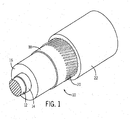
- Figure 1 shows an insulated power cable 10 ( i.e ., a coated conductor) which includes a metallic conductor 12, an internal shielding layer 14, an insulating layer 16, an external shielding layer 18, a metallic screen 20 of wound wires or conducting bands, and an outermost layer 22 (also known as a sheath).
- the outermost layer 22 is opaque.
- the internal shielding layer 14 and/or the insulating layer 16 and/or the external shielding layer 18 are/is composed of a polymeric composition containing polyethylene and triazine of the structure (I) and/or (II).
- the inner layer can be an insulating layer and/or a shielding layer, one or both of which contain the present polymeric composition.
- the present coated metal conductor may comprise two or more embodiment disclosed herein.
- any numerical range recited herein includes all values from the lower value to the upper value, in increments of one unit, provided that there is a separation of at least 2 units between any lower value and any higher value.
- amount of a component, or a value of a compositional or a physical property such as, for example, amount of a blend component, softening temperature, melt index, etc.
- amount of a blend component, softening temperature, melt index, etc. is between 1 and 100
- all individual values, such as, 1, 2, 3, etc., and all subranges, such as, 1 to 20, 55 to 70, 197 to 100, etc., are expressly enumerated in this specification.
- any numerical range recited herein includes any value or subrange within the stated range. Numerical ranges have been recited, as discussed herein, reference melt index, melt flow rate, and other properties.
- alkyl refers to a branched or unbranched, saturated hydrocarbon radical.
- suitable alkyl radicals include, for example, methyl, ethyl, n-propyl, i-propyl, n-butyl, t-butyl, i-butyl (or 2-methylpropyl), etc.
- the alkyls have 1 to 30 carbon atoms.
- aryl or "aryl group,” as used herein, is a substituent derived from an aromatic hydrocarbon compound.
- An aryl group has a total of from six to twenty ring atoms, and has one or more rings which are separate or fused, and may be substituted with alkyl and/or halo groups.
- the aromatic ring(s) may include phenyl, naphthyl, anthracenyl, and biphenyl, among others.
- arylalkyl or "arylalkyl group,” as used herein, is a compound containing both aliphatic and aromatic structures.
- arylalkyl group includes “aralkyl groups” (an alkyl group substituted by at least one aryl group) and/or “alkylaryl groups” (an aryl group substituted by at least one alkyl group).
- blend or "polymer blend,” as used herein, is a blend of two or more polymers. Such a blend may or may not be miscible (not phase separated at molecular level). Such a blend may or may not be phase separated. Such a blend may or may not contain one or more domain configurations, as determined from transmission electron spectroscopy, light scattering, x-ray scattering, and other methods known in the art.
- breakdown voltage of an insulator is the minimum voltage that causes a portion of an insulator to become electrically conductive.
- “Cable” and like terms is at least one wire or optical fiber within a protective insulation, jacket or sheath.
- a cable is two or more wires or optical fibers bound together, typically in a common protective insulation, jacket or sheath.
- the individual wires or fibers inside the jacket may be bare, covered or insulated.
- Combination cables may contain both electrical wires and optical fibers.
- the cable, etc. can be designed for low, medium and high voltage applications. Typical cable designs are illustrated in USP 5,246,783 , 6,496,629 and 6,714,707 .
- composition and like terms mean a mixture or blend of two or more components.
- composition includes a mixture of materials which comprise the composition, as well as reaction products and decomposition products formed from the materials of the composition.
- compositions claimed herein through use of the term “comprising” may include any additional additive, adjuvant, or compound whether polymeric or otherwise, unless stated to the contrary.
- the term, “consisting essentially of” excludes from the scope of any succeeding recitation any other component, step or procedure, excepting those that are not essential to operability.
- the term “consisting of” excludes any component, step or procedure not specifically delineated or listed.
- a “conductor” is an element of elongated shape (wire, cable, fiber) for transferring energy at any voltage (DC, AC, or transient).
- the conductor is typically at least one metal wire or at least one metal cable (such as aluminum or copper) but may include optical fiber.
- Crosslinked means that the polymer, before or after it is shaped into an article, was subjected or exposed to a treatment which induced crosslinking and has xylene or decalene extractables of less than or equal to 90 weight percent ( i.e., greater than or equal to 10 weight percent gel content).
- An “insulating layer” is a layer having a volume resistivity greater than 10 10 ohm-cm, or greater than 10 12 ohm-cm.
- a "layer,” as used herein, is a polymer-based layer surrounding the conductor, for example, an electrically insulating layer, a semiconductive layer, a sheath, a protective layer, a water blocking layer, or a layer performing combined functions, for example, a protective layer charged with a conductive filler.
- intermediate voltage generally means a voltage of between 6 kV and about 36 kV
- high voltage means voltages higher than 36 kV
- extra high voltage generally means voltages greater than 220 kV. The skilled artisan understands that these general voltage ranges may be different outside of the United States.
- opaque is a material that blocks at least natural light (i.e., sunlight). In other words, an opaque material is impenetrable to light energy having a wavelength from about 250 nm to about 800 nm.
- polymer is a macromolecular compound prepared by polymerizing monomers of the same or different type.
- Polymer includes homopolymers, copolymers, terpolymers, interpolymers, and so on.
- interpolymer is a polymer prepared by the polymerization of at least two types of monomers or comonomers. It includes, but is not limited to, copolymers (which usually refers to polymers prepared from two different types of monomers or comonomers, terpolymers (which usually refers to polymers prepared from three different types of monomers or comonomers), tetrapolymers (which usually refers to polymers prepared from four different types of monomers or comonomers), and the like.
- a “shielding layer” may be semiconductive or resistive.
- a shielding layer having semiconductive properties has a volumetric resistivity value, of less than 1000 ⁇ -m, or less than 500 ⁇ -m, when measured at 90°C.
- a shielding layer having resistive properties has a volumetric resistivity value greater than a semiconductive layer.
- a shielding layer having resistive properties typically has a dielectric constant greater than about 10.
- MI Melt index
- Polyethylene homopolymer (0.92g/cc, MI 2.0 g/10 min) is melt fluxed in a Brabender mixing bowl, after which voltage stabilizing agent is melt-compounded into the polyethylene at a target mix temperature and 30 rpm for 5 minutes to insure adequate incorporation.
- the polymeric composition is removed from the mixing bowl and compression molded into a slab that is 0.25 inches thick. Compression molding is achieved using a pressure of 300-500 psi and a temperature of 140°C for 3 minutes, after which the pressure is increased above 2000 psi while maintaining the sample at 140°C for an additional 3 minutes. The high pressure is then maintained while the sample cools.
- 1 inch square specimens are die-cut from the slab and pre-drilled to a depth of 0.5 inches along one of the major axes.
- Steel needles 60° cone, 3 micron tip radius
- the entire jig is conditioned in a circulating air oven for 1 hour at 105°C, after which the needle is advanced into the softened polymer at a rate of approximately 1 mm every 5 minutes while remaining in the 105°C oven.
- the needles are advanced to a stop which produces a point-to-plane distance of approximately 1.9mm.
- a series of specimens are energized to an applied 6kV 60Hz voltage for 30 minutes, followed by an increase in the applied voltage of 1kV every 30 minutes up to a maximum 18kV test voltage.
- the breakdown voltage for each specimen is recorded for evaluation of the characteristic voltage as the scale parameter of a fitted Weibull failure distribution.
- Example 1 is LDPE containing 1.4 wt% CYASORB® UV-1164, 2-[4,6-bis(2,4-dimethylphenyl)-1,3,5-triazin-2-yl]-5-(octyloxy)phenol (CAS 2725-22-6), available from Cytec Industries.
- Example 2 is LDPE containing 2.8 wt% CYASORB® UV-1164.
- Comparative Sample A is LDPE with no voltage stabilizing agent mixed at a temperature of 140°C.
- Comparative Sample B is LDPE containing 1wt% Chimassorb 944, a hindered amine stabilizer.
- Comparative Sample C is LDPE containing 1%wt Cyassorb UV-3346, a light stabilizer.
- a series of 18 specimens of Comparative Sample A are fit to a 2-parameter Weibull failure distribution.
- the data exhibits significant non-linearity leading to poor correlation (r ⁇ 2 of 0.75).
- a 3-parameter Weibull characteristic voltage of 11.7 kV is determined for Comparative Sample A, with a 90% confidence interval which spanned 10.7 to 13.7kV.
- Comparative Sample B is prepared according in the same manner as the LDPE control (Comparative Sample A), using a compounding temperature of 140°C. 10 specimens are prepared and evaluated according to the needle voltage-step rise breakdown test.
- Comparative Sample C is prepared according in the same manner as the LDPE control (Comparative Sample A), using a compounding temperature of 140°C. 9 specimens are prepared and evaluated according to the needle voltage-step rise breakdown test.
- Example 1 Nine specimens of Example 1 are evaluated, yet four of the nine survive the voltage ramp throughout the maximum 18kV test voltage. These survivors are included in the Weibull statistical analysis as "suspensions" (with failure voltage of >18kV).
- Example 2 Eight specimens of Example 2 are evaluated, yet three of the eight survive the voltage ramp throughout the maximum 18kV test voltage. These survivors are included in the Weibull statistical analysis as "suspensions" (with failure voltage of >18kV).
- the characteristic voltage determined for Examples 1 and 2 are similar and higher than that of Comparative Sample A. With no statistical distinction between Examples 1 and 2, it is useful to combine the failure distributions into a single sample set to represent the impact of the presence of the voltage stabilizing agent.
- the composite failure distribution of Examples 1 and 2 is found to be a good fit (r ⁇ 2 of 0.97) to a 2-parameter Weibull distribution with a characteristic voltage of 17.7 kV, with a 90% confidence interval which spanned 16.0 to 22.2 kV.
- the offset t0 is estimated to be 5.4 kV.
- Table 1 n/s Weibull characteristic breakdown voltage (kV) 90% Confidence Interval (kV) Comp. Sample A 18/0 11.7 10.7-13.7 Comp. Sample B 10/0 9.5 9.0-10.3 Comp. Sample C 9/0 9.7 9.0-10.8 Example 1 9/4 17.4 15.5-23.5 Example 2 8/3 17.6 14.8-24.7 Example 1+2 17/7 18.7 15.8-23.8
- Table 1 shows that not all light stabilizers are effective as voltage stabilizers.
- CS-B and CS-C are not effective voltage stabilizing compositions as each of CS-B and CS-C has a breakdown voltage less than the breakdown voltage of LDPE alone (CS-A).
- the results of CS-B and CS-C show the unpredictabilty of utilizing light stabilizers as voltage stabilizers.
- Examples 1 and 2 each exhibit improved breakdown strength in view of (i) LDPE alone (CS-A) and (ii) exhibit improved breakdown strength compared to other light stabilized compositions (CS-B, CS-C).
- Applicants have surprisingly discovered that the triazine of structure (I) unforeseeably provides improved voltage stability to insulating layer for coated conductors.
- the voltage stability provided by triazine of structure (I) is unexpected in view of the unpredictability of light stabilizers as effective voltage stabilizers.
Landscapes
- Chemical & Material Sciences (AREA)
- Health & Medical Sciences (AREA)
- Chemical Kinetics & Catalysis (AREA)
- Medicinal Chemistry (AREA)
- Polymers & Plastics (AREA)
- Organic Chemistry (AREA)
- Physics & Mathematics (AREA)
- Spectroscopy & Molecular Physics (AREA)
- Organic Insulating Materials (AREA)
- Compositions Of Macromolecular Compounds (AREA)
- Insulated Conductors (AREA)
Applications Claiming Priority (2)
| Application Number | Priority Date | Filing Date | Title |
|---|---|---|---|
| US38829210P | 2010-09-30 | 2010-09-30 | |
| PCT/US2011/052910 WO2012050792A1 (en) | 2010-09-30 | 2011-09-23 | Coated conductor with voltage stabilized inner layer |
Publications (2)
| Publication Number | Publication Date |
|---|---|
| EP2622610A1 EP2622610A1 (en) | 2013-08-07 |
| EP2622610B1 true EP2622610B1 (en) | 2014-08-20 |
Family
ID=44801153
Family Applications (1)
| Application Number | Title | Priority Date | Filing Date |
|---|---|---|---|
| EP11770233.2A Active EP2622610B1 (en) | 2010-09-30 | 2011-09-23 | Coated conductor with voltage stabilized inner layer |
Country Status (10)
| Country | Link |
|---|---|
| US (1) | US9040828B2 (enExample) |
| EP (1) | EP2622610B1 (enExample) |
| JP (1) | JP5868983B2 (enExample) |
| KR (1) | KR101798693B1 (enExample) |
| CN (1) | CN103229250B (enExample) |
| BR (1) | BR112013006994A2 (enExample) |
| CA (1) | CA2811569C (enExample) |
| MX (1) | MX2013003510A (enExample) |
| TW (1) | TWI534192B (enExample) |
| WO (1) | WO2012050792A1 (enExample) |
Families Citing this family (9)
| Publication number | Priority date | Publication date | Assignee | Title |
|---|---|---|---|---|
| US9040828B2 (en) * | 2010-09-30 | 2015-05-26 | Union Carbide Chemicals & Plastics Technology Llc | Coated conductor with voltage stabilized inner layer |
| DE102012212574B4 (de) * | 2012-07-18 | 2017-01-12 | Siemens Healthcare Gmbh | Verfahren zur elektromagnetischen Abschirmung für eine Magnetresonanzanlage sowie entsprechend abgeschirmte Vorrichtung |
| CN102930925A (zh) * | 2012-10-31 | 2013-02-13 | 江苏永鼎电气有限公司 | 一种低成本耐强辐射低噪音电缆 |
| WO2014172107A1 (en) * | 2013-04-18 | 2014-10-23 | Dow Global Technologies Llc | Coated conductor with voltage-stabilized inner layer |
| EP3261096A1 (en) * | 2016-06-21 | 2017-12-27 | Borealis AG | Cable and composition |
| EP3261093B1 (en) | 2016-06-21 | 2023-08-02 | Borealis AG | Cable with advantageous electrical properties |
| EP3472237B1 (en) | 2016-06-21 | 2021-05-26 | Borealis AG | Polymer composition for wire and cable applications with advantageous thermomechanical behaviour and electrical properties |
| MX2023002604A (es) * | 2020-09-07 | 2023-03-16 | Dow Global Technologies Llc | Composiciones polimericas estabilizadas para luz ultravioleta. |
| EP4244462A4 (en) * | 2020-11-11 | 2024-09-25 | Baker Hughes Oilfield Operations, LLC | Advanced insulation and jacketing for downhole power and motor lead cables |
Family Cites Families (30)
| Publication number | Priority date | Publication date | Assignee | Title |
|---|---|---|---|---|
| US3522183A (en) | 1968-05-07 | 1970-07-28 | Simplex Wire & Cable Co | Solid dielectric polyolefin compositions containing various voltage stabilizers |
| US3552183A (en) * | 1969-02-13 | 1971-01-05 | Robert Heithann | Hydraulically operated power press |
| JPS5112058B2 (enExample) | 1973-07-03 | 1976-04-15 | ||
| US4870121A (en) | 1987-10-26 | 1989-09-26 | Canadian Patents & Development Ltd. | Electrical tree suppression in high-voltage polymeric insulation |
| US5272236A (en) | 1991-10-15 | 1993-12-21 | The Dow Chemical Company | Elastic substantially linear olefin polymers |
| US5246783A (en) | 1991-08-15 | 1993-09-21 | Exxon Chemical Patents Inc. | Electrical devices comprising polymeric insulating or semiconducting members |
| US5278272A (en) | 1991-10-15 | 1994-01-11 | The Dow Chemical Company | Elastic substantialy linear olefin polymers |
| US5783638A (en) | 1991-10-15 | 1998-07-21 | The Dow Chemical Company | Elastic substantially linear ethylene polymers |
| US5719218A (en) | 1995-06-01 | 1998-02-17 | At Plastics Inc. | Water resistant electrical insulation compositions |
| US6496629B2 (en) | 1999-05-28 | 2002-12-17 | Tycom (Us) Inc. | Undersea telecommunications cable |
| DE60005699T2 (de) * | 1999-07-27 | 2004-08-19 | Pirelli S.P.A. | Kabel, insbesondere für transport und verteilung von elektrischer energie und isolierungszusammensetzung |
| US6696154B2 (en) | 1999-07-27 | 2004-02-24 | Pirelli Cavi E Sistemi S.P.A. | Cable, in particular for transport or distribution of electrical energy and insulating composition |
| US6455616B1 (en) | 2000-03-07 | 2002-09-24 | Union Carbide Chemicals & Plastics Technology Corporation | Polyethylene crosslinkable composition |
| US6858296B1 (en) * | 2000-10-05 | 2005-02-22 | Union Carbide Chemicals & Plastics Technology Corporation | Power cable |
| US6656986B2 (en) | 2001-03-01 | 2003-12-02 | Union Carbide Chemicals & Plastics Technology Corporation | Polyethylene crosslinkable composition |
| US6714707B2 (en) | 2002-01-24 | 2004-03-30 | Alcatel | Optical cable housing an optical unit surrounded by a plurality of gel layers |
| ZA200301683B (en) * | 2002-03-04 | 2004-09-06 | Ciba Sc Holding Ag | Synergistic combinations of UV absorbers for pigmented polyolefins. |
| US6825253B2 (en) | 2002-07-22 | 2004-11-30 | General Cable Technologies Corporation | Insulation compositions containing metallocene polymers |
| JP2004075869A (ja) * | 2002-08-20 | 2004-03-11 | Mitsui Chemicals Inc | 熱可塑性樹脂組成物およびその組成物からなる成形体 |
| JP3821233B2 (ja) * | 2003-05-07 | 2006-09-13 | 日立電線株式会社 | ノンハロゲン難燃絶縁電線 |
| JP4330603B2 (ja) * | 2006-07-18 | 2009-09-16 | 株式会社オートネットワーク技術研究所 | 絶縁電線およびワイヤーハーネス |
| JP5226973B2 (ja) * | 2007-06-15 | 2013-07-03 | 三井化学株式会社 | エチレン系共重合体、該共重合体を含む組成物ならびにその用途 |
| CN101386694B (zh) * | 2007-09-14 | 2011-11-09 | 株式会社藤仓 | 耐放射线性树脂组合物及耐放射线性电线、电缆 |
| EP2072576B1 (en) | 2007-12-18 | 2010-04-28 | Borealis Technology OY | Cable layer of modified soft polypropylene |
| EP2163576B1 (en) | 2008-09-09 | 2011-11-02 | Borealis AG | Polyolefin composition for medium/high/extra high voltage cables comprising benzophenone-type voltage stabiliser |
| US9040828B2 (en) * | 2010-09-30 | 2015-05-26 | Union Carbide Chemicals & Plastics Technology Llc | Coated conductor with voltage stabilized inner layer |
| WO2013047618A1 (ja) * | 2011-09-30 | 2013-04-04 | 株式会社Adeka | 難燃性樹脂組成物及びこれを用いた電線 |
| JP5775494B2 (ja) * | 2012-02-28 | 2015-09-09 | 富士フイルム株式会社 | 銀イオン拡散抑制層形成用組成物、銀イオン拡散抑制層用フィルム、配線基板、電子機器、導電膜積層体、およびタッチパネル |
| US20140017494A1 (en) * | 2012-07-12 | 2014-01-16 | General Cable Technologies Corporation | Insulations containing non-migrating antistatic agent |
| JP6202390B2 (ja) * | 2012-12-27 | 2017-09-27 | 日立金属株式会社 | 電線及びケーブル |
-
2011
- 2011-09-23 US US13/822,236 patent/US9040828B2/en active Active
- 2011-09-23 BR BR112013006994-5A patent/BR112013006994A2/pt not_active Application Discontinuation
- 2011-09-23 KR KR1020137008003A patent/KR101798693B1/ko active Active
- 2011-09-23 MX MX2013003510A patent/MX2013003510A/es active IP Right Grant
- 2011-09-23 WO PCT/US2011/052910 patent/WO2012050792A1/en not_active Ceased
- 2011-09-23 CA CA2811569A patent/CA2811569C/en active Active
- 2011-09-23 EP EP11770233.2A patent/EP2622610B1/en active Active
- 2011-09-23 JP JP2013531671A patent/JP5868983B2/ja active Active
- 2011-09-23 CN CN201180057338.5A patent/CN103229250B/zh active Active
- 2011-09-29 TW TW100135251A patent/TWI534192B/zh active
Also Published As
| Publication number | Publication date |
|---|---|
| CN103229250B (zh) | 2016-06-08 |
| JP5868983B2 (ja) | 2016-02-24 |
| JP2013543637A (ja) | 2013-12-05 |
| CA2811569A1 (en) | 2012-04-19 |
| TWI534192B (zh) | 2016-05-21 |
| WO2012050792A1 (en) | 2012-04-19 |
| KR101798693B1 (ko) | 2017-11-16 |
| EP2622610A1 (en) | 2013-08-07 |
| MX2013003510A (es) | 2013-05-30 |
| CN103229250A (zh) | 2013-07-31 |
| US20130175070A1 (en) | 2013-07-11 |
| BR112013006994A2 (pt) | 2020-11-24 |
| CA2811569C (en) | 2017-06-20 |
| TW201249909A (en) | 2012-12-16 |
| US9040828B2 (en) | 2015-05-26 |
| KR20130114114A (ko) | 2013-10-16 |
Similar Documents
| Publication | Publication Date | Title |
|---|---|---|
| US10622117B2 (en) | Polymeric compositions with voltage stabilizer additive | |
| EP2622610B1 (en) | Coated conductor with voltage stabilized inner layer | |
| US10490318B2 (en) | Coated conductor with voltage-stabilized inner layer |
Legal Events
| Date | Code | Title | Description |
|---|---|---|---|
| PUAI | Public reference made under article 153(3) epc to a published international application that has entered the european phase |
Free format text: ORIGINAL CODE: 0009012 |
|
| 17P | Request for examination filed |
Effective date: 20130502 |
|
| AK | Designated contracting states |
Kind code of ref document: A1 Designated state(s): AL AT BE BG CH CY CZ DE DK EE ES FI FR GB GR HR HU IE IS IT LI LT LU LV MC MK MT NL NO PL PT RO RS SE SI SK SM TR |
|
| DAX | Request for extension of the european patent (deleted) | ||
| GRAP | Despatch of communication of intention to grant a patent |
Free format text: ORIGINAL CODE: EPIDOSNIGR1 |
|
| INTG | Intention to grant announced |
Effective date: 20140324 |
|
| GRAS | Grant fee paid |
Free format text: ORIGINAL CODE: EPIDOSNIGR3 |
|
| GRAA | (expected) grant |
Free format text: ORIGINAL CODE: 0009210 |
|
| AK | Designated contracting states |
Kind code of ref document: B1 Designated state(s): AL AT BE BG CH CY CZ DE DK EE ES FI FR GB GR HR HU IE IS IT LI LT LU LV MC MK MT NL NO PL PT RO RS SE SI SK SM TR |
|
| REG | Reference to a national code |
Ref country code: GB Ref legal event code: FG4D |
|
| REG | Reference to a national code |
Ref country code: CH Ref legal event code: EP |
|
| REG | Reference to a national code |
Ref country code: AT Ref legal event code: REF Ref document number: 683842 Country of ref document: AT Kind code of ref document: T Effective date: 20140915 |
|
| REG | Reference to a national code |
Ref country code: IE Ref legal event code: FG4D |
|
| REG | Reference to a national code |
Ref country code: DE Ref legal event code: R096 Ref document number: 602011009337 Country of ref document: DE Effective date: 20141002 |
|
| REG | Reference to a national code |
Ref country code: SE Ref legal event code: TRGR |
|
| REG | Reference to a national code |
Ref country code: AT Ref legal event code: MK05 Ref document number: 683842 Country of ref document: AT Kind code of ref document: T Effective date: 20140820 |
|
| REG | Reference to a national code |
Ref country code: NL Ref legal event code: VDEP Effective date: 20140820 |
|
| REG | Reference to a national code |
Ref country code: LT Ref legal event code: MG4D |
|
| PG25 | Lapsed in a contracting state [announced via postgrant information from national office to epo] |
Ref country code: GR Free format text: LAPSE BECAUSE OF FAILURE TO SUBMIT A TRANSLATION OF THE DESCRIPTION OR TO PAY THE FEE WITHIN THE PRESCRIBED TIME-LIMIT Effective date: 20141121 Ref country code: FI Free format text: LAPSE BECAUSE OF FAILURE TO SUBMIT A TRANSLATION OF THE DESCRIPTION OR TO PAY THE FEE WITHIN THE PRESCRIBED TIME-LIMIT Effective date: 20140820 Ref country code: BG Free format text: LAPSE BECAUSE OF FAILURE TO SUBMIT A TRANSLATION OF THE DESCRIPTION OR TO PAY THE FEE WITHIN THE PRESCRIBED TIME-LIMIT Effective date: 20141120 Ref country code: NO Free format text: LAPSE BECAUSE OF FAILURE TO SUBMIT A TRANSLATION OF THE DESCRIPTION OR TO PAY THE FEE WITHIN THE PRESCRIBED TIME-LIMIT Effective date: 20141120 Ref country code: LT Free format text: LAPSE BECAUSE OF FAILURE TO SUBMIT A TRANSLATION OF THE DESCRIPTION OR TO PAY THE FEE WITHIN THE PRESCRIBED TIME-LIMIT Effective date: 20140820 Ref country code: PT Free format text: LAPSE BECAUSE OF FAILURE TO SUBMIT A TRANSLATION OF THE DESCRIPTION OR TO PAY THE FEE WITHIN THE PRESCRIBED TIME-LIMIT Effective date: 20141222 Ref country code: ES Free format text: LAPSE BECAUSE OF FAILURE TO SUBMIT A TRANSLATION OF THE DESCRIPTION OR TO PAY THE FEE WITHIN THE PRESCRIBED TIME-LIMIT Effective date: 20140820 |
|
| PG25 | Lapsed in a contracting state [announced via postgrant information from national office to epo] |
Ref country code: LV Free format text: LAPSE BECAUSE OF FAILURE TO SUBMIT A TRANSLATION OF THE DESCRIPTION OR TO PAY THE FEE WITHIN THE PRESCRIBED TIME-LIMIT Effective date: 20140820 Ref country code: HR Free format text: LAPSE BECAUSE OF FAILURE TO SUBMIT A TRANSLATION OF THE DESCRIPTION OR TO PAY THE FEE WITHIN THE PRESCRIBED TIME-LIMIT Effective date: 20140820 Ref country code: IS Free format text: LAPSE BECAUSE OF FAILURE TO SUBMIT A TRANSLATION OF THE DESCRIPTION OR TO PAY THE FEE WITHIN THE PRESCRIBED TIME-LIMIT Effective date: 20141220 Ref country code: RS Free format text: LAPSE BECAUSE OF FAILURE TO SUBMIT A TRANSLATION OF THE DESCRIPTION OR TO PAY THE FEE WITHIN THE PRESCRIBED TIME-LIMIT Effective date: 20140820 Ref country code: AT Free format text: LAPSE BECAUSE OF FAILURE TO SUBMIT A TRANSLATION OF THE DESCRIPTION OR TO PAY THE FEE WITHIN THE PRESCRIBED TIME-LIMIT Effective date: 20140820 |
|
| PG25 | Lapsed in a contracting state [announced via postgrant information from national office to epo] |
Ref country code: NL Free format text: LAPSE BECAUSE OF FAILURE TO SUBMIT A TRANSLATION OF THE DESCRIPTION OR TO PAY THE FEE WITHIN THE PRESCRIBED TIME-LIMIT Effective date: 20140820 |
|
| PG25 | Lapsed in a contracting state [announced via postgrant information from national office to epo] |
Ref country code: DK Free format text: LAPSE BECAUSE OF FAILURE TO SUBMIT A TRANSLATION OF THE DESCRIPTION OR TO PAY THE FEE WITHIN THE PRESCRIBED TIME-LIMIT Effective date: 20140820 Ref country code: EE Free format text: LAPSE BECAUSE OF FAILURE TO SUBMIT A TRANSLATION OF THE DESCRIPTION OR TO PAY THE FEE WITHIN THE PRESCRIBED TIME-LIMIT Effective date: 20140820 Ref country code: CZ Free format text: LAPSE BECAUSE OF FAILURE TO SUBMIT A TRANSLATION OF THE DESCRIPTION OR TO PAY THE FEE WITHIN THE PRESCRIBED TIME-LIMIT Effective date: 20140820 Ref country code: SK Free format text: LAPSE BECAUSE OF FAILURE TO SUBMIT A TRANSLATION OF THE DESCRIPTION OR TO PAY THE FEE WITHIN THE PRESCRIBED TIME-LIMIT Effective date: 20140820 Ref country code: RO Free format text: LAPSE BECAUSE OF FAILURE TO SUBMIT A TRANSLATION OF THE DESCRIPTION OR TO PAY THE FEE WITHIN THE PRESCRIBED TIME-LIMIT Effective date: 20140820 |
|
| REG | Reference to a national code |
Ref country code: CH Ref legal event code: PL |
|
| REG | Reference to a national code |
Ref country code: DE Ref legal event code: R097 Ref document number: 602011009337 Country of ref document: DE |
|
| PG25 | Lapsed in a contracting state [announced via postgrant information from national office to epo] |
Ref country code: MC Free format text: LAPSE BECAUSE OF FAILURE TO SUBMIT A TRANSLATION OF THE DESCRIPTION OR TO PAY THE FEE WITHIN THE PRESCRIBED TIME-LIMIT Effective date: 20140820 Ref country code: PL Free format text: LAPSE BECAUSE OF FAILURE TO SUBMIT A TRANSLATION OF THE DESCRIPTION OR TO PAY THE FEE WITHIN THE PRESCRIBED TIME-LIMIT Effective date: 20140820 |
|
| REG | Reference to a national code |
Ref country code: IE Ref legal event code: MM4A |
|
| PLBE | No opposition filed within time limit |
Free format text: ORIGINAL CODE: 0009261 |
|
| STAA | Information on the status of an ep patent application or granted ep patent |
Free format text: STATUS: NO OPPOSITION FILED WITHIN TIME LIMIT |
|
| PG25 | Lapsed in a contracting state [announced via postgrant information from national office to epo] |
Ref country code: BE Free format text: LAPSE BECAUSE OF NON-PAYMENT OF DUE FEES Effective date: 20140930 |
|
| 26N | No opposition filed |
Effective date: 20150521 |
|
| PG25 | Lapsed in a contracting state [announced via postgrant information from national office to epo] |
Ref country code: LI Free format text: LAPSE BECAUSE OF NON-PAYMENT OF DUE FEES Effective date: 20140930 Ref country code: CH Free format text: LAPSE BECAUSE OF NON-PAYMENT OF DUE FEES Effective date: 20140930 |
|
| PG25 | Lapsed in a contracting state [announced via postgrant information from national office to epo] |
Ref country code: IE Free format text: LAPSE BECAUSE OF NON-PAYMENT OF DUE FEES Effective date: 20140923 |
|
| PG25 | Lapsed in a contracting state [announced via postgrant information from national office to epo] |
Ref country code: SI Free format text: LAPSE BECAUSE OF FAILURE TO SUBMIT A TRANSLATION OF THE DESCRIPTION OR TO PAY THE FEE WITHIN THE PRESCRIBED TIME-LIMIT Effective date: 20140820 |
|
| PG25 | Lapsed in a contracting state [announced via postgrant information from national office to epo] |
Ref country code: SM Free format text: LAPSE BECAUSE OF FAILURE TO SUBMIT A TRANSLATION OF THE DESCRIPTION OR TO PAY THE FEE WITHIN THE PRESCRIBED TIME-LIMIT Effective date: 20140820 |
|
| GBPC | Gb: european patent ceased through non-payment of renewal fee |
Effective date: 20150923 |
|
| PG25 | Lapsed in a contracting state [announced via postgrant information from national office to epo] |
Ref country code: CY Free format text: LAPSE BECAUSE OF FAILURE TO SUBMIT A TRANSLATION OF THE DESCRIPTION OR TO PAY THE FEE WITHIN THE PRESCRIBED TIME-LIMIT Effective date: 20140820 Ref country code: MT Free format text: LAPSE BECAUSE OF FAILURE TO SUBMIT A TRANSLATION OF THE DESCRIPTION OR TO PAY THE FEE WITHIN THE PRESCRIBED TIME-LIMIT Effective date: 20140820 |
|
| PG25 | Lapsed in a contracting state [announced via postgrant information from national office to epo] |
Ref country code: BE Free format text: LAPSE BECAUSE OF FAILURE TO SUBMIT A TRANSLATION OF THE DESCRIPTION OR TO PAY THE FEE WITHIN THE PRESCRIBED TIME-LIMIT Effective date: 20140820 Ref country code: GB Free format text: LAPSE BECAUSE OF NON-PAYMENT OF DUE FEES Effective date: 20150923 Ref country code: LU Free format text: LAPSE BECAUSE OF NON-PAYMENT OF DUE FEES Effective date: 20140923 Ref country code: HU Free format text: LAPSE BECAUSE OF FAILURE TO SUBMIT A TRANSLATION OF THE DESCRIPTION OR TO PAY THE FEE WITHIN THE PRESCRIBED TIME-LIMIT; INVALID AB INITIO Effective date: 20110923 |
|
| REG | Reference to a national code |
Ref country code: FR Ref legal event code: PLFP Year of fee payment: 6 |
|
| REG | Reference to a national code |
Ref country code: FR Ref legal event code: PLFP Year of fee payment: 7 |
|
| PG25 | Lapsed in a contracting state [announced via postgrant information from national office to epo] |
Ref country code: TR Free format text: LAPSE BECAUSE OF FAILURE TO SUBMIT A TRANSLATION OF THE DESCRIPTION OR TO PAY THE FEE WITHIN THE PRESCRIBED TIME-LIMIT Effective date: 20140820 |
|
| PG25 | Lapsed in a contracting state [announced via postgrant information from national office to epo] |
Ref country code: MK Free format text: LAPSE BECAUSE OF FAILURE TO SUBMIT A TRANSLATION OF THE DESCRIPTION OR TO PAY THE FEE WITHIN THE PRESCRIBED TIME-LIMIT Effective date: 20140820 |
|
| REG | Reference to a national code |
Ref country code: FR Ref legal event code: PLFP Year of fee payment: 8 |
|
| PG25 | Lapsed in a contracting state [announced via postgrant information from national office to epo] |
Ref country code: AL Free format text: LAPSE BECAUSE OF FAILURE TO SUBMIT A TRANSLATION OF THE DESCRIPTION OR TO PAY THE FEE WITHIN THE PRESCRIBED TIME-LIMIT Effective date: 20140820 |
|
| REG | Reference to a national code |
Ref country code: DE Ref legal event code: R081 Ref document number: 602011009337 Country of ref document: DE Owner name: UNION CARBIDE CORPORATION, SEADRIFT, US Free format text: FORMER OWNER: UNION CARBIDE CHEMICALS & PLASTICS TECHNOLOGY LLC, MIDLAND, MICH., US Ref country code: DE Ref legal event code: R082 Ref document number: 602011009337 Country of ref document: DE Representative=s name: MURGITROYD & COMPANY, DE |
|
| P01 | Opt-out of the competence of the unified patent court (upc) registered |
Effective date: 20230526 |
|
| PGFP | Annual fee paid to national office [announced via postgrant information from national office to epo] |
Ref country code: DE Payment date: 20250702 Year of fee payment: 15 |
|
| PGFP | Annual fee paid to national office [announced via postgrant information from national office to epo] |
Ref country code: IT Payment date: 20250825 Year of fee payment: 15 |
|
| PGFP | Annual fee paid to national office [announced via postgrant information from national office to epo] |
Ref country code: FR Payment date: 20250808 Year of fee payment: 15 |
|
| PGFP | Annual fee paid to national office [announced via postgrant information from national office to epo] |
Ref country code: SE Payment date: 20250702 Year of fee payment: 15 |