EP2619358B1 - Flame retardant yarns and fabrics comprising them - Google Patents
Flame retardant yarns and fabrics comprising them Download PDFInfo
- Publication number
- EP2619358B1 EP2619358B1 EP11827445.5A EP11827445A EP2619358B1 EP 2619358 B1 EP2619358 B1 EP 2619358B1 EP 11827445 A EP11827445 A EP 11827445A EP 2619358 B1 EP2619358 B1 EP 2619358B1
- Authority
- EP
- European Patent Office
- Prior art keywords
- flame retardant
- melamine
- zinc
- fiber
- yarn
- Prior art date
- Legal status (The legal status is an assumption and is not a legal conclusion. Google has not performed a legal analysis and makes no representation as to the accuracy of the status listed.)
- Active
Links
Images


Classifications
-
- D—TEXTILES; PAPER
- D02—YARNS; MECHANICAL FINISHING OF YARNS OR ROPES; WARPING OR BEAMING
- D02G—CRIMPING OR CURLING FIBRES, FILAMENTS, THREADS, OR YARNS; YARNS OR THREADS
- D02G3/00—Yarns or threads, e.g. fancy yarns; Processes or apparatus for the production thereof, not otherwise provided for
- D02G3/44—Yarns or threads characterised by the purpose for which they are designed
- D02G3/443—Heat-resistant, fireproof or flame-retardant yarns or threads
-
- D—TEXTILES; PAPER
- D01—NATURAL OR MAN-MADE THREADS OR FIBRES; SPINNING
- D01F—CHEMICAL FEATURES IN THE MANUFACTURE OF ARTIFICIAL FILAMENTS, THREADS, FIBRES, BRISTLES OR RIBBONS; APPARATUS SPECIALLY ADAPTED FOR THE MANUFACTURE OF CARBON FILAMENTS
- D01F1/00—General methods for the manufacture of artificial filaments or the like
- D01F1/02—Addition of substances to the spinning solution or to the melt
- D01F1/07—Addition of substances to the spinning solution or to the melt for making fire- or flame-proof filaments
-
- D—TEXTILES; PAPER
- D01—NATURAL OR MAN-MADE THREADS OR FIBRES; SPINNING
- D01F—CHEMICAL FEATURES IN THE MANUFACTURE OF ARTIFICIAL FILAMENTS, THREADS, FIBRES, BRISTLES OR RIBBONS; APPARATUS SPECIALLY ADAPTED FOR THE MANUFACTURE OF CARBON FILAMENTS
- D01F6/00—Monocomponent artificial filaments or the like of synthetic polymers; Manufacture thereof
- D01F6/58—Monocomponent artificial filaments or the like of synthetic polymers; Manufacture thereof from homopolycondensation products
- D01F6/60—Monocomponent artificial filaments or the like of synthetic polymers; Manufacture thereof from homopolycondensation products from polyamides
-
- D—TEXTILES; PAPER
- D01—NATURAL OR MAN-MADE THREADS OR FIBRES; SPINNING
- D01F—CHEMICAL FEATURES IN THE MANUFACTURE OF ARTIFICIAL FILAMENTS, THREADS, FIBRES, BRISTLES OR RIBBONS; APPARATUS SPECIALLY ADAPTED FOR THE MANUFACTURE OF CARBON FILAMENTS
- D01F6/00—Monocomponent artificial filaments or the like of synthetic polymers; Manufacture thereof
- D01F6/58—Monocomponent artificial filaments or the like of synthetic polymers; Manufacture thereof from homopolycondensation products
- D01F6/60—Monocomponent artificial filaments or the like of synthetic polymers; Manufacture thereof from homopolycondensation products from polyamides
- D01F6/605—Monocomponent artificial filaments or the like of synthetic polymers; Manufacture thereof from homopolycondensation products from polyamides from aromatic polyamides
-
- D—TEXTILES; PAPER
- D01—NATURAL OR MAN-MADE THREADS OR FIBRES; SPINNING
- D01F—CHEMICAL FEATURES IN THE MANUFACTURE OF ARTIFICIAL FILAMENTS, THREADS, FIBRES, BRISTLES OR RIBBONS; APPARATUS SPECIALLY ADAPTED FOR THE MANUFACTURE OF CARBON FILAMENTS
- D01F6/00—Monocomponent artificial filaments or the like of synthetic polymers; Manufacture thereof
- D01F6/88—Monocomponent artificial filaments or the like of synthetic polymers; Manufacture thereof from mixtures of polycondensation products as major constituent with other polymers or low-molecular-weight compounds
- D01F6/90—Monocomponent artificial filaments or the like of synthetic polymers; Manufacture thereof from mixtures of polycondensation products as major constituent with other polymers or low-molecular-weight compounds of polyamides
-
- D—TEXTILES; PAPER
- D01—NATURAL OR MAN-MADE THREADS OR FIBRES; SPINNING
- D01F—CHEMICAL FEATURES IN THE MANUFACTURE OF ARTIFICIAL FILAMENTS, THREADS, FIBRES, BRISTLES OR RIBBONS; APPARATUS SPECIALLY ADAPTED FOR THE MANUFACTURE OF CARBON FILAMENTS
- D01F8/00—Conjugated, i.e. bi- or multicomponent, artificial filaments or the like; Manufacture thereof
- D01F8/04—Conjugated, i.e. bi- or multicomponent, artificial filaments or the like; Manufacture thereof from synthetic polymers
- D01F8/12—Conjugated, i.e. bi- or multicomponent, artificial filaments or the like; Manufacture thereof from synthetic polymers with at least one polyamide as constituent
-
- D—TEXTILES; PAPER
- D02—YARNS; MECHANICAL FINISHING OF YARNS OR ROPES; WARPING OR BEAMING
- D02G—CRIMPING OR CURLING FIBRES, FILAMENTS, THREADS, OR YARNS; YARNS OR THREADS
- D02G3/00—Yarns or threads, e.g. fancy yarns; Processes or apparatus for the production thereof, not otherwise provided for
- D02G3/02—Yarns or threads characterised by the material or by the materials from which they are made
-
- D—TEXTILES; PAPER
- D02—YARNS; MECHANICAL FINISHING OF YARNS OR ROPES; WARPING OR BEAMING
- D02G—CRIMPING OR CURLING FIBRES, FILAMENTS, THREADS, OR YARNS; YARNS OR THREADS
- D02G3/00—Yarns or threads, e.g. fancy yarns; Processes or apparatus for the production thereof, not otherwise provided for
- D02G3/02—Yarns or threads characterised by the material or by the materials from which they are made
- D02G3/04—Blended or other yarns or threads containing components made from different materials
-
- D—TEXTILES; PAPER
- D03—WEAVING
- D03D—WOVEN FABRICS; METHODS OF WEAVING; LOOMS
- D03D15/00—Woven fabrics characterised by the material, structure or properties of the fibres, filaments, yarns, threads or other warp or weft elements used
- D03D15/20—Woven fabrics characterised by the material, structure or properties of the fibres, filaments, yarns, threads or other warp or weft elements used characterised by the material of the fibres or filaments constituting the yarns or threads
- D03D15/283—Woven fabrics characterised by the material, structure or properties of the fibres, filaments, yarns, threads or other warp or weft elements used characterised by the material of the fibres or filaments constituting the yarns or threads synthetic polymer-based, e.g. polyamide or polyester fibres
-
- D—TEXTILES; PAPER
- D03—WEAVING
- D03D—WOVEN FABRICS; METHODS OF WEAVING; LOOMS
- D03D15/00—Woven fabrics characterised by the material, structure or properties of the fibres, filaments, yarns, threads or other warp or weft elements used
- D03D15/50—Woven fabrics characterised by the material, structure or properties of the fibres, filaments, yarns, threads or other warp or weft elements used characterised by the properties of the yarns or threads
- D03D15/513—Woven fabrics characterised by the material, structure or properties of the fibres, filaments, yarns, threads or other warp or weft elements used characterised by the properties of the yarns or threads heat-resistant or fireproof
-
- D—TEXTILES; PAPER
- D04—BRAIDING; LACE-MAKING; KNITTING; TRIMMINGS; NON-WOVEN FABRICS
- D04H—MAKING TEXTILE FABRICS, e.g. FROM FIBRES OR FILAMENTARY MATERIAL; FABRICS MADE BY SUCH PROCESSES OR APPARATUS, e.g. FELTS, NON-WOVEN FABRICS; COTTON-WOOL; WADDING ; NON-WOVEN FABRICS FROM STAPLE FIBRES, FILAMENTS OR YARNS, BONDED WITH AT LEAST ONE WEB-LIKE MATERIAL DURING THEIR CONSOLIDATION
- D04H1/00—Non-woven fabrics formed wholly or mainly of staple fibres or like relatively short fibres
- D04H1/40—Non-woven fabrics formed wholly or mainly of staple fibres or like relatively short fibres from fleeces or layers composed of fibres without existing or potential cohesive properties
- D04H1/42—Non-woven fabrics formed wholly or mainly of staple fibres or like relatively short fibres from fleeces or layers composed of fibres without existing or potential cohesive properties characterised by the use of certain kinds of fibres insofar as this use has no preponderant influence on the consolidation of the fleece
-
- D—TEXTILES; PAPER
- D04—BRAIDING; LACE-MAKING; KNITTING; TRIMMINGS; NON-WOVEN FABRICS
- D04H—MAKING TEXTILE FABRICS, e.g. FROM FIBRES OR FILAMENTARY MATERIAL; FABRICS MADE BY SUCH PROCESSES OR APPARATUS, e.g. FELTS, NON-WOVEN FABRICS; COTTON-WOOL; WADDING ; NON-WOVEN FABRICS FROM STAPLE FIBRES, FILAMENTS OR YARNS, BONDED WITH AT LEAST ONE WEB-LIKE MATERIAL DURING THEIR CONSOLIDATION
- D04H1/00—Non-woven fabrics formed wholly or mainly of staple fibres or like relatively short fibres
- D04H1/40—Non-woven fabrics formed wholly or mainly of staple fibres or like relatively short fibres from fleeces or layers composed of fibres without existing or potential cohesive properties
- D04H1/42—Non-woven fabrics formed wholly or mainly of staple fibres or like relatively short fibres from fleeces or layers composed of fibres without existing or potential cohesive properties characterised by the use of certain kinds of fibres insofar as this use has no preponderant influence on the consolidation of the fleece
- D04H1/4326—Condensation or reaction polymers
- D04H1/4334—Polyamides
-
- D—TEXTILES; PAPER
- D04—BRAIDING; LACE-MAKING; KNITTING; TRIMMINGS; NON-WOVEN FABRICS
- D04H—MAKING TEXTILE FABRICS, e.g. FROM FIBRES OR FILAMENTARY MATERIAL; FABRICS MADE BY SUCH PROCESSES OR APPARATUS, e.g. FELTS, NON-WOVEN FABRICS; COTTON-WOOL; WADDING ; NON-WOVEN FABRICS FROM STAPLE FIBRES, FILAMENTS OR YARNS, BONDED WITH AT LEAST ONE WEB-LIKE MATERIAL DURING THEIR CONSOLIDATION
- D04H1/00—Non-woven fabrics formed wholly or mainly of staple fibres or like relatively short fibres
- D04H1/40—Non-woven fabrics formed wholly or mainly of staple fibres or like relatively short fibres from fleeces or layers composed of fibres without existing or potential cohesive properties
- D04H1/42—Non-woven fabrics formed wholly or mainly of staple fibres or like relatively short fibres from fleeces or layers composed of fibres without existing or potential cohesive properties characterised by the use of certain kinds of fibres insofar as this use has no preponderant influence on the consolidation of the fleece
- D04H1/4326—Condensation or reaction polymers
- D04H1/4334—Polyamides
- D04H1/4342—Aromatic polyamides
-
- D—TEXTILES; PAPER
- D04—BRAIDING; LACE-MAKING; KNITTING; TRIMMINGS; NON-WOVEN FABRICS
- D04H—MAKING TEXTILE FABRICS, e.g. FROM FIBRES OR FILAMENTARY MATERIAL; FABRICS MADE BY SUCH PROCESSES OR APPARATUS, e.g. FELTS, NON-WOVEN FABRICS; COTTON-WOOL; WADDING ; NON-WOVEN FABRICS FROM STAPLE FIBRES, FILAMENTS OR YARNS, BONDED WITH AT LEAST ONE WEB-LIKE MATERIAL DURING THEIR CONSOLIDATION
- D04H1/00—Non-woven fabrics formed wholly or mainly of staple fibres or like relatively short fibres
- D04H1/40—Non-woven fabrics formed wholly or mainly of staple fibres or like relatively short fibres from fleeces or layers composed of fibres without existing or potential cohesive properties
- D04H1/42—Non-woven fabrics formed wholly or mainly of staple fibres or like relatively short fibres from fleeces or layers composed of fibres without existing or potential cohesive properties characterised by the use of certain kinds of fibres insofar as this use has no preponderant influence on the consolidation of the fleece
- D04H1/4382—Stretched reticular film fibres; Composite fibres; Mixed fibres; Ultrafine fibres; Fibres for artificial leather
- D04H1/43835—Mixed fibres, e.g. at least two chemically different fibres or fibre blends
-
- D—TEXTILES; PAPER
- D04—BRAIDING; LACE-MAKING; KNITTING; TRIMMINGS; NON-WOVEN FABRICS
- D04H—MAKING TEXTILE FABRICS, e.g. FROM FIBRES OR FILAMENTARY MATERIAL; FABRICS MADE BY SUCH PROCESSES OR APPARATUS, e.g. FELTS, NON-WOVEN FABRICS; COTTON-WOOL; WADDING ; NON-WOVEN FABRICS FROM STAPLE FIBRES, FILAMENTS OR YARNS, BONDED WITH AT LEAST ONE WEB-LIKE MATERIAL DURING THEIR CONSOLIDATION
- D04H3/00—Non-woven fabrics formed wholly or mainly of yarns or like filamentary material of substantial length
- D04H3/005—Synthetic yarns or filaments
- D04H3/009—Condensation or reaction polymers
-
- D—TEXTILES; PAPER
- D06—TREATMENT OF TEXTILES OR THE LIKE; LAUNDERING; FLEXIBLE MATERIALS NOT OTHERWISE PROVIDED FOR
- D06M—TREATMENT, NOT PROVIDED FOR ELSEWHERE IN CLASS D06, OF FIBRES, THREADS, YARNS, FABRICS, FEATHERS OR FIBROUS GOODS MADE FROM SUCH MATERIALS
- D06M13/00—Treating fibres, threads, yarns, fabrics or fibrous goods made from such materials, with non-macromolecular organic compounds; Such treatment combined with mechanical treatment
- D06M13/50—Treating fibres, threads, yarns, fabrics or fibrous goods made from such materials, with non-macromolecular organic compounds; Such treatment combined with mechanical treatment with organometallic compounds; with organic compounds containing boron, silicon, selenium or tellurium atoms
- D06M13/503—Treating fibres, threads, yarns, fabrics or fibrous goods made from such materials, with non-macromolecular organic compounds; Such treatment combined with mechanical treatment with organometallic compounds; with organic compounds containing boron, silicon, selenium or tellurium atoms without bond between a carbon atom and a metal or a boron, silicon, selenium or tellurium atom
-
- D—TEXTILES; PAPER
- D06—TREATMENT OF TEXTILES OR THE LIKE; LAUNDERING; FLEXIBLE MATERIALS NOT OTHERWISE PROVIDED FOR
- D06M—TREATMENT, NOT PROVIDED FOR ELSEWHERE IN CLASS D06, OF FIBRES, THREADS, YARNS, FABRICS, FEATHERS OR FIBROUS GOODS MADE FROM SUCH MATERIALS
- D06M15/00—Treating fibres, threads, yarns, fabrics, or fibrous goods made from such materials, with macromolecular compounds; Such treatment combined with mechanical treatment
- D06M15/19—Treating fibres, threads, yarns, fabrics, or fibrous goods made from such materials, with macromolecular compounds; Such treatment combined with mechanical treatment with synthetic macromolecular compounds
- D06M15/37—Macromolecular compounds obtained otherwise than by reactions only involving carbon-to-carbon unsaturated bonds
- D06M15/667—Macromolecular compounds obtained otherwise than by reactions only involving carbon-to-carbon unsaturated bonds containing phosphorus in the main chain
- D06M15/673—Macromolecular compounds obtained otherwise than by reactions only involving carbon-to-carbon unsaturated bonds containing phosphorus in the main chain containing phosphorus and nitrogen in the main chain
-
- D—TEXTILES; PAPER
- D04—BRAIDING; LACE-MAKING; KNITTING; TRIMMINGS; NON-WOVEN FABRICS
- D04H—MAKING TEXTILE FABRICS, e.g. FROM FIBRES OR FILAMENTARY MATERIAL; FABRICS MADE BY SUCH PROCESSES OR APPARATUS, e.g. FELTS, NON-WOVEN FABRICS; COTTON-WOOL; WADDING ; NON-WOVEN FABRICS FROM STAPLE FIBRES, FILAMENTS OR YARNS, BONDED WITH AT LEAST ONE WEB-LIKE MATERIAL DURING THEIR CONSOLIDATION
- D04H1/00—Non-woven fabrics formed wholly or mainly of staple fibres or like relatively short fibres
- D04H1/40—Non-woven fabrics formed wholly or mainly of staple fibres or like relatively short fibres from fleeces or layers composed of fibres without existing or potential cohesive properties
- D04H1/42—Non-woven fabrics formed wholly or mainly of staple fibres or like relatively short fibres from fleeces or layers composed of fibres without existing or potential cohesive properties characterised by the use of certain kinds of fibres insofar as this use has no preponderant influence on the consolidation of the fleece
- D04H1/4382—Stretched reticular film fibres; Composite fibres; Mixed fibres; Ultrafine fibres; Fibres for artificial leather
- D04H1/43825—Composite fibres
- D04H1/43828—Composite fibres sheath-core
-
- D—TEXTILES; PAPER
- D04—BRAIDING; LACE-MAKING; KNITTING; TRIMMINGS; NON-WOVEN FABRICS
- D04H—MAKING TEXTILE FABRICS, e.g. FROM FIBRES OR FILAMENTARY MATERIAL; FABRICS MADE BY SUCH PROCESSES OR APPARATUS, e.g. FELTS, NON-WOVEN FABRICS; COTTON-WOOL; WADDING ; NON-WOVEN FABRICS FROM STAPLE FIBRES, FILAMENTS OR YARNS, BONDED WITH AT LEAST ONE WEB-LIKE MATERIAL DURING THEIR CONSOLIDATION
- D04H1/00—Non-woven fabrics formed wholly or mainly of staple fibres or like relatively short fibres
- D04H1/40—Non-woven fabrics formed wholly or mainly of staple fibres or like relatively short fibres from fleeces or layers composed of fibres without existing or potential cohesive properties
- D04H1/42—Non-woven fabrics formed wholly or mainly of staple fibres or like relatively short fibres from fleeces or layers composed of fibres without existing or potential cohesive properties characterised by the use of certain kinds of fibres insofar as this use has no preponderant influence on the consolidation of the fleece
- D04H1/4382—Stretched reticular film fibres; Composite fibres; Mixed fibres; Ultrafine fibres; Fibres for artificial leather
- D04H1/43825—Composite fibres
- D04H1/43832—Composite fibres side-by-side
-
- D—TEXTILES; PAPER
- D06—TREATMENT OF TEXTILES OR THE LIKE; LAUNDERING; FLEXIBLE MATERIALS NOT OTHERWISE PROVIDED FOR
- D06M—TREATMENT, NOT PROVIDED FOR ELSEWHERE IN CLASS D06, OF FIBRES, THREADS, YARNS, FABRICS, FEATHERS OR FIBROUS GOODS MADE FROM SUCH MATERIALS
- D06M2200/00—Functionality of the treatment composition and/or properties imparted to the textile material
- D06M2200/30—Flame or heat resistance, fire retardancy properties
-
- D—TEXTILES; PAPER
- D10—INDEXING SCHEME ASSOCIATED WITH SUBLASSES OF SECTION D, RELATING TO TEXTILES
- D10B—INDEXING SCHEME ASSOCIATED WITH SUBLASSES OF SECTION D, RELATING TO TEXTILES
- D10B2331/00—Fibres made from polymers obtained otherwise than by reactions only involving carbon-to-carbon unsaturated bonds, e.g. polycondensation products
- D10B2331/02—Fibres made from polymers obtained otherwise than by reactions only involving carbon-to-carbon unsaturated bonds, e.g. polycondensation products polyamides
- D10B2331/021—Fibres made from polymers obtained otherwise than by reactions only involving carbon-to-carbon unsaturated bonds, e.g. polycondensation products polyamides aromatic polyamides, e.g. aramides
-
- Y—GENERAL TAGGING OF NEW TECHNOLOGICAL DEVELOPMENTS; GENERAL TAGGING OF CROSS-SECTIONAL TECHNOLOGIES SPANNING OVER SEVERAL SECTIONS OF THE IPC; TECHNICAL SUBJECTS COVERED BY FORMER USPC CROSS-REFERENCE ART COLLECTIONS [XRACs] AND DIGESTS
- Y10—TECHNICAL SUBJECTS COVERED BY FORMER USPC
- Y10T—TECHNICAL SUBJECTS COVERED BY FORMER US CLASSIFICATION
- Y10T428/00—Stock material or miscellaneous articles
- Y10T428/249921—Web or sheet containing structurally defined element or component
-
- Y—GENERAL TAGGING OF NEW TECHNOLOGICAL DEVELOPMENTS; GENERAL TAGGING OF CROSS-SECTIONAL TECHNOLOGIES SPANNING OVER SEVERAL SECTIONS OF THE IPC; TECHNICAL SUBJECTS COVERED BY FORMER USPC CROSS-REFERENCE ART COLLECTIONS [XRACs] AND DIGESTS
- Y10—TECHNICAL SUBJECTS COVERED BY FORMER USPC
- Y10T—TECHNICAL SUBJECTS COVERED BY FORMER US CLASSIFICATION
- Y10T428/00—Stock material or miscellaneous articles
- Y10T428/29—Coated or structually defined flake, particle, cell, strand, strand portion, rod, filament, macroscopic fiber or mass thereof
- Y10T428/2904—Staple length fiber
-
- Y—GENERAL TAGGING OF NEW TECHNOLOGICAL DEVELOPMENTS; GENERAL TAGGING OF CROSS-SECTIONAL TECHNOLOGIES SPANNING OVER SEVERAL SECTIONS OF THE IPC; TECHNICAL SUBJECTS COVERED BY FORMER USPC CROSS-REFERENCE ART COLLECTIONS [XRACs] AND DIGESTS
- Y10—TECHNICAL SUBJECTS COVERED BY FORMER USPC
- Y10T—TECHNICAL SUBJECTS COVERED BY FORMER US CLASSIFICATION
- Y10T442/00—Fabric [woven, knitted, or nonwoven textile or cloth, etc.]
- Y10T442/60—Nonwoven fabric [i.e., nonwoven strand or fiber material]
- Y10T442/68—Melt-blown nonwoven fabric
-
- Y—GENERAL TAGGING OF NEW TECHNOLOGICAL DEVELOPMENTS; GENERAL TAGGING OF CROSS-SECTIONAL TECHNOLOGIES SPANNING OVER SEVERAL SECTIONS OF THE IPC; TECHNICAL SUBJECTS COVERED BY FORMER USPC CROSS-REFERENCE ART COLLECTIONS [XRACs] AND DIGESTS
- Y10—TECHNICAL SUBJECTS COVERED BY FORMER USPC
- Y10T—TECHNICAL SUBJECTS COVERED BY FORMER US CLASSIFICATION
- Y10T442/00—Fabric [woven, knitted, or nonwoven textile or cloth, etc.]
- Y10T442/60—Nonwoven fabric [i.e., nonwoven strand or fiber material]
- Y10T442/681—Spun-bonded nonwoven fabric
-
- Y—GENERAL TAGGING OF NEW TECHNOLOGICAL DEVELOPMENTS; GENERAL TAGGING OF CROSS-SECTIONAL TECHNOLOGIES SPANNING OVER SEVERAL SECTIONS OF THE IPC; TECHNICAL SUBJECTS COVERED BY FORMER USPC CROSS-REFERENCE ART COLLECTIONS [XRACs] AND DIGESTS
- Y10—TECHNICAL SUBJECTS COVERED BY FORMER USPC
- Y10T—TECHNICAL SUBJECTS COVERED BY FORMER US CLASSIFICATION
- Y10T442/00—Fabric [woven, knitted, or nonwoven textile or cloth, etc.]
- Y10T442/60—Nonwoven fabric [i.e., nonwoven strand or fiber material]
- Y10T442/696—Including strand or fiber material which is stated to have specific attributes [e.g., heat or fire resistance, chemical or solvent resistance, high absorption for aqueous compositions, water solubility, heat shrinkability, etc.]
Definitions
- the invention relates to technical yarns, and fabrics in general, and in particular, to flame retardant yarns, and fabrics made therefrom comprising partially aromatic polyamides and non-halogenated flame retardant additives.
- Flame retardant (FR) fabrics are crucial in both military and non-military environments. Firefighters, race car drivers, and petro-chemical workers are just a few of the non-military groups that benefit from the added protection of flame retardant fabrics. However, the true benefit of flame retardant fabrics lies with the military. In addition to the unforgiving surroundings that our military troops must operate in, the advent of unconventional modern warfare creates an even more hostile environment. Specifically, the use of improvised explosive devices ("IEDs”) to immobilize large convoys of soldiers makes individual troop protection critically important.
- IEDs improvised explosive devices
- IEDs In addition to ballistic fabrics and body armor, flame retardant fabrics serve a crucial role in protecting soldiers from IEDs. IEDs are constructed of numerous materials (e.g. high-explosive charges, flammable liquids, shrapnel, etc.), some acting as projectiles and others acting as incendiaries upon detonation. Thus, military fabrics must be of varied construction to handle the multitude of threats from an IED.
- flame retardant fabrics used in protective clothing: (1) Fabrics made from flame retardant organic fibers (e.g. aramid, flame retardant rayon, polybenzimidazole, modacrylic, etc.); and (2) Flame retardant fabrics made from conventional materials (e.g. cotton) that have been post treated to impart flame-retardancy.
- Nomex® and Kevlar® aromatic polyamides are among the most common types of flame retardant synthetic fibers. These are made by solution spinning a meta- or para- aromatic polyamide polymer into fiber. Aromatic polyamides do not melt under extreme heat, are naturally flame retardant, but must be solution spun. Unfortunately, Nomex® is not very comfortable and it is difficult and expensive to produce. Kevlar® is also difficult and expensive to produce.
- Post-treatment flame retardants are applied to fabrics and can be broken down into two basic categories: (1) Durable flame retardants; and (2) Non-durable flame retardants.
- Durable flame retardants For protective clothing, the treatment must withstand laundering, so only durable treatments are selected.
- durable flame retardant chemistry relies on phosphorus-based FR agents and chemicals or resins to fix the FR agents on the fabric.
- nylon 6,6 fiber A small amount - about 12%- of aliphatic nylon fibers can be blended with cotton and chemically treated to produce a flame retardant fabric. Because cotton is the major fiber component, this fabric is called "FR cotton" fabric. Nylon fibers impart superior wear resistance to FR cotton fabrics and garments. However, because nylon is melt processable (i.e. thermoplastic) and offers no inherent flame resistance, the quantity of nylon fiber in an FR fabric is limited. Attempts to chemically modify aliphatic nylon fibers and increase nylon fiber content, while still achieving adequate flame retardancy, have been unsuccessful.
- thermoplastic fibers with non-melting flame resistant fibers e.g. aliphatic polyamides and FR treated cotton
- FR polyester fiber is a fiber with such behavior.
- thermoplastic fiber polymer melts and runs down the non-thermoplastic scrim and feeds the flame and the fabric burns completely. Additionally, in clothing, the molten polymer can drip and stick to human skin and results in additional injuries to the wearer.
- the invention disclosed herein provides a flame retardant fabric made from a melt processed partially aromatic polyamide and a non-halogen flame retardant additive.
- partially aromatic polyamides when blended with flame retardant additives, are melt processable into fibers that exhibit superior flame retardancy over aliphatic polyamides (e.g. nylon 6,6) when blended with the same flame retardants.
- aliphatic polyamides e.g. nylon 6,6
- partially aromatic polyamides are thermoplastic (i.e. melt upon heating), which are associated with the "scaffolding effect" and poor flame retardancy.
- a flame retardant fiber comprising a partially aromatic polyamide and a non-halogen flame retardant.
- the partially aromatic polyamide comprises aromatic diamine monomers and aliphatic diacid monomers.
- the partially aromatic polyamide can comprise polymers or copolymers of aromatic and aliphatic diamines and diacids, including MXD6.
- MXD6 refers to polyamides produced from m-xylenediamine (MXDA) and adipic acid.
- the yarns also comprise additional fibers, either natural or synthetic, including continuous filament and staple fibers.
- the additional fibers can be inherently flame retarding or treated with flame retardants.
- the fabrics can also comprise additional yarns, either natural, synthetic, or a blend of both.
- the additional yarns can be treated with flame retardants or contain fibers treated with flame retardants.
- the fabrics can be dyed and also have additional finishes applied, both flame retardant and non-flame retardant.
- flame resistant has subtle differences in the art. The differences in the usage of the terms relate to describing fabrics which either resist burning, burn at a slower rate and are capable of self-extinguishing under conditions such as a vertical flame test.
- flame resistant and “flame retardant” are used interchangeably and are meant to include any fabric that possesses one or more of the desired properties such as resistance to burning, slow burning, self-extinguishing, etc.
- a flame retardant fiber comprising a partially aromatic polyamide and a non-halogen flame retardant additive.
- the partially aromatic polyamide comprises aromatic diamine monomers and aliphatic diacid monomers and may include polymers or copolymers including monomers selected from the group consisting of aromatic diamine monomers, aliphatic diamine monomers, aromatic diacid monomers, aliphatic diacid monomers and combinations thereof.
- the partially aromatic polyamide can also include or exclusively be MXD6 which includes an aromatic diamine and non-aromatic diacid.
- the melting, or processing temperatures, of partially aromatic polyamides ranges from about 240°C (for MXD6) to about 355°C (for polyamideimide), including about 260°C, 280°C, 300°C, 320°C, and 340°C.
- Nylon 6 and nylon 6,6 have melting temperatures of about 220°C and 260°C, respectively. The lower the melting temperature, the easier the polyamide polymer is to process into fiber.
- the partially aromatic polyamides may also include co-polymers or mixtures of multiple partially aromatic amides.
- MXD6 can be blended with Nylon 6/6T prior to forming a fiber.
- partially aromatic polymers may be blended with an aliphatic polyamide or co-polymers or mixtures of multiple aliphatic polyamides.
- MXD6 can be blended with Nylon 6,6 prior to forming a fiber.
- the non-halogen flame retardant additives can include: condensation products of melamine (including melam, melem, and melon), reaction products of melamine with phosphoric acid (including melamine phosphate, melamine pyrophosphate, and melamine polyphosphate (MPP)), reaction products of condensation products of melamine with phosphoric acid (including melam polyphosphate, melem polyphosphate, melon polyphosphate), melamine cyanurate (MC), zinc diethylphosphinate (DEPZn), aluminum diethylphosphinate (DEPAI), calcium diethylphosphinate, magnesium diethylphosphinate, bisphenol-A bis(diphenyphosphinate) (BPADP), resorcinol bis(2,6-dixylenyl phosphate) (RDX), resorcinol bis(diphenyl phosphate) (RDP), phosphorous oxynitride, zinc borate, zinc oxide, zinc stan
- the flame retardant additive is present in an amount from about 1% to about 25% w/w, including from about 5% to about 20% w/w, about 5% to about 10%, and about 10%.
- the mean particle size of the flame retardant additive is less than about 3 microns, including less than about 2 microns, and less than about 1 micron.
- the particle size of the flame retardant additive may be prepared by a milling process which comprises air jet milling of each component, or of co-milling blends of components to reduce the particle size.
- Other wet or dry milling techniques known in the art e.g. media milling
- milling may involve the injection of liquid milling aids, possibly under pressure, into the mill at any suitable point in the milling process. These liquid aids are added to stabilize the flame retardant system and/or prevent agglomeration. Additional components to aid in particle wetting and/or prevent re-agglomeration may also be added at any suitable point during the milling of flame retardant additive, the blending of the flame retardant additive and polymer, and/or the fiber spinning process.
- the flame retardant may be compounded with the polymeric material in an extruder.
- An alternative method involves dispersing the flame retardant composition in polymer at a higher concentration than desired in the final polyamide fiber product, and forming a masterbatch.
- the masterbatch may be ground or pelletized and the resulting particulate dry-blended with additional polyamide resin and this blend used in the fiber spinning process.
- Yet another alternative method involves adding some or all components of the flame retardant additive to the polymer at a suitable point in the polymerization process.
- the flame retardant fiber can be a staple fiber or continuous filament.
- the filament cross section can be any shape, including round, triangle, star, square, oval, bilobal, tri-lobal, or flat. Further, the filament can be textured using known texturing methods.
- the partially aromatic polyamides spun into fibers can also include additional partially aromatic or aliphatic polymers. When spinning such fibers, a mixture of more than one polyamide polymer may be blended prior to spinning into yarn or a multi- filament yarn may be produced containing at least one partially aromatic polyamide polymer and an additional partially aromatic polyamide polymer or aliphatic polymer in a bicomponent form such as a side-by-side or core-sheath configuration.
- the flame retardant staple fiber is spun into a flame retardant yarn.
- the yarn comprises a blend with additional staple fibers, both flame retardant and non-flame retardant, to make a staple spun yarn.
- the additional fibers can include cotton, wool, flax, hemp, silk, nylon, lyocell, polyester, and rayon.
- the staple spun yarn above can also comprise other thermoplastic or non-thermoplastic fibers, such as cellulose, aramids, novoloid, phenolic, polyesters, oxidized acrylic, modacrylic, melamine, poly(p-phenylene benzobisoxazole) (PBO), polybenzimidazole (PBI), or polysulphonamide (PSA), oxidized polyacrylonitrile (PAN), such as partially oxidized PAN, and blends thereof.
- cellulose includes cotton, rayon, and lyocell.
- the thermoplastic / non-thermoplastic fibers can be flame retardant. Certain fibers, such as aramid, PBI, or PBO, maintain strength after flame exposure and, when used in blended yarns and fabrics, are effective at reducing the fabric char length after flammability testing.
- Fabrics comprising the flame retardant yarn made with the disclosed flame retardant fiber will self extinguish in textile vertical flammability tests (ASTM D6413).
- the self extinguishing behavior is achieved in fabrics made with 100% of the disclosed flame retardant fiber or in blends of the flame retardant fiber and staple spun fibers as disclosed above.
- the fabrics made with the disclosed flame retardant yarn can also include additional yarns, such as cellulose, aramids, phenolic, polyester, oxidized acrylic, modacrylic, melamine, cotton, silk, flax, hemp, wool, rayon, lyocell, poly(p-phenylene benzobisoxazole) (PBO), polybenzimidazole (PBI), and polysulphonamide (PSA) fibers, partially oxidized acrylic (including partially oxidized polyacrylonitrile), novoloid, wool, flax, hemp, silk, nylon (whether FR or not), polyester (whether FR or not), anti-static fibers, and combinations thereof.
- the fabric can be treated with additional flame retardant additives and finishes if necessary.
- An exemplary method for treating cotton is found in the technical bulletin 'Fabric Flame Retardant Treatment' (2003) published by Cotton Incorporated, Cary, North Carolina .
- the fabrics can be woven or knit.
- the fibers, yarns, and fabrics can also contain additional components such as: UV stabilizers, anti-microbial agents, bleaching agents, optical brighteners, anti-oxidants, pigments, dyes, soil repellants, stain repellants, nanoparticles, and water repellants.
- UV stabilizers, anti-microbials agents, optical brighteners, anti-oxidants, nanoparticles, and pigments can be added to the flame retardant fiber prior to melt-spinning or added as a post-treatment after fiber formation.
- Dyes, soil repellants, stain repellants, nanoparticles and water repellants can be added as a post-treatment after fiber and/or fabric formation.
- the additional component can be added as a post treatment.
- Fabrics made with the disclosed flame retardant fiber may also have a coating or laminated film applied for abrasion resistance or for control of liquid/vapor permeation.
- molded laminates made with the disclosed flame retardant polymer show superior flame retardancy (as measured using ASTM D-6413) compared to molded laminates made with conventional nylon 6,6 flame retardant fibers
- Figure 2 is a schematic illustration of the Scaffolding Effect associated with flame retardant thermoplastics and non-thermoplastic fibers.
- Figures 3a - 3c compare fabrics made with the disclosed flame retardant fiber and flame retardant rayon to fabrics made with nylon 6,6 flame retardant fibers and flame retardant rayon.
- the fabrics made with the disclosed flame retardant fibers do not suffer from the scaffolding problem, while the nylon 6,6 fabric ( Figure 3a ) does.
- Figure 4 shows the vertical flammability data for nylon 6,6 and MXD6 polymers with various flame retardant additives at various concentrations. The figure shows the unexpected advantage with MXD6 over nylon 6,6.
- Preparation of compression molded laminates Polymers with or without an FR additive are compression molded into films with dimensions of approximately 10 cm x 10 cm and weighing approximately 10 grams. Before molding, woven glass fiber scrims are placed above and below the polymer mixture. The glass fiber scrims prevent polymer shrinking or melting away from the flame during vertical flammability testing and can predict the potential existence of the "scaffolding effect.” The weight of the scrims is about 7% of the final laminate. The molding temperature is approximately 25 degrees Celsius above the melting temperature of the polymer.
- Reference Examples 1 - 7 Flame retardancy of molded laminates made with various aspects of the disclosed flame retardant fiber.
- Example 1 is made with MXD6 and no flame retardant additive.
- Example 2 is made with MXD6 and 10% w/w MPP (melamine polyphosphate) additive.
- Example 3 is made with MXD6 and 10% w/w MC (melamine cyanurate) additive.
- Example 4 is made with MXD6 and 10% w/w DEPZn (zinc diethylphosphinate) additive.
- Example 5 is made with MXD6 and 10% w/w DEPAl (aluminum diethylphosphinate).
- Example 6 is made with MXD6 and 2% w/w SiTA (silicotungstic acid).
- Example 7 is made with MXD6 and 20% w/w MC additive. Results are reported in Table 1 below.
- Reference Comparative Examples 1 - 4 Flame retardancy of molded laminates made with nylon 6,6 and flame retardant additives.
- Comparative Example 1 is made with nylon 6,6 and no flame retardant additive.
- Comparative Example 2 is made with nylon 6,6 and 10% w/w MPP additive.
- Comparative Example 3 is made with nylon 6,6 and 10% w/w MC additive.
- Comparative Example 4 is made with nylon 6,6 and 10% w/w DEPZn additive.
- Comparative Example 5 is made with nylon 6,6 and no flame retardant additive. Results are reported in Table 1 below. Table 1 - Flame Retardancy Measurements Polymer Additive Weight % After-flame, sec Drips Self Extinguished Figure Ex. 1 MXD6 None 82 No No 1b Ex. 2 MXD6 10% MPP 0 No Yes 1d Ex.
- the disclosed flame retardant laminates self extinguished and had shorter after flame time compared to the nylon 6,6 counterpart. Further, the disclosed flame retardant laminates also resulted in no flaming drips, a desired characteristic of any flame retardant fabric. Because both the MXD6 and nylon 6,6 based polymers are melt processable, the results with the MXD6 polymer above are surprising and unexpected.
- Example 8 - 18 Flame retardancy of fabrics made with the disclosed flame retardant fiber and flame retardant rayon .
- flame retarding thermoplastic yarns were combined with a staple spun FR rayon yarn (Lenzing FR) and knit into a tube fabric.
- the blended fabric contained approximately 50 percent of each yarn. Fiber finishes and knitting oils were removed from the fabrics before flammability testing.
- Example 8 is a fabric blend of flame retardant MXD6 fiber containing 2% w/w MPP additive with flame retardant rayon fiber.
- Example 9 is a fabric blend of flame retardant MXD6 fiber containing 5% w/w MPP additive with flame retardant rayon fiber.
- Example 10 is a fabric blend of flame retardant MXD6 fiber containing 10% w/w MPP additive with flame retardant rayon fiber.
- Example 11 is a fabric blend of flame retardant MXD6 fiber containing 2% w/w DEPAI additive with flame retardant rayon fiber.
- Example 12 is a fabric blend of flame retardant MXD6 fiber containing 5% w/w DEPAl additive with flame retardant rayon fiber.
- Example 13 is a fabric blend of flame retardant MXD6 fiber containing 10% w/w DEPAl additive with flame retardant rayon fiber.
- Example 14 is a fabric blend of flame retardant MXD6 fiber containing 5% w/w DEPZn additive with flame retardant rayon fiber.
- Example 15 is a fabric blend of flame retardant MXD6 fiber containing 10% w/w DEPZn additive with flame retardant rayon fiber. Results are reported in Table 2 below.
- Comparative Examples 6 - 8 Flame retardancy of fabrics made with nylon 6,6 flame retardant fiber and flame retardant rayon.
- Comparative Example 6 is a fabric blend of flame retardant nylon 6,6 fiber containing 5% w/w MPP additive with flame retardant rayon fiber.
- Comparative Example 7 is a fabric blend of flame retardant nylon 6,6 fiber containing10% w/w MPP additive with flame retardant rayon fiber.
- Comparative Example 8 is a fabric blend of flame retardant nylon 6,6 containing 10% w/w DEPAl additive with flame retardant rayon fiber. Results are reported in Table 2 below. Table 2 - Flame Retardancy Measurements Fabric Yarn Blend Additive Weight % 1 After-flame, sec Self Extinguished Figure Ex. 8 MXD6 / FR rayon 2% MPP 4.5 Yes Ex. 9 MXD6 / FR rayon 5% MPP 3.0 Yes NA Ex.
- the blend of MXD6 and flame retardant rayon fibers showed superior results to the comparative blend of nylon 6,6 and flame retardant rayon fibers. As discussed above, these results are surprising and unexpected.
Landscapes
- Engineering & Computer Science (AREA)
- Textile Engineering (AREA)
- Chemical & Material Sciences (AREA)
- Chemical Kinetics & Catalysis (AREA)
- General Chemical & Material Sciences (AREA)
- Mechanical Engineering (AREA)
- Manufacturing & Machinery (AREA)
- Inorganic Chemistry (AREA)
- Organic Chemistry (AREA)
- Artificial Filaments (AREA)
- Woven Fabrics (AREA)
- Compositions Of Macromolecular Compounds (AREA)
- Yarns And Mechanical Finishing Of Yarns Or Ropes (AREA)
- Treatments For Attaching Organic Compounds To Fibrous Goods (AREA)
- Knitting Of Fabric (AREA)
Description
- The invention relates to technical yarns, and fabrics in general, and in particular, to flame retardant yarns, and fabrics made therefrom comprising partially aromatic polyamides and non-halogenated flame retardant additives.
- Flame retardant (FR) fabrics are crucial in both military and non-military environments. Firefighters, race car drivers, and petro-chemical workers are just a few of the non-military groups that benefit from the added protection of flame retardant fabrics. However, the true benefit of flame retardant fabrics lies with the military. In addition to the unforgiving surroundings that our military troops must operate in, the advent of unconventional modern warfare creates an even more hostile environment. Specifically, the use of improvised explosive devices ("IEDs") to immobilize large convoys of soldiers makes individual troop protection critically important.
- In addition to ballistic fabrics and body armor, flame retardant fabrics serve a crucial role in protecting soldiers from IEDs. IEDs are constructed of numerous materials (e.g. high-explosive charges, flammable liquids, shrapnel, etc.), some acting as projectiles and others acting as incendiaries upon detonation. Thus, military fabrics must be of varied construction to handle the multitude of threats from an IED.
- There are basically two types of flame retardant fabrics used in protective clothing: (1) Fabrics made from flame retardant organic fibers (e.g. aramid, flame retardant rayon, polybenzimidazole, modacrylic, etc.); and (2) Flame retardant fabrics made from conventional materials (e.g. cotton) that have been post treated to impart flame-retardancy. Nomex® and Kevlar® aromatic polyamides are among the most common types of flame retardant synthetic fibers. These are made by solution spinning a meta- or para- aromatic polyamide polymer into fiber. Aromatic polyamides do not melt under extreme heat, are naturally flame retardant, but must be solution spun. Unfortunately, Nomex® is not very comfortable and it is difficult and expensive to produce. Kevlar® is also difficult and expensive to produce.
- Post-treatment flame retardants are applied to fabrics and can be broken down into two basic categories: (1) Durable flame retardants; and (2) Non-durable flame retardants. For protective clothing, the treatment must withstand laundering, so only durable treatments are selected. Today, most often, durable flame retardant chemistry relies on phosphorus-based FR agents and chemicals or resins to fix the FR agents on the fabric.
- One polymer fiber that has been widely studied because of its processability and strength is
nylon - The problem with using blends of thermoplastic fibers with non-melting flame resistant fibers (e.g. aliphatic polyamides and FR treated cotton) is the so-called "scaffolding effect." (See Horrocks et al., Fire Retardant Materials at 148, § 4.5.2 (2001)). In general, thermoplastic fibers, including those treated or modified with FR agents, self-extinguish by shrinking away from the flame source or when molten polymer drips away from the flame source and extinguishes. FR polyester fiber is a fiber with such behavior. When FR polyester fiber is blended with a non-melting flame retardant fiber, such as FR-treated cotton, the non-melting fiber forms a carbonaceous scaffold (the "scaffolding effect") and the thermoplastic FR polyester fiber is constrained in the flame and will continue to burn. In essence, during vertical flammability testing, the thermoplastic fiber polymer melts and runs down the non-thermoplastic scrim and feeds the flame and the fabric burns completely. Additionally, in clothing, the molten polymer can drip and stick to human skin and results in additional injuries to the wearer.
- What is needed is improved flame retardant nylon blends that eliminate the "scaffolding effect", provide good flame retardancy, prevent dripping and sticking, and are wear resistant. Therefore, it is desirable to find a combination of melt- processed polymer that can be blended with flame retardant additives into a fiber that can be knit or woven or prepared into a nonwoven a self-extinguishing, no drip, wear resistant/durable flame retardant fabric, batting or garment.
- The invention disclosed herein provides a flame retardant fabric made from a melt processed partially aromatic polyamide and a non-halogen flame retardant additive. Surprisingly, it was found that partially aromatic polyamides, when blended with flame retardant additives, are melt processable into fibers that exhibit superior flame retardancy over aliphatic polyamides (
e.g. nylon 6,6) when blended with the same flame retardants. This is unexpected because partially aromatic polyamides are thermoplastic (i.e. melt upon heating), which are associated with the "scaffolding effect" and poor flame retardancy. - A flame retardant fiber is disclosed comprising a partially aromatic polyamide and a non-halogen flame retardant. The partially aromatic polyamide comprises aromatic diamine monomers and aliphatic diacid monomers. Also, the partially aromatic polyamide can comprise polymers or copolymers of aromatic and aliphatic diamines and diacids, including MXD6. For example, MXD6 refers to polyamides produced from m-xylenediamine (MXDA) and adipic acid.
- Flame retardant yarns and fabrics made with the disclosed flame retardant fibers are disclosed. The yarns also comprise additional fibers, either natural or synthetic, including continuous filament and staple fibers. The additional fibers can be inherently flame retarding or treated with flame retardants. The fabrics can also comprise additional yarns, either natural, synthetic, or a blend of both. The additional yarns can be treated with flame retardants or contain fibers treated with flame retardants. The fabrics can be dyed and also have additional finishes applied, both flame retardant and non-flame retardant.
-
-
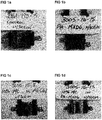
Figures 1a - 1h show the flame retardance of various aspects of the disclosed flame retardant polymer andconventional nylon -
Figure 2 shows the Scaffolding Effect problem. -
Figures 3a - 3c show the flame retardancy of two aspects of the disclosed fabric when blended with flame retardant rayon, andnylon -
Figure 4 compares the After-flame time ofMXD6 verses nylon - The terms "flame resistant," "flame retardant," and "FR" have subtle differences in the art. The differences in the usage of the terms relate to describing fabrics which either resist burning, burn at a slower rate and are capable of self-extinguishing under conditions such as a vertical flame test. For the purposes of this invention the terms "flame resistant" and "flame retardant" are used interchangeably and are meant to include any fabric that possesses one or more of the desired properties such as resistance to burning, slow burning, self-extinguishing, etc.
- A flame retardant fiber is disclosed comprising a partially aromatic polyamide and a non-halogen flame retardant additive. The partially aromatic polyamide comprises aromatic diamine monomers and aliphatic diacid monomers and may include polymers or copolymers including monomers selected from the group consisting of aromatic diamine monomers, aliphatic diamine monomers, aromatic diacid monomers, aliphatic diacid monomers and combinations thereof. The partially aromatic polyamide can also include or exclusively be MXD6 which includes an aromatic diamine and non-aromatic diacid. The melting, or processing temperatures, of partially aromatic polyamides ranges from about 240°C (for MXD6) to about 355°C (for polyamideimide), including about 260°C, 280°C, 300°C, 320°C, and 340°
C. Nylon 6 andnylon Polymer Trade Name Melting Temperature, °C Nylon 6 (non-aromatic) Various 220 Nylon 66 (non-aromatic) Various 260 MXD6 MXD6 240 Nylon 6/6TGrivory 295 Polyphthalamide (PPA) Zytel, LNP 300 Nylon 6T Arlen 310 Nylon 6I/6T Grivory 325 Polyamideimide Torlon 355 - The partially aromatic polyamides may also include co-polymers or mixtures of multiple partially aromatic amides. For example, MXD6 can be blended with
Nylon 6/6T prior to forming a fiber. Furthermore, partially aromatic polymers may be blended with an aliphatic polyamide or co-polymers or mixtures of multiple aliphatic polyamides. For example, MXD6 can be blended withNylon - The non-halogen flame retardant additives can include: condensation products of melamine (including melam, melem, and melon), reaction products of melamine with phosphoric acid (including melamine phosphate, melamine pyrophosphate, and melamine polyphosphate (MPP)), reaction products of condensation products of melamine with phosphoric acid (including melam polyphosphate, melem polyphosphate, melon polyphosphate), melamine cyanurate (MC), zinc diethylphosphinate (DEPZn), aluminum diethylphosphinate (DEPAI), calcium diethylphosphinate, magnesium diethylphosphinate, bisphenol-A bis(diphenyphosphinate) (BPADP), resorcinol bis(2,6-dixylenyl phosphate) (RDX), resorcinol bis(diphenyl phosphate) (RDP), phosphorous oxynitride, zinc borate, zinc oxide, zinc stannate, zinc hydroxystannate, zinc sulfide, zinc phosphate, zinc silicate, zinc hydroxide, zinc carbonate, zinc stearate, magnesium stearate, ammonium octamolybdate, melamine molybdate, melamine octamolybdate, barium metaborate, ferrocene, boron phosphate, boron borate, magnesium hydroxide, magnesium borate, aluminum hydroxide, alumina trihydrate, melamine salts of glycoluril and 3-amino-1,2,4-triazole-5-thiol, urazole salts of potassium, zinc and iron, 1,2-ethanediyl-4-4'-bis-triazolidine-3,5,dione, silicone, oxides of Mg, Al, Ti, Cr, Mn, Fe, Co, Ni, Cu, Zn, Zr, Mo, Sn, Sb, Ba, W, and Bi, polyhedral oligomeric silsesquioxanes, silicotungstic acid (SiTA), phosphotungstic acid, melamine salts of tungstic acid, linear, branched or cyclic phosphates or phosphonates, spirobisphosphonates, spirobisphosphates and nanoparticles, such as carbon nanotubes and nanoclays (including, but not limited to, those based on montmorillonite, halloysite, and laponite).
- The flame retardant additive is present in an amount from about 1% to about 25% w/w, including from about 5% to about 20% w/w, about 5% to about 10%, and about 10%. The mean particle size of the flame retardant additive is less than about 3 microns, including less than about 2 microns, and less than about 1 micron.
- The particle size of the flame retardant additive may be prepared by a milling process which comprises air jet milling of each component, or of co-milling blends of components to reduce the particle size. Other wet or dry milling techniques known in the art (e.g. media milling) may also be used to reduce additive particle size for fiber spinning. If appropriate, milling may involve the injection of liquid milling aids, possibly under pressure, into the mill at any suitable point in the milling process. These liquid aids are added to stabilize the flame retardant system and/or prevent agglomeration. Additional components to aid in particle wetting and/or prevent re-agglomeration may also be added at any suitable point during the milling of flame retardant additive, the blending of the flame retardant additive and polymer, and/or the fiber spinning process.
- The flame retardant may be compounded with the polymeric material in an extruder. An alternative method involves dispersing the flame retardant composition in polymer at a higher concentration than desired in the final polyamide fiber product, and forming a masterbatch. The masterbatch may be ground or pelletized and the resulting particulate dry-blended with additional polyamide resin and this blend used in the fiber spinning process. Yet another alternative method involves adding some or all components of the flame retardant additive to the polymer at a suitable point in the polymerization process.
- The flame retardant fiber can be a staple fiber or continuous filament. The filament cross section can be any shape, including round, triangle, star, square, oval, bilobal, tri-lobal, or flat. Further, the filament can be textured using known texturing methods. As discussed above, the partially aromatic polyamides spun into fibers can also include additional partially aromatic or aliphatic polymers. When spinning such fibers, a mixture of more than one polyamide polymer may be blended prior to spinning into yarn or a multi- filament yarn may be produced containing at least one partially aromatic polyamide polymer and an additional partially aromatic polyamide polymer or aliphatic polymer in a bicomponent form such as a side-by-side or core-sheath configuration.
- The flame retardant staple fiber is spun into a flame retardant yarn. The yarn comprises a blend with additional staple fibers, both flame retardant and non-flame retardant, to make a staple spun yarn. The additional fibers can include cotton, wool, flax, hemp, silk, nylon, lyocell, polyester, and rayon. The staple spun yarn above can also comprise other thermoplastic or non-thermoplastic fibers, such as cellulose, aramids, novoloid, phenolic, polyesters, oxidized acrylic, modacrylic, melamine, poly(p-phenylene benzobisoxazole) (PBO), polybenzimidazole (PBI), or polysulphonamide (PSA), oxidized polyacrylonitrile (PAN), such as partially oxidized PAN, and blends thereof. As used herein, cellulose includes cotton, rayon, and lyocell. The thermoplastic / non-thermoplastic fibers can be flame retardant. Certain fibers, such as aramid, PBI, or PBO, maintain strength after flame exposure and, when used in blended yarns and fabrics, are effective at reducing the fabric char length after flammability testing.
- Fabrics comprising the flame retardant yarn made with the disclosed flame retardant fiber will self extinguish in textile vertical flammability tests (ASTM D6413). The self extinguishing behavior is achieved in fabrics made with 100% of the disclosed flame retardant fiber or in blends of the flame retardant fiber and staple spun fibers as disclosed above. The fabrics made with the disclosed flame retardant yarn can also include additional yarns, such as cellulose, aramids, phenolic, polyester, oxidized acrylic, modacrylic, melamine, cotton, silk, flax, hemp, wool, rayon, lyocell, poly(p-phenylene benzobisoxazole) (PBO), polybenzimidazole (PBI), and polysulphonamide (PSA) fibers, partially oxidized acrylic (including partially oxidized polyacrylonitrile), novoloid, wool, flax, hemp, silk, nylon (whether FR or not), polyester (whether FR or not), anti-static fibers, and combinations thereof. The fabric can be treated with additional flame retardant additives and finishes if necessary. An exemplary method for treating cotton is found in the technical bulletin 'Fabric Flame Retardant Treatment' (2003) published by Cotton Incorporated, Cary, North Carolina. The fabrics can be woven or knit.
- The fibers, yarns, and fabrics can also contain additional components such as: UV stabilizers, anti-microbial agents, bleaching agents, optical brighteners, anti-oxidants, pigments, dyes, soil repellants, stain repellants, nanoparticles, and water repellants. UV stabilizers, anti-microbials agents, optical brighteners, anti-oxidants, nanoparticles, and pigments can be added to the flame retardant fiber prior to melt-spinning or added as a post-treatment after fiber formation. Dyes, soil repellants, stain repellants, nanoparticles and water repellants can be added as a post-treatment after fiber and/or fabric formation. For yarns and fabrics, the additional component can be added as a post treatment. Fabrics made with the disclosed flame retardant fiber may also have a coating or laminated film applied for abrasion resistance or for control of liquid/vapor permeation.
- As shown in
Figures 1a - 1h , molded laminates made with the disclosed flame retardant polymer show superior flame retardancy (as measured using ASTM D-6413) compared to molded laminates made withconventional nylon -
Figure 2 is a schematic illustration of the Scaffolding Effect associated with flame retardant thermoplastics and non-thermoplastic fibers.Figures 3a - 3c compare fabrics made with the disclosed flame retardant fiber and flame retardant rayon to fabrics made withnylon Figures 3b - 3c ) do not suffer from the scaffolding problem, while thenylon Figure 3a ) does.Figure 4 shows the vertical flammability data fornylon nylon -
- After flame means: "Persistent flaming of a material after ignition source has been removed." [Source: ATSM D6413 Standard test Method for Flame Resistance of Textiles (Vertical Method)]
- Char length means: "The distance from the fabric edge, which is directly exposed to flame to the furthest of visible fabric damage, after a specified tearing force has been applied." [Source: ATSM D6413 Standard test Method for Flame Resistance of Textiles (Vertical Method)]
- Drip means: "A flow of liquid that lacks sufficient quantity or pressure to form a continuous stream." [Source: National Fire Protection Association (NFPA) Standard 2112, Standard on Flame-Resistant Garments for Protection of Industrial Personnel Against Flash Fire].
- Melt means: 'The response to heat by a material resulting in evidence of flowing or dripping.' [Source: National Fire Protection Association (NFPA) Standard 2112, Standard on Flame-Resistant Garments for Protection of Industrial Personnel Against Flash Fire].
- Self Extinguishing means: Material will have no persistent flaming after the ignition source is removed OR flaming shall stop before the specimen is totally consumed. When tested by ATSM D6413 Standard test Method for Flame Resistance of Textiles (Vertical Method).
- Flame redardancy was determined in accordance with ASTM D-6413 Standard Test Method for Flame Resistance of Textiles (Vertical Test).
- Preparation of compression molded laminates: Polymers with or without an FR additive are compression molded into films with dimensions of approximately 10 cm x 10 cm and weighing approximately 10 grams. Before molding, woven glass fiber scrims are placed above and below the polymer mixture. The glass fiber scrims prevent polymer shrinking or melting away from the flame during vertical flammability testing and can predict the potential existence of the "scaffolding effect." The weight of the scrims is about 7% of the final laminate. The molding temperature is approximately 25 degrees Celsius above the melting temperature of the polymer.
- Test laminates were prepared using the technique above. Example 1 is made with MXD6 and no flame retardant additive. Example 2 is made with MXD6 and 10% w/w MPP (melamine polyphosphate) additive. Example 3 is made with MXD6 and 10% w/w MC (melamine cyanurate) additive. Example 4 is made with MXD6 and 10% w/w DEPZn (zinc diethylphosphinate) additive. Example 5 is made with MXD6 and 10% w/w DEPAl (aluminum diethylphosphinate). Example 6 is made with MXD6 and 2% w/w SiTA (silicotungstic acid). Example 7 is made with MXD6 and 20% w/w MC additive. Results are reported in Table 1 below.
- Test laminates were prepared using the technique above. Comparative Example 1 is made with
nylon nylon nylon nylon nylon Table 1 - Flame Retardancy Measurements Polymer Additive Weight % After-flame, sec Drips Self Extinguished Figure Ex. 1 MXD6 None 82 No No 1b Ex. 2 MXD6 10 % MPP 0 No Yes 1d Ex. 3 MXD6 10% MC 55 No Yes 1f Ex. 4 MXD6 10 % DEPZn 3 No Yes 1h Ex. 5 MXD6 10 % DEPAl 2 No Yes Ex. 6 MXD6 2% SiTA 9 No Yes Ex. 7 MXD6 20 % MC 7 No Yes NA Comp. Ex. 1 Nylon None 199 Yes No 1a Comp. Ex. 2 Nylon 10% MPP 75 Yes No 1c Comp. Ex. 3 Nylon 10% MC 141 Yes No 1e Comp. Ex. 4 Nylon 10% DEPZn 38 Yes No 1g Comp. Ex. 5 Nylon 2% SiTA 130 Yes No - As shown above in Table 1, the disclosed flame retardant laminates self extinguished and had shorter after flame time compared to the
nylon nylon - Example 8 - 18: Flame retardancy of fabrics made with the disclosed flame retardant fiber and flame retardant rayon. In the following examples, flame retarding thermoplastic yarns were combined with a staple spun FR rayon yarn (Lenzing FR) and knit into a tube fabric. The blended fabric contained approximately 50 percent of each yarn. Fiber finishes and knitting oils were removed from the fabrics before flammability testing.
- Example 8 is a fabric blend of flame retardant MXD6 fiber containing 2% w/w MPP additive with flame retardant rayon fiber. Example 9 is a fabric blend of flame retardant MXD6 fiber containing 5% w/w MPP additive with flame retardant rayon fiber. Example 10 is a fabric blend of flame retardant MXD6 fiber containing 10% w/w MPP additive with flame retardant rayon fiber. Example 11 is a fabric blend of flame retardant MXD6 fiber containing 2% w/w DEPAI additive with flame retardant rayon fiber. Example 12 is a fabric blend of flame retardant MXD6 fiber containing 5% w/w DEPAl additive with flame retardant rayon fiber. Example 13 is a fabric blend of flame retardant MXD6 fiber containing 10% w/w DEPAl additive with flame retardant rayon fiber. Example 14 is a fabric blend of flame retardant MXD6 fiber containing 5% w/w DEPZn additive with flame retardant rayon fiber. Example 15 is a fabric blend of flame retardant MXD6 fiber containing 10% w/w DEPZn additive with flame retardant rayon fiber. Results are reported in Table 2 below.
- Comparative Example 6 is a fabric blend of
flame retardant nylon flame retardant nylon flame retardant nylon Table 2 - Flame Retardancy Measurements Fabric Yarn Blend Additive Weight % 1 After-flame, sec Self Extinguished Figure Ex. 8 MXD6 / FR rayon 2% MPP 4.5 Yes Ex. 9 MXD6 / FR rayon 5% MPP 3.0 Yes NA Ex. 10 MXD6 / FR rayon 10% MPP 0.8 Yes 3b Ex. 11 MXD6 / FR rayon 2% DEPAl 4.7 Yes Ex. 12 MXD6 / FR rayon 5% DEPAl 4.7 Yes Ex. 13 MXD6 / FR rayon 10% DEPAl 3.8 Yes 3d Ex. 14 MXD6 / FR rayon 5% DEPZn 16.6 Yes Ex. 15 MXD6 / FR rayon 10% DEPZn 7.3 Yes Comp. Ex.6 Nylon-6,6 / FR rayon 5% MPP 24.8 No NA Comp. Ex. 7 Nylon-6,6 / FR rayon 10% MPP 17.0 No 3a Comp. Ex. 8 Nylon-6,6 / FR rayon 10% DEPAl 33.3 No 3c 1 Percent based on thermoplastic polymer fiber. - Here, the blend of MXD6 and flame retardant rayon fibers showed superior results to the comparative blend of
nylon - While the invention has been described in conjunction with specific aspects thereof, it is evident that the many alternatives, modifications, and variations will be apparent to those skilled in the art in light of the foregoing description. Accordingly, the invention is intended to embrace all such alternatives, modifications and variations that fall within the scope of the claims.
Claims (15)
- A flame retardant staple spun yarn comprising a flame retardant fiber, said fiber comprising a partially aromatic polyamide and a non-halogen flame retardant additive;
wherein the partially aromatic polyamide comprises aromatic diamine monomers and aliphatic diacid monomers, and;
wherein the flame retardant staple spun yarn comprises an additional fiber. - The flame retardant staple spun yarn of claim 1, wherein the partially aromatic polyamide is MXD6.
- The flame retardant staple spun yarn of claim 1, wherein the non-halogen flame retardant additives are selected from the group consisting of:condensation products of melamine (including melam, melem, and melon), reaction products of melamine with phosphoric acid (including melamine phosphate, melamine pyrophosphate, and melamine polyphosphate (MPP), reaction products of condensation products of melamine with phosphoric acid (including melam polyphosphate, melem polyphosphate, melon polyphosphate), melamine cyanurate (MC), zinc diethylphosphinate (DEPZn), aluminum diethylphosphinate (DEPAI), calcium diethylphosphinate, magnesium diethylphosphinate, bisphenol-A bis(diphenyphosphinate) (BPADP), resorcinol bis(2,6-dixylenyl phosphate) (RDX), resorcinol bis(diphenyl phosphate) (RDP), phosphorous oxynitride, zinc borate, zinc oxide, zinc stannate, zinc hydroxystannate, zinc sulfide, zinc phosphate, zinc silicate, zinc hydroxide, zinc carbonate, zinc stearate, magnesium stearate, ammonium octamolybdate, melamine molybdate, melamine octamolybdate, barium metaborate, ferrocene, boron phosphate, boron borate, magnesium hydroxide, magnesium borate, aluminum hydroxide, alumina trihydrate, melamine salts of glycoluril and 3-amino-1,2,4-triazole-5-thiol, urazole salts of potassium, zinc and iron, 1,2-ethanediyl-4-4'-bis-triazolidine-3,5,dione, silicone, oxides of Mg, Al, Ti, Cr, Mn, Fe, Co, Ni, Cu, Zn, Zr, Mo, Sn, Sb, Ba, W, and Bi, polyhedral oligomeric silsesquioxanes, carbon nanotubes, and nanoclays orwherein the non-halogen flame retardant additive is selected from the group consisting of MPP, MC, DEPZn, and DEPAI.
- The flame retardant staple spun yarn of one of claims 1-3 wherein the non-halogen flame retardant additive is present at a concentration of from about 5% to about 10% by weight.
- The flame retardant staple spun yarn of one of claims 1-4, wherein said additional fiber is selected from the group consisting of: cellulose, aramids, phenolic, polyester, oxidized acrylic, modacrylic, melamine, silk, flax, hemp, wool, poly(p-phenylene benzobisoxazole) (PBO), polybenzimidazole (PBI), and polysulphonamide (PSA) fibers.
- The flame retardant staple spun yarn of one of claims 1-5, wherein said additional fiber has been treated with a flame retardant.
- The flame retardant staple spun yarn of claim 1, wherein said additional fiber is cotton, rayon, polyester, or lyocell.
- A flame retardant continuous filament yarn comprising at least one flame retardant fiber, wherein said flame retardant fiber is continuous, wherein said flame retardant fiber comprised a partially aromatic polyamide and a non-halogen flame retardant additive;
wherein the partially aromatic polyamide comprises aromatic diamine monomers and aliphatic diacid monomers, and;
wherein the flame retardant continuous filament yarn comprises an additional continuous filament fiber. - The flame retardant continuous filament yarn of claim 8, wherein the partially aromatic polyamide is MXD6.
- The flame retardant continuous filament yarn of claim 8, wherein the non-halogen flame retardant additives are selected from the group consisting of:condensation products of melamine (including melam, melem, and melon), reaction products of melamine with phosphoric acid (including melamine phosphate, melamine pyrophosphate, and melamine polyphosphate (MPP), reaction products of condensation products of melamine with phosphoric acid (including melam polyphosphate, melem polyphosphate, melon polyphosphate), melamine cyanurate (MC), zinc diethylphosphinate (DEPZn), aluminum diethylphosphinate (DEPAI), calcium diethylphosphinate, magnesium diethylphosphinate, bisphenol-A bis(diphenyphosphinate) (BPADP), resorcinol bis(2,6-dixylenyl phosphate) (RDX), resorcinol bis(diphenyl phosphate) (RDP), phosphorous oxynitride, zinc borate, zinc oxide, zinc stannate, zinc hydroxystannate, zinc sulfide, zinc phosphate, zinc silicate, zinc hydroxide, zinc carbonate, zinc stearate, magnesium stearate, ammonium octamolybdate, melamine molybdate, melamine octamolybdate, barium metaborate, ferrocene, boron phosphate, boron borate, magnesium hydroxide, magnesium borate, aluminum hydroxide, alumina trihydrate, melamine salts of glycoluril and 3-amino-1,2,4-triazole-5-thiol, urazole salts of potassium, zinc and iron, 1,2-ethanediyl-4-4'-bis-triazolidine-3,5,dione, silicone, oxides of Mg, Al, Ti, Cr, Mn, Fe, Co, Ni, Cu, Zn, Zr, Mo, Sn, Sb, Ba, W, and Bi, polyhedral oligomeric silsesquioxanes, carbon nanotubes, and nanoclays orwherein the non-halogen flame retardant additive is selected from the group consisting of MPP, MC, DEPZn, and DEPAI.
- The flame retardant continuous filament yarn of one of claims 8-10, wherein the non-halogen flame retardant additive is present at a concentration of from about 5% to about 10% by weight.
- The flame retardant continuous filament yarn of one of claims 8-11, wherein said additional continuous filament fiber is selected from the group consisting of: aramids, phenolic, polyesters, oxidized acrylic, modacrylic, melamine, lyocell, poly(p-phenylene benzobisoxazole) (PBO), polybenzimidazole (PBI), and polysulphonamide (PSA) fibers.
- The flame retardant continuous filament yarn of one of claims 8-11, wherein said additional continuous filament fiber has been treated with a flame retardant.
- A fabric comprising the yarn of one of claims 1-13.
- The fabric of claim 14 further comprising an additional yarn, and optionally
wherein said additional yarn comprises a fiber selected from the group consisting of: cellulose, aramids, phenolic, polyester, oxidized acrylic, modacrylic, melamine, cotton, silk, flax, hemp, wool, rayon, lyocell, poly(p-phenylene benzobisoxazole) (PBO), polybenzimidazole (PBI), and polysulphonamide (PSA) fibers.
Applications Claiming Priority (2)
| Application Number | Priority Date | Filing Date | Title |
|---|---|---|---|
| US38561410P | 2010-09-23 | 2010-09-23 | |
| PCT/US2011/052557 WO2012040332A2 (en) | 2010-09-23 | 2011-09-21 | Flame retardant fibers, yarns, and fabrics made therefrom |
Publications (3)
| Publication Number | Publication Date |
|---|---|
| EP2619358A2 EP2619358A2 (en) | 2013-07-31 |
| EP2619358A4 EP2619358A4 (en) | 2016-05-18 |
| EP2619358B1 true EP2619358B1 (en) | 2018-02-21 |
Family
ID=45874353
Family Applications (1)
| Application Number | Title | Priority Date | Filing Date |
|---|---|---|---|
| EP11827445.5A Active EP2619358B1 (en) | 2010-09-23 | 2011-09-21 | Flame retardant yarns and fabrics comprising them |
Country Status (12)
| Country | Link |
|---|---|
| US (1) | US10640893B2 (en) |
| EP (1) | EP2619358B1 (en) |
| JP (1) | JP6076907B2 (en) |
| KR (1) | KR101920504B1 (en) |
| CN (2) | CN103109002B (en) |
| BR (1) | BR112013006887B1 (en) |
| CA (1) | CA2812453A1 (en) |
| IL (1) | IL225148B (en) |
| MX (1) | MX355538B (en) |
| RU (1) | RU2596738C9 (en) |
| TW (2) | TWI625434B (en) |
| WO (1) | WO2012040332A2 (en) |
Cited By (1)
| Publication number | Priority date | Publication date | Assignee | Title |
|---|---|---|---|---|
| CN113106592A (en) * | 2019-05-27 | 2021-07-13 | 广东五源新材料科技集团有限公司 | Animal leather fiber bundle with nanoscale branches, yarn, core-spun yarn and product |
Families Citing this family (61)
| Publication number | Priority date | Publication date | Assignee | Title |
|---|---|---|---|---|
| BR112014004611B8 (en) * | 2011-09-02 | 2021-05-04 | Invista Tech Sarl | article showing flame resistant or flame retardant property |
| AT513219B1 (en) * | 2012-07-23 | 2015-08-15 | Chemiefaser Lenzing Ag | Flame retardant textile fabric for protective clothing |
| CN103012764B (en) * | 2012-12-13 | 2013-11-13 | 江苏腾盛纺织科技集团有限公司 | Random copolyester resin containing oxazole structure, preparation method thereof and high-strength copolyester fiber |
| CN102977348B (en) * | 2012-12-13 | 2013-11-13 | 江苏腾盛纺织科技集团有限公司 | Block copolyester resin containing oxazole structure, preparation method thereof and high-strength copolyester fiber |
| EP2767180B1 (en) * | 2013-02-18 | 2017-01-04 | W.L. Gore & Associates GmbH | Flame protective fabric structure |
| US20140308505A1 (en) * | 2013-04-16 | 2014-10-16 | Thomas Edward Schmitt | Phosphonate polymers, copolymers, and their respective oligomers as flame retardants for polyamide fibers |
| CN103689841B (en) * | 2013-11-27 | 2015-05-13 | 南通东帝纺织品有限公司 | High-temperature resistance plus material and preparation method thereof |
| US11306414B2 (en) | 2014-01-17 | 2022-04-19 | Qed Labs Inc. | Articles with improved flame retardancy and/or melt dripping properties |
| EP3094524B1 (en) * | 2014-01-17 | 2021-05-05 | Zipper-Technik GmbH | Heat protection product |
| RU2662477C2 (en) * | 2014-03-11 | 2018-07-26 | Смартполимер Гмбх | Flame-resistant moulded cellulose bodies produced according to direct dissolving method |
| US20150329997A1 (en) * | 2014-05-15 | 2015-11-19 | Stephen Switzer | Antimicrobial fire-retardant yarn and method of manufacturing same |
| WO2015189810A1 (en) | 2014-06-13 | 2015-12-17 | Csir | Liquid flame retardant composition |
| CN104194040B (en) * | 2014-08-14 | 2016-10-26 | 苏州科技学院相城研究院 | Four (O-isopropyl-phenyl time phosphono) glycoluril fire retardant combination and application processes thereof |
| CN104177651B (en) * | 2014-08-14 | 2016-11-02 | 苏州科技学院相城研究院 | Tetra(O-butyl-phenylphosphinoyl) glycoluril flame retardant composition and application method thereof |
| AT516414B1 (en) * | 2014-10-28 | 2017-07-15 | Chemiefaser Lenzing Ag | Liquid-soaked non-woven fabric containing zinc oxide-containing cellulose fibers |
| JP6736555B2 (en) * | 2014-12-12 | 2020-08-05 | ロバート・ヴァレンタイン・カソウスキー | Use of flame retardants and flame retardants |
| CN107636217B (en) * | 2015-06-01 | 2020-04-14 | 株式会社钟化 | Flame retardant fabric and protective clothing using the same |
| US11959196B2 (en) | 2015-07-06 | 2024-04-16 | Pbi Performance Products, Inc. | Phosphonated PBI fiber |
| CN105386294A (en) * | 2015-10-16 | 2016-03-09 | 辽宁石油化工大学 | Polyester flame-retardant fabric and manufacturing method thereof |
| US11014030B2 (en) | 2016-02-17 | 2021-05-25 | Hollingsworth & Vose Company | Filter media including flame retardant fibers |
| US10252200B2 (en) | 2016-02-17 | 2019-04-09 | Hollingsworth & Vose Company | Filter media including a filtration layer comprising synthetic fibers |
| CN106283657A (en) * | 2016-08-19 | 2017-01-04 | 常熟市大正纺织制版有限公司 | The postfinishing process of wool knitting fabrics |
| EP3519076A4 (en) * | 2016-09-30 | 2020-02-26 | Hollingsworth & Vose Company | FILTERING MEDIUM COMPRISING FLAME RETARDANT FIBERS |
| CN106757679A (en) * | 2016-11-17 | 2017-05-31 | 安徽新盾消防设备有限公司 | Flame-retardant textile |
| MX2019006129A (en) * | 2016-11-28 | 2019-08-14 | Qed Labs Inc | Meltable intumescent flame retardant compositions. |
| CN106758168A (en) * | 2016-12-01 | 2017-05-31 | 西南大学 | Flame retardant polyester fabric preparation method based on nanometer boron phosphate |
| RU2641931C1 (en) * | 2016-12-20 | 2018-01-23 | Федеральное государственное бюджетное образовательное учреждение высшего образования "Волгоградский государственный технический университет" (ВолгГТУ) | Fluorinated polyamide composition with reduced combustibility |
| CN110944546B (en) * | 2017-02-09 | 2022-10-14 | 塔夫特与尼多有限责任公司 | Flame-retardant cover |
| JP6615812B2 (en) * | 2017-03-22 | 2019-12-04 | 大日精化工業株式会社 | Flame retardant resin composition and flame retardant fiber |
| CN107237126B (en) * | 2017-06-01 | 2019-11-15 | 成都海蓉特种纺织品有限公司 | A kind of fire-retardant polyamide fibre textile and preparation method thereof |
| CN107313168A (en) * | 2017-08-31 | 2017-11-03 | 苏州英得福机电科技有限公司 | A kind of environment-friendly composite inflaming retarding fabric |
| EP3467162A1 (en) * | 2017-10-06 | 2019-04-10 | Lenzing Aktiengesellschaft | Flame retardant lyocell filament |
| US20200283933A1 (en) * | 2017-10-20 | 2020-09-10 | Invista North America S.A.R.L. | High load bearing capacity nylon staple fibers with additive, and blended yarns and fabrics thereof |
| US11311527B2 (en) | 2018-05-16 | 2022-04-26 | Forma Therapeutics, Inc. | Inhibiting mutant isocitrate dehydrogenase 1 (mIDH-1) |
| US11013734B2 (en) | 2018-05-16 | 2021-05-25 | Forma Therapeutics, Inc. | Treating patients harboring an isocitrate dehydrogenase-1 (IDH-1) mutation |
| US11013733B2 (en) | 2018-05-16 | 2021-05-25 | Forma Therapeutics, Inc. | Inhibiting mutant isocitrate dehydrogenase 1 (mlDH-1) |
| US20210196701A1 (en) | 2018-05-16 | 2021-07-01 | Forma Therapeutics, Inc. | Inhibiting mutant idh-1 |
| US11738018B2 (en) | 2018-05-16 | 2023-08-29 | FORMA Therapeuetics, Inc. | Inhibiting mutant isocitrate dehydrogenase 1 (mIDH-1) |
| WO2019222551A1 (en) | 2018-05-16 | 2019-11-21 | Forma Therapeutics, Inc. | Solid forms of ((s)-5-((1-(6-chloro-2-oxo-1,2-dihydroquinolin-3-yl)ethyl)amino)-1-methyl-6-oxo-1,6-dihydropyridine-2-carbonitrile |
| CN109402756A (en) * | 2018-10-24 | 2019-03-01 | 武汉纺织大学 | A kind of preparation method of fire-retardant Lyocell fibers |
| US12240959B2 (en) * | 2018-11-14 | 2025-03-04 | Energy Solutions (US) LLC | Flame retardant and preparation process thereof |
| CN111304794B (en) * | 2018-12-11 | 2022-03-08 | 中蓝晨光化工研究设计院有限公司 | A kind of ultra-high-strength yarn and its spinning process |
| CN113260656A (en) | 2019-01-07 | 2021-08-13 | 奥升德功能材料运营有限公司 | Non-halogenated flame retardant polyamide composition |
| CA3171137A1 (en) | 2019-03-28 | 2020-10-01 | Southern Mills, Inc. | Flame resistant fabrics |
| MX2021012042A (en) | 2019-04-01 | 2022-01-04 | Ascend Performance Mat Operations Llc | Non-halogenated flame retardant polyamide compositions. |
| CN110656412A (en) * | 2019-08-26 | 2020-01-07 | 徐州锦业纺织科技有限公司 | Wear-resistant flame-retardant yarn |
| KR102230501B1 (en) * | 2019-11-04 | 2021-03-22 | 한국생산기술연구원 | Flame retardant fiber comprising microcapsulated inorganic flame retardant additive and method of manufacturing same |
| CN111764004B (en) * | 2020-06-24 | 2021-06-29 | 东华大学 | A kind of preparation method of high-strength and high-model polyimide special-shaped fiber |
| JP7505946B2 (en) * | 2020-09-15 | 2024-06-25 | 帝人株式会社 | Heat-resistant protective clothing |
| KR102468645B1 (en) * | 2021-01-25 | 2022-11-21 | 클라쏜 주식회사 | Cloth Composition for Billiard Table with Excellent Antistatic Property |
| WO2022178107A1 (en) * | 2021-02-19 | 2022-08-25 | Universal Fibers, Inc. | Method for manufacturing polyamide fibers |
| KR20240037351A (en) | 2021-08-10 | 2024-03-21 | 써던 밀즈, 인코포레이티드 | flame retardant fabric |
| CN114351465A (en) * | 2021-12-28 | 2022-04-15 | 南通新帝克单丝科技股份有限公司 | Method for coating aramid 1414 fibers with PEEK |
| CN114395841B (en) * | 2022-01-06 | 2023-08-29 | 深圳市威仕度服装有限公司 | Composite flame-retardant fabric and protective clothing based on same |
| CN115161876B (en) * | 2022-08-15 | 2023-07-18 | 吉祥三宝高科纺织有限公司 | A kind of preparation technology of environmental protection fiber wadding |
| KR102583789B1 (en) | 2023-01-03 | 2023-10-04 | (주)보광아이엔티 | Materials for inner and outer of protective product and respective manufacturing methods |
| CN116219566A (en) * | 2023-03-20 | 2023-06-06 | 金堆城钼业股份有限公司 | A kind of ammonium octamolybdate flame-retardant fiber, preparation method and application thereof |
| US20240349833A1 (en) | 2023-04-18 | 2024-10-24 | Southern Mills, Inc. | Flame resistant nonwoven fabrics and composites and garments made with same |
| CN117626459B (en) * | 2023-12-11 | 2024-05-14 | 江苏垶恒复合材料有限公司 | Flame-retardant regenerated cellulose fiber |
| CN118516792B (en) * | 2024-06-13 | 2025-11-18 | 特步(中国)有限公司 | A tear-resistant polyester yarn, a mesh fabric, and a method for manufacturing the mesh fabric. |
| WO2026015099A1 (en) * | 2024-07-11 | 2026-01-15 | Akatek Tekni̇k Teksti̇l Sanayi̇ Ve Ti̇caret Anoni̇m Şi̇rketi̇ | Fabric containing flame resistant fiber blend |
Family Cites Families (29)
| Publication number | Priority date | Publication date | Assignee | Title |
|---|---|---|---|---|
| JPH01221537A (en) | 1988-02-26 | 1989-09-05 | Teijin Ltd | Flame-resistant fiber |
| DE58908791D1 (en) * | 1988-07-13 | 1995-02-02 | Basf Ag | Flame-retardant thermoplastic molding compounds based on partially aromatic copolyamides. |
| JP2703390B2 (en) | 1990-06-11 | 1998-01-26 | 帝人株式会社 | Aromatic polyamide fiber cloth |
| CA2078626C (en) * | 1992-03-06 | 1999-04-27 | Gary W. Shore | Method for producing polyamide carpet fibers with improved flame retardancy |
| BE1008947A3 (en) * | 1994-12-01 | 1996-10-01 | Dsm Nv | Process for the preparation of condensation products of melamine. |
| DE19532720A1 (en) | 1995-09-05 | 1997-03-06 | Basf Ag | Flame retardant thermoplastic molding compounds |
| RU2140472C1 (en) * | 1996-05-15 | 1999-10-27 | Открытое акционерное общество "Научно-исследовательский институт нетканых материалов" | Fire-protective nonwoven material |
| JPH10280230A (en) * | 1997-04-09 | 1998-10-20 | Mitsubishi Gas Chem Co Inc | Polyamide fiber |
| US6225383B1 (en) * | 1997-05-26 | 2001-05-01 | Mitsubishi Engineering Plastic Corp. | Resin composition comprising polyamide resin |
| JP2000303257A (en) * | 1999-04-14 | 2000-10-31 | Unitika Ltd | Yarns for flame-retardant artificial lawn and flame- retardant artificial lawn |
| JP2000328363A (en) * | 1999-05-25 | 2000-11-28 | Nec Corp | Flame-retardant polyamide fiber |
| DE19933901A1 (en) * | 1999-07-22 | 2001-02-01 | Clariant Gmbh | Flame retardant combination |
| JP2001234066A (en) * | 2000-02-24 | 2001-08-28 | Ube Ind Ltd | Polyamide resin composition |
| US20040076824A1 (en) * | 2000-09-20 | 2004-04-22 | Hiroshi Urabe | Flame-retardant polyamide filaments and their use |
| JP2002173829A (en) * | 2000-09-20 | 2002-06-21 | Mitsubishi Engineering Plastics Corp | Flame retardant polyamide filament |
| JP2003105659A (en) * | 2001-09-27 | 2003-04-09 | Mitsubishi Engineering Plastics Corp | Flame-retardant polyamide non-woven fabric |
| FR2851581B1 (en) * | 2003-02-21 | 2007-04-06 | Rhodianyl | FIBERS, FIBERS, FILAMENTS AND FIRE RETARDED TEXTILE ARTICLES |
| JP4425908B2 (en) * | 2003-04-28 | 2010-03-03 | ロディア エンジニアリング プラスティックス ソシエテ ア レスポンサビリテ リミテー | Thermoplastic materials containing nanometer stratified compounds |
| US20050025962A1 (en) * | 2003-07-28 | 2005-02-03 | Reiyao Zhu | Flame retardant fiber blends comprising flame retardant cellulosic fibers and fabrics and garments made therefrom |
| US20050159552A1 (en) * | 2004-01-21 | 2005-07-21 | Reed Jon S. | Flame retarded fibers and filaments and process of production therefor |
| CN1922252B (en) | 2004-02-18 | 2011-06-15 | 亨斯迈先进材料(瑞士)有限公司 | Fire retardant compositions using siloxanes |
| CN1950455A (en) * | 2004-04-28 | 2007-04-18 | 宇部兴产株式会社 | Flame-retardant resin composition |
| JP4662489B2 (en) | 2004-06-29 | 2011-03-30 | 旭化成イーマテリアルズ株式会社 | Flame retardant epoxy resin composition |
| EP1791910B1 (en) | 2004-07-01 | 2012-02-22 | Solvay Specialty Polymers USA, LLC. | Aromatic polyamide composition and article manufactured therefrom |
| US7937924B2 (en) | 2005-11-16 | 2011-05-10 | Lorica International, Inc. | Fire retardant compositions and methods and apparatuses for making the same |
| JP5913783B2 (en) * | 2006-08-31 | 2016-04-27 | サザンミルズ インコーポレイテッドSouthern Mills,Inc. | Flame retardant fabric and garment made therefrom |
| RU2452799C2 (en) * | 2006-12-15 | 2012-06-10 | Тейдзин Текно Продактс Лимитед | Aromatic polyamide fibre based on heterocycle-containing aromatic polyamide, synthesis method thereof, fabric formed by fibre and fibre-reinforced composite material |
| FR2917738B1 (en) * | 2007-06-20 | 2010-11-05 | Rhodia Operations | FLAME RETARDING THERMOPLASTIC COMPOSITIONS |
| EP2256168B1 (en) * | 2008-02-12 | 2013-01-02 | Teijin Limited | Flame-retardant resin composition, flame-retardant fiber, flame-retardant cloth, and heat-resistant protective clothing |
-
2011
- 2011-09-21 EP EP11827445.5A patent/EP2619358B1/en active Active
- 2011-09-21 RU RU2013118576/05A patent/RU2596738C9/en not_active IP Right Cessation
- 2011-09-21 CN CN201180045765.1A patent/CN103109002B/en active Active
- 2011-09-21 BR BR112013006887-6A patent/BR112013006887B1/en not_active IP Right Cessation
- 2011-09-21 JP JP2013530277A patent/JP6076907B2/en active Active
- 2011-09-21 CA CA 2812453 patent/CA2812453A1/en not_active Abandoned
- 2011-09-21 US US13/825,209 patent/US10640893B2/en active Active
- 2011-09-21 MX MX2013003075A patent/MX355538B/en active IP Right Grant
- 2011-09-21 KR KR1020137010160A patent/KR101920504B1/en active Active
- 2011-09-21 CN CN201610603136.0A patent/CN106591982B/en active Active
- 2011-09-21 WO PCT/US2011/052557 patent/WO2012040332A2/en not_active Ceased
- 2011-09-23 TW TW100134435A patent/TWI625434B/en active
- 2011-09-23 TW TW106133284A patent/TW201802312A/en unknown
-
2013
- 2013-03-10 IL IL225148A patent/IL225148B/en active IP Right Grant
Non-Patent Citations (1)
| Title |
|---|
| None * |
Cited By (1)
| Publication number | Priority date | Publication date | Assignee | Title |
|---|---|---|---|---|
| CN113106592A (en) * | 2019-05-27 | 2021-07-13 | 广东五源新材料科技集团有限公司 | Animal leather fiber bundle with nanoscale branches, yarn, core-spun yarn and product |
Also Published As
| Publication number | Publication date |
|---|---|
| WO2012040332A3 (en) | 2012-06-21 |
| MX355538B (en) | 2018-04-20 |
| CN103109002B (en) | 2018-07-06 |
| EP2619358A2 (en) | 2013-07-31 |
| MX2013003075A (en) | 2013-04-05 |
| RU2596738C2 (en) | 2016-09-10 |
| IL225148B (en) | 2019-06-30 |
| JP2013542334A (en) | 2013-11-21 |
| JP6076907B2 (en) | 2017-02-08 |
| TW201229338A (en) | 2012-07-16 |
| CN106591982B (en) | 2020-10-27 |
| WO2012040332A2 (en) | 2012-03-29 |
| RU2596738C9 (en) | 2016-11-10 |
| BR112013006887A2 (en) | 2017-05-23 |
| US20130244527A1 (en) | 2013-09-19 |
| CA2812453A1 (en) | 2012-03-29 |
| BR112013006887B1 (en) | 2020-12-08 |
| RU2013118576A (en) | 2014-10-27 |
| TW201802312A (en) | 2018-01-16 |
| CN106591982A (en) | 2017-04-26 |
| EP2619358A4 (en) | 2016-05-18 |
| TWI625434B (en) | 2018-06-01 |
| KR20130098371A (en) | 2013-09-04 |
| US10640893B2 (en) | 2020-05-05 |
| CN103109002A (en) | 2013-05-15 |
| KR101920504B1 (en) | 2018-11-20 |
Similar Documents
| Publication | Publication Date | Title |
|---|---|---|
| US10640893B2 (en) | Flame retardant fibers, yarns, and fabrics made therefrom | |
| EP2744932B1 (en) | Flame resistant yarns and fabrics including partially aromatic polyamide fiber and other flame resistant fibers | |
| RU2671648C2 (en) | Fabric and fibre product | |
| US20230121552A1 (en) | Fire retardant nylon fibers and methods for making them | |
| US20140308505A1 (en) | Phosphonate polymers, copolymers, and their respective oligomers as flame retardants for polyamide fibers | |
| WO2013148653A1 (en) | Dyeing and printing of fabrics including partially aromatic polyamides | |
| EP3273817A1 (en) | Enhanced meta-aramid and para-aramid textiles, garments, and methods |
Legal Events
| Date | Code | Title | Description |
|---|---|---|---|
| PUAI | Public reference made under article 153(3) epc to a published international application that has entered the european phase |
Free format text: ORIGINAL CODE: 0009012 |
|
| 17P | Request for examination filed |
Effective date: 20130419 |
|
| AK | Designated contracting states |
Kind code of ref document: A2 Designated state(s): AL AT BE BG CH CY CZ DE DK EE ES FI FR GB GR HR HU IE IS IT LI LT LU LV MC MK MT NL NO PL PT RO RS SE SI SK SM TR |
|
| DAX | Request for extension of the european patent (deleted) | ||
| A4 | Supplementary search report drawn up and despatched |
Effective date: 20160415 |
|
| RIC1 | Information provided on ipc code assigned before grant |
Ipc: D01F 6/60 20060101ALI20160411BHEP Ipc: D03D 15/12 20060101ALI20160411BHEP Ipc: D04H 1/42 20120101ALI20160411BHEP Ipc: D01F 1/07 20060101AFI20160411BHEP Ipc: D02G 3/02 20060101ALI20160411BHEP |
|
| REG | Reference to a national code |
Ref country code: DE Ref legal event code: R079 Ref document number: 602011045884 Country of ref document: DE Free format text: PREVIOUS MAIN CLASS: D01F0001070000 Ipc: D02G0003440000 |
|
| GRAP | Despatch of communication of intention to grant a patent |
Free format text: ORIGINAL CODE: EPIDOSNIGR1 |
|
| RIC1 | Information provided on ipc code assigned before grant |
Ipc: D02G 3/44 20060101AFI20170817BHEP Ipc: D01F 1/07 20060101ALI20170817BHEP Ipc: D01F 6/60 20060101ALI20170817BHEP |
|
| RAP1 | Party data changed (applicant data changed or rights of an application transferred) |
Owner name: INVISTA TEXTILES (U.K.) LIMITED |
|
| INTG | Intention to grant announced |
Effective date: 20170907 |
|
| GRAS | Grant fee paid |
Free format text: ORIGINAL CODE: EPIDOSNIGR3 |
|
| GRAA | (expected) grant |
Free format text: ORIGINAL CODE: 0009210 |
|
| AK | Designated contracting states |
Kind code of ref document: B1 Designated state(s): AL AT BE BG CH CY CZ DE DK EE ES FI FR GB GR HR HU IE IS IT LI LT LU LV MC MK MT NL NO PL PT RO RS SE SI SK SM TR |
|
| REG | Reference to a national code |
Ref country code: GB Ref legal event code: FG4D |
|
| REG | Reference to a national code |
Ref country code: CH Ref legal event code: EP |
|
| REG | Reference to a national code |
Ref country code: AT Ref legal event code: REF Ref document number: 971828 Country of ref document: AT Kind code of ref document: T Effective date: 20180315 |
|
| REG | Reference to a national code |
Ref country code: IE Ref legal event code: FG4D |
|
| REG | Reference to a national code |
Ref country code: DE Ref legal event code: R096 Ref document number: 602011045884 Country of ref document: DE |
|
| REG | Reference to a national code |
Ref country code: NL Ref legal event code: FP |
|
| REG | Reference to a national code |
Ref country code: LT Ref legal event code: MG4D |
|
| PG25 | Lapsed in a contracting state [announced via postgrant information from national office to epo] |
Ref country code: FI Free format text: LAPSE BECAUSE OF FAILURE TO SUBMIT A TRANSLATION OF THE DESCRIPTION OR TO PAY THE FEE WITHIN THE PRESCRIBED TIME-LIMIT Effective date: 20180221 Ref country code: HR Free format text: LAPSE BECAUSE OF FAILURE TO SUBMIT A TRANSLATION OF THE DESCRIPTION OR TO PAY THE FEE WITHIN THE PRESCRIBED TIME-LIMIT Effective date: 20180221 Ref country code: CY Free format text: LAPSE BECAUSE OF FAILURE TO SUBMIT A TRANSLATION OF THE DESCRIPTION OR TO PAY THE FEE WITHIN THE PRESCRIBED TIME-LIMIT Effective date: 20180221 Ref country code: LT Free format text: LAPSE BECAUSE OF FAILURE TO SUBMIT A TRANSLATION OF THE DESCRIPTION OR TO PAY THE FEE WITHIN THE PRESCRIBED TIME-LIMIT Effective date: 20180221 Ref country code: NO Free format text: LAPSE BECAUSE OF FAILURE TO SUBMIT A TRANSLATION OF THE DESCRIPTION OR TO PAY THE FEE WITHIN THE PRESCRIBED TIME-LIMIT Effective date: 20180521 Ref country code: ES Free format text: LAPSE BECAUSE OF FAILURE TO SUBMIT A TRANSLATION OF THE DESCRIPTION OR TO PAY THE FEE WITHIN THE PRESCRIBED TIME-LIMIT Effective date: 20180221 |
|
| REG | Reference to a national code |
Ref country code: FR Ref legal event code: PLFP Year of fee payment: 8 |
|
| PG25 | Lapsed in a contracting state [announced via postgrant information from national office to epo] |
Ref country code: BG Free format text: LAPSE BECAUSE OF FAILURE TO SUBMIT A TRANSLATION OF THE DESCRIPTION OR TO PAY THE FEE WITHIN THE PRESCRIBED TIME-LIMIT Effective date: 20180521 Ref country code: RS Free format text: LAPSE BECAUSE OF FAILURE TO SUBMIT A TRANSLATION OF THE DESCRIPTION OR TO PAY THE FEE WITHIN THE PRESCRIBED TIME-LIMIT Effective date: 20180221 Ref country code: LV Free format text: LAPSE BECAUSE OF FAILURE TO SUBMIT A TRANSLATION OF THE DESCRIPTION OR TO PAY THE FEE WITHIN THE PRESCRIBED TIME-LIMIT Effective date: 20180221 Ref country code: SE Free format text: LAPSE BECAUSE OF FAILURE TO SUBMIT A TRANSLATION OF THE DESCRIPTION OR TO PAY THE FEE WITHIN THE PRESCRIBED TIME-LIMIT Effective date: 20180221 Ref country code: GR Free format text: LAPSE BECAUSE OF FAILURE TO SUBMIT A TRANSLATION OF THE DESCRIPTION OR TO PAY THE FEE WITHIN THE PRESCRIBED TIME-LIMIT Effective date: 20180522 |
|
| PG25 | Lapsed in a contracting state [announced via postgrant information from national office to epo] |
Ref country code: EE Free format text: LAPSE BECAUSE OF FAILURE TO SUBMIT A TRANSLATION OF THE DESCRIPTION OR TO PAY THE FEE WITHIN THE PRESCRIBED TIME-LIMIT Effective date: 20180221 Ref country code: PL Free format text: LAPSE BECAUSE OF FAILURE TO SUBMIT A TRANSLATION OF THE DESCRIPTION OR TO PAY THE FEE WITHIN THE PRESCRIBED TIME-LIMIT Effective date: 20180221 Ref country code: RO Free format text: LAPSE BECAUSE OF FAILURE TO SUBMIT A TRANSLATION OF THE DESCRIPTION OR TO PAY THE FEE WITHIN THE PRESCRIBED TIME-LIMIT Effective date: 20180221 Ref country code: AL Free format text: LAPSE BECAUSE OF FAILURE TO SUBMIT A TRANSLATION OF THE DESCRIPTION OR TO PAY THE FEE WITHIN THE PRESCRIBED TIME-LIMIT Effective date: 20180221 |
|
| PGFP | Annual fee paid to national office [announced via postgrant information from national office to epo] |
Ref country code: FR Payment date: 20180827 Year of fee payment: 16 |
|
| REG | Reference to a national code |
Ref country code: DE Ref legal event code: R097 Ref document number: 602011045884 Country of ref document: DE |
|
| PG25 | Lapsed in a contracting state [announced via postgrant information from national office to epo] |
Ref country code: DK Free format text: LAPSE BECAUSE OF FAILURE TO SUBMIT A TRANSLATION OF THE DESCRIPTION OR TO PAY THE FEE WITHIN THE PRESCRIBED TIME-LIMIT Effective date: 20180221 Ref country code: SK Free format text: LAPSE BECAUSE OF FAILURE TO SUBMIT A TRANSLATION OF THE DESCRIPTION OR TO PAY THE FEE WITHIN THE PRESCRIBED TIME-LIMIT Effective date: 20180221 Ref country code: SM Free format text: LAPSE BECAUSE OF FAILURE TO SUBMIT A TRANSLATION OF THE DESCRIPTION OR TO PAY THE FEE WITHIN THE PRESCRIBED TIME-LIMIT Effective date: 20180221 Ref country code: CZ Free format text: LAPSE BECAUSE OF FAILURE TO SUBMIT A TRANSLATION OF THE DESCRIPTION OR TO PAY THE FEE WITHIN THE PRESCRIBED TIME-LIMIT Effective date: 20180221 |
|
| PGFP | Annual fee paid to national office [announced via postgrant information from national office to epo] |
Ref country code: AT Payment date: 20180828 Year of fee payment: 8 |
|
| PLBE | No opposition filed within time limit |
Free format text: ORIGINAL CODE: 0009261 |
|
| STAA | Information on the status of an ep patent application or granted ep patent |
Free format text: STATUS: NO OPPOSITION FILED WITHIN TIME LIMIT |
|
| 26N | No opposition filed |
Effective date: 20181122 |
|
| PG25 | Lapsed in a contracting state [announced via postgrant information from national office to epo] |
Ref country code: SI Free format text: LAPSE BECAUSE OF FAILURE TO SUBMIT A TRANSLATION OF THE DESCRIPTION OR TO PAY THE FEE WITHIN THE PRESCRIBED TIME-LIMIT Effective date: 20180221 |
|
| PG25 | Lapsed in a contracting state [announced via postgrant information from national office to epo] |
Ref country code: MC Free format text: LAPSE BECAUSE OF FAILURE TO SUBMIT A TRANSLATION OF THE DESCRIPTION OR TO PAY THE FEE WITHIN THE PRESCRIBED TIME-LIMIT Effective date: 20180221 |
|
| REG | Reference to a national code |
Ref country code: CH Ref legal event code: PL |
|
| GBPC | Gb: european patent ceased through non-payment of renewal fee |
Effective date: 20180921 |
|
| REG | Reference to a national code |
Ref country code: BE Ref legal event code: MM Effective date: 20180930 |
|
| REG | Reference to a national code |
Ref country code: IE Ref legal event code: MM4A |
|
| PG25 | Lapsed in a contracting state [announced via postgrant information from national office to epo] |
Ref country code: LU Free format text: LAPSE BECAUSE OF NON-PAYMENT OF DUE FEES Effective date: 20180921 |
|
| PG25 | Lapsed in a contracting state [announced via postgrant information from national office to epo] |
Ref country code: IE Free format text: LAPSE BECAUSE OF NON-PAYMENT OF DUE FEES Effective date: 20180921 |
|
| PG25 | Lapsed in a contracting state [announced via postgrant information from national office to epo] |
Ref country code: BE Free format text: LAPSE BECAUSE OF NON-PAYMENT OF DUE FEES Effective date: 20180930 Ref country code: LI Free format text: LAPSE BECAUSE OF NON-PAYMENT OF DUE FEES Effective date: 20180930 Ref country code: CH Free format text: LAPSE BECAUSE OF NON-PAYMENT OF DUE FEES Effective date: 20180930 |
|
| PG25 | Lapsed in a contracting state [announced via postgrant information from national office to epo] |
Ref country code: GB Free format text: LAPSE BECAUSE OF NON-PAYMENT OF DUE FEES Effective date: 20180921 |
|
| PG25 | Lapsed in a contracting state [announced via postgrant information from national office to epo] |
Ref country code: MT Free format text: LAPSE BECAUSE OF NON-PAYMENT OF DUE FEES Effective date: 20180921 |
|
| PG25 | Lapsed in a contracting state [announced via postgrant information from national office to epo] |
Ref country code: HU Free format text: LAPSE BECAUSE OF FAILURE TO SUBMIT A TRANSLATION OF THE DESCRIPTION OR TO PAY THE FEE WITHIN THE PRESCRIBED TIME-LIMIT; INVALID AB INITIO Effective date: 20110921 Ref country code: PT Free format text: LAPSE BECAUSE OF FAILURE TO SUBMIT A TRANSLATION OF THE DESCRIPTION OR TO PAY THE FEE WITHIN THE PRESCRIBED TIME-LIMIT Effective date: 20180221 |
|
| PG25 | Lapsed in a contracting state [announced via postgrant information from national office to epo] |
Ref country code: MK Free format text: LAPSE BECAUSE OF NON-PAYMENT OF DUE FEES Effective date: 20180221 |
|
| PG25 | Lapsed in a contracting state [announced via postgrant information from national office to epo] |
Ref country code: IS Free format text: LAPSE BECAUSE OF FAILURE TO SUBMIT A TRANSLATION OF THE DESCRIPTION OR TO PAY THE FEE WITHIN THE PRESCRIBED TIME-LIMIT Effective date: 20180621 |
|
| REG | Reference to a national code |
Ref country code: AT Ref legal event code: MM01 Ref document number: 971828 Country of ref document: AT Kind code of ref document: T Effective date: 20190921 |
|
| PG25 | Lapsed in a contracting state [announced via postgrant information from national office to epo] |
Ref country code: IT Free format text: LAPSE BECAUSE OF NON-PAYMENT OF DUE FEES Effective date: 20190921 |
|
| PG25 | Lapsed in a contracting state [announced via postgrant information from national office to epo] |
Ref country code: FR Free format text: LAPSE BECAUSE OF NON-PAYMENT OF DUE FEES Effective date: 20190930 |
|
| PG25 | Lapsed in a contracting state [announced via postgrant information from national office to epo] |
Ref country code: AT Free format text: LAPSE BECAUSE OF NON-PAYMENT OF DUE FEES Effective date: 20190921 |
|
| PGFP | Annual fee paid to national office [announced via postgrant information from national office to epo] |
Ref country code: NL Payment date: 20210915 Year of fee payment: 11 |
|
| REG | Reference to a national code |
Ref country code: AT Ref legal event code: UEP Ref document number: 971828 Country of ref document: AT Kind code of ref document: T Effective date: 20180221 |
|
| REG | Reference to a national code |
Ref country code: NL Ref legal event code: MM Effective date: 20221001 |
|
| PG25 | Lapsed in a contracting state [announced via postgrant information from national office to epo] |
Ref country code: NL Free format text: LAPSE BECAUSE OF NON-PAYMENT OF DUE FEES Effective date: 20221001 |
|
| P01 | Opt-out of the competence of the unified patent court (upc) registered |
Effective date: 20230528 |
|
| REG | Reference to a national code |
Ref country code: DE Ref legal event code: R081 Ref document number: 602011045884 Country of ref document: DE Owner name: INVISTA TEXTILES (U.K.) LIMITED, GB Free format text: FORMER OWNER: INVISTA TEXTILES (U.K.) LIMITED, MANCHESTER, GB |
|
| PGFP | Annual fee paid to national office [announced via postgrant information from national office to epo] |
Ref country code: DE Payment date: 20250702 Year of fee payment: 15 |
|
| PGFP | Annual fee paid to national office [announced via postgrant information from national office to epo] |
Ref country code: TR Payment date: 20250912 Year of fee payment: 15 |