EP2612346B1 - Automotive front lamp with graded absorption coating - Google Patents
Automotive front lamp with graded absorption coating Download PDFInfo
- Publication number
- EP2612346B1 EP2612346B1 EP11760569.1A EP11760569A EP2612346B1 EP 2612346 B1 EP2612346 B1 EP 2612346B1 EP 11760569 A EP11760569 A EP 11760569A EP 2612346 B1 EP2612346 B1 EP 2612346B1
- Authority
- EP
- European Patent Office
- Prior art keywords
- lamp
- coated region
- coating
- region
- coated
- Prior art date
- Legal status (The legal status is an assumption and is not a legal conclusion. Google has not performed a legal analysis and makes no representation as to the accuracy of the status listed.)
- Not-in-force
Links
- 238000000576 coating method Methods 0.000 title claims description 125
- 239000011248 coating agent Substances 0.000 title claims description 122
- 238000010521 absorption reaction Methods 0.000 title claims description 77
- 239000011521 glass Substances 0.000 claims description 44
- 239000010410 layer Substances 0.000 claims description 35
- 230000007704 transition Effects 0.000 claims description 33
- 239000000463 material Substances 0.000 claims description 21
- 239000002245 particle Substances 0.000 claims description 13
- 238000004519 manufacturing process Methods 0.000 claims description 5
- 230000002250 progressing effect Effects 0.000 claims description 3
- 239000002356 single layer Substances 0.000 claims description 3
- 238000007493 shaping process Methods 0.000 claims description 2
- 230000000694 effects Effects 0.000 description 8
- 229910052724 xenon Inorganic materials 0.000 description 6
- FHNFHKCVQCLJFQ-UHFFFAOYSA-N xenon atom Chemical compound [Xe] FHNFHKCVQCLJFQ-UHFFFAOYSA-N 0.000 description 6
- 238000000034 method Methods 0.000 description 5
- VQLYBLABXAHUDN-UHFFFAOYSA-N bis(4-fluorophenyl)-methyl-(1,2,4-triazol-1-ylmethyl)silane;methyl n-(1h-benzimidazol-2-yl)carbamate Chemical compound C1=CC=C2NC(NC(=O)OC)=NC2=C1.C=1C=C(F)C=CC=1[Si](C=1C=CC(F)=CC=1)(C)CN1C=NC=N1 VQLYBLABXAHUDN-UHFFFAOYSA-N 0.000 description 3
- 230000008859 change Effects 0.000 description 3
- 230000003247 decreasing effect Effects 0.000 description 3
- VYPSYNLAJGMNEJ-UHFFFAOYSA-N Silicium dioxide Chemical compound O=[Si]=O VYPSYNLAJGMNEJ-UHFFFAOYSA-N 0.000 description 2
- 230000004075 alteration Effects 0.000 description 2
- 230000000712 assembly Effects 0.000 description 2
- 238000000429 assembly Methods 0.000 description 2
- HUUOUJVWIOKBMD-UHFFFAOYSA-N bismuth;oxygen(2-);vanadium Chemical compound [O-2].[O-2].[O-2].[O-2].[V].[Bi+3] HUUOUJVWIOKBMD-UHFFFAOYSA-N 0.000 description 2
- BVTIIQXILLBFIK-UHFFFAOYSA-N cobalt(2+);oxido(oxo)alumane Chemical compound [Co+2].[O-][Al]=O.[O-][Al]=O BVTIIQXILLBFIK-UHFFFAOYSA-N 0.000 description 2
- 238000010586 diagram Methods 0.000 description 2
- 230000002349 favourable effect Effects 0.000 description 2
- 230000004313 glare Effects 0.000 description 2
- 229910052736 halogen Inorganic materials 0.000 description 2
- 150000002367 halogens Chemical class 0.000 description 2
- UQSXHKLRYXJYBZ-UHFFFAOYSA-N iron oxide Inorganic materials [Fe]=O UQSXHKLRYXJYBZ-UHFFFAOYSA-N 0.000 description 2
- 239000007788 liquid Substances 0.000 description 2
- 239000000203 mixture Substances 0.000 description 2
- 230000004048 modification Effects 0.000 description 2
- 238000012986 modification Methods 0.000 description 2
- NDLPOXTZKUMGOV-UHFFFAOYSA-N oxo(oxoferriooxy)iron hydrate Chemical compound O.O=[Fe]O[Fe]=O NDLPOXTZKUMGOV-UHFFFAOYSA-N 0.000 description 2
- 229910019114 CoAl2O4 Inorganic materials 0.000 description 1
- 239000011324 bead Substances 0.000 description 1
- 230000008901 benefit Effects 0.000 description 1
- 239000011247 coating layer Substances 0.000 description 1
- 239000000549 coloured material Substances 0.000 description 1
- 230000001419 dependent effect Effects 0.000 description 1
- CRHLEZORXKQUEI-UHFFFAOYSA-N dialuminum;cobalt(2+);oxygen(2-) Chemical compound [O-2].[O-2].[O-2].[O-2].[O-2].[Al+3].[Al+3].[Co+2].[Co+2] CRHLEZORXKQUEI-UHFFFAOYSA-N 0.000 description 1
- 230000003467 diminishing effect Effects 0.000 description 1
- 238000007598 dipping method Methods 0.000 description 1
- 229910044991 metal oxide Inorganic materials 0.000 description 1
- 150000004706 metal oxides Chemical class 0.000 description 1
- 230000003287 optical effect Effects 0.000 description 1
- 230000001151 other effect Effects 0.000 description 1
- 238000004544 sputter deposition Methods 0.000 description 1
- 230000000007 visual effect Effects 0.000 description 1
Images


Classifications
-
- H—ELECTRICITY
- H01—ELECTRIC ELEMENTS
- H01J—ELECTRIC DISCHARGE TUBES OR DISCHARGE LAMPS
- H01J61/00—Gas-discharge or vapour-discharge lamps
- H01J61/02—Details
- H01J61/38—Devices for influencing the colour or wavelength of the light
- H01J61/40—Devices for influencing the colour or wavelength of the light by light filters; by coloured coatings in or on the envelope
-
- H—ELECTRICITY
- H01—ELECTRIC ELEMENTS
- H01J—ELECTRIC DISCHARGE TUBES OR DISCHARGE LAMPS
- H01J61/00—Gas-discharge or vapour-discharge lamps
- H01J61/02—Details
- H01J61/025—Associated optical elements
-
- H—ELECTRICITY
- H01—ELECTRIC ELEMENTS
- H01J—ELECTRIC DISCHARGE TUBES OR DISCHARGE LAMPS
- H01J61/00—Gas-discharge or vapour-discharge lamps
- H01J61/02—Details
- H01J61/30—Vessels; Containers
- H01J61/35—Vessels; Containers provided with coatings on the walls thereof; Selection of materials for the coatings
-
- H—ELECTRICITY
- H01—ELECTRIC ELEMENTS
- H01K—ELECTRIC INCANDESCENT LAMPS
- H01K1/00—Details
- H01K1/28—Envelopes; Vessels
- H01K1/32—Envelopes; Vessels provided with coatings on the walls; Vessels or coatings thereon characterised by the material thereof
-
- H—ELECTRICITY
- H01—ELECTRIC ELEMENTS
- H01J—ELECTRIC DISCHARGE TUBES OR DISCHARGE LAMPS
- H01J9/00—Apparatus or processes specially adapted for the manufacture, installation, removal, maintenance of electric discharge tubes, discharge lamps, or parts thereof; Recovery of material from discharge tubes or lamps
- H01J9/20—Manufacture of screens on or from which an image or pattern is formed, picked up, converted or stored; Applying coatings to the vessel
Definitions
- the invention describes an automotive front lamp with a graded absorption coating, a lighting assembly comprising such a lamp, and a method of manufacturing such a lamp.
- filament lamps such as the H7 lamp are widely used in reflector assemblies that use a reflector to shape the beam
- discharge lamps such as the D4 lamp are well known for use in projector headlamps that use a lens as well as a reflector to shape the beam.
- Filament lamps such as the H-series lamps generate a mainly white light that may be perceived to be yellowish in colour.
- the more modem high-intensity discharge (HID) lamps (often simply referred to as "xenon” lamps) generate a very bright light with a distinct blue hue.
- HID high-intensity discharge
- UNECE United Nations Economic Commission for Europe
- US1500912A applies a dense coating near the lamp base for preventing glare by the rearward directed lamp rays, and continues such rear coating towards the lamp's tip with diminishing density. Together with a further dense coating on the lamp's tip and a third opaque coating on the lamp's lower side with a reflective silvery surface towards the lamp's filament, in total, in front of a reflector the lamp is inserted into, a powerful soft light is obtained on the road. But especially the reflected light from the lower side coating on the lamp's bulb strongly depends on the bulb's shape, which, in practical manufacturing, is hard to control.
- the object of the invention is achieved by the lamp according to claim 1, the lighting assembly according to claim 10, and the method of coating a lamp according to claims 12 and 13.
- the automotive front lamp comprises a glass envelope enclosing a light generating means, and an axially graded absorption coating applied to a surface of the glass envelope, wherein the graded absorption coating exhibits a smooth transition in a transition region from a first coated region on the glass envelope to a second coated region on the glass envelope.
- An obvious advantage of the graded absorption coating on the lamp according to the invention is that the properties of the beam generated by the lamp can be altered in such a way that the main beam - formed largely with light exiting the lamp in the vicinity of the light generating means - is altered only to an extent governed by the first coated region, while light exiting at an outer region, for example an end-region close to the base of the lamp, is altered to a different extent governed by the second coated region, without any sharp distinction or pronounced 'step'.
- the main beam and outer parts of the beam blend into each other in a smooth transition according to the smooth transition between the first and second coated regions, unlike the effect which would be reached if the coating were to comprise a distinct boundary between the first and second regions.
- the lighting assembly comprises such a lamp and a reflector for collecting and shaping any light passing through the graded absorption coating of the lamp.
- the lamp When the lamp is operational, light generated by the light generating means of the lamp - for example a filament in a halogen lamp or a discharge arc in a high-intensity discharge lamp - will be collected by the reflector and shaped into a beam with a smooth transition between its central and outer regions, as described above.
- any stray light passing through the lamp will be altered according to the graded coating and collected by the reflector, so that the appearance of the lamp in the reflector can be altered even when the lamp is not operational.
- the method of manufacturing an automotive front lamp comprising a glass envelope enclosing a light generating means comprises the step of applying an axially graded absorption coating to a surface of the glass envelope such that the graded absorption coating exhibits a smooth transition in a transition region from a first coated region to a second coated region.
- the lamp and the lighting assembly according to the invention can be used in an automotive application such as a front beam or fog beam assembly. Therefore, in the following, it may be assumed that the lamp and lighting assembly are intended for an automotive application, without however restricting the invention in any way. Furthermore, the modifications described herein could be carried out on the glass envelope of a filament lamp such as a H4 or H7 lamp, a 9005 lamp, a 9006 lamp, etc., but may also be carried out on the outer glass envelope of a gas-discharge lamp such as a D-series lamp, even though reference is more often made to a filament lamp in the following.
- a filament lamp such as a H4 or H7 lamp, a 9005 lamp, a 9006 lamp, etc.
- a gas-discharge lamp such as a D-series lamp
- an automotive lamp in a reflector-based lighting assembly is generally mounted horizontally in the reflector, with the tip of the lamp facing 'outward' and the base of the lamp is mounted in a socket held in the bowl of the reflector.
- This convention may be assumed in the following, without however restricting the invention in any way.
- one end of the lamp (the tip) is usually covered by an opaque anti-glare cap, and the other end is attached to a base or socket.
- the light generating means or light source for example the filament of a halogen lamp or the burner of an HID lamp, is generally positioned such that images of the light source are collected at the sides of the reflector, which casts these images into a beam profile with a bright/dark cut-off and a shoulder region, as will be known to the skilled person.
- the region on the glass envelope of the lamp in the 'vicinity' of the light source is therefore to be understood to be that region from which the 'useful' light is emitted from the lamp during operation, while an 'outer region' can refer to any other region on the lamp envelope through which the 'less useful' light is emitted, for example a region close to the tip or a region close to the base.
- the graded coating can act in various ways on the light that passes through the coating. For example, it may be desirable to slightly alter the colour of the light, to slightly alter its path, etc.
- the light emitted by an automotive headlamp must satisfy certain regulations such as the ECE-R37 and ECE-R112 (filament lamps) or ECE-R98 and ECE-R99 regulations (gas-discharge lamps), which dictate the tolerances for the light output of filament lamps, the beam shape, and the permissible colour range of the lamp.
- the first coated region (in the region of the light source of the lamp) and the second coated region (an end-region of the glass envelope) differ in layer thickness and/or particle density and/or layer count and/or colour, so that the light that contributes to the beam can be altered to an extent in keeping with the relevant regulation, while other light that makes no significant contribution to the beam can be altered to a greater extent.
- the main part of the beam generated by a lamp in a lighting assembly originates from the central part of the lamp in which the light source is positioned.
- the light source can be a filament in the case of a filament lamp, or a burner in which a discharge arc is generated in the case of a gas-discharge lamp.
- Light leaving the lamp at one or both ends generally does not make any significant contribution to the front beam. Therefore, in the invention, the first coated region is applied in the vicinity of the light generating means of the lamp, and a second coated region is applied to an outer region of the glass envelope.
- the first coated region can comprise the region on the surface of the glass envelope between the anti-glare cap and the lower end of the filament, effectively including the entire filament, while the second coated region can comprise the remainder of the surface of the glass envelope down to the base of the lamp.
- the emitted light is absorbed only to a certain degree by the coating, since a high level of light output is usually desired. Particularly in the case of a lamp used for an automotive application, the light output must satisfy the relevant regulations. Therefore, in a preferred embodiment of the invention, a coated region preferably absorbs at most 40%, more preferably at most 15%, of the light passing through that coated region.
- the first coated region may absorb only 15% of the light, since the light emitted in this region essentially entirely contributes to the front beam, while stray light exiting towards the base of the lamp makes no significant contribution to the beam and can therefore be manipulated to a greater extent without any negative impact on beam performance and safety, so that the second coated region could absorb up to 40% of the light.
- the absorption coating can be graded axially and/or circumferentially but where the circumferentially graded coatings are not claimed by the invention.
- An axially graded coating can comprise a first coated region applied to surround the envelope towards one end of the lamp, a second coated region applied to surround the envelope towards the other end of the lamp (for example towards the base), and a transition region, around the circumference of the envelope, given for example by an overlap between the first and second coated regions.
- a circumferentially graded coating can comprise first and second coated regions applied along the length of the envelope, with a transition region also along the length of the envelope, given for example by an overlap between the first and second coated regions.
- a circumferentially varying coating can provide specific light emission qualities for the different regions of the reflector, so that a front beam with slightly coloured regions can be generated. For example, a yellow second coated region on the right-hand side of the glass envelope can result in a yellowish light below the left-hand side of the bright/dark cut-off for that beam.
- a graded absorption coating can be axially as well as circumferentially graded, for example by applying a coating along the length of the glass envelope such that it has a thin region at one end and a thicker region at the other.
- a combination of a circumferentially and an axially graded coating can be applied at an angle, for example by applying the first and second coating regions at an angle of 20°-30° to the optical axis of the lamp.
- the graded absorption coating has a thickness in the range 200 nm to 500 nm in the first coated region and in the range 500 nm to 1000 nm in the second coated region.
- a thin coated region with 300 nm coating thickness can blend into a 'thickly' coated region with 800 nm coating thickness over a transition distance of 3 mm, so that this graded coating has a slope of about 0.167 x 10 -3 .
- the slight alteration to the light originating from the region around the actual light source can ensure that the beam still satisfies the relevant regulation, while the light exiting the lamp through an end of the envelope can be altered to a greater extent without detracting from the beam performance.
- the coating acts to alter the colour of the light exiting the lamp, the main beam is only very slightly affected, while any light exiting the base of the lamp is affected to a greater degree, as will be explained below.
- the thickness of the coating results in a favourable robustness, since such a relatively thick layer can easily withstand the high temperatures reached during operation of the lamp and will not be prone to separate from the glass.
- the first coated region comprises an absorption coating with a low density of absorption particles
- the second coated region comprises an absorption coating with a high density of absorption particles.
- a refractive index of the first coated region and a refractive index of the second coated region differ by at most 0.2. In this way, the light portions exiting the lamp in the first and second coated regions are not very differently refracted.
- the first coated region could comprise an absorption material with a first refractive index close to 1.0, so that this layer only slightly refracts the exiting light
- the second coated region could comprise an absorption material with a second refractive index slightly greater than 1.0, so that the light is only slightly more refracted when leaving the lamp in this region, and the difference between the effect on the main part of the beam and the effect on the remainder of the light is not too pronounced.
- the graded coating can have a first region that is thinner than the second region.
- This variation in thickness can be achieved in a number of ways.
- the number of layers in the first coated region is less than the number of layers in the second coated region.
- This can be achieved, for example, by applying one or more layers essentially to the entire outer surface of the glass envelope.
- One or more subsequent layers can then be applied to a lower region of the lamp below the position of the light source, for example below the filament of a filament lamp.
- the second region comprises only two layers.
- the material properties of the first layer and its thickness can be chosen to have a favourably minor effect on the main beam, while the material properties of the second layer and its thickness can in turn be chosen to have a greater, more noticeable effect on the rest of the light.
- the layers can be applied in any order. For instance, the layer(s) of the second coated region could be applied first, and one or more subsequent layer can then be applied to essentially coat the entire surface of the glass envelope as well as the underlying layers of the second coated region.
- the main beam was modified only slightly, while the light exiting the lamp at the base was modified to a greater extent.
- the functions of the first coated region and second coated region can be reversed, i.e. the first coated region can be thicker, can have an additional layer, or can have a higher density of absorption particles, etc., than the second coated region.
- Such an embodiment may be suited for applications in which a pronounced alteration of the main beam is desired, while only slightly modifying the rest of the light.
- a further alternative embodiment might comprise an axially graded absorption coating with alternating first and second coated regions, with transition regions between each neighbouring first and second region, in the manner of 'stripes' or 'bands' around the glass envelope.
- the stripes or bands may be correspondingly dimensioned, so that, for example, four, five or more bands can be applied to the surface of the glass envelope.
- the lamp can be used in a reflector-based lighting assembly to provide a very specific beam as regards the 'placement' of colour nuances in specific parts of the beam profile.
- the graded coating can be applied using any suitable technique, for example by sputtering one or more coating layers onto the glass envelope.
- the step of applying the axially graded absorption coating comprises the steps of immersing the glass envelope in a coating bath of absorption material, partially withdrawing the glass envelope from the coating bath at a first rate of withdrawal, and completely removing the glass envelope from the coating bath at a second rate of withdrawal.
- the thickness of the coating may depend on several factors, for example the wettability of the liquid coating, its surface tension and viscosity, and the speed at which the lamp is withdrawn from the coating bath.
- the graded absorption coating can comprise a single layer of an absorption material, while still being thinner in the first coated region than in the second coated region.
- the graded single coating can be applied by holding the lamp at its base and immersing the lamp (tip downwards) in a coating bath and then lifting it from the bath at a first, higher speed to obtain a relatively thin first coated region, and then decreasing the speed gradually to obtain a transition region with increasing thickness, and proceeding to raise it from the bath at a lower speed to obtain a relatively thick second coated region.
- the point at which the speed is decreased can be chosen according to a desired 'boundary' between first and second coated regions, and the speed can be adjusted to obtain a uniform gradient over this boundary.
- the speed can be progressively decreased to obtain a gradually increasing thickness over the entire second coated region.
- Such techniques are straightforward and result in a favourable homogenous absorption coating.
- different layers of absorption material can be achieved by successively dipping the lamp into baths of different materials.
- the step of applying the graded absorption coating comprises the steps of applying the coating essentially to the entire surface of the envelope in a desired thickness for the second coated region, and removing a portion of the coating in an area corresponding to the first coated region such that only a thin layer of the absorption coating remains in that area.
- the glass envelope can be drawn out of the bath (at uniform speed for an even coating all round; or at varying speeds for an additional axial gradient) and the coating can then be partially removed from the first coated region by passing a suitable scraper or other tool over this region to leave a relatively thin first coated region and a thicker second coated region.
- a jet of air can be directed at an area of the still liquid coating to 'push' the coating outward from that area, leaving a thinner layer corresponding to a first coated region.
- any other appropriate technique could be applied to obtain the desired distribution of the coating in the first and second regions.
- first and second coatings can be realised in desired combination regarding layer thickness, particle density, layer count, colour, etc.
- a first coating having a single layer with a certain layer thickness and a certain particle density can be combined with a second coating comprising one layer with a certain colour nuance and a further layer with a certain density of absorptive particles.
- Any suitable material can be used for the different regions of the coating, for example a transparent lustre coating or a lustre coating with a pronounced colour or a colour nuance.
- the material of the graded absorption coating is chosen to raise the colour temperature of the lamp by about 100K - 2500K compared to an uncoated lamp.
- the material of the graded absorption coating comprises an essentially blue-coloured material such as cobalt aluminate (CoAl 2 O 4 ).
- Other materials may also be equally suitable, for example bismuth vanadium oxide (BiVO 4 ), ferric oxide (Fe 2 O 3 ) and a metal oxide lustre coating, etc.
- the width of the transition region between the first coated region and the second coated region is preferably chosen to provide a smooth transition between the altered parts of the light emitted from the lamp.
- the transition between a thin first coated region and a thicker second coated region can be about 4 mm, commencing at a point at which the filament ends and progressing in the direction of the lamp base.
- the transition between a first coating having a low density of absorption particles and a second coating having a high density of absorption particles can also extend over a band with a certain width, within which the two materials are mixed with the first material being phased out and the second material being phased in.
- a preferred embodiment of the lighting assembly according to the invention comprises a H7 filament lamp in a suitable reflector, and the graded absorption coating is applied over the entire surface of the glass envelope of the lamp such that the first coated region is applied in the region of the filament, and the second coated region is applied to an end-region of the glass envelope below the filament.
- a conventional lamp can, with relatively little effort, be altered to provide a beam with one or more specifically modified regions, or to appear as a more expensive "xenon" lamp, whether or not the lamp is in its operational state.
- the first coated region can be chosen and applied to move the colour point of the beam towards the blue region during operation of the lamp, i.e. to slightly increase the colour temperature of the beam but without altering the beam profile.
- a second coated region can be designed to give a yellow nuance to the predominantly white light exiting the lamp to one side of a lower region, causing the corresponding region in the front beam (close to the vehicle and below the cut-off) to take on a yellowish cast.
- a second coated region can be designed to change the light exiting the lamp in the lower region into a noticeably blueish white light, which does not contribute to the beam, but which gives the visual impression of "blueness", when looking into such lighting assembly. Any traffic participant looking into such an assembly may be given the impression that the lamp is a xenon lamp.
- Fig 1 shows a schematic representation of a H7 filament lamp 3 with a quartz glass envelope 10 and a filament 11 supported by two electrodes 12, 13.
- a quartz glass bead 14 secures the electrode legs within the envelope 10, which is sealed by a pinch and mounted onto a base or socket 16.
- An opaque cap 15 is attached to the tip of the lamp 3 to reduce glare produced by the lamp 3 when used in an automotive headlamp.
- the light produced by this type of lamp 3 is mainly white and may have a yellowish tinge.
- Fig. 2 shows a schematic representation of a H7 filament lamp 1A of the type shown in Fig. 1 with an axially graded absorption coating 2A applied to the outer surface of the envelope 10 to essentially entirely cover the outer surface of the glass envelope 10.
- the diagram shows a first coated region 21A and a second coated region 22A with a transition region 23A between the first and second coated regions 21A, 22A.
- the transition region 23A is about 4 mm in width.
- the slope of the gradient in the transition region 23A is 0.2 x 10 -3 .
- Fig. 3 shows a gradient profile P A for an axially graded absorption coating such as that described in Fig. 2 , commencing at the end of the anti-glare cap 15 and progressing to the base 16 (indicated on the X axis).
- the coating in the first region 21A results in a low level of absorption a lo (shown on the Y axis) of at most 15% of the light being absorbed as it passes through the envelope in that region.
- a material such as cobalt (II) aluminate is used in this region, the front beam can be given a slight blue tint, i.e. the colour temperature of the light can be increased.
- the first coated region is followed by a transition region 23A in which the properties of the first and second regions 21A, 22A are effectively blended (the slope of the absorption gradient should not be confused with the slope of the graded coating in the transition region).
- the second coated region 22A the light is absorbed to a greater degree a hi , in this example by about 30%.
- the different levels of absorption in the first and second coated regions 21A, 22A can be obtained by different layer thicknesses, different absorption particle densities, etc.
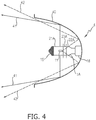
- the choice of cobalt (II) aluminate for the second coated region can result in a marked blue colour of the light leaving the lamp close to the lamp base, which light does not contribute to the main beam when used in a lighting assembly 4 according to an embodiment of the invention as shown in Fig. 4 .
- the lamp 1A is mounted in a reflector 40 shaped to collect images of the light source 11 exiting the lamp 1A through the first coated area 21A and shape a beam 41 using these images.
- the coating itself is not shown for the sake of simplicity.
- the remainder of the light leaving the lamp 1A towards the base of the lamp 1A, for example through the transition region 23A and the second coated area 22A does not contribute to the beam 41.
- this light is given a pronounced blue colour and therefore gives the appearance of a xenon lighting assembly to anyone looking into the reflector, even though the lighting assembly only features a conventional H7 lamp.
- Fig. 5 shows a schematic representation of another lamp 1B with a first type of circumferentially graded absorption coating 2B and a gradient profile P B (shown on its side for the sake of clarity).
- a first coated region 21B is applied along the length of the glass envelope 10
- a second coated region 22B is applied to the remainder of the envelope 10.
- the first coated region 21B provides a thin strip of coating through which the light can pass largely unaffected or only slightly modified, with a corresponding low level of absorption a lo
- the second coated region 22B can alter the light in that region to a greater extent and a greater level of absorption a hi , for example by changing its colour, depending on the application for which the lamp is to be used.
- a transition region 23B ensures a smooth transition between the light portions emitted from the first and second coated regions 21B, 22B.
- Fig. 6 shows a schematic representation of another lamp type 1C with a second type of circumferentially graded absorption coating 2C and a gradient profile P C (also shown on its side for the sake of clarity), in which the coating 2C is applied at a slant to the lamp 1C.
- a thinner first coated region 21C with a corresponding low level of absorption a lo is applied to one side of the tip of the glass envelope 10
- a second coated region 22C and a greater level of absorption a hi is applied to the remainder of the envelope 10 including the outer regions 17.
- a transition region 23C ensures a smooth transition between the light portions emitted from the first and second coated regions 21C, 22C.
- the gradient profile could show a central region with a higher level of absorption than the outer regions, for example if a more absorptive coating is applied in the region of the filament, while a less absorptive coating is applied in the tip and base regions.
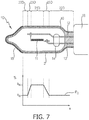
- a lamp 1D is shown in Fig. 7 , with a graded coating 2D according to the invention, this time with a more absorptive first coated region 21D in the centre of the lamp 1D, and two less absorptive second coated regions 22D, one on either side of the first coated region 21D.
- first and second coated regions 21D, 22D lie on either side of two transition regions 23D.
- the corresponding gradient profile P D is shown beneath the lamp 1D, and indicates a higher absorption level a hi in the first coated region 21D, and lower levels of absorption a lo in the outer coated regions 22D.
- the gradient profile would essentially be a mirror image of the gradient profile shown in Fig. 3 .
- the graded absorption coating can equally well be applied to the outer envelope of a gas-discharge lamp such as a D1 - D4 lamp in order to obtain a specific beam performance or lamp appearance.
Landscapes
- Non-Portable Lighting Devices Or Systems Thereof (AREA)
- Engineering & Computer Science (AREA)
- Manufacturing & Machinery (AREA)
- Vessels And Coating Films For Discharge Lamps (AREA)
Priority Applications (1)
| Application Number | Priority Date | Filing Date | Title |
|---|---|---|---|
| EP11760569.1A EP2612346B1 (en) | 2010-08-30 | 2011-08-24 | Automotive front lamp with graded absorption coating |
Applications Claiming Priority (3)
| Application Number | Priority Date | Filing Date | Title |
|---|---|---|---|
| EP10174503 | 2010-08-30 | ||
| EP11760569.1A EP2612346B1 (en) | 2010-08-30 | 2011-08-24 | Automotive front lamp with graded absorption coating |
| PCT/IB2011/053716 WO2012028996A2 (en) | 2010-08-30 | 2011-08-24 | Lamp with graded absorption coating |
Publications (2)
| Publication Number | Publication Date |
|---|---|
| EP2612346A2 EP2612346A2 (en) | 2013-07-10 |
| EP2612346B1 true EP2612346B1 (en) | 2017-01-25 |
Family
ID=44674836
Family Applications (1)
| Application Number | Title | Priority Date | Filing Date |
|---|---|---|---|
| EP11760569.1A Not-in-force EP2612346B1 (en) | 2010-08-30 | 2011-08-24 | Automotive front lamp with graded absorption coating |
Country Status (5)
| Country | Link |
|---|---|
| US (1) | US9431231B2 (enExample) |
| EP (1) | EP2612346B1 (enExample) |
| JP (1) | JP6371525B2 (enExample) |
| CN (1) | CN103098169B (enExample) |
| WO (1) | WO2012028996A2 (enExample) |
Families Citing this family (8)
| Publication number | Priority date | Publication date | Assignee | Title |
|---|---|---|---|---|
| CN105308717B (zh) * | 2013-06-27 | 2018-03-02 | 皇家飞利浦有限公司 | 用于得到在汽车前灯中的彩色外观的灯和前灯照明装置 |
| US9396925B1 (en) * | 2015-02-27 | 2016-07-19 | Osram Sylvania Inc. | Partially coated vehicle lamp capsule |
| KR101806608B1 (ko) | 2015-07-23 | 2017-12-08 | 현대자동차주식회사 | 습기분해 헤드램프 |
| US10283342B2 (en) * | 2015-12-06 | 2019-05-07 | Kla-Tencor Corporation | Laser sustained plasma light source with graded absorption features |
| US11057963B2 (en) * | 2017-10-06 | 2021-07-06 | Applied Materials, Inc. | Lamp infrared radiation profile control by lamp filament design and positioning |
| EP3782187A1 (en) * | 2018-04-16 | 2021-02-24 | Lumileds Holding B.V. | Efficient white lamp for vehicle headlight |
| CN114986998A (zh) * | 2022-05-25 | 2022-09-02 | 福耀玻璃工业集团股份有限公司 | 夹层玻璃、挡风玻璃组件和车辆 |
| CN116202053A (zh) * | 2023-03-16 | 2023-06-02 | 绍兴市上虞恒大照明电器有限公司 | 一种多功能台灯照明装置 |
Citations (2)
| Publication number | Priority date | Publication date | Assignee | Title |
|---|---|---|---|---|
| EP0460913A2 (en) * | 1990-06-04 | 1991-12-11 | Toshiba Lighting & Technology Corporation | A lighting unit having a lamp and a reflector |
| US6369510B1 (en) * | 2000-01-13 | 2002-04-09 | Osram Sylvania Inc. | Blue tinted automobile lamp capsule |
Family Cites Families (17)
| Publication number | Priority date | Publication date | Assignee | Title |
|---|---|---|---|---|
| US1500912A (en) * | 1923-10-23 | 1924-07-08 | Williams Lewis Garfield | Lamp for vehicle headlights and the like |
| US3205394A (en) * | 1960-04-06 | 1965-09-07 | Sylvania Electric Prod | Fluorescent lamp having a sio2 coating on the inner surface of the envelope |
| US3215883A (en) * | 1960-08-10 | 1965-11-02 | John V Mcclees | Photographic lamp |
| JPH02112127A (ja) * | 1988-09-28 | 1990-04-24 | Toshiba Lighting & Technol Corp | けい光ランプ |
| DE69117316T2 (de) * | 1990-03-30 | 1996-08-01 | Toshiba Lighting & Technology | Leuchtstofflampe und ihr Herstellungsverfahren |
| US5243251A (en) * | 1990-04-13 | 1993-09-07 | Toshiba Lighting & Technology Corporation | Lamp having a glass envelope with fluorocarbon polymer layer |
| JPH05129006A (ja) * | 1991-11-07 | 1993-05-25 | Matsushita Electron Corp | ハロゲン電球 |
| JPH06338297A (ja) * | 1993-05-31 | 1994-12-06 | Iwasaki Electric Co Ltd | ショートアークメタルハライドランプ装置 |
| DE19841304A1 (de) | 1998-09-10 | 2000-03-16 | Patent Treuhand Ges Fuer Elektrische Gluehlampen Mbh | Glühlampe |
| JP2002151004A (ja) | 2000-11-14 | 2002-05-24 | Stanley Electric Co Ltd | カラーhidランプ及びその製造方法 |
| JP2002157977A (ja) * | 2000-11-16 | 2002-05-31 | Stanley Electric Co Ltd | カラーバルブ |
| EP1482533A3 (en) * | 2003-05-07 | 2007-10-31 | Patent-Treuhand-Gesellschaft für elektrische Glühlampen mbH | Lamp for generating coloured light |
| US20050023983A1 (en) * | 2003-08-01 | 2005-02-03 | Rajasingh Israel | Optimal silicon dioxide protection layer thickness for silver lamp reflector |
| US20070247050A1 (en) * | 2004-08-20 | 2007-10-25 | Koninklijke Philips Electronics, N.V. | Electric Lamp Comprising a Light Absobing Medium |
| US20080266891A1 (en) * | 2004-09-09 | 2008-10-30 | Koninklijke Philips Electronics, N.V. | Lamp for a Vehicle Headlight Featuring a Dimmed Function |
| JP2007317567A (ja) * | 2006-05-26 | 2007-12-06 | Pearl Denkyu Seisakusho:Kk | 白熱電球用コーティング組成物、白熱電球及び白熱電球のコーティング方法 |
| JP6088140B2 (ja) * | 2008-11-14 | 2017-03-01 | コーニンクレッカ フィリップス エヌ ヴェKoninklijke Philips N.V. | 反射系及びヘッドライト |
-
2011
- 2011-08-24 EP EP11760569.1A patent/EP2612346B1/en not_active Not-in-force
- 2011-08-24 US US13/818,708 patent/US9431231B2/en not_active Expired - Fee Related
- 2011-08-24 JP JP2013525403A patent/JP6371525B2/ja not_active Expired - Fee Related
- 2011-08-24 CN CN201180041960.7A patent/CN103098169B/zh not_active Expired - Fee Related
- 2011-08-24 WO PCT/IB2011/053716 patent/WO2012028996A2/en not_active Ceased
Patent Citations (2)
| Publication number | Priority date | Publication date | Assignee | Title |
|---|---|---|---|---|
| EP0460913A2 (en) * | 1990-06-04 | 1991-12-11 | Toshiba Lighting & Technology Corporation | A lighting unit having a lamp and a reflector |
| US6369510B1 (en) * | 2000-01-13 | 2002-04-09 | Osram Sylvania Inc. | Blue tinted automobile lamp capsule |
Non-Patent Citations (1)
| Title |
|---|
| ANONYMOUS: "Philips MasterDuty", 1 August 2008 (2008-08-01), XP055206617, Retrieved from the Internet <URL:http://www.lighting.philips.com/pwc_li/gb_en/application_areas/assets/documents/automotive/mdbv_leaflet_en.pdf> [retrieved on 20150806] * |
Also Published As
| Publication number | Publication date |
|---|---|
| WO2012028996A3 (en) | 2012-05-18 |
| WO2012028996A2 (en) | 2012-03-08 |
| US9431231B2 (en) | 2016-08-30 |
| JP6371525B2 (ja) | 2018-08-08 |
| CN103098169B (zh) | 2016-06-29 |
| CN103098169A (zh) | 2013-05-08 |
| EP2612346A2 (en) | 2013-07-10 |
| US20130154466A1 (en) | 2013-06-20 |
| JP2013539592A (ja) | 2013-10-24 |
Similar Documents
| Publication | Publication Date | Title |
|---|---|---|
| EP2612346B1 (en) | Automotive front lamp with graded absorption coating | |
| US5130904A (en) | Automotive headlamp waving no ultraviolet output | |
| JP5844088B2 (ja) | 明暗境界線の光度勾配が目的に合わせて減衰されるプロジェクターヘッドライト | |
| KR101044718B1 (ko) | 로우-빔 기능을 갖는 차량의 헤드라이트용 램프 | |
| CN201448753U (zh) | 一种带金属遮光罩的汽车卤素灯 | |
| EP1228525B1 (en) | Halogen incandescent lamp for motor vehicles | |
| CN102217030B (zh) | 灯 | |
| EP3228922A1 (en) | Lamp for motor vehicles | |
| JP5357172B2 (ja) | 高輝度放電ランプ | |
| US20080266891A1 (en) | Lamp for a Vehicle Headlight Featuring a Dimmed Function | |
| JP4367625B2 (ja) | 反射鏡付きランプ | |
| CN101278373A (zh) | 前照灯 | |
| DE10247983A1 (de) | Lampe | |
| JP6650456B2 (ja) | 車両ヘッドライト用のガス放電ランプ | |
| JP2006526257A (ja) | 自動車ヘッドライト用のランプ | |
| JP2008538049A (ja) | ロービーム、フォグライト、ターニングライト又はベンディングライト機能を持つ乗り物のヘッドランプのための一つのフィラメントを有するランプ | |
| JP2007528095A (ja) | メタルハライドランプ及び車両のヘッドランプ |
Legal Events
| Date | Code | Title | Description |
|---|---|---|---|
| PUAI | Public reference made under article 153(3) epc to a published international application that has entered the european phase |
Free format text: ORIGINAL CODE: 0009012 |
|
| 17P | Request for examination filed |
Effective date: 20130402 |
|
| AK | Designated contracting states |
Kind code of ref document: A2 Designated state(s): AL AT BE BG CH CY CZ DE DK EE ES FI FR GB GR HR HU IE IS IT LI LT LU LV MC MK MT NL NO PL PT RO RS SE SI SK SM TR |
|
| RAP1 | Party data changed (applicant data changed or rights of an application transferred) |
Owner name: PHILIPS INTELLECTUAL PROPERTY & STANDARDS GMBH Owner name: KONINKLIJKE PHILIPS N.V. |
|
| DAX | Request for extension of the european patent (deleted) | ||
| 17Q | First examination report despatched |
Effective date: 20150119 |
|
| GRAP | Despatch of communication of intention to grant a patent |
Free format text: ORIGINAL CODE: EPIDOSNIGR1 |
|
| RIC1 | Information provided on ipc code assigned before grant |
Ipc: H01J 61/35 20060101AFI20161006BHEP Ipc: H01K 1/32 20060101ALI20161006BHEP Ipc: H01J 9/20 20060101ALN20161006BHEP Ipc: H01J 61/40 20060101ALI20161006BHEP |
|
| RIC1 | Information provided on ipc code assigned before grant |
Ipc: H01J 61/35 20060101AFI20161013BHEP Ipc: H01J 9/20 20060101ALN20161013BHEP Ipc: H01J 61/40 20060101ALI20161013BHEP Ipc: H01K 1/32 20060101ALI20161013BHEP |
|
| INTG | Intention to grant announced |
Effective date: 20161103 |
|
| GRAS | Grant fee paid |
Free format text: ORIGINAL CODE: EPIDOSNIGR3 |
|
| GRAA | (expected) grant |
Free format text: ORIGINAL CODE: 0009210 |
|
| AK | Designated contracting states |
Kind code of ref document: B1 Designated state(s): AL AT BE BG CH CY CZ DE DK EE ES FI FR GB GR HR HU IE IS IT LI LT LU LV MC MK MT NL NO PL PT RO RS SE SI SK SM TR |
|
| REG | Reference to a national code |
Ref country code: GB Ref legal event code: FG4D |
|
| REG | Reference to a national code |
Ref country code: CH Ref legal event code: EP |
|
| REG | Reference to a national code |
Ref country code: AT Ref legal event code: REF Ref document number: 864563 Country of ref document: AT Kind code of ref document: T Effective date: 20170215 |
|
| REG | Reference to a national code |
Ref country code: IE Ref legal event code: FG4D |
|
| REG | Reference to a national code |
Ref country code: DE Ref legal event code: R096 Ref document number: 602011034687 Country of ref document: DE |
|
| REG | Reference to a national code |
Ref country code: LT Ref legal event code: MG4D |
|
| REG | Reference to a national code |
Ref country code: NL Ref legal event code: MP Effective date: 20170125 |
|
| REG | Reference to a national code |
Ref country code: AT Ref legal event code: MK05 Ref document number: 864563 Country of ref document: AT Kind code of ref document: T Effective date: 20170125 |
|
| PG25 | Lapsed in a contracting state [announced via postgrant information from national office to epo] |
Ref country code: NL Free format text: LAPSE BECAUSE OF FAILURE TO SUBMIT A TRANSLATION OF THE DESCRIPTION OR TO PAY THE FEE WITHIN THE PRESCRIBED TIME-LIMIT Effective date: 20170125 |
|
| PG25 | Lapsed in a contracting state [announced via postgrant information from national office to epo] |
Ref country code: HR Free format text: LAPSE BECAUSE OF FAILURE TO SUBMIT A TRANSLATION OF THE DESCRIPTION OR TO PAY THE FEE WITHIN THE PRESCRIBED TIME-LIMIT Effective date: 20170125 Ref country code: IS Free format text: LAPSE BECAUSE OF FAILURE TO SUBMIT A TRANSLATION OF THE DESCRIPTION OR TO PAY THE FEE WITHIN THE PRESCRIBED TIME-LIMIT Effective date: 20170525 Ref country code: NO Free format text: LAPSE BECAUSE OF FAILURE TO SUBMIT A TRANSLATION OF THE DESCRIPTION OR TO PAY THE FEE WITHIN THE PRESCRIBED TIME-LIMIT Effective date: 20170425 Ref country code: GR Free format text: LAPSE BECAUSE OF FAILURE TO SUBMIT A TRANSLATION OF THE DESCRIPTION OR TO PAY THE FEE WITHIN THE PRESCRIBED TIME-LIMIT Effective date: 20170426 Ref country code: FI Free format text: LAPSE BECAUSE OF FAILURE TO SUBMIT A TRANSLATION OF THE DESCRIPTION OR TO PAY THE FEE WITHIN THE PRESCRIBED TIME-LIMIT Effective date: 20170125 Ref country code: LT Free format text: LAPSE BECAUSE OF FAILURE TO SUBMIT A TRANSLATION OF THE DESCRIPTION OR TO PAY THE FEE WITHIN THE PRESCRIBED TIME-LIMIT Effective date: 20170125 |
|
| REG | Reference to a national code |
Ref country code: FR Ref legal event code: PLFP Year of fee payment: 7 |
|
| PG25 | Lapsed in a contracting state [announced via postgrant information from national office to epo] |
Ref country code: RS Free format text: LAPSE BECAUSE OF FAILURE TO SUBMIT A TRANSLATION OF THE DESCRIPTION OR TO PAY THE FEE WITHIN THE PRESCRIBED TIME-LIMIT Effective date: 20170125 Ref country code: ES Free format text: LAPSE BECAUSE OF FAILURE TO SUBMIT A TRANSLATION OF THE DESCRIPTION OR TO PAY THE FEE WITHIN THE PRESCRIBED TIME-LIMIT Effective date: 20170125 Ref country code: PL Free format text: LAPSE BECAUSE OF FAILURE TO SUBMIT A TRANSLATION OF THE DESCRIPTION OR TO PAY THE FEE WITHIN THE PRESCRIBED TIME-LIMIT Effective date: 20170125 Ref country code: SE Free format text: LAPSE BECAUSE OF FAILURE TO SUBMIT A TRANSLATION OF THE DESCRIPTION OR TO PAY THE FEE WITHIN THE PRESCRIBED TIME-LIMIT Effective date: 20170125 Ref country code: LV Free format text: LAPSE BECAUSE OF FAILURE TO SUBMIT A TRANSLATION OF THE DESCRIPTION OR TO PAY THE FEE WITHIN THE PRESCRIBED TIME-LIMIT Effective date: 20170125 Ref country code: AT Free format text: LAPSE BECAUSE OF FAILURE TO SUBMIT A TRANSLATION OF THE DESCRIPTION OR TO PAY THE FEE WITHIN THE PRESCRIBED TIME-LIMIT Effective date: 20170125 Ref country code: BG Free format text: LAPSE BECAUSE OF FAILURE TO SUBMIT A TRANSLATION OF THE DESCRIPTION OR TO PAY THE FEE WITHIN THE PRESCRIBED TIME-LIMIT Effective date: 20170425 Ref country code: PT Free format text: LAPSE BECAUSE OF FAILURE TO SUBMIT A TRANSLATION OF THE DESCRIPTION OR TO PAY THE FEE WITHIN THE PRESCRIBED TIME-LIMIT Effective date: 20170525 |
|
| REG | Reference to a national code |
Ref country code: DE Ref legal event code: R097 Ref document number: 602011034687 Country of ref document: DE |
|
| PG25 | Lapsed in a contracting state [announced via postgrant information from national office to epo] |
Ref country code: CZ Free format text: LAPSE BECAUSE OF FAILURE TO SUBMIT A TRANSLATION OF THE DESCRIPTION OR TO PAY THE FEE WITHIN THE PRESCRIBED TIME-LIMIT Effective date: 20170125 Ref country code: IT Free format text: LAPSE BECAUSE OF FAILURE TO SUBMIT A TRANSLATION OF THE DESCRIPTION OR TO PAY THE FEE WITHIN THE PRESCRIBED TIME-LIMIT Effective date: 20170125 Ref country code: SK Free format text: LAPSE BECAUSE OF FAILURE TO SUBMIT A TRANSLATION OF THE DESCRIPTION OR TO PAY THE FEE WITHIN THE PRESCRIBED TIME-LIMIT Effective date: 20170125 Ref country code: EE Free format text: LAPSE BECAUSE OF FAILURE TO SUBMIT A TRANSLATION OF THE DESCRIPTION OR TO PAY THE FEE WITHIN THE PRESCRIBED TIME-LIMIT Effective date: 20170125 Ref country code: RO Free format text: LAPSE BECAUSE OF FAILURE TO SUBMIT A TRANSLATION OF THE DESCRIPTION OR TO PAY THE FEE WITHIN THE PRESCRIBED TIME-LIMIT Effective date: 20170125 |
|
| PG25 | Lapsed in a contracting state [announced via postgrant information from national office to epo] |
Ref country code: SM Free format text: LAPSE BECAUSE OF FAILURE TO SUBMIT A TRANSLATION OF THE DESCRIPTION OR TO PAY THE FEE WITHIN THE PRESCRIBED TIME-LIMIT Effective date: 20170125 Ref country code: DK Free format text: LAPSE BECAUSE OF FAILURE TO SUBMIT A TRANSLATION OF THE DESCRIPTION OR TO PAY THE FEE WITHIN THE PRESCRIBED TIME-LIMIT Effective date: 20170125 |
|
| PLBE | No opposition filed within time limit |
Free format text: ORIGINAL CODE: 0009261 |
|
| STAA | Information on the status of an ep patent application or granted ep patent |
Free format text: STATUS: NO OPPOSITION FILED WITHIN TIME LIMIT |
|
| 26N | No opposition filed |
Effective date: 20171026 |
|
| PG25 | Lapsed in a contracting state [announced via postgrant information from national office to epo] |
Ref country code: SI Free format text: LAPSE BECAUSE OF FAILURE TO SUBMIT A TRANSLATION OF THE DESCRIPTION OR TO PAY THE FEE WITHIN THE PRESCRIBED TIME-LIMIT Effective date: 20170125 |
|
| REG | Reference to a national code |
Ref country code: FR Ref legal event code: CA Effective date: 20180126 Ref country code: FR Ref legal event code: TP Owner name: LUMILEDS HOLDING B.V., NL Effective date: 20180126 |
|
| REG | Reference to a national code |
Ref country code: CH Ref legal event code: PL |
|
| PG25 | Lapsed in a contracting state [announced via postgrant information from national office to epo] |
Ref country code: MC Free format text: LAPSE BECAUSE OF FAILURE TO SUBMIT A TRANSLATION OF THE DESCRIPTION OR TO PAY THE FEE WITHIN THE PRESCRIBED TIME-LIMIT Effective date: 20170125 |
|
| PG25 | Lapsed in a contracting state [announced via postgrant information from national office to epo] |
Ref country code: CH Free format text: LAPSE BECAUSE OF NON-PAYMENT OF DUE FEES Effective date: 20170831 Ref country code: LI Free format text: LAPSE BECAUSE OF NON-PAYMENT OF DUE FEES Effective date: 20170831 |
|
| REG | Reference to a national code |
Ref country code: IE Ref legal event code: MM4A |
|
| REG | Reference to a national code |
Ref country code: BE Ref legal event code: MM Effective date: 20170831 |
|
| PG25 | Lapsed in a contracting state [announced via postgrant information from national office to epo] |
Ref country code: LU Free format text: LAPSE BECAUSE OF NON-PAYMENT OF DUE FEES Effective date: 20170824 |
|
| PG25 | Lapsed in a contracting state [announced via postgrant information from national office to epo] |
Ref country code: IE Free format text: LAPSE BECAUSE OF NON-PAYMENT OF DUE FEES Effective date: 20170824 |
|
| REG | Reference to a national code |
Ref country code: FR Ref legal event code: PLFP Year of fee payment: 8 |
|
| PG25 | Lapsed in a contracting state [announced via postgrant information from national office to epo] |
Ref country code: BE Free format text: LAPSE BECAUSE OF NON-PAYMENT OF DUE FEES Effective date: 20170831 |
|
| PG25 | Lapsed in a contracting state [announced via postgrant information from national office to epo] |
Ref country code: MT Free format text: LAPSE BECAUSE OF NON-PAYMENT OF DUE FEES Effective date: 20170824 |
|
| REG | Reference to a national code |
Ref country code: GB Ref legal event code: 732E Free format text: REGISTERED BETWEEN 20180920 AND 20180926 |
|
| REG | Reference to a national code |
Ref country code: DE Ref legal event code: R081 Ref document number: 602011034687 Country of ref document: DE Owner name: LUMILEDS HOLDING B.V., NL Free format text: FORMER OWNER: PHILIPS INTELLECTUAL PROPERTY & STANDARDS GMBH, 20099 HAMBURG, DE |
|
| PG25 | Lapsed in a contracting state [announced via postgrant information from national office to epo] |
Ref country code: HU Free format text: LAPSE BECAUSE OF FAILURE TO SUBMIT A TRANSLATION OF THE DESCRIPTION OR TO PAY THE FEE WITHIN THE PRESCRIBED TIME-LIMIT; INVALID AB INITIO Effective date: 20110824 |
|
| PG25 | Lapsed in a contracting state [announced via postgrant information from national office to epo] |
Ref country code: CY Free format text: LAPSE BECAUSE OF NON-PAYMENT OF DUE FEES Effective date: 20170125 |
|
| PG25 | Lapsed in a contracting state [announced via postgrant information from national office to epo] |
Ref country code: MK Free format text: LAPSE BECAUSE OF FAILURE TO SUBMIT A TRANSLATION OF THE DESCRIPTION OR TO PAY THE FEE WITHIN THE PRESCRIBED TIME-LIMIT Effective date: 20170125 |
|
| PG25 | Lapsed in a contracting state [announced via postgrant information from national office to epo] |
Ref country code: TR Free format text: LAPSE BECAUSE OF FAILURE TO SUBMIT A TRANSLATION OF THE DESCRIPTION OR TO PAY THE FEE WITHIN THE PRESCRIBED TIME-LIMIT Effective date: 20170125 |
|
| PG25 | Lapsed in a contracting state [announced via postgrant information from national office to epo] |
Ref country code: AL Free format text: LAPSE BECAUSE OF FAILURE TO SUBMIT A TRANSLATION OF THE DESCRIPTION OR TO PAY THE FEE WITHIN THE PRESCRIBED TIME-LIMIT Effective date: 20170125 |
|
| PGFP | Annual fee paid to national office [announced via postgrant information from national office to epo] |
Ref country code: GB Payment date: 20200825 Year of fee payment: 10 Ref country code: FR Payment date: 20200824 Year of fee payment: 10 Ref country code: DE Payment date: 20200827 Year of fee payment: 10 |
|
| REG | Reference to a national code |
Ref country code: DE Ref legal event code: R119 Ref document number: 602011034687 Country of ref document: DE |
|
| GBPC | Gb: european patent ceased through non-payment of renewal fee |
Effective date: 20210824 |
|
| PG25 | Lapsed in a contracting state [announced via postgrant information from national office to epo] |
Ref country code: GB Free format text: LAPSE BECAUSE OF NON-PAYMENT OF DUE FEES Effective date: 20210824 Ref country code: FR Free format text: LAPSE BECAUSE OF NON-PAYMENT OF DUE FEES Effective date: 20210831 Ref country code: DE Free format text: LAPSE BECAUSE OF NON-PAYMENT OF DUE FEES Effective date: 20220301 |