EP2611628B1 - Bandage pneumatique avec une bande de roulement comportant un materiau de remplissage degradable - Google Patents
Bandage pneumatique avec une bande de roulement comportant un materiau de remplissage degradable Download PDFInfo
- Publication number
- EP2611628B1 EP2611628B1 EP11740936.7A EP11740936A EP2611628B1 EP 2611628 B1 EP2611628 B1 EP 2611628B1 EP 11740936 A EP11740936 A EP 11740936A EP 2611628 B1 EP2611628 B1 EP 2611628B1
- Authority
- EP
- European Patent Office
- Prior art keywords
- styrene
- thermoplastic
- elastomer
- tread
- degradable
- Prior art date
- Legal status (The legal status is an assumption and is not a legal conclusion. Google has not performed a legal analysis and makes no representation as to the accuracy of the status listed.)
- Not-in-force
Links
Images
Classifications
-
- B—PERFORMING OPERATIONS; TRANSPORTING
- B60—VEHICLES IN GENERAL
- B60C—VEHICLE TYRES; TYRE INFLATION; TYRE CHANGING; CONNECTING VALVES TO INFLATABLE ELASTIC BODIES IN GENERAL; DEVICES OR ARRANGEMENTS RELATED TO TYRES
- B60C1/00—Tyres characterised by the chemical composition or the physical arrangement or mixture of the composition
- B60C1/0016—Compositions of the tread
-
- C—CHEMISTRY; METALLURGY
- C08—ORGANIC MACROMOLECULAR COMPOUNDS; THEIR PREPARATION OR CHEMICAL WORKING-UP; COMPOSITIONS BASED THEREON
- C08L—COMPOSITIONS OF MACROMOLECULAR COMPOUNDS
- C08L1/00—Compositions of cellulose, modified cellulose or cellulose derivatives
-
- C—CHEMISTRY; METALLURGY
- C08—ORGANIC MACROMOLECULAR COMPOUNDS; THEIR PREPARATION OR CHEMICAL WORKING-UP; COMPOSITIONS BASED THEREON
- C08L—COMPOSITIONS OF MACROMOLECULAR COMPOUNDS
- C08L1/00—Compositions of cellulose, modified cellulose or cellulose derivatives
- C08L1/08—Cellulose derivatives
- C08L1/10—Esters of organic acids, i.e. acylates
- C08L1/12—Cellulose acetate
-
- C—CHEMISTRY; METALLURGY
- C08—ORGANIC MACROMOLECULAR COMPOUNDS; THEIR PREPARATION OR CHEMICAL WORKING-UP; COMPOSITIONS BASED THEREON
- C08L—COMPOSITIONS OF MACROMOLECULAR COMPOUNDS
- C08L1/00—Compositions of cellulose, modified cellulose or cellulose derivatives
- C08L1/08—Cellulose derivatives
- C08L1/10—Esters of organic acids, i.e. acylates
- C08L1/14—Mixed esters, e.g. cellulose acetate-butyrate
-
- C—CHEMISTRY; METALLURGY
- C08—ORGANIC MACROMOLECULAR COMPOUNDS; THEIR PREPARATION OR CHEMICAL WORKING-UP; COMPOSITIONS BASED THEREON
- C08L—COMPOSITIONS OF MACROMOLECULAR COMPOUNDS
- C08L53/00—Compositions of block copolymers containing at least one sequence of a polymer obtained by reactions only involving carbon-to-carbon unsaturated bonds; Compositions of derivatives of such polymers
- C08L53/02—Compositions of block copolymers containing at least one sequence of a polymer obtained by reactions only involving carbon-to-carbon unsaturated bonds; Compositions of derivatives of such polymers of vinyl-aromatic monomers and conjugated dienes
-
- C—CHEMISTRY; METALLURGY
- C08—ORGANIC MACROMOLECULAR COMPOUNDS; THEIR PREPARATION OR CHEMICAL WORKING-UP; COMPOSITIONS BASED THEREON
- C08L—COMPOSITIONS OF MACROMOLECULAR COMPOUNDS
- C08L53/00—Compositions of block copolymers containing at least one sequence of a polymer obtained by reactions only involving carbon-to-carbon unsaturated bonds; Compositions of derivatives of such polymers
Definitions
- the present invention relates to pneumatic tires, and more particularly to a tread of a tire adapted to present a different tread when the tire is worn.
- the tread of a pneumatic tire is provided with a sculpture including, in particular, sculpture elements or elementary blocks delimited by various grooves.
- the elementary blocks may further comprise various incisions or slices finer.
- the grooves are channels for evacuating water during a wet run and define the leading edges of the carving elements.
- the tread When a tire is new, the tread has its maximum height. This initial height may vary depending on the type of tire considered and the purpose for which it is intended; for example, "winter" tires generally have a greater tread depth than "summer” tires.
- the height of the elementary blocks of the sculpture decreases and the stiffness of these elementary blocks increases. Increasing the stiffness of the elementary carving blocks results in a decrease in some tire performance, such as wet grip or grip.
- the water evacuation capacities decrease sharply when the depth of the channels of the sculptures decreases.
- the Applicants have found that during the normal running of such a tire with a tread comprising a filling material disposed in an internal cavity, the filling material can degrade very quickly, well before its exposure to the tire. wear due to direct contact with running ground.
- the invention relates to a pneumatic tire with a tread comprising a degradable filling material placed in a cavity, characterized in that the filling material comprises a mixture of a degradable thermoplastic material based on at least one ester cellulose selected from the group of acetates, butyrates, acetobutyrates, propionates and acetopropionates and an unsaturated thermoplastic elastomer.
- the filling material comprising such a mixture has the advantage of having enhanced stability during the rolling of the new and partially worn tire, due to the adhesion between the filling material and the adjacent wall of the tread.
- thermoplastic material being in proportion A and the unsaturated thermoplastic elastomer being in proportion B
- the ratio B / A varies from 0.1 to 1; A and B being expressed in mass.
- the ratio B / A varies from 0.25 to 0.75.
- the unsaturated thermoplastic elastomer is a thermoplastic styrene elastomer.
- the degradable thermoplastic material is based on cellulose acetate.
- the degradable thermoplastic material consists of a mixture of cellulose acetate and glycerol acetate.
- the unsaturated thermoplastic styrene elastomer is a copolymer comprising styrene blocks and diene blocks.
- the cavity where the filling material is placed is disposed radially internally relative to a usable part of the tread.
- the cavity where the filling material is placed is internal to the tread and becomes exposed to wear only beyond a given wear threshold. It is then found that the filling material according to one of the objects of the invention is gradually dislocated and is thus removed from the cavity of the tread. This allows the sculpture of the tire and especially the evacuation channels of this sculpture to be reinforced by the cavity. This allows the tire to maintain its performance including ability to evacuate water, grip and wet behavior.
- the cavity forms a circumferential groove, which may be, for example, a straight groove.
- the cavity is exposed only when the wear rate of the tread is greater than 50%, and preferably between 80 and 95%. Indeed, it is only when the wear of the tread becomes very high, above 80% that there is a significant degradation of the performance of the tire.
- the invention also relates to a thermoplastic composition
- a thermoplastic composition comprising a mixture of a degradable thermoplastic material based on cellulose and an unsaturated thermoplastic styrene elastomer.
- the composition is such that the degradable thermoplastic material is based on cellulose acetate and the unsaturated thermoplastic styrene elastomer is epoxidized.
- the invention particularly relates to pneumatic tires intended to equip tourism-type motor vehicles, SUVs ( “Sport Utility Vehicles” ), two wheels (in particular motorcycles), aircraft, such as industrial vehicles chosen from light trucks, "heavy vehicles”. - that is, metro, buses, road transport vehicles (trucks, tractors, trailers), off-the-road vehicles such as agricultural or civil engineering vehicles -, other transport or handling vehicles.
- any range of values designated by the expression "between a and b" represents the range of values from more than a to less than b (i.e., terminals a and b excluded) while any range of values designated by the expression “from a to b” means the range from a to b (i.e., including the strict limits a and b).
- the tire according to the invention has the characteristic of comprising a tread with a degradable filling material placed in a cavity, and is such that the filling material comprises a mixture of a degradable thermoplastic material based on cellulose and unsaturated thermoplastic elastomer.
- the filling material comprising such a mixture has the advantage of having enhanced stability during the rolling of the new and partially worn tire, particularly because of the adhesion between the filling material and the adjacent wall of the tread of the tire. pneumatic tire.
- thermoplastic material being in proportion A and the styrenic thermoplastic elastomer being in proportion B
- the ratio B / A varies from 0.1 to 1; A and B being expressed in mass.
- the ratio B / A varies from 0.25 to 0.75.
- Degradable thermoplastic material based on cellulose means any formulation based on cellulose esters: for example, cellulose acetates, cellulose butyrates, cellulose acetate butyrates, cellulose propionates, cellulose acetopropionates.
- the degradable thermoplastic material based on cellulose is advantageously based on cellulose acetate.
- It may consist of a mixture of cellulose acetate and glycerol acetate.
- thermoplastic elastomers are in the form of block copolymers.
- TPE thermoplastic elastomers
- intermediate structure between thermoplastic polymers and elastomers they consist of rigid thermoplastic blocks connected by flexible elastomer blocks, for example polybutadiene, polyisoprene or poly (ethylene / butylene).
- TPE copolymers are generally characterized by the presence of two glass transition peaks, the first peak (the lowest temperature, negative) being relative to the elastomer block of the TPE copolymer, the second peak (highest temperature, positive, typically around 80 ° C or higher) being relative to the thermoplastic part (styrene blocks or others) of the TPE copolymer.
- TPEs like all thermoplastic materials, can be used in an extrusion tool when they are heated to a temperature above their melting or softening temperature.
- the melting temperature of a semi-crystalline thermoplastic material is determined by differential scanning calorimetry (DSC) according to ISO 11357.
- the softening point or softening point is the temperature at which the material, for example in the form of a powder, coalesces.
- the point or the softening temperature of a thermoplastic material is measured according to ISO 4625 (" ring and ball " method).
- thermoplastic elastomers are styrenic thermoplastic elastomers (abbreviated as "TPS").
- TPS thermoplastic elastomers
- the rigid sequences of TPS are thus based on styrenic polymers.
- styrene is meant in the present description any monomer containing styrene, unsubstituted as substituted; among the substituted styrenes may be mentioned, for example, methylstyrenes (for example ⁇ -methylstyrene, ⁇ -methylstyrene, p- methylstyrene, tert- butylstyrene) and chlorostyrenes (for example monochlorostyrene, dichlorostyrene).
- methylstyrenes for example ⁇ -methylstyrene, ⁇ -methylstyrene, p- methylstyrene, tert- butylstyrene
- chlorostyrenes for example monochlorostyrene, dichlorostyrene
- TPS elastomers are often triblock elastomers with two rigid segments connected by a flexible segment.
- the rigid and flexible segments can be arranged linearly, star or connected.
- These TPS elastomers may also be diblock elastomers with a single rigid segment connected to a flexible segment.
- each of these segments or blocks contains at least more than 5, usually more than 10 base units (e.g., styrene units and isoprene units for a styrene / isoprene / styrene block copolymer).
- a first essential characteristic of the TPS elastomer used to manufacture the filling material is that it is unsaturated.
- unsaturated TPS elastomer is meant by definition and well known a TPS elastomer which is provided with ethylenic unsaturations, that is to say which comprises double bonds carbon-carbon (conjugated or not); conversely, a TPS elastomer said saturated is of course a TPS elastomer which is free of such double bonds.
- the unsaturated elastomer is a copolymer comprising styrene blocks (that is to say polystyrene) and diene blocks (ie polydiene), especially isoprene blocks (polyisoprene) or butadiene blocks (polybutadiene) ); such an elastomer is chosen in particular from the group consisting of styrene / butadiene (SB), styrene / isoprene (SI), styrene / butadiene / butylene (SBB), styrene / butadiene / isoprene (SBI), styrene / butadiene block copolymers styrene (SBS), styrene / butadiene / butylene / styrene (SBBS), styrene / isoprene / styrene
- this unsaturated elastomer is a triblock copolymer selected from the group consisting of styrene / butadiene / styrene (SBS), styrene / butadiene / butylene / styrene (SBBS), styrene / isoprene / styrene (SIS) block copolymers, styrene / butadiene / isoprene / styrene (SBIS) and mixtures of these copolymers.
- Unsaturated TPS elastomers with styrene blocks and diene blocks have for example been described in the patent applications WO 2008/080557 , WO 2008/145276 , WO 2008/145277 which relate to airtight or self-sealing compositions intended in particular for pneumatic tires.
- the styrene content in the unsaturated TPS elastomer is between 5 and 50%. Outside the indicated area, there is a risk that the intended technical effect, namely a compromise of adhesion which is no longer optimal with respect to a part of the filling material, on the other hand rubbery diene material which forms the walls of the cavity and is thus adjacent to the filling material.
- the styrene content is more preferably between 10 and 40%.
- the number-average molecular weight (denoted Mn) of the TPS elastomer is preferably between 5,000 and 500,000 g / mol, more preferably between 7,000 and 450,000.
- the number-average molecular weight (Mn) of TPS elastomers is determined in a known manner by steric exclusion chromatography (SEC). The sample is solubilized beforehand in tetrahydrofuran at a concentration of approximately 1 g / l; then the solution is filtered on a 0.45 ⁇ m porosity filter before injection. The equipment used is a chromatographic chain "WATERS alliance".
- the elution solvent is tetrahydrofuran, the flow rate 0.7 ml / min, the system temperature 35 ° C and the analysis time 90 min.
- a set of four WATERS columns in series, of trade names "STYRAGEL” ("HMW7", “HMW6E” and two “HT6E”) is used.
- the injected volume of the solution of the polymer sample is 100 ⁇ l.
- the detector is a differential refractometer "WATERS 2410" and its associated software for the exploitation of chromatographic data is the "WATERS MILLENIUM" system.
- the calculated average molar masses relate to a calibration curve made with polystyrene standards.
- Unsaturated and epoxidized TPS elastomers such as, for example, SBS, are known and commercially available, for example from Daicel under the name "Epofriend”.
- thermoplastic polymers The Tg of the above thermoplastic polymers is measured in a known manner by DSC ( Differential Scanning Calorimetry ), for example and unless otherwise specified in the present application, according to ASTM D3418 of 1999.
- the formulations based on cellulose esters may comprise plasticizers of different types: non-exhaustively, mention may be made of triethyl citrate, acetyl triethyl citrate, diethyl citrate, diethyl phthalate, triacetin, ethyl lactate , methyl lactate, castor oil.
- formulations may also include fillers of different types: calcium carbonate, titanium dioxide, silica, chalk ... but also other types of additives of the fire retardant type, UV absorbers, stabilizers ...
- the filler material described above can be used to be disposed in any tread cavity tread of tires for a motor vehicle such as a vehicle type two-wheel, tourism or industrial.
- the manufacture of the degradable filling material is advantageously carried out by means of an extrusion tool, preferably with a twin-screw extruder.
- an extruder makes it possible to obtain both the fusion of the thermoplastic constituents of the composition and their intimate mixing.
- T M1 the given melting or softening temperature of the unsaturated thermoplastic styrene elastomer and T M2 the given melting or softening temperature of the thermoplastic material.
- the body of the twin-screw extruder is brought to a temperature T M greater than the two melting or softening temperatures of the thermoplastic components of the composition. This ensures, during the transfer of the constituents in the body of the extruder, both the melting of the two thermoplastic constituents and their kneading.
- the temperature difference must be greater than 5 ° C so that the melting is complete and is preferably greater than 10 ° C.
- a die of suitable section for the intended use of the filling material.
- a die with a cylindrical section corresponding to the diameter of a rod to be introduced into a circumferential right tread cavity of a tire For example a die with a cylindrical section corresponding to the diameter of a rod to be introduced into a circumferential right tread cavity of a tire.
- the rod can pass through a shaper, which allows better control of the geometry being pulled by a shooter for example. It can then be stored, for example, as a coil.
- the unsaturated thermoplastic styrene elastomer and the thermoplastic material can be introduced at the same time into the body of the extruder by means of the same feed.
- the other optional additives of the filling material may also be introduced at the same time or subsequently.
- a tread with filling material incorporated in one or more cavities is produced by coextrusion.
- the rods of filling material and the tread in which they are embedded are thus extruded together.
- the rods are made as previously indicated prior to the formation of the rubber band and separately from the latter. It is then enough to dispose them in the furrow and to close this last one. So we buried the rods in the eraser after formatting. This method limits the amount of manufacturing defect due to the fact that it eliminates process stabilization steps at the start of each production run.
- the section is extruded and the groove formed in the section simultaneously.
- the tread or band 4 extends around the periphery of the tire between the flanks of the latter and on its carcass 5, at the periphery of the latter.
- the band 4 has an outer peripheral face 6 forming the surface by which the tire will be in contact with the ground. This face has a generally cylindrical shape with circular section.
- the band 4 comprises a main body made of rubber, which conventionally comprises a mixture of natural and synthetic elastomers as well as various products and adjuvants.
- the band 4 further comprises several rods or cords 8 which are in this case five in number, this number is not limiting.
- the rods each have a wire shape, circular cross section as is the case with figures 7 , 11 and 15 or square as in the case of figures 8 and 12 .
- the rods are embedded in the body and extend at a distance from the two main external and internal faces of the band. Each ring forms a circle coaxial with the tire and extends in a plane perpendicular to the axis 3.
- the rods may have identical or different transverse profiles and may consist of identical or different materials.
- the rods are made individually, before and separately from the body 4, and then wound on coils 9 (see Fig. 2 ) which are then fed to the machine.
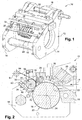
- the nose 10 of the extrusion machine comprises a frame 12 comprising two vertical uprights 14 of flat shape arranged parallel to each other and opposite and at a distance from one another. Most of the organs of the nose extend into the space arranged between the two uprights 14.
- the nose comprises a conduit 16, illustrated in particular in the right part of the figure 2 and serving for feeding the gum to be extruded to form the body.
- the nose 10 comprises a cylinder or roller 18 disposed at the downstream mouth of the duct 16 and having a cylindrical peripheral face 23 with a circular section.
- the nose further comprises a set of parts 20 forming a vault 22 which delimits with the face 23 a chamber 25 for pressurizing the material to be extruded, on which opens the conduit 16.
- the parts 20 are rigidly fixed to the frame 12, while that the roller 18 is rotatably mounted relative to the uprights 14 about its horizontal axis 24 counterclockwise on the figure 2 .
- the nose 10 comprises a profiled blade 26 extending downstream of the chamber 25 and facing the face 23 of the roller. Downstream of the blade, the nose comprises a set 30 with caster wheels 32 for introducing the rods into the grooves previously made, and a roller assembly 34 for closing the grooves on the rods thus arranged.
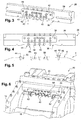
- the profiled blade 26 comprises a main body 28 of elongated form of the one to the other of the uprights 14 and rigidly fixed thereto.
- the body 28 has a lower face 36 having cavities and reliefs and intended to give shape to the upper face 6 of the tread by the effect of the passage of the rubber between the face 36 and the face 23 of the roller.
- the blade 26 further comprises a support 38 carrying plowshares 40 whose number is equal to that of the rods 8 that the band is intended to receive, five in this case.
- each of the shares 40 has a general shape in "L", the longest part of the "L” extending in a direction close to the vertical direction and close to the radial direction to the axis 24, and being threaded into a dedicated hole of the support 38 in which it is slidably movable in this direction.
- the blade 26 comprises for each share 40 rigid fixing means to the body 28, formed in this case for each share by two fastening screws 42 passing through a portion of the support and clamping the share against an inner face of the support.
- This arrangement allows to adjust the position of the share relative to the body 28 in the aforementioned direction and thus to adjust the depth of the groove 44 made by the corresponding share in the band 4, for example according to the tire model being manufactured.
- the grooves 44 themselves are generated by the penetration of the base or small side of the "L" of each plow 40 into the extruded material forming the gum strip.
- the grooves are generated by the fact that the base of each plow protrudes from the face 36 of the body 28, or more precisely from certain zones of this face, as illustrated in FIG. figure 4 .
- the small side of the "L” is oriented so that the plow penetrates under the profiled part of the extrusion blade. This particular arrangement makes it possible to arrange the upstream part of the coulter in an area where the pressure within the band is not yet zero, which makes it possible to facilitate the penetration of the plow into the material of the strip as well as the quality of the molding.
- the face 36 has the right of each share a cavity 45 projecting beyond the share of each side of the latter.
- Each of these cavities makes it possible to form, on either side of the groove, respective raised beads 46 forming excess gum extending in projection from the main part of the face 6.
- Each groove therefore extends between the two beads. 46 associates who are contiguous to it.
- the number of furrows being in this case equal to five, there are ten beads.
- the furrows 44 are intended to receive the rods, then to be filled as will be seen later.
- the band 36 is also shaped to form grooves 50 in this case three in number and intended to persist visibly on the tread and on the final tire, unlike the grooves 44. All the aforementioned grooves extend parallel to each other and to the longitudinal direction of the strip 4.
- the blade 26 carries, in addition, in this case, two members 52 forming deburring knives material to define the two opposite side edges of the strip. These organs are arranged opposite one another, on either side of the support 38.
- the extrusion machine comprises means 54 for receiving coils 9 on which are wound the respective rods. These means are arranged to allow the reels to unwind as manufacture progresses.
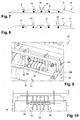
- the roller assembly 30 (see figures 6 , 9 and 10 ) comprises wheels 32 which are equal in number, in this case, to that of rushes, namely five in number.
- the wheels are identical to each other and mounted coaxially to one another about a horizontal axis 56. They extend opposite the blade 26 so that a path 56 of the rods coming from the coils 9 passes between the assembly 30 and the blade 26 before insertion into the tread. During this journey, the rods abut against the circumferential peripheral edge of the respective wheels 32.
- Each wheel thus serves to guide the corresponding rod to the bottom of the groove for the deposit, the wheel penetrating for this purpose within the corresponding groove.
- the wheels 32 are mounted on a common gantry fixed to the frame and the vertical position is adjustable to penetrate the wheels more or less deeply in the grooves, and thus insert the corresponding rods more or less in the latter.
- motorization for the wheels 32, the latter being driven in rotation by the running of the tread and the rods inserted in this band at the same peripheral speed as the latter.
- an intermediate guide piece such as a tube traversed along its axis by the rods for guiding them from the coils 9 to the assembly 30.
- the figure 7 illustrates the band 4 with its grooves 44 open at the bottom of which the rods 8 of filling material have been deposited. It is about this figure of rods with circular cross section of a diameter of about 4 millimeters.
- the figure 8 illustrates similarly the case of a band 4 in the grooves 44 of which are arranged rods 8 of filling material and having a parallelepipedal cross section, for example square to 4 millimeters side.
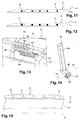
- the roller assembly 34 comprises rolling members whose number is equal to that of the rushes, namely five in this case.
- the assembly 34 comprises a support 62 rigidly fixed to the uprights 14 and extending from one to the other thereof.
- Each of the members 60 comprises a mast 64 of shaped shape, received in a corresponding female orifice of the support 62 being slidably movable in the latter in its longitudinal direction which is close to the radial direction to the axis 24.
- the assembly 34 comprises for each member a clamping element 66 passing through the wall of the support 62 to clamp the mast 64 against an inner face of the support and thus immobilize the member 60 rigidly relative to the support 62 in the selected adjustment position.
- Each member 60 comprises at a lower end of the mast an arm 68 carrying two toothed rollers 70 rotatably mounted on the arm via respective rotational axes 72 coplanar but intersecting and arranged so that the rollers have an open configuration upstream by reference in the sense of scrolling the tape.
- the rollers are arranged so as to bear on the respective beads 46 associated with the groove considered so as to fold the material forming these reliefs in the groove over the rod 8 to fill the groove 44.
- the rod is thus buried , covered and embedded in the tread as illustrated in Figures 11 and 12 in both cases corresponding to Figures 7 and 8 respectively.
- the manufacturing process of the tread is carried out as follows using this machine.
- the gum-forming material is fed into the nose through the conduit 16 along the arrow 71, then passes into the chamber 25 where it is pressurized before being extruded through the extrusion orifice formed by the blade 26 and the roller 18.
- the shares 40 make the longitudinal grooves 44 in the face 6, as well as the two beads 46 located on either side of each furrow.
- the shares are partially rearward in an area of the machine where the pressure is reduced compared to the pressure in the chamber 25.
- the reels 9 carrying the rods are unwound and the rushes guided and supported by the rollers 32 pass between them and the blade 26 to be inserted at the bottom of the respective grooves 44 in the thickness of the tread.
- the rods unwind the coils under the effect of the drive of the band which also drives the wheels 32.
- the coil is not braked by any actuator during its movement.
- the material forming the web is still hot and soft at this stage.
- the wheels 70 fold the material of the beads 46 in the corresponding groove, thus drowning the associated rod in the thickness of the tread.
- the furrow is thus plugged and filled.
- the adhesion properties of the filling materials and the adjacent rubber compositions are characterized as indicated below.
- Adhesion tests were conducted to test the ability of the filler material to adhere after firing to a diene elastomer layer, more specifically to a conventional rubber tire tread composition, based on SBR rubber and silica ("Zeosil 165" Rhodia), further comprising the usual additives (sulfur, accelerator, ZnO, stearic acid, antioxidant).
- the peel samples (of the 90 ° peel type) were made by stacking a thin layer of the material to be tested, a 2 mm layer of the usual composition for raw tread, and finally a sheet of raw reinforcement to limit the deformation of the previous layer during peeling.
- a rupture primer is inserted between the test material layer and the tread type layer.
- test piece after assembly was vulcanized at 180 ° C under pressure for 15 minutes. Strips 30 mm wide were cut with a cutter. These strips are then glued on the side of the test material on a metal support suitable for mounting and the other part is inserted into the traction jaws. The tests are carried out at ambient temperature and at a tensile speed of 100 mm / min. The tensile forces are recorded and these are standardized by the width of the specimen. A force curve is obtained per unit of width (in N / mm) as a function of the displacement of the moving beam of the traction machine (between 0 and 200 mm). The adhesion value chosen corresponds to the maximum value of this curve.
- Table 1 Composition No. ( % by mass of the total) C-1 C-2 C3 C4 AT Cellulose acetate Biograde C9550 * 2 100 90 80 70 B Epoxy SBS (eSBS) Epofriend AT501 * 1 0 10 20 30 B / A 0 0.11 0.25 0.42 * 1 Marketed by the company Daicel; * 2 Marketed by FKUR Kunststoffoff GmbH.
- Table 2 Composition N ° C-1 C2 C3 C4 Maximum effort of peeling (N / mm) 0 1.2 3 , 8 15.1
- the rate of degradation of the filling material decreases substantially when the ratio B / A exceeds 1, ie when the composition of the filling material predominantly comprises an unsaturated thermoplastic elastomer.
- the preferred composition range is therefore for B / A ratios between 0.25 and 0.75.
- Pneumatic tires have been made comprising in the cavities of their tread cylindrical rods of filling material corresponding to the composition C-4.
- the cavities were formed in the tread and the cylindrical rods were introduced into them uncured according to the previously described method.
- the rods were arranged to start appearing at mid-life of the tire after about 4 mm of wear.
Landscapes
- Chemical & Material Sciences (AREA)
- Health & Medical Sciences (AREA)
- Chemical Kinetics & Catalysis (AREA)
- Medicinal Chemistry (AREA)
- Polymers & Plastics (AREA)
- Organic Chemistry (AREA)
- Engineering & Computer Science (AREA)
- Mechanical Engineering (AREA)
- Compositions Of Macromolecular Compounds (AREA)
- Tires In General (AREA)
- Materials For Medical Uses (AREA)
Applications Claiming Priority (2)
| Application Number | Priority Date | Filing Date | Title |
|---|---|---|---|
| FR1056959A FR2964344B1 (fr) | 2010-09-02 | 2010-09-02 | Bandage pneumatique avec une bande de roulement comportant un materiau de remplissage degradable |
| PCT/EP2011/063665 WO2012028429A1 (fr) | 2010-09-02 | 2011-08-09 | Bandage pneumatique avec une bande de roulement comportant un materiau de remplissage degradable |
Publications (2)
| Publication Number | Publication Date |
|---|---|
| EP2611628A1 EP2611628A1 (fr) | 2013-07-10 |
| EP2611628B1 true EP2611628B1 (fr) | 2016-04-06 |
Family
ID=43626980
Family Applications (1)
| Application Number | Title | Priority Date | Filing Date |
|---|---|---|---|
| EP11740936.7A Not-in-force EP2611628B1 (fr) | 2010-09-02 | 2011-08-09 | Bandage pneumatique avec une bande de roulement comportant un materiau de remplissage degradable |
Country Status (6)
| Country | Link |
|---|---|
| US (1) | US20130174952A1 (enExample) |
| EP (1) | EP2611628B1 (enExample) |
| JP (1) | JP6097978B2 (enExample) |
| CN (1) | CN103097147B (enExample) |
| FR (1) | FR2964344B1 (enExample) |
| WO (1) | WO2012028429A1 (enExample) |
Families Citing this family (10)
| Publication number | Priority date | Publication date | Assignee | Title |
|---|---|---|---|---|
| FR2975044B1 (fr) | 2011-05-12 | 2013-06-14 | Michelin Soc Tech | Pneumatique pourvu d'une bande de roulement comprenant un elastomere thermoplastique |
| FR2975407B1 (fr) | 2011-05-18 | 2014-11-28 | Michelin Soc Tech | Cordon composite pour bande de roulement de bandage pneumatique |
| FR2984228B1 (fr) | 2011-12-16 | 2016-09-30 | Soc De Tech Michelin | Bande de roulement ayant des elements de sculpture recouverts d'un assemblage de fibres impregne |
| FR2995559B1 (fr) | 2012-09-17 | 2014-09-05 | Michelin & Cie | Pneumatique pourvu d'une bande de roulement comprenant un elastomere thermoplastique et du noir de carbone |
| BR112015007801A2 (pt) | 2012-10-31 | 2017-07-04 | Michelin & Cie | método e aparelho para fazer pneus recauchutados |
| EP2952538A1 (de) * | 2014-06-03 | 2015-12-09 | LANXESS Deutschland GmbH | Diphenylguanidin-freie Kautschukmischungen enthaltend kurzkettige Alkylester des Glyzerins |
| JP2017088146A (ja) * | 2015-11-17 | 2017-05-25 | 株式会社ブリヂストン | 自動二輪車用空気入りタイヤ |
| US11390122B2 (en) | 2016-04-28 | 2022-07-19 | Bridgestone Corporation | Tire |
| FR3116751B1 (fr) * | 2020-11-27 | 2022-11-04 | Michelin & Cie | Installation de coextrusion permettant de realiser une bande de roulement presentant des inserts de renfort enfouis en profondeur dans les blocs de sculpture |
| FR3116750B1 (fr) * | 2020-11-27 | 2022-11-04 | Michelin & Cie | Procédé de fabrication d’une bande de roulement par coextrusion avec intégration d’une interface de découplage entre blocs de sculpture et coins de renfort |
Family Cites Families (19)
| Publication number | Priority date | Publication date | Assignee | Title |
|---|---|---|---|---|
| US3462328A (en) * | 1965-06-07 | 1969-08-19 | Goodyear Tire & Rubber | Method of making vehicle tire tread |
| US3489723A (en) * | 1966-12-06 | 1970-01-13 | Nopco Chem Co | Two-component castable polyurethane elastomer composition and use |
| US5204407A (en) * | 1990-06-11 | 1993-04-20 | Bridgestone Corporation | Pneumatic tires |
| JPH11349730A (ja) * | 1998-06-04 | 1999-12-21 | Daicel Craft:Kk | セルロース誘導体樹脂組成物 |
| JP2000344942A (ja) * | 1999-06-07 | 2000-12-12 | Daicel Chem Ind Ltd | セルロース系誘導体樹脂組成物、それからなるフィルム又はシート |
| JP4262357B2 (ja) * | 1999-06-09 | 2009-05-13 | 住友ゴム工業株式会社 | タイヤ |
| DE60001250T2 (de) * | 1999-06-28 | 2003-10-30 | Michelin Recherche Et Technique S.A., Granges-Paccot | Laufflächenprofil geeignet zum Begrenzen des durch das Laufen des Reifens erzeugten Geräusches |
| JP2002240509A (ja) * | 2001-02-21 | 2002-08-28 | Yokohama Rubber Co Ltd:The | 空気入りタイヤ |
| US6591881B2 (en) * | 2001-08-20 | 2003-07-15 | Jerry Artrip | Automobile tire with removable tread fillers and tread cavities beneath the rolling surface |
| US7230050B2 (en) * | 2004-10-02 | 2007-06-12 | Bridgestone Corporation | Tire components including thermoplastic-elastomeric block copolymers |
| JP2007039647A (ja) * | 2005-07-01 | 2007-02-15 | Toray Ind Inc | セルロース脂肪酸エステル組成物およびそれからなる繊維およびその製造方法 |
| US7581575B2 (en) * | 2005-10-05 | 2009-09-01 | The Goodyear Tire & Rubber Company | Pneumatic tire with tread having degradable tread filler |
| JP2007161943A (ja) * | 2005-12-16 | 2007-06-28 | Daicel Chem Ind Ltd | セルロースエステル系樹脂組成物 |
| US20070144641A1 (en) * | 2005-12-22 | 2007-06-28 | Nguyen Gia V | Method of forming a tire |
| FR2910478B1 (fr) * | 2006-12-22 | 2009-03-06 | Michelin Soc Tech | Composition auto-obturante pour objet pneumatique |
| FR2916680B1 (fr) | 2007-05-29 | 2009-08-21 | Michelin Soc Tech | Objet pneumatique pourvu d'une couche etanche aux gaz a base d'un elastomere thermoplastique et d'une huile polybutene |
| FR2916679B1 (fr) | 2007-05-29 | 2009-08-21 | Michelin Soc Tech | Objet pneumatique pourvu d'une couche etanche aux gaz a base d'un elastomere thermoplastique |
| FR2925914B1 (fr) * | 2007-12-28 | 2011-02-25 | Michelin Soc Tech | Composition de caoutchouc pour bande de roulement |
| JP5521322B2 (ja) * | 2008-12-18 | 2014-06-11 | 横浜ゴム株式会社 | タイヤトレッド用ゴム組成物 |
-
2010
- 2010-09-02 FR FR1056959A patent/FR2964344B1/fr not_active Expired - Fee Related
-
2011
- 2011-08-09 JP JP2013526390A patent/JP6097978B2/ja not_active Expired - Fee Related
- 2011-08-09 US US13/819,899 patent/US20130174952A1/en not_active Abandoned
- 2011-08-09 EP EP11740936.7A patent/EP2611628B1/fr not_active Not-in-force
- 2011-08-09 CN CN201180042006.XA patent/CN103097147B/zh not_active Expired - Fee Related
- 2011-08-09 WO PCT/EP2011/063665 patent/WO2012028429A1/fr not_active Ceased
Also Published As
| Publication number | Publication date |
|---|---|
| EP2611628A1 (fr) | 2013-07-10 |
| WO2012028429A1 (fr) | 2012-03-08 |
| CN103097147A (zh) | 2013-05-08 |
| JP2013536781A (ja) | 2013-09-26 |
| CN103097147B (zh) | 2015-11-25 |
| US20130174952A1 (en) | 2013-07-11 |
| JP6097978B2 (ja) | 2017-03-22 |
| FR2964344B1 (fr) | 2012-08-31 |
| FR2964344A1 (fr) | 2012-03-09 |
Similar Documents
| Publication | Publication Date | Title |
|---|---|---|
| WO2012028429A1 (fr) | Bandage pneumatique avec une bande de roulement comportant un materiau de remplissage degradable | |
| EP2710180B1 (fr) | Bandage avec cordon composite dans la bande de roulement | |
| EP2373486B1 (fr) | Stratifie multicouche etanche a l'air pour objet pneumatique | |
| EP2167329B1 (fr) | Pneumatique avec une couche auto-obturante | |
| EP2125392B1 (fr) | Pneumatique avec une couche auto-obturante | |
| EP2709838B1 (fr) | Cordon composite caoutchouteux pour bande de roulement de bandage pneumatique | |
| EP3286022B1 (fr) | Pneumatique pret a recevoir un organe a sa surface | |
| WO2009007064A1 (fr) | Objet pneumatique pourvu d'une couche etanche aux gaz a base d'un elastomere thermoplastique et d'une charge lamellaire | |
| EP2569149B1 (fr) | Procede et machine pour la realisation d'une bande de roulement pour pneumatiques de vehicule | |
| EP2373740A1 (fr) | Objet pneumatique pourvu d'une couche etanche aux gaz a base de deux elastomeres thermoplastiques | |
| EP2844500B1 (fr) | Objet pneumatique pourvu d'une couche etanche aux gaz a base d'un elastomere thermoplastique et d'une charge lamellaire | |
| EP2790928B1 (fr) | Bande de roulement ayant des elements de sculpture recouverts d'un materiau thermoplastique | |
| EP3331941A1 (fr) | Stratifié multicouche utilisable comme couche étanche de pneumatique | |
| EP2734385A1 (fr) | Bandage pneumatique pourvu d'une bande de roulement à base d'un élastomère thermoplastique | |
| FR2969536A1 (fr) | Valve auto-obturante | |
| CA2856961A1 (fr) | Methode de fabrication d'une bande de roulement pour pneumatique | |
| WO2011113712A1 (fr) | Procede et dispositif de fabrication d'une bande continue d'un produit fortement collant emballe dans un film thermoplastique | |
| EP3554860B1 (fr) | Ensemble de bandage pneumatique et de roue comprenant un produit auto-obturant amélioré | |
| FR2932713A1 (fr) | Procede d'application d'une couche auto-obturante sur la paroi d'un objet pneumatique. | |
| WO2014170182A1 (fr) | Bandage pneumatique avec une composition degradable a base d'alcool polyvinylique | |
| WO2017220897A1 (fr) | Pneumatique pret a recevoir un organe a sa surface |
Legal Events
| Date | Code | Title | Description |
|---|---|---|---|
| PUAI | Public reference made under article 153(3) epc to a published international application that has entered the european phase |
Free format text: ORIGINAL CODE: 0009012 |
|
| 17P | Request for examination filed |
Effective date: 20130402 |
|
| AK | Designated contracting states |
Kind code of ref document: A1 Designated state(s): AL AT BE BG CH CY CZ DE DK EE ES FI FR GB GR HR HU IE IS IT LI LT LU LV MC MK MT NL NO PL PT RO RS SE SI SK SM TR |
|
| DAX | Request for extension of the european patent (deleted) | ||
| 17Q | First examination report despatched |
Effective date: 20140926 |
|
| GRAP | Despatch of communication of intention to grant a patent |
Free format text: ORIGINAL CODE: EPIDOSNIGR1 |
|
| RIC1 | Information provided on ipc code assigned before grant |
Ipc: C08L 1/10 20060101ALI20151103BHEP Ipc: B60C 1/00 20060101AFI20151103BHEP Ipc: C08L 53/02 20060101ALN20151103BHEP Ipc: C08L 101/00 20060101ALN20151103BHEP Ipc: C08L 1/00 20060101ALI20151103BHEP Ipc: C08L 53/00 20060101ALN20151103BHEP Ipc: C08L 1/14 20060101ALI20151103BHEP Ipc: C08L 1/12 20060101ALI20151103BHEP |
|
| INTG | Intention to grant announced |
Effective date: 20151119 |
|
| GRAS | Grant fee paid |
Free format text: ORIGINAL CODE: EPIDOSNIGR3 |
|
| GRAA | (expected) grant |
Free format text: ORIGINAL CODE: 0009210 |
|
| AK | Designated contracting states |
Kind code of ref document: B1 Designated state(s): AL AT BE BG CH CY CZ DE DK EE ES FI FR GB GR HR HU IE IS IT LI LT LU LV MC MK MT NL NO PL PT RO RS SE SI SK SM TR |
|
| REG | Reference to a national code |
Ref country code: GB Ref legal event code: FG4D Free format text: NOT ENGLISH |
|
| REG | Reference to a national code |
Ref country code: AT Ref legal event code: REF Ref document number: 787319 Country of ref document: AT Kind code of ref document: T Effective date: 20160415 Ref country code: CH Ref legal event code: EP |
|
| REG | Reference to a national code |
Ref country code: IE Ref legal event code: FG4D Free format text: LANGUAGE OF EP DOCUMENT: FRENCH |
|
| REG | Reference to a national code |
Ref country code: DE Ref legal event code: R096 Ref document number: 602011024939 Country of ref document: DE |
|
| REG | Reference to a national code |
Ref country code: LT Ref legal event code: MG4D Ref country code: NL Ref legal event code: MP Effective date: 20160406 |
|
| REG | Reference to a national code |
Ref country code: AT Ref legal event code: MK05 Ref document number: 787319 Country of ref document: AT Kind code of ref document: T Effective date: 20160406 |
|
| REG | Reference to a national code |
Ref country code: FR Ref legal event code: PLFP Year of fee payment: 6 |
|
| PG25 | Lapsed in a contracting state [announced via postgrant information from national office to epo] |
Ref country code: NL Free format text: LAPSE BECAUSE OF FAILURE TO SUBMIT A TRANSLATION OF THE DESCRIPTION OR TO PAY THE FEE WITHIN THE PRESCRIBED TIME-LIMIT Effective date: 20160406 |
|
| PG25 | Lapsed in a contracting state [announced via postgrant information from national office to epo] |
Ref country code: FI Free format text: LAPSE BECAUSE OF FAILURE TO SUBMIT A TRANSLATION OF THE DESCRIPTION OR TO PAY THE FEE WITHIN THE PRESCRIBED TIME-LIMIT Effective date: 20160406 Ref country code: LT Free format text: LAPSE BECAUSE OF FAILURE TO SUBMIT A TRANSLATION OF THE DESCRIPTION OR TO PAY THE FEE WITHIN THE PRESCRIBED TIME-LIMIT Effective date: 20160406 Ref country code: PL Free format text: LAPSE BECAUSE OF FAILURE TO SUBMIT A TRANSLATION OF THE DESCRIPTION OR TO PAY THE FEE WITHIN THE PRESCRIBED TIME-LIMIT Effective date: 20160406 Ref country code: NO Free format text: LAPSE BECAUSE OF FAILURE TO SUBMIT A TRANSLATION OF THE DESCRIPTION OR TO PAY THE FEE WITHIN THE PRESCRIBED TIME-LIMIT Effective date: 20160706 Ref country code: IS Free format text: LAPSE BECAUSE OF FAILURE TO SUBMIT A TRANSLATION OF THE DESCRIPTION OR TO PAY THE FEE WITHIN THE PRESCRIBED TIME-LIMIT Effective date: 20160806 |
|
| PG25 | Lapsed in a contracting state [announced via postgrant information from national office to epo] |
Ref country code: ES Free format text: LAPSE BECAUSE OF FAILURE TO SUBMIT A TRANSLATION OF THE DESCRIPTION OR TO PAY THE FEE WITHIN THE PRESCRIBED TIME-LIMIT Effective date: 20160406 Ref country code: RS Free format text: LAPSE BECAUSE OF FAILURE TO SUBMIT A TRANSLATION OF THE DESCRIPTION OR TO PAY THE FEE WITHIN THE PRESCRIBED TIME-LIMIT Effective date: 20160406 Ref country code: SE Free format text: LAPSE BECAUSE OF FAILURE TO SUBMIT A TRANSLATION OF THE DESCRIPTION OR TO PAY THE FEE WITHIN THE PRESCRIBED TIME-LIMIT Effective date: 20160406 Ref country code: HR Free format text: LAPSE BECAUSE OF FAILURE TO SUBMIT A TRANSLATION OF THE DESCRIPTION OR TO PAY THE FEE WITHIN THE PRESCRIBED TIME-LIMIT Effective date: 20160406 Ref country code: PT Free format text: LAPSE BECAUSE OF FAILURE TO SUBMIT A TRANSLATION OF THE DESCRIPTION OR TO PAY THE FEE WITHIN THE PRESCRIBED TIME-LIMIT Effective date: 20160808 Ref country code: GR Free format text: LAPSE BECAUSE OF FAILURE TO SUBMIT A TRANSLATION OF THE DESCRIPTION OR TO PAY THE FEE WITHIN THE PRESCRIBED TIME-LIMIT Effective date: 20160707 Ref country code: AT Free format text: LAPSE BECAUSE OF FAILURE TO SUBMIT A TRANSLATION OF THE DESCRIPTION OR TO PAY THE FEE WITHIN THE PRESCRIBED TIME-LIMIT Effective date: 20160406 Ref country code: LV Free format text: LAPSE BECAUSE OF FAILURE TO SUBMIT A TRANSLATION OF THE DESCRIPTION OR TO PAY THE FEE WITHIN THE PRESCRIBED TIME-LIMIT Effective date: 20160406 |
|
| PG25 | Lapsed in a contracting state [announced via postgrant information from national office to epo] |
Ref country code: BE Free format text: LAPSE BECAUSE OF NON-PAYMENT OF DUE FEES Effective date: 20160831 Ref country code: IT Free format text: LAPSE BECAUSE OF FAILURE TO SUBMIT A TRANSLATION OF THE DESCRIPTION OR TO PAY THE FEE WITHIN THE PRESCRIBED TIME-LIMIT Effective date: 20160406 |
|
| REG | Reference to a national code |
Ref country code: DE Ref legal event code: R097 Ref document number: 602011024939 Country of ref document: DE |
|
| PG25 | Lapsed in a contracting state [announced via postgrant information from national office to epo] |
Ref country code: CZ Free format text: LAPSE BECAUSE OF FAILURE TO SUBMIT A TRANSLATION OF THE DESCRIPTION OR TO PAY THE FEE WITHIN THE PRESCRIBED TIME-LIMIT Effective date: 20160406 Ref country code: RO Free format text: LAPSE BECAUSE OF FAILURE TO SUBMIT A TRANSLATION OF THE DESCRIPTION OR TO PAY THE FEE WITHIN THE PRESCRIBED TIME-LIMIT Effective date: 20160406 Ref country code: EE Free format text: LAPSE BECAUSE OF FAILURE TO SUBMIT A TRANSLATION OF THE DESCRIPTION OR TO PAY THE FEE WITHIN THE PRESCRIBED TIME-LIMIT Effective date: 20160406 Ref country code: DK Free format text: LAPSE BECAUSE OF FAILURE TO SUBMIT A TRANSLATION OF THE DESCRIPTION OR TO PAY THE FEE WITHIN THE PRESCRIBED TIME-LIMIT Effective date: 20160406 Ref country code: SK Free format text: LAPSE BECAUSE OF FAILURE TO SUBMIT A TRANSLATION OF THE DESCRIPTION OR TO PAY THE FEE WITHIN THE PRESCRIBED TIME-LIMIT Effective date: 20160406 |
|
| PLBE | No opposition filed within time limit |
Free format text: ORIGINAL CODE: 0009261 |
|
| STAA | Information on the status of an ep patent application or granted ep patent |
Free format text: STATUS: NO OPPOSITION FILED WITHIN TIME LIMIT |
|
| PG25 | Lapsed in a contracting state [announced via postgrant information from national office to epo] |
Ref country code: SM Free format text: LAPSE BECAUSE OF FAILURE TO SUBMIT A TRANSLATION OF THE DESCRIPTION OR TO PAY THE FEE WITHIN THE PRESCRIBED TIME-LIMIT Effective date: 20160406 |
|
| 26N | No opposition filed |
Effective date: 20170110 |
|
| PG25 | Lapsed in a contracting state [announced via postgrant information from national office to epo] |
Ref country code: MC Free format text: LAPSE BECAUSE OF FAILURE TO SUBMIT A TRANSLATION OF THE DESCRIPTION OR TO PAY THE FEE WITHIN THE PRESCRIBED TIME-LIMIT Effective date: 20160406 |
|
| REG | Reference to a national code |
Ref country code: CH Ref legal event code: PL |
|
| GBPC | Gb: european patent ceased through non-payment of renewal fee |
Effective date: 20160809 |
|
| PG25 | Lapsed in a contracting state [announced via postgrant information from national office to epo] |
Ref country code: LI Free format text: LAPSE BECAUSE OF NON-PAYMENT OF DUE FEES Effective date: 20160831 Ref country code: CH Free format text: LAPSE BECAUSE OF NON-PAYMENT OF DUE FEES Effective date: 20160831 |
|
| PG25 | Lapsed in a contracting state [announced via postgrant information from national office to epo] |
Ref country code: SI Free format text: LAPSE BECAUSE OF FAILURE TO SUBMIT A TRANSLATION OF THE DESCRIPTION OR TO PAY THE FEE WITHIN THE PRESCRIBED TIME-LIMIT Effective date: 20160406 |
|
| REG | Reference to a national code |
Ref country code: IE Ref legal event code: MM4A |
|
| PG25 | Lapsed in a contracting state [announced via postgrant information from national office to epo] |
Ref country code: GB Free format text: LAPSE BECAUSE OF NON-PAYMENT OF DUE FEES Effective date: 20160809 Ref country code: IE Free format text: LAPSE BECAUSE OF NON-PAYMENT OF DUE FEES Effective date: 20160809 |
|
| REG | Reference to a national code |
Ref country code: FR Ref legal event code: PLFP Year of fee payment: 7 |
|
| PG25 | Lapsed in a contracting state [announced via postgrant information from national office to epo] |
Ref country code: LU Free format text: LAPSE BECAUSE OF NON-PAYMENT OF DUE FEES Effective date: 20160809 |
|
| PGFP | Annual fee paid to national office [announced via postgrant information from national office to epo] |
Ref country code: FR Payment date: 20170822 Year of fee payment: 7 Ref country code: DE Payment date: 20170822 Year of fee payment: 7 |
|
| PG25 | Lapsed in a contracting state [announced via postgrant information from national office to epo] |
Ref country code: CY Free format text: LAPSE BECAUSE OF FAILURE TO SUBMIT A TRANSLATION OF THE DESCRIPTION OR TO PAY THE FEE WITHIN THE PRESCRIBED TIME-LIMIT Effective date: 20160406 Ref country code: HU Free format text: LAPSE BECAUSE OF FAILURE TO SUBMIT A TRANSLATION OF THE DESCRIPTION OR TO PAY THE FEE WITHIN THE PRESCRIBED TIME-LIMIT; INVALID AB INITIO Effective date: 20110809 |
|
| PG25 | Lapsed in a contracting state [announced via postgrant information from national office to epo] |
Ref country code: MT Free format text: LAPSE BECAUSE OF FAILURE TO SUBMIT A TRANSLATION OF THE DESCRIPTION OR TO PAY THE FEE WITHIN THE PRESCRIBED TIME-LIMIT Effective date: 20160406 Ref country code: MK Free format text: LAPSE BECAUSE OF FAILURE TO SUBMIT A TRANSLATION OF THE DESCRIPTION OR TO PAY THE FEE WITHIN THE PRESCRIBED TIME-LIMIT Effective date: 20160406 Ref country code: TR Free format text: LAPSE BECAUSE OF FAILURE TO SUBMIT A TRANSLATION OF THE DESCRIPTION OR TO PAY THE FEE WITHIN THE PRESCRIBED TIME-LIMIT Effective date: 20160406 |
|
| PG25 | Lapsed in a contracting state [announced via postgrant information from national office to epo] |
Ref country code: BG Free format text: LAPSE BECAUSE OF FAILURE TO SUBMIT A TRANSLATION OF THE DESCRIPTION OR TO PAY THE FEE WITHIN THE PRESCRIBED TIME-LIMIT Effective date: 20160406 |
|
| PG25 | Lapsed in a contracting state [announced via postgrant information from national office to epo] |
Ref country code: AL Free format text: LAPSE BECAUSE OF FAILURE TO SUBMIT A TRANSLATION OF THE DESCRIPTION OR TO PAY THE FEE WITHIN THE PRESCRIBED TIME-LIMIT Effective date: 20160406 |
|
| REG | Reference to a national code |
Ref country code: DE Ref legal event code: R119 Ref document number: 602011024939 Country of ref document: DE |
|
| PG25 | Lapsed in a contracting state [announced via postgrant information from national office to epo] |
Ref country code: DE Free format text: LAPSE BECAUSE OF NON-PAYMENT OF DUE FEES Effective date: 20190301 |
|
| PG25 | Lapsed in a contracting state [announced via postgrant information from national office to epo] |
Ref country code: FR Free format text: LAPSE BECAUSE OF NON-PAYMENT OF DUE FEES Effective date: 20180831 |