EP2603152B1 - Customized patient-specific acetabular orthopaedic surgical instrument - Google Patents
Customized patient-specific acetabular orthopaedic surgical instrument Download PDFInfo
- Publication number
- EP2603152B1 EP2603152B1 EP11816767.5A EP11816767A EP2603152B1 EP 2603152 B1 EP2603152 B1 EP 2603152B1 EP 11816767 A EP11816767 A EP 11816767A EP 2603152 B1 EP2603152 B1 EP 2603152B1
- Authority
- EP
- European Patent Office
- Prior art keywords
- patient
- acetabular
- customized patient
- specific
- bone
- Prior art date
- Legal status (The legal status is an assumption and is not a legal conclusion. Google has not performed a legal analysis and makes no representation as to the accuracy of the status listed.)
- Not-in-force
Links
- 210000001981 hip bone Anatomy 0.000 claims description 37
- 238000002513 implantation Methods 0.000 claims description 6
- 210000003692 ilium Anatomy 0.000 claims description 4
- 210000000588 acetabulum Anatomy 0.000 description 39
- 210000003484 anatomy Anatomy 0.000 description 20
- 210000000988 bone and bone Anatomy 0.000 description 15
- 238000000034 method Methods 0.000 description 15
- 238000001356 surgical procedure Methods 0.000 description 11
- 230000000994 depressogenic effect Effects 0.000 description 7
- 210000001624 hip Anatomy 0.000 description 7
- 239000000463 material Substances 0.000 description 7
- 239000007943 implant Substances 0.000 description 6
- 239000007769 metal material Substances 0.000 description 3
- 238000012986 modification Methods 0.000 description 3
- 230000004048 modification Effects 0.000 description 3
- 238000011882 arthroplasty Methods 0.000 description 2
- 238000002591 computed tomography Methods 0.000 description 2
- 238000010586 diagram Methods 0.000 description 2
- 238000005553 drilling Methods 0.000 description 2
- 238000003384 imaging method Methods 0.000 description 2
- 238000004519 manufacturing process Methods 0.000 description 2
- 239000004033 plastic Substances 0.000 description 2
- 238000012552 review Methods 0.000 description 2
- 229910000684 Cobalt-chrome Inorganic materials 0.000 description 1
- 239000004743 Polypropylene Substances 0.000 description 1
- RTAQQCXQSZGOHL-UHFFFAOYSA-N Titanium Chemical compound [Ti] RTAQQCXQSZGOHL-UHFFFAOYSA-N 0.000 description 1
- WAIPAZQMEIHHTJ-UHFFFAOYSA-N [Cr].[Co] Chemical compound [Cr].[Co] WAIPAZQMEIHHTJ-UHFFFAOYSA-N 0.000 description 1
- 239000000853 adhesive Substances 0.000 description 1
- 230000001070 adhesive effect Effects 0.000 description 1
- 239000000919 ceramic Substances 0.000 description 1
- 239000010952 cobalt-chrome Substances 0.000 description 1
- 238000011960 computer-aided design Methods 0.000 description 1
- 238000012790 confirmation Methods 0.000 description 1
- 238000005520 cutting process Methods 0.000 description 1
- 239000003814 drug Substances 0.000 description 1
- 229940079593 drug Drugs 0.000 description 1
- 238000003708 edge detection Methods 0.000 description 1
- 230000000694 effects Effects 0.000 description 1
- 210000002239 ischium bone Anatomy 0.000 description 1
- 210000003041 ligament Anatomy 0.000 description 1
- 238000002595 magnetic resonance imaging Methods 0.000 description 1
- 229910052751 metal Inorganic materials 0.000 description 1
- 239000002184 metal Substances 0.000 description 1
- 229920000642 polymer Polymers 0.000 description 1
- -1 polypropylene Polymers 0.000 description 1
- 229920001155 polypropylene Polymers 0.000 description 1
- 238000012545 processing Methods 0.000 description 1
- 210000003689 pubic bone Anatomy 0.000 description 1
- 238000009877 rendering Methods 0.000 description 1
- 238000004513 sizing Methods 0.000 description 1
- 239000010935 stainless steel Substances 0.000 description 1
- 229910001220 stainless steel Inorganic materials 0.000 description 1
- 229910052715 tantalum Inorganic materials 0.000 description 1
- GUVRBAGPIYLISA-UHFFFAOYSA-N tantalum atom Chemical compound [Ta] GUVRBAGPIYLISA-UHFFFAOYSA-N 0.000 description 1
- 239000010936 titanium Substances 0.000 description 1
- 229910052719 titanium Inorganic materials 0.000 description 1
- 239000012780 transparent material Substances 0.000 description 1
- 238000010200 validation analysis Methods 0.000 description 1
- 230000000007 visual effect Effects 0.000 description 1
Images



Classifications
-
- A—HUMAN NECESSITIES
- A61—MEDICAL OR VETERINARY SCIENCE; HYGIENE
- A61B—DIAGNOSIS; SURGERY; IDENTIFICATION
- A61B17/00—Surgical instruments, devices or methods
- A61B17/16—Instruments for performing osteoclasis; Drills or chisels for bones; Trepans
- A61B17/17—Guides or aligning means for drills, mills, pins or wires
- A61B17/1739—Guides or aligning means for drills, mills, pins or wires specially adapted for particular parts of the body
- A61B17/1742—Guides or aligning means for drills, mills, pins or wires specially adapted for particular parts of the body for the hip
- A61B17/1746—Guides or aligning means for drills, mills, pins or wires specially adapted for particular parts of the body for the hip for the acetabulum
-
- A—HUMAN NECESSITIES
- A61—MEDICAL OR VETERINARY SCIENCE; HYGIENE
- A61B—DIAGNOSIS; SURGERY; IDENTIFICATION
- A61B17/00—Surgical instruments, devices or methods
- A61B17/16—Instruments for performing osteoclasis; Drills or chisels for bones; Trepans
- A61B17/1662—Instruments for performing osteoclasis; Drills or chisels for bones; Trepans for particular parts of the body
- A61B17/1664—Instruments for performing osteoclasis; Drills or chisels for bones; Trepans for particular parts of the body for the hip
- A61B17/1666—Instruments for performing osteoclasis; Drills or chisels for bones; Trepans for particular parts of the body for the hip for the acetabulum
-
- A—HUMAN NECESSITIES
- A61—MEDICAL OR VETERINARY SCIENCE; HYGIENE
- A61B—DIAGNOSIS; SURGERY; IDENTIFICATION
- A61B17/00—Surgical instruments, devices or methods
- A61B17/56—Surgical instruments or methods for treatment of bones or joints; Devices specially adapted therefor
- A61B2017/568—Surgical instruments or methods for treatment of bones or joints; Devices specially adapted therefor produced with shape and dimensions specific for an individual patient
-
- A—HUMAN NECESSITIES
- A61—MEDICAL OR VETERINARY SCIENCE; HYGIENE
- A61B—DIAGNOSIS; SURGERY; IDENTIFICATION
- A61B90/00—Instruments, implements or accessories specially adapted for surgery or diagnosis and not covered by any of the groups A61B1/00 - A61B50/00, e.g. for luxation treatment or for protecting wound edges
- A61B90/03—Automatic limiting or abutting means, e.g. for safety
- A61B2090/033—Abutting means, stops, e.g. abutting on tissue or skin
- A61B2090/034—Abutting means, stops, e.g. abutting on tissue or skin abutting on parts of the device itself
Definitions
- the present disclosure relates generally to customized patient-specific orthopaedic surgical instruments and more particularly to customized patient-specific acetabular orthopaedic surgical instruments.
- Joint arthroplasty is a well-known surgical procedure by which a diseased and/or damaged natural joint is replaced by a prosthetic joint.
- a prosthetic hip replaces a patient's natural hip.
- a typical prosthetic hip includes an acetabular orthopaedic prosthesis and/or femoral head orthopaedic prosthesis.
- a typical acetabular orthopaedic prosthesis includes an acetabular cup, which is secured to the patient's natural acetabulum, and an associated polymer/ceramic/metal bearing or ring.
- orthopaedic surgeons may use a variety of orthopaedic surgical instruments such as, for example, reamers, drill guides, drills, and/or other surgical instruments.
- orthopaedic surgical instruments are generic with respect to the patient such that the same orthopaedic surgical instrument may be used on a number of different patients during similar orthopaedic surgical procedures.
- US-A-2009/0163922 discloses an annular acetabular guide that includes a patient-specific acetabulum-engaging surface.
- the guide includes an aperture having an inner surface oriented at a selected anteversion and abduction angles to the acetabulum-engaging surface for guiding an acetabular implant into the acetabulum.
- a customized patient-specific orthopaedic instrument for facilitating implantation of an acetabular cup prosthesis in a coxal bone of a patient as defined in claim 1.
- the guide housing may include a depth stop to limit movement of the acetabular reamer surgical tool along the longitudinal axis.
- the ring-shaped body may have a slot defined therein, and the guide housing may have a flange extending from a lower end thereof. The flange may be sized to be received in the slot of the ring-shaped body to secure the guide housing to the ring-shaped body.
- an angle may be defined between each arm of the plurality of arms with respect to another adjacent arm of the plurality of arms when viewed in the top plan view and each of the angles may have a magnitude different from any other angle.
- the plurality of arms may include at least three arms extending from the ring-shaped body.
- the customized patient-specific negative contour of the bone-facing surface of at least one of the plurality of arms may receive the corresponding positive contour of the ilium of the patient's coxal bone.
- each arm of the plurality of arms may include a surface defining a hole extending therethrough sized to receive a bone pin.
- references in the specification to "one embodiment”, “an embodiment”, “an example embodiment”, etc., indicate that the embodiment described may include a particular feature, structure, or characteristic, but every embodiment may not necessarily include the particular feature, structure, or characteristic. Moreover, such phrases are not necessarily referring to the same embodiment. Further, when a particular feature, structure, or characteristic is described in connection with an embodiment, it is submitted that it is within the knowledge of one skilled in the art to effect such feature, structure, or characteristic in connection with other embodiments whether or not explicitly described.
- customized patient-specific orthopaedic surgical instrument is a surgical tool for use by a surgeon in performing an orthopaedic surgical procedure that is intended, and configured, for use on a particular patient.
- customized patient-specific orthopaedic surgical instrument is distinct from standard, non-patient specific orthopaedic surgical instruments that are intended for use on a variety of different patients.
- customized patient-specific orthopaedic surgical instrument is distinct from orthopaedic prostheses, whether patient-specific or generic, which are surgically implanted in the body of the patient. Rather, customized patient-specific orthopaedic surgical instruments are used by an orthopaedic surgeon to assist in the implantation of orthopaedic prostheses.
- the customized patient-specific orthopaedic surgical instrument is customized to the particular patient based on the location at which the instrument is to be coupled to one or more bones of the patient, such as in an area of the patient's coxal bone proximate to the acetabulum.
- the customized patient-specific orthopaedic surgical instrument includes bone-contacting or facing surfaces having a negative contour that matches the contour of a portion of the relevant bone of the patient, which is discussed in more detail below in regard to FIG. 2 .
- the customized patient-specific orthopaedic surgical instrument is configured to be coupled to the patient's coxal bone in a unique location and position with respect to the patient's bony anatomy.
- the negative contours of the bone-contacting surfaces are configured to receive a matching contour surface of the portion of the patient's coxal bone.
- the orthopaedic surgeon's guesswork and/or intra-operative decision-making with respect to the placement of the patient-specific acetabular orthopaedic surgical instrument are reduced.
- the orthopaedic surgeon may not be required to locate landmarks of the patient's bone to facilitate the placement of the patient-specific orthopaedic surgical instrument, which typically requires some amount of estimation on part of the surgeon. Rather, the orthopaedic surgeon may simply couple the customized patient-specific orthopaedic surgical instrument to the patient's coxal bone in the unique location.
- the patient-specific orthopaedic surgical instrument defines a particular degree of version and inclination angles relative to the acetabulum and the intended acetabular orthopaedic prosthesis.
- the method 10 includes steps 12 and 14, in which an orthopaedic surgeon performs pre-operative planning of the acetabular orthopaedic surgical procedure to be performed on a patient.
- the steps 12 and 14 may be performed in any order or contemporaneously with each other.
- a number of medical images of the patient's acetabulum and the surrounding bony anatomy are generated.
- the orthopaedic surgeon or other healthcare provider may operate an imaging system to generate the medical images.
- the medical images may be embodied as any number and type of medical images capable of being used to generate a three-dimensional rendered model of the patient's acetabulum and surrounding bony anatomy.
- the medical images may be embodied as any number of computed tomography (CT) images, magnetic resonance imaging (MRI) images, or other three-dimensional medical images.
- CT computed tomography
- MRI magnetic resonance imaging
- the medical images may be embodied as a number of X-ray images or other two-dimensional images from which a three-dimensional rendered model of the area of the patient's coxal bone proximate to the acetabulum and the surrounding bony anatomy may be generated.
- the orthopaedic surgeon may determine any additional pre-operative constraint data.
- the constraint data may be based on the orthopaedic surgeon's preferences, preferences of the patient, anatomical aspects of the patient, guidelines established by the healthcare facility, or the like.
- the constraint data may include the orthopaedic surgeon's preference for the amount of inclination and version for the acetabular prosthesis, the implant depth of the acetabular prosthesis, the amount of the bone to ream, the size range of the orthopaedic implant, and/or the like.
- the orthopaedic surgeon's preferences may be saved as a surgeon's profile, which may be used as a default constraint values for further surgical plans.
- step 16 the medical images and the constraint data, if any, are transmitted or otherwise provided to an orthopaedic surgical instrument vendor or manufacturer.
- the medical images and the constraint data may be transmitted to the vendor via electronic means such as a network or the like.
- the vendor processes the images in step 18.
- the orthopaedic surgical instrument vendor or manufacturer processes the medical images to facilitate the determination of the proper planes of inclination and version, implant depth, implant sizing, and fabrication of the customized patient-specific orthopaedic surgical instrument, as discussed in more detail below.
- the vendor may convert or otherwise generate three-dimensional images from the medical images.
- the vendor may use a suitable computer algorithm to generate one or more three-dimensional images form the number of two-dimensional images.
- the medical images may be generated based on an established standard such as the Digital Imaging and Communications in Medicine (DICOM) standard.
- DICOM Digital Imaging and Communications in Medicine
- An edge-detection, thresholding, watershed, or shape-matching algorithm may be used to convert or reconstruct images to a format acceptable in a computer aided design application or other image processing application.
- the vendor may process the medical images, and/or the converted/reconstructed images from step 20, to determine a number of aspects related to the bony anatomy of the patient such as the anatomical axis of the patient's bones, the mechanical axis of the patient's bone, other axes and various landmarks, and/or other aspects of the patient's bony anatomy.
- the vendor may use any suitable algorithm to process the images.
- the desired inclination plane, the desire version plane, and the desired reaming depth for implantation of the acetabular orthopaedic prosthesis are determined.
- Each of those variables may be determined based on the type, size, and/or position of the acetabular orthopaedic prosthesis to be used during the orthopaedic surgical procedure; the process images, such as specific landmarks identified in the images; and the constraint data supplied by the orthopaedic surgeon in steps 14 and 16.
- the type and/or size of the acetabular orthopaedic prosthesis may be determined based on the patient's anatomy and the constraint data.
- the constraint data may dictate the type, make, model, size, or other characteristic of the acetabular orthopaedic prosthesis.
- the selection of the acetabular orthopaedic prosthesis may also be modified based on the medical images such that an acetabular orthopaedic prosthesis that is usable with the acetabulum of the patient and that matches the constraint data or preferences of the orthopaedic surgeon is selected.
- the planned location and position of the acetabular orthopaedic prosthesis relative to the patient's bony anatomy is determined.
- a digital template of the acetabular orthopaedic prosthesis may be overlaid onto one or more of the processed medical images.
- the vendor may use any suitable algorithm to determine a recommended location and orientation of the acetabular orthopaedic prosthesis (i.e., the digital template) with respect to the patient's bone based on the processed medical images (e.g., landmarks of the patient's acetabulum defined in the images) and/or the constraint data. Additionally, any one or more other aspects of the patient's bony anatomy may be used to determine the proper positioning of the digital template.
- the digital template along with surgical alignment parameters may be presented to the orthopaedic surgeon for approval.
- the approval document may include the implant's planned inclination and version planes, the planned depth to which the surgeon plans to ream, the orientation of the transverse acetabular ligament and labrum, and other relevant landmarks of the patient's bony anatomy.
- the proper inclination and version planes for the acetabular orthopaedic prosthesis may then be determined based on the determined size, location, and orientation of the acetabular orthopaedic prosthesis.
- other aspects of the patient's bony anatomy, as determined in step 22 may be used to determine or adjust the planned inclination and version planes.
- the determined mechanical axis, landmarks, and/or other determined aspects of the relevant bones of the patient may be used to determine the planned inclination and version planes.
- a model of the customized patient-specific orthopaedic surgical instrument which in the illustrative example is a customized patient-specific acetabular orthopaedic surgical instrument, is generated.
- the model is embodied as a three-dimensional rendering of the customized patient-specific acetabular orthopaedic surgical instrument.
- the model may be embodied as a mock-up or fast prototype of the customized patient-specific acetabular orthopaedic surgical instrument.
- the patient-specific acetabular orthopaedic surgical instrument to be modeled and fabricated may be determined based on the acetabular orthopaedic surgical procedure to be performed, the constraint data, and/or the type of orthopaedic prosthesis to be implanted in the patient.
- the particular shape of the customized patient-specific acetabular orthopaedic surgical instrument is determined based on the planned location and implantation angles of the acetabular orthopaedic prosthesis relative to the patient's acetabulum.
- the planned location of the customized patient-specific acetabular orthopaedic surgical instrument relative to the patient's acetabulum may be selected based on, in part, the planned inclination and version planes of the patient's acetabulum as determined in step 24.
- the customized patient-specific acetabular orthopaedic surgical instrument is an acetabular reaming guide.
- the location of the acetabular reaming guide is selected such that the acetabular reaming guide is usable to position the acetabular orthopaedic prosthesis at the planned inclination and version planes determined in step 24. Additionally, the planned location of the orthopaedic surgical instrument may be based on the identified landmarks of the patient's acetabulum identified in step 22.
- the particular shape or configuration of the customized patient-specific acetabular orthopaedic surgical instrument may be determined based on the planned location of the instrument relative to the patient's bony anatomy. That is, the customized patient-specific acetabular orthopaedic surgical instrument may include a bone-contacting surface having a negative contour that matches the corresponding contour of a portion of the bony anatomy of the patient such that the orthopaedic surgical instrument may be coupled to the bony anatomy of the patient in a unique location, which corresponds to the pre-planned location for the instrument.
- one or more guides e.g., cutting or drilling guide
- one or more guides may be aligned to the inclination and version planes, as discussed above.
- the model is validated in step 28.
- the model may be validated by, for example, analyzing the rendered model while coupled to the three-dimensional model of the patient's anatomy to verify the correlation of reaming guides, inclination and version planes, and/or the like. Additionally, the model may be validated by transmitting or otherwise providing the model generated in step 26 to the orthopaedic surgeon for review. For example, where the model is a three-dimensional rendered model, the model along with the three-dimensional images of the patient's acetabulum and area of the coxal bone proximate to the acetabulum may be transmitted to the surgeon for review. Where the model is a physical prototype, the model may be shipped to the orthopaedic surgeon for validation.
- the customized patient-specific acetabular orthopaedic surgical instrument is fabricated in step 30.
- the customized patient-specific acetabular orthopaedic surgical instrument may be fabricated using any suitable fabrication device and method. Additionally, the customized patient-specific acetabular orthopaedic instrument may be formed from any suitable material such as a metallic material, a plastic material, or combination thereof depending on, for example, the intended use of the instrument.
- the fabricated customized patient-specific acetabular orthopaedic instrument is subsequently shipped or otherwise provided to the orthopaedic surgeon. The surgeon performs the orthopaedic surgical procedure in step 32 using the customized patient-specific acetabular orthopaedic surgical instrument.
- the orthopaedic surgeon does not need to determine the proper location of the orthopaedic surgical instrument intra-operatively, which typically requires some amount of estimation on part of the surgeon, the guesswork and/or intra-operative decision-making on part of the orthopaedic surgeon is reduced.
- variations in the bony anatomy of the patient may require more than one customized patient-specific acetabular orthopaedic surgical instrument to be fabricated according to the method described herein.
- the patient may require the implantation of two acetabular orthopaedic prostheses to replace both natural hips.
- the surgeon may follow the method 10 of FIG. 1 to fabricate a different customized patient-specific acetabular orthopaedic surgical instrument for use in replacing each natural hip.
- Each customized patient-specific acetabular orthopaedic surgical instrument defines a particular degree of version angle and a particular degree of inclination angle relative to each particular acetabulum that is different due to the variation in the bony anatomy of each hip.
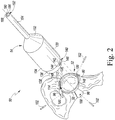
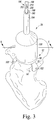
- the customized patient-specific acetabular orthopaedic surgical instrument is illustratively embodied as a customized patient-specific acetabular reaming guide 50 (hereinafter reaming guide 50).
- the reaming guide 50 includes a locating base 52 and a sheath or housing 54 configured to be secured to the base 52, as will be described in greater detail below.
- the base 52 and the housing 54 may be formed from any suitable material such as, for example, a resilient plastic or metallic material.
- the reaming guide 50 is formed from injection-molded, clear polypropylene or other transparent material such that the interior of the reaming guide 50 is visible when the guide 50 is secured to the patient's bony anatomy.
- the reaming guide 50 may be formed from implant-grade metallic material such as titanium or cobalt chromium. Additionally, the reaming guide 50 may include image intensifiers such as, for example, stainless steel, tantalum, or other dense material to aid in positioning and to check the accuracy of alignment.
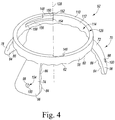
- the base 52 includes a guide body 56 configured to contact a portion of the patient's coxal bone during use.
- the guide body 56 has a generally ring shape but in other embodiments the guide body 56 could have a generally square shape, rectangular shape, or any other suitable form.
- the body 56 includes a bottom surface 60, which is configured to contact a portion of the area of the patient's coxal bone proximate to the acetabulum.
- the bottom surface 60 includes a customized patient-specific negative contour 62 configured to receive the corresponding positive contour of the acetabular margin 64 of the patient's coxal bone (see FIG. 6 ). It should be appreciated that in other embodiments the bottom surface 60 may include other customized patient-specific negative contours that are configured to receive other corresponding contours of the patient's coxal bone proximate to the acetabulum.
- the base 52 also includes a plurality of arms 70 extending outwardly from the body 56.
- the body 56 and the arms 70 are formed as a single monolithic component.
- the body 56 and the arms 70 could each be formed from separate pieces.
- the arms 70 may be separately secured to the body 56 via suitable fasteners such as screws, bolts, adhesive, or the like.
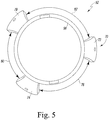
- the base 52 includes three arms 70 extending from the body 56. It should be appreciated that in other embodiments the base 52 may include additional or fewer arms depending on the patient's bony anatomy and the preference of the surgeon.
- the arms 70 extend from the body 56 in a configuration that defines an angle between each arm 70. For example, as illustrated in FIG. 5 , an arm 72 and an arm 74 define an angle 76 therebetween, the arm 74 and an arm 78 define an angle 80 therebetween, and the arm 72 and the arm 78 define an angle 82 therebetween.
- the magnitude of each of the angles 76, 80, 82 is equal to approximately 120 degrees.
- the arms 70 may extend from the body 56 such that the each of the angles 76, 80, 82 has a magnitude different from any other angle.
- the magnitude of the angles 76, 80, 82 may be customized to as required for the particular patient.
- Each arm 70 is configured to contact a portion of the patient's coxal bone during use.
- Each arm 70 includes a bottom surface 84 that is configured to contact a portion of the area of the patient's coxal bone proximate to the acetabulum.
- Each bottom surface 84 includes a customized patient-specific negative contour 86 configured to receive a portion of the corresponding contour of the patient's coxal bone proximate to the acetabulum.
- one arm 72 has a customized patient-specific negative contour 88 configured to receive the corresponding positive contour of the ilium 90 of the patient's coxal bone (see FIG. 2 ).
- bottom surfaces 84 may include other customized patient-specific negative contours that are configured to receive other corresponding contours of the patient's coxal bone proximate to the acetabulum.
- the bottom surface 84 of another arm 70 may include a customized patient-specific negative contour configured to receive a corresponding contour of the pubis or the ischium of the patient's coxal bone.
- the contours 62, 86 of the base 52 cooperate to ensure the reaming guide 50 is placed on the patient's coxal bone in a desired position and orientation, which is based on the predetermined inclination plane and the predetermined version plane of the acetabular orthopaedic prosthesis.
- Each arm 70 includes a top surface 96 positioned opposite the bottom surface 84. Each arm 70 also includes an inner surface 98 that defines a passageway 100 extending through each arm 70.
- the passageways 100 are sized to receive a corresponding bone pin 102 to be secured to the patient's coxal bone (see FIG. 2 ).
- the bone pins 102 cooperate to lock the base 52 in the unique position and orientation.
- the passageway 100 may be sized to receive wire or other retaining devices suitable for locking the base 52 into place on the coxal bone.
- each passageway 100 is angled relative to the top surface 96 and the bottom surface 84.
- Each passageway 100 has a diameter 104 that is slightly larger than the outer diameter of the pin 102, and the passageway 100 of each arm 70 has a substantially circular cross-section.
- each arm 70 may include a passageway 100 configured to receive a bone pin with a different cross-sectional shape.
- the passageway 100 may have any cross-sectional shape suitable for receiving a drill bit of a bone drill and passing a bone pin therethrough.
- the guide body 56 includes a top surface 110 positioned opposite the bottom surface 60.
- An inner surface 112 connects the top surface 110 to the bottom surface 60 and defines an illustratively cylindrical passageway 114 extending therebetween.
- the passageway 114 is sized such that an acetabular reamer surgical tool 116 may be moved through the passageway 114 and placed into contact with the patient's acetabulum.
- the acetabular reamer surgical tool 116 includes a reamer head 120 removably secured to a reamer shank 122 via a set screw 124.
- the cylindrical passageway 114 of the base 52 includes a diameter 126 that is larger than the outer diameter 127 of the reamer head 120 to allow the reamer head 120 to advance therethrough.
- the passageway 114 of the body 56 defines a longitudinal axis 128 that is oriented relative to the bottom surface 60 of the body 56 based on the predetermined version angle and the predetermined inclination angle of the acetabular cup prosthesis. As shown in FIGS. 2-6 , the axis 128 extends generally perpendicular to the bottom surface 60. In other embodiments, the axis 128 may be angled in one or more directions relative to the bottom surface 60 depending on the predetermined inclination and version angles for the particular patient.
- the acetabular reamer surgical tool 116 is limited to movement along the axis 128 while being used to shape the patient's acetabulum. In that way, the reaming guide 50 ensures that the patient's acetabulum is shaped to receive the acetabular prosthesis according to the predetermined inclination and version angles.
- the reaming guide 50 also includes the housing 54 that is securable to the locating base 52.
- the housing 54 has a cylindrical main body 130 extending from an upper end 132 to a lower end 134.
- a sleeve 136 extends outwardly from the lower end 134 and includes an outer surface 138.
- the outer surface 138 has a diameter 140 that is less than the diameter 118 of the passageway 114 of the guide body 56.
- the sleeve 136 also illustratively includes a pair of flanges 142 projecting outwardly from the outer surface 138 of the sleeve 136.
- the flanges 142 are spaced apart from the lower end 134 of the main body 130 and extend in an arc about the circumference of the sleeve 136.
- the flanges 142 have substantially the same length but in other embodiments the flanges 142 may have different lengths such that the housing 54 is keyed to the base 52.
- the guide body 56 includes a pair of corresponding slots 148 defined therein that are configured to receive the flanges 142.
- Each slot 148 includes a notch 150 extending from an upper end 152 defined in the top surface 110 of the body 56 to a lower end 154 defined in the inner surface 112 of the body 56.
- Each slot 148 also includes a channel 156 defined in the inner surface 112 that extends from the lower end 154 of the notch 150 to a distal end 158.
- the length of the channel 156 substantially corresponds to the length of the flange 142.
- the channel 156 extends orthogonally to the longitudinal axis 128. It should be appreciated that in other embodiments the channel 156 may be tilted relative to the longitudinal axis 128 depending the desired position and orientation of the reaming guide 50 to further secure the housing 54 to the base 52.
- the slots 148 and the flanges 142 cooperate to secure the housing 54 to the base 52.
- the housing 54 may be placed in contact with the base 52 such that each flange 142 is received in the notch 150 of a corresponding slot 148.
- a bottom 160 of each flange 142 located in the lower end 154 of the notch 150 When the housing 54 is seated on the base 52, a bottom 160 of each flange 142 located in the lower end 154 of the notch 150.
- the housing 54 is then rotated about the longitudinal axis 128 to advance each flange 142 into the channel 156 of the corresponding slot 148 until an end 146 of the flange 142 is placed in contact with the end 158 of the channel 156 to secure the housing 54 to the base 52.
- the reaming guide 50 may include additional or fewer flanges 142 and slots 148.
- the housing 54 may be securable to the base 52 by other methods.
- the sleeve 136 may have an external thread and the body 56 may have a corresponding internal thread. In such embodiments, the sleeve 136 may be threaded onto the body 56.
- the housing 54 may include a latching mechanism secured to the main body 130 that engages with the base 52.
- the housing 54 may be secured to the base 52 via suitable fasteners such as screws, bolts, or the like.
- the sleeve 136 includes an inner surface 170 that defines a lower passageway 172.
- the lower passageway 172 has a diameter 174 that is slightly larger than the outer diameter 176 of the reamer head 120 of the acetabular reamer surgical tool 116.
- the lower passageway 172 is sized such that the acetabular reamer surgical tool 116 may be moved along the longitudinal axis 128 and placed into contact with the patient's acetabulum.
- the main body 130 also includes an inner surface 178 that defines a central passageway 180 connected with the lower passageway 172.
- the central passageway 180 has a diameter 182 that is larger than the diameter 174 of the passageway 172.
- the diameter 182 of the central passageway 180 may be substantially equal to the diameter 174 of the lower passageway 172.
- a hollow shaft 184 extends upwardly from the upper end 132 of the main body 130.
- the shaft 184 includes an inner surface 188 that defines a cylindrical passageway 190 extending from a top end 186 of the shaft 184 to the upper end 132 of the main body 130.
- the passageway 190 is fluidly connected with the central passageway 180 of the main body 130.
- the passageway 190 has an inner diameter 192 that is smaller than the diameters 174, 182 of the passageways 172, 180 and that is only slightly larger than the outer diameter 176 of the reamer shank 122 of the acetabular reamer surgical tool 116.
- the passageway 190 of the shaft 184 defines another longitudinal axis 194 that is aligned or collinear with the axis 128 defined by the passageway 114 of the body 56.
- the reamer shank 122 includes a user-depressible button 196 positioned proximate to a shank end 198, which is located external to the housing 54.
- the button 196 is moveable between an extended position, which is shown in FIG. 6 , and a depressed position.
- the button 196 When the button 196 is in the extended position, the button 196 extends outwardly from the shank 122 and includes an outer surface 200.
- a biasing member such as a spring (not shown) urges the button 196 to move from the depressed position to the extended position when pressure is removed from the outer surface 200.
- the button 196 also has a lower surface 202, and, when the button 196 is the extended position, the reamer shank 122 is permitted to advance down the shaft 184 until the lower surface 202 contacts the top end 186 of the shaft 184. In that way, the longitudinal movement of the acetabular reamer surgical tool 116 along the axes 128, 194 relative to the bottom surface 60 of the body 56, and, by extension, the patient's acetabulum, is limited by the housing 54.
- the main body 130 and the shaft 184 define a total length 204.
- the magnitude of the length 204 is set based on the predetermined depth to which the orthopaedic surgeon plans to ream the patient's acetabulum. For example, when the surgeon desires to remove a greater amount of material from the patient's acetabulum, the length 204 may be of smaller magnitude so that the button 196 is placed in contact with the top end 186 of the shaft 184 after the reamer head 120 has advanced beyond the bottom surface 60 of the body 56 to a greater depth within the patient's acetabulum.
- the top end 186 of the shaft 184 acts a depth stop 206 for the acetabular reamer surgical tool 116, ensuring that the reamer head 120 is permitted to advance no further than a predetermined position relative to the bottom surface 60 of the body 56.
- reaming guide 50 permits the acetabular reamer surgical tool 116 to ream the patient's acetabulum to only a predetermined depth.
- the shaft 184 may be a telescopic tube such that the surgeon may adjust the length 204 intra-operatively or pre-operatively according to surgical conditions.
- the shank 122 may include a moveable collar rather than the button 196. In such embodiments, the surgeon could adjust the position of the collar along the shank 122 intra-operatively or pre-operatively in order to adjust the reaming depth.
- an orthopaedic surgical procedure 300 using the reaming guide 50 is illustrated.
- the surgeon may perform the procedure 300 in step 32 of method 10, which is illustrated in FIG. 1 and described above.
- the surgeon positions the locating base 52 of the reaming guide 50 on the patient's coxal bone. Because the locating base 52 is customized to the particular patient, the base 52 is positioned on the patient's coxal bone in a substantially unique, predetermined location and orientation.
- the base 52 is positioned on the patient's coxal bone such that the corresponding contours of the surface of the patient's coxal bone are received in the negative contours 62, 86 of the base 52.
- the contour 62 of the body 56 receives the corresponding positive contour of the acetabular margin 64 of the patient's coxal bone.
- the customized patient-specific negative contour 88 of the arm 72 also receives the corresponding positive contour of the ilium 90 of the patient's coxal bone when the base 52 is properly positioned.
- the customized patient-specific negative contours 86 of the remaining arms 74, 78 similarly receive the corresponding positive contours of the surface of the patient's coxal bone.
- the locating base 52 is aligned with the predetermined inclination and version angles relative to the patient's acetabulum intended for the acetabular orthopaedic prosthesis as determined in step 24 of the method 10.
- the longitudinal axis 128 further defines the path to be followed by the acetabular reamer surgical tool 116 during the reaming operation.
- step 304 the surgeon secures the base 52 to the coxal bone.
- the surgeon drills a pilot hole in the patient's coxal bone proximate to the acetabulum using each of the passageways 100 as drilling guides.
- the surgeon may then insert a bone pin 102 through each of the passageways 100 of the arms 70 and into the corresponding pilot hole defined in the patient's coxal bone.
- step 306 the surgeon inserts the acetabular reamer surgical tool 116 into the housing 54.
- the surgeon selects the reamer head 120 and secures the head 120 to the reamer shank 122 using the set screw 124.
- the end 198 of the shank 122 may be inserted into the lower passageway 172 of the sleeve 136 of the housing 54, and the shank 122 may be advanced through the central passageway 180 to the upper end 132 of the main body 130.
- a sloped or ramped end 210 of the button 196 may be advanced into contact with the inner surface 188 of the shaft 184 at the lower end 208.
- the contact between the inner surface 188 and the sloped end 210 as the shank 122 is advanced along passageway 190 causes the button 196 to move to the depressed position.
- the button 196 remains in the depressed position as the shank 122 is advanced along the passageway 190.
- the biasing member urges the button 196 to move from the depressed position to the extended position. In that way, the button 196 ensures that the acetabular reamer surgical tool 116 is not inadvertently decoupled from the housing 54. Should the surgeon desire to remove the acetabular reamer surgical tool 116 from the housing 54, the surgeon may simply press the button 196 to move the button 196 to the depressed position before sliding the shank 122 back down the passageway 190.
- step 308 the housing 54 is secured to the locating base 52.
- the housing 54 is first aligned with the base 52 as shown in FIG. 2 .
- the housing 54 is placed in contact with the base 52 such that each flange 142 is received in the notch 150 of a corresponding slot 148.
- the bottom 160 of each flange 142 is placed in contact with the lower end 154 of the notch 150.
- the housing 54 may then be rotated about the longitudinal axis 128 to advance each flange 142 into the channel 156 of the corresponding slot 148 until the end 146 of the flange 142 is placed in contact with the end 158 of the channel 156.
- step 310 the surgeon attaches a surgical drill to the end 198 of the shank 122 and begins to ream the patient's acetabulum. Because the locating base 52 was secured to the patient's acetabulum in a desired location and orientation based on the predetermined version and inclination angles of the acetabular prosthesis, the reaming of the patient's acetabulum is guided so as to size the patient's acetabulum to receive the acetabular prosthesis according to those predetermined angles. The surgeon advances the reamer head 120 into the patient's acetabulum until the button 196 is placed in contact with the depth stop 206. At that point, the reamer head 120 is located at a predetermined position relative to the bottom surface 60 of the body 56, and the surgeon has reamed the patient's acetabulum to the predetermined depth.
- surgeon may repeat any and all of the steps set forth above depending on the nature of the surgical procedure.
- the surgeon may use more than one reamer head 120 to size the patient's acetabulum, beginning with a smaller head and progressively increasing the size of the head until the predetermined amount of material is removed.
- the reaming guide 50 may include more than one housing 54, and each housing 54 may have a different length 204 to progressively adjust the reaming depth to permit the surgeon to remove greater amounts of material.
- the locating base 52 and the housing 54 may be used as a platform for other surgical instruments to assist with cup and liner placement.
- the impacter used to seat the acetabular cup and liner may be provided with a shaft of the same diameter as the reamer shank 122.
- the locating base 52 and the housing 54 may then be used to guide the motion of the impacter to properly seat the acetabular cup and liner.
- the locating base 52 may be used to provide visual confirmation of the placement of the acetabular cup and liner.
- the locating base 52 and/or the housing 54 may also include markings or graduations to provide information to the surgeon when performing inter-operative changes or when making adjustments to the size and/or alignment of the acetabular cup and liner.
Landscapes
- Health & Medical Sciences (AREA)
- Surgery (AREA)
- Life Sciences & Earth Sciences (AREA)
- Biomedical Technology (AREA)
- Medical Informatics (AREA)
- Orthopedic Medicine & Surgery (AREA)
- Oral & Maxillofacial Surgery (AREA)
- Engineering & Computer Science (AREA)
- Dentistry (AREA)
- Heart & Thoracic Surgery (AREA)
- Nuclear Medicine, Radiotherapy & Molecular Imaging (AREA)
- Molecular Biology (AREA)
- Animal Behavior & Ethology (AREA)
- General Health & Medical Sciences (AREA)
- Public Health (AREA)
- Veterinary Medicine (AREA)
- Prostheses (AREA)
- Surgical Instruments (AREA)
Applications Claiming Priority (2)
| Application Number | Priority Date | Filing Date | Title |
|---|---|---|---|
| US12/855,363 US8808302B2 (en) | 2010-08-12 | 2010-08-12 | Customized patient-specific acetabular orthopaedic surgical instrument and method of use and fabrication |
| PCT/US2011/044466 WO2012021264A1 (en) | 2010-08-12 | 2011-07-19 | Customized patient-specific acetabular orthopaedic surgical instrument and method of use and fabrication |
Publications (3)
| Publication Number | Publication Date |
|---|---|
| EP2603152A1 EP2603152A1 (en) | 2013-06-19 |
| EP2603152A4 EP2603152A4 (en) | 2016-08-31 |
| EP2603152B1 true EP2603152B1 (en) | 2018-07-04 |
Family
ID=45565362
Family Applications (1)
| Application Number | Title | Priority Date | Filing Date |
|---|---|---|---|
| EP11816767.5A Not-in-force EP2603152B1 (en) | 2010-08-12 | 2011-07-19 | Customized patient-specific acetabular orthopaedic surgical instrument |
Country Status (6)
| Country | Link |
|---|---|
| US (2) | US8808302B2 (enExample) |
| EP (1) | EP2603152B1 (enExample) |
| JP (1) | JP6121324B2 (enExample) |
| CN (1) | CN103068328B (enExample) |
| CA (1) | CA2808082A1 (enExample) |
| WO (1) | WO2012021264A1 (enExample) |
Families Citing this family (170)
| Publication number | Priority date | Publication date | Assignee | Title |
|---|---|---|---|---|
| US8591516B2 (en) | 2006-02-27 | 2013-11-26 | Biomet Manufacturing, Llc | Patient-specific orthopedic instruments |
| US8858561B2 (en) | 2006-06-09 | 2014-10-14 | Blomet Manufacturing, LLC | Patient-specific alignment guide |
| US8377066B2 (en) | 2006-02-27 | 2013-02-19 | Biomet Manufacturing Corp. | Patient-specific elbow guides and associated methods |
| US9173661B2 (en) | 2006-02-27 | 2015-11-03 | Biomet Manufacturing, Llc | Patient specific alignment guide with cutting surface and laser indicator |
| US8535387B2 (en) | 2006-02-27 | 2013-09-17 | Biomet Manufacturing, Llc | Patient-specific tools and implants |
| US8864769B2 (en) | 2006-02-27 | 2014-10-21 | Biomet Manufacturing, Llc | Alignment guides with patient-specific anchoring elements |
| US8568487B2 (en) | 2006-02-27 | 2013-10-29 | Biomet Manufacturing, Llc | Patient-specific hip joint devices |
| US10278711B2 (en) | 2006-02-27 | 2019-05-07 | Biomet Manufacturing, Llc | Patient-specific femoral guide |
| US9113971B2 (en) | 2006-02-27 | 2015-08-25 | Biomet Manufacturing, Llc | Femoral acetabular impingement guide |
| US20150335438A1 (en) | 2006-02-27 | 2015-11-26 | Biomet Manufacturing, Llc. | Patient-specific augments |
| US8603180B2 (en) * | 2006-02-27 | 2013-12-10 | Biomet Manufacturing, Llc | Patient-specific acetabular alignment guides |
| US8407067B2 (en) | 2007-04-17 | 2013-03-26 | Biomet Manufacturing Corp. | Method and apparatus for manufacturing an implant |
| US9345548B2 (en) | 2006-02-27 | 2016-05-24 | Biomet Manufacturing, Llc | Patient-specific pre-operative planning |
| US9918740B2 (en) | 2006-02-27 | 2018-03-20 | Biomet Manufacturing, Llc | Backup surgical instrument system and method |
| US9289253B2 (en) | 2006-02-27 | 2016-03-22 | Biomet Manufacturing, Llc | Patient-specific shoulder guide |
| US8608749B2 (en) | 2006-02-27 | 2013-12-17 | Biomet Manufacturing, Llc | Patient-specific acetabular guides and associated instruments |
| US8092465B2 (en) | 2006-06-09 | 2012-01-10 | Biomet Manufacturing Corp. | Patient specific knee alignment guide and associated method |
| US9907659B2 (en) | 2007-04-17 | 2018-03-06 | Biomet Manufacturing, Llc | Method and apparatus for manufacturing an implant |
| US8241293B2 (en) | 2006-02-27 | 2012-08-14 | Biomet Manufacturing Corp. | Patient specific high tibia osteotomy |
| US7967868B2 (en) | 2007-04-17 | 2011-06-28 | Biomet Manufacturing Corp. | Patient-modified implant and associated method |
| US8133234B2 (en) | 2006-02-27 | 2012-03-13 | Biomet Manufacturing Corp. | Patient specific acetabular guide and method |
| US8608748B2 (en) | 2006-02-27 | 2013-12-17 | Biomet Manufacturing, Llc | Patient specific guides |
| US9339278B2 (en) | 2006-02-27 | 2016-05-17 | Biomet Manufacturing, Llc | Patient-specific acetabular guides and associated instruments |
| US9795399B2 (en) | 2006-06-09 | 2017-10-24 | Biomet Manufacturing, Llc | Patient-specific knee alignment guide and associated method |
| GB2442441B (en) | 2006-10-03 | 2011-11-09 | Biomet Uk Ltd | Surgical instrument |
| US10758283B2 (en) | 2016-08-11 | 2020-09-01 | Mighty Oak Medical, Inc. | Fixation devices having fenestrations and methods for using the same |
| CA2696584C (en) | 2007-08-17 | 2016-11-29 | Mohamed Rashwan Mahfouz | Implant design analysis suite |
| US8992538B2 (en) | 2008-09-30 | 2015-03-31 | DePuy Synthes Products, Inc. | Customized patient-specific acetabular orthopaedic surgical instrument and method of use and fabrication |
| US8884618B2 (en) | 2009-02-25 | 2014-11-11 | Zimmer, Inc. | Method of generating a patient-specific bone shell |
| US9078755B2 (en) | 2009-02-25 | 2015-07-14 | Zimmer, Inc. | Ethnic-specific orthopaedic implants and custom cutting jigs |
| DE102009028503B4 (de) | 2009-08-13 | 2013-11-14 | Biomet Manufacturing Corp. | Resektionsschablone zur Resektion von Knochen, Verfahren zur Herstellung einer solchen Resektionsschablone und Operationsset zur Durchführung von Kniegelenk-Operationen |
| EP2493396B1 (en) | 2009-10-29 | 2016-11-23 | Zimmer, Inc. | Patient-specific mill guide |
| MX2012005649A (es) * | 2009-11-17 | 2012-12-05 | Univ Kingston | Guia especifica de paciente para colocacion de la copa acetabular. |
| US8632547B2 (en) | 2010-02-26 | 2014-01-21 | Biomet Sports Medicine, Llc | Patient-specific osteotomy devices and methods |
| GB201009116D0 (en) * | 2010-06-01 | 2010-07-14 | Materialise Nv | Acetabular cup reamer |
| WO2011160008A1 (en) | 2010-06-18 | 2011-12-22 | Howmedica Osteonics Corp. | Patient-specific total hip arthroplasty |
| US12357413B2 (en) | 2010-06-29 | 2025-07-15 | Mighty Oak Medical, Inc. | Patient-matched apparatus for use in spine related surgical procedures and methods for using the same |
| US11806197B2 (en) * | 2010-06-29 | 2023-11-07 | Mighty Oak Medical, Inc. | Patient-matched apparatus for use in spine related surgical procedures and methods for using the same |
| US9198678B2 (en) | 2013-03-15 | 2015-12-01 | George Frey | Patient-matched apparatus and methods for performing surgical procedures |
| US9642633B2 (en) * | 2010-06-29 | 2017-05-09 | Mighty Oak Medical, Inc. | Patient-matched apparatus and methods for performing surgical procedures |
| US11376073B2 (en) | 2010-06-29 | 2022-07-05 | Mighty Oak Medical Inc. | Patient-matched apparatus and methods for performing surgical procedures |
| US8870889B2 (en) * | 2010-06-29 | 2014-10-28 | George Frey | Patient matching surgical guide and method for using the same |
| US11039889B2 (en) * | 2010-06-29 | 2021-06-22 | Mighty Oak Medical, Inc. | Patient-matched apparatus and methods for performing surgical procedures |
| EP2588009B1 (en) * | 2010-06-29 | 2018-12-26 | George Frey | Patient matching surgical guide |
| WO2017066518A1 (en) * | 2010-06-29 | 2017-04-20 | Mighty Oak Medical, Inc. | Patient-matched apparatus and methods for performing surgical procedures |
| US9271744B2 (en) | 2010-09-29 | 2016-03-01 | Biomet Manufacturing, Llc | Patient-specific guide for partial acetabular socket replacement |
| EP2632383B1 (en) | 2010-10-29 | 2022-02-23 | The Cleveland Clinic Foundation | System for assisting with arrangement of a stock instrument with respect to a patient tissue |
| US9877735B2 (en) | 2010-10-29 | 2018-01-30 | The Cleveland Clinic Foundation | System and method for assisting with attachment of a stock implant to a patient tissue |
| EP2632348B1 (en) | 2010-10-29 | 2019-07-17 | The Cleveland Clinic Foundation | System and method for association of a guiding aid with a patient tissue |
| CA2816339C (en) | 2010-10-29 | 2020-09-15 | The Cleveland Clinic Foundation | System of preoperative planning and provision of patient-specific surgical aids |
| US9968376B2 (en) | 2010-11-29 | 2018-05-15 | Biomet Manufacturing, Llc | Patient-specific orthopedic instruments |
| US9241745B2 (en) | 2011-03-07 | 2016-01-26 | Biomet Manufacturing, Llc | Patient-specific femoral version guide |
| US8715289B2 (en) | 2011-04-15 | 2014-05-06 | Biomet Manufacturing, Llc | Patient-specific numerically controlled instrument |
| US8668700B2 (en) | 2011-04-29 | 2014-03-11 | Biomet Manufacturing, Llc | Patient-specific convertible guides |
| US8956364B2 (en) | 2011-04-29 | 2015-02-17 | Biomet Manufacturing, Llc | Patient-specific partial knee guides and other instruments |
| EP2704651A4 (en) * | 2011-05-03 | 2014-10-08 | Smith & Nephew Inc | PATIENT-SPECIFIC GUIDANCE FOR ORTHOPEDIC IMPLANTS |
| US10130378B2 (en) | 2011-05-11 | 2018-11-20 | The Cleveland Clinic Foundation | Generating patient specific instruments for use as surgical aids |
| GB201108078D0 (en) * | 2011-05-16 | 2011-06-29 | Materialise Nv | Surgical guides and methods for manufacturing thereof |
| EP3141196B1 (en) | 2011-05-19 | 2020-04-08 | The Cleveland Clinic Foundation | Apparatus for providing a reference indication to a patient tissue |
| US8532807B2 (en) | 2011-06-06 | 2013-09-10 | Biomet Manufacturing, Llc | Pre-operative planning and manufacturing method for orthopedic procedure |
| US9084618B2 (en) | 2011-06-13 | 2015-07-21 | Biomet Manufacturing, Llc | Drill guides for confirming alignment of patient-specific alignment guides |
| USD705929S1 (en) | 2011-06-29 | 2014-05-27 | George A. Frey | Surgical guide |
| USD775335S1 (en) | 2011-06-29 | 2016-12-27 | Mighty Oak Medical, Inc. | Multi-level surgical guide |
| USD745672S1 (en) | 2012-09-18 | 2015-12-15 | George Frey | Thoracic surgical guide |
| USD738498S1 (en) | 2013-12-16 | 2015-09-08 | George Frey | Sacroiliac surgical guide |
| US20130001121A1 (en) | 2011-07-01 | 2013-01-03 | Biomet Manufacturing Corp. | Backup kit for a patient-specific arthroplasty kit assembly |
| US8764760B2 (en) | 2011-07-01 | 2014-07-01 | Biomet Manufacturing, Llc | Patient-specific bone-cutting guidance instruments and methods |
| US8597365B2 (en) | 2011-08-04 | 2013-12-03 | Biomet Manufacturing, Llc | Patient-specific pelvic implants for acetabular reconstruction |
| US9295497B2 (en) * | 2011-08-31 | 2016-03-29 | Biomet Manufacturing, Llc | Patient-specific sacroiliac and pedicle guides |
| US9066734B2 (en) * | 2011-08-31 | 2015-06-30 | Biomet Manufacturing, Llc | Patient-specific sacroiliac guides and associated methods |
| US9386993B2 (en) | 2011-09-29 | 2016-07-12 | Biomet Manufacturing, Llc | Patient-specific femoroacetabular impingement instruments and methods |
| WO2013062848A1 (en) | 2011-10-27 | 2013-05-02 | Biomet Manufacturing Corporation | Patient-specific glenoid guides |
| US9451973B2 (en) | 2011-10-27 | 2016-09-27 | Biomet Manufacturing, Llc | Patient specific glenoid guide |
| US9554910B2 (en) | 2011-10-27 | 2017-01-31 | Biomet Manufacturing, Llc | Patient-specific glenoid guide and implants |
| US9301812B2 (en) | 2011-10-27 | 2016-04-05 | Biomet Manufacturing, Llc | Methods for patient-specific shoulder arthroplasty |
| KR20130046336A (ko) | 2011-10-27 | 2013-05-07 | 삼성전자주식회사 | 디스플레이장치의 멀티뷰 디바이스 및 그 제어방법과, 디스플레이 시스템 |
| US10325065B2 (en) | 2012-01-24 | 2019-06-18 | Zimmer, Inc. | Method and system for creating patient-specific instrumentation for chondral graft transfer |
| US9237950B2 (en) | 2012-02-02 | 2016-01-19 | Biomet Manufacturing, Llc | Implant with patient-specific porous structure |
| US10543100B2 (en) | 2012-03-28 | 2020-01-28 | Zimmer, Inc. | Glenoid implant surgery using patient specific instrumentation |
| EP2836136A4 (en) * | 2012-04-04 | 2016-04-20 | Smith & Nephew Inc | SURGICAL GUIDE HAVING PEROPERATIVE DEPTH FEEDBACK |
| GB201206493D0 (en) * | 2012-04-12 | 2012-05-30 | Imp Innovations Ltd | Device for use in facilitating alignment of an acetabular component |
| WO2013155626A1 (en) * | 2012-04-16 | 2013-10-24 | Orthosoft Inc. | Patient specific surgical guide |
| CA3083790C (en) | 2012-05-24 | 2023-06-27 | Zimmer, Inc. | Patient-specific instrumentation and method for articular joint repair |
| US10271886B2 (en) | 2012-07-23 | 2019-04-30 | Zimmer, Inc. | Patient-specific instrumentation for implant revision surgery |
| EP2877115A4 (en) | 2012-07-24 | 2016-05-11 | Orthosoft Inc | PATIENT-SPECIFIC INSTRUMENT WITH MEMS IN SURGERY |
| USD745673S1 (en) | 2012-09-18 | 2015-12-15 | George Frey | Lumbar surgical guide |
| USD745671S1 (en) | 2012-09-18 | 2015-12-15 | George Frey | Transitional surgical guide |
| US9572683B2 (en) * | 2012-09-27 | 2017-02-21 | DePuy Synthes Products, Inc. | Acetabular orthopaedic surgical instrument and method of using same |
| US9700433B2 (en) * | 2012-11-28 | 2017-07-11 | Tecomet, Inc | Patient-specific acetabular alignment guide and method |
| WO2014089291A1 (en) * | 2012-12-05 | 2014-06-12 | Smith & Nephew, Inc. | Orthopedic guide systems and methods |
| US9204977B2 (en) | 2012-12-11 | 2015-12-08 | Biomet Manufacturing, Llc | Patient-specific acetabular guide for anterior approach |
| US9060788B2 (en) | 2012-12-11 | 2015-06-23 | Biomet Manufacturing, Llc | Patient-specific acetabular guide for anterior approach |
| US20140180430A1 (en) | 2012-12-20 | 2014-06-26 | Michael Gillman | Devices and methods for hip replacement |
| US20140257402A1 (en) * | 2013-03-08 | 2014-09-11 | The Cleveland Clinic Foundation | Surgical system for positioning a patient and marking locations for a surgical procedure |
| US9839438B2 (en) | 2013-03-11 | 2017-12-12 | Biomet Manufacturing, Llc | Patient-specific glenoid guide with a reusable guide holder |
| US9579107B2 (en) | 2013-03-12 | 2017-02-28 | Biomet Manufacturing, Llc | Multi-point fit for patient specific guide |
| US9826981B2 (en) | 2013-03-13 | 2017-11-28 | Biomet Manufacturing, Llc | Tangential fit of patient-specific guides |
| US9498233B2 (en) | 2013-03-13 | 2016-11-22 | Biomet Manufacturing, Llc. | Universal acetabular guide and associated hardware |
| US20140276872A1 (en) | 2013-03-15 | 2014-09-18 | Otismed Corporation | Customized acetabular cup positioning guide and system and method of generating and employing such a guide |
| US9517145B2 (en) | 2013-03-15 | 2016-12-13 | Biomet Manufacturing, Llc | Guide alignment system and method |
| WO2014197989A1 (en) * | 2013-06-11 | 2014-12-18 | Orthosoft Inc. | Computer assisted subchondral injection |
| CN105246433B (zh) | 2013-06-11 | 2018-06-05 | 奥尔索夫特公司 | 髋臼杯假体定位器械和方法 |
| WO2014197987A1 (en) * | 2013-06-13 | 2014-12-18 | Laboratoires Bodycad Inc. | Surgical cut validation tool and method |
| US9693785B2 (en) * | 2013-07-02 | 2017-07-04 | Inova Health System | Device for a patient-specific acetabulum reaming and cup positioning guide |
| US9668760B2 (en) * | 2013-08-08 | 2017-06-06 | Scott Kelley | Methods and systems for preparing the acetabulum to receive an acetabular component in a hip replacement surgical procedure |
| CN105705117B (zh) | 2013-09-25 | 2018-07-24 | 捷迈有限公司 | 用于矫形手术的患者特定器械(psi)以及利用x射线来制作其的系统和方法 |
| US10736697B2 (en) | 2013-10-10 | 2020-08-11 | Imascap Sas | Methods, systems and devices for pre-operatively planned shoulder surgery guides and implants |
| AU2014335871B2 (en) | 2013-10-17 | 2019-07-18 | Stryker European Operations Limited | Methods, systems and devices for pre-operatively planned glenoid placement guides and uses thereof |
| US20150112349A1 (en) | 2013-10-21 | 2015-04-23 | Biomet Manufacturing, Llc | Ligament Guide Registration |
| WO2015068035A1 (en) | 2013-11-08 | 2015-05-14 | Imascap | Methods, systems and devices for pre-operatively planned adaptive glenoid implants |
| EP4378402A3 (en) | 2013-11-13 | 2024-07-24 | Tornier | Method for providing a patient specific glenoid guide |
| DE102013112497A1 (de) | 2013-11-13 | 2015-05-13 | Aesculap Ag | Medizinisches Instrumentarium |
| US9211128B2 (en) * | 2014-04-17 | 2015-12-15 | Bullseye Hip Replacement, Llc | Devices and methods for hip replacement |
| US10282488B2 (en) | 2014-04-25 | 2019-05-07 | Biomet Manufacturing, Llc | HTO guide with optional guided ACL/PCL tunnels |
| CA2939934A1 (en) | 2014-04-30 | 2015-11-05 | Zimmer, Inc. | Acetabular cup impacting using patient-specific instrumentation |
| US9408616B2 (en) | 2014-05-12 | 2016-08-09 | Biomet Manufacturing, Llc | Humeral cut guide |
| US9839436B2 (en) | 2014-06-03 | 2017-12-12 | Biomet Manufacturing, Llc | Patient-specific glenoid depth control |
| US9561040B2 (en) | 2014-06-03 | 2017-02-07 | Biomet Manufacturing, Llc | Patient-specific glenoid depth control |
| WO2015187822A1 (en) | 2014-06-03 | 2015-12-10 | Zimmer, Inc. | Patient-specific cutting block and method of manufacturing same |
| US9414938B2 (en) * | 2014-09-12 | 2016-08-16 | Bullseye Hip Replacement, Llc | Devices and methods for hip replacement |
| US9826994B2 (en) | 2014-09-29 | 2017-11-28 | Biomet Manufacturing, Llc | Adjustable glenoid pin insertion guide |
| US9833245B2 (en) * | 2014-09-29 | 2017-12-05 | Biomet Sports Medicine, Llc | Tibial tubercule osteotomy |
| EP3253322B1 (en) | 2015-02-02 | 2020-03-11 | Orthosoft ULC | Acetabulum rim digitizer device |
| CA2979424C (en) | 2015-03-25 | 2023-11-07 | Orthosoft Inc. | Method and system for assisting implant placement in thin bones such as scapula |
| US9820868B2 (en) | 2015-03-30 | 2017-11-21 | Biomet Manufacturing, Llc | Method and apparatus for a pin apparatus |
| WO2016191725A1 (en) | 2015-05-28 | 2016-12-01 | Zimmer, Inc. | Patient-specific bone grafting system and method |
| US10568647B2 (en) | 2015-06-25 | 2020-02-25 | Biomet Manufacturing, Llc | Patient-specific humeral guide designs |
| US10226262B2 (en) | 2015-06-25 | 2019-03-12 | Biomet Manufacturing, Llc | Patient-specific humeral guide designs |
| AU2016290962B2 (en) | 2015-07-08 | 2021-04-08 | Zimmer, Inc. | Patient-specific instrumentation for implant revision surgery |
| EP3324861B1 (en) * | 2015-07-21 | 2021-11-10 | Smith & Nephew, Inc. | Orthopedic instrumentation |
| CA3143872C (en) * | 2015-07-27 | 2023-01-03 | Hip Innovation Technology, LLC | Acetabular ball impactor assembly |
| AU2016331086B2 (en) | 2015-09-30 | 2021-06-24 | Zimmer, Inc. | Patient-specific instrumentation for patellar resurfacing surgery and method |
| US10034753B2 (en) | 2015-10-22 | 2018-07-31 | DePuy Synthes Products, Inc. | Customized patient-specific orthopaedic instruments for component placement in a total hip arthroplasty |
| US10624764B2 (en) * | 2015-11-26 | 2020-04-21 | Orthosoft Ulc | System and method for the registration of an anatomical feature |
| CN105726124B (zh) * | 2016-02-06 | 2019-01-15 | 齐欣 | 股骨近端手术定位定向系统及其制作方法 |
| CA3023965A1 (en) * | 2016-05-11 | 2017-11-16 | Arthromeda, Inc. | Patient-specific prosthesis alignment |
| US10722309B2 (en) * | 2016-07-11 | 2020-07-28 | Bullseye Hip Replacement, Llc | Methods to assist with medical procedures by utilizing patient-specific devices |
| US12016573B2 (en) | 2016-08-11 | 2024-06-25 | Mighty Oak Medical, Inc. | Drill apparatus and surgical fixation devices and methods for using the same |
| US10743890B2 (en) | 2016-08-11 | 2020-08-18 | Mighty Oak Medical, Inc. | Drill apparatus and surgical fixation devices and methods for using the same |
| EP3760145B1 (en) * | 2016-09-30 | 2024-01-03 | Boston Scientific Scimed, Inc. | Access devices and associated methods of production |
| US10149688B2 (en) * | 2016-11-09 | 2018-12-11 | Benjamin S. Song | Anatomic acetabular positioning device for hip arthroplasty |
| US10722310B2 (en) | 2017-03-13 | 2020-07-28 | Zimmer Biomet CMF and Thoracic, LLC | Virtual surgery planning system and method |
| US10940022B2 (en) * | 2017-09-19 | 2021-03-09 | Depuy Ireland Unlimited Company | Side-specific orthopaedic surgical instrument systems and associated methods of use |
| USD858765S1 (en) | 2017-10-26 | 2019-09-03 | Mighty Oak Medical, Inc. | Cortical surgical guide |
| USD857893S1 (en) | 2017-10-26 | 2019-08-27 | Mighty Oak Medical, Inc. | Cortical surgical guide |
| US11576725B2 (en) | 2017-12-12 | 2023-02-14 | Orthosoft Ulc | Patient-specific instrumentation for implant revision surgery |
| EP3517058B1 (en) | 2018-01-30 | 2020-11-04 | Tornier | Surgical bone preparation instrument and assembly comprising such an instrument |
| USD895111S1 (en) | 2018-06-04 | 2020-09-01 | Mighty Oak Medical, Inc. | Sacro-iliac guide |
| USD948717S1 (en) | 2018-06-04 | 2022-04-12 | Mighty Oak Medical, Inc. | Sacro-iliac guide |
| EP3946128A4 (en) * | 2019-03-26 | 2022-11-23 | Mighty Oak Medical, Inc. | PATIENT-CUSTOMIZED DEVICE FOR USE IN AUGMENTED REALITY ASSISTED SURGICAL PROCEDURES AND METHODS OF USE THEREOF |
| AU2019229377B2 (en) * | 2019-09-12 | 2026-04-09 | Limacorporate S.P.A. | Orthopedic surgical instrument including an acetabular reaming guide |
| US11497511B2 (en) * | 2019-09-12 | 2022-11-15 | Limacorporate S.P.A. | Orthopedic surgical instrument including an acetabular reaming guide |
| US11986251B2 (en) | 2019-09-13 | 2024-05-21 | Treace Medical Concepts, Inc. | Patient-specific osteotomy instrumentation |
| US11304710B2 (en) | 2019-12-28 | 2022-04-19 | DePuy Synthes Products, Inc. | Customized patient-specific contact segments for orthopaedic surgical instrument using bone silhouette curves |
| CN111134770A (zh) * | 2020-02-29 | 2020-05-12 | 北京市春立正达医疗器械股份有限公司 | 新型定制髋臼导板及其使用方法 |
| CA3116453A1 (en) * | 2020-05-04 | 2021-11-04 | Laboratoires Bodycad Inc. | Osteotomy plate and method for performing an osteotomy procedure using the same |
| US11819280B2 (en) | 2020-09-30 | 2023-11-21 | DePuy Synthes Products, Inc. | Customized patient-specific orthopaedic surgical instrument using patient-specific contacting bodies and parametric fixed geometry |
| US12208023B2 (en) | 2020-10-27 | 2025-01-28 | Depuy Ireland Unlimited Company | Orthopaedic surgical instrument systems and associated methods of use |
| CN115517749A (zh) * | 2021-06-24 | 2022-12-27 | 上海竞微扶生医学科技有限公司 | 定位器、骨道制备系统及定位器的制备方法 |
| US12419689B2 (en) | 2021-06-29 | 2025-09-23 | DePuy Synthes Products, Inc. | Patient-specific registration jig and associated method for registering an orthopaedic surgical instrument to a patient |
| USD992114S1 (en) | 2021-08-12 | 2023-07-11 | Mighty Oak Medical, Inc. | Surgical guide |
| WO2023023161A1 (en) * | 2021-08-17 | 2023-02-23 | Edward Perez | Bone fixation devices, systems, and methods |
| US12702484B2 (en) | 2022-03-31 | 2026-08-11 | Treace Medical Concepts, Inc. | Apparatus, system, and method for generating patient-specific implants and/or instrumentation |
| US12661133B2 (en) | 2022-05-12 | 2026-06-23 | Treace Medical Concepts, Inc. | Apparatus, system, and method for patient-specific methods and instrumentation |
| EP4539753A1 (en) | 2022-06-17 | 2025-04-23 | Treace Medical Concepts, Inc. | Apparatus, system, and method for generating patient-specific implants and/or instrumentation for osteotomies |
| US20240099778A1 (en) * | 2022-09-27 | 2024-03-28 | Treace Medical Concepts, Inc. | Patient-specific soft tissue rearrangement |
| JP2026505040A (ja) | 2023-01-28 | 2026-02-10 | トリース メディカル コンセプツ,インコーポレイティド | 骨切り術のための装置、システム、及び方法 |
| US12636167B2 (en) | 2023-02-21 | 2026-05-26 | Mighty Oak Medical, Inc. | Interbody device incorporating lattice structure and related systems and methods |
| US12440276B2 (en) | 2023-03-14 | 2025-10-14 | Mighty Oak Medical, Inc. | Systems and methods for presurgical planning |
| US12702569B2 (en) | 2023-11-13 | 2026-08-11 | Arthromeda, Inc. | Pelvis registration instrument and method |
Family Cites Families (96)
| Publication number | Priority date | Publication date | Assignee | Title |
|---|---|---|---|---|
| GB1325534A (en) | 1969-08-11 | 1973-08-01 | Nat Res Dev | Prosthetic acetabular devices |
| US3840904A (en) | 1973-04-30 | 1974-10-15 | R Tronzo | Acetabular cup prosthesis |
| US3903549A (en) | 1974-06-12 | 1975-09-09 | William Minor Deyerle | Acetabular cup prosthesis component for total or subtotal hip prosthesis system |
| DE2830566A1 (de) | 1978-07-12 | 1980-01-24 | Gustav Neuhaeuser Praezisionsw | Vorrichtung zum ausformen einer knochenoeffnung im hueftbein zum einsetzen einer kuenstlichen gelenkpfanne |
| US4475549A (en) | 1982-01-18 | 1984-10-09 | Indong Oh | Acetabular cup positioner and method |
| US4632111A (en) | 1985-03-21 | 1986-12-30 | Minnesota Mining And Manufacturing Company | Acetabular cup positioning apparatus |
| US4711233A (en) | 1985-06-26 | 1987-12-08 | Brown Byron L | Method and apparatus for cementing an acetabular cup to an acetabulum |
| US4715860A (en) | 1985-08-23 | 1987-12-29 | The Regents Of The University Of California | Porous acetabular hip resurfacing |
| AT387711B (de) | 1986-07-15 | 1989-03-10 | David Thomas | Knochenfixationsplatte |
| US5007936A (en) | 1988-02-18 | 1991-04-16 | Cemax, Inc. | Surgical method for hip joint replacement |
| US5133660A (en) | 1989-08-07 | 1992-07-28 | Fenick Thomas J | Device for locating the optimum position for a tooth implant |
| US5171243A (en) | 1991-02-13 | 1992-12-15 | Pfizer Hospital Products Group, Inc. | Acetabular cup positioning insert |
| US5098437A (en) | 1991-02-13 | 1992-03-24 | Pfizer Hospital Products Group, Inc. | Acetabular cup positioning insert |
| US5108401A (en) | 1991-04-12 | 1992-04-28 | New York Society For The Relief Of The Ruptured And Crippled, Maintaining The Hospital For Special Surgery | Patella cutting clamp |
| US5677107A (en) | 1991-10-02 | 1997-10-14 | Spectra Group Limited, Inc. | Production of three-dimensional objects |
| DE4219939C2 (de) | 1992-06-18 | 1995-10-19 | Klaus Dipl Ing Radermacher | Vorrichtung zur Ausrichtung, Positionierung und Führung von Bearbeitungswerkzeugen, Bearbeitungs- oder Meßvorrichtungen zur Bearbeitung einer knöchernen Struktur und Verfahren zur Erstellung dieser Vorrichtung |
| US5320529A (en) | 1992-09-09 | 1994-06-14 | Howard C. Weitzman | Method and apparatus for locating an ideal site for a dental implant and for the precise surgical placement of that implant |
| US5320625A (en) | 1993-01-21 | 1994-06-14 | Bertin Kim C | Apparatus and method for implanting a prosthetic acetabular cup and then testing the stability of the implant |
| GB9322383D0 (en) | 1993-10-29 | 1993-12-15 | Howmedica | Method and apparatus for implanting an acetabular cup |
| US5658294A (en) | 1993-12-02 | 1997-08-19 | Sulzer Orthopedics Inc. | Instrument for holding an acetabular cup |
| BE1008372A3 (nl) | 1994-04-19 | 1996-04-02 | Materialise Nv | Werkwijze voor het vervaardigen van een geperfektioneerd medisch model uitgaande van digitale beeldinformatie van een lichaamsdeel. |
| US5817097A (en) | 1995-08-03 | 1998-10-06 | Synvasive Technology, Inc. | Bone saw blade guide with magnet |
| US5824085A (en) | 1996-09-30 | 1998-10-20 | Integrated Surgical Systems, Inc. | System and method for cavity generation for surgical planning and initial placement of a bone prosthesis |
| US5931870A (en) * | 1996-10-09 | 1999-08-03 | Smith & Nephew, Inc. | Acetabular ring prosthesis with reinforcement buttress |
| US8545569B2 (en) | 2001-05-25 | 2013-10-01 | Conformis, Inc. | Patient selectable knee arthroplasty devices |
| US7534263B2 (en) | 2001-05-25 | 2009-05-19 | Conformis, Inc. | Surgical tools facilitating increased accuracy, speed and simplicity in performing joint arthroplasty |
| US7468075B2 (en) | 2001-05-25 | 2008-12-23 | Conformis, Inc. | Methods and compositions for articular repair |
| US7618451B2 (en) | 2001-05-25 | 2009-11-17 | Conformis, Inc. | Patient selectable joint arthroplasty devices and surgical tools facilitating increased accuracy, speed and simplicity in performing total and partial joint arthroplasty |
| AU729042B2 (en) | 1997-01-08 | 2001-01-25 | Clynch Technologies, Inc. | Method for producing custom fitted medical devices |
| US20070100462A1 (en) | 2001-05-25 | 2007-05-03 | Conformis, Inc | Joint Arthroplasty Devices |
| US8083745B2 (en) | 2001-05-25 | 2011-12-27 | Conformis, Inc. | Surgical tools for arthroplasty |
| US8882847B2 (en) | 2001-05-25 | 2014-11-11 | Conformis, Inc. | Patient selectable knee joint arthroplasty devices |
| US5976149A (en) | 1997-02-11 | 1999-11-02 | Medidea, Llc | Method and apparatus for aligning a prosthetic element |
| US6161080A (en) | 1997-11-17 | 2000-12-12 | The Trustees Of Columbia University In The City Of New York | Three dimensional multibody modeling of anatomical joints |
| EP1032319B1 (en) | 1997-11-18 | 2006-12-06 | Biomedical Engineering Trust I | Anterior-posterior femoral resection guide with set of detachable collets |
| US6327491B1 (en) | 1998-07-06 | 2001-12-04 | Neutar, Llc | Customized surgical fixture |
| US6228121B1 (en) | 1999-06-21 | 2001-05-08 | Depuy Othopedics, Inc. | Prosthesis system and method of implanting |
| WO2001077988A2 (en) | 2000-04-05 | 2001-10-18 | Therics, Inc. | System and method for rapidly customizing a design and remotely manufacturing biomedical devices using a computer system |
| US6395005B1 (en) | 2000-04-14 | 2002-05-28 | Howmedica Osteonics Corp. | Acetabular alignment apparatus and method |
| US6676706B1 (en) | 2000-04-26 | 2004-01-13 | Zimmer Technology, Inc. | Method and apparatus for performing a minimally invasive total hip arthroplasty |
| WO2001084479A1 (en) | 2000-04-28 | 2001-11-08 | Orametirix, Inc. | Method and system for scanning a surface and generating a three-dimensional object |
| JP2003531657A (ja) * | 2000-05-01 | 2003-10-28 | アースロサーフェス, インク. | 関節面付け替え修復システム及び方法 |
| US6427698B1 (en) | 2001-01-17 | 2002-08-06 | Taek-Rim Yoon | Innominate osteotomy |
| NO20011769D0 (no) | 2001-04-06 | 2001-04-06 | Bjoern Franc Iversen | Anordning og system for gjensidig posisjonering av protesedeler |
| US8439926B2 (en) | 2001-05-25 | 2013-05-14 | Conformis, Inc. | Patient selectable joint arthroplasty devices and surgical tools |
| DE10200690B4 (de) | 2002-01-10 | 2005-03-03 | Intraplant Ag | Hilfsmittel zur Implantation einer Hüftgelenkendoprothese |
| US8801720B2 (en) | 2002-05-15 | 2014-08-12 | Otismed Corporation | Total joint arthroplasty system |
| US7651501B2 (en) | 2004-03-05 | 2010-01-26 | Wright Medical Technology, Inc. | Instrument for use in minimally invasive hip surgery |
| WO2004032806A1 (en) | 2002-10-07 | 2004-04-22 | Conformis, Inc. | Minimally invasive joint implant with 3-dimensional geometry matching the articular surfaces |
| CN1728976A (zh) | 2002-10-07 | 2006-02-01 | 康复米斯公司 | 具有与关节表面相匹配的三维几何结构的微创关节植入物 |
| CN1780594A (zh) | 2002-11-07 | 2006-05-31 | 康复米斯公司 | 用于确定半月板的大小和形状以及设计治疗的方法 |
| JP2006508746A (ja) | 2002-12-04 | 2006-03-16 | コンフォーミス・インコーポレイテッド | Mriにおける等方性撮像用の複数撮像平面の融合並びに等方性又は近似的等方性撮像を用いた量的画像解析 |
| AU2003207922A1 (en) | 2003-03-13 | 2004-09-30 | Warsaw Orthopedic, Inc. | Vertebral endplate preparation tool kit |
| US7559931B2 (en) | 2003-06-09 | 2009-07-14 | OrthAlign, Inc. | Surgical orientation system and method |
| EP1486900A1 (en) | 2003-06-12 | 2004-12-15 | Materialise, Naamloze Vennootschap | Method and system for manufacturing a surgical guide |
| US6944518B2 (en) | 2003-09-18 | 2005-09-13 | Depuy Products, Inc. | Customized prosthesis and method of designing and manufacturing a customized prosthesis by utilizing computed tomography data |
| GB0322084D0 (en) | 2003-09-22 | 2003-10-22 | Depuy Int Ltd | A drill guide assembly |
| US8175683B2 (en) | 2003-12-30 | 2012-05-08 | Depuy Products, Inc. | System and method of designing and manufacturing customized instrumentation for accurate implantation of prosthesis by utilizing computed tomography data |
| GB0405294D0 (en) | 2004-03-09 | 2004-04-21 | Imp Ltd | Apparatus for use in orthopaedic surgery |
| FR2869791B1 (fr) | 2004-05-04 | 2006-06-09 | Obl Sa | Guide chirurgical implantaire sur mesure et fraise associee, leur procede de fabrication et leur utilisation |
| NO322674B1 (no) | 2004-05-18 | 2006-11-27 | Scandinavian Customized Prosth | Pasientilpasset kappemal for noyaktig kapping av larhals i en total hofteprotese operasjon |
| ATE422847T1 (de) | 2004-12-08 | 2009-03-15 | Perception Raisonnement Action | Vorrichtung zur positionierung einer knochenschnittführung |
| GB0510194D0 (en) | 2005-05-19 | 2005-06-22 | Mcminn Derek J W | Knee prosthesis |
| EP1945124A2 (en) | 2005-11-07 | 2008-07-23 | Vanderbilt University | Adjustable universal surgical platform |
| EP2671521A3 (en) | 2006-02-06 | 2013-12-25 | ConforMIS, Inc. | Patient selectable joint arthroplasty devices and surgical tools |
| US9808262B2 (en) | 2006-02-15 | 2017-11-07 | Howmedica Osteonics Corporation | Arthroplasty devices and related methods |
| US8133234B2 (en) * | 2006-02-27 | 2012-03-13 | Biomet Manufacturing Corp. | Patient specific acetabular guide and method |
| US9113971B2 (en) | 2006-02-27 | 2015-08-25 | Biomet Manufacturing, Llc | Femoral acetabular impingement guide |
| US8298237B2 (en) | 2006-06-09 | 2012-10-30 | Biomet Manufacturing Corp. | Patient-specific alignment guide for multiple incisions |
| US8282646B2 (en) | 2006-02-27 | 2012-10-09 | Biomet Manufacturing Corp. | Patient specific knee alignment guide and associated method |
| US8241293B2 (en) | 2006-02-27 | 2012-08-14 | Biomet Manufacturing Corp. | Patient specific high tibia osteotomy |
| US9173661B2 (en) | 2006-02-27 | 2015-11-03 | Biomet Manufacturing, Llc | Patient specific alignment guide with cutting surface and laser indicator |
| US8092465B2 (en) | 2006-06-09 | 2012-01-10 | Biomet Manufacturing Corp. | Patient specific knee alignment guide and associated method |
| US7670343B2 (en) * | 2006-06-14 | 2010-03-02 | Biomet Manufacturing Corp. | Method and apparatus for reaming an acetabulum |
| US10405873B2 (en) | 2006-08-03 | 2019-09-10 | Orthosoft Ulc | Computer-assisted surgery tools and system |
| TW200821888A (en) | 2006-08-18 | 2008-05-16 | Smith & Amp Nephew Inc | Systems and methods for designing, analyzing and using orthopaedic devices |
| US8460302B2 (en) | 2006-12-18 | 2013-06-11 | Otismed Corporation | Arthroplasty devices and related methods |
| WO2008112996A1 (en) | 2007-03-14 | 2008-09-18 | Conformis, Inc. | Surgical tools for arthroplasty |
| US20080234665A1 (en) | 2007-03-22 | 2008-09-25 | Baylis Medical Company Inc. | Devices and methods for stabilizing medical instruments |
| GB2447702A (en) | 2007-03-23 | 2008-09-24 | Univ Leeds | Surgical bone cutting template |
| US8444651B2 (en) | 2007-05-14 | 2013-05-21 | Queen's University At Kingston | Patient-specific surgical guidance tool and method of use |
| WO2008153964A1 (en) | 2007-06-07 | 2008-12-18 | Sam Hakki | Apparatus and method of determining acetabular center axis |
| WO2008157412A2 (en) | 2007-06-13 | 2008-12-24 | Conformis, Inc. | Surgical cutting guide |
| GB0712290D0 (en) | 2007-06-25 | 2007-08-01 | Depuy Orthopaedie Gmbh | Surgical instrument |
| US8425524B2 (en) | 2007-09-30 | 2013-04-23 | DePuy Synthes Products, LLC | Customized patient-specific multi-cutting blocks |
| US8357111B2 (en) | 2007-09-30 | 2013-01-22 | Depuy Products, Inc. | Method and system for designing patient-specific orthopaedic surgical instruments |
| US20090149977A1 (en) | 2007-11-06 | 2009-06-11 | Schendel Stephen A | Methods, systems, and computer program products for shaping medical implants directly from virtual reality models |
| US10582934B2 (en) | 2007-11-27 | 2020-03-10 | Howmedica Osteonics Corporation | Generating MRI images usable for the creation of 3D bone models employed to make customized arthroplasty jigs |
| US8480679B2 (en) | 2008-04-29 | 2013-07-09 | Otismed Corporation | Generation of a computerized bone model representative of a pre-degenerated state and useable in the design and manufacture of arthroplasty devices |
| US8777875B2 (en) | 2008-07-23 | 2014-07-15 | Otismed Corporation | System and method for manufacturing arthroplasty jigs having improved mating accuracy |
| US8715291B2 (en) | 2007-12-18 | 2014-05-06 | Otismed Corporation | Arthroplasty system and related methods |
| CN104382630B (zh) | 2008-03-03 | 2017-04-12 | 史密夫和内修有限公司 | 用于膝关节的小轮廓患者特定切削块 |
| US8702805B2 (en) | 2008-07-21 | 2014-04-22 | Harutaro Trabish | Acetabulum surgical resurfacing aid |
| US8992538B2 (en) * | 2008-09-30 | 2015-03-31 | DePuy Synthes Products, Inc. | Customized patient-specific acetabular orthopaedic surgical instrument and method of use and fabrication |
| US9017334B2 (en) | 2009-02-24 | 2015-04-28 | Microport Orthopedics Holdings Inc. | Patient specific surgical guide locator and mount |
| US20100274253A1 (en) | 2009-04-23 | 2010-10-28 | Ure Keith J | Device and method for achieving accurate positioning of acetabular cup during total hip replacement |
-
2010
- 2010-08-12 US US12/855,363 patent/US8808302B2/en active Active
-
2011
- 2011-07-19 CN CN201180039293.9A patent/CN103068328B/zh not_active Expired - Fee Related
- 2011-07-19 CA CA 2808082 patent/CA2808082A1/en not_active Abandoned
- 2011-07-19 WO PCT/US2011/044466 patent/WO2012021264A1/en not_active Ceased
- 2011-07-19 JP JP2013524085A patent/JP6121324B2/ja active Active
- 2011-07-19 EP EP11816767.5A patent/EP2603152B1/en not_active Not-in-force
-
2014
- 2014-08-19 US US14/462,864 patent/US9168048B2/en not_active Expired - Fee Related
Non-Patent Citations (1)
| Title |
|---|
| None * |
Also Published As
| Publication number | Publication date |
|---|---|
| CN103068328A (zh) | 2013-04-24 |
| JP2013534153A (ja) | 2013-09-02 |
| WO2012021264A1 (en) | 2012-02-16 |
| CA2808082A1 (en) | 2012-02-16 |
| JP6121324B2 (ja) | 2017-04-26 |
| US9168048B2 (en) | 2015-10-27 |
| CN103068328B (zh) | 2017-03-01 |
| EP2603152A4 (en) | 2016-08-31 |
| US20140358154A1 (en) | 2014-12-04 |
| EP2603152A1 (en) | 2013-06-19 |
| US8808302B2 (en) | 2014-08-19 |
| US20120041445A1 (en) | 2012-02-16 |
Similar Documents
| Publication | Publication Date | Title |
|---|---|---|
| US9168048B2 (en) | Customized patient-specific acetabular orthopaedic surgical instrument and method of use and fabrication | |
| US9492182B2 (en) | Customized patient-specific acetabular orthopaedic surgical instrument and method of use and fabrication | |
| US10034753B2 (en) | Customized patient-specific orthopaedic instruments for component placement in a total hip arthroplasty | |
| US10631878B2 (en) | Customized patient-specific anterior-posterior chamfer block and method | |
| US9597201B2 (en) | Patient-specific acetabular guide for anterior approach | |
| US20200345378A1 (en) | Method of designing and manufacturing low-profile customized patient-specific orthopaedic surgical instruments | |
| US10537343B2 (en) | Low-profile metallic customized patient-specific orthopaedic surgical instruments | |
| EP2967660B1 (en) | Patient-specific assemblies, jigs, and methods for a personalized total hip arthroplasty system | |
| AU2009222469B2 (en) | Customized patient-specific acetabular orthopaedic surgical instrument and method of use and fabrication | |
| US20210059837A1 (en) | Patient specific guide for acetabular reamer and impactor |
Legal Events
| Date | Code | Title | Description |
|---|---|---|---|
| PUAI | Public reference made under article 153(3) epc to a published international application that has entered the european phase |
Free format text: ORIGINAL CODE: 0009012 |
|
| 17P | Request for examination filed |
Effective date: 20130123 |
|
| AK | Designated contracting states |
Kind code of ref document: A1 Designated state(s): AL AT BE BG CH CY CZ DE DK EE ES FI FR GB GR HR HU IE IS IT LI LT LU LV MC MK MT NL NO PL PT RO RS SE SI SK SM TR |
|
| DAX | Request for extension of the european patent (deleted) | ||
| RIC1 | Information provided on ipc code assigned before grant |
Ipc: A61B 90/00 20160101ALI20160329BHEP Ipc: A61B 17/16 20060101ALI20160329BHEP Ipc: A61B 17/17 20060101ALI20160329BHEP Ipc: A61B 17/56 20060101AFI20160329BHEP |
|
| REG | Reference to a national code |
Ref country code: DE Ref legal event code: R079 Ref document number: 602011049828 Country of ref document: DE Free format text: PREVIOUS MAIN CLASS: A61B0017580000 Ipc: A61B0017560000 |
|
| RA4 | Supplementary search report drawn up and despatched (corrected) |
Effective date: 20160802 |
|
| RIC1 | Information provided on ipc code assigned before grant |
Ipc: A61B 17/16 20060101ALI20160727BHEP Ipc: A61B 17/56 20060101AFI20160727BHEP Ipc: A61B 90/00 20160101ALI20160727BHEP Ipc: A61B 17/17 20060101ALI20160727BHEP |
|
| GRAP | Despatch of communication of intention to grant a patent |
Free format text: ORIGINAL CODE: EPIDOSNIGR1 |
|
| INTG | Intention to grant announced |
Effective date: 20180305 |
|
| GRAS | Grant fee paid |
Free format text: ORIGINAL CODE: EPIDOSNIGR3 |
|
| GRAA | (expected) grant |
Free format text: ORIGINAL CODE: 0009210 |
|
| AK | Designated contracting states |
Kind code of ref document: B1 Designated state(s): AL AT BE BG CH CY CZ DE DK EE ES FI FR GB GR HR HU IE IS IT LI LT LU LV MC MK MT NL NO PL PT RO RS SE SI SK SM TR |
|
| REG | Reference to a national code |
Ref country code: GB Ref legal event code: FG4D |
|
| REG | Reference to a national code |
Ref country code: CH Ref legal event code: EP |
|
| REG | Reference to a national code |
Ref country code: AT Ref legal event code: REF Ref document number: 1013671 Country of ref document: AT Kind code of ref document: T Effective date: 20180715 |
|
| REG | Reference to a national code |
Ref country code: IE Ref legal event code: FG4D |
|
| REG | Reference to a national code |
Ref country code: DE Ref legal event code: R096 Ref document number: 602011049828 Country of ref document: DE |
|
| REG | Reference to a national code |
Ref country code: FR Ref legal event code: PLFP Year of fee payment: 8 |
|
| REG | Reference to a national code |
Ref country code: NL Ref legal event code: MP Effective date: 20180704 |
|
| REG | Reference to a national code |
Ref country code: LT Ref legal event code: MG4D |
|
| REG | Reference to a national code |
Ref country code: CH Ref legal event code: PK Free format text: BERICHTIGUNGEN |
|
| REG | Reference to a national code |
Ref country code: AT Ref legal event code: MK05 Ref document number: 1013671 Country of ref document: AT Kind code of ref document: T Effective date: 20180704 |
|
| PG25 | Lapsed in a contracting state [announced via postgrant information from national office to epo] |
Ref country code: NL Free format text: LAPSE BECAUSE OF FAILURE TO SUBMIT A TRANSLATION OF THE DESCRIPTION OR TO PAY THE FEE WITHIN THE PRESCRIBED TIME-LIMIT Effective date: 20180704 |
|
| RIC2 | Information provided on ipc code assigned after grant |
Ipc: A61B 17/16 20060101ALI20160727BHEP Ipc: A61B 17/17 20060101ALI20160727BHEP Ipc: A61B 17/56 20060101AFI20160727BHEP Ipc: A61B 90/00 20160101ALI20160727BHEP |
|
| PG25 | Lapsed in a contracting state [announced via postgrant information from national office to epo] |
Ref country code: RS Free format text: LAPSE BECAUSE OF FAILURE TO SUBMIT A TRANSLATION OF THE DESCRIPTION OR TO PAY THE FEE WITHIN THE PRESCRIBED TIME-LIMIT Effective date: 20180704 Ref country code: IS Free format text: LAPSE BECAUSE OF FAILURE TO SUBMIT A TRANSLATION OF THE DESCRIPTION OR TO PAY THE FEE WITHIN THE PRESCRIBED TIME-LIMIT Effective date: 20181104 Ref country code: PL Free format text: LAPSE BECAUSE OF FAILURE TO SUBMIT A TRANSLATION OF THE DESCRIPTION OR TO PAY THE FEE WITHIN THE PRESCRIBED TIME-LIMIT Effective date: 20180704 Ref country code: AT Free format text: LAPSE BECAUSE OF FAILURE TO SUBMIT A TRANSLATION OF THE DESCRIPTION OR TO PAY THE FEE WITHIN THE PRESCRIBED TIME-LIMIT Effective date: 20180704 Ref country code: BG Free format text: LAPSE BECAUSE OF FAILURE TO SUBMIT A TRANSLATION OF THE DESCRIPTION OR TO PAY THE FEE WITHIN THE PRESCRIBED TIME-LIMIT Effective date: 20181004 Ref country code: LT Free format text: LAPSE BECAUSE OF FAILURE TO SUBMIT A TRANSLATION OF THE DESCRIPTION OR TO PAY THE FEE WITHIN THE PRESCRIBED TIME-LIMIT Effective date: 20180704 Ref country code: CZ Free format text: LAPSE BECAUSE OF FAILURE TO SUBMIT A TRANSLATION OF THE DESCRIPTION OR TO PAY THE FEE WITHIN THE PRESCRIBED TIME-LIMIT Effective date: 20180704 Ref country code: FI Free format text: LAPSE BECAUSE OF FAILURE TO SUBMIT A TRANSLATION OF THE DESCRIPTION OR TO PAY THE FEE WITHIN THE PRESCRIBED TIME-LIMIT Effective date: 20180704 Ref country code: GR Free format text: LAPSE BECAUSE OF FAILURE TO SUBMIT A TRANSLATION OF THE DESCRIPTION OR TO PAY THE FEE WITHIN THE PRESCRIBED TIME-LIMIT Effective date: 20181005 Ref country code: NO Free format text: LAPSE BECAUSE OF FAILURE TO SUBMIT A TRANSLATION OF THE DESCRIPTION OR TO PAY THE FEE WITHIN THE PRESCRIBED TIME-LIMIT Effective date: 20181004 Ref country code: SE Free format text: LAPSE BECAUSE OF FAILURE TO SUBMIT A TRANSLATION OF THE DESCRIPTION OR TO PAY THE FEE WITHIN THE PRESCRIBED TIME-LIMIT Effective date: 20180704 |
|
| REG | Reference to a national code |
Ref country code: CH Ref legal event code: PK Free format text: BERICHTIGUNGEN |
|
| RIC2 | Information provided on ipc code assigned after grant |
Ipc: A61B 17/16 20060101ALI20160727BHEP Ipc: A61B 17/17 20060101ALI20160727BHEP Ipc: A61B 90/00 20160101ALI20160727BHEP Ipc: A61B 17/56 20060101AFI20160727BHEP |
|
| PG25 | Lapsed in a contracting state [announced via postgrant information from national office to epo] |
Ref country code: HR Free format text: LAPSE BECAUSE OF FAILURE TO SUBMIT A TRANSLATION OF THE DESCRIPTION OR TO PAY THE FEE WITHIN THE PRESCRIBED TIME-LIMIT Effective date: 20180704 Ref country code: ES Free format text: LAPSE BECAUSE OF FAILURE TO SUBMIT A TRANSLATION OF THE DESCRIPTION OR TO PAY THE FEE WITHIN THE PRESCRIBED TIME-LIMIT Effective date: 20180704 Ref country code: AL Free format text: LAPSE BECAUSE OF FAILURE TO SUBMIT A TRANSLATION OF THE DESCRIPTION OR TO PAY THE FEE WITHIN THE PRESCRIBED TIME-LIMIT Effective date: 20180704 Ref country code: LV Free format text: LAPSE BECAUSE OF FAILURE TO SUBMIT A TRANSLATION OF THE DESCRIPTION OR TO PAY THE FEE WITHIN THE PRESCRIBED TIME-LIMIT Effective date: 20180704 |
|
| REG | Reference to a national code |
Ref country code: CH Ref legal event code: PL |
|
| PG25 | Lapsed in a contracting state [announced via postgrant information from national office to epo] |
Ref country code: LU Free format text: LAPSE BECAUSE OF NON-PAYMENT OF DUE FEES Effective date: 20180719 |
|
| REG | Reference to a national code |
Ref country code: BE Ref legal event code: MM Effective date: 20180731 |
|
| REG | Reference to a national code |
Ref country code: DE Ref legal event code: R097 Ref document number: 602011049828 Country of ref document: DE |
|
| REG | Reference to a national code |
Ref country code: IE Ref legal event code: MM4A |
|
| PG25 | Lapsed in a contracting state [announced via postgrant information from national office to epo] |
Ref country code: IT Free format text: LAPSE BECAUSE OF FAILURE TO SUBMIT A TRANSLATION OF THE DESCRIPTION OR TO PAY THE FEE WITHIN THE PRESCRIBED TIME-LIMIT Effective date: 20180704 Ref country code: RO Free format text: LAPSE BECAUSE OF FAILURE TO SUBMIT A TRANSLATION OF THE DESCRIPTION OR TO PAY THE FEE WITHIN THE PRESCRIBED TIME-LIMIT Effective date: 20180704 Ref country code: IE Free format text: LAPSE BECAUSE OF NON-PAYMENT OF DUE FEES Effective date: 20180719 Ref country code: EE Free format text: LAPSE BECAUSE OF FAILURE TO SUBMIT A TRANSLATION OF THE DESCRIPTION OR TO PAY THE FEE WITHIN THE PRESCRIBED TIME-LIMIT Effective date: 20180704 Ref country code: MC Free format text: LAPSE BECAUSE OF FAILURE TO SUBMIT A TRANSLATION OF THE DESCRIPTION OR TO PAY THE FEE WITHIN THE PRESCRIBED TIME-LIMIT Effective date: 20180704 Ref country code: CH Free format text: LAPSE BECAUSE OF NON-PAYMENT OF DUE FEES Effective date: 20180731 Ref country code: LI Free format text: LAPSE BECAUSE OF NON-PAYMENT OF DUE FEES Effective date: 20180731 |
|
| PLBE | No opposition filed within time limit |
Free format text: ORIGINAL CODE: 0009261 |
|
| STAA | Information on the status of an ep patent application or granted ep patent |
Free format text: STATUS: NO OPPOSITION FILED WITHIN TIME LIMIT |
|
| PG25 | Lapsed in a contracting state [announced via postgrant information from national office to epo] |
Ref country code: SM Free format text: LAPSE BECAUSE OF FAILURE TO SUBMIT A TRANSLATION OF THE DESCRIPTION OR TO PAY THE FEE WITHIN THE PRESCRIBED TIME-LIMIT Effective date: 20180704 Ref country code: BE Free format text: LAPSE BECAUSE OF NON-PAYMENT OF DUE FEES Effective date: 20180731 Ref country code: SK Free format text: LAPSE BECAUSE OF FAILURE TO SUBMIT A TRANSLATION OF THE DESCRIPTION OR TO PAY THE FEE WITHIN THE PRESCRIBED TIME-LIMIT Effective date: 20180704 Ref country code: DK Free format text: LAPSE BECAUSE OF FAILURE TO SUBMIT A TRANSLATION OF THE DESCRIPTION OR TO PAY THE FEE WITHIN THE PRESCRIBED TIME-LIMIT Effective date: 20180704 |
|
| 26N | No opposition filed |
Effective date: 20190405 |
|
| PG25 | Lapsed in a contracting state [announced via postgrant information from national office to epo] |
Ref country code: SI Free format text: LAPSE BECAUSE OF FAILURE TO SUBMIT A TRANSLATION OF THE DESCRIPTION OR TO PAY THE FEE WITHIN THE PRESCRIBED TIME-LIMIT Effective date: 20180704 |
|
| PG25 | Lapsed in a contracting state [announced via postgrant information from national office to epo] |
Ref country code: MT Free format text: LAPSE BECAUSE OF NON-PAYMENT OF DUE FEES Effective date: 20180719 |
|
| PG25 | Lapsed in a contracting state [announced via postgrant information from national office to epo] |
Ref country code: TR Free format text: LAPSE BECAUSE OF FAILURE TO SUBMIT A TRANSLATION OF THE DESCRIPTION OR TO PAY THE FEE WITHIN THE PRESCRIBED TIME-LIMIT Effective date: 20180704 |
|
| PG25 | Lapsed in a contracting state [announced via postgrant information from national office to epo] |
Ref country code: PT Free format text: LAPSE BECAUSE OF FAILURE TO SUBMIT A TRANSLATION OF THE DESCRIPTION OR TO PAY THE FEE WITHIN THE PRESCRIBED TIME-LIMIT Effective date: 20180704 Ref country code: HU Free format text: LAPSE BECAUSE OF FAILURE TO SUBMIT A TRANSLATION OF THE DESCRIPTION OR TO PAY THE FEE WITHIN THE PRESCRIBED TIME-LIMIT; INVALID AB INITIO Effective date: 20110719 |
|
| PG25 | Lapsed in a contracting state [announced via postgrant information from national office to epo] |
Ref country code: MK Free format text: LAPSE BECAUSE OF NON-PAYMENT OF DUE FEES Effective date: 20180704 Ref country code: CY Free format text: LAPSE BECAUSE OF FAILURE TO SUBMIT A TRANSLATION OF THE DESCRIPTION OR TO PAY THE FEE WITHIN THE PRESCRIBED TIME-LIMIT Effective date: 20180704 |
|
| PGFP | Annual fee paid to national office [announced via postgrant information from national office to epo] |
Ref country code: FR Payment date: 20200611 Year of fee payment: 10 |
|
| PGFP | Annual fee paid to national office [announced via postgrant information from national office to epo] |
Ref country code: DE Payment date: 20200707 Year of fee payment: 10 Ref country code: GB Payment date: 20200708 Year of fee payment: 10 |
|
| REG | Reference to a national code |
Ref country code: DE Ref legal event code: R119 Ref document number: 602011049828 Country of ref document: DE |
|
| GBPC | Gb: european patent ceased through non-payment of renewal fee |
Effective date: 20210719 |
|
| PG25 | Lapsed in a contracting state [announced via postgrant information from national office to epo] |
Ref country code: GB Free format text: LAPSE BECAUSE OF NON-PAYMENT OF DUE FEES Effective date: 20210719 Ref country code: DE Free format text: LAPSE BECAUSE OF NON-PAYMENT OF DUE FEES Effective date: 20220201 |
|
| PG25 | Lapsed in a contracting state [announced via postgrant information from national office to epo] |
Ref country code: FR Free format text: LAPSE BECAUSE OF NON-PAYMENT OF DUE FEES Effective date: 20210731 |