EP2601902A1 - Instruments pour traitement thermique des tissus - Google Patents
Instruments pour traitement thermique des tissus Download PDFInfo
- Publication number
- EP2601902A1 EP2601902A1 EP12194298.1A EP12194298A EP2601902A1 EP 2601902 A1 EP2601902 A1 EP 2601902A1 EP 12194298 A EP12194298 A EP 12194298A EP 2601902 A1 EP2601902 A1 EP 2601902A1
- Authority
- EP
- European Patent Office
- Prior art keywords
- electrode
- tissue
- irrigant
- active
- floating
- Prior art date
- Legal status (The legal status is an assumption and is not a legal conclusion. Google has not performed a legal analysis and makes no representation as to the accuracy of the status listed.)
- Withdrawn
Links
- 206010028980 Neoplasm Diseases 0.000 claims abstract description 41
- 230000003902 lesion Effects 0.000 claims abstract description 26
- 238000007667 floating Methods 0.000 claims description 54
- 239000012212 insulator Substances 0.000 claims description 23
- 238000007669 thermal treatment Methods 0.000 claims description 16
- 238000010438 heat treatment Methods 0.000 claims description 15
- 239000004020 conductor Substances 0.000 claims description 11
- 230000015572 biosynthetic process Effects 0.000 claims description 8
- 238000002679 ablation Methods 0.000 claims description 7
- 239000003989 dielectric material Substances 0.000 claims description 4
- 238000003780 insertion Methods 0.000 claims description 4
- 230000037431 insertion Effects 0.000 claims description 4
- 230000006378 damage Effects 0.000 claims description 2
- 230000015271 coagulation Effects 0.000 claims 1
- 238000005345 coagulation Methods 0.000 claims 1
- 239000007788 liquid Substances 0.000 abstract description 24
- 238000000034 method Methods 0.000 abstract description 21
- 210000004872 soft tissue Anatomy 0.000 abstract description 13
- 210000001519 tissue Anatomy 0.000 description 171
- 239000000523 sample Substances 0.000 description 58
- 239000007789 gas Substances 0.000 description 26
- 239000012530 fluid Substances 0.000 description 20
- 230000015556 catabolic process Effects 0.000 description 10
- PXHVJJICTQNCMI-UHFFFAOYSA-N Nickel Chemical compound [Ni] PXHVJJICTQNCMI-UHFFFAOYSA-N 0.000 description 8
- 230000005855 radiation Effects 0.000 description 8
- 230000008901 benefit Effects 0.000 description 7
- 230000001427 coherent effect Effects 0.000 description 7
- 230000000694 effects Effects 0.000 description 7
- 238000013459 approach Methods 0.000 description 6
- 210000001124 body fluid Anatomy 0.000 description 6
- 238000009835 boiling Methods 0.000 description 6
- 239000011248 coating agent Substances 0.000 description 6
- 238000000576 coating method Methods 0.000 description 6
- 241001465754 Metazoa Species 0.000 description 5
- 238000013461 design Methods 0.000 description 5
- 238000009826 distribution Methods 0.000 description 5
- 239000000463 material Substances 0.000 description 5
- 239000007769 metal material Substances 0.000 description 5
- RTAQQCXQSZGOHL-UHFFFAOYSA-N Titanium Chemical compound [Ti] RTAQQCXQSZGOHL-UHFFFAOYSA-N 0.000 description 4
- 210000000481 breast Anatomy 0.000 description 4
- 230000008021 deposition Effects 0.000 description 4
- 230000005684 electric field Effects 0.000 description 4
- 238000003384 imaging method Methods 0.000 description 4
- 230000002262 irrigation Effects 0.000 description 4
- 238000003973 irrigation Methods 0.000 description 4
- 229910052759 nickel Inorganic materials 0.000 description 4
- 239000002245 particle Substances 0.000 description 4
- 229910001220 stainless steel Inorganic materials 0.000 description 4
- 239000010935 stainless steel Substances 0.000 description 4
- 230000001225 therapeutic effect Effects 0.000 description 4
- 239000010936 titanium Substances 0.000 description 4
- 229910052719 titanium Inorganic materials 0.000 description 4
- WFKWXMTUELFFGS-UHFFFAOYSA-N tungsten Chemical compound [W] WFKWXMTUELFFGS-UHFFFAOYSA-N 0.000 description 4
- 239000010937 tungsten Substances 0.000 description 4
- 229910052721 tungsten Inorganic materials 0.000 description 4
- 230000008016 vaporization Effects 0.000 description 4
- 238000009423 ventilation Methods 0.000 description 4
- 239000012141 concentrate Substances 0.000 description 3
- 238000001816 cooling Methods 0.000 description 3
- 230000007812 deficiency Effects 0.000 description 3
- 238000002682 general surgery Methods 0.000 description 3
- 210000000056 organ Anatomy 0.000 description 3
- 238000004381 surface treatment Methods 0.000 description 3
- 238000009834 vaporization Methods 0.000 description 3
- XKRFYHLGVUSROY-UHFFFAOYSA-N Argon Chemical compound [Ar] XKRFYHLGVUSROY-UHFFFAOYSA-N 0.000 description 2
- 208000026310 Breast neoplasm Diseases 0.000 description 2
- FAPWRFPIFSIZLT-UHFFFAOYSA-M Sodium chloride Chemical compound [Na+].[Cl-] FAPWRFPIFSIZLT-UHFFFAOYSA-M 0.000 description 2
- MCMNRKCIXSYSNV-UHFFFAOYSA-N Zirconium dioxide Chemical compound O=[Zr]=O MCMNRKCIXSYSNV-UHFFFAOYSA-N 0.000 description 2
- 230000004913 activation Effects 0.000 description 2
- 230000009286 beneficial effect Effects 0.000 description 2
- 239000006227 byproduct Substances 0.000 description 2
- 230000007012 clinical effect Effects 0.000 description 2
- 238000010276 construction Methods 0.000 description 2
- 230000005670 electromagnetic radiation Effects 0.000 description 2
- 238000005516 engineering process Methods 0.000 description 2
- 230000006872 improvement Effects 0.000 description 2
- 238000009413 insulation Methods 0.000 description 2
- 238000002357 laparoscopic surgery Methods 0.000 description 2
- 210000004185 liver Anatomy 0.000 description 2
- 239000000203 mixture Substances 0.000 description 2
- 238000012986 modification Methods 0.000 description 2
- 230000004048 modification Effects 0.000 description 2
- 230000007935 neutral effect Effects 0.000 description 2
- 238000010899 nucleation Methods 0.000 description 2
- 239000011780 sodium chloride Substances 0.000 description 2
- 238000012360 testing method Methods 0.000 description 2
- 206010006187 Breast cancer Diseases 0.000 description 1
- 201000009273 Endometriosis Diseases 0.000 description 1
- 238000006424 Flood reaction Methods 0.000 description 1
- 206010019695 Hepatic neoplasm Diseases 0.000 description 1
- 241000238631 Hexapoda Species 0.000 description 1
- 241000124008 Mammalia Species 0.000 description 1
- 208000007097 Urinary Bladder Neoplasms Diseases 0.000 description 1
- 206010046798 Uterine leiomyoma Diseases 0.000 description 1
- 238000010521 absorption reaction Methods 0.000 description 1
- 239000003570 air Substances 0.000 description 1
- PNEYBMLMFCGWSK-UHFFFAOYSA-N aluminium oxide Inorganic materials [O-2].[O-2].[O-2].[Al+3].[Al+3] PNEYBMLMFCGWSK-UHFFFAOYSA-N 0.000 description 1
- 229910052786 argon Inorganic materials 0.000 description 1
- 230000000712 assembly Effects 0.000 description 1
- 238000000429 assembly Methods 0.000 description 1
- 230000000740 bleeding effect Effects 0.000 description 1
- 239000008280 blood Substances 0.000 description 1
- 210000004369 blood Anatomy 0.000 description 1
- 239000010839 body fluid Substances 0.000 description 1
- 210000000988 bone and bone Anatomy 0.000 description 1
- 210000004027 cell Anatomy 0.000 description 1
- 210000002808 connective tissue Anatomy 0.000 description 1
- 238000011109 contamination Methods 0.000 description 1
- 230000007423 decrease Effects 0.000 description 1
- 230000003247 decreasing effect Effects 0.000 description 1
- 230000000881 depressing effect Effects 0.000 description 1
- 201000010099 disease Diseases 0.000 description 1
- 208000037265 diseases, disorders, signs and symptoms Diseases 0.000 description 1
- 238000005553 drilling Methods 0.000 description 1
- 230000008030 elimination Effects 0.000 description 1
- 238000003379 elimination reaction Methods 0.000 description 1
- 210000000981 epithelium Anatomy 0.000 description 1
- 239000000835 fiber Substances 0.000 description 1
- 210000000609 ganglia Anatomy 0.000 description 1
- 238000002329 infrared spectrum Methods 0.000 description 1
- 208000014674 injury Diseases 0.000 description 1
- 210000003734 kidney Anatomy 0.000 description 1
- 201000010260 leiomyoma Diseases 0.000 description 1
- 239000007791 liquid phase Substances 0.000 description 1
- 208000014018 liver neoplasm Diseases 0.000 description 1
- 210000004072 lung Anatomy 0.000 description 1
- 210000001165 lymph node Anatomy 0.000 description 1
- 230000014759 maintenance of location Effects 0.000 description 1
- 210000003205 muscle Anatomy 0.000 description 1
- 210000005036 nerve Anatomy 0.000 description 1
- 229910052756 noble gas Inorganic materials 0.000 description 1
- 230000000771 oncological effect Effects 0.000 description 1
- 238000005457 optimization Methods 0.000 description 1
- 230000003534 oscillatory effect Effects 0.000 description 1
- 208000025661 ovarian cyst Diseases 0.000 description 1
- 238000013021 overheating Methods 0.000 description 1
- 239000012071 phase Substances 0.000 description 1
- 229920000642 polymer Polymers 0.000 description 1
- 208000014081 polyp of colon Diseases 0.000 description 1
- 239000011148 porous material Substances 0.000 description 1
- 230000008569 process Effects 0.000 description 1
- 238000011470 radical surgery Methods 0.000 description 1
- 231100000241 scar Toxicity 0.000 description 1
- 239000007787 solid Substances 0.000 description 1
- 208000037959 spinal tumor Diseases 0.000 description 1
- 230000008733 trauma Effects 0.000 description 1
- 238000002604 ultrasonography Methods 0.000 description 1
- 238000002211 ultraviolet spectrum Methods 0.000 description 1
- 238000009827 uniform distribution Methods 0.000 description 1
- 210000003932 urinary bladder Anatomy 0.000 description 1
- 238000001429 visible spectrum Methods 0.000 description 1
- XLYOFNOQVPJJNP-UHFFFAOYSA-N water Substances O XLYOFNOQVPJJNP-UHFFFAOYSA-N 0.000 description 1
Images










Classifications
-
- A—HUMAN NECESSITIES
- A61—MEDICAL OR VETERINARY SCIENCE; HYGIENE
- A61B—DIAGNOSIS; SURGERY; IDENTIFICATION
- A61B18/00—Surgical instruments, devices or methods for transferring non-mechanical forms of energy to or from the body
- A61B18/04—Surgical instruments, devices or methods for transferring non-mechanical forms of energy to or from the body by heating
- A61B18/08—Surgical instruments, devices or methods for transferring non-mechanical forms of energy to or from the body by heating by means of electrically-heated probes
- A61B18/082—Probes or electrodes therefor
-
- A—HUMAN NECESSITIES
- A61—MEDICAL OR VETERINARY SCIENCE; HYGIENE
- A61B—DIAGNOSIS; SURGERY; IDENTIFICATION
- A61B18/00—Surgical instruments, devices or methods for transferring non-mechanical forms of energy to or from the body
- A61B18/04—Surgical instruments, devices or methods for transferring non-mechanical forms of energy to or from the body by heating
-
- A—HUMAN NECESSITIES
- A61—MEDICAL OR VETERINARY SCIENCE; HYGIENE
- A61B—DIAGNOSIS; SURGERY; IDENTIFICATION
- A61B18/00—Surgical instruments, devices or methods for transferring non-mechanical forms of energy to or from the body
- A61B18/04—Surgical instruments, devices or methods for transferring non-mechanical forms of energy to or from the body by heating
- A61B18/12—Surgical instruments, devices or methods for transferring non-mechanical forms of energy to or from the body by heating by passing a current through the tissue to be heated, e.g. high-frequency current
- A61B18/14—Probes or electrodes therefor
- A61B18/1477—Needle-like probes
-
- A—HUMAN NECESSITIES
- A61—MEDICAL OR VETERINARY SCIENCE; HYGIENE
- A61B—DIAGNOSIS; SURGERY; IDENTIFICATION
- A61B18/00—Surgical instruments, devices or methods for transferring non-mechanical forms of energy to or from the body
- A61B18/18—Surgical instruments, devices or methods for transferring non-mechanical forms of energy to or from the body by applying electromagnetic radiation, e.g. microwaves
-
- A—HUMAN NECESSITIES
- A61—MEDICAL OR VETERINARY SCIENCE; HYGIENE
- A61B—DIAGNOSIS; SURGERY; IDENTIFICATION
- A61B18/00—Surgical instruments, devices or methods for transferring non-mechanical forms of energy to or from the body
- A61B18/04—Surgical instruments, devices or methods for transferring non-mechanical forms of energy to or from the body by heating
- A61B18/042—Surgical instruments, devices or methods for transferring non-mechanical forms of energy to or from the body by heating using additional gas becoming plasma
-
- A—HUMAN NECESSITIES
- A61—MEDICAL OR VETERINARY SCIENCE; HYGIENE
- A61B—DIAGNOSIS; SURGERY; IDENTIFICATION
- A61B18/00—Surgical instruments, devices or methods for transferring non-mechanical forms of energy to or from the body
- A61B2018/00005—Cooling or heating of the probe or tissue immediately surrounding the probe
- A61B2018/00011—Cooling or heating of the probe or tissue immediately surrounding the probe with fluids
- A61B2018/00029—Cooling or heating of the probe or tissue immediately surrounding the probe with fluids open
-
- A—HUMAN NECESSITIES
- A61—MEDICAL OR VETERINARY SCIENCE; HYGIENE
- A61B—DIAGNOSIS; SURGERY; IDENTIFICATION
- A61B18/00—Surgical instruments, devices or methods for transferring non-mechanical forms of energy to or from the body
- A61B2018/00053—Mechanical features of the instrument of device
- A61B2018/00059—Material properties
- A61B2018/00071—Electrical conductivity
- A61B2018/00083—Electrical conductivity low, i.e. electrically insulating
-
- A—HUMAN NECESSITIES
- A61—MEDICAL OR VETERINARY SCIENCE; HYGIENE
- A61B—DIAGNOSIS; SURGERY; IDENTIFICATION
- A61B18/00—Surgical instruments, devices or methods for transferring non-mechanical forms of energy to or from the body
- A61B18/04—Surgical instruments, devices or methods for transferring non-mechanical forms of energy to or from the body by heating
- A61B2018/044—Surgical instruments, devices or methods for transferring non-mechanical forms of energy to or from the body by heating the surgical action being effected by a circulating hot fluid
-
- A—HUMAN NECESSITIES
- A61—MEDICAL OR VETERINARY SCIENCE; HYGIENE
- A61B—DIAGNOSIS; SURGERY; IDENTIFICATION
- A61B18/00—Surgical instruments, devices or methods for transferring non-mechanical forms of energy to or from the body
- A61B18/04—Surgical instruments, devices or methods for transferring non-mechanical forms of energy to or from the body by heating
- A61B2018/044—Surgical instruments, devices or methods for transferring non-mechanical forms of energy to or from the body by heating the surgical action being effected by a circulating hot fluid
- A61B2018/046—Surgical instruments, devices or methods for transferring non-mechanical forms of energy to or from the body by heating the surgical action being effected by a circulating hot fluid in liquid form
-
- A—HUMAN NECESSITIES
- A61—MEDICAL OR VETERINARY SCIENCE; HYGIENE
- A61B—DIAGNOSIS; SURGERY; IDENTIFICATION
- A61B18/00—Surgical instruments, devices or methods for transferring non-mechanical forms of energy to or from the body
- A61B18/04—Surgical instruments, devices or methods for transferring non-mechanical forms of energy to or from the body by heating
- A61B2018/044—Surgical instruments, devices or methods for transferring non-mechanical forms of energy to or from the body by heating the surgical action being effected by a circulating hot fluid
- A61B2018/048—Surgical instruments, devices or methods for transferring non-mechanical forms of energy to or from the body by heating the surgical action being effected by a circulating hot fluid in gaseous form
-
- A—HUMAN NECESSITIES
- A61—MEDICAL OR VETERINARY SCIENCE; HYGIENE
- A61B—DIAGNOSIS; SURGERY; IDENTIFICATION
- A61B18/00—Surgical instruments, devices or methods for transferring non-mechanical forms of energy to or from the body
- A61B18/04—Surgical instruments, devices or methods for transferring non-mechanical forms of energy to or from the body by heating
- A61B18/12—Surgical instruments, devices or methods for transferring non-mechanical forms of energy to or from the body by heating by passing a current through the tissue to be heated, e.g. high-frequency current
- A61B18/14—Probes or electrodes therefor
- A61B2018/1472—Probes or electrodes therefor for use with liquid electrolyte, e.g. virtual electrodes
-
- A—HUMAN NECESSITIES
- A61—MEDICAL OR VETERINARY SCIENCE; HYGIENE
- A61B—DIAGNOSIS; SURGERY; IDENTIFICATION
- A61B2218/00—Details of surgical instruments, devices or methods for transferring non-mechanical forms of energy to or from the body
- A61B2218/001—Details of surgical instruments, devices or methods for transferring non-mechanical forms of energy to or from the body having means for irrigation and/or aspiration of substances to and/or from the surgical site
- A61B2218/002—Irrigation
Definitions
- the present invention relates generally to the field of thermal tissue treatment, and more particularly, to high efficiency surgical instruments and methods which use radio frequency (RF) electrical power and/or electrically heated filaments to destroy tumors, form lesions, denaturize, desiccate, coagulate and ablate soft tissues, as well as to drill, cut, resect and vaporize soft tissues.
- RF radio frequency
- the electrosurgical instruments of the present invention can be used to thermally treat target tissues of interest, either at the tissue surface, below the tissue surface or at a site remote therefrom, using externally supplied conductive or non-conductive fluids, as well as without externally supplied liquids, a mode of operation often referred to as "dry field" environment.
- Electrosurgical procedures are advantageous since they generally reduce patient bleeding and trauma.
- the devices used are electrically energized, typically using an RF generator operating at a frequency that ranges between 100 kHz to over 4 MHz. Due to their ability to provide beneficial outcomes with reduced patient pain and recuperation time, electrosurgical devices have recently gained significant popularity recently.
- the term “electrode” can refer to one or more components of an electrosurgical device (such as an “active electrode” or a “return electrode”) or to the entire device, as in an “ablator electrode” or “cutting electrode”. Electrosurgical devices may also be referred to as electrosurgical "probes" or "instruments”.
- RF current generally flows from an exposed active electrode, through the patient's body, to a passive, return current electrode that is externally attached to a suitable location on the patient body. In this manner, the patient's body becomes part of the return current circuit.
- both the active and the return current electrodes are exposed, and are typically positioned in close proximity to each other, more frequently mounted on the same instrument. The RF current flows from the active electrode to the return electrode through the nearby tissue and conductive fluids.
- the need to effectively yet minimally invasively treat tumor tissue from a patient's body arises in the context of many medical practice areas, including, but not limited to, oncology, ear nose and throat (ENT), urology, gynecology, laparoscopy and general surgery, More specifically, there is often a need to denaturize, desiccate or coagulate tissue and destroy tumors in the liver, kidney, breast, lung, bone, lymph nodes, nerve ganglia and other organs. Such procedures are collectively referred to as tissue ablation or lesion formation, and are often used to destroy tumors without radical surgery. In such cases, an effective treatment is one in which the tumor itself, and perhaps a small margin of tissue around the tumor, is affected. The affected tumor tissue is not immediately removed. Over time, the dead tissue will naturally shrink, dissolve and, in some cases, be gradually replaced by scar tissue.
- Electrosurgical instruments of the present invention may be designed to be inserted directly, to penetrate the patient tissue at the desired location, or alternatively to be introduced into the patient body through a cannula, a resectoscope, an endoscope or an opening in the body.
- the electrosurgical instruments of the present invention may optionally be provided with means for externally supplying irrigation liquid, either electrically conductive or non-conductive, to the surgical site.
- the electrosurgical instrument of the present invention may be designed to function in the absence of an external source of fluids, relying instead on the tissue properties or endogenous bodily fluids. As noted above, this mode of operation is sometimes referred to as "dry field".
- the electrosurgical instrument of the present invention may optionally be equipped with irrigation, aspiration or both, as well as oscillatory or imitational motion.
- the electrosurgical instrument of the present invention may be either monopolar or bipolar electrodes and may optionally be equipped with one or more floating elements.
- "Floating" electrodes for electrosurgery are described in co-pending U.S. Patent Application Nos. 10/911,309 (published as US 2005-0065510 ) and 11/136,514 (published as US 2005-023446 ), the contents of which are incorporated by reference herein in their entirety.
- the electrosurgical instrument of the present invention may include an advanced active electrode designed to operate at high temperatures for improved efficiency.
- the electrosurgical instrument of the present invention may be provided with one or more high-powered sources of non-coherent radiation to affect tissue surfaces.
- the electrosurgical instrument of the present invention may be designed to operate without contact between the electrode and the tissue surface.
- the present invention relates generally to the field of thermal tissue treatment, and more particularly, to high efficiency surgical instruments and methods which use radio frequency (RF) electrical power and/or electrically heated filaments to destroy tumors, form lesions, denaturize, desiccate, coagulate and ablate soft tissues, as well as to drill, cut, resect and vaporize soft tissues,
- RF radio frequency
- the surgical instruments of the present invention can be used with externally supplied conductive or non-conductive liquids, as well as without externally supplied liquids, a mode of operation often referred to as "dry field" environment.
- the present invention provides a high efficiency electrosurgical instrument particularly suited to surface treatment of tissues, such a tumor tissues, the instrument including an active end having radiused corners and composed of a unique combination of active electrode, insulator, floating electrode and return electrode that limit sparking and tissue vaporization.
- an active end having radiused corners and composed of a unique combination of active electrode, insulator, floating electrode and return electrode that limit sparking and tissue vaporization.
- the present invention provides a high efficiency electrosurgical instrument wherein the active electrode and floating electrode interact to boil an exogenous irrigant therebetween such that lesion formation is accomplished primarily by steam and heated fluid which contact the tissue.
- Illustrative examples of this object are set forth in Figures 23-29 .
- the present invention provides a high efficiency electrosurgical instrument particularly suited to sub-surface tissue treatment, the instrument including a switching means that allows a circumferential electrode to function as a floating electrode when drilling into the tissue, and subsequently as an active electrode to thermally treat tissue when in close proximity to a target site.
- a switching means that allows a circumferential electrode to function as a floating electrode when drilling into the tissue, and subsequently as an active electrode to thermally treat tissue when in close proximity to a target site.
- the present invention provides a high efficiency electrosurgical instrument particularly suited to sub-surface tissue treatment, wherein the instrument uses heated irrigant and steam generated within the probe to thermally treat tissue in close proximity.
- the heating occurs within the instrument tip, between an active tip electrode and a floating electrode in contact with the tissue. Illustrative examples of this object are set forth in Figures 33-36 .
- the present invention provides a high efficiency electrosurgical instrument particularly suited to sub-surface tissue treatment, the instrument including an active electrode is inserted into the tissue and a return electrode positioned on the surface of the organ in close proximity to the active electrode so as to focus the current flow in the desired region.
- a high efficiency electrosurgical instrument particularly suited to sub-surface tissue treatment
- the instrument including an active electrode is inserted into the tissue and a return electrode positioned on the surface of the organ in close proximity to the active electrode so as to focus the current flow in the desired region.
- the present invention provides a high efficiency electrosurgical instrument particularly suited to thermal tissue treatment, the instrument composed of a monopolar probe with low-flow irrigation to prevent tissue charring. Illustrative examples of this object are set forth in Figures 39-41 .
- the present invention provides a high efficiency electrosurgical instrument particularly suited to thermal tissue treatment, wherein the instrument includes a heated filament to generate plasma channels between the filament and the surface.
- the instrument includes a heated filament to generate plasma channels between the filament and the surface.
- the present invention provides a minimally invasive instrument particularly suited to thermal tissue treatment, wherein the instrument includes a heated filament emitting electromagnetic radiation in the form of a non-coherent infra-red, ultraviolet and/or visible spectrum to achieve thermal surface treatment and lesion formation.
- a heated filament emitting electromagnetic radiation in the form of a non-coherent infra-red, ultraviolet and/or visible spectrum to achieve thermal surface treatment and lesion formation.
- This present invention constitutes a marked improvement in the field of electrosurgery, more particularly, to high efficiency electrosurgical surgical instruments and methods which use radio frequency (RF) electrical power and/or electrically heated filaments to destroy tumors, form lesions, denaturize, desiccate, coagulate and ablate soft tissues, as well as to drill, cut, resect and vaporize soft tissues.
- RF radio frequency
- Electrode may refer to one or more components of an electrosurgical device (such as an active electrode or a return electrode) or to the entire device, as in an “ablator electrode” or “cutting electrode”.
- electrosurgical devices are often interchangeably referred to herein as electrosurgical “probes” or “instruments”.
- active electrode refers to one or more conductive elements formed from any suitable metallic material, such as stainless steel, nickel, titanium, tungsten, and the like, connected, for example via cabling disposed within the elongated proximal portion of the instrument, to a power supply, for example, an externally disposed electrosurgical generator, and capable of generating an electric field.
- a power supply for example, an externally disposed electrosurgical generator
- floating electrode refers to one or more conductive elements formed from any suitable metallic material, such as stainless steel, nickel, titanium, tungsten, and the like, that, while disconnected from any power supply, is nevertheless but capable of intensifying the electric field in proximity to the active electrode and aid in bubble retention when the instrument is used to vaporize tissue.
- filament refers to one or more electrically powered conductive elements resistively heated to high temperatures.
- return electrode refers to one or more powered conductive elements formed from any suitable metallic material, such as stainless steel, nickel, titanium, tungsten, and the like, to which current flows after passing from the active electrode(s)and through the plasma field.
- proximal refers to that end or portion which is situated closest to the user; in other words, the proximal end of an electrosurgical instrument of the instant invention will typically include the handle portion.
- distal refers to that end or portion situated farthest away from the user; in other words, the distal end of an electrosurgical instrument of the instant invention will typically include the active electrode portion.
- tissue refers to biological tissues, generally defined as a collection of interconnected cells that perform a similar function within an organism.
- tissue refers to biological tissues, generally defined as a collection of interconnected cells that perform a similar function within an organism.
- Four basic types of tissue are found in the bodies of all animals, including the human body and lower multicellular organisms such as insects, including epithelium, connective tissue, muscle tissue, and nervous tissue. These tissues make up all the organs, structures and other body contents.
- the present invention is not limited in terms of the tissue to be treated but rather has broad application to the thermal treatment of any target tissue with particular applicability to the ablation, removal and/or destruction of benign and cancerous tumors.
- the instant invention has both human medical and veterinary applications. Accordingly, the terms "subject” and “patient” are used interchangeably herein to refer to the person or animal being treated or examined. Exemplary animals include house pets, farm animals, and zoo animals. In a preferred embodiment, the subject is a mammal.
- the present invention is directed to high efficiency monopolar or bipolar electrosurgical instruments and methods which utilize radio frequency (RF) energy, electrically energized filaments, and/or non-coherent radiation emitted by heated filaments to destroy tumors, form lesions, denaturize, desiccate, coagulate and ablate soft tissues, as well as to drill, cut, resect and vaporize soft tissues, with or without externally supplied liquids, having particular utility in the context of oncology, ear nose and throat (ENT), urology, gynecology, and laparoscopy, as well as general surgery.
- RF radio frequency
- Certain embodiments of the electrosurgical instrument of the present invention find particular utility in the treatment of tissue surfaces. Others are configured for sub-surface tissue treatment. Similarly, while some embodiments utilize the endogenous fluid of a "wet field" environment to transmit current to target sites, others require an exogenous irrigant. In certain embodiments, the irrigant is heated to the boiling point, whereby thermal tissue treatment arises through direct contact with either the boiling liquid itself or steam associated therewith.
- the present invention expands on the floating electrode concept.
- the present invention relates to the design and deployment of novel "floating electrode” electrosurgical instruments that use steam/ hot fluid to thermally treat target tissue, both at the surface and below the surface.
- a further aspect of the present invention involves the construction and use of hybrid monopolar/bipolar electrosurgical instruments that combine features of monopolar and bipolar instruments to concentrate the energy in the desired region of the tissue to be treated. More particularly, the present invention relates to the discovery of a new type of electrosurgical device, a hybrid between monopolar and bipolar instruments, that results in a novel electrosurgical therapeutic approach for the thermal treatment of tissue. Unlike a bipolar instrument, wherein the return electrode is mounted on the same shaft as the active electrode, according to the principles of this invention, the return electrode is not mounted on the same shaft. Unlike monopolar instruments, wherein the return electrode is mounted on the patient body far away from the surgical site, according to the principles of this invention, the return electrode may be mounted on the patient body close to the surgical site.
- Such devices constitute hybrid instruments in the sense that the return electrode size, shape and location is playing a critically important, and beneficial role in distributing and focusing the RF current in the desired area.
- the return electrode may be externally attached to the skin of the patient breast being treated, and the instrument itself is inserted into the breast tissue/tumor, in close proximity to the return electrode.
- the RF energy is concentrated in the desired tissue/tumor region depending on the medical needs. More specifically, a specially designed return electrode (size, shape and position) and a specially designed active electrode(s) are used to optimize the energy distribution in the tissue over the desired area.
- the return (ground) electrode plays a "passive" role in electrosurgery in the sense that it does not effect the electrical energy distribution in the vicinity of the "active" electrode - the area where the tissue is being treated. This is a consequence of the return electrode being positioned too far away from the area being treated.
- the main active electrode is in close proximity of the surface of the body (skin)
- positioning of a specially designed return electrode on the skin near area being treated can substantially and favorably effect the electrical energy distribution in the tissue.
- the shape and position of return electrode can be changed during procedure for the purpose of optimizing the clinical effects.
- the devices may be used in conjunction with various fluids, bodily fluids or dry fields. This unexpected discovery provides a new modality, or a new method of electrosurgical therapeutic approach for the thermal treatment of tissue.
- the present invention relates to electrosurgical instruments that use hot filaments to generate plasma which may then be used to deliver energy for the thermal treatment of tissue. More particularly, the present invention relates to the discovery of a new type of plasma-based electrosurgical device that utilizes a hot filament (300-900°C) to enhance plasma generation efficiency, ionization, arcing/sparking and effectiveness.
- a hot filament 300-900°C
- a sufficiently high electrical voltage must be applied to the electrode, the voltage exceeding the breakdown threshold (electrical strength) of the gaseous gap, at which point an electrical breakdown (ionization) takes place forming plasma channels between the electrode and the tissue.
- the present invention utilizes a much more efficient approach to achieve gas ionization (plasma formation).
- the present invention uses schemes to substantially and permanently reduce the electrical breakdown threshold of the gaseous media between the electrode and the surface of the tissue.
- the plasma can be generated efficiently at lower voltages (0.5-3kV) than otherwise possible.
- this can be achieved, for example, by using a hot filament (electrode) to substantially reduce the electrical breakdown threshold of the gaseous gap between the electrode and the surface of the tissue.
- the filament also enhances the intensity of the RF field in its vicinity, making it easier to maintain the plasma discharge.
- the heated filament also heats at least part of the discharge volume up to a high temperature and also seeds the discharge channel with ionized particles making it easier to support the discharge.
- the instruments according to the principles of this invention may operate without gas flow, with a gas flow and with a reversed gas flow (gas suction).
- the instruments can operate in various fluids like liquid, gas or air or a combination of all the above at various pressures, including atmospheric pressure.
- the instruments according to the principles of this invention may operate in electrically conductive, such as saline, or non conductive fluids.
- electrically conductive such as saline, or non conductive fluids.
- a portion of the tissue surface can be coated with a thin layer of material with low potential of ionization.
- the present invention provides a novel electrosurgical therapeutic approach for the thermal treatment of tissue, an approach that may be used in conjunction with various irrigants, fluids, and bodily fluids or, alternatively, in a dry environment.
- the present invention relates to the delivery of energy generated by an electrically heated filament to thermally treat target tissue. More particularly, the present invention relates to the discovery of a new type of minimally invasive instrument, based on miniature, intense sources of electromagnetic radiation in the form of non-coherent infra-red, visible and/or ultraviolet generated by an electrically heated filament mounted inside a disposable instrument.
- the instruments based on the principles of this invention can treat either large or small tissue areas, depending on the designs.
- the tissue in order to create a lesion close to an outer or an inner surface of tissue, the tissue has to be heated.
- the heating takes place if the tissue surface absorbs energy.
- the energy according to the principles of this invention is a non-coherent electromagnetic energy, such as infrared (IR), visible (V) and ultraviolet (UV) radiation, radiated by a filament heated to temperatures of approximately 500-2200°C. This radiation is absorbed by the surface of the tissue, heats the surface and adjacent layer of the tissue creating layer of surface lesion.
- the surface temperature rises as a function of time, tissue properties, area of absorption, radiation power, and distance between the filament and the tissue.
- the source of radiation is an electrically heated open or encapsulated filament, heated to temperatures of approximately 500-2200 °C, producing non-coherent IR, visible and UV radiation of enough power.
- the media between source and surface can be gaseous or liquid (conductive or non conductive), bodily fluids, solid or combination of above. Gas ventilation and liquid circulation, aspiration and irrigation may be used for cooling and/or removing byproducts and/or debris.
- Figs 61 & 62 two embodiments are illustrated in Figs 61 & 62 , discussed in greater detail below.
- the embodiment shown in Fig 61 includes an inflated transparent flexible bag with the heated filament source of non-coherent radiation inside, and also gas ventilation/circulation for cooling.
- the embodiment shown in Fig 62 includes a directed movable energy source configured like a headlight (projector), with or without ventilation.
- a headlight projector
- elongated miniature linear versions (b), encapsulated or non-encapsulated heated filament for insertion directly into tissue; (c) Filament/heater coated with an insulator; (d) an external filament/energy source coupled via a fiber optic to bring the energy into the desired area to be treated; (e) same of the above with channels in insulators for additional driving of RF current, monopolar and/or bipolar; (f) various geometries of the above instrument, like cylindrical, linear, spherical, curvilinear, polygonal and or combinations of the above; (g) embodiments can include a flexible bag with controlled transparency and gas ventilation for cooling; (h) miniature versions and combinations of the above.
- the present invention provides a new therapeutic approach for thermal tissue treatment, a method that may be used in conjunction with various fluids, bodily fluids or dry fields.
- the tissue treatment instruments of the present invention may be used in conjunction with existing diagnostic and imaging technologies, for example imaging systems including, but not limited to, MRI, CT, PET, x-ray, fluoroscopic, and ultrasound. Such imaging technology may be used to monitor the introduction and operation of the instruments of the present invention.
- existing imaging systems may be used to determine location of target tissue, to confirm accuracy of instrument positioning, to assess the degree of thermal tissue treatment (e.g., sufficiency of tissue removal), to determine if subsequent procedures are required, and to assist in the atraumatic removal of the instrument.
- the instruments of the present invention find utility in thermal tissue treatment, more particularly in thermal treatment of tumor tissue, both benign and cancerous, to destroy tumors, form lesions, denaturize, desiccate, coagulate and/or ablate tumor tissues, as well as to drill, cut, resect and vaporize tumor tissues, with or without externally supplied liquids.
- the present invention is not particularly limited to the treatment of any one specific disease or the removal of any one specific type of tumor, the instruments of the present invention nevertheless find particular utility in the treatment and removal of liver, breast, bladder and spinal tumors, uterine fibroids, ovarian cysts, and colon polyps as well as the treatment of noncancerous conditions such as endometriosis.
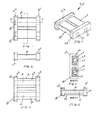
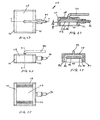
- insulator 20 has a distal end portion 22, a proximal end portion 24 and mid-portions 26.
- Distal end portion 22 has formed in its proximal face cylindrical recesses 28.
- Proximal end portion 24 has axial cylindrical openings 30 axially aligned with recesses 28.
- Mid-portions 26 have formed in lower surface 32 channels 34.
- Insulator 20 is made from a suitable dielectric material, examples of which include, but are not limited to, alumina, zirconia, and high-temperature polymers.
- active electrode 40 has a distal portion forming parallel cylindrical portions 42 connected by flange 44 to proximal conductor 46.
- Electrode 40 may be formed from any suitable metallic material, examples of which include, but are not limited to, stainless steel, nickel, titanium, tungsten, and the like.
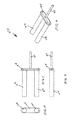
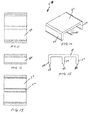
- FIGS 11 through 15 depict a floating electrode for an electrosurgical instrument of the present invention that is particularly suited to thermally treating patient tissue.
- the floating electrode 50 forms adjacent channels having a common flange 52, and lateral flanges 54 and wall 56. Flanges 52 and 54 have ends 58 formed to a radius.
- the present invention is not limited to the depicted design and includes alternate floating electrode embodiments, such as those described in co-pending U.S. Patent Application Nos. 10/911,309 (published as US 2005-0065510 ) and 11/136,514 (published as US 2005-023446 ) cited above, the contents of which are incorporated by reference herein in their entirety.
- the distal portion of probe 60 is an assembly in which distal portions 42 of active electrode 40 are positioned within channel portions 34 of insulator 30.
- Floating electrode 50 is positioned between distal portion 22 and proximal portion 24 of insulator 20.
- Dielectric coating 62 covers flange 44 and conductor 46 of active electrode 40.
- Conductor 40 is connected by means within the probe 60 and electrical cable to a suitable electrosurgical generator.
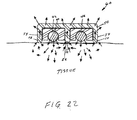
- Figure 22 depicts probe 60 in use, fully or partially submerged in irrigant (either endogenous to site or exogenously supplied).
- Flanges 52 and 54 of floating electrode 50 contact the tissue.
- Distal portions 42 of active electrode 40 may contact the tissue, or may contact the fluid in a gap between the electrode 40 and the tissue.
- Fluid surrounding the distal end of probe 60 is conductive. It may be supplied to the site as a conductive liquid such as standard saline, or may be supplied to the site as a non-conductive irrigant such as water, the fluid becoming conductive by contamination by body fluids such as blood, or by ablation by-products.
- current flows from active electrode 40 to a return electrode (not shown), either at a remote site or mounted on the instrument 60.
- Current flows from distal portions 42 of active electrode 40 through tissue in contact with or in close proximity to portions 42. Some current flows through the tissue to the return electrode. A portion of the current flows through the tissue to radiused portions 58 of flanges 52 and 54 of floating electrode 50 in contact with the tissue to portions of floating electrode 50 in lower potential portions of the electric field. This current then flows from floating electrode 50 to conductive fluid in contact therewith, and then through the fluid to the return electrode.
- the efficiency of probe 60 for thermally treating tissue is enhanced by the elimination of regions of high current density.
- regions of high current density cause boiling of irrigant in close proximity, and arcing through the steam bubbles formed so as to vaporize tissue.
- the absence of these regions allows the device to be used at higher power levels for more rapid tissue treatment without creating these undesirable vaporizing sparks.
- portions of flanges 52 and 54 which contact tissue are radiused so as to eliminate sharp corners which create regions of high current density.
- portions 42 of active electrode 40 are also rounded to eliminate sharp edges which create regions of high current density.
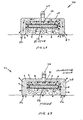
- Probe 70 has a planar active electrode 72 suspended by distal dielectric end piece 74 and proximal dielectric end piece 76 in an inverted channel formed by floating electrode 78. Lateral edges 80 of active electrode 72, and edges 82 of floating electrode 78 are radiused. Lower surface 86 of active electrode 72 is recessed distance 88 from the plane of edges 82 of floating electrode 78. Conductor means 90 within probe 70 and cabling connect active electrode 72 to a suitable electrosurgical generator. Tubular member 92 is connected by means within probe 70 to an external conductive irrigant source.
- the active electrode assembly is depicted as a having a square/rectangular profile and/or cross-section, the invention is not limited to the depicted configuration. So long as a particular configuration provides the requisite confined space, more particularly the presence of a fluid-fillable cavity defined between the active and floating electrodes, other geometries may be contemplated including, but not limited to, electrode assemblies having rounded, circular, elliptical, and polygonal profiles.
- conductive irrigant 96 may be supplied by tubular member 92 to the interior of the distal portion of probe 70, between the upper surface of active electrode 72 and the interior surface of floating electrode 78.
- Current (indicated by arrows) flows from active electrode 72 to a return electrode, either remotely located or on probe 70. A portion of the current flows through conductive liquid surrounding active electrode 72 to floating electrode 78 and therethrough to tissue in contact with or close proximity to edges 82. Current flowing from the floating electrode 78 to the tissue in this manner is conducted through direct contact or through conductive fluid in close proximity. A second portion of the current flows from the active electrode 72 to the tissue through conductive fluid between active electrode 72 and the tissue.
- conductive irrigant 96 Heats irrigant 96 primarily in the regions in which active electrode 72 and floating electrode 78 are in close proximity. If the current flow is sufficiently high related to the flow rate of conductive irrigant 96, boiling of irrigant 96 occurs. Expanding steam and irrigant flow from tubular member 92 causes heated liquid and steam to flow into the region between active electrode 72 and the tissue. Thermal treatment of the tissue is accomplished through contact with heated liquid and steam, and through flow of current. The relative proportion of the two depends on the power supplied and the flow rate of conductive irrigant 96.
- Figure 29 depicts probe 70 in use in a conductive liquid environment.
- Conductive irrigant 96 is supplied by tubular member 92 to the interior of the distal portion of probe 70, between the upper surface of active electrode 72 and the interior surface of floating electrode 78.
- Current flows from active electrode 72 to a return electrode, either remotely located or on probe 70.
- a portion of the current flows through conductive liquid surrounding active electrode 72 to floating electrode 78 and therethrough to conductive liquid in contact with the exterior surfaces of floating electrode 78.
- a second portion of the current flows from the active electrode 72 to the tissue through conductive fluid between active electrode 72 and the tissue.
- Current flowing through conductive irrigant 96 heats irrigant 96 primarily in the regions in which active electrode 72 and floating electrode 78 are in close proximity.
- probe 70 is designed to minimize or eliminate regions of high current density which cause arcing and tissue vaporization. Particularly, edges 82 of floating electrode 78 which contact target tissue are rounded to eliminate regions of high current density and arcing which may result therefrom.
- lateral edges 80 of active electrode 72 are radiused to prevent arcing between active electrode 72 and the tissue or between electrode 72 and floating electrode 78.
- Lower surface 86 of active electrode 72 does not have features such as grooves, protuberances, recesses which increase current density, but is smooth. These features, individually and/or in combination, allow probe 70 to be used at higher power levels for more rapid tissue treatment without arcing and the resulting undesirable tissue vaporization.
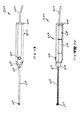
- FIGS 30 through 32 depict the distal portion of an electrosurgical instrument of the present invention that is particularly suited to the thermal treatment of tissue, more particularly sub-surface tissue treatment. While the previous embodiments are designed for surface treatment, electrosurgical instrument 100 thermally treats tissue into which it is inserted. Probe 100 is formed from a dielectric tube 102 having a sharpened, tapered or conical distal end 104 that facilitates atraumatic insertion into the target tissue. To distal end 104 is mounted active electrode 106 connected by conductor 108 insulated by dielectric coating 109 and means within probe 100 and cabling to a suitable electrosurgical generator.
- Tubular conductive member 110 is assembled to dielectric tube 102 near its distal end, and connected by conductor 112 insulated with dielectric coating 114 to a control element in the handle portion of probe 100.
- the control element has a first position in which conductor 112 is not connected to the electrosurgical generator, and a second position in which the conductor 112 is connected to the generator output such that when the generator is activated RF voltage is applied to member 110.
- probe 100 while energized, is first inserted into the tissue, tubular member 110 functioning as a floating electrode, the switching means being in its first position.
- switching means When probe 100 is inserted to the desired depth, switching means is put in its second position and RF energy is supplied to conductive member 110 so as to treat tissue in close proximity.
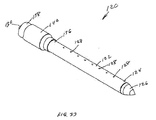
- Figures 33 through 35 depict another embodiment of an electrosurgical instrument of the present invention that is particularly suited to thermal treatment of tissue into which it is inserted.
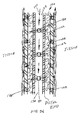
- Probe 120 the distal portion of which is shown has a first conductive tubular member 122 having a distal end 124 in which is mounted dielectric member 126.
- Member 122 has a plurality of ports or perforations 128.
- Second tubular member 130 is coaxially positioned within member 122, and has a distal end 132 positioned within a recess in dielectric member 126.
- Second tubular member 130 with lumen 133 has a plurality of perforations 134.
- Proximal end 136 of member 122 is mounted to tubular member 138, the distal end of first tubular member 138 and proximal portion of member 122 are covered by dielectric coating 140.
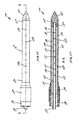
- Second tubular member 130 is connected by means within probe 120 and cabling to a suitable electrosurgical generator. Region 142 is defined by the interior surface of first tubular member 122 and the exterior surface of second tubular member 130. Second tubular member 130 is connected by means within probe 120 and tubing to an external source for conductive irrigant.
- probe 120 is inserted into tissue to be thermally treated.
- Conductive irrigant 150 is supplied to lumen 133 of second tubular member 130.
- Lumen 133, perforations 134, region 142, and perforations 128 together form a flow path for irrigant 150 from lumen 133 of second tubular member 130 to region 144 between the external surface of probe 120 and the tissue into which it is inserted.
- First tubular member 122 is not connected to the electrosurgical unit, but has a floating potential between that of the active electrode (second tubular member 130) and the tissue.
- Current flowing through irrigant 150 in region 142 heats the irrigant causing it to boil.
- Irrigant 150 flowing from region 142 through perforations 128 is a two-phase mixture of steam and liquid which heats tissue with which it is in contact. The relative portions of steam and liquid are determined by the flow rate of irrigant 150, and by the applied power level. Decreasing the power or increasing the flow rate will cause the liquid phase to increase.
- Tissue thermally treated by probe 120 is heated by the irrigant and by resistive heating caused by current flow.
- the RF energy supplied to probe 120 has characteristics selected to minimize arcing within bubbles in the irrigant, and between member 122 and adjacent tissue,
- Figure 37 is an illustrative example of the above-described hybrid electrosurgical instrument of the present invention.
- the instrument of Figure 37 includes an active electrode 400 which is embedded in the tumor 406 and a return electrode 402 on the instrument which contacts a free surface of the tissue near the tumor so as to concentrate the current flow 404 between the active and return electrodes, through the tumor.
- FIG. 38 An alternate embodiment of the above-described hybrid electrosurgical instrument of the present invention is depicted in Figure 38 .
- the instrument of Figure 38 includes an active electrode 410 which is embedded in the tumor 416 and a return electrode 412 not on the instrument which contacts a free surface of the tissue near the tumor so as to concentrate the current flow 414 between the active 410 and return electrodes 412 , through the tumor.
- Figures 39 through 41 depict the distal portion 500 of an alternate embodiment designed to be embedded in a tumor 512 to go undergo treatment, the probe having a tubular active electrode 502 covered by dielectric coating 508 except for uninsulated portion 510 with perforations 504 such that irrigant 506 supplied to the active electrode flows from the electrode through perforations 504 so as to prevent desiccation and burning of tissue in contact with the electrode.
- the probe distal portion construction is identical to that of distal portion 500, with the exception that uninsulated portion 510 of active electrode 502 is formed from a porous metallic material and perforations 504 are eliminated.
- Irrigant supplied to the active electrode flows from the electrode 502 through the porous material so as to prevent desiccation and burning of tissue in contact with the electrode.
- perforations 504 are eliminated, and irrigant is supplied to the site by an annular passage between active electrode 502 and dielectric coating 508. As with the previous embodiments, irrigant so supplied prevents desiccation and burning of tissue in contact with the electrode.
- Electrosurgical instruments like the Argon Beam Coagulator (Conmed Corporation, Utica, NY) and other similar devices operate without direct contact with the tissue. These instruments employ a gaseous gap between the instrument's electrode and the tissue. The electrode is insulated, and high voltage is applied to the gaseous gap between electrode and the surface of the tissue.
- plasma torches generally require very high voltages (up to 10- 20 kV), which are beyond the capability of standard, general purpose, commonly available electrosurgical radio-frequency (RF) generators.
- RF radio-frequency
- plasma torches require specially shaped electrodes, a flow of gas (usually a noble gas jet), a specially designed nozzle to control the gas flow, and high voltage circuitry to bring high voltage to the proximity of the surgical field.
- Advanced, non-contact, plasma-based electrosurgical instruments constructed in accordance with the principles of this invention may be operated in the plasma torch regime yet are compatible with "standard" electrosurgical RF generators.
- the electrosurgical instruments of the present invention (which may be single-use disposables) can operate without a gas flow, with a gas flow and with a reversed gas flow (gas suction),
- the electrosurgical instruments of the present invention substantially and permanently reduce the electrical breakdown threshold of the gaseous gap between the electrode and the surface of the tissue.
- the plasma can be generated efficiently at low voltages (0.5-2kV), thereby allowing for the use of general purpose, standard electrosurgical RF generators.
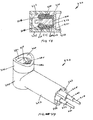
- probe 200 has a proximal portion 202 forming a handle having a proximal end 204 from which passes electrical cable 206 which is connected to a suitable electrosurgical generator, and a distal end 208 from which protrudes elongated instrument distal portion 210.
- Portion 210 has a proximal end 212 mounted to handle portion 202, and a distal end 220.
- Activation button 216 controls the electrosurgical generator to which probe 200 is connected by cable 206.
- Handle portion 202 contains batteries 218.
- Insulator 226 has a first recess 228 formed coaxial with insulator 226, recess 228 having a planar surface 230.
- Surface 230 has formed therein second recess 232.
- Insulator 226 has formed therein passages 234 between second recess 232 and surface 234 of insulator 226.
- Filament wire 236 is connected by tubular members 238 to wires 240 in lumen 223 of tubular member 222, wires 240 being connected by circuitry within handle portion 202 to batteries 218, and by cable 206 to the electrosurgical generator such that depressing activation button 216 causes batteries 218 to supply the battery voltage to filament 236, and the electrosurgical generator to supply RF voltage to filament 236.
- Insulation 242 covers wires 240.
- Insulation 244 covers the proximal portion of tubular members 238 , and the distal portion of wires 240.
- Figure 50 depicts probe 200 in use thermally treating a tissue surface.
- Direct current power supplied by batteries 218 heats filament wire 236 which also heats air and other gasses in proximity to filament wire 236.
- RF power from the electrosurgical generator is also applied to filament wire 236.
- the high temperature of filament 236 increases the ease with which electrons may be ejected from filament 236.
- Heating of the air and other gases in proximity to filament 236 decreases the resistance of the air and gases to electrical breakdown.
- electrosurgical generator 260 is connected by wire 262 to return electrode pad 264, and by wire 265 to first wire 241 of wires 240 connected to batteries 218 and filament 236 in distal end assembly 220.
- Current 272 flows from the region near arcs 266 through the tissue to return electrode 264.
- Figure 52 schematically depicts distal end assembly 220 of probe 200. Batteries 218 via wires 240 and conductive members 238 to filament 236. Wire 265 conducts power from the RF generator to first wire 241 and therefrom via conductive member 238 to filament 236. Power from batteries 218 heats the filament. Power from the RF generator causes arcing 266 and produces the desired clinical effect.
- Figures 52 (B) and (C) show that insulator 226 may have a variety of cross-sections. However, those shown are merely illustrative and not intended to limit the scope of the invention.
- Figure 53 depicts an alternate embodiment of distal end assembly 220 of probe 200.
- Filament 236 has a coil for enhanced heating of the region surrounding filament 236 for increased probe efficiency.
- Figure 54 depicts an alternate embodiment of distal end assembly 220 of probe 200 in which filament 236 is integral with conductive members 238, the filament portion being of a reduced cross-section.
- Figure 55 depicts an alternate embodiment of distal end assembly 220 of probe 200 in which the filament has been deleted.
- Conductive members 238 have distal ends which are in sufficiently close proximity to produce micro-arcing 276 therebetween when voltage from power supply 218 is applied.
- Figure 56 depicts an alternate embodiment of distal end assembly 220 of probe 200 in which heating at the distal region of the probe is accomplished by a UV lamp 278 connected to power supply 276, rather than by a filament,
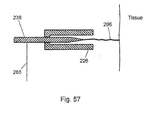
- Figure 57 depicts an alternate embodiment of distal end assembly 220 of probe 200 in which the conductive member 238 has a sharpened distal end having a low included angle so that the distal portion is heated to an elevated temperature by arcs 266. Heating of the distal portion is enhanced by insulator 226 which closely conforms to member 238 so as to prevent radiant or convective heat loss from member 238.
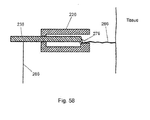
- Figure 58 depicts an alternate embodiment of distal end assembly 220 of probe 200 in which conductive member 238 has a sharpened distal end which is in contact with a portion of insulator 226 such that dielectric breakdown produces micro-sparking which heats the region causing arcs 266 to occur.
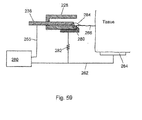
- Figure 59 depicts an alternate embodiment of distal end assembly 220 of probe 200 in which conductive member 280, connected via resistor 282 to wire 262 of the return electrode circuit, is positioned in close proximity to member 238 such that micro-arcing occurs between members 280 and 238, the micro-arcing producing sufficient heat to allow arcing 266. Resistor 282 limits current through member 280.
- Figure 60 corresponds to a new type of minimally invasive instrument, based on miniature, intense sources of infrared, visible and ultra violet generated by an electrically heated filament mounted inside a disposable instrument. More particularly, Figure 60 depicts an alternate embodiment of distal end assembly 220 of probe 200 configured for gas flow through the distal portion of probe 200.
- gas 292 supplied to nozzle 290 floods the area around filament 236 and arcs 266.
- air and gases 294 surrounding arcs 266 and filament 236 are evacuated through nozzle 290.
- Figure 61 depicts an alternate embodiment 600 for treating a surface in a body cavity in which a source of electromagnetic energy, which, in this case is a miniature high-intensity infrared lamp 602 is positioned within a transparent inflatable bag 606.
- a source of electromagnetic energy which, in this case is a miniature high-intensity infrared lamp 602 is positioned within a transparent inflatable bag 606.
- the assembly is positioned within a body cavity to be thermally treated.
- Gas 604 is injected into the bag causing it to inflate and conform to the tissue surface.
- the IR lamp 602 is energized causing heating of the tissue in contact with the bag 604. Gas flow into and out of the bag is maintained during treatment.
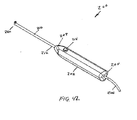
- Figure 62 depicts an alternate embodiment for treating a surface using a probe having at its distal tip 700 a miniature infrared lamp 702, a lens 704 and a reflector 706 for directing heat 708 from the lamp to the tissue surface.
- the profiles of reflector 706 and lens 704 together determine the energy distribution.
- the profiles of reflector 706 and lens 704 together produce a uniform distribution across the distal opening of tip 700.
- the profiles can cooperate to form distributions such as a concentrated spot, line, annulus, or other predetermined desired profile.
- the minimally invasive monopolar and bipolar electrosurgical instruments of the present invention find utility in the area of remote tissue ablation and lesion formation, to destroy tumors, form lesions, denaturize, desiccate, coagulate and ablate soft tissues, as well as to drill, cut, resect and vaporize soft tissues, with or without externally supplied conductive or non-conductive liquids (i.e., in the context of both wet and dry field electrosurgery). More particularly, the electrosurgical instruments of the present invention are designed to heat tissue from the outside in, to provide homogeneous energy deposition using less power, which in turn yields a highly homogeneous lesion.
- the electrosurgical instruments of the present invention allow one to effectively and efficiently control of the shape and size of the lesion formed, to thereby avoid unnecessary complications and undesired side effects.
- Such instruments are particularly useful in the context of oncological, ENT, urological, gynecological, and laparascopic procedures, as well as in the context of general surgery.
Landscapes
- Health & Medical Sciences (AREA)
- Surgery (AREA)
- Life Sciences & Earth Sciences (AREA)
- Engineering & Computer Science (AREA)
- Biomedical Technology (AREA)
- Molecular Biology (AREA)
- Nuclear Medicine, Radiotherapy & Molecular Imaging (AREA)
- Veterinary Medicine (AREA)
- Physics & Mathematics (AREA)
- Heart & Thoracic Surgery (AREA)
- Medical Informatics (AREA)
- Otolaryngology (AREA)
- Animal Behavior & Ethology (AREA)
- General Health & Medical Sciences (AREA)
- Public Health (AREA)
- Plasma & Fusion (AREA)
- Electromagnetism (AREA)
- Surgical Instruments (AREA)
Applications Claiming Priority (3)
| Application Number | Priority Date | Filing Date | Title |
|---|---|---|---|
| US90254807P | 2007-02-21 | 2007-02-21 | |
| US12/033,987 US8475452B2 (en) | 2007-02-21 | 2008-02-20 | Instruments and methods for thermal tissue treatment |
| EP08730326.9A EP2124792B1 (fr) | 2007-02-21 | 2008-02-21 | Instruments pour traitement thermique des tissus |
Related Parent Applications (1)
| Application Number | Title | Priority Date | Filing Date |
|---|---|---|---|
| EP08730326.9 Division | 2008-02-21 |
Publications (1)
| Publication Number | Publication Date |
|---|---|
| EP2601902A1 true EP2601902A1 (fr) | 2013-06-12 |
Family
ID=39627632
Family Applications (2)
| Application Number | Title | Priority Date | Filing Date |
|---|---|---|---|
| EP12194298.1A Withdrawn EP2601902A1 (fr) | 2007-02-21 | 2008-02-21 | Instruments pour traitement thermique des tissus |
| EP08730326.9A Not-in-force EP2124792B1 (fr) | 2007-02-21 | 2008-02-21 | Instruments pour traitement thermique des tissus |
Family Applications After (1)
| Application Number | Title | Priority Date | Filing Date |
|---|---|---|---|
| EP08730326.9A Not-in-force EP2124792B1 (fr) | 2007-02-21 | 2008-02-21 | Instruments pour traitement thermique des tissus |
Country Status (3)
| Country | Link |
|---|---|
| US (2) | US8475452B2 (fr) |
| EP (2) | EP2601902A1 (fr) |
| WO (1) | WO2008103777A1 (fr) |
Families Citing this family (70)
| Publication number | Priority date | Publication date | Assignee | Title |
|---|---|---|---|---|
| US7655004B2 (en) | 2007-02-15 | 2010-02-02 | Ethicon Endo-Surgery, Inc. | Electroporation ablation apparatus, system, and method |
| US8888792B2 (en) | 2008-07-14 | 2014-11-18 | Ethicon Endo-Surgery, Inc. | Tissue apposition clip application devices and methods |
| EP2170022A1 (fr) * | 2008-09-25 | 2010-03-31 | Max-Planck-Gesellschaft zur Förderung der Wissenschaften e.V. | Applicateur de plasma et procédé associé |
| US9561066B2 (en) | 2008-10-06 | 2017-02-07 | Virender K. Sharma | Method and apparatus for tissue ablation |
| US10695126B2 (en) | 2008-10-06 | 2020-06-30 | Santa Anna Tech Llc | Catheter with a double balloon structure to generate and apply a heated ablative zone to tissue |
| US10064697B2 (en) | 2008-10-06 | 2018-09-04 | Santa Anna Tech Llc | Vapor based ablation system for treating various indications |
| US9561068B2 (en) | 2008-10-06 | 2017-02-07 | Virender K. Sharma | Method and apparatus for tissue ablation |
| WO2010042461A1 (fr) | 2008-10-06 | 2010-04-15 | Sharma Virender K | Procédé et appareil d'ablation de tissus |
| US8382753B2 (en) | 2008-10-21 | 2013-02-26 | Hermes Innovations, LLC | Tissue ablation methods |
| US9662163B2 (en) | 2008-10-21 | 2017-05-30 | Hermes Innovations Llc | Endometrial ablation devices and systems |
| US8540708B2 (en) | 2008-10-21 | 2013-09-24 | Hermes Innovations Llc | Endometrial ablation method |
| US8500732B2 (en) * | 2008-10-21 | 2013-08-06 | Hermes Innovations Llc | Endometrial ablation devices and systems |
| US8197477B2 (en) | 2008-10-21 | 2012-06-12 | Hermes Innovations Llc | Tissue ablation methods |
| US8821486B2 (en) | 2009-11-13 | 2014-09-02 | Hermes Innovations, LLC | Tissue ablation systems and methods |
| US8197476B2 (en) | 2008-10-21 | 2012-06-12 | Hermes Innovations Llc | Tissue ablation systems |
| US8157834B2 (en) | 2008-11-25 | 2012-04-17 | Ethicon Endo-Surgery, Inc. | Rotational coupling device for surgical instrument with flexible actuators |
| US8361066B2 (en) | 2009-01-12 | 2013-01-29 | Ethicon Endo-Surgery, Inc. | Electrical ablation devices |
| WO2010120847A1 (fr) * | 2009-04-14 | 2010-10-21 | Old Dominion University Research Foundation | Système et procédé pour appliquer des étincelles plasma à un tissu |
| US8083737B2 (en) | 2009-08-26 | 2011-12-27 | Tyco Healthcare Group Lp | Gas-enhanced surgical instrument with mechanism for cylinder puncture |
| CN102711640B (zh) * | 2009-10-26 | 2015-04-08 | 爱马仕创新有限公司 | 子宫内膜消融设备和系统 |
| US20110098704A1 (en) | 2009-10-28 | 2011-04-28 | Ethicon Endo-Surgery, Inc. | Electrical ablation devices |
| US8715278B2 (en) | 2009-11-11 | 2014-05-06 | Minerva Surgical, Inc. | System for endometrial ablation utilizing radio frequency |
| US9289257B2 (en) | 2009-11-13 | 2016-03-22 | Minerva Surgical, Inc. | Methods and systems for endometrial ablation utilizing radio frequency |
| US8529562B2 (en) | 2009-11-13 | 2013-09-10 | Minerva Surgical, Inc | Systems and methods for endometrial ablation |
| US11896282B2 (en) | 2009-11-13 | 2024-02-13 | Hermes Innovations Llc | Tissue ablation systems and method |
| US9028483B2 (en) | 2009-12-18 | 2015-05-12 | Ethicon Endo-Surgery, Inc. | Surgical instrument comprising an electrode |
| US8992521B2 (en) | 2010-04-22 | 2015-03-31 | Electromedical Associates, Llc | Flexible electrosurgical ablation and aspiration electrode with beveled active surface |
| US9643255B2 (en) | 2010-04-22 | 2017-05-09 | Electromedical Associates, Llc | Flexible electrosurgical ablation and aspiration electrode with beveled active surface |
| US9011426B2 (en) | 2010-04-22 | 2015-04-21 | Electromedical Associates, Llc | Flexible electrosurgical ablation and aspiration electrode with beveled active surface |
| WO2011143200A2 (fr) | 2010-05-11 | 2011-11-17 | Electromedical Associates Llc | Dispositif électrochirurgical brasé |
| US8956348B2 (en) | 2010-07-21 | 2015-02-17 | Minerva Surgical, Inc. | Methods and systems for endometrial ablation |
| US9510897B2 (en) | 2010-11-05 | 2016-12-06 | Hermes Innovations Llc | RF-electrode surface and method of fabrication |
| GB2487199A (en) * | 2011-01-11 | 2012-07-18 | Creo Medical Ltd | Electrosurgical device with fluid conduit |
| US9233241B2 (en) | 2011-02-28 | 2016-01-12 | Ethicon Endo-Surgery, Inc. | Electrical ablation devices and methods |
| US9254169B2 (en) | 2011-02-28 | 2016-02-09 | Ethicon Endo-Surgery, Inc. | Electrical ablation devices and methods |
| WO2012125785A1 (fr) | 2011-03-17 | 2012-09-20 | Ethicon Endo-Surgery, Inc. | Dispositif chirurgical portatif de manipulation d'un ensemble à aimants interne dans le corps d'un patient |
| WO2013016590A1 (fr) | 2011-07-26 | 2013-01-31 | Dan Sachs | Appareils et procédés de modulation du tissu nerveux pelvien |
| US20130269705A1 (en) | 2012-04-16 | 2013-10-17 | Thomas C. Kochem | Variable stiffness flexure |
| US9427255B2 (en) | 2012-05-14 | 2016-08-30 | Ethicon Endo-Surgery, Inc. | Apparatus for introducing a steerable camera assembly into a patient |
| US9078662B2 (en) * | 2012-07-03 | 2015-07-14 | Ethicon Endo-Surgery, Inc. | Endoscopic cap electrode and method for using the same |
| US9545290B2 (en) | 2012-07-30 | 2017-01-17 | Ethicon Endo-Surgery, Inc. | Needle probe guide |
| US10314649B2 (en) | 2012-08-02 | 2019-06-11 | Ethicon Endo-Surgery, Inc. | Flexible expandable electrode and method of intraluminal delivery of pulsed power |
| US9888954B2 (en) | 2012-08-10 | 2018-02-13 | Cook Medical Technologies Llc | Plasma resection electrode |
| US9277957B2 (en) | 2012-08-15 | 2016-03-08 | Ethicon Endo-Surgery, Inc. | Electrosurgical devices and methods |
| GB201215095D0 (en) | 2012-08-24 | 2012-10-10 | Gyrus Medical Ltd | Electrosurgical system |
| US10898705B2 (en) | 2012-09-11 | 2021-01-26 | G&H Technologies, Llc | Electrical discharge irrigator apparatus and method |
| ES2733975T3 (es) * | 2012-09-11 | 2019-12-03 | G&H Tech Llc | Aparato y método para irrigador con descarga eléctrica |
| EP3964151A3 (fr) | 2013-01-17 | 2022-03-30 | Virender K. Sharma | Appareil d'ablation de tissu |
| US9333111B2 (en) | 2013-02-04 | 2016-05-10 | Hologic, Inc. | Fundus bumper mechanical reference for easier mechanism deployment |
| US10098527B2 (en) | 2013-02-27 | 2018-10-16 | Ethidcon Endo-Surgery, Inc. | System for performing a minimally invasive surgical procedure |
| US9895192B2 (en) | 2013-03-13 | 2018-02-20 | Hologic, Inc. | Intrauterine treatment device with articulating array |
| US9901394B2 (en) | 2013-04-04 | 2018-02-27 | Hermes Innovations Llc | Medical ablation system and method of making |
| US9649125B2 (en) | 2013-10-15 | 2017-05-16 | Hermes Innovations Llc | Laparoscopic device |
| DE202013010300U1 (de) * | 2013-11-15 | 2015-02-16 | Hebumedical Gmbh | Nadelförmiges Instrument für die Hochfrequenz-Thermotherapie |
| US10555746B2 (en) | 2014-02-04 | 2020-02-11 | Hologic, Inc. | Devices and methods for treating conditions caused by affarent nerve signals |
| CN106999242A (zh) | 2014-05-23 | 2017-08-01 | 安福拉医药公司 | 用于治疗骨盆病症的方法及装置 |
| US10492856B2 (en) | 2015-01-26 | 2019-12-03 | Hermes Innovations Llc | Surgical fluid management system and method of use |
| JP6814746B2 (ja) | 2015-04-29 | 2021-01-20 | シーラス テクノロジーズ リミテッド | 医療用アブレーションデバイスおよび使用方法 |
| US10052149B2 (en) | 2016-01-20 | 2018-08-21 | RELIGN Corporation | Arthroscopic devices and methods |
| JP2019514481A (ja) | 2016-04-22 | 2019-06-06 | リライン コーポレーション | 関節鏡デバイスおよび方法 |
| US12364537B2 (en) | 2016-05-02 | 2025-07-22 | Santa Anna Tech Llc | Catheter with a double balloon structure to generate and apply a heated ablative zone to tissue |
| US11331140B2 (en) | 2016-05-19 | 2022-05-17 | Aqua Heart, Inc. | Heated vapor ablation systems and methods for treating cardiac conditions |
| EP3478197A4 (fr) | 2016-07-01 | 2020-04-29 | Relign Corporation | Dispositifs d'arthroscopie. |
| EP3495020B1 (fr) * | 2016-08-02 | 2021-01-06 | Feagle Co., Ltd | Dispositif de traitement par plasma |
| US12023082B2 (en) * | 2017-10-06 | 2024-07-02 | Medtronic Advanced Energy Llc | Hemostatic thermal sealer |
| CA3102080A1 (fr) | 2018-06-01 | 2019-12-05 | Santa Anna Tech Llc | Procedes de traitement d'ablation a base de vapeur a plusieurs etapes et systemes de generation et de distribution de vapeur |
| EP3813936B1 (fr) * | 2018-06-06 | 2025-11-05 | Robert F. Rioux | Système portable de traitement de plaie |
| CN110179540B (zh) * | 2019-05-31 | 2024-02-23 | 广东伊丽汇美容科技有限公司 | 人体调养仪电极、负压、红外一体式操作头 |
| US11554214B2 (en) | 2019-06-26 | 2023-01-17 | Meditrina, Inc. | Fluid management system |
| CN113796949B (zh) * | 2021-09-26 | 2025-04-25 | 上海宏桐实业有限公司 | 一种脉冲电场消融系统及其控制方法 |
Citations (4)
| Publication number | Priority date | Publication date | Assignee | Title |
|---|---|---|---|---|
| US20050023446A1 (en) | 2003-07-31 | 2005-02-03 | Sean Chang | Projection system and optical path transfer device thereof |
| US20050065510A1 (en) | 2003-08-11 | 2005-03-24 | Yuval Carmel | Electrosurgical device with floating-potential electrodes |
| US20050234446A1 (en) * | 2003-08-11 | 2005-10-20 | Van Wyk Robert A | Electrosurgical device with floating-potential electrode and methods of using same |
| US20060224154A1 (en) * | 2001-12-07 | 2006-10-05 | Shadduck John H | Medical instrument and method of use |
Family Cites Families (38)
| Publication number | Priority date | Publication date | Assignee | Title |
|---|---|---|---|---|
| US2448741A (en) * | 1945-04-25 | 1948-09-07 | American Cystoscope Makers Inc | Endoscopic surgical instrument |
| US3856015A (en) * | 1972-01-21 | 1974-12-24 | J Iglesias | Stabilized cutting loop for resectoscope |
| US3901242A (en) * | 1974-05-30 | 1975-08-26 | Storz Endoskop Gmbh | Electric surgical instrument |
| US4674499A (en) * | 1980-12-08 | 1987-06-23 | Pao David S C | Coaxial bipolar probe |
| US4682596A (en) * | 1984-05-22 | 1987-07-28 | Cordis Corporation | Electrosurgical catheter and method for vascular applications |
| DE3603758A1 (de) * | 1985-02-09 | 1986-08-14 | Olympus Optical Co., Ltd., Tokio/Tokyo | Resektoskopgeraet |
| US4917082A (en) * | 1988-06-02 | 1990-04-17 | Circon Corporation | Resectoscope electrode |
| US5111812A (en) * | 1990-01-23 | 1992-05-12 | Cardiac Pacemakers, Inc. | Defilbrillation electrode having smooth current distribution |
| US5195959A (en) * | 1991-05-31 | 1993-03-23 | Paul C. Smith | Electrosurgical device with suction and irrigation |
| DE4138115A1 (de) * | 1991-11-19 | 1993-05-27 | Delma Elektro Med App | Medizinisches hochfrequenz-koagulationsinstrument |
| US5683366A (en) * | 1992-01-07 | 1997-11-04 | Arthrocare Corporation | System and method for electrosurgical tissue canalization |
| US5697882A (en) * | 1992-01-07 | 1997-12-16 | Arthrocare Corporation | System and method for electrosurgical cutting and ablation |
| US5902272A (en) * | 1992-01-07 | 1999-05-11 | Arthrocare Corporation | Planar ablation probe and method for electrosurgical cutting and ablation |
| US6391025B1 (en) * | 1993-05-10 | 2002-05-21 | Arthrocare Corporation | Electrosurgical scalpel and methods for tissue cutting |
| US6673069B1 (en) * | 2000-03-30 | 2004-01-06 | Refractec, Inc. | Thermokeratoplasty system with a power supply that can determine a wet or dry cornea |
| US6197025B1 (en) * | 1994-09-30 | 2001-03-06 | Circon Corporation | Grooved slider electrode for a resectoscope |
| US5782829A (en) | 1995-12-06 | 1998-07-21 | Northgate Technologies Incorporated | Resectoscope electrode assembly and methods of use |
| US6033400A (en) * | 1996-04-19 | 2000-03-07 | Circon Corporation | Shaped electrode for a resectoscope |
| US5782289A (en) * | 1996-09-30 | 1998-07-21 | Johnson & Johnson Professional, Inc. | Investment casting |
| GB2327352A (en) * | 1997-07-18 | 1999-01-27 | Gyrus Medical Ltd | Electrosurgical instrument |
| US6169926B1 (en) * | 1998-02-27 | 2001-01-02 | James A. Baker | RF electrode array for low-rate collagen shrinkage in capsular shift procedures and methods of use |
| US6267759B1 (en) * | 1999-06-22 | 2001-07-31 | Senorx, Inc. | Shaped scalpel |
| US6379350B1 (en) * | 1999-10-05 | 2002-04-30 | Oratec Interventions, Inc. | Surgical instrument for ablation and aspiration |
| US6451017B1 (en) * | 2000-01-10 | 2002-09-17 | Hydrocision, Inc. | Surgical instruments with integrated electrocautery |
| US6419684B1 (en) * | 2000-05-16 | 2002-07-16 | Linvatec Corporation | End-cutting shaver blade for axial resection |
| ES2259041T3 (es) * | 2000-09-24 | 2006-09-16 | Medtronic, Inc. | Instrumento quirurgico de micro-reseccion con dispositivo de electrocauterizado. |
| US6530924B1 (en) * | 2000-11-03 | 2003-03-11 | Alan G. Ellman | Electrosurgical tonsilar and adenoid electrode |
| US6921398B2 (en) * | 2001-06-04 | 2005-07-26 | Electrosurgery Associates, Llc | Vibrating electrosurgical ablator |
| US6796982B2 (en) * | 2001-06-05 | 2004-09-28 | Electrosurgery Associates, Llc | Instant ignition electrosurgical probe and method for electrosurgical cutting and ablation |
| US7166103B2 (en) * | 2001-10-01 | 2007-01-23 | Electrosurgery Associates, Llc | High efficiency electrosurgical ablator with electrode subjected to oscillatory or other repetitive motion |
| US6840937B2 (en) * | 2001-10-18 | 2005-01-11 | Electrosurgery Associates, Llc | Electrosurgical ablator with aspiration |
| US6921399B2 (en) * | 2001-11-02 | 2005-07-26 | Electrosurgery Associates, Llc | High efficiency electrosurgery probe |
| US20040030330A1 (en) * | 2002-04-18 | 2004-02-12 | Brassell James L. | Electrosurgery systems |
| KR100466866B1 (ko) * | 2003-04-24 | 2005-01-24 | 전명기 | 생체조직을 응고괴사시키는 고주파 전기수술기용 전극 |
| US7066936B2 (en) * | 2004-06-07 | 2006-06-27 | Ethicon, Inc. | Surgical cutting and tissue vaporizing instrument |
| US7837683B2 (en) * | 2005-05-13 | 2010-11-23 | Electrosurgery Associates, Llc | Electrosurgical ablation electrode with aspiration and method for using same |
| US7611509B2 (en) * | 2005-05-21 | 2009-11-03 | Electromedical Associates | Electrosurgical device |
| US20100042088A1 (en) | 2008-08-14 | 2010-02-18 | Arts Gene H | Surgical Gas Plasma Ignition Apparatus and Method |
-
2008
- 2008-02-20 US US12/033,987 patent/US8475452B2/en not_active Expired - Fee Related
- 2008-02-21 WO PCT/US2008/054500 patent/WO2008103777A1/fr not_active Ceased
- 2008-02-21 EP EP12194298.1A patent/EP2601902A1/fr not_active Withdrawn
- 2008-02-21 EP EP08730326.9A patent/EP2124792B1/fr not_active Not-in-force
-
2013
- 2013-05-30 US US13/905,774 patent/US9827033B2/en not_active Expired - Fee Related
Patent Citations (4)
| Publication number | Priority date | Publication date | Assignee | Title |
|---|---|---|---|---|
| US20060224154A1 (en) * | 2001-12-07 | 2006-10-05 | Shadduck John H | Medical instrument and method of use |
| US20050023446A1 (en) | 2003-07-31 | 2005-02-03 | Sean Chang | Projection system and optical path transfer device thereof |
| US20050065510A1 (en) | 2003-08-11 | 2005-03-24 | Yuval Carmel | Electrosurgical device with floating-potential electrodes |
| US20050234446A1 (en) * | 2003-08-11 | 2005-10-20 | Van Wyk Robert A | Electrosurgical device with floating-potential electrode and methods of using same |
Also Published As
| Publication number | Publication date |
|---|---|
| EP2124792B1 (fr) | 2013-09-18 |
| EP2124792A1 (fr) | 2009-12-02 |
| US8475452B2 (en) | 2013-07-02 |
| US20080208189A1 (en) | 2008-08-28 |
| US20140018786A1 (en) | 2014-01-16 |
| US9827033B2 (en) | 2017-11-28 |
| WO2008103777A1 (fr) | 2008-08-28 |
Similar Documents
| Publication | Publication Date | Title |
|---|---|---|
| US9827033B2 (en) | Instruments and methods for thermal tissue treatment | |
| US8348944B2 (en) | Electrosurgical device having floating-potential electrode and bubble trap | |
| US7566333B2 (en) | Electrosurgical device with floating-potential electrode and methods of using the same | |
| US7563261B2 (en) | Electrosurgical device with floating-potential electrodes | |
| US20090264878A1 (en) | Devices and methods for ablating and removing a tissue mass | |
| RU2603296C2 (ru) | Система и способ электрохирургической резки проводящим газом для лечения струпьев, уплотнения сосудов и тканей | |
| JP4261070B2 (ja) | 粘膜下組織を電気外科的に治療するシステム | |
| US9649144B2 (en) | Systems and methods for turbinate reduction | |
| US9888954B2 (en) | Plasma resection electrode | |
| CN101150997A (zh) | 电外科针仪器 | |
| KR19990028365A (ko) | 전기외과 수술기구 | |
| JPH11501555A (ja) | 電気外科的切断及び切除用システム及び方法 | |
| JP2001522252A (ja) | 電気外科的切断及び切除用の成形電極と方法 | |
| JP2002514097A (ja) | 電気外科的切断及び切除用の平面切除プローブと方法 | |
| US20140364844A1 (en) | Miniaturized dual-mode electrosurgical device and methods of using same | |
| JP2021526051A (ja) | 電気手術器具 | |
| US20150196350A1 (en) | Electrosurgical devices having enhanced effectiveness and methods of making and using same | |
| US20180071008A1 (en) | Instruments and methods for thermal tissue treatment |
Legal Events
| Date | Code | Title | Description |
|---|---|---|---|
| PUAI | Public reference made under article 153(3) epc to a published international application that has entered the european phase |
Free format text: ORIGINAL CODE: 0009012 |
|
| AC | Divisional application: reference to earlier application |
Ref document number: 2124792 Country of ref document: EP Kind code of ref document: P |
|
| AK | Designated contracting states |
Kind code of ref document: A1 Designated state(s): AT BE BG CH CY CZ DE DK EE ES FI FR GB GR HR HU IE IS IT LI LT LU LV MC MT NL NO PL PT RO SE SI SK TR |
|
| RIN1 | Information on inventor provided before grant (corrected) |
Inventor name: SHKVARUNETS, ANATOLY Inventor name: VAN WYK, ROBERT A. Inventor name: CARMEL, YUVAL |
|
| 17P | Request for examination filed |
Effective date: 20131024 |
|
| RBV | Designated contracting states (corrected) |
Designated state(s): AT BE BG CH CY CZ DE DK EE ES FI FR GB GR HR HU IE IS IT LI LT LU LV MC MT NL NO PL PT RO SE SI SK TR |
|
| STAA | Information on the status of an ep patent application or granted ep patent |
Free format text: STATUS: THE APPLICATION IS DEEMED TO BE WITHDRAWN |
|
| 18D | Application deemed to be withdrawn |
Effective date: 20150901 |