EP2601189B1 - N-((6-amino-pyridin-3-yl)methyl)-heteroaryl-carboxamides as inhibitors of plasma kallikrein - Google Patents
N-((6-amino-pyridin-3-yl)methyl)-heteroaryl-carboxamides as inhibitors of plasma kallikrein Download PDFInfo
- Publication number
- EP2601189B1 EP2601189B1 EP11745519.6A EP11745519A EP2601189B1 EP 2601189 B1 EP2601189 B1 EP 2601189B1 EP 11745519 A EP11745519 A EP 11745519A EP 2601189 B1 EP2601189 B1 EP 2601189B1
- Authority
- EP
- European Patent Office
- Prior art keywords
- methyl
- amino
- carboxamide
- dimethylpyridin
- alkyl
- Prior art date
- Legal status (The legal status is an assumption and is not a legal conclusion. Google has not performed a legal analysis and makes no representation as to the accuracy of the status listed.)
- Not-in-force
Links
- 108090000113 Plasma Kallikrein Proteins 0.000 title claims description 37
- 102000003827 Plasma Kallikrein Human genes 0.000 title claims description 34
- 239000003112 inhibitor Substances 0.000 title description 5
- 150000001875 compounds Chemical class 0.000 claims description 429
- 238000000034 method Methods 0.000 claims description 317
- IJGRMHOSHXDMSA-UHFFFAOYSA-N Atomic nitrogen Chemical compound N#N IJGRMHOSHXDMSA-UHFFFAOYSA-N 0.000 claims description 238
- 229910052736 halogen Inorganic materials 0.000 claims description 161
- 125000004122 cyclic group Chemical group 0.000 claims description 152
- 150000002367 halogens Chemical group 0.000 claims description 149
- 229910052757 nitrogen Inorganic materials 0.000 claims description 129
- 229910052760 oxygen Inorganic materials 0.000 claims description 121
- QVGXLLKOCUKJST-UHFFFAOYSA-N atomic oxygen Chemical compound [O] QVGXLLKOCUKJST-UHFFFAOYSA-N 0.000 claims description 120
- 239000001301 oxygen Substances 0.000 claims description 120
- 125000004178 (C1-C4) alkyl group Chemical group 0.000 claims description 109
- NINIDFKCEFEMDL-UHFFFAOYSA-N Sulfur Chemical compound [S] NINIDFKCEFEMDL-UHFFFAOYSA-N 0.000 claims description 91
- 229910052717 sulfur Inorganic materials 0.000 claims description 91
- 239000011593 sulfur Substances 0.000 claims description 91
- 125000003118 aryl group Chemical group 0.000 claims description 83
- 125000001424 substituent group Chemical group 0.000 claims description 77
- -1 C1-4halogenalkyl Chemical group 0.000 claims description 73
- 125000005842 heteroatom Chemical group 0.000 claims description 73
- 125000004430 oxygen atom Chemical group O* 0.000 claims description 73
- 125000006413 ring segment Chemical group 0.000 claims description 72
- 125000006272 (C3-C7) cycloalkyl group Chemical group 0.000 claims description 67
- 125000002924 primary amino group Chemical group [H]N([H])* 0.000 claims description 64
- 125000000623 heterocyclic group Chemical group 0.000 claims description 62
- 125000004093 cyano group Chemical group *C#N 0.000 claims description 60
- 229910052739 hydrogen Inorganic materials 0.000 claims description 57
- 239000001257 hydrogen Substances 0.000 claims description 57
- 125000004434 sulfur atom Chemical group 0.000 claims description 55
- 125000000229 (C1-C4)alkoxy group Chemical group 0.000 claims description 54
- 125000004169 (C1-C6) alkyl group Chemical group 0.000 claims description 53
- 150000003839 salts Chemical group 0.000 claims description 53
- 208000037265 diseases, disorders, signs and symptoms Diseases 0.000 claims description 48
- 229910052799 carbon Inorganic materials 0.000 claims description 44
- 125000004435 hydrogen atom Chemical group [H]* 0.000 claims description 42
- 125000002887 hydroxy group Chemical group [H]O* 0.000 claims description 38
- 229920006395 saturated elastomer Polymers 0.000 claims description 34
- 125000002950 monocyclic group Chemical group 0.000 claims description 33
- 125000006577 C1-C6 hydroxyalkyl group Chemical group 0.000 claims description 31
- 125000000882 C2-C6 alkenyl group Chemical group 0.000 claims description 29
- 201000010099 disease Diseases 0.000 claims description 28
- 125000006620 amino-(C1-C6) alkyl group Chemical group 0.000 claims description 25
- 125000000449 nitro group Chemical group [O-][N+](*)=O 0.000 claims description 23
- 208000035475 disorder Diseases 0.000 claims description 19
- 125000002915 carbonyl group Chemical group [*:2]C([*:1])=O 0.000 claims description 18
- 239000003814 drug Substances 0.000 claims description 17
- 238000011282 treatment Methods 0.000 claims description 17
- 125000006642 (C1-C6) cyanoalkyl group Chemical group 0.000 claims description 16
- 125000004191 (C1-C6) alkoxy group Chemical group 0.000 claims description 15
- 125000005392 carboxamide group Chemical group NC(=O)* 0.000 claims description 15
- 125000006574 non-aromatic ring group Chemical group 0.000 claims description 15
- 239000008194 pharmaceutical composition Substances 0.000 claims description 15
- 125000006619 (C1-C6) dialkylamino group Chemical group 0.000 claims description 14
- 125000004890 (C1-C6) alkylamino group Chemical group 0.000 claims description 13
- UFHFLCQGNIYNRP-UHFFFAOYSA-N Hydrogen Chemical compound [H][H] UFHFLCQGNIYNRP-UHFFFAOYSA-N 0.000 claims description 13
- 125000004432 carbon atom Chemical group C* 0.000 claims description 12
- 125000003367 polycyclic group Chemical group 0.000 claims description 12
- 230000000694 effects Effects 0.000 claims description 10
- 125000001841 imino group Chemical group [H]N=* 0.000 claims description 10
- 125000004433 nitrogen atom Chemical group N* 0.000 claims description 10
- JUJWROOIHBZHMG-UHFFFAOYSA-N Pyridine Chemical group C1=CC=NC=C1 JUJWROOIHBZHMG-UHFFFAOYSA-N 0.000 claims description 9
- 230000002401 inhibitory effect Effects 0.000 claims description 9
- 125000002619 bicyclic group Chemical group 0.000 claims description 7
- 125000000325 methylidene group Chemical group [H]C([H])=* 0.000 claims description 7
- QWLJELCBJXPMEB-UHFFFAOYSA-N n-[[6-amino-2-methyl-4-(1,3-oxazol-2-ylmethoxy)pyridin-3-yl]methyl]-1-benzyltriazole-4-carboxamide Chemical compound C=1N(CC=2C=CC=CC=2)N=NC=1C(=O)NCC=1C(C)=NC(N)=CC=1OCC1=NC=CO1 QWLJELCBJXPMEB-UHFFFAOYSA-N 0.000 claims description 6
- 230000001404 mediated effect Effects 0.000 claims description 5
- GISSAZULDJGQMV-UHFFFAOYSA-N n-[(6-amino-2,4-dimethylpyridin-3-yl)methyl]-1-[[3-methoxy-4-(pyrazol-1-ylmethyl)phenyl]methyl]pyrazole-4-carboxamide Chemical compound C=1C=C(CN2N=CC=C2)C(OC)=CC=1CN(N=C1)C=C1C(=O)NCC1=C(C)C=C(N)N=C1C GISSAZULDJGQMV-UHFFFAOYSA-N 0.000 claims description 5
- LBJVICZKRMLNCJ-UHFFFAOYSA-N n-[(6-amino-2,4-dimethylpyridin-3-yl)methyl]-1-(2-hydroxy-1-phenylethyl)pyrazole-4-carboxamide Chemical compound CC1=CC(N)=NC(C)=C1CNC(=O)C1=CN(C(CO)C=2C=CC=CC=2)N=C1 LBJVICZKRMLNCJ-UHFFFAOYSA-N 0.000 claims description 4
- LRMLBIIGBOPUPH-UHFFFAOYSA-N n-[(6-amino-2,4-dimethylpyridin-3-yl)methyl]-1-(pyridin-4-ylmethyl)pyrazole-4-carboxamide Chemical compound CC1=CC(N)=NC(C)=C1CNC(=O)C1=CN(CC=2C=CN=CC=2)N=C1 LRMLBIIGBOPUPH-UHFFFAOYSA-N 0.000 claims description 4
- BYZNGWXDOMLVBH-UHFFFAOYSA-N n-[(6-amino-2,4-dimethylpyridin-3-yl)methyl]-1-[(2-methylquinolin-6-yl)methyl]triazole-4-carboxamide Chemical compound C1=CC2=NC(C)=CC=C2C=C1CN(N=N1)C=C1C(=O)NCC1=C(C)C=C(N)N=C1C BYZNGWXDOMLVBH-UHFFFAOYSA-N 0.000 claims description 4
- ULUARQDPFVJPMB-UHFFFAOYSA-N n-[(6-amino-2,4-dimethylpyridin-3-yl)methyl]-1-[(4-methoxyphenyl)methyl]pyrazole-4-carboxamide Chemical compound C1=CC(OC)=CC=C1CN1N=CC(C(=O)NCC=2C(=NC(N)=CC=2C)C)=C1 ULUARQDPFVJPMB-UHFFFAOYSA-N 0.000 claims description 4
- CMPHNRMQWUYGHK-UHFFFAOYSA-N n-[(6-amino-2,4-dimethylpyridin-3-yl)methyl]-1-[(4-methyl-3-oxo-1,4-benzoxazin-6-yl)methyl]pyrazole-4-carboxamide Chemical compound C1=C2N(C)C(=O)COC2=CC=C1CN(N=C1)C=C1C(=O)NCC1=C(C)C=C(N)N=C1C CMPHNRMQWUYGHK-UHFFFAOYSA-N 0.000 claims description 4
- OIQHYMFFSWKLDO-UHFFFAOYSA-N n-[(6-amino-2,4-dimethylpyridin-3-yl)methyl]-1-[(4-phenylphenyl)methyl]triazole-4-carboxamide Chemical compound CC1=CC(N)=NC(C)=C1CNC(=O)C(N=N1)=CN1CC1=CC=C(C=2C=CC=CC=2)C=C1 OIQHYMFFSWKLDO-UHFFFAOYSA-N 0.000 claims description 4
- GKNSRNKGBOLEPP-UHFFFAOYSA-N n-[(6-amino-2,4-dimethylpyridin-3-yl)methyl]-1-[(7-methylquinolin-3-yl)methyl]triazole-4-carboxamide Chemical compound C1=NC2=CC(C)=CC=C2C=C1CN(N=N1)C=C1C(=O)NCC1=C(C)C=C(N)N=C1C GKNSRNKGBOLEPP-UHFFFAOYSA-N 0.000 claims description 4
- KEIRCROKHGIIMH-UHFFFAOYSA-N n-[(6-amino-2,4-dimethylpyridin-3-yl)methyl]-1-[[1-(2-methoxyethyl)-3,4-dihydro-2h-quinolin-7-yl]methyl]pyrazole-4-carboxamide Chemical compound C1=C2N(CCOC)CCCC2=CC=C1CN(N=C1)C=C1C(=O)NCC1=C(C)C=C(N)N=C1C KEIRCROKHGIIMH-UHFFFAOYSA-N 0.000 claims description 4
- CWYCUONCOWMQFA-UHFFFAOYSA-N n-[(6-amino-2,4-dimethylpyridin-3-yl)methyl]-1-[[4-(cyanomethoxy)phenyl]methyl]pyrazole-4-carboxamide Chemical compound CC1=CC(N)=NC(C)=C1CNC(=O)C1=CN(CC=2C=CC(OCC#N)=CC=2)N=C1 CWYCUONCOWMQFA-UHFFFAOYSA-N 0.000 claims description 4
- LMXYYMDFPJEEJA-UHFFFAOYSA-N n-[(6-amino-2,4-dimethylpyridin-3-yl)methyl]-1-[[4-(cyclopropylcarbamoylamino)phenyl]methyl]pyrazole-4-carboxamide Chemical compound CC1=CC(N)=NC(C)=C1CNC(=O)C1=CN(CC=2C=CC(NC(=O)NC3CC3)=CC=2)N=C1 LMXYYMDFPJEEJA-UHFFFAOYSA-N 0.000 claims description 4
- ACHRVCHEYBBWEO-UHFFFAOYSA-N n-[(6-amino-2,4-dimethylpyridin-3-yl)methyl]-1-[[4-(hydroxymethyl)phenyl]methyl]pyrazole-4-carboxamide Chemical compound CC1=CC(N)=NC(C)=C1CNC(=O)C1=CN(CC=2C=CC(CO)=CC=2)N=C1 ACHRVCHEYBBWEO-UHFFFAOYSA-N 0.000 claims description 4
- UYHOBBIURQGOSN-UHFFFAOYSA-N n-[(6-amino-2,4-dimethylpyridin-3-yl)methyl]-1-[[4-(propan-2-ylcarbamoyl)phenyl]methyl]pyrazole-4-carboxamide Chemical compound C1=CC(C(=O)NC(C)C)=CC=C1CN1N=CC(C(=O)NCC=2C(=NC(N)=CC=2C)C)=C1 UYHOBBIURQGOSN-UHFFFAOYSA-N 0.000 claims description 4
- OIUPJAOKWHMNEH-UHFFFAOYSA-N n-[(6-amino-2,4-dimethylpyridin-3-yl)methyl]-1-[[4-[(2,5-dioxopyrrolidin-1-yl)methyl]phenyl]methyl]pyrazole-4-carboxamide Chemical compound CC1=CC(N)=NC(C)=C1CNC(=O)C1=CN(CC=2C=CC(CN3C(CCC3=O)=O)=CC=2)N=C1 OIUPJAOKWHMNEH-UHFFFAOYSA-N 0.000 claims description 4
- IFSHKFMSDUJWRO-UHFFFAOYSA-N n-[(6-amino-2,4-dimethylpyridin-3-yl)methyl]-1-[[4-[(5-methylpyrazol-1-yl)methyl]phenyl]methyl]triazole-4-carboxamide Chemical compound CC1=CC=NN1CC(C=C1)=CC=C1CN1N=NC(C(=O)NCC=2C(=NC(N)=CC=2C)C)=C1 IFSHKFMSDUJWRO-UHFFFAOYSA-N 0.000 claims description 4
- OJKPTFGDSOLUFF-UHFFFAOYSA-N n-[(6-amino-2,4-dimethylpyridin-3-yl)methyl]-2-methyl-5-[(1-oxoisoquinolin-2-yl)methyl]furan-3-carboxamide Chemical compound CC=1OC(CN2C(C3=CC=CC=C3C=C2)=O)=CC=1C(=O)NCC1=C(C)C=C(N)N=C1C OJKPTFGDSOLUFF-UHFFFAOYSA-N 0.000 claims description 4
- AXZFTDBLZQVAAF-UHFFFAOYSA-N n-[(6-amino-2,4-dimethylpyridin-3-yl)methyl]-3-benzyl-1,2,4-oxadiazole-5-carboxamide Chemical compound CC1=CC(N)=NC(C)=C1CNC(=O)C1=NC(CC=2C=CC=CC=2)=NO1 AXZFTDBLZQVAAF-UHFFFAOYSA-N 0.000 claims description 4
- ZNFBXTCTSGUQHW-UHFFFAOYSA-N n-[(6-amino-2,4-dimethylpyridin-3-yl)methyl]-5-benzyl-1,3,4-oxadiazole-2-carboxamide Chemical compound CC1=CC(N)=NC(C)=C1CNC(=O)C(O1)=NN=C1CC1=CC=CC=C1 ZNFBXTCTSGUQHW-UHFFFAOYSA-N 0.000 claims description 4
- CHSCMCOWGWDCQR-UHFFFAOYSA-N n-[(6-amino-2,4-dimethylpyridin-3-yl)methyl]-5-benzyl-1,3-oxazole-2-carboxamide Chemical compound CC1=CC(N)=NC(C)=C1CNC(=O)C(O1)=NC=C1CC1=CC=CC=C1 CHSCMCOWGWDCQR-UHFFFAOYSA-N 0.000 claims description 4
- ZUDXQKDTYUIMKT-UHFFFAOYSA-N n-[(6-amino-2,4-dimethylpyridin-3-yl)methyl]-5-benzyl-1-methyl-1,2,4-triazole-3-carboxamide Chemical compound CC1=CC(N)=NC(C)=C1CNC(=O)C1=NN(C)C(CC=2C=CC=CC=2)=N1 ZUDXQKDTYUIMKT-UHFFFAOYSA-N 0.000 claims description 4
- DTPXJVVBPLQWBN-UHFFFAOYSA-N n-[(6-amino-4-chloro-2-methylpyridin-3-yl)methyl]-1-benzylpyrazole-4-carboxamide Chemical compound CC1=NC(N)=CC(Cl)=C1CNC(=O)C1=CN(CC=2C=CC=CC=2)N=C1 DTPXJVVBPLQWBN-UHFFFAOYSA-N 0.000 claims description 4
- ZRENHNGQWBVIAI-UHFFFAOYSA-N n-[(6-amino-4-cyclohexyloxy-2-methylpyridin-3-yl)methyl]-1-benzylpyrazole-4-carboxamide Chemical compound C1=NN(CC=2C=CC=CC=2)C=C1C(=O)NCC=1C(C)=NC(N)=CC=1OC1CCCCC1 ZRENHNGQWBVIAI-UHFFFAOYSA-N 0.000 claims description 4
- LNNAHRUKLVTDBH-UHFFFAOYSA-N n-[(6-amino-4-methoxy-2-methylpyridin-3-yl)methyl]-1-benzylpyrazole-4-carboxamide Chemical compound COC1=CC(N)=NC(C)=C1CNC(=O)C1=CN(CC=2C=CC=CC=2)N=C1 LNNAHRUKLVTDBH-UHFFFAOYSA-N 0.000 claims description 4
- FOEOJKNUMDSKMO-UHFFFAOYSA-N 2-[4-[[4-[(6-amino-2,4-dimethylpyridin-3-yl)methylcarbamoyl]pyrazol-1-yl]methyl]phenoxy]acetic acid Chemical compound CC1=CC(N)=NC(C)=C1CNC(=O)C1=CN(CC=2C=CC(OCC(O)=O)=CC=2)N=C1 FOEOJKNUMDSKMO-UHFFFAOYSA-N 0.000 claims description 3
- 239000003937 drug carrier Substances 0.000 claims description 3
- 125000001153 fluoro group Chemical group F* 0.000 claims description 3
- JYXGVWDNVCBLEQ-UHFFFAOYSA-N n-[(6-amino-2,4-dimethylpyridin-3-yl)methyl]-1-(1,2-benzoxazol-3-ylmethyl)pyrazole-4-carboxamide Chemical compound CC1=CC(N)=NC(C)=C1CNC(=O)C1=CN(CC=2C3=CC=CC=C3ON=2)N=C1 JYXGVWDNVCBLEQ-UHFFFAOYSA-N 0.000 claims description 3
- JYZQONPRENTMRB-UHFFFAOYSA-N n-[(6-amino-2,4-dimethylpyridin-3-yl)methyl]-1-(1,3-benzothiazol-2-ylmethyl)pyrazole-4-carboxamide Chemical compound CC1=CC(N)=NC(C)=C1CNC(=O)C1=CN(CC=2SC3=CC=CC=C3N=2)N=C1 JYZQONPRENTMRB-UHFFFAOYSA-N 0.000 claims description 3
- YZWTUMFQPSCKHC-UHFFFAOYSA-N n-[(6-amino-2,4-dimethylpyridin-3-yl)methyl]-1-(1-benzofuran-2-ylmethyl)pyrazole-4-carboxamide Chemical compound CC1=CC(N)=NC(C)=C1CNC(=O)C1=CN(CC=2OC3=CC=CC=C3C=2)N=C1 YZWTUMFQPSCKHC-UHFFFAOYSA-N 0.000 claims description 3
- WPZSHZWTNBNXEO-UHFFFAOYSA-N n-[(6-amino-2,4-dimethylpyridin-3-yl)methyl]-1-(1-methylindol-5-yl)sulfonylpyrrole-3-carboxamide Chemical compound CC1=CC(N)=NC(C)=C1CNC(=O)C1=CN(S(=O)(=O)C=2C=C3C=CN(C)C3=CC=2)C=C1 WPZSHZWTNBNXEO-UHFFFAOYSA-N 0.000 claims description 3
- DTLRUZKFZYHOBO-UHFFFAOYSA-N n-[(6-amino-2,4-dimethylpyridin-3-yl)methyl]-1-(1-phenylethyl)pyrazole-4-carboxamide Chemical compound C1=C(C(=O)NCC=2C(=NC(N)=CC=2C)C)C=NN1C(C)C1=CC=CC=C1 DTLRUZKFZYHOBO-UHFFFAOYSA-N 0.000 claims description 3
- UQNKWXZAHWAEIU-UHFFFAOYSA-N n-[(6-amino-2,4-dimethylpyridin-3-yl)methyl]-1-(3,4-dihydro-2h-1,5-benzodioxepin-6-ylmethyl)pyrazole-4-carboxamide Chemical compound CC1=CC(N)=NC(C)=C1CNC(=O)C1=CN(CC=2C=3OCCCOC=3C=CC=2)N=C1 UQNKWXZAHWAEIU-UHFFFAOYSA-N 0.000 claims description 3
- RFWGXKVXWYEDIE-UHFFFAOYSA-N n-[(6-amino-2,4-dimethylpyridin-3-yl)methyl]-1-(3-cyanophenyl)sulfonylpyrazole-4-carboxamide Chemical compound CC1=CC(N)=NC(C)=C1CNC(=O)C1=CN(S(=O)(=O)C=2C=C(C=CC=2)C#N)N=C1 RFWGXKVXWYEDIE-UHFFFAOYSA-N 0.000 claims description 3
- XBDPGGCIEKUDKJ-UHFFFAOYSA-N n-[(6-amino-2,4-dimethylpyridin-3-yl)methyl]-1-(3-methoxyphenyl)sulfonylpyrrole-3-carboxamide Chemical compound COC1=CC=CC(S(=O)(=O)N2C=C(C=C2)C(=O)NCC=2C(=NC(N)=CC=2C)C)=C1 XBDPGGCIEKUDKJ-UHFFFAOYSA-N 0.000 claims description 3
- CFNRXFVWMJQCAJ-UHFFFAOYSA-N n-[(6-amino-2,4-dimethylpyridin-3-yl)methyl]-1-(3-pyrimidin-2-ylphenyl)sulfonylpyrrole-3-carboxamide Chemical compound CC1=CC(N)=NC(C)=C1CNC(=O)C1=CN(S(=O)(=O)C=2C=C(C=CC=2)C=2N=CC=CN=2)C=C1 CFNRXFVWMJQCAJ-UHFFFAOYSA-N 0.000 claims description 3
- UQGMQMRTUNUSCX-UHFFFAOYSA-N n-[(6-amino-2,4-dimethylpyridin-3-yl)methyl]-1-(4-phenylphenyl)sulfonylpyrrole-3-carboxamide Chemical compound CC1=CC(N)=NC(C)=C1CNC(=O)C1=CN(S(=O)(=O)C=2C=CC(=CC=2)C=2C=CC=CC=2)C=C1 UQGMQMRTUNUSCX-UHFFFAOYSA-N 0.000 claims description 3
- DOSCTASBPDFRET-UHFFFAOYSA-N n-[(6-amino-2,4-dimethylpyridin-3-yl)methyl]-1-(5-chlorothiophen-2-yl)sulfonylpyrrole-3-carboxamide Chemical compound CC1=CC(N)=NC(C)=C1CNC(=O)C1=CN(S(=O)(=O)C=2SC(Cl)=CC=2)C=C1 DOSCTASBPDFRET-UHFFFAOYSA-N 0.000 claims description 3
- CSWCXDDXKQWSRB-UHFFFAOYSA-N n-[(6-amino-2,4-dimethylpyridin-3-yl)methyl]-1-(benzenesulfonyl)-2,5-dimethylpyrrole-3-carboxamide Chemical compound CC=1N(S(=O)(=O)C=2C=CC=CC=2)C(C)=CC=1C(=O)NCC1=C(C)C=C(N)N=C1C CSWCXDDXKQWSRB-UHFFFAOYSA-N 0.000 claims description 3
- BYMDCGFTGBZJBB-UHFFFAOYSA-N n-[(6-amino-2,4-dimethylpyridin-3-yl)methyl]-1-(benzenesulfonyl)-4-methylpyrrole-3-carboxamide Chemical compound CC1=CN(S(=O)(=O)C=2C=CC=CC=2)C=C1C(=O)NCC1=C(C)C=C(N)N=C1C BYMDCGFTGBZJBB-UHFFFAOYSA-N 0.000 claims description 3
- HOPVDEHOWTWUDS-UHFFFAOYSA-N n-[(6-amino-2,4-dimethylpyridin-3-yl)methyl]-1-(cyclohexylmethyl)pyrazole-4-carboxamide Chemical compound CC1=CC(N)=NC(C)=C1CNC(=O)C1=CN(CC2CCCCC2)N=C1 HOPVDEHOWTWUDS-UHFFFAOYSA-N 0.000 claims description 3
- RPXMSPHMCUCZNH-UHFFFAOYSA-N n-[(6-amino-2,4-dimethylpyridin-3-yl)methyl]-1-(furan-2-ylmethyl)-2,5-dimethylpyrrole-3-carboxamide Chemical compound CC=1N(CC=2OC=CC=2)C(C)=CC=1C(=O)NCC1=C(C)C=C(N)N=C1C RPXMSPHMCUCZNH-UHFFFAOYSA-N 0.000 claims description 3
- OYLJPVORLWINFY-UHFFFAOYSA-N n-[(6-amino-2,4-dimethylpyridin-3-yl)methyl]-1-(imidazo[1,2-a]pyridin-2-ylmethyl)pyrazole-4-carboxamide Chemical compound CC1=CC(N)=NC(C)=C1CNC(=O)C1=CN(CC=2N=C3C=CC=CN3C=2)N=C1 OYLJPVORLWINFY-UHFFFAOYSA-N 0.000 claims description 3
- VFUVLOZRLJAPPU-UHFFFAOYSA-N n-[(6-amino-2,4-dimethylpyridin-3-yl)methyl]-1-(naphthalen-1-ylmethyl)-1,2,4-triazole-3-carboxamide Chemical compound CC1=CC(N)=NC(C)=C1CNC(=O)C1=NN(CC=2C3=CC=CC=C3C=CC=2)C=N1 VFUVLOZRLJAPPU-UHFFFAOYSA-N 0.000 claims description 3
- NLRLSHYJGRTPLS-UHFFFAOYSA-N n-[(6-amino-2,4-dimethylpyridin-3-yl)methyl]-1-(naphthalen-1-ylmethyl)triazole-4-carboxamide Chemical compound CC1=CC(N)=NC(C)=C1CNC(=O)C(N=N1)=CN1CC1=CC=CC2=CC=CC=C12 NLRLSHYJGRTPLS-UHFFFAOYSA-N 0.000 claims description 3
- BOINRHSOFVSNQU-UHFFFAOYSA-N n-[(6-amino-2,4-dimethylpyridin-3-yl)methyl]-1-(naphthalen-2-ylmethyl)-1,2,4-triazole-3-carboxamide Chemical compound CC1=CC(N)=NC(C)=C1CNC(=O)C1=NN(CC=2C=C3C=CC=CC3=CC=2)C=N1 BOINRHSOFVSNQU-UHFFFAOYSA-N 0.000 claims description 3
- VWGVJQZHMBOLSQ-UHFFFAOYSA-N n-[(6-amino-2,4-dimethylpyridin-3-yl)methyl]-1-(naphthalen-2-ylmethyl)pyrazole-4-carboxamide Chemical compound CC1=CC(N)=NC(C)=C1CNC(=O)C1=CN(CC=2C=C3C=CC=CC3=CC=2)N=C1 VWGVJQZHMBOLSQ-UHFFFAOYSA-N 0.000 claims description 3
- MBRKUBPARWQXHD-UHFFFAOYSA-N n-[(6-amino-2,4-dimethylpyridin-3-yl)methyl]-1-(naphthalen-2-ylmethyl)triazole-4-carboxamide Chemical compound CC1=CC(N)=NC(C)=C1CNC(=O)C(N=N1)=CN1CC1=CC=C(C=CC=C2)C2=C1 MBRKUBPARWQXHD-UHFFFAOYSA-N 0.000 claims description 3
- UQJLGQSSCJBZFY-UHFFFAOYSA-N n-[(6-amino-2,4-dimethylpyridin-3-yl)methyl]-1-(pyridin-3-ylmethyl)pyrazole-4-carboxamide Chemical compound CC1=CC(N)=NC(C)=C1CNC(=O)C1=CN(CC=2C=NC=CC=2)N=C1 UQJLGQSSCJBZFY-UHFFFAOYSA-N 0.000 claims description 3
- RMYXWNNWPXHXJT-UHFFFAOYSA-N n-[(6-amino-2,4-dimethylpyridin-3-yl)methyl]-1-(quinolin-3-ylmethyl)pyrazole-4-carboxamide Chemical compound CC1=CC(N)=NC(C)=C1CNC(=O)C1=CN(CC=2C=C3C=CC=CC3=NC=2)N=C1 RMYXWNNWPXHXJT-UHFFFAOYSA-N 0.000 claims description 3
- WUCCRPGGMBVFRY-UHFFFAOYSA-N n-[(6-amino-2,4-dimethylpyridin-3-yl)methyl]-1-[(1-methyl-3,4-dihydro-2h-quinolin-7-yl)methyl]pyrazole-4-carboxamide Chemical compound C1=C2N(C)CCCC2=CC=C1CN(N=C1)C=C1C(=O)NCC1=C(C)C=C(N)N=C1C WUCCRPGGMBVFRY-UHFFFAOYSA-N 0.000 claims description 3
- XBPJTCIEOJFPKF-UHFFFAOYSA-N n-[(6-amino-2,4-dimethylpyridin-3-yl)methyl]-1-[(1-methylbenzotriazol-5-yl)methyl]pyrazole-4-carboxamide Chemical compound CC1=CC(N)=NC(C)=C1CNC(=O)C1=CN(CC=2C=C3N=NN(C)C3=CC=2)N=C1 XBPJTCIEOJFPKF-UHFFFAOYSA-N 0.000 claims description 3
- MHLALIQKGDASOX-UHFFFAOYSA-N n-[(6-amino-2,4-dimethylpyridin-3-yl)methyl]-1-[(1-methylindol-6-yl)methyl]pyrazole-4-carboxamide Chemical compound CC1=CC(N)=NC(C)=C1CNC(=O)C1=CN(CC=2C=C3N(C)C=CC3=CC=2)N=C1 MHLALIQKGDASOX-UHFFFAOYSA-N 0.000 claims description 3
- HGVKEHICKRVVTE-UHFFFAOYSA-N n-[(6-amino-2,4-dimethylpyridin-3-yl)methyl]-1-[(2,3-dimethyl-1h-indol-5-yl)methyl]pyrazole-4-carboxamide Chemical compound C1=C2C(C)=C(C)NC2=CC=C1CN(N=C1)C=C1C(=O)NCC1=C(C)C=C(N)N=C1C HGVKEHICKRVVTE-UHFFFAOYSA-N 0.000 claims description 3
- FFIADOLVJVDAEG-UHFFFAOYSA-N n-[(6-amino-2,4-dimethylpyridin-3-yl)methyl]-1-[(2,4-difluorophenyl)methyl]pyrazole-4-carboxamide Chemical compound CC1=CC(N)=NC(C)=C1CNC(=O)C1=CN(CC=2C(=CC(F)=CC=2)F)N=C1 FFIADOLVJVDAEG-UHFFFAOYSA-N 0.000 claims description 3
- YLDIKIAHQGCTTE-UHFFFAOYSA-N n-[(6-amino-2,4-dimethylpyridin-3-yl)methyl]-1-[(2,6-difluorophenyl)methyl]triazole-4-carboxamide Chemical compound CC1=CC(N)=NC(C)=C1CNC(=O)C(N=N1)=CN1CC1=C(F)C=CC=C1F YLDIKIAHQGCTTE-UHFFFAOYSA-N 0.000 claims description 3
- XXJKFEZCNLMZSU-UHFFFAOYSA-N n-[(6-amino-2,4-dimethylpyridin-3-yl)methyl]-1-[(2-benzyl-1,3-thiazol-4-yl)methyl]pyrazole-4-carboxamide Chemical compound CC1=CC(N)=NC(C)=C1CNC(=O)C1=CN(CC=2N=C(CC=3C=CC=CC=3)SC=2)N=C1 XXJKFEZCNLMZSU-UHFFFAOYSA-N 0.000 claims description 3
- ARQXIEWAUSQQHM-UHFFFAOYSA-N n-[(6-amino-2,4-dimethylpyridin-3-yl)methyl]-1-[(2-chlorophenyl)methyl]pyrazole-4-carboxamide Chemical compound CC1=CC(N)=NC(C)=C1CNC(=O)C1=CN(CC=2C(=CC=CC=2)Cl)N=C1 ARQXIEWAUSQQHM-UHFFFAOYSA-N 0.000 claims description 3
- WKOPMVAENVMDCB-UHFFFAOYSA-N n-[(6-amino-2,4-dimethylpyridin-3-yl)methyl]-1-[(2-cyanophenyl)methyl]indole-3-carboxamide Chemical compound CC1=CC(N)=NC(C)=C1CNC(=O)C(C1=CC=CC=C11)=CN1CC1=CC=CC=C1C#N WKOPMVAENVMDCB-UHFFFAOYSA-N 0.000 claims description 3
- MGSHKJBZVVLKLV-UHFFFAOYSA-N n-[(6-amino-2,4-dimethylpyridin-3-yl)methyl]-1-[(2-methyl-1,3-thiazol-4-yl)methyl]pyrazole-4-carboxamide Chemical compound S1C(C)=NC(CN2N=CC(=C2)C(=O)NCC=2C(=NC(N)=CC=2C)C)=C1 MGSHKJBZVVLKLV-UHFFFAOYSA-N 0.000 claims description 3
- AGUSXZKRBGJRHP-UHFFFAOYSA-N n-[(6-amino-2,4-dimethylpyridin-3-yl)methyl]-1-[(2-methylquinolin-6-yl)methyl]pyrazole-4-carboxamide Chemical compound C1=CC2=NC(C)=CC=C2C=C1CN(N=C1)C=C1C(=O)NCC1=C(C)C=C(N)N=C1C AGUSXZKRBGJRHP-UHFFFAOYSA-N 0.000 claims description 3
- GDDDMMNDJRDZCI-UHFFFAOYSA-N n-[(6-amino-2,4-dimethylpyridin-3-yl)methyl]-1-[(2-morpholin-4-ylpyridin-4-yl)methyl]pyrazole-4-carboxamide Chemical compound CC1=CC(N)=NC(C)=C1CNC(=O)C1=CN(CC=2C=C(N=CC=2)N2CCOCC2)N=C1 GDDDMMNDJRDZCI-UHFFFAOYSA-N 0.000 claims description 3
- URNQLIMTVRDZCM-UHFFFAOYSA-N n-[(6-amino-2,4-dimethylpyridin-3-yl)methyl]-1-[(2-phenyl-1,3-oxazol-4-yl)methyl]pyrazole-4-carboxamide Chemical compound CC1=CC(N)=NC(C)=C1CNC(=O)C1=CN(CC=2N=C(OC=2)C=2C=CC=CC=2)N=C1 URNQLIMTVRDZCM-UHFFFAOYSA-N 0.000 claims description 3
- XXOBCKZLTYYIFO-UHFFFAOYSA-N n-[(6-amino-2,4-dimethylpyridin-3-yl)methyl]-1-[(2-tert-butyl-1,3-thiazol-4-yl)methyl]pyrazole-4-carboxamide Chemical compound CC1=CC(N)=NC(C)=C1CNC(=O)C1=CN(CC=2N=C(SC=2)C(C)(C)C)N=C1 XXOBCKZLTYYIFO-UHFFFAOYSA-N 0.000 claims description 3
- UTAJKCOBLAFYDW-UHFFFAOYSA-N n-[(6-amino-2,4-dimethylpyridin-3-yl)methyl]-1-[(3,5-dimethoxyphenyl)methyl]pyrazole-4-carboxamide Chemical compound COC1=CC(OC)=CC(CN2N=CC(=C2)C(=O)NCC=2C(=NC(N)=CC=2C)C)=C1 UTAJKCOBLAFYDW-UHFFFAOYSA-N 0.000 claims description 3
- GHBUWRIQURZTTE-UHFFFAOYSA-N n-[(6-amino-2,4-dimethylpyridin-3-yl)methyl]-1-[(3-carbamoylphenyl)methyl]pyrazole-4-carboxamide Chemical compound CC1=CC(N)=NC(C)=C1CNC(=O)C1=CN(CC=2C=C(C=CC=2)C(N)=O)N=C1 GHBUWRIQURZTTE-UHFFFAOYSA-N 0.000 claims description 3
- KUZFJXVHEYBFPA-UHFFFAOYSA-N n-[(6-amino-2,4-dimethylpyridin-3-yl)methyl]-1-[(3-chlorophenyl)methyl]pyrazole-4-carboxamide Chemical compound CC1=CC(N)=NC(C)=C1CNC(=O)C1=CN(CC=2C=C(Cl)C=CC=2)N=C1 KUZFJXVHEYBFPA-UHFFFAOYSA-N 0.000 claims description 3
- JKQQCHADIMQVBM-UHFFFAOYSA-N n-[(6-amino-2,4-dimethylpyridin-3-yl)methyl]-1-[(3-cyanophenyl)methyl]pyrazole-4-carboxamide Chemical compound CC1=CC(N)=NC(C)=C1CNC(=O)C1=CN(CC=2C=C(C=CC=2)C#N)N=C1 JKQQCHADIMQVBM-UHFFFAOYSA-N 0.000 claims description 3
- RFUVSHLZUAOYPH-UHFFFAOYSA-N n-[(6-amino-2,4-dimethylpyridin-3-yl)methyl]-1-[(3-cyanophenyl)methyl]triazole-4-carboxamide Chemical compound CC1=CC(N)=NC(C)=C1CNC(=O)C(N=N1)=CN1CC1=CC=CC(C#N)=C1 RFUVSHLZUAOYPH-UHFFFAOYSA-N 0.000 claims description 3
- ADHPVJPGQKBDKM-UHFFFAOYSA-N n-[(6-amino-2,4-dimethylpyridin-3-yl)methyl]-1-[(3-fluorophenyl)methyl]pyrazole-4-carboxamide Chemical compound CC1=CC(N)=NC(C)=C1CNC(=O)C1=CN(CC=2C=C(F)C=CC=2)N=C1 ADHPVJPGQKBDKM-UHFFFAOYSA-N 0.000 claims description 3
- HTWOQJUTMHGZAY-UHFFFAOYSA-N n-[(6-amino-2,4-dimethylpyridin-3-yl)methyl]-1-[(3-morpholin-4-ylsulfonylphenyl)methyl]pyrazole-4-carboxamide Chemical compound CC1=CC(N)=NC(C)=C1CNC(=O)C1=CN(CC=2C=C(C=CC=2)S(=O)(=O)N2CCOCC2)N=C1 HTWOQJUTMHGZAY-UHFFFAOYSA-N 0.000 claims description 3
- HIHNCZYPMFGJEZ-UHFFFAOYSA-N n-[(6-amino-2,4-dimethylpyridin-3-yl)methyl]-1-[(3-phenylphenyl)methyl]pyrazole-4-carboxamide Chemical compound CC1=CC(N)=NC(C)=C1CNC(=O)C1=CN(CC=2C=C(C=CC=2)C=2C=CC=CC=2)N=C1 HIHNCZYPMFGJEZ-UHFFFAOYSA-N 0.000 claims description 3
- BCZGTKJOMVDJJZ-UHFFFAOYSA-N n-[(6-amino-2,4-dimethylpyridin-3-yl)methyl]-1-[(3-pyrazol-1-ylphenyl)methyl]triazole-4-carboxamide Chemical compound CC1=CC(N)=NC(C)=C1CNC(=O)C(N=N1)=CN1CC1=CC=CC(N2N=CC=C2)=C1 BCZGTKJOMVDJJZ-UHFFFAOYSA-N 0.000 claims description 3
- NUMQRUYULXVQRY-UHFFFAOYSA-N n-[(6-amino-2,4-dimethylpyridin-3-yl)methyl]-1-[(3-pyrrolidin-1-ylphenyl)methyl]-1,2,4-triazole-3-carboxamide Chemical compound CC1=CC(N)=NC(C)=C1CNC(=O)C1=NN(CC=2C=C(C=CC=2)N2CCCC2)C=N1 NUMQRUYULXVQRY-UHFFFAOYSA-N 0.000 claims description 3
- YRTJJYKZLPYTIN-UHFFFAOYSA-N n-[(6-amino-2,4-dimethylpyridin-3-yl)methyl]-1-[(3-pyrrolidin-1-ylphenyl)methyl]triazole-4-carboxamide Chemical compound CC1=CC(N)=NC(C)=C1CNC(=O)C(N=N1)=CN1CC1=CC=CC(N2CCCC2)=C1 YRTJJYKZLPYTIN-UHFFFAOYSA-N 0.000 claims description 3
- LPFUKCAHGQSIMR-UHFFFAOYSA-N n-[(6-amino-2,4-dimethylpyridin-3-yl)methyl]-1-[(4-chlorophenyl)methyl]pyrazole-4-carboxamide Chemical compound CC1=CC(N)=NC(C)=C1CNC(=O)C1=CN(CC=2C=CC(Cl)=CC=2)N=C1 LPFUKCAHGQSIMR-UHFFFAOYSA-N 0.000 claims description 3
- OMKHCIFLCNZFGN-UHFFFAOYSA-N n-[(6-amino-2,4-dimethylpyridin-3-yl)methyl]-1-[(4-cyanophenyl)methyl]pyrazole-4-carboxamide Chemical compound CC1=CC(N)=NC(C)=C1CNC(=O)C1=CN(CC=2C=CC(=CC=2)C#N)N=C1 OMKHCIFLCNZFGN-UHFFFAOYSA-N 0.000 claims description 3
- KBMZZOSYJTUSCB-UHFFFAOYSA-N n-[(6-amino-2,4-dimethylpyridin-3-yl)methyl]-1-[(4-methyl-2,3-dihydro-1,4-benzoxazin-6-yl)sulfonyl]pyrrole-3-carboxamide Chemical compound C1=C2N(C)CCOC2=CC=C1S(=O)(=O)N(C=1)C=CC=1C(=O)NCC1=C(C)C=C(N)N=C1C KBMZZOSYJTUSCB-UHFFFAOYSA-N 0.000 claims description 3
- OOHSVGGUTZAFJG-UHFFFAOYSA-N n-[(6-amino-2,4-dimethylpyridin-3-yl)methyl]-1-[(4-methyl-2-phenyl-1,3-thiazol-5-yl)methyl]pyrazole-4-carboxamide Chemical compound CC=1N=C(C=2C=CC=CC=2)SC=1CN(N=C1)C=C1C(=O)NCC1=C(C)C=C(N)N=C1C OOHSVGGUTZAFJG-UHFFFAOYSA-N 0.000 claims description 3
- QVIJKFUZGKPKSV-UHFFFAOYSA-N n-[(6-amino-2,4-dimethylpyridin-3-yl)methyl]-1-[(4-phenoxyphenyl)methyl]-1,2,4-triazole-3-carboxamide Chemical compound CC1=CC(N)=NC(C)=C1CNC(=O)C1=NN(CC=2C=CC(OC=3C=CC=CC=3)=CC=2)C=N1 QVIJKFUZGKPKSV-UHFFFAOYSA-N 0.000 claims description 3
- QFRKZOVMPPMBKQ-UHFFFAOYSA-N n-[(6-amino-2,4-dimethylpyridin-3-yl)methyl]-1-[(4-phenylmethoxyphenyl)methyl]pyrazole-4-carboxamide Chemical compound CC1=CC(N)=NC(C)=C1CNC(=O)C1=CN(CC=2C=CC(OCC=3C=CC=CC=3)=CC=2)N=C1 QFRKZOVMPPMBKQ-UHFFFAOYSA-N 0.000 claims description 3
- KHZULTQYMYJBPY-UHFFFAOYSA-N n-[(6-amino-2,4-dimethylpyridin-3-yl)methyl]-1-[(4-phenylphenyl)methyl]-1,2,4-triazole-3-carboxamide Chemical compound CC1=CC(N)=NC(C)=C1CNC(=O)C1=NN(CC=2C=CC(=CC=2)C=2C=CC=CC=2)C=N1 KHZULTQYMYJBPY-UHFFFAOYSA-N 0.000 claims description 3
- FWDWMFHWEGGMGL-UHFFFAOYSA-N n-[(6-amino-2,4-dimethylpyridin-3-yl)methyl]-1-[(4-pyrazol-1-ylphenyl)methyl]-1,2,4-triazole-3-carboxamide Chemical compound CC1=CC(N)=NC(C)=C1CNC(=O)C1=NN(CC=2C=CC(=CC=2)N2N=CC=C2)C=N1 FWDWMFHWEGGMGL-UHFFFAOYSA-N 0.000 claims description 3
- SDKNXFXFIWAGHW-UHFFFAOYSA-N n-[(6-amino-2,4-dimethylpyridin-3-yl)methyl]-1-[(4-pyrazol-1-ylphenyl)methyl]imidazole-4-carboxamide Chemical compound CC1=CC(N)=NC(C)=C1CNC(=O)C(N=C1)=CN1CC1=CC=C(N2N=CC=C2)C=C1 SDKNXFXFIWAGHW-UHFFFAOYSA-N 0.000 claims description 3
- WIYPUZPBXBLMSM-UHFFFAOYSA-N n-[(6-amino-2,4-dimethylpyridin-3-yl)methyl]-1-[(4-pyrazol-1-ylphenyl)methyl]triazole-4-carboxamide Chemical compound CC1=CC(N)=NC(C)=C1CNC(=O)C(N=N1)=CN1CC1=CC=C(N2N=CC=C2)C=C1 WIYPUZPBXBLMSM-UHFFFAOYSA-N 0.000 claims description 3
- KCGGXHJBWUPJKT-UHFFFAOYSA-N n-[(6-amino-2,4-dimethylpyridin-3-yl)methyl]-1-[(4-pyridin-4-ylphenyl)methyl]pyrazole-4-carboxamide Chemical compound CC1=CC(N)=NC(C)=C1CNC(=O)C1=CN(CC=2C=CC(=CC=2)C=2C=CN=CC=2)N=C1 KCGGXHJBWUPJKT-UHFFFAOYSA-N 0.000 claims description 3
- SLKNIQINJJTWTN-UHFFFAOYSA-N n-[(6-amino-2,4-dimethylpyridin-3-yl)methyl]-1-[(5-phenyl-1,3-oxazol-4-yl)methyl]pyrazole-4-carboxamide Chemical compound CC1=CC(N)=NC(C)=C1CNC(=O)C1=CN(CC2=C(OC=N2)C=2C=CC=CC=2)N=C1 SLKNIQINJJTWTN-UHFFFAOYSA-N 0.000 claims description 3
- CCLJREZEJQOIAB-UHFFFAOYSA-N n-[(6-amino-2,4-dimethylpyridin-3-yl)methyl]-1-[(6-methylpyridin-2-yl)methyl]pyrazole-4-carboxamide Chemical compound CC1=CC=CC(CN2N=CC(=C2)C(=O)NCC=2C(=NC(N)=CC=2C)C)=N1 CCLJREZEJQOIAB-UHFFFAOYSA-N 0.000 claims description 3
- NAGACJGTMZTIRV-UHFFFAOYSA-N n-[(6-amino-2,4-dimethylpyridin-3-yl)methyl]-1-[(7-chloroquinolin-2-yl)methyl]pyrazole-4-carboxamide Chemical compound CC1=CC(N)=NC(C)=C1CNC(=O)C1=CN(CC=2N=C3C=C(Cl)C=CC3=CC=2)N=C1 NAGACJGTMZTIRV-UHFFFAOYSA-N 0.000 claims description 3
- OHBJDBJVZSAGFU-UHFFFAOYSA-N n-[(6-amino-2,4-dimethylpyridin-3-yl)methyl]-1-[4-(3,5-dimethylpyrazol-1-yl)phenyl]sulfonylpyrrole-3-carboxamide Chemical compound N1=C(C)C=C(C)N1C1=CC=C(S(=O)(=O)N2C=C(C=C2)C(=O)NCC=2C(=NC(N)=CC=2C)C)C=C1 OHBJDBJVZSAGFU-UHFFFAOYSA-N 0.000 claims description 3
- UVQHJBUGKGJWEA-UHFFFAOYSA-N n-[(6-amino-2,4-dimethylpyridin-3-yl)methyl]-1-[[2-[2-(dimethylamino)-2-oxoethyl]-1,3-thiazol-4-yl]methyl]pyrazole-4-carboxamide Chemical compound S1C(CC(=O)N(C)C)=NC(CN2N=CC(=C2)C(=O)NCC=2C(=NC(N)=CC=2C)C)=C1 UVQHJBUGKGJWEA-UHFFFAOYSA-N 0.000 claims description 3
- VIGDTVWBASSIEN-UHFFFAOYSA-N n-[(6-amino-2,4-dimethylpyridin-3-yl)methyl]-1-[[3-(2-methoxyethyl)phenyl]methyl]pyrazole-4-carboxamide Chemical compound COCCC1=CC=CC(CN2N=CC(=C2)C(=O)NCC=2C(=NC(N)=CC=2C)C)=C1 VIGDTVWBASSIEN-UHFFFAOYSA-N 0.000 claims description 3
- JNYWMWTXMOIBGI-UHFFFAOYSA-N n-[(6-amino-2,4-dimethylpyridin-3-yl)methyl]-1-[[3-(imidazol-1-ylmethyl)phenyl]methyl]triazole-4-carboxamide Chemical compound CC1=CC(N)=NC(C)=C1CNC(=O)C(N=N1)=CN1CC1=CC=CC(CN2C=NC=C2)=C1 JNYWMWTXMOIBGI-UHFFFAOYSA-N 0.000 claims description 3
- MIRDRGNIUOZRES-UHFFFAOYSA-N n-[(6-amino-2,4-dimethylpyridin-3-yl)methyl]-1-[[3-(phenylcarbamoyl)phenyl]methyl]pyrazole-4-carboxamide Chemical compound CC1=CC(N)=NC(C)=C1CNC(=O)C1=CN(CC=2C=C(C=CC=2)C(=O)NC=2C=CC=CC=2)N=C1 MIRDRGNIUOZRES-UHFFFAOYSA-N 0.000 claims description 3
- BVBHSYHAYCYSAG-UHFFFAOYSA-N n-[(6-amino-2,4-dimethylpyridin-3-yl)methyl]-1-[[3-(piperidine-1-carbonyl)phenyl]methyl]pyrazole-4-carboxamide Chemical compound CC1=CC(N)=NC(C)=C1CNC(=O)C1=CN(CC=2C=C(C=CC=2)C(=O)N2CCCCC2)N=C1 BVBHSYHAYCYSAG-UHFFFAOYSA-N 0.000 claims description 3
- FUJWXPYTYXJWOD-UHFFFAOYSA-N n-[(6-amino-2,4-dimethylpyridin-3-yl)methyl]-1-[[4-(1,2,4-triazol-1-ylmethyl)phenyl]methyl]-1,2,4-triazole-3-carboxamide Chemical compound CC1=CC(N)=NC(C)=C1CNC(=O)C1=NN(CC=2C=CC(CN3N=CN=C3)=CC=2)C=N1 FUJWXPYTYXJWOD-UHFFFAOYSA-N 0.000 claims description 3
- YSBPDXVFLIPXTO-UHFFFAOYSA-N n-[(6-amino-2,4-dimethylpyridin-3-yl)methyl]-1-[[4-(2-oxopyrrolidin-1-yl)phenyl]methyl]pyrazole-4-carboxamide Chemical compound CC1=CC(N)=NC(C)=C1CNC(=O)C1=CN(CC=2C=CC(=CC=2)N2C(CCC2)=O)N=C1 YSBPDXVFLIPXTO-UHFFFAOYSA-N 0.000 claims description 3
- HIKVSELABJYTAG-UHFFFAOYSA-N n-[(6-amino-2,4-dimethylpyridin-3-yl)methyl]-1-[[4-(3-methyl-1,2,4-oxadiazol-5-yl)phenyl]methyl]pyrazole-4-carboxamide Chemical compound CC1=NOC(C=2C=CC(CN3N=CC(=C3)C(=O)NCC=3C(=NC(N)=CC=3C)C)=CC=2)=N1 HIKVSELABJYTAG-UHFFFAOYSA-N 0.000 claims description 3
- JVJHGRCLLMUDAN-UHFFFAOYSA-N n-[(6-amino-2,4-dimethylpyridin-3-yl)methyl]-1-[[4-(dimethylsulfamoyl)phenyl]methyl]pyrazole-4-carboxamide Chemical compound C1=CC(S(=O)(=O)N(C)C)=CC=C1CN1N=CC(C(=O)NCC=2C(=NC(N)=CC=2C)C)=C1 JVJHGRCLLMUDAN-UHFFFAOYSA-N 0.000 claims description 3
- HHSFVRDDLHLDJJ-UHFFFAOYSA-N n-[(6-amino-2,4-dimethylpyridin-3-yl)methyl]-1-[[4-(imidazol-1-ylmethyl)phenyl]methyl]triazole-4-carboxamide Chemical compound CC1=CC(N)=NC(C)=C1CNC(=O)C(N=N1)=CN1CC(C=C1)=CC=C1CN1C=NC=C1 HHSFVRDDLHLDJJ-UHFFFAOYSA-N 0.000 claims description 3
- XNEXYQNHODUCKT-UHFFFAOYSA-N n-[(6-amino-2,4-dimethylpyridin-3-yl)methyl]-1-[[4-(morpholine-4-carbonyl)phenyl]methyl]pyrazole-4-carboxamide Chemical compound CC1=CC(N)=NC(C)=C1CNC(=O)C1=CN(CC=2C=CC(=CC=2)C(=O)N2CCOCC2)N=C1 XNEXYQNHODUCKT-UHFFFAOYSA-N 0.000 claims description 3
- LNIQFEDZTVICMH-UHFFFAOYSA-N n-[(6-amino-2,4-dimethylpyridin-3-yl)methyl]-1-[[4-(phenoxymethyl)phenyl]methyl]pyrazole-4-carboxamide Chemical compound CC1=CC(N)=NC(C)=C1CNC(=O)C1=CN(CC=2C=CC(COC=3C=CC=CC=3)=CC=2)N=C1 LNIQFEDZTVICMH-UHFFFAOYSA-N 0.000 claims description 3
- OUKWTWSWNLIIED-UHFFFAOYSA-N n-[(6-amino-2,4-dimethylpyridin-3-yl)methyl]-1-[[4-(pyrazol-1-ylmethyl)phenyl]methyl]imidazole-4-carboxamide Chemical compound CC1=CC(N)=NC(C)=C1CNC(=O)C(N=C1)=CN1CC(C=C1)=CC=C1CN1N=CC=C1 OUKWTWSWNLIIED-UHFFFAOYSA-N 0.000 claims description 3
- OINOKQVNBGAIMA-UHFFFAOYSA-N n-[(6-amino-2,4-dimethylpyridin-3-yl)methyl]-1-[[4-(pyrazol-1-ylmethyl)phenyl]methyl]pyrazole-4-carboxamide Chemical compound CC1=CC(N)=NC(C)=C1CNC(=O)C1=CN(CC=2C=CC(CN3N=CC=C3)=CC=2)N=C1 OINOKQVNBGAIMA-UHFFFAOYSA-N 0.000 claims description 3
- VRZRCOIKEHKLQS-UHFFFAOYSA-N n-[(6-amino-2,4-dimethylpyridin-3-yl)methyl]-1-[[4-(pyrrolidin-1-ylmethyl)phenyl]methyl]pyrazole-4-carboxamide Chemical compound CC1=CC(N)=NC(C)=C1CNC(=O)C1=CN(CC=2C=CC(CN3CCCC3)=CC=2)N=C1 VRZRCOIKEHKLQS-UHFFFAOYSA-N 0.000 claims description 3
- AWOCNKRELUFWTO-UHFFFAOYSA-N n-[(6-amino-2,4-dimethylpyridin-3-yl)methyl]-1-[[4-(triazol-1-ylmethyl)phenyl]methyl]pyrazole-4-carboxamide Chemical compound CC1=CC(N)=NC(C)=C1CNC(=O)C1=CN(CC=2C=CC(CN3N=NC=C3)=CC=2)N=C1 AWOCNKRELUFWTO-UHFFFAOYSA-N 0.000 claims description 3
- NOWFJDCOFMTWBJ-UHFFFAOYSA-N n-[(6-amino-2,4-dimethylpyridin-3-yl)methyl]-1-[[4-[(1-methylpyrazol-3-yl)carbamoyl]phenyl]methyl]pyrazole-4-carboxamide Chemical compound CC1=CC(N)=NC(C)=C1CNC(=O)C1=CN(CC=2C=CC(=CC=2)C(=O)NC2=NN(C)C=C2)N=C1 NOWFJDCOFMTWBJ-UHFFFAOYSA-N 0.000 claims description 3
- MBRYIDMDONOJKC-UHFFFAOYSA-N n-[(6-amino-2,4-dimethylpyridin-3-yl)methyl]-1-[[4-[(2,5-dimethyl-3-oxopyrazol-1-yl)methyl]phenyl]methyl]pyrazole-4-carboxamide Chemical compound CC1=CC(=O)N(C)N1CC(C=C1)=CC=C1CN1N=CC(C(=O)NCC=2C(=NC(N)=CC=2C)C)=C1 MBRYIDMDONOJKC-UHFFFAOYSA-N 0.000 claims description 3
- LAHWWHTYCCSIGH-UHFFFAOYSA-N n-[(6-amino-2,4-dimethylpyridin-3-yl)methyl]-1-[[4-[(2-oxopyridin-1-yl)methyl]phenyl]methyl]pyrazole-4-carboxamide Chemical compound CC1=CC(N)=NC(C)=C1CNC(=O)C1=CN(CC=2C=CC(CN3C(C=CC=C3)=O)=CC=2)N=C1 LAHWWHTYCCSIGH-UHFFFAOYSA-N 0.000 claims description 3
- MKNQOJGNOABDKI-UHFFFAOYSA-N n-[(6-amino-2,4-dimethylpyridin-3-yl)methyl]-1-[[4-[(2-oxopyrrolidin-1-yl)methyl]phenyl]methyl]pyrazole-4-carboxamide Chemical compound CC1=CC(N)=NC(C)=C1CNC(=O)C1=CN(CC=2C=CC(CN3C(CCC3)=O)=CC=2)N=C1 MKNQOJGNOABDKI-UHFFFAOYSA-N 0.000 claims description 3
- FGZWHKYFVTWNMF-UHFFFAOYSA-N n-[(6-amino-2,4-dimethylpyridin-3-yl)methyl]-1-[[4-[(3,5-dimethylpyrazol-1-yl)methyl]phenyl]methyl]triazole-4-carboxamide Chemical compound N1=C(C)C=C(C)N1CC(C=C1)=CC=C1CN1N=NC(C(=O)NCC=2C(=NC(N)=CC=2C)C)=C1 FGZWHKYFVTWNMF-UHFFFAOYSA-N 0.000 claims description 3
- DSOFMKFSFNBAPY-UHFFFAOYSA-N n-[(6-amino-2,4-dimethylpyridin-3-yl)methyl]-1-[[4-[(4-methylpyrazol-1-yl)methyl]phenyl]methyl]pyrazole-4-carboxamide Chemical compound C1=C(C)C=NN1CC(C=C1)=CC=C1CN1N=CC(C(=O)NCC=2C(=NC(N)=CC=2C)C)=C1 DSOFMKFSFNBAPY-UHFFFAOYSA-N 0.000 claims description 3
- XMWLUGVHOMCRDL-UHFFFAOYSA-N n-[(6-amino-2,4-dimethylpyridin-3-yl)methyl]-1-[[4-[(5-oxo-1h-pyrazol-2-yl)methyl]phenyl]methyl]pyrazole-4-carboxamide Chemical compound CC1=CC(N)=NC(C)=C1CNC(=O)C1=CN(CC=2C=CC(CN3NC(=O)C=C3)=CC=2)N=C1 XMWLUGVHOMCRDL-UHFFFAOYSA-N 0.000 claims description 3
- JJSWHKFLXYOTHY-UHFFFAOYSA-N n-[(6-amino-2,4-dimethylpyridin-3-yl)methyl]-1-[[6-(hydroxymethyl)pyridin-2-yl]methyl]pyrazole-4-carboxamide Chemical compound CC1=CC(N)=NC(C)=C1CNC(=O)C1=CN(CC=2N=C(CO)C=CC=2)N=C1 JJSWHKFLXYOTHY-UHFFFAOYSA-N 0.000 claims description 3
- VDVDOLCDTIHJHO-UHFFFAOYSA-N n-[(6-amino-2,4-dimethylpyridin-3-yl)methyl]-1-benzyl-1,2,4-triazole-3-carboxamide Chemical compound CC1=CC(N)=NC(C)=C1CNC(=O)C1=NN(CC=2C=CC=CC=2)C=N1 VDVDOLCDTIHJHO-UHFFFAOYSA-N 0.000 claims description 3
- VGRRUJVAMGPQKT-UHFFFAOYSA-N n-[(6-amino-2,4-dimethylpyridin-3-yl)methyl]-1-benzyl-2,5-dimethylpyrrole-3-carboxamide Chemical compound CC=1N(CC=2C=CC=CC=2)C(C)=CC=1C(=O)NCC1=C(C)C=C(N)N=C1C VGRRUJVAMGPQKT-UHFFFAOYSA-N 0.000 claims description 3
- NOUMDPPDURVRDC-UHFFFAOYSA-N n-[(6-amino-2,4-dimethylpyridin-3-yl)methyl]-1-benzyl-3-methylpyrazole-4-carboxamide Chemical compound C1=C(C(=O)NCC=2C(=NC(N)=CC=2C)C)C(C)=NN1CC1=CC=CC=C1 NOUMDPPDURVRDC-UHFFFAOYSA-N 0.000 claims description 3
- PHHWNVCZAXETDR-UHFFFAOYSA-N n-[(6-amino-2,4-dimethylpyridin-3-yl)methyl]-1-benzyl-4-methylpyrrole-3-carboxamide Chemical compound C1=C(C(=O)NCC=2C(=NC(N)=CC=2C)C)C(C)=CN1CC1=CC=CC=C1 PHHWNVCZAXETDR-UHFFFAOYSA-N 0.000 claims description 3
- FBAPNPFIJBPEIT-UHFFFAOYSA-N n-[(6-amino-2,4-dimethylpyridin-3-yl)methyl]-1-benzylimidazole-4-carboxamide Chemical compound CC1=CC(N)=NC(C)=C1CNC(=O)C(N=C1)=CN1CC1=CC=CC=C1 FBAPNPFIJBPEIT-UHFFFAOYSA-N 0.000 claims description 3
- YPTGBOUDNLIXLS-UHFFFAOYSA-N n-[(6-amino-2,4-dimethylpyridin-3-yl)methyl]-1-benzylindole-3-carboxamide Chemical compound CC1=CC(N)=NC(C)=C1CNC(=O)C(C1=CC=CC=C11)=CN1CC1=CC=CC=C1 YPTGBOUDNLIXLS-UHFFFAOYSA-N 0.000 claims description 3
- JYWSLTHIABTUOB-UHFFFAOYSA-N n-[(6-amino-2,4-dimethylpyridin-3-yl)methyl]-1-benzylpyrrole-3-carboxamide Chemical compound CC1=CC(N)=NC(C)=C1CNC(=O)C1=CN(CC=2C=CC=CC=2)C=C1 JYWSLTHIABTUOB-UHFFFAOYSA-N 0.000 claims description 3
- JRMWHJBSUIUNBW-UHFFFAOYSA-N n-[(6-amino-2,4-dimethylpyridin-3-yl)methyl]-2,5-dimethyl-1-(1-phenylethyl)pyrrole-3-carboxamide Chemical compound CC1=CC(C(=O)NCC=2C(=NC(N)=CC=2C)C)=C(C)N1C(C)C1=CC=CC=C1 JRMWHJBSUIUNBW-UHFFFAOYSA-N 0.000 claims description 3
- UNTRPEXZLPRKLH-UHFFFAOYSA-N n-[(6-amino-2,4-dimethylpyridin-3-yl)methyl]-2-(1-benzofuran-2-ylmethyl)triazole-4-carboxamide Chemical compound CC1=CC(N)=NC(C)=C1CNC(=O)C1=NN(CC=2OC3=CC=CC=C3C=2)N=C1 UNTRPEXZLPRKLH-UHFFFAOYSA-N 0.000 claims description 3
- DCMBPCSGDIXGHI-UHFFFAOYSA-N n-[(6-amino-2,4-dimethylpyridin-3-yl)methyl]-2-[(4-methoxyphenyl)methyl]-1,3-oxazole-4-carboxamide Chemical compound C1=CC(OC)=CC=C1CC1=NC(C(=O)NCC=2C(=NC(N)=CC=2C)C)=CO1 DCMBPCSGDIXGHI-UHFFFAOYSA-N 0.000 claims description 3
- HQQHQZXVVZJXRZ-UHFFFAOYSA-N n-[(6-amino-2,4-dimethylpyridin-3-yl)methyl]-2-benzyl-1,3-oxazole-4-carboxamide Chemical compound CC1=CC(N)=NC(C)=C1CNC(=O)C1=COC(CC=2C=CC=CC=2)=N1 HQQHQZXVVZJXRZ-UHFFFAOYSA-N 0.000 claims description 3
- PHYSWHLTJDIWFC-UHFFFAOYSA-N n-[(6-amino-2,4-dimethylpyridin-3-yl)methyl]-2-benzyl-1,3-thiazole-4-carboxamide Chemical compound CC1=CC(N)=NC(C)=C1CNC(=O)C1=CSC(CC=2C=CC=CC=2)=N1 PHYSWHLTJDIWFC-UHFFFAOYSA-N 0.000 claims description 3
- JEFVBYDUOMVLHI-UHFFFAOYSA-N n-[(6-amino-2,4-dimethylpyridin-3-yl)methyl]-2-benzyl-4-methyl-1,3-thiazole-5-carboxamide Chemical compound S1C(C(=O)NCC=2C(=NC(N)=CC=2C)C)=C(C)N=C1CC1=CC=CC=C1 JEFVBYDUOMVLHI-UHFFFAOYSA-N 0.000 claims description 3
- BAVNYPNHVRRHET-UHFFFAOYSA-N n-[(6-amino-2,4-dimethylpyridin-3-yl)methyl]-3-benzyl-1,2-oxazole-5-carboxamide Chemical compound CC1=CC(N)=NC(C)=C1CNC(=O)C1=CC(CC=2C=CC=CC=2)=NO1 BAVNYPNHVRRHET-UHFFFAOYSA-N 0.000 claims description 3
- MUXCZCRVQFQAIS-UHFFFAOYSA-N n-[(6-amino-2,4-dimethylpyridin-3-yl)methyl]-5-[(4-phenoxyphenyl)methyl]-1h-1,2,4-triazole-3-carboxamide Chemical compound CC1=CC(N)=NC(C)=C1CNC(=O)C1=NC(CC=2C=CC(OC=3C=CC=CC=3)=CC=2)=NN1 MUXCZCRVQFQAIS-UHFFFAOYSA-N 0.000 claims description 3
- MFSQIIIHVBIHND-UHFFFAOYSA-N n-[(6-amino-2,4-dimethylpyridin-3-yl)methyl]-5-[(4-phenylphenyl)methyl]-1h-1,2,4-triazole-3-carboxamide Chemical compound CC1=CC(N)=NC(C)=C1CNC(=O)C1=NC(CC=2C=CC(=CC=2)C=2C=CC=CC=2)=NN1 MFSQIIIHVBIHND-UHFFFAOYSA-N 0.000 claims description 3
- CJTYZSXAGJVLIH-UHFFFAOYSA-N n-[(6-amino-2,4-dimethylpyridin-3-yl)methyl]-5-benzyl-1h-1,2,4-triazole-3-carboxamide Chemical compound CC1=CC(N)=NC(C)=C1CNC(=O)C1=NNC(CC=2C=CC=CC=2)=N1 CJTYZSXAGJVLIH-UHFFFAOYSA-N 0.000 claims description 3
- GTGHMBBKODSHRE-UHFFFAOYSA-N n-[(6-amino-2,4-dimethylpyridin-3-yl)methyl]-5-phenoxyfuran-2-carboxamide Chemical compound CC1=CC(N)=NC(C)=C1CNC(=O)C(O1)=CC=C1OC1=CC=CC=C1 GTGHMBBKODSHRE-UHFFFAOYSA-N 0.000 claims description 3
- OWFDEFYDWUKBDA-UHFFFAOYSA-N n-[(6-amino-2-methylpyridin-3-yl)methyl]-1-benzylpyrazole-4-carboxamide Chemical compound CC1=NC(N)=CC=C1CNC(=O)C1=CN(CC=2C=CC=CC=2)N=C1 OWFDEFYDWUKBDA-UHFFFAOYSA-N 0.000 claims description 3
- VEZNOACNEPSKKA-UHFFFAOYSA-N n-[(6-amino-4-methylpyridin-3-yl)methyl]-1-benzylpyrazole-4-carboxamide Chemical compound CC1=CC(N)=NC=C1CNC(=O)C1=CN(CC=2C=CC=CC=2)N=C1 VEZNOACNEPSKKA-UHFFFAOYSA-N 0.000 claims description 3
- ZUXZPMVAQHMLQJ-UHFFFAOYSA-N n-[[6-amino-4-(2-methoxyethoxy)-2-methylpyridin-3-yl]methyl]-1-benzylpyrazole-4-carboxamide Chemical compound COCCOC1=CC(N)=NC(C)=C1CNC(=O)C1=CN(CC=2C=CC=CC=2)N=C1 ZUXZPMVAQHMLQJ-UHFFFAOYSA-N 0.000 claims description 3
- 230000002159 abnormal effect Effects 0.000 claims description 2
- YZMKHZZIPJZJTR-UHFFFAOYSA-N n-[(6-amino-2,4-dimethylpyridin-3-yl)methyl]-1-(1,3-benzodioxol-5-ylmethyl)pyrazole-4-carboxamide Chemical compound CC1=CC(N)=NC(C)=C1CNC(=O)C1=CN(CC=2C=C3OCOC3=CC=2)N=C1 YZMKHZZIPJZJTR-UHFFFAOYSA-N 0.000 claims description 2
- WLIVFTPRFJQPPD-UHFFFAOYSA-N n-[(6-amino-2,4-dimethylpyridin-3-yl)methyl]-1-(3h-benzimidazol-5-ylmethyl)pyrazole-4-carboxamide Chemical compound CC1=CC(N)=NC(C)=C1CNC(=O)C1=CN(CC=2C=C3N=CNC3=CC=2)N=C1 WLIVFTPRFJQPPD-UHFFFAOYSA-N 0.000 claims description 2
- YPMQPJHHELWYGC-UHFFFAOYSA-N n-[(6-amino-2,4-dimethylpyridin-3-yl)methyl]-1-(benzenesulfonyl)pyrrole-3-carboxamide Chemical compound CC1=CC(N)=NC(C)=C1CNC(=O)C1=CN(S(=O)(=O)C=2C=CC=CC=2)C=C1 YPMQPJHHELWYGC-UHFFFAOYSA-N 0.000 claims description 2
- FTBOOYITHPHSSO-UHFFFAOYSA-N n-[(6-amino-2,4-dimethylpyridin-3-yl)methyl]-1-[(1,1-dioxo-2,3-dihydro-1-benzothiophen-5-yl)methyl]pyrazole-4-carboxamide Chemical compound CC1=CC(N)=NC(C)=C1CNC(=O)C1=CN(CC=2C=C3C(S(CC3)(=O)=O)=CC=2)N=C1 FTBOOYITHPHSSO-UHFFFAOYSA-N 0.000 claims description 2
- KXTIOXUGQMYWJG-UHFFFAOYSA-N n-[(6-amino-2,4-dimethylpyridin-3-yl)methyl]-1-[(1,2,3-trimethylindol-5-yl)methyl]triazole-4-carboxamide Chemical compound C=1C=C2N(C)C(C)=C(C)C2=CC=1CN(N=N1)C=C1C(=O)NCC1=C(C)C=C(N)N=C1C KXTIOXUGQMYWJG-UHFFFAOYSA-N 0.000 claims description 2
- ZGMRJKJEDUMBBI-UHFFFAOYSA-N n-[(6-amino-2,4-dimethylpyridin-3-yl)methyl]-1-[(1,2-dimethylbenzimidazol-5-yl)methyl]pyrazole-4-carboxamide Chemical compound C=1C=C2N(C)C(C)=NC2=CC=1CN(N=C1)C=C1C(=O)NCC1=C(C)C=C(N)N=C1C ZGMRJKJEDUMBBI-UHFFFAOYSA-N 0.000 claims description 2
- IYSFGGFTJDDAJG-UHFFFAOYSA-N n-[(6-amino-2,4-dimethylpyridin-3-yl)methyl]-1-[(1,2-dimethylindol-5-yl)methyl]pyrazole-4-carboxamide Chemical compound C=1C=C2N(C)C(C)=CC2=CC=1CN(N=C1)C=C1C(=O)NCC1=C(C)C=C(N)N=C1C IYSFGGFTJDDAJG-UHFFFAOYSA-N 0.000 claims description 2
- KRVANXMIFRIDJT-UHFFFAOYSA-N n-[(6-amino-2,4-dimethylpyridin-3-yl)methyl]-1-[(2-anilino-1,3-thiazol-4-yl)methyl]pyrazole-4-carboxamide Chemical compound CC1=CC(N)=NC(C)=C1CNC(=O)C1=CN(CC=2N=C(NC=3C=CC=CC=3)SC=2)N=C1 KRVANXMIFRIDJT-UHFFFAOYSA-N 0.000 claims description 2
- XFBVLADKLOFZNC-UHFFFAOYSA-N n-[(6-amino-2,4-dimethylpyridin-3-yl)methyl]-1-[(2-methylimidazo[1,2-a]pyridin-6-yl)methyl]pyrazole-4-carboxamide Chemical compound C1=CC2=NC(C)=CN2C=C1CN(N=C1)C=C1C(=O)NCC1=C(C)C=C(N)N=C1C XFBVLADKLOFZNC-UHFFFAOYSA-N 0.000 claims description 2
- USAJQBGNUADRAW-UHFFFAOYSA-N n-[(6-amino-2,4-dimethylpyridin-3-yl)methyl]-1-[(3,4-difluorophenyl)methyl]pyrazole-4-carboxamide Chemical compound CC1=CC(N)=NC(C)=C1CNC(=O)C1=CN(CC=2C=C(F)C(F)=CC=2)N=C1 USAJQBGNUADRAW-UHFFFAOYSA-N 0.000 claims description 2
- KEVAKJMOXFNJON-UHFFFAOYSA-N n-[(6-amino-2,4-dimethylpyridin-3-yl)methyl]-1-[(3-chloroquinolin-6-yl)methyl]pyrazole-4-carboxamide Chemical compound CC1=CC(N)=NC(C)=C1CNC(=O)C1=CN(CC=2C=C3C=C(Cl)C=NC3=CC=2)N=C1 KEVAKJMOXFNJON-UHFFFAOYSA-N 0.000 claims description 2
- QXYBMUQNHRDNIX-UHFFFAOYSA-N n-[(6-amino-2,4-dimethylpyridin-3-yl)methyl]-1-[(3-pyrazol-1-ylphenyl)methyl]-1,2,4-triazole-3-carboxamide Chemical compound CC1=CC(N)=NC(C)=C1CNC(=O)C1=NN(CC=2C=C(C=CC=2)N2N=CC=C2)C=N1 QXYBMUQNHRDNIX-UHFFFAOYSA-N 0.000 claims description 2
- MHSBTTJCQQJZNU-UHFFFAOYSA-N n-[(6-amino-2,4-dimethylpyridin-3-yl)methyl]-1-[(4-phenoxyphenyl)methyl]triazole-4-carboxamide Chemical compound CC1=CC(N)=NC(C)=C1CNC(=O)C(N=N1)=CN1CC(C=C1)=CC=C1OC1=CC=CC=C1 MHSBTTJCQQJZNU-UHFFFAOYSA-N 0.000 claims description 2
- LNJDBRCEILQTPH-UHFFFAOYSA-N n-[(6-amino-2,4-dimethylpyridin-3-yl)methyl]-1-[(6-methoxynaphthalen-2-yl)methyl]pyrazole-4-carboxamide Chemical compound C1=CC2=CC(OC)=CC=C2C=C1CN(N=C1)C=C1C(=O)NCC1=C(C)C=C(N)N=C1C LNJDBRCEILQTPH-UHFFFAOYSA-N 0.000 claims description 2
- DZSUGJUGHRYZIA-UHFFFAOYSA-N n-[(6-amino-2,4-dimethylpyridin-3-yl)methyl]-1-[(7-aminothieno[2,3-c]pyridin-5-yl)methyl]pyrazole-4-carboxamide Chemical compound CC1=CC(N)=NC(C)=C1CNC(=O)C1=CN(CC=2N=C(N)C=3SC=CC=3C=2)N=C1 DZSUGJUGHRYZIA-UHFFFAOYSA-N 0.000 claims description 2
- GXNNDHNHDUFBEI-UHFFFAOYSA-N n-[(6-amino-2,4-dimethylpyridin-3-yl)methyl]-1-[(7-chloroquinolin-2-yl)methyl]triazole-4-carboxamide Chemical compound CC1=CC(N)=NC(C)=C1CNC(=O)C(N=N1)=CN1CC1=CC=C(C=CC(Cl)=C2)C2=N1 GXNNDHNHDUFBEI-UHFFFAOYSA-N 0.000 claims description 2
- LMKPUGVRQMCJJU-UHFFFAOYSA-N n-[(6-amino-2,4-dimethylpyridin-3-yl)methyl]-1-[[4-(6-methylpyrazin-2-yl)oxyphenyl]methyl]pyrazole-4-carboxamide Chemical compound CC1=CN=CC(OC=2C=CC(CN3N=CC(=C3)C(=O)NCC=3C(=NC(N)=CC=3C)C)=CC=2)=N1 LMKPUGVRQMCJJU-UHFFFAOYSA-N 0.000 claims description 2
- KKNGSIWKXILPAS-UHFFFAOYSA-N n-[(6-amino-2,4-dimethylpyridin-3-yl)methyl]-1-[[4-(morpholin-4-ylmethyl)phenyl]methyl]pyrazole-4-carboxamide Chemical compound CC1=CC(N)=NC(C)=C1CNC(=O)C1=CN(CC=2C=CC(CN3CCOCC3)=CC=2)N=C1 KKNGSIWKXILPAS-UHFFFAOYSA-N 0.000 claims description 2
- HRLLYAUDNOMZTA-UHFFFAOYSA-N n-[(6-amino-2,4-dimethylpyridin-3-yl)methyl]-1-[[4-(trifluoromethoxy)phenyl]methyl]pyrazole-4-carboxamide Chemical compound CC1=CC(N)=NC(C)=C1CNC(=O)C1=CN(CC=2C=CC(OC(F)(F)F)=CC=2)N=C1 HRLLYAUDNOMZTA-UHFFFAOYSA-N 0.000 claims description 2
- GWWXECIWSOTRAV-UHFFFAOYSA-N n-[(6-amino-2,4-dimethylpyridin-3-yl)methyl]-1-[[6-fluoro-4-(trifluoromethyl)quinolin-2-yl]methyl]pyrazole-4-carboxamide Chemical compound CC1=CC(N)=NC(C)=C1CNC(=O)C1=CN(CC=2N=C3C=CC(F)=CC3=C(C=2)C(F)(F)F)N=C1 GWWXECIWSOTRAV-UHFFFAOYSA-N 0.000 claims description 2
- QVQMFVXDJUTIKG-UHFFFAOYSA-N n-[(6-amino-2,4-dimethylpyridin-3-yl)methyl]-1-benzyltriazole-4-carboxamide Chemical compound CC1=CC(N)=NC(C)=C1CNC(=O)C(N=N1)=CN1CC1=CC=CC=C1 QVQMFVXDJUTIKG-UHFFFAOYSA-N 0.000 claims description 2
- DCCOZLDILLONDD-UHFFFAOYSA-N n-[(6-amino-2,4-dimethylpyridin-3-yl)methyl]-2-[(2-methylquinolin-6-yl)methyl]-1,3-oxazole-4-carboxamide Chemical compound C1=CC2=NC(C)=CC=C2C=C1CC(OC=1)=NC=1C(=O)NCC1=C(C)C=C(N)N=C1C DCCOZLDILLONDD-UHFFFAOYSA-N 0.000 claims description 2
- RAKFDKRWCLZYAO-UHFFFAOYSA-N n-[(6-amino-2,4-dimethylpyridin-3-yl)methyl]-5-[amino(phenyl)methyl]-1h-1,2,4-triazole-3-carboxamide Chemical compound CC1=CC(N)=NC(C)=C1CNC(=O)C1=NNC(C(N)C=2C=CC=CC=2)=N1 RAKFDKRWCLZYAO-UHFFFAOYSA-N 0.000 claims description 2
- LVJONVYRGYYEGZ-UHFFFAOYSA-N n-[(6-amino-2-methylpyridin-3-yl)methyl]-1-[(2,5,7-trimethylquinolin-3-yl)methyl]pyrazole-4-carboxamide Chemical compound CC1=NC2=CC(C)=CC(C)=C2C=C1CN(N=C1)C=C1C(=O)NCC1=CC=C(N)N=C1C LVJONVYRGYYEGZ-UHFFFAOYSA-N 0.000 claims description 2
- ATRKABUPNXFPKF-UHFFFAOYSA-N n-[(6-amino-2-methylpyridin-3-yl)methyl]-1-[(2-methylquinolin-6-yl)methyl]pyrazole-4-carboxamide Chemical compound C1=CC2=NC(C)=CC=C2C=C1CN(N=C1)C=C1C(=O)NCC1=CC=C(N)N=C1C ATRKABUPNXFPKF-UHFFFAOYSA-N 0.000 claims description 2
- LRSBELBIYXLLQU-UHFFFAOYSA-N n-[(6-amino-2-methylpyridin-3-yl)methyl]-1-[[6-fluoro-4-(trifluoromethyl)quinolin-2-yl]methyl]pyrazole-4-carboxamide Chemical compound CC1=NC(N)=CC=C1CNC(=O)C1=CN(CC=2N=C3C=CC(F)=CC3=C(C=2)C(F)(F)F)N=C1 LRSBELBIYXLLQU-UHFFFAOYSA-N 0.000 claims description 2
- OGGNUGUPULLVNE-UHFFFAOYSA-N n-[(6-amino-4-chloro-2-methylpyridin-3-yl)methyl]-1-(naphthalen-2-ylmethyl)pyrazole-4-carboxamide Chemical compound CC1=NC(N)=CC(Cl)=C1CNC(=O)C1=CN(CC=2C=C3C=CC=CC3=CC=2)N=C1 OGGNUGUPULLVNE-UHFFFAOYSA-N 0.000 claims description 2
- HLXKJAGGYKLWEY-UHFFFAOYSA-N n-[(6-amino-4-chloro-2-methylpyridin-3-yl)methyl]-1-[(2-methylquinolin-6-yl)methyl]triazole-4-carboxamide Chemical compound C1=CC2=NC(C)=CC=C2C=C1CN(N=N1)C=C1C(=O)NCC1=C(Cl)C=C(N)N=C1C HLXKJAGGYKLWEY-UHFFFAOYSA-N 0.000 claims description 2
- VAWBDPGLZYEYPL-UHFFFAOYSA-N n-[(6-amino-4-chloro-2-methylpyridin-3-yl)methyl]-1-[[4-[(2-oxopyridin-1-yl)methyl]phenyl]methyl]pyrazole-4-carboxamide Chemical compound CC1=NC(N)=CC(Cl)=C1CNC(=O)C1=CN(CC=2C=CC(CN3C(C=CC=C3)=O)=CC=2)N=C1 VAWBDPGLZYEYPL-UHFFFAOYSA-N 0.000 claims description 2
- IGVXGJBTGGNVPI-UHFFFAOYSA-N n-[1-(6-amino-2,4-dimethylpyridin-3-yl)cyclopropyl]-1-[(2-methylquinolin-6-yl)methyl]triazole-4-carboxamide Chemical compound C1=CC2=NC(C)=CC=C2C=C1CN(N=N1)C=C1C(=O)NC1(C=2C(=NC(N)=CC=2C)C)CC1 IGVXGJBTGGNVPI-UHFFFAOYSA-N 0.000 claims description 2
- QXVKLXZLQIBRSP-UHFFFAOYSA-N n-[[6-amino-4-(3,3-dimethyl-2-oxobutoxy)-2-methylpyridin-3-yl]methyl]-1-(naphthalen-2-ylmethyl)pyrazole-4-carboxamide Chemical compound CC1=NC(N)=CC(OCC(=O)C(C)(C)C)=C1CNC(=O)C1=CN(CC=2C=C3C=CC=CC3=CC=2)N=C1 QXVKLXZLQIBRSP-UHFFFAOYSA-N 0.000 claims description 2
- 125000005843 halogen group Chemical group 0.000 claims 12
- ZVXKYWHJBYIYNI-UHFFFAOYSA-N 1h-pyrazole-4-carboxamide Chemical compound NC(=O)C=1C=NNC=1 ZVXKYWHJBYIYNI-UHFFFAOYSA-N 0.000 claims 1
- 239000013543 active substance Substances 0.000 claims 1
- OKKJLVBELUTLKV-UHFFFAOYSA-N Methanol Chemical compound OC OKKJLVBELUTLKV-UHFFFAOYSA-N 0.000 description 195
- 238000004128 high performance liquid chromatography Methods 0.000 description 181
- XEKOWRVHYACXOJ-UHFFFAOYSA-N Ethyl acetate Chemical compound CCOC(C)=O XEKOWRVHYACXOJ-UHFFFAOYSA-N 0.000 description 148
- 239000000203 mixture Substances 0.000 description 137
- WEVYAHXRMPXWCK-UHFFFAOYSA-N Acetonitrile Chemical compound CC#N WEVYAHXRMPXWCK-UHFFFAOYSA-N 0.000 description 103
- XLYOFNOQVPJJNP-UHFFFAOYSA-N water Substances O XLYOFNOQVPJJNP-UHFFFAOYSA-N 0.000 description 99
- 239000011541 reaction mixture Substances 0.000 description 96
- YMWUJEATGCHHMB-UHFFFAOYSA-N Dichloromethane Chemical compound ClCCl YMWUJEATGCHHMB-UHFFFAOYSA-N 0.000 description 94
- ZMXDDKWLCZADIW-UHFFFAOYSA-N N,N-Dimethylformamide Chemical compound CN(C)C=O ZMXDDKWLCZADIW-UHFFFAOYSA-N 0.000 description 87
- DTQVDTLACAAQTR-UHFFFAOYSA-N Trifluoroacetic acid Chemical class OC(=O)C(F)(F)F DTQVDTLACAAQTR-UHFFFAOYSA-N 0.000 description 85
- 239000000243 solution Substances 0.000 description 69
- IAZDPXIOMUYVGZ-WFGJKAKNSA-N Dimethyl sulfoxide Chemical compound [2H]C([2H])([2H])S(=O)C([2H])([2H])[2H] IAZDPXIOMUYVGZ-WFGJKAKNSA-N 0.000 description 61
- 238000004895 liquid chromatography mass spectrometry Methods 0.000 description 57
- CSNNHWWHGAXBCP-UHFFFAOYSA-L Magnesium sulfate Chemical compound [Mg+2].[O-][S+2]([O-])([O-])[O-] CSNNHWWHGAXBCP-UHFFFAOYSA-L 0.000 description 56
- 235000019439 ethyl acetate Nutrition 0.000 description 44
- 229940093499 ethyl acetate Drugs 0.000 description 44
- LFQSCWFLJHTTHZ-UHFFFAOYSA-N Ethanol Chemical compound CCO LFQSCWFLJHTTHZ-UHFFFAOYSA-N 0.000 description 41
- JGFZNNIVVJXRND-UHFFFAOYSA-N N,N-Diisopropylethylamine (DIPEA) Chemical compound CCN(C(C)C)C(C)C JGFZNNIVVJXRND-UHFFFAOYSA-N 0.000 description 39
- 238000000746 purification Methods 0.000 description 37
- 238000005160 1H NMR spectroscopy Methods 0.000 description 35
- VEXZGXHMUGYJMC-UHFFFAOYSA-N Hydrochloric acid Chemical compound Cl VEXZGXHMUGYJMC-UHFFFAOYSA-N 0.000 description 35
- WYURNTSHIVDZCO-UHFFFAOYSA-N Tetrahydrofuran Chemical compound C1CCOC1 WYURNTSHIVDZCO-UHFFFAOYSA-N 0.000 description 35
- 239000012043 crude product Substances 0.000 description 35
- 239000012044 organic layer Substances 0.000 description 35
- 230000002829 reductive effect Effects 0.000 description 35
- 238000002953 preparative HPLC Methods 0.000 description 32
- 239000002904 solvent Substances 0.000 description 32
- 150000001721 carbon Chemical group 0.000 description 31
- 239000003643 water by type Substances 0.000 description 31
- HEMHJVSKTPXQMS-UHFFFAOYSA-M Sodium hydroxide Chemical compound [OH-].[Na+] HEMHJVSKTPXQMS-UHFFFAOYSA-M 0.000 description 30
- 229910052943 magnesium sulfate Inorganic materials 0.000 description 28
- VYPSYNLAJGMNEJ-UHFFFAOYSA-N Silicium dioxide Chemical compound O=[Si]=O VYPSYNLAJGMNEJ-UHFFFAOYSA-N 0.000 description 27
- BDAGIHXWWSANSR-UHFFFAOYSA-N Formic acid Chemical compound OC=O BDAGIHXWWSANSR-UHFFFAOYSA-N 0.000 description 26
- 239000000725 suspension Substances 0.000 description 26
- CSCPPACGZOOCGX-UHFFFAOYSA-N Acetone Chemical compound CC(C)=O CSCPPACGZOOCGX-UHFFFAOYSA-N 0.000 description 24
- 239000000047 product Substances 0.000 description 24
- UIIMBOGNXHQVGW-UHFFFAOYSA-M Sodium bicarbonate Chemical compound [Na+].OC([O-])=O UIIMBOGNXHQVGW-UHFFFAOYSA-M 0.000 description 23
- BWHMMNNQKKPAPP-UHFFFAOYSA-L potassium carbonate Chemical compound [K+].[K+].[O-]C([O-])=O BWHMMNNQKKPAPP-UHFFFAOYSA-L 0.000 description 23
- PMZURENOXWZQFD-UHFFFAOYSA-L Sodium Sulfate Chemical compound [Na+].[Na+].[O-]S([O-])(=O)=O PMZURENOXWZQFD-UHFFFAOYSA-L 0.000 description 22
- 229910052938 sodium sulfate Inorganic materials 0.000 description 22
- YXFVVABEGXRONW-UHFFFAOYSA-N Toluene Chemical compound CC1=CC=CC=C1 YXFVVABEGXRONW-UHFFFAOYSA-N 0.000 description 21
- 239000000651 prodrug Substances 0.000 description 20
- 229940002612 prodrug Drugs 0.000 description 20
- 235000019253 formic acid Nutrition 0.000 description 19
- 229910052805 deuterium Inorganic materials 0.000 description 18
- 208000001344 Macular Edema Diseases 0.000 description 17
- LXDSHZCTNZCBOS-UHFFFAOYSA-N tert-butyl n-[5-(aminomethyl)-4,6-dimethylpyridin-2-yl]carbamate Chemical compound CC1=CC(NC(=O)OC(C)(C)C)=NC(C)=C1CN LXDSHZCTNZCBOS-UHFFFAOYSA-N 0.000 description 17
- YZCKVEUIGOORGS-OUBTZVSYSA-N Deuterium Chemical compound [2H] YZCKVEUIGOORGS-OUBTZVSYSA-N 0.000 description 16
- 239000007821 HATU Substances 0.000 description 15
- RAXXELZNTBOGNW-UHFFFAOYSA-N imidazole Natural products C1=CNC=N1 RAXXELZNTBOGNW-UHFFFAOYSA-N 0.000 description 15
- VHYFNPMBLIVWCW-UHFFFAOYSA-N 4-Dimethylaminopyridine Chemical compound CN(C)C1=CC=NC=C1 VHYFNPMBLIVWCW-UHFFFAOYSA-N 0.000 description 14
- WMFOQBRAJBCJND-UHFFFAOYSA-M Lithium hydroxide Chemical compound [Li+].[OH-] WMFOQBRAJBCJND-UHFFFAOYSA-M 0.000 description 14
- IMNFDUFMRHMDMM-UHFFFAOYSA-N N-Heptane Chemical compound CCCCCCC IMNFDUFMRHMDMM-UHFFFAOYSA-N 0.000 description 14
- 239000007832 Na2SO4 Substances 0.000 description 14
- 206010030113 Oedema Diseases 0.000 description 14
- IAZDPXIOMUYVGZ-UHFFFAOYSA-N Dimethylsulphoxide Chemical compound CS(C)=O IAZDPXIOMUYVGZ-UHFFFAOYSA-N 0.000 description 13
- 230000001965 increasing effect Effects 0.000 description 13
- GLXDVVHUTZTUQK-UHFFFAOYSA-M lithium;hydroxide;hydrate Chemical compound [Li+].O.[OH-] GLXDVVHUTZTUQK-UHFFFAOYSA-M 0.000 description 13
- 238000004704 ultra performance liquid chromatography Methods 0.000 description 13
- 206010058202 Cystoid macular oedema Diseases 0.000 description 12
- RTZKZFJDLAIYFH-UHFFFAOYSA-N Diethyl ether Chemical compound CCOCC RTZKZFJDLAIYFH-UHFFFAOYSA-N 0.000 description 12
- 201000010206 cystoid macular edema Diseases 0.000 description 12
- 229940079593 drug Drugs 0.000 description 12
- VLKZOEOYAKHREP-UHFFFAOYSA-N n-Hexane Chemical compound CCCCCC VLKZOEOYAKHREP-UHFFFAOYSA-N 0.000 description 12
- 238000003756 stirring Methods 0.000 description 12
- 239000004480 active ingredient Substances 0.000 description 11
- 239000012267 brine Substances 0.000 description 11
- 238000010348 incorporation Methods 0.000 description 11
- 229910000027 potassium carbonate Inorganic materials 0.000 description 11
- HPALAKNZSZLMCH-UHFFFAOYSA-M sodium;chloride;hydrate Chemical compound O.[Na+].[Cl-] HPALAKNZSZLMCH-UHFFFAOYSA-M 0.000 description 11
- 208000017442 Retinal disease Diseases 0.000 description 10
- 206010038923 Retinopathy Diseases 0.000 description 10
- 239000002253 acid Substances 0.000 description 10
- FJDQFPXHSGXQBY-UHFFFAOYSA-L caesium carbonate Chemical compound [Cs+].[Cs+].[O-]C([O-])=O FJDQFPXHSGXQBY-UHFFFAOYSA-L 0.000 description 10
- 238000004440 column chromatography Methods 0.000 description 10
- 238000001727 in vivo Methods 0.000 description 10
- 239000010410 layer Substances 0.000 description 10
- 239000000377 silicon dioxide Substances 0.000 description 10
- 229910000030 sodium bicarbonate Inorganic materials 0.000 description 10
- 239000013078 crystal Substances 0.000 description 9
- KACZQOKEFKFNDB-UHFFFAOYSA-N ethyl 1h-pyrazole-4-carboxylate Chemical compound CCOC(=O)C=1C=NNC=1 KACZQOKEFKFNDB-UHFFFAOYSA-N 0.000 description 9
- 239000000543 intermediate Substances 0.000 description 9
- 239000007787 solid Substances 0.000 description 9
- 238000001946 ultra-performance liquid chromatography-mass spectrometry Methods 0.000 description 9
- 208000006011 Stroke Diseases 0.000 description 8
- 125000004429 atom Chemical group 0.000 description 8
- 229910052681 coesite Inorganic materials 0.000 description 8
- 229910052906 cristobalite Inorganic materials 0.000 description 8
- 238000001704 evaporation Methods 0.000 description 8
- 230000008020 evaporation Effects 0.000 description 8
- 239000000284 extract Substances 0.000 description 8
- 208000014674 injury Diseases 0.000 description 8
- 230000014759 maintenance of location Effects 0.000 description 8
- 125000002496 methyl group Chemical group [H]C([H])([H])* 0.000 description 8
- 229960003010 sodium sulfate Drugs 0.000 description 8
- 235000011152 sodium sulphate Nutrition 0.000 description 8
- 229910052682 stishovite Inorganic materials 0.000 description 8
- 239000003826 tablet Substances 0.000 description 8
- 229910052905 tridymite Inorganic materials 0.000 description 8
- RIOQSEWOXXDEQQ-UHFFFAOYSA-N triphenylphosphine Chemical compound C1=CC=CC=C1P(C=1C=CC=CC=1)C1=CC=CC=C1 RIOQSEWOXXDEQQ-UHFFFAOYSA-N 0.000 description 8
- 239000003039 volatile agent Substances 0.000 description 8
- QGZKDVFQNNGYKY-UHFFFAOYSA-N Ammonia Chemical compound N QGZKDVFQNNGYKY-UHFFFAOYSA-N 0.000 description 7
- KDLHZDBZIXYQEI-UHFFFAOYSA-N Palladium Chemical compound [Pd] KDLHZDBZIXYQEI-UHFFFAOYSA-N 0.000 description 7
- ZMANZCXQSJIPKH-UHFFFAOYSA-N Triethylamine Chemical compound CCN(CC)CC ZMANZCXQSJIPKH-UHFFFAOYSA-N 0.000 description 7
- 208000006752 brain edema Diseases 0.000 description 7
- 238000006243 chemical reaction Methods 0.000 description 7
- 239000000706 filtrate Substances 0.000 description 7
- 229910052740 iodine Inorganic materials 0.000 description 7
- 230000003287 optical effect Effects 0.000 description 7
- 239000012071 phase Substances 0.000 description 7
- 239000011347 resin Substances 0.000 description 7
- 229920005989 resin Polymers 0.000 description 7
- 230000008728 vascular permeability Effects 0.000 description 7
- PAQZWJGSJMLPMG-UHFFFAOYSA-N 2,4,6-tripropyl-1,3,5,2$l^{5},4$l^{5},6$l^{5}-trioxatriphosphinane 2,4,6-trioxide Chemical compound CCCP1(=O)OP(=O)(CCC)OP(=O)(CCC)O1 PAQZWJGSJMLPMG-UHFFFAOYSA-N 0.000 description 6
- OSWFIVFLDKOXQC-UHFFFAOYSA-N 4-(3-methoxyphenyl)aniline Chemical compound COC1=CC=CC(C=2C=CC(N)=CC=2)=C1 OSWFIVFLDKOXQC-UHFFFAOYSA-N 0.000 description 6
- 201000006474 Brain Ischemia Diseases 0.000 description 6
- XDTMQSROBMDMFD-UHFFFAOYSA-N Cyclohexane Chemical compound C1CCCCC1 XDTMQSROBMDMFD-UHFFFAOYSA-N 0.000 description 6
- 206010019860 Hereditary angioedema Diseases 0.000 description 6
- KAESVJOAVNADME-UHFFFAOYSA-N Pyrrole Chemical compound C=1C=CNC=1 KAESVJOAVNADME-UHFFFAOYSA-N 0.000 description 6
- NPXOKRUENSOPAO-UHFFFAOYSA-N Raney nickel Chemical compound [Al].[Ni] NPXOKRUENSOPAO-UHFFFAOYSA-N 0.000 description 6
- PXIPVTKHYLBLMZ-UHFFFAOYSA-N Sodium azide Chemical compound [Na+].[N-]=[N+]=[N-] PXIPVTKHYLBLMZ-UHFFFAOYSA-N 0.000 description 6
- 125000006242 amine protecting group Chemical group 0.000 description 6
- 239000007864 aqueous solution Substances 0.000 description 6
- 239000002585 base Substances 0.000 description 6
- 230000015572 biosynthetic process Effects 0.000 description 6
- 229910000024 caesium carbonate Inorganic materials 0.000 description 6
- 239000003795 chemical substances by application Substances 0.000 description 6
- 206010012601 diabetes mellitus Diseases 0.000 description 6
- 238000002360 preparation method Methods 0.000 description 6
- 239000003755 preservative agent Substances 0.000 description 6
- 230000008569 process Effects 0.000 description 6
- 238000010898 silica gel chromatography Methods 0.000 description 6
- 238000001356 surgical procedure Methods 0.000 description 6
- 230000008733 trauma Effects 0.000 description 6
- 125000004454 (C1-C6) alkoxycarbonyl group Chemical group 0.000 description 5
- KGDOHXYALMXHLF-UHFFFAOYSA-N 1-benzylpyrazole-4-carboxylic acid Chemical compound C1=C(C(=O)O)C=NN1CC1=CC=CC=C1 KGDOHXYALMXHLF-UHFFFAOYSA-N 0.000 description 5
- VSCBATMPTLKTOV-UHFFFAOYSA-N 2-tert-butylimino-n,n-diethyl-1,3-dimethyl-1,3,2$l^{5}-diazaphosphinan-2-amine Chemical compound CCN(CC)P1(=NC(C)(C)C)N(C)CCCN1C VSCBATMPTLKTOV-UHFFFAOYSA-N 0.000 description 5
- HBAQYPYDRFILMT-UHFFFAOYSA-N 8-[3-(1-cyclopropylpyrazol-4-yl)-1H-pyrazolo[4,3-d]pyrimidin-5-yl]-3-methyl-3,8-diazabicyclo[3.2.1]octan-2-one Chemical class C1(CC1)N1N=CC(=C1)C1=NNC2=C1N=C(N=C2)N1C2C(N(CC1CC2)C)=O HBAQYPYDRFILMT-UHFFFAOYSA-N 0.000 description 5
- 206010048962 Brain oedema Diseases 0.000 description 5
- 206010020772 Hypertension Diseases 0.000 description 5
- 229940127379 Kallikrein Inhibitors Drugs 0.000 description 5
- 206010025415 Macular oedema Diseases 0.000 description 5
- DKGAVHZHDRPRBM-UHFFFAOYSA-N Tert-Butanol Chemical compound CC(C)(C)O DKGAVHZHDRPRBM-UHFFFAOYSA-N 0.000 description 5
- 125000004744 butyloxycarbonyl group Chemical group 0.000 description 5
- 239000013058 crude material Substances 0.000 description 5
- WGLUMOCWFMKWIL-UHFFFAOYSA-N dichloromethane;methanol Chemical compound OC.ClCCl WGLUMOCWFMKWIL-UHFFFAOYSA-N 0.000 description 5
- 125000001495 ethyl group Chemical group [H]C([H])([H])C([H])([H])* 0.000 description 5
- 238000000605 extraction Methods 0.000 description 5
- 238000000338 in vitro Methods 0.000 description 5
- 230000000155 isotopic effect Effects 0.000 description 5
- 201000010230 macular retinal edema Diseases 0.000 description 5
- 239000003921 oil Substances 0.000 description 5
- 235000019198 oils Nutrition 0.000 description 5
- 239000012074 organic phase Substances 0.000 description 5
- 125000001997 phenyl group Chemical group [H]C1=C([H])C([H])=C(*)C([H])=C1[H] 0.000 description 5
- 230000009467 reduction Effects 0.000 description 5
- PPASLZSBLFJQEF-RKJRWTFHSA-M sodium ascorbate Substances [Na+].OC[C@@H](O)[C@H]1OC(=O)C(O)=C1[O-] PPASLZSBLFJQEF-RKJRWTFHSA-M 0.000 description 5
- 235000010378 sodium ascorbate Nutrition 0.000 description 5
- 229960005055 sodium ascorbate Drugs 0.000 description 5
- PPASLZSBLFJQEF-RXSVEWSESA-M sodium-L-ascorbate Chemical compound [Na+].OC[C@H](O)[C@H]1OC(=O)C(O)=C1[O-] PPASLZSBLFJQEF-RXSVEWSESA-M 0.000 description 5
- 239000003381 stabilizer Substances 0.000 description 5
- 239000000126 substance Substances 0.000 description 5
- 210000001519 tissue Anatomy 0.000 description 5
- 125000003088 (fluoren-9-ylmethoxy)carbonyl group Chemical group 0.000 description 4
- HVKOBTWONUDXRV-UHFFFAOYSA-N 4-[(4-ethoxycarbonylpyrazol-1-yl)methyl]benzoic acid Chemical compound C1=C(C(=O)OCC)C=NN1CC1=CC=C(C(O)=O)C=C1 HVKOBTWONUDXRV-UHFFFAOYSA-N 0.000 description 4
- 229960000549 4-dimethylaminophenol Drugs 0.000 description 4
- 206010001580 Albuminuria Diseases 0.000 description 4
- 208000024827 Alzheimer disease Diseases 0.000 description 4
- USFZMSVCRYTOJT-UHFFFAOYSA-N Ammonium acetate Chemical compound N.CC(O)=O USFZMSVCRYTOJT-UHFFFAOYSA-N 0.000 description 4
- 239000005695 Ammonium acetate Substances 0.000 description 4
- VTYYLEPIZMXCLO-UHFFFAOYSA-L Calcium carbonate Chemical compound [Ca+2].[O-]C([O-])=O VTYYLEPIZMXCLO-UHFFFAOYSA-L 0.000 description 4
- 208000002177 Cataract Diseases 0.000 description 4
- 206010008111 Cerebral haemorrhage Diseases 0.000 description 4
- 206010008120 Cerebral ischaemia Diseases 0.000 description 4
- 206010051055 Deep vein thrombosis Diseases 0.000 description 4
- 206010012688 Diabetic retinal oedema Diseases 0.000 description 4
- 206010012689 Diabetic retinopathy Diseases 0.000 description 4
- 108010080865 Factor XII Proteins 0.000 description 4
- 102000000429 Factor XII Human genes 0.000 description 4
- 108010071241 Factor XIIa Proteins 0.000 description 4
- SIKJAQJRHWYJAI-UHFFFAOYSA-N Indole Chemical compound C1=CC=C2NC=CC2=C1 SIKJAQJRHWYJAI-UHFFFAOYSA-N 0.000 description 4
- 102100035792 Kininogen-1 Human genes 0.000 description 4
- AFVFQIVMOAPDHO-UHFFFAOYSA-N Methanesulfonic acid Chemical compound CS(O)(=O)=O AFVFQIVMOAPDHO-UHFFFAOYSA-N 0.000 description 4
- BZLVMXJERCGZMT-UHFFFAOYSA-N Methyl tert-butyl ether Chemical compound COC(C)(C)C BZLVMXJERCGZMT-UHFFFAOYSA-N 0.000 description 4
- 206010027525 Microalbuminuria Diseases 0.000 description 4
- LRHPLDYGYMQRHN-UHFFFAOYSA-N N-Butanol Chemical compound CCCCO LRHPLDYGYMQRHN-UHFFFAOYSA-N 0.000 description 4
- 238000005481 NMR spectroscopy Methods 0.000 description 4
- MUBZPKHOEPUJKR-UHFFFAOYSA-N Oxalic acid Chemical compound OC(=O)C(O)=O MUBZPKHOEPUJKR-UHFFFAOYSA-N 0.000 description 4
- WTKZEGDFNFYCGP-UHFFFAOYSA-N Pyrazole Chemical compound C=1C=NNC=1 WTKZEGDFNFYCGP-UHFFFAOYSA-N 0.000 description 4
- 239000007868 Raney catalyst Substances 0.000 description 4
- 229910000564 Raney nickel Inorganic materials 0.000 description 4
- FAPWRFPIFSIZLT-UHFFFAOYSA-M Sodium chloride Chemical compound [Na+].[Cl-] FAPWRFPIFSIZLT-UHFFFAOYSA-M 0.000 description 4
- 208000030886 Traumatic Brain injury Diseases 0.000 description 4
- HEDRZPFGACZZDS-MICDWDOJSA-N Trichloro(2H)methane Chemical compound [2H]C(Cl)(Cl)Cl HEDRZPFGACZZDS-MICDWDOJSA-N 0.000 description 4
- OKJPEAGHQZHRQV-UHFFFAOYSA-N Triiodomethane Natural products IC(I)I OKJPEAGHQZHRQV-UHFFFAOYSA-N 0.000 description 4
- 206010047249 Venous thrombosis Diseases 0.000 description 4
- SORGEQQSQGNZFI-UHFFFAOYSA-N [azido(phenoxy)phosphoryl]oxybenzene Chemical compound C=1C=CC=CC=1OP(=O)(N=[N+]=[N-])OC1=CC=CC=C1 SORGEQQSQGNZFI-UHFFFAOYSA-N 0.000 description 4
- 125000005907 alkyl ester group Chemical group 0.000 description 4
- 125000000217 alkyl group Chemical group 0.000 description 4
- 235000019257 ammonium acetate Nutrition 0.000 description 4
- 229940043376 ammonium acetate Drugs 0.000 description 4
- 239000008346 aqueous phase Substances 0.000 description 4
- 125000006615 aromatic heterocyclic group Chemical group 0.000 description 4
- 206010003246 arthritis Diseases 0.000 description 4
- 125000001584 benzyloxycarbonyl group Chemical group C(=O)(OCC1=CC=CC=C1)* 0.000 description 4
- 239000008280 blood Substances 0.000 description 4
- 210000004369 blood Anatomy 0.000 description 4
- UORVGPXVDQYIDP-UHFFFAOYSA-N borane Chemical compound B UORVGPXVDQYIDP-UHFFFAOYSA-N 0.000 description 4
- 239000000872 buffer Substances 0.000 description 4
- 230000002612 cardiopulmonary effect Effects 0.000 description 4
- 206010008118 cerebral infarction Diseases 0.000 description 4
- 239000000460 chlorine Substances 0.000 description 4
- 201000011190 diabetic macular edema Diseases 0.000 description 4
- FAMRKDQNMBBFBR-BQYQJAHWSA-N diethyl azodicarboxylate Substances CCOC(=O)\N=N\C(=O)OCC FAMRKDQNMBBFBR-BQYQJAHWSA-N 0.000 description 4
- 238000010828 elution Methods 0.000 description 4
- 239000000839 emulsion Substances 0.000 description 4
- 206010015037 epilepsy Diseases 0.000 description 4
- 150000002148 esters Chemical class 0.000 description 4
- 230000014509 gene expression Effects 0.000 description 4
- 230000005764 inhibitory process Effects 0.000 description 4
- 208000020658 intracerebral hemorrhage Diseases 0.000 description 4
- INQOMBQAUSQDDS-UHFFFAOYSA-N iodomethane Chemical compound IC INQOMBQAUSQDDS-UHFFFAOYSA-N 0.000 description 4
- 239000000314 lubricant Substances 0.000 description 4
- 239000000463 material Substances 0.000 description 4
- 201000006417 multiple sclerosis Diseases 0.000 description 4
- UYWQUFXKFGHYNT-UHFFFAOYSA-N phenylmethyl ester of formic acid Natural products O=COCC1=CC=CC=C1 UYWQUFXKFGHYNT-UHFFFAOYSA-N 0.000 description 4
- 235000011181 potassium carbonates Nutrition 0.000 description 4
- 239000000843 powder Substances 0.000 description 4
- 201000001474 proteinuria Diseases 0.000 description 4
- 238000010992 reflux Methods 0.000 description 4
- 230000002207 retinal effect Effects 0.000 description 4
- 208000004644 retinal vein occlusion Diseases 0.000 description 4
- RSXAGKGZQKIFIV-UHFFFAOYSA-M sodium;6-amino-3-cyano-2-methylpyridin-4-olate Chemical compound [Na+].CC1=NC(N)=CC([O-])=C1C#N RSXAGKGZQKIFIV-UHFFFAOYSA-M 0.000 description 4
- 238000006467 substitution reaction Methods 0.000 description 4
- 208000024891 symptom Diseases 0.000 description 4
- DYHSDKLCOJIUFX-UHFFFAOYSA-N tert-butoxycarbonyl anhydride Chemical compound CC(C)(C)OC(=O)OC(=O)OC(C)(C)C DYHSDKLCOJIUFX-UHFFFAOYSA-N 0.000 description 4
- XNBKAPBUZHEDAX-UHFFFAOYSA-N tert-butyl n-(5-cyano-4,6-dimethylpyridin-2-yl)carbamate Chemical compound CC1=CC(NC(=O)OC(C)(C)C)=NC(C)=C1C#N XNBKAPBUZHEDAX-UHFFFAOYSA-N 0.000 description 4
- 230000001225 therapeutic effect Effects 0.000 description 4
- FYSNRJHAOHDILO-UHFFFAOYSA-N thionyl chloride Chemical compound ClS(Cl)=O FYSNRJHAOHDILO-UHFFFAOYSA-N 0.000 description 4
- 230000000699 topical effect Effects 0.000 description 4
- VZCYOOQTPOCHFL-UHFFFAOYSA-N trans-butenedioic acid Natural products OC(=O)C=CC(O)=O VZCYOOQTPOCHFL-UHFFFAOYSA-N 0.000 description 4
- 125000002023 trifluoromethyl group Chemical group FC(F)(F)* 0.000 description 4
- MOWXJLUYGFNTAL-DEOSSOPVSA-N (s)-[2-chloro-4-fluoro-5-(7-morpholin-4-ylquinazolin-4-yl)phenyl]-(6-methoxypyridazin-3-yl)methanol Chemical compound N1=NC(OC)=CC=C1[C@@H](O)C1=CC(C=2C3=CC=C(C=C3N=CN=2)N2CCOCC2)=C(F)C=C1Cl MOWXJLUYGFNTAL-DEOSSOPVSA-N 0.000 description 3
- CTRBFJUGIGJMCH-UHFFFAOYSA-N 1,2,3,4-tetrahydroquinolin-7-ylmethanol Chemical compound C1CCNC2=CC(CO)=CC=C21 CTRBFJUGIGJMCH-UHFFFAOYSA-N 0.000 description 3
- HIBSZYWSKKORPD-UHFFFAOYSA-N 1-[[3-methoxy-4-(pyrazol-1-ylmethyl)phenyl]methyl]pyrazole-4-carboxylic acid Chemical compound C=1C=C(CN2N=CC=C2)C(OC)=CC=1CN1C=C(C(O)=O)C=N1 HIBSZYWSKKORPD-UHFFFAOYSA-N 0.000 description 3
- YZUPZGFPHUVJKC-UHFFFAOYSA-N 1-bromo-2-methoxyethane Chemical compound COCCBr YZUPZGFPHUVJKC-UHFFFAOYSA-N 0.000 description 3
- QTBSBXVTEAMEQO-UHFFFAOYSA-N Acetic acid Chemical compound CC(O)=O QTBSBXVTEAMEQO-UHFFFAOYSA-N 0.000 description 3
- 101800004538 Bradykinin Proteins 0.000 description 3
- OKTJSMMVPCPJKN-UHFFFAOYSA-N Carbon Chemical compound [C] OKTJSMMVPCPJKN-UHFFFAOYSA-N 0.000 description 3
- ZAMOUSCENKQFHK-UHFFFAOYSA-N Chlorine atom Chemical compound [Cl] ZAMOUSCENKQFHK-UHFFFAOYSA-N 0.000 description 3
- FEWJPZIEWOKRBE-JCYAYHJZSA-N Dextrotartaric acid Chemical compound OC(=O)[C@H](O)[C@@H](O)C(O)=O FEWJPZIEWOKRBE-JCYAYHJZSA-N 0.000 description 3
- PXGOKWXKJXAPGV-UHFFFAOYSA-N Fluorine Chemical compound FF PXGOKWXKJXAPGV-UHFFFAOYSA-N 0.000 description 3
- WSFSSNUMVMOOMR-UHFFFAOYSA-N Formaldehyde Chemical compound O=C WSFSSNUMVMOOMR-UHFFFAOYSA-N 0.000 description 3
- VZCYOOQTPOCHFL-OWOJBTEDSA-N Fumaric acid Chemical compound OC(=O)\C=C\C(O)=O VZCYOOQTPOCHFL-OWOJBTEDSA-N 0.000 description 3
- QXZGBUJJYSLZLT-UHFFFAOYSA-N H-Arg-Pro-Pro-Gly-Phe-Ser-Pro-Phe-Arg-OH Natural products NC(N)=NCCCC(N)C(=O)N1CCCC1C(=O)N1C(C(=O)NCC(=O)NC(CC=2C=CC=CC=2)C(=O)NC(CO)C(=O)N2C(CCC2)C(=O)NC(CC=2C=CC=CC=2)C(=O)NC(CCCN=C(N)N)C(O)=O)CCC1 QXZGBUJJYSLZLT-UHFFFAOYSA-N 0.000 description 3
- 206010061218 Inflammation Diseases 0.000 description 3
- GUBGYTABKSRVRQ-QKKXKWKRSA-N Lactose Natural products OC[C@H]1O[C@@H](O[C@H]2[C@H](O)[C@@H](O)C(O)O[C@@H]2CO)[C@H](O)[C@@H](O)[C@H]1O GUBGYTABKSRVRQ-QKKXKWKRSA-N 0.000 description 3
- ZCQWOFVYLHDMMC-UHFFFAOYSA-N Oxazole Chemical compound C1=COC=N1 ZCQWOFVYLHDMMC-UHFFFAOYSA-N 0.000 description 3
- 208000002193 Pain Diseases 0.000 description 3
- OFOBLEOULBTSOW-UHFFFAOYSA-N Propanedioic acid Natural products OC(=O)CC(O)=O OFOBLEOULBTSOW-UHFFFAOYSA-N 0.000 description 3
- RWRDLPDLKQPQOW-UHFFFAOYSA-N Pyrrolidine Chemical compound C1CCNC1 RWRDLPDLKQPQOW-UHFFFAOYSA-N 0.000 description 3
- 206010063837 Reperfusion injury Diseases 0.000 description 3
- 229920002472 Starch Polymers 0.000 description 3
- 230000004913 activation Effects 0.000 description 3
- HOPRXXXSABQWAV-UHFFFAOYSA-N anhydrous collidine Natural products CC1=CC=NC(C)=C1C HOPRXXXSABQWAV-UHFFFAOYSA-N 0.000 description 3
- 125000002029 aromatic hydrocarbon group Chemical group 0.000 description 3
- WPYMKLBDIGXBTP-UHFFFAOYSA-N benzoic acid Chemical compound OC(=O)C1=CC=CC=C1 WPYMKLBDIGXBTP-UHFFFAOYSA-N 0.000 description 3
- 239000011230 binding agent Substances 0.000 description 3
- QXZGBUJJYSLZLT-FDISYFBBSA-N bradykinin Chemical compound NC(=N)NCCC[C@H](N)C(=O)N1CCC[C@H]1C(=O)N1[C@H](C(=O)NCC(=O)N[C@@H](CC=2C=CC=CC=2)C(=O)N[C@@H](CO)C(=O)N2[C@@H](CCC2)C(=O)N[C@@H](CC=2C=CC=CC=2)C(=O)N[C@@H](CCCNC(N)=N)C(O)=O)CCC1 QXZGBUJJYSLZLT-FDISYFBBSA-N 0.000 description 3
- 150000001732 carboxylic acid derivatives Chemical class 0.000 description 3
- 239000003153 chemical reaction reagent Substances 0.000 description 3
- 229910052801 chlorine Inorganic materials 0.000 description 3
- 238000004587 chromatography analysis Methods 0.000 description 3
- KRKNYBCHXYNGOX-UHFFFAOYSA-N citric acid Chemical compound OC(=O)CC(O)(C(O)=O)CC(O)=O KRKNYBCHXYNGOX-UHFFFAOYSA-N 0.000 description 3
- 230000015271 coagulation Effects 0.000 description 3
- 238000005345 coagulation Methods 0.000 description 3
- UTBIMNXEDGNJFE-UHFFFAOYSA-N collidine Natural products CC1=CC=C(C)C(C)=N1 UTBIMNXEDGNJFE-UHFFFAOYSA-N 0.000 description 3
- 238000007796 conventional method Methods 0.000 description 3
- ARUVKPQLZAKDPS-UHFFFAOYSA-L copper(II) sulfate Chemical compound [Cu+2].[O-][S+2]([O-])([O-])[O-] ARUVKPQLZAKDPS-UHFFFAOYSA-L 0.000 description 3
- 238000002425 crystallisation Methods 0.000 description 3
- 230000008025 crystallization Effects 0.000 description 3
- 238000001514 detection method Methods 0.000 description 3
- 229960004132 diethyl ether Drugs 0.000 description 3
- 125000001028 difluoromethyl group Chemical group [H]C(F)(F)* 0.000 description 3
- SIPUZPBQZHNSDW-UHFFFAOYSA-N diisobutylaluminium hydride Substances CC(C)C[Al]CC(C)C SIPUZPBQZHNSDW-UHFFFAOYSA-N 0.000 description 3
- 239000002552 dosage form Substances 0.000 description 3
- IPYKIBHWBWGXAL-UHFFFAOYSA-N ethyl 1-[[3-methoxy-4-(pyrazol-1-ylmethyl)phenyl]methyl]pyrazole-4-carboxylate Chemical compound C1=C(C(=O)OCC)C=NN1CC(C=C1OC)=CC=C1CN1N=CC=C1 IPYKIBHWBWGXAL-UHFFFAOYSA-N 0.000 description 3
- DENIGWWKLZQLBV-UHFFFAOYSA-N ethyl 5-benzyl-1,3,4-oxadiazole-2-carboxylate Chemical compound O1C(C(=O)OCC)=NN=C1CC1=CC=CC=C1 DENIGWWKLZQLBV-UHFFFAOYSA-N 0.000 description 3
- GKCFMCIHBADKTR-UHFFFAOYSA-N ethyl 5-benzyl-1,3-oxazole-2-carboxylate Chemical compound O1C(C(=O)OCC)=NC=C1CC1=CC=CC=C1 GKCFMCIHBADKTR-UHFFFAOYSA-N 0.000 description 3
- 238000001914 filtration Methods 0.000 description 3
- 238000003818 flash chromatography Methods 0.000 description 3
- 239000000796 flavoring agent Substances 0.000 description 3
- 239000011737 fluorine Substances 0.000 description 3
- 229910052731 fluorine Inorganic materials 0.000 description 3
- 125000004216 fluoromethyl group Chemical group [H]C([H])(F)* 0.000 description 3
- 235000003599 food sweetener Nutrition 0.000 description 3
- 238000009472 formulation Methods 0.000 description 3
- 239000012458 free base Substances 0.000 description 3
- 238000004108 freeze drying Methods 0.000 description 3
- 239000007903 gelatin capsule Substances 0.000 description 3
- 150000004677 hydrates Chemical class 0.000 description 3
- 125000001041 indolyl group Chemical group 0.000 description 3
- 230000004054 inflammatory process Effects 0.000 description 3
- 230000000302 ischemic effect Effects 0.000 description 3
- CTAPFRYPJLPFDF-UHFFFAOYSA-N isoxazole Chemical compound C=1C=NOC=1 CTAPFRYPJLPFDF-UHFFFAOYSA-N 0.000 description 3
- 239000008101 lactose Substances 0.000 description 3
- YNESATAKKCNGOF-UHFFFAOYSA-N lithium bis(trimethylsilyl)amide Chemical compound [Li+].C[Si](C)(C)[N-][Si](C)(C)C YNESATAKKCNGOF-UHFFFAOYSA-N 0.000 description 3
- 238000004519 manufacturing process Methods 0.000 description 3
- 230000002503 metabolic effect Effects 0.000 description 3
- IVUDUBYIFUUJFW-UHFFFAOYSA-N methyl 3-methoxy-4-(pyrazol-1-ylmethyl)benzoate Chemical compound COC1=CC(C(=O)OC)=CC=C1CN1N=CC=C1 IVUDUBYIFUUJFW-UHFFFAOYSA-N 0.000 description 3
- MAGLWMOZQOEIRW-UHFFFAOYSA-N n-[(6-amino-2,4-dimethylpyridin-3-yl)methyl]-1-[[4-[(3,5-dimethylpyrazol-1-yl)methyl]phenyl]methyl]pyrazole-4-carboxamide Chemical compound N1=C(C)C=C(C)N1CC(C=C1)=CC=C1CN1N=CC(C(=O)NCC=2C(=NC(N)=CC=2C)C)=C1 MAGLWMOZQOEIRW-UHFFFAOYSA-N 0.000 description 3
- 150000002825 nitriles Chemical class 0.000 description 3
- 239000012299 nitrogen atmosphere Substances 0.000 description 3
- 229910000069 nitrogen hydride Inorganic materials 0.000 description 3
- 231100000252 nontoxic Toxicity 0.000 description 3
- 230000003000 nontoxic effect Effects 0.000 description 3
- QIQXTHQIDYTFRH-UHFFFAOYSA-N octadecanoic acid Chemical compound CCCCCCCCCCCCCCCCCC(O)=O QIQXTHQIDYTFRH-UHFFFAOYSA-N 0.000 description 3
- 210000000056 organ Anatomy 0.000 description 3
- 230000003204 osmotic effect Effects 0.000 description 3
- WCPAKWJPBJAGKN-UHFFFAOYSA-N oxadiazole Chemical compound C1=CON=N1 WCPAKWJPBJAGKN-UHFFFAOYSA-N 0.000 description 3
- MUMZUERVLWJKNR-UHFFFAOYSA-N oxoplatinum Chemical compound [Pt]=O MUMZUERVLWJKNR-UHFFFAOYSA-N 0.000 description 3
- 230000036407 pain Effects 0.000 description 3
- 239000000546 pharmaceutical excipient Substances 0.000 description 3
- 229910003446 platinum oxide Inorganic materials 0.000 description 3
- 125000002943 quinolinyl group Chemical group N1=C(C=CC2=CC=CC=C12)* 0.000 description 3
- 239000000741 silica gel Substances 0.000 description 3
- 229910002027 silica gel Inorganic materials 0.000 description 3
- 229960001866 silicon dioxide Drugs 0.000 description 3
- 159000000000 sodium salts Chemical class 0.000 description 3
- 239000012453 solvate Substances 0.000 description 3
- 239000007921 spray Substances 0.000 description 3
- 235000019698 starch Nutrition 0.000 description 3
- 239000003765 sweetening agent Substances 0.000 description 3
- GFYHSKONPJXCDE-UHFFFAOYSA-N sym-collidine Natural products CC1=CN=C(C)C(C)=C1 GFYHSKONPJXCDE-UHFFFAOYSA-N 0.000 description 3
- 238000003786 synthesis reaction Methods 0.000 description 3
- HHUIMSYYIRAPIN-UHFFFAOYSA-N tert-butyl n-[4,6-dimethyl-5-[(1h-pyrrole-3-carbonylamino)methyl]pyridin-2-yl]carbamate Chemical compound CC1=CC(NC(=O)OC(C)(C)C)=NC(C)=C1CNC(=O)C1=CNC=C1 HHUIMSYYIRAPIN-UHFFFAOYSA-N 0.000 description 3
- QSDOBDVEEOSPOI-UHFFFAOYSA-N tert-butyl n-[4,6-dimethyl-5-[(prop-2-ynoylamino)methyl]pyridin-2-yl]carbamate Chemical compound CC1=CC(NC(=O)OC(C)(C)C)=NC(C)=C1CNC(=O)C#C QSDOBDVEEOSPOI-UHFFFAOYSA-N 0.000 description 3
- NGFKTFNIBRGRBJ-UHFFFAOYSA-N tert-butyl n-[5-[[[1-[[3-methoxy-4-(pyrazol-1-ylmethyl)phenyl]methyl]pyrazole-4-carbonyl]amino]methyl]-4,6-dimethylpyridin-2-yl]carbamate Chemical compound C=1C=C(CN2N=CC=C2)C(OC)=CC=1CN(N=C1)C=C1C(=O)NCC1=C(C)C=C(NC(=O)OC(C)(C)C)N=C1C NGFKTFNIBRGRBJ-UHFFFAOYSA-N 0.000 description 3
- BPFIVVBQLXMTKD-UHFFFAOYSA-N tert-butyl n-[5-[[[1-[[4-(chloromethyl)phenyl]methyl]pyrazole-4-carbonyl]amino]methyl]-4,6-dimethylpyridin-2-yl]carbamate Chemical compound CC1=CC(NC(=O)OC(C)(C)C)=NC(C)=C1CNC(=O)C1=CN(CC=2C=CC(CCl)=CC=2)N=C1 BPFIVVBQLXMTKD-UHFFFAOYSA-N 0.000 description 3
- 238000002560 therapeutic procedure Methods 0.000 description 3
- 150000003852 triazoles Chemical class 0.000 description 3
- VCGRFBXVSFAGGA-UHFFFAOYSA-N (1,1-dioxo-1,4-thiazinan-4-yl)-[6-[[3-(4-fluorophenyl)-5-methyl-1,2-oxazol-4-yl]methoxy]pyridin-3-yl]methanone Chemical compound CC=1ON=C(C=2C=CC(F)=CC=2)C=1COC(N=C1)=CC=C1C(=O)N1CCS(=O)(=O)CC1 VCGRFBXVSFAGGA-UHFFFAOYSA-N 0.000 description 2
- DVUYLIUTJRTZOO-UHFFFAOYSA-N (1-methyl-3,4-dihydro-2h-quinolin-7-yl)methanol Chemical compound C1=C(CO)C=C2N(C)CCCC2=C1 DVUYLIUTJRTZOO-UHFFFAOYSA-N 0.000 description 2
- QBYIENPQHBMVBV-HFEGYEGKSA-N (2R)-2-hydroxy-2-phenylacetic acid Chemical compound O[C@@H](C(O)=O)c1ccccc1.O[C@@H](C(O)=O)c1ccccc1 QBYIENPQHBMVBV-HFEGYEGKSA-N 0.000 description 2
- NKSWDWKYFRUDOC-UHFFFAOYSA-N (7-methylquinolin-3-yl)methanol Chemical compound C1=C(CO)C=NC2=CC(C)=CC=C21 NKSWDWKYFRUDOC-UHFFFAOYSA-N 0.000 description 2
- RYHBNJHYFVUHQT-UHFFFAOYSA-N 1,4-Dioxane Chemical compound C1COCCO1 RYHBNJHYFVUHQT-UHFFFAOYSA-N 0.000 description 2
- LEVJXTIOQLKFPD-UHFFFAOYSA-N 1-(2-hydroxy-1-phenylethyl)pyrazole-4-carboxylic acid Chemical compound C1=C(C(O)=O)C=NN1C(CO)C1=CC=CC=C1 LEVJXTIOQLKFPD-UHFFFAOYSA-N 0.000 description 2
- RJAFVJZCUMEOBR-UHFFFAOYSA-N 1-(pyridin-4-ylmethyl)pyrazole-4-carboxylic acid Chemical compound C1=C(C(=O)O)C=NN1CC1=CC=NC=C1 RJAFVJZCUMEOBR-UHFFFAOYSA-N 0.000 description 2
- JMWJJDKQQMMJRG-UHFFFAOYSA-N 1-[(4-methoxyphenyl)methyl]pyrazole-4-carboxylic acid Chemical compound C1=CC(OC)=CC=C1CN1N=CC(C(O)=O)=C1 JMWJJDKQQMMJRG-UHFFFAOYSA-N 0.000 description 2
- HZPMXYIKOKUPGH-UHFFFAOYSA-N 1-[(4-phenylphenyl)methyl]triazole-4-carboxylic acid Chemical compound N1=NC(C(=O)O)=CN1CC1=CC=C(C=2C=CC=CC=2)C=C1 HZPMXYIKOKUPGH-UHFFFAOYSA-N 0.000 description 2
- IOGKAQPFCRUMHV-UHFFFAOYSA-N 1-[6-amino-3-(aminomethyl)-2-methylpyridin-4-yl]oxy-3,3-dimethylbutan-2-one Chemical compound CC1=NC(N)=CC(OCC(=O)C(C)(C)C)=C1CN IOGKAQPFCRUMHV-UHFFFAOYSA-N 0.000 description 2
- UAXJTGZGXAPGPK-UHFFFAOYSA-N 1-[[4-(hydroxymethyl)phenyl]methyl]pyrazole-4-carboxylic acid Chemical compound C1=CC(CO)=CC=C1CN1N=CC(C(O)=O)=C1 UAXJTGZGXAPGPK-UHFFFAOYSA-N 0.000 description 2
- ZJKJRCNNVPPAKX-UHFFFAOYSA-N 1-[[4-(hydroxymethyl)phenyl]methyl]triazole-4-carboxylic acid Chemical compound C1=CC(CO)=CC=C1CN1N=NC(C(O)=O)=C1 ZJKJRCNNVPPAKX-UHFFFAOYSA-N 0.000 description 2
- QLCWKHVZSXQNGW-UHFFFAOYSA-N 1-[[4-(pyrazol-1-ylmethyl)phenyl]methyl]imidazole-4-carboxylic acid Chemical compound C1=NC(C(=O)O)=CN1CC(C=C1)=CC=C1CN1N=CC=C1 QLCWKHVZSXQNGW-UHFFFAOYSA-N 0.000 description 2
- MIGIDQCWBSDLTO-UHFFFAOYSA-N 1-benzyltriazole-4-carboxylic acid Chemical compound N1=NC(C(=O)O)=CN1CC1=CC=CC=C1 MIGIDQCWBSDLTO-UHFFFAOYSA-N 0.000 description 2
- VBICKXHEKHSIBG-UHFFFAOYSA-N 1-monostearoylglycerol Chemical compound CCCCCCCCCCCCCCCCCC(=O)OCC(O)CO VBICKXHEKHSIBG-UHFFFAOYSA-N 0.000 description 2
- KUANSVOYVCWJBY-UHFFFAOYSA-N 2-[6-amino-3-[[(1-benzylpyrazole-4-carbonyl)amino]methyl]-2-methylpyridin-4-yl]oxyacetic acid Chemical compound CC1=NC(N)=CC(OCC(O)=O)=C1CNC(=O)C1=CN(CC=2C=CC=CC=2)N=C1 KUANSVOYVCWJBY-UHFFFAOYSA-N 0.000 description 2
- DJPHKLGIOCXHQO-UHFFFAOYSA-N 2-anilino-1,3-oxazole-4-carboxylic acid Chemical compound OC(=O)C1=COC(NC=2C=CC=CC=2)=N1 DJPHKLGIOCXHQO-UHFFFAOYSA-N 0.000 description 2
- IZHVBANLECCAGF-UHFFFAOYSA-N 2-hydroxy-3-(octadecanoyloxy)propyl octadecanoate Chemical compound CCCCCCCCCCCCCCCCCC(=O)OCC(O)COC(=O)CCCCCCCCCCCCCCCCC IZHVBANLECCAGF-UHFFFAOYSA-N 0.000 description 2
- LEOQOUDWNCQNEV-UHFFFAOYSA-N 3-(azidomethyl)-7-methylquinoline Chemical compound C1=C(CN=[N+]=[N-])C=NC2=CC(C)=CC=C21 LEOQOUDWNCQNEV-UHFFFAOYSA-N 0.000 description 2
- CVBZTKSCBCMNJP-UHFFFAOYSA-N 3-benzyl-1,2,4-oxadiazole-5-carboxylic acid Chemical compound O1C(C(=O)O)=NC(CC=2C=CC=CC=2)=N1 CVBZTKSCBCMNJP-UHFFFAOYSA-N 0.000 description 2
- OUKOQDPIRSJXNM-UHFFFAOYSA-N 5-[(1-oxoisoquinolin-2-yl)methyl]furan-2-carboxylic acid Chemical compound O1C(C(=O)O)=CC=C1CN1C(=O)C2=CC=CC=C2C=C1 OUKOQDPIRSJXNM-UHFFFAOYSA-N 0.000 description 2
- BEQQNTOPOKMNLY-UHFFFAOYSA-N 5-benzyl-1,3,4-oxadiazole-2-carboxylic acid Chemical compound O1C(C(=O)O)=NN=C1CC1=CC=CC=C1 BEQQNTOPOKMNLY-UHFFFAOYSA-N 0.000 description 2
- SBJWZQMUDVTOGG-UHFFFAOYSA-N 5-benzyl-1,3-oxazole-2-carboxylic acid Chemical compound O1C(C(=O)O)=NC=C1CC1=CC=CC=C1 SBJWZQMUDVTOGG-UHFFFAOYSA-N 0.000 description 2
- CCYRJXQNZACYHA-UHFFFAOYSA-N 5-benzyl-1-methyl-1,2,4-triazole-3-carboxylic acid Chemical compound CN1N=C(C(O)=O)N=C1CC1=CC=CC=C1 CCYRJXQNZACYHA-UHFFFAOYSA-N 0.000 description 2
- XWMXDGMPOBQOCU-UHFFFAOYSA-N 6-(azidomethyl)-2-methylquinoline Chemical compound C1=C(CN=[N+]=[N-])C=CC2=NC(C)=CC=C21 XWMXDGMPOBQOCU-UHFFFAOYSA-N 0.000 description 2
- PCEABCFUTCHMSZ-UHFFFAOYSA-N 6-(hydroxymethyl)-4-methyl-1,4-benzoxazin-3-one Chemical compound C1=C(CO)C=C2N(C)C(=O)COC2=C1 PCEABCFUTCHMSZ-UHFFFAOYSA-N 0.000 description 2
- ZFXMWBGQRGABCI-UHFFFAOYSA-N 6-amino-2,4-dimethylpyridine-3-carbonitrile Chemical compound CC1=CC(N)=NC(C)=C1C#N ZFXMWBGQRGABCI-UHFFFAOYSA-N 0.000 description 2
- SHDQGAVARJBTEQ-UHFFFAOYSA-N 6-amino-4-cyclohexyloxy-2-methylpyridine-3-carbonitrile Chemical compound CC1=NC(N)=CC(OC2CCCCC2)=C1C#N SHDQGAVARJBTEQ-UHFFFAOYSA-N 0.000 description 2
- LHMAMOFOAIMOCD-UHFFFAOYSA-N 6-amino-4-methoxy-2-methylpyridine-3-carbonitrile Chemical compound COC1=CC(N)=NC(C)=C1C#N LHMAMOFOAIMOCD-UHFFFAOYSA-N 0.000 description 2
- KDCGOANMDULRCW-UHFFFAOYSA-N 7H-purine Chemical compound N1=CNC2=NC=NC2=C1 KDCGOANMDULRCW-UHFFFAOYSA-N 0.000 description 2
- 239000005541 ACE inhibitor Substances 0.000 description 2
- GUBGYTABKSRVRQ-XLOQQCSPSA-N Alpha-Lactose Chemical compound O[C@@H]1[C@@H](O)[C@@H](O)[C@@H](CO)O[C@H]1O[C@@H]1[C@@H](CO)O[C@H](O)[C@H](O)[C@H]1O GUBGYTABKSRVRQ-XLOQQCSPSA-N 0.000 description 2
- 206010002383 Angina Pectoris Diseases 0.000 description 2
- 208000028185 Angioedema Diseases 0.000 description 2
- 208000022211 Arteriovenous Malformations Diseases 0.000 description 2
- CIWBSHSKHKDKBQ-JLAZNSOCSA-N Ascorbic acid Chemical compound OC[C@H](O)[C@H]1OC(=O)C(O)=C1O CIWBSHSKHKDKBQ-JLAZNSOCSA-N 0.000 description 2
- BVKZGUZCCUSVTD-UHFFFAOYSA-M Bicarbonate Chemical compound OC([O-])=O BVKZGUZCCUSVTD-UHFFFAOYSA-M 0.000 description 2
- WKBOTKDWSSQWDR-UHFFFAOYSA-N Bromine atom Chemical compound [Br] WKBOTKDWSSQWDR-UHFFFAOYSA-N 0.000 description 2
- 241000282472 Canis lupus familiaris Species 0.000 description 2
- HEDRZPFGACZZDS-UHFFFAOYSA-N Chloroform Chemical compound ClC(Cl)Cl HEDRZPFGACZZDS-UHFFFAOYSA-N 0.000 description 2
- 208000035473 Communicable disease Diseases 0.000 description 2
- 208000010859 Creutzfeldt-Jakob disease Diseases 0.000 description 2
- OKKJLVBELUTLKV-MZCSYVLQSA-N Deuterated methanol Chemical compound [2H]OC([2H])([2H])[2H] OKKJLVBELUTLKV-MZCSYVLQSA-N 0.000 description 2
- 208000002249 Diabetes Complications Diseases 0.000 description 2
- 206010012655 Diabetic complications Diseases 0.000 description 2
- 208000007590 Disorders of Excessive Somnolence Diseases 0.000 description 2
- 208000007530 Essential hypertension Diseases 0.000 description 2
- 108010010803 Gelatin Proteins 0.000 description 2
- 208000032612 Glial tumor Diseases 0.000 description 2
- 206010018338 Glioma Diseases 0.000 description 2
- AEMRFAOFKBGASW-UHFFFAOYSA-N Glycolic acid Chemical compound OCC(O)=O AEMRFAOFKBGASW-UHFFFAOYSA-N 0.000 description 2
- 201000005569 Gout Diseases 0.000 description 2
- 206010019280 Heart failures Diseases 0.000 description 2
- 208000016988 Hemorrhagic Stroke Diseases 0.000 description 2
- 208000031226 Hyperlipidaemia Diseases 0.000 description 2
- 201000008450 Intracranial aneurysm Diseases 0.000 description 2
- 208000032382 Ischaemic stroke Diseases 0.000 description 2
- KFZMGEQAYNKOFK-UHFFFAOYSA-N Isopropanol Chemical compound CC(C)O KFZMGEQAYNKOFK-UHFFFAOYSA-N 0.000 description 2
- 206010025282 Lymphoedema Diseases 0.000 description 2
- 241000124008 Mammalia Species 0.000 description 2
- 241001465754 Metazoa Species 0.000 description 2
- YNAVUWVOSKDBBP-UHFFFAOYSA-N Morpholine Chemical compound C1COCCN1 YNAVUWVOSKDBBP-UHFFFAOYSA-N 0.000 description 2
- 241000699670 Mus sp. Species 0.000 description 2
- 201000010183 Papilledema Diseases 0.000 description 2
- 208000018737 Parkinson disease Diseases 0.000 description 2
- NBIIXXVUZAFLBC-UHFFFAOYSA-N Phosphoric acid Chemical compound OP(O)(O)=O NBIIXXVUZAFLBC-UHFFFAOYSA-N 0.000 description 2
- GLUUGHFHXGJENI-UHFFFAOYSA-N Piperazine Chemical compound C1CNCCN1 GLUUGHFHXGJENI-UHFFFAOYSA-N 0.000 description 2
- NQRYJNQNLNOLGT-UHFFFAOYSA-N Piperidine Chemical compound C1CCNCC1 NQRYJNQNLNOLGT-UHFFFAOYSA-N 0.000 description 2
- 208000003251 Pruritus Diseases 0.000 description 2
- 201000004681 Psoriasis Diseases 0.000 description 2
- KYQCOXFCLRTKLS-UHFFFAOYSA-N Pyrazine Chemical compound C1=CN=CC=N1 KYQCOXFCLRTKLS-UHFFFAOYSA-N 0.000 description 2
- SMWDFEZZVXVKRB-UHFFFAOYSA-N Quinoline Chemical compound N1=CC=CC2=CC=CC=C21 SMWDFEZZVXVKRB-UHFFFAOYSA-N 0.000 description 2
- IWYDHOAUDWTVEP-UHFFFAOYSA-N R-2-phenyl-2-hydroxyacetic acid Natural products OC(=O)C(O)C1=CC=CC=C1 IWYDHOAUDWTVEP-UHFFFAOYSA-N 0.000 description 2
- 241000700159 Rattus Species 0.000 description 2
- 208000001647 Renal Insufficiency Diseases 0.000 description 2
- 206010038886 Retinal oedema Diseases 0.000 description 2
- 206010038926 Retinopathy hypertensive Diseases 0.000 description 2
- 206010038934 Retinopathy proliferative Diseases 0.000 description 2
- 206010040047 Sepsis Diseases 0.000 description 2
- CDBYLPFSWZWCQE-UHFFFAOYSA-L Sodium Carbonate Chemical compound [Na+].[Na+].[O-]C([O-])=O CDBYLPFSWZWCQE-UHFFFAOYSA-L 0.000 description 2
- 206010041349 Somnolence Diseases 0.000 description 2
- 235000021355 Stearic acid Nutrition 0.000 description 2
- QAOWNCQODCNURD-UHFFFAOYSA-N Sulfuric acid Chemical compound OS(O)(=O)=O QAOWNCQODCNURD-UHFFFAOYSA-N 0.000 description 2
- FEWJPZIEWOKRBE-UHFFFAOYSA-N Tartaric acid Natural products [H+].[H+].[O-]C(=O)C(O)C(O)C([O-])=O FEWJPZIEWOKRBE-UHFFFAOYSA-N 0.000 description 2
- YTPLMLYBLZKORZ-UHFFFAOYSA-N Thiophene Chemical compound C=1C=CSC=1 YTPLMLYBLZKORZ-UHFFFAOYSA-N 0.000 description 2
- 208000007536 Thrombosis Diseases 0.000 description 2
- 206010046851 Uveitis Diseases 0.000 description 2
- 206010053648 Vascular occlusion Diseases 0.000 description 2
- 208000027418 Wounds and injury Diseases 0.000 description 2
- LKTZULLZCWFXSI-UHFFFAOYSA-N [1-(2-methoxyethyl)-3,4-dihydro-2h-quinolin-7-yl]methanol Chemical compound C1=C(CO)C=C2N(CCOC)CCCC2=C1 LKTZULLZCWFXSI-UHFFFAOYSA-N 0.000 description 2
- ZNNCFVDPQNEARO-UHFFFAOYSA-N [3-methoxy-4-(pyrazol-1-ylmethyl)phenyl]methanol Chemical compound COC1=CC(CO)=CC=C1CN1N=CC=C1 ZNNCFVDPQNEARO-UHFFFAOYSA-N 0.000 description 2
- VVGSGMISAANDCM-UHFFFAOYSA-N [4-(azidomethyl)phenyl]methanol Chemical compound OCC1=CC=C(CN=[N+]=[N-])C=C1 VVGSGMISAANDCM-UHFFFAOYSA-N 0.000 description 2
- OGALXJIOJZXBBP-UHFFFAOYSA-N [4-(chloromethyl)phenyl]methanol Chemical compound OCC1=CC=C(CCl)C=C1 OGALXJIOJZXBBP-UHFFFAOYSA-N 0.000 description 2
- 230000002378 acidificating effect Effects 0.000 description 2
- 208000005707 acquired angioedema Diseases 0.000 description 2
- 230000009471 action Effects 0.000 description 2
- 239000002671 adjuvant Substances 0.000 description 2
- 239000000443 aerosol Substances 0.000 description 2
- 239000000783 alginic acid Substances 0.000 description 2
- 235000010443 alginic acid Nutrition 0.000 description 2
- 229920000615 alginic acid Polymers 0.000 description 2
- 229960001126 alginic acid Drugs 0.000 description 2
- 150000004781 alginic acids Chemical class 0.000 description 2
- 125000004453 alkoxycarbonyl group Chemical group 0.000 description 2
- BJEPYKJPYRNKOW-UHFFFAOYSA-N alpha-hydroxysuccinic acid Natural products OC(=O)C(O)CC(O)=O BJEPYKJPYRNKOW-UHFFFAOYSA-N 0.000 description 2
- 230000001668 ameliorated effect Effects 0.000 description 2
- 150000001412 amines Chemical class 0.000 description 2
- 229910021529 ammonia Inorganic materials 0.000 description 2
- 206010002026 amyotrophic lateral sclerosis Diseases 0.000 description 2
- 229940044094 angiotensin-converting-enzyme inhibitor Drugs 0.000 description 2
- 210000003423 ankle Anatomy 0.000 description 2
- 239000003963 antioxidant agent Substances 0.000 description 2
- 235000006708 antioxidants Nutrition 0.000 description 2
- 230000005744 arteriovenous malformation Effects 0.000 description 2
- 239000012298 atmosphere Substances 0.000 description 2
- 230000008901 benefit Effects 0.000 description 2
- 208000015294 blood coagulation disease Diseases 0.000 description 2
- 229910000085 borane Inorganic materials 0.000 description 2
- 208000021138 brain aneurysm Diseases 0.000 description 2
- 208000029028 brain injury Diseases 0.000 description 2
- GDTBXPJZTBHREO-UHFFFAOYSA-N bromine Substances BrBr GDTBXPJZTBHREO-UHFFFAOYSA-N 0.000 description 2
- 229910052794 bromium Inorganic materials 0.000 description 2
- OSADMUFWNOFEFD-UHFFFAOYSA-N butyl 5-benzyl-1-methyl-1,2,4-triazole-3-carboxylate Chemical compound CN1N=C(C(=O)OCCCC)N=C1CC1=CC=CC=C1 OSADMUFWNOFEFD-UHFFFAOYSA-N 0.000 description 2
- YSASMYPQGJZZIZ-UHFFFAOYSA-N butyl 5-benzyl-1h-1,2,4-triazole-3-carboxylate Chemical compound CCCCOC(=O)C1=NNC(CC=2C=CC=CC=2)=N1 YSASMYPQGJZZIZ-UHFFFAOYSA-N 0.000 description 2
- 229940009550 c1 esterase inhibitor Drugs 0.000 description 2
- 229910000019 calcium carbonate Inorganic materials 0.000 description 2
- 235000010216 calcium carbonate Nutrition 0.000 description 2
- 239000001506 calcium phosphate Substances 0.000 description 2
- 229910000389 calcium phosphate Inorganic materials 0.000 description 2
- 235000011010 calcium phosphates Nutrition 0.000 description 2
- 238000013132 cardiothoracic surgery Methods 0.000 description 2
- 239000000969 carrier Substances 0.000 description 2
- 230000002490 cerebral effect Effects 0.000 description 2
- 208000020832 chronic kidney disease Diseases 0.000 description 2
- 238000000576 coating method Methods 0.000 description 2
- 230000007278 cognition impairment Effects 0.000 description 2
- 239000003086 colorant Substances 0.000 description 2
- 238000001816 cooling Methods 0.000 description 2
- 229910000366 copper(II) sulfate Inorganic materials 0.000 description 2
- JZCCFEFSEZPSOG-UHFFFAOYSA-L copper(II) sulfate pentahydrate Chemical compound O.O.O.O.O.[Cu+2].[O-]S([O-])(=O)=O JZCCFEFSEZPSOG-UHFFFAOYSA-L 0.000 description 2
- 210000004351 coronary vessel Anatomy 0.000 description 2
- 239000006071 cream Substances 0.000 description 2
- 238000000315 cryotherapy Methods 0.000 description 2
- 125000000753 cycloalkyl group Chemical group 0.000 description 2
- 230000006378 damage Effects 0.000 description 2
- 150000001975 deuterium Chemical group 0.000 description 2
- 238000011161 development Methods 0.000 description 2
- 229960000633 dextran sulfate Drugs 0.000 description 2
- 239000003085 diluting agent Substances 0.000 description 2
- XBDQKXXYIPTUBI-UHFFFAOYSA-N dimethylselenoniopropionate Natural products CCC(O)=O XBDQKXXYIPTUBI-UHFFFAOYSA-N 0.000 description 2
- 229940000406 drug candidate Drugs 0.000 description 2
- 206010014599 encephalitis Diseases 0.000 description 2
- VATPCUDLDPGCAQ-UHFFFAOYSA-N ethyl 1-(2-hydroxy-1-phenylethyl)pyrazole-4-carboxylate Chemical compound C1=C(C(=O)OCC)C=NN1C(CO)C1=CC=CC=C1 VATPCUDLDPGCAQ-UHFFFAOYSA-N 0.000 description 2
- DHYIOEBFZHVNBF-UHFFFAOYSA-N ethyl 1-[(1-methyl-3,4-dihydro-2h-quinolin-7-yl)methyl]pyrazole-4-carboxylate Chemical compound C1=C(C(=O)OCC)C=NN1CC1=CC=C(CCCN2C)C2=C1 DHYIOEBFZHVNBF-UHFFFAOYSA-N 0.000 description 2
- WZFVTNSSDKRZFM-UHFFFAOYSA-N ethyl 1-[(4-isocyanatophenyl)methyl]pyrazole-4-carboxylate Chemical compound C1=C(C(=O)OCC)C=NN1CC1=CC=C(N=C=O)C=C1 WZFVTNSSDKRZFM-UHFFFAOYSA-N 0.000 description 2
- SFEQBQBNWCXKHA-UHFFFAOYSA-N ethyl 1-[(4-methyl-3-oxo-1,4-benzoxazin-6-yl)methyl]pyrazole-4-carboxylate Chemical compound C1=C(C(=O)OCC)C=NN1CC1=CC=C(OCC(=O)N2C)C2=C1 SFEQBQBNWCXKHA-UHFFFAOYSA-N 0.000 description 2
- DWBMQXUMHALGOE-UHFFFAOYSA-N ethyl 1-[[4-(2-tert-butylsilyloxypropan-2-yl)phenyl]methyl]pyrazole-4-carboxylate Chemical compound C(C)OC(=O)C=1C=NN(C1)CC1=CC=C(C=C1)C(O[SiH2]C(C)(C)C)(C)C DWBMQXUMHALGOE-UHFFFAOYSA-N 0.000 description 2
- JRYJZVGRORFPKC-UHFFFAOYSA-N ethyl 1-[[4-(cyclopropylcarbamoylamino)phenyl]methyl]pyrazole-4-carboxylate Chemical compound C1=C(C(=O)OCC)C=NN1CC(C=C1)=CC=C1NC(=O)NC1CC1 JRYJZVGRORFPKC-UHFFFAOYSA-N 0.000 description 2
- MPGOXXKCRLAXPT-UHFFFAOYSA-N ethyl 1-[[4-(hydroxymethyl)phenyl]methyl]pyrazole-4-carboxylate Chemical compound C1=C(C(=O)OCC)C=NN1CC1=CC=C(CO)C=C1 MPGOXXKCRLAXPT-UHFFFAOYSA-N 0.000 description 2
- YBKXBQMXCHYBJS-UHFFFAOYSA-N ethyl 1-[[4-(hydroxymethyl)phenyl]methyl]triazole-4-carboxylate Chemical compound N1=NC(C(=O)OCC)=CN1CC1=CC=C(CO)C=C1 YBKXBQMXCHYBJS-UHFFFAOYSA-N 0.000 description 2
- HKKNBFXTUOCTPR-UHFFFAOYSA-N ethyl 1-[[4-(propan-2-ylcarbamoyl)phenyl]methyl]pyrazole-4-carboxylate Chemical compound C1=C(C(=O)OCC)C=NN1CC1=CC=C(C(=O)NC(C)C)C=C1 HKKNBFXTUOCTPR-UHFFFAOYSA-N 0.000 description 2
- CUTDJCLKKQWXGM-UHFFFAOYSA-N ethyl 1-benzylpyrazole-4-carboxylate Chemical compound C1=C(C(=O)OCC)C=NN1CC1=CC=CC=C1 CUTDJCLKKQWXGM-UHFFFAOYSA-N 0.000 description 2
- HYERFSZSZAQXCO-UHFFFAOYSA-N ethyl 2-anilino-1,3-oxazole-4-carboxylate Chemical compound CCOC(=O)C1=COC(NC=2C=CC=CC=2)=N1 HYERFSZSZAQXCO-UHFFFAOYSA-N 0.000 description 2
- DSHWMBCJDOGPTB-UHFFFAOYSA-N ethyl 2-ethoxy-2-iminoacetate Chemical compound CCOC(=N)C(=O)OCC DSHWMBCJDOGPTB-UHFFFAOYSA-N 0.000 description 2
- CZLPZXWGCUQRPN-UHFFFAOYSA-N ethyl 3-benzyl-1,2,4-oxadiazole-5-carboxylate Chemical compound O1C(C(=O)OCC)=NC(CC=2C=CC=CC=2)=N1 CZLPZXWGCUQRPN-UHFFFAOYSA-N 0.000 description 2
- 239000003527 fibrinolytic agent Substances 0.000 description 2
- 230000003480 fibrinolytic effect Effects 0.000 description 2
- 235000013355 food flavoring agent Nutrition 0.000 description 2
- 210000002683 foot Anatomy 0.000 description 2
- 238000001640 fractional crystallisation Methods 0.000 description 2
- 210000001035 gastrointestinal tract Anatomy 0.000 description 2
- 239000008273 gelatin Substances 0.000 description 2
- 229920000159 gelatin Polymers 0.000 description 2
- 235000019322 gelatine Nutrition 0.000 description 2
- 235000011852 gelatine desserts Nutrition 0.000 description 2
- 239000008187 granular material Substances 0.000 description 2
- 229940093915 gynecological organic acid Drugs 0.000 description 2
- 125000001188 haloalkyl group Chemical group 0.000 description 2
- 208000003906 hydrocephalus Diseases 0.000 description 2
- XMBWDFGMSWQBCA-UHFFFAOYSA-N hydrogen iodide Chemical compound I XMBWDFGMSWQBCA-UHFFFAOYSA-N 0.000 description 2
- 230000007062 hydrolysis Effects 0.000 description 2
- 238000006460 hydrolysis reaction Methods 0.000 description 2
- 201000001948 hypertensive retinopathy Diseases 0.000 description 2
- 230000006872 improvement Effects 0.000 description 2
- PZOUSPYUWWUPPK-UHFFFAOYSA-N indole Natural products CC1=CC=CC2=C1C=CN2 PZOUSPYUWWUPPK-UHFFFAOYSA-N 0.000 description 2
- RKJUIXBNRJVNHR-UHFFFAOYSA-N indolenine Natural products C1=CC=C2CC=NC2=C1 RKJUIXBNRJVNHR-UHFFFAOYSA-N 0.000 description 2
- 239000003701 inert diluent Substances 0.000 description 2
- 208000015181 infectious disease Diseases 0.000 description 2
- 230000002757 inflammatory effect Effects 0.000 description 2
- 208000028867 ischemia Diseases 0.000 description 2
- 125000001449 isopropyl group Chemical group [H]C([H])([H])C([H])(*)C([H])([H])[H] 0.000 description 2
- AWJUIBRHMBBTKR-UHFFFAOYSA-N isoquinoline Chemical compound C1=NC=CC2=CC=CC=C21 AWJUIBRHMBBTKR-UHFFFAOYSA-N 0.000 description 2
- 201000006370 kidney failure Diseases 0.000 description 2
- 210000002414 leg Anatomy 0.000 description 2
- 230000000670 limiting effect Effects 0.000 description 2
- 229940006116 lithium hydroxide Drugs 0.000 description 2
- 206010025135 lupus erythematosus Diseases 0.000 description 2
- 208000002502 lymphedema Diseases 0.000 description 2
- 208000002780 macular degeneration Diseases 0.000 description 2
- HQKMJHAJHXVSDF-UHFFFAOYSA-L magnesium stearate Chemical compound [Mg+2].CCCCCCCCCCCCCCCCCC([O-])=O.CCCCCCCCCCCCCCCCCC([O-])=O HQKMJHAJHXVSDF-UHFFFAOYSA-L 0.000 description 2
- VZCYOOQTPOCHFL-UPHRSURJSA-N maleic acid Chemical compound OC(=O)\C=C/C(O)=O VZCYOOQTPOCHFL-UPHRSURJSA-N 0.000 description 2
- 229960002510 mandelic acid Drugs 0.000 description 2
- 239000002609 medium Substances 0.000 description 2
- 230000004060 metabolic process Effects 0.000 description 2
- BDMQUHKEECRIDC-UHFFFAOYSA-N methyl 1,2,3,4-tetrahydroquinoline-7-carboxylate Chemical compound C1CCNC2=CC(C(=O)OC)=CC=C21 BDMQUHKEECRIDC-UHFFFAOYSA-N 0.000 description 2
- FZDKJPFKFJDTQB-UHFFFAOYSA-N methyl 1-[(4-phenylphenyl)methyl]triazole-4-carboxylate Chemical compound N1=NC(C(=O)OC)=CN1CC1=CC=C(C=2C=CC=CC=2)C=C1 FZDKJPFKFJDTQB-UHFFFAOYSA-N 0.000 description 2
- YMDNFPNGZLBKLR-UHFFFAOYSA-N methyl 1-[[4-(pyrazol-1-ylmethyl)phenyl]methyl]imidazole-4-carboxylate Chemical compound C1=NC(C(=O)OC)=CN1CC(C=C1)=CC=C1CN1N=CC=C1 YMDNFPNGZLBKLR-UHFFFAOYSA-N 0.000 description 2
- LAUOCIBBDLBMIR-UHFFFAOYSA-N methyl 1-methyl-3,4-dihydro-2h-quinoline-7-carboxylate Chemical compound C1CCN(C)C2=CC(C(=O)OC)=CC=C21 LAUOCIBBDLBMIR-UHFFFAOYSA-N 0.000 description 2
- ZUBFCTVFPWPWRO-UHFFFAOYSA-N methyl 2-(6-amino-3-cyano-2-methylpyridin-4-yl)oxyacetate Chemical compound COC(=O)COC1=CC(N)=NC(C)=C1C#N ZUBFCTVFPWPWRO-UHFFFAOYSA-N 0.000 description 2
- FTYLPIAYSCRGCB-UHFFFAOYSA-N methyl 2-[6-amino-3-(aminomethyl)-2-methylpyridin-4-yl]oxyacetate Chemical compound COC(=O)COC1=CC(N)=NC(C)=C1CN FTYLPIAYSCRGCB-UHFFFAOYSA-N 0.000 description 2
- YBYKGFNIPLXSQS-UHFFFAOYSA-N methyl 2-[6-amino-3-[[(1-benzylpyrazole-4-carbonyl)amino]methyl]-2-methylpyridin-4-yl]oxyacetate Chemical compound COC(=O)COC1=CC(N)=NC(C)=C1CNC(=O)C1=CN(CC=2C=CC=CC=2)N=C1 YBYKGFNIPLXSQS-UHFFFAOYSA-N 0.000 description 2
- 150000007522 mineralic acids Chemical class 0.000 description 2
- 239000001788 mono and diglycerides of fatty acids Substances 0.000 description 2
- 208000010125 myocardial infarction Diseases 0.000 description 2
- RMZCBHPQDPGLTG-UHFFFAOYSA-N n-[(6-amino-2,4-dimethylpyridin-3-yl)methyl]-1-(4-methoxyphenyl)sulfonylpyrrole-3-carboxamide Chemical compound C1=CC(OC)=CC=C1S(=O)(=O)N1C=C(C(=O)NCC=2C(=NC(N)=CC=2C)C)C=C1 RMZCBHPQDPGLTG-UHFFFAOYSA-N 0.000 description 2
- WJLZUGUPNREOFZ-UHFFFAOYSA-N n-[(6-amino-2,4-dimethylpyridin-3-yl)methyl]-1-[(3-methylquinoxalin-2-yl)methyl]pyrazole-4-carboxamide Chemical compound CC1=CC(N)=NC(C)=C1CNC(=O)C1=CN(CC=2C(=NC3=CC=CC=C3N=2)C)N=C1 WJLZUGUPNREOFZ-UHFFFAOYSA-N 0.000 description 2
- GTRZDWXIXSFZSJ-UHFFFAOYSA-N n-[(6-amino-2,4-dimethylpyridin-3-yl)methyl]-1-[(4-phenoxyphenyl)methyl]imidazole-4-carboxamide Chemical compound CC1=CC(N)=NC(C)=C1CNC(=O)C(N=C1)=CN1CC(C=C1)=CC=C1OC1=CC=CC=C1 GTRZDWXIXSFZSJ-UHFFFAOYSA-N 0.000 description 2
- PEBVXZHHVAKSFQ-UHFFFAOYSA-N n-[(6-amino-2,4-dimethylpyridin-3-yl)methyl]-2-anilino-1,3-oxazole-4-carboxamide Chemical compound CC1=CC(N)=NC(C)=C1CNC(=O)C1=COC(NC=2C=CC=CC=2)=N1 PEBVXZHHVAKSFQ-UHFFFAOYSA-N 0.000 description 2
- ILFBOPLUPHMIDD-UHFFFAOYSA-N n-[(6-amino-2,4-dimethylpyridin-3-yl)methyl]-4-morpholin-4-ylsulfonyl-1h-pyrrole-2-carboxamide Chemical compound CC1=CC(N)=NC(C)=C1CNC(=O)C1=CC(S(=O)(=O)N2CCOCC2)=CN1 ILFBOPLUPHMIDD-UHFFFAOYSA-N 0.000 description 2
- RAKFDKRWCLZYAO-HNNXBMFYSA-N n-[(6-amino-2,4-dimethylpyridin-3-yl)methyl]-5-[(s)-amino(phenyl)methyl]-1h-1,2,4-triazole-3-carboxamide Chemical compound CC1=CC(N)=NC(C)=C1CNC(=O)C1=NNC([C@@H](N)C=2C=CC=CC=2)=N1 RAKFDKRWCLZYAO-HNNXBMFYSA-N 0.000 description 2
- BSFUNWYPRPHBQM-UHFFFAOYSA-N n-[[6-amino-2-methyl-4-[2-(methylamino)-2-oxoethoxy]pyridin-3-yl]methyl]-1-benzylpyrazole-4-carboxamide Chemical compound CNC(=O)COC1=CC(N)=NC(C)=C1CNC(=O)C1=CN(CC=2C=CC=CC=2)N=C1 BSFUNWYPRPHBQM-UHFFFAOYSA-N 0.000 description 2
- 125000004123 n-propyl group Chemical group [H]C([H])([H])C([H])([H])C([H])([H])* 0.000 description 2
- 230000007971 neurological deficit Effects 0.000 description 2
- 201000011107 obstructive hydrocephalus Diseases 0.000 description 2
- OQCDKBAXFALNLD-UHFFFAOYSA-N octadecanoic acid Natural products CCCCCCCC(C)CCCCCCCCC(O)=O OQCDKBAXFALNLD-UHFFFAOYSA-N 0.000 description 2
- 150000007524 organic acids Chemical class 0.000 description 2
- 235000005985 organic acids Nutrition 0.000 description 2
- 201000008482 osteoarthritis Diseases 0.000 description 2
- 239000002245 particle Substances 0.000 description 2
- 230000000144 pharmacologic effect Effects 0.000 description 2
- XHXFXVLFKHQFAL-UHFFFAOYSA-N phosphoryl trichloride Chemical compound ClP(Cl)(Cl)=O XHXFXVLFKHQFAL-UHFFFAOYSA-N 0.000 description 2
- LJCNRYVRMXRIQR-OLXYHTOASA-L potassium sodium L-tartrate Chemical compound [Na+].[K+].[O-]C(=O)[C@H](O)[C@@H](O)C([O-])=O LJCNRYVRMXRIQR-OLXYHTOASA-L 0.000 description 2
- 239000002244 precipitate Substances 0.000 description 2
- 230000002062 proliferating effect Effects 0.000 description 2
- 125000006239 protecting group Chemical group 0.000 description 2
- 230000002797 proteolythic effect Effects 0.000 description 2
- UMJSCPRVCHMLSP-UHFFFAOYSA-N pyridine Natural products COC1=CC=CN=C1 UMJSCPRVCHMLSP-UHFFFAOYSA-N 0.000 description 2
- DOYOPBSXEIZLRE-UHFFFAOYSA-N pyrrole-3-carboxylic acid Chemical compound OC(=O)C=1C=CNC=1 DOYOPBSXEIZLRE-UHFFFAOYSA-N 0.000 description 2
- 230000005855 radiation Effects 0.000 description 2
- 230000002285 radioactive effect Effects 0.000 description 2
- 210000001525 retina Anatomy 0.000 description 2
- 201000011195 retinal edema Diseases 0.000 description 2
- 206010039073 rheumatoid arthritis Diseases 0.000 description 2
- 239000012047 saturated solution Substances 0.000 description 2
- 238000000926 separation method Methods 0.000 description 2
- 239000011734 sodium Substances 0.000 description 2
- 235000017557 sodium bicarbonate Nutrition 0.000 description 2
- 239000011780 sodium chloride Substances 0.000 description 2
- 239000001476 sodium potassium tartrate Substances 0.000 description 2
- 235000011006 sodium potassium tartrate Nutrition 0.000 description 2
- GEHJYWRUCIMESM-UHFFFAOYSA-L sodium sulfite Chemical compound [Na+].[Na+].[O-]S([O-])=O GEHJYWRUCIMESM-UHFFFAOYSA-L 0.000 description 2
- 238000003797 solvolysis reaction Methods 0.000 description 2
- 208000020431 spinal cord injury Diseases 0.000 description 2
- 230000006641 stabilisation Effects 0.000 description 2
- 238000011105 stabilization Methods 0.000 description 2
- 239000008107 starch Substances 0.000 description 2
- 239000007858 starting material Substances 0.000 description 2
- 239000008117 stearic acid Substances 0.000 description 2
- 239000005437 stratosphere Substances 0.000 description 2
- 238000012799 strong cation exchange Methods 0.000 description 2
- 239000000758 substrate Substances 0.000 description 2
- KZNICNPSHKQLFF-UHFFFAOYSA-N succinimide Chemical compound O=C1CCC(=O)N1 KZNICNPSHKQLFF-UHFFFAOYSA-N 0.000 description 2
- 239000000829 suppository Substances 0.000 description 2
- 230000001629 suppression Effects 0.000 description 2
- 239000000454 talc Substances 0.000 description 2
- 235000012222 talc Nutrition 0.000 description 2
- 229910052623 talc Inorganic materials 0.000 description 2
- 239000011975 tartaric acid Substances 0.000 description 2
- 235000002906 tartaric acid Nutrition 0.000 description 2
- 125000000999 tert-butyl group Chemical group [H]C([H])([H])C(*)(C([H])([H])[H])C([H])([H])[H] 0.000 description 2
- HMTDMGXJDFAVAE-UHFFFAOYSA-N tert-butyl n-[4,6-dimethyl-5-[(1h-pyrazole-4-carbonylamino)methyl]pyridin-2-yl]carbamate Chemical compound CC1=CC(NC(=O)OC(C)(C)C)=NC(C)=C1CNC(=O)C1=CNN=C1 HMTDMGXJDFAVAE-UHFFFAOYSA-N 0.000 description 2
- UZFKNOVJCLTNHV-UHFFFAOYSA-N tert-butyl n-[4,6-dimethyl-5-[[[1-[(2-methylquinolin-6-yl)methyl]triazole-4-carbonyl]amino]methyl]pyridin-2-yl]carbamate Chemical compound C1=CC2=NC(C)=CC=C2C=C1CN(N=N1)C=C1C(=O)NCC1=C(C)C=C(NC(=O)OC(C)(C)C)N=C1C UZFKNOVJCLTNHV-UHFFFAOYSA-N 0.000 description 2
- ZPVYZSNNARTVOU-UHFFFAOYSA-N tert-butyl n-[4,6-dimethyl-5-[[[1-[(4-phenylphenyl)methyl]triazole-4-carbonyl]amino]methyl]pyridin-2-yl]carbamate Chemical compound CC1=CC(NC(=O)OC(C)(C)C)=NC(C)=C1CNC(=O)C(N=N1)=CN1CC1=CC=C(C=2C=CC=CC=2)C=C1 ZPVYZSNNARTVOU-UHFFFAOYSA-N 0.000 description 2
- VVSZSBPZCIJTQE-UHFFFAOYSA-N tert-butyl n-[4,6-dimethyl-5-[[[1-[(7-methylquinolin-3-yl)methyl]triazole-4-carbonyl]amino]methyl]pyridin-2-yl]carbamate Chemical compound C1=NC2=CC(C)=CC=C2C=C1CN(N=N1)C=C1C(=O)NCC1=C(C)C=C(NC(=O)OC(C)(C)C)N=C1C VVSZSBPZCIJTQE-UHFFFAOYSA-N 0.000 description 2
- KESQSOFGMHKAAV-UHFFFAOYSA-N tert-butyl n-[4,6-dimethyl-5-[[[1-[[4-(pyrazol-1-ylmethyl)phenyl]methyl]imidazole-4-carbonyl]amino]methyl]pyridin-2-yl]carbamate Chemical compound CC1=CC(NC(=O)OC(C)(C)C)=NC(C)=C1CNC(=O)C(N=C1)=CN1CC(C=C1)=CC=C1CN1N=CC=C1 KESQSOFGMHKAAV-UHFFFAOYSA-N 0.000 description 2
- FSDLTZNMVRHFRN-UHFFFAOYSA-N tert-butyl n-[4,6-dimethyl-5-[[[1-[[4-[(5-methylpyrazol-1-yl)methyl]phenyl]methyl]triazole-4-carbonyl]amino]methyl]pyridin-2-yl]carbamate Chemical compound CC1=CC=NN1CC(C=C1)=CC=C1CN1N=NC(C(=O)NCC=2C(=NC(NC(=O)OC(C)(C)C)=CC=2C)C)=C1 FSDLTZNMVRHFRN-UHFFFAOYSA-N 0.000 description 2
- FRSTWQDXIUELFP-UHFFFAOYSA-N tert-butyl n-[5-[[(3-benzyl-1,2,4-oxadiazole-5-carbonyl)amino]methyl]-4,6-dimethylpyridin-2-yl]carbamate Chemical compound CC1=CC(NC(=O)OC(C)(C)C)=NC(C)=C1CNC(=O)C1=NC(CC=2C=CC=CC=2)=NO1 FRSTWQDXIUELFP-UHFFFAOYSA-N 0.000 description 2
- DFEOYMFQKNDOSK-UHFFFAOYSA-N tert-butyl n-[5-[[(5-benzyl-1,3,4-oxadiazole-2-carbonyl)amino]methyl]-4,6-dimethylpyridin-2-yl]carbamate Chemical compound CC1=CC(NC(=O)OC(C)(C)C)=NC(C)=C1CNC(=O)C(O1)=NN=C1CC1=CC=CC=C1 DFEOYMFQKNDOSK-UHFFFAOYSA-N 0.000 description 2
- CZYINICDWPCBOA-UHFFFAOYSA-N tert-butyl n-[5-[[(5-benzyl-1,3-oxazole-2-carbonyl)amino]methyl]-4,6-dimethylpyridin-2-yl]carbamate Chemical compound CC1=CC(NC(=O)OC(C)(C)C)=NC(C)=C1CNC(=O)C(O1)=NC=C1CC1=CC=CC=C1 CZYINICDWPCBOA-UHFFFAOYSA-N 0.000 description 2
- QIIRFGHFHPFAKN-UHFFFAOYSA-N tert-butyl n-[5-[[(5-benzyl-1-methyl-1,2,4-triazole-3-carbonyl)amino]methyl]-4,6-dimethylpyridin-2-yl]carbamate Chemical compound CC1=CC(NC(=O)OC(C)(C)C)=NC(C)=C1CNC(=O)C1=NN(C)C(CC=2C=CC=CC=2)=N1 QIIRFGHFHPFAKN-UHFFFAOYSA-N 0.000 description 2
- PZOACZUKMHNATO-UHFFFAOYSA-N tert-butyl n-[5-[[[1-[[4-(chloromethyl)phenyl]methyl]triazole-4-carbonyl]amino]methyl]-4,6-dimethylpyridin-2-yl]carbamate Chemical compound CC1=CC(NC(=O)OC(C)(C)C)=NC(C)=C1CNC(=O)C(N=N1)=CN1CC1=CC=C(CCl)C=C1 PZOACZUKMHNATO-UHFFFAOYSA-N 0.000 description 2
- HKHSYTHCPFLJQU-UHFFFAOYSA-N tert-butyl n-[5-[[[1-[[4-(hydroxymethyl)phenyl]methyl]pyrazole-4-carbonyl]amino]methyl]-4,6-dimethylpyridin-2-yl]carbamate Chemical compound CC1=CC(NC(=O)OC(C)(C)C)=NC(C)=C1CNC(=O)C1=CN(CC=2C=CC(CO)=CC=2)N=C1 HKHSYTHCPFLJQU-UHFFFAOYSA-N 0.000 description 2
- PMHGCKYWCBRKNI-UHFFFAOYSA-N tert-butyl n-[5-[[[1-[[4-(hydroxymethyl)phenyl]methyl]triazole-4-carbonyl]amino]methyl]-4,6-dimethylpyridin-2-yl]carbamate Chemical compound CC1=CC(NC(=O)OC(C)(C)C)=NC(C)=C1CNC(=O)C(N=N1)=CN1CC1=CC=C(CO)C=C1 PMHGCKYWCBRKNI-UHFFFAOYSA-N 0.000 description 2
- BMFGKESMKGWTKF-UHFFFAOYSA-N tert-butyl n-[5-[[[1-[[4-[(2,5-dioxopyrrolidin-1-yl)methyl]phenyl]methyl]pyrazole-4-carbonyl]amino]methyl]-4,6-dimethylpyridin-2-yl]carbamate Chemical compound CC1=CC(NC(=O)OC(C)(C)C)=NC(C)=C1CNC(=O)C1=CN(CC=2C=CC(CN3C(CCC3=O)=O)=CC=2)N=C1 BMFGKESMKGWTKF-UHFFFAOYSA-N 0.000 description 2
- 238000012360 testing method Methods 0.000 description 2
- JOXIMZWYDAKGHI-UHFFFAOYSA-N toluene-4-sulfonic acid Chemical compound CC1=CC=C(S(O)(=O)=O)C=C1 JOXIMZWYDAKGHI-UHFFFAOYSA-N 0.000 description 2
- 230000009466 transformation Effects 0.000 description 2
- 238000002054 transplantation Methods 0.000 description 2
- 230000009529 traumatic brain injury Effects 0.000 description 2
- QORWJWZARLRLPR-UHFFFAOYSA-H tricalcium bis(phosphate) Chemical compound [Ca+2].[Ca+2].[Ca+2].[O-]P([O-])([O-])=O.[O-]P([O-])([O-])=O QORWJWZARLRLPR-UHFFFAOYSA-H 0.000 description 2
- 229940086542 triethylamine Drugs 0.000 description 2
- 208000021331 vascular occlusion disease Diseases 0.000 description 2
- 210000003462 vein Anatomy 0.000 description 2
- 238000010792 warming Methods 0.000 description 2
- 238000005406 washing Methods 0.000 description 2
- 239000000080 wetting agent Substances 0.000 description 2
- HLFYJILNIBADGG-UHFFFAOYSA-N (2-methylquinolin-6-yl)methanol Chemical compound C1=C(CO)C=CC2=NC(C)=CC=C21 HLFYJILNIBADGG-UHFFFAOYSA-N 0.000 description 1
- DNISEZBAYYIQFB-PHDIDXHHSA-N (2r,3r)-2,3-diacetyloxybutanedioic acid Chemical compound CC(=O)O[C@@H](C(O)=O)[C@H](C(O)=O)OC(C)=O DNISEZBAYYIQFB-PHDIDXHHSA-N 0.000 description 1
- MAYZWDRUFKUGGP-VIFPVBQESA-N (3s)-1-[5-tert-butyl-3-[(1-methyltetrazol-5-yl)methyl]triazolo[4,5-d]pyrimidin-7-yl]pyrrolidin-3-ol Chemical compound CN1N=NN=C1CN1C2=NC(C(C)(C)C)=NC(N3C[C@@H](O)CC3)=C2N=N1 MAYZWDRUFKUGGP-VIFPVBQESA-N 0.000 description 1
- 125000004209 (C1-C8) alkyl group Chemical group 0.000 description 1
- MIOPJNTWMNEORI-GMSGAONNSA-N (S)-camphorsulfonic acid Chemical compound C1C[C@@]2(CS(O)(=O)=O)C(=O)C[C@@H]1C2(C)C MIOPJNTWMNEORI-GMSGAONNSA-N 0.000 description 1
- BJEPYKJPYRNKOW-REOHCLBHSA-N (S)-malic acid Chemical compound OC(=O)[C@@H](O)CC(O)=O BJEPYKJPYRNKOW-REOHCLBHSA-N 0.000 description 1
- JYEUMXHLPRZUAT-UHFFFAOYSA-N 1,2,3-triazine Chemical compound C1=CN=NN=C1 JYEUMXHLPRZUAT-UHFFFAOYSA-N 0.000 description 1
- UUZJJNBYJDFQHL-UHFFFAOYSA-N 1,2,3-triazolidine Chemical compound C1CNNN1 UUZJJNBYJDFQHL-UHFFFAOYSA-N 0.000 description 1
- CIISBYKBBMFLEZ-UHFFFAOYSA-N 1,2-oxazolidine Chemical compound C1CNOC1 CIISBYKBBMFLEZ-UHFFFAOYSA-N 0.000 description 1
- CZSRXHJVZUBEGW-UHFFFAOYSA-N 1,2-thiazolidine Chemical compound C1CNSC1 CZSRXHJVZUBEGW-UHFFFAOYSA-N 0.000 description 1
- WNXJIVFYUVYPPR-UHFFFAOYSA-N 1,3-dioxolane Chemical compound C1COCO1 WNXJIVFYUVYPPR-UHFFFAOYSA-N 0.000 description 1
- OGYGFUAIIOPWQD-UHFFFAOYSA-N 1,3-thiazolidine Chemical compound C1CSCN1 OGYGFUAIIOPWQD-UHFFFAOYSA-N 0.000 description 1
- NFGHHSYAGGGNTC-UHFFFAOYSA-N 1-(azidomethyl)-2-phenylbenzene Chemical group [N-]=[N+]=NCC1=CC=CC=C1C1=CC=CC=C1 NFGHHSYAGGGNTC-UHFFFAOYSA-N 0.000 description 1
- XHLHQGJTIDCMRC-UHFFFAOYSA-N 1-(azidomethyl)-4-phenylbenzene Chemical group C1=CC(CN=[N+]=[N-])=CC=C1C1=CC=CC=C1 XHLHQGJTIDCMRC-UHFFFAOYSA-N 0.000 description 1
- GIGRWGTZFONRKA-UHFFFAOYSA-N 1-(bromomethyl)-4-methoxybenzene Chemical compound COC1=CC=C(CBr)C=C1 GIGRWGTZFONRKA-UHFFFAOYSA-N 0.000 description 1
- HZQLUIZFUXNFHK-UHFFFAOYSA-N 1-(bromomethyl)-4-phenylbenzene Chemical group C1=CC(CBr)=CC=C1C1=CC=CC=C1 HZQLUIZFUXNFHK-UHFFFAOYSA-N 0.000 description 1
- XRNZTLCUKBAULC-UHFFFAOYSA-N 1-(naphthalen-2-ylmethyl)pyrazole-4-carboxylic acid Chemical compound C1=C(C(=O)O)C=NN1CC1=CC=C(C=CC=C2)C2=C1 XRNZTLCUKBAULC-UHFFFAOYSA-N 0.000 description 1
- LUBJCRLGQSPQNN-UHFFFAOYSA-N 1-Phenylurea Chemical compound NC(=O)NC1=CC=CC=C1 LUBJCRLGQSPQNN-UHFFFAOYSA-N 0.000 description 1
- XWHDOJLHDUQDDX-UHFFFAOYSA-N 1-[(1-methyl-3,4-dihydro-2h-quinolin-7-yl)methyl]pyrazole-4-carboxylic acid Chemical compound C1=C2N(C)CCCC2=CC=C1CN1C=C(C(O)=O)C=N1 XWHDOJLHDUQDDX-UHFFFAOYSA-N 0.000 description 1
- XNLNQUFXRNXYBN-UHFFFAOYSA-N 1-[(4-methyl-3-oxo-1,4-benzoxazin-6-yl)methyl]pyrazole-4-carboxylic acid Chemical compound C1=C2N(C)C(=O)COC2=CC=C1CN1C=C(C(O)=O)C=N1 XNLNQUFXRNXYBN-UHFFFAOYSA-N 0.000 description 1
- ABDDQTDRAHXHOC-QMMMGPOBSA-N 1-[(7s)-5,7-dihydro-4h-thieno[2,3-c]pyran-7-yl]-n-methylmethanamine Chemical compound CNC[C@@H]1OCCC2=C1SC=C2 ABDDQTDRAHXHOC-QMMMGPOBSA-N 0.000 description 1
- XUVQJLOOQRPMNB-UHFFFAOYSA-N 1-[[1-(2-methoxyethyl)-3,4-dihydro-2h-quinolin-7-yl]methyl]pyrazole-4-carboxylic acid Chemical compound C1=C2N(CCOC)CCCC2=CC=C1CN1C=C(C(O)=O)C=N1 XUVQJLOOQRPMNB-UHFFFAOYSA-N 0.000 description 1
- GJLZBLWGRDQPPN-UHFFFAOYSA-N 1-[[4-[(3,5-dimethylpyrazol-1-yl)methyl]phenyl]methyl]pyrazole-4-carboxylic acid Chemical compound N1=C(C)C=C(C)N1CC(C=C1)=CC=C1CN1N=CC(C(O)=O)=C1 GJLZBLWGRDQPPN-UHFFFAOYSA-N 0.000 description 1
- QBUMXSSCYUMVAW-UHFFFAOYSA-N 1-bromocyclohexene Chemical compound BrC1=CCCCC1 QBUMXSSCYUMVAW-UHFFFAOYSA-N 0.000 description 1
- QTODCAWXQQKXRL-UHFFFAOYSA-N 1-hydroxy-2h-quinoline Chemical compound C1=CC=C2N(O)CC=CC2=C1 QTODCAWXQQKXRL-UHFFFAOYSA-N 0.000 description 1
- FPIRBHDGWMWJEP-UHFFFAOYSA-N 1-hydroxy-7-azabenzotriazole Chemical compound C1=CN=C2N(O)N=NC2=C1 FPIRBHDGWMWJEP-UHFFFAOYSA-N 0.000 description 1
- DFPYXQYWILNVAU-UHFFFAOYSA-N 1-hydroxybenzotriazole Chemical compound C1=CC=C2N(O)N=NC2=C1.C1=CC=C2N(O)N=NC2=C1 DFPYXQYWILNVAU-UHFFFAOYSA-N 0.000 description 1
- LNETULKMXZVUST-UHFFFAOYSA-N 1-naphthoic acid Chemical compound C1=CC=C2C(C(=O)O)=CC=CC2=C1 LNETULKMXZVUST-UHFFFAOYSA-N 0.000 description 1
- 125000000453 2,2,2-trichloroethyl group Chemical group [H]C([H])(*)C(Cl)(Cl)Cl 0.000 description 1
- 125000004206 2,2,2-trifluoroethyl group Chemical group [H]C([H])(*)C(F)(F)F 0.000 description 1
- HGUFODBRKLSHSI-UHFFFAOYSA-N 2,3,7,8-tetrachloro-dibenzo-p-dioxin Chemical compound O1C2=CC(Cl)=C(Cl)C=C2OC2=C1C=C(Cl)C(Cl)=C2 HGUFODBRKLSHSI-UHFFFAOYSA-N 0.000 description 1
- OXBLVCZKDOZZOJ-UHFFFAOYSA-N 2,3-Dihydrothiophene Chemical compound C1CC=CS1 OXBLVCZKDOZZOJ-UHFFFAOYSA-N 0.000 description 1
- WJOPLBNTJYROCF-UHFFFAOYSA-N 2-(bromomethyl)-7-chloroquinoline Chemical compound C1=CC(CBr)=NC2=CC(Cl)=CC=C21 WJOPLBNTJYROCF-UHFFFAOYSA-N 0.000 description 1
- LBLYYCQCTBFVLH-UHFFFAOYSA-N 2-Methylbenzenesulfonic acid Chemical compound CC1=CC=CC=C1S(O)(=O)=O LBLYYCQCTBFVLH-UHFFFAOYSA-N 0.000 description 1
- IMSODMZESSGVBE-UHFFFAOYSA-N 2-Oxazoline Chemical compound C1CN=CO1 IMSODMZESSGVBE-UHFFFAOYSA-N 0.000 description 1
- PHMRHRWRLBKRLU-UHFFFAOYSA-N 2-[(4-methoxyphenyl)methyl]-1,3-oxazole-4-carboxylic acid Chemical compound C1=CC(OC)=CC=C1CC1=NC(C(O)=O)=CO1 PHMRHRWRLBKRLU-UHFFFAOYSA-N 0.000 description 1
- WXHLLJAMBQLULT-UHFFFAOYSA-N 2-[[6-[4-(2-hydroxyethyl)piperazin-1-yl]-2-methylpyrimidin-4-yl]amino]-n-(2-methyl-6-sulfanylphenyl)-1,3-thiazole-5-carboxamide;hydrate Chemical compound O.C=1C(N2CCN(CCO)CC2)=NC(C)=NC=1NC(S1)=NC=C1C(=O)NC1=C(C)C=CC=C1S WXHLLJAMBQLULT-UHFFFAOYSA-N 0.000 description 1
- UUNIOFWUJYBVGQ-UHFFFAOYSA-N 2-amino-4-(3,4-dimethoxyphenyl)-10-fluoro-4,5,6,7-tetrahydrobenzo[1,2]cyclohepta[6,7-d]pyran-3-carbonitrile Chemical compound C1=C(OC)C(OC)=CC=C1C1C(C#N)=C(N)OC2=C1CCCC1=CC=C(F)C=C12 UUNIOFWUJYBVGQ-UHFFFAOYSA-N 0.000 description 1
- KMGUEILFFWDGFV-UHFFFAOYSA-N 2-benzoyl-2-benzoyloxy-3-hydroxybutanedioic acid Chemical compound C=1C=CC=CC=1C(=O)C(C(C(O)=O)O)(C(O)=O)OC(=O)C1=CC=CC=C1 KMGUEILFFWDGFV-UHFFFAOYSA-N 0.000 description 1
- 125000001340 2-chloroethyl group Chemical group [H]C([H])(Cl)C([H])([H])* 0.000 description 1
- 125000004777 2-fluoroethyl group Chemical group [H]C([H])(F)C([H])([H])* 0.000 description 1
- NEAQRZUHTPSBBM-UHFFFAOYSA-N 2-hydroxy-3,3-dimethyl-7-nitro-4h-isoquinolin-1-one Chemical compound C1=C([N+]([O-])=O)C=C2C(=O)N(O)C(C)(C)CC2=C1 NEAQRZUHTPSBBM-UHFFFAOYSA-N 0.000 description 1
- FPTCVTJCJMVIDV-UHFFFAOYSA-N 2-phenylacetohydrazide Chemical compound NNC(=O)CC1=CC=CC=C1 FPTCVTJCJMVIDV-UHFFFAOYSA-N 0.000 description 1
- RSEBUVRVKCANEP-UHFFFAOYSA-N 2-pyrroline Chemical compound C1CC=CN1 RSEBUVRVKCANEP-UHFFFAOYSA-N 0.000 description 1
- VHMICKWLTGFITH-UHFFFAOYSA-N 2H-isoindole Chemical compound C1=CC=CC2=CNC=C21 VHMICKWLTGFITH-UHFFFAOYSA-N 0.000 description 1
- BCHZICNRHXRCHY-UHFFFAOYSA-N 2h-oxazine Chemical compound N1OC=CC=C1 BCHZICNRHXRCHY-UHFFFAOYSA-N 0.000 description 1
- AGIJRRREJXSQJR-UHFFFAOYSA-N 2h-thiazine Chemical compound N1SC=CC=C1 AGIJRRREJXSQJR-UHFFFAOYSA-N 0.000 description 1
- GOLORTLGFDVFDW-UHFFFAOYSA-N 3-(1h-benzimidazol-2-yl)-7-(diethylamino)chromen-2-one Chemical compound C1=CC=C2NC(C3=CC4=CC=C(C=C4OC3=O)N(CC)CC)=NC2=C1 GOLORTLGFDVFDW-UHFFFAOYSA-N 0.000 description 1
- HCDMJFOHIXMBOV-UHFFFAOYSA-N 3-(2,6-difluoro-3,5-dimethoxyphenyl)-1-ethyl-8-(morpholin-4-ylmethyl)-4,7-dihydropyrrolo[4,5]pyrido[1,2-d]pyrimidin-2-one Chemical compound C=1C2=C3N(CC)C(=O)N(C=4C(=C(OC)C=C(OC)C=4F)F)CC3=CN=C2NC=1CN1CCOCC1 HCDMJFOHIXMBOV-UHFFFAOYSA-N 0.000 description 1
- BYHQTRFJOGIQAO-GOSISDBHSA-N 3-(4-bromophenyl)-8-[(2R)-2-hydroxypropyl]-1-[(3-methoxyphenyl)methyl]-1,3,8-triazaspiro[4.5]decan-2-one Chemical compound C[C@H](CN1CCC2(CC1)CN(C(=O)N2CC3=CC(=CC=C3)OC)C4=CC=C(C=C4)Br)O BYHQTRFJOGIQAO-GOSISDBHSA-N 0.000 description 1
- WNEODWDFDXWOLU-QHCPKHFHSA-N 3-[3-(hydroxymethyl)-4-[1-methyl-5-[[5-[(2s)-2-methyl-4-(oxetan-3-yl)piperazin-1-yl]pyridin-2-yl]amino]-6-oxopyridin-3-yl]pyridin-2-yl]-7,7-dimethyl-1,2,6,8-tetrahydrocyclopenta[3,4]pyrrolo[3,5-b]pyrazin-4-one Chemical compound C([C@@H](N(CC1)C=2C=NC(NC=3C(N(C)C=C(C=3)C=3C(=C(N4C(C5=CC=6CC(C)(C)CC=6N5CC4)=O)N=CC=3)CO)=O)=CC=2)C)N1C1COC1 WNEODWDFDXWOLU-QHCPKHFHSA-N 0.000 description 1
- BMYNFMYTOJXKLE-UHFFFAOYSA-N 3-azaniumyl-2-hydroxypropanoate Chemical compound NCC(O)C(O)=O BMYNFMYTOJXKLE-UHFFFAOYSA-N 0.000 description 1
- IPUHHWUHLJMZIB-UHFFFAOYSA-N 3-benzyl-1,2-oxazole-5-carboxylic acid Chemical compound O1C(C(=O)O)=CC(CC=2C=CC=CC=2)=N1 IPUHHWUHLJMZIB-UHFFFAOYSA-N 0.000 description 1
- ZFJOMUKPDWNRFI-UHFFFAOYSA-N 3-bromo-4-methylbenzoic acid Chemical compound CC1=CC=C(C(O)=O)C=C1Br ZFJOMUKPDWNRFI-UHFFFAOYSA-N 0.000 description 1
- RRRCPCOJPQLWEP-UHFFFAOYSA-N 3-hydroxytriazolo[4,5-b]pyridine Chemical compound C1=CN=C2N(O)N=NC2=C1.C1=CN=C2N(O)N=NC2=C1 RRRCPCOJPQLWEP-UHFFFAOYSA-N 0.000 description 1
- WEQPBCSPRXFQQS-UHFFFAOYSA-N 4,5-dihydro-1,2-oxazole Chemical compound C1CC=NO1 WEQPBCSPRXFQQS-UHFFFAOYSA-N 0.000 description 1
- GUUULVAMQJLDSY-UHFFFAOYSA-N 4,5-dihydro-1,2-thiazole Chemical compound C1CC=NS1 GUUULVAMQJLDSY-UHFFFAOYSA-N 0.000 description 1
- WEDKTMOIKOKBSH-UHFFFAOYSA-N 4,5-dihydrothiadiazole Chemical compound C1CN=NS1 WEDKTMOIKOKBSH-UHFFFAOYSA-N 0.000 description 1
- VAJUUDUWDNCECT-UHFFFAOYSA-N 4-(bromomethyl)pyridine;hydron;bromide Chemical compound Br.BrCC1=CC=NC=C1 VAJUUDUWDNCECT-UHFFFAOYSA-N 0.000 description 1
- KVCQTKNUUQOELD-UHFFFAOYSA-N 4-amino-n-[1-(3-chloro-2-fluoroanilino)-6-methylisoquinolin-5-yl]thieno[3,2-d]pyrimidine-7-carboxamide Chemical compound N=1C=CC2=C(NC(=O)C=3C4=NC=NC(N)=C4SC=3)C(C)=CC=C2C=1NC1=CC=CC(Cl)=C1F KVCQTKNUUQOELD-UHFFFAOYSA-N 0.000 description 1
- DTJVECUKADWGMO-UHFFFAOYSA-N 4-methoxybenzenesulfonyl chloride Chemical compound COC1=CC=C(S(Cl)(=O)=O)C=C1 DTJVECUKADWGMO-UHFFFAOYSA-N 0.000 description 1
- BSEXLDBVQJQABI-UHFFFAOYSA-N 5-(aminomethyl)-4,6-dimethylpyridin-2-amine Chemical compound CC1=CC(N)=NC(C)=C1CN BSEXLDBVQJQABI-UHFFFAOYSA-N 0.000 description 1
- YYCHPXKRSSCCMO-UHFFFAOYSA-N 5-(aminomethyl)-4-methylpyridin-2-amine Chemical compound CC1=CC(N)=NC=C1CN YYCHPXKRSSCCMO-UHFFFAOYSA-N 0.000 description 1
- IRPVABHDSJVBNZ-RTHVDDQRSA-N 5-[1-(cyclopropylmethyl)-5-[(1R,5S)-3-(oxetan-3-yl)-3-azabicyclo[3.1.0]hexan-6-yl]pyrazol-3-yl]-3-(trifluoromethyl)pyridin-2-amine Chemical compound C1=C(C(F)(F)F)C(N)=NC=C1C1=NN(CC2CC2)C(C2[C@@H]3CN(C[C@@H]32)C2COC2)=C1 IRPVABHDSJVBNZ-RTHVDDQRSA-N 0.000 description 1
- XUSKPMMPOGGMKA-UHFFFAOYSA-N 5-ethyl-1h-pyrazole-4-carboxylic acid Chemical compound CCC=1NN=CC=1C(O)=O XUSKPMMPOGGMKA-UHFFFAOYSA-N 0.000 description 1
- XKVUYEYANWFIJX-UHFFFAOYSA-N 5-methyl-1h-pyrazole Chemical compound CC1=CC=NN1 XKVUYEYANWFIJX-UHFFFAOYSA-N 0.000 description 1
- KCBWAFJCKVKYHO-UHFFFAOYSA-N 6-(4-cyclopropyl-6-methoxypyrimidin-5-yl)-1-[[4-[1-propan-2-yl-4-(trifluoromethyl)imidazol-2-yl]phenyl]methyl]pyrazolo[3,4-d]pyrimidine Chemical compound C1(CC1)C1=NC=NC(=C1C1=NC=C2C(=N1)N(N=C2)CC1=CC=C(C=C1)C=1N(C=C(N=1)C(F)(F)F)C(C)C)OC KCBWAFJCKVKYHO-UHFFFAOYSA-N 0.000 description 1
- MJMAINZAZNHEJX-UHFFFAOYSA-N 6-(hydroxymethyl)-4h-1,4-benzoxazin-3-one Chemical compound O1CC(=O)NC2=CC(CO)=CC=C21 MJMAINZAZNHEJX-UHFFFAOYSA-N 0.000 description 1
- HXCYCNRRUSUSKY-UHFFFAOYSA-N 6-amino-4-chloro-2-methylpyridine-3-carbonitrile Chemical compound CC1=NC(N)=CC(Cl)=C1C#N HXCYCNRRUSUSKY-UHFFFAOYSA-N 0.000 description 1
- AHHMSCOUJVNQBP-UHFFFAOYSA-N 7-methylquinoline-3-carbaldehyde Chemical compound C1=C(C=O)C=NC2=CC(C)=CC=C21 AHHMSCOUJVNQBP-UHFFFAOYSA-N 0.000 description 1
- ZCYVEMRRCGMTRW-UHFFFAOYSA-N 7553-56-2 Chemical compound [I] ZCYVEMRRCGMTRW-UHFFFAOYSA-N 0.000 description 1
- CYJRNFFLTBEQSQ-UHFFFAOYSA-N 8-(3-methyl-1-benzothiophen-5-yl)-N-(4-methylsulfonylpyridin-3-yl)quinoxalin-6-amine Chemical compound CS(=O)(=O)C1=C(C=NC=C1)NC=1C=C2N=CC=NC2=C(C=1)C=1C=CC2=C(C(=CS2)C)C=1 CYJRNFFLTBEQSQ-UHFFFAOYSA-N 0.000 description 1
- QTBSBXVTEAMEQO-UHFFFAOYSA-M Acetate Chemical compound CC([O-])=O QTBSBXVTEAMEQO-UHFFFAOYSA-M 0.000 description 1
- 241000251468 Actinopterygii Species 0.000 description 1
- 206010067484 Adverse reaction Diseases 0.000 description 1
- 229920001817 Agar Polymers 0.000 description 1
- 239000005995 Aluminium silicate Substances 0.000 description 1
- NLXLAEXVIDQMFP-UHFFFAOYSA-N Ammonia chloride Chemical compound [NH4+].[Cl-] NLXLAEXVIDQMFP-UHFFFAOYSA-N 0.000 description 1
- VHUUQVKOLVNVRT-UHFFFAOYSA-N Ammonium hydroxide Chemical compound [NH4+].[OH-] VHUUQVKOLVNVRT-UHFFFAOYSA-N 0.000 description 1
- 241000416162 Astragalus gummifer Species 0.000 description 1
- 241000271566 Aves Species 0.000 description 1
- 239000005711 Benzoic acid Substances 0.000 description 1
- 241000283690 Bos taurus Species 0.000 description 1
- CPELXLSAUQHCOX-UHFFFAOYSA-M Bromide Chemical compound [Br-] CPELXLSAUQHCOX-UHFFFAOYSA-M 0.000 description 1
- FGUUSXIOTUKUDN-IBGZPJMESA-N C1(=CC=CC=C1)N1C2=C(NC([C@H](C1)NC=1OC(=NN=1)C1=CC=CC=C1)=O)C=CC=C2 Chemical compound C1(=CC=CC=C1)N1C2=C(NC([C@H](C1)NC=1OC(=NN=1)C1=CC=CC=C1)=O)C=CC=C2 FGUUSXIOTUKUDN-IBGZPJMESA-N 0.000 description 1
- 241000283707 Capra Species 0.000 description 1
- OKTJSMMVPCPJKN-NJFSPNSNSA-N Carbon-14 Chemical compound [14C] OKTJSMMVPCPJKN-NJFSPNSNSA-N 0.000 description 1
- BVKZGUZCCUSVTD-UHFFFAOYSA-L Carbonate Chemical compound [O-]C([O-])=O BVKZGUZCCUSVTD-UHFFFAOYSA-L 0.000 description 1
- 241000282693 Cercopithecidae Species 0.000 description 1
- VEXZGXHMUGYJMC-UHFFFAOYSA-M Chloride anion Chemical compound [Cl-] VEXZGXHMUGYJMC-UHFFFAOYSA-M 0.000 description 1
- KRKNYBCHXYNGOX-UHFFFAOYSA-K Citrate Chemical compound [O-]C(=O)CC(O)(CC([O-])=O)C([O-])=O KRKNYBCHXYNGOX-UHFFFAOYSA-K 0.000 description 1
- 102000055157 Complement C1 Inhibitor Human genes 0.000 description 1
- 229920002261 Corn starch Polymers 0.000 description 1
- 229920000858 Cyclodextrin Polymers 0.000 description 1
- HTJDQJBWANPRPF-UHFFFAOYSA-N Cyclopropylamine Chemical compound NC1CC1 HTJDQJBWANPRPF-UHFFFAOYSA-N 0.000 description 1
- FBPFZTCFMRRESA-FSIIMWSLSA-N D-Glucitol Natural products OC[C@H](O)[C@H](O)[C@@H](O)[C@H](O)CO FBPFZTCFMRRESA-FSIIMWSLSA-N 0.000 description 1
- FBPFZTCFMRRESA-KVTDHHQDSA-N D-Mannitol Chemical compound OC[C@@H](O)[C@@H](O)[C@H](O)[C@H](O)CO FBPFZTCFMRRESA-KVTDHHQDSA-N 0.000 description 1
- FBPFZTCFMRRESA-JGWLITMVSA-N D-glucitol Chemical compound OC[C@H](O)[C@@H](O)[C@H](O)[C@H](O)CO FBPFZTCFMRRESA-JGWLITMVSA-N 0.000 description 1
- RGHNJXZEOKUKBD-SQOUGZDYSA-M D-gluconate Chemical compound OC[C@@H](O)[C@@H](O)[C@H](O)[C@@H](O)C([O-])=O RGHNJXZEOKUKBD-SQOUGZDYSA-M 0.000 description 1
- AEMOLEFTQBMNLQ-AQKNRBDQSA-N D-glucopyranuronic acid Chemical compound OC1O[C@H](C(O)=O)[C@@H](O)[C@H](O)[C@H]1O AEMOLEFTQBMNLQ-AQKNRBDQSA-N 0.000 description 1
- 206010061818 Disease progression Diseases 0.000 description 1
- 102000004190 Enzymes Human genes 0.000 description 1
- 108090000790 Enzymes Proteins 0.000 description 1
- 241000283086 Equidae Species 0.000 description 1
- 108090000371 Esterases Proteins 0.000 description 1
- 108010074864 Factor XI Proteins 0.000 description 1
- 108010080805 Factor XIa Proteins 0.000 description 1
- 241000282326 Felis catus Species 0.000 description 1
- YLQBMQCUIZJEEH-UHFFFAOYSA-N Furan Chemical compound C=1C=COC=1 YLQBMQCUIZJEEH-UHFFFAOYSA-N 0.000 description 1
- WQZGKKKJIJFFOK-GASJEMHNSA-N Glucose Natural products OC[C@H]1OC(O)[C@H](O)[C@@H](O)[C@@H]1O WQZGKKKJIJFFOK-GASJEMHNSA-N 0.000 description 1
- DHMQDGOQFOQNFH-UHFFFAOYSA-N Glycine Chemical compound NCC(O)=O DHMQDGOQFOQNFH-UHFFFAOYSA-N 0.000 description 1
- XLYOFNOQVPJJNP-ZSJDYOACSA-N Heavy water Chemical compound [2H]O[2H] XLYOFNOQVPJJNP-ZSJDYOACSA-N 0.000 description 1
- 108010000487 High-Molecular-Weight Kininogen Proteins 0.000 description 1
- 241000282412 Homo Species 0.000 description 1
- CPELXLSAUQHCOX-UHFFFAOYSA-N Hydrogen bromide Chemical compound Br CPELXLSAUQHCOX-UHFFFAOYSA-N 0.000 description 1
- DGAQECJNVWCQMB-PUAWFVPOSA-M Ilexoside XXIX Chemical compound C[C@@H]1CC[C@@]2(CC[C@@]3(C(=CC[C@H]4[C@]3(CC[C@@H]5[C@@]4(CC[C@@H](C5(C)C)OS(=O)(=O)[O-])C)C)[C@@H]2[C@]1(C)O)C)C(=O)O[C@H]6[C@@H]([C@H]([C@@H]([C@H](O6)CO)O)O)O.[Na+] DGAQECJNVWCQMB-PUAWFVPOSA-M 0.000 description 1
- WRYCSMQKUKOKBP-UHFFFAOYSA-N Imidazolidine Chemical compound C1CNCN1 WRYCSMQKUKOKBP-UHFFFAOYSA-N 0.000 description 1
- CKLJMWTZIZZHCS-REOHCLBHSA-N L-aspartic acid Chemical compound OC(=O)[C@@H](N)CC(O)=O CKLJMWTZIZZHCS-REOHCLBHSA-N 0.000 description 1
- JVTAAEKCZFNVCJ-UHFFFAOYSA-M Lactate Chemical compound CC(O)C([O-])=O JVTAAEKCZFNVCJ-UHFFFAOYSA-M 0.000 description 1
- 240000007472 Leucaena leucocephala Species 0.000 description 1
- 235000010643 Leucaena leucocephala Nutrition 0.000 description 1
- 239000012448 Lithium borohydride Substances 0.000 description 1
- FYYHWMGAXLPEAU-UHFFFAOYSA-N Magnesium Chemical compound [Mg] FYYHWMGAXLPEAU-UHFFFAOYSA-N 0.000 description 1
- OFOBLEOULBTSOW-UHFFFAOYSA-L Malonate Chemical compound [O-]C(=O)CC([O-])=O OFOBLEOULBTSOW-UHFFFAOYSA-L 0.000 description 1
- 229930195725 Mannitol Natural products 0.000 description 1
- BAVYZALUXZFZLV-UHFFFAOYSA-N Methylamine Chemical compound NC BAVYZALUXZFZLV-UHFFFAOYSA-N 0.000 description 1
- AYCPARAPKDAOEN-LJQANCHMSA-N N-[(1S)-2-(dimethylamino)-1-phenylethyl]-6,6-dimethyl-3-[(2-methyl-4-thieno[3,2-d]pyrimidinyl)amino]-1,4-dihydropyrrolo[3,4-c]pyrazole-5-carboxamide Chemical compound C1([C@H](NC(=O)N2C(C=3NN=C(NC=4C=5SC=CC=5N=C(C)N=4)C=3C2)(C)C)CN(C)C)=CC=CC=C1 AYCPARAPKDAOEN-LJQANCHMSA-N 0.000 description 1
- QIAFMBKCNZACKA-UHFFFAOYSA-N N-benzoylglycine Chemical compound OC(=O)CNC(=O)C1=CC=CC=C1 QIAFMBKCNZACKA-UHFFFAOYSA-N 0.000 description 1
- 229910002651 NO3 Inorganic materials 0.000 description 1
- 229910004809 Na2 SO4 Inorganic materials 0.000 description 1
- PVNIIMVLHYAWGP-UHFFFAOYSA-N Niacin Chemical compound OC(=O)C1=CC=CN=C1 PVNIIMVLHYAWGP-UHFFFAOYSA-N 0.000 description 1
- NHNBFGGVMKEFGY-UHFFFAOYSA-N Nitrate Chemical compound [O-][N+]([O-])=O NHNBFGGVMKEFGY-UHFFFAOYSA-N 0.000 description 1
- GRYLNZFGIOXLOG-UHFFFAOYSA-N Nitric acid Chemical compound O[N+]([O-])=O GRYLNZFGIOXLOG-UHFFFAOYSA-N 0.000 description 1
- IDRGFNPZDVBSSE-UHFFFAOYSA-N OCCN1CCN(CC1)c1ccc(Nc2ncc3cccc(-c4cccc(NC(=O)C=C)c4)c3n2)c(F)c1F Chemical compound OCCN1CCN(CC1)c1ccc(Nc2ncc3cccc(-c4cccc(NC(=O)C=C)c4)c3n2)c(F)c1F IDRGFNPZDVBSSE-UHFFFAOYSA-N 0.000 description 1
- 241000283973 Oryctolagus cuniculus Species 0.000 description 1
- WYNCHZVNFNFDNH-UHFFFAOYSA-N Oxazolidine Chemical compound C1COCN1 WYNCHZVNFNFDNH-UHFFFAOYSA-N 0.000 description 1
- 229910019142 PO4 Inorganic materials 0.000 description 1
- 229910019213 POCl3 Inorganic materials 0.000 description 1
- 235000019483 Peanut oil Nutrition 0.000 description 1
- 241001494479 Pecora Species 0.000 description 1
- 102000035195 Peptidases Human genes 0.000 description 1
- 108091005804 Peptidases Proteins 0.000 description 1
- PCNDJXKNXGMECE-UHFFFAOYSA-N Phenazine Natural products C1=CC=CC2=NC3=CC=CC=C3N=C21 PCNDJXKNXGMECE-UHFFFAOYSA-N 0.000 description 1
- NBIIXXVUZAFLBC-UHFFFAOYSA-L Phosphate ion(2-) Chemical compound OP([O-])([O-])=O NBIIXXVUZAFLBC-UHFFFAOYSA-L 0.000 description 1
- OAICVXFJPJFONN-UHFFFAOYSA-N Phosphorus Chemical compound [P] OAICVXFJPJFONN-UHFFFAOYSA-N 0.000 description 1
- 108050007539 Plasma protease C1 inhibitor Proteins 0.000 description 1
- 239000002202 Polyethylene glycol Substances 0.000 description 1
- 241000288906 Primates Species 0.000 description 1
- XBDQKXXYIPTUBI-UHFFFAOYSA-M Propionate Chemical compound CCC([O-])=O XBDQKXXYIPTUBI-UHFFFAOYSA-M 0.000 description 1
- 239000004365 Protease Substances 0.000 description 1
- 229910006124 SOCl2 Inorganic materials 0.000 description 1
- 208000000453 Skin Neoplasms Diseases 0.000 description 1
- AWMVMTVKBNGEAK-UHFFFAOYSA-N Styrene oxide Chemical compound C1OC1C1=CC=CC=C1 AWMVMTVKBNGEAK-UHFFFAOYSA-N 0.000 description 1
- KDYFGRWQOYBRFD-UHFFFAOYSA-N Succinic acid Natural products OC(=O)CCC(O)=O KDYFGRWQOYBRFD-UHFFFAOYSA-N 0.000 description 1
- CZMRCDWAGMRECN-UGDNZRGBSA-N Sucrose Chemical compound O[C@H]1[C@H](O)[C@@H](CO)O[C@@]1(CO)O[C@@H]1[C@H](O)[C@@H](O)[C@H](O)[C@@H](CO)O1 CZMRCDWAGMRECN-UGDNZRGBSA-N 0.000 description 1
- 229930006000 Sucrose Natural products 0.000 description 1
- QAOWNCQODCNURD-UHFFFAOYSA-L Sulfate Chemical compound [O-]S([O-])(=O)=O QAOWNCQODCNURD-UHFFFAOYSA-L 0.000 description 1
- DHXVGJBLRPWPCS-UHFFFAOYSA-N Tetrahydropyran Chemical compound C1CCOCC1 DHXVGJBLRPWPCS-UHFFFAOYSA-N 0.000 description 1
- YPWFISCTZQNZAU-UHFFFAOYSA-N Thiane Chemical compound C1CCSCC1 YPWFISCTZQNZAU-UHFFFAOYSA-N 0.000 description 1
- FZWLAAWBMGSTSO-UHFFFAOYSA-N Thiazole Chemical compound C1=CSC=N1 FZWLAAWBMGSTSO-UHFFFAOYSA-N 0.000 description 1
- 229920001615 Tragacanth Polymers 0.000 description 1
- YZCKVEUIGOORGS-NJFSPNSNSA-N Tritium Chemical compound [3H] YZCKVEUIGOORGS-NJFSPNSNSA-N 0.000 description 1
- LXRZVMYMQHNYJB-UNXOBOICSA-N [(1R,2S,4R)-4-[[5-[4-[(1R)-7-chloro-1,2,3,4-tetrahydroisoquinolin-1-yl]-5-methylthiophene-2-carbonyl]pyrimidin-4-yl]amino]-2-hydroxycyclopentyl]methyl sulfamate Chemical compound CC1=C(C=C(S1)C(=O)C1=C(N[C@H]2C[C@H](O)[C@@H](COS(N)(=O)=O)C2)N=CN=C1)[C@@H]1NCCC2=C1C=C(Cl)C=C2 LXRZVMYMQHNYJB-UNXOBOICSA-N 0.000 description 1
- PTNZUQYUPCUNSX-UHFFFAOYSA-N [4-(pyrazol-1-ylmethyl)phenyl]methanamine Chemical compound C1=CC(CN)=CC=C1CN1N=CC=C1 PTNZUQYUPCUNSX-UHFFFAOYSA-N 0.000 description 1
- 239000002250 absorbent Substances 0.000 description 1
- 230000002745 absorbent Effects 0.000 description 1
- 239000003070 absorption delaying agent Substances 0.000 description 1
- 238000010521 absorption reaction Methods 0.000 description 1
- 239000000370 acceptor Substances 0.000 description 1
- DPXJVFZANSGRMM-UHFFFAOYSA-N acetic acid;2,3,4,5,6-pentahydroxyhexanal;sodium Chemical compound [Na].CC(O)=O.OCC(O)C(O)C(O)C(O)C=O DPXJVFZANSGRMM-UHFFFAOYSA-N 0.000 description 1
- CSCPPACGZOOCGX-WFGJKAKNSA-N acetone d6 Chemical compound [2H]C([2H])([2H])C(=O)C([2H])([2H])[2H] CSCPPACGZOOCGX-WFGJKAKNSA-N 0.000 description 1
- 150000007513 acids Chemical class 0.000 description 1
- YBCVMFKXIKNREZ-UHFFFAOYSA-N acoh acetic acid Chemical compound CC(O)=O.CC(O)=O YBCVMFKXIKNREZ-UHFFFAOYSA-N 0.000 description 1
- 230000003213 activating effect Effects 0.000 description 1
- 125000004423 acyloxy group Chemical group 0.000 description 1
- 239000003463 adsorbent Substances 0.000 description 1
- 230000006838 adverse reaction Effects 0.000 description 1
- 239000008272 agar Substances 0.000 description 1
- 235000010419 agar Nutrition 0.000 description 1
- 150000001298 alcohols Chemical class 0.000 description 1
- 125000002723 alicyclic group Chemical group 0.000 description 1
- 125000003342 alkenyl group Chemical group 0.000 description 1
- 125000003545 alkoxy group Chemical group 0.000 description 1
- 125000004457 alkyl amino carbonyl group Chemical group 0.000 description 1
- 125000003282 alkyl amino group Chemical group 0.000 description 1
- 229910000147 aluminium phosphate Inorganic materials 0.000 description 1
- 235000012211 aluminium silicate Nutrition 0.000 description 1
- SNAAJJQQZSMGQD-UHFFFAOYSA-N aluminum magnesium Chemical compound [Mg].[Al] SNAAJJQQZSMGQD-UHFFFAOYSA-N 0.000 description 1
- 125000003277 amino group Chemical group 0.000 description 1
- 239000003242 anti bacterial agent Substances 0.000 description 1
- 239000003429 antifungal agent Substances 0.000 description 1
- 229940121375 antifungal agent Drugs 0.000 description 1
- 239000012300 argon atmosphere Substances 0.000 description 1
- 150000004945 aromatic hydrocarbons Chemical class 0.000 description 1
- 235000010323 ascorbic acid Nutrition 0.000 description 1
- 239000011668 ascorbic acid Substances 0.000 description 1
- 229960005070 ascorbic acid Drugs 0.000 description 1
- 229940009098 aspartate Drugs 0.000 description 1
- 230000004888 barrier function Effects 0.000 description 1
- 150000007514 bases Chemical class 0.000 description 1
- SRSXLGNVWSONIS-UHFFFAOYSA-M benzenesulfonate Chemical compound [O-]S(=O)(=O)C1=CC=CC=C1 SRSXLGNVWSONIS-UHFFFAOYSA-M 0.000 description 1
- 235000010233 benzoic acid Nutrition 0.000 description 1
- AGEZXYOZHKGVCM-UHFFFAOYSA-N benzyl bromide Chemical compound BrCC1=CC=CC=C1 AGEZXYOZHKGVCM-UHFFFAOYSA-N 0.000 description 1
- 125000001797 benzyl group Chemical group [H]C1=C([H])C([H])=C(C([H])=C1[H])C([H])([H])* 0.000 description 1
- WQZGKKKJIJFFOK-VFUOTHLCSA-N beta-D-glucose Chemical compound OC[C@H]1O[C@@H](O)[C@H](O)[C@@H](O)[C@@H]1O WQZGKKKJIJFFOK-VFUOTHLCSA-N 0.000 description 1
- 230000004071 biological effect Effects 0.000 description 1
- 239000012620 biological material Substances 0.000 description 1
- 230000031018 biological processes and functions Effects 0.000 description 1
- 230000037396 body weight Effects 0.000 description 1
- 239000006172 buffering agent Substances 0.000 description 1
- KDYFGRWQOYBRFD-NUQCWPJISA-N butanedioic acid Chemical compound O[14C](=O)CC[14C](O)=O KDYFGRWQOYBRFD-NUQCWPJISA-N 0.000 description 1
- 159000000007 calcium salts Chemical class 0.000 description 1
- MIOPJNTWMNEORI-UHFFFAOYSA-N camphorsulfonic acid Chemical compound C1CC2(CS(O)(=O)=O)C(=O)CC1C2(C)C MIOPJNTWMNEORI-UHFFFAOYSA-N 0.000 description 1
- 239000002775 capsule Substances 0.000 description 1
- 125000003178 carboxy group Chemical group [H]OC(*)=O 0.000 description 1
- 239000001768 carboxy methyl cellulose Substances 0.000 description 1
- 150000001735 carboxylic acids Chemical class 0.000 description 1
- 230000015556 catabolic process Effects 0.000 description 1
- 210000004027 cell Anatomy 0.000 description 1
- 230000001413 cellular effect Effects 0.000 description 1
- 239000001913 cellulose Substances 0.000 description 1
- 229920002678 cellulose Polymers 0.000 description 1
- 230000008859 change Effects 0.000 description 1
- 239000007795 chemical reaction product Substances 0.000 description 1
- 239000012069 chiral reagent Substances 0.000 description 1
- 125000004218 chloromethyl group Chemical group [H]C([H])(Cl)* 0.000 description 1
- IJOOHPMOJXWVHK-UHFFFAOYSA-N chlorotrimethylsilane Chemical compound C[Si](C)(C)Cl IJOOHPMOJXWVHK-UHFFFAOYSA-N 0.000 description 1
- 235000015165 citric acid Nutrition 0.000 description 1
- 238000003776 cleavage reaction Methods 0.000 description 1
- 238000003181 co-melting Methods 0.000 description 1
- 239000000470 constituent Substances 0.000 description 1
- 230000001276 controlling effect Effects 0.000 description 1
- 239000012050 conventional carrier Substances 0.000 description 1
- 229910000365 copper sulfate Inorganic materials 0.000 description 1
- 239000008120 corn starch Substances 0.000 description 1
- 239000002537 cosmetic Substances 0.000 description 1
- 230000008878 coupling Effects 0.000 description 1
- 238000010168 coupling process Methods 0.000 description 1
- 238000005859 coupling reaction Methods 0.000 description 1
- 125000001995 cyclobutyl group Chemical group [H]C1([H])C([H])([H])C([H])(*)C1([H])[H] 0.000 description 1
- 229940097362 cyclodextrins Drugs 0.000 description 1
- 125000000113 cyclohexyl group Chemical group [H]C1([H])C([H])([H])C([H])([H])C([H])(*)C([H])([H])C1([H])[H] 0.000 description 1
- 125000001511 cyclopentyl group Chemical group [H]C1([H])C([H])([H])C([H])([H])C([H])(*)C1([H])[H] 0.000 description 1
- 125000001559 cyclopropyl group Chemical group [H]C1([H])C([H])([H])C1([H])* 0.000 description 1
- DEZRYPDIMOWBDS-UHFFFAOYSA-N dcm dichloromethane Chemical compound ClCCl.ClCCl DEZRYPDIMOWBDS-UHFFFAOYSA-N 0.000 description 1
- 230000003247 decreasing effect Effects 0.000 description 1
- 238000006731 degradation reaction Methods 0.000 description 1
- 230000001419 dependent effect Effects 0.000 description 1
- 230000036576 dermal application Effects 0.000 description 1
- 238000013461 design Methods 0.000 description 1
- 239000008121 dextrose Substances 0.000 description 1
- 125000004772 dichloromethyl group Chemical group [H]C(Cl)(Cl)* 0.000 description 1
- 125000004852 dihydrofuranyl group Chemical group O1C(CC=C1)* 0.000 description 1
- NBIIXXVUZAFLBC-UHFFFAOYSA-M dihydrogenphosphate Chemical compound OP(O)([O-])=O NBIIXXVUZAFLBC-UHFFFAOYSA-M 0.000 description 1
- UXGNZZKBCMGWAZ-UHFFFAOYSA-N dimethylformamide dmf Chemical compound CN(C)C=O.CN(C)C=O UXGNZZKBCMGWAZ-UHFFFAOYSA-N 0.000 description 1
- MKRTXPORKIRPDG-UHFFFAOYSA-N diphenylphosphoryl azide Chemical compound C=1C=CC=CC=1P(=O)(N=[N+]=[N-])C1=CC=CC=C1 MKRTXPORKIRPDG-UHFFFAOYSA-N 0.000 description 1
- 230000005750 disease progression Effects 0.000 description 1
- 239000007884 disintegrant Substances 0.000 description 1
- 239000002612 dispersion medium Substances 0.000 description 1
- 238000009826 distribution Methods 0.000 description 1
- CETRZFQIITUQQL-UHFFFAOYSA-N dmso dimethylsulfoxide Chemical compound CS(C)=O.CS(C)=O CETRZFQIITUQQL-UHFFFAOYSA-N 0.000 description 1
- MOTZDAYCYVMXPC-UHFFFAOYSA-N dodecyl hydrogen sulfate Chemical compound CCCCCCCCCCCCOS(O)(=O)=O MOTZDAYCYVMXPC-UHFFFAOYSA-N 0.000 description 1
- 229940043264 dodecyl sulfate Drugs 0.000 description 1
- 239000013583 drug formulation Substances 0.000 description 1
- 229940112141 dry powder inhaler Drugs 0.000 description 1
- 238000001035 drying Methods 0.000 description 1
- 239000000975 dye Substances 0.000 description 1
- 239000003995 emulsifying agent Substances 0.000 description 1
- 238000003821 enantio-separation Methods 0.000 description 1
- 230000032050 esterification Effects 0.000 description 1
- 238000005886 esterification reaction Methods 0.000 description 1
- AFAXGSQYZLGZPG-UHFFFAOYSA-L ethanedisulfonate group Chemical group C(CS(=O)(=O)[O-])S(=O)(=O)[O-] AFAXGSQYZLGZPG-UHFFFAOYSA-L 0.000 description 1
- CCIVGXIOQKPBKL-UHFFFAOYSA-M ethanesulfonate Chemical compound CCS([O-])(=O)=O CCIVGXIOQKPBKL-UHFFFAOYSA-M 0.000 description 1
- LJQKCYFTNDAAPC-UHFFFAOYSA-N ethanol;ethyl acetate Chemical compound CCO.CCOC(C)=O LJQKCYFTNDAAPC-UHFFFAOYSA-N 0.000 description 1
- 150000002170 ethers Chemical class 0.000 description 1
- 229940052303 ethers for general anesthesia Drugs 0.000 description 1
- NYCINFNSECJDFM-UHFFFAOYSA-N ethyl 1-[[4-(chloromethyl)phenyl]methyl]pyrazole-4-carboxylate Chemical compound C1=C(C(=O)OCC)C=NN1CC1=CC=C(CCl)C=C1 NYCINFNSECJDFM-UHFFFAOYSA-N 0.000 description 1
- GCWQWISEDOBYRI-UHFFFAOYSA-N ethyl 1-[[4-[(3,5-dimethylpyrazol-1-yl)methyl]phenyl]methyl]pyrazole-4-carboxylate Chemical compound C1=C(C(=O)OCC)C=NN1CC(C=C1)=CC=C1CN1C(C)=CC(C)=N1 GCWQWISEDOBYRI-UHFFFAOYSA-N 0.000 description 1
- OWZFULPEVHKEKS-UHFFFAOYSA-N ethyl 2-chloro-2-oxoacetate Chemical compound CCOC(=O)C(Cl)=O OWZFULPEVHKEKS-UHFFFAOYSA-N 0.000 description 1
- VICYTAYPKBLQFB-UHFFFAOYSA-N ethyl 3-bromo-2-oxopropanoate Chemical compound CCOC(=O)C(=O)CBr VICYTAYPKBLQFB-UHFFFAOYSA-N 0.000 description 1
- MSMGXWFHBSCQFB-UHFFFAOYSA-N ethyl cyanoformate Chemical compound CCOC(=O)C#N MSMGXWFHBSCQFB-UHFFFAOYSA-N 0.000 description 1
- FMVJYQGSRWVMQV-UHFFFAOYSA-N ethyl propiolate Chemical compound CCOC(=O)C#C FMVJYQGSRWVMQV-UHFFFAOYSA-N 0.000 description 1
- 230000002349 favourable effect Effects 0.000 description 1
- 239000012467 final product Substances 0.000 description 1
- 235000019634 flavors Nutrition 0.000 description 1
- 239000011888 foil Substances 0.000 description 1
- 229940050411 fumarate Drugs 0.000 description 1
- 239000001530 fumaric acid Substances 0.000 description 1
- 235000011087 fumaric acid Nutrition 0.000 description 1
- 238000007306 functionalization reaction Methods 0.000 description 1
- 239000000499 gel Substances 0.000 description 1
- 229960001731 gluceptate Drugs 0.000 description 1
- KWMLJOLKUYYJFJ-VFUOTHLCSA-N glucoheptonic acid Chemical compound OC[C@@H](O)[C@@H](O)[C@H](O)[C@@H](O)[C@@H](O)C(O)=O KWMLJOLKUYYJFJ-VFUOTHLCSA-N 0.000 description 1
- 229940050410 gluconate Drugs 0.000 description 1
- 229940097042 glucuronate Drugs 0.000 description 1
- 229940074045 glyceryl distearate Drugs 0.000 description 1
- 229940075507 glyceryl monostearate Drugs 0.000 description 1
- 238000000227 grinding Methods 0.000 description 1
- 239000007902 hard capsule Substances 0.000 description 1
- 238000010438 heat treatment Methods 0.000 description 1
- 230000002008 hemorrhagic effect Effects 0.000 description 1
- 210000003494 hepatocyte Anatomy 0.000 description 1
- IPCSVZSSVZVIGE-UHFFFAOYSA-M hexadecanoate Chemical compound CCCCCCCCCCCCCCCC([O-])=O IPCSVZSSVZVIGE-UHFFFAOYSA-M 0.000 description 1
- 150000003840 hydrochlorides Chemical class 0.000 description 1
- 150000002431 hydrogen Chemical class 0.000 description 1
- 238000005984 hydrogenation reaction Methods 0.000 description 1
- QAOWNCQODCNURD-UHFFFAOYSA-M hydrogensulfate Chemical compound OS([O-])(=O)=O QAOWNCQODCNURD-UHFFFAOYSA-M 0.000 description 1
- UFBBWLWUIISIPW-UHFFFAOYSA-N imidazo[2,1-b][1,3]thiazole Chemical compound C1=CSC2=NC=CN21 UFBBWLWUIISIPW-UHFFFAOYSA-N 0.000 description 1
- MTNDZQHUAFNZQY-UHFFFAOYSA-N imidazoline Chemical compound C1CN=CN1 MTNDZQHUAFNZQY-UHFFFAOYSA-N 0.000 description 1
- 150000003949 imides Chemical class 0.000 description 1
- 125000000814 indol-3-yl group Chemical group [H]C1=C([H])C([H])=C2N([H])C([H])=C([*])C2=C1[H] 0.000 description 1
- 239000004615 ingredient Substances 0.000 description 1
- 239000007972 injectable composition Substances 0.000 description 1
- 238000002347 injection Methods 0.000 description 1
- 239000007924 injection Substances 0.000 description 1
- 230000006623 intrinsic pathway Effects 0.000 description 1
- 239000011630 iodine Substances 0.000 description 1
- PNDPGZBMCMUPRI-UHFFFAOYSA-N iodine Chemical compound II PNDPGZBMCMUPRI-UHFFFAOYSA-N 0.000 description 1
- SUMDYPCJJOFFON-UHFFFAOYSA-N isethionic acid Chemical compound OCCS(O)(=O)=O SUMDYPCJJOFFON-UHFFFAOYSA-N 0.000 description 1
- 125000000959 isobutyl group Chemical group [H]C([H])([H])C([H])(C([H])([H])[H])C([H])([H])* 0.000 description 1
- 239000012948 isocyanate Substances 0.000 description 1
- 150000002513 isocyanates Chemical class 0.000 description 1
- 238000002955 isolation Methods 0.000 description 1
- JJWLVOIRVHMVIS-UHFFFAOYSA-N isopropylamine Chemical compound CC(C)N JJWLVOIRVHMVIS-UHFFFAOYSA-N 0.000 description 1
- ZLTPDFXIESTBQG-UHFFFAOYSA-N isothiazole Chemical compound C=1C=NSC=1 ZLTPDFXIESTBQG-UHFFFAOYSA-N 0.000 description 1
- 239000000644 isotonic solution Substances 0.000 description 1
- 239000007951 isotonicity adjuster Substances 0.000 description 1
- NLYAJNPCOHFWQQ-UHFFFAOYSA-N kaolin Chemical compound O.O.O=[Al]O[Si](=O)O[Si](=O)O[Al]=O NLYAJNPCOHFWQQ-UHFFFAOYSA-N 0.000 description 1
- 229940001447 lactate Drugs 0.000 description 1
- 229940099584 lactobionate Drugs 0.000 description 1
- JYTUSYBCFIZPBE-AMTLMPIISA-N lactobionic acid Chemical compound OC(=O)[C@H](O)[C@@H](O)[C@@H]([C@H](O)CO)O[C@@H]1O[C@H](CO)[C@H](O)[C@H](O)[C@H]1O JYTUSYBCFIZPBE-AMTLMPIISA-N 0.000 description 1
- 239000007788 liquid Substances 0.000 description 1
- 229940057995 liquid paraffin Drugs 0.000 description 1
- 229910003002 lithium salt Inorganic materials 0.000 description 1
- 159000000002 lithium salts Chemical class 0.000 description 1
- 210000004185 liver Anatomy 0.000 description 1
- 239000006210 lotion Substances 0.000 description 1
- 231100000053 low toxicity Toxicity 0.000 description 1
- 239000007937 lozenge Substances 0.000 description 1
- 239000011777 magnesium Substances 0.000 description 1
- 229910052749 magnesium Inorganic materials 0.000 description 1
- 235000019359 magnesium stearate Nutrition 0.000 description 1
- 229940049920 malate Drugs 0.000 description 1
- 239000011976 maleic acid Substances 0.000 description 1
- 239000001630 malic acid Substances 0.000 description 1
- 235000011090 malic acid Nutrition 0.000 description 1
- IWYDHOAUDWTVEP-UHFFFAOYSA-M mandelate Chemical compound [O-]C(=O)C(O)C1=CC=CC=C1 IWYDHOAUDWTVEP-UHFFFAOYSA-M 0.000 description 1
- 239000000594 mannitol Substances 0.000 description 1
- 235000010355 mannitol Nutrition 0.000 description 1
- 238000004949 mass spectrometry Methods 0.000 description 1
- 238000001819 mass spectrum Methods 0.000 description 1
- 239000012528 membrane Substances 0.000 description 1
- COTNUBDHGSIOTA-UHFFFAOYSA-N meoh methanol Chemical compound OC.OC COTNUBDHGSIOTA-UHFFFAOYSA-N 0.000 description 1
- 229940098779 methanesulfonic acid Drugs 0.000 description 1
- FREGRQYTSPAJDX-WAYWQWQTSA-N methyl (z)-3-(dimethylamino)-2-isocyanoprop-2-enoate Chemical compound COC(=O)C(\[N+]#[C-])=C\N(C)C FREGRQYTSPAJDX-WAYWQWQTSA-N 0.000 description 1
- YDCHPLOFQATIDS-UHFFFAOYSA-N methyl 2-bromoacetate Chemical compound COC(=O)CBr YDCHPLOFQATIDS-UHFFFAOYSA-N 0.000 description 1
- UXSNXOMMJXTFEG-UHFFFAOYSA-N methyl 4-(bromomethyl)-3-methoxybenzoate Chemical compound COC(=O)C1=CC=C(CBr)C(OC)=C1 UXSNXOMMJXTFEG-UHFFFAOYSA-N 0.000 description 1
- PWXMEBZOKUPCST-UHFFFAOYSA-N methyl 5-(chloromethyl)furan-2-carboxylate Chemical compound COC(=O)C1=CC=C(CCl)O1 PWXMEBZOKUPCST-UHFFFAOYSA-N 0.000 description 1
- 229920000609 methyl cellulose Polymers 0.000 description 1
- IMAKHNTVDGLIRY-UHFFFAOYSA-N methyl prop-2-ynoate Chemical compound COC(=O)C#C IMAKHNTVDGLIRY-UHFFFAOYSA-N 0.000 description 1
- JZMJDSHXVKJFKW-UHFFFAOYSA-M methyl sulfate(1-) Chemical compound COS([O-])(=O)=O JZMJDSHXVKJFKW-UHFFFAOYSA-M 0.000 description 1
- 239000001923 methylcellulose Substances 0.000 description 1
- 235000010981 methylcellulose Nutrition 0.000 description 1
- 239000002480 mineral oil Substances 0.000 description 1
- 235000010446 mineral oil Nutrition 0.000 description 1
- 238000002156 mixing Methods 0.000 description 1
- FVYBAJYRRIYNBN-UHFFFAOYSA-N n'-hydroxy-2-phenylethanimidamide Chemical compound ON=C(N)CC1=CC=CC=C1 FVYBAJYRRIYNBN-UHFFFAOYSA-N 0.000 description 1
- PCYFGXWDBASQBM-UHFFFAOYSA-N n-[(6-amino-2,4-dimethylpyridin-3-yl)methyl]-5-[(1-oxoisoquinolin-2-yl)methyl]furan-2-carboxamide Chemical compound CC1=CC(N)=NC(C)=C1CNC(=O)C(O1)=CC=C1CN1C(=O)C2=CC=CC=C2C=C1 PCYFGXWDBASQBM-UHFFFAOYSA-N 0.000 description 1
- SYSQUGFVNFXIIT-UHFFFAOYSA-N n-[4-(1,3-benzoxazol-2-yl)phenyl]-4-nitrobenzenesulfonamide Chemical class C1=CC([N+](=O)[O-])=CC=C1S(=O)(=O)NC1=CC=C(C=2OC3=CC=CC=C3N=2)C=C1 SYSQUGFVNFXIIT-UHFFFAOYSA-N 0.000 description 1
- SGCNQIHFCKWCTH-UHFFFAOYSA-N n-[[6-amino-4-(2-amino-2-oxoethoxy)-2-methylpyridin-3-yl]methyl]-1-benzylpyrazole-4-carboxamide Chemical compound CC1=NC(N)=CC(OCC(N)=O)=C1CNC(=O)C1=CN(CC=2C=CC=CC=2)N=C1 SGCNQIHFCKWCTH-UHFFFAOYSA-N 0.000 description 1
- 125000004108 n-butyl group Chemical group [H]C([H])([H])C([H])([H])C([H])([H])C([H])([H])* 0.000 description 1
- WOOWBQQQJXZGIE-UHFFFAOYSA-N n-ethyl-n-propan-2-ylpropan-2-amine Chemical compound CCN(C(C)C)C(C)C.CCN(C(C)C)C(C)C WOOWBQQQJXZGIE-UHFFFAOYSA-N 0.000 description 1
- 125000001280 n-hexyl group Chemical group C(CCCCC)* 0.000 description 1
- 125000000740 n-pentyl group Chemical group [H]C([H])([H])C([H])([H])C([H])([H])C([H])([H])C([H])([H])* 0.000 description 1
- 125000001624 naphthyl group Chemical group 0.000 description 1
- 235000001968 nicotinic acid Nutrition 0.000 description 1
- 239000011664 nicotinic acid Substances 0.000 description 1
- 229910017604 nitric acid Inorganic materials 0.000 description 1
- 239000012457 nonaqueous media Substances 0.000 description 1
- QIQXTHQIDYTFRH-UHFFFAOYSA-M octadecanoate Chemical compound CCCCCCCCCCCCCCCCCC([O-])=O QIQXTHQIDYTFRH-UHFFFAOYSA-M 0.000 description 1
- 239000002674 ointment Substances 0.000 description 1
- 229940049964 oleate Drugs 0.000 description 1
- ZQPPMHVWECSIRJ-KTKRTIGZSA-N oleic acid Chemical compound CCCCCCCC\C=C/CCCCCCCC(O)=O ZQPPMHVWECSIRJ-KTKRTIGZSA-N 0.000 description 1
- 239000004006 olive oil Substances 0.000 description 1
- 235000008390 olive oil Nutrition 0.000 description 1
- 239000003960 organic solvent Substances 0.000 description 1
- 235000006408 oxalic acid Nutrition 0.000 description 1
- 230000003647 oxidation Effects 0.000 description 1
- 238000007254 oxidation reaction Methods 0.000 description 1
- 239000006174 pH buffer Substances 0.000 description 1
- 238000004806 packaging method and process Methods 0.000 description 1
- 238000007911 parenteral administration Methods 0.000 description 1
- 239000006072 paste Substances 0.000 description 1
- 239000000312 peanut oil Substances 0.000 description 1
- 125000006340 pentafluoro ethyl group Chemical group FC(F)(F)C(F)(F)* 0.000 description 1
- VLTRZXGMWDSKGL-UHFFFAOYSA-N perchloric acid Chemical class OCl(=O)(=O)=O VLTRZXGMWDSKGL-UHFFFAOYSA-N 0.000 description 1
- 229940021222 peritoneal dialysis isotonic solution Drugs 0.000 description 1
- 239000000825 pharmaceutical preparation Substances 0.000 description 1
- NBIIXXVUZAFLBC-UHFFFAOYSA-K phosphate Chemical compound [O-]P([O-])([O-])=O NBIIXXVUZAFLBC-UHFFFAOYSA-K 0.000 description 1
- 239000010452 phosphate Substances 0.000 description 1
- 150000003904 phospholipids Chemical class 0.000 description 1
- 229910052698 phosphorus Inorganic materials 0.000 description 1
- 239000011574 phosphorus Substances 0.000 description 1
- FAIAAWCVCHQXDN-UHFFFAOYSA-N phosphorus trichloride Chemical compound ClP(Cl)Cl FAIAAWCVCHQXDN-UHFFFAOYSA-N 0.000 description 1
- 230000004962 physiological condition Effects 0.000 description 1
- OXNIZHLAWKMVMX-UHFFFAOYSA-N picric acid Chemical class OC1=C([N+]([O-])=O)C=C([N+]([O-])=O)C=C1[N+]([O-])=O OXNIZHLAWKMVMX-UHFFFAOYSA-N 0.000 description 1
- 239000006187 pill Substances 0.000 description 1
- 239000004033 plastic Substances 0.000 description 1
- 229920003023 plastic Polymers 0.000 description 1
- 229920001223 polyethylene glycol Polymers 0.000 description 1
- 229920000642 polymer Polymers 0.000 description 1
- 239000004810 polytetrafluoroethylene Substances 0.000 description 1
- 229920001343 polytetrafluoroethylene Polymers 0.000 description 1
- 239000001267 polyvinylpyrrolidone Substances 0.000 description 1
- 229920000036 polyvinylpyrrolidone Polymers 0.000 description 1
- 235000013855 polyvinylpyrrolidone Nutrition 0.000 description 1
- 230000009024 positive feedback mechanism Effects 0.000 description 1
- 238000002600 positron emission tomography Methods 0.000 description 1
- LPNYRYFBWFDTMA-UHFFFAOYSA-N potassium tert-butoxide Chemical compound [K+].CC(C)(C)[O-] LPNYRYFBWFDTMA-UHFFFAOYSA-N 0.000 description 1
- 230000003389 potentiating effect Effects 0.000 description 1
- 239000002243 precursor Substances 0.000 description 1
- 230000002035 prolonged effect Effects 0.000 description 1
- BDERNNFJNOPAEC-UHFFFAOYSA-N propan-1-ol Chemical compound CCCO BDERNNFJNOPAEC-UHFFFAOYSA-N 0.000 description 1
- 239000003380 propellant Substances 0.000 description 1
- 230000000069 prophylactic effect Effects 0.000 description 1
- 235000019260 propionic acid Nutrition 0.000 description 1
- UORVCLMRJXCDCP-UHFFFAOYSA-N propynoic acid Chemical compound OC(=O)C#C UORVCLMRJXCDCP-UHFFFAOYSA-N 0.000 description 1
- 230000004952 protein activity Effects 0.000 description 1
- 102000004169 proteins and genes Human genes 0.000 description 1
- 108090000623 proteins and genes Proteins 0.000 description 1
- 238000000425 proton nuclear magnetic resonance spectrum Methods 0.000 description 1
- CPNGPNLZQNNVQM-UHFFFAOYSA-N pteridine Chemical compound N1=CN=CC2=NC=CN=C21 CPNGPNLZQNNVQM-UHFFFAOYSA-N 0.000 description 1
- USPWKWBDZOARPV-UHFFFAOYSA-N pyrazolidine Chemical compound C1CNNC1 USPWKWBDZOARPV-UHFFFAOYSA-N 0.000 description 1
- DNXIASIHZYFFRO-UHFFFAOYSA-N pyrazoline Chemical compound C1CN=NC1 DNXIASIHZYFFRO-UHFFFAOYSA-N 0.000 description 1
- PBMFSQRYOILNGV-UHFFFAOYSA-N pyridazine Chemical compound C1=CC=NN=C1 PBMFSQRYOILNGV-UHFFFAOYSA-N 0.000 description 1
- ZVJHJDDKYZXRJI-UHFFFAOYSA-N pyrroline Natural products C1CC=NC1 ZVJHJDDKYZXRJI-UHFFFAOYSA-N 0.000 description 1
- IUVKMZGDUIUOCP-BTNSXGMBSA-N quinbolone Chemical compound O([C@H]1CC[C@H]2[C@H]3[C@@H]([C@]4(C=CC(=O)C=C4CC3)C)CC[C@@]21C)C1=CCCC1 IUVKMZGDUIUOCP-BTNSXGMBSA-N 0.000 description 1
- 125000004159 quinolin-2-yl group Chemical group [H]C1=C([H])C([H])=C2C([H])=C([H])C(*)=NC2=C1[H] 0.000 description 1
- 150000003254 radicals Chemical class 0.000 description 1
- 230000001105 regulatory effect Effects 0.000 description 1
- 230000004044 response Effects 0.000 description 1
- 238000004366 reverse phase liquid chromatography Methods 0.000 description 1
- 229910052701 rubidium Inorganic materials 0.000 description 1
- MOODSJOROWROTO-UHFFFAOYSA-N salicylsulfuric acid Chemical compound OC(=O)C1=CC=CC=C1OS(O)(=O)=O MOODSJOROWROTO-UHFFFAOYSA-N 0.000 description 1
- 230000007017 scission Effects 0.000 description 1
- 125000002914 sec-butyl group Chemical group [H]C([H])([H])C([H])([H])C([H])(*)C([H])([H])[H] 0.000 description 1
- XGVXKJKTISMIOW-ZDUSSCGKSA-N simurosertib Chemical compound N1N=CC(C=2SC=3C(=O)NC(=NC=3C=2)[C@H]2N3CCC(CC3)C2)=C1C XGVXKJKTISMIOW-ZDUSSCGKSA-N 0.000 description 1
- 201000000849 skin cancer Diseases 0.000 description 1
- 229910052708 sodium Inorganic materials 0.000 description 1
- 229910001467 sodium calcium phosphate Inorganic materials 0.000 description 1
- 229910000029 sodium carbonate Inorganic materials 0.000 description 1
- 235000017550 sodium carbonate Nutrition 0.000 description 1
- 235000019812 sodium carboxymethyl cellulose Nutrition 0.000 description 1
- 229920001027 sodium carboxymethylcellulose Polymers 0.000 description 1
- 239000001488 sodium phosphate Substances 0.000 description 1
- 239000007901 soft capsule Substances 0.000 description 1
- 239000002594 sorbent Substances 0.000 description 1
- 239000000600 sorbitol Substances 0.000 description 1
- 241000894007 species Species 0.000 description 1
- 230000000087 stabilizing effect Effects 0.000 description 1
- 229940114926 stearate Drugs 0.000 description 1
- 230000001954 sterilising effect Effects 0.000 description 1
- 238000004659 sterilization and disinfection Methods 0.000 description 1
- 229940086735 succinate Drugs 0.000 description 1
- KDYFGRWQOYBRFD-UHFFFAOYSA-L succinate(2-) Chemical compound [O-]C(=O)CCC([O-])=O KDYFGRWQOYBRFD-UHFFFAOYSA-L 0.000 description 1
- 229960002317 succinimide Drugs 0.000 description 1
- 239000005720 sucrose Substances 0.000 description 1
- 229940071103 sulfosalicylate Drugs 0.000 description 1
- 239000004094 surface-active agent Substances 0.000 description 1
- 230000002459 sustained effect Effects 0.000 description 1
- 239000006188 syrup Substances 0.000 description 1
- 235000020357 syrup Nutrition 0.000 description 1
- 229940095064 tartrate Drugs 0.000 description 1
- LMBFAGIMSUYTBN-MPZNNTNKSA-N teixobactin Chemical compound C([C@H](C(=O)N[C@@H]([C@@H](C)CC)C(=O)N[C@@H](CO)C(=O)N[C@H](CCC(N)=O)C(=O)N[C@H]([C@@H](C)CC)C(=O)N[C@@H]([C@@H](C)CC)C(=O)N[C@@H](CO)C(=O)N[C@H]1C(N[C@@H](C)C(=O)N[C@@H](C[C@@H]2NC(=N)NC2)C(=O)N[C@H](C(=O)O[C@H]1C)[C@@H](C)CC)=O)NC)C1=CC=CC=C1 LMBFAGIMSUYTBN-MPZNNTNKSA-N 0.000 description 1
- QVLZUXQNVPOYRL-UHFFFAOYSA-N tert-butyl n-[5-[[[1-[(7-chloroquinolin-2-yl)methyl]pyrazole-4-carbonyl]amino]methyl]-4,6-dimethylpyridin-2-yl]carbamate Chemical compound CC1=CC(NC(=O)OC(C)(C)C)=NC(C)=C1CNC(=O)C1=CN(CC=2N=C3C=C(Cl)C=CC3=CC=2)N=C1 QVLZUXQNVPOYRL-UHFFFAOYSA-N 0.000 description 1
- CJWGWUPRKUDVGW-UHFFFAOYSA-N tert-butyl n-[5-[[[1-[[4-[(3,5-dimethylpyrazol-1-yl)methyl]phenyl]methyl]pyrazole-4-carbonyl]amino]methyl]-4,6-dimethylpyridin-2-yl]carbamate Chemical compound N1=C(C)C=C(C)N1CC(C=C1)=CC=C1CN1N=CC(C(=O)NCC=2C(=NC(NC(=O)OC(C)(C)C)=CC=2C)C)=C1 CJWGWUPRKUDVGW-UHFFFAOYSA-N 0.000 description 1
- BCNZYOJHNLTNEZ-UHFFFAOYSA-N tert-butyldimethylsilyl chloride Chemical compound CC(C)(C)[Si](C)(C)Cl BCNZYOJHNLTNEZ-UHFFFAOYSA-N 0.000 description 1
- WHRNULOCNSKMGB-UHFFFAOYSA-N tetrahydrofuran thf Chemical compound C1CCOC1.C1CCOC1 WHRNULOCNSKMGB-UHFFFAOYSA-N 0.000 description 1
- RAOIDOHSFRTOEL-UHFFFAOYSA-N tetrahydrothiophene Chemical compound C1CCSC1 RAOIDOHSFRTOEL-UHFFFAOYSA-N 0.000 description 1
- 150000003536 tetrazoles Chemical class 0.000 description 1
- WROMPOXWARCANT-UHFFFAOYSA-N tfa trifluoroacetic acid Chemical compound OC(=O)C(F)(F)F.OC(=O)C(F)(F)F WROMPOXWARCANT-UHFFFAOYSA-N 0.000 description 1
- 229940124597 therapeutic agent Drugs 0.000 description 1
- 231100001274 therapeutic index Toxicity 0.000 description 1
- VLLMWSRANPNYQX-UHFFFAOYSA-N thiadiazole Chemical compound C1=CSN=N1.C1=CSN=N1 VLLMWSRANPNYQX-UHFFFAOYSA-N 0.000 description 1
- RLTPJVKHGBFGQA-UHFFFAOYSA-N thiadiazolidine Chemical compound C1CSNN1 RLTPJVKHGBFGQA-UHFFFAOYSA-N 0.000 description 1
- CBDKQYKMCICBOF-UHFFFAOYSA-N thiazoline Chemical compound C1CN=CS1 CBDKQYKMCICBOF-UHFFFAOYSA-N 0.000 description 1
- 229930192474 thiophene Natural products 0.000 description 1
- 239000012443 tonicity enhancing agent Substances 0.000 description 1
- 230000001988 toxicity Effects 0.000 description 1
- 231100000419 toxicity Toxicity 0.000 description 1
- 239000000196 tragacanth Substances 0.000 description 1
- 235000010487 tragacanth Nutrition 0.000 description 1
- 229940116362 tragacanth Drugs 0.000 description 1
- 125000003866 trichloromethyl group Chemical group ClC(Cl)(Cl)* 0.000 description 1
- ITMCEJHCFYSIIV-UHFFFAOYSA-M triflate Chemical compound [O-]S(=O)(=O)C(F)(F)F ITMCEJHCFYSIIV-UHFFFAOYSA-M 0.000 description 1
- 230000001960 triggered effect Effects 0.000 description 1
- CWMFRHBXRUITQE-UHFFFAOYSA-N trimethylsilylacetylene Chemical compound C[Si](C)(C)C#C CWMFRHBXRUITQE-UHFFFAOYSA-N 0.000 description 1
- RYFMWSXOAZQYPI-UHFFFAOYSA-K trisodium phosphate Chemical compound [Na+].[Na+].[Na+].[O-]P([O-])([O-])=O RYFMWSXOAZQYPI-UHFFFAOYSA-K 0.000 description 1
- 229910052722 tritium Inorganic materials 0.000 description 1
- 108010036927 trypsin-like serine protease Proteins 0.000 description 1
- 229910052720 vanadium Inorganic materials 0.000 description 1
- 230000024883 vasodilation Effects 0.000 description 1
- 238000009736 wetting Methods 0.000 description 1
- 238000010626 work up procedure Methods 0.000 description 1
- QBAZWXKSCUESGU-UHFFFAOYSA-N yttrium(3+);trinitrate;hexahydrate Chemical compound O.O.O.O.O.O.[Y+3].[O-][N+]([O-])=O.[O-][N+]([O-])=O.[O-][N+]([O-])=O QBAZWXKSCUESGU-UHFFFAOYSA-N 0.000 description 1
Images

Classifications
-
- C—CHEMISTRY; METALLURGY
- C07—ORGANIC CHEMISTRY
- C07D—HETEROCYCLIC COMPOUNDS
- C07D409/00—Heterocyclic compounds containing two or more hetero rings, at least one ring having sulfur atoms as the only ring hetero atoms
- C07D409/14—Heterocyclic compounds containing two or more hetero rings, at least one ring having sulfur atoms as the only ring hetero atoms containing three or more hetero rings
-
- A—HUMAN NECESSITIES
- A61—MEDICAL OR VETERINARY SCIENCE; HYGIENE
- A61K—PREPARATIONS FOR MEDICAL, DENTAL OR TOILETRY PURPOSES
- A61K31/00—Medicinal preparations containing organic active ingredients
- A61K31/33—Heterocyclic compounds
- A61K31/395—Heterocyclic compounds having nitrogen as a ring hetero atom, e.g. guanethidine or rifamycins
- A61K31/435—Heterocyclic compounds having nitrogen as a ring hetero atom, e.g. guanethidine or rifamycins having six-membered rings with one nitrogen as the only ring hetero atom
- A61K31/44—Non condensed pyridines; Hydrogenated derivatives thereof
- A61K31/4427—Non condensed pyridines; Hydrogenated derivatives thereof containing further heterocyclic ring systems
- A61K31/443—Non condensed pyridines; Hydrogenated derivatives thereof containing further heterocyclic ring systems containing a five-membered ring with oxygen as a ring hetero atom
-
- A—HUMAN NECESSITIES
- A61—MEDICAL OR VETERINARY SCIENCE; HYGIENE
- A61P—SPECIFIC THERAPEUTIC ACTIVITY OF CHEMICAL COMPOUNDS OR MEDICINAL PREPARATIONS
- A61P25/00—Drugs for disorders of the nervous system
-
- A—HUMAN NECESSITIES
- A61—MEDICAL OR VETERINARY SCIENCE; HYGIENE
- A61P—SPECIFIC THERAPEUTIC ACTIVITY OF CHEMICAL COMPOUNDS OR MEDICINAL PREPARATIONS
- A61P25/00—Drugs for disorders of the nervous system
- A61P25/08—Antiepileptics; Anticonvulsants
-
- A—HUMAN NECESSITIES
- A61—MEDICAL OR VETERINARY SCIENCE; HYGIENE
- A61P—SPECIFIC THERAPEUTIC ACTIVITY OF CHEMICAL COMPOUNDS OR MEDICINAL PREPARATIONS
- A61P25/00—Drugs for disorders of the nervous system
- A61P25/14—Drugs for disorders of the nervous system for treating abnormal movements, e.g. chorea, dyskinesia
- A61P25/16—Anti-Parkinson drugs
-
- A—HUMAN NECESSITIES
- A61—MEDICAL OR VETERINARY SCIENCE; HYGIENE
- A61P—SPECIFIC THERAPEUTIC ACTIVITY OF CHEMICAL COMPOUNDS OR MEDICINAL PREPARATIONS
- A61P27/00—Drugs for disorders of the senses
- A61P27/02—Ophthalmic agents
-
- A—HUMAN NECESSITIES
- A61—MEDICAL OR VETERINARY SCIENCE; HYGIENE
- A61P—SPECIFIC THERAPEUTIC ACTIVITY OF CHEMICAL COMPOUNDS OR MEDICINAL PREPARATIONS
- A61P27/00—Drugs for disorders of the senses
- A61P27/02—Ophthalmic agents
- A61P27/12—Ophthalmic agents for cataracts
-
- A—HUMAN NECESSITIES
- A61—MEDICAL OR VETERINARY SCIENCE; HYGIENE
- A61P—SPECIFIC THERAPEUTIC ACTIVITY OF CHEMICAL COMPOUNDS OR MEDICINAL PREPARATIONS
- A61P3/00—Drugs for disorders of the metabolism
- A61P3/08—Drugs for disorders of the metabolism for glucose homeostasis
- A61P3/10—Drugs for disorders of the metabolism for glucose homeostasis for hyperglycaemia, e.g. antidiabetics
-
- A—HUMAN NECESSITIES
- A61—MEDICAL OR VETERINARY SCIENCE; HYGIENE
- A61P—SPECIFIC THERAPEUTIC ACTIVITY OF CHEMICAL COMPOUNDS OR MEDICINAL PREPARATIONS
- A61P31/00—Antiinfectives, i.e. antibiotics, antiseptics, chemotherapeutics
-
- A—HUMAN NECESSITIES
- A61—MEDICAL OR VETERINARY SCIENCE; HYGIENE
- A61P—SPECIFIC THERAPEUTIC ACTIVITY OF CHEMICAL COMPOUNDS OR MEDICINAL PREPARATIONS
- A61P43/00—Drugs for specific purposes, not provided for in groups A61P1/00-A61P41/00
-
- A—HUMAN NECESSITIES
- A61—MEDICAL OR VETERINARY SCIENCE; HYGIENE
- A61P—SPECIFIC THERAPEUTIC ACTIVITY OF CHEMICAL COMPOUNDS OR MEDICINAL PREPARATIONS
- A61P7/00—Drugs for disorders of the blood or the extracellular fluid
-
- A—HUMAN NECESSITIES
- A61—MEDICAL OR VETERINARY SCIENCE; HYGIENE
- A61P—SPECIFIC THERAPEUTIC ACTIVITY OF CHEMICAL COMPOUNDS OR MEDICINAL PREPARATIONS
- A61P7/00—Drugs for disorders of the blood or the extracellular fluid
- A61P7/02—Antithrombotic agents; Anticoagulants; Platelet aggregation inhibitors
-
- A—HUMAN NECESSITIES
- A61—MEDICAL OR VETERINARY SCIENCE; HYGIENE
- A61P—SPECIFIC THERAPEUTIC ACTIVITY OF CHEMICAL COMPOUNDS OR MEDICINAL PREPARATIONS
- A61P7/00—Drugs for disorders of the blood or the extracellular fluid
- A61P7/10—Antioedematous agents; Diuretics
-
- A—HUMAN NECESSITIES
- A61—MEDICAL OR VETERINARY SCIENCE; HYGIENE
- A61P—SPECIFIC THERAPEUTIC ACTIVITY OF CHEMICAL COMPOUNDS OR MEDICINAL PREPARATIONS
- A61P9/00—Drugs for disorders of the cardiovascular system
- A61P9/10—Drugs for disorders of the cardiovascular system for treating ischaemic or atherosclerotic diseases, e.g. antianginal drugs, coronary vasodilators, drugs for myocardial infarction, retinopathy, cerebrovascula insufficiency, renal arteriosclerosis
-
- A—HUMAN NECESSITIES
- A61—MEDICAL OR VETERINARY SCIENCE; HYGIENE
- A61P—SPECIFIC THERAPEUTIC ACTIVITY OF CHEMICAL COMPOUNDS OR MEDICINAL PREPARATIONS
- A61P9/00—Drugs for disorders of the cardiovascular system
- A61P9/12—Antihypertensives
-
- C—CHEMISTRY; METALLURGY
- C07—ORGANIC CHEMISTRY
- C07D—HETEROCYCLIC COMPOUNDS
- C07D401/00—Heterocyclic compounds containing two or more hetero rings, having nitrogen atoms as the only ring hetero atoms, at least one ring being a six-membered ring with only one nitrogen atom
- C07D401/02—Heterocyclic compounds containing two or more hetero rings, having nitrogen atoms as the only ring hetero atoms, at least one ring being a six-membered ring with only one nitrogen atom containing two hetero rings
- C07D401/12—Heterocyclic compounds containing two or more hetero rings, having nitrogen atoms as the only ring hetero atoms, at least one ring being a six-membered ring with only one nitrogen atom containing two hetero rings linked by a chain containing hetero atoms as chain links
-
- C—CHEMISTRY; METALLURGY
- C07—ORGANIC CHEMISTRY
- C07D—HETEROCYCLIC COMPOUNDS
- C07D403/00—Heterocyclic compounds containing two or more hetero rings, having nitrogen atoms as the only ring hetero atoms, not provided for by group C07D401/00
- C07D403/02—Heterocyclic compounds containing two or more hetero rings, having nitrogen atoms as the only ring hetero atoms, not provided for by group C07D401/00 containing two hetero rings
- C07D403/12—Heterocyclic compounds containing two or more hetero rings, having nitrogen atoms as the only ring hetero atoms, not provided for by group C07D401/00 containing two hetero rings linked by a chain containing hetero atoms as chain links
-
- C—CHEMISTRY; METALLURGY
- C07—ORGANIC CHEMISTRY
- C07D—HETEROCYCLIC COMPOUNDS
- C07D403/00—Heterocyclic compounds containing two or more hetero rings, having nitrogen atoms as the only ring hetero atoms, not provided for by group C07D401/00
- C07D403/14—Heterocyclic compounds containing two or more hetero rings, having nitrogen atoms as the only ring hetero atoms, not provided for by group C07D401/00 containing three or more hetero rings
-
- C—CHEMISTRY; METALLURGY
- C07—ORGANIC CHEMISTRY
- C07D—HETEROCYCLIC COMPOUNDS
- C07D405/00—Heterocyclic compounds containing both one or more hetero rings having oxygen atoms as the only ring hetero atoms, and one or more rings having nitrogen as the only ring hetero atom
- C07D405/14—Heterocyclic compounds containing both one or more hetero rings having oxygen atoms as the only ring hetero atoms, and one or more rings having nitrogen as the only ring hetero atom containing three or more hetero rings
-
- C—CHEMISTRY; METALLURGY
- C07—ORGANIC CHEMISTRY
- C07D—HETEROCYCLIC COMPOUNDS
- C07D413/00—Heterocyclic compounds containing two or more hetero rings, at least one ring having nitrogen and oxygen atoms as the only ring hetero atoms
- C07D413/02—Heterocyclic compounds containing two or more hetero rings, at least one ring having nitrogen and oxygen atoms as the only ring hetero atoms containing two hetero rings
- C07D413/12—Heterocyclic compounds containing two or more hetero rings, at least one ring having nitrogen and oxygen atoms as the only ring hetero atoms containing two hetero rings linked by a chain containing hetero atoms as chain links
-
- C—CHEMISTRY; METALLURGY
- C07—ORGANIC CHEMISTRY
- C07D—HETEROCYCLIC COMPOUNDS
- C07D417/00—Heterocyclic compounds containing two or more hetero rings, at least one ring having nitrogen and sulfur atoms as the only ring hetero atoms, not provided for by group C07D415/00
- C07D417/14—Heterocyclic compounds containing two or more hetero rings, at least one ring having nitrogen and sulfur atoms as the only ring hetero atoms, not provided for by group C07D415/00 containing three or more hetero rings
Definitions
- the invention relates to N-((6-amino-pyridin-3-yl)methyl)-heteroaryl-carboxamides, to their preparation, to their use as medicaments and to medicaments comprising them.
- Plasmakallikrein is the activated form of the trypsin-like serine protease plasma-prokallikrein and is mainly expressed by hepatocytes in the liver. Activation of plasma-prokallikrein is believed to be mainly mediated through coagulation factor XIIa (fXIIa). Binding of the zymogen factor XII (fXII) to negatively charged surfaces is thought to induce a major conformational change in the protein, resulting in the expression of endogeneous (auto)activity sufficient to activate a small number of plasma-prokallikrein molecules. In a positive feedback mechanism, active plasmakallikrein efficiently activates surface-bound fXII to fXIIa and vice versa.
- FXIIa is the first component of the intrinsic pathway of coagulation activating factor XI to factor XIa.
- plasmakallikrein activated by fXIIa cleaves high molecular weight kininogen to bradykinin (BK).
- BK bradykinin
- the nonapeptide BK is a potent mediator of inflammation, vasodilation, pain and increased vascular permeability.
- the functional C1 esterase inhibitor (C1Inh) regulates the activation of several proteolytic systems in plasma and is the major endogeneous inhibitor of PK.
- Low molecular weight plasmakallikrein inhibitors are described e.g. in WO2008016883 .
- Plasma kallikrein may have numerous implications in disorders such as hereditary angioedema (HAE) ( JA Bernstein et al, Expert Rev. Clin. Immunol., 6, 29-39, 2010 ; UC Nzeako et al., Arch Intern Med., 161, 2417-2429, 2001 ), retinopathy or diabetic retinopathy ( AC Clermont et al, Abstract 5035-D883, ARVO 2010 , Fort Lauderdale, Florida), proliferative and non-proliferative retinopathy, diabetic macular edema (DME), clinically significant macular edema (CSME), cystoid macular edema (CME), CME following cataract extraction, CME induced by cryotherapy, CME induced by uveitis, CME following vascular occlusion (e.g.
- HAE hereditary angioedema
- CSME clinically significant macular edema
- CME cystoid macular edem
- central retina vein occlusion branch retinal vein occlusion, or hemiretinal vein occlusion
- retinal edema complications related to cataract surgery in diabetic retinopathy, hypertensive retinopathy ( JA Phipps et al, Hypertension, 53, 175-181, 2009 ), retinal trauma, dry and wet aged-related macular degeneration (AMD), ischemic reperfusion injuries ( C Storoni et al, JPET, 318, 849-954, 2006 ), e.g.
- tissue and/or organ transplantation surgically-induced brain injury, focal cerebral ischemia, global cerebral ischemia, glioma-associated edema, spinal cord injury, pain, ischemia, focal brain ischemia, neurological and cognitive deficits, deep vein thrombosis, stroke, myocardial infarction, acquired angioedema drug-related (ACE-inhibitors), edema, high altitude cerebral edema, cytotoxic cerebral edema, osmotic cerebral edema, obstructive hydrocephalus, radiation induced edema, lymph edema, traumatic brain injury, hemorrhagic stroke (e.g., cerebral stroke or subarachnoid stroke), intracerebral hemorrhage, hemorrhagic transformation of ischemic stroke, cerebral trauma associate with injury or surgery, brain aneurysm, arterio-venous malformation, reduction of blood losses during surgical procedures (e.g.
- ACE-inhibitors acquired angioedema drug
- cardiothoracic surgery such as cardiopulmonary bypass or coronary artery bypass grafting
- blood coagulation disorders such as thrombosis, itch, disorders with an inflammation component (such as multiple sclerosis), epilepsy, encephalitis, Alzheimer's disease, excessive daytime sleepiness, essential hypertension, increased blood pressure associated with diabetes or hyperlipidemia, renal insufficiency, chronic kidney disease, heart failure, microalbuminuria, albuminuria, proteinuria, disorders associated with increased vascular permeability (e.g.
- vascular permeability increased retinal vascular permeability, increased leg, feet, ankle vascular permeability), cerebral hemorrhage, microalbuminuria, albuminuria and proteinuria, , deep vein thrombosis, coagulation from post fibrinolytic treatments, angina, angioedema, sepsis, arthritis (e.g. rheumatoid arthritis, osteoarthritis, infection arthritis), lupus, gout, psoriasis, blood loss during cardiopulmonary bypass, inflammatory bowel, diabetes, diabetic complications, infectious diseases, astrocyte-activation related diseases (e.g. Alzheimer's disease or multiple sclerosis), Parkinson's disease, amyotrophic lateral sclerosis, Creutzfeld-Jacob disease, stroke, epilepsy and trauma (e.g. brain trauma).
- astrocyte-activation related diseases e.g. Alzheimer's disease or multiple sclerosis
- Parkinson's disease amyotrophic lateral sclerosis
- Plasma kallikrein inhibitors are considered to be useful in the treatment of a wide range of disorders, in particular retinopathy or edema-associated diseases, such as hereditary angioedema, macular edema and brain edema.
- Plasma kallikrein inhibitors are considered to be especially useful in the treatment of retinopathy, e.g. retinopathy associated with diabetes and/or hypertension.
- Plasma kallikrein inhibitors are considered to be especially useful in the treatment of hereditary angioedema.
- Plasma kallikrein inhibitors are considered to be especially useful in the treatment of edema formation in diseases, e.g. edema formation related to ischemic reperfusion injuries.
- Plasma kallikrein inhibitors are considered to be especially useful in the treatment of macular edema, e.g. macular edema associated with diabetes and/or hypertension.
- preferred compounds should bind potently to plasmakallikrein whilst showing little affinity for other proteases. They should be well absorbed from the gastrointestinal tract, be sufficiently metabolically stable and possess favorable pharmacokinetic properties. They should be non-toxic and demonstrate few side-effects. Furthermore, the ideal drug candidate will be able to exist in a physical form that is stable, non-hygroscopic and easily formulated.
- the compounds of the invention are plasmakallikrein inhibitors and are therefore potentially useful in the treatment of a wide range of disorders, particularly retinopathy or edema-associated diseases.
- Figure 1 shows the leakage vs min after dextran sulfate (DX) injection for a compound of the invention at doses of 3, 30 and 100 mg/kg po.
- the invention relates to a compound of the formula I wherein
- the invention relates to a compound of the formula I wherein
- the term "compounds of the present invention” refers to compounds of Formula (I) and (IA), prodrugs thereof, salts of the compound and/or prodrugs, hydrates or solvates of the compounds, salts and/or prodrugs, as well as all stereoisomers (including diastereoisomers and enantiomers), tautomers and isotopically labeled compounds (including deuterium substitutions), as well as inherently formed moieties (e.g., polymorphs, solvates and/or hydrates).
- Halogen is generally fluorine, chlorine, bromine or iodine; preferably fluorine, chlorine or bromine.
- Halogenalkyl groups preferably have a chain length of 1 to 4 carbon atoms and are, for example, fluoromethyl, difluoromethyl, trifluoromethyl, chloromethyl, dichloromethyl, trichloromethyl, 2,2,2-trifluoroethyl, 2-fluoroethyl, 2-chloroethyl, pentafluoroethyl, 1,1-difluoro-2,2,2-trichloroethyl, 2,2,2-trichloroethyl, 1,1,2,2-tetrafluoroethyl, 2,2,3,3-tetrafluoropropyl, 2,2,3,3,3-pentafluoropropyl or 2,2,3,4,4,4-hexafluorobutyl; preferably -CF 3 , -CHF 2 , -CH 2 F, -CHF
- X 3 and/or X 4 as a "C 1-3 alkylene, wherein one carbon atom of the C 1-3 alkylene may be replaced by a group selected from carbonyl; oxygen; sulfur; -S(O)-; -S(O) 2 -; amino, which may be substituted by C 1-4 alkyl; -NH-C(O)-; -C(O)-NH-; -C(O)-O-; -O-C(O)-; -NH-S(O) 2 -; -S(O) 2 -NH-; and -NHC(O)NH-" encompasses e.g.
- R 6 , B 1 and/or B 2 as a "three- to seven-membered monocyclic ring system which may be aromatic, saturated or unsaturated non-aromatic and which may contain from 1 to 4 hetero atoms" encompasses three- to seven-membered monocyclic aromatic or non-aromatic hydrocarbon groups and aromatic or non-aromatic heterocyclic ring systems of the same sizes.
- A as a "five-membered monocyclic aromatic ring system which contains from 1 to 4 hetero atoms" encompasses five-membered monocyclic aromatic heterocyclic ring systems.
- two R 8 as a "fused five- to seven-membered monocyclic aromatic or unsaturated non-aromatic ring system which may contain from 1 to 4 hetero atoms" encompasses a C 6 -aromatic hydrocarbon group, a five- to seven-membered monocyclic unsaturated non-aromatic hydrocarbon group or a five- to seven-membered monocyclic heterocyclic aromatic or unsaturated non-aromatic ring system. All said groups/ring systems comprise at least one double-bond, which is shared with the aromatic ring system A they are fused to.
- B as a "five- to ten-membered monocyclic or fused polycyclic aromatic ring system which may contain from 1 to 4 heteroatoms" encompasses a C 6 - or C 10 -aromatic hydrocarbon group or a five- to ten-membered heterocyclic aromatic ring system.
- two R 12 as a "fused five- to seven-membered monocyclic unsaturated non-aromatic ring system which may contain from 1 to 4 hetero atoms" encompasses five- to seven-membered non-aromatic hydrocarbon and heterocyclic groups which comprise at least one double-bond, which is shared with the aromatic ring system B they are fused to.
- B as a "three- to ten-membered monocyclic or fused polycyclic saturated or unsaturated non-aromatic ring system which may contain from 1 to 4 heteroatoms" encompasses three- to ten-membered non-aromatic hydrocarbon groups and non-aromatic heterocyclic ring systems of the same sizes.
- two R 16 as a "fused five- to six-membered monocyclic aromatic ring system which may contain from 1 to 4 hetero atoms" encompasses a C 6 -aromatic hydrocarbon group or a five- to six-membered monocyclic heterocyclic aromatic ring system. In all said groups/ring systems one double-bond is shared with the ring system B they are fused to.
- Polycyclic means preferably bicyclic.
- fused polycyclic aromatic ring system refers to an aromatic sustituent which consists of multiple, e.g. two, aromatic rings that are fused together.
- a C 6 - or C 10 -aromatic hydrocarbon group is typically phenyl or naphthyl respectively.
- a C 6 -aromatic hydrocarbon group is especially phenyl.
- five- to six-membered heterocyclic aromatic ring systems consist of 5 to 6 ring atoms of which 1-3 ring atoms are hetero atoms.
- heterocyclic ring systems are: imidazo[2,1-b]thiazole, pyrrole, pyrroline, pyrrolidine, pyrazole, pyrazoline, pyrazolidine, imidazole, imidazoline, imidazolidine, triazole, triazoline, triazolidine, tetrazole, furane, dihydrofurane, tetrahydrofurane, oxadiazole, dioxolane, thiophene, dihydrothiophene, tetrahydrothiophene, oxazole, oxazoline, oxazolidine, isoxazole, isoxazoline, isoxazolidine, thiazole, thiazoline, thiazolidine, isothiazole, isothiazoline, isothiazolidine, thiadiazole, thiadiazoline, thiadiazolidine, pyridine, piperidine, pyridazine
- indole isoindole, coumarin, isoquinoline, quinoline and the like.
- Preferred heterocycles are: pyrrole, imidazole, pyrazole, oxazole, isoxazole, triazole or oxadiazole.
- the compounds of formula I may exist in optically active form or in form of mixtures of optical isomers, e.g. in form of racemic mixtures or diastereomeric mixtures.
- further asymmetrical carbon atom(s) may be present in the compounds of formula I and their salts. All optical isomers and their mixtures, including the racemic mixtures, are embraced by the invention.
- the term “isomers” refers to different compounds that have the same molecular formula but differ in arrangement and configuration of the atoms.
- an optical isomer or “a stereoisomer” refers to any of the various stereo isomeric configurations which may exist for a given compound of the invention and includes geometric isomers. It is understood that a substituent may be attached at a chiral center of a carbon atom. Therefore, the invention includes enantiomers, diastereomers or racemates of the compound.
- “Enantiomers” are a pair of stereoisomers that are non- superimposable mirror images of each other. A 1:1 mixture of a pair of enantiomers is a “racemic" mixture.
- Diastereoisomers are stereoisomers that have at least two asymmetric atoms, but which are not mirror-images of each other.
- the absolute stereochemistry is specified according to the Cahn- Ingold- Prelog R-S system. When a compound is a pure enantiomer the stereochemistry at each chiral carbon may be specified by either R or S.
- Resolved compounds whose absolute configuration is unknown can be designated (+) or (-) depending on the direction (dextro- or levorotatory) which they rotate plane polarized light at the wavelength of the sodium D line.
- the compounds described herein may contain one or more asymmetric centers and may thus give rise to enantiomers, diastereomers, and other stereoisomeric forms that may be defined, in terms of absolute stereochemistry, as (R)- or (S)-.
- the invention is meant to include all such possible isomers, including racemic mixtures, optically pure forms and intermediate mixtures.
- Optically active (R)- and (S)- isomers may be prepared using chiral synthons or chiral reagents, or resolved using conventional techniques. If the compound contains a double bond, the substituent may be E or Z configuration. If the compound contains a disubstituted cycloalkyl, the cycloalkyl substituent may have a cis-or trans-configuration.
- any asymmetric atom (e.g. carbon or the like) of the compound(s) of the invention can be present in racemic or enantiomerically enriched, for example the (R)-, (S)- or ( R,S )-configuration.
- each asymmetric atom has at least 50 % enantiomeric excess, at least 60 % enantiomeric excess, at least 70 % enantiomeric excess, at least 80 % enantiomeric excess, at least 90 % enantiomeric excess, at least 95 % enantiomeric excess, or at least 99 % enantiomeric excess in the (R)- or ( S )-configuration.
- Substituents at atoms with unsaturated bonds may, if possible, be present in cis- (Z)- or trans- (E)- form.
- a compound of the invention can be in the form of one of the possible isomers, rotamers, atropisomers, tautomers or mixtures thereof, for example, as substantially pure geometric ( cis or trans ) isomers, diastereomers, optical isomers (antipodes), racemates or mixtures thereof.
- Any resulting mixtures of isomers can be separated on the basis of the physicochemical differences of the constituents, into the pure or substantially pure geometric or optical isomers, diastereomers, racemates, for example, by chromatography and/or fractional crystallization.
- any resulting racemates of final products or intermediates can be resolved into the optical antipodes by known methods, e.g., by separation of the diastereomeric salts thereof, obtained with an optically active acid or base, and liberating the optically active acidic or basic compound.
- a basic moiety may thus be employed to resolve the compounds of the invention into their optical antipodes, e.g., by fractional crystallization of a salt formed with an optically active acid, e.g., tartaric acid, dibenzoyl tartaric acid, diacetyl tartaric acid, di -O,O'-p -toluoyl tartaric acid, mandelic acid, malic acid or camphor-10-sulfonic acid.
- Racemic products can also be resolved by chiral chromatography, e.g., high pressure liquid chromatography (HPLC) using a chiral adsorbent.
- HPLC high pressure liquid chromatography
- Compounds of formula I may exist in free form or as a salt.
- language such as “compound of formula I” is to be understood as embracing the compounds in any form, for example free or acid addition salt form.
- Salts which are unsuitable for pharmaceutical uses, but which can be employed, for example, for the isolation or purification of free compounds of formula I, such as picrates or perchlorates, are also included.
- Salts are preferably physiologically acceptable salts, formed by the addition of an acid.
- the term "pharmaceutically acceptable salts” refers to salts that retain the biological effectiveness and properties of the compounds of this invention and, which typically are not biologically or otherwise undesirable.
- the compounds of the invention may be capable of forming acid salts by virtue of the presence of suitable groups, such as amino groups.
- Pharmaceutically acceptable acid addition salts can be formed with inorganic acids and organic acids, e.g., acetate, aspartate, benzoate, besylate, bromide/hydrobromide, bicarbonate/carbonate, bisulfate/sulfate, camphorsulfonate, chloride/hydrochloride, chlortheophyllonate, citrate, ethandisulfonate, fumarate, gluceptate, gluconate, glucuronate, hippurate, hydroiodide/iodide, isethionate, lactate, lactobionate, laurylsulfate, malate, maleate, malonate, mandelate, mesylate, methylsulphate, naphthoate, napsylate, nicotinate, nitrate, octadecanoate, oleate, oxalate, palmitate, pamoate, phosphate/hydrogen phosphate/dihydrogen
- Inorganic acids from which salts can be derived include, for example, hydrochloric acid, hydrobromic acid, sulfuric acid, nitric acid, phosphoric acid, and the like.
- Organic acids from which salts can be derived include, for example, acetic acid, propionic acid, glycolic acid, oxalic acid, maleic acid, malonic acid, succinic acid, fumaric acid, tartaric acid, citric acid, benzoic acid, mandelic acid, methanesulfonic acid, ethanesulfonic acid, toluenesulfonic acid, sulfosalicylic acid, and the like.
- the pharmaceutically acceptable salts of the invention can be synthesized from a parent compound by conventional chemical methods. Generally, such salts can be prepared by reacting free base forms of these compounds with a stoichiometric amount of the appropriate acid. Such reactions are typically carried out in water or in an organic solvent, or in a mixture of the two. Generally, non-aqueous media like ether, ethyl acetate, ethanol, isopropanol, or acetonitrile are preferred, where practicable.
- the invention includes all pharmaceutically acceptable isotopically-labeled compounds of the invention, i.e. compounds of formula (I), wherein (1) one or more atoms are replaced by atoms having the same atomic number, but an atomic mass or mass number different from the atomic mass or mass number usually found in nature, and/or (2) the isotopic ratio of one or more atoms is different from the naturally occurring ratio.
- compounds of formula (I) wherein (1) one or more atoms are replaced by atoms having the same atomic number, but an atomic mass or mass number different from the atomic mass or mass number usually found in nature, and/or (2) the isotopic ratio of one or more atoms is different from the naturally occurring ratio.
- isotopes suitable for inclusion in the compounds of the invention comprises isotopes of hydrogen, such as 2 H and 3 H, carbon, such as 11 C, 13 C and 14 C, chlorine, such as 36 Cl, fluorine, such as 18 F, iodine, such as 123 I and 251 I, nitrogen, such as 13 N and 15 N, oxygen, such as 15 O, 17 O and 18 O, phosphorus, such as 32 P, and sulfur, such as 35 S.
- hydrogen such as 2 H and 3 H
- carbon such as 11 C, 13 C and 14 C
- chlorine such as 36 Cl
- fluorine such as 18 F
- iodine such as 123 I and 251 I
- nitrogen such as 13 N and 15 N
- oxygen such as 15 O, 17 O and 18 O
- phosphorus such as 32 P
- sulfur such as 35 S.
- isotopically-labeled compounds of formula (I), for example, those incorporating a radioactive isotope, are useful in drug and/or substrate tissue distribution studies.
- the radioactive isotopes tritium, i.e. 3 H, and carbon-14, i.e. 14 C, are particularly useful for this purpose in view of their ease of incorporation and ready means of detection.
- substitution with heavier isotopes such as deuterium, i.e. 2 H, may afford certain therapeutic advantages resulting from greater metabolic stability, for example, increased in vivo half-life or reduced dosage requirements, and hence may be preferred in some circumstances.
- Isotopically-labeled compounds of formula (I) can generally be prepared by conventional techniques known to those skilled in the art or by processes analogous to those described in the accompanying Examples and Preparations using an appropriate isotopically-labeled reagents in place of the non-labeled reagent previously employed.
- isotopic enrichment factor means the ratio between the isotopic abundance and the natural abundance of a specified isotope.
- a substituent in a compound of this invention is denoted deuterium, such compound has an isotopic enrichment factor for each designated deuterium atom of at least 3500 (52.5% deuterium incorporation at each designated deuterium atom), at least 4000 (60% deuterium incorporation), at least 4500 (67.5% deuterium incorporation), at least 5000 (75% deuterium incorporation), at least 5500 (82.5% deuterium incorporation), at least 6000 (90% deuterium incorporation), at least 6333.3 (95% deuterium incorporation), at least 6466.7 (97% deuterium incorporation), at least 6600 (99% deuterium incorporation), or at least 6633.3 (99.5% deuterium incorporation).
- solvates in accordance with the invention include those wherein the solvent of crystallization may be isotopically substituted, e.g. D 2 O, d 6 -acetone, d 6 -DMSO.
- Compounds of the invention i.e. compounds of formula (I) that contain groups capable of acting as donors and/or acceptors for hydrogen bonds may be capable of forming co-crystals with suitable co-crystal formers.
- These co-crystals may be prepared from compounds of formula (I) by known co-crystal forming procedures. Such procedures include grinding, heating, co-subliming, co-melting, or contacting in solution compounds of formula I with the co-crystal former under crystallization conditions and isolating co-crystals thereby formed.
- Suitable co-crystal formers include those described in WO 2004/078163 .
- the invention further provides co-crystals comprising a compound of formula (I).
- the invention also provides pro-drugs of the compounds of the invention that converts in vivo to the compounds of the invention.
- a pro-drug is an active or inactive compound that is modified chemically through in vivo physiological action, such as hydrolysis, metabolism and the like, into a compound of this invention following administration of the prodrug to a subject.
- the suitability and techniques involved in making and using prodrugs are well known by those skilled in the art.
- Prodrugs can be conceptually divided into two non-exclusive categories, bioprecursor prodrugs and carrier prodrugs. See The Practice of Medicinal Chemistry, Ch. 31-32 (Ed. Wermuth, Academic Press, San Diego, Calif., 2001 ).
- bioprecursor prodrugs are compounds, which are inactive or have low activity compared to the corresponding active drug compound, that contain one or more protective groups and are converted to an active form by metabolism or solvolysis. Both the active drug form and any released metabolic products should have acceptably low toxicity.
- Carrier prodrugs are drug compounds that contain a transport moiety, e.g., that improve uptake and/or localized delivery to a site(s) of action.
- a transport moiety e.g., that improve uptake and/or localized delivery to a site(s) of action.
- the linkage between the drug moiety and the transport moiety is a covalent bond
- the prodrug is inactive or less active than the drug compound
- any released transport moiety is acceptably non-toxic.
- the transport moiety is intended to enhance uptake
- the release of the transport moiety should be rapid.
- it is desirable to utilize a moiety that provides slow release e.g. , certain polymers or other moieties, such as cyclodextrins.
- Carrier prodrugs can, for example, be used to improve one or more of the following properties: increased lipophilicity, increased duration of pharmacological effects, increased site-specificity, decreased toxicity and adverse reactions, and/or improvement in drug formulation (e.g. , stability, water solubility, suppression of an undesirable organoleptic or physiochemical property).
- lipophilicity can be increased by esterification of hydroxy groups with lipophilic carboxylic acids (e.g., a carboxylic acid having at least one lipophilic moiety).
- Exemplary prodrugs are, e.g ., O -acyl derivatives of alcohols.
- Preferred are pharmaceutically acceptable ester derivatives convertible by solvolysis under physiological conditions to the parent carboxylic acid, e.g ., lower alkyl esters, cycloalkyl esters, lower alkenyl esters, benzyl esters, mono- or di-substituted lower alkyl esters, such as the -(amino, mono- or di-lower alkylamino, carboxy, lower alkoxycarbonyl)-lower alkyl esters, the -(lower alkanoyloxy, lower alkoxycarbonyl or di-lower alkylaminocarbonyl)-lower alkyl esters, such as the pivaloyloxymethyl ester and the like conventionally used in the art.
- amines have been masked as arylcarbonyloxymethyl substituted derivatives which are cleaved by esterases in vivo releasing the free drug and formaldehyde ( Bundgaard, J. Med. Chem. 2503 (1989 )).
- drugs containing an acidic NH group such as imidazole, imide, indole and the like, have been masked with N-acyloxymethyl groups ( Bundgaard, Design of Prodrugs, Elsevier (1985 )). Hydroxy groups have been masked as esters and ethers.
- EP 039,051 (Sloan and Little) discloses Mannich-base hydroxamic acid prodrugs, their preparation and use.
- the compounds of the invention can also be obtained in the form of their hydrates, or include other solvents used for their crystallization.
- Preferred substituents preferred ranges of numerical values or preferred ranges of the radicals present in compounds of the formula I and the corresponding intermediate compounds are defined below.
- the definition of the substituents applies to the end-products as well as to the corresponding intermediates.
- the definitions of the substituents may be combined at will, e.g. preferred substituents R 1 and particularly preferred substituents R 2 .
- the invention relates to one or more than one of the compounds of the formula I mentioned in the Examples hereinafter, in free form or in salt form, or in pharmaceutically acceptable salt form.
- R 1 is halogen; cyano; nitro; hydroxy; amino; -C(O)H; -C(O)OH; -C(O)NH 2 ; C 1-6 alkyl; C 1-6 halogenalkyl; C 1-6 hydroxyalkyl; C 1-4 alkoxy-C 1-6 alkyl; C 1-6 aminoalkyl; C 2-6 alkenyl; C 2-6 halogenalkenyl; C 2-6 alkinyl; C 2-6 halogenalkinyl; C 1-6 alkoxy; C 1-6 halogenalkoxy; C 1-4 alkoxy-C 1-6 alkoxy; C 1-6 alkylamino; di(C 1-6 alkyl)amino; or C 3-7 cycloalkyl, wherein one carbon atom may be replaced by an oxygen atom, wherein the C 3-7 cycloalkyl may be attached directly to the pyridine ring or via a C 3-7 cycloalkyl, wherein one carbon atom may
- One class of compounds of the invention are compounds of formula I, wherein R 1 is C 1-6 alkyl, C 1-6 halogenalkyl; or C 3-7 cycloalkyl, wherein the C 3-7 cycloalkyl may be attached directly to the pyridine ring or via a C 1-2 alkylene and wherein the C 3-7 cycloalkyl may be substituted once or more than once by C 1-4 alkyl.
- One class of compounds of the invention are compounds of formula I, wherein R 1 is C 1-4 alkyl or C 1-4 halogenalkyl.
- One class of compounds of the invention are compounds of formula I, wherein R 1 is methyl, -CFH 2 , -CF 2 H, or -CF 3 .
- One class of compounds of the invention are compounds of formula I, wherein R 1 is methyl.
- One class of compounds of the invention are compounds of formula I, wherein R 2 is hydrogen.
- R 3 is halogen; cyano; nitro; hydroxy; amino; -C(O)H; -C(O)OH; -C(O)NH 2 ; or -X 1 -R 6 ;
- X 1 is selected from bond; carbonyl; oxygen; sulfur; -S(O)-; -S(O) 2 -; amino, which may be substituted by C 1-4 alkyl; -NH-C(O)-; -C(O)-NH-; -NH-S(O) 2 -; and -S(O) 2 -NH-;
- R 6 is C 1-6 alkyl; C 1-6 halogenalkyl; C 1-6 cyanoalkyl; C 1-6 carboxyalkyl; C 1-6 hydroxyalkyl; C 1-4 alkoxy-C 1-6 alkyl; C 1-4 alkoxy-C 1-4 alkoxy-C 1-6 alkyl; C 1-4 alkyl
- One class of compounds of the invention are compounds of formula I, wherein R 3 is -X 1 -R 6 ; X 1 is bond; and R 6 is C 1-6 alkyl; C 1-6 halogenalkyl; or C 3-7 cycloalkyl, wherein the C 3-7 cycloalkyl may be attached directly to group X 1 or via a C 1-2 alkylene and wherein the C 3-7 cycloalkyl may be substituted once or more than once by C 1-4 alkyl.
- One class of compounds of the invention are compounds of formula I, wherein R 3 is -X 1 -R 6 ; X 1 is bond; and R 6 is C 1-4 alkyl or C 1-4 halogenalkyl.
- One class of compounds of the invention are compounds of formula I, wherein R 3 is -X 1 -R 6 ; X 1 is bond; and R 6 is methyl, -CFH 2 , -CF 2 H, or -CF 3 .
- One class of compounds of the invention are compounds of formula I, wherein R 3 is -X 1 -R 6 ; X 1 is bond; and R 6 is methyl.
- R 3 is -X 1 -R 6 ;
- X 1 is selected from carbonyl; oxygen; sulfur; -S(O)-; -S(O) 2 -; and amino, which may be substituted by C 1-4 alkyl; and
- R 6 is C 1-6 alkyl; C 1-6 halogenalkyl; C 1-6 cyanoalkyl; C 1-6 carboxyalkyl; C 1-6 hydroxyalkyl; C 1-4 alkoxy-C 1-6 alkyl; C 1-4 alkoxy-C 1-4 alkoxy-C 1-6 alkyl; C 1 - 4 alkylcarbonyl-C 1-6 alkyl; C 1-4 alkoxycarbonyl-C 1-6 alkyl; C 1-4 alkylcarbonyloxy-C 1-6 alkyl; C 1-6 aminoalkyl; C 1-4 alkylamino-C 1-6 alkyl; di(C 1-4 alkyl)amino-C 1-6
- R 3 is -X 1 -R 6 ; X 1 is oxygen; and R 6 is C 1-6 alkyl; C 1-6 halogenalkyl; C 1-6 cyanoalkyl; C 1-6 carboxyalkyl; C 1-6 hydroxyalkyl; C 1-4 alkoxy-C 1-6 alkyl; C 1-4 alkoxy-C 1-4 alkoxy-C 1-6 alkyl; C 1-4 alkylcarbonyl-C 1-6 alkyl; C 1-4 alkoxycarbonyl-C 1-6 alkyl; C 1-4 alkylcarbonyloxy-C 1-6 alkyl; C 1-6 aminoalkyl; C 1 - 4 alkylamino-C 1-6 alkyl; di(C 1-4 alkyl)amino-C 1-6 alkyl; aminocarbonyl-C 1-6 alkyl; C 1 - 4 alkylaminocarbonyl-C 1-6 alkyl; di(C 1-4 alkyl)amino-C 1-6 alkyl;
- R 3 is -X 1 -R 6 ; X 1 is oxygen; and R 6 is C 1-6 alkyl; C 1-6 halogenalkyl; C 1-6 cyanoalkyl; C 1-6 carboxyalkyl; C 1-6 hydroxyalkyl; C 1-4 alkoxy-C 1-6 alkyl; C 1-4 alkoxy-C 1-4 alkoxy-C 1-8 alkyl; C 1-4 alkylcarbonyl-C 1-6 alkyl; C 1-4 alkoxycarbonyl-C 1-6 alkyl; C 1-4 alkylcarbonyloxy-C 1-6 alkyl; C 1-6 aminoalkyl; C 1-4 alkylamino-C 1-6 alkyl; di(C 1-4 alkyl)amino-C 1-6 alkyl; aminocarbonyl-C 1-6 alkyl; C 1-4 alkylaminocarbonyl-C 1-6 alkyl; di(C 1-4 alkyl)amino-C 1-6 alkyl; aminocarbonyl
- R 3 is -X 1 -R 6 ;
- X 1 is oxygen; and
- R 6 is a three- to seven-membered monocyclic ring system which may be aromatic, saturated or unsaturated non-aromatic and which may contain from 1 to 4 hetero atoms selected from nitrogen, oxygen and sulfur, wherein the ring system may contain not more than 2 oxygen atoms and not more than 2 sulfur atoms, wherein the ring system may be attached directly to group X 1 or via a C 1-2 alkylene, wherein the ring system may in turn be substituted once or more than once by R 7 , and wherein a substituent on a nitrogen in a heterocyclic ring system may not be halogen; each R 7 independently is halogen, cyano, C 1-4 alkyl, C 1-4 halogenalkyl, C 1-4 alkoxy, or C 1-4 halogenalkoxy; or two R 7 at the same ring atom together are ox
- R 3 is -X 1 -R 6 ;
- X 1 is oxygen; and
- R 6 is a five- to six-membered monocyclic aromatic ring system which contains from 1 to 4 hetero atoms selected from nitrogen, oxygen and sulfur, wherein the ring system may contain not more than 2 oxygen atoms and not more than 2 sulfur atoms, wherein the ring system may be attached directly to group X 1 or via a C 1-2 alkylene, wherein the ring system may in turn be substituted once or more than once by R 7 , and wherein a substituent on a nitrogen in a heterocyclic ring system may not be halogen; each R 7 independently is halogen, C 1-4 alkyl, C 1-4 halogenalkyl, C 1-4 alkoxy, or C 1-4 halogenalkoxy.
- One class of compounds of the invention are compounds of formula I, wherein R 4 and R 5 are each hydrogen.
- A is a five-membered monocyclic aromatic ring system which contains from 1 to 4 hetero atoms selected from nitrogen, oxygen and sulfur, wherein the ring system may contain not more than 1 hetero atom selected from oxygen and sulfur, and wherein the group L is attached to a ring atom being separated by one further ring atom from the ring atom to which the carboxamide group is attached, wherein the ring system may be substituted once, twice or three times by R 8 , and wherein a substituent on a ring nitrogen atom may not be halogen; and each R 8 independently is halogen; C 1-6 alkyl; C 1-6 halogenalkyl; C 1-6 alkoxy; or C 1-6 halogenalkoxy; or two R 8 at adjacent ring atoms atoms form together with said ring atoms a fused five- to seven-membered monocyclic aromatic or unsaturated non-aromatic ring system which may contain from 1
- A is a five-membered monocyclic aromatic ring system which contains from 1 to 4 hetero atoms selected from nitrogen, oxygen and sulfur, wherein the ring system may contain not more than 1 hetero atom selected from oxygen and sulfur, and wherein the group L is attached to a ring atom being separated by one further ring atom from the ring atom to which the carboxamide group is attached, wherein the ring system may be substituted once, twice or three times by R 8 , and wherein a substituent on a ring nitrogen atom may not be halogen; and each R 8 independently is halogen; C 1-6 alkyl; C 1-6 halogenalkyl; C 1-6 alkoxy; or C 1-6 halogenalkoxy.
- One class of compounds of the invention are compounds of formula I, wherein A is a ring system selected from pyrrole, imidazole, pyrazole, oxazole, isoxazole, triazole and oxadiazole and wherein the group L is attached to a ring atom being separated by one further ring atom from the ring atom to which the carboxamide group is attached, wherein the ring system may be substituted once, twice or three times by R 8 , and wherein a substituent on a ring nitrogen atom may not be halogen; and each R 8 independently is halogen; C 1-6 alkyl; C 1-6 halogenalkyl; C 1-6 alkoxy; or C 1-6 halogenalkoxy.
- One class of compounds of the invention are compounds of formula I, wherein A is a ring system selected from wherein the bond marked with the asterisk is attached to the carboxamide group and wherein each R 6 independently is hydrogen; halogen; C 1-4 alkyl; C 1-4 halogenalkyl; C 1-4 alkoxy; or C 1-4 halogenalkoxy.
- One class of compounds of the invention are compounds of formula I, wherein A is A 1 .
- One class of compounds of the invention are compounds of formula I, wherein A is A 2 .
- One class of compounds of the invention are compounds of formula I, wherein A is A 3 .
- One class of compounds of the invention are compounds of formula I, wherein A is A 4 .
- One class of compounds of the invention are compounds of formula I, wherein A is A 5 .
- One class of compounds of the invention are compounds of formula I, wherein A is A 6 .
- One class of compounds of the invention are compounds of formula I, wherein A is A 7 .
- One class of compounds of the invention are compounds of formula I, wherein L is-C(R 10 ) 2 -; and each R 10 independently is hydrogen; halogen; cyano; hydroxy; nitro; amino; C 1-6 alkyl; C 1-6 halogenalkyl; C 1-6 hydroxyalkyl; C 1-4 alkoxy-C 1-6 alkyl; amino-C 1-6 alkyl; C 1-4 alkylamino-C 1-6 alkyl; di(C 1-4 alkyl)amino-C 1-6 alkyl; C 2-6 alkenyl; C 2-6 halogenalkenyl; C 2-6 alkinyl; C 2-6 halogenalkinyl; C 1-6 alkoxy; C 1-6 halogenalkoxy; C 1-4 alkoxy-C 1-6 alkoxy; C 1-6 alkylamino; di(C 1-6 alkyl)amino; or C 3-7 cycloalkyl, wherein one carbon atom may be replaced by an oxygen atom,
- One class of compounds of the invention are compounds of formula I, wherein L is -O-.
- One class of compounds of the invention are compounds of formula I, wherein L is-N(R 11 )-; and R 11 is hydrogen; C 1-6 alkyl; or C 3-7 cycloalkyl, wherein one carbon atom may be replaced by an oxygen atom, wherein the C 3-7 cycloalkyl may be attached directly to the nitrogen atom or via a C 1-2 alkylene.
- One class of compounds of the invention are compounds of formula I, wherein L is-N(R 11 )-; and R 11 is hydrogen.
- One class of compounds of the invention are compounds of formula I, wherein L is-S(O) 2 -.
- One class of compounds of the invention are compounds of formula I, wherein B is a five- to ten-membered monocyclic or fused polycyclic aromatic ring system which may contain from 1 to 4 hetero atoms selected from nitrogen, oxygen and sulfur, wherein the ring system may contain not more than 2 oxygen atoms and not more than 2 sulfur atoms, and wherein the ring system may be substituted once or more than once by R 12 ; and wherein a substituent on a nitrogen in a heterocyclic ring system may not be halogen.
- One class of compounds of the invention are compounds of formula I, wherein B is a five- to six-membered monocyclic aromatic ring system which may contain from 1 to 4 hetero atoms selected from nitrogen, oxygen and sulfur, wherein the ring system may contain not more than 2 oxygen atoms and not more than 2 sulfur atoms, and wherein the ring system is substituted once by -X 3 -B 1 ; and wherein the ring system may be further substituted once or more than once by halogen; cyano; nitro; hydroxy; amino; - C(O)H; -C(O)OH; -C(O)NH 2 ; or-X 2 -R 13 ; and wherein a substituent on a nitrogen in a heterocyclic ring system may not be halogen.
- B is a five- to six-membered monocyclic aromatic ring system which may contain from 1 to 4 hetero atoms selected from nitrogen, oxygen and sulfur, wherein the ring system may contain not more than 2 oxygen atoms and not more than 2 sulfur atoms, and wherein the ring system is substituted once by -X 3 -B 1 ; and wherein the ring system may be further substituted once or more than once by halogen; cyano; hydroxy; amino; or -X 2 -R 13 ; and wherein a substituent on a nitrogen in a heterocyclic ring system may not be halogen; X 2 is selected from bond; oxygen; amino, which may be substituted by C 1-4 alkyl; R 13 is C 1-6 alkyl; C 1-6 halogenalkyl; C 1-6 hydroxyalkyl; C 1-4 alkoxy-C 1-6 alkyl; C 1-6 aminoalkyl; C 1-4 alkylamino
- B is a five- to six-membered monocyclic aromatic ring system which may contain from 1 to 4 hetero atoms selected from nitrogen, oxygen and sulfur, wherein the ring system may contain not more than 2 oxygen atoms and not more than 2 sulfur atoms, and wherein the ring system is substituted once by X 3 -B 1 ; and wherein the ring system may be further substituted once or more than once by halogen; cyano; hydroxy; amino; or X 2 -R 13 ; and wherein a substituent on a nitrogen in a heterocyclic ring system may not be halogen; X 2 is selected from bond; oxygen; R 13 is C 1-6 alkyl; C 1-6 halogenalkyl; X 3 is bond or C 1-3 alkylene, wherein one carbon atom of the C 1-3 alkylene may be replaced by a group selected from oxygen; sulfur; amino, which may be substituted by C 1-4 alkyl; B
- One class of compounds of the invention are compounds of formula I, wherein B is phenyl, wherein the phenyl is substituted once by -X 3 -B 1 in the para-position to the group L and wherein the phenyl may be further substituted once or more than once by halogen; cyano; hydroxy; amino; or -X 2 -R 13 ; and wherein a substituent on a nitrogen in a heterocyclic ring system may not be halogen; X 2 is selected from bond; oxygen; R 13 is C 1-6 alkyl; C 1-6 halogenalkyl; X 3 is bond or C 1-3 alkylene, wherein one carbon atom of the C 1-3 alkylene may be replaced by a group selected from oxygen; sulfur; amino, which may be substituted by C 1-4 alkyl; B 1 is a three- to seven-membered monocyclic ring system which may be aromatic, saturated or unsaturated non-aromatic and which may contain from 1 to 4 hetero atoms selected from
- One class of compounds of the invention are compounds of formula I, wherein B is a five- to six-membered monocyclic aromatic ring system which contains from 1 to 4 hetero atoms selected from nitrogen, oxygen and sulfur, wherein the ring system may contain not more than 2 oxygen atoms and not more than 2 sulfur atoms, and wherein the ring system is substituted once by -X 3 -B 1 ; and wherein the ring system may be further substituted once or more than once by halogen; cyano; hydroxy; amino; or -X 2 -R 13 ; and wherein a substituent on a nitrogen in a heterocyclic ring system may not be halogen; X 2 is selected from bond; oxygen; R 13 is C 1-6 alkyl; C 1-6 halogenalkyl; X 3 is bond or C 1-3 alkylene, wherein one carbon atom of the C 1-3 alkylene may be replaced by a group selected from oxygen; sulfur; amino, which may be substituted by C 1-4 alkyl;
- One class of compounds of the invention are compounds of formula I, wherein B is a eight- to ten-membered fused bicyclic aromatic ring system which may contain from 1 to 4 hetero atoms selected from nitrogen, oxygen and sulfur, wherein the ring system may contain not more than 2 oxygen atoms and not more than 2 sulfur atoms, and wherein the ring system may be substituted once or more than once by R 12 ; and wherein a substituent on a nitrogen in a heterocyclic ring system may not be halogen; each R 12 independently is halogen; cyano; nitro; hydroxy; amino; -C(O)H; -C(O)OH;-C(O)NH 2 ; -X 2 -R 13 .
- One class of compounds of the invention are compounds of formula I, wherein B is a nine- to ten-membered fused bicyclic aromatic ring system which may contain from 1 to 4 hetero atoms selected from nitrogen, oxygen and sulfur, wherein the ring system may contain not more than 2 oxygen atoms and not more than 2 sulfur atoms, and wherein the ring system may be substituted once or more than once by R 12 ; and wherein a substituent on a nitrogen in a heterocyclic ring system may not be halogen; each R 12 independently is halogen; cyano; hydroxy; amino; -X 2 -R 13 ; X 2 is selected from bond; oxygen; and amino, which may be substituted by C 1-4 alkyl; R 13 is C 1-6 alkyl; C 1-6 halogenalkyl.
- One class of compounds of the invention are compounds of formula I, wherein B is a three- to ten-membered monocyclic or fused polycyclic saturated or unsaturated non-aromatic ring system which may contain from 1 to 4 hetero atoms selected from nitrogen, oxygen and sulfur, wherein the ring system may contain not more than 2 oxygen atoms and not more than 2 sulfur atoms, and wherein the ring system may be substituted once or more than once by R 16 , and wherein a substituent on a nitrogen in a heterocyclic ring system may not be halogen.
- One class of compounds of the invention are compounds of formula IA, wherein
- One class of compounds of the invention are compounds of formula IA, wherein
- One class of compounds of the invention are compounds of formula IA, wherein
- One class of compounds of the invention are compounds of formula IA, wherein
- One class of compounds of the invention are compounds of formula IA, wherein
- One class of compounds of the invention are compounds of formula IA, wherein
- One class of compounds of the invention are compounds of formula IA, wherein
- the invention provides a compound selected from
- the invention provides a compound which is (S)-5-(amino(phenyl)methyl)-N-((6-amino-2,4-dimethylpyridin-3-yl)methyl)-1 H-1,2,4-triazole-3-carboxamide.
- the invention also provides a process for the production of compounds of the formula I.
- Compounds of the formula I are obtainable according to the following process as described in scheme 1:
- a compound of formula I may be obtained by reacting a compound of formula II, in which R 1 , R 2 , R 3 , R 4 and R 5 are as defined under formula I, and R a is hydrogen or an amine protecting group, for example C 1-6 alkoxycarbonyl, e.g. tertiary butyloxycarbonyl, allyloxycarbonyl, benzyloxycarbonyl or fluorenylmethoxycarbonyl, with a compound of formula III, in which A, L and B are as defined under formula I, and R b is hydroxy, halogen or C 1-6 alkoxy, in the presence of a suitable base, e.g.
- a suitable solvent e.g. dimethylformamide (DMF), DMSO (dimethylsulfoxide), tetrahydrofurane (THF) or DCM, and, if R b is hydroxy, in the presence of a suitable coupling reagent, e.g.
- HATU O-(7-azabenzotriazol-1-yl)-N,N,N',N'-tetramethyluronium hexafluorophosphate
- HBTU O-(benzotriazol-1-yl)-N,N,N',N'-tetramethyluronium hexafluorophosphate
- BEMP 2-tert-butylimino-2-diethylamino-1,3-dimethylperhydro-1,3,2-diazaphosphorine
- the reactions can be effected according to conventional methods, for example as described in the Examples.
- Acid addition salts may be produced from the free bases in known manner, and vice-versa.
- the starting materials e.g. compounds of the formulae III, V and VI, are known or may be prepared according to conventional procedures starting from known compounds, for example as described in the Examples.
- the invention also provides a compound of formula IIa in which R 1 , R 2 and R 6 are as defined under formula I, and R a is hydrogen or an amine protecting group, for example C 1-6 alkoxycarbonyl, e.g. tertiary butyloxycarbonyl.
- R a is hydrogen.
- the invention provides a pharmaceutical composition
- a pharmaceutical composition comprising a compound of the invention and a pharmaceutically acceptable carrier.
- the pharmaceutical composition can be formulated for particular routes of administration such as oral administration, parenteral administration, and rectal administration, etc.
- the pharmaceutical compositions of the invention can be made up in a solid form including capsules, tablets, pills, granules, powders or suppositories, or in a liquid form including solutions, suspensions or emulsions.
- compositions can be subjected to conventional pharmaceutical operations such as sterilization and/or can contain conventional inert diluents, lubricating agents, or buffering agents, as well as adjuvants, such as preservatives, stabilizers, wetting agents, emulsifers and buffers etc.
- the pharmaceutical compositions are tablets and gelatin capsules comprising the active ingredient together with
- Tablets may be either film coated or enteric coated according to methods known in the art.
- compositions for oral administration include an effective amount of a compound of the invention in the form of tablets, lozenges, aqueous or oily suspensions, dispersible powders or granules, emulsion, hard or soft capsules, or syrups or elixirs.
- Compositions intended for oral use are prepared according to any method known in the art for the manufacture of pharmaceutical compositions and such compositions can contain one or more agents selected from the group consisting of sweetening agents, flavoring agents, coloring agents and preserving agents in order to provide pharmaceutically elegant and palatable preparations. Tablets contain the active ingredient in admixture with nontoxic pharmaceutically acceptable excipients which are suitable for the manufacture of tablets.
- excipients are, for example, inert diluents, such as calcium carbonate, sodium carbonate, lactose, calcium phosphate or sodium phosphate; granulating and disintegrating agents, for example, corn starch, or alginic acid; binding agents, for example, starch, gelatin or acacia; and lubricating agents, for example magnesium stearate, stearic acid or talc.
- the tablets are uncoated or coated by known techniques to delay disintegration and absorption in the gastrointestinal tract and thereby provide a sustained action over a longer period.
- a time delay material such as glyceryl monostearate or glyceryl distearate can be employed.
- Formulations for oral use can be presented as hard gelatin capsules wherein the active ingredient is mixed with an inert solid diluent, for example, calcium carbonate, calcium phosphate or kaolin, or as soft gelatin capsules wherein the active ingredient is mixed with water or an oil medium, for example, peanut oil, liquid paraffin or olive oil.
- an inert solid diluent for example, calcium carbonate, calcium phosphate or kaolin
- water or an oil medium for example, peanut oil, liquid paraffin or olive oil.
- compositions are aqueous isotonic solutions or suspensions, and suppositories are advantageously prepared from fatty emulsions or suspensions.
- Said compositions may be sterilized and/or contain adjuvants, such as preserving, stabilizing, wetting or emulsifying agents, solution promoters, salts for regulating the osmotic pressure and/or buffers. In addition, they may also contain other therapeutically valuable substances.
- Said compositions are prepared according to conventional mixing, granulating or coating methods, respectively, and contain about 0.1-75%, or contain about 1-50%, of the active ingredient.
- compositions for transdermal application include an effective amount of a compound of the invention with carrier.
- Carriers include absorbable pharmacologically acceptable solvents to assist passage through the skin of the host.
- transdermal devices are in the form of a bandage comprising a backing member, a reservoir containing the compound optionally with carriers, optionally a rate controlling barrier to deliver the compound of the skin of the host at a controlled and predetermined rate over a prolonged period of time, and means to secure the device to the skin.
- compositions for topical application include aqueous solutions, suspensions, ointments, creams, gels or sprayable formulations, e.g., for delivery by aerosol or the like.
- topical delivery systems will in particular be appropriate for dermal application, e.g., for the treatment of skin cancer,'e.g., for prophylactic use in sun creams, lotions, sprays and the like. They are thus particularly suited for use in topical, including cosmetic, formulations well-known in the art.
- Such may contain solubilizers, stabilizers, tonicity enhancing agents, buffers and preservatives.
- a topical application may also pertain to an inhalation or to an intranasal application. They are conveniently delivered in the form of a dry powder (either alone, as a mixture, for example a dry blend with lactose, or a mixed component particle, for example with phospholipids) from a dry powder inhaler or an aerosol spray presentation from a pressurised container, pump, spray, atomizer or nebuliser, with or without the use of a suitable propellant.
- a dry powder either alone, as a mixture, for example a dry blend with lactose, or a mixed component particle, for example with phospholipids
- the invention further provides anhydrous pharmaceutical compositions and dosage forms comprising the compounds of the invention as active ingredients, since water may facilitate the degradation of certain compounds.
- Anhydrous pharmaceutical compositions and dosage forms of the invention can be prepared using anhydrous or low moisture containing ingredients and low moisture or low humidity conditions.
- An anhydrous pharmaceutical composition may be prepared and stored such that its anhydrous nature is maintained.
- anhydrous compositions are preferably packaged using materials known to prevent exposure to water such that they can be included in suitable formulary kits. Examples of suitable packaging include, but are not limited to, hermetically sealed foils, plastics, unit dose containers (e. g., vials), blister packs, and strip packs.
- compositions and dosage forms that comprise one or more agents that reduce the rate by which the compound of the invention as an active ingredient will decompose.
- agents which are referred to herein as “stabilizers,” include, but are not limited to, antioxidants such as ascorbic acid, pH buffers, or salt buffers, etc.
- the term "pharmaceutically acceptable carrier” includes any and all solvents, dispersion media, coatings, surfactants, antioxidants, preservatives (e.g., antibacterial agents, antifungal agents), isotonic agents, absorption delaying agents, salts, preservatives, drugs, drug stabilizers, binders, excipients, disintegration agents, lubricants, sweetening agents, flavoring agents, dyes, such like materials and combinations thereof, as would be known to one of ordinary skill in the art (see, for example, Remington's Pharmaceutical Sciences, 18th Ed. Mack Printing Company, 1990, pp. 1289- 1329 ). Except insofar as any conventional carrier is incompatible with the active ingredient, its use in the therapeutic or pharmaceutical compositions is contemplated.
- the compounds of formula I in free form or in pharmaceutically acceptable salt form exhibit valuable pharmacological properties, e.g. plasmakallikrein inhibiting properties, e.g. as indicated in in-vitro and in-vivo tests as provided in the next sections and are therefore indicated for therapy.
- pharmacological properties e.g. plasmakallikrein inhibiting properties, e.g. as indicated in in-vitro and in-vivo tests as provided in the next sections and are therefore indicated for therapy.
- Compounds of the invention may be useful in the treatment of indications, such as: hereditary angioedema (HAE), retinopathy or diabetic retinopathy, proliferative and non-proliferative retinopathy, diabetic macular edema (DME), clinically significant macular edema (CSME), cystoid macular edema (CME), CME following cataract extraction, CME induced by cryotherapy, CME induced by uveitis, CME following vascular occlusion (e.g.
- central retina vein occlusion branch retinal vein occlusion, or hemiretinal vein occlusion
- retinal edema complications related to cataract surgery in diabetic retinopathy, hypertensive retinopathy, retinal trauma, dry and wet aged-related macular degeneration (AMD), ischemic reperfusion injuries, e.g.
- tissue and/or organ transplantation surgically-induced brain injury, focal cerebral ischemia, global cerebral ischemia, glioma-associated edema, spinal cord injury, pain, ischemia, focal brain ischemia, neurological and cognitive deficits, deep vein thrombosis, stroke, myocardial infarction, acquired angioedema drug-related (ACE-inhibitors), edema, high altitude cerebral edema, cytotoxic cerebral edema, osmotic cerebral edema, obstructive hydrocephalus, radiation induced edema, lymph edema, traumatic brain injury, hemorrhagic stroke (e.g., cerebral stroke or subarachnoid stroke), intracerebral hemorrhage, hemorrhagic transformation of ischemic stroke, cerebral trauma associate with injury or surgery, brain aneurysm, arterio-venous malformation, reduction of blood losses during surgical procedures (e.g.
- ACE-inhibitors acquired angioedema drug
- cardiothoracic surgery such as cardiopulmonary bypass or coronary artery bypass grafting
- blood coagulation disorders such as thrombosis, itch, disorders with an inflammation component (such as multiple sclerosis), epilepsy, encephalitis, Alzheimer's disease, excessive daytime sleepiness, essential hypertension, increased blood pressure associated with diabetes or hyperlipidemia, renal insufficiency, chronic kidney disease, heart failure, microalbuminuria, albuminuria, proteinuria, disorders associated with increased vascular permeability (e.g.
- vascular permeability increased retinal vascular permeability, increased leg, feet, ankle vascular permeability), cerebral hemorrhage, microalbuminuria, albuminuria and proteinuria, , deep vein thrombosis, coagulation from post fibrinolytic treatments, angina, angioedema, sepsis, arthritis (e.g. rheumatoid arthritis, osteoarthritis, infection arthritis), lupus, gout, psoriasis, blood loss during cardiopulmonary bypass, inflammatory bowel, diabetes, diabetic complications, infectious diseases, astrocyte-activation related diseases (e.g. Alzheimer's disease or multiple sclerosis), Parkinson's disease, amyotrophic lateral sclerosis, Creutzfeld-Jacob disease, stroke, epilepsy and trauma (e.g. brain trauma)
- trauma e.g. brain trauma
- Compounds of the invention may be especially useful in the treatment of an indication selected from: retinopathy and edema-associated diseases.
- the invention provides the use of a compound of formula (I) in free form or in pharmaceutically acceptable salt form as a medicament.
- the invention provides the use of a compound of formula (I) in free form or in pharmaceutically acceptable salt form in therapy.
- the therapy is selected from a disease which is ameliorated by inhibition of plasmakallikrein.
- the disease is selected from the afore-mentioned list, e.g. retinopathy and edema-associated diseases.
- the invention provides a method of treating a disease which is ameliorated by inhibition of plasmakallikrein comprising administration of a therapeutically acceptable amount of a compound of formula (I) in free form or in pharmaceutically acceptable salt form.
- the disease is selected from the afore-mentioned list, suitably retinopathy and edema-associated diseases.
- the invention provides a compound of formula I for use in a method of inhibiting plasmakallikrein in a subject, wherein the method comprises administering to the subject a therapeutically effective amount of said compound.
- the invention provides a compound of formula I for use in a method of treating a disorder or a disease in a subject mediated by plasmakallikrein, wherein the method comprises administering to the subject a therapeutically effective amount of said compound.
- a disorder or said disease is selected from retinopathy and edema-associated diseases.
- a therapeutically effective amount of a compound of the invention refers to an amount of the compound of the invention that will elicit the biological or medical response of a subject, for example, reduction or inhibition of an enzyme or a protein activity, or ameliorate symptoms, alleviate conditions, slow or delay disease progression, or prevent a disease, etc.
- a therapeutically effective amount refers to the amount of the compound of the invention that, when administered to a subject, is effective to (1) at least partially alleviating, inhibiting, preventing and/or ameliorating a condition, or a disorder or a disease (i) mediated by plasmakallikrein, or (ii) associated with plasmakallikrein activity, or (iii) characterized by abnormal activity of plasmakallikrein; or (2) reducing or inhibiting the activity of plasmakallikrein; or (3) reducing or inhibiting the expression of plasmakallikrein.
- a therapeutically effective amount refers to the amount of the compound of the invention that, when administered to a cell, or a tissue, or a non-cellular biological material, or a medium, is effective to at least partially reducing or inhibiting the activity of plasmakallikrein; or at least partially reducing or inhibiting the expression of plasmakallikrein.
- the term "subject" refers to an animal.
- the animal is a mammal.
- a subject also refers to for example, primates (e.g., humans), cows, sheep, goats, horses, dogs, cats, rabbits, rats, mice, fish, birds and the like.
- the subject is a human.
- the term “inhibition” or “inhibiting” refers to the reduction or suppression of a given condition, symptom, or disorder, or disease, or a significant decrease in the baseline activity of a biological activity or process.
- treating refers in one embodiment, to ameliorating the disease or disorder (i.e., slowing or arresting or reducing the development of the disease or at least one of the clinical symptoms thereof).
- treating refers to alleviating or ameliorating at least one physical parameter including those which may not be discernible by the patient.
- treating or “treatment” refers to modulating the disease or disorder, either physically, ( e.g ., stabilization of a discernible symptom), physiologically, ( e.g ., stabilization of a physical parameter), or both.
- “treating” or “treatment” refers to preventing or delaying the onset or development or progression of the disease or disorder.
- the pharmaceutical composition or combination of the invention can be in unit dosage of about 1-1000 mg of active ingredient(s) for a subject of about 50-70 kg, or about 1-500 mg or about 1-250 mg or about 1-150 mg or about 0.5-100 mg, or about 1-50 mg of active ingredients.
- the therapeutically effective dosage of a compound, the pharmaceutical composition, or the combinations thereof is dependent on the species of the subject, the body weight, age and individual condition, the disorder or disease or the severity thereof being treated. A physician, clinician or veterinarian of ordinary skill can readily determine the effective amount of each of the active ingredients necessary to prevent, treat or inhibit the progress of the disorder or disease.
- the above-cited dosage properties are demonstrable in vitro and in vivo tests using advantageously mammals, e. g., mice, rats, dogs, monkeys or isolated organs, tissues and preparations thereof.
- the compounds of the invention can be applied in vitro in the form of solutions, e.g., preferably aqueous solutions, and in vivo either enterally, parenterally, advantageously intravenously, e.g ., as a suspension or in aqueous solution.
- the dosage in vitro may range between about 10 -3 molar and 10 -9 molar concentrations.
- a therapeutically effective amount in vivo may range depending on the route of administration, between about 0.1-500 mg/kg, or between about 1-100 mg/kg.
- the activity of a compound according to the invention can be assessed by in vitro & in vivo methods described herein.
- the compound of the invention may be administered either simultaneously with, or before or after, at least one other therapeutic agent.
- the compound of the invention may be administered separately, by the same or different route of administration, or together in the same pharmaceutical composition.
- Example 134 is shown as
- the crude intermediate was purified by column chromatography (CombiFlash Companion, 12 g SiO 2 , heptane to EA), dissolved in DCM (1 ml) and TFA (1 ml), kept for 1 h at rt, and concentrated. Purification by preparative HPLC (Waters Sunfire Prep C18 OBD 5 um, 100x19 mm, A: H 2 O+0.1% TFA, B: MeCN + 0.1% TFA, 6-36% B in 10 min, 30 ml/min, rt) afforded the title compound.
- Ethyl-2-ethoxy-2-iminoacetate was prepared from ethyl cyano formate and ethanol according to N. Bozhkova, H. Heimgartner, Helvetica Chimica Acta, 1989, 72, 825-837 .
- Ethyl-2-ethoxy-2-iminoacetate (1.318 g, 9.08 mmol) and phenyl acetic acid hydrazide (1.364 g, 9.08 mmol) were mixed together in ethanol (20 ml) and stirred at 80°C for 1 h. Ethanol was evaporated. The residue was dissolved in n -butanol (20 ml). The reaction mixture was stirred at 150°C for 20 h, then solvents were evaporated.
- reaction mixture was purified by preparative HPLC (Waters Sun-Fire C18, 100X30 mm, 5 to 100% ACN (0.1% TFA), flow 40 ml/min) to afford tert -butyl 5-((1-(4-((1H-pyrazol-1-yl)methyl)-3-methoxybenzyl)-1H-pyrazole-4-carboxamido)methyl)-4,6-dimethylpyridin-2-ylcarbamate.
- Example 12 1-(4-Methoxy-benzenesulfonyl)-1H-pyrrole-3-carboxylic acid (6-amino-2,4-dimethyl-pyridin-3-ylmethyl)-amide:
- the reaction mixture was diluted with MeOH (1 ml) and H 2 O (1 ml) and the resulting solution was filtered over a PTFE membrane (0.45 um).
- the filtrate was purified by a preparative LC-MS system using a Waters SunfireTM C-18 OBD column [150 x 30 mm, 5um particle size] and elution at 50 ml/min using the following gradient: 0-1.5 min (90 % water containing 0.1% TFA / 10 % acetonitrile), 1.5-11.5 min (linear gradient from 90 % water containing 0.1% TFA / 10 % acetonitrile to 35 % water containing 0.1% TFA / 65 % acetonitrile), 11.5 - 12.5 min (linear gradient from 35 % water containing 0.1 % TFA / 65 % acetonitrile to 0 % water containing 0.1% TFA / 100 % acetonitrile), 12.5 - 13.5 min (0 % water
- the crude product was purified by column chromatography (CombiFlash Rf, 13 g RediSep Rf C18, MeCN:water 5:95 + 0.1% TFA to MeCN), followed by preparative HPLC (Waters Sunfire Prep C18 OBD 5 um, 100x30 mm, A: H 2 O+0.1% TFA, B: MeCN + 0.1% TFA, 5-35% B in 15 min, 30 ml/min, rt) to afford the title compound.
- column chromatography CombiFlash Rf, 13 g RediSep Rf C18, MeCN:water 5:95 + 0.1% TFA to MeCN
- preparative HPLC Waters Sunfire Prep C18 OBD 5 um, 100x30 mm, A: H 2 O+0.1% TFA, B: MeCN + 0.1% TFA, 5-35% B in 15 min, 30 ml/min, rt
- the crude product was purified by column chromatography (CombiFlash Companion, 4 g SiO 2 , DCM to DCM:MeOH 9:1), followed by preparative HPLC (Waters Sunfire Prep C18 OBD 5 um, 100x19 mm, A: H 2 O+0.1% TFA, B: MeCN + 0.1% TFA, 15-45% B in 10 min, 30 ml/min, rt) affording the title compound.
- Example 104 N-((6-amino-2,4-dimethylpyridin-3-yl)methyl)-1-((3-methylquinoxalin-2-yl)methyl)-1H-pyrazole-4-carboxamide
- Example 110 N-((6-amino-2,4-dimethylpyridin-3-yl-methyl)-1-(4-(morpholinomethyl)benzyl )- 1H - pyrazole - 4 - carboxamide
- Example 111 1-[4-(1,1-Dioxo-tetrahydro-1lambda*6*-thiophen-3-ylcarbamoyl)-benzyl]-1H-pyrazole-4-carboxylic acid (6-amino-2,4-dimethyl-pyridin-3-ylmethyl )-amide
- Example 112 N -((6-amino-2,4-dimethylpyridin-3-yl)methyl)-1-(4-(3-cyclopropylureido)benzyl)-1H-pyrazole-4-carboxamide
- Example 120 N -((6-amino-2,4-dimethylpyridin-3-yl)methyl)-1-(4-(isopropylcarbamoyl)benzyl)-1H-pyrazole-4-carboxamide:
- Example 140 1-(4-((1H-1,2,3-triazol-1-yl)methyl)benzyl)-N-((6-amino-2,4-dimethylpyridin-3-yl)methyl)-1H-pyrazole-4-carboxamide
- Example 141 N-((6-amino-2,4-dimethylpyridin-3-yl)methyl)-1-(4-((2,5-dimethyl-3-oxo-2,3-dihydro-1H-pyrazol-1-yl)methyl)benzyl)-1H-pyrazole-4-carboxamide
- Example 150 N-((6-Amino-2,4-dimethylpyridin-3-yl)methyl)-1-((1-(2-methoxyethyl)-1,2,3,4-tetrahydroquinolin-7-yl)methyl)-1H-pyrazole-4-carboxamide
- Example 151 N-((6-Amino-2,4-dimethylpyridin-3-yl)methyl)-1-((4-methyl-3-oxo-3,4-dihydro-2H-benzo[b][1,4]oxazin-6-yl)methyl)-1H-pyrazole-4-carboxamide
- Example 152 N-((6-Amino-2,4-dimethylpyridin-3-yl)methyl)-1-((1-methyl-1,2,3,4-tetrahydroquinolin-7-yl)methyl)-1H-pyrrazole-4-carboxamide
- Example 156 N-((6-amino-2,4-dimethylpyridin-3-yl)methyl)-1-((7-methylquinolin-3-yl)methyl)-1H-1,2,3-triazole-4-carboxamide
- Fractions were combined and solvents were evaporated to afford athe product as a formic acid salt, which was dissolved in methanol and eluted through a PL-HCO 3 MP-resin column (Stratosphere SPE) in order to remove salt.
- the eluted solution was evaporated and dried overnight under high vacuum (dessicator, 50°C) to afford the title compound as a free base.
- Fractions were combined and solvents were evaporated to afford the product as a TFA salt, which was dissolved in hot methanol/ACN and eluted through a PL-HCO 3 MP-resin column (Stratosphere SPE) in order to remove salt.
- the eluted solution was evaporated and dried overnight under high vacuum (dessicator, 50°C) to afford the title compound as a free base.
- ethyl 1-((2-methylquinolin-6-yl)methyl)-1H-pyrazole-4-carboxylate was prepared in analogy to Example 9, Step c).
- ethanol 10 ml
- 6M NaOH aqueous solution 0.700 ml, 4.20 mmol
- the yellow solution was shaken at 23 °C for 4days, after which additional 6M NaOH aqueous solution (0.700 ml, 4.20 mmol) was added, and stirring continued at gentle reflux (80°C) for 24h.
- Reaction mixture was diluted with methanol, then applied onto a PL-SO 3 H cartridge (500mg/6ml by VARIAN) to catch the desired amine product, washed the cartridge with DMF, DCM and MeOH to remove all impurities, then the product was released from the cartridge by washing with 2M NH 3 in MeOH.
- the basic filtrate was evaporated to give the crude material, which was treated with 0.2ml of MeOH and 1ml of ACN in ultrasonic bath. The precipitate formed was filtered, washed with 1 ml of ACN and dried under high vacuum for 4 days to yield the title compound.
- HPLC (Method J) Rt 2.373 min
- MS (Method V) [M+H] + 387.1.
- the Boc protected precursor of the title compound was prepared in analogy to Example 159 Step b) from the corresponding carboxylic acid and a known amine tert-butyl (5-(aminomethyl)-6-methylpyridin-2-yl)carbamate (prepared according to P. E. J. Sanderson et. al, Journal of Medicinal Chemistry 1998, 41, 4466 ).
- the Boc group of the coupling product fell off spontaneously after purification by reverse-phase preparative HPLC to afford the title compound.
- HPLC (Method J) Rt 3.302 min
- MS (Method V) [M+H] + 459.2.
- the starting material ethyl pyrazole-4-carboxylate was saponified in analogy to Example 157, Step a), To a solution of the free acid (1 g, 5.86 mmol) in DMF (40 ml) were added DIPEA (4.10 ml, 23.46 mmol) and tert-butyl (5-(aminomethyl)-6-methylpyridin-2-yl)carbamate (1.531 g, 6.45 mmol). At 0°C, propylphosphonic anhydride (50% in DMF, 3.42 ml, 5.86 mmol) was added dropwise. Reaction mixture was stirred for 30min at 0°C, then diluted with ethyl acetate and water.
- Example 166 N-((6-amino-2,4-dimethylpyridin-3-yl)methyl)-1-((1,2,3-trimethyl-1H-indol-5-yl)methyl)-1H-1,2,3-triazole-4-carboxamide
Landscapes
- Chemical & Material Sciences (AREA)
- Organic Chemistry (AREA)
- Health & Medical Sciences (AREA)
- Engineering & Computer Science (AREA)
- Bioinformatics & Cheminformatics (AREA)
- Veterinary Medicine (AREA)
- Public Health (AREA)
- General Health & Medical Sciences (AREA)
- Animal Behavior & Ethology (AREA)
- Life Sciences & Earth Sciences (AREA)
- Medicinal Chemistry (AREA)
- Pharmacology & Pharmacy (AREA)
- General Chemical & Material Sciences (AREA)
- Chemical Kinetics & Catalysis (AREA)
- Nuclear Medicine, Radiotherapy & Molecular Imaging (AREA)
- Diabetes (AREA)
- Biomedical Technology (AREA)
- Hematology (AREA)
- Neurosurgery (AREA)
- Neurology (AREA)
- Ophthalmology & Optometry (AREA)
- Heart & Thoracic Surgery (AREA)
- Cardiology (AREA)
- Endocrinology (AREA)
- Communicable Diseases (AREA)
- Obesity (AREA)
- Vascular Medicine (AREA)
- Emergency Medicine (AREA)
- Urology & Nephrology (AREA)
- Psychology (AREA)
- Pain & Pain Management (AREA)
- Oncology (AREA)
- Epidemiology (AREA)
- Pharmaceuticals Containing Other Organic And Inorganic Compounds (AREA)
- Plural Heterocyclic Compounds (AREA)
- Medicines That Contain Protein Lipid Enzymes And Other Medicines (AREA)
- Nitrogen Condensed Heterocyclic Rings (AREA)
- Heterocyclic Carbon Compounds Containing A Hetero Ring Having Oxygen Or Sulfur (AREA)
- Enzymes And Modification Thereof (AREA)
Description
- The invention relates to N-((6-amino-pyridin-3-yl)methyl)-heteroaryl-carboxamides, to their preparation, to their use as medicaments and to medicaments comprising them.
- Plasmakallikrein (PK) is the activated form of the trypsin-like serine protease plasma-prokallikrein and is mainly expressed by hepatocytes in the liver. Activation of plasma-prokallikrein is believed to be mainly mediated through coagulation factor XIIa (fXIIa). Binding of the zymogen factor XII (fXII) to negatively charged surfaces is thought to induce a major conformational change in the protein, resulting in the expression of endogeneous (auto)activity sufficient to activate a small number of plasma-prokallikrein molecules. In a positive feedback mechanism, active plasmakallikrein efficiently activates surface-bound fXII to fXIIa and vice versa. This reciprocal activation of fXII and plasmakallikrein is critical for the formation of sufficient plasmakallikrein activity to trigger downstream proteolytic cascades. FXIIa is the first component of the intrinsic pathway of coagulation activating factor XI to factor XIa. Moreover, plasmakallikrein activated by fXIIa cleaves high molecular weight kininogen to bradykinin (BK). The nonapeptide BK is a potent mediator of inflammation, vasodilation, pain and increased vascular permeability. The functional C1 esterase inhibitor (C1Inh) regulates the activation of several proteolytic systems in plasma and is the major endogeneous inhibitor of PK. Low molecular weight plasmakallikrein inhibitors are described e.g. in
WO2008016883 . - Plasma kallikrein may have numerous implications in disorders such as hereditary angioedema (HAE) (JA Bernstein et al, Expert Rev. Clin. Immunol., 6, 29-39, 2010; UC Nzeako et al., Arch Intern Med., 161, 2417-2429, 2001), retinopathy or diabetic retinopathy (AC Clermont et al, Abstract 5035-D883, ARVO 2010, Fort Lauderdale, Florida), proliferative and non-proliferative retinopathy, diabetic macular edema (DME), clinically significant macular edema (CSME), cystoid macular edema (CME), CME following cataract extraction, CME induced by cryotherapy, CME induced by uveitis, CME following vascular occlusion (e.g. central retina vein occlusion, branch retinal vein occlusion, or hemiretinal vein occlusion), retinal edema, complications related to cataract surgery in diabetic retinopathy, hypertensive retinopathy (JA Phipps et al, Hypertension, 53, 175-181, 2009), retinal trauma, dry and wet aged-related macular degeneration (AMD), ischemic reperfusion injuries (C Storoni et al, JPET, 318, 849-954, 2006), e.g. in all kind of contexts associated with tissue and/or organ transplantation, surgically-induced brain injury, focal cerebral ischemia, global cerebral ischemia, glioma-associated edema, spinal cord injury, pain, ischemia, focal brain ischemia, neurological and cognitive deficits, deep vein thrombosis, stroke, myocardial infarction, acquired angioedema drug-related (ACE-inhibitors), edema, high altitude cerebral edema, cytotoxic cerebral edema, osmotic cerebral edema, obstructive hydrocephalus, radiation induced edema, lymph edema, traumatic brain injury, hemorrhagic stroke (e.g., cerebral stroke or subarachnoid stroke), intracerebral hemorrhage, hemorrhagic transformation of ischemic stroke, cerebral trauma associate with injury or surgery, brain aneurysm, arterio-venous malformation, reduction of blood losses during surgical procedures (e.g. cardiothoracic surgery, such as cardiopulmonary bypass or coronary artery bypass grafting), blood coagulation disorders such as thrombosis, itch, disorders with an inflammation component (such as multiple sclerosis), epilepsy, encephalitis, Alzheimer's disease, excessive daytime sleepiness, essential hypertension, increased blood pressure associated with diabetes or hyperlipidemia, renal insufficiency, chronic kidney disease, heart failure, microalbuminuria, albuminuria, proteinuria, disorders associated with increased vascular permeability (e.g. increased retinal vascular permeability, increased leg, feet, ankle vascular permeability), cerebral hemorrhage, microalbuminuria, albuminuria and proteinuria, , deep vein thrombosis, coagulation from post fibrinolytic treatments, angina, angioedema, sepsis, arthritis (e.g. rheumatoid arthritis, osteoarthritis, infection arthritis), lupus, gout, psoriasis, blood loss during cardiopulmonary bypass, inflammatory bowel, diabetes, diabetic complications, infectious diseases, astrocyte-activation related diseases (e.g. Alzheimer's disease or multiple sclerosis), Parkinson's disease, amyotrophic lateral sclerosis, Creutzfeld-Jacob disease, stroke, epilepsy and trauma (e.g. brain trauma).
- Plasma kallikrein inhibitors are considered to be useful in the treatment of a wide range of disorders, in particular retinopathy or edema-associated diseases, such as hereditary angioedema, macular edema and brain edema.
Plasma kallikrein inhibitors are considered to be especially useful in the treatment of retinopathy, e.g. retinopathy associated with diabetes and/or hypertension.
Plasma kallikrein inhibitors are considered to be especially useful in the treatment of hereditary angioedema.
Plasma kallikrein inhibitors are considered to be especially useful in the treatment of edema formation in diseases, e.g. edema formation related to ischemic reperfusion injuries.
Plasma kallikrein inhibitors are considered to be especially useful in the treatment of macular edema, e.g. macular edema associated with diabetes and/or hypertension. - There is a need to provide new plasmakallikrein inhibitors that are good drug candidates. In particular, preferred compounds should bind potently to plasmakallikrein whilst showing little affinity for other proteases. They should be well absorbed from the gastrointestinal tract, be sufficiently metabolically stable and possess favorable pharmacokinetic properties. They should be non-toxic and demonstrate few side-effects. Furthermore, the ideal drug candidate will be able to exist in a physical form that is stable, non-hygroscopic and easily formulated.
- The compounds of the invention are plasmakallikrein inhibitors and are therefore potentially useful in the treatment of a wide range of disorders, particularly retinopathy or edema-associated diseases.
-
Figure 1 shows the leakage vs min after dextran sulfate (DX) injection for a compound of the invention at doses of 3, 30 and 100 mg/kg po. - In a first aspect, the invention relates to a compound of the formula I

- R1 is hydrogen; halogen; cyano; nitro; hydroxy; amino; -C(O)H; -C(O)OH; -C(O)NH2; C1-6alkyl; C1-6halogenalkyl; C1-6hydroxyalkyl; C1-4alkoxy-C1-6alkyl; C1-6aminoalkyl; C2-6alkenyl; C2-6halogenalkenyl; C2-8alkinyl; C2-6halogenalkinyl; C1-6alkoxy; C1-6halogenalkoxy; C1-4alkoxy-C1-6alkoxy; C1-a6alkylamino; di(C1-6alkyl)amino; or C3-7cycloalkyl, wherein one carbon atom may be replaced by an oxygen atom, wherein the C3-7cycloalkyl may be attached directly to the pyridine ring or via a C1-2alkylene or an oxygen, and wherein the C3-7cycloalkyl may be substituted once or more than once by halogen, C1-4alkyl or C1-4alkoxy;
- R2 is hydrogen or fluoro;
- R3 is hydrogen; halogen; cyano; nitro; hydroxy; amino; -C(O)H; -C(O)OH; -C(O)NH2; or -X1-R6;
X1 is selected from bond; carbonyl; oxygen; sulfur; -S(O)-; -S(O)2-; amino, which may be substituted by C1-4alkyl; -NH-C(O)-; -C(O)-NH-; -NH-S(O)2-; and -S(O)2-NH;
R6 is C1-6alkyl; C1-6halogenalkyl; C1-6cyanoalkyl; C1-6carboxyalkyl; C1-6hydroxyalkyl; C1-4alkoxy-C1-6alkyl; C1-4alkoxy-C1-4alkoxy-C1-6alkyl; C1-4alkylcarbonyl-C1-6alkyl; C1-4alkoxycarbonyl-C1-6alkyl; C1-4alkylcarbonyloxy-C1-6alkyl; C1-6aminoalkyl; C1-4alkylamino-C1-6alkyl; di(C1-4alkyl)amino-C1-6alkyl; aminocarbonyl-C1-6alkyl; C1-4alkylaminocarbonyl-C1-6alkyl; di(C1-4alkyl)aminocarbonyl-C1-6alkyl; C1-4alkylcarbonylamino-C1-6alkyl; C1-4alkylaminosulfonyl-C1-6alkyl; di(C1-4alkyl)aminosulfonyl-C1-6alkyl; C2-6alkenyl; C2-6halogenalkenyl; C2-6alkinyl; C2-6halogenalkinyl;
or R6 is a three- to seven-membered monocyclic ring system which may be aromatic, saturated or unsaturated non-aromatic and which may contain from 1 to 4 hetero atoms selected from nitrogen, oxygen and sulfur, wherein the ring system may contain not more than 2 oxygen atoms and not more than 2 sulfur atoms, wherein the ring system may be attached directly to group X1 or via a C1-2alkylene, wherein the ring system may in turn be substituted once or more than once by R7, and wherein a substituent on a nitrogen in a heterocyclic ring system may not be halogen;
each R7 independently is halogen, cyano, C1-4alkyl, C1-4halogenalkyl, C1-4alkoxy, or C1-4halogenalkoxy; or two R7 at the same ring atom together are oxo; - R4 and R5 are each independently hydrogen; cyano;
C1-6alkyl; C1-6halogenalkyl; C1-6hydroxyalkyl; C1-4alkoxy-C1-6alkyl; C2-6alkenyl; C2-6halogenalkenyl; C2-6alkinyl; C2-6halogenalkinyl;
C1-6alkylamino; di(C1-6alkyl)amino;
or C3-7cycloalkyl, wherein one carbon atom may be replaced by an oxygen atom, wherein the C3-7cycloalkyl may be attached directly to the methylene or via a C1-2alkylene, and wherein the C3-7cycloalkyl may be substituted once or more than once by halogen, C1-4alkyl or C1-4alkoxy;
or R4 and R5 together with the carbon atom to which they are bound form a C3-7cycloalkyl;
or R4 and R5 together are oxo;
or R4 and R5 together are imino, which may be substituted by C1-4alkyl; - A is a five-membered monocyclic aromatic ring system which contains from 1 to 4 hetero atoms selected from nitrogen, oxygen and sulfur, wherein the ring system may contain not more than 1 hetero atom selected from oxygen and sulfur, and wherein the group L is attached to a ring atom being separated by one further ring atom from the ring atom to which the carboxamide group is attached, wherein the ring system may be substituted once, twice or three times by R8, and wherein a substituent on a ring nitrogen atom may not be halogen;
- each R8 independently is halogen; cyano; nitro; hydroxy; amino; -C(O)H; -C(O)OH;-C(O)NH2;
C1-6alkyl; C1-6halogenalkyl; C1-6hydroxyalkyl; C1-4alkoxy-C1-6alkyl; C1-6aminoalkyl; C2-6alkenyl; C2-6halogenalkenyl; C2-6alkinyl; C2-6halogenalkinyl;
C1-6alkoxy; C1-6halogenalkoxy; C1-4alkoxy-C1-6alkoxy; C1-6alkylamino; di(C1-6alkyl)amino; or C3-7cycloalkyl, wherein one carbon atom may be replaced by an oxygen atom, wherein the C3-7cycloalkyl may be attached directly to group A or via a C1-2alkylene or an oxygen, and wherein the C3-7cycloalkyl may be substituted once or more than once by halogen, C1-4alkyl or C1-4alkoxy;
or two R8 at adjacent ring atoms atoms form together with said ring atoms a fused five- to seven-membered monocyclic aromatic or unsaturated non-aromatic ring system which may contain from 1 to 4 hetero atoms selected from nitrogen, oxygen and sulfur, wherein the ring system may contain not more than 2 oxygen atoms and not more than 2 sulfur atoms, and wherein the ring system may in turn be substituted once or more than once by R9, and wherein a substituent on a nitrogen in a heterocyclic ring system may not be halogen; and wherein each R9 independently is halogen, C1-4alkyl or C1-4alkoxy, or two R9 at the same ring atom together are oxo; - L is -C(R10)2-; -O-; -S-; -N(R11)-; -S(O)-; or -S(O)2-;
- each R10 independently is hydrogen;
halogen; cyano; hydroxy; nitro; amino;
C1-6alkyl; C1-6halogenalkyl; C1-6hydroxyalkyl; C1-4alkoxy-C1-6alkyl; amino-C1-6alkyl; C1-4alkylamino-C1-6alkyl; di(C1-4alkyl)amino-C1-6alkyl;
C2-6alkenyl; C2-6halogenalkenyl; C2-6alkinyl; C2-6halogenalkinyl;
C1-6alkoxy; C1-6halogenalkoxy; C1-4alkoxy-C1-6alkoxy; C1-6alkylamino; di(C1-6alkyl)amino;
or C3-7cycloalkyl, wherein one carbon atom may be replaced by an oxygen atom, wherein the C3-7cycloalkyl may be attached directly to the methylene or via a C1-2alkylene or an oxygen, and wherein the C3-7cycloalkyl may be substituted once or more than once by halogen, C1-4alkyl or C1-4alkoxy;
or two R10 together with the carbon atom to which they are bound form a C3-7cycloalkyl;
or two R10 together are oxo;
or two R10 together are imino, which may be substituted by C1-4alkyl; - R11 is hydrogen;
C1-6alkyl;
or C3-7cycloalkyl, wherein one carbon atom may be replaced by an oxygen atom, wherein the C3-7cycloalkyl may be attached directly to the nitrogen atom or via a C1-2alkylene; - B is a five- to ten-membered monocyclic or fused polycyclic aromatic ring system which may contain from 1 to 4 hetero atoms selected from nitrogen, oxygen and sulfur, wherein the ring system may contain not more than 2 oxygen atoms and not more than 2 sulfur atoms, and wherein the ring system may be substituted once or more than once by R12, and wherein a substituent on a nitrogen in a heterocyclic ring system may not be halogen;
- each R12 independently is halogen; cyano; nitro; hydroxy; amino; -C(O)H; -C(O)OH;-C(O)NH2; -X2-R13; or -X3-B1;
- X2 is selected from bond; carbonyl; oxygen; sulfur; -S(O)-; -S(O)2-; amino, which may be substituted by C1-4alkyl; -NH-C(O)-; -C(O)-NH-; -C(O)-O-; -O-C(O)-; -NH-S(O)2-; -S(O)2-NH-; and -NHC(O)NH-;
- R13 is C1-6alkyl; C1-6halogenalkyl; C1-6cyanoalkyl; C1-6carboxyalkyl; C1-6hydroxyalkyl; C1-4alkoxy-C1-6alkyl; C1-4alkoxy-C1-4alkoxy-C1-6alkyl; C1-4alkylcarbonyl-C1-4alkyl; C1-4alkoxycarbonyl-C1-6alkyl; C1-4alkylcarbonyloxy-C1-6alkyl; C1-6aminoalkyl; C1-4alkylamino-C1-6alkyl; di(C1-4alkyl)amino-C1-6alkyl; aminocarbonyl-C1-6alkyl; C1-4alkylaminocarbonyl-C1-6alkyl; di(C1-4alkyl)aminocarbonyl-C1-6alkyl; C1-4alkylcarbonylamino-C1-6alkyl; C1-4alkylaminosulfonyl-C1-6alkyl; di(C1-4alkyl)aminosulfonyl-C1-6alkyl;
C2-6alkenyl; C2-6halogenalkenyl; C2-6alkinyl; C2-6halogenalkinyl;
X3 is bond or C1-3alkylene, wherein one carbon atom of the C1-3alkylene may be replaced by a group selected from carbonyl; oxygen; sulfur; -S(O)-; -S(O)2-; amino, which may be substituted by C1-4alkyl; -NH-C(O)-; -C(O)-NH-; -C(O)-O-; -O-C(O)-; -NH-S(O)2-; -S(O)2-NH-; and -NHC(O)NH-; - B1 is a three- to seven-membered monocyclic ring system which may be aromatic, saturated or unsaturated non-aromatic and which may contain from 1 to 4 hetero atoms selected from nitrogen, oxygen and sulfur, wherein the ring system may contain not more than 2 oxygen atoms and not more than 2 sulfur atoms, wherein the ring system may in turn be substituted once or more than once by R14, and wherein a substituent on a nitrogen in a heterocyclic ring system may not be halogen;
each R14 independently is halogen, cyano, C1-4alkyl, C1-4halogenalkyl, C1-4alkoxy, or C1-4halogenalkoxy; or two R14 at the same ring atom together are oxo; - or two R12 at adjacent ring atoms atoms form together with said ring atoms a fused five-to seven-membered monocyclic unsaturated non-aromatic ring system which may contain from 1 to 4 hetero atoms selected from nitrogen, oxygen and sulfur, wherein the ring system may contain not more than 2 oxygen atoms and not more than 2 sulfur atoms, and wherein the ring system may in turn be substituted once or more than once by R15, and wherein a substituent on a nitrogen in a heterocyclic ring system may not be halogen; and wherein each R15 independently is halogen, C1-4alkyl, C1-4alkoxy, or C1-4alkoxyC1-4alkyl, or two R15 at the same ring atom together are oxo;
- or B is a three- to ten-membered monocyclic or fused polycyclic saturated or unsaturated non-aromatic ring system which may contain from 1 to 4 hetero atoms selected from nitrogen, oxygen and sulfur, wherein the ring system may contain not more than 2 oxygen atoms and not more than 2 sulfur atoms, and wherein the ring system may be substituted once or more than once by R16, and wherein a substituent on a nitrogen in a heterocyclic ring system may not be halogen;
- each R16 independently is halogen; cyano; nitro; hydroxy; amino; -C(O)H; -C(O)OH;-C(O)NH2; -X4-R17; or-X5-B2;
- X4 is selected from bond; carbonyl; oxygen; sulfur; -S(O)-; -S(O)2-; amino, which may be substituted by C1-4alkyl; -NH-C(O)-; -C(O)-NH-; -C(O)-O-; -O-C(O)-; -NH-S(O)2-; -S(O)2-NH-; and -NHC(O)NH-;
- R17 is C1-6alkyl; C1-6halogenalkyl; C1-6cyanoalkyl; C1-6carboxyalkyl; C1-6hydroxyalkyl; C1-4alkoxy-C1-6alkyl; C1-4alkoxy-C1-4alkoxy-C1-6alkyl; C1-4alkylcarbonyl-C1-6alkyl; C1-4alkoxycarbonyl-C1-6alkyl; C1-4alkylcarbonyloxy-C1-6alkyl; C1-6aminoalkyl; C1-4alkylamino-C1-6alkyl; di(C1-4alkyl)amino-C1-6alkyl; aminocarbonyl-C1-6alkyl; C1-4alkylaminocarbonyl-C1-6alkyl; di(C1-4alkyl)aminocarbonyl-C1-6alkyl; C1-4alkylcarbonylamino-C1-6alkyl; C1-4alkylaminosulfonyl-C1-6alkyl; di(C1-4alkyl)aminosulfonyl-C1-6alkyl;
C2-6alkenyl; C2-6halogenalkenyl; C2-6alkinyl; C2-6halogenalkinyl; - X5 is bond or C1-3alkylene, wherein one carbon atom of the C1-3alkylene may be replaced by a group selected from carbonyl; oxygen; sulfur; -S(O)-; -S(O)2-; amino, which may be substituted by C1-4alkyl; -NH-C(O)-; -C(O)-NH-; -C(O)-O-; -O-C(O)-; -NH-S(O)2-; -S(O)2-NH-; and -NHC(O)NH-;
- B2 is a three- to seven-membered monocyclic ring system which may be aromatic, saturated or unsaturated non-aromatic and which may contain from 1 to 4 hetero atoms selected from nitrogen, oxygen and sulfur, wherein the ring system may contain not more than 2 oxygen atoms and not more than 2 sulfur atoms, wherein the ring system may in turn be substituted once or more than once by R18, and wherein a substituent on a nitrogen in a heterocyclic ring system may not be halogen;
each R18 independently is halogen, cyano, C1-4alkyl, C1-4halogenalkyl, C1-4alkoxy, or C1-4halogenalkoxy; or two R18 at the same ring atom together are oxo; - or two R16 at adjacent ring atoms atoms form together with said ring atoms a fused five-to six-membered monocyclic aromatic ring system which may contain from 1 to 4 hetero atoms selected from nitrogen, oxygen and sulfur, wherein the ring system may contain not more than 2 oxygen atoms and not more than 2 sulfur atoms, and wherein the ring system may in turn be substituted once or more than once by R19, and wherein a substituent on a nitrogen in a heterocyclic ring system may not be halogen; and wherein each R19 independently is halogen, C1-4alkyl or C1-4alkoxy;
or two R16 at the same ring atom together are oxo; - or two R16 at the same ring atom together with the ring atom to which they are bound form a C3-7cycloalkyl;
- or two R16 at the same ring atom together are imino, which may be substituted by C1-4alkyl;
- In a second aspect, the invention relates to a compound of the formula I

- R1 is hydrogen; halogen; cyano; nitro; hydroxy; amino; -C(O)H; -C(O)OH; -C(O)NH2; C1-6alkyl; C1-6halogenalkyl; C1-6hydroxyalkyl; C1-4alkoxy-C1-6alkyl; C1-6aminoalkyl; C2-6alkenyl; C2-6halogenalkenyl; C2-6alkinyl; C2-6halogenalkinyl; C1-6alkoxy; C1-6halogenalkoxy; C1-4alkoxy-C1-6alkoxy; C1-6alkylamino; di(C1-6alkyl)amino; or C3-7cycloalkyl, wherein one carbon atom may be replaced by an oxygen atom, wherein the C3-7cycloalkyl may be attached directly to the pyridine ring or via a C1-2alkylene or an oxygen, and wherein the C3-7cycloalkyl may be substituted once or more than once by halogen, C1-4alkyl or C1-4alkoxy;
- R2 is hydrogen or fluoro;
- R3 is hydrogen; halogen; cyano; nitro; hydroxy; amino; -C(O)H; -C(O)OH; -C(O)NH2; or -X1-R6;
X1 is selected from bond; carbonyl; oxygen; sulfur; -S(O)-; -S(O)2-; amino, which may be substituted by C1-4alkyl; -NH-C(O)-; -C(O)-NH-; -NH-S(O)2-; and -S(O)2-NH-;
R6 is C1-6alkyl; C1-6halogenalkyl; C1-6cyanoalkyl; C1-6carboxyalkyl; C1-6hydroxyalkyl; C1-4alkoxy-C1-6alkyl; C1-4alkoxy-C1-4alkoxy-C1-6alkyl; C1-4alkylcarbonyl-C1-6alkyl; C1-4alkoxycarbonyl-C1-6alkyl; C1-4alkylcarbonyloxy-C1-6alkyl; C1-6aminoalkyl; C1-4alkylamino-C1-6alkyl; di(C1-4alkyl)amino-C1-6alkyl; aminocarbonyl-C1-6alkyl; C1-4alkylaminocarbonyl-C1-6alkyl; di(C1-4alkyl)aminocarbonyl-C1-6alkyl; C1-4alkylcarbonylamino-C1-6alkyl; C1-4alkylaminosulfonyl-C1-6alkyl; di(C1-4alkyl)aminosulfonyl-C1-6alkyl;
C2-6akenyl; C2-6halogenalkenyl; C2-6alkinyl; C2-6halogenalkinyl;
or R6 is a three- to seven-membered monocyclic ring system which may be aromatic, saturated or unsaturated non-aromatic and which may contain from 1 to 4 hetero atoms
selected from nitrogen, oxygen and sulfur, wherein the ring system may contain not more than 2 oxygen atoms and not more than 2 sulfur atoms, wherein the ring system may be attached directly to group X1 or via a C1-2alkylene, wherein the ring system may in turn be substituted once or more than once by R7, and wherein a substituent on a nitrogen in a heterocyclic ring system may not be halogen;
each R7 independently is halogen, cyano, C1-4alkyl, C1-4halogenalkyl, C1-4alkoxy, or C1-4halogenalkoxy; or two R7 at the same ring atom together are oxo; - R4 and R5 are each independently hydrogen; cyano;
C1-6alkyl; C1-6halogenalkyl; C1-6hydroxyalkyl; C1-4alkoxy-C1-6alkyl; C2-6alkenyl; C2-6halogenalkenyl; C2-6alkinyl; C2-6halogenalkinyl;
C1-6alkylamino; di(C1-6alkyl)amino;
or C3-7cycloalkyl, wherein one carbon atom may be replaced by an oxygen atom, wherein the C3-7cycloalkyl may be attached directly to the methylene or via a C1-2alkylene, and wherein the C3-7cycloalkyl may be substituted once or more than once by halogen, C1-4alkyl or C1-4alkoxy;
or R4 and R5 together with the carbon atom to which they are bound form a C3-7cycloalkyl;
or R4 and R5 together are oxo;
or R4 and R5 together are imino, which may be substituted by C1-4alkyl; - A is a five-membered monocyclic aromatic ring system which contains from 1 to 4 hetero atoms selected from nitrogen, oxygen and sulfur, wherein the ring system may contain not more than 1 hetero atom selected from oxygen and sulfur, and wherein the group L is attached to a ring atom being separated by one further ring atom from the ring atom to which the carboxamide group is attached, wherein the ring system may be substituted once, twice or three times by R8, and wherein a substituent on a ring nitrogen atom may not be halogen;
- each R8 independently is halogen; cyano; nitro; hydroxy; amino; -C(O)H; -C(O)OH;-C(O)NH2;
C1-6alkyl; C1-6halogenalkyl; C1-6hydroxyalkyl; C1-4alkoxy-C1-6alkyl; C1-6aminoalkyl;
C2-6alkenyl; C2-6halogenalkenyl; C2-6alkinyl; C2-6halogenalkinyl;
C1-6alkoxy; C1-6halogenalkoxy; C1-4alkoxy-C1-6alkoxy; C1-6alkylamino; di(C1-6alkyl)amino; or C3-7cycloalkyl, wherein one carbon atom may be replaced by an oxygen atom, wherein the C3-7cycloalkyl may be attached directly to group A or via a C1-2alkylene or an oxygen, and wherein the C3-7cycloalkyl may be substituted once or more than once by halogen, C1-4alkyl or C1-4alkoxy;
or two R8 at adjacent ring atoms atoms form together with said ring atoms a fused five- to seven-membered monocyclic aromatic or unsaturated non-aromatic ring system which may contain from 1 to 4 hetero atoms selected from nitrogen, oxygen and sulfur, wherein the ring system may contain not more than 2 oxygen atoms and not more than 2 sulfur atoms, and wherein the ring system may in turn be substituted once or more than once by R9, and wherein a substituent on a nitrogen in a heterocyclic ring system may not be halogen; and wherein each R9 independently is halogen, C1-4alkyl or C1-4alkoxy, or two R9 at the same ring atom together are oxo; - L is -C(R10)2-; -O-; -S-; -N(R11)-; -S(O)-; or -S(O)2-;
- each R10 independently is hydrogen;
halogen; cyano; hydroxy; nitro; amino;
C1-6alkyl; C1-6halogenalkyl; C1-6hydroxyalkyl; C1-4alkoxy-C1-6alkyl; amino-C1-6alkyl; C1-4alkylamino-C1-6alkyl; di(C1-4alkyl)amino-C1-6alkyl;
C2-6alkenyl; C2-6halogenalkenyl; C2-6alkinyl; C2-6halogenalkinyl;
C1-6alkoxy; C1-6halogenalkoxy; C1-4alkoxy-C1-8alkoxy; C1-6alkylamino; di(C1-6alkyl)amino; or C3-7cycloalkyl, wherein one carbon atom may be replaced by an oxygen atom, wherein the C3-7cycloalkyl may be attached directly to the methylene or via a C1-2alkylene or an oxygen, and wherein the C3-7cycloalkyl may be substituted once or more than once by halogen, C1-4alkyl or C1-4alkoxy;
or two R10 together with the carbon atom to which they are bound form a C3-7cycloalkyl;
or two R10 together are oxo;
or two R10 together are imino, which may be substituted by C1-4alkyl; - R11 is hydrogen;
C1-6alkyl;
or C3-7cycloalkyl, wherein one carbon atom may be replaced by an oxygen atom, wherein the C3-7cycloalkyl may be attached directly to the nitrogen atom or via a C1-2alkylene; - B is a five- to ten-membered monocyclic or fused polycyclic aromatic ring system which may contain from 1 to 4 hetero atoms selected from nitrogen, oxygen and sulfur, wherein the ring system may contain not more than 2 oxygen atoms and not more than 2 sulfur atoms, and wherein the ring system may be substituted once or more than once by R12, and wherein a substituent on a nitrogen in a heterocyclic ring system may not be halogen;
- each R12 independently is halogen; cyano; nitro; hydroxy; amino; -C(O)H; -C(O)OH;-C(O)NH2; -X2- R13; or -X3-B1;
- X2 is selected from bond; carbonyl; oxygen; sulfur; -S(O)-; -S(O)2-; amino, which may be substituted by C1-4alkyl; -NH-C(O)-; -C(O)-NH-; -C(O)-O-; -O-C(O)-; -NH-S(O)2-; -S(O)2-NH-; and -NHC(O)NH-;
- R13 is C1-6alkyl; C1-6halogenalkyl; C1-6cyanoalkyl; C1-6carboxyalkyl; C1-6hydroxyalkyl; C1-4alkoxy-C1-6alkyl; C1-4alkoxy-C1-4alkoxy-C1-6alkyl; C1-4alkylcarbonyl-C1-6alkyl; C1-4alkoxycarbonyl-C1-6alkyl; C1-4alkylcarbonyloxy-C1-6alkyl; C1-6aminoalkyl; C1-4alkylamino-C1-8alkyl; di(C1-4alkyl)amino-C1-6alkyl; aminocarbonyl-C1-6alkyl; C1-4alkylaminocarbonyl-C1-6alkyl; di(C1-4alkyl)aminocarbonyl-C1-6alky); C1-4alkylcarbonylamino-C1-6alkyl; C1-4alkylaminosulfonyl-C1-6alkyl; di(C1-4alkyl)aminosulfonyl-C1-6alkyl;
C2-6alkenyl; C2-6halogenalkenyl; C2-6alkinyl; C2-6halogenalkinyl; - X3 is bond or C1-3alkylene, wherein one carbon atom of the C1-3alkylene may be replaced by a group selected from carbonyl; oxygen; sulfur; -S(O)-; -S(O)2-; amino, which may be substituted by C1-4alkyl; -NH-C(O)-; -C(O)-NH-; -C(O)-O-; -O-C(O)-; -NH-S(O)2-; -S(O)2-NH-; and -NHC(O)NH-;
- B1 is a three- to seven-membered monocyclic ring system which may be aromatic, saturated or unsaturated non-aromatic and which may contain from 1 to 4 hetero atoms selected from nitrogen, oxygen and sulfur, wherein the ring system may contain not more than 2 oxygen atoms and not more than 2 sulfur atoms, wherein the ring system may in turn be substituted once or more than once by R14, and wherein a substituent on a nitrogen in a heterocyclic ring system may not be halogen;
- each R14 independently is halogen, cyano, C1-4alkyl, C1-4halogenalkyl, C1-4alkoxy, or C1-4halogenalkoxy; or two R14 at the same ring atom together are oxo;
- or two R12 at adjacent ring atoms atoms form together with said ring atoms a fused five-to seven-membered monocyclic unsaturated non-aromatic ring system which may contain from 1 to 4 hetero atoms selected from nitrogen, oxygen and sulfur, wherein the ring system may contain not more than 2 oxygen atoms and not more than 2 sulfur atoms, and wherein the ring system may in turn be substituted once or more than once by R15, and wherein a substituent on a nitrogen in a heterocyclic ring system may not be halogen; and wherein each R15 independently is halogen, C1-4alkyl or C1-4alkoxy, or two R15 at the same ring atom together are oxo;
- or B is a three- to ten-membered monocyclic or fused polycyclic saturated or unsaturated non-aromatic ring system which may contain from 1 to 4 hetero atoms selected from nitrogen, oxygen and sulfur, wherein the ring system may contain not more than 2 oxygen atoms and not more than 2 sulfur atoms, and wherein the ring system may be substituted once or more than once by R16, and wherein a substituent on a nitrogen in a heterocyclic ring system may not be halogen;
- each R16 independently is halogen; cyano; nitro; hydroxy; amino; -C(O)H; -C(O)OH;-C(O)NH2; -X4-R17; or -X5-B2;
- X4 is selected from bond; carbonyl; oxygen; sulfur; -S(O)-; -S(O)2-; amino, which may be substituted by C1-4alkyl; -NH-C(O)-; -C(O)-NH-; -C(O)-O-; -O-C(O)-; -NH-S(O)2-; -S(O)2-NH-; and -NHC(O)NH-;
- R17 is C1-6alkyl; C1-8halogenalkyl; C1-6cyanoalkyl; C1-8carboxyalkyl; C1-6hydroxyalkyl; C1-4alkoxy-C1-6alkyl; C1-4alkoxy-C1-4alkoxy-C1-6alkyl; C1-4alkylcarbonyl-C1-6alkyl; C1-4alkoxycarbonyl-C1-6alkyl; C1-4alkylcarbonyloxy-C1-6alkyl; C1-6aminoalkyl; C1-4alkylamino-C1-6alkyl; di(C1-4alkyl)amino-C1-6alkyl; aminocarbonyl-C1-6alkyl; C1-4alkylaminocarbonyl-C1-6alkyl; di(C1-4alkyl)aminocarbonyl-C1-6alkyl; C1-4alkylcarbonylamino-C1-6alkyl; C1-4alkylaminosulfonyl-C1-6alkyl; di(C1-4alkyl)aminosulfonyl-C1-6alkyl;
C2-6alkenyl; C2-6halogenalkenyl; C2-6alkinyl; C2-6halogenalkinyl; - X5 is bond or C1-3alkylene, wherein one carbon atom of the C1-3alkylene may be replaced by a group selected from carbonyl; oxygen; sulfur; -S(O)-; -S(O)2-; amino, which may be substituted by C1-4alkyl; -NH-C(O)-; -C(O)-NH-; -C(O)-O-; -O-C(O)-; -NH-S(O)2-; -S(O)2-NH-; and -NHC(O)NH-;
- B2 is a three- to seven-membered monocyclic ring system which may be aromatic, saturated or unsaturated non-aromatic and which may contain from 1 to 4 hetero atoms selected from nitrogen, oxygen and sulfur, wherein the ring system may contain not more than 2 oxygen atoms and not more than 2 sulfur atoms, wherein the ring system may in turn be substituted once or more than once by R18, and wherein a substituent on a nitrogen in a heterocyclic ring system may not be halogen;
each R18 independently is halogen, cyano, C1-4alkyl, C1-4halogenalkyl, C1-4alkoxy, or C1-4halogenalkoxy; or two R18 at the same ring atom together are oxo; - or two R16 at adjacent ring atoms atoms form together with said ring atoms a fused five-to six-membered monocyclic aromatic ring system which may contain from 1 to 4 hetero atoms selected from nitrogen, oxygen and sulfur, wherein the ring system may contain not more than 2 oxygen atoms and not more than 2 sulfur atoms, and wherein the ring system may in turn be substituted once or more than once by R19, and wherein a substituent on a nitrogen in a heterocyclic ring system may not be halogen; and wherein each R19 independently is halogen, C1-4alkyl or C1-4alkoxy;
or two R16 at the same ring atom together are oxo;
or two R16 at the same ring atom together with the ring atom to which they are bound form a C3-7cycloalkyl;
or two R16 at the same ring atom together are imino, which may be substituted by C1-4alkyl; - Unless specified otherwise, the term "compounds of the present invention" refers to compounds of Formula (I) and (IA), prodrugs thereof, salts of the compound and/or prodrugs, hydrates or solvates of the compounds, salts and/or prodrugs, as well as all stereoisomers (including diastereoisomers and enantiomers), tautomers and isotopically labeled compounds (including deuterium substitutions), as well as inherently formed moieties (e.g., polymorphs, solvates and/or hydrates).
- Unless indicated otherwise, the expressions used in this invention have the following meaning:
- "Alkyl" represents a straight-chain or branched-chain alkyl group, for example, methyl, ethyl, n- or iso-propyl, n-, iso-, sec- or tert-butyl, n-pentyl, n-hexyl; C1-6alkyl preferably represents a straight-chain or branched-chain C1-4alkyl with particular preference given to methyl, ethyl, n-propyl, iso-propyl and tert-butyl.
- Each alkyl part of "alkoxy", "halogenalkyl" and so on shall have the same meaning as described in the above-mentioned definition of "alkyl", especially regarding linearity and preferential size.
- "C3-7cycloalkyl" represents a saturated alicyclic moiety having from three to seven carbon atoms. This term refers to groups such as cyclopropyl, cyclobutyl, cyclopentyl and cyclohexyl.
- A substituent being substituted "once or more than once", for example as defined for R1, is preferably substituted by one to three substituents.
- Halogen is generally fluorine, chlorine, bromine or iodine; preferably fluorine, chlorine or bromine. Halogenalkyl groups preferably have a chain length of 1 to 4 carbon atoms and are, for example, fluoromethyl, difluoromethyl, trifluoromethyl, chloromethyl, dichloromethyl, trichloromethyl, 2,2,2-trifluoroethyl, 2-fluoroethyl, 2-chloroethyl, pentafluoroethyl, 1,1-difluoro-2,2,2-trichloroethyl, 2,2,2-trichloroethyl, 1,1,2,2-tetrafluoroethyl, 2,2,3,3-tetrafluoropropyl, 2,2,3,3,3-pentafluoropropyl or 2,2,3,4,4,4-hexafluorobutyl; preferably -CF3, -CHF2, -CH2F, -CHF-CH3, -CF2CH3, or -CH2CF3.
- In the context of the invention, the definition of X3 and/or X4 as a "C1-3alkylene, wherein one carbon atom of the C1-3alkylene may be replaced by a group selected from carbonyl; oxygen; sulfur; -S(O)-; -S(O)2-; amino, which may be substituted by C1-4alkyl; -NH-C(O)-; -C(O)-NH-; -C(O)-O-; -O-C(O)-; -NH-S(O)2-; -S(O)2-NH-; and -NHC(O)NH-" encompasses e.g. -CH2-; -O-; -CH2-O-; -O-CH2-; -C(CH3)H-O-; and -CH2-NHC(O)NH-. In the context of the invention, the definition of R6, B1 and/or B2 as a "three- to seven-membered monocyclic ring system which may be aromatic, saturated or unsaturated non-aromatic and which may contain from 1 to 4 hetero atoms" encompasses three- to seven-membered monocyclic aromatic or non-aromatic hydrocarbon groups and aromatic or non-aromatic heterocyclic ring systems of the same sizes.
- In the context of the invention, the definition of A as a "five-membered monocyclic aromatic ring system which contains from 1 to 4 hetero atoms" encompasses five-membered monocyclic aromatic heterocyclic ring systems.
- In the context of the invention, the definition of two R8 as a "fused five- to seven-membered monocyclic aromatic or unsaturated non-aromatic ring system which may contain from 1 to 4 hetero atoms" encompasses a C6-aromatic hydrocarbon group, a five- to seven-membered monocyclic unsaturated non-aromatic hydrocarbon group or a five- to seven-membered monocyclic heterocyclic aromatic or unsaturated non-aromatic ring system. All said groups/ring systems comprise at least one double-bond, which is shared with the aromatic ring system A they are fused to.
- In the context of the invention, the definition of B as a "five- to ten-membered monocyclic or fused polycyclic aromatic ring system which may contain from 1 to 4 heteroatoms" encompasses a C6- or C10-aromatic hydrocarbon group or a five- to ten-membered heterocyclic aromatic ring system.
- In the context of the invention, the definition of two R12 as a "fused five- to seven-membered monocyclic unsaturated non-aromatic ring system which may contain from 1 to 4 hetero atoms" encompasses five- to seven-membered non-aromatic hydrocarbon and heterocyclic groups which comprise at least one double-bond, which is shared with the aromatic ring system B they are fused to.
- In the context of the invention, the definition of B as a "three- to ten-membered monocyclic or fused polycyclic saturated or unsaturated non-aromatic ring system which may contain from 1 to 4 heteroatoms" encompasses three- to ten-membered non-aromatic hydrocarbon groups and non-aromatic heterocyclic ring systems of the same sizes.
- In the context of the invention, the definition of two R16 as a "fused five- to six-membered monocyclic aromatic ring system which may contain from 1 to 4 hetero atoms" encompasses a C6-aromatic hydrocarbon group or a five- to six-membered monocyclic heterocyclic aromatic ring system. In all said groups/ring systems one double-bond is shared with the ring system B they are fused to.
- "Polycyclic" means preferably bicyclic.
- The term "fused polycyclic aromatic ring system" refers to an aromatic sustituent which consists of multiple, e.g. two, aromatic rings that are fused together.
- A C6- or C10-aromatic hydrocarbon group is typically phenyl or naphthyl respectively.
A C6-aromatic hydrocarbon group is especially phenyl. - Preferably, but also depending on substituent definition, "five- to six-membered heterocyclic aromatic ring systems" consist of 5 to 6 ring atoms of which 1-3 ring atoms are hetero atoms.
- Examples of heterocyclic ring systems are: imidazo[2,1-b]thiazole, pyrrole, pyrroline, pyrrolidine, pyrazole, pyrazoline, pyrazolidine, imidazole, imidazoline, imidazolidine, triazole, triazoline, triazolidine, tetrazole, furane, dihydrofurane, tetrahydrofurane, oxadiazole, dioxolane, thiophene, dihydrothiophene, tetrahydrothiophene, oxazole, oxazoline, oxazolidine, isoxazole, isoxazoline, isoxazolidine, thiazole, thiazoline, thiazolidine, isothiazole, isothiazoline, isothiazolidine, thiadiazole, thiadiazoline, thiadiazolidine, pyridine, piperidine, pyridazine, pyrazine, piperazine, triazine, pyrane, tetrahydropyrane, thiopyrane, tetrahydrothiopyrane, oxazine, thiazine, dioxine, morpholine, purine, pteridine, and the corresponding benz-annelated heterocycles, e.g. indole, isoindole, coumarin, isoquinoline, quinoline and the like. Preferred heterocycles are: pyrrole, imidazole, pyrazole, oxazole, isoxazole, triazole or oxadiazole.
- The compounds of formula I may exist in optically active form or in form of mixtures of optical isomers, e.g. in form of racemic mixtures or diastereomeric mixtures. In particular, further asymmetrical carbon atom(s) may be present in the compounds of formula I and their salts. All optical isomers and their mixtures, including the racemic mixtures, are embraced by the invention.
- As used herein, the term "isomers" refers to different compounds that have the same molecular formula but differ in arrangement and configuration of the atoms. Also as used herein, the term "an optical isomer" or "a stereoisomer" refers to any of the various stereo isomeric configurations which may exist for a given compound of the invention and includes geometric isomers. It is understood that a substituent may be attached at a chiral center of a carbon atom. Therefore, the invention includes enantiomers, diastereomers or racemates of the compound. "Enantiomers" are a pair of stereoisomers that are non- superimposable mirror images of each other. A 1:1 mixture of a pair of enantiomers is a "racemic" mixture. The term is used to designate a racemic mixture where appropriate. "Diastereoisomers" are stereoisomers that have at least two asymmetric atoms, but which are not mirror-images of each other. The absolute stereochemistry is specified according to the Cahn- Ingold- Prelog R-S system. When a compound is a pure enantiomer the stereochemistry at each chiral carbon may be specified by either R or S. Resolved compounds whose absolute configuration is unknown can be designated (+) or (-) depending on the direction (dextro- or levorotatory) which they rotate plane polarized light at the wavelength of the sodium D line. The compounds described herein may contain one or more asymmetric centers and may thus give rise to enantiomers, diastereomers, and other stereoisomeric forms that may be defined, in terms of absolute stereochemistry, as (R)- or (S)-. The invention is meant to include all such possible isomers, including racemic mixtures, optically pure forms and intermediate mixtures. Optically active (R)- and (S)- isomers may be prepared using chiral synthons or chiral reagents, or resolved using conventional techniques. If the compound contains a double bond, the substituent may be E or Z configuration. If the compound contains a disubstituted cycloalkyl, the cycloalkyl substituent may have a cis-or trans-configuration.
- Any asymmetric atom (e.g. carbon or the like) of the compound(s) of the invention can be present in racemic or enantiomerically enriched, for example the (R)-, (S)- or (R,S)-configuration. In certain embodiments, each asymmetric atom has at least 50 % enantiomeric excess, at least 60 % enantiomeric excess, at least 70 % enantiomeric excess, at least 80 % enantiomeric excess, at least 90 % enantiomeric excess, at least 95 % enantiomeric excess, or at least 99 % enantiomeric excess in the (R)- or (S)-configuration. Substituents at atoms with unsaturated bonds may, if possible, be present in cis- (Z)- or trans- (E)- form.
- Accordingly, as used herein a compound of the invention can be in the form of one of the possible isomers, rotamers, atropisomers, tautomers or mixtures thereof, for example, as substantially pure geometric (cis or trans) isomers, diastereomers, optical isomers (antipodes), racemates or mixtures thereof.
- Any resulting mixtures of isomers can be separated on the basis of the physicochemical differences of the constituents, into the pure or substantially pure geometric or optical isomers, diastereomers, racemates, for example, by chromatography and/or fractional crystallization.
- Any resulting racemates of final products or intermediates can be resolved into the optical antipodes by known methods, e.g., by separation of the diastereomeric salts thereof, obtained with an optically active acid or base, and liberating the optically active acidic or basic compound. In particular, a basic moiety may thus be employed to resolve the compounds of the invention into their optical antipodes, e.g., by fractional crystallization of a salt formed with an optically active acid, e.g., tartaric acid, dibenzoyl tartaric acid, diacetyl tartaric acid, di-O,O'-p-toluoyl tartaric acid, mandelic acid, malic acid or camphor-10-sulfonic acid. Racemic products can also be resolved by chiral chromatography, e.g., high pressure liquid chromatography (HPLC) using a chiral adsorbent.
- Depending on substituent definition, compounds of formula I may occur in various tautomeric forms. All tautomeric forms of the compounds of formula I are embraced by the invention.
- Compounds of formula I may exist in free form or as a salt. In this specification, unless otherwise indicated, language such as "compound of formula I" is to be understood as embracing the compounds in any form, for example free or acid addition salt form. Salts, which are unsuitable for pharmaceutical uses, but which can be employed, for example, for the isolation or purification of free compounds of formula I, such as picrates or perchlorates, are also included. For therapeutic use, only pharmaceutically acceptable salts or free compounds are employed (where applicable in the form of pharmaceutical preparations), and are therefore preferred. Salts are preferably physiologically acceptable salts, formed by the addition of an acid.
- As used herein, the term "pharmaceutically acceptable salts" refers to salts that retain the biological effectiveness and properties of the compounds of this invention and, which typically are not biologically or otherwise undesirable. The compounds of the invention may be capable of forming acid salts by virtue of the presence of suitable groups, such as amino groups.
- Pharmaceutically acceptable acid addition salts can be formed with inorganic acids and organic acids, e.g., acetate, aspartate, benzoate, besylate, bromide/hydrobromide, bicarbonate/carbonate, bisulfate/sulfate, camphorsulfonate, chloride/hydrochloride, chlortheophyllonate, citrate, ethandisulfonate, fumarate, gluceptate, gluconate, glucuronate, hippurate, hydroiodide/iodide, isethionate, lactate, lactobionate, laurylsulfate, malate, maleate, malonate, mandelate, mesylate, methylsulphate, naphthoate, napsylate, nicotinate, nitrate, octadecanoate, oleate, oxalate, palmitate, pamoate, phosphate/hydrogen phosphate/dihydrogen phosphate, polygalacturonate, propionate, stearate, succinate, sulfosalicylate, tartrate, tosylate and trifluoroacetate salts. Inorganic acids from which salts can be derived include, for example, hydrochloric acid, hydrobromic acid, sulfuric acid, nitric acid, phosphoric acid, and the like. Organic acids from which salts can be derived include, for example, acetic acid, propionic acid, glycolic acid, oxalic acid, maleic acid, malonic acid, succinic acid, fumaric acid, tartaric acid, citric acid, benzoic acid, mandelic acid, methanesulfonic acid, ethanesulfonic acid, toluenesulfonic acid, sulfosalicylic acid, and the like.
- The pharmaceutically acceptable salts of the invention can be synthesized from a parent compound by conventional chemical methods. Generally, such salts can be prepared by reacting free base forms of these compounds with a stoichiometric amount of the appropriate acid. Such reactions are typically carried out in water or in an organic solvent, or in a mixture of the two. Generally, non-aqueous media like ether, ethyl acetate, ethanol, isopropanol, or acetonitrile are preferred, where practicable. Lists of additional suitable salts can be found, e.g., in "Remington's Pharmaceutical Sciences", 20th ed., Mack Publishing Company, Easton, Pa., (1985); and in "Handbook of Pharmaceutical Salts: Properties, Selection, and Use" by Stahl and Wermuth (Wiley-VCH, Weinheim, Germany, 2002).
- The invention includes all pharmaceutically acceptable isotopically-labeled compounds of the invention, i.e. compounds of formula (I), wherein (1) one or more atoms are replaced by atoms having the same atomic number, but an atomic mass or mass number different from the atomic mass or mass number usually found in nature, and/or (2) the isotopic ratio of one or more atoms is different from the naturally occurring ratio.
- Examples of isotopes suitable for inclusion in the compounds of the invention comprises isotopes of hydrogen, such as 2H and 3H, carbon, such as 11C, 13C and 14C, chlorine, such as 36Cl, fluorine, such as 18F, iodine, such as 123I and 251I, nitrogen, such as 13N and 15N, oxygen, such as 15O, 17O and 18O, phosphorus, such as 32P, and sulfur, such as 35S.
- Certain isotopically-labeled compounds of formula (I), for example, those incorporating a radioactive isotope, are useful in drug and/or substrate tissue distribution studies. The radioactive isotopes tritium, i.e. 3H, and carbon-14, i.e. 14C, are particularly useful for this purpose in view of their ease of incorporation and ready means of detection.
- Substitution with heavier isotopes such as deuterium, i.e. 2H, may afford certain therapeutic advantages resulting from greater metabolic stability, for example, increased in vivo half-life or reduced dosage requirements, and hence may be preferred in some circumstances.
- Substitution with positron emitting isotopes, such as 11C, 18F, 15O and 13N, can be useful in Positron Emission Tomography (PET) studies for examining substrate receptor occupancy.
- Isotopically-labeled compounds of formula (I) can generally be prepared by conventional techniques known to those skilled in the art or by processes analogous to those described in the accompanying Examples and Preparations using an appropriate isotopically-labeled reagents in place of the non-labeled reagent previously employed.
- Further, substitution with heavier isotopes, particularly deuterium (i.e., 2H or D) may afford certain therapeutic advantages resulting from greater metabolic stability, for example increased in vivo half-life or reduced dosage requirements or an improvement in therapeutic index. It is understood that deuterium in this context is regarded as a substituent of a compound of the formula (I). The concentration of such a heavier isotope, specifically deuterium, may be defined by the isotopic enrichment factor. The term "isotopic enrichment factor" as used herein means the ratio between the isotopic abundance and the natural abundance of a specified isotope. If a substituent in a compound of this invention is denoted deuterium, such compound has an isotopic enrichment factor for each designated deuterium atom of at least 3500 (52.5% deuterium incorporation at each designated deuterium atom), at least 4000 (60% deuterium incorporation), at least 4500 (67.5% deuterium incorporation), at least 5000 (75% deuterium incorporation), at least 5500 (82.5% deuterium incorporation), at least 6000 (90% deuterium incorporation), at least 6333.3 (95% deuterium incorporation), at least 6466.7 (97% deuterium incorporation), at least 6600 (99% deuterium incorporation), or at least 6633.3 (99.5% deuterium incorporation).
- Pharmaceutically acceptable solvates in accordance with the invention include those wherein the solvent of crystallization may be isotopically substituted, e.g. D2O, d6-acetone, d6-DMSO.
- Compounds of the invention, i.e. compounds of formula (I) that contain groups capable of acting as donors and/or acceptors for hydrogen bonds may be capable of forming co-crystals with suitable co-crystal formers. These co-crystals may be prepared from compounds of formula (I) by known co-crystal forming procedures. Such procedures include grinding, heating, co-subliming, co-melting, or contacting in solution compounds of formula I with the co-crystal former under crystallization conditions and isolating co-crystals thereby formed. Suitable co-crystal formers include those described in
WO 2004/078163 . Hence the invention further provides co-crystals comprising a compound of formula (I). - Compounds of the invention are either obtained in the free form, as a salt thereof, or as prodrug derivatives thereof.
- The invention also provides pro-drugs of the compounds of the invention that converts in vivo to the compounds of the invention. A pro-drug is an active or inactive compound that is modified chemically through in vivo physiological action, such as hydrolysis, metabolism and the like, into a compound of this invention following administration of the prodrug to a subject. The suitability and techniques involved in making and using prodrugs are well known by those skilled in the art. Prodrugs can be conceptually divided into two non-exclusive categories, bioprecursor prodrugs and carrier prodrugs. See The Practice of Medicinal Chemistry, Ch. 31-32 (Ed. Wermuth, Academic Press, San Diego, Calif., 2001). Generally, bioprecursor prodrugs are compounds, which are inactive or have low activity compared to the corresponding active drug compound, that contain one or more protective groups and are converted to an active form by metabolism or solvolysis. Both the active drug form and any released metabolic products should have acceptably low toxicity.
- Carrier prodrugs are drug compounds that contain a transport moiety, e.g., that improve uptake and/or localized delivery to a site(s) of action. Desirably for such a carrier prodrug, the linkage between the drug moiety and the transport moiety is a covalent bond, the prodrug is inactive or less active than the drug compound, and any released transport moiety is acceptably non-toxic. For prodrugs where the transport moiety is intended to enhance uptake, typically the release of the transport moiety should be rapid. In other cases, it is desirable to utilize a moiety that provides slow release, e.g., certain polymers or other moieties, such as cyclodextrins. Carrier prodrugs can, for example, be used to improve one or more of the following properties: increased lipophilicity, increased duration of pharmacological effects, increased site-specificity, decreased toxicity and adverse reactions, and/or improvement in drug formulation (e.g., stability, water solubility, suppression of an undesirable organoleptic or physiochemical property). For example, lipophilicity can be increased by esterification of hydroxy groups with lipophilic carboxylic acids (e.g., a carboxylic acid having at least one lipophilic moiety).
- Exemplary prodrugs are, e.g., O-acyl derivatives of alcohols. Preferred are pharmaceutically acceptable ester derivatives convertible by solvolysis under physiological conditions to the parent carboxylic acid, e.g., lower alkyl esters, cycloalkyl esters, lower alkenyl esters, benzyl esters, mono- or di-substituted lower alkyl esters, such as the -(amino, mono- or di-lower alkylamino, carboxy, lower alkoxycarbonyl)-lower alkyl esters, the -(lower alkanoyloxy, lower alkoxycarbonyl or di-lower alkylaminocarbonyl)-lower alkyl esters, such as the pivaloyloxymethyl ester and the like conventionally used in the art. In addition, amines have been masked as arylcarbonyloxymethyl substituted derivatives which are cleaved by esterases in vivo releasing the free drug and formaldehyde (Bundgaard, J. Med. Chem. 2503 (1989)). Moreover, drugs containing an acidic NH group, such as imidazole, imide, indole and the like, have been masked with N-acyloxymethyl groups (Bundgaard, Design of Prodrugs, Elsevier (1985)). Hydroxy groups have been masked as esters and ethers.
EP 039,051 - Furthermore, the compounds of the invention, including their salts, can also be obtained in the form of their hydrates, or include other solvents used for their crystallization.
- Preferred substituents, preferred ranges of numerical values or preferred ranges of the radicals present in compounds of the formula I and the corresponding intermediate compounds are defined below. The definition of the substituents applies to the end-products as well as to the corresponding intermediates. The definitions of the substituents may be combined at will, e.g. preferred substituents R1 and particularly preferred substituents R2.
- In especially preferred embodiments, the invention relates to one or more than one of the compounds of the formula I mentioned in the Examples hereinafter, in free form or in salt form, or in pharmaceutically acceptable salt form.
- One class of compounds of the invention, are compounds of formula I, wherein R1 is halogen; cyano; nitro; hydroxy; amino; -C(O)H; -C(O)OH; -C(O)NH2; C1-6alkyl; C1-6halogenalkyl; C1-6hydroxyalkyl; C1-4alkoxy-C1-6alkyl; C1-6aminoalkyl; C2-6alkenyl; C2-6halogenalkenyl; C2-6alkinyl; C2-6halogenalkinyl; C1-6alkoxy; C1-6halogenalkoxy; C1-4alkoxy-C1-6alkoxy; C1-6alkylamino; di(C1-6alkyl)amino; or C3-7cycloalkyl, wherein one carbon atom may be replaced by an oxygen atom, wherein the C3-7cycloalkyl may be attached directly to the pyridine ring or via a C1-2alkylene or an oxygen, and wherein the C3-7cycloalkyl may be substituted once or more than once by halogen, C1-4alkyl or C1-4alkoxy.
- One class of compounds of the invention, are compounds of formula I, wherein R1 is C1-6alkyl, C1-6halogenalkyl; or C3-7cycloalkyl, wherein the C3-7cycloalkyl may be attached directly to the pyridine ring or via a C1-2alkylene and wherein the C3-7cycloalkyl may be substituted once or more than once by C1-4alkyl.
- One class of compounds of the invention, are compounds of formula I, wherein R1 is C1-4alkyl or C1-4halogenalkyl.
- One class of compounds of the invention, are compounds of formula I, wherein R1 is methyl, -CFH2, -CF2H, or -CF3.
- One class of compounds of the invention, are compounds of formula I, wherein R1 is methyl.
- One class of compounds of the invention, are compounds of formula I, wherein R2 is hydrogen.
- One class of compounds of the invention, are compounds of formula I, wherein R3 is halogen; cyano; nitro; hydroxy; amino; -C(O)H; -C(O)OH; -C(O)NH2; or -X1-R6; X1 is selected from bond; carbonyl; oxygen; sulfur; -S(O)-; -S(O)2-; amino, which may be substituted by C1-4alkyl; -NH-C(O)-; -C(O)-NH-; -NH-S(O)2-; and -S(O)2-NH-; R6 is C1-6alkyl; C1-6halogenalkyl; C1-6cyanoalkyl; C1-6carboxyalkyl; C1-6hydroxyalkyl; C1-4alkoxy-C1-6alkyl; C1-4alkoxy-C1-4alkoxy-C1-6alkyl; C1-4alkylcarbonyl-C1-6alkyl; C1-4alkoxycarbonyl-C1-6alkyl; C1-4alkylcarbonyloxy-C1-6alkyl; C1-6aminoalkyl; C1-4alkylamino-C1-6alkyl; di(C1-4alkyl)amino-C1-6alkyl; aminocarbonyl-C1-6alkyl; C1-4alkylaminocarbonyl-C1-6alkyl; di(C1-4alkyl)aminocarbonyl-C1-6alkyl; C1-4alkylcarbonylamino-C1-6alkyl; C1-4alkylaminosulfonyl-C1-6alkyl; di(C1-4alkyl)aminosulfonyl-C1-6alkyl;
C2-6alkenyl; C2-6halogenalkenyl; C2-6alkinyl; C2-6halogenalkinyl;
or R6 is a three- to seven-membered monocyclic ring system which may be aromatic, saturated or unsaturated non-aromatic and which may contain from 1 to 4 hetero atoms selected from nitrogen, oxygen and sulfur, wherein the ring system may contain not more than 2 oxygen atoms and not more than 2 sulfur atoms, wherein the ring system may be attached directly to group X1 or via a C1-2alkylene, wherein the ring system may in turn be substituted once or more than once by R7, and wherein a substituent on a nitrogen in a heterocyclic ring system may not be halogen;
each R7 independently is halogen, cyano, C1-4alkyl, C1-4halogenalkyl, C1-4alkoxy, or C1-4halogenalkoxy; or two R7 at the same ring atom together are oxo. - One class of compounds of the invention, are compounds of formula I, wherein R3 is -X1-R6;
X1 is bond; and R6 is C1-6alkyl; C1-6halogenalkyl; or C3-7cycloalkyl, wherein the C3-7cycloalkyl may be attached directly to group X1 or via a C1-2alkylene and wherein the C3-7cycloalkyl may be substituted once or more than once by C1-4alkyl. - One class of compounds of the invention, are compounds of formula I, wherein R3 is -X1-R6;
X1 is bond; and R6 is C1-4alkyl or C1-4halogenalkyl. - One class of compounds of the invention, are compounds of formula I, wherein R3 is -X1-R6;
X1 is bond; and R6 is methyl, -CFH2, -CF2H, or -CF3. - One class of compounds of the invention, are compounds of formula I, wherein R3 is -X1-R6;
X1 is bond; and R6 is methyl. - One class of compounds of the invention, are compounds of formula I, wherein R3 is -X1-R6;
X1 is selected from carbonyl; oxygen; sulfur; -S(O)-; -S(O)2-; and amino, which may be substituted by C1-4alkyl; and R6 is C1-6alkyl; C1-6halogenalkyl; C1-6cyanoalkyl; C1-6carboxyalkyl; C1-6hydroxyalkyl; C1-4alkoxy-C1-6alkyl; C1-4alkoxy-C1-4alkoxy-C1-6alkyl; C1-4alkylcarbonyl-C1-6alkyl; C1-4alkoxycarbonyl-C1-6alkyl; C1-4alkylcarbonyloxy-C1-6alkyl; C1-6aminoalkyl; C1-4alkylamino-C1-6alkyl; di(C1-4alkyl)amino-C1-6alkyl; aminocarbonyl-C1-6alkyl; C1-4alkylaminocarbonyl-C1-6alkyl; di(C1-4alkyl)aminocarbonyl-C1-6alkyl; C1-4alkylcarbonylamino-C1-6alkyl; C1-4alkylaminosulfonyl-C1-6alkyl; di(C1-4alkyl)aminosulfonyl-C1-6alkyl;
C2-6alkenyl; C2-6halogenalkenyl; C2-6alkinyl; C2-6halogenalkinyl;
or R8 is a three- to seven-membered monocyclic ring system which may be aromatic, saturated or unsaturated non-aromatic and which may contain from 1 to 4 hetero atoms selected from nitrogen, oxygen and sulfur, wherein the ring system may contain not more than 2 oxygen atoms and not more than 2 sulfur atoms, wherein the ring system may be attached directly to group X1 or via a C1-2alkylene, wherein the ring system may in turn be substituted once or more than once by R7, and wherein a substituent on a nitrogen in a heterocyclic ring system may not be halogen;
each R7 independently is halogen, cyano, C1-4alkyl, C1-4halogenalkyl, C1-4alkoxy, or C1-4halogenalkoxy; or two R7 at the same ring atom together are oxo. - One class of compounds of the invention, are compounds of formula I, wherein R3 is -X1-R6;
X1 is oxygen; and R6 is C1-6alkyl; C1-6halogenalkyl; C1-6cyanoalkyl; C1-6carboxyalkyl; C1-6hydroxyalkyl; C1-4alkoxy-C1-6alkyl; C1-4alkoxy-C1-4alkoxy-C1-6alkyl; C1-4alkylcarbonyl-C1-6alkyl; C1-4alkoxycarbonyl-C1-6alkyl; C1-4alkylcarbonyloxy-C1-6alkyl; C1-6aminoalkyl; C1-4alkylamino-C1-6alkyl; di(C1-4alkyl)amino-C1-6alkyl; aminocarbonyl-C1-6alkyl; C1-4alkylaminocarbonyl-C1-6alkyl; di(C1-4alkyl)aminocarbonyl-C1-6alkyl; C1-4alkylcarbonylamino-C1-6alkyl; C1-4alkylaminosulfonyl-C1-6alkyl; di(C1-4alkyl)aminosulfonyl-C1-6alkyl;
C2-6alkenyl; C2-6halogenalkenyl; C2-6alkinyl; C2-6halogenalkinyl;
or R6 is a three- to seven-membered monocyclic ring system which may be aromatic, saturated or unsaturated non-aromatic and which may contain from 1 to 4 hetero atoms selected from nitrogen, oxygen and sulfur, wherein the ring system may contain not more than 2 oxygen atoms and not more than 2 sulfur atoms, wherein the ring system may be attached directly to group X1 or via a C1-2alkylene, wherein the ring system may in turn be substituted once or more than once by R7, and wherein a substituent on a nitrogen in a heterocyclic ring system may not be halogen;
each R7 independently is halogen, cyano, C1-4alkyl, C1-4halogenalkyl, C1-4alkoxy, or C1-4halogenalkoxy; or two R7 at the same ring atom together are oxo. - One class of compounds of the invention, are compounds of formula I, wherein R3 is -X1-R6;
X1 is oxygen; and R6 is C1-6alkyl; C1-6halogenalkyl; C1-6cyanoalkyl; C1-6carboxyalkyl; C1-6hydroxyalkyl; C1-4alkoxy-C1-6alkyl; C1-4alkoxy-C1-4alkoxy-C1-8alkyl; C1-4alkylcarbonyl-C1-6alkyl; C1-4alkoxycarbonyl-C1-6alkyl; C1-4alkylcarbonyloxy-C1-6alkyl; C1-6aminoalkyl; C1-4alkylamino-C1-6alkyl; di(C1-4alkyl)amino-C1-6alkyl; aminocarbonyl-C1-6alkyl; C1-4alkylaminocarbonyl-C1-6alkyl; di(C1-4alkyl)aminocarbonyl-C1-6alkyl; C1-4alkylcarbonylamino-C1-6alkyl; C1-4alkylaminosulfonyl-C1-6alkyl; di(C1-4alkyl)aminosulfonyl-C1-6alkyl;
C2-6alkenyl; C2-6halogenalkenyl; C2-6alkinyl; or C2-6halogenalkinyl. - One class of compounds of the invention, are compounds of formula I, wherein R3 is -X1-R6;
X1 is oxygen; and R6 is a three- to seven-membered monocyclic ring system which may be aromatic, saturated or unsaturated non-aromatic and which may contain from 1 to 4 hetero atoms selected from nitrogen, oxygen and sulfur, wherein the ring system may contain not more than 2 oxygen atoms and not more than 2 sulfur atoms, wherein the ring system may be attached directly to group X1 or via a C1-2alkylene, wherein the ring system may in turn be substituted once or more than once by R7, and wherein a substituent on a nitrogen in a heterocyclic ring system may not be halogen;
each R7 independently is halogen, cyano, C1-4alkyl, C1-4halogenalkyl, C1-4alkoxy, or C1-4halogenalkoxy; or two R7 at the same ring atom together are oxo. - One class of compounds of the invention, are compounds of formula I, wherein R3 is -X1-R6;
X1 is oxygen; and R6 is a five- to six-membered monocyclic aromatic ring system which contains from 1 to 4 hetero atoms selected from nitrogen, oxygen and sulfur, wherein the ring system may contain not more than 2 oxygen atoms and not more than 2 sulfur atoms, wherein the ring system may be attached directly to group X1 or via a C1-2alkylene, wherein the ring system may in turn be substituted once or more than once by R7, and wherein a substituent on a nitrogen in a heterocyclic ring system may not be halogen;
each R7 independently is halogen, C1-4alkyl, C1-4halogenalkyl, C1-4alkoxy, or C1-4halogenalkoxy. - One class of compounds of the invention, are compounds of formula I, wherein R4 and R5 are each hydrogen.
- One class of compounds of the invention, are compounds of formula I, wherein A is a five-membered monocyclic aromatic ring system which contains from 1 to 4 hetero atoms selected from nitrogen, oxygen and sulfur, wherein the ring system may contain not more than 1 hetero atom selected from oxygen and sulfur, and wherein the group L is attached to a ring atom being separated by one further ring atom from the ring atom to which the carboxamide group is attached, wherein the ring system may be substituted once, twice or three times by R8, and wherein a substituent on a ring nitrogen atom may not be halogen; and each R8 independently is halogen; C1-6alkyl; C1-6halogenalkyl; C1-6alkoxy; or C1-6halogenalkoxy; or two R8 at adjacent ring atoms atoms form together with said ring atoms a fused five- to seven-membered monocyclic aromatic or unsaturated non-aromatic ring system which may contain from 1 to 4 hetero atoms selected from nitrogen, oxygen and sulfur, wherein the ring system may contain not more than 2 oxygen atoms and not more than 2 sulfur atoms, and wherein the ring system may in turn be substituted once or more than once by R9, and wherein a substituent on a nitrogen in a heterocyclic ring system may not be halogen; and wherein each R9 independently is halogen, C1-4alkyl or C1-4alkoxy, or two R9 at the same ring atom together are oxo.
- One class of compounds of the invention, are compounds of formula I, wherein A is a five-membered monocyclic aromatic ring system which contains from 1 to 4 hetero atoms selected from nitrogen, oxygen and sulfur, wherein the ring system may contain not more than 1 hetero atom selected from oxygen and sulfur, and wherein the group L is attached to a ring atom being separated by one further ring atom from the ring atom to which the carboxamide group is attached, wherein the ring system may be substituted once, twice or three times by R8, and wherein a substituent on a ring nitrogen atom may not be halogen; and each R8 independently is halogen; C1-6alkyl; C1-6halogenalkyl; C1-6alkoxy; or C1-6halogenalkoxy.
- One class of compounds of the invention, are compounds of formula I, wherein A is a ring system selected from pyrrole, imidazole, pyrazole, oxazole, isoxazole, triazole and oxadiazole and wherein the group L is attached to a ring atom being separated by one further ring atom from the ring atom to which the carboxamide group is attached, wherein the ring system may be substituted once, twice or three times by R8, and wherein a substituent on a ring nitrogen atom may not be halogen; and each R8 independently is halogen; C1-6alkyl; C1-6halogenalkyl; C1-6alkoxy; or C1-6halogenalkoxy.
- One class of compounds of the invention, are compounds of formula I, wherein A is a ring system selected from


- One class of compounds of the invention, are compounds of formula I, wherein A is A1. One class of compounds of the invention, are compounds of formula I, wherein A is A2. One class of compounds of the invention, are compounds of formula I, wherein A is A3. One class of compounds of the invention, are compounds of formula I, wherein A is A4. One class of compounds of the invention, are compounds of formula I, wherein A is A5. One class of compounds of the invention, are compounds of formula I, wherein A is A6. One class of compounds of the invention, are compounds of formula I, wherein A is A7.
- One class of compounds of the invention, are compounds of formula I, wherein L is-C(R10)2-; and each R10 independently is hydrogen; halogen; cyano; hydroxy; nitro; amino; C1-6alkyl; C1-6halogenalkyl; C1-6hydroxyalkyl; C1-4alkoxy-C1-6alkyl; amino-C1-6alkyl; C1-4alkylamino-C1-6alkyl; di(C1-4alkyl)amino-C1-6alkyl; C2-6alkenyl; C2-6halogenalkenyl; C2-6alkinyl; C2-6halogenalkinyl; C1-6alkoxy; C1-6halogenalkoxy; C1-4alkoxy-C1-6alkoxy; C1-6alkylamino; di(C1-6alkyl)amino; or C3-7cycloalkyl, wherein one carbon atom may be replaced by an oxygen atom, wherein the C3-7cycloalkyl may be attached directly to the methylene or via a C1-2alkylene or an oxygen, and wherein the C3-7cycloalkyl may be substituted once or more than once by halogen, C1-4alkyl or C1-4alkoxy; or two R10 together with the carbon atom to which they are bound form a C3-7cycloalkyl; or two R10 together are oxo; or two R10 together are imino, which may be substituted by C1-4alkyl. One class of compounds of the invention, are compounds of formula I, wherein L is-C(R10)2-; and each R10 is hydrogen.
- One class of compounds of the invention, are compounds of formula I, wherein L is -O-.
- One class of compounds of the invention, are compounds of formula I, wherein L is-N(R11)-; and R11 is hydrogen; C1-6alkyl; or C3-7cycloalkyl, wherein one carbon atom may be replaced by an oxygen atom, wherein the C3-7cycloalkyl may be attached directly to the nitrogen atom or via a C1-2alkylene.
- One class of compounds of the invention, are compounds of formula I, wherein L is-N(R11)-; and R11 is hydrogen.
- One class of compounds of the invention, are compounds of formula I, wherein L is-S(O)2-.
- One class of compounds of the invention, are compounds of formula I, wherein B is a five- to ten-membered monocyclic or fused polycyclic aromatic ring system which may contain from 1 to 4 hetero atoms selected from nitrogen, oxygen and sulfur, wherein the ring system may contain not more than 2 oxygen atoms and not more than 2 sulfur atoms, and wherein the ring system may be substituted once or more than once by R12; and wherein a substituent on a nitrogen in a heterocyclic ring system may not be halogen.
- One class of compounds of the invention, are compounds of formula I, wherein B is a five- to six-membered monocyclic aromatic ring system which may contain from 1 to 4 hetero atoms selected from nitrogen, oxygen and sulfur, wherein the ring system may contain not more than 2 oxygen atoms and not more than 2 sulfur atoms, and wherein the ring system is substituted once by -X3-B1; and wherein the ring system may be further substituted once or more than once by halogen; cyano; nitro; hydroxy; amino; - C(O)H; -C(O)OH; -C(O)NH2; or-X2-R13; and wherein a substituent on a nitrogen in a heterocyclic ring system may not be halogen.
- One class of compounds of the invention, are compounds of formula I, wherein B is a five- to six-membered monocyclic aromatic ring system which may contain from 1 to 4 hetero atoms selected from nitrogen, oxygen and sulfur, wherein the ring system may contain not more than 2 oxygen atoms and not more than 2 sulfur atoms, and wherein the ring system is substituted once by -X3-B1; and wherein the ring system may be further substituted once or more than once by halogen; cyano; hydroxy; amino; or -X2-R13; and wherein a substituent on a nitrogen in a heterocyclic ring system may not be halogen;
X2 is selected from bond; oxygen; amino, which may be substituted by C1-4alkyl;
R13 is C1-6alkyl; C1-6halogenalkyl; C1-6hydroxyalkyl; C1-4alkoxy-C1-6alkyl; C1-6aminoalkyl; C1-4alkylamino-C1-6alkyl; di(C1-4alkyl)amino-C1-6alkyl;
X3 is bond or C1-3alkylene, wherein one carbon atom of the C1-3alkylene may be replaced by a group selected from oxygen; sulfur; amino, which may be substituted by C1-4alkyl;
B1 is a three- to seven-membered monocyclic ring system which may be aromatic, saturated or unsaturated non-aromatic and which may contain from 1 to 4 hetero atoms selected from nitrogen, oxygen and sulfur, wherein the ring system may contain not more than 2 oxygen atoms and not more than 2 sulfur atoms, wherein the ring system may in turn be substituted once or more than once by R14, and wherein a substituent on a nitrogen in a heterocyclic ring system may not be halogen;
each R14 independently is halogen, cyano, C1-4alkyl, C1-4halogenalkyl, C1-4alkoxy, or C1-4halogenalkoxy; or two R14 at the same ring atom together are oxo. - One class of compounds of the invention, are compounds of formula I, wherein B is a five- to six-membered monocyclic aromatic ring system which may contain from 1 to 4 hetero atoms selected from nitrogen, oxygen and sulfur, wherein the ring system may contain not more than 2 oxygen atoms and not more than 2 sulfur atoms, and wherein the ring system is substituted once by X3-B1; and wherein the ring system may be further substituted once or more than once by halogen; cyano; hydroxy; amino; or X2-R13; and wherein a substituent on a nitrogen in a heterocyclic ring system may not be halogen;
X2 is selected from bond; oxygen;
R13 is C1-6alkyl; C1-6halogenalkyl;
X3 is bond or C1-3alkylene, wherein one carbon atom of the C1-3alkylene may be replaced by a group selected from oxygen; sulfur; amino, which may be substituted by C1-4alkyl; B1 is a three- to seven-membered monocyclic ring system which may be aromatic, saturated or unsaturated non-aromatic and which may contain from 1 to 4 hetero atoms selected from nitrogen, oxygen and sulfur, wherein the ring system may contain not more than 2 oxygen atoms and not more than 2 sulfur atoms, wherein the ring system may in turn be substituted once or more than once by R14, and wherein a substituent on a nitrogen in a heterocyclic ring system may not be halogen;
each R14 independently is halogen, cyano, C1-4alkyl, C1-4halogenalkyl, C1-4alkoxy, or C1-4halogenalkoxy; or two R14 at the same ring atom together are oxo. - One class of compounds of the invention, are compounds of formula I, wherein B is phenyl, wherein the phenyl is substituted once by -X3-B1 in the para-position to the group L and wherein the phenyl may be further substituted once or more than once by halogen; cyano; hydroxy; amino; or -X2-R13; and wherein a substituent on a nitrogen in a heterocyclic ring system may not be halogen;
X2 is selected from bond; oxygen;
R13 is C1-6alkyl; C1-6halogenalkyl;
X3 is bond or C1-3alkylene, wherein one carbon atom of the C1-3alkylene may be replaced by a group selected from oxygen; sulfur; amino, which may be substituted by C1-4alkyl; B1 is a three- to seven-membered monocyclic ring system which may be aromatic, saturated or unsaturated non-aromatic and which may contain from 1 to 4 hetero atoms selected from nitrogen, oxygen and sulfur, wherein the ring system may contain not more than 2 oxygen atoms and not more than 2 sulfur atoms, wherein the ring system may in turn be substituted once or more than once by R14, and wherein a substituent on a nitrogen in a heterocyclic ring system may not be halogen;
each R14 independently is halogen, cyano, C1-4alkyl, C1-4halogenalkyl, C1-4alkoxy, or C1-4halogenalkoxy; or two R14 at the same ring atom together are oxo. - One class of compounds of the invention, are compounds of formula I, wherein B is a five- to six-membered monocyclic aromatic ring system which contains from 1 to 4 hetero atoms selected from nitrogen, oxygen and sulfur, wherein the ring system may contain not more than 2 oxygen atoms and not more than 2 sulfur atoms, and wherein the ring system is substituted once by -X3-B1; and wherein the ring system may be further substituted once or more than once by halogen; cyano; hydroxy; amino; or -X2-R13; and wherein a substituent on a nitrogen in a heterocyclic ring system may not be halogen;
X2 is selected from bond; oxygen;
R13 is C1-6alkyl; C1-6halogenalkyl;
X3 is bond or C1-3alkylene, wherein one carbon atom of the C1-3alkylene may be replaced by a group selected from oxygen; sulfur; amino, which may be substituted by C1-4alkyl; B1 is a three- to seven-membered monocyclic ring system which may be aromatic, saturated or unsaturated non-aromatic and which may contain from 1 to 4 hetero atoms selected from nitrogen, oxygen and sulfur, wherein the ring system may contain not more than 2 oxygen atoms and not more than 2 sulfur atoms, wherein the ring system may in turn be substituted once or more than once by R14, and wherein a substituent on a nitrogen in a heterocyclic ring system may not be halogen;
each R14 independently is halogen, cyano, C1-4alkyl, C1-4halogenalkyl, C1-4alkoxy, or C1-4halogenalkoxy; or two R14 at the same ring atom together are oxo. - One class of compounds of the invention, are compounds of formula I, wherein B is a eight- to ten-membered fused bicyclic aromatic ring system which may contain from 1 to 4 hetero atoms selected from nitrogen, oxygen and sulfur, wherein the ring system may contain not more than 2 oxygen atoms and not more than 2 sulfur atoms, and wherein the ring system may be substituted once or more than once by R12; and wherein a substituent on a nitrogen in a heterocyclic ring system may not be halogen;
each R12 independently is halogen; cyano; nitro; hydroxy; amino; -C(O)H; -C(O)OH;-C(O)NH2; -X2-R13. - One class of compounds of the invention, are compounds of formula I, wherein B is a nine- to ten-membered fused bicyclic aromatic ring system which may contain from 1 to 4 hetero atoms selected from nitrogen, oxygen and sulfur, wherein the ring system may contain not more than 2 oxygen atoms and not more than 2 sulfur atoms, and wherein the ring system may be substituted once or more than once by R12; and wherein a substituent on a nitrogen in a heterocyclic ring system may not be halogen;
each R12 independently is halogen; cyano; hydroxy; amino; -X2-R13;
X2 is selected from bond; oxygen; and amino, which may be substituted by C1-4alkyl;
R13 is C1-6alkyl; C1-6halogenalkyl. - One class of compounds of the invention, are compounds of formula I, wherein B is a three- to ten-membered monocyclic or fused polycyclic saturated or unsaturated non-aromatic ring system which may contain from 1 to 4 hetero atoms selected from nitrogen, oxygen and sulfur, wherein the ring system may contain not more than 2 oxygen atoms and not more than 2 sulfur atoms, and wherein the ring system may be substituted once or more than once by R16, and wherein a substituent on a nitrogen in a heterocyclic ring system may not be halogen.
- One class of compounds of the invention, are compounds of formula IA,

- R1 and R3 are each independently C1-4alkyl or C1-4halogenalkyl;
- A is a ring system selected from

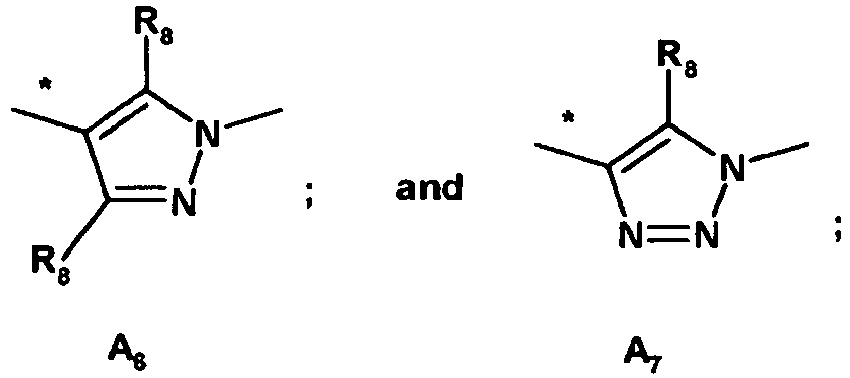
- L is -C(R10)2-; and each R10 is hydrogen;
- B is a five- to six-membered monocyclic aromatic ring system which may contain from 1 to 4 hetero atoms selected from nitrogen, oxygen and sulfur, wherein the ring system may contain not more than 2 oxygen atoms and not more than 2 sulfur atoms, and wherein the ring system is substituted once by -X3-B1; and wherein the ring system may be further substituted once or more than once by halogen; cyano; hydroxy; amino; or-X2-R13; and wherein a substituent on a nitrogen in a heterocyclic ring system may not be halogen;
- X2 is selected from bond; oxygen;
- R13 is C1-6alkyl; C1-6halogenalkyl;
- X3 is bond or C1-3alkylene, wherein one carbon atom of the C1-3alkylene may be replaced by a group selected from oxygen; sulfur; amino, which may be substituted by C1-4alkyl; B1 is a three- to seven-membered monocyclic ring system which may be aromatic, saturated or unsaturated non-aromatic and which may contain from 1 to 4 hetero atoms selected from nitrogen, oxygen and sulfur, wherein the ring system may contain not more than 2 oxygen atoms and not more than 2 sulfur atoms, wherein the ring system may in turn be substituted once or more than once by R14, and wherein a substituent on a nitrogen in a heterocyclic ring system may not be halogen; and
- each R14 independently is halogen, cyano, C1-4alkyl, C1-4halogenalkyl, C1-4alkoxy, or C1-4halogenalkoxy; or two R14 at the same ring atom together are oxo.
- One class of compounds of the invention, are compounds of formula IA,

- R1 and R3 are each independently C1-4alkyl or C1-4halogenalkyl;
- A is a ring system selected from


- L is -C(R10)2-; and each R10 is hydrogen;
- B is a nine- to ten-membered fused bicyclic aromatic ring system which may contain from 1 to 4 hetero atoms selected from nitrogen, oxygen and sulfur, wherein the ring system may contain not more than 2 oxygen atoms and not more than 2 sulfur atoms, and wherein the ring system may be substituted once or more than once by R12; and wherein a substituent on a nitrogen in a heterocyclic ring system may not be halogen;
- each R12 independently is halogen; cyano; hydroxy; amino; -X2-R13;
- X2 is selected from bond; oxygen; and amino, which may be substituted by C1-4alkyl; and R13 is C1-6alkyl; C1-6halogenalkyl.
- One class of compounds of the invention, are compounds of formula IA,

- R1 is C1-4alkyl or C1-4halogenalkyl;
- R3 is -X1-R6; X1 is oxygen; and R6 is C1-6alkyl; C1-6halogenalkyl; C1-6cyanoalkyl; C1-6carboxyalkyl; C1-6hydroxyalkyl; C1-4alkoxy-C1-6alkyl; C1-4alkoxy-C1-4alkoxy-C1-6alkyl; C1-4alkylcarbonyl-C1-6alkyl; C1-4alkoxycarbonyl-C1-6alkyl; C1-4alkylcarbonyloxy-C1-6alkyl; C1-6aminoalkyl; C1-4alkylamino-C1-6alkyl; di(C1-4alkyl)amino-C1-6alkyl; aminocarbonyl-C1-6alkyl; C1-4alkylaminocarbonyl-C1-6alkyl; di(C1-4alkyl)aminocarbonyl-C1-6alkyl; C1-4alkylcarbonylamino-C1-6alkyl; C1-4alkylaminosulfonyl-C1-6alkyl; di(C1-4alkyl)aminosulfonyl-C1-6alkyl;
- C2-6alkenyl; C2-6halogenalkenyl; C2-6alkinyl; C2-6halogonalkinyl;
- or R6 is a three- to seven-membered monocyclic ring system which may be aromatic, saturated or unsaturated non-aromatic and which may contain from 1 to 4 hetero atoms selected from nitrogen, oxygen and sulfur, wherein the ring system may contain not more than 2 oxygen atoms and not more than 2 sulfur atoms, wherein the ring system may be attached directly to group X1 or via a C1-2alkylene, wherein the ring system may in turn be substituted once or more than once by R7, and wherein a substituent on a nitrogen in a heterocyclic ring system may not be halogen;
- each R7 independently is halogen, cyano, C1-4alkyl, C1-4halogenalkyl, C1-4alkoxy, or C1-4halogenalkoxy; or two R7 at the same ring atom together are oxo;
- A is a ring system selected from


- L is -C(R10)2-; and each R10 is hydrogen;
- B is a five- to six-membered monocyclic aromatic ring system which may contain from 1 to 4 hetero atoms selected from nitrogen, oxygen and sulfur, wherein the ring system may contain not more than 2 oxygen atoms and not more than 2 sulfur atoms, and wherein the ring system is substituted once by -X3-B1; and wherein the ring system may be further substituted once or more than once by halogen; cyano; hydroxy; amino; or - X2-R13; and wherein a substituent on a nitrogen in a heterocyclic ring system may not be halogen;
- X2 is selected from bond; oxygen;
- R13 is C1-6alkyl; C1-6halogenalkyl;
- X3 is bond or C1-3alkylene, wherein one carbon atom of the C1-3alkylene may be replaced by a group selected from oxygen; sulfur; amino, which may be substituted by C1-4alkyl; B1 is a three- to seven-membered monocyclic ring system which may be aromatic, saturated or unsaturated non-aromatic and which may contain from 1 to 4 hetero atoms selected from nitrogen, oxygen and sulfur, wherein the ring system may contain not more than 2 oxygen atoms and not more than 2 sulfur atoms, wherein the ring system may in turn be substituted once or more than once by R14, and wherein a substituent on a nitrogen in a heterocyclic ring system may not be halogen; and
- each R14 independently is halogen, cyano, C1-4alkyl, C1-4halogenalkyl, C1-4alkoxy, or C1-4halogenalkoxy; or two R14 at the same ring atom together are oxo.
- One class of compounds of the invention, are compounds of formula IA,
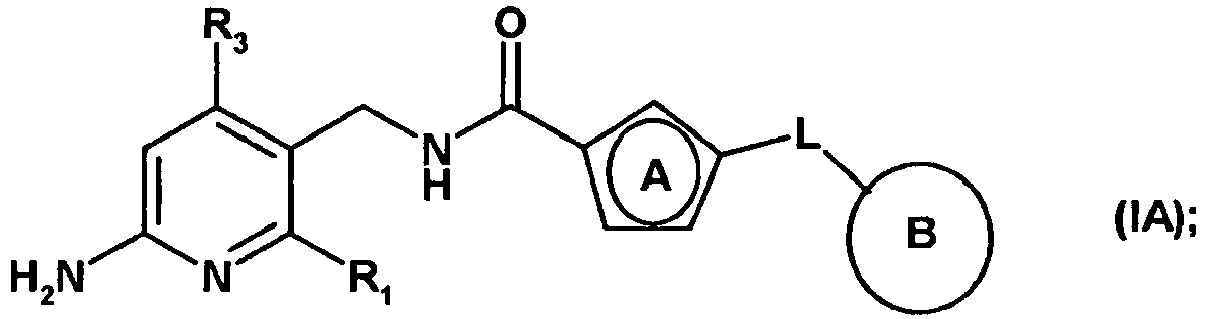
- R1 is C1-4alkyl or C1-4halogenalkyl;
- R3 is -X1-R6; X1 is oxygen; and R6 is C1-6alkyl; C1-6halogenalkyl; C1-6cyanoalkyl; C1-6carboxyalkyl; C1-6hydroxyalkyl; C1-4alkoxy-C1-6alkyl; C1-4alkoxy-C1-4alkoxy-C1-6alkyl; C1-4alkylcarbonyl-C1-6alkyl; C1-4alkoxycarbonyl-C1-6alkyl; C1-4alkylcarbonyloxy-C1-6alkyl; C1-6aminoalkyl; C1-4alkylamino-C1-6alkyl; di(C1-4alkyl)amino-C1-6alkyl; aminocarbonyl-C1-6alkyl; C1-4alkylaminocarbonyl-C1-6alkyl; di(C1-4alkyl)aminocarbonyl-C1-6alkyl; C1-4alkylcarbonylamino-C1-6alkyl; C1-4alkylaminosulfonyl-C1-6alkyl; di(C1-4alkyl)aminosulfonyl-C1-6alkyl;
- C2-6alkenyl; C2-6halogenalkenyl; C2-6alkinyl; C2-6halogenalkinyl;
- or R6 is a three- to seven-membered monocyclic ring system which may be aromatic, saturated or unsaturated non-aromatic and which may contain from 1 to 4 hetero atoms selected from nitrogen, oxygen and sulfur, wherein the ring system may contain not more than 2 oxygen atoms and not more than 2 sulfur atoms, wherein the ring system may be attached directly to group X1 or via a C1-2alkylene, wherein the ring system may in turn be substituted once or more than once by R7, and wherein a substituent on a nitrogen in a heterocyclic ring system may not be halogen;
- each R7 independently is halogen, cyano, C1-4alkyl, C1-4halogenalkyl, C1-4alkoxy, or C1-4halogenalkoxy; or two R7 at the same ring atom together are oxo;
- A is a ring system selected from


- L is -C(R10)2-; and each R10 is hydrogen;
- B is a nine- to ten-membered fused bicyclic aromatic ring system which may contain from 1 to 4 hetero atoms selected from nitrogen, oxygen and sulfur, wherein the ring system may contain not more than 2 oxygen atoms and not more than 2 sulfur atoms, and wherein the ring system may be substituted once or more than once by R12; and wherein a substituent on a nitrogen in a heterocyclic ring system may not be halogen;
- each R12 independently is halogen; cyano; hydroxy; amino; -X2-R13;
- X2 is selected from bond; oxygen; and amino, which may be substituted by C1-4alkyl; and
- R13 is C1-6alkyl; C1-6halogenalkyl.
- One class of compounds of the invention, are compounds of formula IA,

- R1 and R3 are C1-4alkyl;
- A is a ring system selected from

- L is -C(R10)2-; and each R10 is hydrogen;
- B is a nine- to ten-membered fused bicyclic aromatic ring system which may contain from 1 to 4 hetero atoms selected from nitrogen, oxygen and sulfur, wherein the ring system may contain not more than 2 oxygen atoms and not more than 2 sulfur atoms, and wherein the ring system may be substituted once or more than once by R12; and wherein a substituent on a nitrogen in a heterocyclic ring system may not be halogen;
- each R12 independently is halogen; -X2-R13;
- X2 is selected from bond; and
- R13 is C1-6alkyl; C1-6halogenalkyl.
- One class of compounds of the invention, are compounds of formula IA,

- R1 and R3 are C1-4alkyl;
- A is a ring system selected from

- L is -C(R10)2-; and each R10 is hydrogen;
- B is a quinolinyl or an indolyl, wherein the quinolinyl or indolyl may be substituted once or more than once by R12; and wherein a substituent on a nitrogen in a heterocyclic ring system may not be halogen;
- each R12 independently is halogen; -X2-R13;
- X2 is selected from bond; and
- R13 is C1-6alkyl; C1-6halogenalkyl.
- One class of compounds of the invention, are compounds of formula IA,

- R1 and R3 are C1-4alkyl;
- A is a ring system selected from

- L is -C(R10)2-; and each R10 is hydrogen;
- B is a quinolin-2-yl, quinol-3-yl, quinol-6-yl, or an indol-3-yl, wherein the quinolinyl or indolyl may be substituted once or more than once by R12; and wherein a substituent on a nitrogen in a heterocyclic ring system may not be halogen;
- each R12 independently is halogen; -X2-R13;
- X2 is selected from bond; and
- R13 is C1-8alkyl; C1-6halogenalkyl.
- In one embodiment, the invention provides a compound selected from
- N-((6-amino-2,4-dimethylpyridin-3-yl)methyl)-5-benzyl-1-methyl-1H-1,2,4-triazole-3-carboxamide;
- N-((6-amino-2,4-dimethylpyridin-3-yl)methyl)-3-benzylisoxazole-5-carboxamide;
- N-((6-amino-2,4-dimethylpyridin-3-yl)methyl)-5-benzyl-1,3,4-oxadiazole-2-carboxamide;
- N-((6-amino-2,4-dimethylpyridin-3-yl)methyl)-3-benzyl-1,2,4-oxadiazole-5-carboxamide;
- 1-(4-((1H-pyrazol-1-yl)methyl)benzyl)-N-((6-amino-2,4-dimethylpyridin-3-yl)methyl)-1H-i midazole-4-carboxamide;
- N-((6-amino-2,4-dimethylpyridin-3-yl)methyl)-5-benzyloxazole-2-carboxamide;
- N-((6-amino-2,4-dimethylpyridin-3-yl)methyl)-2-(4-methoxybenzyl)oxazole-4-carboxamide
- 1-(4-((1H-pyrazol-1-yl)methyl)-3-methoxybenzyl)-N-((6-amino-2,4-dimethylpyridin-3-yl)methyl)-1 H-pyrazole-4-carboxamide;
- N-((6-amino-2,4-dimethylpyridin-3-yl)methyl)-1-(biphenyl-4-ylmethyl)-1H-1,2,3-triazole-4-carboxamide;
- N-((6-amino-2,4-dimethylpyridin-3-yl)methyl)-1-(2-hydroxy-1-phenylethyl)-1H-pyrazole-4-carboxamide;
- N-((6-amino-2,4-dimethylpyridin-3-yl)methyl)-1-(phenylsulfonyl)-1H-pyrrole-3-carboxamide;
- N-((6-amino-2,4-dimethylpyridin-3-yl)methyl)-1-(4-methoxybenzyl)-1H-pyrazole-4-carboxamide;
- N-((6-amino-4-methoxy-2-methylpyridin-3-yl)methyl)-1-benzyl-1 H-pyrazole-4-carboxamide;
- N-((6-amino-4-(cyclohexyloxy)-2-methylpyridin-3-yl)methyl)-1-benzyl-1 H-pyrazole-4-carboxamide;
- N-((6-amino-2,4-dimethylpyridin-3-yl)methyl)-1-(4-(hydroxymethyl)benzyl)-1H-pyrazole-4-carboxamide;
- N-((6-amino-2,4-dimethylpyridin-3-yl)methyl)-1-(4-((2,5-dioxopyrrolidin-1-yl)methyl)benzyl)-1H-pyrazole-4-carboxamide;
- N-((6-amino-2,4-dimethylpyridin-3-yl)methyl)-1-(pyridin-4-ylmethyl)-1H-pyrazole-4-carboxamide;
- N-((6-amino-2,4-dimethylpyridin-3-yl)methyl)-1-benzyl-1H-1,2,3-triazole-4-carboxamide;
- N-((6-amino-2,4-dimethylpyridin-3-yl)methyl)-1-benzyl-1H-imidazole-4-carboxamide;
- N-((6-amino-2,4-dimethylpyridin-3-yl)methyl)-1-(4-phenoxybenzyl)-1H-imidazole-4-carboxamide;
- 1-(4-(1H-pyrazol-1-yl)benzyl)-N-((6-amino-2,4-dimethylpyridin-3-yl)methyl)-1H-imidazole-4-carboxamide;
- N-((6-amino-2,4-dimethylpyridin-3-yl)methyl)-1-((2-(phenylamino)thiazol-4-yl)methyl)-1H-pyrazole-4-carboxam ide;
- N-((6-amino-2,4-dimethylpyridin-3-yl)methyl)-1-((4-methyl-2-phenylthiazol-5-yl)methyl)-1 H-pyrazole-4-carboxamide;
- N-((6-amino-2,4-dimethylpyridin-3-yl)methyl)-1-((2-benzylthiazol-4-yl)methyl)-1H-pyrazole-4-carboxamide;
- N-((6-amino-2,4-dimethylpyridin-3-yl)methyl)-1-((2-tert-butylthiazol-4-yl)methyl)-1H-pyrazole-4-carboxamide;
- N-((6-amino-2,4-dimethylpyridin-3-yl)methyl)-1-((2-(2-(dimethylamino)-2-oxoethyl)thiazol-4-yl)methyl)-1 H-pyrazole-4-carboxamide;
- N-((6-amino-2,4-dimethylpyridin-3-yl)methyl)-1-(imidazo[1,2-a]pyridin-2-ylmethyl)-1H-pyrazole-4-carboxamide;
- N-((6-amino-2,4-dimethylpyridin-3-yl)methyl)-1-(benzofuran-2-ylmethyl)-1H-pyrazole-4-carboxamide;
- N-((6-amino-2,4-dimethylpyridin-3-yl)methyl)-1-((2-phenyloxazol-4-yl)methyl)-1H-pyrazole-4-carboxamide;
- 1-((1H-benzo[d]imidazol-5-yl)methyl)-N-((6-amino-2,4-dimethylpyridin-3-yl)methyl)-1H-pyrazole-4-carboxamide;
- N-((6-amino-2,4-dimethylpyridin-3-yl)methyl)-1-((1-methyl-1H-indol-6-yl)methyl)-1H-pyrazole-4-carboxamide;
- N-((6-amino-2,4-dimethylpyridin-3-yl)methyl)-1-((5-phenyloxazol-4-yl)methyl)-1H-pyrazole-4-carboxamide;
- N-((6-amino-2,4-dimethylpyridin-3-yl)methyl)-1-(4-((3,5-dimethyl-1H-pyrazol-1-yl)methyl)benzyl)-1H-pyrazole-4-carboxamide;
- N-((6-amino-2,4-dimethylpyridin-3-yl)methyl)-1-(3-cyanophenylsulfonyl)-1H-pyrazole-4-carboxamide;
- N-((6-amino-2,4-dimethylpyridin-3-yl)methyl)-1-(4-phenoxybenzyl)-1H-1,2,3-triazole-4-carboxamide;
- N-((6-amino-2,4-dimethylpyridin-3-yl)methyl)-1-(naphthalen-1-ylmethyl)-1H-1,2,3-triazole-4-carboxamide;
- N-((6-amino-2,4-dimethylpyridin-3-yl)methyl)-1-(naphthalen-2-ylmethyl)-1H-1,2,3-triazole-4-carboxamide;
- 1-(4-(1H-pyrazol-1-yl)benzyl)-N-((6-amino-2,4-dimethylpyridin-3-yl)methyl)-1H-1,2,3-triazole-4-carboxamide;
- 1-(3-(1H-pyrazol-1-yl)benzyl)-N-((6-amino-2,4-dimethylpyridin-3-yl)methyl)-1H-1,2,3-triazole-4-carboxamide;
- N-((6-amino-2,4-dimethylpyridin-3-yl)methyl)-1-(3-(pyrrolidin-1-yl)benzyl)-1H-1,2,3-triazole-4-carboxamide;
- N-((6-amino-2,4-dimethylpyridin-3-yl)methyl)-2-(benzofuran-2-ylmethyl)-2H-1,2,3-triazole-4-carboxamide;
- 1-(4-((1H-imidazol-1-yl)methyl)benzyl)-N-((6-amino-2,4-dimethylpyridin-3-yl)methyl)-1H-1,2,3-triazole-4-carboxamide;
- 1-(3-((1H-imidazol-1-yl)methyl)benzyl)-N-((6-amino-2,4-dimethylpyridin-3-yl)methyl)-1H-1,2,3-triazole-4-carboxamide;
- N-((6-amino-2,4-dimethylpyridin-3-yl)methyl)-2-benzylthiazole-4-carboxamide;
- N-((6-amino-2,4-dimethylpyridin-3-yl)methyl)-5-phenoxyfuran-2-carboxamide;
- N-((6-amino-2,4-dimethylpyridin-3-yl)methyl)-1-benzyl-3-methyl-1H-pyrazole-4-carboxamide;
- N-((6-amino-2,4-dimethylpyridin-3-yl)methyl)-1-(furan-2-ylmethyl)-2,5-dimethyl-1H-pyrrole-3-carboxamide;
- N-((6-amino-2,4-dimethylpyridin-3-yl)methyl)-2,5-dimethyl-1-(1-phenylethyl)-1H-pyrrole-3-carboxamide;
- N-((6-amino-2,4-dimethylpyridin-3-yl)methyl)-4-(morpholinosulfonyl)-1H-pyrrole-2-carboxamide;
- N-((6-amino-2,4-dimethylpyridin-3-yl)methyl)-1-(2,6-difluorobenzyl)-1H-1,2,3-triazole-4-carboxamide;
- N-((6-amino-2,4-dimethylpyridin-3-yl)methyl)-1-(3-cyanobenzyl)-1H-1,2,3-triazole-4-carboxamide;
- N-((6-amino-2,4-dimethylpyridin-3-yl)methyl)-2-benzyl-4-methylthiazole-5-carboxamide;
- N-((6-amino-2,4-dimethylpyridin-3-yl)methyl)-1-benzyl-1H-1,2,4-triazole-3-carboxamide;
- N-((6-amino-2,4-dimethylpyridin-3-yl)methyl)-1-(4-(6-methylpyrazin-2-yloxy)benzyl)-1H-pyrazole-4-carboxamide;
- N-((6-amino-2,4-dimethylpyridin-3-yl)methyl)-2-benzyloxazole-4-carboxamide;
- 1-(4-((1H-1,2,4-triazol-1-yl)methyl)benzyl)-N-((6-amino-2,4-dimethylpyridin-3-yl)methyl)-1H-1,2,4-triazole-3-carboxamide;
- N-((6-amino-4-(2-methoxyethoxy)-2-methylpyridin-3-yl)methyl)-1-benzyl-1H-pyrazole-4-carboxamide;
- N-((6-amino-2,4-dimethylpyridin-3-yl)methyl)-1-(biphenyl-4-ylmethyl)-1H-1,2,4-triazole-3-carboxamide;
- N-((6-amino-2,4-dimethylpyridin-3-yl)methyl)-1-(naphthalen-1-ylmethyl)-1H-1,2,4-triazole-3-carboxamide;
- N-((6-amino-2,4-dimethylpyridin-3-yl)methyl)-1-(4-phenoxybenzyl)-1H-1,2,4-triazole-3-carboxamide;
- N-((6-amino-2,4-dimethylpyridin-3-yl)methyl)-1-(naphthalen-2-ylmethyl)-1H-1,2,4-triazole-3-carboxamide;
- N-((6-amino-2,4-dimethylpyridin-3-yl)methyl)-1-(4-(2-oxopyrrolidin-1-yl)benzyl)-1H-pyrazole-4-carboxamide;
- 1-(4-(1H-pyrazol-1-yl)benzyl)-N-((6-amino-2,4-dimethylpyridin-3-yl)methyl)-1H-1,2,4-triazole-3-carboxamide;
- 1-(3-(1H-pyrazol-1-yl)benzyl)-N-((6-amino-2,4-dimethylpyridin-3-yl)methyl)-1H-1,2,4-triazole-3-carboxamide;
- N-((6-amino-2,4-dimethylpyridin-3-yl)methyl)-1-(3-(pyrrolidin-1-yl)benzyl)-1H-1,2,4-triazole-3-carboxamide;
- N-((6-amino-2,4-dimethylpyridin-3-yl)methyl)-1-((2-morpholinopyridin-4-yl)methyl)-1H-pyrazole-4-carboxamide;
- N-((6-amino-2,4-dimethylpyridin-3-yl)methyl)-1-benzyl-1H-pyrrole-3-carboxamide;
- N-((6-amino-2,4-dimethylpyridin-3-yl)methyl)-1-(3-(2-methoxyethyl)benzyl)-1H-pyrazole-4-carboxamide;
- N-((6-amino-2,4-dimethylpyridin-3-yl)methyl)-2,5-dimethyl-1-(phenylsulfonyl)-1H-pyrrole-3-carboxamide;
- N-((6-amino-2,4-dimethylpyridin-3-yl)methyl)-1-(3,5-dimethoxybenzyl)-1H-pyrazole-4-carboxamide;
- N-((6-amino-2,4-dimethylpyridin-3-yl)methyl)-4-methyl-1-(phenylsulfonyl)-1H-pyrrole-3-carboxamide;
- N-((6-amino-2,4-dimethylpyridin-3-yl)methyl)-1-((2,3-dimethyl-1H-indol-5-yl)methyl)-1H-pyrazole-4-carboxamide;
- N-((6-amino-2,4-dimethylpyridin-3-yl)methyl)-1-benzyl-4-methyl-1H-pyrrole-3-carboxamide;
- N-((6-amino-2,4-dimethylpyridin-3-yl)methyl)-2-methyl-5-((1-oxoisoquinolin-2(1H)-yl)methyl)furan-3-carboxamide;
- N-((6-amino-2,4-dimethylpyridin-3-yl)methyl)-1-(4-(trifluoromethoxy)benzyl)-1H-pyrazole-4-carboxamide;
- N-((6-amino-2,4-dimethylpyridin-3-yl)methyl)-1-(3-cyanobenzyl)-1H-pyrazole-4-carboxamide;
- N-((6-amino-2,4-dimethylpyridin-3-yl)methyl)-1-(4-cyanobenzyl)-1H-pyrazole-4-carboxamide;
- N-((6-amino-2,4-dimethylpyridin-3-yl)methyl)-1-(naphthalen-2-ylmethyl)-1H-pyrazole-4-carboxamide;
- N-((6-amino-2,4-dimethylpyridin-3-yl)methyl)-1-(3-fluorobenzyl)-1H-pyrazole-4-carboxamide;
- N-((6-amino-2-methylpyridin-3-yl)methyl)-1-benzyl-1H-pyrazole-4-carboxamide;
- N-((6-amino-2,4-dimethylpyridin-3-yl)methyl)-1-((6-methylpyridin-2-yl)methyl)-1H-pyrazole-4-carboxamide;
- N-((6-amino-2,4-dimethylpyridin-3-yl)methyl)-1-(2-chlorobenzyl)-1H-pyrazole-4-carboxamide;
- N-((6-amino-2,4-dimethylpyridin-3-yl)methyl)-1-(cyclohexylmethyl)-1H-pyrazole-4-carboxamide;
- N-((6-amino-2,4-dimethylpyridin-3-yl)methyl)-1-(4-(phenoxymethyl)benzyl)-1H-pyrazole-4-carboxamide;
- N-((6-amino-2,4-dimethylpyridin-3-yl)methyl)-1-(3,4-difluorobenzyl)-1H-pyrazole-4-carboxamide;
- N-((6-amino-2,4-dimethylpyridin-3-yl)methyl)-1-(4-(3-methyl-1,2,4-oxadiazol-5-yl)benzyl)-1 H-pyrazole-4-carboxamide;
- N-((6-amino-2,4-dimethylpyridin-3-yl)methyl)-1-(3-chlorobenzyl)-1H-pyrazole-4-carboxamide;
- N-((6-amino-2,4-dimethylpyridin-3-yl)methyl)-1-(2,4-difluorobenzyl)-1H-pyrazole-4-carboxamide;
- N-((6-amino-2,4-dimethylpyridin-3-yl)methyl)-1-(4-(benzyloxy)benzyl)-1H-pyrazole-4-carboxamide;
- N-((6-amino-2,4-dimethylpyridin-3-yl)methyl)-1-((3,4-dihydro-2H-benzo[b][1,4]dioxepin-6-yl)methyl)-1 H-pyrazole-4-carboxamide;
- N-((6-amino-2,4-dimethylpyridin-3-yl)methyl)-1-(4-chlorobenzyl)-1H-pyrazole-4-carboxamide;
- N-((6-amino-2,4-dimethylpyridin-3-yl)methyl)-1-((2-methylthiazol-4-yl)methyl)-1H-pyrazole-4-carboxamide;
- N-((6-amino-2,4-dimethylpyridin-3-yl)methyl)-1-(pyridin-3-ylmethyl)-1H-pyrazole-4-carboxamide;
- N-((6-amino-2,4-dimethylpyridin-3-yl)methyl)-1-((6-(hydroxymethyl)pyridin-2-yl)methyl)-1 H-pyrazole-4-carboxamide;
- N-((6-amino-2,4-dimethylpyridin-3-yl)methyl)-1-(1-phenylethyl)-1H-pyrazole-4-carboxamide;
- N-((6-amino-2,4-dimethylpyridin-3-yl)methyl)-1-((1-methyl-1H-benzo[d][1,2,3]triazol-5-yl)methyl)-1H-pyrazole-4-carboxamide;
- N-((6-amino-2,4-dimethylpyridin-3-yl)methyl)-1-(3-carbamoylbenzyl)-1H-pyrazole-4-carboxamide;
- N-((6-amino-2,4-dimethylpyridin-3-yl)methyl)-1-(benzo[d][1,3]dioxol-5-ylmethyl)-1H-pyrazole-4-carboxam ide;
- N-((6-amino-2,4-dimethylpyridin-3-yl)methyl)-1-((3-methylquinoxalin-2-yl)methyl)-1H-pyrazole-4-carboxamide;
- N-((6-amino-2,4-dimethylpyridin-3-yl)methyl)-1-(benzo[d]thiazol-2-ylmethyl)-1H-pyrazole-4-carboxamide;
- N-((6-amino-2,4-dimethylpyridin-3-yl)methyl)-1-(benzo[d]isoxazol-3-ylmethyl)-1H-pyrazole-4-carboxamide;
- N-((6-amino-2,4-dimethylpyridin-3-yl)methyl)-1-(2-cyanobenzyl)-1H-indole-3-carboxamide;
- N-((6-amino-2,4-dimethylpyridin-3-yl)methyl)-1-benzyl-1H-indole-3-carboxamide;
- N-((6-amino-2,4-dimethylpyridin-3-yl)methyl)-1-benzyl-2,5-dimethyl-1H-pyrrole-3-carboxamide;
- N-((6-amino-2,4-dimethylpyridin-3-yl)methyl)-1-(4-(morpholinomethyl)benzyl)-1H-pyrazole-4-carboxamide;
- N-((6-amino-2,4-dimethylpyridin-3-yl)methyl)-1-(4-(3-cyclopropylureido)benzyl)-1H-pyrazole-4-carboxamide;
- N-((6-amino-2,4-dimethylpyridin-3-yl)methyl)-5-benzyl-1H-1,2,4-triazole-3-carboxamide;
- N-((6-amino-2,4-dimethylpyridin-3-yl)methyl)-1-(4-(pyridin-4-yl)benzyl)-1H-pyrazole-4-carboxamide;
- N-((6-amino-2,4-dimethylpyridin-3-yl)methyl)-1-(biphenyl-3-ylmethyl)-1H-pyrazole-4-carboxamide;
- N-((6-amino-2,4-dimethylpyridin-3-yl)methyl)-1-(3-(morpholinosulfonyl)benzyl)-1H-pyrazole-4-carboxamide;
- N-((6-amino-2,4-dimethylpyridin-3-yl)methyl)-1-(3-(phenylcarbamoyl)benzyl)-1H-pyrazole-4-carboxamide;
- N-((6-amino-2,4-dimethylpyridin-3-yl)methyl)-1-(4-(pyrrolidin-1-ylmethyl)benzyl)-1H-pyrazole-4-carboxamide;
- N-((6-amino-2,4-dimethylpyridin-3-yl)methyl)-1-(3-(piperidine-1-carbonyl)benzyl)-1H-pyrazole-4-carboxamide;
- N-((6-amino-2,4-dimethylpyridin-3-yl)methyl)-1-(4-(isopropylcarbamoyl)benzyl)-1H-pyrazole-4-carboxamide;
- N-((6-amino-2,4-dimethylpyridin-3-yl)methyl)-1-(4-(morpholine-4-carbonyl)benzyl)-1H-pyrazole-4-carboxamide;
- N-((6-amino-2,4-dimethylpyridin-3-yl)methyl)-1-(4-(1-methyl-1H-pyrazol-3-ylcarbamoyl)benzyl)-1 H-pyrazole-4-carboxamide;
- 5-(amino(phenyl)methyl)-N-((6-amino-2,4-dimethylpyridin-3-yl)methyl)-1H-1,2,4-triazole-3-carboxamide;
- N-((6-amino-2,4-dimethylpyridin-3-yl)methyl)-3-(biphenyl-4-ylmethyl)-1H-1,2,4-triazole-5-carboxamide;
- N-((6-amino-2,4-dimethylpyridin-3-yl)methyl)-3-(4-phenoxybenzyl)-1H-1,2,4-triazole-5-carboxamide;
- N-((6-amino-2,4-dimethylpyridin-3-yl)methyl)-1-(4-(N,N-dimethylsulfamoyl)benzyl)-1H-pyrazole-4-carboxamide;
- N-((6-amino-2,4-dimethylpyridin-3-yl)methyl)-1-(biphenyl-4-ylsulfonyl)-1H-pyrrole-3-carboxamide;
- N-((6-amino-2,4-dimethylpyridin-3-yl)methyl)-1-(5-chlorothiophen-2-ylsulfonyl)-1H-pyrrole-3-carboxamide;
- N-((6-amino-2,4-dimethylpyridin-3-yl)methyl)-1-(3-methoxyphenylsulfonyl)-1H-pyrrole-3-carboxamide;
- N-((6-amino-2,4-dimethylpyridin-3-yl)methyl)-1-(4-methyl-3,4-dihydro-2H-benzo[b][1,4]oxazin-6-ylsulfonyl)-1H-pyrrole-3-carboxamide;
- N-((6-amino-2,4-dimethylpyridin-3-yl)methyl)-1-(1-methyl-1H-indol-5-ylsulfonyl)-1H-pyrrole-3-carboxamide;
- N-((6-amino-2,4-dimethylpyridin-3-yl)methyl)-1-(3-(pyrimidin-2-yl)phenylsulfonyl)-1H-pyrrole-3-carboxamide;
- N-((6-amino-2,4-dimethylpyridin-3-yl)methyl)-1-(4-(3,5-dimethyl-1H-pyrazol-1-yl)phenylsulfonyl)-1 H-pyrrole-3-carboxamide;
- 2-(4-((4-((6-amino-2,4-dimethylpyridin-3-yl)methylcarbamoyl)-1H-pyrazol-1-yl)methyl)phenoxy)acetic acid;
- N-((6-amino-2,4-dimethylpyridin-3-yl)methyl)-1-(4-(cyanomethoxy)benzyl)-1H-pyrazole-4-carboxamide; N-((6-amino-2-methyl-4-(oxazol-2-ylmethoxy)pyridin-3-yl)methyl)-1-benzyl-1 H-1,2,3-triazole-4-carboxamide;
- N-((6-amino-2-methyl-4-(oxazol-2-ylmethoxy)pyridin-3-yl)methyl)-1-benzyl-1 H-1,2,3-triazole-4-carboxamide;
- N-((6-amino-4-methylpyridin-3-yl)methyl)-1-benzyl-1H-pyrazole-4-carboxamide;
- N-((6-amino-2,4-dimethylpyridin-3-yl)methyl)-1-(4-((3-oxo-2,3-dihydro-1H-pyrazol-1-yl)methyl)benzyl)-1 H-pyrazole-4-carboxamide;
- 1-(4-((1H-1,2,3-triazol-1-yl)methyl)benzyl)-N-((6-amino-2,4-dimethylpyridin-3-yl)methyl)-1H-pyrazole-4-carboxamide;
- N-((6-amino-2,4-dimethylpyridin-3-yl)methyl)-1-(4-((2,5-dimethyl-3-oxo-2,3-dihydro-1H-pyrazol-1-yl)methyl)benzyl)-1H-pyrazole-4-carboxamide;
- N-((6-amino-2,4-dimethylpyridin-3-yl)methyl)-1-(4-((2-oxopyridin-1(2H)-yl)methyl)benzyl)-1 H-pyrazole-4-carboxamide;
- N-((6-amino-2,4-dimethylpyridin-3-yl)methyl)-1-(4-((2-oxopyrrolidin-1-yl)methyl)benzyl)-1 H-pyrazole-4-carboxamide;
- N-((6-amino-4-chloro-2-methylpyridin-3-yl)methyl)-1-benzyl-1H-pyrazole-4-carboxamide;
- 1-(4-((1H-pyrazol-1-yl)methyl)benzyl)-N-((6-amino-2,4-dimethylpyridin-3-yl)methyl)-1H-pyrazole-4-carboxamide;
- N-((6-amino-2,4-dimethylpyridin-3-yl)methyl)-1-(4-((4-methyl-1H-pyrazol-1-yl)methyl)benzyl)-1H-pyrazole-4-carboxamide;
- N-((6-amino-2,4-dimethylpyridin-3-yl)methyl)-1-(4-((5-methyl-1H-pyrazol-1-yl)methyl)benzyl)-1 H-1,2,3-triazole-4-carboxamide;
- N-((6-amino-2,4-dimethylpyridin-3-yl)methyl)-1-(4-((3,5-dimethyl-1H-pyrazol-1-yl)methyl)benzyl)-1 H-1,2,3-triazole-4-carboxamide;
- N-((6-amino-4-(3,3-dimethyl-2-oxobutoxy)-2-methylpyridin-3-yl)methyl)-1-(naphthalen-2-ylmethyl)-1H-pyrazole-4-carboxamide;
- N-((6-Amino-2,4-dimethylpyridin-3-yl)methyl)-1-((1-(2-methoxyethyl)-1,2,3,4-tetrahydroquinolin-7-yl)methyl)-1H-pyrazole-4-carboxamide;
- N-((6-Amino-2,4-dimethylpyridin-3-yl)methyl)-1-((4-methyl-3-oxo-3,4-dihydro-2H-benzo[b][1,4]oxazin-6-yl)methyl)-1H-pyrazole-4-carboxamide;
- N-((6-Amino-2,4-dimethylpyridin-3-yl)methyl)-1-((1-methyl-1,2,3,4-tetrahydroquinolin-7-yl)methyl)-1 H-pyrazole-4-carboxamide;
- N-((6-amino-2,4-dimethylpyridin-3-yl)methyl)-1-((2-methylquinolin-6-yl)methyl)-1H-1,2,3-triazole-4-carboxamide;
- N-((6-amino-2,4-dimethylpyridin-3-yl)methyl)-1-((2-methylquinolin-6-yl)methyl)-1H-pyrazole-4-carboxamide;
- N-((6-amino-2,4-dimethylpyridin-3-yl)methyl)-1-(quinolin-3-ylmethyl)-1 H-pyrazole-4-carboxamide;
- N-((6-amino-2,4-dimethylpyridin-3-yl)methyl)-1-((7-methylquinolin-3-yl)methyl)-1H-1,2,3-triazole-4-carboxamide;
- N-((6-amino-2,4-dimethylpyridin-3-yl)methyl)-1-((7-chloroquinolin-2-yl)methyl)-1H-pyrazole-4-carboxam ide;
- N-((6-amino-2,4-dimethylpyridin-3-yl)methyl)-1-((7-chloroquinolin-2-yl)methyl)-1H-1,2,3-triazole-4-carboxamide;
- N-((6-amino-2-methylpyridin-3-yl)methyl)-1-((2-methylquinolin-6-yl)methyl)-1H-pyrazole-4-carboxamide;
- N-((6-amino-2-methylpyridin-3-yl)methyl)-1-((6-fluoro-4-(trifluoromethyl)quinolin-2-yl)methyl)-1 H-pyrazole-4-carboxamide;
- N-((6-amino-2-methylpyridin-3-yl)methyl)-1-((2,5,7-trimethylquinolin-3-yl)methyl)-1H-pyrazole-4-carboxamide;
- N-((6-amino-2,4-dimethylpyridin-3-yl)methyl)-1-((6-fluoro-4-(trifluoromethyl)quinolin-2-yl)methyl)-1H-pyrazole-4-carboxamide;
- N-((6-amino-2,4-dimethylpyridin-3-yl)methyl)-1-((6-methoxynaphthalen-2-yl)methyl)-1H-pyrazole-4-carboxamide;
- N-(1-(6-Amino-2,4-dimethylpyridin-3-yl)cyclopropyl)-1-((2-methylquinolin-6-yl)methyl)-1H-1,2,3-triazole-4-carboxamide;
- N-((6-Amino-2,4-dimethylpyridin-3-yl)methyl)-1-((1,2-dimethyl-1H-benzo[d]imidazol-5-yl)methyl)-1 H-pyrazole-4-carboxamide;
- N-((6-amino-2,4-dimethylpyridin-3-yl)methyl)-1-((1,2,3-trimethyl-1H-indol-5-yl)methyl)-1H-1,2,3-triazole-4-carboxamide;
- N-((6-Amino-4-chloro-2-methylpyridin-3-yl)methyl)-1-(4-((2-oxopyridin-1(2H)-yl)methyl)benzyl)-1 H-pyrazole-4-carboxamide;
- N-((6-Amino-2,4-dimethylpyridin-3-yl)methyl)-1-((1,2-dimethyl-1H-indol-5-yl)methyl)-1 H-pyrazole-4-carboxamide;
- N-((6-amino-2,4-dimethylpyridin-3-yl)methyl)-1-((2-methylimidazo[1,2-a]pyridin-6-yl)methyl)-1H-pyrazole-4-carboxamide;
- N-((6-amino-2,4-dimethylpyridin-3-yl)methyl)-2-((2-methylquinolin-6-yl)methyl)oxazole-4-carboxamide;
- N-((6-Amino-2,4-dimethylpyridin-3-yl)methyl)-1-((7-aminothieno[2,3-c]pyridin-5-yl)methyl)-1 H-pyrazole-4-carboxamide;
- N-((6-amino-4-chloro-2-methylpyridin-3-yl)methyl)-1-(naphthalen-2-ylmethyl)-1H-pyrazole-4-carboxamide;
- N-((6-Amino-2,4-dimethylpyridin-3-yl)methyl)-1-((3-chloroquinolin-6-yl)methyl)-1H-pyrazole-4-carboxamide;
- N-((6-amino-2,4-dimethylpyridin-3-yl)methyl)-1-((1,1-dioxido-2,3-dihydrobenzo[b]thiophen-5-yl)methyl)-1 H-pyrazole-4-carboxamide and
- N-((6-Amino-4-chloro-2-methylpyridin-3-yl)methyl)-1-((2-methylquinolin-6-yl)methyl)-1 H-1,2,3-triazole-4-carboxamide.
- In one embodiment, the invention provides a compound which is
(S)-5-(amino(phenyl)methyl)-N-((6-amino-2,4-dimethylpyridin-3-yl)methyl)-1 H-1,2,4-triazole-3-carboxamide. - In a further aspect, the invention also provides a process for the production of compounds of the formula I. Compounds of the formula I are obtainable according to the following process as described in scheme 1:

- A compound of formula I may be obtained by reacting a compound of formula II, in which R1, R2, R3, R4 and R5 are as defined under formula I, and Ra is hydrogen or an amine protecting group, for example C1-6alkoxycarbonyl, e.g. tertiary butyloxycarbonyl, allyloxycarbonyl, benzyloxycarbonyl or fluorenylmethoxycarbonyl, with a compound of formula III, in which A, L and B are as defined under formula I, and Rb is hydroxy, halogen or C1-6alkoxy, in the presence of a suitable base, e.g. collidine, N,N-diisopropylethylamine (DIPEA), triethylamine or 4-DMAP (4-dimethylaminopyridine), in the presence of a suitable solvent, e.g. dimethylformamide (DMF), DMSO (dimethylsulfoxide), tetrahydrofurane (THF) or DCM, and, if Rb is hydroxy, in the presence of a suitable coupling reagent, e.g. O-(7-azabenzotriazol-1-yl)-N,N,N',N'-tetramethyluronium hexafluorophosphate (HATU), propyl phosphonic anhydride, O-(benzotriazol-1-yl)-N,N,N',N'-tetramethyluronium hexafluorophosphate (HBTU) or 2-tert-butylimino-2-diethylamino-1,3-dimethylperhydro-1,3,2-diazaphosphorine (BEMP); and, if Ra is an amine protecting group, followed by deprotecting the amine-functionality.
- Compounds of the formula IIa are obtainable according to the following process as described in scheme 2:

- Step 2.1: A nitrile of formula IV, in which R1, R2 and R6 are as defined under formula I, and Ra is hydrogen or an amine protecting group, for example C1-6alkoxycarbonyl, e.g. tertiary butyloxycarbonyl, allyloxycarbonyl, benzyloxycarbonyl or fluorenylmethoxycarbonyl, may be obtained by reacting a nitrile of formula V, in which R1 and R2 are as defined under formula I, and Ra is hydrogen or an amine protecting group, for example C1-6alkoxycarbonyl, e.g. tertiary butyloxycarbonyl, allyloxycarbonyl, benzyloxycarbonyl or fluorenylmethoxycarbonyl, with a compound of formula VI, in which R6 is as defined under formula I and Rc is a leaving group, for example mesylate, tosylate, triflate or halogen, in the presence of a suitable base, e.g. potasium carbonate or cesium carbonate, and in the presence of a suitable solvent, e.g. DMF or DMSO.
- Step 2.2: A compound of formula IIa, in which R1, R2 and R6 are as defined under formula I, and Ra is hydrogen or an amine protecting group, for example C1-6alkoxycarbonyl, e.g. tertiary butyloxycarbonyl, allyloxycarbonyl, benzyloxycarbonyl or fluorenylmethoxycarbonyl, may be obtained by reacting the nitrile of formula IV with a suitable hydrogenation agent, e.g. diisobutyl aluminium hydride, borane or hydrogen in the presence of palladium/charcoal, raney-nickel or platinum oxide, optionally in the presence of a suitable acid or base, e.g. HCl or ammonia, when using hydrogen in the presence of palladium/charcoal, raney-nickel or platinum oxide, and in the presence of a suitable solvent, e.g. THF for diisobutyl aluminium hydride or borane or a solvent selected from methanol, ethanol and chloroform for hydrogen in the presence of palladium/charcoal, raney-nickel or platinum oxide.
- Further compounds of formula I may be obtainable from compounds of formula I-prepared as described according to scheme 1 - by reduction, oxidation and/or other functionalization of resulting compounds and/or by cleavage of any protecting group(s) optionally present, and of recovering the so obtainable compound of the formula I.
- The reactions can be effected according to conventional methods, for example as described in the Examples.
- The work-up of the reaction mixtures and the purification of the compounds thus obtainable may be carried out in accordance with known procedures.
- Acid addition salts may be produced from the free bases in known manner, and vice-versa.
- Compounds of the formula I can also be prepared by further conventional processes, e. g. as described in the Examples, which processes are further aspects of the invention.
- The starting materials, e.g. compounds of the formulae III, V and VI, are known or may be prepared according to conventional procedures starting from known compounds, for example as described in the Examples.
- In a further aspect, the invention also provides a compound of formula IIa

- In another aspect, the invention provides a pharmaceutical composition comprising a compound of the invention and a pharmaceutically acceptable carrier. The pharmaceutical composition can be formulated for particular routes of administration such as oral administration, parenteral administration, and rectal administration, etc. In addition, the pharmaceutical compositions of the invention can be made up in a solid form including capsules, tablets, pills, granules, powders or suppositories, or in a liquid form including solutions, suspensions or emulsions. The pharmaceutical compositions can be subjected to conventional pharmaceutical operations such as sterilization and/or can contain conventional inert diluents, lubricating agents, or buffering agents, as well as adjuvants, such as preservatives, stabilizers, wetting agents, emulsifers and buffers etc.
- Typically, the pharmaceutical compositions are tablets and gelatin capsules comprising the active ingredient together with
- a) diluents, e.g., lactose, dextrose, sucrose, mannitol, sorbitol, cellulose and/or glycine;
- b) lubricants, e.g., silica, talcum, stearic acid, its magnesium or calcium salt and/or polyethyleneglycol; for tablets also
- c) binders, e.g., magnesium aluminum silicate, starch paste, gelatin, tragacanth, methylcellulose, sodium carboxymethylcellulose and/or polyvinylpyrrolidone; if desired
- d) disintegrants, e.g., starches, agar, alginic acid or its sodium salt, or effervescent mixtures; and/or
- e) absorbents, colorants, flavors and sweeteners.
- Tablets may be either film coated or enteric coated according to methods known in the art.
- Suitable compositions for oral administration include an effective amount of a compound of the invention in the form of tablets, lozenges, aqueous or oily suspensions, dispersible powders or granules, emulsion, hard or soft capsules, or syrups or elixirs. Compositions intended for oral use are prepared according to any method known in the art for the manufacture of pharmaceutical compositions and such compositions can contain one or more agents selected from the group consisting of sweetening agents, flavoring agents, coloring agents and preserving agents in order to provide pharmaceutically elegant and palatable preparations. Tablets contain the active ingredient in admixture with nontoxic pharmaceutically acceptable excipients which are suitable for the manufacture of tablets. These excipients are, for example, inert diluents, such as calcium carbonate, sodium carbonate, lactose, calcium phosphate or sodium phosphate; granulating and disintegrating agents, for example, corn starch, or alginic acid; binding agents, for example, starch, gelatin or acacia; and lubricating agents, for example magnesium stearate, stearic acid or talc. The tablets are uncoated or coated by known techniques to delay disintegration and absorption in the gastrointestinal tract and thereby provide a sustained action over a longer period. For example, a time delay material such as glyceryl monostearate or glyceryl distearate can be employed. Formulations for oral use can be presented as hard gelatin capsules wherein the active ingredient is mixed with an inert solid diluent, for example, calcium carbonate, calcium phosphate or kaolin, or as soft gelatin capsules wherein the active ingredient is mixed with water or an oil medium, for example, peanut oil, liquid paraffin or olive oil.
- Certain injectable compositions are aqueous isotonic solutions or suspensions, and suppositories are advantageously prepared from fatty emulsions or suspensions. Said compositions may be sterilized and/or contain adjuvants, such as preserving, stabilizing, wetting or emulsifying agents, solution promoters, salts for regulating the osmotic pressure and/or buffers. In addition, they may also contain other therapeutically valuable substances. Said compositions are prepared according to conventional mixing, granulating or coating methods, respectively, and contain about 0.1-75%, or contain about 1-50%, of the active ingredient.
- Suitable compositions for transdermal application include an effective amount of a compound of the invention with carrier. Carriers include absorbable pharmacologically acceptable solvents to assist passage through the skin of the host. For example, transdermal devices are in the form of a bandage comprising a backing member, a reservoir containing the compound optionally with carriers, optionally a rate controlling barrier to deliver the compound of the skin of the host at a controlled and predetermined rate over a prolonged period of time, and means to secure the device to the skin.
- Suitable compositions for topical application, e.g., to the skin and eyes, include aqueous solutions, suspensions, ointments, creams, gels or sprayable formulations, e.g., for delivery by aerosol or the like. Such topical delivery systems will in particular be appropriate for dermal application, e.g., for the treatment of skin cancer,'e.g., for prophylactic use in sun creams, lotions, sprays and the like. They are thus particularly suited for use in topical, including cosmetic, formulations well-known in the art. Such may contain solubilizers, stabilizers, tonicity enhancing agents, buffers and preservatives.
- As used herein a topical application may also pertain to an inhalation or to an intranasal application. They are conveniently delivered in the form of a dry powder (either alone, as a mixture, for example a dry blend with lactose, or a mixed component particle, for example with phospholipids) from a dry powder inhaler or an aerosol spray presentation from a pressurised container, pump, spray, atomizer or nebuliser, with or without the use of a suitable propellant.
- The invention further provides anhydrous pharmaceutical compositions and dosage forms comprising the compounds of the invention as active ingredients, since water may facilitate the degradation of certain compounds.
- Anhydrous pharmaceutical compositions and dosage forms of the invention can be prepared using anhydrous or low moisture containing ingredients and low moisture or low humidity conditions. An anhydrous pharmaceutical composition may be prepared and stored such that its anhydrous nature is maintained. Accordingly, anhydrous compositions are preferably packaged using materials known to prevent exposure to water such that they can be included in suitable formulary kits. Examples of suitable packaging include, but are not limited to, hermetically sealed foils, plastics, unit dose containers (e. g., vials), blister packs, and strip packs.
- The invention further provides pharmaceutical compositions and dosage forms that comprise one or more agents that reduce the rate by which the compound of the invention as an active ingredient will decompose. Such agents, which are referred to herein as "stabilizers," include, but are not limited to, antioxidants such as ascorbic acid, pH buffers, or salt buffers, etc.
- As used herein, the term "pharmaceutically acceptable carrier" includes any and all solvents, dispersion media, coatings, surfactants, antioxidants, preservatives (e.g., antibacterial agents, antifungal agents), isotonic agents, absorption delaying agents, salts, preservatives, drugs, drug stabilizers, binders, excipients, disintegration agents, lubricants, sweetening agents, flavoring agents, dyes, such like materials and combinations thereof, as would be known to one of ordinary skill in the art (see, for example, Remington's Pharmaceutical Sciences, 18th Ed. Mack Printing Company, 1990, pp. 1289- 1329). Except insofar as any conventional carrier is incompatible with the active ingredient, its use in the therapeutic or pharmaceutical compositions is contemplated.
- The compounds of formula I in free form or in pharmaceutically acceptable salt form, exhibit valuable pharmacological properties, e.g. plasmakallikrein inhibiting properties, e.g. as indicated in in-vitro and in-vivo tests as provided in the next sections and are therefore indicated for therapy.
- Compounds of the invention may be useful in the treatment of indications, such as: hereditary angioedema (HAE), retinopathy or diabetic retinopathy, proliferative and non-proliferative retinopathy, diabetic macular edema (DME), clinically significant macular edema (CSME), cystoid macular edema (CME), CME following cataract extraction, CME induced by cryotherapy, CME induced by uveitis, CME following vascular occlusion (e.g. central retina vein occlusion, branch retinal vein occlusion, or hemiretinal vein occlusion), retinal edema, complications related to cataract surgery in diabetic retinopathy, hypertensive retinopathy, retinal trauma, dry and wet aged-related macular degeneration (AMD), ischemic reperfusion injuries, e.g. in all kind of contexts associated with tissue and/or organ transplantation, surgically-induced brain injury, focal cerebral ischemia, global cerebral ischemia, glioma-associated edema, spinal cord injury, pain, ischemia, focal brain ischemia, neurological and cognitive deficits, deep vein thrombosis, stroke, myocardial infarction, acquired angioedema drug-related (ACE-inhibitors), edema, high altitude cerebral edema, cytotoxic cerebral edema, osmotic cerebral edema, obstructive hydrocephalus, radiation induced edema, lymph edema, traumatic brain injury, hemorrhagic stroke (e.g., cerebral stroke or subarachnoid stroke), intracerebral hemorrhage, hemorrhagic transformation of ischemic stroke, cerebral trauma associate with injury or surgery, brain aneurysm, arterio-venous malformation, reduction of blood losses during surgical procedures (e.g. cardiothoracic surgery, such as cardiopulmonary bypass or coronary artery bypass grafting), blood coagulation disorders such as thrombosis, itch, disorders with an inflammation component (such as multiple sclerosis), epilepsy, encephalitis, Alzheimer's disease, excessive daytime sleepiness, essential hypertension, increased blood pressure associated with diabetes or hyperlipidemia, renal insufficiency, chronic kidney disease, heart failure, microalbuminuria, albuminuria, proteinuria, disorders associated with increased vascular permeability (e.g. increased retinal vascular permeability, increased leg, feet, ankle vascular permeability), cerebral hemorrhage, microalbuminuria, albuminuria and proteinuria, , deep vein thrombosis, coagulation from post fibrinolytic treatments, angina, angioedema, sepsis, arthritis (e.g. rheumatoid arthritis, osteoarthritis, infection arthritis), lupus, gout, psoriasis, blood loss during cardiopulmonary bypass, inflammatory bowel, diabetes, diabetic complications, infectious diseases, astrocyte-activation related diseases (e.g. Alzheimer's disease or multiple sclerosis), Parkinson's disease, amyotrophic lateral sclerosis, Creutzfeld-Jacob disease, stroke, epilepsy and trauma (e.g. brain trauma)
- Compounds of the invention may be especially useful in the treatment of an indication selected from: retinopathy and edema-associated diseases.
- Thus, as a further embodiment, the invention provides the use of a compound of formula (I) in free form or in pharmaceutically acceptable salt form as a medicament.
- As a further embodiment, the invention provides the use of a compound of formula (I) in free form or in pharmaceutically acceptable salt form in therapy.
- In a further embodiment, the therapy is selected from a disease which is ameliorated by inhibition of plasmakallikrein. In another embodiment, the disease is selected from the afore-mentioned list, e.g. retinopathy and edema-associated diseases.
- In another embodiment, the invention provides a method of treating a disease which is ameliorated by inhibition of plasmakallikrein comprising administration of a therapeutically acceptable amount of a compound of formula (I) in free form or in pharmaceutically acceptable salt form. In a further embodiment, the disease is selected from the afore-mentioned list, suitably retinopathy and edema-associated diseases.
- In one embodiment, the invention provides a compound of formula I for use in a method of inhibiting plasmakallikrein in a subject, wherein the method comprises administering to the subject a therapeutically effective amount of said compound.
- In a further embodiment, the invention provides a compound of formula I for use in a method of treating a disorder or a disease in a subject mediated by plasmakallikrein, wherein the method comprises administering to the subject a therapeutically effective amount of said compound. Preferably said disorder or said disease is selected from retinopathy and edema-associated diseases.
- The term "a therapeutically effective amount" of a compound of the invention refers to an amount of the compound of the invention that will elicit the biological or medical response of a subject, for example, reduction or inhibition of an enzyme or a protein activity, or ameliorate symptoms, alleviate conditions, slow or delay disease progression, or prevent a disease, etc. In one non-limiting embodiment, the term "a therapeutically effective amount" refers to the amount of the compound of the invention that, when administered to a subject, is effective to (1) at least partially alleviating, inhibiting, preventing and/or ameliorating a condition, or a disorder or a disease (i) mediated by plasmakallikrein, or (ii) associated with plasmakallikrein activity, or (iii) characterized by abnormal activity of plasmakallikrein; or (2) reducing or inhibiting the activity of plasmakallikrein; or (3) reducing or inhibiting the expression of plasmakallikrein. In another non-limiting embodiment, the term "a therapeutically effective amount" refers to the amount of the compound of the invention that, when administered to a cell, or a tissue, or a non-cellular biological material, or a medium, is effective to at least partially reducing or inhibiting the activity of plasmakallikrein; or at least partially reducing or inhibiting the expression of plasmakallikrein.
- As used herein, the term "subject" refers to an animal. Preferably, the animal is a mammal. A subject also refers to for example, primates (e.g., humans), cows, sheep, goats, horses, dogs, cats, rabbits, rats, mice, fish, birds and the like. In a preferred embodiment, the subject is a human.
- As used herein, the term "inhibition" or "inhibiting" refers to the reduction or suppression of a given condition, symptom, or disorder, or disease, or a significant decrease in the baseline activity of a biological activity or process.
- As used herein, the term "treating" or "treatment" of any disease or disorder refers in one embodiment, to ameliorating the disease or disorder (i.e., slowing or arresting or reducing the development of the disease or at least one of the clinical symptoms thereof). In another embodiment "treating" or "treatment" refers to alleviating or ameliorating at least one physical parameter including those which may not be discernible by the patient. In yet another embodiment, "treating" or "treatment" refers to modulating the disease or disorder, either physically, (e.g., stabilization of a discernible symptom), physiologically, (e.g., stabilization of a physical parameter), or both. In yet another embodiment, "treating" or "treatment" refers to preventing or delaying the onset or development or progression of the disease or disorder.
- The pharmaceutical composition or combination of the invention can be in unit dosage of about 1-1000 mg of active ingredient(s) for a subject of about 50-70 kg, or about 1-500 mg or about 1-250 mg or about 1-150 mg or about 0.5-100 mg, or about 1-50 mg of active ingredients. The therapeutically effective dosage of a compound, the pharmaceutical composition, or the combinations thereof, is dependent on the species of the subject, the body weight, age and individual condition, the disorder or disease or the severity thereof being treated. A physician, clinician or veterinarian of ordinary skill can readily determine the effective amount of each of the active ingredients necessary to prevent, treat or inhibit the progress of the disorder or disease.
- The above-cited dosage properties are demonstrable in vitro and in vivo tests using advantageously mammals, e.g., mice, rats, dogs, monkeys or isolated organs, tissues and preparations thereof. The compounds of the invention can be applied in vitro in the form of solutions, e.g., preferably aqueous solutions, and in vivo either enterally, parenterally, advantageously intravenously, e.g., as a suspension or in aqueous solution. The dosage in vitro may range between about 10-3 molar and 10-9 molar concentrations. A therapeutically effective amount in vivo may range depending on the route of administration, between about 0.1-500 mg/kg, or between about 1-100 mg/kg.
- The activity of a compound according to the invention can be assessed by in vitro & in vivo methods described herein.
- The compound of the invention may be administered either simultaneously with, or before or after, at least one other therapeutic agent. The compound of the invention may be administered separately, by the same or different route of administration, or together in the same pharmaceutical composition.
- The following Examples illustrate the invention, but do not limit it. In all structural formulas shown in the Examples methyl groups are represented as an open chemical bond. For elucidation, Example 134 is shown as

- An alternative image would be:

-
- ACN
- Acetonitrile
- AcOH
- acetic acid
- BEMP
- 2-tert-butylimino-2-diethylamino-1,3-dimethylperhydro-1,3,2-diazaphosphorine
- br
- broad signal (NMR)
- DCM
- dichloromethane
- DIBAL-H
- diisobutylaluminum hydride
- DIPEA
- N,N-diisopropylethylamine
- 4-DMAP
- 4-dimethylaminopyridine
- DMF
- dimethylformamide
- DMSO
- dimethylsulfoxide
- DPPA
- diphenyl phosphoryl azide
- EA
- ethyl acetate
- EtOH
- ethanol
- h
- hour(s)
- HBTU
- O-(benzotriazol-1-yl)-N,N,N',N-tetramethyluronium hexafluorophosphate
- HATU
- O-(7-azabenzotriazol-1-yl)-N,N,N',N'-tetramethyluronium hexafluorophosphate
- HOAt
- 1-hydroxy-7-azabenzotriazole
- HOBt
- 1-hydroxybenzotriazole
- HPLC
- high pressure liquid chromatography
- LHMDS
- lithium bis(trimethylsilyl)amide
- LiOH
- Lithium hydroxide
- MeOH
- methanol
- min
- minute(s)
- MS
- mass spectrometry
- NMR
- nuclear magnetic resonance spectroscopy PTFApolytetrafluoroethylene
- quant.
- quantitative
- rt
- room temperature
- Rt
- retention time
- TBME
- tert-butyl methyl ether
- TFA
- trifluoroacetic acid
- THF
- tetrahydrofurane
- UPLC
- ultra performance liquid chromatography
- 1H NMR spectra were recorded using a
Bruker AM 300 Spectrometer. HPLC was performed using an Agilent 1100 or 1200 series instrument. Mass spectra and LC/MS were determined using an Agilent 1100 series instrument, a UPLC-MS Waters Alliance 2690 instrument, or a UPLC-MS Waters Acquity SQD system. - Method A: LC-MS (method A) Instrument: Agilent 1100 series; column: Waters Sunfire 2.5 um C18, 3x30 mm, flow 1.4 mL/min, 40 °C; solvent: CH3CN (0.1% CHOOH) = A; H2O (0.1% CHOOH) = B; gradient: 0-2.5 min: A/B = 10/90 to 98/2, 0.5 min: 98% A, 0.1 min: A/B = 98/2 to 10/90.
- Method B: UPLC-MS Waters Alliance 2690; column: Acquity HSS T3, 1.8 um, 2.1 x 50 mm, flow 1.2 ml/min., 60°C, Solvent: CH3CN (0.05 % HCOOH) = A, H2O (0.05 % HCOOH) = B, gradient: 0-1.5 min: A/B = 10/90 to 95/5.
- Method C: HPLC Instrument: Agilent 1100 series; column: Agilent Eclipse 1.8 um, XBD-C18, 4.6x50 mm, flow 1.0 mL/min, 30 °C; solvent: CH3CN (0.1% CF3CO2H) = A; H2O (0.1% CF3CO2H) = B; gradient: 0-3 min: A/B = 5/95 to 100/0, 1.5 min: 100% A, 0.5 min: A/
B 100/0 to 5/95. - Method D: MS Instrument: Agilent 1100 series; detection: API-ES, positive/negative
- Method E: HPLC Instrument: Agilent 1100 series; column: Agilent Eclipse 1.8 um, XBD-C18, 2.1x30 mm, flow 0.6 mL/min, 30 °C; solvent: CH3CN (0.1% CF3CO2H) = A; H2O (0.1% CF3CO2H) = B; gradient: 0-6 min: A/B = 5/95 to 100/0, 1.5 min: 100% A, 0.5 min: A/
B 100/0 to 5/95. - Method F: UPLC-MS Waters Acquity; UPLC; column Acquity UPLC HSS T3 1,8 µm 2.1mm x 50 mm; flow 1.2 ml/min; 60 °C.; solvent: A water + 0.1 % HCOOH / B acetonitrile + 0.1 % HCOOH; 0 - 0.5 min 90A : 10B; 0.5 - 2.0 min 90A : 10B - 5A : 95B; 2.0 - 3.0 min 5A : 95B
- Method G: HPLC Instrument Agilent 1100 series; column: Waters SunFire, 2.5um, 3x30mm, flow 1.4 ml/min, 40°C; solvent: H2O (0.1% CF3CO2H); CH3CN (0.1% CF3CO2H); gradient: FAST 10-98% CH3CN in 2.5 min).
- Method H: HPLC Instrument Agilent 1200 series; column: Agilent eclipse XDB-C18, 1.8 microm., 2.1 x 30 mm, flow 0.6 mL/min, 30°C; solvent: CH3CN (0.1 % CF3CO2H) = A, H2O (0.1% CF3CO2H) = B; gradient: 0-3 min: A/B = 5/95 to 100/0, 3-3.75 min: 100% A, 3.75-4 min: A/B = 100/0 to 5/95.
- Method I: Agilent 1100 series, LC-ZMD; column XBridge C18; 2.5 µm; 3 x 30 mm; gradient: A water + 5 % acetonitrile / B acetonitrile + 0.5-1.0 % HCOOH; 0 - 1.7 min 90A : 10B - 5A : 95B, 1.6 ml/min flow; 1.7 - 2.4 min 5A : 95B, 2.4 ml/min flow;
column temperature 50 °C. - Method J: HPLC Instrument Agilent 1100 series; column: Waters Symmetry C18, 3.5 um, 2.1 x 50 mm, flow 0.6 ml/min, 40°C; Solvent: CH3CN (0.1 % CF3CO2H) = A, H2O (0.1% CF3CO2H) = B gradient: 0-3.5 min: A/B = 5/95 to 95/5.
- Method K: (RtK = retention time K) Agilent 1100 series, LC-MSD; column X-Bridge C18 2.5 µm; 3 x 30 mm; gradient: A water + 0.05% formic acid + 3.75 mM ammonium acetate / B acetonitrile + 0.04% formic acid; 0 - 1.70 min 90A : 10B - 5A : 95B, flow 1.2 -1.4 ml/min; 1.70 - 2.40 min 5A : 95B, flow 1.4 - 2.4 ml/min; 2.40 - 2.45 min 10A : 90B - 90A : 10B, flow 2.4 ml/min; 2.45 - 2.50 min 90A : 10B, flow 2.4 -1.2 ml/min;
column temperature 50 °C. - Method L: (RtL = retention time L) Agilent 1100 series, LC-MSD; column X-Bridge C18 2.5 µm; 3 x 30 mm; gradient: A water + 0.05% formic acid + 3.75 mM ammonium acetate / B acetonitrile + 0.04% formic acid; 0 - 3.70 min 95A : 5B - 5A : 95B, flow 1.2 -1.4 ml/min; 3.70 - 4.40 min 5A : 95B, flow 1.4 - 2.4 ml/min; 4.40 - 4.45 min 5A : 95B - 95A : 5B, flow 2.4 ml/min; 4.45 - 4.50 min 95A : 5B, flow 2.4 -1.2 ml/min;
column temperature 50 °C. - Method M: (RtM = retention time M) : Agilent 1100 series, LC-MSD; column X-Bridge C18 2.5 µm; 3 x 30 mm; gradient: A water + 0.05% formic acid + 3.75 mM ammonium acetate / B acetonitrile + 0.04% formic acid; 0 - 0.50 min 99A : 1 B, flow 1.2 ml/min; 0.50 - 2.20 min 99A : 1B - 5A : 95B, flow 1.2 - 1.4 ml/min; 2.20 - 2.90 min 5A : 95B, flow 1.4 - 2.4 ml/min; 2.90 - 2.95 min 5A : 95B - 99A : 1 B, flow 2.4 -1.2 ml/min;
column temperature 50 °C. - Method N: (RtN = retention time N): Agilent 1100 series, LC-MSD; column X-Bridge C18 2.5 µm; 3 x 30 mm; gradient: A water + 0.05% TFA / B acetonitrile + 0.04% TFA; 0 - 0.50 min 99A : 1B, flow 1.2 ml/min; 0.50 - 2.20 min 99A : 1B - 5A : 95B, flow 1.2 - 1.4 ml/min; 2.20 - 2.90 min 5A : 95B, flow 1.4 - 2.4 ml/min; 2.90 - 2.95 min 5A : 95B - 99A : 1B, flow 2.4 -1.2 ml/min;
column temperature 50 °C. - Method O: (RtO = retention time O) : Agilent 1100 series, LC-MSD; column X-Bridge C18 2.5 µm; 3 x 30 mm; gradient: A water + 0.05% TFA / B acetonitrile + 0.04% TFA; 0 - 1.70 min 90A : 10B - 5A : 95B, flow 1.2 - 1.4 ml/min; 1.70 - 2.40 min 5A : 95B, flow 1.4 - 2.4 ml/min; 2.40 - 2.45 min 10A : 90B - 90A : 10B, flow 2.4 ml/min; 2.45 - 2.50 min 90A : 10B, flow 2.4 -1.2 ml/min;
column temperature 50 °C. - Method P: (RtP = retention time P) : Waters 2795 Alliance HT, LC-MSD; column X-Terra C18 3.5 µm; 4.6 x 20 mm; gradient: A water + 0.1% TFA / B acetonitrile + 0.1 % TFA; 0 - 8 min 95A : 5B - 0A : 100B, flow 2ml/min; 8 - 9.80 min 0A : 100B, flow 2 ml/min; 9.80 - 9.81 min 0A : 100B - 95A : 5B, flow 2 - 0.1 ml/min; column temperature 45 °C.
- Method Q: (RtQ = retention time Q) : Waters 2795 Alliance HT, LC-MSD;
column Sunfire C18 5 µm; 4.6 x 50 mm; gradient: A water + 0.1 % TFA / B acetonitrile + 0.1 % TFA; 0 - 8 min 97A : 3B - 17A : 83B, flow 2ml/min; 8 - 9.80 min 17A : 83B - 0A : 100B, flow 2 ml/min; 9.80 - 9.81 min 0A : 100B - 95A : 5B, flow 2 - 0.1 ml/min; column temperature 45 °C. - Method R: Agilent 1100 series, LC-ZMD; column XBridge C18; 2.5 µm; 3 x 30 mm; gradient: A water + 5 % acetonitrile / B acetonitrile + 0.05 % TFA; 0 - 1.7 min 90A : 10B - 5A : 95B, 1.6 ml/min flow; 1.7 - 2.4 min 5A : 95B, 2.4 ml/min flow;
column temperature 50 °C. - Method S: Agilent 1100 series, LC-ZMD; column XBridge C18; 2.5 µm; 3 x 30 mm; gradient: A water + 5 % acetonitrile / B acetonitrile + 0.05 % TFA; 0 - 0.5 min 99A : 1 B, 1.4 ml/min flow; 0.5 - 2.2 min 99A : 1B - 5A : 95B, 1.6 ml/min flow; 2.2 - 2.9 min 5A : 95B, 2.4 ml/min flow;
column temperature 50 °C. - Method T: Agilent 1100 series, LC-ZMD; column Ascentis Express FusedCore C18 2.7 µm; 2.1 x 30 mm; gradient: A water + 0.05 % TFA / B acetonitrile + 0.04 % TFA; 0 - 1.40 min 98A : 2B - 2A : 98B; 1.40 - 2.15 min 2A : 98B; flow 1.2 ml/min;
column temperature 50 °C. - Method U: LC-MS (method V) Instrument: Agilent 1100 series; column: Waters Sunfire 2.5 um C18, 3x30 mm, flow 1.4 mL/min, 40 °C; solvent: CH3CN (0.1% TFA) = A; H2O (0.1% TFA) = B; gradient: 0-2.5 min: A/B = 10/90 to 98/2, 0.5 min: 98% A, 0.1 min: A/B = 98/2 to 10/90.
- Method V: UPLC-MS Waters Acquity; UPLC; column Acquity UPLC HSS T3 1,8 µm 2.1mm x 50 mm; flow 1.2 ml/min; 60 °C.; solvent: A water + 0.05 % HCOOH + ammonium acetate (3.75mM)/ B acetonitrile + 0.04 % HCOOH; 0 - 0.5 min 90A : 10B; 0.5 - 2.0 min 90A : 10B - 5A : 95B; 2.0 - 3.0 min 5A : 95B.
-

- To a mixture of 6-amino-2,4-dimethylnicotinonitrile (10 g, 67.9 mmol, prepared according to K. Sato, M. Shashi, T. Amakasu, K. Takeda, Bulletin of the Chemical Society of Japan 1969, 42, 2319) and DMAP (0.830 g, 6.79 mmol) in THF (200 ml) was added Boc2O (27.5 g, 126 mmol) at rt. The reaction mixture was stirred for 14 h, before it was concentrated. Purification by column chromatography (CombiFlash Companion, 120 g SiO2, heptane to heptane:EA 3:1) afforded a mixture of the mono- and bis-protected starting material. This mixture was dissolved in MeOH (270 ml) and DCM (80 ml) and cooled to 0°C. NaOH (1N, 102 ml, 102 mmol) and H2O2 (35%, 8.92 ml, 102 mmol) were added and the reaction mixture was stirred at 0°C for 75 min after which LCMS indicated complete conversion. The reaction mixture was transferred to an aqueous solution of Na2SO3 (2N, 300 ml, 600 mmol), concentrated in vacuo to ca. 300 ml (bath temperature <50°C), and extracted with DCM (6x150 ml). The combined extracts were dried over Na2SO4, filtered and concentrated to dryness affording the desired product. LCMS RtM = 1.97 min, [M+H]+ = 248.2.
- To a mixture of tert-butyl 5-cyano-4,6-dimethylpyridin-2-ylcarbamate (10.8 g, 43.7 mmol) in THF (100 ml) were added about 15 cm3 of a Raney-Ni suspension in MeOH under Ar. The flask was sealed, and the suspension was vigorously stirred at rt for 6 d under an atmosphere of hydrogen. The reaction mixture was filtered over a plug of cellite and eluted with DCM (200 ml), DCM-MeOH (9:1, 200 ml) and NH3 in MeOH (7N, 100 ml). Removal of all volatiles in vacuo afforded the crude product which was recrystallized from MeOH-DCM to afford the title compound. LCMS RtM = 1.13 min, [M+H]+ = 252.2.
- A solution of 1-hydroxychinolin (100 mg, 0.689 mmol) in dry THF (12 ml) was treated with LHMDS (1 N in hexane, 1.45 ml, 1.45 mmol) and kept at rt for 90 min. The reaction mixture was cooled to -10°C, before methyl 5-(chloromethyl)furan-2-carboxylate (120 mg, 0.689 mmol) and Nal (103 mg, 0.689 mmol) were added, and stirring was continued for 18 h while warming to rt. All volatiles were removed in vacuo. The crude product was partitioned between EA (10 ml) and water (20 ml), washed with brine (20 ml), dried over Na2SO4, filtered and concentrated. Purification by column chromatography (CombiFlash Companion, 12 g SiO2, heptane to EA) afforded the substituted ester which was dissolved in EtOH (2 ml) and LiOH (2N, 0.420 ml, 0.840 mmol). After stirring at rt for 18 h, the reaction mixture was acidified with 1 N HCl, and all volatiles were removed in vacuo. The remaining residue was suspended in MeOH (2 ml) and filtered. Concentration of the filtrate afforded the title compound. LCMS RtM = 1.71 min, [M+H]+ = 284.1.
- To a solution of tert-butyl 5-(aminomethyl)-4,6-dimethylpyridin-2-ylcarbamate (41.1 mg, 0.163 mmol) in THF (5 ml) were added collidine (0.022 ml, 0.163 mmol), 5-((1-oxoisoquinolin-2(1H)-yl)methyl)furan-2-carboxylic acid (44.0 mg, 0.163 mmol) and HATU (81.0 mg, 0.212 mmol). After stirring for 18 h at rt, all volatiles were removed in vacuo. The crude intermediate was purified by column chromatography (CombiFlash Companion, 12 g SiO2, heptane to EA), dissolved in DCM (1 ml) and TFA (1 ml), kept for 1 h at rt, and concentrated. Purification by preparative HPLC (Waters Sunfire
Prep C18 OBD 5 um, 100x19 mm, A: H2O+0.1% TFA, B: MeCN + 0.1% TFA, 6-36% B in 10 min, 30 ml/min, rt) afforded the title compound. 1H-NMR (DMSO-d6, 400 MHz): 2.37 (s, 3H), 4.28 (d, 2H), 5.23 (s, 2H), 6.45 (d, 1 H), 6.62 (s, 1H), 6.68 (d, 1H), 7.06 (d, 1 H), 7.49-7.59 (m, 4H), 7.65-7.76 (m, 2H), 8.21 (d, 1 H), 8.52 (t, 1 H), 13.33 (s, 1H). LCMS RtM = 1.50 min, [M+H]+ = 403.3. -

- Ethyl-2-ethoxy-2-iminoacetate (1.318 g, 9.08 mmol) and phenyl acetic acid hydrazide (1.364 g, 9.08 mmol) were mixed together in ethanol (20 ml) and stirred at 80°C for 1 h. Ethanol was evaporated. The residue was dissolved in n-butanol (20 ml). The reaction mixture was stirred at 150°C for 20 h, then solvents were evaporated.
- The residue was suspended in acetonitrile and the precipitate was filtered off. The filtrate was purified by prep. HPLC (column: Interchrom C18 ODB, 10um, 250x28mm, 23°C; A: water + 0.1% HCOOH, B: ORG + 0.1% HCOOH [ORG = methanol / acetonitrile 4:1 ]; gradient 20% B 2.5 min, 20 - 100% B in 35 min, 100% B for 2.5 min) to give the title compound. UPLC-MS (method F) Rt = 0.85 min, [M+H]+ = 260.3; HPLC (method G) Rt = 1.861 min.
- 5-Benzyl-1H-[1,2,4]triazole-3-carboxylic acid butyl ester (100 mg, 0.386 mmol) was dissolved in acetone (3 ml), to which were added potassium carbonate (80 mg, 0.578 mmol) and iodomethane (27 µl, 0.432 mmol) as a solution in acetone (2 ml) at 23 °C. The reaction mixture was stirred at 23 °C for 72 h, then filtered and concentrated. The residue was purified by silica gel chromatography (cyclohexane/ethyl acetate; 25 g column; flow 40 ml/min; 0% ethyl acetate to 100% ethyl acetate in 20 min) to give the title compound. UPLC-MS (method F) Rt = 0.96 min, [M+H]+ = 274.3.
- 5-Benzyl-1-methyl-1H-[1,2,4]triazole-3-carboxylic acid butyl ester (45 mg, 0.165 mmol) was dissolved in ethanol (2 ml), followed by addition of 6M sodium hydroxide aqueous solution (55 µl, 0.330 mmol). The reaction mixture was stirred at 80 °C for 18 h, then cooled to 23 °C and neutralized with 1M hydrochloric acid. Solvents were removed in vacuo. The crude mixture of title compound and NaCl was used without further purification for the next step. HPLC (method G) Rt = 1.241 min.
- To a mixture of 5-benzyl-1-methyl-1H-[1,2,4]triazole-3-carboxylic acid (55 mg, 0.165 mmol, contains about 35% NaCl) in DMF (1 ml) were added (5-aminomethyl-4,6-dimethyl-pyridin-2-yl)-carbamic acid tert-butyl ester (54 mg, 0.215 mmol) and HBTU (65 mg, 0.171 mmol) followed by BEMP (50 µl, 0.173 mmol) as last. The reaction mixture was stirred at 23 °C for 20 h. The reaction mixture was diluted with water and methanol, then purified by prep. HPLC (WATERS C18 ODB, 5µm, 50x19mm; A: water + 0.1% HCOOH, B: ORG + 0.1% HCOOH [ORG = methanol / acetonitrile 4:1]
gradient 10% ORG 2.5min, 10-100% ORG in 15min, 100% ORG 2.5min) to give the title compound. UPLC-MS (method F) Rt = 0.82 min, [M+H]+ = 451.5; HPLC (method G) Rt = 1.624 min. - (5-{[(5-Benzyl-1-methyl-1H-[1,2,4]triazole-3-carbonyl)-amino]-methyl}-4,6-dimethyl-pyridin-2-yl)-carbamic acid tert-butyl ester (29 mg, 0.064 mmol) was dissolved in a mixture of dichloromethane (4 ml) and TFA (1 ml). The reaction mixture was shaken at 23 °C for 18 h. Solvents were removed in vacuo. The residue was dissolved in dichloromethane / methanol 1:1 (1 ml) and purified over VARIAN SCX - SPE cartridge (strong cation exchange), washing with methanol and releasing the compound with 2M ammonia in methanol. The basic fraction was evaporated in vacuo to give the title compound. 1H-NMR (DMSO, 400 MHz) 8.5 (s, 1 H), 7.2 - 7.3 (m, 5H), 7.0 (br s, 2H) 6.5 (s, 1H), 4.3 (d, 2H), 4.2 (s, 2H), 3.8 (s, 3H), 2.4 (s, 3H), 2.3 (s, 3H). UPLC-MS (method F) Rt = 0.92 min, [M+H]+ = 351.4. HPLC (method G) Rt = 1.281 min.
-

- The title compound was prepared in analogy to example 13, Step b) starting from 3-Benzyl-isoxazole-5-carboxylic acid (
WO2006123061 ). 1H-NMR (d3-MeOD, 400 MHz): 7.34 - 7.27 (m, 5H), 6.77 (s, 1 H), 6.71 (s, 1 H), 4.49 (s, 2H), 4.08 (s, 2H), 2.59 (s, 3H), 2.47 (s, 3H). HPLC (Method J) Rt = 3.16 min; MS [M+H]+ = 337.1. -

- 5-Benzyl-[1,3,4]oxadiazole-2-carboxylic acid ethyl ester can be prepared as described by J. Dost, M. Heschel, J. Stein J. Prakt. Chem. 1985, 327, 109-116. LCMS (method A) RtA = 1.670 min; [M+H]+ = 233.1
- A mixture of 5-Benzyl-[1,3,4]oxadiazole-2-carboxylic acid ethyl ester (2.6 g, 11 mmol) and lithiumhydroxide-hydrate (0.4 g, 11 mmol) in 60 mL MeOH and 30 mL water was stirred at room temperature for 1 h. The mixture was evaporated in vacuo to yield the crude product as lithium salt which was used in the next step without further purification. LCMS (method A) RtA = 1.018 min; [M+H]+ = 205.0.
- A mixture of Benzyl-[1,3,4]oxadiazole-2-carboxylic acid (2.4 g, 11 mmol), (5-Aminomethyl-4,6-dimethyl-pyridin-2-yl)-carbamic acid tert-butyl ester (2.8 g, 11 mmol), HATU (5.5 g, 15 mmol) and DIPEA (7.8 mL, 45 mmol) in 20 mL DMF was stirred at room termperature for 16 h. The mixture was evaporated and the residue was partitioned between ethyl acetate and 1 N aq. HCl. The organic layer was dried over MgSO4 and evaporated in vacuo. The crude product was purified by preparative HPLC (Waters Sunfire
Prep C18 PBD 5 um, 30x100 mm, 5 to 100% ACN and 0.1% TFA, flow 40ml/min). HPLC (method C) RtA = 3.114. - A mixture of (5-{[(5-Benzyl-[1,3,4]oxadiazole-2-carbonyl)-amino]-methyl}-4,6-dimethyl-pyridin-2-yl)-carbamic acid tert-butyl ester (412 mg, 0.94 mmol), 4 mL TFA and 8 mL DCM was stirred of room temperature for 2 h. The mixture was evaporated in vacuo and the residue was purified by preparative HPLC (Macherey-Nagel Nucleosil 250x40 mm, 5 to 100% ACN and 0.1% TFA, flow 40ml/min). The product containing fractions were lyophilised, then dissolved in 1 mL MeOH and the resulting mixture was filtered over a MeOH flushed PL-HCO3 MP-resin column. The column was washed with MeOH, the solvent was removed and the crude product was dissolved in water/ACN and lyophilised to yield the title compound. 1H-NMR (DMSO-d6, 400 MHz) 9.33 (t, 1H), 7.29-7.39 (m, 5H), 6.11 (s, 1 H), 5.71 (bs, 2H), 4.34-4.36 (m, 4H), 2.30 (s, 3 H), 2.17 (s, 3H); LCMS (method A) RtA = 0.814 min; [M+H]+ = 338.0.
-

- To a mixture of N-Hydroxy-2-phenyl-acetamidine (1 g, 6.7 mmol) in 7 mL ethyl acetate was added a solution of Chloro-oxo-acetic acid ethyl ester (1.5 g, 10.7 mmol) in 7 mL ethyl acetate at 0°C. The mixture was stirred for 1.5 h at room temperature and then heated to 80°C for 2.5 h. The reaction mixture was treated with aq. NaHCO3-solution and extracted with ethyl acetate. The organic layers were dried over MgSO4 and evaporated in vacuo. The crude product was purified by preparative HPLC (Waters Sunfire
Prep C18 PBD 5 um, 30x100 mm, 5 to 100% ACN and 0.1% TFA, flow 40ml/min) to yield the title compound. LCMS (method A) RtA = 1.938 min; [M+H]+ = 233.1. - A mixture of 3-Benzyl-[1,2,4]oxadiazole-5-carboxylic acid ethyl ester (360 mg, 1.6 mmol) and lithiumhydroxide-hydrate (65 mg, 1.6 mmol) in 10 mL MeOH and 5 mL water was stirred at room temperature for 1 h. The mixture was evaporated in vacuo to yield the crude product which was used in the next step without further purification.
- A mixture of 3-Benzyl-[1,2,4]oxadiazole-5-carboxylic acid (330 mg, 1.5 mmol), (5-Aminomethyl-4,6-dimethyl-pyridin-2-yl)-carbamic acid tert-butyl ester (389 mg, 1.5 mmol), HATU (1.1 g, 3.1 mmol) and DIPEA (0.8 mL, 4.7 mmol) in 10 mL DMF was stirred at room temperature for 16 h. The mixture was evaporated and the residue was partitioned between ethyl acetate and 1 N aq. HCl. The organic layer was dried over MgSO4 and evaporated in vacuo. The crude product was purified by preparative HPLC (Waters Sunfire
Prep C18 PBD 5 um, 30x100 mm, 5 to 100% ACN and 0.1% TFA, flow 40 ml/min). LCMS (method A) RtA = 1.834 min; [M+H]+ = 438.1. - A mixture of (5-{[(3-Benzyl-[1,2,4]oxadiazole-5-carbonyl)-amino]-methyl}-4,6-dimethyl-pyridin-2-yl)-carbamic acid tert-butyl ester (65 mg, 0.09 mmol), 2 mL TFA and 4 mL DCM was stirred of room temperature for 1 h. The mixture was evaporated in vacuo and the residue was purified by prep HPLC (Macherey-Nagel Nucleosil 250x40 mm, 5 to 100% ACN and 0.1% TFA, flow 40ml/min). Aq. NaHCO3-solution was added to the product containing fractions and after evaporation the aq. layer was extracted with ethyl acetate. The organic layer was dried over MgSO4 and concentrated to give the title compound. 1H-NMR (DMSO-d6, 400 MHz) 9.43 (t, 1 H), 7.25-7.36 (m, 5H), 6.10 (s, 1 H), 5.70 (s, 2H), 4.35 (d, 2H), 4.18 (s, 2H), 2.29 (s, 3H), 2.16 (s, 3H); LCMS (method A) RtA = 1.024 min; [M+H]+ = 338.0.
-

- A mixture of 4-Pyrazol-1-ylmethyl-benzylamine (550 mg, 2.5 mmol), (Z)-methyl-3-(dimethylamino)-2-isocyanoacrylate (380 mg, 2.5 mmol) and DIPEA (1.3 mL, 7.4 mmol) in 20 mL nBuOH was heated to 120 °C for 16 h. The mixture was concentrated in vacuo and the crude product was used in the next step without further purification. LCMS (method A) RtA = 1.210 min; [M+H]+ = 297.0.
- A mixture of 1-(4-Pyrazol-1-ylmethyl-benzyl)-1H-imidazole-4-carboxylic acid methyl ester (730 mg, 2.5 mmol) and lithiumhydroxyde-hydrate (210 mg, 4.9 mmol) in 10 mL MeOH and 5 mL water was stirred at room temperature for 3 h. The mixture was evaporated in vacuo, the residue was acidified with 1 N aq. HCl and lyophilised to yield the crude product which was used in the next step without further purification. LCMS (method A) RtA = 0.412 min; [M+H]+ = 283.0.
- A mixture of 1-(4-Pyrazol-1-ylmethyl-benzyl)-1H-imidazole-4-carboxylic acid (0.67 g, 2.4 mmol), (5-Aminomethyl-4,6-dimethyl-pyridin-2-yl)-carbamic acid tert-butyl ester (0.61 g, 2.4 mmol), HATU (1.8 g, 4.8 mmol) and DIPEA (1.3 mL, 7.2 mmol) in 10 mL DMF was stirred at room termperature for 16 h. The mixture was evaporated and the residue was partitioned between ethyl acetate and 1 N aq. HCl. The organic layer was dried over MgSO4 and evaporated in vacuo. The crude product was purified by preparative HPLC (Waters Sunfire
Prep C18 PBD 5 um, 30x100 mm, 5 to 100% ACN and 0.1% TFA, flow 40ml/min). LCMS (method A) RtA = 1.418 min; [M+H]+ = 516.1. - A mixture of [4,6-Dimethyl-5-({[1-(4-pyrazol-1-ylmethyl-benzyl)-1H-imidazole-4-carbonyl]-amino}-methyl)-pyridin-2-yl]- carbamic acid tert-butyl ester (260 mg, 0.37 mmol), 5 mL TFA and 10 mL DCM was stirred of room temperature for 1 h. The mixture was evaporated in vacuo and the residue was purified by preparative HPLC (Macherey-Nagel Nucleosil 250x40 mm, 5 to 100% ACN and 0.1% TFA, flow 40ml/min). Aq. NaHCO3-solution was added to the product containing fractions and after evaporation the aq. layer was extracted with ethyl acetate. The organic layer was dried over MgSO4 and concentrated to give the title compound. 1H-NMR (DMSO-d6, 400 MHz) 7.80 (s, 2H), 7.66-7.69 (m, 2H), 7.45 (s, 1 H), 7.28 (d, 2H), 7.20 (d, 2H), 6.26 (s, 1H), 6.21 (s, 1 H), 6.04 (s, 2H), 5.31 (s, 2H), 5.19 (s, 2H), 4.30 (d, 2H), 2.34 (s, 3H), 2.21 (s, 3H); LCMS (method A) RtA = 0.832 min; [M+H]+ = 416.0
-

- 5-Benzyl-oxazole-2-carboxylic acid ethyl ester can be prepared as described by R.H. Good, G. Jones, J. Chem. Soc. (C) 1970, 1938-1945. LCMS (method A) RtA = 1.847 min; [M+H]+ = 232.0
- A mixture of 5-Benzyl-oxazole-2-carboxylic acid ethyl ester (0.95 g, 3.5 mmol) and lithiumhydroxide-hydrate (0.73 g, 17.5 mmol) in 20 mL MeOH and 10 mL water was stirred at room temperature for 2 h. The mixture was evaporated in vacuo, extracted with hexane and the aq. layer was acidified with 1 N aq. HCl. After extraction with ethyl acetate, the organic layer was dried over MgSO4, and evaporated to yield the crude product which was used in the next step without further purification. LCMS (method A) RtA = 1.350 min; [M+H]+ = 203.9.
- A mixture of 5-Benzyl-oxazole-2-carboxylic acid (0.86 g, 2.8 mmol), (5-Aminomethyl-4,6-dimethyl-pyridin-2-yl)-carbamic acid tert-butyl ester (0.70 g, 2.8 mmol), HATU (1.4 g, 3.6 mmol) and DIPEA (2.0 mL, 11.7 mmol) in 10 mL DMF was stirred at room termperature for 16 h. The mixture was evaporated and the residue was partitioned between ethyl acetate and 1 N aq. HCl. The organic layer was dried over MgSO4 and evaporated in vacuo. The crude product was purified by preparative HPLC (Waters Sunfire
Prep C18 PBD 5 um, 30x100 mm, 5 to 100% ACN and 0.1% TFA, flow 40ml/min). LCMS (method A) RtA = 1.719 min; [M+H]+ = 437.0 - A mixture of (5-{[(5-Benzyl-oxazole-2-carbonyl)-amino]-methyl}-4,6-dimethyl-pyridin-2-yl)-carbamic acid tert-butyl ester (170 mg, 0.34 mmol), 2 mL TFA and 5 mL DCM was stirred of room temperature for 2 h. The mixture was evaporated in vacuo and the residue was purified by preparative HPLC (Macherey-Nagel Nucleosil 250x40 mm, 5 to 100% ACN and 0.1% TFA, flow 40ml/min). The product containing fractions were lyophilised, then dissolved in 1 mL MeOH and the resulting mixture was filtered over a MeOH flushed PL-HCO3 MP-resin column. The column was washed with MeOH, the solvent was removed and the crude product was dissolved in water/ACN and lyophilised to yield the title compound. 1H-NMR (DMSO-d6, 400 MHz) 8.80 (t, 1 H), 7.27-7.37 (m, 5H), 7.10 (s, 1H), 6.11 (s, 1H), 5.72 (s, 2H), 4.31 (d, 2H), 4.12 (s, 2H), 2.30 (s, 3H), 2.17 (s, 3H); LCMS (method A) RtA = 1.001 min; [M+H]+ = 337.0.
-

- The title compound was prepared in analogy to example 13, Step b) starting from 2-(4-Methoxy-benzyl)-oxazole-4-carboxylic acid (Journal of the American Chemical Society 1950, 72 5401-3).
- 1H-NMR (DMSO-d6, 400 MHz): 8.49 (s, 1H), 7.97 (t, 1H), 7.20 (d, 2H), 6.89 (d, 2H), 6.10 (s, 1H), 5.66 (s,2 H), 4.31(d, 2H), 4.09 (s, 2H), 3.73 (s, 3H), 2.30 (s, 3H), 2.18 (s, 3H). HPLC (Method G) Rt = 1.46 min; MS [M+H]+ = 367.3.
-

- A suspension of methyl 4-(bromomethyl)-3-methoxybenzoate (400 mg, 1.544 mmol) and 1H-pyrazole (105 mg, 1.544 mmol) and K2CO3 (533 mg, 3.86 mmol) in DMF (5 ml) was stirred for 3.5 h at rt. A saturated solution of NaHCO3 was added and the mixture was extracted with ethyl acetate. The combined organic extracts were dried over Na2SO4, filtered and concentrated under reduced pressure to afford crude Methyl 4-((1H-pyrazol-1-yl)methyl)-3-methoxybenzoate. MS [M+H]+ = 247.
- To a solution of methyl 4-((1H-pyrazol-1-yl)methyl)-3-methoxybenzoate (330 mg crude) in THF (6 ml) DIBAL-H 1M in Hexane (4.02 ml, 4.02 mmol) was added dropwise at - 70°C. The reaction mixture was stirred at -70°C for 3.5 h. The reaction mixture was quenched subsequently with ethyl acetate (2 ml) and saturated aqueous NH4Cl. The resulting mixture was extracted with ethyl acetate. The organic layer was washed with brine, dried over Na2SO4, filtered and concentrated under reduced pressure to afford crude (4-((1H-pyrazol-1-yl)methyl)-3-methoxyphenyl)methanol. MS [M+H]+ = 219.
- To a mixture of Ethyl 1 H-pyrazole-4-carboxylate (117 mg, 0.833 mmol), crude (4-((1H-pyrazol-1-yl)methyl)-3-methoxyphenyl)methanol (256 mg, 71%, 0.833 mmol) and Triphenylphosphine (328 mg, 1.249 mmol) in THF (8 ml) DEAD 40% in Toluene (0.494 ml, 1.249 mmol) was added slowly at 0°C. The reaction mixture was stirred at 0°C for 2 h and continued to stir for 12 h at rt. A saturated solution of NaHCO3 was added and the mixture was extracted with ethyl acetate. The combined organic extracts were dried over Na2SO4, filtered and concentrated under reduced pressure to afford crude Ethyl 1-(4-((1H-pyrazol-1-yl)methyl)-3-methoxybenzyl)-1H-pyrazole-4-carboxylate. MS [M+H]+ = 341.
- To a solution of crude ethyl 1-(4-((1H-pyrazol-1-yl)methyl)-3-methoxybenzyl)-1H-pyrazole-4-carboxylate(998 mg, 29%, 0.85 mmol) in THF:EtOH:H2O 2:1:1 (15 ml), LiOH Monohydrate (107 mg, 2.55 mmol) was added and stirred for 12 h at 50°C. The reaction mixture was concentrated under reduced pressure. The remaining solid was taken up in ethyl acetate and extracted with water. The aqueous phase was acidified by adding aqueous HCl and extracted with ethy acetate. The organic extract was dried over Na2SO4, filtered and concentrated under reduced pressure to afford crude 1-(4-((1H-pyrazol-1-yl)methyl)-3-methoxybenzyl)-1H-pyrazole-4-carboxylic acid. MS [M+H]+ = 313.
- To a mixture of 1-(4-((1H-pyrazol-1-yl)methyl)-3-methoxybenzyl)-1H-pyrazole-4-carboxylic acid (135 mg, 0.303 mmol), tert-butyl 5-(aminomethyl)-4,6-dimethylpyridin-2-ylcarbamate (76 mg, 0.303 mmol) and DIPEA (0.211 ml, 1.210 mmol) in DMF (2 ml), HATU (173 mg, 0.454 mmol) was added and stirred for 12 h at rt. The reaction mixture was purified by preparative HPLC (Waters Sun-Fire C18, 100X30 mm, 5 to 100% ACN (0.1% TFA), flow 40 ml/min) to afford tert-butyl 5-((1-(4-((1H-pyrazol-1-yl)methyl)-3-methoxybenzyl)-1H-pyrazole-4-carboxamido)methyl)-4,6-dimethylpyridin-2-ylcarbamate. HPLC (Method H) Rt = 3.19 min; MS [M+H]+ = 546.
- To a solution of Tert-butyl 5-((1-(4-((1H-pyrazol-1-yl)methyl)-3-methoxybenzyl)-1H-pyrazole-4-carboxamido)methyl)-4,6-dimethylpyridin-2-ylcarbamate (100 mg, 0.147mmol)
- in DCM (3 ml), TFA (1 ml, 12.98 mmol) was added and stirred at rt for 3h. The reaction mixture was concentrated under reduced pressure and subsequently purified by preparative HPLC (Machery-Nagel Nucleosil C18, 250X40mm, 5 to 100% ACN (0.1% TFA), flow 40 ml/min) to afford 1-(4-((1H-pyrazol-1-yl)methyl)-3-methoxybenzyl)-N-((6-amino-2,4-dimethylpyridin-3-yl)methyl)-1H-pyrazole-4-carboxamide. 1H-NMR (DMSO-d6, 400 MHz): 8.21 (s, 1H), 7.87 (m, 2 H), 7.68 (d, 1H), 7.40 (d, 1 H), 6.97 (s, 1 H), 6.79 (d, 1H), 6.72 (d, 1H), 6.22 (m, 1H), 6.09 (s, 1H), 5.62 (s, 2 H), 5.26 (s, 2 H), 5.23 (s, 2H), 4.24 (d,2 H), 3.78 (s, 3 H), 2.26 (s, 3 H), 2.12 (s, 3 H). HPLC (Method H) Rt = 2.81 min; MS [M+H]+ = 446.
-
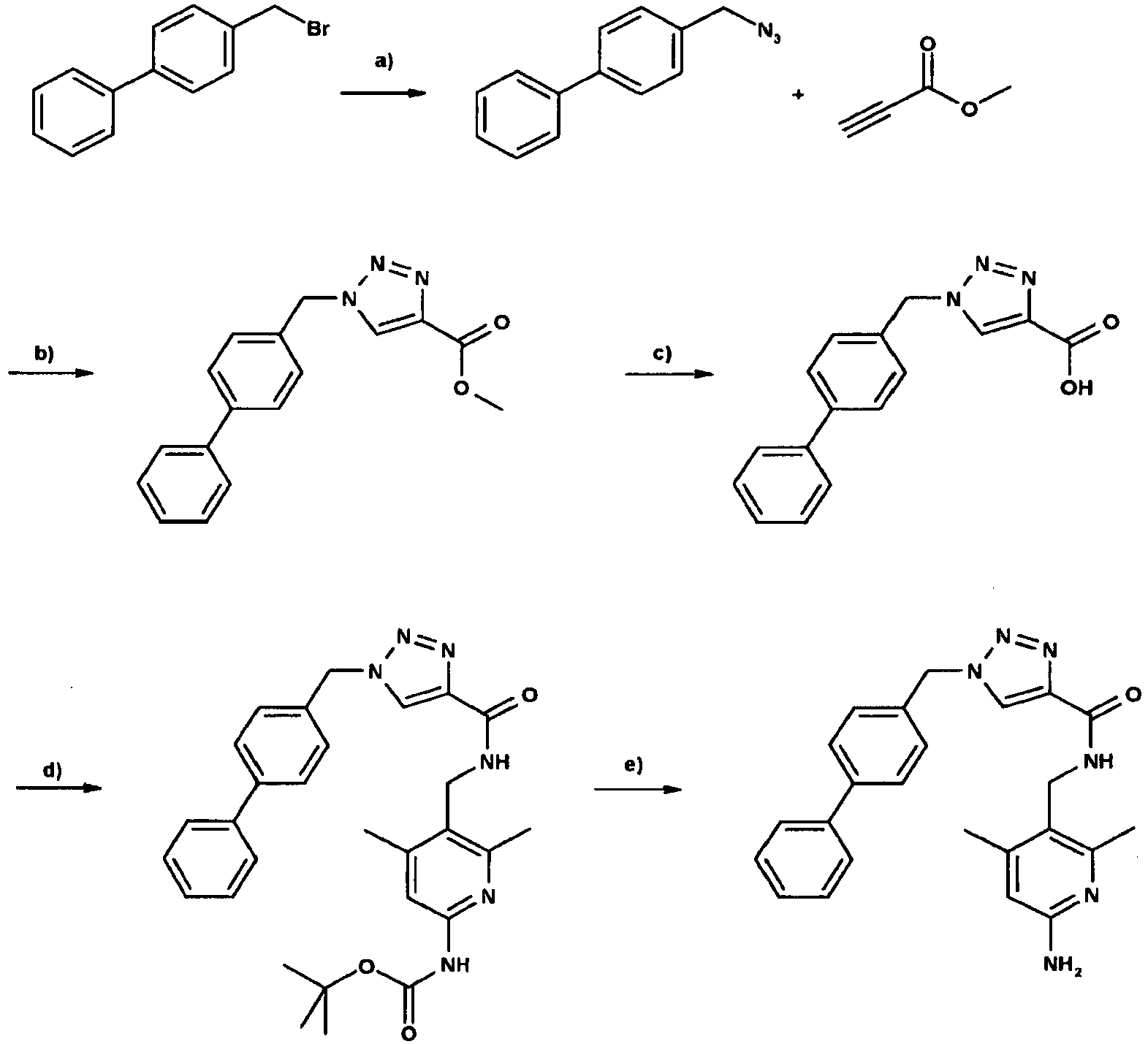
- A mixture of 4-(Bromomethyl)-biphenyl (200 mg, 0.6 mmol) and sodium azide (41 mg, 0.6 mmol) in 2 mL DMF was stirred at 90 °C for 1 h. The reaction mixture was concentrated in vacuo and the residue was treated with DCM and extracted with water. The organic layer was dried over MgSO4 and evaporated to give the title compound which was used in the next step without further purification. 1 H-NMR (CDCl3, 400 MHz) 7.62-7.66 (m, 4H), 7.39-7.50 (m, 5H), 4.42 (s, 2H).
- A mixture of 4-Azidomethyl-biphenyl (145 mg, 0.5 mmol), methyl propiolate (44 mg, 0.5 mmol), copper(II) sulfate (17 mg, 0.1 mmol) and sodium ascorbate (103 mg, 0.5 mmol) in 3 mL tBuOH and 1 mL water was stirred at room temperature for 3 h. Ethyl acetate was added and the mixture was extracted with water. The organic layer was dried over MgSO4 and evaporated in vacuo to give the title compound which was used in the next step without further purification. LCMS (method A) RtA = 1.964 min; [M+H]+ = 294.0.
- A mixture of 1-Biphenyl-4-ylmethyl-1H-[1,2,3]triazole-4-carboxylic acid methyl ester (60 mg, 0.2 mmol) and lithiumhydroxide-hydrate (35 mg, 0.8 mmol) in 4 mL MeOH and 2 mL water was stirred at 80 °C for 2 h. The mixture was evaporated in vacuo, extracted with hexane and the aq. layer was acidified with 1 N aq. HCl. After extraction with ethyl acetate, the organic layer was dried over MgSO4, and evaporated to yield the crude product which was used in the next step without further purification. 1 H-NMR (DMSO-d6, 400 MHz) 8.83 (s, 1H), 7.65-7.70 (m, 4H), 7.38-7.49 (m, 5H), 5.70 (s, 2H).
- A mixture of 1-Biphenyl-4-ylmethyl-1H-[1,2,3]triazole-4-carboxylic acid (26 mg, 0.09 mmol), (5-Aminomethyl-4,6-dimethyl-pyridin-2-yl)-carbamic acid tert-butyl ester (23 mg, 0.09 mmol), HATU (46 mg, 0.12 mmol) and DIPEA (0.07 mL, 0.37 mmol) in 2 mL DMF was stirred at room termperature for 1 h. The crude mixture was purified by preparative HPLC (Waters Sunfire
Prep C18 PBD 5 um, 30x100 mm, 5 to 100% ACN and 0.1% TFA, flow 40ml/min). LCMS (method A) RtA = 1.917 min; [M+H]+ = 513.1. - A mixture of (5-{[(1-Biphenyl-4-ylmethyl-1H-[1,2,3]triazole-4-carbonyl)-amino]-methyl}-4,6-dimethyl-pyridin-2-yl)-carbamic acid tert-butyl ester (27 mg, 0.053 mmol), 1 mL TFA and 2 mL DCM was stirred at room temperature for 2 h. The mixture was evaporated in vacuo to yield the final product (TFA salt). 1H-NMR (DMSO-d6, 400 MHz) 13.24 (bs, 1 H), 8.87 (t, 1H), 8.70 (s, 1H), 7.65-7.69 (m, 4H), 7.43-7.52 (m, 6H), 7.36-7.40 (t, 1H), 6.62 (s, 1H), 5.70 (s, 2H), 4.43 (d, 2H), 2.52 (s, 3H), 2.40 (s, 3H); LCMS (method A) RtA = 1.317 min; [M+H]+ = 413.0.
-

- A mixture of ethyl 1H-pyrazole-4-carboxylate (1.5 g, 10.7 mmol), yttrium (III) nitrate hexahydrate (82.0 mg, 0.214 mmol) and styrene oxide (1.21 ml, 10.7 mmol) was stirred at rt for 17 h, before it was adsorbed on celite. Purification by column chromatography (CombiFlash Companion, 12 g SiO2, heptane to EA) afforded the title compound. LCMS RtM = 1.72 min, [M+H]+ = 261.2.
- A mixture of ethyl 1-(2-hydroxy-1-phenylethyl)-1H-pyrazole-4-carboxylate (110 mg, 0.423 mmol) in EtOH (2 ml) was treated with NaOH (2N, 0.634 ml, 1.268 mmol) and heated to 90°C for 30 min. The reaction mixture was acidified with 1 N HCl, and all volatiles were removed in vacuo. The remaining residue was suspended in MeOH (10 ml) and filtered. Concentration of the filtrate afforded the title compound. LCMS RtM = 1.58 min, [M+H]+ = 233.2.
- The title compound was obtained starting from 1-(2-hydroxy-1-phenylethyl)-1H-pyrazole-4-carboxylic acid in analogy to Example 1. 1H-NMR (DMSO-d6, 400 MHz): 2.40 (s, 3H), 3.94 (dd, 1H), 4.18 (dd, 1H), 4.29 (d, 2H), 5.46 (dd, 1H), 6.64 (s, 1 H), 7.24-7.39 (m, 5H), 7.41-7.61 (m, 2H), 7.88 (s, 1H), 8.19 (t, 1H), 8.34 (s, 1 H), 13.25 (br, s, 1H). LCMS RtM = 1.39 min, [M+H]+ = 366.3.
-

- To a mixture of 1H-pyrrole-3-carboxylic acid (1.40 g, 12.60 mmol), tert-butyl 5-(aminomethyl)-4,6-dimethylpyridin-2-ylcarbamate (3.48 g, 13.86 mmol) and DIPEA (6.60 ml, 37.8 mmol) in DCM (100 ml) was added HBTU (5.73 g, 15.12 mmol) at rt and was stirred at rt for 12 hours. The suspension was filtered off. The solid was washed with DCM and dried under reduced pressure to afford pure tert-butyl 5-((1H-pyrrole-3-carboxamido)methyl)-4,6-dimethylpyridin-2-ylcarbamate. HPLC (Method G) Rt = 1.35 min; MS [M+H]+ = 345.2.
- To a mixture of (4,6-dimethyl-5-{[(1H-pyrrole-3-carbonyl)-amino]-methyl}-pyridin-2-yl)-carbamic acid tert-butyl ester (45 mg, 0.131 mmol) and 4-DMAP (6.38 mg, 0.052 mmol) in dry THF (0.8 ml) was added under argon atmosphere a 1.0 M solution of KOtBu in THF (0.196 ml, 0.196 mmol). The reaction mixture was stirred at rt for 20 min. 4-Methoxy-benzenesulfonyl chloride (32.4 mg, 0.157 mmol) was added in one portion and the mixture was stirred for an additional 17 h at rt. The reaction mixture was diluted with MeOH (1 ml) and H2O (1 ml) and the resulting solution was filtered over a PTFE membrane (0.45 um). The filtrate was purified by a preparative LC-MS system using a Waters SunfireTM C-18 OBD column [150 x 30 mm, 5um particle size] and elution at 50 ml/min using the following gradient: 0-1.5 min (90 % water containing 0.1% TFA / 10 % acetonitrile), 1.5-11.5 min (linear gradient from 90 % water containing 0.1% TFA / 10 % acetonitrile to 35 % water containing 0.1% TFA / 65 % acetonitrile), 11.5 - 12.5 min (linear gradient from 35 % water containing 0.1 % TFA / 65 % acetonitrile to 0 % water containing 0.1% TFA / 100 % acetonitrile), 12.5 - 13.5 min (0 % water containing 0.1% TFA / 100 % acetonitrile). Product collection was triggered by the MS signal and the resulting fractions were pooled and freeze-dried to yield a colorless powder. A 50% solution of TFA in DCM (1.0 ml) was added and the reaction mixture was stirred at rt for 2h. After evaporation to dryness, the residue was dissolved in a mixture of acetonitrile/water and freeze-dried to yield the title compound. 1H-NMR (DMSO, 400 MHz): 13.52 (br s, 1H), 8.26 (t, 1H), 7.96-7.92 (m, 2H), 7.87-7.86 (m, 1H), 7.68 (br s, 2H), 7.37 (t, 1 H), 7.19-7.16 (m, 2H), 6.67-6.66 (m, 1 H), 6.63 (s, 1 H), 4.26 (d, 2H), 3.85 (s, 3H), 2.50 (s, 3H), 2.37 (s, 3H); LCMS (Method T) RtT = 0.88 min; [M+H]+ = 414.8.
-

- A mixture of ethyl 1H-pyrazole-4-carboxylate (400 mg, 2.85 mmol), K2CO3 (1.97 g, 14.3 mmol) and 4-methoxybenzyl bromide (0.453 ml, 3.14 mmol) in dry acetone (10 ml) was heated to 50°C for 3 h. The reaction mixture was filtered, and the filtrate was concentrated. EtOH (10 mL) and KOH (320 mg, 5.71 mmol) were added and the mixture was heated to 65°C for 6 h, before it was concentrated again. The crude product was dissolved in water (5 ml), washed with EA (2x10 ml) and acidified with 1N HCl. The resulting precipitate was collected by filtration, washed with water and dried in vacuo affording the title compound. LCMS RtL = 0.86 min, [M+H]+ = 233.2.
- To a mixture of tert-butyl 5-(aminomethyl)-4,6-dimethylpyridin-2-ylcarbamate (80.0 mg, 0.318 mmol) in DCM (3 ml) were added HOAt (87.0 mg, 0.637 mmol), collidine (0.127 ml, 0.955 mmol), 1-(4-methoxybenzyl)-1H-pyrazole-4-carboxylic acid (73.9 mg, 0.318 mmol) and HATU (81.0 mg, 0.212 mmol). After stirring for 2 h at rt, all volatiles were removed in vacuo. The crude intermediate was purified by column chromatography (CombiFlash Companion, 12 g SiO2, TBME to TBME + 10% MeOH), dissolved in DCM (3 ml) and TFA (1 ml), kept for 14 h at rt, and concentrated. Purification by column chromatography (CombiFlash Rf, 13 g RediSep Rf C18, MeCN:water 5:95 + 0.1% TFA to MeCN) afforded the title compound as. 1H-NMR (DMSO-d6, 400 MHz): 2.37 (s, 3H), 3.73 (s, 3H), 4.27 (d, 2H), 5.24 (s, 1H), 6.64 (s, 1 H), 6.91 (d, 2H), 7.23 (d, 2H), 7.70 (br, s, 2H), 7.84 (s, 1H), 8.14-8.19 (m, 2H), 13.59 (s, 1H). LCMS RtK = 0.71 min, [M+H]+ = 366.4.
-

- To a mixture of sodium 6-amino-3-cyano-2-methylpyridin-4-olate (500 mg, 2.92 mmol, prepared in analogy to
WO2001062233A2 and isolated as sodium salt), and K2CO3 (808 mg, 5.84 mmol) in DMF (1 ml) was added Mel (0.200 ml, 3.21 mmol), and the reaction mixture was stirred at rt for 9 d. Saturated NaHCO3 (50 ml) was added and the mixture was extracted with EA (4x20 ml). The combined organic extracts were diluted with additional DCM and MeOH until homogeneous, dried over Na2SO4, filtered and concentrated. The crude product was recrystallized from refluxing MeOH-DCM to afford the title compound. 1H-NMR (DMSO-d6, 400 MHz): 2.34 (s, 3H), 3.82 (s, 3H), 5.91 (s, 1 H), 6.83 (br, s, 2H); LCMS RtM = 1.11 min, [M+H]+ = 164.2. - A mixture of 6-amino-4-methoxy-2-methylnicotinonitrile (100 mg, 0.613 mmol) in THF (4 ml) was cooled to -78°C, and treated with DIBAL-H (1M in THF, 3.68 ml, 3.68 mmol). The mixture was slowly warmed to rt. Stirring was continued for 24 h at rt, before the reaction mixture was carefully transferred to an ice-cold mixture of MeOH (50 ml) and water (0.2 ml, 11.0 mmol). The resulting suspension was adsorbed on celite (ca. 30 cm3) and dried in vacuo. Elution with DCM-MeOH (9:1, 200 ml) and removal of all volatiles afforded a yellow oil. Dry THF (5 ml), 1-benzyl-1H-pyrazole-4-carboxylic acid (79.0 mg, 0.389 mmol, prepared in analogy to example 13), DIPEA (0.209 ml, 1.20 mmol), DMAP (1.8 mg, 0.015 mmol) and HATU (148 mg, 0.389 mmol) were added, and the reaction mixture was stirred at rt for 14 h, before it was concentrated to dryness. The crude product was purified by column chromatography (CombiFlash Rf, 13 g RediSep Rf C18, MeCN:water 5:95 + 0.1% TFA to MeCN), followed by preparative HPLC (Waters Sunfire
Prep C18 OBD 5 um, 100x30 mm, A: H2O+0.1% TFA, B: MeCN + 0.1% TFA, 5-35% B in 15 min, 30 ml/min, rt) to afford the title compound. 1H-NMR (DMSO-d6, 400 MHz): 2.47 (s, 3H), 3.91 (s, 3 H), 4.22 (d, 2H), 5.33 (s, 2H), 6.26 (s, 1 H), 7.22-7.27 (m, 2H), 7.28-7.38 (m, 3H), 7.53 (br, s, 2H), 7.86 (s, 1 H), 8.09 (t, 1 H), 8.23 (s, 1 H), 12.95 (s, 1 H); LCMS RtK = 0.82 min, [M+H]+ = 352.4. -

- To a mixture of sodium 6-amino-3-cyano-2-methylpyridin-4-olate (300 mg, 1.75 mmol) and K2CO3 (485 mg, 3.51 mmol) in DMF (6 ml) was added Cyclohexenylbromide (0.213 ml, 1.84 mmol) and the reaction mixture was stirred at rt for 14 h. NaHCO3 (100 ml) was added and the mixture was extracted with EA (5x30 ml). The combined organic extracts were dried over Na2SO4, filtered and concentrated. The resulting prodcut was dissolved in n-PrOH (10 ml), and hydrogenated (1 atm H2, rt) for 1 h over Pd/C (93 mg, 0.088 mmol). The reaction mixture was filtered and the filtrate was adsorbed on celite. Purification by column chromatography (CombiFlash Companion, 10 g SiO2, DCM to DCM:MeOH 9:1) afforded the desired product. LCMS RtM = 1.63 min, [M+H]+ = 232.6.
- To a mixture of 6-Amino-4-(cyclohexyloxy)-2-methylnicotinonitrile (30.0 mg, 0.130 mmol) in EtOH (5 ml) were added about 10 cm3 of a Raney-Ni suspension in MeOH under Ar. The flask was sealed, and the suspension was vigorously stirred at rt for 3 d under an atmosphere of hydrogen. The reaction mixture was filtered over a plug of cellite and eluted with DCM-MeOH (9:1, 100 ml), DCM (50 ml), MeOH (50 ml) and NH3 in MeOH (7N, 50 ml). The combined filtrates were concentrated. Dry THF (5 ml), 1-benzyl-1H-pyrazole-4-carboxylic acid (26.3 mg, 0.130 mmol, prepared in analogy to example 13), DIPEA (0.091 ml, 0.520 mmol), DMAP (0.80 mg, 0.0065 mmol) and HATU (49.4 mg, 0.130 mmol) were added, and the reaction mixture was stirred at rt for 10 h, before it was concentrated to dryness. The crude product was purified by column chromatography (CombiFlash Companion, 4 g SiO2, DCM to DCM:MeOH 9:1), followed by preparative HPLC (Waters Sunfire
Prep C18 OBD 5 um, 100x19 mm, A: H2O+0.1% TFA, B: MeCN + 0.1% TFA, 15-45% B in 10 min, 30 ml/min, rt) affording the title compound. 1H-NMR (DMSO-d6, 400 MHz): 1.15-1.27 (m, 1H), 1.27-1.38 (m, 2 H), 1.40-1.50 (m, 1H), 1.51-1.62 (m, 2H), 1.62-1.72 (m, 2H), 1.77-1.88 (m, 2 H), 2.44 (s, 3H), 4.24 (d, 2H), 4.47 (mc, 1H), 5.34 (s, 2H), 6.29 (s, 1H), 7.19-7.25 (m, 2H), 7.27-7.41 (m, 5H), 7.84 (s, 1H), 7.92 (t, 1H), 8.21 (s, 1 H), 12.81 (s, 1 H); LCMS RtK = 1.11 min, [M+H]+ = 420.4. -

- A mixture of (4-Chloromethyl-phenyl)-methanol (600 mg, 3.8 mmol), ethyl 1 H-pyrazole-4-carboxylate (537 mg, 3.8 mmol) and potassium carbonate (2.6 g, 19 mmol) in 30 mL acetone was stirred at 50 °C for 3 h. The mixture was filtrated and concentrated in vacuo. The crude was purified by preparative HPLC (Waters Sunfire
Prep C18 PBD 5 um, 30x100 mm, 5 to 100% ACN and 0.1% TFA, flow 40ml/min) to yield the title compound. LCMS (method A) RtA = 1.403 min; [M+H]+ = 261.0. - A mixture of 1-(4-Hydroxymethyl-benzyl)-1H-pyrazole-4-carboxylic acid ethyl ester (500 mg, 1.4 mmol), tert-Butyl-chloro-dimethyl-silane (261 mg, 1.7 mmol) and imidazole (245 mg, 3.6 mmol) in 5 mL DMF was stirred at RT for 6 h. The reaction mixture was evaporated in vacuo, the crude was dissolved in ethyl acetate and extracted with 1 N aq. HCl-solution and aq. NaHCO3 solution. The oganic layer was dried over MgSO4 and concentrated in vacuo to yield the title compound which was used in the next step without further purification. 1 H-NMR (DMSO-d6, 400 MHz) 8.45 (s, 1 H), 7.87 (s, 1H), 7.24-7.30 (m, 4H), 5.35 (s, 2H), 4.69 (s, 2H), 4.21 (q, 2H), 1.26 (t, 3H), 0.90 (s, 9H), 0.07 (s, 6H).
- A mixture of 1-[4-(tert-Butyl-dimethyl-silanyloxymethyl)-benzyl]-1H-pyrazole-4-carboxylic acid ethyl ester (630 mg, 1.4 mmol) and lithiumhydroxide-hydrate (119 mg, 2.8 mmol) in 20 mL MeOH and 10 mL water was stirred at RT for 32 h. The mixture was evaporated in vacuo and the aq. layer was acidified with 1 N aq. HCl. After extraction with ethyl acetate, the organic layer was dried over MgSO4 and evaporated to yield the crude product which was used in the next step without further purification. 1 H-NMR (DMSO-d6, 400 MHz) 12.3 (bs, 1 H), 8.36 (s, 1 H), 7.81 (s, 1 H), 7.23-7.31 (s, 4H), 5.34 (s, 2H), 5.18 (t, 1H), 4.47 (s, 2H).
- A mixture of 1-(4-Hydroxymethyl-benzyl)-1 H-pyrazole-4-carboxylic acid (220 mg, 0.95 mmol), (5-Aminomethyl-4,6-dimethyl-pyridin-2-yl)-carbamic acid tert-butyl ester (238 mg, 0.95 mmol), HATU (7206 mg, 1.90 mmol) and DIPEA (0.64 mL, 2.84 mmol) in 5 mL DMF was stirred at room temperature for 16 h. The reaction mixture was concentrated in vacuo, dissolved in ethylacetate and extracted with aq. NaHCO3-solution. The organic layer was dried over MgSO4 and evaporated. The crude product was purified by preparative HPLC (Waters Sunfire
Prep C18 PBD 5 um, 30x100 mm, 5 to 100% ACN and 0.1% TFA, flow 40ml/min). LCMS (method A) RtA = 1.243 min; [M+H]+ = 466.0. - A mixture of [5-({[1-(4-Hydroxymethyl-benzyl)-1H-pyrazole-4-carbonyl]-amino}-methyl)-4,6-dimethyl-pyridin-2-yl]-carbamic acid tert-butyl ester (50 mg, 0.11 mmol), 1 mL TFA and 2 mL DCM was stirred of room temperature for 2 h. The mixture was evaporated in vacuo and the residue was purified by preparative HPLC (Macherey-Nagel Nucleosil 250x40 mm, 5 to 100% ACN and 0.1 % TFA, flow 40ml/min). The product containing fractions were lyophilised, then dissolved in 1 mL MeOH and the resulting mixture was filtered over a MeOH flushed PL-HCO3 MP-resin column. The column was washed with MeOH, the solvent was removed and the product was dissolved in water/ACN and lyophilised to yield the title compound. 1 H-NMR (DMSO-d6, 400 MHz) 8.24 (s, 1 H), 7.93 (t, 1 H), 7.88 (s, 1 H), 7.28-7.30 (s, 2H), 7.21-7.23 (s, 2H), 6.15 (s, 1H), 5.78 (bs, 2H), 5.30 (s, 2H), 5.18 (t, 1H), 4.47 (d, 2H), 4.27 (d, 2H), 2.30 (s, 3H), 2.17 (s, 3H); LCMS (method A) RtA = 0.128 min; [M+H]+ = 366.1.
-

- A mixture of [5-({[1-(4-Hydroxymethyl-benzyl)-1H-pyrazole-4-carbonyl]-amino}-methyl)-4,6-dimethyl-pyridin-2-yl]-carbamic acid tert-butyl ester (100 mg, 0.2 mmol, for preparation see step D, example 16), trimethylsilyl chloride (47 mg, 0.4 mmol) and DMSO (4 mg, 0.06 mmol) was stirred at RT for 10 min. Aq. NaHCO3-solution was added and the mixture was extracted with ethyl acetate. The organic layer was dried over MgSO4 and concentrated in vacuo to yield the title compound which was used in the next step without further purification. LCMS (method A) RtA = 1.598 min; [M+H]+ = 484.0.
- A mixture of [5-({[1-(4-Chloromethyl-benzyl)-1H-pyrazole-4-carbonyl]-amino}-methyl)-4,6-dimethyl-pyridin-2-yl]-carbamic acid tert-butyl ester (67 mg, 0.1 mmol), succinimide (12 mg, 0.1 mmol) and potassium carbonate (84 mg, 0.6 mmol) in 50 mL acetone was stirred at 80 °C for 24 h. The mixture was filtrated and concentrated in vacuo. The crude was purified by preparative HPLC (Waters Sunfire
Prep C18 PBD 5 um, 30x100 mm, 5 to 100% ACN and 0.1% TFA, flow 40ml/min) to yield the title compound. LCMS (method A) RtA = 1.339 min; [M+H]+ = 547.2. - A mixture of {5-[({1-[4-(2,5-Dioxo-pyrrolidin-1-ylmethyl)-benzyl]-1H-pyrazole-4-carbonyl}-amino)-methyl]-4,6-dimethyl-pyridin-2-yl}-carbamic acid tert-butyl ester (48 mg, 0.08 mmol), 1mL TFA and 2 mL DCM was stirred of room temperature for 2 h. The mixture was evaporated in vacuo and the residue was purified by preparative HPLC (Macherey-Nagel Nucleosil 250x40 mm, 5 to 100% ACN and 0.1% TFA, flow 40ml/min). The product containing fractions were lyophilised, then dissolved in 1 mL MeOH and the resulting mixture was filtered over a MeOH flushed PL-HCO3 MP-resin column. The column was washed with MeOH, the solvent was removed and the product was dissolved in water/ACN and lyophilised to yield the title compound. 1 H-NMR (DMSO-d6, 400 MHz) 88.25 (s, 1H), 7.91 (t, 1H), 7.87 (s, 1H), 7.24 (d, 2H), 7.20 (d, 2H), 6.13 (s, 1H), 5.70 (bs, 2H), 5.28 (s, 2H), 4.52 (d, 2H), 2.67 (s, 4H), 2.29 (s, 3H), 2.15 (s, 3H); LCMS (method A) RtA = 0.439 min; [M+H]+ = 447.1.
-

- To a mixture of ethyl 1H-pyrazole-4-carboxylate (350 mg, 2.50 mmol) in dry DMF (2 ml) were added NaH (60% in mineral oil, 400 mg, 10.0 mmol) and 4-(bromomethyl)-pyridine hydrobromide (632 mg, 2.50 mmol) at 0°C. The resulting suspension was stirred for 14 h while slowly warming to rt, before it was transferred to a sat. solution of NaHCO3 (50 mL) and extracted with EA (4x20 ml). The combined organic extracts were dried over Na2SO4, filtered and concentrated. Purification by column chromatography (CombiFlash Companion, 4 g SiO2, heptane to EA + 5% NEt3) afforded the intermediate ester, which was dissolved in EtOH (5 ml) and NaOH (1N, 5.00 ml), and heated to reflux for 20 min. The reaction mixture was neutralized with 1 N HCl, and concentrated to dryness to yield the crude product which was used in the next step without any further purification. LCMS RtM = 0.19 min, [M+H]+ = 204.1.
- The title compound was obtained as a colorless solid starting from crude 1-(pyridin-4-ylmethyl)-1H-pyrazole-4-carboxylic acid in analogy to Example 13. 1H-NMR (DMSO-d6, 400 MHz): 2.40 (s, 3H), 4.29 (d, 2H), 5.50 (s, 2H), 6.65 (s, 1H), 7.27 (d, 2H), 7.57 (br, s, 2H), 7.94 (s, 1H), 8.25 (t, 1H), 8.33 (s, 1H), 8.61 (d, 2H), 13.32 (br, s, 1H). LCMS RtM = 1.12 min, [M+H]+ = 337.3.
-

- sodium 6-amino-3-cyano-2-methylpyridin-4-olate (600 mg, 3.51 mmol) and Cs2CO3 (1714 mg, 5.26 mmol) were suspend in DMSO (10 ml), then methyl 2-bromoacetate (1.328 ml, 14.02 mmol) was slowly added at RT. The suspension was stirring at 50°C during 5 h. Water/brine were added and the reaction mixture was extracted with EA, dried and evaporated to afford the crude product. Purification by flash chromatography (AcOEt, then DCM :MeOH: NH4OH 9:1:0.05) afforded the title compound. LCMS (method F) RtF = 0.35 min; [M+H]+ = 222.2.
- Methyl 2-(6-amino-3-cyano-2-methylpyridin-4-yloxy)acetate (215 mg, 0.972 mmol) was dissolved in EtOH (16 ml), MeOH (8 ml) and HCl 1M (5 ml), then Palladium on carbon (310 mg, 0.292 mmol) was added and the reaction mixture was stirred at rt under H2 pressure during 48h. After filtration over celite, washing with MeOH and evaporation of the solvent, the title compound was obtained. MS (Method D): [M+H]+ 226.0 / 451.2.
- Methyl 2-(6-amino-3-(aminomethyl)-2-methylpyridin-4-yloxy)acetate (271 mg, 0.909 mmol), 1-benzyl-1H-pyrazole-4-carboxylic acid (synthesis description below) (184 mg, 0.909 mmol) and DIPEA (0.794 ml, 4.54 mmol) were dissolved in DMF (2 ml), then HATU (518 mg, 1.363 mmol) was added and the reaction mixture was stirred over night at rt. Purification by prep HPLC (Sun-Fire C18,
100X30mm 5 to 100% ACN and 0.1% TFA, flow 40mml/min.) offered the titled compound after lyophilisation. HPLC (Method C) Rtc = 2.789 min, MS (Method D): [M+H]+ = 410.0. - Methyl 2-(6-amino-3-((1-benzyl-1 H-pyrazole-4-carboxamido)methyl)-2-methylpyridin-4-yloxy)acetate (28 mg, 0.051 mmol) was dissolved in THF, EtOH, H2O 2:1:1 (5 ml), then LiOH (4.31 mg, 0.103 mmol) was added and the reaction mixture was stirred at rt over night. After adjusting the pH to 4, the reaction mixture was evaporated, co-evaporated with Toluene (4 times) then dried under HV to get the title compound which was used for the next step without further purification. HPLC/MS (Method B) Rtb = 0.43 min, MS [M+H]+ = 396.3.
- 2-(6-amino-3-((1-benzyl-1 H-pyrazole-4-carboxamido)methyl)-2-methylpyridin-4-yloxy)acetic acid (35 mg, 0.051 mmol) was dissolved in DMF (1 ml), CDI (16.65 mg, 0.103 mmol) was added. After stirring for 15min at rt Methylamin 2M in THF (0.257 ml, 0.513 mmol) was added and the reaction mixture was stirred 6 h at rt. Purification by prep HPLC (Nucleosil C18, 250x40mm 5 to 100% ACN and 0.1% TFA, flow 40mml/min.) offered the title compound. 1H-NMR (DMSO-d6, 400 MHz): 2.71 (d, 3H), 4.37 (d, 2H), 4.67 (s, 2H), 5.34 (s, 2H), 6.20 (s, 1 H), 7.24 (m, 5H), 7.79 (s, 2H), 7.89 (s, 1H), 8.25 (d, 2H), 8.28 (s, 1H), 8.35 (t, 1H). HPLC/MS (Method B) Rtb = 0.46 min, MS [M+H]+ = 409.4.
-

- Bromomethyl-benzene (610 mg, 3.57 mmol) was suspended in Acetone (25 ml), ethyl 1 H-pyrazole-4-carboxylate (500 mg, 3.57 mmol) and K2CO3 (2465 mg, 17.84 mmol) were added. The suspension was stirred 16 h at 50°C. The reaction mixture was filtrated and evaporated in vacuum to give the title compound which was used for the next step without further purification. HPLC/MS (Method A) RtA = 1.82 min, MS [M+H]+ = 230.9.
- Ethyl 1-benzyl-1H-pyrazole-4-carboxylate (1.05 g, 3.56 mmol) was dissolved in MeOH (20 ml). Water (10 ml) and LiOH.H2O (0.299 g, 7.11 mmol) were added and the suspension was stirred for 3 h at rt. The reaction mixture was evaporated in vacuum to remove the MeOH. The water phase was washed with AcOEt, then treated with 1 N HCl until pH3, and extracted with AcOEt. The organic phase was dried over MgSO4 and evaporated in vacuum to give the title compound which was used in the next step without any further purification. HPLC/MS (Method A) RtA = 1.3 min, MS [M+H]+ = 203.1.
-

- To a suspension of 6-amino-2,4-dimethylnicotinonitrile (7.5 g, 48.4 mmol, prepared according to Synlett 2007, 19, 2979) and DMAP (0.591 g, 4.84 mmol) in THF (150 ml) was added Boc2O (20.23 ml, 87 mmol). The resulting mixture was stirred over night. The reaction mixture was adsorbed / concentrated onto Isolute sorbent and purified by chromatography (120 g silica, cHex/EA 100-70 % cHex 30 min) to afford the desired mixture of double- and mono-protected product. The intermediate was dissolved in MeOH (175 ml) and DCM (56 ml) and cooled to 0°C. NaOH (72.6 ml, 72.6 mmol) and H2O2 (7.42 ml, 72.6 mmol) were added. Additional MeOH (ca. 15 mL) was added until the emulsion was cleared again and the reaction was stirred at that temperature for 90 min. The reaction mixture was quenched into 2N Na2SO3 (250 mL), and DCM and MeOH were slowly removed under vacuum (bath temp < 50°C). The remaining mixture was transferred into a separation funnel, diluted with additional water and extracted with DCM (6x150 mL). Drying over Na2SO4, filtration and evaporation afforded the title compound. HPLC/MS (Method F): RtF = 1.59 min, [M+H]+ = 248.3.
- tert-butyl 5-cyano-4,6-dimethylpyridin-2-ylcarbamate (8 g) was hydrogenated by means of raney-nickel (18.9 g) in MeOH / NH3 aq. 10%(100 ml). The reaction mixture was filtered through hyflo, washed with MeOH and evaporated under reduced pressure. The crude was solved in EA (100 ml) and heptane 80 (ml) was added. The solution was partly evaporated to a volume of approx. 80 ml. The precipitated solid was filtrated to afford the title compound. HPLC/MS (Method F) : RtF = 0.82 min, [M+H]+ = 252.3.
- To a solution of 2-(phenylamino)oxazole-4-carboxylic acid (90 mg, 0.432 mmol), tert-butyl 5-(aminomethyl)-4,6-dimethylpyridin-2-ylcarbamate (130 mg, 0.518 mmol) and DIPEA (226 ul, 1.296 mmol) in DCM (4 ml) was added propylphosphonic anhydride solution (50% in EA, 390 ul, 0.662 mmol) at rt. The reaction mixture was stirred at RT. The reaction mixture was quenched with H2O and extracted twice with DCM. The combined organic phases were dried over Na2 SO4, filtered and evaporated under reduced pressure to afford a suspension. The solids were filtered off and washed with DCM / MeOH to afford the Boc-protected precursor of title product. This was dissolved in HCl (4 N in dioxane, 820 ul), and the mixture was stirred at RT for 4 hours. To the resulting suspension was added diethylether (2 ml). The etheric phase was separated and the remaining crystals were dried under reduced pressure at 50°C over night to afford the title product. 1H-NMR (CD3OD, 400 MHz): 7.94 (s, 1H), 7.62 (d, 2H), 7.32 (t, 2H), 7.02 (t, 1H), 6.72 (s, 1H), 4.53 (s, 2H), 2.63 (s, 3H), 2.51 (s, 3H), HPLC/MS (Method G): RtG = 1.38 min, MS [M+H]+ = 338.3.
- A solution of 1-phenylurea (2.0 g, 14.69 mmol) and ethyl 3-bromo-2-oxopropanoate (2.16 ml, 14.69 mmol) in DMF (58 ml) was heated at 60°C for 3 hours. The reaction mixture was allowed to cool to rt and quenched with water (300 ml) / Na2CO3-solution (50 ml). The product was extracted with EA (2 x). The combined organic phases were washed with brine, dried over Na2SO4, filtered and evaporated under reduced pressure to afford crude product. Purification by flash-chromatography (Silica gel 62 g, gradient: cyclohexane / EA (80 ml/min.) from 95/5 (5 min.) to 80/20 (25 min.)) afforded the title compound. HPLC (Method U): RtU = 1.91 min, MS (Method D) [M+H]+ = 233.1.
- A mixture of ethyl 2-(phenylamino)oxazole-4-carboxylate (1.64 g, 6.94 mmol) and lithiumhydroxide (332 mg, 13.88 mmol) in THF (23 ml) / water (11.5 ml) was stirred at rt for 4 hours. The reaction mixture was acidified with 2 N HCl and extracted with EA (2 x). The combined organic phases were dried over Na2SO4, filtered and evaporated under reduced pressure to afford the title product. HPLC/MS (Method G) : RtG = 1.41 min, MS (Method D) [M+H]+ = 204.9.
-

- The title compound was prepared in analogy to example 4, Step c) starting from 1-benzyl-1H-1,2,3-triazole-4-carboxylic acid (Tetrahedron Letters, 2010, 51(28), 3691). HPLC/MS (Method A) Rt = 0.807 min; [M+H]+ = 337.0.
-

- The title compound was prepared in analogy to example 6. HPLC (Method B) Rt = 0.460 min; MS [M+H]+ = 336.4.
-

- The title compound was prepared in analogy to example 6. HPLC (Method A) Rt = 1.306 min; MS [M+H]+ = 428.0.
-

- The title compound was prepared in analogy to example 6. HPLC (Method A) Rt = 0.933 min; MS [M+H]+ = 402.1.
-

- The title compound was prepared in analogy to example 13. HPLC (Method A) Rt = 1.099 min; MS [M+H]+ = 434.0.
-

- The title compound was prepared in analogy to example 13. HPLC (Method A) Rt = 1.173 min; MS [M+H]+ = 433.0.
-
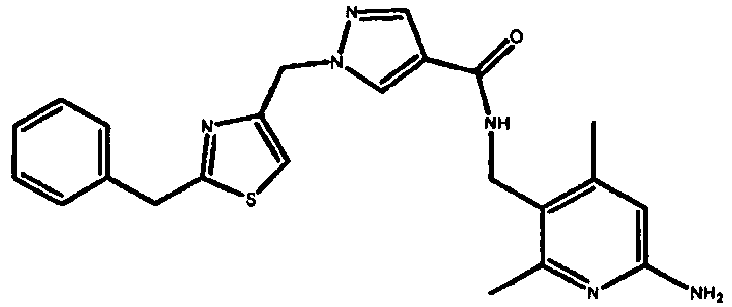
- The title compound was prepared in analogy to example 13. HPLC (Method A) Rt = 1.137 min; MS [M+H]+ = 433.0.
-

- The title compound was prepared in analogy to example 13. HPLC (Method A) Rt = 1.101 min; MS [M+H]+ = 399.1.
-

- The title compound was prepared in analogy to example 13. HPLC (Method C) Rt = 2.338 min; MS (Method D) [M+H]+ = 428.3.
-

- The title compound was prepared in analogy to example 13. HPLC (Method C) Rt = 0.646 min; MS (Method D) [M+H]+ = 376.3.
-

- The title compound was prepared in analogy to example 9. HPLC (Method A) Rt = 1.107 min; MS [M+H]+ = 376.0.
-

- The title compound was prepared in analogy to example 13. HPLC (Method A) Rt = 1.041 min; MS [M+H]+ = 403.0.
-

- The title compound was prepared in analogy to example 9, Steps c) - f). HPLC (Method A) Rt = 0.108 min; MS [M+H]+ = 376.0.
-

- The title compound was prepared in analogy to example 9, Steps c) - f). HPLC (Method A) Rt = 0.103 min; MS [M+H]+ = 389.0.
-

- The title compound was prepared in analogy to example 13. HPLC (Method A) Rt = 1.062 min; MS [M+H]+ = 403.0.
-

- The title compound was prepared in analogy to example 9, step c. (Method A) Rt = 1.902 min; MS [M+H]+ = 279.0.
- The title compound was prepared in analogy to example 147, step f. (Method A) Rt = 1.741 min; MS [M+H]+ = 339.1.
- The title compound was prepared in analogy to example 16, step c. (Method A) Rt = 1.341 min; MS [M+H]+ = 311.0.
- The title compound was prepared in analogy to example 16, step d. (Method A) Rt = 1.511 min; MS [M+H]+ = 544.2.
- The title compound was prepared in analogy to example 16, step e. HPLC (Method A) Rt = 1.001 min; MS [M+H]+ = 444.1.
-

- The title compound was prepared in analogy to example 12. HPLC (Method B) Rt = 0.520 min; MS [M+H]+ = 411.4.
-

- The title compound was prepared in analogy to example 10. HPLC (Method A) Rt = 1.327 min; MS [M+H]+ = 429.1.
-

- The title compound was prepared in analogy to example 10. HPLC (Method A) Rt = 1.163 min; MS [M+H]+ = 387.1.
-

- The title compound was prepared in analogy to example 10. HPLC (Method A) Rt = 1.190 min; MS [M+H]+ = 387.1.
-

- The title compound was prepared in analogy to example 10. HPLC (Method A) Rt = 0.977 min; MS [M+H]+ = 403.0.
-

- The title compound was prepared in analogy to example 10. HPLC (Method A) Rt = 1.003 min; MS [M+H]+ = 403.0.
-

- The title compound was prepared in analogy to example 10. HPLC (Method E) Rt = 3.450min; MS (Method D) [M+H]+ = 406.2.
-
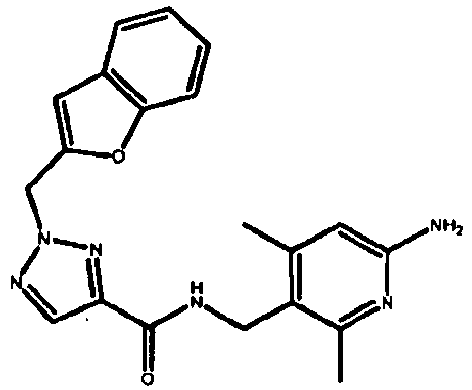
- The title compound was prepared in analogy to example 9, Steps c) - f). HPLC (Method A) Rt = 1.156min; MS [M+H]+ = 377.0.
-

- The title compound was prepared in analogy to example 10. HPLC (Method C) Rt = 2.337 min; MS (Method D) [M+H]+ = 417.0.
-

- The title compound was prepared in analogy to example 10. HPLC (Method C) Rt = 2.369 min; MS (Method D) [M+H]+ = 417.1.
-

- The title compound was prepared in analogy to example 1, Step d). HPLC (Method A) Rt = 1.142 min; MS [M+H]+ = 353.0.
-

- The title compound was prepared in analogy to example 1, Step d). HPLC (Method S) Rt = 1.64 min; MS [M+H]+ = 338.6.
-

- The title compound was prepared in analogy to example 1, Step d). HPLC (Method S) Rt = 1.53 min; MS [M+H]+ = 350.6.
-

- The title compound was prepared in analogy to example 1, Step d). HPLC (Method R) Rt = 0.94min; MS [M+H]+ = 353.8.
-

- The title compound was prepared in analogy to example 1, Step d). HPLC (Method S) Rt = 1.74 min; MS [M+H]+ = 377.5.
-

- The title compound was prepared in analogy to example 1, Step d). HPLC (Method R) Rt = 0.60 min; MS [M+H]+ = 394.7.
-

- The title compound was prepared in analogy to example 1, Step d). HPLC (Method R) Rt = 0.81 min; MS [M+H]+ = 373.7.
-

- The title compound was prepared in analogy to example 1, Step d). HPLC (Method R) Rt = 0.75 min; MS [M+H]+ = 362.7.
-

- The title compound was prepared in analogy to example 1, Step d). HPLC (Method S) Rt = 1.61 min; MS [M+H]+ = 367.7.
-

- The title compound was prepared in analogy to example 13. HPLC (Method G) Rt = 1.19 min; MS [M+H]+ = 337.2.
-
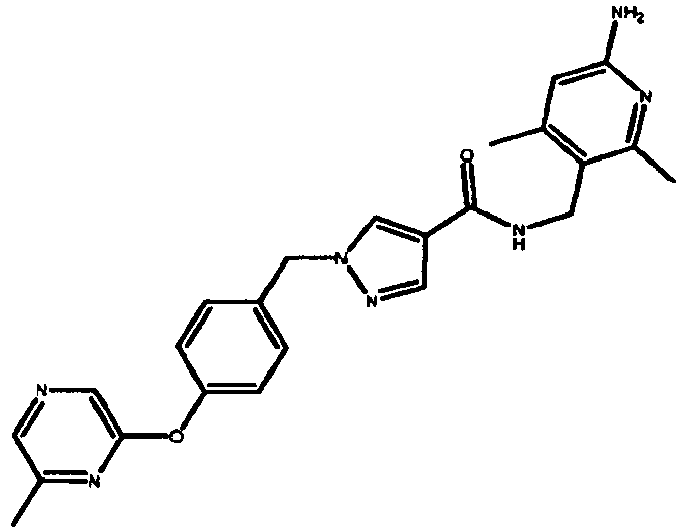
- The title compound was prepared in analogy to example 13. HPLC (Method G) Rt = 1.409min; MS [M+H]+ = 444.5.
-

- The title compound was prepared in analogy to example 8. HPLC (Method G) Rt = 1.40 min; MS [M+H]+ = 337.3.
-

- The title compound was prepared in analogy to example 9, Steps c) - f). HPLC (Method J) Rt = 2.61 min; MS [M+H]+ = 418.5.
-

- The title compound was prepared in analogy to example 15. HPLC (Method G) Rt = 1.37min; MS [M+H]+ = 396.3.
-

- The title compound was prepared in analogy to example 13. HPLC (Method G) Rt = 1.62 min; MS [M+H]+ = 413.5.
-

- The title compound was prepared in analogy to example 13. HPLC (Method G) Rt = 1.47 min; MS [M+H]+ = 387.4.
-

- The title compound was prepared in analogy to example 13. HPLC (Method G) Rt = 1.63 min; MS [M+H]+ = 429.4.
-

- The title compound was prepared in analogy to example 13. HPLC (Method G) Rt = 1.50 min; MS [M+H]+ = 387.4.
-

- The title compound was prepared in analogy to example 13. HPLC (Method H) Rt = 2.53 min; MS [M+H]+ = 419.
-

- The title compound was prepared in analogy to example 13. HPLC (Method G) Rt = 1.31 min; MS [M+H]+ = 403.4.
-

- The title compound was prepared in analogy to example 13. HPLC (Method G) Rt = 1.31 min; MS [M+H]+ = 403.4.
-

- The title compound was prepared in analogy to example 9, Steps c) - f). HPLC (Method G) Rt = 1.22 min; MS [M+H]+ = 406.5.
-

- The title compound was prepared in analogy to example 9, Steps c) - f). HPLC (Method H) Rt = 2.26 min; MS [M+H]+ = 422.
-

- The title compound was prepared in analogy to example 13. HPLC (Method G) Rt = 1.44 min; MS [M+H]+ = 335.3.
-

- The title compound was prepared in analogy to example 9, Steps c) - f). HPLC (Method H) Rt = 2.75 min; MS [M+H]+ = 394.
-

- The title compound was prepared in analogy to example 12. HPLC (Method G) Rt = 1.61 min; MS [M+H]+ = 413.0.
-

- The title compound was prepared in analogy to example 13. HPLC (Method H) Rt = 2.78 min; MS [M+H]+ = 396.
-

- The title compound was prepared in analogy to example 12. HPLC (Method G) Rt = 1.62 min; MS [M+H]+ = 399.0.
-
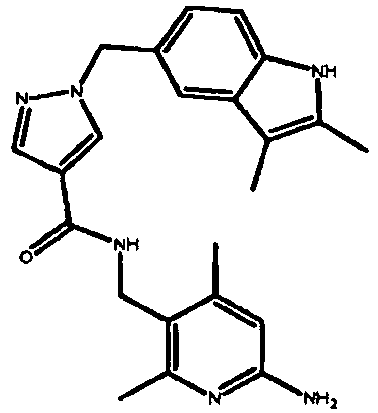
- The title compound was prepared in analogy to example 9, Steps c) - f). HPLC (Method B) Rt = 0.57 min; MS [M+H]+ = 403.
-
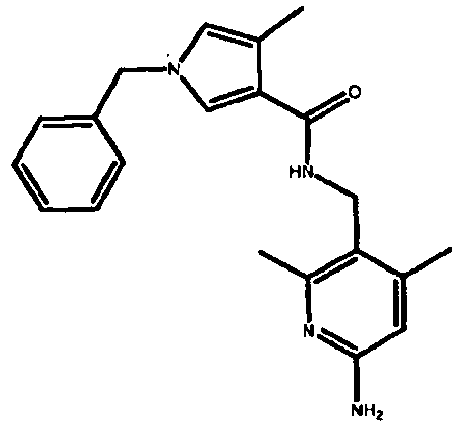
- The title compound was prepared in analogy to example 13. HPLC (Method H) Rt = 3.03 min; MS [M+H]+ = 349.
-

- The title compound was prepared in analogy to example 19. HPLC (Method H) Rt = 2.60 min; MS [M+H]+ = 395.2.
-

- The title compound was prepared in analogy to example 20. HPLC (Method B) RtB = 0.49 min; MS [M+H]+ = 339.3.
-
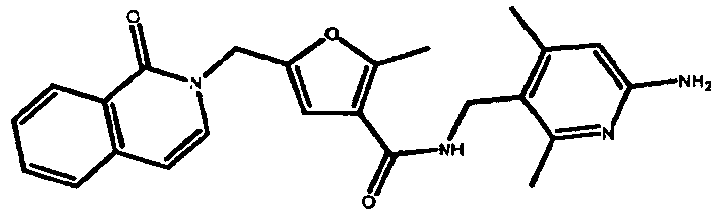
- The title compound was prepared in analogy to example 1. HPLC (Method L) Rt = 1.56 min; MS [M+H]+ = 417.4.
-

- The title compound was prepared in analogy to example 13. HPLC (Method K) Rt = 0.96 min; MS [M+H]+ = 420.3.
-

- The title compound was prepared in analogy to example 13. HPLC (Method K) Rt = 0.62 min; MS [M+H]+ = 361.2.
-

- The title compound was prepared in analogy to example 13. HPLC (Method K) Rt = 0.62 min; MS [M+H]+ = 361.2.
-

- The title compound was prepared in analogy to example 13. HPLC (Method K) Rt = 0.90 min; MS [M+H]+ = 386.4.
-

- The title compound was prepared in analogy to example 13. HPLC (Method K) Rt = 0.73 min; MS [M+H]+ = 354.4.
-

- The title compound was prepared in analogy to example 13. HPLC (Method M) Rt = 1.36 min; MS [M+H]+ = 322.3.
-

- The title compound was prepared in analogy to example 18. HPLC (Method M) Rt = 1.19 min; MS [M+H]+ = 351.3.
-

- The title compound was prepared in analogy to example 13. HPLC (Method Q) Rt = 4.89 min; MS [M+H]+ = 370.5.
-
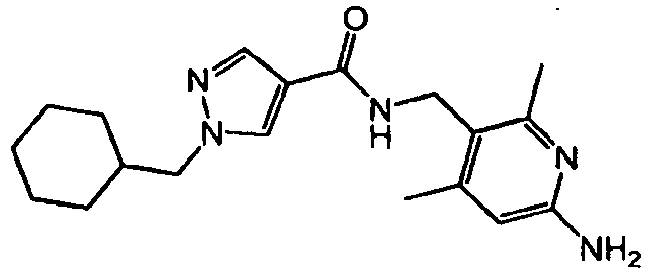
- The title compound was prepared in analogy to example 13. HPLC (Method Q) Rt = 4.89 min; MS [M+H]+ = 342.6.
-

- The title compound was prepared in analogy to example 13. HPLC (Method Q) Rt = 5.63 min; MS [M+H]+ = 442.6.
-

- The title compound was prepared in analogy to example 13. HPLC (Method Q) Rt = 4.71 min; MS [M+H]+ = 372.5.
-

- The title compound was prepared in analogy to example 13. HPLC (Method Q) Rt = 4.58 min; MS [M+H]+ = 418.5.
-

- The title compound was prepared in analogy to example 13. HPLC (Method Q) Rt = 4.89min; MS [M+H]+ = 370.5.
-

- The title compound was prepared in analogy to example 13. HPLC (Method Q) Rt = 4.66 min; MS [M+H]+ = 372.5.
-

- The title compound was prepared in analogy to example 13. HPLC (Method Q) Rt = 5.64 min; MS [M+H]+ = 442.6.
-

- The title compound was prepared in analogy to example 13. HPLC (Method Q) Rt = 4.49 min; MS [M+H]+ = 408.6.
-

- The title compound was prepared in analogy to example 13. HPLC (Method Q) Rt = 4.89 min; MS [M+H]+ = 370.5.
-

- The title compound was prepared in analogy to example 13. HPLC (Method K) Rt = 0.60 min; MS [M+H]+ = 357.3.
-

- The title compound was prepared in analogy to example 18. HPLC (Method Q) Rt = 2.85 min; MS [M+H]+ = 337.5.
-

- The title compound was prepared in analogy to example 13. HPLC (Method N) Rt = 1.25 min; MS [M+H]+ = 367.6.
-

- The title compound was prepared in analogy to example 13. HPLC (Method N) Rt = 0.91 min; MS [M+H]+ = 350.3.
-

- The title compound was prepared in analogy to example 13. HPLC (Method P) Rt = 1.95 min; MS [M+H]+ = 391.4.
-

- The title compound was prepared in analogy to example 13. HPLC (Method P) Rt = 1.58 min; MS [M+H]+ = 379.6.
-

- The title compound was prepared in analogy to example 13. HPLC (Method O) Rt = 0.85 min; MS [M+H]+ = 380.7.
-
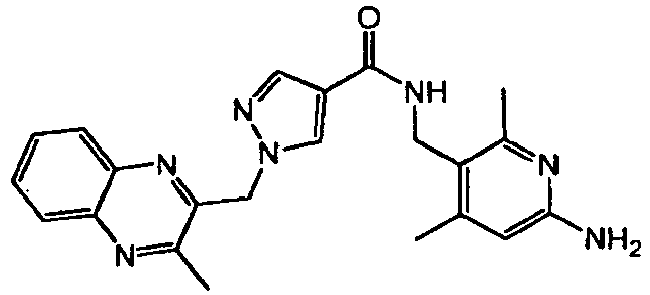
- The title compound was prepared in analogy to example 13. HPLC (Method O) Rt = 0.82 min; MS [M+H]+ = 402.7.
-

- The title compound was prepared in analogy to example 13. HPLC (Method M) Rt = 1.45 min; MS [M+H]+ = 393.2.
-

- The title compound was prepared in analogy to example 13. HPLC (Method M) Rt = 1.45 min; MS [M+H]+ = 377.2.
-

- The title compound was prepared in analogy to example 1, Step d). HPLC (Method R) Rt = 1.00 min; MS [M+H]+ =410.5.
-

- The title compound was prepared in analogy to example 1, Step d). HPLC (Method R) Rt = 1.05 min; MS [M+H]+ = 385.5.
-

- The title compound was prepared in analogy to example 1, Step d). HPLC (Method R) Rt = 1.00 min; MS [M+H]+ = 363.6.
-

- The title compound was prepared in analogy to example 9. HPLC (Method J) Rt = 0.796 min; MS [M+H]+ = 435.5.
-

- The title compound was prepared in analogy to example 13. HPLC (Method J) Rt = 2.655 min; MS (Method F) [M+H]+ = 497.4.
-

- To a solution of ethyl pyrazole-4-carboxlate (500 mg, 3.57 mmol) and bromo-para-toluic acid (767 mg, 3.57 mmol) in acetone (10 ml) was added potassium carbonate (2.465 g, 17.84 mmol). The suspension was stirred at 50°C overnight. Water was added to the reaction, and the aqueous phase was washed with ethyl acetate. The pH of the aqueous phase was acidified with 1M hydrochloric acid, and the product was extracted with ethyl acetate. Organic layer was dried over sodium sulfate, filtered and evaporated to afford the title compound. HPLC (method G) Rt= 1.642 min; UPLC (method F) Rt = 0.69min, [M+H]+275.3 [M-H]- 273.3.
- To a solution of 1-(4-carboxy-benzyl)-1H-pyrazole-4-carboxylic acid ethyl ester (200 mg, 0.729 mmol) in THF (3 ml) was added triethylamine (0.132 ml, 0.948 mmol). The mixture was stirred at 23°C under N2 atmosphere. Then, DPPA (0.228 ml, 0.948 mmol) was added and reaction mixture was stirred 2 h at 23 °C under N2 atmosphere. The solvent was evaporated, and the residual oil was purified by silica gel chromatography (cyclohexane / ethyl acetate from 100/0 to 50/50). Fractions were combined and evaporated to afford pure acyl azide intermediate.HPLC (method G) Rt = 2.092 min; UPLC (method F) Rt = 0.99 min, MS [M+H]+ 300.3.
- Acyl azide was dissolved in toluene (9.00 ml) and heated for 1 h at reflux ( oil bath 120°C) under N2 atmosphere. Toluene was evaporated to afford the title compound as a pale yellow solid.
- UPLC (method F) Rt = 0.53 min, MS [M+H]+ 246.3 (corresponding amine, isocyanate unstable under HPLC analysis conditions)
- To a solution of 1-(4-isocyanato-benzyl)-1H-pyrazole-4-carboxylic acid ethyl ester (99 mg, 0.365 mmol) in THF (2 ml) was added cyclopropylamine (41.7 mg, 0.730 mmol). The resulting solution was stirred for 30 min at 23 °C. The solvent was evaporated, and the residual white solid was triturated in diethyl ether, filtered, washed with diethyl ether and ethanol, and dried under vacuum to afford the title compound.
- HPLC (method G) Rt =1.683 min; UPLC (method BF Rt = 0.73 min, MS [M+H]+ 329.4.
- The title compound was prepared from 1-[4-(3-cyclopropyl-ureido)-benzyl]-1H-pyrazole-4-carboxylic acid ethyl ester in an analogous way according to the synthesis of Example 13. 1H-NMR (DMSO-d6, 400 MHz): 0.38 (dt, 2H), 0.61 (dt, 2H), 1.14 (d, 1H), 2.14 (s, 3H), 2.27 (s, 3H), 4.25 (d, 2H), 5.19 (s, 2H), 5.63 (s, 2H), 6.10 (s, 1 H), 6.39 (s, 1 H), 7.14 (d, 2H), 7.36 (d, 2H), 7.85 (s, 1H), 7.88 (t, 1 H), 8.19 (s, 1H), 8.35 (s, 1H). HPLC (method G) Rt =1.202 min; UPLC (method F) Rt = 0.42 min, MS [M+H]+ 434.5.
-
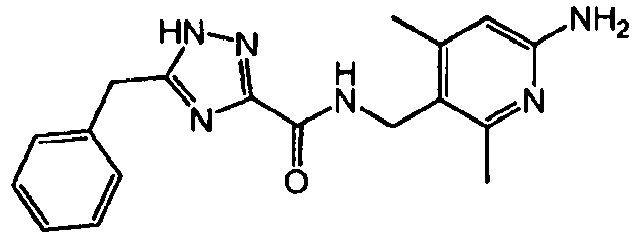
- The title compound was prepared in analogy to example 2. HPLC (Method G) Rt = 1.186 min; MS (Method F) [M+H]+ = 337.4.
-

- The title compound was prepared in analogy to example 9. HPLC (Method I) Rt = 0.28 min; MS [M+H]+ = 413.4.
-

- The title compound was prepared in analogy to example 13. HPLC (Method J) Rt = 3.408 min; MS (Method F) [M+H]+ = 412.4.
-

- The title compound was prepared in analogy to example 13. HPLC (Method J) Rt = 3.040 min; MS (Method F) [M+H]+ = 485.4.
-

- The title compound was prepared in analogy to example 13. HPLC (Method J) Rt = 3.189 min; MS (Method F) [M+H]+ = 455.5.
-

- The title compound was prepared in analogy to example 9, Steps c) - f). HPLC (Method J) Rt = 2.509 min; MS (Method F) [M+H]+ = 419.5.
-

- The title compound was prepared in analogy to example 13. HPLC (Method J) Rt = 3.007 min; MS (Method F) [M+H]+ = 447.5.
-

- 1-(4-Carboxy-benzyl)-1H-pyrazole-4-carboxylic acid ethyl ester was prepared as described in Example 112.
- To a solution of 1-(4-carboxy-benzyl)-1H-pyrazole-4-carboxylic acid ethyl ester (50 mg, 0.153 mmol) in DCM (1 ml) were added DIPEA (40.1 µl, 0.230 mmol), HBTU (63.9 mg, 0.168 mmol) and isopropylamine (13 µl, 0.153 mmol). Reaction mixture was stirred over a weekend at 23 °C. The solvent was evaporated, and the residual oil was dissolved in ethyl acetate and washed with 1 M hydrochloric acid, saturated sodium bicarbonate solution and brine. Organic layer was dried (sodium sulfate), filtered and evaporated to afford the title compound. HPLC (method G) Rt = 1.761 min; UPLC (method F) Rt = 0.79 min, MS [M+H]+ 316.3.
- The title compound was prepared from 1-(4-isopropylcarbamoyl-benzyl)-1H-pyrazole-4-carboxylic acid ethyl ester in an analogous way according to the synthesis of Example 13. 1H-NMR (DMSO-d6, 400 MHz): 1.15 (d, 6H), 2.15 (s, 3H), 2.28 (s, 3H), 4.07 (m, 1H), 4.27 (d, 2H), 5.37 (s, 2H), 5.63 (s, 2H), 6.11 (s, 1 H), 7.30 (d, 2H), 7.80 (d, 2H), 7.90 (br s, 2H), 8.17 (d, 1H), 8.27 (s, 1H). HPLC (method G) Rt=1.283 min; UPLC (method F) Rt = 0.44 min, MS[M+H]+ 421.5.
-

- The title compound was prepared in analogy to example 13. HPLC (Method J) Rt = 2.809 min; MS (Method F) [M+H]+ = 449.5.
-

- The title compound was prepared in analogy to example 13. HPLC (Method J) Rt = 2.818 min; MS (Method F) [M+H]+ = 459.5.
-

- The title compound was prepared in analogy to example 2. HPLC (Method J) Rt = 2.412 min; MS (Method D) [M+H]+ = 352.1.
-

- The title compound was prepared in analogy to example 2. HPLC (Method J) Rt = 3.277 min; MS (Method F) [M+H]+ =413.4.
-

- The title compound was prepared in analogy to example 2. HPLC (Method J) Rt = 3.262 min; MS (Method F) [M+H]+ = 429.4.
-

- The title compound was prepared in analogy to example 13. HPLC (Method J) Rt = 2.941 min; MS (Method F) [M+H]+ = 443.4
-

- The title compound was prepared in analogy to example 12. HPLC (Method T) Rt = 0.96 min; MS [M+H]+ = 460.7
-

- The title compound was prepared in analogy to example 12. HPLC (Method T) Rt = 0.87 min; MS [M+H]+ = 424.7.
-

- The title compound was prepared in analogy to example 12. HPLC (Method T) Rt = 0.84 min; MS [M+H]+ = 414.8.
-
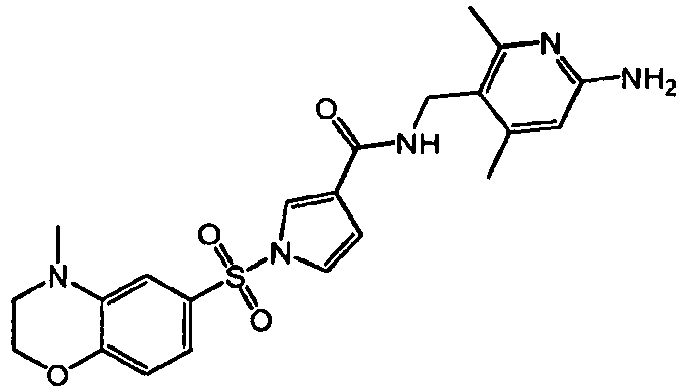
- The title compound was prepared in analogy to example 12. HPLC (Method T) Rt = 0.86 min; MS [M+H]+ = 455.9.
-

- The title compound was prepared in analogy to example 12. HPLC (Method T) Rt = 0.86 min; MS [M+H]+ = 437.8.
-

- The title compound was prepared in analogy to example 12. HPLC (Method T) Rt = 0.85 min; MS [M+H]+ = 462.8.
-
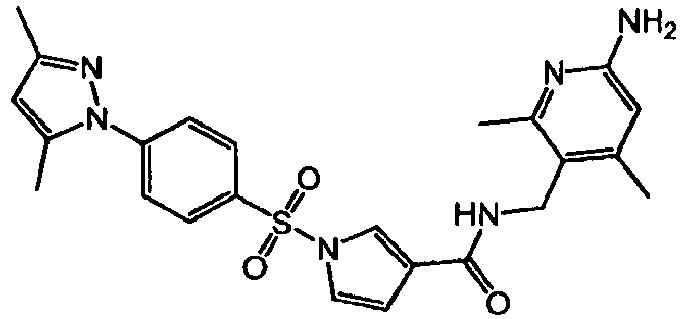
- The title compound was prepared in analogy to example 12. HPLC (Method T) Rt = 0.87 min; MS [M+H]+ = 478.8.
-

- Hydrolysis of example 135: To N-((6-amino-2,4-dimethylpyridin-3-yl)methyl)-1-(4-(cyanomethoxy)benzyl)-1 H-pyrazole-4-carboxamide (15 mg, 0.038 mmol) was added K2CO3 (15.93 mg, 0.115 mmol) in THF/H2O (0.3 ml). The reaction mixture was stirred at 50 °C for 17 min, then at 90°C for 1h. The reaction mixture was diluted with water (2 mL) containing few drops of HCl (4M). Purification by preparative LC-MS (
Flow 50 mL/min Waters Sunfire C18-ODB 30x150 mm, 5 um, 8% to 100% acetonitrile/water + 0.1% of trifluoroacetic acid, in 14 min.) offered the title product after lyophilization. HPLC (Method I) Rt = 0.70 min; MS [M+H]+ = 410.5. -

- The title compound was prepared in analogy to example 1, Step d). HPLC (Method R) Rt = 0.82 min; MS [M+H]+ = 391.6.
-

- Step a): A suspension of 1-benzyl-1H-1,2,3-triazole-4-carboxylic acid (259 mg, 1.147mmol) in SOCl2 (1.522 ml, 20.85 mmol) was stirred at 40°C for 1h, and subsequently evaporated under reduced pressure. The remaining residue was dissolved in DMF (2 ml). After addition of 1-(6-amino-3-(aminomethyl)-2-methylpyridin-4-yloxy)-3,3-dimethylbutan-2-one (300mg, 1.042mmol, HCl-Salt: obtained in analogy to example 19 steps a) and b))
and DIPEA (1.092 ml, 6.25 mmol) the reaction mixture was stirred for 12 h at rt. Purification by prep HPLC (Nucleosil C18, 250x40mm 5 to 100% ACN and 0.1% TFA , flow 40mml/min) offered the titled compound after lyophilisation. HPLC (Method H) Rt = 3.12 min; MS [M+H]+ = 437.3. -

- The title compound was prepared in analogy to example 136. HPLC (Method H) Rt = 2.64 min; MS [M+H]+ = 420.0.
-

- The title compound was prepared from known 5-(aminomethyl)-4-methylpyridin-2-amine in analogy to the final synthetic step of example 14. LCMS RtL = 1.22 min, MS [M+H]+ = 322.4.
-

- The title compound was prepared in analogy to example 17. LCMS (Method A) RtA = 0.933; [M+H]+ = 432.1.
-

- A suspension of [5-({[1-(4-Chloromethyl-benzyl)-1H-pyrazole-4-carbonyl]-amino}-methyl) -4,6-dimethyl-pyridin-2-yl]-carbamic acid tert-butyl ester (100 mg, 0.207 mmol, prepared according to step a) of example 17), sodium azide (13.43 mg, 0.207 mmol), ethynyltrimethylsilane (20.29 mg, 0.207 mmol), DIPEA (3.61 µL, 0.021 mmol), copper sulfate (3.30 mg, 0.021 mmol) and sodium ascorbate (4.09 mg, 0.021 mmol) in 2.5 mL of DMSO and 0.5 mL of water was stirred for 3 hours at 60°C. The mixture was allowed to cool to room temperature, was diluted with ethyl acetate and washed with water. The
- organic solution was concentrated under reduced pressure. The residue was dissolved in 5 mL of methanol and 2 mL of concentrated aqueous HCl was added. This solution was stirred for 2 hours at 60°C. The volatiles were evaporated under reduced pressure. The residue was adjusted to basic pH with 1 N NaOH. The resulting aqueous solution was extracted with ethyl acetate. The organic solution was dried of MgSO4, filtered and concentrated under reduced pressure. The residue was purified by preparative HPLC (Macherey Nagel C18 100x10 mm, Flow 40mL/min, ACN/water (0.1% TFA) 5/95 over 2 min, then ACN/water (0.1% TFA) 5/95 - 100/0 over 15 min). The fractions containing product were pooled, freeze-dried and redissolved in methanol. This solution was filtered over a methanol-flushed PL-HCO3-MP resin column, which was subsequently washed twice with 5 mL methanol. The methanolic solution was concentrated under reduced pressure. The residue was taken up in ACN - water and freeze dried to afford the title compound. LCMS (Method A) RtA = 0.316; [M+H]+ = 417.1.
-

- The title compound was prepared in analogy to example 17. LCMS (Method A) RtA = 0.493; [M+H]+ = 460.1.
-

- The title compound was prepared in analogy to example 17. 1 H NMR (DMSO-d6, 400MHz) 8.24 (d, 1H, 0.5Hz), 7.88-7.90 (t, 1H, 4.7Hz), 7.87 (d, 1H, 0.5H), 7.75-7.77 (dd, 1 H, 6.6Hz, 2.2Hz), 7.39-7.44 (m, 1 H), 7.25-7.27 (d, 2H, 8.3Hz), 7.21-7.23 (d, 2H, 8.3Hz), 6.39-6.41 (d, 1H, 9.1 Hz), 6.21-6.25 (dt, 1H, 9.1Hz, 2.2Hz), 6.11 (s, 1H), 5.64 (s, 2H), 5.29 (s, 2H), 5.07 (s, 2H), 4.25-4.27 (d, 2H, 4.7Hz), 2.28 (s, 3H), 2.15 (s, 3H), HPLC (Method H) Rt = 2.53 min; MS [M+H]+ = 443.0.
-

- The title compound was prepared in analogy to example 17. LCMS (Method A) RtA = 0.822; [M+H]+ = 433.1.
-

- A suspension of sodium 6-amino-3-cyano-2-methylpyridin-4-olate (690 mg, 4.03 mmol, prepared in analogy to
WO2001062233A2 and isolated as sodium salt) in PCl3 (3.50 ml, 40.3 mmol) and POCl3 (0.94 ml, 10.1 mmol) was heated to reflux for 12 h. After cooling to room temperature, the reaction mixture was carefully given onto 2N NaOH (200 ml) and 50 g ice. The mixture was extracted with DCM (7x50 ml), and the combined organic extracts were dried over Na2SO4, filtered and concentrated. The crude product was used without additional purification. LCMS RtM = 1.45 min, [M+H]+ = 168.1. - The title compound was prepared in analogy to example 14b. LCMS (method K) RtK = 0.83 min, [M+H]+ = 356.4.
-

- The title compound was prepared in analogy to example 9. HPLC (Method H) Rt = 2.64 min; MS [M+H]+ = 416.0.
-

- The title compound was prepared in analogy to example 9. HPLC (Method H) Rt = 2.79 min; MS [M+H]+ = 430.0.
-

- A mixture of (4-Chloromethyl-phenyl)-methanol (5 g, 31.9 mmol) and sodium azide (2.283 g, 35.1 mmol) in 50 mL DMF was stirred at 90 °C for 16 h. The reaction mixture was concentrated in vacuo and the residue was treated with DCM and extracted with water. The organic layer was dried over MgSO4 and evaporated to give the title compound which was used in the next step without further purification. 1 H-NMR (CDCl3, 400 MHz) 7.38 -7.31 (m, 4H), 4.52 (d, 2H, 5.6 Hz), 4.42 (s, 2H).
- A mixture of (4-Azidomethyl-phenyl)-methanol (4.12 g, 25 mmol), ethyl propiolate (2.54 mL, 25 mmol), copper(II) sulfate (798 mg, 5 mmol) and sodium ascorbate (4.95 g, 25 mmol) in 30 mL n-BuOH and 30 mL water was stirred at room temperature for 16 h. Ethyl acetate was added and the mixture was extracted with water. The organic layer was dried over MgSO4 and evaporated in vacuo to give the title compound which was used in the next step without further purification. LCMS (Method A) RtA = 1.157; [M+H]+ = 467.0MS [M+H]+ = 262.0.
- A mixture of 1-(4-Hydroxymethyl-benzyl)-1H-[1,2,3]triazole-4-carboxylic acid ethyl ester (4.35 g, 9.42 mmol) and lithiumhydroxide-hydrate (1.976 g, 47.1 mmol) in 80 mL MeOH and 80 mL water was stirred at 30 °C for 3 h. The methanol was evaporated in vacuo. The residual aqueous layer was washed with ethyl acetate, acidified with 1 N aq. HCl and extracted with ethyl acetate. The organic layer was dried over MgSO4, filtered and evaporated to yield the crude product which was used in the next step without further purification. 1H-NMR (DMSO-d6, 400 MHz) 13.1 (broad s, 1H), 8.76 (s, 1 H), 7.27-7.39 (m, 4H), 5.63 (s, 2H), 5.20 (t, 1H), 4.48 (d, 2H).
- A mixture of 1-(4-hydroxymethyl-benzyl)-1H-[1,2,3]triazole-4-carboxylic acid (0.95 g, 4.07 mmol), (5-Aminomethyl-4,6-dimethyl-pyridin-2-yl)-carbamic acid tert-butyl ester (1.024 g, 4.07 mmol), HATU (2.013 g, 5.30 mmol) and DIPEA (2.85 mL, 16.29 mmol) in 50 mL DMF was stirred at room temperature for 3 h. The reaction mixture was concnentrated under reduced pressure. The residue was taken up in ethyl acetate and washed with 1 n HCl solution and saturated sodium bicarbonate solution. The organic solution was dried over MgSO4, filtered and concentrated to yield the crude product which was used in the next step without further purification. LCMS (Method A) RtA = 1.279; [M+H]+ = 467.0.
- To a solution of [5-({[1-(4-Hydroxymethyl-benzyl)-1H-[1,2,3]triazole-4-carbonyl]-amino}-methyl)-4,6-dimethyl-pyridin-2-yl]-carbamic acid tert-butyl ester (690 mg, 1.331 mmol) in 10 mL of DCM was added dropwise a solution of thionyl chloride (0.107 mL, 1.464 mmol) and pyridine (1.615 µL, 0.02 mmol) in 10 mL of DCM. The reaction mixture was stirred for 3 h at 40°C and saturated aqueous bicarbonate solution was added. The layers were separated and the aqueous layer was extracted with DCM. The combined organic solution was dried over MgSO4, filtered and concentrated under vacuum to yield the crude product which was used in the next step without further purification. LCMS (Method A) RtA = 1.681; [M+H]+ = 485.0.
- A mixture of [5-({[1-(4-Chloromethyl-benzyl)-1H-[1,2,3]triazole-4-carbonyl]-amino}-methyl)-4,6-dimethyl-pyridin-2-yl]-carbamic acid tert-butyl ester (200 mg, 0.412 mmol), 3-methylpyrazole (33.9 mg, 0.412 mmol) and cesium carbonate (269 mg, 0.825 mmol) in 2 mL of DMF was stirred at 80 °C for 2h. The reaction mixture was filtered and concentrated under reduced pressure. The residue was purified by preparative HPLC (Waters SunFire Prep C18 OBD 5µm 30x100 mm, Flow 40mL/min, ACN/water (0.1% TFA) 5/95 over 2 min, then ACN/water (0.1% TFA) 5/95 - 100/0 over 15 min). LCMS (Method A) RtA = 1.527; [M+H]+ = 531.1.
- A mixture of {4,6-Dimethyl-5-[({1-[4-(5-methyl-pyrazol-1-ylmethyl)-benzyl]-1H-[1,2,3]triazole-4-carbonyl}-amino)-methyl]-pyridin-2-yl}-carbamic acid tert-butyl ester (132 mg, 0.249 mmol) and 5 mL of TFA in 10 mL of DCM was stirred at room temperature for 2h. The reaction mixture was concentrated under reduced pressure. The residue was purified by preparative HPLC (Waters SunFire Prep C18 OBD 5µm 30x100 mm, Flow 40mL/min, ACN/water (0.1% TFA) 5/95 over 2 min, then ACN/water (0.1% TFA) 5/95-100/0 over 15 min) to yield the title compound. 1H-NMR (DMSO-d6, 600 MHz) 8.59 (s, 1 H), 8.29 (t, 1 H), 7.33 (s, 1 H), 7.28 (d, 2H), 7.09 (d, 2H), 6.09 (s, 1 H), 6.05 (s, 1 H), 5.63 (s, 2H), 5.59 (s, 2H), 5.26 (s, 2H), 4.32 (d, 2H), 2.29 (s, 3H), 2.17 (s, 3H), 2.16 (s, 3H); [M+H]+ = 431.0.
-

- The title compound was prepared in analogy to example 147. 1H-NMR (DMSO-d6, 600 MHz) 8.60 (s, 1H), 8.30 (t, 1H), 7.29 (d, 2H), 7.09 (d, 2H), 6.10 (s, 1H), 5.84 (s, 1H), 5.64 (s, 2H), 5.60 (s, 2H), 5.16 (s, 2H), 4.33 (d, 2H), 2.30 (s, 3H), 2.18 (s, 3H), 2.14 (s, 3H), 2.08 (s, 3H); [M+H]+ = 445.1.
-

- The title compound was prepared in analogy to example 1 step d) using 1-(6-amino-3-(aminomethyl)-2-methylpyridin-4-yloxy)-3,3-dimethylbutan-2-one (from example 136) and 1-Naphthalen-2-ylmethyl-1H-pyrazole-4-carboxylic acid (from example 83). HPLC (Method H) Rt = 3.33 min; MS [M+H]+ = 486.2.
-

- To a cooled (0 °C) solution 1 g (5.23 mmol)of methyl 1,2,3,4-tetrahydroquinoline-7-carboxylate in THF (10 ml) was added 20.92 ml, (20.92 mmol) of a solution of DIBAL-H in THF. The reaction mixture was stirred for 2 hr at 0 °C. Additional DIBAL-H in THF (15.69 ml, 15.69 mmol) was added. The reaction mixture was allowed to warm to 20 °C and stirring was continued for 16 hr. The reaction mixture was treated with 30 mL of 10% aqueous sodium potassium tartrate and stirred for 1h. Water was added and the mixture was extracted with AcOEt. The organic layer was dried over MgSO4 and concentrated under reduced pressure to give (1,2,3,4-tetrahydroquinolin-7-yl)methanol. HPLC (Method H) Rt = 2.74 min; MS (Method A) [M+H]+ = 164.1
- A mixture of (1,2,3,4-tetrahydroquinolin-7-yl)methanol (370 mg, 1.496 mmol), 1-bromo-2-methoxyethane (0.141 ml, 1.496 mmol) and Cs2CO3 (731 mg, 2.244 mmol) in DMF (10 ml), was stirred for 16 hr at 80 °C. Additional 1-bromo-2-methoxyethane (0.070 ml, 0.748 mmol) was added and stirring was continued for 16 hr at 80 °C. A third batch of 1-bromo-2-methoxyethane (0.070 ml, 0.748 mmol) was added and stirring was continued for 1 additional hour at 80 °C. The reaction mixture was cooled to room temperature and water was added. The mixture was extracted with AcOEt. The organic layer was dried over MgSO4 and concentrated under reduced pressure to give the title compound. HPLC (Method A) Rt = 1.173 min; MS (Method A) [M+H]+ = 221.9
- (1-(2-Methoxyethyl)-1,2,3,4-tetrahydroquinolin-7-yl)methanol (357 mg, 0.807 mmol) and ethyl 1H-pyrazole-4-carboxylate (113 mg, 0.807 mmol) were dissolved in THF (5 ml). Triphenylphosphine (317 mg, 1.210 mmol) was added, and, after cooling to 0°C, a 40% solution of DEAD in Toluene (0.479 ml, 1.210 mmol) was added dropwise. The reaction mixture was stirred for 2 hr at 0 °C, then overnight at 20 °C. The reaction mixture was diluted with AcOEt and washed with 1N HCl, and saturated aqueous NaHCO3. The organic layer was dried over MgSO4 and concentrated under reduced pressure. The crude product was purified by preparative-HPLC (Waters SunFire Prep C18 OBD 5µm 19*50, Flow 20mL/min, ACN: 2min at 5%, then to 100% within 17.5min, RT 11.80min) to give the title compound. HPLC (Method A) Rt = 2.001 min; MS (Method A) [M]+ = 343.9
- Ethyl 1-((1-(2-methoxvethyl)-1,2,3,4-tetrahydroquinolin-7-yl)methyl)-1H-pyrazole-4-carboxylate (484 mg, 0.874 mmol) was dissolved in a mixture of MeOH (5 ml) and 1N NaOH (5.00 ml). The reaction mixture was stirred for 2 hr at 20 °C and the MeOH was removed by evaporation under reduced pressure. The aqeuous phase was washed with AcOEt, then acidified with HCl and extracted with AcOEt. The organic layer was concentrated under reduced pressure to afford the title compound. HPLC (Method H) Rt = 2.74 min
- The title compound was obtained by an analogous procedure as in example 13 b). HPLC (Method H) Rt = 2.70 min; MS (Method A) [M+H]+ = 449.0
-
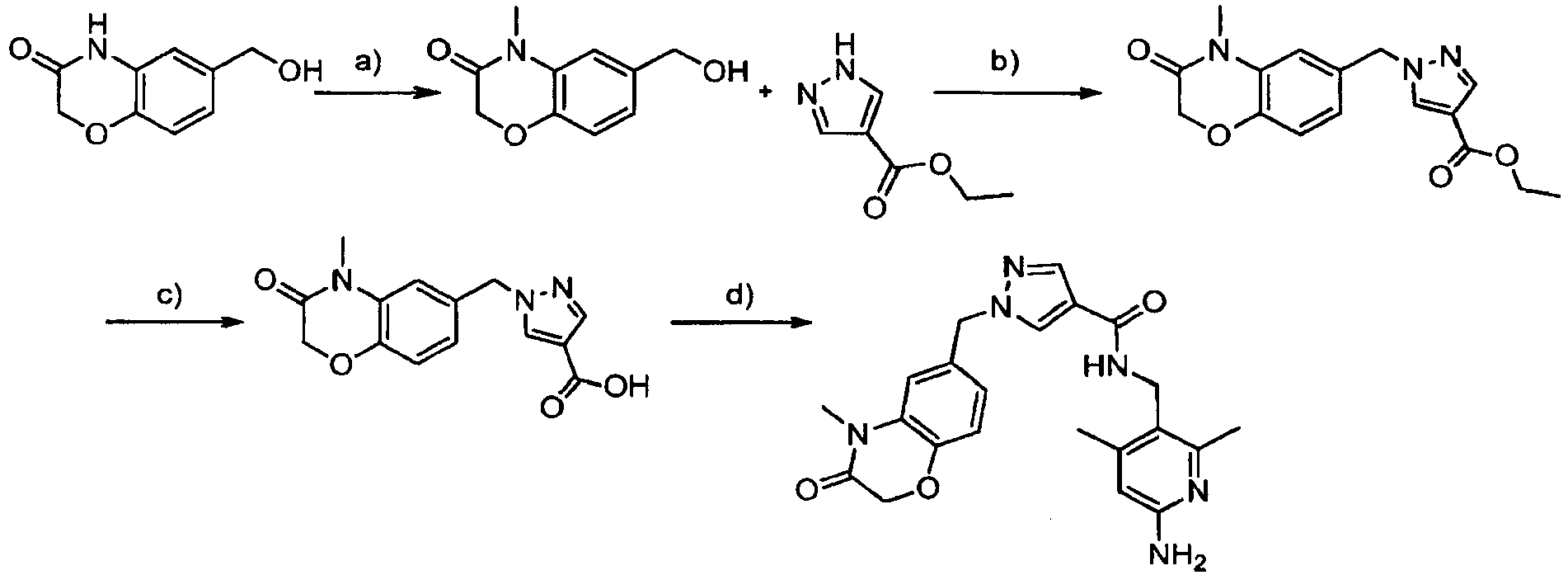
- A suspension of 6-(hydroxymethyl)-2H-benzo[b][1,4]oxazin-3(4H)-one (180 mg, 1.005 mmol), Cs2CO3 (655 mg, 2.009 mmol) and iodomethane (0.060 ml, 0.954 mmol) was stirred for 45 min at 20 °C. The reaction mixture was filtered and concentrated under reduced pressure. The crude product was purified by preparative HPLC (Macherey-Nagel Nucleosil 100-10 C18, Flow 40mL/min, ACN: 2min at 5%, then to 100% within 17.5min, RT 14.14min) to yield the title compound. HPLC (Method A) Rt = 0.93 min; MS (Method A) [M+H]+ = 193.9
- To a stirred, cooled (0°C) solution of 6-(hydroxymethyl)-4-methyl-2H-benzo[b][1,4]oxazin-3(4H)-one (122 mg, 0.631 mmol), ethylpyrazol-4-carboxylate (88 mg, 0.631 mmol) and triphenylphosphine (248 mg, 0.947 mmol) in THF (5 ml) was added dropwise a 40% solution of DEAD in toluene (0.375 ml, 0.947 mmol). The reaction mixture was stirred for 2h at 0°C, then over night at 20 °C. Saturated aqueous NaHCO3 was added and the mixture was extracted with AcOEt. The organic layer was dried over MgSO4, filtered and concentrated under reduced pressure to give the title compound. MS (Method A) [M+H]+ = 316.9
- Ethyl 1-((4-methyl-3-oxo-3,4-dihydro-2H-benzo[b][1,4]oxazin-6-yl)methyl)-1H-pyrazole-4-carboxylate (780 mg, 0.618 mmol) was dissolved in a mixture of MeOH (5 ml) and 1 N NaOH (5.00 ml). The reaction mixture was stirred for 2 hr at 20 °C and the MeOH was removed by evaporation under reduced pressure. The aqeuous phase was washed with AcOEt, then acidified with HCl and extracted with AcOEt. The organic layer was concentrated under reduced pressure to afford the title compound. HPLC (Method H) Rt = 2.636 min; MS (Method A) [M-H]- = 286.1
- The title compound was obtained by an analogous procedure as in example 13 b). 1H-NMR (DMSO-d6, 400 MHz) δ 8.24 (s, 1 H), 7.97 (broad s, 1H), 7.88 (s, 1H), 7.18 (s, 1H), 6.98 (d, 1H), 6.92 (d, 1H), 6.26 (s, 1 H), 6.11 (broad, 2H), 5.29 (s, 2H), 4.64 (s, 2H), 4.27 (d, 2H), 3.26 (s, 3H), 2.35 (s, 3H), 2.22 (s, 3H); HPLC (Method H) Rt = 2.529 min; MS (Method A) [M+H]+ = 421.0
-
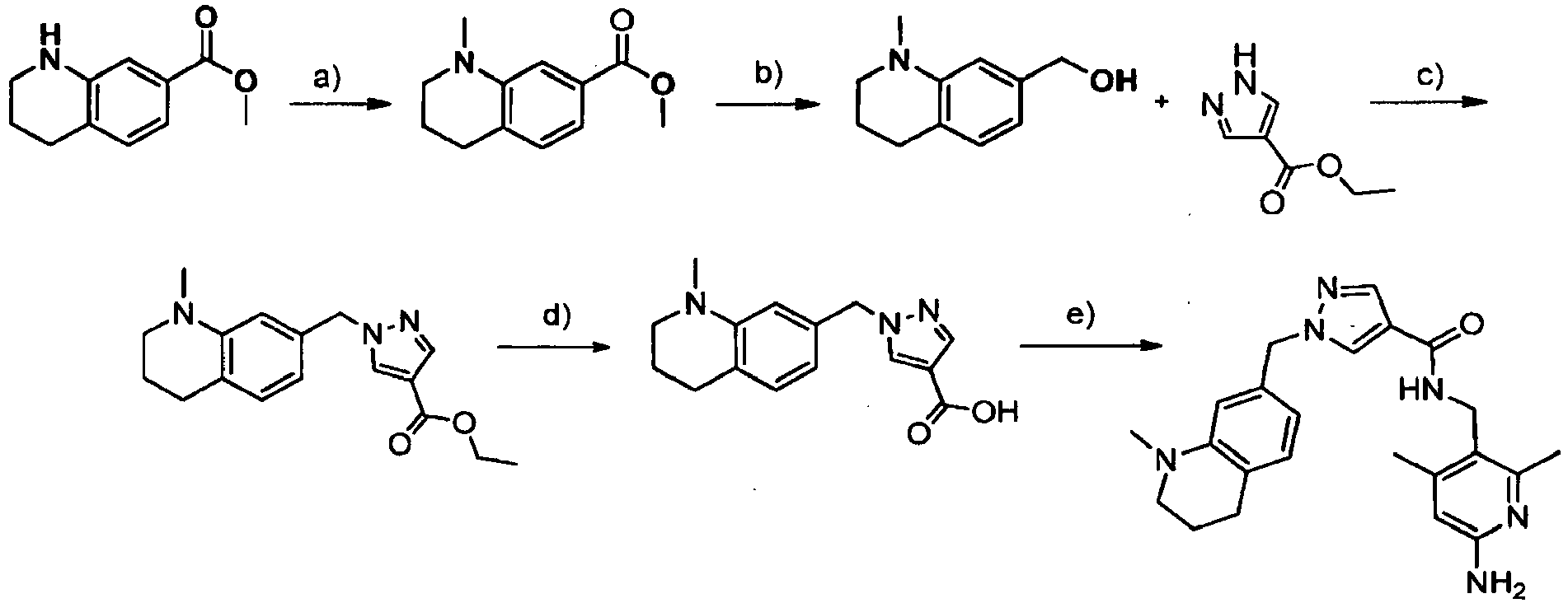
- A suspension of methyl 1,2,3,4-tetrahydroquinoline-7-carboxylate (380 mg, 1.987 mmol), Cs2CO3 (1295 mg, 3.97 mmol) and iodomethane (0.118 ml, 1.888 mmol) was stirred for 16 hours at 20 °C. After that time, more iodomethane (0.118 ml, 1.888 mmol) was added and stirring was continued for 8 hours at 60°C. The reaction mixture was allowed to cool to room temperature, filtered and concentrated under reduced pressure. The crude product was purified by preparative HPLC (Macherey-Nagel Nucleosil 100-10 C18, Flow 40mL/min, ACN: 2 min at 5%, then to 100% within 17.5min, RT 15.52 min) to yield the title compound. HPLC (Method H) Rt = 3.005 min; MS (Method A) [M+H]+ = 206.1
- To a cooled (0 °C) solution of methyl 1-methyl-1,2,3,4-tetrahydroquinoline-7-carboxylate (320 mg, 1.559 mmol) in THF (25 mL) was added a solution of DIBAL-H in THF (6.24 ml, 6.24 mmol). The reaction mixture was stirred for 3 hr at 0 °C. The reaction mixture was treated with 30 mL of 10% aqueous sodium potassium tartrate and stirred for 2h at 20°C. The mixture was extracted with AcOEt. The organic layer was dried over MgSO4, filtered and concentrated under reduced pressure to give the title compound. MS (Method A) [M+H]+ = 178.0
- To a stirred, cooled (0°C) solution of (1-methyl-1,2,3,4-tetrahydroquinolin-7-yl)methanol (200 mg, 0.733 mmol), ethyl 1H-pyrazole-4-carboxylate (103 mg, 0.733 mmol) and triphenylphosphine (289 mg, 1.100 mmol) in THF (10 ml) was added dropwise a 40% solution of DEAD in toluene (0.435 ml, 1.1 mmol). The reaction mixture was stirred for 2h at 0°C, then over night at 20 °C. Saturated aqueous NaHCO3 was added and the mixture was extracted with AcOEt. The organic layer was dried over MgSO4, filtered and concentrated under reduced pressure to give the title compound. The crude product was purified by preparative HPLC (Waters SunFire Prep C18 OBD 5µm 30*100, Flow 40mL/min, ACN: 2min at 5%, then to 100% within 17.5min, RT 10.00min) to give the title compound. HPLC (Method H) Rt = 2.919 min; MS (Method A) [M+H]+ = 300.0
- Ethyl 1-((1-methyl-1,2,3,4-tetrahydroquinolin-7-yl)methyl)-1H-pyrazole-4-carboxylate (233 mg, 0.607 mmol) was dissolved in a mixture of MeOH (6 ml) and 1 N NaOH (3.00 ml). The reaction mixture was stirred for 8 hr at 20 °C and the solvents were removed by evaporation under reduced pressure to afford the title compound. HPLC (Method A) Rt = 1.348 min; MS (Method A) [M+H]+ = 271.9
- The title compound was obtained by an analogous procedure as in example 13 b). 1H-NMR (DMSO-d6, 400 MHz) δ 8.18 (s, 1H), 7.87 (broad s, 1H), 7.86 (s, 1H), 6.84 (d, 1H), 6.51 (s, 1H), 6.40 (d, 1H), 6.12 (s, 1H), 5.62 (s, 2H), 5.16 (s, 2H), 4.27 (d, 2H), 3.17 (7, 3H), 2.80 (s, 3H), 2.65 (t, 2H), 2.28 (s, 3H), 2.15 (s, 3H), 1.85 (m, 2H); HPLC (Method H), Rt = 2.443 min; MS (Method A) [M+H]+ = 405.1
-

- To a solution of (5-aminomethyl-4,6-dimethyl-pyridin-2-yl)-carbamic acid tert-butyl ester (4.50 g, 17.90 mmol), propiolic acid (0.918 ml, 14.92 mmol), DIPEA (7.82 ml, 44.8 mmol) in DCM (140 ml) at 23 °C was added dropwise over 5
min 50% propylphosphonic anhydride in DMF (12.5 ml, 21.41 mmol). The reaction was stirred at 23 °C for 1 day. The reaction was quenched by addition of brine, and the phases were separated. The aqueous phase was further extracted with DCM, and the combined organic phase was dried over Na2SO4, filtered, and evaporated to provide the crude product, which was purified by flash column chromatography (silica gel 0.040-0.063mm, 160g, flow rate 60ml/min, detection at 220nm, MeOH in DCM 0->1% over 10min, then 1->5% over 20min) to yield the title compound. HPLC (Method G) Rt = 1.333 min; MS (Method F) [M+H]+ = 304.31. - To a solution of (2-methyl-6-quinolinyl) methanol (100 mg, 0.560 mmol) and DBU (0.152 ml, 1.008 mmol) in DMF (4 ml) was added DPPA (0.205 ml, 0.952 mmol). The reaction mixture was stirred overnight at 23°C. Reaction mixture was poured into water and extracted twice with ethyl acetate. Organic layer was washed with brine, dried over sodium sulfate, filtered and evaporated to afford a crude material, which was purified by silicagel chromatography (cyclohexane : ethyl acetate from 100:0 to 0:100) to afford the title compound. HPLC (Method G) Rt = 1.048 min; MS (Method F) [M+H]+ = 199.2
- To a solution of 6-(azidomethyl)-2-methylquinoline (58.9 mg, 0.297 mmol) and tert-butyl (4,6-dimethyl-5-(propiolamidomethyl)pyridin-2-yl)carbamate (90 mg, 0.297 mmol) in t-BuOH (2 ml) /water (2 ml) were added copper(II) sulfate pentahydrate (14.84 mg, 0.059 mmol) and sodium ascorbate (58.9 mg, 0.297 mmol). Reaction mixture was stirred for 1.5h at 23°C. Reaction mixture was poured into water and extracted twice with ethyl acetate. Combined organic layers were washed with brine, dried over sodium sulfate and evaporated to afford the crude material, which was purified by silicagel chromatography (DCM/methanol from 10/0 to 9/1) to afford the title compound. HPLC (Method G) Rt = 1.308 min; MS (Method F) [M+H]+ = 502.5
- To a solution of tert-butyl (4,6-dimethyl-5-((1-((2-methylquinolin-6-yl)methyl)-1H-1,2,3-triazole-4-carboxamido)methyl)pyridin-2-yl)carbamate (131.9 mg, 0.263 mmol) in DCM (1.2ml) was added TFA (0.405 ml, 5.26 mmol). Reaction mixture was stirred overnight at 23°C. Reaction mixture was evaporated to afford the crude material, which was purified by preparative HPLC (Sunfire C18-ODB, 5 µm, 100x30 mm, elution with A=water+0.1%TFA and B=ACN+0.1%TFA, gradient from 5% to 100%B in 25 min, flow: 40 mL/min). Fractions were combined and acetonitrile was evaporated. Residual aqueous layer was frozen and lyophilized to afford the product as a TFA salt, which was dissolved in acetonitrile/methanol and eluted through a PL-HCO3 MP-resin column (Stratosphere SPE). The eluted solution was evaporated, and the residue was triturated in Et2O and filtered to afford the title compound as a free base. 1 H-NMR (DMSO-d6, 400 MHz) δ 8.70 (s, 1H), 8.62 (broad s, 1H), 8.24 (d, 1H), 7.91 (d, 1H), 7.86 (s, 1H), 7.66 (d, 1H), 7.43 (d, 1H), 6.37 (broad s, 1H), 5.82 (s, 2H), 4.33(d, 2H), 2.64 (s, 3H), 2.42 (s, 3H), 2.29 (s, 3H); HPLC (Method G) Rt = 0.932 min; MS (Method F) [M+H]+ = 402.5.
-

- The title compound was prepared in analogy to example 13. HPLC (Method G) Rt = 0.909min, MS (Method F) [M+H]+ = 401.5.
-

- The title compound was prepared in analogy to example 13. HPLC (Method G) Rt = 1.020min, MS (Method F) [M+H]+ = 387.2.
-

- To a solution of 7-methyl-3-quinoline carboxaldehyde (200 mg, 1.168 mmol) in THF (4.5 ml) was added 2M LiBH4 solution in THF (2.337 ml, 4.67 mmol) at 0°C. Reaction mixture was stirred at 0°C for 2h, then slowly poured into NaHCO3 sat. solution and extracted twice with ethyl acetate. Organic layer was dried over sodium sulfate, filtered and evaporated to afford the crude material, which was purified by silica gel chromatography (cyclohexane/
ethyl acetate form 100/0 to 0/100) to afford the title compound. HPLC (Method G) Rt = 0.68 min, MS (Method V) [M+H]+ = 174.2. - To a solution of (7-methylquinolin-3-yl)methanol (41.5 mg, 0.232 mmol) and DBU (0.063 ml, 0.418 mmol) in DMF (0.8 ml) was added DPPA (0.085 ml, 0.395 mmol). The reaction mixture was stirred for 1.5h at 23°C. Reaction mixture was poured in brine and extracted twice with ethyl acetate. Organic layer was dried over sodium sulfate, filtered and evaporated to afford the title compound. HPLC (Method G) Rt = 1.174 min, MS (Method V) [M+H]+ = 199.2.
- To a solution of 3-(azidomethyl)-7-methylquinoline (46.0 mg, 0.232 mmol) and tert-butyl (4,6-dimethyl-5-(propiolamidomethyl)pyridin-2-yl)carbamate (70 mg, 0.231 mmol) in t-BuOH (1.8ml) /water (1.8ml) were added copper(II) sulfate pentahydrate (11.52 mg, 0.046 mmol) and sodium ascorbate (45.7 mg, 0.231 mmol). Reaction mixture was stirred overnight at 23°C. Reaction mixture was poured into water and extracted twice with ethyl acetate. Combined organic layers were washed with brine, dried over sodium sulfate and evaporated to afford a crude product, which was purified by silicagel chromatography (cyclohexane /ethyl acetate from 100/0 to 0/100) to afford the title compound. HPLC (Method G) Rt = 1.408 min, MS (Method V) [M+H]4 = 502.4.
- To a solution of tert-butyl (4,6-dimethyl-5-((1-((7-methylquinolin-3-yl)methyl)-1H-1,2,3-triazole-4-carboxamido)methyl)pyridin-2-yl)carbamate (70 mg, 0.140 mmol) in DCM (1 ml) was added TFA (0.215 ml, 2.79 mmol). Reaction mixture was stirred over a weekend at 23°C. Reaction mixture was evaporated to afford a crude product, which was purified by preparative HPLC (Sunfire C18-ODB, 5 µm, 100x30 mm, elution with A=water+0.1%HCOOH and B=ACN+0.1%HCOOH, gradient from 10% to 100%B in 25 min, flow: 40 mL/min). Fractions were combined and solvents were evaporated to afford athe product as a formic acid salt, which was dissolved in methanol and eluted through a PL-HCO3 MP-resin column (Stratosphere SPE) in order to remove salt. The eluted solution was evaporated and dried overnight under high vacuum (dessicator, 50°C) to afford the title compound as a free base. 1 H-NMR (DMSO-d6, 400 MHz) δ 8.90 (s, 1H), 8.72 (s, 1H), 8.30 (broad s, 1 H), 8.26 (s, 1H), 7.89 (d, 1H), 7.83 (s, 1 H), 7.49 (d, 1H), 6.10 (s, 1 H), 5.87 (s, 2H), 5.61 (broad s, 2H), 4.33(d, 2H), 2.54 (s, 3H), 2.31 (s, 3H), 2.18 (s, 3H); HPLC (Method G) Rt = 1.079 min; MS (Method V) [M+H]+ = 402.4.
-
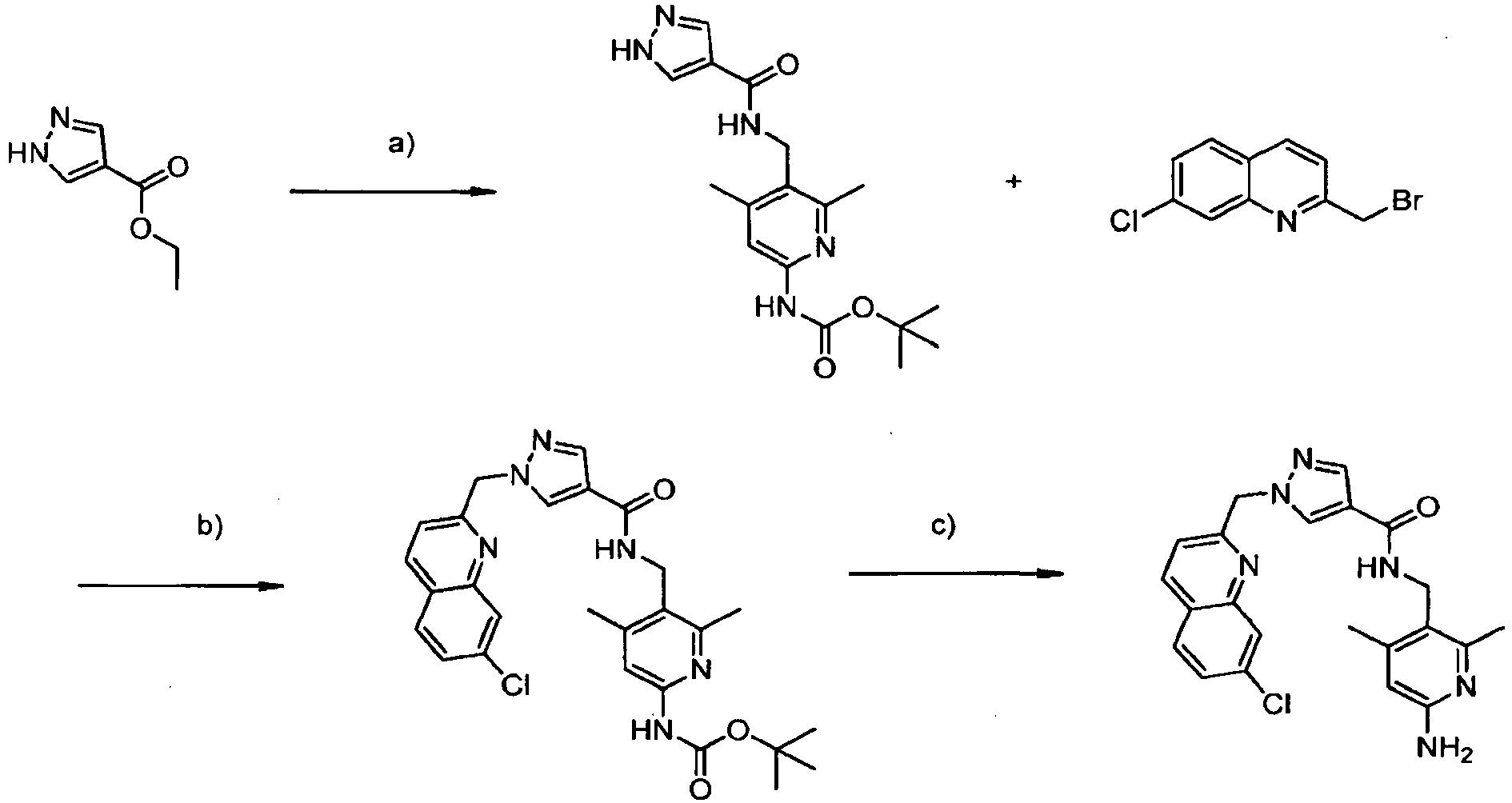
- To a solution of ethyl pyrazole-4-carboxylate (1 g, 7.14 mmol) in EtOH/THF/water 2/1/1 (8ml) was added LiOH monohydrate (329 mg, 7.84 mmol). Reaction mixture was stirred for 1day at 80°C. 4M HCl in dioxane (1.962 ml, 7.85 mmol) was added to reaction mixture which was evaporated to dryness to afford the free carboxylic acid. This material (1.218g, 7.14 mmol) was dissolved in DMF (30 ml), to which were added HBTU (4.06 g, 10.71 mmol), DIPEA (3.74 ml, 21.43 mmol) then tert-butyl (5-(aminomethyl)-4,6-dimethylpyridin-2-yl)carbamate (2.69 g, 10.71 mmol). Reaction mixture was stirred overnight at 23°C. Reaction mixture was diluted with ethyl acetate and water. Phases were separated and organic layer was washed with NaHCO3 sat. solution and brine. Organic layer was dried over sodium sulfate, filtered and evaporated to afford the crude material, which was purified by normal phase chromatography (silica gel, 100% ethyl acetate) followed by reverse phase chromatography (C18, acetonitrile/water) to afford the title compound. HPLC (Method G) Rt = 1.245 min, MS (Method V) [M+H]+ = 346.2.
- To a solution of tert-butyl (5-((1H-pyrazole-4-carboxamido)methyl)-4,6-dimethylpyridin-2-yl)carbamate (100 mg, 0.290 mmol) in acetone (2.5 ml) were added 2-(bromomethyl)-7-chloroquinoline (74.3 mg, 0.290 mmol) and K2CO3 (200 mg, 1.448 mmol). Reaction mixture was stirred for 5h at 50°C. Reaction mixture was diluted with ethyl acetate and water. Phases were separated and organic layer was washed with brine, dried over sodium sulfate, filtered and evaporated to afford the title compound. HPLC (Method G) Rt = 1.736 min, MS (Method V) [M+H]+ = 521.3.
- To a solution of tert-butyl (5-((1-((7-chloroquinolin-2-yl)methyl)-1H-pyrazole-4-carboxamido)methyl)-4,6-dimethylpyridin-2-yl)carbamate (151 mg, 0.29 mmol) in DCM (2 ml) was added TFA (0.447 ml, 5.80 mmol). Reaction mixture was stirred for 7.5h at 23°C. After evaporation of solvents, the crude material was purified by preparative HPLC (SunFire C18-ODB, 5 µm, 100x30 mm, elution with A=water+0.1%TFA and B=ACN+0.1%TFA, gradient from 5% to 100%B in 25 min, flow: 40 mL/min). Fractions were combined, and the solvents were evaporated to afford the title cpd as a TFA salt, which was dissolved in hot methanol/ACN and eluted through a PL-HCO3 MP-resin column (Stratosphere SPE) in order to remove salt. The eluted solution was evaporated, and the residue was dried over a weekend under high vacuum (dessicator, 50°C) to afford the title compound as a free base. 1 H-NMR (DMSO-d6, 400 MHz) δ 8.40 (d, 1 H), 8.38 (s, 1 H), 8.03 (s, 1 H), 8.02 (d, 1 H), 7.94 (broad s, 2H), 7.65 (d, 1 H), 7.24 (d, 1 H), 6.11 (s, 1 H), 5.63 (s, 2H), 5.61 (broad s, 2H), 4.28 (d, 2H), 2.29 (s, 3H), 2.16 (s, 3H); HPLC (Method G) Rt = 1.476 min, MS (Method V) [M+H]+ = 422.3.
-

- To a solution of 2-(bromomethyl)-7-chloroquinoline (50 mg, 0.195 mmol) in DMF (0.5 ml) was added sodium azide (19.01 mg, 0.292 mmol). Reaction mixture was stirred for 2h at 90°C. Reaction mixture was diluted with ethyl acetate/ water. Layers were seperated and organic layer was washed twice with water and with brine, dried over sodium sulfate, filtered and evaporated to afford the title compound. HPLC (Method G) Rt = 1.990 min, MS (Method V) [M+H]+ = 219.1.
- To a solution of 2-(azidomethyl)-7-chloroquinoline (37.1 mg, 0.134 mmol) and tert-butyl (4,6-dimethyl-5-(propiolamidomethyl)pyridin-2-yl)carbamate (40.7 mg, 0.134 mmol) in t-BuOH (1ml) /water (1ml) were added copper(II) sulfate pentahydrate (33.5 mg, 0.134 mmol) and sodium ascorbate (26.6 mg, 0.134 mmol). Reaction mixture was stirred for 3 days at 23°C.
- Reaction mixture was poured into water and extracted twice with ethyl acetate. Combined organic layers were washed with brine, dried over sodium sulfate and evaporated to afford a crude product, which was purified by silicagel chromatography (cyclohexane /ethyl acetate from 100/0 to 0/100) to afford the title compound. HPLC (Method G) Rt = 1.778 min, MS (Method V) [M+H]+ = 522.2.
- To a solution of tert-butyl (5-((1-((7-chloroquinolin-2-yl)methyl)-1H-1,2,3-triazole-4-carboxamido)methyl)-4,6-dimethylpyridin-2-yl)carbamate (46.7 mg, 0.089 mmol) in DCM (0.6 ml) was added TFA (0.138 ml, 1.789 mmol). Reaction mixture was stirred overnight at 23°C.
- Reaction mixture was evaporated to afford a crude product, which was purified by preparative HPLC (Sunfire C18-ODB, 5 µm, 100x30 mm, elution with A=water+0.1%TFA and B=ACN+0.1%TFA, gradient from 5% to 100%B in 25 min, flow: 40 mL/min). Fractions were combined and solvents were evaporated to afford the product as a TFA salt, which was dissolved in hot methanol/ACN and eluted through a PL-HCO3 MP-resin column (Stratosphere SPE) in order to remove salt. The eluted solution was evaporated and dried overnight under high vacuum (dessicator, 50°C) to afford the title compound as a free base. 1H-NMR (DMSO-d6, 400 MHz) δ 8.70 (s, 1H), 8.46 (d, 1H), 8.34 (broad s, 1 H), 8.05 (d, 1H), 8.00 (s, 1 H), 7.66 (d, 1H), 7.45 (d, 1H), 6.10 (s, 1 H), 5.98 (s, 2H), 5.62 (broad s, 2H), 4.34 (d, 2H), 2.32 (s, 3H), 2.19 (s, 3H); HPLC (Method G) Rt = 1.519 min, MS (Method V) [M+H]+ = 422.2.
-

- The starting material ethyl 1-((2-methylquinolin-6-yl)methyl)-1H-pyrazole-4-carboxylate was prepared in analogy to Example 9, Step c). To a solution of ethyl 1-((2-methylquinolin-6-yl)methyl)-1H-pyrazole-4-carboxylate (2.067 g, 3.5 mmol) in ethanol (10 ml) was added 6M NaOH aqueous solution (0.700 ml, 4.20 mmol). The yellow solution was shaken at 23 °C for 4days, after which additional 6M NaOH aqueous solution (0.700 ml, 4.20 mmol) was added, and stirring continued at gentle reflux (80°C) for 24h. After evaporation of ethanol, water was added, and the mixture was washed with EA to remove impurities. Aqueous phase was neutralized by addition of 1M HCl aq. then concentrated in vacuo to give the crude material, which was suspended in methanol, treated in ultrasonic bath, then filtered, washed with methanol. The filtrate was evaporated to give the title compound, containing some NaCl. UPLC (Method V) Rt = 0.36 min, MS (Method V) [M+H]+ = 268.2,.
- To a suspension of 1-((2-methylquinolin-6-yl)methyl)-1H-pyrazole-4-carboxylic acid (incl. NaCl) (100 mg, 0.337 mmol), EDC.HCl (84 mg, 0.438 mmol) and HOAt (59.6 mg, 0.438 mmol) in DMF (1 ml) was added N-methylmorpholine (0.185 ml, 1.684 mmol). The reaction mixture was stirred for 1 h at 50°C, then 5-(aminomethyl)-6-methylpyridin-2-amine (70.7 mg, 0.337 mmol) was added. Stirring continued at 50°C for 18h. Reaction mixture was diluted with methanol, then applied onto a PL-SO3H cartridge (500mg/6ml by VARIAN) to catch the desired amine product, washed the cartridge with DMF, DCM and MeOH to remove all impurities, then the product was released from the cartridge by washing with 2M NH3 in MeOH. The basic filtrate was evaporated to give the crude material, which was treated with 0.2ml of MeOH and 1ml of ACN in ultrasonic bath. The precipitate formed was filtered, washed with 1 ml of ACN and dried under high vacuum for 4 days to yield the title compound. HPLC (Method J) Rt = 2.373 min, MS (Method V) [M+H]+ = 387.1.
-

- The Boc protected precursor of the title compound was prepared in analogy to Example 159 Step b) from the corresponding carboxylic acid and a known amine tert-butyl (5-(aminomethyl)-6-methylpyridin-2-yl)carbamate (prepared according to P. E. J. Sanderson et. al, Journal of Medicinal Chemistry 1998, 41, 4466). The Boc group of the coupling product fell off spontaneously after purification by reverse-phase preparative HPLC to afford the title compound. HPLC (Method J) Rt = 3.302 min, MS (Method V) [M+H]+ = 459.2.
-
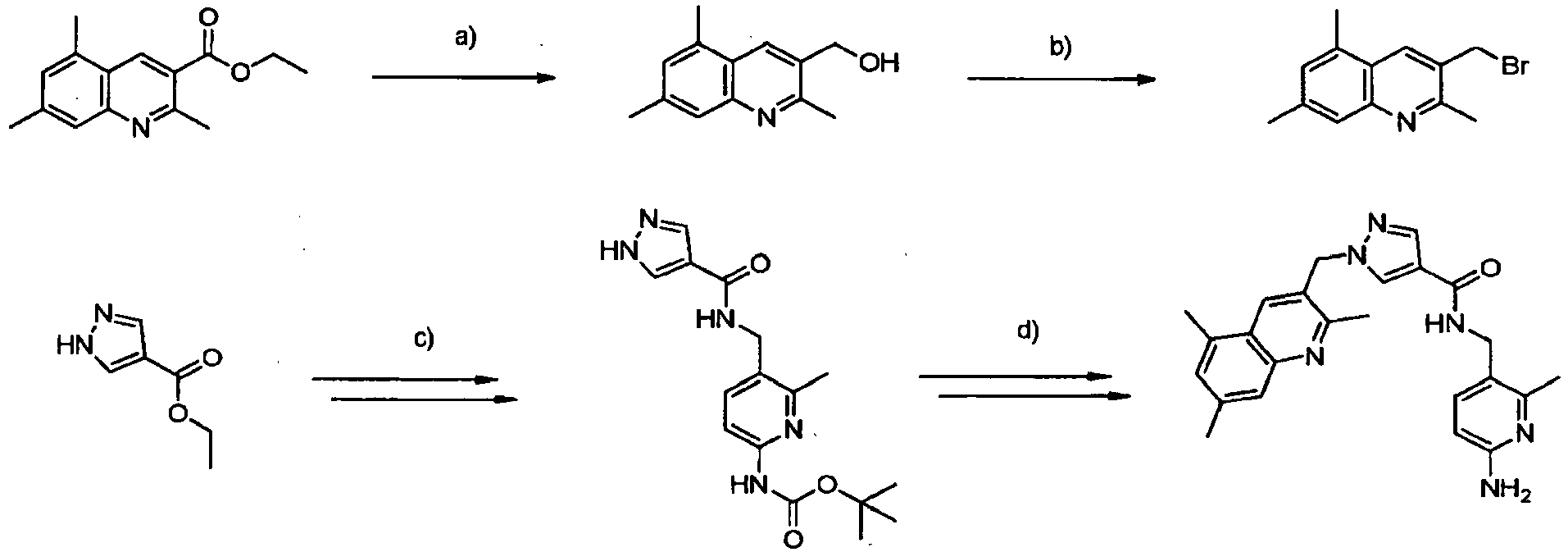
- To a solution of 2,5,7-trimethylquinoline-3-carboxylic acid ethyl ester (50 mg, 0.206 mmol) in DCM (1.7 ml) at -78°C was added DIBAI-H 1M in Toluene (29.2 mg, 0.206 mmol). Reaction mixture was stirred 1 h at -78°C. Methanol (1ml) was added to quench the reaction at -78°C. Mixture was then warmed up to 23°C. Sat. potassium/sodium tartrate solution (Rochelle's salt, 2ml) was added and mixture was stirred 30min at RT. Solid was filtered off and filtrate was extracted twice with DCM. Combined organic layer was washed with sat. NaHCO3 solution, brine, dried over sodium sulfate, filtered and evaporated to afford the title compound. HPLC (Method G) Rt = 1.113 min, MS (Method V) [M+H]+ = 202.1
- To a solution of (2,5,7-trimethylquinolin-3-yl)methanol (42.1 mg, 0.205 mmol) in DCM (1.5 ml) was added PBr3 (0.039 ml, 0.410 mmol). Reaction mixture was stirred overnight at 23°C. Reaction mixture was diluted with ethyl acetate/ NaHCO3 sat. aq solution. Layers were seperated and aqueous layer was extracted once more with ethyl acetate. Organic layer was dried over sodium sulfate, filtered and evaporated to afford the title compound. HPLC (Method G) Rt = 1.409 min, MS (Method V) [M+H]+ = 264.2, 266.2.
- The starting material ethyl pyrazole-4-carboxylate was saponified in analogy to Example 157, Step a), To a solution of the free acid (1 g, 5.86 mmol) in DMF (40 ml) were added DIPEA (4.10 ml, 23.46 mmol) and tert-butyl (5-(aminomethyl)-6-methylpyridin-2-yl)carbamate (1.531 g, 6.45 mmol). At 0°C, propylphosphonic anhydride (50% in DMF, 3.42 ml, 5.86 mmol) was added dropwise. Reaction mixture was stirred for 30min at 0°C, then diluted with ethyl acetate and water. Phases were separated and organic layer was washed with NaHCO3 sat. solution and brine. Organic layer was dried over sodium sulfate, filtered and evaporated to afford the crude material, which was purified by silicagel chromatography (DCM/MeOH from 100/0 to 9/1 in 30min) to afford the title compound. HPLC (Method G) Rt = 1.209 min, MS (Method V) [M+H]+ = 332.3.
- The subseqent steps of synthesis were done in analogy to Example 157, Steps b) and c) to afford the title compound. HPLC (Method G) Rt = 1.128 min, MS (Method V) [M+H]+ = 415.4.
-

- The title compound was prepared in analogy to Example 13. HPLC (Method G) Rt = 1.680 min, MS (Method V) [M+H]+ = 473.1.
-

- The title compound was prepared in analogy to Example 13. HPLC (Method G) Rt = 1.561 min, MS (Method V) [M+H]+ = 461.2.
-
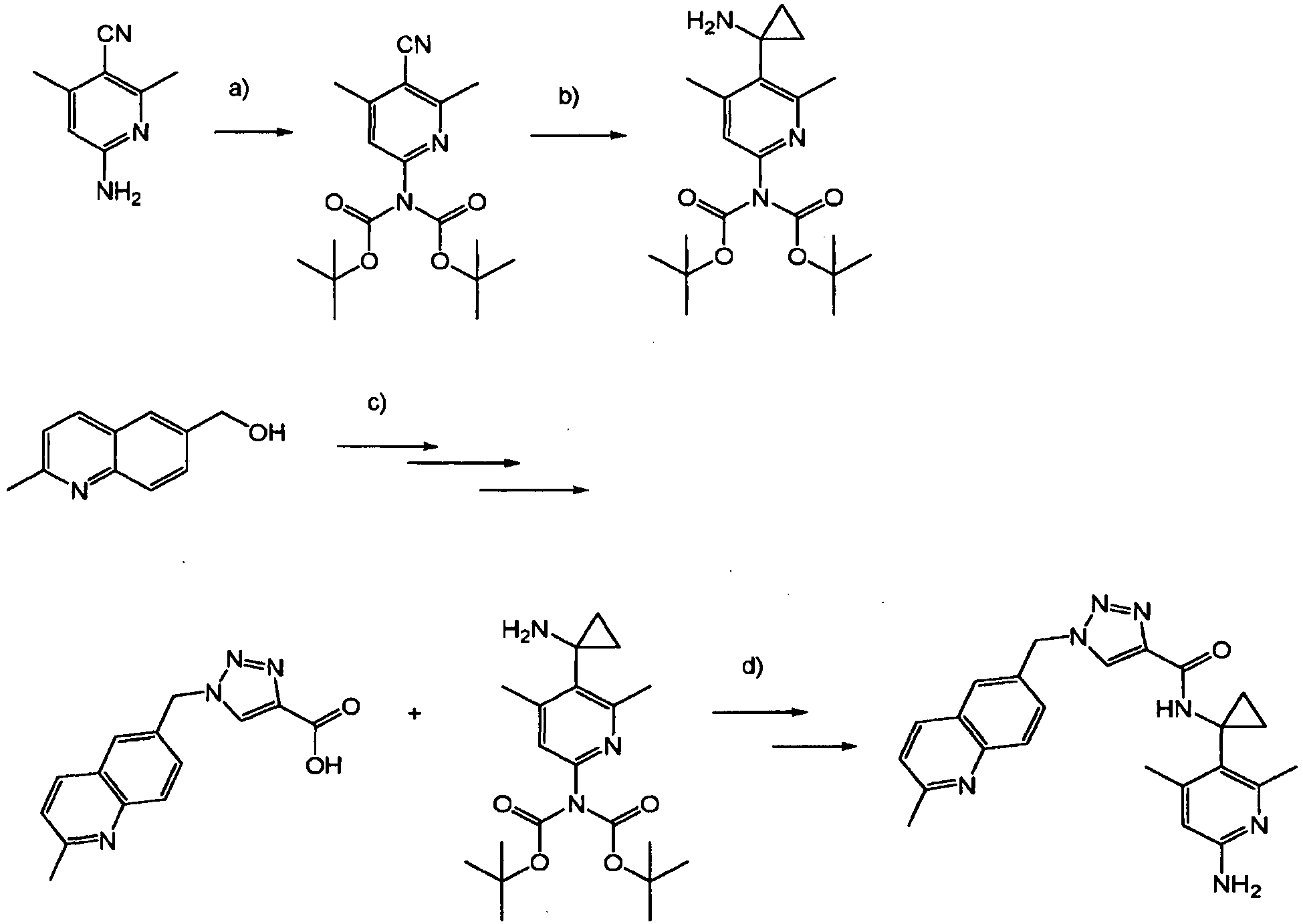
- To a brown suspension of 6-amino-2,4-dimethylnicotinonitrile (10g, 67.9mmol) and DMAP (0.830 g, 6.79 mmol) in THF (200 ml) was added (BOC)2O (31.6 ml, 136 mmol) and the mixture was stirred at 23°C for 6hr. The dark-brown solution was concentrated under reduced pressure, Purification by flash-chromatography (Silica gel, cyclohexane / EA = 9: 1) afforded the title compound. HPLC-MS (method F) Rt 1.36 min. [M+H]+ = 348.2
- To a solution of Bis-BOC-protected 6-amino-2,4-dimethylnicotinonitrile (3 g, 8.64 mmol) and Ti(Oi-Pr)4 (2.78 ml, 9.50 mmol) in diethylther (100 ml) EtMgBr (1M in diethylether , 19.86 ml, 19.86 mmol) was added slowly at -70° C . After 10min at -70° C the solution was warmed to 23°C, followed by adding of BF3.OEt2 (2.19 ml, 17.27 mmol). The mixture was stirred for 1h, 1N HCl and diethylether were added. 4 N NaOH was added and the mixture was extracted with Et OAc. The organic layer was dried over MgSO4, filtered and concentrated under vacuum. The crude product was splitted off into 6 parts and purified by prep. HPLC.The fractions were collected, made alkaline with NaHCO3 and extracted with EA to afford a mixture of the title compound and tert-butyl 5-(1-aminocyclopropyl)-4,6-dimethylpyridin-2-ylcarbamate.
- The title compound was prepared in analogy to Example 153, Step b) and Example10, Steps b) and c). MS (Method V) [M+H]+ = 269.0
- The title compound was prepared in analogy to Example 9, Steps e) and f). HPLC (Method H) Rt = 2.42 min, MS (Method V) [M+H]+ = 428.2.
-

- To a suspension of 1,2-Dimethyl-1H-benzo[d]imidazole-5-carboxylic acid (crude, 2.54 g, approx. 9.35 mmol) in MeOH (15.5 ml) / toluene (78 ml) Trimethylsilyldiazomethane (2 M solution in hexane, 7.0 ml, 14 mmol) was added at 0 - 10°C. The reaction mixture was stirred at rt for 1 hour. The reaction mixture was evaporated under reduced pressure. The residue was taken up in DCM, Remaining insoluble solid was filtered off. The filtrate wasevaporated again to dryness to afford crude Methyl 1,2-dimethyl-1H-benzo[d]i m idazole-5-carboxylate
- To a solution of Methyl 1,2-dimethyl-1H-benzo[d]imidazole-5-carboxylate (500 mg, 2.448 mmol) in THF (24.5 ml) Lithiumaluminium hydride (1 M in THF, 2.44 ml) was added at 0°C. After 2 hours sodiumsulfate decahydrate and citric acid was added to the reaction to destroy the excess of lithiumaluminiumhydride. After 1 hour, methanol (25 ml) was added and the fine suspension was filtered off. The filtrate was evaporated under reduced pressure to afford a brown solid. EA (50 ml) was added and the suspension was treated in an ultra sonic bath. The solid was filtered off and this procedure was repeated twice.The yellow filtrate was evaporated under reduced pressure to afford crude (1,2-Dimethyl-1H-benzo[d]imidazol-5-yl)methanol.
- The title compound was prepared in analogy to Example 9, Steps c) and d). MS (Method V) [M+H]+ = 271.0.
- The title compound was prepared in analogy to Example 20, Step c),and Example 9, Step f). HPLC (Method H) Rt = 3.329 min, MS (Method V) [M+H]+ = 404.1.
-

- The title compound was prepared in analogy to Example 165 a). HPLC (Method G) Rt = 1.795 min, MS (Method V) [M+H]+ = 190.2.
- The title compound was prepared in analogy to Example 153b). HPLC (Method G) Rt = 2.43 min, , MS (Method V) [M+H]+ = 213.0.
- The title compound was prepared in analogy to Example 153c) and 153d). HPLC (Method G) Rt = 1.736 min, MS (Method V) [M+H]+ = 418.3.
-

- The title compound was prepared in analogy to example 17. HPLC (Method G) Rt = 1.244 min, MS (Method V) [M+H]+ = 463.2.
-

- To a solution of Methyl 2-methyl-1H-indole-5-carboxylate (1000 mg, 5.29 mmol) in THF (53 ml) KOtBu (723 mg, 6.44 mmol) was added and subsequently lodomethane (1.05 ml, 16.81 mmol) was added at rt. The reaction mixture was stirred at rt for 40 hours.The orange reaction mixture was quenched with water / brine and extracted twice with EA. The combined organic layers were washed with brine, dried over Na2SO4, filtered and concentrated under vacuum to afford crude methyl 1,2-Dimethyl-1H-indole-5-carboxylate.
- To a solution of methyl 1,2-Dimethyl-1H-indole-5-carboxylate (crude, 1.14 mg, 5.31 mmol) in THF (54 ml) Lithiumaluminium hydride (1 M in THF, 5.31 ml) was added at 0°C. The reaction mixture was stirred at rt for 2 hours. Sodiumsulfate decahydrate was added to the reaction mixture to destroy the excess of Lithiumaluminium hydride. After 1 hour, methanol was added and the fine suspension was filtered off. The filtrate was concentrated under vacuum to afford crude (1,2-Dimethyl-1H-indol-5-yl)methanol. MS (Method V) [M+H]+ = 176.3.
- To a solution of (1,2-Dimethyl-1H-indol-5-yl)methanol (crude, 250 mg, 76 %, 1.084 mmol), Ethyl 1H-pyrazole-4-carboxylate (266 mg, 1.898 mmol) and Triphenylphosphine (341 mg, 1.3 mmol) in toluene (10.5 ml) Diethyl azodicarboxylate (206 ul, 1.3 mmol) was added at rt. The reaction mixture was stirred at rt for 16 hours. The reaction mixture was quenched with brine and extracted twice with DCM . The combined organic layers were dried over Na2SO4, filtered and concentrated under vacuum. :The crude product was purified by flash-chromatography on silica gel (60 g), gradient of cyclohexane / EA (50 ml/min.) from 100/0 (3 min.) to 70/30 (20 min.) to afford pure ethyl 1-((1,2-dimethyl-1H-indol-5-yl)methyl)-1H-pyrazole-4-carboxylate. MS (Method V) [M+H]+ = 298.4.
- A mixture of Ethyl 1-((1,2-dimethyl-1H-indol-5-yl)methyl)-1H-pyrazole-4-carboxylate (88 %, 122 mg, 0.361 mmol) and 2 N NaOH (0.9 ml, 1.8 mmol) in dioxane (1 ml) was stirred at rt for 16 hours. The reaction mixture was acidified with 1 N HCl to pH 2 and extracted with EtOAc (2 x). The combined organic layers were dried over Na2SO4, filtered and concentrated under vacuum to afford crude 1-((1,2-dimethyl-1H-indol-5-yl)methyl)-1H-pyrazole-4-carboxylic acid.
- To a solution of 1-((1-Methyl-1H-pyrrolo[2,3-b]pyridin-5-yl)methyl)-1H-pyrazole-4-carboxylic acid (130mg, 0.330mmol, 65%), tert-Butyl 5-(aminomethyl)-4,6-dimethylpyridin-2-ylcarbamate (99 mg, 0.396 mmol) and DIPEA (0.308 ml, 1.764 mmol) in DCM (4 ml) Propanephosphonic anhydride (50 % in EA (0.156 ml, 0.529 mmol) was added at rt. The reaction mixture was stirred at rt for 1 h. The reaction mixture was quenched with 1 N NaOH and extracted twice with DCM. The combined organic layers were dried over Na2SO4, filtered and concentrated under vacuum. he crude product was purified by flash-chromatography on silica gel (26 g), gradient of DCM/DCM:MeOH 8:2 (40 ml/min.) from 100/0 (5 min.) to 80/20 (20 min.) to 80/20 5min. to afford tert-Butyl 5-((1-((1,2-dimethyl-1H-indol-5-yl)methyl)-1H-pyrazole-4-carboxamido)methyl)-4,6-dimethylpyridin-2-ylcarbamate. MS (Method V) [M+H]+ = 503.4.
- To a solution of tert-Butyl 5-((1-((1,2-dimethyl-1H-indol-5-yl)methyl)-1H-pyrazole-4-carboxamido)methyl)-4,6-dimethylpyridin-2-ylcarbamate (160mg, 0.318mmol) in DCM (5 ml) Silica gel (2000 mg)was added. The resulting suspension was concentrated under vacuum to dryness and kept at 75°C for 6 days under high vacuum. The mixture was taken up in suspended in DCM / NH3 (in MeOH 7N) 9:1, the solution was filtered of and concentrated under reduced pressure to afford the title compound. The crude product was purified by preparative HPLC (Waters Sunfire
Prep C18 ODB 5 um, 30x100 mm, 1 to 99% ACN and 0.1% TFA, flow 45 ml/min) to yield pure title compound. 1H-NMR (CH3-OD, 400 MHz): ppm 2.26 (s, 3 H) 2.38 (s, 3 H) 2.41 - 2.44 (m, 3 H) 3.68 (s, 3 H) 4.44 (s, 2 H) 5.37 (s, 2 H) 6.20 (s, 1 H) 6.31 (s, 1 H) 7.05 (dd, J=8.56, 1.71 Hz, 1 H) 7.29 (d, J=8.31 Hz, 1 H) 7.39 - 7.41 (m, 1 H) 7.93 (s, 1 H) 8.04 (s, 1 H). HPLC (Method F) Rt = 0.70 min, MS (Method V) [M+H]+ = 403.2. -

- The title compound was prepared in analogy to Example 165 . HPLC (Method F) Rt = 0.33 min, MS (Method V) [M+H]+ = 390.4.
-

- A mixture of 6-(Chloromethyl)-2-methylquinoline (1.09 g, 5.69 mmol), Ethyl oxazole-4-carboxylate (1.00 g, 7.11 mmol), Cesium carbonate (3.7 g, 11.37 mmol), Palladium(II)acetate (64 mg, 0.284 mmol) and (2-Biphenyl)dicyclohexyl-phosphine (199 mg, 0.569 mmol) in dioxane (28 ml) was stirred at 100° C over night.The reaction mixture was quenched with H2O / brine and extracted with EA (3 x). The combined organic layers were dried over Na2SO4, filtered and evaporated under vacuum.The crude product was purified by flash-chromatography on silica gel (29 g), gradient of cyclohexane / EA (60 ml/min.) from 100/0 (2 min.) to 70/30 (25 min.) to afford pure Ethyl 2-((2-methylquinolin-6-yl)methyl)oxazole-4-carboxylate. MS (Method V) [M+H]+= 297.1
- The title compound was prepared in analogy to Example 165. HPLC (Method G) Rt = 0.436 min, MS (Method V) [[M/2+H]+ = 201.7.
-

- To a solution of (7-Aminothieno[2,3-c]pyridin-5-yl)methanol (67 mg, 0.394 mmol) and Imidazole (71.2 mg, 0.985 mmol) in DMF (2.6 ml) tert-Butylchlorodimethylsilane (71.2 mg, 0.473 mmol) was added at rt. The reaction mixture was stirred at rt over night (16 hours). The orange reaction mixture was quenched with water / brine and extracted twice with EA. The organic layers were dried over Na2SO4, filtered and concentrated under vacuum to afford crude title compound.
- To a solution of 5-((tert-Butyidimethylsilyloxy)methyl)thieno[2,3-c]pyridin-7-amine (crude, 125 mg, 0.393 mmol) and DMAP (2.4 mg, 0.02 mmol) in acetonitrile (4 ml) (BOC)2O (107 mg, 0.49 mmol) was added (BOC)2O (107 mg, 0.49 mmol) at rt. to afford crude bis-BOC-protected 5-((tert-butyldimethylsilyloxy)methyl)thieno[2,3-c]pyridin-7-amine
- To a solution of this crude product (138 mg, 0.279 mmol) in THF (4 ml) tetrabutylammonium fluoride trihydrate (88 mg, 0.279 mmol) was added at rt. The reaction mixture was purified by flash-chromatography on silica gel (10 g), gradient of cyclohexane / EA (40 ml/min.) from 100/0 (5 min.) to 80/20 (20 min). MS (Method V) [M+H]+= 381.1
- The title compound was prepared in analogy to Example 165. HPLC (Method G) Rt = 0.965 min, MS (Method V) [M+H]+ = 408.2.
-

- The title compound was prepared in analogy to Example 13. HPLC (Method H) Rt = 2.96 min, MS (Method V) [M+H]+ = 406.3.
-

- To a solution of Methyl quinoline-6-carboxylate (1000 mg, 5.34 mmol) in DMF (20 ml) was added N-Chlorosuccinimide (2141 mg, 16.0 mmol) and the reaction mixture was stirred at 120°C for 20 hr.
- The reaction mixture was allowed to cool to ambient temperature, treated with water, neutralized with solid NaHCO3 and further stirred at 23°C for 30 minutes. Finally, powdered sodium thiosulfate was carefully added to remove excess of N-chlorosuccinimide. The mixture was stirred at 23°C for 1 h and extracted with EA.The organic layer was dried over Na2SO4, filtered and concentrated under vacuum.The crude product was purified by flash-chromatography on silica gel (120g), gradient of cyclohexane / EA (85 ml/min.) from 100/0 (5 min.) to 70/30 (30 min.) to afford pure Methyl 3-chloroquinoline-6-carboxylate. HPLC (Method G) Rt = 2.01 min, HPLC-MS (Method F) [M+H]+ = 222.2.
- To a solution of Methyl 3-chloroquinoline-6-carboxylate (145 mg, 0.654 mmol) in THF (6 ml) Lithiumaluminium hydride 1M in THF (0.654 ml, 0.654 mmol) was added slowly at rt. The reaction was stirred for 2h at rt. Sodiumsulfate decahydrate was added to the reaction mixture to destroy the excess of Lithiumaluminium hydride. After 1h, methanol was added and the fine suspension was filtered off. The filtrate was concentrated under vacuum, to afford crude (3-chloroquinolin-6-yl)methanol. MS (Method V) [M+H]+= 194.2.
- To a solution of (3-Chloroquinolin-6-yl)methanol (142mg, 0.660mmol, 90%) and Triethyl amine (0.092 ml, 0.660 mmol) in DCM (4 ml) Methane sulfonyl chloride (0.051 ml, 0.660 mmol) was added slowly at rt. The reaction was stirred for 1h at rt and subsequently quenched with H2O and extracted twice with DCM. The organic layer was dried with Na2SO4, filtered and evaporated to dryness to afford crude (3-Chloroquinolin-6-yl)methyl methanesulfonate, which was immediately used in the following step.
- A solution of tert-Butyl 5-((1H-pyrazole-4-carboxamido)methyl)-4,6-dimethylpyridin-2-ylcarbamate (145mg, 0.421mmol), (3-Chloroquinolin-6-yl)methyl methanesulfonate ( 143mg, 0.421mmol 80%) and K2CO3 (291 mg, 2.105 mmol) in Acetone (3 ml) was stirred for 20h at 50°C. The reaction was quenched with H2O and extracted twice with DCM. The organic layer was dried with Na2SO4, filtered and evaporated to dryness to afford crude title compound. The crude product was purified by preparative HPLC (Macherey-Nagel Nucleosil 250x40 mm, 5 to 100% ACN and 0.1% TFA, flow 40ml/min) to afford pure title compound. MS (Method V) [M+H]+= 521.4.
- To a solution of tert-Butyl 5-((1-((3-chloroquinolin-6-yl)methyl)-1H-pyrazole-4-carboxamido)methyl)-4,6-dimethylpyridin-2-ylcarbamate (125 mg, 0.240 mmol) in DCM (1 ml) Tri flouro acetic acid (0.092 ml, 1.200 mmol) was added at rt. The reaction was stirred for 2h at rt. The reaction mixture was concentrated under vacuum to afford crude title compound. The crude product was dissolved in MeOH and filtered over a PL-HCO3-cartridge (MP-resin, VARIAN) to afford pure title compound.
- 1H-NMR (DMSO-d6, 400 MHz): ppm 2.17 (s, 3 H) 2.30 (s, 3 H) 4.28 (d, J=4.65 Hz, 2 H) 5.56 (s, 2 H) 6.13 (s, 1 H) 7.67 (dd, J=8.68, 2.08 Hz, 1 H) 7.82 (s, 1 H) 7.94 (s, 1 H) 8.04 (d, J=8.56 Hz, 1 H) 8.35 (s, 1 H) 8.59 (d, J=2.45 Hz, 1 H) 8.89 (d, J=2.45 Hz, 1 H). HPLC (Method G) Rt = 1.407 min, MS (Method V) [M+H]+ = 421.3.
-

- To a solution of (1,1-Dioxo-2,3-dihydro-1H-1lambda*6*-benzo[b]thiophen-5-yl)-methanol (crude, 160 mg, 0.64 mmol) and triethylamne (180 ul, 1.29 mmol) in DCM (7 ml) Methanesulfonylchloride (60 ul, 0.77 mmol) was added at rt. The reaction mixture was stirred at rt for 3 hours.
- The reaction mixture was quenched with brine and extracted twice with DCM . The combined organic layers were dried over Na2SO4, filtered and concentrated under vacuum to afford crude title compound.
- The title compound was prepared in analogy to Example 157 b) and 157c). HPLC (Method G) Rt = 1.164 min, MS (Method V) [M+H]+ = 426.3.
-

- The title compound was prepared from 1-((2-Methylquinolin-6-yl)methyl)-1H-1,2,3-triazole-4-carboxylic acid and 5-(aminomethyl)-4-chloro-6-methylpyridin-2-amine in analogy to Example 20c).HPLC-MS (Method F) Rt = 0.44 min. [M+H]+ = 422.1.
-

- The title compound was prepared in analogy to Example 74. HPLC-MS (Method G) Rt = 1.61 min. [M+H]+ = 399.0.
-
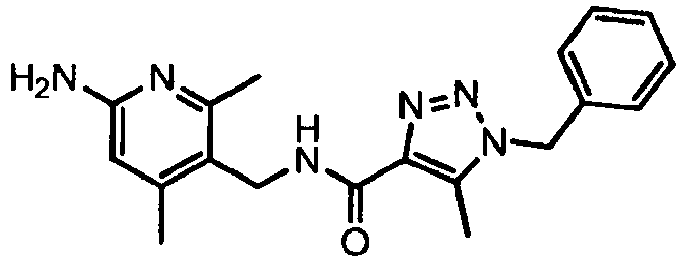
- The title compound was prepared in analogy to Example 1d). HPLC-MS (Method R) Rt = 0.87 min. [M+H]+ = 350.4.
-

- The title compound was prepared in analogy to Example 153. HPLC-MS (Method G) Rt = 1.198 min. [M+H]+ = 339.4.
-

- The title compound was prepared from 1 Ethyl 1-benzyl-2-methyl-1H-pyrrole-3-carboxylate in analogy to Example 19 a and b).HPLC-MS (Method G) Rt = 1.534 min. [M+H]+ = 349.1.
-

- To a suspension sodium 6-amino-3-cyano-2-methylpyridin-4-olate (500 mg, 2.92 mmol) in DMF (5 ml) was added NaH (117 mg, 2.92 mmol) at rt and the reaction mixture was stirred for 15 min. Methyl chlorodifluoroacetate (1.3 g, 9.4 mmol) was added dropwise with vigurous stirring over the course of 20 min. After 15 min, the suspension was warmed to 70°C for 14 h.The reaction mixture was quenched into brine:Na2CO3 (70+70 mL) and extracted with EA (3x60 mL). The combined organic phases were dried over Na2SO4, filtered and concentrated under reduced pressure.
- Column chromatography (Combiflash Companion, 4 g SiO2, DCM:(DCM/MeOH 9:1)) afforded the titlte compound. [M+H]+ = 200.4.
- The title compound was prepared in analogy to Example 14 b).HPLC-MS (Method F) Rt = 0.94 min. [M+H]+ = 388.2.
-

- The title compound was prepared in analogy to Example 144. HPLC-MS (Method F) Rt = 0.83 min. [M+H]+ = 400.2.
-

- The title compound was prepared in analogy to Example 13b). [M+H]+ = 308.5.
-

- The title compound was prepared in analogy to Example 74. HPLC-MS (Method G) Rt = 1.67 min. [M+H]+ = 427.0.
- The fluorogenic substrate DPro-Phe-Arg-(Rh110)-γGlu-OH (where DPro is the amino acid d-proline, Rh110 is the fluorophore rhodamine 110 and γGlu is a glutamine linked to Rh110 via the gamma-carbonyl function; from Biosyntan, Berlin, Germany), being based on the chromogenic substrate described in Gallimore et al (Thromb Res 25, 293-298, 1982), was dissolved in DMSO at 5 mM and stored at -80 °C. All other chemicals were of analytical grade.
- Human plasma kallikrein was purchased from Kordia (Leiden, Netherlands, batch HPKA 1303). A stock solution of 0.17 mg/ml deinonized water was stored at -80 °C.
- Enzymatic reactions were conducted in 'assay buffer', comprising 50 mM Hepes/NaOH at pH 7.8, 150 mM NaCl, 1 mM EDTA and 0.05 % (w/v) CHAPS.
- Both, enzyme and substrate were diluted in assay buffer.
- All protein and peptide containing solutions were handled in siliconized tubes (Life Systems Design, Merenschwand, Switzerland). The compound solutions as well as the enzyme and the substrate solutions were transferred to 384-well plates (black Cliniplate; cat. no. 95040020 Labsystems Oy, Finland) by means of a CyBi-Well 96-channel pipettor (CyBio AG, Jena, Germany). Plate measurements were conducted by the means of a Safire2 reader (TECAN, Maennedorf, Switzerland). The Safire2 is a monochomator-based instrument and wavelengths of 485 nm and 535 nm were taken for fluorescence excitation and emission acquisition, respectively. The bandwidths were set to 10 nm in both the excitation and the emission path. The fluorescence in each well was excited by three flashes per measurement.
- For the determination of IC50 values, the assays were performed at room temperature in 384-well plates with a total assay volume of 25.25 µl per well.
- The test compound was dissolved in 90 % (v/v) DMSO/water. For the assays, 250 nL of the 90 % (v/v) DMSO/water solution or compound solution were added per well, followed by the addition of 12.5 µl protease solution (protease in assay buffer). The final assay concentration of the human plasma kallikrein was nominally 25 pM, the 11 compound concentrations in the dilution series were in the range form 1 nM to 100 uM. After 1 hour of pre-incubation at room temperature, the reactions were started by the addition of 12.5 µl substrate solution (in assay buffer, final assay concentration was 0.5 uM). After the addition of the substrate solution, the final DMSO concentration in the assay was 0.9 % (v/v). The effect of the compound on the enzymatic activity was obtained from the linear part of the progress curves and determined after 1 hour (t = 60 min). The IC50 value was calculated from the plot of percentage of inhibition vs. inhibitor concentration by a logistics fit according to the following equation:

where y is the %-inhibition at the inhibitor concentration, x. A1 is the lowest inhibition value, i.e. 0 %, and A2 the maximum inhibition value, i.e. 100 %. The exponent, p, is the Hill coefficient. The curve fitting was conducted with the non-linear regression routine of the analysis software Origin 7.5SR6 (OriginLab Corporation).Table 1 Example IC50 (µM) Example IC50 (µM) 1 0.81 94 0.0021 2 7.67 95 0.485 3 2.26 96 0.291 4 7.6 97 1.9 5 4.5 98 3.8 6 0.0002 99 7.0 7 2.03 100 0.642 8 2.64 101 0.07 9 9.12E-05 102 4.0 10 0.03 103 0.299 11 12.2 104 0.113 12 1.37 105 0.168 13 0.15 106 0.415 14 0.32 107 1.8 15 0.23 108 0.798 16 0.15 109 1.3 17 0.098 110 0.249 18 1.1 111 2.1 19 0.07 112 0.229 20 7.4 113 5.8 21 2.54 114 0.03 22 1.7 115 0.0033 23 0.009 116 0.197 24 0.238 117 0.152 25 0.109 118 0.183 26 0.019 119 0.289 27 0.021 120 0.223 28 0.343 121 0.369 29 0.248 122 0.752 30 0.204 123 15.8 31 0.143 124 0.071 32 0.041 125 0.036 33 0.262 126 0.67 34 0.046 127 0.016 35 3.9 128 0.301 36 0.000134 129 0.244 37 5.3 130 0.067 38 0.019 131 0.009 39 0.634 132 0.071 40 0.009 133 0.196 41 0.108 134 1.1 42 0.145 135 0.089 43 0.113 136 0.024 44 0.215 137 0.127 45 0.045 138 62.7 46 1.1 139 0.0049 47 3.2 140 0.0046 48 35.5 141 0.0012 49 0.679 142 2.24E-05 50 0.739 143 0.0026 51 7 144 42.4 52 5.7 145 0.0002 53 3.6 146 0.00004 54 1.8 147 0.0001 55 6.3 148 0.00003 56 4.4 149 0.0078 57 0.144 150 0.01 58 3.8 151 0.013 59 0.209 152 0.004 60 0.379 153 0.016 61 0.046 154 0.002 62 0.681 155 0.003 63 0.011 156 0.00092 64 0.014 157 0.002 65 0.029 158 0.004 66 0.325 159 0.007 67 0.06 160 0.02 68 0.034 161 0.004 69 1.6 162 0.005 70 4.1 163 0.005 71 0.19 164 1.2 72 0.937 165 0.006 73 0.114 166 0.0002 74 0.595 167 0.0002 75 0.0031 168 0.0001 76 0.949 169 0.003 77 0.072 170 0.0097 78 10.1 171 0.026 79 0.166 172 0.06 80 0.117 173 0.0004 81 0.411 174 0.075 82 0.678 175 0.061 83 0.018 176 45.0 84 0.498 177 52.1 85 4.1 178 67.3 86 7.5 179 85.8 87 1.3 180 > 100 88 1.8 181 37.0 89 0.006 182 > 100 (38% inhibition at 100 uM) 90 2.0 183 > 100 (39% inhibition at 100 uM) 91 0.133 92 0.867 93 0.674 - For imaging of vascular leakiness a CRi Maestro 2 system was used (CRi, Woburn, MA 01801 USA). The temperature of the animal was maintained at 37° during the imaging procedure using warming pad. Female mice (C57BL/6JRj Mouse, MA512) were used for the assay. The compound to be tested was disolved in 0.5% methylcellulose and applied orally at a volume of 10ml/kg (timpoint 0). Fourty minutes later, animals were anaesthetized using a mixture of oxygen (100%) and isofluran (2%). Anaesthesia was delivered by a face mask. Then, the contrast agent (in house developed near-infrared tracer based on the Kodak Xsight 670LSS near-infrared dye bound to albumin, 2.5 mg/kg/5 ml) was injected intravenously. At timepoint 50min, the back of the animal was shaved and a reference image was recorded. At timepoint 60min, dextran sulfate (8%, 0.05 ml / injection site) was injected intradermanlly using a 30G needle at 4 sites arranged in a rectangular pattern with about 10mm distance between the spots. 5 mins after dextran sulfate injection time lapse imaging was started. The recording interval was 5 mins for a total recording time of 15mins.
- For data analysis regions-of-interest were defined for each of the injection sites (ROI2-5) and the area surrounding the injection sites (ROI1). For these and the time course of the fluorescence signal was plotted and statistically evaluated for each experimental group as mean +/- standard-error-of-mean.
-
Figure 1 shows the leakage vs min after dextran sulfate (DX) injection for Example 153 at doses of 3, 30 and 100 mg/kg po. - The following are further embodiments of the invention:
- Embodiment 1: A compound of the formula I

- R1 is hydrogen; halogen; cyano; nitro; hydroxy; amino; -C(O)H; -C(O)OH; -C(O)NH2; C1-6alkyl; C1-6halogenalkyl; C1-6hydroxyalkyl; C1-4alkoxy-C1-6alkyl; C1-6aminoalkyl; C2-6alkenyl; C2-6halogenalkenyl; C2-8alkinyl; C2-6halogenalkinyl;
C1-6alkoxy; C1-6halogenalkoxy; C1-4alkoxy-C1-6alkoxy; C1-6alkylamino; di(C1-6alkyl)amino; or C3-7cycloalkyl, wherein one carbon atom may be replaced by an oxygen atom, wherein the C3-7cycloalkyl may be attached directly to the pyridine ring or via a C1-2alkylene or an oxygen, and wherein the C3-7cycloalkyl may be substituted once or more than once by halogen, C1-4alkyl or C1-4alkoxy; - R2 is hydrogen or fluoro;
- R3 is hydrogen; halogen; cyano; nitro; hydroxy; amino; -C(O)H; -C(O)OH; -C(O)NH2; or -X1-R6;
X1 is selected from bond; carbonyl; oxygen; sulfur; -S(O)-; -S(O)2-; amino, which may be substituted by C1-4alkyl; -NH-C(O)-; -C(O)-NH-; -NH-S(O)2-; and -S(O)2-NH-;
Re is C1-6alkyl; C1-6halogenalkyl; C1-6cyanoalkyl; C1-6carboxyalkyl; C1-6hydroxyalkyl; C1-4alkoxy-C1-6alkyl; C1-4alkoxy-C1-4alkoxy-C1-6alkyl; C1-4alkylcarbonyl-C1-6alkyl; C1-4alkoxycarbonyl-C1-6alkyl; C1-4alkylcarbonyloxy-C1-6alkyl; C1-6aminoalkyl; C1-4alkylamino-C1-6alkyl; di(C1-4alkyl)amino-C1-6alkyl; aminocarbonyl-C1-6alkyl; C1-4alkylaminocarbonyl-C1-6alkyl; di(C1-4alkyl)aminocarbonyl-C1-6alkyl; C1-4alkylcarbonylamino-C1-6alkyl; C1-4alkylaminosulfonyl-C1-6alkyl; di(C1-4alkyl)aminosulfonyl-C1-6alkyl;
C2-6alkenyl; C2-6halogenalkenyl; C2-6alkinyl; C2-6halogenalkinyl;
or R6 is a three- to seven-membered monocyclic ring system which may be aromatic, saturated or unsaturated non-aromatic and which may contain from 1 to 4 hetero atoms selected from nitrogen, oxygen and sulfur, wherein the ring system may contain not more than 2 oxygen atoms and not more than 2 sulfur atoms, wherein the ring system may be attached directly to group X1 or via a C1-2alkylene, wherein the ring system may in turn be
substituted once or more than once by R7, and wherein a substituent on a nitrogen in a heterocyclic ring system may not be halogen;
each R7 independently is halogen, cyano, C1-4alkyl, C1-4halogenalkyl, C1-4alkoxy, or C1-4halogenalkoxy; or two R7 at the same ring atom together are oxo; - R4 and R5 are each independently hydrogen; cyano;
C1-6alkyl; C1-6halogenalkyl; C1-6hydroxyalkyl; C1-4alkoxy-C1-6alkyl; C2-6alkenyl; C2-6halogenalkenyl; C2-6alkinyl; C2-6halogenalkinyl;
C1-6alkylamino; di(C1-6alkyl)amino;
or C3-7cycloalkyl, wherein one carbon atom may be replaced by an oxygen atom, wherein the C3-7cycloalkyl may be attached directly to the methylene or via a C1-2alkylene, and wherein the C3-7cycloalkyl may be substituted once or more than once by halogen, C1-4alkyl or C1-4alkoxy;
or R4 and R5 together with the carbon atom to which they are bound form a C3-7cycloalkyl;
or R4 and R5 together are oxo;
or R4 and R5 together are imino, which may be substituted by C1-4alkyl; - A is a five-membered monocyclic aromatic ring system which contains from 1 to 4 hetero atoms selected from nitrogen, oxygen and sulfur, wherein the ring system may contain not more than 1 hetero atom selected from oxygen and sulfur, and wherein the group L is attached to a ring atom being separated by one further ring atom from the ring atom to which the carboxamide group is attached, wherein the ring system may be substituted once, twice or three times by R8, and wherein a substituent on a ring nitrogen atom may not be halogen;
- each R8 independently is halogen; cyano; nitro; hydroxy; amino; -C(O)H; -C(O)OH;-C(O)NH2;
C1-6alkyl; C1-6halogenalkyl; C1-6hydroxyalkyl; C1-4alkoxy-C1-6alkyl; C1-6aminoalkyl; C2-6alkenyl; C2-6halogenalkenyl; C2-6alkinyl; C2-6halogenalkinyl;
C1-6alkoxy; C1-6halogenalkoxy; C1-4alkoxy-C1-6alkoxy; C1-6alkylamino; di(C1-6alkyl)amino; or C3-7cycloalkyl, wherein one carbon atom may be replaced by an oxygen atom, wherein the C3-7cycloalkyl may be attached directly to group A or via a C1-2alkylene or an oxygen, and wherein the C3-7cycloalkyl may be substituted once or more than once by halogen, C1-4alkyl or C1-4alkoxy;
or two R8 at adjacent ring atoms atoms form together with said ring atoms a fused five- to seven-membered monocyclic aromatic or unsaturated non-aromatic ring system which may contain from 1 to 4 hetero atoms selected from nitrogen, oxygen and sulfur, wherein the ring system may contain not more than 2 oxygen atoms and not more than 2 sulfur atoms, and wherein the ring system may in turn be substituted once or more than once by R9, and wherein a substituent on a nitrogen in a heterocyclic ring system may not be halogen; and wherein each R9 independently is halogen, C1-4alkyl or C1-4alkoxy, or two R9 at the same ring atom together are oxo; - L is -C(R10)2-; -O-; -S-; -N(R11)-; -S(O)-; or -S(O)2-;
- each R10 independently is hydrogen;
halogen; cyano; hydroxy; nitro; amino;
C1-6alkyl; C1-6halogenalkyl; C1-6hydroxyalkyl; C1-4alkoxy-C1-6alkyl; amino-C1-6alkyl; C1-4alkylamino-C1-6alkyl; di(C1-4alkyl)amino-C1-6alkyl;
C2-6alkenyl; C2-6halogenalkenyl; C2-6alkinyl; C2-6halogenalkinyl;
C1-6alkoxy; C1-6halogenalkoxy; C1-4alkoxy-C1-6alkoxy; C1-6alkylamino; di(C1-6alkyl)amino; or C3-7cycloalkyl, wherein one carbon atom may be replaced by an oxygen atom, wherein the C3-7cycloalkyl may be attached directly to the methylene or via a C1-2alkylene or an oxygen, and wherein the C3-7cycloalkyl may be substituted once or more than once by halogen, C1-4alkyl or C1-4alkoxy;
or two R10 together with the carbon atom to which they are bound form a C3-7cycloalkyl;
or two R10 together are oxo;
or two R10 together are imino, which may be substituted by C1-4alkyl; - R11 is hydrogen;
C1-6alkyl;
or C3-7cycloalkyl, wherein one carbon atom may be replaced by an oxygen atom, wherein the C3-7cycloalkyl may be attached directly to the nitrogen atom or via a C1-2alkylene; - B is a five- to ten-membered monocyclic or fused polycyclic aromatic ring system which may contain from 1 to 4 hetero atoms selected from nitrogen, oxygen and sulfur, wherein the ring system may contain not more than 2 oxygen atoms and not more than 2 sulfur atoms, and wherein the ring system may be substituted once or more than once by R12, and wherein a substituent on a nitrogen in a heterocyclic ring system may not be halogen;
- each R12 independently is halogen; cyano; nitro; hydroxy; amino; -C(O)H; -C(O)OH;-C(O)NH2; -X2-R13; or -X3-B1;
- X2 is selected from bond; carbonyl; oxygen; sulfur; -S(O)-; -S(O)2-; amino, which may be substituted by C1-4alkyl; -NH-C(O)-; -C(O)-NH-; -C(O)-O-; -O-C(O)-; -NH-S(O)2-; -S(O)2-NH-; and -NHC(O)NH-;
- R13 is C1-6alkyl; C1-6halogenalkyl; C1-6cyanoalkyl; C1-6carboxyalkyl; C1-6hydroxyalkyl; C1-4alkoxy-C1-6alkyl; C1-4alkoxy-C1-4alkoxy-C1-6alkyl; C1-4alkylcarbonyl-C1-6alkyl; C1-4alkoxycarbonyl-C1-6alkyl; C1-4alkylcarbonyloxy-C1-6alkyl; C1-6aminoalkyl; C1-4alkylamino-C1-6alkyl; di(C1-4alkyl)amino-C1-6alkyl; aminocarbonyl-C1-6alkyl; C1-4alkylaminocarbonyl-C1-6alkyl; di(C1-4alkyl)aminocarbonyl-C1-6alkyl; C1-4alkylcarbonylamino-C1-6alkyl; C1-4alkylaminosulfonyl-C1-6alkyl; di(C1-4alkyl)aminosulfonyl-C1-6alkyl;
C2-6alkenyl; C2-6halogenalkenyl; C2-6alkinyl; C2-6halogenalkinyl; - X3 is bond or C1-3alkylene, wherein one carbon atom of the C1-3alkylene may be replaced by a group selected from carbonyl; oxygen; sulfur; -S(O)-; -S(O)2-; amino, which may be substituted by C1-4alkyl; -NH-C(O)-; -C(O)-NH-; -C(O)-O-; -O-C(O)-; -NH-S(O)2-; -S(O)2-NH-; and -NHC(O)NH-;
- B1 is a three- to seven-membered monocyclic ring system which may be aromatic, saturated or unsaturated non-aromatic and which may contain from 1 to 4 hetero atoms selected from nitrogen, oxygen and sulfur, wherein the ring system may contain not more than 2 oxygen atoms and not more than 2 sulfur atoms, wherein the ring system may in turn be substituted once or more than once by R14, and wherein a substituent on a nitrogen in a heterocyclic ring system may not be halogen;
each R14 independently is halogen, cyano, C1-4alkyl, C1-4halogenalkyl, C1-4alkoxy, or C1-4halogenalkoxy; or two R14 at the same ring atom together are oxo; - or two R12 at adjacent ring atoms atoms form together with said ring atoms a fused five-to seven-membered monocyclic unsaturated non-aromatic ring system which may contain from 1 to 4 hetero atoms selected from nitrogen, oxygen and sulfur, wherein the ring system may contain not more than 2 oxygen atoms and not more than 2 sulfur atoms, and wherein the ring system may in turn be substituted once or more than once by R15, and wherein a substituent on a nitrogen in a heterocyclic ring system may not be halogen; and wherein each R15 independently is halogen, C1-4alkyl, C1-4alkoxy, or C1-4alkoxyC1-4alkyl, or two R15 at the same ring atom together are oxo;
- or B is a three- to ten-membered monocyclic or fused polycyclic saturated or unsaturated non-aromatic ring system which may contain from 1 to 4 hetero atoms selected from nitrogen, oxygen and sulfur, wherein the ring system may contain not more than 2 oxygen atoms and not more than 2 sulfur atoms, and wherein the ring system may be substituted once or more than once by R16, and wherein a substituent on a nitrogen in a heterocyclic ring system may not be halogen;
- each R16 independently is halogen; cyano; nitro; hydroxy; amino; -C(O)H; -C(O)OH;-C(O)NH2; -X4-R17; or -X5-B2;
- X4 is selected from bond; carbonyl; oxygen; sulfur; -S(O)-; -S(O)2-; amino, which may be substituted by C1-4alkyl; -NH-C(O)-; -C(O)-NH-; -C(O)-O-; -O-C(O)-; -NH-S(O)2-; -S(O)2-NH-; and -NHC(O)NH-;
- R17 is C1-6alkyl; C1-6halogenalkyl; C1-6cyanoalkyl; C1-6carboxyalkyl; C1-6hydroxyalkyl; C1-4alkoxy-C1-6alkyl; C1-4alkoxy-C1-4alkoxy-C1-6alkyl; C1-4alkylcarbonyl-C1-6alkyl; C1-4alkoxycarbonyl-C1-6alkyl; C1-4alkylcarbonyloxy-C1-6alkyl; C1-6aminoalkyl; C1-4alkylamino-C1-6alkyl; di(C1-4alkyl)amino-C1-6alkyl; aminocarbonyl-C1-6alkyl; C1-4alkylaminocarbonyl-C1-6alkyl; di(C1-4alkyl)aminocarbonyl-C1-6alkyl; C1-4alkylcarbonylamino-C1-6alkyl; C1-4alkylaminosulfonyl-C1-6alkyl; di(C1-4alkyl)aminosulfonyl-C1-6alkyl;
C2-6alkenyl; C2-6halogenalkenyl; C2-6alkinyl; C2-6halogenalkinyl; - X5 is bond or C1-3alkylene, wherein one carbon atom of the C1-3alkylene may be replaced by a group selected from carbonyl; oxygen; sulfur; -S(O)-; -S(O)2-; amino, which may be substituted by C1-4alkyl; -NH-C(O)-; -C(O)-NH-; -C(O)-O-; -O-C(O)-; -NH-S(O)2-; -S(O)2-NH-; and -NHC(O)NH-;
- B2 is a three- to seven-membered monocyclic ring system which may be aromatic, saturated or unsaturated non-aromatic and which may contain from 1 to 4 hetero atoms selected from nitrogen, oxygen and sulfur, wherein the ring system may contain not more than 2 oxygen atoms and not more than 2 sulfur atoms, wherein the ring system may in turn be substituted once or more than once by R18, and wherein a substituent on a nitrogen in a heterocyclic ring system may not be halogen;
each R18 independently is halogen, cyano, C1-4alkyl, C1-4halogenalkyl, C1-4alkoxy, or C1-4halogenalkoxy; or two R18 at the same ring atom together are oxo; - or two R16 at adjacent ring atoms atoms form together with said ring atoms a fused five-to six-membered monocyclic aromatic ring system which may contain from 1 to 4 hetero atoms selected from nitrogen, oxygen and sulfur, wherein the ring system may contain not more than 2 oxygen atoms and not more than 2 sulfur atoms, and wherein the ring system may in turn be substituted once or more than once by R19, and wherein a substituent on a nitrogen in a heterocyclic ring system may not be halogen; and wherein each R19 independently is halogen, C1-4alkyl or C1-4alkoxy;
or two R16 at the same ring atom together are oxo;
or two R16 at the same ring atom together with the ring atom to which they are bound form a C3-7cycloalkyl;
or two R16 at the same ring atom together are imino, which may be substituted by C1-4alkyl; - in free form or in salt form.
- R1 is hydrogen; halogen; cyano; nitro; hydroxy; amino; -C(O)H; -C(O)OH; -C(O)NH2; C1-6alkyl; C1-6halogenalkyl; C1-6hydroxyalkyl; C1-4alkoxy-C1-6alkyl; C1-6aminoalkyl; C2-6alkenyl; C2-6halogenalkenyl; C2-8alkinyl; C2-6halogenalkinyl;
- Embodiment 2: A compound of formula I according to embodiment 1, wherein R1 is C1-4alkyl or C1-4halogenalkyl; R2 is hydrogen; R3 is -X1-R6; X1 is bond; and R6 is C1-4alkyl or C1-4halogenalkyl.
- Embodiment 3: A compound of formula I according to embodiment 1, wherein R1 is C1-4alkyl or C1-4halogenalkyl; R2 is hydrogen; R3 is -X1-R6; X1 is oxygen; and R6 is C1-6alkyl; C1-6halogenalkyl; C1-6cyanoalkyl; C1-6carboxyalkyl; C1-6hydroxyalkyl; C1-4alkoxy-C1-6alkyl; C1-4alkoxy-C1-4alkoxy-C1-6alkyl; C1-4alkylcarbonyl-C1-6alkyl; C1-4alkoxycarbonyl-C1-6alkyl; C1-4alkylcarbonyloxy-C1-6alkyl; C1-6aminoalkyl; C1-4alkylamino-C1-6alkyl; di(C1-4alkyl)amino-C1-6alkyl; aminocarbonyl-C1-6alkyl; C1-4alkylaminocarbonyl-C1-6alkyl; di(C1-4alkyl)aminocarbonyl-C1-6alkyl; C1-4alkylcarbonylamino-C1-6alkyl; C1-4alkylaminosulfonyl-C1-6alkyl; di(C1-4alkyl)aminosulfonyl-C1-6alkyl;
C2-6alkenyl; C2-6halogenalkenyl; C2-6alkinyl; C2-6halogenalkinyl;
or R6 is a three- to seven-membered monocyclic ring system which may be aromatic, saturated or unsaturated non-aromatic and which may contain from 1 to 4 hetero atoms selected from nitrogen, oxygen and sulfur, wherein the ring system may contain not more than 2 oxygen atoms and not more than 2 sulfur atoms, wherein the ring system may be attached directly to group X1 or via a C1-2alkylene, wherein the ring system may in turn be substituted once or more than once by R7, and wherein a substituent on a nitrogen in a heterocyclic ring system may not be halogen;
each R7 independently is halogen, cyano, C1-4alkyl, C1-4halogenalkyl, C1-4alkoxy, or C1-4halogenalkoxy; or two R7 at the same ring atom together are oxo. - Embodiment 4: A compound of formula I according to any of embodiments 1 to 3, wherein R4 and R5 are each hydrogen; L is -C(R10)2-; and each R10 is hydrogen.
- Embodiment 5: A compound of formula I according to any of embodiments 1 to 4, wherein A is a ring system selected from


- Embodiment 6: A compound of formula I according to any of embodiments 1 to 5, wherein B is a five- to six-membered monocyclic aromatic ring system which may contain from 1 to 4 hetero atoms selected from nitrogen, oxygen and sulfur, wherein the ring system may contain not more than 2 oxygen atoms and not more than 2 sulfur atoms, and wherein the ring system is substituted once by -X3-B1; and wherein the ring system may be further substituted once or more than once by halogen; cyano; hydroxy; amino; or -X2-R13; and wherein a substituent on a nitrogen in a heterocyclic ring system may not be halogen;
X2 is selected from bond; oxygen;
R13 is C1-6alkyl; C1-6halogenalkyl;
X3 is bond or C1-3alkylene, wherein one carbon atom of the C1-3alkylene may be replaced by a group selected from oxygen; sulfur; amino, which may be substituted by C1-4alkyl; B1 is a three- to seven-membered monocyclic ring system which may be aromatic, saturated or unsaturated non-aromatic and which may contain from 1 to 4 hetero atoms selected from nitrogen, oxygen and sulfur, wherein the ring system may contain not more than 2 oxygen atoms and not more than 2 sulfur atoms, wherein the ring system may in turn be substituted once or more than once by R14, and wherein a substituent on a nitrogen in a heterocyclic ring system may not be halogen;
each R14 independently is halogen, cyano, C1-4alkyl, C1-4halogenalkyl, C1-4alkoxy, or C1-4halogenalkoxy; or two R14 at the same ring atom together are oxo. - Embodiment 7: A compound of formula I according to any of embodiments 1 to 5, wherein B is a nine- to ten-membered fused bicyclic aromatic ring system which may contain from 1 to 4 hetero atoms selected from nitrogen, oxygen and sulfur, wherein the ring system may contain not more than 2 oxygen atoms and not more than 2 sulfur atoms, and wherein the ring system may be substituted once or more than once by R12; and wherein a substituent on a nitrogen in a heterocyclic ring system may not be halogen;
each R12 independently is halogen; cyano; hydroxy; amino; -X2-R13;
X2 is selected from bond; oxygen; and amino, which may be substituted by C1-4alkyl;
R13 is C1-6alkyl; C1-6halogenalkyl. - Embodiment 8: A compound of formula I according to any of embodiments 1 to 7 which is selected from
- N-((6-amino-2,4-dimethylpyridin-3-yl)methyl)-5-benzyl-1-methyl-1H-1,2,4-triazole-3-carboxamide;
- N-((6-amino-2,4-dimethylpyridin-3-yl)methyl)-3-benzylisoxazole-5-carboxamide;
- N-((6-amino-2,4-dimethylpyridin-3-yl)methyl)-5-benzyl-1,3,4-oxadiazole-2-carboxamide;
- N-((6-amino-2,4-dimethylpyridin-3-yl)methyl)-3-benzyl-1,2,4-oxadiazole-5-carboxamide;
- 1-(4-((1H-pyrazol-1-yl)methyl)benzyl)-N-((6-amino-2,4-dimethylpyridin-3-yl)methyl)-1H-imidazole-4-carboxamide;
- N-((6-amino-2,4-dimethylpyridin-3-yl)methyl)-5-benzyloxazole-2-carboxamide;
- N-((6-amino-2,4-dimethylpyridin-3-yl)methyl)-2-(4-methoxybenzyl)oxazole-4-carboxamide
- 1-(4-((1H-pyrazol-1-yl)methyl)-3-methoxybenzyl)-N-((6-amino-2,4-dimethylpyridin-3-yl)methyl)-1 H-pyrazole-4-carboxamide;
- N-((6-amino-2,4-dimethylpyridin-3-yl)methyl)-1-(biphenyl-4-ylmethyl)-1H-1,2,3-triazole-4-carboxamide;
- N-((6-amino-2,4-dimethylpyridin-3-yl)methyl)-1-(2-hydroxy-1-phenylethyl)-1H-pyrazole-4-carboxamide;
- N-((6-amino-2,4-dimethylpyridin-3-yl)methyl)-1-(phenylsulfonyl)-1H-pyrrole-3-carboxamide;
- N-((6-amino-2,4-dimethylpyridin-3-yl)methyl)-1-(4-methoxybenzyl)-1H-pyrazole-4-carboxamide;
- N-((6-amino-4-methoxy-2-methylpyridin-3-yl)methyl)-1-benzyl-1 H-pyrazole-4-carboxamide;
- N-((6-amino-4-(cyclohexyloxy)-2-methylpyridin-3-yl)methyl)-1-benzyl-1 H-pyrazole-4-carboxamide;
- N-((6-amino-2,4-dimethylpyridin-3-yl)methyl)-1-(4-(hydroxymethyl)benzyl)-1H-pyrazole-4-carboxamide;
- N-((6-amino-2,4-dimethylpyridin-3-yl)methyl)-1-(4-((2,5-dioxopyrrolidin-1-yl)methyl)benzyl)-1H-pyrazole-4-carboxamide;
- N-((6-amino-2,4-dimethylpyridin-3-yl)methyl)-1-(pyridin-4-ylmethyl)-1H-pyrazole-4-carboxamide;
- N-((6-amino-2,4-dimethylpyridin-3-yl)methyl)-1-benzyl-1H-1,2,3-triazole-4-carboxamide;
- N-((6-amino-2,4-dimethylpyridin-3-yl)methyl)-1-benzyl-1H-imidazole-4-carboxamide;
- N-((6-amino-2,4-dimethylpyridin-3-yl)methyl)-1-(4-phenoxybenzyl)-1H-imidazole-4-carboxamide;
- 1-(4-(1H-pyrazol-1-yl)benzyl)-N-((6-amino-2,4-dimethylpyridin-3-yl)methyl)-1H-imidazole-4-carboxamide;
- N-((6-amino-2,4-dimethylpyridin-3-yl)methyl)-1-((2-(phenylamino)thiazol-4-yl)methyl)-1H-pyrazole-4-carboxam ide;
- N-((6-amino-2,4-dimethylpyridin-3-yl)methyl)-1-((4-methyl-2-phenylthiazol-5-yl)methyl)-1 H-pyrazole-4-carboxamide;
- N-((6-amino-2,4-dimethylpyridin-3-yl)methyl)-1-((2-benzylthiazol-4-yl)methyl)-1H-pyrazole-4-carboxamide;
- N-((6-amino-2,4-dimethylpyridin-3-yl)methyl)-1-((2-tert-butylthiazol-4-yl)methyl)-1H-pyrazole-4-carboxamide;
- N-((6-amino-2,4-dimethylpyridin-3-yl)methyl)-1-((2-(2-(dimethylamino)-2-oxoethyl)thiazol-4-yl) methyl)-1 H-pyrazole-4-carboxamide;
- N-((6-amino-2,4-dimethylpyridin-3-yl)methyl)-1-(imidazo[1,2-a]pyridin-2-ylmethyl)-1H-pyrazole-4-carboxam ide;
- N-((6-amino-2,4-dimethylpyridin-3-yl)methyl)-1-(benzofuran-2-ylmethyl)-1H-pyrazole-4-carboxamide;
- N-((6-amino-2,4-dimethylpyridin-3-yl)methyl)-1-((2-phenyloxazol-4-yl)methyl)-1H-pyrazole-4-carboxamide;
- 1-((1H-benzo[d]imidazol-5-yl)methyl)-N-((6-amino-2,4-dimethylpyridin-3-yl)methyl)-1H-pyrazole-4-carboxamide;
- N-((6-amino-2,4-dimethylpyridin-3-yl)methyl)-1-((1-methyl-1H-indol-6-yl)methyl)-1H-pyrazole-4-carboxamide;
- N-((6-amino-2,4-dimethylpyridin-3-yl)methyl)-1-((5-phenyloxazol-4-yl)methyl)-1H-pyrazole-4-carboxamide;
- N-((6-amino-2,4-dimethylpyridin-3-yl)methyl)-1-(4-((3,5-dimethyl-1H-pyrazol-1-yl)methyl)benzyl)-1 H-pyrazole-4-carboxamide;
- N-((6-amino-2,4-dimethylpyridin-3-yl)methyl)-1-(3-cyanophenylsulfonyl)-1H-pyrazole-4-carboxamide;
- N-((6-amino-2,4-dimethylpyridin-3-yl)methyl)-1-(4-phenoxybenzyl)-1H-1,2,3-triazole-4-carboxamide;
- N-((6-amino-2,4-dimethylpyridin-3-yl)methyl)-1-(naphthalen-1-ylmethyl)-1H-1,2,3-triazole-4-carboxamide;
- N-((6-amino-2,4-dimethylpyridi n-3-yl)methyl)-1-(naphthalen-2-ylmethyl)-1H-1,2,3-triazole-4-carboxamide;
- 1-(4-(1H-pyrazol-1-yl)benzyl)-N-((6-amino-2,4-dimethylpyridin-3-yl)methyl)-1H-1,2,3-triazole-4-carboxamide;
- 1-(3-(1 H-pyrazol-1-yl)benzyl)-N-((6-amino-2,4-dimethylpyridin-3-yl)methyl)-1H-1,2,3-triazole-4-carboxamide;
- N-((6-amino-2,4-dimethylpyridin-3-yl)methyl)-1-(3-(pyrrolidin-1-yl)benzyl)-1H-1,2,3-triazole-4-carboxamide;
- N-((6-amino-2,4-dimethylpyridin-3-yl)methyl)-2-(benzofuran-2-ylmethyl)-2H-1,2,3-triazole-4-carboxamide;
- 1-(4-((1H-imidazol-1-yl)methyl)benzyl)-N-((6-amino-2,4-dimethylpyridin-3-yl)methyl)-1H-1,2,3-triazole-4-carboxamide;
- 1-(3-((1H-imidazol-1-yl)methyl)benzyl)-N-((6-amino-2,4-dimethylpyridin-3-yl)methyl)-1H-1,2,3-triazole-4-carboxamide;
- N-((6-amino-2,4-dimethylpyridin-3-yl)methyl)-2-benzylthiazole-4-carboxamide;
- N-((6-amino-2,4-dimethylpyridin-3-yl)methyl)-5-phenoxyfuran-2-carboxamide;
- N-((6-amino-2,4-dimethylpyridin-3-yl)methyl)-1-benzyl-3-methyl-1H-pyrazole-4-carboxamide;
- N-((6-amino-2,4-dimethylpyridin-3-yl)methyl)-1-(furan-2-ylmethyl)-2,5-dimethyl-1H-pyrrole-3-carboxam ide;
- N-((6-amino-2,4-dimethylpyridin-3-yl)methyl)-2,5-dimethyl-1-(1-phenylethyl)-1H-pyrrole-3-carboxamide;
- N-((6-amino-2,4-dimethylpyridin-3-yl)methyl)-4-(morpholinosulfonyl)-1H-pyrrole-2-carboxamide;
- N-((6-amino-2,4-dimethylpyridin-3-yl)methyl)-1-(2,6-difluorobenzyl)-1H-1,2,3-triazole-4-carboxamide;
- N-((6-amino-2,4-dimethylpyridin-3-yl)methyl)-1-(3-cyanobenzyl)-1H-1,2,3-triazole-4-carboxamide;
- N-((6-amino-2,4-dimethylpyridin-3-yl)methyl)-2-benzyl-4-methylthiazole-5-carboxamide;
- N-((6-amino-2,4-dimethylpyridin-3-yl)methyl)-1-benzyl-1H-1,2,4-triazole-3-carboxamide;
- N-((6-amino-2,4-dimethylpyridin-3-yl)methyl)-1-(4-(6-methylpyrazin-2-yloxy)benzyl)-1H-pyrazole-4-carboxamide;
- N-((6-amino-2,4-dimethylpyridin-3-yl)methyl)-2-benzyloxazole-4-carboxamide;
- 1-(4-((1H-1,2,4-triazol-1-yl)methyl)benzyl)-N-((6-amino-2,4-dimethylpyridin-3-yl)methyl)-1H-1,2,4-triazole-3-carboxamide;
- N-((6-amino-4-(2-methoxyethoxy)-2-methylpyridin-3-yl)methyl)-1-benzyl-1H-pyrazole-4-carboxamide;
- N-((6-amino-2,4-dimethylpyridin-3-yl)methyl)-1-(biphenyl-4-ylmethyl)-1H-1,2,4-triazole-3-carboxamide;
- N-((6-amino-2,4-dimethylpyridin-3-yl)methyl)-1-(naphthalen-1-ylmethyl)-1H-1,2,4-triazole-3-carboxamide;
- N-((6-amino-2,4-dimethylpyridin-3-yl)methyl)-1-(4-phenoxybenzyl)-1H-1,2,4-triazole-3-carboxamide;
- N-((6-amino-2,4-dimethylpyridin-3-yl)methyl)-1-(naphthalen-2-ylmethyl)-1H-1,2,4-triazole-3-carboxamide;
- N-((6-amino-2,4-dimethylpyridin-3-yl)methyl)-1-(4-(2-oxopyrrolidin-1-yl)benzyl)-1H-pyrazole-4-carboxamide;
- 1-(4-(1H-pyrazol-1-yl)benzyl)-N-((6-amino-2,4-dimethylpyridin-3-yl)methyl)-1H-1,2,4-triazole-3-carboxamide;
- 1-(3-(1H-pyrazol-1-yl)benzyl)-N-((6-amino-2,4-dimethylpyridin-3-yl)methyl)-1H-1,2,4-triazole-3-carboxamide;
- N-((6-amino-2,4-dimethylpyridin-3-yl)methyl)-1-(3-(pyrrolidin-1-yl)benzyl)-1H-1,2,4-triazole-3-carboxamide;
- N-((6-amino-2,4-dimethylpyridin-3-yl)methyl)-1-((2-morpholinopyridin-4-yl)methyl)-1H-pyrazole-4-carboxamide;
- N-((6-amino-2,4-dimethylpyridin-3-yl)methyl)-1-benzyl-1H-pyrrole-3-carboxamide;
- N-((6-amino-2,4-dimethylpyridin-3-yl)methyl)-1-(3-(2-methoxyethyl)benzyl)-1H-pyrazole-4-carboxamide;
- N-((6-amino-2,4-dimethylpyridin-3-yl)methyl)-2,5-dimethyl-1-(phenylsulfonyl)-1H-pyrrole-3-carboxamide;
- N-((6-amino-2,4-dimethylpyridin-3-yl)methyl)-1-(3,5-dimethoxybenzyl)-1H-pyrazole-4-carboxamide;
- N-((6-amino-2,4-dimethylpyridin-3-yl)methyl)-4-methyl-1-(phenylsulfonyl)-1H-pyrrole-3-carboxamide;
- N-((6-amino-2,4-dimethylpyridin-3-yl)methyl)-1-((2,3-dimethyl-1H-indol-5-yl)methyl)-1H-pyrazole-4-carboxamide;
- N-((6-amino-2,4-dimethylpyridin-3-yl)methyl)-1-benzyl-4-methyl-1H-pyrrole-3-carboxamide;
- N-((6-amino-2,4-dimethylpyridin-3-yl)methyl)-2-methyl-5-((1-oxoisoquinolin-2(1H)-yl)methyl)furan-3-carboxamide;
- N-((6-amino-2,4-dimethylpyridin-3-yl)methyl)-1-(4-(trifluoromethoxy)benzyl)-1H-pyrazole-4-carboxamide;
- N-((6-amino-2,4-dimethylpyridin-3-yl)methyl)-1-(3-cyanobenzyl)-1H-pyrazole-4-carboxamide;
- N-((6-amino-2,4-dimethylpyridin-3-yl)methyl)-1-(4-cyanobenzyl)-1H-pyrazole-4-carboxamide;
- N-((6-amino-2,4-dimethylpyridin-3-yl)methyl)-1-(naphthalen-2-ylmethyl)-1H-pyrazole-4-carboxamide;
- N-((6-amino-2,4-dimethylpyridin-3-yl)methyl)-1-(3-fluorobenzyl)-1H-pyrazole-4-carboxamide;
- N-((6-amino-2-methylpyridin-3-yl)methyl)-1-benzyl-1H-pyrazole-4-carboxamide;
- N-((6-amino-2,4-dimethylpyridin-3-yl)methyl)-1-((6-methylpyridin-2-yl)methyl)-1H-pyrazole-4-carboxamide;
- N-((6-amino-2,4-dimethylpyridin-3-yl)methyl)-1-(2-chlorobenzyl)-1H-pyrazole-4-carboxamide;
- N-((6-amino-2,4-dimethylpyridin-3-yl)methyl)-1-(cyclohexylmethyl)-1H-pyrazole-4-carboxamide;
- N-((6-amino-2,4-dimethylpyridin-3-yl)methyl)-1-(4-(phenoxymethyl)benzyl)-1H-pyrazole-4-carboxamide;
- N-((6-amino-2,4-dimethylpyridin-3-yl)methyl)-1-(3,4-difluorobenzyl)-1H-pyrazole-4-carboxamide;
- N-((6-amino-2,4-dimethylpyridin-3-yl)methyl)-1-(4-(3-methyl-1,2,4-oxadiazol-5-yl)benzyl)-1 H-pyrazole-4-carboxamide;
- N-((6-amino-2,4-dimethylpyridin-3-yl)methyl)-1-(3-chlorobenzyl)-1H-pyrazole-4-carboxamide;
- N-((6-amino-2,4-dimethylpyridin-3-yl)methyl)-1-(2,4-difluorobenzyl)-1H-pyrazole-4-carboxamide;
- N-((6-amino-2,4-dimethylpyridin-3-yl)methyl)-1-(4-(benzyloxy)benzyl)-1H-pyrazole-4-carboxamide;
- N-((6-amino-2,4-dimethylpyridin-3-yl)methyl)-1-((3,4-dihydro-2H-benzo[b][1,4]dioxepin-6-yl)methyl)-1 H-pyrazole-4-carboxamide;
- N-((6-amino-2,4-dimethylpyridin-3-yl)methyl)-1-(4-chlorobenzyl)-1H-pyrazole-4-carboxamide;
- N-((6-amino-2,4-dimethylpyridin-3-yl)methyl)-1-((2-methylthiazol-4-yl)methyl)-1H-pyrazole-4-carboxamide;
- N-((6-amino-2,4-dimethylpyridin-3-yl)methyl)-1-(pyridin-3-ylmethyl)-1H-pyrazole-4-carboxamide;
- N-((6-amino-2,4-dimethylpyridin-3-yl)methyl)-1-((6-(hydroxymethyl)pyridin-2-yl)methyl)-1 H-pyrazole-4-carboxamide;
- N-((6-amino-2,4-dimethylpyridin-3-yl)methyl)-1-(1-phenylethyl)-1H-pyrazole-4-carboxamide;
- N-((6-amino-2,4-dimethylpyridin-3-yl)methyl)-1-((1-methyl-1H-benzo[d][1,2,3]triazol-5-yl)methyl)-1 H-pyrazole-4-carboxamide;
- N-((6-amino-2,4-dimethylpyridin-3-yl)methyl)-1-(3-carbamoylbenzyl)-1H-pyrazole-4-carboxamide;
- N-((6-amino-2,4-dimethylpyridin-3-yl)methyl)-1-(benzo[d][1,3]dioxol-5-ylmethyl)-1H-pyrazole-4-carboxamide;
- N-((6-amino-2,4-dimethylpyridin-3-yl)methyl)-1-((3-methylquinoxalin-2-yl)methyl)-1H-pyrazole-4-carboxamide;
- N-((6-amino-2,4-dimethylpyridin-3-yl)methyl)-1-(benzo[d]thiazol-2-ylmethyl)-1H-pyrazole-4-carboxamide;
- N-((6-amino-2,4-dimethylpyridin-3-yl)methyl)-1-(benzo[d]isoxazol-3-ylmethyl)-1H-pyrazole-4-carboxamide;
- N-((6-amino-2,4-dimethylpyridin-3-yl)methyl)-1-(2-cyanobenzyl)-1H-indole-3-carboxamide;
- N-((6-amino-2,4-dimethylpyridin-3-yl)methyl)-1-benzyl-1H-indole-3-carboxamide;
- N-((6-amino-2,4-dimethylpyridin-3-yl)methyl)-1-benzyl-2,5-dimethyl-1H-pyrrole-3-carboxamide;
- N-((6-amino-2,4-dimethylpyridin-3-yl)methyl)-1-(4-(morpholinomethyl)benzyl)-1H-pyrazole-4-carboxamide;
- N-((6-amino-2,4-dimethylpyridin-3-yl)methyl)-1-(4-(3-cyclopropylureido)benzyl)-1H-pyrazole-4-carboxamide;
- N-((6-amino-2,4-dimethylpyridin-3-yl)methyl)-5-benzyl-1H-1,2,4-triazole-3-carboxamide;
- N-((6-amino-2,4-dimethylpyridin-3-yl)methyl)-1-(4-(pyridin-4-yl)benzyl)-1H-pyrazole-4-carboxamide;
- N-((6-amino-2,4-dimethylpyridin-3-yl)methyl)-1-(biphenyl-3-ylmethyl)-1H-pyrazole-4-carboxamide;
- N-((6-amino-2,4-dimethylpyridin-3-yl)methyl)-1-(3-(morpholinosulfonyl)benzyl)-1H-pyrazole-4-carboxamide;
- N-((6-amino-2,4-dimethylpyridin-3-yl)methyl)-1-(3-(phenylcarbamoyl)benzyl)-1H-pyrazole-4-carboxamide;
- N-((6-amino-2,4-dimethylpyridin-3-yl)methyl)-1-(4-(pyrrolidin-1-ylmethyl)benzyl)-1H-pyrazole-4-carboxamide;
- N-((6-amino-2,4-dimethylpyridin-3-yl)methyl)-1-(3-(piperidine-1-carbonyl)benzyl)-1H-pyrazole-4-carboxamide;
- N-((6-amino-2,4-dimethylpyridin-3-yl)methyl)-1-(4-(isopropylcarbamoyl)benzyl)-1H-pyrazole-4-carboxamide;
- N-((6-amino-2,4-dimethylpyridin-3-yl)methyl)-1-(4-(morpholine-4-carbonyl)benzyl)-1H-pyrazole-4-carboxamide;
- N-((6-amino-2,4-dimethylpyridin-3-yl)methyl)-1-(4-(1-methyl-1H-pyrazol-3-ylcarbamoyl)benzyl)-1 H-pyrazole-4-carboxamide;
- 5-(amino(phenyl)methyl)-N-((6-amino-2,4-dimethylpyridin-3-yl)methyl)-1H-1,2,4-triazole-3-carboxamide;
- N-((6-amino-2,4-dimethylpyridin-3-yl)methyl)-3-(biphenyl-4-ylmethyl)-1H-1,2,4-triazole-5-carboxamide;
- N-((6-amino-2,4-dimethylpyridin-3-yl)methyl)-3-(4-phenoxybenzyl)-1H-1,2,4-triazole-5-carboxamide;
- N-((6-amino-2,4-dimethylpyridin-3-yl)methyl)-1-(4-(N,N-dimethylsulfamoyl)benzyl)-1H-pyrazole-4-carboxamide;
- N-((6-amino-2,4-dimethylpyridin-3-yl)methyl)-1-(biphenyl-4-ylsulfonyl)-1H-pyrrole-3-carboxamide;
- N-((6-amino-2,4-dimethylpyridin-3-yl)methyl)-1-(5-chlorothiophen-2-ylsulfonyl)-1H-pyrrole-3-carboxamide;
- N-((6-amino-2,4-dimethylpyridin-3-yl)methyl)-1-(3-methoxyphenylsulfonyl)-1H-pyrrole-3-carboxamide;
- N-((6-amino-2,4-dimethylpyridin-3-yl)methyl)-1-(4-methyl-3,4-dihydro-2H-benzo[b][1,4]oxazin-6-ylsulfonyl)-1H-pyrrole-3-carboxamide;
- N-((6-amino-2,4-dimethylpyridin-3-yl)methyl)-1-(1-methyl-1H-indol-5-ylsulfonyl)-1H-pyrrole-3-carboxamide;
- N-((6-amino-2,4-dimethylpyridin-3-yl)methyl)-1-(3-(pyrimidin-2-yl)phenylsulfonyl)-1H-pyrrole-3-carboxamide;
- N-((6-amino-2,4-dimethylpyridin-3-yl)methyl)-1-(4-(3,5-dimethyl-1H-pyrazol-1-yl)phenylsulfonyl)-1H-pyrrole-3-carboxamide;
- 2-(4-((4-((6-amino-2,4-dimethylpyridin-3-yl)methylcarbamoyl)-1H-pyrazol-1-yl)methyl)phenoxy)acetic acid;
- N-((6-amino-2,4-dimethylpyridin-3-yl)methyl)-1-(4-(cyanomethoxy)benzyl)-1H-pyrazole-4-carboxamide;
- N-((6-amino-2-methyl-4-(oxazol-2-ylmethoxy)pyridin-3-yl)methyl)-1-benzyl-1H-1,2,3-triazole-4-carboxamide;
- N-((6-amino-2-methyl-4-(oxazol-2-ylmethoxy)pyridin-3-yl)methyl)-1-benzyl-1 H-1,2,3-triazole-4-carboxamide;
- N-((6-amino-4-methylpyridin-3-yl)methyl)-1-benzyl-1H-pyrazole-4-carboxamide;
- N-((6-amino-2,4-dimethylpyridin-3-yl)methyl)-1-(4-((3-oxo-2,3-dihydro-1H-pyrazol-1-yl)methyl)benzyl)-1H-pyrazole-4-carboxamide;
- 1-(4-((1H-1,2,3-triazol-1-yl)methyl)benzyl)-N-((6-amino-2,4-dimethylpyridin-3-yl)methyl)-1 H-pyrazole-4-carboxamide;
- N-((6-amino-2,4-dimethylpyridin-3-yl)methyl)-1-(4-((2,5-dimethyl-3-oxo-2,3-dihydro-1H-pyrazol-1-yl)methyl)benzyl)-1 H-pyrazole-4-carboxamide;
- N-((6-amino-2,4-dimethylpyridin-3-yl)methyl)-1-(4-((2-oxopyridin-1(2H)-yl)methyl)benzyl)-1 H-pyrazole-4-carboxamide;
- N-((6-amino-2,4-dimethylpyridin-3-yl)methyl)-1-(4-((2-oxopyrrolidin-1-yl)methyl)benzyl)-1 H-pyrazole-4-carboxamide;
- N-((6-amino-4-chloro-2-methylpyridin-3-yl)methyl)-1-benzyl-1H-pyrazole-4-carboxamide;
- 1-(4-((1H-pyrazol-1-yl)methyl)benzyl)-N-((6-amino-2,4-dimethylpyridin-3-yl)methyl)-1H-pyrazole-4-carboxamide;
- N-((6-amino-2,4-dimethylpyridin-3-yl)methyl)-1-(4-((4-methyl-1H-pyrazol-1-yl)methyl)benzyl)-1 H-pyrazole-4-carboxamide;
- N-((6-amino-2,4-dimethylpyridin-3-yl)methyl)-1-(4-((5-methyl-1H-pyrazol-1-yl)methyl)benzyl)-1H-1,2,3-triazole-4-carboxamide;
- N-((6-amino-2,4-dimethylpyridin-3-yl)methyl)-1-(4-((3,5-dimethyl-1H-pyrazol-1-yl)methyl)benzyl)-1H-1,2,3-triazole-4-carboxamide;
- N-((6-amino-4-(3,3-dimethyl-2-oxobutoxy)-2-methylpyridin-3-yl)methyl)-1-(naphthalen-2-ylmethyl)-1H-pyrazole-4-carboxamide;
- N-((6-Amino-2,4-dimethylpyridin-3-yl)methyl)-1-((1-(2-methoxyethyl)-1,2,3,4-tetrahydroquinolin-7-yl)methyl)-1 H-pyrazole-4-carboxamide;
- N-((6-Amino-2,4-dimethylpyridin-3-yl)methyl)-1-((4-methyl-3-oxo-3,4-dihydro-2H-benzo[b][1,4]oxazin-6-yl)methyl)-1H-pyrazole-4-carboxamide;
- N-((6-Amino-2,4-dimethylpyridin-3-yl)methyl)-1-((1-methyl-1,2,3,4-tetrahydroquinolin-7-yl)methyl)-1H-pyrazole-4-carboxamide;
- N-((6-amino-2,4-dimethylpyridin-3-yl)methyl)-1-((2-methylquinolin-6-yl)methyl)-1H-1,2,3-triazole-4-carboxamide;
- N-((6-amino-2,4-dimethylpyridin-3-yl)methyl)-1-((2-methylquinolin-6-yl)methyl)-1H-pyrazole-4-carboxamide;
- N-((6-amino-2,4-dimethylpyridin-3-yl)methyl)-1-(quinolin-3-ylmethyl)-1H-pyrazole-4-carboxamide;
- N-((6-amino-2,4-dimethylpyridin-3-yl)methyl)-1-((7-methylquinolin-3-yl)methyl)-1H-1,2,3-triazole-4-carboxamide;
- N-((6-amino-2,4-dimethylpyridin-3-yl)methyl)-1-((7-chloroquinolin-2-yl)methyl)-1H-pyrazole-4-carboxam ide;
- N-((6-amino-2,4-dimethylpyridin-3-yl)methyl)-1-((7-chloroquinolin-2-yl)methyl)-1H-1,2,3-triazole-4-carboxamide;
- N-((6-amino-2-methylpyridin-3-yl)methyl)-1-((2-methylquinolin-6-yl)methyl)-1 H-pyrazole-4-carboxamide;
- N-((6-amino-2-methylpyridin-3-yl)methyl)-1-((6-fluoro-4-(trifluoromethyl)quinolin-2-yl)methyl)-1 H-pyrazole-4-carboxamide;
- N-((6-amino-2-methylpyridin-3-yl)methyl)-1-((2,5,7-trimethylquinolin-3-yl)methyl)-1 H-pyrazole-4-carboxamide;
- N-((6-amino-2,4-dimethylpyridin-3-yl)methyl)-1-((6-fluoro-4-(trifluoromethyl)quinolin-2-yl)methyl)-1 H-pyrazole-4-carboxamide;
- N-((6-amino-2,4-dimethylpyridin-3-yl)methyl)-1-((6-methoxynaphthalen-2-yl)methyl)-1H-pyrazole-4-carboxamide;
- N-(1-(6-Amino-2,4-dimethylpyridin-3-yl)cyclopropyl)-1-((2-methylquinolin-6-yl)methyl)-1H-1,2,3-triazole-4-carboxamide;
- N-((6-Amino-2,4-dimethylpyridin-3-yl)methyl)-1-((1,2-dimethyl-1H-benzo[d]imidazol-5-yl)methyl)-1 H-pyrazole-4-carboxamide;
- N-((6-amino-2,4-dimethylpyridin-3-yl)methyl)-1-((1,2,3-trimethyl-1H-indol-5-yl)methyl)-1H-1,2,3-triazole-4-carboxamide;
- N-((6-Amino-4-chloro-2-methylpyridin-3-yl)methyl)-1-(4-((2-oxopyridin-1(2H)-yl)methyl)benzyl)-1H-pyrazole-4-carboxamide;
- N-((6-Amino-2,4-dimethylpyridin-3-yl)methyl)-1-((1,2-dimethyl-1H-indol-5-yl)methyl)-1 H-pyrazole-4-carboxamide;
- N-((6-amino-2,4-dimethylpyridin-3-yl)methyl)-1-((2-methylimidazo[1,2-a]pyridin-6-yl)methyl)-1 H-pyrazole-4-carboxamide;
- N-((6-amino-2,4-dimethylpyridin-3-yl)methyl)-2-((2-methylquinolin-6-yl)methyl)oxazole-4-carboxamide;
- N-((6-Amino-2,4-dimethylpyridin-3-yl)methyl)-1-((7-aminothieno[2,3-c]pyridin-5-yl)methyl)-1 H-pyrazole-4-carboxamide;
- N-((6-amino-4-chloro-2-methylpyridin-3-yl)methyl)-1-(naphthalen-2-ylmethyl)-1H-pyrazole-4-carboxamide;
- N-((6-Amino-2,4-dimethylpyridin-3-yl)methyl)-1-((3-chloroquinolin-6-yl)methyl)-1H-pyrazole-4-carboxamide;
- N-((6-amino-2,4-dimethylpyridin-3-yl)methyl)-1-((1,1-dioxido-2,3-dihydrobenzo[b]thiophen-5-yl)methyl)-1 H-pyrazole-4-carboxamide and
- N-((6-Amino-4-chloro-2-methylpyridin-3-yl)methyl)-1-((2-methylquinolin-6-yl)methyl)-1H-1,2,3-triazole-4-carboxamide.
- Embodiment 9: A pharmaceutical composition comprising a therapeutically effective amount of a compound according to any one of embodiments 1 to 8 and one or more pharmaceutically acceptable carriers.
- Embodiment 10: A combination comprising a therapeutically effective amount of the compound according to any one of embodiments 1 to 8 and one or more therapeutically active agents.
- Embodiment 11: A method of inhibiting plasmakallikrein activity in a subject, wherein the method comprises administering to the subject a therapeutically effective amount of the compound according to any one of embodiments 1 to 8.
- Embodiment 12: A method of treating a disorder or a disease in a subject mediated by plasmakallikrein, wherein the method comprises administering to the subject a therapeutically effective amount of the compound according to any one of embodiments 1 to 8.
- Embodiment 13: A compound according to any one of embodiments 1 to 8, for use as a medicament.
- Embodiment 14: Use of a compound according to any one of embodiments 1 to 8, for the treatment of a disorder or disease in a subject mediated by plasmakallikrein.
- Embodiment 15: Use of a compound according to any one of embodiments 1 to 8, for the treatment of a disorder or disease in a subject characterized by an abnormal activity of plasmakallikrein.
- Embodiment 16: A compound of formula IIa

Claims (15)
- A compound of the formula I
 R1 is hydrogen; halogen; cyano; nitro; hydroxy; amino; -C(O)H; -C(O)OH; -C(O)NH2; C1-6alkyl; C1-6halogenalkyl; C1-6hydroxyalkyl; C1-4alkoxy-C1-6alkyl; C1-6aminoalkyl; C2-6alkenyl; C2-6halogenalkenyl; C2-6alkinyl; C2-6halogenalkinyl; C1-6alkoxy; C1-6halogenalkoxy; C1-4alkoxy-C1-6alkoxy; C1-6alkylamino; di(C1-6alkyl)amino; or C3-7cycloalkyl, wherein one carbon atom may be replaced by an oxygen atom, wherein the C3-7cycloalkyl may be attached directly to the pyridine ring or via a C1-2alkylene or an oxygen, and wherein the C3-7cycloalkyl may be substituted once or more than once by halogen, C1-4alkyl or C1-4alkoxy;R2 is hydrogen or fluoro;R3 is hydrogen; halogen; cyano; nitro; hydroxy; amino; -C(O)H; -C(O)OH; -C(O)NH2; or -X1-R6; X1 is selected from bond; carbonyl; oxygen; sulfur; -S(O)-; -S(O)2-; amino, which may be substituted by C1-4alkyl; -NH-C(O)-; -C(O)-NH-; -NH-S(O)2-; and -S(O)2-NH-;
R6 is C1-6alkyl; C1-6halogenalkyl; C1-6cyanoalkyl; C1-6carboxyalkyl; C1-6hydroxyalkyl; C1-4alkoxy-C1-6alkyl; C1-4alkoxy-C1-4alkoxy-C1-6alkyl; C1-4alkylcarbonyl-C1-6alkyl; C1-4alkoxycarbonyl-C1-6alkyl; C1-4alkylcarbonyloxy-C1-6alkyl; C1-6aminoalkyl; C1-4alkylamino-C1-6alkyl; di(C1-4alkyl)amino-C1-6alkyl; aminocarbonyl-C1-6alkyl; C1-4alkylaminocarbonyl-C1-6alkyl; di(C1-4alkyl)aminocarbonyl-C1-6alkyl; C1-4alkylcarbonylamino-C1-6alkyl; C1-4alkylaminosulfonyl-C1-6alkyl; di(C1-4alkyl)aminosulfonyl-C1-6alkyl; C2-6alkenyl; C2-6halogenalkenyl; C2-6alkinyl; C2-6halogenalkinyl;
or R6 is a three- to seven-membered monocyclic ring system which may be aromatic, saturated or unsaturated non-aromatic and which may contain from 1 to 4 hetero atoms selected from nitrogen, oxygen and sulfur, wherein the ring system may contain not more than 2 oxygen atoms and not more than 2 sulfur atoms, wherein the ring system may be attached directly to group X1 or via a C1-2alkylene, wherein the ring system may in turn be substituted once or more than once by R7, and wherein a substituent on a nitrogen in a heterocyclic ring system may not be halogen;
each R7 independently is halogen, cyano, C1-4alkyl, C1-4halogenalkyl, C1-4alkoxy, or C1-4halogenalkoxy; or two R7 at the same ring atom together are oxo;R4 and R5 are each independently hydrogen; cyano;
C1-6alkyl; C1-6halogenalkyl; C1-6hydroxyalkyl; C1-4alkoxy-C1-6alkyl; C2-6alkenyl; C2-6halogenalkenyl; C2-6alkinyl; C2-6halogenalkinyl;
C1-6alkylamino; di(C1-6alkyl)amino;
or C3-7cycloalkyl, wherein one carbon atom may be replaced by an oxygen atom, wherein the C3-7cycloalkyl may be attached directly to the methylene or via a C1-2alkylene, and wherein the C3-7cycloalkyl may be substituted once or more than once by halogen, C1-4alkyl or C1-4alkoxy;
or R4 and R5 together with the carbon atom to which they are bound form a C3-7cycloalkyl;
or R4 and R5 together are oxo;
or R4 and R5 together are imino, which may be substituted by C1-4alkyl;A is a five-membered monocyclic aromatic ring system which contains from 1 to 4 hetero atoms selected from nitrogen, oxygen and sulfur, wherein the ring system may contain not more than 1 hetero atom selected from oxygen and sulfur, and wherein the group L is attached to a ring atom being separated by one further ring atom from the ring atom to which the carboxamide group is attached, wherein the ring system may be substituted once, twice or three times by R8, and wherein a substituent on a ring nitrogen atom may not be halogen;each R8 independently is halogen; cyano; nitro; hydroxy; amino; -C(O)H; -C(O)OH; -C(O)NH2; C1-6alkyl; C1-6halogenalkyl; C1-6hydroxyalkyl; C1-4alkoxy-C1-6alkyl; C1-6aminoalkyl;
C2-6alkenyl; C2-6halogenalkenyl; C2-6alkinyl; C2-6halogenalkinyl;
C1-6alkoxy; C1-6halogenalkoxy; C1-4alkoxy-C1-6alkoxy; C1-6alkylamino; di(C1-6alkyl)amino; or C3-7cycloalkyl, wherein one carbon atom may be replaced by an oxygen atom, wherein the C3-7cycloalkyl may be attached directly to group A or via a C1-2alkylene or an oxygen, and wherein the C3-7cycloalkyl may be substituted once or more than once by halogen, C1-4alkyl or C1-4alkoxy;
or two R8 at adjacent ring atoms atoms form together with said ring atoms a fused five- to seven-membered monocyclic aromatic or unsaturated non-aromatic ring system which may contain from 1 to 4 hetero atoms selected from nitrogen, oxygen and sulfur, wherein the ring system may contain not more than 2 oxygen atoms and not more than 2 sulfur atoms, and wherein the ring system may in turn be substituted once or more than once by R9, and wherein a substituent on a nitrogen in a heterocyclic ring system may not be halogen; and wherein each R9 independently is halogen, C1-4alkyl or C1-4alkoxy, or two R9 at the same ring atom together are oxo;L is -C(R10)2-; -O-; -S-; -N(R11)-; -S(O)-; or -S(O)2-;each R10 independently is hydrogen;
halogen; cyano; hydroxy; nitro; amino;
C1-6alkyl; C1-6halogenalkyl; C1-6hydroxyalkyl; C1-4alkoxy-C1-6alkyl; amino-C1-6alkyl; C1-4alkylamino-C1-6alkyl; di(C1-4alkyl)amino-C1-6alkyl;
C2-6alkenyl; C2-6halogenalkenyl; C2-6alkinyl; C2-6halogenalkinyl;
C1-6alkoxy; C1-6halogenalkoxy; C1-4alkoxy-C1-6alkoxy; C1-6alkylamino; di(C1-6alkyl)amino;
or C3-7cycloalkyl, wherein one carbon atom may be replaced by an oxygen atom, wherein the C3-7cycloalkyl may be attached directly to the methylene or via a C1-2alkylene or an oxygen, and
wherein the C3-7cycloalkyl may be substituted once or more than once by halogen, C1-4alkyl or C1-4alkoxy;
or two R10 together with the carbon atom to which they are bound form a C3-7cycloalkyl;
or two R10 together are oxo;
or two R10 together are imino, which may be substituted by C1-4alkyl;R11 is hydrogen;
C1-6alkyl;
or C3-7cycloalkyl, wherein one carbon atom may be replaced by an oxygen atom, wherein the C3-7cycloalkyl may be attached directly to the nitrogen atom or via a C1-2alkylene;B is a five- to ten-membered monocyclic or fused polycyclic aromatic ring system which may contain from 1 to 4 hetero atoms selected from nitrogen, oxygen and sulfur, wherein the ring system may contain not more than 2 oxygen atoms and not more than 2 sulfur atoms, and wherein the ring system may be substituted once or more than once by R12, and wherein a substituent on a nitrogen in a heterocyclic ring system may not be halogen;each R12 independently is halogen; cyano; nitro; hydroxy; amino; -C(O)H; -C(O)OH; -C(O)NH2; -X2-R13; or -X3-B1;X2 is selected from bond; carbonyl; oxygen; sulfur; -S(O)-; -S(O)2-; amino, which may be substituted by C1-4alkyl; -NH-C(O)-; -C(O)-NH-; -C(O)-O-; -O-C(O)-; -NH-S(O)2-; -S(O)2-NH-; and -NHC(O)NH-;R13 is C1-6alkyl; C1-6halogenalkyl; C1-6cyanoalkyl; C1-6carboxyalkyl; C1-6hydroxyalkyl; C1-4alkoxy-C1-6alkyl; C1-4alkoxy-C1-4alkoxy-C1-6alkyl; C1-4alkylcarbonyl-C1-6alkyl; C1-4alkoxycarbonyl-C1-6alkyl; C1-4alkylcarbonyloxy-C1-6alkyl; C1-6aminoalkyl; C1-4alkylamino-C1-6alkyl; di(C1-4alkyl)amino-C1-6alkyl; aminocarbonyl-C1-6alkyl; C1-4alkylaminocarbonyl-C1-6alkyl; di(C1-4alkyl)aminocarbonyl-C1-6alkyl; C1-4alkylcarbonylamino-C1-6alkyl; C1-4alkylaminosulfonyl-C1-6alkyl; di(C1-4alkyl)aminosulfonyl-C1-6alkyl;
C2-6alkenyl; C2-6halogenalkenyl; C2-6alkinyl; C2-6halogenalkinyl;X3 is bond or C1-3alkylene, wherein one carbon atom of the C1-3alkylene may be replaced by a group selected from carbonyl; oxygen; sulfur; -S(O)-; -S(O)2-; amino, which may be substituted by C1-4alkyl; -NH-C(O)-; -C(O)-NH-; -C(O)-O-; -O-C(O)-; -NH-S(O)2-; -S(O)2-NH-; and - NHC(O)NH-;B1 is a three- to seven-membered monocyclic ring system which may be aromatic, saturated or unsaturated non-aromatic and which may contain from 1 to 4 hetero atoms selected from nitrogen, oxygen and sulfur, wherein the ring system may contain not more than 2 oxygen atoms and not more than 2 sulfur atoms, wherein the ring system may in turn be substituted once or more than once by R14, and wherein a substituent on a nitrogen in a heterocyclic ring system may not be halogen;
each R14 independently is halogen, cyano, C1-4alkyl, C1-4halogenalkyl, C1-4alkoxy, or C1-4halogenalkoxy; or two R14 at the same ring atom together are oxo;or two R12 at adjacent ring atoms atoms form together with said ring atoms a fused five- to seven-membered monocyclic unsaturated non-aromatic ring system which may contain from 1 to 4 hetero atoms selected from nitrogen, oxygen and sulfur, wherein the ring system may contain not more than 2 oxygen atoms and not more than 2 sulfur atoms, and wherein the ring system may in turn be substituted once or more than once by R15, and wherein a substituent on a nitrogen in a heterocyclic ring system may not be halogen; and wherein each R15 independently is halogen, C1-4alkyl, C1-4alkoxy, or C1-4alkoxyC1-4alkyl or two R15 at the same ring atom together are oxo;or B is a three- to ten-membered monocyclic or fused polycyclic saturated or unsaturated non-aromatic ring system which may contain from 1 to 4 hetero atoms selected from nitrogen, oxygen and sulfur, wherein the ring system may contain not more than 2 oxygen atoms and not more than 2 sulfur atoms, and wherein the ring system may be substituted once or more than once by R16, and wherein a substituent on a nitrogen in a heterocyclic ring system may not be halogen;each R16 independently is halogen; cyano; nitro; hydroxy; amino; -C(O)H; -C(O)OH; -C(O)NH2; -X4-R17; or -X5-B2;X4 is selected from bond; carbonyl; oxygen; sulfur; -S(O)-; -S(O)2-; amino, which may be substituted by C1-4alkyl; -NH-C(O)-; -C(O)-NH-; -C(O)-O-; -O-C(O)-; -NH-S(O)2-; -S(O)2-NH-; and -NHC(O)NH-;R17 is C1-6alkyl; C1-6halogenalkyl; C1-6cyanoalkyl; C1-6carboxyalkyl; C1-6hydroxyalkyl; C1-4alkoxy-C1-6alkyl; C1-4alkoxy-C1-4alkoxy-C1-6alkyl; C1-4alkylcarbonyl-C1-6alkyl; C1-4alkoxycarbonyl-C1-6alkyl; C1-4alkylcarbonyloxy-C1-6alkyl; C1-6aminoalkyl; C1-4alkylamino-C1-6alkyl; di(C1-4alkyl)amino-C1-6alkyl; aminocarbonyl-C1-6alkyl; C1-4alkylaminocarbonyl-C1-6alkyl; di(C1-4alkyl)aminocarbonyl-C1-6alkyl; C1-4alkylcarbonylamino-C1-6alkyl; C1-4alkylaminosulfonyl-C1-6alkyl; di(C1-4alkyl)aminosulfonyl-C1-6alkyl;
C2-6alkenyl; C2-6halogenalkenyl; C2-6alkinyl; C2-6halogenalkinyl;X5 is bond or C1-3alkylene, wherein one carbon atom of the C1-3alkylene may be replaced by a group selected from carbonyl; oxygen; sulfur; -S(O)-; -S(O)2-; amino, which may be substituted by C1-4alkyl; -NH-C(O)-; -C(O)-NH-; -C(O)-O-; -O-C(O)-; -NH-S(O)2-; -S(O)2-NH-; and - NHC(O)NH-;B2 is a three- to seven-membered monocyclic ring system which may be aromatic, saturated or unsaturated non-aromatic and which may contain from 1 to 4 hetero atoms selected from nitrogen, oxygen and sulfur, wherein the ring system may contain not more than 2 oxygen atoms and not more than 2 sulfur atoms, wherein the ring system may in turn be substituted once or more than once by R18, and wherein a substituent on a nitrogen in a heterocyclic ring system may not be halogen;
each R18 independently is halogen, cyano, C1-4alkyl, C1-4halogenalkyl, C1-4alkoxy, or C1-4halogenalkoxy; or two R18 at the same ring atom together are oxo;or two R16 at adjacent ring atoms atoms form together with said ring atoms a fused five- to six-membered monocyclic aromatic ring system which may contain from 1 to 4 hetero atoms selected from nitrogen, oxygen and sulfur, wherein the ring system may contain not more than 2 oxygen atoms and not more than 2 sulfur atoms, and wherein the ring system may in turn be substituted once or more than once by R19, and wherein a substituent on a nitrogen in a heterocyclic ring system may not be halogen; and wherein each R19 independently is halogen, C1-4alkyl or C1-4alkoxy;in free form or in salt form or in pharmaceutically acceptable salt form.
or two R16 at the same ring atom together are oxo;
or two R16 at the same ring atom together with the ring atom to which they are bound form a C3-7cycloalkyl;
or two R16 at the same ring atom together are imino, which may be substituted by C1-4alkyl; - A compound of formula I according to claim 1, wherein R1 is C1-4alkyl or C1-4halogenalkyl; R2 is hydrogen; R3 is -X1-R6; X1 is bond; and R6 is C1-4alkyl or C1-4halogenalkyl, in free form or in pharmaceutically acceptable salt form.
- A compound of formula I according to claim 1, wherein R1 is C1-4alkyl or C1-4halogenalkyl; R2 is hydrogen; R3 is -X1-R6; X1 is oxygen; and
R6 is C1-6alkyl; C1-6halogenalkyl; C1-6cyanoalkyl; C1-6carboxyalkyl; C1-6hydroxyalkyl; C1-4alkoxy-C1-6alkyl; C1-4alkoxy-C1-4alkoxy-C1-6alkyl; C1-4alkylcarbonyl-C1-6alkyl; C1-4alkoxycarbonyl-C1-6alkyl; C1-4alkylcarbonyloxy-C1-6alkyl; C1-6aminoalkyl; C1-4alkylamino-C1-6alkyl; di(C1-4alkyl)amino-C1-6alkyl; aminocarbonyl-C1-6alkyl; C1-4alkylaminocarbonyl-C1-6alkyl; di(C1-4alkyl)aminocarbonyl-C1-6alkyl; C1-4alkylcarbonylamino-C1-6alkyl; C1-4alkylaminosulfonyl-C1-6alkyl; di(C1-4alkyl)aminosulfonyl-C1-6alkyl;
C2-6alkenyl; C2-6halogenalkenyl; C2-6alkinyl; C2-6halogenalkinyl;
or R6 is a three- to seven-membered monocyclic ring system which may be aromatic, saturated or unsaturated non-aromatic and which may contain from 1 to 4 hetero atoms selected from nitrogen, oxygen and sulfur, wherein the ring system may contain not more than 2 oxygen atoms and not more than 2 sulfur atoms, wherein the ring system may be attached directly to group X1 or via a C1-2alkylene, wherein the ring system may in turn be substituted once or more than once by R7, and wherein a substituent on a nitrogen in a heterocyclic ring system may not be halogen;
each R7 independently is halogen, cyano, C1-4alkyl, C1-4halogenalkyl, C1-4alkoxy, or C1-4halogenalkoxy; or two R7 at the same ring atom together are oxo, in free form or in pharmaceutically acceptable salt form. - A compound of formula I according to any of claims 1 to 3, wherein R4 and R5 are each hydrogen; L is -C(R10)2-; and each R10 is hydrogen, in free form or in pharmaceutically acceptable salt form.
- A compound of formula I according to any of claims 1 to 4, wherein A is a ring system selected from
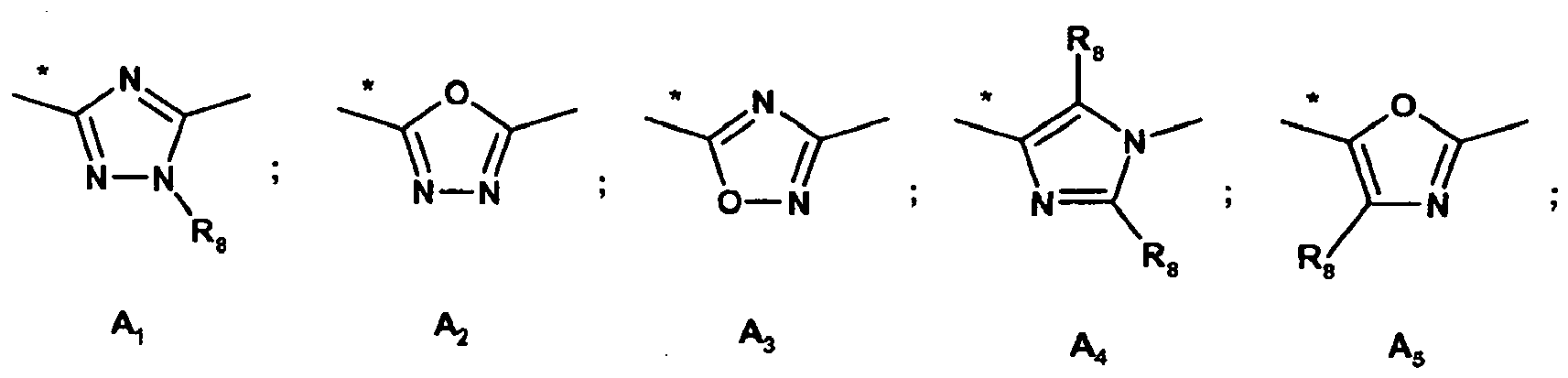

- A compound of formula I according to any of claims 1 to 5, wherein B is a five- to six-membered monocyclic aromatic ring system which may contain from 1 to 4 hetero atoms selected from nitrogen, oxygen and sulfur, wherein the ring system may contain not more than 2 oxygen atoms and not more than 2 sulfur atoms, and wherein the ring system is substituted once by -X3-B1; and wherein the ring system may be further substituted once or more than once by halogen; cyano; hydroxy; amino; or -X2-R13; and wherein a substituenton a nitrogen in a heterocyclic ring system may not be halogen;
X2 is selected from bond; oxygen;
R13 is C1-6alkyl; C1-6halogenalkyl;
X3 is bond or C1-3alkylene, wherein one carbon atom of the C1-3alkylene may be replaced by a group selected from oxygen; sulfur; amino, which may be substituted by C1-4alkyl;
B1 is a three- to seven-membered monocyclic ring system which may be aromatic, saturated or
unsaturated non-aromatic and which may contain from 1 to 4 hetero atoms selected from nitrogen, oxygen and sulfur, wherein the ring system may contain not more than 2 oxygen atoms and not more than 2 sulfur atoms, wherein the ring system may in turn be substituted once or more than once by R14, and wherein a substituent on a nitrogen in a heterocyclic ring system may not be halogen;
each R14 independently is halogen, cyano, C1-4alkyl, C1-4halogenalkyl, C1-4alkoxy, or C1-4halogenalkoxy; or two R14 at the same ring atom together are oxo, in free form or in pharmaceutically acceptable salt form. - A compound of formula I according to any of claims 1 to 5, wherein B is a nine- to ten-membered fused bicyclic aromatic ring system which may contain from 1 to 4 hetero atoms selected from nitrogen, oxygen and sulfur, wherein the ring system may contain not more than 2 oxygen atoms and not more than 2 sulfur atoms, and wherein the ring system may be substituted once or more than once by R12; and wherein a substituent on a nitrogen in a heterocyclic ring system may not be halogen;
each R12 independently is halogen; cyano; hydroxy; amino; -X2-R13;
X2 is selected from bond; oxygen; and amino, which may be substituted by C1-4alkyl;
R13 is C1-6alkyl; C1-6halogenalkyl, in free form or in pharmaceutically acceptable salt form. - A compound of formula I according to claim 1 which is selected fromN-((6-amino-2,4-dimethylpyridin-3-yl)methyl)-5-benzyl-1-methyl-1H-1,2,4-triazole-3-carboxamide;N-((6-amino-2,4-dimethylpyridin-3-yl)methyl)-3-benzylisoxazole-5-carboxamide;N-((6-amino-2,4-dimethylpyridin-3-yl)methyl)-5-benzyl-1,3,4-oxadiazole-2-carboxamide;N-((6-amino-2,4-dimethylpyridin-3-yl)methyl)-3-benzyl-1,2,4-oxadiazole-5-carboxamide;1-(4-((1H-pyrazol-1-yl)methyl)benzyl)-N-((6-amino-2,4-dimethylpyridin-3-yl)methyl)-1H-imidazole-4-carboxamide;N-((6-amino-2,4-dimethylpyridin-3-yl)methyl)-5-benzyloxazole-2-carboxamide;N-((6-amino-2,4-dimethylpyridin-3-yl)methyl)-2-(4-methoxybenzyl)oxazole-4-carboxamide1-(4-((1H-pyrazol-1-yl)methyl)-3-methoxybenzyl)-N-((6-amino-2,4-dimethylpyridin-3-yl)methyl)-1 H-pyrazole-4-carboxamide;N-((6-amino-2,4-dimethylpyridin-3-yl)methyl)-1-(biphenyl-4-ylmethyl)-1H-1,2,3-triazole-4-carboxamide;N-((6-amino-2,4-dimethylpyridin-3-yl)methyl)-1-(2-hydroxy-1-phenylethyl)-1H-pyrazole-4-carboxamide;N-((6-amino-2,4-dimethylpyridin-3-yl)methyl)-1-(phenylsulfonyl)-1H-pyrrole-3-carboxamide;N-((6-amino-2,4-dimethylpyridin-3-yl)methyl)-1-(4-methoxybenzyl)-1H-pyrazole-4-carboxamide;N-((6-amino-4-methoxy-2-methylpyridin-3-yl)methyl)-1-benzyl-1H-pyrazole-4-carboxamide;N-((6-amino-4-(cyclohexyloxy)-2-methylpyridin-3-yl)methyl)-1-benzyl-1 H-pyrazole-4-carboxamide;N-((6-amino-2,4-dimethylpyridin-3-yl)methyl)-1-(4-(hydroxymethyl)benzyl)-1H-pyrazole-4-carboxamide;N-((6-amino-2,4-dimethylpyridin-3-yl)methyl)-1-(4-((2,5-dioxopyrrolidin-1-yl)methyl)benzyl)-1H-pyrazole-4-carboxamide;N-((6-amino-2,4-dimethylpyridin-3-yl)methyl)-1-(pyridin-4-ylmethyl)-1H-pyrazole-4-carboxamide;N-((6-amino-2,4-dimethylpyridin-3-yl)methyl)-1-benzyl-1H-1,2,3-triazole-4-carboxamide;N-((6-amino-2,4-dimethylpyridin-3-yl)methyl)-1-benzyl-1H-imidazole-4-carboxamide;N-((6-arnino-2,4-dimethylpyridin-3-yl)methyl)-1-(4-phenoxybenzyl)-1H-imidazole-4-carboxamide;1-(4-(1H-pyrazol-1-yl)benzyl)-N-((6-amino-2,4-dimethylpyridin-3-yl)methyl)-1H-imidazole-4-carboxamide;N-((6-amino-2,4-dimethylpyridin-3-yl)methyl)-1-((2-(phenylamino)thiazol-4-yl)methyl)-1H-pyrazole-4-carboxamide;N-((6-amino-2,4-dimethylpyridin-3-yl)methyl)-1-((4-methyl-2-phenylthiazol-5-yl)methyl)-1H-pyrazole-4-carboxamide;N-((6-amino-2,4-dimethylpyridin-3-yl)methyl)-1-((2-benzylthiazol-4-yl)methyl)-1H-pyrazole-4-carboxamide;N-((6-amino-2,4-dimethylpyridin-3-yl)methyl)-1-((2-tert-butylthiazol-4-yl)methyl)-1H-pyrazole-4-carboxamide;N-((6-amino-2,4-dimethylpyridin-3-yl)methyl)-1-((2-(2-(dimethylamino)-2-oxoethyl)thiazol-4-yl)methyl)-1 H-pyrazole-4-carboxamide;N-((6-amino-2,4-dimethylpyridin-3-yl)methyl)-1-(imidazo[1,2-a]pyridin-2-ylmethyl)-1H-pyrazole-4-carboxamide;N-((6-amino-2,4-dimethylpyridin-3-yl)methyl)-1-(benzofuran-2-ylmethyl)-1H-pyrazole-4-carboxamide;N-((6-amino-2,4-dimethylpyridin-3-yl)methyl)-1-((2-phenyloxazol-4-yl)methyl)-1H-pyrazole-4-carboxamide;1-((1H-benzo[d]imidazol-5-yl)methyl)-N-((6-amino-2,4-dimethylpyridin-3-yl)methyl)-1H-pyrazole-4-carboxamide;N-((6-amino-2,4-dimethylpyridin-3-yl)methyl)-1-((1-methyl-1H-indol-6-yl)methyl)-1H-pyrazole-4-carboxamide;N-((6-amino-2,4-dimethylpyridin-3-yl)methyl)-1-((5-phenyloxazol-4-yl)methyl)-1H-pyrazole-4-carboxamide;N-((6-amino-2,4-dimethylpyridin-3-yl)methyl)-1-(4-((3,5-dimethyl-1H-pyrazol-1-yl)methyl)benzyl)= 1 H-pyrazole-4-carboxamide;N-((6-amino-2,4-dimethylpyridin-3-yl)methyl)-1-(3-cyanophenylsulfonyl)-1H-pyrazole-4-carboxamide;N-((6-amino-2,4-dimethylpyridin-3-yl)methyl)-1-(4-phenoxybenzyl)-1H-1,2,3-triazole-4-carboxamide;N-((6-amino-2,4-dimethylpyridin-3-yl)methyl)-1-(naphthalen-1-ylmethyl)-1H-1,2,3-triazole-4-carboxamide;N-((6-amino-2,4-dimethylpyridin-3-yl)methyl)-1-(naphthalen-2-ylmethyl)-1H-1,2,3-triazole-4-carboxamide;1-(4-(1H-pyrazol-1-yl)benzyl)-N-((6-amino-2,4-dimethylpyridin-3-yl)methyl)-1H-1,2,3-triazole-4-carboxamide;1-(3-(1H-pyrazol-1-yl)benzyl)-N-((6-amino-2,4-dimethylpyridin-3-yl)methyl)-1H-1,2,3-triazole-4-carboxamide;N-((6-amino-2,4-dimethylpyridin-3-yl)methyl)-1-(3-(pyrrolidin-1-yl)benzyl)-1H-1,2,3-triazole-4-carboxamide;N-((6-amino-2,4-dimethylpyridin-3-yl)methyl)-2-(benzofuran-2-ylmethyl)-2H-1,2,3-triazole-4-carboxamide;1-(4-((1H-imidazol-1-yl)methyl)benzyl)-N-((6-amino-2,4-dimethylpyridin-3-yl)methyl)-1H-1,2,3-triazole-4-carboxamide;1-(3-((1H-imidazol-1-yl)methyl)benzyl)-N-((6-amino-2,4-dimethylpyridin-3-yl)methyl)-1H-1,2,3-triazole-4-carboxamide;N-((6-amino-2,4-dimethylpyridin-3-yl)methyl)-2-benzylthiazole-4-carboxamide;N-((6-amino-2,4-dimethylpyridin-3-yl)methyl)-5-phenoxyfuran-2-carboxamide;N-((6-amino-2,4-dimethylpyridin-3-yl)methyl)-1-benzyl-3-methyl-1H-pyrazole-4-carboxamide;N-((6-amino-2,4-dimethylpyridin-3-yl)methyl)-1-(furan-2-ylmethyl)-2,5-dimethyl-1H-pyrrole-3-carboxamide;N-((6-amino-2,4-dimethylpyridin-3-yl)methyl)-2,5-dimethyl-1-(1-phenylethyl)-1H-pyrrole-3-carboxamide;N-((6-amino-2,4-dimethyltpyridin-3-yl)methyl)-4-(morpholinosulfonyl)-1H-pyrrole-2-carboxamide;N-((6-amino-2,4-dimethylpyridin-3-yl)methyl)-1-(2,6-difluorobenzyl)-1H-1,2,3-triazole-4-carboxamide;N-((6-amino-2,4-dimethylpyridin-3-yl)methyl)-1-(3-cyanobenzyl)-1H-1,2,3-triazole-4-carboxamide;N-((6-amino-2,4-dimethylpyridin-3-yl)methyl)-2-benzyl-4-methylthiazole-5-carboxamide;N-((6-amino-2,4-dimethylpyridin-3-yl)methyl)-1-benzyl-1H-1,2,4-triazole-3-carboxamide;N-((6-amino-2,4-dimethylpyridin-3-yl)methyl)-1-(4-(6-methylpyrazin-2-yloxy)benzyl)-1H-pyrazole-4-carboxamide;N-((6-amino-2,4-dimethylpyridin-3-yl)methyl)-2-benzyloxazole-4-carboxamide;1-(4-((1H-1,2,4-triazol-1-yl)methyl)benzyl)-N-((6-amino-2,4-dimethylpyridin-3-yl)methyl)-1H-1,2,4-triazole-3-carboxamide;N-((6-amino-4-(2-methoxyethoxy)-2-methylpyridin-3-yl)methyl)-1-benzyl-1H-pyrazole-4-carboxamide;N-((6-amino-2,4-dimethylpyridin-3-yl)methyl)-1-(biphenyl-4-ylmethyl)-1H-1,2,4-triazole-3-carboxamide;N-((6-amino-2,4-dimethylpyridin-3-yl)methyl)-1-(naphthalen-1-ylmethyl)-1 H-1,2,4-triazole-3-carboxamide;N-((6-amino-2,4-dimethylpyridin-3-yl)methyl)-1-(4-phenoxybenzyl)-1H-1,2,4-triazole-3-carboxamide;N-((6-amino-2,4-dimethylpyridin-3-yl)methyl)-1-(naphthalen-2-ylmethyl)-1H-1,2,4-triazole-3-carboxamide;N-((6-amino-2,4-dimethylpyridin-3-yl)methyl)-1-(4-(2-oxopyrrolidin-1-yl)benzyl)-1H-pyrazole-4-carboxamide;1-(4-(1H-pyrazol-1-yl)benzyl)-N-((6-amino-2,4-dimethylpyridin-3-yl)methyl)-1H-1,2,4-triazole-3-carboxamide;1-(3-(1H-pyrazol-1-yl)benzyl)-N-((6-amino-2,4-dimethylpyridin-3-yl)methyl)-1H-1,2,4-triazole-3-carboxamide;N-((6-amino-2,4-dimethylpyridin-3-yl)methyl)-1-(3-(pyrrolidin-1-yl)benzyl)-1H-1,2,4-triazole-3-carboxamide;N-((6-amino-2,4-dimethylpyridin-3-yl)methyl)-1-((2-morpholinopyridin-4-yl)methyl)-1H-pyrazole-4-carboxamide;N-((6-amino-2,4-dimethylpyridin-3-yl)methyl)-1-benzyl-1H-pyrrole-3-carboxamide;N-((6-amino-2,4-dimethylpyridin-3-yl)methyl)-1-(3-(2-methoxyethyl)benzyl)-1H-pyrazole-4-carboxamide;N-((6-amino-2,4-dimethylpyridin-3-yl)methyl)-2,5-dimethyl-1-(phenylsulfonyl)-1H-pyrrole-3-carboxamide;N-((6-amino-2,4-dimethylpyridin-3-yl)methyl)-1-(3,5-dimethoxybenzyl)-1H-pyrazole-4-carboxamide;N-((6-amino-2,4-dimethylpyridin-3-yl)methyl)-4-methyl-1-(phenylsulfonyl)-1H-pyrrole-3-carboxamide;N-((6-amino-2,4-dimethylpyridin-3-yl)methyl)-1-((2,3-dimethyl-1H-indol-5-yl)methyl)-1H-pyrazole-4-carboxamide;N-((6-amino-2,4-dimethylpyridin-3-yl)methyl)-1-benzyl-4-methyl-1H-pyrrole-3-carboxamide;N-((6-amino-2,4-dimethylpyridin-3-yl)methyl)-2-methyl-5-((1-oxoisoquinolin-2(1H)-yl)methyl)furan-3-carboxamide;N-((6-amino-2,4-dimethylpyridin-3-yl)methyl)-1-(4-(trifluoromethoxy)benzyl)-1H-pyrazole-4-carboxamide;N-((6-amino-2,4-dimethylpyridin-3-yl)methyl)-1-(3-cyanobenzyl)-1H-pyrazole-4-carboxamide;N-((6-amino-2,4-dimethylpyridin-3-yl)methyl)-1-(4-cyanobenzyl)-1H-pyrazole-4-carboxamide;N-((6-amino-2,4-dimethylpyridin-3-yl)methyl)-1-(naphthalen-2-ylmethyl)-1H-pyrazole-4-carboxamide;N-((6-amino-2,4-dimethylpyridin-3-yl)methyl)-1-(3-fluorobenzyl)-1H-pyrazole-4-carboxamide;N-((6-amino-2-methylpyridin-3-yl)methyl)-1-benzyl-1H-pyrazole-4-carboxamide;N-((6-amino-2,4-dimethylpyridin-3-yl)methyl)-1-((6-methylpyridin-2-yl)methyl)-1H-pyrazole-4-carboxamide;N-((6-amino-2,4-dimethylpyridin-3-yl)methyl)-1-(2-chlorobenzyl)-1H-pyrazole-4-carboxamide;N-((6-amino-2,4-dimethylpyridin-3-yl)methyl)-1-(cyclohexylmethyl)-1H-pyrazole-4-carboxamide;N-((6-amino-2,4-dimethylpyridin-3-yl)methyl)-1-(4-(phenoxymethyl)benzyl)-1H-pyrazole-4-carboxamide;N-((6-amino-2,4-dimethylpyridin-3-yl)methyl)-1-(3,4-difluorobenzyl)-1H-pyrazole-4-carboxamide;N-((6-amino-2,4-dimethylpyridin-3-yl)methyl)-1-(4-(3-methyl-1,2,4-oxadiazol-5-yl)benzyl)-1H-pyrazole-4-carboxamide;N-((6-amino-2,4-dimethylpyridin-3-yl)methyl)-1-(3-chlorobenzyl)-1H-pyrazole-4-carboxamide;N-((6-amino-2,4-dimethylpyridin-3-yl)methyl)-1-(2,4-difluorobenzyl)-1H-pyrazole-4-carboxamide;N-((6-amino-2,4-dimethylpyridin-3-yl)methyl)-1-(4-(benzyloxy)benzyl)-1H-pyrazole-4-carboxamide;N-((6-amino-2,4-dimethylpyridin-3-yl)methyl)-1-((3,4-dihydro-2H-benzo[b][1,4]dioxepin-6-yl)methyl)-1H-pyrazole-4-carboxamide;N-((6-amino-2,4-dimethylpyridin-3-yl)methyl)-1-(4-chlorobenzyl)-1H-pyrazole-4-carboxamide;N-((6-amino-2,4-dimethylpyridin-3-yl)methyl)-1-((2-methylthiazol-4-yl)methyl)-1H-pyrazole-4-carboxamide;N-((6-amino-2,4-dimethylpyridin-3-yl)methyl)-1-(pyridin-3-ylmethyl)-1H-pyrazole-4-carboxamide;N-((6-amino-2,4-dimethylpyridin-3-yl)methyl)-1-((6-(hydroxymethyl)pyridin-2-yl)methyl)-1H-pyrazole-4-carboxamide;N-((6-amino-2,4-dimethylpyridin-3-yl)methyl)-1-(1-phenylethyl)-1H-pyrazole-4-carboxamide;N-((6-amino-2,4-dimethylpyridin-3-yl)methyl)-1-((1-methyl-1H-benzo[d][1,2,3]triazol-5-yl)methyl)-1 H-pyrazole-4-carboxamide;N-((6-amino-2,4-dimethylpyridin-3-yl)methyl)-1-(3-carbamoylbenzyl)-1H-pyrazole-4-carboxamide;N-((6-amino-2,4-dimethylpyridin-3-yl)methyl)-1-(benzo[d][1,3]dioxol-5-ylmethyl)-1H-pyrazole-4-carboxamide;N-((6-amino-2,4-dimethylpyridin-3-yl)methyl)-1-((3-methylquinoxalin-2-yl)methyl)-1H-pyrazote-4-carboxamide;N-((6-amino-2,4-dimethylpyridin-3-yl)methyl)-1-(benzo[d]thiazol-2-ylmethyl)-1H-pyrazole-4-carboxamide;N-((6-amino-2,4-dimethylpyridin-3-yl)methyl)-1-(benzo[d]isoxazol-3-ylmethyl)-1H-pyrazole-4-carboxamide;N-((6-amino-2,4-dimethylpyridin-3-yl)methyl)-1-(2-cyanobenzyl)-1H-indole-3-carboxamide;N-((6-amino-2,4-dimethylpyridin-3-yl)methyl)-1-benzyl-1H-indole-3-carboxamide;N-((6-amino-2,4-dimethylpyridin-3-yl)methyl)-1-benzyl-2,5-dimethyl-1H-pyrrole-3-carboxamide;N-((6-amino-2,4-dimethylpyridin-3-yl)methyl)-1-(4-(morpholinomethyl)benzyl)-1H-pyrazole-4-carboxamide;N-((6-amino-2,4-dimethylpyridin-3-yl)methyl)-1-(4-(3-cyclopropylureido)benzyl)-1H-pyrazole-4-carboxamide;N-((6-amino-2,4-dimethylpyridin-3-yl)methyl)-5-benzyl-1H-1,2,4-triazole-3-carboxamide;N-((6-amino-2,4-dimethylpyridin-3-yl)methyl)-1-(4-(pyridin-4-yl)benzyl)-1H-pyrazole-4-carboxamide;N-((6-amino-2,4-dimethylpyridin-3-yl)methyl)-1-(biphenyl-3-ylmethyl)-1H-pyrazole-4-carboxamide;N-((6-amino-2,4-dimethylpyridin-3-yl)methyl)-1-(3-(morpholinosulfonyl)benzyl)-1H-pyrazole-4-carboxamide;N-((6-amino-2,4-dimethylpyridin-3-yl)methyl)-1-(3-(phenylcarbamoyl)benzyl)-1H-pyrazole-4-carboxamide;N-((6-amino-2,4-dimethylpyridin-3-yl)methyl)-1-(4-(pyrrolidin-1-ylmethyl)benzyl)-1H-pyrazole-4-carboxamide;N-((6-amino-2,4-dimethylpyridin-3-yl)methyl)-1-(3-(piperidine-1-carbonyl)benzyl)-1H-pyrazole-4-carboxamide;N-((6-amino-2,4-dimethylpyridin-3-yl)methyl)-1-(4-(isopropylcarbamoyl)benzyl)-1H-pyrazole-4-carboxamide;N-((6-amino-2,4-dimethylpyridin-3-yl)methyl)-1-(4-(morpholine-4-carbonyl)benzyl)-1H-pyrazole-4-carboxamide;N-((6-amino-2,4-dimethylpyridin-3-yl)methyl)-1-(4-(1-methyl-1H-pyrazol-3-ylcarbamoyl)benzyl)-1 H-pyrazole-4-carboxamide;5-(amino(phenyl)methyl)-N-((6-amino-2,4-dimethylpyridin-3-yl)methyl)-1 H-1,2,4-triazole-3-carboxamide;N-((6-amino-2,4-dimethylpyridin-3-yl)methyl)-3-(biphenyl-4-ylmethyl)-1H-1,2,4-triazole-5-carboxamide;N-((6-amino-2,4-dimethylpyridin-3-yl)methyl)-3-(4-phenoxybenzyl)-1H-1,2,4-triazole-5-carboxamide;N-((6-amino-2,4-dimethylpyridin-3-yl)methyl)-1-(4-(N,N-dimethylsulfamoyl)benzyl)-1H-pyrazole-4-carboxamide;N-((6-amino-2,4-dimethylpyridin-3-yl)methyl)-1-(biphenyl-4-ylsulfonyl)-1H-pyrrole-3-carboxamide;N-((6-amino-2,4-dimethylpyridin-3-yl)methyl)-1-(5-chlorothiophen-2-ylsulfonyl)-1H-pyrrole-3-carboxamide;N-((6-amino-2,4-dimethylpyridin-3-yl)methyl)-1-(3-methoxyphenylsulfonyl)-1H-pyrrole-3-carboxamide;N-((6-amino-2,4-dimethylpyridin-3-yl)methyl)-1-(4-methyl-3,4-dihydro-2H-benzo[b][1,4]oxazin-6-ylsulfonyl)-1 H-pyrrole-3-carboxamide;N-((6-amino-2,4-dimethylpyridin-3-yl)methyl)-1-(1-methyl-1H-indol-5-ylsulfonyl)-1H-pyrrole-3-carboxamide;N-((6-amino-2,4-dimethylpyridin-3-yl)methyl)-1-(3-(pyrimidin-2-yl)phenylsulfonyl)-1H-pyrrole-3-carboxamide;N-((6-amino-2,4-dimethylpyridin-3-yl)methyl)-1-(4-(3,5-dimethyl-1H-pyrazol-1-yl)phenylsulfonyl)-1 H-pyrrole-3-carboxamide;2-(4-((4-((6-amino-2,4-dimethylpyridin-3-yl)methylcarbamoyl)-1H-pyrazol-1-yl)methyl)phenoxy)acetic acid;N-((6-amino-2,4-dimethylpyridin-3-yl)methyl)-1-(4-(cyanomethoxy)benzyl)-1H-pyrazole-4-carboxamide;N-((6-amino-2-methyl-4-(oxazol-2-ylmethoxy)pyridin-3-yl)methyl)-1-benzyl-1H-1,2,3-triazole-4-carboxamide;N-((6-amino-2-methyl-4-(oxazol-2-ylmethoxy)pyridin-3-yl)methyl)-1-benzyl-1 H-1,2,3-triazole-4-carboxamide;N-((6-amino-4-methylpyridin-3-yl)methyl)-1-benzyl-1H-pyrazole-4-carboxamide;N-((6-amino-2,4-dimethylpyridin-3-yl)methyl)-1-(4-((3-oxo-2,3-dihydro-1H-pyrazol-1-yl)methyl)benzyl)-1 H-pyrazole-4-carboxamide;1-(4-((1H-1,2,3-triazol-1-yl)methyl)benzyl)-N-((6-amino-2,4-dimethylpyridin-3-yl)methyl)-1H-pyrazole-4-carboxamide;N-((6-amino-2,4-dimethylpyridin-3-yl)methyl)-1-(4-((2,5-dimethyl-3-oxo-2,3-dihydro-1H-pyrazol-1-yl)methyl)benzyl)-1 H-pyrazole-4-carboxamide;N-((6-amino-2,4-dimethylpyridin-3-yl)methyl)-1-(4-((2-oxopyridin-1(2H)-yl)methyl)benzyl)-1H-pyrazole-4-carboxamide;N-((6-amino-2,4-dimethylpyridin-3-yl)methyl)-1-(4-((2-oxopyrrolidin-1-yl)methyl)benzyl)-1H-pyrazole-4-carboxamide;N-((6-amino-4-chloro-2-methylpyridin-3-yl)methyl)-1-benzyl-1H-pyrazole-4-carboxamide;1-(4-((1H-pyrazol-1-yl)methyl)benzyl)-N-((6-amino-2,4-dimethylpyridin-3-yl)methyl)-1H-pyrazole-4-carboxamide;N-((6-amino-2,4-dimethylpyridin-3-yl)methyl)-1-(4-((4-methyl-1H-pyrazol-1-yl)methyl)benzyl)-1H-pyrazole-4-carboxamide;N-((6-amino-2,4-dimethylpyridin-3-yl)methyl)-1-(4-((5-methyl-1H-pyrazol-1-yl)methyl)benzyl)-1H-1,2,3-triazole-4-carboxamide;N-((6-amino-2,4-dimethylpyridin-3-yl)methyl)-1-(4-((3,5-dimethyl-1H-pyrazol-1-yl)methyl)benzyl)-1 H-1,2,3-triazole-4-carboxamide;N-((6-amino-4-(3,3-dimethyl-2-oxobutoxy)-2-methylpyridin-3-yl)methyl)-1-(naphthalen-2-ylmethyl)-1H-pyrazole-4-carboxamide;N-((6-Amino-2,4-dimethylpyridin-3-yl)methyl)-1-((1-(2-methoxyethyl)-1,2,3,4-tetrahydroquinolin-7-yl)methyl)-1H-pyrazole-4-carboxamide;N-((6-Amino-2,4-dimethylpyridin-3-yl)methyl)-1-((4-methyl-3-oxo-3,4-dihydro-2H-benzo[b][1,4]oxazin-6-yl)methyl)-1H-pyrazole-4-carboxamide;N-((6-Amino-2,4-dimethylpyridin-3-yl)methyl)-1-((1-methyl-1,2,3,4-tetrahydroquinolin-7-yl)methyl)-1H-pyrazole-4-carboxamide;N-((6-amino-2,4-dimethylpyridin-3-yl)methyl)-1-((2-methylquinolin-6-yl)methyl)-1H-1,2,3-triazole-4-carboxamide;N-((6-amino-2,4-dimethylpyridin-3-yl)methyl)-1-((2-methylquinolin-6-yl)methyl)-1H-pyrazole-4-carboxamide;N-((6-amino-2,4-dimethylpyridin-3-yl)methyl)-1-(quinolin-3-ylmethyl)-1H-pyrazole-4-carboxamide;N-((6-amino-2,4-dimethylpyridin-3-yl)methyl)-1-((7-methylquinolin-3-yl)methyl)-1H-1,2,3-triazole-4-carboxamide;N-((6-amino-2,4-dimethylpyridin-3-yl)methyl)-1-((7-chloroquinolin-2-yl)methyl)-1 H-pyrazole-4-carboxamide;N-((6-amino-2,4-dimethylpyridin-3-yl)methyl)-1-((7-chloroquinolin-2-yl)methyl)-1H-1,2,3-triazole-4-carboxamide;N-((6-amino-2-methylpyridin-3-yl)methyl)-1-((2-methylquinolin-6-yl)methyl)-1 H-pyrazole-4-carboxamide;N-((6-amino-2-methylpyridin-3-yl)methyl)-1-((6-fluoro-4-(trifluoromethyl)quinolin-2-yl)methyl)-1H-pyrazole-4-carboxamide;N-((6-amino-2-methylpyridin-3-yl)methyl)-1-((2,5,7-trimethylquinolin-3-yl)methyl)-1H-pyrazole-4-carboxamide;N-((6-amino-2,4-dimethylpyridin-3-yl)methyl)-1-((6-fluoro-4-(trifluoromethyl)quinolin-2-yl)methyl)-1 H-pyrazole-4-carboxamide;N-((6-amino-2,4-dimethylpyridin-3-yl)methyl)-1-((6-methoxynaphthalen-2-yl)methyl)-1H-pyrazole-4-carboxamide;N-(1-(6-Amino-2,4-dimethylpyridin-3-yl)cyclopropyl)-1-((2-methylquinolin-6-yl)methyl)-1H-1,2,3-triazole-4-carboxamide;N-((6-Amino-2,4-dimethylpyridin-3-yl)methyl)-1-((1,2-dimethyl-1H-benzo[d]imidazol-5-yl)methyl)-1 H-pyrazole-4-carboxamide;N-((6-amino-2,4-dimethylpyridin-3-yl)methyl)-1-((1,2,3-trimethyl-1H-indol-5-yl)methyl)-1H-1,2,3-triazole-4-carboxamide;N-((6-Amino-4-chloro-2-methylpyridin-3-yl)methyl)-1-(4-((2-oxopyridin-1(2H)-yl)methyl)benzyl)-1 H-pyrazole-4-carboxamide;N-((6-Amino-2,4-dimethylpyridin-3-yl)methyl)-1-((1,2-dimethyl-1H-indol-5-yl)methyl)-1H-pyrazole-4-carboxamide;N-((6-amino-2,4-dimethylpyridin-3-yl)methyl)-1-((2-methylimidazo[1,2-a]pyridin-6-yl)methyl)-1H-pyrazole-4-carboxamide;N-((6-amino-2,4-dimethylpyridin-3-yl)methyl)-2-((2-methylquinolin-6-yl)methyl)oxazole-4-carboxamide;N-((6-Amino-2,4-dimethylpyridin-3-yl)methyl)-1-((7-aminothieno[2,3-c]pyridin-5-yl)methyl)-1H-pyrazole-4-carboxamide;N-((6-amino-4-chloro-2-methylpyridin-3-yl)methyl)-1-(naphthalen-2-ylmethyl)-1 H-pyrazole-4-carboxamide;N-((6-Amino-2,4-dimethylpyridin-3-yl)methyl)-1-((3-chloroquinolin-6-yl)methyl)-1H-pyrazole-4-carboxamide;N-((6-amino-2,4-dimethylpyridin-3-yl)methyl)-1-((1,1-dioxido-2,3-dihydrobenzo[b]thiophen-5-yl)methyl)-1 H-pyrazole-4-carboxamide andN-((6-Amino-4-chloro-2-methylpyridin-3-yl)methyl)-1-((2-methylquinolin-6-yl)methyl)-1 H-1,2,3-triazole-4-carboxamide,in free form or in pharmaceutically acceptable salt form.
- A pharmaceutical composition comprising a therapeutically effective amount of a compound according to any one of claims 1 to 8 in free form or in pharmaceutical acceptable salt form and one or more pharmaceutically acceptable carriers.
- A combination comprising a therapeutically effective amount of the compound according to any one of claims 1 to 8 in free form or in pharmaceutically acceptable salt form and one or more therapeutically active agents.
- A compound according to any one of claims 1 to 8 in free form or in pharmaceutically acceptable salt form for use in a method of inhibiting plasmakallikrein activity in a subject, wherein the method comprises administering to the subject a therapeutically effective amount of said compound.
- A compound according to any one of claims 1 to 8 in free form or in pharmaceutically acceptable salt form for use in a method of treating a disorder or a disease in a subject mediated by plasmakallikrein, wherein the method comprises administering to the subject a therapeutically effective amount of said compound.
- A compound according to any one of claims 1 to 8 in free form or in pharmaceutically acceptable salt form, for use as a medicament.
- A compound according to any one of claims 1 to 8 in free form or in pharmaceutically acceptable salt form, for use in the treatment of a disorder or disease in a subject mediated by plasmakallikrein.
- A compound according to any one of claims 1 to 8 in free form or in pharmaceutically acceptable salt form, for use in the treatment of a disorder or disease in a subject characterized by an abnormal activity of plasmakallikrein.
Applications Claiming Priority (2)
| Application Number | Priority Date | Filing Date | Title |
|---|---|---|---|
| US37061210P | 2010-08-04 | 2010-08-04 | |
| PCT/EP2011/063389 WO2012017020A1 (en) | 2010-08-04 | 2011-08-03 | N-((6-amino-pyridin-3-yl)methyl)-heteroaryl-carboxamides as inhibitors of plasma kallikrein |
Publications (2)
| Publication Number | Publication Date |
|---|---|
| EP2601189A1 EP2601189A1 (en) | 2013-06-12 |
| EP2601189B1 true EP2601189B1 (en) | 2015-04-15 |
Family
ID=44503821
Family Applications (1)
| Application Number | Title | Priority Date | Filing Date |
|---|---|---|---|
| EP11745519.6A Not-in-force EP2601189B1 (en) | 2010-08-04 | 2011-08-03 | N-((6-amino-pyridin-3-yl)methyl)-heteroaryl-carboxamides as inhibitors of plasma kallikrein |
Country Status (14)
| Country | Link |
|---|---|
| US (1) | US9290485B2 (en) |
| EP (1) | EP2601189B1 (en) |
| JP (1) | JP5809267B2 (en) |
| KR (1) | KR20130096253A (en) |
| CN (1) | CN103080104B (en) |
| AR (1) | AR082446A1 (en) |
| AU (1) | AU2011287574B2 (en) |
| CA (1) | CA2806015A1 (en) |
| EA (1) | EA021359B1 (en) |
| ES (1) | ES2542764T3 (en) |
| MX (1) | MX2013001363A (en) |
| TW (1) | TW201206900A (en) |
| UY (1) | UY33541A (en) |
| WO (1) | WO2012017020A1 (en) |
Families Citing this family (64)
| Publication number | Priority date | Publication date | Assignee | Title |
|---|---|---|---|---|
| GB2494851A (en) | 2011-07-07 | 2013-03-27 | Kalvista Pharmaceuticals Ltd | Plasma kallikrein inhibitors |
| WO2013025858A1 (en) * | 2011-08-16 | 2013-02-21 | Glaxosmithkline Llc | 5-benzyl-n-phenyethyl-1,3,4-oxadiazole-2-carboxamide derivatives |
| PT2840080T (en) * | 2012-04-17 | 2018-02-06 | Fujifilm Corp | HETEROCYCLIC COMPOUND CONTAINING NITROGEN OR SALT THEREOF |
| GB201212081D0 (en) | 2012-07-06 | 2012-08-22 | Kalvista Pharmaceuticals Ltd | New polymorph |
| IL239682B (en) | 2013-01-08 | 2018-10-31 | Kalvista Pharmaceuticals Ltd | Benzylamine and 2-(aminomethyl)pyridine derivatives |
| GB201300304D0 (en) * | 2013-01-08 | 2013-02-20 | Kalvista Pharmaceuticals Ltd | Benzylamine derivatives |
| GB2510407A (en) | 2013-02-04 | 2014-08-06 | Kalvista Pharmaceuticals Ltd | Aqueous suspensions of kallikrein inhibitors for parenteral administration |
| BR112015028879B1 (en) * | 2013-05-23 | 2022-12-20 | Kalvista Pharmaceuticals Limited | HETEROCYCLIC DERIVATIVE COMPOUNDS, PHARMACEUTICAL COMPOSITION INCLUDING THE SAID COMPOUNDS AND THEIR USES |
| US8906951B1 (en) | 2013-06-24 | 2014-12-09 | Tigercat Pharma, Inc. | Use of NK-1 receptor antagonists in pruritus |
| US9198898B2 (en) | 2013-06-24 | 2015-12-01 | Tigercat Pharma, Inc. | Use of NK-1 receptor antagonists in pruritus |
| TWI636047B (en) | 2013-08-14 | 2018-09-21 | 英商卡爾維斯塔製藥有限公司 | Heterocyclic derivatives |
| GB2517908A (en) * | 2013-08-14 | 2015-03-11 | Kalvista Pharmaceuticals Ltd | Bicyclic inhibitors |
| CA2920815C (en) * | 2013-08-14 | 2021-09-21 | Kalvista Pharmaceuticals Limited | Inhibitors of plasma kallikrein |
| BR112016008080B1 (en) | 2013-10-16 | 2021-02-23 | Fujifilm Corporation | carboxylic acid salt or a mineral acid salt, succinate crystal, fumarate crystal and pharmaceutical composition |
| CN106061480B (en) * | 2013-12-30 | 2020-02-28 | 莱福斯希医药公司 | Therapeutic inhibitory compounds |
| US9611252B2 (en) | 2013-12-30 | 2017-04-04 | Lifesci Pharmaceuticals, Inc. | Therapeutic inhibitory compounds |
| BR112017000816A2 (en) * | 2014-07-16 | 2017-12-05 | Lifesci Pharmaceuticals Inc | therapeutic inhibitory compounds |
| CN107072995B (en) | 2014-08-22 | 2020-02-21 | 富士胶片株式会社 | Pharmaceutical compositions for treating FLT3 mutation-positive cancers, mutant FLT3 inhibitors, and uses of these |
| GB201421085D0 (en) | 2014-11-27 | 2015-01-14 | Kalvista Pharmaceuticals Ltd | New enzyme inhibitors |
| GB201421083D0 (en) * | 2014-11-27 | 2015-01-14 | Kalvista Pharmaceuticals Ltd | Enzyme inhibitors |
| GB201421088D0 (en) | 2014-11-27 | 2015-01-14 | Kalvista Pharmaceuticals Ltd | New enzyme inhibitors |
| JP6412471B2 (en) | 2015-07-15 | 2018-10-24 | 富士フイルム株式会社 | Process for producing nitrogen-containing heterocyclic compound and intermediate thereof |
| WO2017072020A1 (en) * | 2015-10-27 | 2017-05-04 | Boehringer Ingelheim International Gmbh | Heteroarylcarboxamide derivatives as plasma kallikrein inhibitors |
| WO2017072021A1 (en) * | 2015-10-27 | 2017-05-04 | Boehringer Ingelheim International Gmbh | Heteroarylcarboxamide derivatives as plasma kallikrein inhibitors |
| TWI773657B (en) | 2015-12-18 | 2022-08-11 | 美商亞德利克斯公司 | Substituted 4-phenyl pyridine compounds as non-systemic tgr5 agonists |
| US12084472B2 (en) | 2015-12-18 | 2024-09-10 | Ardelyx, Inc. | Substituted 4-phenyl pyridine compounds as non-systemic TGR5 agonists |
| JP6896701B2 (en) * | 2016-02-26 | 2021-06-30 | 大日本住友製薬株式会社 | Imidazolylamide derivative |
| WO2017207983A1 (en) | 2016-05-31 | 2017-12-07 | Kalvista Pharmaceuticals Limited | Pyrazole derivatives as plasma kallikrein inhibitors |
| GB201609607D0 (en) * | 2016-06-01 | 2016-07-13 | Kalvista Pharmaceuticals Ltd | Polymorphs of N-(3-Fluoro-4-methoxypyridin-2-yl)methyl)-3-(methoxymethyl)-1-({4-((2-oxopy ridin-1-yl)methyl)phenyl}methyl)pyrazole-4-carboxamide and salts |
| GB201609603D0 (en) | 2016-06-01 | 2016-07-13 | Kalvista Pharmaceuticals Ltd | Polymorphs of N-[(6-cyano-2-fluoro-3-methoxyphenyl)Methyl]-3-(methoxymethyl)-1-({4-[(2-ox opyridin-1-YL)Methyl]phenyl}methyl)pyrazole-4-carboxamide |
| EP3481391A4 (en) * | 2016-07-11 | 2020-03-11 | Lifesci Pharmaceuticals, Inc. | Therapeutic inhibitory compounds |
| CN106214681B (en) * | 2016-07-28 | 2018-05-08 | 三峡大学 | Application and its synthetic method of the compound on the medicine for suppressing kallikrein KLK7 is prepared |
| CN106333949B (en) * | 2016-07-28 | 2018-05-29 | 三峡大学 | Application and its synthetic method of the compound on the drug for inhibiting kallikrein KLK7 is prepared |
| TW201822637A (en) | 2016-11-07 | 2018-07-01 | 德商拜耳廠股份有限公司 | Substituted sulfonamides for controlling animal pests |
| WO2018117127A1 (en) * | 2016-12-20 | 2018-06-28 | 大日本住友製薬株式会社 | Agent for removing undifferentiated ips cells |
| JP6775483B2 (en) * | 2016-12-20 | 2020-10-28 | 大日本住友製薬株式会社 | Pharmaceuticals consisting of 1,4-di-substituted imidazole derivatives |
| WO2018200674A1 (en) * | 2017-04-26 | 2018-11-01 | Mitobridge, Inc. | Dynamin-1-like protein inhibitors |
| JP7078722B2 (en) | 2017-11-29 | 2022-05-31 | カルビスタ・ファーマシューティカルズ・リミテッド | Dosage form containing plasma kallikrein inhibitor |
| GB201721515D0 (en) * | 2017-12-21 | 2018-02-07 | Kalvista Pharmaceuticals Ltd | Dosage forms comprising a plasma kallikrein inhibtor |
| GB201719881D0 (en) | 2017-11-29 | 2018-01-10 | Kalvista Pharmaceuticals Ltd | Solid forms of plasma kallikrein inhibitor and salts thereof |
| US11142536B2 (en) * | 2018-10-03 | 2021-10-12 | Massachusetts Institute Of Technology | Macromolecules comprising triazoles |
| US11155527B2 (en) | 2018-10-03 | 2021-10-26 | Massachusetts Institute Of Technology | Macromolecules comprising triazoles and related compounds |
| TW202031645A (en) * | 2018-10-30 | 2020-09-01 | 丹麥商H 朗德貝克公司 | Arylsulfonylpyrolecarboxamide derivatives as kv3 potassium channel activators |
| GB201910116D0 (en) | 2019-07-15 | 2019-08-28 | Kalvista Pharmaceuticals Ltd | Treatments of hereditary angioedema |
| GB201910125D0 (en) | 2019-07-15 | 2019-08-28 | Kalvista Pharmaceuticals Ltd | Treatments of angioedema |
| WO2021026672A1 (en) | 2019-08-09 | 2021-02-18 | Novartis Ag | Heterocyclic wdr5 inhibitors as anti-cancer compounds |
| WO2021028645A1 (en) * | 2019-08-09 | 2021-02-18 | Kalvista Pharmaceuticals Limited | Plasma kallikrein inhibitors |
| WO2021032935A1 (en) * | 2019-08-21 | 2021-02-25 | Kalvista Pharmaceuticals Limited | Enzyme inhibitors |
| MX2022006865A (en) | 2019-12-06 | 2022-07-11 | Vertex Pharma | Substituted tetrahydrofurans as modulators of sodium channels. |
| GB201918994D0 (en) | 2019-12-20 | 2020-02-05 | Kalvista Pharmaceuticals Ltd | Treatments of diabetic macular edema and impaired visual acuity |
| GB2591730A (en) | 2019-12-09 | 2021-08-11 | Kalvista Pharmaceuticals Ltd | New polymorphs |
| EP4116299A4 (en) * | 2020-03-04 | 2024-03-27 | Medshine Discovery Inc. | HETEROCYCLIC COMPOUND |
| US12528786B2 (en) | 2020-07-10 | 2026-01-20 | Merck Sharp & Dohme Llc | Plasma kallikrein inhibitors |
| WO2022056051A1 (en) * | 2020-09-10 | 2022-03-17 | Merck Sharp & Dohme Corp. | Plasma kallikrein inhibitors |
| WO2022079446A1 (en) | 2020-10-15 | 2022-04-21 | Kalvista Pharmaceuticals Limited | Treatments of angioedema |
| EP4232031A1 (en) | 2020-10-23 | 2023-08-30 | Kalvista Pharmaceuticals Limited | Treatments of angioedema |
| US20240122909A1 (en) | 2021-02-09 | 2024-04-18 | Kalvista Pharmaceuticals Limited | Treatments of hereditary angioedema |
| CN117794920A (en) | 2021-06-04 | 2024-03-29 | 沃泰克斯药物股份有限公司 | N-(Hydroxyalkyl(hetero)aryl)tetrahydrofurancarboxamide as a sodium channel modulator |
| WO2023002219A1 (en) | 2021-07-23 | 2023-01-26 | Kalvista Pharmaceuticals Limited | Treatments of hereditary angioedema |
| CA3255900A1 (en) | 2022-04-27 | 2023-11-02 | Kalvista Pharmaceuticals Limited | Formulations of a plasma kallikrein inhibitor |
| EP4673437A1 (en) | 2023-02-27 | 2026-01-07 | Kalvista Pharmaceuticals Limited | New solid form of a plasma kallikrein inhibitor |
| EP4737450A1 (en) * | 2023-06-30 | 2026-05-06 | Longwood Pharmaceuticals (Hangzhou) Co., Ltd | Heteroaromatic formamide compounds and uses thereof in medicine |
| WO2025172693A1 (en) | 2024-02-13 | 2025-08-21 | Kalvista Pharmaceuticals Limited | Oral sebetralstat for the treatment of an attack of hereditary angioedema |
| WO2025172692A1 (en) | 2024-02-13 | 2025-08-21 | Kalvista Pharmaceuticals Limited | Oral sebetralstat for the treatment of an attack of hereditary angioedema |
Family Cites Families (28)
| Publication number | Priority date | Publication date | Assignee | Title |
|---|---|---|---|---|
| PT72878B (en) | 1980-04-24 | 1983-03-29 | Merck & Co Inc | Process for preparing mannich-base hydroxamic acid pro-drugs for the improved delivery of non-steroidal anti-inflammatory agents |
| US6664255B1 (en) * | 1999-05-19 | 2003-12-16 | Pharmacia Corporation | Substituted polycyclic aryl and heteroaryl pyrazinones useful for selective inhibition of the coagulation cascade |
| ATE293962T1 (en) | 2000-02-25 | 2005-05-15 | Hoffmann La Roche | ADENOSINE RECEPTOR MODULATORS |
| AU2001255408A1 (en) | 2000-04-14 | 2001-10-30 | Corvas International, Inc. | Tetrahydro-azepinone derivatives as thrombin inhibitors |
| AU2001273040A1 (en) | 2000-06-27 | 2002-01-08 | Du Pont Pharmaceuticals Company | Factor xa inhibitors |
| AUPR649001A0 (en) | 2001-07-20 | 2001-08-09 | Holly, John Anthony | A precision seed and chemical placement implement |
| FR2836143B1 (en) * | 2002-02-21 | 2004-04-16 | Servier Lab | NOVEL AMINO ACID DERIVATIVES, THEIR PREPARATION PROCESS AND THE PHARMACEUTICAL COMPOSITIONS CONTAINING THE SAME |
| GB0205527D0 (en) | 2002-03-08 | 2002-04-24 | Ferring Bv | Inhibitors |
| WO2004071440A2 (en) | 2003-02-06 | 2004-08-26 | Bristol-Myers Squibb Company | Thiazolyl-based compounds useful as kinase inhibitors |
| CA2514733A1 (en) | 2003-02-28 | 2004-09-16 | Transform Pharmaceuticals, Inc. | Pharmaceutical co-crystal compositions of drugs such as carbamazepine, celecoxib, olanzapine, itraconazole, topiramate, modafinil, 5-fluorouracil, hydrochlorothiazide, acetaminophen, aspirin, flurbiprofen, phenytoin and ibuprofen |
| JP4800216B2 (en) | 2003-10-24 | 2011-10-26 | エグゼリクシス, インコーポレイテッド | p70S6 kinase modulator and methods of use |
| US7429604B2 (en) | 2004-06-15 | 2008-09-30 | Bristol Myers Squibb Company | Six-membered heterocycles useful as serine protease inhibitors |
| US20080096932A1 (en) | 2004-07-23 | 2008-04-24 | Darren Mansfield | 3-Pyridinylethylcarboxamide Derivatives as Fungicides |
| CN104803916B (en) | 2004-11-16 | 2017-08-11 | 詹森药业有限公司 | Hete rocyclic derivatives as SARM (SARMS) |
| FR2885904B1 (en) | 2005-05-19 | 2007-07-06 | Aventis Pharma Sa | NOVEL FLUORENE DERIVATIVES, COMPOSITIONS CONTAINING SAME AND USE THEREOF |
| JP2008543965A (en) | 2005-06-28 | 2008-12-04 | タケダ・ケンブリッジ・リミテッド | Heterocyclic non-peptide GNRH antagonist |
| AU2006325746A1 (en) | 2005-12-14 | 2007-06-21 | Bristol-Myers Squibb Company | Six-membered heterocycles useful as serine protease inhibitors |
| JP5322935B2 (en) * | 2006-07-31 | 2013-10-23 | アクティベサイト ファーマシューティカルズ インコーポレイティッド | Inhibitors of plasma kallikrein |
| GB0807828D0 (en) | 2008-04-29 | 2008-06-04 | Vantia Ltd | Aminopyridine derivatives |
| EP2379513A1 (en) | 2008-12-30 | 2011-10-26 | Millennium Pharmaceuticals, Inc. | Heteroaryl compounds useful as raf kinase inhibitors |
| EP2408753A4 (en) | 2009-03-20 | 2012-11-07 | Univ Brandeis | COMPOUNDS AND METHODS FOR TREATING MAMMALIAN GASTROINTESTINAL MICROBIAL INFECTIONS |
| US8946231B2 (en) | 2009-03-23 | 2015-02-03 | Merck Sharp & Dohme Corp. | P2X3, receptor antagonists for treatment of pain |
| CN105254557A (en) | 2009-05-29 | 2016-01-20 | 拉夸里亚创药株式会社 | Aryl substituted carboxamide derivatives as calcium or sodium channel blockers |
| MX2012001419A (en) | 2009-08-06 | 2012-03-16 | Merck Patent Gmbh | Novel bicyclic urea compounds. |
| GB0918924D0 (en) | 2009-10-28 | 2009-12-16 | Vantia Ltd | Azaindole derivatives |
| GB0918922D0 (en) | 2009-10-28 | 2009-12-16 | Vantia Ltd | Aminopyridine derivatives |
| GB0918923D0 (en) | 2009-10-28 | 2009-12-16 | Vantia Ltd | Aminothiazole derivatives |
| CA2783801A1 (en) | 2009-12-18 | 2011-06-23 | Activesite Pharmaceuticals, Inc. | Prodrugs of inhibitors of plasma kallikrein |
-
2011
- 2011-07-29 US US13/194,009 patent/US9290485B2/en not_active Expired - Fee Related
- 2011-08-02 AR ARP110102785A patent/AR082446A1/en unknown
- 2011-08-02 UY UY0001033541A patent/UY33541A/en not_active Application Discontinuation
- 2011-08-03 EA EA201300200A patent/EA021359B1/en not_active IP Right Cessation
- 2011-08-03 WO PCT/EP2011/063389 patent/WO2012017020A1/en not_active Ceased
- 2011-08-03 TW TW100127620A patent/TW201206900A/en unknown
- 2011-08-03 CN CN201180041505.7A patent/CN103080104B/en not_active Expired - Fee Related
- 2011-08-03 JP JP2013522243A patent/JP5809267B2/en not_active Expired - Fee Related
- 2011-08-03 EP EP11745519.6A patent/EP2601189B1/en not_active Not-in-force
- 2011-08-03 KR KR1020137005250A patent/KR20130096253A/en not_active Withdrawn
- 2011-08-03 CA CA2806015A patent/CA2806015A1/en not_active Abandoned
- 2011-08-03 AU AU2011287574A patent/AU2011287574B2/en not_active Ceased
- 2011-08-03 ES ES11745519.6T patent/ES2542764T3/en active Active
- 2011-08-03 MX MX2013001363A patent/MX2013001363A/en not_active Application Discontinuation
Also Published As
| Publication number | Publication date |
|---|---|
| CN103080104B (en) | 2015-04-08 |
| MX2013001363A (en) | 2013-02-21 |
| ES2542764T3 (en) | 2015-08-11 |
| US20120035168A1 (en) | 2012-02-09 |
| CN103080104A (en) | 2013-05-01 |
| WO2012017020A1 (en) | 2012-02-09 |
| AR082446A1 (en) | 2012-12-05 |
| AU2011287574B2 (en) | 2015-01-22 |
| US9290485B2 (en) | 2016-03-22 |
| TW201206900A (en) | 2012-02-16 |
| UY33541A (en) | 2012-02-29 |
| CA2806015A1 (en) | 2012-02-09 |
| EA201300200A1 (en) | 2013-06-28 |
| EA021359B1 (en) | 2015-05-29 |
| JP5809267B2 (en) | 2015-11-10 |
| EP2601189A1 (en) | 2013-06-12 |
| JP2013532713A (en) | 2013-08-19 |
| KR20130096253A (en) | 2013-08-29 |
| AU2011287574A1 (en) | 2013-02-28 |
Similar Documents
| Publication | Publication Date | Title |
|---|---|---|
| US9290485B2 (en) | N-((6-amino-pyridin-3-yl)methyl)-heteroaryl-carboxamides | |
| US11524938B2 (en) | Aromatic sulfonamide derivatives | |
| US10093683B2 (en) | Factor XIa inhibitors | |
| US12209081B2 (en) | Heterocycle derivatives for treating TRPM3 mediated disorders | |
| JP5583694B2 (en) | Pyrrolidine compounds that modulate the CB2 receptor | |
| US8163756B2 (en) | Enzyme modulators and treatments | |
| AU2017238504B2 (en) | 6-hydroxy-4-oxo-1,4-dihydropyrimidine-5-carboxamides as APJ agonists | |
| US8492378B2 (en) | GSK-3β inhibitor | |
| US11713312B2 (en) | Substituted bicyclic compounds as farnesoid X receptor modulators | |
| WO2013111108A1 (en) | 5-membered heteroarylcarboxamide derivatives as plasma kallikrein inhibitors | |
| EA018988B1 (en) | Glucokinase activators | |
| BRPI0620010A2 (en) | analogues of arylpropionamide, arylacrylamide, arylpropinamide, or arylmethylurea analogues, processes for their preparation, pharmaceutical composition and use thereof | |
| KR20070054624A (en) | Novel alkynyl derivatives as modulators of metabolic glutamate receptors | |
| JPWO2006109846A1 (en) | Triazole derivatives and uses thereof | |
| US9695198B2 (en) | Factor IXa inhibitors | |
| US20040073025A1 (en) | Thrombin inhibitors | |
| US9914727B2 (en) | Factor IXa inhibitors | |
| JP2017226661A (en) | Diazepinone derivatives useful for the treatment of fragile X syndrome, Parkinson's disease or reflux disease | |
| US7875647B2 (en) | Heteroaryl-pyrazole derivatives as cannabinoid CB1 receptor antagonists | |
| AU2002240389A1 (en) | Thrombin inhibitors |
Legal Events
| Date | Code | Title | Description |
|---|---|---|---|
| PUAI | Public reference made under article 153(3) epc to a published international application that has entered the european phase |
Free format text: ORIGINAL CODE: 0009012 |
|
| 17P | Request for examination filed |
Effective date: 20130304 |
|
| AK | Designated contracting states |
Kind code of ref document: A1 Designated state(s): AL AT BE BG CH CY CZ DE DK EE ES FI FR GB GR HR HU IE IS IT LI LT LU LV MC MK MT NL NO PL PT RO RS SE SI SK SM TR |
|
| DAX | Request for extension of the european patent (deleted) | ||
| GRAP | Despatch of communication of intention to grant a patent |
Free format text: ORIGINAL CODE: EPIDOSNIGR1 |
|
| INTG | Intention to grant announced |
Effective date: 20140617 |
|
| GRAP | Despatch of communication of intention to grant a patent |
Free format text: ORIGINAL CODE: EPIDOSNIGR1 |
|
| INTG | Intention to grant announced |
Effective date: 20141110 |
|
| GRAS | Grant fee paid |
Free format text: ORIGINAL CODE: EPIDOSNIGR3 |
|
| GRAA | (expected) grant |
Free format text: ORIGINAL CODE: 0009210 |
|
| AK | Designated contracting states |
Kind code of ref document: B1 Designated state(s): AL AT BE BG CH CY CZ DE DK EE ES FI FR GB GR HR HU IE IS IT LI LT LU LV MC MK MT NL NO PL PT RO RS SE SI SK SM TR |
|
| REG | Reference to a national code |
Ref country code: GB Ref legal event code: FG4D Ref country code: CH Ref legal event code: EP |
|
| REG | Reference to a national code |
Ref country code: IE Ref legal event code: FG4D |
|
| REG | Reference to a national code |
Ref country code: AT Ref legal event code: REF Ref document number: 721887 Country of ref document: AT Kind code of ref document: T Effective date: 20150515 |
|
| REG | Reference to a national code |
Ref country code: DE Ref legal event code: R096 Ref document number: 602011015697 Country of ref document: DE Effective date: 20150528 |
|
| REG | Reference to a national code |
Ref country code: FR Ref legal event code: PLFP Year of fee payment: 5 |
|
| REG | Reference to a national code |
Ref country code: ES Ref legal event code: FG2A Ref document number: 2542764 Country of ref document: ES Kind code of ref document: T3 Effective date: 20150811 |
|
| REG | Reference to a national code |
Ref country code: NL Ref legal event code: VDEP Effective date: 20150415 |
|
| REG | Reference to a national code |
Ref country code: AT Ref legal event code: MK05 Ref document number: 721887 Country of ref document: AT Kind code of ref document: T Effective date: 20150415 |
|
| REG | Reference to a national code |
Ref country code: LT Ref legal event code: MG4D |
|
| PG25 | Lapsed in a contracting state [announced via postgrant information from national office to epo] |
Ref country code: NL Free format text: LAPSE BECAUSE OF FAILURE TO SUBMIT A TRANSLATION OF THE DESCRIPTION OR TO PAY THE FEE WITHIN THE PRESCRIBED TIME-LIMIT Effective date: 20150415 |
|
| PG25 | Lapsed in a contracting state [announced via postgrant information from national office to epo] |
Ref country code: NO Free format text: LAPSE BECAUSE OF FAILURE TO SUBMIT A TRANSLATION OF THE DESCRIPTION OR TO PAY THE FEE WITHIN THE PRESCRIBED TIME-LIMIT Effective date: 20150715 Ref country code: FI Free format text: LAPSE BECAUSE OF FAILURE TO SUBMIT A TRANSLATION OF THE DESCRIPTION OR TO PAY THE FEE WITHIN THE PRESCRIBED TIME-LIMIT Effective date: 20150415 Ref country code: PT Free format text: LAPSE BECAUSE OF FAILURE TO SUBMIT A TRANSLATION OF THE DESCRIPTION OR TO PAY THE FEE WITHIN THE PRESCRIBED TIME-LIMIT Effective date: 20150817 Ref country code: LT Free format text: LAPSE BECAUSE OF FAILURE TO SUBMIT A TRANSLATION OF THE DESCRIPTION OR TO PAY THE FEE WITHIN THE PRESCRIBED TIME-LIMIT Effective date: 20150415 Ref country code: HR Free format text: LAPSE BECAUSE OF FAILURE TO SUBMIT A TRANSLATION OF THE DESCRIPTION OR TO PAY THE FEE WITHIN THE PRESCRIBED TIME-LIMIT Effective date: 20150415 |
|
| PGFP | Annual fee paid to national office [announced via postgrant information from national office to epo] |
Ref country code: DE Payment date: 20150729 Year of fee payment: 5 Ref country code: ES Payment date: 20150713 Year of fee payment: 5 Ref country code: GB Payment date: 20150729 Year of fee payment: 5 |
|
| PG25 | Lapsed in a contracting state [announced via postgrant information from national office to epo] |
Ref country code: AT Free format text: LAPSE BECAUSE OF FAILURE TO SUBMIT A TRANSLATION OF THE DESCRIPTION OR TO PAY THE FEE WITHIN THE PRESCRIBED TIME-LIMIT Effective date: 20150415 Ref country code: LV Free format text: LAPSE BECAUSE OF FAILURE TO SUBMIT A TRANSLATION OF THE DESCRIPTION OR TO PAY THE FEE WITHIN THE PRESCRIBED TIME-LIMIT Effective date: 20150415 Ref country code: RS Free format text: LAPSE BECAUSE OF FAILURE TO SUBMIT A TRANSLATION OF THE DESCRIPTION OR TO PAY THE FEE WITHIN THE PRESCRIBED TIME-LIMIT Effective date: 20150415 Ref country code: IS Free format text: LAPSE BECAUSE OF FAILURE TO SUBMIT A TRANSLATION OF THE DESCRIPTION OR TO PAY THE FEE WITHIN THE PRESCRIBED TIME-LIMIT Effective date: 20150815 Ref country code: GR Free format text: LAPSE BECAUSE OF FAILURE TO SUBMIT A TRANSLATION OF THE DESCRIPTION OR TO PAY THE FEE WITHIN THE PRESCRIBED TIME-LIMIT Effective date: 20150716 |
|
| PGFP | Annual fee paid to national office [announced via postgrant information from national office to epo] |
Ref country code: FR Payment date: 20150629 Year of fee payment: 5 |
|
| PGFP | Annual fee paid to national office [announced via postgrant information from national office to epo] |
Ref country code: IT Payment date: 20150827 Year of fee payment: 5 |
|
| REG | Reference to a national code |
Ref country code: DE Ref legal event code: R097 Ref document number: 602011015697 Country of ref document: DE |
|
| PG25 | Lapsed in a contracting state [announced via postgrant information from national office to epo] |
Ref country code: EE Free format text: LAPSE BECAUSE OF FAILURE TO SUBMIT A TRANSLATION OF THE DESCRIPTION OR TO PAY THE FEE WITHIN THE PRESCRIBED TIME-LIMIT Effective date: 20150415 Ref country code: DK Free format text: LAPSE BECAUSE OF FAILURE TO SUBMIT A TRANSLATION OF THE DESCRIPTION OR TO PAY THE FEE WITHIN THE PRESCRIBED TIME-LIMIT Effective date: 20150415 |
|
| PLBE | No opposition filed within time limit |
Free format text: ORIGINAL CODE: 0009261 |
|
| STAA | Information on the status of an ep patent application or granted ep patent |
Free format text: STATUS: NO OPPOSITION FILED WITHIN TIME LIMIT |
|
| PG25 | Lapsed in a contracting state [announced via postgrant information from national office to epo] |
Ref country code: CZ Free format text: LAPSE BECAUSE OF FAILURE TO SUBMIT A TRANSLATION OF THE DESCRIPTION OR TO PAY THE FEE WITHIN THE PRESCRIBED TIME-LIMIT Effective date: 20150415 Ref country code: PL Free format text: LAPSE BECAUSE OF FAILURE TO SUBMIT A TRANSLATION OF THE DESCRIPTION OR TO PAY THE FEE WITHIN THE PRESCRIBED TIME-LIMIT Effective date: 20150415 Ref country code: RO Free format text: LAPSE BECAUSE OF NON-PAYMENT OF DUE FEES Effective date: 20150415 Ref country code: SK Free format text: LAPSE BECAUSE OF FAILURE TO SUBMIT A TRANSLATION OF THE DESCRIPTION OR TO PAY THE FEE WITHIN THE PRESCRIBED TIME-LIMIT Effective date: 20150415 |
|
| 26N | No opposition filed |
Effective date: 20160118 |
|
| PG25 | Lapsed in a contracting state [announced via postgrant information from national office to epo] |
Ref country code: MC Free format text: LAPSE BECAUSE OF FAILURE TO SUBMIT A TRANSLATION OF THE DESCRIPTION OR TO PAY THE FEE WITHIN THE PRESCRIBED TIME-LIMIT Effective date: 20150415 Ref country code: LU Free format text: LAPSE BECAUSE OF FAILURE TO SUBMIT A TRANSLATION OF THE DESCRIPTION OR TO PAY THE FEE WITHIN THE PRESCRIBED TIME-LIMIT Effective date: 20150803 |
|
| REG | Reference to a national code |
Ref country code: CH Ref legal event code: PL |
|
| PG25 | Lapsed in a contracting state [announced via postgrant information from national office to epo] |
Ref country code: CH Free format text: LAPSE BECAUSE OF NON-PAYMENT OF DUE FEES Effective date: 20150831 Ref country code: LI Free format text: LAPSE BECAUSE OF NON-PAYMENT OF DUE FEES Effective date: 20150831 |
|
| PG25 | Lapsed in a contracting state [announced via postgrant information from national office to epo] |
Ref country code: SI Free format text: LAPSE BECAUSE OF FAILURE TO SUBMIT A TRANSLATION OF THE DESCRIPTION OR TO PAY THE FEE WITHIN THE PRESCRIBED TIME-LIMIT Effective date: 20150415 |
|
| REG | Reference to a national code |
Ref country code: IE Ref legal event code: MM4A |
|
| PG25 | Lapsed in a contracting state [announced via postgrant information from national office to epo] |
Ref country code: IE Free format text: LAPSE BECAUSE OF NON-PAYMENT OF DUE FEES Effective date: 20150803 |
|
| PG25 | Lapsed in a contracting state [announced via postgrant information from national office to epo] |
Ref country code: BE Free format text: LAPSE BECAUSE OF FAILURE TO SUBMIT A TRANSLATION OF THE DESCRIPTION OR TO PAY THE FEE WITHIN THE PRESCRIBED TIME-LIMIT Effective date: 20150415 |
|
| REG | Reference to a national code |
Ref country code: DE Ref legal event code: R119 Ref document number: 602011015697 Country of ref document: DE |
|
| PG25 | Lapsed in a contracting state [announced via postgrant information from national office to epo] |
Ref country code: MT Free format text: LAPSE BECAUSE OF FAILURE TO SUBMIT A TRANSLATION OF THE DESCRIPTION OR TO PAY THE FEE WITHIN THE PRESCRIBED TIME-LIMIT Effective date: 20150415 |
|
| GBPC | Gb: european patent ceased through non-payment of renewal fee |
Effective date: 20160803 |
|
| REG | Reference to a national code |
Ref country code: FR Ref legal event code: ST Effective date: 20170428 |
|
| PG25 | Lapsed in a contracting state [announced via postgrant information from national office to epo] |
Ref country code: SM Free format text: LAPSE BECAUSE OF FAILURE TO SUBMIT A TRANSLATION OF THE DESCRIPTION OR TO PAY THE FEE WITHIN THE PRESCRIBED TIME-LIMIT Effective date: 20150415 Ref country code: HU Free format text: LAPSE BECAUSE OF FAILURE TO SUBMIT A TRANSLATION OF THE DESCRIPTION OR TO PAY THE FEE WITHIN THE PRESCRIBED TIME-LIMIT; INVALID AB INITIO Effective date: 20110803 Ref country code: BG Free format text: LAPSE BECAUSE OF FAILURE TO SUBMIT A TRANSLATION OF THE DESCRIPTION OR TO PAY THE FEE WITHIN THE PRESCRIBED TIME-LIMIT Effective date: 20150415 |
|
| PG25 | Lapsed in a contracting state [announced via postgrant information from national office to epo] |
Ref country code: CY Free format text: LAPSE BECAUSE OF FAILURE TO SUBMIT A TRANSLATION OF THE DESCRIPTION OR TO PAY THE FEE WITHIN THE PRESCRIBED TIME-LIMIT Effective date: 20150415 Ref country code: SE Free format text: LAPSE BECAUSE OF FAILURE TO SUBMIT A TRANSLATION OF THE DESCRIPTION OR TO PAY THE FEE WITHIN THE PRESCRIBED TIME-LIMIT Effective date: 20150415 |
|
| PG25 | Lapsed in a contracting state [announced via postgrant information from national office to epo] |
Ref country code: GB Free format text: LAPSE BECAUSE OF NON-PAYMENT OF DUE FEES Effective date: 20160803 Ref country code: DE Free format text: LAPSE BECAUSE OF NON-PAYMENT OF DUE FEES Effective date: 20170301 Ref country code: FR Free format text: LAPSE BECAUSE OF NON-PAYMENT OF DUE FEES Effective date: 20160831 |
|
| PG25 | Lapsed in a contracting state [announced via postgrant information from national office to epo] |
Ref country code: IT Free format text: LAPSE BECAUSE OF NON-PAYMENT OF DUE FEES Effective date: 20160803 |
|
| PG25 | Lapsed in a contracting state [announced via postgrant information from national office to epo] |
Ref country code: ES Free format text: LAPSE BECAUSE OF NON-PAYMENT OF DUE FEES Effective date: 20160804 |
|
| PG25 | Lapsed in a contracting state [announced via postgrant information from national office to epo] |
Ref country code: TR Free format text: LAPSE BECAUSE OF FAILURE TO SUBMIT A TRANSLATION OF THE DESCRIPTION OR TO PAY THE FEE WITHIN THE PRESCRIBED TIME-LIMIT Effective date: 20150415 Ref country code: MK Free format text: LAPSE BECAUSE OF FAILURE TO SUBMIT A TRANSLATION OF THE DESCRIPTION OR TO PAY THE FEE WITHIN THE PRESCRIBED TIME-LIMIT Effective date: 20150415 |
|
| PG25 | Lapsed in a contracting state [announced via postgrant information from national office to epo] |
Ref country code: AL Free format text: LAPSE BECAUSE OF FAILURE TO SUBMIT A TRANSLATION OF THE DESCRIPTION OR TO PAY THE FEE WITHIN THE PRESCRIBED TIME-LIMIT Effective date: 20150415 |
|
| REG | Reference to a national code |
Ref country code: ES Ref legal event code: FD2A Effective date: 20181107 |