EP2596663B1 - Vorskalierung von a-gps-positionierungspräzisionsdaten - Google Patents
Vorskalierung von a-gps-positionierungspräzisionsdaten Download PDFInfo
- Publication number
- EP2596663B1 EP2596663B1 EP10855084.9A EP10855084A EP2596663B1 EP 2596663 B1 EP2596663 B1 EP 2596663B1 EP 10855084 A EP10855084 A EP 10855084A EP 2596663 B1 EP2596663 B1 EP 2596663B1
- Authority
- EP
- European Patent Office
- Prior art keywords
- accuracy
- control message
- code
- determining
- positioning
- Prior art date
- Legal status (The legal status is an assumption and is not a legal conclusion. Google has not performed a legal analysis and makes no representation as to the accuracy of the status listed.)
- Not-in-force
Links
- 230000001413 cellular effect Effects 0.000 claims description 34
- 238000000034 method Methods 0.000 claims description 30
- 238000004590 computer program Methods 0.000 claims description 13
- 238000005259 measurement Methods 0.000 description 16
- 230000009466 transformation Effects 0.000 description 9
- 239000011159 matrix material Substances 0.000 description 8
- 238000006243 chemical reaction Methods 0.000 description 6
- 230000005540 biological transmission Effects 0.000 description 4
- 230000011664 signaling Effects 0.000 description 4
- 239000004165 Methyl ester of fatty acids Substances 0.000 description 3
- 230000008901 benefit Effects 0.000 description 3
- 238000004364 calculation method Methods 0.000 description 3
- 230000010267 cellular communication Effects 0.000 description 3
- 238000004891 communication Methods 0.000 description 3
- 238000010586 diagram Methods 0.000 description 3
- 230000006870 function Effects 0.000 description 3
- 230000000694 effects Effects 0.000 description 2
- 230000010354 integration Effects 0.000 description 2
- 238000012423 maintenance Methods 0.000 description 2
- 238000013341 scale-up Methods 0.000 description 2
- 238000012546 transfer Methods 0.000 description 2
- 238000000844 transformation Methods 0.000 description 2
- 201000002569 3-methylglutaconic aciduria type 5 Diseases 0.000 description 1
- 241001146702 Candidatus Entotheonella factor Species 0.000 description 1
- 230000009471 action Effects 0.000 description 1
- 238000013459 approach Methods 0.000 description 1
- 239000012141 concentrate Substances 0.000 description 1
- 238000009795 derivation Methods 0.000 description 1
- 238000011161 development Methods 0.000 description 1
- 230000003287 optical effect Effects 0.000 description 1
- 230000001105 regulatory effect Effects 0.000 description 1
- 239000004065 semiconductor Substances 0.000 description 1
- 230000001131 transforming effect Effects 0.000 description 1
Images



Classifications
-
- H—ELECTRICITY
- H04—ELECTRIC COMMUNICATION TECHNIQUE
- H04W—WIRELESS COMMUNICATION NETWORKS
- H04W24/00—Supervisory, monitoring or testing arrangements
-
- G—PHYSICS
- G01—MEASURING; TESTING
- G01S—RADIO DIRECTION-FINDING; RADIO NAVIGATION; DETERMINING DISTANCE OR VELOCITY BY USE OF RADIO WAVES; LOCATING OR PRESENCE-DETECTING BY USE OF THE REFLECTION OR RERADIATION OF RADIO WAVES; ANALOGOUS ARRANGEMENTS USING OTHER WAVES
- G01S19/00—Satellite radio beacon positioning systems; Determining position, velocity or attitude using signals transmitted by such systems
- G01S19/01—Satellite radio beacon positioning systems transmitting time-stamped messages, e.g. GPS [Global Positioning System], GLONASS [Global Orbiting Navigation Satellite System] or GALILEO
- G01S19/03—Cooperating elements; Interaction or communication between different cooperating elements or between cooperating elements and receivers
- G01S19/05—Cooperating elements; Interaction or communication between different cooperating elements or between cooperating elements and receivers providing aiding data
-
- H—ELECTRICITY
- H04—ELECTRIC COMMUNICATION TECHNIQUE
- H04W—WIRELESS COMMUNICATION NETWORKS
- H04W48/00—Access restriction; Network selection; Access point selection
- H04W48/08—Access restriction or access information delivery, e.g. discovery data delivery
-
- H—ELECTRICITY
- H04—ELECTRIC COMMUNICATION TECHNIQUE
- H04W—WIRELESS COMMUNICATION NETWORKS
- H04W64/00—Locating users or terminals or network equipment for network management purposes, e.g. mobility management
Definitions
- the present invention relates to a method in conjunction with positioning of a mobile terminal in a cellular telecommunication system.
- the invention also relates to a node in a telecommunication system for performing the method, and to an associated computer program product and computer readable medium.
- GPS global positioning system
- a movable unit such as a car, ship, or generally any entity or person provided with a positioning signal receiver.
- GPS involves a plurality of satellites which orbit the Earth and transmit GPS ranging signals which are captured and analyzed by the GPS receiver to determine a current position with respect to the surface of the Earth.
- Assisted GPS (A-GPS) positioning is an enhancement of GPS, specifically designed to facilitate integration of GPS receivers in mobile terminals for cellular communication systems.
- a number of GPS reference receivers are attached to the cellular communication system and serve to collect assistance data that, when transmitted to GPS receivers in mobile terminals connected to the cellular communication system, will enhance the performance of the terminals' GPS receivers.
- the search for GPS satellites may be rendered much faster in the GPS receiver, which is advantageous in devices like mobile terminals where the GPS functionality may not be constantly activated.
- the GPS receiver starts up it will use the assistance data to determine an approximate indication of its current position and thus concentrate its search to certain satellites only rather than all satellites in the GPS system.
- A-GPS accuracy can become as good as 10 meters also without differential operation.
- the development of A-GPS was accelerated by the U.S. FCC's North American E-911 positioning mandate, requiring that the location of a cell phone be made available to emergency call dispatchers.
- the RNC of the W-CDMA RAN may perform a shape conversion to scale the obtained horizontal and vertical accuracies to the level that is configured for the specific service (e.g. as directed by the Client Type IE).
- the terminal provides a result, exactly at the received requested accuracy level, with the accuracy requested, and at a confidence level of typically 39% or 20% (2D and 3D covariance matrix level, respectively).
- 95% confidence is however required for reporting.
- the RNC would scale up the obtained horizontal and vertical accuracies, a fact that would result in a failure to meet the requested accuracies that were originally received from the CN and the end user.
- the fact that the QoS was not fulfilled may also be signaled to the end user, and it may also affect performance management counters. Both of these effects will yield statistics that in the end may be reported to the federal communication commission (the FCC) with the result that the operator's fulfillment of the regulatory E-911 requirements may be questioned.
- WO 2008/127159 A1 discloses techniques for achieving transformations of received positioning information according to a first reporting format to positioning information according to a second format such as to allow a seamless transformation and handling of the positioning confidence values, i.e. the probability that the terminal is actually located in the region determined by the applied positioning method. It is also described a conversion from an elliptical confidence area 41 with a confidence level Pe to a circular confidence area 21 with another confidence level Pc. The above techniques can be used for reporting position of a mobile station.
- pre-scaling functionality may be introduced that will scale the horizontal and vertical accuracy requirements originally received from the end user, before these accuracies are sent on towards the mobile terminal as requirements on the accuracy of the A-GPS positioning to be performed by the mobile terminal.
- This pre-scaling may be selected according to a configured best estimate of the confidence and uncertainty relation being used by a majority of the mobile terminals in the telecommunication system.
- the pre-scaling may also account for the type of service, which - in a W-DCMA/UMTS environment - for instance may be signaled by the Client Type IE in the W-CDMA RANAP LOCATION REPORTING CONTROL message.
- One aspect of the present invention therefore is a method in conjunction with positioning of a mobile terminal in a cellular telecommunication system.
- the method comprises: determining an end user's requested positioning accuracy for the positioning of said mobile terminal; determining an estimated confidence value for the positioning of said mobile terminal; determining a required confidence value for said end user; producing a pre-scale value based on at least said estimated confidence value and said required confidence value; applying said pre-scale value to said requested positioning accuracy to obtain a pre-scaled requested positioning accuracy; and sending the pre-scaled requested positioning accuracy in said cellular telecommunication system towards said mobile terminal.
- An advantage of the invention is that enhanced positioning accuracy may be obtained. Another advantage of the invention is a reduced risk for the requested QoS not being fulfilled.
- determining the end user's requested positioning accuracy involves: receiving a first control message in a node of said cellular telecommunication system, said first control message representing a request from said end user for a positioning report pertaining to said mobile terminal; and determining at least one accuracy code included in said first control message, wherein the or each determined accuracy code represents a radius of an uncertainty circle or an altitude.
- the positioning of the mobile terminal may for instance be performed in accordance with any of the existing or future alternatives within A-GPS (Assisted GPS).
- the cellular telecommunication system is compliant with W-CDMA (UMTS), and the node is a Radio Network Controller (RNC) which receives the first control message in the form of a Location Reporting Control message from the Core Network (CN) over the Radio Access Network Application (RANAP) protocol.
- RNC Radio Network Controller
- the cellular telecommunication system is compliant with LTE, wherein the node is an Evolved Serving Mobile Location Center (E-SMLC) which communicates with the CN over the LTE Positioning Protocol Annex (LPPa) protocol.
- E-SMLC Evolved Serving Mobile Location Center
- LPPa LTE Positioning Protocol Annex
- determining the estimated confidence value for the positioning of said mobile terminal involves: analyzing said first control message to determine whether a horizontal accuracy code is included therein, and whether a vertical accuracy code is included therein; and, based upon said analyzing, selecting said estimated confidence value from a plurality of configured best estimates of confidences values known to be reported by mobile terminals in the cellular telecommunication system.
- the configured best estimates of confidences values may be 39 % in a 2D case (i.e. when only a horizontal accuracy code is included in the first control message, specifying a radius of an uncertainty circle); 20 % in a 3D case (i.e. when both a horizontal and a vertical accuracy code are included in the first control message, specifying a radius of an uncertainty circle as well as an altitude), and 68 % in a 1D case (i.e. when only a vertical accuracy code is included in the first control message, specifying an altitude).
- determining the required confidence value involves: analyzing said first control message to determine a service class of said end user; and determining said required confidence value based on the determined service class. In this regard, determining the required confidence value may further involve: reading a client type included in said first control message; and using a cross-reference table to map the client type into said required confidence value.
- the client type is the Client Type IE of this message.
- the cross-reference table may contain a list which maps all or some of the different possible Client Type IE values (e.g.
- Emergency Services Value Added Services, PLMN Operator Services, Lawful Intercept Services, PLMN Operator Broadcast Services, PLMN Operator Operation and Maintenance Services, PLMN Operator Anonymous Statistics Services, PLMN Operator Target MS Services Support) into corresponding required confidence values between 0 and 100 %. For instance, Emergency Services may be mapped to a required confidence value of 95 %.
- producing a pre-scale value involves: analyzing said first control message to determine whether a horizontal accuracy code is included therein whereas a vertical accuracy code is not included therein; and, if so, calculating said pre-scale value v PS as 1/sqrt (-2*log (1 -C Required )), where C Required is the determined required confidence value.
- the second control message is a Measurement Control message which is sent over the Radio Resource Control (RRC) interface from the RNC to the mobile terminal (User Equipment, UE).
- RRC Radio Resource Control
- producing a pre-scale value involves:
- a second aspect of the invention is a node in a cellular telecommunication system, said node comprising a mobile terminal positioning function unit.
- the mobile terminal positioning function unit is configured for: determining an end user's requested positioning accuracy for the positioning of a mobile terminal in said telecommunication system; determining an estimated confidence value for the positioning of said mobile terminal; determining a required confidence value for said end user; producing a pre-scale value based on at least said estimated confidence value and said required confidence value; applying said pre-scale value to said requested positioning accuracy to obtain a pre-scaled requested positioning accuracy; and sending the pre-scaled requested positioning accuracy in said cellular telecommunication system towards said mobile terminal.
- the cellular telecommunication system is compliant with W-CDMA ("Wideband Code Division Multiple Access") or UMTS ("Universal Mobile Telecommunications System”), and the node is a Radio Network Controller (RNC).
- RNC Radio Network Controller
- the cellular telecommunication system is compliant with GSM, and the node is a Serving Mobile Location Center (SMLC).
- SMLC Serving Mobile Location Center
- the cellular telecommunication system is compliant with LTE, and the node is an Evolved Serving Mobile Location Center (E-SMLC).
- E-SMLC Evolved Serving Mobile Location Center
- a third aspect of the invention is a computer program product comprising computer program code for performing the method according to the first aspect of the invention when said computer program code is executed by a processor.
- Embodiments of the second and third aspects of the invention may generally have the same or directly corresponding features as any of the features referred to above for the first aspect.
- Fig 1 illustrates a cellular telecommunications system 1 according to the familiar W-CDMA/UMTS system architecture, as defined in the 3GPP standards.
- Users of user equipment (UE) i.e. mobile terminals
- UE user equipment
- An individual UE 2 connects to a mobile telecommunications core network (CN) 10 over a radio link to a radio base station (also known as Node B), which in turn is connected to a radio network controller (RNC) 20.
- CN mobile telecommunications core network
- RNC radio network controller
- the telecommunications system 1 of Fig 1 is capable of positioning services with respect to UE:s 2 in the system.
- Fig 1 illustrates the typical setup for an A-GPS environment, where telecommunications system 1 is combined with satellites 3, or space vehicles (SV), included in the GPS system.
- An end-user may command positioning of a particular UE 2.
- the CN 10 will send a positioning request 32 via the RNC 20 and further on towards the UE 2 in the form of a measurement order 42.
- the UE 2 will perform A-GPS positioning to determine its current position, using GPS ranging signals 4 from the satellites 3 as well as GPS assistance data 46 which has been collected by reference GPS receivers 12 and retrieved at 52 by the RNC 20.
- the UE 2 After completed A-GPS positioning, the UE 2 will send a measurement report 44 to the RNC 20, which will forward it as a positioning report 34 to the CN 10.
- a modular illustration of the RNC 20 is given.
- a controller 22 with associated memory 24 is responsible for the overall operation of the RNC 20.
- the RNC has a RANAP interface 26 for communication with the CN 10 over a Radio Access Network Application (RANAP) protocol 30.
- An RRC interface 27 correspondingly allows communication between the RNC 20 and the UE 2 over a Radio Resource Control (RRC) protocol 40.
- the RNC 20 is capable of retrieving the GPS assistance data 52 from the reference GPS receivers 12 in accordance with a reference receiver protocol 50 over a GPS interface 28.
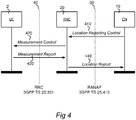
- the CN 10 will send a LOCATION REPORTING CONTROL message 32, 410 over the RANAP protocol 30 to the RNC 20.
- the following information is obtained from the LOCATION REPORTING CONTROL message:
- the RRC protocol 40 from the RNC 20 to the UE 2 also contains information elements in a MEASUREMENT CONTROL message 42, 420 that can transfer:
- the GPS receiver in the UE 2 Upon receipt of the MEASUREMENT CONTROL message 42, 420, the GPS receiver in the UE 2 will act to determine its position and the corresponding inaccuracy. Particulars of this activity are not within the scope of the present invention and are well known to persons skilled in the art. Thus, it is sufficient within the context of the present application to note that the UE 2 measures the time of arrival of ranging signals 4 transmitted from multiple ones of the GPS satellites 3. The orbits and positions of these satellites are available with very high precision, since this information is provided to the terminal as assistance data 52, 46 in A-GPS positioning. Such assistance data 52, 46 can for instance contain trajectory models that describe the orbits of the satellites 3.
- the pseudoranges measured with respect to the satellites 3 can then be combined by the UE 2 to compute its position.
- a covariance matrix describing the uncertainty can be calculated, said covariance matrix being the second moment of the almost Gaussian uncertainty (follows by the strong law of large numbers).
- This covariance matrix represents an ellipse in the 2D horizontal case and an ellipsoid in the 3D case. As will be seen below, these covariance matrices are associated with confidence values of 39% and 20%, respectively.
- the UE 2 will report the outcome of its position determination in a MEASUREMENT REPORT message 44, 430 which is sent to the RNC 20.
- the RNC 20 obtains the following information from the MEASUREMENT REPORT message 44, 430 received over the RRC protocol 40:
- the second variant is most common.
- the RANAP protocol 30 from the RNC 20 to the CN 10 also contains information elements in a LOCATION REPORT message 34, 440 that can transfer:
- the RNC 20 may transform the positioning information from the reporting format as received from the UE 2 into another reporting format suitable for the end user.
- Such transformation may involve shape conversion for transforming a first uncertainty area shape into a second uncertainty area shape.
- the transformation may also be done with the intention to scale the received uncertainty so that the confidence value of the scaled uncertainty becomes equal to the confidence value that is configured for reporting to the CN, for the specific service valid for the ongoing positioning. Algorithms for such transformation and shape conversion are available from the prior art for the person skilled in the art, for instance from PCT/SE2007/050237 .
- the UE 2 may determine an A-GPS position and an uncertainty that exactly match the requested horizontal and vertical accuracies which are received from the RNC 20. Normally the UE 2 then responds with a confidence value of 39% or 20% in the 2D and 3D cases, respectively. Most often the configured confidence to be reported to the end user from the RNC 20 via the CN 10 is significantly higher, in emergency positioning typically 95%. To comply with the higher confidence value, the RNC 20 therefore scales up the uncertainty region obtained from the UE 2. The result is then an uncertainty region that is larger than what was originally requested by the end user, this resulting in a failure to meet the requested QoS. This is then recorded in statistics, and also signaled to the end user. All in all, this will result in increased customer complaints.
- this problem is addressed by the introduction of a pre-scaling of the requested horizontal and vertical inaccuracies that are received from the end user (in the disclosed embodiment, by way of the LOCATION REPORTING CONTROL message 32, 410 over the RANAP protocol 30 between the RNC 20 and the CN 10).
- This pre-scaling is performed in the RNC 20 and transforms the requested inaccuracies to be consistent with configured best estimates of the confidence values that are reported by the UE:s 2.
- the configured values could e.g. be 39 % in the 2D case and 20 % in the 3D case. For example, for emergency positioning this would mean that the horizontal and vertical inaccuracies would be scaled down.
- the pre-scaled inaccuracies will be sent from the RNC 20 to the UE 2 over the RRC protocol 40 in the MEASUREMENT CONTROL message 42, 420.
- the UE 2 would then determine the A-GPS position, uncertainty and confidence and report this positioning information to the RNC 20.
- the RNC 20 then performs a shape conversion as mentioned above in order to scale up the reported uncertainty to correspond to the confidence value needed for reporting. In this case the QoS will be met, thanks to the previous pre-scaling step, and the problem is avoided.
- the pre-scaling functionality of the present invention will now be described in detail. First, the pre-scaling will be derived and explained from a theoretical perspective. Then, with reference to Fig 5 as well as Appendix 1, a description will follow of how the pre-scaling functionality may be applied in the W-CDMA/UMTS embodiment shown in Figs 1, 1a and 4 .
- the pre-scaling is performed on the radius of an uncertainty circle.
- an uncertainty region determined by an ellipse is first used.
- the circular uncertainty pre-scaling is obtained as a special case by setting the semi-major axis equal to the semi-minor axis.
- Appendix 1 includes an example where all algorithms of this section are implemented in a single MATLAB program.
- the ellipse is parameterized with semi-major axis a' , semi-minor axis b' and an angle ⁇ relative to north, counted clockwise from the semi-major axis, see Fig 3 for details. It is clear from symmetry reasons that the angle ⁇ does not affect the final result. The value of ⁇ is therefore taken to be 0 below. The goal is hence to convert the ellipsoid confidence area at confidence level C Initial to a circular confidence area at confidence level C Circular .
- a' and b' are then transformed into the standard deviations of a normal distribution. This is done using the following calculations, where v is the scale factor that translates from one standard deviation to C Initial :
- dxdy 1 2 ⁇ ⁇ 0 2 ⁇ ⁇ 01 1 v
- the pre-scaling v PS represents the pre-scale value (i.e. factor or weight) with which an end user's requested positioning accuracy (horizontal and/or vertical) is to be multiplied before the thus pre-scaled requested positioning accuracy is sent further on towards a mobile terminal (e.g. UE 2).
- C Initial represents the confidence value which is required by the end user. To avoid any confusion, it is mentioned already now that in this later section, the required confidence value will be referred to as C Required rather than C Initial .
- This case parallels the one for the 2D case in that a Gaussian 3D distribution is assumed and an ellipsoid is first considered, assuming the third principal axis being equal to the vertical inaccuracy.
- the obtained equation can be solved numerically for a set of given C Initial , resulting in a corresponding set of v , generating a table as exemplified in Table 1.
- interpolation in the table is utilized, as exemplified by the MATLAB code in appendix 1.
- a backward interpolation can be used to compute scale factors other than for the unit covariance level.
- the theoretical derivation of the pre-scaling functionality may for instance be applied in the W-CDMA/UMTS embodiment which has been described above with reference to Figs 1, 1a and 4 .
- the steps of the pre-scaling method shown in Fig 5 are performed by the UE positioning function 29 in the RNC 20 after having received the LOCATION REPORTING CONTROL message 410 from the CN 10.
- a software implementation of the pre-scaling method is given in Appendix 1. It is to be observed that the method shown in Fig 5 is divided in steps which do not necessarily have to be performed in the exact order shown, or as separate steps even though this is the case in Fig 5 . Therefore, the reader should not be surprised by the fact that the software implementation given in Appendix 1 does not exhibit exactly the same division of functional steps as are shown in Fig 5 .
- the end user's requested positioning accuracy for the positioning of the UE 2 is determined.
- the RNC 20 determines at least one accuracy code included in the LOCATION REPORTING CONTROL message 410.
- Particulars of the LOCATION REPORTING CONTROL message are defined in the specification 3GPP, TS25.413, "UTRAN Iu interface RANAP signalling", which is available for instance at http://www.3gpp.org .
- a horizontal accuracy code represents a radius r of an uncertainty circle 200 (see Fig 2 ), whereas a vertical accuracy code represents an altitude.
- a situation where only a horizontal accuracy code is included in the LOCATION REPORTING CONTROL message 410 (specifying a radius of an uncertainty circle only) is referred to as a 2D case.
- a 3D case is when both a horizontal and a vertical accuracy code are included in the message 410 (specifying a radius of an uncertainty circle as well as an altitude).
- a 1D case is when only a vertical accuracy code is included in the message 410 (specifying an altitude only).
- an estimated confidence value for the positioning of the mobile terminal is determined.
- the estimated confidence value may then be selected from a plurality of configured best estimates of confidences values known to be reported by UE:s 2 in the cellular telecommunication system 1.
- the configured best estimates of confidences values preferably correspond to unit standard deviation for the covariance matrix, as has already been explained above in the theoretical section.
- the configured best estimates of confidences values may preferably be 39 % in the 2D case, 20 % in the 3D case, and 68 % in the 1D case.
- a required confidence value for the end user is determined.
- this involves analyzing the received LOCATION REPORTING CONTROL message 410 to determine a service class of the end user; and determining the required confidence value based on the determined service class. More specifically, this pertains to reading the Client Type IE included in the message 410, and using a cross-reference table to map the read Client Type IE into the required confidence value.
- the cross-reference table contains a list which maps all or some of the different possible Client Type IE values (e.g.
- Emergency Services Value Added Services, PLMN Operator Services, Lawful Intercept Services, PLMN Operator Broadcast Services, PLMN Operator Operation and Maintenance Services, PLMN Operator Anonymous Statistics Services, PLMN Operator Target MS Services Support) into corresponding required confidence values between 0 and 100 %. For instance, Emergency Services may be mapped to a required confidence value of 95 %.
- step 540 in which a pre-scale value is produced from these pieces of input data.
- a pre-scale value is produced from these pieces of input data.
- step 540 involves calculating the pre-scale value v PS by using the determined required confidence value C Required to interpolate in a table which maps a set of possible required confidence values to a corresponding set of pre-scale values - for instance Table 1 as listed above in the theoretical section.
- step 540 involves calculating the pre-scale value v PS by using the determined required confidence value C Required to interpolate in a table which maps a set of possible required confidence values to a corresponding set of pre-scale values - for instance Table 2 as listed above in the theoretical section.
- step 550 the calculated pre-scale value from step 540 is applied to the requested positioning accuracy from step 510. Then, in step 560, the pre-scaled requested positioning accuracy is sent in the cellular telecommunication system 1 towards the UE 2.
- RRC Radio Resource Control
- the pre-scaled horizontal and vertical accuracy codes AccuracyCode H_PS and AccuracyCode V_PS are inserted into the MEASUREMENT CONTROL message 420 to be sent towards the UE 2.
- the pre-scaling method described above with reference to Fig 5 and Appendix 1 may be embodied as a computer program product comprising computer program code for performing the method when the computer program code is executed by a processor, such as the controller 22 in the RNC 20 of Fig 2 .
- the pre-scaling method may also be embodied as a computer readable medium having stored thereon a computer program comprising computer program code for performing the method when the computer program code is executed by a processor.
- the processor may for instance be the controller 22 in the RNC 20 of Fig 2 .
- the computer readable medium may for instance be the memory 24 in the RNC 20 of Fig 2 , or another plausible medium including but not limited to an optical disc (e.g. CD or DVD), a portable semi-conductor memory (e.g. USB stick), a magnetic disc, or a file server accessible in a computer network such as the Internet.
Landscapes
- Engineering & Computer Science (AREA)
- Radar, Positioning & Navigation (AREA)
- Remote Sensing (AREA)
- Computer Networks & Wireless Communication (AREA)
- Physics & Mathematics (AREA)
- General Physics & Mathematics (AREA)
- Signal Processing (AREA)
- Mobile Radio Communication Systems (AREA)
- Position Fixing By Use Of Radio Waves (AREA)
Claims (12)
- Verfahren in Verbindung mit der Positionierung eines mobilen Endgeräts (2) in einem zellularen Telekommunikationssystem (1), wobei das Verfahren in einem Knoten (20) des zellularen Telekommunikationssystems durchgeführt wird, wobei das Verfahren Folgendes umfasst:Bestimmen (510) einer von einem Endbenutzer angeforderten Positionierungsgenauigkeit für die Positionierung des mobilen Endgeräts, das das Empfangen einer ersten Steuernachricht (410) in einem Knoten (20) des zellularen Telekommunikationssystems einschließt, wobei die erste Steuernachricht eine Anforderung des Endbenutzers eines Positionierungsberichts für das mobile Endgerät repräsentiert, und Bestimmen mindestens eines Genauigkeitscodes, der in der ersten Steuernachricht beinhaltet ist;Bestimmen (520) eines geschätzten Vertrauenswerts für die Positionierung des mobilen Endgeräts durch Analysieren der ersten Steuernachricht (410), um zu bestimmen, ob darin ein horizontaler Genauigkeitscode und ein vertikaler Genauigkeitscode beinhaltet ist, und auf Basis der Analyse Auswählen des geschätzten Vertrauenswerts aus einer Vielzahl von konfigurierten besten Schätzungen von Vertrauenswerten, die bekanntermaßen von mobilen Endgeräten (2) im zellularen Telekommunikationssystem (1) gemeldet werden;Bestimmen (530) eines erforderlichen Vertrauenswerts für den Endbenutzer durch Analysieren der ersten Steuernachricht (410), um eine Dienstklasse des Endbenutzers zu bestimmen, und Bestimmen des erforderlichen Vertrauenswerts auf Basis der bestimmten Dienstklasse;Produzieren (540) eines Vorskalierungswerts mindestens auf Basis des geschätzten Vertrauenswerts und des erforderlichen Vertrauenswerts;Anwenden (550) des Vorskalierungswerts auf die angeforderte Positionierungsgenauigkeit, um eine vorskalierte angeforderte Positionierungsgenauigkeit zu erhalten; undSenden (560) der vorskalierten angeforderten Positionierungsgenauigkeit im zellularen Telekommunikationssystem an das mobile Endgerät.
- Verfahren nach Anspruch 1, wobei der oder jeder bestimmte Genauigkeitscode einen Radius, r, eines Unsicherheitskreises (200) oder eine Höhe repräsentiert.
- Verfahren nach Anspruch 4, wobei das Bestimmen (530) des erforderlichen Vertrauenswerts ferner Folgendes einschließt:Lesen eines Clienttyps, der in der ersten Steuernachricht (410) beinhaltet ist; undVerwenden einer Querverweistabelle, um den Clienttyp dem erforderlichen Vertrauenswert zuzuordnen.
- Verfahren nach einem der Ansprüche 1-3, wobei das Produzieren (540) eines Vorskalierungswerts Folgendes einschließt:Analysieren der ersten Steuernachricht (410), um zu bestimmen, ob ein horizontaler Genauigkeitscode darin enthalten ist, während ein vertikaler Genauigkeitscode nicht darin enthalten ist; und, wenn ja,Berechnen des Vorskalierungswerts vPS als 1/sqrt (-2*log (1-CRequired)), wo CRequired der bestimmte erforderliche Vertrauenswert ist.
- Verfahren nach Anspruch 4, wobei das Anwenden (550) des Vorskalierungswerts und das Senden (560) der vorskalierten angeforderten Positionierungsgenauigkeit Folgendes einschließt:Bestimmen einer horizontalen Genauigkeit AccuracyH = 10*(1.1^AccuracyCodeH - 1), wo AccuracyCodeH der horizontale Genauigkeitscode ist, der in der ersten Steuernachricht (410) beinhaltet ist;Vorskalieren der horizontalen Genauigkeit AccuracyH in AccuracyH_PS = AccuracyH*vPS, wo vPS der Vorskalierungswert ist;Bestimmen eines vorskalierten horizontalen Genauigkeitscodes AccuracyCodeH_PS = max([1 floor(log(1+AccuracyH_PS /10)/log(1.1))]) undEinfügen des vorskalierten horizontalen Genauigkeitscodes AccuracyCodeH_PS in eine zweite Steuernachricht (420), die an das mobile Endgerät (2) im zellularen Telekommunikationssystem (1) zu senden ist.
- Verfahren nach einem der Ansprüche 1-3, wobei das Produzieren (540) eines Vorskalierungswerts Folgendes einschließt:Analysieren der ersten Steuernachricht (410), um zu bestimmen, ob sowohl ein horizontaler Genauigkeitscode als auch ein vertikaler Genauigkeitscode darin enthalten ist; und, wenn ja,Berechnen des Vorskalierungswerts vPS durch Verwenden des bestimmten erforderlichen Vertrauenswerts CRequired, um in einer Tabelle zu interpolieren, die einen Satz von möglichen erforderlichen Vertrauenswerten C einem entsprechenden Satz von Vorskalierungswerten v zuordnet, wo der Satz von Vorskalierungswerten v folgende Gleichung erfüllt

- Verfahren nach Anspruch 6, wobei das Anwenden (550) des Vorskalierungswerts und das Senden (560) der vorskalierten angeforderten Positionierungsgenauigkeit Folgendes einschließen:Bestimmen einer horizontalen Genauigkeit AccuracyH = 10*(1.1^AccuracyCodeH - 1), wo AccuracyCodeH der horizontale Genauigkeitscode ist, der in der ersten Steuernachricht (410) beinhaltet ist;Vorskalieren der horizontalen Genauigkeit AccuracyH in AccuracyH_PS = AccuracyH*vPS, wo vPS der Vorskalierungswert ist;Bestimmen eines vorskalierten horizontalen Genauigkeitscodes AccuracyCodeH_PS = max([1 floor(log(1+AccuracyH_PS /10)/log(1.1))]);Bestimmen einer vertikalen Genauigkeit AccuracyV = 45*(1.025^AccuracyCodeV - 1), wo AccuracyCodeV der vertikale Genauigkeitscode ist, der in der ersten Steuernachricht beinhaltet ist;Vorskalieren der vertikalen Genauigkeit AccuracyV in AccuracyV_PS = AccuracyV*vPS, wo vPS der Vorskalierungswert ist;Bestimmen eines vorskalierten vertikalen Genauigkeitscodes AccuracyCodeV_PS = max([1 floor(log(1+AccuracyV_PS /45)/log(1.025))]) undEinfügen des vorskalierten horizontalen und vertikalen Genauigkeitscodes AccuracyCodeH_PS und AccuracyCodeV_PS in eine zweite Steuernachricht (420), die an das mobile Endgerät (2) im zellularen Telekommunikationssystem (1) zu senden ist.
- Verfahren nach einem der Ansprüche 1-3, wobei das Produzieren (540) eines Vorskalierungswerts Folgendes einschließt:Analysieren der ersten Steuernachricht (410), um zu bestimmen, ob ein vertikaler Genauigkeitscode darin enthalten ist, während ein horizontaler Genauigkeitscode nicht darin enthalten ist; und, wenn ja,Berechnen des Vorskalierungswerts vPS durch Verwenden des bestimmten erforderlichen Vertrauenswerts CRequired, um in einer Tabelle zu interpolieren, die einen Satz von möglichen erforderlichen Vertrauenswerten C einem entsprechenden Satz von Vorskalierungswerten v, zuordnet, wo der Satz von Vorskalierungswerten v folgende Gleichung erfüllt:

- Verfahren nach Anspruch 8, wobei das Anwenden (550) des Vorskalierungswerts und das Senden (560) der vorskalierten angeforderten Positionierungsgenauigkeit Folgendes einschließen:Bestimmen einer vertikalen Genauigkeit AccuracyV = 45*(1.025^AccuracyCodeV - 1), wo AccuracyCodeV der vertikale Genauigkeitscode ist, der in der ersten Steuernachricht (410) beinhaltet ist;Vorskalieren der vertikalen Genauigkeit AccuracyV in AccuracyV_PS = AccuracyV*vPS, wo vPS der Vorskalierungswert ist;Bestimmen eines vorskalierten vertikalen Genauigkeitscodes AccuracyCodeV_PS = max([1 floor(log(1+AccuracyV_PS /45)/log(1.025))]) undEinfügen des vorskalierten vertikalen Genauigkeitscodes AccuracyCodeV_PS in eine zweite Steuernachricht (420), die an das mobile Endgerät (2) im zellularen Telekommunikationssystem (1) zu senden ist.
- Knoten in einem zellularen Telekommunikationssystem, wobei der Knoten (20) eine Positionierungsfunktionseinheit (29) für ein mobiles Endgerät umfasst, wobei die Positionierungsfunktionseinheit (29) für ein mobiles Endgerät für Folgendes konfiguriert ist:Bestimmen (510) einer von einem Endbenutzer angeforderten Positionierungsgenauigkeit für die Positionierung eines mobilen Endgeräts (2) im Telekommunikationssystem (1), das das Empfangen einer ersten Steuernachricht (410) in einem Knoten (20) des zellularen Telekommunikationssystems einschließt, wobei die erste Steuernachricht eine Anforderung des Endbenutzers eines Positionierungsberichts für das mobile Endgerät repräsentiert, und Bestimmen mindestens eines Genauigkeitscodes, der in der ersten Steuernachricht beinhaltet ist;Bestimmen (520) eines geschätzten Vertrauenswerts für die Positionierung des mobilen Endgeräts durch Analysieren der ersten Steuernachricht (410), um zu bestimmen, ob darin ein horizontaler Genauigkeitscode und ein vertikaler Genauigkeitscode beinhaltet ist, und auf Basis der Analyse Auswählen des geschätzten Vertrauenswerts aus einer Vielzahl von konfigurierten besten Schätzungen von Vertrauenswerten, die bekanntermaßen von mobilen Endgeräten (2) im zellularen Telekommunikationssystem (1) gemeldet werden;Bestimmen (530) eines erforderlichen Vertrauenswerts für den Endbenutzer durch Analysieren der ersten Steuernachricht (410), um eine Dienstklasse des Endbenutzers zu bestimmen, und Bestimmen des erforderlichen Vertrauenswerts auf Basis der bestimmten Dienstklasse;Produzieren (540) eines Vorskalierungswerts mindestens auf Basis des geschätzten Vertrauenswerts und des erforderlichen Vertrauenswerts;Anwenden (550) des Vorskalierungswerts auf die angeforderte Positionierungsgenauigkeit, um eine vorskalierte angeforderte Positionierungsgenauigkeit zu erhalten; undSenden (560) der vorskalierten angeforderten Positionierungsgenauigkeit im zellularen Telekommunikationssystem an das mobile Endgerät.
- Knoten nach Anspruch 10, wobei das zellulare Telekommunikationssystem mit W-CDMA oder UMTS kompatibel und der Knoten eine Funknetzwerksteuerung, RNC, ist oder wobei das zellulare Telekommunikationssystem mit GSM kompatibel und der Knoten ein Serving Mobile Location Center, SMLC, ist oder wobei das zellulare Telekommunikationssystem mit LTE kompatibel und der Knoten ein Evolved Serving Mobile Location Center, E-SMLC, ist.
- Computerprogrammprodukt, das Computerprogrammcode zum Durchführen des Verfahrens nach einem der Ansprüche 1-9 umfasst, wenn der Computerprogrammcode von einem Prozessor (22) ausgeführt wird.
Applications Claiming Priority (1)
| Application Number | Priority Date | Filing Date | Title |
|---|---|---|---|
| PCT/SE2010/050856 WO2012011855A1 (en) | 2010-07-19 | 2010-07-19 | Pre-scaling of a-gps positioning accuracy data |
Publications (3)
| Publication Number | Publication Date |
|---|---|
| EP2596663A1 EP2596663A1 (de) | 2013-05-29 |
| EP2596663A4 EP2596663A4 (de) | 2017-04-12 |
| EP2596663B1 true EP2596663B1 (de) | 2018-01-17 |
Family
ID=45497072
Family Applications (1)
| Application Number | Title | Priority Date | Filing Date |
|---|---|---|---|
| EP10855084.9A Not-in-force EP2596663B1 (de) | 2010-07-19 | 2010-07-19 | Vorskalierung von a-gps-positionierungspräzisionsdaten |
Country Status (3)
| Country | Link |
|---|---|
| US (1) | US8923886B2 (de) |
| EP (1) | EP2596663B1 (de) |
| WO (1) | WO2012011855A1 (de) |
Families Citing this family (4)
| Publication number | Priority date | Publication date | Assignee | Title |
|---|---|---|---|---|
| US9125098B2 (en) * | 2011-08-03 | 2015-09-01 | Qualcomm Incorporated | Method and apparatus for flow congestion control in multiflow networks |
| US9264353B2 (en) * | 2011-09-22 | 2016-02-16 | Qualcomm Incorporated | Dynamic subflow control for a multipath transport connection in a wireless communication network |
| US9736631B2 (en) | 2015-08-13 | 2017-08-15 | At&T Mobility Ii Llc | Location accuracy for proximity services |
| US11343551B1 (en) * | 2019-07-23 | 2022-05-24 | Amazon Technologies, Inc. | Bandwidth estimation for video streams |
Family Cites Families (5)
| Publication number | Priority date | Publication date | Assignee | Title |
|---|---|---|---|---|
| US7974639B2 (en) * | 2005-02-04 | 2011-07-05 | Qualcomm Incorporated | Method and apparatus for performing position determination with a short circuit call flow |
| US8200250B2 (en) | 2007-04-11 | 2012-06-12 | Telefonaktiebolaget L M Ericsson (Publ) | Transformation of positioning reporting formats |
| EP2374019B1 (de) * | 2008-12-17 | 2017-07-12 | Telefonaktiebolaget LM Ericsson (publ) | Melden von positionsbestimmungsdaten |
| EP2374294B1 (de) * | 2008-12-18 | 2016-03-09 | Telefonaktiebolaget LM Ericsson (publ) | Verfahren und anordnung für verbesserte positionierung |
| US8718673B2 (en) * | 2010-05-21 | 2014-05-06 | Maple Acquisition Llc | System and method for location assurance of a mobile device |
-
2010
- 2010-07-19 WO PCT/SE2010/050856 patent/WO2012011855A1/en not_active Ceased
- 2010-07-19 EP EP10855084.9A patent/EP2596663B1/de not_active Not-in-force
- 2010-07-19 US US13/810,522 patent/US8923886B2/en active Active
Also Published As
| Publication number | Publication date |
|---|---|
| WO2012011855A1 (en) | 2012-01-26 |
| US20130115973A1 (en) | 2013-05-09 |
| EP2596663A1 (de) | 2013-05-29 |
| EP2596663A4 (de) | 2017-04-12 |
| US8923886B2 (en) | 2014-12-30 |
Similar Documents
| Publication | Publication Date | Title |
|---|---|---|
| US9723585B2 (en) | Method and apparatus for position determination in a cellular communications system | |
| EP1535486B1 (de) | Auf bereichen basierende positionsbestimmung für endgeräte in einem drahtlosen netzwerk | |
| EP2484129B1 (de) | Lte-fingerabdruckpositionierungsreferenzen für andere zelluläre systeme | |
| EP1506686B1 (de) | Verbesserte positionsbestimmung in drahtlosen kommunikationssystemen | |
| CN102883432B (zh) | 用于使用历史网络信息来确定近似位置的方法和装置 | |
| JP5522645B2 (ja) | 無線位置決定精度を改善するための方法及び装置 | |
| US8229459B2 (en) | Method and arrangement for enhanced cell identification and cell positioning | |
| EP2884808A1 (de) | Verfahren und Vorrichtung zur Meldung des Standorts eines mobilen Endgeräts | |
| US20040152470A1 (en) | Location estimation of wireless terminals though pattern matching of signal-strength differentials | |
| US20130252629A1 (en) | Positioning with split antennas per cell | |
| US20150338502A1 (en) | Determining a position of a terminal | |
| EP3348099B1 (de) | Fingerabdruck-positionierung für mobile endgeräte | |
| US8385948B2 (en) | Method and arrangement for improved positioning | |
| EP2596663B1 (de) | Vorskalierung von a-gps-positionierungspräzisionsdaten | |
| US8200250B2 (en) | Transformation of positioning reporting formats | |
| JP5296196B2 (ja) | 位置情報集計装置及び位置情報集計方法 | |
| EP2724173B1 (de) | Verfahren und vorrichtung zur auswahl einer positionierungslösung | |
| CN101179834A (zh) | 位置业务服务质量精确确定方法和装置 | |
| JP2018004434A (ja) | 測位処理システム、方法、コンピュータプログラム、サーバ装置及びユーザ端末 | |
| WO2024033846A1 (en) | Integrity level of radio access technology dependent positioning |
Legal Events
| Date | Code | Title | Description |
|---|---|---|---|
| PUAI | Public reference made under article 153(3) epc to a published international application that has entered the european phase |
Free format text: ORIGINAL CODE: 0009012 |
|
| 17P | Request for examination filed |
Effective date: 20130108 |
|
| AK | Designated contracting states |
Kind code of ref document: A1 Designated state(s): AL AT BE BG CH CY CZ DE DK EE ES FI FR GB GR HR HU IE IS IT LI LT LU LV MC MK MT NL NO PL PT RO SE SI SK SM TR |
|
| DAX | Request for extension of the european patent (deleted) | ||
| RA4 | Supplementary search report drawn up and despatched (corrected) |
Effective date: 20170313 |
|
| RIC1 | Information provided on ipc code assigned before grant |
Ipc: H04W 64/00 20090101AFI20170307BHEP Ipc: G01S 19/05 20100101ALI20170307BHEP |
|
| 17Q | First examination report despatched |
Effective date: 20170327 |
|
| GRAP | Despatch of communication of intention to grant a patent |
Free format text: ORIGINAL CODE: EPIDOSNIGR1 |
|
| INTG | Intention to grant announced |
Effective date: 20171013 |
|
| GRAS | Grant fee paid |
Free format text: ORIGINAL CODE: EPIDOSNIGR3 |
|
| GRAA | (expected) grant |
Free format text: ORIGINAL CODE: 0009210 |
|
| AK | Designated contracting states |
Kind code of ref document: B1 Designated state(s): AL AT BE BG CH CY CZ DE DK EE ES FI FR GB GR HR HU IE IS IT LI LT LU LV MC MK MT NL NO PL PT RO SE SI SK SM TR |
|
| REG | Reference to a national code |
Ref country code: GB Ref legal event code: FG4D |
|
| REG | Reference to a national code |
Ref country code: CH Ref legal event code: EP |
|
| REG | Reference to a national code |
Ref country code: IE Ref legal event code: FG4D |
|
| REG | Reference to a national code |
Ref country code: AT Ref legal event code: REF Ref document number: 965212 Country of ref document: AT Kind code of ref document: T Effective date: 20180215 |
|
| REG | Reference to a national code |
Ref country code: DE Ref legal event code: R096 Ref document number: 602010048170 Country of ref document: DE |
|
| REG | Reference to a national code |
Ref country code: NL Ref legal event code: FP |
|
| REG | Reference to a national code |
Ref country code: LT Ref legal event code: MG4D |
|
| REG | Reference to a national code |
Ref country code: AT Ref legal event code: MK05 Ref document number: 965212 Country of ref document: AT Kind code of ref document: T Effective date: 20180117 |
|
| PG25 | Lapsed in a contracting state [announced via postgrant information from national office to epo] |
Ref country code: NO Free format text: LAPSE BECAUSE OF FAILURE TO SUBMIT A TRANSLATION OF THE DESCRIPTION OR TO PAY THE FEE WITHIN THE PRESCRIBED TIME-LIMIT Effective date: 20180417 Ref country code: FI Free format text: LAPSE BECAUSE OF FAILURE TO SUBMIT A TRANSLATION OF THE DESCRIPTION OR TO PAY THE FEE WITHIN THE PRESCRIBED TIME-LIMIT Effective date: 20180117 Ref country code: LT Free format text: LAPSE BECAUSE OF FAILURE TO SUBMIT A TRANSLATION OF THE DESCRIPTION OR TO PAY THE FEE WITHIN THE PRESCRIBED TIME-LIMIT Effective date: 20180117 Ref country code: HR Free format text: LAPSE BECAUSE OF FAILURE TO SUBMIT A TRANSLATION OF THE DESCRIPTION OR TO PAY THE FEE WITHIN THE PRESCRIBED TIME-LIMIT Effective date: 20180117 Ref country code: ES Free format text: LAPSE BECAUSE OF FAILURE TO SUBMIT A TRANSLATION OF THE DESCRIPTION OR TO PAY THE FEE WITHIN THE PRESCRIBED TIME-LIMIT Effective date: 20180117 Ref country code: CY Free format text: LAPSE BECAUSE OF FAILURE TO SUBMIT A TRANSLATION OF THE DESCRIPTION OR TO PAY THE FEE WITHIN THE PRESCRIBED TIME-LIMIT Effective date: 20180117 |
|
| PG25 | Lapsed in a contracting state [announced via postgrant information from national office to epo] |
Ref country code: LV Free format text: LAPSE BECAUSE OF FAILURE TO SUBMIT A TRANSLATION OF THE DESCRIPTION OR TO PAY THE FEE WITHIN THE PRESCRIBED TIME-LIMIT Effective date: 20180117 Ref country code: SE Free format text: LAPSE BECAUSE OF FAILURE TO SUBMIT A TRANSLATION OF THE DESCRIPTION OR TO PAY THE FEE WITHIN THE PRESCRIBED TIME-LIMIT Effective date: 20180117 Ref country code: GR Free format text: LAPSE BECAUSE OF FAILURE TO SUBMIT A TRANSLATION OF THE DESCRIPTION OR TO PAY THE FEE WITHIN THE PRESCRIBED TIME-LIMIT Effective date: 20180418 Ref country code: PL Free format text: LAPSE BECAUSE OF FAILURE TO SUBMIT A TRANSLATION OF THE DESCRIPTION OR TO PAY THE FEE WITHIN THE PRESCRIBED TIME-LIMIT Effective date: 20180117 Ref country code: IS Free format text: LAPSE BECAUSE OF FAILURE TO SUBMIT A TRANSLATION OF THE DESCRIPTION OR TO PAY THE FEE WITHIN THE PRESCRIBED TIME-LIMIT Effective date: 20180517 Ref country code: BG Free format text: LAPSE BECAUSE OF FAILURE TO SUBMIT A TRANSLATION OF THE DESCRIPTION OR TO PAY THE FEE WITHIN THE PRESCRIBED TIME-LIMIT Effective date: 20180417 Ref country code: AT Free format text: LAPSE BECAUSE OF FAILURE TO SUBMIT A TRANSLATION OF THE DESCRIPTION OR TO PAY THE FEE WITHIN THE PRESCRIBED TIME-LIMIT Effective date: 20180117 |
|
| REG | Reference to a national code |
Ref country code: DE Ref legal event code: R097 Ref document number: 602010048170 Country of ref document: DE |
|
| PG25 | Lapsed in a contracting state [announced via postgrant information from national office to epo] |
Ref country code: EE Free format text: LAPSE BECAUSE OF FAILURE TO SUBMIT A TRANSLATION OF THE DESCRIPTION OR TO PAY THE FEE WITHIN THE PRESCRIBED TIME-LIMIT Effective date: 20180117 Ref country code: AL Free format text: LAPSE BECAUSE OF FAILURE TO SUBMIT A TRANSLATION OF THE DESCRIPTION OR TO PAY THE FEE WITHIN THE PRESCRIBED TIME-LIMIT Effective date: 20180117 Ref country code: IT Free format text: LAPSE BECAUSE OF FAILURE TO SUBMIT A TRANSLATION OF THE DESCRIPTION OR TO PAY THE FEE WITHIN THE PRESCRIBED TIME-LIMIT Effective date: 20180117 Ref country code: RO Free format text: LAPSE BECAUSE OF FAILURE TO SUBMIT A TRANSLATION OF THE DESCRIPTION OR TO PAY THE FEE WITHIN THE PRESCRIBED TIME-LIMIT Effective date: 20180117 |
|
| PLBE | No opposition filed within time limit |
Free format text: ORIGINAL CODE: 0009261 |
|
| STAA | Information on the status of an ep patent application or granted ep patent |
Free format text: STATUS: NO OPPOSITION FILED WITHIN TIME LIMIT |
|
| PG25 | Lapsed in a contracting state [announced via postgrant information from national office to epo] |
Ref country code: CZ Free format text: LAPSE BECAUSE OF FAILURE TO SUBMIT A TRANSLATION OF THE DESCRIPTION OR TO PAY THE FEE WITHIN THE PRESCRIBED TIME-LIMIT Effective date: 20180117 Ref country code: DK Free format text: LAPSE BECAUSE OF FAILURE TO SUBMIT A TRANSLATION OF THE DESCRIPTION OR TO PAY THE FEE WITHIN THE PRESCRIBED TIME-LIMIT Effective date: 20180117 Ref country code: SM Free format text: LAPSE BECAUSE OF FAILURE TO SUBMIT A TRANSLATION OF THE DESCRIPTION OR TO PAY THE FEE WITHIN THE PRESCRIBED TIME-LIMIT Effective date: 20180117 Ref country code: SK Free format text: LAPSE BECAUSE OF FAILURE TO SUBMIT A TRANSLATION OF THE DESCRIPTION OR TO PAY THE FEE WITHIN THE PRESCRIBED TIME-LIMIT Effective date: 20180117 |
|
| 26N | No opposition filed |
Effective date: 20181018 |
|
| PG25 | Lapsed in a contracting state [announced via postgrant information from national office to epo] |
Ref country code: SI Free format text: LAPSE BECAUSE OF FAILURE TO SUBMIT A TRANSLATION OF THE DESCRIPTION OR TO PAY THE FEE WITHIN THE PRESCRIBED TIME-LIMIT Effective date: 20180117 |
|
| REG | Reference to a national code |
Ref country code: CH Ref legal event code: PL |
|
| PG25 | Lapsed in a contracting state [announced via postgrant information from national office to epo] |
Ref country code: MC Free format text: LAPSE BECAUSE OF FAILURE TO SUBMIT A TRANSLATION OF THE DESCRIPTION OR TO PAY THE FEE WITHIN THE PRESCRIBED TIME-LIMIT Effective date: 20180117 Ref country code: LU Free format text: LAPSE BECAUSE OF NON-PAYMENT OF DUE FEES Effective date: 20180719 |
|
| REG | Reference to a national code |
Ref country code: BE Ref legal event code: MM Effective date: 20180731 |
|
| REG | Reference to a national code |
Ref country code: IE Ref legal event code: MM4A |
|
| PG25 | Lapsed in a contracting state [announced via postgrant information from national office to epo] |
Ref country code: LI Free format text: LAPSE BECAUSE OF NON-PAYMENT OF DUE FEES Effective date: 20180731 Ref country code: IE Free format text: LAPSE BECAUSE OF NON-PAYMENT OF DUE FEES Effective date: 20180719 Ref country code: FR Free format text: LAPSE BECAUSE OF NON-PAYMENT OF DUE FEES Effective date: 20180731 Ref country code: CH Free format text: LAPSE BECAUSE OF NON-PAYMENT OF DUE FEES Effective date: 20180731 |
|
| PG25 | Lapsed in a contracting state [announced via postgrant information from national office to epo] |
Ref country code: BE Free format text: LAPSE BECAUSE OF NON-PAYMENT OF DUE FEES Effective date: 20180731 |
|
| PG25 | Lapsed in a contracting state [announced via postgrant information from national office to epo] |
Ref country code: MT Free format text: LAPSE BECAUSE OF NON-PAYMENT OF DUE FEES Effective date: 20180719 |
|
| PG25 | Lapsed in a contracting state [announced via postgrant information from national office to epo] |
Ref country code: TR Free format text: LAPSE BECAUSE OF FAILURE TO SUBMIT A TRANSLATION OF THE DESCRIPTION OR TO PAY THE FEE WITHIN THE PRESCRIBED TIME-LIMIT Effective date: 20180117 |
|
| PG25 | Lapsed in a contracting state [announced via postgrant information from national office to epo] |
Ref country code: PT Free format text: LAPSE BECAUSE OF FAILURE TO SUBMIT A TRANSLATION OF THE DESCRIPTION OR TO PAY THE FEE WITHIN THE PRESCRIBED TIME-LIMIT Effective date: 20180117 Ref country code: HU Free format text: LAPSE BECAUSE OF FAILURE TO SUBMIT A TRANSLATION OF THE DESCRIPTION OR TO PAY THE FEE WITHIN THE PRESCRIBED TIME-LIMIT; INVALID AB INITIO Effective date: 20100719 |
|
| PG25 | Lapsed in a contracting state [announced via postgrant information from national office to epo] |
Ref country code: MK Free format text: LAPSE BECAUSE OF NON-PAYMENT OF DUE FEES Effective date: 20180117 |
|
| PGFP | Annual fee paid to national office [announced via postgrant information from national office to epo] |
Ref country code: NL Payment date: 20220726 Year of fee payment: 13 |
|
| PGFP | Annual fee paid to national office [announced via postgrant information from national office to epo] |
Ref country code: GB Payment date: 20220727 Year of fee payment: 13 Ref country code: DE Payment date: 20220629 Year of fee payment: 13 |
|
| REG | Reference to a national code |
Ref country code: DE Ref legal event code: R119 Ref document number: 602010048170 Country of ref document: DE |
|
| REG | Reference to a national code |
Ref country code: NL Ref legal event code: MM Effective date: 20230801 |
|
| GBPC | Gb: european patent ceased through non-payment of renewal fee |
Effective date: 20230719 |
|
| PG25 | Lapsed in a contracting state [announced via postgrant information from national office to epo] |
Ref country code: NL Free format text: LAPSE BECAUSE OF NON-PAYMENT OF DUE FEES Effective date: 20230801 |
|
| PG25 | Lapsed in a contracting state [announced via postgrant information from national office to epo] |
Ref country code: NL Free format text: LAPSE BECAUSE OF NON-PAYMENT OF DUE FEES Effective date: 20230801 Ref country code: DE Free format text: LAPSE BECAUSE OF NON-PAYMENT OF DUE FEES Effective date: 20240201 Ref country code: GB Free format text: LAPSE BECAUSE OF NON-PAYMENT OF DUE FEES Effective date: 20230719 |