EP2596092B2 - Partikel mit mehreren beschichtungen - Google Patents
Partikel mit mehreren beschichtungen Download PDFInfo
- Publication number
- EP2596092B2 EP2596092B2 EP11741361.7A EP11741361A EP2596092B2 EP 2596092 B2 EP2596092 B2 EP 2596092B2 EP 11741361 A EP11741361 A EP 11741361A EP 2596092 B2 EP2596092 B2 EP 2596092B2
- Authority
- EP
- European Patent Office
- Prior art keywords
- mixtures
- composition
- solution
- consumer product
- sulfooxy
- Prior art date
- Legal status (The legal status is an assumption and is not a legal conclusion. Google has not performed a legal analysis and makes no representation as to the accuracy of the status listed.)
- Active
Links
Images
Classifications
-
- C—CHEMISTRY; METALLURGY
- C11—ANIMAL OR VEGETABLE OILS, FATS, FATTY SUBSTANCES OR WAXES; FATTY ACIDS THEREFROM; DETERGENTS; CANDLES
- C11D—DETERGENT COMPOSITIONS; USE OF SINGLE SUBSTANCES AS DETERGENTS; SOAP OR SOAP-MAKING; RESIN SOAPS; RECOVERY OF GLYCEROL
- C11D17/00—Detergent materials or soaps characterised by their shape or physical properties
- C11D17/0039—Coated compositions or coated components in the compositions, (micro)capsules
-
- C—CHEMISTRY; METALLURGY
- C11—ANIMAL OR VEGETABLE OILS, FATS, FATTY SUBSTANCES OR WAXES; FATTY ACIDS THEREFROM; DETERGENTS; CANDLES
- C11D—DETERGENT COMPOSITIONS; USE OF SINGLE SUBSTANCES AS DETERGENTS; SOAP OR SOAP-MAKING; RESIN SOAPS; RECOVERY OF GLYCEROL
- C11D11/00—Special methods for preparing compositions containing mixtures of detergents
- C11D11/0082—Special methods for preparing compositions containing mixtures of detergents one or more of the detergent ingredients being in a liquefied state, e.g. slurry, paste or melt, and the process resulting in solid detergent particles such as granules, powders or beads
- C11D11/0088—Special methods for preparing compositions containing mixtures of detergents one or more of the detergent ingredients being in a liquefied state, e.g. slurry, paste or melt, and the process resulting in solid detergent particles such as granules, powders or beads the liquefied ingredients being sprayed or adsorbed onto solid particles
-
- C—CHEMISTRY; METALLURGY
- C11—ANIMAL OR VEGETABLE OILS, FATS, FATTY SUBSTANCES OR WAXES; FATTY ACIDS THEREFROM; DETERGENTS; CANDLES
- C11D—DETERGENT COMPOSITIONS; USE OF SINGLE SUBSTANCES AS DETERGENTS; SOAP OR SOAP-MAKING; RESIN SOAPS; RECOVERY OF GLYCEROL
- C11D3/00—Other compounding ingredients of detergent compositions covered in group C11D1/00
- C11D3/16—Organic compounds
- C11D3/20—Organic compounds containing oxygen
- C11D3/22—Carbohydrates or derivatives thereof
- C11D3/222—Natural or synthetic polysaccharides, e.g. cellulose, starch, gum, alginic acid or cyclodextrin
-
- C—CHEMISTRY; METALLURGY
- C11—ANIMAL OR VEGETABLE OILS, FATS, FATTY SUBSTANCES OR WAXES; FATTY ACIDS THEREFROM; DETERGENTS; CANDLES
- C11D—DETERGENT COMPOSITIONS; USE OF SINGLE SUBSTANCES AS DETERGENTS; SOAP OR SOAP-MAKING; RESIN SOAPS; RECOVERY OF GLYCEROL
- C11D3/00—Other compounding ingredients of detergent compositions covered in group C11D1/00
- C11D3/16—Organic compounds
- C11D3/37—Polymers
- C11D3/3746—Macromolecular compounds obtained by reactions only involving carbon-to-carbon unsaturated bonds
- C11D3/3753—Polyvinylalcohol; Ethers or esters thereof
-
- C—CHEMISTRY; METALLURGY
- C11—ANIMAL OR VEGETABLE OILS, FATS, FATTY SUBSTANCES OR WAXES; FATTY ACIDS THEREFROM; DETERGENTS; CANDLES
- C11D—DETERGENT COMPOSITIONS; USE OF SINGLE SUBSTANCES AS DETERGENTS; SOAP OR SOAP-MAKING; RESIN SOAPS; RECOVERY OF GLYCEROL
- C11D3/00—Other compounding ingredients of detergent compositions covered in group C11D1/00
- C11D3/16—Organic compounds
- C11D3/37—Polymers
- C11D3/3746—Macromolecular compounds obtained by reactions only involving carbon-to-carbon unsaturated bonds
- C11D3/3757—(Co)polymerised carboxylic acids, -anhydrides, -esters in solid and liquid compositions
- C11D3/3761—(Co)polymerised carboxylic acids, -anhydrides, -esters in solid and liquid compositions in solid compositions
-
- C—CHEMISTRY; METALLURGY
- C11—ANIMAL OR VEGETABLE OILS, FATS, FATTY SUBSTANCES OR WAXES; FATTY ACIDS THEREFROM; DETERGENTS; CANDLES
- C11D—DETERGENT COMPOSITIONS; USE OF SINGLE SUBSTANCES AS DETERGENTS; SOAP OR SOAP-MAKING; RESIN SOAPS; RECOVERY OF GLYCEROL
- C11D3/00—Other compounding ingredients of detergent compositions covered in group C11D1/00
- C11D3/39—Organic or inorganic per-compounds
-
- C—CHEMISTRY; METALLURGY
- C11—ANIMAL OR VEGETABLE OILS, FATS, FATTY SUBSTANCES OR WAXES; FATTY ACIDS THEREFROM; DETERGENTS; CANDLES
- C11D—DETERGENT COMPOSITIONS; USE OF SINGLE SUBSTANCES AS DETERGENTS; SOAP OR SOAP-MAKING; RESIN SOAPS; RECOVERY OF GLYCEROL
- C11D3/00—Other compounding ingredients of detergent compositions covered in group C11D1/00
- C11D3/39—Organic or inorganic per-compounds
- C11D3/3945—Organic per-compounds
Definitions
- the present application relates to particles comprising benefit agents, and products comprising such particles, as well as processes for making and using such particles and products comprising such particles.
- Products for example, consumer products may comprise one or more benefit agents that can provide a desired benefit to such product and/or a situs that is contacted with such a product - for example stain removal and/or bleaching.
- benefit agents such as preformed peracids may be degraded by or degrade components of such products before such product is used - this is particularly true when the product has a pH greater than about 6.
- a protection system that protects the components of a product from a benefit agent is desired. Efforts have been made in this area but typically either fail to provide the required level of protection or fail to release the benefit agent when it is needed.
- US 2006/0172909 relates to a multilayer capsule coated with at least one coating layer comprising a polyelectrolyte.
- US 2009/0270303 relates to particles coated with one coating layer comprising an ionotropically cross-linked polymer.
- a particle comprising a benefit agent, such as preformed peracids, wherein the benefit agent is encapsulated by a first material that forms a first layer and said first layer is encapsulated by a second material that forms a second layer.
- the second layer serves as a barrier that separates the particle from its environment, for example, a liquid detergent environment
- the first layer serves as a material sink that absorbs any material from the particle's environment that successfully penetrates, by diffusion or any other means, through the second layer.
- Such particles are stable in a product, such as a consumer product, during storage, yet, as needed, such particles release the encapsulated benefit agent during the product's use.
- the process of making such particles does not unduly degrade the benefit agent and when such particles are employed in a product, they are stable, yet they release the desired amount of benefit agent when such product is used as intended.
- the present application relates to particles comprising a benefit agent encapsulated by a first layer that is in turn encapsulated by a second material, and products comprising such particles, as well as processes for making and using such particles and products comprising such particles.
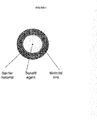
- Figure 1 depicts a representative particle having a core encapsulated by a dual shell system.
- consumer product means baby care, beauty care, fabric & home care, family care, feminine care, or devices generally intended to be used in the form in which it is sold.
- Such products include but are not limited to diapers, bibs, wipes; products for and/or methods relating to treating hair (human, dog, and/or cat), including, bleaching, coloring, dyeing, conditioning, shampooing, styling; deodorants and antiperspirants; personal cleansing; cosmetics; skin care including application of creams, lotions, and other topically applied products for consumer use including fine fragrances; and shaving products, products for and/or methods relating to treating fabrics, hard surfaces and any other surfaces in the area of fabric and home care, including: air care including air fresheners and scent delivery systems, car care, dishwashing, fabric conditioning (including softening and/or freshening), laundry detergency, laundry and rinse additive and/or care, hard surface cleaning and/or treatment including floor and toilet bowl cleaners, and other cleaning for consumer or institutional use; products and/or methods relating to bath
- cleaning and/or treatment composition is a subset of consumer products that includes, unless otherwise indicated, beauty care, fabric & home care products.
- Such products include, but are not limited to, products for treating hair (human, dog, and/or cat), including, bleaching, coloring, dyeing, conditioning, shampooing, styling; deodorants and antiperspirants; personal cleansing; cosmetics; skin care including application of creams, lotions, and other topically applied products for consumer use including fine fragrances; and shaving products, products for treating fabrics, hard surfaces and any other surfaces in the area of fabric and home care, including: air care including air fresheners and scent delivery systems, car care, dishwashing, fabric conditioning (including softening and/or freshening), laundry detergency, laundry and rinse additive and/or care, hard surface cleaning and/or treatment including floor and toilet bowl cleaners, granular or powder-form all-purpose or "heavy-duty" washing agents, especially cleaning detergents; liquid, gel or paste-form all-purpose washing agents, especially the so-called
- the term "fabric and/or hard surface cleaning and/or treatment composition” is a subset of cleaning and treatment compositions that includes, unless otherwise indicated, granular or powder-form all-purpose or "heavy-duty” washing agents, especially cleaning detergents; liquid, gel or paste-form all-purpose washing agents, especially the so-called heavy-duty liquid types; liquid fine-fabric detergents; hand dishwashing agents or light duty dishwashing agents, especially those of the high-foaming type; machine dishwashing agents, including the various tablet, granular, liquid and rinse-aid types for household and institutional use; liquid cleaning and disinfecting agents, including antibacterial hand-wash types, cleaning bars, car or carpet shampoos, bathroom cleaners including toilet bowl cleaners; and metal cleaners, fabric conditioning products including softening and/or freshening that may be in liquid, solid and/or dryer sheet form ; as well as cleaning auxiliaries such as bleach additives and "stain-stick" or pre-treat types, substrate-laden products such as dryer added sheets, dry and we
- solid includes granular, powder, bar and tablet product forms.
- fluid includes liquid, gel, paste and gas product forms.
- situs includes paper products, fabrics, garments, hard surfaces, hair and skin.
- component or composition levels are in reference to the active portion of that component or composition, and are exclusive of impurities, for example, residual solvents or by-products, which may be present in commercially available sources of such components or compositions.
- a particle comprising a shell and a core, said shell comprising at least a first layer, and a second layer, said first layer encapsulating said core and comprising a material sink, said second layer encapsulating said first layer and comprising a barrier material, said particle having a particle diameter of from about 150 microns to about 3000 microns, from about 500 microns to about 2000 microns, or even from about 750 microns to about 1500 microns is disclosed.
- said material sink may comprise a sink for small molecules, said molecules may have a molecular weight from about 500 grams/mol to about 18 grams/mol, from about 300 grams/mol to about 18 grams/mol, or even from about 100 grams/mol to about 28grams/mol.
- said small molecules may be selected from water, an organic material and mixtures thereof.
- said organic material may be selected from the group consisting of ethanol, propylene glycol, ethyl acetate, trans-2-hexanal, cis-3 hexenol, methyl heptenone, cinnamalva, benzaldehyde, benzyl alcohol and mixtures thereof.
- said core may comprise a combination of said core materials.
- said core materials may be agglomerated.
- said combination of said core materials being encapsulated by said material sink and barrier material.
- said barrier material may comprise a material that is not pH sensitive in the pH range of from about 4 to about 9.
- said barrier material may comprise a good film forming polymer.
- said barrier material may comprise a polymer with a dielectric constant from about 3.2 to about 9.3.
- said barrier material may additionally comprise an organoclay that reduces the dielectric constant of the aforementioned polymer.
- a suitable organoclay may comprise a montmorillonite clay that has been organically modified, for example with a fatty amine.
- said material sink may comprise a material that is a solid at a temperature of from about 20°C to about 150°C, or even from about 60°C to about 150°C.
- said material sink may have a centrifuge retention capacity from about 2 gram/gram to about 500 gram/gram, from about 10 gram/gram to about 300 gram/gram, or even from about 50 gram/gram to about 150 gram/gram.
- said sink material may comprise an anionic non-reducing polysaccharide.
- said material sink may comprise an anionic non-reducing polysaccharide that may be encapsulated with a barrier material capable of masking the (negative) charge of said anionic non-reducing polysaccharide, such as a barrier material comprising a polymer with a dielectric constant from about 3.2 to about 8.3.
- a barrier material capable of masking the (negative) charge of said anionic non-reducing polysaccharide, such as a barrier material comprising a polymer with a dielectric constant from about 3.2 to about 8.3.
- said particle may have a stability index of from about 0.80 to about 1, from about 0.90 to about 1, or even from about 0.95 to about 1.
- said particle may have a release index of from about 0.25 to about 1, from about 0.50 to about 1, or even from about 0.85 to about 1.
- said particle may have a core to shell mass ratio of from about 5:95 to about 80:20, from about 15:85 to about 60:40, or even from about 25:75 to about 50:50.
- said particle may have a material sink to barrier material mass ratio of from about 20:80 to about 3:97 or even from about 15:85 to 10:90.
- said particle may comprise a third layer, said third layer may comprise a second barrier material.
- said third layer may be positioned between said first and second layer.
- said third layer may encapsulate the outer surface of said second layer.
- said second barrier material may comprise polyvinyl alcohol, polyvinyl acetate, cellulose acetate, poly(vinyl-alcohol-co-vinylacetate), acrylic acid-ethylene-vinyl acetate copolymer, shellac, hydroxypropylmethyl cellulose phthalate, cellulose acetate phthalate and mixtures thereof.
- said consumer product may comprise said particle and an adjunct ingredient.
- said consumer product may comprise at least 75%, 85% or even 90% of said particles comprising a particle wall thickness of from about 1 to about 500 microns, from about 20 microns to about 250 microns, or even from about 50 microns to about 150 microns.
- said consumer product may comprise a material selected from the group consisting of an external structuring system, an anti-agglomeration agent and mixtures thereof.
- said external structuring system is a hydrogenated castor oil derivative.
- said consumer product may comprise a material selected from
- said consumer product may comprise:
- said detersive enzyme may comprise an enzyme selected from the group consisting of lipase, protease, amylase, cellulase, pectate lyase, xyloglucanase, and mixtures thereof.
- said consumer product may comprise:
- said consumer product may be enclosed within a water soluble a pouch material, in one aspect, said pouch material may comprise polyvinyl alcohol, a polyvinyl alcohol copolymer, hydroxypropyl methyl cellulose (HPMC), and mixtures thereof.
- said pouch material may comprise polyvinyl alcohol, a polyvinyl alcohol copolymer, hydroxypropyl methyl cellulose (HPMC), and mixtures thereof.
- the suitable materials and equipment for practicing the present invention may be obtained from: Germany SSB, Stroever GmbH & Co. KG, Muggenburg 11, 28217 Bremen, Germany; Sigma Aldrich NV/SA, Kardinaal Cardijnplein 8, 2880 Bornem, Belgium; ProCepT nv, Rosteyne 4, 9060 Zelzate, Belgium; GEA Process Engineering Inc. • 9165 Rumsey Road • Columbia, MD 21045, US; Mettler-Toledo, Inc., 1900 Polaris Parkway, Columbus, OH, 43240, US; IKA-Werke GmbH & Co. KG, Janke & Kunkel Str.
- a process of making a consumer product, comprising a consumer product adjunct material and a particle comprising:
- said process may comprise:
- adjuncts are suitable for use in the instant compositions and may be desirably incorporated in certain embodiments of the invention, for example to assist or enhance performance, for treatment of the substrate to be cleaned, or to modify the aesthetics of the composition as is the case with perfumes, colorants, dyes or the like. It is understood that such adjuncts are in addition to the components supplied by the recited particle. The precise nature of these additional components, and levels of incorporation thereof, will depend on the physical form of the composition and the nature of the operation for which it is to be used.
- Suitable adjunct materials include, but are not limited to, surfactants, builders, chelating agents, dye transfer inhibiting agents, dispersants, enzymes, and enzyme stabilizers, catalytic materials, bleach activators, polymeric dispersing agents, clay soil removal/anti-redeposition agents, brighteners, suds suppressors, dyes, additional perfume and perfume delivery systems, external structuring systems, fabric softeners, carriers, hydrotropes, processing aids and/or pigments.
- suitable examples of such other adjuncts and levels of use are found in U.S. Patent Nos. 5,576,282 , 6,306,812 B1 and 6,326,348 B1 . Each adjunct ingredient is not essential to Applicants' compositions.
- compositions do not contain one or more of the following adjuncts materials: bleach activators, surfactants, builders, chelating agents, dye transfer inhibiting agents, dispersants, enzymes, and enzyme stabilizers, catalytic metal complexes, polymeric dispersing agents, clay and soil removal/anti-redeposition agents, brighteners, suds suppressors, dyes, additional perfumes and perfume delivery systems, external structuring system, fabric softeners, carriers, hydrotropes, processing aids and/or pigments.
- adjuncts may form a product matrix that is combined with the particle disclosed herein to form a finished consumer product.
- such one or more adjuncts may be present as detailed below:
- compositions according to the present invention can comprise a surfactant or surfactant system wherein the surfactant can be selected from nonionic and/or anionic and/or cationic surfactants and/or ampholytic and/or zwitterionic and/or semi-polar nonionic surfactants.
- the surfactant is typically present at a level of from about 0.1%, from about 1%, or even from about 5% by weight of the cleaning compositions to about 99.9%, to about 80%, to about 35%, or even to about 30% by weight of the cleaning compositions.
- compositions according to the present invention can comprise a polymeric dispersing agent, clay soil removal/anti-redeposition agent or mixtures thereof.
- said polymer system may comprise one or more amphiphilic alkoxylated greasy cleaning polymers, and either a clay soil cleaning polymer or a soil suspending polymer.
- Suitable polymer systems are described in patent US2009/0124528A1 .
- the polymer system is typically present at a level of from about 0.1%, to about 5%, or even from about 0.3% to about 2%, or even better from about 0.6% to about 1.5% by weight of the cleaning compositions.
- compositions of the present invention can comprise one or more detergent builders or builder systems. When present, the compositions will typically comprise at least about 1% builder, or from about 5% or 10% to about 80%, 50%, or even 30% by weight, of said builder.
- Builders include, but are not limited to, the alkali metal, ammonium and alkanolammonium salts of polyphosphates, alkali metal silicates, alkaline earth and alkali metal carbonates, aluminosilicate builders polycarboxylate compounds, ether hydroxypolycarboxylates, copolymers of maleic anhydride with ethylene or vinyl methyl ether, 1,3,5-trihydroxybenzene-2,4,6-trisulphonic acid, and carboxymethyl-oxysuccinic acid, the various alkali metal, ammonium and substituted ammonium salts of polyacetic acids such as ethylenediamine tetraacetic acid and nitrilotriacetic acid, as well as polycarboxylates such as mellitic acid, succinic acid, oxydisuccinic acid, polymaleic acid, benzene 1,3,5-tricarboxylic acid, carboxymethyloxysuccinic acid, and soluble salts thereof.
- compositions herein may also optionally contain one or more copper, iron and/or manganese chelating agents. If utilized, chelating agents will generally comprise from about 0.1% by weight of the compositions herein to about 15%, or even from about 3.0% to about 15% by weight of the compositions herein.
- compositions of the present invention may also include one or more dye transfer inhibiting agents.
- Suitable polymeric dye transfer inhibiting agents include, but are not limited to, polyvinylpyrrolidone polymers, polyamine N-oxide polymers, copolymers of N-vinylpyrrolidone and N-vinylimidazole, polyvinyloxazolidones and polyvinylimidazoles or mixtures thereof.
- the dye transfer inhibiting agents are present at levels from about 0.0001%, from about 0.01%, from about 0.05% by weight of the cleaning compositions to about 10%, about 2%, or even about 1% by weight of the cleaning compositions.
- compositions of the present invention can also contain dispersants.
- Suitable water-soluble organic materials are the homo- or co-polymeric acids or their salts, in which the polycarboxylic acid may comprise at least two carboxyl radicals separated from each other by not more than two carbon atoms.
- Enzymes - The compositions can comprise one or more detergent enzymes which provide cleaning performance and/or fabric care benefits.
- suitable enzymes include, but are not limited to, hemicellulases, peroxidases, proteases, cellulases, xylanases, lipases, phospholipases, esterases, cutinases, pectinases, keratanases, reductases, oxidases, phenoloxidases, lipoxygenases, ligninases, pullulanases, tannases, pentosanases, malanases, ⁇ -glucanases, arabinosidases, hyaluronidase, chondroitinase, laccase, and amylases, or mixtures thereof.
- a typical combination is a cocktail of conventional applicable enzymes like protease, lipase, cutinase and/or cellulase in conjunction with amylase.
- Enzyme Stabilizers - Enzymes for use in compositions for example, detergents can be stabilized by various techniques.
- the enzymes employed herein can be stabilized by the presence of water-soluble sources of calcium and/or magnesium ions in the finished compositions that provide such ions to the enzymes.
- Catalytic Metal Complexes - Applicants' compositions may include catalytic metal complexes.
- One type of metal-containing bleach catalyst is a catalyst system comprising a transition metal cation of defined bleach catalytic activity, such as copper, iron, titanium, ruthenium, tungsten, molybdenum, or manganese cations, an auxiliary metal cation having little or no bleach catalytic activity, such as zinc or aluminum cations, and a sequestrate having defined stability constants for the catalytic and auxiliary metal cations, particularly ethylenediaminetetraacetic acid, ethylenediaminetetra (methyl-enephosphonic acid) and water-soluble salts thereof.
- Such catalysts are disclosed in U.S. patent 4,430,243 .
- compositions herein can be catalyzed by means of a manganese compound.
- a manganese compound Such compounds and levels of use are well known in the art and include, for example, the manganese-based catalysts disclosed in U.S. patent 5,576,282 .
- Cobalt bleach catalysts useful herein are known, and are described, for example, in U.S. patents 5,597,936 and 5,595,967 . Such cobalt catalysts are readily prepared by known procedures, such as taught for example in U.S. patents 5,597,936 , and 5,595,967 .
- compositions herein may also suitably include a transition metal complex of a macropolycyclic rigid ligand - abbreviated as "MRL".
- MRL macropolycyclic rigid ligand
- the compositions and cleaning processes herein can be adjusted to provide on the order of at least one part per hundred million of the benefit agent MRL species in the aqueous washing medium, and may provide from about 0.005 ppm to about 25 ppm, from about 0.05 ppm to about 10 ppm, or even from about 0.1 ppm to about 5 ppm, of the MRL in the wash liquor.
- Suitable transition-metals in the instant transition-metal bleach catalyst include manganese, iron and chromium.
- Suitable MRL's herein are a special type of ultra-rigid ligand that is cross-bridged such as 5,12-diethyl-1,5,8,12-tetraazabicyclo[6.6.2]hexa-decane.
- Suitable transition metal MRLs are readily prepared by known procedures, such as taught for example in WO 00/32601 , and U.S. patent 6,225,464 .
- External structuring system The consumer product of the present invention may comprise from 0.01% to 5% or even from 0.1% to 1% by weight of an external structuring system.
- the external structuring system may be selected from the group consisting of:
- Unit dose laundry detergent compositions may comprise from 0.01 to 5% by weight of a naturally derived and/or synthetic polymeric structurant.
- Suitable naturally derived polymeric structurants include: hydroxyethyl cellulose, hydrophobically modified hydroxyethyl cellulose, carboxymethyl cellulose, polysaccharide derivatives and mixtures thereof.
- Suitable polysaccharide derivatives include: pectine, alginate, arabinogalactan (gum Arabic), carrageenan, gellan gum, xanthan gum, guar gum and mixtures thereof.
- Suitable synthetic polymeric structurants include: polycarboxylates, polyacrylates, hydrophobically modified ethoxylated urethanes, hydrophobically modified non-ionic polyols and mixtures thereof.
- the polycarboxylate polymer may be a polyacrylate, polymethacrylate or mixtures thereof.
- the polyacrylate may be a copolymer of unsaturated mono- or di-carbonic acid and C 1 -C 30 alkyl ester of the (meth)acrylic acid. Such copolymers are available from Noveon inc under the tradename Carbopol® Aqua 30.
- Certain of the consumer products disclosed herein can be used to clean or treat a situs inter alia a surface or fabric.
- a situs is contacted with an embodiment of Applicants' consumer product, in neat form or diluted in a liquor, for example, a wash liquor and then the situs may be optionally washed and/or rinsed.
- a situs is optionally washed and/or rinsed, contacted with an aspect of the consumer product and then optionally washed and/or rinsed.
- washing includes but is not limited to, scrubbing and mechanical agitation.
- the fabric may comprise most any fabric capable of being laundered or treated in normal consumer use conditions.
- Liquors that may comprise the disclosed compositions may have a pH of from about 3 to about 11.5. Such compositions are typically employed at concentrations of from about 500 ppm to about 15,000 ppm in solution.
- the wash solvent is water
- the water temperature typically ranges from about 5°C to about 90°C and, when the situs comprises a fabric, the water to fabric ratio is typically from about 1:1 to about 30:1.
- test methods that are disclosed in the Test Methods Section of the present application should be used to determine the respective values of the parameters of Applicants' invention as such invention is described and claimed herein.
- the mean particle size of the particles is determined using a Lasentec M500L-316-K supplied by Mettler-Toledo, Inc., 1900 Polaris Parkway, Columbus, OH, 43240, US.
- the equipment is setup (Lasentec, FBRM Control Interface, version 6.0) as described in the Lasentec manual, issued February 2000.
- Software setup and sample analysis is performed using Windows software (Windows XP, version 2002) in the WINDOWS manual. When the particles are collected as solid particles they are uniformly dispersed in deionized water so the test can be performed.
- X ⁇ 2000 ⁇ X ⁇ 2000 + 1000 ⁇ X ⁇ 1000 + 500 ⁇ X ⁇ 500 + 250 ⁇ X ⁇ 250 + 125 ⁇ X ⁇ 125 + 63 ⁇ X ⁇ 63 100
- Hydrogen peroxide in liquid bleaches liberates iodine from an acidified potassium iodide solution.
- the free iodine is titrated potentiometrically with a standardized thiosulphate solution Bleach component + 2I - + 2H + ⁇ I 2 + 2 H 2 O [1] I 2 + I - ⁇ I 3 - [2] I 3 - + 2S 2 O 3 2 - ⁇ 3I - + S 4 O 6 [3]
- the bleach component can be a hydrogen peroxide source, a preformed peracid or a peracid generated by a bleach activator.
- the method measures the total amount of bleach.
- Catalase needs to be added after the peracid generation. Catalase destroys hydrogen peroxide without influencing the peracid and only the peracid is present for further analysis.
- the activity of the bleach catalyst is measured by means of a colorimetric reaction with a specific dye.
- Isoquinolinium class materials and the activated intermediate can be measured by mass spectrometry. Depending upon the response of the individual molecule, electrospray mass spectrometry operated in positive or negative ion is used to measure the isoquinolinium and the oxidized intermediate. MS analysis is done either by direct infusion or by injecting discrete amounts of diluted sample (flow injection analysis). No HPLC separation is needed.
- Release index is calculated using the same formula as described above for metal catalysts.
- the amount of benefit agent left upon storage of particles containing these benefit agents in a laundry detergent composition can be determined filtering the particles from the liquid detergent composition, breaking said particles to release the benefit agent and analyzing the amount left of benefit agent upon storage by using standard analytical methods as described below.
- Conditions stability test samples containing 1% of benefit agent in particle form are stored 7 days at 30°C in a laundry detergent composition. Filtration: After 7 days at 30°C samples are filtered using an 8 microns filter (Whatman Int. LTD, supplied by VWR). Particles are rinsed twice with 3 mL of water. Particles breakage for benefit agent release: Filter paper containing the particles is introduced in a 250 mL glass pot and 100 mL of deionized water is added. A metal ball of 4 cm diameter (Imes, Belgium) is introduced in the glass pot and the glass pot is closed. The mixture containing the particles is kept at 45°C for 1 hour in a thermo shaker at 135 rpm (Thermo shaker THO 5, Gerhardt) for complete benefit agent release. Stability index determination: Benefit agent is analyzed according analytical methods described below.
- Hydrogen peroxide in liquid bleaches liberates iodine from an acidified potassium iodide solution.
- the free iodine is titrated potentiometrically with a standardized thiosulphate solution Bleach component + 2I - + 2H + ⁇ I 2 + 2 H 2 O [1] I 2 + I - ⁇ I 3 - [2] I 3 - + 2S 2 O 3 2 - ⁇ 3I - + S 4 O 6 [3]
- the bleach component can be a hydrogen peroxide source, a preformed peracid or a peracid generated by a bleach activator.
- the method measures the total amount of bleach.
- Catalase needs to be added after the peracid generation. Catalase destroys hydrogen peroxide without influencing the peracid and only the peracid is present for further analysis.
- the activity of the bleach catalyst is measured by means of a colorimetric reaction with a specific dye.
- Stability index C aged particles C total wherein C aged particles is the concentration of metal catalyst determined inside the particles after storage in the liquid detergent composition in ppm and C total is the total amount of metal catalyst in the liquid detergent composition in ppm (total encapsulated).
- Isoquinolinium class materials and the activated intermediate can be measured by mass spectrometry. Depending upon the response of the individual molecule, electrospray mass spectrometry operated in positive or negative ion is used to measure the isoquinolinium and the oxidized intermediate. MS analysis is done either by direct infusion or by injecting discrete amounts of diluted sample (flow injection analysis). No HPLC separation is needed.
- Centrifuge retention capacity may be measured using test method EDANA 441.2-02
- pH measurement of a liquid detergent composition may be measured using test method EN 1262.
- Example 1 Making single capsules 50wt% Core / 50wt% coating
- PAP coated particles are prepared as follow: a PAP granule of about 0.05 grams is covered with about 0.10 grams of a 10% xanthan gum aqueous gel. This aqueous gel is prepared by adding 9 grams of MilliQ water to 1 gram of xanthan gum. The homogeneous gel is obtained by heating 5 hours at 40°C in a close container without stirring.
- Example 2 Making an Encapsulate 50 wt% Core / 50 wt% coating
- PAP (EurecoTM MG grade, Solvay) is coated with two polymers using a fluid bed coater with wurster. Two polymeric solutions are prepared. First, a 2% xanthan gum aqueous solution is prepared by weighting 8 grams xanthan gum powder (Kelzan ASX-T, CPKelco) to 392 grams demi water at 50°C under continuous stirring. Addition is done in 3 hours. Secondly, an 8% polyvinyl acetate solution in acetone/water is prepared by adding 400 grams polyvinyl acetate (MW ⁇ 167,000g/mol, Sigma-Aldrich) to 920 grams acetone and 3680 grams demi water under continuous stirring.
- xanthan gum powder Kelzan ASX-T, CPKelco
- a fluid bed coater with wurster (4M8-Fluidbed, ProCepT, Belgium) is used to coat the PAP. Hot air is set up at 60°C. 400 grams PAP are fluidized and when the system is ready, spraying from the bottom of 400 grams xanthan gum solution begins at a rate of 3mL/min. When spraying from xanthan gum solution is finished, particles are dried at 60°C for 10 minutes. Then, spraying of 5000 grams polyvinyl acetate in acetone/water solution begins at a flow rate of 5mL/min. Material is collected and analyzed by SEM (TM-1000, Hitachi) to ensure a homogenous coating. Release index is 0.88, calculated using above described method.
- Example 3 Production of Particles using a fluid bed coater with wurster
- PAP (EurecoTM MG grade, Solvay) is coated with two polymers using a fluid bed coater with wurster.
- an Alcogum ® L-229 acrylate based emulsion copolymer is used for the inner coating.
- a 10% Polyvinyl alcohol aqueous solution is prepared by adding 100 grams polyvinyl alcohol (M w average ⁇ 13,000-26,000, ref. 363170, Sigma-Aldrich) to 900 grams demi-water under continuous stirring at 50°C.
- a fluid bed coater with wurster (4M8-Fluidbed, ProCepT, Belgium) is used to coat the PAP.
- Hot air inlet is set up at 60°C.
- System is pre-heated with 70 grams PAP fluidized inside the fluid bed coater.
- spraying from the bottom of 40 grams Alcogum ® L-229 begins at a rate of 0.5mL/min.
- spraying from Alcogum ® L-229 is finished, particles are dried at 60°C for 10 minutes.
- Spraying of 600 grams polyvinyl alcohol aqueous solution begins at a flow rate of 1.5mL/min. Material is collected and analyzed and stability index is determined in a liquid formulation as the one in example 4, by the method described above. Stability index is 0.95.
- Non-limiting examples of product formulations containing an encapsulated benefit agent summarized in the following table Example 4
- Example 5 Dosage 40mL 35mL 31mL Ingredients Weight % C 11-16 Alkylbenzene sulfonic acid 20.0 12.5 22.0 C 12-14 Alkyl sulfate 2.0 C 12-14 alkyl 7-ethoxylate 17.0 17.0 19.0 C 12-14 alkyl ethoxy 3 sulfate 7.5 8.0 Citric acid 0.9 1.0 2.0 C 12-18 Fatty acid 13.0 18.0 18.0 Sodium citrate 4.0 enzymes 0-3.0 0-3.0 0-3.0 Ethoxylated Polyethylenimine 1 2.2 Hydroxyethane diphosphonic acid 0.6 0.5 2.2 Amphiphilic alkoxylated grease cleaning polymer 2 2.5 3.5 Ethylene diamine tetra(methylene phosphonic) acid 0.4 Brightener 0.2 0.3 0.3 Perfume microcapsules 4 0.4 Particles (50% EurecoTM MG
- Perfume microcapsules can be prepared as follows: 25 grams of butyl acrylate-acrylic acid copolymer emulsifier (Colloid C351, 25% solids, pka 4.5-4.7, Kemira Chemicals, Inc. Kennesaw, Georgia U.S.A.) is dissolved and mixed in 200 grams deionized water. The pH of the solution is adjusted to pH of 4.0 with sodium hydroxide solution. 8 grams of partially methylated methylol melamine resin (Cymel 385, 80% solids, Cytec Industries West Paterson , New Jersey, U.S.A.) is added to the emulsifier solution.
- butyl acrylate-acrylic acid copolymer emulsifier Colloid C351, 25% solids, pka 4.5-4.7, Kemira Chemicals, Inc. Kennesaw, Georgia U.S.A.
- the pH of the solution is adjusted to pH of 4.0 with sodium hydroxide solution. 8 grams of partially methylated methylol melamine resin
- compositions from examples 4, 5 and 6 are enclosed within a PVA film.
- the film used in the present examples is Monosol M8630 76 ⁇ m thickness.
- Example 11 Compartment 1 2 3 4 5 6 Dosage 34.0 3.5 3.5 25.0 1.5 4.0 Ingredients Weight % C 11-16 Alkylbenzene sulfonic acid 20.0 20.0 20.0 20.0 25.0 30.0 C 12-14 alkyl 7-ethoxylate 17.0 17.0 17.0 17.0 15.0 10.0 C 12-14 alkyl ethoxy 3 sulfate 7.5 7.5 7.5 7.5 Citric acid 0.5 2.0 2.0 C 12-18 Fatty acid 13.0 13.0 13.0 18.0 10.0 15.0 enzymes 0-3.0 0-3.0 0-3.0 0-3.0 Ethoxylated Polyethylenimine 1 2.2 2.2 2.2 Hydroxyethane diphosphonic acid 0.6 0.6 0.6 2.2 Ethylene diamine tetra(methylene phosphonic) acid 0.4 Amphi
- Example 12 Comparison between mono- and dual-encapsulation, using single capsules making
- PAP coated particles are prepared as follow: a PAP granule of about 0.05 grams is covered with about 0.40 grams of a 40% polyvinyl acetate gel in ethanol (this gel is prepared by adding 6 grams of ethanol (96%, So.Co.Fi.) to 4 grams of polyvinyl acetate and then heating at 40°C until a homogeneous gel is obtained) is applied.
- the particle After drying this layer for 48 hours at 25°C on a Teflon surface, the particle is stored in about 2 mL of a liquid laundry composition as described in example 5 and is kept in an oven (Micra 9, ISCO) at 30°C for 1 week. Stability index is determined using the method described above. The value is 0.2.
- the stability index of the particles of 13-16 (which are made per the process of Examples 1 and 9) is determined to be as follows: Particle Benefit agent (core) 1 st layer Weight % 1 st layer* 2 nd layer Weight % 2 nd layer* Stability index in formula of example 17 Ex. 13 PAP 2 Kelzan ASX-T 7.0 Polyvinyl acetate 1 43.0 0.99 Ex. 14 PAP 2 Kelzan HP-T 3.0 Polyvinyl acetate 1 47.0 0.75 Ex. 15 PAP 2 Kelzan ASX 30.0 Polyvinyl acetate 1 40.0 0.86 Ex.
- Non-limiting examples of product formulations containing an encapsulated benefit agent summarized in the following table
- Example 17 Dosage 25mL 25mL Ingredients Weight % Monoethanolamine: C 12-15 EO ⁇ 3 ⁇ SO 3 H 37.0 35.0
- Example 19 Example 20 Compartment 7 8* 9* 10 11 12* Dosage 34.0 3.5 3.5 25.0 1.5 4.0 Ingredients Weight % C 11-16 Alkylbenzene sulfonic acid 20.0 20.0 C 12-14 alkyl 7-ethoxylate 17.0 17.0 C 12-14 alkyl ethoxy 3 sulfate 7.5 7.5 Citric acid 2.0 C 12-18 Fatty acid 13.0 18.0 enzymes 0-3.0 0-3.0 Ethoxylated Polyethylenimine 1 2.2 Hydroxyethane diphosphonic acid 0.6 Amphiphilic alkoxylated grease cleaning polymer 2 2.3 Ethylene diamine tetra(methylene phosphonic) acid 0.4 Brightener 0.2 1.5 Perfume microcapsules 4 0.4 Particles (50% EurecoTM MG) 3 1.9 100 100 100
- Example 21 Comparison between mono- and dual-encapsulation, using single capsules making
Landscapes
- Chemical & Material Sciences (AREA)
- Life Sciences & Earth Sciences (AREA)
- Engineering & Computer Science (AREA)
- Chemical Kinetics & Catalysis (AREA)
- Oil, Petroleum & Natural Gas (AREA)
- Wood Science & Technology (AREA)
- Organic Chemistry (AREA)
- Health & Medical Sciences (AREA)
- Inorganic Chemistry (AREA)
- Molecular Biology (AREA)
- Emergency Medicine (AREA)
- Detergent Compositions (AREA)
- Glanulating (AREA)
- Medicinal Preparation (AREA)
- Accessory Of Washing/Drying Machine, Commercial Washing/Drying Machine, Other Washing/Drying Machine (AREA)
- Cleaning By Liquid Or Steam (AREA)
- Cosmetics (AREA)
Claims (12)
- Teilchen, umfassend eine Schale und einen Kern, wobei der Kern ein Material umfasst, ausgewählt aus der Gruppe, bestehend aus einer vorgebildeten Persäure, einem Metallkatalysator, einem Bleichmittelaktivator, einem Bleichmittelverstärker, einem Diacylperoxid, einer Wasserstoffperoxidquelle; wobei die Schale eine erste Schicht und eine zweite Schicht umfasst, wobei die erste Schicht den Kern einkapselt und eine Materialsenke umfasst, die ein Material umfasst, ausgewählt aus der Gruppe, bestehend aus einem wasserlöslichen und/oder wasserdispergierbaren nicht reduzierenden Polysaccharid, einem wasserlöslichen und/oder wasserdispergierbaren Acrylatderivat und Mischungen davon; wobei die zweite Schicht die erste Schicht einkapselt und ein Barrierematerial umfasst, das ein Material umfasst, ausgewählt aus der Gruppe, bestehend aus Polyvinylalkohol, Polyvinylacetat, Celluloseacetat, Poly(vinyl-alkohol-co-vinylacetat), Acrylsäure-Ethylen-Vinylacetat-Copolymer und Mischungen davon; wobei das Teilchen einen Teilchendurchmesser von 150 Mikrometer bis 3000 Mikrometer aufweist.
- Teilchen nach einem der vorstehenden Ansprüche, wobei:a) der Metallkatalysator ein Material umfasst, ausgewählt aus der Gruppe, bestehend aus Dichlor-1,4-diethyl-1,4,8,11-tetraaazabicyclo[6.6.2]hexadecanmangan(II); Dichlor-1,4-dimethyl-1,4,8,11-tetraaazabicyclo[6.6.2]hexadecanmangan(II) und Mischungen davon;b) der Bleichmittelverstärker Material umfasst, ausgewählt aus der Gruppe, bestehend aus 2-[3-[(2-Hexyldodecyl)oxy]-2-(sulfooxy)propyl]-3,4-dihydroisochinoliniumzwitterion; 3,4-Dihydro-2-[3-[(2-pentylundecyl)oxy]-2-(sulfooxy)propyl]isochinoliniumzwitterion; 2-[3-[(2-Butyldecyl)oxy]-2-(sulfooxy)propyl]-3,4-dihydroisochinoliniumzwitterion; 3,4-Dihydro-2-[3-(octadecyloxy)-2-(sulfooxy)propyl]isochinoliniumzwitterion; 2-[3-(Hexadecyloxy)-2-(sulfooxy)propyl]-3,4-dihydroisochinoliniumzwitterion; 3,4-Dihydro-2-[2-(sulfooxy)-3-(tetradecyloxy)propyl]isochinoliniumzwitterion; 2-[3-(Dodecyloxy)-2-(sulfooxy)propyl]-3,4-dihydroisochinoliniumzwitterion; 2-[3-[(3-Hexyldecyl)oxy]-2-(sulfooxy)propyl]-3,4-dihydroisochinoliniumzwitterion; 3,4-Dihydro-2-[3-[(2-pentylnonyl)oxy]-2-(sulfooxy)propyl]isochinoliniumzwitterion; 3,4-Dihydro-2-[3-[(2-propylheptyl)oxy]-2-(sulfooxy)propyl]isochinoliniumzwitterion; 2-[3-[(2-Butyloctyl)oxy]-2-(sulfooxy)propyl]-3,4-dihydroisochinoliniumzwitterion; 2-[3-(Decyloxy)-2-(sulfooxy)propyl]-3,4-dihydroisochinoliniumzwitterion; 3,4-Dihydro-2-[3-(octyloxy)-2-(sulfooxy)propyl]isochinoliniumzwitterion; 2-[3-[(2-Ethylhexyl)oxy]-2-(sulfooxy)propyl]-3,4-dihydroisochinoliniumzwitterion und Mischungen davon;b) der Bleichmittelaktivator ein Material umfasst, ausgewählt aus der Gruppe, bestehend aus Tetraacetylethylendiamin (TAED); Benzoylcaprolactam (BzCL); 4-Nitrobenzoylcaprolactam; 3-Chlorbenzoyl-caprolactam; Benzoyloxybenzolsulfonat (BOBS); Nonanoyloxybenzolsulfonat (NOBS);
Phenylbenzoat (PhBz); Decanoyloxybenzolsulfonat (C10-OBS); Benzoylvalerolactam (BZVL); Octanoyloxybenzolsulfonat (C8-OBS);
perhydrolysierbaren Estern; 4-[N-(Nonaoyl)aminohexanoyloxy]-benzolsulfonatnatriumsalz (NACA-OBS);
Dodecanoyloxybenzolsulfonat (LOBS oder C12-OBS); 10-Undecenoyloxybenzolsulfonat (UDOBS oder C11-OBS mit Ungesättigtheit in der Position 10); Decanoyloxybenzoesäure (DOBA); (6-Octanamidocaproyl)oxybenzolsulfonat; (6-Nonanamidocaproyl)oxybenzolsulfonat; (6-Decanamidocaproyl)oxybenzolsulfonat und Mischungen davon;c) die vorgebildete Persäure ein Material umfasst, ausgewählt aus der Gruppe, bestehend aus Peroxymonoschwefelsäuren; Perimidsäuren; Peroxokohlensäuren; Percarbonsäuren und Salzen der Säuren; wobei die Percarbonsäuren und Salze davon vorzugsweise Phthalimidoperoxyhexansäure, 1,12-Diperoxydodecandisäure; oder Monoperoxyphthalsäure (Magnesiumsalzhexahydrat) umfassen; Amidoperoxysäuren, wobei die Amidoperoxysäuren vorzugsweise N,N'-Terephthaloyl-di(6-aminocapronsäure), ein Monononylamid von entweder Peroxybernsteinsäure (NAPSA) oder Peroxyadipinsäure (NAPAA), N-Nonanoylaminoperoxycapronsäure (NAPCA) und Mischungen davon umfassen;d) das Diacylperoxid ein Material umfasst, ausgewählt aus der Gruppe, bestehend aus Dinonanoylperoxid, Didecanoylperoxid, Diundecanoylperoxid, Dilauroylperoxid, Dibenzoylperoxid, Di-(3,5,5-trimethylhexanoyl)peroxid und Mischungen davon;e) die Wasserstoffperoxidquelle ein Material umfasst, ausgewählt aus der Gruppe, bestehend aus einem Perborat, einem Percarbonat, einem Peroxyhydrat, einem Persulfat und Mischungen davon. - Teilchen nach einem der vorstehenden Ansprüche, wobei:a) der Polyvinylalkohol eine Polyvinylalkohol-Variante mit einem Hydrolysegrad von 80 mol-% bis 99 mol-%, mehr bevorzugt von 87 mol-% bis 89 mol-%; und einem Molekulargewicht von 10.000 Gramm/Mol bis 750.000 Gramm/Mol, mehr bevorzugt von 30.000 Gramm/Mol bis 300.000 Gramm/Mol umfasst;b) das Polyvinylacetat eine Polyvinylacetat-Variante mit einem Polymerisationsgrad von 150 bis 5.000, vorzugsweise von 150 bis 2.000 oder mehr bevorzugt von 190 bis 1.000 umfasst; undc) das Celluloseacetat eine Celluloseacetat-Variante mit einem Molekulargewicht von 30.000 Gramm/Mol bis 50.000 Gramm/Mol umfasst.
- Teilchen nach einem der vorstehenden Ansprüche, wobei:a) das wasserlösliche und/oder wasserdispergierbare nicht reduzierende Polysaccharid ein Material umfasst, ausgewählt aus der Gruppe, bestehend aus Xanthangummi, Diutangummi, Guargummi, Gellangummi, Carrageenan, synergistischen Gummisystemen und Mischungen davon; undb) das wasserlösliche und/oder wasserdispergierbare Acrylatderivat eine Glasübergangstemperatur von 50 °C bis 130 °C, mehr bevorzugt von 90 °C bis 115 °C aufweist.
- Endprodukt, umfassend das Teilchen nach einem der vorstehenden Ansprüche und einen Zusatzbestandteil, wobei vorzugsweise mindestens 75 %, mehr bevorzugt 85 % oder am meisten bevorzugt 90 % der Teilchen eine Teilchenwanddicke von 1 bis 500 Mikrometer, mehr bevorzugt von 20 Mikrometer bis 250 Mikrometer, am meisten bevorzugt von 50 Mikrometer bis 150 Mikrometer aufweisen, wobei das Endprodukt vorzugsweise ein Material umfasst, ausgewählt aus der Gruppe bestehend aus einem Strukturmittel, einem Antiagglomerationsmittel und Mischungen davon, wobei das Strukturmittel vorzugsweise hydriertes Rizinusölderivat umfasst.
- Endprodukt nach Anspruch 5, wobei das Endprodukt ein Material umfasst, ausgewählt aus:a) einem anionischen Tensid und/oder einem nichtionischen Tensid, vorzugsweise einem anionischen Tensid;b) einem Lösungsmittel, wobei das Lösungsmittel vorzugsweise Butoxypropoxypropanol und/oder Glycerin umfasst;c) Wasser, vorzugsweise, basierend auf dem Gesamtgewicht der Zusammensetzung, zu weniger als 10 % Wasser, mehr bevorzugt zu 2 % bis 10 % Wasser; undd) wahlweise einem oder mehreren Materialien, ausgewählt aus der Gruppe, bestehend aus:(i) einem bleichmittelkompatiblen Tonreinigungspolymer, wobei das bleichmittelkompatible Tonreinigungspolymer vorzugsweise ausgewählt ist aus der Gruppe, bestehend aus ethoxyliertem Hexamethylendiamindimethylquat, ethoxysulfatiertem Hexamethylendiamindimethylquat und Mischungen davon;(ii) einem Aufheller, wobei der Aufheller vorzugsweise einen fluoreszierenden Aufheller umfasst, ausgewählt aus Dinatrium-4,4'-bis(2-sulfostyryl)biphenyl und/oder Bis(sulfobenzofuranyl)biphenyl;(iii) einem Builder, wobei der Builder vorzugsweise Natriumcitrat umfasst; und(iv) einem Chelant, wobei der Chelant vorzugsweise 1-Hydroxyethyliden-1,1-diphosphonsäure (HEDP) umfasst.
- Endprodukt nach einem der Ansprüche 5 bis 6, wobei das Endprodukt Folgendes umfasst:a. zu 0,0001 Gewichts-% bis 8 Gewichts-% ein Reinigungsenzym undb. einen unverdünnten pH-Wert von 6,5 bis 10,5 aufweist.
- Endprodukt nach Anspruch 7, wobei das Reinigungsenzym ein Enzym umfasst, ausgewählt aus der Gruppe, bestehend aus: Lipase, Protease, Amylase, Cellulase, Pektatlyase, Xyloglucanase und Mischungen davon.
- Endprodukt nach einem der Ansprüche 5 bis 8, wobei das Endprodukt Folgendes umfasst:a. zu 0,1 Gewichts-% bis 12 Gewichts-% das Bleichmittel oder Bleichmittelsystem, undb. einen unverdünnten pH-Wert von 6,5 bis 10,5 aufweist.
- Endprodukt nach einem der Ansprüche 5 bis 9, wobei das Endprodukt innerhalb eines wasserlöslichen Beutelmaterials eingeschlossen ist, wobei das Beutelmaterial vorzugsweise einen Polyvinylalkohol, ein Polyvinylalkoholcopolymer, eine Hydroxypropylmethylcellulose (HPMC) und Mischungen davon umfasst.
- Verfahren zum Behandeln und/oder Reinigen einer Stelle, wobei das Verfahren umfassta. wahlweise Waschen und/oder Spülen der Stelle,b. Inkontaktbringen der Stelle mit einem Endprodukt nach einem der Ansprüche 5 bis 10; undc. wahlweise Waschen und/oder Spülen der Stelle.
- Prozess zum Herstellen eines Endprodukts nach einem der Ansprüche 5 bis 10, umfassend ein Endprodukt-Zusatzmaterial und ein Teilchen, wobei der Prozess Folgendes umfasst:a) Zubereiten einer ersten Lösung, umfassend, basierend auf dem Gesamtgewicht der Lösung, zu 0,5 % bis 10 % eine Materialsenke, die in der ersten Lösung suspendiert und/oder gelöst ist, und ein oder mehrere Lösungsmittel, wobei das Lösungsmittel vorzugsweise Wasser, Ethanol, Aceton, Dichlormethan und Mischungen davon umfasst;b) Zubereiten einer zweiten Lösung, umfassend, basierend auf dem Gesamtgewicht der Lösung, zu 2 % bis 20 % ein Barrierematerial, das in der zweiten Lösung suspendiert und/oder gelöst ist, und ein oder mehrere Lösungsmittel, wobei das Lösungsmittel vorzugsweise Wasser, Ethanol, Aceton, Dichlormethan und Mischungen davon umfasst;c) wahlweise Zubereiten einer dritten Lösung, umfassend, basierend auf dem Gesamtgewicht der Lösung, zu 2 % bis 20 % ein Barrierematerial, das in der dritten Lösung suspendiert und/oder gelöst ist, und ein oder mehrere Lösungsmittel, wobei das Lösungsmittel vorzugsweise Wasser, Ethanol, Aceton, Dichlormethan und Mischungen davon umfasst;d) wahlweise Kombinieren eines Antiagglomerationsmittels mit der ersten, zweiten und/oder dritten Lösung;e) wahlweise Bilden einer ersten Zusammensetzung durch Agglomerieren des Kernmaterials und eines Bindemittels, wobei der Agglomerationsprozess vorzugsweise Fließbettverarbeitung, eine Agglomerationsverarbeitung mit hoher Scherung oder eine Kombination davon umfasst;f) Fluidisieren des Kernmaterials oder der ersten Zusammensetzung in einer Kammer bei einer Temperatur von 25 °C bis 90 °C, wobei die Kammer vorzugsweise eine Fließbettauftragsmaschine umfasst, wahlweise umfassend einen Wurster, wobei die Kammer mehr bevorzugt ein Sprudelbett umfasst;g) Bilden einer zweiten Zusammensetzung durch Sprühen der ersten Lösung auf das fluidisierte Kernmaterial oder die erste Zusammensetzung, wobei das Sprühverfahren vorzugsweise eine Bifluiddüse umfasst;h) Fluidisieren der zweiten Zusammensetzung in einer Kammer bei einer Temperatur von 25 °C bis 90 °C, wobei die Kammer vorzugsweise eine Fließbettauftragsmaschine umfasst, wahlweise umfassend einen Wurster, wobei die Kammer mehr bevorzugt ein Sprudelbett umfasst;i) Bilden einer dritten Zusammensetzung durch Sprühen der zweiten Lösung auf die zweite Zusammensetzung, wobei der Sprühprozess vorzugsweise eine Bifluiddüse umfasst;j) wahlweise Fluidisieren der dritten Zusammensetzung in einer Kammer bei einer Temperatur von 25 °C bis 90 °C, wobei die Kammer vorzugsweise eine Fließbettauftragsmaschine, wahlweise mit Wurster, umfasst, wobei die Kammer mehr bevorzugt ein Sprudelbett umfasst;k) wahlweise Bilden einer vierten Zusammensetzung durch Sprühen der dritten Lösung auf die dritte Zusammensetzung, wobei der Sprühprozess vorzugsweise eine Bifluiddüse umfasst;l) wahlweise Bilden einer fünften Zusammensetzung durch Agglomerieren der dritten und/oder vierten Zusammensetzung; undm) Kombinieren der dritten, vierten und/oder fünften Zusammensetzung mit einem oder mehreren Endprodukt-Zusätzen.
Applications Claiming Priority (3)
| Application Number | Priority Date | Filing Date | Title |
|---|---|---|---|
| US36589610P | 2010-07-20 | 2010-07-20 | |
| US36799010P | 2010-07-27 | 2010-07-27 | |
| PCT/US2011/044624 WO2012012494A1 (en) | 2010-07-20 | 2011-07-20 | Particles with a plurality of coatings |
Publications (3)
| Publication Number | Publication Date |
|---|---|
| EP2596092A1 EP2596092A1 (de) | 2013-05-29 |
| EP2596092B1 EP2596092B1 (de) | 2017-05-31 |
| EP2596092B2 true EP2596092B2 (de) | 2020-04-01 |
Family
ID=44504196
Family Applications (1)
| Application Number | Title | Priority Date | Filing Date |
|---|---|---|---|
| EP11741361.7A Active EP2596092B2 (de) | 2010-07-20 | 2011-07-20 | Partikel mit mehreren beschichtungen |
Country Status (9)
| Country | Link |
|---|---|
| US (1) | US20120028874A1 (de) |
| EP (1) | EP2596092B2 (de) |
| JP (2) | JP6104799B2 (de) |
| CN (1) | CN103003407B (de) |
| AR (1) | AR082384A1 (de) |
| BR (1) | BR112013001359A2 (de) |
| CA (1) | CA2804195A1 (de) |
| MX (1) | MX2013000792A (de) |
| WO (1) | WO2012012494A1 (de) |
Families Citing this family (34)
| Publication number | Priority date | Publication date | Assignee | Title |
|---|---|---|---|---|
| US8754026B2 (en) * | 2010-09-27 | 2014-06-17 | Basf Se | Process for producing granules comprising one or more complexing agent salts |
| CN103874758A (zh) * | 2011-09-13 | 2014-06-18 | 宝洁公司 | 包封物 |
| DE102012211028A1 (de) | 2012-06-27 | 2014-01-02 | Henkel Ag & Co. Kgaa | Hochkonzentriertes flüssiges Wasch- oder Reinigungsmittel |
| TWI642603B (zh) * | 2012-11-09 | 2018-12-01 | 陝西有色天宏瑞科矽材料有限責任公司 | 減輕多晶矽的金屬接觸污染的容器及方法 |
| GB201402257D0 (en) * | 2014-02-10 | 2014-03-26 | Revolymer Ltd | Novel Peracid - containing particle |
| BR112016019545B1 (pt) * | 2014-02-27 | 2018-09-25 | Unilever N.V. | cápsula multicompartimentada de detergente para lavagem de roupa solúvel em água e método de preparação de uma cápsula |
| US9422398B2 (en) | 2014-05-30 | 2016-08-23 | Industrial Technology Research Institute | Copolymer, and method for preparing a monomer used to form the copolymer |
| NO2719169T3 (de) * | 2014-06-17 | 2018-06-23 | ||
| KR101787638B1 (ko) * | 2014-11-05 | 2017-10-19 | 주식회사 엘지화학 | 이중 측벽 구조를 가지는 카트리지 프레임 및 이를 포함하는 배터리 모듈 |
| CN105640819A (zh) * | 2014-11-13 | 2016-06-08 | 广州十长生化妆品有限公司 | 一种具有嫩滑美白肌肤的去角质微球及其应用 |
| US9962321B2 (en) * | 2014-12-16 | 2018-05-08 | Noxell Corporation | Compositions providing delayed release of actives |
| US10280386B2 (en) | 2015-04-03 | 2019-05-07 | Ecolab Usa Inc. | Enhanced peroxygen stability in multi-dispense TAED-containing peroxygen solid |
| US9783766B2 (en) | 2015-04-03 | 2017-10-10 | Ecolab Usa Inc. | Enhanced peroxygen stability using anionic surfactant in TAED-containing peroxygen solid |
| CN106860032B (zh) * | 2016-10-25 | 2021-04-09 | 咏达生医材料股份有限公司 | 一种气态皮肤供氧美白产品及其应用 |
| GB201705186D0 (en) * | 2017-03-31 | 2017-05-17 | Innovia Films Ltd | Fibre |
| DE102017004742A1 (de) * | 2017-05-17 | 2018-11-22 | Weylchem Wiesbaden Gmbh | Beschichtete Granulate, deren Verwendung und Wasch- und Reinigungsmittel enthaltend diese |
| CA3102614C (en) | 2018-06-15 | 2023-02-28 | Ecolab Usa Inc. | Enhanced peroxygen stability using fatty acid in bleach activating agent containing peroxygen solid |
| EP3848444B1 (de) * | 2018-08-14 | 2026-04-01 | The Procter & Gamble Company | Flüssige stoffbehandlungszusammensetzungen mit aufheller |
| EP3611247B2 (de) | 2018-08-14 | 2026-01-07 | The Procter & Gamble Company | Stoffbehandlungszusammensetzungen mit pflegemittelkapseln |
| EP3611246B2 (de) * | 2018-08-14 | 2025-07-23 | The Procter & Gamble Company | Stoffbehandlungszusammensetzungen mit pflegemittelkapseln |
| EP3613839A1 (de) * | 2018-08-24 | 2020-02-26 | Lakma Strefa Sp.z o o. | Reinigungsmittelzusammensetzung, einheitsdosis und system für harte boden- und oberflurflächen |
| CN110302415A (zh) * | 2019-06-12 | 2019-10-08 | 王银梅 | 一种高粘结强度透湿促愈合伤口敷料的制备方法 |
| EP3969555A1 (de) | 2019-06-21 | 2022-03-23 | Ecolab USA, Inc. | Feste nichtionische tensidzusammensetzungen |
| US11160347B1 (en) * | 2020-05-04 | 2021-11-02 | To2M Corporation | Use and method of gas supply device for lightening hair color |
| EP3967742A1 (de) * | 2020-09-15 | 2022-03-16 | WeylChem Performance Products GmbH | Bleichkatalysatorhaltige zusammensetzungen, verfahren zu ihrer herstellung und bleich- und reinigungsmittel damit |
| PL4244319T3 (pl) * | 2020-11-10 | 2024-10-28 | Unilever Ip Holdings B.V. | Wodna alkaliczna ścierna kompozycja czyszcząca |
| KR102305401B1 (ko) * | 2020-11-24 | 2021-09-27 | 신홍철 | 분말 염모제 |
| KR102286697B1 (ko) * | 2020-11-24 | 2021-08-05 | 신홍철 | 분말 염모제용 마이크로비드 및 분말 염모제 |
| KR102778387B1 (ko) * | 2021-07-21 | 2025-03-07 | 신홍철 | 다시마 포함 분말 염모제 |
| KR102584625B1 (ko) * | 2021-07-21 | 2023-10-05 | 신홍철 | 쑥 포함 분말 염모제 |
| USD1088343S1 (en) | 2022-05-11 | 2025-08-12 | People Against Dirty Holdings Limited | Packet |
| JP7840109B2 (ja) * | 2022-08-12 | 2026-04-03 | ザ プロクター アンド ギャンブル カンパニー | 固体溶解性組成物 |
| CN115721615B (zh) * | 2022-11-17 | 2024-08-30 | 华熙生物科技股份有限公司 | 一种透明质酸颗粒及其制备方法 |
| GB2628608A (en) | 2023-03-30 | 2024-10-02 | Reckitt Benckiser Vanish Bv | Bleach catalyst with improved performance and composition comprising said catalyst |
Citations (1)
| Publication number | Priority date | Publication date | Assignee | Title |
|---|---|---|---|---|
| WO2000029534A1 (en) † | 1998-11-13 | 2000-05-25 | Genencor International, Inc. | Fluidized bed low density granule |
Family Cites Families (21)
| Publication number | Priority date | Publication date | Assignee | Title |
|---|---|---|---|---|
| GR76237B (de) | 1981-08-08 | 1984-08-04 | Procter & Gamble | |
| US4657784A (en) * | 1986-03-10 | 1987-04-14 | Ecolab Inc. | Process for encapsulating particles with at least two coating layers having different melting points |
| US5324649A (en) | 1991-10-07 | 1994-06-28 | Genencor International, Inc. | Enzyme-containing granules coated with hydrolyzed polyvinyl alcohol or copolymer thereof |
| US5534179A (en) | 1995-02-03 | 1996-07-09 | Procter & Gamble | Detergent compositions comprising multiperacid-forming bleach activators |
| US5597936A (en) | 1995-06-16 | 1997-01-28 | The Procter & Gamble Company | Method for manufacturing cobalt catalysts |
| US5576282A (en) | 1995-09-11 | 1996-11-19 | The Procter & Gamble Company | Color-safe bleach boosters, compositions and laundry methods employing same |
| GB2309976A (en) * | 1996-02-08 | 1997-08-13 | Procter & Gamble | Bleach catalyst particles for inclusion in detergents |
| MA24137A1 (fr) | 1996-04-16 | 1997-12-31 | Procter & Gamble | Fabrication d'agents de surface ramifies . |
| AU731577B2 (en) | 1997-03-07 | 2001-04-05 | Procter & Gamble Company, The | Bleach compositions containing metal bleach catalyst, and bleach activators and/or organic percarboxylic acids |
| WO1998039335A1 (en) | 1997-03-07 | 1998-09-11 | The Procter & Gamble Company | Improved methods of making cross-bridged macropolycycles |
| AU752879B2 (en) | 1997-12-20 | 2002-10-03 | Genencor International, Inc. | Matrix granule |
| EP1135392A2 (de) | 1998-11-30 | 2001-09-26 | The Procter & Gamble Company | Verfahren zur herstellung von vernetzt verbrückten tetraazamacrocyclen |
| US6627593B2 (en) * | 2001-07-13 | 2003-09-30 | Ecolab Inc. | High concentration monoester peroxy dicarboxylic acid compositions, use solutions, and methods employing them |
| US20030148909A1 (en) * | 2001-09-19 | 2003-08-07 | Valerio Del Duca | Bleaching compositions for dark colored fabric and articles comprising same |
| DE10361170A1 (de) * | 2003-06-13 | 2005-01-05 | Henkel Kgaa | Lagerstabiles Polyelektrolytkapselsystem auf Basis von Peroxycarbonsäuren |
| DE102004018790B4 (de) * | 2004-04-15 | 2010-05-06 | Henkel Ag & Co. Kgaa | Wasserlöslich umhüllte Bleichmittelteilchen |
| DE102004018789A1 (de) * | 2004-04-15 | 2005-11-10 | Henkel Kgaa | Flüssiges Wasch- oder Reinigungsmittel mit wasserlöslich umhülltem Bleichmittel |
| DE102007004054A1 (de) * | 2007-01-22 | 2008-07-24 | Henkel Ag & Co. Kgaa | Verfahren zur Herstellung teilchenförmiger Bleichmittelzusammensetzungen |
| ATE503826T1 (de) * | 2007-07-02 | 2011-04-15 | Procter & Gamble | Mehrkammerbeutel enthaltend waschmittel |
| EP2225355B1 (de) | 2007-11-09 | 2016-05-11 | The Procter & Gamble Company | Reinigungsmittel mit multipolymersystem mit mindestens einem alkoxylierten fettreinigungspolymer |
| JP5547093B2 (ja) * | 2008-02-15 | 2014-07-09 | ザ プロクター アンド ギャンブル カンパニー | 送達粒子 |
-
2011
- 2011-07-20 US US13/186,528 patent/US20120028874A1/en not_active Abandoned
- 2011-07-20 CA CA2804195A patent/CA2804195A1/en not_active Abandoned
- 2011-07-20 JP JP2013520829A patent/JP6104799B2/ja active Active
- 2011-07-20 CN CN201180035216.6A patent/CN103003407B/zh not_active Expired - Fee Related
- 2011-07-20 EP EP11741361.7A patent/EP2596092B2/de active Active
- 2011-07-20 BR BR112013001359A patent/BR112013001359A2/pt not_active IP Right Cessation
- 2011-07-20 MX MX2013000792A patent/MX2013000792A/es not_active Application Discontinuation
- 2011-07-20 AR ARP110102626A patent/AR082384A1/es unknown
- 2011-07-20 WO PCT/US2011/044624 patent/WO2012012494A1/en not_active Ceased
-
2015
- 2015-08-21 JP JP2015164057A patent/JP2016029172A/ja active Pending
Patent Citations (1)
| Publication number | Priority date | Publication date | Assignee | Title |
|---|---|---|---|---|
| WO2000029534A1 (en) † | 1998-11-13 | 2000-05-25 | Genencor International, Inc. | Fluidized bed low density granule |
Also Published As
| Publication number | Publication date |
|---|---|
| WO2012012494A4 (en) | 2012-03-08 |
| CN103003407A (zh) | 2013-03-27 |
| WO2012012494A1 (en) | 2012-01-26 |
| EP2596092A1 (de) | 2013-05-29 |
| MX2013000792A (es) | 2013-02-27 |
| CN103003407B (zh) | 2017-09-05 |
| BR112013001359A2 (pt) | 2016-05-17 |
| EP2596092B1 (de) | 2017-05-31 |
| AR082384A1 (es) | 2012-12-05 |
| CA2804195A1 (en) | 2012-01-26 |
| JP2013538886A (ja) | 2013-10-17 |
| JP2016029172A (ja) | 2016-03-03 |
| US20120028874A1 (en) | 2012-02-02 |
| JP6104799B2 (ja) | 2017-03-29 |
Similar Documents
| Publication | Publication Date | Title |
|---|---|---|
| EP2596092B1 (de) | Partikel mit mehreren beschichtungen | |
| EP2596093B1 (de) | Freisetzungspartikel mit mehreren kernen | |
| EP2556139B1 (de) | Verkapselungen | |
| EP2555742B2 (de) | Verkapselungen | |
| EP2756065B1 (de) | Verkapselungen | |
| US20110294715A1 (en) | Encapsulates | |
| EP1881059A1 (de) | Partikel zur Wirkstoffabgabe | |
| CN103003406B (zh) | 具有多种护理品的递送颗粒 | |
| MX2012011525A (es) | Encapsulados. |
Legal Events
| Date | Code | Title | Description |
|---|---|---|---|
| PUAI | Public reference made under article 153(3) epc to a published international application that has entered the european phase |
Free format text: ORIGINAL CODE: 0009012 |
|
| 17P | Request for examination filed |
Effective date: 20130108 |
|
| AK | Designated contracting states |
Kind code of ref document: A1 Designated state(s): AL AT BE BG CH CY CZ DE DK EE ES FI FR GB GR HR HU IE IS IT LI LT LU LV MC MK MT NL NO PL PT RO RS SE SI SK SM TR |
|
| DAX | Request for extension of the european patent (deleted) | ||
| GRAP | Despatch of communication of intention to grant a patent |
Free format text: ORIGINAL CODE: EPIDOSNIGR1 |
|
| INTG | Intention to grant announced |
Effective date: 20161222 |
|
| GRAS | Grant fee paid |
Free format text: ORIGINAL CODE: EPIDOSNIGR3 |
|
| GRAA | (expected) grant |
Free format text: ORIGINAL CODE: 0009210 |
|
| AK | Designated contracting states |
Kind code of ref document: B1 Designated state(s): AL AT BE BG CH CY CZ DE DK EE ES FI FR GB GR HR HU IE IS IT LI LT LU LV MC MK MT NL NO PL PT RO RS SE SI SK SM TR |
|
| REG | Reference to a national code |
Ref country code: CH Ref legal event code: EP Ref country code: GB Ref legal event code: FG4D |
|
| REG | Reference to a national code |
Ref country code: AT Ref legal event code: REF Ref document number: 897482 Country of ref document: AT Kind code of ref document: T Effective date: 20170615 |
|
| REG | Reference to a national code |
Ref country code: IE Ref legal event code: FG4D |
|
| REG | Reference to a national code |
Ref country code: DE Ref legal event code: R096 Ref document number: 602011038342 Country of ref document: DE |
|
| REG | Reference to a national code |
Ref country code: NL Ref legal event code: MP Effective date: 20170531 |
|
| REG | Reference to a national code |
Ref country code: LT Ref legal event code: MG4D |
|
| REG | Reference to a national code |
Ref country code: AT Ref legal event code: MK05 Ref document number: 897482 Country of ref document: AT Kind code of ref document: T Effective date: 20170531 |
|
| PG25 | Lapsed in a contracting state [announced via postgrant information from national office to epo] |
Ref country code: LT Free format text: LAPSE BECAUSE OF FAILURE TO SUBMIT A TRANSLATION OF THE DESCRIPTION OR TO PAY THE FEE WITHIN THE PRESCRIBED TIME-LIMIT Effective date: 20170531 Ref country code: HR Free format text: LAPSE BECAUSE OF FAILURE TO SUBMIT A TRANSLATION OF THE DESCRIPTION OR TO PAY THE FEE WITHIN THE PRESCRIBED TIME-LIMIT Effective date: 20170531 Ref country code: FI Free format text: LAPSE BECAUSE OF FAILURE TO SUBMIT A TRANSLATION OF THE DESCRIPTION OR TO PAY THE FEE WITHIN THE PRESCRIBED TIME-LIMIT Effective date: 20170531 Ref country code: AT Free format text: LAPSE BECAUSE OF FAILURE TO SUBMIT A TRANSLATION OF THE DESCRIPTION OR TO PAY THE FEE WITHIN THE PRESCRIBED TIME-LIMIT Effective date: 20170531 Ref country code: NO Free format text: LAPSE BECAUSE OF FAILURE TO SUBMIT A TRANSLATION OF THE DESCRIPTION OR TO PAY THE FEE WITHIN THE PRESCRIBED TIME-LIMIT Effective date: 20170831 Ref country code: ES Free format text: LAPSE BECAUSE OF FAILURE TO SUBMIT A TRANSLATION OF THE DESCRIPTION OR TO PAY THE FEE WITHIN THE PRESCRIBED TIME-LIMIT Effective date: 20170531 |
|
| PG25 | Lapsed in a contracting state [announced via postgrant information from national office to epo] |
Ref country code: NL Free format text: LAPSE BECAUSE OF FAILURE TO SUBMIT A TRANSLATION OF THE DESCRIPTION OR TO PAY THE FEE WITHIN THE PRESCRIBED TIME-LIMIT Effective date: 20170531 Ref country code: IS Free format text: LAPSE BECAUSE OF FAILURE TO SUBMIT A TRANSLATION OF THE DESCRIPTION OR TO PAY THE FEE WITHIN THE PRESCRIBED TIME-LIMIT Effective date: 20170930 Ref country code: BG Free format text: LAPSE BECAUSE OF FAILURE TO SUBMIT A TRANSLATION OF THE DESCRIPTION OR TO PAY THE FEE WITHIN THE PRESCRIBED TIME-LIMIT Effective date: 20170831 Ref country code: SE Free format text: LAPSE BECAUSE OF FAILURE TO SUBMIT A TRANSLATION OF THE DESCRIPTION OR TO PAY THE FEE WITHIN THE PRESCRIBED TIME-LIMIT Effective date: 20170531 Ref country code: RS Free format text: LAPSE BECAUSE OF FAILURE TO SUBMIT A TRANSLATION OF THE DESCRIPTION OR TO PAY THE FEE WITHIN THE PRESCRIBED TIME-LIMIT Effective date: 20170531 Ref country code: LV Free format text: LAPSE BECAUSE OF FAILURE TO SUBMIT A TRANSLATION OF THE DESCRIPTION OR TO PAY THE FEE WITHIN THE PRESCRIBED TIME-LIMIT Effective date: 20170531 |
|
| PG25 | Lapsed in a contracting state [announced via postgrant information from national office to epo] |
Ref country code: CZ Free format text: LAPSE BECAUSE OF FAILURE TO SUBMIT A TRANSLATION OF THE DESCRIPTION OR TO PAY THE FEE WITHIN THE PRESCRIBED TIME-LIMIT Effective date: 20170531 Ref country code: RO Free format text: LAPSE BECAUSE OF FAILURE TO SUBMIT A TRANSLATION OF THE DESCRIPTION OR TO PAY THE FEE WITHIN THE PRESCRIBED TIME-LIMIT Effective date: 20170531 Ref country code: DK Free format text: LAPSE BECAUSE OF FAILURE TO SUBMIT A TRANSLATION OF THE DESCRIPTION OR TO PAY THE FEE WITHIN THE PRESCRIBED TIME-LIMIT Effective date: 20170531 Ref country code: SK Free format text: LAPSE BECAUSE OF FAILURE TO SUBMIT A TRANSLATION OF THE DESCRIPTION OR TO PAY THE FEE WITHIN THE PRESCRIBED TIME-LIMIT Effective date: 20170531 Ref country code: EE Free format text: LAPSE BECAUSE OF FAILURE TO SUBMIT A TRANSLATION OF THE DESCRIPTION OR TO PAY THE FEE WITHIN THE PRESCRIBED TIME-LIMIT Effective date: 20170531 |
|
| PG25 | Lapsed in a contracting state [announced via postgrant information from national office to epo] |
Ref country code: PL Free format text: LAPSE BECAUSE OF FAILURE TO SUBMIT A TRANSLATION OF THE DESCRIPTION OR TO PAY THE FEE WITHIN THE PRESCRIBED TIME-LIMIT Effective date: 20170531 Ref country code: IT Free format text: LAPSE BECAUSE OF FAILURE TO SUBMIT A TRANSLATION OF THE DESCRIPTION OR TO PAY THE FEE WITHIN THE PRESCRIBED TIME-LIMIT Effective date: 20170531 Ref country code: SM Free format text: LAPSE BECAUSE OF FAILURE TO SUBMIT A TRANSLATION OF THE DESCRIPTION OR TO PAY THE FEE WITHIN THE PRESCRIBED TIME-LIMIT Effective date: 20170531 |
|
| REG | Reference to a national code |
Ref country code: CH Ref legal event code: PL Ref country code: DE Ref legal event code: R026 Ref document number: 602011038342 Country of ref document: DE |
|
| PLBI | Opposition filed |
Free format text: ORIGINAL CODE: 0009260 |
|
| PLAX | Notice of opposition and request to file observation + time limit sent |
Free format text: ORIGINAL CODE: EPIDOSNOBS2 |
|
| 26 | Opposition filed |
Opponent name: DANISCO US INC. Effective date: 20180228 |
|
| REG | Reference to a national code |
Ref country code: IE Ref legal event code: MM4A |
|
| REG | Reference to a national code |
Ref country code: FR Ref legal event code: ST Effective date: 20180330 |
|
| PG25 | Lapsed in a contracting state [announced via postgrant information from national office to epo] |
Ref country code: LI Free format text: LAPSE BECAUSE OF NON-PAYMENT OF DUE FEES Effective date: 20170731 Ref country code: IE Free format text: LAPSE BECAUSE OF NON-PAYMENT OF DUE FEES Effective date: 20170720 Ref country code: CH Free format text: LAPSE BECAUSE OF NON-PAYMENT OF DUE FEES Effective date: 20170731 |
|
| PG25 | Lapsed in a contracting state [announced via postgrant information from national office to epo] |
Ref country code: FR Free format text: LAPSE BECAUSE OF NON-PAYMENT OF DUE FEES Effective date: 20170731 Ref country code: SI Free format text: LAPSE BECAUSE OF FAILURE TO SUBMIT A TRANSLATION OF THE DESCRIPTION OR TO PAY THE FEE WITHIN THE PRESCRIBED TIME-LIMIT Effective date: 20170531 |
|
| REG | Reference to a national code |
Ref country code: BE Ref legal event code: MM Effective date: 20170731 |
|
| PG25 | Lapsed in a contracting state [announced via postgrant information from national office to epo] |
Ref country code: LU Free format text: LAPSE BECAUSE OF NON-PAYMENT OF DUE FEES Effective date: 20170720 |
|
| PLBB | Reply of patent proprietor to notice(s) of opposition received |
Free format text: ORIGINAL CODE: EPIDOSNOBS3 |
|
| PG25 | Lapsed in a contracting state [announced via postgrant information from national office to epo] |
Ref country code: BE Free format text: LAPSE BECAUSE OF NON-PAYMENT OF DUE FEES Effective date: 20170731 |
|
| PG25 | Lapsed in a contracting state [announced via postgrant information from national office to epo] |
Ref country code: MT Free format text: LAPSE BECAUSE OF NON-PAYMENT OF DUE FEES Effective date: 20170720 |
|
| PLBP | Opposition withdrawn |
Free format text: ORIGINAL CODE: 0009264 |
|
| PG25 | Lapsed in a contracting state [announced via postgrant information from national office to epo] |
Ref country code: HU Free format text: LAPSE BECAUSE OF FAILURE TO SUBMIT A TRANSLATION OF THE DESCRIPTION OR TO PAY THE FEE WITHIN THE PRESCRIBED TIME-LIMIT; INVALID AB INITIO Effective date: 20110720 Ref country code: MC Free format text: LAPSE BECAUSE OF FAILURE TO SUBMIT A TRANSLATION OF THE DESCRIPTION OR TO PAY THE FEE WITHIN THE PRESCRIBED TIME-LIMIT Effective date: 20170531 |
|
| PG25 | Lapsed in a contracting state [announced via postgrant information from national office to epo] |
Ref country code: CY Free format text: LAPSE BECAUSE OF NON-PAYMENT OF DUE FEES Effective date: 20170531 |
|
| PG25 | Lapsed in a contracting state [announced via postgrant information from national office to epo] |
Ref country code: MK Free format text: LAPSE BECAUSE OF FAILURE TO SUBMIT A TRANSLATION OF THE DESCRIPTION OR TO PAY THE FEE WITHIN THE PRESCRIBED TIME-LIMIT Effective date: 20170531 |
|
| PUAH | Patent maintained in amended form |
Free format text: ORIGINAL CODE: 0009272 |
|
| STAA | Information on the status of an ep patent application or granted ep patent |
Free format text: STATUS: PATENT MAINTAINED AS AMENDED |
|
| PG25 | Lapsed in a contracting state [announced via postgrant information from national office to epo] |
Ref country code: TR Free format text: LAPSE BECAUSE OF FAILURE TO SUBMIT A TRANSLATION OF THE DESCRIPTION OR TO PAY THE FEE WITHIN THE PRESCRIBED TIME-LIMIT Effective date: 20170531 |
|
| 27A | Patent maintained in amended form |
Effective date: 20200401 |
|
| AK | Designated contracting states |
Kind code of ref document: B2 Designated state(s): AL AT BE BG CH CY CZ DE DK EE ES FI FR GB GR HR HU IE IS IT LI LT LU LV MC MK MT NL NO PL PT RO RS SE SI SK SM TR |
|
| REG | Reference to a national code |
Ref country code: DE Ref legal event code: R102 Ref document number: 602011038342 Country of ref document: DE |
|
| PG25 | Lapsed in a contracting state [announced via postgrant information from national office to epo] |
Ref country code: PT Free format text: LAPSE BECAUSE OF FAILURE TO SUBMIT A TRANSLATION OF THE DESCRIPTION OR TO PAY THE FEE WITHIN THE PRESCRIBED TIME-LIMIT Effective date: 20170531 |
|
| PG25 | Lapsed in a contracting state [announced via postgrant information from national office to epo] |
Ref country code: GR Free format text: LAPSE BECAUSE OF FAILURE TO SUBMIT A TRANSLATION OF THE DESCRIPTION OR TO PAY THE FEE WITHIN THE PRESCRIBED TIME-LIMIT Effective date: 20170531 |
|
| PG25 | Lapsed in a contracting state [announced via postgrant information from national office to epo] |
Ref country code: AL Free format text: LAPSE BECAUSE OF FAILURE TO SUBMIT A TRANSLATION OF THE DESCRIPTION OR TO PAY THE FEE WITHIN THE PRESCRIBED TIME-LIMIT Effective date: 20170531 |
|
| P01 | Opt-out of the competence of the unified patent court (upc) registered |
Effective date: 20230429 |
|
| PGFP | Annual fee paid to national office [announced via postgrant information from national office to epo] |
Ref country code: GB Payment date: 20250529 Year of fee payment: 15 |
|
| PGFP | Annual fee paid to national office [announced via postgrant information from national office to epo] |
Ref country code: DE Payment date: 20250604 Year of fee payment: 15 |