EP2590266A1 - Anordnung zum Verbinden eines Ladegeräts für eine Fahrzeug-Batterie mit einer Ladedose - Google Patents
Anordnung zum Verbinden eines Ladegeräts für eine Fahrzeug-Batterie mit einer Ladedose Download PDFInfo
- Publication number
- EP2590266A1 EP2590266A1 EP11306439.8A EP11306439A EP2590266A1 EP 2590266 A1 EP2590266 A1 EP 2590266A1 EP 11306439 A EP11306439 A EP 11306439A EP 2590266 A1 EP2590266 A1 EP 2590266A1
- Authority
- EP
- European Patent Office
- Prior art keywords
- screen
- charging socket
- charger
- contact element
- motor vehicle
- Prior art date
- Legal status (The legal status is an assumption and is not a legal conclusion. Google has not performed a legal analysis and makes no representation as to the accuracy of the status listed.)
- Granted
Links
Images

Classifications
-
- H—ELECTRICITY
- H01—ELECTRIC ELEMENTS
- H01R—ELECTRICALLY-CONDUCTIVE CONNECTIONS; STRUCTURAL ASSOCIATIONS OF A PLURALITY OF MUTUALLY-INSULATED ELECTRICAL CONNECTING ELEMENTS; COUPLING DEVICES; CURRENT COLLECTORS
- H01R13/00—Details of coupling devices of the kinds covered by groups H01R12/70 or H01R24/00 - H01R33/00
- H01R13/648—Protective earth or shield arrangements on coupling devices, e.g. anti-static shielding
- H01R13/658—High frequency shielding arrangements, e.g. against EMI [Electro-Magnetic Interference] or EMP [Electro-Magnetic Pulse]
- H01R13/6591—Specific features or arrangements of connection of shield to conductive members
- H01R13/65912—Specific features or arrangements of connection of shield to conductive members for shielded multiconductor cable
- H01R13/65914—Connection of shield to additional grounding conductors
-
- H—ELECTRICITY
- H01—ELECTRIC ELEMENTS
- H01R—ELECTRICALLY-CONDUCTIVE CONNECTIONS; STRUCTURAL ASSOCIATIONS OF A PLURALITY OF MUTUALLY-INSULATED ELECTRICAL CONNECTING ELEMENTS; COUPLING DEVICES; CURRENT COLLECTORS
- H01R9/00—Structural associations of a plurality of mutually-insulated electrical connecting elements, e.g. terminal strips or terminal blocks; Terminals or binding posts mounted upon a base or in a case; Bases therefor
- H01R9/03—Connectors arranged to contact a plurality of the conductors of a multiconductor cable, e.g. tapping connections
- H01R9/05—Connectors arranged to contact a plurality of the conductors of a multiconductor cable, e.g. tapping connections for coaxial cables
- H01R9/0518—Connection to outer conductor by crimping or by crimping ferrule
Definitions
- the invention relates to an arrangement for electrically conductive connection of a charger for a rechargeable battery unit of a motor vehicle with the same attached to the body, externally accessible charging socket, in which between charger and charging socket connected at least two insulated electrical wires having electrical line is, whose wires are surrounded by a common, flexible electrical screen over which a sheath of insulating material is arranged.
- Such an arrangement can be used in electric vehicles, which are driven only by an electric motor, but also in plug-in hybrid vehicles, which also have an electric motor as a drive in addition to an internal combustion engine.
- the energy source for the respective electric motor is a battery unit, in which at least one rechargeable battery is arranged.
- the word “battery” will be used hereinafter instead of the words “battery unit”.
- With a fully charged battery for example, a car can travel about 150 km. Thereafter, the battery must be recharged. This is done at charging stations via an existing at a "pump" electrical line at the end of an electrical connector, a so-called charging plug attached. To charge the battery, the charging plug is inserted into the charging socket of the respective motor vehicle.
- a high-voltage line is mounted within a motor vehicle, which is designed for example for electrical voltages of 1 kV.
- This cable with at least two insulated electrical wires is designed to protect against electromagnetic interference (EMC) with a common, all wires surrounding flexible electric screen.
- EMC electromagnetic interference
- Such a screen for example, a braid of copper wires.
- the invention has the object of developing the above-described arrangement so that no electromagnetic interference can go out of their line.
- the shield of the line is electrically connected to ground potential, with which the charging socket is connected.
- the screen of the line is thereby continued uninterrupted until the charging socket, so that its function is fully maintained. From the line therefore no electromagnetic interference can go out.
- the electrical connection of the shield is very simple in this arrangement, since after removing the jacket from the end of the line only the inner sleeve and the outer sleeve must be set on the screen, the then connected by a simple plug-in operation by means of the insulated conductor to ground potential.
- Fig. 1 an arrangement is shown schematically in which a arranged in a motor vehicle battery charger 1 is connected via an electrical line 2 to a charging socket 3, which is attached to a body 4 of the motor vehicle accessible from the outside. Of the body 4, only a small portion is shown schematically.
- a charging socket 3 In the socket 3, an electrical connector, the external charging plug, are inserted in the direction of arrow 5.
- the line 2 is designed as a high-voltage line. She has according to the in Fig. 2 illustrated embodiment, two insulated electrical wires 6 and 7, the conductors 8 and 9 are advantageously made of copper or aluminum. Their cross sections are for example 2.5 mm 2 to 6 mm 2 or 35 mm 2 .
- the two wires 6 and 7 are surrounded by a common, flexible electrical screen 10, which is advantageously designed as a braid of copper wires. Over the screen 10, a jacket 11 is attached made of insulating material.
- the line end is accordingly Fig. 2 treated.
- the jacket 11 is first removed on a corresponding length.
- the thereby exposed screen 10 is shortened so far that the wires 6 and 7 are accessible.
- Your ladder 8 and 9 are then stripped and connected to contacts of the charging socket 3.
- a metal, cylindrical inner sleeve 13 is pushed, which rests on the screen 10.
- the projecting beyond the inner sleeve 13 end of the screen 10 is then bent or bent back so that it lies on the outer peripheral surface of the inner sleeve 13.
- the inner sleeve 13 is made of brass, for example.
- a metal outer cylindrical sleeve 14 is pushed onto the inner sleeve 13, which is dimensioned so that it rests with a press fit on the bent end of the screen 10.
- the outer sleeve 14 thereby pushes the screen 10 against the inner sleeve 13, so that a perfect electrically conductive connection between the screen 10 and the outer sleeve 14 is given.
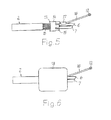
- the outer sleeve 14 is also made of brass, for example. It has at least one of the same projecting contact element 15. In Fig. 5 three contact elements 15 are shown. About one of the contact elements 15, the outer sleeve 14 and thus the screen 10 is connected to the ground point 12.
- an insulated electrical conductor 16 is used, at one end of a contact part 17 is attached, which is attached to the contact element 15.
- the other end of the conductor 16 is electrically connected to the ground point 12, for example via a cable lug.
- Other contact elements 15 of the outer sleeve 14 can be used for example for the PE function of the charging socket (protective conductor house connection) or the shielding function or control function of a signal line connected to the charger (control pilot).
- the area of the outer bushing 14 can be covered moisture-proof.
- a moisture-proof envelope 18 can be applied to this area, in a known technique, for example by foaming or by the use of a hot-melt process.
Landscapes
- Electric Propulsion And Braking For Vehicles (AREA)
Abstract
Description
- Die Erfindung bezieht sich auf eine Anordnung zum elektrisch leitenden Verbinden eines Ladegeräts für eine wiederaufladbare Batterie-Einheit eines Kraftfahrzeugs mit einer an der Karosserie desselben angebrachten, von außen zugänglichen Ladedose, bei welcher zwischen Ladegerät und Ladedose eine mindestens zwei isolierte elektrische Adern aufweisende elektrische Leitung angeschlossen ist, deren Adern von einem gemeinsamen, flexiblen elektrischen Schirm umgeben sind, über dem ein Mantel aus Isoliermaterial angeordnet ist.
- Eine solche Anordnung kann in Elektrofahrzeugen eingesetzt werden, die nur von einem Elektromotor angetrieben werden, aber auch in Plug-In-Hybridfahrzeugen, die als Antrieb neben einem Verbrennungsmotor auch einen Elektromotor haben. Als Energiequelle für den jeweiligen Elektromotor dient eine Batterie-Einheit, in der mindestens eine wiederaufladbare Batterie angeordnet ist. Der Einfachheit halber wird im folgenden statt der Worte "Batterie-Einheit" das Wort "Batterie" verwendet. Mit einer voll aufgeladenen Batterie kann beispielsweise ein PKW etwa 150 km zurücklegen. Danach muß die Batterie wieder aufgeladen werden. Das geschieht an Stromtankstellen über eine an einer "Zapfsäule" vorhandenen elektrischen Leitung, an deren Ende ein elektrischer Stecker, ein sogenannter Ladestecker, angebracht ist. Zum Aufladen der Batterie wird der Ladestecker in die Ladedose des jeweiligen Kraftfahrzeugs gesteckt.
- Für die elektrische Verbindung des Ladegeräts, an welches die Batterie angeschlossen ist, mit der Ladedose ist innerhalb eines Kraftfahrzeugs eine Hochvoltleitung angebracht, die beispielsweise für elektrische Spannungen von 1 kV ausgelegt ist. Diese mindestens zwei isolierte elektrische Adern aufweisende Leitung ist zum Schutz gegen elektromagnetische Störstrahlung (EMV) mit einem gemeinsamen, alle Adern umgebenden flexiblen elektrischen Schirm ausgerüstet. Ein solcher Schirm ist beispielsweise ein Geflecht aus Kupferdrähten. Die heute bei bekannten Anordnungen zur Verfügung stehenden Ladedosen haben keine Anschlußmöglichkeit für den Schirm der Leitung. Er wird daher im Bereich der Ladedose durchtrennt und endet somit in der Nähe derselben. Die Wirkung des Schirms ist dadurch zumindest im Bereich der Ladedose aufgehoben, so daß elektromagnetische Störungen durch die Leitung innerhalb des Fahrzeugs, in welches sie eingebaut ist, und auch in der Umgebung desselben nicht ausgeschlossen werden können.
- Der Erfindung liegt die Aufgabe zugrunde, die eingangs geschilderte Anordnung so weiterzubilden, daß von ihrer Leitung keine elektromagnetischen Störungen ausgehen können.
- Diese Aufgabe wird gemäß der Erfindung dadurch gelöst,
- daß der Schirm der Leitung im Bereich der Ladedose durch Entfernen des Mantels freigelegt ist,
- daß auf dem freigelegten Schirm eine auf demselben aufliegende zylindrische Innenbuchse aus Metall angeordnet ist, auf deren Außenfläche das zurückgebogene freie Ende des Schirms aufliegt,
- daß die Innenbuchse von einer zylindrischen Außenbuchse aus Metall umgeben ist, die mit Preßsitz auf dem zurückgebogenen Ende des Schirms aufliegt und die mindestens ein von derselben abstehendes Kontaktelement aufweist, und
- daß auf das Kontaktelement ein Stecker aufgesteckt ist, der an einem Ende eines isolierten elektrischen Leiters angebracht ist, welcher mit seinem anderen Ende an einen Massepunkt des Kraftfahrzeugs angeschlossen ist.
- In dieser Anordnung ist der Schirm der Leitung elektrisch an Massepotential angeschlossen, mit dem auch die Ladedose verbunden ist. Der Schirm der Leitung ist dadurch bis zur Ladedose ununterbrochen weitergeführt, so daß seine Funktion voll erhalten bleibt. Von der Leitung können daher keine elektromagnetischen Störungen ausgehen. Der elektrische Anschluß des Schirms ist bei dieser Anordnung sehr einfach ausgeführt, da nach dem Entfernen des Mantels vom Ende der Leitung nur noch die Innenbuchse und die Außenbuchse auf dem Schirm festgelegt werden müssen, der anschließend durch einen einfachen Steckvorgang mittels des isolierten Leiters an Massepotential angeschlossen wird.
- Ein Ausführungsbeispiel des Erfindungsgegenstandes ist in den Zeichnungen dargestellt.
- Es zeigen:
-
Fig. 1 die Anordnung nach der Erfindung in schematischer Darstellung. -
Fig. 2 das Ende einer in der Anordnung eingesetzten zweiadrigen Leitung. -
Fig. 3 bis 5 das Ende der Leitung in ergänzten Ausführungsformen. -
Fig. 6 ein fertiggestelltes Leitungsende. - In
Fig. 1 ist eine Anordnung schematisch dargestellt, in welcher eine in einem Kraftfahrzeug angeordnetes Ladegerät 1 für eine Batterie über eine elektrische Leitung 2 mit einer Ladedose 3 verbunden ist, die an einer Karosserie 4 des Kraftfahrzeugs von außen zugänglich angebracht ist. Von der Karosserie 4 ist nur ein kleiner Abschnitt schematisch dargestellt. In die Ladedose 3 kann ein elektrischer Stecker, der externe Ladestecker, in Richtung des Pfeiles 5 eingesteckt werden. - Die Leitung 2 ist als Hochvoltleitung ausgeführt. Sie hat entsprechend der in
Fig. 2 dargestellten Ausführungsform zwei isolierte elektrische Adern 6 und 7, deren Leiter 8 und 9 mit Vorteil aus Kupfer bzw. Aluminium bestehen. lhre Querschnitte liegen beispielsweise bei 2,5 mm2 bis 6 mm2 oder bei 35 mm2. Die beiden Adern 6 und 7 sind von einem gemeinsamen, flexiblen elektrischen Schirm 10 umgeben, der mit Vorteil als Geflecht aus Kupferdrähten ausgeführt ist. Über dem Schirm 10 ist ein Mantel 11 aus Isoliermaterial angebracht. - Zum Anschließen der Leitung 2 an die Ladedose 3 wird das Leitungsende entsprechend
Fig. 2 behandelt. Dazu wird zunächst der Mantel 11 auf einer entsprechenden Länge entfernt. Der dadurch freigelegte Schirm 10 wird so weit gekürzt, daß die Adern 6 und 7 zugänglich sind. Ihre Leiter 8 und 9 werden dann abisoliert und mit Kontakten der Ladedose 3 verbunden. - Zur elektrisch leitenden Verbindung des Schirms 10 mit einem Massepunkt 12 (
Fig. 5 ) innerhalb des Kraftfahrzeugs, der sich vorzugsweise an der Karosserie 4 desselben befindet, wird auf den Schirm 10 eine aus Metall bestehende, zylindrische Innenbuchse 13 aufgeschoben, die auf dem Schirm 10 aufliegt. Das über die Innenbuchse 13 hinausragende Ende des Schirms 10 wird danach umgebogen bzw. zurückgebogen, so daß es auf der äußeren Umfangsfläche der Innenbuchse 13 liegt. Die Innenbuchse 13 besteht beispielsweise aus Messing. - Danach wird auf die Innenbuchse 13 eine aus Metall bestehende zylindrische Außenbuchse 14 aufgeschoben, die so bemessen ist, daß sie mit Preßsitz auf dem umgebogenen Ende des Schirms 10 aufliegt. Die Außenbuchse 14 drückt dadurch den Schirm 10 gegen die Innenbuchse 13, so daß eine einwandfreie elektrisch leitende Verbindung zwischen dem Schirm 10 und der Außenbuchse 14 gegeben ist. Die Außenbuchse 14 besteht ebenfalls beispielsweise aus Messing. Sie hat mindestens ein von derselben abstehendes Kontaktelement 15. In
Fig. 5 sind drei Kontaktelemente 15 dargestellt. Über eines der Kontaktelemente 15 ist die Außenbuchse 14 und damit der Schirm 10 mit dem Massepunkt 12 verbunden. Für die Verbindung ist ein isolierter elektrischer Leiter 16 eingesetzt, an dessen einem Ende ein Kontaktteil 17 angebracht ist, das auf das Kontaktelement 15 aufgesteckt ist. Das andere Ende des Leiters 16 ist elektrisch leitend mit dem Massepunkt 12 verbunden, beispielsweise über einen Kabelschuh. - Andere Kontaktelemente 15 der Außenbuchse 14 können beispielsweise für die PE-Funktion der Ladedose (Schutzleiter Hausanschluß) oder die Schirmfunktion bzw. Kontrollfunktion einer an das Ladegerät angeschlossenen Signalleitung verwendet werden (Control-Pilot).
- Nach Fertigstellung aller erforderlichen elektrischen Verbindungen kann der Bereich der Außenbuchse 14 feuchtigkeitsdicht abgedeckt werden. Dazu kann auf diesen Bereich beispielsweise eine feuchtigkeitsdichte Umhüllung 18 aufgebracht werden, und zwar in bekannter Technik beispielsweise durch Umschäumen oder durch den Einsatz eines Hot-Melt-Verfahrens.
Claims (4)
- Anordnung zum elektrisch leitenden Verbinden eines Ladegeräts für eine wiederaufladbare Batterie-Einheit eines Kraftfahrzeugs mit einer in der Karosserie desselben angebrachten, von außen zugänglichen Ladedose, bei welcher zwischen Ladegerät und Ladedose eine mindestens zwei isolierte elektrische Adern aufweisende elektrische Leitung angeschlossen ist, deren Adern von einem gemeinsamen, flexiblen elektrischen Schirm umgeben sind, über dem ein Mantel aus Isoliermaterial angeordnet ist, dadurch gekennzeichnet,- daß der Schirm (10) der Leitung (2) im Bereich der Ladedose (3) durch Entfernen des Mantels (11) freigelegt ist,- daß auf dem freigelegten Schirm (10) eine auf demselben aufliegende zylindrische Innenbuchse (13) aus Metall angeordnet ist, auf deren Außenfläche das zurückgebogene freie Ende des Schirms (10) aufliegt,- daß die Innenbuchse (13) von einer zylindrischen Außenbuchse (14) aus Metall umgeben ist, die mit Preßsitz auf dem zurückgebogenen Ende des Schirms (10) aufliegt und die mindestens ein von derselben abstehendes Kontaktelement (15) aufweist, und- daß auf ein Kontaktelement (15) der Außenbuchse (14) ein Kontaktteil (17) aufgesteckt ist, das an einem Ende eines isolierten elektrischen Leiters (16) angebracht ist, welcher mit seinem anderen Ende an einen Massepunkt (12) des Kraftfahrzeugs angeschlossen ist.
- Anordnung nach Anspruch 1, dadurch gekennzeichnet daß an ein Kontaktelement (15) der Außenbuchse (14) ein Schutzleiter der Ladedose (3) angeschlossen ist.
- Anordnung nach Anspruch 1, dadurch gekennzeichnet daß an ein Kontaktelement (15) der Außenbuchse (14) eine Signalleitung für die Kontrollfunktion des Ladegeräts (1) angeschlossen ist.
- Anordnung nach einem der Ansprüche 1 bis 3, dadurch gekennzeichnet, daß der Bereich des Schirmanschlusses mit Innenbuchse (13) und Außenbuchse (14) in eine feuchtigkeitsdichte Umhüllung (18) eingebettet ist.
Priority Applications (2)
| Application Number | Priority Date | Filing Date | Title |
|---|---|---|---|
| ES11306439.8T ES2449377T3 (es) | 2011-11-07 | 2011-11-07 | Disposición para unir un aparato de carga para una batería de automóvil con una toma de carga |
| EP11306439.8A EP2590266B1 (de) | 2011-11-07 | 2011-11-07 | Anordnung zum Verbinden eines Ladegeräts für eine Fahrzeug-Batterie mit einer Ladedose |
Applications Claiming Priority (1)
| Application Number | Priority Date | Filing Date | Title |
|---|---|---|---|
| EP11306439.8A EP2590266B1 (de) | 2011-11-07 | 2011-11-07 | Anordnung zum Verbinden eines Ladegeräts für eine Fahrzeug-Batterie mit einer Ladedose |
Publications (2)
| Publication Number | Publication Date |
|---|---|
| EP2590266A1 true EP2590266A1 (de) | 2013-05-08 |
| EP2590266B1 EP2590266B1 (de) | 2014-01-08 |
Family
ID=45319031
Family Applications (1)
| Application Number | Title | Priority Date | Filing Date |
|---|---|---|---|
| EP11306439.8A Active EP2590266B1 (de) | 2011-11-07 | 2011-11-07 | Anordnung zum Verbinden eines Ladegeräts für eine Fahrzeug-Batterie mit einer Ladedose |
Country Status (2)
| Country | Link |
|---|---|
| EP (1) | EP2590266B1 (de) |
| ES (1) | ES2449377T3 (de) |
Cited By (1)
| Publication number | Priority date | Publication date | Assignee | Title |
|---|---|---|---|---|
| DE102020127124A1 (de) | 2020-10-15 | 2022-04-21 | Phoenix Contact E-Mobility Gmbh | Elektrisch leitende Verbindungsanordnung |
Citations (5)
| Publication number | Priority date | Publication date | Assignee | Title |
|---|---|---|---|---|
| US3280246A (en) * | 1965-02-02 | 1966-10-18 | Thomas & Betts Corp | Ground sheath connector |
| EP0567802A1 (de) * | 1992-05-01 | 1993-11-03 | DaimlerChrysler Aerospace Airbus Gesellschaft mit beschränkter Haftung | Anordnung zur Masseanbindung an eine innere Blitzschutzanlage |
| EP0738027A1 (de) * | 1995-04-12 | 1996-10-16 | DaimlerChrysler Aerospace Airbus Gesellschaft mit beschränkter Haftung | Leitungsverbinder |
| US7044756B1 (en) * | 2004-12-03 | 2006-05-16 | Yazaki Corporation | Method of grounding shielded wire and structure for grounding shielded wire |
| US20060128223A1 (en) * | 2004-12-01 | 2006-06-15 | Yazaki Corporation | Shielded cable-grounding structure |
-
2011
- 2011-11-07 EP EP11306439.8A patent/EP2590266B1/de active Active
- 2011-11-07 ES ES11306439.8T patent/ES2449377T3/es active Active
Patent Citations (5)
| Publication number | Priority date | Publication date | Assignee | Title |
|---|---|---|---|---|
| US3280246A (en) * | 1965-02-02 | 1966-10-18 | Thomas & Betts Corp | Ground sheath connector |
| EP0567802A1 (de) * | 1992-05-01 | 1993-11-03 | DaimlerChrysler Aerospace Airbus Gesellschaft mit beschränkter Haftung | Anordnung zur Masseanbindung an eine innere Blitzschutzanlage |
| EP0738027A1 (de) * | 1995-04-12 | 1996-10-16 | DaimlerChrysler Aerospace Airbus Gesellschaft mit beschränkter Haftung | Leitungsverbinder |
| US20060128223A1 (en) * | 2004-12-01 | 2006-06-15 | Yazaki Corporation | Shielded cable-grounding structure |
| US7044756B1 (en) * | 2004-12-03 | 2006-05-16 | Yazaki Corporation | Method of grounding shielded wire and structure for grounding shielded wire |
Cited By (1)
| Publication number | Priority date | Publication date | Assignee | Title |
|---|---|---|---|---|
| DE102020127124A1 (de) | 2020-10-15 | 2022-04-21 | Phoenix Contact E-Mobility Gmbh | Elektrisch leitende Verbindungsanordnung |
Also Published As
| Publication number | Publication date |
|---|---|
| ES2449377T3 (es) | 2014-03-19 |
| EP2590266B1 (de) | 2014-01-08 |
Similar Documents
| Publication | Publication Date | Title |
|---|---|---|
| DE102010050562B3 (de) | Vorrichtung zum Laden eines mit elektrischer Energie antreibbaren Fahrzeugs | |
| DE102013011874A1 (de) | Elektrischer Leistungsverteiler für ein Elektro- oder Hybridfahrzeug sowie Verteilergehäuse für einen derartigen Leistungsverteiler | |
| DE102013220498A1 (de) | Abgeschirmter Verbinder | |
| DE102018121400A1 (de) | Elektrischer Steckverbinder, Hochvoltleitungssatz, Hochvoltsystem und Verfahren zum Anbringen eines elektrischen Steckverbinders | |
| EP3869622B1 (de) | Ladebuchse für ein elektrofahrzeug | |
| DE202012011808U1 (de) | Verbindungsvorrichtung | |
| DE102014100142A1 (de) | Hochwasserfeste Steckerkonstruktion für eine widerstandsarme Leitung zwischen Erdstift und Gehäuse | |
| WO2019096663A1 (de) | Ladestation für elektrofahrzeuge | |
| DE102021103797B3 (de) | Ladebuchse für einen elektrischen energiespeicher | |
| DE102013016099A1 (de) | Mehrfachanschlusskabel zur Verbindung von Hochspannungsvorrichtungen eines Kraftfahrzeugs und Kraftfahrzeug | |
| EP2590266B1 (de) | Anordnung zum Verbinden eines Ladegeräts für eine Fahrzeug-Batterie mit einer Ladedose | |
| EP1921635B1 (de) | Elektrische Anschlussleitung für ein elektrisches Aggregat eines Kraftfahrzeugs | |
| DE102019120806A1 (de) | Entstörvorrichtung mit verdrillten Stromschienen für ein Elektrofahrzeug | |
| EP2706620B1 (de) | Verfahren zum Abdichten eines elektrischen Kupplungsteils und damit hergestelltes Kupplungsteil | |
| DE2745061C2 (de) | Vorrichtung zur Unterdrückung von durch die Zündanlage hervorgerufenen Funkstörungen bei Motorrädern | |
| DE3210225C2 (de) | Steckbare Kabelgarnitur mit elektrisch leitendem Gehäuse | |
| DE102022121292A1 (de) | Kraftfahrzeugmotor, Verfahren zum Zusammenbauen eines Kraftfahrzeugmotors und Kraftfahrzeug mit einem solchen Kraftfahrzeugmotor | |
| EP0397063A2 (de) | Einrichtung zum Schutz elektrischer Anlagen | |
| WO2022174944A1 (de) | Kabelverbindung mit verbesserter elektromagnetischer schirmung | |
| DE102018000140A1 (de) | Abgeschirmter Kabelbaum und Verfahren zum Herstellen eines abgeschirmten Kabelbaums | |
| DE3323219A1 (de) | Elektrohandwerkzeug mit einem geteilten gehaeuse | |
| WO2012052184A1 (de) | Steckerteil einer steckvorrichtung | |
| DE102017006979A1 (de) | Hochvolt-Anordnung für ein Kraftfahrzeug mit Signalübertragung über einen Hochvolt-Schirm | |
| DE102019117375A1 (de) | Verfahren zur Steuerung einer Kraftfahrzeugladevorrichtung sowie eine solche Kraftfahrzeugladevorrichtung | |
| EP3196986B1 (de) | Elektrisches kupplungsteil |
Legal Events
| Date | Code | Title | Description |
|---|---|---|---|
| PUAI | Public reference made under article 153(3) epc to a published international application that has entered the european phase |
Free format text: ORIGINAL CODE: 0009012 |
|
| 17P | Request for examination filed |
Effective date: 20120509 |
|
| AK | Designated contracting states |
Kind code of ref document: A1 Designated state(s): AL AT BE BG CH CY CZ DE DK EE ES FI FR GB GR HR HU IE IS IT LI LT LU LV MC MK MT NL NO PL PT RO RS SE SI SK SM TR |
|
| AX | Request for extension of the european patent |
Extension state: BA ME |
|
| GRAP | Despatch of communication of intention to grant a patent |
Free format text: ORIGINAL CODE: EPIDOSNIGR1 |
|
| INTG | Intention to grant announced |
Effective date: 20130624 |
|
| GRAS | Grant fee paid |
Free format text: ORIGINAL CODE: EPIDOSNIGR3 |
|
| GRAA | (expected) grant |
Free format text: ORIGINAL CODE: 0009210 |
|
| AK | Designated contracting states |
Kind code of ref document: B1 Designated state(s): AL AT BE BG CH CY CZ DE DK EE ES FI FR GB GR HR HU IE IS IT LI LT LU LV MC MK MT NL NO PL PT RO RS SE SI SK SM TR |
|
| REG | Reference to a national code |
Ref country code: GB Ref legal event code: FG4D Free format text: NOT ENGLISH |
|
| REG | Reference to a national code |
Ref country code: CH Ref legal event code: EP |
|
| REG | Reference to a national code |
Ref country code: IE Ref legal event code: FG4D Free format text: LANGUAGE OF EP DOCUMENT: GERMAN |
|
| REG | Reference to a national code |
Ref country code: AT Ref legal event code: REF Ref document number: 649228 Country of ref document: AT Kind code of ref document: T Effective date: 20140215 |
|
| REG | Reference to a national code |
Ref country code: DE Ref legal event code: R096 Ref document number: 502011001989 Country of ref document: DE Effective date: 20140220 |
|
| REG | Reference to a national code |
Ref country code: ES Ref legal event code: FG2A Ref document number: 2449377 Country of ref document: ES Kind code of ref document: T3 Effective date: 20140319 |
|
| REG | Reference to a national code |
Ref country code: NL Ref legal event code: VDEP Effective date: 20140108 |
|
| REG | Reference to a national code |
Ref country code: LT Ref legal event code: MG4D |
|
| PG25 | Lapsed in a contracting state [announced via postgrant information from national office to epo] |
Ref country code: NO Free format text: LAPSE BECAUSE OF FAILURE TO SUBMIT A TRANSLATION OF THE DESCRIPTION OR TO PAY THE FEE WITHIN THE PRESCRIBED TIME-LIMIT Effective date: 20140408 Ref country code: LT Free format text: LAPSE BECAUSE OF FAILURE TO SUBMIT A TRANSLATION OF THE DESCRIPTION OR TO PAY THE FEE WITHIN THE PRESCRIBED TIME-LIMIT Effective date: 20140108 Ref country code: IS Free format text: LAPSE BECAUSE OF FAILURE TO SUBMIT A TRANSLATION OF THE DESCRIPTION OR TO PAY THE FEE WITHIN THE PRESCRIBED TIME-LIMIT Effective date: 20140508 |
|
| PG25 | Lapsed in a contracting state [announced via postgrant information from national office to epo] |
Ref country code: NL Free format text: LAPSE BECAUSE OF FAILURE TO SUBMIT A TRANSLATION OF THE DESCRIPTION OR TO PAY THE FEE WITHIN THE PRESCRIBED TIME-LIMIT Effective date: 20140108 Ref country code: FI Free format text: LAPSE BECAUSE OF FAILURE TO SUBMIT A TRANSLATION OF THE DESCRIPTION OR TO PAY THE FEE WITHIN THE PRESCRIBED TIME-LIMIT Effective date: 20140108 Ref country code: CY Free format text: LAPSE BECAUSE OF FAILURE TO SUBMIT A TRANSLATION OF THE DESCRIPTION OR TO PAY THE FEE WITHIN THE PRESCRIBED TIME-LIMIT Effective date: 20140108 Ref country code: SE Free format text: LAPSE BECAUSE OF FAILURE TO SUBMIT A TRANSLATION OF THE DESCRIPTION OR TO PAY THE FEE WITHIN THE PRESCRIBED TIME-LIMIT Effective date: 20140108 Ref country code: PT Free format text: LAPSE BECAUSE OF FAILURE TO SUBMIT A TRANSLATION OF THE DESCRIPTION OR TO PAY THE FEE WITHIN THE PRESCRIBED TIME-LIMIT Effective date: 20140508 |
|
| PG25 | Lapsed in a contracting state [announced via postgrant information from national office to epo] |
Ref country code: LV Free format text: LAPSE BECAUSE OF FAILURE TO SUBMIT A TRANSLATION OF THE DESCRIPTION OR TO PAY THE FEE WITHIN THE PRESCRIBED TIME-LIMIT Effective date: 20140108 Ref country code: RS Free format text: LAPSE BECAUSE OF FAILURE TO SUBMIT A TRANSLATION OF THE DESCRIPTION OR TO PAY THE FEE WITHIN THE PRESCRIBED TIME-LIMIT Effective date: 20140108 Ref country code: HR Free format text: LAPSE BECAUSE OF FAILURE TO SUBMIT A TRANSLATION OF THE DESCRIPTION OR TO PAY THE FEE WITHIN THE PRESCRIBED TIME-LIMIT Effective date: 20140108 |
|
| REG | Reference to a national code |
Ref country code: DE Ref legal event code: R097 Ref document number: 502011001989 Country of ref document: DE |
|
| PG25 | Lapsed in a contracting state [announced via postgrant information from national office to epo] |
Ref country code: CZ Free format text: LAPSE BECAUSE OF FAILURE TO SUBMIT A TRANSLATION OF THE DESCRIPTION OR TO PAY THE FEE WITHIN THE PRESCRIBED TIME-LIMIT Effective date: 20140108 Ref country code: DK Free format text: LAPSE BECAUSE OF FAILURE TO SUBMIT A TRANSLATION OF THE DESCRIPTION OR TO PAY THE FEE WITHIN THE PRESCRIBED TIME-LIMIT Effective date: 20140108 Ref country code: EE Free format text: LAPSE BECAUSE OF FAILURE TO SUBMIT A TRANSLATION OF THE DESCRIPTION OR TO PAY THE FEE WITHIN THE PRESCRIBED TIME-LIMIT Effective date: 20140108 Ref country code: RO Free format text: LAPSE BECAUSE OF FAILURE TO SUBMIT A TRANSLATION OF THE DESCRIPTION OR TO PAY THE FEE WITHIN THE PRESCRIBED TIME-LIMIT Effective date: 20140108 |
|
| PLBE | No opposition filed within time limit |
Free format text: ORIGINAL CODE: 0009261 |
|
| STAA | Information on the status of an ep patent application or granted ep patent |
Free format text: STATUS: NO OPPOSITION FILED WITHIN TIME LIMIT |
|
| PG25 | Lapsed in a contracting state [announced via postgrant information from national office to epo] |
Ref country code: SK Free format text: LAPSE BECAUSE OF FAILURE TO SUBMIT A TRANSLATION OF THE DESCRIPTION OR TO PAY THE FEE WITHIN THE PRESCRIBED TIME-LIMIT Effective date: 20140108 Ref country code: PL Free format text: LAPSE BECAUSE OF FAILURE TO SUBMIT A TRANSLATION OF THE DESCRIPTION OR TO PAY THE FEE WITHIN THE PRESCRIBED TIME-LIMIT Effective date: 20140108 |
|
| 26N | No opposition filed |
Effective date: 20141009 |
|
| REG | Reference to a national code |
Ref country code: DE Ref legal event code: R097 Ref document number: 502011001989 Country of ref document: DE Effective date: 20141009 |
|
| PG25 | Lapsed in a contracting state [announced via postgrant information from national office to epo] |
Ref country code: SI Free format text: LAPSE BECAUSE OF FAILURE TO SUBMIT A TRANSLATION OF THE DESCRIPTION OR TO PAY THE FEE WITHIN THE PRESCRIBED TIME-LIMIT Effective date: 20140108 |
|
| PG25 | Lapsed in a contracting state [announced via postgrant information from national office to epo] |
Ref country code: LU Free format text: LAPSE BECAUSE OF FAILURE TO SUBMIT A TRANSLATION OF THE DESCRIPTION OR TO PAY THE FEE WITHIN THE PRESCRIBED TIME-LIMIT Effective date: 20141107 Ref country code: BE Free format text: LAPSE BECAUSE OF NON-PAYMENT OF DUE FEES Effective date: 20141130 Ref country code: MC Free format text: LAPSE BECAUSE OF FAILURE TO SUBMIT A TRANSLATION OF THE DESCRIPTION OR TO PAY THE FEE WITHIN THE PRESCRIBED TIME-LIMIT Effective date: 20140108 |
|
| REG | Reference to a national code |
Ref country code: CH Ref legal event code: PL |
|
| PG25 | Lapsed in a contracting state [announced via postgrant information from national office to epo] |
Ref country code: LI Free format text: LAPSE BECAUSE OF NON-PAYMENT OF DUE FEES Effective date: 20141130 Ref country code: CH Free format text: LAPSE BECAUSE OF NON-PAYMENT OF DUE FEES Effective date: 20141130 |
|
| REG | Reference to a national code |
Ref country code: IE Ref legal event code: MM4A |
|
| PG25 | Lapsed in a contracting state [announced via postgrant information from national office to epo] |
Ref country code: IE Free format text: LAPSE BECAUSE OF NON-PAYMENT OF DUE FEES Effective date: 20141107 |
|
| REG | Reference to a national code |
Ref country code: FR Ref legal event code: PLFP Year of fee payment: 5 |
|
| PG25 | Lapsed in a contracting state [announced via postgrant information from national office to epo] |
Ref country code: SM Free format text: LAPSE BECAUSE OF FAILURE TO SUBMIT A TRANSLATION OF THE DESCRIPTION OR TO PAY THE FEE WITHIN THE PRESCRIBED TIME-LIMIT Effective date: 20140108 |
|
| PG25 | Lapsed in a contracting state [announced via postgrant information from national office to epo] |
Ref country code: GR Free format text: LAPSE BECAUSE OF FAILURE TO SUBMIT A TRANSLATION OF THE DESCRIPTION OR TO PAY THE FEE WITHIN THE PRESCRIBED TIME-LIMIT Effective date: 20140409 Ref country code: BG Free format text: LAPSE BECAUSE OF FAILURE TO SUBMIT A TRANSLATION OF THE DESCRIPTION OR TO PAY THE FEE WITHIN THE PRESCRIBED TIME-LIMIT Effective date: 20140108 |
|
| PG25 | Lapsed in a contracting state [announced via postgrant information from national office to epo] |
Ref country code: TR Free format text: LAPSE BECAUSE OF FAILURE TO SUBMIT A TRANSLATION OF THE DESCRIPTION OR TO PAY THE FEE WITHIN THE PRESCRIBED TIME-LIMIT Effective date: 20140108 Ref country code: MT Free format text: LAPSE BECAUSE OF FAILURE TO SUBMIT A TRANSLATION OF THE DESCRIPTION OR TO PAY THE FEE WITHIN THE PRESCRIBED TIME-LIMIT Effective date: 20140108 Ref country code: HU Free format text: LAPSE BECAUSE OF FAILURE TO SUBMIT A TRANSLATION OF THE DESCRIPTION OR TO PAY THE FEE WITHIN THE PRESCRIBED TIME-LIMIT; INVALID AB INITIO Effective date: 20111107 |
|
| REG | Reference to a national code |
Ref country code: FR Ref legal event code: PLFP Year of fee payment: 6 |
|
| REG | Reference to a national code |
Ref country code: FR Ref legal event code: PLFP Year of fee payment: 7 |
|
| REG | Reference to a national code |
Ref country code: AT Ref legal event code: MM01 Ref document number: 649228 Country of ref document: AT Kind code of ref document: T Effective date: 20161107 |
|
| PG25 | Lapsed in a contracting state [announced via postgrant information from national office to epo] |
Ref country code: AT Free format text: LAPSE BECAUSE OF NON-PAYMENT OF DUE FEES Effective date: 20161107 |
|
| PG25 | Lapsed in a contracting state [announced via postgrant information from national office to epo] |
Ref country code: MK Free format text: LAPSE BECAUSE OF FAILURE TO SUBMIT A TRANSLATION OF THE DESCRIPTION OR TO PAY THE FEE WITHIN THE PRESCRIBED TIME-LIMIT Effective date: 20140108 |
|
| PG25 | Lapsed in a contracting state [announced via postgrant information from national office to epo] |
Ref country code: AL Free format text: LAPSE BECAUSE OF FAILURE TO SUBMIT A TRANSLATION OF THE DESCRIPTION OR TO PAY THE FEE WITHIN THE PRESCRIBED TIME-LIMIT Effective date: 20140108 |
|
| PGFP | Annual fee paid to national office [announced via postgrant information from national office to epo] |
Ref country code: ES Payment date: 20240126 Year of fee payment: 13 |
|
| REG | Reference to a national code |
Ref country code: ES Ref legal event code: FD2A Effective date: 20251230 |
|
| PGFP | Annual fee paid to national office [announced via postgrant information from national office to epo] |
Ref country code: DE Payment date: 20251119 Year of fee payment: 15 |
|
| PGFP | Annual fee paid to national office [announced via postgrant information from national office to epo] |
Ref country code: GB Payment date: 20251121 Year of fee payment: 15 |
|
| PGFP | Annual fee paid to national office [announced via postgrant information from national office to epo] |
Ref country code: IT Payment date: 20251125 Year of fee payment: 15 |
|
| PGFP | Annual fee paid to national office [announced via postgrant information from national office to epo] |
Ref country code: FR Payment date: 20251125 Year of fee payment: 15 |
|
| PG25 | Lapsed in a contracting state [announced via postgrant information from national office to epo] |
Ref country code: ES Free format text: LAPSE BECAUSE OF NON-PAYMENT OF DUE FEES Effective date: 20241108 |