EP2586468B1 - Poröses medizinisches Implantat, wie beispielsweise eine intraokulare Kugel, und Herstellungsverfahren - Google Patents
Poröses medizinisches Implantat, wie beispielsweise eine intraokulare Kugel, und Herstellungsverfahren Download PDFInfo
- Publication number
- EP2586468B1 EP2586468B1 EP12290314.9A EP12290314A EP2586468B1 EP 2586468 B1 EP2586468 B1 EP 2586468B1 EP 12290314 A EP12290314 A EP 12290314A EP 2586468 B1 EP2586468 B1 EP 2586468B1
- Authority
- EP
- European Patent Office
- Prior art keywords
- implant
- polymer material
- matrix
- coated
- constituted
- Prior art date
- Legal status (The legal status is an assumption and is not a legal conclusion. Google has not performed a legal analysis and makes no representation as to the accuracy of the status listed.)
- Not-in-force
Links
- 239000007943 implant Substances 0.000 title claims description 25
- 238000004519 manufacturing process Methods 0.000 title claims description 8
- 239000011159 matrix material Substances 0.000 claims description 28
- 239000002131 composite material Substances 0.000 claims description 26
- 239000000463 material Substances 0.000 claims description 22
- 239000002861 polymer material Substances 0.000 claims description 20
- 238000000034 method Methods 0.000 claims description 12
- 238000003856 thermoforming Methods 0.000 claims description 11
- 238000000465 moulding Methods 0.000 claims description 7
- 230000008569 process Effects 0.000 claims description 7
- 239000011248 coating agent Substances 0.000 claims description 6
- 238000000576 coating method Methods 0.000 claims description 6
- 238000004132 cross linking Methods 0.000 claims description 5
- 239000000126 substance Substances 0.000 claims description 5
- 238000007731 hot pressing Methods 0.000 claims description 3
- 238000007493 shaping process Methods 0.000 claims description 2
- 239000004743 Polypropylene Substances 0.000 description 29
- 229920001155 polypropylene Polymers 0.000 description 29
- -1 polypropylenes Polymers 0.000 description 25
- 239000000047 product Substances 0.000 description 21
- ZWEHNKRNPOVVGH-UHFFFAOYSA-N 2-Butanone Chemical compound CCC(C)=O ZWEHNKRNPOVVGH-UHFFFAOYSA-N 0.000 description 18
- 229920000642 polymer Polymers 0.000 description 17
- 229920003229 poly(methyl methacrylate) Polymers 0.000 description 16
- 239000004926 polymethyl methacrylate Substances 0.000 description 16
- 239000000203 mixture Substances 0.000 description 12
- 239000000178 monomer Substances 0.000 description 8
- 238000010438 heat treatment Methods 0.000 description 7
- 238000007654 immersion Methods 0.000 description 6
- LFQSCWFLJHTTHZ-UHFFFAOYSA-N Ethanol Chemical compound CCO LFQSCWFLJHTTHZ-UHFFFAOYSA-N 0.000 description 5
- 150000001875 compounds Chemical class 0.000 description 5
- 239000011148 porous material Substances 0.000 description 5
- 238000003756 stirring Methods 0.000 description 5
- 239000004952 Polyamide Substances 0.000 description 3
- 239000000919 ceramic Substances 0.000 description 3
- 230000000694 effects Effects 0.000 description 3
- 229920002647 polyamide Polymers 0.000 description 3
- 229920000728 polyester Polymers 0.000 description 3
- 239000004814 polyurethane Substances 0.000 description 3
- 239000000758 substrate Substances 0.000 description 3
- 239000004342 Benzoyl peroxide Substances 0.000 description 2
- OMPJBNCRMGITSC-UHFFFAOYSA-N Benzoylperoxide Chemical compound C=1C=CC=CC=1C(=O)OOC(=O)C1=CC=CC=C1 OMPJBNCRMGITSC-UHFFFAOYSA-N 0.000 description 2
- OKTJSMMVPCPJKN-UHFFFAOYSA-N Carbon Chemical compound [C] OKTJSMMVPCPJKN-UHFFFAOYSA-N 0.000 description 2
- VVQNEPGJFQJSBK-UHFFFAOYSA-N Methyl methacrylate Chemical compound COC(=O)C(C)=C VVQNEPGJFQJSBK-UHFFFAOYSA-N 0.000 description 2
- 239000011324 bead Substances 0.000 description 2
- 235000019400 benzoyl peroxide Nutrition 0.000 description 2
- 239000003054 catalyst Substances 0.000 description 2
- 239000002872 contrast media Substances 0.000 description 2
- 238000001816 cooling Methods 0.000 description 2
- 229920001577 copolymer Polymers 0.000 description 2
- 125000005442 diisocyanate group Chemical group 0.000 description 2
- 238000001035 drying Methods 0.000 description 2
- 239000005038 ethylene vinyl acetate Substances 0.000 description 2
- 229920001684 low density polyethylene Polymers 0.000 description 2
- 229920001200 poly(ethylene-vinyl acetate) Polymers 0.000 description 2
- 229920002635 polyurethane Polymers 0.000 description 2
- 238000001356 surgical procedure Methods 0.000 description 2
- 239000004753 textile Substances 0.000 description 2
- 230000000930 thermomechanical effect Effects 0.000 description 2
- 229920000089 Cyclic olefin copolymer Polymers 0.000 description 1
- 239000004593 Epoxy Substances 0.000 description 1
- VGGSQFUCUMXWEO-UHFFFAOYSA-N Ethene Chemical compound C=C VGGSQFUCUMXWEO-UHFFFAOYSA-N 0.000 description 1
- 239000005977 Ethylene Substances 0.000 description 1
- 239000005057 Hexamethylene diisocyanate Substances 0.000 description 1
- WOBHKFSMXKNTIM-UHFFFAOYSA-N Hydroxyethyl methacrylate Chemical compound CC(=C)C(=O)OCCO WOBHKFSMXKNTIM-UHFFFAOYSA-N 0.000 description 1
- 239000004696 Poly ether ether ketone Substances 0.000 description 1
- 239000004698 Polyethylene Substances 0.000 description 1
- XTXRWKRVRITETP-UHFFFAOYSA-N Vinyl acetate Chemical compound CC(=O)OC=C XTXRWKRVRITETP-UHFFFAOYSA-N 0.000 description 1
- 230000009471 action Effects 0.000 description 1
- 229920006125 amorphous polymer Polymers 0.000 description 1
- 229920005601 base polymer Polymers 0.000 description 1
- JUPQTSLXMOCDHR-UHFFFAOYSA-N benzene-1,4-diol;bis(4-fluorophenyl)methanone Chemical compound OC1=CC=C(O)C=C1.C1=CC(F)=CC=C1C(=O)C1=CC=C(F)C=C1 JUPQTSLXMOCDHR-UHFFFAOYSA-N 0.000 description 1
- 230000015572 biosynthetic process Effects 0.000 description 1
- 230000036760 body temperature Effects 0.000 description 1
- CQEYYJKEWSMYFG-UHFFFAOYSA-N butyl acrylate Chemical compound CCCCOC(=O)C=C CQEYYJKEWSMYFG-UHFFFAOYSA-N 0.000 description 1
- 230000010261 cell growth Effects 0.000 description 1
- 229910010293 ceramic material Inorganic materials 0.000 description 1
- 229920001688 coating polymer Polymers 0.000 description 1
- 238000003851 corona treatment Methods 0.000 description 1
- 230000007159 enucleation Effects 0.000 description 1
- 125000003700 epoxy group Chemical group 0.000 description 1
- 238000001704 evaporation Methods 0.000 description 1
- 230000008020 evaporation Effects 0.000 description 1
- 230000001815 facial effect Effects 0.000 description 1
- 239000012467 final product Substances 0.000 description 1
- 230000009477 glass transition Effects 0.000 description 1
- 230000012010 growth Effects 0.000 description 1
- RRAMGCGOFNQTLD-UHFFFAOYSA-N hexamethylene diisocyanate Chemical compound O=C=NCCCCCCN=C=O RRAMGCGOFNQTLD-UHFFFAOYSA-N 0.000 description 1
- 229920001903 high density polyethylene Polymers 0.000 description 1
- 239000004700 high-density polyethylene Substances 0.000 description 1
- 125000002887 hydroxy group Chemical group [H]O* 0.000 description 1
- 238000002513 implantation Methods 0.000 description 1
- 239000012948 isocyanate Substances 0.000 description 1
- IQPQWNKOIGAROB-UHFFFAOYSA-N isocyanate group Chemical group [N-]=C=O IQPQWNKOIGAROB-UHFFFAOYSA-N 0.000 description 1
- 150000002513 isocyanates Chemical class 0.000 description 1
- 150000002596 lactones Chemical class 0.000 description 1
- 239000004702 low-density polyethylene Substances 0.000 description 1
- 238000005259 measurement Methods 0.000 description 1
- 229920001179 medium density polyethylene Polymers 0.000 description 1
- 238000002844 melting Methods 0.000 description 1
- 230000008018 melting Effects 0.000 description 1
- QSHDDOUJBYECFT-UHFFFAOYSA-N mercury Chemical compound [Hg] QSHDDOUJBYECFT-UHFFFAOYSA-N 0.000 description 1
- 229910052753 mercury Inorganic materials 0.000 description 1
- 125000002496 methyl group Chemical group [H]C([H])([H])* 0.000 description 1
- 239000004745 nonwoven fabric Substances 0.000 description 1
- RVTZCBVAJQQJTK-UHFFFAOYSA-N oxygen(2-);zirconium(4+) Chemical compound [O-2].[O-2].[Zr+4] RVTZCBVAJQQJTK-UHFFFAOYSA-N 0.000 description 1
- 238000009832 plasma treatment Methods 0.000 description 1
- 229920000768 polyamine Polymers 0.000 description 1
- 229920001610 polycaprolactone Polymers 0.000 description 1
- 239000004632 polycaprolactone Substances 0.000 description 1
- 229920000647 polyepoxide Polymers 0.000 description 1
- 229920000570 polyether Polymers 0.000 description 1
- 229920002530 polyetherether ketone Polymers 0.000 description 1
- 229920000573 polyethylene Polymers 0.000 description 1
- 229920000139 polyethylene terephthalate Polymers 0.000 description 1
- 239000005020 polyethylene terephthalate Substances 0.000 description 1
- 229920000193 polymethacrylate Polymers 0.000 description 1
- 229920005862 polyol Polymers 0.000 description 1
- 150000003077 polyols Chemical class 0.000 description 1
- 238000002459 porosimetry Methods 0.000 description 1
- 229920006135 semi-crystalline thermoplastic polymer Polymers 0.000 description 1
- 238000004381 surface treatment Methods 0.000 description 1
- KKEYFWRCBNTPAC-UHFFFAOYSA-L terephthalate(2-) Chemical compound [O-]C(=O)C1=CC=C(C([O-])=O)C=C1 KKEYFWRCBNTPAC-UHFFFAOYSA-L 0.000 description 1
- XLYOFNOQVPJJNP-UHFFFAOYSA-N water Substances O XLYOFNOQVPJJNP-UHFFFAOYSA-N 0.000 description 1
- 238000005303 weighing Methods 0.000 description 1
- 239000002759 woven fabric Substances 0.000 description 1
- 229910001928 zirconium oxide Inorganic materials 0.000 description 1
Images
Classifications
-
- A—HUMAN NECESSITIES
- A61—MEDICAL OR VETERINARY SCIENCE; HYGIENE
- A61L—METHODS OR APPARATUS FOR STERILISING MATERIALS OR OBJECTS IN GENERAL; DISINFECTION, STERILISATION OR DEODORISATION OF AIR; CHEMICAL ASPECTS OF BANDAGES, DRESSINGS, ABSORBENT PADS OR SURGICAL ARTICLES; MATERIALS FOR BANDAGES, DRESSINGS, ABSORBENT PADS OR SURGICAL ARTICLES
- A61L27/00—Materials for grafts or prostheses or for coating grafts or prostheses
- A61L27/28—Materials for coating prostheses
- A61L27/34—Macromolecular materials
-
- A—HUMAN NECESSITIES
- A61—MEDICAL OR VETERINARY SCIENCE; HYGIENE
- A61L—METHODS OR APPARATUS FOR STERILISING MATERIALS OR OBJECTS IN GENERAL; DISINFECTION, STERILISATION OR DEODORISATION OF AIR; CHEMICAL ASPECTS OF BANDAGES, DRESSINGS, ABSORBENT PADS OR SURGICAL ARTICLES; MATERIALS FOR BANDAGES, DRESSINGS, ABSORBENT PADS OR SURGICAL ARTICLES
- A61L27/00—Materials for grafts or prostheses or for coating grafts or prostheses
- A61L27/50—Materials characterised by their function or physical properties, e.g. injectable or lubricating compositions, shape-memory materials, surface modified materials
-
- A—HUMAN NECESSITIES
- A61—MEDICAL OR VETERINARY SCIENCE; HYGIENE
- A61L—METHODS OR APPARATUS FOR STERILISING MATERIALS OR OBJECTS IN GENERAL; DISINFECTION, STERILISATION OR DEODORISATION OF AIR; CHEMICAL ASPECTS OF BANDAGES, DRESSINGS, ABSORBENT PADS OR SURGICAL ARTICLES; MATERIALS FOR BANDAGES, DRESSINGS, ABSORBENT PADS OR SURGICAL ARTICLES
- A61L27/00—Materials for grafts or prostheses or for coating grafts or prostheses
- A61L27/50—Materials characterised by their function or physical properties, e.g. injectable or lubricating compositions, shape-memory materials, surface modified materials
- A61L27/56—Porous materials, e.g. foams or sponges
-
- A—HUMAN NECESSITIES
- A61—MEDICAL OR VETERINARY SCIENCE; HYGIENE
- A61L—METHODS OR APPARATUS FOR STERILISING MATERIALS OR OBJECTS IN GENERAL; DISINFECTION, STERILISATION OR DEODORISATION OF AIR; CHEMICAL ASPECTS OF BANDAGES, DRESSINGS, ABSORBENT PADS OR SURGICAL ARTICLES; MATERIALS FOR BANDAGES, DRESSINGS, ABSORBENT PADS OR SURGICAL ARTICLES
- A61L31/00—Materials for other surgical articles, e.g. stents, stent-grafts, shunts, surgical drapes, guide wires, materials for adhesion prevention, occluding devices, surgical gloves, tissue fixation devices
- A61L31/08—Materials for coatings
- A61L31/10—Macromolecular materials
-
- Y—GENERAL TAGGING OF NEW TECHNOLOGICAL DEVELOPMENTS; GENERAL TAGGING OF CROSS-SECTIONAL TECHNOLOGIES SPANNING OVER SEVERAL SECTIONS OF THE IPC; TECHNICAL SUBJECTS COVERED BY FORMER USPC CROSS-REFERENCE ART COLLECTIONS [XRACs] AND DIGESTS
- Y10—TECHNICAL SUBJECTS COVERED BY FORMER USPC
- Y10T—TECHNICAL SUBJECTS COVERED BY FORMER US CLASSIFICATION
- Y10T428/00—Stock material or miscellaneous articles
- Y10T428/24—Structurally defined web or sheet [e.g., overall dimension, etc.]
- Y10T428/24273—Structurally defined web or sheet [e.g., overall dimension, etc.] including aperture
- Y10T428/24322—Composite web or sheet
-
- Y—GENERAL TAGGING OF NEW TECHNOLOGICAL DEVELOPMENTS; GENERAL TAGGING OF CROSS-SECTIONAL TECHNOLOGIES SPANNING OVER SEVERAL SECTIONS OF THE IPC; TECHNICAL SUBJECTS COVERED BY FORMER USPC CROSS-REFERENCE ART COLLECTIONS [XRACs] AND DIGESTS
- Y10—TECHNICAL SUBJECTS COVERED BY FORMER USPC
- Y10T—TECHNICAL SUBJECTS COVERED BY FORMER US CLASSIFICATION
- Y10T442/00—Fabric [woven, knitted, or nonwoven textile or cloth, etc.]
- Y10T442/10—Scrim [e.g., open net or mesh, gauze, loose or open weave or knit, etc.]
Definitions
- the present invention relates to a composite product, in particular an implant, for example an intraocular ball, which has a good porosity, in particular a porosity allowing cell growth within the implant.
- the present invention also relates to a method of manufacturing a porous composite product of this kind.
- the present invention also relates to the use of a composite product of this kind in the medical field.
- Porous composite products used in the medical field, in particular in the form of an implant, are already known in the prior art. It is known, in particular, porous composites ceramic material. These porous ceramic composites are relatively heavy, lack flexibility and thus have problems for the wearer of the implant.
- Porous composite products are also known in the prior art, which are made from layers of porous polymers which are fixed together. However, while these composite products have greater flexibility than ceramic composite products and high porosity, they are complicated to manufacture and the risk of rupture between the separate entities forming the composite product is high, resulting loss of composite capabilities.
- the present invention aims at overcoming the drawbacks of the prior art by proposing a porous composite product which is simple to manufacture and which, moreover, resists well to use under repeated high stress without entailing a significant risk of its rupture. which is particularly suitable for medical use as an implant.
- an implant is as defined in claim 1 or claim 2.
- the second material added to the base substrate having a cementing function to maintain the shape of the substrate.
- the effect of heating and cooling of the second material is used to obtain the substrate in a specific form.
- the matrix is constituted in the form of a grid.
- the matrix consists of a perforated woven sheet or a perforated nonwoven sheet.
- the composite product comprises a plurality of matrices made of a first polymer material which are coated with a second polymeric material and stacked on top of one another.
- the composite product consists of a matrix made of the first polymer material coated with the second polymeric material and folded on itself, preferably several times.
- the plurality of stacked matrices or the folds of the folded matrix on itself are fixed together, in particular by hot molding or thermoforming.
- implants are obtained which are composite products which have a high porosity and which are easy to manufacture and which, at the same time, withstand repeated stresses without breaking unexpectedly.
- the softening temperature of the second polymeric material is greater than 45 ° C, preferably greater than 50 ° C.
- the softening temperature of the first polymer material is greater than 90 ° C.
- the present invention also relates to a method for manufacturing a porous implant, as defined in claim 11, improvements being defined in claims 12 and 13.
- thermoforming step before the thermoforming step, the coated base element is folded back into a plurality of plies, then the thermoforming step is carried out in a mold or a press hot, whose shape corresponds to the composite product that is desired.
- a plurality of base matrices are stacked with a first polymer material coated with the second polymeric material and heat-pressed in a mold or in a hot press, whose shape corresponds to that of the product that is desired.
- the second polymer is meant both a polymeric material and prepolymer materials.
- the shaping of the composite product is carried out by hot molding or thermoforming at a temperature above the softening temperature (T ram ° C) of the second polymer material Pu or, in the case of the use of reactive prepolymers P r , at a temperature above their reaction temperature / crosslinking (T ret ° C).
- This temperature must, moreover, be lower than the softening temperature of the first polymer material of the matrix (M), so that it retains its physical, chemical and mechanical integrity.
- T ram ° C (M)> T ram ° C (P u ) or else T ram ° C (P u ) ⁇ T ° C molding or thermoforming ⁇ T ram ° C (M) or that (T ram ° C) (M)> T ret ° C (P r) or T ret ° C (P r) ⁇ or T ° C molding or thermoforming ⁇ T ram ° C (M).
- Cooling the mold or the press at a temperature below the softening point of Pu makes it possible to freeze and hold the device in its shape, the matrix being trapped by interpenetration of the polymer (Pu) returned to the vitreous or crystalline state or the three-dimensional network constituted by the crosslinked prepolymers (P r ). Furthermore, since these are implantable composite products to be operated at temperatures between 35 and 42 ° C, another requirement in this process is that the polymer (Pu) has a softening temperature greater than the body temperature and at least equal to or greater than 45 ° C and, preferably, equal to or greater than 50 ° C.
- the matrices are selected according to a set of parameters such as chemical nature, biocompatibility, biodegradability or non-biodegradability in the body, mechanical and thermomechanical characteristics, especially in its implantation medium (effect of pH, humidity), structure, texture, mesh, type and density of pores or perforation of the tissue or nonwoven polymer.
- Another important parameter is the ability of the surfaces of the base polymers forming the matrix or matrices to fix the polymer P (P u or P r ) stably. Plasma or corona treatment, or any other physical or chemical surface treatment to increase the fixation of the polymer (P) may be applied to improve its fixation.
- the softening temperature of the matrix (M) should be greater than 70 ° C and preferably greater than 90 ° C.
- woven and non-woven fabrics based on polypropylenes, polyethylenes, polyamides, polyesters and polyurethanes are particularly well suited for this function.
- the cross-sectional dimension of the perforations formed in the base matrix is comprised between 0.2 mm 2 and 10 mm 2, in particular between 4 mm 2 and 8 mm 2.
- the thickness of the second material forming the coating of the base matrix is preferably between 500 and 1000 microns, especially between 650 and 750 microns, so that the size or dimensions of the perforations of the final product, consisting of the perforated base matrix and the coating, differ very little from that (s) of the base matrix.
- the polymer (P u ) is chosen from amorphous or semi-crystalline thermoplastic polymers having a softening temperature (glass transition or melting temperature greater than 45 ° C.) and, preferably, greater than 50 ° C. Its chemical nature, its biocompatibility, its biodegradability or non-biodegradability in the body, its mechanical and thermomechanical characteristics, especially in the body (effect of pH, water), its ability to adhere to the surface of M, unmodified or after treatment and fix the polymer (Pu) stably.
- a softening temperature glass transition or melting temperature greater than 45 ° C.
- 50 ° C glass transition or melting temperature
- polymethacrylates, methacrylate-acrylate copolymers, low and medium-density polyethylenes, ethylene-olefin copolymers, polycaprolactone and its copolymers with lactones and polyethers may be mentioned as second polymeric material.
- the reactive prepolymers (P r ) are chosen from systems, polyol / diisocyanate, polyamine / diisocyanate, epoxies, and any other polymer carrying reactive functions for crosslinking and the formation of a three-dimensional network.
- the present invention also relates to an intraocular ball comprising a composite product of the invention.
- Porous discs for use in spine surgery can also be made as an intervertebral disk substitute. These discs can have various forms allowing their introduction by simple incision and their easy positioning, but also have a compressibility adjusted, in particular by introduction to the heart of the disc of a metallic or ceramic or polymer shape with specific mechanical properties (rigid form, flexible, hollow, full).
- the technique of the present invention can also be used to produce prostheses that can be used in facial reconstruction in reconstructive or aesthetic surgery.
- a mold for making forms that can serve as a prosthesis of the chin, the nasal wall, or the cheeks.
- the only limitation in the design of these prostheses is the impossibility of making by molding or hot pressing the appropriate form for the replacement prosthesis.
- the properties of the prostheses can, in addition, be easily modulated in terms of rigidity and mechanical strength by the choice of the matrix and the coating polymer.
- the present invention also relates to the use of the method according to the invention for manufacturing an intervertebral disk or an intraocular ball.
- a solution of PMMA (reference Degacryl 6606F, Degussa) at 10% by weight in methyl ethyl ketone (MEK) is prepared in a 2L flask with stirring, then placed in a large-opening container.
- a 150 mm X 340 mm polypropylene grid strip (PPKM802 of Textile Development Associate, TDA), held at both ends, is then immersed in the container containing the PMMA solution and dried under a stream of air to remove the excess PMMA may clog some pores of the grid.
- a second immersion of the grid in the opposite direction of the first is then performed, followed by drying under a stream of air, then the grid is dried at 50 ° C. This procedure can be repeated to increase the amount of PMMA attached to the grid.
- the grid is finally dried in a vacuum oven at 80 ° C. for 4 h 30. After three immersions, the weight of the coating is determined by weighing.
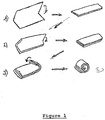
- a 120 mm x 90 mm preform is cut out of the coated PP grid and then folded according to the precise protocol shown in FIG. Figure 1 .
- the upper part of the mold or piston is then inserted and a 360 ° rotation applied, then the piston is removed. This action is repeated three times to properly dispose of the polymer.
- the piston is finally inserted into the conduit of the mold and the mold is placed between the two jaws of a heating press which is brought to 130 ° C, ie at a temperature above the PMMA softening temperature and below to that of polypropylene.
- the mold is kept hot for 10 minutes and then the mold is allowed to cool to 50 ° C, after which the ball-shaped device can be demolded and recovered.
- the discs After demolding, the discs are immersed in absolute ethanol for one hour and then dried under vacuum for twelve hours to remove any traces of volatile compounds.
- the porosity of the ball is greater than 50%.
- a solution of PMMA (reference Degacryl 6606F, Degussa) at 10% by weight in methyl ethyl ketone (MEK) is prepared in a 2L flask with stirring, then placed in a large-opening container.
- a preform is cut in a polypropylene grid of 120 mm X 90 mm (reference PPKM802 of Textile Development Associate, TDA) is cut and a spherical PEEK preform of diameter 5 minutes and height of about 5 minutes is placed at its center and fixed at the gate.
- the assembly consisting of the preform on which the disk is hung, is then immersed in the container containing the PMMA solution, and then dried under air flow to remove excess PMMA may clog some pores of the grid.
- a second immersion of the said set in the opposite direction of the first is then performed, followed by drying under a stream of air, then the grid is dried at 50 ° C. This procedure can be repeated to increase the amount of PMMA attached to the polypropylene preform.
- the whole is finally dried in a vacuum oven at 80 ° C for 4 h 30.
- the coated PP grid containing the disk is folded according to a precise protocol, so as to maintain the central shape in the core of the polypropylene matrix.
- the resulting strip is then wound on itself to obtain a dense roll of material. This is inserted into the lower part of a cylindrical mold.
- the upper part of the mold or piston is then inserted into the duct of the mold and the mold is placed between the two jaws of a heating press which is brought to 130 ° C., that is to say at a temperature greater than or equal to softening temperature of PMMA (Tram ⁇ 100 ° C) and lower than that of polypropylene (Tram ⁇ 160 ° C).
- the mold is kept hot for ten minutes, then the mold is allowed to cool to 50 ° C, after which the porous ball-shaped device can be demolded and recovered.
- the devices After demolding, the devices are immersed in absolute ethanol for one hour and then dried under vacuum for twelve hours to remove any traces of volatile compounds.
- a multi-hydroxy functional co-oligomer based on MMA and 2-hydroxyethyl methacrylate (HEMA) (average molar mass 1500 g / mol, f OH 3) synthesized by a radical route in our laboratories is solubilized in methyl ethyl ketone and placed in a 2L flask under stirring and mixed with hexamethylene diisocyanate so as to have a stoichiometry between hydroxyl functions and isocyanate.
- a strip of a polypropylene grid of 120 mm X 90 mm, held at both ends, is then immersed in the container containing the mixture.
- a second immersion of the grid in the opposite direction of the first is then performed followed by evaporation of the MEK at 30 ° C under a stream of dry air and then under partial vacuum.
- a preform is cut in the PP grid coated and then it is folded according to a precise protocol is inserted into the lower part of a disk-shaped mold.
- the upper part of the mold or piston is then inserted into the duct of the mold and the mold is placed between the two jaws of a heating press which is brought to 130 ° C., that is to say at a temperature above the heating temperature. softening of PU and lower than that of polypropylene.
- the mold is kept hot for six hours, then the mold is allowed to cool to 50 ° C, after which the disk-shaped device can be demolded and recovered.
- the discs After demolding, the discs are immersed in absolute ethanol for twelve hours, to remove any traces of unreacted isocyanate functions, and then dried under vacuum for twelve hours, to remove any traces of volatile compounds.
- a mixture of monomers, methyl methacrylate (80% by weight), butyl acrylate (15% by weight), and methyl dimethacrylate (3% by mass) and a radical catalyst benzoyl peroxide (2% by weight) is placed in a 2L flask with stirring.
- a preform cut from a polypropylene grid of 120 mm ⁇ 90 mm is then immersed in the container containing the mixture.
- a second immersion of the grid in the opposite direction of the first is then performed.
- the coated PP preform is inserted into the bottom portion of a disk-shaped mold.
- the upper part of the mold is then inserted and the mold is placed between the two jaws of a heating press which is brought to 100 ° C, that is to say at a temperature above the softening temperature of the monomer mixture and below to that of polypropylene.
- the mold is kept hot for ten hours and then the mold is allowed to cool to 50 ° C, after which the disk-shaped device can be demolded and recovered.
- the discs After demolding, the discs are immersed in absolute ethanol for twelve hours, to remove any traces of unreacted monomers, and then dried under vacuum for twelve hours to remove any traces of volatile compounds.
- Example 4 To a mixture of monomers, identical to that of Example 4 (73% by mass) and a radical catalyst, benzoyl peroxide (2% by mass) placed in a 2L flask with stirring is added a contrast agent. zirconium oxide (25% by weight). A preform cut from a polypropylene grid of 120 mm ⁇ 90 mm is then immersed in the container containing the mixture. A second immersion of the grid in the opposite direction of the first is then performed.
- the coated PP grid is inserted into the lower part of a mold.
- the upper part of the mold is then inserted and the mold is placed between the two jaws of a heating press which is brought to 100 ° C, that is to say at a temperature above the softening temperature of the mixture and lower than that polypropylene.
- the mold is kept hot for ten hours, then the mold is allowed to cool to 50 ° C, after which the disk-shaped device can be demolded and recovered.
- the discs After demolding, the discs are immersed in absolute ethanol for twelve hours, to remove any traces of unreacted monomers, and then dried under vacuum for twelve hours to remove any traces of volatile compounds.
- the size of the perforations formed in the grid section is between 0.2 mm 2 and 10 mm 2, in particular between 4 mm 2 and 8 mm 2.
- the thickness of PMMA is 700 microns to plus or minus 50 microns.
- first polymer material and a second polymer material are mentioned. However, each of them may consist of a mixture of polymers each having characteristics provided for the first polymer and the second polymer, respectively.
- first polymer is in fact a mixture of N first polymeric materials and the second polymer is a mixture of P second polymeric materials
- the conditions relating to the softening temperatures become the greatest of the temperatures. softening or reaction / crosslinking of the P second polymeric materials is less than the lowest of the softening temperatures of the N first polymeric materials and, secondly, that the lowest softening temperature of the second Pu-type polymer materials is greater than 45 ° C and preferably above 50 ° C.
- a second material besides PMMA, it is possible to use a Poly ( ⁇ -caprolactone) (Tram between 45 and 50 ° C.); a ethylene vinyl acetate copolymer (EVA) (Tram between 50 and 70 ° C, the softening temperature depending on the ethylene / vinyl acetate ratio, for example for EVATANE 28-800 the Tram is equal to 63 °).
- ⁇ -caprolactone ⁇ -caprolactone
- EVA ethylene vinyl acetate copolymer
Landscapes
- Health & Medical Sciences (AREA)
- Animal Behavior & Ethology (AREA)
- Chemical & Material Sciences (AREA)
- Veterinary Medicine (AREA)
- Public Health (AREA)
- General Health & Medical Sciences (AREA)
- Epidemiology (AREA)
- Life Sciences & Earth Sciences (AREA)
- Oral & Maxillofacial Surgery (AREA)
- Transplantation (AREA)
- Medicinal Chemistry (AREA)
- Dermatology (AREA)
- Heart & Thoracic Surgery (AREA)
- Surgery (AREA)
- Vascular Medicine (AREA)
- Dispersion Chemistry (AREA)
- Materials For Medical Uses (AREA)
- Prostheses (AREA)
Claims (15)
- Implantat, umfassend mindestens ein Basis- oder Matrixelement aus einem ersten Polymermaterial, das mit einer Beschichtung aus einem zweiten Polymermaterial beschichtet ist, dadurch gekennzeichnet, dass das mindestens eine Basis- oder Matrixelement, das mit der Beschichtung beschichtet ist, Öffnungen umfasst, die dieses von einer Seite zur anderen durchqueren; und wobei die Erweichungstemperatur des zweiten Polymermaterials niedriger ist als die Erweichungstemperatur des ersten Polymermaterials.
- Implantat nach Anspruch 1, dadurch gekennzeichnet, dass das zweite Material auf Vorpolymeren basiert, und die Vernetzungstemperatur des zweiten Materials niedriger ist als die Erweichungstemperatur des ersten Polymermaterials.
- Implantat nach Anspruch 1 oder 2, dadurch gekennzeichnet, dass die Matrix in Form eines Gitters gebildet ist.
- Implantat nach Anspruch 1 oder 2, dadurch gekennzeichnet, dass die Matrix aus einer perforierten gewebten Schicht besteht.
- Implantat nach Anspruch 1 oder 2, dadurch gekennzeichnet, dass die Matrix aus einer perforierten nichtgewebten Schicht besteht.
- Implantat nach einem der Ansprüche 1 bis 5, dadurch gekennzeichnet, dass das Implantat mehrere mit dem zweiten Polymermaterial beschichtete Matrizen umfasst, die aufeinander gestapelt sind.
- Implantat nach einem der Ansprüche 1 bis 6, dadurch gekennzeichnet, dass das Implantat aus einer mit dem zweiten Polymermaterial beschichteten Matrix besteht, die, vorzugsweise mehrere Male, in sich gefaltet ist.
- Implantat nach einem der Ansprüche 1 bis 7, dadurch gekennzeichnet, dass die mehreren gestapelten Matrizen oder die Falten der in sich gefalteten Matrix insbesondere durch Wärmeformen oder Thermoformen aneinander befestigt sind.
- Intraokulare Kugel, welche aus einem Implantat nach Anspruch 8 besteht.
- Bandscheibe, welche aus einem Implantat nach Anspruch 8 besteht.
- Verfahren zur Herstellung eines porösen Implantats nach einem der vorhergehenden Ansprüche, welches die Schritte umfasst, in denen mindestens ein perforiertes Basis- oder Matrixelement (M), umfassend Öffnungen, die dieses von einer Seite zur anderen, beispielsweise in Form eines Gitters, einer perforierten gewebten oder perforierten nichtgewebten Schicht aus einem ersten Polymermaterial durchqueren, bereitgestellt wird, das Basiselement mit einem zweiten Polymermaterial beschichtet wird; dann das beschichtete Basiselement warmgepresst oder thermogeformt wird, um ein Verbundprodukt zu erhalten, wobei die Formgebung des Verbundprodukts durch Wärmeformen oder Thermoformen bei einer Temperatur über der Erweichungstemperatur des zweiten Polymermaterials durchgeführt wird oder im Fall von reaktiven Vorpolymeren bei einer Temperatur über ihrer Vernetzungstemperatur und bei einer Temperatur unter der Erweichungstemperatur des ersten Materials, um so seine physikalische, chemische und mechanische Integrität aufrechtzuerhalten.
- Verfahren nach Anspruch 11, dadurch gekennzeichnet, dass mehrere Basismatrizen aus einem ersten Polymermaterial, das mit dem zweiten Material beschichtet ist, gestapelt werden und in einer Form oder einer Wärmepresse, deren Form jener des Produkts entspricht, das erhalten werden soll, gepresst wird.
- Verfahren nach Anspruch 11, dadurch gekennzeichnet, dass vor dem Thermoformschritt das beschichtete Basiselement in sich in mehrere Falten gefaltet wird, dann der Thermoformschritt in einer Form oder einer Wärmepresse, deren Form jener des Verbundprodukts entspricht, das erhalten werden soll, durchgeführt wird.
- Verfahren nach einem der Ansprüche 11 bis 13, dadurch gekennzeichnet, dass das poröse Implantat eine Bandscheibe ist.
- Verfahren nach einem der Ansprüche 11 bis 13, dadurch gekennzeichnet, dass das poröse Implantat eine intraokulare Kugel ist.
Applications Claiming Priority (2)
| Application Number | Priority Date | Filing Date | Title |
|---|---|---|---|
| FR1103298A FR2981850B1 (fr) | 2011-10-28 | 2011-10-28 | Produit composite poreux, notamment implant medical, par exemple bille intraoculaire, et procede de fabrication |
| FR1200448A FR2981851B1 (fr) | 2011-10-28 | 2012-02-16 | Produit composite, notamment implant medical par exemple bille intraoculaire, et procede de fabrication |
Publications (2)
| Publication Number | Publication Date |
|---|---|
| EP2586468A1 EP2586468A1 (de) | 2013-05-01 |
| EP2586468B1 true EP2586468B1 (de) | 2017-11-08 |
Family
ID=46963630
Family Applications (1)
| Application Number | Title | Priority Date | Filing Date |
|---|---|---|---|
| EP12290314.9A Not-in-force EP2586468B1 (de) | 2011-10-28 | 2012-09-24 | Poröses medizinisches Implantat, wie beispielsweise eine intraokulare Kugel, und Herstellungsverfahren |
Country Status (4)
| Country | Link |
|---|---|
| US (1) | US20130110232A1 (de) |
| EP (1) | EP2586468B1 (de) |
| BR (1) | BR102012027284A2 (de) |
| FR (1) | FR2981851B1 (de) |
Families Citing this family (4)
| Publication number | Priority date | Publication date | Assignee | Title |
|---|---|---|---|---|
| US7922767B2 (en) * | 2007-07-07 | 2011-04-12 | Jmea Corporation | Disk fusion implant |
| US9901457B2 (en) | 2014-10-16 | 2018-02-27 | Jmea Corporation | Coiling implantable prostheses |
| RU2672282C2 (ru) * | 2016-08-03 | 2018-11-13 | Алексей Викторович Грибанов | Способ формирования эндопротеза тела позвонка и эндопротез тела позвонка |
| KR20220060501A (ko) * | 2019-03-29 | 2022-05-11 | 티디비티 아이피 인코포레이티드 | 조직 및 장기 대체물 그리고 이들의 제조 방법 |
Family Cites Families (9)
| Publication number | Priority date | Publication date | Assignee | Title |
|---|---|---|---|---|
| FR2603797B1 (fr) * | 1986-09-15 | 1988-11-18 | Vachet Jean Marc | Implant orbitaire apres enucleation |
| US20040138695A1 (en) * | 2002-06-18 | 2004-07-15 | Shu-Tung Li | Coatings of implants |
| US20040241212A1 (en) * | 2003-05-30 | 2004-12-02 | Pendharkar Sanyog Manohar | Biodegradable hemostatic wound dressings |
| US7553371B2 (en) * | 2004-02-02 | 2009-06-30 | Nanosys, Inc. | Porous substrates, articles, systems and compositions comprising nanofibers and methods of their use and production |
| US20050260355A1 (en) * | 2004-05-20 | 2005-11-24 | Jan Weber | Medical devices and methods of making the same |
| US7790273B2 (en) * | 2006-05-24 | 2010-09-07 | Nellix, Inc. | Material for creating multi-layered films and methods for making the same |
| EP2303353B1 (de) * | 2008-06-12 | 2018-01-10 | Ramot at Tel-Aviv University Ltd. | Arzneimittel freisetzende medizinische vorrichtungen |
| US20100009165A1 (en) * | 2008-07-10 | 2010-01-14 | Zyvex Performance Materials, Llc | Multifunctional Nanomaterial-Containing Composites and Methods for the Production Thereof |
| WO2012097381A1 (en) * | 2011-01-14 | 2012-07-19 | Biomerix Corporation | At least partially resorbable reticulated elastomeric matrix elements and methods of making same |
-
2012
- 2012-02-16 FR FR1200448A patent/FR2981851B1/fr not_active Expired - Fee Related
- 2012-09-24 EP EP12290314.9A patent/EP2586468B1/de not_active Not-in-force
- 2012-10-17 US US13/653,631 patent/US20130110232A1/en not_active Abandoned
- 2012-10-24 BR BRBR102012027284-9A patent/BR102012027284A2/pt not_active Application Discontinuation
Non-Patent Citations (1)
| Title |
|---|
| None * |
Also Published As
| Publication number | Publication date |
|---|---|
| FR2981851B1 (fr) | 2014-12-19 |
| US20130110232A1 (en) | 2013-05-02 |
| BR102012027284A2 (pt) | 2014-08-19 |
| EP2586468A1 (de) | 2013-05-01 |
| FR2981851A1 (fr) | 2013-05-03 |
Similar Documents
| Publication | Publication Date | Title |
|---|---|---|
| JP7189975B2 (ja) | ポロゲン材料、製造方法、および使用 | |
| JPH09509081A (ja) | 切削可能なptfe移植材料 | |
| US8853294B2 (en) | Polyurethane-grafted hydrogels | |
| EP2569473B1 (de) | Poröse materialien, verfahren zur herstellung und verwendung | |
| US8697763B2 (en) | Processes for making porous implantable materials | |
| US9072821B2 (en) | Biocompatible structures and compositions | |
| CA2558661C (en) | Load bearing biocompatible device | |
| JPS62500706A (ja) | 単層または多層補綴物質の製法およびそれにより得られた物質 | |
| US20110276134A1 (en) | Silicone implant with imprinted texture | |
| EP0478279A2 (de) | Biokompatibles Körperimplantat mit einer strukturierten Oberfläche | |
| EP2586468A1 (de) | Poröses Verbundprodukt, insbesondere medizinisches Implantat, wie beispielsweise eine intraokulare Kugel, und Herstellungsverfahren | |
| WO2008030939A2 (en) | Porous polymeric material particularly suited for medical implant applications | |
| FR2981850A1 (fr) | Produit composite poreux, notamment implant medical, par exemple bille intraoculaire, et procede de fabrication | |
| CN112584877A (zh) | 用于无血管环境和角膜植入物的上皮化微孔生物材料 | |
| EP0171410A1 (de) | Ein körpergewebe-ersatzerzeugnis und dessen herstellung | |
| FR3113371A1 (fr) | Dispositif médical comprenant un assemblage d’éléments de matrices biologiques acellulaires et au moins un polymère | |
| RU2021111869A (ru) | Протезы межпозвонковых дисков и способы их изготовления |
Legal Events
| Date | Code | Title | Description |
|---|---|---|---|
| PUAI | Public reference made under article 153(3) epc to a published international application that has entered the european phase |
Free format text: ORIGINAL CODE: 0009012 |
|
| AK | Designated contracting states |
Kind code of ref document: A1 Designated state(s): AL AT BE BG CH CY CZ DE DK EE ES FI FR GB GR HR HU IE IS IT LI LT LU LV MC MK MT NL NO PL PT RO RS SE SI SK SM TR |
|
| AX | Request for extension of the european patent |
Extension state: BA ME |
|
| 17P | Request for examination filed |
Effective date: 20131104 |
|
| RBV | Designated contracting states (corrected) |
Designated state(s): AL AT BE BG CH CY CZ DE DK EE ES FI FR GB GR HR HU IE IS IT LI LT LU LV MC MK MT NL NO PL PT RO RS SE SI SK SM TR |
|
| 17Q | First examination report despatched |
Effective date: 20160707 |
|
| GRAP | Despatch of communication of intention to grant a patent |
Free format text: ORIGINAL CODE: EPIDOSNIGR1 |
|
| INTG | Intention to grant announced |
Effective date: 20170424 |
|
| GRAS | Grant fee paid |
Free format text: ORIGINAL CODE: EPIDOSNIGR3 |
|
| RAP1 | Party data changed (applicant data changed or rights of an application transferred) |
Owner name: POLYMEREXPERT |
|
| GRAA | (expected) grant |
Free format text: ORIGINAL CODE: 0009210 |
|
| AK | Designated contracting states |
Kind code of ref document: B1 Designated state(s): AL AT BE BG CH CY CZ DE DK EE ES FI FR GB GR HR HU IE IS IT LI LT LU LV MC MK MT NL NO PL PT RO RS SE SI SK SM TR |
|
| REG | Reference to a national code |
Ref country code: GB Ref legal event code: FG4D Free format text: NOT ENGLISH |
|
| REG | Reference to a national code |
Ref country code: CH Ref legal event code: EP Ref country code: AT Ref legal event code: REF Ref document number: 943529 Country of ref document: AT Kind code of ref document: T Effective date: 20171115 |
|
| REG | Reference to a national code |
Ref country code: IE Ref legal event code: FG4D Free format text: LANGUAGE OF EP DOCUMENT: FRENCH |
|
| REG | Reference to a national code |
Ref country code: DE Ref legal event code: R096 Ref document number: 602012039446 Country of ref document: DE |
|
| REG | Reference to a national code |
Ref country code: NL Ref legal event code: MP Effective date: 20171108 |
|
| REG | Reference to a national code |
Ref country code: LT Ref legal event code: MG4D |
|
| REG | Reference to a national code |
Ref country code: AT Ref legal event code: MK05 Ref document number: 943529 Country of ref document: AT Kind code of ref document: T Effective date: 20171108 |
|
| PG25 | Lapsed in a contracting state [announced via postgrant information from national office to epo] |
Ref country code: NO Free format text: LAPSE BECAUSE OF FAILURE TO SUBMIT A TRANSLATION OF THE DESCRIPTION OR TO PAY THE FEE WITHIN THE PRESCRIBED TIME-LIMIT Effective date: 20180208 Ref country code: LT Free format text: LAPSE BECAUSE OF FAILURE TO SUBMIT A TRANSLATION OF THE DESCRIPTION OR TO PAY THE FEE WITHIN THE PRESCRIBED TIME-LIMIT Effective date: 20171108 Ref country code: FI Free format text: LAPSE BECAUSE OF FAILURE TO SUBMIT A TRANSLATION OF THE DESCRIPTION OR TO PAY THE FEE WITHIN THE PRESCRIBED TIME-LIMIT Effective date: 20171108 Ref country code: ES Free format text: LAPSE BECAUSE OF FAILURE TO SUBMIT A TRANSLATION OF THE DESCRIPTION OR TO PAY THE FEE WITHIN THE PRESCRIBED TIME-LIMIT Effective date: 20171108 Ref country code: NL Free format text: LAPSE BECAUSE OF FAILURE TO SUBMIT A TRANSLATION OF THE DESCRIPTION OR TO PAY THE FEE WITHIN THE PRESCRIBED TIME-LIMIT Effective date: 20171108 Ref country code: SE Free format text: LAPSE BECAUSE OF FAILURE TO SUBMIT A TRANSLATION OF THE DESCRIPTION OR TO PAY THE FEE WITHIN THE PRESCRIBED TIME-LIMIT Effective date: 20171108 |
|
| PG25 | Lapsed in a contracting state [announced via postgrant information from national office to epo] |
Ref country code: HR Free format text: LAPSE BECAUSE OF FAILURE TO SUBMIT A TRANSLATION OF THE DESCRIPTION OR TO PAY THE FEE WITHIN THE PRESCRIBED TIME-LIMIT Effective date: 20171108 Ref country code: RS Free format text: LAPSE BECAUSE OF FAILURE TO SUBMIT A TRANSLATION OF THE DESCRIPTION OR TO PAY THE FEE WITHIN THE PRESCRIBED TIME-LIMIT Effective date: 20171108 Ref country code: BG Free format text: LAPSE BECAUSE OF FAILURE TO SUBMIT A TRANSLATION OF THE DESCRIPTION OR TO PAY THE FEE WITHIN THE PRESCRIBED TIME-LIMIT Effective date: 20180208 Ref country code: GR Free format text: LAPSE BECAUSE OF FAILURE TO SUBMIT A TRANSLATION OF THE DESCRIPTION OR TO PAY THE FEE WITHIN THE PRESCRIBED TIME-LIMIT Effective date: 20180209 Ref country code: IS Free format text: LAPSE BECAUSE OF FAILURE TO SUBMIT A TRANSLATION OF THE DESCRIPTION OR TO PAY THE FEE WITHIN THE PRESCRIBED TIME-LIMIT Effective date: 20180308 Ref country code: LV Free format text: LAPSE BECAUSE OF FAILURE TO SUBMIT A TRANSLATION OF THE DESCRIPTION OR TO PAY THE FEE WITHIN THE PRESCRIBED TIME-LIMIT Effective date: 20171108 Ref country code: AT Free format text: LAPSE BECAUSE OF FAILURE TO SUBMIT A TRANSLATION OF THE DESCRIPTION OR TO PAY THE FEE WITHIN THE PRESCRIBED TIME-LIMIT Effective date: 20171108 |
|
| PG25 | Lapsed in a contracting state [announced via postgrant information from national office to epo] |
Ref country code: CZ Free format text: LAPSE BECAUSE OF FAILURE TO SUBMIT A TRANSLATION OF THE DESCRIPTION OR TO PAY THE FEE WITHIN THE PRESCRIBED TIME-LIMIT Effective date: 20171108 Ref country code: CY Free format text: LAPSE BECAUSE OF FAILURE TO SUBMIT A TRANSLATION OF THE DESCRIPTION OR TO PAY THE FEE WITHIN THE PRESCRIBED TIME-LIMIT Effective date: 20171108 Ref country code: EE Free format text: LAPSE BECAUSE OF FAILURE TO SUBMIT A TRANSLATION OF THE DESCRIPTION OR TO PAY THE FEE WITHIN THE PRESCRIBED TIME-LIMIT Effective date: 20171108 Ref country code: DK Free format text: LAPSE BECAUSE OF FAILURE TO SUBMIT A TRANSLATION OF THE DESCRIPTION OR TO PAY THE FEE WITHIN THE PRESCRIBED TIME-LIMIT Effective date: 20171108 Ref country code: SK Free format text: LAPSE BECAUSE OF FAILURE TO SUBMIT A TRANSLATION OF THE DESCRIPTION OR TO PAY THE FEE WITHIN THE PRESCRIBED TIME-LIMIT Effective date: 20171108 |
|
| REG | Reference to a national code |
Ref country code: DE Ref legal event code: R097 Ref document number: 602012039446 Country of ref document: DE |
|
| PG25 | Lapsed in a contracting state [announced via postgrant information from national office to epo] |
Ref country code: RO Free format text: LAPSE BECAUSE OF FAILURE TO SUBMIT A TRANSLATION OF THE DESCRIPTION OR TO PAY THE FEE WITHIN THE PRESCRIBED TIME-LIMIT Effective date: 20171108 Ref country code: IT Free format text: LAPSE BECAUSE OF FAILURE TO SUBMIT A TRANSLATION OF THE DESCRIPTION OR TO PAY THE FEE WITHIN THE PRESCRIBED TIME-LIMIT Effective date: 20171108 Ref country code: SM Free format text: LAPSE BECAUSE OF FAILURE TO SUBMIT A TRANSLATION OF THE DESCRIPTION OR TO PAY THE FEE WITHIN THE PRESCRIBED TIME-LIMIT Effective date: 20171108 Ref country code: PL Free format text: LAPSE BECAUSE OF FAILURE TO SUBMIT A TRANSLATION OF THE DESCRIPTION OR TO PAY THE FEE WITHIN THE PRESCRIBED TIME-LIMIT Effective date: 20171108 |
|
| PLBE | No opposition filed within time limit |
Free format text: ORIGINAL CODE: 0009261 |
|
| STAA | Information on the status of an ep patent application or granted ep patent |
Free format text: STATUS: NO OPPOSITION FILED WITHIN TIME LIMIT |
|
| PG25 | Lapsed in a contracting state [announced via postgrant information from national office to epo] |
Ref country code: MT Free format text: LAPSE BECAUSE OF FAILURE TO SUBMIT A TRANSLATION OF THE DESCRIPTION OR TO PAY THE FEE WITHIN THE PRESCRIBED TIME-LIMIT Effective date: 20171108 |
|
| 26N | No opposition filed |
Effective date: 20180809 |
|
| REG | Reference to a national code |
Ref country code: FR Ref legal event code: PLFP Year of fee payment: 7 |
|
| PG25 | Lapsed in a contracting state [announced via postgrant information from national office to epo] |
Ref country code: SI Free format text: LAPSE BECAUSE OF FAILURE TO SUBMIT A TRANSLATION OF THE DESCRIPTION OR TO PAY THE FEE WITHIN THE PRESCRIBED TIME-LIMIT Effective date: 20171108 |
|
| REG | Reference to a national code |
Ref country code: DE Ref legal event code: R119 Ref document number: 602012039446 Country of ref document: DE |
|
| PG25 | Lapsed in a contracting state [announced via postgrant information from national office to epo] |
Ref country code: MC Free format text: LAPSE BECAUSE OF FAILURE TO SUBMIT A TRANSLATION OF THE DESCRIPTION OR TO PAY THE FEE WITHIN THE PRESCRIBED TIME-LIMIT Effective date: 20171108 |
|
| REG | Reference to a national code |
Ref country code: CH Ref legal event code: PL |
|
| GBPC | Gb: european patent ceased through non-payment of renewal fee |
Effective date: 20180924 |
|
| REG | Reference to a national code |
Ref country code: BE Ref legal event code: MM Effective date: 20180930 |
|
| REG | Reference to a national code |
Ref country code: IE Ref legal event code: MM4A |
|
| PG25 | Lapsed in a contracting state [announced via postgrant information from national office to epo] |
Ref country code: LU Free format text: LAPSE BECAUSE OF NON-PAYMENT OF DUE FEES Effective date: 20180924 |
|
| PG25 | Lapsed in a contracting state [announced via postgrant information from national office to epo] |
Ref country code: DE Free format text: LAPSE BECAUSE OF NON-PAYMENT OF DUE FEES Effective date: 20190402 Ref country code: IE Free format text: LAPSE BECAUSE OF NON-PAYMENT OF DUE FEES Effective date: 20180924 |
|
| PG25 | Lapsed in a contracting state [announced via postgrant information from national office to epo] |
Ref country code: BE Free format text: LAPSE BECAUSE OF NON-PAYMENT OF DUE FEES Effective date: 20180930 Ref country code: CH Free format text: LAPSE BECAUSE OF NON-PAYMENT OF DUE FEES Effective date: 20180930 Ref country code: LI Free format text: LAPSE BECAUSE OF NON-PAYMENT OF DUE FEES Effective date: 20180930 |
|
| PG25 | Lapsed in a contracting state [announced via postgrant information from national office to epo] |
Ref country code: GB Free format text: LAPSE BECAUSE OF NON-PAYMENT OF DUE FEES Effective date: 20180924 |
|
| PG25 | Lapsed in a contracting state [announced via postgrant information from national office to epo] |
Ref country code: TR Free format text: LAPSE BECAUSE OF FAILURE TO SUBMIT A TRANSLATION OF THE DESCRIPTION OR TO PAY THE FEE WITHIN THE PRESCRIBED TIME-LIMIT Effective date: 20171108 |
|
| PG25 | Lapsed in a contracting state [announced via postgrant information from national office to epo] |
Ref country code: PT Free format text: LAPSE BECAUSE OF FAILURE TO SUBMIT A TRANSLATION OF THE DESCRIPTION OR TO PAY THE FEE WITHIN THE PRESCRIBED TIME-LIMIT Effective date: 20171108 Ref country code: HU Free format text: LAPSE BECAUSE OF FAILURE TO SUBMIT A TRANSLATION OF THE DESCRIPTION OR TO PAY THE FEE WITHIN THE PRESCRIBED TIME-LIMIT; INVALID AB INITIO Effective date: 20120924 |
|
| PG25 | Lapsed in a contracting state [announced via postgrant information from national office to epo] |
Ref country code: MK Free format text: LAPSE BECAUSE OF NON-PAYMENT OF DUE FEES Effective date: 20171108 |
|
| PG25 | Lapsed in a contracting state [announced via postgrant information from national office to epo] |
Ref country code: AL Free format text: LAPSE BECAUSE OF FAILURE TO SUBMIT A TRANSLATION OF THE DESCRIPTION OR TO PAY THE FEE WITHIN THE PRESCRIBED TIME-LIMIT Effective date: 20171108 |
|
| PGFP | Annual fee paid to national office [announced via postgrant information from national office to epo] |
Ref country code: FR Payment date: 20220819 Year of fee payment: 11 |
|
| PG25 | Lapsed in a contracting state [announced via postgrant information from national office to epo] |
Ref country code: FR Free format text: LAPSE BECAUSE OF NON-PAYMENT OF DUE FEES Effective date: 20230930 |