EP2583666A1 - Aqueous hair cleansing agent - Google Patents
Aqueous hair cleansing agent Download PDFInfo
- Publication number
- EP2583666A1 EP2583666A1 EP11795391.9A EP11795391A EP2583666A1 EP 2583666 A1 EP2583666 A1 EP 2583666A1 EP 11795391 A EP11795391 A EP 11795391A EP 2583666 A1 EP2583666 A1 EP 2583666A1
- Authority
- EP
- European Patent Office
- Prior art keywords
- cleansing agent
- aqueous hair
- hair cleansing
- weight
- general formula
- Prior art date
- Legal status (The legal status is an assumption and is not a legal conclusion. Google has not performed a legal analysis and makes no representation as to the accuracy of the status listed.)
- Granted
Links
Classifications
-
- A—HUMAN NECESSITIES
- A61—MEDICAL OR VETERINARY SCIENCE; HYGIENE
- A61K—PREPARATIONS FOR MEDICAL, DENTAL OR TOILETRY PURPOSES
- A61K8/00—Cosmetics or similar toiletry preparations
- A61K8/18—Cosmetics or similar toiletry preparations characterised by the composition
- A61K8/30—Cosmetics or similar toiletry preparations characterised by the composition containing organic compounds
- A61K8/33—Cosmetics or similar toiletry preparations characterised by the composition containing organic compounds containing oxygen
- A61K8/39—Derivatives containing from 2 to 10 oxyalkylene groups
-
- A—HUMAN NECESSITIES
- A61—MEDICAL OR VETERINARY SCIENCE; HYGIENE
- A61K—PREPARATIONS FOR MEDICAL, DENTAL OR TOILETRY PURPOSES
- A61K8/00—Cosmetics or similar toiletry preparations
- A61K8/18—Cosmetics or similar toiletry preparations characterised by the composition
- A61K8/92—Oils, fats or waxes; Derivatives thereof, e.g. hydrogenation products thereof
-
- A—HUMAN NECESSITIES
- A61—MEDICAL OR VETERINARY SCIENCE; HYGIENE
- A61K—PREPARATIONS FOR MEDICAL, DENTAL OR TOILETRY PURPOSES
- A61K8/00—Cosmetics or similar toiletry preparations
- A61K8/18—Cosmetics or similar toiletry preparations characterised by the composition
- A61K8/30—Cosmetics or similar toiletry preparations characterised by the composition containing organic compounds
- A61K8/40—Cosmetics or similar toiletry preparations characterised by the composition containing organic compounds containing nitrogen
- A61K8/44—Aminocarboxylic acids or derivatives thereof, e.g. aminocarboxylic acids containing sulfur; Salts; Esters or N-acylated derivatives thereof
-
- A—HUMAN NECESSITIES
- A61—MEDICAL OR VETERINARY SCIENCE; HYGIENE
- A61K—PREPARATIONS FOR MEDICAL, DENTAL OR TOILETRY PURPOSES
- A61K8/00—Cosmetics or similar toiletry preparations
- A61K8/18—Cosmetics or similar toiletry preparations characterised by the composition
- A61K8/30—Cosmetics or similar toiletry preparations characterised by the composition containing organic compounds
- A61K8/46—Cosmetics or similar toiletry preparations characterised by the composition containing organic compounds containing sulfur
- A61K8/466—Cosmetics or similar toiletry preparations characterised by the composition containing organic compounds containing sulfur containing sulfonic acid derivatives; Salts
-
- A—HUMAN NECESSITIES
- A61—MEDICAL OR VETERINARY SCIENCE; HYGIENE
- A61K—PREPARATIONS FOR MEDICAL, DENTAL OR TOILETRY PURPOSES
- A61K8/00—Cosmetics or similar toiletry preparations
- A61K8/18—Cosmetics or similar toiletry preparations characterised by the composition
- A61K8/72—Cosmetics or similar toiletry preparations characterised by the composition containing organic macromolecular compounds
- A61K8/84—Cosmetics or similar toiletry preparations characterised by the composition containing organic macromolecular compounds obtained by reactions otherwise than those involving only carbon-carbon unsaturated bonds
- A61K8/86—Polyethers
-
- A—HUMAN NECESSITIES
- A61—MEDICAL OR VETERINARY SCIENCE; HYGIENE
- A61Q—SPECIFIC USE OF COSMETICS OR SIMILAR TOILETRY PREPARATIONS
- A61Q5/00—Preparations for care of the hair
- A61Q5/02—Preparations for cleaning the hair
Definitions
- the present invention relates to an aqueous hair cleansing agent.
- an aqueous hair cleansing agent having good lather and high cleansing power it is preferable to use, as a main cleansing agent, a strong acid-based anionic surfactant having the same charge as that of the hair and the scalp.
- a strong acid-based anionic surfactant having the same charge as that of the hair and the scalp.
- an auxiliary surfactant such as a nonionic surfactant or an amphoteric surfactant is generally formulated therewith.
- auxiliary surfactants the ones that are most commonly used in aqueous hair cleansing agents are a fatty acid monoethanolamide as the nonionic surfactant and a fatty acid amidopropyl betaine as the amphoteric surfactant, but when the amount of sebum is large or when a styling agent is used, lather is poor and it is difficult for sufficient cleansing power to be exhibited.
- Patent Documents 1 to 3 disclose a technique of using a strong acid-type anionic surfactant in combination with a monoalkyl glyceryl ether or a polyoxypropylene octyl ether as a nonionic surfactant.
- an aqueous hair cleansing agent containing components (A), (B), (C), and (D) below:
- the present invention relates to an aqueous hair cleansing agent exhibiting sufficient lather and high cleansing power even under conditions in which there is sebum or a styling agent.
- an aqueous hair cleansing agent having excellent lather and cleansing power even under conditions of a large amount of sebum and the like is obtained for the first time by mixing, with an aqueous hair cleansing agent having an alkyl sulfate or an alkyl ether sulfate, which are sulfate type anionic surfactants, as a main cleansing component, a polyoxypropylene alkyl ether, a monoalkyl glyceryl ether or a monoalkenyl glyceryl ether, and an alkylhydroxysulfobetaine at a specific ratio as auxiliary surfactants.
- an alkyl sulfate or an alkyl ether sulfate which are sulfate type anionic surfactants, as a main cleansing component, a polyoxypropylene alkyl ether, a monoalkyl glyceryl ether or a monoalkenyl glyceryl ether, and an alkylhydroxysulf
- an aqueous hair cleansing agent having excellent lather and cleansing power even under conditions in which there is soiling due to sebum and the like.
- the aqueous hair cleansing agent of the present invention is an aqueous hair cleansing agent containing components (A), (B), (C), and (D) below:
- component (A) is explained.
- component (A) is an alkyl sulfate or an alkyl ether sulfate, which are sulfate type anionic surfactants, represented by the general formula (1).
- R 1 O(CH 2 CH 2 O) n SO 3 M (1)
- R 1 presents an alkyl group or alkenyl group having 10 to 18 carbon atoms
- M presents an alkali metal, an alkaline earth metal, ammonium, an alkanolamine, or a basic amino acid
- n presents a number from 0 to 5 as a mass average.
- a polyoxyethylene alkyl ether sulfate for which R 1 in the general formula (1) above is an alkyl group having 12 to 14 carbon atoms, n presents 1 or 2 as a mass average, and M is ammonium or sodium is more preferable from the viewpoint of lather (quantity) and high cleansing power.
- component (A) one type thereof may be used or two or more types may be used in combination, and the content thereof is 1 to 30 weight % of the aqueous hair cleansing agent of the present invention, preferably 5 to 25 weight %, more preferably 8 to 20 weight %, and even more preferably 9 to 15 weight %, in terms of lather (quantity) and viscosity of the aqueous hair cleansing agent.
- component (B) is now explained.
- component (B) is a polyoxypropylene alkyl ether type nonionic surfactant represented by the general formula (2).
- R 2 O(CH 2 CH (CH 3 )O) m H (2)
- R 2 presents a straight chain or branched alkyl group or alkenyl group having 8 to 10 carbon atoms, and m presents a number from 0.5 to 4 as a mass average.
- a polyoxypropylene octyl ether for which R 2 in the general formula (2) above is an alkyl group having 8 carbon atoms and m is a number from 2 to 3 as a mass average is more preferable from the viewpoint of quick lathering, smoothness during rinsing and after drying, and suppression of strange odor as a starting material.
- component (B) one type thereof may be used or two or more types may be used in combination, and the content thereof is 0.1 to 10 weight % of the aqueous hair cleansing agent of the present invention, preferably 0.2 to 5 weight %, more preferably 0.3 to 2 weight %, and even more preferably 0.5 to 1.5 weight %, in terms of lather (quantity) and smoothness during rinsing.
- component (C) is a monoalkyl glyceryl ether or monoalkenyl glyceryl ether type nonionic surfactant having an alkyl group or alkenyl group having 4 to 12 carbon atoms.
- the alkyl group or alkenyl group is preferably a straight chain or branched alkyl group having 4 to 10 carbon atoms, and more preferably a straight chain or branched alkyl group having 8 to 10 carbon atoms, from the viewpoint of quick lathering and cleansing power.
- n-butyl group an isobutyl group, an n -pentyl group, a 2-methylbutyl group, an isopentyl group, an n -hexyl group, an isohexyl group, an n -heptyl group, an n-octyl group, a 2-ethylhexyl group, an n -decyl group, and an isodecyl group.
- a branched alkyl group is preferable, and a 2-ethylhexyl group and an isodecyl group are more preferable.
- component (C) one type thereof may be used or two or more types may be used in combination, and the content thereof is 0.1 to 5 weight % of the aqueous hair cleansing agent of the present invention, preferably 0.2 to 3 weight %, and more preferably 0.3 to 1.5 weight %, in terms of lather and cleansing power.
- component (D) is now explained.
- component (D) is an alkylhydroxysulfobetaine type amphoteric surfactant represented by the general formula (3) below.
- R 3 presents an alkyl group having 10 to 14 carbon atoms.
- R 3 in the general formula (3) above is more preferably an alkyl group having 12 to 14 carbon atoms from the viewpoint of lather and cleansing power under conditions in which there is soiling due to sebum and the like, and the viscosity of the aqueous hair cleansing agent.
- component (D) one type thereof may be used or two or more types may be used in combination, and the content thereof is 0.1 to 10 weight % of the aqueous hair cleansing agent of the present invention, preferably 0.3 to 5 weight %, and more preferably 0.5 to 3 weight %, in terms of lather and cleansing power under conditions in which there is soiling due to sebum and the like, and the viscosity of the aqueous hair cleansing agent.
- alkylhydroxysulfobetaine as component (D), which is an amphoteric surfactant used in the present invention since the anionic group is a strong acid-based sulfonic acid group, even if the pH is 4 or below, since the anionic group is dissociated, it has the properties of an amphoteric surfactant without being influenced by pH and it can exhibit high lather and cleansing power even under conditions in which there is soiling due to sebum, regardless of the pH.
- the aqueous hair cleansing agent of the present invention can provide higher lather and cleansing power by containing a combination of components (A) to (D) above at a specific ratio and can provide hair that is smooth during foaming and during rinsing by reducing friction of the hair and hair that is smooth, soft, and easy to manage after drying.
- the aqueous hair cleansing agent of the present invention may have further formulated therewith (E) an organic carboxylic acid or a salt thereof in order to improve smoothness and manageability after drying.
- the organic carboxylic acid is preferably a dicarboxylic acid (optionally having a hydroxy group) or a hydroxymonocarboxylic acid.
- examples of the dicarboxylic acid optionally having a hydroxy group include malonic acid, succinic acid, glutaric acid, adipic acid, maleic acid, fumaric acid, phthalic acid, oxalic acid, malic acid, and tartaric acid
- examples of the hydroxymonocarboxylic acid include glycolic acid, lactic acid, hydroxyacrylic acid, oxybutyric acid, and glyceric acid.
- glycolic acid, lactic acid, malonic acid, maleic acid, and malic acid are preferable. Lactic acid and malic acid are more preferable.
- examples of a salt of these organic carboxylic acids include a salt with an alkali metal, an alkaline earth metal, ammonia, or an organic amine compound.
- organic carboxylic acid or a salt thereof one type thereof may be used or two or more types may be used in combination, and the content thereof is preferably 0.1 to 5 weight % of the aqueous hair cleansing agent, more preferably 0.2 to 3 weight %, and even more preferably 0.5 to 2 weight %, in terms of it being higher than the quantity that is used for the purpose of simply adjusting the pH and providing hair smoothness and manageability after drying.
- the aqueous hair cleansing agent of the present invention when diluted 20 times with water preferably has a pH at 25°C of 1 to 5, more preferably a pH of 2 to 4.5, and even more preferably a pH of 3 to 4, in terms of the organic carboxylic acid making the hair exhibit the maximum smoothness and manageability.
- the aqueous hair cleansing agent of the present invention may contain an anionic surfactant other than component (A), a nonionic surfactant other than components (B) and (C), or an amphoteric surfactant other than component (D).
- a sulfuric acid-based, sulfonic acid-based, or carboxylic acid-based surfactant may be used.
- examples thereof include an alkylene sulfosuccinate phenyl alkyl ether sulfate, a sulfosuccinate alkyl ester salt, a polyoxyalkylene sulfosuccinate alkyl ester salt, an alkanesulfonate, a higher fatty acid salt, and an alkyl ether carboxylic acid and a salt thereof; among them an alkyl ether carboxylic acid or a salt thereof is preferable, and an alkyl ether carboxylic acid or a salt thereof having an alkyl group having 12 to 14 carbon atoms is more preferable, from the viewpoint of low irritation and smoothness during rinsing.
- nonionic surfactant other than components (B) and (C) examples include a polyoxyalkylene sorbitan fatty acid ester, a polyoxyalkylene sorbitol fatty acid ester, a polyoxyalkylene glycerol fatty acid ester, a polyoxyalkylene fatty acid ester, a polyoxyalkylene alkyl ether, a polyoxyalkylene alkyl phenyl ether, a polyoxyalkylene (hardened) castor oil, a sucrose fatty acid ester, a polyglycerol alkyl ether, a polyglycerol fatty acid ester, a fatty acid alkanolamide, and an alkylglycoside.
- a polyoxyalkylene sorbitan fatty acid ester such as a polyoxyethylene sorbitan fatty acid ester, a polyoxyalkylene fatty acid ester such as a polyoxyalkylene (C 8 to C 20 ) fatty acid ester, a polyoxyethylene alkyl ether such as polyoxyethylene lauryl ether, a polyoxyalkylene (hardened) castor oil such as polyoxyethylene hardened castor oil, and an alkylglycoside are preferable from the viewpoint of lather (foam quantity).
- a polyoxyethylene alkyl ether having an alkyl group having 12 to 18 carbon atoms is more preferable.
- a fatty acid alkanolamide is also suitable; either a monoalkanolamide or a dialkanolamide may be used, and one having an acyl group having 8 to 18 carbon atoms and, even more, 10 to 16 carbon atoms is preferable from the viewpoint of lather (foam quantity).
- one having a hydroxyalkyl group having 2 to 3 carbon atoms is preferable, and examples thereof include oleic acid diethanolamide, palm kernel oil fatty acid diethanolamide, coconut oil fatty acid diethanolamide, lauric acid diethanolamide, polyoxyethylene coconut oil fatty acid monoethanolamide, coconut oil fatty acid monoethanolamide, lauric acid isopropanolamide, and lauric acid monoethanolamide.
- amphoteric surfactant other than component (D) examples include betaine-based surfactants.
- betaine-based surfactants an alkyldimethylaminoacetic acid betaine or a fatty acid amidopropyl betaine is preferable from the viewpoint of lather (foam quantity) and viscosity, and a fatty acid amidopropyl betaine is more preferable.
- the fatty acid amidopropyl betaine is preferably one having an acyl group having 8 to 18 carbon atoms, and more preferably 10 to 16 carbon atoms, and is even more preferably lauramidopropyl betaine, palm kernel oil fatty acid amidopropyl betaine, coconut oil fatty acid amidopropyl betaine, and the like.
- the content thereof is preferably no greater than the content of component (D), more preferably no greater than 0.5 weight %, and even more preferably no greater than 1/3 as a ratio by mass relative to component (D).
- one type or two or more types may be used in combination in the aqueous hair cleansing agent, but when the aqueous hair cleansing agent of the present invention is prepared in the form of an aqueous liquid cleansing agent, it is more preferable to use, together with components (A), (B), (C), and (D), a fatty acid amidopropyl betaine and a fatty acid alkanolamide since appropriate viscosity and a smooth feel during rinsing are obtained.
- the content of the surfactants other than (A), (B), (C), and (D) is preferably 0.01 to 10 weight % of the aqueous hair cleansing agent of the present invention since a good foam-increasing effect is obtained. It is more preferably 0.1 to 8 weight %, even more preferably 0.2 to 4 weight %, and even more preferably 0.5 to 1.5 weight % from the above-mentioned point.
- a cationic surfactant In order to improve ease of running the fingers through the hair during rinsing and finishing after drying, a cationic surfactant, a cationized polymer, and a silicone may be formulated with the aqueous hair cleansing agent of the present invention.
- Examples of the cationic surfactant include an alkyltrimethylammonium salt, an alkoxytrimethylammonium salt, a dialkyldimethylammonium salt, an alkyldimethylamine salt, an alkoxydimethylamine salt, and an alkylamidodimethylamine salt.
- R 11 presents an alkyl group having 12 to 22 carbon atoms
- Me presents a methyl group
- X presents a halogen (chlorine or bromine).
- Specific examples include cetyltrimethylammonium chloride, stearyltrimethylammonium chloride and behenyltrimethylammonium chloride.
- R 12 presents an alkyl group having 12 to 22 carbon atoms
- R 13 presents an ethylene group or a propylene group
- Me presents a methyl group
- X presents a halogen (chlorine or bromine).
- Specific examples include stearoxypropyltrimethylammonium chloride, stearoxyethyltrimethylammonium chloride, and stearoxyhydroxypropyltrimethylammonium chloride.
- R 14 2 -N + (Me) 2 X - (6) examples include those represented by the general formula below.
- R 14 presents an alkyl group having 12 to 22 carbon atoms or a benzyl group
- Me presents a methyl group
- X presents a halogen (chlorine or bromine).
- Specific examples include distearyldimethylammonium chloride.
- R 15 -N(Me) 2 (7) examples include those represented by the general formula below.
- R 15 presents an alkyl group having 12 to 22 carbon atoms, and Me presents a methyl group.
- Specific examples include an organic acid salt of behenyldimethylamine and stearyldimethylamine.
- R 16 -O-R 17 -N(Me) 2 Examples include those represented by the general formula below.
- R 16 -O-R 17 -N(Me) 2 (8)
- R 16 presents an alkyl group having 12 to 22 carbon atoms
- R 17 presents an ethylene group or a propylene group
- Me presents a methyl group.
- R 18 presents an alkyl group having 11 to 21 carbon atoms
- R 19 presents an ethylene group or a propylene group
- Me presents a methyl group.
- Examples of the cationic surfactant other than (i) to (vi) above include lanolin fatty acid aminopropylethyldimethylammonium ethylsulfate (ethylsulfate of an alkanoylaminopropyldimethylethylammonium, the alkanoyl group being derived from lanolin), lanolin fatty acid aminoethyltriethylammonium ethylsulfate, lanolin fatty acid aminopropyltriethylammonium ethylsulfate, lanolin fatty acid aminoethyltrimethylammonium methylsulfate, lanolin fatty acid aminopropylethyldimethylammonium methylsulfate, isoalkanoic acid (C 14 to C 20 ) aminopropylethyldimethylammonium ethylsulfate, isoalkanoic acid (C 18 to C 22 )
- the cationic surfactant two or more types thereof may be used in combination, and the content thereof is preferably 0.01 to 10 weight % of the aqueous hair cleansing agent of the present invention, more preferably 0.05 to 5 weight %, and even more preferably 0.1 to 2 weight %, in terms of smoothness from the time of washing hair to the time of rinsing.
- a cationized polymer there can be cited a cationized cellulose derivative, a cationic starch, a cationized fenugreek gum derivative, a cationized guar gum derivative, a cationized tara gum derivative, a cationized locust bean gum derivative, a cationized quassia derivative, a cationized xanthan gum derivative, a diallyl quaternary ammonium salt/acrylamide copolymer, a vinylimidazolium trichloride/vinylpyrrolidone copolymer, a hydroxyethylcellulose/dimethyldiallylammonium chloride copolymer, a vinylpyrrolidone/quaternized dimethylaminoethyl methacrylate copolymer, a polyvinylpyrrolidone/alkylamino acrylate copolymer, a polyvinylpyrrolidone/alkylamino acryl
- cationized polymers two or more types may be used in combination, and the content thereof is preferably 0.01 to 3 weight % of the aqueous hair cleansing agent of the present invention, more preferably 0.05 to 2 weight %, and even more preferably 0.1 to 1 weight %, in terms of smoothness from the time of washing hair to the time of rinsing.
- silicones examples include those listed below.
- Examples include those represented by the general formula below. (Me) 3 Si-[(Me) 2 SiO] d -Si(Me) 3 (10)
- Me presents a methyl group and d is a number from 3 to 2 ⁇ 10 4 .
- a polydimethylsiloxane is present as dispersed particles in the aqueous hair cleansing agent, and the average particle size of the dispersed particles is preferably 0.1 to 100 ⁇ m, more preferably 0.1 to no greater than 30 ⁇ m, even more preferably 0.1 to no greater than 4 ⁇ m, and even more preferably 0.1 to no greater than 2 ⁇ m, from the viewpoint of finishing after drying and storage stability of the aqueous hair cleansing agent.
- the average particle size of a polydimethylsiloxane emulsion is the median diameter measured by a laser light scattering method, and it may be measured using a normal particle size analyzer employing laser light scattering, for example an LS-130 from Coulter.
- polydimethylsiloxane for example, ones commercially available as 'Silicone CF2450 1 by Dow Corning Toray Silicone Co., Ltd. containing 60 weight % of a polydimethylsiloxane oil for which d in the general formula (10) is 300 to 6,500 and having an average particle size of 0.8 ⁇ m, or 'Silicone CF2460' by Dow Corning Toray Silicone Co., Ltd. containing 75 weight % of a polydimethylsiloxane oil for which d is 300 to 6, 500 and having an average particle size of 20 ⁇ m may be used.
- Such a polydimethylsiloxane is preferably contained at 0.01 to 10 weight % of the aqueous hair cleansing agent of the present invention, more preferably 0.05 to 6 weight %, even more preferably 0.3 to 3 weight %, and even more preferably 0.5 to 2 weight %, in terms of improving foam texture during hair washing, and texture and luster after drying.
- Various types of amino-modified silicones may be used, and those having an average molecular weight of about 3 ⁇ 10 3 to 1 ⁇ 10 5 and described under the name Amodimethicone in the CTFA Dictionary (Cosmetic Ingredient Dictionary, USA) 9th Edition, 2002, Volume 1, p. 107 are more preferable.
- Examples of commercially available products include SM 8704C (Dow Corning Toray Silicone Co., Ltd.), DC 929 (Dow Corning Corporation), KT 1989 (GE Toshiba Silicone Co., Ltd.), 8500 Conditioning Agent, DOW CORNING TORAY SS-3588, and DOW CORNING TORAY SILSTYLE 104 (Dow Corning Toray Silicone Co., Ltd.).
- a polyether-modified silicone a polymethylphenylsiloxane, a fatty acid-modified silicone, an alcohol-modified silicone, an alkoxy-modified silicone, an epoxy-modified silicone, a fluorine-modified silicone, a cyclic silicone, an alkyl-modified silicone, and the like.
- the content thereof is preferably 0.01 to 5 weight % of the aqueous hair cleansing agent of the present invention, more preferably 0.05 to 2 weight %, and even more preferably 0.1 to 1 weight %, in terms of smoothness from the time of washing the hair to the time of rinsing.
- the aqueous hair cleansing agent of the present invention may further contain a pearlescent agent containing an ethylene glycol monofatty acid ester, an ethylene glycol difatty acid ester, an ethylene glycol monoalkyl ether, or an ethylene glycol dialkyl ether.
- Examples of the ethylene glycol monofatty acid ester include ethylene glycol monostearic acid ester and ethylene glycol monobehenic acid ester, and examples of the ethylene glycol difatty acid ester include ethylene glycol distearic acid ester and ethylene glycol dibehenic acid ester.
- Examples of the ethylene glycol monoalkyl ether include ethylene glycol monostearyl ether, and examples of the ethylene glycol dialkyl ether include ethylene glycol distearyl ether.
- ethylene glycol distearic acid ester is preferable from the viewpoint of a pearl appearance.
- the content thereof is preferably 0.1 to 10 weight % of the aqueous hair cleansing agent of the present invention, more preferably 0.5 to 5 weight %, and even more preferably 1 to 4 weight %, in terms of improving the storage stability of the aqueous hair cleansing agent, improving smoothness during foaming and during rinsing, and improving the stability of the aqueous hair cleansing agent.
- the aqueous hair cleansing agent of the present invention may comprise an oil as another conditioning agent.
- the oil include hydrocarbons such as squalene, squalane, liquid paraffin, liquid isoparaffin, and cycloparaffin; glycerides such as castor oil, cacao oil, mink oil, avocado oil, olive oil, sunflower oil, and camellia oil; waxes such as beeswax, spermaceti, lanolin, and carnauba wax; alcohols such as cetyl alcohol, oleyl alcohol, stearyl alcohol, isostearyl alcohol, 2-octyldodecanol, glycerol, myristyl alcohol, behenyl alcohol, and cetostearyl alcohol; esters such as isopropyl palmitate, isopropyl myristate, octyldodecyl myristate, hexyl laurate, cetyl lactate, propylene glycol monostearate
- a higher fatty acid, a higher alcohol, and a glyceride are preferable, and lauric acid, myristyl alcohol, cetyl alcohol, stearyl alcohol, sunflower oil, and camellia oil are more preferable.
- these oils one type thereof may be used or two or more types may be used in combination, and the content thereof is preferably 0.1 to 2 weight % of the aqueous hair cleansing agent of the present invention, more preferably 0.2 to 1.5 weight %, and even more preferably 0.3 to 1.0 weight %.
- the aqueous hair cleansing agent of the present invention may comprise a viscosity adjusting agent; examples of the viscosity adjusting agent include hydroxyethylcellulose, methylcellulose, polyethylene glycol, polypropylene glycol, ethylene glycol, propylene glycol, isoprene glycol, ethanol, benzyl alcohol, benzyloxyethanol, phenoxyethanol, a clay mineral, and a salt (sodium chloride, ammonium chloride, sodium citrate, and the like), and among them benzyl alcohol, ethanol, polypropylene glycol, sodium chloride, and sodium citrate are preferable.
- examples of the viscosity adjusting agent include hydroxyethylcellulose, methylcellulose, polyethylene glycol, polypropylene glycol, ethylene glycol, propylene glycol, isoprene glycol, ethanol, benzyl alcohol, benzyloxyethanol, phenoxyethanol, a clay mineral, and a salt (sodium chloride, am
- the viscosity adjusting agent two or more types may be used in combination, and the amount thereof used is preferably 0.01 to 5 weight % of the aqueous hair cleansing agent of the present invention, more preferably 0.05 to 4 weight %, and even more preferably 0.1 to 3 weight %, in terms of foam quantity and foam quality.
- the aqueous hair cleansing agent of the present invention may contain, in addition to the above-mentioned components, a component that is usually used in an aqueous hair cleansing agent as appropriate according to the intended purpose.
- a component that is usually used in an aqueous hair cleansing agent as appropriate according to the intended purpose.
- a component include a preservative; a chelating agent; a moisturizing agent such as sorbitol or panthenol; a coloring agent such as a dye or a pigment; an extract such as a polar solvent extract of eucalyptus, a protein obtained from a pearl or a mother-of-pearl-containing shell or a hydrolysate thereof, a protein obtained from honey, royal jelly, or silk or a hydrolysate thereof, an extract containing a protein obtained from legume seeds, a ginseng extract, a rice germ extract, a fucus extract, an aloe extract, an Alpinia speciosa leaf extract, or a chlor
- the form of the aqueous hair cleansing agent of the present invention may be selected as appropriate from a liquid, a gel, and the like, but is preferably a liquid using as a solvent water or a lower alcohol, and more preferably water.
- the present invention is not limited to the above-mentioned embodiments, and modification, improvement, and the like within the scope that can achieve the present invention are included in the present invention.
- the aqueous hair cleansing agents shown in Table 1 were prepared by a standard method and evaluated by the evaluation methods below. The results are shown in Tables 1 and 2.
- the pH is a value at 25°C when diluted 20 times by mass with water.
- a bundle of human hair having a length of 25 cm, a width of 5.5 cm, and a weight of 20 g was preliminarily washed using 2 g of a 10 weight % aqueous solution of sodium lauryl ether (2) sulfate, fully rinsed with hot water at 40°C, and then, in a state in which it contained 30 g of moisture, coated with 0.1 g of model sebum (mixed liquid of S-lanolin 50 weight %, L-lanolin 45 weight %, oleic acid 5%) and 2 g of the aqueous hair cleansing agent, followed by foaming for 15 seconds. Subsequently, the foam was squeezed out from the hair into a volumetric flask, and the volume of the foam was measured. The larger the value, the better the lather under conditions of sebum soiling.
- the cleansing power was determined by measuring change in color before and after cleansing using a colorimeter when model sebum colored with carbon black was used. First, a circle having a diameter of 3 cm was drawn on an upper arm part, and the color inside the circle was measured using a colorimeter. When measuring using a colorimeter, the L value, a value, and b value were measured, and the initial values were defined as L 0 , a 0 , and b 0 respectively.
- model sebum (S-lanolin 50 weight %, L-lanolin 45 weight %, oleic acid 5%, carbon black 0.1 weight %) colored with carbon black was spread uniformly inside the circle drawn on the upper arm part, and measurement with the colorimeter was carried out again (L 1 , a 1 , b 1 ).
- the upper arm part was coated with 0.1 g of an aqueous solution of the aqueous hair cleansing agent diluted to 10 weight %, massaged for 30 seconds, then rinsed with hot water at 40 degrees for 30 seconds, and measured using the colorimeter (L 2 , a 2 , b 2 ) after wiping off the moisture.
- the cleansing power (%) was calculated from the equation below using the values obtained by measurement using the colorimeter.
- Cleansing power % 1 - L 2 - L 0 2 + a 2 - a 0 2 + b 2 - b 0 2 L 1 - L 0 2 + a 1 - a 0 2 + b 1 - b 0 2 ⁇ 100
- a bundle of human hair having a length of 25 cm, a width of 5.5 cm, and a weight of 10 g was lightly rinsed with hot water at 40°C, excess moisture was removed, and foaming was carried out using 0.5 g of the aqueous hair cleansing agent for about 30 seconds.
- sensory evaluation of a slippery feel was carried out using the 5 grades below. Evaluation was carried out by five people, and the average value was obtained.
- An average of at least 4.0 was denoted as 'excellent', at least 3.2 but less than 4.0 as 'good', at least 2.5 but less than 3.2 as 'fair', and less than 2.5 as 'poor'.
- a bundle of human hair having a length of 25 cm, a width of 5.5 cm, and a weight of 10 g was lightly rinsed with hot water at 40°C, excess moisture was removed, and foaming was carried out using 0.5 g of the aqueous hair cleansing agent for about 30 seconds. Subsequently, while rinsing the hair bundle having foam attached thereto with hot water at 40°C and a flow rate of 2L/min, sensory evaluation of a slippery feel was carried out using the 5 grades below. Evaluation was carried out by five people, and the average value was obtained.
- An average of at least 4.0 was denoted as 'excellent', at least 3.2 but less than 4.0 as 'good', at least 2.5 but less than 3.2 as 'fair', and less than 2.5 as 'poor'.
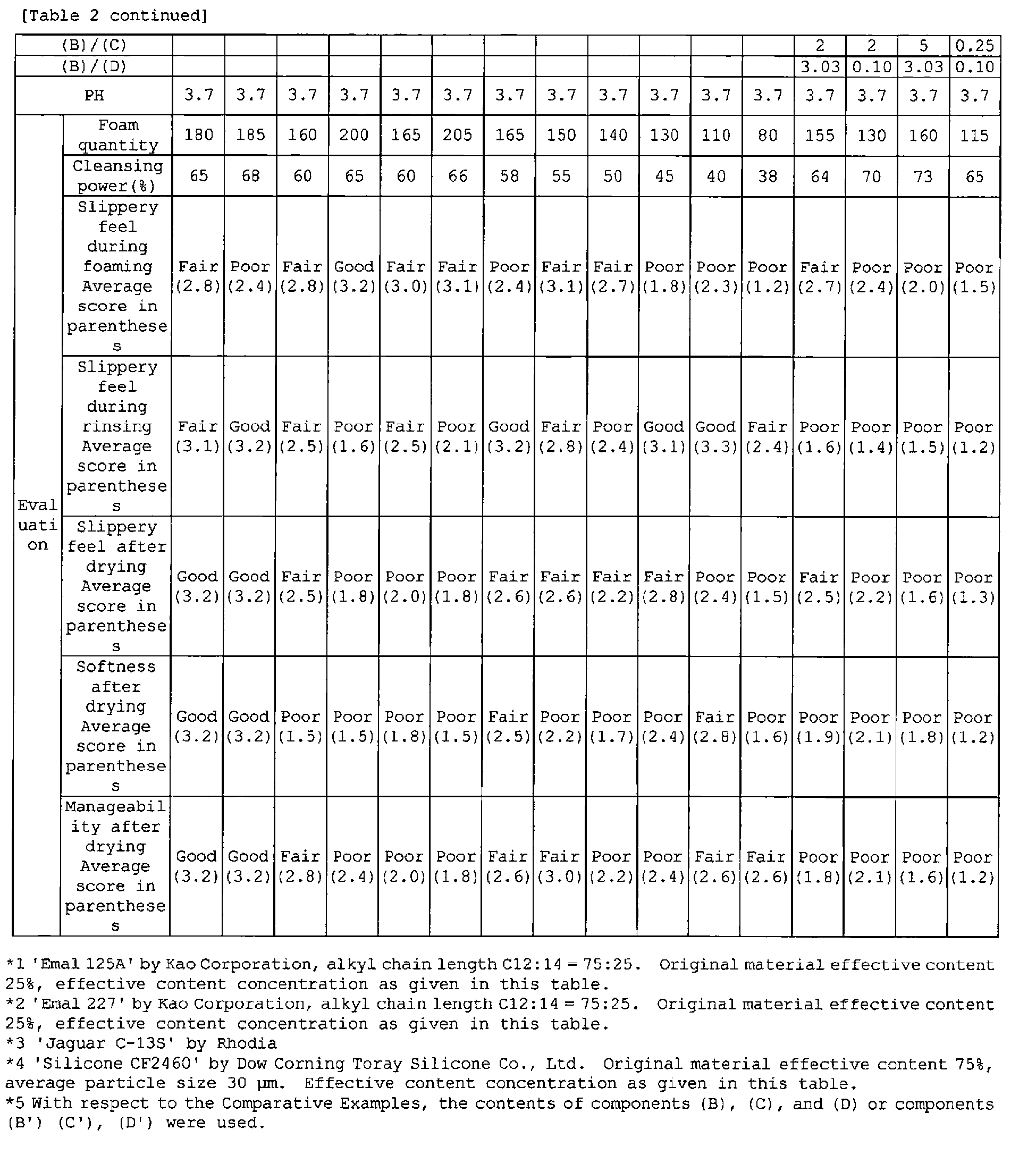
- compositions of the Examples had excellent lather and cleansing power under conditions of sebum soiling, excellent smoothness during foaming and during rinsing, and excellent hair smoothness, softness, and manageability after drying.
- Formulation examples using the aqueous hair cleansing agent of the present invention are shown below.
- Examples 16 and 17 had excellent lather and cleansing power even under conditions of sebum soiling, excellent smoothness during foaming and during rinsing, and excellent hair smoothness, softness, and manageability after drying.
Landscapes
- Health & Medical Sciences (AREA)
- Life Sciences & Earth Sciences (AREA)
- Animal Behavior & Ethology (AREA)
- General Health & Medical Sciences (AREA)
- Public Health (AREA)
- Veterinary Medicine (AREA)
- Birds (AREA)
- Epidemiology (AREA)
- Emergency Medicine (AREA)
- Chemical & Material Sciences (AREA)
- Oil, Petroleum & Natural Gas (AREA)
- Cosmetics (AREA)
Abstract
(A) from 1 to 30 weight % of a sulfate type anionic surfactant represented by the general formula (1) below
R1O(CH2CH2O)nSO3M (1)
wherein in the general formula (1) above, R1 presents an alkyl group or alkenyl group having 10 to 18 carbon atoms, M presents an alkali metal, an alkaline earth metal, ammonium, an alkanolamine, or a basic amino acid, and n presents a number from 0 to 5 as a mass average;
(B) from 0.1 to 10 weight % of a polyoxypropylene alkyl ether type nonionic surfactant represented by the general formula (2) below
R2O(CH2CH(CH3)O)mH (2)
wherein in the general formula (2) above, R2 presents a straight chain or branched alkyl group or alkenyl group having 8 to 10 carbon atoms, and m presents a number from 0.5 to 4 as a mass average;
(C) from 0.1 to 5 weight % of a monoalkyl glyceryl ether or monoalkenyl glyceryl ether type nonionic surfactant having an alkyl group or alkenyl group having 4 to 12 carbon atoms; and
(D) from 0.1 to 10 weight % of an alkylhydroxysulfobetaine type amphoteric surfactant represented by the general formula (3) below

wherein in the general formula (3) above, R3 presents an alkyl group having 10 to 14 carbon atoms,
the mass ratio of components (B) and (D) being (B)/(D) = 3/2 to 1/4.
Description
- The present invention relates to an aqueous hair cleansing agent.
- In the case of a conventional aqueous hair cleansing agent, if the scalp is soiled due to sebum, or a styling agent is attached to the hair, lather and foam quality, which are basic aspects of performance are degraded, and it is difficult for sufficient cleansing power to be exhibited.
- In order to obtain an aqueous hair cleansing agent having good lather and high cleansing power, it is preferable to use, as a main cleansing agent, a strong acid-based anionic surfactant having the same charge as that of the hair and the scalp. In order to further enhance lather and cleansing power, an auxiliary surfactant such as a nonionic surfactant or an amphoteric surfactant is generally formulated therewith. Among the auxiliary surfactants, the ones that are most commonly used in aqueous hair cleansing agents are a fatty acid monoethanolamide as the nonionic surfactant and a fatty acid amidopropyl betaine as the amphoteric surfactant, but when the amount of sebum is large or when a styling agent is used, lather is poor and it is difficult for sufficient cleansing power to be exhibited.
- Therefore, in order to enhance the lather of a cleansing agent, Patent Documents 1 to 3 disclose a technique of using a strong acid-type anionic surfactant in combination with a monoalkyl glyceryl ether or a polyoxypropylene octyl ether as a nonionic surfactant.
-
- [Patent Document 1] Japanese patent publication No.
JP-A-2001-107096 - [Patent Document 2] Japanese patent publication No.
JP-A-2007-197420 - [Patent Document 3] Japanese patent publication No.
JP-A-2008-031468 - In accordance with the present invention, there is provided an aqueous hair cleansing agent containing components (A), (B), (C), and (D) below:
- (A) from 1 to 30 weight % of a sulfate type anionic surfactant represented by the general formula (1) below
R1O(CH2CH2O)nSO3M (1)
wherein in the general formula (1) above, R1 presents an alkyl group or alkenyl group having 10 to 18 carbon atoms, M presents an alkali metal, an alkaline earth metal, ammonium, an alkanolamine, or a basic amino acid, and n presents a number from 0 to 5 as a mass average; - (B) from 0.1 to 10 weight % of a polyoxypropylene alkyl ether type nonionic surfactant represented by the general formula (2) below,
R2O(CH2CH(CH3)O)mH (2)
wherein in the general formula (2) above, R2 presents a straight chain or branched alkyl group or alkenyl group having 8 to 10 carbon atoms, and m presents a number from 0.5 to 4 as a mass average; - (C) from 0.1 to 5 weight % of a monoalkyl glyceryl ether or monoalkenyl glyceryl ether type nonionic surfactant having an alkyl group or alkenyl group having 4 to 12 carbon atoms; and
- (D) from 0.1 to 10 weight % of an alkylhydroxysulfobetaine type amphoteric surfactant represented by the general formula (3) below

the mass ratio of components (B) and (D) being (B)/(D) = 3/2 to 1/4. - Even if the cleansing agents described in Patent Documents 1 to 3 are used, the lather and cleansing power are not sufficient when there is a large amount of sebum or styling agent.
- The present invention relates to an aqueous hair cleansing agent exhibiting sufficient lather and high cleansing power even under conditions in which there is sebum or a styling agent.
- The present inventor has found that an aqueous hair cleansing agent having excellent lather and cleansing power even under conditions of a large amount of sebum and the like is obtained for the first time by mixing, with an aqueous hair cleansing agent having an alkyl sulfate or an alkyl ether sulfate, which are sulfate type anionic surfactants, as a main cleansing component, a polyoxypropylene alkyl ether, a monoalkyl glyceryl ether or a monoalkenyl glyceryl ether, and an alkylhydroxysulfobetaine at a specific ratio as auxiliary surfactants.
- In accordance with the present invention, there is obtained an aqueous hair cleansing agent having excellent lather and cleansing power even under conditions in which there is soiling due to sebum and the like.
- The aqueous hair cleansing agent of the present invention is an aqueous hair cleansing agent containing components (A), (B), (C), and (D) below:
- (A) from 1 to 30 weight % of a sulfate type anionic surfactant represented by the general formula (1) below
R1O(CH2CH2O)nSO3M (1)
wherein in the general formula (1) above, R1 presents an alkyl group or alkenyl group having 10 to 18 carbon atoms, M presents an alkali metal, an alkaline earth metal, ammonium, an alkanolamine, or a basic amino acid, and n presents a number from 0 to 5 as a mass average - (B) from 0.1 to 10 weight % of a polyoxypropylene alkyl ether type nonionic surfactant represented by the general formula (2) below
R2O(CH2CH(CH3)O)mH (2)
wherein in the general formula (2) above, R2 presents a straight chain or branched alkyl group or alkenyl group having 8 to 10 carbon atoms, and m presents a number from 0.5 to 4 as a mass average - (C) from 0.1 to 5 weight % of a monoalkyl glyceryl ether or monoalkenyl glyceryl ether type nonionic surfactant having an alkyl group or alkenyl group having 4 to 12 carbon atoms
- (D) from 0.1 to 10 weight % of an alkylhydroxysulfobetaine type amphoteric surfactant represented by the general formula (3) below

the mass ratio of components (B) and (D) being (B)/(D) = 3/2 to 1/4. - First, component (A) is explained.
In the aqueous hair cleansing agent of the present invention, component (A) is an alkyl sulfate or an alkyl ether sulfate, which are sulfate type anionic surfactants, represented by the general formula (1). -
R1O(CH2CH2O)nSO3M (1)
In the general formula (1) above, R1 presents an alkyl group or alkenyl group having 10 to 18 carbon atoms, M presents an alkali metal, an alkaline earth metal, ammonium, an alkanolamine, or a basic amino acid, and n presents a number from 0 to 5 as a mass average. - Among them, a polyoxyethylene alkyl ether sulfate for which R1 in the general formula (1) above is an alkyl group having 12 to 14 carbon atoms, n presents 1 or 2 as a mass average, and M is ammonium or sodium is more preferable from the viewpoint of lather (quantity) and high cleansing power.
- With regard to component (A), one type thereof may be used or two or more types may be used in combination, and the content thereof is 1 to 30 weight % of the aqueous hair cleansing agent of the present invention, preferably 5 to 25 weight %, more preferably 8 to 20 weight %, and even more preferably 9 to 15 weight %, in terms of lather (quantity) and viscosity of the aqueous hair cleansing agent.
- Component (B) is now explained.
In the aqueous hair cleansing agent of the present invention, component (B) is a polyoxypropylene alkyl ether type nonionic surfactant represented by the general formula (2). -
R2O(CH2CH (CH3)O)mH (2)
In the general formula (2) above, R2 presents a straight chain or branched alkyl group or alkenyl group having 8 to 10 carbon atoms, and m presents a number from 0.5 to 4 as a mass average. - Among them, a polyoxypropylene octyl ether for which R2 in the general formula (2) above is an alkyl group having 8 carbon atoms and m is a number from 2 to 3 as a mass average is more preferable from the viewpoint of quick lathering, smoothness during rinsing and after drying, and suppression of strange odor as a starting material.
- With regard to component (B), one type thereof may be used or two or more types may be used in combination, and the content thereof is 0.1 to 10 weight % of the aqueous hair cleansing agent of the present invention, preferably 0.2 to 5 weight %, more preferably 0.3 to 2 weight %, and even more preferably 0.5 to 1.5 weight %, in terms of lather (quantity) and smoothness during rinsing.
- Component (C) is now explained.
In the aqueous hair cleansing agent of the present invention, component (C) is a monoalkyl glyceryl ether or monoalkenyl glyceryl ether type nonionic surfactant having an alkyl group or alkenyl group having 4 to 12 carbon atoms. - Among them, the alkyl group or alkenyl group is preferably a straight chain or branched alkyl group having 4 to 10 carbon atoms, and more preferably a straight chain or branched alkyl group having 8 to 10 carbon atoms, from the viewpoint of quick lathering and cleansing power. Specific examples include an n-butyl group, an isobutyl group, an n-pentyl group, a 2-methylbutyl group, an isopentyl group, an n-hexyl group, an isohexyl group, an n-heptyl group, an n-octyl group, a 2-ethylhexyl group, an n-decyl group, and an isodecyl group. Among them, a branched alkyl group is preferable, and a 2-ethylhexyl group and an isodecyl group are more preferable.
- With regard to component (C), one type thereof may be used or two or more types may be used in combination, and the content thereof is 0.1 to 5 weight % of the aqueous hair cleansing agent of the present invention, preferably 0.2 to 3 weight %, and more preferably 0.3 to 1.5 weight %, in terms of lather and cleansing power.
- Component (D) is now explained.
In the aqueous hair cleansing agent of the present invention, component (D) is an alkylhydroxysulfobetaine type amphoteric surfactant represented by the general formula (3) below. -
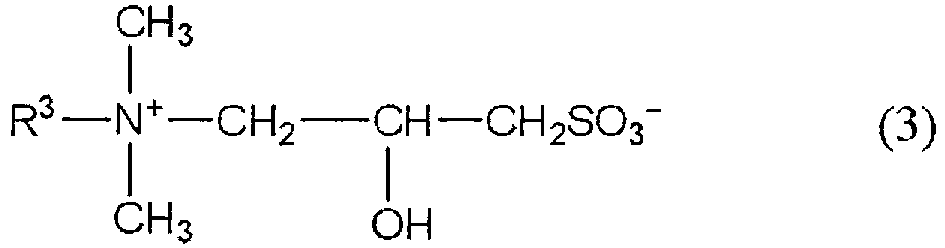
- Among them, R3 in the general formula (3) above is more preferably an alkyl group having 12 to 14 carbon atoms from the viewpoint of lather and cleansing power under conditions in which there is soiling due to sebum and the like, and the viscosity of the aqueous hair cleansing agent.
- With regard to component (D), one type thereof may be used or two or more types may be used in combination, and the content thereof is 0.1 to 10 weight % of the aqueous hair cleansing agent of the present invention, preferably 0.3 to 5 weight %, and more preferably 0.5 to 3 weight %, in terms of lather and cleansing power under conditions in which there is soiling due to sebum and the like, and the viscosity of the aqueous hair cleansing agent.
- On the other hand, with regard to the alkylhydroxysulfobetaine as component (D), which is an amphoteric surfactant used in the present invention, since the anionic group is a strong acid-based sulfonic acid group, even if the pH is 4 or below, since the anionic group is dissociated, it has the properties of an amphoteric surfactant without being influenced by pH and it can exhibit high lather and cleansing power even under conditions in which there is soiling due to sebum, regardless of the pH.
- Furthermore, the mass ratio of components (B) and (C) is preferably (B)/(C) = 3/1 to 1/2, and more preferably 2/1 to 1/1, from the viewpoint of lather and cleansing power under conditions in which there is soiling due to sebum and the like, smoothness during foaming and during rinsing, and smoothness, softness, and manageability after drying.
- Furthermore, the mass ratio of component (B) and (D) is preferably (B)/(D) = 3/2 to 1/4, and more preferably 3/2 to 1/3, from the viewpoint of lather and cleansing power under conditions in which there is soiling due to sebum and the like, smoothness during foaming and during rinsing, and smoothness, softness, and manageability after drying.
- The aqueous hair cleansing agent of the present invention can provide higher lather and cleansing power by containing a combination of components (A) to (D) above at a specific ratio and can provide hair that is smooth during foaming and during rinsing by reducing friction of the hair and hair that is smooth, soft, and easy to manage after drying.
- The aqueous hair cleansing agent of the present invention may have further formulated therewith (E) an organic carboxylic acid or a salt thereof in order to improve smoothness and manageability after drying.
- The organic carboxylic acid is preferably a dicarboxylic acid (optionally having a hydroxy group) or a hydroxymonocarboxylic acid. Specifically, examples of the dicarboxylic acid optionally having a hydroxy group include malonic acid, succinic acid, glutaric acid, adipic acid, maleic acid, fumaric acid, phthalic acid, oxalic acid, malic acid, and tartaric acid, and examples of the hydroxymonocarboxylic acid include glycolic acid, lactic acid, hydroxyacrylic acid, oxybutyric acid, and glyceric acid. Among them, glycolic acid, lactic acid, malonic acid, maleic acid, and malic acid are preferable. Lactic acid and malic acid are more preferable. Furthermore, examples of a salt of these organic carboxylic acids include a salt with an alkali metal, an alkaline earth metal, ammonia, or an organic amine compound.
- With regard to the organic carboxylic acid or a salt thereof, one type thereof may be used or two or more types may be used in combination, and the content thereof is preferably 0.1 to 5 weight % of the aqueous hair cleansing agent, more preferably 0.2 to 3 weight %, and even more preferably 0.5 to 2 weight %, in terms of it being higher than the quantity that is used for the purpose of simply adjusting the pH and providing hair smoothness and manageability after drying.
- The aqueous hair cleansing agent of the present invention when diluted 20 times with water preferably has a pH at 25°C of 1 to 5, more preferably a pH of 2 to 4.5, and even more preferably a pH of 3 to 4, in terms of the organic carboxylic acid making the hair exhibit the maximum smoothness and manageability.
- In order to further improve the cleansing performance, the aqueous hair cleansing agent of the present invention may contain an anionic surfactant other than component (A), a nonionic surfactant other than components (B) and (C), or an amphoteric surfactant other than component (D).
- As the anionic surfactant other than component (A), a sulfuric acid-based, sulfonic acid-based, or carboxylic acid-based surfactant may be used. Examples thereof include an alkylene sulfosuccinate phenyl alkyl ether sulfate, a sulfosuccinate alkyl ester salt, a polyoxyalkylene sulfosuccinate alkyl ester salt, an alkanesulfonate, a higher fatty acid salt, and an alkyl ether carboxylic acid and a salt thereof; among them an alkyl ether carboxylic acid or a salt thereof is preferable, and an alkyl ether carboxylic acid or a salt thereof having an alkyl group having 12 to 14 carbon atoms is more preferable, from the viewpoint of low irritation and smoothness during rinsing.
- Examples of the nonionic surfactant other than components (B) and (C) include a polyoxyalkylene sorbitan fatty acid ester, a polyoxyalkylene sorbitol fatty acid ester, a polyoxyalkylene glycerol fatty acid ester, a polyoxyalkylene fatty acid ester, a polyoxyalkylene alkyl ether, a polyoxyalkylene alkyl phenyl ether, a polyoxyalkylene (hardened) castor oil, a sucrose fatty acid ester, a polyglycerol alkyl ether, a polyglycerol fatty acid ester, a fatty acid alkanolamide, and an alkylglycoside.
- Among them, a polyoxyalkylene sorbitan fatty acid ester such as a polyoxyethylene sorbitan fatty acid ester, a polyoxyalkylene fatty acid ester such as a polyoxyalkylene (C8 to C20) fatty acid ester, a polyoxyethylene alkyl ether such as polyoxyethylene lauryl ether, a polyoxyalkylene (hardened) castor oil such as polyoxyethylene hardened castor oil, and an alkylglycoside are preferable from the viewpoint of lather (foam quantity). A polyoxyethylene alkyl ether having an alkyl group having 12 to 18 carbon atoms is more preferable.
- Furthermore, a fatty acid alkanolamide is also suitable; either a monoalkanolamide or a dialkanolamide may be used, and one having an acyl group having 8 to 18 carbon atoms and, even more, 10 to 16 carbon atoms is preferable from the viewpoint of lather (foam quantity). Furthermore, one having a hydroxyalkyl group having 2 to 3 carbon atoms is preferable, and examples thereof include oleic acid diethanolamide, palm kernel oil fatty acid diethanolamide, coconut oil fatty acid diethanolamide, lauric acid diethanolamide, polyoxyethylene coconut oil fatty acid monoethanolamide, coconut oil fatty acid monoethanolamide, lauric acid isopropanolamide, and lauric acid monoethanolamide.
- Examples of the amphoteric surfactant other than component (D) include betaine-based surfactants. Among them, an alkyldimethylaminoacetic acid betaine or a fatty acid amidopropyl betaine is preferable from the viewpoint of lather (foam quantity) and viscosity, and a fatty acid amidopropyl betaine is more preferable. The fatty acid amidopropyl betaine is preferably one having an acyl group having 8 to 18 carbon atoms, and more preferably 10 to 16 carbon atoms, and is even more preferably lauramidopropyl betaine, palm kernel oil fatty acid amidopropyl betaine, coconut oil fatty acid amidopropyl betaine, and the like. When an amphoteric surfactant other than component (D) is formulated therewith, the content thereof is preferably no greater than the content of component (D), more preferably no greater than 0.5 weight %, and even more preferably no greater than 1/3 as a ratio by mass relative to component (D).
- With regard to the surfactants other than (A), (B), (C), and (D), one type or two or more types may be used in combination in the aqueous hair cleansing agent, but when the aqueous hair cleansing agent of the present invention is prepared in the form of an aqueous liquid cleansing agent, it is more preferable to use, together with components (A), (B), (C), and (D), a fatty acid amidopropyl betaine and a fatty acid alkanolamide since appropriate viscosity and a smooth feel during rinsing are obtained.
- The content of the surfactants other than (A), (B), (C), and (D) is preferably 0.01 to 10 weight % of the aqueous hair cleansing agent of the present invention since a good foam-increasing effect is obtained. It is more preferably 0.1 to 8 weight %, even more preferably 0.2 to 4 weight %, and even more preferably 0.5 to 1.5 weight % from the above-mentioned point.
- In order to improve ease of running the fingers through the hair during rinsing and finishing after drying, a cationic surfactant, a cationized polymer, and a silicone may be formulated with the aqueous hair cleansing agent of the present invention.
- Examples of the cationic surfactant include an alkyltrimethylammonium salt, an alkoxytrimethylammonium salt, a dialkyldimethylammonium salt, an alkyldimethylamine salt, an alkoxydimethylamine salt, and an alkylamidodimethylamine salt.
- Examples include those represented by the general formula below.
R11-N+(Me)3X- (4)
In the general formula (4) above, R11 presents an alkyl group having 12 to 22 carbon atoms, Me presents a methyl group, and X presents a halogen (chlorine or bromine).
Specific examples include cetyltrimethylammonium chloride, stearyltrimethylammonium chloride and behenyltrimethylammonium chloride. - Examples include those represented by the general formula below.
R12-O-R13-N+(Me)3X- (5)
In the general formula (5) above, R12 presents an alkyl group having 12 to 22 carbon atoms, R13 presents an ethylene group or a propylene group, Me presents a methyl group, and X presents a halogen (chlorine or bromine).
Specific examples include stearoxypropyltrimethylammonium chloride, stearoxyethyltrimethylammonium chloride, and stearoxyhydroxypropyltrimethylammonium chloride. - Examples include those represented by the general formula below.
R14 2-N+(Me)2X- (6)
In the general formula (6) above, R14 presents an alkyl group having 12 to 22 carbon atoms or a benzyl group, Me presents a methyl group, and X presents a halogen (chlorine or bromine).
Specific examples include distearyldimethylammonium chloride. - Examples include those represented by the general formula below.
R15-N(Me)2 (7)
In the general formula (7), R15 presents an alkyl group having 12 to 22 carbon atoms, and Me presents a methyl group.
Specific examples include an organic acid salt of behenyldimethylamine and stearyldimethylamine. - Examples include those represented by the general formula below.
R16-O-R17-N(Me)2 (8)
In the general formula (8), R16 presents an alkyl group having 12 to 22 carbon atoms, R17 presents an ethylene group or a propylene group, and Me presents a methyl group. - Examples include those represented by the general formula below.
R18-C(=O)NH-R19-N(Me)2 (9)
In the general formula (9) above, R18 presents an alkyl group having 11 to 21 carbon atoms, R19 presents an ethylene group or a propylene group, and Me presents a methyl group. - Examples of the cationic surfactant other than (i) to (vi) above include lanolin fatty acid aminopropylethyldimethylammonium ethylsulfate (ethylsulfate of an alkanoylaminopropyldimethylethylammonium, the alkanoyl group being derived from lanolin), lanolin fatty acid aminoethyltriethylammonium ethylsulfate, lanolin fatty acid aminopropyltriethylammonium ethylsulfate, lanolin fatty acid aminoethyltrimethylammonium methylsulfate, lanolin fatty acid aminopropylethyldimethylammonium methylsulfate, isoalkanoic acid (C14 to C20) aminopropylethyldimethylammonium ethylsulfate, isoalkanoic acid (C18 to C22) aminopropylethyldimethylammonium ethylsulfate, isostearic acid aminopropylethyldimethylammonium ethylsulfate, isononanoic acid aminopropylethyldimethylammonium ethylsulfate, and an alkyltrimethylammonium saccharide.
- With regard to the cationic surfactant, two or more types thereof may be used in combination, and the content thereof is preferably 0.01 to 10 weight % of the aqueous hair cleansing agent of the present invention, more preferably 0.05 to 5 weight %, and even more preferably 0.1 to 2 weight %, in terms of smoothness from the time of washing hair to the time of rinsing.
- Next, as the cationized polymer, there can be cited a cationized cellulose derivative, a cationic starch, a cationized fenugreek gum derivative, a cationized guar gum derivative, a cationized tara gum derivative, a cationized locust bean gum derivative, a cationized quassia derivative, a cationized xanthan gum derivative, a diallyl quaternary ammonium salt/acrylamide copolymer, a vinylimidazolium trichloride/vinylpyrrolidone copolymer, a hydroxyethylcellulose/dimethyldiallylammonium chloride copolymer, a vinylpyrrolidone/quaternized dimethylaminoethyl methacrylate copolymer, a polyvinylpyrrolidone/alkylamino acrylate copolymer, a polyvinylpyrrolidone/alkylamino acrylate/vinylcaprolactam copolymer, a vinylpyrrolidone/methacrylamidopropyltrimethylammonium chloride copolymer, an alkylacrylamide/acrylate/alkylaminoalkylacrylamide/polyethylene glycol methacrylate copolymer, an adipic acid/dimethylamino hydroxypropylethylenetriamine copolymer (Cartaretin, Sandoz, USA), cationic polymers described in
JP-A-53-139734 JP-A-60-36407 - Furthermore, for example, commercially available products such as Merquat 550 (NALCO, copolymer of acrylamide and a diallyldimethylammonium salt; CTFA name Polyquaternium-7), Luviquat FC370 (BASF, copolymer of 1-vinyl-2-pyrrolidone and 1-vinyl-3-methylimidazolium salt; CTFA name Polyquaternium-16), Gafquat 755N (ISP, copolymer of 1-vinyl-2-pyrrolidone and dimethylaminoethyl methacrylate; CTFA name Polyquaternium-11), Ucare Polymer JR and the Ucare LR series (Amerchol, salt of reaction product between trimethylammonium substituted epoxide and hydroxyethylcellulose; CTFA name Polyquaternium-10), Poiz C-60H, Poiz C-80M, and Poiz C-150L (Kao Corporation, salt of reaction product between trimethylammonium substituted epoxide and hydroxyethylcellulose; CTFA name Polyquaternium-10), the Jaguar series (Rhodia, salt of reaction product between trimethylammonium substituted epoxide and guar gum), Catinal CF-100 (Toho Chemical Industry Co., Ltd., salt of reaction product between trimethylammonium substituted epoxide and fenugreek gum), Catinal CTR-100 (Toho Chemical Industry Co., Ltd., salt of reaction product between trimethylammonium substituted epoxide and tara gum), and Catinal CLB-100 (Toho Chemical Industry Co., Ltd., salt of reaction product between trimethylammonium substituted epoxide and locust bean gum) may be used.
- With regard to these cationized polymers, two or more types may be used in combination, and the content thereof is preferably 0.01 to 3 weight % of the aqueous hair cleansing agent of the present invention, more preferably 0.05 to 2 weight %, and even more preferably 0.1 to 1 weight %, in terms of smoothness from the time of washing hair to the time of rinsing.
- Examples of silicones include those listed below.
- Examples include those represented by the general formula below.
(Me)3Si-[(Me)2SiO]d-Si(Me)3 (10)
In the general formula (10) above, Me presents a methyl group and d is a number from 3 to 2 × 10⁴. - A polydimethylsiloxane is present as dispersed particles in the aqueous hair cleansing agent, and the average particle size of the dispersed particles is preferably 0.1 to 100 µm, more preferably 0.1 to no greater than 30 µm, even more preferably 0.1 to no greater than 4 µm, and even more preferably 0.1 to no greater than 2 µm, from the viewpoint of finishing after drying and storage stability of the aqueous hair cleansing agent.
- The average particle size of a polydimethylsiloxane emulsion is the median diameter measured by a laser light scattering method, and it may be measured using a normal particle size analyzer employing laser light scattering, for example an LS-130 from Coulter.
- As a polydimethylsiloxane, for example, ones commercially available as 'Silicone CF24501 by Dow Corning Toray Silicone Co., Ltd. containing 60 weight % of a polydimethylsiloxane oil for which d in the general formula (10) is 300 to 6,500 and having an average particle size of 0.8 µm, or 'Silicone CF2460' by Dow Corning Toray Silicone Co., Ltd. containing 75 weight % of a polydimethylsiloxane oil for which d is 300 to 6, 500 and having an average particle size of 20 µm may be used.
- Such a polydimethylsiloxane is preferably contained at 0.01 to 10 weight % of the aqueous hair cleansing agent of the present invention, more preferably 0.05 to 6 weight %, even more preferably 0.3 to 3 weight %, and even more preferably 0.5 to 2 weight %, in terms of improving foam texture during hair washing, and texture and luster after drying.
- Various types of amino-modified silicones may be used, and those having an average molecular weight of about 3 × 10³ to 1 × 10⁵ and described under the name Amodimethicone in the CTFA Dictionary (Cosmetic Ingredient Dictionary, USA) 9th Edition, 2002, Volume 1, p. 107 are more preferable. Examples of commercially available products include SM 8704C (Dow Corning Toray Silicone Co., Ltd.), DC 929 (Dow Corning Corporation), KT 1989 (GE Toshiba Silicone Co., Ltd.), 8500 Conditioning Agent, DOW CORNING TORAY SS-3588, and DOW CORNING TORAY SILSTYLE 104 (Dow Corning Toray Silicone Co., Ltd.).
- Other than those mentioned above, there can be cited a polyether-modified silicone, a polymethylphenylsiloxane, a fatty acid-modified silicone, an alcohol-modified silicone, an alkoxy-modified silicone, an epoxy-modified silicone, a fluorine-modified silicone, a cyclic silicone, an alkyl-modified silicone, and the like.
- With regard to these amino-modified silicones and the other silicones, two or more types may be used in combination, and the content thereof is preferably 0.01 to 5 weight % of the aqueous hair cleansing agent of the present invention, more preferably 0.05 to 2 weight %, and even more preferably 0.1 to 1 weight %, in terms of smoothness from the time of washing the hair to the time of rinsing.
- The aqueous hair cleansing agent of the present invention may further contain a pearlescent agent containing an ethylene glycol monofatty acid ester, an ethylene glycol difatty acid ester, an ethylene glycol monoalkyl ether, or an ethylene glycol dialkyl ether.
- Examples of the ethylene glycol monofatty acid ester include ethylene glycol monostearic acid ester and ethylene glycol monobehenic acid ester, and examples of the ethylene glycol difatty acid ester include ethylene glycol distearic acid ester and ethylene glycol dibehenic acid ester. Examples of the ethylene glycol monoalkyl ether include ethylene glycol monostearyl ether, and examples of the ethylene glycol dialkyl ether include ethylene glycol distearyl ether.
Among them, ethylene glycol distearic acid ester is preferable from the viewpoint of a pearl appearance. - With regard to the above, two or more types may be used in combination, and the content thereof is preferably 0.1 to 10 weight % of the aqueous hair cleansing agent of the present invention, more preferably 0.5 to 5 weight %, and even more preferably 1 to 4 weight %, in terms of improving the storage stability of the aqueous hair cleansing agent, improving smoothness during foaming and during rinsing, and improving the stability of the aqueous hair cleansing agent.
- Furthermore, the aqueous hair cleansing agent of the present invention may comprise an oil as another conditioning agent. Examples of the oil include hydrocarbons such as squalene, squalane, liquid paraffin, liquid isoparaffin, and cycloparaffin; glycerides such as castor oil, cacao oil, mink oil, avocado oil, olive oil, sunflower oil, and camellia oil; waxes such as beeswax, spermaceti, lanolin, and carnauba wax; alcohols such as cetyl alcohol, oleyl alcohol, stearyl alcohol, isostearyl alcohol, 2-octyldodecanol, glycerol, myristyl alcohol, behenyl alcohol, and cetostearyl alcohol; esters such as isopropyl palmitate, isopropyl myristate, octyldodecyl myristate, hexyl laurate, cetyl lactate, propylene glycol monostearate, oleyl oleate, hexadecyl 2-ethylhexanoate, isononyl isononanoate, and tridecyl isononanoate; higher fatty acids such as capric acid, lauric acid, myristic acid, palmitic acid, stearic acid, behenic acid, oleic acid, coconut oil fatty acid, isostearic acid, and isopalmitic acid; and in addition isostearyl glyceryl ether, polyoxypropylene butyl ether, and the like. Among them, a higher fatty acid, a higher alcohol, and a glyceride are preferable, and lauric acid, myristyl alcohol, cetyl alcohol, stearyl alcohol, sunflower oil, and camellia oil are more preferable. With regard to these oils, one type thereof may be used or two or more types may be used in combination, and the content thereof is preferably 0.1 to 2 weight % of the aqueous hair cleansing agent of the present invention, more preferably 0.2 to 1.5 weight %, and even more preferably 0.3 to 1.0 weight %.
- The aqueous hair cleansing agent of the present invention may comprise a viscosity adjusting agent; examples of the viscosity adjusting agent include hydroxyethylcellulose, methylcellulose, polyethylene glycol, polypropylene glycol, ethylene glycol, propylene glycol, isoprene glycol, ethanol, benzyl alcohol, benzyloxyethanol, phenoxyethanol, a clay mineral, and a salt (sodium chloride, ammonium chloride, sodium citrate, and the like), and among them benzyl alcohol, ethanol, polypropylene glycol, sodium chloride, and sodium citrate are preferable. With regard to the viscosity adjusting agent, two or more types may be used in combination, and the amount thereof used is preferably 0.01 to 5 weight % of the aqueous hair cleansing agent of the present invention, more preferably 0.05 to 4 weight %, and even more preferably 0.1 to 3 weight %, in terms of foam quantity and foam quality.
- The aqueous hair cleansing agent of the present invention may contain, in addition to the above-mentioned components, a component that is usually used in an aqueous hair cleansing agent as appropriate according to the intended purpose. Examples of such a component include a preservative; a chelating agent; a moisturizing agent such as sorbitol or panthenol; a coloring agent such as a dye or a pigment; an extract such as a polar solvent extract of eucalyptus, a protein obtained from a pearl or a mother-of-pearl-containing shell or a hydrolysate thereof, a protein obtained from honey, royal jelly, or silk or a hydrolysate thereof, an extract containing a protein obtained from legume seeds, a ginseng extract, a rice germ extract, a fucus extract, an aloe extract, an Alpinia speciosa leaf extract, or a chlorella extract; a pearlescent agent such as titanium oxide; a fragrance; a pigment; a UV absorber; an antioxidant; and other components described in Encyclopedia of Shampoo Ingredients (Hunting, Anthony L.L., 1983, MICELLE PRESS).
- The form of the aqueous hair cleansing agent of the present invention may be selected as appropriate from a liquid, a gel, and the like, but is preferably a liquid using as a solvent water or a lower alcohol, and more preferably water.
- The present invention is not limited to the above-mentioned embodiments, and modification, improvement, and the like within the scope that can achieve the present invention are included in the present invention.
- The aqueous hair cleansing agents shown in Table 1 were prepared by a standard method and evaluated by the evaluation methods below. The results are shown in Tables 1 and 2. The pH is a value at 25°C when diluted 20 times by mass with water.
- A bundle of human hair having a length of 25 cm, a width of 5.5 cm, and a weight of 20 g was preliminarily washed using 2 g of a 10 weight % aqueous solution of sodium lauryl ether (2) sulfate, fully rinsed with hot water at 40°C, and then, in a state in which it contained 30 g of moisture, coated with 0.1 g of model sebum (mixed liquid of S-lanolin 50 weight %, L-lanolin 45 weight %, oleic acid 5%) and 2 g of the aqueous hair cleansing agent, followed by foaming for 15 seconds. Subsequently, the foam was squeezed out from the hair into a volumetric flask, and the volume of the foam was measured. The larger the value, the better the lather under conditions of sebum soiling.
- The cleansing power was determined by measuring change in color before and after cleansing using a colorimeter when model sebum colored with carbon black was used.
First, a circle having a diameter of 3 cm was drawn on an upper arm part, and the color inside the circle was measured using a colorimeter. When measuring using a colorimeter, the L value, a value, and b value were measured, and the initial values were defined as L0, a0, and b0 respectively. Subsequently, model sebum (S-lanolin 50 weight %, L-lanolin 45 weight %, oleic acid 5%, carbon black 0.1 weight %) colored with carbon black was spread uniformly inside the circle drawn on the upper arm part, and measurement with the colorimeter was carried out again (L1, a1, b1). Subsequently, the upper arm part was coated with 0.1 g of an aqueous solution of the aqueous hair cleansing agent diluted to 10 weight %, massaged for 30 seconds, then rinsed with hot water at 40 degrees for 30 seconds, and measured using the colorimeter (L2, a2, b2) after wiping off the moisture. - The cleansing power (%) was calculated from the equation below using the values obtained by measurement using the colorimeter.
-

- A bundle of human hair having a length of 25 cm, a width of 5.5 cm, and a weight of 10 g was lightly rinsed with hot water at 40°C, excess moisture was removed, and foaming was carried out using 0.5 g of the aqueous hair cleansing agent for about 30 seconds. In this process, sensory evaluation of a slippery feel was carried out using the 5 grades below. Evaluation was carried out by five people, and the average value was obtained. An average of at least 4.0 was denoted as 'excellent', at least 3.2 but less than 4.0 as 'good', at least 2.5 but less than 3.2 as 'fair', and less than 2.5 as 'poor'.
-
- 5: very slippery
- 4: fairly slippery
- 3: normal feel
- 2: not very slippery
- 1: not slippery
- A bundle of human hair having a length of 25 cm, a width of 5.5 cm, and a weight of 10 g was lightly rinsed with hot water at 40°C, excess moisture was removed, and foaming was carried out using 0.5 g of the aqueous hair cleansing agent for about 30 seconds. Subsequently, while rinsing the hair bundle having foam attached thereto with hot water at 40°C and a flow rate of 2L/min, sensory evaluation of a slippery feel was carried out using the 5 grades below. Evaluation was carried out by five people, and the average value was obtained. An average of at least 4.0 was denoted as 'excellent', at least 3.2 but less than 4.0 as 'good', at least 2.5 but less than 3.2 as 'fair', and less than 2.5 as 'poor'.
-
- 5: very slippery
- 4: fairly slippery
- 3: normal feel
- 2: not very slippery
- 1: not slippery
- After being treated under the same conditions as for (4), the hair was dried using a drier, and sensory evaluation of a slippery feel after being fully dried was carried out using the 5 grades below. Evaluation was carried out by five people, and the average value was obtained. An average of at least 4.0 was denoted as 'excellent', at least 3.2 but less than 4.0 as 'good', at least 2.5 but less than 3.2 as 'fair', and less than 2.5 as 'poor'.
-
- 5: very slippery
- 4: fairly slippery
- 3: normal feel
- 2: not very slippery
- 1: not slippery
- After being treated under the same conditions as for (4), sensory evaluation of the softness of hair after drying was carried out using the 5 grades below. Evaluation was carried out by five people, and the average value was obtained. An average of at least 4.0 was denoted as 'excellent', at least 3.2 but less than 4.0 as 'good', at least 2.5 but less than 3.2 as 'fair', and less than 2.5 as 'poor'.
-
- 5: soft
- 4: slightly soft
- 3: normal feel
- 2: not very soft
- 1: not soft
- After being treated under the same conditions as for (4), sensory evaluation of the manageability after drying was carried out using the 5 grades below. Evaluation was carried out by five people, and the average value was obtained. An average of at least 4.0 was denoted as 'excellent', at least 3.2 but less than 4.0 as 'good', at least 2.5 but less than 3.2 as 'fair', and less than 2.5 as 'poor'.
-
- 5: manageable
- 4: slightly manageable
- 3: normal feel
- 2: not very manageable
- 1: not manageable
-


-
- *1 'Emal 125A' by Kao Corporation, alkyl chain length C12:14 = 75:25. Original material effective content 25%, effective content concentration as given in Tables 1 and 2.
- *2 'Emal 227' by Kao Corporation, alkyl chain length C12:14 = 75:25. Original material effective content 25%, effective content concentration as given in Tables 1 and 2.
- *3 'Jaguar C-13S' by Rhodia
- *4 ' Silicone CF2460' by Dow Corning Toray Silicone Co., Ltd. Original material effective content 75%, average particle size 30 µm. Effective content concentration as given in Tables 1 and 2.
- From Tables 1 and 2, it can be seen that the compositions of the Examples had excellent lather and cleansing power under conditions of sebum soiling, excellent smoothness during foaming and during rinsing, and excellent hair smoothness, softness, and manageability after drying.
- Formulation examples using the aqueous hair cleansing agent of the present invention are shown below.
-
(weight %) Ammonium polyoxyethylene (1) lauryl ether sulfate 12.0 Polyoxypropylene (3) octyl ether 0.65 Monoisodecyl glyceryl ether 0.35 Laurylhydroxysulfobetaine 1.70 Malic acid 0.75 Myristyl alcohol 0.40 Cationized guar gum 0.28 ('Jaguar C-17', Rhodia) Cationized cellulose 0.25 ('Poiz C-80M', Kao Corporation) Diallyldimethylammonium chloride/acrylamide copolymer %) 1.8 ('Merquat 550', OndeoNalco, effective content 8.5 weight Polydimethylsiloxane 1.0 ('Silicone CF2460', Dow Corning Toray Silicone Co., Ltd., effective content 75%, amount formulated was effective content concentration) Ethylene glycol distearyl ether 2.0 Polypropylene glycol (mass average molecular weight 400) 1.5 Benzyl alcohol 0.3 Ethanol 3.0 Camellia oil 0.01 Panthenol 0.05 Royal jelly 0.01 Purified honey 0.01 Shea butter 0.01 Silk extract 0.05 Lanolin acid 0.01 Stearoxydimethylamine 0.01 Glycylglycine 0.05 Rose hip extract 0.01 Coconut extract 0.01 Alpinia speciosa leaf extract 0.01 Ginseng extract 0.01 Lotus flower extract 0.01 Licorice extract 0.01 Paramethylsulfonic acid 0.35 Sodium chloride 0.2 Fragrance appropriate amount pH adjusting agent (caustic potash) amount to make pH 3.9 Ion exchanged water Balance -
(weight %) Sodium polyoxyethylene (2) lauryl ether sulfate 11.0 Polyoxypropylene (3) octyl ether 1.0 Mono-2-ethylhexyl glyceryl ether 1.0 Laurylhydroxysulfobetaine 2.0 Polyoxyethylene (6) stearyl ether 2.0 Lauric acid 0.8 Dipotassium glycyrrhizinate 0.1 Coconut oil fatty acid monoethanolamide 1.0 Lauramidopropyl betaine 0.5 Cationized locust bean gum 0.2 ('Catinal CLB-100', Toho Chemical Industry Co., Ltd.) Cationized fenugreek gum 0.2 ('Catinal CLB-100', Toho Chemical Industry Co., Ltd.) Polydimethylsiloxane 1.5 ('Silicone CF2450', Dow Corning Toray Silicone Co., Ltd., effective content 60%, amount added was effective content concentration) Aminopolyether-modified silicone 0.2 ('Silicone SILSTYLE 104', Dow Corning Toray Silicone Co., Ltd.) Ethylene glycol distearyl ether 1.5 Dipropylene glycol 3.0 Benzyloxyethanol 0.5 1-Menthol 1.0 Sodium chloride 0.2 Fragrance appropriate amount pH adjusting agent (caustic soda) amount to make pH 3.5 Ion exchanged water Balance - It can be seen that Examples 16 and 17 had excellent lather and cleansing power even under conditions of sebum soiling, excellent smoothness during foaming and during rinsing, and excellent hair smoothness, softness, and manageability after drying.
Claims (20)
- An aqueous hair cleansing agent comprising components (A), (B), (C) and (D) below:(A) from 1 to 30 weight % of a sulfate type anionic surfactant represented by the general formula (1) below
R1O(CH2CH2O)nSO3M (1)
wherein in the general formula (1) above, R1 presents an alkyl group or alkenyl group having 10 to 18 carbon atoms, M presents an alkali metal, an alkaline earth metal, ammonium, an alkanolamine, or a basic amino acid, and n presents a number from 0 to 5 as a mass average;(B) from 0.1 to 10 weight % of a polyoxypropylene alkyl ether type nonionic surfactant represented by the general formula (2) below,
R2O(CH2CH(CH3)O)mH (2)
wherein in the general formula (2) above, R2 presents a straight chain or branched alkyl group or alkenyl group having 8 to 10 carbon atoms, and m presents a number from 0.5 to 4 as a mass average;(C) from 0.1 to 5 weight % of a monoalkyl glyceryl ether or monoalkenyl glyceryl ether type nonionic surfactant having an alkyl group or alkenyl group having 4 to 12 carbon atoms; and(D) from 0.1 to 10 weight % of an alkylhydroxysulfobetaine type amphoteric surfactant represented by the general formula (3) belowwherein in the general formula (3) above, R3 presents an alkyl group having 10 to 14 carbon atoms,
the mass ratio of components (B) and (D) being (B)/(D) = 3/2 to 1/4. - The aqueous hair cleansing agent according to Claim 1, wherein the mass ratio of components (B) and (C) is (B)/(C) = 3/1 to 1/2.
- The aqueous hair cleansing agent according to Claim 1 or 2, further comprising at least one type of (E) an organic carboxylic acid or a salt thereof.
- The aqueous hair cleansing agent according to Claim 3, wherein component (E) comprises at least one or more selected from the group consisting of glycolic acid, lactic acid, malonic acid, maleic acid and malic acid.
- The aqueous hair cleansing agent according to Claim 3 or 4, comprising component (E) at 0.1 to 5 weight % of the aqueous hair cleansing agent.
- The aqueous hair cleansing agent according to any one of Claims 1 to 5, wherein the aqueous hair cleansing agent has a pH of 1 to 5 at 25°C when diluted 20 times by weight with water.
- The aqueous hair cleansing agent according to any one of Claims 1 to 6, wherein component (A) is a polyoxyethylene alkyl ether sulfate for which R1 in the general formula (1) is an alkyl group having 12 to 14 carbon atoms, n presents a number from 1 to 2 as a mass average, and M is ammonium or sodium.
- The aqueous hair cleansing agent according to any one of Claims 1 to 7, wherein component (B) is a polyoxypropylene octyl ether for which R2 in the general formula (2) above is an alkyl group having 8 carbon atoms and m is a number from 2 to 3 as a mass average.
- The aqueous hair cleansing agent according to any one of Claims 1 to 8, wherein component (C) is a monoalkyl glyceryl ether type nonionic surfactant having a 2-ethylhexyl group or an isodecyl group.
- The aqueous hair cleansing agent according to any one of Claims 1 to 9, wherein component (D) is an alkylhydroxysulfobetaine type amphoteric surfactant represented by the general formula (3) below

- The aqueous hair cleansing agent according to any one of Claims 1 to 10, wherein the mass ratio of components (B) and (D) is (B)/(D) = 3/2 to 1/3.
- The aqueous hair cleansing agent according to any one of Claims 1 to 10, wherein the mass ratio of component (B) and (C) is (B)/(C) = 2/1 to 1/1.
- The aqueous hair cleansing agent according to any one of Claims 1 to 12, comprising from 9 to 15 weight % of component (A) by weight of the aqueous hair cleansing agent.
- The aqueous hair cleansing agent according to any one of Claims 1 to 13, comprising from 0.3 to 2 weight % of component (B) by weight of the aqueous hair cleansing agent.
- The aqueous hair cleansing agent according to any one of Claims 1 to 14, comprising from 0.2 to 3 weight % of component (C) by weight of the aqueous hair cleansing agent.
- The aqueous hair cleansing agent according to any one of Claims 1 to 13, comprising from 0.5 to 3 weight % of component (D) by weight of the aqueous hair cleansing agent.
- The aqueous hair cleansing agent according to any one of Claims 1 to 16, further comprising no greater than 0.5 weight % of an amphoteric surfactant other than component (D) by weight of the aqueous hair cleansing agent.
- The aqueous hair cleansing agent according to any one of Claims 1 to 17, comprising an aliphatic amidopropyl betaine or an aliphatic alkanolamide as a surfactant other than component (D).
- The aqueous hair cleansing agent according to any one of Claims 1 to 18, comprising from 0.01 to 10 weight % of a surfactant other than components (A), (B), (C), and (D).
- The aqueous hair cleansing agent according to any one of Claims 1 to 19, wherein the aqueous hair cleansing agent has a pH of 2 to 4.5 at 25°C when diluted 20 times by weight with water.
Applications Claiming Priority (2)
| Application Number | Priority Date | Filing Date | Title |
|---|---|---|---|
| JP2010139514A JP5341029B2 (en) | 2010-06-18 | 2010-06-18 | Aqueous hair cleanser |
| PCT/JP2011/003343 WO2011158483A1 (en) | 2010-06-18 | 2011-06-13 | Aqueous hair cleansing agent |
Publications (3)
| Publication Number | Publication Date |
|---|---|
| EP2583666A1 true EP2583666A1 (en) | 2013-04-24 |
| EP2583666A4 EP2583666A4 (en) | 2015-05-27 |
| EP2583666B1 EP2583666B1 (en) | 2017-07-26 |
Family
ID=45347899
Family Applications (1)
| Application Number | Title | Priority Date | Filing Date |
|---|---|---|---|
| EP11795391.9A Not-in-force EP2583666B1 (en) | 2010-06-18 | 2011-06-13 | Aqueous hair cleansing agent |
Country Status (6)
| Country | Link |
|---|---|
| US (1) | US8530398B2 (en) |
| EP (1) | EP2583666B1 (en) |
| JP (1) | JP5341029B2 (en) |
| CN (1) | CN102946851B (en) |
| TW (1) | TWI465255B (en) |
| WO (1) | WO2011158483A1 (en) |
Cited By (1)
| Publication number | Priority date | Publication date | Assignee | Title |
|---|---|---|---|---|
| WO2018153658A1 (en) * | 2017-02-23 | 2018-08-30 | Beiersdorf Daily Chemical Wuhan Co. Ltd. (Früher C-Bons) | Silicone-free shampoo composition |
Families Citing this family (17)
| Publication number | Priority date | Publication date | Assignee | Title |
|---|---|---|---|---|
| JP6246563B2 (en) * | 2013-11-05 | 2017-12-13 | 花王株式会社 | Oil-in-water skin cosmetics |
| JP2015168666A (en) * | 2014-03-10 | 2015-09-28 | 花王株式会社 | Aqueous hair detergent |
| KR20210082277A (en) | 2015-05-01 | 2021-07-02 | 로레알 | Use of active agents during chemical treatments |
| SG10201603461TA (en) * | 2015-05-08 | 2016-12-29 | Kao Corp | Hair cleansing agent |
| BR112018010381B1 (en) | 2015-11-24 | 2021-08-17 | L'oreal | HAIR TREATMENT COMPOSITION, HAIR TREATMENT SYSTEM, HAIR TREATMENT AND HAIR COLOR CHANGE METHODS, AND MULTI-COMPARTMENT KIT FOR HAIR COLOR OR SHAPE CHANGE |
| CN108495687B (en) | 2015-11-24 | 2021-11-09 | 欧莱雅 | Composition for treating hair |
| US10828244B2 (en) | 2015-11-24 | 2020-11-10 | L'oreal | Compositions for treating the hair |
| US11135150B2 (en) | 2016-11-21 | 2021-10-05 | L'oreal | Compositions and methods for improving the quality of chemically treated hair |
| US11433011B2 (en) | 2017-05-24 | 2022-09-06 | L'oreal | Methods for treating chemically relaxed hair |
| US11596588B2 (en) | 2017-12-29 | 2023-03-07 | L'oreal | Compositions for altering the color of hair |
| US20210267876A1 (en) * | 2018-06-12 | 2021-09-02 | Kao Corporation | Detergent |
| CN112236129B (en) * | 2018-06-12 | 2024-02-09 | 花王株式会社 | Cleaning agent |
| JP7110797B2 (en) * | 2018-07-30 | 2022-08-02 | 日油株式会社 | Hair cleanser composition |
| US11090249B2 (en) | 2018-10-31 | 2021-08-17 | L'oreal | Hair treatment compositions, methods, and kits for treating hair |
| US11419809B2 (en) | 2019-06-27 | 2022-08-23 | L'oreal | Hair treatment compositions and methods for treating hair |
| EP4074301B1 (en) * | 2019-12-12 | 2026-01-28 | Kao Corporation | Hair cleanser composition, kit and method for hair cleaning |
| EP4159189A4 (en) | 2020-05-29 | 2025-05-21 | Kao Corporation | AEROSOL-TYPE HAIR CLEANSER |
Family Cites Families (23)
| Publication number | Priority date | Publication date | Assignee | Title |
|---|---|---|---|---|
| US3928251A (en) * | 1972-12-11 | 1975-12-23 | Procter & Gamble | Mild shampoo compositions |
| LU76955A1 (en) | 1977-03-15 | 1978-10-18 | ||
| LU84894A1 (en) | 1983-07-01 | 1985-04-17 | Oreal | HAIR COMPOSITION AND METHOD FOR TREATING HAIR |
| JPH1180797A (en) * | 1997-09-02 | 1999-03-26 | Lion Corp | Liquid detergent composition |
| US6221816B1 (en) | 1998-12-25 | 2001-04-24 | Kao Corporation | Detergent composition comprising a monoglyceryl ether |
| JP2001107096A (en) | 1999-10-12 | 2001-04-17 | Kao Corp | Aqueous liquid detergent composition |
| JP3964592B2 (en) * | 2000-02-02 | 2007-08-22 | 花王株式会社 | Cleaning composition |
| JP4127777B2 (en) * | 2002-08-09 | 2008-07-30 | 花王株式会社 | Hair cleaning composition |
| JP4147068B2 (en) * | 2002-08-09 | 2008-09-10 | 花王株式会社 | Hair cleaning composition |
| JP4965869B2 (en) | 2005-02-28 | 2012-07-04 | 花王株式会社 | Surfactant composition |
| JP2007116586A (en) * | 2005-10-24 | 2007-05-10 | Technoaid:Kk | Facility supervisory system |
| AU2006309718B2 (en) | 2005-10-31 | 2011-06-02 | Kao Corporation | Thickening/Foam-Promoting Agent |
| JP3961554B1 (en) | 2005-10-31 | 2007-08-22 | 花王株式会社 | Thickening and foaming agent |
| ES2648997T3 (en) | 2005-12-28 | 2018-01-09 | Kao Corporation | Composition of skin or hair wash |
| KR101453106B1 (en) * | 2006-04-07 | 2014-10-27 | 카오카부시키가이샤 | Cleansing composition |
| US20070269397A1 (en) | 2006-05-22 | 2007-11-22 | Kao Corporation | Aqueous hair cleansing agent |
| CN101077332B (en) * | 2006-05-22 | 2012-05-23 | 花王株式会社 | Aqueous hair cleansing agent |
| KR101394685B1 (en) | 2006-07-04 | 2014-05-14 | 카오카부시키가이샤 | Cleansing composition |
| JP5041894B2 (en) | 2006-07-04 | 2012-10-03 | 花王株式会社 | Cleaning composition |
| JP2008069084A (en) * | 2006-09-12 | 2008-03-27 | Kao Corp | Hair cleanser |
| JP5325568B2 (en) * | 2008-04-04 | 2013-10-23 | 花王株式会社 | Conditioning composition for hair |
| JP2010235523A (en) | 2009-03-31 | 2010-10-21 | Kao Corp | Aqueous hair cleanser |
| WO2010113447A1 (en) | 2009-03-31 | 2010-10-07 | 花王株式会社 | Aqueous hair cleansing agent |
-
2010
- 2010-06-18 JP JP2010139514A patent/JP5341029B2/en active Active
-
2011
- 2011-06-13 EP EP11795391.9A patent/EP2583666B1/en not_active Not-in-force
- 2011-06-13 WO PCT/JP2011/003343 patent/WO2011158483A1/en not_active Ceased
- 2011-06-13 US US13/805,193 patent/US8530398B2/en active Active
- 2011-06-13 CN CN201180029324.2A patent/CN102946851B/en active Active
- 2011-06-17 TW TW100121275A patent/TWI465255B/en active
Cited By (1)
| Publication number | Priority date | Publication date | Assignee | Title |
|---|---|---|---|---|
| WO2018153658A1 (en) * | 2017-02-23 | 2018-08-30 | Beiersdorf Daily Chemical Wuhan Co. Ltd. (Früher C-Bons) | Silicone-free shampoo composition |
Also Published As
| Publication number | Publication date |
|---|---|
| WO2011158483A1 (en) | 2011-12-22 |
| JP5341029B2 (en) | 2013-11-13 |
| US8530398B2 (en) | 2013-09-10 |
| EP2583666A4 (en) | 2015-05-27 |
| TWI465255B (en) | 2014-12-21 |
| US20130102513A1 (en) | 2013-04-25 |
| CN102946851B (en) | 2014-08-06 |
| JP2012001512A (en) | 2012-01-05 |
| TW201204404A (en) | 2012-02-01 |
| EP2583666B1 (en) | 2017-07-26 |
| CN102946851A (en) | 2013-02-27 |
Similar Documents
| Publication | Publication Date | Title |
|---|---|---|
| EP2583666B1 (en) | Aqueous hair cleansing agent | |
| US8632758B2 (en) | Aqueous hair cleansing agent | |
| CN102361628B (en) | Aqueous hair cleansing agent | |
| EP1531783B1 (en) | Detergent compositions | |
| US7604796B2 (en) | Hair cleansing compositions | |
| JP2005068051A (en) | Cleaning fee | |
| JP5607311B2 (en) | Aqueous hair cleanser | |
| WO2004014334A1 (en) | Hair detergent compositions | |
| US20060160714A1 (en) | Aqueous hair cleansing composition | |
| JP5426212B2 (en) | Aqueous hair cleanser | |
| EP3435967B1 (en) | Hair conditioning composition containing pentaerythritol ester and ppg alkyl ether | |
| DE60309121T2 (en) | Aqueous hair cleansing composition | |
| EP1754467B1 (en) | Water-based shampoo | |
| JP5426213B2 (en) | Aqueous hair cleanser | |
| JP4331673B2 (en) | Aqueous hair cleanser | |
| JP2007176895A (en) | Aqueous hair cleanser | |
| CN100506205C (en) | water-based hair cleanser | |
| JP2006182729A (en) | Aqueous hair cleanser |
Legal Events
| Date | Code | Title | Description |
|---|---|---|---|
| PUAI | Public reference made under article 153(3) epc to a published international application that has entered the european phase |
Free format text: ORIGINAL CODE: 0009012 |
|
| 17P | Request for examination filed |
Effective date: 20130110 |
|
| AK | Designated contracting states |
Kind code of ref document: A1 Designated state(s): AL AT BE BG CH CY CZ DE DK EE ES FI FR GB GR HR HU IE IS IT LI LT LU LV MC MK MT NL NO PL PT RO RS SE SI SK SM TR |
|
| DAX | Request for extension of the european patent (deleted) | ||
| RA4 | Supplementary search report drawn up and despatched (corrected) |
Effective date: 20150428 |
|
| RIC1 | Information provided on ipc code assigned before grant |
Ipc: A61Q 5/02 20060101ALI20150421BHEP Ipc: A61K 8/46 20060101ALI20150421BHEP Ipc: A61K 8/36 20060101ALI20150421BHEP Ipc: A61K 8/39 20060101ALI20150421BHEP Ipc: A61K 8/92 20060101ALI20150421BHEP Ipc: A61K 8/44 20060101ALI20150421BHEP Ipc: A61K 8/86 20060101AFI20150421BHEP |
|
| RIC1 | Information provided on ipc code assigned before grant |
Ipc: A61K 8/86 20060101AFI20170112BHEP Ipc: A61K 8/36 20060101ALI20170112BHEP Ipc: A61Q 5/02 20060101ALI20170112BHEP Ipc: A61K 8/92 20060101ALI20170112BHEP Ipc: A61K 8/44 20060101ALI20170112BHEP Ipc: A61K 8/39 20060101ALI20170112BHEP Ipc: A61K 8/46 20060101ALI20170112BHEP |
|
| GRAP | Despatch of communication of intention to grant a patent |
Free format text: ORIGINAL CODE: EPIDOSNIGR1 |
|
| INTG | Intention to grant announced |
Effective date: 20170221 |
|
| GRAS | Grant fee paid |
Free format text: ORIGINAL CODE: EPIDOSNIGR3 |
|
| GRAA | (expected) grant |
Free format text: ORIGINAL CODE: 0009210 |
|
| AK | Designated contracting states |
Kind code of ref document: B1 Designated state(s): AL AT BE BG CH CY CZ DE DK EE ES FI FR GB GR HR HU IE IS IT LI LT LU LV MC MK MT NL NO PL PT RO RS SE SI SK SM TR |
|
| REG | Reference to a national code |
Ref country code: GB Ref legal event code: FG4D |
|
| REG | Reference to a national code |
Ref country code: CH Ref legal event code: EP |
|
| REG | Reference to a national code |
Ref country code: AT Ref legal event code: REF Ref document number: 911802 Country of ref document: AT Kind code of ref document: T Effective date: 20170815 |
|
| REG | Reference to a national code |
Ref country code: IE Ref legal event code: FG4D |
|
| REG | Reference to a national code |
Ref country code: DE Ref legal event code: R096 Ref document number: 602011039984 Country of ref document: DE |
|
| REG | Reference to a national code |
Ref country code: NL Ref legal event code: MP Effective date: 20170726 |
|
| REG | Reference to a national code |
Ref country code: LT Ref legal event code: MG4D |
|
| REG | Reference to a national code |
Ref country code: AT Ref legal event code: MK05 Ref document number: 911802 Country of ref document: AT Kind code of ref document: T Effective date: 20170726 |
|
| PG25 | Lapsed in a contracting state [announced via postgrant information from national office to epo] |
Ref country code: SE Free format text: LAPSE BECAUSE OF FAILURE TO SUBMIT A TRANSLATION OF THE DESCRIPTION OR TO PAY THE FEE WITHIN THE PRESCRIBED TIME-LIMIT Effective date: 20170726 Ref country code: NL Free format text: LAPSE BECAUSE OF FAILURE TO SUBMIT A TRANSLATION OF THE DESCRIPTION OR TO PAY THE FEE WITHIN THE PRESCRIBED TIME-LIMIT Effective date: 20170726 Ref country code: AT Free format text: LAPSE BECAUSE OF FAILURE TO SUBMIT A TRANSLATION OF THE DESCRIPTION OR TO PAY THE FEE WITHIN THE PRESCRIBED TIME-LIMIT Effective date: 20170726 Ref country code: FI Free format text: LAPSE BECAUSE OF FAILURE TO SUBMIT A TRANSLATION OF THE DESCRIPTION OR TO PAY THE FEE WITHIN THE PRESCRIBED TIME-LIMIT Effective date: 20170726 Ref country code: NO Free format text: LAPSE BECAUSE OF FAILURE TO SUBMIT A TRANSLATION OF THE DESCRIPTION OR TO PAY THE FEE WITHIN THE PRESCRIBED TIME-LIMIT Effective date: 20171026 Ref country code: HR Free format text: LAPSE BECAUSE OF FAILURE TO SUBMIT A TRANSLATION OF THE DESCRIPTION OR TO PAY THE FEE WITHIN THE PRESCRIBED TIME-LIMIT Effective date: 20170726 Ref country code: LT Free format text: LAPSE BECAUSE OF FAILURE TO SUBMIT A TRANSLATION OF THE DESCRIPTION OR TO PAY THE FEE WITHIN THE PRESCRIBED TIME-LIMIT Effective date: 20170726 |
|
| PG25 | Lapsed in a contracting state [announced via postgrant information from national office to epo] |
Ref country code: ES Free format text: LAPSE BECAUSE OF FAILURE TO SUBMIT A TRANSLATION OF THE DESCRIPTION OR TO PAY THE FEE WITHIN THE PRESCRIBED TIME-LIMIT Effective date: 20170726 Ref country code: BG Free format text: LAPSE BECAUSE OF FAILURE TO SUBMIT A TRANSLATION OF THE DESCRIPTION OR TO PAY THE FEE WITHIN THE PRESCRIBED TIME-LIMIT Effective date: 20171026 Ref country code: PL Free format text: LAPSE BECAUSE OF FAILURE TO SUBMIT A TRANSLATION OF THE DESCRIPTION OR TO PAY THE FEE WITHIN THE PRESCRIBED TIME-LIMIT Effective date: 20170726 Ref country code: LV Free format text: LAPSE BECAUSE OF FAILURE TO SUBMIT A TRANSLATION OF THE DESCRIPTION OR TO PAY THE FEE WITHIN THE PRESCRIBED TIME-LIMIT Effective date: 20170726 Ref country code: RS Free format text: LAPSE BECAUSE OF FAILURE TO SUBMIT A TRANSLATION OF THE DESCRIPTION OR TO PAY THE FEE WITHIN THE PRESCRIBED TIME-LIMIT Effective date: 20170726 Ref country code: GR Free format text: LAPSE BECAUSE OF FAILURE TO SUBMIT A TRANSLATION OF THE DESCRIPTION OR TO PAY THE FEE WITHIN THE PRESCRIBED TIME-LIMIT Effective date: 20171027 Ref country code: IS Free format text: LAPSE BECAUSE OF FAILURE TO SUBMIT A TRANSLATION OF THE DESCRIPTION OR TO PAY THE FEE WITHIN THE PRESCRIBED TIME-LIMIT Effective date: 20171126 |
|
| PG25 | Lapsed in a contracting state [announced via postgrant information from national office to epo] |
Ref country code: DK Free format text: LAPSE BECAUSE OF FAILURE TO SUBMIT A TRANSLATION OF THE DESCRIPTION OR TO PAY THE FEE WITHIN THE PRESCRIBED TIME-LIMIT Effective date: 20170726 Ref country code: RO Free format text: LAPSE BECAUSE OF FAILURE TO SUBMIT A TRANSLATION OF THE DESCRIPTION OR TO PAY THE FEE WITHIN THE PRESCRIBED TIME-LIMIT Effective date: 20170726 Ref country code: CZ Free format text: LAPSE BECAUSE OF FAILURE TO SUBMIT A TRANSLATION OF THE DESCRIPTION OR TO PAY THE FEE WITHIN THE PRESCRIBED TIME-LIMIT Effective date: 20170726 |
|
| REG | Reference to a national code |
Ref country code: DE Ref legal event code: R097 Ref document number: 602011039984 Country of ref document: DE |
|
| REG | Reference to a national code |
Ref country code: FR Ref legal event code: PLFP Year of fee payment: 8 |
|
| PG25 | Lapsed in a contracting state [announced via postgrant information from national office to epo] |
Ref country code: SM Free format text: LAPSE BECAUSE OF FAILURE TO SUBMIT A TRANSLATION OF THE DESCRIPTION OR TO PAY THE FEE WITHIN THE PRESCRIBED TIME-LIMIT Effective date: 20170726 Ref country code: IT Free format text: LAPSE BECAUSE OF FAILURE TO SUBMIT A TRANSLATION OF THE DESCRIPTION OR TO PAY THE FEE WITHIN THE PRESCRIBED TIME-LIMIT Effective date: 20170726 Ref country code: SK Free format text: LAPSE BECAUSE OF FAILURE TO SUBMIT A TRANSLATION OF THE DESCRIPTION OR TO PAY THE FEE WITHIN THE PRESCRIBED TIME-LIMIT Effective date: 20170726 Ref country code: EE Free format text: LAPSE BECAUSE OF FAILURE TO SUBMIT A TRANSLATION OF THE DESCRIPTION OR TO PAY THE FEE WITHIN THE PRESCRIBED TIME-LIMIT Effective date: 20170726 |
|
| PLBE | No opposition filed within time limit |
Free format text: ORIGINAL CODE: 0009261 |
|
| STAA | Information on the status of an ep patent application or granted ep patent |
Free format text: STATUS: NO OPPOSITION FILED WITHIN TIME LIMIT |
|
| 26N | No opposition filed |
Effective date: 20180430 |
|
| PG25 | Lapsed in a contracting state [announced via postgrant information from national office to epo] |
Ref country code: SI Free format text: LAPSE BECAUSE OF FAILURE TO SUBMIT A TRANSLATION OF THE DESCRIPTION OR TO PAY THE FEE WITHIN THE PRESCRIBED TIME-LIMIT Effective date: 20170726 |
|
| REG | Reference to a national code |
Ref country code: CH Ref legal event code: PL |
|
| REG | Reference to a national code |
Ref country code: BE Ref legal event code: MM Effective date: 20180630 |
|
| REG | Reference to a national code |
Ref country code: IE Ref legal event code: MM4A |
|
| PG25 | Lapsed in a contracting state [announced via postgrant information from national office to epo] |
Ref country code: LU Free format text: LAPSE BECAUSE OF NON-PAYMENT OF DUE FEES Effective date: 20180613 Ref country code: MC Free format text: LAPSE BECAUSE OF FAILURE TO SUBMIT A TRANSLATION OF THE DESCRIPTION OR TO PAY THE FEE WITHIN THE PRESCRIBED TIME-LIMIT Effective date: 20170726 |
|
| PG25 | Lapsed in a contracting state [announced via postgrant information from national office to epo] |
Ref country code: CH Free format text: LAPSE BECAUSE OF NON-PAYMENT OF DUE FEES Effective date: 20180630 Ref country code: LI Free format text: LAPSE BECAUSE OF NON-PAYMENT OF DUE FEES Effective date: 20180630 Ref country code: IE Free format text: LAPSE BECAUSE OF NON-PAYMENT OF DUE FEES Effective date: 20180613 |
|
| PG25 | Lapsed in a contracting state [announced via postgrant information from national office to epo] |
Ref country code: BE Free format text: LAPSE BECAUSE OF NON-PAYMENT OF DUE FEES Effective date: 20180630 |
|
| PG25 | Lapsed in a contracting state [announced via postgrant information from national office to epo] |
Ref country code: MT Free format text: LAPSE BECAUSE OF NON-PAYMENT OF DUE FEES Effective date: 20180613 |
|
| PG25 | Lapsed in a contracting state [announced via postgrant information from national office to epo] |
Ref country code: TR Free format text: LAPSE BECAUSE OF FAILURE TO SUBMIT A TRANSLATION OF THE DESCRIPTION OR TO PAY THE FEE WITHIN THE PRESCRIBED TIME-LIMIT Effective date: 20170726 |
|
| PG25 | Lapsed in a contracting state [announced via postgrant information from national office to epo] |
Ref country code: PT Free format text: LAPSE BECAUSE OF FAILURE TO SUBMIT A TRANSLATION OF THE DESCRIPTION OR TO PAY THE FEE WITHIN THE PRESCRIBED TIME-LIMIT Effective date: 20170726 Ref country code: HU Free format text: LAPSE BECAUSE OF FAILURE TO SUBMIT A TRANSLATION OF THE DESCRIPTION OR TO PAY THE FEE WITHIN THE PRESCRIBED TIME-LIMIT; INVALID AB INITIO Effective date: 20110613 |
|
| PG25 | Lapsed in a contracting state [announced via postgrant information from national office to epo] |
Ref country code: MK Free format text: LAPSE BECAUSE OF NON-PAYMENT OF DUE FEES Effective date: 20170726 Ref country code: CY Free format text: LAPSE BECAUSE OF FAILURE TO SUBMIT A TRANSLATION OF THE DESCRIPTION OR TO PAY THE FEE WITHIN THE PRESCRIBED TIME-LIMIT Effective date: 20170726 |
|
| PG25 | Lapsed in a contracting state [announced via postgrant information from national office to epo] |
Ref country code: AL Free format text: LAPSE BECAUSE OF FAILURE TO SUBMIT A TRANSLATION OF THE DESCRIPTION OR TO PAY THE FEE WITHIN THE PRESCRIBED TIME-LIMIT Effective date: 20170726 |
|
| P01 | Opt-out of the competence of the unified patent court (upc) registered |
Effective date: 20230522 |
|
| PGFP | Annual fee paid to national office [announced via postgrant information from national office to epo] |
Ref country code: GB Payment date: 20240502 Year of fee payment: 14 |
|
| PGFP | Annual fee paid to national office [announced via postgrant information from national office to epo] |
Ref country code: DE Payment date: 20240502 Year of fee payment: 14 |
|
| PGFP | Annual fee paid to national office [announced via postgrant information from national office to epo] |
Ref country code: FR Payment date: 20240509 Year of fee payment: 14 |
|
| REG | Reference to a national code |
Ref country code: DE Ref legal event code: R119 Ref document number: 602011039984 Country of ref document: DE |
|
| GBPC | Gb: european patent ceased through non-payment of renewal fee |
Effective date: 20250613 |
|
| PG25 | Lapsed in a contracting state [announced via postgrant information from national office to epo] |
Ref country code: GB Free format text: LAPSE BECAUSE OF NON-PAYMENT OF DUE FEES Effective date: 20250613 |
|
| PG25 | Lapsed in a contracting state [announced via postgrant information from national office to epo] |
Ref country code: DE Free format text: LAPSE BECAUSE OF NON-PAYMENT OF DUE FEES Effective date: 20260101 |
|
| PG25 | Lapsed in a contracting state [announced via postgrant information from national office to epo] |
Ref country code: FR Free format text: LAPSE BECAUSE OF NON-PAYMENT OF DUE FEES Effective date: 20250630 |