EP2566628B2 - Zerstäuber mit einem gittermischer - Google Patents
Zerstäuber mit einem gittermischer Download PDFInfo
- Publication number
- EP2566628B2 EP2566628B2 EP11719471.2A EP11719471A EP2566628B2 EP 2566628 B2 EP2566628 B2 EP 2566628B2 EP 11719471 A EP11719471 A EP 11719471A EP 2566628 B2 EP2566628 B2 EP 2566628B2
- Authority
- EP
- European Patent Office
- Prior art keywords
- mixer
- atomizer
- paint
- mixing elements
- mixers
- Prior art date
- Legal status (The legal status is an assumption and is not a legal conclusion. Google has not performed a legal analysis and makes no representation as to the accuracy of the status listed.)
- Active
Links
Images


Classifications
-
- B—PERFORMING OPERATIONS; TRANSPORTING
- B05—SPRAYING OR ATOMISING IN GENERAL; APPLYING FLUENT MATERIALS TO SURFACES, IN GENERAL
- B05B—SPRAYING APPARATUS; ATOMISING APPARATUS; NOZZLES
- B05B7/00—Spraying apparatus for discharge of liquids or other fluent materials from two or more sources, e.g. of liquid and air, of powder and gas
- B05B7/02—Spray pistols; Apparatus for discharge
- B05B7/04—Spray pistols; Apparatus for discharge with arrangements for mixing liquids or other fluent materials before discharge
- B05B7/0408—Spray pistols; Apparatus for discharge with arrangements for mixing liquids or other fluent materials before discharge with arrangements for mixing two or more liquids
-
- B—PERFORMING OPERATIONS; TRANSPORTING
- B05—SPRAYING OR ATOMISING IN GENERAL; APPLYING FLUENT MATERIALS TO SURFACES, IN GENERAL
- B05B—SPRAYING APPARATUS; ATOMISING APPARATUS; NOZZLES
- B05B3/00—Spraying or sprinkling apparatus with moving outlet elements or moving deflecting elements
- B05B3/02—Spraying or sprinkling apparatus with moving outlet elements or moving deflecting elements with rotating elements
- B05B3/10—Spraying or sprinkling apparatus with moving outlet elements or moving deflecting elements with rotating elements discharging over substantially the whole periphery of the rotating member
-
- B—PERFORMING OPERATIONS; TRANSPORTING
- B01—PHYSICAL OR CHEMICAL PROCESSES OR APPARATUS IN GENERAL
- B01F—MIXING, e.g. DISSOLVING, EMULSIFYING OR DISPERSING
- B01F25/00—Flow mixers; Mixers for falling materials, e.g. solid particles
- B01F25/40—Static mixers
- B01F25/42—Static mixers in which the mixing is affected by moving the components jointly in changing directions, e.g. in tubes provided with baffles or obstructions
- B01F25/421—Static mixers in which the mixing is affected by moving the components jointly in changing directions, e.g. in tubes provided with baffles or obstructions by moving the components in a convoluted or labyrinthine path
- B01F25/423—Static mixers in which the mixing is affected by moving the components jointly in changing directions, e.g. in tubes provided with baffles or obstructions by moving the components in a convoluted or labyrinthine path by means of elements placed in the receptacle for moving or guiding the components
-
- B—PERFORMING OPERATIONS; TRANSPORTING
- B01—PHYSICAL OR CHEMICAL PROCESSES OR APPARATUS IN GENERAL
- B01F—MIXING, e.g. DISSOLVING, EMULSIFYING OR DISPERSING
- B01F25/00—Flow mixers; Mixers for falling materials, e.g. solid particles
- B01F25/40—Static mixers
- B01F25/42—Static mixers in which the mixing is affected by moving the components jointly in changing directions, e.g. in tubes provided with baffles or obstructions
- B01F25/43—Mixing tubes, e.g. wherein the material is moved in a radial or partly reversed direction
- B01F25/431—Straight mixing tubes with baffles or obstructions that do not cause substantial pressure drop; Baffles therefor
- B01F25/4316—Straight mixing tubes with baffles or obstructions that do not cause substantial pressure drop; Baffles therefor the baffles being flat pieces of material, e.g. intermeshing, fixed to the wall or fixed on a central rod
- B01F25/43161—Straight mixing tubes with baffles or obstructions that do not cause substantial pressure drop; Baffles therefor the baffles being flat pieces of material, e.g. intermeshing, fixed to the wall or fixed on a central rod composed of consecutive sections of flat pieces of material
-
- B—PERFORMING OPERATIONS; TRANSPORTING
- B05—SPRAYING OR ATOMISING IN GENERAL; APPLYING FLUENT MATERIALS TO SURFACES, IN GENERAL
- B05B—SPRAYING APPARATUS; ATOMISING APPARATUS; NOZZLES
- B05B12/00—Arrangements for controlling delivery; Arrangements for controlling the spray area
- B05B12/14—Arrangements for controlling delivery; Arrangements for controlling the spray area for supplying a selected one of a plurality of liquids or other fluent materials or several in selected proportions to a spray apparatus, e.g. to a single spray outlet
- B05B12/1418—Arrangements for controlling delivery; Arrangements for controlling the spray area for supplying a selected one of a plurality of liquids or other fluent materials or several in selected proportions to a spray apparatus, e.g. to a single spray outlet for supplying several liquids or other fluent materials in selected proportions to a single spray outlet
Definitions
- the invention relates to an atomizer, in particular a rotary atomizer, for applying a coating composition consisting of several components.
- rotary atomizers are usually used as the application device, some of which can also apply multi-component paints which consist of several coating agent components, such as, for example, a base paint and a hardener. It is important here that the various components of the multi-component lacquer are mixed as well as possible in the atomizer.
- the conventional rotary atomizers have static spiral mixers, which are also referred to as Kenics ® mixers. These spiral mixers have numerous spiral-shaped mixing elements that direct the coating agent flow radially outwards and then lead it back to the center.
- two separate spiral mixers are used, the first spiral mixer being arranged in the color tube of the rotary atomizer, while the second spiral mixer is located outside the color tube in the connection block of the rotary atomizer.
- a disadvantage of this conventional design is the fact that a relatively long overall length of the mixer is required, so that large losses of paint or detergent occur during a color change or during rinsing processes.
- the object of the invention is therefore to create a correspondingly improved atomizer with a structurally integrated mixer.
- the invention encompasses the general technical teaching of using another type of mixer, namely a so-called lattice mixer, which has numerous mixing elements which are arranged in a lattice-like arrangement.
- Grid mixers of this type are made, for example US 2004/0114461 A1 is known, so that the content of this document of the present description with regard to the structure and operation of a grid mixer is fully attributable.
- a common feature of the new mixer according to the invention with the conventional spiral mixer is that it is a static mixer in both cases. This means that the mixer itself has no moving parts, since the mixing is brought about by the flow movement of the coating agent components to be mixed with one another.
- the grid mixer differs from the conventional spiral mixer in the arrangement and design of the individual mixing elements.
- the conventionally used spiral mixer has spiral-shaped mixing elements which divert the flow of coating agent in a spiral, the mixing elements adjacent in the flow direction each having opposite deflection directions, as a result of which the mixing is effected.
- the lattice mixer used according to the invention preferably has elongated, straight, sharp-edged and rod-shaped mixing elements which are made of plastic and each have an essentially rectangular cross section. These mixing elements therefore each cause turbulence, which leads to effective mixing of the coating agent components to be mixed with one another.
- the individual mixing elements are arranged in a grid-like manner.
- a plurality of rod-shaped mixing elements are arranged together in one plane and thus form a lattice, a plurality of such lattices consisting of a plurality of mixing elements being interleaved.
- the individual mixing elements preferably have a certain angle of attack relative to the flow direction. This means that the individual mixing elements are not aligned parallel to the direction of flow, since this would only lead to a low mixing effect.
- the angle of attack of the mixing elements with respect to the direction of flow is preferably greater than 20 °, 30 ° or 40 ° and / or less than 70 °, 60 ° or 50 °. In the preferred embodiment, the angle of attack is essentially the same for all mixing elements. However, there is alternatively also the possibility that the mixing elements have different angles of attack.
- the mixer has several sections, which are arranged one behind the other in the direction of flow are and are flowed through in succession.
- the different sections can differ, for example, in the orientation of the mixing elements.
- the angle of attack of the mixing elements can fluctuate relative to the flow direction between the sections.
- the mixer has a total of more than 5, 6, 7, 8, 9, 10 or even more than 11 different sections.
- the immediately adjacent sections of the mixer are each designed differently, for example with regard to the angle of attack or the orientation and design of the mixing elements, the section after the next but one again having the same structure.
- the mixer is preferably elongated in the direction of flow and has an essentially cylindrical cross section, the mixer preferably being arranged completely inside the atomizer.
- the mixer preferably has a length in the flow direction that is less than 10 cm, 8 cm or even 6 cm. This advantageously enables the mixer to be arranged completely in the paint tube of the atomizer.
- the overall length of the mixer is therefore preferably less than the overall length of the paint tube of the atomizer.
- the atomizer according to the invention like the conventional atomizers, has a controllable main needle valve which either releases or blocks the flow of coating agent.
- the main needle valve When the main needle valve is closed, the atomizer does not apply any coating agent, so that the valve position of the main needle valve determines whether the atomizer applies the coating agent or not.
- the mixer is arranged upstream of the main needle valve so that the ready mixed coating agent is present on the main needle valve. It is advantageous here if the mixer is moved as far upstream as possible to the main needle valve in order to minimize the distance between the downstream end of the mixer and the main needle valve. This is advantageous because it reduces the amount of paint or solvent used when changing colors or rinsing.
- the line length between the downstream end of the mixer and the main needle valve is therefore preferably shorter than 10 cm, 6 cm, 5 cm, 4 cm, 3 cm, 2 cm or even shorter than 1 cm.
- the atomizer according to the invention like the conventional atomizers - has a hollow paint tube in order to supply the coating agent to be applied.
- the advantages of the grating mixer according to the invention offer the possibility that the mixer is arranged completely in the paint tube, so that under certain circumstances an additional mixer in the connection block of the atomizer can be dispensed with, which was necessary in the conventional atomizer described at the beginning.
- the paint tube can also form the casing of the usually cylindrical mixer, so that an additional mixing pipe for the casing of the mixer can be dispensed with.
- the diameter of the mixer essentially corresponds to the diameter of the paint tube in one exemplary embodiment, so that the mixer completely fills the cross section of the paint tube.
- several mixers are arranged side by side in the paint tube of the atomizer, which will be described in detail below.
- each of the two paint systems having several components, in particular a base paint and a hardener.
- a mixer is assigned to each of the two coating systems in order to mix the components of the coating system with one another.
- the mixers for the different paint systems are arranged together in the paint tube, the mixers for the different paint systems preferably being located next to one another with respect to the direction of flow. Each mixer for the different paint systems then fills only part of the cross-section of the paint tube.
- the various mixers are then preferably encased by a mixing tube in order to separate the various mixers from one another.
- mixers for the different color systems can have different mixing properties that are adapted to the properties of the respective color system in order to achieve the best possible mixing result.
- the mixers for the different paint systems are not arranged together in the paint tube.
- the mixer for the one paint system can be arranged in the paint tube, while the mixer for the other paint system is located outside the paint tube, for example in a valve or connection block of the atomizer upstream of the paint tube.
- the atomizer according to the invention has several mixers, which can also be very useful in general for optimizing the mixing result.
- Figure 1 shows a rotary atomizer 1, which can be used, for example, for painting motor vehicle body components, the rotary atomizer 1 being constructed largely conventionally, so that a detailed description of the structure and operation of the rotary atomizer 1 can be dispensed with.
- the rotary atomizer 1 has a paint tube 2 which is fastened to a connection block 3, the paint tube 2 being aligned coaxially with the axis of rotation of a bell cup shaft 4 in order to supply the coating agent to be applied.
- a grating mixer 5 is arranged in the paint tube 2 in order to mix the various components (e.g. master varnish and hardener) of the coating composition with one another.
- the lattice mixer 5 has numerous elongated, rod-shaped, sharp-edged mixing elements 6 which are arranged in a lattice-like manner, with the mixing elements 6 generating turbulence in the paint tube 2, which leads to thorough mixing.
- the grid mixer consists of a total of twelve sections 7, 8, which are arranged one behind the other in the direction of flow and flow through one after the other.
- the different sections 7, 8 of the lattice mixer 5 differ in the orientation of the individual mixing elements 6, as shown in the perspective view in FIG Figure 2 can be seen.
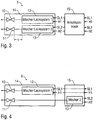
- Figure 3 shows a schematic diagram to illustrate the structure of a rotary atomizer 9 according to the invention, which is suitable for the application of two different paint systems, the first paint system consisting of a first base paint SL1 and a first hardener H1, while the second paint system consists of a second base paint SL2 and a second hardener H2.
- the rotary atomizer has two main needle valves 10, 11 and one grating mixer 12, 13 each, the two grating mixers 12, 13 being arranged together next to one another in a paint tube 14 of the rotary atomizer 9.
- the lattice mixer 12 mixes the first base paint SL1 with the first hardener H1, while the other lattice mixer 13 mixes the second base paint SL2 with the second hardener H2.
- the two grid mixers 12, 13 correspond in structure and function to the grid mixer 5 according to FIGS Figures 1 and 2nd .
- the rotary atomizer 9 also has a connection block 15 with integrated valves in this exemplary embodiment.
- the two grid mixers 12, 13 are arranged at a very short distance 1 ⁇ 5 cm upstream of the associated main needle valves 10, 11. This is advantageous because the line section to be rinsed between the lattice mixers 12, 13 and the associated main needle valves 10, 11 thus has a small volume, so that the detergent losses and the paint losses are correspondingly small.
- Figure 4 shows a modification of the embodiment according to Figure 3 , so that to avoid repetition reference is made to the above description, the same reference numerals being used for corresponding details.
- a special feature of this exemplary embodiment is the arrangement of the two grid mixers 12, 13.
- the grid mixer 12 in this exemplary embodiment is also located within the paint tube 14, whereas the other grid mixer 13 is integrated in the connection block 15.
Landscapes
- Chemical & Material Sciences (AREA)
- Dispersion Chemistry (AREA)
- Chemical Kinetics & Catalysis (AREA)
- Nozzles (AREA)
Description
- Die Erfindung betrifft einen Zerstäuber, insbesondere einen Rotationszerstäuber, zur Applikation eines aus mehreren Komponenten bestehenden Beschichtungsmittels.
- In modernen Lackieranlagen zur Lackierung von Kraftfahrzeugkarosseriebauteilen werden als Applikationsgerät üblicherweise Rotationszerstäuber eingesetzt, die teilweise auch Mehrkomponentenlacke applizieren können, die aus mehreren Beschichtungsmittelkomponenten bestehen, wie beispielsweise einem Stammlack und einem Härter. Wichtig ist hierbei, dass die verschiedenen Komponenten des Mehrkomponentenlacks in dem Zerstäuber möglichst gut miteinander vermischt werden. Hierzu weisen die herkömmlichen Rotationszerstäuber statische Wendelmischer auf, die auch als Kenics®-Mischer bezeichnet werden. Diese Wendelmischer haben zahlreiche spiralförmige Mischelemente, die den Beschichtungsmittelstrom radial nach außen richten und dann wieder zur Mitte zurück führen. Üblicherweise werden hierbei zwei getrennte Wendelmischer eingesetzt, wobei der erste Wendelmischer in dem Farbrohr des Rotationszerstäubers angeordnet ist, während sich der zweite Wendelmischer außerhalb des Farbrohrs im Anschlussblock des Rotationszerstäubers befindet.
- Nachteilig an dieser herkömmlichen Bauweise ist die Tatsache, dass eine relativ große Baulänge des Mischers erforderlich ist, so dass bei einem Farbwechsel bzw. bei Spülvorgängen große Verluste an Lack bzw. Spülmittel auftreten.
- Weiterhin offenbart
DE 82 31 663 U1 ein Farbführungsrohr in einem Zerstäuber, wobei in dem Farbführungsrohr ein statischer Mischer angeordnet ist. Auch dieser bekannte Mischer erfordert jedoch eine relativ große Baulänge. - Ferner ist zum Stand der Technik hinzuweisen auf
DE 30 40 136 A1 undUS 4 614 440 . - Weiterhin offenbart
US 2004/0114461 A1 einen sogenannten Gittermischer, wobei es sich um einen statischen Mischer handelt, der zum Mischen von hochviskosen Flüssigkeiten verwendet wird, beispielsweise in Spritzgussmaschinen. Bisher wurden derartige Gittermischer jedoch nicht in Zerstäubern eingesetzt, zumal man davon ausging, dass solche Gittermischer nur zum Mischen von hochviskosen Flüssigkeiten geeignet sind. - Ferner ist zum Stand der Technik hinzuweisen auf
US 2006/0192033 A1 undWO 2008/136827 A1 . - Schließlich offenbart
FR 2 890 876 A1 - Der Erfindung liegt deshalb die Aufgabe zugrunde, einen entsprechend verbesserten Zerstäuber mit einem baulich integrierten Mischer zu schaffen.
- Diese Aufgabe wird durch einen erfindungsgemäßen Zerstäuber gemäß dem Hauptanspruch gelöst.
- Die Erfindung umfasst die allgemeine technische Lehre, einen anderen Mischertyp zu verwenden, nämlich einen sogenannten Gittermischer, der zahlreiche Mischelemente aufweist, die gitterförmig ineinander verschränkt angeordnet sind. Derartige Gittermischer sind beispielsweise aus
US 2004/0114461 A1 bekannt, so dass der Inhalt dieser Druckschrift der vorliegenden Beschreibung hinsichtlich des Aufbaus und der Funktionsweise eines Gittermischers in vollem Umfang zuzurechnen ist. - Eine Gemeinsamkeit des erfindungsgemäßen neuen Mischers mit dem herkömmlichen Wendelmischer besteht darin, dass es sich in beiden Fällen um statische Mischer handelt. Dies bedeutet, dass der Mischer selbst keine beweglichen Teile aufweist, da die Mischung durch die Strömungsbewegung der miteinander zu mischenden Beschichtungsmittelkomponenten bewirkt wird.
- Der Gittermischer unterscheidet sich dagegen von dem herkömmlichen Wendelmischer durch die Anordnung und Gestaltung der einzelnen Mischelemente. So weist der herkömmlicherweise verwendete Wendelmischer spiralförmige Mischelemente auf, die den Beschichtungsmittelstrom spiralförmig umleiten, wobei die in Strömungsrichtung benachbarten Mischelemente jeweils entgegengesetzte Umlenkrichtungen aufweisen, wodurch die Mischung bewirkt wird. Der erfindungsgemäß verwendete Gittermischer weist dagegen vorzugsweise langgestreckte, gerade, scharfkantige und stabförmige Mischelemente auf, die aus Kunststoff bestehen und jeweils einen im Wesentlichen rechteckigen Querschnitt aufweisen. Diese Mischelemente bewirken also jeweils Turbulenzen, die zu einer effektiven Durchmischung der miteinander zu mischenden Beschichtungsmittelkomponenten führen.
- Die einzelnen Mischelemente sind hierbei gitterförmig ineinander verschränkt angeordnet. In dem bevorzugte Ausführungsbeispiel des erfindungsgemäßen Gittermischers sind jeweils mehrere stabförmige Mischelemente gemeinsam in einer Ebene angeordnet und bilden somit ein Gitter, wobei mehrere derartige Gitter aus mehreren Mischelementen ineinander verschränkt angeordnet sind.
- Weiterhin ist zu erwähnen, dass die einzelnen Mischelemente vorzugsweise einen bestimmten Anstellwinkel relativ zur Strömungsrichtung aufweisen. Dies bedeutet, dass die einzelnen Mischelemente nicht parallel zur Strömungsrichtung ausgerichtet sind, da dies nur zu einer geringen Mischwirkung führen würde. Vorzugsweise ist der Anstellwinkel der Mischelemente gegenüber der Strömungsrichtung größer als 20°, 30° oder 40° und/oder kleiner als 70°, 60° oder 50°. In dem bevorzugten Ausführungsbeispiel ist der Anstellwinkel bei allen Mischelementen im Wesentlichen gleich. Es besteht jedoch alternativ auch die Möglichkeit, dass die Mischelemente unterschiedliche Anstellwinkel aufweisen.
- Hierbei weist der Mischer mehrere Abschnitte auf, die in Strömungsrichtung hintereinander angeordnet sind und nacheinander durchströmt werden. Die verschiedenen Abschnitte können sich beispielsweise durch die Ausrichtung der Mischelemente unterscheiden. So kann beispielsweise der Anstellwinkel der Mischelemente relativ zur Strömungsrichtung zwischen den Abschnitten schwanken. In dem bevorzugten Ausführungsbeispiel der Erfindung weist der Mischer insgesamt mehr als 5, 6, 7, 8, 9, 10 oder sogar mehr als 11 verschiedene Abschnitte auf. Hierbei besteht die Möglichkeit, dass die unmittelbar benachbarten Abschnitte des Mischers jeweils unterschiedlich ausgestaltet sind, beispielsweise hinsichtlich des Anstellwinkels oder der Ausrichtung und Gestaltung der Mischelemente, wobei der jeweils übernächste Abschnitt des Mischers wieder den gleichen Aufbau aufweist.
- Weiterhin ist zu erwähnen, dass der Mischer vorzugsweise in Strömungsrichtung langgestreckt ist und einen im Wesentlichen zylindrischen Querschnitt aufweist, wobei der Mischer vorzugsweise vollständig innerhalb des Zerstäubers angeordnet ist.
- Wichtig ist ferner, dass der Mischer vorzugsweise eine Baulänge in Strömungsrichtung aufweist, die kleiner ist als 10cm, 8cm oder sogar 6cm. Dies ermöglicht es vorteilhaft, dass der Mischer vollständig in dem Farbrohr des Zerstäubers angeordnet ist. Die Baulänge des Mischers ist also vorzugsweise kleiner als die Baulänge des Farbrohrs des Zerstäubers.
- Der erfindungsgemäße Zerstäuber weist in dem bevorzugten Ausführungsbeispiel - wie auch die herkömmlichen Zerstäuber - ein steuerbares Hauptnadelventil auf, das den Beschichtungsmittelstrom wahlweise freigibt oder sperrt. Bei geschlossenem Hauptnadelventil appliziert der Zerstäuber also kein Beschichtungsmittel, so dass die Ventilstellung des Hauptnadelventils bestimmt, ob der Zerstäuber das Beschichtungsmittel appliziert oder nicht. Der Mischer ist hierbei stromaufwärts vor dem Hauptnadelventil angeordnet, so dass an dem Hauptnadelventil das fertig gemischte Beschichtungsmittel ansteht. Hierbei ist es vorteilhaft, wenn der Mischer möglichst weit stromaufwärts zu dem Hauptnadelventil hin verlagert wird, um den Abstand zwischen dem stromabwärts gelegenen Ende des Mischers und dem Hauptnadelventil zu minimieren. Dies ist vorteilhaft, weil dadurch der Lack- bzw. Lösemittelverbrauch bei einem Farbwechsel bzw. beim Spülen reduziert wird. Die Leitungslänge zwischen dem stromabwärts gelegenen Ende des Mischers und dem Hauptnadelventil ist deshalb vorzugsweise kürzer als 10cm, 6cm, 5cm, 4cm, 3cm, 2cm oder sogar kürzer als 1cm.
- Es wurde bereits vorstehend erwähnt, dass der erfindungsgemäße Zerstäuber - wie auch die herkömmlichen Zerstäuber - ein hohles Farbrohr aufweist, um das zu applizierende Beschichtungsmittel zuzuführen. Die Vorteile des erfindungsgemäßen Gittermischers bieten hierbei die Möglichkeit, dass der Mischer vollständig in dem Farbrohr angeordnet ist, so dass unter Umständen auf einen zusätzlichen Mischer in dem Anschlussblock des Zerstäubers verzichtet werden kann, was bei dem eingangs beschriebenen herkömmlichen Zerstäuber erforderlich war. Hierbei ist zu erwähnen, dass das Farbrohr auch die Ummantelung des üblicherweise zylindrischen Mischers bilden kann, so dass auf ein zusätzliches Mischrohr zur Ummantelung des Mischers verzichtet werden kann. Ferner ist zu erwähnen, dass der Durchmesser des Mischers in einem Ausführungsbeispiel im Wesentlichen dem Durchmesser des Farbrohrs entspricht, so dass der Mischer den Querschnitt des Farbrohrs vollständig ausfüllt. Es besteht jedoch im Rahmen der Erfindung auch die Möglichkeit, dass in dem Farbrohr des Zerstäubers mehrere Mischer nebeneinander angeordnet sind, was noch detailliert beschrieben wird.
- Dies ist beispielsweise dann sinnvoll, wenn der Zerstäuber zur Applizierung von verschiedenen Lacksystemen geeignet ist, wobei jedes der beiden Lacksysteme mehrere Komponenten aufweist, insbesondere einen Stammlack und einen Härter. Jedem der beiden Lacksysteme ist jeweils ein Mischer zugeordnet, um die Komponenten des Lacksystems miteinander zu mischen.
- Hierbei besteht - wie bereits vorstehend kurz erwähnt - die Möglichkeit, dass die Mischer für die verschiedenen Lacksysteme gemeinsam in dem Farbrohr angeordnet sind, wobei sich die Mischer für die verschiedenen Lacksysteme bezüglich der Strömungsrichtung vorzugsweise nebeneinander befinden. Jeder Mischer für die verschiedenen Lacksysteme füllt hierbei dann nur einen Teil des Querschnitts des Farbrohrs auf. Darüber hinaus sind die verschiedenen Mischer dann vorzugsweise durch jeweils ein Mischrohr ummantelt, um die verschiedenen Mischer voneinander zu trennen.
- Ferner ist zu erwähnen, dass die Mischer für die verschiedenen Farbsysteme unterschiedliche Mischeigenschaften aufweisen können, die an die Eigenschaften des jeweiligen Farbsystems angepasst sind, um ein möglichst optimales Mischergebnis zu erzielen.
- Alternativ besteht auch die Möglichkeit, dass die Mischer für die verschiedenen Lacksysteme nicht gemeinsam in dem Farbrohr angeordnet sind. So kann der Mischer für das eine Lacksystem in dem Farbrohr angeordnet sein, während sich der Mischer für das andere Farbsystem außerhalb des Farbrohrs befindet, beispielsweise in einem Ventil- oder Anschlussblock des Zerstäubers stromaufwärts vor dem Farbrohr.
- Allgemein ist zu erwähnen, dass der erfindungsgemäße Zerstäuber mehrere Mischer aufweist, was auch ganz allgemein zur Optimierung des Mischergebnisses sinnvoll sein kann.
- Andere vorteilhafte Weiterbildungen der Erfindung sind in den Unteransprüchen gekennzeichnet oder werden nachstehend zusammen mit der Beschreibung der bevorzugten Ausführungsbeispiele der Erfindung anhand der Figuren näher erläutert. Es zeigen:
-
Figur 1 : eine schematisierte Querschnittszeichnung eines nicht erfindungsgemäßen Rotationszerstäubers mit einem integrierten Gittermischer, -
Figur 2 : eine Perspektivansicht des Gittermischers aus dem Rotationszerstäuber gemäßFigur 1 , -
Figur 3 : ein vereinfachtes Diagramm zur Verdeutlichung des Aufbaus eines Rotationszerstäubers zur Applikation von zwei verschiedenen Lacksystemen, wobei in das Farbrohr des Rotationszerstäubers zwei Mischer integriert sind, -
Figur 4 : eine erfindungsgemäße Abwandlung vonFigur 3 , wobei der eine Mischer in dem Farbrohr angeordnet ist, während sich der andere Mischer in dem Ventilblock befindet. -
Figur 1 zeigt einen Rotationszerstäuber 1, der beispielsweise zur Lackierung von Kraftfahrzeugkarosseriebauteilen eingesetzt werden kann, wobei der Rotationszerstäuber 1 weitgehend herkömmlich aufgebaut ist, so dass auf eine detaillierte Beschreibung des Aufbaus und der Funktionsweise des Rotationszerstäubers 1 verzichtet werden kann. Für die Beschreibung der Erfindung ist lediglich wichtig, dass der Rotationszerstäuber 1 ein Farbrohr 2 aufweist, das an einem Anschlussblock 3 befestigt ist, wobei das Farbrohr 2 koaxial zur Drehachse einer Glockentellerwelle 4 ausgerichtet ist, um das zu applizierende Beschichtungsmittel zuzuführen. - In dem Farbrohr 2 ist ein Gittermischer 5 angeordnet, um die verschiedenen Komponenten (z.B. Stammlack und Härter) des Beschichtungsmittels miteinander zu vermischen.
- Der Gittermischer 5 weist zahlreiche langgestreckte, stabförmige, scharfkantige Mischelemente 6 auf, die gitterförmig ineinander verschränkt angeordnet sind, wobei die Mischelemente 6 in dem Farbrohr 2 Turbulenzen erzeugen, was zu einer guten Durchmischung führt.
- Der Gittermischer besteht hierbei aus insgesamt zwölf Abschnitten 7, 8, die in Strömungsrichtung hintereinander angeordnet sind, und nacheinander durchströmt werden. Die verschiedenen Abschnitte 7, 8 des Gittermischers 5 unterscheiden sich hierbei durch die Ausrichtung der einzelnen Mischelemente 6, wie aus der Perspektivdarstellung in
Figur 2 ersichtlich ist. -
Figur 3 zeigt ein schematisches Diagramm zur Verdeutlichung des Aufbaus eines erfindungsgemäßen Rotationszerstäubers 9, der zur Applikation von zwei verschiedenen Lacksystemen geeignet ist, wobei das erste Lacksystem aus einem ersten Stammlack SL1 und einem ersten Härter H1 besteht, während das zweite Lacksystem aus einem zweiten Stammlack SL2 und einem zweiten Härter H2 besteht. - Zur Applikation der verschiedenen Lacksysteme weist der Rotationszerstäuber zwei Hauptnadelventile 10, 11 sowie jeweils einen Gittermischer 12, 13 auf, wobei die beiden Gittermischer 12, 13 gemeinsam nebeneinander in einem Farbrohr 14 des Rotationszerstäubers 9 angeordnet sind. Der Gittermischer 12 mischt hierbei den ersten Stammlack SL1 mit dem ersten Härter H1, während der andere Gittermischer 13 den zweiten Stammlack SL2 mit dem zweiten Härter H2 mischt.
- Die beiden Gittermischer 12, 13 entsprechen hierbei in Aufbau und Funktion dem Gittermischer 5 gemäß den
Figuren 1 und2 . - Darüber hinaus weist der Rotationszerstäuber 9 auch in diesem Ausführungsbeispiel einen Anschlussblock 15 mit integrierten Ventilen auf.
- Aus der Zeichnung ist weiterhin ersichtlich, dass die beiden Gittermischer 12, 13 in einem sehr kurzen Abstand 1<5cm stromaufwärts vor den zugehörigen Hauptnadelventilen 10, 11 angeordnet sind. Dies ist vorteilhaft, weil der zu spülende Leitungsabschnitt zwischen den Gittermischern 12, 13 und den zugehörigen Hauptnadelventilen 10, 11 dadurch ein geringes Volumen aufweist, so dass auch die Spülmittelverluste bzw. die Lackverluste entsprechend klein sind.
-
Figur 4 zeigt eine Abwandlung des Ausführungsbeispiels gemäßFigur 3 , so dass zur Vermeidung von Wiederholungen auf die vorstehende Beschreibung verwiesen wird, wobei für entsprechende Einzelheiten dieselben Bezugszeichen verwendet werden. - Eine Besonderheit dieses Ausführungsbeispiels besteht in der Anordnung der beiden Gittermischer 12, 13. So befindet sich der Gittermischer 12 in diesem Ausführungsbeispiel ebenfalls innerhalb des Farbrohrs 14, wohingegen der andere Gittermischer 13 in den Anschlussblock 15 integriert ist.
- Die Erfindung ist nicht auf die vorstehend beschriebenen bevorzugten Ausführungsbeispiele beschränkt. Vielmehr ist eine Vielzahl von Varianten und Abwandlungen möglich, die ebenfalls von dem Erfindungsgedanken Gebrauch machen und deshalb in den Schutzbereich fallen. Weiterhin ist zu erwähnen, dass die Erfindung auch Schutz beansprucht für den Gegenstand der Unteransprüche unabhängig von den Merkmalen der vorangehenden Ansprüche.
-
- 1
- Rotationszerstäuber
- 2
- Farbrohr
- 3
- Anschlussblock
- 4
- Glockentellerwelle
- 5
- Gittermischer
- 6
- Mischelemente
- 7
- Abschnitt des Gittermischers
- 8
- Abschnitt des Gittermischers
- 9
- Rotationszerstäuber
- 10
- Hauptnadelventil
- 11
- Hauptnadelventil
- 12
- Gittermischer
- 13
- Gittermischer
- 14
- Farbrohr
- 15
- Anschlussblock
- H1
- Erster Härter
- H2
- Zweiter Härter
- 1
- Leitungslänge zwischen Gittermischer und Hauptnadelventil
- SL1
- Erster Stammlack
- SL2
- Zweiter Stammlack
Claims (9)
- Zerstäuber (1; 9), insbesondere Rotationszerstäuber, zur Applikation eines aus mehreren Komponenten bestehenden Beschichtungsmittels, mita) einem statischen Mischer (5; 12, 13), der die verschiedenen Komponenten (SL1, H1, SL2, H2) des Beschichtungsmittels miteinander mischt, wobei der Mischer (5; 12, 13) mehrere feststehende Mischelemente (6) aufweist und baulich in den Zerstäuber (1; 9) integriert ist,b) wobei der Mischer (5; 12, 13) ein Gittermischer ist, bei dem die Mischelemente (6) gitterförmig ineinander verschränkt angeordnet sind,c) wobei der Mischer (5; 12, 13) mehrere Abschnitte (7, 8) aufweist, die in Strömungsrichtung hintereinander angeordnet sind und nacheinander durchströmt werden,
dadurch gekennzeichnet,d) dass die Mischelemente (6) in den in Strömungsrichtung benachbarten Abschnitten (7, 8) des Mischers (5; 12, 13) unterschiedlich ausgerichtet sind, so dass sich die verschiedenen Abschnitte (7, 8) des Mischers (5; 12, 13) durch die Ausrichtung der Mischelemente (6) unterscheiden,e) dass der Zerstäuber (1; 9) zur Applizierung von mindestens zwei verschiedenen Lacksystemen geeignet ist, wobei jedes der beiden Lacksysteme mehrere Komponenten aufweist, insbesondere einen Stammlack (SL1, SL2) und einen Härter (H1, H2), undf) dass der Zerstäuber (1; 9) für jedes der beiden Lacksysteme jeweils einen Mischer (5; 12, 13) aufweist, wobei die Mischer (5; 12, 13) baulich in den Zerstäuber (1; 9) integriert sind. - Zerstäuber (1; 9) nach Anspruch 1,
dadurch gekennzeichnet,a) dass die einzelnen Mischelemente (6) jeweils einen im Wesentlichen rechteckigen Querschnitt aufweisen, und/oderb) dass die einzelnen Mischelemente (6) jeweils langgestreckt sind, und/oderc) dass die einzelnen Mischelemente (6) jeweils gerade sind, und/oderd) dass die einzelnen Mischelemente (6) jeweils scharfkantig sind, und/odere) dass die einzelnen Mischelemente (6) jeweils stabförmig sind, und/oderf) dass die einzelnen Mischelemente (6) aus Kunststoff bestehen. - Zerstäuber (1; 9) nach einem der vorhergehenden Ansprüche, dadurch gekennzeichnet,a) dass die einzelnen Mischelemente (6) einen bestimmten Anstellwinkel relativ zur Strömungsrichtung aufweisen, und/oderb) dass der Anstellwinkel der Mischelemente (6) größer ist als 20°, 30° oder 40° und/oder kleiner als 70°, 60° oder 50°, und/oderc) dass der Anstellwinkel bei allen Mischelementen (6) im Wesentlichen gleich ist.
- Zerstäuber (1; 9) nach einem der vorhergehenden Ansprüche, dadurch gekennzeichnet,a) dass die Anzahl der Abschnitte des Mischers (5; 12, 13) größer ist als 5, 6, 7, 8, 9, 10 oder 11, und/oderb) dass der Mischer (5; 12, 13) in Strömungsrichtung langgestreckt ist, und/oderc) dass der Mischer (5; 12, 13) im Wesentlichen zylindrisch ist, und/oderd) dass der Mischer (5; 12, 13) eine Baulänge von weniger als 10cm, 8cm oder 6cm aufweist, und/odere) dass der Mischer (5; 12, 13) vollständig innerhalb des Zerstäubers (1; 9) angeordnet ist.
- Zerstäuber (1; 9) nach einem der vorhergehenden Ansprüche, dadurch gekennzeichnet,a) dass der Zerstäuber (1; 9) ein steuerbares Hauptnadelventil (10, 11) aufweist, das in Abhängigkeit von seiner Ventilstellung bestimmt, ob der Zerstäuber (1; 9) das Beschichtungsmittel appliziert oder nicht, undb) dass der Mischer (5; 12, 13) stromaufwärts vor dem Hauptnadelventil (10, 11) angeordnet ist, undc) dass zwischen dem stromabwärts gelegenen Ende des Mischers (5; 12, 13) und dem Hauptnadelventil (10, 11) eine Leitungslänge (1) liegt, die kürzer ist als 10cm, 6cm oder 5cm.
- Zerstäuber (1; 9) nach einem der vorhergehenden Ansprüche, dadurch gekennzeichnet,a) dass der Zerstäuber (1; 9) ein hohles Farbrohr (14) aufweist, um das Beschichtungsmittel zuzuführen, undb) dass der Mischer (5; 12, 13) vollständig in dem Farbrohr (14) angeordnet ist, und/oderc) dass die Mischelemente (6) ohne ein zusätzliches Mischrohr in dem Farbrohr (14) angeordnet sind, und/oderd) dass der Durchmesser des Mischers (5; 12, 13) im Wesentlichen dem Durchmesser des Farbrohrs (14) entspricht, so dass der Mischer (5; 12, 13) den Querschnitt des Farbrohrs (14) vollständig ausfüllt.
- Zerstäuber (1; 9) nach Anspruch 6,
dadurch gekennzeichnet,a) dass die Mischer (5; 12, 13) für die verschiedenen Lacksysteme gemeinsam in dem Farbrohr (14) angeordnet sind, und/oderb) dass die Mischer (5; 12, 13) für die verschiedenen Lacksysteme bezüglich der Strömungsrichtung nebeneinander angeordnet sind, und/oderc) dass die Mischer (5; 12, 13) für die verschiedenen Lacksysteme jeweils nur einen Teil des Querschnitts des Farbrohrs (14) ausfüllen, und/oderd) dass die Mischer (5; 12, 13) für die verschiedenen Lacksysteme jeweils ein Mischrohr aufweisen, in dem die Mischelemente (6) angeordnet sind, wobei die Mischrohre die Mischer (5; 12, 13) voneinander trennen, und/odere) dass die Mischer (5; 12, 13) für die verschiedenen Farbsysteme unterschiedliche Mischeigenschaften aufweisen, die an die Eigenschaften des jeweiligen Farbsystems angepasst sind. - Zerstäuber (1; 9) nach Anspruch 6, dadurch gekennzeichnet, dass der Mischer (5; 12, 13) für das eine Lacksystem in dem Farbrohr (14) angeordnet ist, während der Mischer (5; 12, 13) für das andere Farbsystem außerhalb des Farbrohrs (14) angeordnet ist, insbesondere in einem Ventilblock des Zerstäubers (1; 9) stromaufwärts vor dem Farbrohr (14).
- Zerstäuber (1; 9) nach einem der vorhergehenden Ansprüche, dadurch gekennzeichnet, dass mehrere Mischer (5; 12, 13) in dem Zerstäuber (1; 9) angeordnet sind.
Priority Applications (1)
| Application Number | Priority Date | Filing Date | Title |
|---|---|---|---|
| PL11719471T PL2566628T5 (pl) | 2010-05-07 | 2011-05-04 | Rozpylacz z mieszadłem kratowym |
Applications Claiming Priority (2)
| Application Number | Priority Date | Filing Date | Title |
|---|---|---|---|
| DE102010019771A DE102010019771A1 (de) | 2010-05-07 | 2010-05-07 | Zerstäuber mit einem Gittermischer |
| PCT/EP2011/002228 WO2011138028A1 (de) | 2010-05-07 | 2011-05-04 | Zerstäuber mit einem gittermischer |
Publications (3)
| Publication Number | Publication Date |
|---|---|
| EP2566628A1 EP2566628A1 (de) | 2013-03-13 |
| EP2566628B1 EP2566628B1 (de) | 2017-09-06 |
| EP2566628B2 true EP2566628B2 (de) | 2020-06-24 |
Family
ID=44170569
Family Applications (1)
| Application Number | Title | Priority Date | Filing Date |
|---|---|---|---|
| EP11719471.2A Active EP2566628B2 (de) | 2010-05-07 | 2011-05-04 | Zerstäuber mit einem gittermischer |
Country Status (8)
| Country | Link |
|---|---|
| US (1) | US9539594B2 (de) |
| EP (1) | EP2566628B2 (de) |
| CN (1) | CN102883818B (de) |
| DE (1) | DE102010019771A1 (de) |
| ES (1) | ES2648137T5 (de) |
| MX (1) | MX2012012740A (de) |
| PL (1) | PL2566628T5 (de) |
| WO (1) | WO2011138028A1 (de) |
Families Citing this family (9)
| Publication number | Priority date | Publication date | Assignee | Title |
|---|---|---|---|---|
| DE102010019771A1 (de) | 2010-05-07 | 2011-11-10 | Dürr Systems GmbH | Zerstäuber mit einem Gittermischer |
| US9790836B2 (en) | 2012-11-20 | 2017-10-17 | Tenneco Automotive Operating Company, Inc. | Loose-fill insulation exhaust gas treatment device and methods of manufacturing |
| DE102014004862A1 (de) | 2014-04-03 | 2015-10-08 | Dürr Systems GmbH | Mischer und entsprechendes Betriebsverfahren |
| DE102015008659B4 (de) | 2015-07-03 | 2019-06-19 | Dürr Systems Ag | Beschichtungsmittelventil und Rotationszerstäuber |
| DE102015010158A1 (de) | 2015-07-03 | 2017-01-05 | Dürr Systems Ag | Applikationsgerät, insbesondere Rotationszerstäuber |
| DE102015008661A1 (de) | 2015-07-03 | 2017-01-05 | Dürr Systems Ag | Nadelventil |
| FR3044567A1 (fr) * | 2015-12-08 | 2017-06-09 | Peugeot Citroen Automobiles Sa | Applicateur selectif de vernis pour carrosserie automobile |
| DE102020128118A1 (de) | 2020-10-26 | 2022-04-28 | Dürr Systems Ag | Wechselsystem zum Wechseln eines Mischers |
| DE102020128115A1 (de) | 2020-10-26 | 2022-04-28 | Dürr Systems Ag | Applikationsvorrichtung zum vorzugsweise teilgeboosterten Applizieren |
Citations (6)
| Publication number | Priority date | Publication date | Assignee | Title |
|---|---|---|---|---|
| US6740281B2 (en) † | 2002-03-04 | 2004-05-25 | The Procter & Gamble Company | Three-dimensional articles of indeterminate axial length |
| US6793192B2 (en) † | 2002-03-04 | 2004-09-21 | The Procter & Gamble Company | Process of making integral three-dimensional articles, and mold for making such articles |
| WO2007090777A1 (de) † | 2006-02-07 | 2007-08-16 | Stamixco Technology Ag | Mischelement für einen statischen mischer, statischer mischer sowie verfahren zum herstellen eines dergestalten mischelements |
| DE102006041677A1 (de) † | 2006-09-06 | 2008-03-27 | Eisenmann Lacktechnik Gmbh & Co. Kg | System zur Reinigung von medienführenden Wegen in einer Beschichtungsanlage |
| WO2009000642A1 (de) † | 2007-06-22 | 2008-12-31 | Sulzer Chemtech Ag | Statisches mischelement |
| EP2011562A1 (de) † | 2007-07-06 | 2009-01-07 | StaMixCo Technology AG | Mischereinsatz, statische Mischvorrichtung und Verfahren zum Herstellen eines statischen Mischereinsatzes |
Family Cites Families (49)
| Publication number | Priority date | Publication date | Assignee | Title |
|---|---|---|---|---|
| US4093188A (en) * | 1977-01-21 | 1978-06-06 | Horner Terry A | Static mixer and method of mixing fluids |
| CH623751A5 (de) * | 1977-12-23 | 1981-06-30 | Gema Ag | |
| DE8028390U1 (de) * | 1980-10-24 | 1981-02-12 | Hermann Behr & Sohn Gmbh & Co, 7121 Ingersheim | Zerstäuber |
| DE3232088A1 (de) | 1982-08-28 | 1984-03-01 | Hermann Behr & Sohn Gmbh & Co, 7121 Ingersheim | Farbmischverfahren und farbmischeinrichtung zur verfahrensdurchfuehrung |
| DE8231663U1 (de) * | 1982-11-11 | 1983-08-18 | Hermann Behr & Sohn Gmbh & Co, 7121 Ingersheim | Duese mit anschliessender koaxialanordnung fuer eine farbspritzeinrichtung |
| US4614440A (en) * | 1985-03-21 | 1986-09-30 | Komax Systems, Inc. | Stacked motionless mixer |
| DE4321873A1 (de) | 1991-09-03 | 1994-03-03 | Tuchenhagen Otto Gmbh | Statischer Mischer |
| US5435061A (en) * | 1992-02-24 | 1995-07-25 | Koch Engineering Company, Inc. | Method of manufacturing a static mixing unit |
| US5462204A (en) * | 1994-03-29 | 1995-10-31 | Rhh Foam Systems, Inc. | Foam dispensing gun |
| DE59505843D1 (de) | 1995-02-02 | 1999-06-10 | Sulzer Chemtech Ag | Statische Mischvorrichtung für hochviskose Medien |
| US6769574B1 (en) * | 1995-03-13 | 2004-08-03 | Mixpac Systems Ag | Dispensing assembly having coded attachment of an accessory to a multiple component cartridge or dispensing device using differently sized inlets and outlets |
| WO1998003268A1 (en) * | 1996-07-18 | 1998-01-29 | Abb Industry K.K. | Paint spraying device |
| ES2185893T3 (es) * | 1997-06-18 | 2003-05-01 | Wilhelm A Keller | Mezclador. |
| US6027241A (en) * | 1999-04-30 | 2000-02-22 | Komax Systems, Inc. | Multi viscosity mixing apparatus |
| CA2322333C (en) * | 1999-11-10 | 2005-04-26 | Sulzer Chemtech Ag | Static mixer with precision cast elements |
| DE10005457A1 (de) * | 2000-02-08 | 2001-08-09 | Bayer Ag | Statischer Mischer |
| US6375096B1 (en) * | 2000-03-01 | 2002-04-23 | Cleveland State University | Two component spray gun and nozzle attachment |
| DE50106752D1 (de) | 2000-04-27 | 2005-08-25 | Sika Schweiz Ag Zuerich | Statisches Mischelement und Statikmischer sowie Verwendung derselben |
| NL1016271C1 (nl) | 2000-09-26 | 2002-03-27 | Mercatel Groep B V | Statische menginrichting en werkwijze voor het vervaardigen daarvan. |
| DE10063485A1 (de) * | 2000-12-20 | 2002-07-04 | Bayer Ag | Statischer Mischer |
| SE525422E (sv) | 2002-07-10 | 2010-07-06 | Eftec Europe Holding Ag | Anordning för applikation av ett fluidum |
| US6773156B2 (en) * | 2002-07-10 | 2004-08-10 | Tah Industries, Inc. | Method and apparatus for reducing fluid streaking in a motionless mixer |
| CA2442780C (en) * | 2002-12-13 | 2007-12-11 | Sulzer Chemtech Ag | A static mixer for high-viscosity media |
| US20050035220A1 (en) * | 2003-08-11 | 2005-02-17 | Brown Daniel P. | Multi-component fluid nozzle assembly with detachable nozzle spray tip |
| EP1510247B1 (de) * | 2003-08-26 | 2008-04-30 | Sulzer Chemtech AG | Statischer Mischer mit polymorpher Struktur |
| US20050094482A1 (en) * | 2003-10-31 | 2005-05-05 | Nordson Corporation | Method and apparatus for producing closed cell foam |
| DE10358646A1 (de) | 2003-12-15 | 2005-07-14 | Dürr Systems GmbH | Ventilanordnung zum Mischen eines Mehrkomponenten-Lacks und zugehöriges Betriebsverfahren |
| EP1588779A1 (de) * | 2004-04-19 | 2005-10-26 | 3M Espe AG | Dynamischer Mischer |
| US7559440B2 (en) * | 2004-09-07 | 2009-07-14 | Clayton Corporation | Anti-crossover dispensing applicator |
| TWI323737B (en) * | 2005-03-01 | 2010-04-21 | Asahi Kasei Chemicals Corp | Method for producing thermoplastic polymer solution |
| US8608091B2 (en) * | 2005-03-18 | 2013-12-17 | 3M Innovative Properties Company | Dispensing gun assembly for mixing and dispensing plural component foam |
| US20060219816A1 (en) * | 2005-04-05 | 2006-10-05 | Durr Systems | Rotary atomizer component |
| EP1728560A1 (de) * | 2005-06-03 | 2006-12-06 | 3M Innovative Properties Company | System zum Lagern und Ausbringen eines Materials |
| DE102005039412A1 (de) * | 2005-08-20 | 2007-02-22 | Forschungszentrum Karlsruhe Gmbh | Zweistoffzerstäubervorrichtung |
| FR2890876B1 (fr) * | 2005-09-19 | 2007-11-30 | Sames Technologies Soc Par Act | Installation de projection de produit de revetement multi-composant |
| US7717357B2 (en) * | 2006-01-09 | 2010-05-18 | Fomo Products, Inc. | Method for rapid insulation of expanses |
| KR20090016601A (ko) * | 2006-12-27 | 2009-02-16 | 에이비비 가부시키가이샤 | 도장 장치 |
| US20080179554A1 (en) * | 2007-01-29 | 2008-07-31 | Finn Clifford J | Dispensing Gun Valve Member And Dispensing Gun Formed Therewith |
| WO2008100754A1 (en) * | 2007-02-09 | 2008-08-21 | Poly-D, Llc | Metered dosing container with independently deformable internal bladder |
| CN101663106B (zh) | 2007-05-04 | 2011-11-16 | 埃科莱布有限公司 | 可移动的泡沫制造单元 |
| DE102007062132A1 (de) * | 2007-12-21 | 2009-07-02 | Dürr Systems GmbH | Testverfahren und Testgerät zur Funktionsprüfung einer Lackiereinrichtung |
| EP2147931A1 (de) * | 2008-07-24 | 2010-01-27 | LANXESS Inc. | Verfahren zur kontinuierlichen Hydrierung von Kohlenstoff-Kohlenstoff-Doppelbindungen in einem ungesättigten Polymer |
| US20120106290A1 (en) * | 2008-12-10 | 2012-05-03 | Technische Universiteit Eindhoven | Static mixer comprising a static mixing element, method of mixing a fluid in a conduit and a formula for designing such a static mixing element |
| CA2686581C (en) * | 2009-02-11 | 2017-06-27 | Sulzer Mixpac Ag | Intermediate piece for the connection of a storage container to a static mixer |
| US8322632B2 (en) * | 2009-07-14 | 2012-12-04 | Walter Bradley P | Internal mixing spray gun |
| DE102010019771A1 (de) | 2010-05-07 | 2011-11-10 | Dürr Systems GmbH | Zerstäuber mit einem Gittermischer |
| US8969638B2 (en) * | 2010-11-02 | 2015-03-03 | Fina Technology, Inc. | Depolymerizatin of plastic materials |
| WO2013161404A1 (ja) * | 2012-04-27 | 2013-10-31 | Abb株式会社 | 回転霧化頭型塗装機 |
| US9079197B2 (en) * | 2012-08-16 | 2015-07-14 | Fomo Products, Inc. | Dual polymer needles for disposable foam dispensing gun |
-
2010
- 2010-05-07 DE DE102010019771A patent/DE102010019771A1/de not_active Withdrawn
-
2011
- 2011-05-04 PL PL11719471T patent/PL2566628T5/pl unknown
- 2011-05-04 MX MX2012012740A patent/MX2012012740A/es unknown
- 2011-05-04 WO PCT/EP2011/002228 patent/WO2011138028A1/de not_active Ceased
- 2011-05-04 US US13/696,460 patent/US9539594B2/en active Active
- 2011-05-04 EP EP11719471.2A patent/EP2566628B2/de active Active
- 2011-05-04 ES ES11719471T patent/ES2648137T5/es active Active
- 2011-05-04 CN CN201180022213.9A patent/CN102883818B/zh active Active
Patent Citations (6)
| Publication number | Priority date | Publication date | Assignee | Title |
|---|---|---|---|---|
| US6740281B2 (en) † | 2002-03-04 | 2004-05-25 | The Procter & Gamble Company | Three-dimensional articles of indeterminate axial length |
| US6793192B2 (en) † | 2002-03-04 | 2004-09-21 | The Procter & Gamble Company | Process of making integral three-dimensional articles, and mold for making such articles |
| WO2007090777A1 (de) † | 2006-02-07 | 2007-08-16 | Stamixco Technology Ag | Mischelement für einen statischen mischer, statischer mischer sowie verfahren zum herstellen eines dergestalten mischelements |
| DE102006041677A1 (de) † | 2006-09-06 | 2008-03-27 | Eisenmann Lacktechnik Gmbh & Co. Kg | System zur Reinigung von medienführenden Wegen in einer Beschichtungsanlage |
| WO2009000642A1 (de) † | 2007-06-22 | 2008-12-31 | Sulzer Chemtech Ag | Statisches mischelement |
| EP2011562A1 (de) † | 2007-07-06 | 2009-01-07 | StaMixCo Technology AG | Mischereinsatz, statische Mischvorrichtung und Verfahren zum Herstellen eines statischen Mischereinsatzes |
Also Published As
| Publication number | Publication date |
|---|---|
| US20150122915A1 (en) | 2015-05-07 |
| EP2566628A1 (de) | 2013-03-13 |
| CN102883818B (zh) | 2016-01-06 |
| PL2566628T5 (pl) | 2020-11-02 |
| PL2566628T3 (pl) | 2018-02-28 |
| EP2566628B1 (de) | 2017-09-06 |
| WO2011138028A1 (de) | 2011-11-10 |
| CN102883818A (zh) | 2013-01-16 |
| US9539594B2 (en) | 2017-01-10 |
| MX2012012740A (es) | 2012-11-21 |
| DE102010019771A1 (de) | 2011-11-10 |
| ES2648137T3 (es) | 2017-12-28 |
| ES2648137T5 (es) | 2021-02-22 |
Similar Documents
| Publication | Publication Date | Title |
|---|---|---|
| EP2566628B1 (de) | Zerstäuber mit einem gittermischer | |
| EP1799336B9 (de) | Statischer mischer | |
| EP2540400B1 (de) | Vollkegeldüse | |
| EP1471993B1 (de) | Dispergier-vorrichtung | |
| DE1557118B2 (de) | ||
| EP0971787A1 (de) | Dynamischer mischer für zahnärztliche abdruckmassen | |
| DE102017117584B4 (de) | Mischanlage und entsprechendes Mischverfahren | |
| WO2014063848A1 (de) | Austragvorrichtung | |
| EP3495036A1 (de) | Mischereinsatz für statische mischer, statischer mischer sowie herstellungsverfahren | |
| EP3484627B1 (de) | Mischventil | |
| EP0347712B1 (de) | Vorrichtung zum Mischen von wenigstens zwei reaktiven Kunststoffkomponenten | |
| WO2006111273A1 (de) | Applikator für zwei oder mehr komponenten | |
| DE29920776U1 (de) | Haltegriff für Fahrzeuginnenräume | |
| DE102012023271B4 (de) | Mischbehälter | |
| DE10149335B4 (de) | Strahlreger für eine sanitäre Auslaufarmatur | |
| DE102010060671B4 (de) | Integrierter Radialer Zapfenverschluss für Mehrkomponentenkartuschen mit Mischer | |
| EP1593473B1 (de) | Mehrkomponenten-Mischkopf | |
| EP1238698B1 (de) | Statikmischer | |
| DE3539426A1 (de) | Statische mischvorrichtung fuer nieder- und hochviskose stoffe | |
| DE29907573U1 (de) | Dynamischer Mischer für zahnärztliche Abdruckmassen | |
| EP2364612A2 (de) | Vorrichtung zum Auftragen eines flüssigen, pastosen oder pulverförmigen Produkts | |
| EP3862074B1 (de) | Misch-vorrichtung für zweikomponentenkleber | |
| DE202008004552U1 (de) | Vorrichtung zum Mischen und zur Abgabe von Kunststoffmassen | |
| WO1997032705A1 (de) | Boxerkopf | |
| DE10009990A1 (de) | Verfahren und Vorrichtung zum Befüllen von Doppelwandbehältern |
Legal Events
| Date | Code | Title | Description |
|---|---|---|---|
| PUAI | Public reference made under article 153(3) epc to a published international application that has entered the european phase |
Free format text: ORIGINAL CODE: 0009012 |
|
| 17P | Request for examination filed |
Effective date: 20121017 |
|
| AK | Designated contracting states |
Kind code of ref document: A1 Designated state(s): AL AT BE BG CH CY CZ DE DK EE ES FI FR GB GR HR HU IE IS IT LI LT LU LV MC MK MT NL NO PL PT RO RS SE SI SK SM TR |
|
| DAX | Request for extension of the european patent (deleted) | ||
| RAP1 | Party data changed (applicant data changed or rights of an application transferred) |
Owner name: DUERR SYSTEMS AG |
|
| GRAP | Despatch of communication of intention to grant a patent |
Free format text: ORIGINAL CODE: EPIDOSNIGR1 |
|
| STAA | Information on the status of an ep patent application or granted ep patent |
Free format text: STATUS: GRANT OF PATENT IS INTENDED |
|
| INTG | Intention to grant announced |
Effective date: 20170424 |
|
| GRAS | Grant fee paid |
Free format text: ORIGINAL CODE: EPIDOSNIGR3 |
|
| GRAA | (expected) grant |
Free format text: ORIGINAL CODE: 0009210 |
|
| STAA | Information on the status of an ep patent application or granted ep patent |
Free format text: STATUS: THE PATENT HAS BEEN GRANTED |
|
| AK | Designated contracting states |
Kind code of ref document: B1 Designated state(s): AL AT BE BG CH CY CZ DE DK EE ES FI FR GB GR HR HU IE IS IT LI LT LU LV MC MK MT NL NO PL PT RO RS SE SI SK SM TR |
|
| REG | Reference to a national code |
Ref country code: GB Ref legal event code: FG4D Free format text: NOT ENGLISH |
|
| REG | Reference to a national code |
Ref country code: CH Ref legal event code: EP Ref country code: AT Ref legal event code: REF Ref document number: 925288 Country of ref document: AT Kind code of ref document: T Effective date: 20170915 |
|
| REG | Reference to a national code |
Ref country code: IE Ref legal event code: FG4D Free format text: LANGUAGE OF EP DOCUMENT: GERMAN |
|
| REG | Reference to a national code |
Ref country code: DE Ref legal event code: R096 Ref document number: 502011012956 Country of ref document: DE |
|
| REG | Reference to a national code |
Ref country code: ES Ref legal event code: FG2A Ref document number: 2648137 Country of ref document: ES Kind code of ref document: T3 Effective date: 20171228 |
|
| REG | Reference to a national code |
Ref country code: NL Ref legal event code: MP Effective date: 20170906 |
|
| REG | Reference to a national code |
Ref country code: LT Ref legal event code: MG4D |
|
| PG25 | Lapsed in a contracting state [announced via postgrant information from national office to epo] |
Ref country code: FI Free format text: LAPSE BECAUSE OF FAILURE TO SUBMIT A TRANSLATION OF THE DESCRIPTION OR TO PAY THE FEE WITHIN THE PRESCRIBED TIME-LIMIT Effective date: 20170906 Ref country code: SE Free format text: LAPSE BECAUSE OF FAILURE TO SUBMIT A TRANSLATION OF THE DESCRIPTION OR TO PAY THE FEE WITHIN THE PRESCRIBED TIME-LIMIT Effective date: 20170906 Ref country code: NO Free format text: LAPSE BECAUSE OF FAILURE TO SUBMIT A TRANSLATION OF THE DESCRIPTION OR TO PAY THE FEE WITHIN THE PRESCRIBED TIME-LIMIT Effective date: 20171206 Ref country code: HR Free format text: LAPSE BECAUSE OF FAILURE TO SUBMIT A TRANSLATION OF THE DESCRIPTION OR TO PAY THE FEE WITHIN THE PRESCRIBED TIME-LIMIT Effective date: 20170906 Ref country code: LT Free format text: LAPSE BECAUSE OF FAILURE TO SUBMIT A TRANSLATION OF THE DESCRIPTION OR TO PAY THE FEE WITHIN THE PRESCRIBED TIME-LIMIT Effective date: 20170906 |
|
| PG25 | Lapsed in a contracting state [announced via postgrant information from national office to epo] |
Ref country code: GR Free format text: LAPSE BECAUSE OF FAILURE TO SUBMIT A TRANSLATION OF THE DESCRIPTION OR TO PAY THE FEE WITHIN THE PRESCRIBED TIME-LIMIT Effective date: 20171207 Ref country code: LV Free format text: LAPSE BECAUSE OF FAILURE TO SUBMIT A TRANSLATION OF THE DESCRIPTION OR TO PAY THE FEE WITHIN THE PRESCRIBED TIME-LIMIT Effective date: 20170906 Ref country code: RS Free format text: LAPSE BECAUSE OF FAILURE TO SUBMIT A TRANSLATION OF THE DESCRIPTION OR TO PAY THE FEE WITHIN THE PRESCRIBED TIME-LIMIT Effective date: 20170906 Ref country code: BG Free format text: LAPSE BECAUSE OF FAILURE TO SUBMIT A TRANSLATION OF THE DESCRIPTION OR TO PAY THE FEE WITHIN THE PRESCRIBED TIME-LIMIT Effective date: 20171206 |
|
| PG25 | Lapsed in a contracting state [announced via postgrant information from national office to epo] |
Ref country code: NL Free format text: LAPSE BECAUSE OF FAILURE TO SUBMIT A TRANSLATION OF THE DESCRIPTION OR TO PAY THE FEE WITHIN THE PRESCRIBED TIME-LIMIT Effective date: 20170906 |
|
| REG | Reference to a national code |
Ref country code: SK Ref legal event code: T3 Ref document number: E 26049 Country of ref document: SK |
|
| PG25 | Lapsed in a contracting state [announced via postgrant information from national office to epo] |
Ref country code: RO Free format text: LAPSE BECAUSE OF FAILURE TO SUBMIT A TRANSLATION OF THE DESCRIPTION OR TO PAY THE FEE WITHIN THE PRESCRIBED TIME-LIMIT Effective date: 20170906 Ref country code: CZ Free format text: LAPSE BECAUSE OF FAILURE TO SUBMIT A TRANSLATION OF THE DESCRIPTION OR TO PAY THE FEE WITHIN THE PRESCRIBED TIME-LIMIT Effective date: 20170906 |
|
| REG | Reference to a national code |
Ref country code: FR Ref legal event code: PLFP Year of fee payment: 8 |
|
| PG25 | Lapsed in a contracting state [announced via postgrant information from national office to epo] |
Ref country code: EE Free format text: LAPSE BECAUSE OF FAILURE TO SUBMIT A TRANSLATION OF THE DESCRIPTION OR TO PAY THE FEE WITHIN THE PRESCRIBED TIME-LIMIT Effective date: 20170906 Ref country code: IS Free format text: LAPSE BECAUSE OF FAILURE TO SUBMIT A TRANSLATION OF THE DESCRIPTION OR TO PAY THE FEE WITHIN THE PRESCRIBED TIME-LIMIT Effective date: 20180106 Ref country code: SM Free format text: LAPSE BECAUSE OF FAILURE TO SUBMIT A TRANSLATION OF THE DESCRIPTION OR TO PAY THE FEE WITHIN THE PRESCRIBED TIME-LIMIT Effective date: 20170906 |
|
| REG | Reference to a national code |
Ref country code: DE Ref legal event code: R026 Ref document number: 502011012956 Country of ref document: DE |
|
| PLBI | Opposition filed |
Free format text: ORIGINAL CODE: 0009260 |
|
| PLAX | Notice of opposition and request to file observation + time limit sent |
Free format text: ORIGINAL CODE: EPIDOSNOBS2 |
|
| 26 | Opposition filed |
Opponent name: EISENMANN SE Effective date: 20180606 |
|
| PG25 | Lapsed in a contracting state [announced via postgrant information from national office to epo] |
Ref country code: DK Free format text: LAPSE BECAUSE OF FAILURE TO SUBMIT A TRANSLATION OF THE DESCRIPTION OR TO PAY THE FEE WITHIN THE PRESCRIBED TIME-LIMIT Effective date: 20170906 |
|
| PG25 | Lapsed in a contracting state [announced via postgrant information from national office to epo] |
Ref country code: SI Free format text: LAPSE BECAUSE OF FAILURE TO SUBMIT A TRANSLATION OF THE DESCRIPTION OR TO PAY THE FEE WITHIN THE PRESCRIBED TIME-LIMIT Effective date: 20170906 |
|
| PG25 | Lapsed in a contracting state [announced via postgrant information from national office to epo] |
Ref country code: MT Free format text: LAPSE BECAUSE OF FAILURE TO SUBMIT A TRANSLATION OF THE DESCRIPTION OR TO PAY THE FEE WITHIN THE PRESCRIBED TIME-LIMIT Effective date: 20170906 |
|
| PLBB | Reply of patent proprietor to notice(s) of opposition received |
Free format text: ORIGINAL CODE: EPIDOSNOBS3 |
|
| REG | Reference to a national code |
Ref country code: CH Ref legal event code: PL |
|
| REG | Reference to a national code |
Ref country code: BE Ref legal event code: MM Effective date: 20180531 |
|
| PG25 | Lapsed in a contracting state [announced via postgrant information from national office to epo] |
Ref country code: MC Free format text: LAPSE BECAUSE OF FAILURE TO SUBMIT A TRANSLATION OF THE DESCRIPTION OR TO PAY THE FEE WITHIN THE PRESCRIBED TIME-LIMIT Effective date: 20170906 |
|
| REG | Reference to a national code |
Ref country code: IE Ref legal event code: MM4A |
|
| PG25 | Lapsed in a contracting state [announced via postgrant information from national office to epo] |
Ref country code: LI Free format text: LAPSE BECAUSE OF NON-PAYMENT OF DUE FEES Effective date: 20180531 Ref country code: CH Free format text: LAPSE BECAUSE OF NON-PAYMENT OF DUE FEES Effective date: 20180531 |
|
| PG25 | Lapsed in a contracting state [announced via postgrant information from national office to epo] |
Ref country code: LU Free format text: LAPSE BECAUSE OF NON-PAYMENT OF DUE FEES Effective date: 20180504 |
|
| PG25 | Lapsed in a contracting state [announced via postgrant information from national office to epo] |
Ref country code: IE Free format text: LAPSE BECAUSE OF NON-PAYMENT OF DUE FEES Effective date: 20180504 |
|
| PG25 | Lapsed in a contracting state [announced via postgrant information from national office to epo] |
Ref country code: BE Free format text: LAPSE BECAUSE OF NON-PAYMENT OF DUE FEES Effective date: 20180531 |
|
| REG | Reference to a national code |
Ref country code: AT Ref legal event code: MM01 Ref document number: 925288 Country of ref document: AT Kind code of ref document: T Effective date: 20180504 |
|
| PG25 | Lapsed in a contracting state [announced via postgrant information from national office to epo] |
Ref country code: AT Free format text: LAPSE BECAUSE OF NON-PAYMENT OF DUE FEES Effective date: 20180504 |
|
| APAH | Appeal reference modified |
Free format text: ORIGINAL CODE: EPIDOSCREFNO |
|
| APBM | Appeal reference recorded |
Free format text: ORIGINAL CODE: EPIDOSNREFNO |
|
| APBP | Date of receipt of notice of appeal recorded |
Free format text: ORIGINAL CODE: EPIDOSNNOA2O |
|
| APBU | Appeal procedure closed |
Free format text: ORIGINAL CODE: EPIDOSNNOA9O |
|
| PG25 | Lapsed in a contracting state [announced via postgrant information from national office to epo] |
Ref country code: TR Free format text: LAPSE BECAUSE OF FAILURE TO SUBMIT A TRANSLATION OF THE DESCRIPTION OR TO PAY THE FEE WITHIN THE PRESCRIBED TIME-LIMIT Effective date: 20170906 |
|
| PUAH | Patent maintained in amended form |
Free format text: ORIGINAL CODE: 0009272 |
|
| STAA | Information on the status of an ep patent application or granted ep patent |
Free format text: STATUS: PATENT MAINTAINED AS AMENDED |
|
| PG25 | Lapsed in a contracting state [announced via postgrant information from national office to epo] |
Ref country code: PT Free format text: LAPSE BECAUSE OF FAILURE TO SUBMIT A TRANSLATION OF THE DESCRIPTION OR TO PAY THE FEE WITHIN THE PRESCRIBED TIME-LIMIT Effective date: 20170906 Ref country code: HU Free format text: LAPSE BECAUSE OF FAILURE TO SUBMIT A TRANSLATION OF THE DESCRIPTION OR TO PAY THE FEE WITHIN THE PRESCRIBED TIME-LIMIT; INVALID AB INITIO Effective date: 20110504 |
|
| 27A | Patent maintained in amended form |
Effective date: 20200624 |
|
| AK | Designated contracting states |
Kind code of ref document: B2 Designated state(s): AL AT BE BG CH CY CZ DE DK EE ES FI FR GB GR HR HU IE IS IT LI LT LU LV MC MK MT NL NO PL PT RO RS SE SI SK SM TR |
|
| REG | Reference to a national code |
Ref country code: DE Ref legal event code: R102 Ref document number: 502011012956 Country of ref document: DE |
|
| PG25 | Lapsed in a contracting state [announced via postgrant information from national office to epo] |
Ref country code: CY Free format text: LAPSE BECAUSE OF FAILURE TO SUBMIT A TRANSLATION OF THE DESCRIPTION OR TO PAY THE FEE WITHIN THE PRESCRIBED TIME-LIMIT Effective date: 20170906 Ref country code: MK Free format text: LAPSE BECAUSE OF NON-PAYMENT OF DUE FEES Effective date: 20170906 |
|
| PG25 | Lapsed in a contracting state [announced via postgrant information from national office to epo] |
Ref country code: AL Free format text: LAPSE BECAUSE OF FAILURE TO SUBMIT A TRANSLATION OF THE DESCRIPTION OR TO PAY THE FEE WITHIN THE PRESCRIBED TIME-LIMIT Effective date: 20170906 |
|
| REG | Reference to a national code |
Ref country code: SK Ref legal event code: T5 Ref document number: E 26049 Country of ref document: SK |
|
| REG | Reference to a national code |
Ref country code: ES Ref legal event code: DC2A Ref document number: 2648137 Country of ref document: ES Kind code of ref document: T5 Effective date: 20210222 |
|
| P01 | Opt-out of the competence of the unified patent court (upc) registered |
Effective date: 20230512 |
|
| PGFP | Annual fee paid to national office [announced via postgrant information from national office to epo] |
Ref country code: ES Payment date: 20250627 Year of fee payment: 15 |
|
| PGFP | Annual fee paid to national office [announced via postgrant information from national office to epo] |
Ref country code: GB Payment date: 20260306 Year of fee payment: 16 |
|
| PGFP | Annual fee paid to national office [announced via postgrant information from national office to epo] |
Ref country code: PL Payment date: 20260423 Year of fee payment: 16 |
|
| PGFP | Annual fee paid to national office [announced via postgrant information from national office to epo] |
Ref country code: IT Payment date: 20260521 Year of fee payment: 16 |
|
| PGFP | Annual fee paid to national office [announced via postgrant information from national office to epo] |
Ref country code: DE Payment date: 20260522 Year of fee payment: 16 |
|
| PGFP | Annual fee paid to national office [announced via postgrant information from national office to epo] |
Ref country code: FR Payment date: 20260526 Year of fee payment: 16 |
|
| PGFP | Annual fee paid to national office [announced via postgrant information from national office to epo] |
Ref country code: SK Payment date: 20260429 Year of fee payment: 16 |