EP2565072A1 - Vehicle seat lifter device - Google Patents
Vehicle seat lifter device Download PDFInfo
- Publication number
- EP2565072A1 EP2565072A1 EP11774734A EP11774734A EP2565072A1 EP 2565072 A1 EP2565072 A1 EP 2565072A1 EP 11774734 A EP11774734 A EP 11774734A EP 11774734 A EP11774734 A EP 11774734A EP 2565072 A1 EP2565072 A1 EP 2565072A1
- Authority
- EP
- European Patent Office
- Prior art keywords
- unlock
- rotation
- lock
- cam
- operating
- Prior art date
- Legal status (The legal status is an assumption and is not a legal conclusion. Google has not performed a legal analysis and makes no representation as to the accuracy of the status listed.)
- Granted
Links
Images






Classifications
-
- B—PERFORMING OPERATIONS; TRANSPORTING
- B60—VEHICLES IN GENERAL
- B60N—SEATS SPECIALLY ADAPTED FOR VEHICLES; VEHICLE PASSENGER ACCOMMODATION NOT OTHERWISE PROVIDED FOR
- B60N2/00—Seats specially adapted for vehicles; Arrangement or mounting of seats in vehicles
- B60N2/02—Seats specially adapted for vehicles; Arrangement or mounting of seats in vehicles the seat or part thereof being movable, e.g. adjustable
- B60N2/04—Seats specially adapted for vehicles; Arrangement or mounting of seats in vehicles the seat or part thereof being movable, e.g. adjustable the whole seat being movable
- B60N2/16—Seats specially adapted for vehicles; Arrangement or mounting of seats in vehicles the seat or part thereof being movable, e.g. adjustable the whole seat being movable height-adjustable
- B60N2/1605—Seats specially adapted for vehicles; Arrangement or mounting of seats in vehicles the seat or part thereof being movable, e.g. adjustable the whole seat being movable height-adjustable characterised by the cinematic
- B60N2/161—Rods
- B60N2/1615—Parallelogram-like structure
-
- B—PERFORMING OPERATIONS; TRANSPORTING
- B60—VEHICLES IN GENERAL
- B60N—SEATS SPECIALLY ADAPTED FOR VEHICLES; VEHICLE PASSENGER ACCOMMODATION NOT OTHERWISE PROVIDED FOR
- B60N2/00—Seats specially adapted for vehicles; Arrangement or mounting of seats in vehicles
- B60N2/02—Seats specially adapted for vehicles; Arrangement or mounting of seats in vehicles the seat or part thereof being movable, e.g. adjustable
- B60N2/04—Seats specially adapted for vehicles; Arrangement or mounting of seats in vehicles the seat or part thereof being movable, e.g. adjustable the whole seat being movable
- B60N2/16—Seats specially adapted for vehicles; Arrangement or mounting of seats in vehicles the seat or part thereof being movable, e.g. adjustable the whole seat being movable height-adjustable
- B60N2/1635—Seats specially adapted for vehicles; Arrangement or mounting of seats in vehicles the seat or part thereof being movable, e.g. adjustable the whole seat being movable height-adjustable characterised by the drive mechanism
- B60N2/165—Gear wheel driven mechanism
-
- B—PERFORMING OPERATIONS; TRANSPORTING
- B60—VEHICLES IN GENERAL
- B60N—SEATS SPECIALLY ADAPTED FOR VEHICLES; VEHICLE PASSENGER ACCOMMODATION NOT OTHERWISE PROVIDED FOR
- B60N2/00—Seats specially adapted for vehicles; Arrangement or mounting of seats in vehicles
- B60N2/02—Seats specially adapted for vehicles; Arrangement or mounting of seats in vehicles the seat or part thereof being movable, e.g. adjustable
- B60N2/04—Seats specially adapted for vehicles; Arrangement or mounting of seats in vehicles the seat or part thereof being movable, e.g. adjustable the whole seat being movable
- B60N2/16—Seats specially adapted for vehicles; Arrangement or mounting of seats in vehicles the seat or part thereof being movable, e.g. adjustable the whole seat being movable height-adjustable
- B60N2/1635—Seats specially adapted for vehicles; Arrangement or mounting of seats in vehicles the seat or part thereof being movable, e.g. adjustable the whole seat being movable height-adjustable characterised by the drive mechanism
- B60N2/167—Ratchet mechanism
-
- B—PERFORMING OPERATIONS; TRANSPORTING
- B60—VEHICLES IN GENERAL
- B60N—SEATS SPECIALLY ADAPTED FOR VEHICLES; VEHICLE PASSENGER ACCOMMODATION NOT OTHERWISE PROVIDED FOR
- B60N2/00—Seats specially adapted for vehicles; Arrangement or mounting of seats in vehicles
- B60N2/02—Seats specially adapted for vehicles; Arrangement or mounting of seats in vehicles the seat or part thereof being movable, e.g. adjustable
- B60N2/04—Seats specially adapted for vehicles; Arrangement or mounting of seats in vehicles the seat or part thereof being movable, e.g. adjustable the whole seat being movable
- B60N2/16—Seats specially adapted for vehicles; Arrangement or mounting of seats in vehicles the seat or part thereof being movable, e.g. adjustable the whole seat being movable height-adjustable
- B60N2/1675—Seats specially adapted for vehicles; Arrangement or mounting of seats in vehicles the seat or part thereof being movable, e.g. adjustable the whole seat being movable height-adjustable with weight compensating means
-
- B—PERFORMING OPERATIONS; TRANSPORTING
- B60—VEHICLES IN GENERAL
- B60N—SEATS SPECIALLY ADAPTED FOR VEHICLES; VEHICLE PASSENGER ACCOMMODATION NOT OTHERWISE PROVIDED FOR
- B60N2/00—Seats specially adapted for vehicles; Arrangement or mounting of seats in vehicles
- B60N2/02—Seats specially adapted for vehicles; Arrangement or mounting of seats in vehicles the seat or part thereof being movable, e.g. adjustable
- B60N2/04—Seats specially adapted for vehicles; Arrangement or mounting of seats in vehicles the seat or part thereof being movable, e.g. adjustable the whole seat being movable
- B60N2/16—Seats specially adapted for vehicles; Arrangement or mounting of seats in vehicles the seat or part thereof being movable, e.g. adjustable the whole seat being movable height-adjustable
- B60N2/1685—Seats specially adapted for vehicles; Arrangement or mounting of seats in vehicles the seat or part thereof being movable, e.g. adjustable the whole seat being movable height-adjustable characterised by a lock
-
- B—PERFORMING OPERATIONS; TRANSPORTING
- B60—VEHICLES IN GENERAL
- B60N—SEATS SPECIALLY ADAPTED FOR VEHICLES; VEHICLE PASSENGER ACCOMMODATION NOT OTHERWISE PROVIDED FOR
- B60N2/00—Seats specially adapted for vehicles; Arrangement or mounting of seats in vehicles
- B60N2/24—Seats specially adapted for vehicles; Arrangement or mounting of seats in vehicles for particular purposes or particular vehicles
- B60N2/42—Seats specially adapted for vehicles; Arrangement or mounting of seats in vehicles for particular purposes or particular vehicles the seat constructed to protect the occupant from the effect of abnormal g-forces, e.g. crash or safety seats
- B60N2/43—Safety locks
Definitions
- This invention relates to a seat lifter device for a vehicle seat used for adjusting the height of a seat cushion of a vehicle seat.
- a vehicle seat device is provided with a seat lifter device for adjusting the height of the seat cushion and the seat lifter device is operated by operating an operating lever under a condition that an occupant of the seat is seated on the seat cushion to adjust the height of the seat cushion.
- a vehicle seat lifter device is disclosed in a Patent Document 1.
- the vehicle seat lifter device described in the Patent Document 1 uses a roller clutch mechanism for changing over the motion of the operating lever and frictionally keeping the lifted position of the seat by rollers and the seat lifter device uses a parallel link mechanism having two link members which are rotatably connected by a sector gear and a pinion gear.
- the pinion gear is rotatably driven by the roller clutch mechanism.
- An occupant of the seat reciprocates the operating lever from the neutral position to upper or lower position under the occupant being kept seated on the seat.
- the vehicle seat can be successively raised or successively lowered.
- Patent Document 1 JP 2003-93187 A
- the seat lifter device for a vehicle has to have a structure which can keep the lifted position even upon a vehicular collision accident.
- the device according to the Patent Document 1 uses the roller clutch mechanism for frictionally keeping the lifted position. External force is applied to the vehicle seat upon a vehicular collision or the like and such external force is also applied to the roller clutch mechanism through the link members.
- the link members may not withstand the force and the lifted position of the seat may not be kept.
- the present invention was made considering the above issues and it is an object of the present invention to provide a vehicle seat lifter device which can keep the lifted position of the vehicle seat even upon an external force being applied.
- a seat lifter device for a vehicle comprises a pair of right and left base frames, a pair of right and left rear link members, a torque rod for connecting the pair of right and left rear link members for torque transmission, a pair of front right and left link members each one end being pivoted on each front portion of the pair of right and rear base frames and forming a parallel link mechanism with the rear link members, a rotation device for relatively rotating the base frames and the rear link members, a lock/unlock device having an engagement/disengagement mechanism for engaging or disengaging a detent member movably supported on a first rotation member fixed to the base frame side with or from a second rotation member fixed to the rear link member side and a rotating member supported on the base frame side and engaging with or disengaging from the engagement/disengagement mechanism, wherein the lock/unlock device produces a lock condition in which the relative rotation between the first and the second rotation members is restricted by the engagement of the detent
- the invention associated with claim 2 is characterized in that the seat lifter device associated with claim 1 includes a lock/unlock device operating mechanism for operating the rotating member of the lock/unlock device to be rotated in response to the rotation of the operating member from the neutral position in one direction thereby to operate the lock/unlock device to be in the unlock condition while the operating member is rotated from the neutral position to a first position and to keep the unlock condition while the operating member is rotated from the first position to a second position, the lock/unlock device operating mechanism further operating the lock/unlock device to return to the lock condition when the position of the operating member exceeds the second position and at the same time operating the operating member to be returnable to the neutral position, the lock/unlock device operating mechanism further operating the rotating member to be rotated in response to the rotation of the operating member from the neutral position in the other direction thereby to operate the lock/unlock device to be in the unlock condition while the operating member is rotated from the neutral position to a third position and at the same time to be returnable to the lock condition when the position of the operating
- the invention associated with claim 3 is characterized in that the seat lifter device associated with claim 2, includes a rotation device driving mechanism which is operated in response to the rotation of the operating member in the one direction from the neutral position, which is idly movable while the operating member is rotated from the neutral position to the first position, which drives the rotation device to rotate the rear link member relative to the base frame in a direction that the seat cushion is raised upwardly while the operating member is rotated from the first position to the second position, which is idly movable while the operating member returns to the neutral position and is operated in response to the rotation of the operating member from the neutral position in the other direction, and which drives the rotation device to be in freely rotatable condition to have the rear link member to be freely rotatable relative to the base frame while the operating member is rotated from the neutral position to the third position.
- a rotation device driving mechanism which is operated in response to the rotation of the operating member in the one direction from the neutral position, which is idly movable while the operating member is rotated from the neutral position
- the seat lifter device of claim 3 includes the rotation device which includes a sector gear formed integrally with the rear link member and a pinion gear engaged with the sector gear and rotatably supported on the base frame, the rotation device driving mechanism includes a ratchet wheel formed integrally and coaxially with the pinion gear, a feed pawl rotatably supported on the operating member and engaging with the ratchet wheel when the operating member is rotated in the one direction to drive the pinion gear to rotate and disengaging from the ratchet wheel when the operating member is rotated in the other direction and a separating member fixed to the base frame and brought into contact with the feed pawl to have the feed pawl to be separated from the ratchet wheel while the operating member is rotated from the neutral position to the third position.
- the rotation device driving mechanism includes a ratchet wheel formed integrally and coaxially with the pinion gear, a feed pawl rotatably supported on the operating member and engaging with the ratchet wheel when the operating member is rotated in the
- the invention associated with claim 5 is characterized in that the seat lifter device of claim 4 includes a base frame upward biasing means, one end of which is engaged with the base frame and the other end of which is engaged with the pinion gear of the rotation device and biasing the base frame to move upwardly.
- the invention associated with claim 7 is characterized in that the seat lifter device of any of claims 2 through 6, wherein the lock/unlock device produces the lock condition and the unlock condition by the second rotation member being engaged with the first rotation member fixed to the base frame side and rotatable on the axial center of the torque rod through the bearing portion relative to the first rotation member, the detent member being supported on the first rotation member and movable only in a radial direction and the cam member being rotatably supported on the first rotation member to operate the detent member to advance or retreat in the radial direction, the internal tooth being formed on the second rotation member and engageable with the external tooth formed on the tip end of the detent member and the detent member being moved in the radial direction when the cam member is rotated by the rotating member wherein the external tooth engages with or disengage from the internal tooth.
- the invention associated with claim 8 is characterized in that the seat lifter device of any of claims 2 through 7, wherein the lock/unlock device operating mechanism is characterized in that the operating member is provided with the unlock cam for rotating the rotating member to the unlock position by pushing the contacting portion provided at the end portion of the rotating member so that the lock/unlock device is brought into the unlock condition while the operating member is rotated from the neutral position to the first position and the holding cam for holding the lock/unlock device to the unlock position by engaging with the contacting portion so that the lock/unlock device is kept to the lock condition while the operating member is rotated from the first position to the second position, the contacting portion of the rotating member is released from the holding cam to have the rotating member to be rotated to the lock position so that the lock/unlock device returns to the lock condition when the operating member exceeds the second position, the unlock cam is formed by the fixed unlock cam integrally formed on the operating member and the swing unlock cam swingably supported on the operating member and biased to be in contact with the fixed unlock cam and that the contacting portion of the rotating member which
- the lock/unlock device is provided with the engagement/disengagement mechanism to produce a lock condition in which the relative rotation between a first rotation member and a second rotation member is restricted and an unlock condition in which the relative rotation between the first and the second rotation members is allowed by the engagement/disengagement operation of the engagement/disengagement mechanism such that a detent member movably supported on the first rotation member fixed to the base frame side engages with or disengages from the second rotation member fixed to the rear link member.
- This seat lifter device can firmly hold the seat lifted position even when an exterior force generated upon a vehicle collision is applied to the engagement/disengagement mechanism through the rear link member.
- the rotation device has a function to relatively rotate the base frame and the rear link member.
- This rotation device and the lock/unlock device are structured to be operated by the operating member through the lock/unlock device operating mechanism. Accordingly, it is not necessary to repeatedly reciprocate the operating member as was in conventional device and the adjustment of the seat lifted position can be simplified.
- the rotation device driving mechanism operates to have the rotation device to be freely movable while the operating device is rotated in the other direction from the neutral position to the third position, the rear link members can be freely rotatable relative to the base frame to promptly adjust the lifted position of the vehicle seat.
- the rotation device is formed by the gear mechanism and the rotation device driving mechanism is formed by a ratchet mechanism, the relative rotation angle between the base frame and the rear link member, in other words, the lifted amount of the vehicle seat can be randomly or freely adjusted by adjusting the pitch angles of the gear and the ratchet.
- the base frame upward biasing means since the base frame upward biasing means always biases the base frame in upward direction, after the lock/unlock device has been in unlock condition to lower the base frame, the seat lifted position can be freely and randomly adjusted by the occupant's own weight. This can improve the operability of the seat lifter device.
- the lock/unlock device since the lock/unlock device includes the first rotation member on which the detent member is supported and movable only in a radial direction, and further at the same time on which the cam member is rotatably supported and the second rotation member on which the internal tooth is formed which engages with or disengages from the external tooth formed on the tip end of the detent member, the engagement/disengagement of the external tooth with or from the internal tooth of the second member by the rotation of the cam member by the rotating member to simplify the structure for lifted position adjustment of the vehicle seat.
- the lock/unlock device operating mechanism includes the operating member which includes an unlock cam for unlocking the lock/unlock device while the operating member is rotated from the neutral position to the first position and a holding cam for holding the lock/unlock device to the unlock condition while the operating member is rotated from the first position to the second position.
- the operating member exceeds the second position, the contacting portion of the rotating member of the lock/unlock device is released from the holding cam to return the rotating member to the lock position.
- the unlock cam is structured to have the fixed unlock cam and the swing unlock cam.
- the contacting portion of the rotating member which has been returned to the lock position swings swing unlock cam and passes through the space between the fixed unlock cam and the swing unlock cam to face the swing unlock cam. Accordingly, the contacting portion of the rotating member of the lock/unlock device can be faced to the unlock cam at the initial position by only swinging the swing unlock cam. This can simplify the structure of the lock/unlock device operating mechanism.
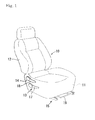
- Fig. 1 shows a view of the vehicle seat 10 equipped with a seat lifter device for a vehicle.
- the vehicle seat 10 includes a seat cushion 11 forming a seating surface and a seat back 12 forming a back surface of the seat.
- the vehicle seat 10 includes a seat lifter device 13 for adjusting the height of the seat cushion 11, a seat reclining device 14 for adjusting the inclination angle of the seat back 12 relative to the seat cushion and a seat slide adjuster device 15 for adjusting the front/rear ward position of the seat cushion 11.
- the height of the seat cushion 11 can be adjusted by operating an operating lever 17 (as an operating member) provided at one side of the seat cushion 11.
- the inclination angle of the seat back 12 can be adjusted by operating an operating lever 18 provided at the one side of the seat cushion apart from the position of the operating lever 17.
- the front/rearward position of the seat cushion 11 can be adjusted by operating an operating lever 19 provided at a lower portion of the seat cushion 11.
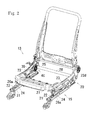
- Fig. 2 shows the vehicle seat 10, but showing the condition that the cushion portion of the seat cushion 11 and the cushion portion of the seat back 12 have been removed.
- the seat lifter device 13 is provided on the seat slide adjuster device 15.
- the seat slide adjuster device 15 includes a pair of right and left lower rails 21 fixed to a vehicle floor and a corresponding pair of upper rails 22 engageable with the lower rails and slidable in a vehicle front/rearward direction.
- the upper rails 22 can be locked at predetermined positions in the vehicle front/rearward direction by a lock mechanism (not shown).
- the seat lifter device 13 includes a pair of right and left base frames 23 forming a part of the seat cushion 11 and a pair of right and left front link members 24 and a pair of right and left rear link members 25 to connect the base frames 23 to the right and left upper rails 22 to be relatively movable in an upper and lower direction.
- the seat lifter device 13 includes a rotation device 30 for relatively rotating the base frames 23 and the rear link members 25, a lock/unlock device 40 for locking or unlocking the relative rotation between the base frames 23 and the rear link members 25, the operating lever 17, a lock/unlock device operating mechanism 80 for operating the lock/unlock device 40 and a rotation device driving mechanism 90 for driving the rotation device 30 to rotate.
- Each lower end of the pair of front link members 24 is pivoted for rotation to each front end of the pair of upper rails 22 through hinge pin 26a (See Fig. 2 and Fig. 5 ).
- Each upper end of the pair of front link members 24 is pivoted for rotation to each front end of the pair of base frames 23 through hinge pin 26b (See Fig. 5 ).
- Each middle portion of the pair of front link members 24 is connected to each other by a connecting rod 27 (See Fig. 5 ).
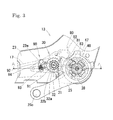
- Each lower end of the pair of rear link members 25 is pivoted for rotation to each rear end of the pair of upper rails 22 through hinge pin 26c (See Fig. 3 and Fig. 5 ).
- Each end of a cylindrical torque rod 28 formed by a pipe material is inserted into each upper end of the pair of rear link members 25 and connected to the rear link members 25 at both ends by welding or the like.
- One end of the torque rod 28 is rotatably supported on the lock/unlock device 40 and the other end of the torque rod 28 is rotatably supported in the bearing bore 23d (See Fig. 2 ) formed at the other of the pair of base frames 23.
- the lock/unlock device 40 is provided at the one end of the torque rod 28 and arranged coaxially with the torque rod 28.
- the lock/unlock device 40 is disposed between the one end of the torque rod 28 and the one of the base frames 23 in which side the operating lever 17 is provided.
- the one of the rear link members 25 fixed to the one end side of the torque rod 28 forms the driving side link member 25 (hereinafter referred to as “driving side rear link member 25") which is operated by the operating lever 17 and the other rear link member 25 forms the driven side link member to which a torque is transmitted through the torque rod 28.
- driving side rear link member 25 The front and rear link members 24, 25, base frames 23 and the upper rails 22 form a parallel link mechanism 20 (See Fig. 2 ) thereby to move the base frames 23 approximately in parallel in up and down direction.
- the rotation device 30 includes a sector gear 31 integrally formed with the driving side rear link member 25, a pinion gear engaged with the sector gear 31 and rotatably supported on the base frame 23 and a lift spring 33 (See Figs. 4 and 5 ) as a base frame upward biasing means, one end of which is engaged with the base frame 23 and the other end of which is engaged with the pinion gear 32 so that the base frame 23 can be moved in upward direction by a spring biasing force.
- the sector gear 31 is provided at the outer peripheral front side of the rotation end side of the driving side rear link member 25.
- the pinion gear 32 is rotatably inserted into the bearing bore 23a (See Figs. 4 and 5 ) provided at the base frame 23 at one end of the rotation shaft 32a and engaged with the sector gear 31.
- the lift spring 33 is formed by a spiral spring wound in a clockwise direction from the inside towards outer periphery side seen from the inside of the base frame 23 as shown in Fig. 5 .
- the outer peripheral end portion 33a of the lift spring 33 is engaged with one end of the engaging pin 34 provided at the inner side surface of the base frame 23 and the inner peripheral end portion 33b of the lift spring 33 is engaged with a slit 32b which is provided at the other side of the rotation shaft 32a of the pinion gear 32 and extends in an axial direction.
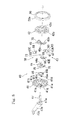
- the lock/unlock device 40 includes a disc shaped first rotation member 41, a disc shaped second rotation member 42 formed with an internal tooth 42a at the inner peripheral surface and engaged with the first rotation member 41 for relative rotation, a first, a second and a third pawl 43A, 43B and 43C as three detent members formed in a circle on three points supported on and guided by the first rotation member 41 movably in a radial direction and having an external tooth 63 engageable with or disengageable from the internal tooth 42a, a cam member 44 and a release plate 45 rotatable between the lock position and the release position and operating the first, second and third pawls 43A, 43B and 43C between the engaging position with the internal tooth 42a of the second rotation member 42 and the non-engaging position with the internal tooth 42a of the second rotation member 42, a lock spring 46 (See Fig.
- the cam member 44 and the release plate 45 form an engagement/disengagement mechanism 48 (See Fig. 6 ) which restricts or allow the relative rotation between the first and the second rotation members 41 and 42 by engaging or disengaging the each pawl 43A, 43B and 43C movably supported on the first rotation member 41 with or from the second rotation member 42.
- the first rotation member 41 is provided with a circular recessed portion 41 b formed by half blanking and open to the second rotation member 42 side.
- the recessed portion 41 b is formed with a penetrating bore 41 c at the central portion.
- the circular recessed portion 41 b has an inner peripheral surface 41d centering on the rotational axis line O1 of the first and the second rotation members 41 and 42.
- the second rotation member 42 is provided with a circular recessed portion 42b formed by half blanking and open to the first rotation member 41 side.
- the recessed portion 42b is formed with a penetrating bore 42c at the central portion.
- the circular recessed portion 42b has an inner peripheral surface 42d centering on the rotational axis line O1 of the first and the second rotation members 41 and 42.
- the internal tooth 42a is formed on the inner peripheral surface in full circle.
- the inner peripheral surface 41d of the first rotation member 41 is slidably inserted into the outer peripheral surface 42e of the second rotation member 42 in a circumferential direction.
- the bearing portion is formed between the inner peripheral surface 41d of the first rotation member 41 and the outer peripheral surface 42e of the second rotation member 42, which is commonly used as the bearing portion of the one end side of the torque rod 28, which will be later explained in detail.
- three guide walls 41 a are provided with an equal interval separated with one another in a circle within the circular recessed portion 41 d of the first rotation member 41 and a pair of guide surfaces 41 e is provided between the adjacent two guide walls 41 a facing with each other and in parallel to slidably guide both width portions of three pawls 43A, 43B and 43C.
- a circular arc surface 41f is formed on the inner periphery of the guide walls 41 a centering on the rotational axis line O1.
- the second rotation member 42 is relatively rotatably supported on the first rotation member 41 through the bearing portion 49 formed between the inner peripheral surface 41 d of the first rotation member 41 and the outer peripheral surface 42e of the second rotation member 42.
- a ring holder 50 made from a metal plate is fixed on the outer peripheral portion of the first rotation member 41 by welding or the like.
- the ring holder 50 includes a bent portion 50a bent with approximately a right angle towards the end surface of the second rotation member 42 and by this bent portion 50a, the first and the second rotation members 41 and 42 are prevented from axial movement, allowing the relative rotation.
- the first, second and third pawls 43A, 43B and 43C are formed by two different kinds of pawls arranged with an equal angle separated with one another in a circle within a surface intersecting the rotational axis line O1.
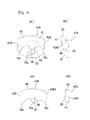
- the first pawl 43A is formed by forging a steel material and is formed with a first block 61 and a second block 62 having a step with the first block 61 as viewed from the side, which structure is shown in Fig. 9 (A1) and (B1) in detail.
- the first block 61 of the first pawl 43A is arranged at the inner peripheral surface 42d side of the second rotation member 42 and the second block 62 is arranged at the axial center side of the second rotation member 42.
- the outer end (end surface facing the internal tooth 42a of the second rotation member 42) of the first block 61 is formed with an external tooth 63 which is engageable with the internal tooth 42a of the second rotation member 42 and the inner end (opposite direction to the outer end) of the first block 61 is formed with an inner surface cam portion 64 which is engageable with the outer peripheral surface of the cam member 44.
- a pawl side groove cam portion 65 is provided at the second block 62 and penetrating through the second block 62 in a thickness direction. The cam portion 65 is formed through at approximately the center portion in a width direction of the second block 62.
- the second and the third pawls 43B and 43C are formed by press-machining a steel plate.
- the second pawl 43B is of flat shape similar to the first pawl 43A with the second block 62 being cut away and with only the first block 61, which means the second pawl 43B has no step without the second block 62.
- the length in a radial direction of the second and the third pawls 43B and 43C is shorter by the length of the second block 62 with respect to the length of the first pawl 43A and the thickness in a width direction is also thinner by the thickness of the second block 62 than the thickness of the first pawl 43A.
- each second and third pawls 43B and 43C is provided with an external tooth 66 which is engageable with the internal tooth 42a of the second rotation member 42.
- the second and the third pawls 43B and 43C are provided with an inner surface cam portion 67 which engaes with the outer peripheral surface of the cam member 44 and further provided with an engaging projection 68 at the central portion in an axial direction.
- the cam profile of the inner surface cam portion 64 formed at the stepped portion of the first pawl 43A is the same with the cam profile of the inner surface cam portion 67 formed at the inner end side of the second pawl 43B.
- the inner surface cam portions 64 and 67 are provided with three pushing portions 76a, 76b and 76c to which the cam face 75 (later explained) of the cam member 44.
- One of three portions is provided at the central portion in a circular direction and the other two are provided at both sides in the circular direction of the first and the second pawls 43A and 43B.
- the pushing portion 76a provided at the central portion of the first and the second pawls 43A and 43B and the pushing portion 76b provided at the deeper side of the locking rotation direction of the cam member 44 are formed to be a cam face with an inclined surface which approaches to the cam face 75 of the cam member 44 as the cam member 44 rotates in a locking rotation direction (counterclockwise direction a viewed in Fig. 7 ).
- the pushing portion 76c provided at the front side of the locking rotation direction of the cam member 44 is formed to be a circular arc surface centering on the rotation center of the cam member 44.
- the third pawl 43C is formed to be approximately the same with the second pawl 43B, but the third pawl 43C is different in structure from the second pawl 43B that a wedge function portion 72 (See Fig. 7 ) is provided, instead of providing the pushing portion 76c of the second pawl 43B.
- the first, the second and the third pawls 43A, 43B and 43C are guided on the guide surface 41 e of the guide wall 41 a formed in the circular recessed portion 41 b of the first rotation member 41 and slidably moved in a radial direction of the first and the second rotation members 41 and 42.
- the pawls3A, 43B and 43C are engaging or disengaging the external teeth 63 and 66 with or from the internal tooth 42a.
- An inclined surface 71 ( Fig. 7 ) is provided at one side surface of the front side of the rotation direction of the cam member 44 facing to the guide surface 41e of the guide wall 41 a.
- the inclined surface 71 has a straight line shape and the width thereof becomes consequently narrower towards outward in a radial direction.
- the distance between the inclined surface 71 and the guide surface 41 e of the guide wall 41 a becomes gradually narrower towards outward in a radial direction to form a wedge function portion 72 in which the centerline between the guide surface 41e and the inclined surface 71 runs towards the rotational axis line O1.
- a wedge member 73 (See Fig. 7 ) is provided at the wedge function portion 72 formed by a ball member to be in contact with the guide surface 41 e and the inclined surface 71.
- the wedge member 73 is sandwiched between the end surface of the circular recessed portion 41 b of the first rotation member 41 and the peripheral brim portion of the release plate 45 in an axial direction of the cam member 44 and movable in a radial direction of the cam member 44 by contacting the guide surface 41e and the inclined surface 71.
- the wedge member 73 is functioned to relatively move the guide wall 41 a provided at the first rotation member 41 and the third pawl 43C engaged with the second rotation member 42 in a direction where both members are separating from each other by the operation of the wedge function portion 72 by pressing the wedge member 73 outwardly in a radial direction by the cam face 75 of the cam member 44.
- the cam member 44 is disposed in the circular recessed portion 42b of the second rotation member 42 and rotatable on the rotational axis line within the recessed portion 42b.
- the cam member 44 includes a penetrating bore 44a at the center portion thereof and three sets of cam faces 75 at the outer peripheral brim with an equal angle interval one another in a circle.
- One set of the cam faces 75 is arranged to be engageable with each pushing portion 76a, 76b and 76c of the inner surface cam portion 64 of the first pawl 43A.
- One set of the remaining two sets of cam faces 75 is arranged to be engageable with each pushing portion 76a, 76b and 76c of the inner cam surface portion 67 of the second pawl 43B and the other set of the remaining t two sets of cam faces 75 is arranged to be engageable with each pushing portion 76a, 76b and a wedge member 73 of the inner cam surface portion 67 of the third pawl 43C.
- the cam face 75 pushes the portion close to the engagement portion between the external teeth 63 and 66 of the first, second and third pawls 43A, 43B and 43C and the internal tooth 42a of the second rotation member 42 to surely lock the rotation of the second rotation member 42 relative to the first rotation member 41 with a strong force.
- each cam face 75 is formed by three pushing cam portions 77a, 77b and 77c which are to be contactable with the three pushing portions 76a, 76b and 76c of the first, second and third pawls 43A, 43B and 43C.
- the pushing cam portion 77c to be in contact with the wedge member 73 functions as the wedge pushing cam portion.
- Three pushing cam portions 77a, 77b and 77c are kept to respective angle positions to be in contact with each pushing portion 76a, 76b and 76c of the inner surface cam portions 64 and 67 of the first, second and third pawls 43A, 43B and 43C and each pushing portion 76a, 76b of the inner surface cam portion 67 of the third pawl 43C and the and the wedge member 73 when the cam member 44 is rotated to the lock position.
- the pushing cam portions 77a, 77b and 77c are separated from the pushing cam portions 76a, 76b and 76c and the wedge member 73 and the pushing cam portion (wedge pushing cam portion) 77c is kept to an angle position where the pushing cam portion engages with the circular arc surface 41f of the guide wall 41a.
- the side surface of the cam member 44 is provided with a plurality of engaging projections provided with an equal angle interval with one another in a circle.
- the pawl side groove cam portion 65 formed on the first pawl 43A engages with one of the plurality of engaging projections 78.
- the pawl side groove cam portion 65 and the plurality of engaging projections 78 fuctio to move the first pawl 43A inwardly in a radial direction by the rotation of the cam member 44 in a lock releasing direction.
- the release plate 45 is a thin plate having a penetrating bore 45a at the central portion thereof which is engaged with the engaging projection 78 of the side surface of the cam member 44 to be integrally formed therewith.
- the release plate 45 is attached to the cam member 44 so that the axial line of the release plate agrees to the axial line of the second block 62 of the first pawl 43A and is slidably movably facing to the end surface of the second pawl 43B.
- the second and the third pawls 43B and 43C and the release plate 45 are accommodated in the first pawl 43A within a thickness range thereof.
- the release plate 45 is of approximately a circular ring shape with a recessed sector portion 45b at the circular ring portion and the first pawl 43A is disposed in this recessed sector portion 45b.
- the angle of recessed sector portion corresponds to the shape of the first pawl 43A so that the release plate 45 does not interfere with the first pawl 43A upon the rotation of the cam member 44.
- Two release plate side groove cam portions 79 are provided circumferentially on the rotation center of the release plate 45 and penetrating through the release plate in a thickness direction. These release plate side groove cam portions 79 are positioned outwardly in a radial direction from the circumferential position of the engaging projection 78 so that the release plate side groove cam portions 79 correspond to the end surfaces of the second and third pawls 43B and 43C. The release plate side groove cam portions 79 are engaged with the engaging projections 68 provided on the second and the third pawls 43B and 43C, respectively.
- the lock spring 46 is as seen from the second rotation member 42 side, formed by a spiral spring wound in a c counterclockwise direction from the inner peripheral side to the pouter peripheral side.
- the outer side end portion 46a of the lock spring 46 is engaged with a recessed groove 41g of the first rotation member 41 and the inner side end 46b of the lock spring 46 is engaged with a recessed groove (not shown) of the cam member 44.
- the lock spring 46 urges the cam member 44 in a rotation direction, in counterclockwise direction as viewed from the second rotation member side 42. In other words, the lock spring 46 urges to rotate the cam member 44 in a lock position side.
- Each pawl 43A, 43B and 43C is urged in a direction where the engagement position with the internal tooth 42a of the second rotation member 42 is maintained by the lock spring 46.
- the rotating member 47 includes a hinge shaft 47a, an arm 47b, one end of which is fixed to one end of the hinge shaft 47a in an intersection direction and a contacting portion 47c provided at the other end of the arm 47b to be in parallel with the hinge shaft 47a.
- the hinge shaft 47a is arranged on the rotational axis line O1 of the first rotation member 41, the cam member 44 and the second rotation member 42 and rotatably penetrates through the penetration bores 41 c, 44a and 42c respectively formed on the rotation central portion of the first rotation member 41, the cam member 44 and the second rotation member 42.
- Double chamfered portion with two chamfered sides is formed at approximately the central portion of the hinge shaft 47a in an axial direction and the penetrating bore 44a of the cam member 44, through which the hinge shaft 47a is penetrated is also double chamfered to be inserted into the double chamfered portion of the hinge shaft 47a for unitary rotation between the hinge shaft 47a and the cam member.
- the penetrating bore 44a of the cam member 44 is formed slightly larger than the size of the double chamfered portion of the hinge shaft 47a to provide a play in a radial direction therebetween.
- the cam member 44 is slightly movable in a radial direction within the circular recessed portion 41 b of the first rotation member 41. Accordingly, the cam member 44 can be self-adjusted so that each pawl 43A, 43B and 43C is engaged with the internal tooth 42a of the second rotation member 42 with an equal engagement force when the pawls 43A, 43B and 43C engage with the internal tooth 42a of the second rotation member 42.
- the arm 47b is provided to be facing obliquely upward in a front direction and the contacting portion 47c is in contact with the lock/unlock device operating mechanism 80 provided at the operating lever 17.
- the contacting portion 47c is pushed and the arm 47b is rotated in a counterclockwise direction, the lock condition of the pawls 43A, 43B and 43C by the cam member 44 are released.
- the lock/unlock device 40 is disposed coaxially with the torque rod 28 between one of the base frames 23 and one end of the torque rod 28.
- the first rotation member 41 of the lock/unlock device 40 faces to the base frame 23 side and the second rotation member 42 faces to the torque rod 28 side and the first rotation member 41 is as will be explained later in detail fixed to the base frame 23 and the second rotation member 42 is also as will be explained later in detail fixed to the driving side rear link members 25 and the torque rod 28.
- the first rotation member 41 of the lock/unlock device 40 is engaged with the engaging hole 23b formed on the side surface of the one of the base frames 23 and formed integral with the base frame 23 by welding or the like.
- the first rotation member 41 of the lock/unlock device 40 is engaged with the engaging hole 23b to be floatable in a radial direction so that the attachment position of the lock/unlock device 40 relative to the base frame 23 is adjustable in a radial direction. This can avoid center axis deviation between the bearing portion 49 of the lock/unlock device 40 and the bearing bore 23d of the base frame 23 by absorbing the gap between the first rotation member 41 and the one of the base frames 23.
- a plurality of (for example, four) engaging projections 42g is provided on the second rotation member 42 at a surface opposite to surface of the first rotation member 41 side and arranged with a certain distance with one another in a circumferential direction.
- An insertion bore 25a for inserting one end of the torque rod 28 is provided on the driving side rear link member 25 and a plurality of (for example, four) engaging bores 25b which engage with the engaging projections 42g is formed around the insertion bore 25a.
- an insertion bore (not shown) is also provided on the driven side rear link member 25 in which the other end of the torque rod 28 is inserted.
- the driving side rear link member 25 is integrally formed on the second rotation member 42 by welding or the like under the engaging projections 42g being engaged with the engaging bores 25b.
- the insertion bore 25a of the driving side rear link member 25 formed integrally with the second rotation member 42 by welding or the like is inserted into the one end of the torque rod 28 and is integrally formed therewith by welding or the like.
- the operating lever 17 is rotatably supported on the base frame 23 and is kept to the neutral position.
- the shaft bore 17a formed at one end side of the operating lever 17 rotatably engaged with one end side of the rotation shaft 32a of the pinion gear 32 which penetrates through the shaft bore 23a formed on the base frame 23.
- a torsion coil spring 60 is provided on the operating lever 17 in coaxial with the shaft bore 17a and biases the operating lever 17 to keep the approximately horizontal neutral position (lever operating angle being zero), operating end side of the operating lever 17 being facing frontward.
- the both end portions 60a and 60b of the torsion coil spring 60 are sandwiching the both side surfaces of the engaging portion 17b (See Fig. 6 ) provided at the outside surface of the operating lever 17 and the both side surfaces of the engaging portion 23c (See Fig. 6 ) provided at the outside surface of the base frame 23.
- This structure keeps the operating lever 17 to be in the neutral position.
- This torsion coil spring 60 may be eliminated from the structure, but in such case, a holding means is provided to keep the neutral position of the operating lever 17 and the occupant of the vehicle seat manually operates the lever to return to the neutral position from the upper position or from the lower position.
- a supporting shaft 17c (See Fig. 5 ) is provided in the vicinity of the shaft bore 17a of the inner side surface of the operating lever 17 for rotatably supporting the feed pawl 92 which will be later explained in detail.
- the lock/unlock device operating mechanism 80 is provided in a radial direction at a rearward outer peripheral portion of the rotation end side of the operating lever 17 serving as a cam to be in contact with the contacting portion 47c of the rotating member 47 of the lock/unlock device 40.
- the lock/unlock device operating mechanism 80 rotates the rotating member 47 of the lock/unlock device 40 in response to the operation of the operating lever 17 to have the lock/unlock device 40 to be in the lock position or the unlock position.
- the lock/unlock device operating mechanism 80 includes a first unlock cam 81, a holding cam 82, and a second unlock cam 83.
- the first unlock cam 81 includes a fixed unlock cam 84 formed integrally with the operating lever 17 a swing unlock cam 85 swingably supported on the operating lever 17 and biased to be in contact with the fixed unlock cam 84.
- the fixed unlock am 84 and the holding cam 82 are formed from one member.
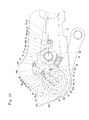
- the fixed unlock cam 84 functions as a cam which pushes the contacting portion 47c of the rotating member 47 to be in unlock position so that the lock/unlock device 40 produces the unlock condition while the operating lever 17 is rotated from the neutral position (lever operating angle being zero) as shown in Fig. 10 to the first position (for example, lever operating angle being +10 degree) in upper direction as shown in Fig. 11 .
- the swing unlock cam 85 is swingably supported on the operating lever 17 at one end side through a pin 85a and is biased by a torsion coil spring 85b disposed in the pin 85a to be in contact with the fixed unlock cam 84.
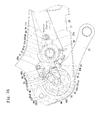
- the swing unlock cam 85 functions as a cam which is pushed by the contacting portion 47c of the rotating member 47 and swung to be separated from the fixed unlock cam 84 thereby passing through the contacting portion 47c to be facing to the swing unlock cam 85 portion of the firs unlock cam 81 at the initial position, while the operating lever 17 is rotated from the position shown in fig. 16 to the neutral position as shown in Fig. 18 passing through the lower position shown in Fig. 17 .
- the swing unlock cam 85 is brought into contact with the fixed unlock cam 84 again after the contacting portion 47c of the rotating member 47 passed the separated portion by the biasing force of the torsion coil spring 85b and faces with the passed contacting portion 47c.
- this facing position becomes the initial position of the contacting portion 47c and accordingly, the swing unlock cam 85 and the fixed unlock cam 84 function to have the lock/unlock device 40 to be in unlock condition upon pushing and rotating the contacting portion 47c of the rotating member 47 to be in unlock position.
- the holding cam 82 is a cam which holds the rotating member 47 to the unlock position by contacting the contacting portion 47c so that the lock/unlock device 40 is kept to the unlock condition while the operating lever 17 is rotated from the first position to the second position in upward direction (for example, lever operating angle: +30 degree) shown in Fig. 14 .
- the second unlock cam 83 is a cam which pushes the contacting portion 47c of the rotating member 47 to be to be in unlock position so that the lock/unlock device 40 is positioned to be in unlock condition while the operating lever 17 is rotated from the neutral position to the third position in downward direction (for example, lever operating angle: -10 degree) shown in Fig. 19 .
- the rotation device driving mechanism 90 includes a ratchet wheel 91 formed on the pinion gear 32 integrally and co-axially therewith, a feed pawl 92 rotatably supported on the operating lever 17 and engaged with the ratchet wheel 91 when the operating lever 17 is rotated in one direction to rotatably drive the pinion gear 32 and disengaged from the ratchet wheel 91 when the operating lever 17 is rotated in the other direction and a separating member 93 fixed to the base frame 23 for separating the feed pawl 92 from the ratchet wheel 91 by contacting the feed pawl 92 while the operating lever 17 is rotated from the neutral position to the third position.
- a one end side of the supporting shaft 17c provided at the operating lever 17 is rotatably inserted into the shaft bore 92a provided at the rotation end side of the feed pawl 92 passing through the elongated bore 23e provided on the base frame 23.
- a torsion coil spring 94 is engaged with one end side of the supporting shaft 17c and is biasing in a direction that the pawl 92b at the tip end side of the feed pawl 92 engages with the tooth 91 a of the ratchet wheel 91.
- One end portion 94a of the torsion coil spring 94 is engaged with the groove 92c formed on the outer peripheral surface of the feed pawl 92 and the other end portion 94b is engaged with a slit 17d provided at the one end side of the supporting shaft 17c and extending in an axial direction.
- the separating member 93 is provided at the inner peripheral surface of the operating lever 17 to be in contact with the inner peripheral surface of the feed pawl 92 in response to the downward rotation of the operating lever 17.
- the upward operation of the seat cushion 11 according to the embodiment will be explained with reference to Figs. 10 through 18 and downward operation of the seat cushion 11 according to the embodiment will be explained with reference to Figs. 10 and 19 .
- the amount of the upward movement or the downward movement of the seat cushion 11 in other words, the amount of rotation of the driving side rear link member 25 is restricted by the engagement of the first detent surface 25c1 or the second detent surface 25c2 of the recessed portion 25c provided at the rotation end side of the driving side rear link member 25 with the engaging projection 23f provided at the inner peripheral surface of the base frame 23.
- the operating lever 17 is positioned at the neutral position (lever operating angle: zero degree) and that the pawl 92b of the feed pawl 92 of the rotation device driving mechanism 90 is in contact with a portion (back surface portion of the tooth 91 a indicated as “2" in the drawing) separated from the tooth 91 a portion, for example, the portion indicated as "1" in the drawing.
- the rotation device driving mechanism 90 is not associated with the rotation device 30 under this condition.
- the contacting portion 47c of the rotating member 47 of the lock/unlock device 40 faces with the start point (swing unlock cam 85) of the first unlock cam 81 of the lock/unlock device operating mechanism 80 which is positioned at the initial position and external tooth 63, 66 of each pawl 43A, 43B and 43C, for example, in the drawing, the external tooth 66 of the second pawl 43B is indicated as “A", “B” and “C” is engaged with each internal tooth 42a of the second rotation member 42 which is also indicated as "A", "B” and “C” on the drawing, in this order.
- the second rotation member 42 is locked relative to the first rotation member 41. This will restrict the rotation of the driving side rear link member 25 to hold the seat cushion 11 to the predetermined height position.
- the cam member 44 of the lock/unlock device 40 and the release plate 45 are unitary rotated in the counterclockwise direction and each engagement of the pushing cam portions 77a, 77b and 77c of the cam surface 75 with the pushing portions 76a, 76b and 76c of the first, second and third pawls 43A, 43B and 43C is released.
- the first pawl 43A is pulled towards the rotational shaft line 01 along the guide surface 41 a of the guide wall 41 a to release the engagement between the external tooth 63 of the first pawl 43A and the internal tooth 42a of the second rotation member 42.
- the driving side rear link member 25 is rotated in the clockwise direction and the external tooth 63, 66 formed on the first, second and third pawls 43A, 43B and 43C, for example, the external tooth 66 of the second pawl 43B indicated as “A” and “B” is engageable with the internal tooth 42a formed on the second rotation member 42 indicated as “B” and “C” in this order.
- the contacting portion 47c of the rotating member 47 of the lock/unlock device 40 is disengaged from the holding cam 82 of the lock/unlock device operating mechanism 80 and the rotating member 47 of the lock/unlock device 40 is rotated in a clockwise direction by the biasing force of the lock spring 46.
- the wedge member 73 provided on the wedge function portion 72 formed between the third pawl 43C and the guide wall 41a is pushed outwardly in a radial direction by the pushing cam portion 77c of the cam 44 and the third pawl 43C and the guide surface 41 e of the guide wall 41a are separated from each other by the wedge function receiving force in a direction to be separating from each other. Then the first rotation member 41 on which the guide wall 41a is formed and the second rotation member 42 with which the third pawl 43C is engaged are relatively rotated thereby removing the gap between the plurality of first, second and third pawls 43A, 43B and 43C and the guide wall 41 a.
- the cam 44 functions to move the third pawl 43C away from the wedge function portion 72 by the wedge function.
- the third pawl 43C is moved away from the edge function portion 72, a gap between the cam 44 and the third pawl 43C is generated and the cam 44 further rotates in the lock direction. Accordingly, an unstable locking operation due to the provision of the wedge function portion 72 can be avoided.
- the contacting portion 47c is released from the holding cam 82 and when the operating lever 17 is released after the rotating member 47 has been returned to the lock position, the feed pawl 92 of the rotation device driving mechanism 90 is moved downwardly together with the operating lever 17.
- the feed pawl 92 is rotated in a clockwise direction overcoming the biasing force of the torsion coil spring 60 and the pawl 92b rides over the back surface of the tooth 91 a of the ratchet wheel 91 to release the engagement with the tooth 91 a.
- the contacting portion 47c of the rotating member 47 of the lock/unlock device 40 rotates the swing unlock cam 85 of the lock/unlock device operating mechanism 80 in the counterclockwise direction and passes through the area between the swing unlock cam 85 and the fixed unlock cam 84.
- the occupant of the seat cushion 11 rotates the operating lever 17 in upward direction being kept seated on the seat cushion 11.
- the height of the seat cushion 11 is adjusted in upward direction keeping the seat cushion to be in horizontal condition due to the function of the parallel link mechanism 20.
- the contacting portion 47c of the rotating member 47 of the lock/unlock device 40 is pushed by the second unlock cam 83 of the lock/unlock device operating mechanism 80 and the rotating member 47 of the lock/unlock device 40 is rotated in a counterclockwise direction. Due to the rotation of the rotating member 47,as similar operation as the operation explained with reference to Fig. 11 , the locking condition of the second rotation member 42 relative to the first rotation member 41 is released to allow the driving side rear link member 25 to be rotated. Under this condition, when the occupant of the vehicle applies his or her weight on the seat cushion 11, the seat cushion 11 is moved downward overcoming the force of the lift spring 33.
- the occupant releases the operating lever 17 to have the lever return to the upper neutral position by the biasing force of the torsion coil spring 60 from the position shown in Fig. 19 .
- the pawl 92 of the rotation device driving mechanism 90 is moved upward together with the operating lever 17 and then rotated in the counterclockwise direction by the biasing force of the torsion coil spring 94. Then as shown in Fig.
- the pawl 92b of the feed pawl 92 is brought into contact with the back surface of the tooth 91 a of the ratchet wheel 91 and at the same time, the rotating member 47 of the lock/unlock device 40 is rotated in clockwise direction until the contacting portion 47c of the rotating member 47 is brought into contact with the start point of the second unlock cam 83 (start point of the first unlock cam 81).
- Figs. 20 and 21 show a second embodiment according to the invention and the detail explanation thereof will be made mainly regarding to the different points from the first embodiment and the same reference numerals are used for the structure of the same component and detail explanation will be omitted.
- the lock/unlock device operating mechanism 80 according to the second embodiment includes a first unlock cam 81 and a holding cam 82 facing the first unlock cam 81 which function as same as the first unlock cam 81 and the holding cam 82 of the lock/unlock device operating mechanism 80 according to the first embodiment.
- the first unlock cam 81 and the holding cam 82 are provided instead of using the second unlock cam 83 of the first embodiment.
- an engaging wheel 95 and a pair of engaging members 96 and 97 are provided instead of the ratchet wheel 91 and the feed pawl 92 of the rotation device driving mechanism 90 of the first embodiment.
- the structure of the engaging wheel 95 and the pair of engaging members 96 and 97 is different from the structure of the ratchet wheel 91 and the feed pawl 92.
- the engaging wheel 95 is integrally formed on the rotation shaft 32a and coaxial with the pinion gear 32.
- a triangle tooth 95a is formed on the engaging wheel 95.
- a central portion of each pair of engaging members 96 and 97 is rotatably mounted on the rotation shaft 98 in a manner that when one end side comes closer, the other end side backs away.
- the rotation shaft 98 is arranged in parallel with the rotation shaft 32a of the engaging wheel 95 and fixedly supported on the connecting member 99 which is rotatably supported on the rotation shaft 32a.
- the pair of engaging members 96 and 97 is provided with a plurality of engaging teeth 96a and 97a to be in contact with the triangle tooth 95a of the engaging wheel 95 at each one end side having a predetermined interval with one another in a radial direction.
- each pair of engaging members 96 and 97 is engaged with both ends of a coil spring 100, respectively.
- An engagement operating member 101 is provided between the other ends of the pair of engaging member 96 and 97 for rotating the pair of engaging members 96 and 97 in response to the rotation of the operating lever 17.
- the engagement operating member 101 is provided at the operating lever 17 to be passing through the elongated bore 23e of the base frame 23.
- the operating lever 17 is positioned in the neutral position and the engaging members 96 and 97 of the rotation device operating mechanism 90 are rotated in clockwise and counterclockwise directions by the biasing force of the coil spring 100 and accordingly, the engaging teeth 96a and 97a are disengaged from the triangle tooth 95a of the engaging wheel 95.
- the rotation device operating mechanism 90 does not function on the rotation device 30.
- the operating lever 17 is rotated in upward direction the other end of the upper side engaging member 96 is pushed upward by the engagement operating member 101.
- the friction resistance between the rotation shaft 32a of the engaging wheel 95 and the connecting member 99 is set to be larger than the friction resistance between the engaging member 96 and the rotation shaft 98.
- the connecting member 99 does not rotate about the rotation shaft 32a of the engaging wheel 95, but only the engaging member 96 rotates about the rotation shaft 98 in a counterclockwise direction. Since the engaging tooth 96a is provided separately from the triangle tooth 95a, it would take some time to have the engaging tooth 96a to be engaged with the triangle tooth 95a and the lock/unlock device 40 is unlocked while this time lag. Then the engaging tooth 96a of the engaging member 96 is engaged with the triangle tooth 95a of the engaging wheel 95 and the engaging wheel 95 is pushed by the engaging member 96 to be rotated in the counterclockwise direction. Thus the rotation device 30 and the lock/unlock device 40 are operated as same as the operation thereof in the first embodiment and finally the seat cushion 11 is moved upwardly to a suitable position.
- the lock/unlock device 40 is provided with the engagement/disengagement mechanism 48 which produces a lock condition to restrict the relative rotation between the first rotation member 41 and the second rotation member 42 or an unlock condition to allow the relative rotation between the first rotation member 41 and the second rotation member 42 by the engagement or disengagement of the first, second and third pawls 43A, 43B and 43C movably supported on the first rotation member 41 fixed to the base frame 23 side with or from the second rotation member 42 fixed to the driving side rear link member 25 side by the operation of the lock/unlock device operating mechanism 80 associated with the rotation of the operating lever 17 in upward direction. Accordingly, the vehicle seat lifter device 13 can firmly hold the lifted position of the vehicle seat 10 when an external force applied to the vehicle seat 10 upon a vehicle collision accident is applied on the engagement/disengagement mechanism 48 through the driving side rear link member 25.
- the rotation device 30 has a function to relatively rotate the base frame 23 and the driving side rear link member 25.
- the rotation device 30 and the lock/unlock device 40 are structured to be operable by the operating lever 17 through the rotation device driving mechanism 90 and the lock/unlock device operating mechanism 80. Accordingly, different from the conventional devices the operating lever is not needed to be frequently reciprocated and the lifting adjustment of the vehicle seat can be simply performed.
- the rotation device driving mechanism 90 controls the rotation device 30 to be in a freely rotatable condition, while the operating lever 17 is rotated from the neutral position to the downward third position. Accordingly, the driving side rear link member 25 is freely rotated relative to the base frame 23 thereby to quickly adjust the lifted position of the vehicle seat 10.
- the lock/unlock device 40 includes the first rotation member 41 on which the first, second and third pawls 43A, 43B and 43C are supported movably but only in a radial direction and at the same time on which the cam member 44 is supported for advancing and retreating the first, second and third pawls 43A, 43B and 43C in the radial direction and the second rotation member 42 on which the internal tooth 42a is formed for engaging with and disengaging from the external tooth 63 and 66 formed on the tip end of the first, second and third pawls 43A, 43B and 43C.
- the internal tooth 42a of the second rotation member 42 is engaged with or disengaged from the external tooth 63 and 66 of the first, second and third pawls 43A, 43B and 43C. This can simplify the lifting adjustment structure of the vehicle seat 10.
- the lock/unlock device operating mechanism 80 includes the unlock cam 81 which operates the lock/unlock device 40 to be in unlock condition while the operating lever 17 is rotated from the neutral position to the first position, and the holding cam 82 which operates the lock/unlock device 40 to be kept to the unlock condition while the operating lever 17 is rotated from the first position to the second position.
- the contacting portion 47c of the rotating member 47 of the lock/unlock device 40 is released from the engagement with the holding cam 82. Then the rotating member 47 is returned to the lock position.
- the unlock cam 81 is formed by the fixed unlock cam 84 and the swing unlock cam 85.
- the rotation device 30 is formed by the gear mechanism and the rotation device driving mechanism 90 is formed by ratchet mechanism. Accordingly, the relative rotation angle between the base frame 23 and the driving side rear link member 25, i.e., the lifting adjustment amount of the vehicle seat 10 can be freely and randomly adjusted by adjusting the pitch angles of the gears and ratchet mechanism.
- the lift spring 33 is always biasing the base frame 23 in an upward direction, after the lock/unlock device 40 is controlled to be in unlock condition for lowering the base frame 23, the occupant can freely adjust the height of the vehicle seat to a desired position by lowering the vehicle seat 10 by the occupant's own weight. This can improve the operability of the seat lifter device 13 for the vehicle.
- the seat lifter device according to the invention can be adapted to a device for adjusting the height of the vehicle seat cushion and suitable for the device that requires a smooth height adjustment of the vehicle seat cushion.
Landscapes
- Engineering & Computer Science (AREA)
- Aviation & Aerospace Engineering (AREA)
- Transportation (AREA)
- Mechanical Engineering (AREA)
- Seats For Vehicles (AREA)
Abstract
Description
- This invention relates to a seat lifter device for a vehicle seat used for adjusting the height of a seat cushion of a vehicle seat.
- Generally, a vehicle seat device is provided with a seat lifter device for adjusting the height of the seat cushion and the seat lifter device is operated by operating an operating lever under a condition that an occupant of the seat is seated on the seat cushion to adjust the height of the seat cushion. One of such vehicle seat lifter devices is disclosed in a Patent Document 1.
- The vehicle seat lifter device described in the Patent Document 1 uses a roller clutch mechanism for changing over the motion of the operating lever and frictionally keeping the lifted position of the seat by rollers and the seat lifter device uses a parallel link mechanism having two link members which are rotatably connected by a sector gear and a pinion gear. The pinion gear is rotatably driven by the roller clutch mechanism. An occupant of the seat reciprocates the operating lever from the neutral position to upper or lower position under the occupant being kept seated on the seat. Thus the vehicle seat can be successively raised or successively lowered.
- Patent Document 1:
JP 2003-93187 A - The seat lifter device for a vehicle has to have a structure which can keep the lifted position even upon a vehicular collision accident. However, the device according to the Patent Document 1 uses the roller clutch mechanism for frictionally keeping the lifted position. External force is applied to the vehicle seat upon a vehicular collision or the like and such external force is also applied to the roller clutch mechanism through the link members. The link members may not withstand the force and the lifted position of the seat may not be kept.
- The present invention was made considering the above issues and it is an object of the present invention to provide a vehicle seat lifter device which can keep the lifted position of the vehicle seat even upon an external force being applied.
- The feature of the seat lifter device associated with claim 1 of this invention made for solving the above problem is characterized in that a seat lifter device for a vehicle comprises a pair of right and left base frames, a pair of right and left rear link members, a torque rod for connecting the pair of right and left rear link members for torque transmission, a pair of front right and left link members each one end being pivoted on each front portion of the pair of right and rear base frames and forming a parallel link mechanism with the rear link members, a rotation device for relatively rotating the base frames and the rear link members, a lock/unlock device having an engagement/disengagement mechanism for engaging or disengaging a detent member movably supported on a first rotation member fixed to the base frame side with or from a second rotation member fixed to the rear link member side and a rotating member supported on the base frame side and engaging with or disengaging from the engagement/disengagement mechanism, wherein the lock/unlock device produces a lock condition in which the relative rotation between the first and the second rotation members is restricted by the engagement of the detent member with the second rotation member and an unlock condition in which the relative rotation between the first and the second rotation members is allowed by the disengagement of the detent member from the second rotation member and an operating member rotatably supported on the base frame and kept to a neutral position.
- The invention associated with claim 2 is characterized in that the seat lifter device associated with claim 1 includes a lock/unlock device operating mechanism for operating the rotating member of the lock/unlock device to be rotated in response to the rotation of the operating member from the neutral position in one direction thereby to operate the lock/unlock device to be in the unlock condition while the operating member is rotated from the neutral position to a first position and to keep the unlock condition while the operating member is rotated from the first position to a second position, the lock/unlock device operating mechanism further operating the lock/unlock device to return to the lock condition when the position of the operating member exceeds the second position and at the same time operating the operating member to be returnable to the neutral position, the lock/unlock device operating mechanism further operating the rotating member to be rotated in response to the rotation of the operating member from the neutral position in the other direction thereby to operate the lock/unlock device to be in the unlock condition while the operating member is rotated from the neutral position to a third position and at the same time to be returnable to the lock condition when the position of the operating member returns to the neutral position from the third position.
- The invention associated with claim 3 is characterized in that the seat lifter device associated with claim 2, includes a rotation device driving mechanism which is operated in response to the rotation of the operating member in the one direction from the neutral position, which is idly movable while the operating member is rotated from the neutral position to the first position, which drives the rotation device to rotate the rear link member relative to the base frame in a direction that the seat cushion is raised upwardly while the operating member is rotated from the first position to the second position, which is idly movable while the operating member returns to the neutral position and is operated in response to the rotation of the operating member from the neutral position in the other direction, and which drives the rotation device to be in freely rotatable condition to have the rear link member to be freely rotatable relative to the base frame while the operating member is rotated from the neutral position to the third position.
- The invention associated with claim 4 is characterized in that the seat lifter device of claim 3 includes the rotation device which includes a sector gear formed integrally with the rear link member and a pinion gear engaged with the sector gear and rotatably supported on the base frame, the rotation device driving mechanism includes a ratchet wheel formed integrally and coaxially with the pinion gear, a feed pawl rotatably supported on the operating member and engaging with the ratchet wheel when the operating member is rotated in the one direction to drive the pinion gear to rotate and disengaging from the ratchet wheel when the operating member is rotated in the other direction and a separating member fixed to the base frame and brought into contact with the feed pawl to have the feed pawl to be separated from the ratchet wheel while the operating member is rotated from the neutral position to the third position.
- The invention associated with claim 5 is characterized in that the seat lifter device of claim 4 includes a base frame upward biasing means, one end of which is engaged with the base frame and the other end of which is engaged with the pinion gear of the rotation device and biasing the base frame to move upwardly.
- The invention associated with claim 6 is characterized in that the seat lifter device of claim 4 or 5 wherein assuming that the pitch angle of the internal tooth of the lock/unlock device is indicated as "C", the rotation speed ratio of the sector gear relative to the pinion gear is indicated as "A" and that the pitch angle of the ratchet wheel is indicated as "B", the pitch angle "C" is represented as C=A×B.
- The invention associated with claim 7 is characterized in that the seat lifter device of any of claims 2 through 6, wherein the lock/unlock device produces the lock condition and the unlock condition by the second rotation member being engaged with the first rotation member fixed to the base frame side and rotatable on the axial center of the torque rod through the bearing portion relative to the first rotation member, the detent member being supported on the first rotation member and movable only in a radial direction and the cam member being rotatably supported on the first rotation member to operate the detent member to advance or retreat in the radial direction, the internal tooth being formed on the second rotation member and engageable with the external tooth formed on the tip end of the detent member and the detent member being moved in the radial direction when the cam member is rotated by the rotating member wherein the external tooth engages with or disengage from the internal tooth.
- The invention associated with
claim 8 is characterized in that the seat lifter device of any of claims 2 through 7, wherein the lock/unlock device operating mechanism is characterized in that the operating member is provided with the unlock cam for rotating the rotating member to the unlock position by pushing the contacting portion provided at the end portion of the rotating member so that the lock/unlock device is brought into the unlock condition while the operating member is rotated from the neutral position to the first position and the holding cam for holding the lock/unlock device to the unlock position by engaging with the contacting portion so that the lock/unlock device is kept to the lock condition while the operating member is rotated from the first position to the second position, the contacting portion of the rotating member is released from the holding cam to have the rotating member to be rotated to the lock position so that the lock/unlock device returns to the lock condition when the operating member exceeds the second position, the unlock cam is formed by the fixed unlock cam integrally formed on the operating member and the swing unlock cam swingably supported on the operating member and biased to be in contact with the fixed unlock cam and that the contacting portion of the rotating member which has been returned to the lock position operates to swing the swing unlock cam and passes through the fixed unlock cam and the swing unlock cam to face with the swing unlock cam at the initial position when the operating member returns to the neutral position. - According to the invention of claim 1, the lock/unlock device is provided with the engagement/disengagement mechanism to produce a lock condition in which the relative rotation between a first rotation member and a second rotation member is restricted and an unlock condition in which the relative rotation between the first and the second rotation members is allowed by the engagement/disengagement operation of the engagement/disengagement mechanism such that a detent member movably supported on the first rotation member fixed to the base frame side engages with or disengages from the second rotation member fixed to the rear link member. This seat lifter device can firmly hold the seat lifted position even when an exterior force generated upon a vehicle collision is applied to the engagement/disengagement mechanism through the rear link member.
- According to the invention of claim 2, the rotation device has a function to relatively rotate the base frame and the rear link member. This rotation device and the lock/unlock device are structured to be operated by the operating member through the lock/unlock device operating mechanism. Accordingly, it is not necessary to repeatedly reciprocate the operating member as was in conventional device and the adjustment of the seat lifted position can be simplified.
- According to the invention of claim 3, since the rotation device driving mechanism operates to have the rotation device to be freely movable while the operating device is rotated in the other direction from the neutral position to the third position, the rear link members can be freely rotatable relative to the base frame to promptly adjust the lifted position of the vehicle seat.
- According to the invention of claim 4, since the rotation device is formed by the gear mechanism and the rotation device driving mechanism is formed by a ratchet mechanism, the relative rotation angle between the base frame and the rear link member, in other words, the lifted amount of the vehicle seat can be randomly or freely adjusted by adjusting the pitch angles of the gear and the ratchet.
- According to the invention of claim 5, since the base frame upward biasing means always biases the base frame in upward direction, after the lock/unlock device has been in unlock condition to lower the base frame, the seat lifted position can be freely and randomly adjusted by the occupant's own weight. This can improve the operability of the seat lifter device.
- According to the invention of claim 6, since the pitch angle "C" of the internal tooth of the lock/unlock device is calculated by C=A×B, wherein the "A" represents the rotation speed ratio of the sector gear relative to the rotation speed of the pinion gear and the "B" represents the pitch angle of the ratchet wheel, the lock/unlock device can be surely brought into lock condition every one operation of the operating member which rotates one pitch angle of the ratchet wheel.
- According to the invention of claim 7, since the lock/unlock device includes the first rotation member on which the detent member is supported and movable only in a radial direction, and further at the same time on which the cam member is rotatably supported and the second rotation member on which the internal tooth is formed which engages with or disengages from the external tooth formed on the tip end of the detent member, the engagement/disengagement of the external tooth with or from the internal tooth of the second member by the rotation of the cam member by the rotating member to simplify the structure for lifted position adjustment of the vehicle seat.
- According to the invention of
claim 8, the lock/unlock device operating mechanism includes the operating member which includes an unlock cam for unlocking the lock/unlock device while the operating member is rotated from the neutral position to the first position and a holding cam for holding the lock/unlock device to the unlock condition while the operating member is rotated from the first position to the second position. When the operating member exceeds the second position, the contacting portion of the rotating member of the lock/unlock device is released from the holding cam to return the rotating member to the lock position. The unlock cam is structured to have the fixed unlock cam and the swing unlock cam. Accordingly, when the operating member is returned to the neutral position, the contacting portion of the rotating member which has been returned to the lock position, swings swing unlock cam and passes through the space between the fixed unlock cam and the swing unlock cam to face the swing unlock cam. Accordingly, the contacting portion of the rotating member of the lock/unlock device can be faced to the unlock cam at the initial position by only swinging the swing unlock cam. This can simplify the structure of the lock/unlock device operating mechanism. -
-
Fig. 1 is a perspective view of a vehicle seat equipped with a seat lifter device according to the invention. -
Fig. 2 is a perspective view of the vehicle seat ofFig. 1 but showing a view that the seat cushion has been removed. -
Fig. 3 is a side view of the seat lifter device for the vehicle seat seen from the inside of the base frame according to a first embodiment of the invention. -
Fig. 4 is a cross sectional view of the seat lifter device for the vehicle seat taken along the line A-A of the first embodiment of the invention. -
Fig. 5 is an exploded perspective view of the seat lifter device for the vehicle seat according to the first embodiment. -
Figs. 6(A) and (B) respectively show a side view of the seat lifter device for the vehicle seat according to the first embodiment seen from outside of the base frame and a cross sectional view thereof taken along the line B-B. -
Figs. 7 (A) and (B) are a cross sectional view of the lock/unlock device of the vehicle seat lifter device, showing the lock condition and unlock condition, respectively, taken along the line C-C ofFig. 6 seen from the outside of the base frame. -
Fig. 8 is an exploded perspective view of the lock/unlock device ofFig. 7 . -
Figs. 9 (A1) and (B1) show the plane view and side view of the first pawl of the lock/unlock device of the lock/unlock device shown inFig. 7 , Figs. (A2) and (B2) show the plane view and the side view of the second pawl of the lock/unlock device of the lock/unlock device shown inFig. 7 . -
Fig. 10 is a side view of the seat lifter device according to the first embodiment seen from the outside of the base frame when the operating lever is positioned at the neutral position. -
Fig. 11 is a side view of the seat lifter device according to the first embodiment seen from the outside of the base frame when the operating lever is positioned at the first position. -
Fig. 12 is a side view of the seat lifter device according to the first embodiment seen from the outside of the base frame when the operating lever is positioned at a position on the way to the first position. -
Fig. 13 is a side view of the seat lifter device according to the first embodiment seen from the outside of the base frame when the operating lever is positioned at a position on the way to the first position. -
Fig. 14 is a side view of the seat lifter device according to the first embodiment seen from the outside of the base frame when the operating lever is positioned at the second position. -
Fig. 15 is a side view of the seat lifter device according to the first embodiment seen from the outside of the base frame when the operating lever is positioned at the lock position. -
Fig. 16 is a side view of the seat lifter device according to the first embodiment seen from the outside of the base frame when the operating lever is positioned at a position on the way of returning to the neutral position. -
Fig. 17 is a side view of the seat lifter device according to the first embodiment seen from the outside of the base frame when the operating lever is positioned at further downward position from the position ofFig. 16 . -
Fig. 18 is a side view of the seat lifter device according to the first embodiment seen from the outside of the base frame when the operating lever has been returned to the neutral position. -
Fig. 19 is a side view of the seat lifter device according to the first embodiment seen from the outside of the base frame when the operating lever is positioned at the third position. -
Fig. 20 is a side view of the seat lifter device according to a second embodiment seen from the outside of the base frame. -
Figs. 21 (A), (B) and (C) are a cross sectional view of the seat lifter device shown inFig. 20 , taken along the line C-C, a cross sectional view taken along the line D-D and a cross sectional view taken along the line E-E, respectively. - The embodiments of the present invention will be explained with reference to the attached drawings.
Fig. 1 shows a view of thevehicle seat 10 equipped with a seat lifter device for a vehicle. Thevehicle seat 10 includes aseat cushion 11 forming a seating surface and a seat back 12 forming a back surface of the seat. Thevehicle seat 10 includes aseat lifter device 13 for adjusting the height of theseat cushion 11, aseat reclining device 14 for adjusting the inclination angle of the seat back 12 relative to the seat cushion and a seatslide adjuster device 15 for adjusting the front/rear ward position of theseat cushion 11. - The height of the
seat cushion 11 can be adjusted by operating an operating lever 17 (as an operating member) provided at one side of theseat cushion 11. The inclination angle of the seat back 12 can be adjusted by operating an operatinglever 18 provided at the one side of the seat cushion apart from the position of the operatinglever 17. The front/rearward position of theseat cushion 11 can be adjusted by operating an operatinglever 19 provided at a lower portion of theseat cushion 11. -
Fig. 2 shows thevehicle seat 10, but showing the condition that the cushion portion of theseat cushion 11 and the cushion portion of the seat back 12 have been removed. Theseat lifter device 13 is provided on the seatslide adjuster device 15. The seatslide adjuster device 15 includes a pair of right and leftlower rails 21 fixed to a vehicle floor and a corresponding pair ofupper rails 22 engageable with the lower rails and slidable in a vehicle front/rearward direction. The upper rails 22 can be locked at predetermined positions in the vehicle front/rearward direction by a lock mechanism (not shown). - As shown in
Figs. 2 though 5, theseat lifter device 13 includes a pair of right and left base frames 23 forming a part of theseat cushion 11 and a pair of right and leftfront link members 24 and a pair of right and leftrear link members 25 to connect the base frames 23 to the right and leftupper rails 22 to be relatively movable in an upper and lower direction. Further, theseat lifter device 13 includes arotation device 30 for relatively rotating the base frames 23 and therear link members 25, a lock/unlock device 40 for locking or unlocking the relative rotation between the base frames 23 and therear link members 25, the operatinglever 17, a lock/unlockdevice operating mechanism 80 for operating the lock/unlock device 40 and a rotationdevice driving mechanism 90 for driving therotation device 30 to rotate. - Each lower end of the pair of
front link members 24 is pivoted for rotation to each front end of the pair ofupper rails 22 throughhinge pin 26a (SeeFig. 2 andFig. 5 ). Each upper end of the pair offront link members 24 is pivoted for rotation to each front end of the pair of base frames 23 throughhinge pin 26b (SeeFig. 5 ). Each middle portion of the pair offront link members 24 is connected to each other by a connecting rod 27 (SeeFig. 5 ). - Each lower end of the pair of
rear link members 25 is pivoted for rotation to each rear end of the pair ofupper rails 22 throughhinge pin 26c (SeeFig. 3 andFig. 5 ). Each end of acylindrical torque rod 28 formed by a pipe material is inserted into each upper end of the pair ofrear link members 25 and connected to therear link members 25 at both ends by welding or the like. One end of thetorque rod 28 is rotatably supported on the lock/unlock device 40 and the other end of thetorque rod 28 is rotatably supported in the bearing bore 23d (SeeFig. 2 ) formed at the other of the pair of base frames 23. In other words, as shown inFigs. 4 and5 , the lock/unlock device 40 is provided at the one end of thetorque rod 28 and arranged coaxially with thetorque rod 28. The lock/unlock device 40 is disposed between the one end of thetorque rod 28 and the one of the base frames 23 in which side the operatinglever 17 is provided. - The one of the
rear link members 25 fixed to the one end side of thetorque rod 28 forms the driving side link member 25 (hereinafter referred to as "driving siderear link member 25") which is operated by the operatinglever 17 and the otherrear link member 25 forms the driven side link member to which a torque is transmitted through thetorque rod 28. The front andrear link members upper rails 22 form a parallel link mechanism 20 (SeeFig. 2 ) thereby to move the base frames 23 approximately in parallel in up and down direction. - As shown in
Figs. 3 through 5 , therotation device 30 includes asector gear 31 integrally formed with the driving siderear link member 25, a pinion gear engaged with thesector gear 31 and rotatably supported on thebase frame 23 and a lift spring 33 (SeeFigs. 4 and5 ) as a base frame upward biasing means, one end of which is engaged with thebase frame 23 and the other end of which is engaged with thepinion gear 32 so that thebase frame 23 can be moved in upward direction by a spring biasing force. - The
sector gear 31 is provided at the outer peripheral front side of the rotation end side of the driving siderear link member 25. Thepinion gear 32 is rotatably inserted into the bearing bore 23a (SeeFigs. 4 and5 ) provided at thebase frame 23 at one end of therotation shaft 32a and engaged with thesector gear 31. Thelift spring 33 is formed by a spiral spring wound in a clockwise direction from the inside towards outer periphery side seen from the inside of thebase frame 23 as shown inFig. 5 . The outerperipheral end portion 33a of thelift spring 33 is engaged with one end of the engagingpin 34 provided at the inner side surface of thebase frame 23 and the innerperipheral end portion 33b of thelift spring 33 is engaged with aslit 32b which is provided at the other side of therotation shaft 32a of thepinion gear 32 and extends in an axial direction. - As shown in
Figs. 6 through 8 , the lock/unlock device 40 includes a disc shapedfirst rotation member 41, a disc shapedsecond rotation member 42 formed with aninternal tooth 42a at the inner peripheral surface and engaged with thefirst rotation member 41 for relative rotation, a first, a second and athird pawl first rotation member 41 movably in a radial direction and having anexternal tooth 63 engageable with or disengageable from theinternal tooth 42a, acam member 44 and arelease plate 45 rotatable between the lock position and the release position and operating the first, second andthird pawls internal tooth 42a of thesecond rotation member 42 and the non-engaging position with theinternal tooth 42a of thesecond rotation member 42, a lock spring 46 (SeeFig. 8 ) for rotatably biasing thecam member 44 towards the lock position side and a rotatingmember 47 for operating thecam member 44 to rotate between the lock position and the released position. Thecam member 44 and therelease plate 45 form an engagement/disengagement mechanism 48 (SeeFig. 6 ) which restricts or allow the relative rotation between the first and thesecond rotation members pawl first rotation member 41 with or from thesecond rotation member 42. - As shown in
Figs. 6 and8 , thefirst rotation member 41 is provided with a circular recessedportion 41 b formed by half blanking and open to thesecond rotation member 42 side. The recessedportion 41 b is formed with a penetratingbore 41 c at the central portion. The circular recessedportion 41 b has an innerperipheral surface 41d centering on the rotational axis line O1 of the first and thesecond rotation members Figs. 6 and7 , thesecond rotation member 42 is provided with a circular recessedportion 42b formed by half blanking and open to thefirst rotation member 41 side. The recessedportion 42b is formed with a penetratingbore 42c at the central portion. The circular recessedportion 42b has an inner peripheral surface 42d centering on the rotational axis line O1 of the first and thesecond rotation members internal tooth 42a is formed on the inner peripheral surface in full circle. - As shown in
Fig. 6 , the innerperipheral surface 41d of thefirst rotation member 41 is slidably inserted into the outerperipheral surface 42e of thesecond rotation member 42 in a circumferential direction. Thus the first and thesecond rotation members torque rod 28. The bearing portion is formed between the innerperipheral surface 41d of thefirst rotation member 41 and the outerperipheral surface 42e of thesecond rotation member 42, which is commonly used as the bearing portion of the one end side of thetorque rod 28, which will be later explained in detail. As shown inFig. 8 , threeguide walls 41 a are provided with an equal interval separated with one another in a circle within the circular recessedportion 41 d of thefirst rotation member 41 and a pair of guide surfaces 41 e is provided between the adjacent twoguide walls 41 a facing with each other and in parallel to slidably guide both width portions of threepawls circular arc surface 41f is formed on the inner periphery of theguide walls 41 a centering on the rotational axis line O1. - As shown in
Fig. 6 , thesecond rotation member 42 is relatively rotatably supported on thefirst rotation member 41 through the bearingportion 49 formed between the innerperipheral surface 41 d of thefirst rotation member 41 and the outerperipheral surface 42e of thesecond rotation member 42. As shown inFig. 8 , aring holder 50 made from a metal plate is fixed on the outer peripheral portion of thefirst rotation member 41 by welding or the like. Thering holder 50 includes abent portion 50a bent with approximately a right angle towards the end surface of thesecond rotation member 42 and by thisbent portion 50a, the first and thesecond rotation members - As shown in
Figs. 7 and8 , the first, second andthird pawls first pawl 43A is formed by forging a steel material and is formed with afirst block 61 and asecond block 62 having a step with thefirst block 61 as viewed from the side, which structure is shown inFig. 9 (A1) and (B1) in detail. As shown inFig. 8 , thefirst block 61 of thefirst pawl 43A is arranged at the inner peripheral surface 42d side of thesecond rotation member 42 and thesecond block 62 is arranged at the axial center side of thesecond rotation member 42. - As shown in
Figs. 9 (A1) and (B1 the both width side ends 43A1 of the first and thesecond blocks internal tooth 42a of the second rotation member 42) of thefirst block 61 is formed with anexternal tooth 63 which is engageable with theinternal tooth 42a of thesecond rotation member 42 and the inner end (opposite direction to the outer end) of thefirst block 61 is formed with an innersurface cam portion 64 which is engageable with the outer peripheral surface of thecam member 44. Further, a pawl sidegroove cam portion 65 is provided at thesecond block 62 and penetrating through thesecond block 62 in a thickness direction. Thecam portion 65 is formed through at approximately the center portion in a width direction of thesecond block 62. - On the other hand, the second and the
third pawls Fig. 9 (A2) and (B2), thesecond pawl 43B is of flat shape similar to thefirst pawl 43A with thesecond block 62 being cut away and with only thefirst block 61, which means thesecond pawl 43B has no step without thesecond block 62. In other words, the length in a radial direction of the second and thethird pawls second block 62 with respect to the length of thefirst pawl 43A and the thickness in a width direction is also thinner by the thickness of thesecond block 62 than the thickness of thefirst pawl 43A. - As shown in
Fig. 9 (A2) and (B2), the both width side ends 43B1 of the second and thethird pawls first pawl 43A. The outer end of each second andthird pawls external tooth 66 which is engageable with theinternal tooth 42a of thesecond rotation member 42. The second and thethird pawls surface cam portion 67 which engaes with the outer peripheral surface of thecam member 44 and further provided with an engagingprojection 68 at the central portion in an axial direction. - The cam profile of the inner
surface cam portion 64 formed at the stepped portion of thefirst pawl 43A is the same with the cam profile of the innersurface cam portion 67 formed at the inner end side of thesecond pawl 43B. In other words, as shown inFig. 9 (A1) and (A2), the innersurface cam portions portions cam member 44. One of three portions is provided at the central portion in a circular direction and the other two are provided at both sides in the circular direction of the first and thesecond pawls - The pushing
portion 76a provided at the central portion of the first and thesecond pawls portion 76b provided at the deeper side of the locking rotation direction of thecam member 44 are formed to be a cam face with an inclined surface which approaches to thecam face 75 of thecam member 44 as thecam member 44 rotates in a locking rotation direction (counterclockwise direction a viewed inFig. 7 ). The pushingportion 76c provided at the front side of the locking rotation direction of thecam member 44 is formed to be a circular arc surface centering on the rotation center of thecam member 44. On the other hand, thethird pawl 43C is formed to be approximately the same with thesecond pawl 43B, but thethird pawl 43C is different in structure from thesecond pawl 43B that a wedge function portion 72 (SeeFig. 7 ) is provided, instead of providing the pushingportion 76c of thesecond pawl 43B. - The first, the second and the
third pawls guide surface 41 e of theguide wall 41 a formed in the circular recessedportion 41 b of thefirst rotation member 41 and slidably moved in a radial direction of the first and thesecond rotation members external teeth internal tooth 42a. An inclined surface 71 (Fig. 7 ) is provided at one side surface of the front side of the rotation direction of thecam member 44 facing to theguide surface 41e of theguide wall 41 a. Theinclined surface 71 has a straight line shape and the width thereof becomes consequently narrower towards outward in a radial direction. - In other words, the distance between the
inclined surface 71 and theguide surface 41 e of theguide wall 41 a becomes gradually narrower towards outward in a radial direction to form awedge function portion 72 in which the centerline between theguide surface 41e and theinclined surface 71 runs towards the rotational axis line O1. A wedge member 73 (SeeFig. 7 ) is provided at thewedge function portion 72 formed by a ball member to be in contact with theguide surface 41 e and theinclined surface 71. Thewedge member 73 is sandwiched between the end surface of the circular recessedportion 41 b of thefirst rotation member 41 and the peripheral brim portion of therelease plate 45 in an axial direction of thecam member 44 and movable in a radial direction of thecam member 44 by contacting theguide surface 41e and theinclined surface 71. Thewedge member 73 is functioned to relatively move theguide wall 41 a provided at thefirst rotation member 41 and thethird pawl 43C engaged with thesecond rotation member 42 in a direction where both members are separating from each other by the operation of thewedge function portion 72 by pressing thewedge member 73 outwardly in a radial direction by thecam face 75 of thecam member 44. - As shown in
Fig. 8 , thecam member 44 is disposed in the circular recessedportion 42b of thesecond rotation member 42 and rotatable on the rotational axis line within the recessedportion 42b. Thecam member 44 includes a penetratingbore 44a at the center portion thereof and three sets of cam faces 75 at the outer peripheral brim with an equal angle interval one another in a circle. One set of the cam faces 75 is arranged to be engageable with each pushingportion surface cam portion 64 of thefirst pawl 43A. One set of the remaining two sets of cam faces 75 is arranged to be engageable with each pushingportion cam surface portion 67 of thesecond pawl 43B and the other set of the remaining t two sets of cam faces 75 is arranged to be engageable with each pushingportion wedge member 73 of the innercam surface portion 67 of thethird pawl 43C. Thecam face 75 pushes the portion close to the engagement portion between theexternal teeth third pawls internal tooth 42a of thesecond rotation member 42 to surely lock the rotation of thesecond rotation member 42 relative to thefirst rotation member 41 with a strong force. - As shown in
Fig. 7 , eachcam face 75 is formed by three pushingcam portions portions third pawls cam portion 77c to be in contact with thewedge member 73 functions as the wedge pushing cam portion. Three pushingcam portions portion surface cam portions third pawls portion surface cam portion 67 of thethird pawl 43C and the and thewedge member 73 when thecam member 44 is rotated to the lock position. - When the
cam member 44 is rotated in a direction where the lock is released, the pushingcam portions cam portions wedge member 73 and the pushing cam portion (wedge pushing cam portion) 77c is kept to an angle position where the pushing cam portion engages with thecircular arc surface 41f of theguide wall 41a. The side surface of thecam member 44 is provided with a plurality of engaging projections provided with an equal angle interval with one another in a circle. The pawl sidegroove cam portion 65 formed on thefirst pawl 43A engages with one of the plurality of engagingprojections 78. The pawl sidegroove cam portion 65 and the plurality of engagingprojections 78 fuctio to move thefirst pawl 43A inwardly in a radial direction by the rotation of thecam member 44 in a lock releasing direction. - As shown in
Figs. 7 and8 , therelease plate 45 is a thin plate having a penetratingbore 45a at the central portion thereof which is engaged with the engagingprojection 78 of the side surface of thecam member 44 to be integrally formed therewith. Therelease plate 45 is attached to thecam member 44 so that the axial line of the release plate agrees to the axial line of thesecond block 62 of thefirst pawl 43A and is slidably movably facing to the end surface of thesecond pawl 43B. The second and thethird pawls release plate 45 are accommodated in thefirst pawl 43A within a thickness range thereof. - The
release plate 45 is of approximately a circular ring shape with a recessedsector portion 45b at the circular ring portion and thefirst pawl 43A is disposed in this recessedsector portion 45b. The angle of recessed sector portion corresponds to the shape of thefirst pawl 43A so that therelease plate 45 does not interfere with thefirst pawl 43A upon the rotation of thecam member 44. - Two release plate side
groove cam portions 79 are provided circumferentially on the rotation center of therelease plate 45 and penetrating through the release plate in a thickness direction. These release plate sidegroove cam portions 79 are positioned outwardly in a radial direction from the circumferential position of the engagingprojection 78 so that the release plate sidegroove cam portions 79 correspond to the end surfaces of the second andthird pawls groove cam portions 79 are engaged with the engagingprojections 68 provided on the second and thethird pawls groove cam portions 79 and the engaging projections 68he second and thethird pawls cam member 44 is rotated together withrelease plate 45 in a direction where the lock is released (clockwise direction as viewed inFig. 7 ). - As shown in
Fig. 8 , thelock spring 46 is as seen from thesecond rotation member 42 side, formed by a spiral spring wound in a c counterclockwise direction from the inner peripheral side to the pouter peripheral side. The outerside end portion 46a of thelock spring 46 is engaged with a recessedgroove 41g of thefirst rotation member 41 and theinner side end 46b of thelock spring 46 is engaged with a recessed groove (not shown) of thecam member 44. Thelock spring 46 urges thecam member 44 in a rotation direction, in counterclockwise direction as viewed from the secondrotation member side 42. In other words, thelock spring 46 urges to rotate thecam member 44 in a lock position side. Eachpawl internal tooth 42a of thesecond rotation member 42 is maintained by thelock spring 46. - As shown in
Fig. 8 , the rotatingmember 47 includes ahinge shaft 47a, anarm 47b, one end of which is fixed to one end of thehinge shaft 47a in an intersection direction and a contactingportion 47c provided at the other end of thearm 47b to be in parallel with thehinge shaft 47a. Thehinge shaft 47a is arranged on the rotational axis line O1 of thefirst rotation member 41, thecam member 44 and thesecond rotation member 42 and rotatably penetrates through the penetration bores 41 c, 44a and 42c respectively formed on the rotation central portion of thefirst rotation member 41, thecam member 44 and thesecond rotation member 42. Double chamfered portion with two chamfered sides is formed at approximately the central portion of thehinge shaft 47a in an axial direction and the penetratingbore 44a of thecam member 44, through which thehinge shaft 47a is penetrated is also double chamfered to be inserted into the double chamfered portion of thehinge shaft 47a for unitary rotation between thehinge shaft 47a and the cam member. - The penetrating
bore 44a of thecam member 44 is formed slightly larger than the size of the double chamfered portion of thehinge shaft 47a to provide a play in a radial direction therebetween. Thus, thecam member 44 is slightly movable in a radial direction within the circular recessedportion 41 b of thefirst rotation member 41. Accordingly, thecam member 44 can be self-adjusted so that eachpawl internal tooth 42a of thesecond rotation member 42 with an equal engagement force when thepawls internal tooth 42a of thesecond rotation member 42. As shown inFig. 6 , thearm 47b is provided to be facing obliquely upward in a front direction and the contactingportion 47c is in contact with the lock/unlockdevice operating mechanism 80 provided at the operatinglever 17. The contactingportion 47c is pushed and thearm 47b is rotated in a counterclockwise direction, the lock condition of thepawls cam member 44 are released. - As shown in
Fig. 5 , the lock/unlock device 40 is disposed coaxially with thetorque rod 28 between one of the base frames 23 and one end of thetorque rod 28. Thefirst rotation member 41 of the lock/unlock device 40 faces to thebase frame 23 side and thesecond rotation member 42 faces to thetorque rod 28 side and thefirst rotation member 41 is as will be explained later in detail fixed to thebase frame 23 and thesecond rotation member 42 is also as will be explained later in detail fixed to the driving siderear link members 25 and thetorque rod 28. - The
first rotation member 41 of the lock/unlock device 40 is engaged with the engaging hole 23b formed on the side surface of the one of the base frames 23 and formed integral with thebase frame 23 by welding or the like. Thefirst rotation member 41 of the lock/unlock device 40 is engaged with the engaging hole 23b to be floatable in a radial direction so that the attachment position of the lock/unlock device 40 relative to thebase frame 23 is adjustable in a radial direction. This can avoid center axis deviation between the bearingportion 49 of the lock/unlock device 40 and the bearing bore 23d of thebase frame 23 by absorbing the gap between thefirst rotation member 41 and the one of the base frames 23. - A plurality of (for example, four) engaging
projections 42g is provided on thesecond rotation member 42 at a surface opposite to surface of thefirst rotation member 41 side and arranged with a certain distance with one another in a circumferential direction. An insertion bore 25a for inserting one end of thetorque rod 28 is provided on the driving siderear link member 25 and a plurality of (for example, four) engagingbores 25b which engage with the engagingprojections 42g is formed around theinsertion bore 25a. On the other hand, an insertion bore (not shown) is also provided on the driven siderear link member 25 in which the other end of thetorque rod 28 is inserted. The driving siderear link member 25 is integrally formed on thesecond rotation member 42 by welding or the like under the engagingprojections 42g being engaged with the engagingbores 25b. The insertion bore 25a of the driving siderear link member 25 formed integrally with thesecond rotation member 42 by welding or the like is inserted into the one end of thetorque rod 28 and is integrally formed therewith by welding or the like. - As shown in
Fig. 5 andFig. 6 , the operatinglever 17 is rotatably supported on thebase frame 23 and is kept to the neutral position. In other words, theshaft bore 17a formed at one end side of the operatinglever 17 rotatably engaged with one end side of therotation shaft 32a of thepinion gear 32 which penetrates through theshaft bore 23a formed on thebase frame 23. Atorsion coil spring 60 is provided on the operatinglever 17 in coaxial with the shaft bore 17a and biases the operatinglever 17 to keep the approximately horizontal neutral position (lever operating angle being zero), operating end side of the operatinglever 17 being facing frontward. - The both
end portions torsion coil spring 60 are sandwiching the both side surfaces of the engagingportion 17b (SeeFig. 6 ) provided at the outside surface of the operatinglever 17 and the both side surfaces of the engagingportion 23c (SeeFig. 6 ) provided at the outside surface of thebase frame 23. This structure keeps the operatinglever 17 to be in the neutral position. Thistorsion coil spring 60 may be eliminated from the structure, but in such case, a holding means is provided to keep the neutral position of the operatinglever 17 and the occupant of the vehicle seat manually operates the lever to return to the neutral position from the upper position or from the lower position. A supportingshaft 17c (SeeFig. 5 ) is provided in the vicinity of the shaft bore 17a of the inner side surface of the operatinglever 17 for rotatably supporting thefeed pawl 92 which will be later explained in detail. - As shown in
Figs. 5 and6 , the lock/unlockdevice operating mechanism 80 is provided in a radial direction at a rearward outer peripheral portion of the rotation end side of the operatinglever 17 serving as a cam to be in contact with the contactingportion 47c of the rotatingmember 47 of the lock/unlock device 40. In other words, the lock/unlockdevice operating mechanism 80 rotates the rotatingmember 47 of the lock/unlock device 40 in response to the operation of the operatinglever 17 to have the lock/unlock device 40 to be in the lock position or the unlock position. The lock/unlockdevice operating mechanism 80 includes afirst unlock cam 81, a holdingcam 82, and asecond unlock cam 83. Thefirst unlock cam 81 includes a fixedunlock cam 84 formed integrally with the operatinglever 17 aswing unlock cam 85 swingably supported on the operatinglever 17 and biased to be in contact with the fixedunlock cam 84. According to this embodiment, the fixedunlock am 84 and the holdingcam 82 are formed from one member. - The fixed
unlock cam 84 functions as a cam which pushes the contactingportion 47c of the rotatingmember 47 to be in unlock position so that the lock/unlock device 40 produces the unlock condition while the operatinglever 17 is rotated from the neutral position (lever operating angle being zero) as shown inFig. 10 to the first position (for example, lever operating angle being +10 degree) in upper direction as shown inFig. 11 . Theswing unlock cam 85 is swingably supported on the operatinglever 17 at one end side through apin 85a and is biased by atorsion coil spring 85b disposed in thepin 85a to be in contact with the fixedunlock cam 84. - The
swing unlock cam 85 functions as a cam which is pushed by the contactingportion 47c of the rotatingmember 47 and swung to be separated from the fixedunlock cam 84 thereby passing through the contactingportion 47c to be facing to theswing unlock cam 85 portion of the firs unlockcam 81 at the initial position, while the operatinglever 17 is rotated from the position shown infig. 16 to the neutral position as shown inFig. 18 passing through the lower position shown inFig. 17 . Theswing unlock cam 85 is brought into contact with the fixedunlock cam 84 again after the contactingportion 47c of the rotatingmember 47 passed the separated portion by the biasing force of thetorsion coil spring 85b and faces with the passed contactingportion 47c. Accordingly, this facing position becomes the initial position of the contactingportion 47c and accordingly, theswing unlock cam 85 and the fixedunlock cam 84 function to have the lock/unlock device 40 to be in unlock condition upon pushing and rotating the contactingportion 47c of the rotatingmember 47 to be in unlock position. - The holding
cam 82 is a cam which holds the rotatingmember 47 to the unlock position by contacting the contactingportion 47c so that the lock/unlock device 40 is kept to the unlock condition while the operatinglever 17 is rotated from the first position to the second position in upward direction (for example, lever operating angle: +30 degree) shown inFig. 14 . Thesecond unlock cam 83 is a cam which pushes the contactingportion 47c of the rotatingmember 47 to be to be in unlock position so that the lock/unlock device 40 is positioned to be in unlock condition while the operatinglever 17 is rotated from the neutral position to the third position in downward direction (for example, lever operating angle: -10 degree) shown inFig. 19 . - As shown in
Fig. 5 andFig. 6 , the rotationdevice driving mechanism 90 includes aratchet wheel 91 formed on thepinion gear 32 integrally and co-axially therewith, afeed pawl 92 rotatably supported on the operatinglever 17 and engaged with theratchet wheel 91 when the operatinglever 17 is rotated in one direction to rotatably drive thepinion gear 32 and disengaged from theratchet wheel 91 when the operatinglever 17 is rotated in the other direction and a separatingmember 93 fixed to thebase frame 23 for separating thefeed pawl 92 from theratchet wheel 91 by contacting thefeed pawl 92 while the operatinglever 17 is rotated from the neutral position to the third position. - The
ratchet wheel 91 is formed with atooth 91 a with a predetermined pitch angle. Assuming that theinternal tooth 42a formed on thesecond rotation member 42 of the lock/unlock device 40 has the pitch angle of "C", the rotation speed ratio of the rotation speed of the sector gear relative to the rotation speed of thepinion gear 32 of therotation device 30 is set to be "A" and the pitch angle of thetooth 91 a of theratchet wheel 91 is "B", the formula C=A×B can be established among the values. A one end side of the supportingshaft 17c provided at the operatinglever 17 is rotatably inserted into theshaft bore 92a provided at the rotation end side of thefeed pawl 92 passing through theelongated bore 23e provided on thebase frame 23. - A
torsion coil spring 94 is engaged with one end side of the supportingshaft 17c and is biasing in a direction that thepawl 92b at the tip end side of thefeed pawl 92 engages with thetooth 91 a of theratchet wheel 91. Oneend portion 94a of thetorsion coil spring 94 is engaged with thegroove 92c formed on the outer peripheral surface of thefeed pawl 92 and the other end portion 94b is engaged with aslit 17d provided at the one end side of the supportingshaft 17c and extending in an axial direction. The separatingmember 93 is provided at the inner peripheral surface of the operatinglever 17 to be in contact with the inner peripheral surface of thefeed pawl 92 in response to the downward rotation of the operatinglever 17. - Next, the upward operation of the
seat cushion 11 according to the embodiment will be explained with reference toFigs. 10 through 18 and downward operation of theseat cushion 11 according to the embodiment will be explained with reference toFigs. 10 and19 . It is noted here that the amount of the upward movement or the downward movement of theseat cushion 11, in other words, the amount of rotation of the driving siderear link member 25 is restricted by the engagement of the first detent surface 25c1 or the second detent surface 25c2 of the recessedportion 25c provided at the rotation end side of the driving siderear link member 25 with the engagingprojection 23f provided at the inner peripheral surface of thebase frame 23. Under the initial condition as shown inFig. 10 , the operatinglever 17 is positioned at the neutral position (lever operating angle: zero degree) and that thepawl 92b of thefeed pawl 92 of the rotationdevice driving mechanism 90 is in contact with a portion (back surface portion of thetooth 91 a indicated as "2" in the drawing) separated from thetooth 91 a portion, for example, the portion indicated as "1" in the drawing. In other words, the rotationdevice driving mechanism 90 is not associated with therotation device 30 under this condition. - The contacting
portion 47c of the rotatingmember 47 of the lock/unlock device 40 faces with the start point (swing unlock cam 85) of thefirst unlock cam 81 of the lock/unlockdevice operating mechanism 80 which is positioned at the initial position andexternal tooth pawl external tooth 66 of thesecond pawl 43B is indicated as "A", "B" and "C" is engaged with eachinternal tooth 42a of thesecond rotation member 42 which is also indicated as "A", "B" and "C" on the drawing, in this order. Thus thesecond rotation member 42 is locked relative to thefirst rotation member 41. This will restrict the rotation of the driving siderear link member 25 to hold theseat cushion 11 to the predetermined height position. - As shown in
Fig. 11 , when the operatinglever 17 is operated to be rotated from the neutral position to the first position in upper direction (for example, lever operating angle: +10 degree) against the biasing force of thetorsion coil spring 60, thefeed pawl 92 of the rotationdevice driving mechanism 90 is moved upwardly together with the movement of the operatinglever 17 and thepawl 92b of thefeed pawl 92 moves idly until the back surface portion of thetooth 91 a indicated as "2" of theratchet wheel 91 contacts with thetooth 91 a indicated as "1" while the operatinglever 17 is operated. At the same time, the contactingportion 47c of the rotatingmember 47 of the lock/unlock device 40 is pushed by thefirst unlock cam 81 of the lock/unlockdevice operating mechanism 80 and the rotatingmember 47 of the lock/unlock device 40 is rotated in counterclockwise direction. - By such rotation of the rotating
member 47, thecam member 44 of the lock/unlock device 40 and therelease plate 45 are unitary rotated in the counterclockwise direction and each engagement of the pushingcam portions cam surface 75 with the pushingportions third pawls groove cam portion 65 of thefirst pawl 43A and the engagingprojection 78 of thecam 44, thefirst pawl 43A is pulled towards therotational shaft line 01 along theguide surface 41 a of theguide wall 41 a to release the engagement between theexternal tooth 63 of thefirst pawl 43A and theinternal tooth 42a of thesecond rotation member 42. - At the same time, by the engagement between the engaging
projection 68 of the second andthird pawls groove cam portion 79 of therelease plate 45, the second and thethird pawls guide surface 41 e of theguide wall 41 a thereby to release the engagement between theexternal tooth 66 of the second and thethird pawls internal tooth 42a of thesecond rotation member 42. Thus the locking of thesecond rotation member 42 relative to thefirst rotation member 41 is released and the driving siderear link member 25 is allowed to rotate. - Under this condition, since the pushing
cam portion 77c of thecam surface 75 of thecam 44 is engaged with the innerperipheral surface 41f of theguide wall 41 a, the center position of thecam 44 is adjusted by the innerperipheral surface 41f of theguide wall 41 a. as the result, the gap between theexternal tooth third pawls internal tooth 42 of thesecond rotation member 42 becomes substantially even and the interference of the tooth tip of theexternal tooth pawls internal tooth 42a of thesecond rotation member 42 can be eliminated or minimized to restrict the generation of abnormal noise or the malfunctioning of rotation due to the interference between the tooth tips. - As shown in
Figs. 12 and13 , when the operatinglever 17 is operated to be rotated from the first position to the second position in upward direction as shown inFig. 14 overcoming the biasing force of thetorsion coil spring 60, thefeed pawl 92 of the rotationdevice driving mechanism 90 is moved upward together with the operatinglever 17 and thepawl 92b of thefeed pawl 92 pushes thetooth 91 a of theratchet wheel 91, the tooth indicated as "1" in a counterclockwise direction to rotate theratchet wheel 91 during the operation of the operatinglever 17. Then the driving siderear link member 25 is rotated in a clockwise direction. The rotatingmember 47 of the lock/unlock device 40 is kept to the unlock position by the engagement of the contactingportion 47c with the holdingcam 82 of the lock/unlockdevice operating mechanism 80. - As shown in
Fig. 14 , when the operatinglever 17 is rotated to the second position (for example, lever operating angle: +30 degree) overcoming the biasing force of thetorsion coil spring 60, thefeed pawl 92 of the rotationdevice driving mechanism 90 is moved upward together with the operatinglever 17 and thepawl 92b of thefeed pawl 92 pushes thetooth 91 a of theratchet wheel 91, the tooth indicated as "1" in the counterclockwise direction thereby to rotate theratchet wheel 91 during the operation of the operatinglever 17. Thus the driving siderear link member 25 is rotated in the clockwise direction and theexternal tooth third pawls external tooth 66 of thesecond pawl 43B indicated as "A" and "B" is engageable with theinternal tooth 42a formed on thesecond rotation member 42 indicated as "B" and "C" in this order. The contactingportion 47c of the rotatingmember 47 of the lock/unlock device 40 is disengaged from the holdingcam 82 of the lock/unlockdevice operating mechanism 80 and the rotatingmember 47 of the lock/unlock device 40 is rotated in a clockwise direction by the biasing force of thelock spring 46. - By this rotation of the rotating
member 47, thecam member 44 is rotated and the pushingcam portions cam member 44 move the first, second and thethird pawls guide surface 41 e. Then theexternal tooth third pawls internal tooth 42a formed on thesecond rotation member 42. This will lock the rotation of thesecond rotation member 42 relative to thefirst rotation member 41 and the driving siderear link member 25 is restricted from rotation and the seat back 11 is kept to a predetermined height position higher than the initial condition. - At this time, the
wedge member 73 provided on thewedge function portion 72 formed between thethird pawl 43C and theguide wall 41a is pushed outwardly in a radial direction by the pushingcam portion 77c of thecam 44 and thethird pawl 43C and theguide surface 41 e of theguide wall 41a are separated from each other by the wedge function receiving force in a direction to be separating from each other. Then thefirst rotation member 41 on which theguide wall 41a is formed and thesecond rotation member 42 with which thethird pawl 43C is engaged are relatively rotated thereby removing the gap between the plurality of first, second andthird pawls guide wall 41 a. - Under such condition, since the operating
lever 17 is positioned front side of the rotation operation direction by thecam 44, thecam 44 functions to move thethird pawl 43C away from thewedge function portion 72 by the wedge function. As thethird pawl 43C is moved away from theedge function portion 72, a gap between thecam 44 and thethird pawl 43C is generated and thecam 44 further rotates in the lock direction. Accordingly, an unstable locking operation due to the provision of thewedge function portion 72 can be avoided. - As shown in
Fig. 15 , the contactingportion 47c is released from the holdingcam 82 and when the operatinglever 17 is released after the rotatingmember 47 has been returned to the lock position, thefeed pawl 92 of the rotationdevice driving mechanism 90 is moved downwardly together with the operatinglever 17. However, thefeed pawl 92 is rotated in a clockwise direction overcoming the biasing force of thetorsion coil spring 60 and thepawl 92b rides over the back surface of thetooth 91 a of theratchet wheel 91 to release the engagement with thetooth 91 a. - As shown in
Fig. 16 , when the operatinglever 17 is rotated and is returned from the second position to a position on the way to the neutral position in downward direction by the force oftorsion coil spring 60, the contactingportion 47c of the rotatingmember 47 of the lock/unlock device 40 begins to be in contact with theswing unlock cam 85 of the lock/unlockdevice operating mechanism 80. Under this situation, since theexternal tooth third pawls internal tooth 42a formed on thesecond rotation member 42 to keep the rotation lock condition of thesecond rotation member 42 relative to thefirst rotation member 41. - As shown in
Fig. 17 , when the operatinglever 17 is rotated further in a lower direction from the position shown inFig. 16 , overcoming the biasing force oftorsion coil spring 60, thefeed pawl 92 of the rotationdevice driving mechanism 90 is moved downward together with the operatinglever 17 and thepawl 92b of thefeed pawl 92 rides over the back surface of thetooth 91 a of theratchet wheel 91 indicated as "2" and moves to the position capable of engaging with thetooth 91 a indicated as "2". Under this situation, the contactingportion 47c of the rotatingmember 47 of the lock/unlock device 40 rotates theswing unlock cam 85 of the lock/unlockdevice operating mechanism 80 in the counterclockwise direction and passes through the area between theswing unlock cam 85 and the fixedunlock cam 84. - As shown in
Fig. 18 , when the operatinglever 17 is rotated from the position shown inFig. 17 in a lower direction and is returned to the neutral position overcoming the biasing force of thetorsion coil spring 60, thefeed pawl 92 is moved downward together with the operatinglever 17 and thepawl 92b of thefeed pawl 92 moves to the back surface portion of thetooth 91 a of theratchet wheel 91 indicated as "3". The contactingportion 47c of the rotatingmember 47 of the lock¥unlock device 40 passes through the area between theswing unlock cam 85 and the fixedunlock cam 84 and faces at the start point of the first unlock cam 81 (swing unlock cam 85) and at the initial position. Thus, the upward movement operation of theseat cushion 11 is completed. As explained, the occupant of theseat cushion 11 rotates the operatinglever 17 in upward direction being kept seated on theseat cushion 11. By this operation of thelever 17, the height of theseat cushion 11 is adjusted in upward direction keeping the seat cushion to be in horizontal condition due to the function of theparallel link mechanism 20. - From the initial condition as shown in
Fig. 10 to the condition shown infig. 19 , when the operatinglever 17 is rotated from the neutral position to the downward third position (for example, operating lever angle: -10 degree), overcoming the biasing force of thetorsion coil spring 60, thefeed pawl 92 of the rotationdevice driving mechanism 90 is not engaged with thetooth 91a of theratchet wheel 91 during the downward operation of the operatinglever 17 and moved downward together with the operatinglever 17. Then thefeed pawl 92 is engaged with the separatingmember 93 and is rotated in clockwise direction overcoming the biasing force of thetorsion coil spring 94. Thus thepawl 92b of thefeed pawl 92 is separated from the back surface of thetooth 91 a of theratchet wheel 91 in a radial direction. - At the same time, the contacting
portion 47c of the rotatingmember 47 of the lock/unlock device 40 is pushed by thesecond unlock cam 83 of the lock/unlockdevice operating mechanism 80 and the rotatingmember 47 of the lock/unlock device 40 is rotated in a counterclockwise direction. Due to the rotation of the rotatingmember 47,as similar operation as the operation explained with reference toFig. 11 , the locking condition of thesecond rotation member 42 relative to thefirst rotation member 41 is released to allow the driving siderear link member 25 to be rotated. Under this condition, when the occupant of the vehicle applies his or her weight on theseat cushion 11, theseat cushion 11 is moved downward overcoming the force of thelift spring 33. - After the
seat cushion 11 being adjusted to a suitable height position for the occupant of the seat, the occupant releases the operatinglever 17 to have the lever return to the upper neutral position by the biasing force of thetorsion coil spring 60 from the position shown inFig. 19 . Then thepawl 92 of the rotationdevice driving mechanism 90 is moved upward together with the operatinglever 17 and then rotated in the counterclockwise direction by the biasing force of thetorsion coil spring 94. Then as shown inFig. 10 , thepawl 92b of thefeed pawl 92 is brought into contact with the back surface of thetooth 91 a of theratchet wheel 91 and at the same time, the rotatingmember 47 of the lock/unlock device 40 is rotated in clockwise direction until the contactingportion 47c of the rotatingmember 47 is brought into contact with the start point of the second unlock cam 83 (start point of the first unlock cam 81). - Due to the rotational movement of the rotating
member 47, the rotation of thesecond rotation member 42 relative to thefirst rotation member 41 is locked similar to the operation explained with reference toFigs. 14 and15 . Accordingly, the rotation of the driving siderear link member 25 is restricted and theseat cushion 11 is fixed to a height position lower than the initial condition by a predetermined value. Thus the lowering operation of theseat cushion 11 is completed. By this operation of thelever 17, the height of theseat cushion 11 is adjusted in downward direction keeping the seat cushion to be in horizontal condition due to the function of theparallel link mechanism 20. -
Figs. 20 and21 show a second embodiment according to the invention and the detail explanation thereof will be made mainly regarding to the different points from the first embodiment and the same reference numerals are used for the structure of the same component and detail explanation will be omitted. The lock/unlockdevice operating mechanism 80 according to the second embodiment includes afirst unlock cam 81 and a holdingcam 82 facing thefirst unlock cam 81 which function as same as thefirst unlock cam 81 and the holdingcam 82 of the lock/unlockdevice operating mechanism 80 according to the first embodiment. In detail, instead of using thesecond unlock cam 83 of the first embodiment, thefirst unlock cam 81 and the holdingcam 82 are provided. Further, according to the rotationdevice driving mechanism 90 of the second embodiment, an engagingwheel 95 and a pair of engagingmembers ratchet wheel 91 and thefeed pawl 92 of the rotationdevice driving mechanism 90 of the first embodiment. The structure of theengaging wheel 95 and the pair of engagingmembers ratchet wheel 91 and thefeed pawl 92. - The engaging
wheel 95 is integrally formed on therotation shaft 32a and coaxial with thepinion gear 32. Atriangle tooth 95a is formed on theengaging wheel 95. A central portion of each pair of engagingmembers rotation shaft 98 in a manner that when one end side comes closer, the other end side backs away. Therotation shaft 98 is arranged in parallel with therotation shaft 32a of theengaging wheel 95 and fixedly supported on the connectingmember 99 which is rotatably supported on therotation shaft 32a. the pair of engagingmembers teeth triangle tooth 95a of theengaging wheel 95 at each one end side having a predetermined interval with one another in a radial direction. The other end of each pair of engagingmembers coil spring 100, respectively. Anengagement operating member 101 is provided between the other ends of the pair of engagingmember members lever 17. Theengagement operating member 101 is provided at the operatinglever 17 to be passing through theelongated bore 23e of thebase frame 23. - In the initial condition shown in
Fig. 20 , the operatinglever 17 is positioned in the neutral position and the engagingmembers device operating mechanism 90 are rotated in clockwise and counterclockwise directions by the biasing force of thecoil spring 100 and accordingly, the engagingteeth triangle tooth 95a of theengaging wheel 95. In other words, the rotationdevice operating mechanism 90 does not function on therotation device 30. When the operatinglever 17 is rotated in upward direction the other end of the upperside engaging member 96 is pushed upward by theengagement operating member 101. The friction resistance between therotation shaft 32a of theengaging wheel 95 and the connectingmember 99 is set to be larger than the friction resistance between the engagingmember 96 and therotation shaft 98. Accordingly, the connectingmember 99 does not rotate about therotation shaft 32a of theengaging wheel 95, but only the engagingmember 96 rotates about therotation shaft 98 in a counterclockwise direction. Since the engagingtooth 96a is provided separately from thetriangle tooth 95a, it would take some time to have the engagingtooth 96a to be engaged with thetriangle tooth 95a and the lock/unlock device 40 is unlocked while this time lag. Then the engagingtooth 96a of the engagingmember 96 is engaged with thetriangle tooth 95a of theengaging wheel 95 and theengaging wheel 95 is pushed by the engagingmember 96 to be rotated in the counterclockwise direction. Thus therotation device 30 and the lock/unlock device 40 are operated as same as the operation thereof in the first embodiment and finally theseat cushion 11 is moved upwardly to a suitable position. - On the other hand, when the operating
lever 17 is rotated downwardly, the other end of the lowerside engaging member 97 is pushed down by theengagement operating member 101. Then, according to the same reason with the operation of the upperside engaging member 96, only the engagingmember 97 is rotated in the clockwise direction about therotation shaft 98. Since the lock/unlock device 80 is provided with the first unlock cam 81 (fixedunlock cam 84 and the swing unlock cam 85) and the holdingcam 82 instead of thesecond unlock cam 83 of the first embodiment, therotation device 30 and the lock/unlock device 40 are operated as similar to the operation of the operatinglever 17 to rotate upwardly. Finally, theseat cushion 11 is lowered. - According to the first and the second embodiments of the invention, the lock/
unlock device 40 is provided with the engagement/disengagement mechanism 48 which produces a lock condition to restrict the relative rotation between thefirst rotation member 41 and thesecond rotation member 42 or an unlock condition to allow the relative rotation between thefirst rotation member 41 and thesecond rotation member 42 by the engagement or disengagement of the first, second andthird pawls first rotation member 41 fixed to thebase frame 23 side with or from thesecond rotation member 42 fixed to the driving siderear link member 25 side by the operation of the lock/unlockdevice operating mechanism 80 associated with the rotation of the operatinglever 17 in upward direction. Accordingly, the vehicleseat lifter device 13 can firmly hold the lifted position of thevehicle seat 10 when an external force applied to thevehicle seat 10 upon a vehicle collision accident is applied on the engagement/disengagement mechanism 48 through the driving siderear link member 25. - The
rotation device 30 has a function to relatively rotate thebase frame 23 and the driving siderear link member 25. Therotation device 30 and the lock/unlock device 40 are structured to be operable by the operatinglever 17 through the rotationdevice driving mechanism 90 and the lock/unlockdevice operating mechanism 80. Accordingly, different from the conventional devices the operating lever is not needed to be frequently reciprocated and the lifting adjustment of the vehicle seat can be simply performed. Further, the rotationdevice driving mechanism 90 controls therotation device 30 to be in a freely rotatable condition, while the operatinglever 17 is rotated from the neutral position to the downward third position. Accordingly, the driving siderear link member 25 is freely rotated relative to thebase frame 23 thereby to quickly adjust the lifted position of thevehicle seat 10. - ] According to the first and the second embodiments of the invention, the lock/
unlock device 40 includes thefirst rotation member 41 on which the first, second andthird pawls cam member 44 is supported for advancing and retreating the first, second andthird pawls second rotation member 42 on which theinternal tooth 42a is formed for engaging with and disengaging from theexternal tooth third pawls member 47 by operating thecam member 44, theinternal tooth 42a of thesecond rotation member 42 is engaged with or disengaged from theexternal tooth third pawls vehicle seat 10. - Further, according to the first and the second embodiments of the invention, the lock/unlock
device operating mechanism 80 includes theunlock cam 81 which operates the lock/unlock device 40 to be in unlock condition while the operatinglever 17 is rotated from the neutral position to the first position, and the holdingcam 82 which operates the lock/unlock device 40 to be kept to the unlock condition while the operatinglever 17 is rotated from the first position to the second position. When the operatinglever 17 is rotated further to exceed the second position, the contactingportion 47c of the rotatingmember 47 of the lock/unlock device 40 is released from the engagement with the holdingcam 82. Then the rotatingmember 47 is returned to the lock position. Theunlock cam 81 is formed by the fixedunlock cam 84 and theswing unlock cam 85. When the operatinglever 17 returns to the neutral position, the contactingportion 47c of the rotatingmember 47 which has been returned to the lock position, swings theswing unlock cam 85 and passes through the area between the fixedunlock cam 84 and theswing unlock cam 85 to face theswing unlock cam 85 at the initial position. Accordingly, the contactingportion 47c of the rotatingmember 47 faces theswing unlock cam 85 at the initial position by only the swinging operation of theswing unlock cam 85. This can simplify the structure of the lick/unlockdevice operating mechanism 80. - Further, according to the first and the second embodiments of the invention, the
rotation device 30 is formed by the gear mechanism and the rotationdevice driving mechanism 90 is formed by ratchet mechanism. Accordingly, the relative rotation angle between thebase frame 23 and the driving siderear link member 25, i.e., the lifting adjustment amount of thevehicle seat 10 can be freely and randomly adjusted by adjusting the pitch angles of the gears and ratchet mechanism. - Further, according to the first embodiment of the invention, since the
lift spring 33 is always biasing thebase frame 23 in an upward direction, after the lock/unlock device 40 is controlled to be in unlock condition for lowering thebase frame 23, the occupant can freely adjust the height of the vehicle seat to a desired position by lowering thevehicle seat 10 by the occupant's own weight. This can improve the operability of theseat lifter device 13 for the vehicle. - Further, according to the first embedment of the invention, since the pitch angle "C" of the
internal tooth 42a of the lock/unlock device 40 is formed to be computed by multiplication of rotation speed ratio "A" of the pinion gear relative to the rotation speed of thesector gear 31 by the pitch angle "B" of the ratchet wheel 91 (C=A×B), the lock/unlock device 40 can be surely in lock condition, every one operation of the operatinglever 17 which rotates theratchet wheel 91 with one pitch angle. - The invention have been explained in accordance with the above embodiment, however, the invention is not limited to the structure explained by the embodiment and various changes or modifications can be made within the scope of the appended claims.
- The seat lifter device according to the invention can be adapted to a device for adjusting the height of the vehicle seat cushion and suitable for the device that requires a smooth height adjustment of the vehicle seat cushion.
- 10: vehicle seat, 11: seat cushion, 12: seat back, 13: seat lifter device , 17: operating lever (operating member), 20: parallel link mechanism, 23: base frame, 24: front link member, 25: rear link member, 28: torque rod, 30: rotation device, 31: sector gear, 32: pinion gear, 33: lift spring (base frame upward biasing means), 40: lock/unlock device, 41: first rotation member, 42: second rotation member, 42a: internal tooth, 43: pawls (detent member), 43A: first pawl (detent member), 43B: second pawl (detent member), 43C: third pawl (detent member), 44: cam member, 47: rotating member, 47c: contacting portion, 48: engagement/disengagement mechanism, 49: bearing portion, 63, 66: external tooth, 80: loc/unlock device operating mechanism, 81: first unlock cam, 82: holding cam, 83: second unlock cam, 84: fixed unlock cam, 85: swing unlock cam, 90: rotation device driving mechanism, 91: ratchet wheel, 92: feed pawl, 93: separating member.
Claims (8)
- A seat lifter device for a vehicle, comprising:a pair of right and left base frames;a pair of right and left rear link members;a torque rod for connecting the pair of right and left rear link members for torque transmission;a pair of front right and left link members each one end being pivoted on each front portion of the pair of right and rear base frames and forming a parallel link mechanism with the rear link members;a rotation device for relatively rotating the base frames and the rear link members;a lock/unlock device having an engagement/disengagement mechanism for engaging or disengaging a detent member movably supported on a first rotation member fixed to the base frame side, with or from a second rotation member fixed to the rear link member side and a rotating member supported on the base frame side and engaging with or disengaging from the engagement/disengagement mechanism, wherein the lock/unlock device produces a lock condition in which the relative rotation between the first and the second rotation members is restricted by the engagement of the detent member with the second rotation member and an unlock condition in which the relative rotation between the first and the second rotation members is allowed by the disengagement of the detent member from the second rotation member; andan operating member rotatably supported on the base frame and kept to a neutral position.
- The seat lifter device for a vehicle according to claim 1, further comprising:a lock/unlock device operating mechanism for operating the rotating member of the lock/unlock device to be rotated in response to the rotation of the operating member from the neutral position in one direction thereby to operate the lock/unlock device to be in the unlock condition while the operating member is rotated from the neutral position to a first position and to keep the unlock condition while the operating member is rotated from the first position to a second position, the lock/unlock device operating mechanism further operating the lock/unlock device to return to the lock condition when the position of the operating member exceeds the second position and at the same time operating the operating member to be returnable to the neutral position, the lock/unlock device operating mechanism further operating the rotating member to be rotated in response to the rotation of the operating member from the neutral position in the other direction thereby to operate the lock/unlock device to be in the unlock condition while the operating member is rotated from the neutral position to a third position and at the same time to be returnable to the lock condition when the position of the operating member returns to the neutral position from the third position.
- The seat lifter device for the vehicle according to claim 2, further comprising a rotation device driving mechanism, wherein the rotation device driving mechanism is operated in response to the rotation of the operating member in the one direction from the neutral position, idly movable while the operating member is rotated from the neutral position to the first position, drives the rotation device to rotate the rear link member relative to the base frame in a direction that the seat cushion is raised upwardly while the operating member is rotated from the first position to the second position, idly movable while the operating member returns to the neutral position and is operated in response to the rotation of the operating member from the neutral position in the other direction, and drives the rotation device to be in freely rotatable condition to have the rear link member to be freely rotatable relative to the base frame while the operating member is rotated from the neutral position to the third position.
- The seat lifter device for the vehicle according to claim 3, wherein
the rotation device includes a sector gear formed integrally with the rear link member and a pinion gear engaged with the sector gear and rotatably supported on the base frame,
the rotation device driving mechanism includes a ratchet wheel formed integrally and coaxially with the pinion gear, a feed pawl rotatably supported on the operating member and engaging with the ratchet wheel when the operating member is rotated in the one direction to drive the pinion gear to rotate and
disengaging from the ratchet wheel when the operating member is rotated in the other direction and a separating member fixed to the base frame and brought into contact with the feed pawl to have the feed pawl to be separated from the ratchet wheel while the operating member is rotated from the neutral position to the third position. - The seat lifter device for the vehicle according to claim 4, further including
a base frame upward biasing means, one end of which is engaged with the base frame and the other end of which is engaged with the pinion gear of the rotation device and biasing the base frame to move upwardly. - The seat lifter device for the vehicle according to claim 4 or 5, assuming that the pitch angle of the internal tooth of the lock/unlock device is indicated as "C", the rotation speed ratio of the sector gear relative to the pinion gear is indicated as "A" and that the pitch angle of the ratchet wheel is indicated as "B", the pitch angle "C" is represented as C=A×B.
- The seat lifter device for the vehicle according to any one of claims 2 through 6, wherein the lock/unlock device produces the lock condition and the unlock condition by the second rotation member being engaged with the first rotation member fixed to the base frame side and rotatable on the axial center of the torque rod through the bearing portion relative to the first rotation member;
the detent member being supported on the first rotation member and movable only in a radial direction and the cam member being rotatably supported on the first rotation member to operate the detent member to advance or retreat in the radial direction;
the internal tooth being formed on the second rotation member and engageable with the external tooth formed on the tip end of the detent member; and
the detent member being moved in the radial direction when the cam member is rotated by the rotating member wherein an external tooth engages with or disengage from an internal tooth. - The seat lifter device for the vehicle according to claim 7, wherein the lock/unlock device operating mechanism is characterized in that:the operating member is provided with an unlock cam for rotating the rotating member to the unlock position by pushing a contacting portion provided at the end portion of the rotating member so that the lock/unlock device is brought into the unlock condition while the operating member is rotated from the neutral position to the first position and a holding cam for holding the lock/unlock device to the unlock position by engaging with the contacting portion so that the lock/unlock device is kept to the lock condition while the operating member is rotated from the first position to the second position;the contacting portion of the rotating member is released from the holding cam to have the rotating member to be rotated to the lock position so that the lock/unlock device returns to the lock condition when the operating member exceeds the second position;the unlock cam is formed by a fixed unlock cam integrally formed on the operating member and a swing unlock cam swingably supported on the operating member and biased to be in contact with the fixed unlock cam; and thatthe contacting portion of the rotating member which has been returned to the lock position operates to swing the swing unlock cam and passes through the fixed unlock cam and the swing unlock cam to face with the swing unlock cam at the initial position when the operating member returns to the neutral position.
Applications Claiming Priority (2)
| Application Number | Priority Date | Filing Date | Title |
|---|---|---|---|
| JP2010103217 | 2010-04-28 | ||
| PCT/JP2011/056893 WO2011135950A1 (en) | 2010-04-28 | 2011-03-23 | Vehicle seat lifter device |
Publications (3)
| Publication Number | Publication Date |
|---|---|
| EP2565072A1 true EP2565072A1 (en) | 2013-03-06 |
| EP2565072A4 EP2565072A4 (en) | 2013-06-19 |
| EP2565072B1 EP2565072B1 (en) | 2015-06-03 |
Family
ID=44861271
Family Applications (1)
| Application Number | Title | Priority Date | Filing Date |
|---|---|---|---|
| EP11774734.5A Not-in-force EP2565072B1 (en) | 2010-04-28 | 2011-03-23 | Vehicle seat lifter device |
Country Status (5)
| Country | Link |
|---|---|
| US (1) | US8585148B2 (en) |
| EP (1) | EP2565072B1 (en) |
| JP (1) | JP5141850B2 (en) |
| CN (1) | CN203063716U (en) |
| WO (1) | WO2011135950A1 (en) |
Families Citing this family (28)
| Publication number | Priority date | Publication date | Assignee | Title |
|---|---|---|---|---|
| JP2815616B2 (en) | 1989-06-16 | 1998-10-27 | 東芝機械株式会社 | Level control method and apparatus for constant level furnace |
| WO2011090098A1 (en) * | 2010-01-21 | 2011-07-28 | シロキ工業株式会社 | Non-stepless lowering device and non-stepless lifter device |
| CN103153694A (en) * | 2010-10-12 | 2013-06-12 | 提爱思科技股份有限公司 | Vehicle seat |
| EP3513910A1 (en) * | 2011-03-11 | 2019-07-24 | Stanley D. Winnard | Hand held, gear-driven ratchet wrench |
| US9352666B2 (en) * | 2011-08-10 | 2016-05-31 | Ts Tech Co., Ltd. | Vehicle seat |
| WO2014027627A1 (en) * | 2012-08-14 | 2014-02-20 | 株式会社デルタツーリング | Vehicle seat |
| WO2014045421A1 (en) * | 2012-09-21 | 2014-03-27 | テイ・エス テック株式会社 | Vehicle seat |
| GB2508857B (en) * | 2012-12-13 | 2020-01-22 | Nissan Motor Mfg Uk Limited | Vehicle seat assembly |
| GB2538875B (en) * | 2013-06-13 | 2018-01-03 | Nissan Motor Mfg (Uk) Limited | Vehicle seat assembly |
| JP6167792B2 (en) | 2013-09-19 | 2017-07-26 | アイシン精機株式会社 | Vehicle seat lifter |
| JP6191358B2 (en) | 2013-09-19 | 2017-09-06 | アイシン精機株式会社 | Steering wheel return device and vehicle seat lifter device |
| US9562560B1 (en) * | 2013-11-04 | 2017-02-07 | Sandia Corporation | Robust tilt and lock mechanism for hopping actuator |
| US9884684B2 (en) * | 2014-10-23 | 2018-02-06 | Gulfstream Aerospace Corporation | In-flight leveling system |
| DE102015201649B4 (en) * | 2014-11-13 | 2017-07-27 | Adient Luxembourg Holding S.à.r.l. | Connecting element for height adjustment of a vehicle seat and vehicle seat |
| JP6224045B2 (en) * | 2015-10-02 | 2017-11-01 | テイ・エス テック株式会社 | Seat frame |
| CN105329120B (en) * | 2015-12-02 | 2017-08-29 | 湖北中航精机科技有限公司 | A kind of vehicle, seat and its bidirectional driving apparatus |
| US10195962B2 (en) | 2016-07-14 | 2019-02-05 | Bae Industries, Inc. | Power seat assembly with spring loaded seatback dump and motor driven design rewind and reset functionality |
| US10279712B2 (en) | 2016-07-14 | 2019-05-07 | Bae Industries, Inc. | Rear row seat latch assembly with power and manual driven variants |
| CN107415784B (en) * | 2017-05-11 | 2023-11-07 | 汕头市瑞祥模具有限公司 | Automobile armrest position rotation adjusting device |
| CN111386211B (en) * | 2017-11-30 | 2022-05-17 | 提爱思科技股份有限公司 | Seat for passenger |
| DE102017130074B4 (en) * | 2017-12-15 | 2021-03-04 | Schaeffler Technologies AG & Co. KG | Spur gear with locking mechanism |
| JP6984534B2 (en) * | 2018-04-27 | 2021-12-22 | トヨタ紡織株式会社 | Lifter device |
| DE102018208641B4 (en) * | 2018-05-30 | 2023-04-27 | Brose Fahrzeugteile SE & Co. Kommanditgesellschaft, Coburg | Vehicle seat with power-actuated adjustable swing arm component and locking unit |
| US10723243B2 (en) | 2018-11-21 | 2020-07-28 | Lear Corporation | Seat adjuster |
| US10857910B2 (en) * | 2018-12-17 | 2020-12-08 | Lear Corporation | Vehicle seating system |
| JP7125903B2 (en) * | 2019-02-20 | 2022-08-25 | シロキ工業株式会社 | Vehicle seat lifting device |
| JP7318346B2 (en) * | 2019-06-21 | 2023-08-01 | トヨタ紡織株式会社 | Lifter device |
| JP7775772B2 (en) * | 2022-04-08 | 2025-11-26 | トヨタ紡織株式会社 | Vehicle seat frame structure |
Family Cites Families (14)
| Publication number | Priority date | Publication date | Assignee | Title |
|---|---|---|---|---|
| DE4119418C1 (en) * | 1991-06-13 | 1993-01-14 | Mercedes-Benz Aktiengesellschaft, 7000 Stuttgart, De | |
| US5863098A (en) * | 1996-07-31 | 1999-01-26 | Aisin Seiki Kabushiki Kaisha | Seat height adjusting device |
| DE19705485C1 (en) * | 1997-02-13 | 1998-04-02 | Faure Bertrand Sitztech Gmbh | Self latching automobile seat adjustment mechanism |
| ATE249347T1 (en) * | 1998-10-13 | 2003-09-15 | Magna Seating Sys Inc | SEAT HEIGHT ADJUSTMENT DEVICE |
| DE20023584U1 (en) * | 1999-01-28 | 2004-12-16 | Keiper Gmbh & Co. Kg | Locking fitting for motor vehicle seat consists of two parts with bolt guide acting as bearing for both parts |
| JP2002168276A (en) * | 2000-11-30 | 2002-06-14 | Fuji Kiko Co Ltd | Brake equipment |
| JP4209101B2 (en) | 2001-09-25 | 2009-01-14 | Ntn株式会社 | Seat seat |
| JP2003125880A (en) * | 2001-10-26 | 2003-05-07 | Fuji Kiko Co Ltd | Ratchet lever mechanism |
| KR20080045209A (en) * | 2005-09-15 | 2008-05-22 | 인티어 오토모티브 시팅 시스템스 게엠베하 | Seat assembly with seat cushion rocker mechanism |
| JP5055766B2 (en) * | 2005-12-27 | 2012-10-24 | アイシン精機株式会社 | Vehicle seat device |
| JP4900916B2 (en) | 2006-07-07 | 2012-03-21 | 株式会社タチエス | Vehicle seat height mechanism |
| US8029062B2 (en) * | 2007-11-10 | 2011-10-04 | Bruno Independent Living Aids, Inc. | Seating system |
| DE102008063352A1 (en) * | 2008-02-27 | 2009-09-03 | C. Rob. Hammerstein Gmbh & Co. Kg | Adjustable swivel joint for motor vehicle seat, particularly upper swivel joint at seat carrier, has two arms and pinion in contact with sector gear arc, and rotating end is provided, which has two round plates |
| JP5315859B2 (en) * | 2008-08-28 | 2013-10-16 | アイシン精機株式会社 | Vehicle seat |
-
2011
- 2011-03-23 WO PCT/JP2011/056893 patent/WO2011135950A1/en not_active Ceased
- 2011-03-23 JP JP2012512730A patent/JP5141850B2/en not_active Expired - Fee Related
- 2011-03-23 CN CN2011900004337U patent/CN203063716U/en not_active Expired - Fee Related
- 2011-03-23 US US13/640,619 patent/US8585148B2/en not_active Expired - Fee Related
- 2011-03-23 EP EP11774734.5A patent/EP2565072B1/en not_active Not-in-force
Also Published As
| Publication number | Publication date |
|---|---|
| CN203063716U (en) | 2013-07-17 |
| US20130026806A1 (en) | 2013-01-31 |
| JP5141850B2 (en) | 2013-02-13 |
| EP2565072A4 (en) | 2013-06-19 |
| WO2011135950A1 (en) | 2011-11-03 |
| JPWO2011135950A1 (en) | 2013-07-18 |
| US8585148B2 (en) | 2013-11-19 |
| EP2565072B1 (en) | 2015-06-03 |
Similar Documents
| Publication | Publication Date | Title |
|---|---|---|
| EP2565072B1 (en) | Vehicle seat lifter device | |
| US7380883B2 (en) | Reclining apparatus | |
| KR100840404B1 (en) | Hinge mechanism for vehicle seat and seat with hinge mechanism | |
| EP2492135B1 (en) | Seat reclining apparatus for vehicle | |
| EP2189326B1 (en) | Vehicle seat reclining device | |
| US7744157B2 (en) | Reclining device | |
| EP1674332B1 (en) | Vehicle seat reclining apparatus | |
| US7334843B2 (en) | Seat reclining apparatus for vehicle | |
| EP2095990A2 (en) | Seat reclining apparatus for vehicle | |
| WO2011070829A1 (en) | Locking device | |
| JP5060201B2 (en) | Reclining device | |
| JP5434186B2 (en) | Vehicle seat lifter | |
| US7562935B2 (en) | Seat reclining apparatus | |
| JP2012158301A (en) | Seat lifter system for vehicle | |
| WO2011056414A1 (en) | Semi active height adjuster | |
| JP3791823B2 (en) | Reclining device | |
| JP2000342372A (en) | Seat recliner structure | |
| JP2012011999A (en) | Reclining device | |
| JP2005209158A (en) | Rotating feed structure of operation shaft | |
| JP3926997B2 (en) | Bilateral reclining device | |
| US11541783B2 (en) | Seat lifter device | |
| JP2010200783A (en) | Reclining device | |
| JP2010200781A (en) | Reclining device | |
| JP2008228888A (en) | Operation force reducing mechanism of operation lever | |
| JP2007275336A (en) | Seat |
Legal Events
| Date | Code | Title | Description |
|---|---|---|---|
| PUAI | Public reference made under article 153(3) epc to a published international application that has entered the european phase |
Free format text: ORIGINAL CODE: 0009012 |
|
| 17P | Request for examination filed |
Effective date: 20121026 |
|
| AK | Designated contracting states |
Kind code of ref document: A1 Designated state(s): AL AT BE BG CH CY CZ DE DK EE ES FI FR GB GR HR HU IE IS IT LI LT LU LV MC MK MT NL NO PL PT RO RS SE SI SK SM TR |
|
| A4 | Supplementary search report drawn up and despatched |
Effective date: 20130516 |
|
| RIC1 | Information provided on ipc code assigned before grant |
Ipc: B60N 2/42 20060101ALI20130510BHEP Ipc: B60N 2/44 20060101ALI20130510BHEP Ipc: B60N 2/16 20060101AFI20130510BHEP |
|
| DAX | Request for extension of the european patent (deleted) | ||
| RIC1 | Information provided on ipc code assigned before grant |
Ipc: B60N 2/44 20060101ALI20140410BHEP Ipc: B60N 2/16 20060101AFI20140410BHEP Ipc: B60N 2/42 20060101ALI20140410BHEP |
|
| 17Q | First examination report despatched |
Effective date: 20140424 |
|
| GRAP | Despatch of communication of intention to grant a patent |
Free format text: ORIGINAL CODE: EPIDOSNIGR1 |
|
| INTG | Intention to grant announced |
Effective date: 20141217 |
|
| GRAS | Grant fee paid |
Free format text: ORIGINAL CODE: EPIDOSNIGR3 |
|
| GRAA | (expected) grant |
Free format text: ORIGINAL CODE: 0009210 |
|
| AK | Designated contracting states |
Kind code of ref document: B1 Designated state(s): AL AT BE BG CH CY CZ DE DK EE ES FI FR GB GR HR HU IE IS IT LI LT LU LV MC MK MT NL NO PL PT RO RS SE SI SK SM TR |
|
| REG | Reference to a national code |
Ref country code: GB Ref legal event code: FG4D |
|
| REG | Reference to a national code |
Ref country code: CH Ref legal event code: EP |
|
| REG | Reference to a national code |
Ref country code: AT Ref legal event code: REF Ref document number: 729729 Country of ref document: AT Kind code of ref document: T Effective date: 20150715 Ref country code: IE Ref legal event code: FG4D |
|
| REG | Reference to a national code |
Ref country code: DE Ref legal event code: R096 Ref document number: 602011016958 Country of ref document: DE |
|
| REG | Reference to a national code |
Ref country code: AT Ref legal event code: MK05 Ref document number: 729729 Country of ref document: AT Kind code of ref document: T Effective date: 20150603 |
|
| PG25 | Lapsed in a contracting state [announced via postgrant information from national office to epo] |
Ref country code: HR Free format text: LAPSE BECAUSE OF FAILURE TO SUBMIT A TRANSLATION OF THE DESCRIPTION OR TO PAY THE FEE WITHIN THE PRESCRIBED TIME-LIMIT Effective date: 20150603 Ref country code: NO Free format text: LAPSE BECAUSE OF FAILURE TO SUBMIT A TRANSLATION OF THE DESCRIPTION OR TO PAY THE FEE WITHIN THE PRESCRIBED TIME-LIMIT Effective date: 20150903 Ref country code: LT Free format text: LAPSE BECAUSE OF FAILURE TO SUBMIT A TRANSLATION OF THE DESCRIPTION OR TO PAY THE FEE WITHIN THE PRESCRIBED TIME-LIMIT Effective date: 20150603 Ref country code: FI Free format text: LAPSE BECAUSE OF FAILURE TO SUBMIT A TRANSLATION OF THE DESCRIPTION OR TO PAY THE FEE WITHIN THE PRESCRIBED TIME-LIMIT Effective date: 20150603 Ref country code: ES Free format text: LAPSE BECAUSE OF FAILURE TO SUBMIT A TRANSLATION OF THE DESCRIPTION OR TO PAY THE FEE WITHIN THE PRESCRIBED TIME-LIMIT Effective date: 20150603 |
|
| REG | Reference to a national code |
Ref country code: NL Ref legal event code: MP Effective date: 20150603 |
|
| REG | Reference to a national code |
Ref country code: LT Ref legal event code: MG4D |
|
| PG25 | Lapsed in a contracting state [announced via postgrant information from national office to epo] |
Ref country code: RS Free format text: LAPSE BECAUSE OF FAILURE TO SUBMIT A TRANSLATION OF THE DESCRIPTION OR TO PAY THE FEE WITHIN THE PRESCRIBED TIME-LIMIT Effective date: 20150603 Ref country code: BG Free format text: LAPSE BECAUSE OF FAILURE TO SUBMIT A TRANSLATION OF THE DESCRIPTION OR TO PAY THE FEE WITHIN THE PRESCRIBED TIME-LIMIT Effective date: 20150903 Ref country code: LV Free format text: LAPSE BECAUSE OF FAILURE TO SUBMIT A TRANSLATION OF THE DESCRIPTION OR TO PAY THE FEE WITHIN THE PRESCRIBED TIME-LIMIT Effective date: 20150603 Ref country code: AT Free format text: LAPSE BECAUSE OF FAILURE TO SUBMIT A TRANSLATION OF THE DESCRIPTION OR TO PAY THE FEE WITHIN THE PRESCRIBED TIME-LIMIT Effective date: 20150603 Ref country code: GR Free format text: LAPSE BECAUSE OF FAILURE TO SUBMIT A TRANSLATION OF THE DESCRIPTION OR TO PAY THE FEE WITHIN THE PRESCRIBED TIME-LIMIT Effective date: 20150904 |
|
| PG25 | Lapsed in a contracting state [announced via postgrant information from national office to epo] |
Ref country code: EE Free format text: LAPSE BECAUSE OF FAILURE TO SUBMIT A TRANSLATION OF THE DESCRIPTION OR TO PAY THE FEE WITHIN THE PRESCRIBED TIME-LIMIT Effective date: 20150603 |
|
| REG | Reference to a national code |
Ref country code: FR Ref legal event code: PLFP Year of fee payment: 6 |
|
| PG25 | Lapsed in a contracting state [announced via postgrant information from national office to epo] |
Ref country code: RO Free format text: LAPSE BECAUSE OF NON-PAYMENT OF DUE FEES Effective date: 20150603 Ref country code: SK Free format text: LAPSE BECAUSE OF FAILURE TO SUBMIT A TRANSLATION OF THE DESCRIPTION OR TO PAY THE FEE WITHIN THE PRESCRIBED TIME-LIMIT Effective date: 20150603 Ref country code: PT Free format text: LAPSE BECAUSE OF FAILURE TO SUBMIT A TRANSLATION OF THE DESCRIPTION OR TO PAY THE FEE WITHIN THE PRESCRIBED TIME-LIMIT Effective date: 20151006 Ref country code: CZ Free format text: LAPSE BECAUSE OF FAILURE TO SUBMIT A TRANSLATION OF THE DESCRIPTION OR TO PAY THE FEE WITHIN THE PRESCRIBED TIME-LIMIT Effective date: 20150603 Ref country code: PL Free format text: LAPSE BECAUSE OF FAILURE TO SUBMIT A TRANSLATION OF THE DESCRIPTION OR TO PAY THE FEE WITHIN THE PRESCRIBED TIME-LIMIT Effective date: 20150603 Ref country code: IS Free format text: LAPSE BECAUSE OF FAILURE TO SUBMIT A TRANSLATION OF THE DESCRIPTION OR TO PAY THE FEE WITHIN THE PRESCRIBED TIME-LIMIT Effective date: 20151003 |
|
| REG | Reference to a national code |
Ref country code: DE Ref legal event code: R097 Ref document number: 602011016958 Country of ref document: DE |
|
| PLBE | No opposition filed within time limit |
Free format text: ORIGINAL CODE: 0009261 |
|
| STAA | Information on the status of an ep patent application or granted ep patent |
Free format text: STATUS: NO OPPOSITION FILED WITHIN TIME LIMIT |
|
| PG25 | Lapsed in a contracting state [announced via postgrant information from national office to epo] |
Ref country code: IT Free format text: LAPSE BECAUSE OF FAILURE TO SUBMIT A TRANSLATION OF THE DESCRIPTION OR TO PAY THE FEE WITHIN THE PRESCRIBED TIME-LIMIT Effective date: 20150603 Ref country code: DK Free format text: LAPSE BECAUSE OF FAILURE TO SUBMIT A TRANSLATION OF THE DESCRIPTION OR TO PAY THE FEE WITHIN THE PRESCRIBED TIME-LIMIT Effective date: 20150603 |
|
| 26N | No opposition filed |
Effective date: 20160304 |
|
| PG25 | Lapsed in a contracting state [announced via postgrant information from national office to epo] |
Ref country code: SI Free format text: LAPSE BECAUSE OF FAILURE TO SUBMIT A TRANSLATION OF THE DESCRIPTION OR TO PAY THE FEE WITHIN THE PRESCRIBED TIME-LIMIT Effective date: 20150603 |
|
| PG25 | Lapsed in a contracting state [announced via postgrant information from national office to epo] |
Ref country code: BE Free format text: LAPSE BECAUSE OF NON-PAYMENT OF DUE FEES Effective date: 20160331 |
|
| REG | Reference to a national code |
Ref country code: FR Ref legal event code: PLFP Year of fee payment: 7 |
|
| PG25 | Lapsed in a contracting state [announced via postgrant information from national office to epo] |
Ref country code: LU Free format text: LAPSE BECAUSE OF FAILURE TO SUBMIT A TRANSLATION OF THE DESCRIPTION OR TO PAY THE FEE WITHIN THE PRESCRIBED TIME-LIMIT Effective date: 20160323 Ref country code: MC Free format text: LAPSE BECAUSE OF FAILURE TO SUBMIT A TRANSLATION OF THE DESCRIPTION OR TO PAY THE FEE WITHIN THE PRESCRIBED TIME-LIMIT Effective date: 20150603 |
|
| REG | Reference to a national code |
Ref country code: CH Ref legal event code: PL |
|
| GBPC | Gb: european patent ceased through non-payment of renewal fee |
Effective date: 20160323 |
|
| REG | Reference to a national code |
Ref country code: IE Ref legal event code: MM4A |
|
| PG25 | Lapsed in a contracting state [announced via postgrant information from national office to epo] |
Ref country code: BE Free format text: LAPSE BECAUSE OF FAILURE TO SUBMIT A TRANSLATION OF THE DESCRIPTION OR TO PAY THE FEE WITHIN THE PRESCRIBED TIME-LIMIT Effective date: 20150603 |
|
| PG25 | Lapsed in a contracting state [announced via postgrant information from national office to epo] |
Ref country code: GB Free format text: LAPSE BECAUSE OF NON-PAYMENT OF DUE FEES Effective date: 20160323 Ref country code: IE Free format text: LAPSE BECAUSE OF NON-PAYMENT OF DUE FEES Effective date: 20160323 Ref country code: CH Free format text: LAPSE BECAUSE OF NON-PAYMENT OF DUE FEES Effective date: 20160331 Ref country code: LI Free format text: LAPSE BECAUSE OF NON-PAYMENT OF DUE FEES Effective date: 20160331 |
|
| PG25 | Lapsed in a contracting state [announced via postgrant information from national office to epo] |
Ref country code: NL Free format text: LAPSE BECAUSE OF FAILURE TO SUBMIT A TRANSLATION OF THE DESCRIPTION OR TO PAY THE FEE WITHIN THE PRESCRIBED TIME-LIMIT Effective date: 20150603 Ref country code: SE Free format text: LAPSE BECAUSE OF FAILURE TO SUBMIT A TRANSLATION OF THE DESCRIPTION OR TO PAY THE FEE WITHIN THE PRESCRIBED TIME-LIMIT Effective date: 20150603 |
|
| PG25 | Lapsed in a contracting state [announced via postgrant information from national office to epo] |
Ref country code: MT Free format text: LAPSE BECAUSE OF FAILURE TO SUBMIT A TRANSLATION OF THE DESCRIPTION OR TO PAY THE FEE WITHIN THE PRESCRIBED TIME-LIMIT Effective date: 20150603 |
|
| REG | Reference to a national code |
Ref country code: DE Ref legal event code: R084 Ref document number: 602011016958 Country of ref document: DE |
|
| REG | Reference to a national code |
Ref country code: FR Ref legal event code: PLFP Year of fee payment: 8 |
|
| PG25 | Lapsed in a contracting state [announced via postgrant information from national office to epo] |
Ref country code: CY Free format text: LAPSE BECAUSE OF FAILURE TO SUBMIT A TRANSLATION OF THE DESCRIPTION OR TO PAY THE FEE WITHIN THE PRESCRIBED TIME-LIMIT Effective date: 20150603 Ref country code: HU Free format text: LAPSE BECAUSE OF FAILURE TO SUBMIT A TRANSLATION OF THE DESCRIPTION OR TO PAY THE FEE WITHIN THE PRESCRIBED TIME-LIMIT; INVALID AB INITIO Effective date: 20110323 Ref country code: SM Free format text: LAPSE BECAUSE OF FAILURE TO SUBMIT A TRANSLATION OF THE DESCRIPTION OR TO PAY THE FEE WITHIN THE PRESCRIBED TIME-LIMIT Effective date: 20150603 |
|
| PG25 | Lapsed in a contracting state [announced via postgrant information from national office to epo] |
Ref country code: MK Free format text: LAPSE BECAUSE OF FAILURE TO SUBMIT A TRANSLATION OF THE DESCRIPTION OR TO PAY THE FEE WITHIN THE PRESCRIBED TIME-LIMIT Effective date: 20150603 Ref country code: TR Free format text: LAPSE BECAUSE OF FAILURE TO SUBMIT A TRANSLATION OF THE DESCRIPTION OR TO PAY THE FEE WITHIN THE PRESCRIBED TIME-LIMIT Effective date: 20150603 Ref country code: MT Free format text: LAPSE BECAUSE OF FAILURE TO SUBMIT A TRANSLATION OF THE DESCRIPTION OR TO PAY THE FEE WITHIN THE PRESCRIBED TIME-LIMIT Effective date: 20160331 |
|
| PG25 | Lapsed in a contracting state [announced via postgrant information from national office to epo] |
Ref country code: AL Free format text: LAPSE BECAUSE OF FAILURE TO SUBMIT A TRANSLATION OF THE DESCRIPTION OR TO PAY THE FEE WITHIN THE PRESCRIBED TIME-LIMIT Effective date: 20150603 |
|
| PGFP | Annual fee paid to national office [announced via postgrant information from national office to epo] |
Ref country code: DE Payment date: 20190312 Year of fee payment: 9 |
|
| PGFP | Annual fee paid to national office [announced via postgrant information from national office to epo] |
Ref country code: FR Payment date: 20190213 Year of fee payment: 9 |
|
| REG | Reference to a national code |
Ref country code: DE Ref legal event code: R119 Ref document number: 602011016958 Country of ref document: DE |
|
| PG25 | Lapsed in a contracting state [announced via postgrant information from national office to epo] |
Ref country code: FR Free format text: LAPSE BECAUSE OF NON-PAYMENT OF DUE FEES Effective date: 20200331 Ref country code: DE Free format text: LAPSE BECAUSE OF NON-PAYMENT OF DUE FEES Effective date: 20201001 |