EP2559499B1 - Dispositif de formage incrémental - Google Patents
Dispositif de formage incrémental Download PDFInfo
- Publication number
- EP2559499B1 EP2559499B1 EP20120178446 EP12178446A EP2559499B1 EP 2559499 B1 EP2559499 B1 EP 2559499B1 EP 20120178446 EP20120178446 EP 20120178446 EP 12178446 A EP12178446 A EP 12178446A EP 2559499 B1 EP2559499 B1 EP 2559499B1
- Authority
- EP
- European Patent Office
- Prior art keywords
- sheet
- forming device
- hot
- incremental forming
- forming
- Prior art date
- Legal status (The legal status is an assumption and is not a legal conclusion. Google has not performed a legal analysis and makes no representation as to the accuracy of the status listed.)
- Active
Links
Images

Classifications
-
- B—PERFORMING OPERATIONS; TRANSPORTING
- B21—MECHANICAL METAL-WORKING WITHOUT ESSENTIALLY REMOVING MATERIAL; PUNCHING METAL
- B21D—WORKING OR PROCESSING OF SHEET METAL OR METAL TUBES, RODS OR PROFILES WITHOUT ESSENTIALLY REMOVING MATERIAL; PUNCHING METAL
- B21D31/00—Other methods for working sheet metal, metal tubes, metal profiles
- B21D31/005—Incremental shaping or bending, e.g. stepwise moving a shaping tool along the surface of the workpiece
-
- B—PERFORMING OPERATIONS; TRANSPORTING
- B21—MECHANICAL METAL-WORKING WITHOUT ESSENTIALLY REMOVING MATERIAL; PUNCHING METAL
- B21D—WORKING OR PROCESSING OF SHEET METAL OR METAL TUBES, RODS OR PROFILES WITHOUT ESSENTIALLY REMOVING MATERIAL; PUNCHING METAL
- B21D31/00—Other methods for working sheet metal, metal tubes, metal profiles
Definitions
- the invention relates to an incremental forming device hot sheet.
- the field of the invention is that of the forming of sheet metal parts by incremental forming.
- a machine which may be a robot or any other machine of 3-axis type or more
- a forming tool with rolling or rigid end;
- the movements of the tool are controlled by a digital processor under the control of software.
- the tool moves in a horizontal plane according to a parametric trajectory defined by the software then, by successive vertical incremental jumps, according to trajectories based on the geometry to be formed in parallel horizontal planes.
- the incremental forming in "dieless” or “partial die” configuration does not make it possible to form parts of complex geometries nor to obtain acceptable accuracies with certain materials such as stainless steels or titanium alloys. Indeed, the elongations tolerated by this technology limit the geometry of the pieces to achieve. Thus, for certain geometries, risks of damage appear: the sheet can tear and cracks can form.
- elastic deformations may occur due to the elastic return of some alloys after forming. This elastic return then forces to modify the trajectories of the tool to anticipate this phenomenon, but this anticipation does not make it possible to obtain a final geometry of the satisfactory piece.
- the invention aims to overcome these disadvantages by proposing to raise the temperature of the sheet during the incremental forming and in a particular configuration.
- Such hot incremental forming promotes the formability of the sheet by reducing the forces required for forming and elastic return caused by forming.
- the possibilities of incremental forming of complex parts and the precision of the formed parts are thus significantly improved.
- the temperature of the heating can be raised to different temperature levels depending on the material to be formed, for example between 600 and 800 ° C for titanium alloys.
- the object of the invention is a hot forming device according to claim 1.
- This device comprises a frame comprising means for positioning the sheet to be formed, and an insulating box disposed in the frame and arranged to thermally isolate heating means, in particular halogen or infrared lamps or equivalent. These heating means are arranged in the box so as to be able to heat the sheet by its lower face turned towards the inside of the frame.
- the figure 1 illustrates the principle of incremental forming without tools, that is to say without a sheet metal support matrix.
- a tool of forming 1 - here a tool of 3-axis type - moves along a path T on the sheet 2 to be formed, initially flat.
- the tool is guided by a machine, a robot R in the example, and its trajectory is parameterized by a digital processing unit 3 of the robot.
- the sheet 2 is connected to the frame by the link 10
- the tool 1 deforms the sheet 2 according to zones Z1, Z2,..., Zi, parallel to the trajectory T.
- the tool passes from one zone Zi to another by a step of increment "I" of perpendicular displacement in the plane of the plate 2.
- the amplitude of the increment is also set by the unit 3.
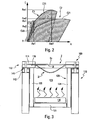
- the invention exploits the lowering of the mechanical characteristics of a sheet when passing from a cold deformation domain D1 to a heat deformation field D2, as illustrated by FIG. figure 2 for a titanium alloy sheet.
- the cold deformation domain D1 when the elongation "A" of a stress test specimen "C” increases, the cold variation curve C1 passes from a linear variation C10, corresponding to a field of elastic strain to a nonlinear variation C11 defining a plastic strain domain.
- the value of the stress at the point R e1 corresponding to the transition between the elastic and plastic domains, defines the elastic limit of the specimen.
- the plastic strain curve C11 passes through a maximum R m1 , corresponding to the mechanical strength at break.
- the variation curve C2 changes from a linear variation C20 to a nonlinear variation C21, at the point R e2 of change of domain.
- the nonlinear variation curve C21 passes through a maximum defining the point Rm2 of mechanical strength at break.
- the figure 3 illustrates an example of an incremental hot forming apparatus according to the invention.
- the apparatus 100 comprises a frame 110 lined internally with a thermal insulating box 120.
- This box is of parallelepipedal shape and comprises five walls, including a base wall 121 and side walls 122, 123 and 124 (only three lateral faces are visible on the sectional view of the figure 3 ). It is open on its upper part, as shown in the figure, located opposite the sheet 2 to be formed.
- the frame 100 also comprises positioning means 112 of the sheet 2 in the form of a blank holder 114 and a peripheral matrix 116.
- the sheet 2 is thus positioned on the opposite side to the base face 121 of the box 120.
- the casing 120 accommodates, on its base wall 121, halogen lamp heating means in the example 130. These lamps are able to heat the sheet 2 from below (arrows F).
- An auxiliary heating system 140 consisting of resistive heating elements in the example, is arranged in a support 142 under the peripheral matrix 116.
- This heating system 140 makes it possible to compensate for the thermal losses associated with the fixing and maintenance of the heating element. sheet 2 through the clamp 114 and the matrix 116.
- This auxiliary system 140 also improves the temperature homogeneity of the entire sheet to form 2.
- the lamps 130 are heated in the direction of the lower face 2i of the sheet 2 turned towards the inside of the frame 110.
- the sheet is made of a titanium and aluminum alloy, known under the trade name "TA6V ".
- the temperature to reach is at least 600 ° C. Once this temperature is reached, the heating is kept substantially constant under the sheet 2 to be formed, at the same time as the incremental forming is made from the upper face 2s of the sheet with the tool 1.
- the sheet 2 once formed schematically shows the generally curved shape referenced 2f on the figure 3 .
- the invention is not limited to the examples described or shown above but includes all the embodiments covered by the claims.
- the positioning means of the sheet may be of any type known to those skilled in the art (clamp, key, etc.).
- the auxiliary heating system may consist of any suitable means, for example an induction heater or the like.
Landscapes
- Engineering & Computer Science (AREA)
- Mechanical Engineering (AREA)
- Shaping Metal By Deep-Drawing, Or The Like (AREA)
Description
- L'invention concerne un dispositif de formage incrémental à chaud de tôle.
- Le domaine de l'invention est celui de la mise en forme de pièces de tôlerie par le formage incrémental.
- Dans un formage incrémental, avec une matrice partielle simplifiée (« partial die» en terminologie anglaise) ou sans matrice (« dieless » en terminologie anglaise), la tôle est uniquement maintenue en bordure, entre un serre-flan non spécifique et une matrice périphérique - dont la géométrie est adaptée à la pièce à former - en configuration « partial dieless » ou un simple support pour la configuration « dieless ».
- En général, une machine (qui peut être un robot ou tout autre machine de type 3 axes ou plus) est équipée d'un outil de formage à extrémité roulante ou rigide ; Les déplacements de l'outil sont pilotés par un processeur numérique sous le contrôle d'un logiciel. L'outil se déplace dans un plan horizontal selon une trajectoire paramétrique définie par le logiciel puis, par des sauts incrémentaux verticaux successifs, selon des trajectoires s'appuyant sur la géométrie à former dans des plans horizontaux parallèles.
- Cependant, le formage incrémental en configuration « dieless » ou « partial die », ne permet pas de réaliser le formage de pièces de géométries complexes ni d'obtenir des précisions acceptables avec certains matériaux tels que des aciers inoxydables ou des alliages de titane. En effet, les allongements tolérés par cette technologie limitent la géométrie des pièces à réaliser. Ainsi, pour certaines géométries, des risques d'endommagement apparaissent : la tôle peut se déchirer et des criques peuvent se former.
- Par ailleurs, des déformations élastiques peuvent apparaître du fait du retour élastique de certains alliages après formage. Ce retour élastique oblige alors à modifier les trajectoires de l'outil pour anticiper ce phénomène, mais cette anticipation ne permet pas d'obtenir une géométrie finale de la pièce satisfaisante.
- De plus certains matériaux, comme ceux déjà cités, nécessitent des efforts importants pour être mis en forme. Et ces efforts risquent de devenir bloquants lorsque la machine n'est pas suffisamment rigide ou puissante. En effet, une machine peu rigide se déforme face aux efforts de formage : la rigidité de la machine influe ainsi directement sur la précision du formage. Le document
JP-2008/126245 - L'invention vise à palier ces inconvénients en proposant d'élever la température de la tôle lors du formage incrémental et selon une configuration particulière.
- Un tel formage incrémental à chaud favorise la formabilité de la tôle en diminuant les efforts nécessaires au formage et le retour élastique provoqué par le formage. Les possibilités de formage incrémental de pièces complexes et la précision des pièces formées en est ainsi sensiblement améliorée.
- La température du chauffage peut s'élever à différents niveaux de température suivant le matériau à former, par exemple entre 600 et 800°C pour des alliages de titane.
- L'objet de l'invention est un dispositif de formage à chaud selon la revendication 1. Ce dispositif comporte un châssis comprenant des moyens de positionnement de la tôle à former, ainsi qu'un caisson isolant disposé dans le châssis et agencé pour isoler thermiquement des moyens de chauffe, en particulier des lampes à halogène ou infrarouge ou équivalent. Ces moyens de chauffe sont disposés dans le caisson de sorte à pouvoir chauffer la tôle par sa face inférieure tournée vers l'intérieur du châssis.
- Selon des modes de réalisation particuliers :
- les moyens de positionnement comportent un serre-flan et une matrice périphérique ou un support non spécifique aptes à enserrer la tôle à former ;
- un système de chauffe auxiliaire, agencé en utilisation de préférence sous la matrice périphérique ou le support, permet de compenser les pertes thermiques liées à la fixation et au maintien de la tôle à travers le serre-flan et la matrice périphérique ;
- le système de chauffe auxiliaire est constitué d'éléments chauffants résistifs.
- D'autres avantages, aspects et caractéristiques préférées de l'invention apparaîtront à la lecture de la description détaillée qui suit, en référence aux figures jointes qui représentent, respectivement :
- en
figure 1 , un schéma de principe de formage incrémental sans matrice support ; - en
figure 2 , le diagramme de la variation des caractéristiques mécaniques d'une tôle à chaud et à froid, et - en
figure 3 , une vue en coupe d'un exemple d'appareil de formage incrémental à chaud selon l'invention. - La
figure 1 illustre le principe du formage incrémental sans outillage, c'est-à-dire sans matrice support de tôle. Dans un tel formage, un outil de formage 1 - ici un outil de type 3 axes - se déplace selon une trajectoire T sur la tôle 2 à former, initialement plane. L'outil est guidé par une machine, un robot R dans l'exemple, et sa trajectoire est paramétrée par une unité de traitement numérique 3 du robot. La tôle 2 est reliée au bâti par la liaison 10 - L'outil 1 déforme la tôle 2 selon des zones Z1, Z2, .., Zi, parallèlement à la trajectoire T. L'outil passe d'une zone Zi à une autre par un pas d'incrément « I » de déplacement perpendiculaire au plan de la tôle 2. L'amplitude de l'incrément est également réglée par l'unité 3.
- L'invention exploite l'abaissement des caractéristiques mécaniques d'une tôle lorsque l'on passe d'un domaine de déformation à froid D1 à un domaine de déformation à chaud D2, tel qu'illustré par la
figure 2 pour une tôle en alliage de titane. Dans le domaine de déformation à froid D1, lorsque l'allongement « A » d'une éprouvette test sous contrainte « C » augmente, la courbe de variation à froid C1 passe d'une variation linéaire C10, correspondant à un domaine de déformation élastique, à une variation non linéaire C11 définissant un domaine de déformation plastique. - La valeur de la contrainte au point Re1, correspondant au passage entre les domaines élastique et plastique, définit la limite d'élasticité de l'éprouvette. La courbe de déformation plastique C11 passe par un maximum Rm1, correspondant à la résistance mécanique à la rupture.
- De manière similaire, dans le domaine de déformation à chaud D2, la courbe de variation C2 passe d'une variation linéaire C20 à une variation non linéaire C21, au point Re2 de changement de domaine. La courbe de variation non linéaire C21 passe par un maximum définissant le point Rm2 de résistance mécanique à la rupture.
- Lorsque l'on passe du domaine de déformation à froid D1 à un domaine de déformation à chaud D2, les caractéristiques mécaniques Re1 et Rm1 sont sensiblement abaissées et les allongements correspondants Ae1 et Am1 sont sensiblement augmentées. Ainsi, des tôles en acier inoxydable ou en alliage de titane ou autre, difficiles à mettre en forme par formage incrémental à froid - du fait d'une ductilité limitée et d'un important retour élastique - peuvent alors être mis en forme par un chauffage particulier, sans nécessiter d'appareil ou d'outil de formage de haute rigidité.
- La
figure 3 illustre un exemple d'appareil de formage incrémental à chaud selon l'invention. L'appareil 100 comporte un châssis 110 doublé intérieurement d'un caisson isolant thermique 120. Ce caisson est de forme parallélépipédique et comporte cinq parois, dont une paroi de base 121 et des parois latérales 122, 123 et 124 (seules trois faces latérales sont visibles sur la vue en coupe de lafigure 3 ). Il est ouvert sur sa partie supérieure, telle que représentée sur la figure, située en regard de la tôle 2 à former. - Le châssis 100 comporte également des moyens de positionnement 112 de la tôle 2 sous forme d'un serre-flan 114 et d'une matrice périphérique 116. La tôle 2 est ainsi positionnée du côté opposé à la face de base 121 du caisson 120.
- Le caisson 120 accueille sur sa paroi de base 121 des moyens de chauffe à lampes à halogène dans l'exemple 130. Ces lampes sont aptes à chauffer la tôle 2 par en dessous (flèches F).
- Un système de chauffe auxiliaire 140, constitué d'éléments chauffants résistifs dans l'exemple, est agencé dans un support 142 sous la matrice périphérique 116. Ce système de chauffe 140 permet de compenser les pertes thermiques liées à la fixation et au maintien de la tôle 2 à travers le serre-joint 114 et la matrice 116. Ce système auxiliaire 140 permet également d'améliorer l'homogénéité en température sur toute la tôle à former 2.
- En fonctionnement, les lampes 130 chauffent en direction de la face inférieure 2i de la tôle 2 tournée vers l'intérieur du châssis 110. la tôle est ici constituée d'un alliage en titane et d'aluminium, connu sous la dénomination commerciale « TA6V ». La température à atteindre est d'au moins 600°C. Une fois cette température atteinte, la chauffe est maintenue sensiblement constante sous la tôle 2 à former, en même temps que le formage incrémental est réalisé à partir de la face supérieure 2s de la tôle avec l'outil 1. La tôle 2 une fois formée présente schématiquement la forme globalement incurvée référencée 2f sur la
figure 3 . - L'invention n'est pas limitée aux exemples décrits ou représentés ci-dessus mais comprend toutes les variantes de réalisation couvertes par les revendications. Il est par exemple possible d'utiliser des formes de châssis et de caisson cylindriques ou autres. Les moyens de positionnement de la tôle peuvent être de tout type connu de la personne du métier (serre-joint, clavette, etc.). Le système de chauffe auxiliaire peut être constitué de tout moyen approprié, par exemple un chauffage à induction ou équivalent.
Claims (6)
- Dispositif de formage incrémental à chaud de tôle (2), caractérisé en ce qu'il comporte un châssis (110) comprenant des moyens de positionnement (112) de la tôle à former (2), ainsi qu'un caisson isolant (120) disposé dans le châssis (110) et agencé pour isoler thermiquement des moyens de chauffe (130), ces moyens de chauffe étant disposés dans le caisson (120) de sorte à pouvoir chauffer (F) la tôle (2) par sa face inférieure (2i) tournée vers l'intérieur du châssis (110).
- Dispositif de formage incrémental à chaud selon la revendication précédente, dans lequel les moyens de chauffe comportent des lampes à halogène (130).
- Dispositif de formage incrémental à chaud selon l'une des revendications 1 ou 2, dans lequel les moyens de positionnement (112) comportent un serre-flan (114) et une matrice périphérique (116) aptes à enserrer la tôle à former (2).
- Dispositif de formage incrémental à chaud selon l'une quelconque des revendications 1 à 3, dans lequel un système de chauffe auxiliaire (140) permet de compenser les pertes thermiques liées à la fixation et au maintien de la tôle (2) à travers le serre-flan (114) et la matrice (116).
- Dispositif de formage incrémental à chaud selon la revendication précédente, dans lequel le système de chauffe auxiliaire (140) est agencé en utilisation sous la matrice périphérique (116).
- Dispositif de formage incrémental à chaud selon l'une des revendications 4 ou 5, dans lequel le système de chauffe auxiliaire (140) est constitué d'éléments chauffants résistifs.
Applications Claiming Priority (1)
| Application Number | Priority Date | Filing Date | Title |
|---|---|---|---|
| FR1157403A FR2979066B1 (fr) | 2011-08-18 | 2011-08-18 | Procede et dispositif de formage incremental |
Publications (2)
| Publication Number | Publication Date |
|---|---|
| EP2559499A1 EP2559499A1 (fr) | 2013-02-20 |
| EP2559499B1 true EP2559499B1 (fr) | 2013-11-13 |
Family
ID=46551452
Family Applications (1)
| Application Number | Title | Priority Date | Filing Date |
|---|---|---|---|
| EP20120178446 Active EP2559499B1 (fr) | 2011-08-18 | 2012-07-30 | Dispositif de formage incrémental |
Country Status (2)
| Country | Link |
|---|---|
| EP (1) | EP2559499B1 (fr) |
| FR (1) | FR2979066B1 (fr) |
Cited By (1)
| Publication number | Priority date | Publication date | Assignee | Title |
|---|---|---|---|---|
| KR20240039490A (ko) * | 2022-09-19 | 2024-03-26 | 한국생산기술연구원 | 점진 성형 장치 |
Families Citing this family (7)
| Publication number | Priority date | Publication date | Assignee | Title |
|---|---|---|---|---|
| CN104384310B (zh) * | 2014-09-24 | 2016-04-27 | 安徽工业大学 | 一种带辅助底座的板料渐进成形方法 |
| US9719150B2 (en) * | 2015-01-05 | 2017-08-01 | The Boeing Company | Methods of forming a workpiece made of a naturally aging alloy |
| CN106001254B (zh) * | 2016-05-24 | 2017-12-26 | 北京航空航天大学 | 一种用于热渐进成形的保温装置 |
| CN110102637B (zh) * | 2019-06-13 | 2023-12-08 | 福州大学 | 一种单点渐进成形热空气加热工作台及其使用方法 |
| CN111774472B (zh) * | 2020-07-31 | 2022-02-11 | 重庆交通大学 | 浮动支撑单点渐进热成形装置 |
| CN113042618A (zh) * | 2021-03-15 | 2021-06-29 | 武汉理工大学 | 大型构件增量成形方法 |
| CN113857342B (zh) * | 2021-09-08 | 2023-05-12 | 上海交通大学 | 一种提高薄壁成形件搅拌摩擦渐进成形性能的方法 |
Family Cites Families (3)
| Publication number | Priority date | Publication date | Assignee | Title |
|---|---|---|---|---|
| JP3959455B2 (ja) * | 2002-02-19 | 2007-08-15 | 本田技研工業株式会社 | 逐次成形装置 |
| US7984635B2 (en) * | 2005-04-22 | 2011-07-26 | K.U. Leuven Research & Development | Asymmetric incremental sheet forming system |
| JP5224259B2 (ja) * | 2006-11-17 | 2013-07-03 | 新潟県 | マグネシウム合金薄板の塑性加工方法 |
-
2011
- 2011-08-18 FR FR1157403A patent/FR2979066B1/fr not_active Expired - Fee Related
-
2012
- 2012-07-30 EP EP20120178446 patent/EP2559499B1/fr active Active
Cited By (2)
| Publication number | Priority date | Publication date | Assignee | Title |
|---|---|---|---|---|
| KR20240039490A (ko) * | 2022-09-19 | 2024-03-26 | 한국생산기술연구원 | 점진 성형 장치 |
| KR102791769B1 (ko) | 2022-09-19 | 2025-04-09 | 한국생산기술연구원 | 점진 성형 장치 |
Also Published As
| Publication number | Publication date |
|---|---|
| EP2559499A1 (fr) | 2013-02-20 |
| FR2979066B1 (fr) | 2013-09-06 |
| FR2979066A1 (fr) | 2013-02-22 |
Similar Documents
| Publication | Publication Date | Title |
|---|---|---|
| EP2559499A1 (fr) | Procédé et dispositif de formage incrémental | |
| Jedrasiak et al. | Thermal modeling of Al-Al and Al-steel friction stir spot welding | |
| Cox et al. | A method for double-sided friction stir spot welding | |
| Chien et al. | Optimal FSW process parameters for aluminum alloys AA5083 | |
| Liu et al. | Effect of friction stir welding parameters on microstructural characteristics and mechanical properties of 2219-T6 aluminum alloy joints | |
| Grant et al. | Finite element process modelling of inertia friction welding advanced nickel-based superalloy | |
| EP2195135B1 (fr) | Procede de soudage de pieces par friction malaxage utilisant un dispositif a double epaulement | |
| Kumar et al. | Multi-response optimization of process parameters for friction stir welding of joining dissimilar Al alloys by gray relation analysis and Taguchi method | |
| BE1025079B1 (fr) | Element radiant tubulaire pour installations industrielles et similaires | |
| Kumar et al. | Thermal simulation on friction stir welding of AA6061 aluminum alloy by computational fluid dynamics | |
| FR2752539A1 (fr) | Procede de fabrication d'une aube creuse de turbomachine et equipement de vrillage evolutif a chaud utilise | |
| Besler et al. | Advanced process possibilities in friction crush welding of aluminum, steel, and copper by using an additional wire | |
| Calogero et al. | A weldability study of Al–Cu–Li 2198 alloy | |
| Cheng et al. | Weldment properties evaluation and formability study of tailor-welded blanks of different thickness combinations and welding orientations | |
| Arhami et al. | Microstructural evolution and mechanical properties evaluation of IN-939 bonds made by isothermal solidification of a liquated Ni-Cr-B interlayer | |
| Napolitano et al. | FSW of extruded and additively manufactured parts for automotive components | |
| Kumar et al. | The role of tool design in influencing the mechanism for the formation of friction stir welds in aluminum alloy 7020 | |
| Hovanski et al. | Comparing laser welding technologies with friction stir welding for production of aluminum tailor-welded blanks | |
| Dul | Application and processing of nickel alloys in the aviation industry | |
| Azuma et al. | Friction stir welding in stainless steel sheet of type 430 using Ni-based dual two-phase intermetallic alloy tool | |
| Meikeerthy et al. | Multi response optimization of friction stir welding in air and water by analytic hierarchy process and VIKOR method. | |
| EP2355953B1 (fr) | Procédé d'assemblage de deux toles par soudure laser, notamment pour assembler la tôle d'encadrement d'une porte de véhicule automobile à la doublure de cette porte | |
| EP0885979B1 (fr) | Procédé de fabrication d'un article en alliage renforcé par dispersion d'oxydes | |
| Ghetiya et al. | Determination of an optimum parametric combination using a tensile strength prediction model for friction stir welded AA8011 aluminium alloy | |
| Guo et al. | Joining of AA1100–16 vol.-% B4C metal matrix composite using laser welding and friction stir welding |
Legal Events
| Date | Code | Title | Description |
|---|---|---|---|
| PUAI | Public reference made under article 153(3) epc to a published international application that has entered the european phase |
Free format text: ORIGINAL CODE: 0009012 |
|
| AK | Designated contracting states |
Kind code of ref document: A1 Designated state(s): AL AT BE BG CH CY CZ DE DK EE ES FI FR GB GR HR HU IE IS IT LI LT LU LV MC MK MT NL NO PL PT RO RS SE SI SK SM TR |
|
| AX | Request for extension of the european patent |
Extension state: BA ME |
|
| GRAP | Despatch of communication of intention to grant a patent |
Free format text: ORIGINAL CODE: EPIDOSNIGR1 |
|
| 17P | Request for examination filed |
Effective date: 20130709 |
|
| RBV | Designated contracting states (corrected) |
Designated state(s): AL AT BE BG CH CY CZ DE DK EE ES FI FR GB GR HR HU IE IS IT LI LT LU LV MC MK MT NL NO PL PT RO RS SE SI SK SM TR |
|
| RIC1 | Information provided on ipc code assigned before grant |
Ipc: B21D 31/00 20060101AFI20130726BHEP |
|
| INTG | Intention to grant announced |
Effective date: 20130813 |
|
| GRAS | Grant fee paid |
Free format text: ORIGINAL CODE: EPIDOSNIGR3 |
|
| GRAA | (expected) grant |
Free format text: ORIGINAL CODE: 0009210 |
|
| AK | Designated contracting states |
Kind code of ref document: B1 Designated state(s): AL AT BE BG CH CY CZ DE DK EE ES FI FR GB GR HR HU IE IS IT LI LT LU LV MC MK MT NL NO PL PT RO RS SE SI SK SM TR |
|
| REG | Reference to a national code |
Ref country code: GB Ref legal event code: FG4D Free format text: NOT ENGLISH |
|
| REG | Reference to a national code |
Ref country code: CH Ref legal event code: EP |
|
| REG | Reference to a national code |
Ref country code: AT Ref legal event code: REF Ref document number: 640335 Country of ref document: AT Kind code of ref document: T Effective date: 20131215 |
|
| REG | Reference to a national code |
Ref country code: IE Ref legal event code: FG4D Free format text: LANGUAGE OF EP DOCUMENT: FRENCH |
|
| REG | Reference to a national code |
Ref country code: DE Ref legal event code: R096 Ref document number: 602012000506 Country of ref document: DE Effective date: 20140109 |
|
| REG | Reference to a national code |
Ref country code: NL Ref legal event code: VDEP Effective date: 20131113 |
|
| REG | Reference to a national code |
Ref country code: AT Ref legal event code: MK05 Ref document number: 640335 Country of ref document: AT Kind code of ref document: T Effective date: 20131113 |
|
| REG | Reference to a national code |
Ref country code: LT Ref legal event code: MG4D |
|
| PG25 | Lapsed in a contracting state [announced via postgrant information from national office to epo] |
Ref country code: HR Free format text: LAPSE BECAUSE OF FAILURE TO SUBMIT A TRANSLATION OF THE DESCRIPTION OR TO PAY THE FEE WITHIN THE PRESCRIBED TIME-LIMIT Effective date: 20131113 Ref country code: FI Free format text: LAPSE BECAUSE OF FAILURE TO SUBMIT A TRANSLATION OF THE DESCRIPTION OR TO PAY THE FEE WITHIN THE PRESCRIBED TIME-LIMIT Effective date: 20131113 Ref country code: IS Free format text: LAPSE BECAUSE OF FAILURE TO SUBMIT A TRANSLATION OF THE DESCRIPTION OR TO PAY THE FEE WITHIN THE PRESCRIBED TIME-LIMIT Effective date: 20140313 Ref country code: LT Free format text: LAPSE BECAUSE OF FAILURE TO SUBMIT A TRANSLATION OF THE DESCRIPTION OR TO PAY THE FEE WITHIN THE PRESCRIBED TIME-LIMIT Effective date: 20131113 Ref country code: NO Free format text: LAPSE BECAUSE OF FAILURE TO SUBMIT A TRANSLATION OF THE DESCRIPTION OR TO PAY THE FEE WITHIN THE PRESCRIBED TIME-LIMIT Effective date: 20140213 Ref country code: SE Free format text: LAPSE BECAUSE OF FAILURE TO SUBMIT A TRANSLATION OF THE DESCRIPTION OR TO PAY THE FEE WITHIN THE PRESCRIBED TIME-LIMIT Effective date: 20131113 Ref country code: NL Free format text: LAPSE BECAUSE OF FAILURE TO SUBMIT A TRANSLATION OF THE DESCRIPTION OR TO PAY THE FEE WITHIN THE PRESCRIBED TIME-LIMIT Effective date: 20131113 |
|
| PG25 | Lapsed in a contracting state [announced via postgrant information from national office to epo] |
Ref country code: RS Free format text: LAPSE BECAUSE OF FAILURE TO SUBMIT A TRANSLATION OF THE DESCRIPTION OR TO PAY THE FEE WITHIN THE PRESCRIBED TIME-LIMIT Effective date: 20131113 Ref country code: AT Free format text: LAPSE BECAUSE OF FAILURE TO SUBMIT A TRANSLATION OF THE DESCRIPTION OR TO PAY THE FEE WITHIN THE PRESCRIBED TIME-LIMIT Effective date: 20131113 Ref country code: CY Free format text: LAPSE BECAUSE OF FAILURE TO SUBMIT A TRANSLATION OF THE DESCRIPTION OR TO PAY THE FEE WITHIN THE PRESCRIBED TIME-LIMIT Effective date: 20131113 Ref country code: ES Free format text: LAPSE BECAUSE OF FAILURE TO SUBMIT A TRANSLATION OF THE DESCRIPTION OR TO PAY THE FEE WITHIN THE PRESCRIBED TIME-LIMIT Effective date: 20131113 Ref country code: LV Free format text: LAPSE BECAUSE OF FAILURE TO SUBMIT A TRANSLATION OF THE DESCRIPTION OR TO PAY THE FEE WITHIN THE PRESCRIBED TIME-LIMIT Effective date: 20131113 |
|
| PG25 | Lapsed in a contracting state [announced via postgrant information from national office to epo] |
Ref country code: PT Free format text: LAPSE BECAUSE OF FAILURE TO SUBMIT A TRANSLATION OF THE DESCRIPTION OR TO PAY THE FEE WITHIN THE PRESCRIBED TIME-LIMIT Effective date: 20140313 |
|
| PG25 | Lapsed in a contracting state [announced via postgrant information from national office to epo] |
Ref country code: EE Free format text: LAPSE BECAUSE OF FAILURE TO SUBMIT A TRANSLATION OF THE DESCRIPTION OR TO PAY THE FEE WITHIN THE PRESCRIBED TIME-LIMIT Effective date: 20131113 |
|
| REG | Reference to a national code |
Ref country code: DE Ref legal event code: R097 Ref document number: 602012000506 Country of ref document: DE |
|
| PG25 | Lapsed in a contracting state [announced via postgrant information from national office to epo] |
Ref country code: PL Free format text: LAPSE BECAUSE OF FAILURE TO SUBMIT A TRANSLATION OF THE DESCRIPTION OR TO PAY THE FEE WITHIN THE PRESCRIBED TIME-LIMIT Effective date: 20131113 Ref country code: CZ Free format text: LAPSE BECAUSE OF FAILURE TO SUBMIT A TRANSLATION OF THE DESCRIPTION OR TO PAY THE FEE WITHIN THE PRESCRIBED TIME-LIMIT Effective date: 20131113 Ref country code: SK Free format text: LAPSE BECAUSE OF FAILURE TO SUBMIT A TRANSLATION OF THE DESCRIPTION OR TO PAY THE FEE WITHIN THE PRESCRIBED TIME-LIMIT Effective date: 20131113 |
|
| PLBE | No opposition filed within time limit |
Free format text: ORIGINAL CODE: 0009261 |
|
| STAA | Information on the status of an ep patent application or granted ep patent |
Free format text: STATUS: NO OPPOSITION FILED WITHIN TIME LIMIT |
|
| PG25 | Lapsed in a contracting state [announced via postgrant information from national office to epo] |
Ref country code: DK Free format text: LAPSE BECAUSE OF FAILURE TO SUBMIT A TRANSLATION OF THE DESCRIPTION OR TO PAY THE FEE WITHIN THE PRESCRIBED TIME-LIMIT Effective date: 20131113 |
|
| 26N | No opposition filed |
Effective date: 20140814 |
|
| REG | Reference to a national code |
Ref country code: DE Ref legal event code: R097 Ref document number: 602012000506 Country of ref document: DE Effective date: 20140814 |
|
| PG25 | Lapsed in a contracting state [announced via postgrant information from national office to epo] |
Ref country code: SI Free format text: LAPSE BECAUSE OF FAILURE TO SUBMIT A TRANSLATION OF THE DESCRIPTION OR TO PAY THE FEE WITHIN THE PRESCRIBED TIME-LIMIT Effective date: 20131113 Ref country code: LU Free format text: LAPSE BECAUSE OF FAILURE TO SUBMIT A TRANSLATION OF THE DESCRIPTION OR TO PAY THE FEE WITHIN THE PRESCRIBED TIME-LIMIT Effective date: 20140730 |
|
| REG | Reference to a national code |
Ref country code: IE Ref legal event code: MM4A |
|
| PG25 | Lapsed in a contracting state [announced via postgrant information from national office to epo] |
Ref country code: IT Free format text: LAPSE BECAUSE OF FAILURE TO SUBMIT A TRANSLATION OF THE DESCRIPTION OR TO PAY THE FEE WITHIN THE PRESCRIBED TIME-LIMIT Effective date: 20131113 |
|
| REG | Reference to a national code |
Ref country code: FR Ref legal event code: PLFP Year of fee payment: 4 |
|
| PG25 | Lapsed in a contracting state [announced via postgrant information from national office to epo] |
Ref country code: IE Free format text: LAPSE BECAUSE OF NON-PAYMENT OF DUE FEES Effective date: 20140730 |
|
| REG | Reference to a national code |
Ref country code: CH Ref legal event code: PL |
|
| PG25 | Lapsed in a contracting state [announced via postgrant information from national office to epo] |
Ref country code: CH Free format text: LAPSE BECAUSE OF NON-PAYMENT OF DUE FEES Effective date: 20150731 Ref country code: LI Free format text: LAPSE BECAUSE OF NON-PAYMENT OF DUE FEES Effective date: 20150731 Ref country code: SM Free format text: LAPSE BECAUSE OF FAILURE TO SUBMIT A TRANSLATION OF THE DESCRIPTION OR TO PAY THE FEE WITHIN THE PRESCRIBED TIME-LIMIT Effective date: 20131113 Ref country code: MC Free format text: LAPSE BECAUSE OF FAILURE TO SUBMIT A TRANSLATION OF THE DESCRIPTION OR TO PAY THE FEE WITHIN THE PRESCRIBED TIME-LIMIT Effective date: 20131113 |
|
| PG25 | Lapsed in a contracting state [announced via postgrant information from national office to epo] |
Ref country code: RO Free format text: LAPSE BECAUSE OF FAILURE TO SUBMIT A TRANSLATION OF THE DESCRIPTION OR TO PAY THE FEE WITHIN THE PRESCRIBED TIME-LIMIT Effective date: 20131113 |
|
| PG25 | Lapsed in a contracting state [announced via postgrant information from national office to epo] |
Ref country code: BG Free format text: LAPSE BECAUSE OF FAILURE TO SUBMIT A TRANSLATION OF THE DESCRIPTION OR TO PAY THE FEE WITHIN THE PRESCRIBED TIME-LIMIT Effective date: 20131113 Ref country code: GR Free format text: LAPSE BECAUSE OF FAILURE TO SUBMIT A TRANSLATION OF THE DESCRIPTION OR TO PAY THE FEE WITHIN THE PRESCRIBED TIME-LIMIT Effective date: 20140214 Ref country code: MT Free format text: LAPSE BECAUSE OF FAILURE TO SUBMIT A TRANSLATION OF THE DESCRIPTION OR TO PAY THE FEE WITHIN THE PRESCRIBED TIME-LIMIT Effective date: 20131113 |
|
| REG | Reference to a national code |
Ref country code: FR Ref legal event code: PLFP Year of fee payment: 5 |
|
| PG25 | Lapsed in a contracting state [announced via postgrant information from national office to epo] |
Ref country code: HU Free format text: LAPSE BECAUSE OF FAILURE TO SUBMIT A TRANSLATION OF THE DESCRIPTION OR TO PAY THE FEE WITHIN THE PRESCRIBED TIME-LIMIT; INVALID AB INITIO Effective date: 20120730 Ref country code: BE Free format text: LAPSE BECAUSE OF FAILURE TO SUBMIT A TRANSLATION OF THE DESCRIPTION OR TO PAY THE FEE WITHIN THE PRESCRIBED TIME-LIMIT Effective date: 20140731 Ref country code: TR Free format text: LAPSE BECAUSE OF FAILURE TO SUBMIT A TRANSLATION OF THE DESCRIPTION OR TO PAY THE FEE WITHIN THE PRESCRIBED TIME-LIMIT Effective date: 20131113 |
|
| REG | Reference to a national code |
Ref country code: FR Ref legal event code: PLFP Year of fee payment: 6 |
|
| PG25 | Lapsed in a contracting state [announced via postgrant information from national office to epo] |
Ref country code: MK Free format text: LAPSE BECAUSE OF FAILURE TO SUBMIT A TRANSLATION OF THE DESCRIPTION OR TO PAY THE FEE WITHIN THE PRESCRIBED TIME-LIMIT Effective date: 20131113 |
|
| REG | Reference to a national code |
Ref country code: FR Ref legal event code: PLFP Year of fee payment: 7 |
|
| PG25 | Lapsed in a contracting state [announced via postgrant information from national office to epo] |
Ref country code: AL Free format text: LAPSE BECAUSE OF FAILURE TO SUBMIT A TRANSLATION OF THE DESCRIPTION OR TO PAY THE FEE WITHIN THE PRESCRIBED TIME-LIMIT Effective date: 20131113 |
|
| PGFP | Annual fee paid to national office [announced via postgrant information from national office to epo] |
Ref country code: DE Payment date: 20250722 Year of fee payment: 14 |
|
| PGFP | Annual fee paid to national office [announced via postgrant information from national office to epo] |
Ref country code: GB Payment date: 20250722 Year of fee payment: 14 |
|
| PGFP | Annual fee paid to national office [announced via postgrant information from national office to epo] |
Ref country code: FR Payment date: 20250725 Year of fee payment: 14 |