EP2552971B1 - End-functionalized polymers - Google Patents
End-functionalized polymers Download PDFInfo
- Publication number
- EP2552971B1 EP2552971B1 EP11712229.1A EP11712229A EP2552971B1 EP 2552971 B1 EP2552971 B1 EP 2552971B1 EP 11712229 A EP11712229 A EP 11712229A EP 2552971 B1 EP2552971 B1 EP 2552971B1
- Authority
- EP
- European Patent Office
- Prior art keywords
- group
- alkyl
- copolymer
- hydroxy
- terminated polymer
- Prior art date
- Legal status (The legal status is an assumption and is not a legal conclusion. Google has not performed a legal analysis and makes no representation as to the accuracy of the status listed.)
- Active
Links
- 0 **CC(*)(*)*N* Chemical compound **CC(*)(*)*N* 0.000 description 1
- OMAOWNSEWUZXQI-UHFFFAOYSA-N CC(C)(C(NCCNC(C(C)(C)I)=O)=O)N Chemical compound CC(C)(C(NCCNC(C(C)(C)I)=O)=O)N OMAOWNSEWUZXQI-UHFFFAOYSA-N 0.000 description 1
Classifications
-
- C—CHEMISTRY; METALLURGY
- C08—ORGANIC MACROMOLECULAR COMPOUNDS; THEIR PREPARATION OR CHEMICAL WORKING-UP; COMPOSITIONS BASED THEREON
- C08F—MACROMOLECULAR COMPOUNDS OBTAINED BY REACTIONS ONLY INVOLVING CARBON-TO-CARBON UNSATURATED BONDS
- C08F8/00—Chemical modification by after-treatment
- C08F8/44—Preparation of metal salts or ammonium salts
-
- C—CHEMISTRY; METALLURGY
- C08—ORGANIC MACROMOLECULAR COMPOUNDS; THEIR PREPARATION OR CHEMICAL WORKING-UP; COMPOSITIONS BASED THEREON
- C08F—MACROMOLECULAR COMPOUNDS OBTAINED BY REACTIONS ONLY INVOLVING CARBON-TO-CARBON UNSATURATED BONDS
- C08F8/00—Chemical modification by after-treatment
-
- C—CHEMISTRY; METALLURGY
- C08—ORGANIC MACROMOLECULAR COMPOUNDS; THEIR PREPARATION OR CHEMICAL WORKING-UP; COMPOSITIONS BASED THEREON
- C08F—MACROMOLECULAR COMPOUNDS OBTAINED BY REACTIONS ONLY INVOLVING CARBON-TO-CARBON UNSATURATED BONDS
- C08F8/00—Chemical modification by after-treatment
- C08F8/30—Introducing nitrogen atoms or nitrogen-containing groups
-
- C—CHEMISTRY; METALLURGY
- C08—ORGANIC MACROMOLECULAR COMPOUNDS; THEIR PREPARATION OR CHEMICAL WORKING-UP; COMPOSITIONS BASED THEREON
- C08F—MACROMOLECULAR COMPOUNDS OBTAINED BY REACTIONS ONLY INVOLVING CARBON-TO-CARBON UNSATURATED BONDS
- C08F8/00—Chemical modification by after-treatment
- C08F8/42—Introducing metal atoms or metal-containing groups
-
- C—CHEMISTRY; METALLURGY
- C08—ORGANIC MACROMOLECULAR COMPOUNDS; THEIR PREPARATION OR CHEMICAL WORKING-UP; COMPOSITIONS BASED THEREON
- C08F—MACROMOLECULAR COMPOUNDS OBTAINED BY REACTIONS ONLY INVOLVING CARBON-TO-CARBON UNSATURATED BONDS
- C08F12/00—Homopolymers and copolymers of compounds having one or more unsaturated aliphatic radicals, each having only one carbon-to-carbon double bond, and at least one being terminated by an aromatic carbocyclic ring
- C08F12/02—Monomers containing only one unsaturated aliphatic radical
- C08F12/04—Monomers containing only one unsaturated aliphatic radical containing one ring
- C08F12/06—Hydrocarbons
- C08F12/08—Styrene
-
- C—CHEMISTRY; METALLURGY
- C08—ORGANIC MACROMOLECULAR COMPOUNDS; THEIR PREPARATION OR CHEMICAL WORKING-UP; COMPOSITIONS BASED THEREON
- C08F—MACROMOLECULAR COMPOUNDS OBTAINED BY REACTIONS ONLY INVOLVING CARBON-TO-CARBON UNSATURATED BONDS
- C08F16/00—Homopolymers and copolymers of compounds having one or more unsaturated aliphatic radicals, each having only one carbon-to-carbon double bond, and at least one being terminated by an alcohol, ether, aldehydo, ketonic, acetal or ketal radical
- C08F16/12—Homopolymers and copolymers of compounds having one or more unsaturated aliphatic radicals, each having only one carbon-to-carbon double bond, and at least one being terminated by an alcohol, ether, aldehydo, ketonic, acetal or ketal radical by an ether radical
-
- C—CHEMISTRY; METALLURGY
- C08—ORGANIC MACROMOLECULAR COMPOUNDS; THEIR PREPARATION OR CHEMICAL WORKING-UP; COMPOSITIONS BASED THEREON
- C08F—MACROMOLECULAR COMPOUNDS OBTAINED BY REACTIONS ONLY INVOLVING CARBON-TO-CARBON UNSATURATED BONDS
- C08F2/00—Processes of polymerisation
- C08F2/001—Multistage polymerisation processes characterised by a change in reactor conditions without deactivating the intermediate polymer
-
- C—CHEMISTRY; METALLURGY
- C08—ORGANIC MACROMOLECULAR COMPOUNDS; THEIR PREPARATION OR CHEMICAL WORKING-UP; COMPOSITIONS BASED THEREON
- C08F—MACROMOLECULAR COMPOUNDS OBTAINED BY REACTIONS ONLY INVOLVING CARBON-TO-CARBON UNSATURATED BONDS
- C08F20/00—Homopolymers and copolymers of compounds having one or more unsaturated aliphatic radicals, each having only one carbon-to-carbon double bond, and only one being terminated by only one carboxyl radical or a salt, anhydride, ester, amide, imide or nitrile thereof
- C08F20/02—Monocarboxylic acids having less than ten carbon atoms, Derivatives thereof
- C08F20/10—Esters
- C08F20/12—Esters of monohydric alcohols or phenols
-
- C—CHEMISTRY; METALLURGY
- C08—ORGANIC MACROMOLECULAR COMPOUNDS; THEIR PREPARATION OR CHEMICAL WORKING-UP; COMPOSITIONS BASED THEREON
- C08F—MACROMOLECULAR COMPOUNDS OBTAINED BY REACTIONS ONLY INVOLVING CARBON-TO-CARBON UNSATURATED BONDS
- C08F20/00—Homopolymers and copolymers of compounds having one or more unsaturated aliphatic radicals, each having only one carbon-to-carbon double bond, and only one being terminated by only one carboxyl radical or a salt, anhydride, ester, amide, imide or nitrile thereof
- C08F20/02—Monocarboxylic acids having less than ten carbon atoms, Derivatives thereof
- C08F20/52—Amides or imides
- C08F20/54—Amides, e.g. N,N-dimethylacrylamide or N-isopropylacrylamide
-
- C—CHEMISTRY; METALLURGY
- C08—ORGANIC MACROMOLECULAR COMPOUNDS; THEIR PREPARATION OR CHEMICAL WORKING-UP; COMPOSITIONS BASED THEREON
- C08F—MACROMOLECULAR COMPOUNDS OBTAINED BY REACTIONS ONLY INVOLVING CARBON-TO-CARBON UNSATURATED BONDS
- C08F2438/00—Living radical polymerisation
- C08F2438/02—Stable Free Radical Polymerisation [SFRP]; Nitroxide Mediated Polymerisation [NMP] for, e.g. using 2,2,6,6-tetramethylpiperidine-1-oxyl [TEMPO]
-
- C—CHEMISTRY; METALLURGY
- C08—ORGANIC MACROMOLECULAR COMPOUNDS; THEIR PREPARATION OR CHEMICAL WORKING-UP; COMPOSITIONS BASED THEREON
- C08F—MACROMOLECULAR COMPOUNDS OBTAINED BY REACTIONS ONLY INVOLVING CARBON-TO-CARBON UNSATURATED BONDS
- C08F26/00—Homopolymers and copolymers of compounds having one or more unsaturated aliphatic radicals, each having only one carbon-to-carbon double bond, and at least one being terminated by a single or double bond to nitrogen or by a heterocyclic ring containing nitrogen
- C08F26/06—Homopolymers and copolymers of compounds having one or more unsaturated aliphatic radicals, each having only one carbon-to-carbon double bond, and at least one being terminated by a single or double bond to nitrogen or by a heterocyclic ring containing nitrogen by a heterocyclic ring containing nitrogen
- C08F26/10—N-Vinyl-pyrrolidone
-
- C—CHEMISTRY; METALLURGY
- C08—ORGANIC MACROMOLECULAR COMPOUNDS; THEIR PREPARATION OR CHEMICAL WORKING-UP; COMPOSITIONS BASED THEREON
- C08F—MACROMOLECULAR COMPOUNDS OBTAINED BY REACTIONS ONLY INVOLVING CARBON-TO-CARBON UNSATURATED BONDS
- C08F2810/00—Chemical modification of a polymer
- C08F2810/40—Chemical modification of a polymer taking place solely at one end or both ends of the polymer backbone, i.e. not in the side or lateral chains
-
- C—CHEMISTRY; METALLURGY
- C08—ORGANIC MACROMOLECULAR COMPOUNDS; THEIR PREPARATION OR CHEMICAL WORKING-UP; COMPOSITIONS BASED THEREON
- C08F—MACROMOLECULAR COMPOUNDS OBTAINED BY REACTIONS ONLY INVOLVING CARBON-TO-CARBON UNSATURATED BONDS
- C08F293/00—Macromolecular compounds obtained by polymerisation on to a macromolecule having groups capable of inducing the formation of new polymer chains bound exclusively at one or both ends of the starting macromolecule
- C08F293/005—Macromolecular compounds obtained by polymerisation on to a macromolecule having groups capable of inducing the formation of new polymer chains bound exclusively at one or both ends of the starting macromolecule using free radical "living" or "controlled" polymerisation, e.g. using a complexing agent
-
- C—CHEMISTRY; METALLURGY
- C08—ORGANIC MACROMOLECULAR COMPOUNDS; THEIR PREPARATION OR CHEMICAL WORKING-UP; COMPOSITIONS BASED THEREON
- C08F—MACROMOLECULAR COMPOUNDS OBTAINED BY REACTIONS ONLY INVOLVING CARBON-TO-CARBON UNSATURATED BONDS
- C08F36/00—Homopolymers and copolymers of compounds having one or more unsaturated aliphatic radicals, at least one having two or more carbon-to-carbon double bonds
- C08F36/02—Homopolymers and copolymers of compounds having one or more unsaturated aliphatic radicals, at least one having two or more carbon-to-carbon double bonds the radical having only two carbon-to-carbon double bonds
- C08F36/04—Homopolymers and copolymers of compounds having one or more unsaturated aliphatic radicals, at least one having two or more carbon-to-carbon double bonds the radical having only two carbon-to-carbon double bonds conjugated
- C08F36/06—Butadiene
-
- C—CHEMISTRY; METALLURGY
- C08—ORGANIC MACROMOLECULAR COMPOUNDS; THEIR PREPARATION OR CHEMICAL WORKING-UP; COMPOSITIONS BASED THEREON
- C08F—MACROMOLECULAR COMPOUNDS OBTAINED BY REACTIONS ONLY INVOLVING CARBON-TO-CARBON UNSATURATED BONDS
- C08F36/00—Homopolymers and copolymers of compounds having one or more unsaturated aliphatic radicals, at least one having two or more carbon-to-carbon double bonds
- C08F36/02—Homopolymers and copolymers of compounds having one or more unsaturated aliphatic radicals, at least one having two or more carbon-to-carbon double bonds the radical having only two carbon-to-carbon double bonds
- C08F36/04—Homopolymers and copolymers of compounds having one or more unsaturated aliphatic radicals, at least one having two or more carbon-to-carbon double bonds the radical having only two carbon-to-carbon double bonds conjugated
- C08F36/08—Isoprene
Definitions
- This invention relates to end-functionalized living polymers, the preparation thereof and its use as building blocks in industrial applications.
- End-functionalized polymers as well as telechelic polymers, are widely used in industry as building blocks, such as telechelic polyether (PEGs, PPGs, poly-THFs), telechelic polyester (diol initiated polycaprolactones).
- telechelic polyether PEGs, PPGs, poly-THFs
- telechelic polyester diol initiated polycaprolactones
- NMP nitroxide-mediated polymerization
- the International Publication WO 97/46593 discloses a method for preparing telechelic 1,3-diene oligomers that consists in effecting the free radical polymerization of at least one 1,3-diene with a heat sensitive polymerization initiator such as hydrogen peroxide in the presence of a stable nitroxide radical.
- the object of the present invention is to have new end-functionalized polymers.
- new end-functionalized polymers can be obtained by adding a functional vinyl hetero monomer such as e.g. a vinyl ether monomer to a living radical polymerization system during polymerization or after completion of the polymerization.
- a functional vinyl hetero monomer such as e.g. a vinyl ether monomer
- the functional polymer can be well-defined, such as molecular weight, block structure.
- the invention relates to a polymer or copolymer having a structure represented by the general formulae 1 or 2 wherein
- the group R 1 is preferably hydrogen or methyl.
- the group R 2 can be the functional end group of the vinyl hetero monomer.
- the group R 2 is preferably a hydroxy group or an amino group which may be further reacted with any compound capable of reacting with an alcohol or amine, e.g. with a carboxylic acid, a dicarboxylic acid, a tricarboxylic acid, an acid anhydride, an isocyanate, a diisocyanate, an alkylhalogenide, an alkyl ester of an unsaturated carboxylic acid, and an acid halogenide.
- a carboxylic acid e.g. with a carboxylic acid, a dicarboxylic acid, a tricarboxylic acid, an acid anhydride, an isocyanate, a diisocyanate, an alkylhalogenide, an alkyl ester of an unsaturated carboxylic acid, and an acid halogenide.
- Examples of compounds capable of reacting with the alcohol or amino group are: (meth)acryloyl chloride, (meth)acrylic anhydride, C 1 -C 4 alkyl (meth)acrylate such as methyl methacrylate, 3-isopropenyl- ⁇ , ⁇ -dimethylbenzylisocyanate, maleic anhydride, succinic anhydride, phthalic anhydride, isophorone diisocyanate, 2,4-toluene-diisocyanate, triethoxy(3-isocyanatopropyl)silane, triethoxychlorosilane, epichlorohydrin.
- the residue Ra-NHCOO-* is e.g. selected from 3-isopropenyl- ⁇ , ⁇ -dimethylbenzyl-isocyanate residue trimethoxy(3-isocyanatopropyl) silane or triethoxy(3-isocyanatopropyl) silane.
- sil for the group R 2 or R 20 is represented by the formula -SiA 1 A 2 A 3 , where A 1 A 2 A 3 can be, independently, hydrogen or a substituted or unsubstituted alkyl, cycloalkyl, alkoxy, alkenyl, cycloalkenyl, alkynyl, cycloalkynyl, aryl, or heteroaryl group.
- Examples are trimethoxysilyl (MeO) 3 Si-*, triethoxysilyl (EtO) 3 Si-* and (MeO) 2 (CH 3 )Si-*.
- the group Y depends on the kind of living polymerization technique.
- Y represents the fragment of a RAFT initiator whereby the initiator is selected from the group consisting of dithioesters, dithiocarbamates, trithiocarbonates and xanthates.
- the initiator is, for example,
- Y represents the fragment of a polymerization initiator whereby the initiator is selected from the group consisting of alpha,alpha'-dichloro- or alpha,alpha'-dibromoxylene, p-toluenesulfonylchloride (PTS), hexakis-(alpha-chloro- or alpha-bromomethyl)-benzene, 1-phenethyl chloride or bromide, methyl or ethyl 2-chloro- or 2-bromopropionate, methyl or ethyl-2-bromo- or 2-chloroisobutyrate, and the corresponding 2-chloro- or 2-bromopropionic acid, 2-chloro- or 2-bromoisobutyric acid, chloro- or bromoacetonitrile, 2-chloro- or 2-bromopropionitrile, alpha-bromobenzacetonitrile, alpha-bromo-gamma-
- the above listed ATRP polymerisation initiator can have a functional group in addition to the group which initiates the polymerisation.
- additional functional group corresponds to the group R 2 as defined above. It is selected from the group consisting of a hydroxy, amino, epoxy, COOH, ester, amide, silyl group, an isocyanate group, a group represented by the general formula 3 or formula 4
- NMP nitroxide mediated living polymerisation
- a preferred fragment Y is
- Such an NMP initiator is, for example,
- the OH group in the above fragment can react further with any compound capable of reacting with an alcohol or amine, e.g. with an acid, an acid anhydride, an ester, an isocyanate, an alkylhalogenide and an acid halogenide as described above
- a di-, tri or poly functional NMP initiator is used.
- Polymers of the formula (2) are prepared. Such initiators are described in WO 03/004471 .
- NMP initiators examples include the compounds of formulae la, Ib, Ic and Id and wherein
- A' and A" together are a group wherein Z 2 is O, NR 202 or when R 201 represents alkyl or aryl, Z 2 is additionally a direct bond;
- R 202 is H, C 1 -C 18 alkyl or phenyl;
- R 201 is H, straight or branched C 1 -C 18 alkyl or C 3 -C 18 alkenyl, which may be unsubstituted or substitued by one or more OH, C 1 -C 8 alkoxy, carboxy, C 1 -C 8 alkoxycarbonyl, C 5 -C 12 cycloalkyl, C 5 -C 12 cycloalkenyl;
- phenyl, C 7 -C 9 phenylalkyl or naphthyl which may be unsubstituted or substituted by one or more C 1 -C 8 alkyl, halogen, OH, C 1 -C 8 alkoxy, carboxy, C 1 -C 8 alk
- A' is O-Y 3 and
- A" is O-Y 4 forming a ketale structure in the 4 position; wherein Y 3 and Y 4 are independently C 1 -C 12 alkyl, C 3 -C 12 alkenyl, C 3 -C 12 alkinyl, C 5 -C 8 cycloalkyl, phenyl, naphthyl, C 7 -C 9 phenylalkyl; or Y 3 and Y 4 together form one of the bivalent groups -C(R 301 )(R 302 )-CH(R 303 )-, -CH(R 301 )-CH 2 -C(R 302 )(R 303 )-, -CH(R 302 )-CH 2 -C(R 301 )(R 303 )-, -CH 2 -C(R 301 )(R 302 )-CH(R 303 )-, o-phenylene, 1, 2-cyclohexylidene, -CH 2 -CH
- Suitable examples of di-, tri or poly functional NMP initiators are and
- a preferred di-, tri or poly functional NMP initiator is the compound la, and in particular o is thus preferably 2.
- Y 1 is preferably
- the group X depends also on the kind of living polymerization technique.
- X is a sulphide.
- X is a halogen.
- X is a nitroxide
- Nitroxides can derive from NMP initiators. Suitable NMP initiators are e.g. disclosed in WO 2005/059048 .
- the NMP initiators can be of formulae A, B or O wherein
- NMP initiators are:
- X can be a nitroxide of formulae A', B' or O' wherein
- X is a nitroxide of formula O', and in particular X is
- the group Z n is the polymer main chain.
- the chain is preferably built up of styrenic monomers and/or acrylic and/or methacrylic monomers.
- Z n may be a homopolymer or a copolymer.
- Z n is built up from vinylic monomers selected from the group consisting of n-butyl acrylate, 2-ethylhexyl acrylate and styrene.
- Group A is derived from the vinyl hetero monomer.
- A is a divalent group or if M is a direct bond and R 2 is silyl, A is a direct bond and the vinyl hetero monomer is a vinyl silane.
- the vinyl hetero monomer is a vinyl ether.
- the vinyl hetero monomer is a vinyl thio ether.
- the vinyl hetero monomer is a vinyl amine.
- the vinyl hetero monomer is a vinyl silane.
- A is oxygen and the vinyl hetero monomer is thus a vinyl ether.
- the vinylether is preferably selected from 1,4-butanediol vinyl ether, ethylene glycol vinyl ether, di(ethylene glycol) vinyl ether, 2-aminoethyl vinyl ether, 3-amino-1-propanol vinyl ether, 1,4-butanediol divinyl ether, ethylene glycol divinyl ether, di(ethylene glycol) divinyl ether, tris(trimethylsilyl)silyl vinyl ether and glycidyl vinyl ether.
- Group M is a bond or a divalent group linking the heteroatom of the vinyl hetero monomer and the functional end group of the vinyl hetero monomer.
- M is an alkylene group
- M is a linear or branched alkylene chain, preferably a C 1 -C 12 alkylene chain, more preferably a C 1 -C 6 alkylene chain.
- An example for a branched alkylene chain is 2-ethylhexylene.
- the alkylene chain my also be a cyclic alkylene chain, e.g. 1,4 cyclohexanedimethylene.
- M is a C 1 -C 50 heteroalkylene chain, it is e.g. an ethylene glycol, diethylene glycol, triethylene glycol chain or is -CH 2 -cyclohexylene-CH 2 -; If M is arylene, it is e.g. phenylene, naphtylene. If M is heteroarylene, it is e.g. pyridylene.
- the polymer or copolymer of the formula 1 or 2 may be produced by adding a functional vinyl hetero monomer to a living radical polymerization system during polymerization or after completion of polymerization.
- the polymer or copolymer of the formula 1 or 2 is produced by adding a functional vinyl hetero monomer to a living radical polymerization system.
- the living radical polymerization system can be of formula 5 or 6 Y-Z n -X (5) wherein Y, Z n , X, Y 1 , n and m have the same meaning as depicted above for the compounds of formulae (1) and (2).
- the functional vinyl hetero monomer is reacted with a living radical polymerization system at a temperature of above 80 °C.
- Non-reacted functional vinyl hetero monomer may be removed, for example by distillation.
- the living radical polymerization system of formula 5 or 6 Y-Z n -X (5) wherein Y, Z n , X, Y 1 , n and m have the same meaning as depicted above for the compounds of formulae (1) and (2), may be prepared by reacting Y-X with at least one vinylic monomer.
- Non-reacted vinylic monomer may be removed, for example by distillation.
- the functional vinyl hetero monomer is a functional vinyl ether.
- the polymer produced has a molecular weight between 1000 and 200,000 g/mol and a polydispersity of between 1.0 and 2.5, preferably 1.0 and 1.5.
- An alkenyl-terminated polymer or copolymer is prepared by adding a divinyl ether monomer to a living polymerization system, preferably adding 1,4 butanediol divinyl ether.
- An alkenyl-terminated polymer or copolymer is prepared by reacting a hydroxyl terminated polymer or copolymer prepared as described above or by reacting an amino-terminated polymer or copolymer prepared as described above with a compound having a vinyl group and a functional group capable of reacting with the hydroxyl or amino group, said compound being selected from the group consisting of (meth)acryloyl chloride, (meth)acrylic anhydride, C 1 -C 4 -alkyl (meth)acrylate and 3-isopropenyl- ⁇ , ⁇ -dimethylbenzyl isocyanate.
- a carboxylic acid-terminated polymer or copolymer is prepared by reacting a hydroxyl-or amino terminated polymer or copolymer prepared as described above with a cyclic anhydride compound, preferably maleic anhydride, succinic anhydride, phthalic anhydride.
- a cyclic anhydride compound preferably maleic anhydride, succinic anhydride, phthalic anhydride.
- a silyl-terminated polymer or copolymer is prepared by reacting a hydroxyl terminated polymer or copolymer prepared as described above or by reacting an amino-terminated polymer or copolymer prepared as described above with a compound having a silyl group and a functional group capable of reacting with the hydroxyl or amino group said compound being selected from the group consisting of of trimethoxy(3-isocyanatopropyl) silane, triethoxy(3-isocyanatopropyl) silane and triethoxychlorosilane.
- a silyl-terminated polymer or copolymer is prepared by reacting an alkenyl-terminated polymer or copolymer prepared as described above with a silyl containing hydrosilyl compound, preferably with dimethoxymethylhydrosilane.
- a silyl-terminated polymer or copolymer is prepared by adding a vinyl silane to a living radical polymerization system, preferably adding vinyltrimethoxysilane or vinyltriethoxysilane.
- An epoxy-terminated polymer or copolymer is prepared by reacting a hydroxyl-terminated polymer or copolymer as described above with epichlorohydrin.
- An isocyanate-terminated polymer or copolymer is prepared by reacting a hydroxyl- or amino-terminated polymer or copolymer prepared as described above with diisocyanate monomer, such as isophorone diisocyanate, 2,4-toluene-diisocyanate, hexamethylene diisocyanate and methylene diphenyl diisocyanate.
- diisocyanate monomer such as isophorone diisocyanate, 2,4-toluene-diisocyanate, hexamethylene diisocyanate and methylene diphenyl diisocyanate.
- the end functionalized living polymers can be used as building blocks in industrial applications such as resins, adhesives, sealants binders, crosslinkers, inks, plastics, coatings, foams and epoxies.
- the eluent is THF at a flow rate of 1.0 mL/min.
- the calibration curve is based on polystyrene standards.
- Solid content is tested using Halogen HB43 apparatus at 200 °C for 10 min.
- Example 1 Controlled poly(nBA30) end functionalized with OH group
- R 2 is OH
- Example 4 Controlled poly(nBA30-b-St10) end functionalized with OH group
- Example 5 Controlled vinyl telechelic poly(nBA30)
- R 2 is -O-CH-CH 2 -Si-(CH 3 )(OCH 3 ) 2
- Example 11 Controlled silyl telechelic poly(nBA30)
- Example 12 Controlled OH telechelic poly(nBA270)
- Example 13 Controlled silyl telechelic poly(nBA270)
- Example 15 Controlled poly(nBA30) end functionalized with alkenyl group
- Example 16 Controlled OH telechelic poly(nBA35-b-St10)
Landscapes
- Chemical & Material Sciences (AREA)
- General Chemical & Material Sciences (AREA)
- Health & Medical Sciences (AREA)
- Chemical Kinetics & Catalysis (AREA)
- Medicinal Chemistry (AREA)
- Polymers & Plastics (AREA)
- Organic Chemistry (AREA)
- Addition Polymer Or Copolymer, Post-Treatments, Or Chemical Modifications (AREA)
- Polymerization Catalysts (AREA)
- Paints Or Removers (AREA)
Description
- This invention relates to end-functionalized living polymers, the preparation thereof and its use as building blocks in industrial applications.
- End-functionalized polymers, as well as telechelic polymers, are widely used in industry as building blocks, such as telechelic polyether (PEGs, PPGs, poly-THFs), telechelic polyester (diol initiated polycaprolactones). However, there are few products based on nitroxide-mediated polymerization (NMP).
- The end-functionalization of nitroxide mediated polymer via the monoaddition of maleic anhydride to NMP polymer is described by H. Eva, J. Hawker Macromolecules, 2001, 34, 3856.
- The end-functionalization of nitroxide mediated polymer by treating the NMP polymer with acetic acid catalyzed by zinc is described by G. Chessa, A. Scrivanti, et al. Polymer, 2001, 42, 9347; or by J. Pradel, B. Boutevin, et al. J Polym. Sci. Part A, Polym. Chem., 2000, 38, 3293.
- The International Publication
WO 97/46593 - All these three approaches are not based on copolymerization.
- The end-functionalization of ATRP polymer via the copolymerization of OH containing monomer is described by V. Coessens, J. Pyun, et al., in Macromol. Rapid Commun. 2000, 21, 103.
- The publication
US2007004880 (Kaneka ) discloses vinyl polymers having a terminal functional group of the structure -CH2-C(X)(R2)-R1-R3 wherein R1 is a divalent hydrocarbon group containing 1 to 20 carbon atoms, R2 is a hydrogen atom or a methyl group R3 is a hydroxy, amino, epoxy, carboxylic acid, ester, ether, amide or silyl group, an alkenyl group having low polymerizability, an organic compound having 1 to 20 carbon atoms, X is a halogen atom, a nitroxide or sulfide group or a cobalt porphyrin complex. - The object of the present invention is to have new end-functionalized polymers.
- It has been found that new end-functionalized polymers can be obtained by adding a functional vinyl hetero monomer such as e.g. a vinyl ether monomer to a living radical polymerization system during polymerization or after completion of the polymerization.
- Due to living polymer technology (preferably NMP technology) the functional polymer can be well-defined, such as molecular weight, block structure.
- Due to the copolymerization of a functional vinyl ether monomer, a high degree of functionalization (>90%) can be obtained.
- Due to no special purification equipment needed, this process is suitable for industrial manufacture.
- Thus, the invention relates to a polymer or copolymer having a structure represented by the general formulae 1 or 2

- R1
- is a hydrogen atom, a methyl group, or a radically non-polymerizable organic group containing 1 to 20 carbon atoms.
- R2
- is a functional end group of a vinyl hetero monomer selected from the group consisting of hydroxy, epoxy, silyl, NH2, NH(C1-C6alkyl), N(C1-C6alkyl)2, -CH=CH2, -C≡CH, -C(CH3)=CH2, -O-CH=CH2, (-O-CH2-CH2)1-10-OH, -OR20, -COOR20, -CONHR20, -OCONHR20, -OCOR20 and -NH-CO-R20, wherein R20 is linear or branched C1-C20 alkyl or linear or branched C1-C20 alkyl substituted with hydroxy, epoxy, silyl, NH2 or N(C1-C6alkyl)2; or R20 is phenyl, benzyl, -CH=CH2, -C≡CH or -C(CH3)=CH2,
- or R2
- is a residue of an acrylic acid (CH2=CH-COO-*), methacrylic acid, (CH2=C(CH3)-COO-*) or CH(CH3)=CH-COO-*
- or R2
- is a residue of a dicarboxylic acid HOOC-Rc-COO-* or C1-C6alkyl-OOC-Rc-COO-* wherein Rc is C1-C20 alkylene, C1-C20alkenylene or phenylene;
- or R2
- is a residue derived from the reaction of an isocyanate Ra-NCO with the hydroxy group or with the amine group of the vinyl hetero monomer, said residue being Ra-NHCOO-* or Ra-NHCO-NH-* wherein Ra is unsubstituted C1-C20alkyl, C1-C20cycloalkyl or C1-C20alkyl substituted with hydroxy, epoxy, silyl, NH2, NH(C1-C6alkyl) or N(C1-C6alkyl)2;
- or R2
- is a residue derived from the reaction of a diisocyanate residue OCN-Rb-NCO with the hydroxy group or with the amine group of the vinyl hetero monomer, said residue being *-OOC-NH-Rb-NCO or *-HNOC-NH-Rb-NCO or *-OOC-NH-Rb-NHCOR30 wherein Rb is C1-C20 alkylene or C1-C20cycloalkylene or phenylene and R30 is a residue of hydroxyethylacrylate (CH2=CH-COO-(CH2)2-O*), hydroxyethylmethacrylate (CH2=C(CH3)-COO-(CH2)2-O*), hydroxybutylacrylate (CH2=CH-COO-(CH2)4-O*) or hydroxybutylmethacrylate (CH2=C(CH3)-COO-(CH2)4-O*),
- A
- is the hetero atom of the vinyl hetero monomer selected from the group consisting of oxygen, nitrogen, sulfur and silicon; and if R2 is silyl and M is a direct bond, A is a direct bond;
- M
- is a bond or a divalent group linking the heteroatom of the vinyl hetero monomer and the functional end group of the vinyl hetero monomer said M being selected from the group consisting of C1-50 alkylene, C1-50 (hetero)alkylene, arylene and heteroarylene;
- X
- is a halogen atom, a nitroxide group or a sulphide group;
- Zn
- is a polymer or copolymer segment of random-, gradient- or block-type structure, which is built up from vinylic monomers selected from the group consisting of isoprene, 1,3-butadiene, α-C5-18alkene, 4-vinyl-pyridine, 2-vinyl-pyridine, vinyl-imidazole, N-vinylpyrrolidone, dimethyl acrylamide, 3-dimethylamino-propylmethacrylamide, styrene, substituted styrene and a compound of formula CH2=C(R3)-C(=R4)-R5, wherein R3 is a hydrogen atom or a methyl group; R4 is oxygen atom or sulfur atom; R5 is NH2, hydroxy, unsubstituted C1-18 alkoxy, C2-100alkoxy interrupted by at least one N and/or O atom, hydroxy-substituted C1-18alkoxy, unsubstituted C1-18alkylamino, di(C1-18alkyl) amino, hydroxy-substituted C1-18alkylamino, hydroxy-substituted di(C1-18alkyl) amino or -O-CH2-CH2-N(CH3)2;
- Y
- is the chain terminus of the polymer/copolymer Zn and Y represents the fragment of a polymerization initiator capable of initiating polymerization;
- Y1
- represents a di-, tri- or poly-valent fragment of a di-, tri-, or polyfunctional NMP initiator;
- m
- is 2, 3 or 4, preferably 2;
- n
- is the number of monomer units Z and is between 10 and 5000.
- The group R1 is preferably hydrogen or methyl.
- The group R2 can be the functional end group of the vinyl hetero monomer.
- The group R2 is preferably a hydroxy group or an amino group which may be further reacted with any compound capable of reacting with an alcohol or amine, e.g. with a carboxylic acid, a dicarboxylic acid, a tricarboxylic acid, an acid anhydride, an isocyanate, a diisocyanate, an alkylhalogenide, an alkyl ester of an unsaturated carboxylic acid, and an acid halogenide.
- Examples of compounds capable of reacting with the alcohol or amino group are: (meth)acryloyl chloride, (meth)acrylic anhydride, C1-C4alkyl (meth)acrylate such as methyl methacrylate, 3-isopropenyl-α,α-dimethylbenzylisocyanate, maleic anhydride, succinic anhydride, phthalic anhydride, isophorone diisocyanate, 2,4-toluene-diisocyanate, triethoxy(3-isocyanatopropyl)silane, triethoxychlorosilane, epichlorohydrin.
- The residue Ra-NHCOO-* is e.g. selected from 3-isopropenyl-α,α-dimethylbenzyl-isocyanate residue

- The diisocyanate residue *-OC-NH-Ra-NCO or *-OC-NH-Ra-NHCO-* is preferably selected from IPDI residue


a TDI residue

- The term "silyl" for the group R2 or R20 is represented by the formula -SiA1A2A3, where A1A2A3 can be, independently, hydrogen or a substituted or unsubstituted alkyl, cycloalkyl, alkoxy, alkenyl, cycloalkenyl, alkynyl, cycloalkynyl, aryl, or heteroaryl group.
- Examples are trimethoxysilyl (MeO)3Si-*, triethoxysilyl (EtO)3Si-* and (MeO)2(CH3)Si-*.
- The above mentioned acid, acid anhydride, ester, isocyanate, alkylhalide or acid halogenide can also be substituted by a functional group.
- Examples of residues R2 are given in Tab. 1.
- The group Y depends on the kind of living polymerization technique.
- If RAFT technique is used, Y represents the fragment of a RAFT initiator whereby the initiator is selected from the group consisting of dithioesters, dithiocarbamates, trithiocarbonates and xanthates.
- The initiator is, for example,
- 2-phenylprop-2-yl dithiobenzoate (Ph-C(CH3,CH3)-S-C(S)-Ph) or benzyl dithioacetate (Ph-CH2-S-C(S)-CH3) as described in
WO-A-98/01478 - a carbamate such as, for example, benzyl 1-pyrrolecarbodithioate

WO99/31144 - alkylxanthates such as, for example, ethyl α(O-ethylxanthyl propionate) as described in
WO 98/58974 - If ATRP technique is used Y represents the fragment of a polymerization initiator whereby the initiator is selected from the group consisting of alpha,alpha'-dichloro- or alpha,alpha'-dibromoxylene, p-toluenesulfonylchloride (PTS), hexakis-(alpha-chloro- or alpha-bromomethyl)-benzene, 1-phenethyl chloride or bromide, methyl or ethyl 2-chloro- or 2-bromopropionate, methyl or ethyl-2-bromo- or 2-chloroisobutyrate, and the corresponding 2-chloro- or 2-bromopropionic acid, 2-chloro- or 2-bromoisobutyric acid, chloro- or bromoacetonitrile, 2-chloro- or 2-bromopropionitrile, alpha-bromobenzacetonitrile, alpha-bromo-gamma-butyrolactone (= 2-bromo-dihydro-2(3H)-furanone) and the initiators derived from 1,1,1-(tris-hydroxymethyl)propane and pentaerythritol of the formulae of above.
- The above listed ATRP polymerisation initiator can have a functional group in addition to the group which initiates the polymerisation. Such additional functional group corresponds to the group R2 as defined above. It is selected from the group consisting of a hydroxy, amino, epoxy, COOH, ester, amide, silyl group, an isocyanate group, a group represented by the general formula 3 or formula 4

- Preferred is the nitroxide mediated living polymerisation (NMP).
- If NMP polymerisation is used Y is a fragment derived from an NMP initiator whereby the fragment is selected from the group consisting of -CH2-phenyl, CH3CH-phenyl, (CH3)2C-phenyl, (C5-6cycloalkyl)2CCN, (CH3)2CCN,

- A preferred fragment Y is

- The above listed NMP initiator fragments can have an additional functional group R'2 as defined above for the group R2. Preferably, R'2 is selected from the group consisting of hydroxy, epoxy, silyl, NH2, NH(C1-C6alkyl), N(C1-C6alkyl)2, -CH=CH2, -C≡CH, -C(CH3)=CH2, -O-CH=CH2, (-O-CH2-CH2)1-10-OH, -OR20, -COOR20, -CONHR20, -OCONHR20, -OCOR20 and -NH-CO-R20, wherein R20 is linear or branched C1-C20 alkyl or linear or branched C1-C20 alkyl substituted with hydroxy, epoxy, silyl, NH2 or N(C1-C6alkyl)2; or R20 is phenyl, benzyl, -CH=CH2, -C≡CH or -C(CH3)=CH2,
- Such an NMP initiator is, for example,

- Thus, another preferred fragment Y is the group

- The OH group in the above fragment can react further with any compound capable of reacting with an alcohol or amine, e.g. with an acid, an acid anhydride, an ester, an isocyanate, an alkylhalogenide and an acid halogenide as described above
- Examples of residues Y are given in Tab. 1
- In one embodiment a di-, tri or poly functional NMP initiator is used. Polymers of the formula (2) are prepared. Such initiators are described in
WO 03/004471 - Examples of di-, tri or poly functional NMP initiators are the compounds of formulae la, Ib, Ic and Id


- R8 and R9 are
- independently of each other hydrogen, C1-C18alkyl or phenyl;
- R10
- is hydrogen, C1-C18alkyl, C1-C18alkyl which is substituted by OH, or phenyl which is unsubstituted or substituted by OH, halogen, C1-C8alkoxy or C1-C8alkyl;
- X1
- is O, S, NR11 or, if Z1 is -O-CH2-, X1 is additionally a direct bond; wherein R11 is hydrogen or C1-C18alkyl;
- Z1
- is a direct bond and if R8 is hydrogen and R9 phenyl, Z1 is additionally -O-CH2-;
- Y2
- is a radical derived from a polyol, a polyamine, a polyaminoalcohol, a polyaminothiol, a polyhydroxythiol, a polyaminohydroxythiol or a polythiol having 2 to 20 -OH, SH and/or -NR12H groups, wherein R12 is hydrogen, C1-C18alkyl or phenyl; or if X1 is a direct bond and Z1 is -O-CH2-, Y1 is a radical derived from a polycarboxylic acid having 2-20 carboxylic functions;
- A' and A" together are =O; or
- A'
- is hydrogen; and
- A"
- is hydrogen, -O-R100, wherein R100 is hydrogen, C1-C18alkyl which is uninterrupted or interrupted by one or more oxygen atoms, NHR100, NR100R103 or cyanoethyl; or a group

R102 is hydrogen, C1-C18alkyl or R101 and R102 together with the nitrogen atom form a 5-membered ring which may have an unsaturated bond or be fused to a benzene ring;
R103 is hydrogen or C1-C18alky; or - A' and A" together are a group

Z2 is O, NR202 or when R201 represents alkyl or aryl, Z2 is additionally a direct bond;
R202 is H, C1-C18alkyl or phenyl;
R201 is H, straight or branched C1-C18alkyl or C3-C18alkenyl, which may be unsubstituted or substitued by one or more OH, C1-C8alkoxy, carboxy, C1-C8alkoxycarbonyl, C5-C12cycloalkyl, C5-C12cycloalkenyl; phenyl, C7-C9phenylalkyl or naphthyl which may be unsubstituted or substituted by one or more C1-C8alkyl, halogen, OH, C1-C8alkoxy, carboxy, C1-C8alkoxycarbonyl; or -C(O)-C1-C18alkyl, or an acyl moiety of an α,β-unsaturated carboxylic acid having 3 to 9 carbon atoms or of an aromatic carboxylic acid having 7 to 15 carbon atoms; -SO3 -Me+, -PO(O-Me+)2, -P(O)(OR13)2, -SO2R13, -CO-NH-R13, -CONH2, COOR13, or Si(Me)3, wherein Me+ is = H+, ammonium or an alkali metal cation; wherein R13 is hydrogen, C1-C18alkyl or phenyl, or - A' is O-Y3 and
- A" is O-Y4 forming a ketale structure in the 4 position; wherein
Y3 and Y4 are independently C1-C12alkyl, C3-C12alkenyl, C3-C12alkinyl, C5-C8cycloalkyl, phenyl, naphthyl, C7-C9phenylalkyl; or
Y3 and Y4 together form one of the bivalent groups -C(R301)(R302)-CH(R303)-, -CH(R301)-CH2-C(R302)(R303)-, -CH(R302)-CH2-C(R301)(R303)-, -CH2-C(R301)(R302)-CH(R303)-, o-phenylene, 1, 2-cyclohexylidene, -CH2-CH=CH-CH2- or
R301 is hydrogen, C1-C12alkyl, COOH, COO-(C1-C12)alkyl or CH2OR304;
R302 and R303 are independently hydrogen, methyl, ethyl, COOH or COO-(C1-C12)alkyl;
R304 is hydrogen, C1-C12alkyl, benzyl, or a monovalent acyl residue derived from an aliphatic, cycloaliphatic or aromatic monocarboxylic acid having up to 18 carbon atoms.
and
o is 2 to 8. - Suitable examples of di-, tri or poly functional NMP initiators are


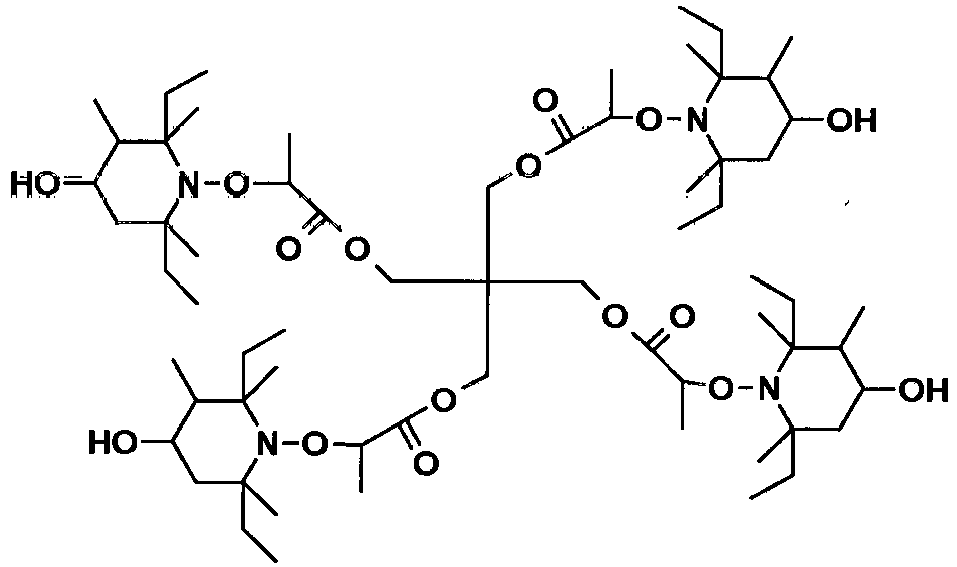

- A preferred di-, tri or poly functional NMP initiator is the compound la, and in particular


- The group X depends also on the kind of living polymerization technique.
- If RAFT technique is used X is a sulphide.
- If ATRP technique is used X is a halogen.
- If NMP technique is used X is a nitroxide.
- Nitroxides can derive from NMP initiators. Suitable NMP initiators are e.g. disclosed in
WO 2005/059048 . - The NMP initiators can be of formulae A, B or O
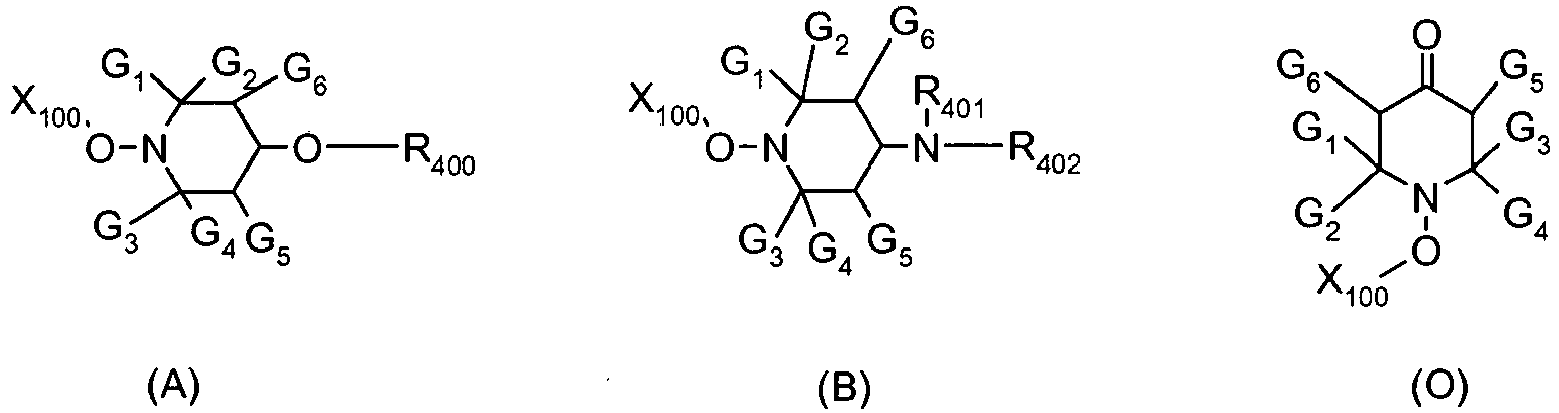
- R400
- is hydrogen, C1-C18alkyl which is uninterrupted or interrupted by one or more oxygen atoms, cyanoethyl, benzoyl, glycidyl, a monovalent radical of an aliphatic carboxylic acid having 2 to 18 carbon atoms, of a cycloaliphatic carboxylic acid having 7 to 15 carbon atoms, or an α, β-unsaturated carboxylic acid having 3 to 5 carbon atoms or of an aromatic carboxylic acid having 7 to 15 carbon atoms;
- R401
- is C1-C12alkyl, C5-C7cycloalkyl, C7-C8aralkyl, C2-C18alkanoyl, C3-C5alkenoyl or benzoyl;
- R402
- is C1-C18alkyl, C5-C7cycloalkyl, C2-C8alkenyl unsubstituted or substituted by a cyano, carbonyl or carbamide group, or is glycidyl, a group of the formula -CH2CH(OH)-Z3 or of the formula -CO-Z3 or -CONH-Z3 wherein Z3 is hydrogen, methyl or phenyl;
- G6
- is hydrogen,
- G5
- is hydrogen or C1-C4alkyl,
- G1 and G3
- are methyl,
- G2 and G4
- are ethyl or propyl or
- G1 and G2
- are methyl and G3 and G4 are ethyl or propyl; and
- X100
- is selected from the group consisting of -CH2-phenyl, CH3CH-phenyl, (CH3)2C-phenyl, (C5-C6cycloalkyl)2CCN, (CH3)2CCN,

- The above compounds and their preparation are described in
GB2335190 GB2361235 - Examples of NMP initiators are:

- Thus, X can be a nitroxide of formulae A', B' or O'

- R400
- is hydrogen, C1-C18alkyl which is uninterrupted or interrupted by one or more oxygen atoms, cyanoethyl, benzoyl, glycidyl, a monovalent radical of an aliphatic carboxylic acid having 2 to 18 carbon atoms, of a cycloaliphatic carboxylic acid having 7 to 15 carbon atoms, or an α, β-unsaturated carboxylic acid having 3 to 5 carbon atoms or of an aromatic carboxylic acid having 7 to 15 carbon atoms;
- R401
- is C1-C12alkyl, C5-C7cycloalkyl, C7-C8aralkyl, C2-C18alkanoyl, C3-C5alkenoyl or benzoyl;
- R402
- is C1-C18alkyl, C5-C7cycloalkyl, C2-C8alkenyl unsubstituted or substituted by a cyano, carbonyl or carbamide group, or is glycidyl, a group of the formula -CH2CH(OH)-Z3 or of the formula -CO-Z3 or -CONH-Z3 wherein Z3 is hydrogen, methyl or phenyl;
- G6
- is hydrogen,
- G5
- is hydrogen or C1-C4alkyl,
- G1 and G3
- are methyl,
- G2 and G4
- are ethyl or propyl, or
- G1 and G2
- are methyl and
- G3 and G4
- are ethyl or propyl.
- Preferably, X is a nitroxide of formula O', and in particular X is

- The group Zn is the polymer main chain. The chain is preferably built up of styrenic monomers and/or acrylic and/or methacrylic monomers. Zn may be a homopolymer or a copolymer.
- Preferably, Zn is built up from vinylic monomers selected from the group consisting of styrene and a compound of formula CH2=C(R3)-C(=R4)-R5, wherein R3 is a hydrogen atom or a methyl group; R4 is oxygen atom; R5 is NH2, hydroxy, unsubstituted C1-18alkoxy, C2-100alkoxy interrupted by at least one N and/or O atom, hydroxy-substituted C1-18alkoxy, unsubstituted C1-18alkylamino, di(C1-18alkyl) amino, hydroxy-substituted C1-18alkylamino, hydroxy-substituted di(C1-18alkyl) amino or -O-CH2-CH2-N(CH3)2.
- More preferably, Zn is built up from vinylic monomers selected from the group consisting of n-butyl acrylate, 2-ethylhexyl acrylate and styrene.
- Zn is preferably a polymer or copolymer segment which is built up from monomers selected from the group consisting of styrene, substituted styrene and a compound of formula CH2=C(H, CH3)-C(=O)-R5, wherein R5 is NH2, unsubstituted C1-18 alkoxy, C2-100alkoxy interrupted by at least one N and/or O atom, or hydroxyl-substituted C1-18alkoxy, unsubstituted C1-18alkylamino, di(C1-18alkyl) amino, hydroxyl-substituted C1-18alkylamino, or hydroxyl-substituted di(C1-18alkyl) amino, or-O-CH2-CH2-N(CH3)2.; more preferably styrene, substituted styrene, or a compound of formula CH2=C(H, CH3)-C(=O)-R5, wherein R5 is unsubstituted C1-18 alkoxy, C2-100alkoxy interrupted by at least one N and/or O atom, or hydroxyl-substituted C1-18alkoxy.
- Group A is derived from the vinyl hetero monomer.
- A is a divalent group or if M is a direct bond and R2 is silyl, A is a direct bond and the vinyl hetero monomer is a vinyl silane.
- If A is oxygen (-O-), the vinyl hetero monomer is a vinyl ether.
- If A is sulphur (-S-), the vinyl hetero monomer is a vinyl thio ether.
- If A is nitrogen (-NH-), the vinyl hetero monomer is a vinyl amine.
- If A is silicon (-SiH2-), the vinyl hetero monomer is a vinyl silane.
- Preferably A is oxygen and the vinyl hetero monomer is thus a vinyl ether.
- The vinylether is preferably selected from 1,4-butanediol vinyl ether, ethylene glycol vinyl ether, di(ethylene glycol) vinyl ether, 2-aminoethyl vinyl ether, 3-amino-1-propanol vinyl ether, 1,4-butanediol divinyl ether, ethylene glycol divinyl ether, di(ethylene glycol) divinyl ether, tris(trimethylsilyl)silyl vinyl ether and glycidyl vinyl ether.
- Group M is a bond or a divalent group linking the heteroatom of the vinyl hetero monomer and the functional end group of the vinyl hetero monomer.
- If M is an alkylene group, M is a linear or branched alkylene chain, preferably a C1-C12alkylene chain, more preferably a C1-C6alkylene chain. An example for a branched alkylene chain is 2-ethylhexylene. The alkylene chain my also be a cyclic alkylene chain, e.g. 1,4 cyclohexanedimethylene.
- If M is a C1-C50 heteroalkylene chain, it is e.g. an ethylene glycol, diethylene glycol, triethylene glycol chain or is -CH2-cyclohexylene-CH2-;
If M is arylene, it is e.g. phenylene, naphtylene.
If M is heteroarylene, it is e.g. pyridylene. - The polymer or copolymer of the formula 1 or 2 may be produced by adding a functional vinyl hetero monomer to a living radical polymerization system during polymerization or after completion of polymerization.
- Preferably, the polymer or copolymer of the formula 1 or 2 is produced by adding a functional vinyl hetero monomer to a living radical polymerization system.
- The living radical polymerization system can be of formula 5 or 6
Y-Zn-X (5)

- Preferably, the functional vinyl hetero monomer is reacted with a living radical polymerization system at a temperature of above 80 °C. Non-reacted functional vinyl hetero monomer may be removed, for example by distillation.
- The living radical polymerization system of formula 5 or 6
Y-Zn-X (5)

may be prepared by reacting Y-X with at least one vinylic monomer. - The vinylic monomer may be selected from the group consisting of isoprene, 1,3-butadiene, α-C5-18alkene, 4-vinyl-pyridine, 2-vinyl-pyridine, vinyl-imidazole, N-vinylpyrrolidone, dimethyl acrylamide, 3-dimethylamino-propylmethacrylamide, styrene, substituted styrene and a compound of formula CH2=C(R3)-C(=R4)-R5, wherein R3 is a hydrogen atom or a methyl group; R4 is oxygen atom or sulfur atom; R5 is NH2, hydroxy, unsubstituted C1-18alkoxy, C2-100alkoxy interrupted by at least one N and/or O atom, hydroxy-substituted C1-18alkoxy, unsubstituted C1-18alkylamino, di(C1-18alkyl) amino, hydroxy-substituted C1-18alkylamino, hydroxy-substituted di(C1-18alkyl) amino or -O-CH2-CH2-N(CH3)2.
- Non-reacted vinylic monomer may be removed, for example by distillation.
- In one embodiment the functional vinyl hetero monomer is a functional vinyl ether.
- An example of the process is the following reaction:

- The polymer produced has a molecular weight between 1000 and 200,000 g/mol and a polydispersity of between 1.0 and 2.5, preferably 1.0 and 1.5.
- A hydroxyl-terminated polymer or copolymer (R2 = OH) is prepared by adding a hydroxyl vinyl ether to a living polymerization system.
- An amino terminated polymer or copolymer (R2 = NH2, NH(C1-C6alkyl) or N(C1-C6alkyl)2) is prepared by adding an amino vinyl ether to a living polymerization system.
- An alkenyl-terminated polymer or copolymer is prepared by adding a divinyl ether monomer to a living polymerization system, preferably adding 1,4 butanediol divinyl ether.
- An alkenyl-terminated polymer or copolymer is prepared by reacting a hydroxyl terminated polymer or copolymer prepared as described above or by reacting an amino-terminated polymer or copolymer prepared as described above with a compound having a vinyl group and a functional group capable of reacting with the hydroxyl or amino group, said compound being selected from the group consisting of (meth)acryloyl chloride, (meth)acrylic anhydride, C1-C4-alkyl (meth)acrylate and 3-isopropenyl-α,α-dimethylbenzyl isocyanate.
- A carboxylic acid-terminated polymer or copolymer is prepared by reacting a hydroxyl-or amino terminated polymer or copolymer prepared as described above with a cyclic anhydride compound, preferably maleic anhydride, succinic anhydride, phthalic anhydride.
- A silyl-terminated polymer or copolymer is prepared by reacting a hydroxyl terminated polymer or copolymer prepared as described above or by reacting an amino-terminated polymer or copolymer prepared as described above with a compound having a silyl group and a functional group capable of reacting with the hydroxyl or amino group said compound being selected from the group consisting of of trimethoxy(3-isocyanatopropyl) silane, triethoxy(3-isocyanatopropyl) silane and triethoxychlorosilane.
- A silyl-terminated polymer or copolymer is prepared by reacting an alkenyl-terminated polymer or copolymer prepared as described above with a silyl containing hydrosilyl compound, preferably with dimethoxymethylhydrosilane.
- A silyl-terminated polymer or copolymer is prepared by adding a vinyl silane to a living radical polymerization system, preferably adding vinyltrimethoxysilane or vinyltriethoxysilane.
- An epoxy-terminated polymer or copolymer is prepared by reacting a hydroxyl-terminated polymer or copolymer as described above with epichlorohydrin.
- An isocyanate-terminated polymer or copolymer is prepared by reacting a hydroxyl- or amino-terminated polymer or copolymer prepared as described above with diisocyanate monomer, such as isophorone diisocyanate, 2,4-toluene-diisocyanate, hexamethylene diisocyanate and methylene diphenyl diisocyanate.
- The end functionalized living polymers can be used as building blocks in industrial applications such as resins, adhesives, sealants binders, crosslinkers, inks, plastics, coatings, foams and epoxies.
- The eluent is THF at a flow rate of 1.0 mL/min. The calibration curve is based on polystyrene standards.
- Solid content is tested using Halogen HB43 apparatus at 200 °C for 10 min.
-
- 1H NMR spectroscopy is performed in 5 mm diameter tubes in CDCl3 at 25 °C using a Bruker Avance 500 (500 MHz) spectrometer. The chemical shift scale is calibrated on the basis of the solvent peak (δ = 7.26 ppm). In order to determine the OH functionality, two drops of trifluoroacetic anhydride are added into the tubes and the signal of the now downfield shifted CF3COOCH2- protons are integrated.
- The mixture of 76.8 g n-butylacrylate (nBA, 0.6 mol), and 3.2 g of NOR regulator I (0.01 mol) (prepared as described in
WO 2008/003602 ) is stirred under nitrogen at room temperature for 30 min firstly, and then is heated at 125 °C until the solid content (SC) of 51 %. Residual nBA monomer is removed under 5 mbar vacuum (at 60 °C for 2 hr). Finally, a yellowish free-flowing living controlled poly(nBA) is obtained (SC of 98%). GPC: Mn = 3550 g/mol, PD = 1.19.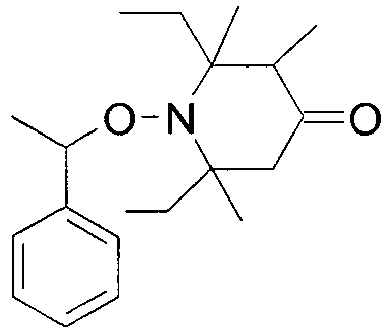
- The mixture of 76.8 g nBA (0.6 mol), and 6.2 g of NOR regulator II (0.01 mol) (prepared as described below) is stirred under nitrogen at room temperature for 30 min firstly, and then is heated at 125 °C until the SC of 51%. Residual n-BA monomer is removed under 5 mbar vacuum (at 60 °C for 2 hr). Finally, a yellowish free-flowing living controlled poly(nBA) is obtained (SC of 98%). GPC: Mn = 3650 g/mol, PD = 1.21.
- NOR regulator II:

- To the solution of 6.37 g (0.03 mol) 2,6-diethyl-2,3,6-trimethylpiperidin-4-on-N-oxyl (prepared according to
WO 2004/085397 ) in 40 mL ethanol are added 5.2 g (0.03 mol) N,N,N',N",N"-pentamethyltriethylene diamine, 1.19 g (0.012 mol) CuCl and 0.19 g (0.003 mol) Cu. To the stirred mixture is then during 5 minutes added the solution of 5 g (0.014 mol) N,N'-2-bromoiso-butyroyl-1,2-diaminoethane (prepared according to Kruger, H. J.; Peng, G.; Holm, R. H. Inorganic Chemistry (1991), 30(4), 734-42) in 70 mL ethanol. The mixture is then stirred 40 h at room temperature and evaporated on a rotary evaporator. The residue is treated with 100 mL ethyl acetate and filtrated. The filtrate is successively washed with 200 mL water, 200 mL 2% EDTA solution, dried over Na2SO4 and evaporated. The crude product is purified on a silica gel column (hexane/ethyl acetate 8:2) to afford 8.27 g of the NOR regulator II as a light yellow resin. MS for C34H64N4O6 (622.90) found M+=622. - Intermediate 3: Living controlled mono-OH functional poly(nBA): HO-PnBA35-NOR The mixture of 89.6 g nBA (0.7 mol), and 3.5 g of NOR regulator III (0.01 mol) (described as intermediate for compound 3 of
WO 2005/118651 , page 26) is stirred under nitrogen at room temperature for 30 min firstly, and then is heated at 125 °C until the SC of 51 %. Residual n-BA monomer is removed under 5 mbar vacuum (at 60 °C for 2 hr). Finally, a yellowish free-flowing living controlled poly(nBA) is obtained (SC of 98%). GPC: Mn = 5000 g/mol, PD = 1.20; OH functionality: 1.0. - NOR regulator III:

- The mixture of 71.0 g Intermediate 1 (0.02 mol), and 41.6 g styrene (St, 0.4 mol) is stirred under nitrogen at room temperature for 30 min firstly, and then is heated at 125 °C until the SC of 82%. Residual St monomer is removed under 5 mbar vacuum (at 60 °C for 2 hr). Finally, a yellowish viscous living controlled poly(nBA-b-St) is obtained (SC of 98%). GPC: Mn = 4350 g/mol, PD = 1.25.
- The mixture of 691 g nBA (5.4 mol), and 3.5 g of NOR regulator III (0.01 mol) is stirred under nitrogen at room temperature for 30 min firstly, and then is heated at 125 °C until a SC of 51% is reached. Residual n-BA monomer is removed under 5 mbar vacuum (at 60 °C for 2 hr). Finally, a yellowish viscous living controlled poly(nBA) is obtained (SC of 98%). GPC: Mn = 28,000 g/mol, PD = 1.30; OH functionality: 1.0.
- The mixture of 100 g Intermediate 3 (0.02 mol), and 41.6 g St (0.4 mol) is stirred under nitrogen at room temperature for 30 min firstly, and then is heated at 125 °C until a SC of 85% is reached. Residual St monomer is removed under 5 mbar vacuum (at 60 °C for 2 hr). Finally, a yellowish viscous living controlled HO-poly(nBA-b-St)-NOR is obtained (SC of 98%). GPC: Mn = 6100 g/mol, PD = 1.25. OH functionality: 1.0.
- The table 1 below shows the residues of polymers of the formula 1 wherein R1 is hydrogen and A is oxygen, M is -(CH2)4-, Zn is nBA and X is

- The following general polymer is obtained.

Ex. R2 Y 1 OH 
3, 12 OH 
6 HOOC-CH2-CH2-COO-* 
7 CH2=CH-COO-* 
8 

9, 13 (Et-O)3-Si-(CH2)3-NH-COO-* 
14 CH2=C(CH3)-COO-* 
15 CH2=CH-COO-* 
- The mixture of 35.5 g Intermediate 1 (0.01 mol), and 11.6 g 1,4-butanediol vinyl ether (0.1 mol) is stirred under nitrogen at room temperature for 30 min firstly, and then is heated at 130 °C for 3 hr. Residual 1,4-butanediol vinyl ether monomer is removed under 5 mbar vacuum (at 130 °C for 2 hr). Finally, a yellowish free-flowing controlled poly(nBA30) end functionalized with OH group is obtained (SC of 99%). GPC: Mn = 3750 g/mol, PD = 1.23. OH functionality: 1.1.
- Compound of formula 2, R2 is OH
- The mixture of 36.5 g Intermediate 2 (0.01 mol), and 23.2 g 1,4-butanediol vinyl ether (0.2 mol) is stirred under nitrogen at room temperature for 30 min firstly, and then is heated at 130 °C for 3 hr. Residual 1,4-butanediol vinyl ether monomer is removed under 5 mbar vacuum (at 130 °C for 2 hr). Finally, a yellowish free-flowing controlled OH telechelic poly(nBA30) is obtained (SC of 99%). GPC: Mn = 3850 g/mol, PD = 1.27. OH functionality: 2.1.
- The mixture of 50 g Intermediate 3 (0.01 mol), and 11.6 g 1,4-butanediol vinyl ether (0.1 mol) is stirred under nitrogen at room temperature for 30 min firstly, and then is heated at 130 °C for 3 hr. Residual 1,4-butanediol vinyl ether monomer is removed under 5 mbar vacuum (at 130 °C for 2 hr). Finally, a yellowish free-flowing controlled OH telechelic poly(nBA35) is obtained (SC of 99%). GPC: Mn = 5350 g/mol, PD = 1.23. OH functionality: 2.1.
- Compound of formula 1 wherein Zn is a copolymer, R2 is OH
- The mixture of 43.5 g Intermediate 4 (0.01 mol), and 23.2 g 1,4-butanediol vinyl ether (0.1 mol) is stirred under nitrogen at room temperature for 30 min firstly, and then is heated at 130 °C for 3 hr. Residual 1,4-butanediol vinyl ether monomer is removed under 5 mbar vacuum (at 130 °C for 2 hr). Finally, a yellowish viscous controlled poly(nBA30-b-St10) end functionalized with OH group is obtained (SC of 99%). GPC: Mn = 4550 g/mol, PD = 1.30. OH functionality: 1.0.
- Compound of formula 2, R2 is -O-CH=CH2
- The mixture of 36.5 g Intermediate 2 (0.01 mol), and 28.4 g 1,4-butanediol divinyl ether (0.2 mol) is stirred under nitrogen at room temperature for 30 min firstly, and then is heated at 130 °C for 3 hr. Residual 1,4-butanediol divinyl ether monomer is removed under 1 mbar vacuum (at 140 °C for 2 hr). Finally, a yellowish free-flowing controlled vinyl telechelic poly(nBA30) is obtained (SC of 99%). GPC: Mn = 3950 g/mol, PD = 1.28. Vinyl functionality: 2.1.
- The mixture of 53.5 g Example 3 (0.01 mol), 2.0 g succinic anhydride (0.02 mol), and 0.1 g dibutyltin dilaurate is stirred under nitrogen at room temperature for 30 min firstly, and then is heated at 90 °C for 15 hr. A yellowish free-flowing controlled COOH telechelic poly(nBA35) is obtained (SC of 99%). GPC: Mn = 5250 g/mol, PD = 1.35. COOH functionality: 1.9.
- The mixture of 53.5 g Example 3 (0.01 mol), 2.52 g acrylic anhydride (0.02 mol), 50 mL dried xylene, and 0.1 g dibutyltin dilaurate is stirred under nitrogen at room temperature for 30 min firstly, and then is heated at 90 °C for 15 hr. Xylene is removed under 10 mbar vacuum (at 100 °C for 2 hr). Finally, a yellowish free-flowing controlled alkenyl telechelic poly(nBA35) is obtained (SC of 99%). GPC: Mn = 5550 g/mol, PD = 1.36. Alkenyl functionality: 2.0.
- The mixture of 53.5 g Example 3 (0.01 mol), 4.44 g isophorone diisocyanate (0.02 mol), 50 mL dried xylene, and 0.1 g dibutyltin dilaurate is stirred under nitrogen at room temperature for 30 min, and heated at 60 °C for 4 hr. Then, 2.32 g 2-hydroxyethyl acrylate (0.02 mol) is added and heated at 90 °C for 15 hr. Xylene is removed under 10 mbar vacuum (at 100 °C for 2 hr). Finally, a yellowish viscous controlled alkenyl telechelic poly(nBA35) is obtained (SC of 99%). GPC: Mn = 5600 g/mol, PD = 1.38. Alkenyl functionality: 1.9.
- The mixture of 53.5 g Example 3 (0.01 mol), 4.95 g triethoxy(3-isocyanatorpropyl) silane (0.02 mol), and 0.1 g dibutyltin dilaurate is stirred under nitrogen at room temperature for 30 min firstly, and then is heated at 90 °C for 15 hr. Finally, a yellowish viscous controlled silyl telechelic poly(nBA35) is obtained. GPC: Mn = 5600g/mol, PD = 1.35. Silyl functionality: 1.9.
- Compound of formula 2, R2 is -O-CH-CH2-Si-(CH3)(OCH3)2
- The mixture of 55.0 g Example 5 (0.01 mol), 2.55 mL dimethoxymethylhydrosilane (0.02 mol), 0.4 mL dimethylorthoformate, and 10-3 mmol chloroplatinic acid is stirred under nitrogen and heated at 100 °C for 3 hr. Finally, a yellowish free-flowing controlled silyl telechelic poly(nBA35) is obtained. GPC: Mn = 5650 g/mol, PD = 1.34). Silyl functionality: 1.9.
- A polymer of the formula (1) wherein M is a bond, A is Si and R2 is methoxy
- The mixture of 36.5 g Intermediate 2 (0.01 mol), 29.6 g vinyltrimethoxysilane (0.2 mol) is stirred under nitrogen at room temperature for 30 min firstly, and then is heated at 130 °C for 3 hr. Residual vinyltrimethoxysilane monomer is removed under 5 mbar vacuum (at 100 °C for 2 hr). Finally, a yellowish free-flowing controlled silyl telechelic poly(nBA30) is obtained (SC of 99%). GPC: Mn = 3750 g/mol, PD=1.28. Silyl functionality: 2.0.

- The mixture of 268 g Intermediate 5 (0.01 mol), and 23.2 g 1,4-butanediol vinyl ether (0.2 mol) is stirred under nitrogen at room temperature for 30 min firstly, and then is heated at 130 °C for 3 hr. Residual 1,4-butanediol vinyl ether monomer is removed under 5 mbar vacuum (at 130 °C for 2 hr). Finally, a yellowish viscous controlled OH telechelic poly(nBA270) is obtained (SC of 99%). GPC: Mn = 32,000 g/mol, PD = 1.35. OH functionality: 2.4.
- The mixture of 320 g Example 12 (0.01 mol), 7.42 g triethoxy(3-isocyanatopropyl) silane (0.03 mol), and 0.3 g dibutyltin dilaurate is stirred under nitrogen at room temperature for 30 min firstly, and then is heated at 90 °C for 15 hr. Finally, a yellowish viscous controlled silyl telechelic poly(nBA270) is obtained. GPC: Mn = 36,000 g/mol, PD = 1.40. Silyl functionality: 2.4.
- The mixture of 37.5 g Example 1 (0.01 mol), 1.54 g methacrylic anhydride (0.01 mol), 50 mL dried xylene, and 0.1 g dibutyltin dilaurate is stirred under nitrogen at room temperature for 30 min firstly, and then is heated at 90 °C for 15 hr. Xylene is removed under 10 mbar vacuum (at 100 °C for 2 hr). Finally, a yellowish free-flowing controlled poly(nBA30) end functionalized with alkenyl group is obtained (SC of 99%). GPC: Mn = 3950 g/mol, PD = 1.3. Alkenyl functionality: 1.0.
- The mixture of 37.5 g Example 1 (0.01 mol), 128 g n-butyl acrylate (1.0 mol) and 0.1 g tetrabutyl titanate is stirred under nitrogen at room temperature for 30 min firstly, and then is heated at 100 °C for 8 hr. The formed 1-butanol and residual n-butyl acrylate is slowly removed under 10 mbar vacuum (at 100 °C for 2 hr). Finally, a yellowish free-flowing controlled poly(nBA30) end functionalized with alkenyl group is obtained (SC of 99%). GPC: Mn = 3850 g/mol, PD = 1.3. Alkenyl functionality: 0.85.
- The mixture of 61 g Intermediate 6 (0.01 mol), and 23.2 g 1,4-butanediol vinyl ether (0.2 mol) is stirred under nitrogen at room temperature for 30 min firstly, and then is heated at 130 °C for 6 hr. Residual 1,4-butanediol vinyl ether monomer is removed under 5 mbar vacuum (at 130 °C for 2 hr). Finally, a yellowish viscous controlled OH telechelic poly(nBA35-b-St10) is obtained (SC of 99%). GPC: Mn = 6250 g/mol, PD = 1.28. OH functionality: 2.3.
Claims (16)
- A polymer or copolymer having a structure represented by the general formula 1 or 2
 R1 is a hydrogen atom, a methyl group, or a radically non-polymerizable organic group containing 1 to 20 carbon atoms.R2 is a functional end group of a vinyl hetero monomer selected from the group consisting of hydroxy, epoxy, silyl, NH2, NH(C1-C6alkyl), N(C1-C6alkyl)2, -CH=CH2, -CΞCH, -C(CH3)=CH2, -O-CH=CH2, (-O-CH2-CH2)1-10-OH, -OR20, -COOR20, -CONHR20, -OCONHR20, -OCOR20 and -NH-CO-R20, wherein R20 is linear or branched C1-C20 alkyl or linear or branched C1-C20 alkyl substituted with hydroxy, epoxy, silyl, NH2 or N(C1-C6alkyl)2; or R20 is phenyl, benzyl, -CH=CH2, -CΞCH or -C(CH3)=CH2,or R2 is a residue of an acrylic acid (CH2=CH-COO-*), methacrylic acid, (CH2=C(CH3)-COO-*) or CH(CH3)=CH-COO-*or R2 is a residue of a dicarboxylic acid HOOC-Rc-COO-* or C1-C6alkyl-OOC-Rc-COO-* wherein Rc is C1-C20 alkylene, C1-C20alkenylene or phenylene;or R2 is a residue derived from the reaction of an isocyanate Ra-NCO with the hydroxy group or with the amine group of the vinyl hetero monomer, said residue being Ra-NHCOO-* or Ra-NHCO-NH-* wherein Ra is unsubstituted C1-C20alkyl, C1-C20cycloalkyl or C1-C20alkyl substituted with hydroxy, epoxy, silyl, NH2, NH(C1-C6alkyl) or N(C1-C6alkyl)2;or R2 is a residue derived from the reaction of a diisocyanate residue OCN-Rb-NCO with the hydroxy group or with the amine group of the vinyl hetero monomer, said residue being *-OOC-NH-Rb-NCO or *-HNOC-NH-Rb-NCO or *-OOC-NH-Rb-NHCOR30 wherein Rb is C1-C20 alkylene or C1-C20cycloalkylene or phenylene and R30 is a residue of hydroxyethylacrylate (CH2=CH-COO-(CH2)2-O*), hydroxyethylmethacrylate (CH2=C(CH3)-COO-(CH2)2-O*), hydroxybutylacrylate (CH2=CH-COO-(CH2)4-O*) or hydroxybutylmethacrylate (CH2=C(CH3)-COO-(CH2)4-O*),A is the hetero atom of the vinyl hetero monomer selected from the group consisting of oxygen, nitrogen, sulfur and silicon; and if R2 is silyl and M is a direct bond, A is a direct bond;M is a bond or a divalent group linking the heteroatom of the vinyl hetero monomer and the functional end group of the vinyl hetero monomer said M being selected from the group consisting of C1-50 alkylene, C1-50 (hetero)alkylene, arylene and heteroarylene;X is a halogen atom, a nitroxide group or a sulphide group,Zn is a polymer or copolymer segment of random-, gradient- or block-type structure, which is built up from vinylic monomers selected from the group consisting of isoprene, 1,3-butadiene, α-C5-18alkene, 4-vinyl-pyridine, 2-vinyl-pyridine, vinylimidazole, N-vinylpyrrolidone, dimethyl acrylamide, 3-dimethylamino-propyl-methacrylamide, styrene, substituted styrene and a compound of formula CH2=C(R3)-C(=R4)-R5, wherein R3 is a hydrogen atom or a methyl group; R4 is oxygen atom or sulfur atom; R5 is NH2, hydroxy, unsubstituted C1-18 alkoxy, C2-100alkoxy interrupted by at least one N and/or O atom, hydroxy-substituted C1-18alkoxy, unsubstituted C1-18alkylamino, di(C1-18alkyl) amino, hydroxy-substituted C1-18alkylamino, hydroxy-substituted di(C1-18alkyl) amino or -O-CH2-CH2-N(CH3)2;Y is the chain terminus of the polymer/copolymer Zn and Y represents the fragment of a polymerization initiator capable of initiating polymerization;Y1 represents a di-, tri- or poly-valent fragment of a di-, tri-, or polyfunctional NMP initiator;m is 2, 3 or 4, preferably 2;n is the number of monomer units Z and is between 10 and 5000.
 - The polymer or copolymer according to claim 1
wherein X a nitroxide group and Y is a fragment of a NMP initiator capable of initiating polymerization. - The polymer or copolymer according to claim 1 or claim 2,
wherein Zn is built up from vinylic monomers selected from the group consisting of styrene and a compound of formula CH2=C(R3)-C(=R4)-R5, wherein R3 is a hydrogen atom or a methyl group; R4 is oxygen atom; R5 is NH2, hydroxy, unsubstituted C1-18alkoxy, C2-100alkoxy interrupted by at least one N and/or O atom, hydroxy-substituted C1-18alkoxy, unsubstituted C1-18alkylamino, di(C1-18alkyl) amino, hydroxy-substituted C1-18alkylamino, hydroxy-substituted di(C1-18alkyl) amino or -O-CH2-CH2-N(CH3)2; preferably from vinylic monomers selected from the group consisting of n-butyl acrylate, 2-ethylhexyl acrylate and styrene. - The polymer or copolymer according to any of claims 1 to 3 with a molecular weight of between 1000 and 200,000 g/mol and a polydispersity of between 1.0 and 2.5, preferably between 1.0 and 1.5.
- A process to prepare the polymer or copolymer of any of claims 1 to 4, which process comprises the step of adding a functional vinyl hetero monomer to a living radical polymerization system.
- The process of claim 5, wherein the living radical polymerization system is of formula 5 or 6
Y-Zn-X (5)

- The process according to claim 5 or claim 6, wherein R2 is OH thus obtaining a hydroxy-terminated polymer or copolymer by adding a hydroxy vinyl ether to the living polymerization system.
- The process according to claim 5 or claim 6, wherein R2 is NH2, NH(C1-C6alkyl) or N(C1-C6alkyl)2 thus obtaining an amino-terminated polymer or copolymer by adding an amino vinyl ether to the living polymerization system.
- The process according to claim 5 or claim 6, wherein R2 is -O-CH=CH2 thus obtaining an alkenyl-terminated polymer or copolymer by adding a divinyl ether, preferably 1,4-butanediol divinyl ether to the living polymerization system.
- The process according to claim 5 or claim 6, wherein R2 is silyl thus obtaining a silyl-terminated polymer or copolymer by adding a vinyl silane, preferably vinyltrimethoxysilane or vinyltriethoxysilane, to the living polymerization system.
- A process to prepare an alkenyl-terminated polymer or copolymer of any of claims 1 to 4, which process comprises the step of reacting a hydroxy-terminated polymer or copolymer prepared according to claim 7 or by reacting an amino-terminated polymer or copolymer prepared according to claim 8 with a compound having a vinyl group and a functional group capable of reacting with the hydroxy or amino group, said compound being selected from the group consisting of (meth)acryloyl chloride, (meth)acrylic anhydride, C1-C4-alkyl (meth)acrylate and 3-isopropenyl-α,α-dimethylbenzyl isocyanate.
- A process to prepare a carboxylic acid-terminated polymer or copolymer of any of claims 1 to 4, which process comprises the step of reacting a hydroxy-terminated polymer or copolymer prepared according to claim 7 or by reacting an amino-terminated polymer or copolymer prepared according to claim 8 with a cyclic anhydride compound, preferably maleic anhydride, succinic anhydride or phthalic anhydride.
- A process to prepare a silyl-terminated polymer or copolymer of any of claims 1 to 4, which process comprises the step of reacting a hydroxy-terminated polymer or copolymer prepared according to claim 7 or by reacting an amino-terminated polymer or copolymer prepared according to claim 8 with a compound having a silyl group and a functional group capable of reacting with the hydroxyl or amino group, said compound being preferably selected from the group consisting of trimethoxy(3-isocyanatopropyl) silane, triethoxy(3-isocyanatopropyl) silane and triethoxychlorosilane.
- A process to prepare a silyl-terminated polymer or copolymer of any of claims 1 to 4, which process comprises the step of reacting an alkenyl-terminated polymer or copolymer prepared according to claim 9 or claim 10 with a silyl containing hydrosilyl compound, preferably with dimethoxymethylhydrosilane.
- A process to prepare an epoxy-terminated polymer or copolymer of any of claims 1 to 4, which process comprises the step of reacting a hydroxy-terminated polymer or copolymer prepared according to claim 7 with epichlorohydrin; or
a process to prepare an isocyanate-terminated polymer or copolymer of any of claims 1 to 4, which process comprises the step of reacting a hydroxy-terminated polymer or copolymer prepared according to claim 7 or reacting an amino-terminated polymer or copolymer prepared according to claim 8 with diisocyanate monomer, preferably with isophorone diisocyanate, 2,4-toluene-diisocyanate, hexamethylene diisocyanate or methylene diphenyl diisocyanate. - The use of polymers or copolymers according to claim 1 as building blocks in industrial applications such as resins, adhesives, sealants binders, crosslinkers, inks, plastics, coatings, foams and epoxies.
Priority Applications (1)
| Application Number | Priority Date | Filing Date | Title |
|---|---|---|---|
| EP11712229.1A EP2552971B1 (en) | 2010-03-30 | 2011-03-29 | End-functionalized polymers |
Applications Claiming Priority (4)
| Application Number | Priority Date | Filing Date | Title |
|---|---|---|---|
| US31879810P | 2010-03-30 | 2010-03-30 | |
| EP10158328 | 2010-03-30 | ||
| PCT/EP2011/054780 WO2011120947A1 (en) | 2010-03-30 | 2011-03-29 | End-functionalized polymers |
| EP11712229.1A EP2552971B1 (en) | 2010-03-30 | 2011-03-29 | End-functionalized polymers |
Publications (2)
| Publication Number | Publication Date |
|---|---|
| EP2552971A1 EP2552971A1 (en) | 2013-02-06 |
| EP2552971B1 true EP2552971B1 (en) | 2014-07-02 |
Family
ID=42101737
Family Applications (1)
| Application Number | Title | Priority Date | Filing Date |
|---|---|---|---|
| EP11712229.1A Active EP2552971B1 (en) | 2010-03-30 | 2011-03-29 | End-functionalized polymers |
Country Status (6)
| Country | Link |
|---|---|
| US (1) | US10316114B2 (en) |
| EP (1) | EP2552971B1 (en) |
| JP (1) | JP5769794B2 (en) |
| KR (1) | KR101524342B1 (en) |
| CN (1) | CN102822211B (en) |
| WO (1) | WO2011120947A1 (en) |
Families Citing this family (10)
| Publication number | Priority date | Publication date | Assignee | Title |
|---|---|---|---|---|
| EP2817358B1 (en) | 2012-02-24 | 2019-08-21 | Basf Se | Novel polymer dispersants |
| WO2014044562A1 (en) | 2012-09-18 | 2014-03-27 | Basf Se | Polymers comprising a polyurethane backbone endcapped with reactive (meth)acrylic terminating groups and their use as adhesives |
| EP3004215B1 (en) | 2013-06-07 | 2017-09-13 | Basf Se | Novel polymer dispersants |
| JP2016530362A (en) | 2013-07-22 | 2016-09-29 | ビーエーエスエフ ソシエタス・ヨーロピアBasf Se | Novel polymers and their use as dispersants |
| JP2019059856A (en) * | 2017-09-27 | 2019-04-18 | 第一工業製薬株式会社 | Method for producing carboxymethyl cellulose or salt thereof |
| KR20200130285A (en) * | 2018-03-09 | 2020-11-18 | 로베르트 보쉬 게엠베하 | Chemical method for making covalently tunable networks |
| CN112912420A (en) | 2018-08-16 | 2021-06-04 | 巴斯夫欧洲公司 | Polymer composition |
| US11820868B2 (en) * | 2019-08-28 | 2023-11-21 | Boston Scientific Scimed, Inc. | Multifunctional nitroxide-mediated polymerization initiators and multi-armed polymers and hydrogels formed therefrom |
| CN114106638A (en) * | 2021-12-24 | 2022-03-01 | 无锡海特新材料研究院有限公司 | High-oxygen-resistance coating, preparation method and coating method |
| CN119264409B (en) * | 2024-12-05 | 2025-03-25 | 成都思立可科技股份有限公司 | Block copolymer containing polar segments, preparation method thereof, and application thereof |
Family Cites Families (28)
| Publication number | Priority date | Publication date | Assignee | Title |
|---|---|---|---|---|
| US2949474A (en) * | 1956-02-06 | 1960-08-16 | Rohm & Haas | New unsaturated glycidyl ethers, polymers thereof and methods for producing them |
| DE4022750A1 (en) * | 1990-07-18 | 1992-01-23 | Bayer Ag | USE OF COPOLYMERIASTS CONTAINING HYDROXYL AND CARBONIC ACID ANHYDRIDE GROUPS AS BINDERS FOR POWDER COATINGS |
| CA2123030C (en) * | 1993-11-15 | 1999-01-05 | Jongkoo Jeong | Copolymers of styrene and silane coupling agent, synthesizing method and method for improving adhesion performance in fiber-reinforced polystyrene composites by using the copolymers |
| JPH09291106A (en) * | 1996-04-25 | 1997-11-11 | Kansai Paint Co Ltd | Preparation of curable styrene resin having narrow molecular weight distribution |
| JPH11511202A (en) | 1996-06-04 | 1999-09-28 | エルフ アトケム ソシエテ アノニム | Method for synthesizing telechelic 1,3-diene oligomers by controlled radical polymerization of 1,3-dienes in the presence of stable free radicals |
| WO1998001478A1 (en) | 1996-07-10 | 1998-01-15 | E.I. Du Pont De Nemours And Company | Polymerization with living characteristics |
| FR2764892B1 (en) | 1997-06-23 | 2000-03-03 | Rhodia Chimie Sa | PROCESS FOR THE SYNTHESIS OF BLOCK POLYMERS |
| JP4098896B2 (en) | 1997-09-22 | 2008-06-11 | 株式会社カネカ | Polymer, method for producing the polymer, and curable composition using the polymer |
| WO1999015567A1 (en) * | 1997-09-22 | 1999-04-01 | Kaneka Corporation | Polymer, process for producing the polymer, and curable composition containing the polymer |
| BR9815179A (en) | 1997-12-18 | 2000-10-10 | Du Pont | Process for producing a polymer, polymer, coating composition and chain transfer agent. |
| CH693416A5 (en) | 1998-03-09 | 2003-07-31 | Ciba Sc Holding Ag | 1-Alkoxypolyalkylpiperidinderivate and their use as polymerization regulators. |
| JP2001019770A (en) * | 1999-07-07 | 2001-01-23 | Kuraray Co Ltd | Polyvinyl alcohol-based graft polymer, polyvinyl alcohol-based block polymer and methods for producing them |
| CN1093120C (en) * | 1999-10-21 | 2002-10-23 | 复旦大学 | Trigger containing TEMPO polymer and its preparing process |
| JP4341136B2 (en) * | 2000-03-16 | 2009-10-07 | 株式会社クラレ | Method for producing polymer having functional group at terminal of main chain |
| TW541303B (en) | 2000-03-22 | 2003-07-11 | Ciba Sc Holding Ag | 2,2,6,6 diethyl-dimethyl-1-alkoxy-piperidine compounds and their corresponding 1-oxides |
| EP1417171B1 (en) | 2001-07-05 | 2007-11-21 | Ciba SC Holding AG | Multifunctional alkoxyamines based on polyalkylpiperidines, polyalkylpiperazinones and polyalkylmorpholinones and their use as polymerization regulators/initiators |
| JP2003155463A (en) * | 2001-11-21 | 2003-05-30 | Kanegafuchi Chem Ind Co Ltd | Emulsion type adhesive |
| CN1260254C (en) * | 2001-11-30 | 2006-06-21 | 上海市合成树脂研究所 | Controllable free radical polymerization process with thioether compound as chain transferring agent |
| US20060229452A1 (en) | 2003-03-27 | 2006-10-12 | Peter Nesvadba | Process for the oxidation of secondary amines into the corresponding nitroxides |
| KR101123607B1 (en) | 2003-12-10 | 2012-03-21 | 시바 홀딩 인크 | Coating compositions containing levelling agents prepared by nitroxyl mediated polymerisation |
| CN100586963C (en) | 2004-05-27 | 2010-02-03 | 西巴特殊化学品控股有限公司 | Alkoxyamines containing a radical-polymerizable group |
| JP2007231033A (en) * | 2006-02-27 | 2007-09-13 | Toyo Ink Mfg Co Ltd | Copolymers and modified copolymers |
| US20080003252A1 (en) * | 2006-06-30 | 2008-01-03 | Yu-Chin Lai | Functionalized hydrophilic macromonomers and medical devices incorporating same |
| JP5307002B2 (en) | 2006-07-05 | 2013-10-02 | チバ ホールディング インコーポレーテッド | Method for producing sterically hindered nitroxyl ether |
| DE102006037351A1 (en) * | 2006-08-09 | 2008-02-14 | Evonik Röhm Gmbh | Process for the preparation of hydroxytelecheler ATRP products |
| DE102006037352A1 (en) * | 2006-08-09 | 2008-02-14 | Evonik Röhm Gmbh | Process for the preparation of acid-terminated ATRP products |
| DE102006048154A1 (en) * | 2006-10-10 | 2008-04-17 | Evonik Röhm Gmbh | Process for the preparation of silyltelechelen polymers |
| KR101540826B1 (en) * | 2007-11-28 | 2015-07-30 | 세키스이가가쿠 고교가부시키가이샤 | Terminally modified acrylic polymer and method for producing terminally modified acrylic polymer |
-
2011
- 2011-03-29 KR KR1020127028207A patent/KR101524342B1/en not_active Expired - Fee Related
- 2011-03-29 EP EP11712229.1A patent/EP2552971B1/en active Active
- 2011-03-29 CN CN201180016562.XA patent/CN102822211B/en active Active
- 2011-03-29 WO PCT/EP2011/054780 patent/WO2011120947A1/en not_active Ceased
- 2011-03-29 US US13/638,191 patent/US10316114B2/en active Active
- 2011-03-29 JP JP2013501802A patent/JP5769794B2/en not_active Expired - Fee Related
Also Published As
| Publication number | Publication date |
|---|---|
| KR20130002341A (en) | 2013-01-07 |
| KR101524342B1 (en) | 2015-07-06 |
| EP2552971A1 (en) | 2013-02-06 |
| WO2011120947A1 (en) | 2011-10-06 |
| JP2013523929A (en) | 2013-06-17 |
| JP5769794B2 (en) | 2015-08-26 |
| US20130030071A1 (en) | 2013-01-31 |
| CN102822211A (en) | 2012-12-12 |
| US10316114B2 (en) | 2019-06-11 |
| CN102822211B (en) | 2015-04-22 |
Similar Documents
| Publication | Publication Date | Title |
|---|---|---|
| KR101524342B1 (en) | End-functionalized polymers | |
| EP0108946B1 (en) | Curing composition | |
| CN102046725B (en) | Sealing mass that can be cross-linked using water | |
| JP2001106713A (en) | Oligomerized and polymerized telechelic | |
| EP1498433A1 (en) | Process for producing (meth)acrylic polymer terminated by crosslinkable silyl group | |
| JP7224131B2 (en) | Curable composition | |
| JP7073167B2 (en) | Curable composition | |
| CN116997610A (en) | Curable compositions and cured products thereof | |
| CN114040933A (en) | Block copolymer, resin composition, and method for producing block copolymer | |
| CN111094443B (en) | Curable composition, sealing material composition, and adhesive composition | |
| JP2012211216A (en) | Method for reducing coloring of vinyl polymer | |
| US20230144994A1 (en) | (meth)acrylic ester copolymer and curable composition containing the same | |
| JP7832175B2 (en) | (Meth)acrylic acid ester copolymers and curable compositions | |
| WO2004076555A1 (en) | Curable resin composition and process for production thereof | |
| JP5564170B2 (en) | Adhesive composition for asphalt tarpaulin | |
| WO2023054700A1 (en) | Curable composition | |
| WO2008059872A1 (en) | Sealing material composition | |
| JP7713855B2 (en) | curable composition | |
| JP2021055012A (en) | Curable composition | |
| WO2025212368A1 (en) | Moisture curable composition with improved uv resistance | |
| CN117580908A (en) | Curable compositions, cured products, coating agents and concrete structures | |
| WO2024224831A1 (en) | Crystalline polyoxyalkylene-based polymer and curable composition comprising same | |
| WO2026042693A1 (en) | Curable composition | |
| WO2023171425A1 (en) | Polyoxyalkylene-based polymer mixture and curable composition | |
| JP2022049666A (en) | Curable composition |
Legal Events
| Date | Code | Title | Description |
|---|---|---|---|
| PUAI | Public reference made under article 153(3) epc to a published international application that has entered the european phase |
Free format text: ORIGINAL CODE: 0009012 |
|
| 17P | Request for examination filed |
Effective date: 20121029 |
|
| AK | Designated contracting states |
Kind code of ref document: A1 Designated state(s): AL AT BE BG CH CY CZ DE DK EE ES FI FR GB GR HR HU IE IS IT LI LT LU LV MC MK MT NL NO PL PT RO RS SE SI SK SM TR |
|
| DAX | Request for extension of the european patent (deleted) | ||
| GRAP | Despatch of communication of intention to grant a patent |
Free format text: ORIGINAL CODE: EPIDOSNIGR1 |
|
| INTG | Intention to grant announced |
Effective date: 20140311 |
|
| GRAS | Grant fee paid |
Free format text: ORIGINAL CODE: EPIDOSNIGR3 |
|
| GRAA | (expected) grant |
Free format text: ORIGINAL CODE: 0009210 |
|
| AK | Designated contracting states |
Kind code of ref document: B1 Designated state(s): AL AT BE BG CH CY CZ DE DK EE ES FI FR GB GR HR HU IE IS IT LI LT LU LV MC MK MT NL NO PL PT RO RS SE SI SK SM TR |
|
| REG | Reference to a national code |
Ref country code: GB Ref legal event code: FG4D |
|
| REG | Reference to a national code |
Ref country code: AT Ref legal event code: REF Ref document number: 675895 Country of ref document: AT Kind code of ref document: T Effective date: 20140715 Ref country code: CH Ref legal event code: EP |
|
| REG | Reference to a national code |
Ref country code: IE Ref legal event code: FG4D |
|
| REG | Reference to a national code |
Ref country code: DE Ref legal event code: R096 Ref document number: 602011008112 Country of ref document: DE Effective date: 20140814 |
|
| REG | Reference to a national code |
Ref country code: AT Ref legal event code: MK05 Ref document number: 675895 Country of ref document: AT Kind code of ref document: T Effective date: 20140702 |
|
| REG | Reference to a national code |
Ref country code: NL Ref legal event code: VDEP Effective date: 20140702 |
|
| REG | Reference to a national code |
Ref country code: LT Ref legal event code: MG4D |
|
| PG25 | Lapsed in a contracting state [announced via postgrant information from national office to epo] |
Ref country code: ES Free format text: LAPSE BECAUSE OF FAILURE TO SUBMIT A TRANSLATION OF THE DESCRIPTION OR TO PAY THE FEE WITHIN THE PRESCRIBED TIME-LIMIT Effective date: 20140702 Ref country code: PT Free format text: LAPSE BECAUSE OF FAILURE TO SUBMIT A TRANSLATION OF THE DESCRIPTION OR TO PAY THE FEE WITHIN THE PRESCRIBED TIME-LIMIT Effective date: 20141103 Ref country code: CZ Free format text: LAPSE BECAUSE OF FAILURE TO SUBMIT A TRANSLATION OF THE DESCRIPTION OR TO PAY THE FEE WITHIN THE PRESCRIBED TIME-LIMIT Effective date: 20140702 Ref country code: FI Free format text: LAPSE BECAUSE OF FAILURE TO SUBMIT A TRANSLATION OF THE DESCRIPTION OR TO PAY THE FEE WITHIN THE PRESCRIBED TIME-LIMIT Effective date: 20140702 Ref country code: LT Free format text: LAPSE BECAUSE OF FAILURE TO SUBMIT A TRANSLATION OF THE DESCRIPTION OR TO PAY THE FEE WITHIN THE PRESCRIBED TIME-LIMIT Effective date: 20140702 Ref country code: SE Free format text: LAPSE BECAUSE OF FAILURE TO SUBMIT A TRANSLATION OF THE DESCRIPTION OR TO PAY THE FEE WITHIN THE PRESCRIBED TIME-LIMIT Effective date: 20140702 Ref country code: BG Free format text: LAPSE BECAUSE OF FAILURE TO SUBMIT A TRANSLATION OF THE DESCRIPTION OR TO PAY THE FEE WITHIN THE PRESCRIBED TIME-LIMIT Effective date: 20141002 Ref country code: NO Free format text: LAPSE BECAUSE OF FAILURE TO SUBMIT A TRANSLATION OF THE DESCRIPTION OR TO PAY THE FEE WITHIN THE PRESCRIBED TIME-LIMIT Effective date: 20141002 Ref country code: GR Free format text: LAPSE BECAUSE OF FAILURE TO SUBMIT A TRANSLATION OF THE DESCRIPTION OR TO PAY THE FEE WITHIN THE PRESCRIBED TIME-LIMIT Effective date: 20141003 |
|
| PG25 | Lapsed in a contracting state [announced via postgrant information from national office to epo] |
Ref country code: AT Free format text: LAPSE BECAUSE OF FAILURE TO SUBMIT A TRANSLATION OF THE DESCRIPTION OR TO PAY THE FEE WITHIN THE PRESCRIBED TIME-LIMIT Effective date: 20140702 Ref country code: PL Free format text: LAPSE BECAUSE OF FAILURE TO SUBMIT A TRANSLATION OF THE DESCRIPTION OR TO PAY THE FEE WITHIN THE PRESCRIBED TIME-LIMIT Effective date: 20140702 Ref country code: CY Free format text: LAPSE BECAUSE OF FAILURE TO SUBMIT A TRANSLATION OF THE DESCRIPTION OR TO PAY THE FEE WITHIN THE PRESCRIBED TIME-LIMIT Effective date: 20140702 Ref country code: NL Free format text: LAPSE BECAUSE OF FAILURE TO SUBMIT A TRANSLATION OF THE DESCRIPTION OR TO PAY THE FEE WITHIN THE PRESCRIBED TIME-LIMIT Effective date: 20140702 Ref country code: IS Free format text: LAPSE BECAUSE OF FAILURE TO SUBMIT A TRANSLATION OF THE DESCRIPTION OR TO PAY THE FEE WITHIN THE PRESCRIBED TIME-LIMIT Effective date: 20141102 Ref country code: RS Free format text: LAPSE BECAUSE OF FAILURE TO SUBMIT A TRANSLATION OF THE DESCRIPTION OR TO PAY THE FEE WITHIN THE PRESCRIBED TIME-LIMIT Effective date: 20140702 Ref country code: LV Free format text: LAPSE BECAUSE OF FAILURE TO SUBMIT A TRANSLATION OF THE DESCRIPTION OR TO PAY THE FEE WITHIN THE PRESCRIBED TIME-LIMIT Effective date: 20140702 Ref country code: HR Free format text: LAPSE BECAUSE OF FAILURE TO SUBMIT A TRANSLATION OF THE DESCRIPTION OR TO PAY THE FEE WITHIN THE PRESCRIBED TIME-LIMIT Effective date: 20140702 |
|
| REG | Reference to a national code |
Ref country code: DE Ref legal event code: R097 Ref document number: 602011008112 Country of ref document: DE |
|
| PG25 | Lapsed in a contracting state [announced via postgrant information from national office to epo] |
Ref country code: RO Free format text: LAPSE BECAUSE OF FAILURE TO SUBMIT A TRANSLATION OF THE DESCRIPTION OR TO PAY THE FEE WITHIN THE PRESCRIBED TIME-LIMIT Effective date: 20140702 Ref country code: SK Free format text: LAPSE BECAUSE OF FAILURE TO SUBMIT A TRANSLATION OF THE DESCRIPTION OR TO PAY THE FEE WITHIN THE PRESCRIBED TIME-LIMIT Effective date: 20140702 Ref country code: EE Free format text: LAPSE BECAUSE OF FAILURE TO SUBMIT A TRANSLATION OF THE DESCRIPTION OR TO PAY THE FEE WITHIN THE PRESCRIBED TIME-LIMIT Effective date: 20140702 Ref country code: DK Free format text: LAPSE BECAUSE OF FAILURE TO SUBMIT A TRANSLATION OF THE DESCRIPTION OR TO PAY THE FEE WITHIN THE PRESCRIBED TIME-LIMIT Effective date: 20140702 |
|
| PLBE | No opposition filed within time limit |
Free format text: ORIGINAL CODE: 0009261 |
|
| STAA | Information on the status of an ep patent application or granted ep patent |
Free format text: STATUS: NO OPPOSITION FILED WITHIN TIME LIMIT |
|
| 26N | No opposition filed |
Effective date: 20150407 |
|
| REG | Reference to a national code |
Ref country code: DE Ref legal event code: R097 Ref document number: 602011008112 Country of ref document: DE Effective date: 20150407 |
|
| PG25 | Lapsed in a contracting state [announced via postgrant information from national office to epo] |
Ref country code: MC Free format text: LAPSE BECAUSE OF FAILURE TO SUBMIT A TRANSLATION OF THE DESCRIPTION OR TO PAY THE FEE WITHIN THE PRESCRIBED TIME-LIMIT Effective date: 20140702 Ref country code: LU Free format text: LAPSE BECAUSE OF FAILURE TO SUBMIT A TRANSLATION OF THE DESCRIPTION OR TO PAY THE FEE WITHIN THE PRESCRIBED TIME-LIMIT Effective date: 20150329 |
|
| REG | Reference to a national code |
Ref country code: CH Ref legal event code: PL |
|
| PG25 | Lapsed in a contracting state [announced via postgrant information from national office to epo] |
Ref country code: SI Free format text: LAPSE BECAUSE OF FAILURE TO SUBMIT A TRANSLATION OF THE DESCRIPTION OR TO PAY THE FEE WITHIN THE PRESCRIBED TIME-LIMIT Effective date: 20140702 |
|
| REG | Reference to a national code |
Ref country code: IE Ref legal event code: MM4A |
|
| PG25 | Lapsed in a contracting state [announced via postgrant information from national office to epo] |
Ref country code: LI Free format text: LAPSE BECAUSE OF NON-PAYMENT OF DUE FEES Effective date: 20150331 Ref country code: CH Free format text: LAPSE BECAUSE OF NON-PAYMENT OF DUE FEES Effective date: 20150331 Ref country code: IE Free format text: LAPSE BECAUSE OF NON-PAYMENT OF DUE FEES Effective date: 20150329 |
|
| REG | Reference to a national code |
Ref country code: FR Ref legal event code: PLFP Year of fee payment: 6 |
|
| PG25 | Lapsed in a contracting state [announced via postgrant information from national office to epo] |
Ref country code: BE Free format text: LAPSE BECAUSE OF FAILURE TO SUBMIT A TRANSLATION OF THE DESCRIPTION OR TO PAY THE FEE WITHIN THE PRESCRIBED TIME-LIMIT Effective date: 20140702 |
|
| PG25 | Lapsed in a contracting state [announced via postgrant information from national office to epo] |
Ref country code: MT Free format text: LAPSE BECAUSE OF FAILURE TO SUBMIT A TRANSLATION OF THE DESCRIPTION OR TO PAY THE FEE WITHIN THE PRESCRIBED TIME-LIMIT Effective date: 20140702 |
|
| PG25 | Lapsed in a contracting state [announced via postgrant information from national office to epo] |
Ref country code: IT Free format text: LAPSE BECAUSE OF NON-PAYMENT OF DUE FEES Effective date: 20160329 |
|
| REG | Reference to a national code |
Ref country code: FR Ref legal event code: PLFP Year of fee payment: 7 |
|
| PG25 | Lapsed in a contracting state [announced via postgrant information from national office to epo] |
Ref country code: HU Free format text: LAPSE BECAUSE OF FAILURE TO SUBMIT A TRANSLATION OF THE DESCRIPTION OR TO PAY THE FEE WITHIN THE PRESCRIBED TIME-LIMIT; INVALID AB INITIO Effective date: 20110329 Ref country code: SM Free format text: LAPSE BECAUSE OF FAILURE TO SUBMIT A TRANSLATION OF THE DESCRIPTION OR TO PAY THE FEE WITHIN THE PRESCRIBED TIME-LIMIT Effective date: 20140702 |
|
| PG25 | Lapsed in a contracting state [announced via postgrant information from national office to epo] |
Ref country code: TR Free format text: LAPSE BECAUSE OF FAILURE TO SUBMIT A TRANSLATION OF THE DESCRIPTION OR TO PAY THE FEE WITHIN THE PRESCRIBED TIME-LIMIT Effective date: 20140702 Ref country code: IT Free format text: LAPSE BECAUSE OF NON-PAYMENT OF DUE FEES Effective date: 20160329 |
|
| PGRI | Patent reinstated in contracting state [announced from national office to epo] |
Ref country code: IT Effective date: 20170710 |
|
| REG | Reference to a national code |
Ref country code: FR Ref legal event code: PLFP Year of fee payment: 8 |
|
| PG25 | Lapsed in a contracting state [announced via postgrant information from national office to epo] |
Ref country code: MK Free format text: LAPSE BECAUSE OF FAILURE TO SUBMIT A TRANSLATION OF THE DESCRIPTION OR TO PAY THE FEE WITHIN THE PRESCRIBED TIME-LIMIT Effective date: 20140702 |
|
| PG25 | Lapsed in a contracting state [announced via postgrant information from national office to epo] |
Ref country code: AL Free format text: LAPSE BECAUSE OF FAILURE TO SUBMIT A TRANSLATION OF THE DESCRIPTION OR TO PAY THE FEE WITHIN THE PRESCRIBED TIME-LIMIT Effective date: 20140702 |
|
| PGFP | Annual fee paid to national office [announced via postgrant information from national office to epo] |
Ref country code: FR Payment date: 20230323 Year of fee payment: 13 |
|
| PGFP | Annual fee paid to national office [announced via postgrant information from national office to epo] |
Ref country code: IT Payment date: 20230321 Year of fee payment: 13 Ref country code: GB Payment date: 20230321 Year of fee payment: 13 |
|
| GBPC | Gb: european patent ceased through non-payment of renewal fee |
Effective date: 20240329 |
|
| PG25 | Lapsed in a contracting state [announced via postgrant information from national office to epo] |
Ref country code: GB Free format text: LAPSE BECAUSE OF NON-PAYMENT OF DUE FEES Effective date: 20240329 |
|
| PG25 | Lapsed in a contracting state [announced via postgrant information from national office to epo] |
Ref country code: FR Free format text: LAPSE BECAUSE OF NON-PAYMENT OF DUE FEES Effective date: 20240331 |
|
| PG25 | Lapsed in a contracting state [announced via postgrant information from national office to epo] |
Ref country code: GB Free format text: LAPSE BECAUSE OF NON-PAYMENT OF DUE FEES Effective date: 20240329 Ref country code: FR Free format text: LAPSE BECAUSE OF NON-PAYMENT OF DUE FEES Effective date: 20240331 |
|
| PGFP | Annual fee paid to national office [announced via postgrant information from national office to epo] |
Ref country code: DE Payment date: 20260320 Year of fee payment: 16 |
|
| PG25 | Lapsed in a contracting state [announced via postgrant information from national office to epo] |
Ref country code: IT Free format text: LAPSE BECAUSE OF NON-PAYMENT OF DUE FEES Effective date: 20240329 |